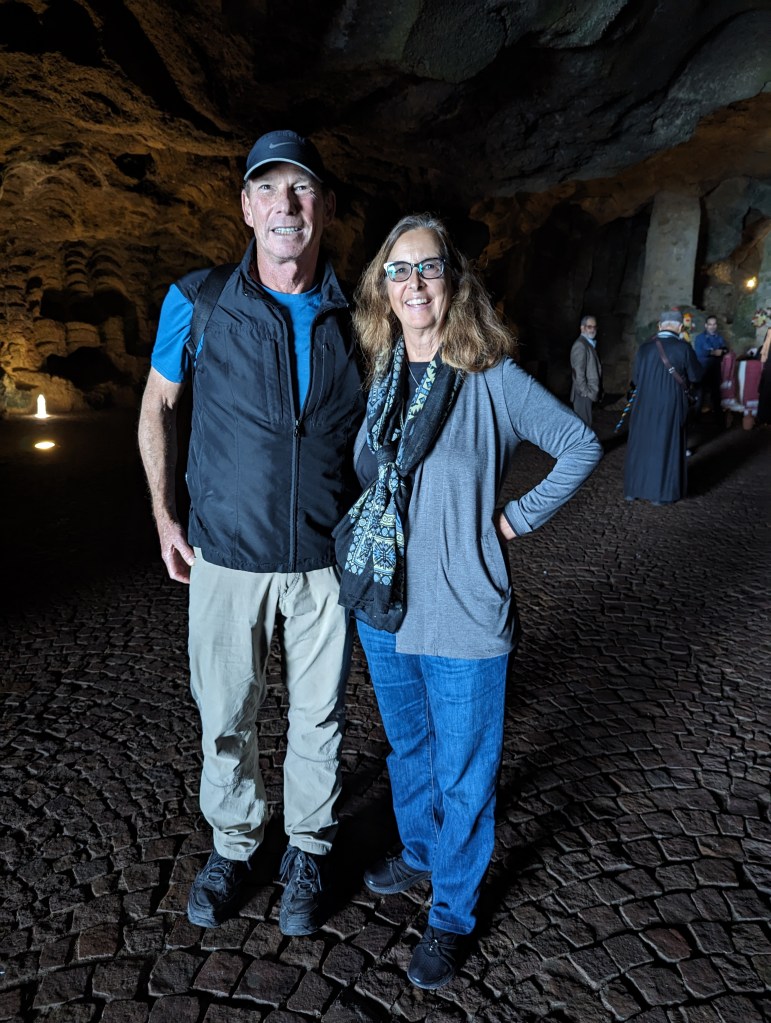
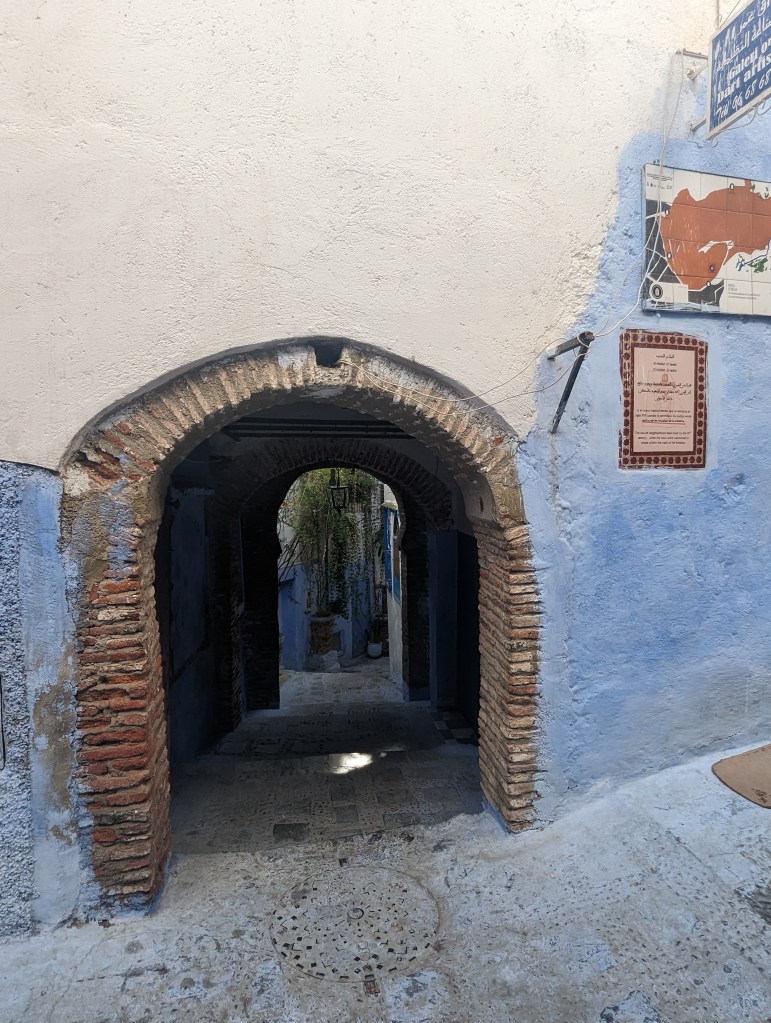
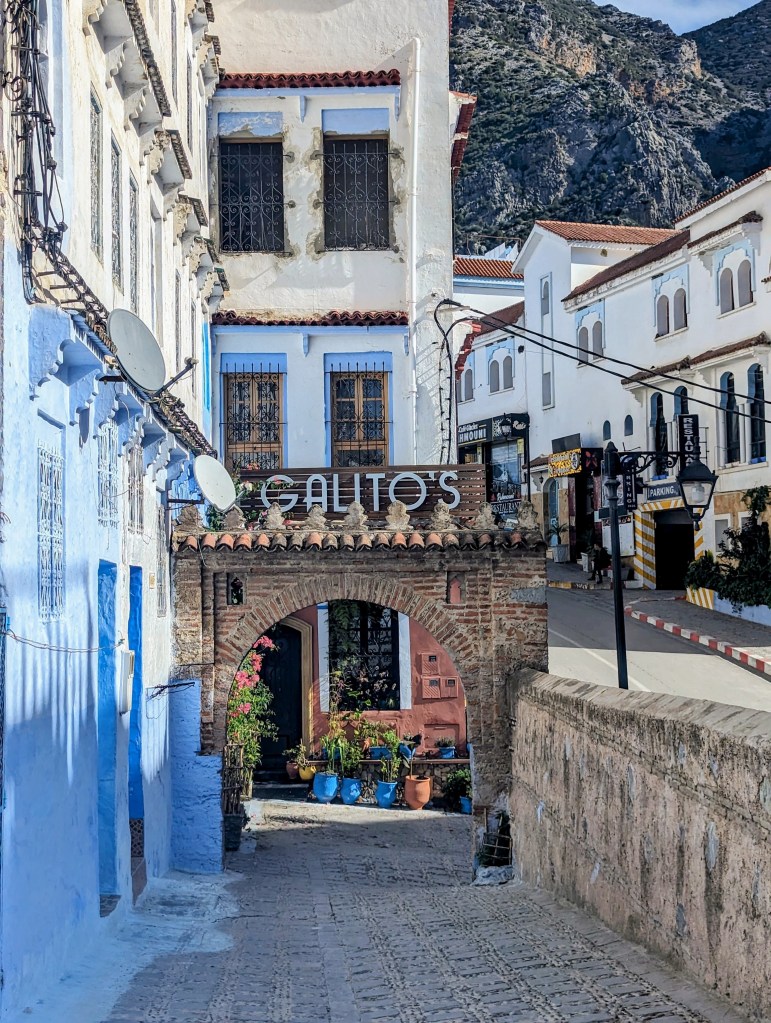
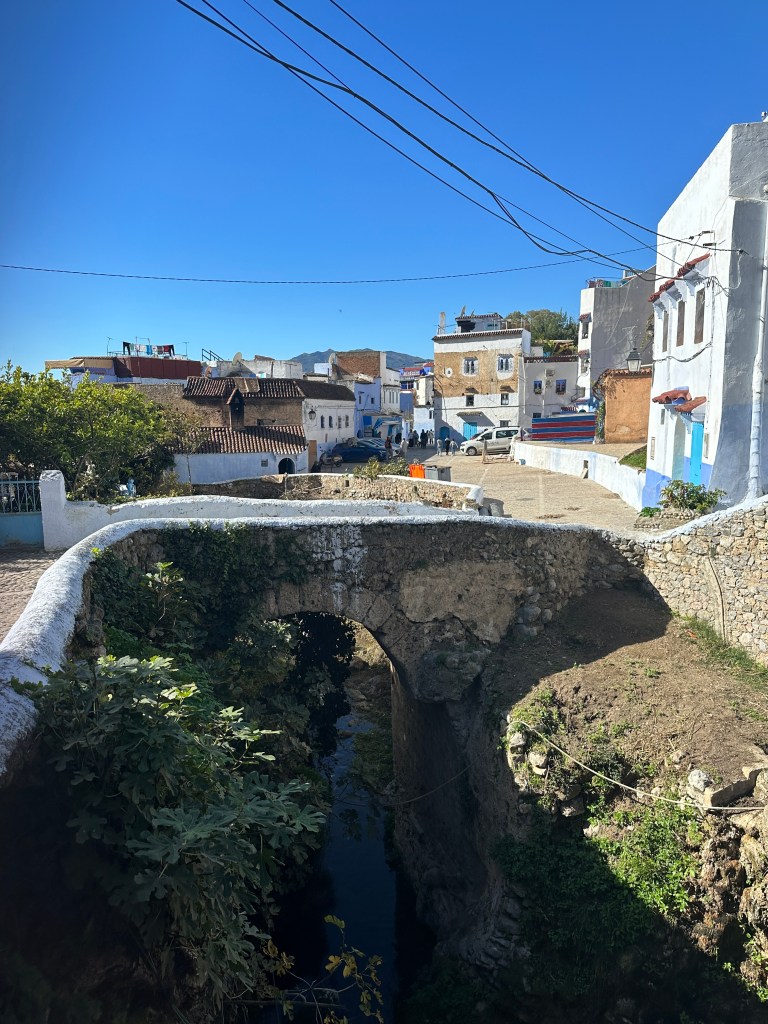
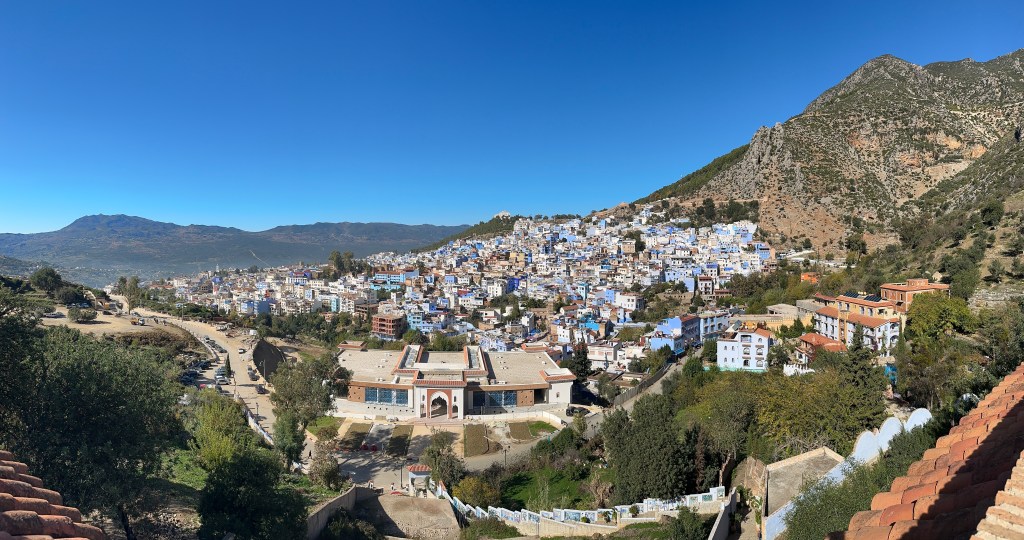
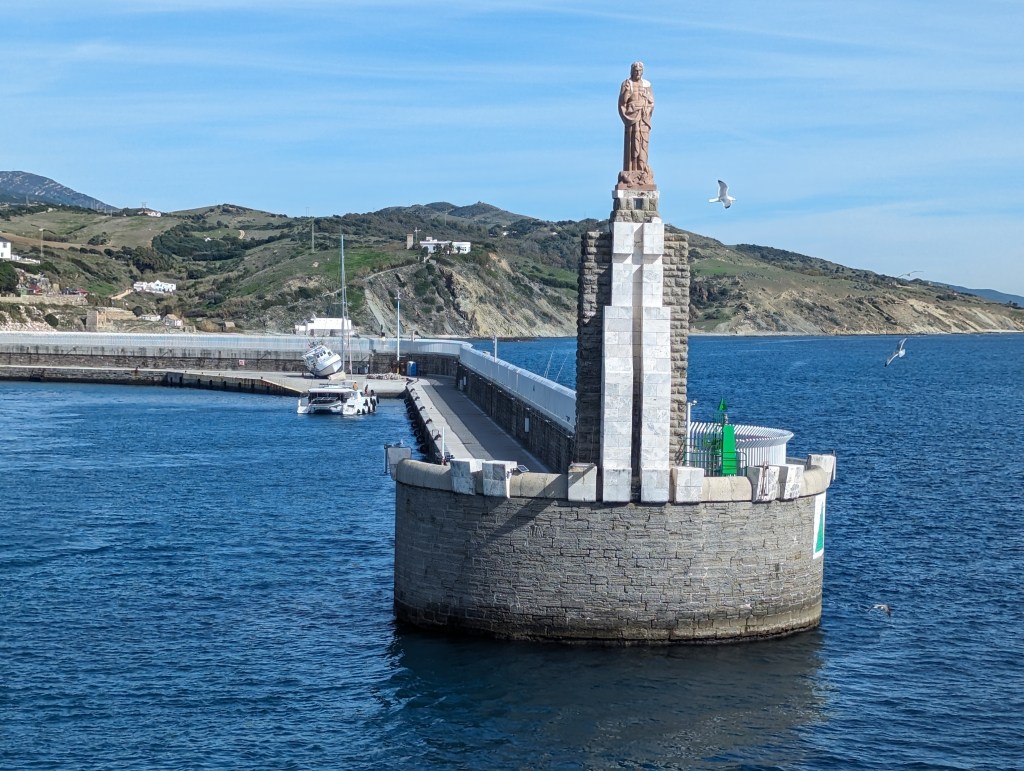
Morocco: Rabat Nov. 15-17 Fez Nov. 17-20 Middle Atlas Mountains: Ifrane Nov. 20-21

We arrived in Rabat in the early afternoon. Our hotel was in the middle of the medina.

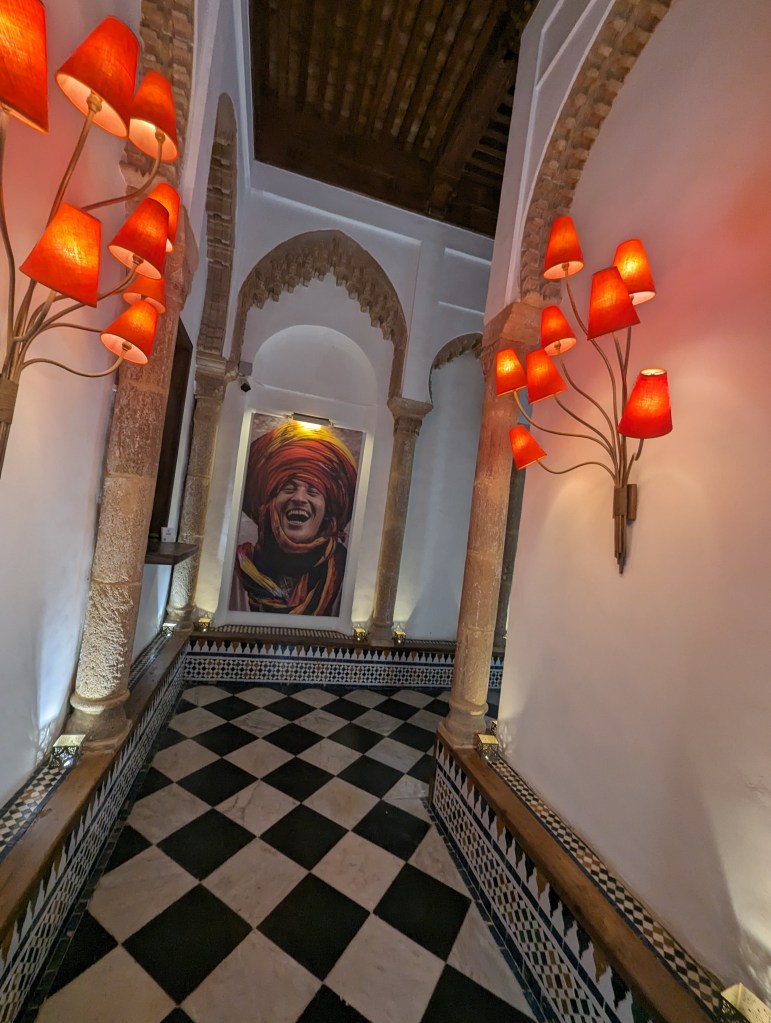
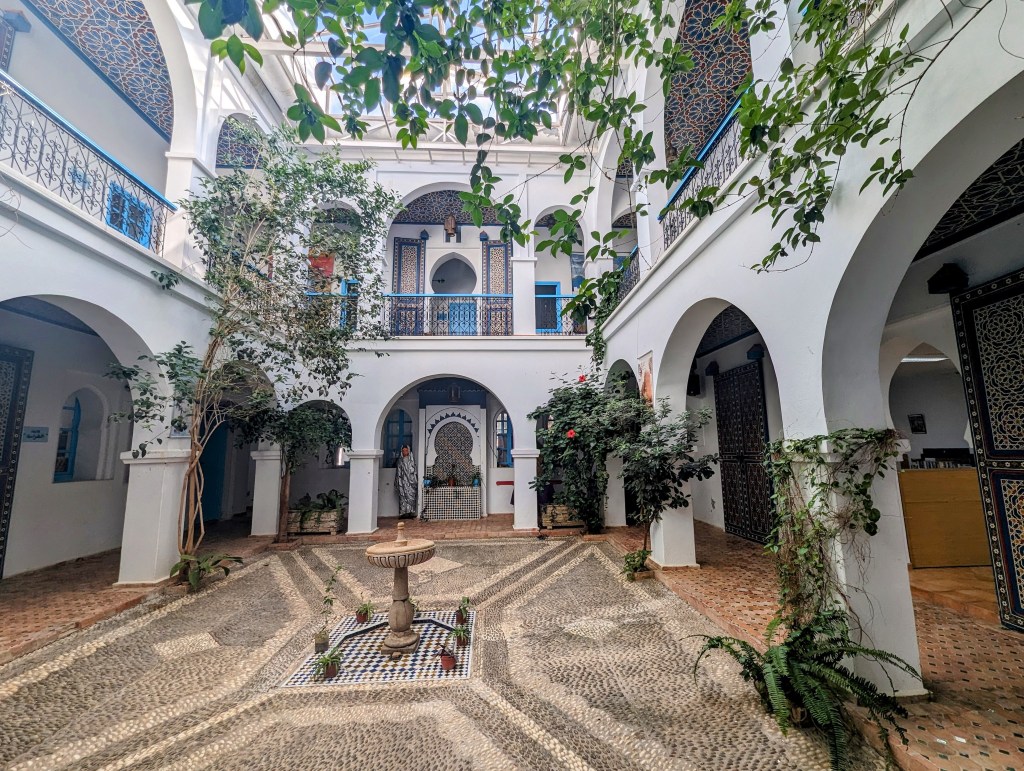
entryway Dar Shaan

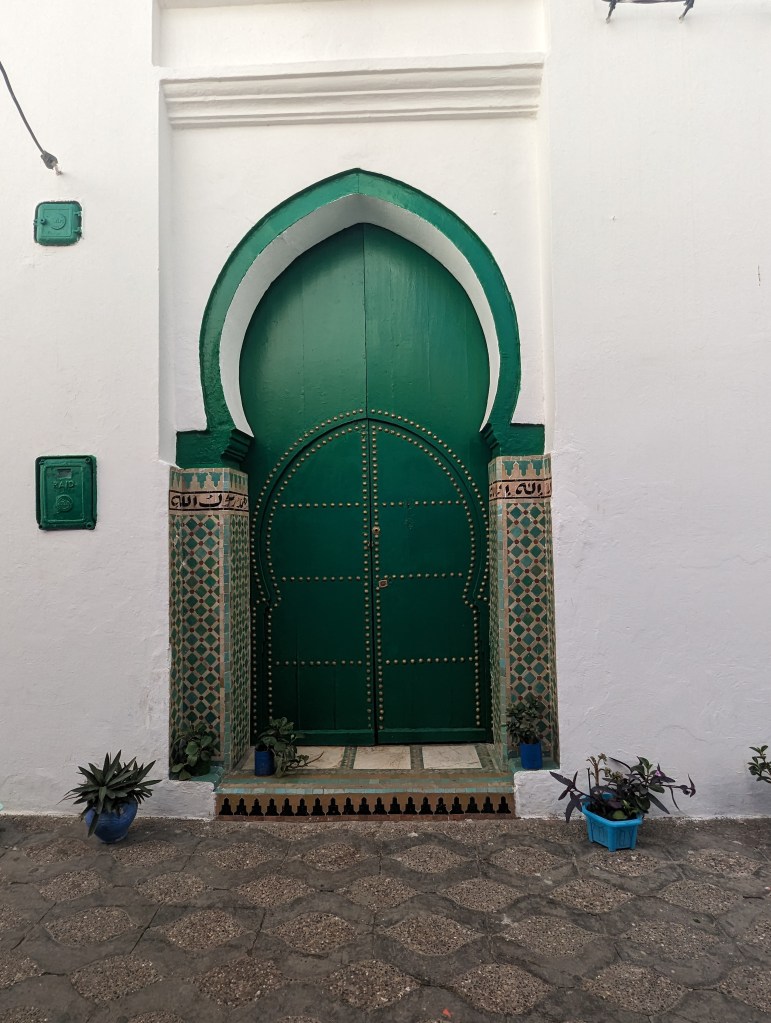
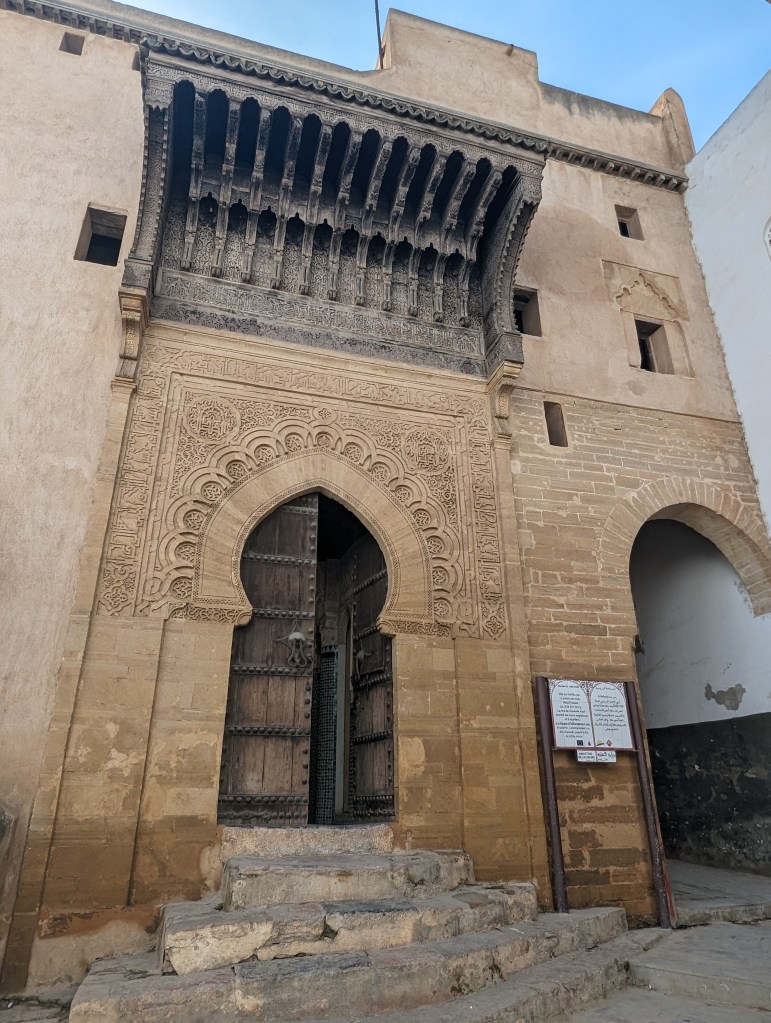
Dar means house or home. Riad is specifically a home with a garden, usually in the center. So not sure why this one is called Dar and not Riad. But note the entrance opens into a hallway. We have been told that the Muslim culture encourages one to be humble. Part of the reason for the long plain robes is to hide any good clothing or jewels. The homes are the same. They are supposed to be humble from the outside so as not to boast wealth. So even with the door open, one should not be able to see into a luxurious space within.
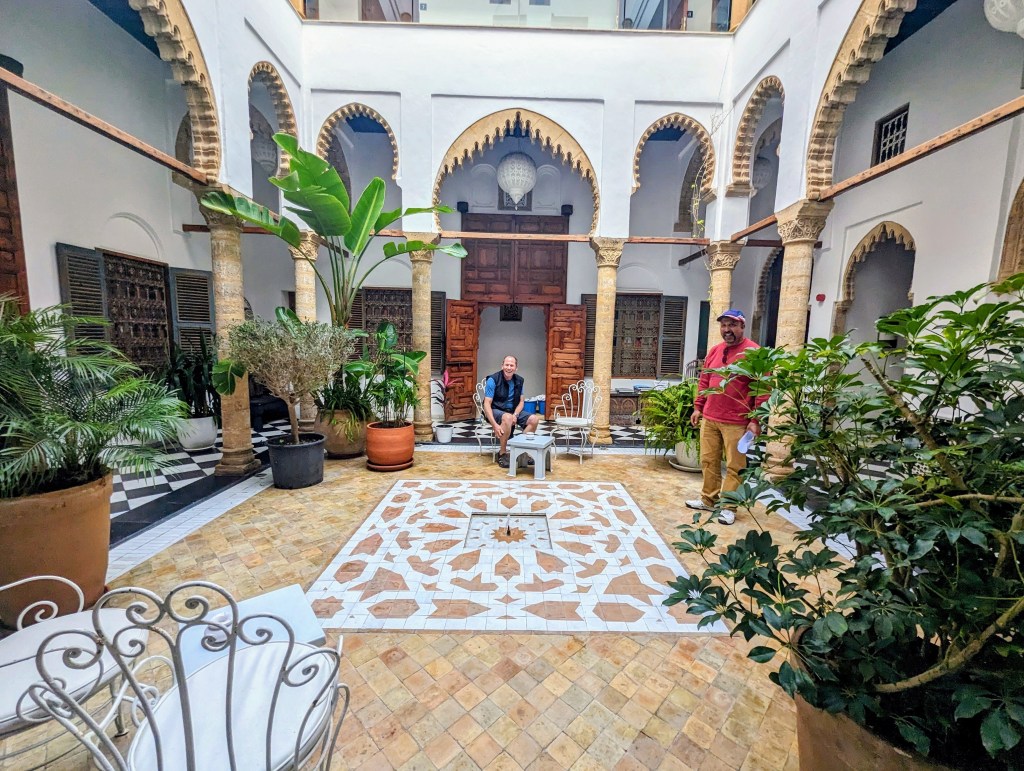
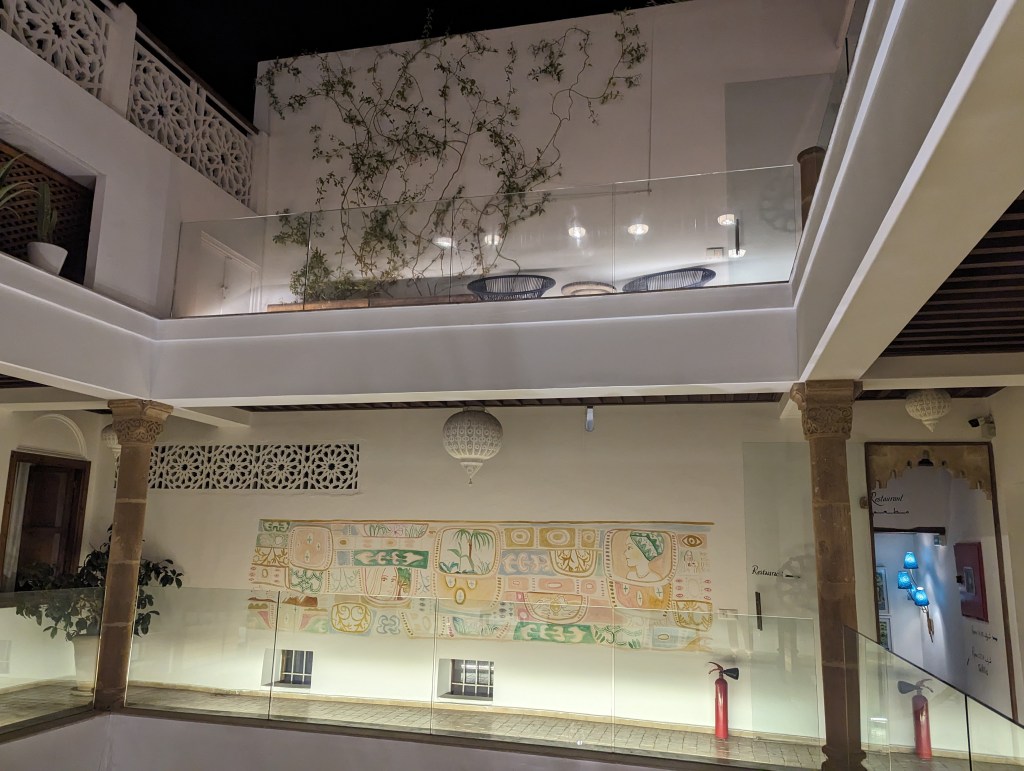
Only once inside does it open into the lush space seen here. The bedrooms in Dar Shaan all open into the courtyard not outside. That is also typical. In a traditional Muslim home, for privacy, there are often no external windows.

Once settled in we took a walk to the kasbah.

Kasbah of the Oudaias 

Here it is not within the medina but across the street. It had been a site of dwelling Phoenicians, Carthaginians and Romans, but had been mostly tribal. In the 12th century Almohad Muslim tribes established their Moroccan empire. It was then that the first ribat (or, fortress, from where modern-day Rabat takes its name) was built on the site of the current Kasbah. Rabat then became the first Moroccan capital. But over the centuries due to fighting between tribes, the area’s population dwindled. It was not until the 17th century when the last of the Moors were expelled from Spain that many settled here and further developed this fortress as well as the one in Salé across the Bou Regreg River.
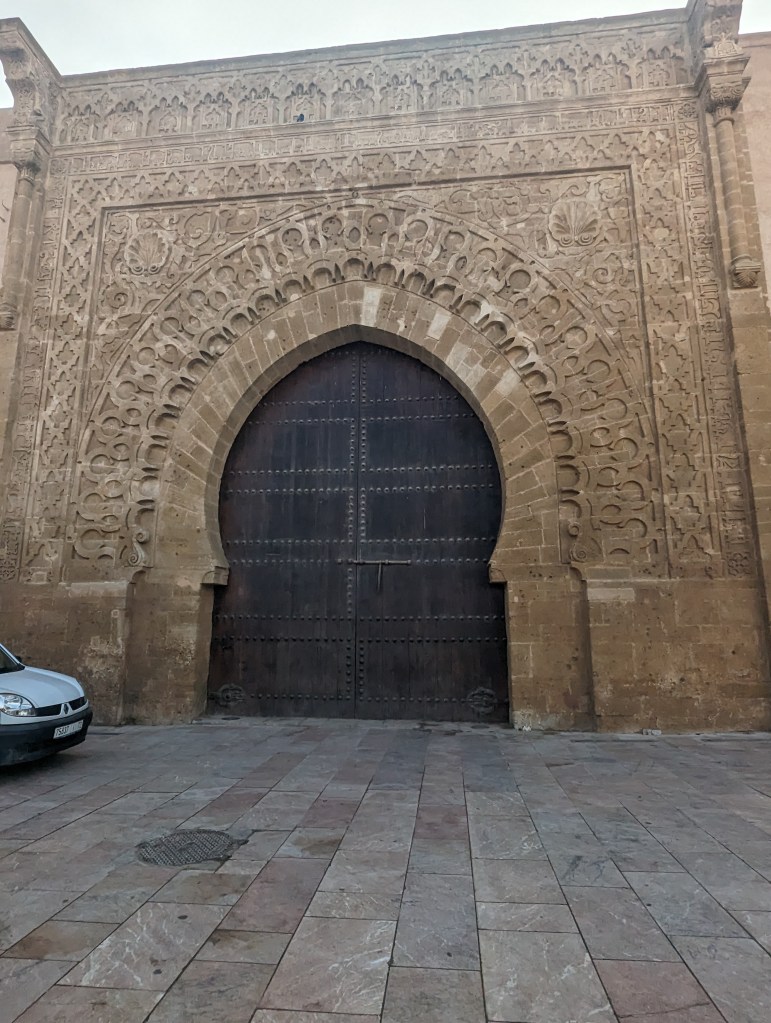
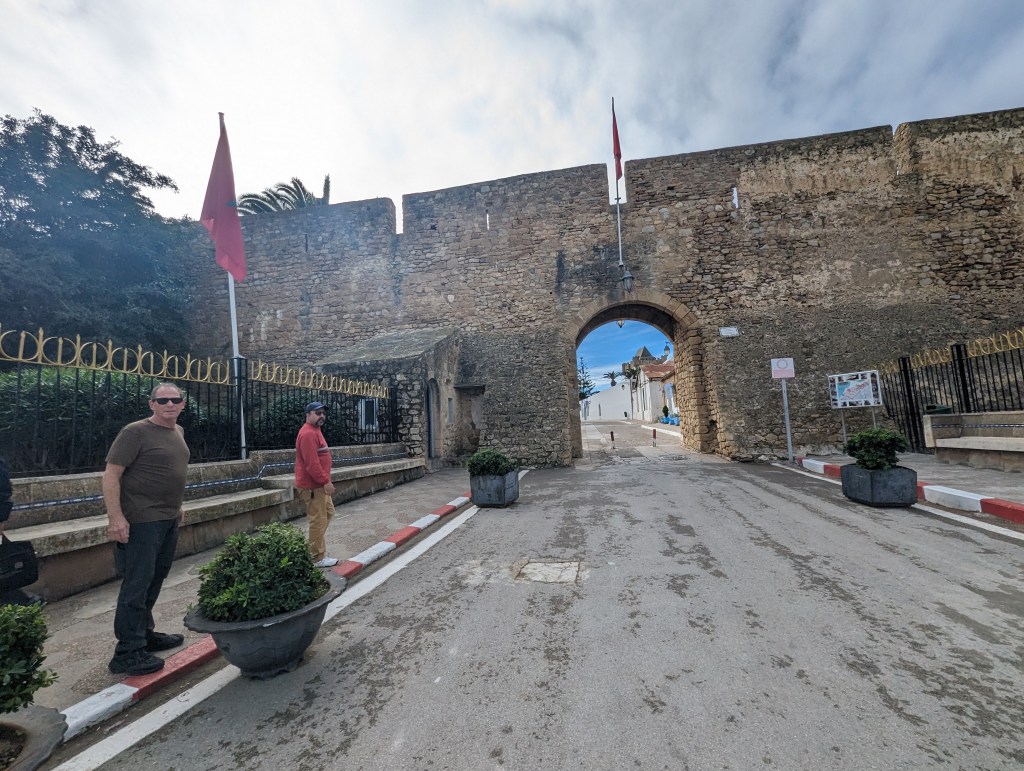
Bab Oudaya Gate

Built in the 12th century, the monumental Bab Oudaya Gate, located uphill and overlooking Rabat below, is considered one of the most beautiful gates of Almohad Moroccan architecture. Once through, the first thing is, of course, a water fountain.

We strolled around looking for the promised gorgeous views. But there was so much mist off the ocean, it was difficult to see far.

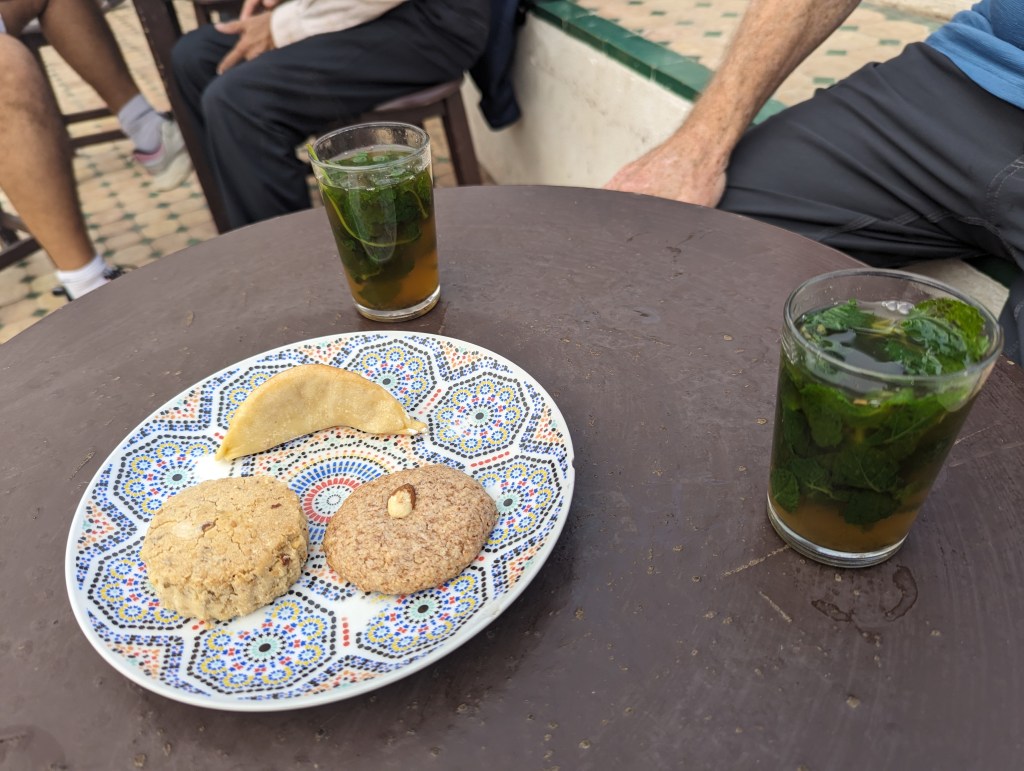
We made our way down to the bottom, newer section of the kasbah and stopped for tea and almond cookies – there were about 7 or 8 different ones to choose from – at Cafe Maure.
We then strolled through the Andalusian Gardens developed in the early 20th century during the French protectorate of Morocco (more on that later). What makes a garden an Andalusian one are the inclusion of three elements: several levels; a water element; and foods, herbs, and/or fruit trees.

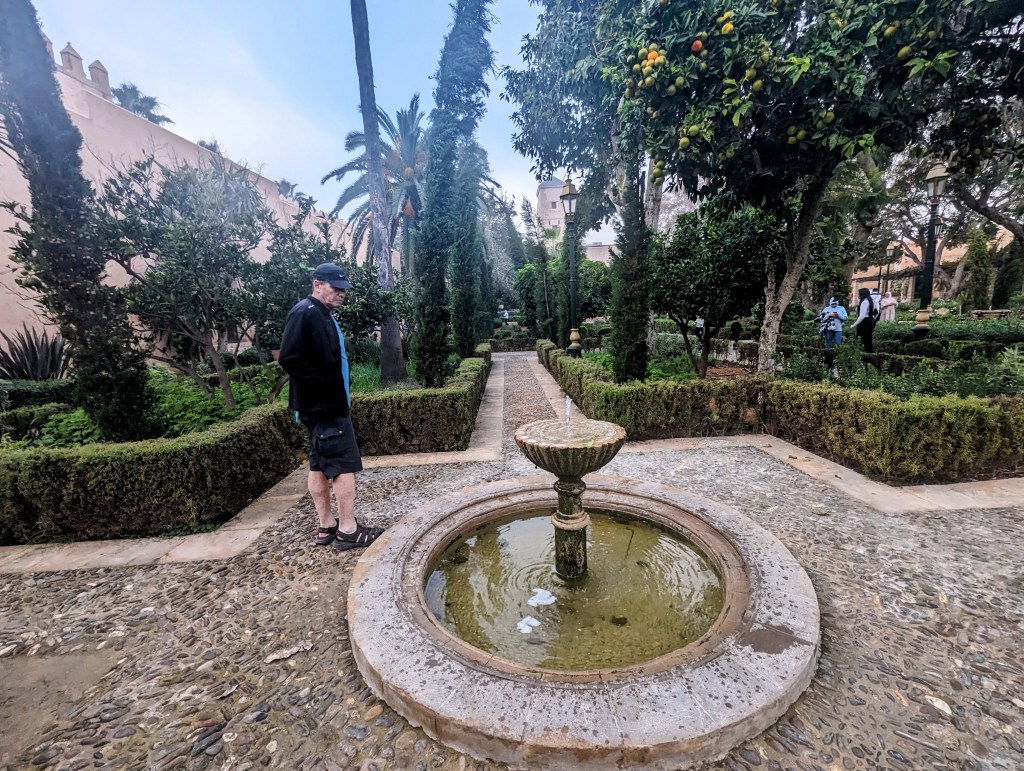
Andalusian Garden Kasbah of the Oudaias Rabat

We left the Kasbah from the lower end and had a view of the tower.
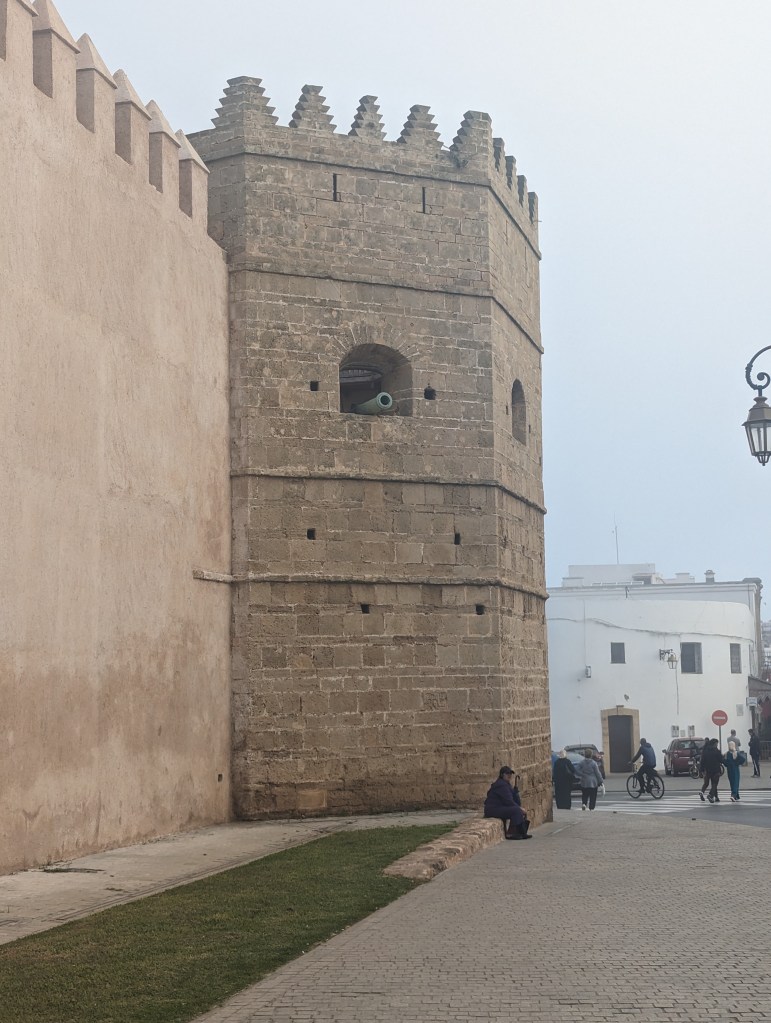
We then crossed into the medina, which was really bustling in the late afternoon.

Dinner was tagine in Dar Shaan. We then retired to our room, which, as I’ve said, looked out onto the courtyard.
In the morning we met with our guide Esma, newly graduated from a guide program, one of 2 women in her class of 50. As she walked us into the medina, she explained a bit about the history of Rabat, which is the current capital of Morocco and home of the king. In 1912 France decided that Morocco needed protection. They moved in and controlled Morocco and its resources. They allowed Spain to control the most northern and southern regions, but they kept control of the central portion of the country. The king was called sultan during that time. He was allowed to live in the country but had little power. This period of time is called the time of the French Protectorate. The king was exiled to Madagascar in 1950 but with help from friends returned in 1953 and fought his way back to power. Morocco achieved independence in 1956. One can see in Rabat, more than most other cities in Morocco, the influence of the French in the architecture.

Upon entering the medina, Esma pointed out that you can immediately tell which are the Moroccan homes, those with no windows on the outside, and which are the French, windows and even balconies. The first street of the medina is called the Avenue of the Consuls because prior to the French protectorate it was home to foreign consuls including those of Sweden, Denmark, and Holland. Today it has Moroccan government offices.
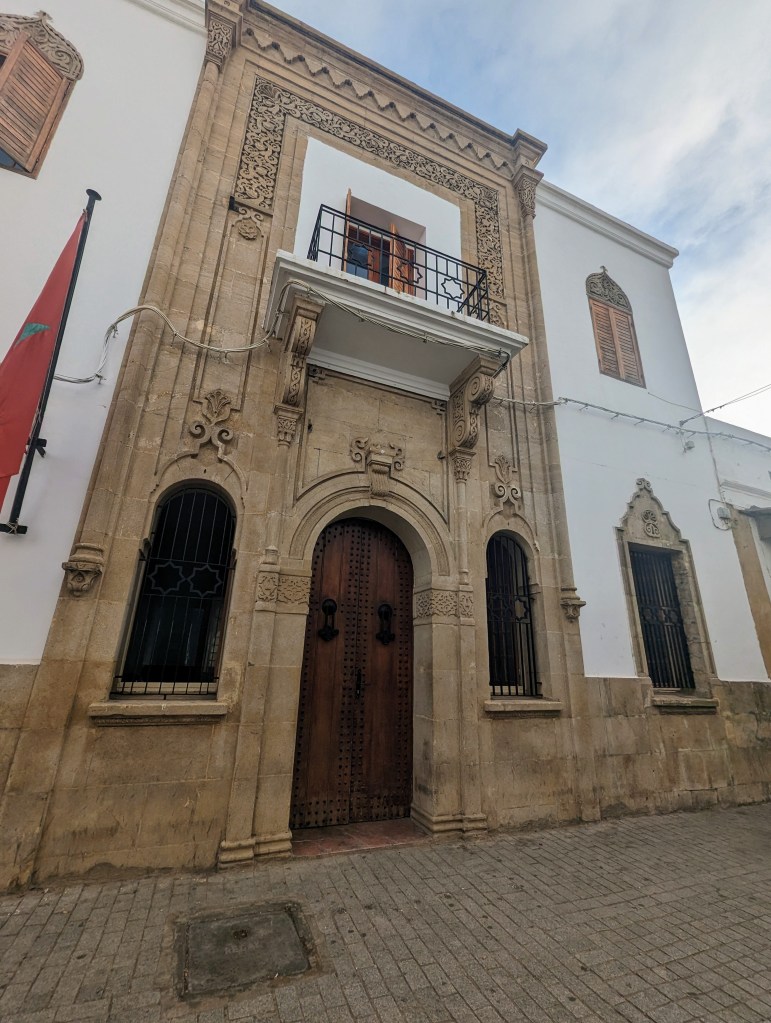
The entire medina has been designated a World Heritage Site by UNESCO, and has undergone major restoration in the last few years as can be seen by the new appearance of the exteriors of the shops.

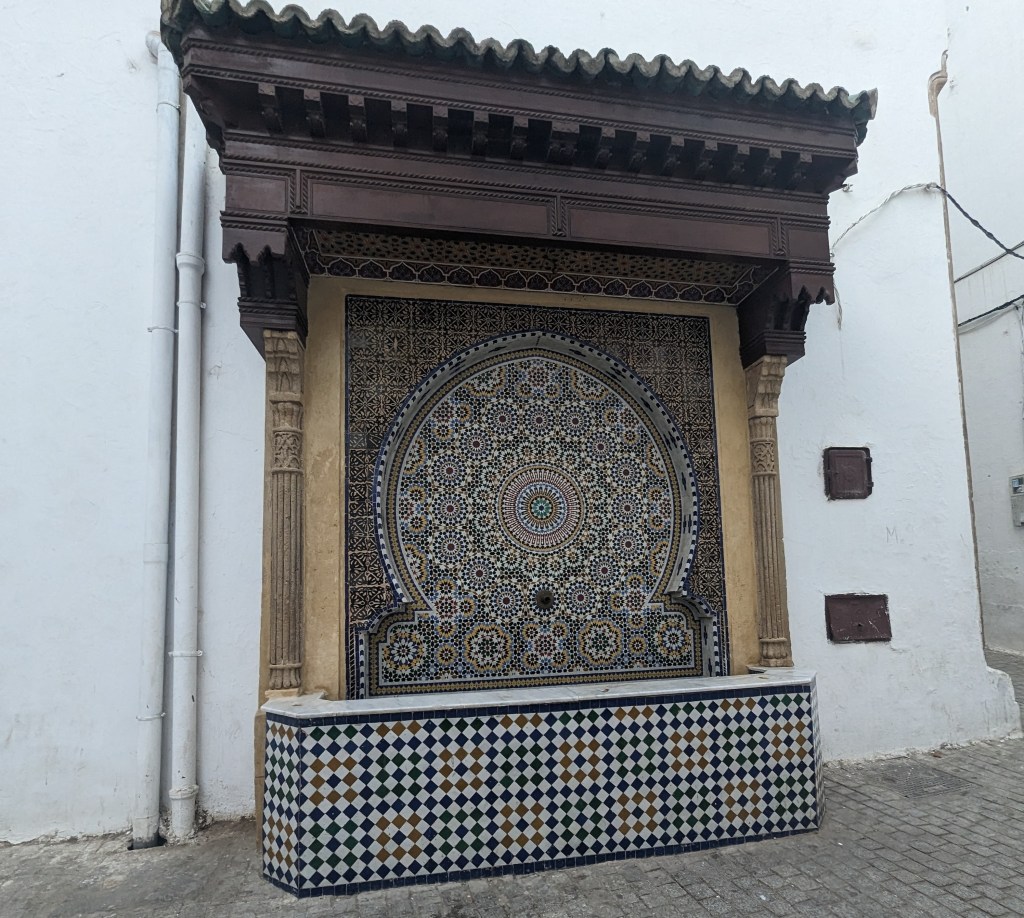
But it also retains the old elements like the water sources.
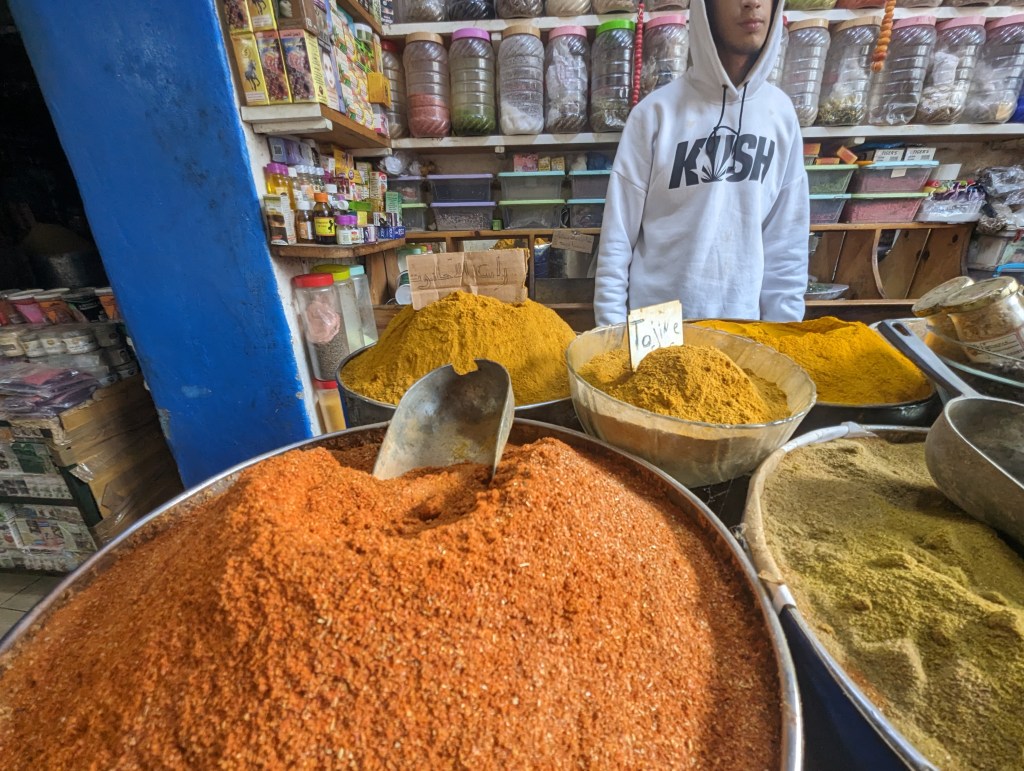
As we walked through the medina she pointed out the different spices popular in Moroccan cooking and teas for infusions.
She showed us the huge variety of oils, infusions, and products for hair, skin, face, and bathing.
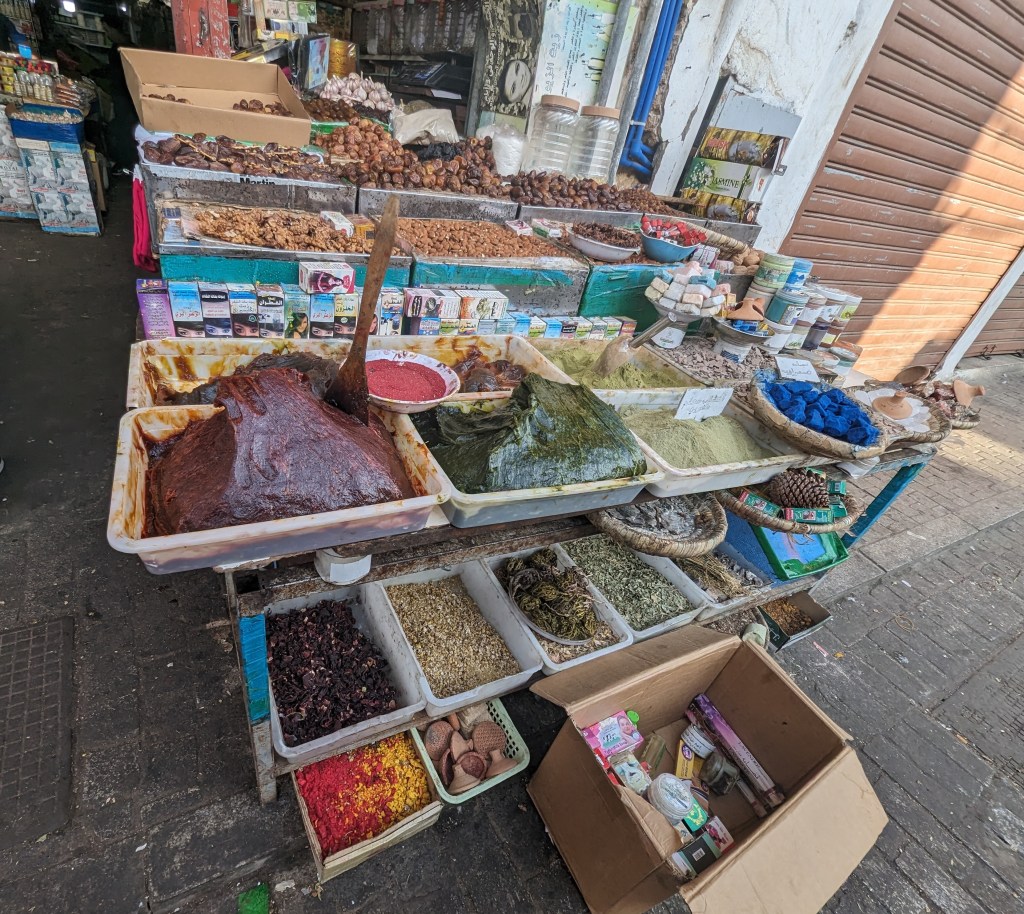
And she showed us the huge variety of dates grown in the country.

Then we left the medina and entered “New” Rabat built during the French protectorate period.

Here can be found examples of early 20th century French architecture. In the building below, when part of it was removed for the adjacent new building, the removed parts were painted onto the new adjoining building to maintain visual continuity.

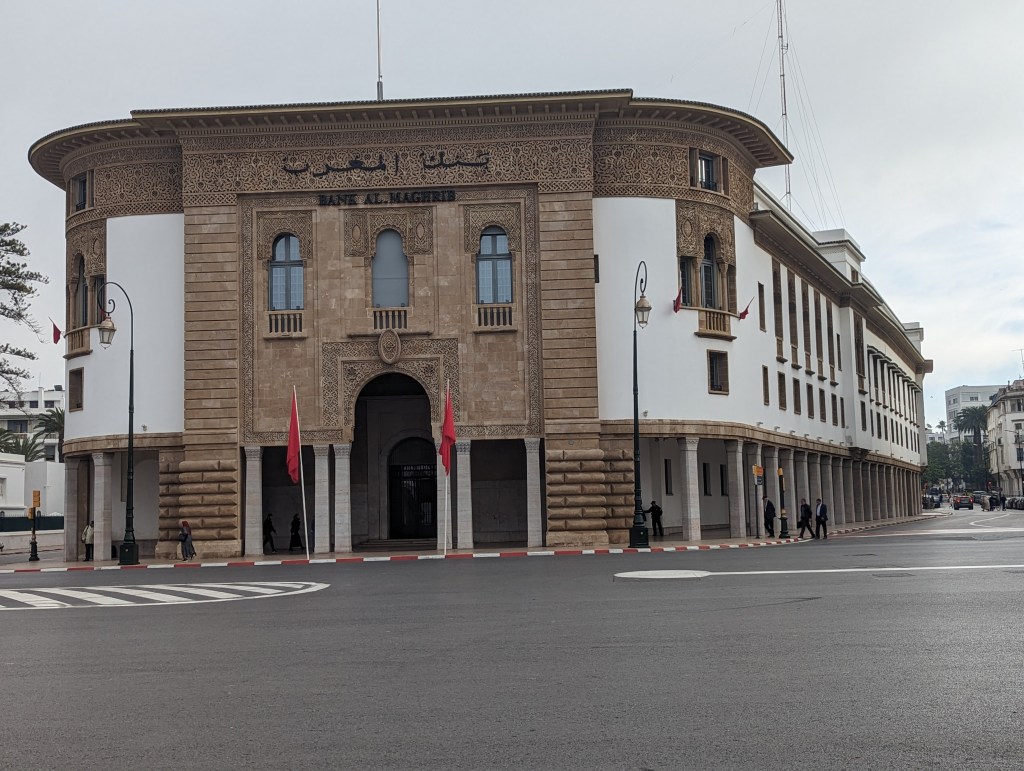
We passed The Bank Al-Maghrib, the central bank of Morocco founded in 1959, after independence. It is the successor to the State Bank of Morocco which had been founded in 1909 to “stabilize” the Moroccan currency for and by European influence. It was built here in Rabat by the French in 1925 to represent the city’s enhanced status as the country’s new capital (transferred from Fez).
We passed the parliament building.

And the train station built by the French in 1925 and currently offering high speed train access to multiple cities around the country.
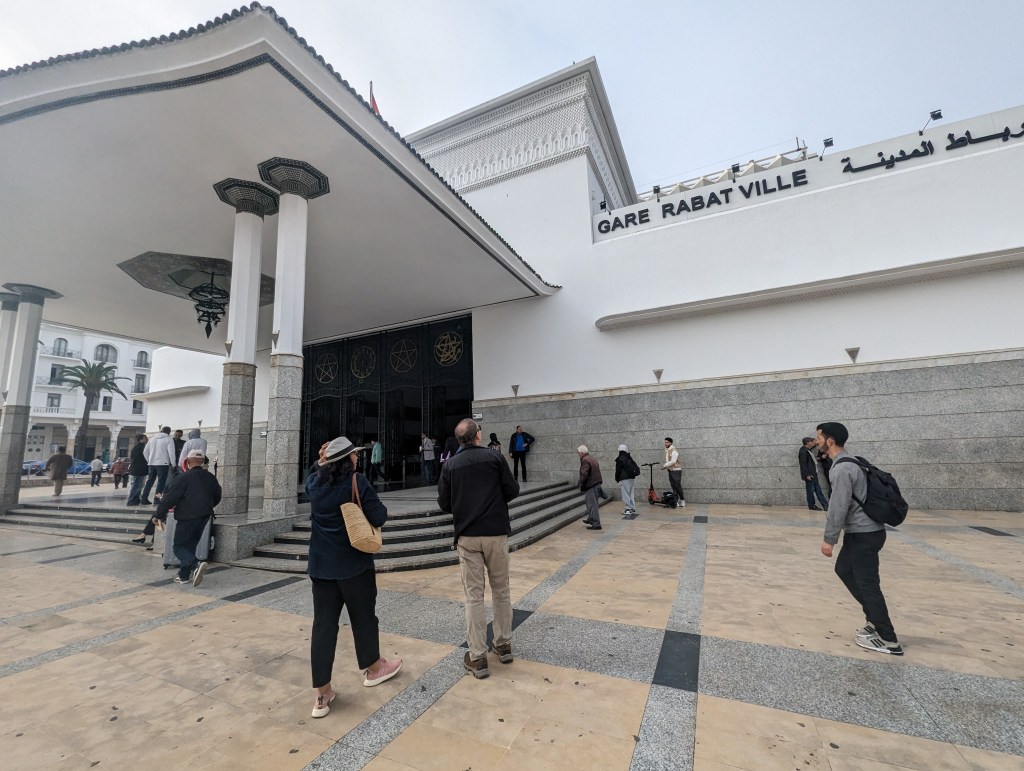
The area in front of the train station and Parliament buildings was the French military parade ground.
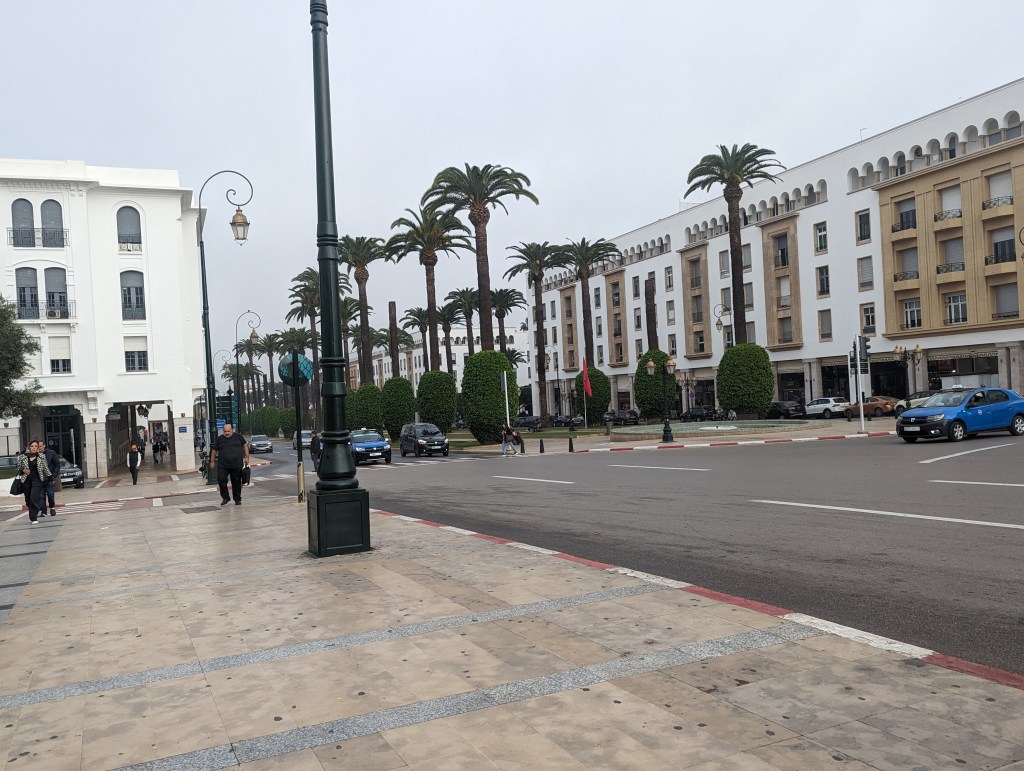
Then we passed the Credit Agricole, a bank of France still in Morocco.

And we passed a French school, which is private and expensive, with ties to universities in France.
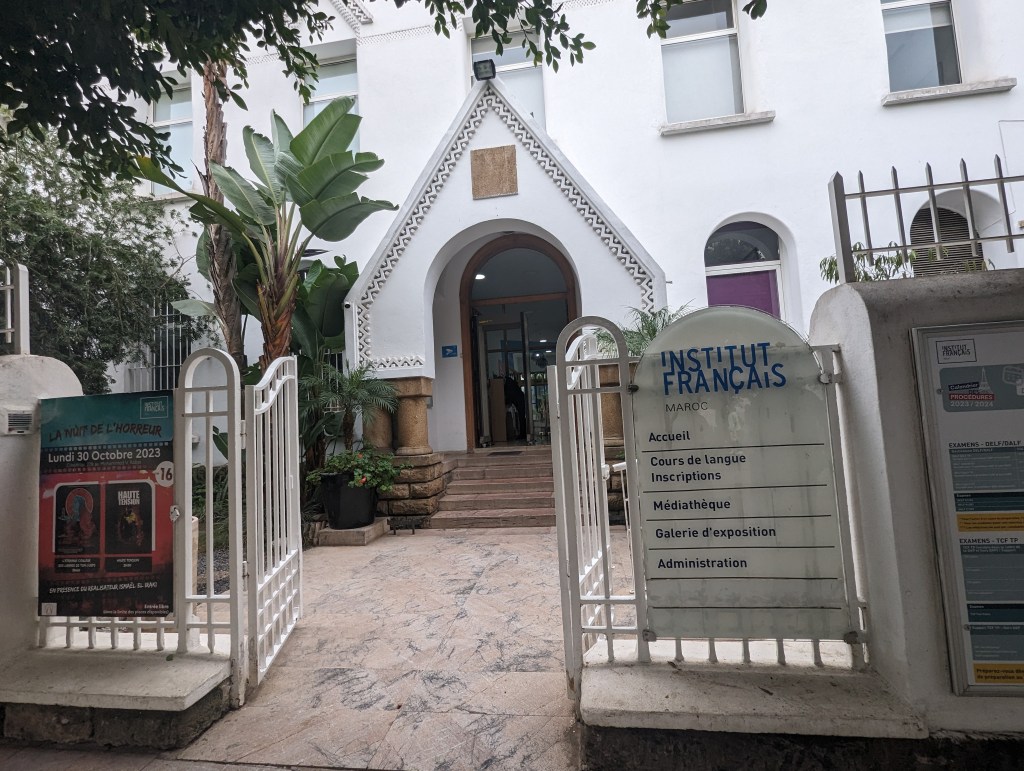
Esma explained to us that the current king has been pushing for years to expel the French influence financially and culturally from his country. In two years French will no longer be the third official language of the country and taught in schools; English will. She went on to tell us that the current king is very popular with the people as is his son. The king’s son is currently enrolled in a public college because he wants to learn as the common people do and understand their experiences. The entire royal family is believed to be in touch with the people of Morocco that they serve.

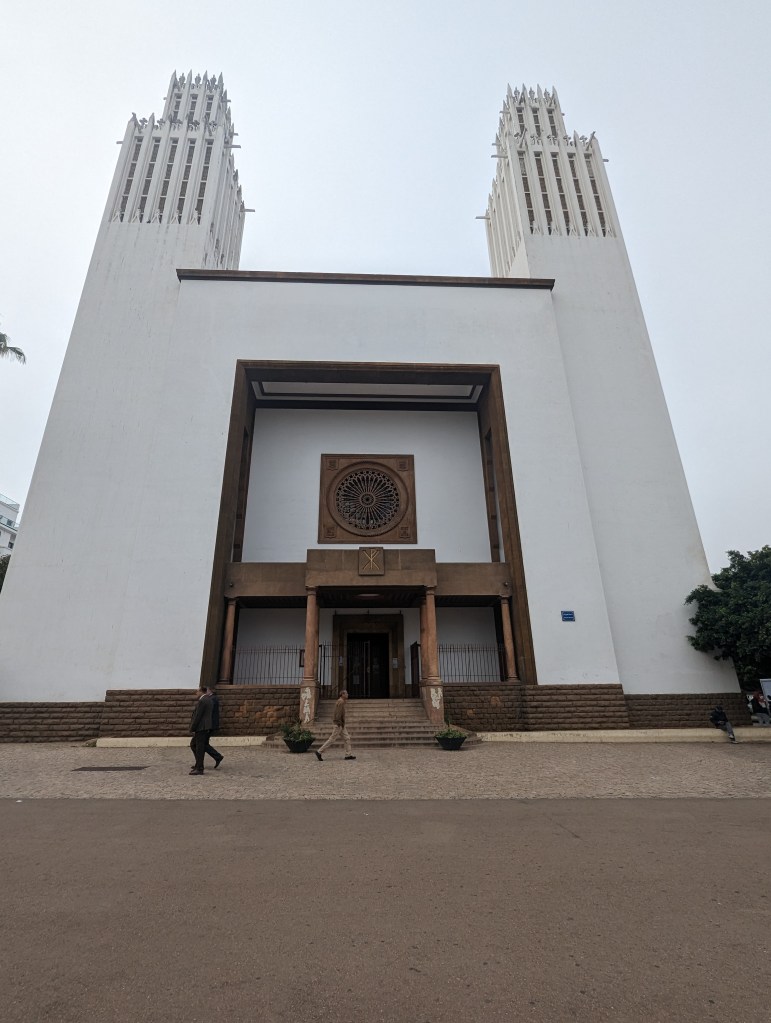
We then went to the St. Peter’s Cathedral of Rabat. It was built in the art deco style in 1921 by the French. Understanding that Muslims preference for a humble exterior and Muslim law does not allow for depictions of any human or animal forms, the French were respectful and kept the exterior quite plain.
The interior is decorated with mosaic tiles depicting the stations of the cross.

There is no large altarpiece.
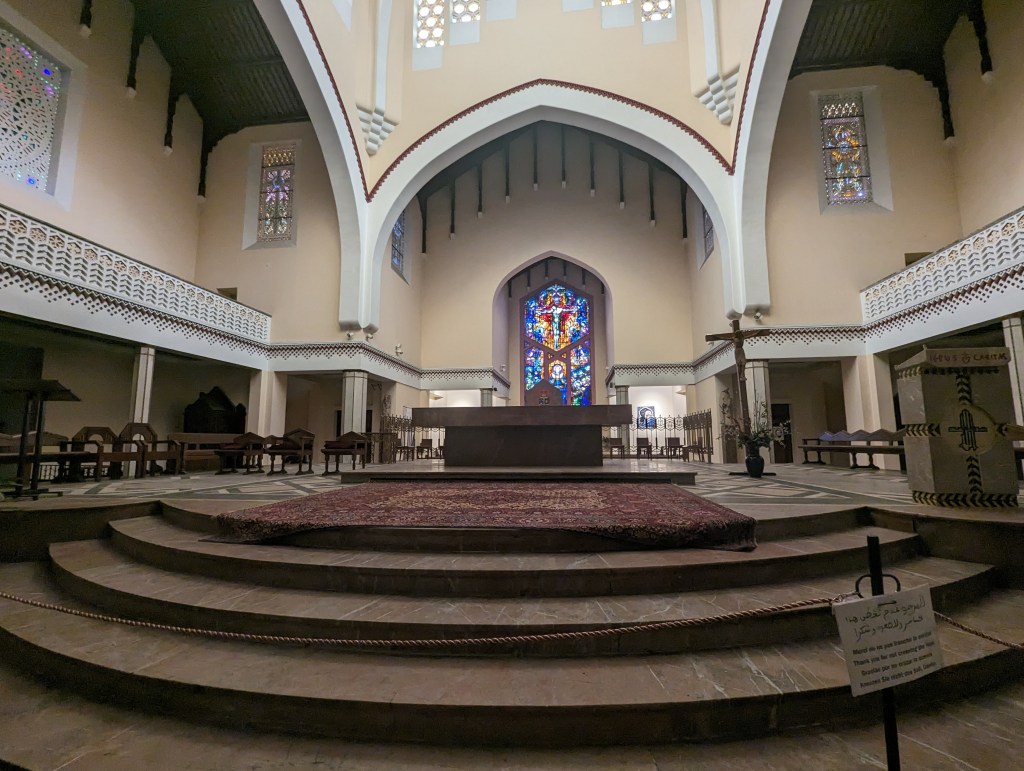
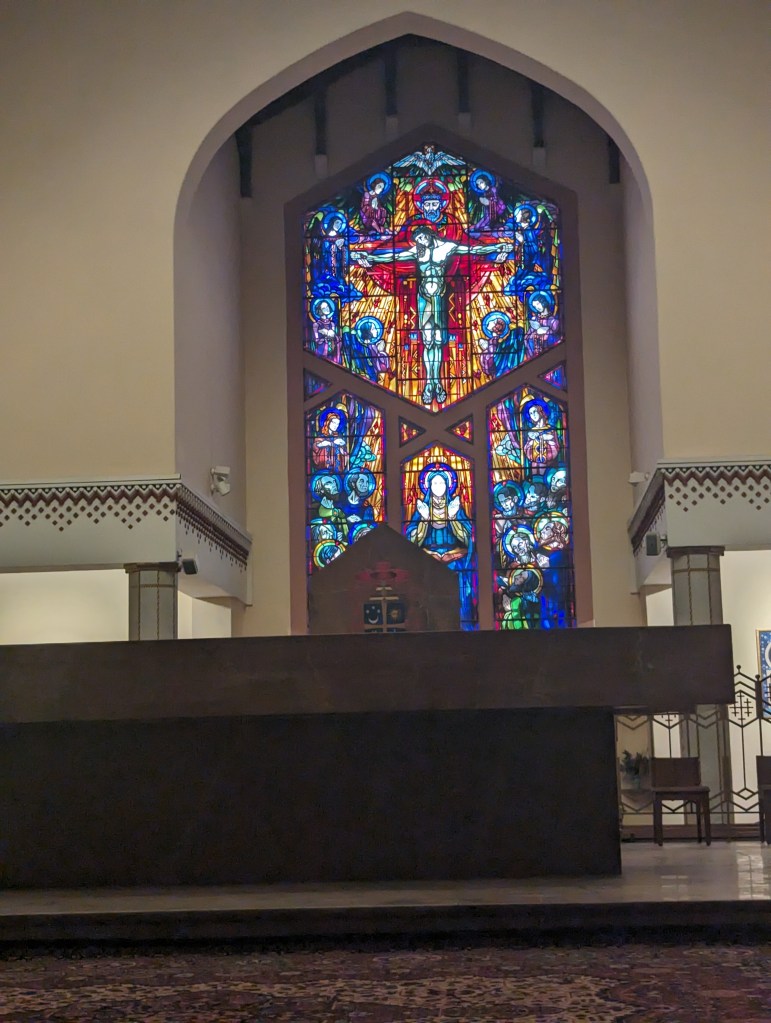
Behind the altar is a stained glass window.
Outside we were passed by the local metro, which is quite clean and modern in appearance.

We then headed to Yacoub Al Mansour Square. One enters passing two guards on horseback who change every 4 hours without ceremony.

Inside the square is a mosque, a museum, and a mausoleum. At one end is a museum of the history of Morocco with an elevated porch and domed arches surrounding a pavilion. At the other end is the mausoleum. Between the two elevated structures is the mosque.
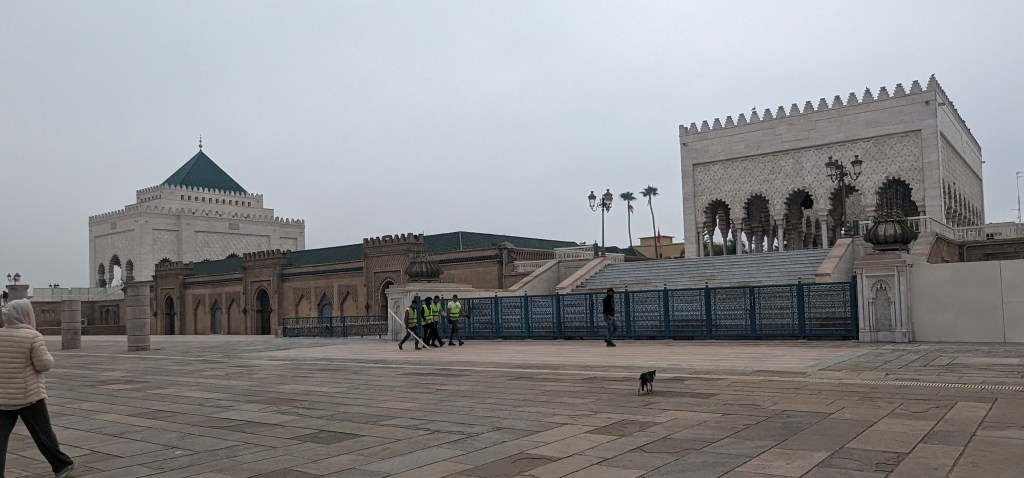
The museum is currently under renovation. The mosque is not open to the public, but the mausoleum is. King Hassan II commissioned the construction of the Mausoleum of Mohamed V for his late father, Mohamed V, in the year 1962. Construction of the Mohamed V Mausoleum was completed in 1971. Both of his sons have subsequently been buried there. It took over 400 builders and craftsmen nearly 10 years to complete the project.
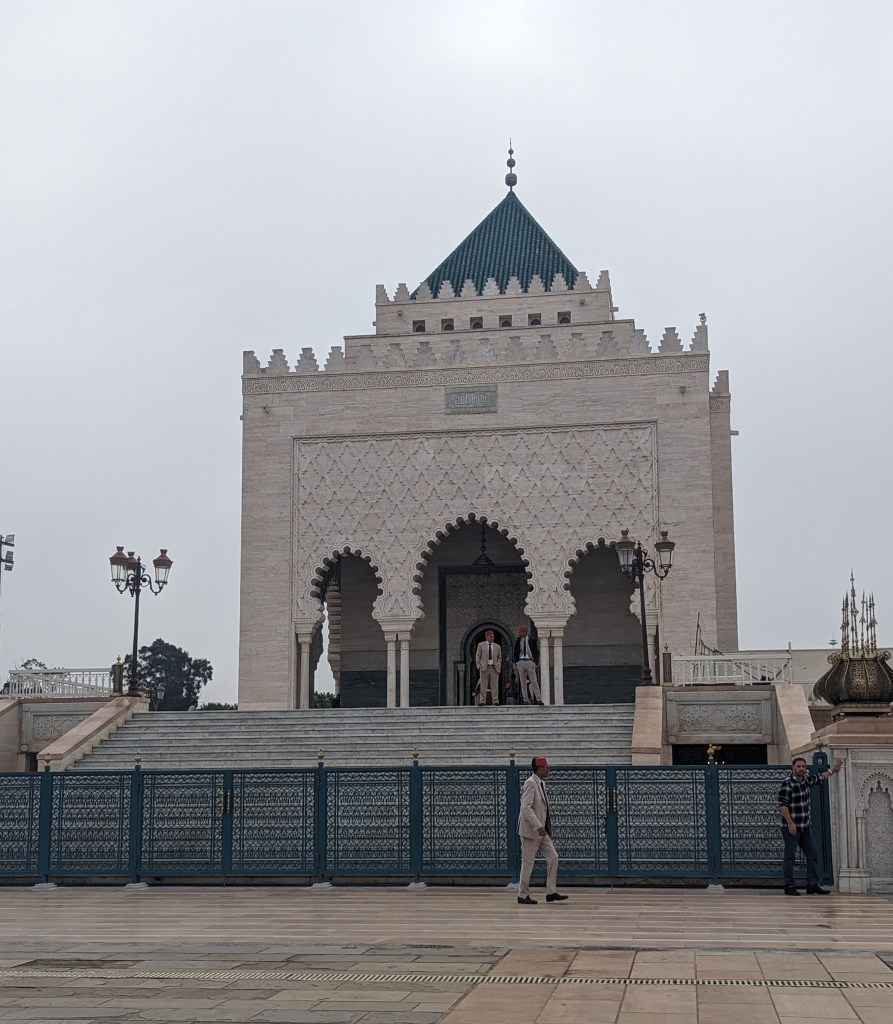
It was designed by a Vietnamese architect, hence its elevated design, not typical at all for a Muslim tomb. There is a guard at every entrance. They change every two hours.

Inside are the tombs. Muslims must be buried underground so the bodies are actually about 10 feet below the decorative sarcofagi.
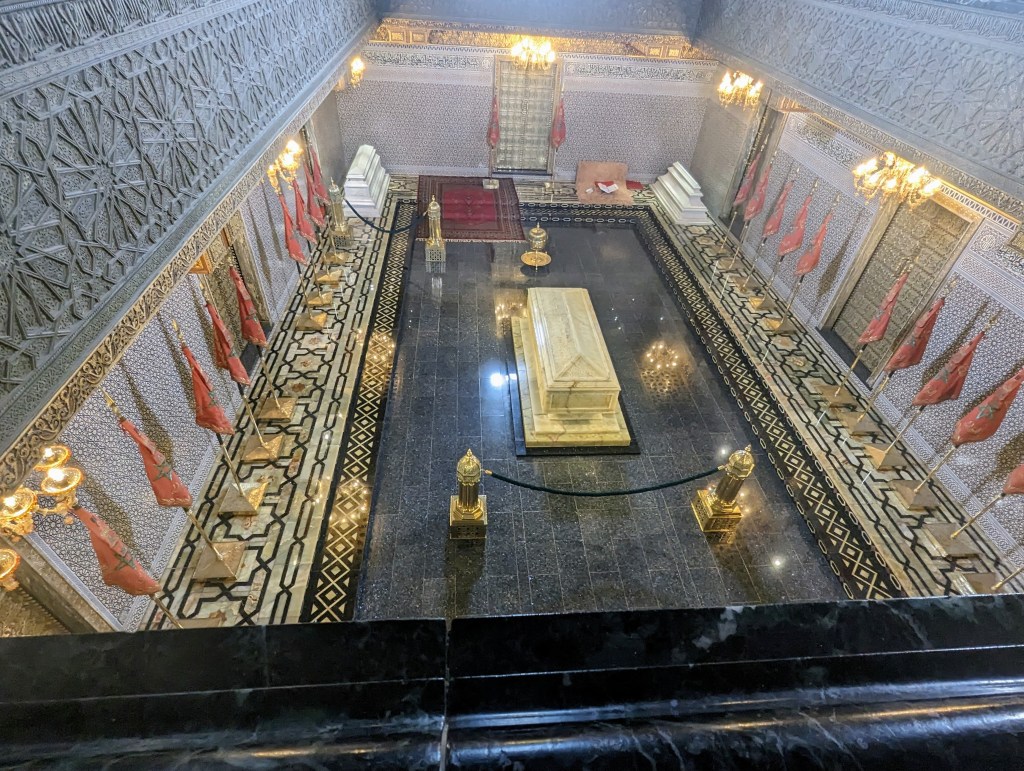
King Hassan II wanted to encourage traditional craftsmanship as a means to promote a sense of Moroccan identity and showcase to the world the beauty of Moroccan artisans’ work. The floors are marble.
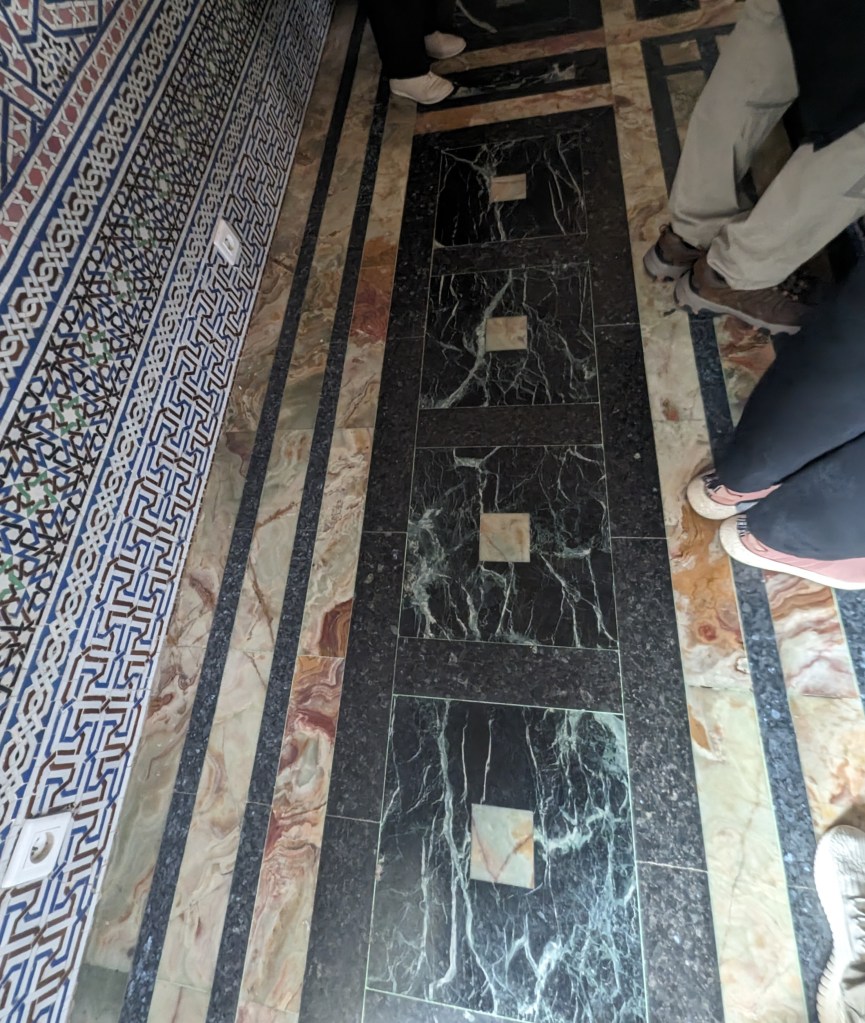
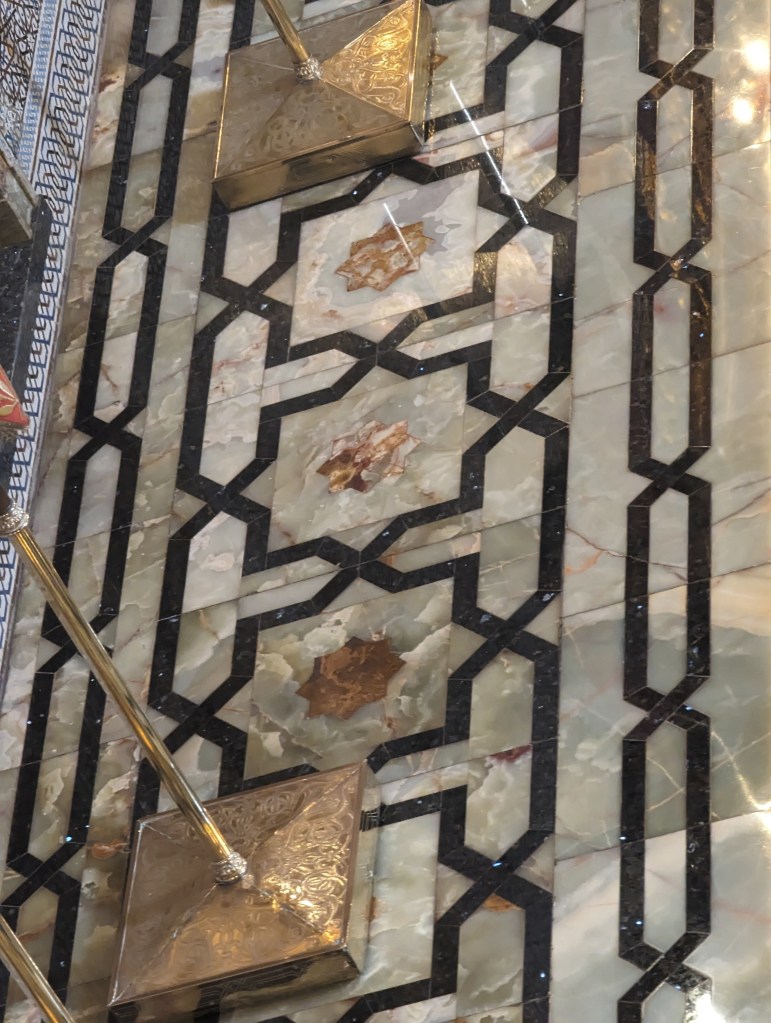
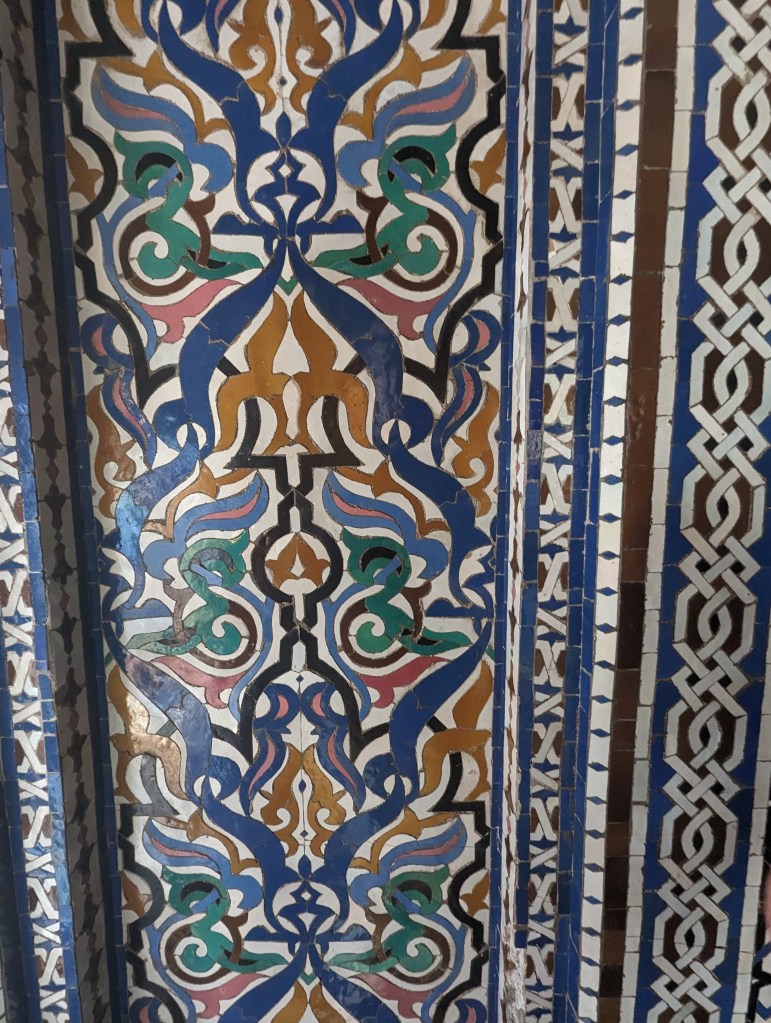
The lower walls are covered in mosaic tiles.
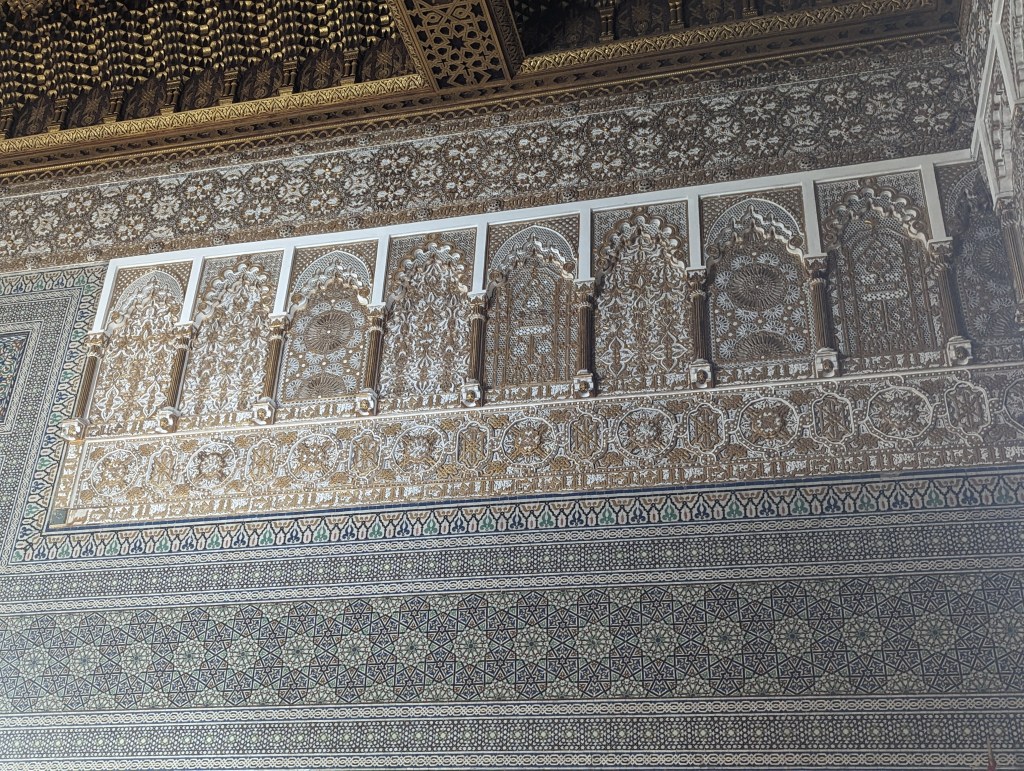
The friezes are carved plaster,
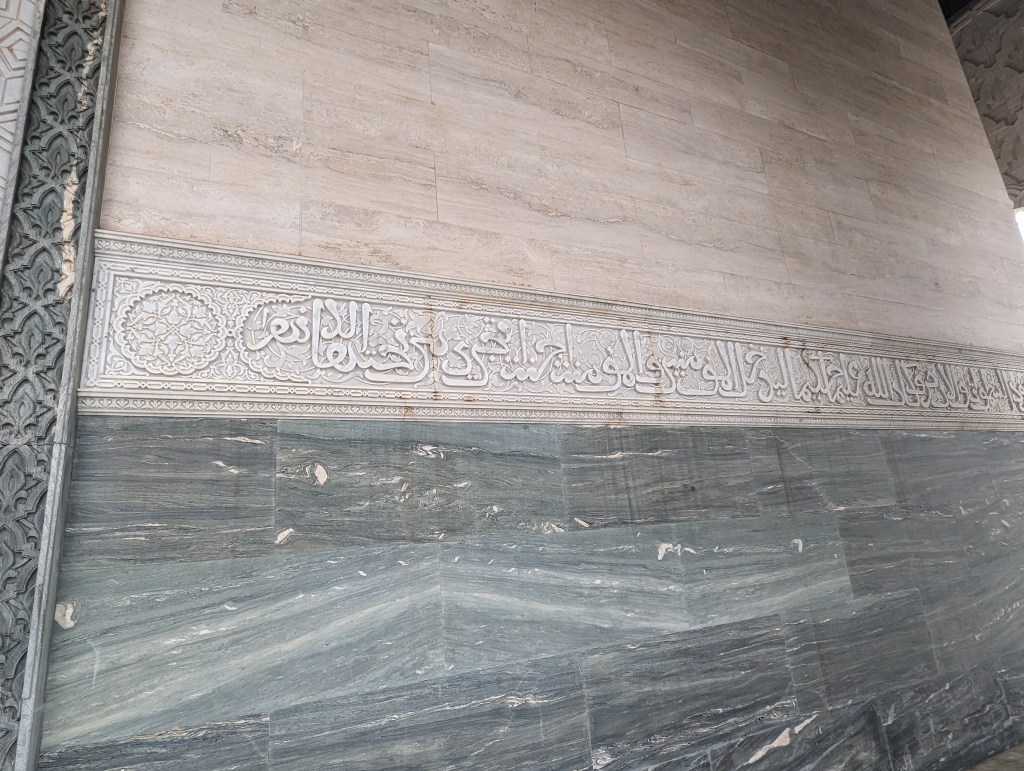
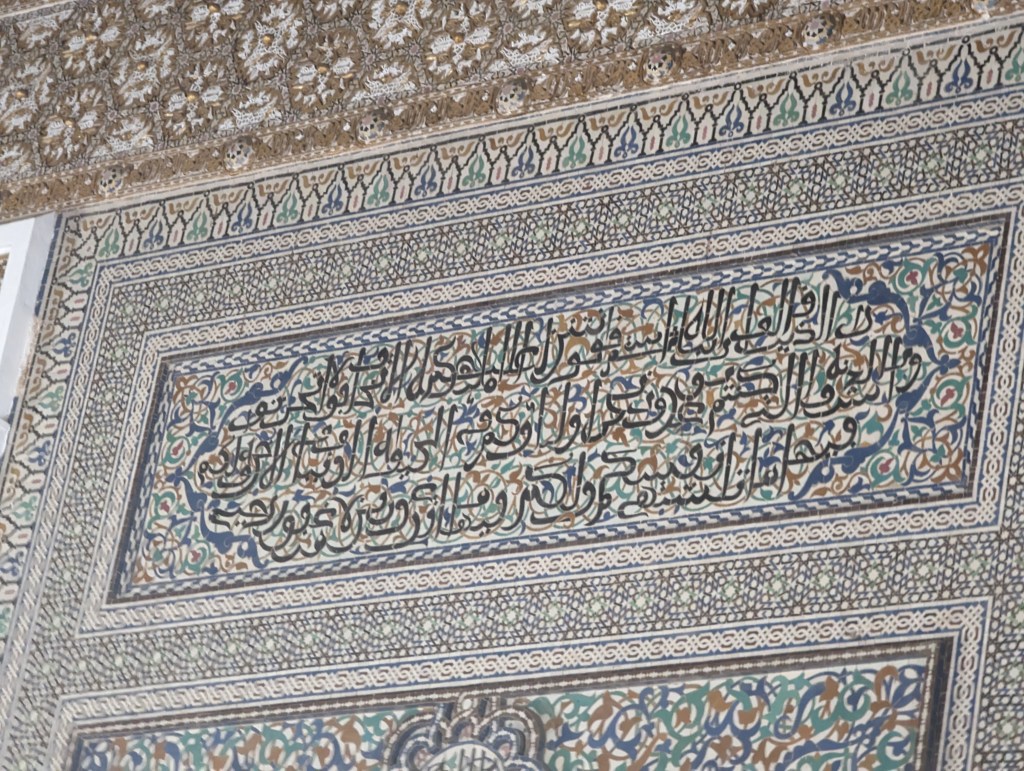
some of which have verses from the Quran.
The ceilings and dome are all carved wood. Every inch of the mausoleum is a work of art.

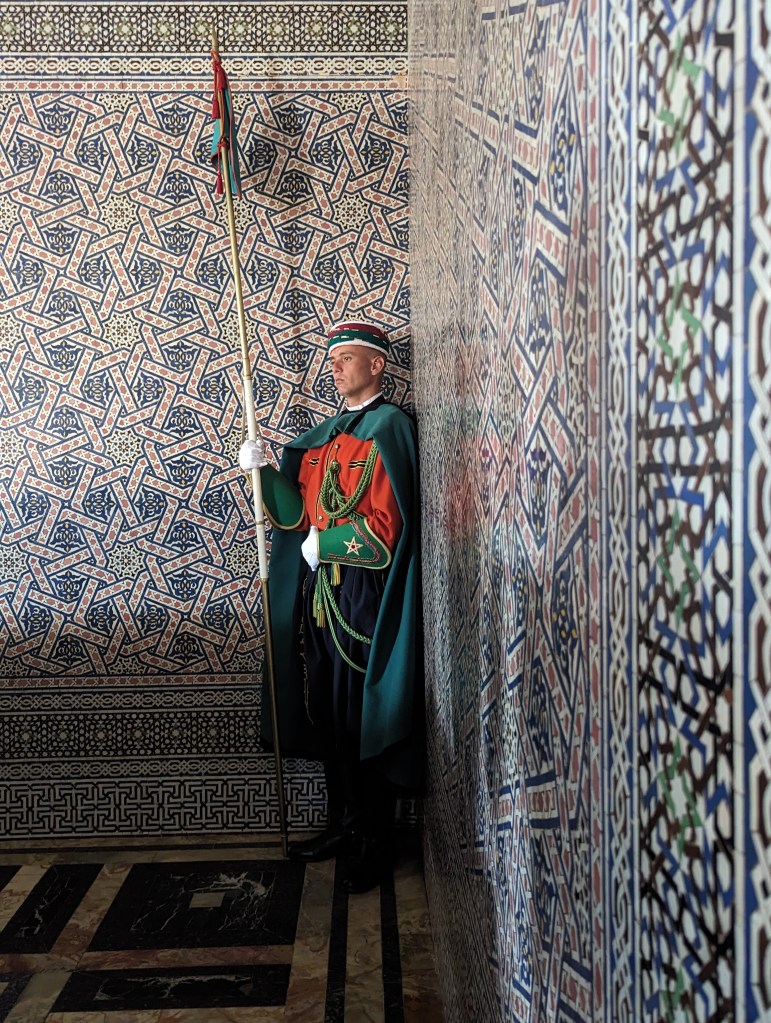
There is also a guard at every corner.
The imam comes in at prayer time and recites verses from the Quran from memory.
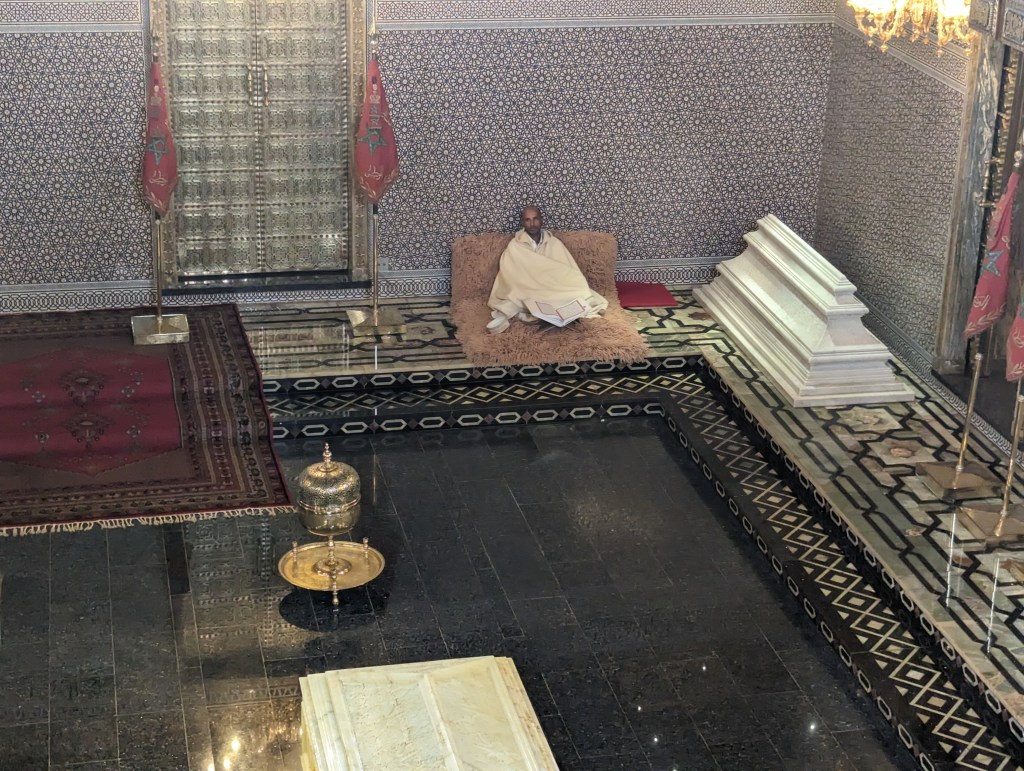
From the side entrance, the mosque next door can be seen.

Above every door is a passage from the Quran that reminds us that there is only one God: Allah.
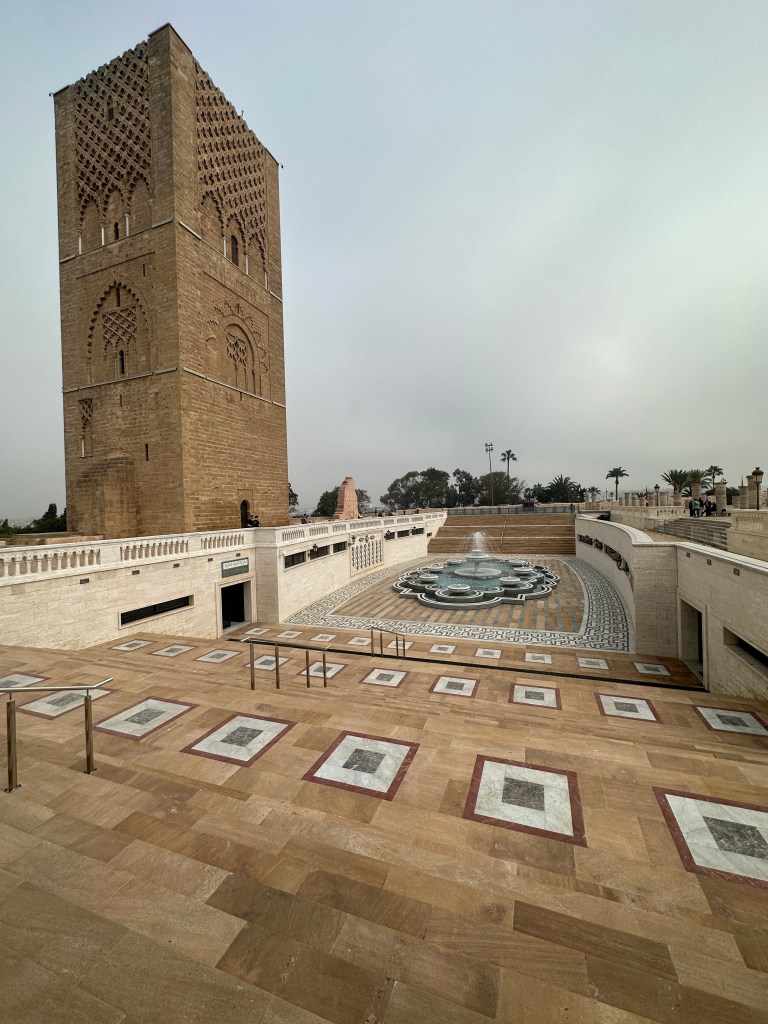
Leaving the mausoleum, the view across Yacoub Al Mansour Square is that of Hassan Tower and the never finished 12th century Mosque of Rabat. The Hassan Tower was to be the minaret of the mosque. The mosque was based on the one in Cordoba and when finished would have been the largest in the Muslim world. The tower, like the Giralda Tower in Seville, was based on the minaret in Marrakesh.
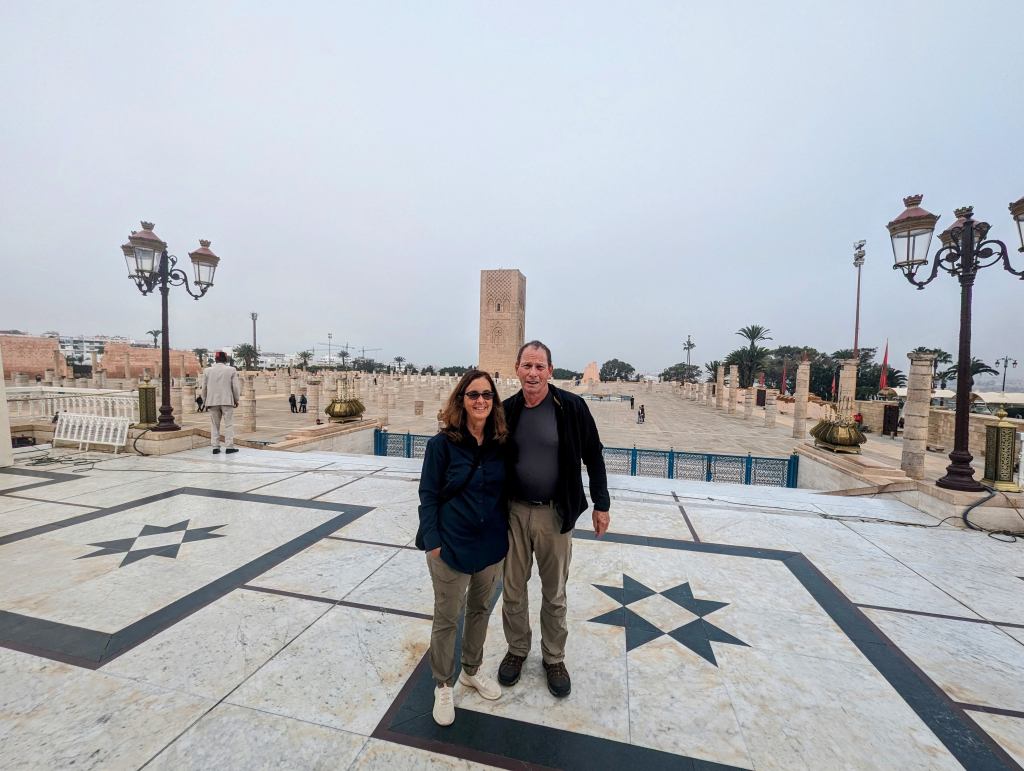
The Hassan Tower now serves as the minaret to the mosque of the mausoleum, and is the only minaret in Morocco not attached to its mosque. The 12th century mosque was never completed because its builder died and the project abandoned. Many of the columns fell and suffered damage during the Lisbon earthquake of 1755.

On the wall next to the Hassan Tower is a family tree of the current king showing his descendance from the prophet Muhammed.
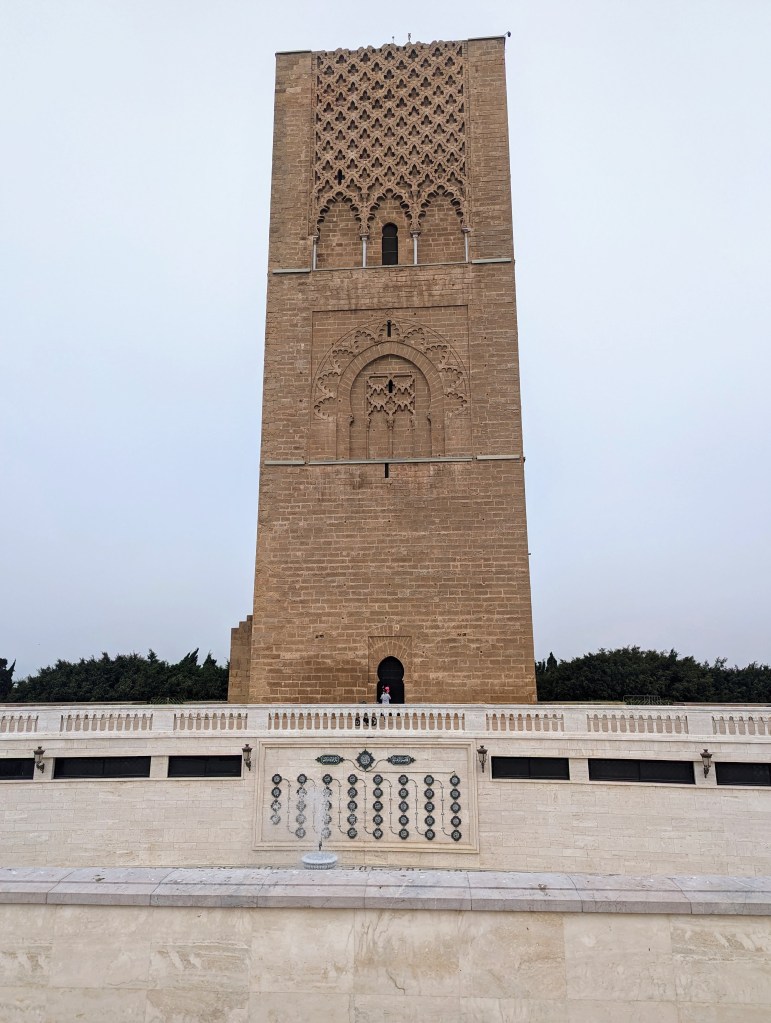
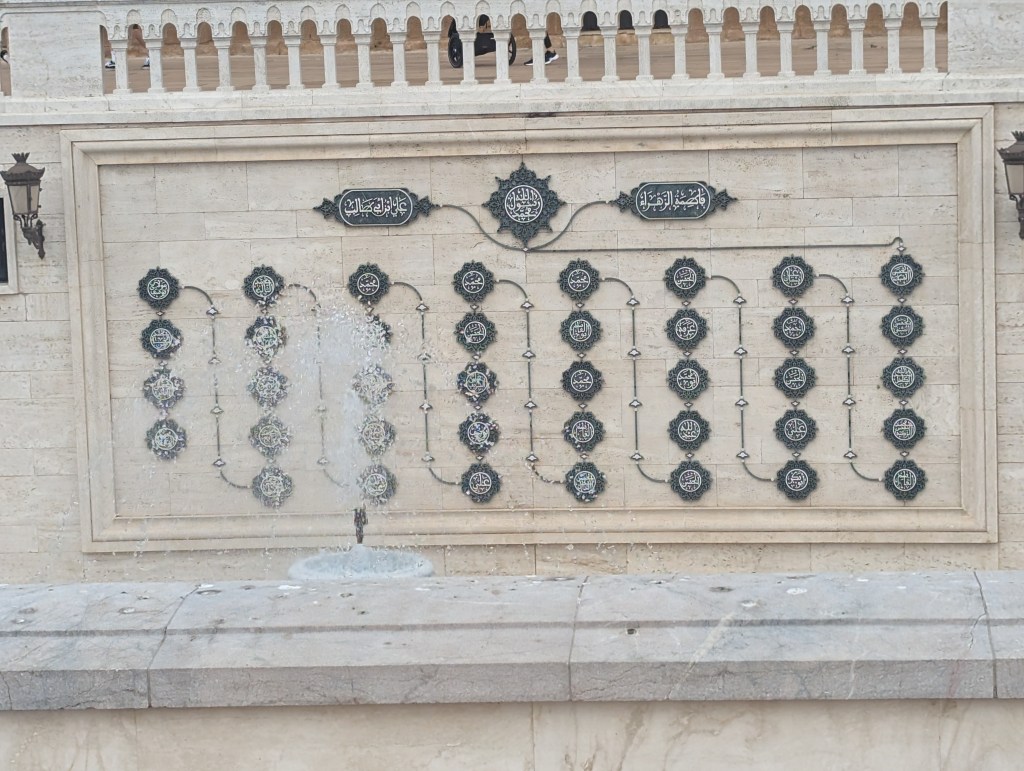
The space under the tower holds important archives of Moroccan history and is closed to the public. The fountain is turned on only when someone of importance is inside.
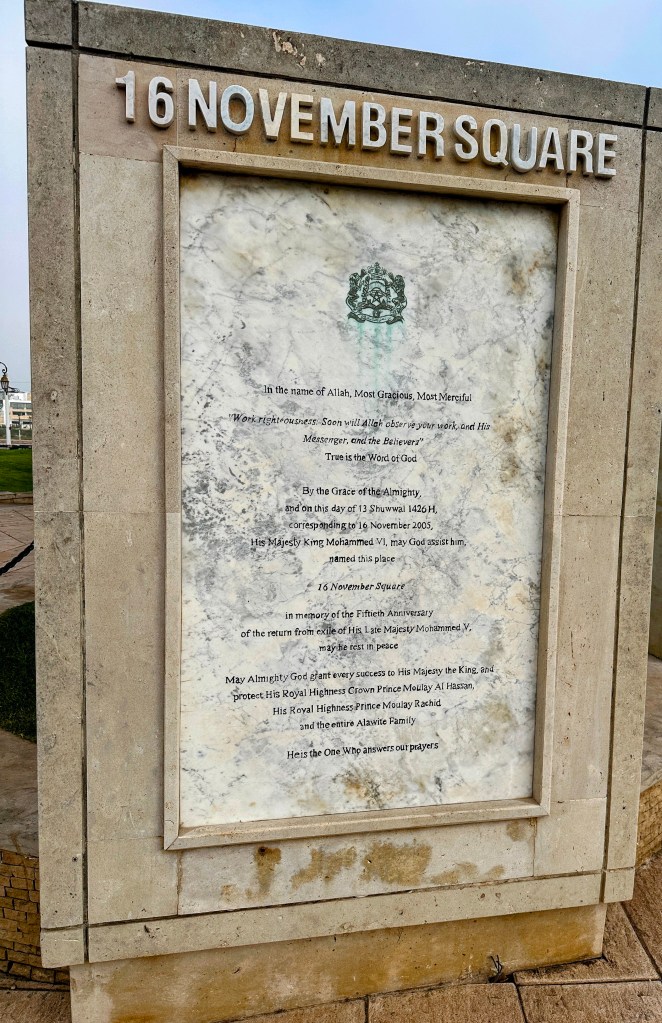
We then passed through November 16th Square, commemorating King Mohamed V’s return from exile on November 16, 1953. It happened to be November 16th that we visited.
We then walked down to the river where one can catch a boat and cross over to the sister city of Salé.
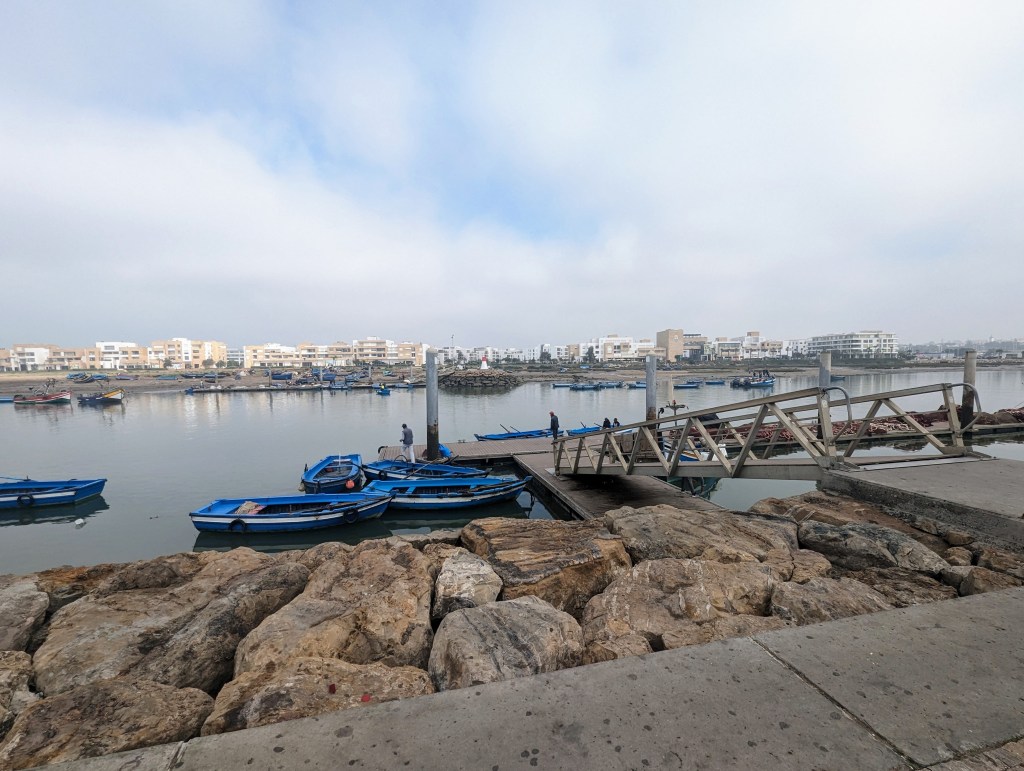
From here there is a good view of the Kasbah up on the hill.
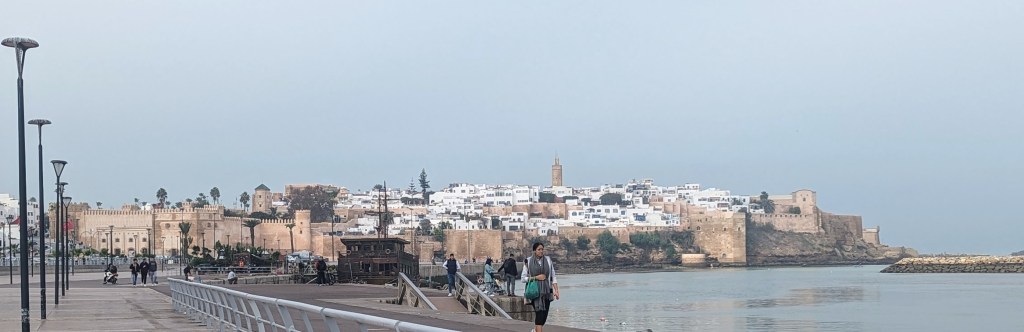
In the 16th and 17th centuries pirates roamed these shores and looted European ships. But they did not steal goods. They only stole the sailors as white slaves, who were then used for labor or, if someone of importance, sold back for ransom.
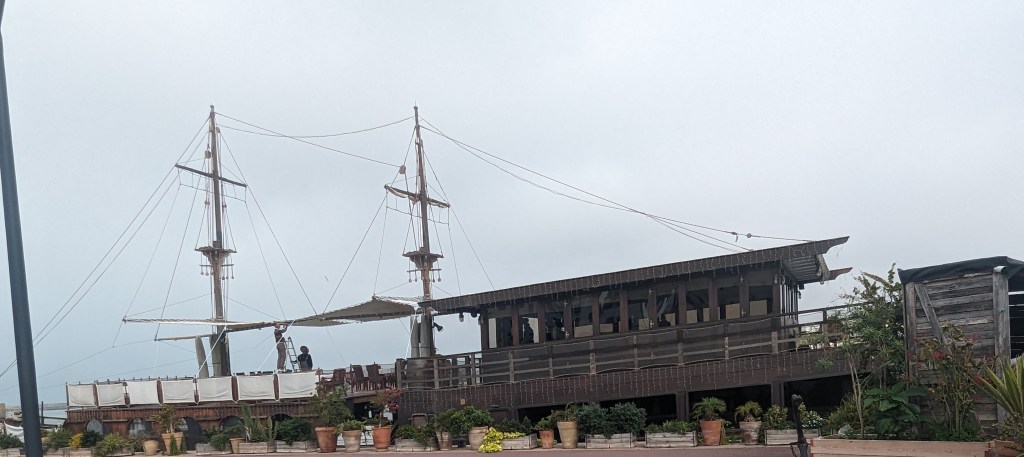
this pirate ship is now a restaurant

Slaves found guilty of crimes were chained in the dungeon at low tide then drowned when the tide came in. The low round structure below is the dungeon.

In the afternoon we took a quick drive by Salé, most of which is under renovation.

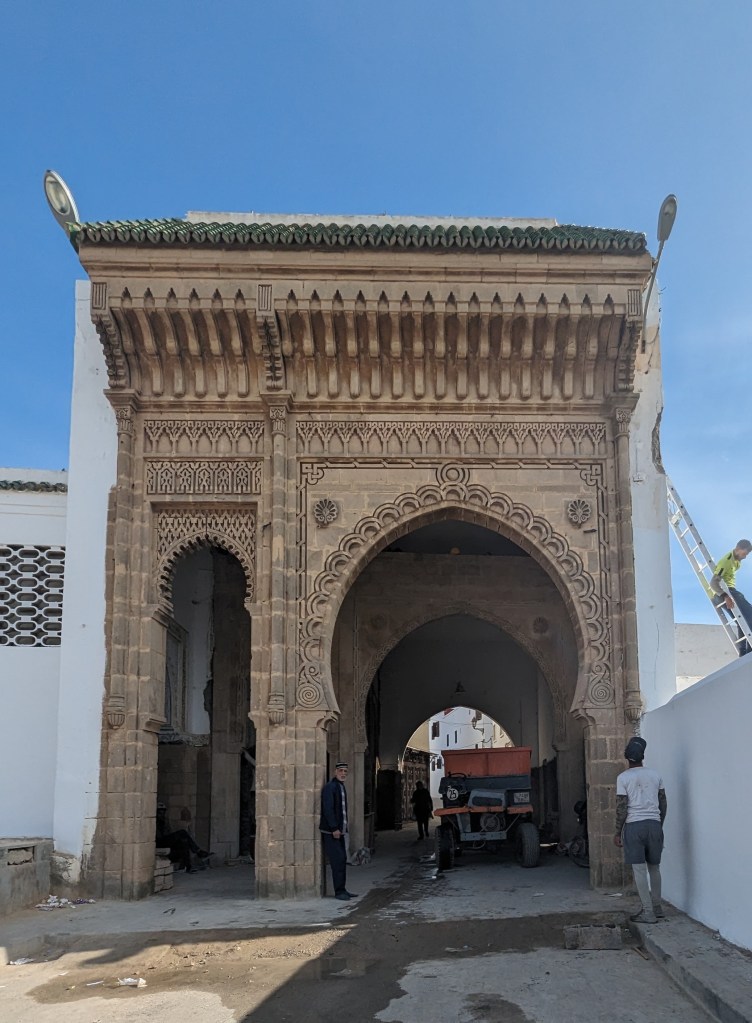
Gate Salé

We walked through the gate of the Kasbah.
And saw the door to the mosque.
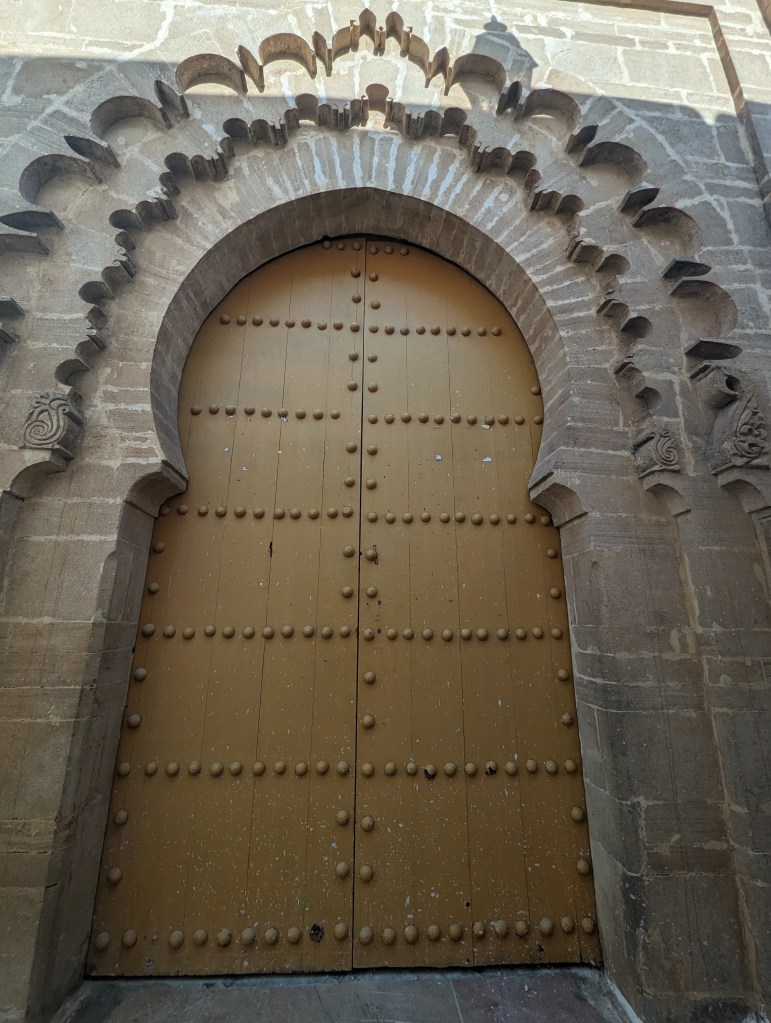
Mosque Salé

And next to it the Quran school, the madrassa.
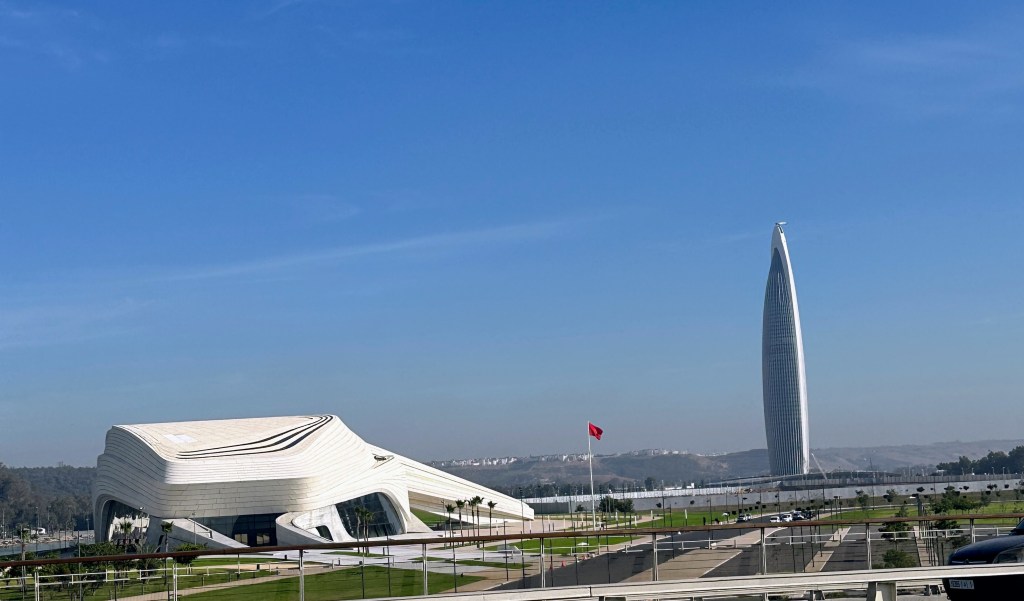
We then took a drive south along the Atlantic coast. We passed the newly built Grand Theatre of Rabat designed by Iraqi-British architect Zaha Hadid. The construction of the theatre is part of a wider national initiative by King Mohamed VI to promote the arts and cultural development. It is scheduled to open in 2024. Next to it is the Mohamed VI Tower, an office and industrial space also scheduled to open in 2024.
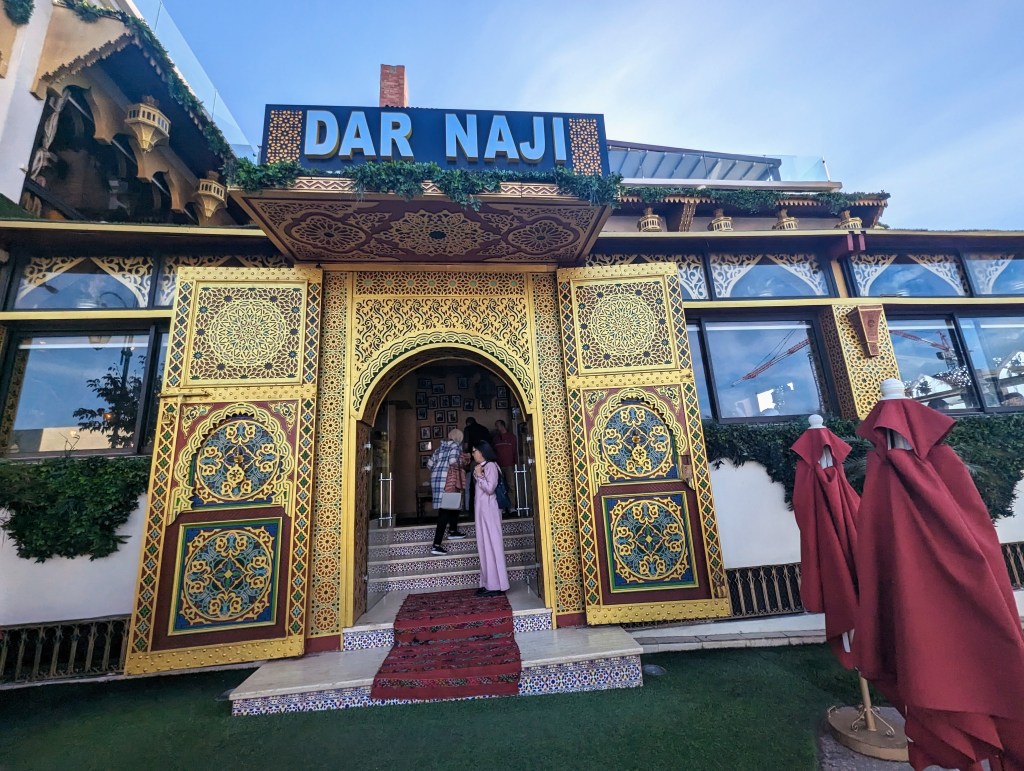
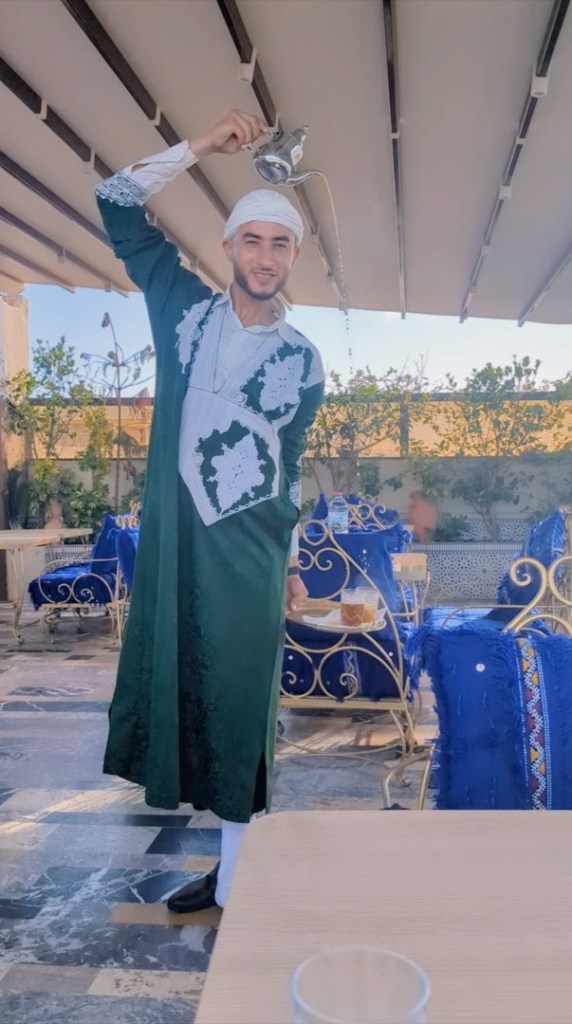
We then went for a very late lunch at Dar Naji Restaurant and had great food, great views, and lots of fun.
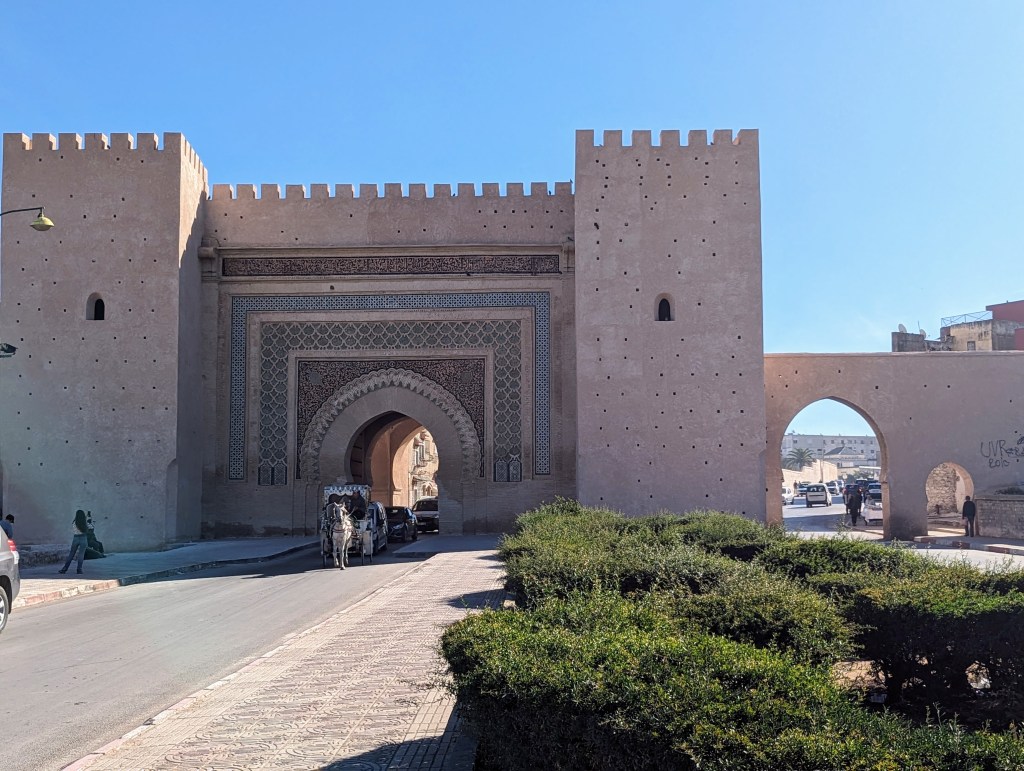
In the morning we headed to Fez. On the way we passed the city of Meknes, one of the 4 imperial cities of Morocco, ie one of the 4 cities that has been the capital: Marrakesh, Fez, Meknes, and Rabat. Meknes was founded in the 11th century and was capital briefly in the 17th during which time a large palace complex was built. Most of the town is currently under restoration. We stopped for a picture of the gate.
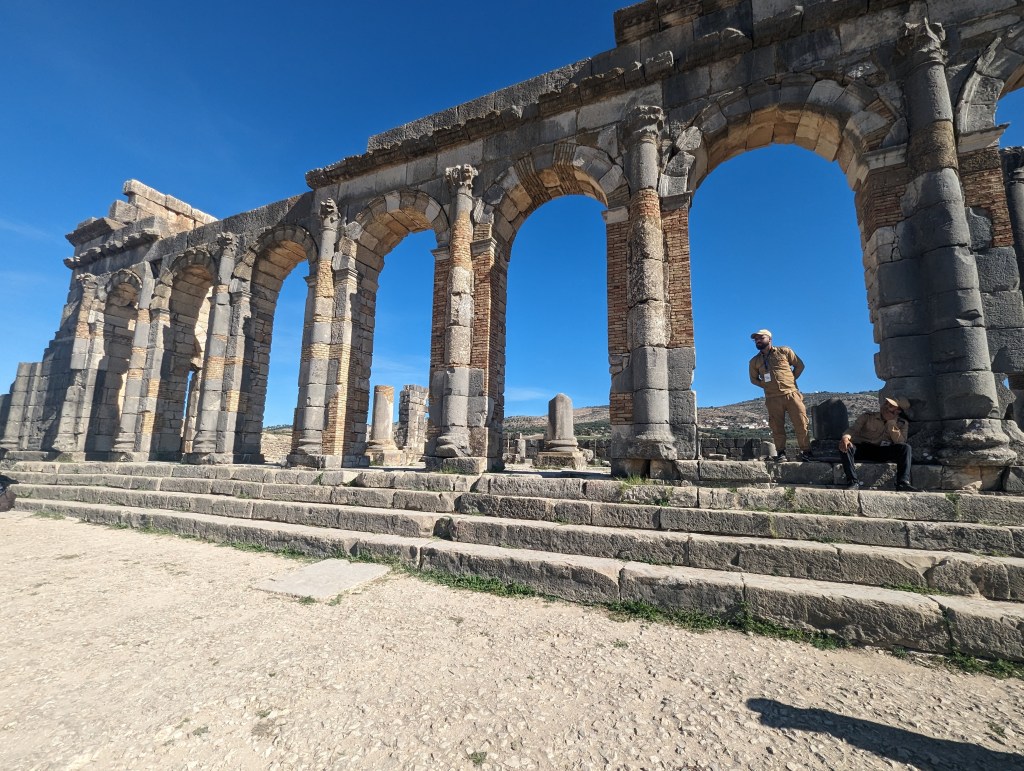
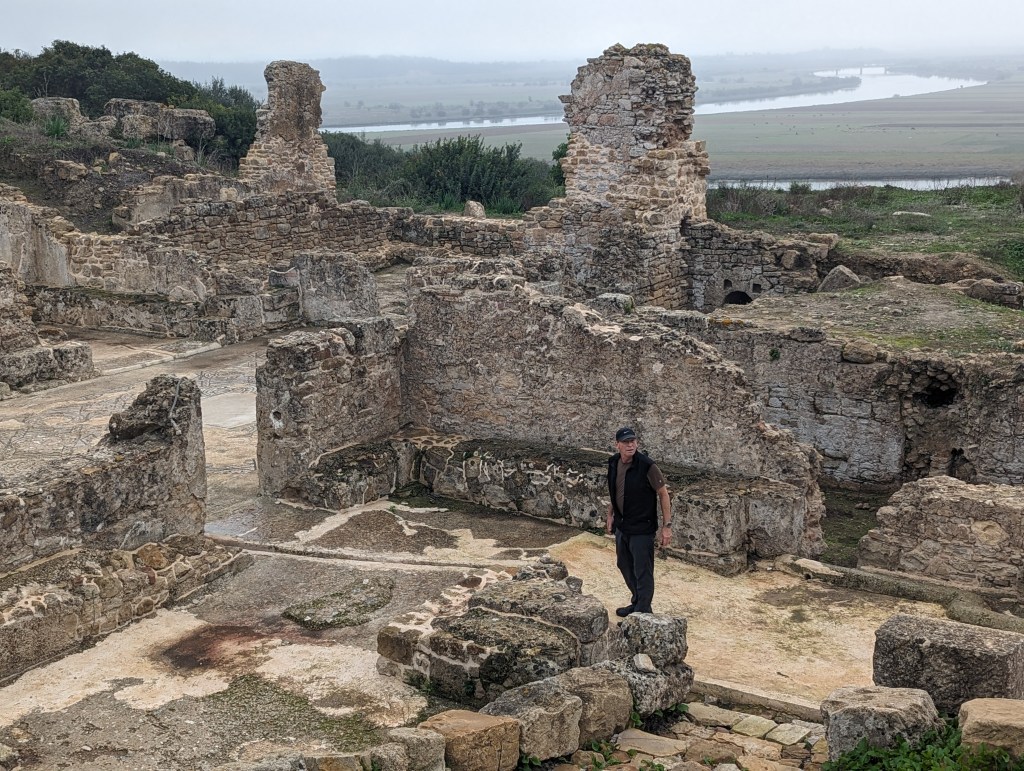
Next we stopped in Volubilis, a partly-excavated Berber-Roman city built in a fertile agricultural area. It developed from the 3rd century BC onward as a Berber, then proto-Cartaginian settlement before being the capital of the kingdom of Mauritania. It grew rapidly under Roman rule from the 1st century AD onward. The city gained a number of major public buildings in the 2nd century, including a basilica, temple and triumphal arch. Its prosperity, which was derived principally from olives, prompted the construction of many fine houses with large mosaic floors. The city fell to local tribes in 285 and was abandoned by Romans due to its remoteness. It remained mostly intact until the Lisbon earthquake of 1755. Once a lot of the buildings fell down, the area was ransacked for building materials. It was discovered by the French in the early 20th century. Excavations are ongoing.
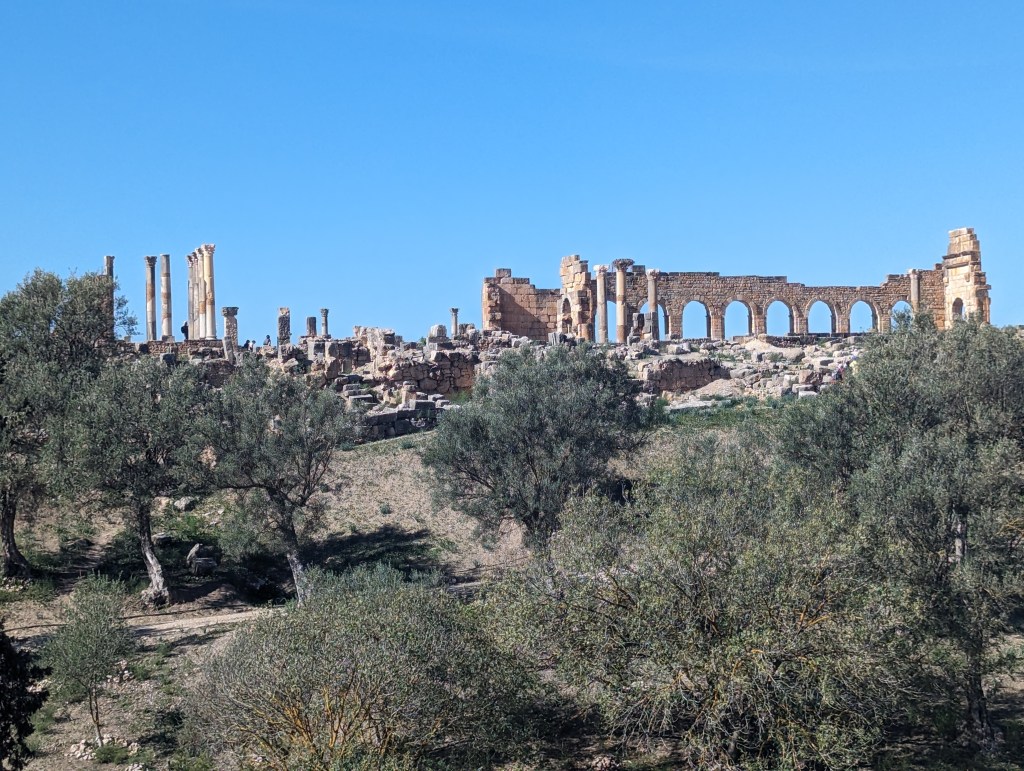
Volubilis

We hired a local guide to show us around. One of the fist things he explained is that there were 3 types of stone used to build the town: marble from Italy for columns, local limestone for the building materials, and a form of lava rock used for milling wheat and grinding olives for their oil.
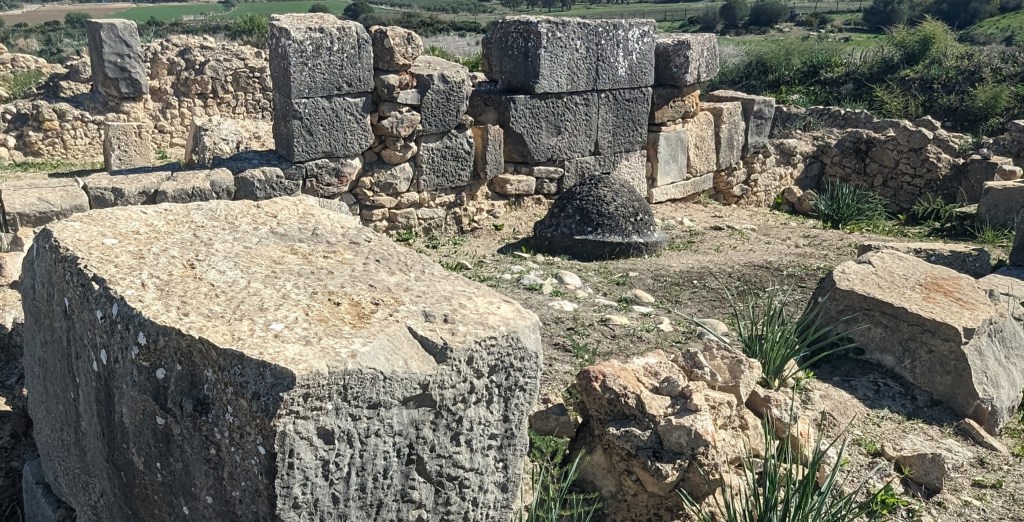
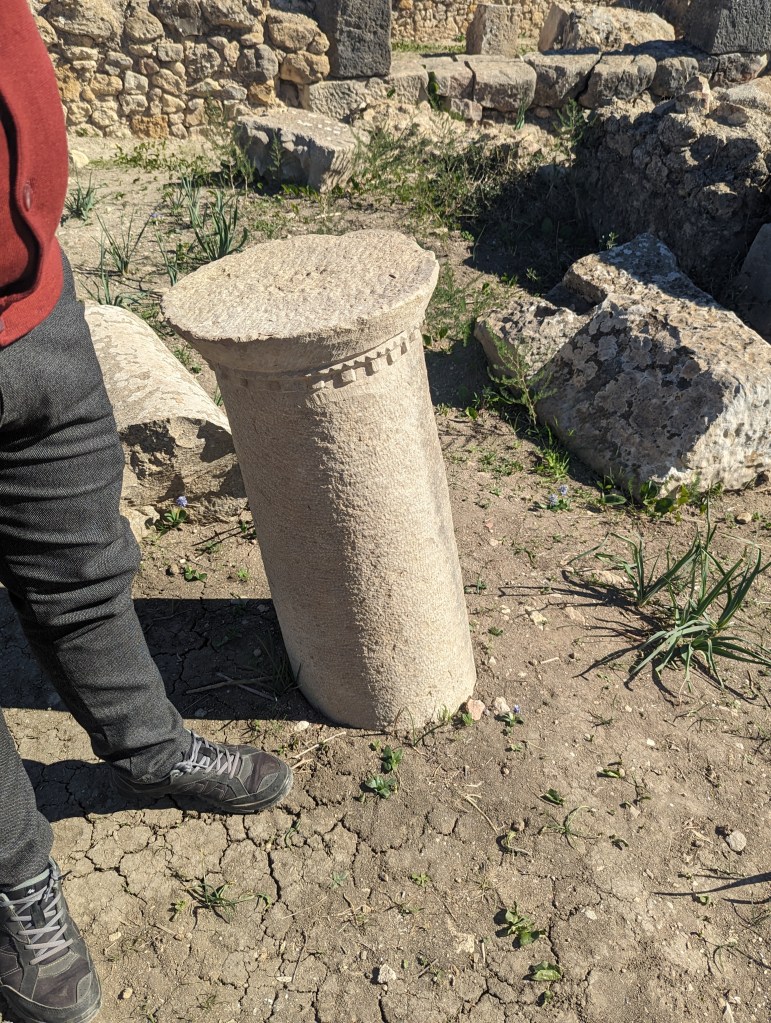
the large blocks are limestone; the round black one is a lava millstone

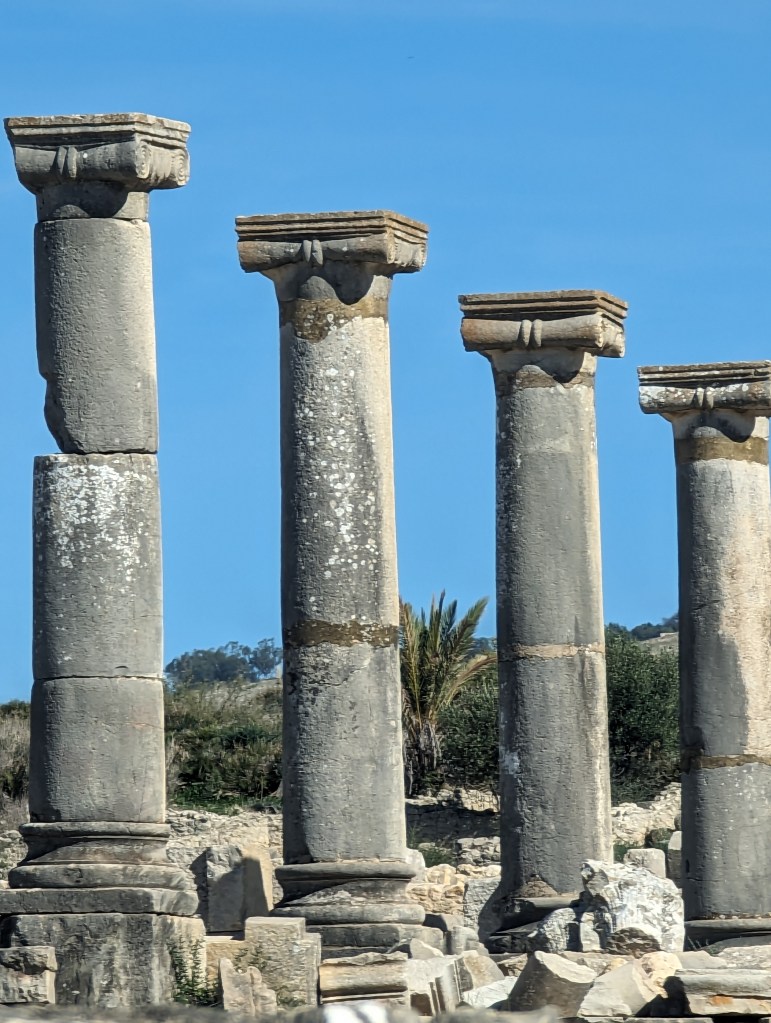
The site is a mix of cultures: Roman, Greek, and Berber. All 3 types of column capitals are found at the site; Doric, Corinthian, and Ionic.
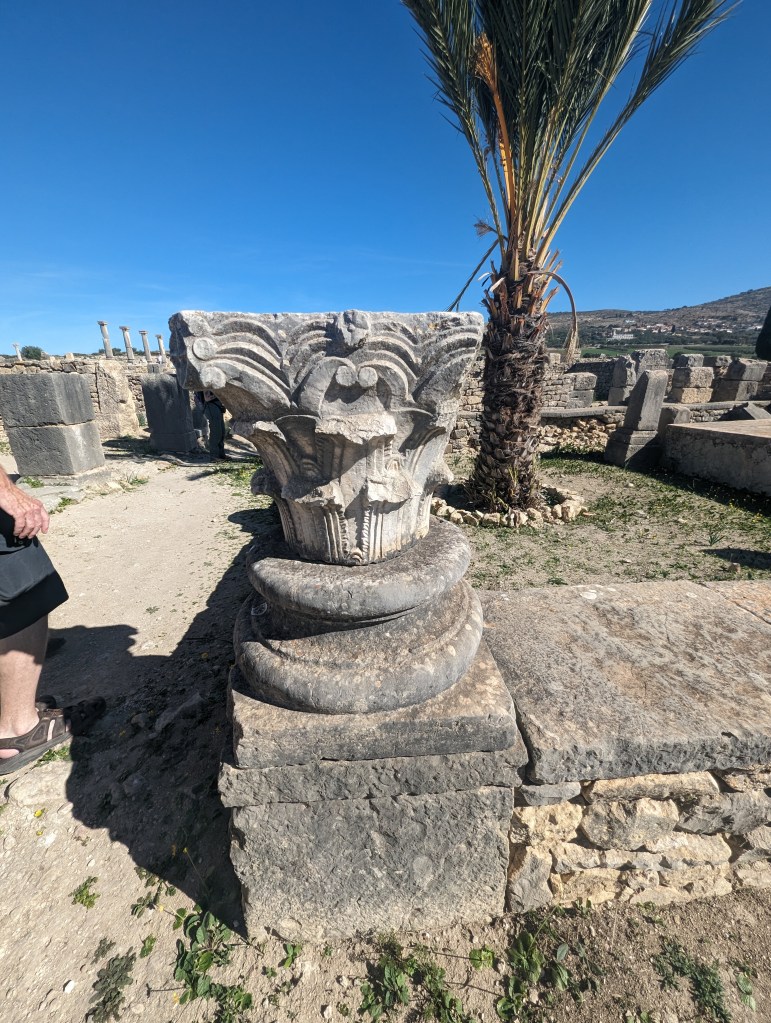
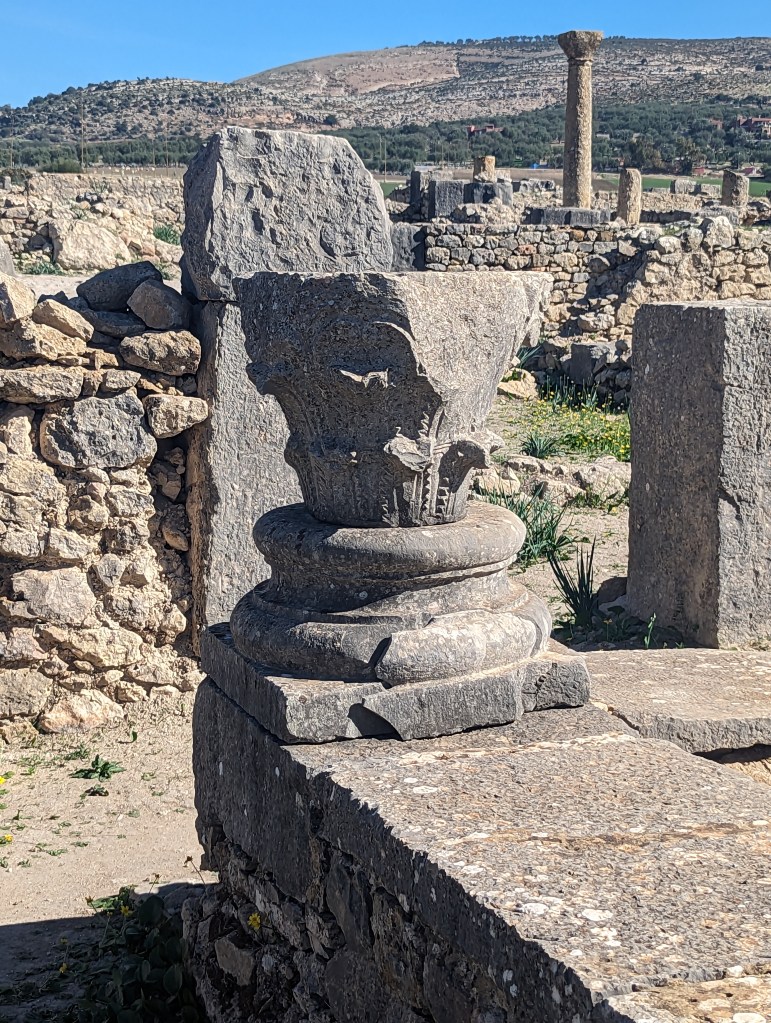
Corinthian capital
Ionic capitals

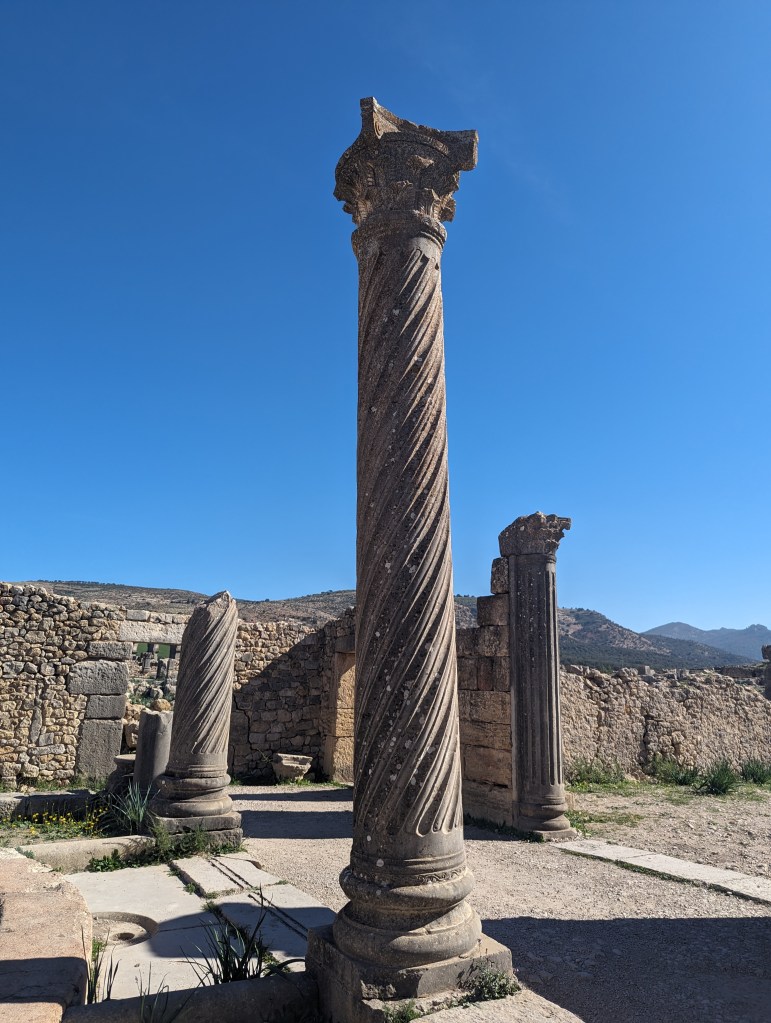
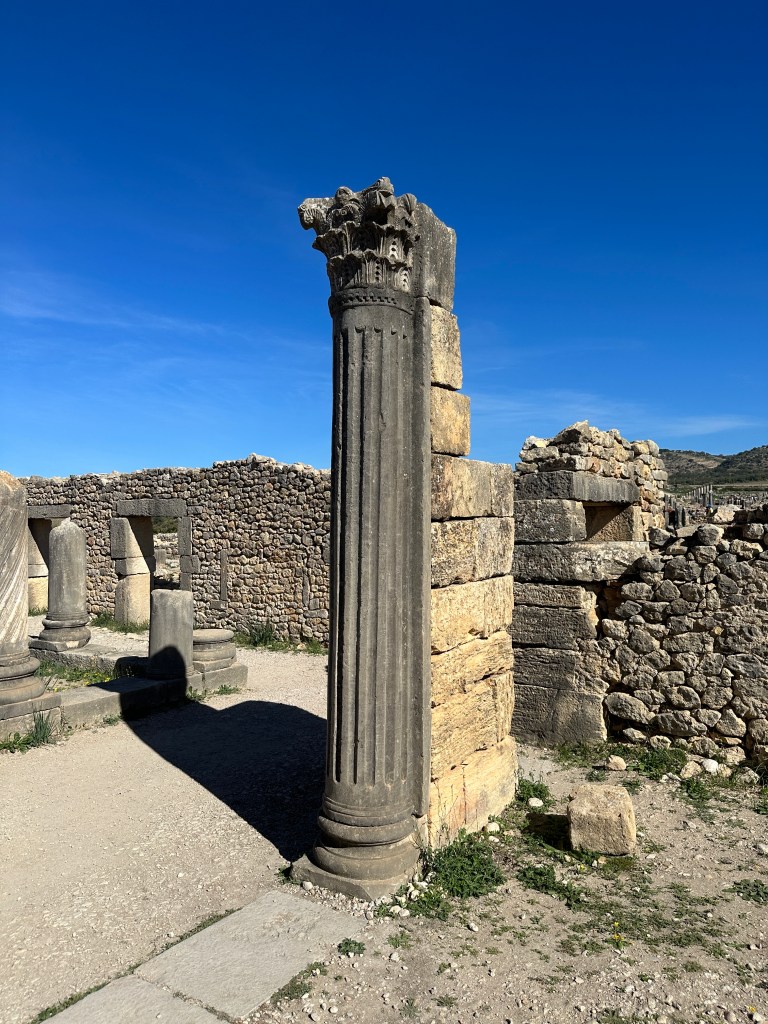
In addition to all 3 capitals, there are examples of all 3 types of columns: the above smooth columns, the below twisted columns,
and fluted columns.
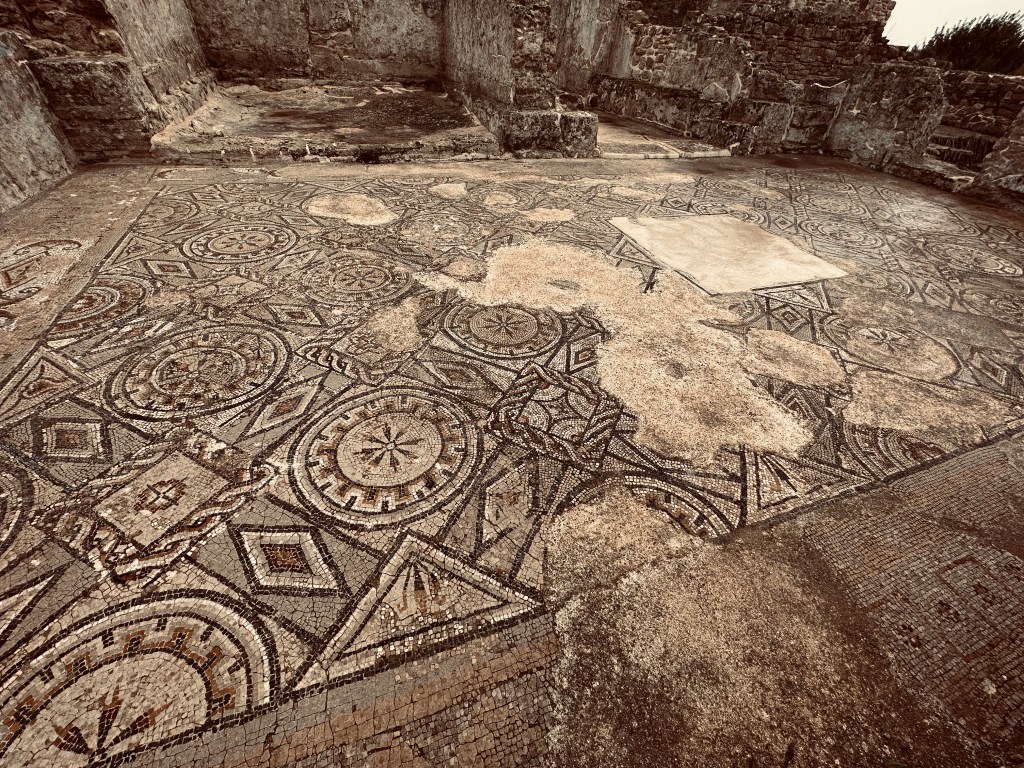
In the mosaics found in some of the houses, there are both Greek and Roman gods depicted. There are also many Berber symbols. Unfortunately the pictures do not do the mosaics justice.

The northern gate was called the Tangier gate because it headed north toward Tangier. Then a major carriage-way passed through the center of town.

Tanger Gate

Along the road ran 2 parallel aqueducts. One then turned and headed west into the homes of the wealthy, the other headed west into the city.

The wealthy houses each had their own bakery,

hamam for bathing, (notice in the one below the stairs, heating occurred below and the warm bath was in the room above)

mill for wheat, mill for olives,

and solarium with water, which came in through a duct. The grooves are for sitting and enjoying the cool water in the hot sun.
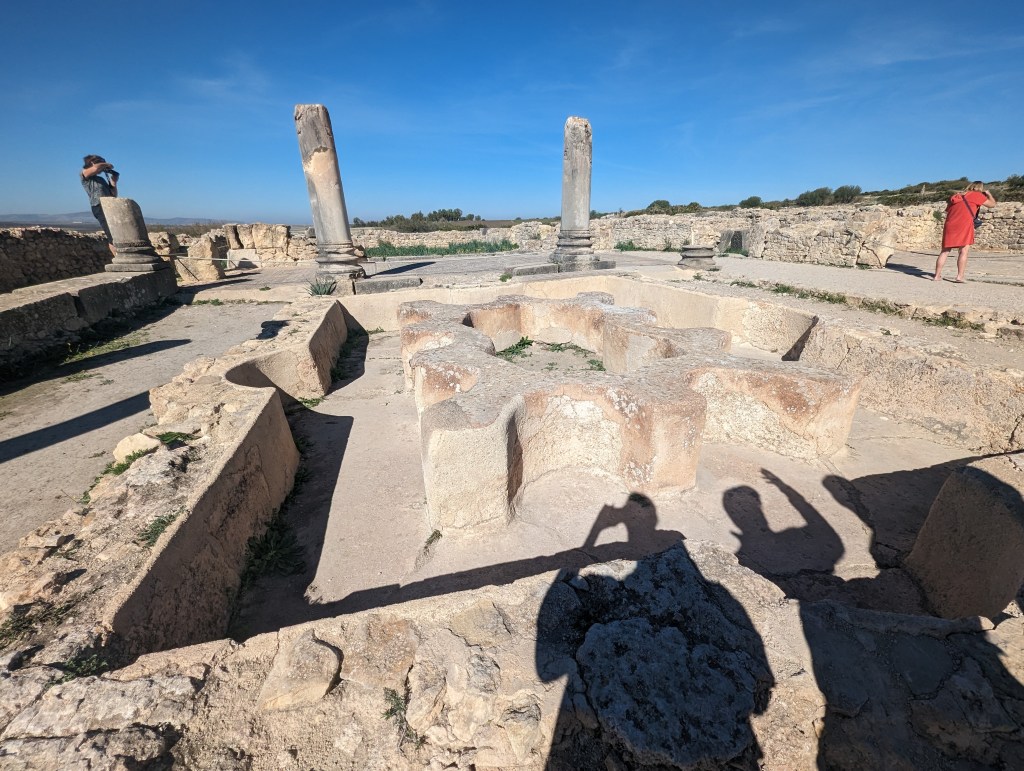
One house even had an aquarium. It contained fish to look at but also fish to nibble the caluses off feet for a “pedicure.”
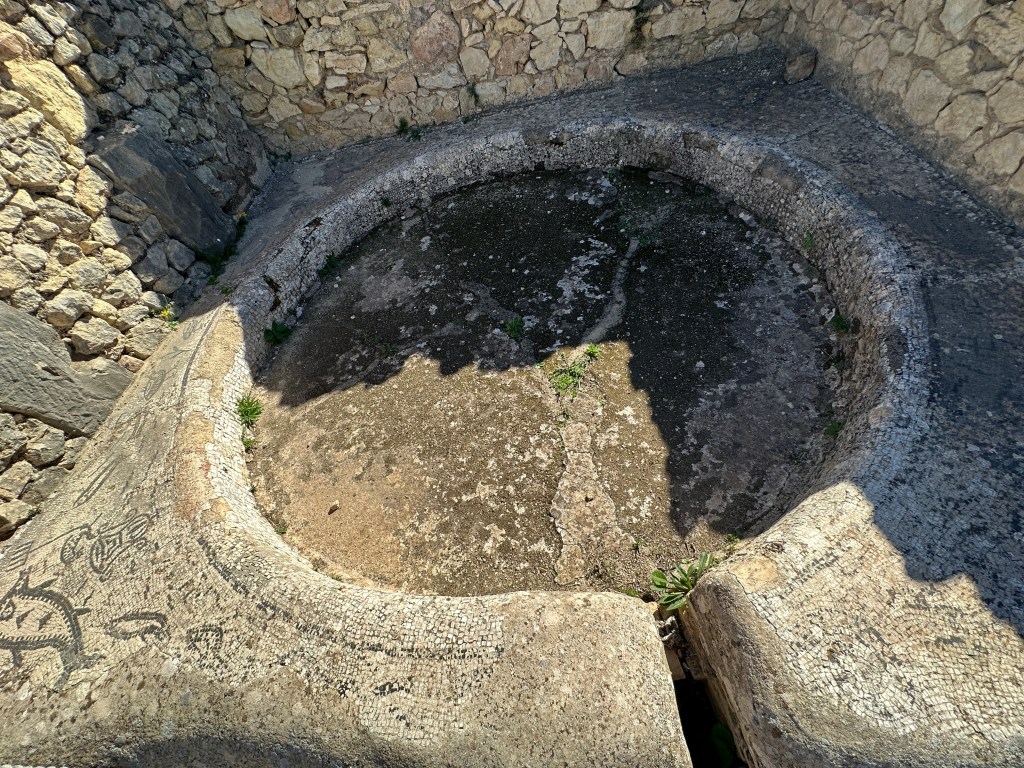
They had running water and sewage lines in the city, fascinating. There was a public toilet room next to the public fountain and wash basin. Note the grooves in which the clothes were washed.
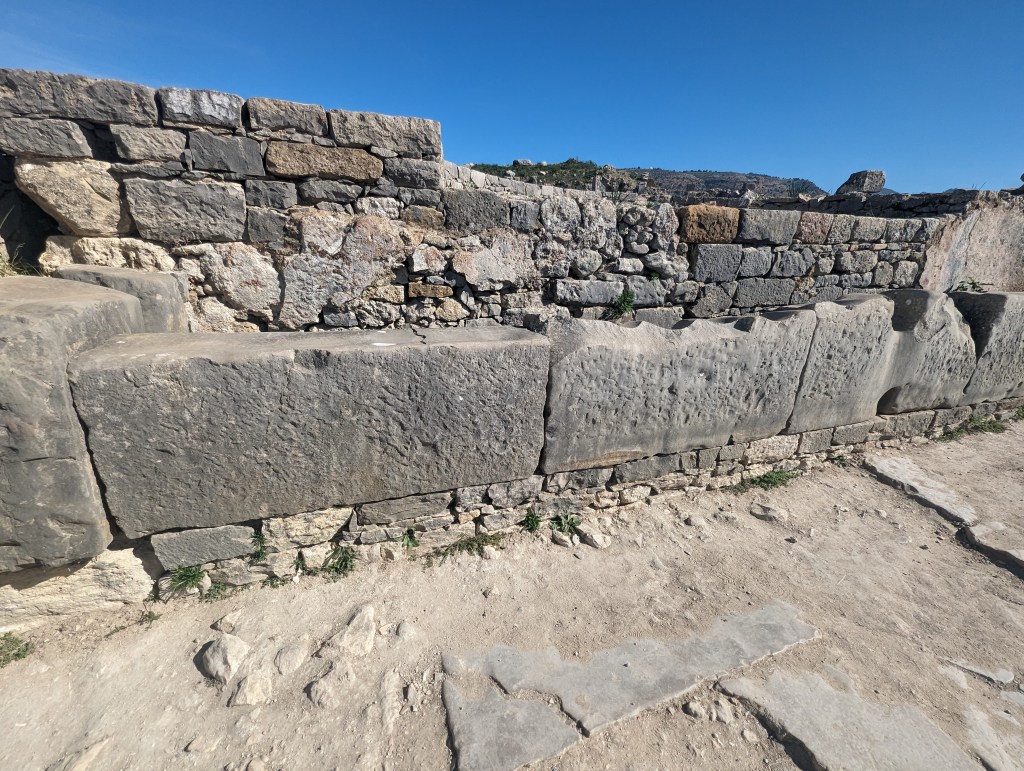
Most of the houses were 2 stories. The entrance door lifted in a groove up into the second level.

Here are some more mosaics, a small sampling of the many at the site. The one below represents the 4 seasons.
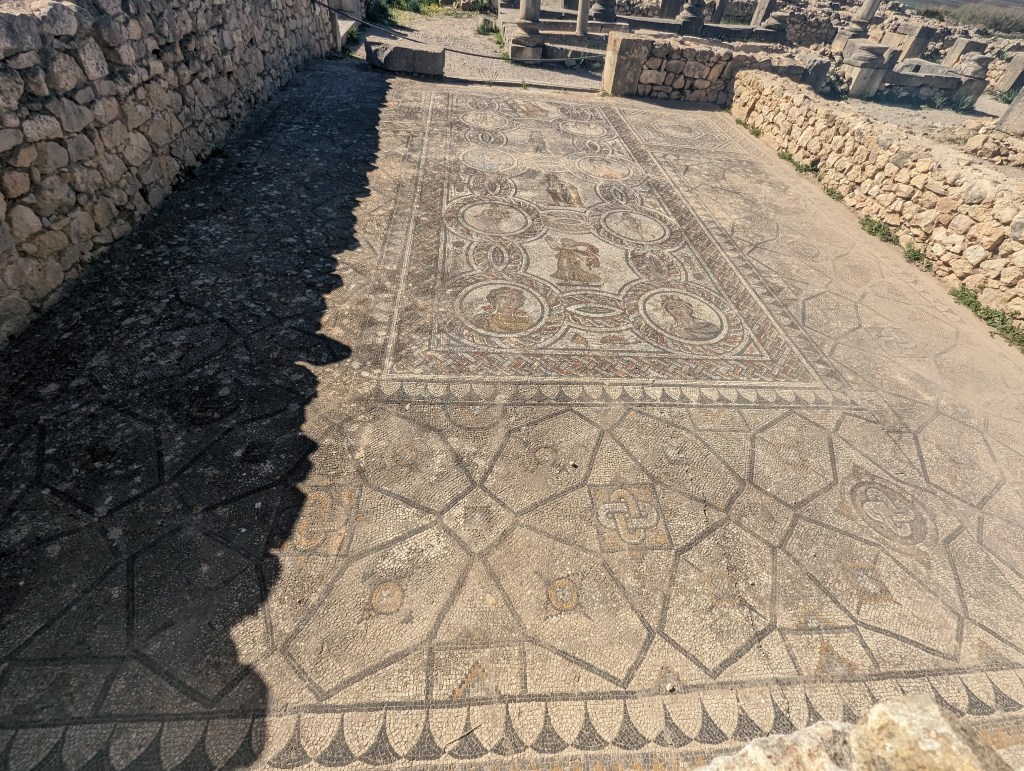
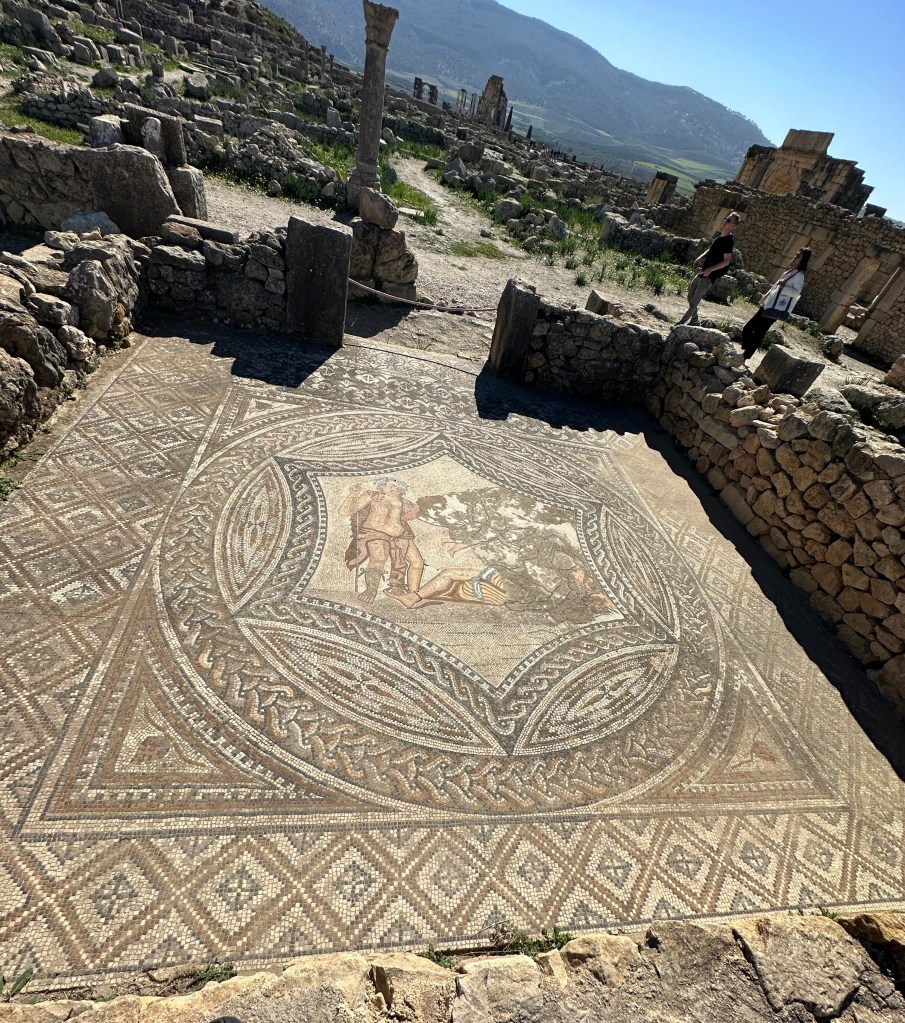
Bacchus and Diana

Here is a picture of Medusa with the snakes as hair.
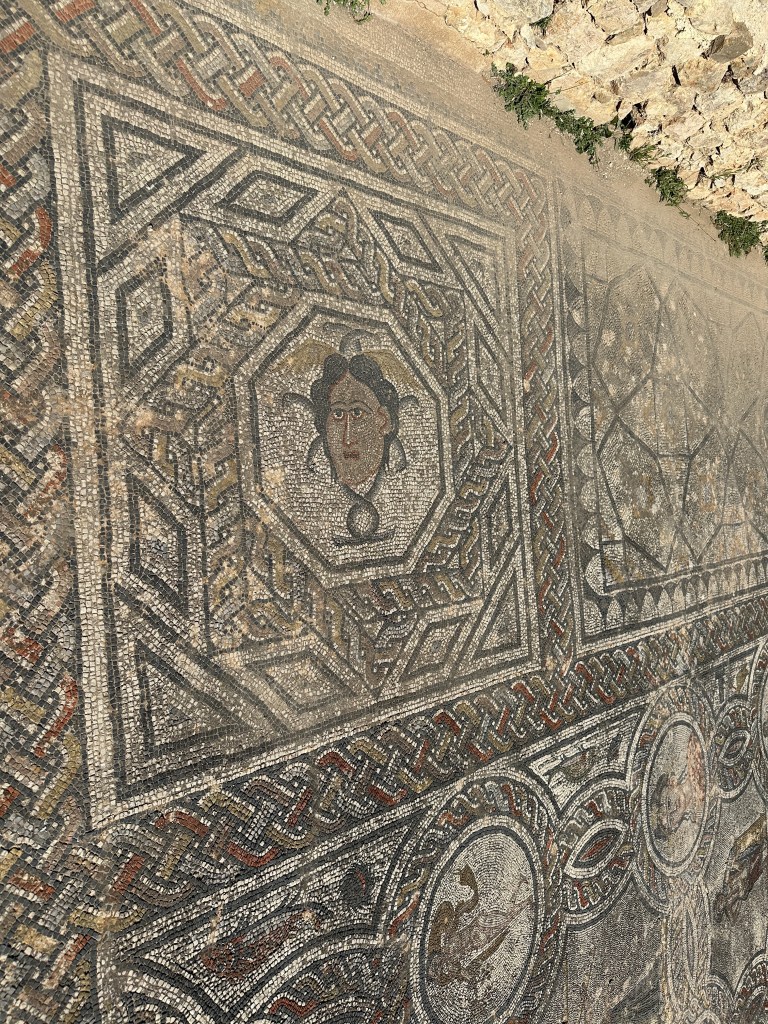
And Hercules performing his labors.
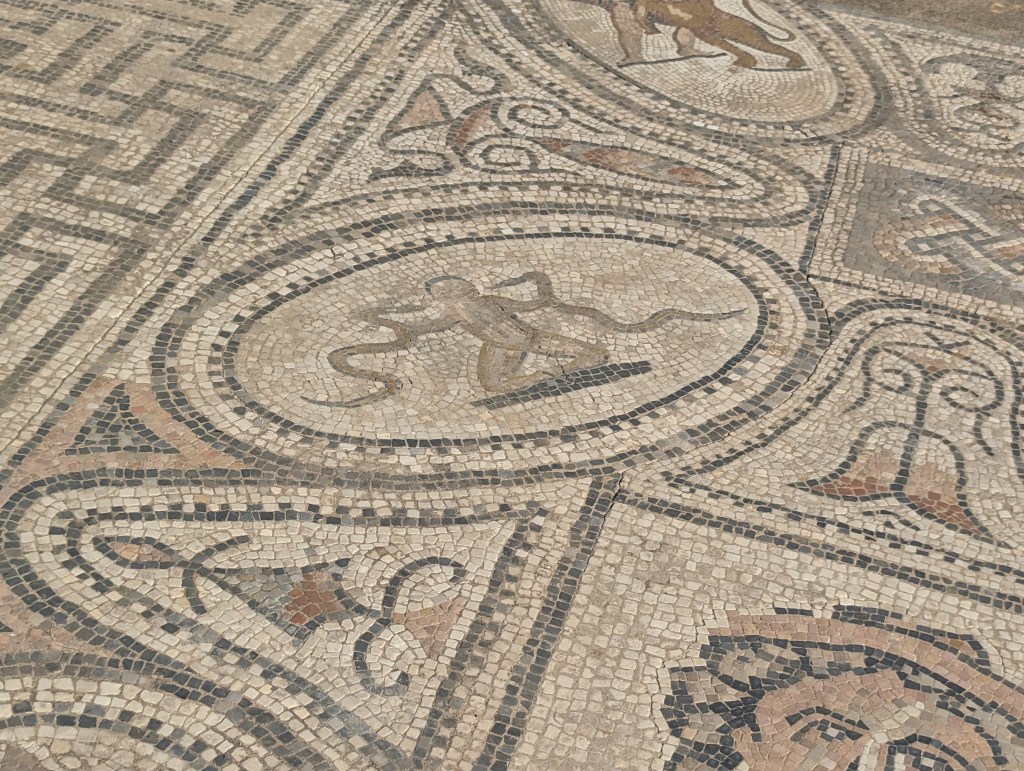
The swastika had been a symbol of prosperity and good fortune.

Berber symbol for donkey.
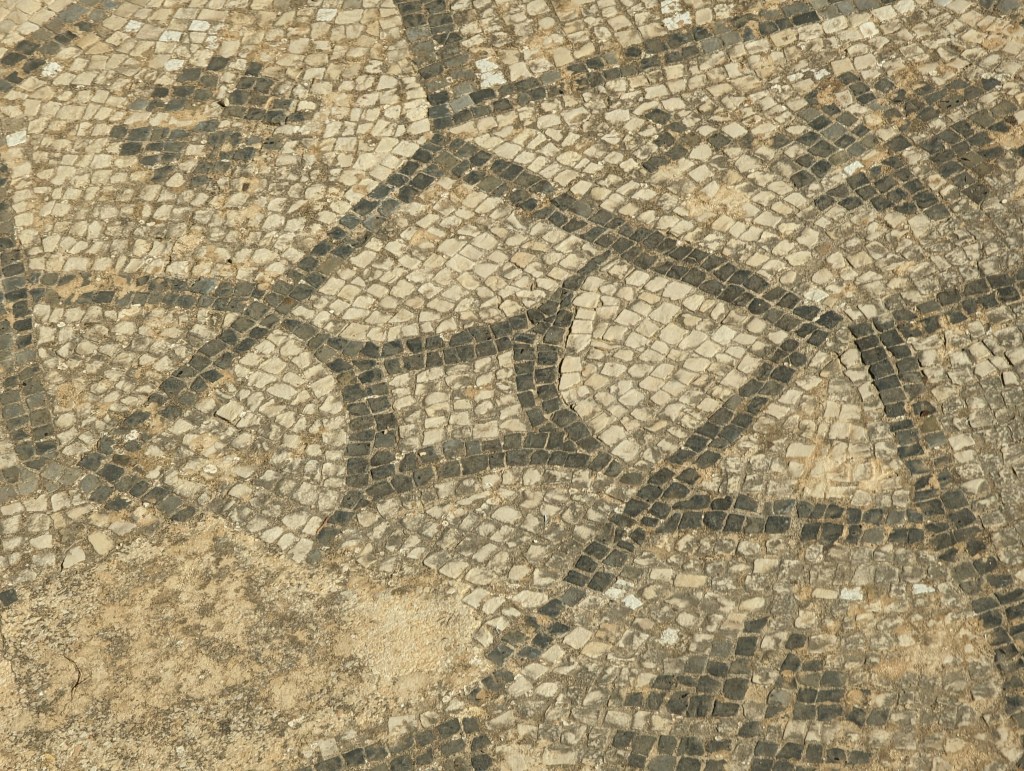
And the Berber cross.
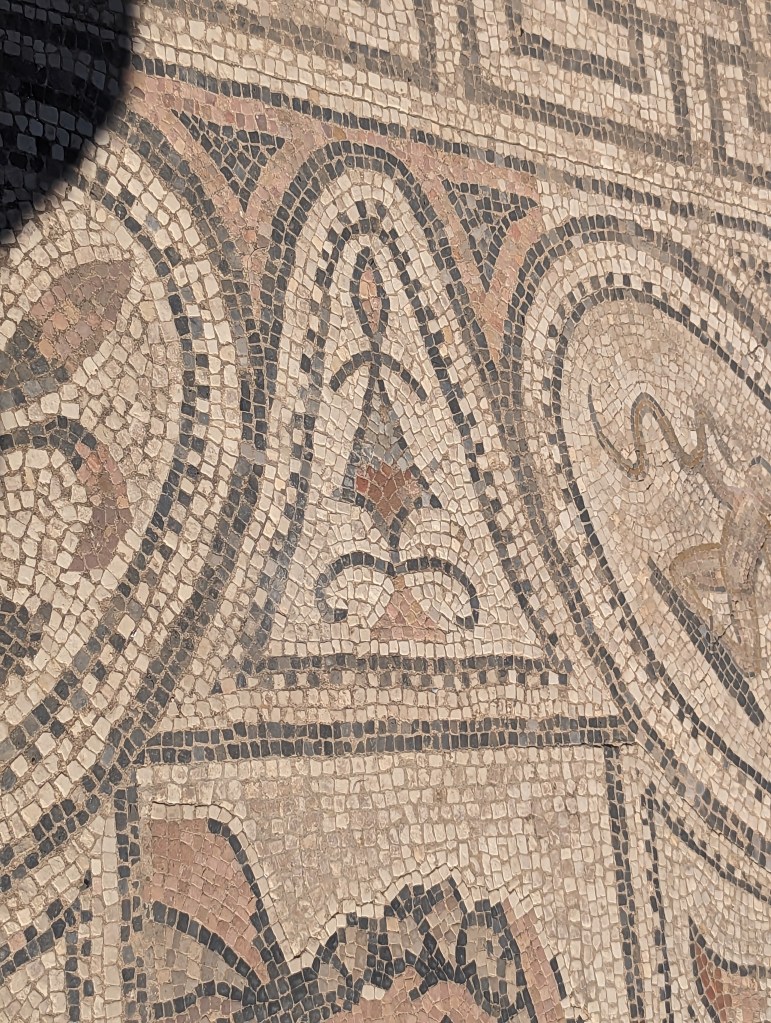
The name of the town, Volubilis, is Roman for morning glory, which is depicted below.

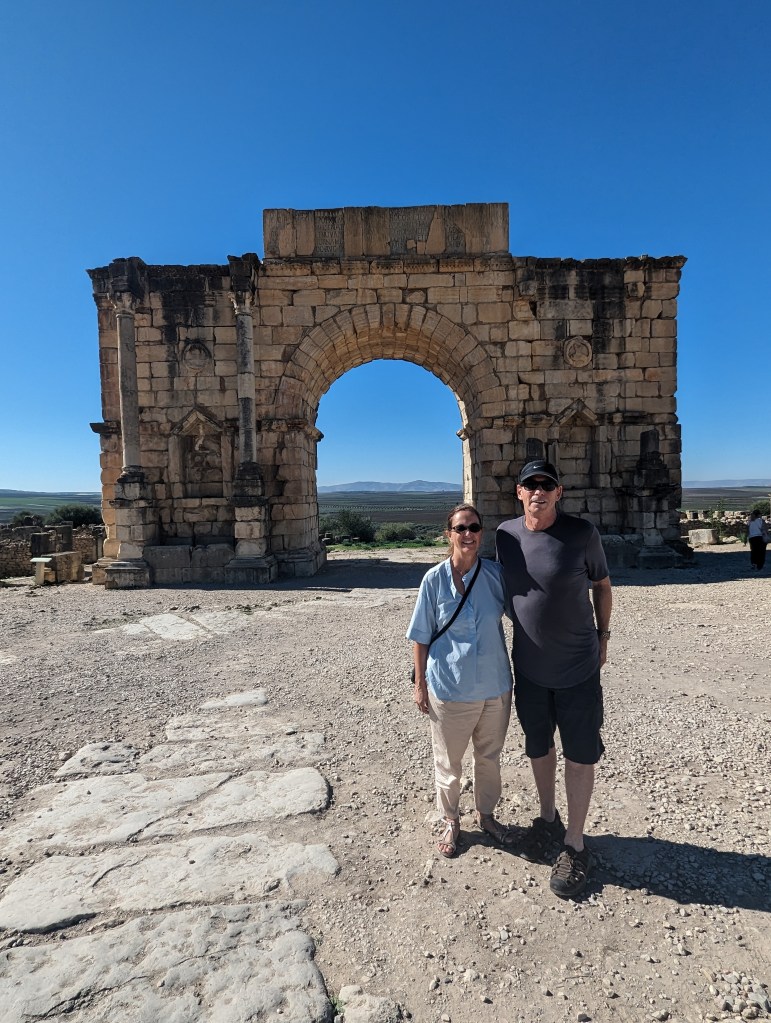
At the end of the road is the Triumphal Arch.
Beyond is the basilica: the court.

Basilica from the side

in front of which is the forum, which would have had a colonnade with shops and a market.
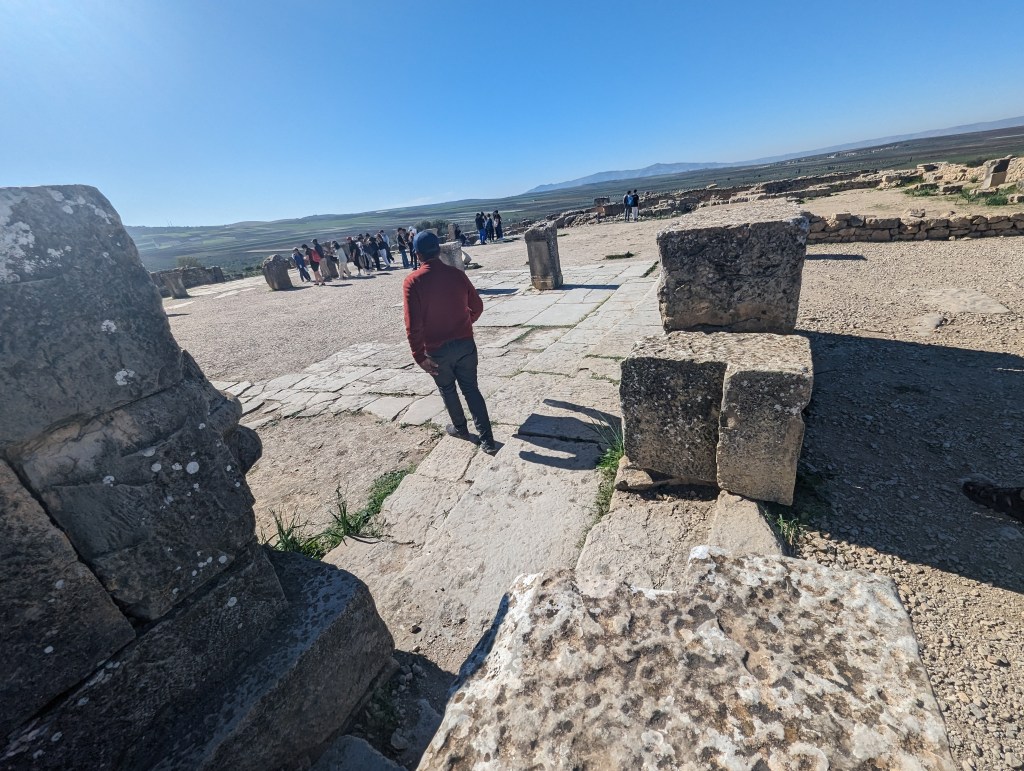
The Forum
front of Basilica

Next to the Basilica was the temple built in 218 and dedicated to the trinity: Juno, Jupiter, and Minerva.
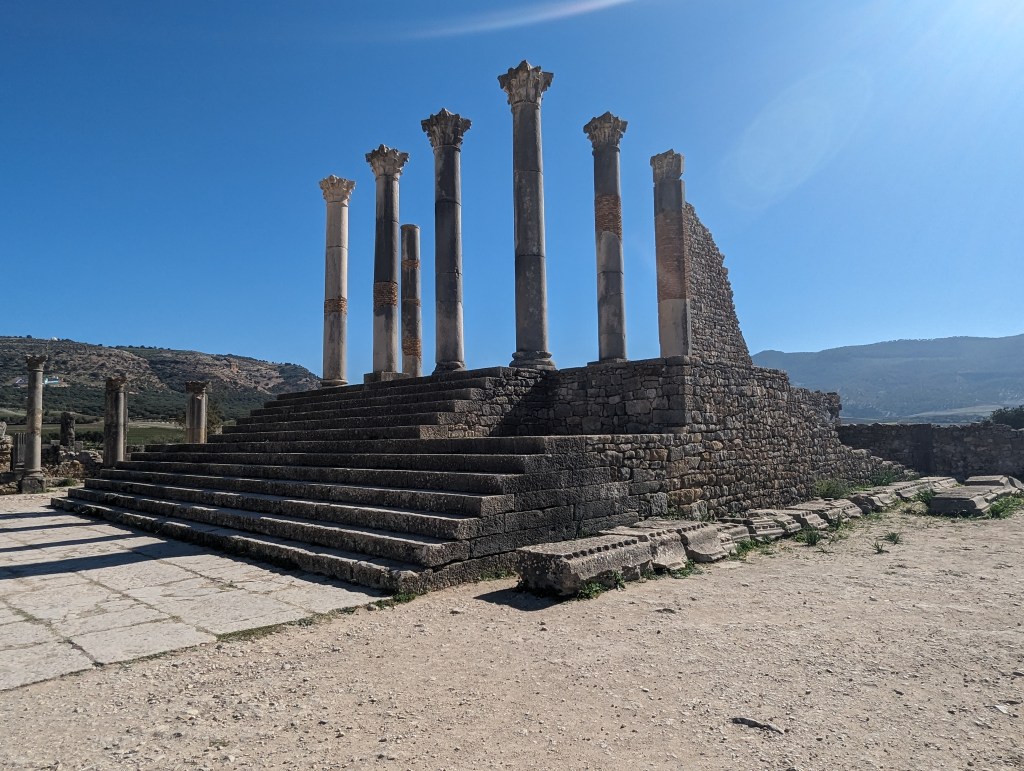
In front of the temple is the altar for sacrificing animals.
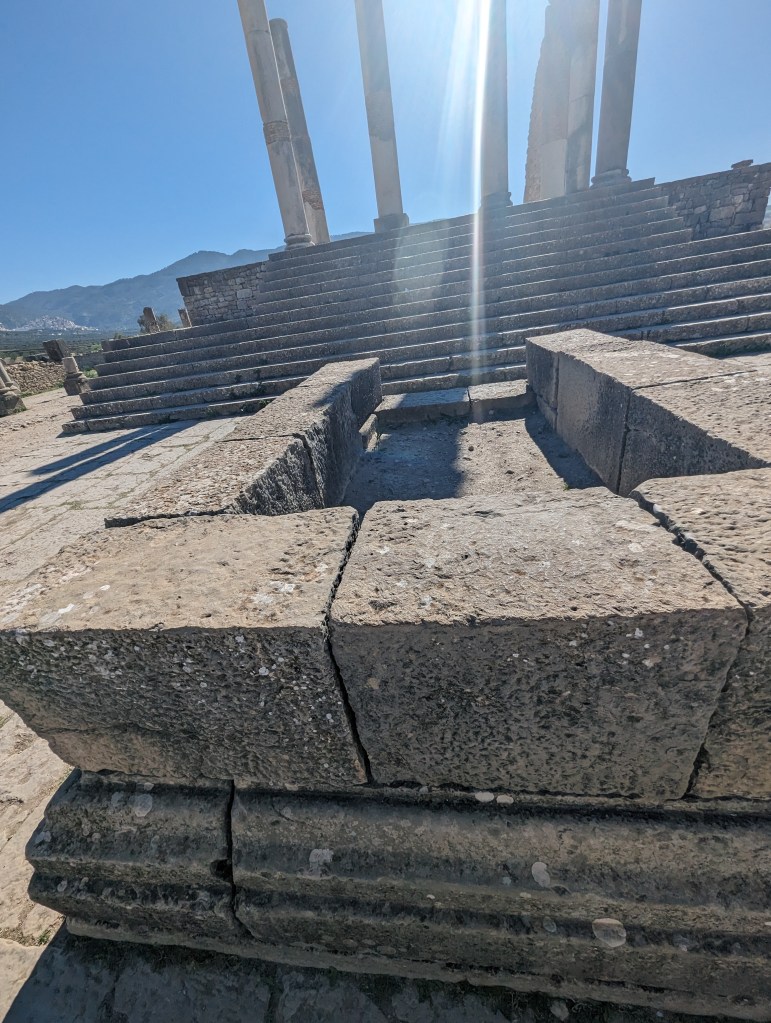
As we left the site, we had a last look back at the view of the temple and basilica.
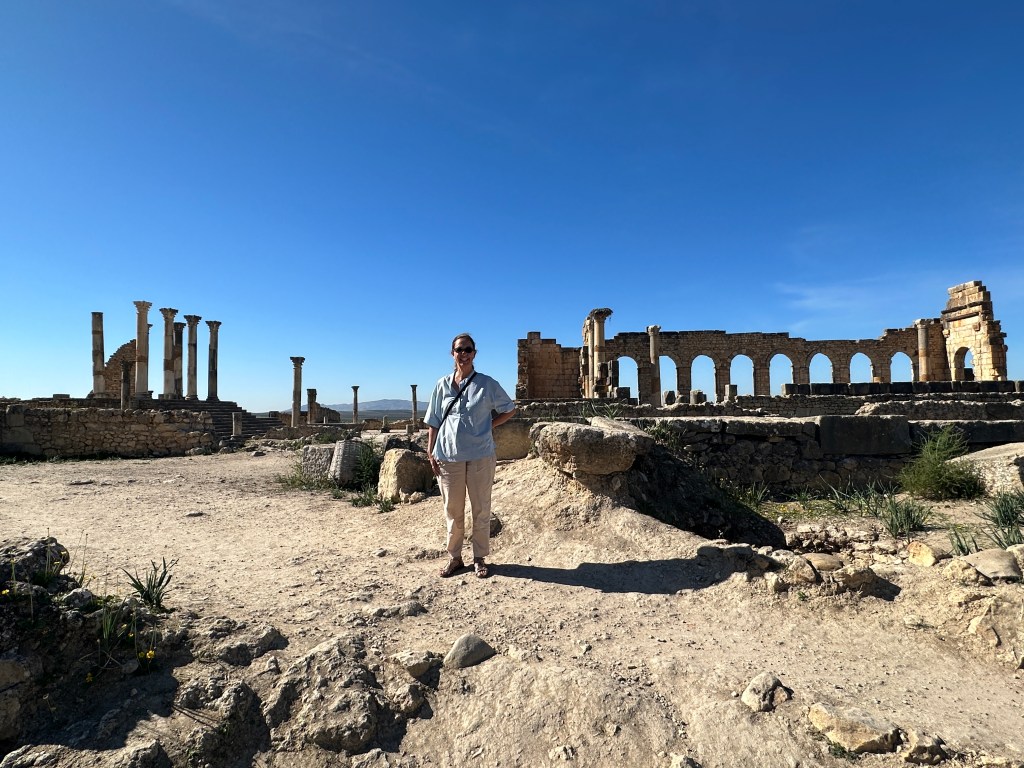
I do love an ancient ruin!

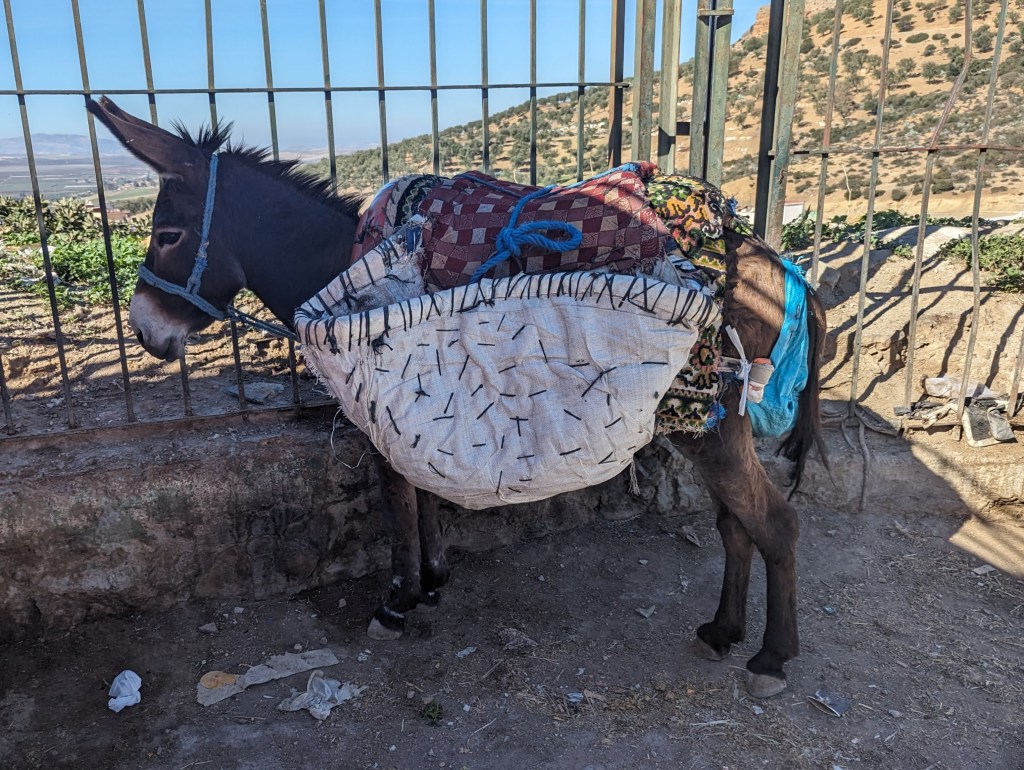
We headed from Volubilis to the nearby town of Moulay Idriss, site of the tomb of Idris I, the first major Islamic ruler of Morocco, after whom the town is named. He died in 791. Kamal told us that if a Muslim is unable to make a pilgrimage to Mecca in his life, visiting this city 7 times will serve the purpose. We parked and headed up the medina for lunch. We passed this donkey home from a day’s work. The medina streets are often too narrow for even carts, so donkeys are used to deliver goods to the shops.
We passed the shops on the main square.

We climbed the many, many steps to the Scorpion Restaurant with its gorgeous views. Notice the humble entrance.

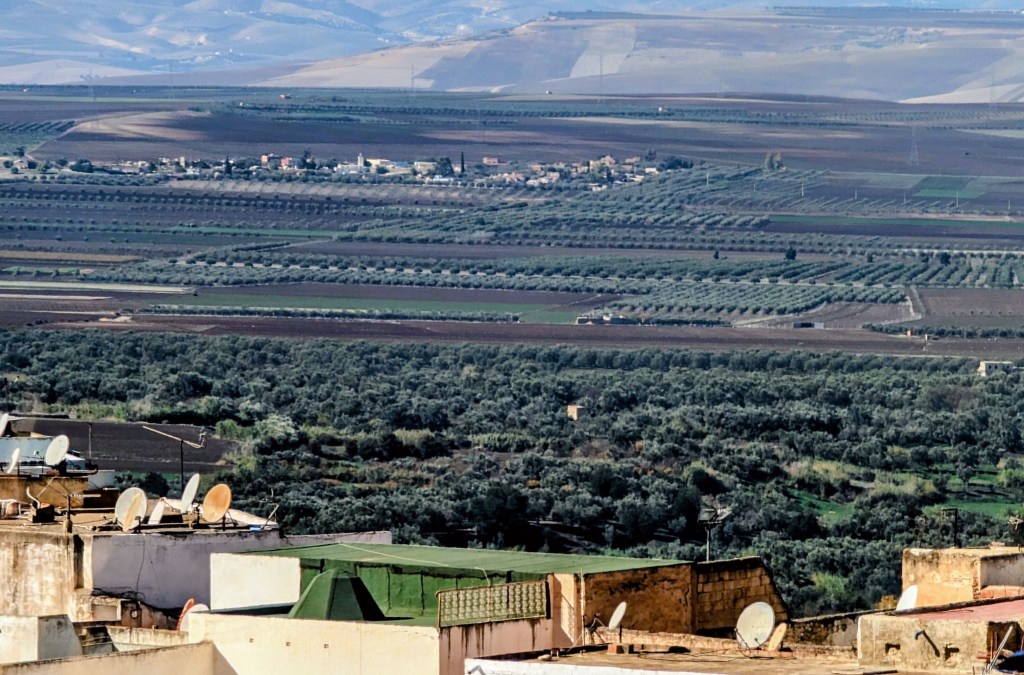
And here are the views of the city.

From here we can appreciate the fertile land that enticed the Romans.
We were presented with our menu including several things that were new to us.

This was lunch for just the 2 of us, not including the kebabs that came later.
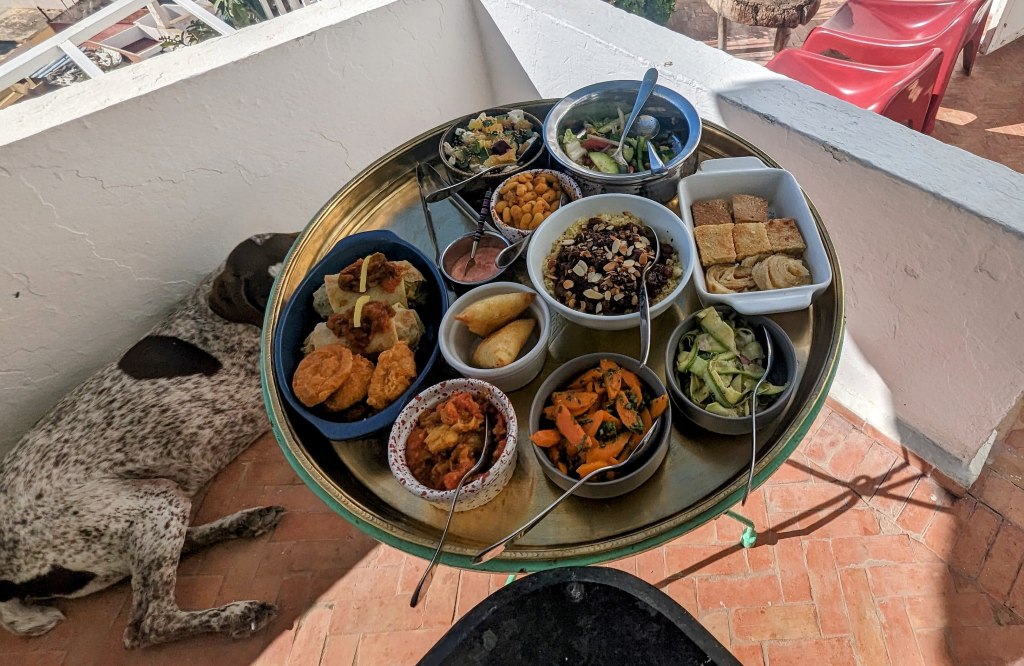
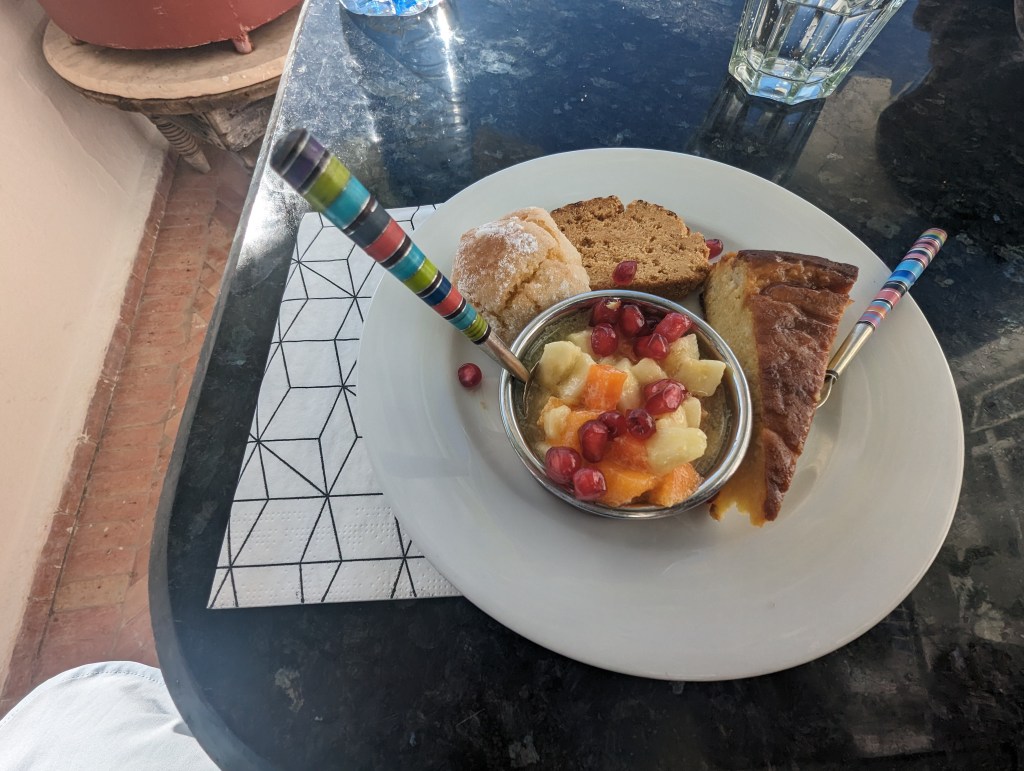
We managed to pack away most of it; it was soooo delicious. Then came dessert. And of course tea.
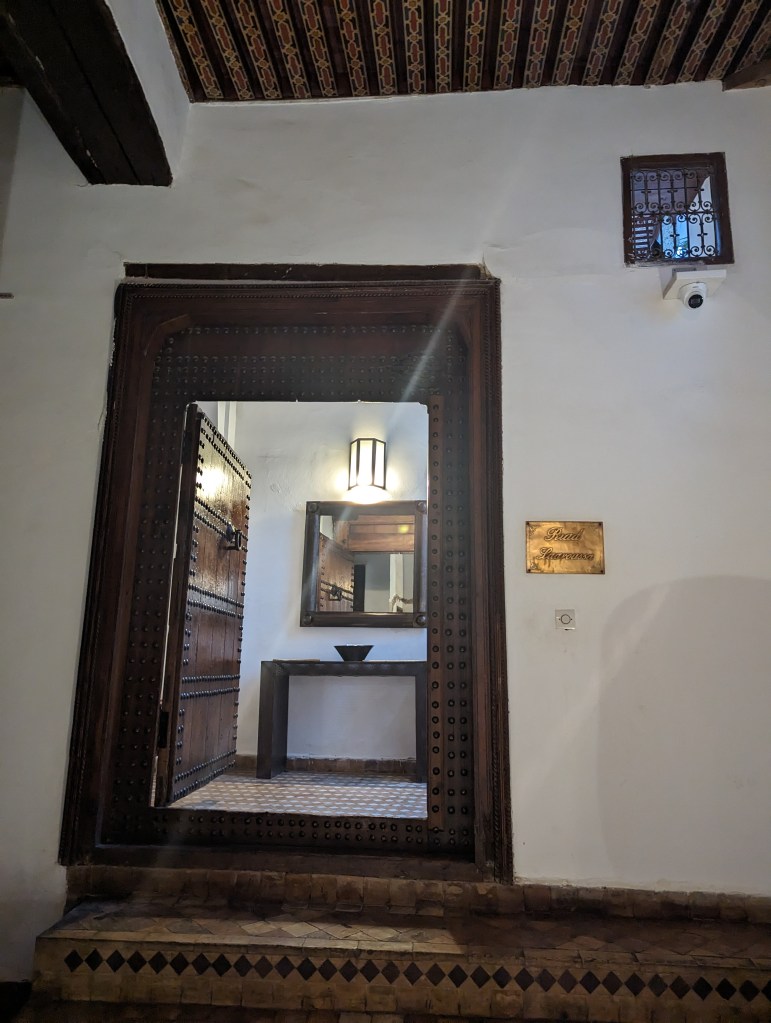
We rolled out of there back to the car for the final drive to Fez. Once there we were met by a porter from the riad who had a cart for our luggage. We wound our way through the medina to Riad Laaroussa.

Again, the entrance is an inconspicuous hallway.
Which opened into this awesome courtyard so huge it has orange trees.
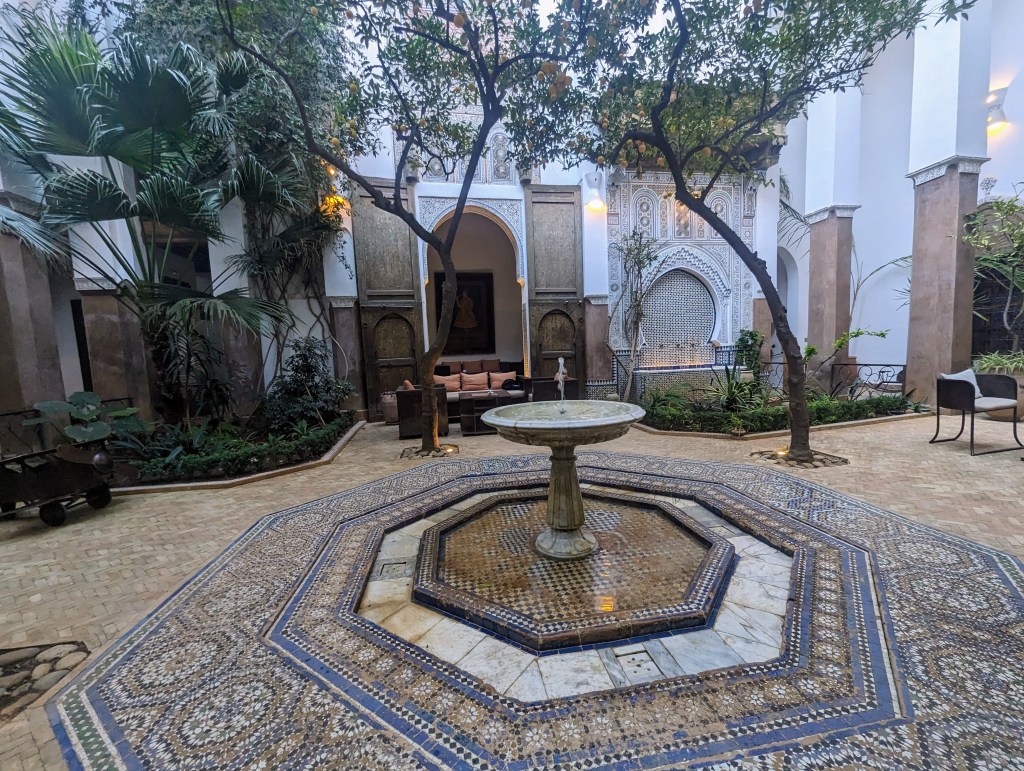
We were offered tea and more almond cookies, but honestly could not eat a bite. But the tea is settling to the stomach.

We were led up to our room called the terrace room. It is the largest room I have ever slept in with a floating bed smack in the middle and a desk behind.
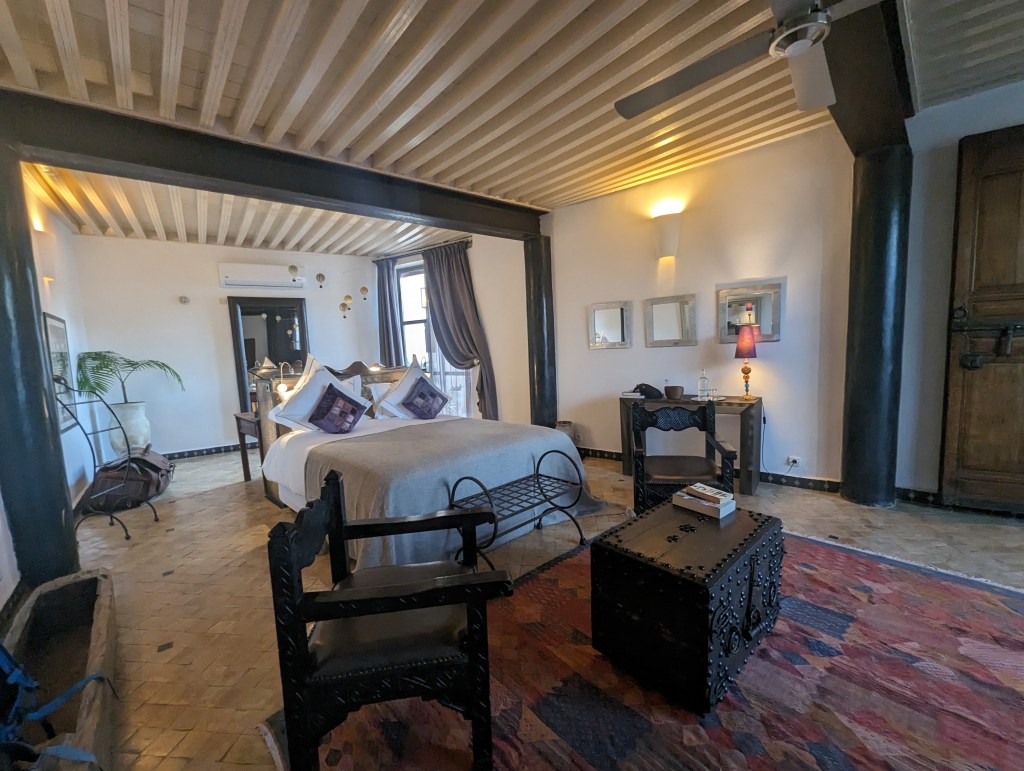
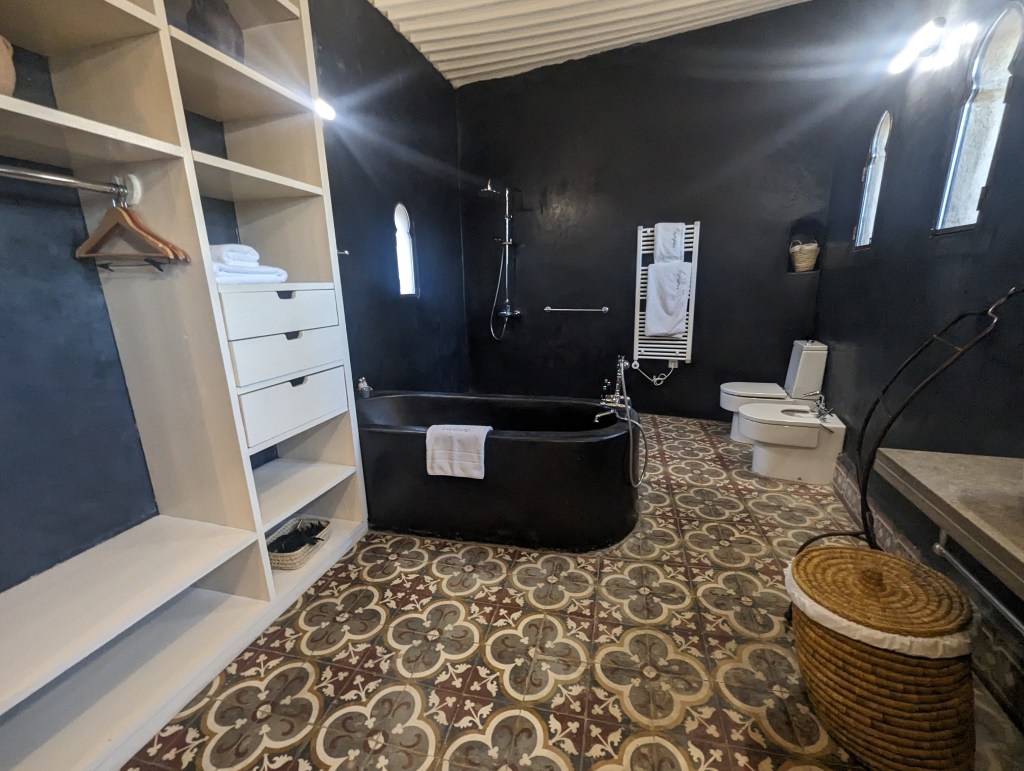
our bathroom with an open shower and Moroccan emollients and bath products, such luxury

We had 2 terraces.

the front terrace
view from the front terrace
our back terrace with a kitchen

We were given a tour of the riad which has a spa, swimming pool, and offers massages. The restaurant and breakfast terrace are on the roof.
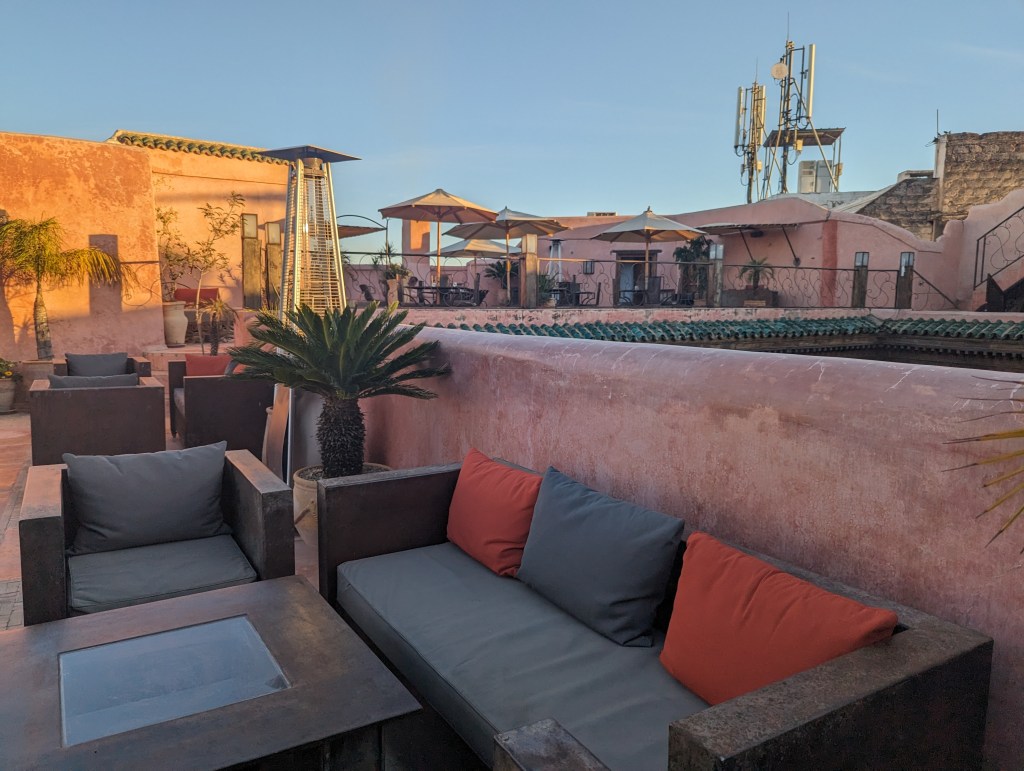
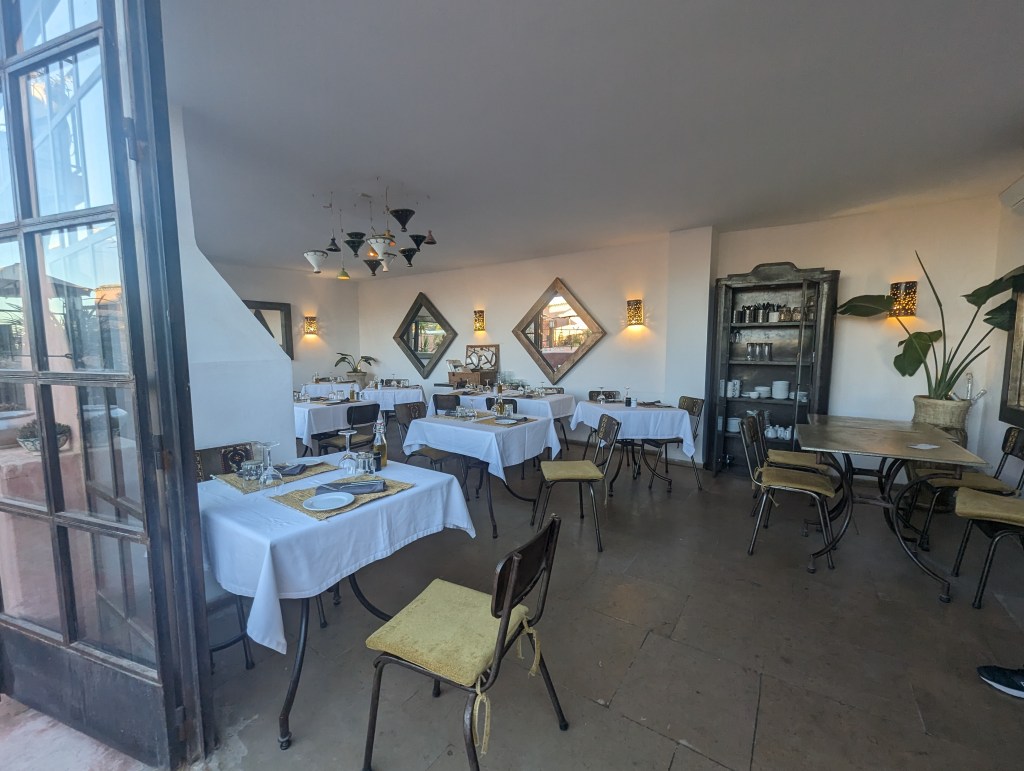
And we were here for 3 nights! We may never want to leave. We had dinner on the terrace, but could barely eat. Then hit the hay for our big day and early start.

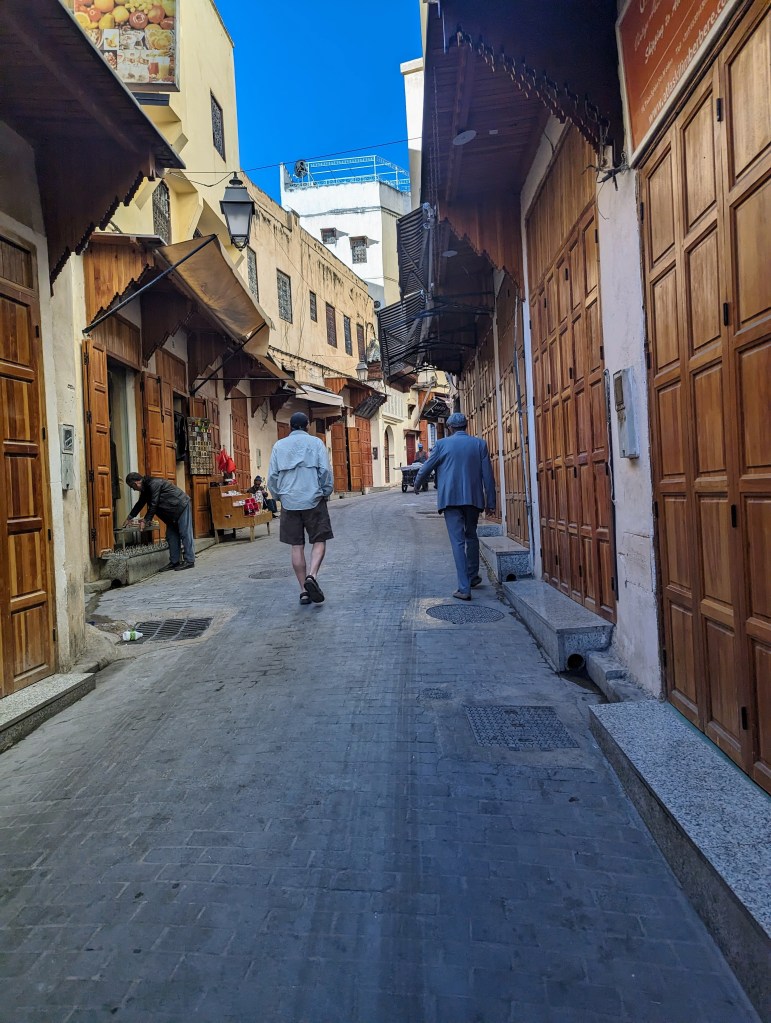
We were met in the morning by Naim. It was so early few of the shops in the medina were open yet. But he explained how UNESCO is renovating the medina to emulate the original design with uniform wood doors on all the shops.
He walked us out of the medina through the blue gate. The entrance door with its mosaic tiles is the most emblematic portal of the old medina of Fez, the largest medieval city and car-free urban area in the world. The side facing the medina, is green, the color of Islam.
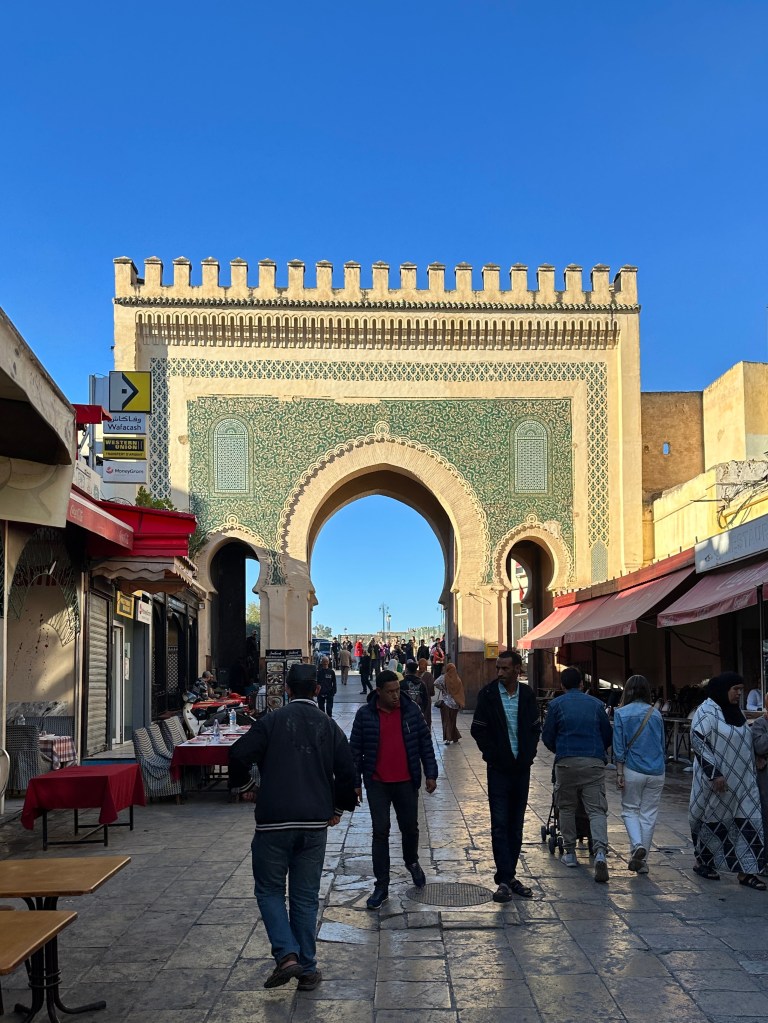
Bab boujloud

 The blue on the side that welcomes new visitors represents the color of the city of Fez, famous for its pottery, painted with elegant cobalt blue patterns. The bab (portal) was built in 1913.
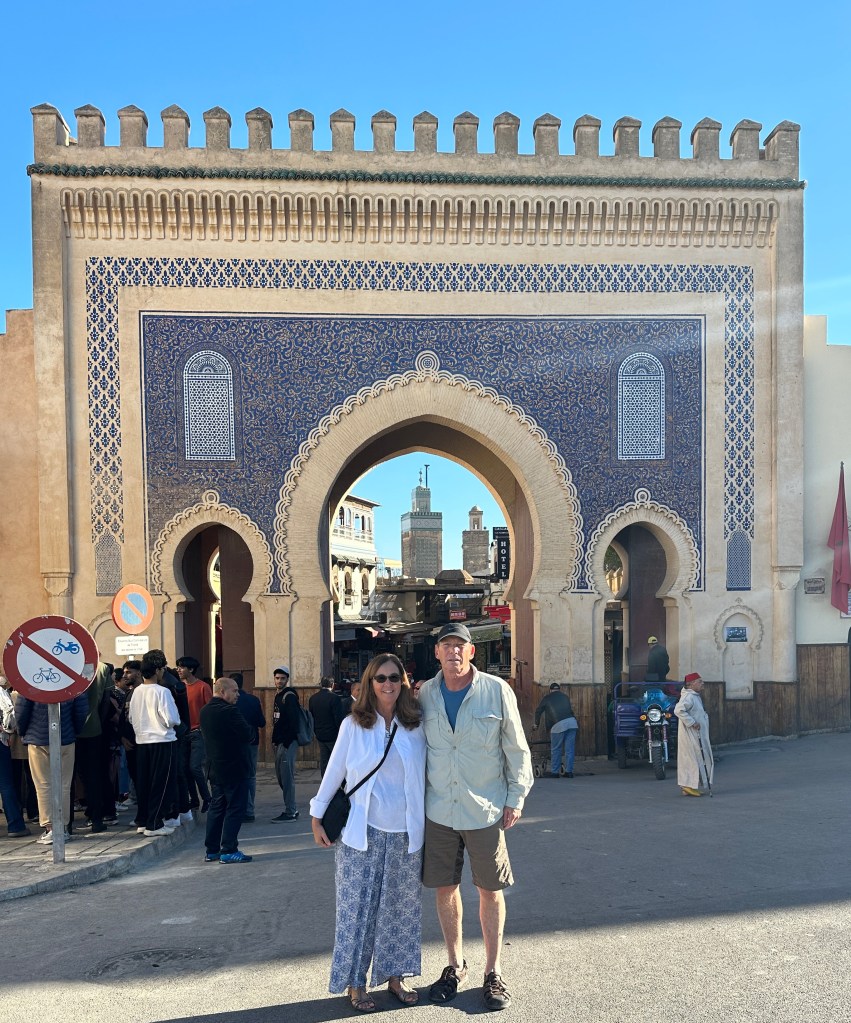
We then hopped in the car and Kamal drove us to see the Jewish Quarter in the “new city” of Fez: Fez el-Jdid, built mostly in the 14th and 15th centuries after the Jews were expelled from Spain. On the way, Naim filled us in on Fez history.

Fez was founded in the 9th century by Idris II, son of Idris I buried in Moulay Idriss mentioned above. He is buried in a mausoleum in the center of the medina he built, which is the old medina. Fez reached its peak in the 13th–14th centuries under the Marinids, when it replaced Marrakesh as the capital of the kingdom. The urban fabric and the principal monuments in the medina – madrasas, fondouks, palaces, residences, mosques and fountains – date from this period. Although the political capital of Morocco was transferred to Rabat in 1912, Fez has retained its status as the country’s cultural and spiritual centre. Today it is the second largest city in Morocco by population.

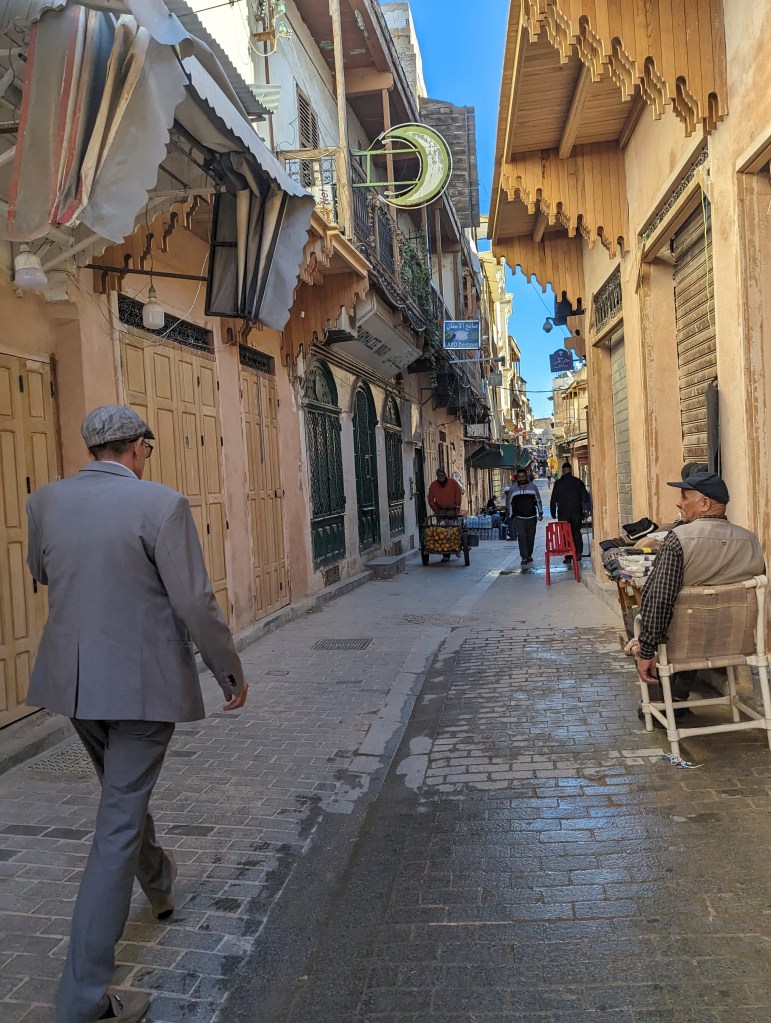
Immediately one can see the difference from the Muslim areas in the old medina. The Jewish Quarter has wider streets and the homes have balconies,

Many Jews adopted the French iron balconies.
We visited the synagogue.
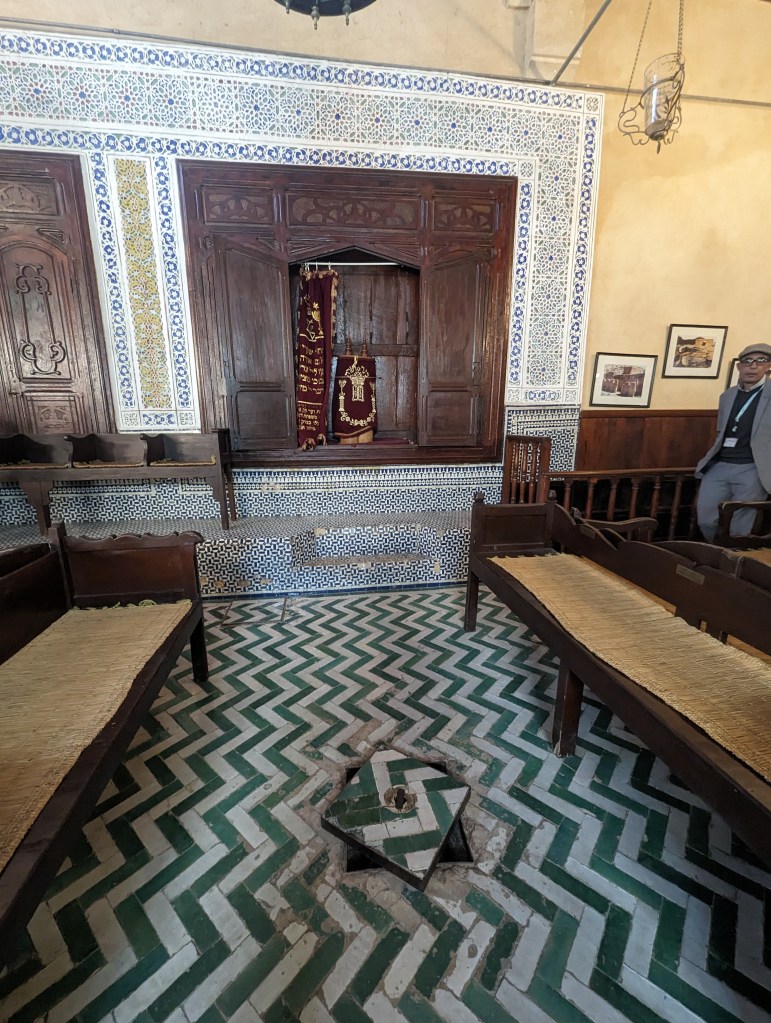
With its wooden bima.
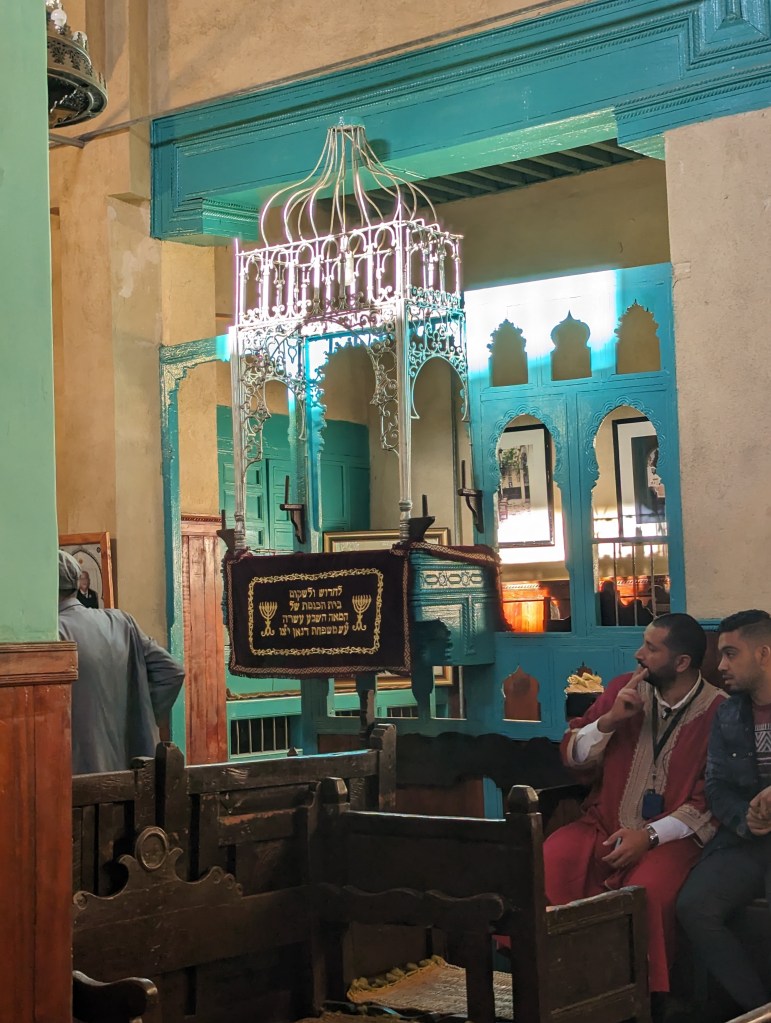
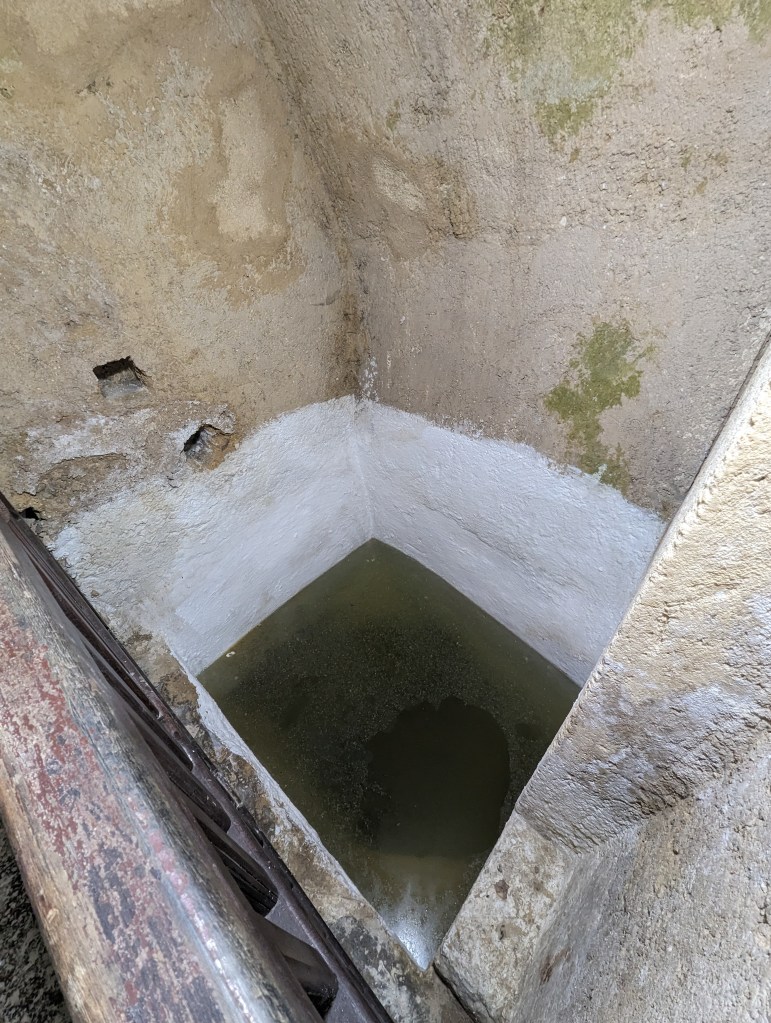
And the uninviting looking mikvah.
We then stopped in front of the Royal Palace. The original foundation dates to the 13th century. Despite the Muslim preference for humble entrances to their homes, in 1962 having been returned to his throne, King Mohamed V ordered this elaborate gate built for his home to showcase to the world the craftsmanship of Fez and Morocco to promote trade and tourism.

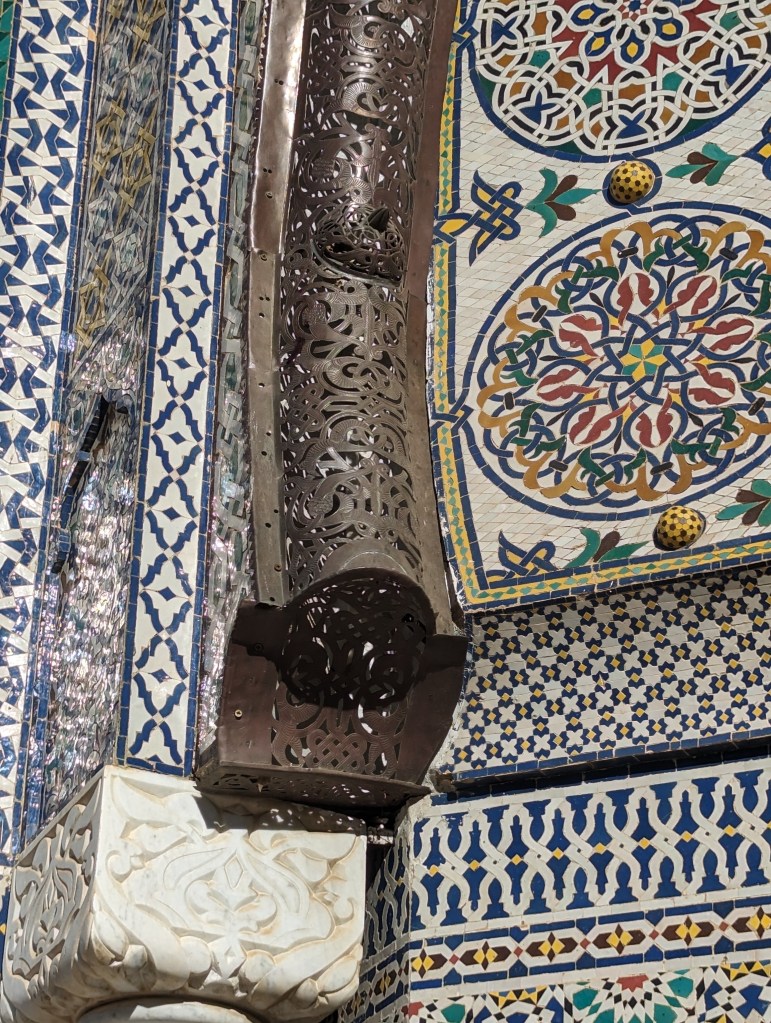
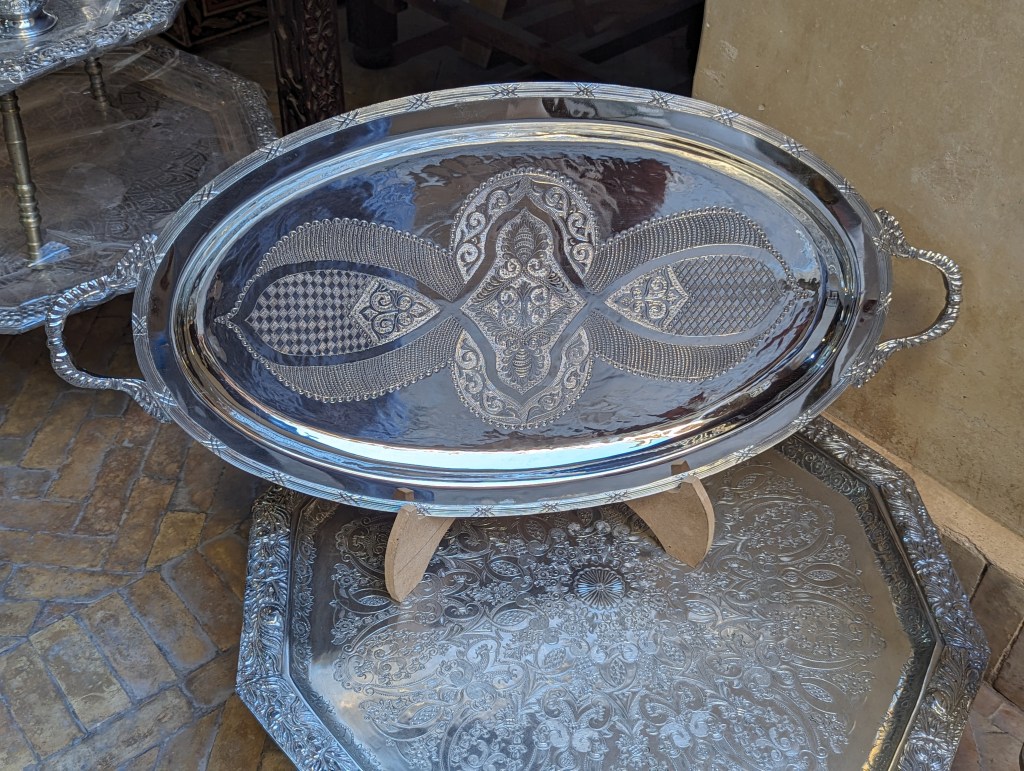
The typical Moroccan artisanal arts on display include metal works:
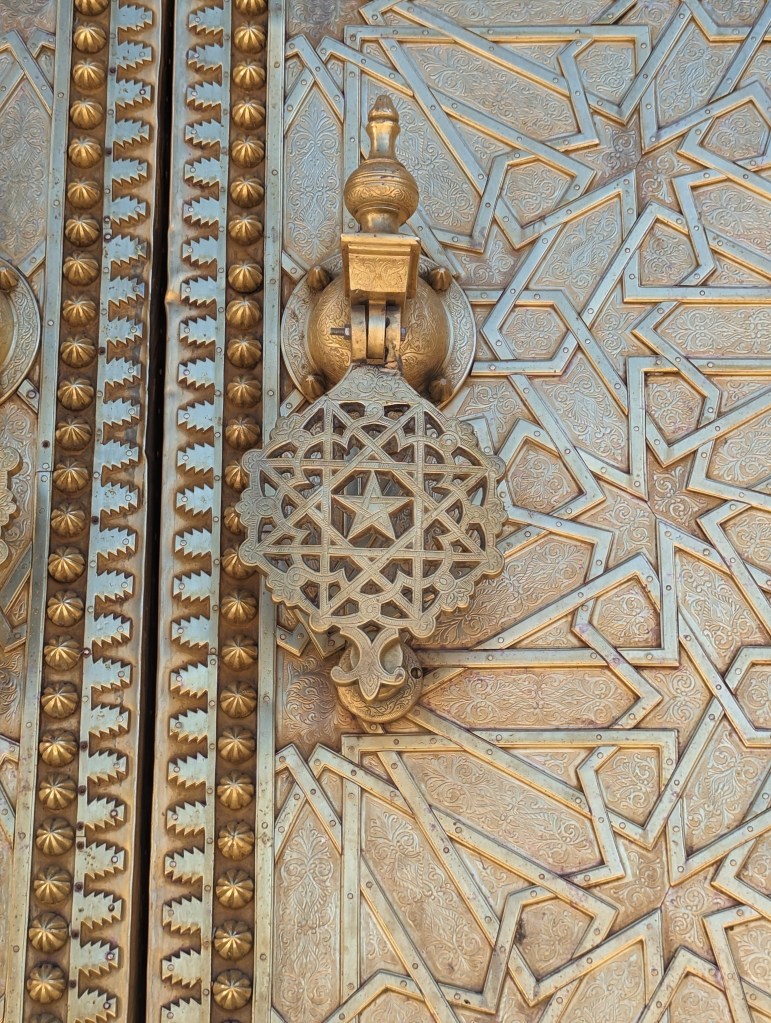
With an example of the fine metalwork
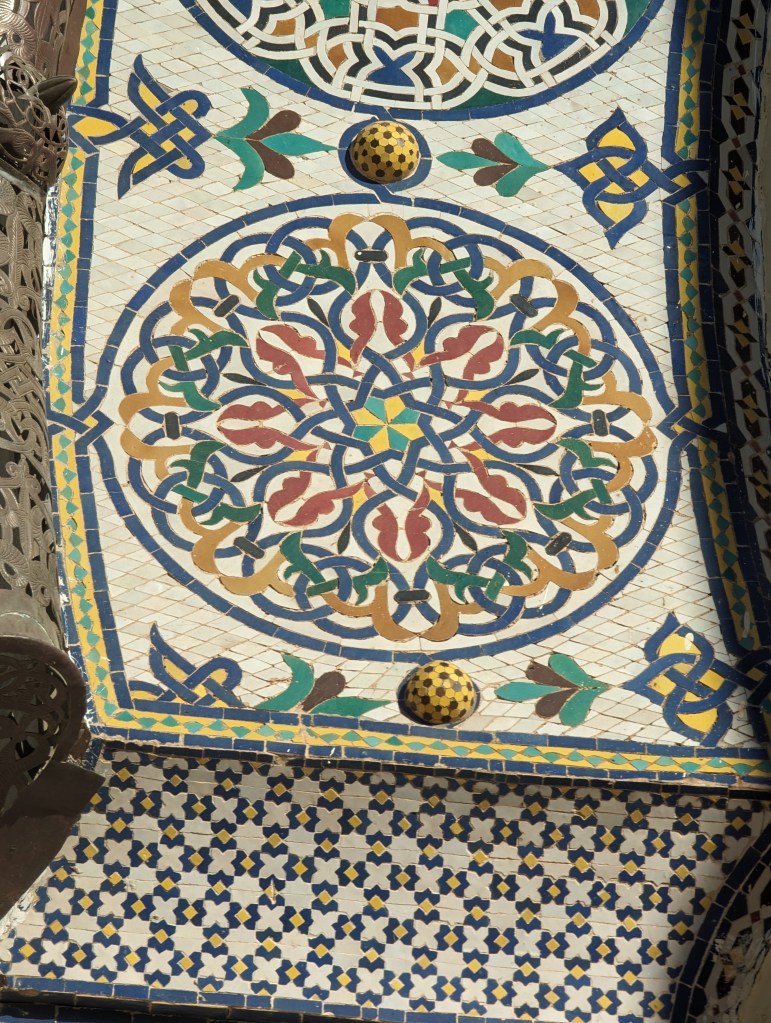
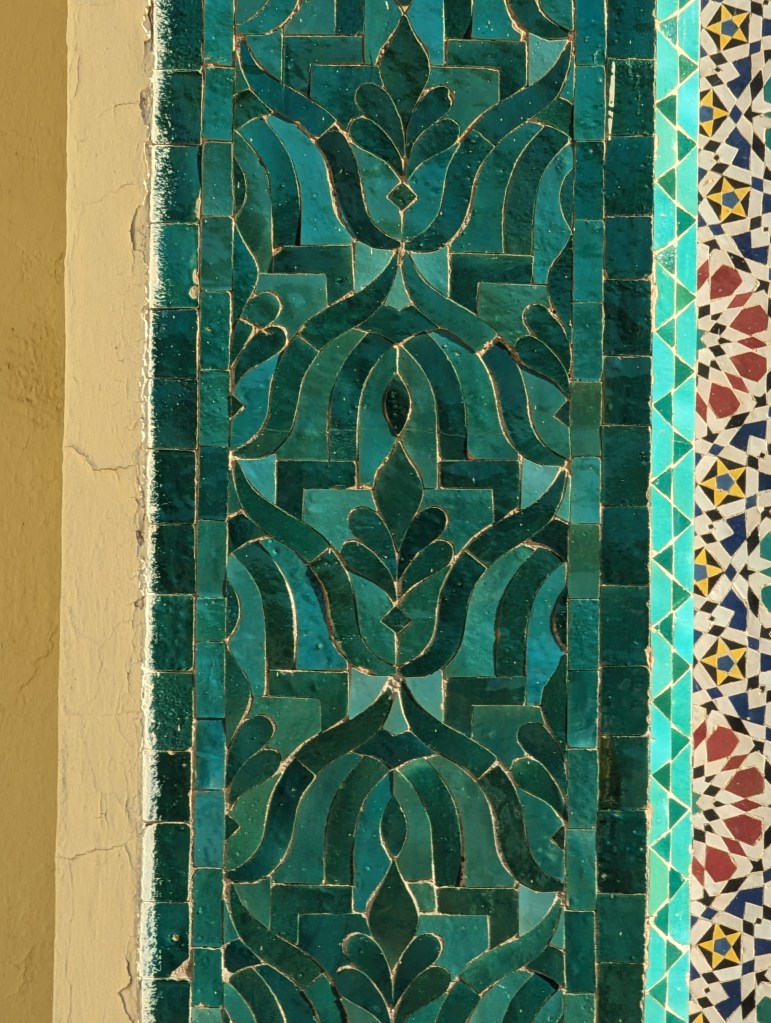
And of course mosaic tiles.
and the overhang carved woods.
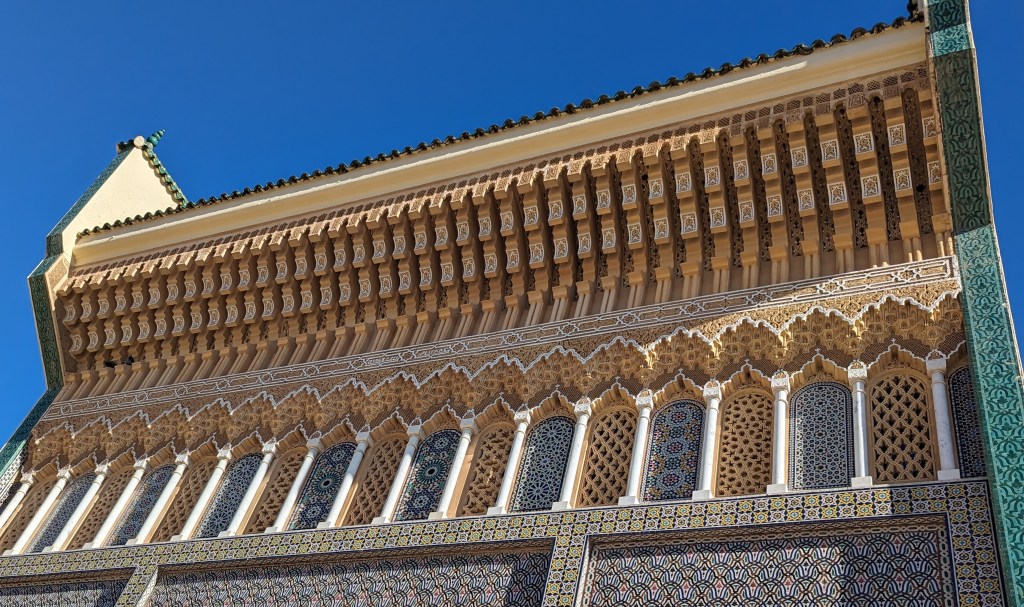
One side with white panel has a Quran quote that is a poem about serving the one God and living in peace and harmony with one another. When France fell to Germany in WWII, Germans controlled French occupied Morocco. Hitler demanded that Morocco hand over the Jews. The king refused and provided refuge for Moroccan Jews inside this immense palace (one of about 2 dozen in the country).
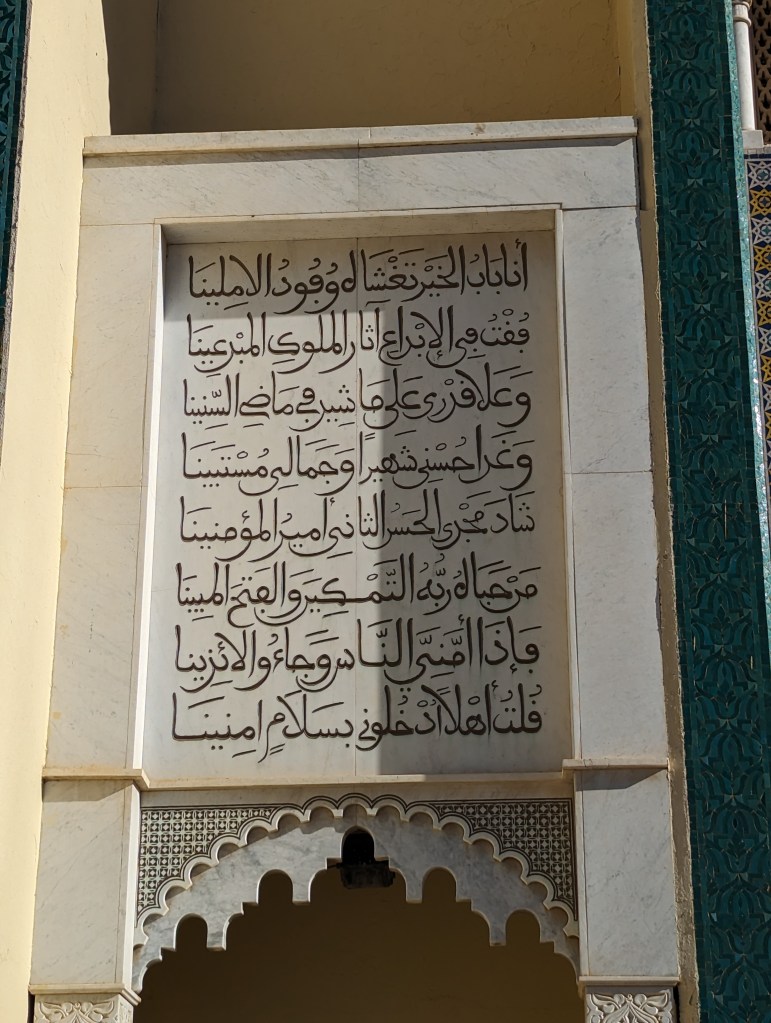
On the opposite side the same white panel is blank so the gate is not completely symmetrical because only God is perfect; nothing man-made can be perfect.

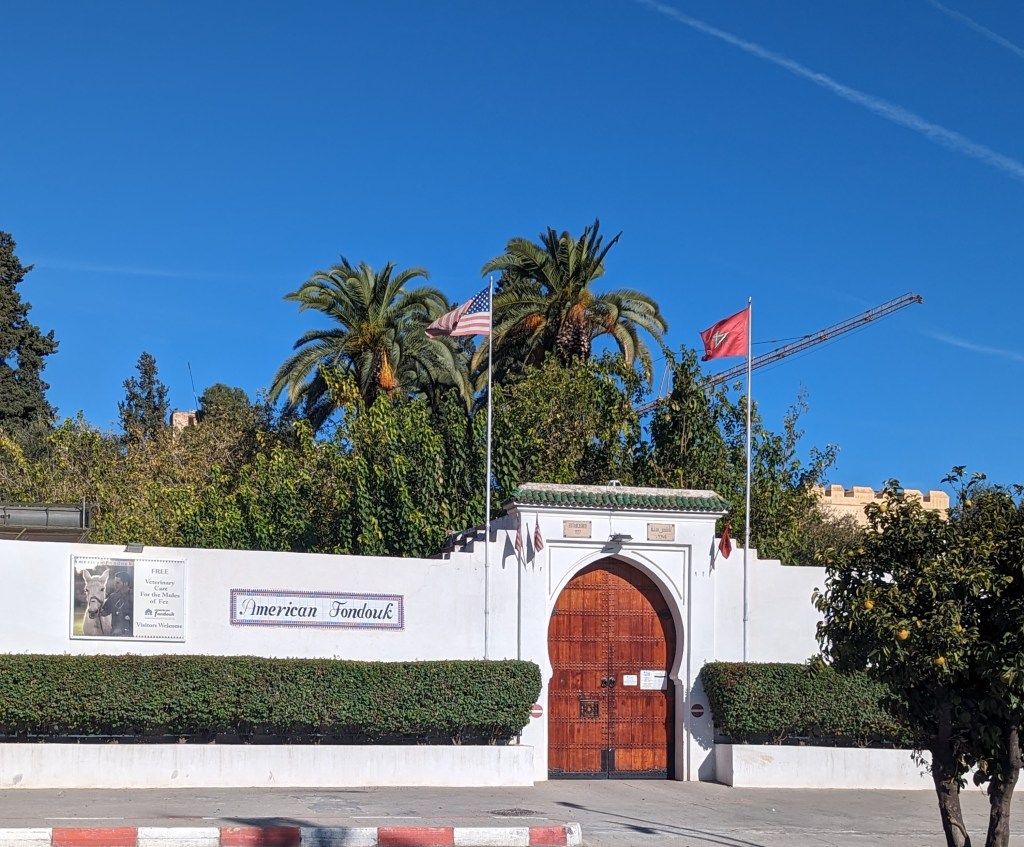
After admiring the gate, we hopped back in the car and headed for a viewpoint. On the way we passed a previous fondouk. A fondouk was a place where merchants and their wares could pull in, trade with the locals, have a place for them and their horse to stay, and take the local handicrafts with them to sell elsewhere. The one we passed was bought by an American woman (thus the name: American Fondouk), and is now a veterinary hospital that does open to the public, but was closed today.
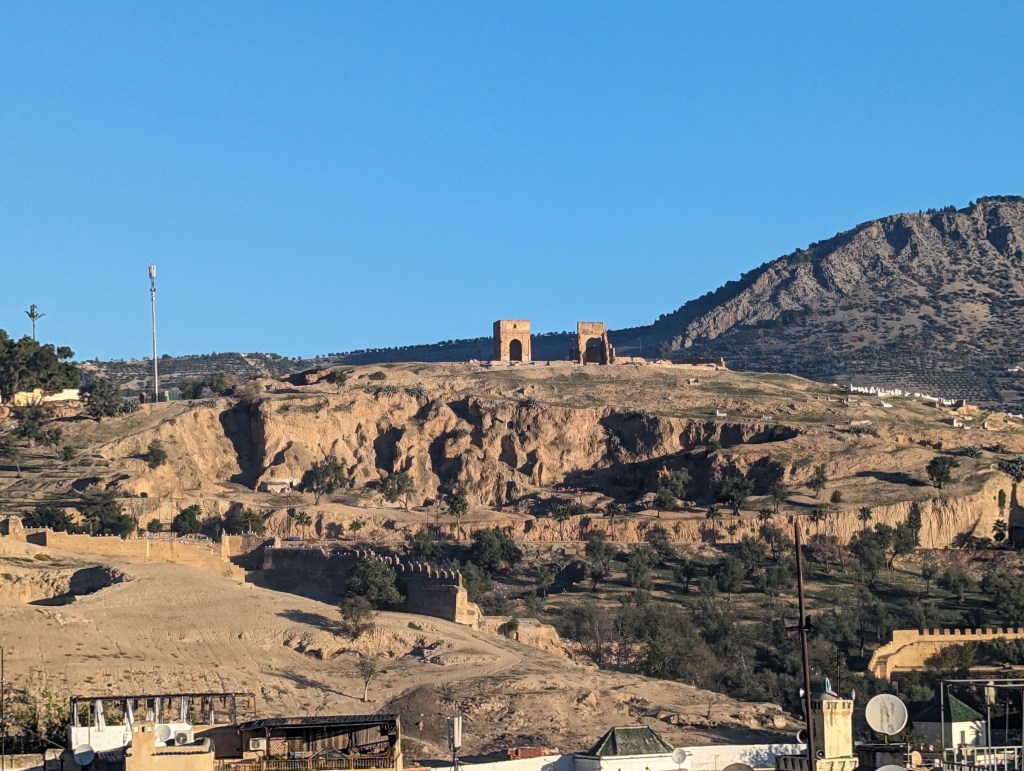
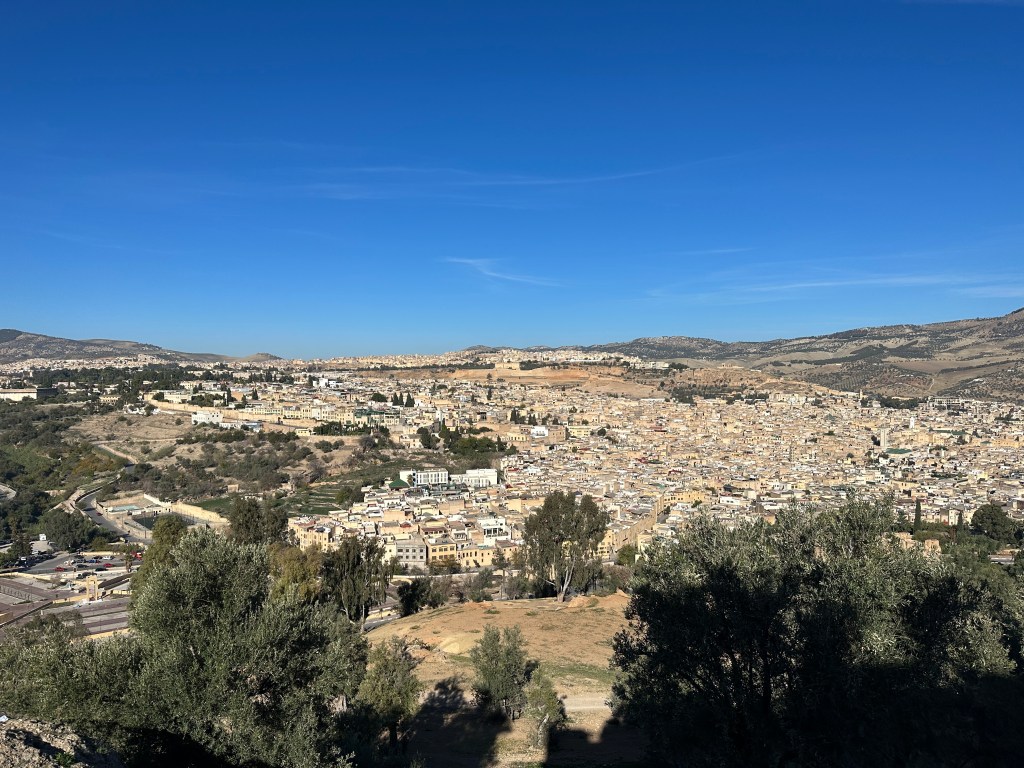
Then we made it to a spot above the town where we could have a view over both Old and New Fez as well as modern Fez. Old Fez is in the foreground, new Fez to the middle left, and 1980s and beyond across the back.
Fez’s renown as a spiritual center is due to its large number of resident artisans, most of which practice their art in the same way that has been passed down through generations. In that vein, we headed to a family run ceramics shop.

Outside of each of the major gates -3 in total- lies a cemetery.

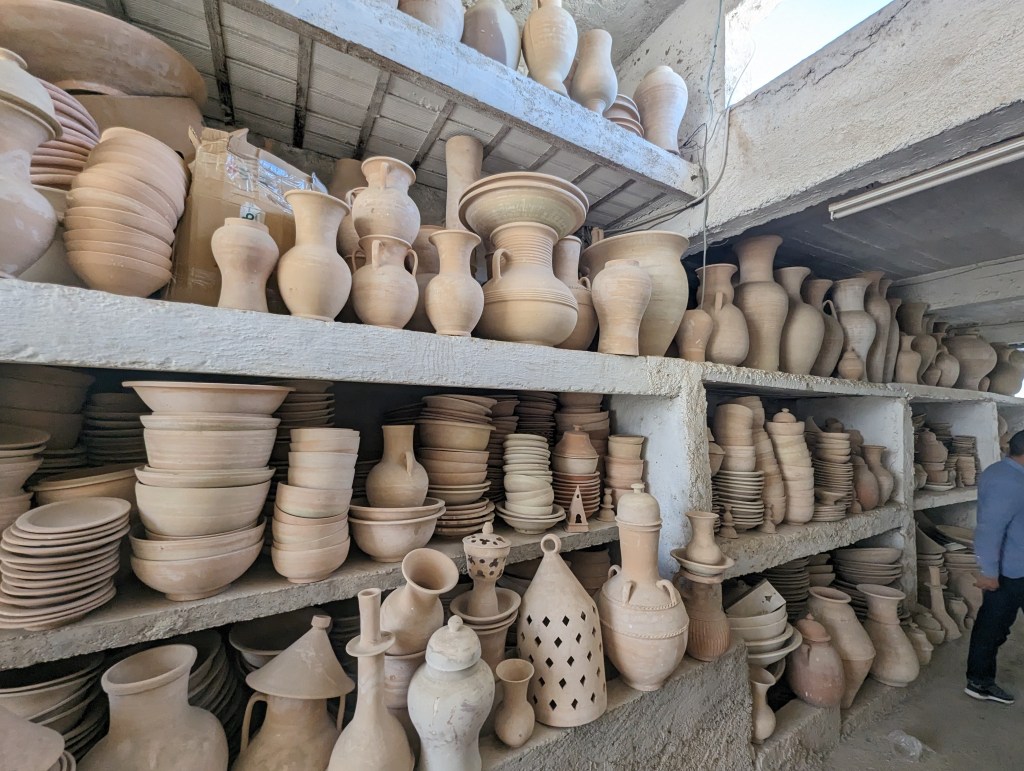
One of the family members came out to meet us and explain the process. First he showed us the excavated clay which is dissolved in water to make the clay. They use white rather than red clay because it can be fired at a higher temperature, making it more stable and durable than red.

The lump of clay is then spun into shape. He is using his feet to spin the wheel.

Then the pieces are placed in the courtyard to dry in the sun.
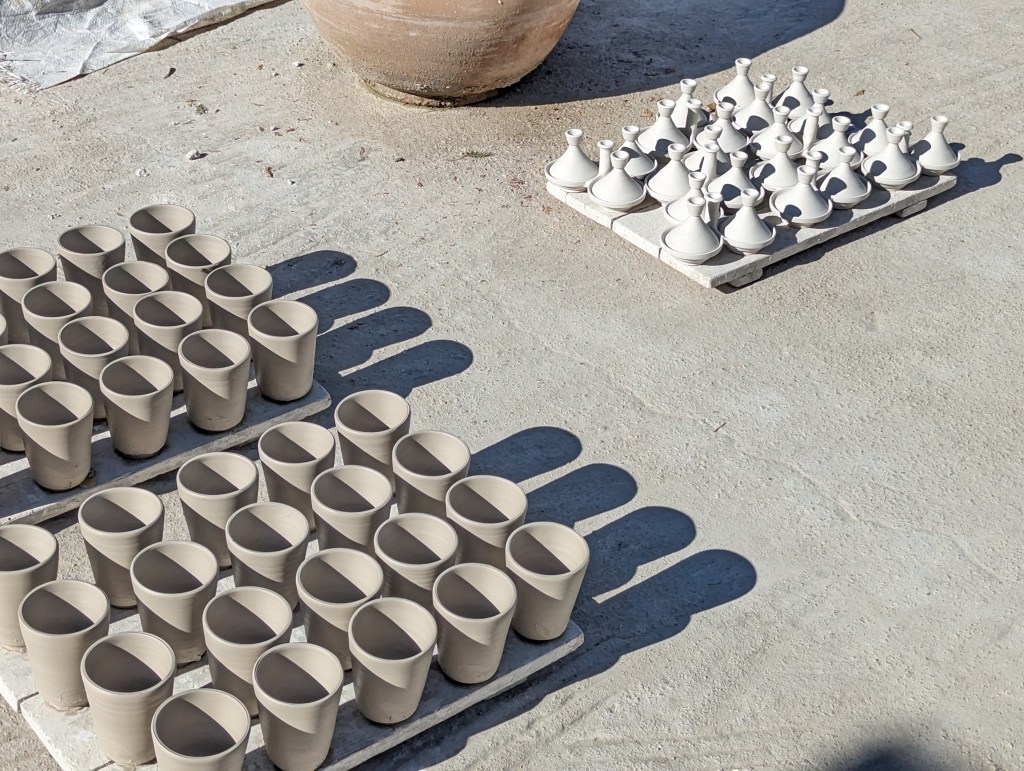
The items then go through their first bake, at which point they are called biscuit baked.
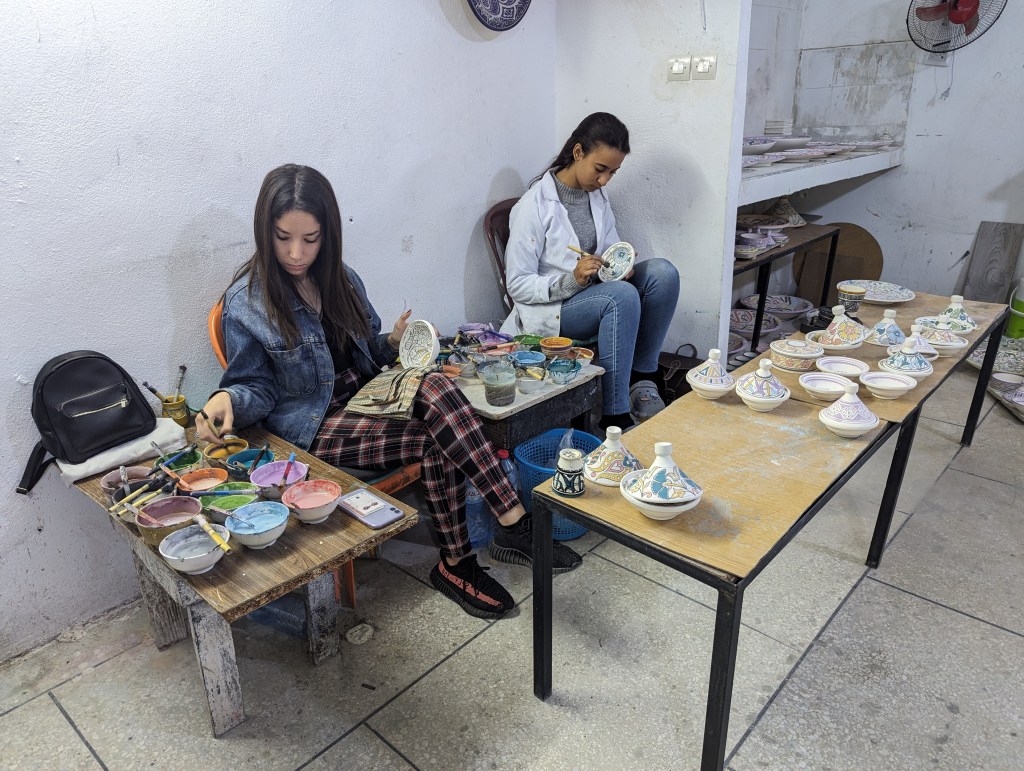
The next step is painting, which is all done by hand.
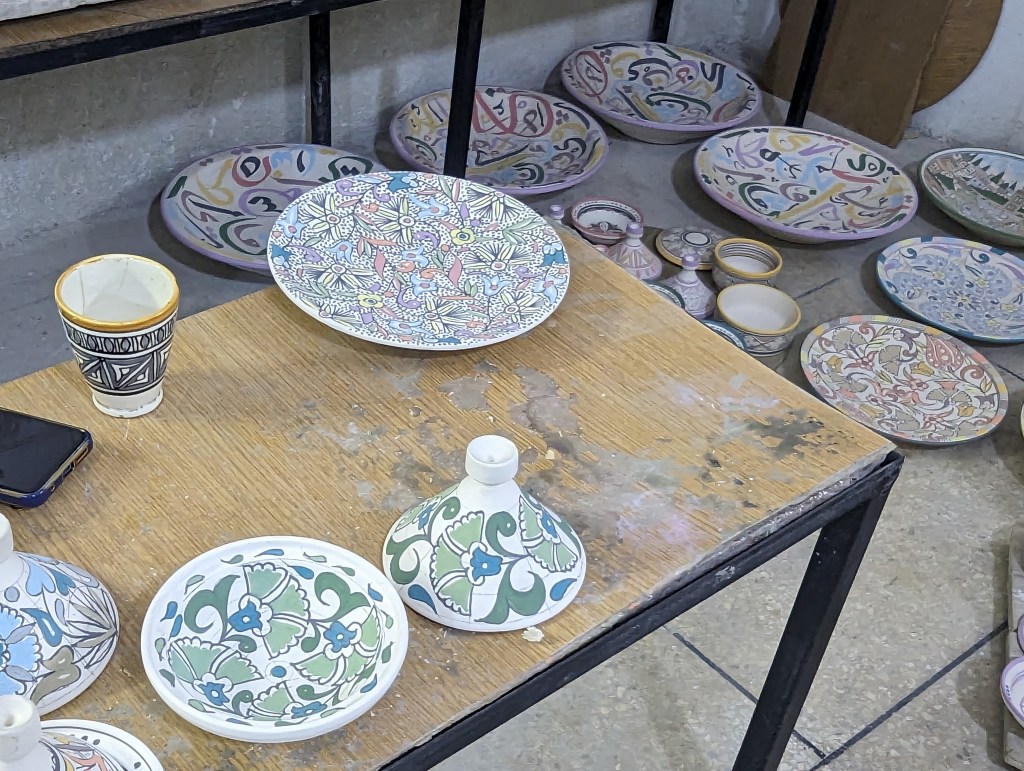
The pieces are then sprayed with a finish to give them the gloss and put in the oven for the second bake. Then he showed us the area where the tiles are broken into shapes if they are to be used for mosaics.

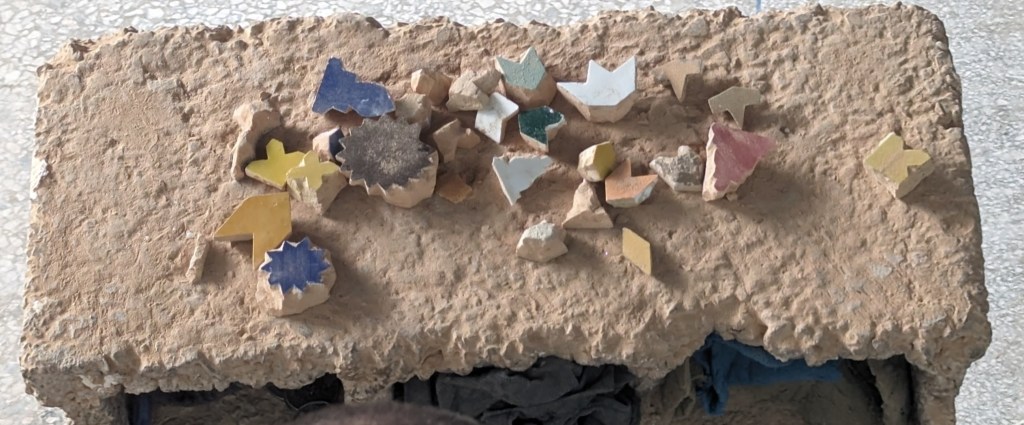
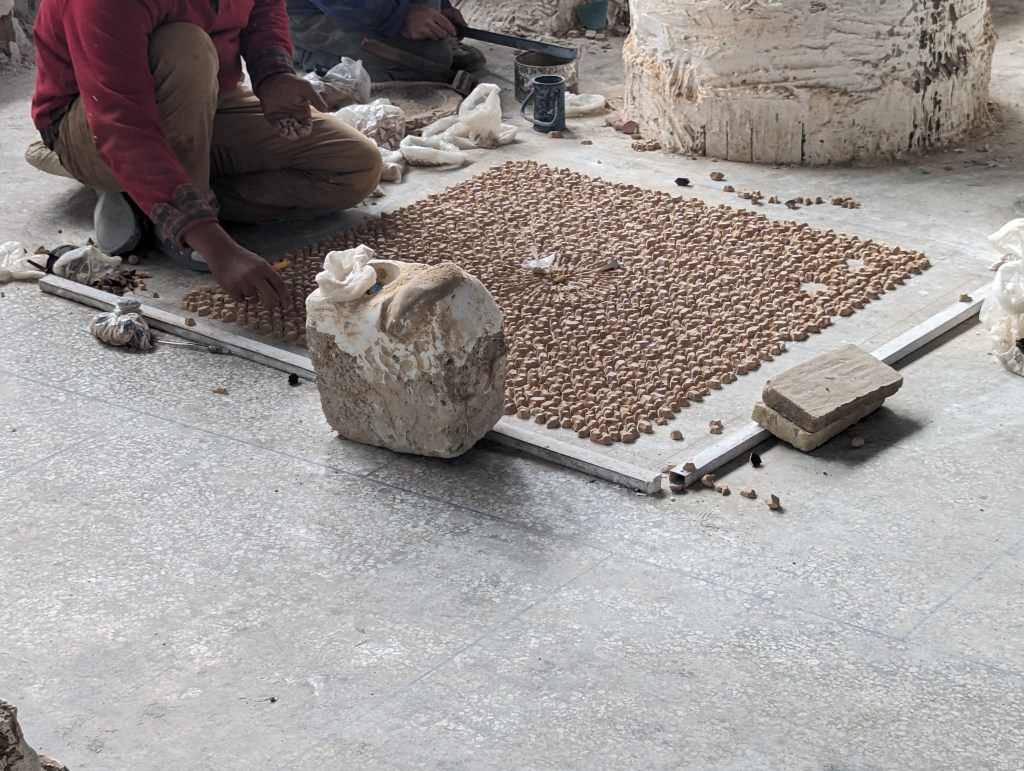
The pieces are then given to the master builder who builds the mosaic with the pieces turned upside down. He has to keep the colors and design plan all in his head.
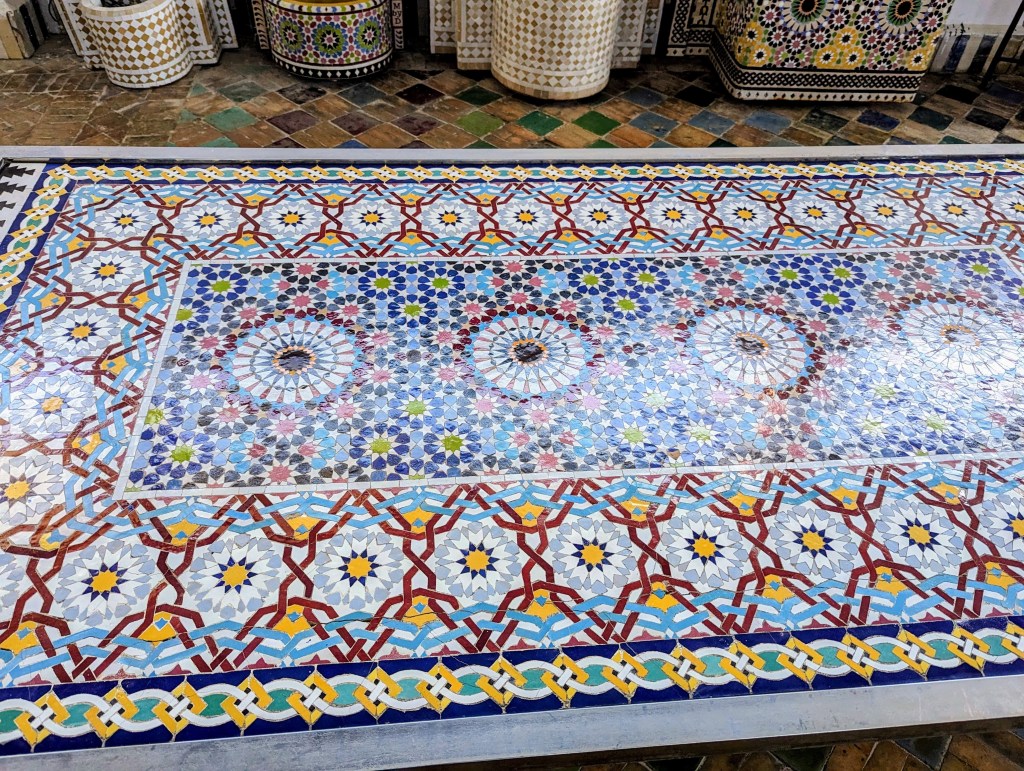
Here is a finished product.
If building a fountain, fireplace, or any 3-D mosaic, the pieces are placed into a mold. The process gives me such a new appreciation for works we have seen like the palace gate and the Mohamed V Mausoleum.
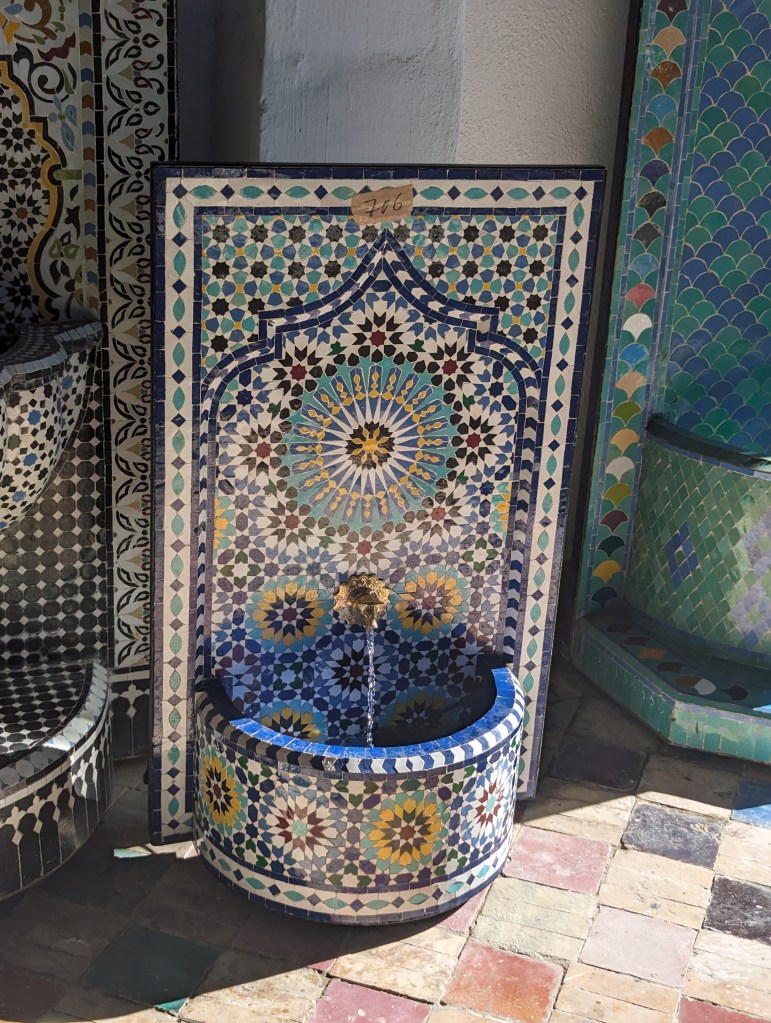
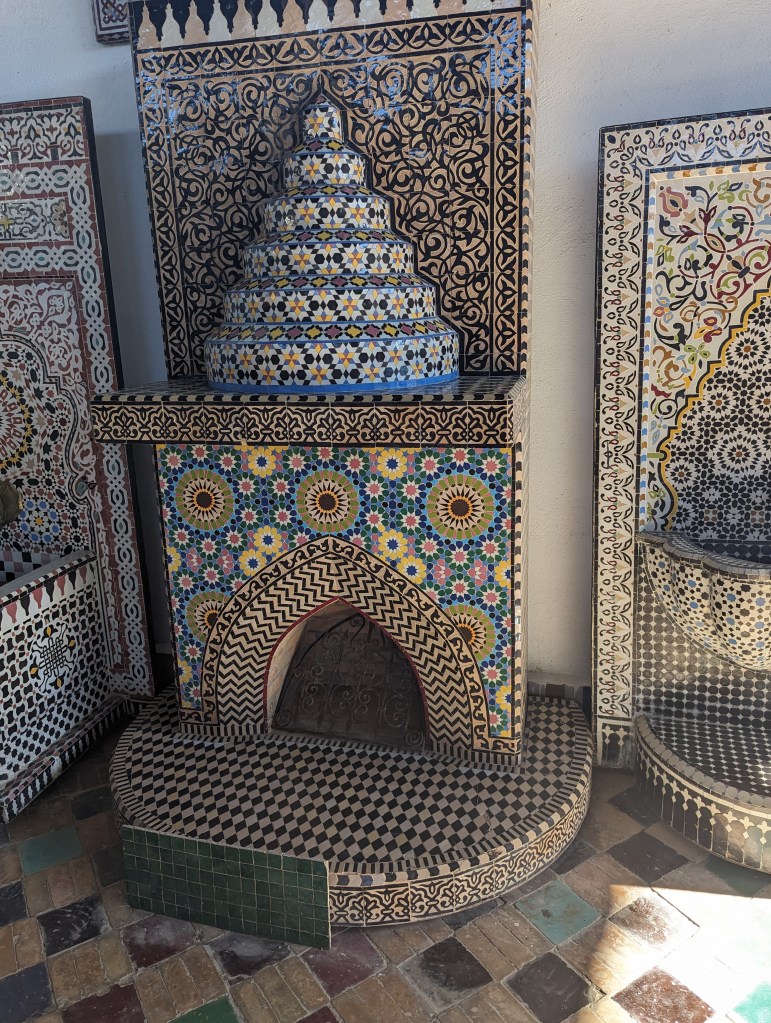
Then he showed us the gallery/showroom shop, gorgeous stuff.

We then headed back to the old medina. Just inside all of the major gates is the food markets to make it easiest for farmers bringing their produce and people coming to shop. The alleyways are so narrow that often only a donkey can transport the goods.

The next section are baked goods and prepared foods like olives, preserved lemons, smen (preserved butter, often flavored) or street foods for fast snacks. One new food we were introduced to is kligh, which is meat that is preserved, somewhat like jerky, then stored in fat. It is mostly commonly fried for breakfast, often with eggs.

Moroccans have all kinds of breads, especially for breakfast. One with semolina is called harcha. This woman is making crepes.

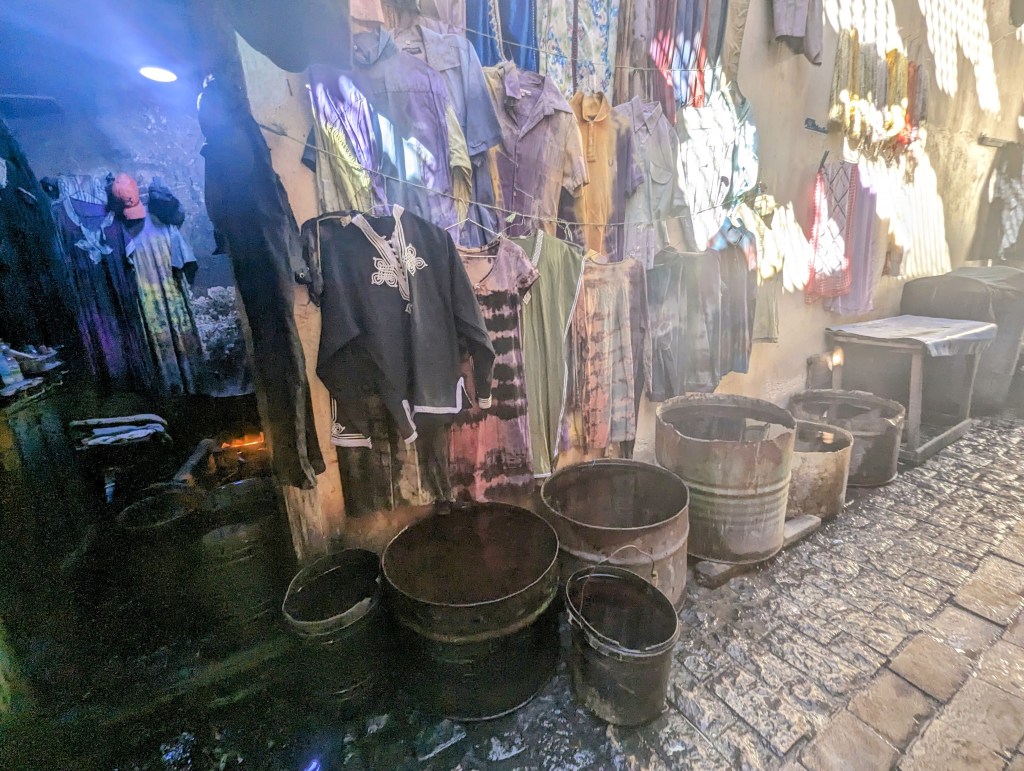
The artisanal products tend to be made and sold on specific streets. This street is for dying wool and fabrics. The wool dyers do not like to be photographed working; they are in the shed seen below.
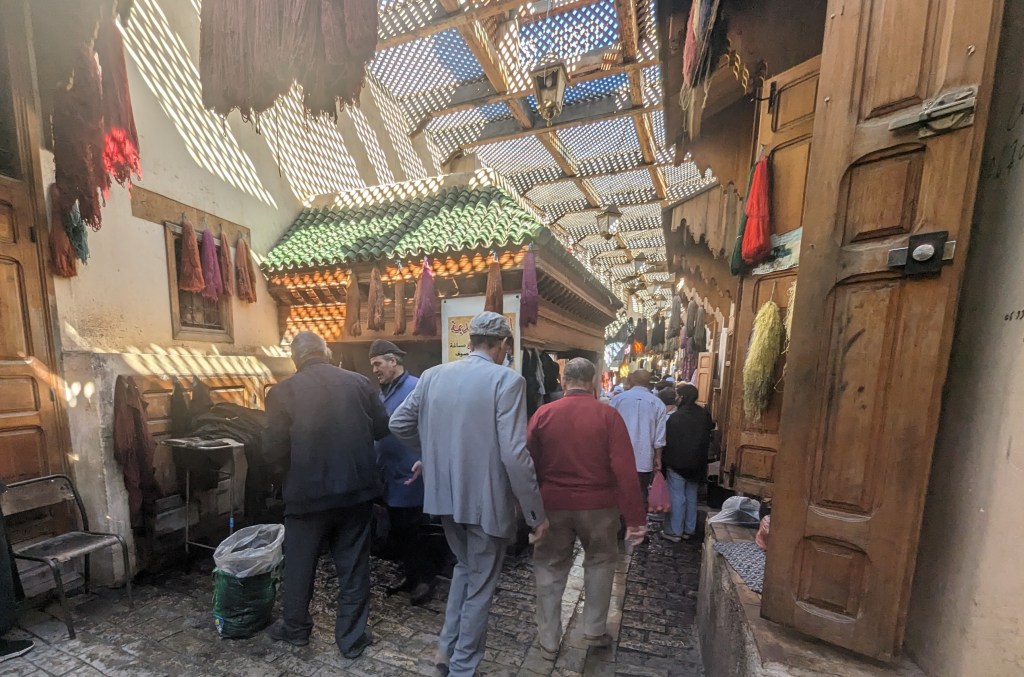
They then hang the dyed wool to dry.
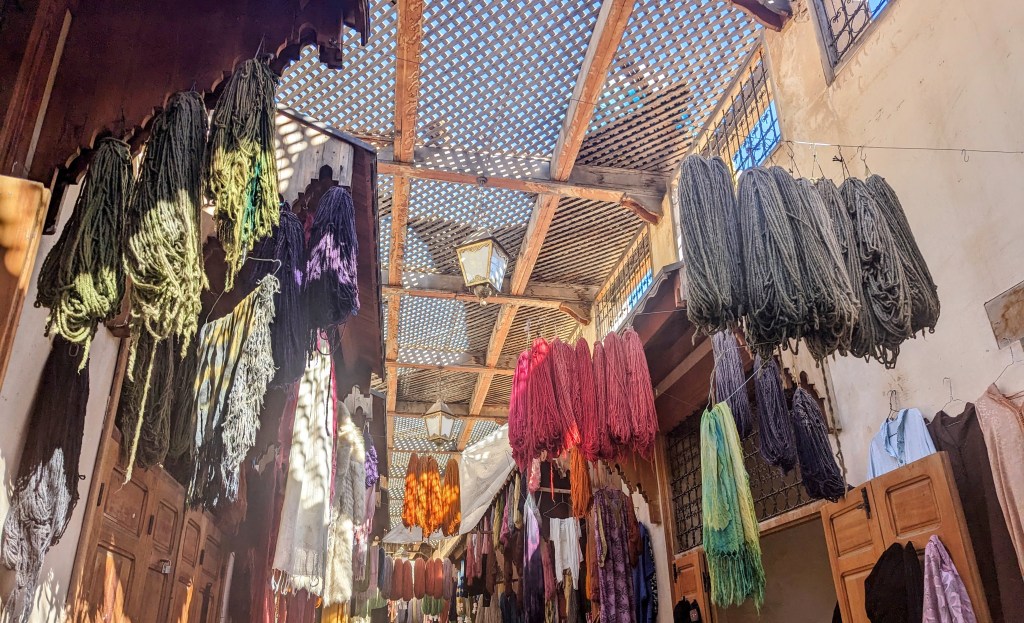
The Arabs tend to have subdued colors, the Berbers prefer bright colors.
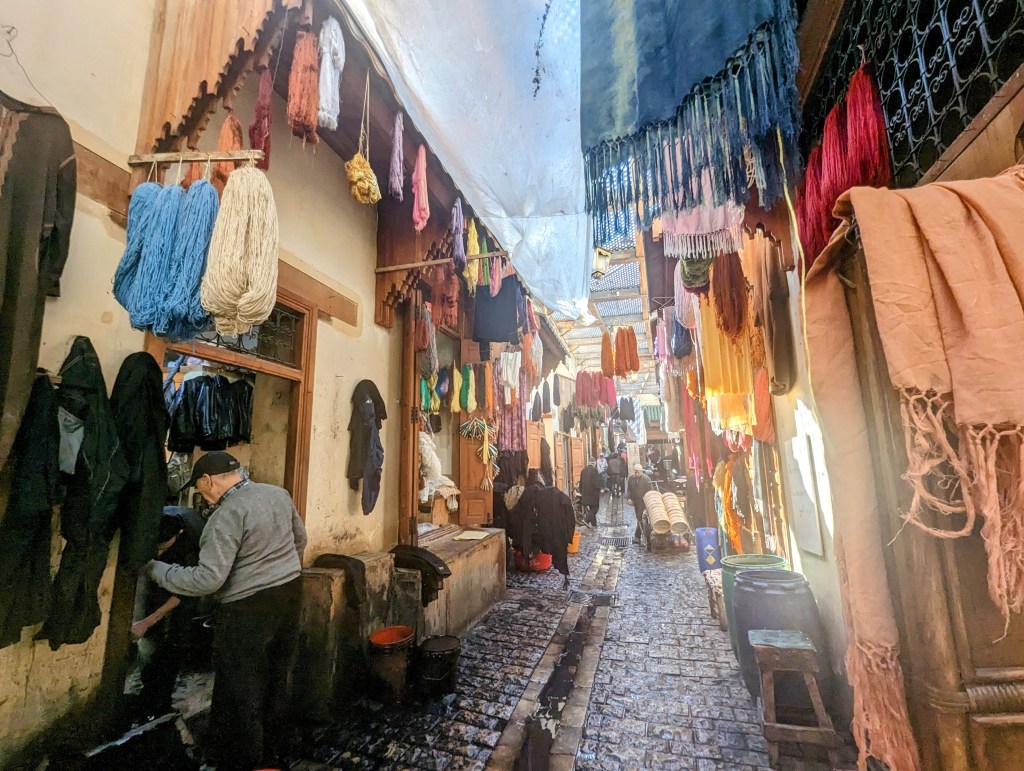
And silk.
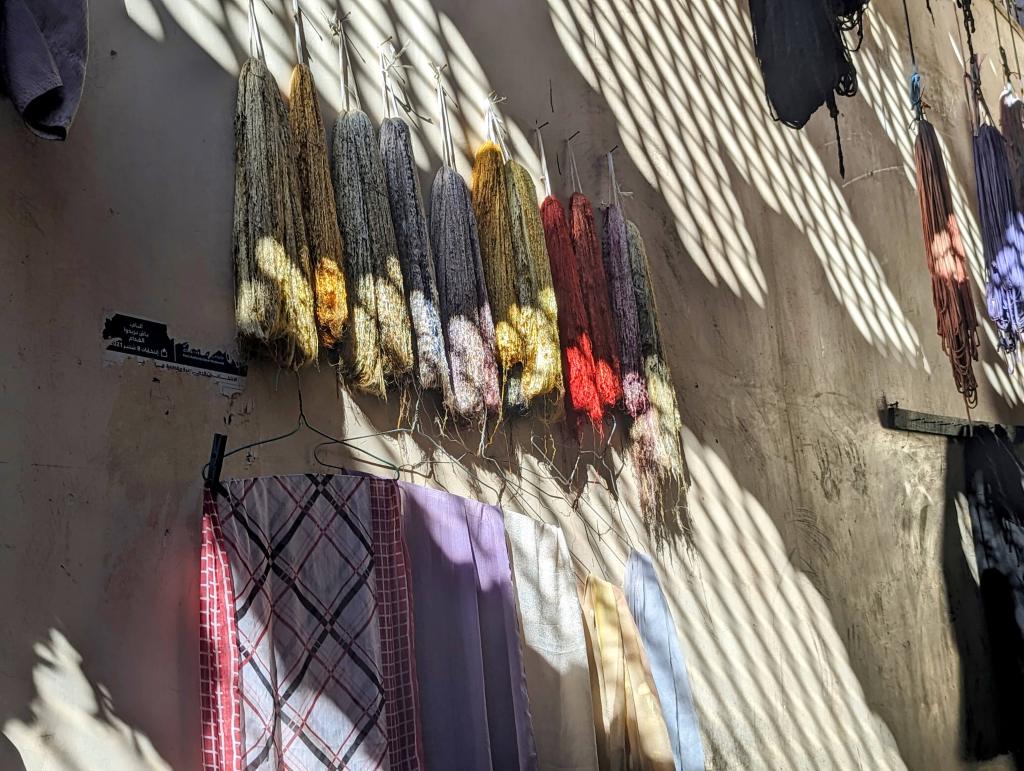
Dye vats are also used for fabrics,
We then passed through the metal works area. Many of the items for sale are machine-made. Naim taught us how to tell the difference by touch and resonance.

Techniques include both chiseling and creating lace patterns.
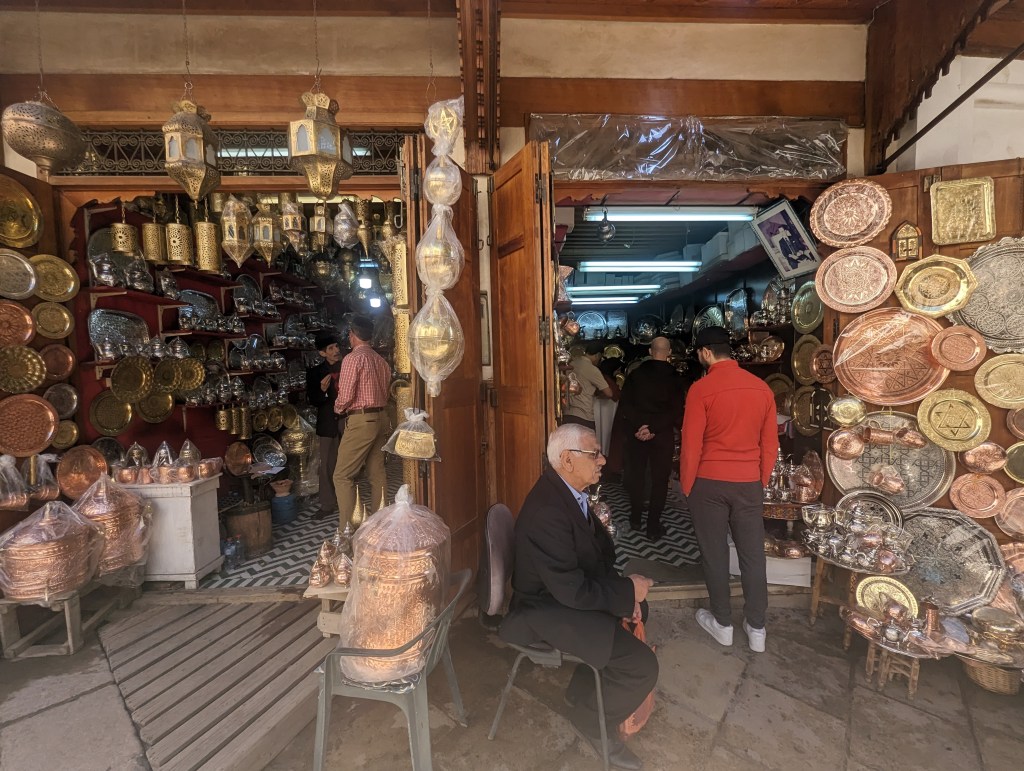
This is an area devoted to artisans working in only the centuries old methods of hand banging and cutting without refined tools. These products are often used in restaurants.

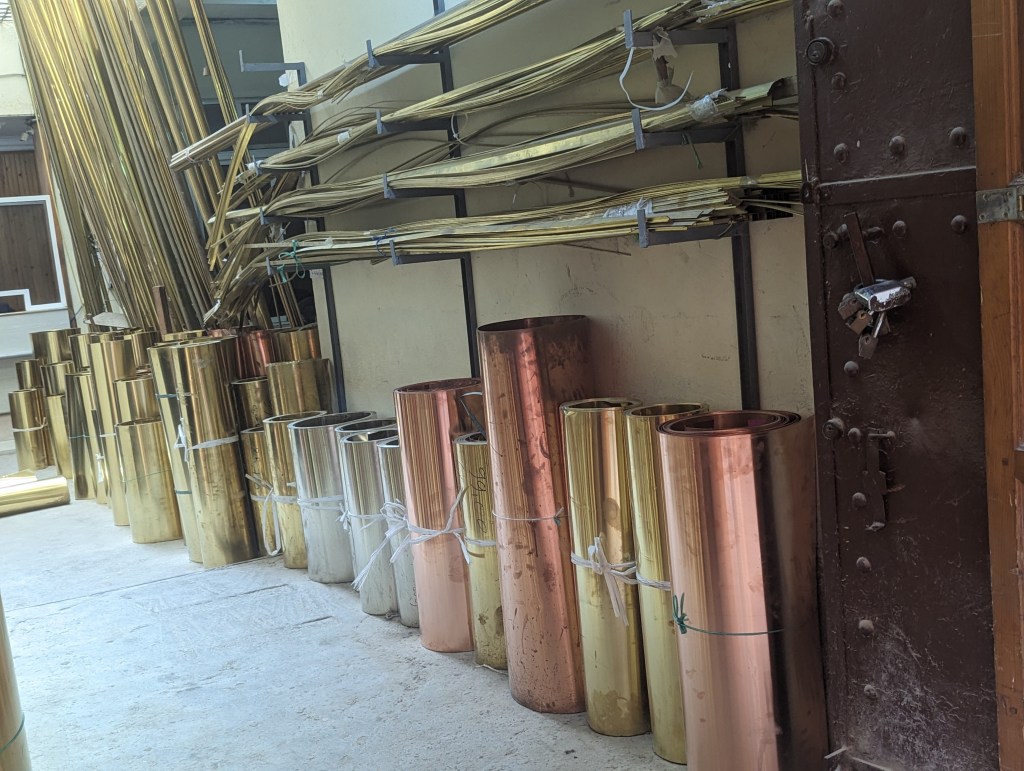
Naim pointed out the raw materials store.
Naim then took us to a side street for a special treat to see his friend who is one of the last hand filigree weavers left in the world.

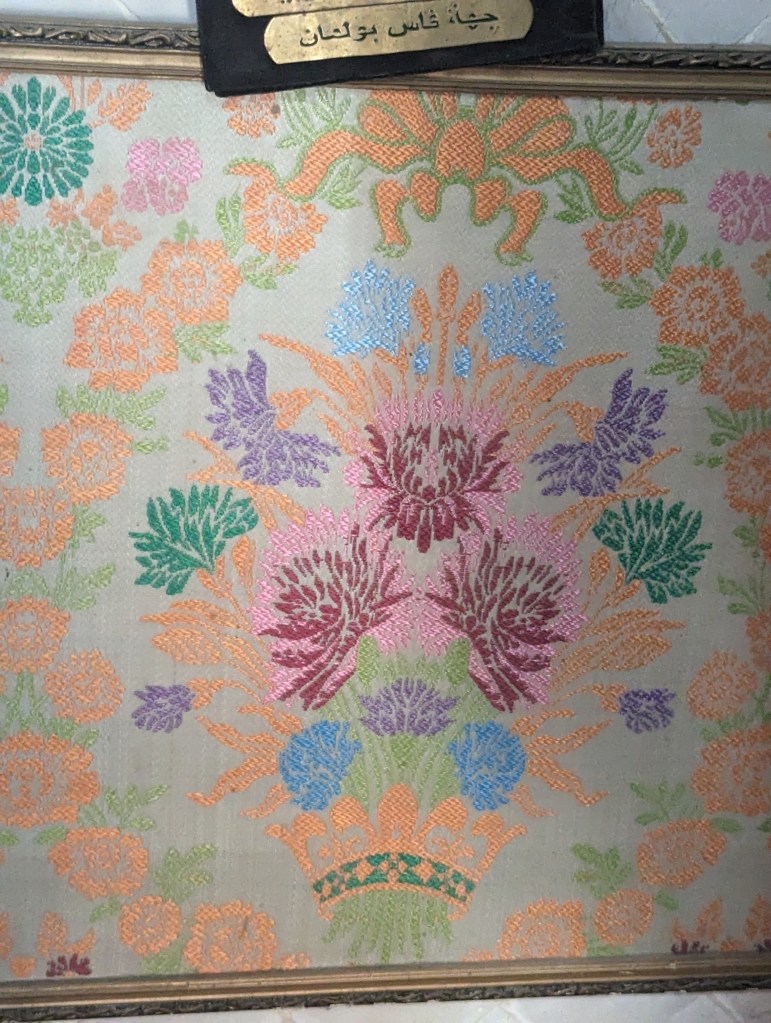
The design is unbelievably intricate.
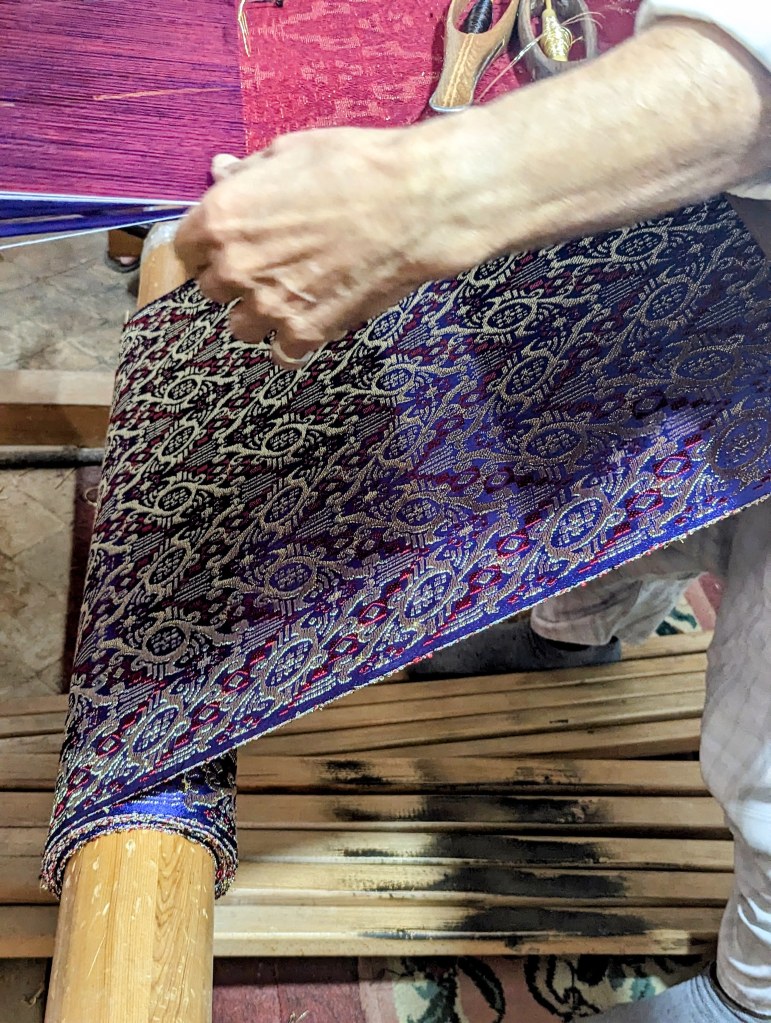
It requires so many different threads and lifts.
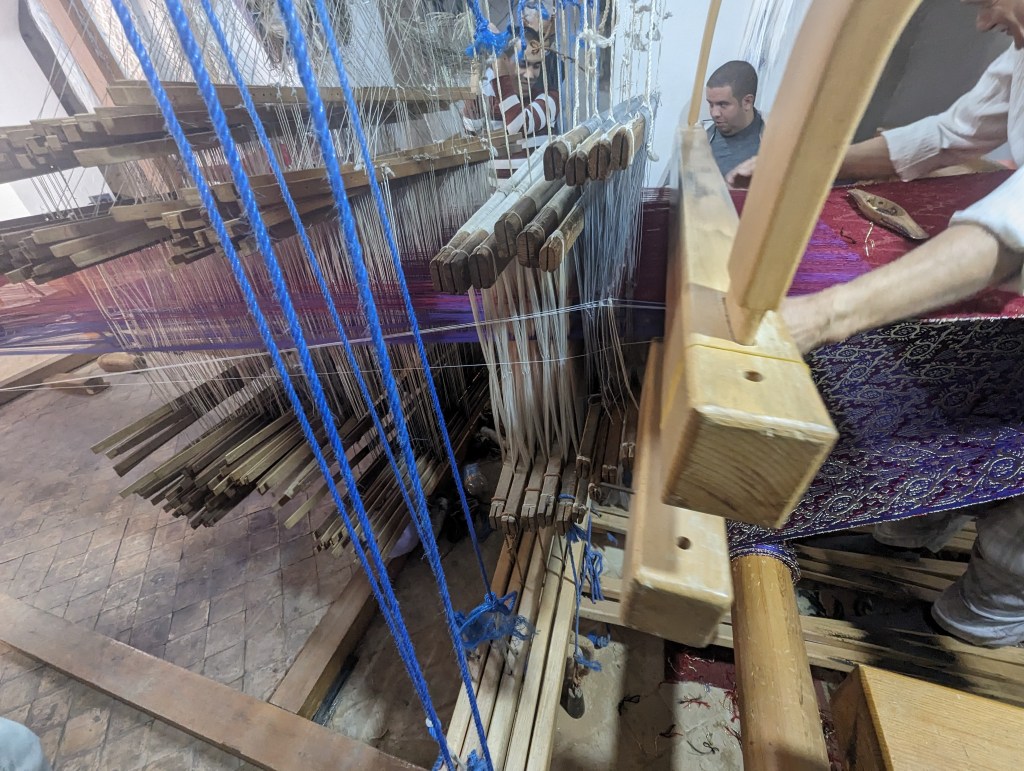
It also requires an assistant who has been given a pattern of which strings to pull together after every pass of the threads. He is pulling down numbers of strings at a time from over his head, while chatting with his friend, without even looking at them. Fascinating process to observe.
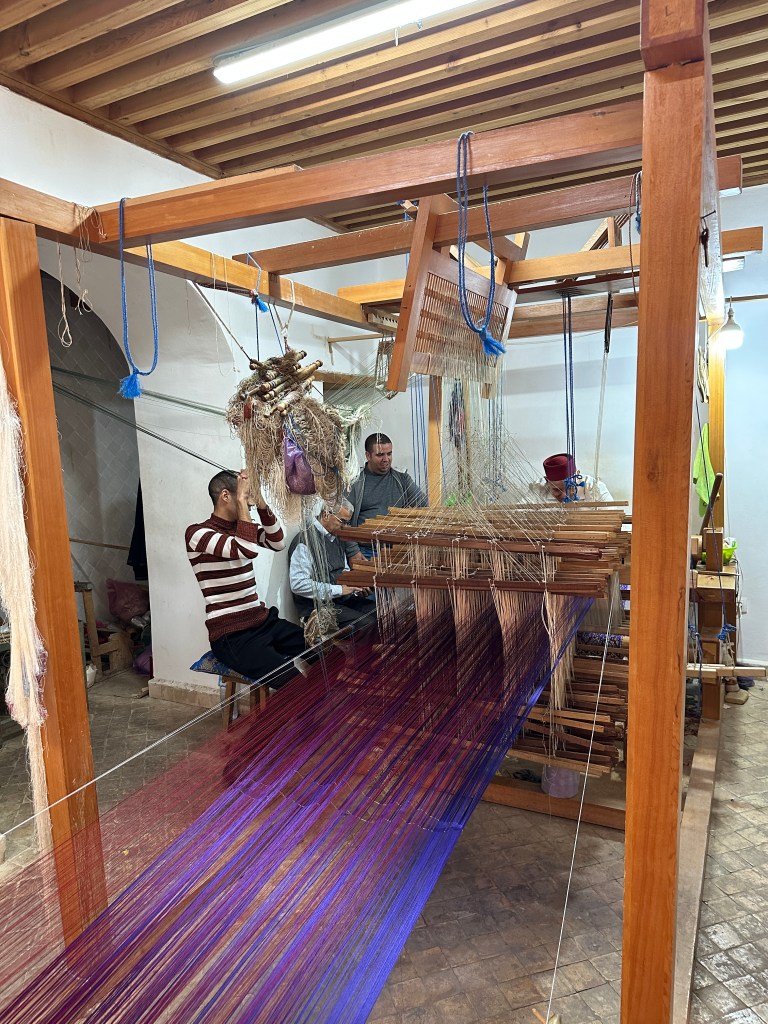
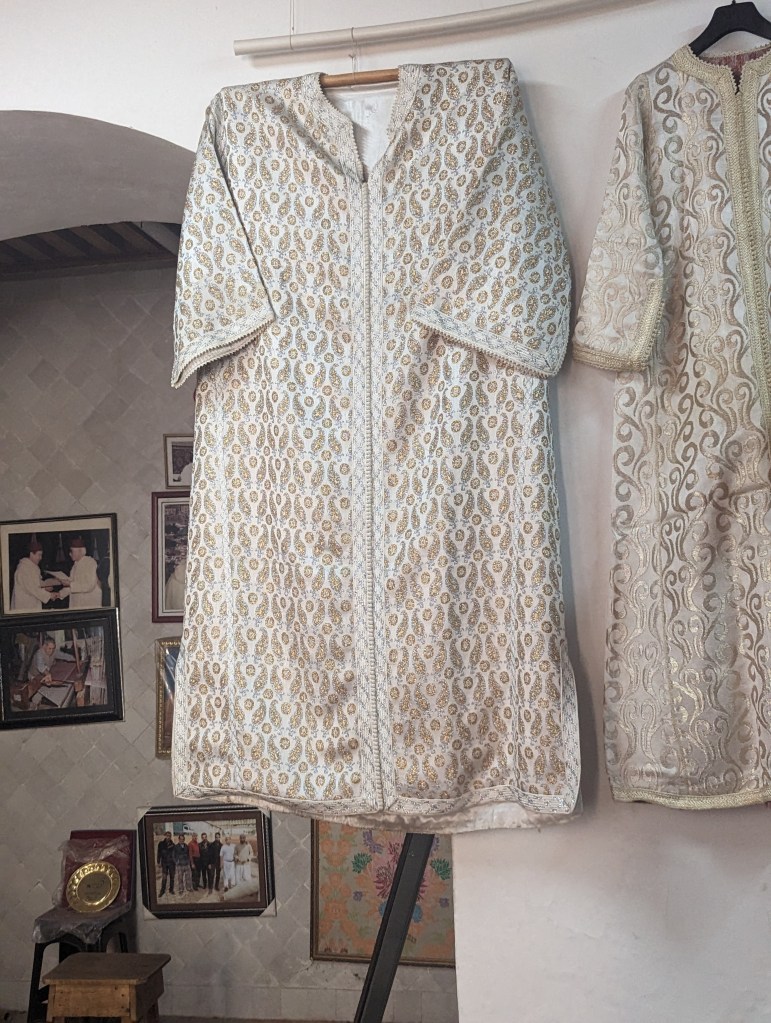
Displayed in his tiny shop are some other materials he has weaved.
We then visited a tannery where hides are processed in the same way that they were in the 13th century.
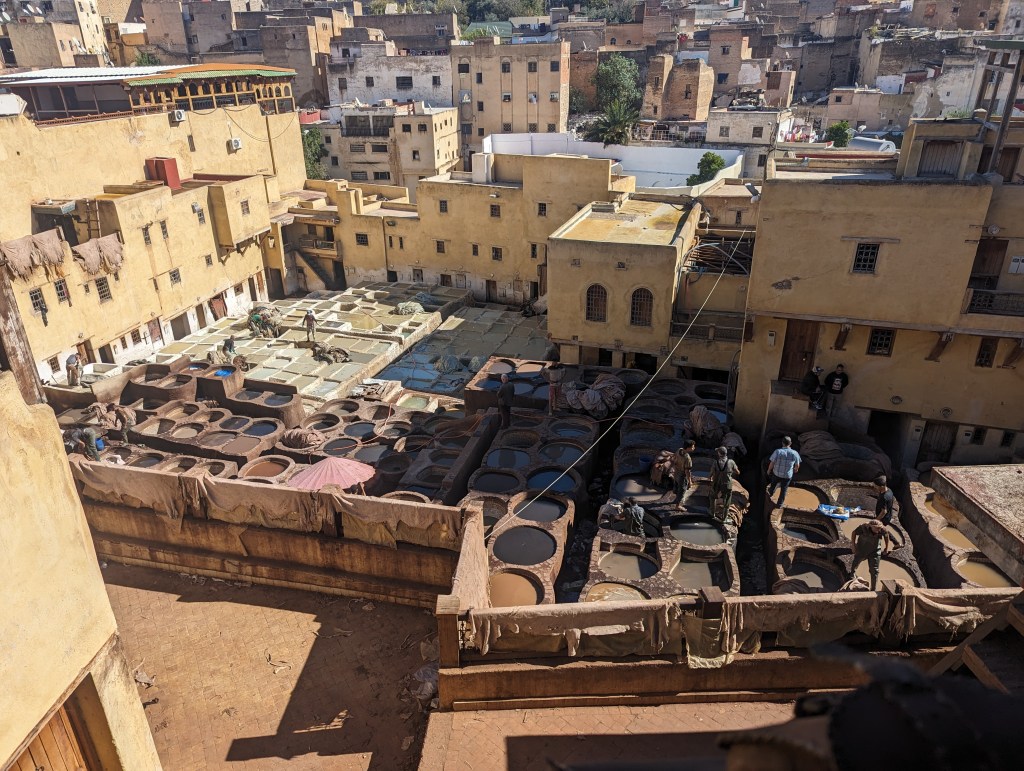
First the hides are placed in vats of water mixed with lye and pigeon droppings – ammonia- and left to soak for about 2 weeks. This softens the hides and opens their pores to allow the dye to soak in,
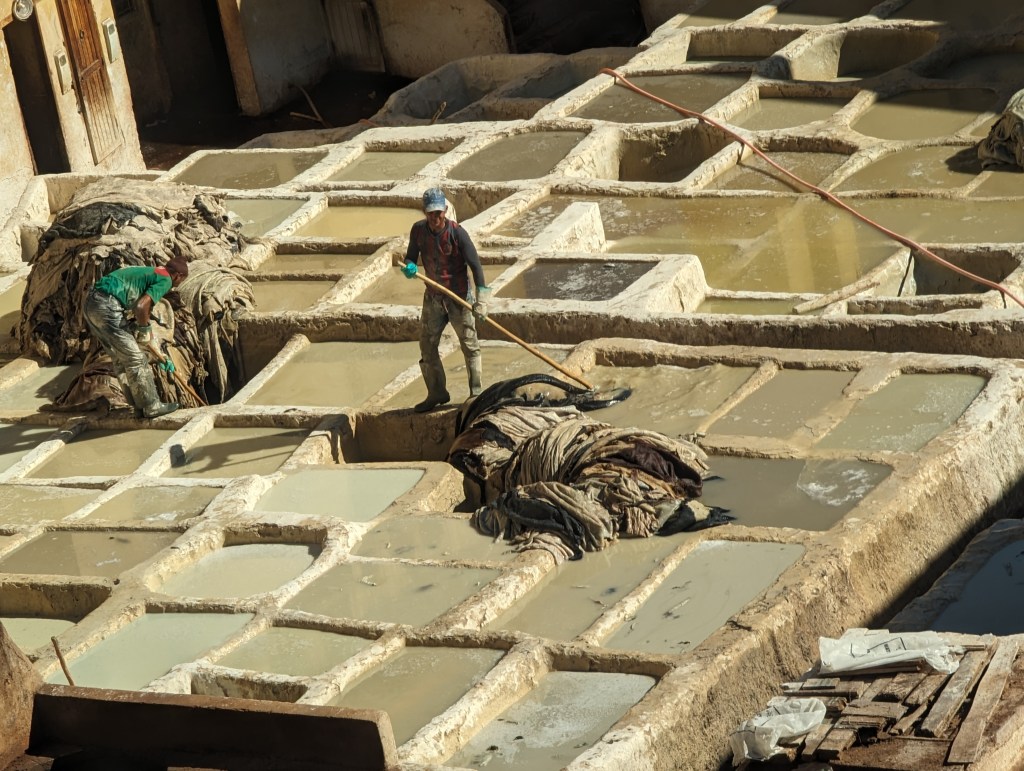
The hides are then hung in the sun to dry. Any remaining fat or hair is then further scraped off.

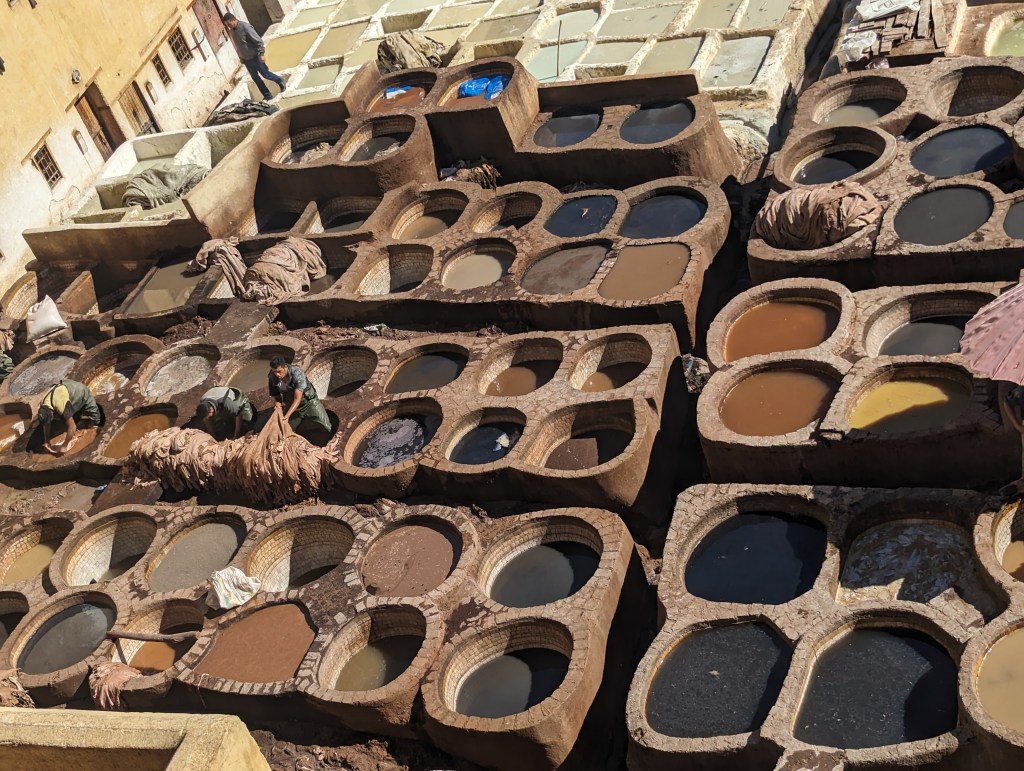
The hide is then placed in the chosen color and left for a length of time depending on the deepness of the color desired. The variety of color choices is wide.
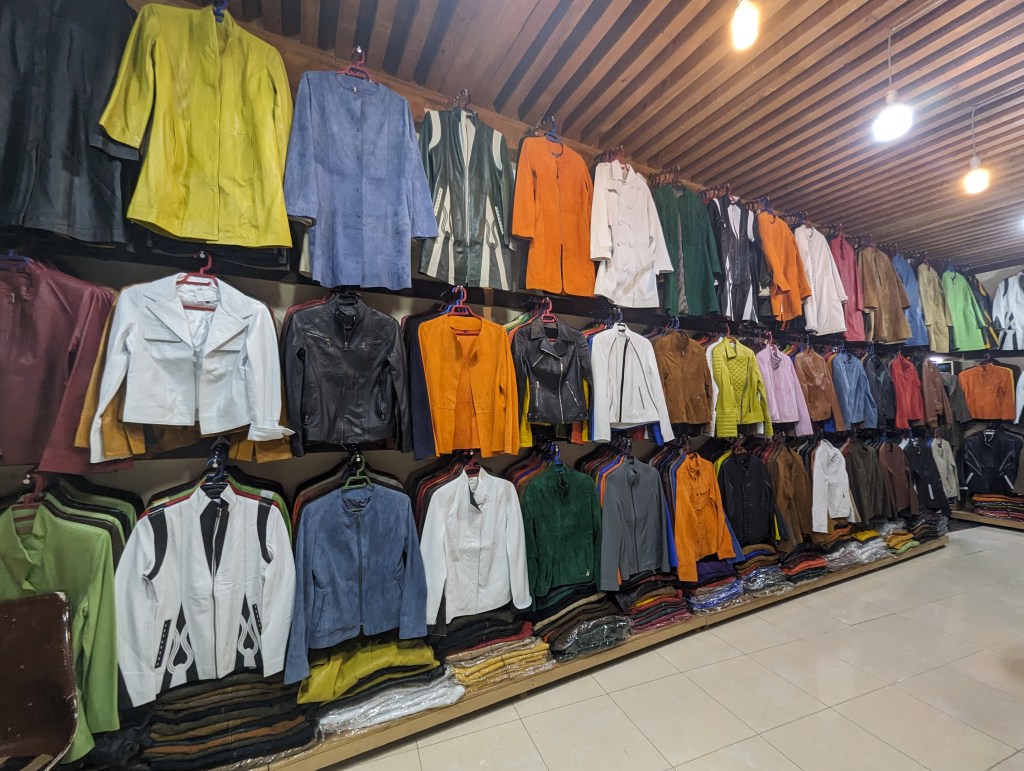
The finished products are assembled in the rooms all around the square. The shop is chock full of finished products from shoes and hand bags to jackets in every color.
Naim then led us through a maze of streets for lunch here in this gorgeous gem.
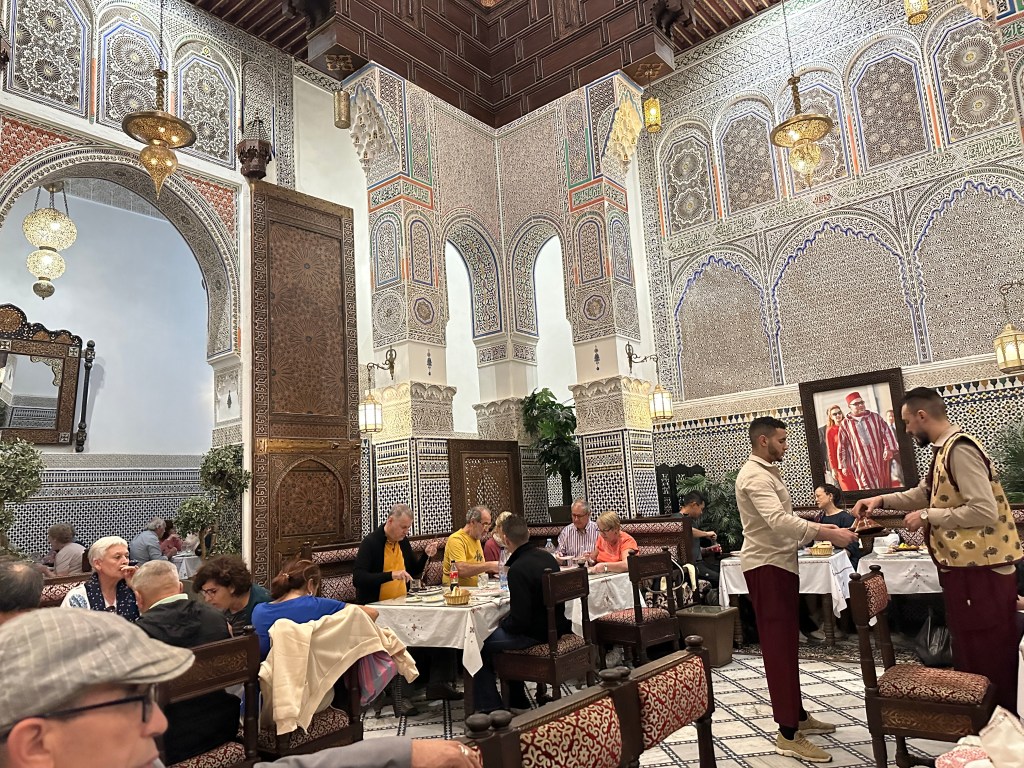
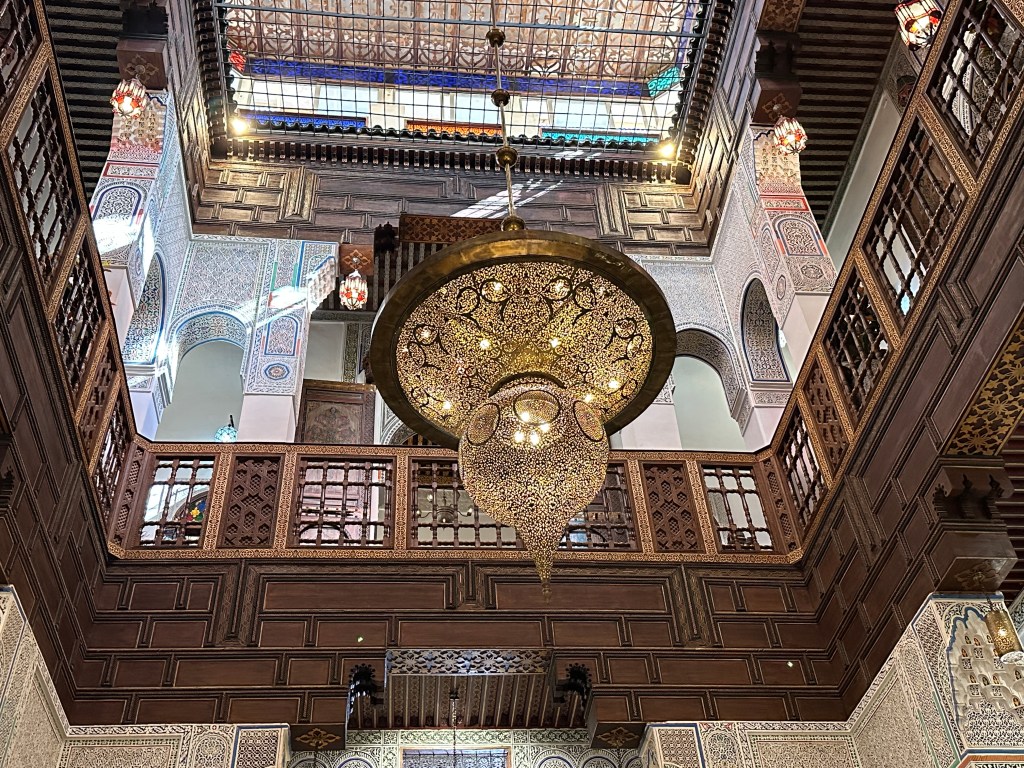
Its showpiece chandelier is a fine example of hand craftsmanship.
After lunch we visited Madrasa Bou Inania built in 1350. It is the only madrassa (Quran school) that also had a functioning mosque.
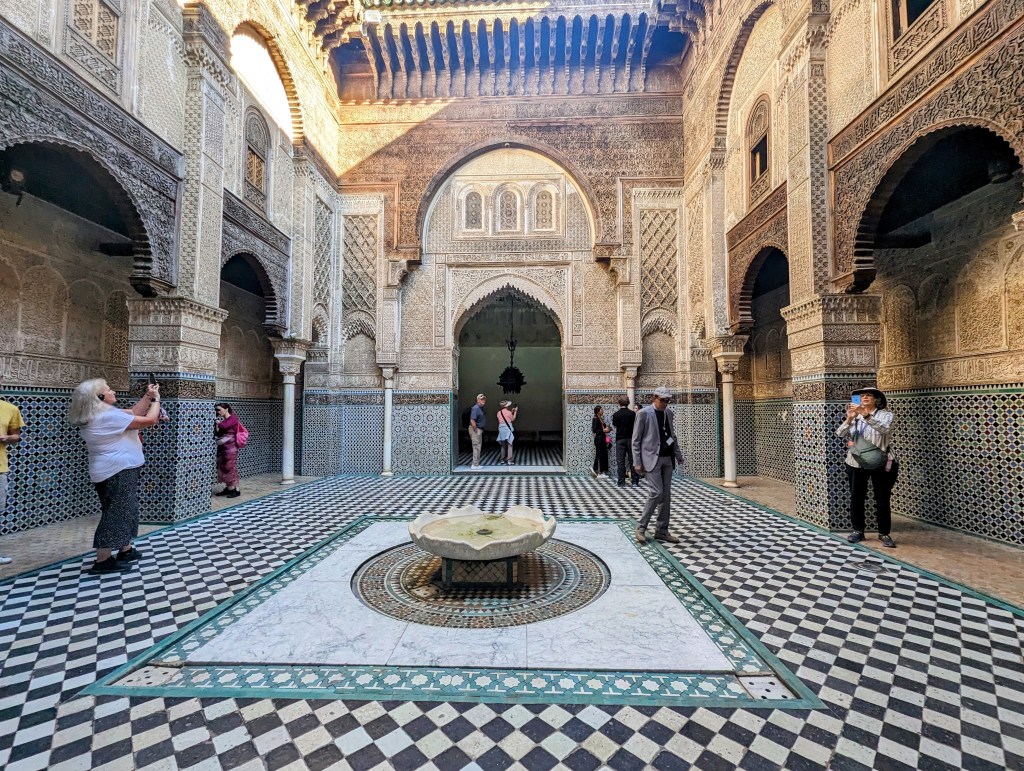
Madrasa Bou Inania

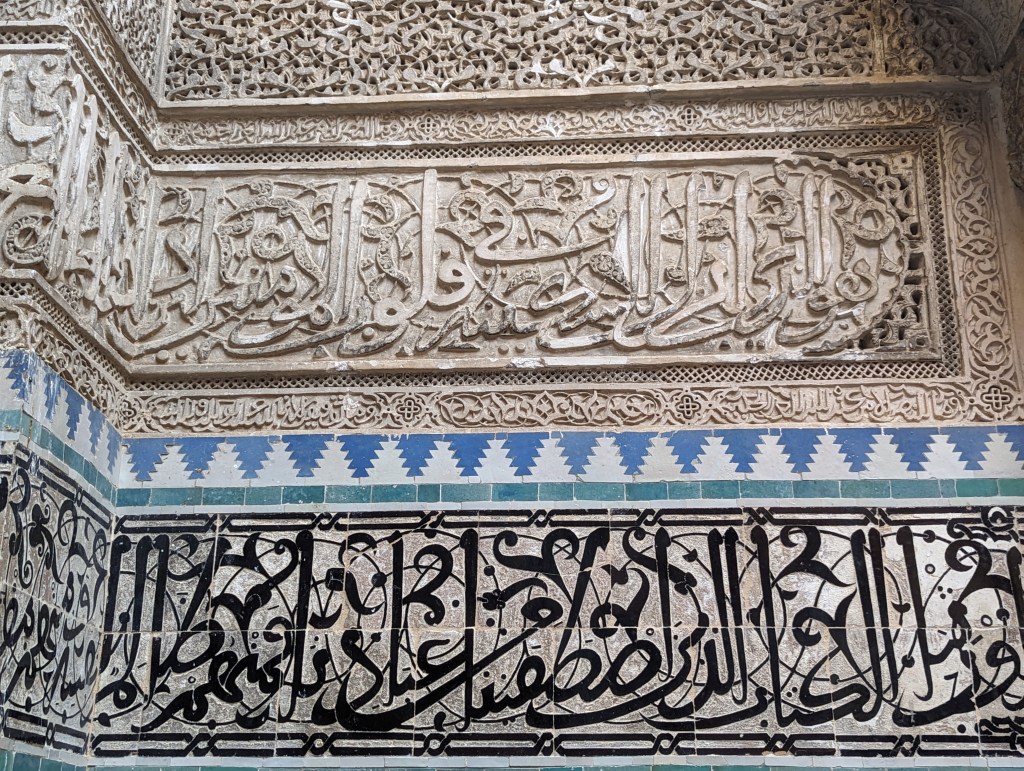
The architecture is typically Moroccan of the time: marble floor, mosaic tiles at the bottom of the walls above which are the carved plaster walls. The ceiling is open, but the carved wood top overhangs the vulnerable plaster to protect it from getting wet from rain. The plaster has verses from the Quran. Calligraphy on tile and carved into the plaster was also popular at the time.
The end room was used for prayer when not a classroom. On one end is a mihrab.
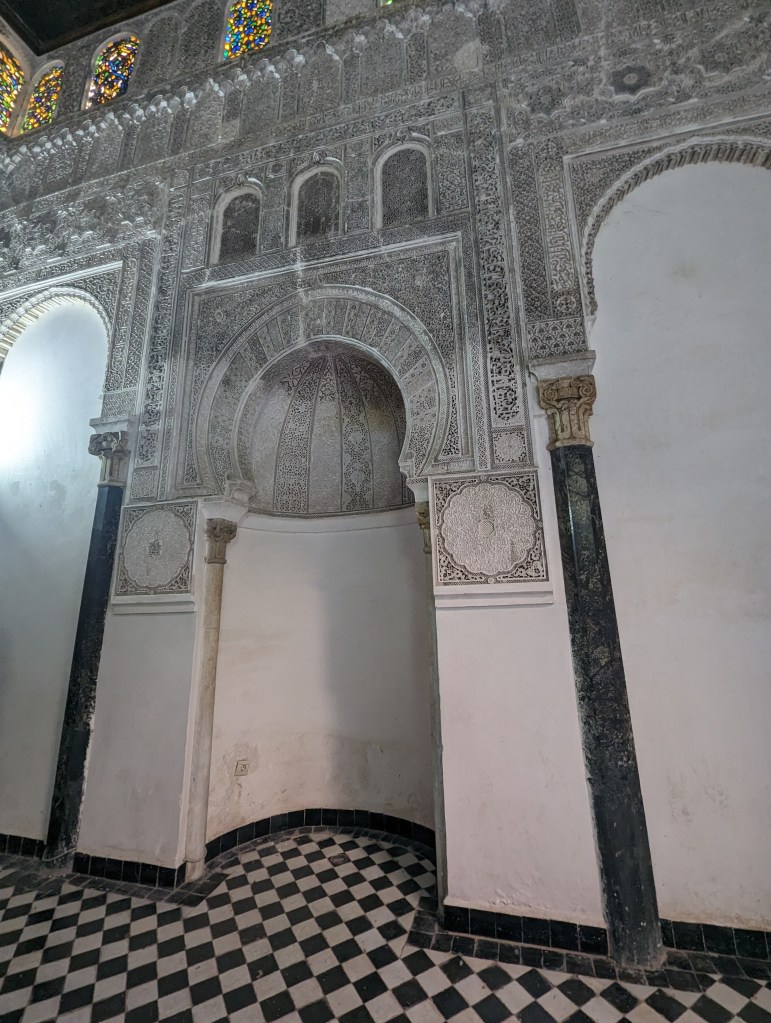
The upper floors held the dormitories for the students.

We passed by the main mosque in the center of the medina in which Idris II is buried. Being non Muslim, we are not allowed to enter.
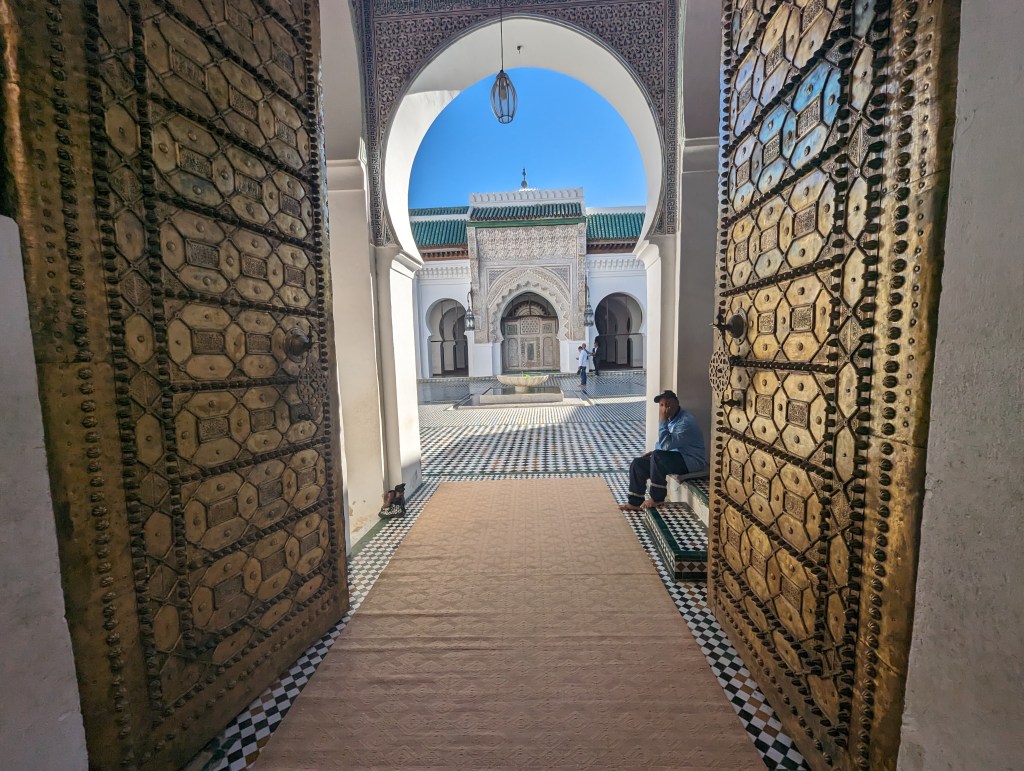
While the mosque was being built, his tomb remained under a tent, which was ceremoniously changed yearly. Now inside the mosque the tomb is canopied with drapes which are still ceremoniously changed yearly. The main entranceway has all the the elements of artisanship seen elsewhere.
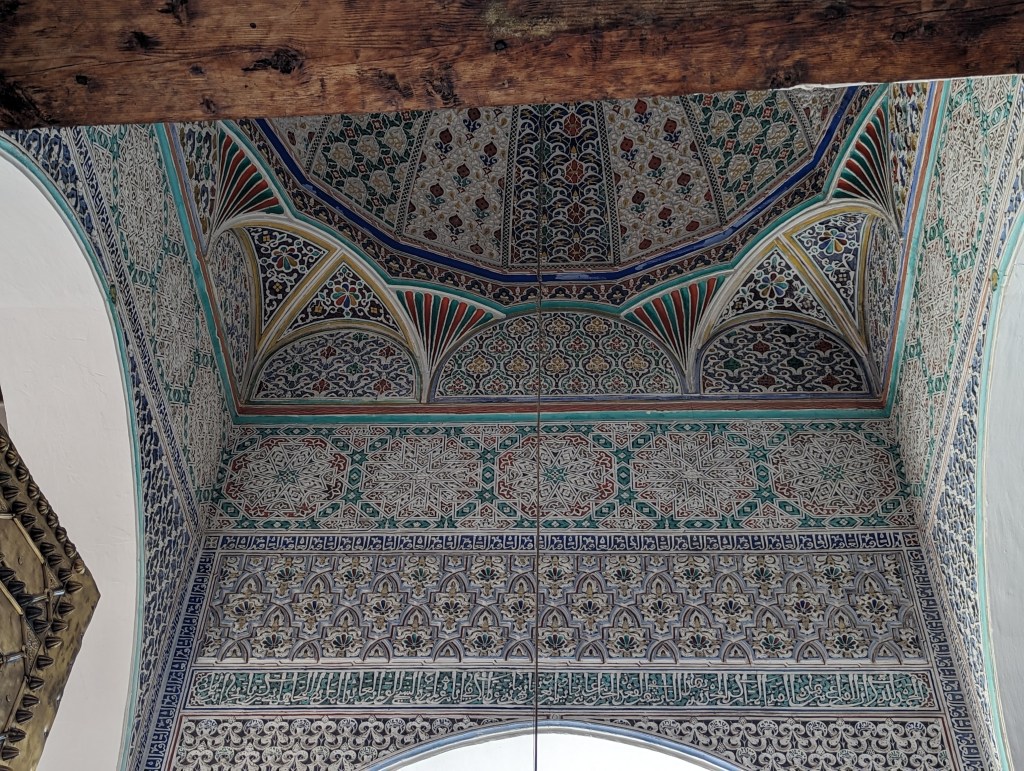
There are 14 entrances around the mosque but the remaining are all much more modest.

Fondiq is the plural of fondouk, the shopping centers for traveling merchants. Unlike riads with their L-shaped entrance to hide the center from the street, fondiq have a large entranceway right into a large courtyard to allow passage of the horse and carriage. UNESCO is in the process of restoring several fondiqs within the old medina.
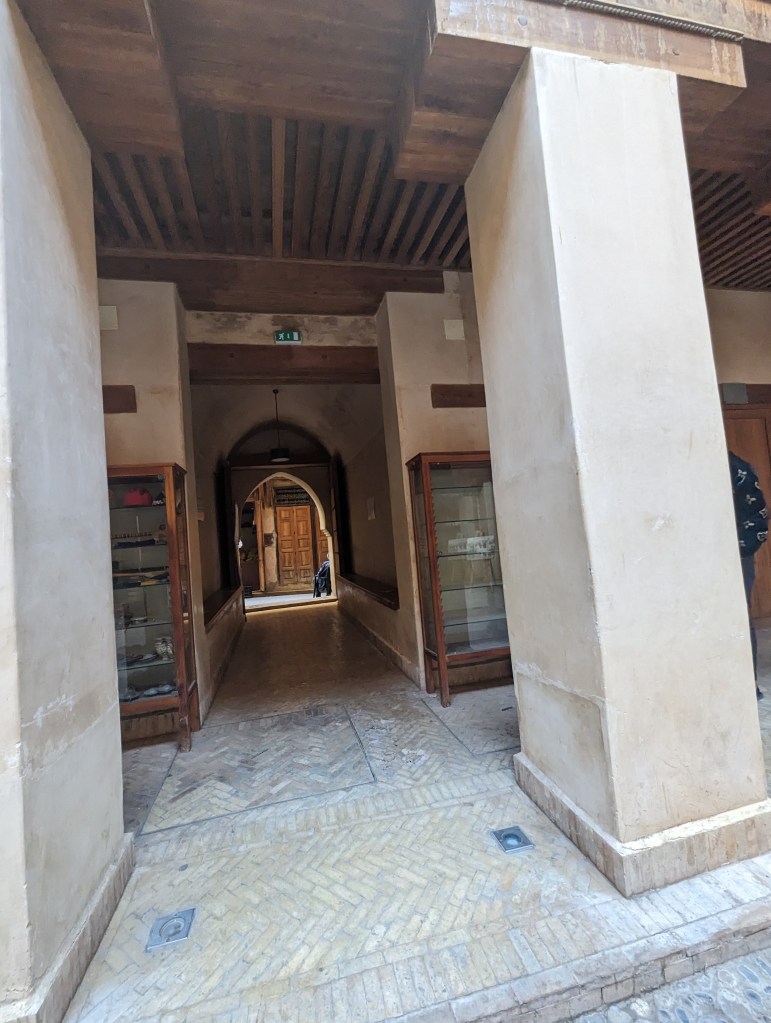
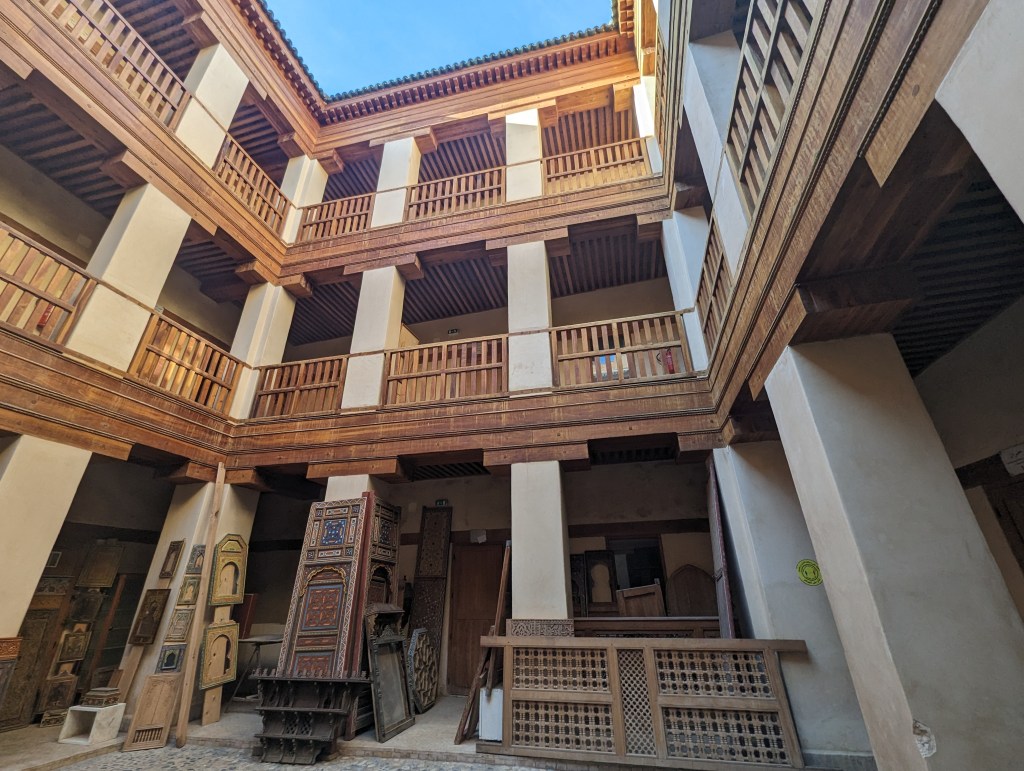
Fondiq Fez entrance
Fondiq Fez courtyard

Naim had a friend in this fondiq, an expert in metal crafts. He let me have a bang at a piece he was working on.
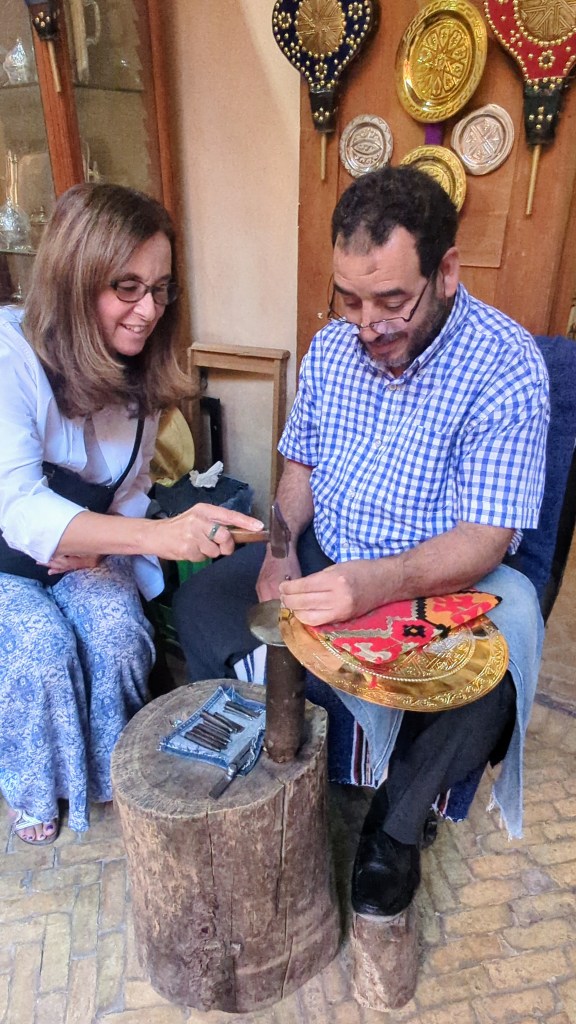
He showed us a piece he was just starting. He first draws in an outline for himself. But the rest of the pattern is done freehand.
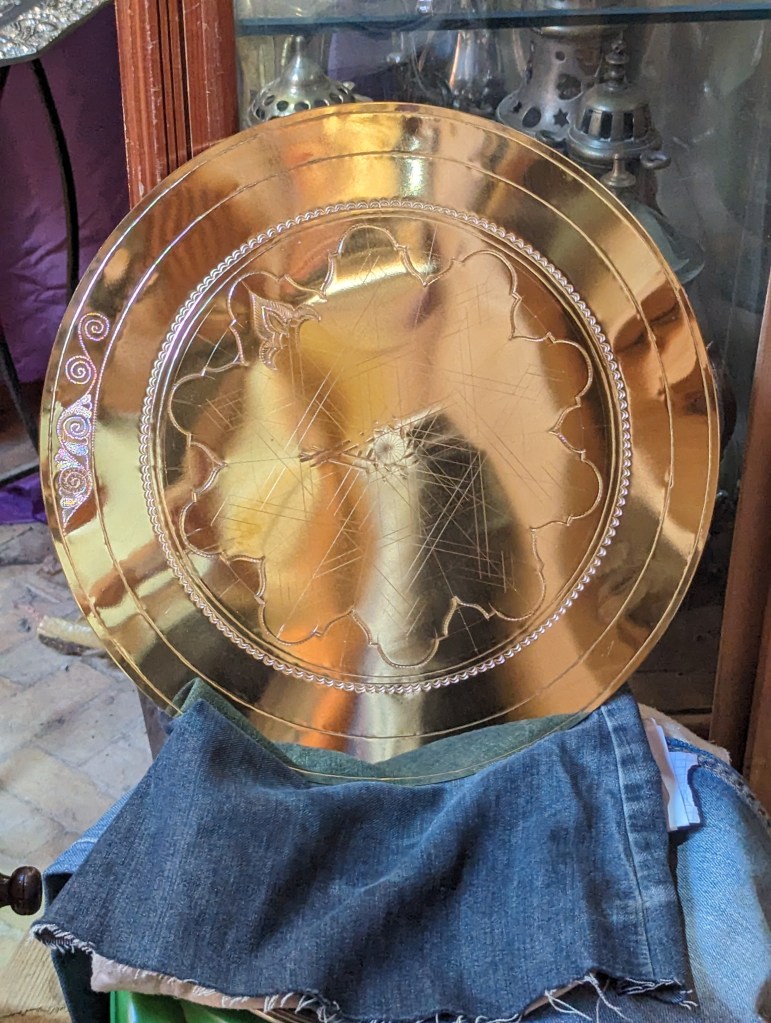
His finished works are magnificent.
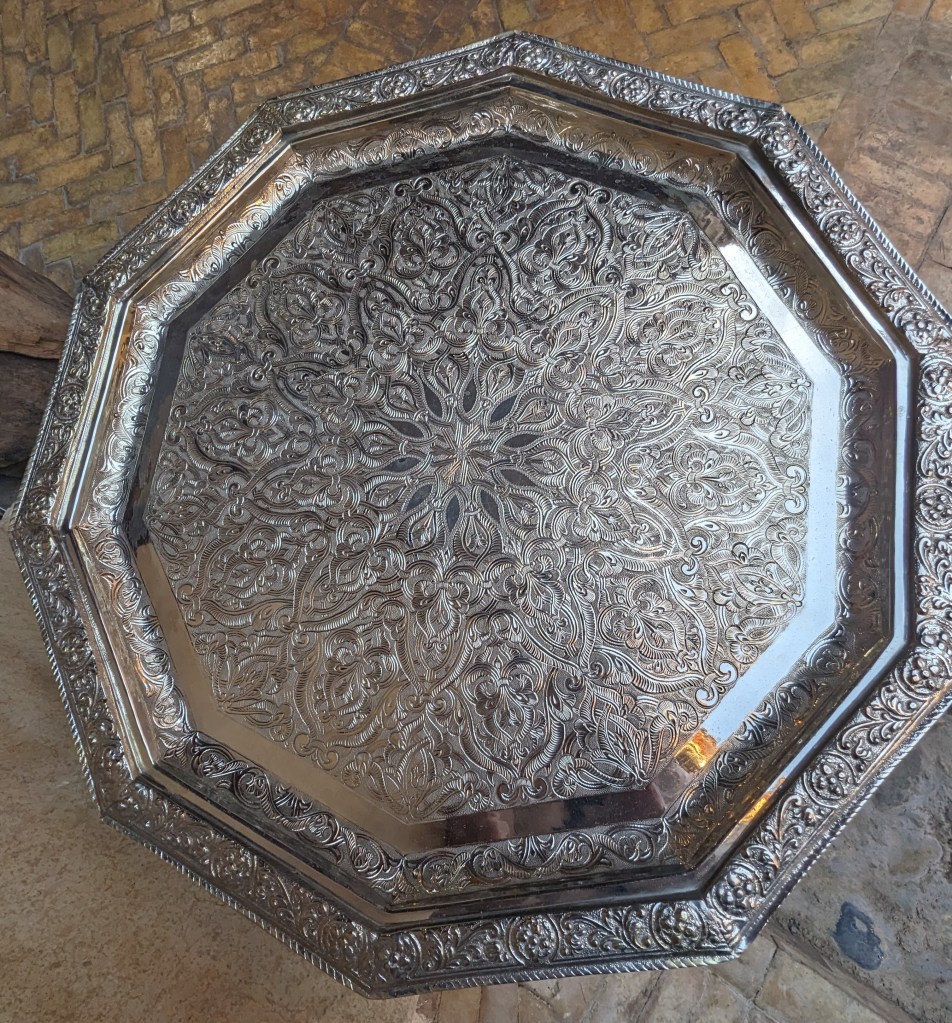
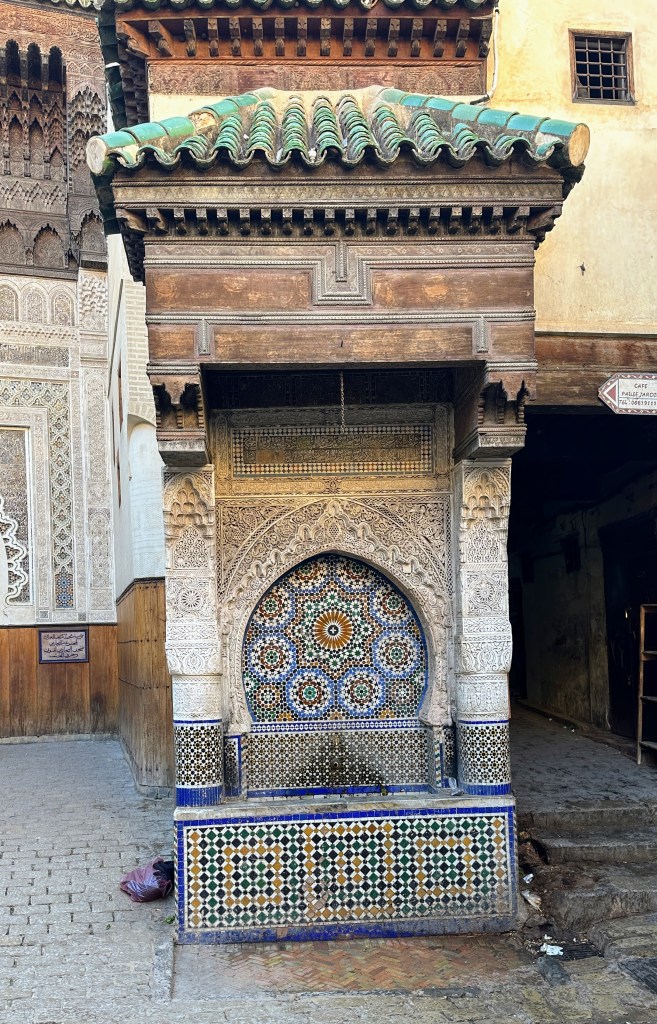
Back outside the fondiq Naim pointed out the most important fountain in the old medina because it is the only one with all 3 layers of the local artisan works.
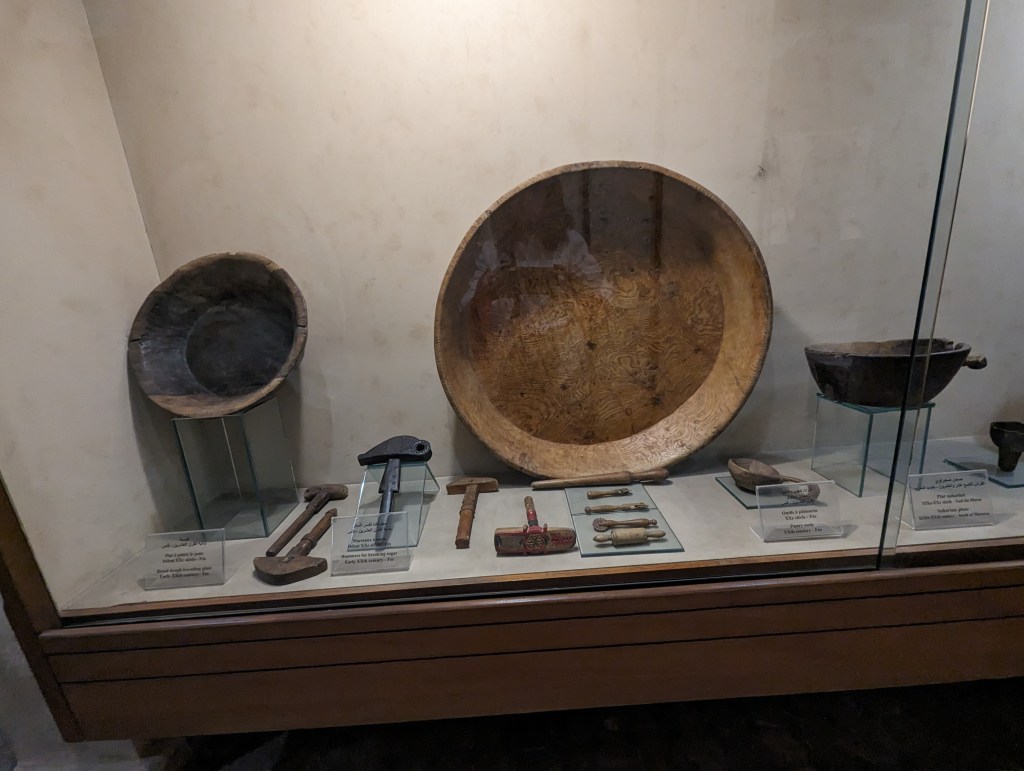
We then visited a fondouk turned into a woodwork museum.

Fondouk al-Najjarin

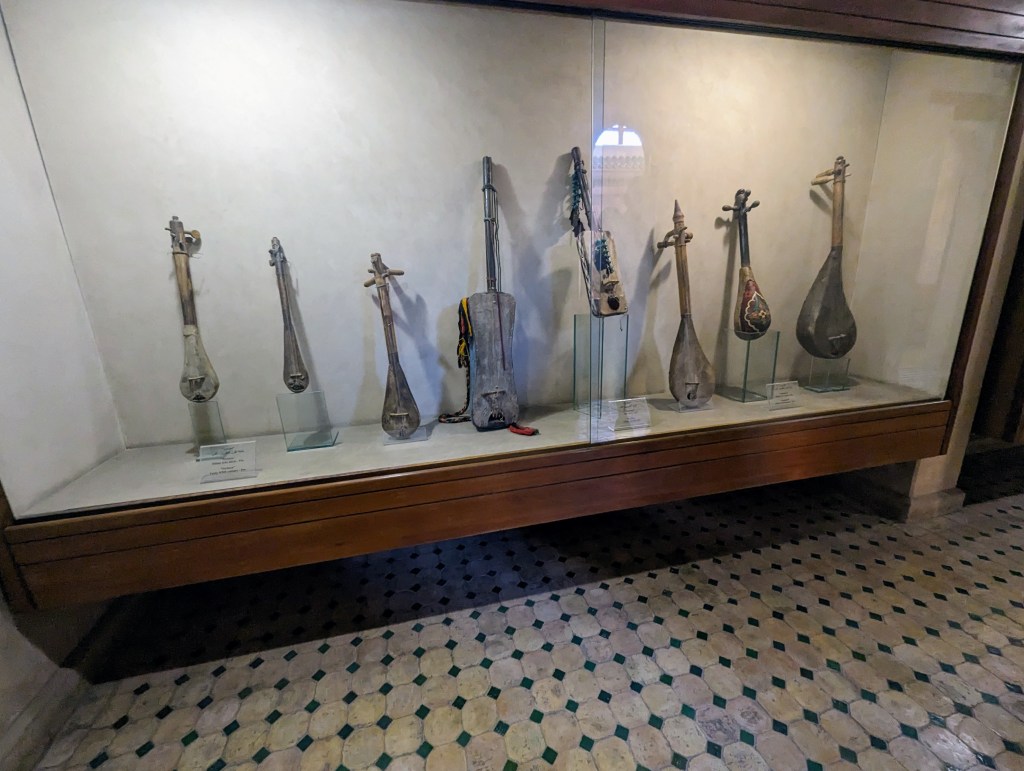
Each room had a display of a different wood product from chests and shelves and furniture to tools
and instruments
And that concluded a very long day of touring. In the morning we headed over to Cafe Clock for our cooking class. Once gathered we decided, as a group, what we would be cooking, choosing from a menu with recipes for all the dishes. We then headed to the market to purchase the ingredients. The chicken was bought fresh.

We came back later for the cleaned parts. Meanwhile we headed for the veggies and herbs and phyllo dough for dessert of snake cookies.

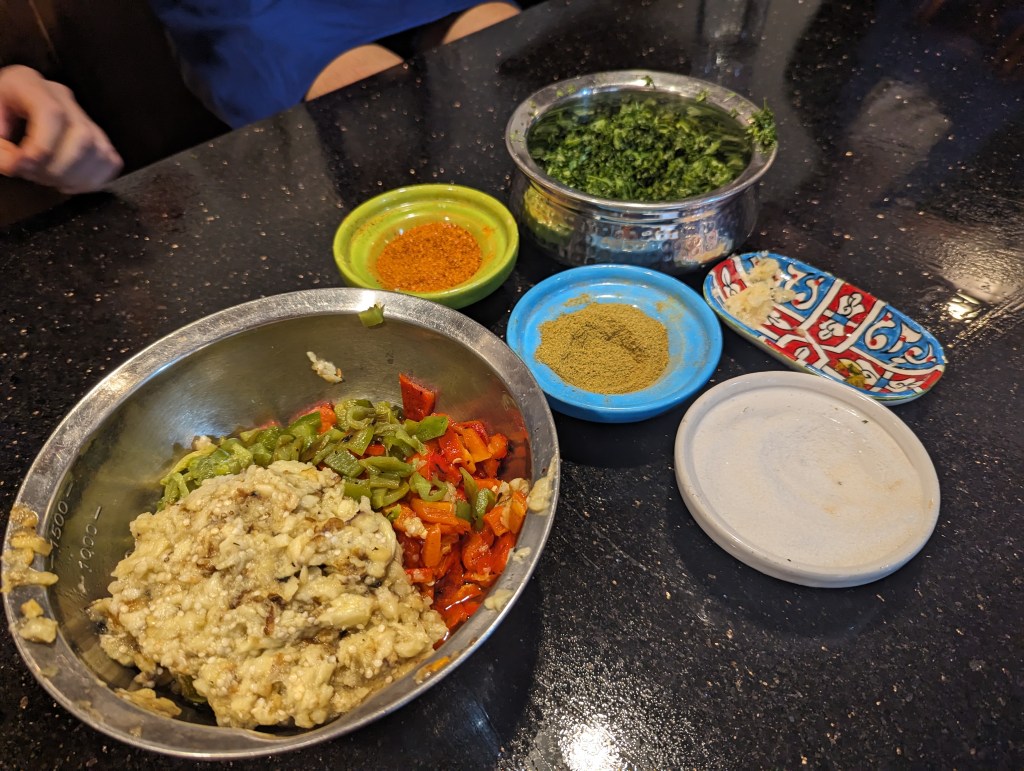
While peeling, chopping, mixing, cooking, and taking mint lemonade breaks on the terrace, we shared stories.

mixing the tagine ingredients
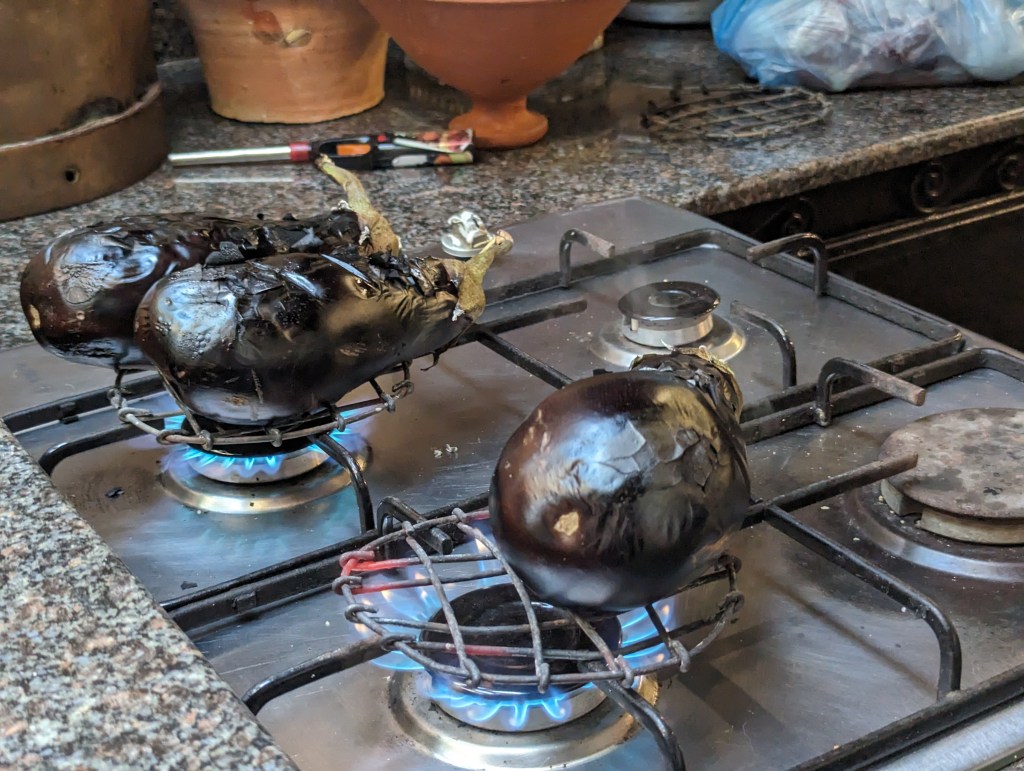
roasted eggplant and peppers salad

Then we all shared the delicious lunch we had made.

chicken tagine

The next morning we headed for the Middle Atlas Mountains and the town of Ifrane. The Atlas Cedar Biosphere Reserve is home to 75% of the world’s majestic Atlas cedar tree population. This region is characterized by a wealth of ecosystems and the mountain peaks, which reach up to 3,700 m, provide the region with critically important water resources.
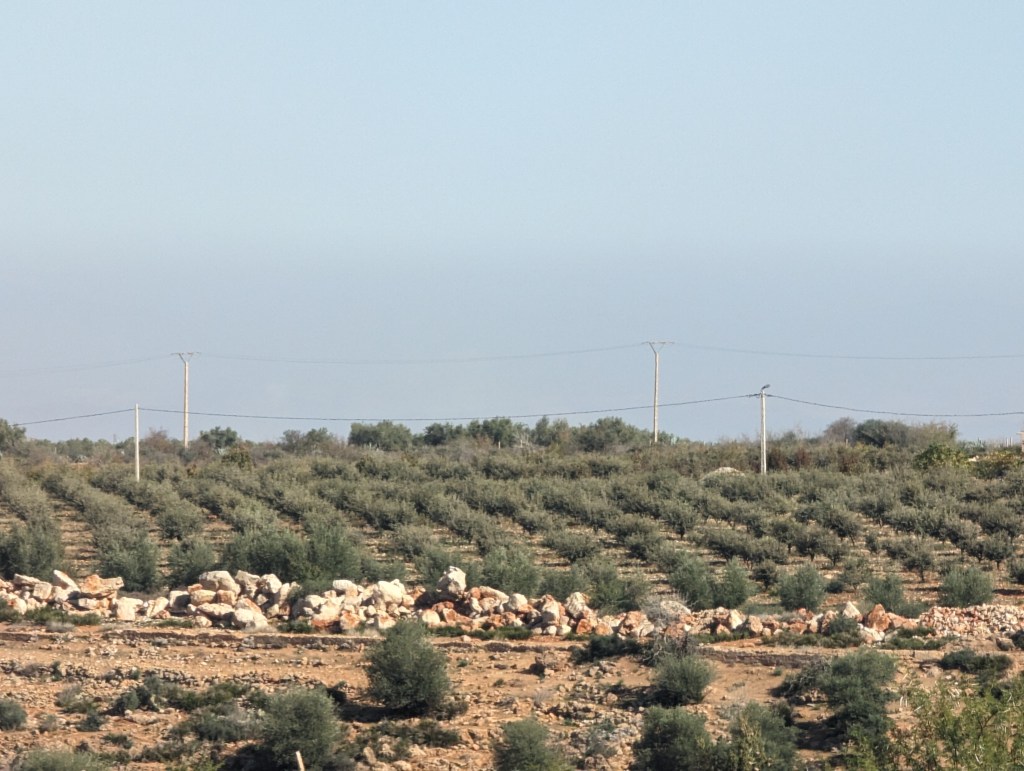
cedar plantation

On the way we stopped at Domaine de La Pommeraie, an organic goat and sheep farm. Our host Tamik was a retired mathematics professor married to an engineering instructor. He is a Jewish Berber originally from Tangier. Having raised 2 children and taught dozens of others, they decided to retire from teaching and run the farm full time. They run workshops for tourists and also have classes for children as well.

classroom

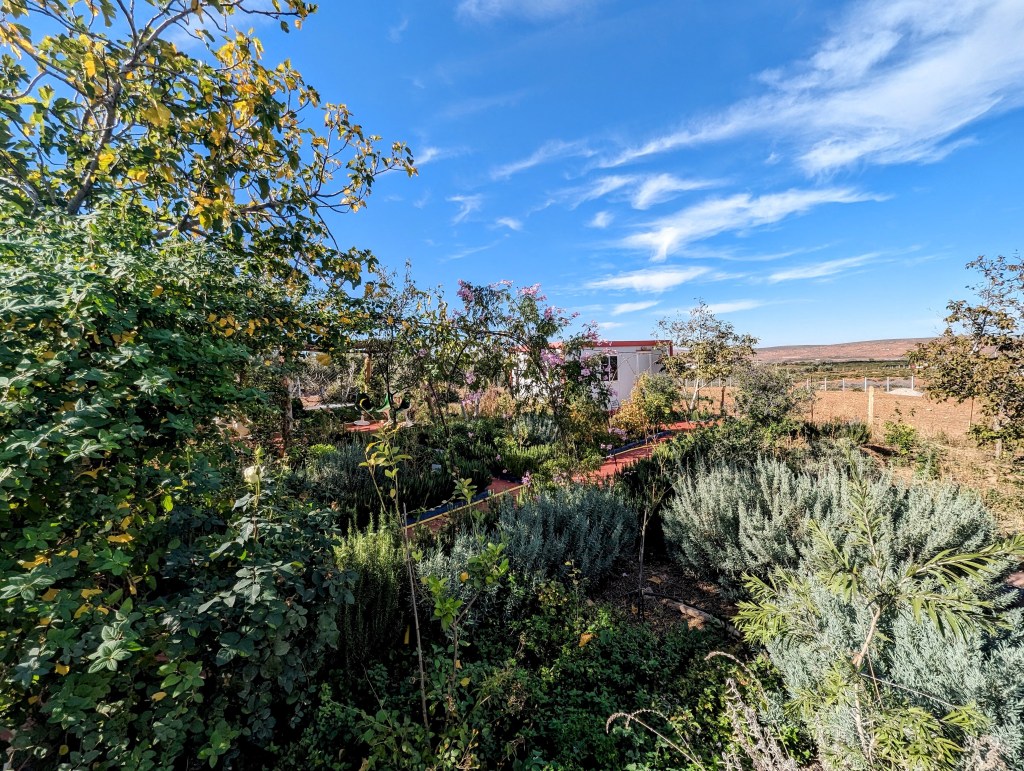
His kitchen garden includes roses and lavender for scented waters.

and is chock full of herbs – rosemary, sage, and thyme – and fruit – figs, apricots, peaches, apples, and all kinds of citrus – and nut – almond and walnut – trees.
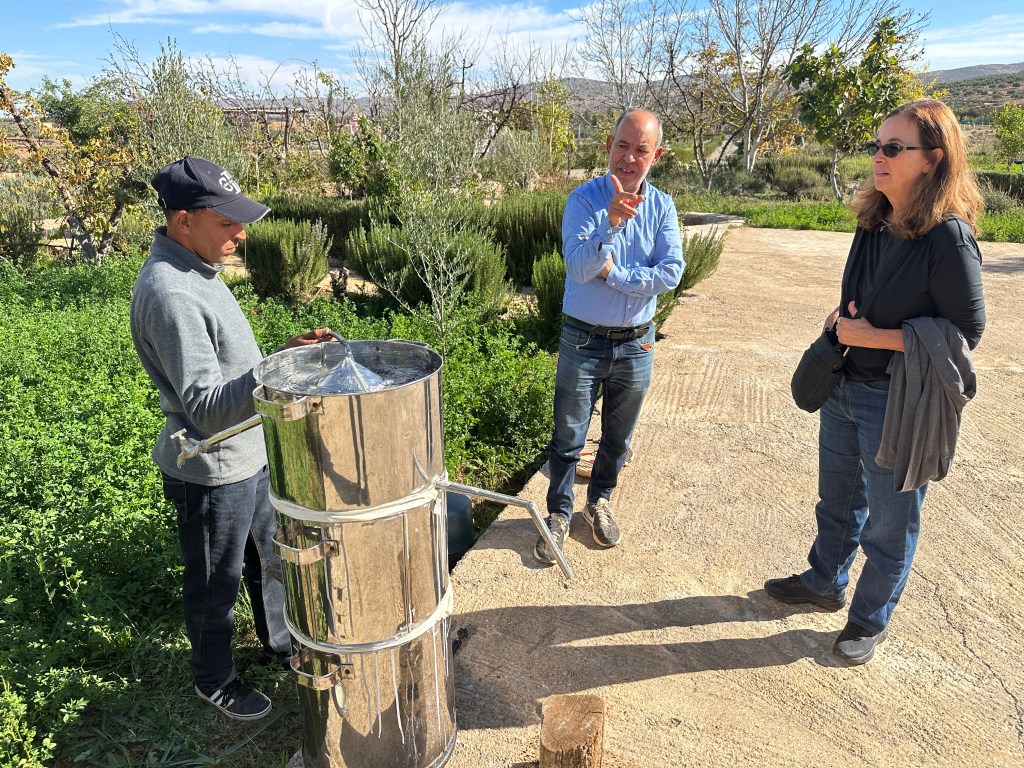
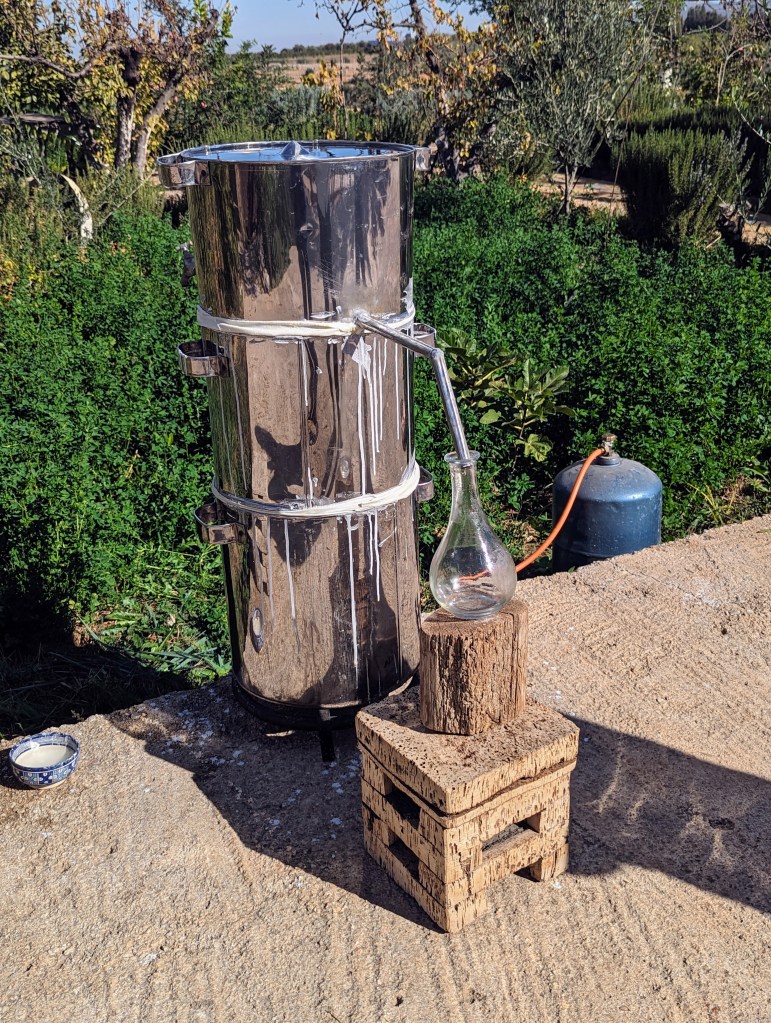
He gave us a workshop on distilling lavender for a water infusion.
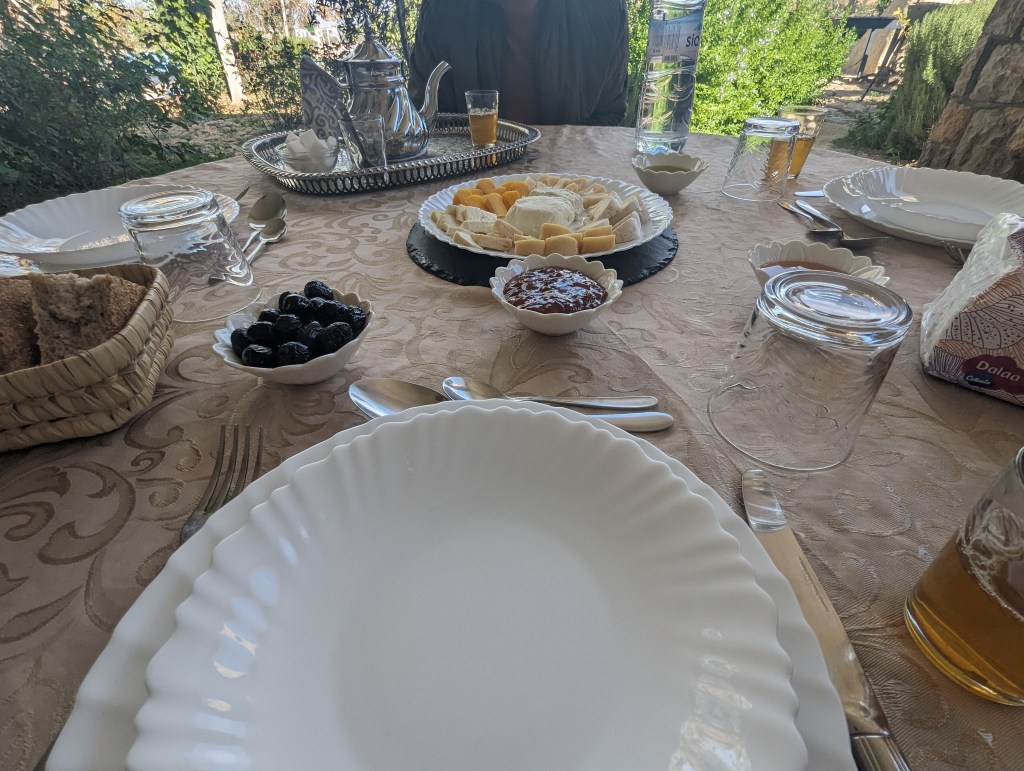
We were then treated to a cheese tasting of all home made artisanally crafted cheeses of local varieties and those of recipes and methods passed down many generations by his Jewish Berber family. The cheeses were accompanied by home made bread and apricot jam, fresh pressed olive oil, and multiflower honey collected on the farm, and of course Moroccan mint tea.
We then enjoyed a lunch of barbecue skewers and eggplant salad and a veggie dish, all delicious. He and Kamal joined us and we shared stories and talked about the similarities and differences in our countries. Have I mentioned that there are no guns in Morocco? It is one of the first things we were told in Tangier by several people all trying to impress upon us the safety of visiting the country. Only police and military are allowed guns. I asked Tamik if there is hunting for sport allowed in Morocco and/or if, as a farmer, he is allowed to have a gun to protect his plants and animals from predators. His response was that there is no game in Morocco to hunt, only rabbits. And yes, as a farmer he would be allowed to get a gun permit to protect his property, but he does not feel the need. He said that wild dogs help keep the rabbit population at a tolerable level.

We then drove to Ifrane, known as the Alps of Morocco. Ifrane means caves. The original ancient dwellers dug caves into the limestone for shelter. The modern town of Ifrane was established by the French administration in 1928 due to its Alpine climate so that Europeans could find relief from the summer heat of the interior plains of Morocco. Ifrane is also a popular altitude training destination. In 1995 an English-language, American-curriculum public university opened and this has helped launch Ifrane as a desirable destination for domestic tourism. The king has a palace in Ifrane which he uses when he wants to ski. According to the MBC Times, Ifrane is ranked the second-cleanest town in the world, behind Calgary. According to a survey, Ifrane makes a number of efforts to offer its residents an exemplary quality of life through rigorous waste management, but also by reducing air pollution.

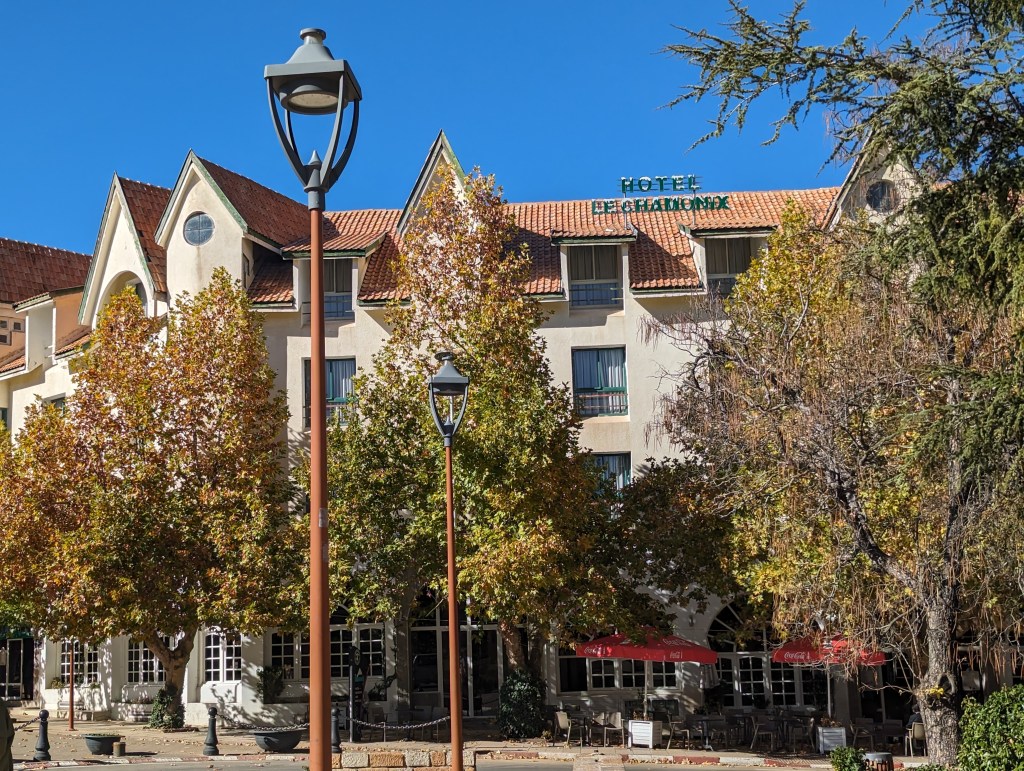
We walked around the main square with its Hotel Chamonix.
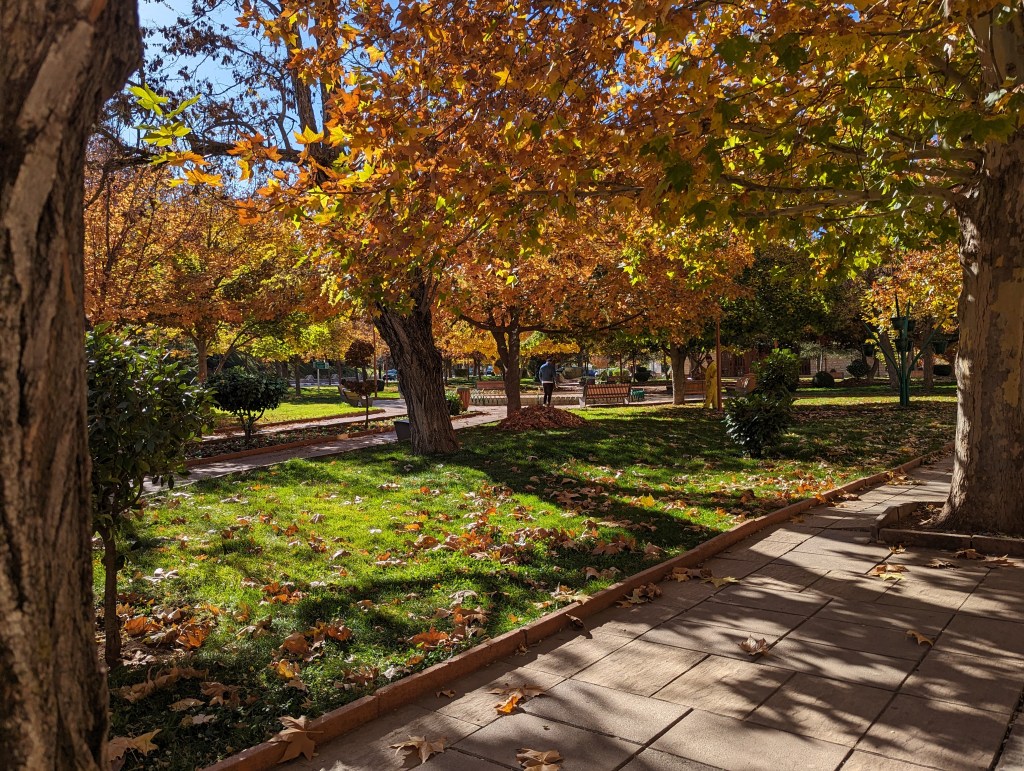
We enjoyed a touch of fall foliage, something we really did not expect to find in Africa.
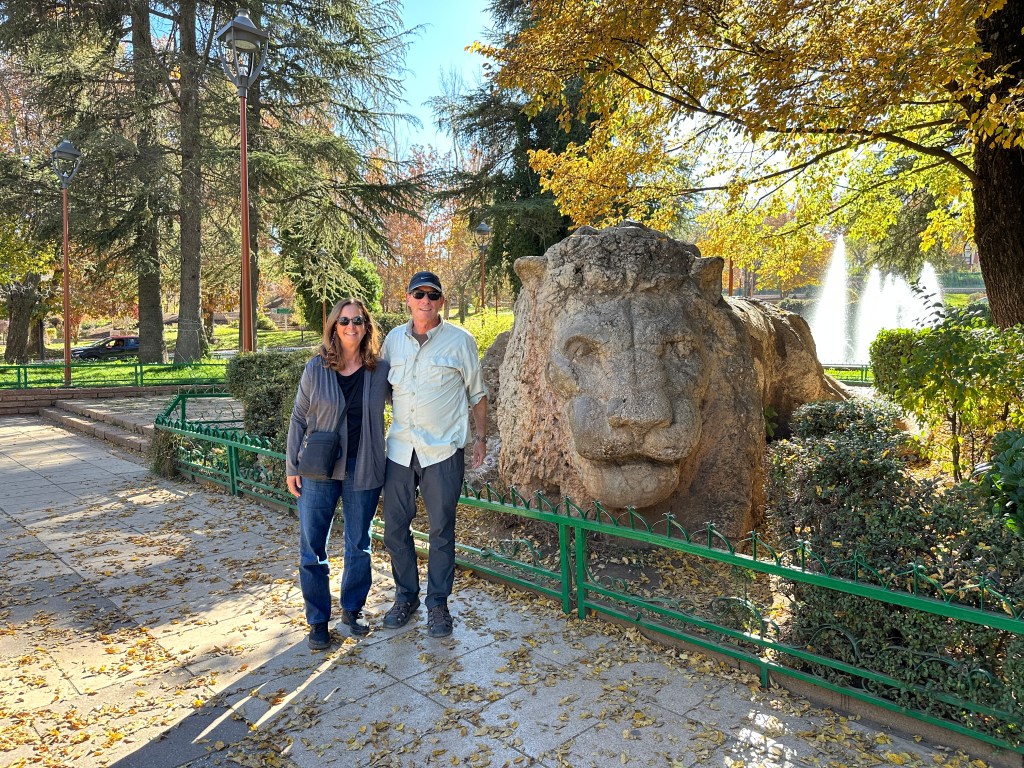
We took a picture in front of the famous lion statue carved by a German soldier during WWII, when Ifrane was used briefly as a prisoner-of-war camp, in exchange for the prisoner’s freedom – or so the story goes – and commemorates the last wild Atlas lion, which was shot near here in the early 1920s.
We checked into our 5 star Hotel Michlifen.

And were told we had been upgraded to a suite.
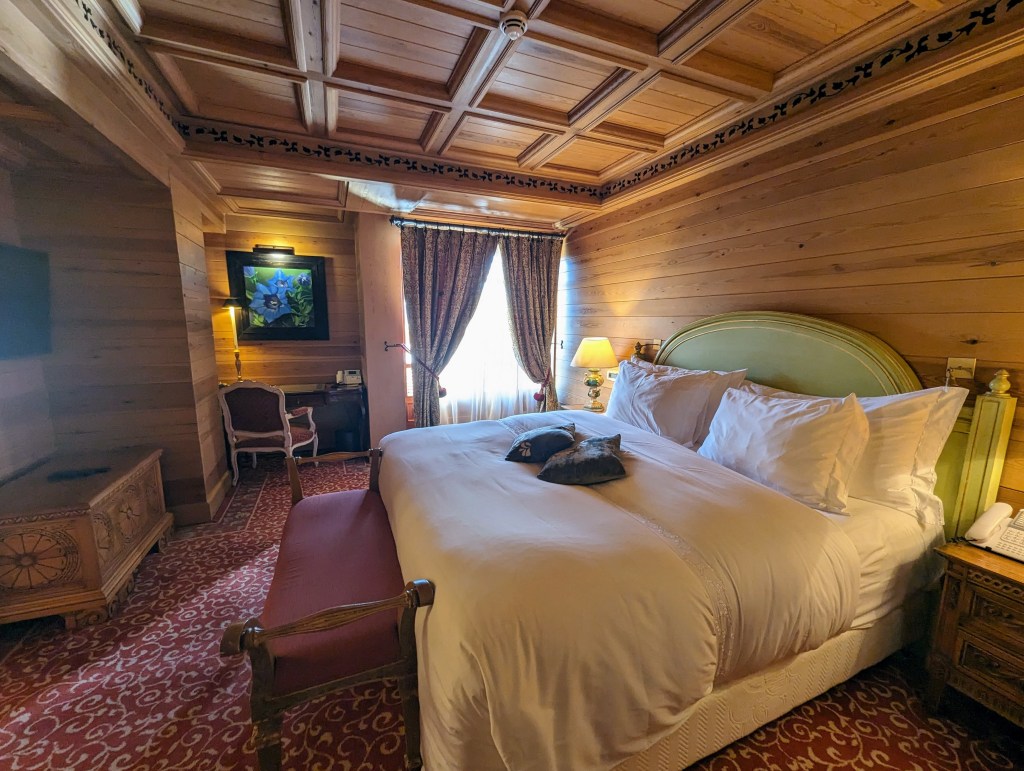
And we thought the last one was huge!
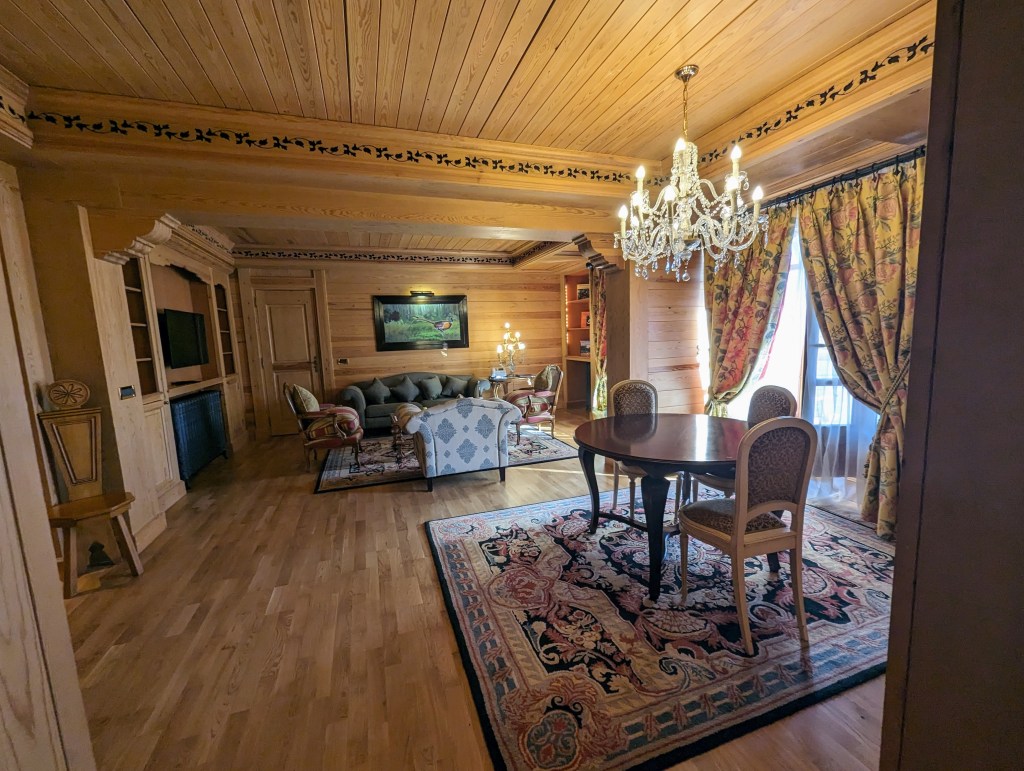
And these pics do not include the dressing room with built in closets or the second bathroom. We have a view of the huge heated pool from our terrace.

We sat on the terrace, sipped wine and watched the sun set over the mountains. A perfect end to the perfect day.

Morocco: Tanger-Tétoan Region: Tangier Nov. 8-13, Rif Mountains: Chefchaouen Nov. 13-15

We arrived in Tangier on a beautiful sunny day and were immediately impressed with what appeared to be a large, bustling modern city. The passport office was on the ship. All we had to do on exiting the ship was show our stamped passport, go through security, and easy as that, we were in the country.

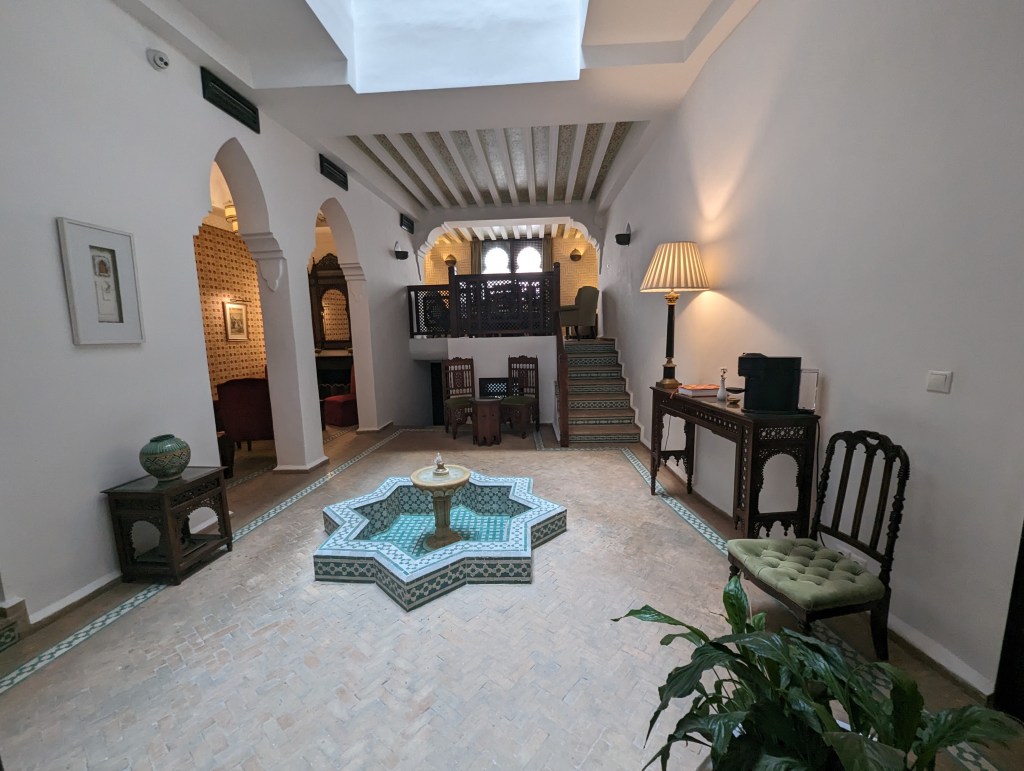
We were met by a driver sent by our riad. A riad is a traditional Moroccan home built around a central courtyard usually with a water element. Many riads in the old cities (medinas) have been converted into small boutique hotels, or guest houses, with typically 6-8 rooms. Our riad was located in the kasbah, which was the original fortress located in the center of the medina. We passed the entrance to the medina.

We were dropped at the entrance to the kasbah, as no cars are allowed in. A young porter came to meet us and transport our luggage. And we entered our riad.

La Maison Blanche

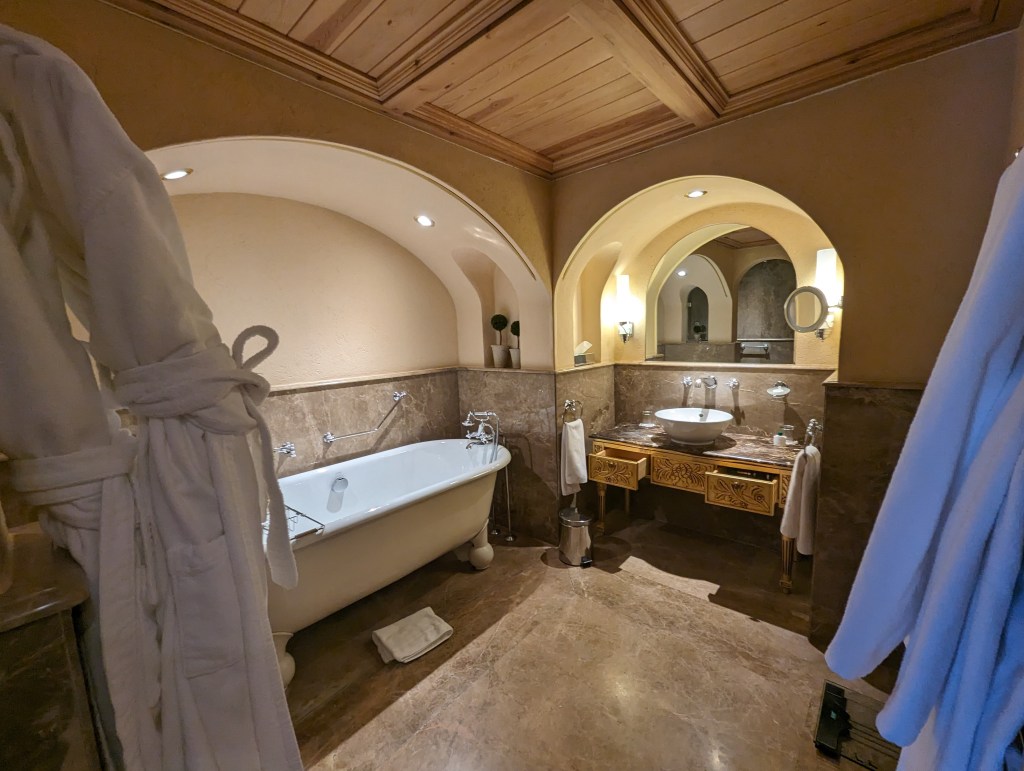
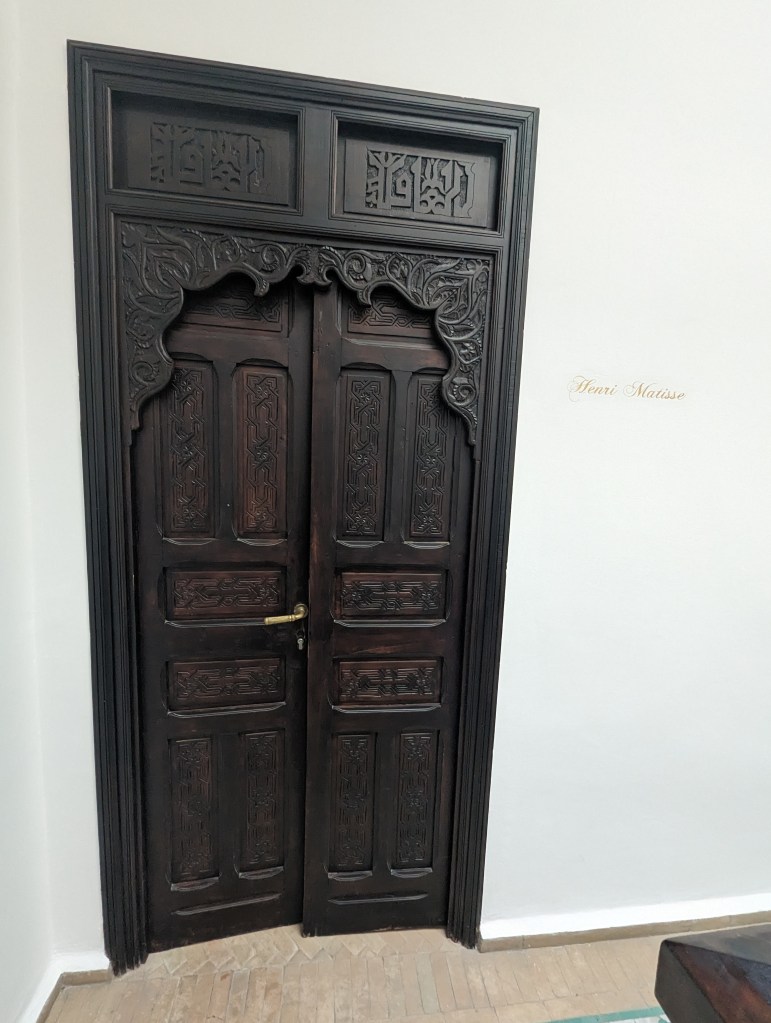
We were greeted by Aziz the owner who gave us a tour of the riad which has been in his family for many generations. We were booked in the Henri Matisse room. Matisse spent a lot of time in Tangier and painted several of his famous works here.

The doors are carved by hand as is all of the original woodwork in the riad. The windows have carved woodwork with laced patterns to allow for air but also privacy. Aziz took us to the rooftop to show off the views.

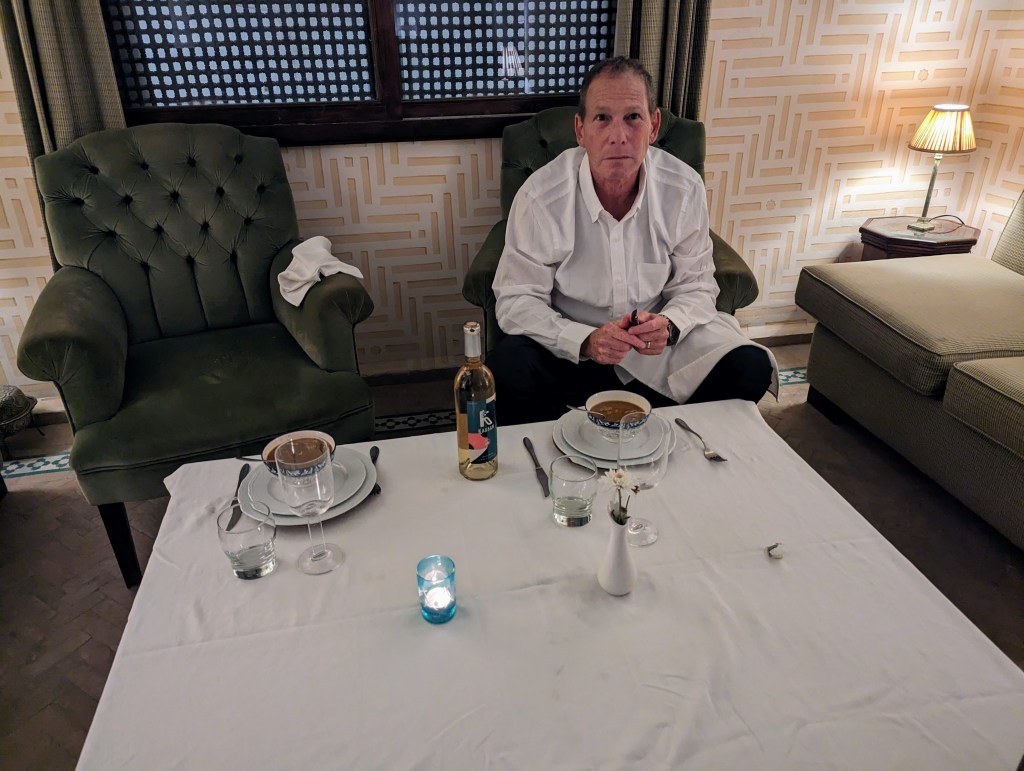
He told us to make ourselves at home, which we did. Dinner that night was served in the salon of the riad. We were introduced to harira soup, which is a very tasty vegetable based soup eaten any time of day including breakfast throughout Morocco. We are both fans.

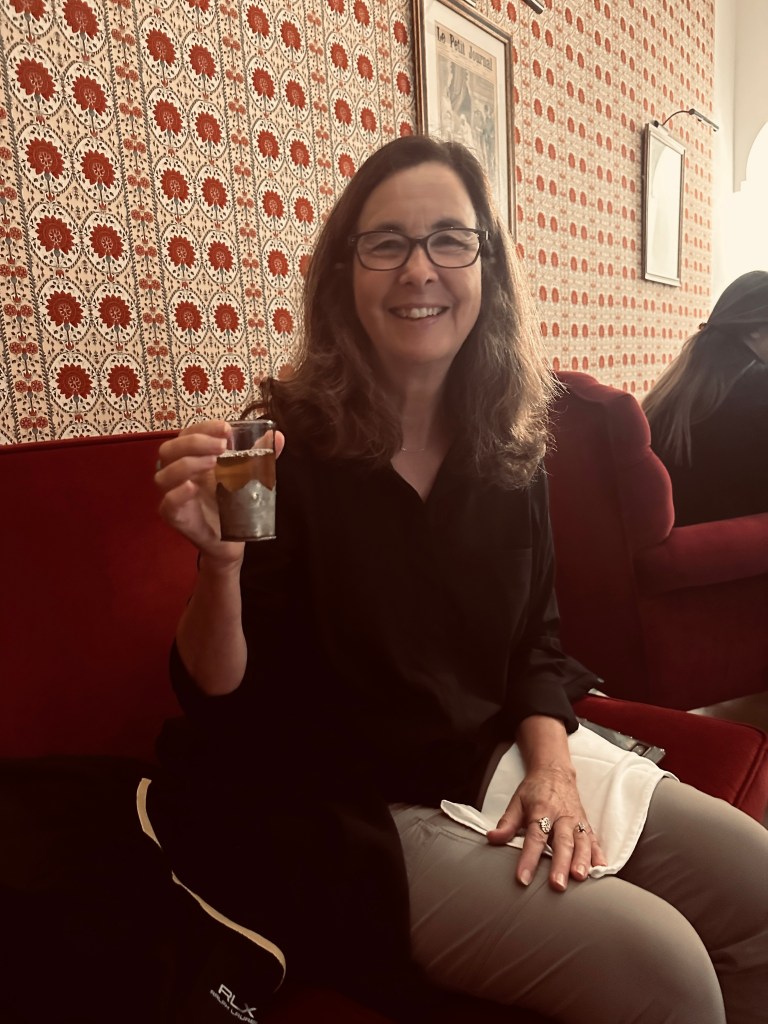
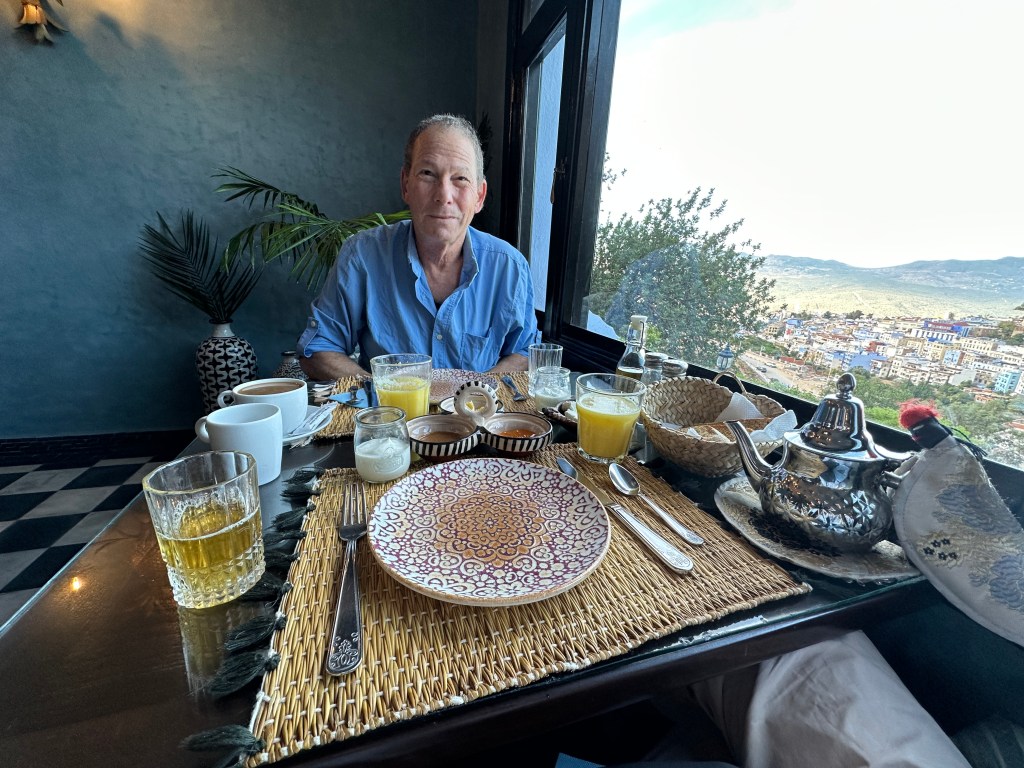
Breakfast was served up on the roof and consisted of fresh oranges, pomegranates, and Moroccan mint green tea with jasmine flower, my new favorite hot beverage,

love the cute glasses

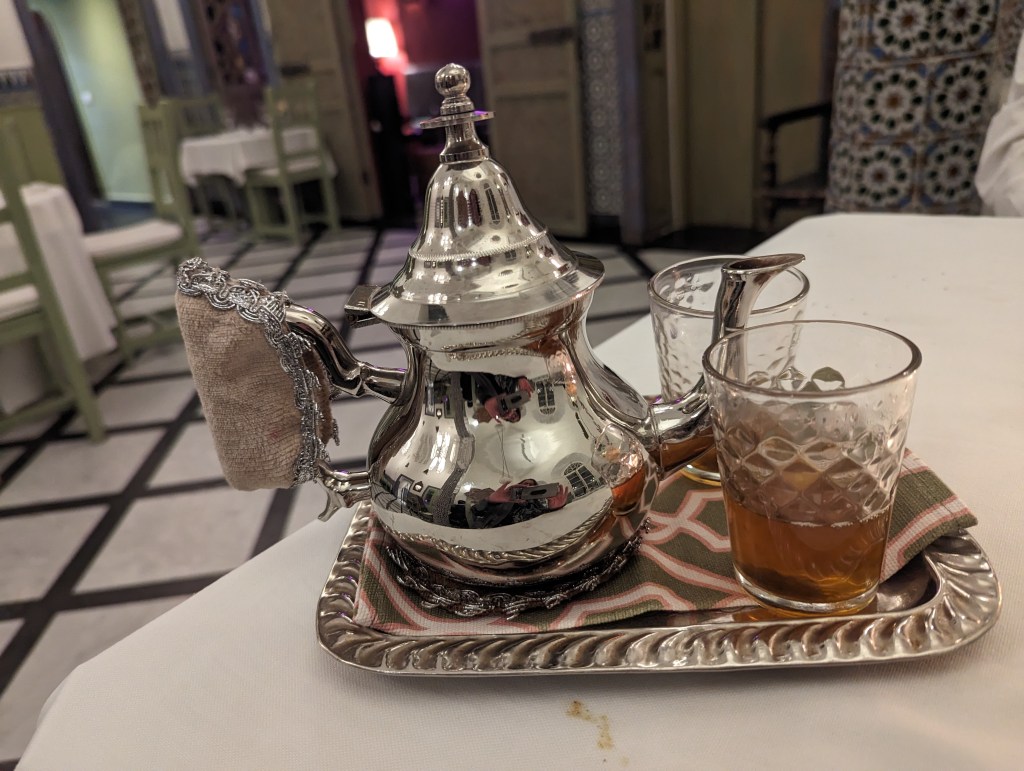
Breakfast featured msemmen, a several times folded pan fried flat bread. It is served with butter, jam and/or honey. Also on offer were beghrir, basically a pancake cooked on one side with its many holes giving an airy, crumpet-like consistency, also served with butter and jam. As I write this I realize despite breakfast there 5 mornings, I have not a single picture of the spread, so sorry. But I do have a picture of the adorable tea service used.

love the fitted hot mitt

After breakfast we met Latif for a walking tour. He told us that in order to understand the culture of Tangier, it is important first to have some history of Morocco in general and Tangier in specific. Many civilisations and cultures have influenced Tangier, starting from before the 10th century BC with the Phoenicians.  Over the next centuries it was home to Carthaginians, Romans, and Berbers. (Berbers are actually tribes of many peoples. The Romans called “Berbers” anyone who did not speak Latin.) Byzantine control probably yielded to pressure from Visigoth Spain around 618. In the 8th century the Muslims moved in and converted many of the Berbers. As the Spanish started to conquer and expel the Jews and Moors from Andalusia in the 13th through the 15th century, many of them moved into northern Africa and converted many of the Berbers to both religions. It remained under Muslim control for most of the next several hundred years until the Portuguese started to move ever southward into Africa in the 15th century. In the 17th century it passed into Spanish control along with the rest of Portugal’s domains. Iberian rule lasted until 1661 when it was given to England as part of a princess’s dowry. But the English rule only lasted about 40 years when the kingdom was taken back by the Muslims. In the late 19th century France bombarded Tangier. In the early 20th century Spain controlled most of southern Morocco and the very north while France controlled most of the middle. While under colonial rule, the King of Morocco was considered a sultan. In 1920s, Tangier, an international zone managed by colonial powers, became a destination for many European and American diplomats, spies, bohemians, writers and businessmen. That status came to an end with Moroccan independence, in phases between 1956 and 1960. In 2011 with the Arab Spring raging throughout Africa, the King Of Morocco, supposedly a direct descendant of the prophet Muhammed, allowed his country to write a new constitution electing a Prime Minister and cabinets. In 2011 the Berber language was for the first time recognized as the second official language of Morocco, Arabic the first, and French the third. Arabic and French are taught in every school in Morocco today. Most of the Moroccans that we have met in service industries also speak English, Spanish, Italian, and some of them German, impressive. Then we were off for the tour.

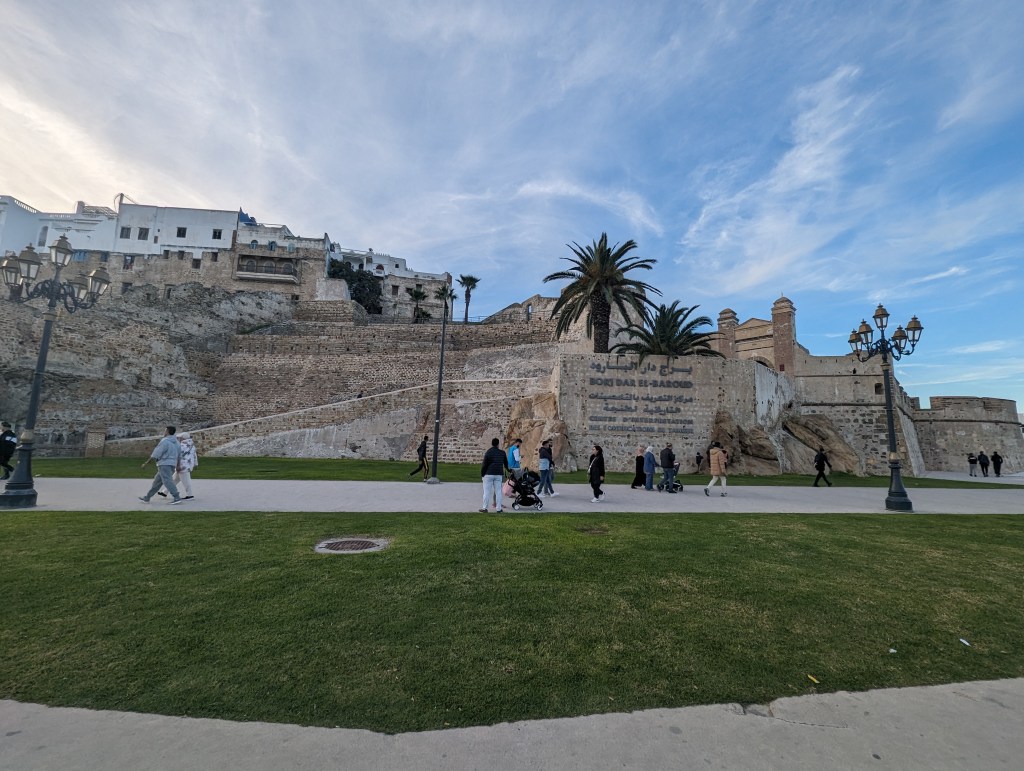
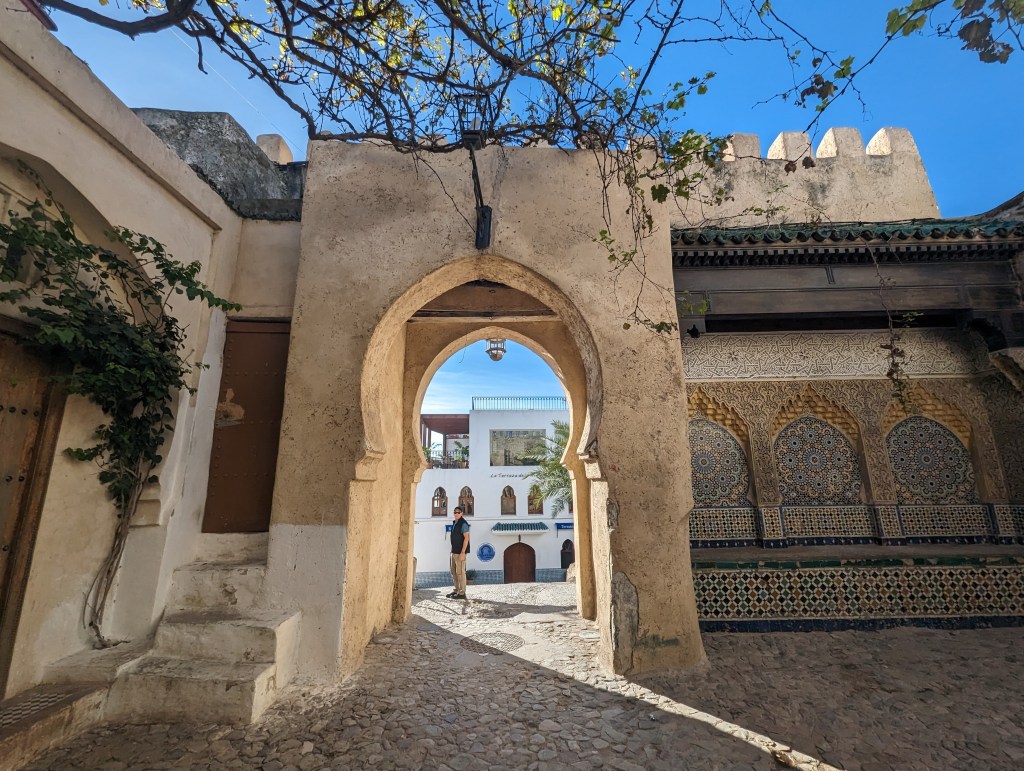
Being already at the top in the kasbah, we started there. The streets of the Kasbah are the typical narrow winding ones.

Latif pointed out a flower pot that has the design of the Moroccan flag and explained that the red color is for the blood of the martyrs, green is the color of Islam, and the 5 pointed star on the Moroccan flag symbolizes the 5 pillars of Islam: Shahada, a belief in the one God, Allah; Salah, daily prayers; Zakat, alms to the poor (Muslims are expected to give 2.5-10% of their income to charity NOT including the mosque); Sawm, fasting at Ramadan; and Hajj, making a pilgrimage to Mecca at least once in a lifetime, health and wealth allowing.

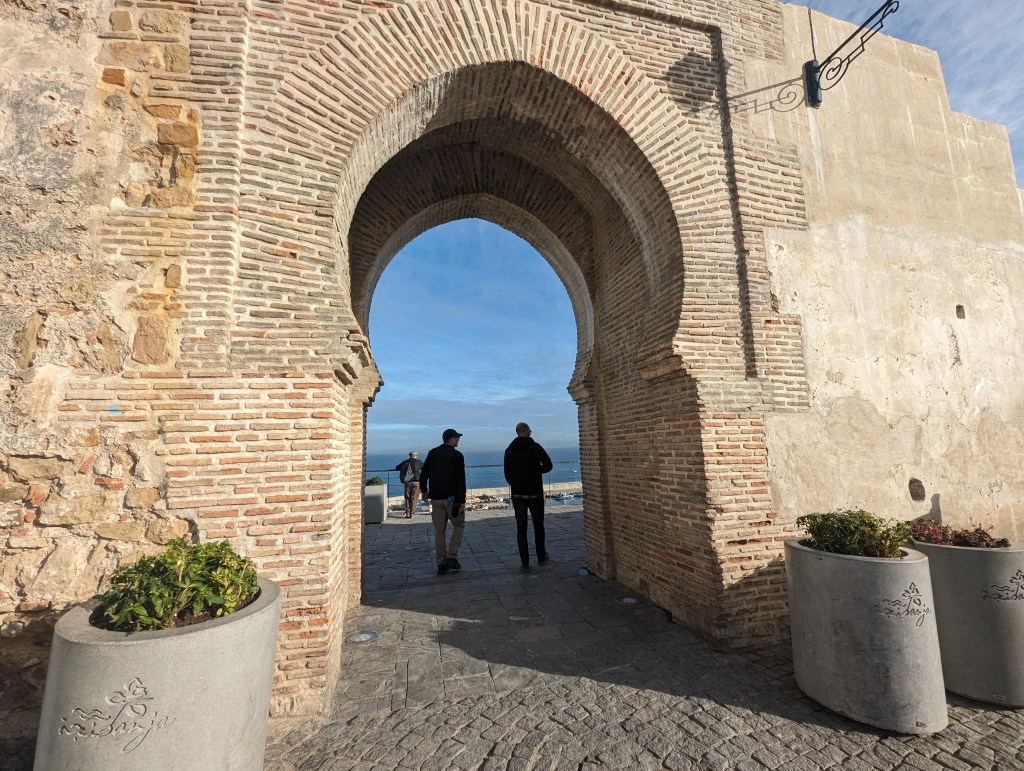
The kasbah (citadel) of Tangier was built right after the city was evacuated by the English in 1684 and reclaimed by Morocco. The sultan of Morocco supported the city’s resettlement and commissioned its reconstruction, overseen by its new governor. It is therefore surrounded by a wall with gates.

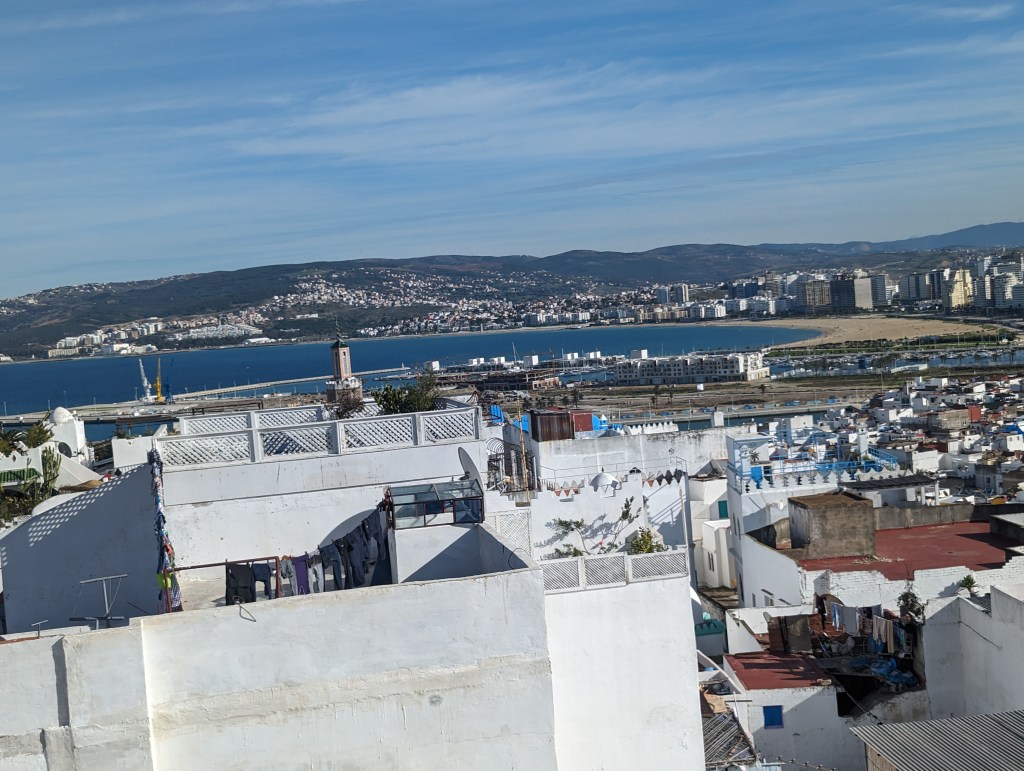
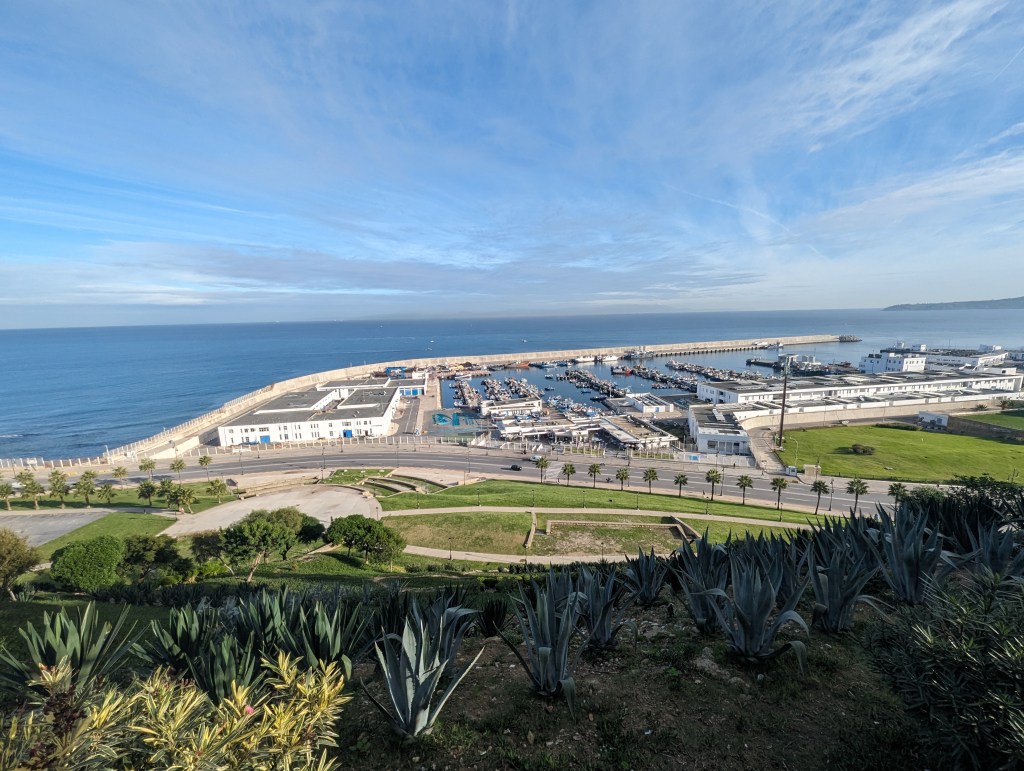
This one opens out to a view of the port of Tangier.

Zooming in, the new mosque at the port can be seen.

The main square of the kasbah is flanked on one side by what used to be a prison, but is now a museum of modern Moroccan art.

We went in for a look at the art.

Further down the square is a part of the original sultan’s palace which is now a cultural center.

Inside is the entire history of Morocco. One of the first displays shows the original door to the building.

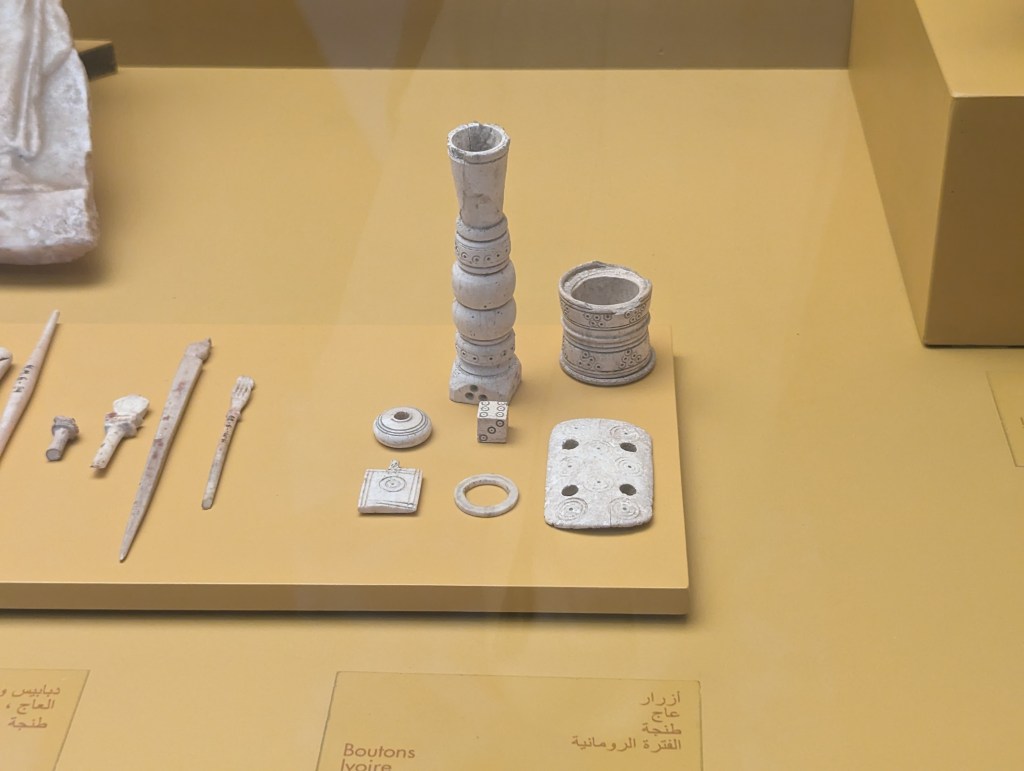
The rooms are organized by period from the paleolithic, neolithic, through Roman times all the way to the present. One of our favorite ancient tidbits was this die from the Roman times.

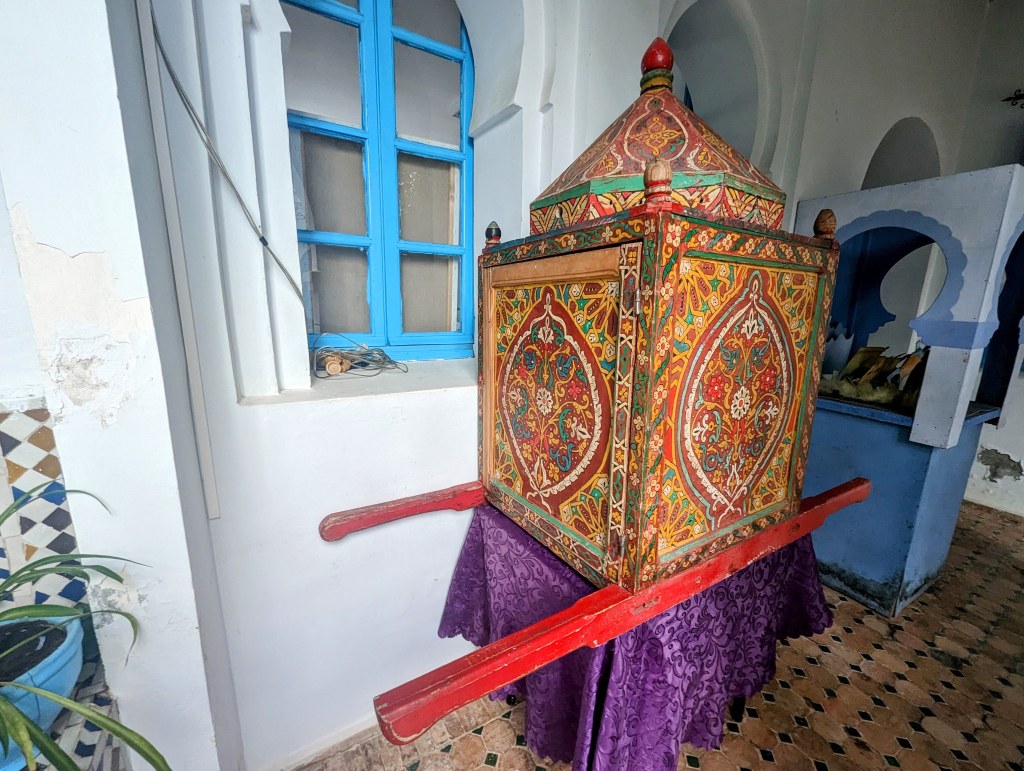
And a more modern favorite was this ammaria which is used to carry the bride from her home to that of the groom.

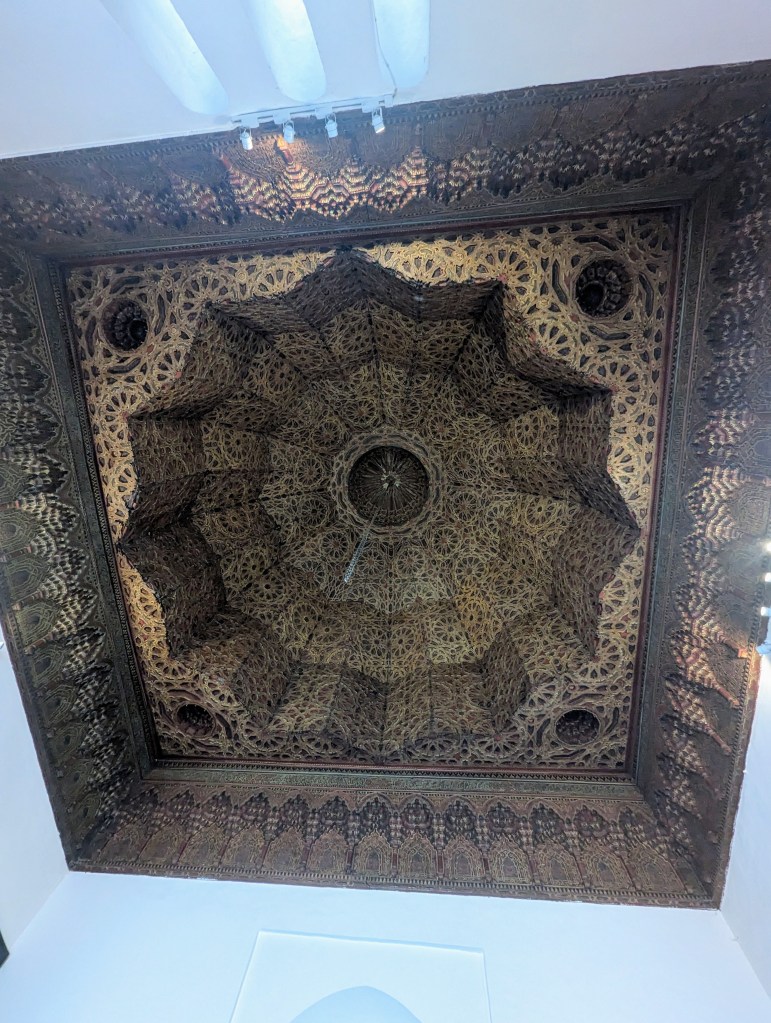
Each room of the museum has an incredibly detailed hand carved wood ceiling.

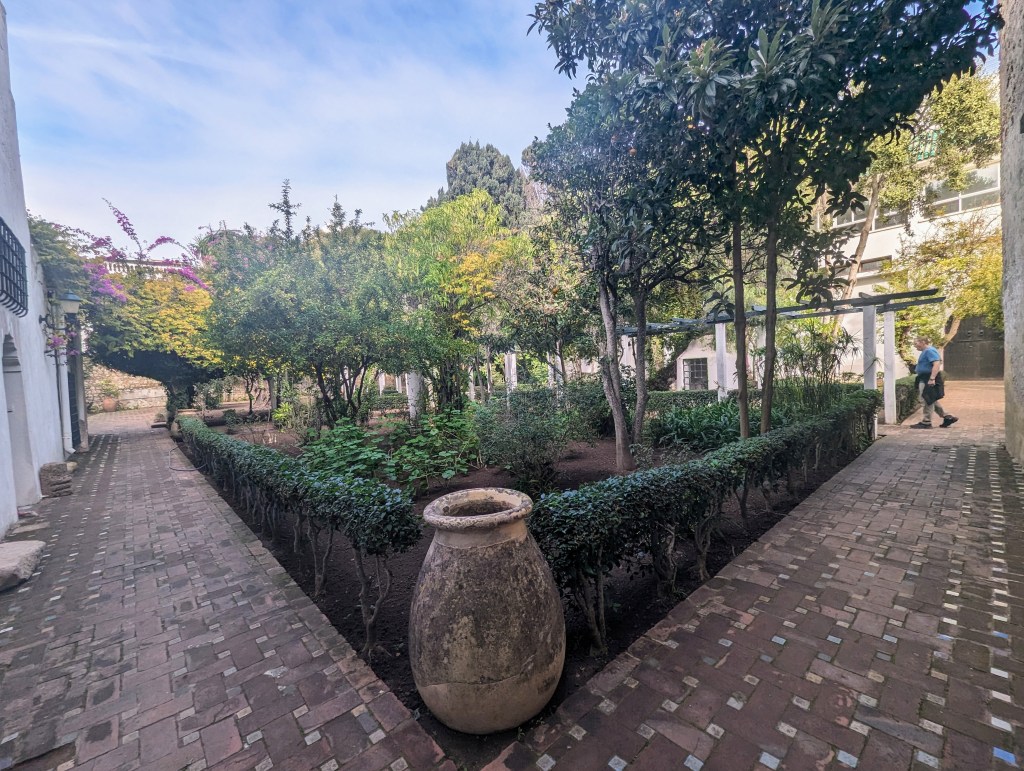
And of course having been a palace, the building has a central courtyard with an extensive garden.

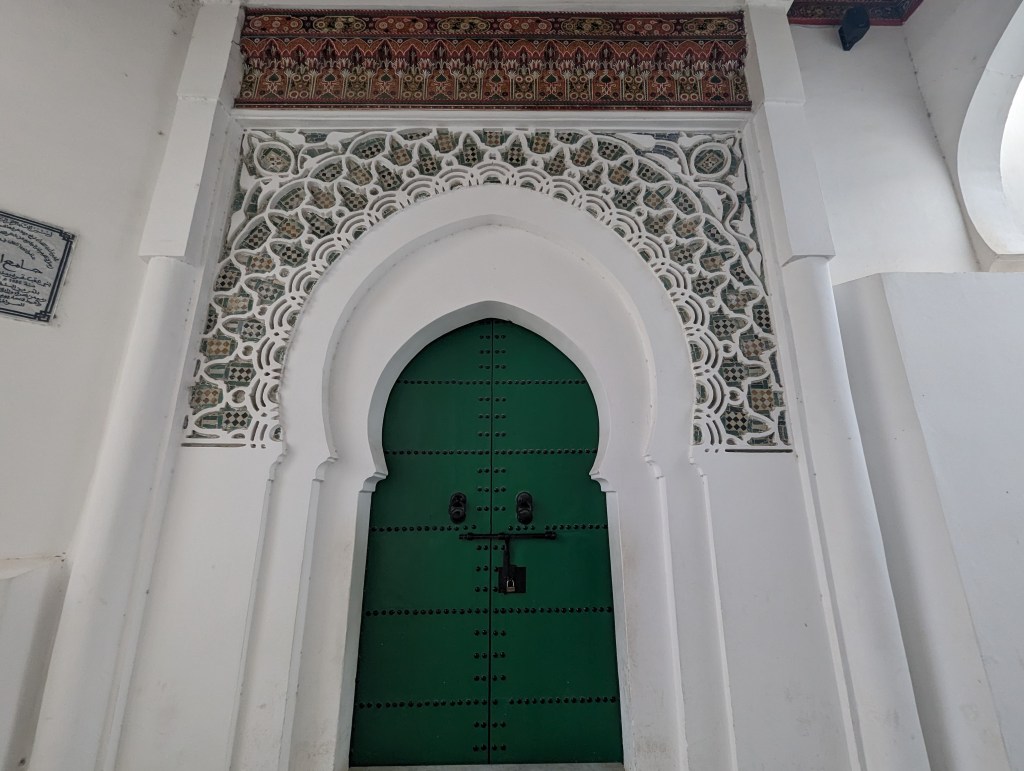
Around the corner from the palace is the mosque. A green door is typical on a mosque entrance.

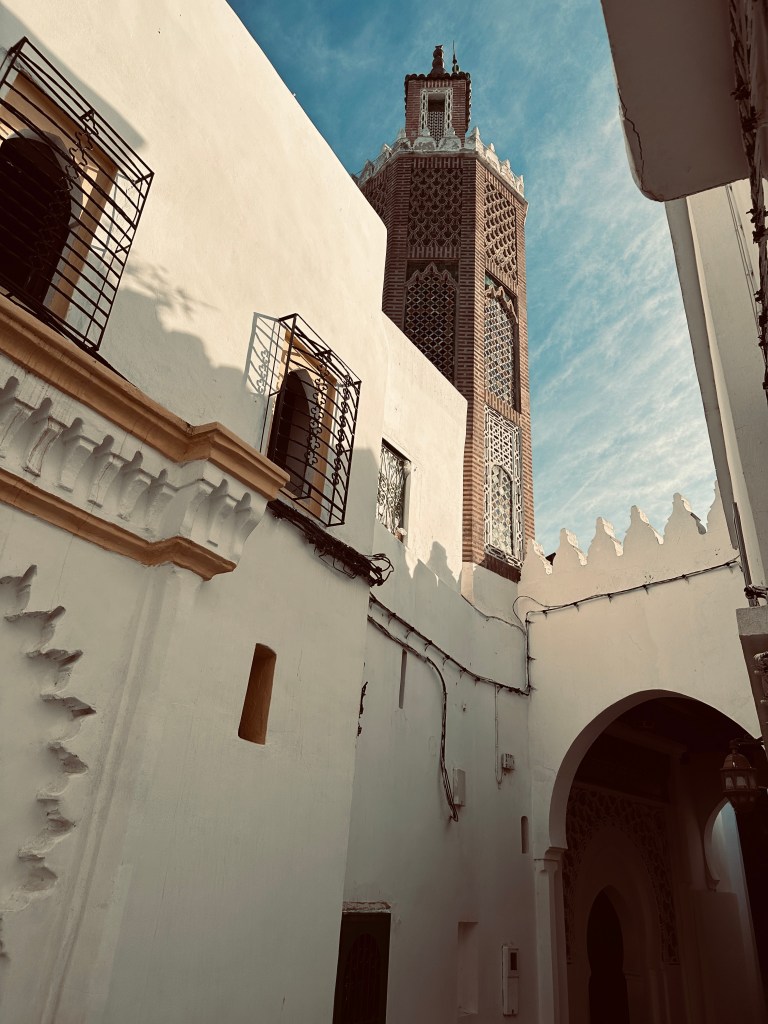
And the minaret.

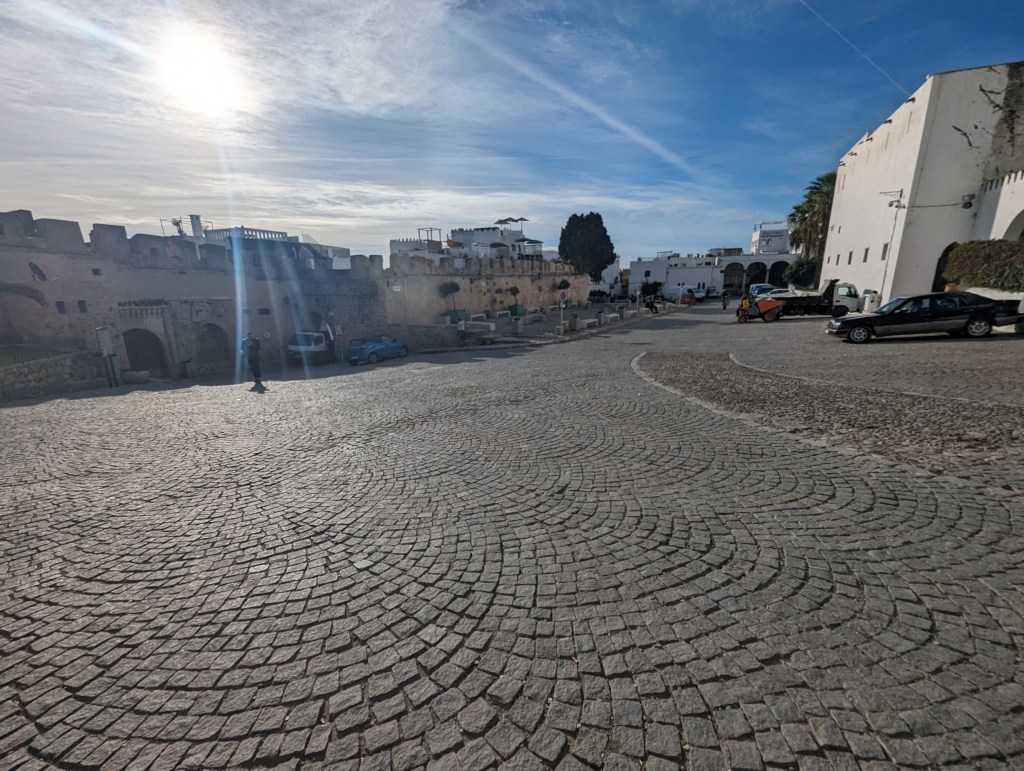
At the end of the square is the gate that exits the kasbah into the medina.

And the gate into the medina, the old city. The area between the two gates is where punishment of men who were found guilty of a crime took place, ie whipping.

At the top of the medina are several famous cafes. Morocco boasts many famous inhabitants in its day. These cafes were frequented by writers, artists, musicians, and many more through the years.

A souk is a market. Where in the past they were areas of the medina, today most of the medina is a giant souk.

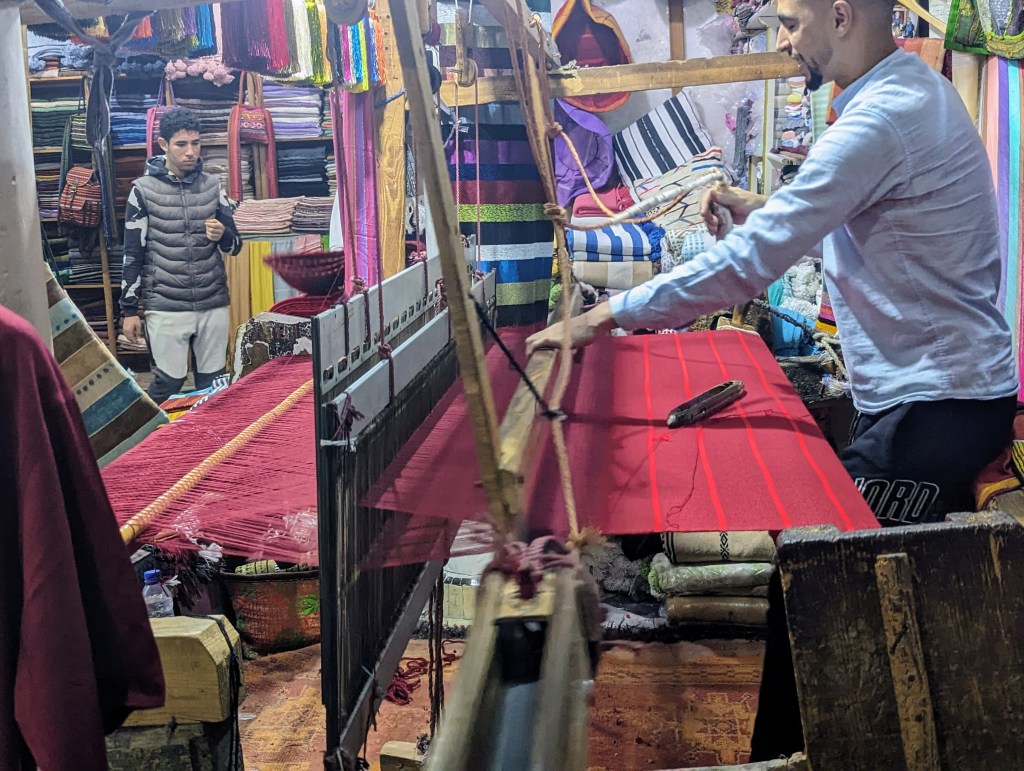
The souks are mostly organized by product. Our favorite was that of the tailors where many make there own textiles. In this shop a man is using his feet to power the loom to weave the fabrics: wool, silk, and combinations of the 2.

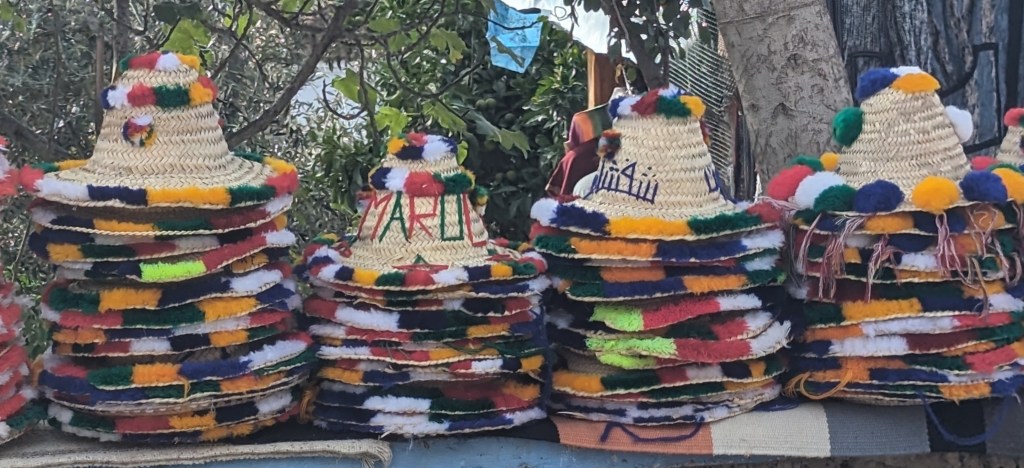
Today was market day which means those living in the mountains, mostly Berbers, come into town and sell fruits and vegetables as well as hand crafted items. They also do their own shopping. I was warned that they do not like to be photographed, so was respectful. But they can be distinguished by their hats, which they weave from straw to protect their heads and necks from sun but allow air for cooling. They are decorated with wool balls, the colors denoting their tribes. The ones from the North tend to use charcoal colored balls, those from the South and East prefer colored ones.

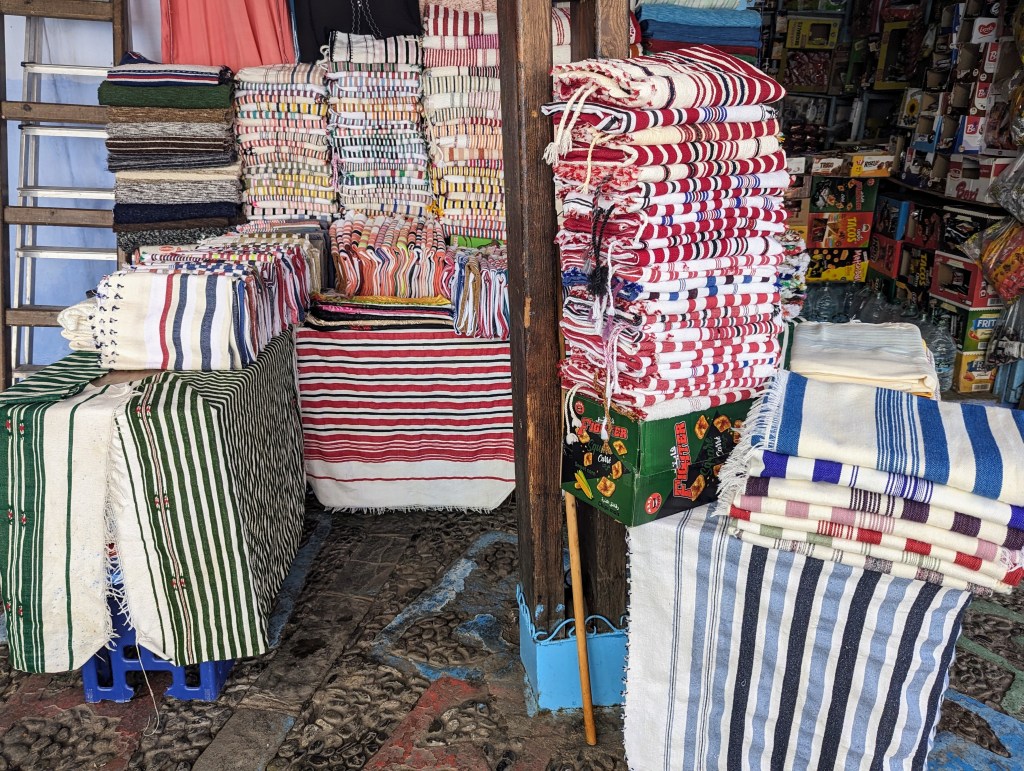
The women wear aprons that are hand woven and typically red and white striped. The way she ties it, to the side or in front, denotes if she is married or still eligible. The ones worn by the tribal women are simple red and white striped.

But those sold for the tourists, which can also be tablecloths, couch covers, whatever, are more colorful.

We also went into the food and spice markets.

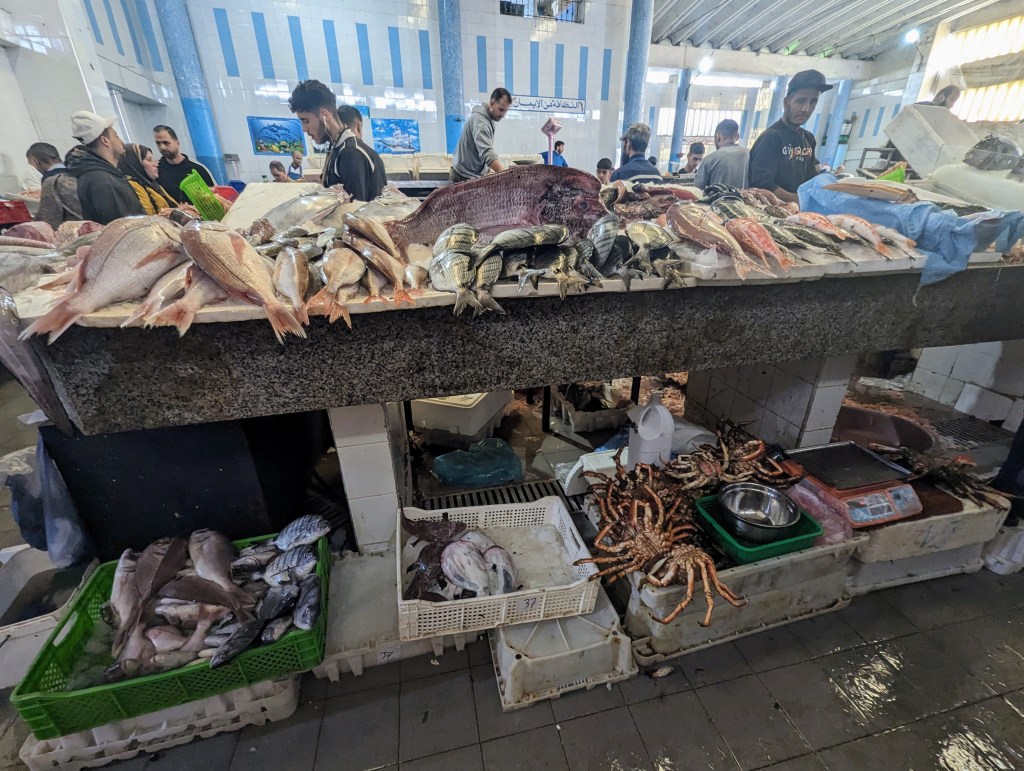
The fish market was the largest we have seen anywhere.

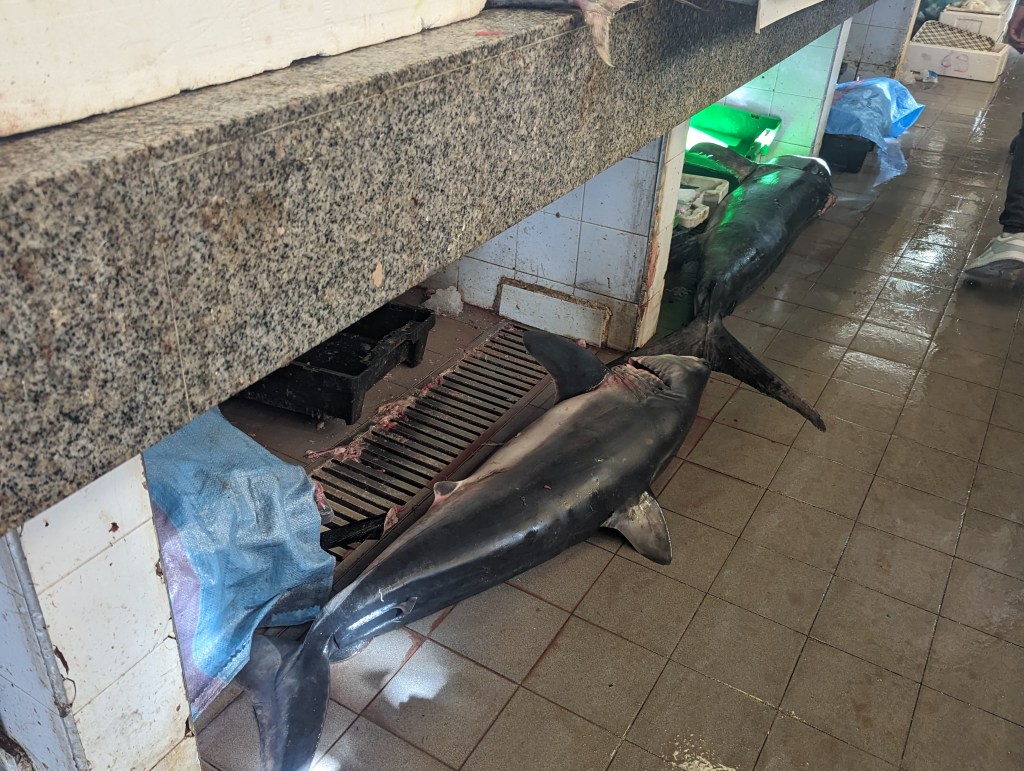
Even sharks!

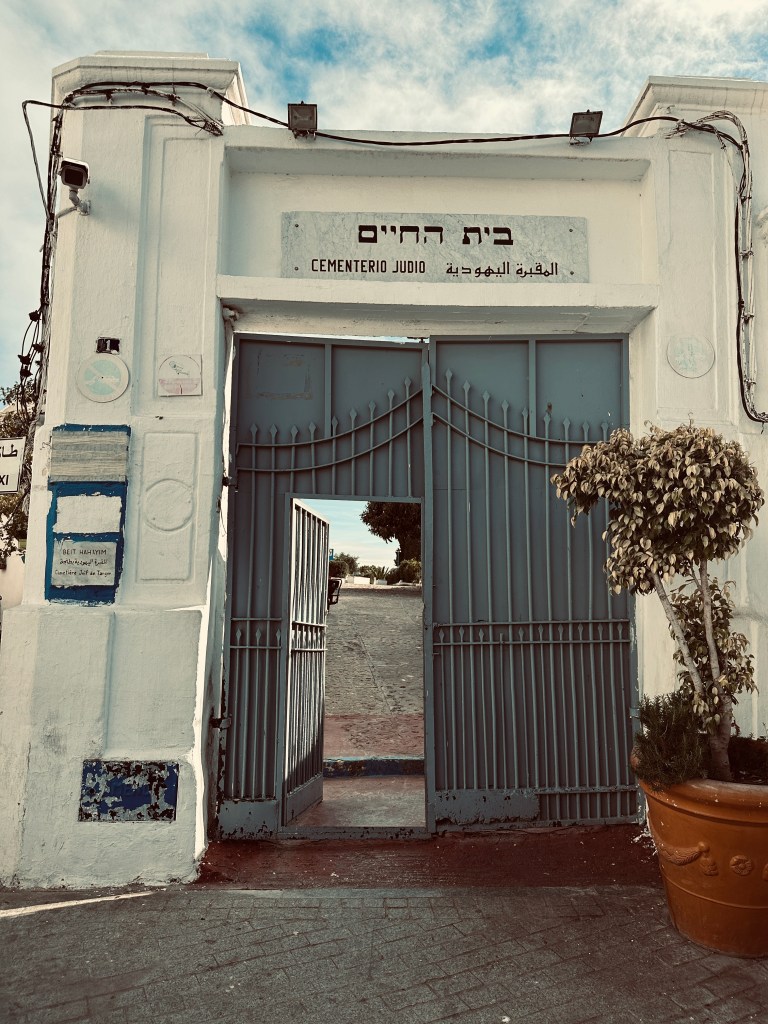
We walked by the Jewish cemetery.

It has a truly great view.

The first Jews migrated to Tangier after the destruction of the First Temple in Jerusalem in the 6th century BC and settled among the Berbers. Jews of Tangier were later met by a second wave of migration from the Jews living in the Iberian Peninsula during the 1492 Alhambra Decree and the Inquisitions. At one point the Jews made up as much as 25% of the population. For the most part Jews and Muslims lived peaceably together. But in 1956 most Jews joined the Zionist movement to Israel.

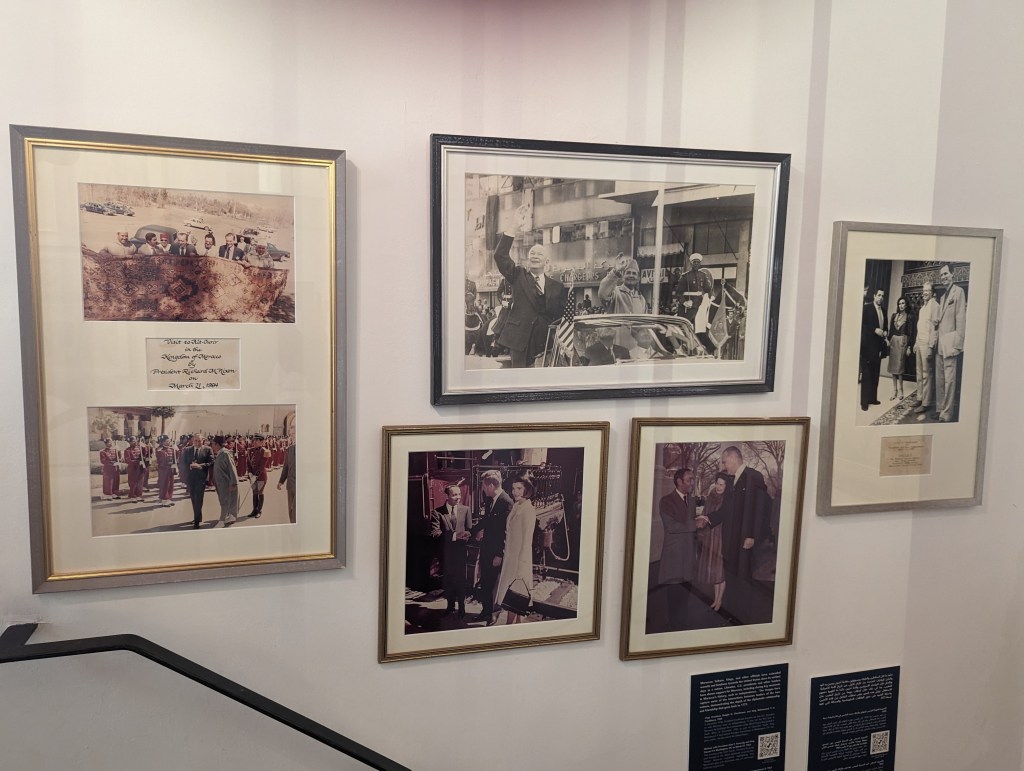
We then visited the original US Legation.

Which is now a museum.

Morocco was the first country in the world to officially recognize the US independence, which it did in 1777. It was, therefore, the home of the first legation of the US in a foreign country, (a legation is a lower rank than an embassy because it is headed by a minister not an ambassador) established in 1821. Morocco has had great relationship with the US throughout our history and has been visited by most presidents.

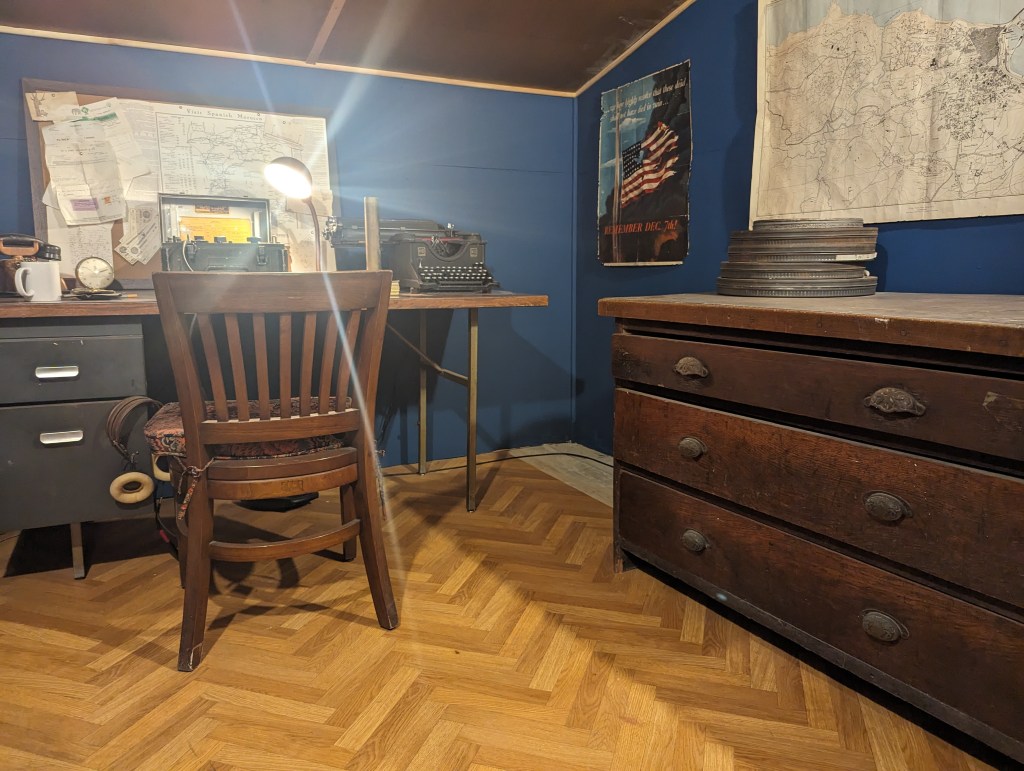
At the time that World War II broke out, Morocco was controlled by France. When France fell to Germany, Morocco was then occupied by Germans. The allies helped plan and operate Operation Torch. On November 8, 1942, American and British forces invaded beaches and ports across French North Africa. It opened a long-awaited second front against the Axis. Operation Torch constituted the biggest and most complex amphibious landing to that point in world history. Part of that planning happened right here in this telegraph office hidden in the top of the US Legation.

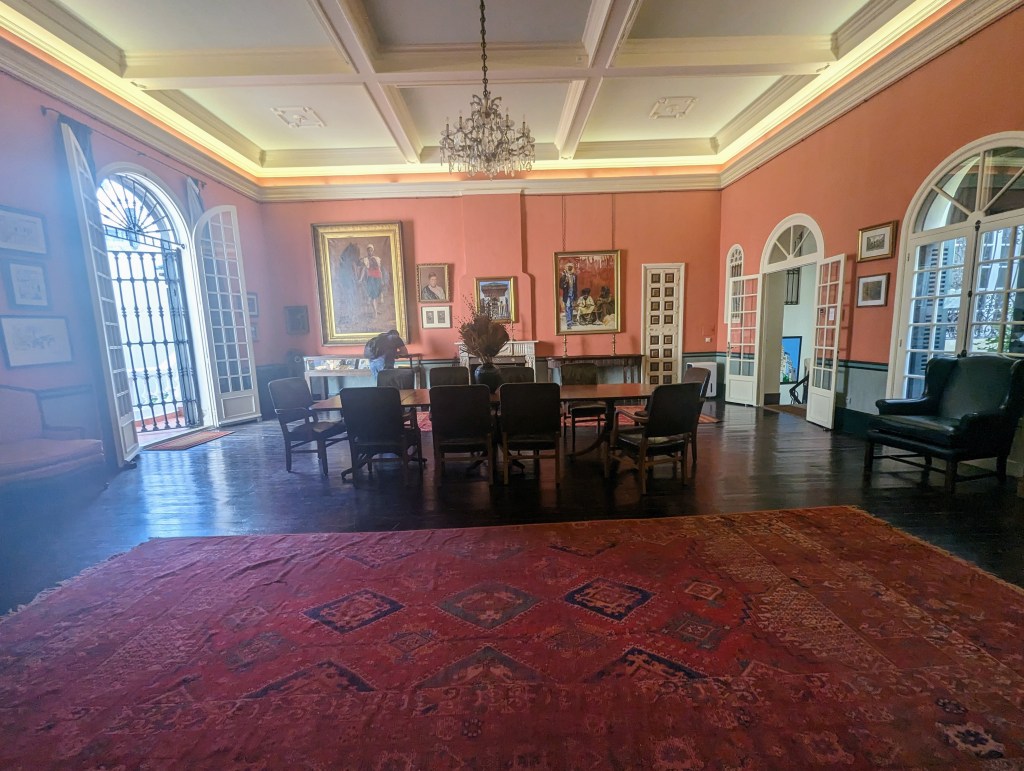
The embassy was also used for living and entertaining.

dining room US Legation

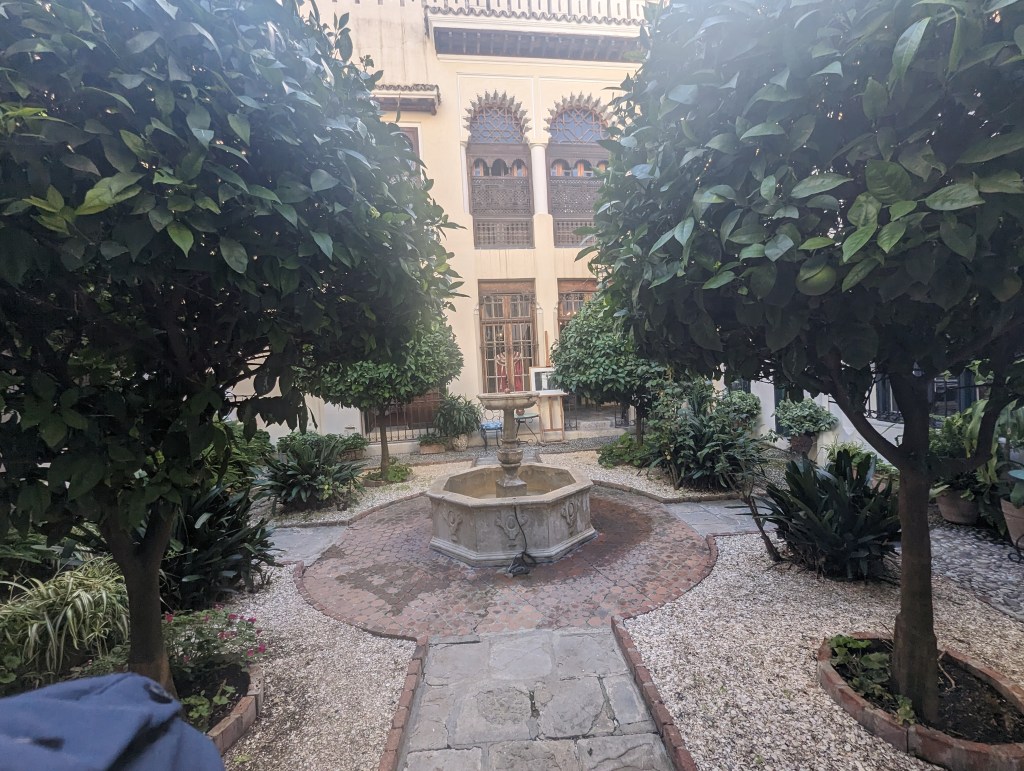
courtyard US Legation

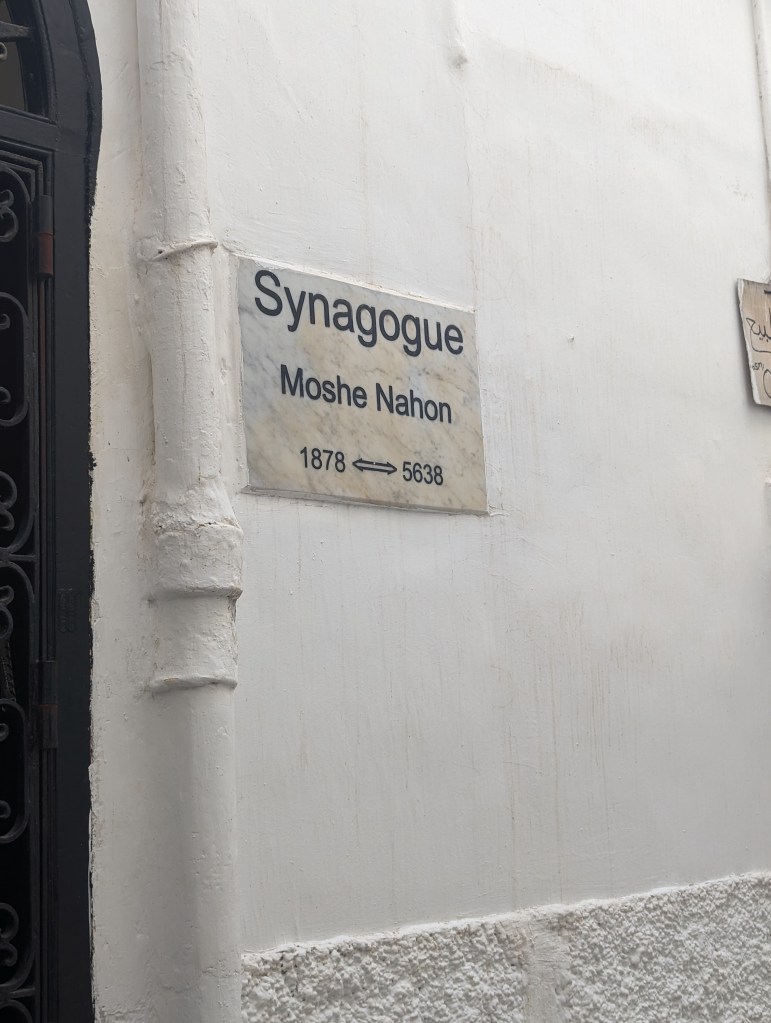
We then went into the Jewish quarter to visit the synagogue. Latif explained that a Jewish Quarter in Morocco is not like a ghetto but an area for Jews to be together, making it easier for them to practice their religion and maintain dietary specialties.

He took us to a Jewish shop that carries everything from mezuzahs and menorahs to lamps and tea services.

We had lunch of chicken tagine and lamb kabobs in a small family run restaurant in the medina.

Then we visited more shops like this one with the most exquisite hand made carpets. It can take three people working together a year to make one carpet.

In the evening we walked around outside the medina on our own and visited the main square called the Grand Socco. It was packed with people and street performers.

Grand Socco

In the morning we met Kamal who was to be our driver for the next 34 days, which will be a personal record for him. His previous longest clients were with him for 21 days. Kamal is a Muslim Berber from a village in the south that is made up of all Berbers. He says his ancestry is 3-4,000 years old.

Our first stop was a lookout over the former mansion of Greek-American tycoon Perdicaris who built a 70 hectares park of trees imported from around the world. It is now a public park.

We then stopped in Donabo Gardens. Despite it not being the right time of year for gardens, they were lovely.

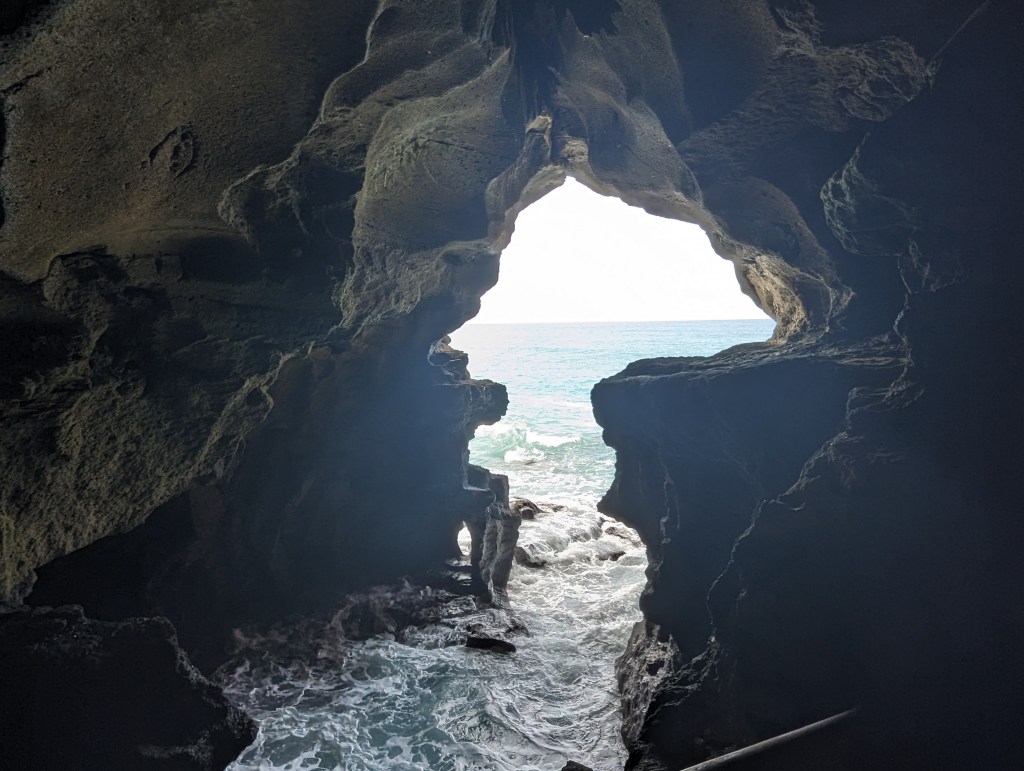
We then went on to Hercules’ Cave, so named because legend has it that he carved it out and lived there while he was planning to separate the two continents, one of his 12 labors for immortality.

The mouth of the cave is said to look like the shape of Africa.

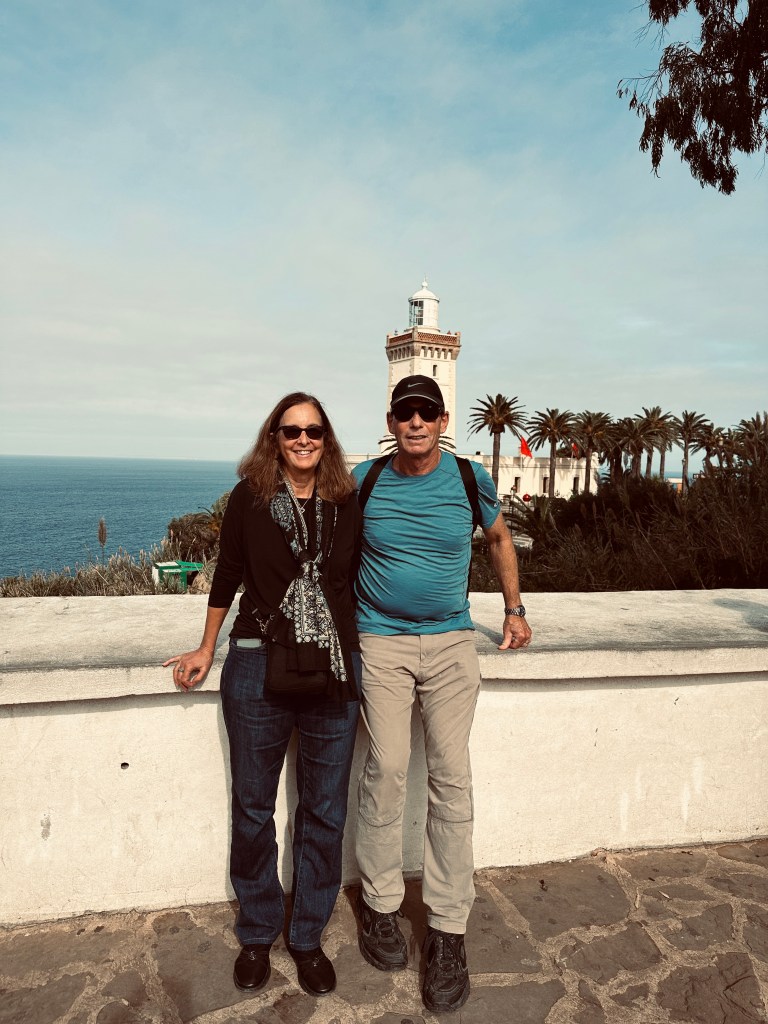
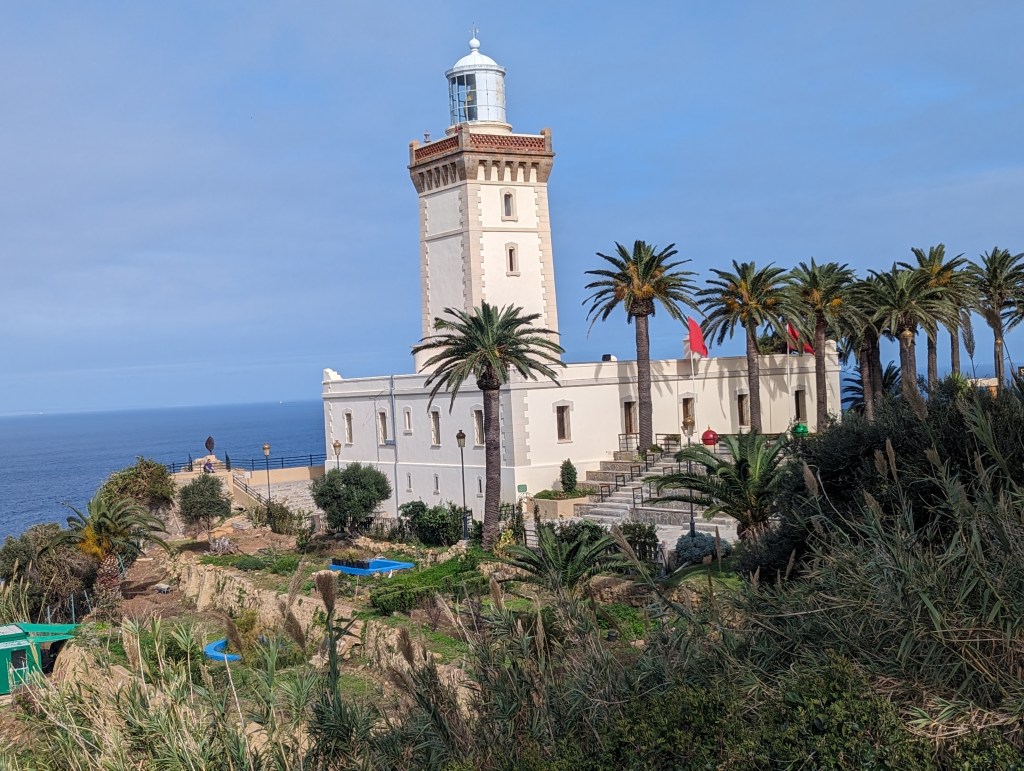
Then we drove to Cape Spartel, a promontory in Morocco about 1,000 feet above sea level at the entrance to the Strait of Gibraltar. It is the northwesternmost point of the African continent.

We had a relaxing late couscous tagine lunch, the Friday special in Morocco, on the terrace before heading back to Tangier.

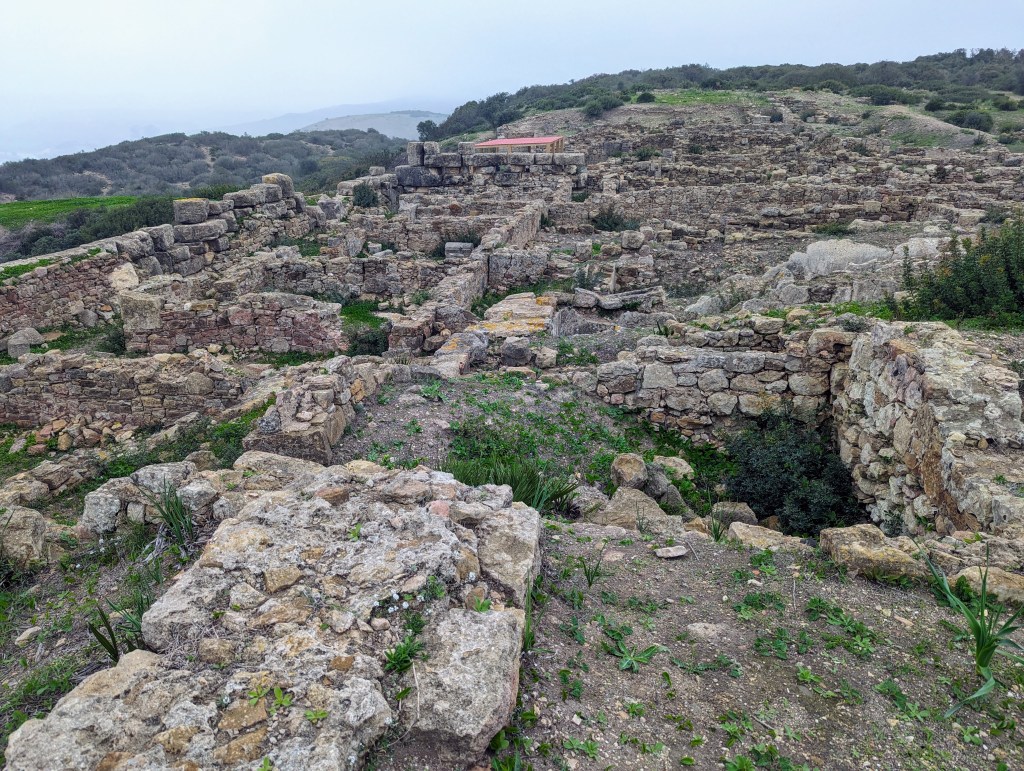
The next morning we headed down the Atlantic coast to the archaeological site of Lixus near the town of Larache. Lixus was originally founded by the Phoenicians in the 8-7th century BC. It has been continuously inhabited since. Amongst the ruins were artifacts from all of the different eras. Among those now displayed in the museum include many Roman coins.

Lixus was one of the largest Roman industrial sites. It was built by the Loukkos River. The main industries were salting and exporting tuna. Another was the making of a purple dye from a local flower.

Industrial Center Lixus by the river

We hiked up a steep hill to the Roman baths.

which still had some preserved mosaic floors.

And still further up the hill to the Basilica. Notice the three languages on the sign: Arabic, Berber, French.

And to the top of the hill to the homes of the very wealthiest Romans with their private baths and rooms and great views.

And then we wound our way around to the city complex that was Lixus, its temples and forums and apartments. Several camera shots could not get it all in; the ruins are massive.

Having satisfied my ancient craving for the day, we drove a bit back up the coast to Asilah, a town on Morocco’s Atlantic coast. Its medina, is enclosed by well-preserved 15th-century ramparts and gates, built by colonial Portuguese. The medina is an art hub, known for its murals and an annual festival in June. But first we went for lunch at Restaurante Dar Al Maghrebia.

There we discovered two new food treats: breguats, a phyllo dough-like deep fried pastry filled with choice of ___, we had fish; and pastellas, a slightly thicker dough also stuffed and deep fried, but topped with powdered sugar and cinnamon; we chose chicken. We also had our fav harira soup. We are LOVING Moroccan food!

With full bellies we entered through the medina gate into Asilah.

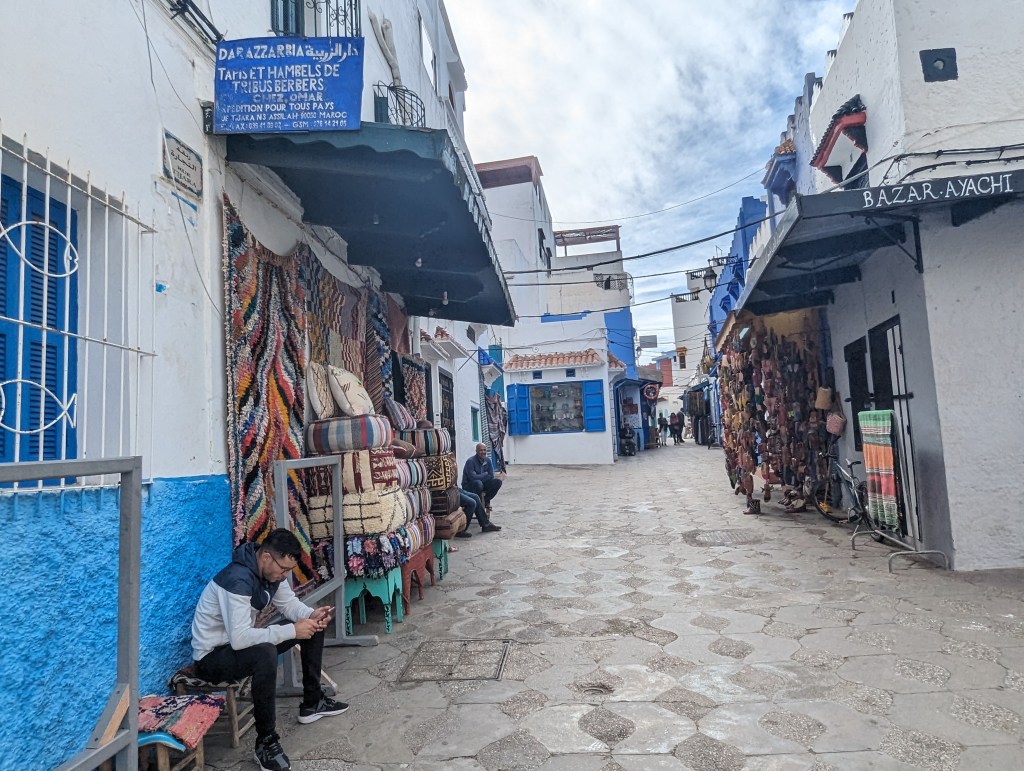
The town is repainted in its iconic blue and white colors every two years.

Asilah medina shops

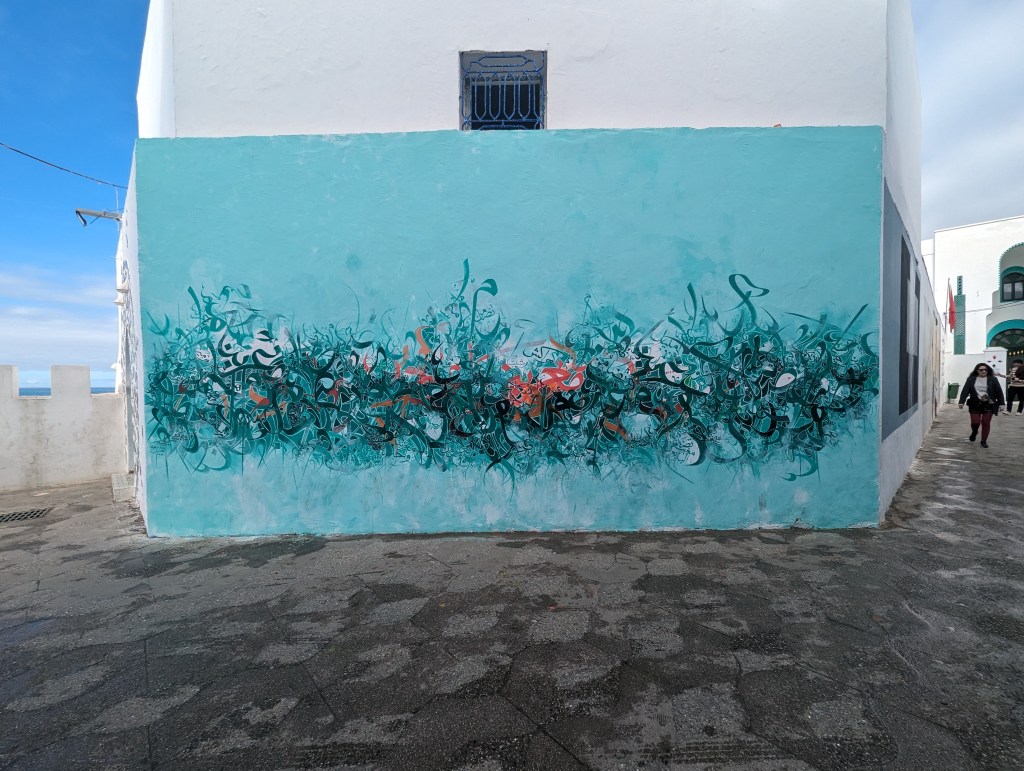
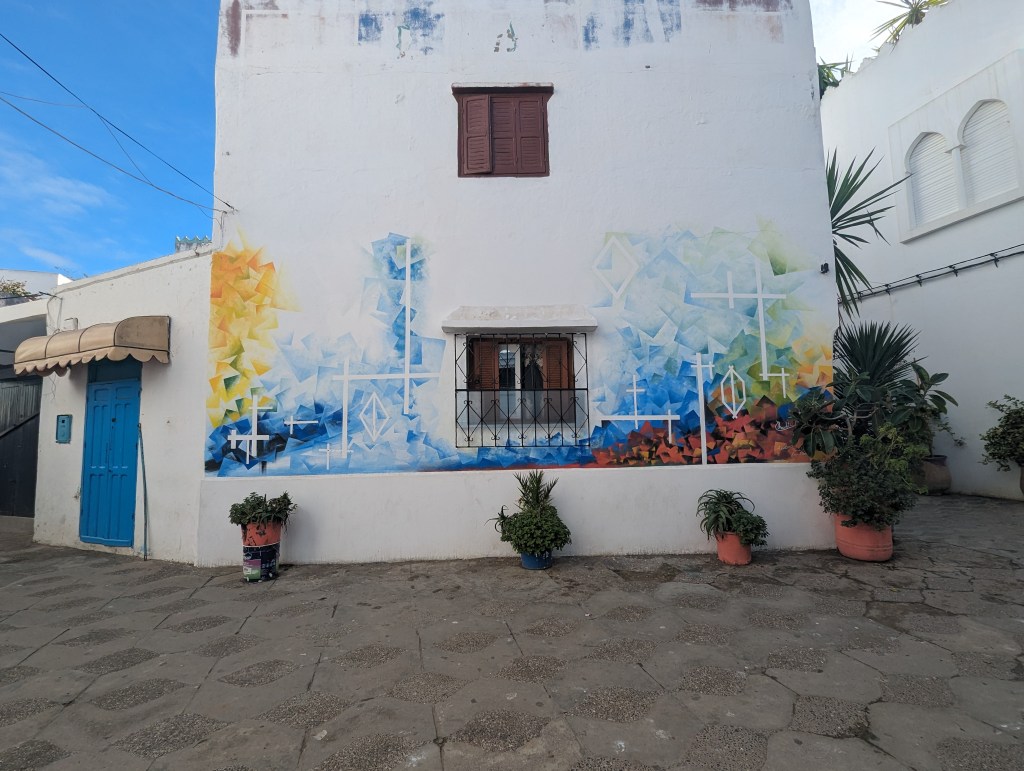
Once repainted, then murals are added by local artists. They can be found scattered throughout the medina.

We walked along the Atlantic side with the beach beyond the wall.

As in Tangier, the windows often have carved lattice for privacy but breeze; the difference being that here they are painted blue.

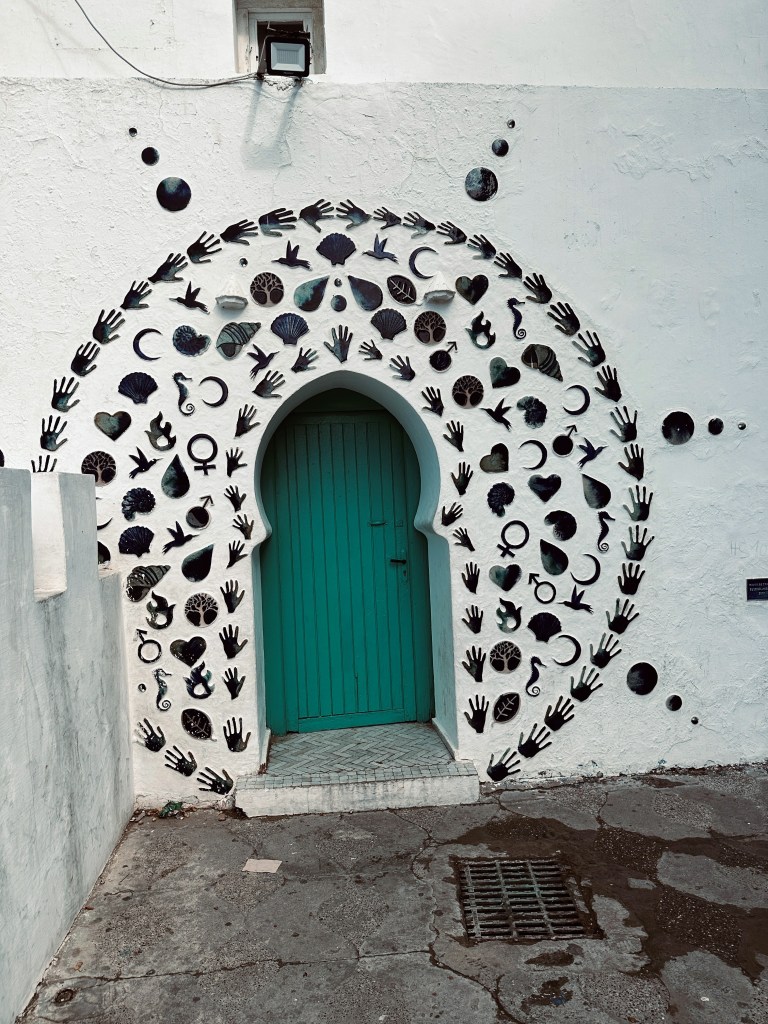
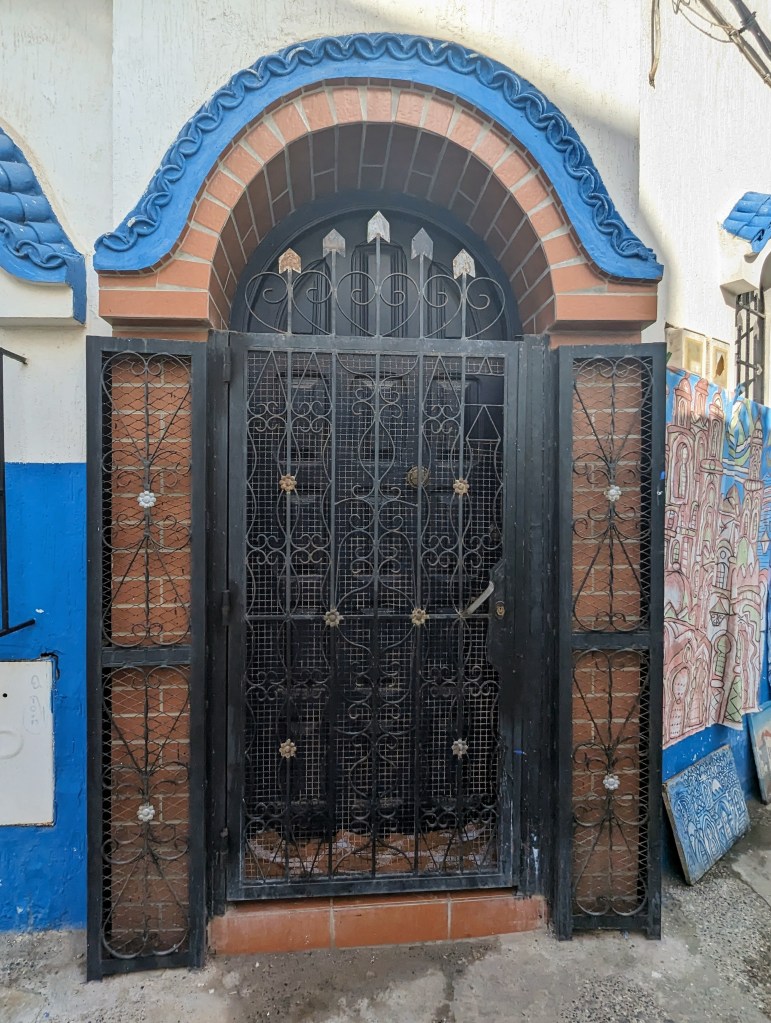
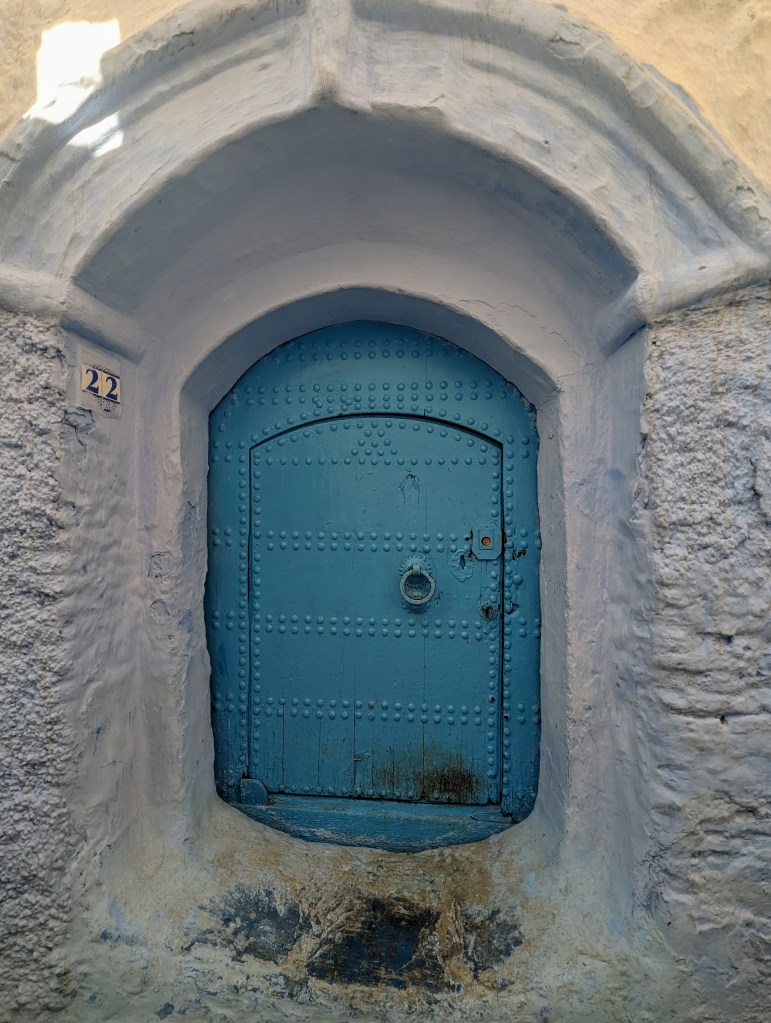
Many of the doors are gorgeous.

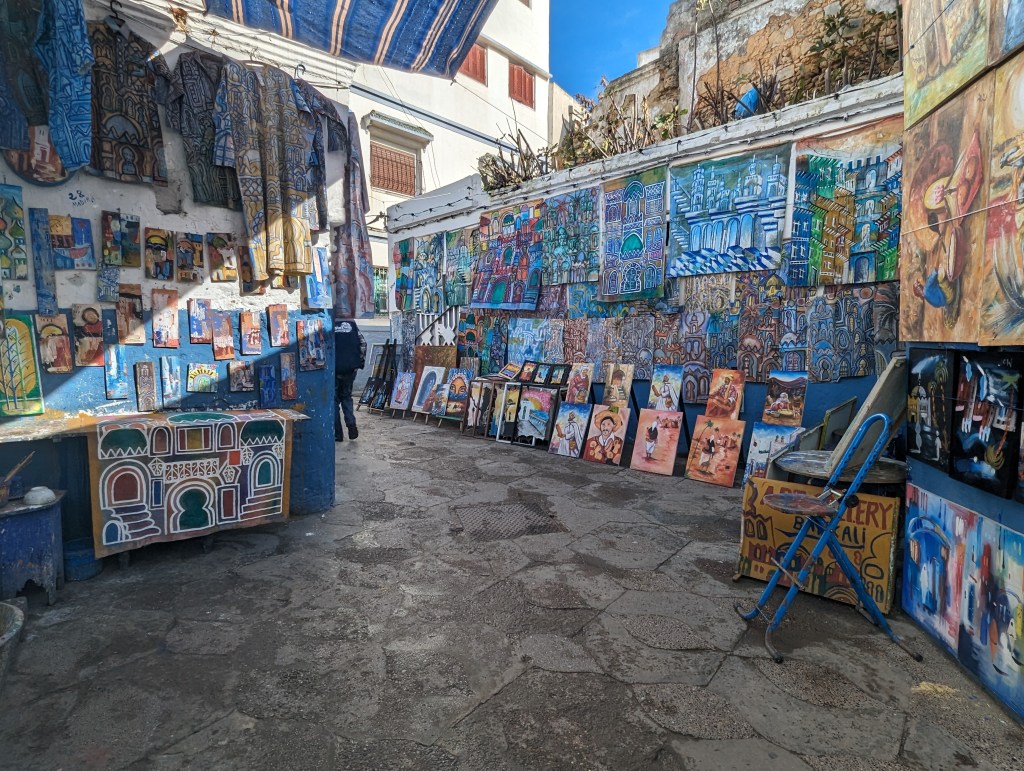
In Asilah everything becomes art.

hanging painted buoys
embroidered footwear

And there is every kind of art.

And there are art galleries on every corner, literally.

In this instance, the whole house is a work of art.

That night we had a delicious French-Moroccan fusion dinner at the M Restaurant in the kasbah. The following day we spent mostly with Lucas and Amina Peters, the founders/managers of Journey Beyond Travel, who arranged our entire trip. They had invited us into their home and garden for lunch, tea, and visit with them and their children. We ate bocadillos, which are spanish-inspired sandwiches on long baguette-like bread filled with just about anything and everything, including the french fries. In the late afternoon we shopped a bit in the medina and said a sad farewell to Tangier.

Kamal picked us up in the morning after breakfast, and we headed to Chefchaouen. Along the way we stopped for tea at a scenic roadside cafe. We entered into the Rif Mountain Range, one of 4 in Morocco (the others are: the Atlas Mountains, the High Atlas Mountains, and the Anti-Atlas Mountains).

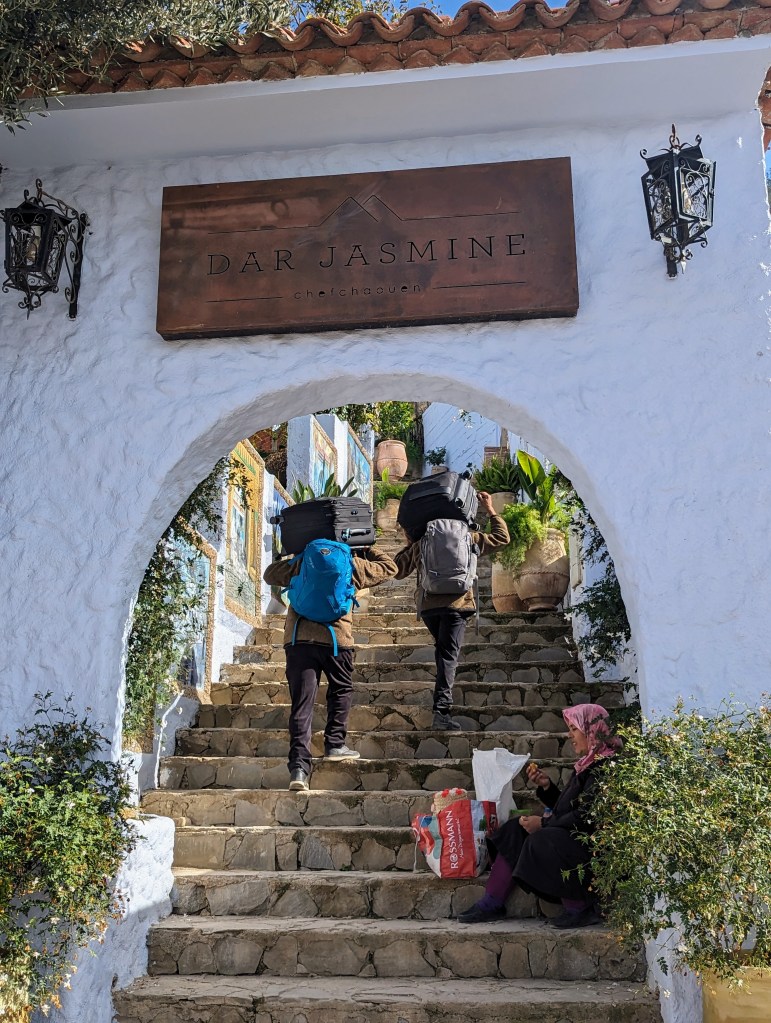
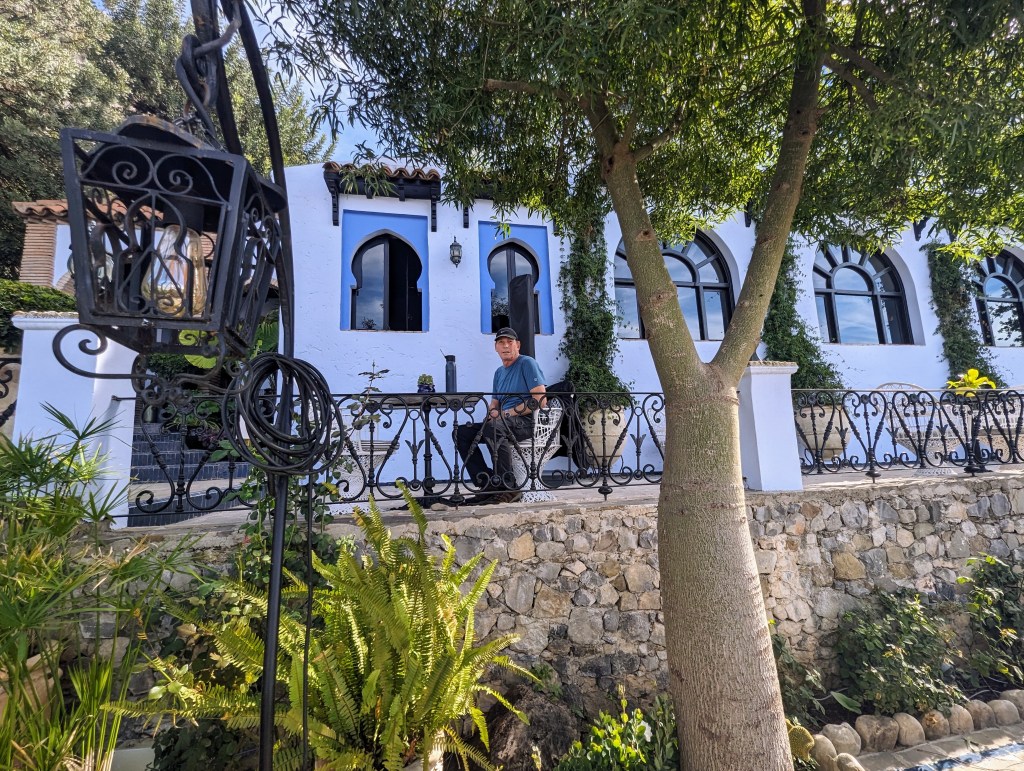
We arrived at our hotel Dar Jasmine in the afternoon and climbed the 160 stairs to the lobby! The porters had come down to meet us and, thankfully, carried our bags up the long flight of stairs for us.

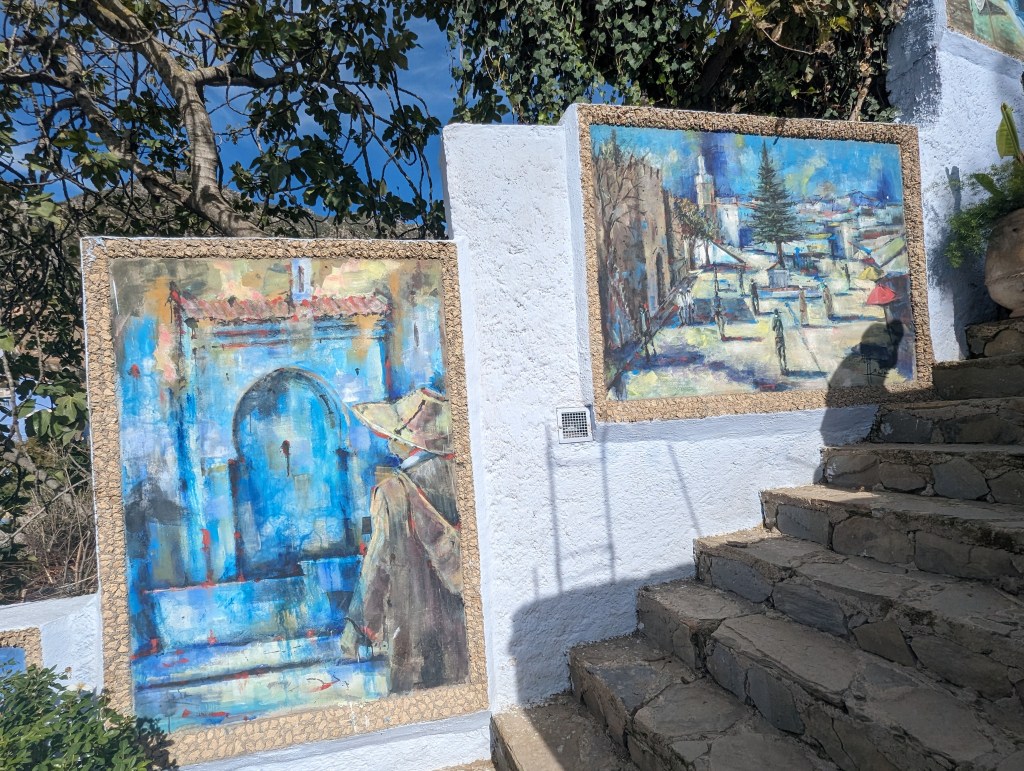
The walls along the stairs are lined with murals.

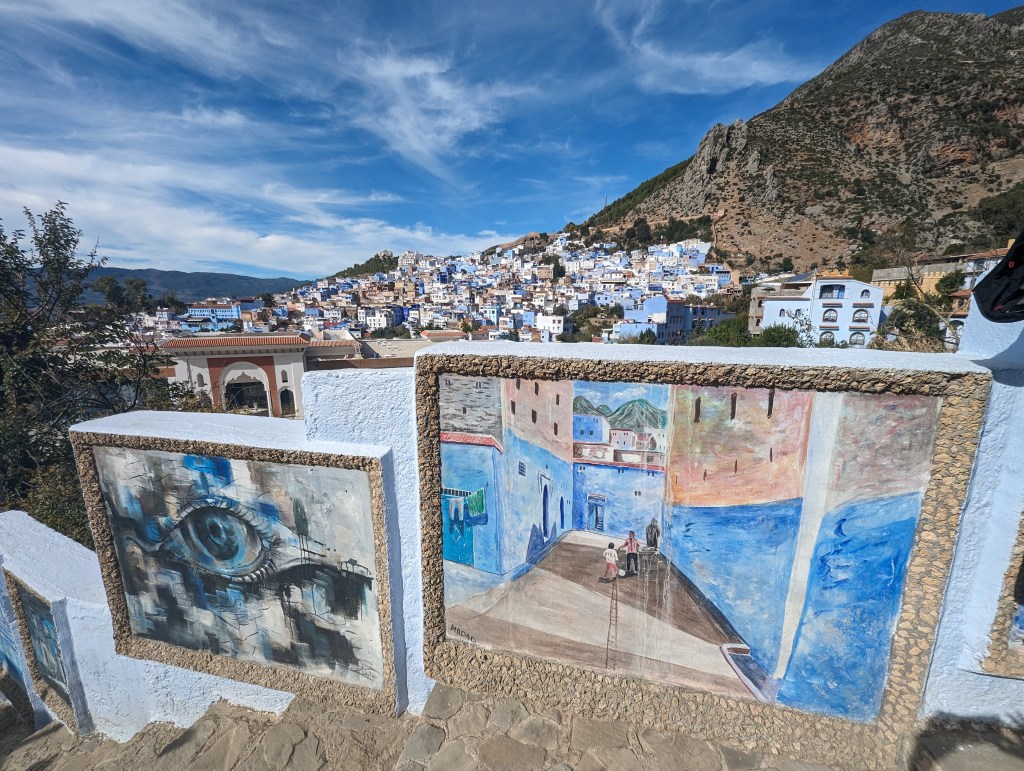
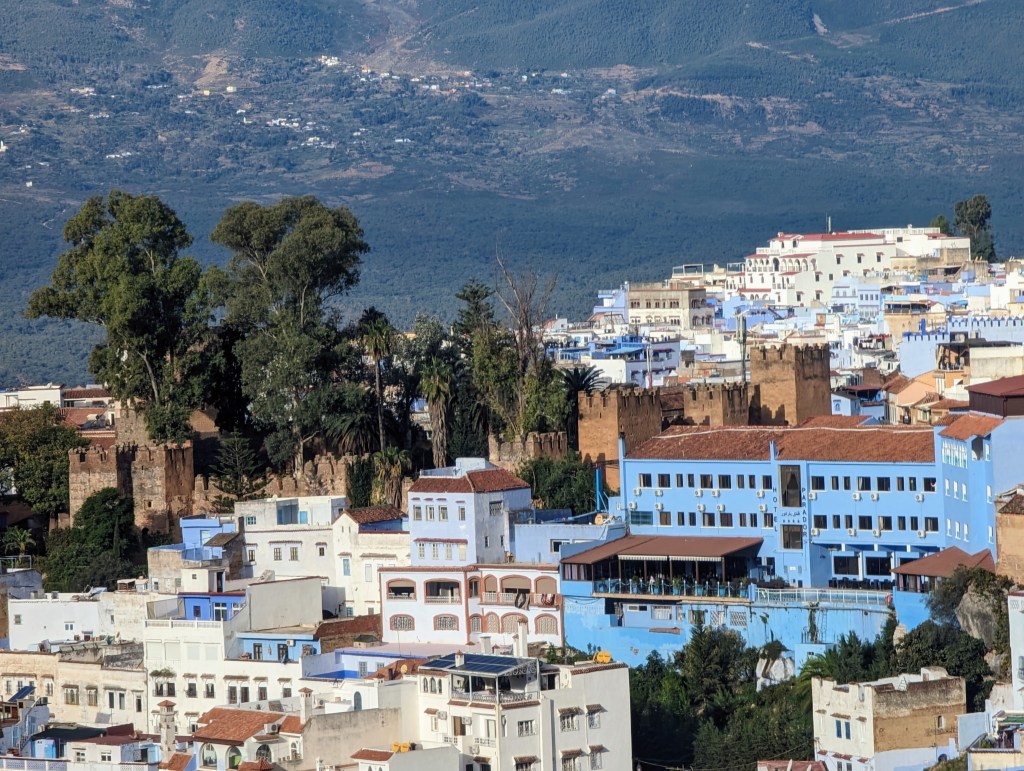
As we climbed we got our first glimpse of the medina of Chefchaouen.

We had lunch on the terrace.

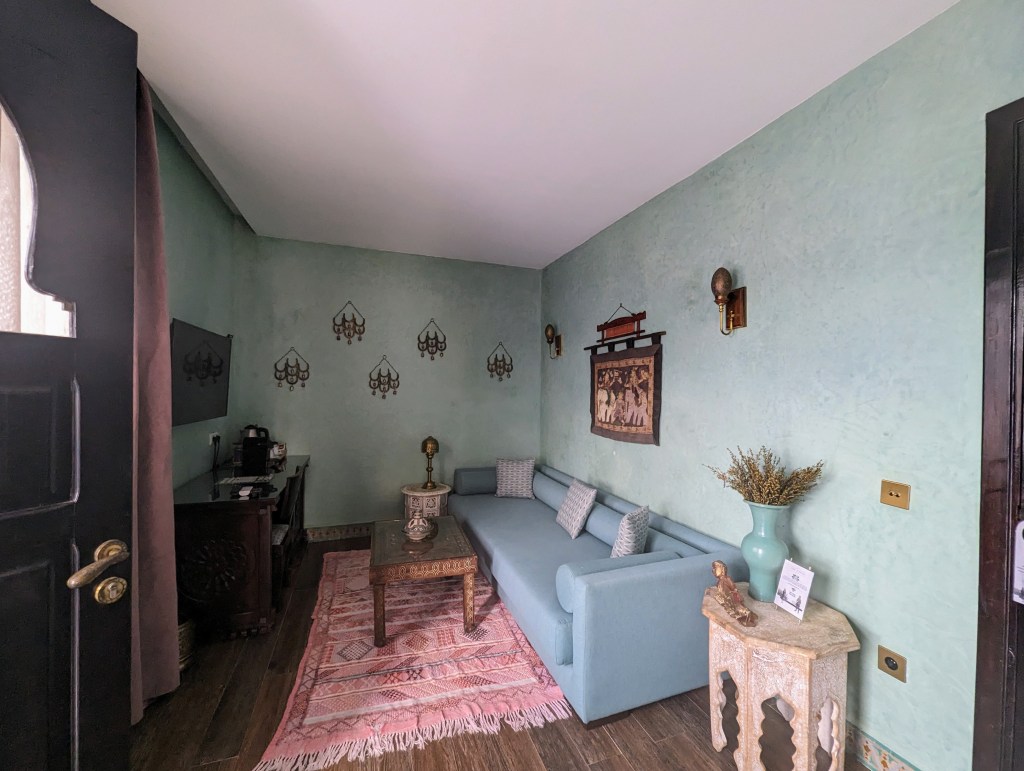
then settled into our room which was really a suite with a sitting area

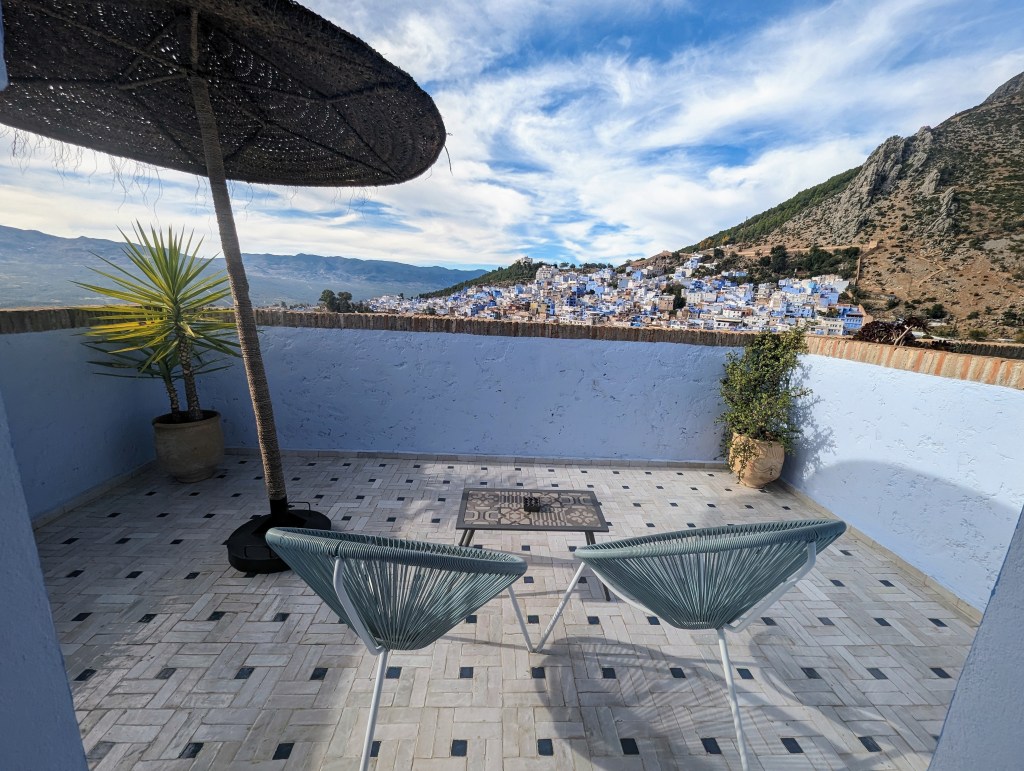
off of which was a terrace with a gorgeous view of the medina.

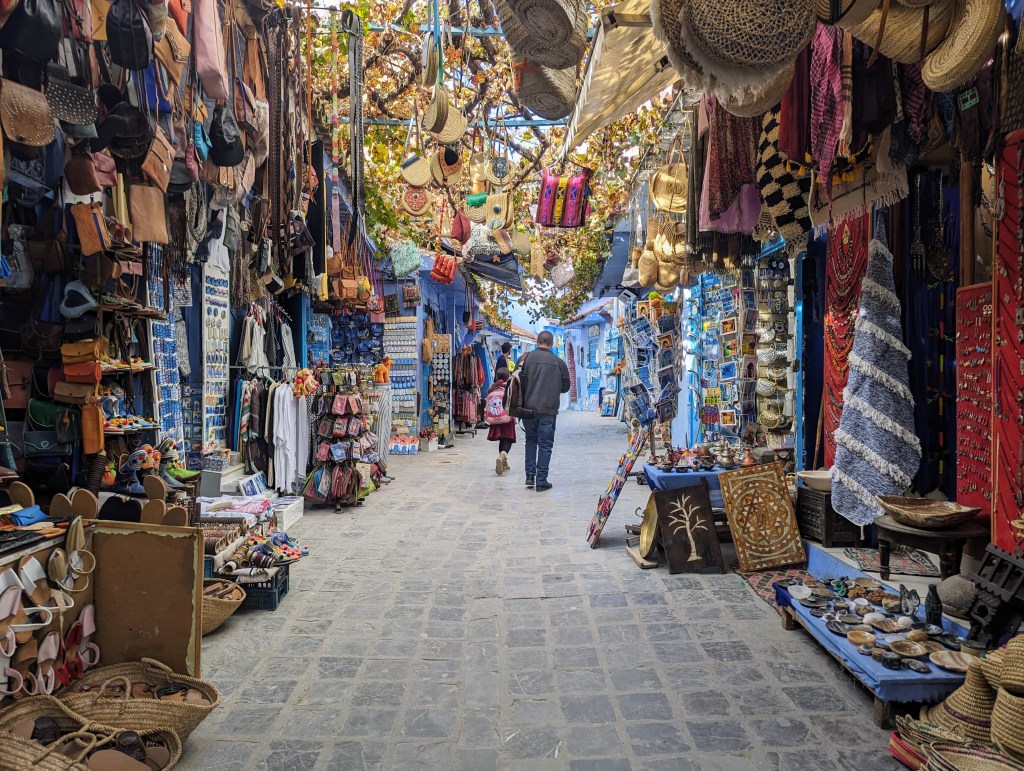
Then it was time to hike into the medina. So down all the steps we went and up into the medina. As typical, it was full of shops for tourists.

From the top of the medina, we had a great view back at our hotel, impressed with ourselves at how far we had walked.

As in Asilah, we were impressed with the painted walls.

And the doors.

Headed back to our hotel we crossed over the Portuguese Bridge.

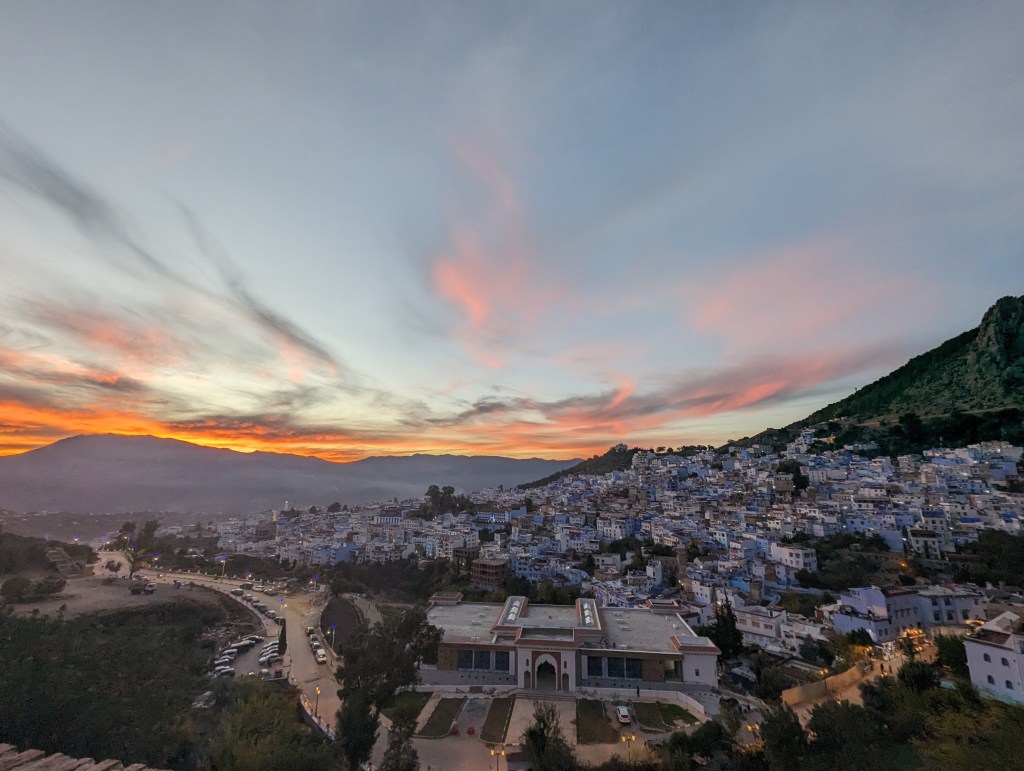
Then we trudged up the 50-60 steps up out of the bottom of the medina to street level, then the over 200 steps up to our room on the second floor (ground floor is zero, so up 2 more flights, no elevators) and enjoyed the sunset over the medina. We needed the rest.

until dinner in the hotel.

In the morning we enjoyed our included breakfast

which had starters very similar to breakfast in Tangier, but then eggs, avocado toast, and omelettes were added.

these are just the “starters”

We then met our guide Fatima who was the first female guide in the area and is one of the few female guides in the country. She is currently studying for a masters degree in the history of the Jews in the area. She is a Berber and grew up in Chefchaouen. She first gave us a brief history of the town. It was originally just a lot of tribes living in the region. But with the expulsion from Andalusia, Muslims and Jews streamed into the area mostly in the 15th century. First the Kasbah was built as the protective fortress. It can be seen from our hotel sitting in the middle of the medina.

Kasbah Chefchaouen is the clay colored structure with towers

The kasbah during its history has been used as a residence for governors, as a military arsenal and as a prison. Then as the town grew outward, walls were built around for protection. Both the kasbah and the medina walls have been restored several times through the years.

one corner of medina walls Chefchaouen

Fatima says it is unclear why some of the houses were originally painted blue. One speculation is that it was started by the Jews. Another is that it was for spirituality reasons: feeling close to “heaven.” But with the advent of the internet, as the town started to get tourists to come see the “blue city”, more and more homes were painted blue until it was officially adopted by the town council and now that the city is a UNESCO World Heritage Site, it is strictly regulated. Tourism is basically the only source of income for the city.

The original location of the city was based on its great access to water both by the river and natural springs from the mountains. She walked us to the top of the hill just outside the medina and showed us the springs source, which is covered by walls both for beauty and protection of the springs.

wall around springs

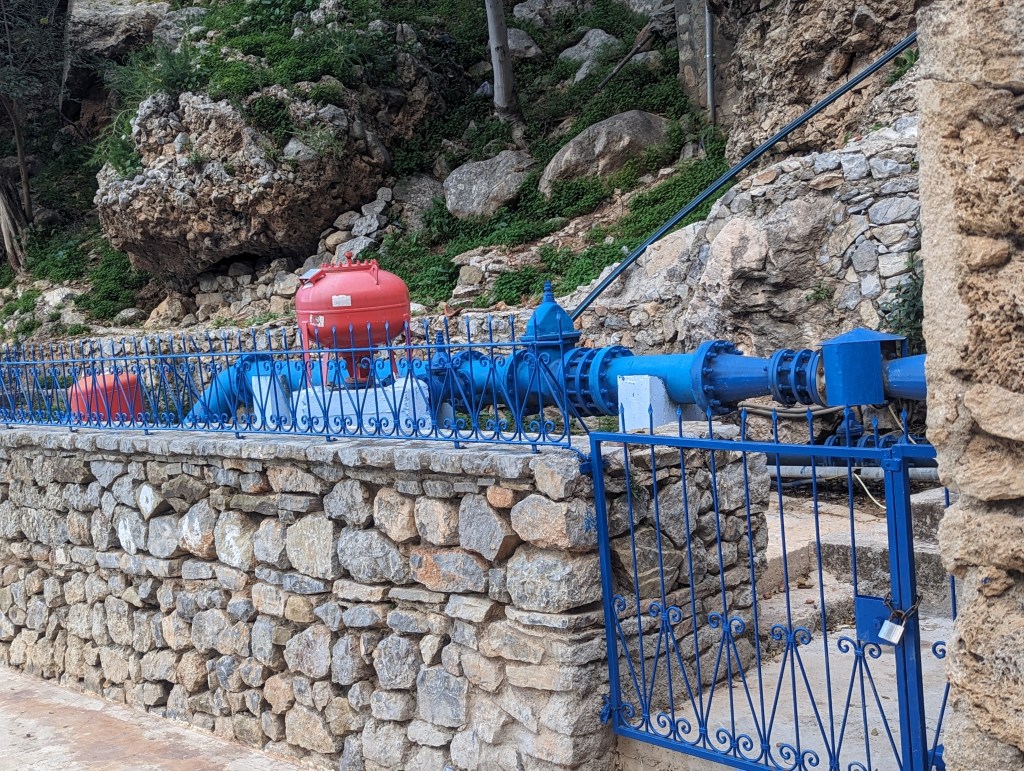
The water treatment facility with pipes leading from it to all of the sections of town is located right next to the springs.

It is a good thing the springs still run from the mountains, because with global warming and a recent drought, this is the current state of the river.

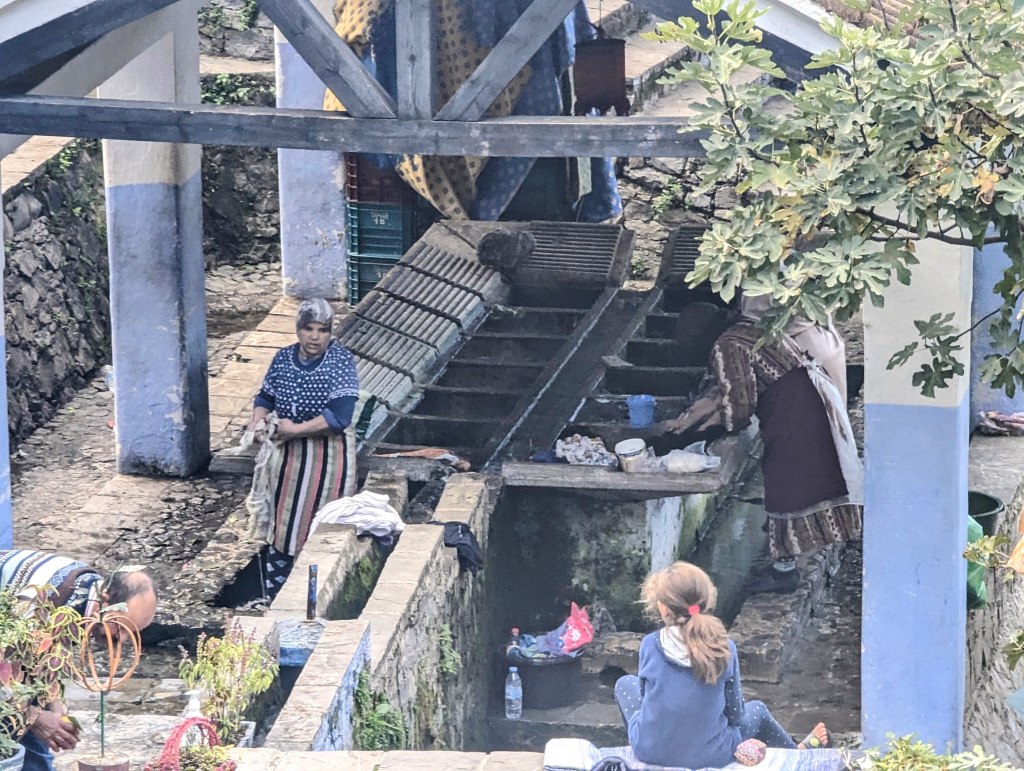
Just below the springs is where the local women come to do their laundry on washboards.

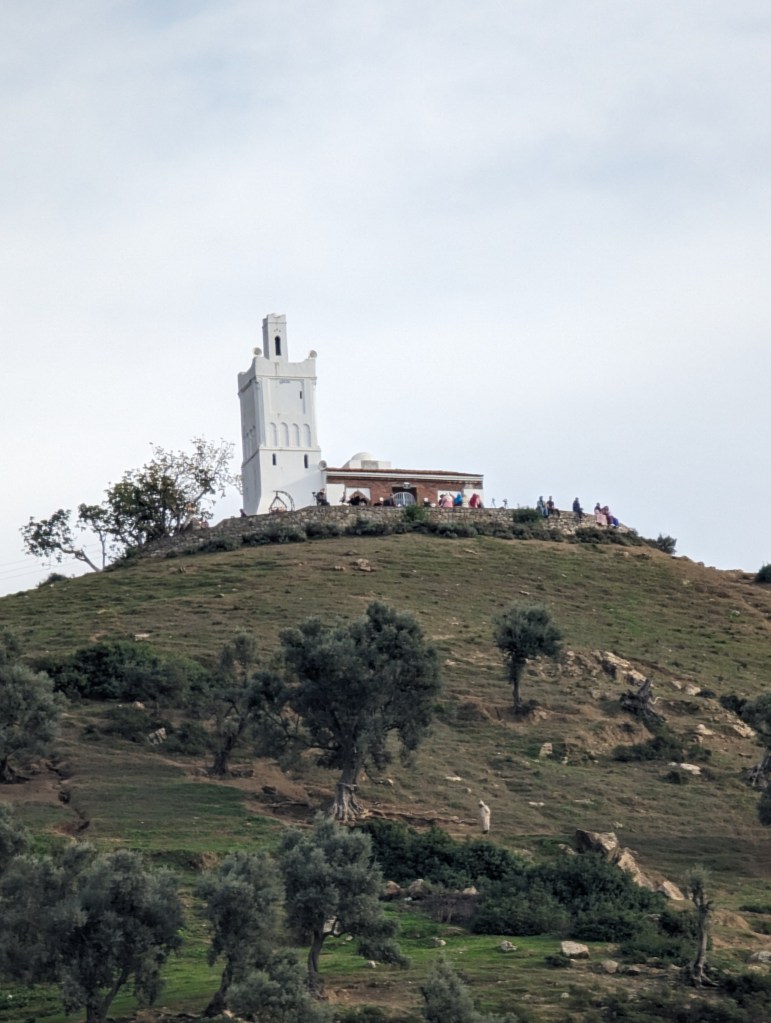
From up high we can look across to what is called the Spanish Mosque. Fatima explained that it has never been used for prayer. After expelling the Moors and Jews from Spain in the 15th century, the Spaniards then came down into Morocco and conquered it. They then built this mosque high up on the mountain as a means of spying on the muslims both because of it’s vantage point and because Muslims in those days used their local mosques not just for prayer, but also to discuss politics and news. But the Muslims were smart enough to realize that the Spaniards had refused to allow them to practice their religion in Spain, so why would they build them a mosque? And they refused to use it.

Spanish Mosque

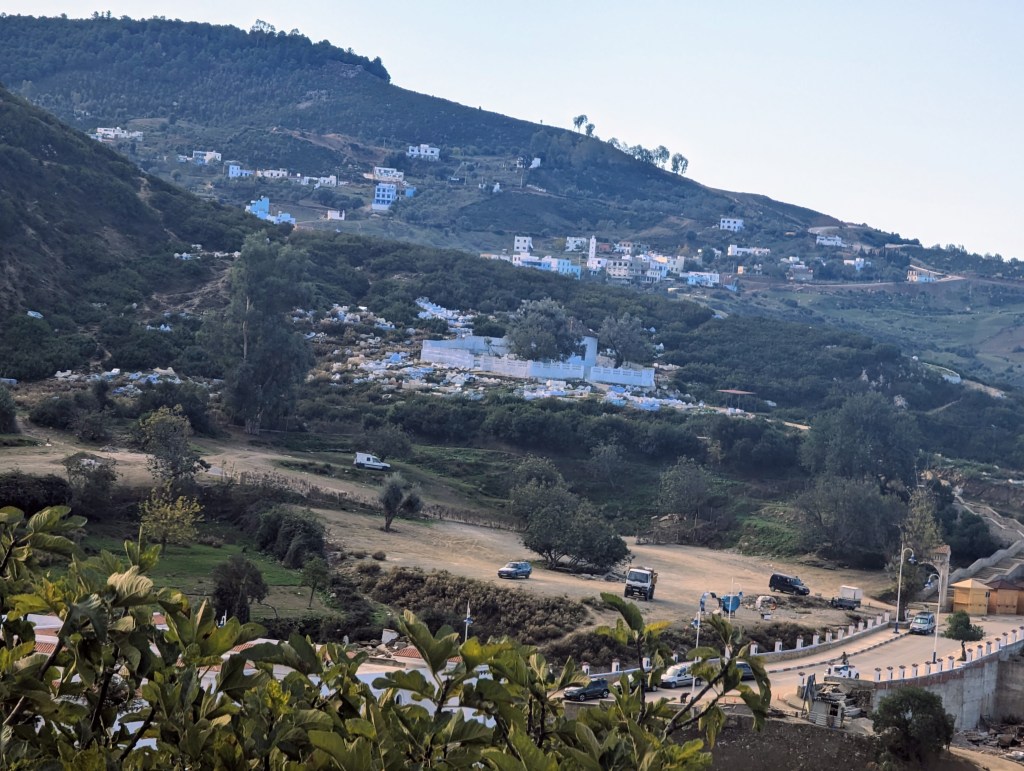
Just below the mosque on the hill is a large cemetery with Muslims in the front and Jews in the back.

Then we walked through the upper gate into the medina.

Fatima explained to us that there are several sections to the medina. Each section has all of the following 5 elements:

A mosque

Water for the people and their animals. There is always a faucet for easy access to water. The low wall is a trough for animals to drink from.

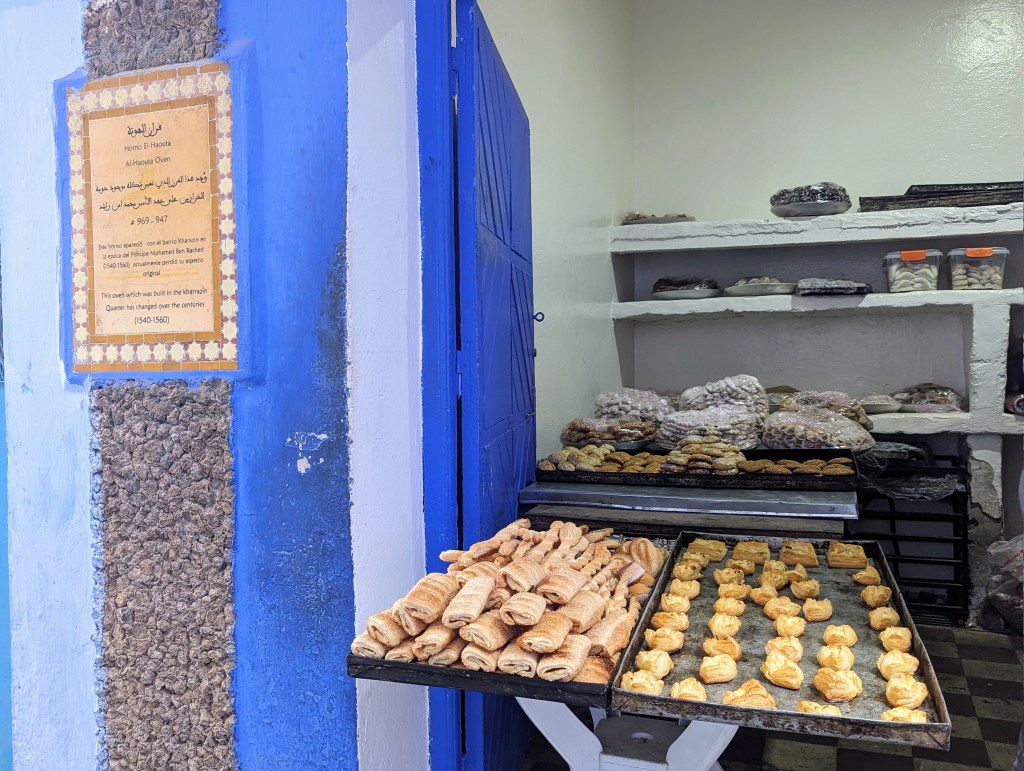
A bakery with an oven. The bakery makes and sells breads and sweets. But it also maintains a community oven. Families make their own dough at home and then for a few durham can bring their dough to get baked.

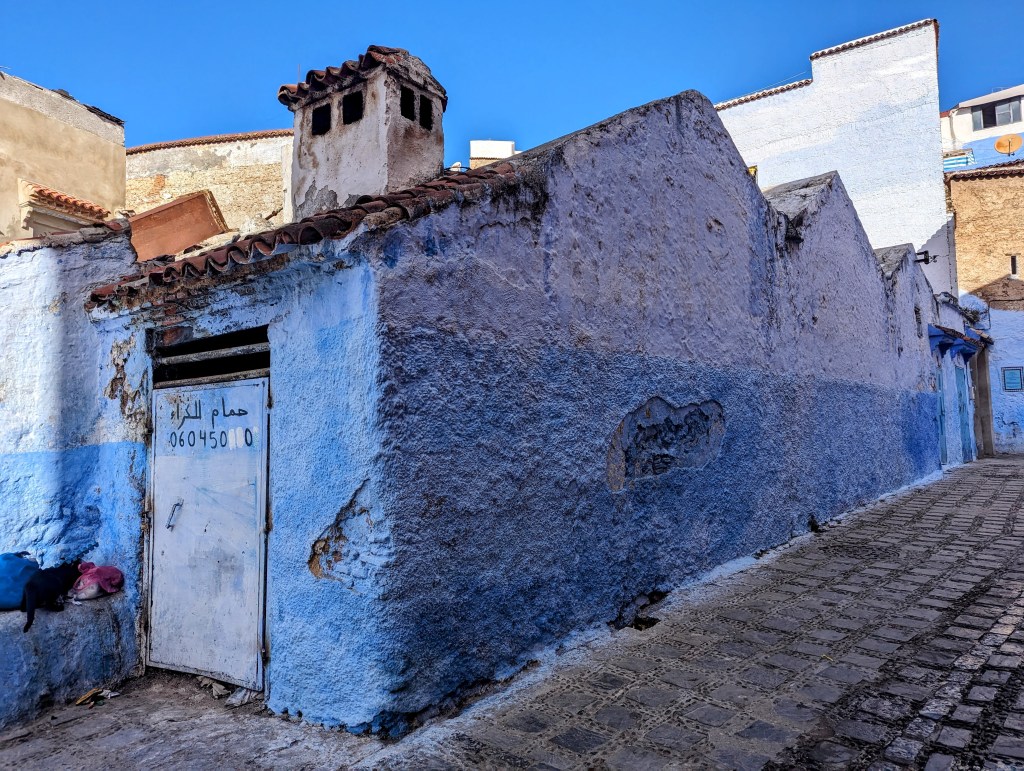
A Hamam, which is a public bathing facility. Some communities separate men and women by areas, others by times. Most of them no longer function. The one below is in the process of renovation.

And a Qaran school. The one below was a regular public school when Fatima was a child, now it is a public space for offices

courtyard school

and a library.

In the school is an ammaria for carrying the bride to her new home.

Fatima shared that after the bride crawls in (the dome is hollow for her head to fit), she is handed a loaf or bread by her mother so that she will prosper and never go hungry in her new home.

After the door is shut, the family throws water to symbolize “do not return,” which means they hope she is happy in her new home with no reason to miss her old home.

Traditional homes in medinas have an elevation to step over as entering the home and a very low door so one must stoop or bow upon entering. This is to give one pause and to be humbled.

People still live in the medina, but mostly there are shops with arts and hand crafted items for sale.

She showed us a shop where the paint pigments are sold.

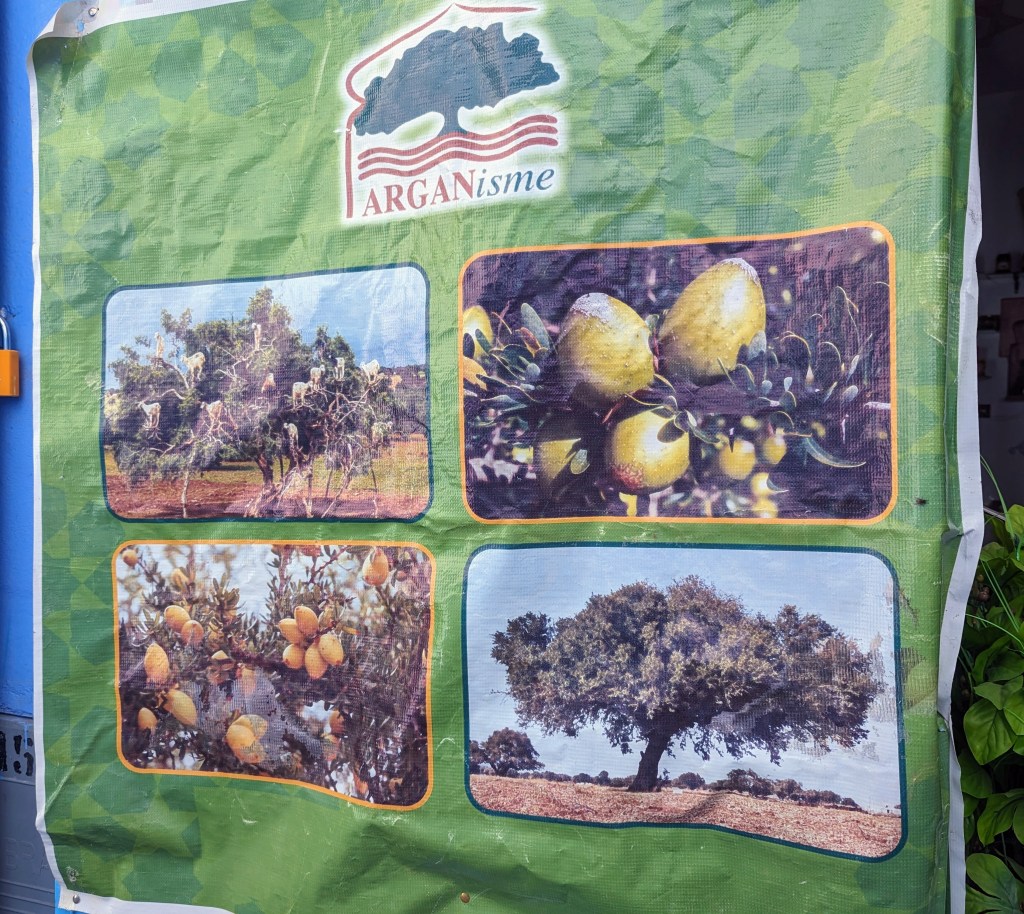
She also took us to a coop that sells argan products. Coops are becoming very popular in Morocco and are supported by the government.

notice in the first picture the goats in the argan tree eating the nuts

Argan nuts are ubiquitous in Morocco in foods, hair and skin products, even for medicinal use. The women in the coop showed us the process the nuts go through for either roasting for food products or grinding for oil extraction.

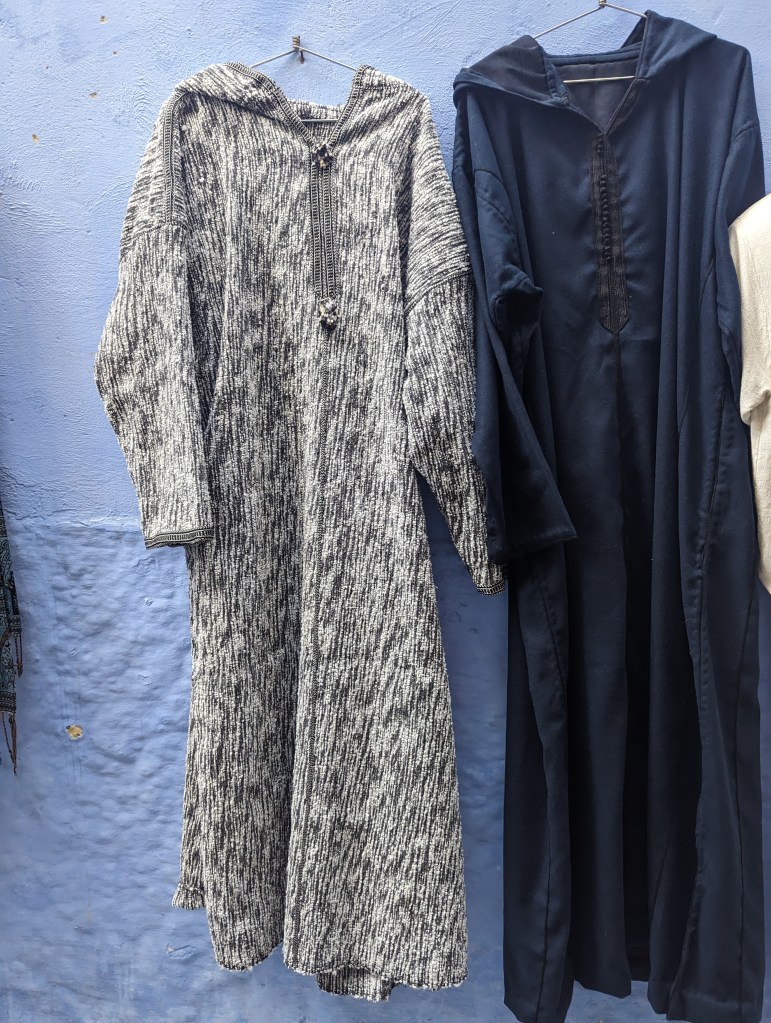
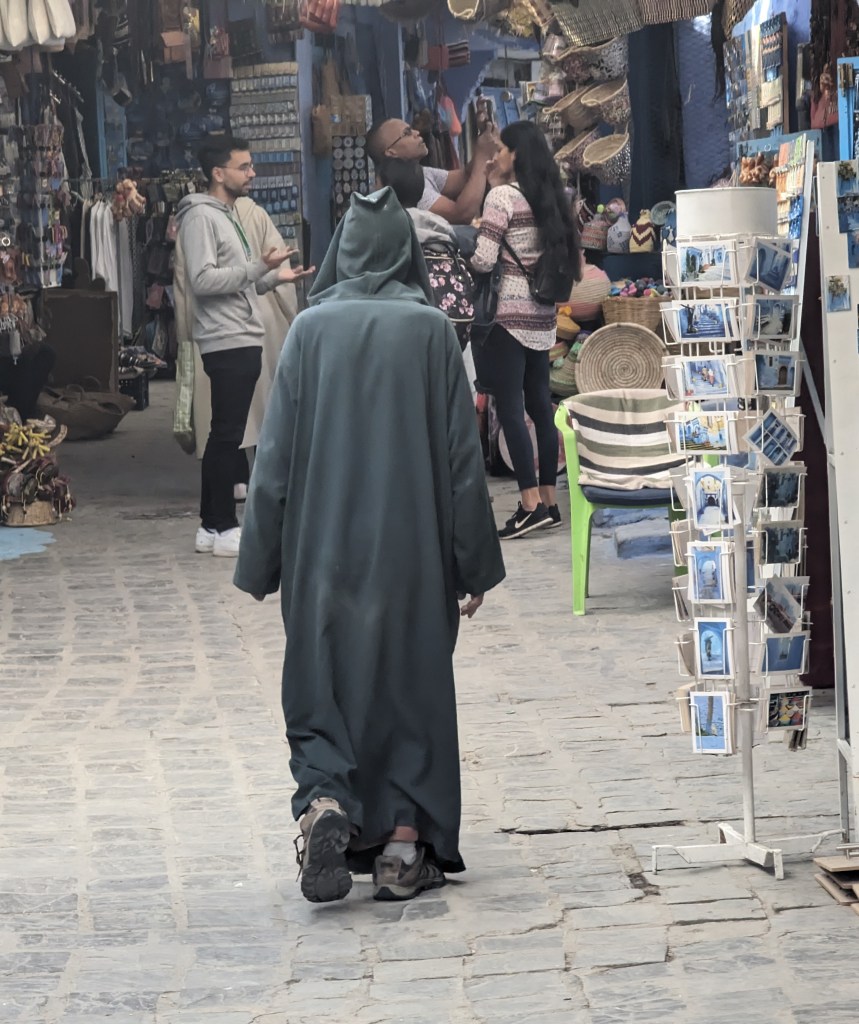
Fatima explained the traditional clothing. The djellaba is a long and loose type of robe with a hood and is often worn over the top of other clothes. Woolen djellabas are the most traditional, but cotton djellabas are becoming increasingly popular too. Naturally, woolen garments are favoured in the cooler winter months, while lightweight cotton djellabas are preferable on hot, sunny days.

wollen on left, cotton on right

The gandora is similar to a djellaba, with the major differences being that it has shorter sleeves and does not have a hood.  It can be worn by either sex, but is more common to women.

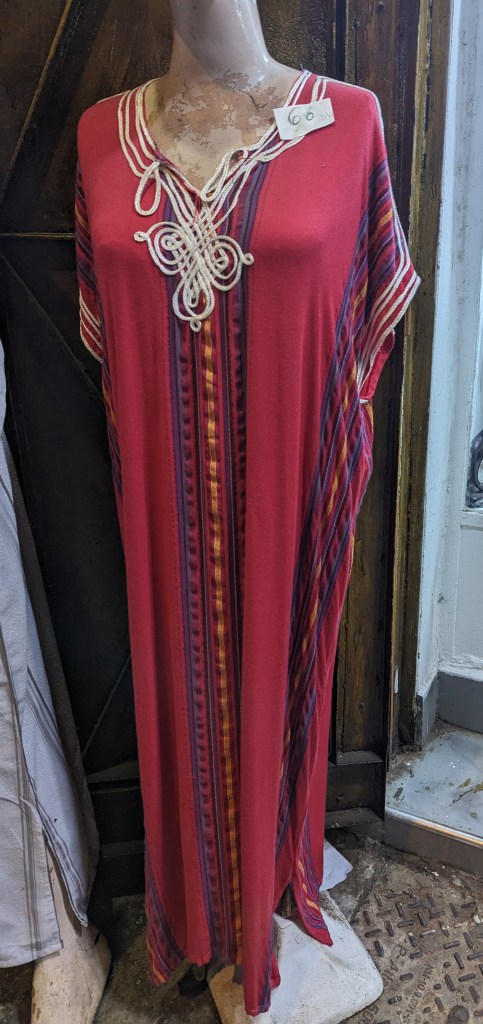
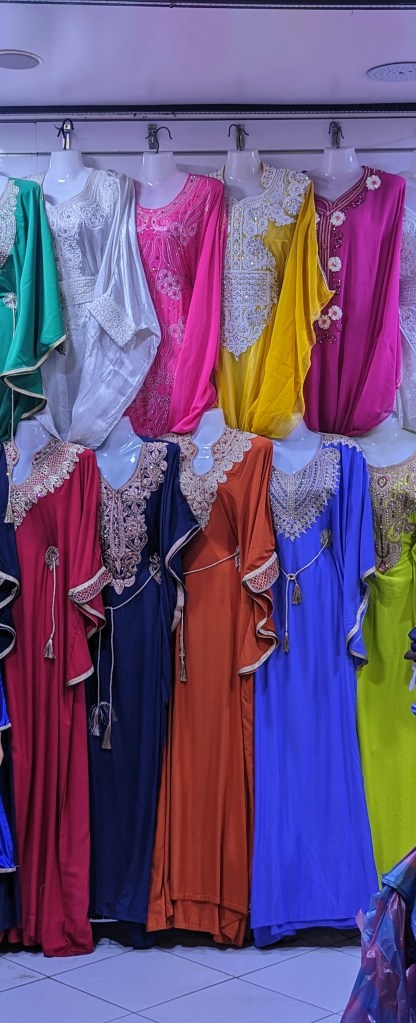
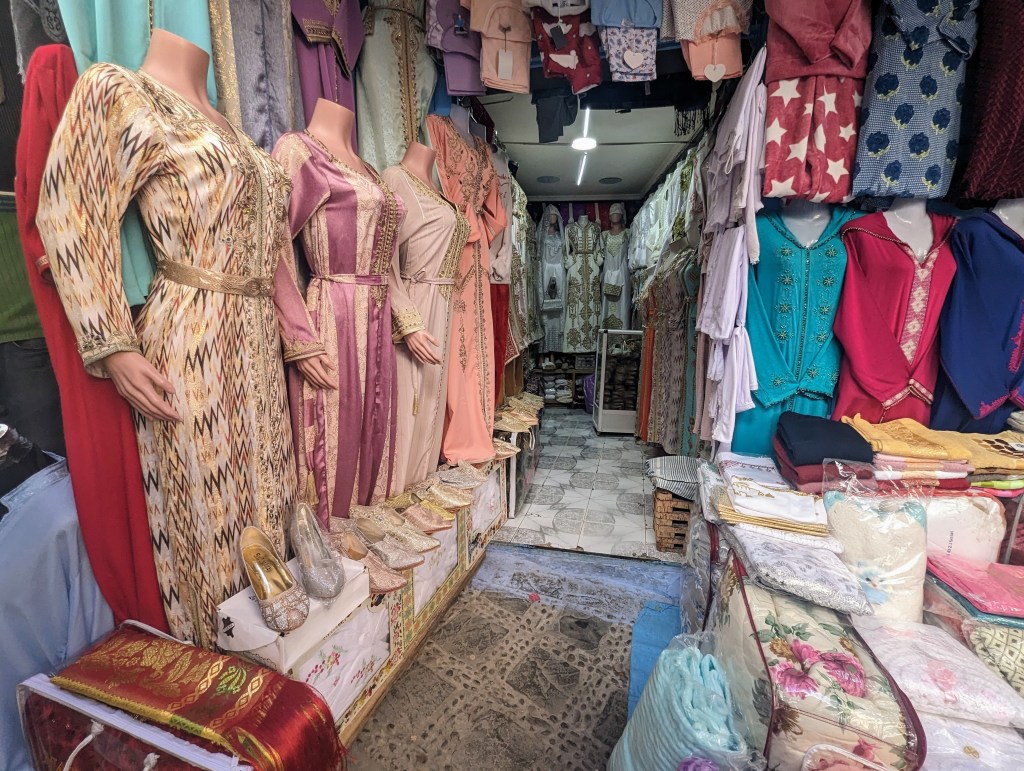
The kaftan is another long and flowing robe-like dress worn a lot in Morocco. Unlike the djellaba, though, the kaftan is only worn by women, usually for dressing up for special occasions.

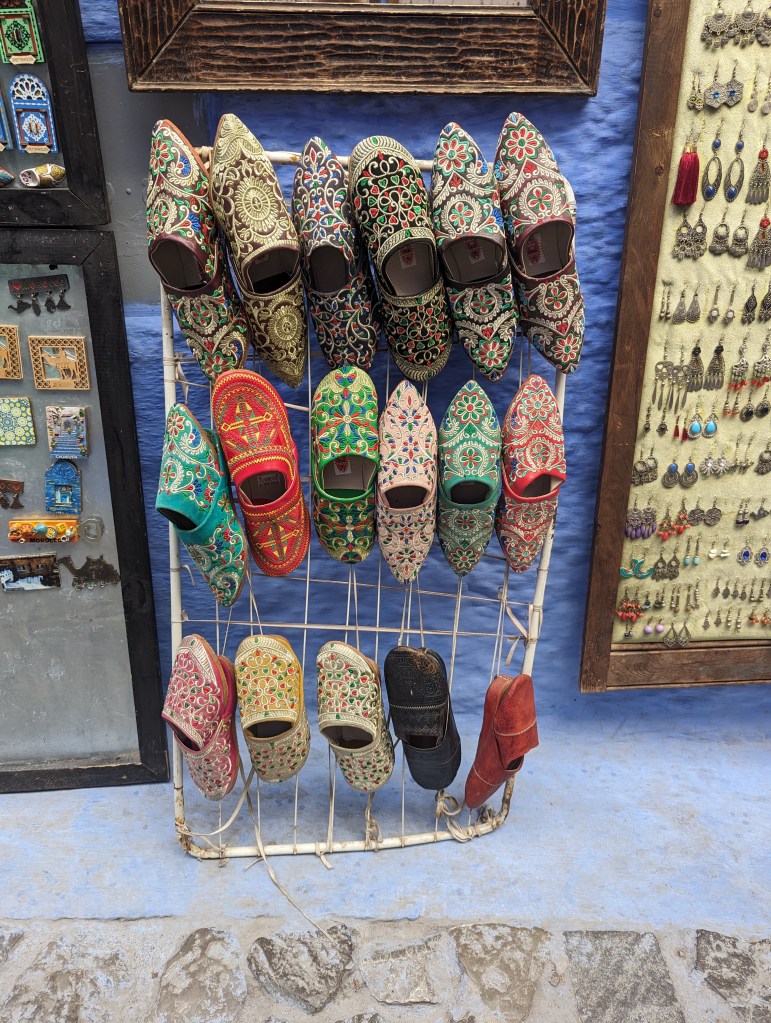
The store below is a bridal shop. It not only sells bridal kaftans, but also the shoes, nightwear, slippers, and linens that would go with the bride to her new home.

Inside the home, slippers are worn. The ones seen in the shop below are similar to what Eric and I donned in the home of Lucas and Amina Peters in Tangier.

We passed the kasbah but did not go in.

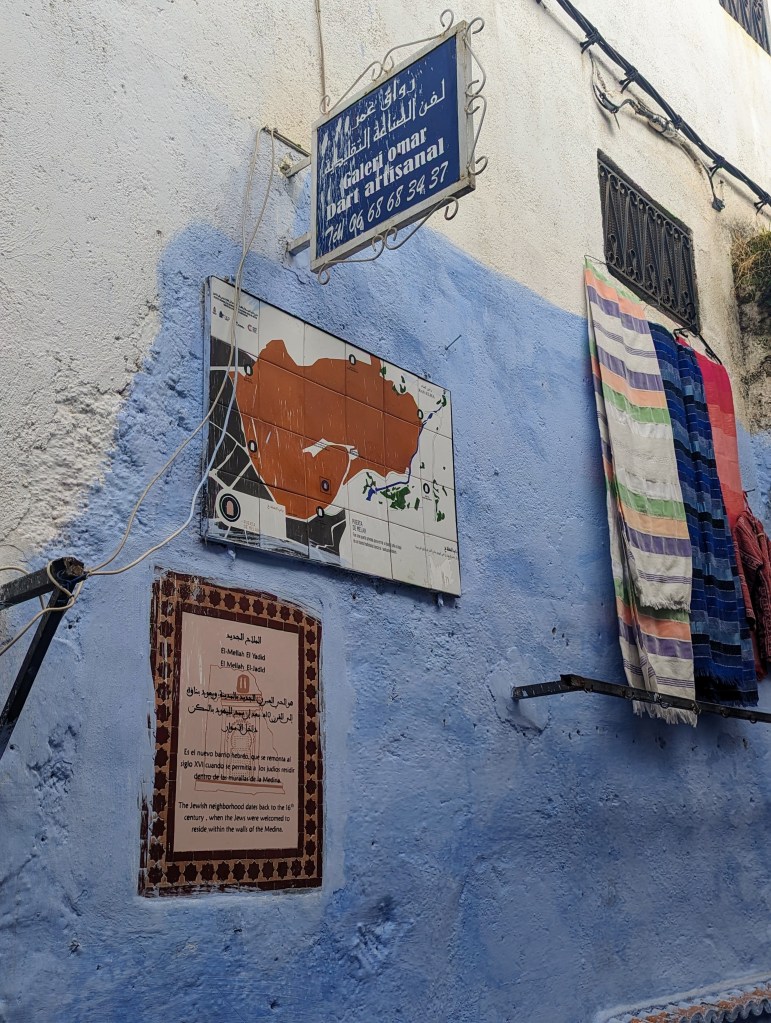
Then we entered the Jewish Quarter. Similar to what Latif had said in Tangier, Fatima said the Jews had their own quarter for their safety and comfort. It was by no means a ghetto.

gate to Jewish quarter
Jewish bakery

At the bottom of the Jewish Quarter is the lower entry into the medina. The gate here was called the trading gate because that was where outsiders would come to make trades with the medina merchants.

Once again we crossed the Portuguese Bridge. This time we were told that it was so named because after an attempted Portuguese invasion, Portuguese soldiers were captured and turned into slaves who then were forced to build the bridge.

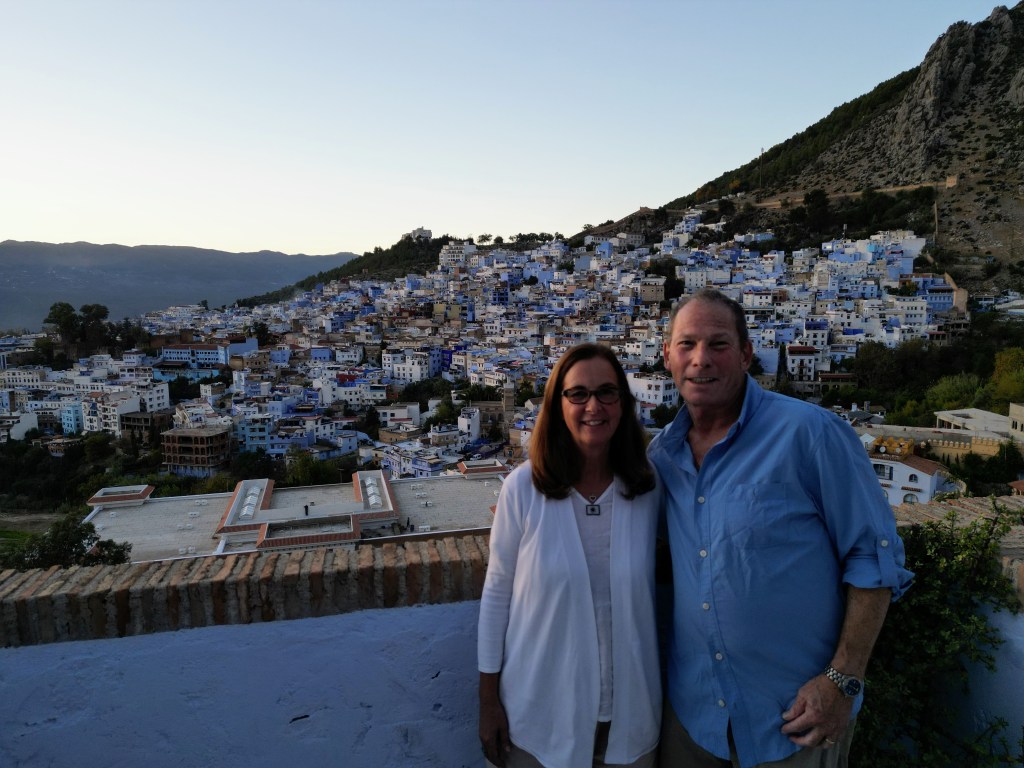
And again we made the very long trek up to our hotel suite for an afternoon rest. Eric took a panoramic shot of the town from our terrace. We honestly could not stop enjoying the view of the Blue City.

And we used the drone to take a selfie. It would be our last use of the drone. We were told that if caught with a drone in Morocco, it would be confiscated. Although interestingly, there are no laws on the books against drones, nor is there anywhere that says it other than in drone user chat rooms.

After a rest, we again trudged down into the medina for dinner at Bab Ssour.

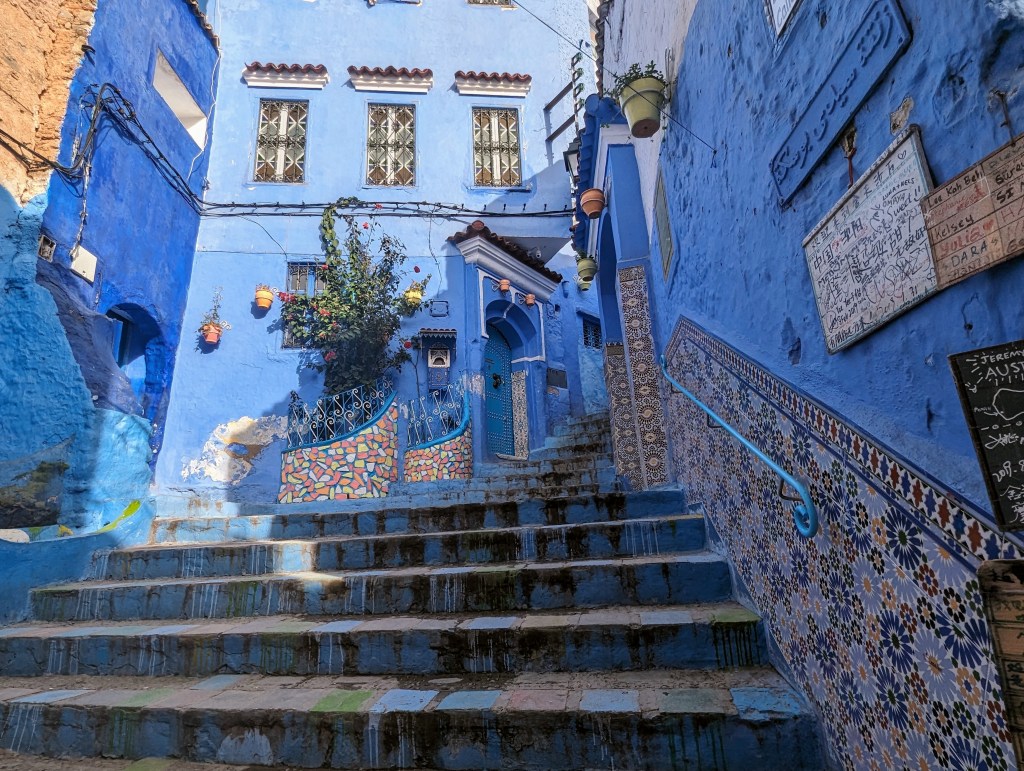
We climbed three flights of decorated stairs.

And had dinner on the top terrace. We had a delicious traditional Moroccan dinner of tagines, pastellas, and chicken briouats all for under $20 including a generous tip.

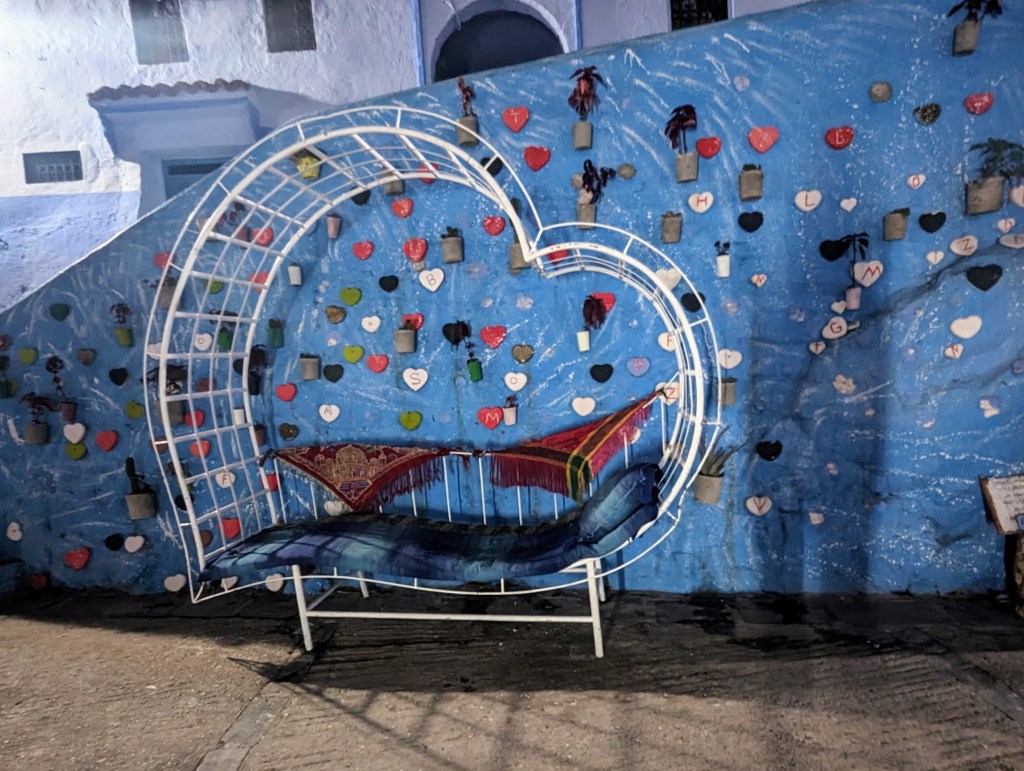
Then another hike back to our suite. We laughed that at least we were walking off all the calories just consumed. On the way, I had to take a picture of this love seat for our love of Chefchaouen.

And this concluded our visit in Northern Morocco.

Spain: Andalusia Region: Ronda Oct. 25-27, Granada Oct. 27-29, Úbeda Oct. 29-31, Córdoba Oct. 31-Nov. 2, Seville Nov. 2-5, Cádiz Nov. 5-7, Tarifa Nov. 7-8

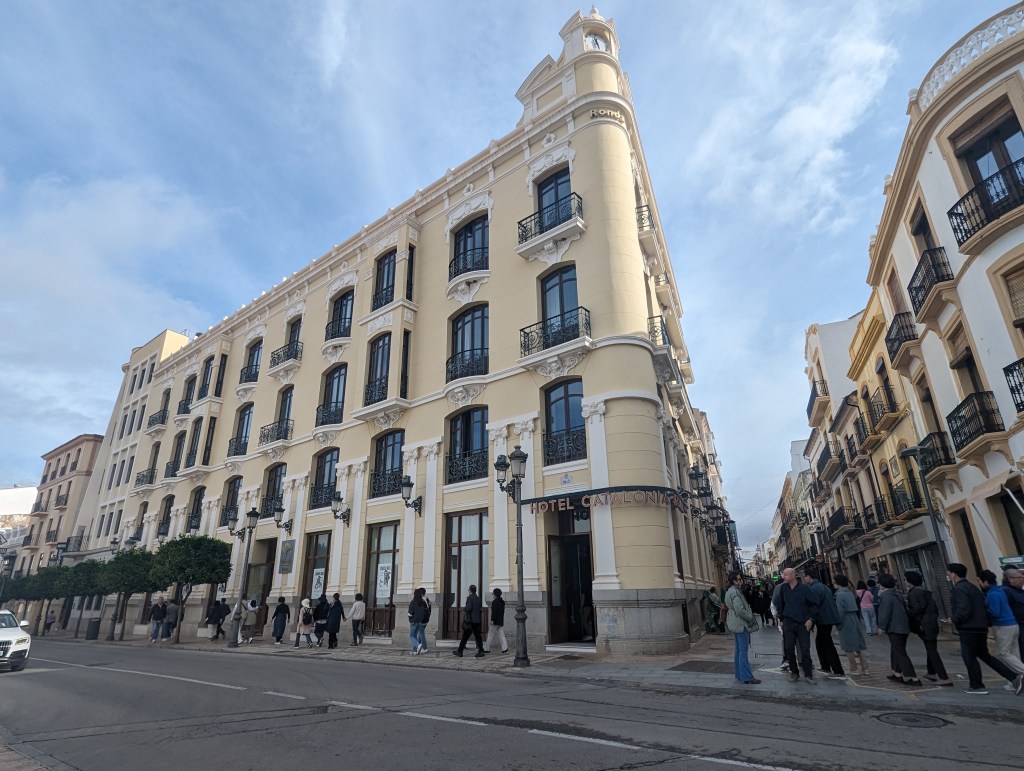
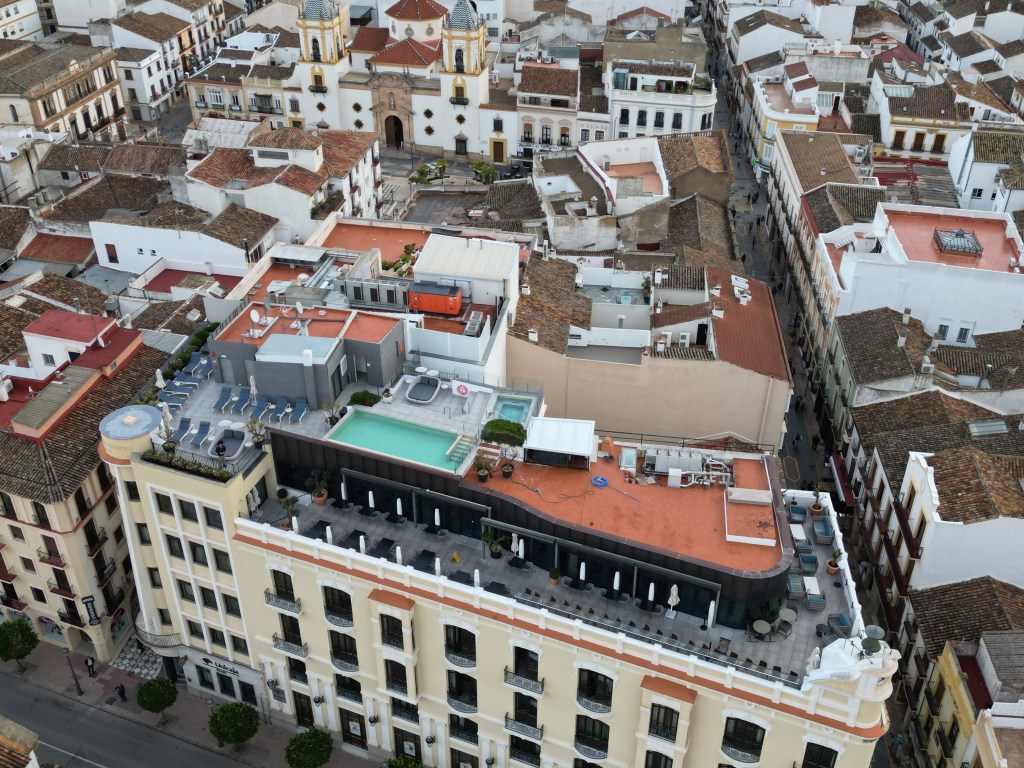
We headed back into Spain. It was our longest driving day yet: over 4.5 hours. We passed through Seville and on to Ronda. The reasoning behind this is we were planning this part of the trip around getting back to Seville in time for a poker tournament there. We arrived in Ronda in the late afternoon and immediately decided that this was another “stand out” spot on our trip so far. First our hotel: The Catalonia

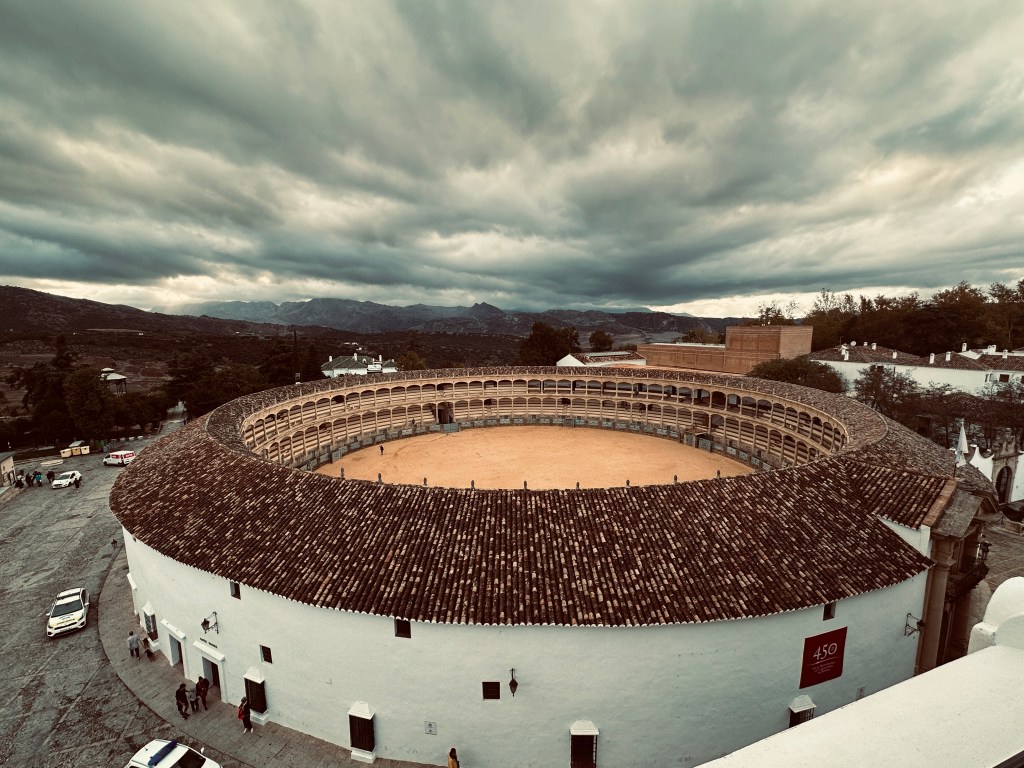
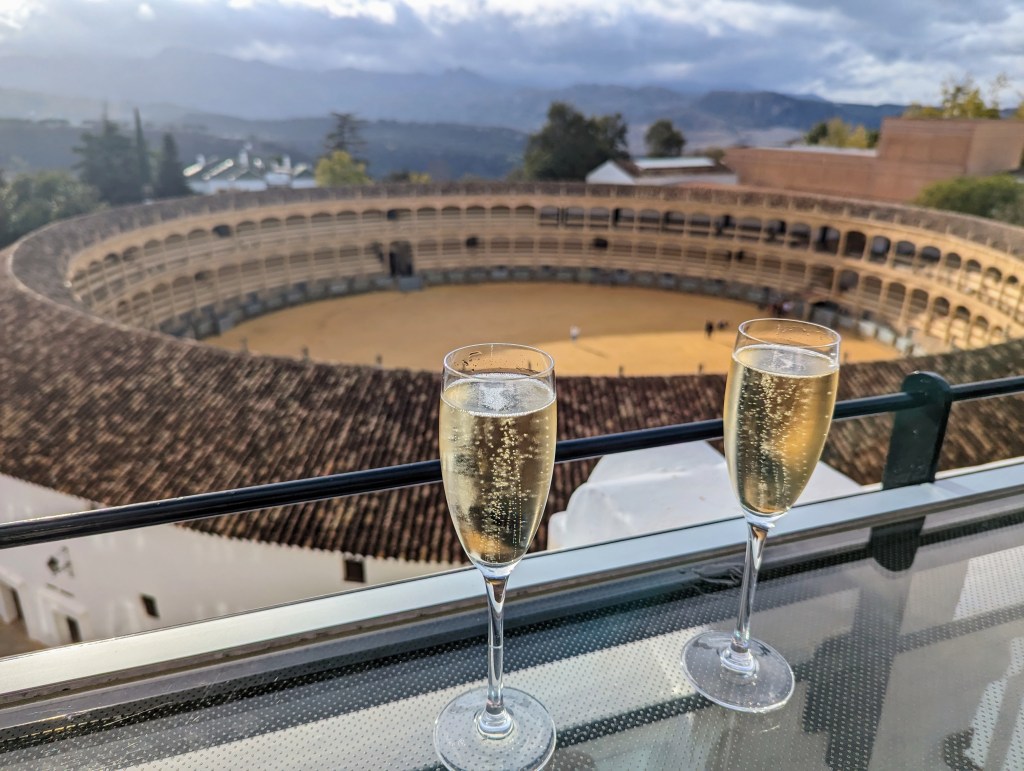
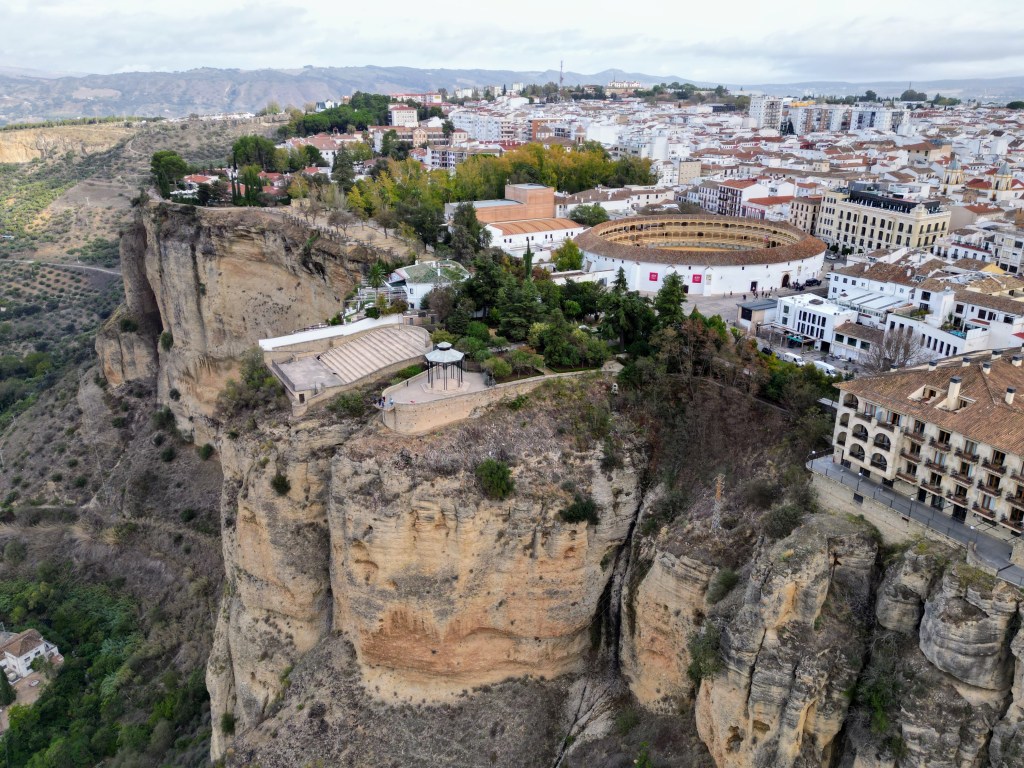
As the bell hop showed us to our room he confided “You have the best room in the hotel.” And we did! We had a corner suite with views of the bullring out one side.

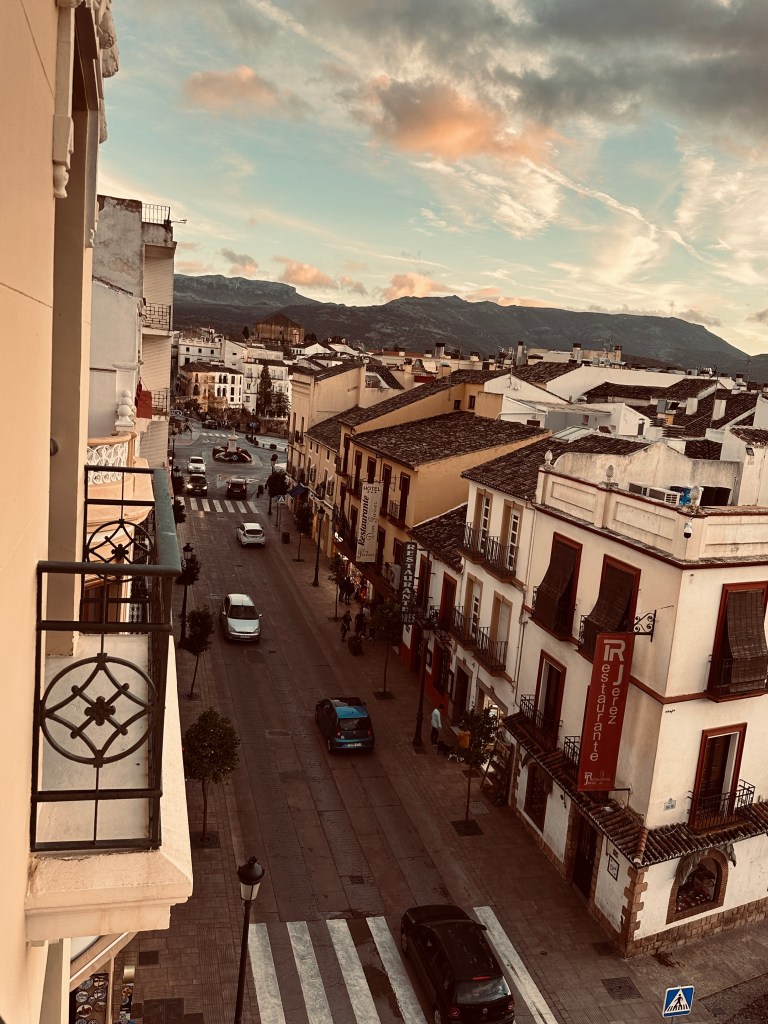
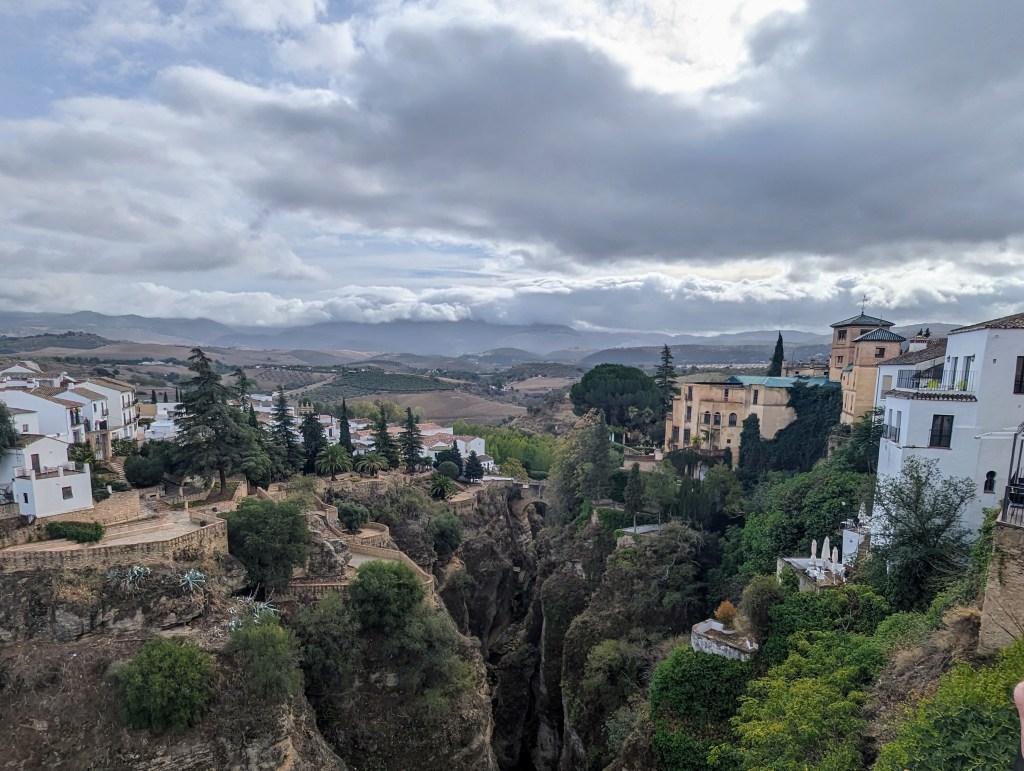
And views of the city below out the middle and other side.

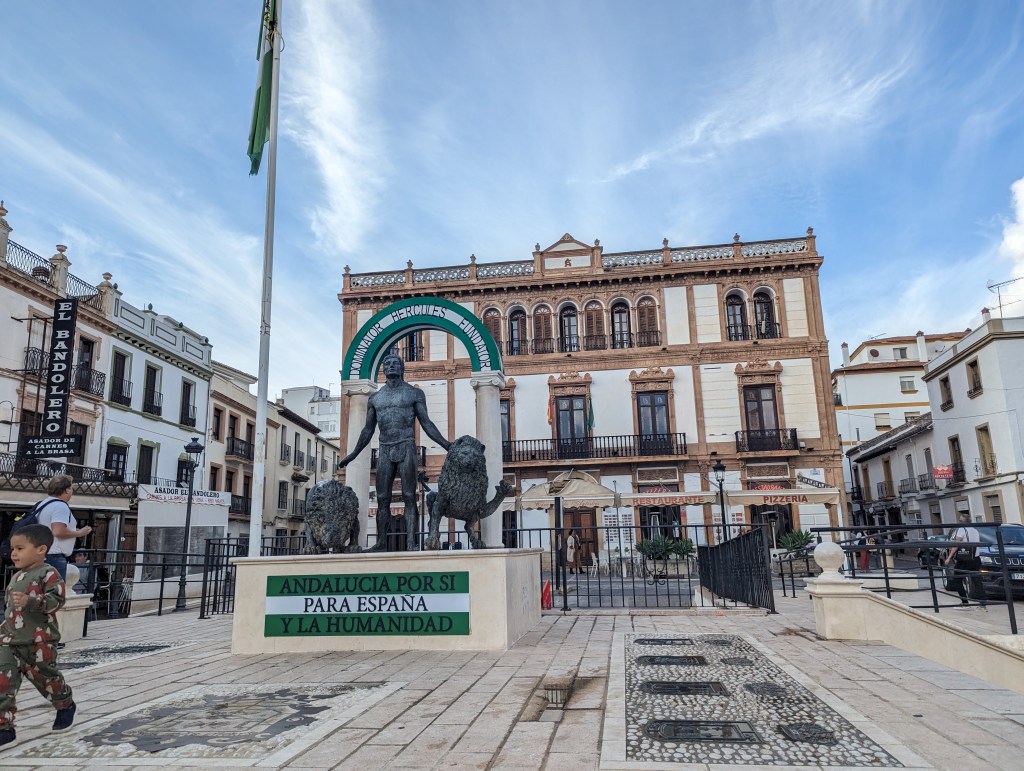
Driving here we honestly could not remember why we had chosen Ronda as a stop; it had been so long since we made our bookings. So we set out to explore the town. We discovered the usual cute squares, pedestrian only shopping streets, and churches.

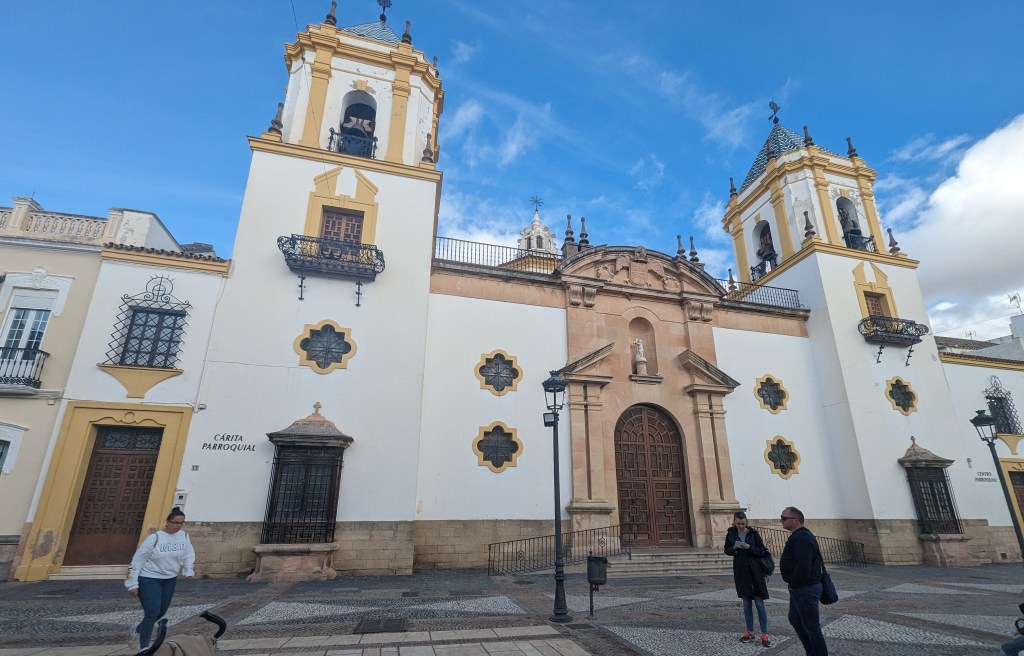
Socorro Church

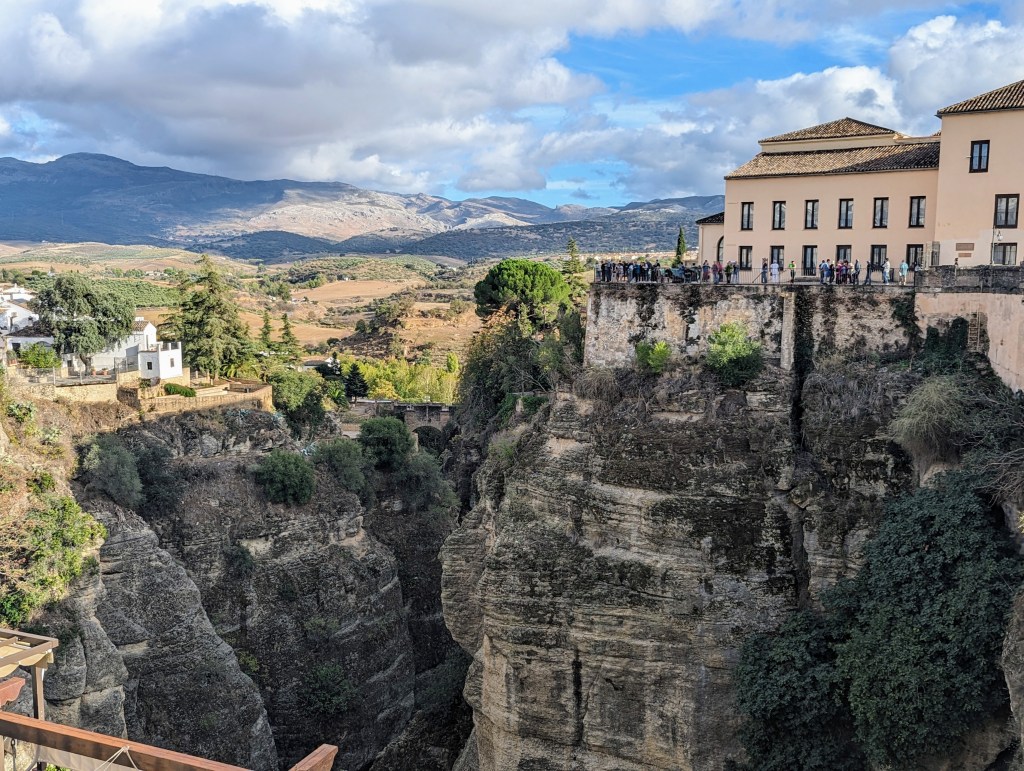
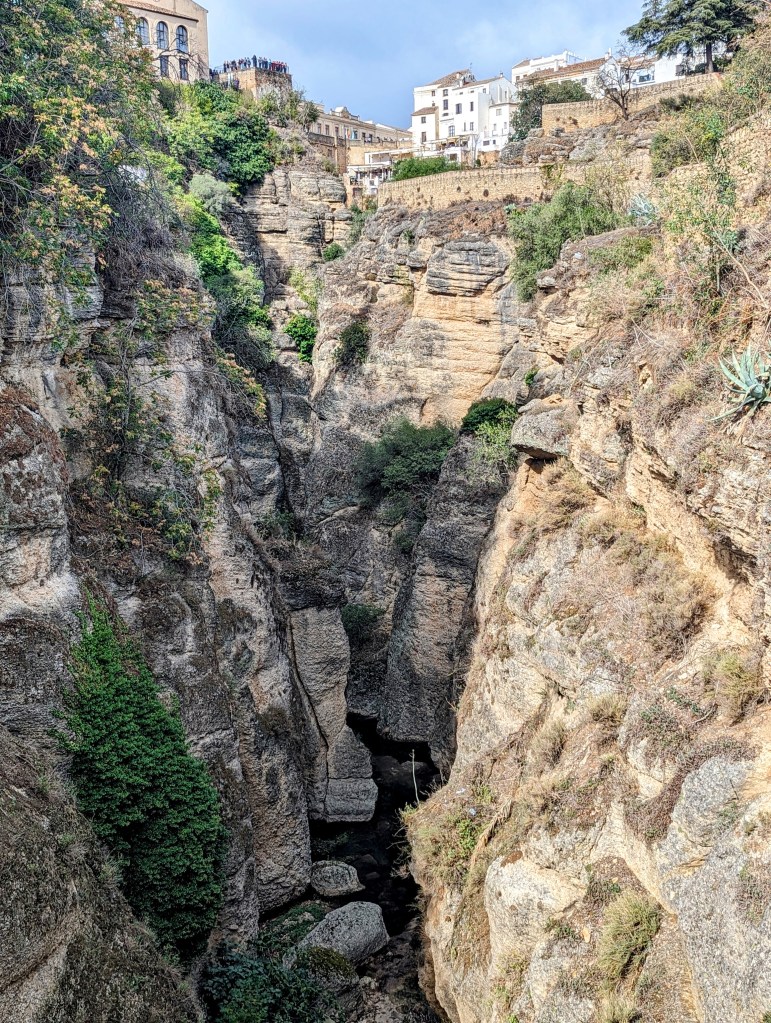
But then we ventured a different direction, and POW, we found the gorge.

This is why tourists flock to Ronda. At this point it was late in the day and getting drizzly, so we put off exploring the gorge further until the next day, and went back into our hotel to enjoy our welcome drink of cava on the roof terrace bar.

We freshened up and had a delicious meal of Andalusian specialties in our hotel restaurant. Dinner included sea bream, a fish neither of us had tasted before, but is now a favorite.

The next morning we had the absolute best breakfast buffet we have ever had included in the price of the hotel room. Not only did it have every food and pastry (yes, croissants and pan chocolate) and a machine that made all kinds of lattes and cappuccinos, it also included fresh squeezed orange juice and fixings for mimosas and Bloody Marys.

By the way, these orange juicers are found in almost every grocery store in Spain, even little mini markets, for help yourself bottles.

With very full bellies, we set out to visit the gorge. Pictures just cannot capture the beauty of the surroundings, but we tried.

Puente Nueve

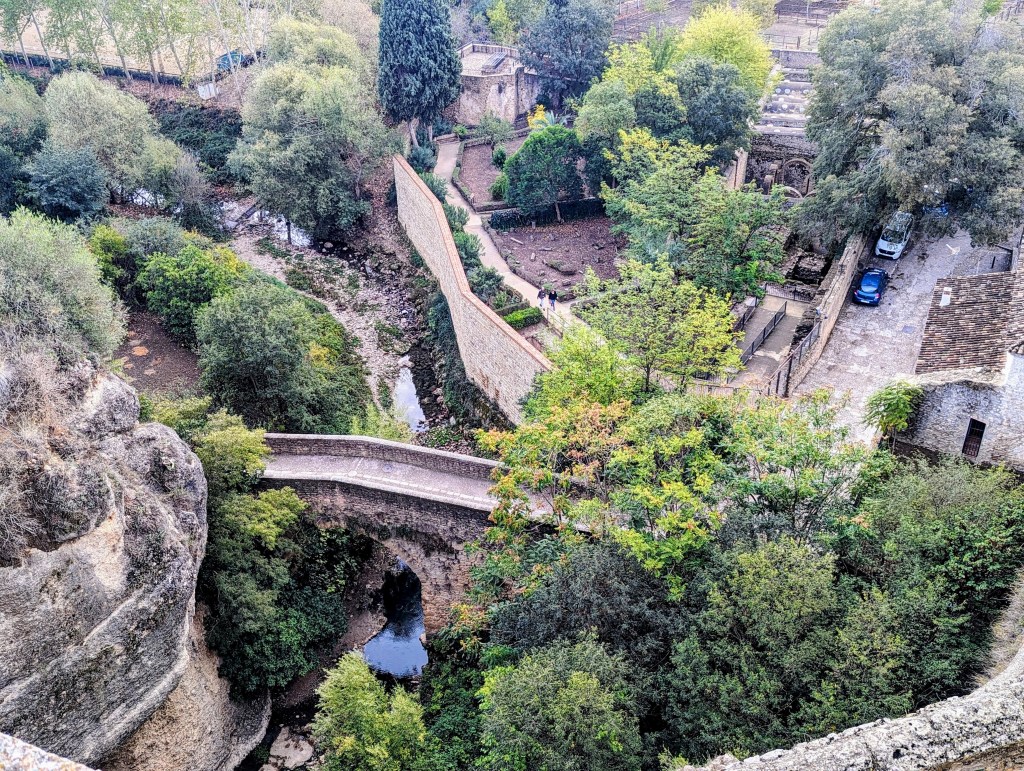
There are 3 bridge crossings over the gorge: the original Moor Bridge, the Old Bridge, and the New Bridge. The new bridge was first built in 1735 but the bridge collapsed several years later and sadly killed 50 people. The Puente Nuevo was started in 1759 and was completed in 1793, with a height of 98 metres. We hiked down to the 2 older bridges on one side of the gorge, then back up the other side.

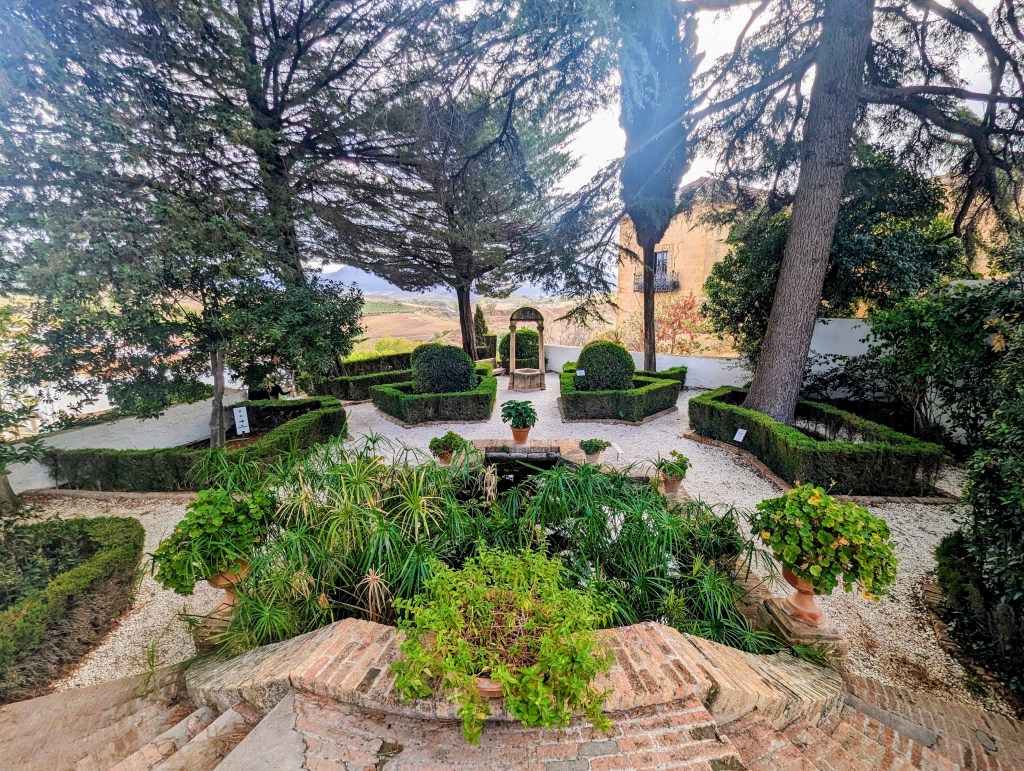
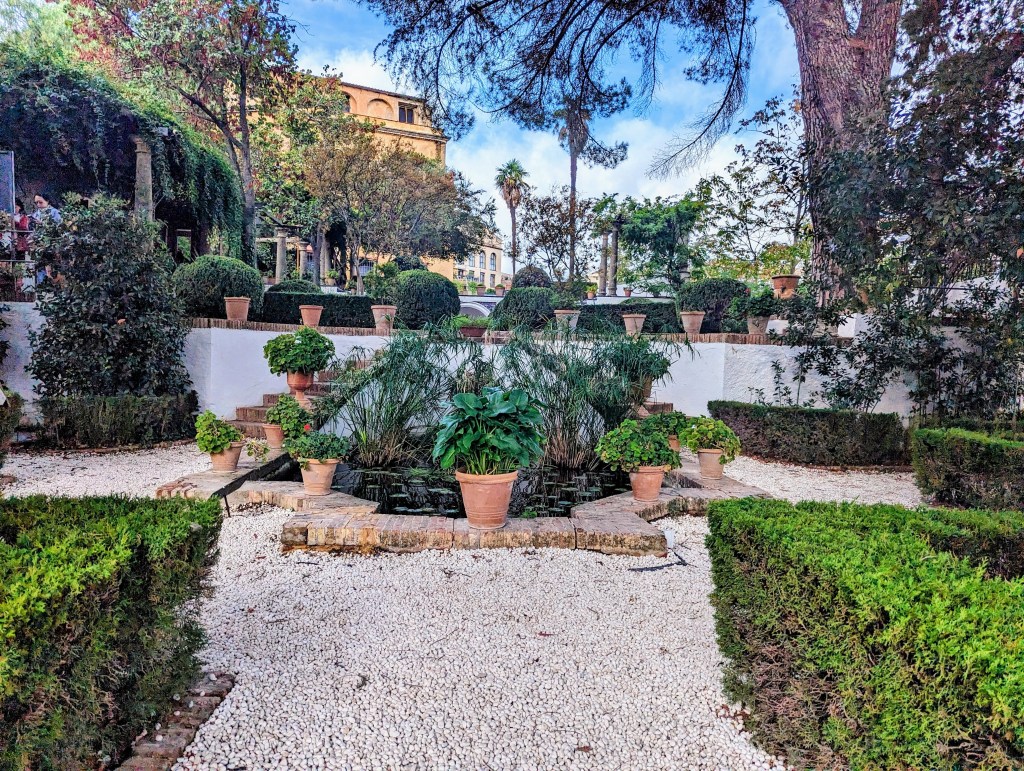
On the way down we stopped to explore the Casa del Moro Rey, (House of the Moorish King). It is a monumental complex with a long history that begins in the 14th century and extends to the  20th century. It is made up of three parts: a water mine from the Muslim era, a neo-Mudejar style house and a garden designed by Jean Claude Nicolas Forestier in the 1920s. The house was under renovation. The mine was a water wheel driven by Christian slaves to bring water up from the river into the Moorish city in the 14th century. But it was 20 stories down into a dark hole, so we chose to skip it. The garden was lovely.

At the bottom of the gorge are the other 2 bridge crossings.

Old Bridge
Moors Bridge
looking back up to town from Old Bridge

After hiking back up, we rested a bit. Eric took some drone shots of the bullring, our hotel, and the gorge.

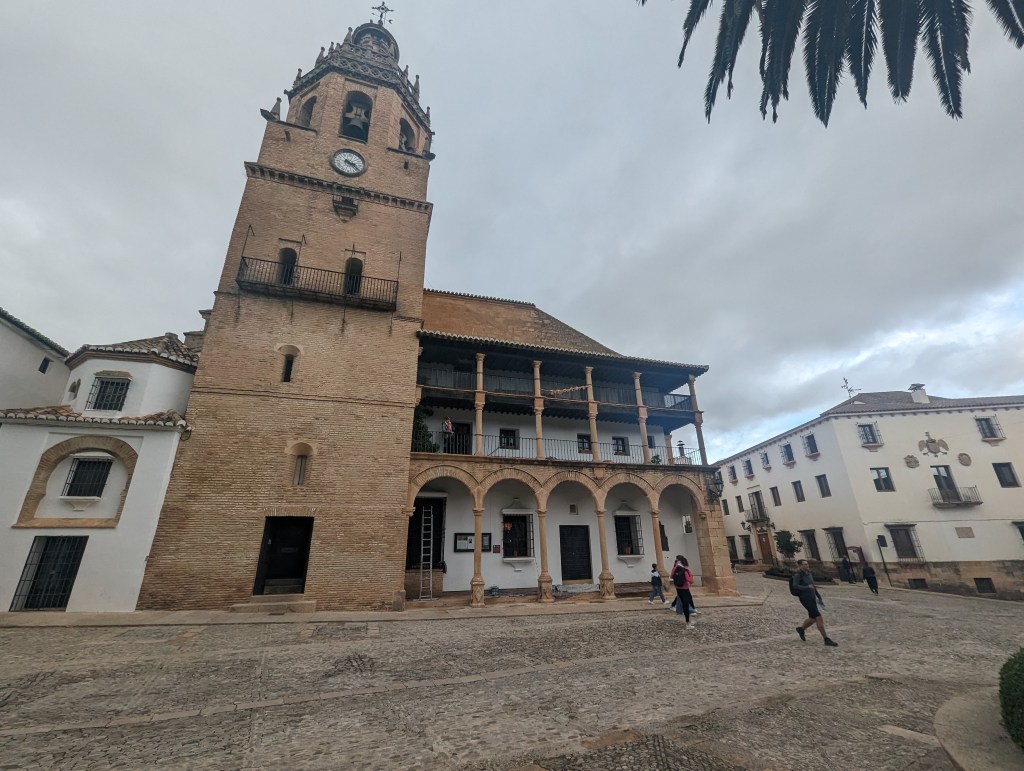
Then we headed back out to explore the Old Town. First we stopped at the Saint Mary Major Church built in the 16th century, renovated in the 18th, like so many churches in this part of Spain, on the site of a mosque, which had been built on the site of Roman ruins.

Iglesia de Santa Maria del Mayor

The we strolled out to the Almocábar gate, which was built in the 13th century and guarded the entrance to the city in the Moorish time. It is the site where the Castilian troops gathered on May, 1485 before invading and ending Moorish control of the city in 1492.

Almocábar gate

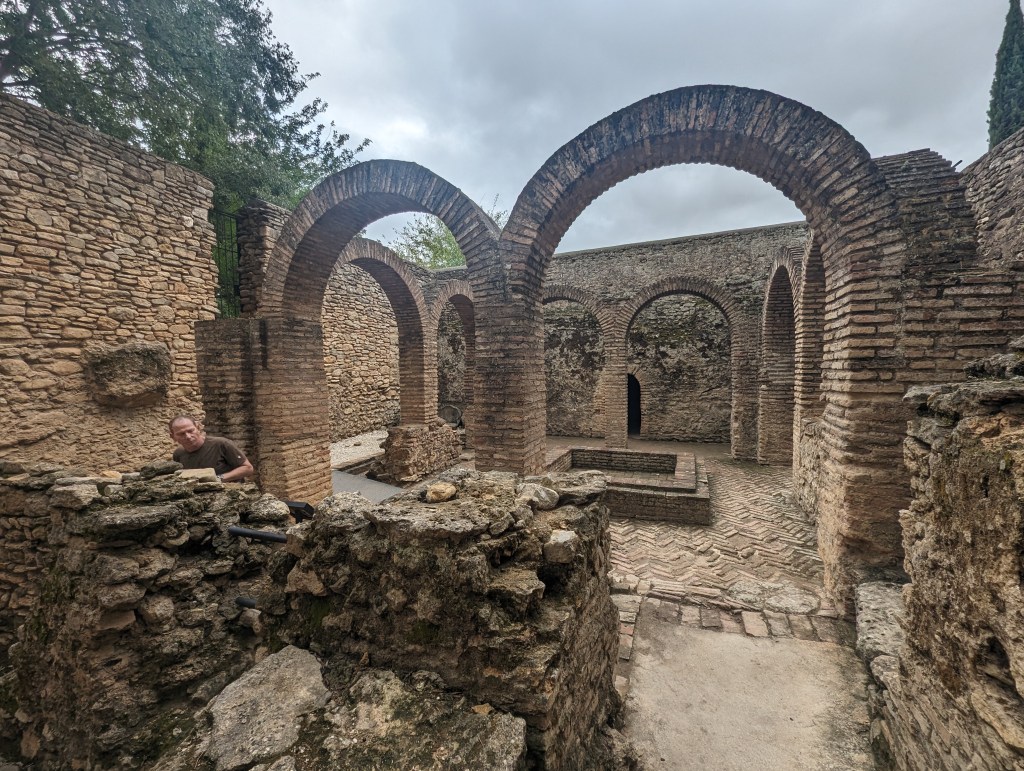
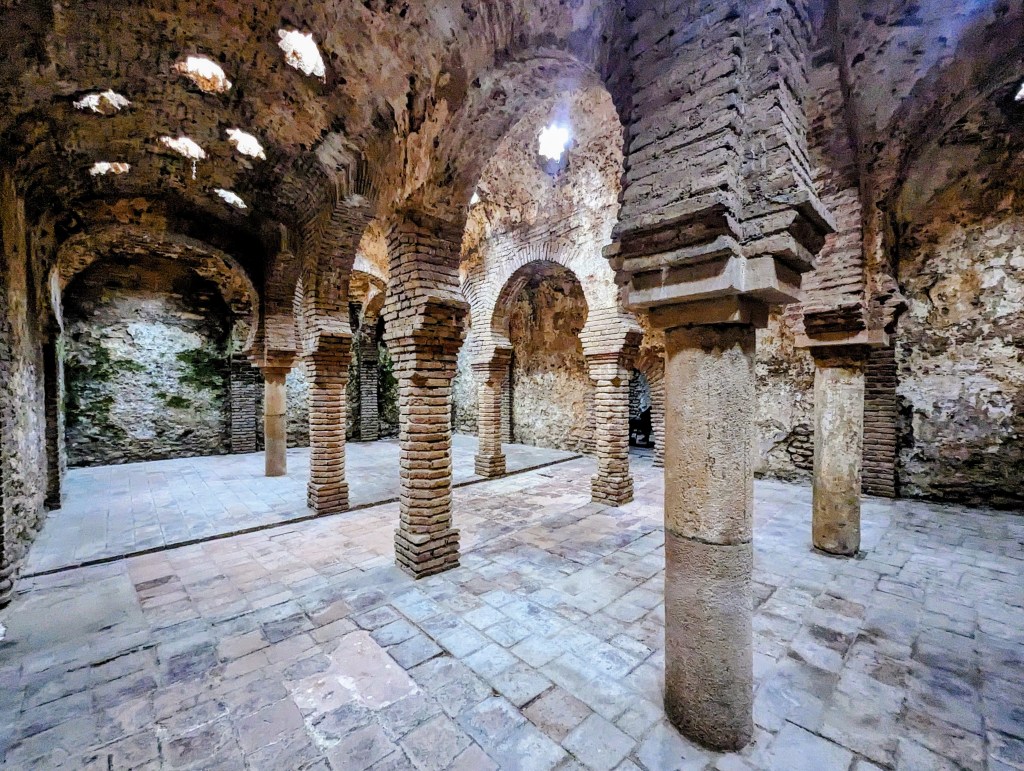
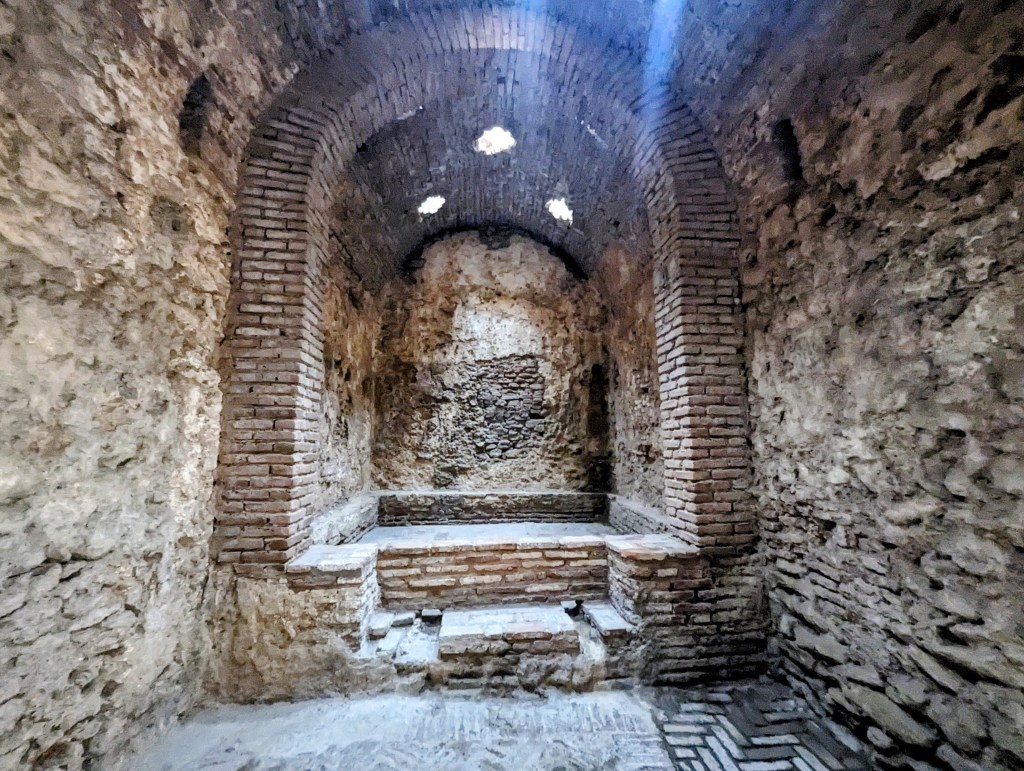
We then headed all the way down below the Moors Bridge to visit the Arab baths. During Moorish occupation, the baths were an important gathering point for ritual cleansing. It is situated right next to the river. When the Christians took over the city, they outlawed the use of baths deeming bathing part of the Muslim religious rituals. The baths were changed into laundry facilities, for which they were used through the 1930s.

Arab Baths Reception Entrance

Water was brought from the river using a water wheel very similar to that in the mine of the Casa del Mor Rey, but was above ground due to it’s proximity to the river, and was turned by a donkey, not Christian slaves.

view of Moros Bridge from the water wheel area

The water then flowed into the baths through an aqueduct. The baths were heated by a fire in the room adjacent using a wood burning fire. The water flowed through this area, was warmed, then flowed through ducts below the warm room.

Arab Baths warm room
Arab baths cool room with pool

We now found ourselves even lower below town than we had been on our morning hike. Rather than climbing the steep incline along the gorge, we meandered the long way around through town. We then thoroughly enjoyed a well earned meal at Sensur Gastrobar.

The next morning it was time to leave Ronda, which again was a real highlight for us so far.

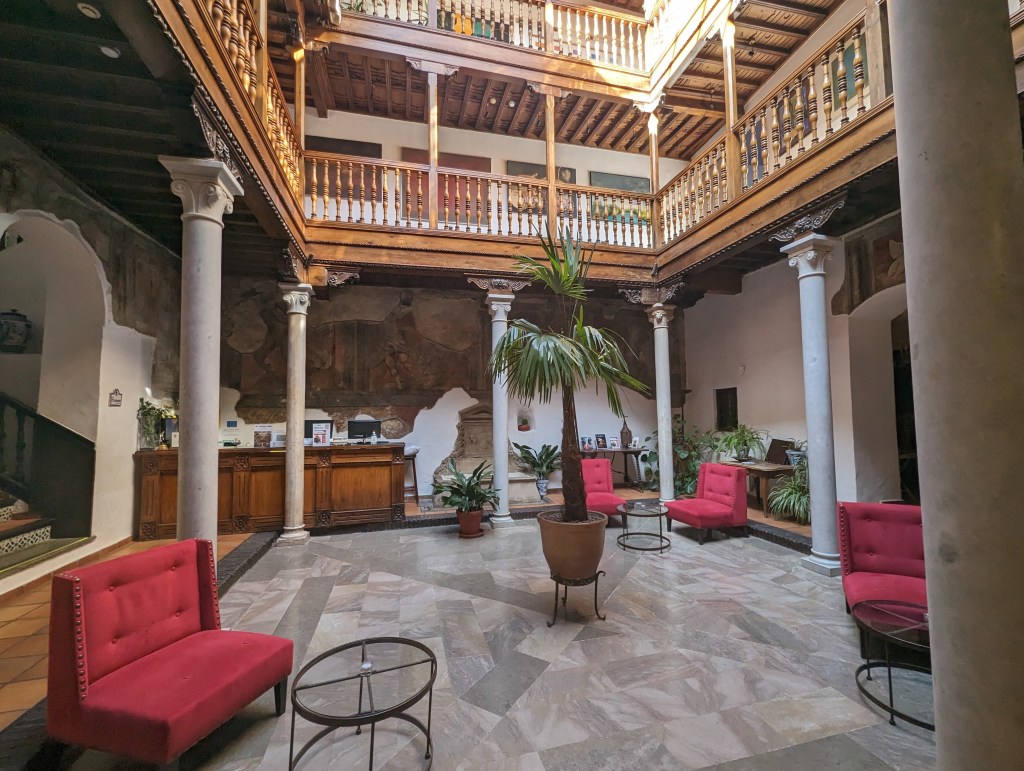
We arrived in Granada and checked into the Hotel Palacio de Santa Inés, made up of two Mudejar buildings with a Plateresque façade. It is located in the historic center of Granada, in the noble area of ​​the Nasrid neighborhood of Albayzín, declared a World Heritage Site by UNESCO.

lobby Hotel Palacio de Santa Inés
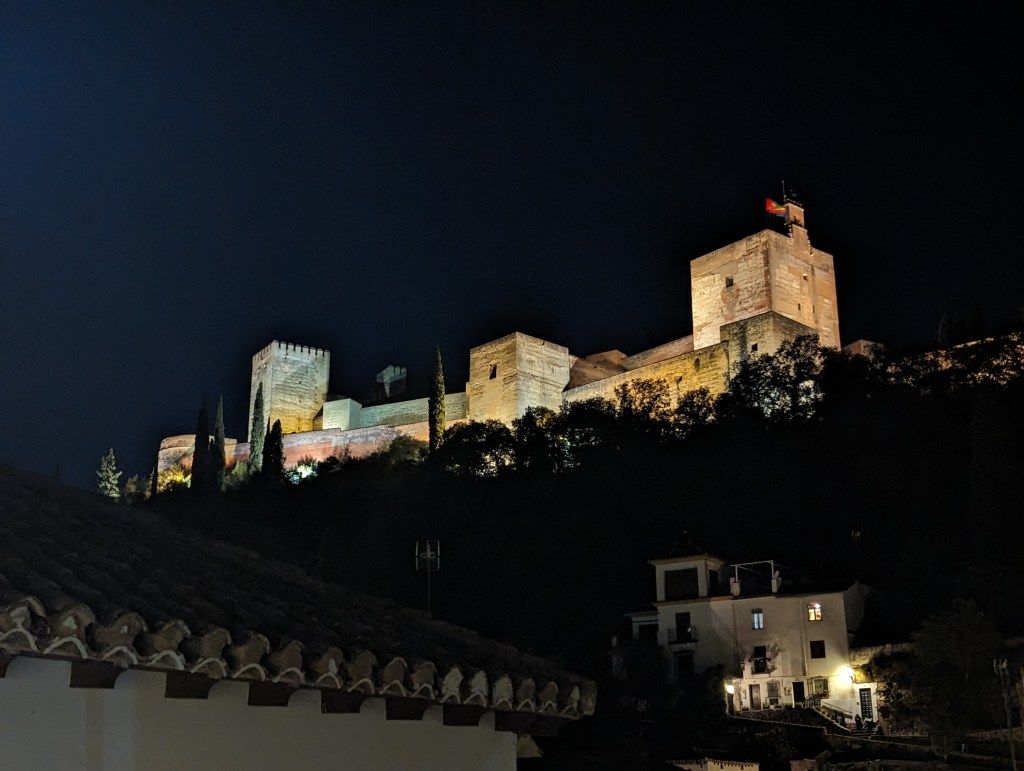
view Alhambra from our room

And then we discovered our first really big fail of our trip: we had not booked tickets to go see Alhambra, which was a palace built by the Moors then turned into a fortress by the Christians. It never occurred to us that we would need advance tickets for a weekday late in October, but it was sold out for weeks. So we had to just enjoy the view of it from afar.

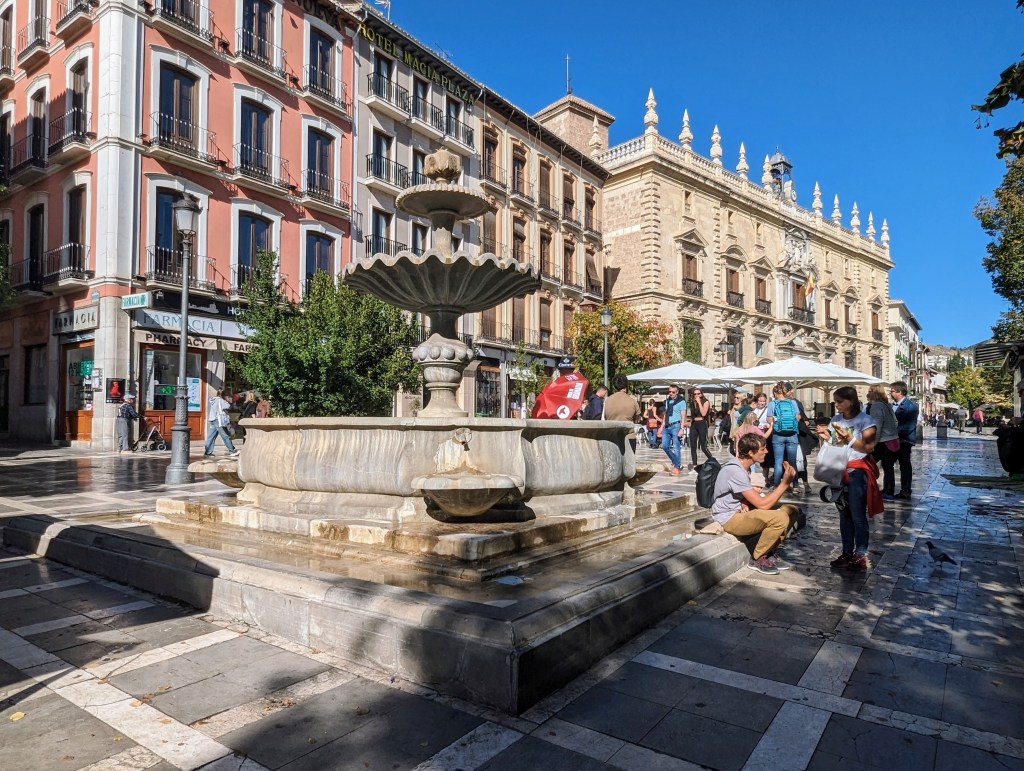
We had booked a late afternoon walking tour of Albaicin and Sacromonte neighborhoods. We met first in Albaicin at the Plaza Nueva (New Plaza), built by the Christians in the early 16th century.

Plaza Nueva Granada

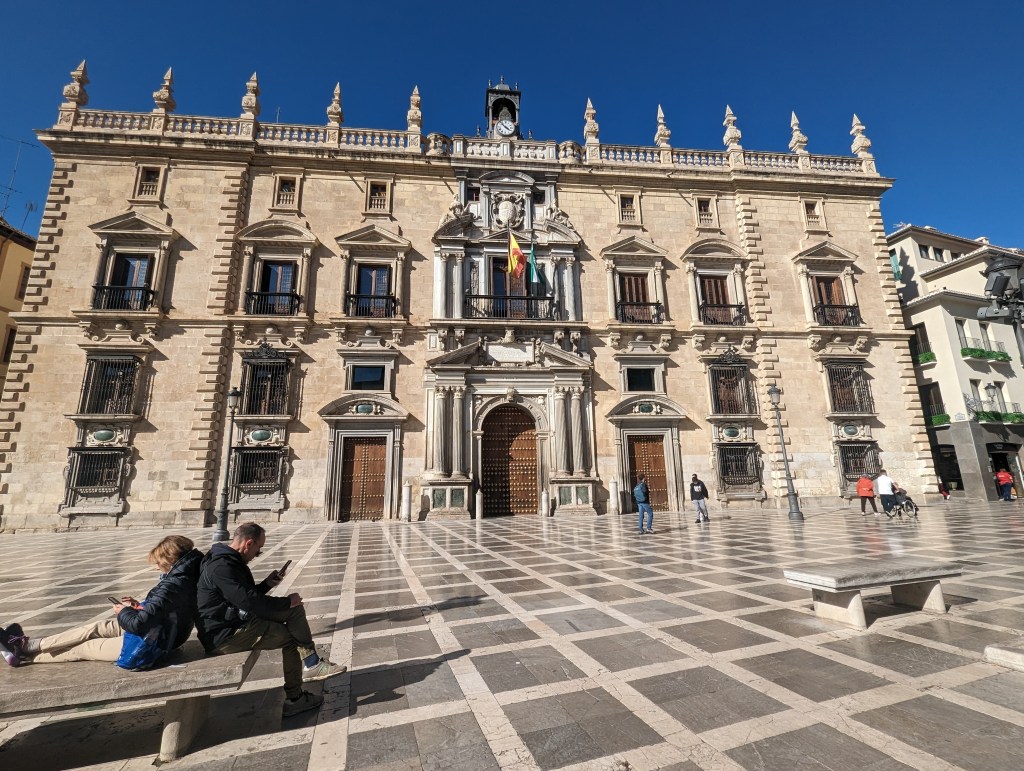
Our tour guide Nacho explained that Granada was the last city in Spain to conquer the Moors, which happened in 1492. Because the Moors had been pushed down from the north in the early part of the 13th century, they had congregated in Granada which is why the Alhambra was built, to be a safe city in which the Moors could live. When the final conquest of the Moors happened in the late 15th century, it was very fast, and they were forced to leave, quickly. So unlike the other regions of Spain, where some Moors were converted, here they evacuated. What that meant to the city was their homes and monuments were basically left intact and taken over by the Christians with little modification. The “new” plaza was the Christians’ beginning of expansion. There was much lawlessness in the Andalusian region, so a large justice building was built by orders of Carlos I between 1531 and 1587. It was the first building of its kind to be built in Spain to hold a court of law. Despite this attempt, the next couple of hundred years were lawless ones.

Palacio de Justicia

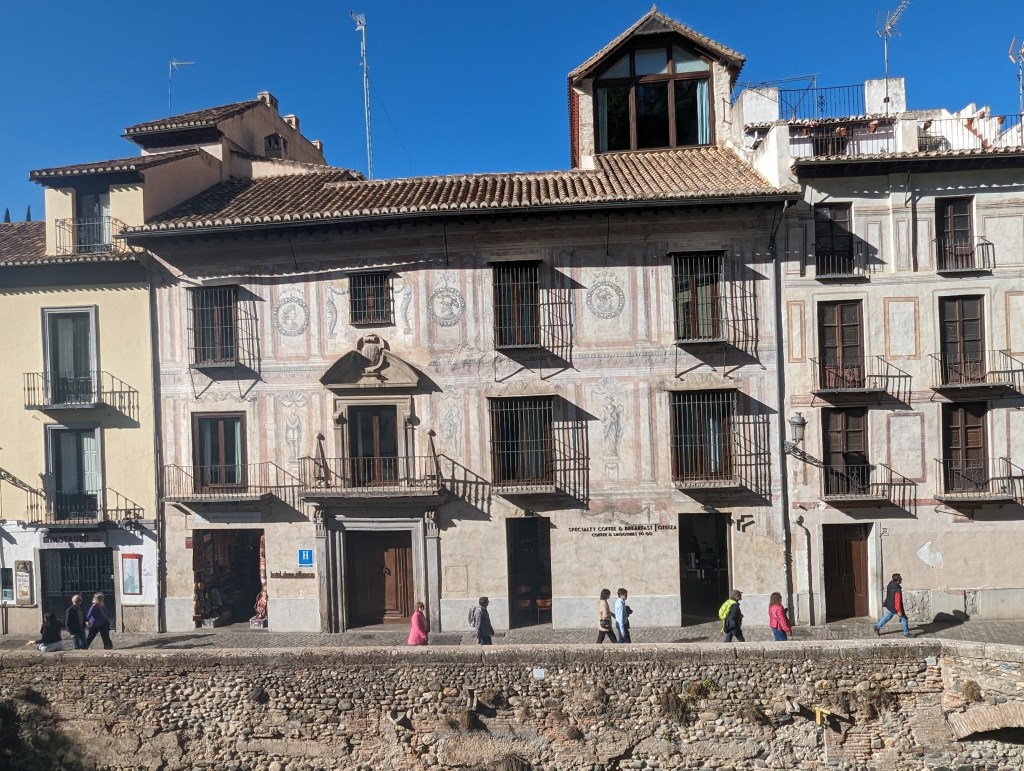
We walked across the Darro River to look back at the Albaicin neighborhood. Nacho explained how for centuries Granada was a relatively poor city. The Christians who had taken over wanted to maintain the appearance of luxury, which is evident in the fake façade seen on the house below with its neoclassical decor painted on rather than sculpted.

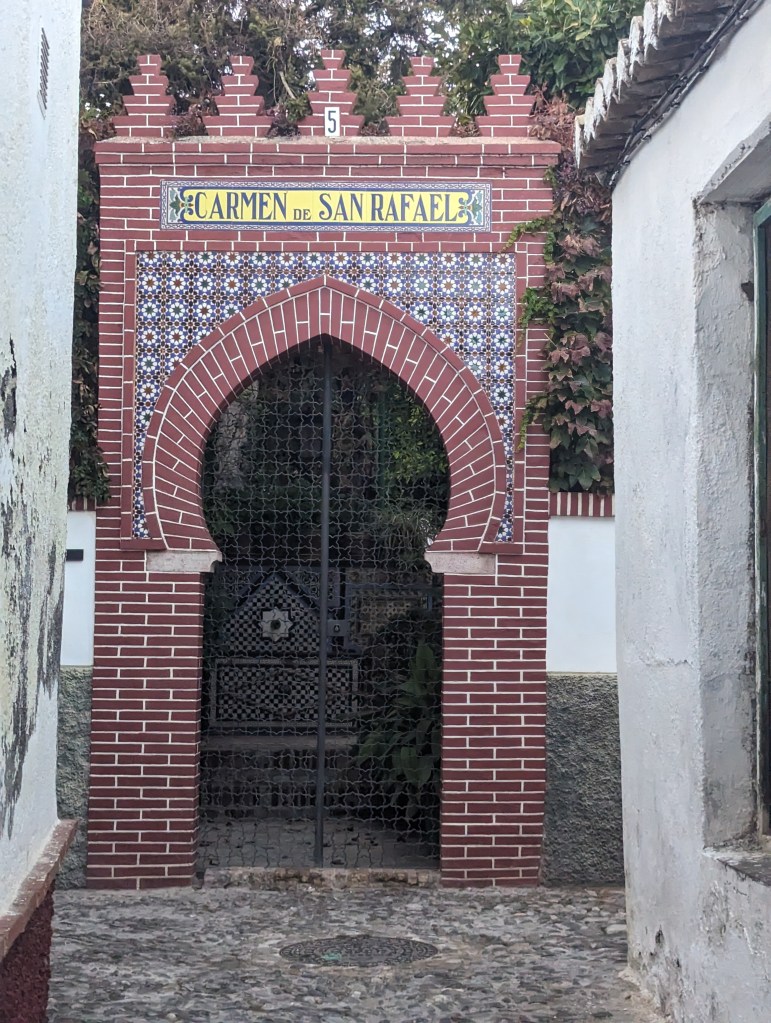
The Christians also took over the private homes of the Moors, most of of which had very plain, humble exteriors but opened into lush interiors with interior gardens and always a water element in a central atrium, if wealthy. These latter ones are now called Carmens, with a Christian name attached, which can be seen throughout the city and sell for millions of euros today.

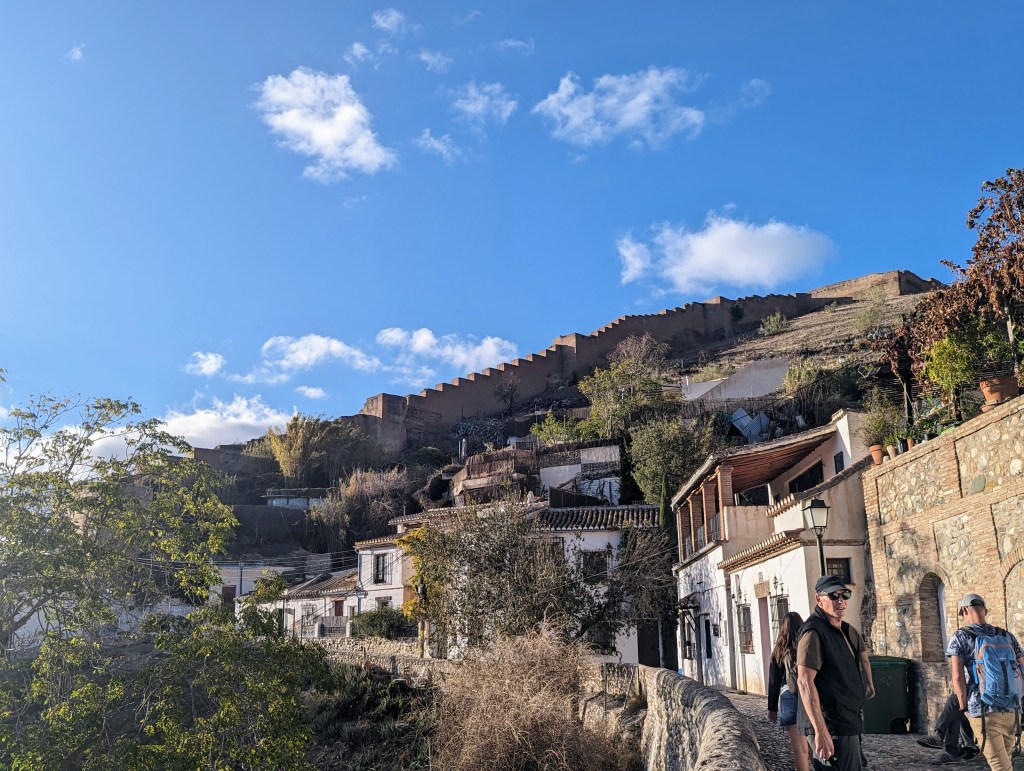
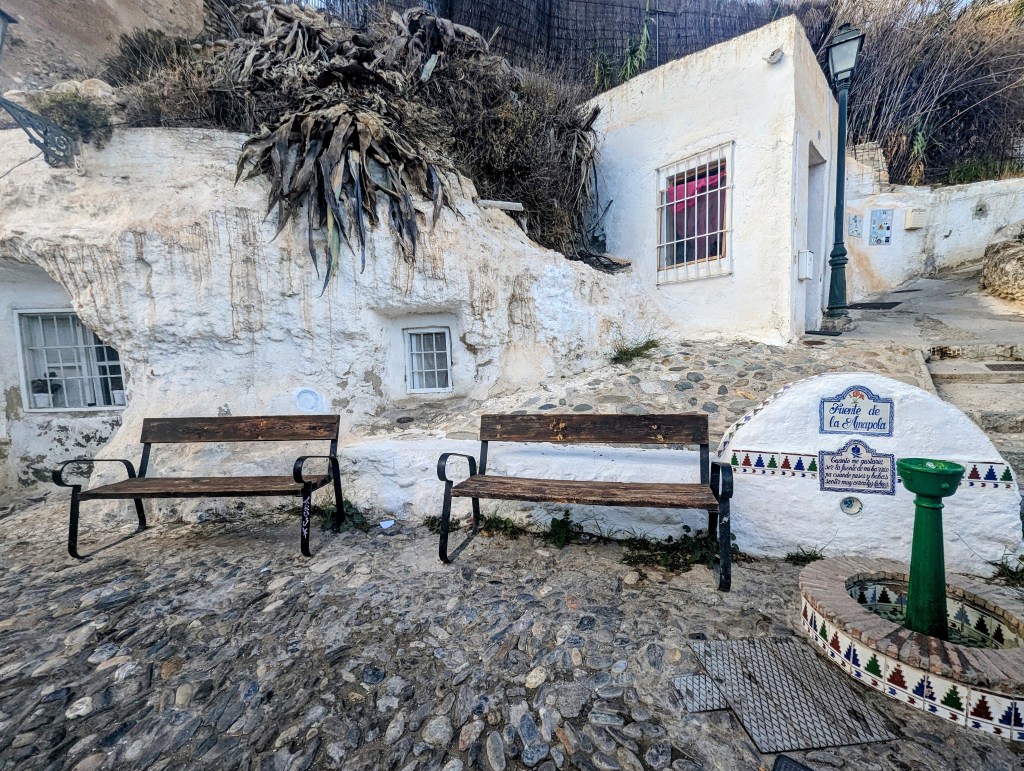
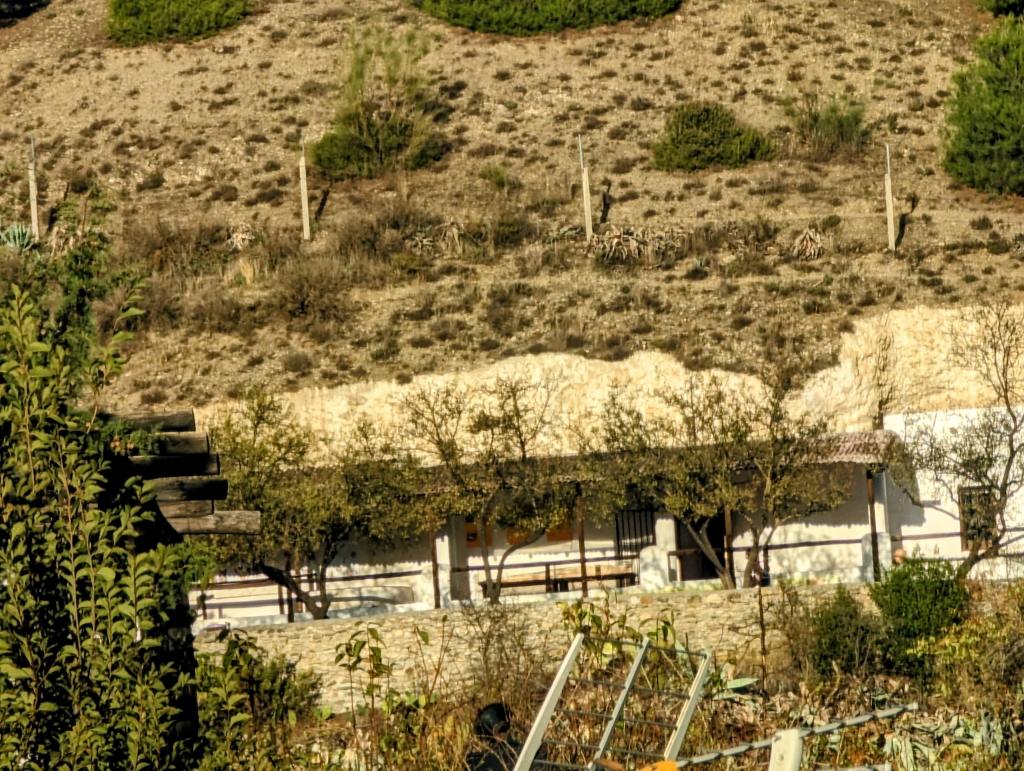
Granada always had a large gypsy population. Once the Nasrid period was over, the Christians encouraged the gypsys to stay because of their particular skills with breeding animals and veterinary care. But the city was walled and the gypsies were forced to live outside the walls. The gypsies dug caves into the hills and lived outside the city walls, now called the Sacromonte neighborhood.

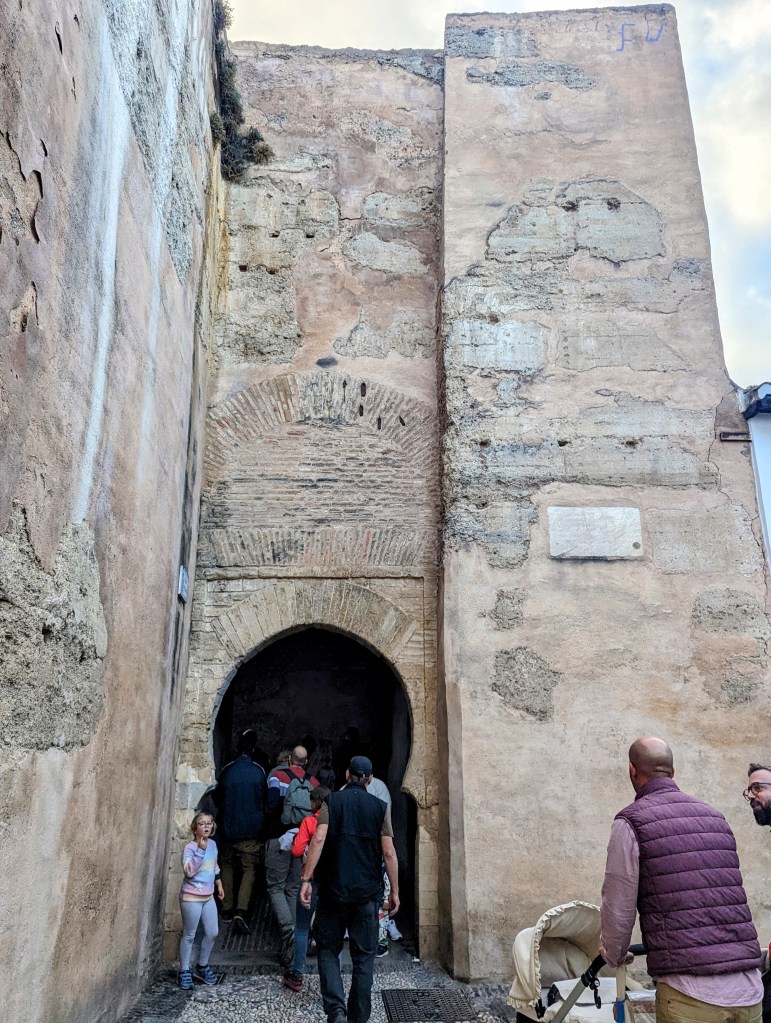
city walls seen from Sacromonte side

The caves were covered in lime for protection, then cacti planted on top to draw moisture and stabilize the soil. The cacti have since been decimated by a blight.

In the 1960s there was a flood causing some of the caves to collapse. Then dictator Franco, who felt the impoverished neighborhood an emabarrasment, ordered all of the gypsies to evacuate. He put them in shelters with little better facilities. Many continue to live in poverty. The caves were taken over as communes in the 70s. But then as most gentrification occurs, people started moving back in, building second stories for views of Alhambra, and some caves now sell for huge sums.

renovated cave

In the late 18th century a painter made an image of a local gypsy, Chorrojumo. His image became wildly popular throughout Europe. Tourists began to come to the area. The gypsies would play guitar and dance to entertain the tourists. This is when/where this type of Flamenco was born. Today, there are numerous Flamenco venues hosted in the caves of Sacromonte. (Different types of Flamenco arose pretty much simultaneously throughout Andalusia from different gypsy tribes.)

statue Chorrojumo

The neighborhood of Sacromonte had always been, not only outside the walls of the city, but off the grid of water and also ultimately the electric grid. They had cisterns from which to get buckets of water. They were in use only until the last 50 years or so.

water cistern

As we re-entered the Albaicin neighborhood in the upper section we immediately saw again the Moorish influence of the architecture. When the Christians rebuilt this part of the city in the 16th century, it contained a large market and butcher shops and other public buildings independent of the ones in the part of town down below. Today it is mostly bars and restaurants.

Plaza Larga

At the end of the plaza is a Moorish port leading into the next square. It was originally part of a wall surrounding the Cadima Alcazaba, an 11th century Muslim fortress. The Christians renamed it the Door of Weights because when a butcher was caught using defective weights to cheat his customers, his weights were hung there to humiliate him.

The Puerta de las Pesas (Door of Weights)

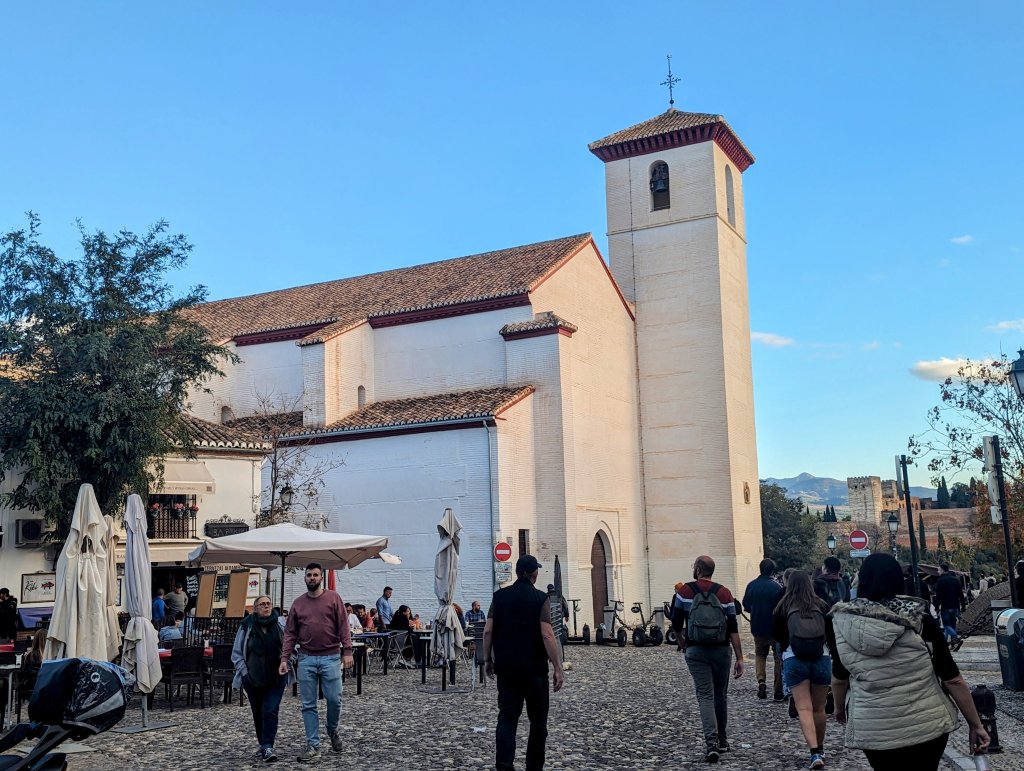
Passing through the Door of Weights, we entered into St. Michael’s Square.

St. Michael Church and Square

Nacho told us that when he was a child the area around this square was a parking lot. The square was made famous by the Clintons. Bill brought Hillary there during a visit to Spain during the Lewinsky scandal only months before his impeachment. He claimed he wanted her to see the most beautiful sunset in the world. Since then tourists have flocked there to enjoy the same view. The view is of the setting sun casting light on the Alhambra.

That night we had a delicious dinner at Pilar del Toro.

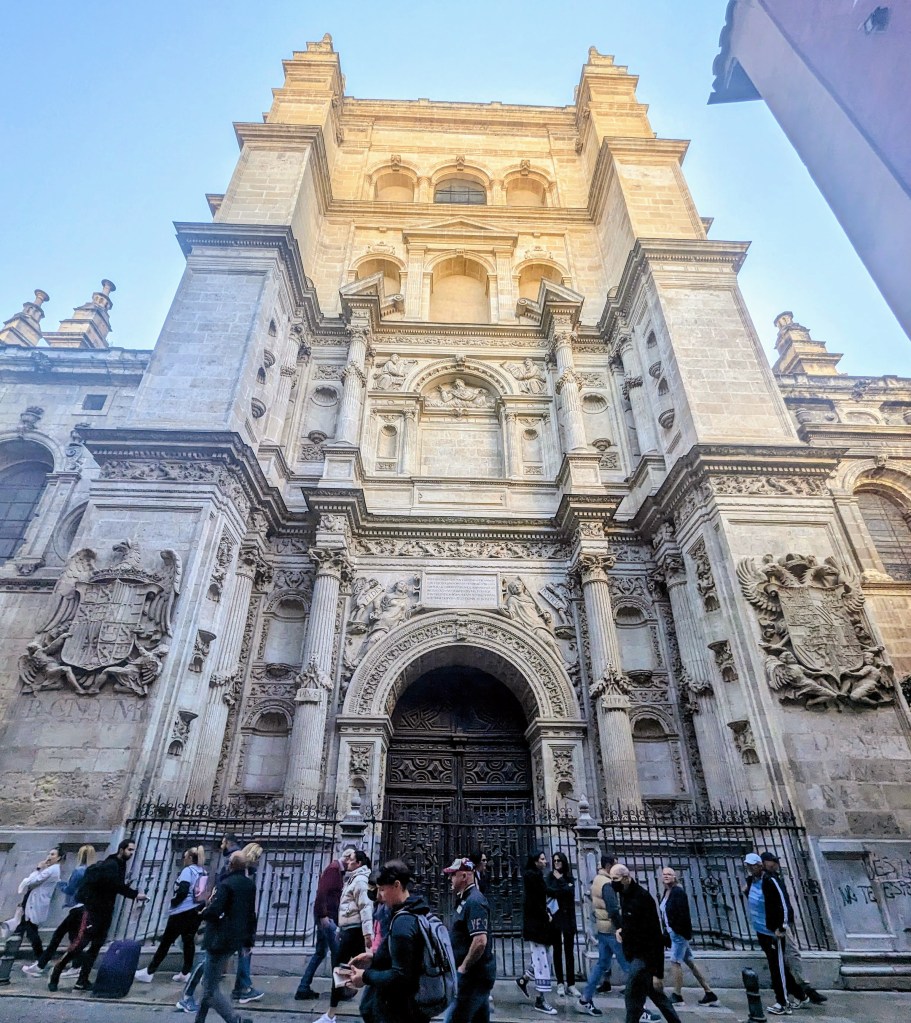
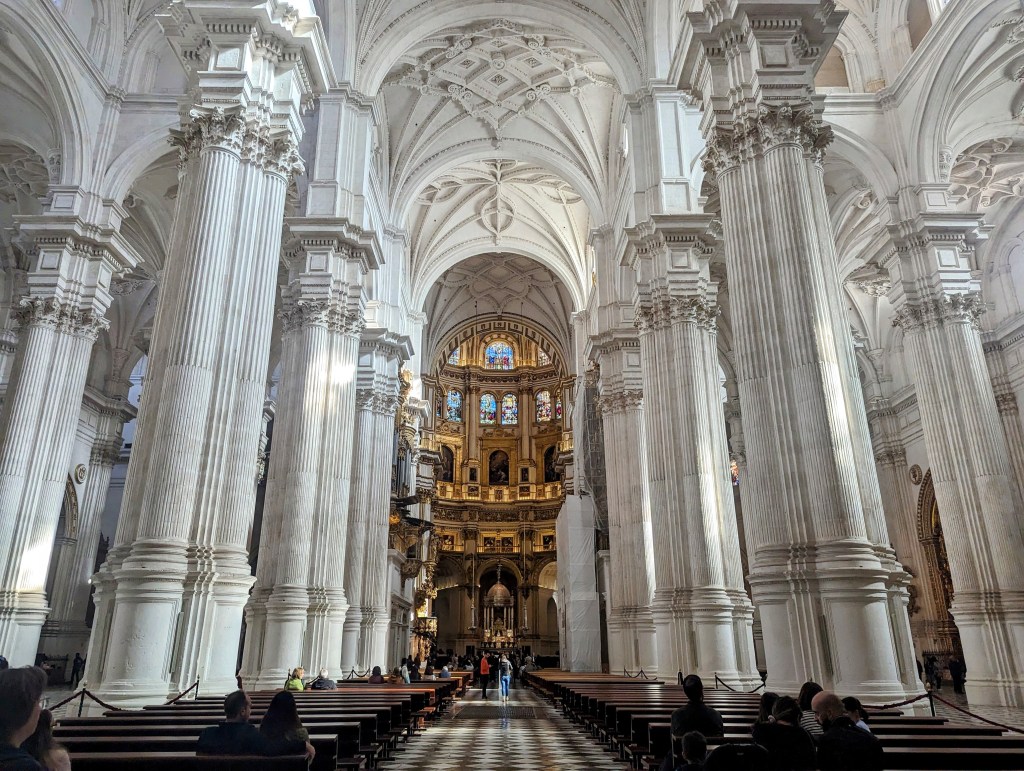
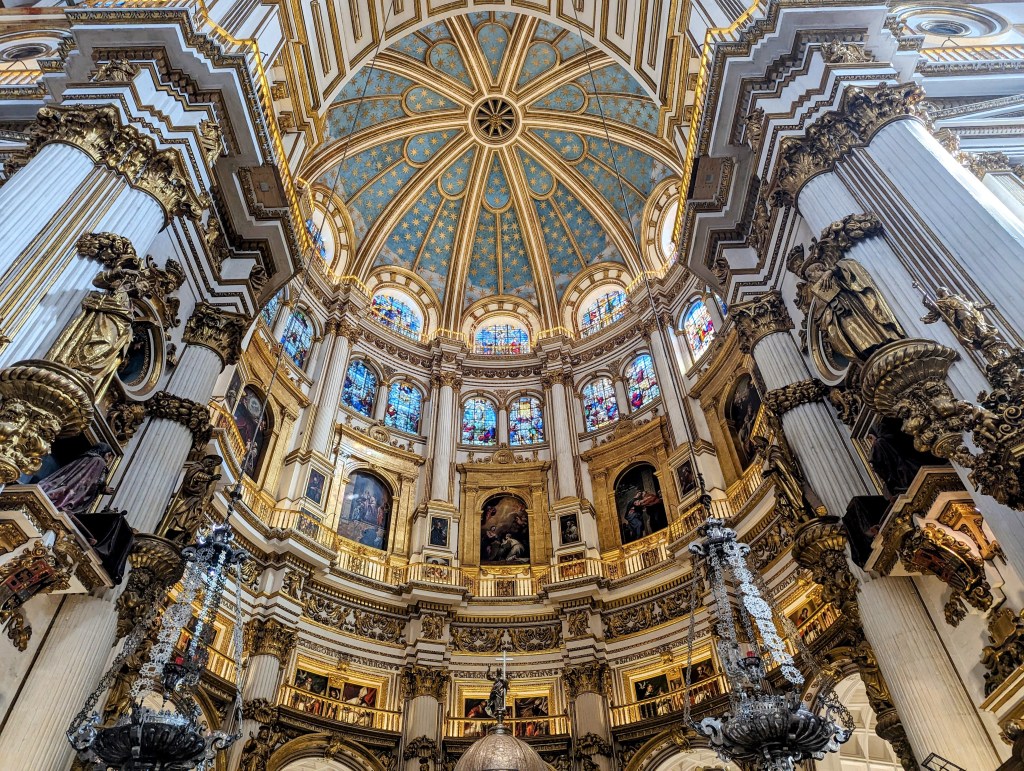
The next morning we set out to visit the Cathedral of Granada. At this point we had visited so many cathedrals in Spain, we entered a bit unenthusiastic, but were pleasantly surprised. It turned out to be one of our favorites due to its brightness, the clean simple lines, light airy feeling, and beautiful artwork. Construction was begun in the 16th century, late for a Spanish cathedral. It was originally started in the Gothic style, but was finished in the Renaissance style. It was built on top of a Muslim Medina.

Granada Cathedral dedicated to Santa María de la Encarnación
Nave Granada Cathedral facing Main Chapel
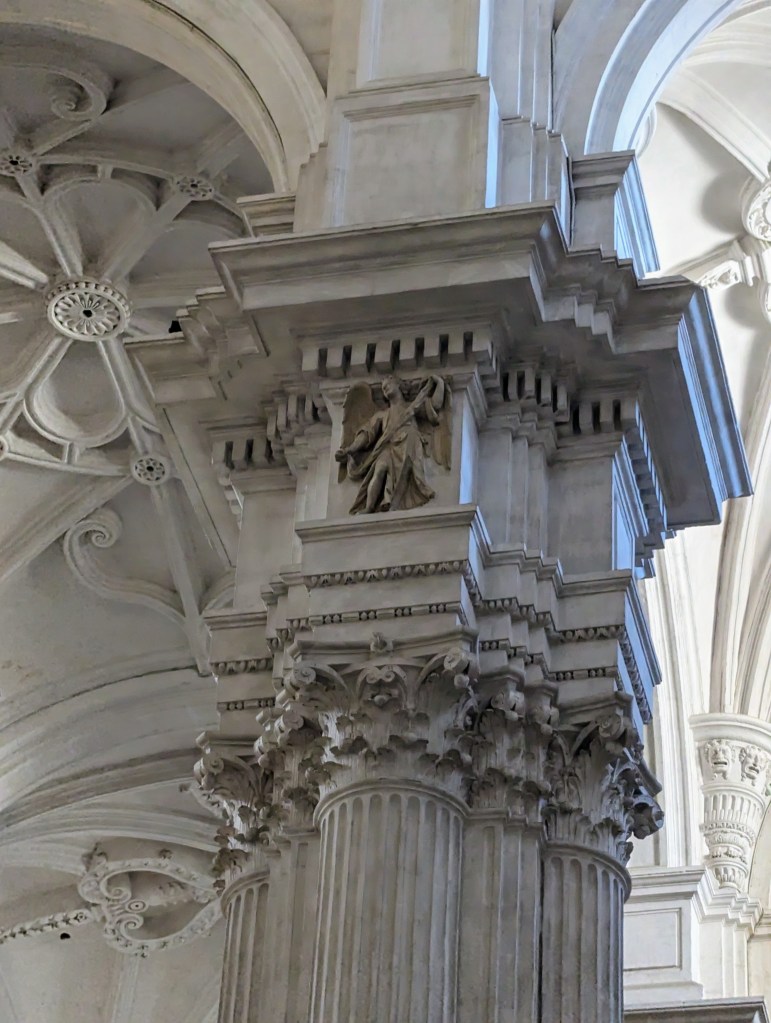
top detail of column of nave
Rotunda of Main Chapel

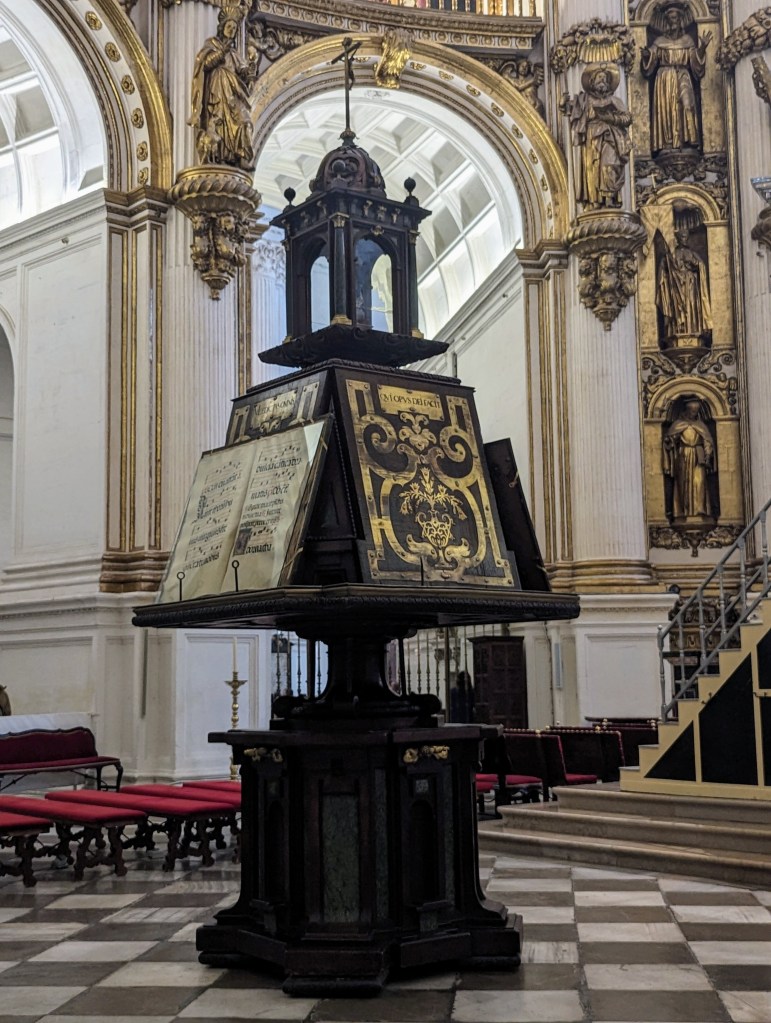
Unlike most cathedrals in Spain, the choir sits in the main chapel. At the back of the chapel sits a large stand to hold the large choir books. It is shaped so that the books can be placed on all sides to be seen from every angle by the choir.

choir music stand
choir books

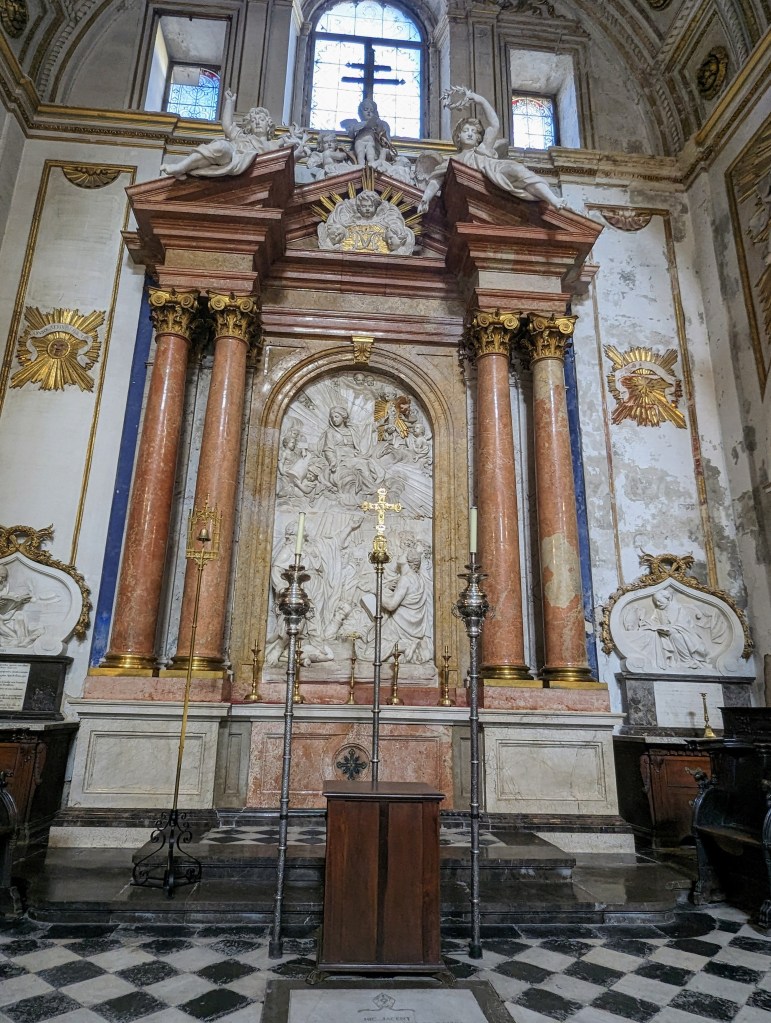
Each side chapel is more spectacular than the next. Several have gorgeous marbles. Very few have been redone in the Baroque style that was popular in Spain.

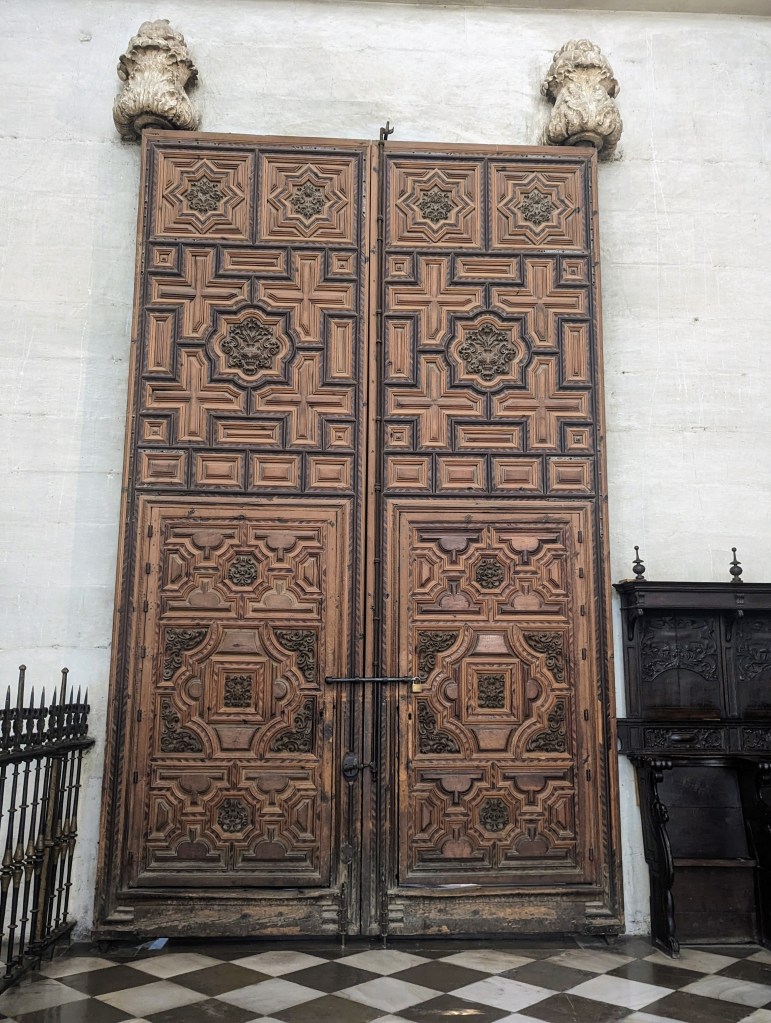
Even the doors in the cathedral are exquisite.

one of the many pieces of art on the walls

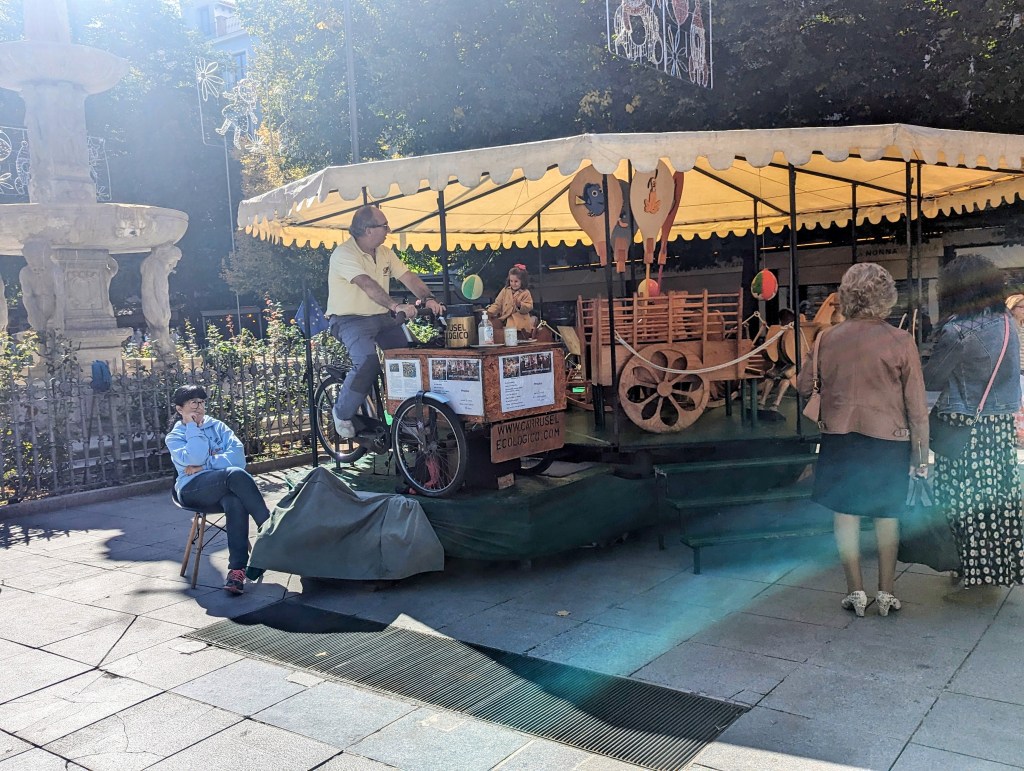
When we exited the church we meandered through the Arabic market: La Alcaicería, which has very narrow alleys and is packed with merchandise and reminded us of the markets in Jerusalem. When we emerged from the markets, we were amused to see this man powering a carousel with a cycle. The sign on the box in front of him reads: http://www.carruselecologico.com

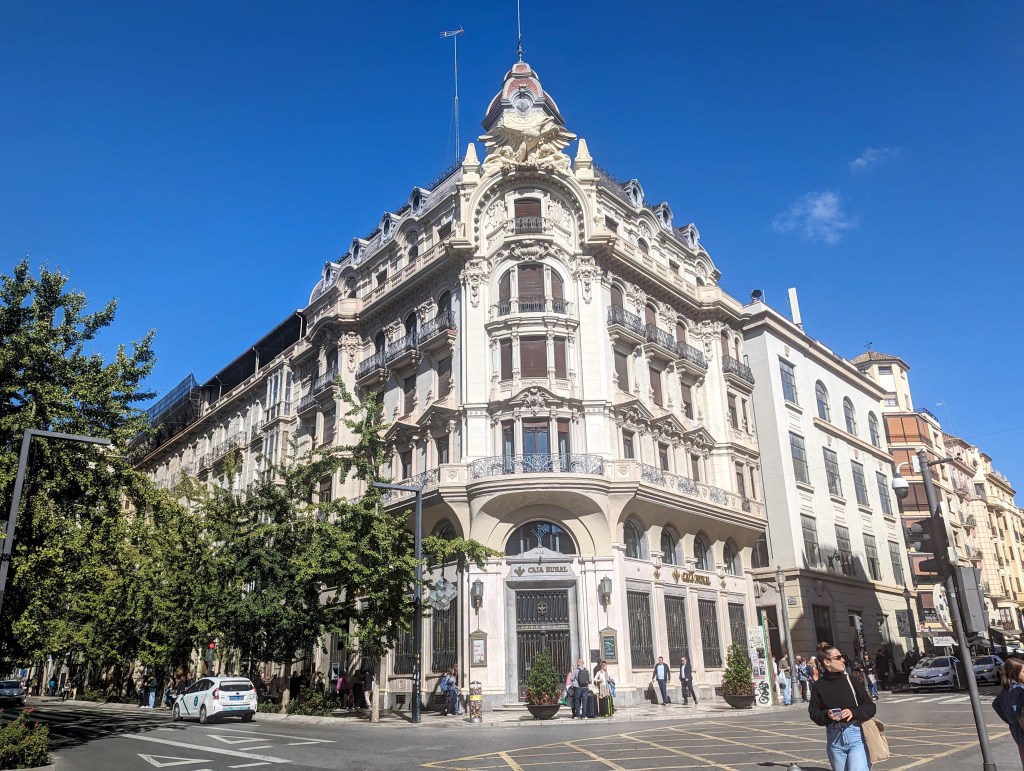
We emerged from the market to find ourselves in a more modern section of town with high end shops. There we found a statue built in 1892 commemorating the 400th anniversary of Queen Isabella of Spain’s meeting with Columbus.

And also in the square are buildings with gorgeous architecture.

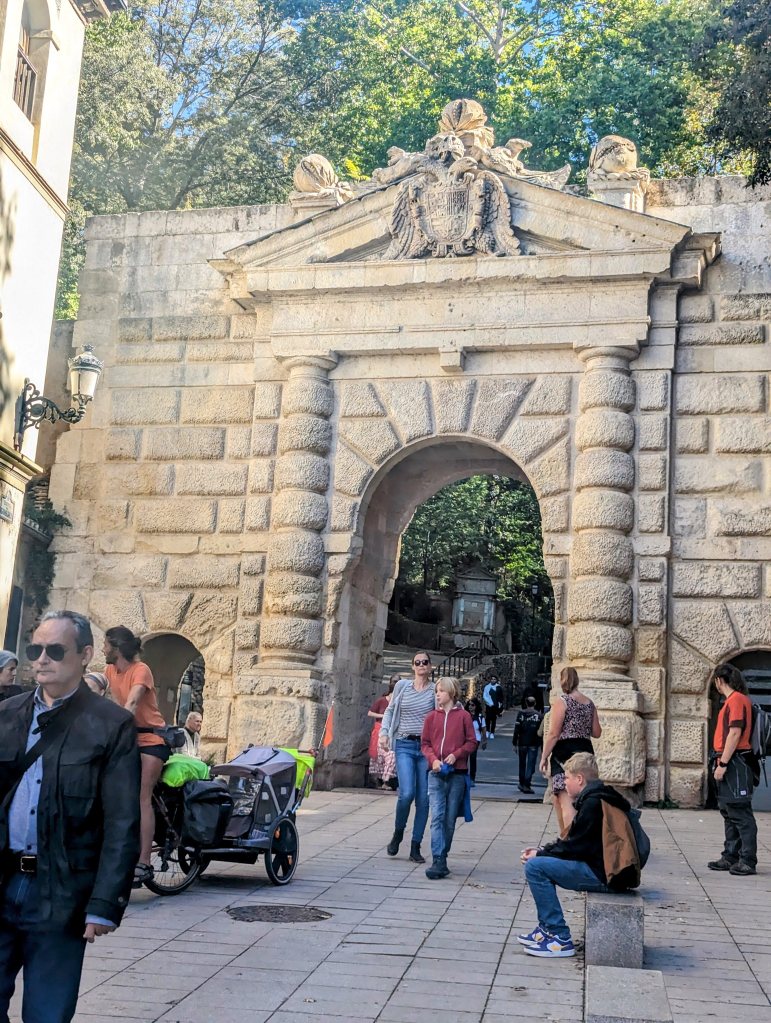
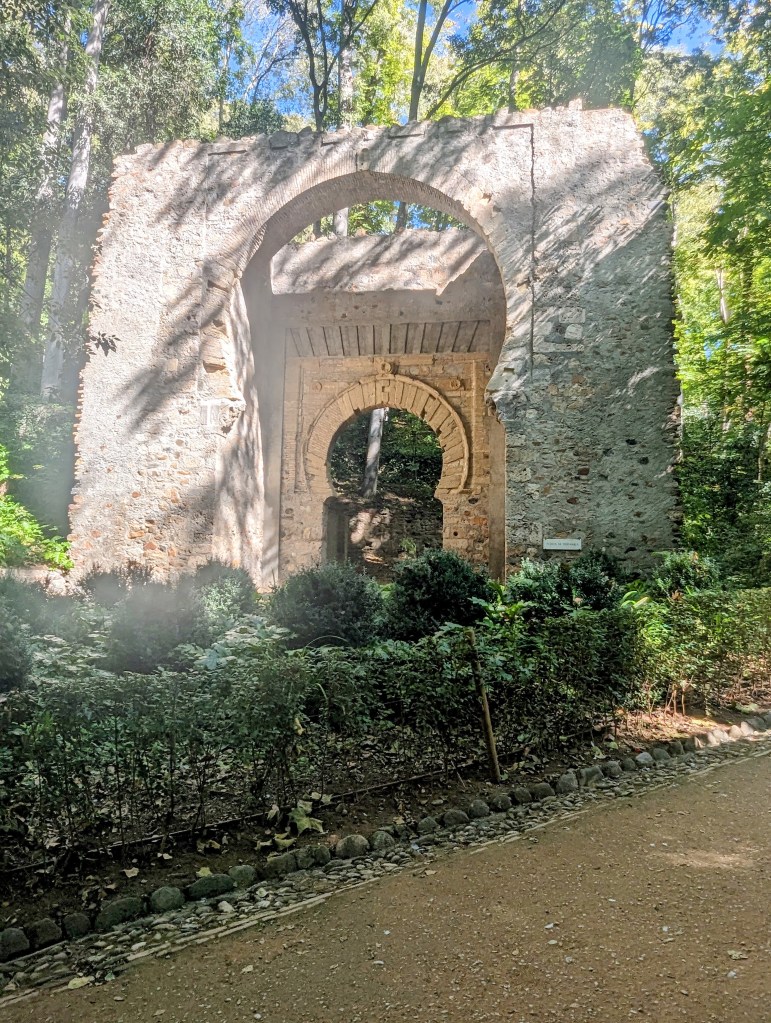
We could not go inside Alhambra, but we decided to hike up to it so we could try to get a drone shot above it. At the entrance to the Alhambra Forest and the long hike up the hill is this gate dedicated to Charles I in 1526. It is nicknamed the Pomegranate Gate due to the 3 large split pomegranates seen spilling their seeds sitting atop the gate. The pomegranate is the symbol of Granada.

The Granada Gate

On the way we passed this Arco de las Orejas (Gate of Ears), which was originally in Plaza de Bib-Rambla . In the 19th century it was taken down during a renovation project. But there was such an outcry from historical conservationists, that it was rebuilt on this walkway up to Alhambra. Its name is because when thieves or crooks were punished by the removal of body parts, often ears, they were hung on this gate to warn the public of the consequences of such actions.

Arco de las Orejas

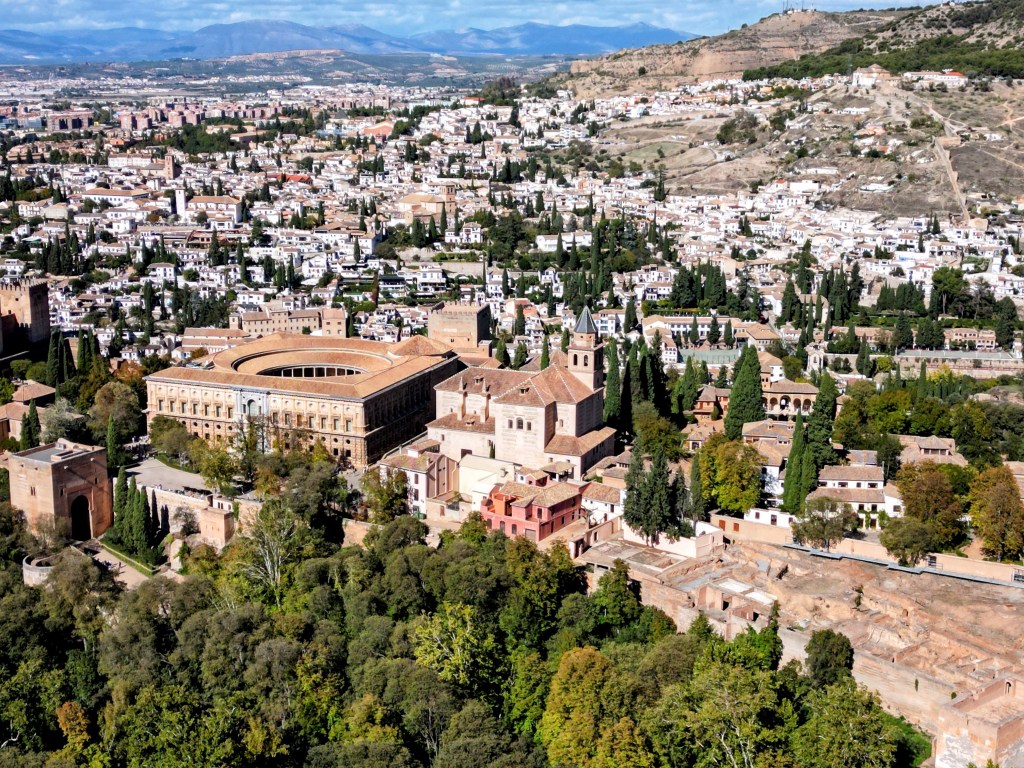
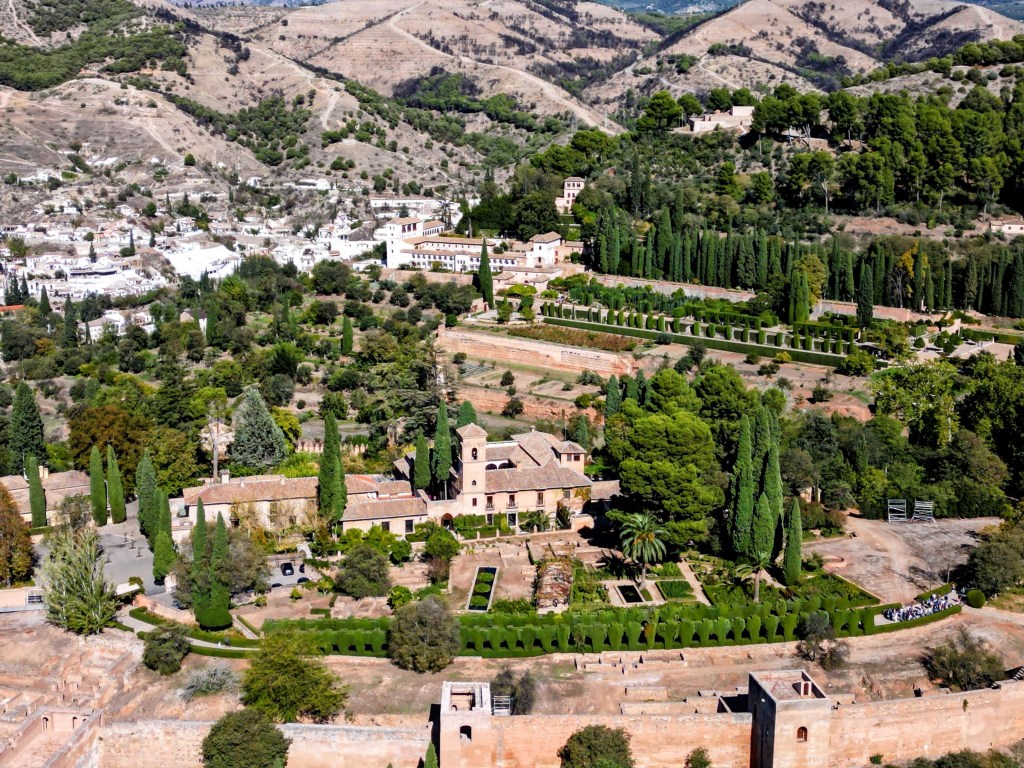
Up on top Eric did manage some drone shots of Alhambra.

drone view Alhambra
drone view Alhambra garden

That night we had paella at Mesa Pio.

Then we returned to our room for a final view before bed.

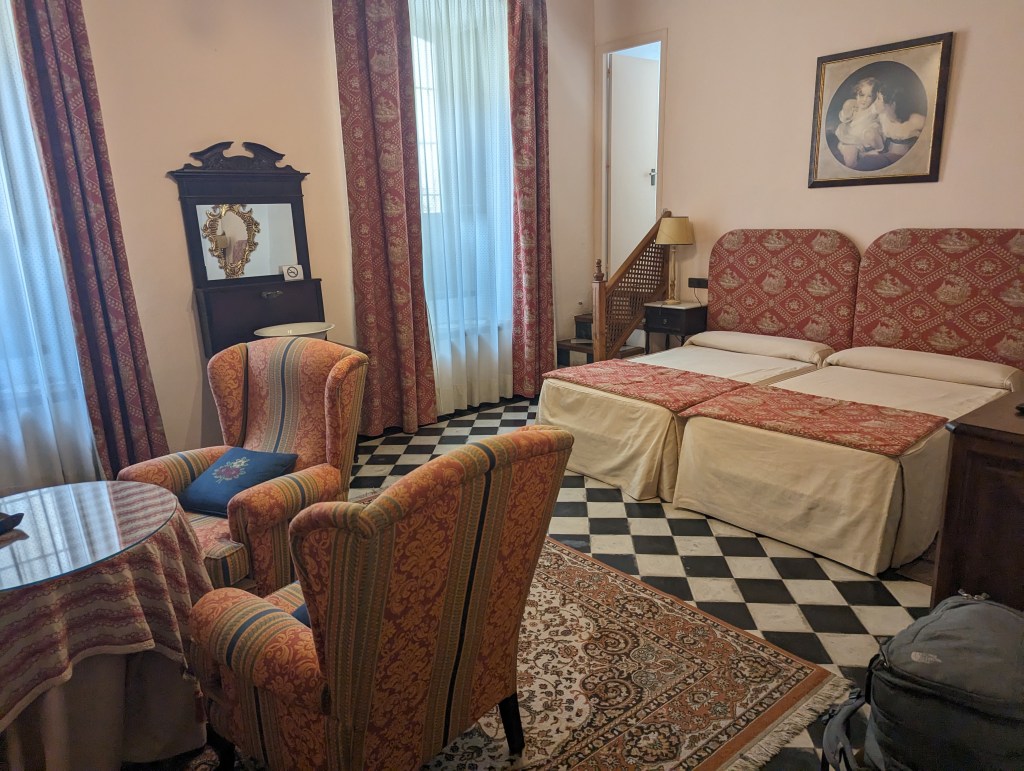
And again we were on the move, this time to Úbeda. When booking we had tried to find charming hotels that gave us a feel for local culture. In Úbeda we certainly achieved this goal. Hotel Ordoñez Sandoval was built in a historic family house in a neoclassical style.

inner courtyard Hotel Ordoñez Sandoval
our room Hotel Ordoñez Sandoval

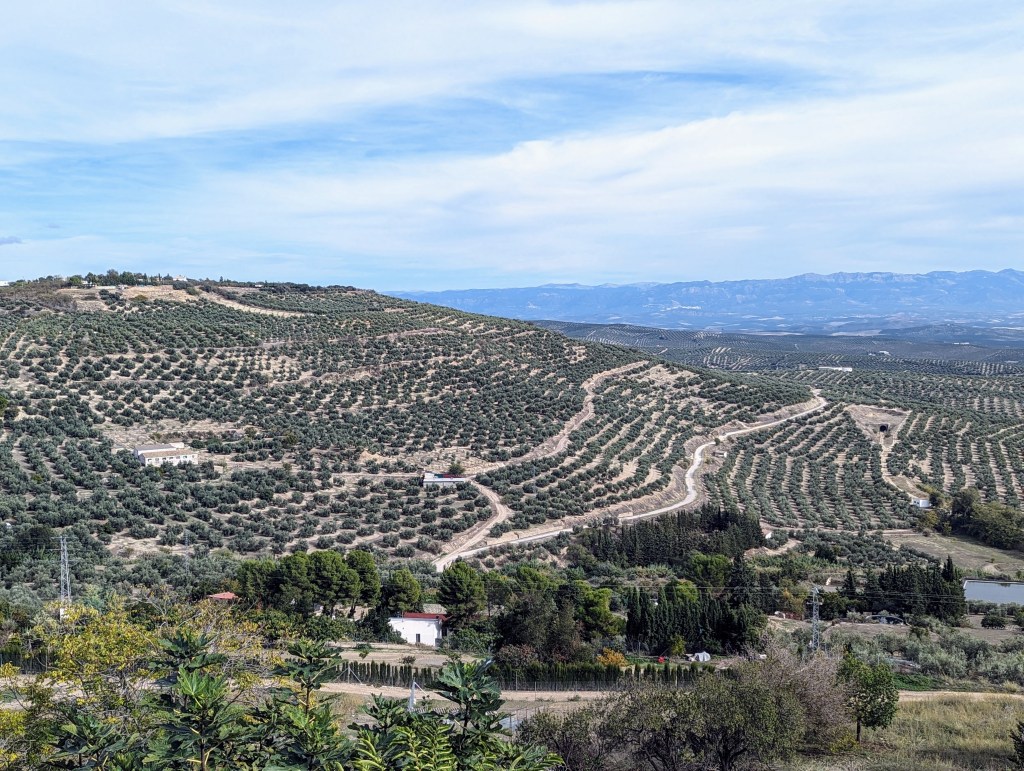
Driving into town we were struck by the number of olive groves and how well maintained they appeared. We learned that the province has 70 million olive trees. From town, you can see them best from Mirador del Salvador viewpoint.

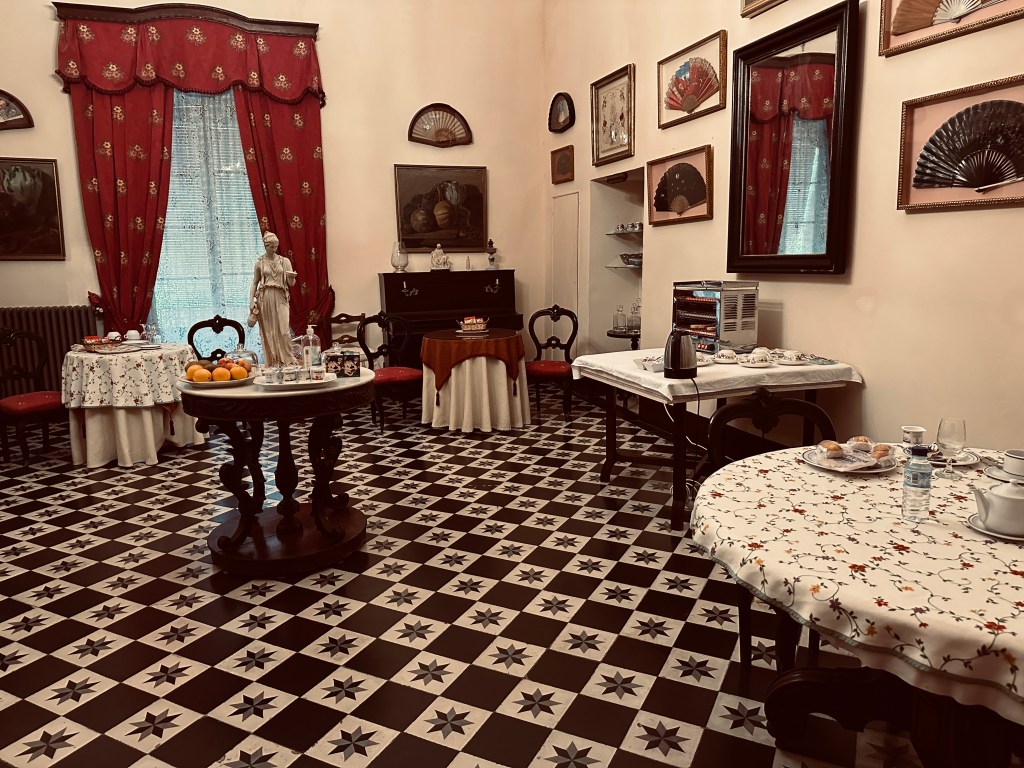
We walked around town all afternoon and took a lot of pictures, but I will add them with the history we learned about the town and its historic monuments on our walking tour the next morning. The next day started with an included breakfast in the cutest room in our hotel.

We met Josue for the tour and were the only ones. He admitted that few English speakers make it to Úbeda, which has only recently become a tourist destination due to UNESCO designating the town a world cultural heritage site in 2003 due to the town’s highest number of monuments/m2 in all of Europe, second only to Florence, and to the well preserved renaissance buildings.

In the year 1233, the Muslims in Úbeda were definitively conquered by Ferdinand II of Castile, a full 2.5 centuries before Granada, making this the southernmost city in Spain for that period of time and therefore very influential to the region. After both the fall of Granada and the “discovery” of the Americas in 1492, wealth poured into the area. Especially notable for the architecture of the city of today is the role of Francisco de los Cobos, secretary of Emperor Charles V. Francisco de los Cobos was not born with a title but benefited from his uncle’s relationship working as secretary to Queen Isabel I. Francisco de los Cobos ultimately accumulated a lot of wealth, but did not manage to get a title until in his 40s when he married 14 year-old María de Mendoza. Having accumulated wealth and power, he strove to build a palace, a university, and a mausoleum for himself. In order to do this, he first needed permission from the Crown and the Pope. So first he built a hospital as his donation. The building is used today as a cultural center.

Next he started work on his palace and his mausoleum. He engaged the architect Andrés de Vandelvira, whose work became instrumental in introducing the Renaissance ideas to Spain.

Francisco de los Cobos did not survive to see his mausoleum finished, but his wife and architect completed it and later buried him there.

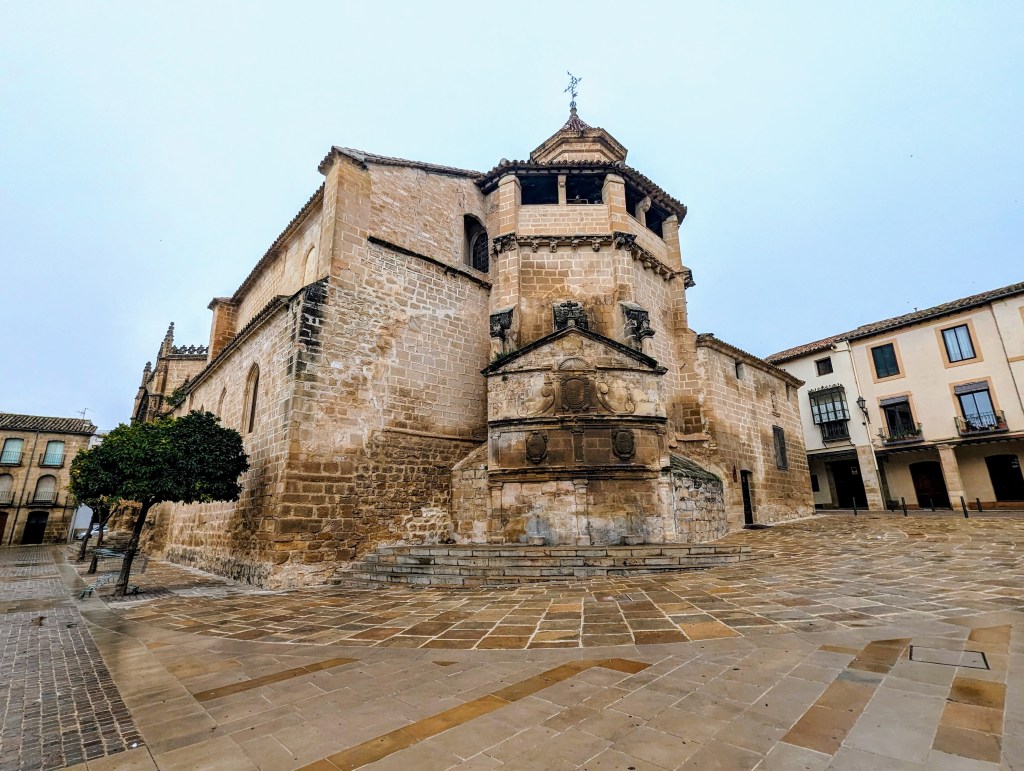
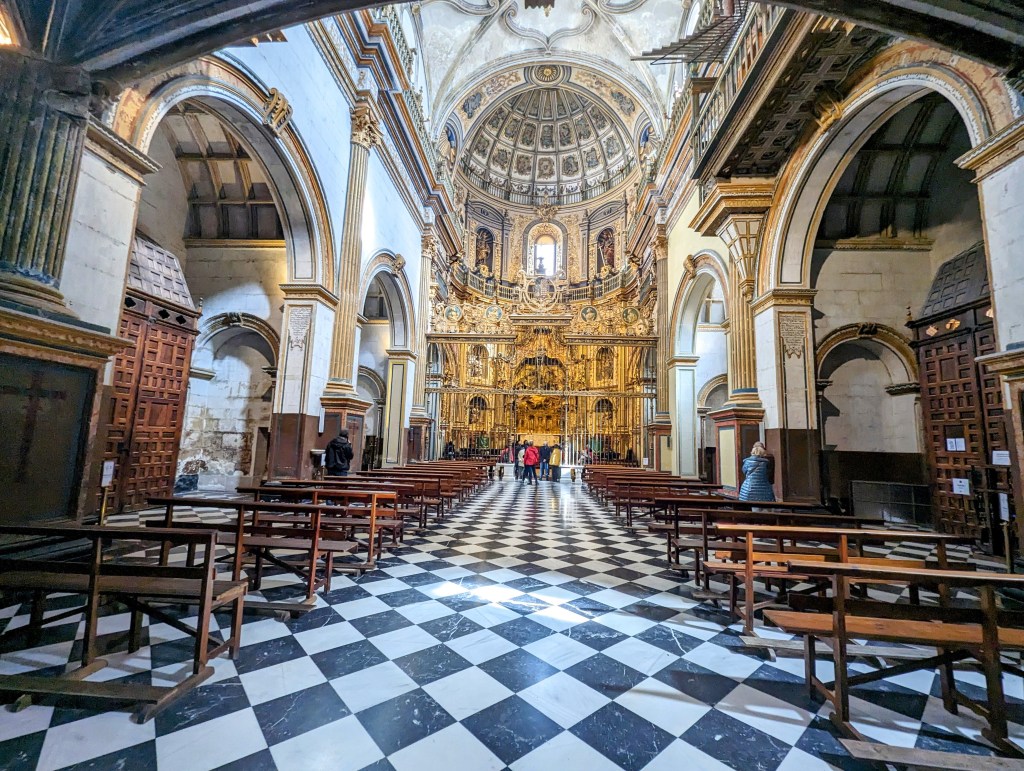
Sacred Chapel of the Savior of the World

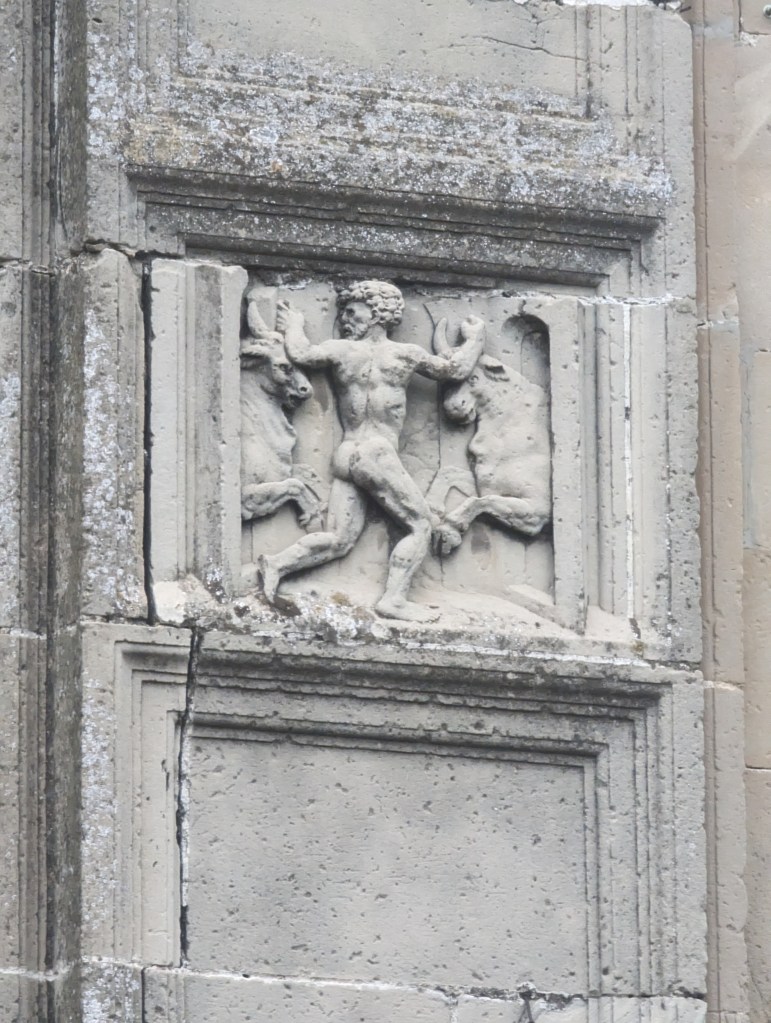
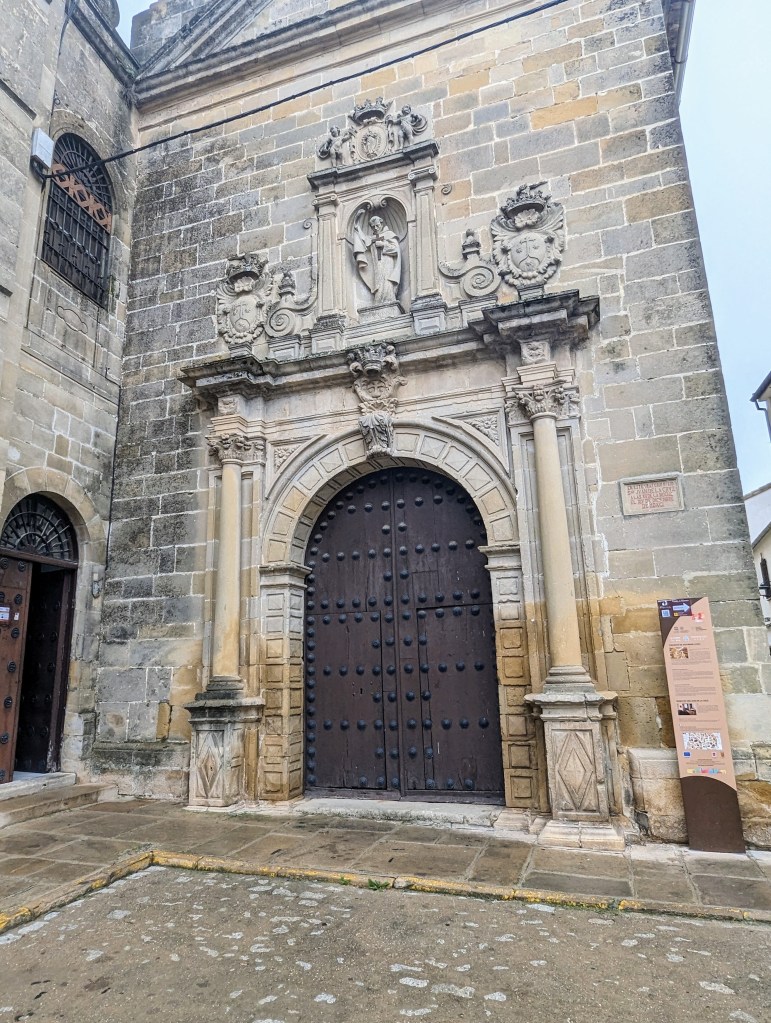
Francisco de los Cobos was very involved in the design of this chapel, now the largest mausoleum for a private patron in Europe. The name is of course reference to Jesus. As was popular in the Renaissance, he used neoclassical elements and mythological references. On the façade are depictions of stories of Hercules, son of god (Zeus), attaining immortality through his 12 labors.

We would go into the chapel after the tour, but first more on Andrés de Vandelvira. After the death of Francisco de los Cobos, the architect continued to work for his wife and several nephews building palaces. The palace of Francisco de los Cobos, behind the chapel, is currently under reconstruction.

Palace of Francisco de los Cobos

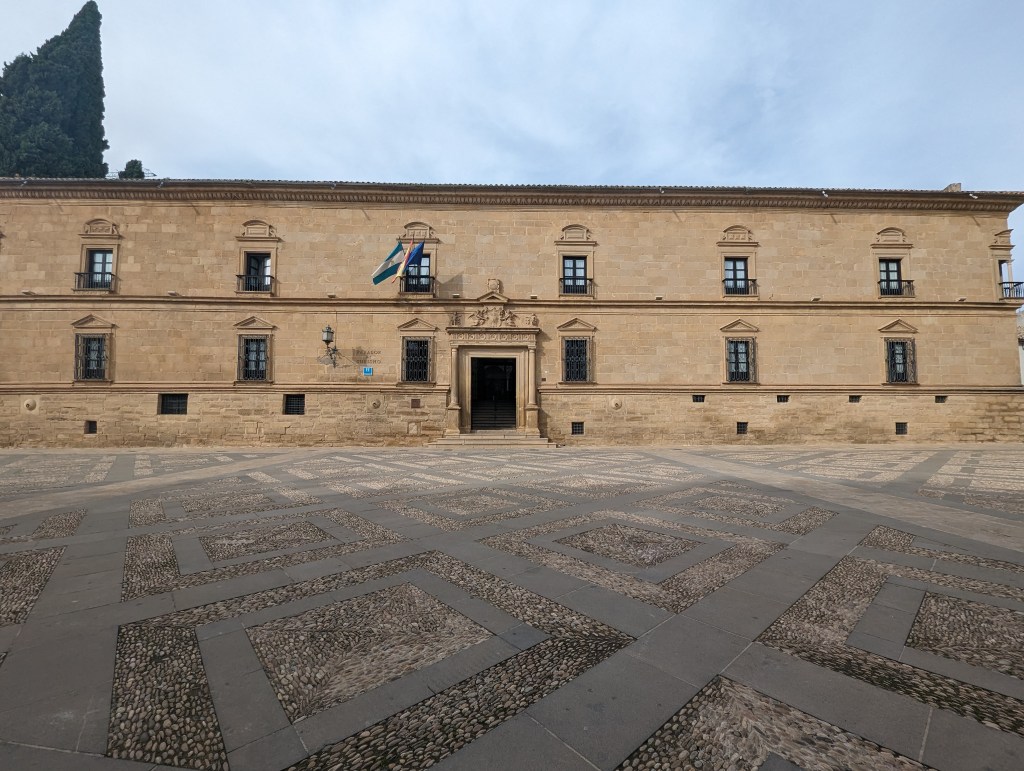
The palace of the Marquis of Donadío, built for the first chaplain of the Sacred Chapel of the Savior of the World, is in the same square as the chapel, today called the Plaza Vázquez de Molina. The palace today is a Parador Hotel.

Parador Úbeda

A signature element of Andrés de Vandelvira is the white marble column that can be seen on the corners of the Parador, above top right.

The inner courtyard of the palace/Parador is typical of the Spanish Renaissance style portraying wealth: columns surrounding an open space with a water element in the center, in this case a fountain.

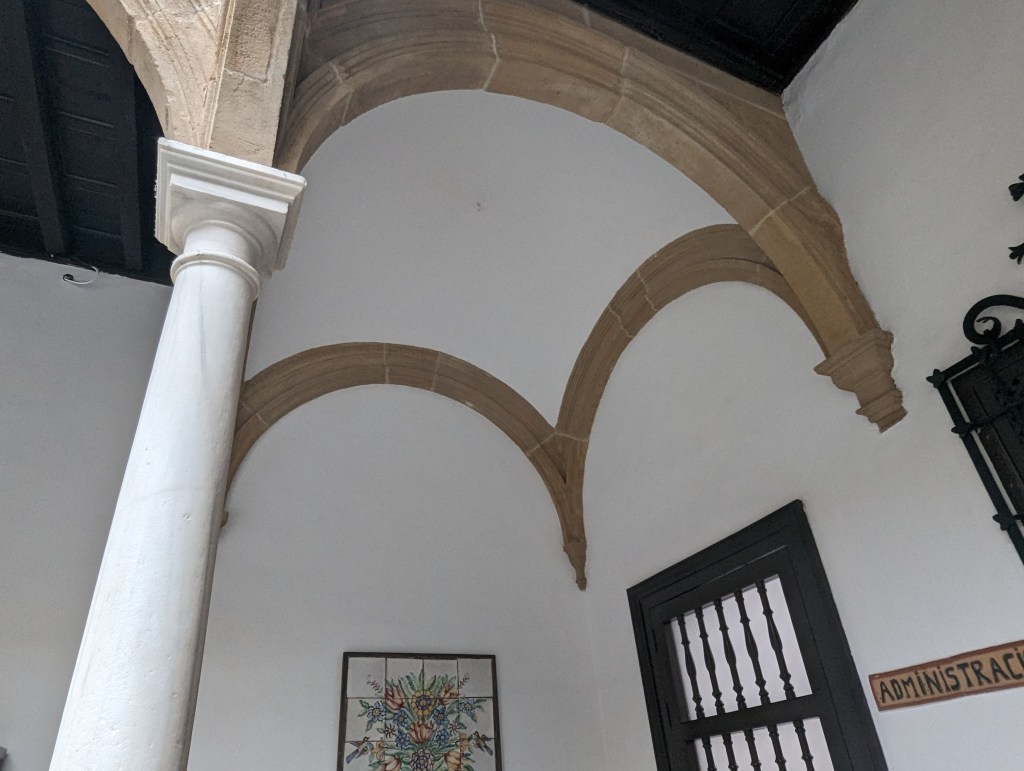
And in the corners can be seen a second signature element of Andrés de Vandelvira: a “handkerchief” ceiling.

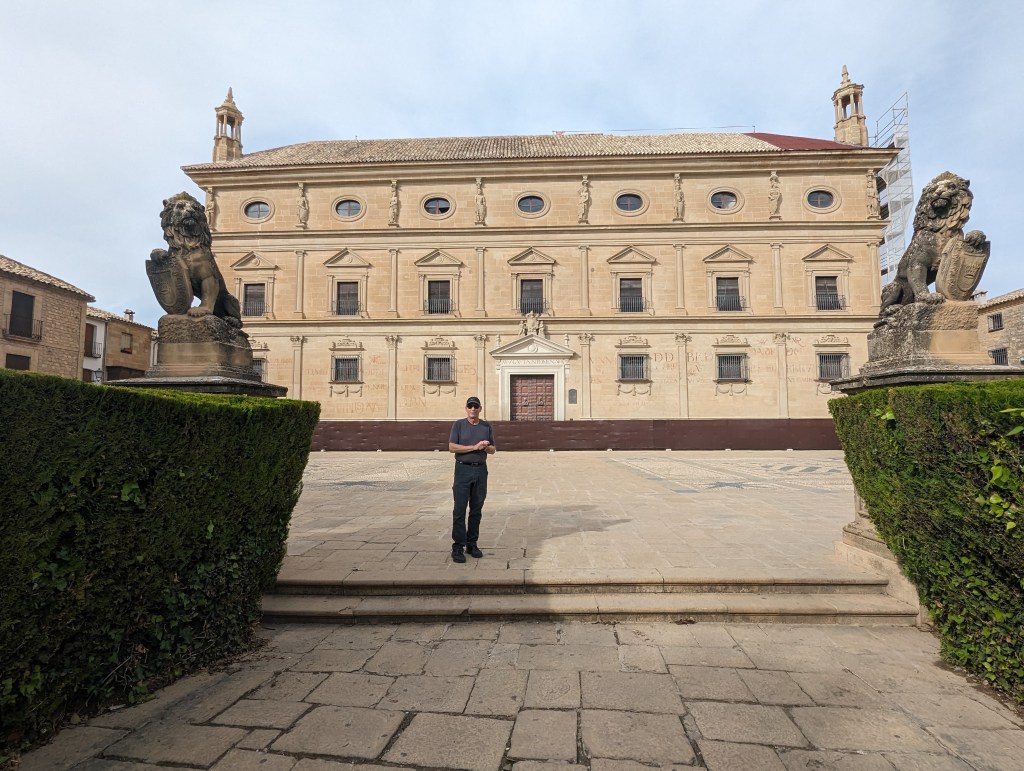
Also in the Plaza Vázquez de Molina is another building of one of Francisco de los Cobos nephews: Mancera Palace. But it was never lived in as a palace and became a monastery.

Mancera Palace

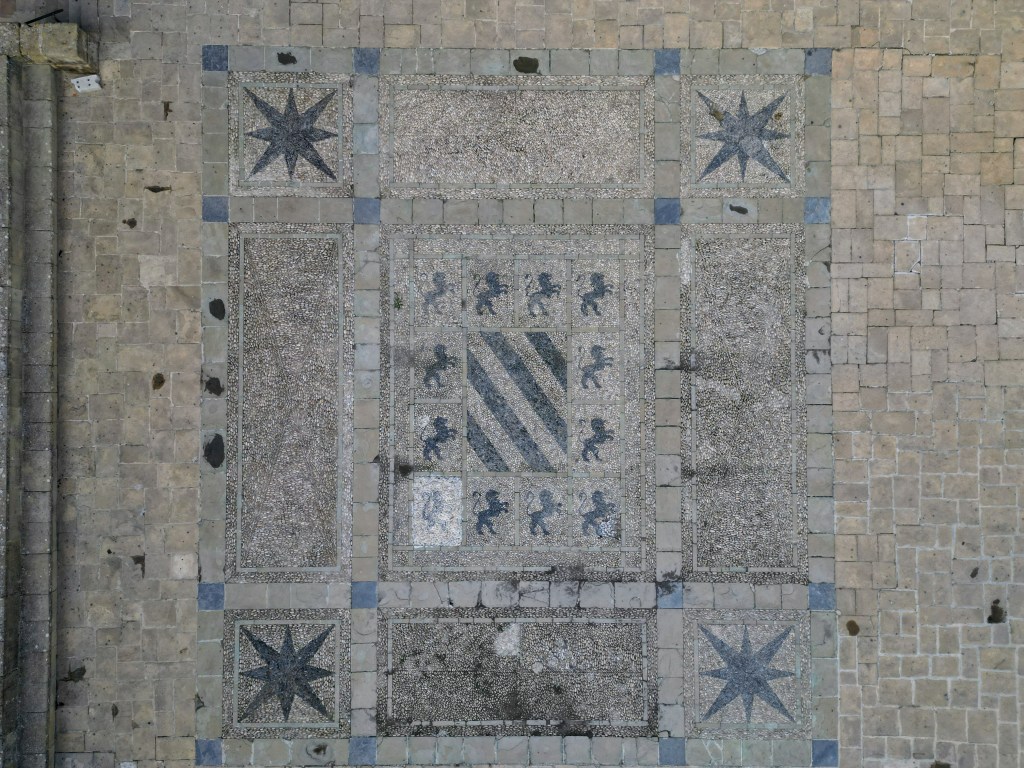
In front of the Mancera Palace are representations of the 12 men who defeated the 12 muslims in the fight for the kingdom in 1233, represented as lions.

drone shot ground in front of Mancera Palace

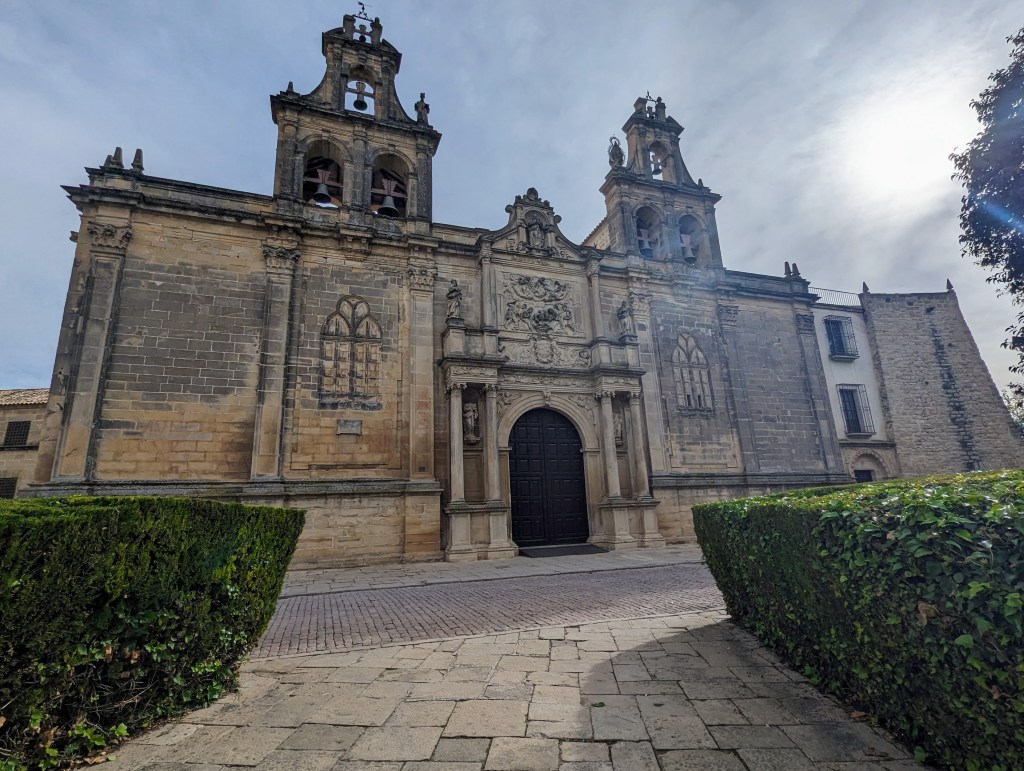
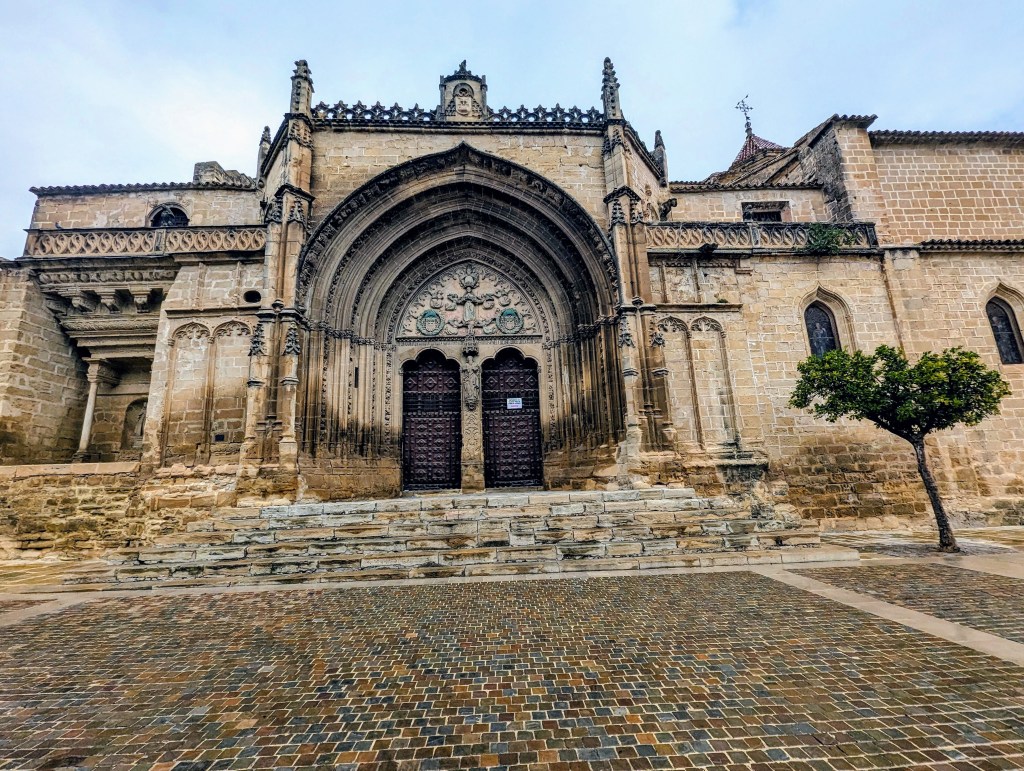
Also in the same square is the Church of Santa María de los Reales Alcázares on a site formerly a mosque. Like I said above, a lot of monuments in one place.

Church of Santa María de los Reales Alcázares

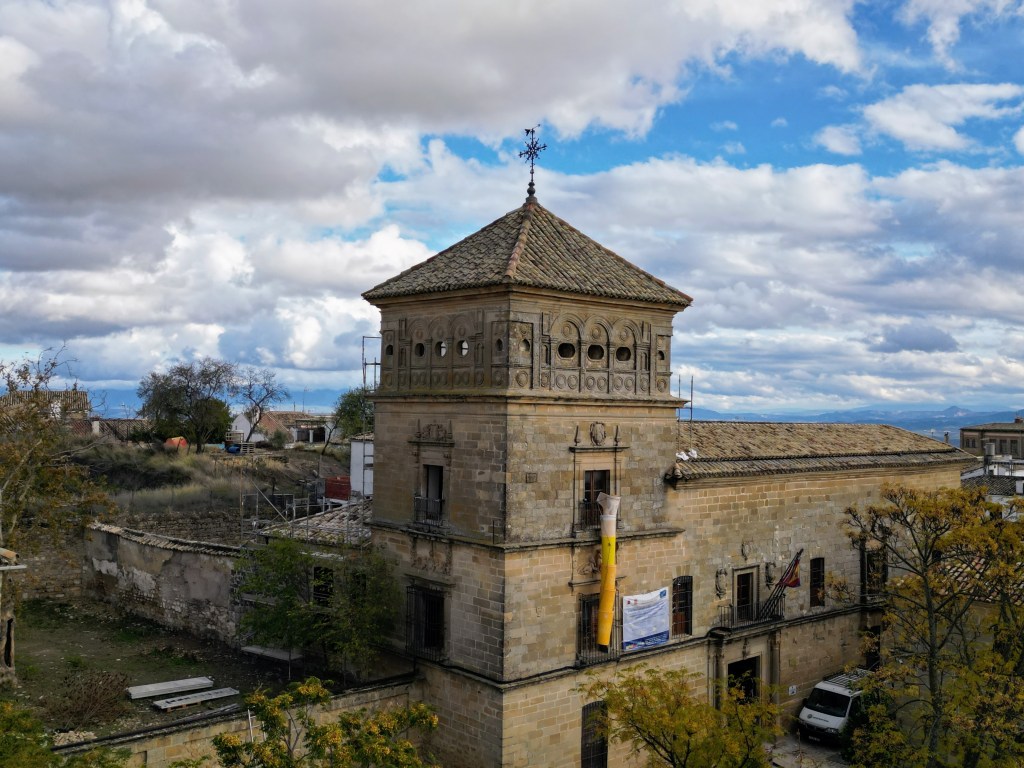
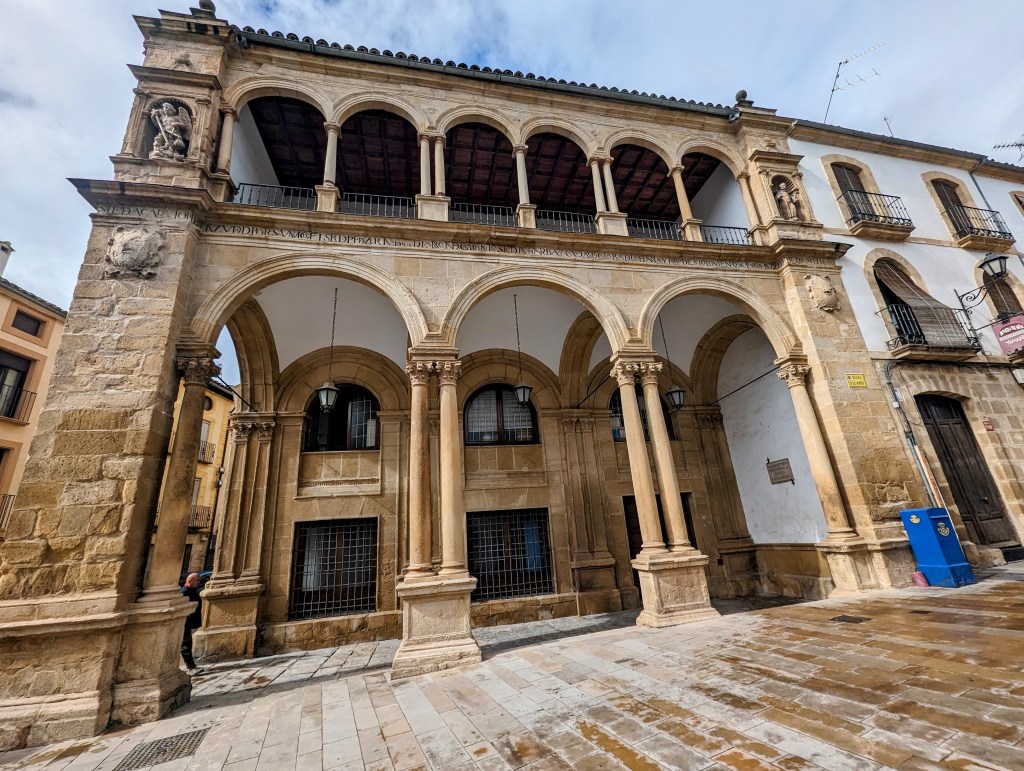
Just off the square are two other important buildings: city hall and the police station. City Hall was built as a palace.

City Hall Ubeda

What is now the police station was built to be a home for women who never married but did not become nuns and whose families could not afford to keep them. They were housed and given honest work to keep them off the streets.

Police station

Walking around town, we entered the Jewish Quarter. Because the fall of the muslims in 1233 was relatively benign, a battle of 12 vs 12, the Jews, Muslims, and Christians coexisted in relative harmony until the Inquisition started. The pillars in the Jewish Quarter have representations of the 12 tribes and the Star of David.

We walked past the 16th century Church devoted to St. John of the Cross, a devotee of the Barefoot Carmelites. He died at the monastery here, but due to a postmortem fight with the monastery in Segovia, only parts of his body are buried here, and parts in Segovia.

We also walked into Plaza de 1 de Mayo. The market was located here in the Islamic era. Bullfights also took place in this square, like other public events. Executions, including those of the inquisition, were also carried out here.

Plaza de 1 de Mayo

At the end of the square is the Church of San Pablo, which is the oldest in Úbeda. It was originally built by the Visigoths. The back of the church has some of the original wall.

back portion of Church of San Pablo

The front façade is Romanesque. Note the balconies on either side of the front. In the 15th century the church was used as the town hall, and announcements were made from the balconies.

Church of San Pablo

On the corner of the Plaza de 1 de Mayo is this building built in the 16th century to be the new town hall. It is currently a music conservatory.

Music Conservatory

Another interesting note is the number of palaces in Úbeda. At the height of its wealth in the 16th and 17th centuries, there were as many as 250 palaces. Today there are 19 that remain, many of which are hotels or museums. One is still privately owned, but because it contains many original furnishings, treasures and art works, it opens to the public on occasion.

privately owned palace

Note the white marble column on the side, identifying the the architect as Andrés de Vandelvira.

Once the walking tour was finished, we felt compelled to enter the Sacred Chapel of the Savior of the World.

Sacred Chapel of the Savior of the World interior

In the ante chamber before the sacristy is a signature handkerchief ceiling.

After an amazing lunch at Restaurante Antique, we decided to visit the synagogue. The Water Synagogue was discovered in 2010 when a private person was undergoing a demolition for a new home having bought a group of adjacent properties because they shared walls.

Sinogoga de Agua
column with representation of the 12 tribes

It was the above column that made the archeologists suspect that this had belonged to Jews, but it was the finding of the women’s gallery above that made them believe it was a synagogue.

women’s gallery

The synagogue gets its name from the natural springs that run underneath and feed the mikvah. Today the water is still crystal clear.

The complex also includes a kitchen with still intact and half buried storage bowls.

Before leaving town, we got some drone views of the major monuments.

In the morning we were off to Córdoba. Once again we had booked a hotel incredibly well located. Hotel Madinat is in the heart of the old medina of Córdoba, in the historic center. From their website: This traditional Andalucía nowadays, the Madinat Hotel, maintains the appearance of an old-style Casa-Patio run by the bourgeoisie of the late nineteenth and early twentieth centuries. Its previous owners include an ex-mayor of the city who was an intimate friend of Julio Romero de Torres and commissioned numerous paintings, including the first poster for the town fair in 1912. The first radio broadcasts in the city were also carried out here in 1929. Its present beauty evokes that period of eclectic modernism through carefully restored features such as rich mouldings, original tiles, paintings and furniture.

view of internal courtyard from our room

Once settled in, we headed out to visit the Mosque-Cathedral of Córdoba. The building embodies the history of the area. It was originally built in the mid 6th century as the Visigothic Basilica of Saint Vincent. In the mid 8th century a mosque was built upon the remains. Two years later a minaret was added. As the city grew and prospered, the first extension was added in the mid 9th century, and a new minaret added in the mid 10th century. A second extension was added in the latter half of the 10th century followed by a third extension by the end of the 10th century. At this point it had the capacity for 40,000 worshipers. Following the conquest of the Muslims in the early 12th century, the Christian cathedral was dedicated in 1146. The Royal Chapel was completed in the mid 14th century. In the 15th century a Gothic basilica-shaped nave was erected within, removing 50 original columns. The bell tower was added in the 16th century, the dome of the transept and the vault of the choir in the 17th as well as the main altarpiece. The choir stalls were added in the 18th and restorations were made in the 19th century. In 1984 it was declared a World Heritage site by UNESCO. Restorations have been ongoing.

One enters the Mosque-Cathedral through the Patio de los Narangos (The Oranges Courtyard) full or orange trees, palms, and cypresses.

Patio de los Naranjos

Then through the main gate.

Upon entrance we were immediately awed at the enormity of the space as well as intrigued by how different it was from every other cathedral we had seen. The columns are all double tiered.

A mihrab is a niche in the wall of a mosque that indicates the qibla, the direction of the Kaaba in Mecca towards which Muslims should face when praying. The columns in front of the entrance to the mihrab are different to demonstrate its importance and position.

The entrance to the mihrab is inscripted in gold with passages from the Quran.

This mihrab is the earliest known to be a room and not just a niche, cannot be entered by tourists. It is elaborately carved white marble.

Right next to the mihrab is what was converted into the sacristy of the cathedral. The cathedral is dedicated to Our Lady of the Assumption. The sacristy has a beautiful marble sculpture dedicated to her.

As in most cathedrals, there are many chapels around the periphery. At the front is the one dedicated to Our Lady of the Assumption.

Chapel of Our Lady of the Assumption

In the center of the building is the main chapel.

main altarpiece

The ceilings, both Muslim and Christian, are all stunning throughout. But the one over the choir is particularly breathtaking, said to be inspired by the Sistine Chapel in Rome.

Having spent several hours in the Mosque-Cathedral, we retired to our room. But first a visit to the rooftop terrace for views of the city.

In the morning we met our walking tour guide Lou at the Plaza of Tendillas located where the historic center of Córdoba meets the modern. We were her only clients.

Monument to the Great Captain 

It is surrounded by examples of typical 19th century Spanish architecture.

Bank of Spain

Lou then took us for a view of the tower of the Mosque-Cathedral seen through the Calle de los Flores, Road of the Flowers.

Calle de los Flores

We then entered the Jewish Quarter with it’s narrow winding streets. The apartments open onto central courtyards.

We entered the synagogue.

the women’s gallery is to the left

Outside was a statue of Maimonides.

Lou also pointed out the symbols that can be seen on the roads throughout Spain that are of the Camino de Jerusalem: the Sephardic Jewish path to Jerusalem.

We strolled past the Alcázar, fortress of the kings, which we would visit later.

We stopped by the Royal Stables, which was built by order of Philip II in 1570 on part of the site of the city’s Alcázar fortress. With these facilities the King intended to further his project to create purebred Spanish horses. This was the place where the Spanish –or Andalusian– horse was first bred from Arab stock. We were also to come back that night, more on that later.

Beyond the Alcázar is the Jewish wall of the Jewish quarter.

Beyond the Jewish Quarter is the area of Córdoba known for its patios, which are inner courtyards. Every year since 1921 (except during the Spanish Civil War) during the first 2 weeks in May private homes compete for prizes in several categories based on the beauty of their patios. The top prize is 25,000 euros. In order to qualify for the competition the family (or families) must live in the space and maintain the patio on their own. Lou took us to a few that are open to the public.

She also showed us a sculpture dedicated to those who maintain the patios. It emphasizes not only the importance of the patios to the culture of Córdoba, but also the importance of family, passing the tradition from one generation to the next.

Once the tour was over, we headed back to the Alcázar.

The first room is the room of the mosaics.

Honestly, the inside was pretty humdrum; it was all about the views from the tower and the gardens.

view Alcázar Gardens from Tower
view Equestrian Arena from AlcázarTower
view Mosque-Cathedral from Alcázar Tower

Then we went down into the gardens which were immense and impressive despite the end of the season.

On the way back to the hotel we passed the Puerta del Puente, a 16th century gate, built on the site of a previous Roman gate, to welcome King Philip II to the city.

Puerta del Puente

It is at the entrance to the Roman Bridge, which we walked across for a view back at the city.

view of Mosque-Cathedral from Roman Bridge
Puerta del Puente

We went back to rest up for our big night out. We had tickets to the Equestrian Show! The Andalusian horses have been trained in dresage and put on a nightly show in the equestrian arena seen from the tower. There are not more than a few hundred people in attendance around the arena; it is an intimate feeling (very dissimilar to when I saw the Lipizzaners in Madison Square Garden). Alas, pictures were not allowed. But the show was AMAZING! The show started with a single flamenco dancer on a platform, which was then removed for the horses. There were routines with multiple horses dancing in precision interactions (picture an aerial show or the Rockettes). Others had single riders showing intricate dance moves by the horse. In one routine the horses were led by rope and hand motions to dance by themselves. One involved a single rider with a long pole which the horse dance around. There were a couple where the horse and rider danced with a flamenco dancer. I have copied a couple of pictures from the internet to show.

Just spectacular! After the show we went for dinner at El Cabello Andaluz (The Andalusian Horse, fitting).

We felt the need to break down and finally try the Andalusian specialty flamenquin, which is basically rolled layers of meat, cheese, and ham breaded and deep fried. We were not any more impressed than we had expected.

What a full day. In the morning, before leaving town, I wanted to see the Roman Temple built in the first century and discovered in the 1950s during the expansion of City Hall.

Roman Temple Córdoba

Then we were off to Seville. There we had rented an AirBnb for a few days, our last of the trip (laundry time again). Once again we were in the heart of the old city with views, this time of the cathedral.

view of cathedral tower from our terrace

We walked all around the neighborhood to familiarize ourselves. As in Córdoba, there are plenty of examples of typical 19th century Spanish architecture.

Spain has some of the most gorgeous and huge varieties of ficus trees.

In the morning our walking tour started at the Spanish Plaza which was built for the 1928 Ibero-American Exposition. We met by the North Tower where horse drawn carriages line up for the tourists.

North Tower Paza de Espania, Seville

Unfortunately the entire plaza was closed due to a huge storm that had come through in the prior days knocking down trees and making it unsafe. The only building visible was the Seville Pavilion, which is now a cultural center.

We passed the University of Seville.

University of Seville, built 1505

And stopped in front of the 18th century Royal Tobacco Factory. We were told tales of the cigarillos, the women who were the laborers that rolled the cigarettes. They were generally gypsies, the most famous of which is Carmen, for whom the opera is named. Whenever the factory tried to lower their wages or increase their hours, the entire gypsy community would turn out in protest: one of the earliest examples of collective bargaining.

Royal Tobacco Factory of Seville

We walked by the Alfonso XIII Hotel, commissioned by the King of Spain to play host to international dignitaries during the 1929 Exhibition. Its Moorish detailing is typical of Andalusian architecture.

Alfonso XIII Hotel

We walked by the Golden Tower which was built by the Moors in 1220 as a watchtower to protect the city on the bank of the Guadalquivir River. In the Middle Ages it was used as a prison. It was damaged in the 1775 Lisbon earthquake, but has been restored and now is a museum of military history.

Golden Tower

Miguel de Cervantes, author of Don Quixote lived a large portion of his life in Seville and wrote his famous novel here. There are many statues of him scattered throughout the city.

Miguel de Cervantes

We then went into the Plaza Nueva (New Plaza) in which stands City Hall. It is a Plateresque-style building, which means the reliefs are in the style of a silversmith. It was a style popular in Spain in the late 15th century. This week there is a book fair going on in the plaza.

With a closer look at the façade, one can see that the right side was never decorated. There was an extension made in the 19th century, funding ran out, and now there are restrictions to changing historical buildings.

We finished our walking tour outside the Cathedral of Seville with its famous tower. It was originally built as a mosque in the 12th century. The cathedral, finished in the 16th century, is one of the largest in the world, the largest in Spain, and is the largest Gothic church in the world.

Cathedral of Seville

The Giralda bell tower was originally the minaret of the mosque. The belfry was added in the 15th century. The statue on its top, called “El Giraldillo”, was installed in 1568 to represent the triumph of the Christian faith.

Giralda Bell Tower

A copy of El Giradillo now is on street level.

Here we also found lots more horse drawn carriages.

After the tour we took a walk and found an Asian-Spanish fusion tapas place where we had the most delicious late lunch.

Eric then left for his poker tournament, and I headed out for a walking tour of the Jewish quarter: Santa Cruz. While waiting for the tour to begin, we were entertained by a Flamenco street dancer.

As typical, the streets were narrow and winding. But then we came out onto Plaza de Alfaro with this famous balcony:

Rosin’s Balcony

The legend is that the love story that unfolded at this balcony was the inspiration for the Barber of Seville. Seville likes to boast inspiration for many operas in addition to the 2 mentioned: The Marriage of Figaro, Don Giovanni, and several more.

Santa Cruz also has examples of what were Jewish apartment housing complexes with central courtyards now transformed into lush high end hotels.

Hotel Las Casas de la Judería

Church of Santa María la Blanca was built as a mosque in the 12th century but after the conquest of the Moors in Seville in 1248, it was given to the Jews by Ferdinand II as a synagogue. In 1391 after the anti-Jewish revolt in Seville, it was transformed into a church.

Church of Santa María la Blanca

Around the side is the original synagogue entrance.

On the street in front of it can be found the Jewish Camino symbol.

We finished our tour on Mármoles street where there are 3 Egyptian granite columns almost 9 m high, set on local marble bases. They were made in the time of the Emperor Hadrian and possibly formed part of some Roman temple.

When I got home I was treated to this sight through the window.

Eric was knocked out of his tournament making him available for more sightseeing the next day. After morning errands and some shopping, we headed to the cathedral to see the inside. First we climbed Giralda Tower for the views.
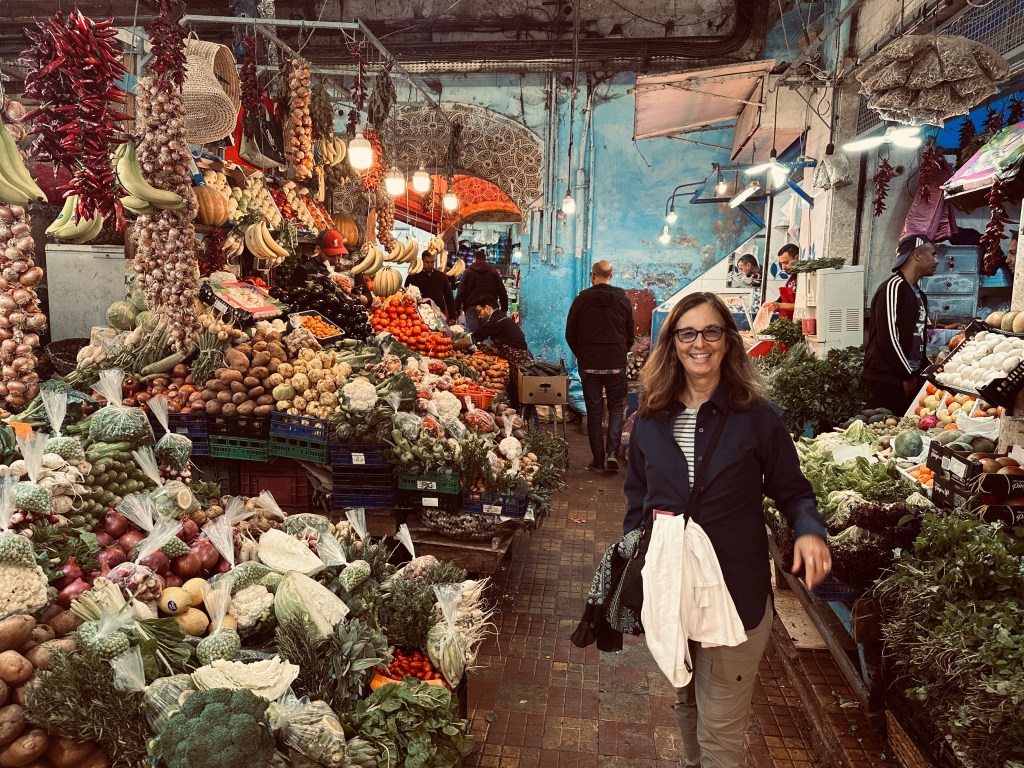
view Alcazar from Giralda Tower

The we went into the church. The height is overwhelming, the size awe inspiring. We spent several hours with audio guides exploring, so much to see.

Among the many notables buried in the church are Christopher Columbus and his son. Below is the monument over his tomb.

Tomb and monument of Christopher Columbus

In one of the side chapels is the baptismal font.

There are so many splendid side chapels it is hard to pick one to show, but below is the largest and tallest and is one of my favorites due to the elaborately carved marble statues.

There are many beautiful works of art throughout the cathedral. One of the most famous is that by Francisco de Goya painted in 1818 of the sisters Saints Justa and Rufina, natives of Seville, at the moment Saint Rufina was thrown to the lions and her sister ran to her side. The lion is lciking Saint Rufina’s feet, depicting her taming of it. The Giralda Tower can be seen in the background.

The Chapter Room is for meetings. Leather covered benches can be seen against the walls, which are purposely left empty making the space even more impressive. The painting of The Saviour fits perfectly into the oval shaped ceiling; obviously it was painted for this space.

In the sacristy are many beautiful treasures one of which, Spain’s most valuable crown, the Virgen de los Reyes. It has over 11,000 stones and the world’s largest pearl (pictured below, used as the angel’s torso).

The choir is typical of many we have seen in the Gothic cathedrals of Spain: intricately carved mahogany stalls with a large central music stand.

The crowning glory is the world’s largest altarpiece. Craftsman Pierre Dancart spent 44 years carving Retablo Mayor from wood. The gilded high altar of Capilla Mayor (Grand Chapel) features scenes from the Old Testament, the life of Christ plus images of saints. At the bottom center is Santa Maria la Sede, the cathedral’s patron saint

We exited the cathedral through the Courtyard of Oranges with a final look back at the Giralda Tower.

And with that our visit to Seville was complete. On to Cádiz for a beach trip. We had booked in our first modern Parador. The room was not yet ready, so we took a long walk along the beach and out to the 18th century Castle of San Sebastián which is currently closed.

Castle of San Sebastián

But from there we had a great view of the beach and the 17th century fortress Castle of Santa Catalina.

The Castle of Santa Catalina

After a late lunch right off the beach, our room was ready.

The doors completely opened onto a terrace with this view.
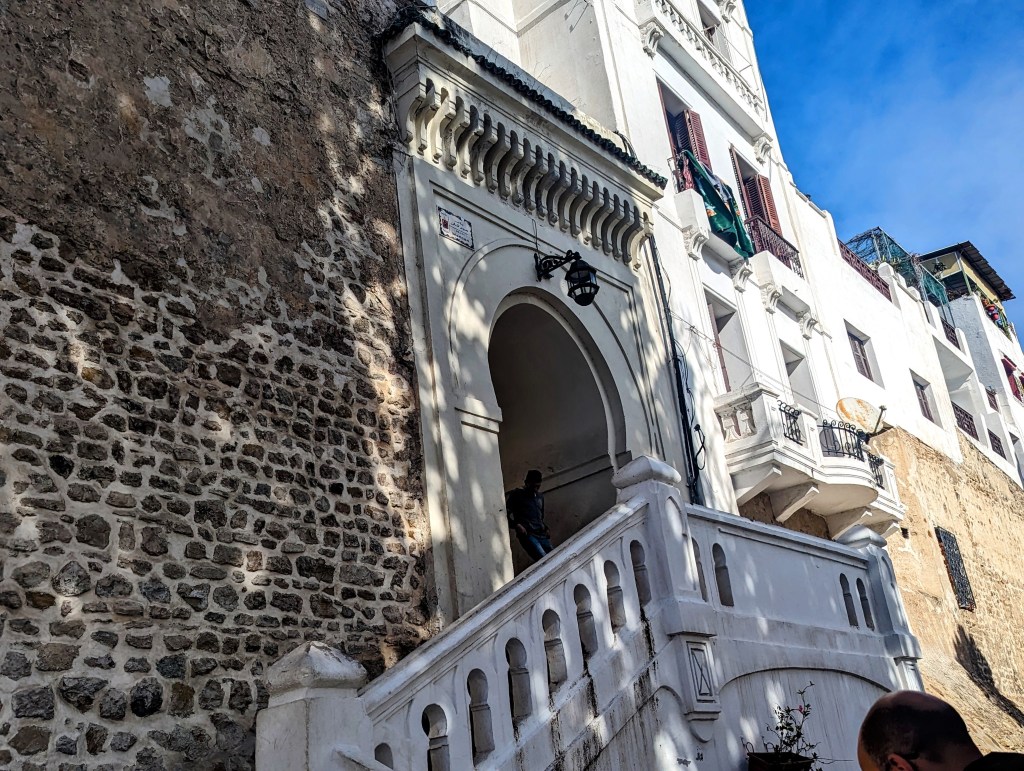
Ah what beauty and relaxation. We took another beach walk at sunset.

In the morning we took a quick walking tour. There’s not a lot of historical significance in Cádiz, but we did learn some fun facts. For one, Cádiz at 3,500 years, is the oldest continuously inhabited city in the Western world. Our tour started in Plaza San Juan de Dios in front of Town Hall flying the flags below from left to right: the Andalusian flag, the Spanish flag, and the Cádiz flag.

The pediment base relief shows Hercules, the legendary founder of the city. He is also depicted on the city flag. The legend is that one of Hercules’ 12 labors to achieve immortality was to separate the continent of Europe and Africa. He was said to have lived in Cádiz at the time.
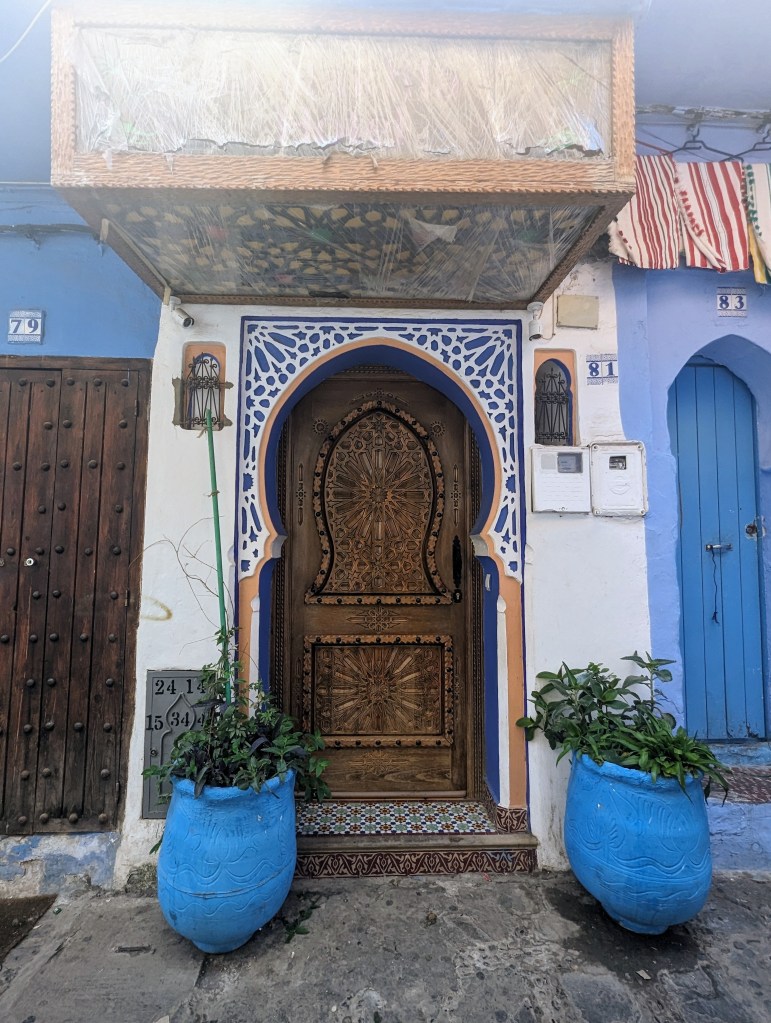
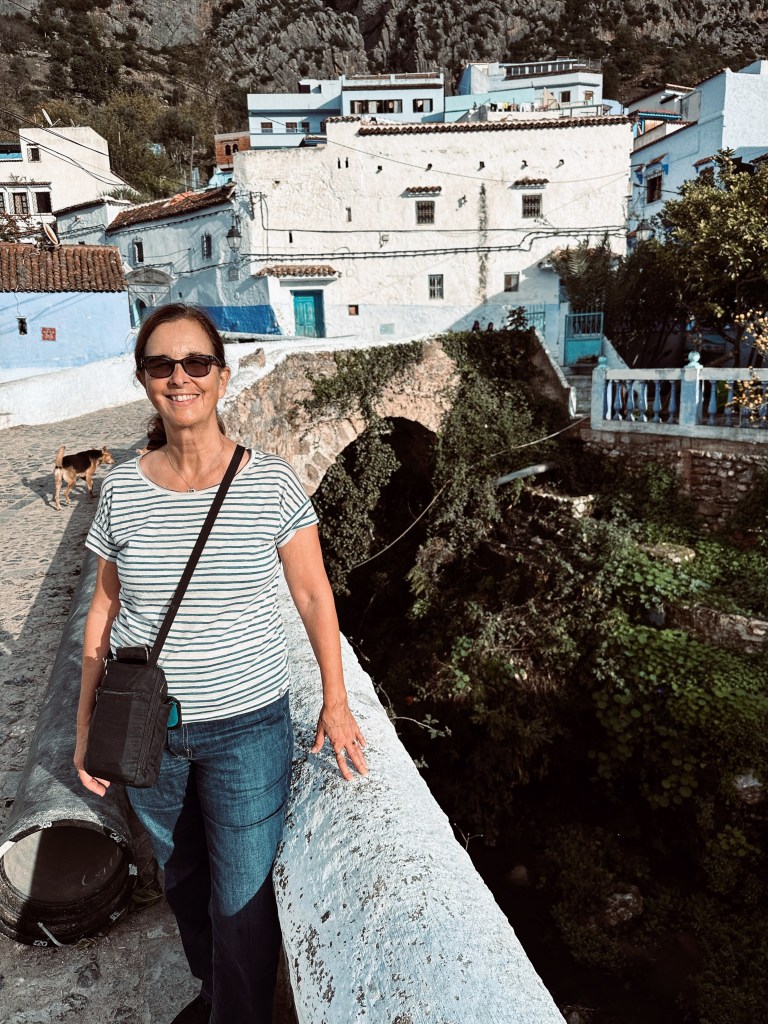
We walked past some Roman ruins.

And toward the water to look back at the Old Town of Cádiz, which is called “Little Havana” based on it’s colorful houses. They are meant to be a cheerful sight for the sailors returning from a voyage.

Another fun fact: in the early days of ships sailing to the Americas, they often left with much more cargo than they had on the return. In order to have enough ballast to weight the boat upright, they often carried back river stones which were then used to pave the streets of the old city.

We passed the 18th century Cádiz Cathedral. Notice the street here in the newer section of town is not that of river stones.

Cádiz Cathedral

In the same square is a cute church.

Iglesia de Santiago Apóstol

Now fun fact #3: When Napoleon was defeated in the early 19th century, his army left behind over 300 canons. Many were melted down for various uses, the most common of which was to protect the corners of buildings on the narrow streets from damage cause by carriages passing too closely.

repurposed canon

As in many Spanish towns, the post office is impressive.

As is the market.

Being a Monday, the market was very quiet; no fish sellers. But worth a peek inside to see the preserved columns.

After the tour, we headed back to the beach. Along the way we passed yet another amazing ficus tree.

In the morning we drove to the city of Algeciras to return our rental car after 51 days of driving. We then caught a taxi to nearby Tarifa where we checked into a tiny guest house tucked into the Old City right against the Old City wall, with a part of the wall exposed in the guest house lobby.

After checking in, we strolled over to the port passing the monument of Sancho IV El Bravo, 13th century King of Castile, in front of the Guzman Castle.

monument Sancho IV El Bravo

The castle was built in the 10th century by the Moors to protect the harbor.

Guzman Castle

We strolled out past the Santa Catalina Castle, built in 1933 as a military base on the site of a previous fortress, but is now abandoned.

There is a long peninsula jutting off the beach of Tarifa and separates the Atlantic Ocean from the Mediterranean Sea.

The next morning we boarded our ferry to Tangier, Morocco.

On the way out of the harbor we passed the staue of Jesus Christ, a fitting goodbye to Spain.