
We arrived in Rabat in the early afternoon. Our hotel was in the middle of the medina.

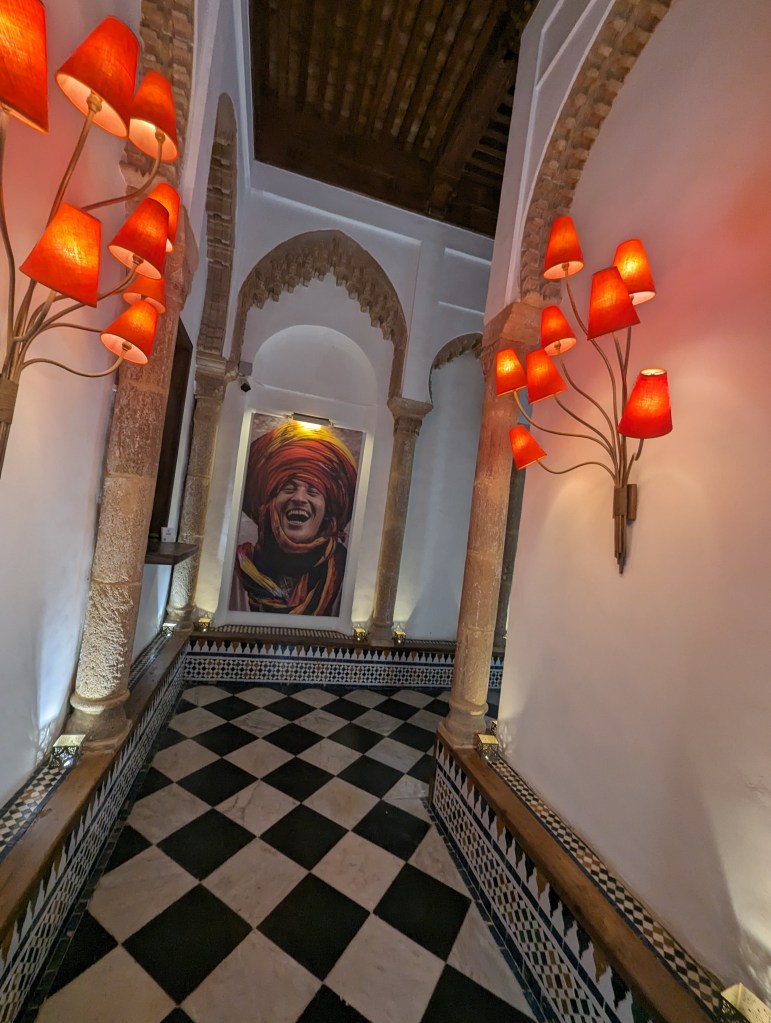
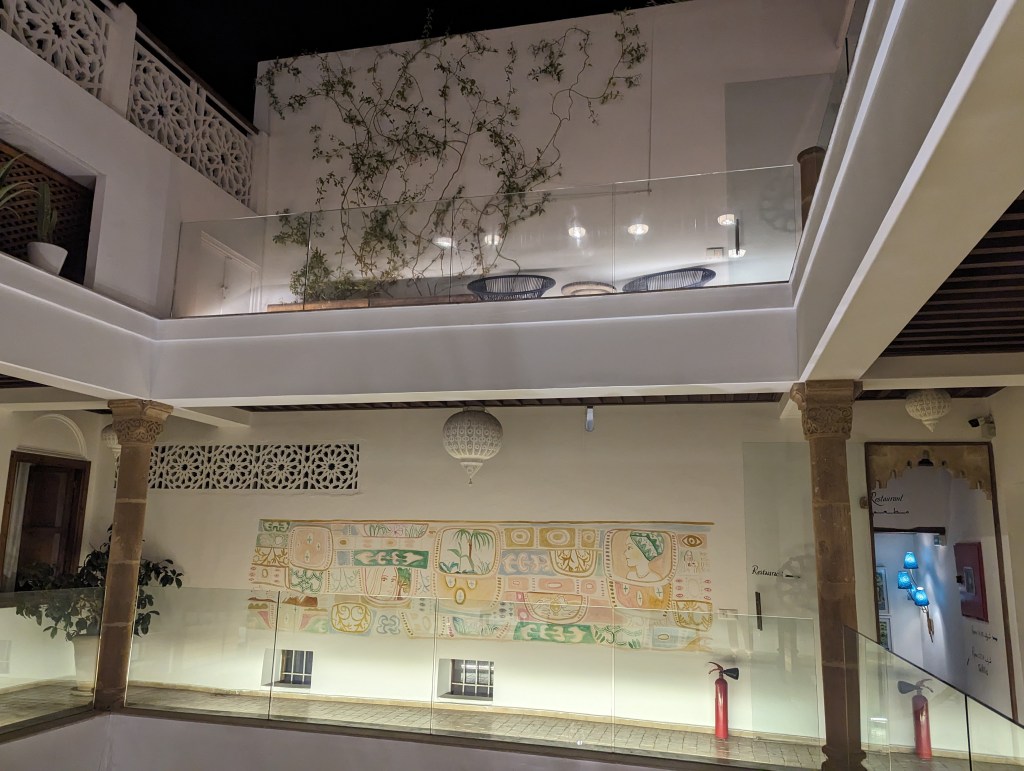
Dar means house or home. Riad is specifically a home with a garden, usually in the center. So not sure why this one is called Dar and not Riad. But note the entrance opens into a hallway. We have been told that the Muslim culture encourages one to be humble. Part of the reason for the long plain robes is to hide any good clothing or jewels. The homes are the same. They are supposed to be humble from the outside so as not to boast wealth. So even with the door open, one should not be able to see into a luxurious space within.
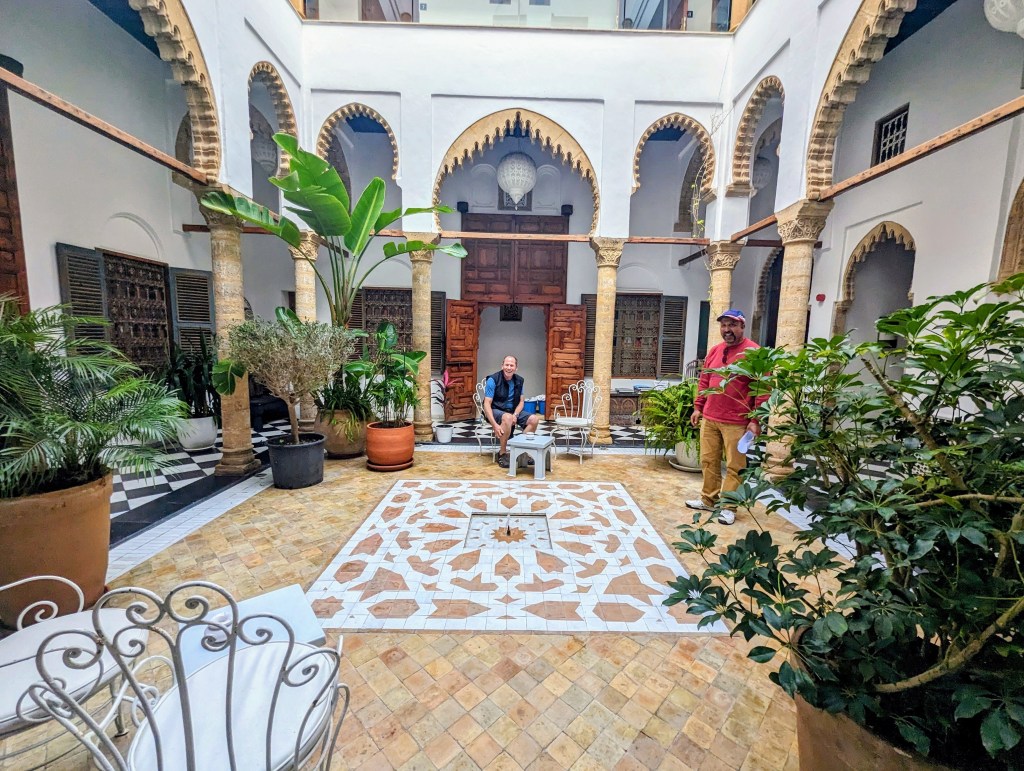
Only once inside does it open into the lush space seen here. The bedrooms in Dar Shaan all open into the courtyard not outside. That is also typical. In a traditional Muslim home, for privacy, there are often no external windows.
Once settled in we took a walk to the kasbah.

Here it is not within the medina but across the street. It had been a site of dwelling Phoenicians, Carthaginians and Romans, but had been mostly tribal. In the 12th century Almohad Muslim tribes established their Moroccan empire. It was then that the first ribat (or, fortress, from where modern-day Rabat takes its name) was built on the site of the current Kasbah. Rabat then became the first Moroccan capital. But over the centuries due to fighting between tribes, the area’s population dwindled. It was not until the 17th century when the last of the Moors were expelled from Spain that many settled here and further developed this fortress as well as the one in Salé across the Bou Regreg River.
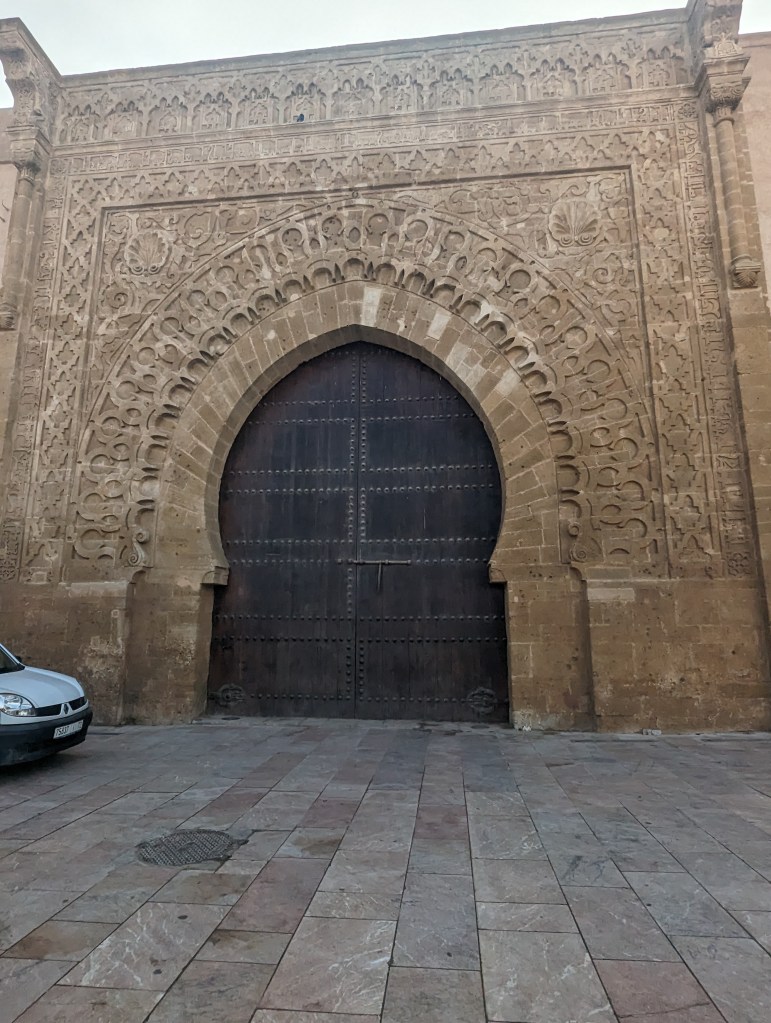
Built in the 12th century, the monumental Bab Oudaya Gate, located uphill and overlooking Rabat below, is considered one of the most beautiful gates of Almohad Moroccan architecture. Once through, the first thing is, of course, a water fountain.

We strolled around looking for the promised gorgeous views. But there was so much mist off the ocean, it was difficult to see far.

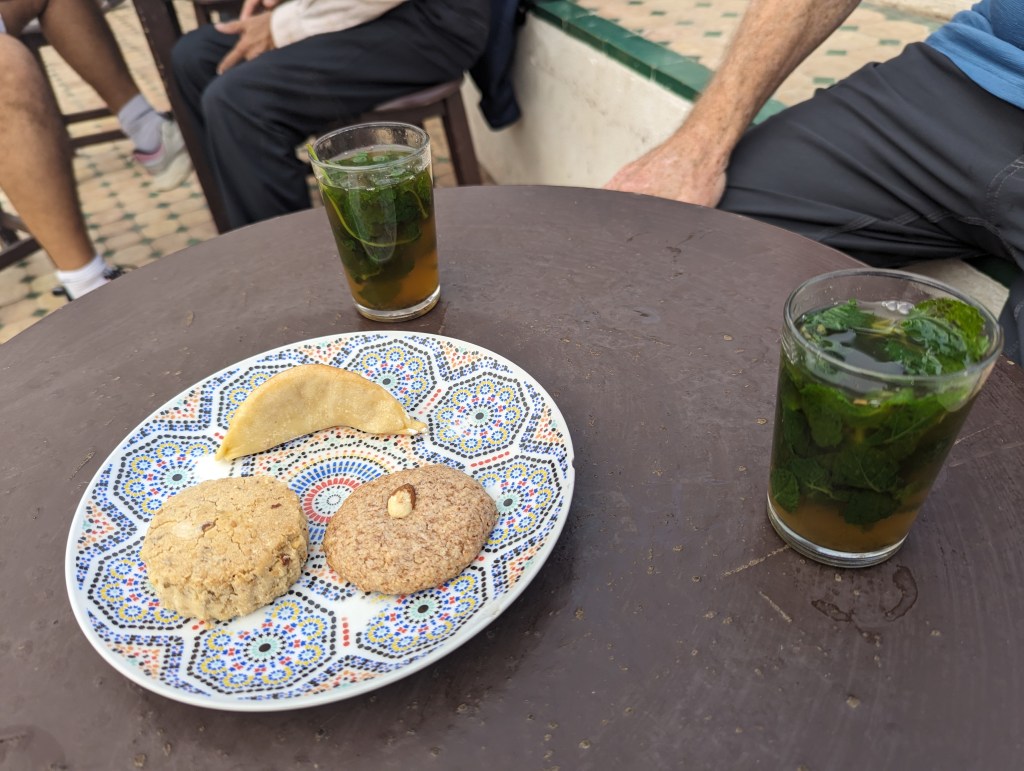
We made our way down to the bottom, newer section of the kasbah and stopped for tea and almond cookies – there were about 7 or 8 different ones to choose from – at Cafe Maure.
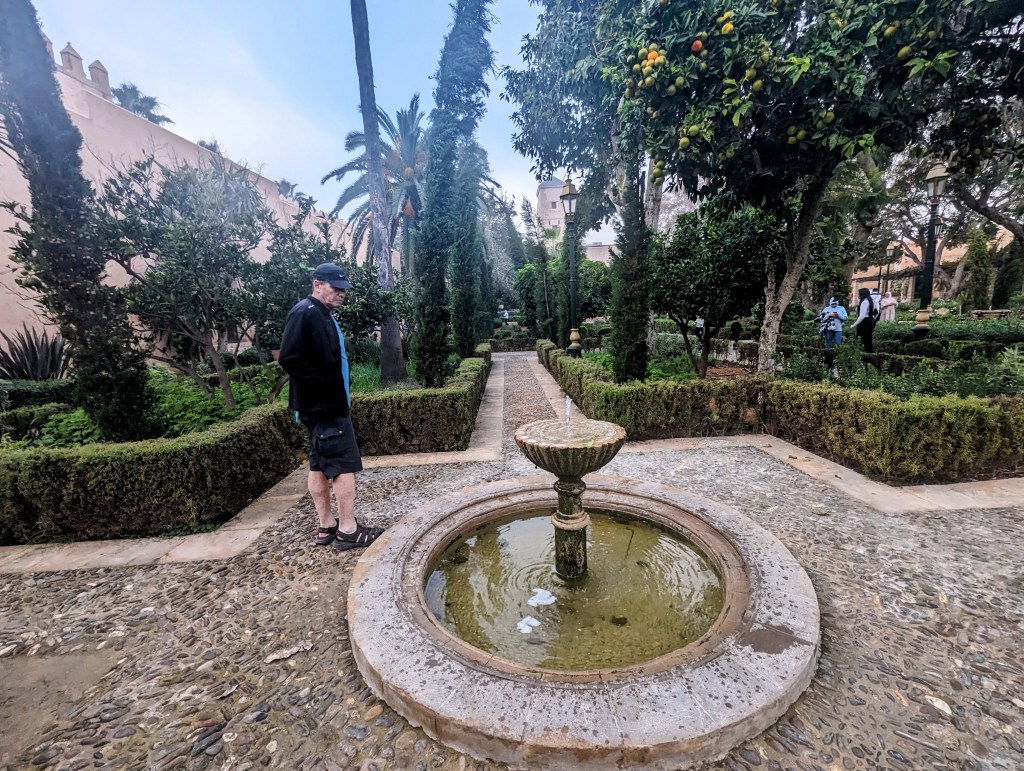
We then strolled through the Andalusian Gardens developed in the early 20th century during the French protectorate of Morocco (more on that later). What makes a garden an Andalusian one are the inclusion of three elements: several levels; a water element; and foods, herbs, and/or fruit trees.

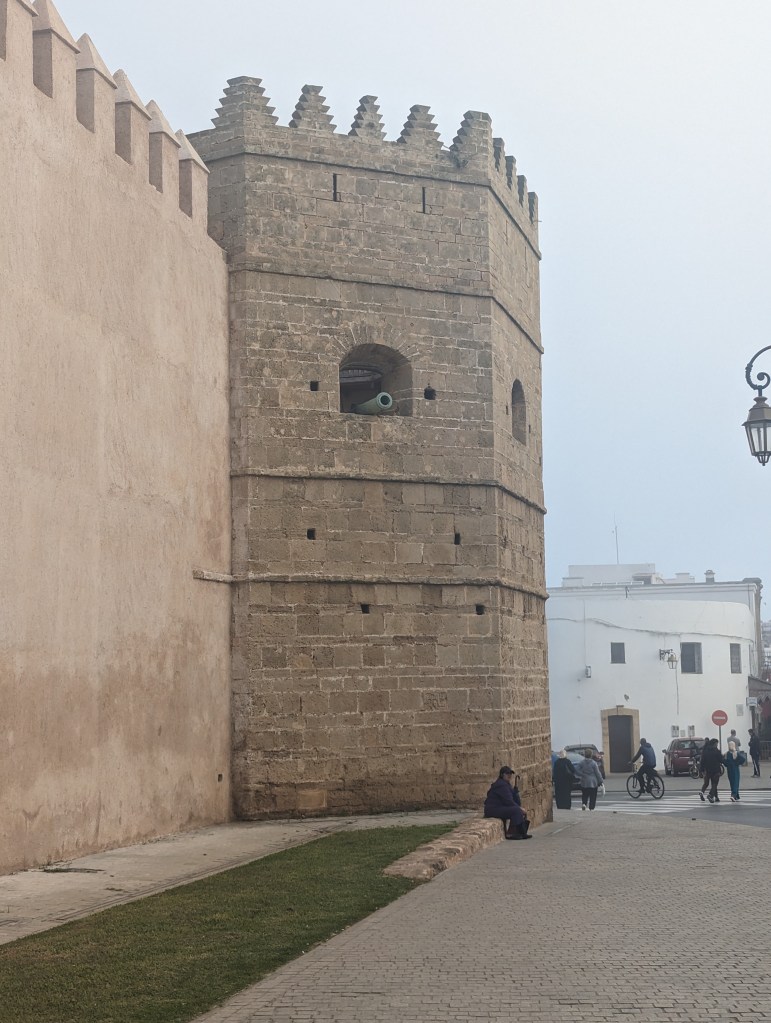
We left the Kasbah from the lower end and had a view of the tower.
We then crossed into the medina, which was really bustling in the late afternoon.

Dinner was tagine in Dar Shaan. We then retired to our room, which, as I’ve said, looked out onto the courtyard.
In the morning we met with our guide Esma, newly graduated from a guide program, one of 2 women in her class of 50. As she walked us into the medina, she explained a bit about the history of Rabat, which is the current capital of Morocco and home of the king. In 1912 France decided that Morocco needed protection. They moved in and controlled Morocco and its resources. They allowed Spain to control the most northern and southern regions, but they kept control of the central portion of the country. The king was called sultan during that time. He was allowed to live in the country but had little power. This period of time is called the time of the French Protectorate. The king was exiled to Madagascar in 1950 but with help from friends returned in 1953 and fought his way back to power. Morocco achieved independence in 1956. One can see in Rabat, more than most other cities in Morocco, the influence of the French in the architecture.
Upon entering the medina, Esma pointed out that you can immediately tell which are the Moroccan homes, those with no windows on the outside, and which are the French, windows and even balconies. The first street of the medina is called the Avenue of the Consuls because prior to the French protectorate it was home to foreign consuls including those of Sweden, Denmark, and Holland. Today it has Moroccan government offices.
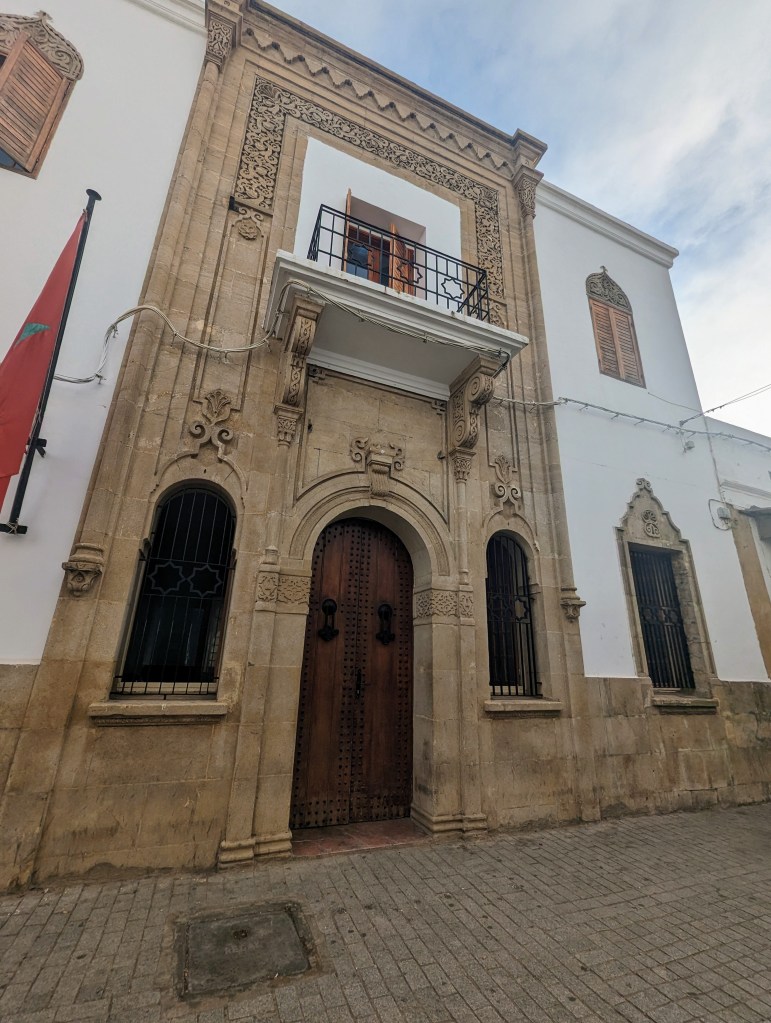
The entire medina has been designated a World Heritage Site by UNESCO, and has undergone major restoration in the last few years as can be seen by the new appearance of the exteriors of the shops.

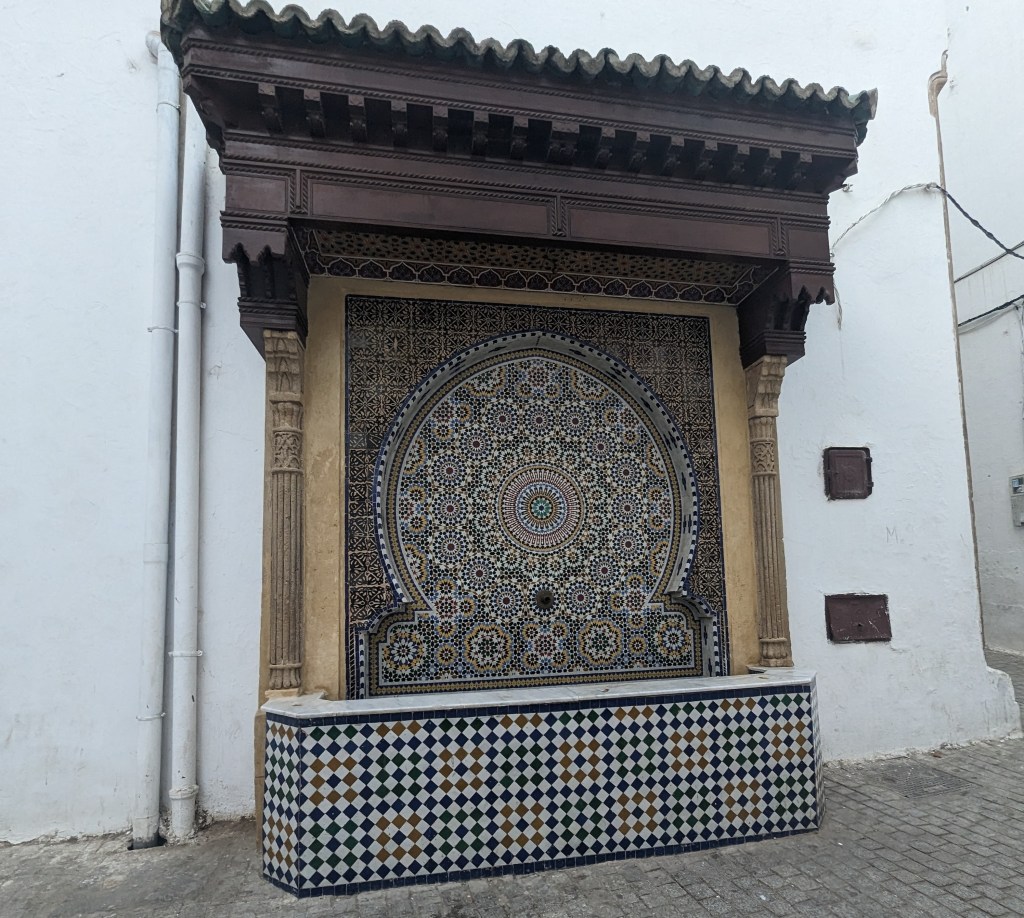
But it also retains the old elements like the water sources.
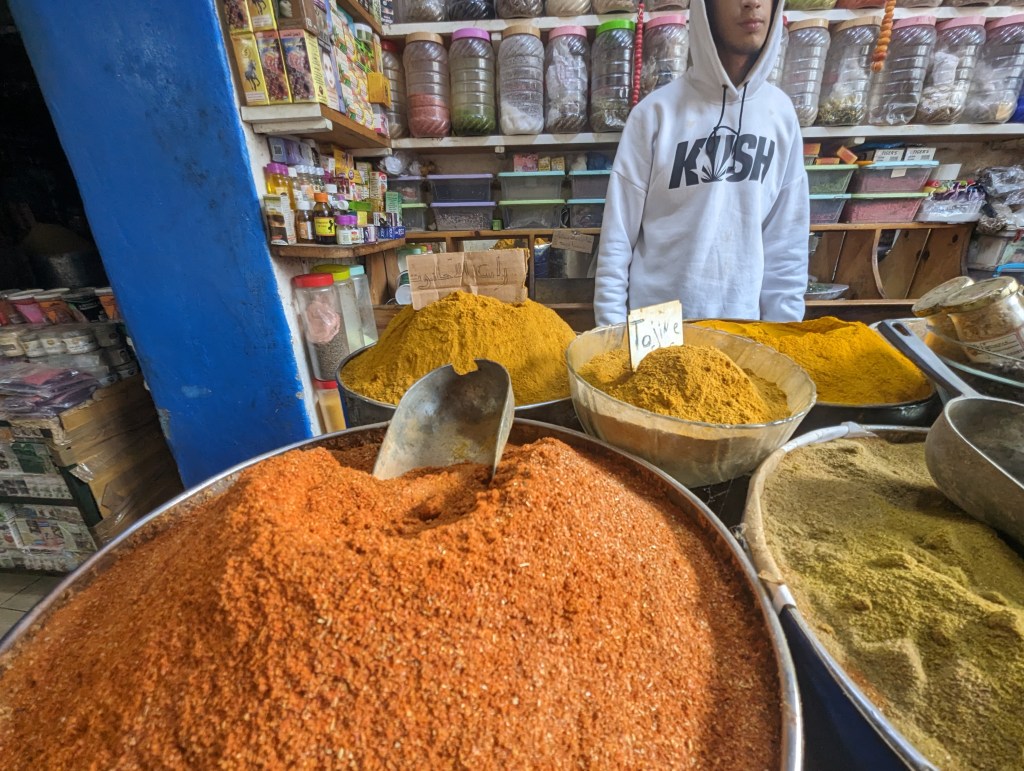
As we walked through the medina she pointed out the different spices popular in Moroccan cooking and teas for infusions.
She showed us the huge variety of oils, infusions, and products for hair, skin, face, and bathing.
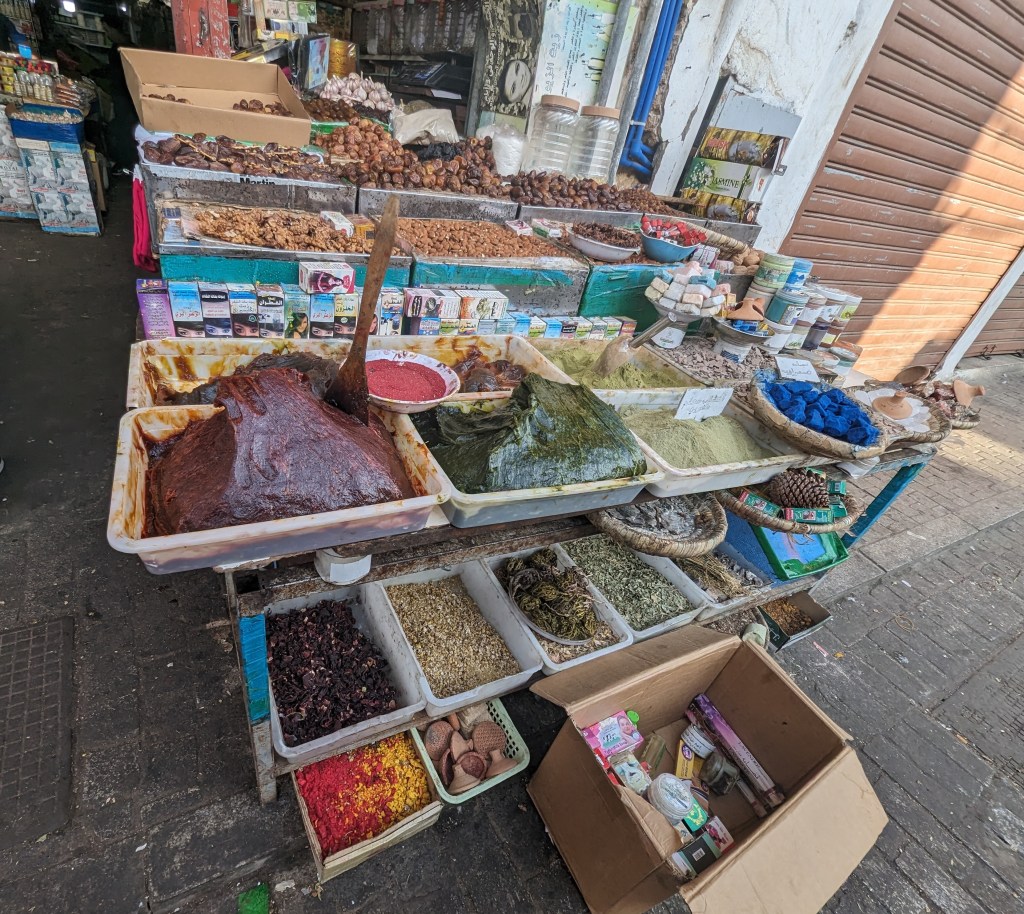
And she showed us the huge variety of dates grown in the country.

Then we left the medina and entered “New” Rabat built during the French protectorate period.

Here can be found examples of early 20th century French architecture. In the building below, when part of it was removed for the adjacent new building, the removed parts were painted onto the new adjoining building to maintain visual continuity.

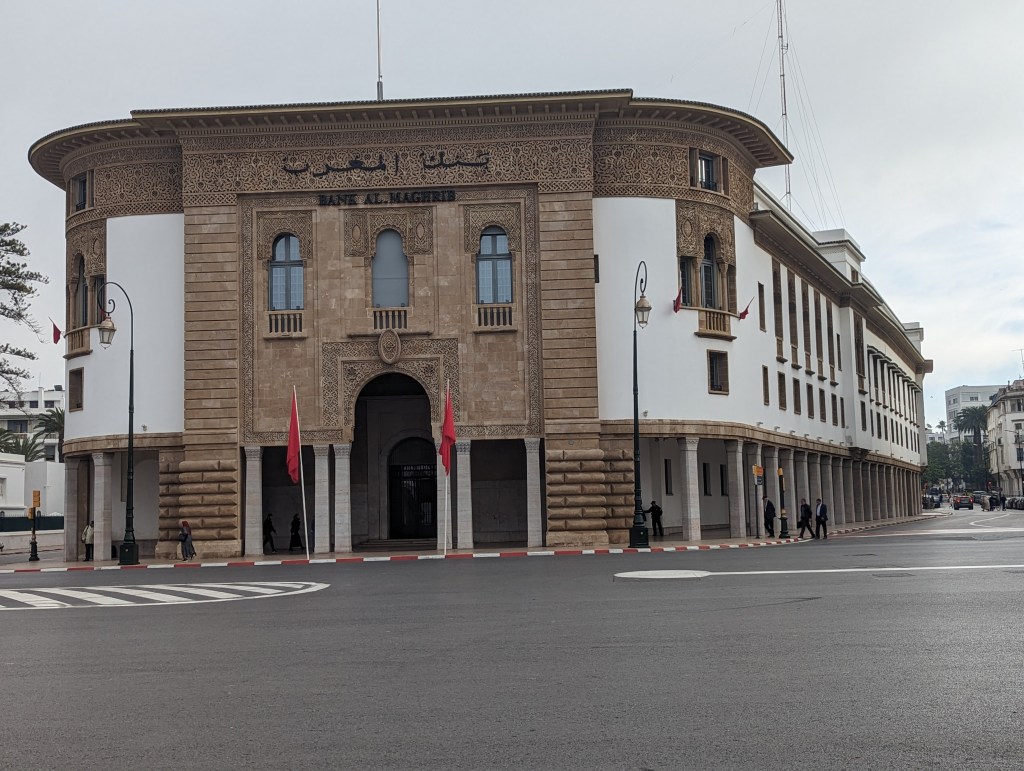
We passed The Bank Al-Maghrib, the central bank of Morocco founded in 1959, after independence. It is the successor to the State Bank of Morocco which had been founded in 1909 to “stabilize” the Moroccan currency for and by European influence. It was built here in Rabat by the French in 1925 to represent the city’s enhanced status as the country’s new capital (transferred from Fez).
We passed the parliament building.

And the train station built by the French in 1925 and currently offering high speed train access to multiple cities around the country.
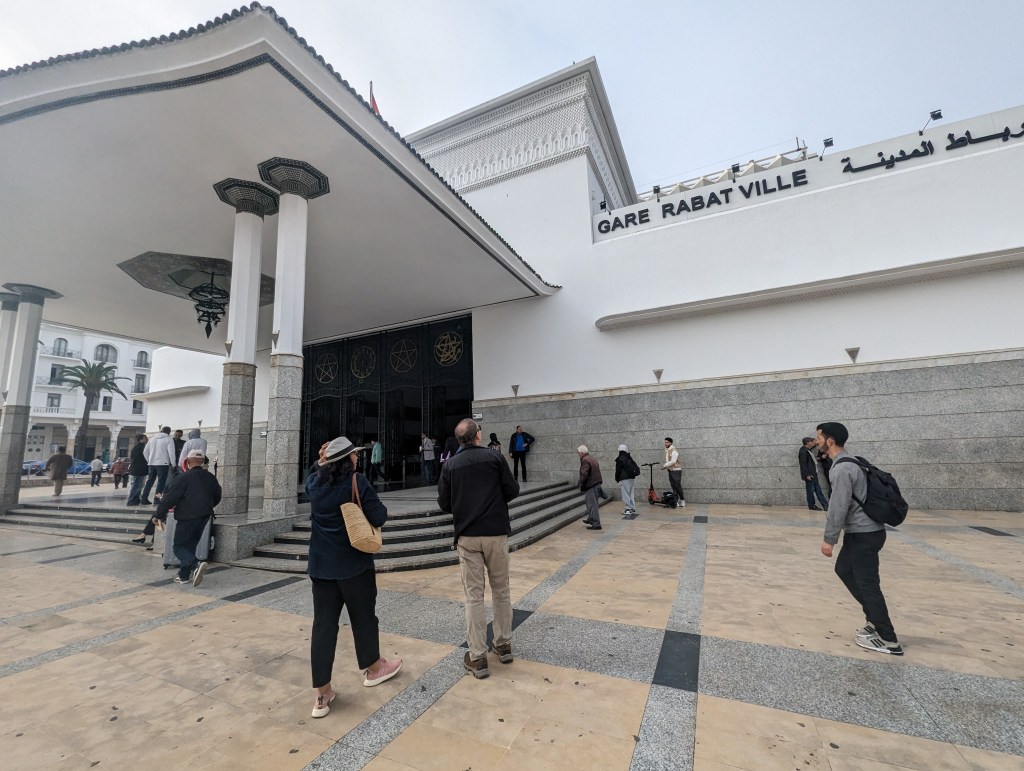
The area in front of the train station and Parliament buildings was the French military parade ground.
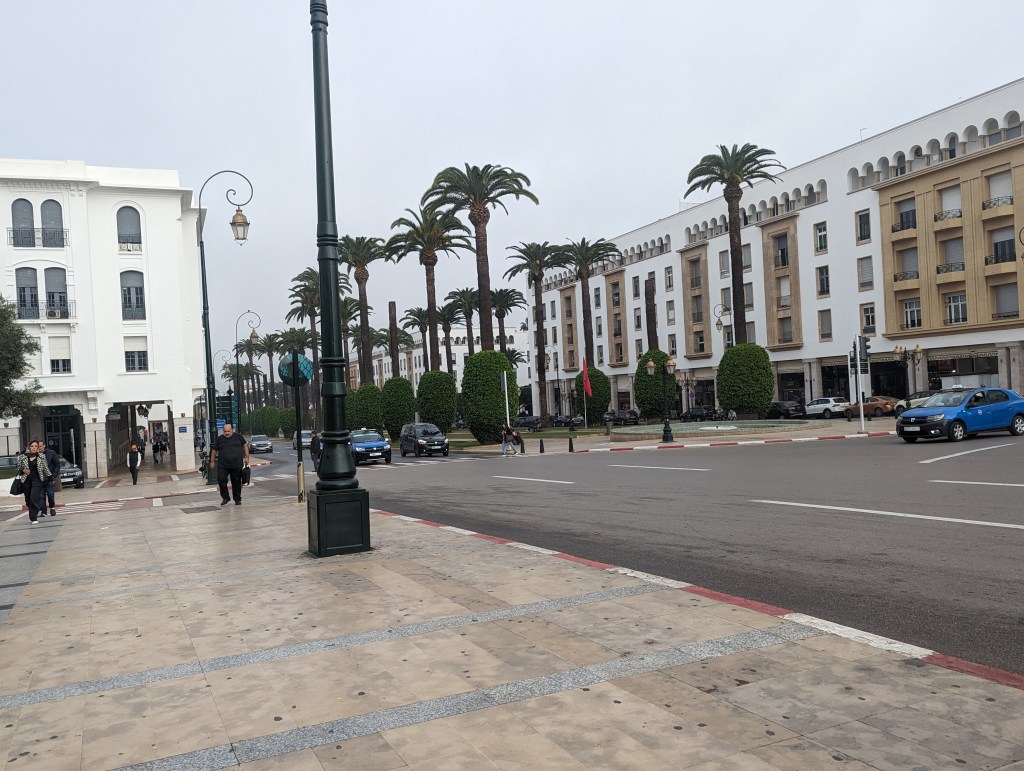
Then we passed the Credit Agricole, a bank of France still in Morocco.

And we passed a French school, which is private and expensive, with ties to universities in France.
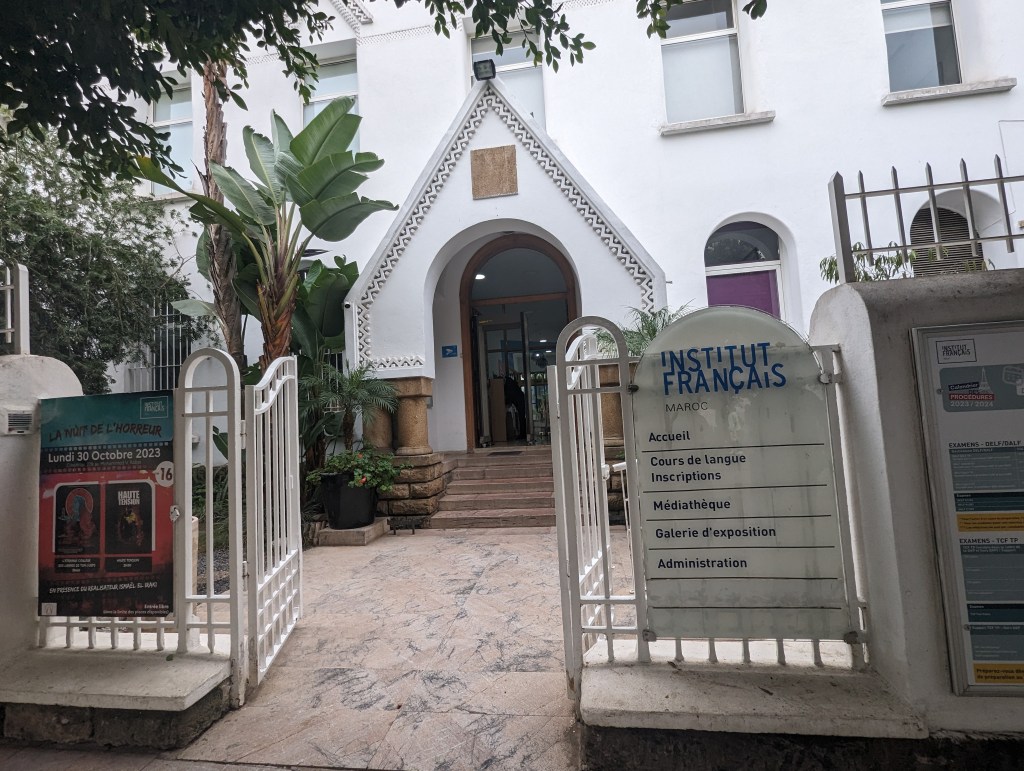
Esma explained to us that the current king has been pushing for years to expel the French influence financially and culturally from his country. In two years French will no longer be the third official language of the country and taught in schools; English will. She went on to tell us that the current king is very popular with the people as is his son. The king’s son is currently enrolled in a public college because he wants to learn as the common people do and understand their experiences. The entire royal family is believed to be in touch with the people of Morocco that they serve.
We then went to the St. Peter’s Cathedral of Rabat. It was built in the art deco style in 1921 by the French. Understanding that Muslims preference for a humble exterior and Muslim law does not allow for depictions of any human or animal forms, the French were respectful and kept the exterior quite plain.
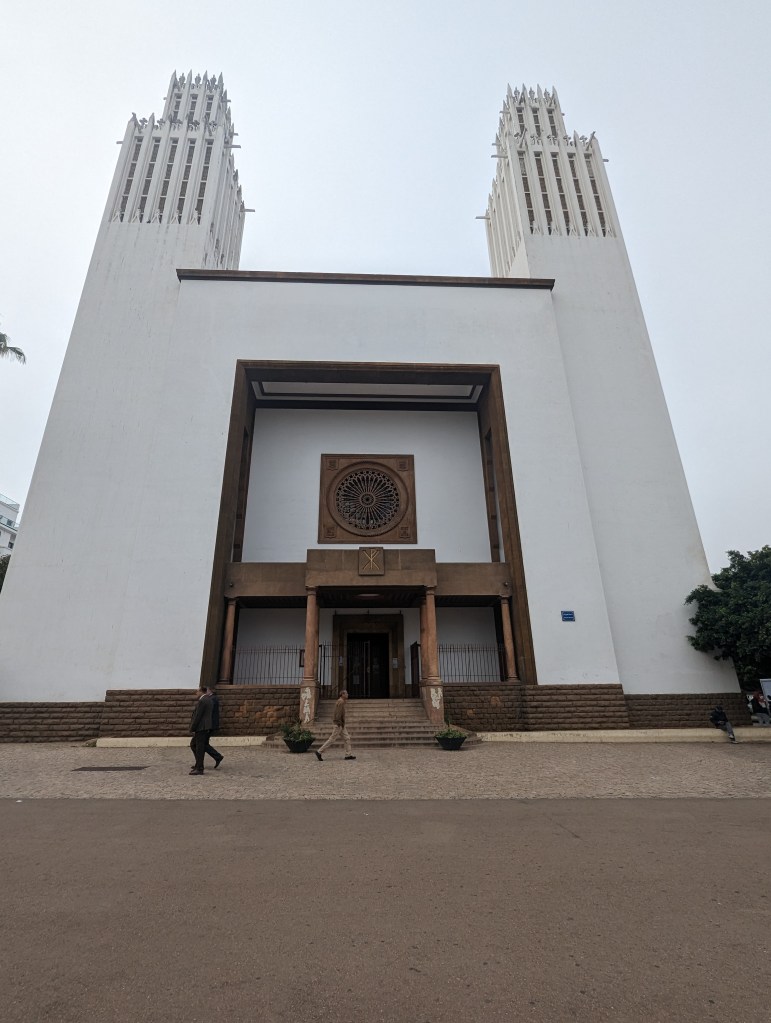

The interior is decorated with mosaic tiles depicting the stations of the cross.

There is no large altarpiece.
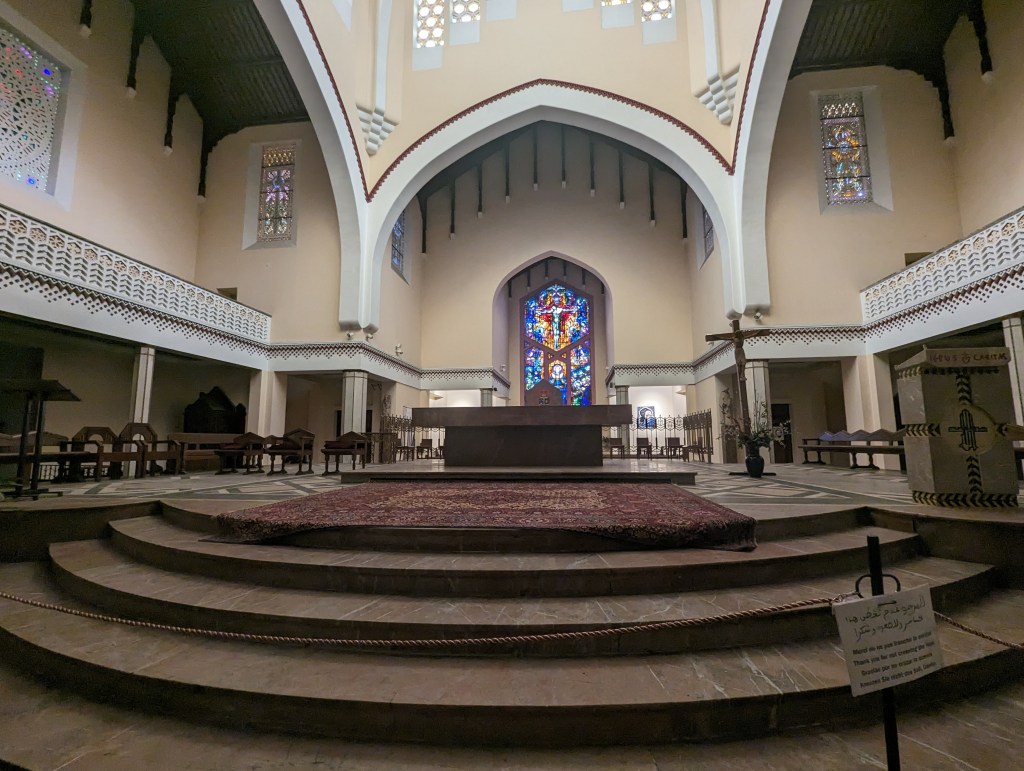
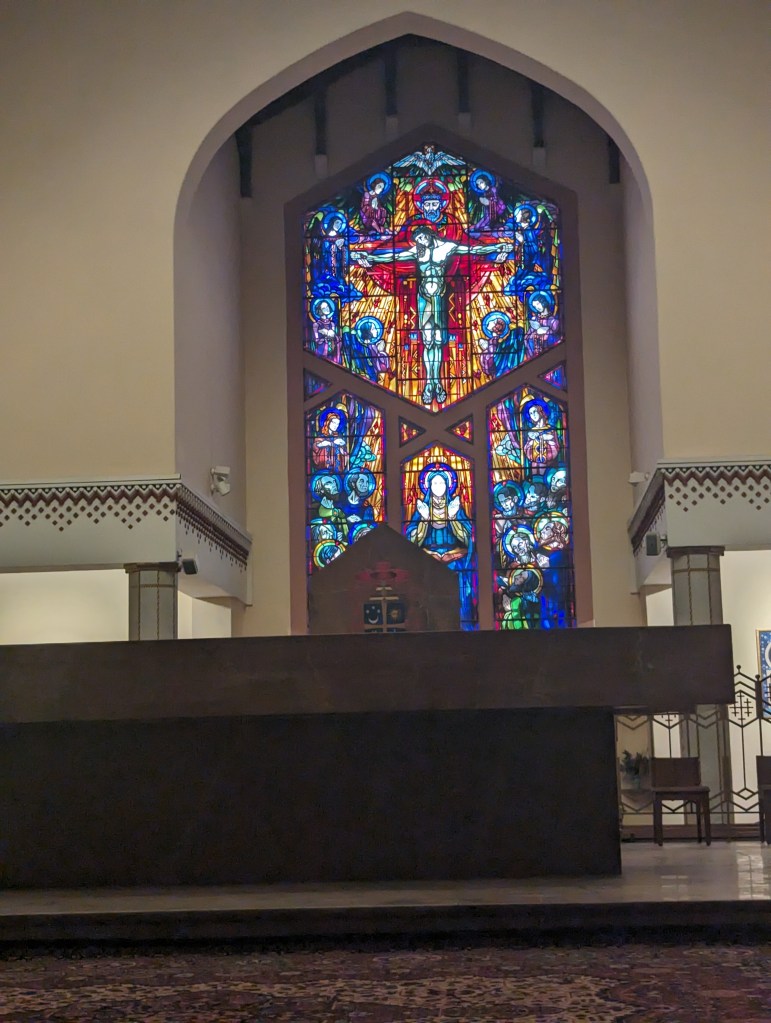
Behind the altar is a stained glass window.
Outside we were passed by the local metro, which is quite clean and modern in appearance.

We then headed to Yacoub Al Mansour Square. One enters passing two guards on horseback who change every 4 hours without ceremony.

Inside the square is a mosque, a museum, and a mausoleum. At one end is a museum of the history of Morocco with an elevated porch and domed arches surrounding a pavilion. At the other end is the mausoleum. Between the two elevated structures is the mosque.
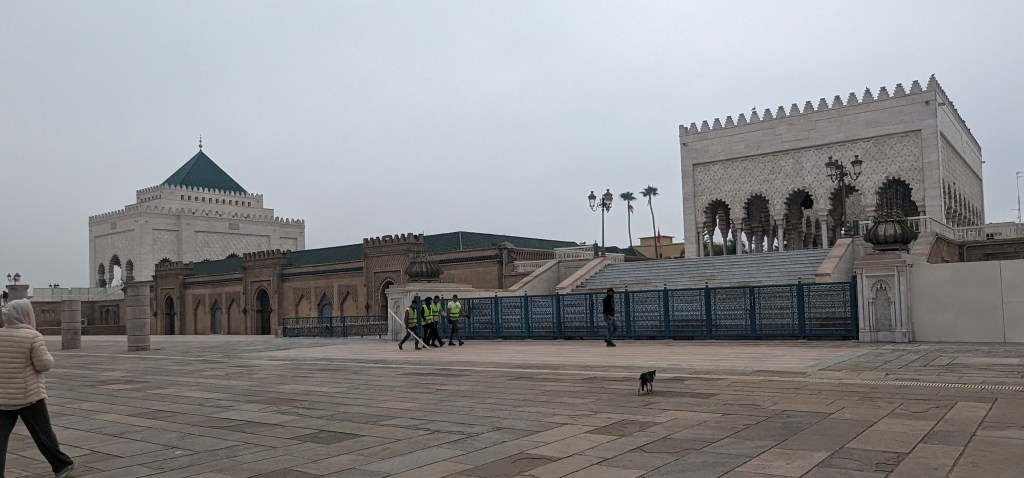
The museum is currently under renovation. The mosque is not open to the public, but the mausoleum is. King Hassan II commissioned the construction of the Mausoleum of Mohamed V for his late father, Mohamed V, in the year 1962. Construction of the Mohamed V Mausoleum was completed in 1971. Both of his sons have subsequently been buried there. It took over 400 builders and craftsmen nearly 10 years to complete the project.
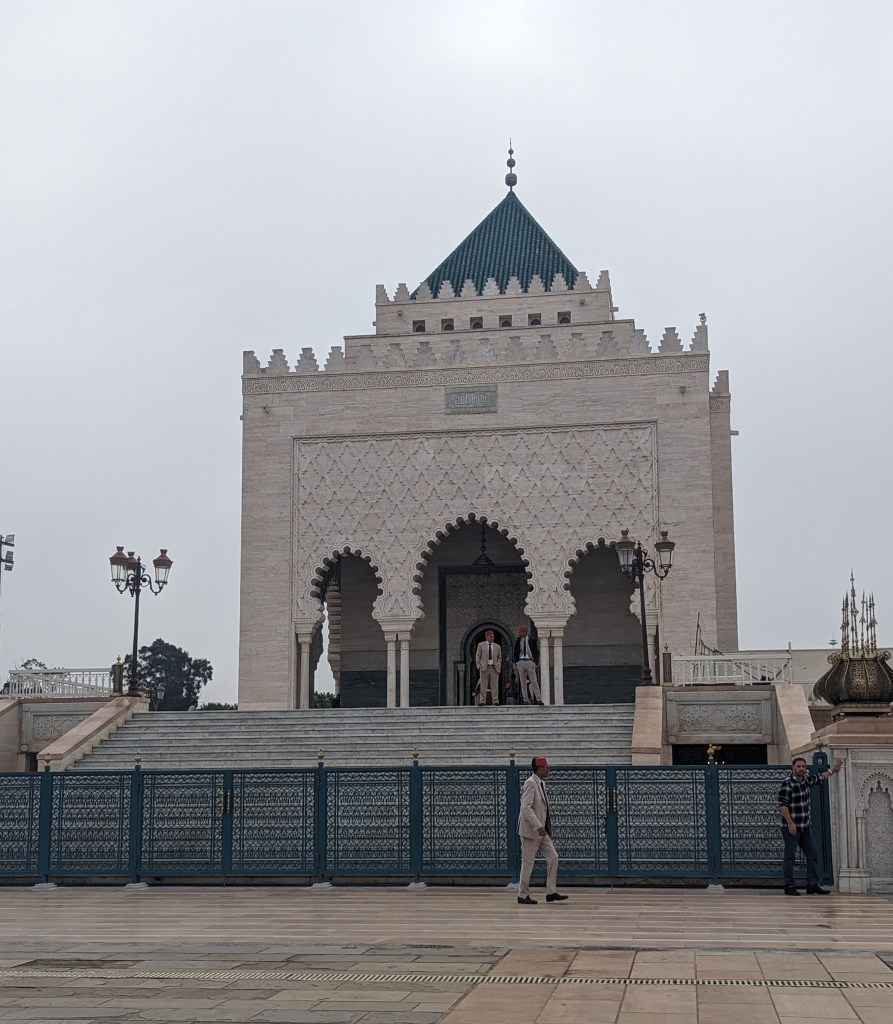
It was designed by a Vietnamese architect, hence its elevated design, not typical at all for a Muslim tomb. There is a guard at every entrance. They change every two hours.

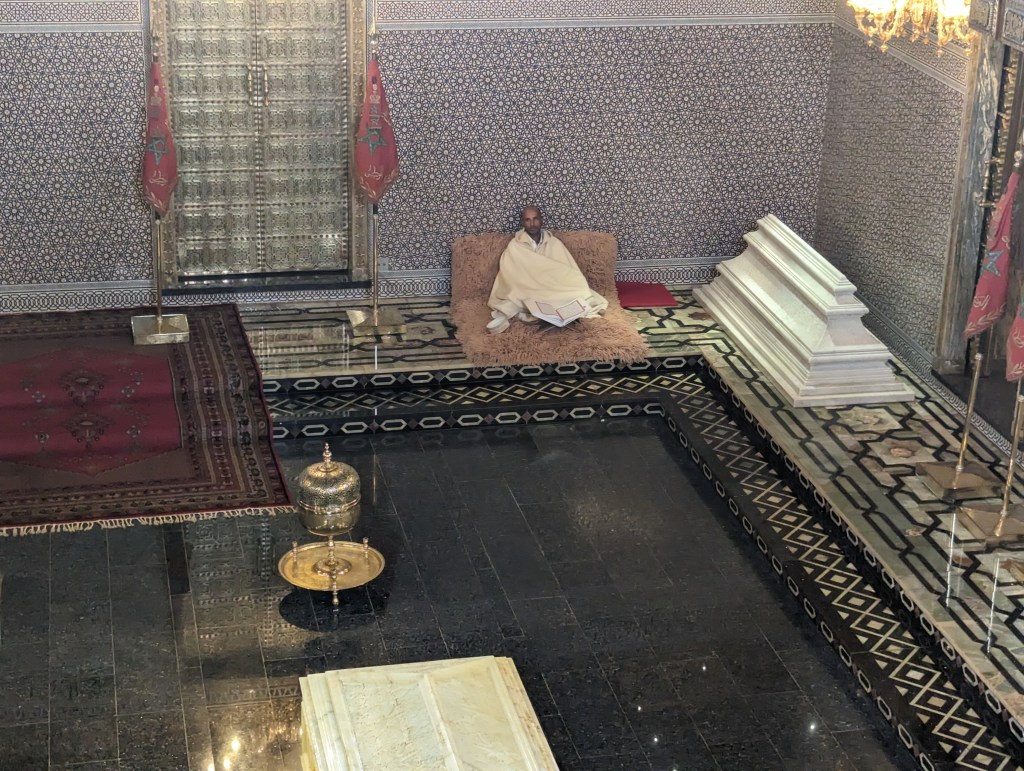
Inside are the tombs. Muslims must be buried underground so the bodies are actually about 10 feet below the decorative sarcofagi.
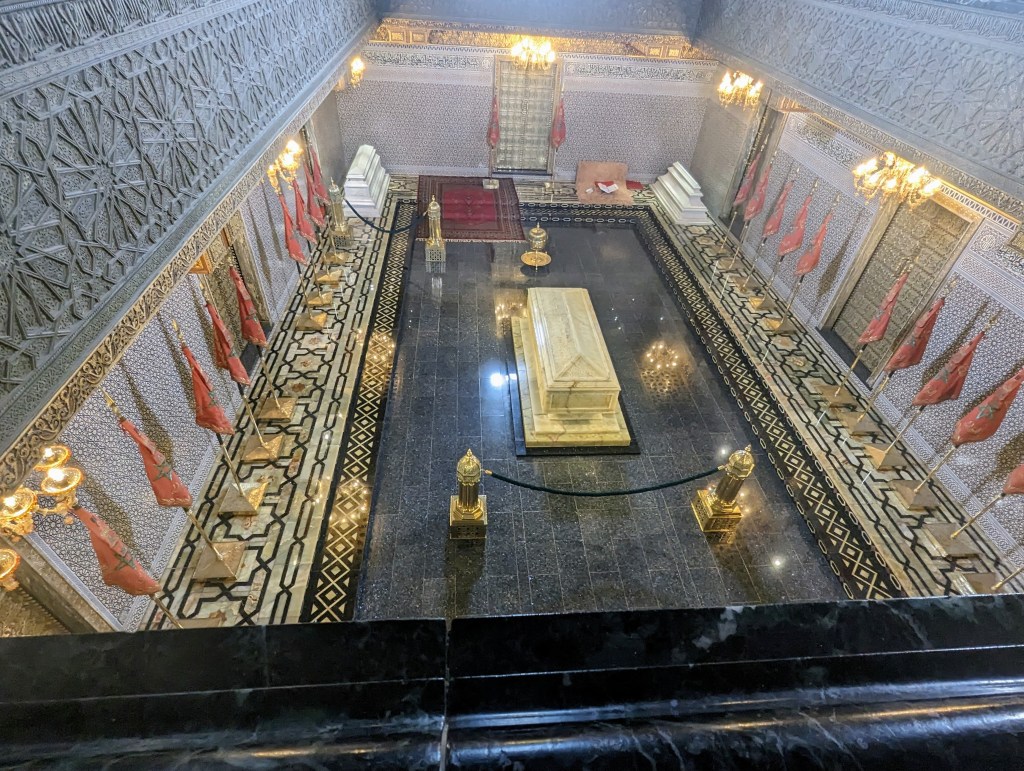
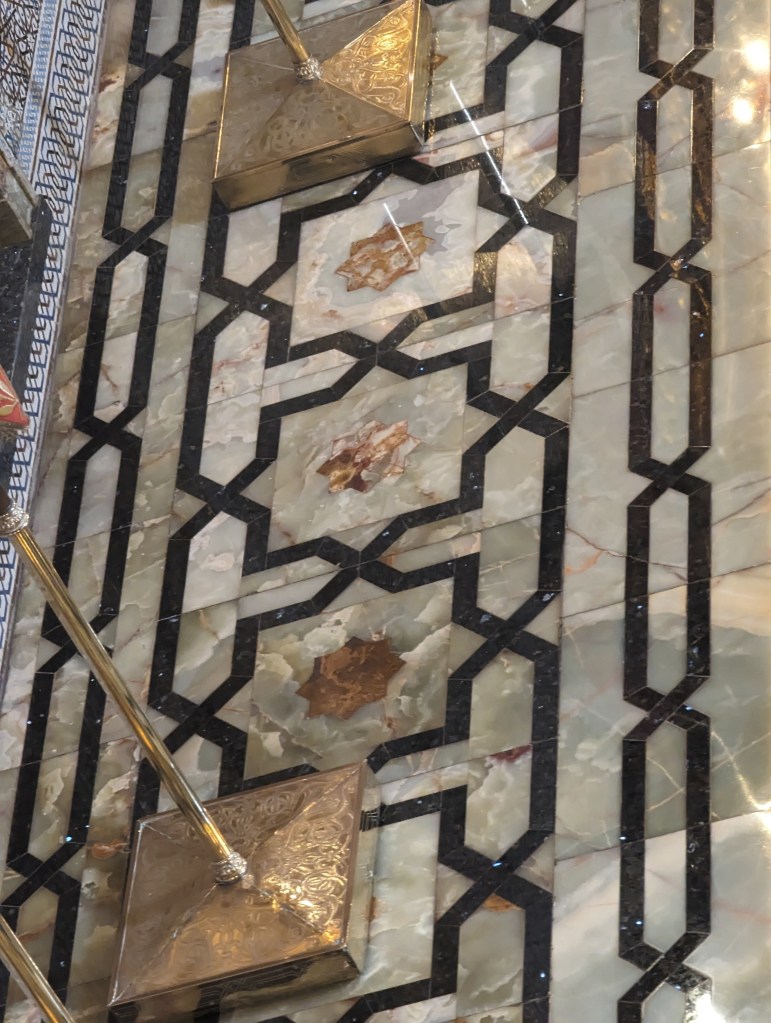
King Hassan II wanted to encourage traditional craftsmanship as a means to promote a sense of Moroccan identity and showcase to the world the beauty of Moroccan artisans’ work. The floors are marble.
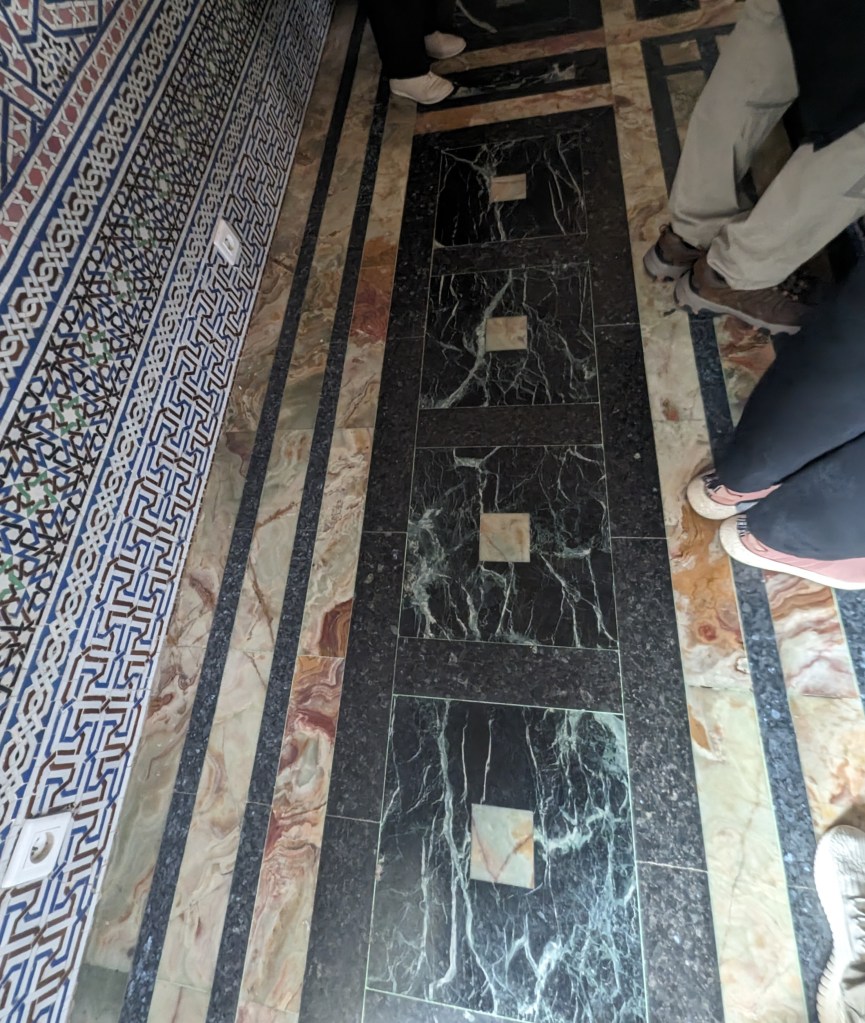
The lower walls are covered in mosaic tiles.
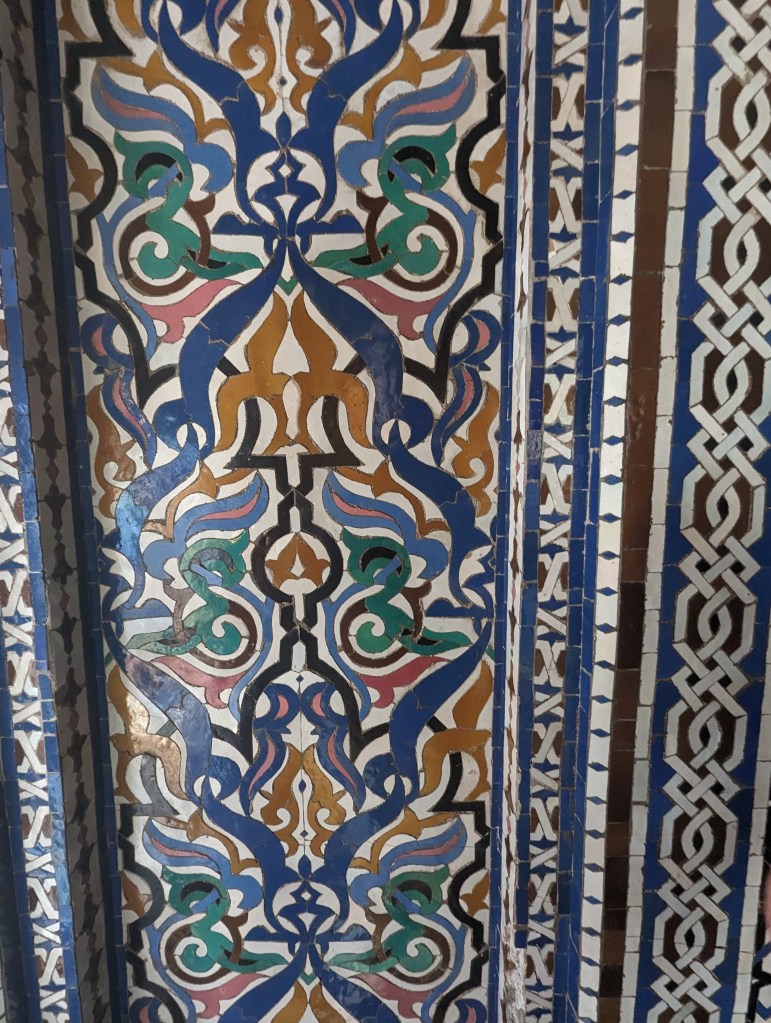

The friezes are carved plaster,
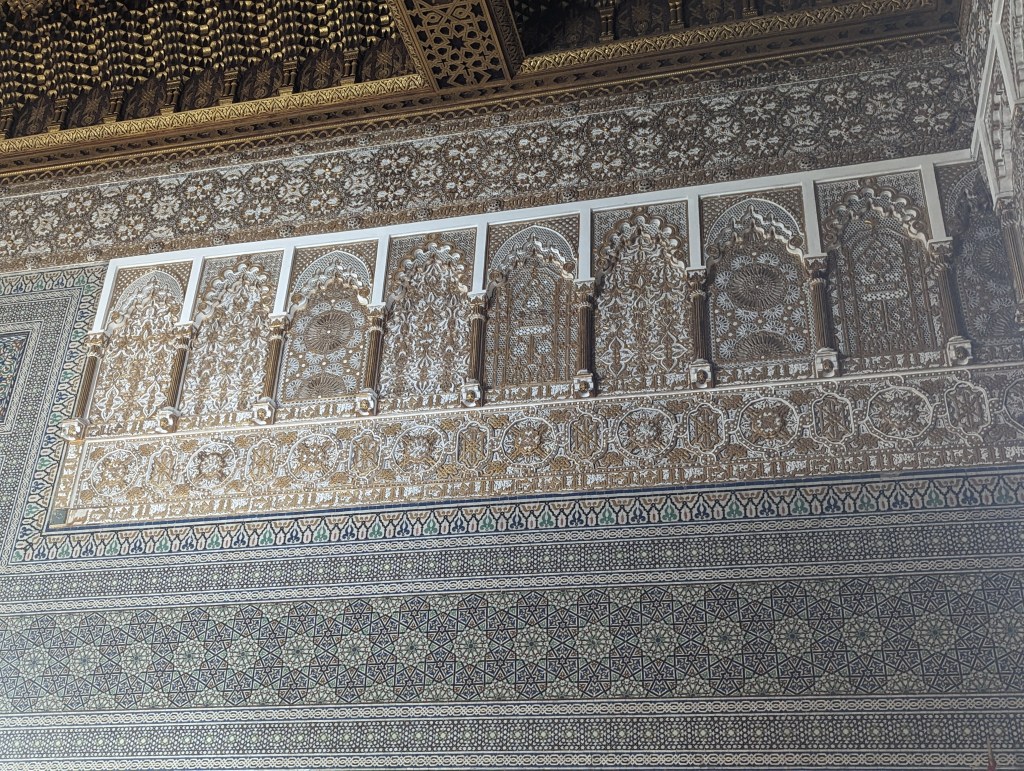
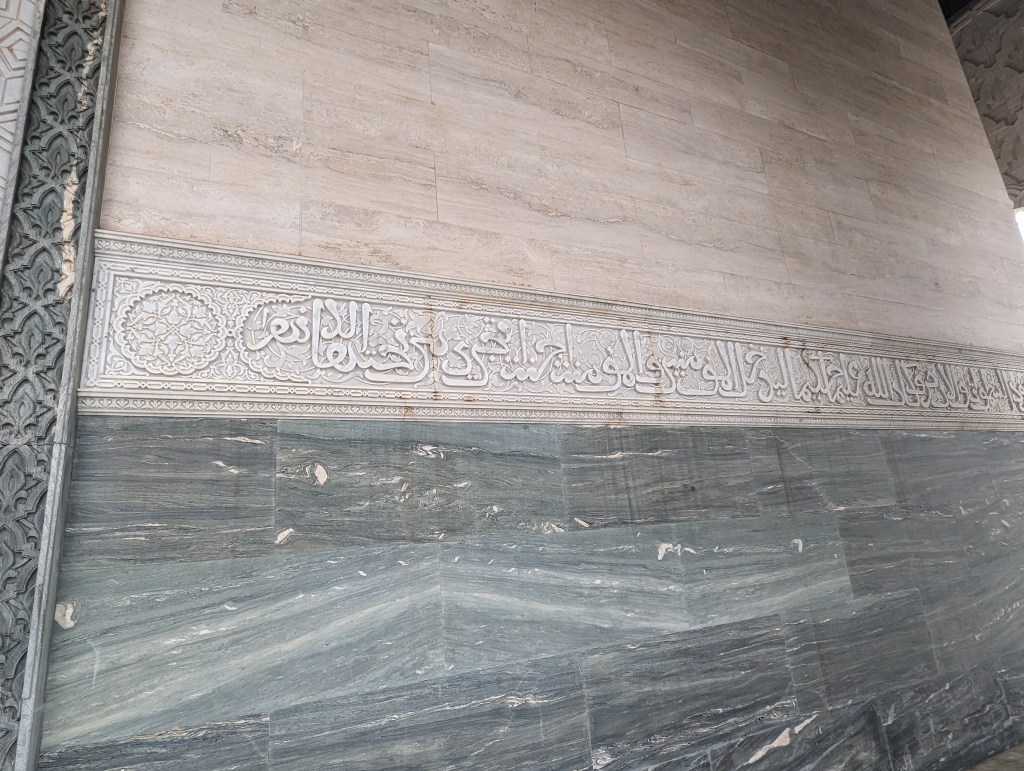
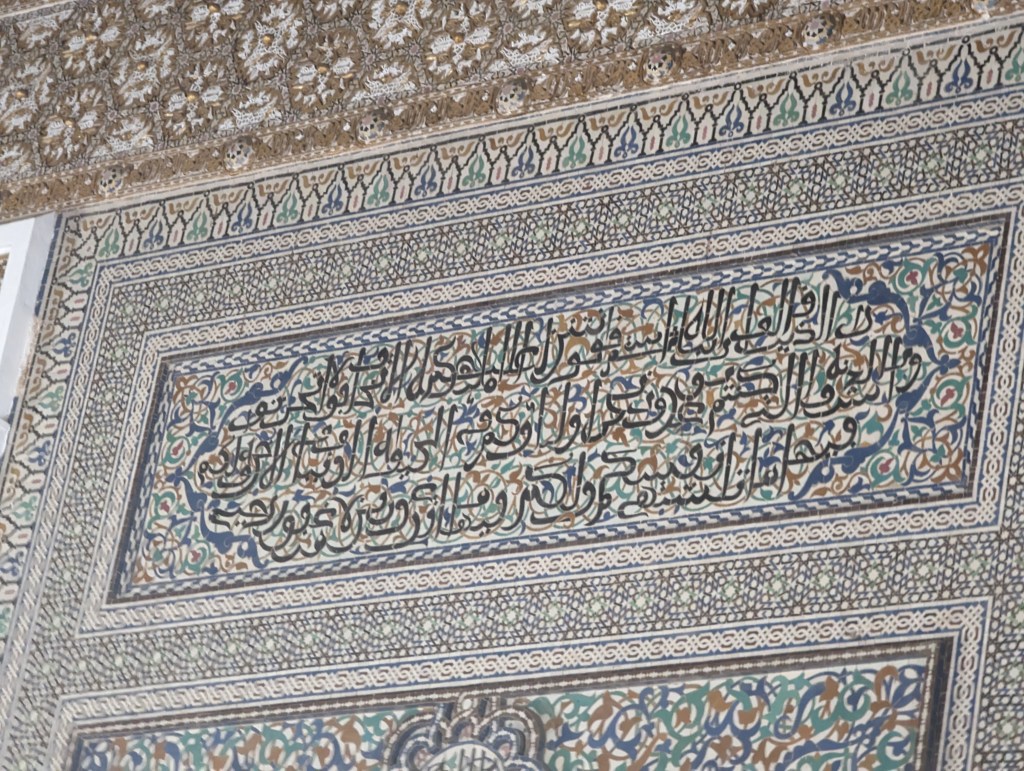
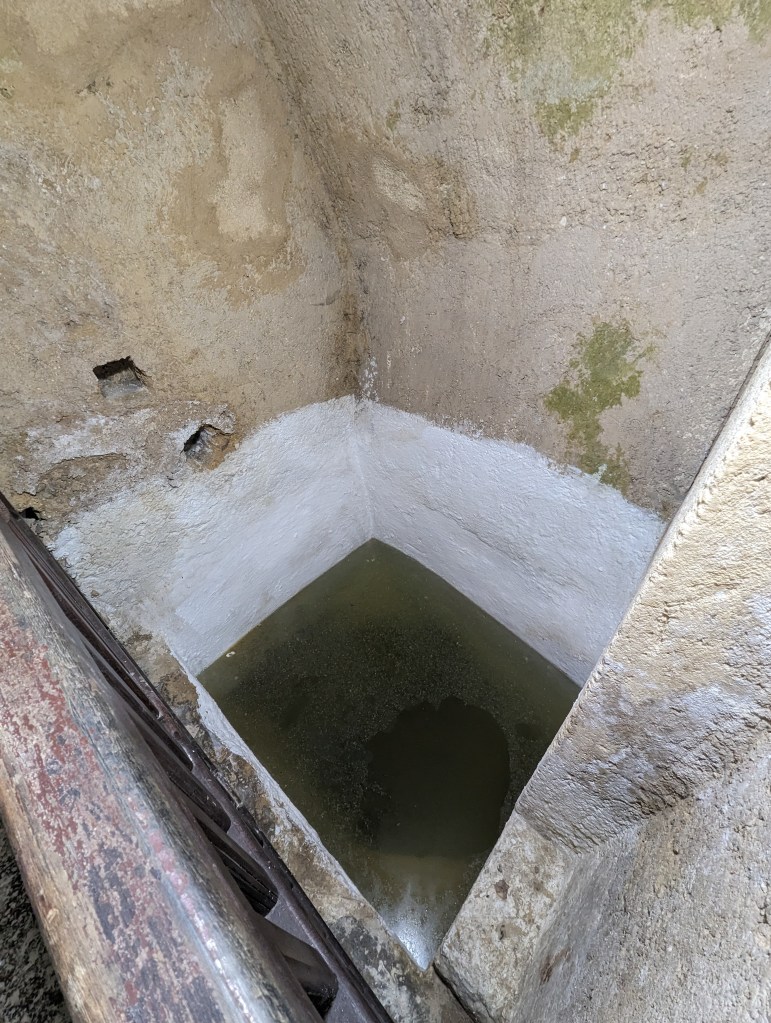
some of which have verses from the Quran.
The ceilings and dome are all carved wood. Every inch of the mausoleum is a work of art.

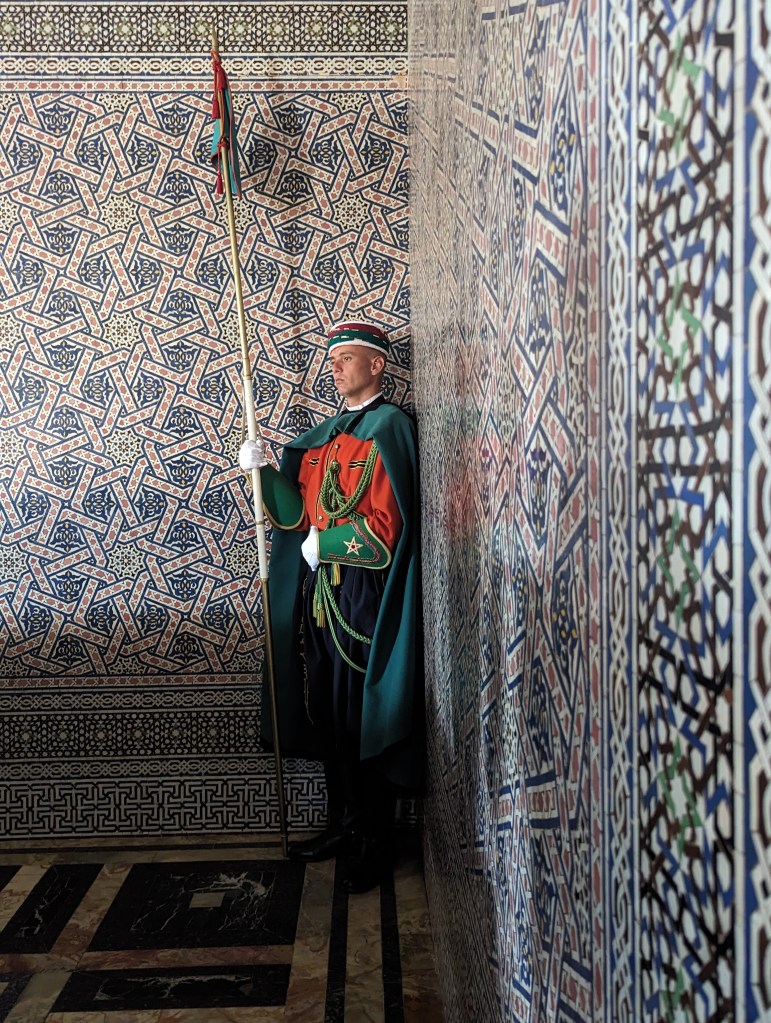
There is also a guard at every corner.
The imam comes in at prayer time and recites verses from the Quran from memory.
From the side entrance, the mosque next door can be seen.

Above every door is a passage from the Quran that reminds us that there is only one God: Allah.
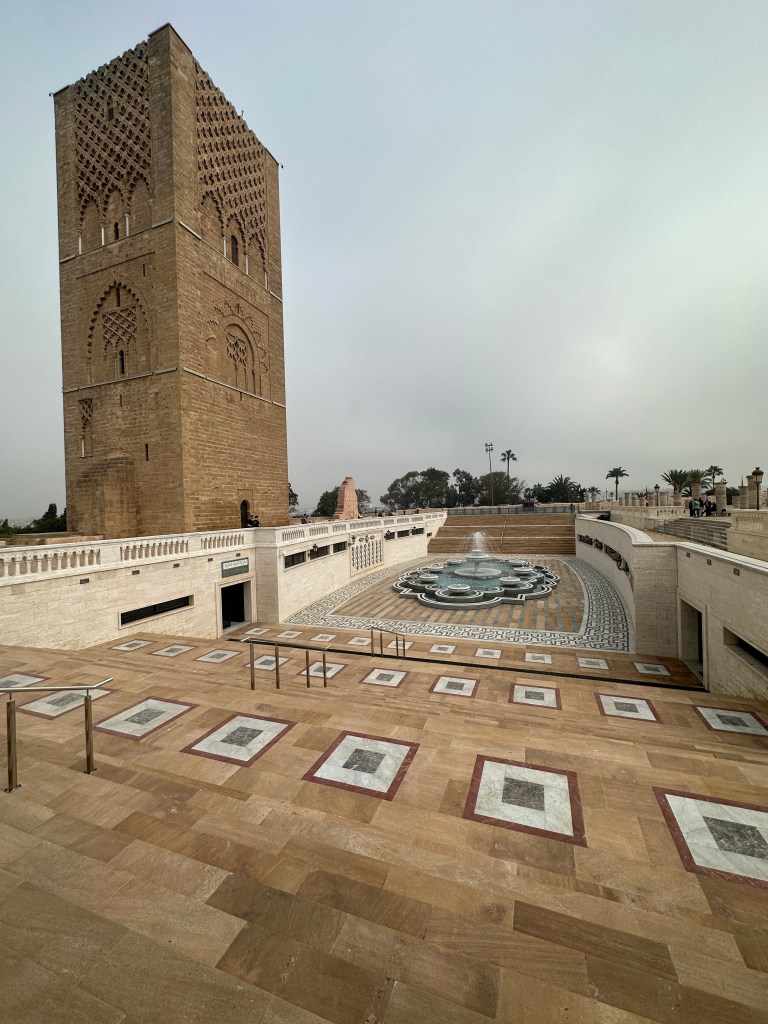
Leaving the mausoleum, the view across Yacoub Al Mansour Square is that of Hassan Tower and the never finished 12th century Mosque of Rabat. The Hassan Tower was to be the minaret of the mosque. The mosque was based on the one in Cordoba and when finished would have been the largest in the Muslim world. The tower, like the Giralda Tower in Seville, was based on the minaret in Marrakesh.
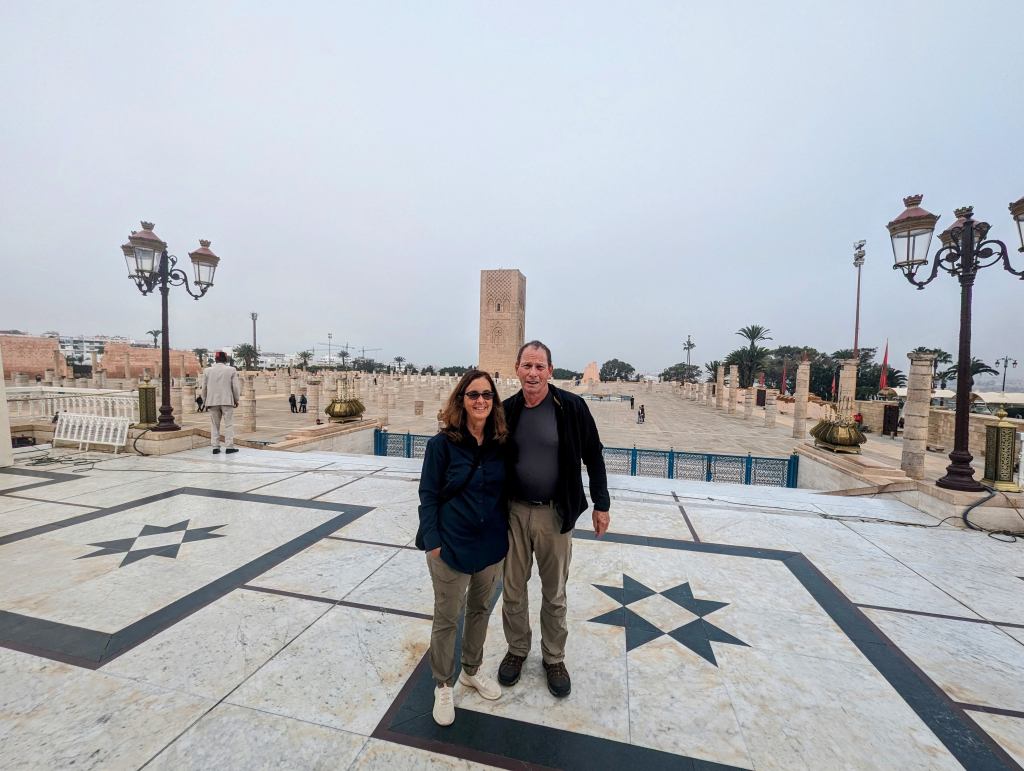
The Hassan Tower now serves as the minaret to the mosque of the mausoleum, and is the only minaret in Morocco not attached to its mosque. The 12th century mosque was never completed because its builder died and the project abandoned. Many of the columns fell and suffered damage during the Lisbon earthquake of 1755.
On the wall next to the Hassan Tower is a family tree of the current king showing his descendance from the prophet Muhammed.
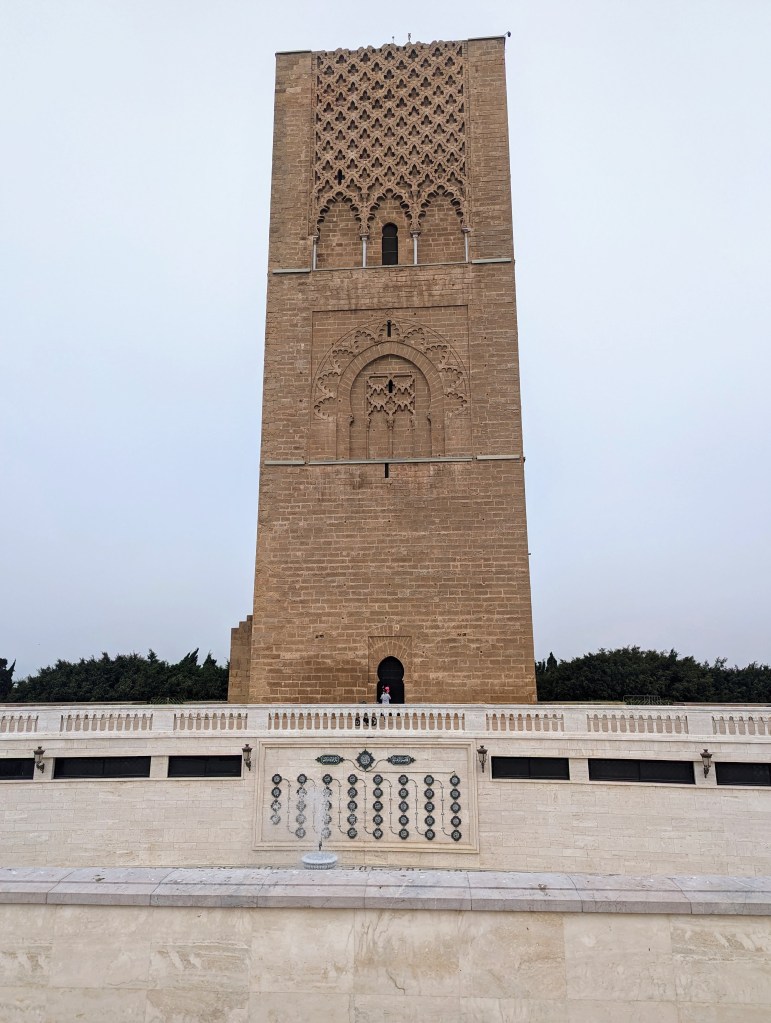
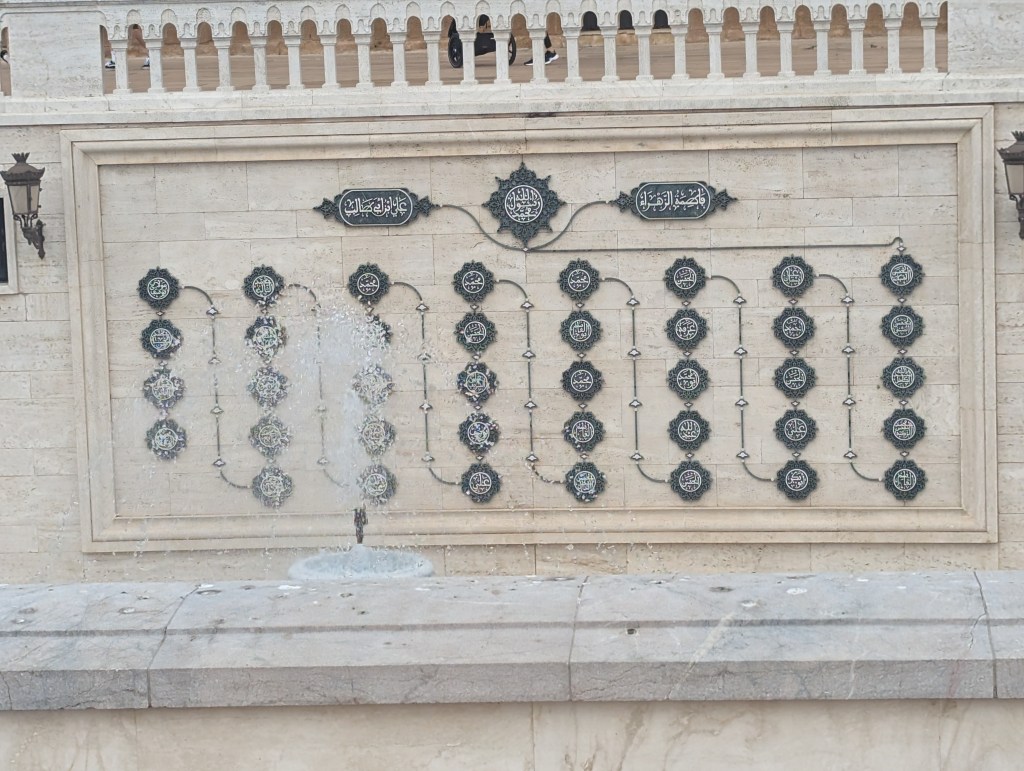
The space under the tower holds important archives of Moroccan history and is closed to the public. The fountain is turned on only when someone of importance is inside.
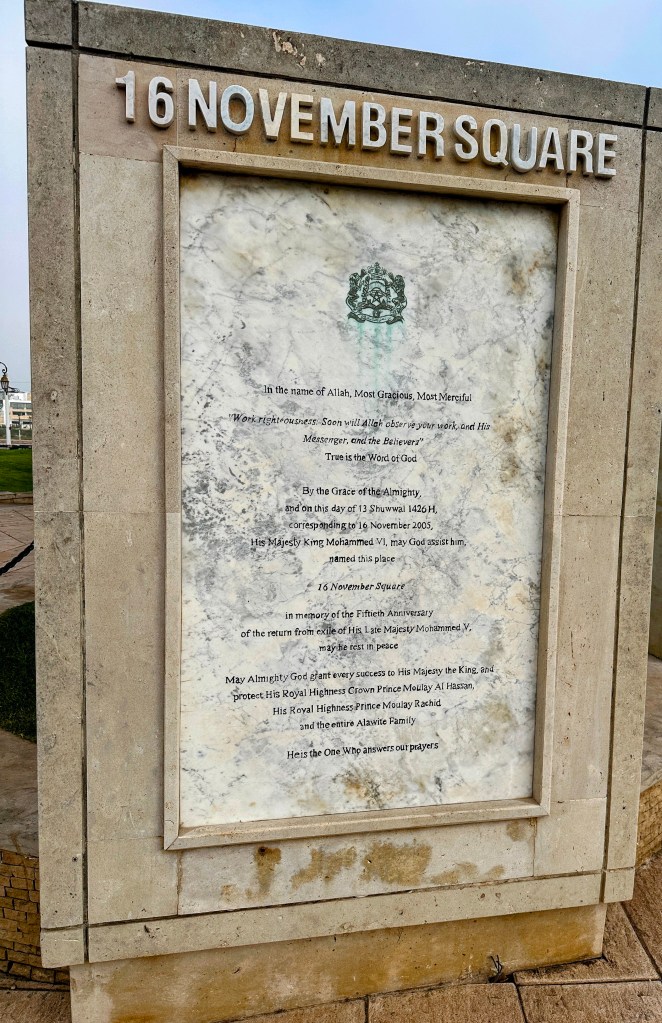
We then passed through November 16th Square, commemorating King Mohamed V’s return from exile on November 16, 1953. It happened to be November 16th that we visited.
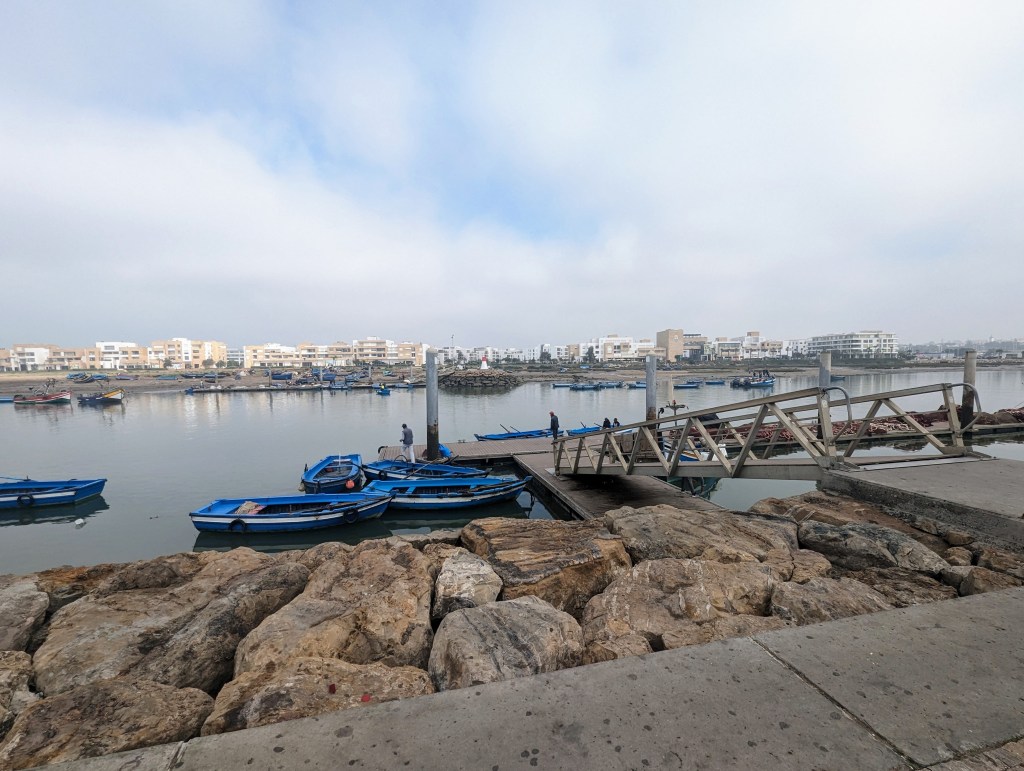
We then walked down to the river where one can catch a boat and cross over to the sister city of Salé.
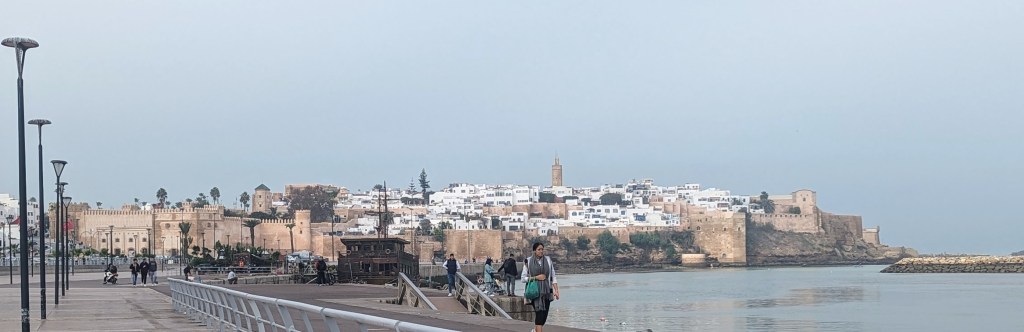
From here there is a good view of the Kasbah up on the hill.
In the 16th and 17th centuries pirates roamed these shores and looted European ships. But they did not steal goods. They only stole the sailors as white slaves, who were then used for labor or, if someone of importance, sold back for ransom.
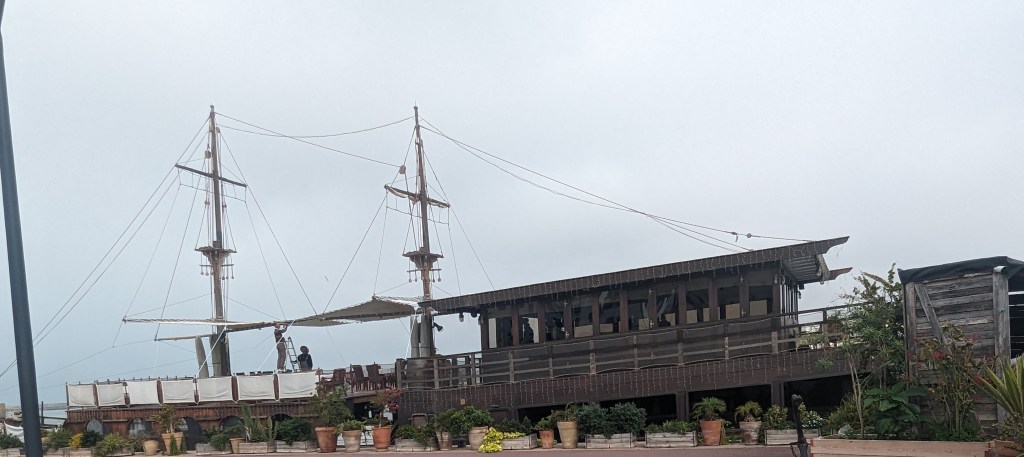
Slaves found guilty of crimes were chained in the dungeon at low tide then drowned when the tide came in. The low round structure below is the dungeon.

In the afternoon we took a quick drive by Salé, most of which is under renovation.

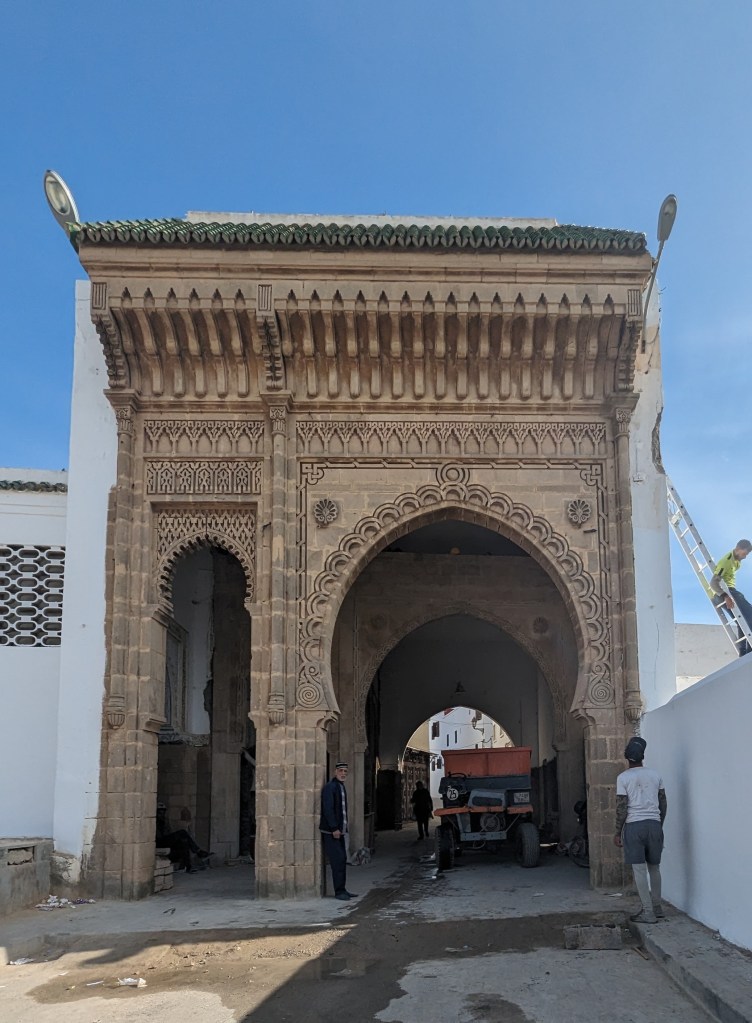
We walked through the gate of the Kasbah.
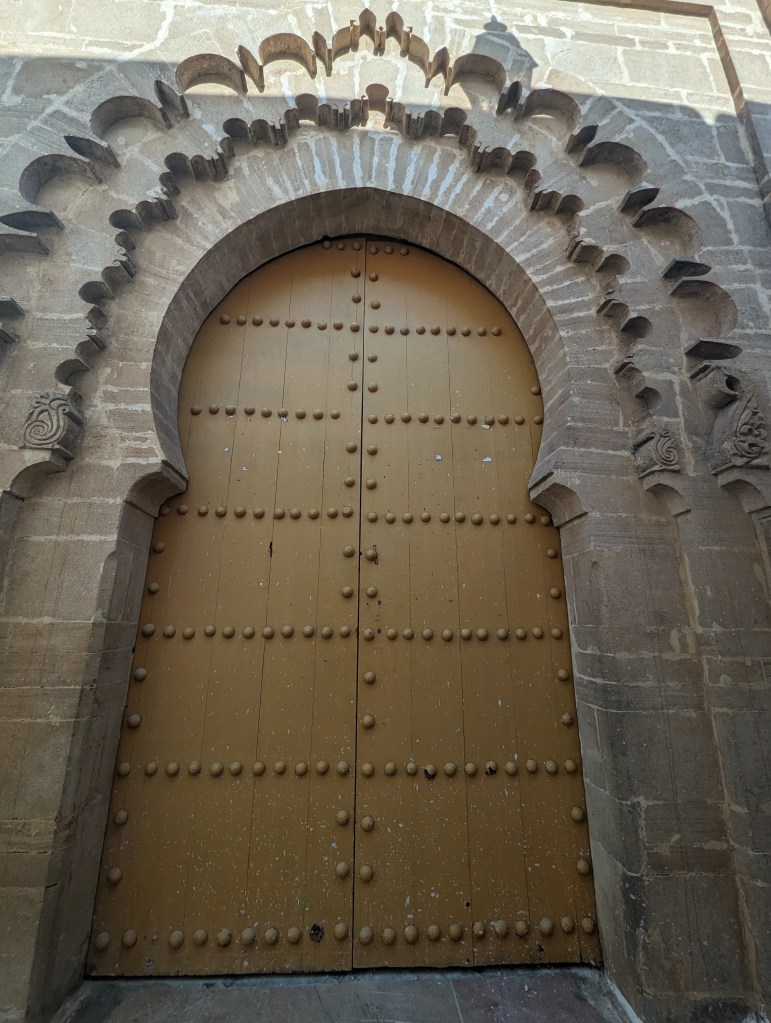
And saw the door to the mosque.
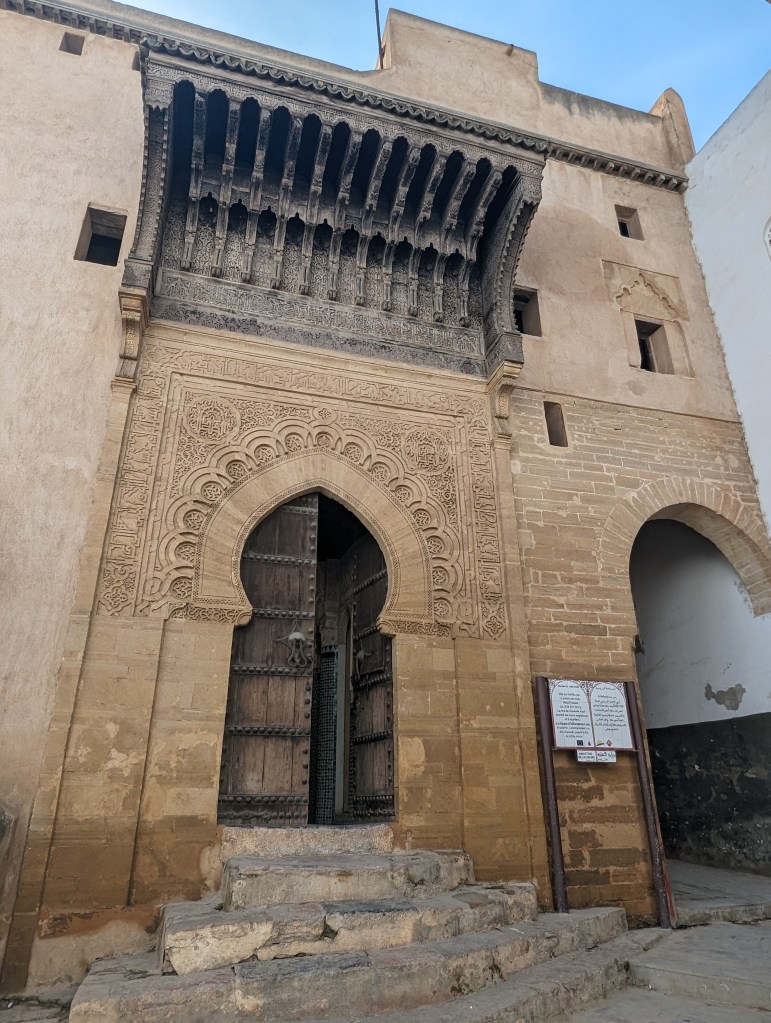
And next to it the Quran school, the madrassa.
We then took a drive south along the Atlantic coast. We passed the newly built Grand Theatre of Rabat designed by Iraqi-British architect Zaha Hadid. The construction of the theatre is part of a wider national initiative by King Mohamed VI to promote the arts and cultural development. It is scheduled to open in 2024. Next to it is the Mohamed VI Tower, an office and industrial space also scheduled to open in 2024.
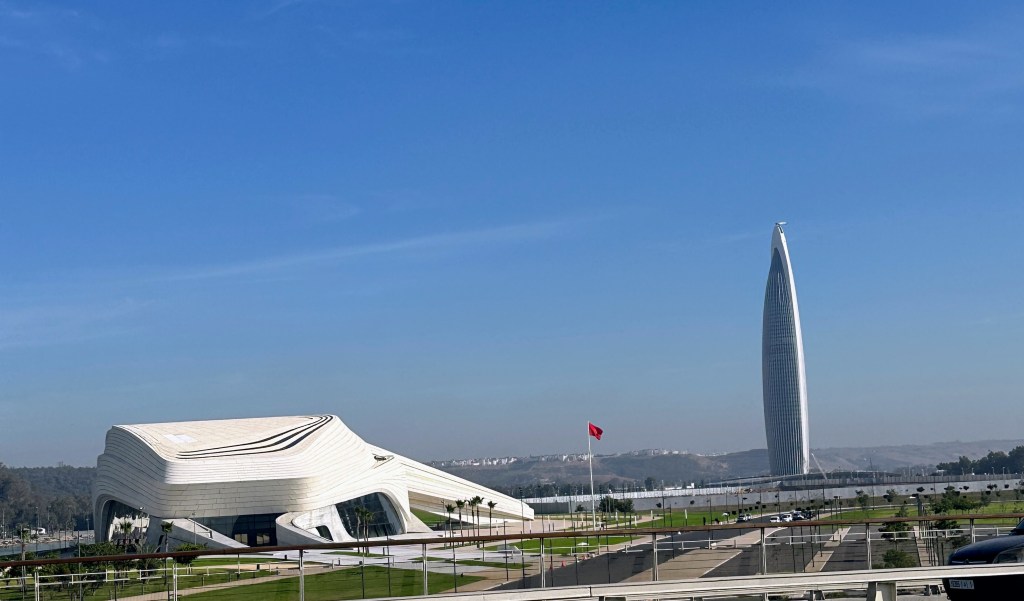
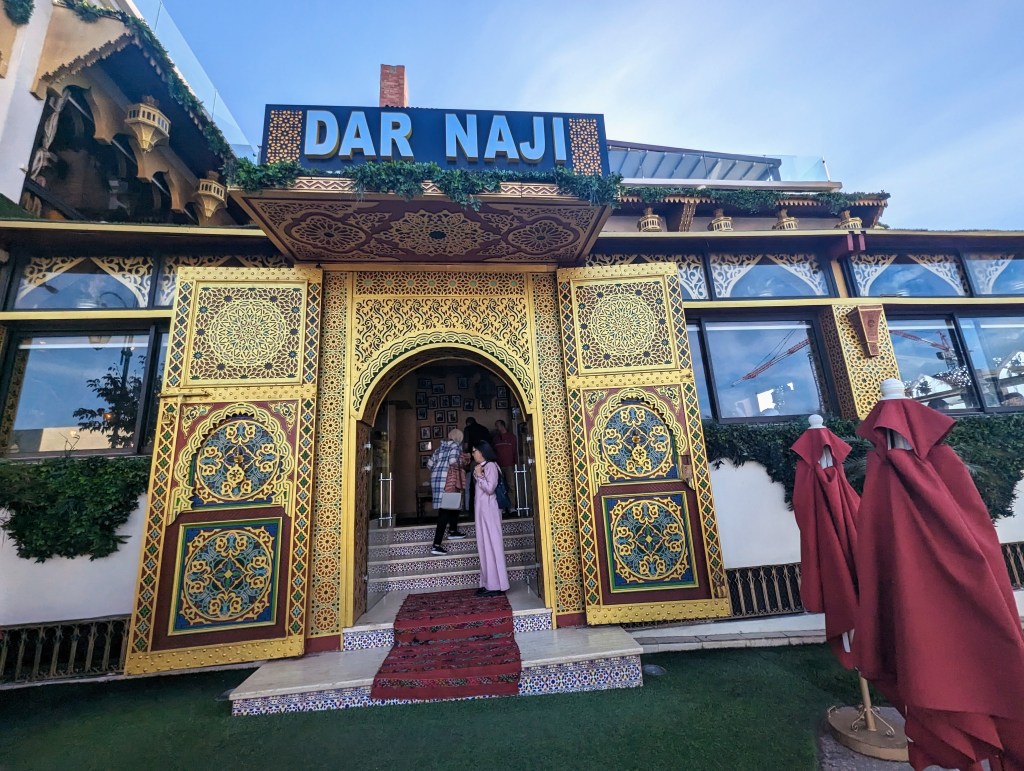
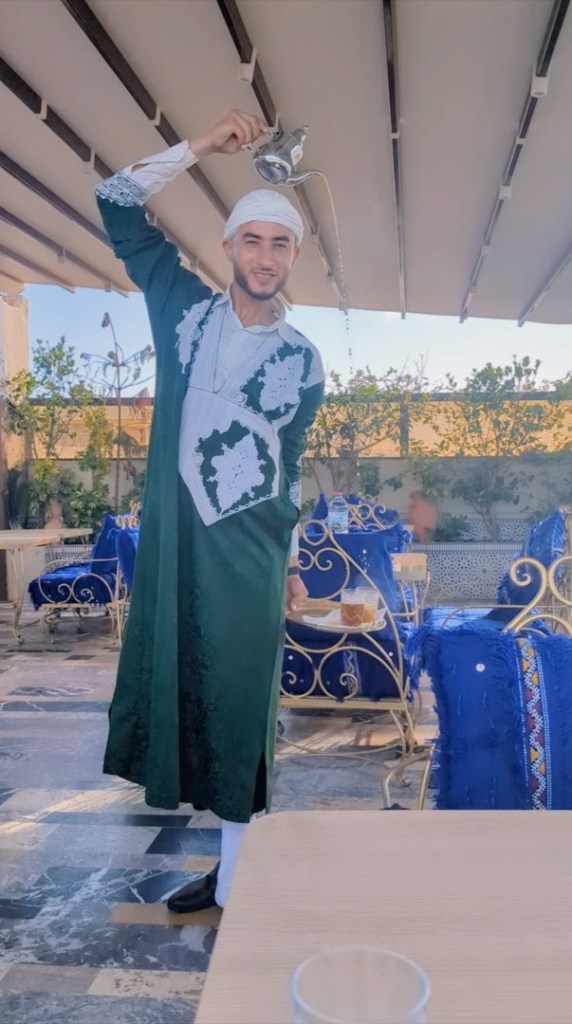
We then went for a very late lunch at Dar Naji Restaurant and had great food, great views, and lots of fun.
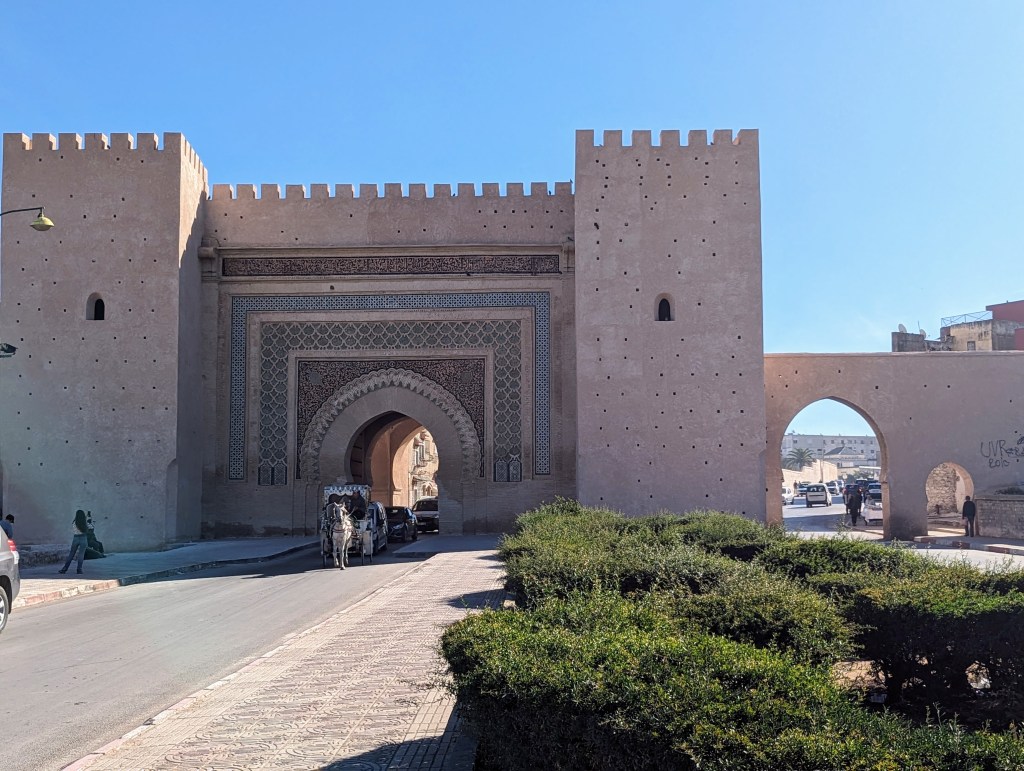
In the morning we headed to Fez. On the way we passed the city of Meknes, one of the 4 imperial cities of Morocco, ie one of the 4 cities that has been the capital: Marrakesh, Fez, Meknes, and Rabat. Meknes was founded in the 11th century and was capital briefly in the 17th during which time a large palace complex was built. Most of the town is currently under restoration. We stopped for a picture of the gate.
Next we stopped in Volubilis, a partly-excavated Berber-Roman city built in a fertile agricultural area. It developed from the 3rd century BC onward as a Berber, then proto-Cartaginian settlement before being the capital of the kingdom of Mauritania. It grew rapidly under Roman rule from the 1st century AD onward. The city gained a number of major public buildings in the 2nd century, including a basilica, temple and triumphal arch. Its prosperity, which was derived principally from olives, prompted the construction of many fine houses with large mosaic floors. The city fell to local tribes in 285 and was abandoned by Romans due to its remoteness. It remained mostly intact until the Lisbon earthquake of 1755. Once a lot of the buildings fell down, the area was ransacked for building materials. It was discovered by the French in the early 20th century. Excavations are ongoing.
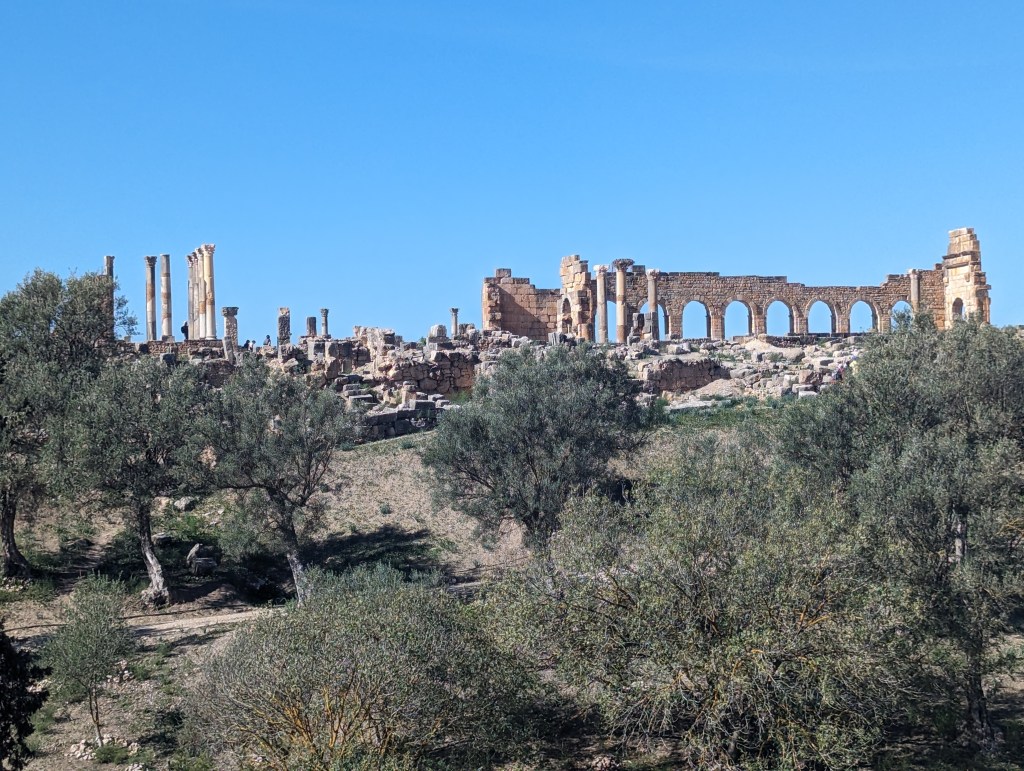
We hired a local guide to show us around. One of the fist things he explained is that there were 3 types of stone used to build the town: marble from Italy for columns, local limestone for the building materials, and a form of lava rock used for milling wheat and grinding olives for their oil.
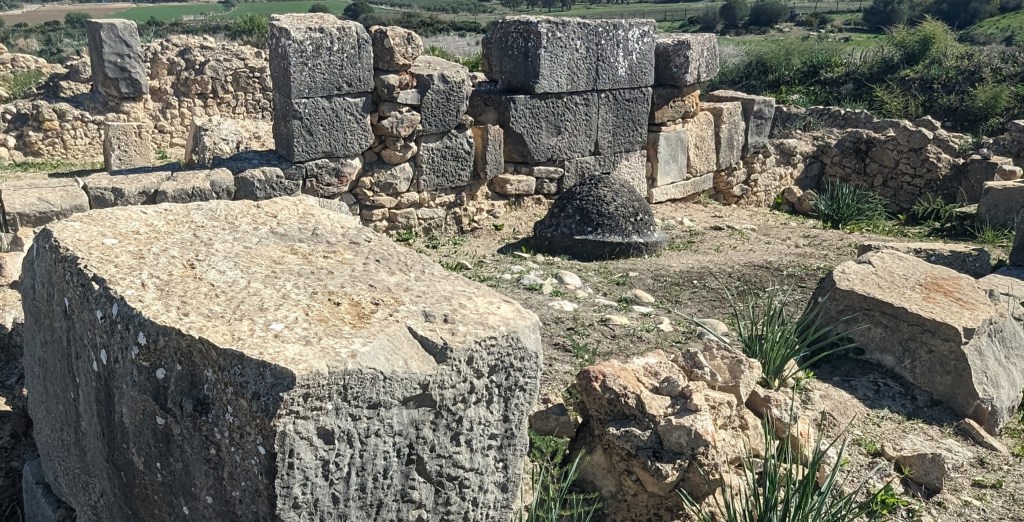
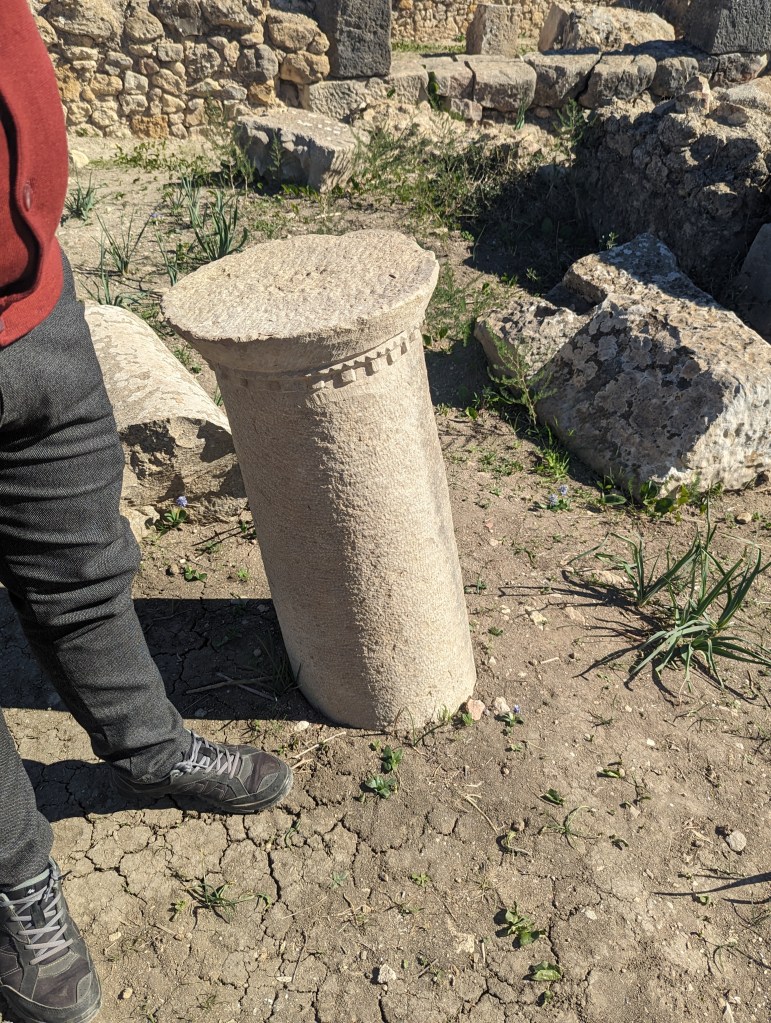
The site is a mix of cultures: Roman, Greek, and Berber. All 3 types of column capitals are found at the site; Doric, Corinthian, and Ionic.
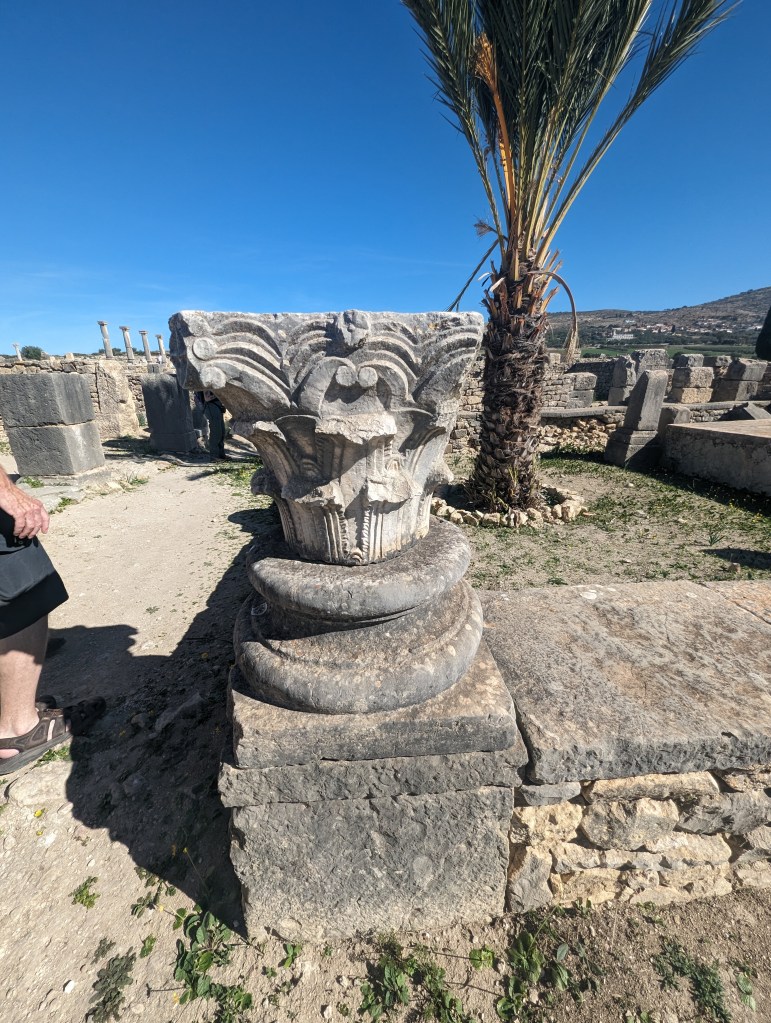
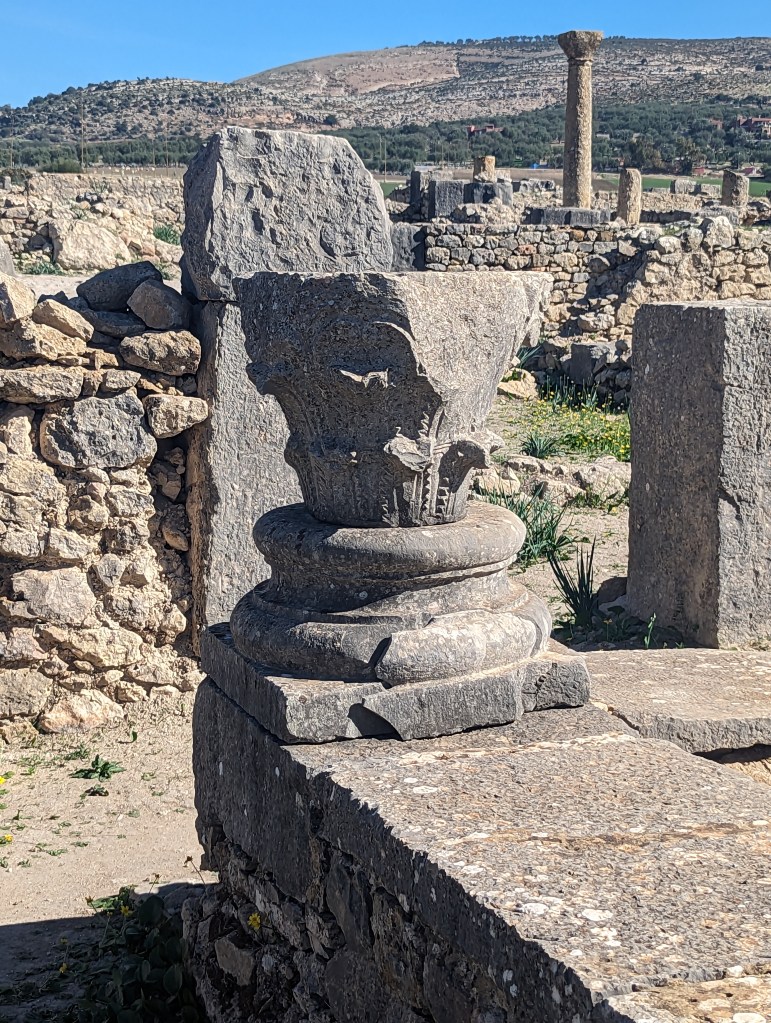
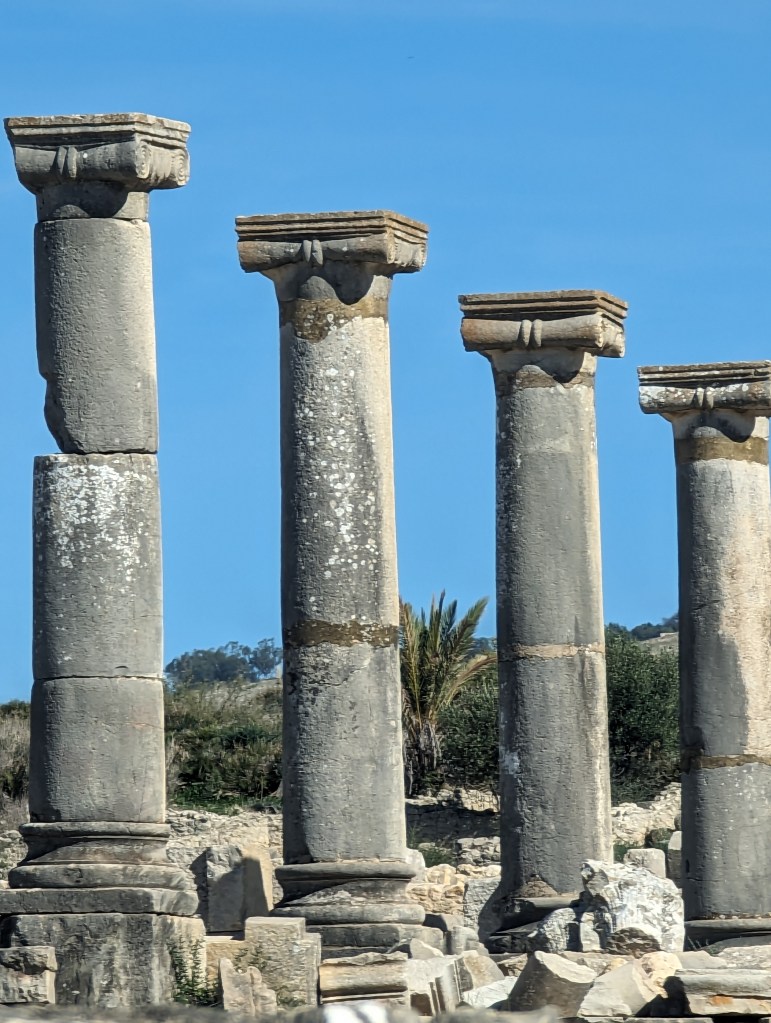
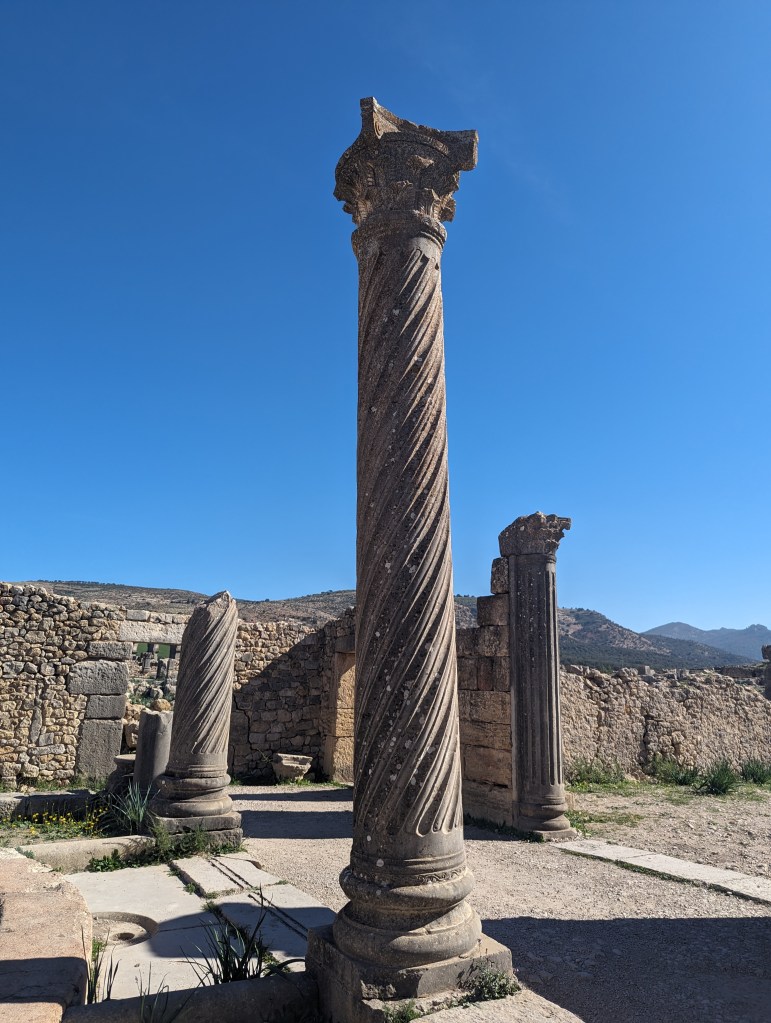
In addition to all 3 capitals, there are examples of all 3 types of columns: the above smooth columns, the below twisted columns,
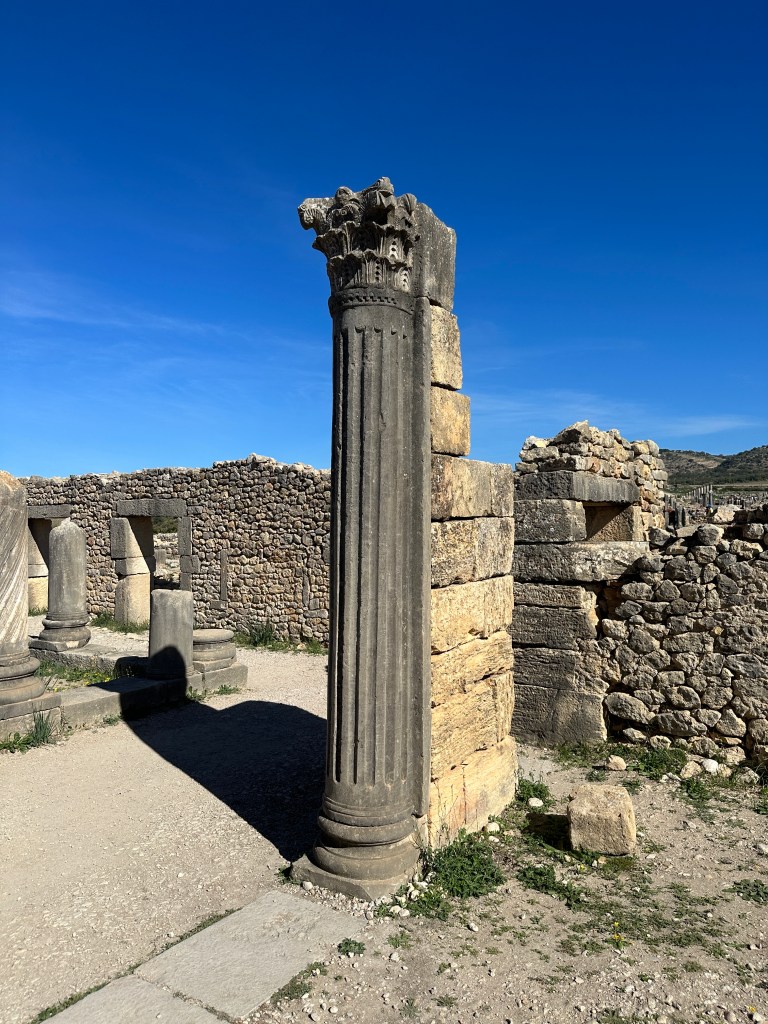
and fluted columns.
In the mosaics found in some of the houses, there are both Greek and Roman gods depicted. There are also many Berber symbols. Unfortunately the pictures do not do the mosaics justice.


The northern gate was called the Tangier gate because it headed north toward Tangier. Then a major carriage-way passed through the center of town.

Along the road ran 2 parallel aqueducts. One then turned and headed west into the homes of the wealthy, the other headed west into the city.

The wealthy houses each had their own bakery,

hamam for bathing, (notice in the one below the stairs, heating occurred below and the warm bath was in the room above)

mill for wheat, mill for olives,

and solarium with water, which came in through a duct. The grooves are for sitting and enjoying the cool water in the hot sun.
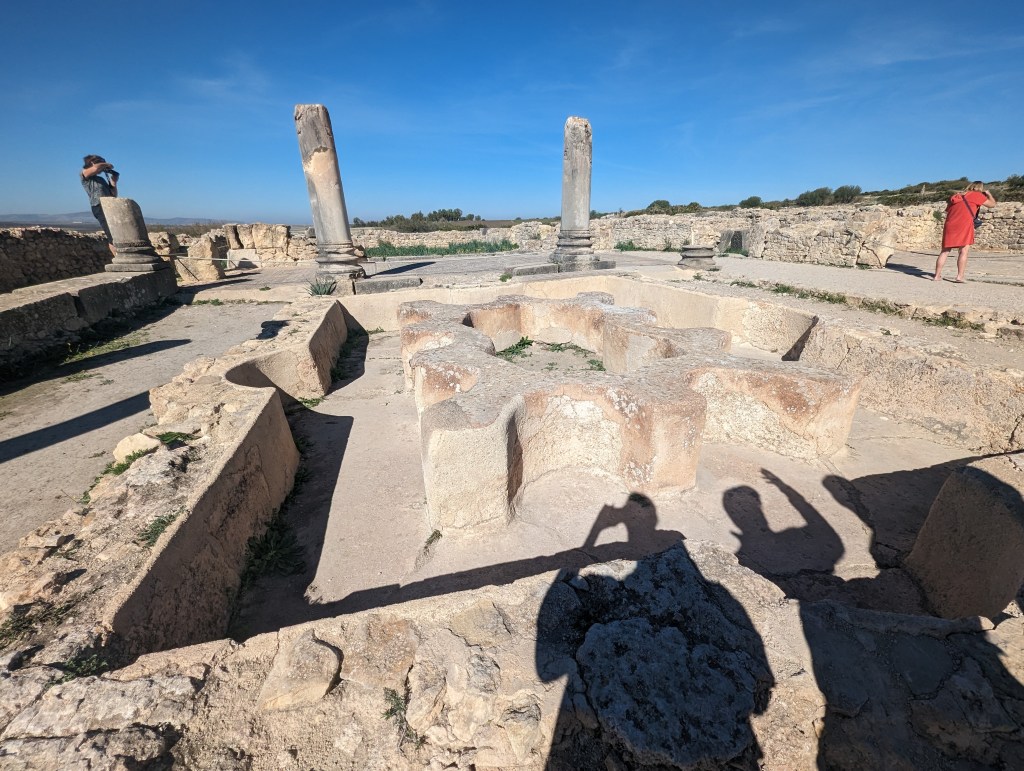
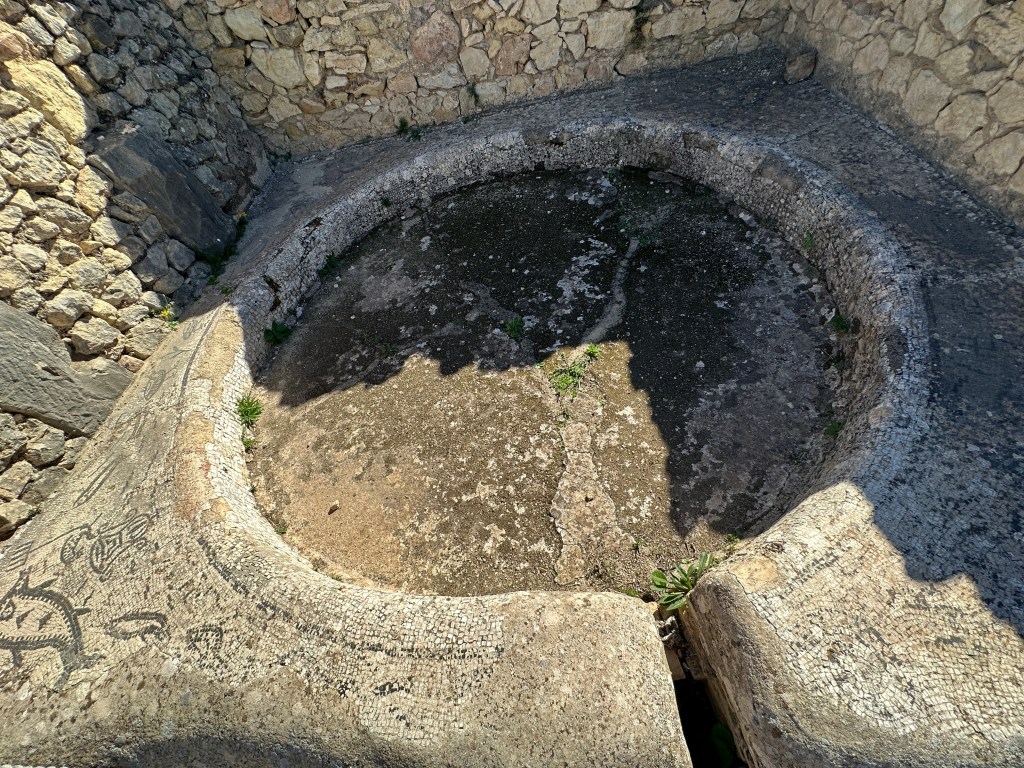
One house even had an aquarium. It contained fish to look at but also fish to nibble the caluses off feet for a “pedicure.”
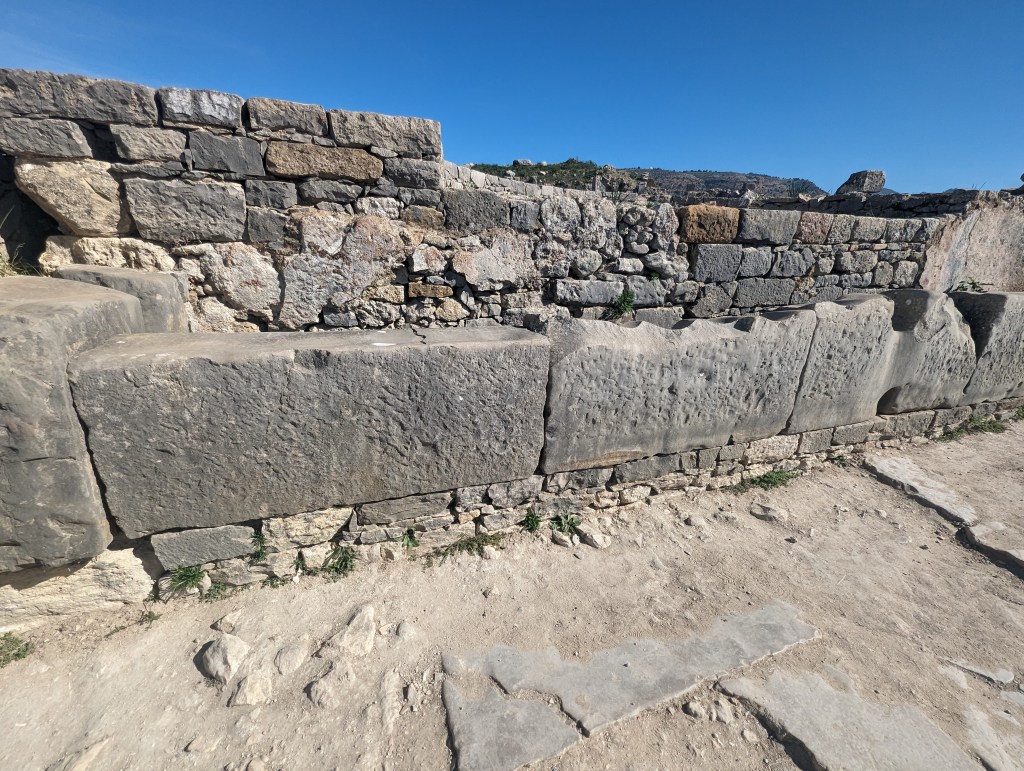
They had running water and sewage lines in the city, fascinating. There was a public toilet room next to the public fountain and wash basin. Note the grooves in which the clothes were washed.
Most of the houses were 2 stories. The entrance door lifted in a groove up into the second level.

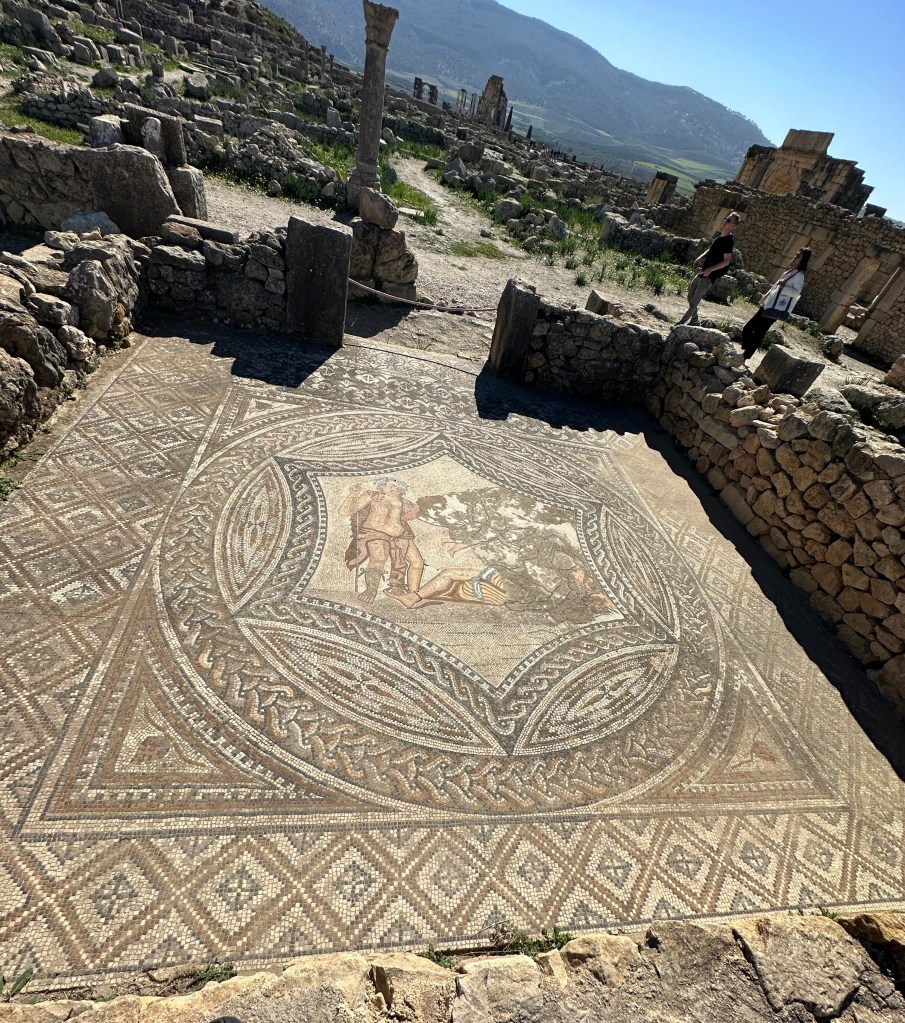
Here are some more mosaics, a small sampling of the many at the site. The one below represents the 4 seasons.
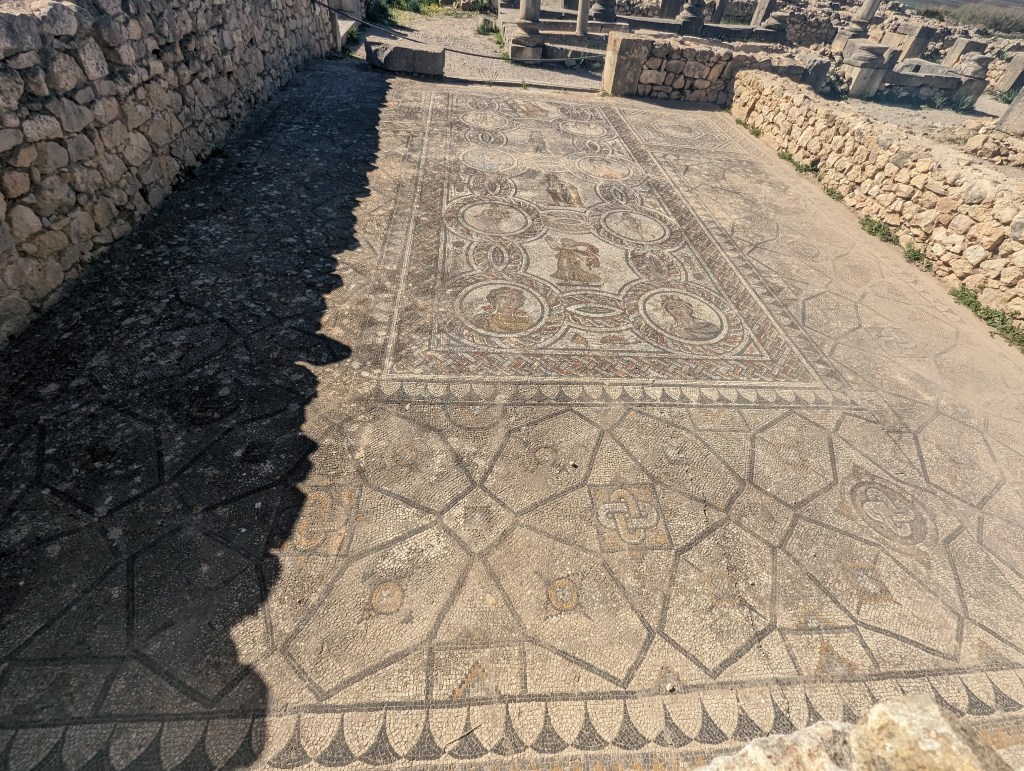
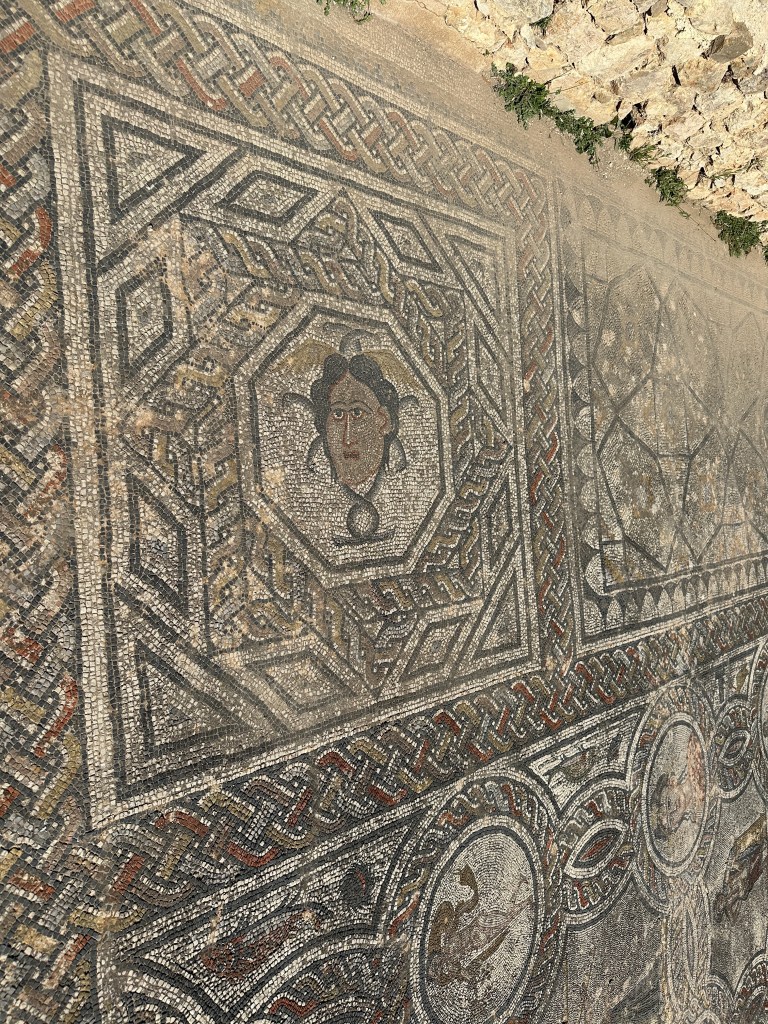
Here is a picture of Medusa with the snakes as hair.
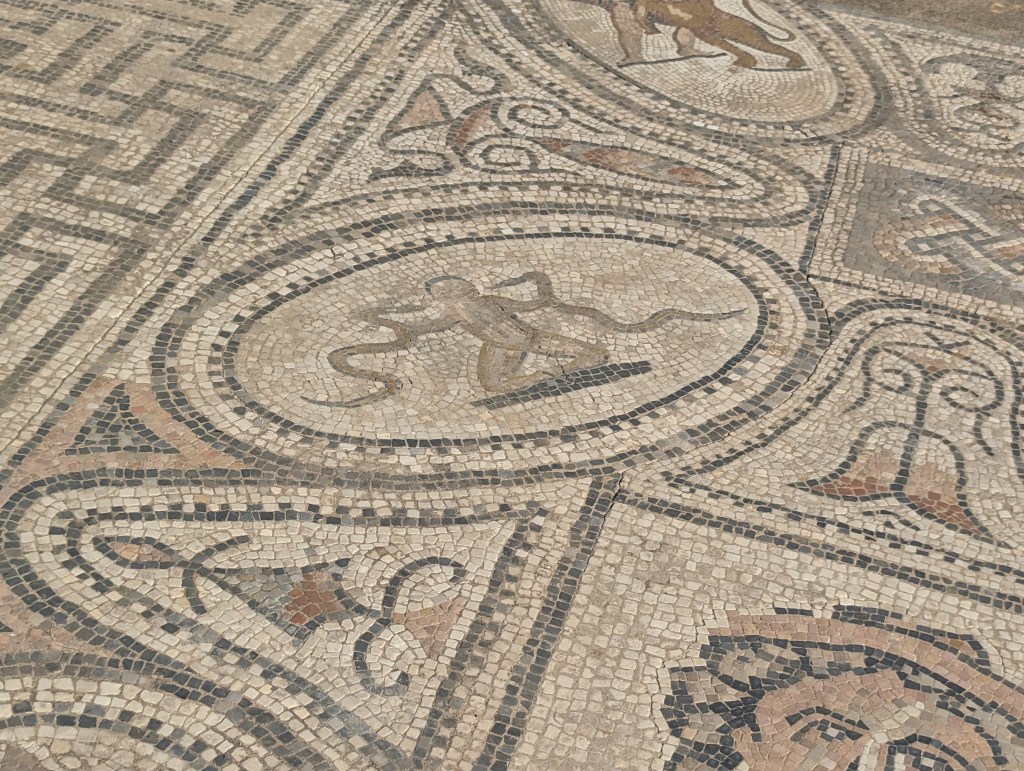
And Hercules performing his labors.
The swastika had been a symbol of prosperity and good fortune.

Berber symbol for donkey.
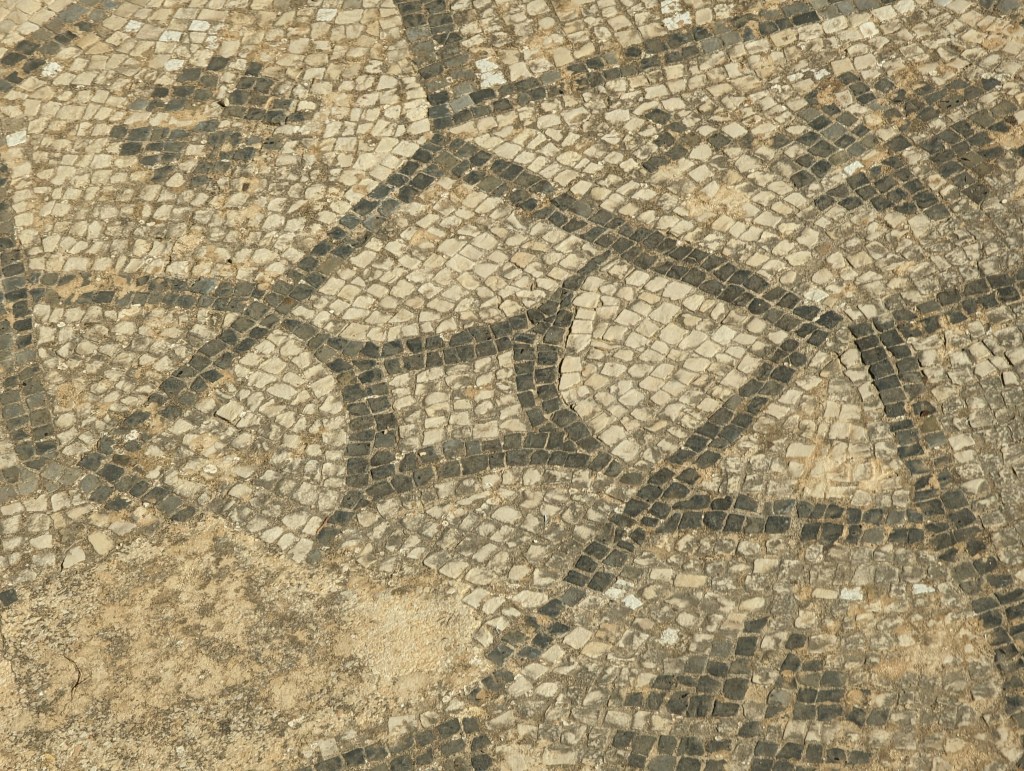
And the Berber cross.
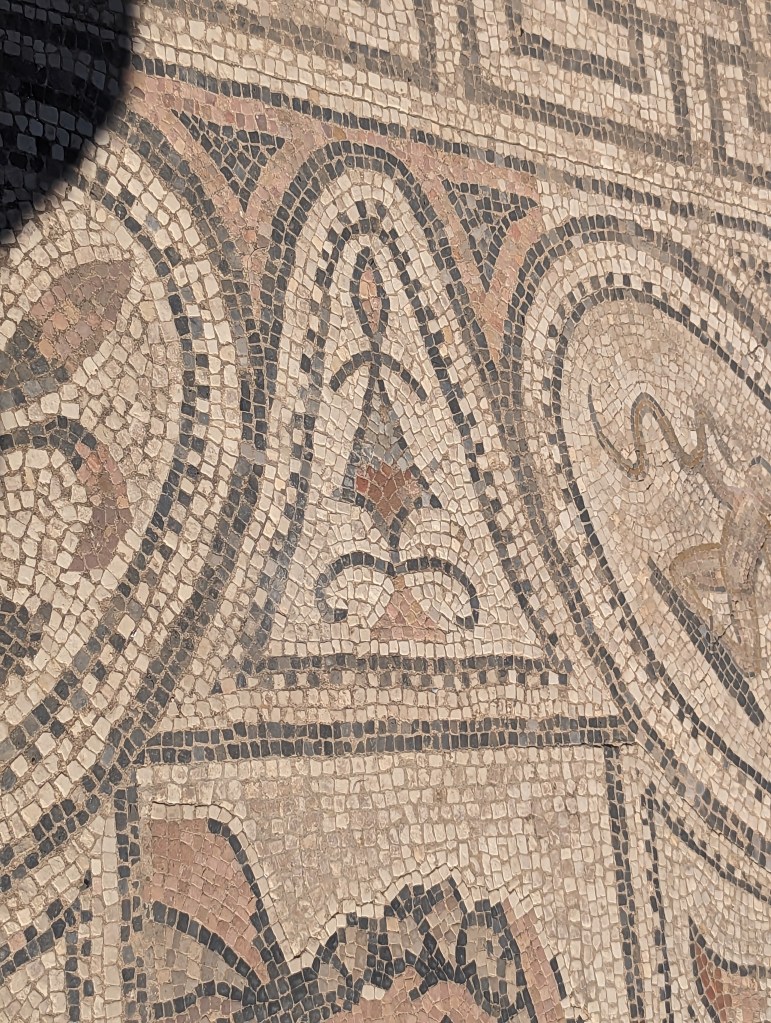
The name of the town, Volubilis, is Roman for morning glory, which is depicted below.

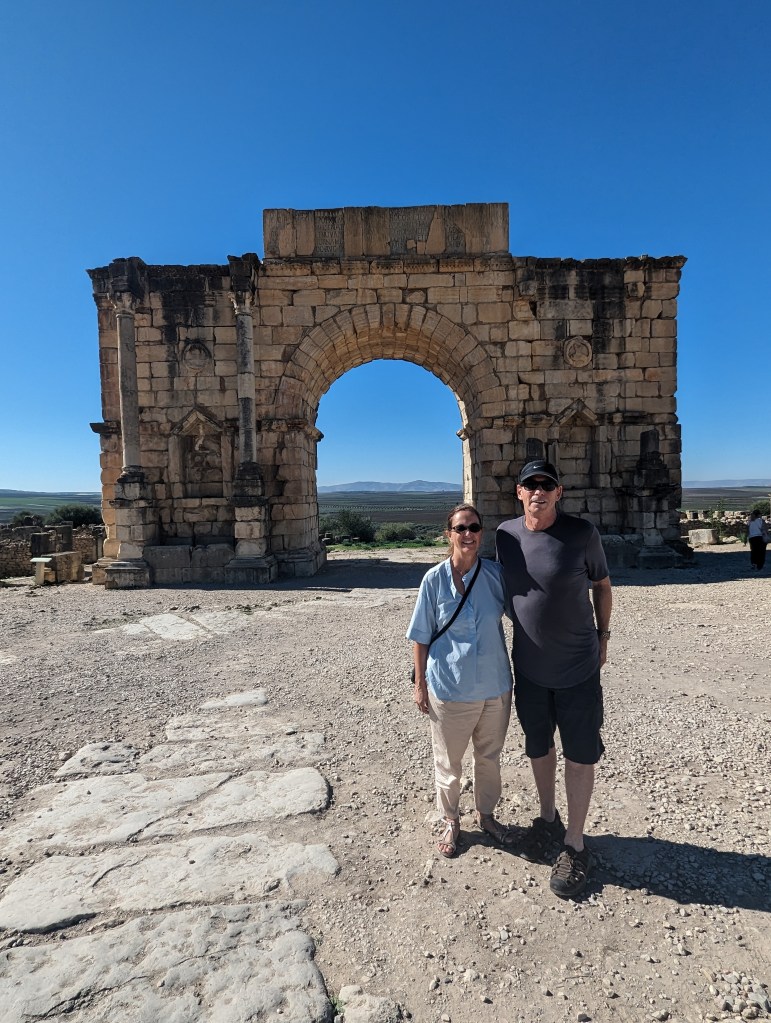
At the end of the road is the Triumphal Arch.
Beyond is the basilica: the court.

in front of which is the forum, which would have had a colonnade with shops and a market.
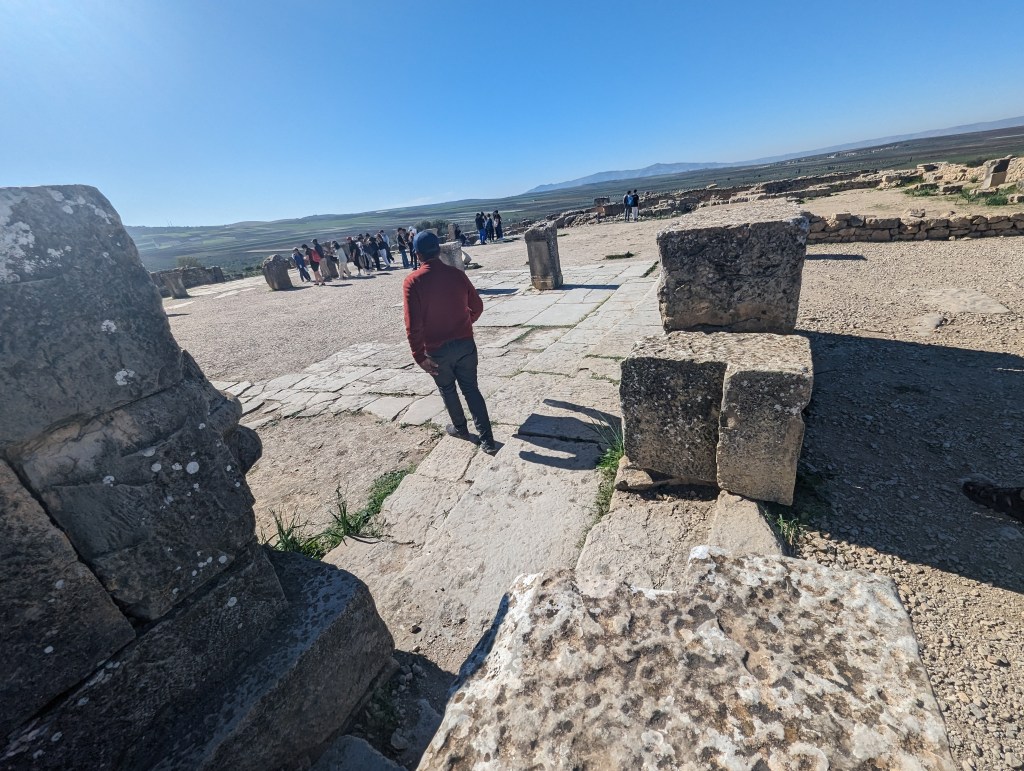
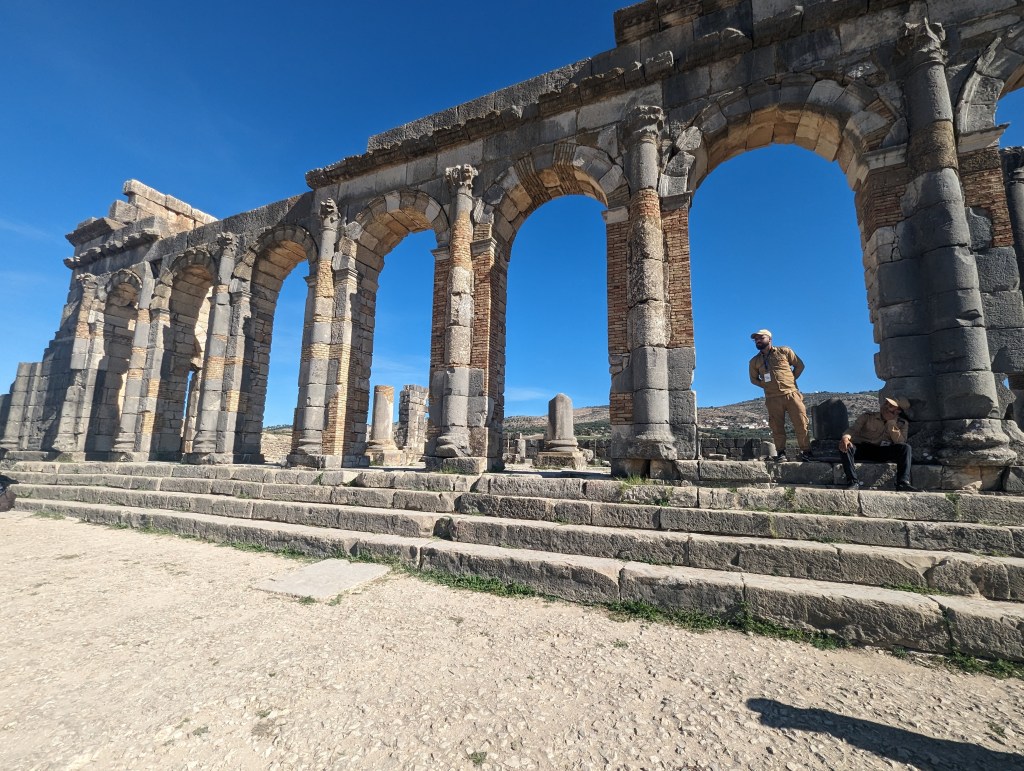
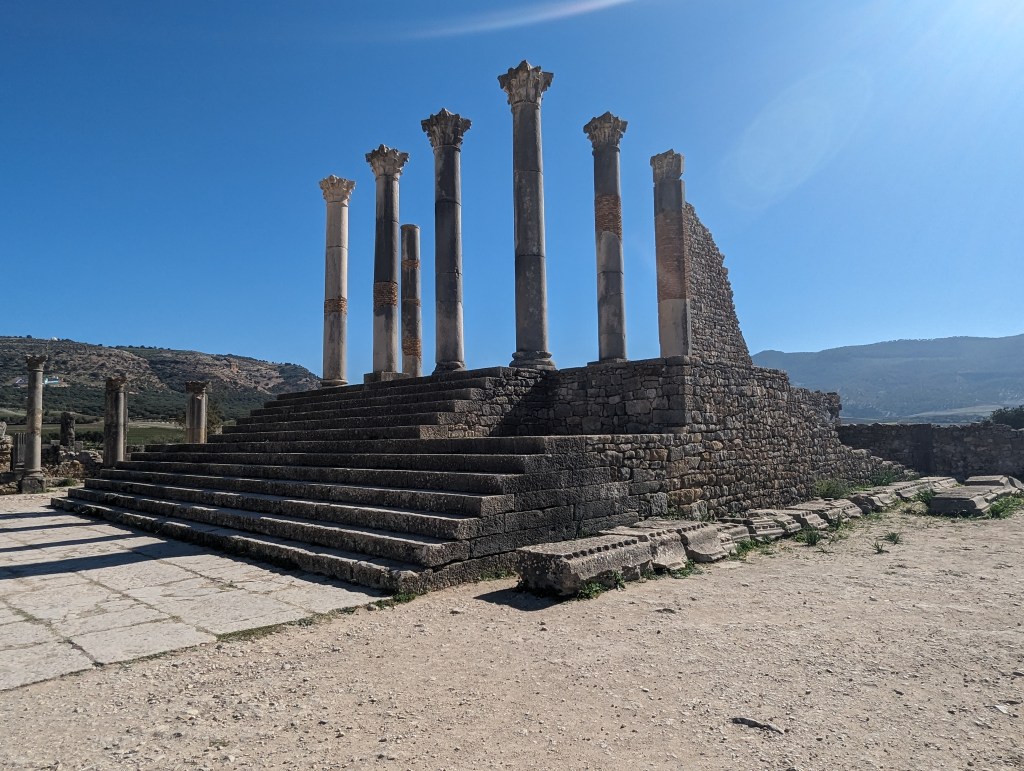
Next to the Basilica was the temple built in 218 and dedicated to the trinity: Juno, Jupiter, and Minerva.
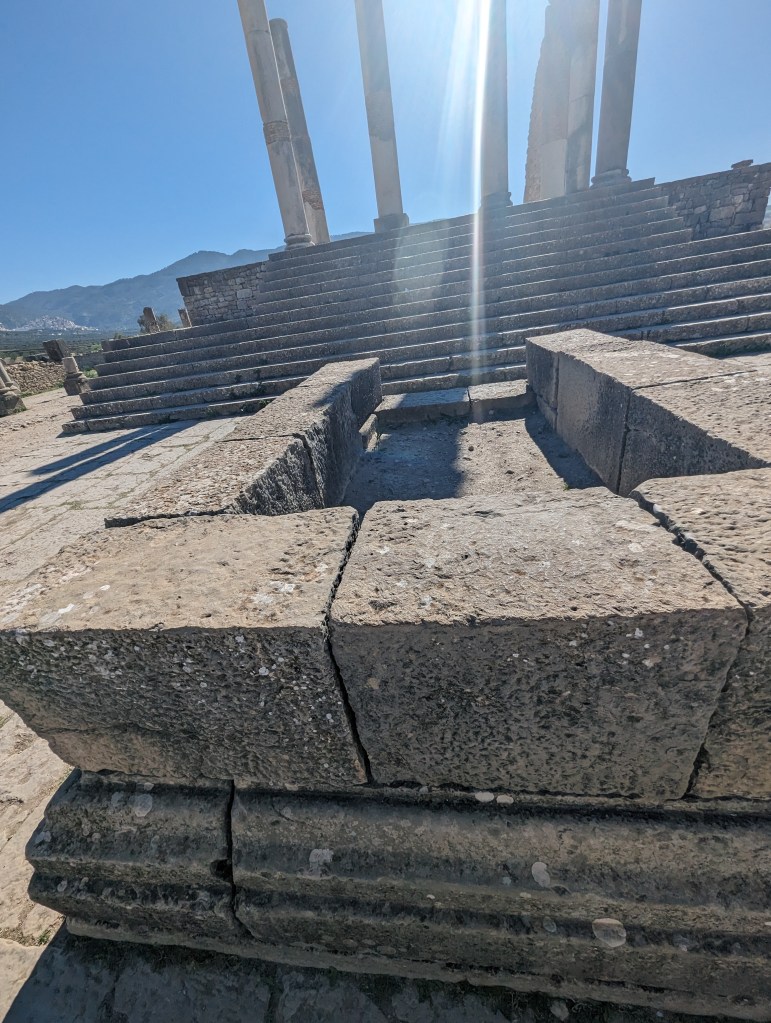
In front of the temple is the altar for sacrificing animals.
As we left the site, we had a last look back at the view of the temple and basilica.
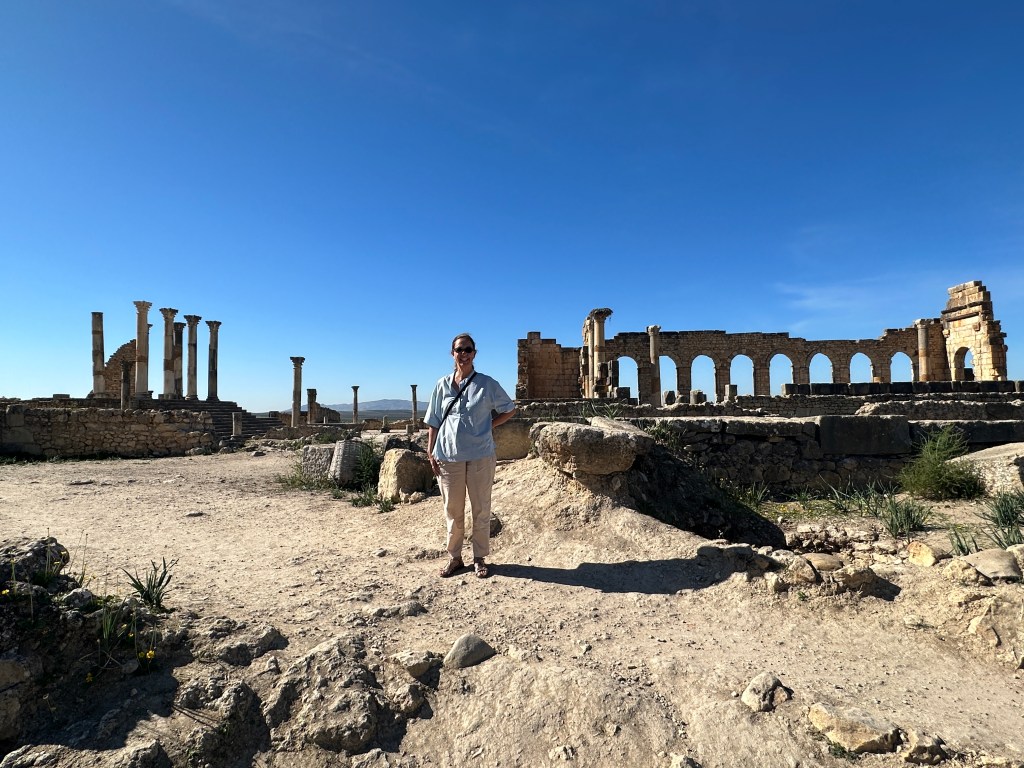
I do love an ancient ruin!
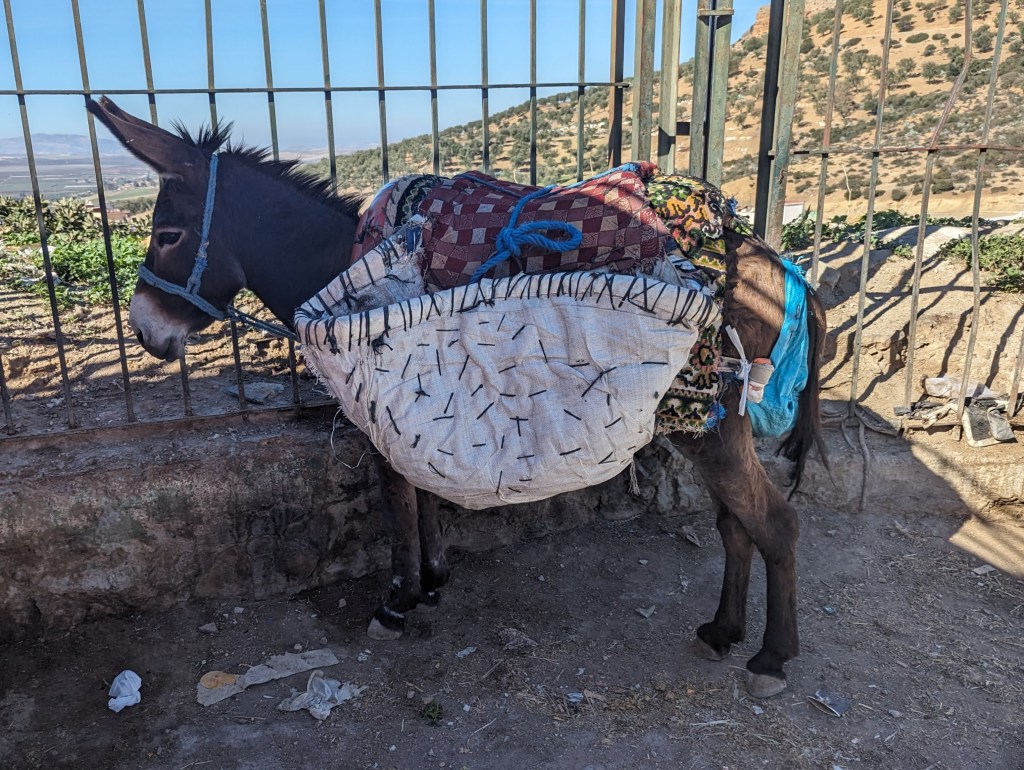
We headed from Volubilis to the nearby town of Moulay Idriss, site of the tomb of Idris I, the first major Islamic ruler of Morocco, after whom the town is named. He died in 791. Kamal told us that if a Muslim is unable to make a pilgrimage to Mecca in his life, visiting this city 7 times will serve the purpose. We parked and headed up the medina for lunch. We passed this donkey home from a day’s work. The medina streets are often too narrow for even carts, so donkeys are used to deliver goods to the shops.
We passed the shops on the main square.

We climbed the many, many steps to the Scorpion Restaurant with its gorgeous views. Notice the humble entrance.

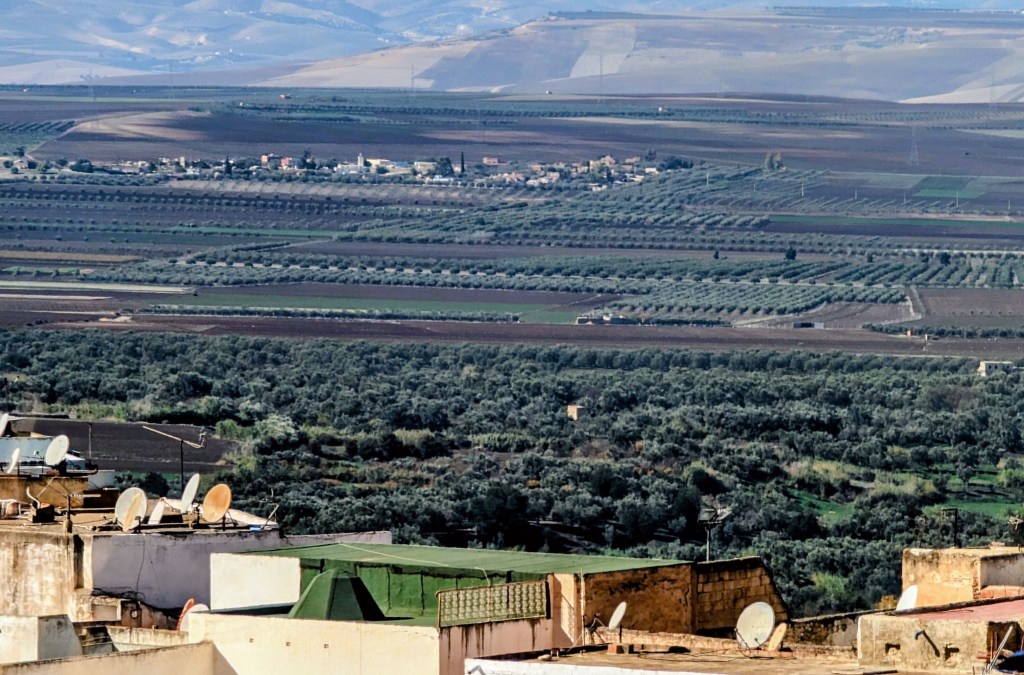
And here are the views of the city.

From here we can appreciate the fertile land that enticed the Romans.
We were presented with our menu including several things that were new to us.

This was lunch for just the 2 of us, not including the kebabs that came later.
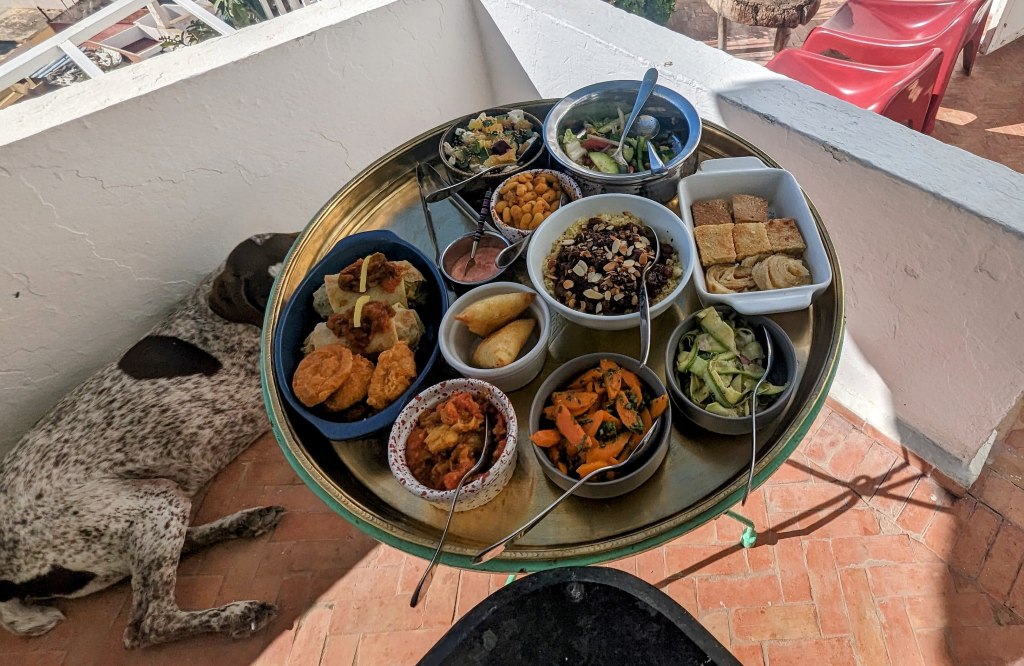
We managed to pack away most of it; it was soooo delicious. Then came dessert. And of course tea.
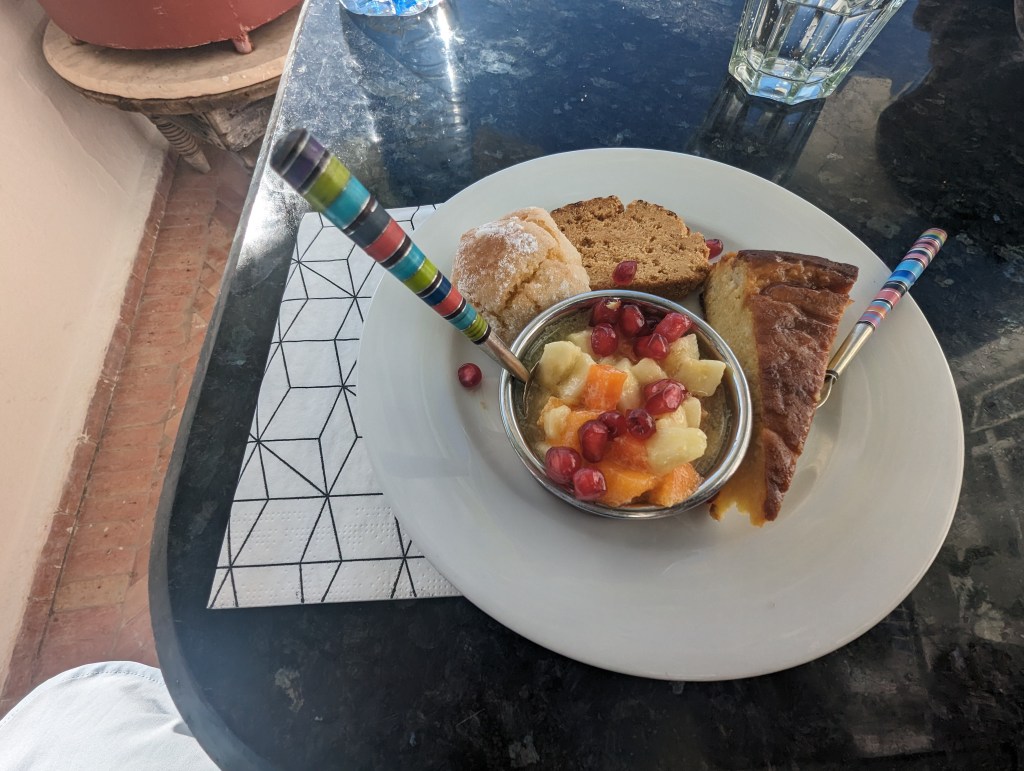
We rolled out of there back to the car for the final drive to Fez. Once there we were met by a porter from the riad who had a cart for our luggage. We wound our way through the medina to Riad Laaroussa.

Again, the entrance is an inconspicuous hallway.
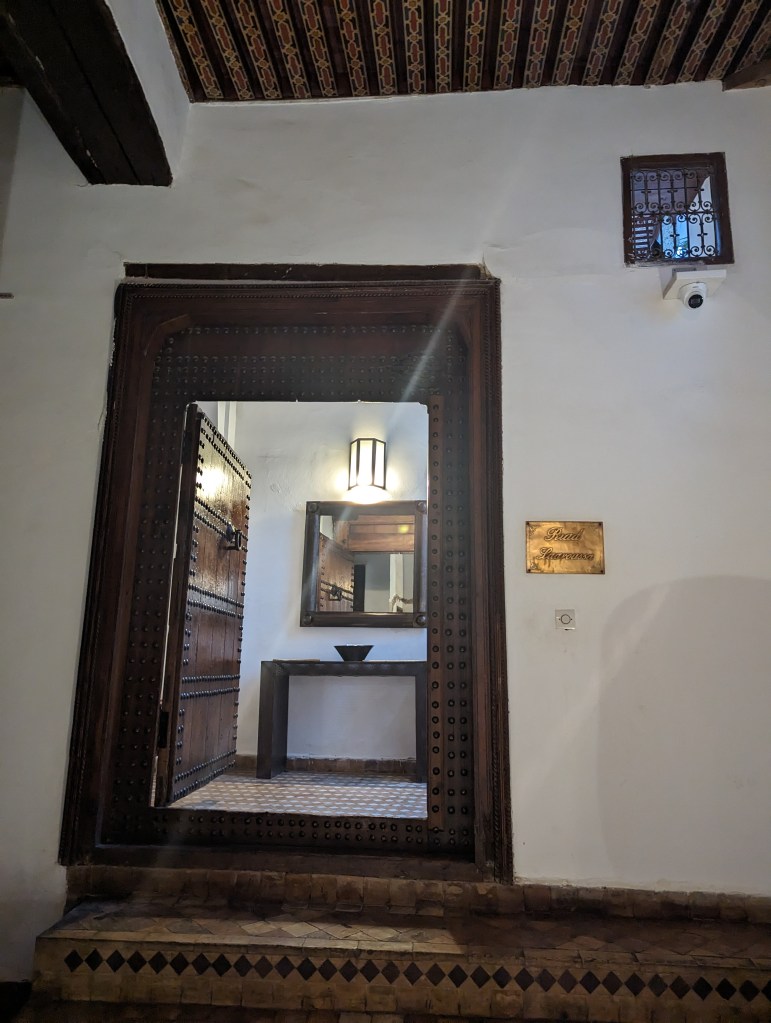
Which opened into this awesome courtyard so huge it has orange trees.
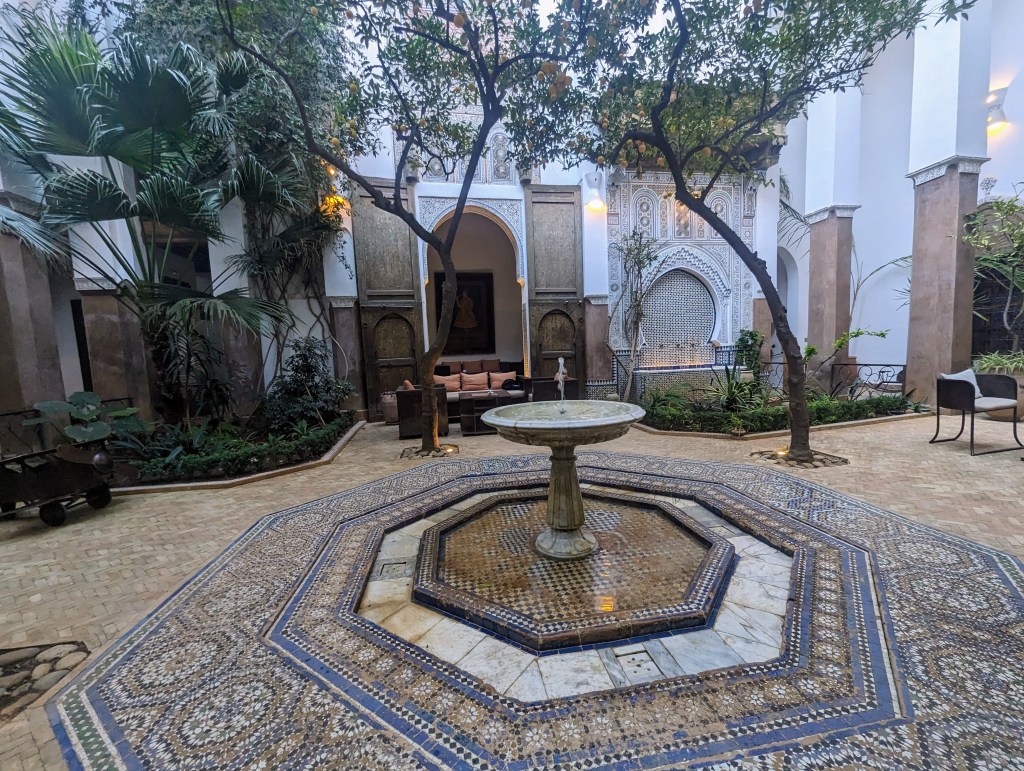
We were offered tea and more almond cookies, but honestly could not eat a bite. But the tea is settling to the stomach.

We were led up to our room called the terrace room. It is the largest room I have ever slept in with a floating bed smack in the middle and a desk behind.
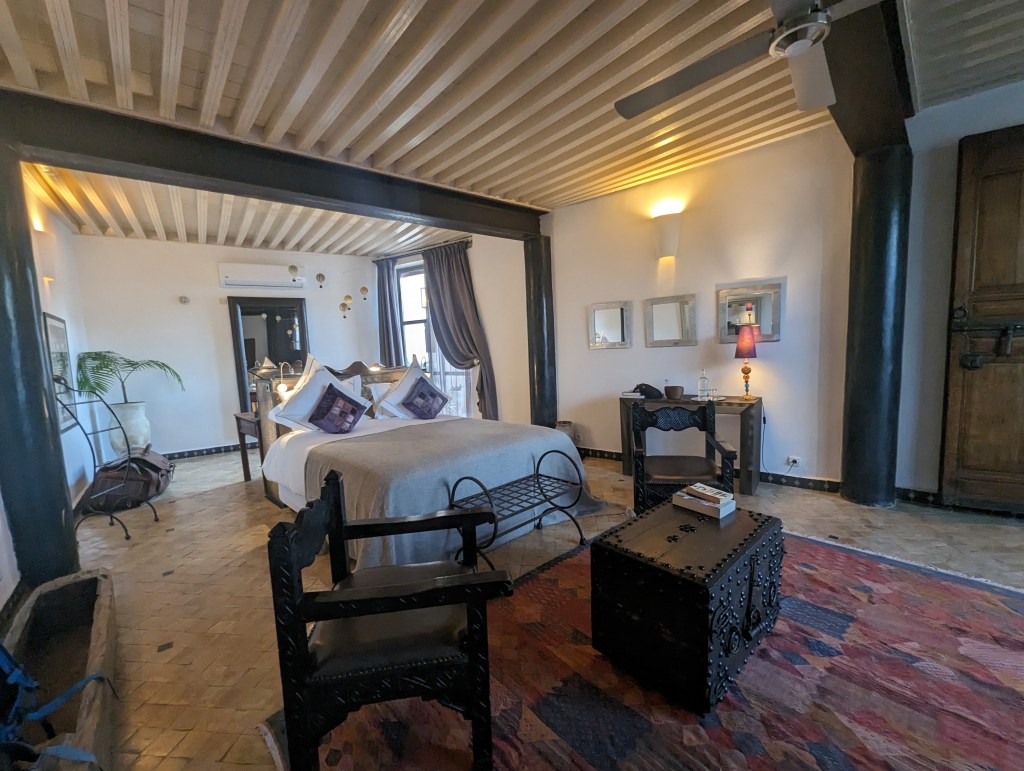
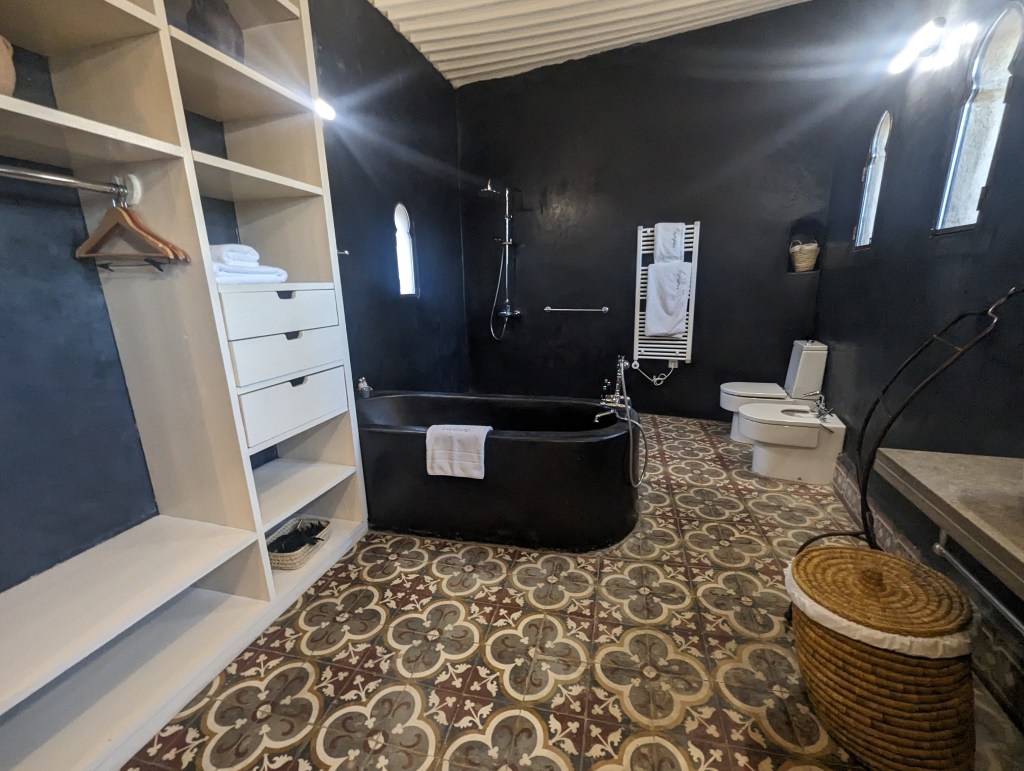
We had 2 terraces.

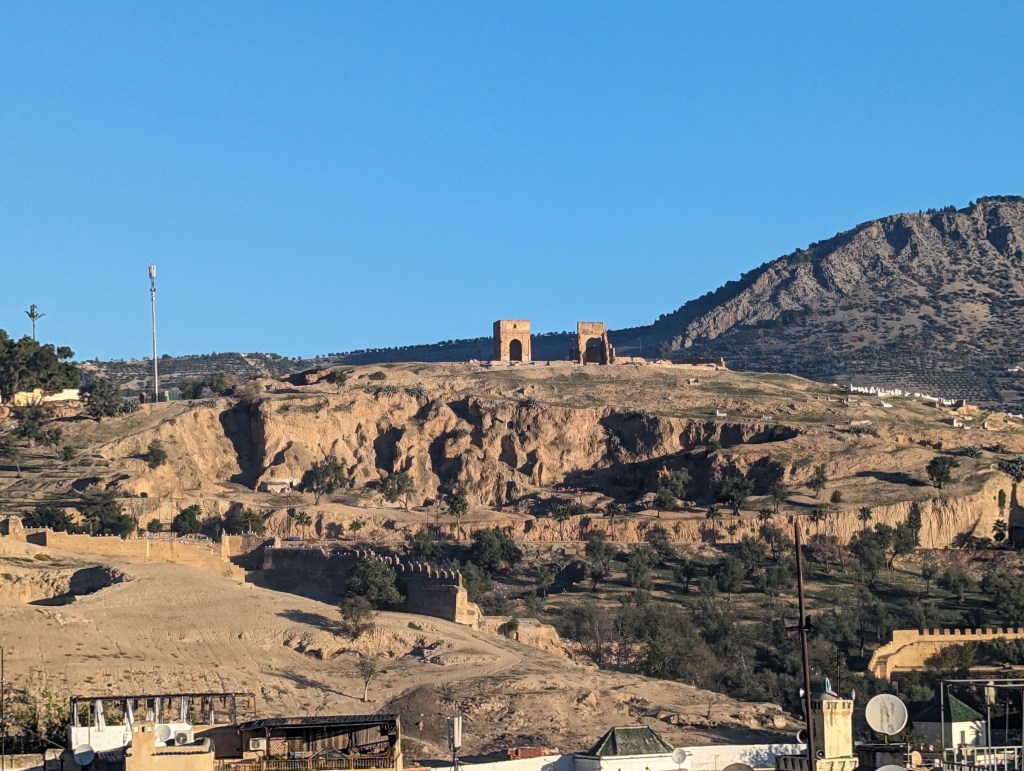

We were given a tour of the riad which has a spa, swimming pool, and offers massages. The restaurant and breakfast terrace are on the roof.
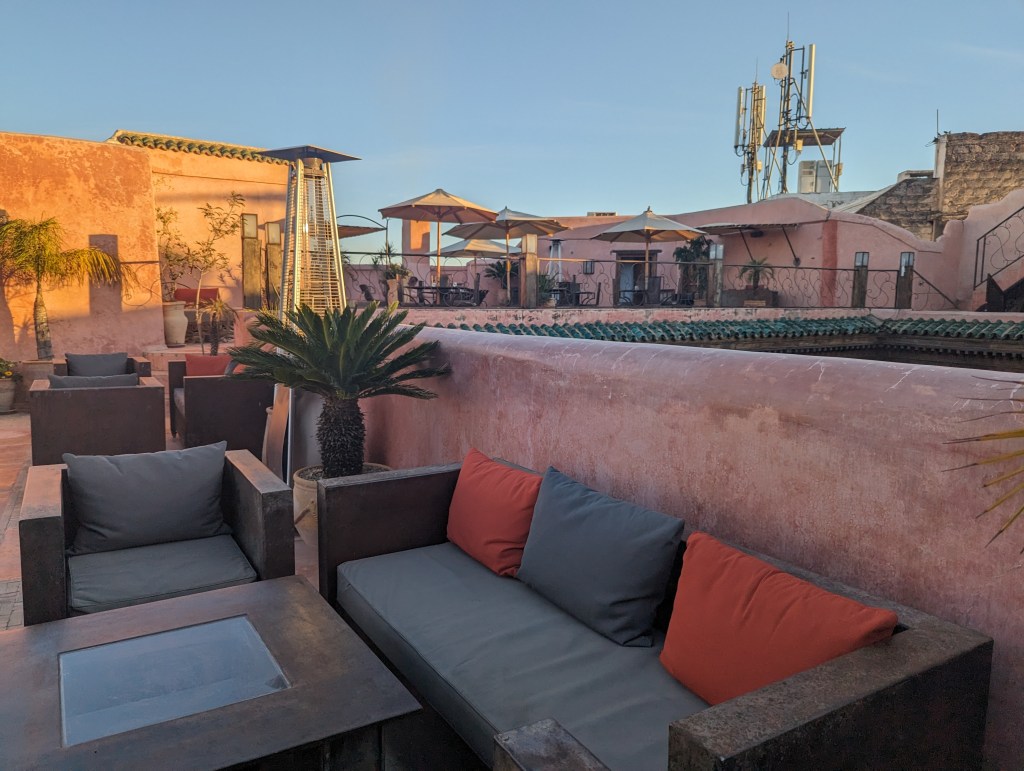
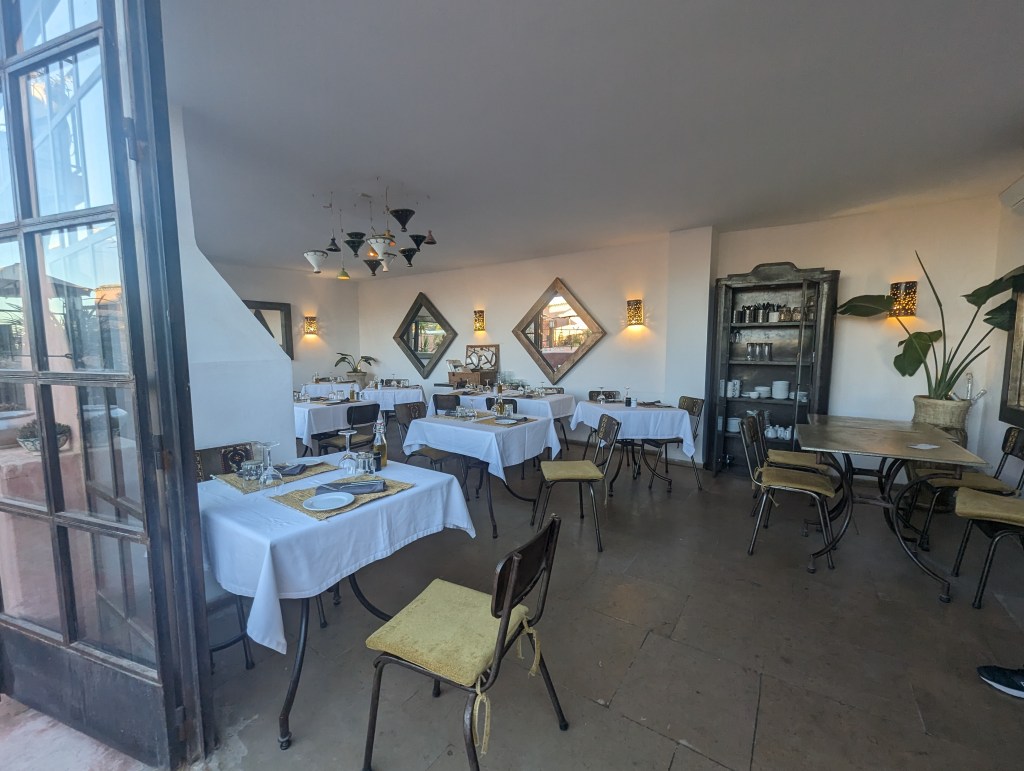
And we were here for 3 nights! We may never want to leave. We had dinner on the terrace, but could barely eat. Then hit the hay for our big day and early start.
We were met in the morning by Naim. It was so early few of the shops in the medina were open yet. But he explained how UNESCO is renovating the medina to emulate the original design with uniform wood doors on all the shops.
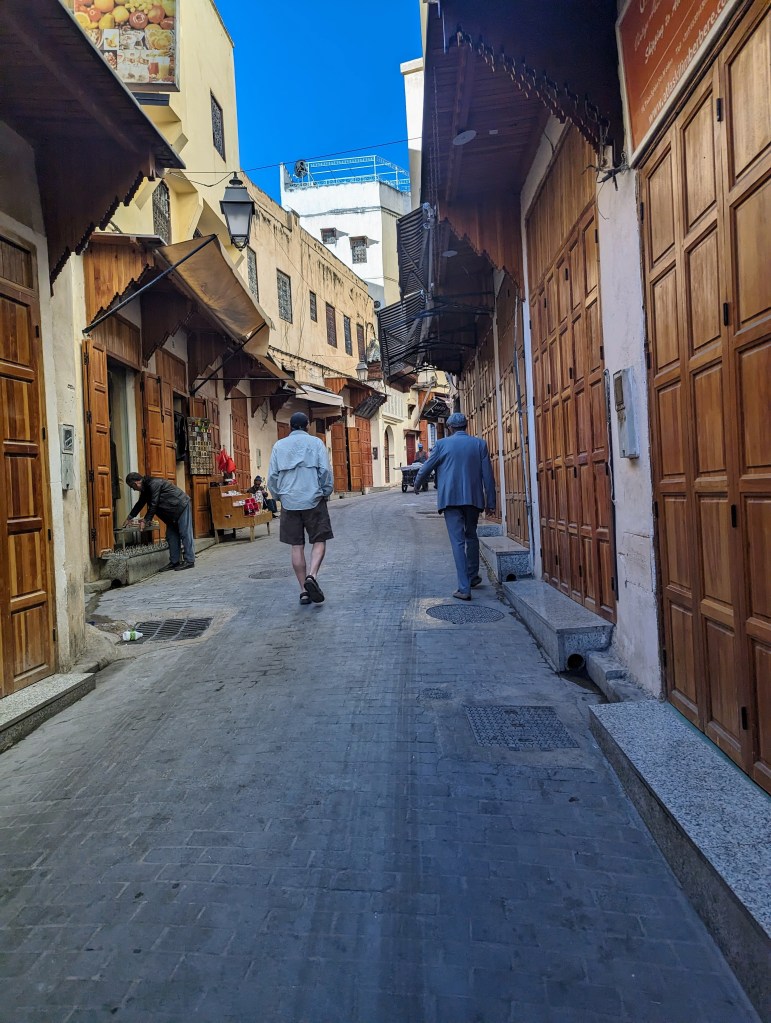
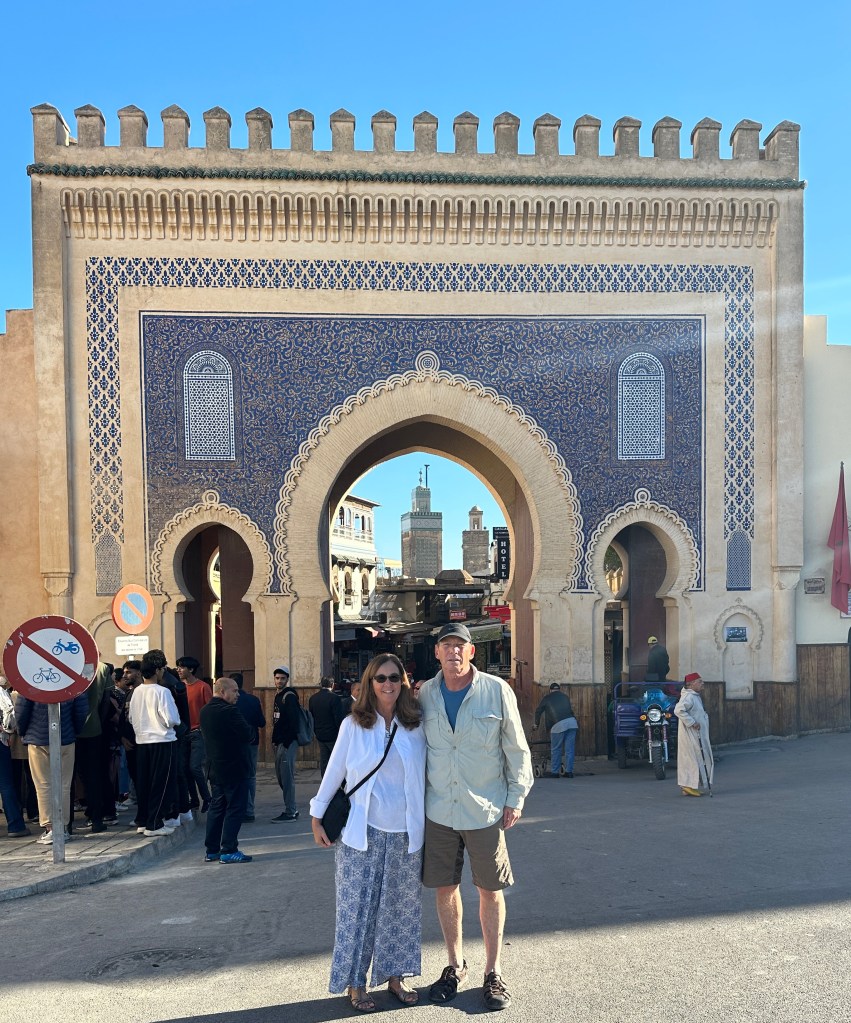
He walked us out of the medina through the blue gate. The entrance door with its mosaic tiles is the most emblematic portal of the old medina of Fez, the largest medieval city and car-free urban area in the world. The side facing the medina, is green, the color of Islam.
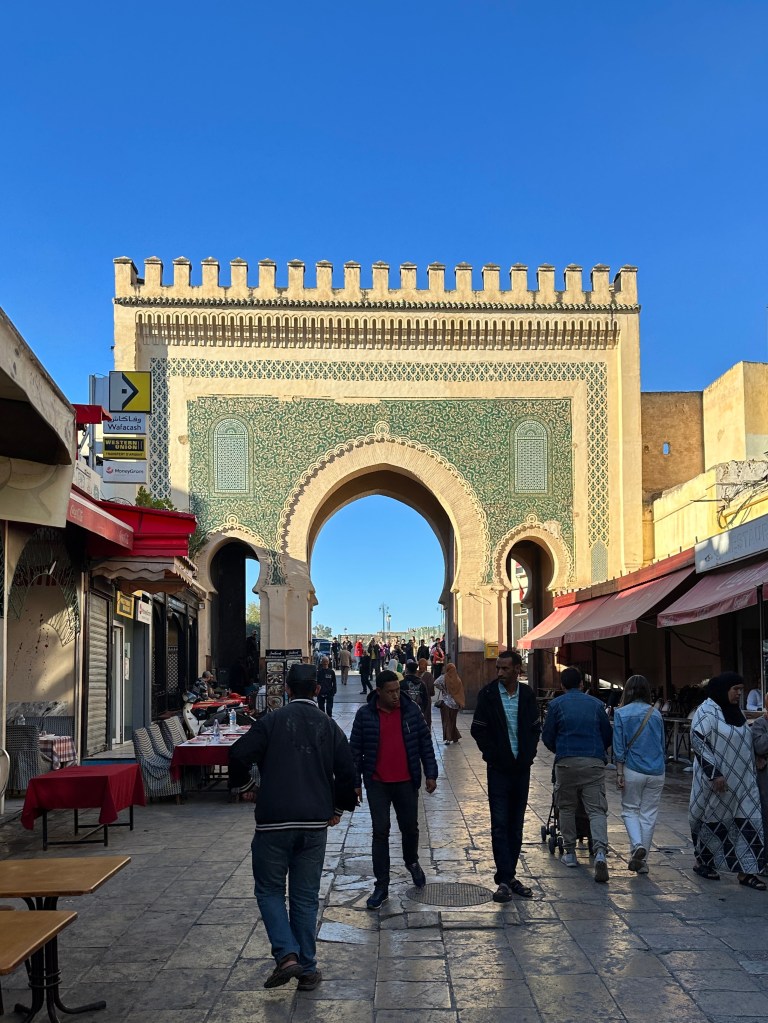
The blue on the side that welcomes new visitors represents the color of the city of Fez, famous for its pottery, painted with elegant cobalt blue patterns. The bab (portal) was built in 1913.
We then hopped in the car and Kamal drove us to see the Jewish Quarter in the “new city” of Fez: Fez el-Jdid, built mostly in the 14th and 15th centuries after the Jews were expelled from Spain. On the way, Naim filled us in on Fez history.
Fez was founded in the 9th century by Idris II, son of Idris I buried in Moulay Idriss mentioned above. He is buried in a mausoleum in the center of the medina he built, which is the old medina. Fez reached its peak in the 13th–14th centuries under the Marinids, when it replaced Marrakesh as the capital of the kingdom. The urban fabric and the principal monuments in the medina – madrasas, fondouks, palaces, residences, mosques and fountains – date from this period. Although the political capital of Morocco was transferred to Rabat in 1912, Fez has retained its status as the country’s cultural and spiritual centre. Today it is the second largest city in Morocco by population.
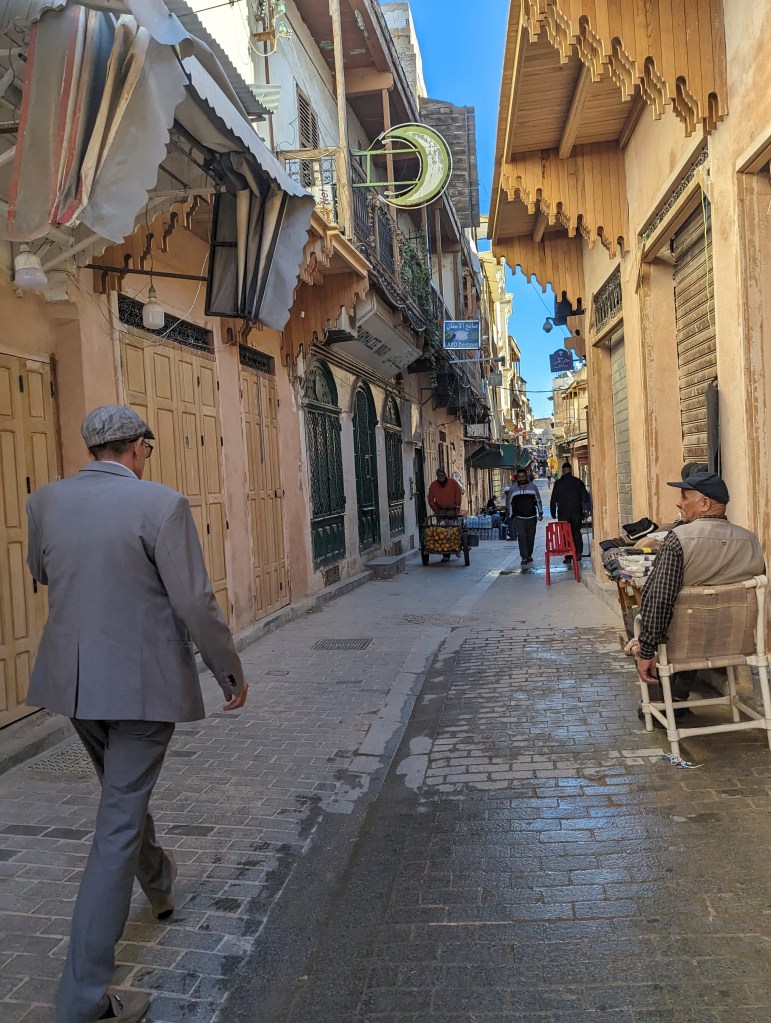
Immediately one can see the difference from the Muslim areas in the old medina. The Jewish Quarter has wider streets and the homes have balconies,

Many Jews adopted the French iron balconies.
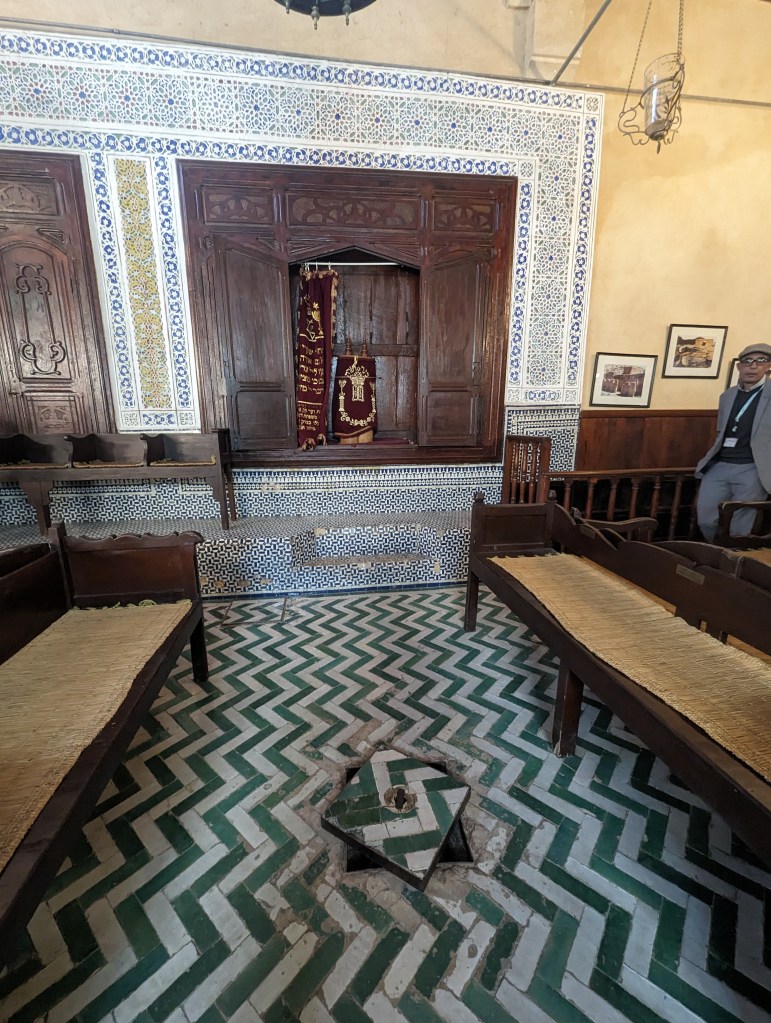
We visited the synagogue.
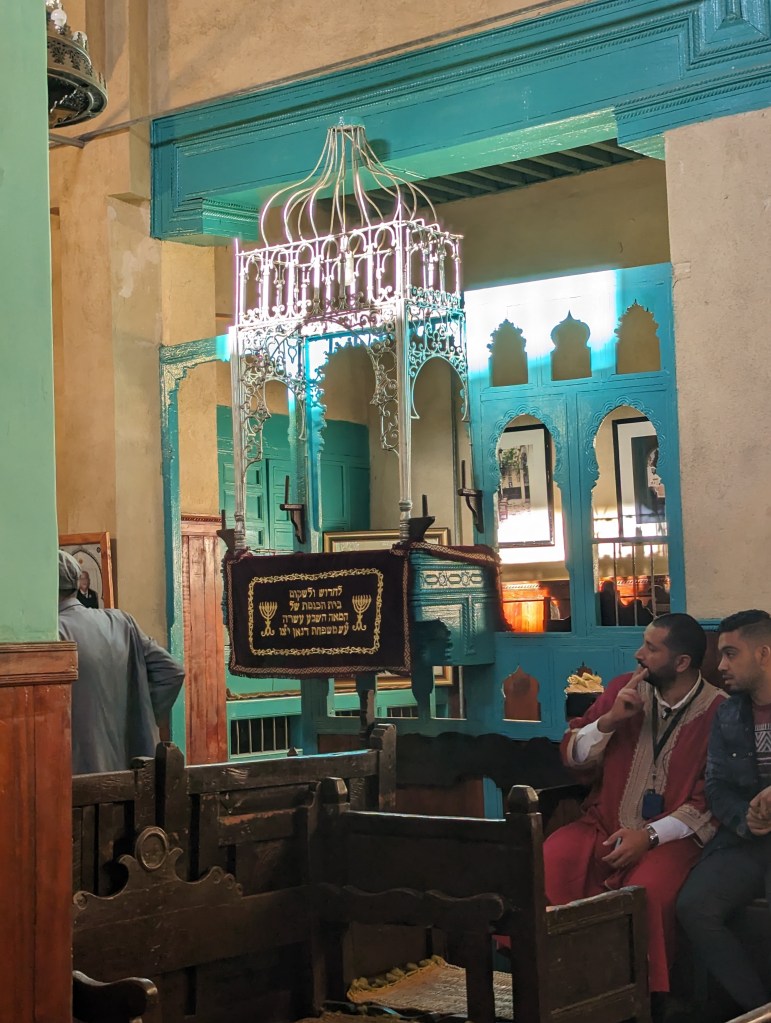
With its wooden bima.
And the uninviting looking mikvah.
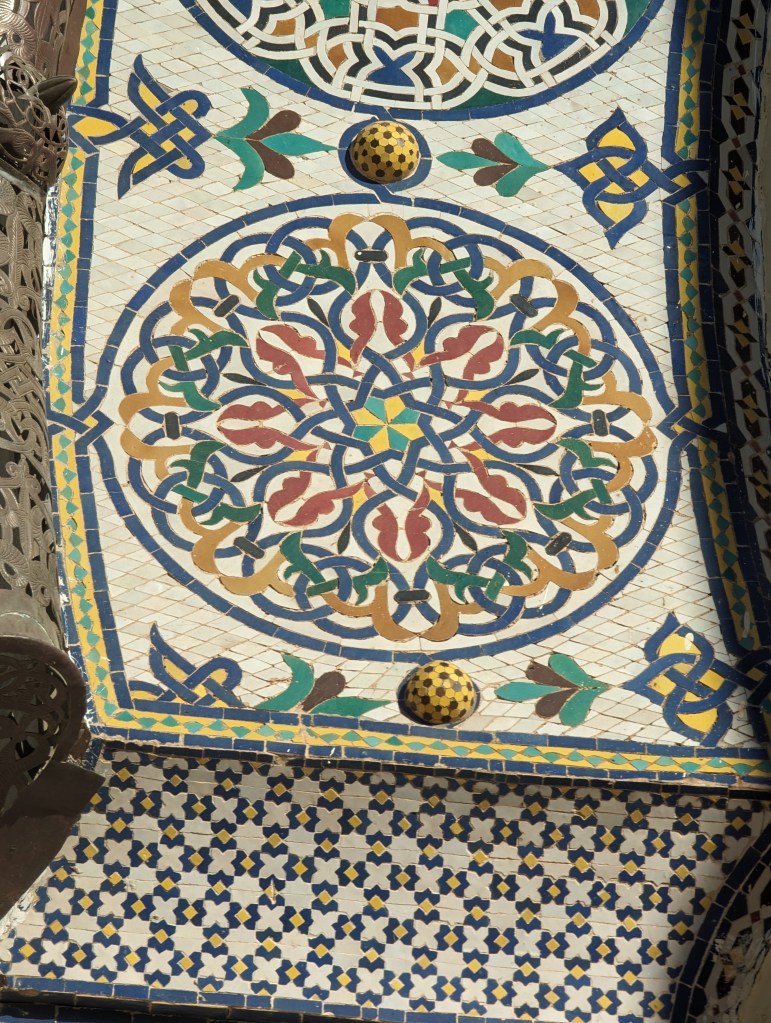
We then stopped in front of the Royal Palace. The original foundation dates to the 13th century. Despite the Muslim preference for humble entrances to their homes, in 1962 having been returned to his throne, King Mohamed V ordered this elaborate gate built for his home to showcase to the world the craftsmanship of Fez and Morocco to promote trade and tourism.

The typical Moroccan artisanal arts on display include metal works:
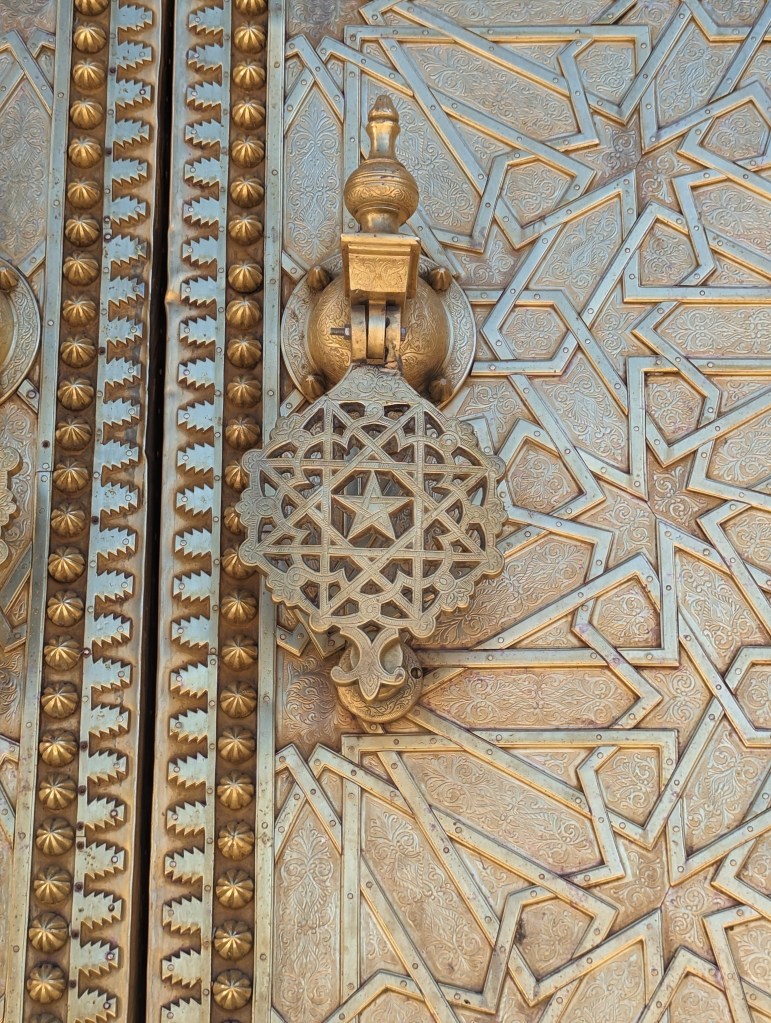
With an example of the fine metalwork
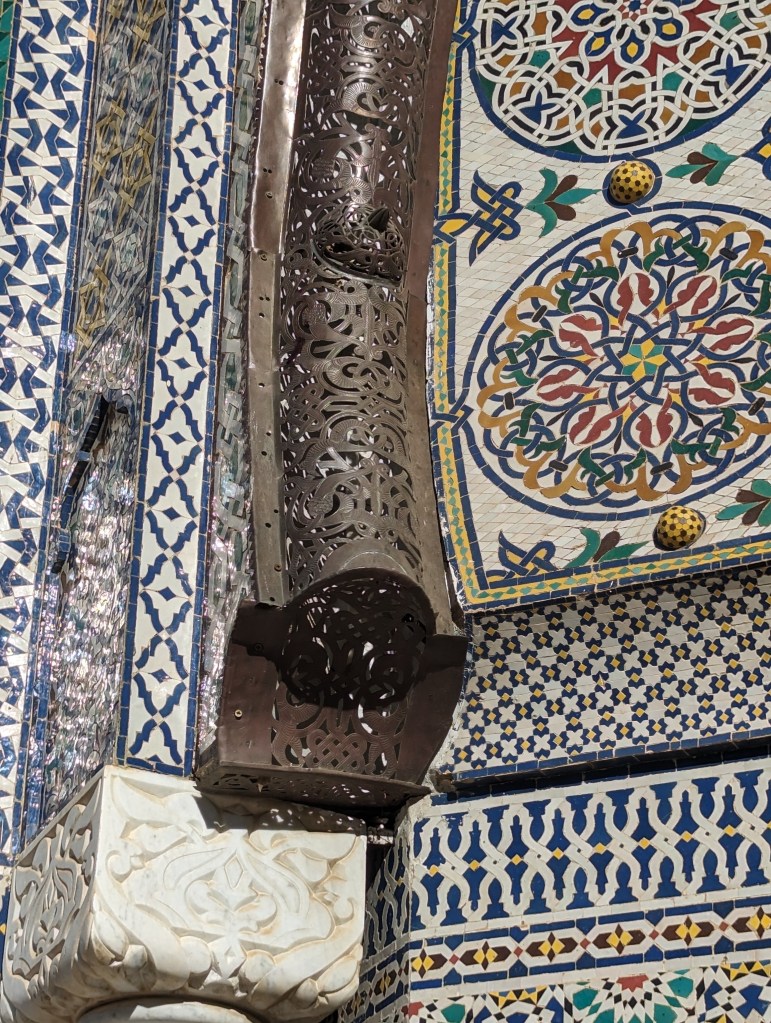
And of course mosaic tiles.
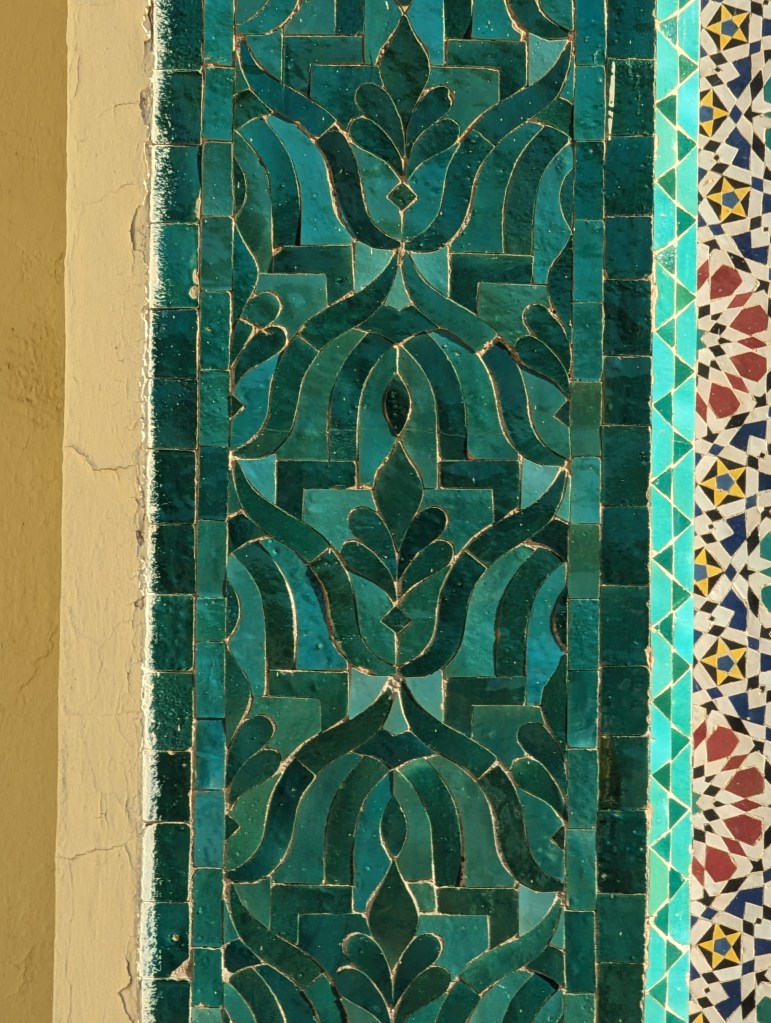
and the overhang carved woods.
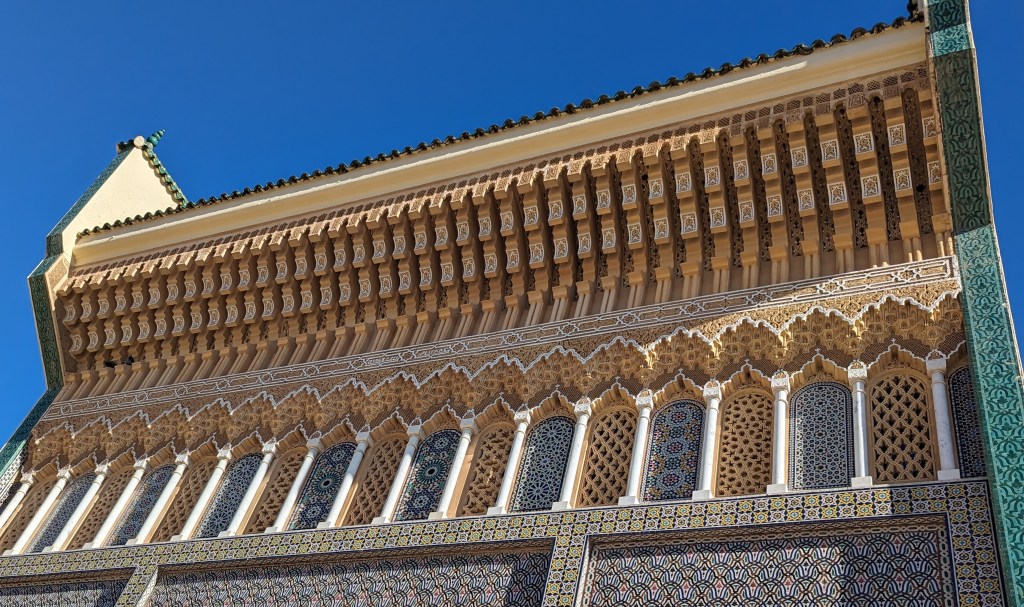
One side with white panel has a Quran quote that is a poem about serving the one God and living in peace and harmony with one another. When France fell to Germany in WWII, Germans controlled French occupied Morocco. Hitler demanded that Morocco hand over the Jews. The king refused and provided refuge for Moroccan Jews inside this immense palace (one of about 2 dozen in the country).
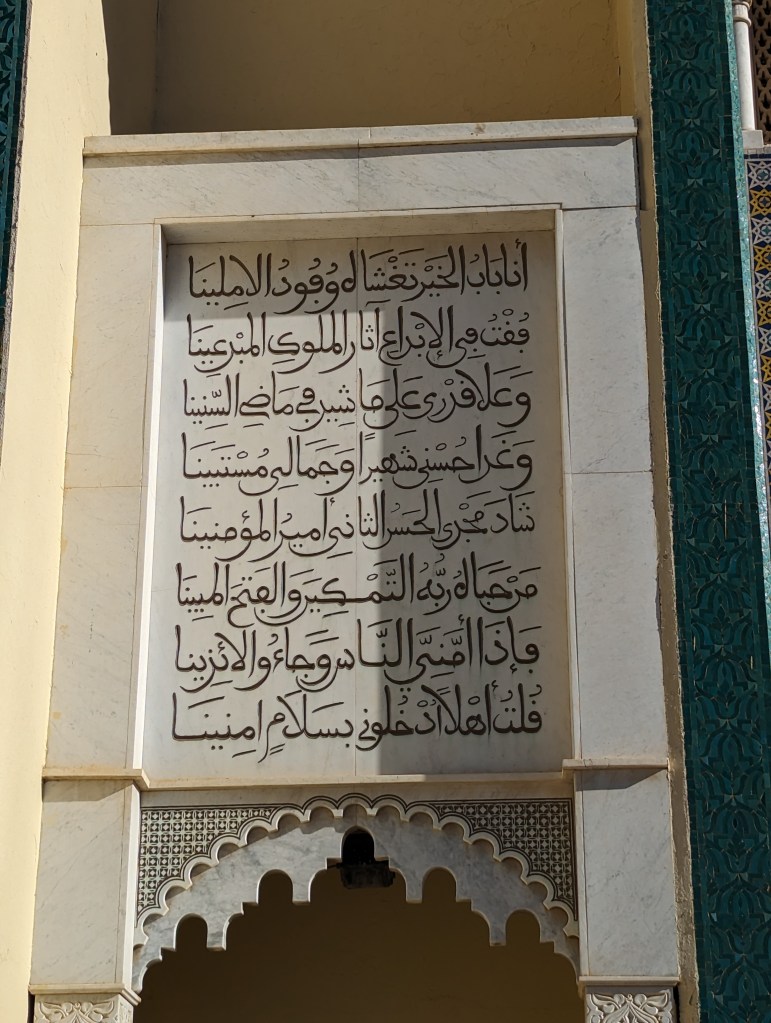
On the opposite side the same white panel is blank so the gate is not completely symmetrical because only God is perfect; nothing man-made can be perfect.
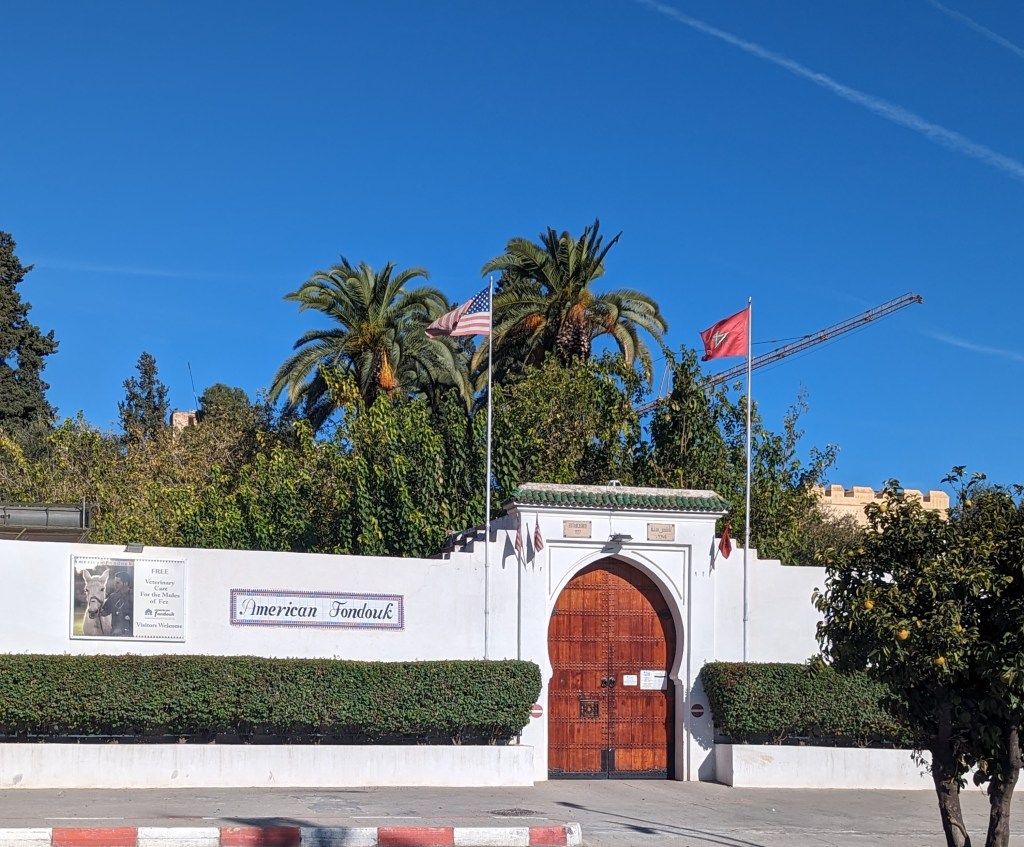
After admiring the gate, we hopped back in the car and headed for a viewpoint. On the way we passed a previous fondouk. A fondouk was a place where merchants and their wares could pull in, trade with the locals, have a place for them and their horse to stay, and take the local handicrafts with them to sell elsewhere. The one we passed was bought by an American woman (thus the name: American Fondouk), and is now a veterinary hospital that does open to the public, but was closed today.
Then we made it to a spot above the town where we could have a view over both Old and New Fez as well as modern Fez. Old Fez is in the foreground, new Fez to the middle left, and 1980s and beyond across the back.
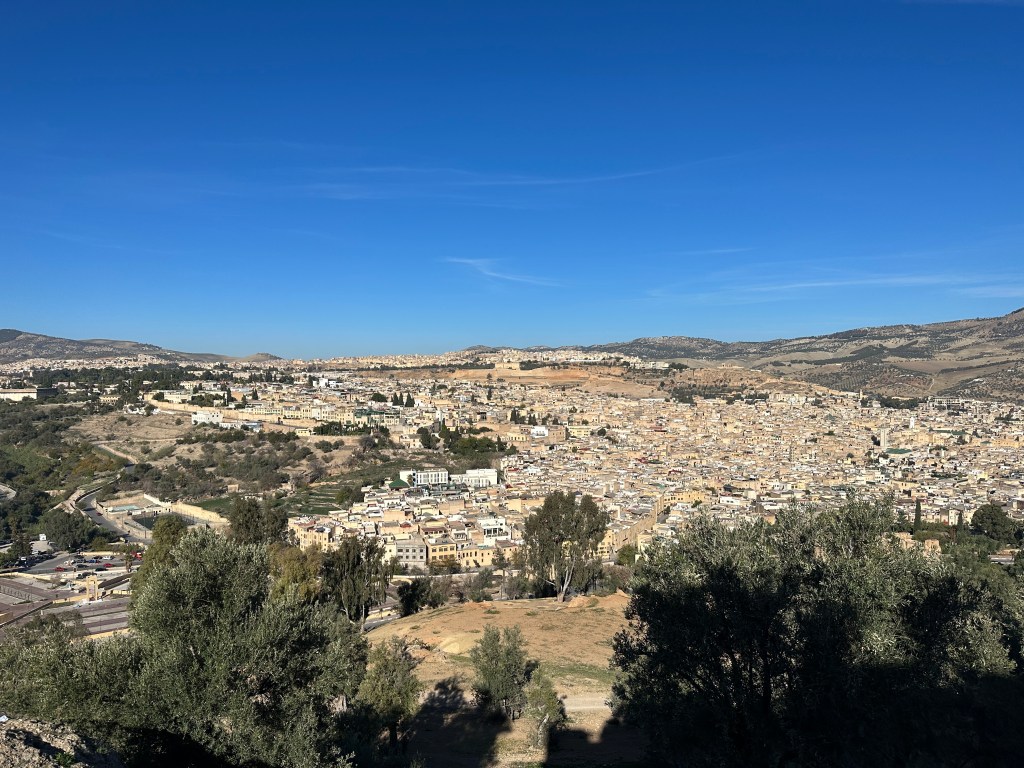
Fez’s renown as a spiritual center is due to its large number of resident artisans, most of which practice their art in the same way that has been passed down through generations. In that vein, we headed to a family run ceramics shop.
Outside of each of the major gates -3 in total- lies a cemetery.


One of the family members came out to meet us and explain the process. First he showed us the excavated clay which is dissolved in water to make the clay. They use white rather than red clay because it can be fired at a higher temperature, making it more stable and durable than red.

The lump of clay is then spun into shape. He is using his feet to spin the wheel.

Then the pieces are placed in the courtyard to dry in the sun.
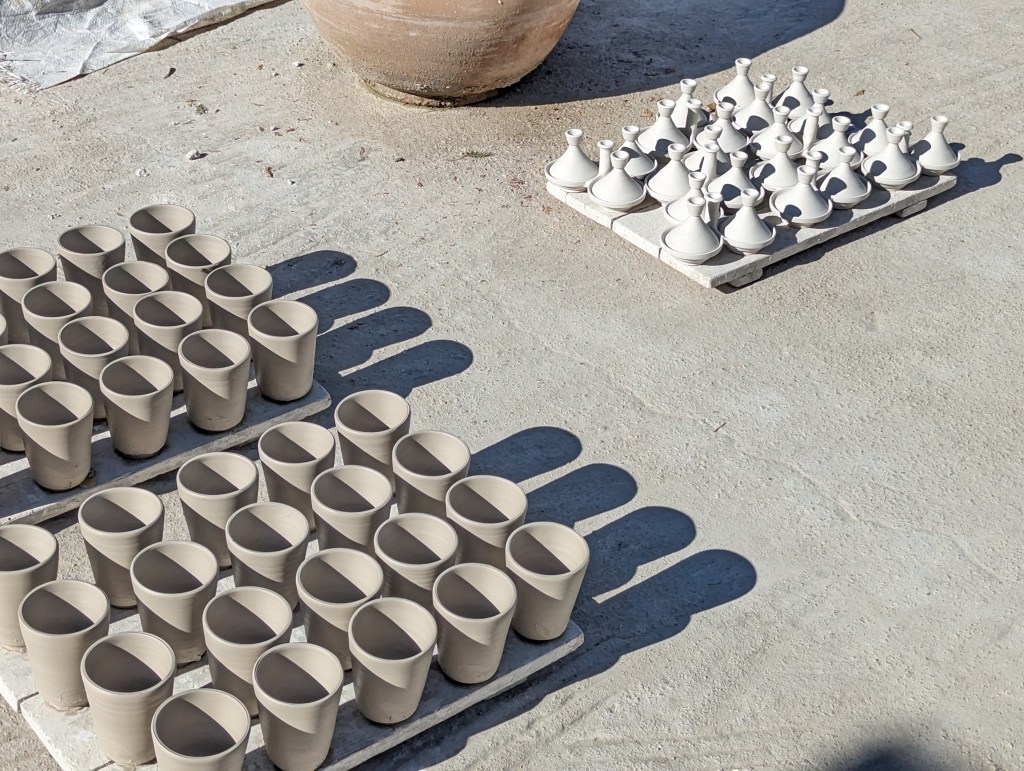
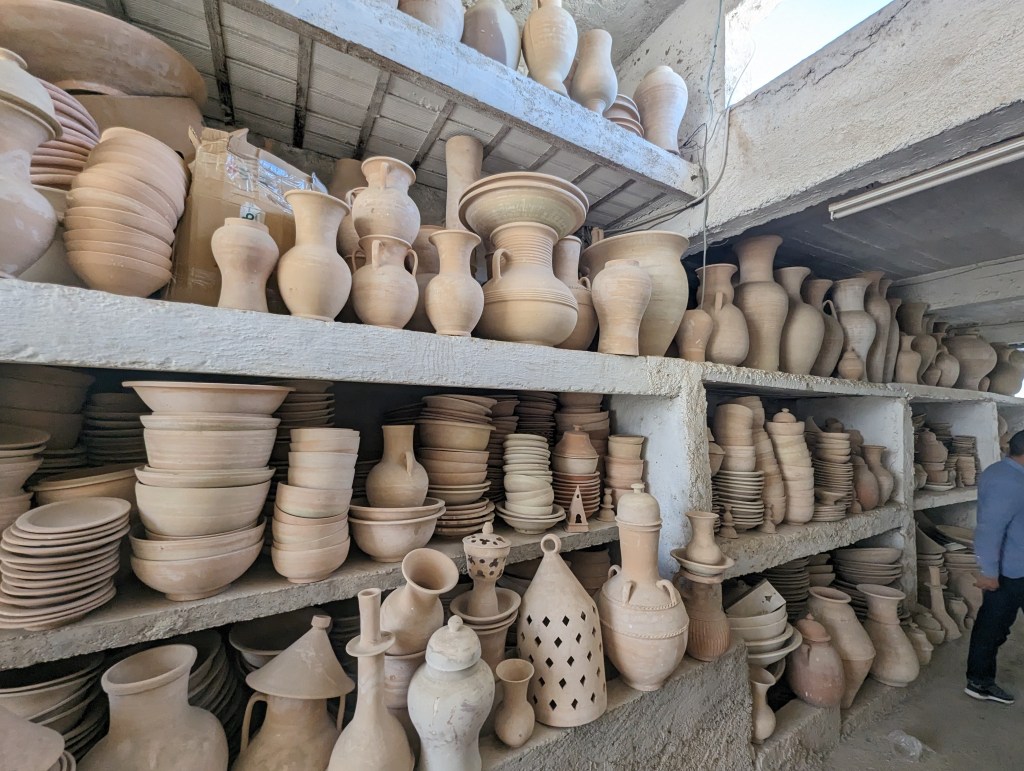
The items then go through their first bake, at which point they are called biscuit baked.
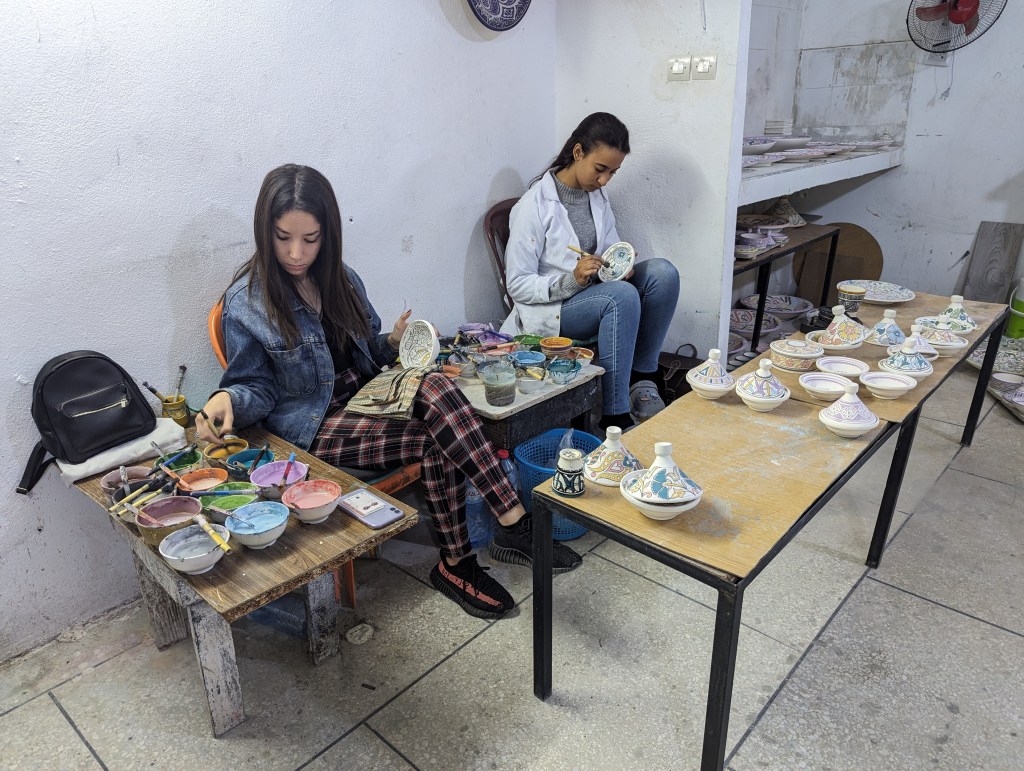
The next step is painting, which is all done by hand.
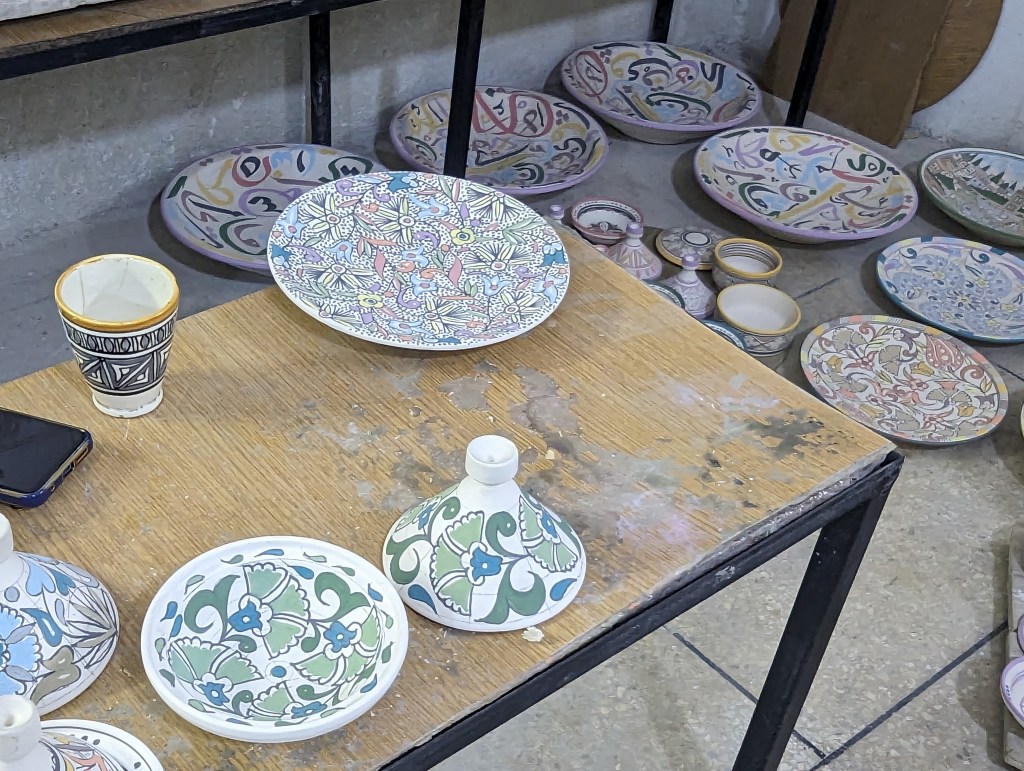
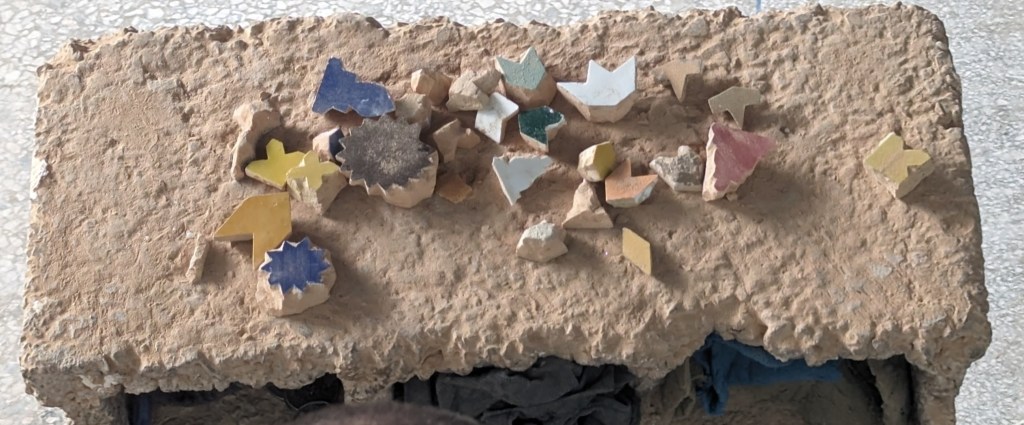
The pieces are then sprayed with a finish to give them the gloss and put in the oven for the second bake. Then he showed us the area where the tiles are broken into shapes if they are to be used for mosaics.

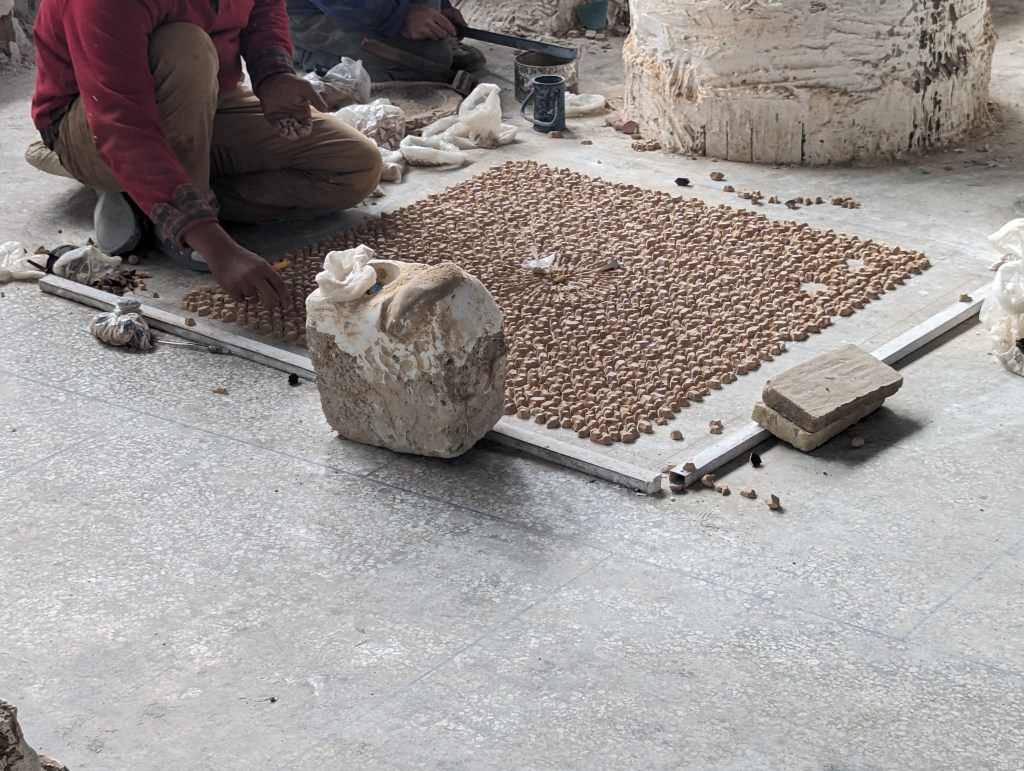
The pieces are then given to the master builder who builds the mosaic with the pieces turned upside down. He has to keep the colors and design plan all in his head.
Here is a finished product.
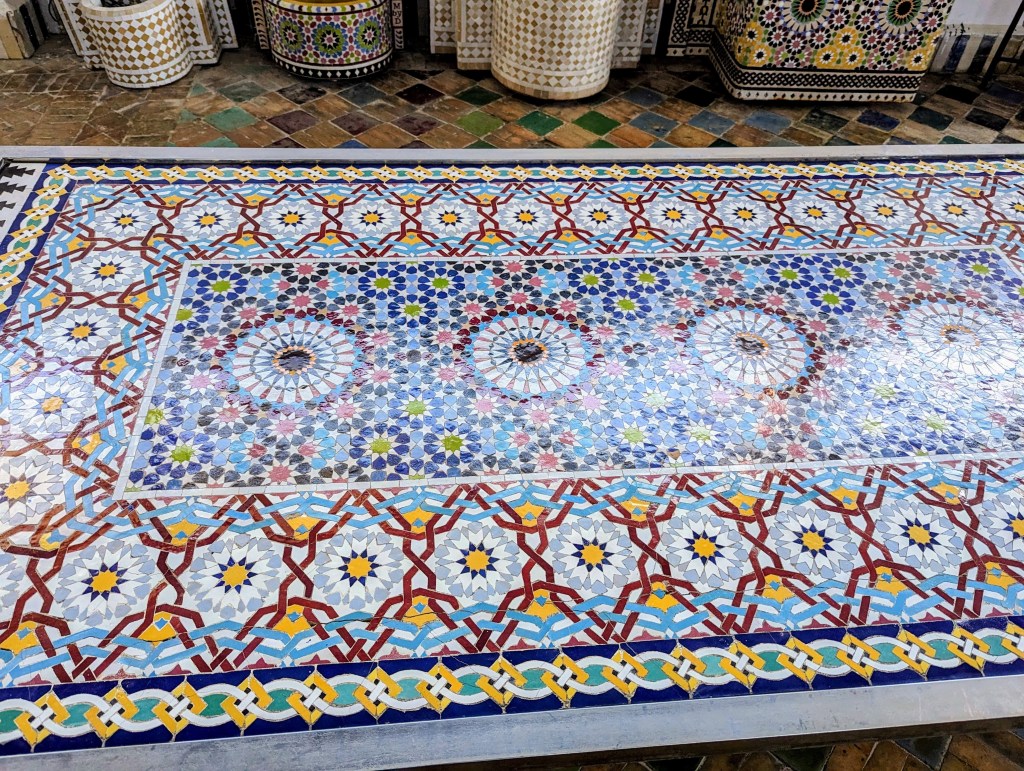
If building a fountain, fireplace, or any 3-D mosaic, the pieces are placed into a mold. The process gives me such a new appreciation for works we have seen like the palace gate and the Mohamed V Mausoleum.
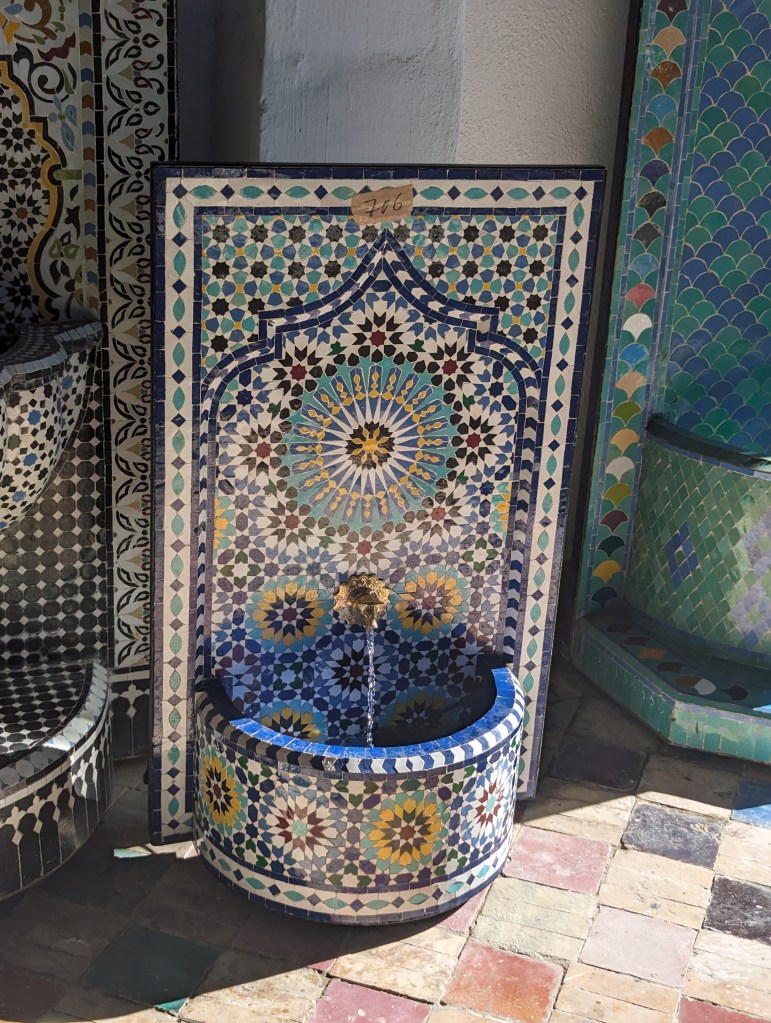
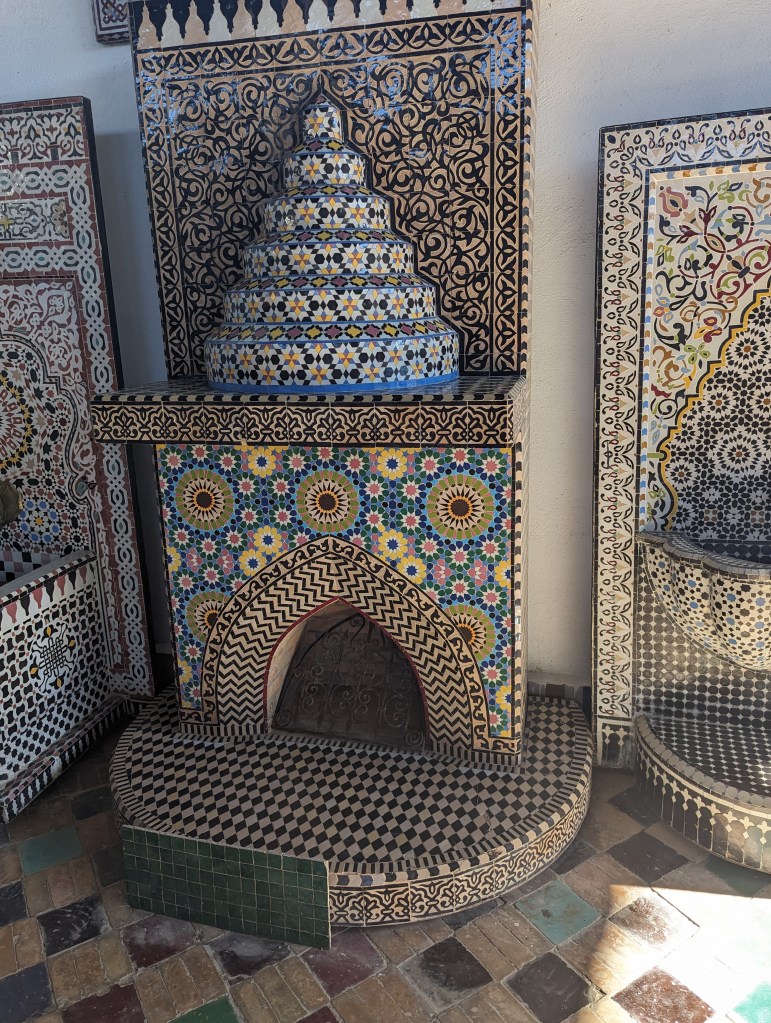
Then he showed us the gallery/showroom shop, gorgeous stuff.

We then headed back to the old medina. Just inside all of the major gates is the food markets to make it easiest for farmers bringing their produce and people coming to shop. The alleyways are so narrow that often only a donkey can transport the goods.

The next section are baked goods and prepared foods like olives, preserved lemons, smen (preserved butter, often flavored) or street foods for fast snacks. One new food we were introduced to is kligh, which is meat that is preserved, somewhat like jerky, then stored in fat. It is mostly commonly fried for breakfast, often with eggs.

Moroccans have all kinds of breads, especially for breakfast. One with semolina is called harcha. This woman is making crepes.

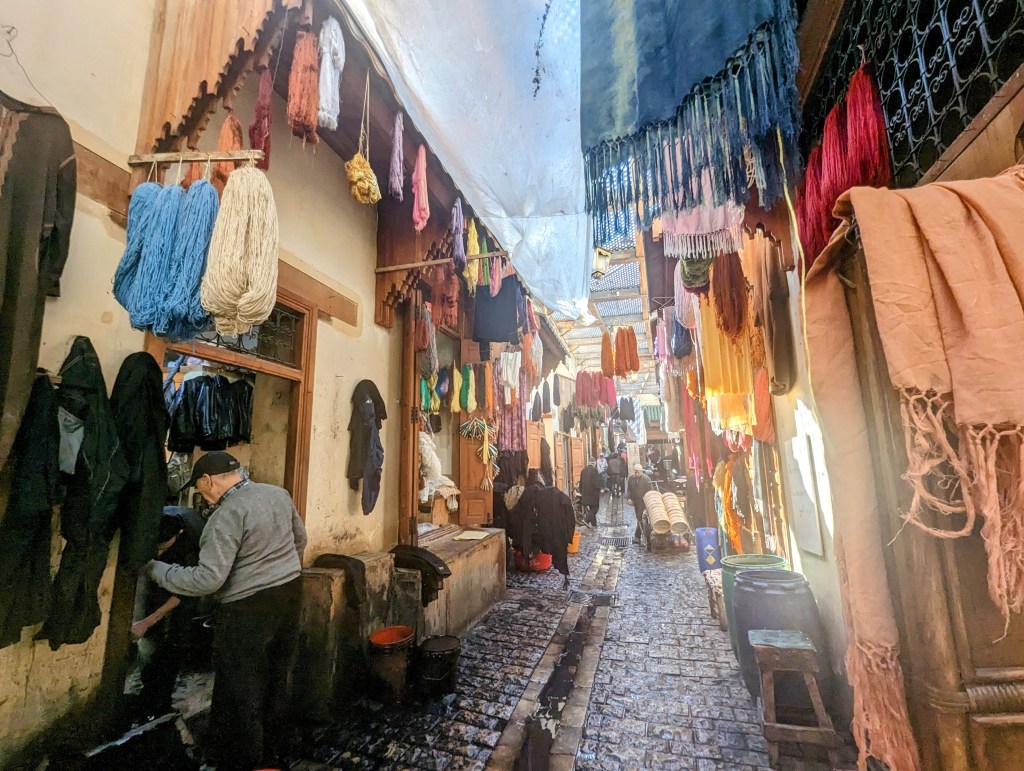
The artisanal products tend to be made and sold on specific streets. This street is for dying wool and fabrics. The wool dyers do not like to be photographed working; they are in the shed seen below.
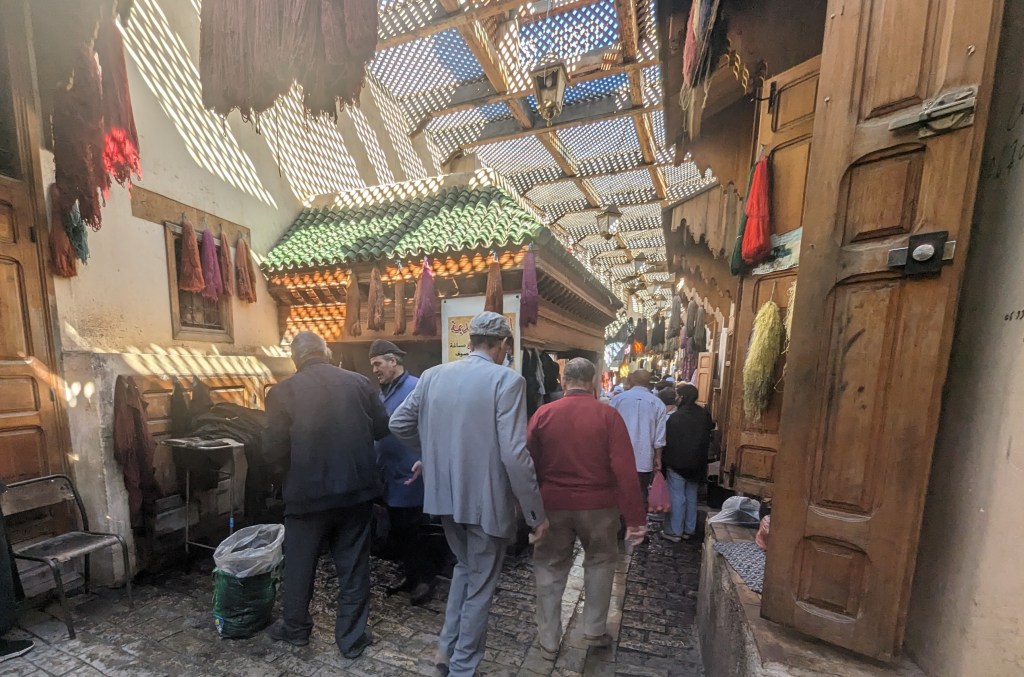
They then hang the dyed wool to dry.
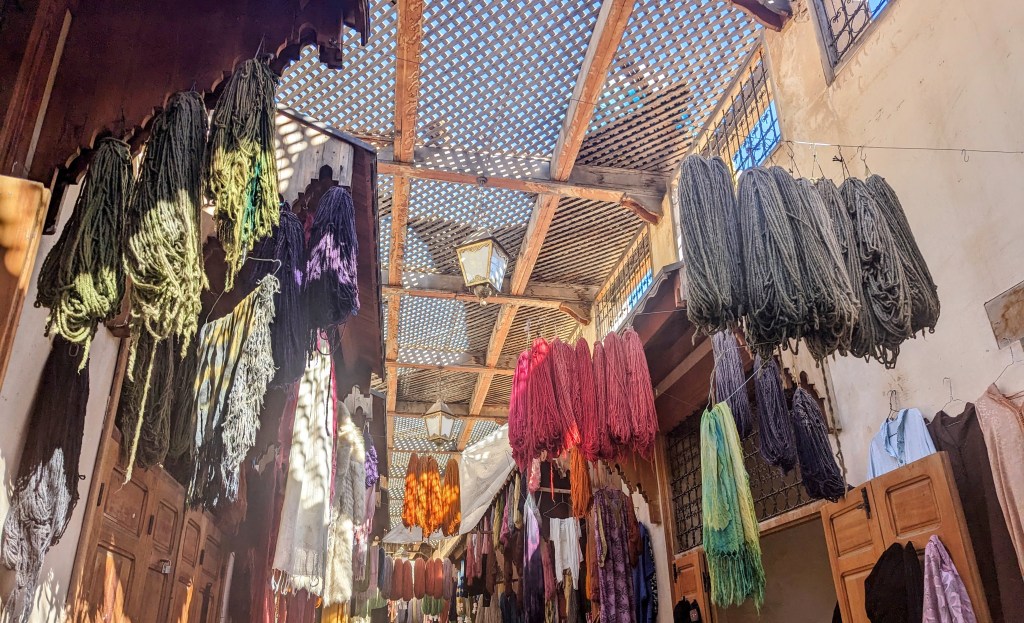
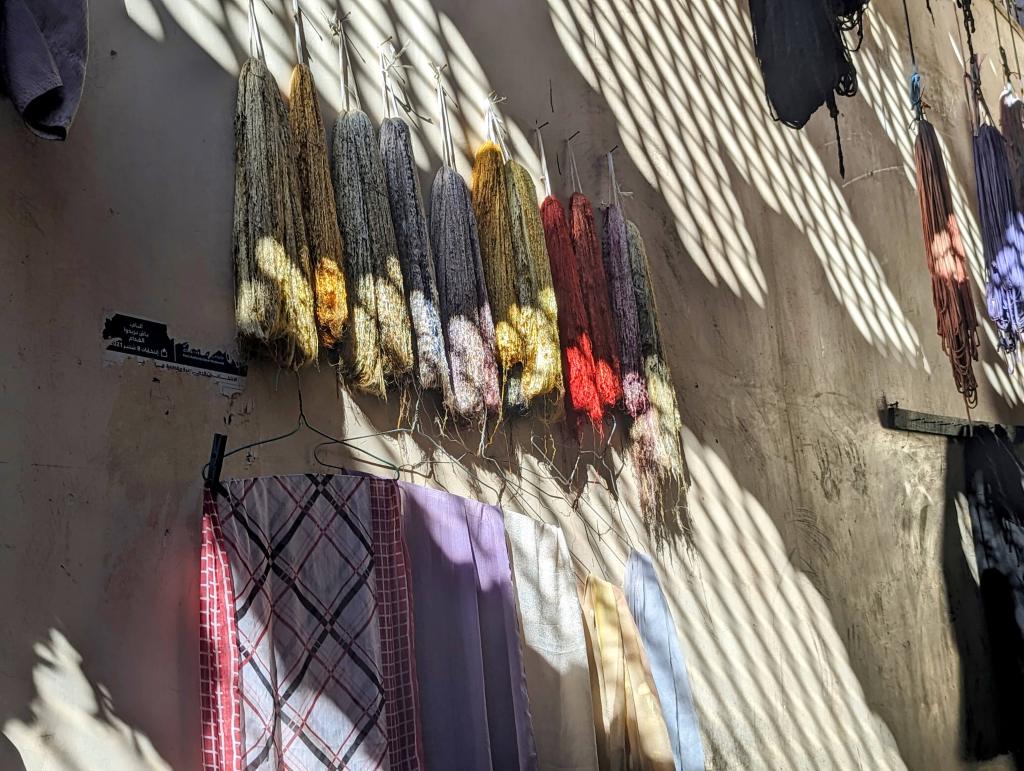
The Arabs tend to have subdued colors, the Berbers prefer bright colors.
And silk.
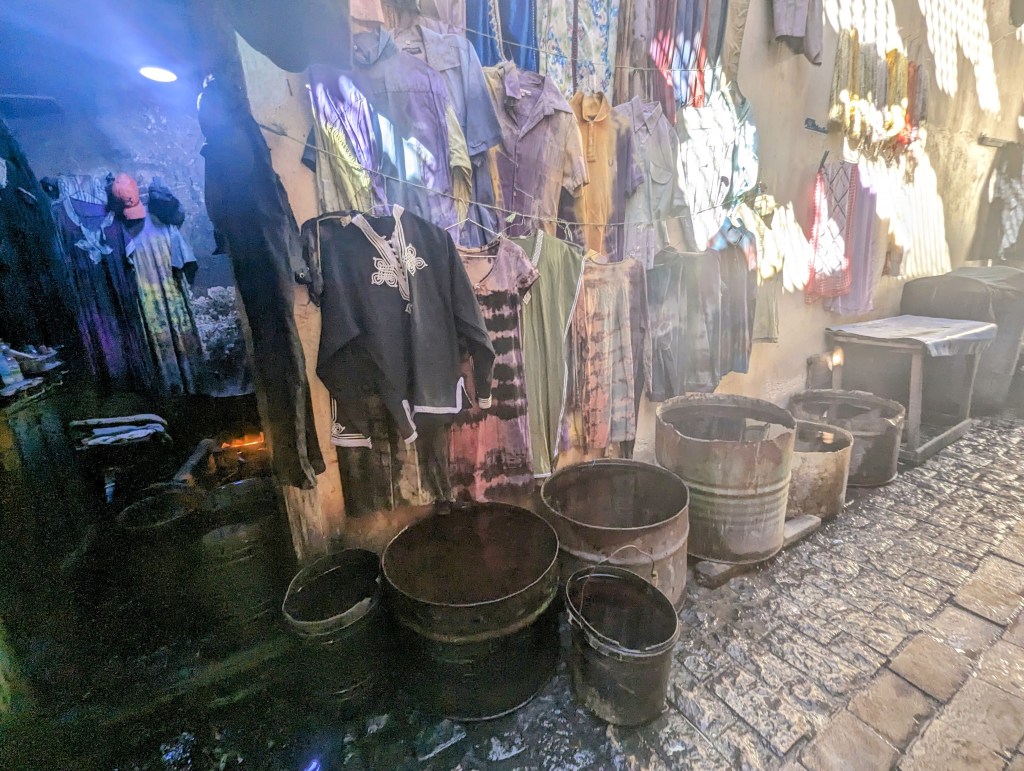
Dye vats are also used for fabrics,
We then passed through the metal works area. Many of the items for sale are machine-made. Naim taught us how to tell the difference by touch and resonance.

Techniques include both chiseling and creating lace patterns.
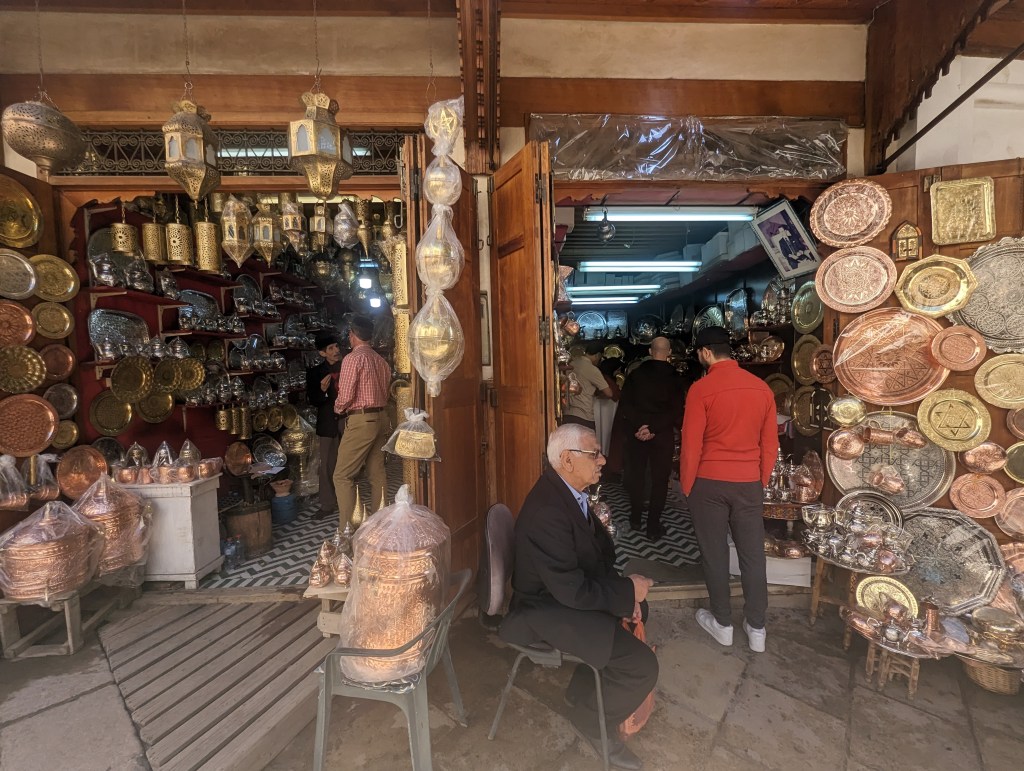
This is an area devoted to artisans working in only the centuries old methods of hand banging and cutting without refined tools. These products are often used in restaurants.

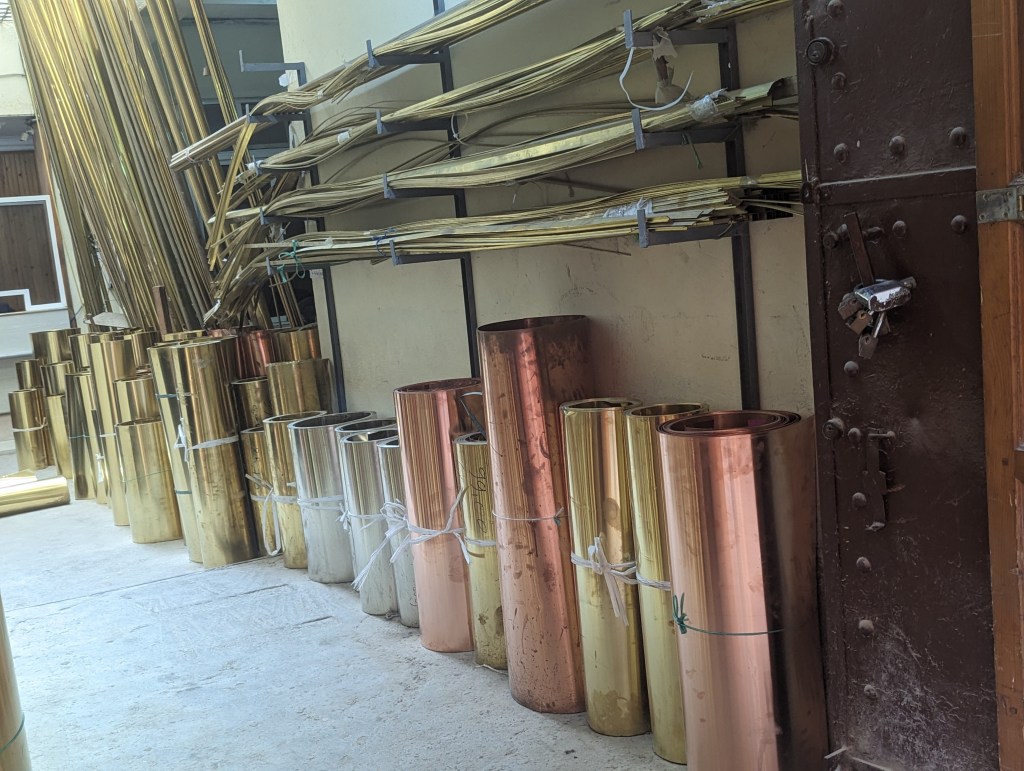
Naim pointed out the raw materials store.
Naim then took us to a side street for a special treat to see his friend who is one of the last hand filigree weavers left in the world.

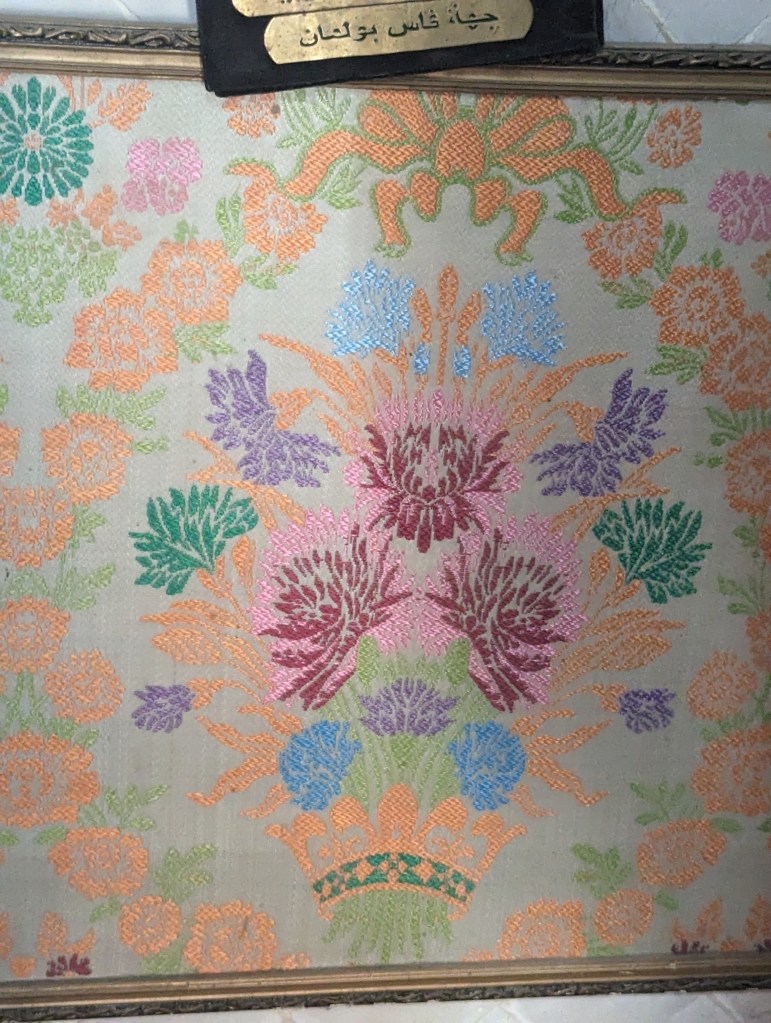
The design is unbelievably intricate.
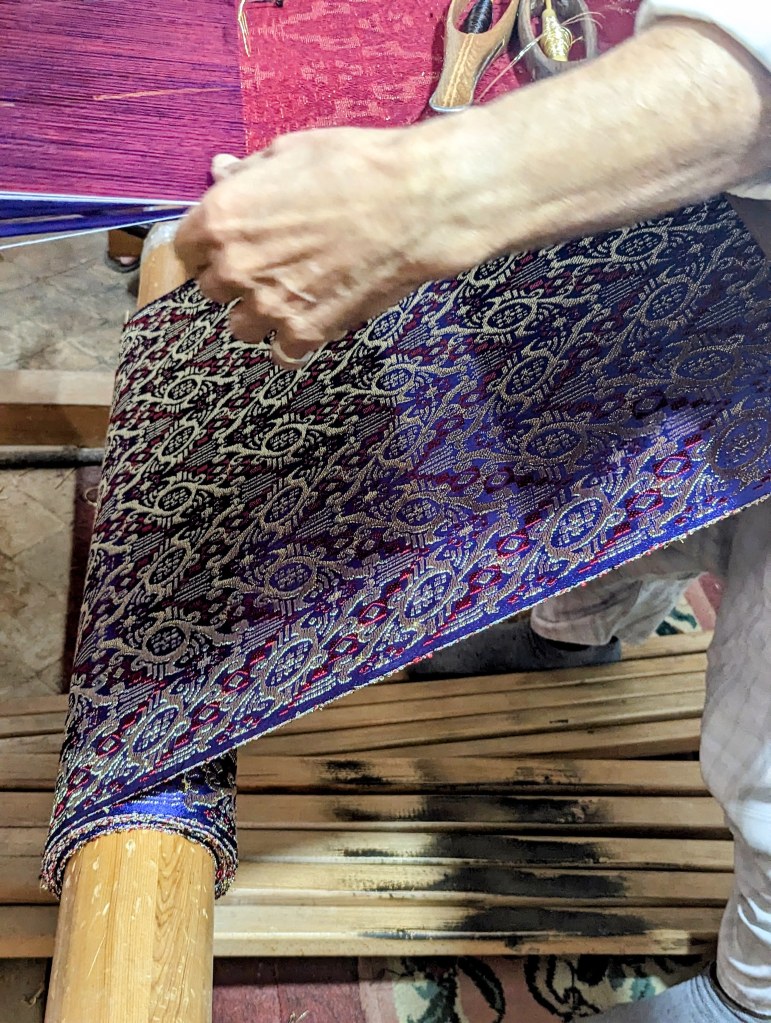
It requires so many different threads and lifts.
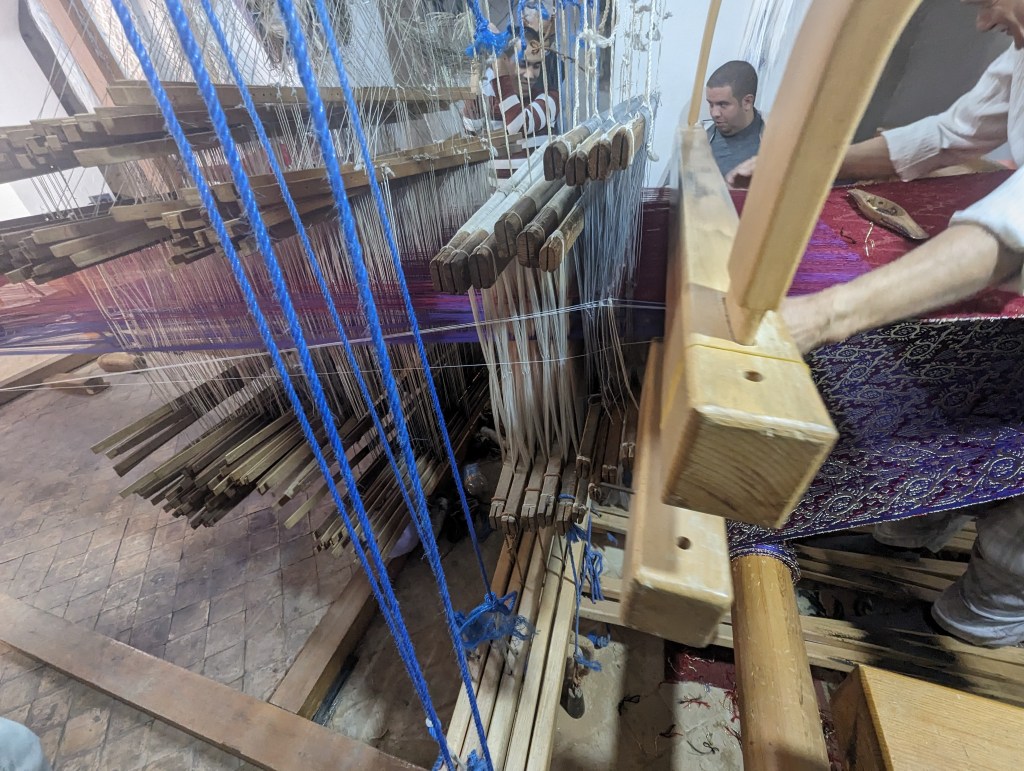
It also requires an assistant who has been given a pattern of which strings to pull together after every pass of the threads. He is pulling down numbers of strings at a time from over his head, while chatting with his friend, without even looking at them. Fascinating process to observe.
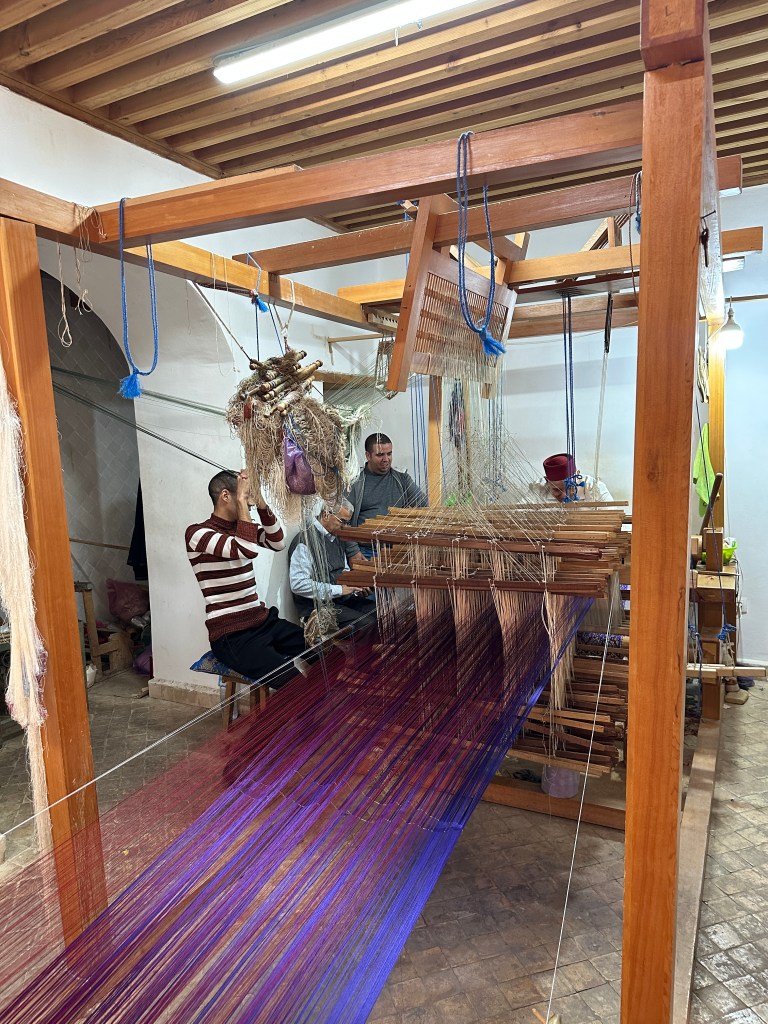
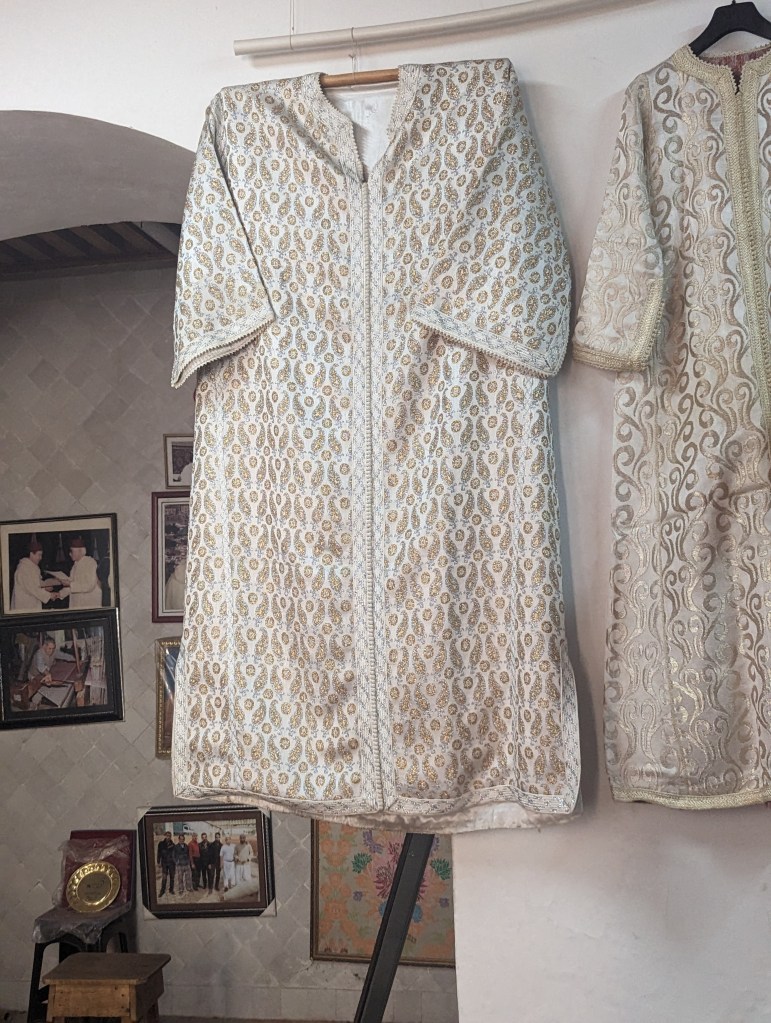
Displayed in his tiny shop are some other materials he has weaved.
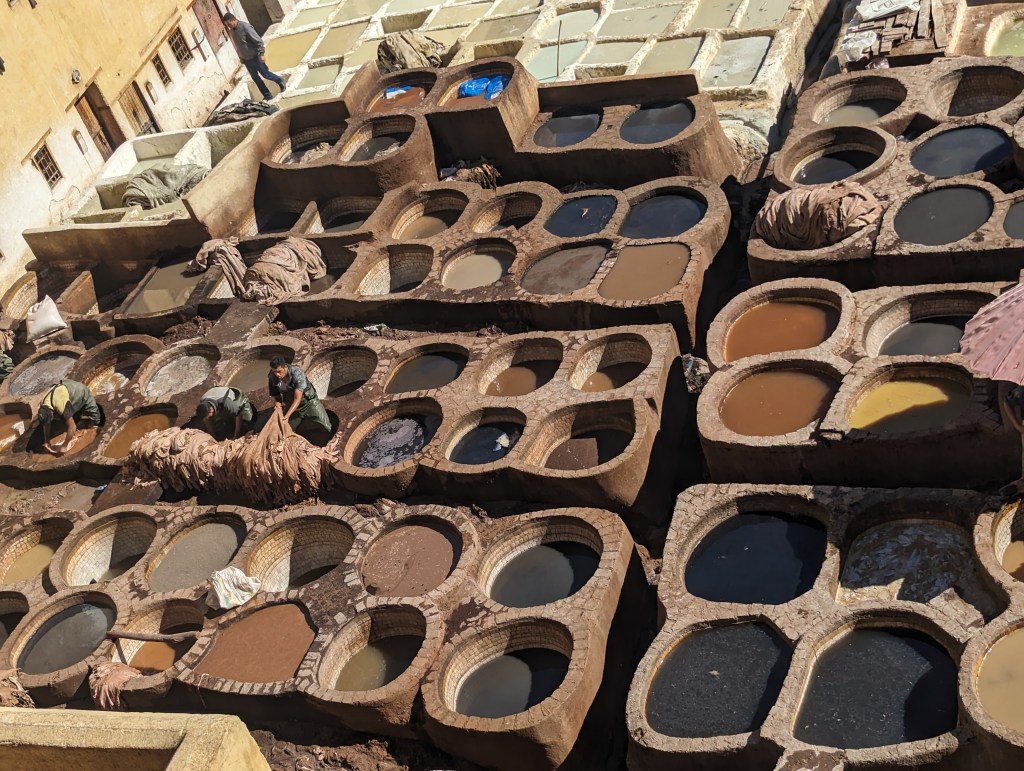
We then visited a tannery where hides are processed in the same way that they were in the 13th century.
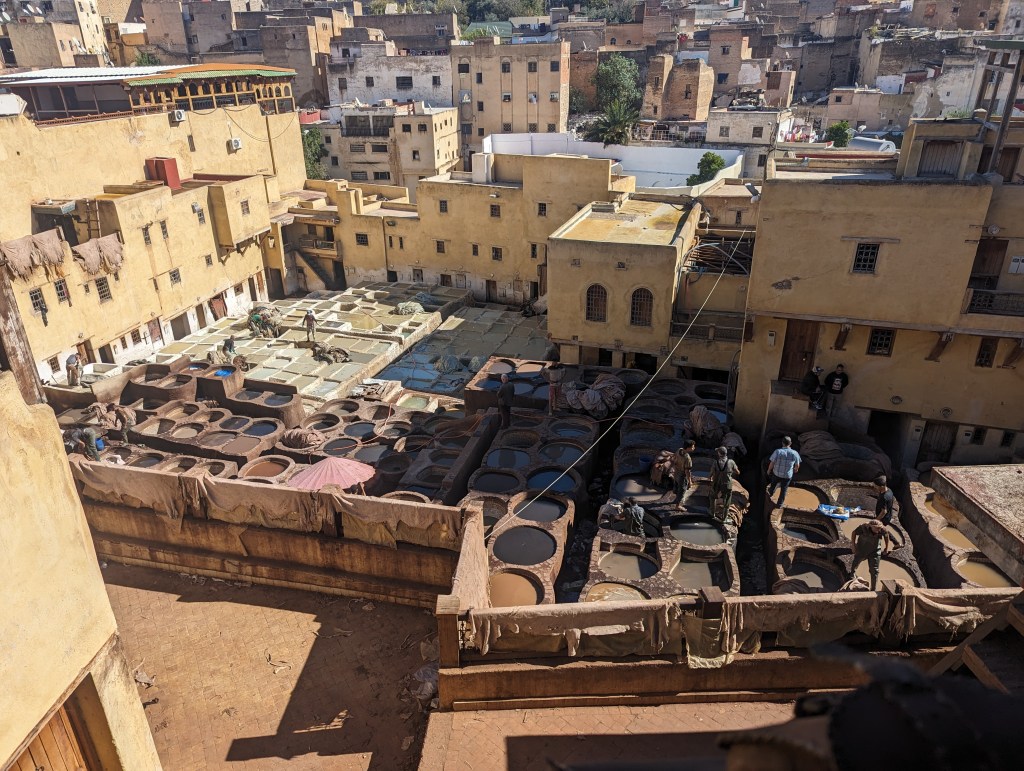
First the hides are placed in vats of water mixed with lye and pigeon droppings – ammonia- and left to soak for about 2 weeks. This softens the hides and opens their pores to allow the dye to soak in,
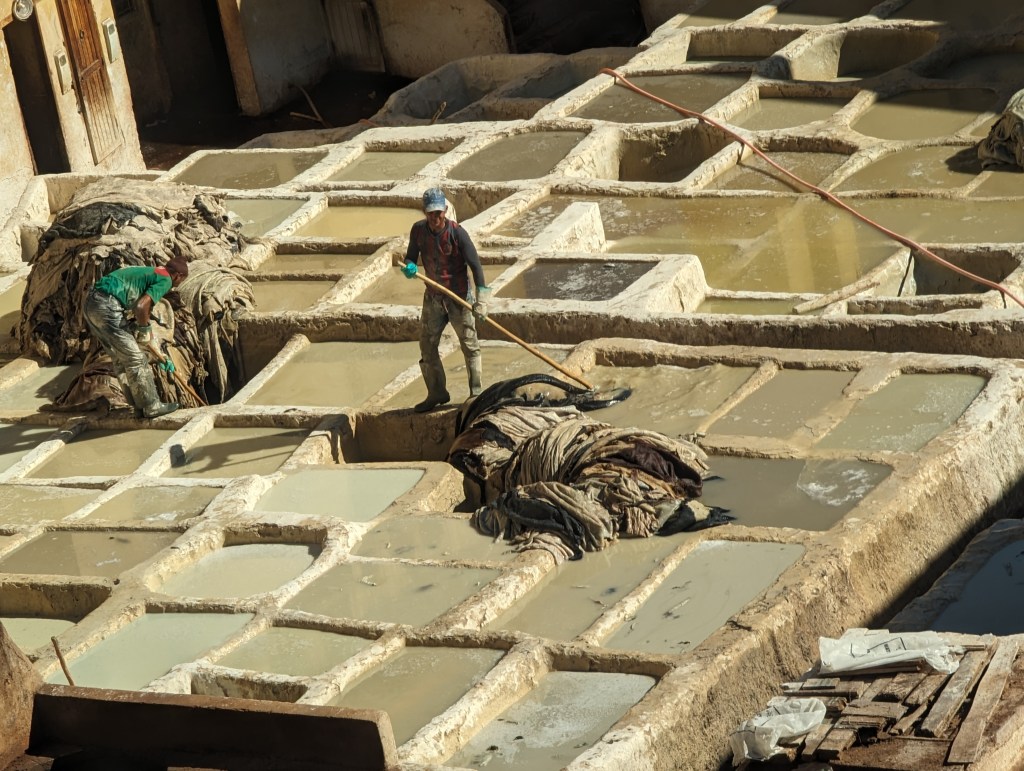
The hides are then hung in the sun to dry. Any remaining fat or hair is then further scraped off.

The hide is then placed in the chosen color and left for a length of time depending on the deepness of the color desired. The variety of color choices is wide.
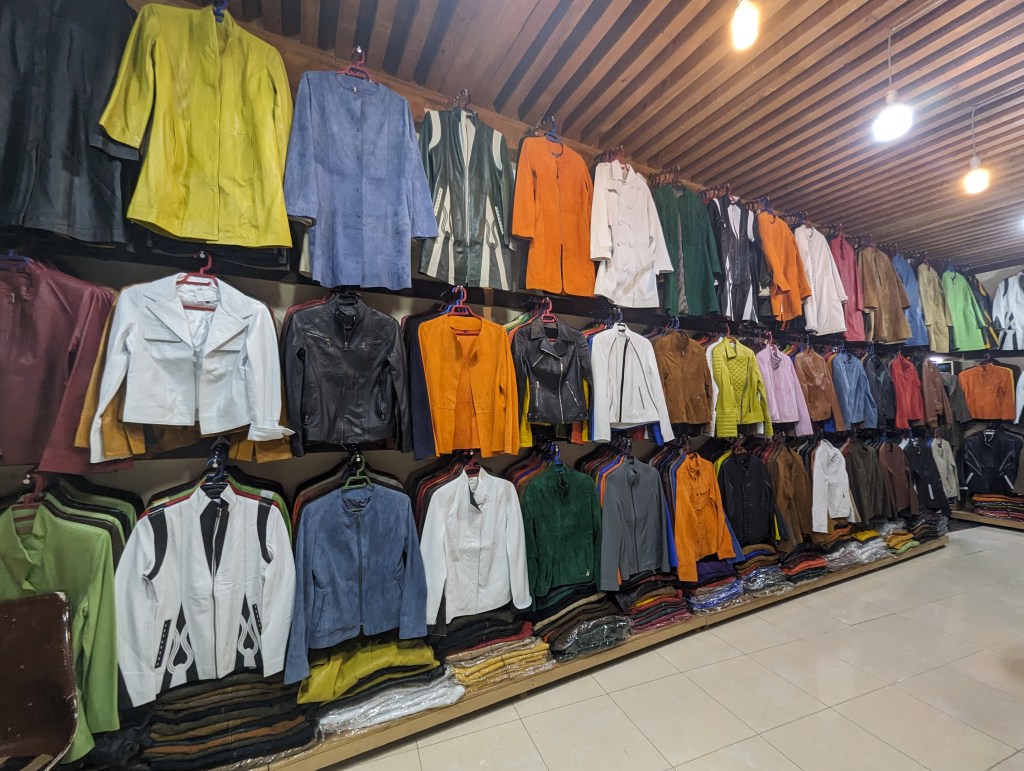
The finished products are assembled in the rooms all around the square. The shop is chock full of finished products from shoes and hand bags to jackets in every color.
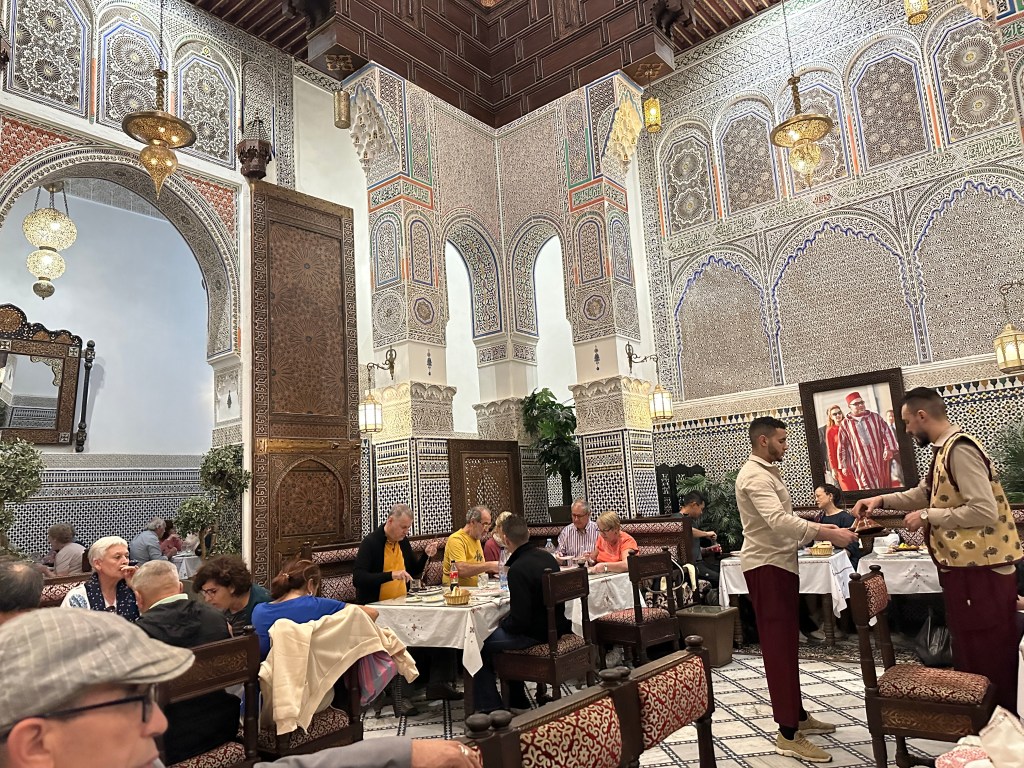
Naim then led us through a maze of streets for lunch here in this gorgeous gem.
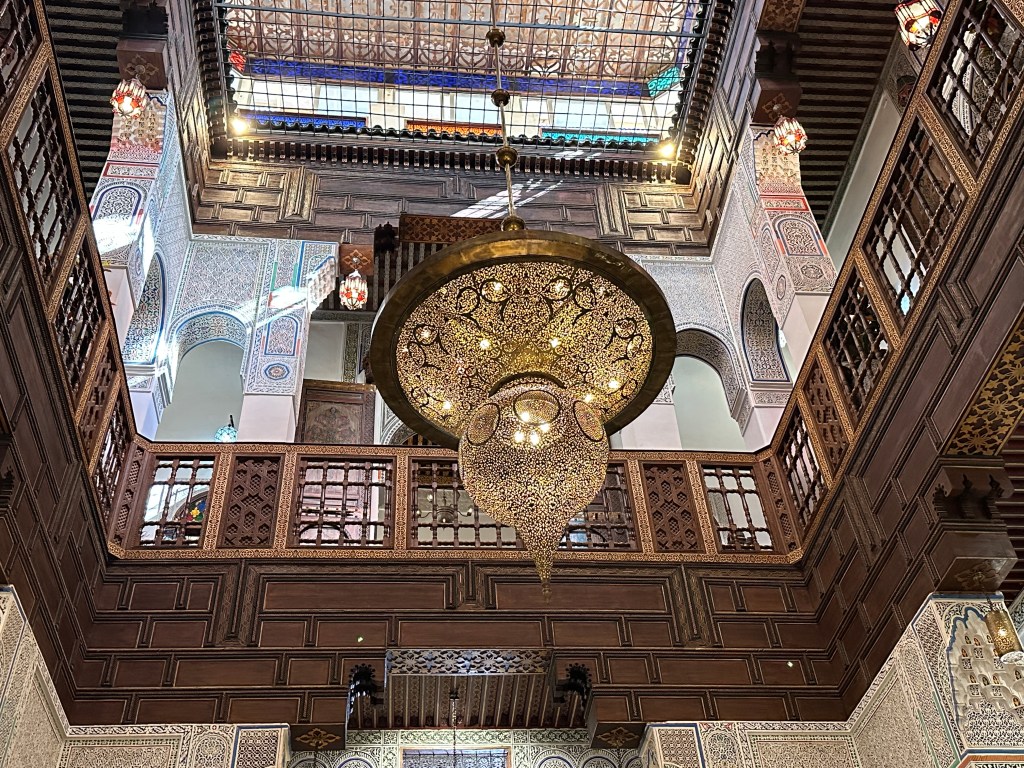
Its showpiece chandelier is a fine example of hand craftsmanship.
After lunch we visited Madrasa Bou Inania built in 1350. It is the only madrassa (Quran school) that also had a functioning mosque.
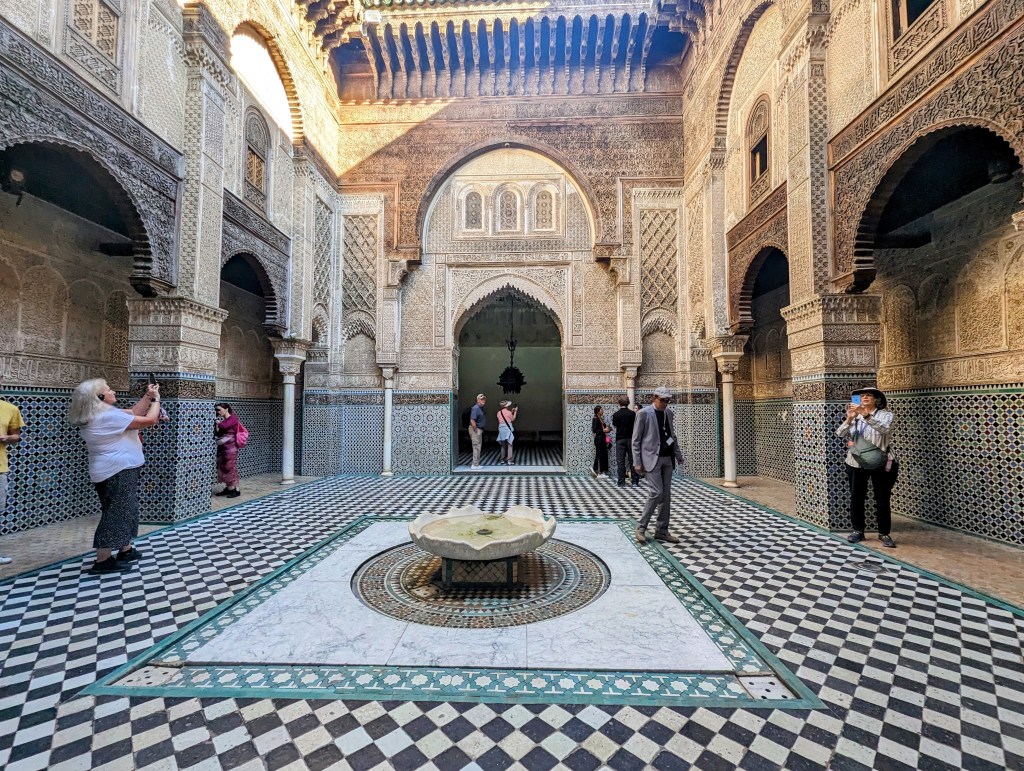
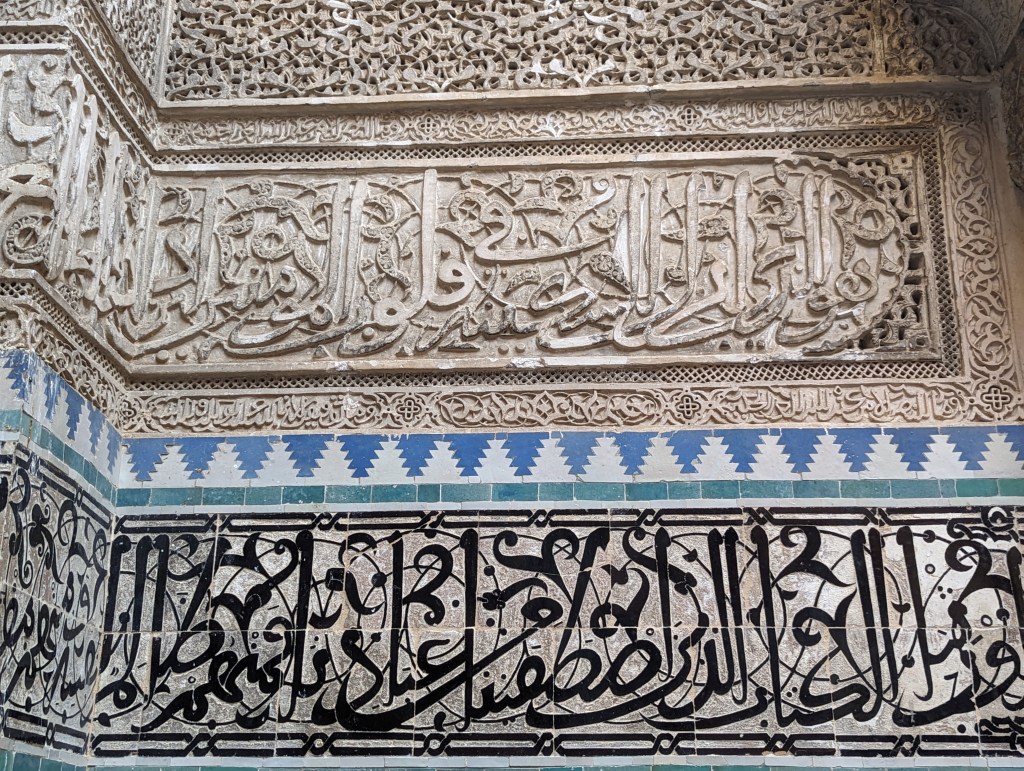
The architecture is typically Moroccan of the time: marble floor, mosaic tiles at the bottom of the walls above which are the carved plaster walls. The ceiling is open, but the carved wood top overhangs the vulnerable plaster to protect it from getting wet from rain. The plaster has verses from the Quran. Calligraphy on tile and carved into the plaster was also popular at the time.
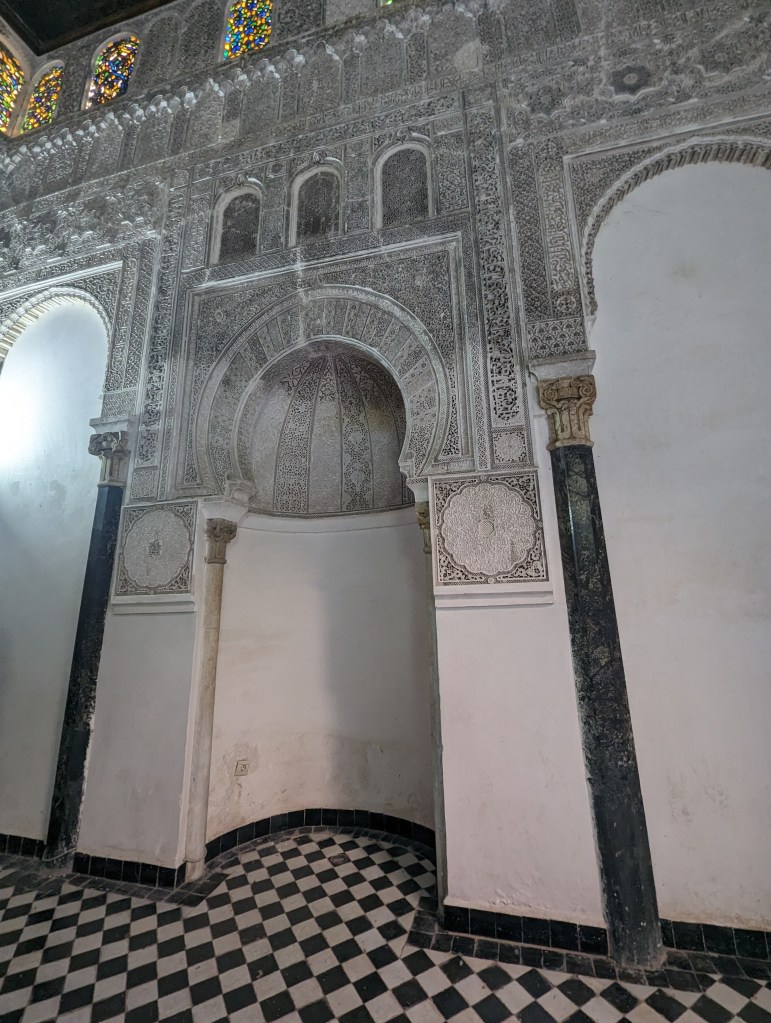
The end room was used for prayer when not a classroom. On one end is a mihrab.
The upper floors held the dormitories for the students.

We passed by the main mosque in the center of the medina in which Idris II is buried. Being non Muslim, we are not allowed to enter.
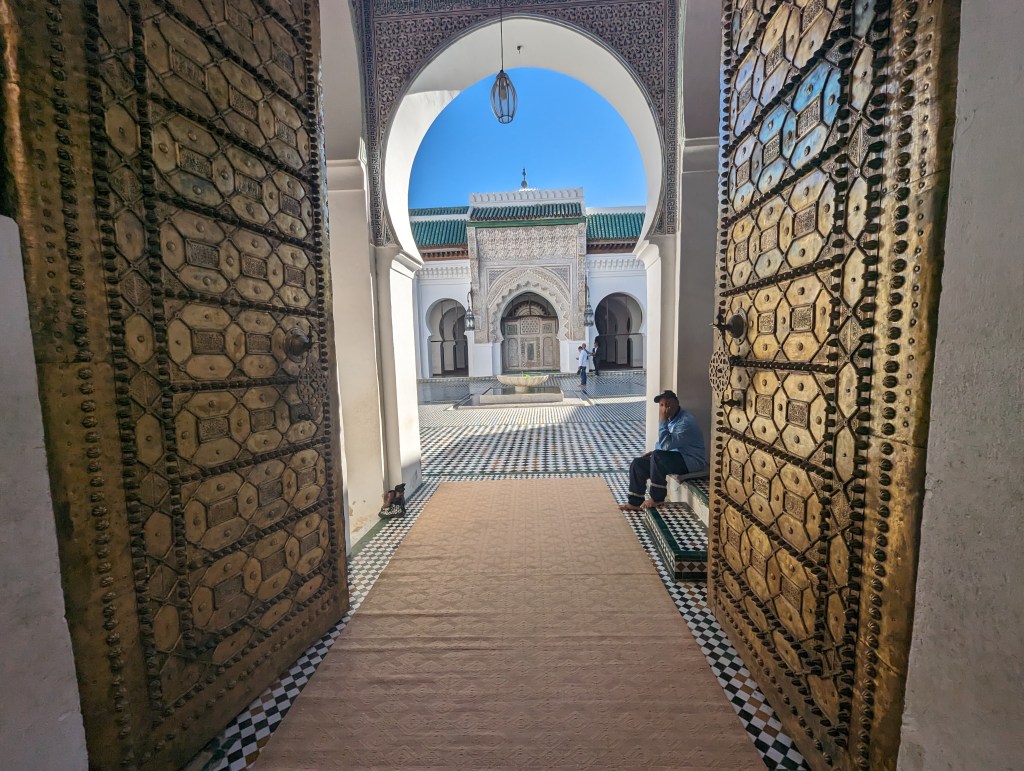
While the mosque was being built, his tomb remained under a tent, which was ceremoniously changed yearly. Now inside the mosque the tomb is canopied with drapes which are still ceremoniously changed yearly. The main entranceway has all the the elements of artisanship seen elsewhere.
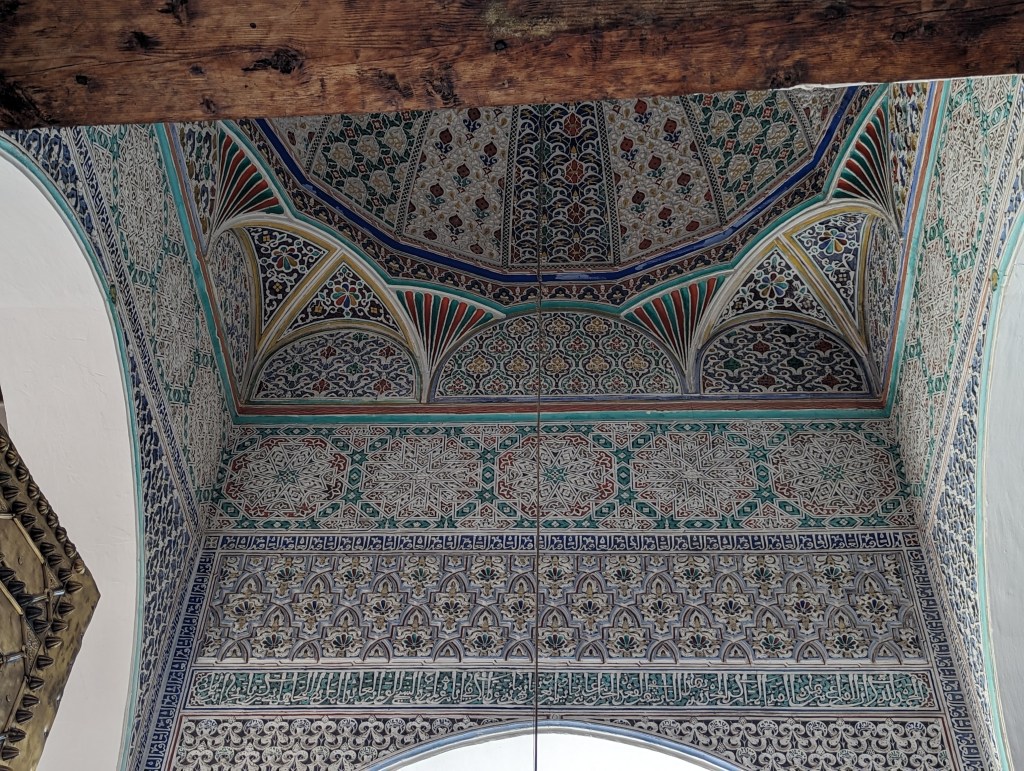
There are 14 entrances around the mosque but the remaining are all much more modest.

Fondiq is the plural of fondouk, the shopping centers for traveling merchants. Unlike riads with their L-shaped entrance to hide the center from the street, fondiq have a large entranceway right into a large courtyard to allow passage of the horse and carriage. UNESCO is in the process of restoring several fondiqs within the old medina.
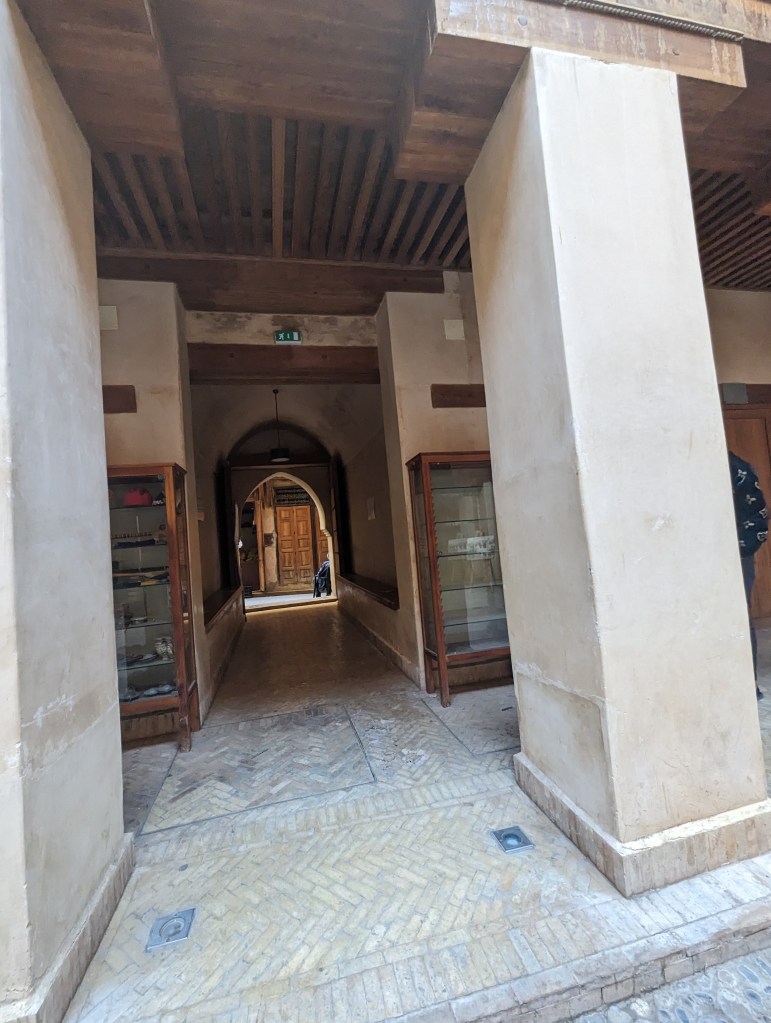
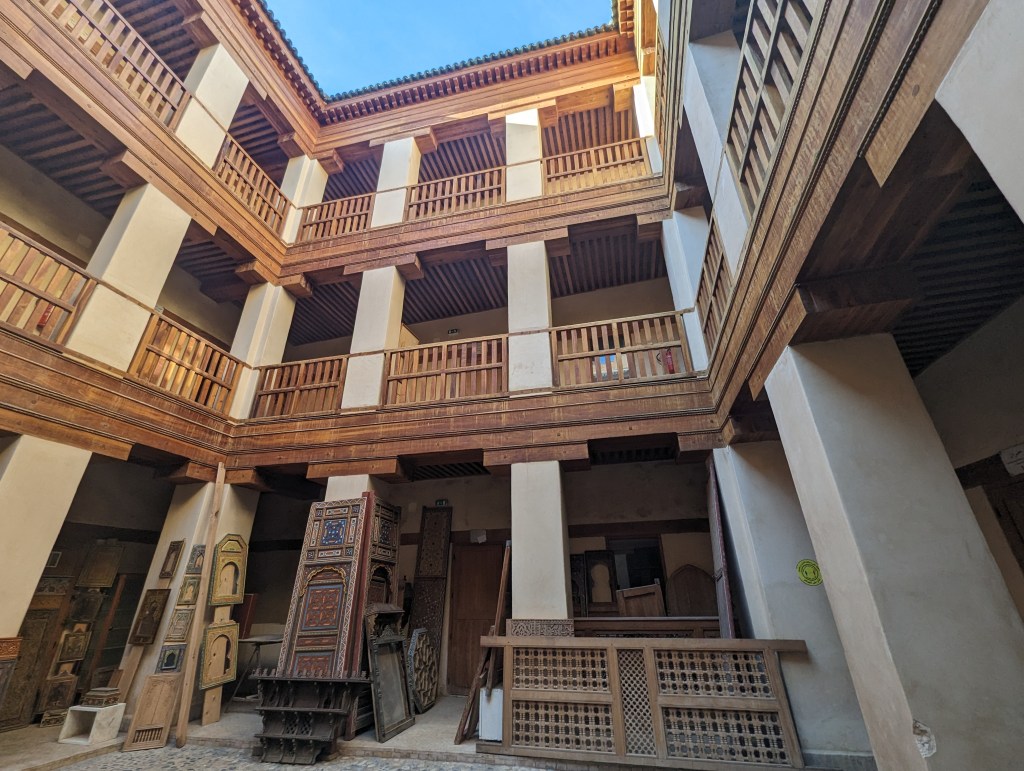
Naim had a friend in this fondiq, an expert in metal crafts. He let me have a bang at a piece he was working on.
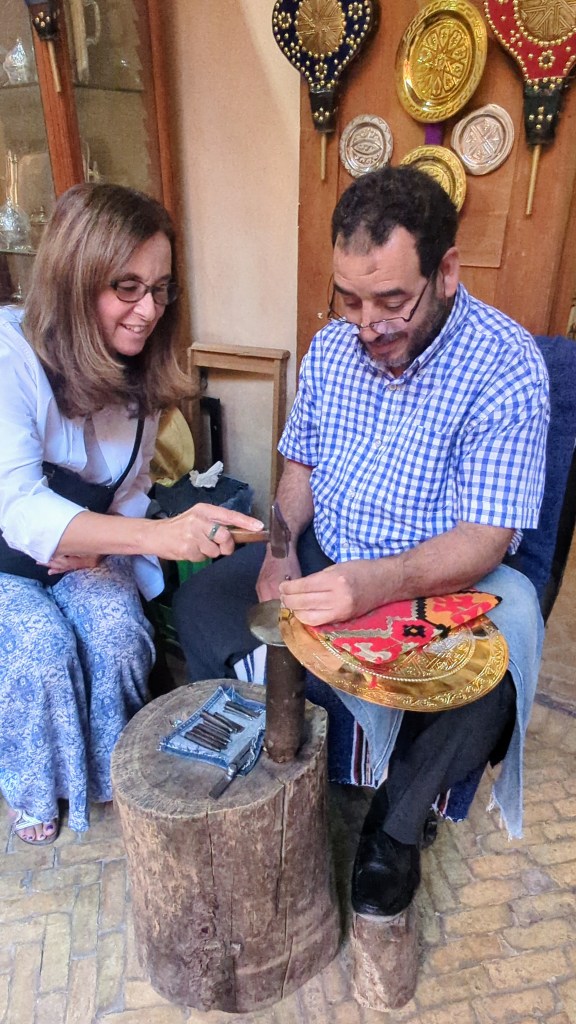
He showed us a piece he was just starting. He first draws in an outline for himself. But the rest of the pattern is done freehand.
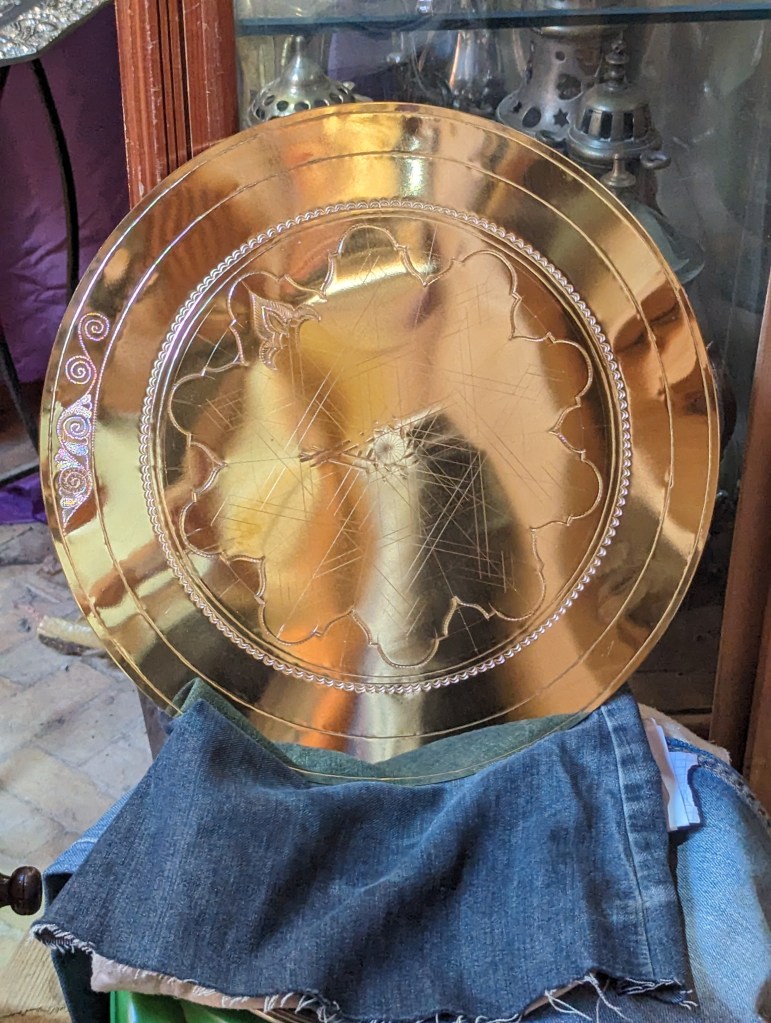
His finished works are magnificent.
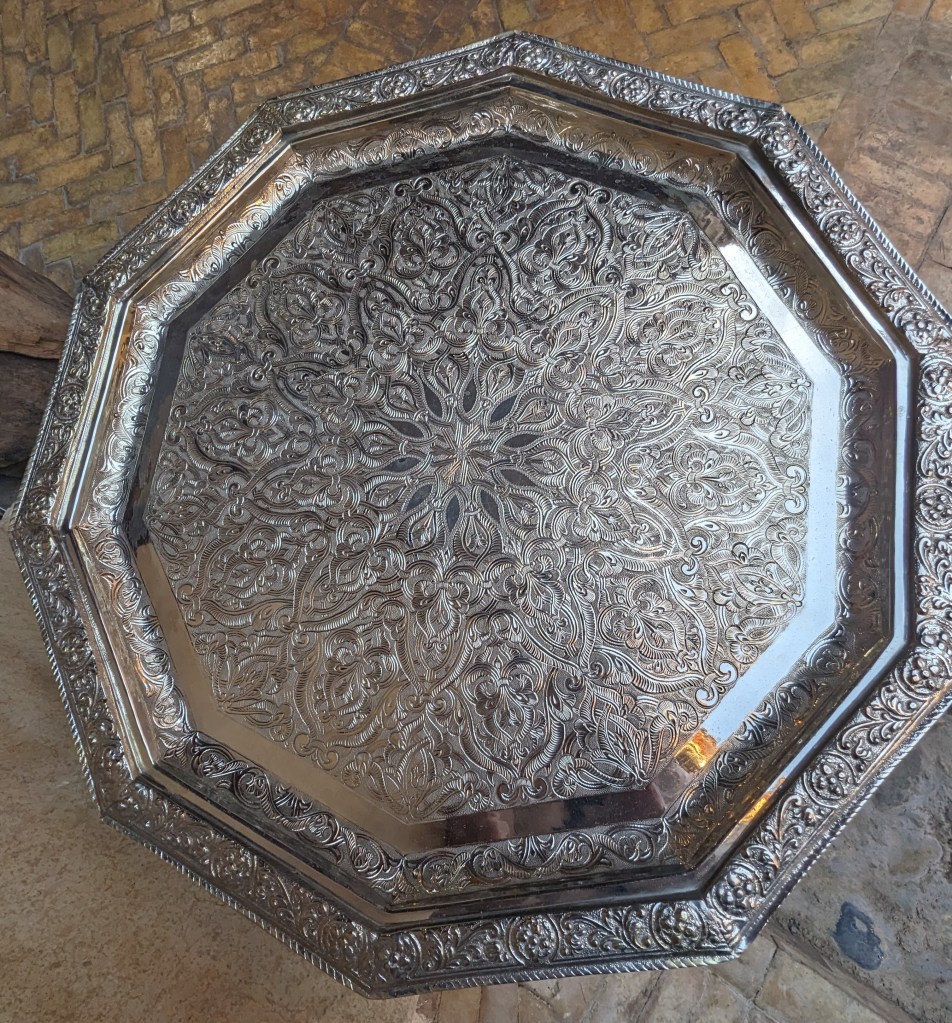
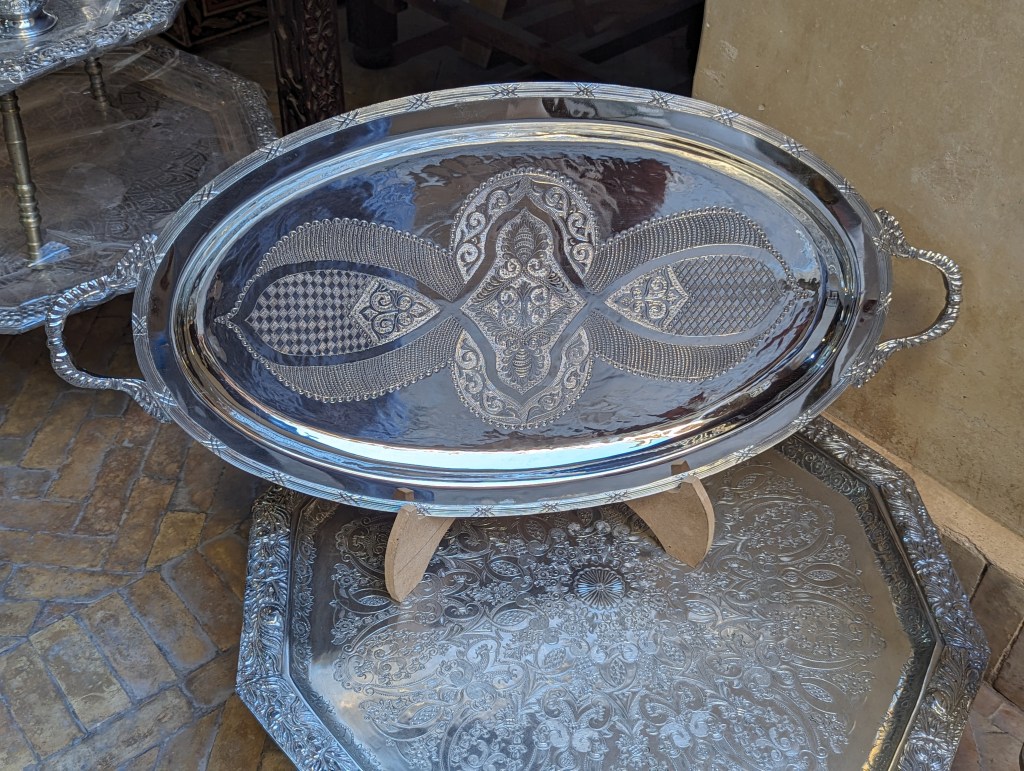
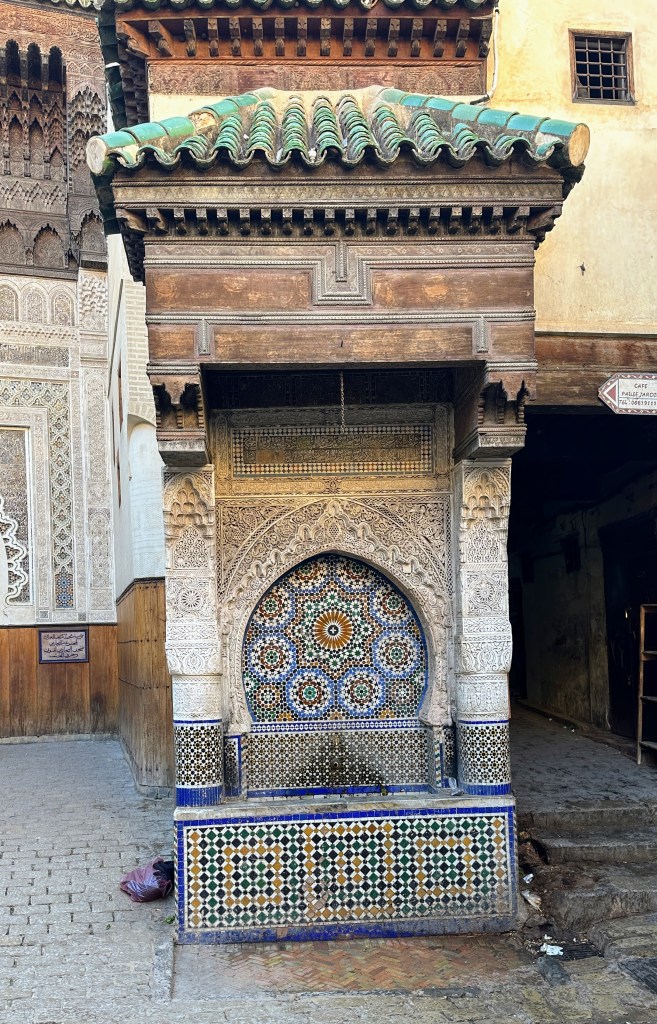
Back outside the fondiq Naim pointed out the most important fountain in the old medina because it is the only one with all 3 layers of the local artisan works.
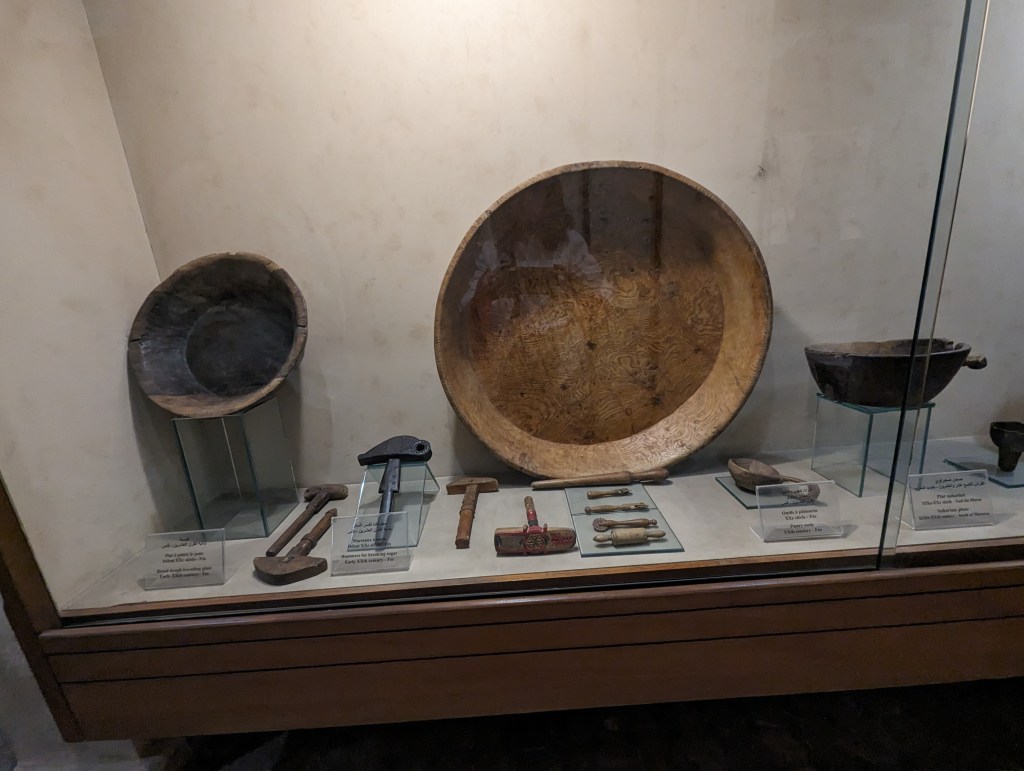
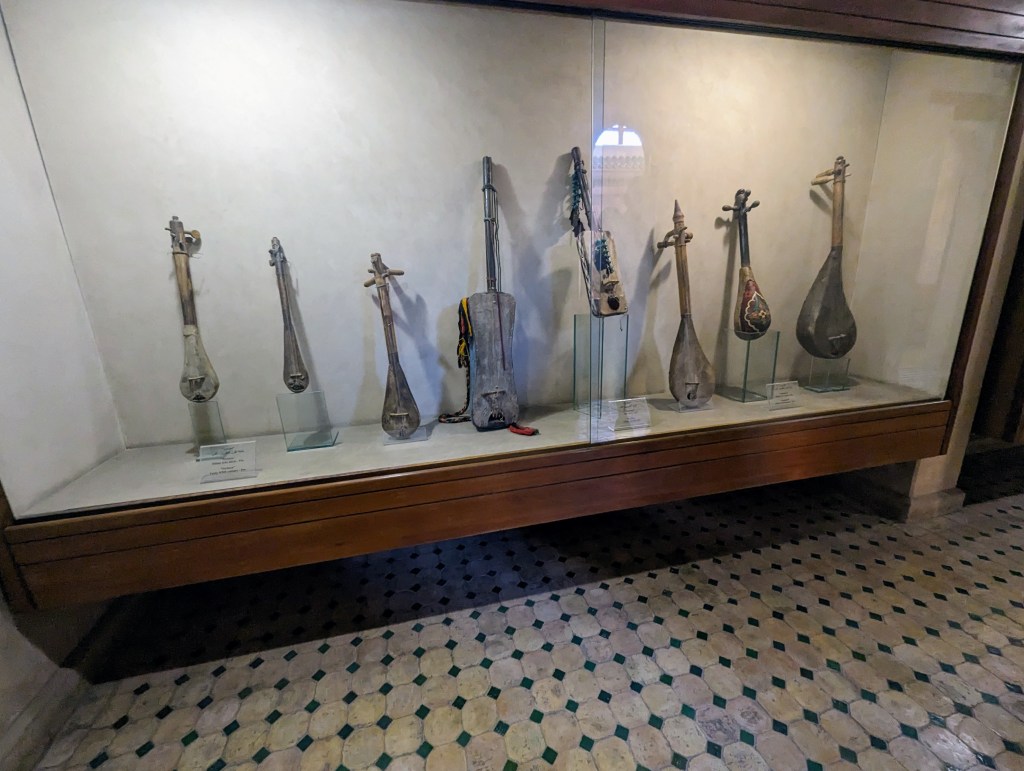
We then visited a fondouk turned into a woodwork museum.


Each room had a display of a different wood product from chests and shelves and furniture to tools
and instruments
And that concluded a very long day of touring. In the morning we headed over to Cafe Clock for our cooking class. Once gathered we decided, as a group, what we would be cooking, choosing from a menu with recipes for all the dishes. We then headed to the market to purchase the ingredients. The chicken was bought fresh.

We came back later for the cleaned parts. Meanwhile we headed for the veggies and herbs and phyllo dough for dessert of snake cookies.

While peeling, chopping, mixing, cooking, and taking mint lemonade breaks on the terrace, we shared stories.

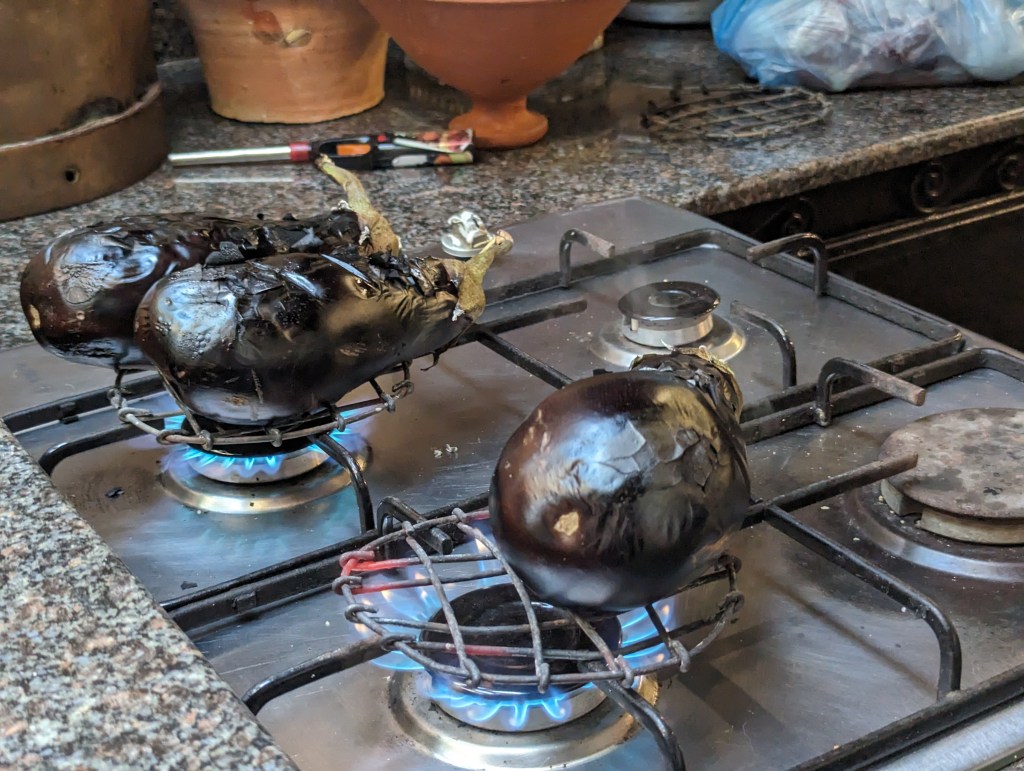
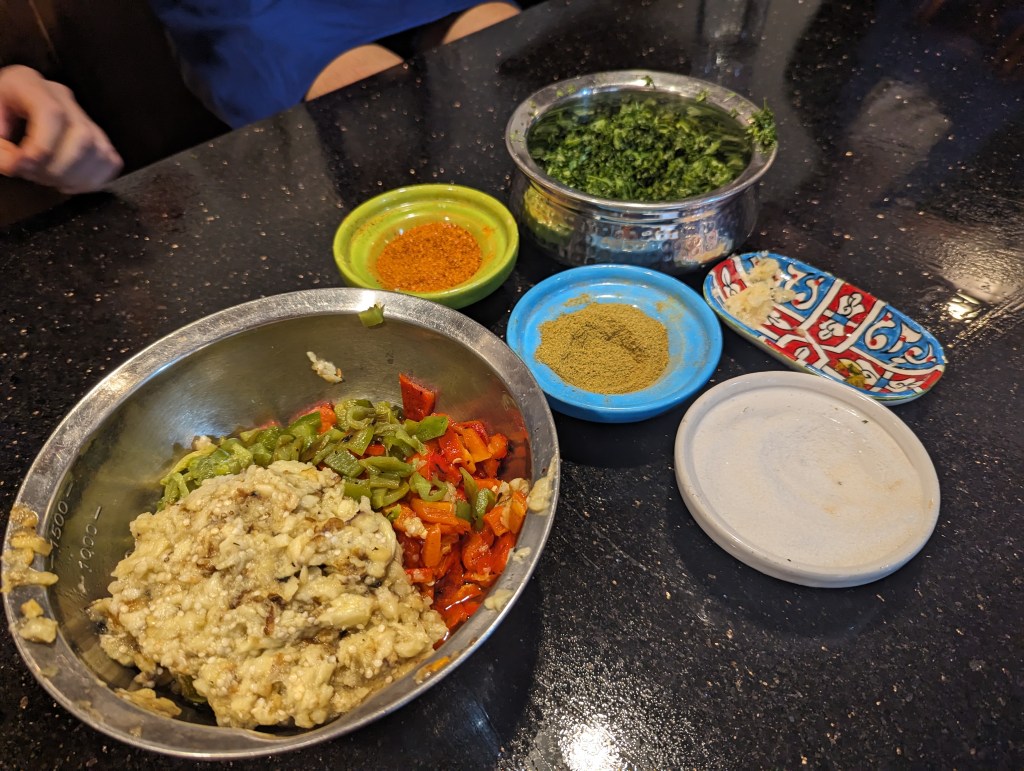
Then we all shared the delicious lunch we had made.


The next morning we headed for the Middle Atlas Mountains and the town of Ifrane. The Atlas Cedar Biosphere Reserve is home to 75% of the world’s majestic Atlas cedar tree population. This region is characterized by a wealth of ecosystems and the mountain peaks, which reach up to 3,700 m, provide the region with critically important water resources.
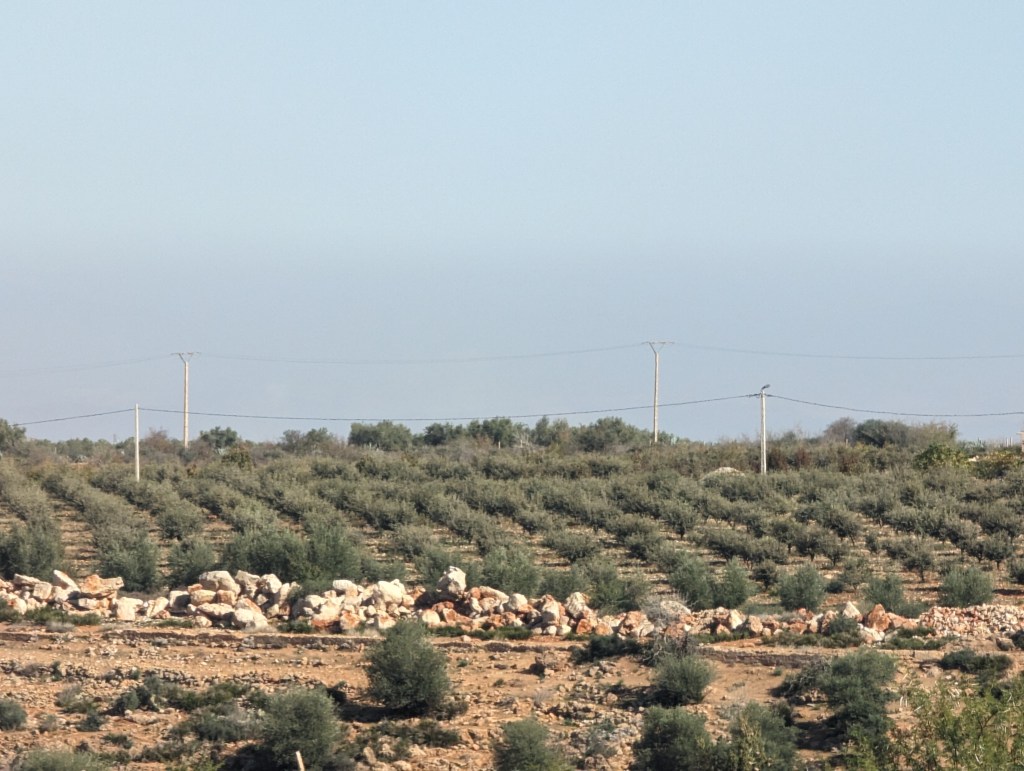
On the way we stopped at Domaine de La Pommeraie, an organic goat and sheep farm. Our host Tamik was a retired mathematics professor married to an engineering instructor. He is a Jewish Berber originally from Tangier. Having raised 2 children and taught dozens of others, they decided to retire from teaching and run the farm full time. They run workshops for tourists and also have classes for children as well.

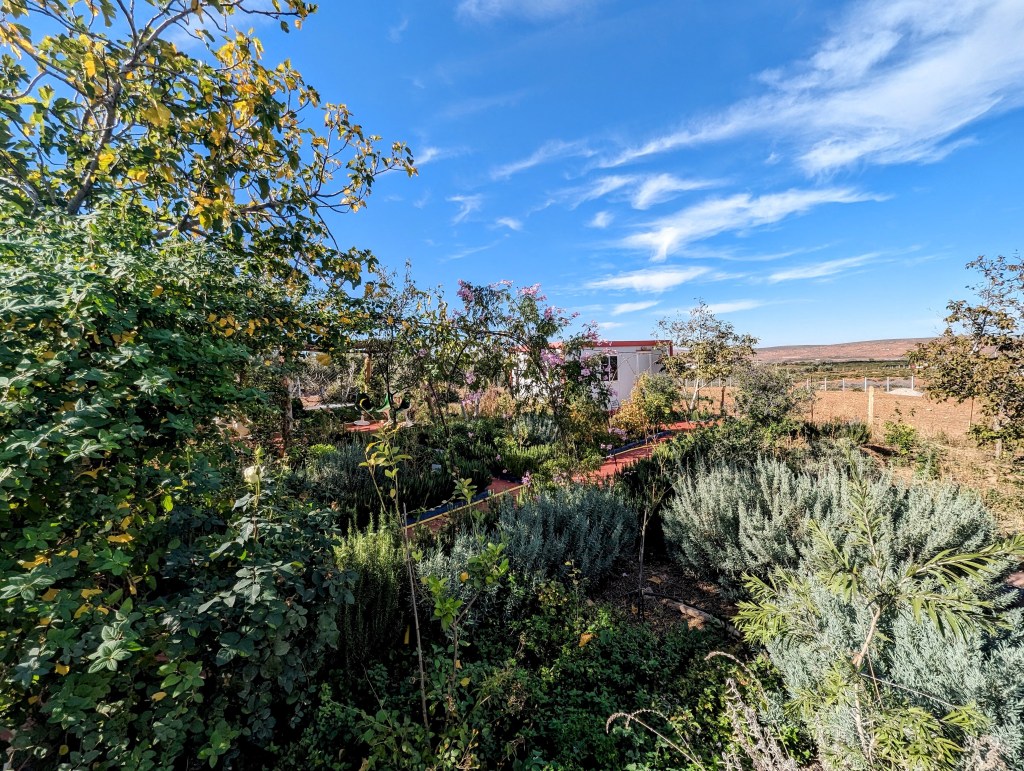
His kitchen garden includes roses and lavender for scented waters.

and is chock full of herbs – rosemary, sage, and thyme – and fruit – figs, apricots, peaches, apples, and all kinds of citrus – and nut – almond and walnut – trees.
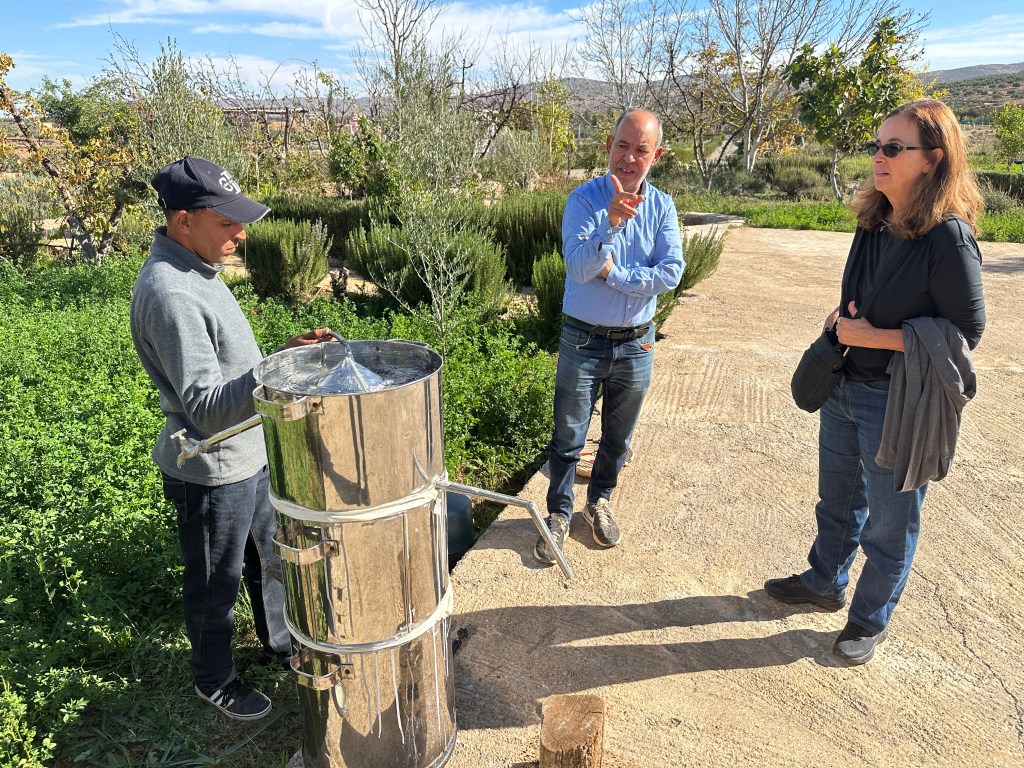
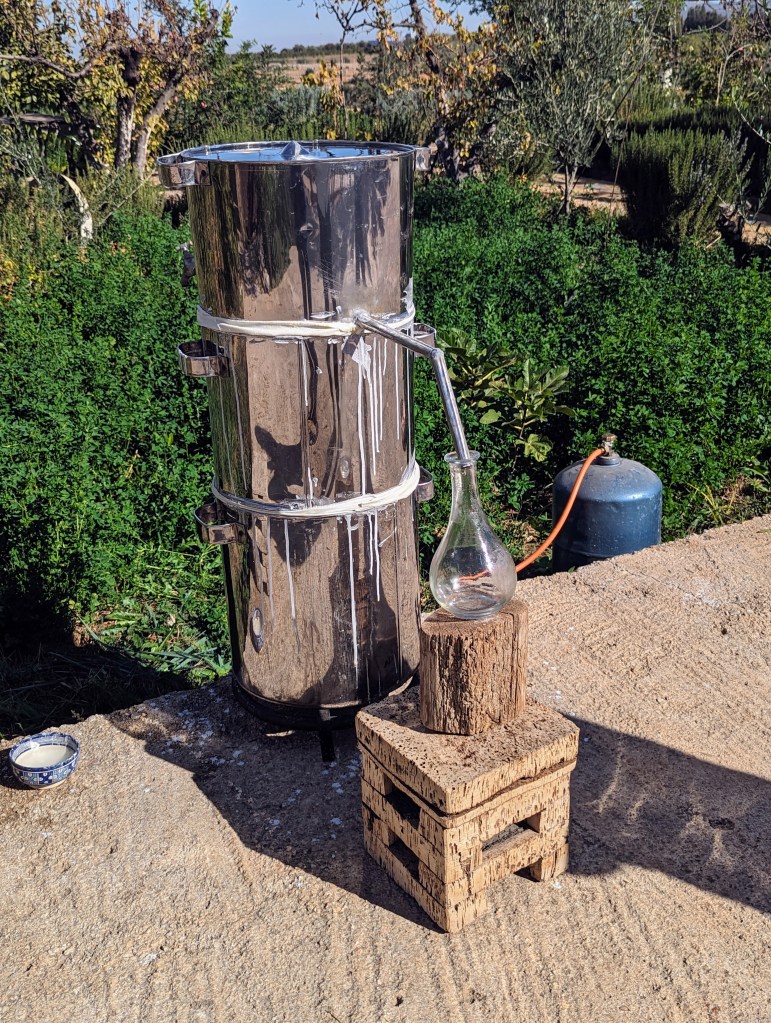
He gave us a workshop on distilling lavender for a water infusion.
We were then treated to a cheese tasting of all home made artisanally crafted cheeses of local varieties and those of recipes and methods passed down many generations by his Jewish Berber family. The cheeses were accompanied by home made bread and apricot jam, fresh pressed olive oil, and multiflower honey collected on the farm, and of course Moroccan mint tea.
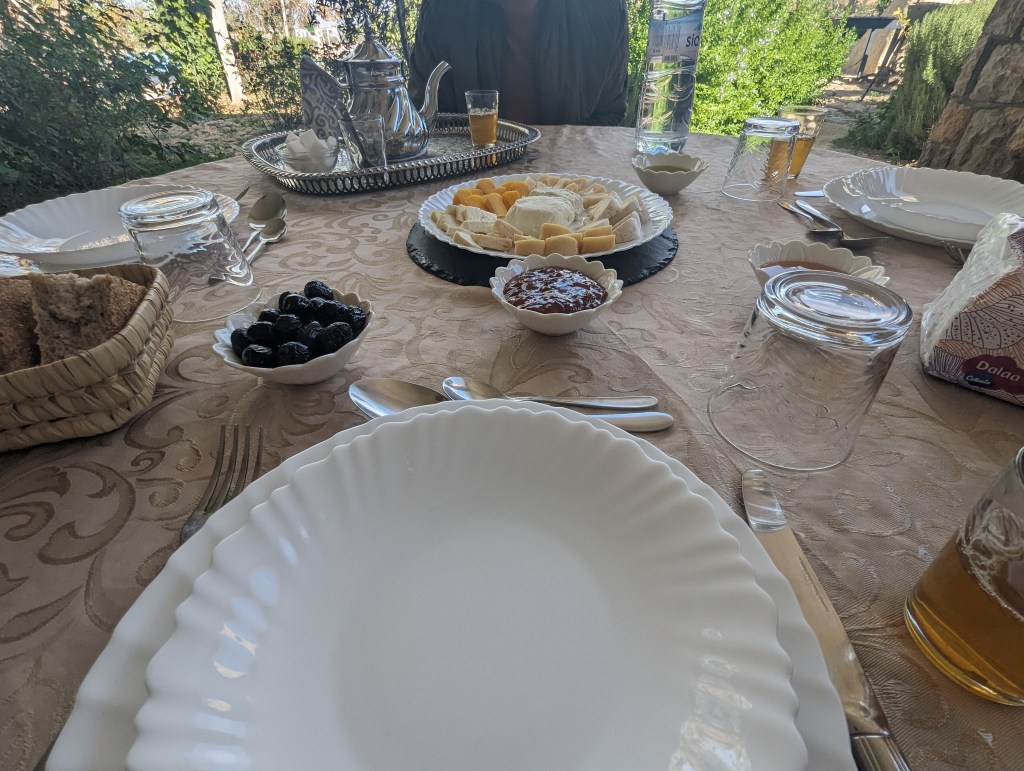
We then enjoyed a lunch of barbecue skewers and eggplant salad and a veggie dish, all delicious. He and Kamal joined us and we shared stories and talked about the similarities and differences in our countries. Have I mentioned that there are no guns in Morocco? It is one of the first things we were told in Tangier by several people all trying to impress upon us the safety of visiting the country. Only police and military are allowed guns. I asked Tamik if there is hunting for sport allowed in Morocco and/or if, as a farmer, he is allowed to have a gun to protect his plants and animals from predators. His response was that there is no game in Morocco to hunt, only rabbits. And yes, as a farmer he would be allowed to get a gun permit to protect his property, but he does not feel the need. He said that wild dogs help keep the rabbit population at a tolerable level.
We then drove to Ifrane, known as the Alps of Morocco. Ifrane means caves. The original ancient dwellers dug caves into the limestone for shelter. The modern town of Ifrane was established by the French administration in 1928 due to its Alpine climate so that Europeans could find relief from the summer heat of the interior plains of Morocco. Ifrane is also a popular altitude training destination. In 1995 an English-language, American-curriculum public university opened and this has helped launch Ifrane as a desirable destination for domestic tourism. The king has a palace in Ifrane which he uses when he wants to ski. According to the MBC Times, Ifrane is ranked the second-cleanest town in the world, behind Calgary. According to a survey, Ifrane makes a number of efforts to offer its residents an exemplary quality of life through rigorous waste management, but also by reducing air pollution.
We walked around the main square with its Hotel Chamonix.
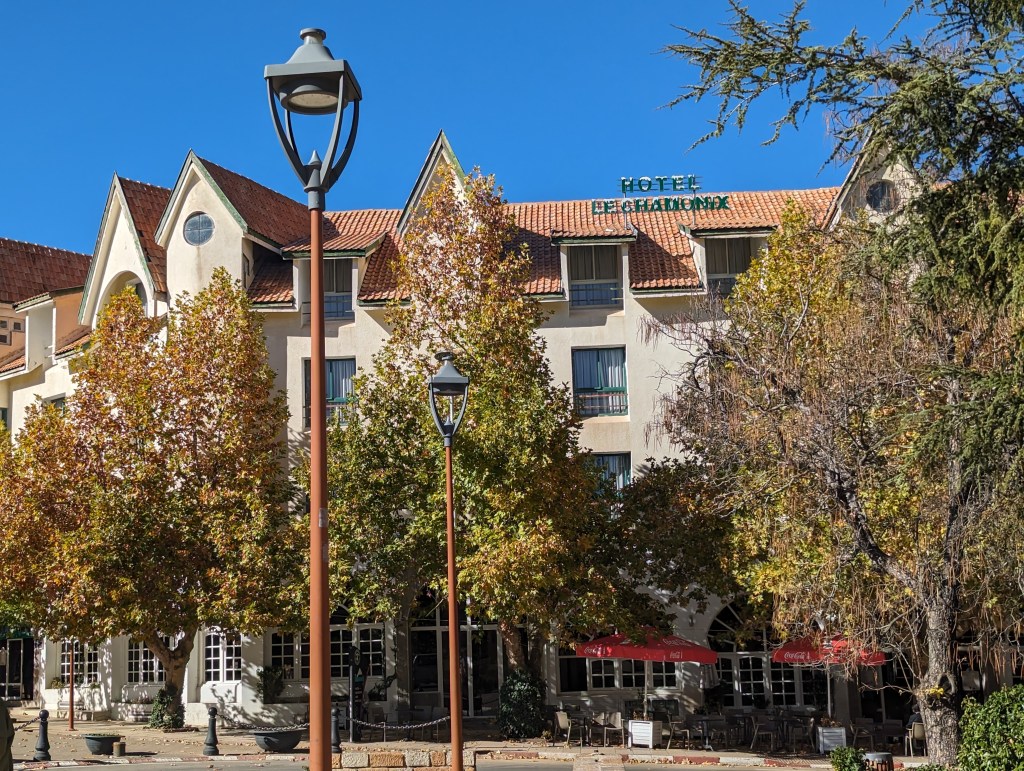
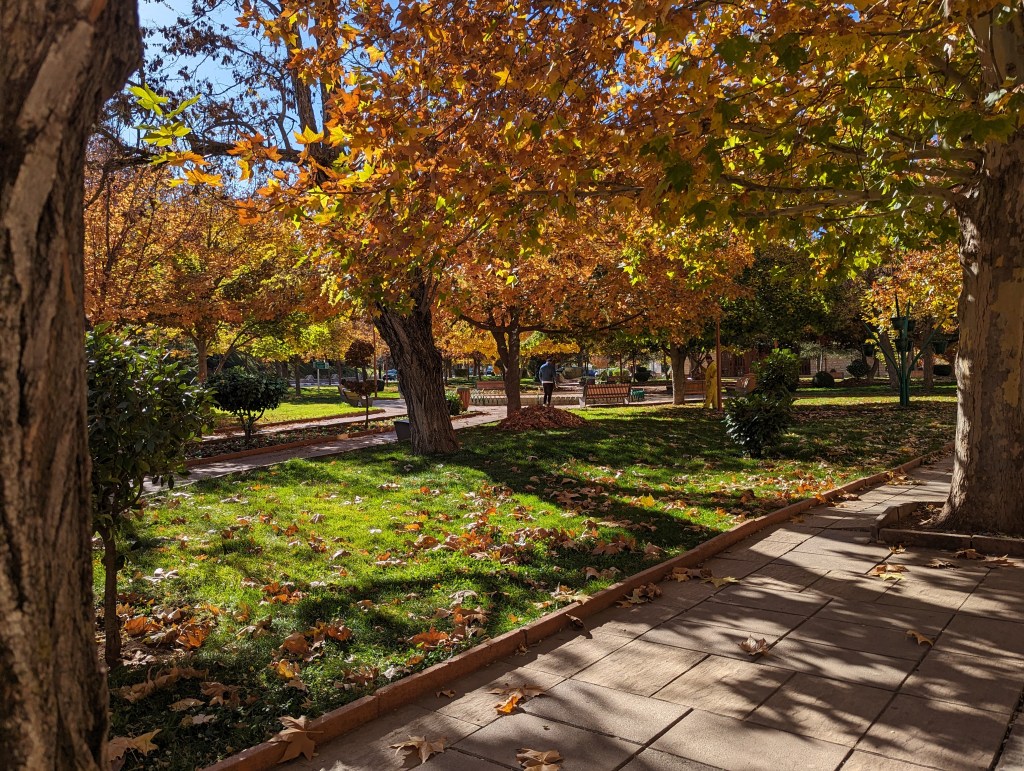
We enjoyed a touch of fall foliage, something we really did not expect to find in Africa.
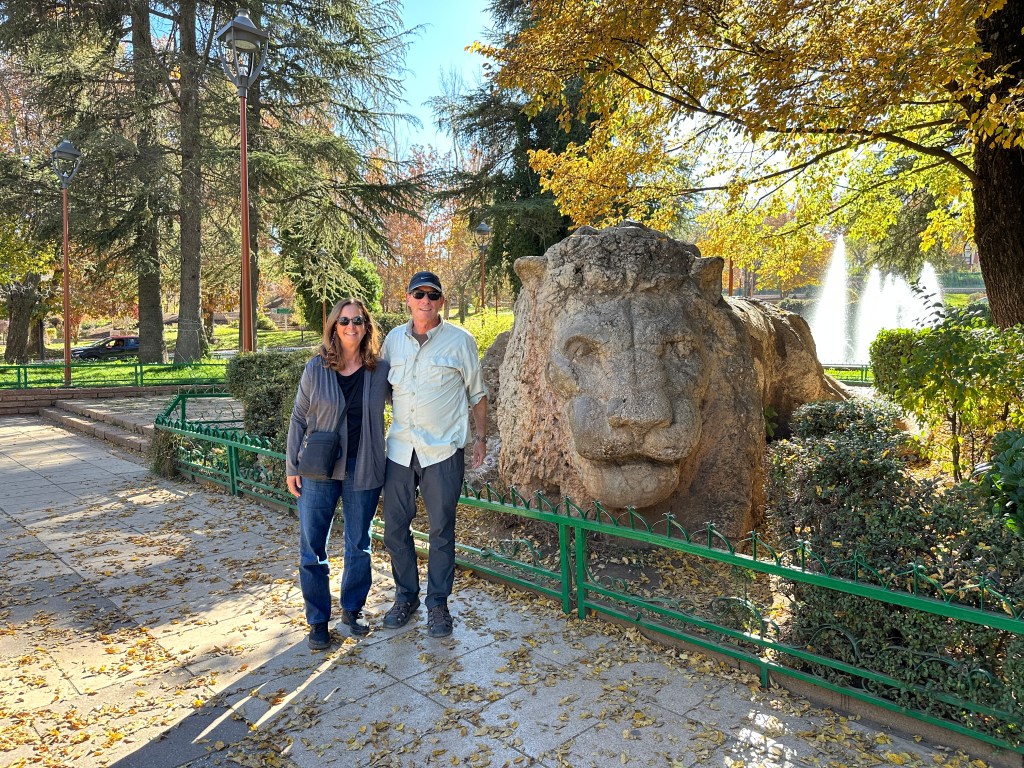
We took a picture in front of the famous lion statue carved by a German soldier during WWII, when Ifrane was used briefly as a prisoner-of-war camp, in exchange for the prisoner’s freedom – or so the story goes – and commemorates the last wild Atlas lion, which was shot near here in the early 1920s.
We checked into our 5 star Hotel Michlifen.


And were told we had been upgraded to a suite.
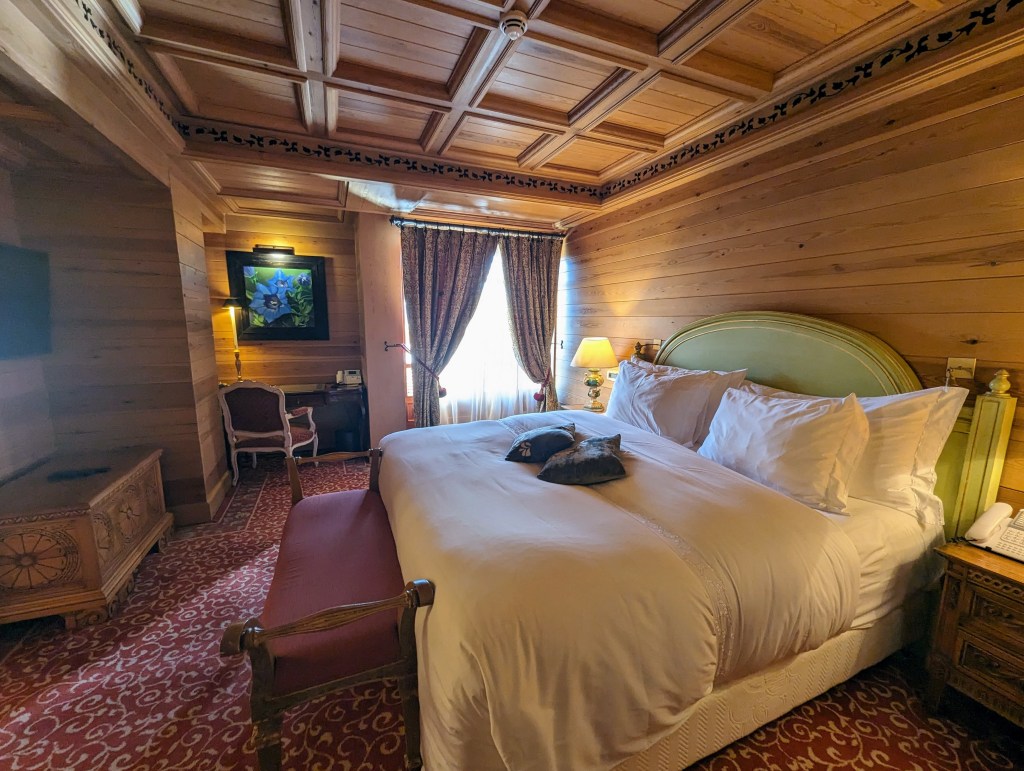
And we thought the last one was huge!
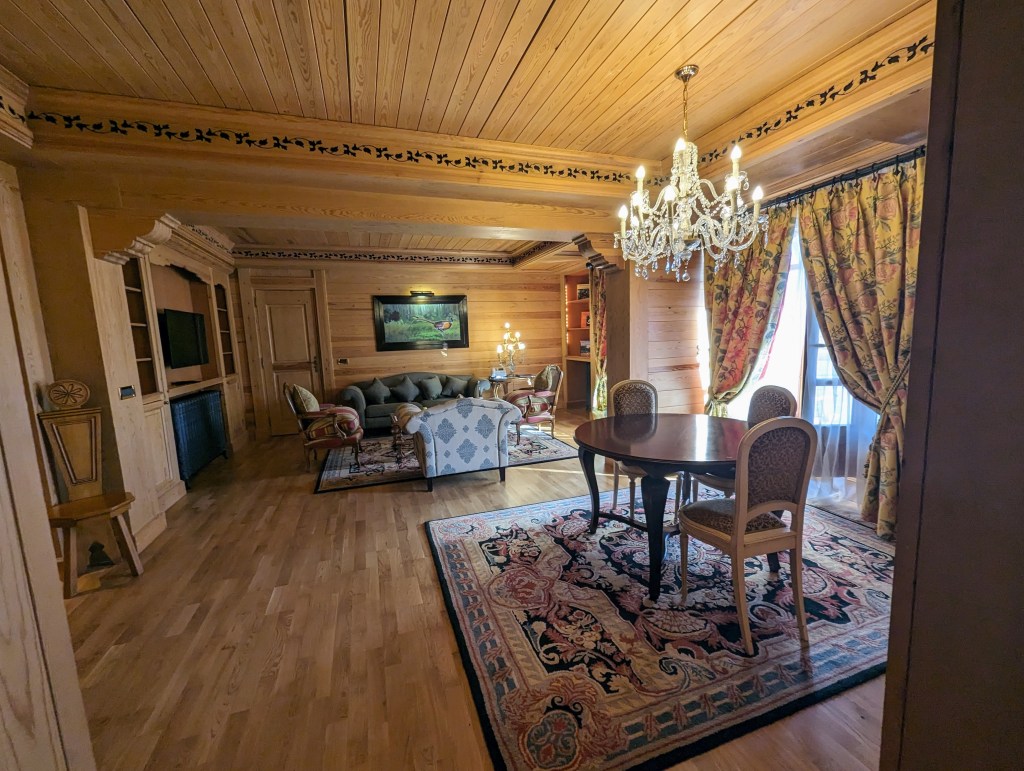
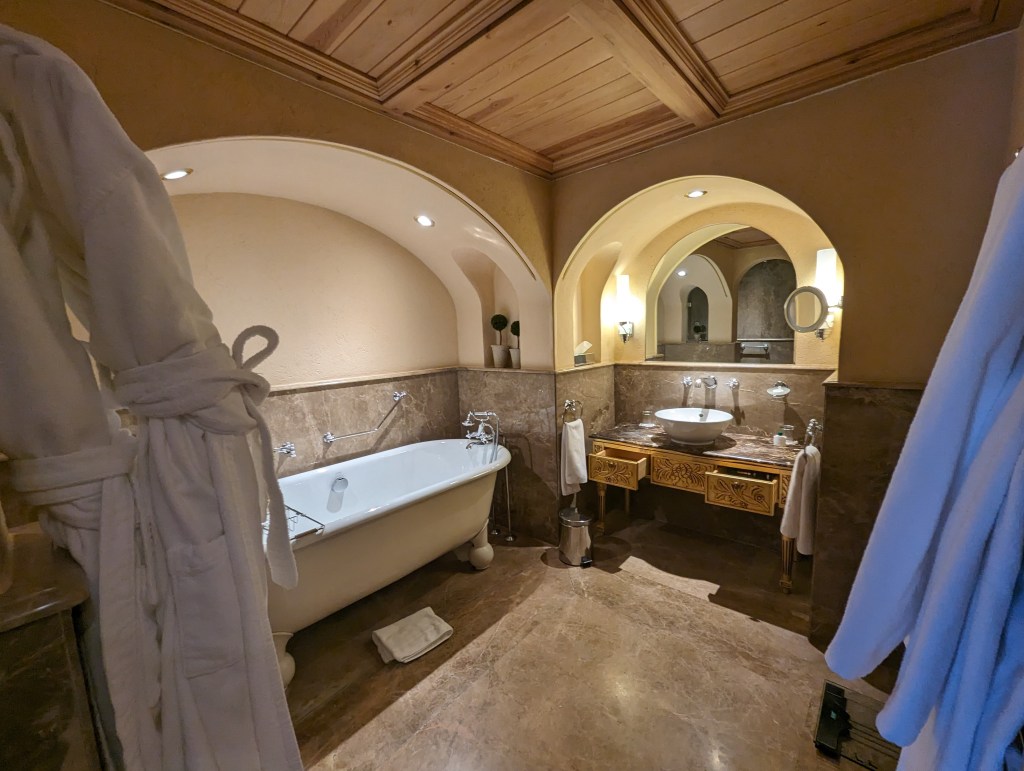
And these pics do not include the dressing room with built in closets or the second bathroom. We have a view of the huge heated pool from our terrace.

We sat on the terrace, sipped wine and watched the sun set over the mountains. A perfect end to the perfect day.

 Jo & Eric's travels
<
div dir=”ltr”>I’m enjoying reading about your travels. Hope th
LikeLike
Spectacular!! Your travelogue is epic – I love it.
LikeLike