
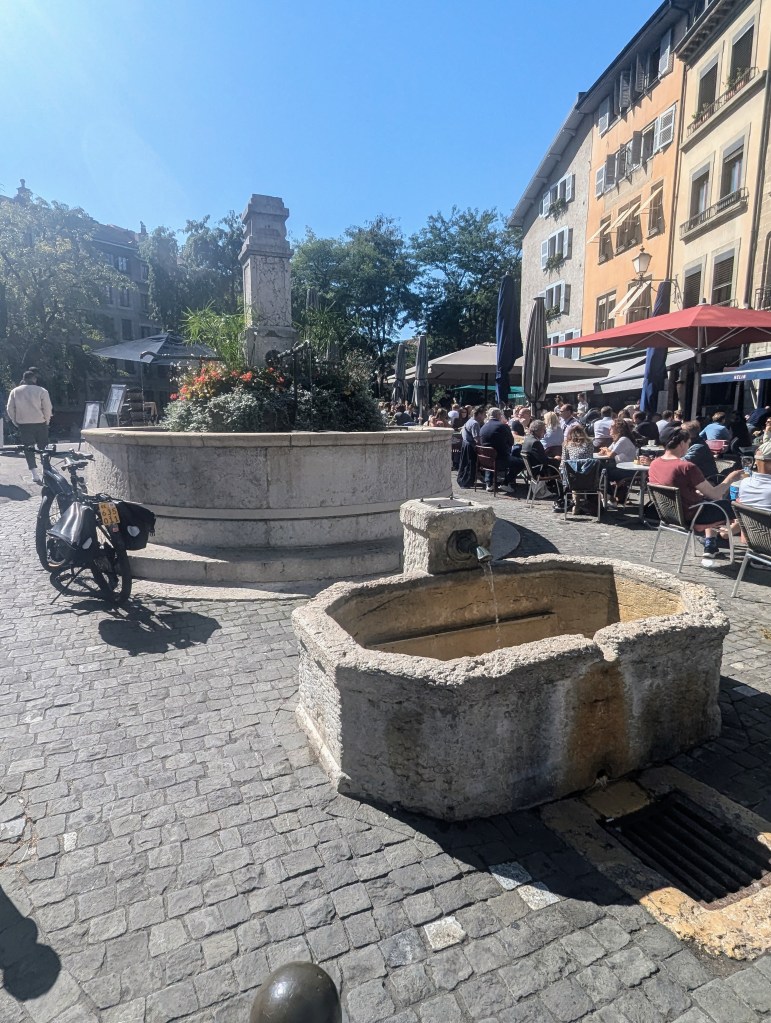
We arrived in Geneva airport at 7:30 am. Our Hotel D had sent us a transit card for use while in the city, so we were able to hop a train from the airport to 2 blocks from the hotel. Hotel D had obligingly agreed to check us in, for a fee, at 9am. After a refresh, we hit the town with a walking tour of the old city. We hiked around the bottom of Lake Geneva (AKA Lac Léman), then up to the Place du Borg-de-Four, which is the French translation of the Latin “Forum of the Burgandies.” The square has always been filled with markets and fairs, even a cattle market; today it is a tourist spot with shops, bars, cafes and some high-end shops. In its center is a fountain.
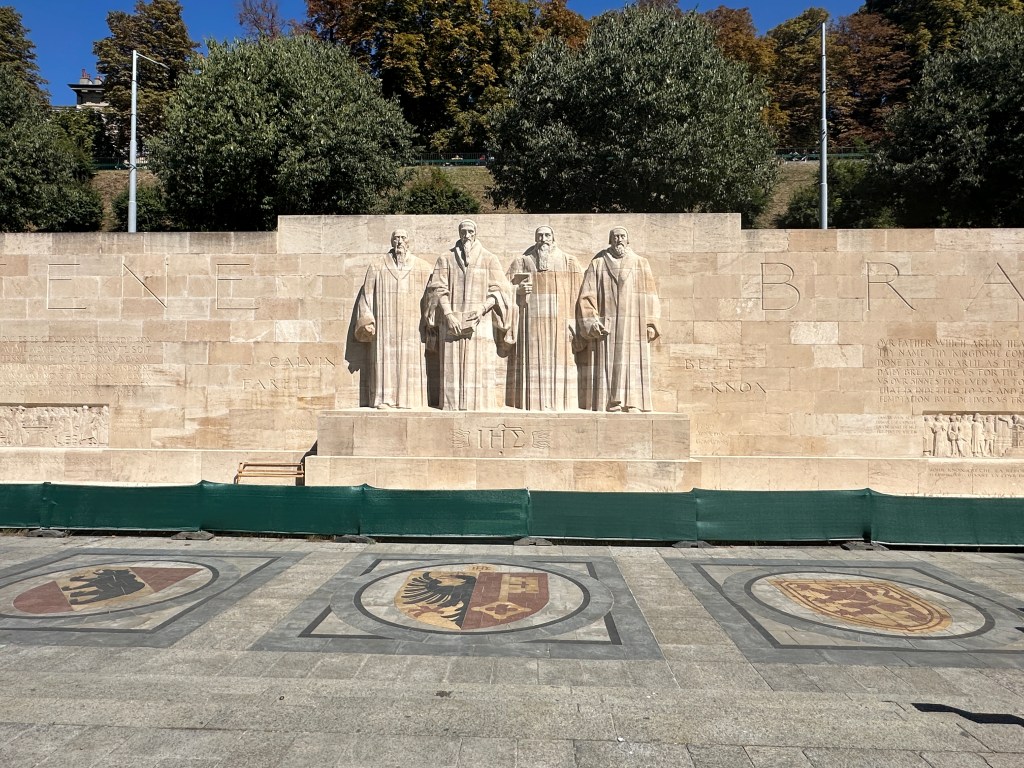
We then headed over to the the Reformation Wall, inaugurated in 1909, celebrating the persons and events of the Protestant Reformation. It sits on the University of Geneva grounds and marks the 400th anniversary of the French reformer John Calvin and the 350th anniversary of Calvin’s founding of the university.

The wall is built directly into the old city wall.
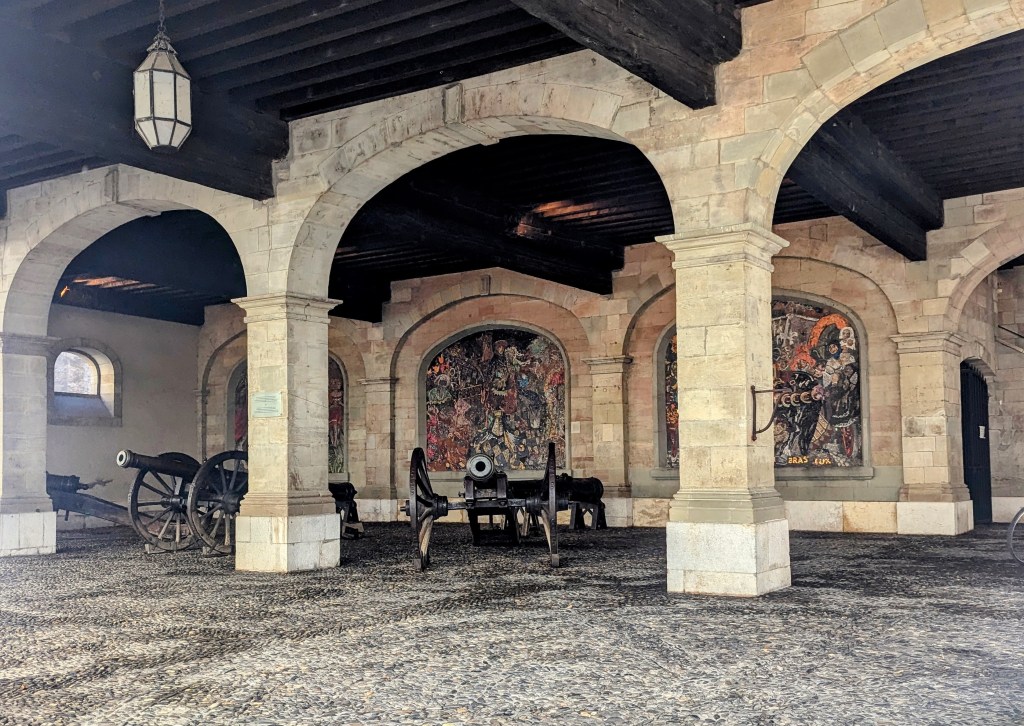
We headed up to the arsenal, built in the early 18th century to house ammunition to protect the old city. In Roman times it was an open air market and was first covered in the 15th century. Today it houses city archives.
So a quick history of Geneva: the Romans first took it over from local tribes in the 2nd century. It became Christian with its first bishop in the 4th century, and was ruled under the holy Roman Empire until the late 14th century, when it was self-governance. In 1541, with Protestantism on the rise, John Calvin became the spiritual leader of the city. In the 18th century Geneva again was under the influence of Catholic France. At the end of the Napoleonic wars, June 1, 1814, Geneva was admitted to the Swiss Confederation. The French influence remains with regards to both the language and the cuisine.
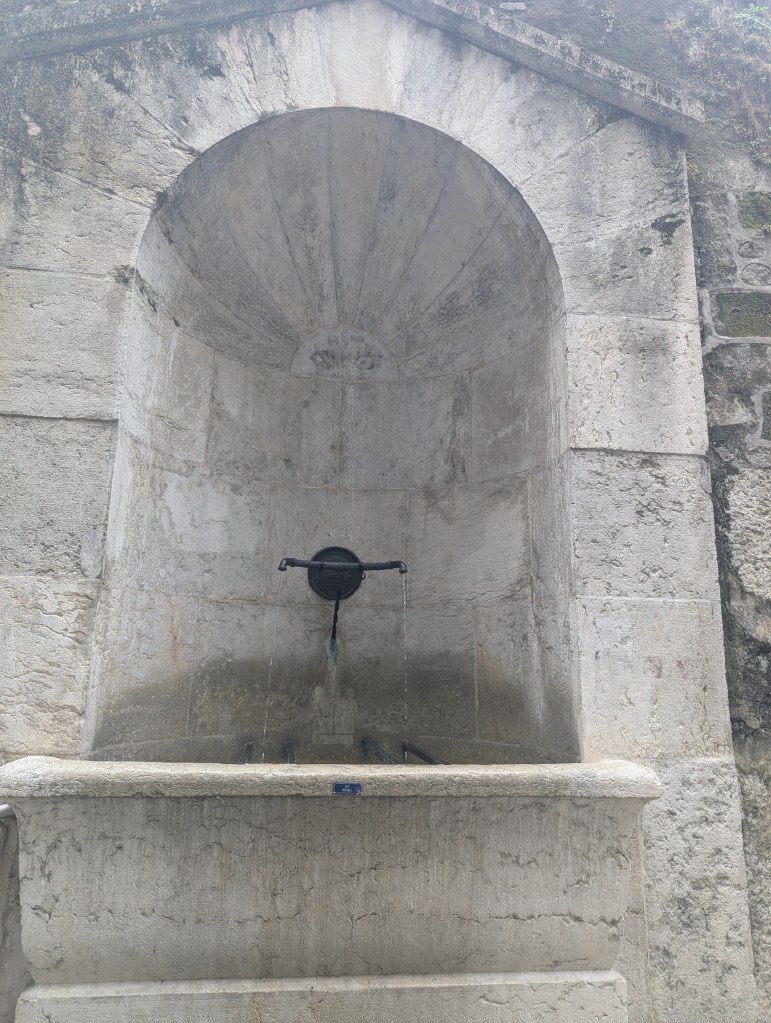
Scattered throughout the city are water fountains. Like in Rome, the water flows from the snow caps and is potable. One can fill a water bottle almost anywhere in the city.
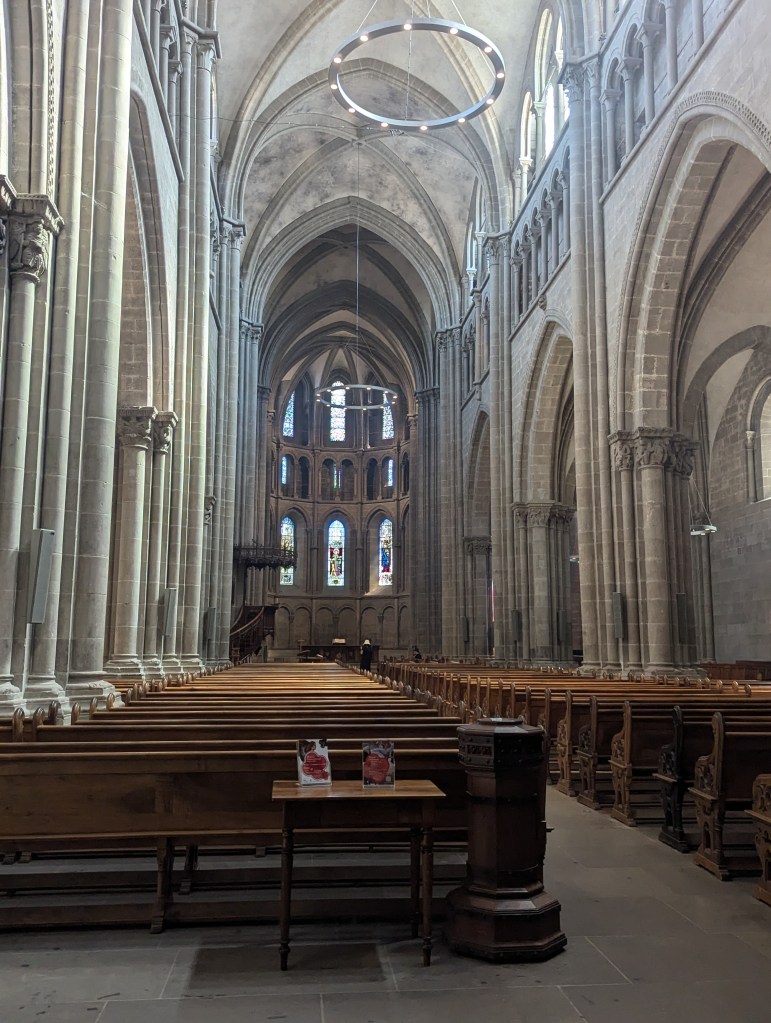
Next stop was the Saint Peter Cathedral. The locale of the current building has been since the first bishop in the 4th century. The present cathedral was built in 1160 and was begun in the Gothic style.

In the 16th century, John Calvin adopted it for his Protestant use and stripped it of altars, statues, and most paintings. There are large round chandeliers hanging from the center.
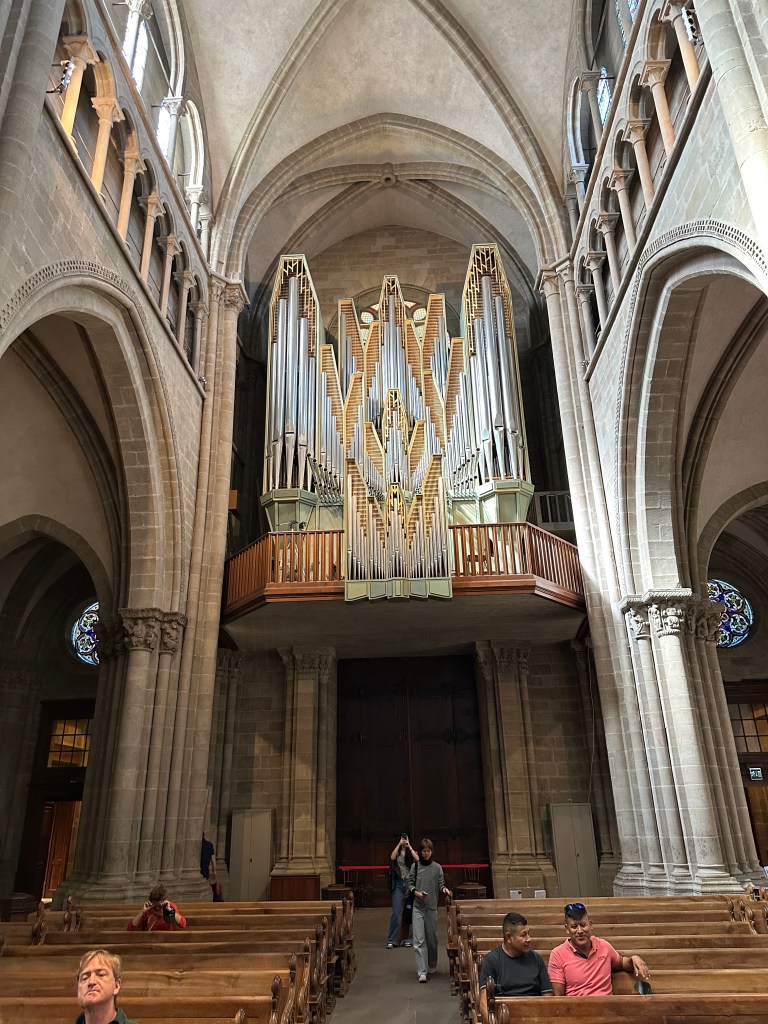
The enormous pipe organ above the main entrance is designed to look like a red and gold crown.
Heading back down the hill we passed this cute carousel for the kids.

We strolled through the Old Town down onto the Place du Molard (Molard Square and Tower). In the 13th century it was the port for the lake. In the 16th century it was the economic center of the city with warehouses, customs and exchange offices, hotels, shops, and more. Today it is filled with cafes, boutique and souvenir shops and more.

The clock tower at the center of the square is a Middle Ages remnant of a protective wall.
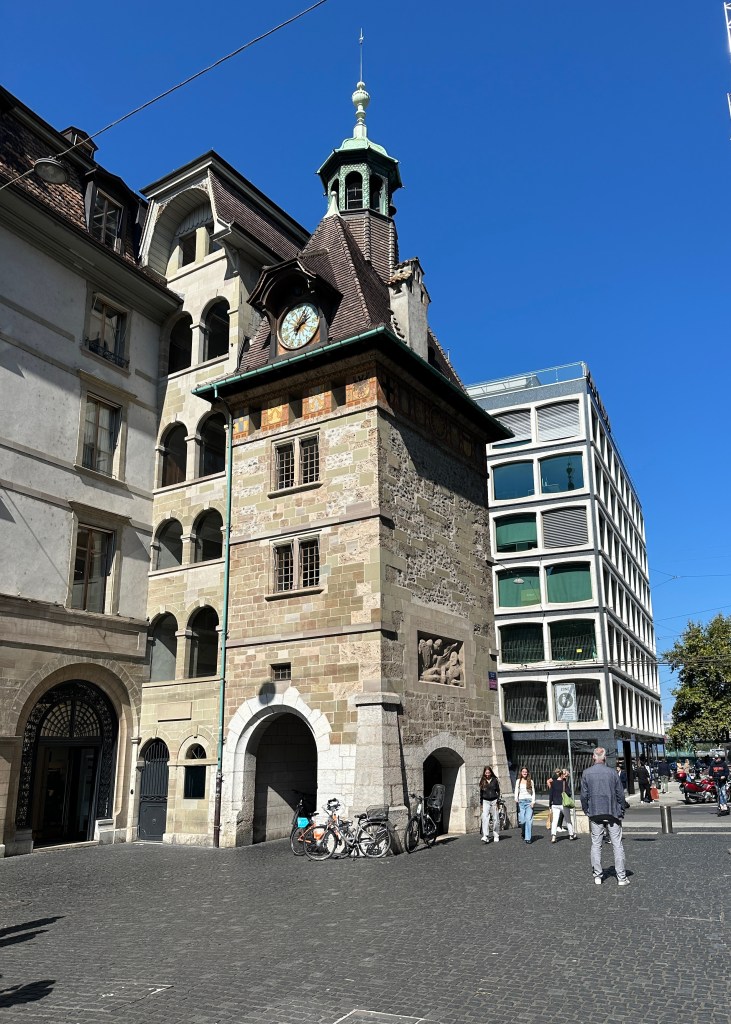
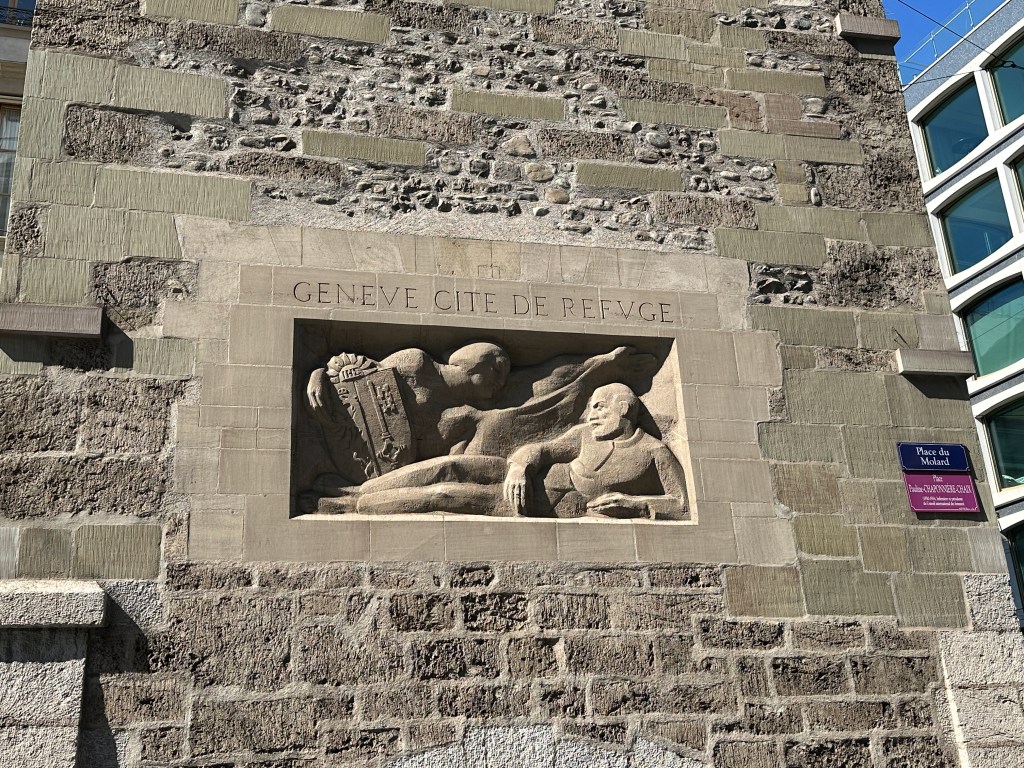
In 1906 it was adorned with a frieze and coat of arms of key actors of the Reformation.
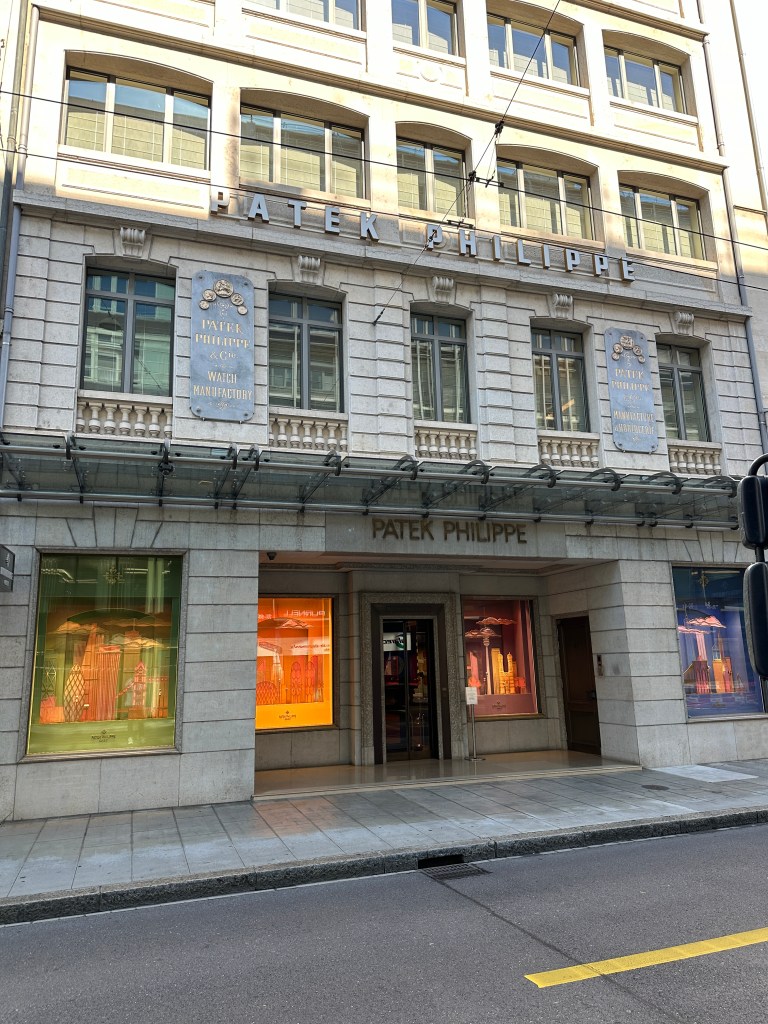
We strolled along Rue du Rhône. Geneva is a shoppers paradise. Here is every brand imaginable high to low: Claires to Tiffany, H&M to Hermes, Swatch to Patek Philippe. But Rue du Rhône is definitely the high end 5th Avenue-like vibe. We passed too many watch shops to count with watches selling for hundreds of thousands of dollars!
Even the chocolate shops on Rue du Rhône are high end. And oh so many chocolate shops in Geneva.

We headed out of the Old Town toward the water’s edge. There we found the famous Geneva Flower Clock. Geneva is renowned worldwide for its watch making heritage. In 1955, as a tribute to this history and to nature, the Flower Clock was installed on the edge of the English Garden. It has functioned without disturbance for over 50 years. The flowers, 6500 in number, are changed seasonally.

Geneva’s English Garden was established in 1855. It hosts monuments, fountains, busts, and a significant arboretum.

But probably the most famous of Geneva’s attractions is the Jet d’Eau. Originally built in 1886 as a safety release for hydraulic power, it was moved to the present location in 1891 in celebration of the Swiss Confederation’s 600th anniversary.
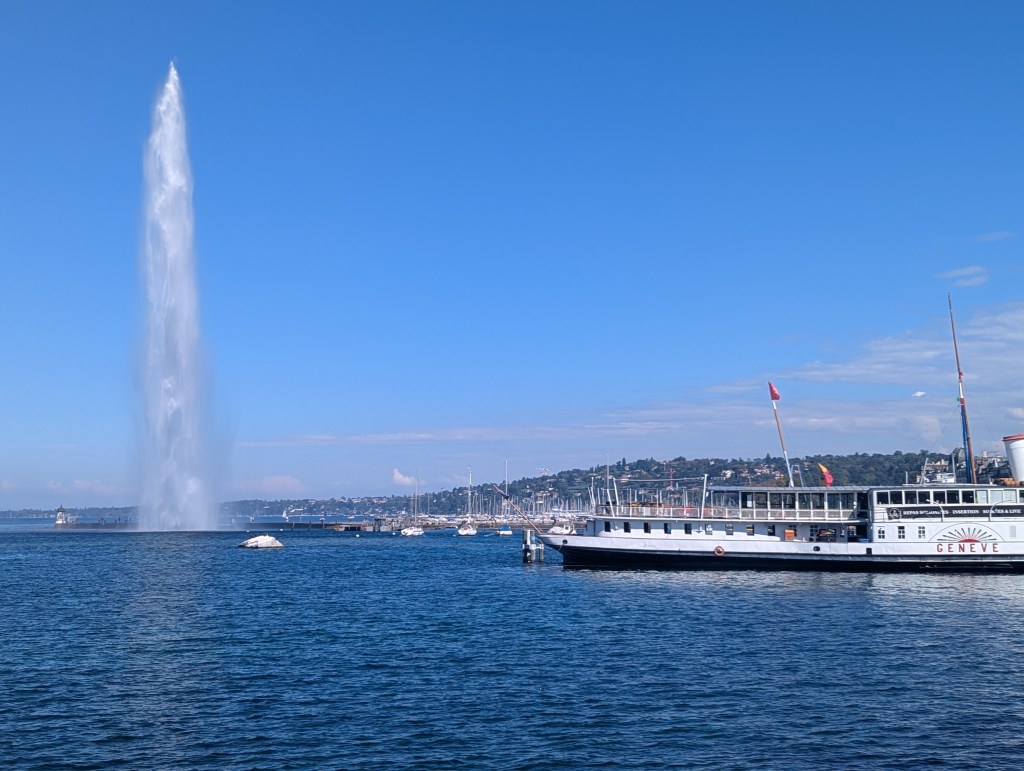
After a good night’s sleep, but still a bit jet-lagged we decided to spend this gloriously sunny day out on Lake Geneva.
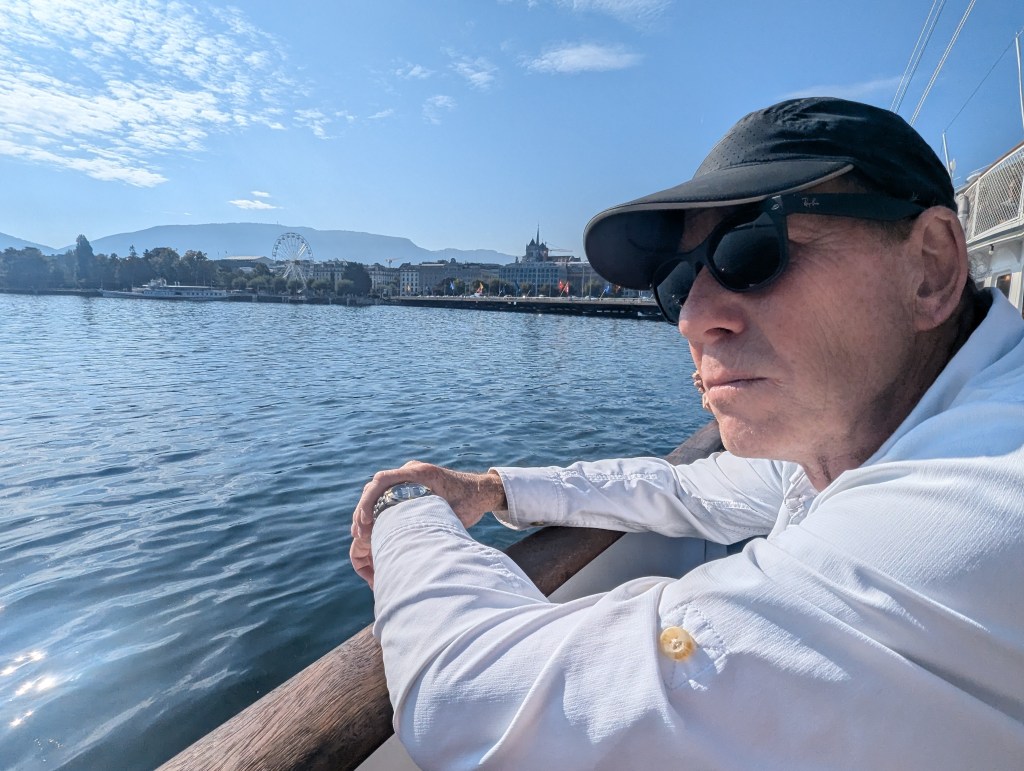
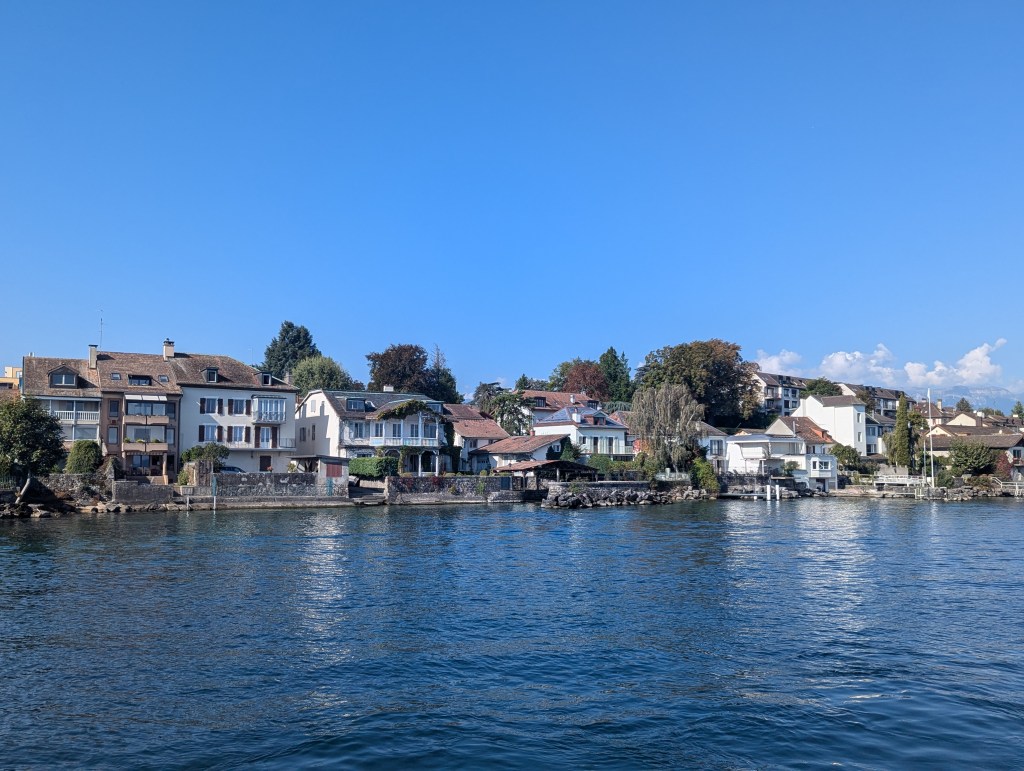
We left the city and headed north along the western shore passing many beautiful homes along the way.


We stopped in a few port towns:
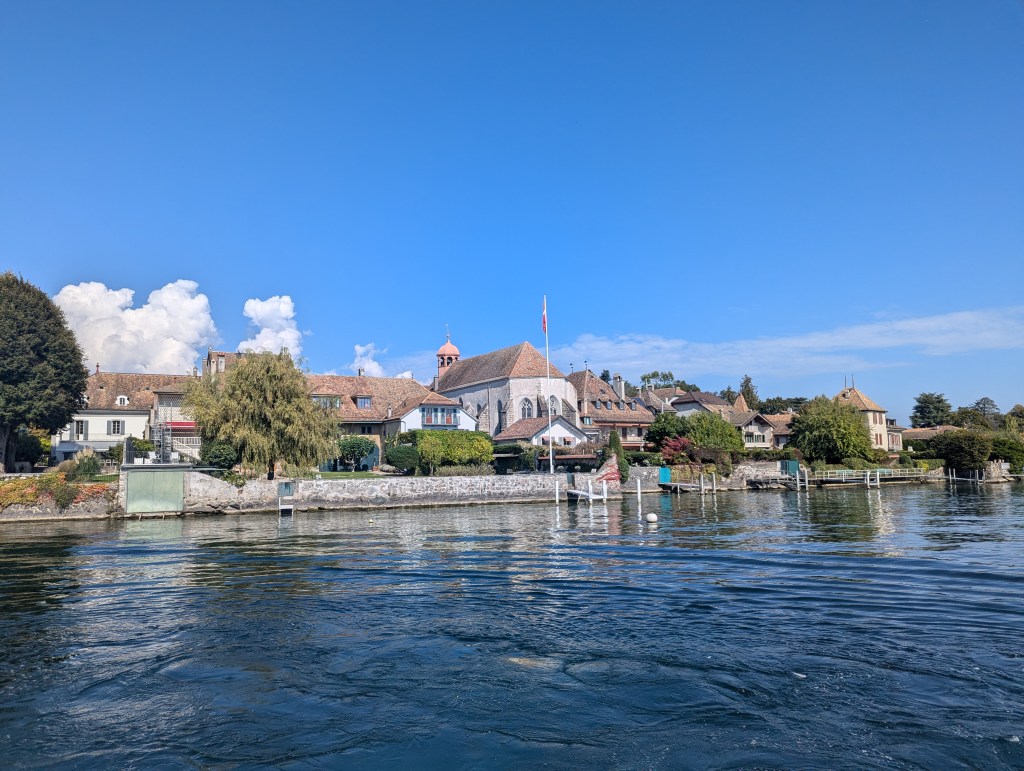
and passed too many sailboats to count. This group seemed to be racing.
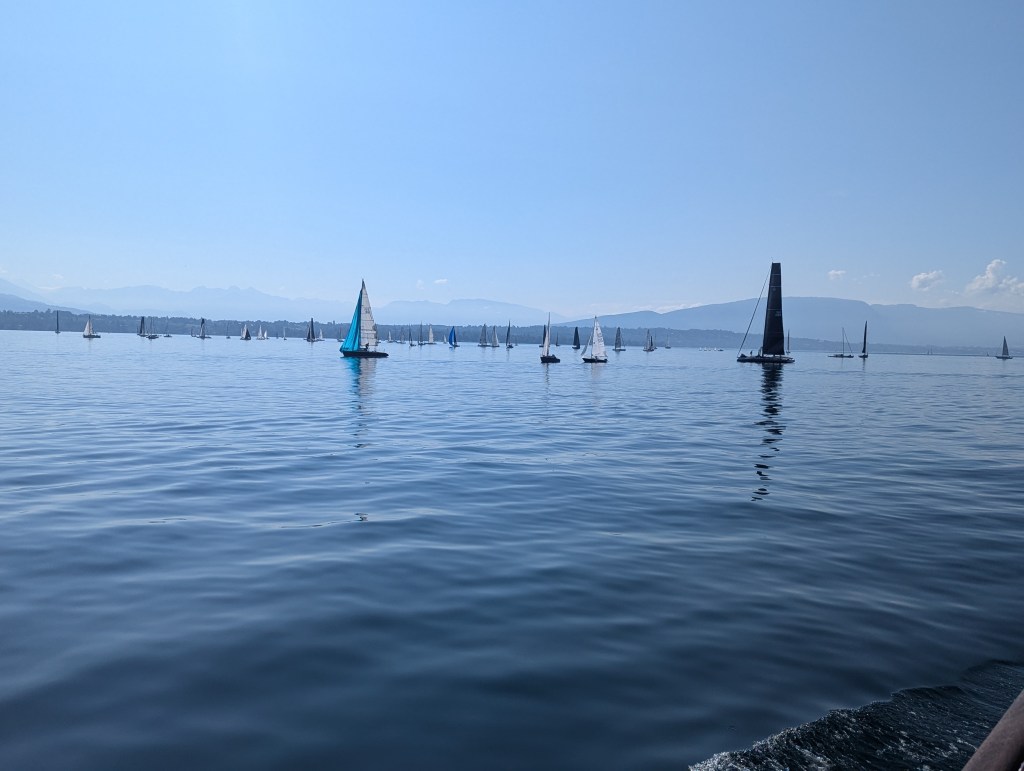
We hopped off at Yvoire.
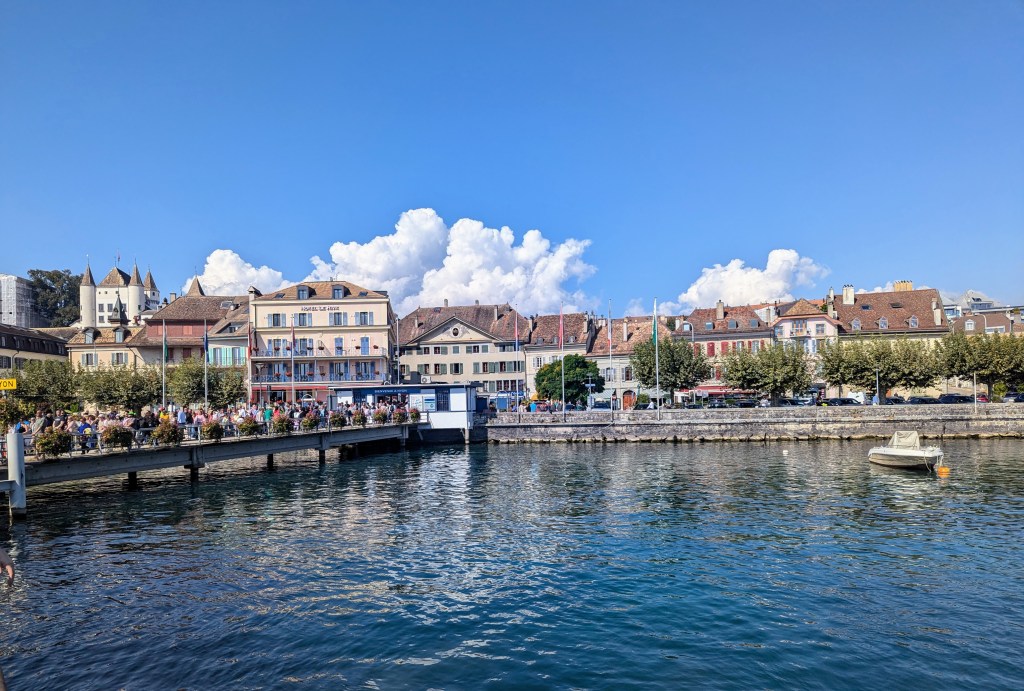
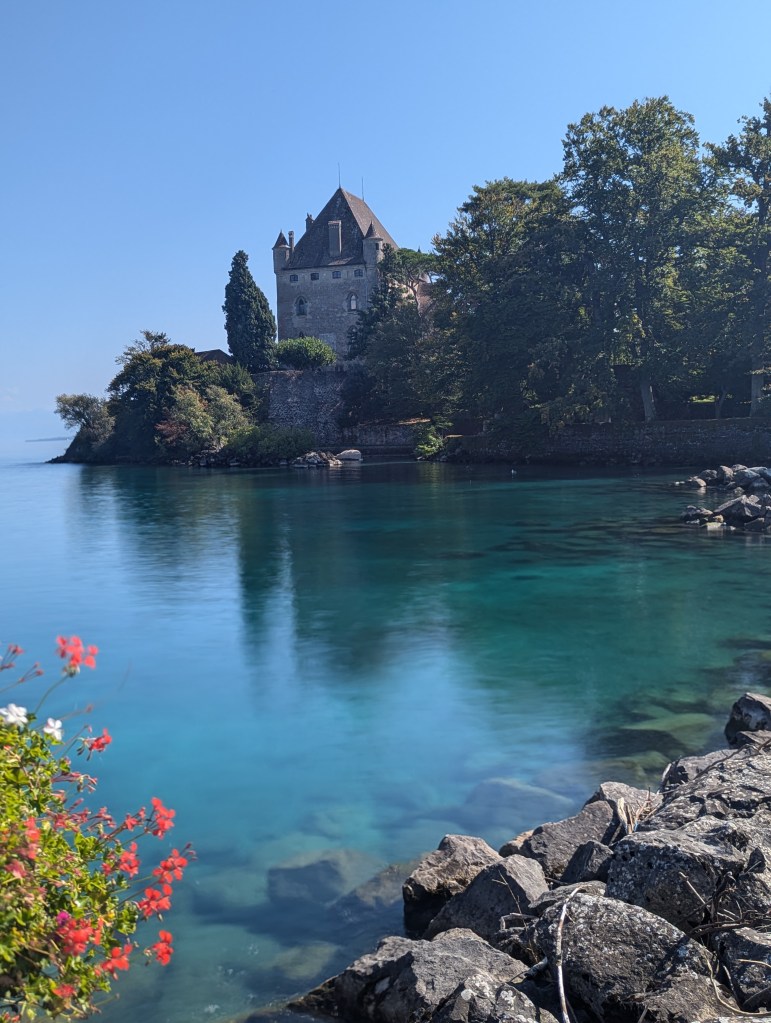
Yvoire is a medieval city built in the early 14th century. Located on the French shore of the lake, the village of Yvoire is nicknamed the “gem of the lake”. Overlooking the town is the midieval castle. Also worth mentioning is how crystal clear the water in the lake is. The water from the taps throughout the towns on the lake is not only potable but actually delicious and fresh tasting.
Walking up from the lake into town one is surrounded by beautiful cafes and pubs.

We checked out the local church built in the 13th century but having undergone many changes since.

Saint Pancrace Church
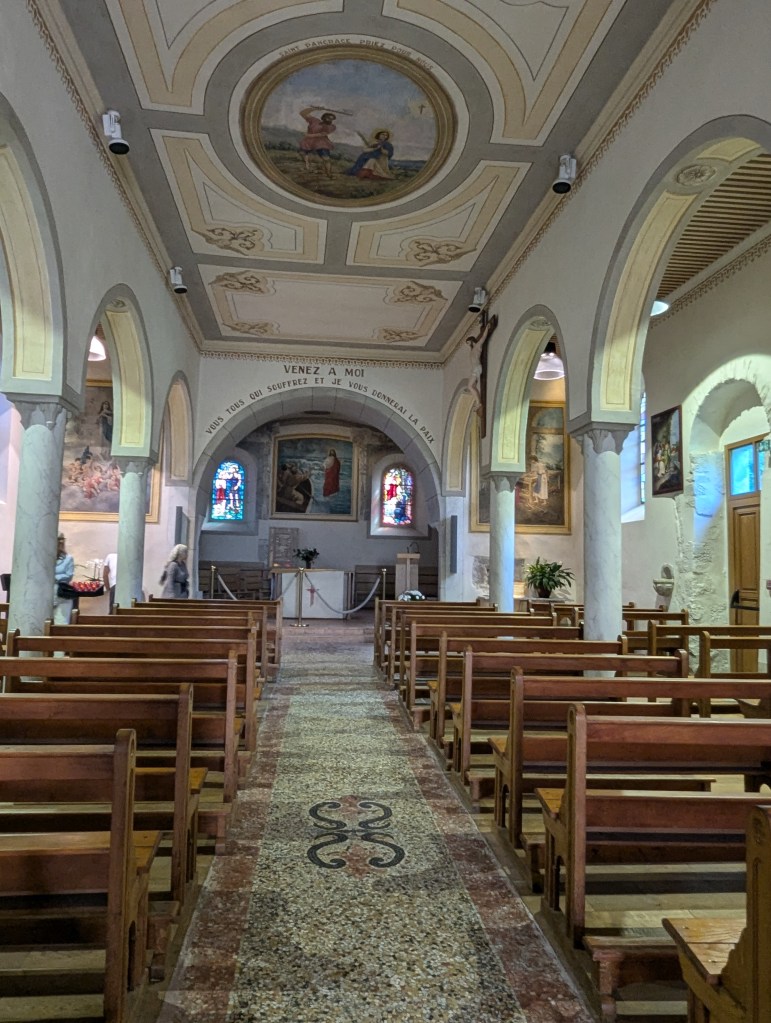
Saint Pancrace Church interior
The current bulbous bell tower was built in 1857 in place of the old campanile.
This bell tower wall, characteristic of Romanesque-style chapels, had been one of the 800 bell towers in the region destroyed during the French Revolution in order to melt down bells for the cannons of Napoleon’s armies.
The bell tower of Yvoire was covered with stainless steel in 1989. This gives it this shiny appearance, like a lighthouse on Lake Geneva on sunny days. Before 1989, the bell tower looked really rusty.

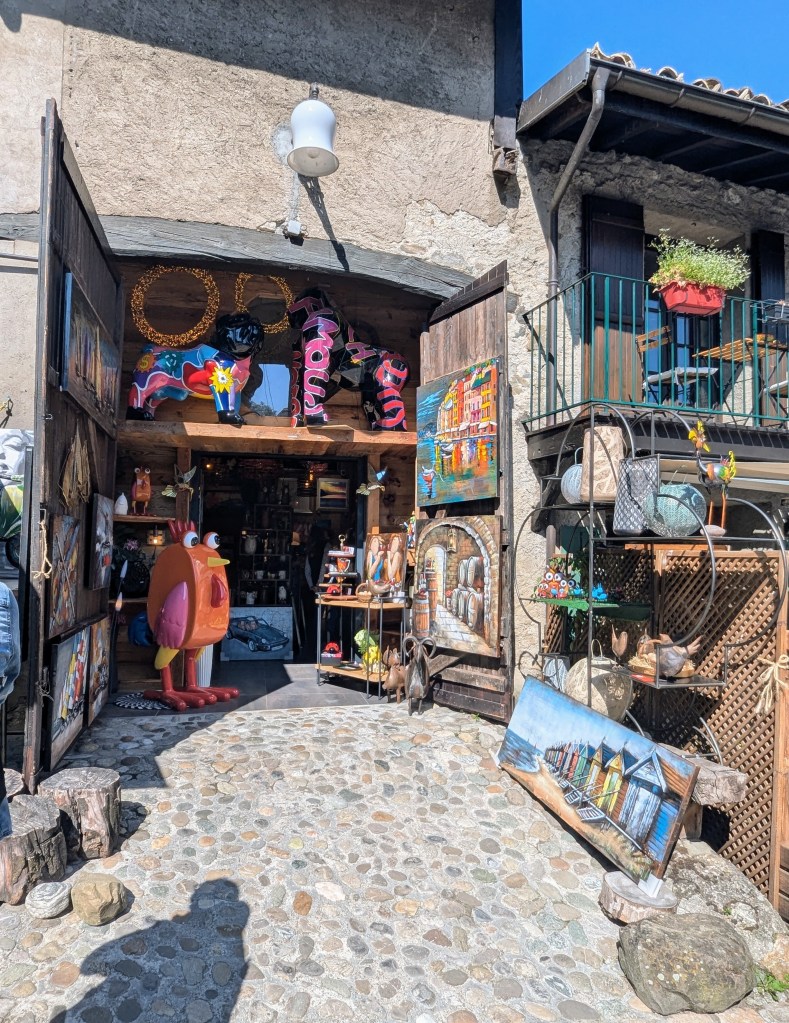
We meandered the car-free streets of the old town, which is packed with cafes, pubs, and shops. We stopped in a few of local artist shops.

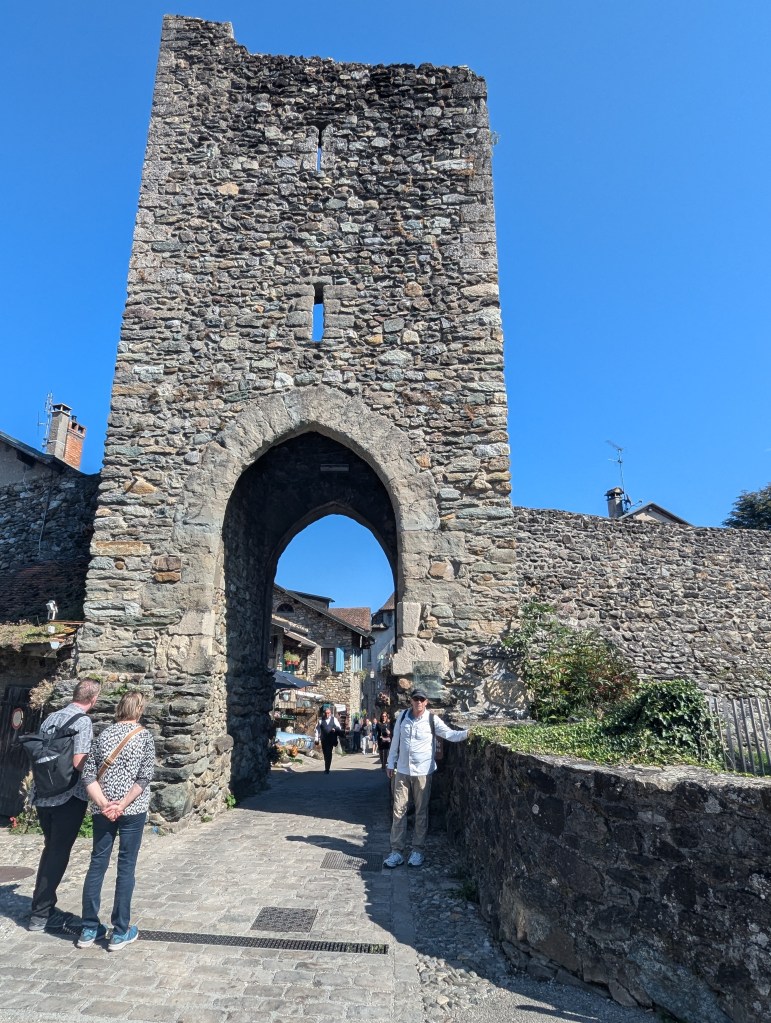
We wandered through the Port of Nernier, built in the early 14th century to fortify the town and one of the few remnants of the old wall remaining.
The castle, first seen from the lake, can be seen through many of the streets in this tiny town.

The flora is spectacular, even this late in the season. Flowers are growing everywhere, and trees seemingly right onto the sides of buildings!

After thoroughly enjoying this small French town, it was time for a beer break before heading back to the boat. We found a little cafe right on the water’s edge that served a local beer.

On our journey home the boat was much less crowded than it had been in the morning, giving us a chance to appreciate the boat itself. We had been on 2 in a fleet of 8 paddle steamboats dating to the early 20th century but renovated in 2009. Each has her original bell.

The engine is visible through plexiglass toward the stern.
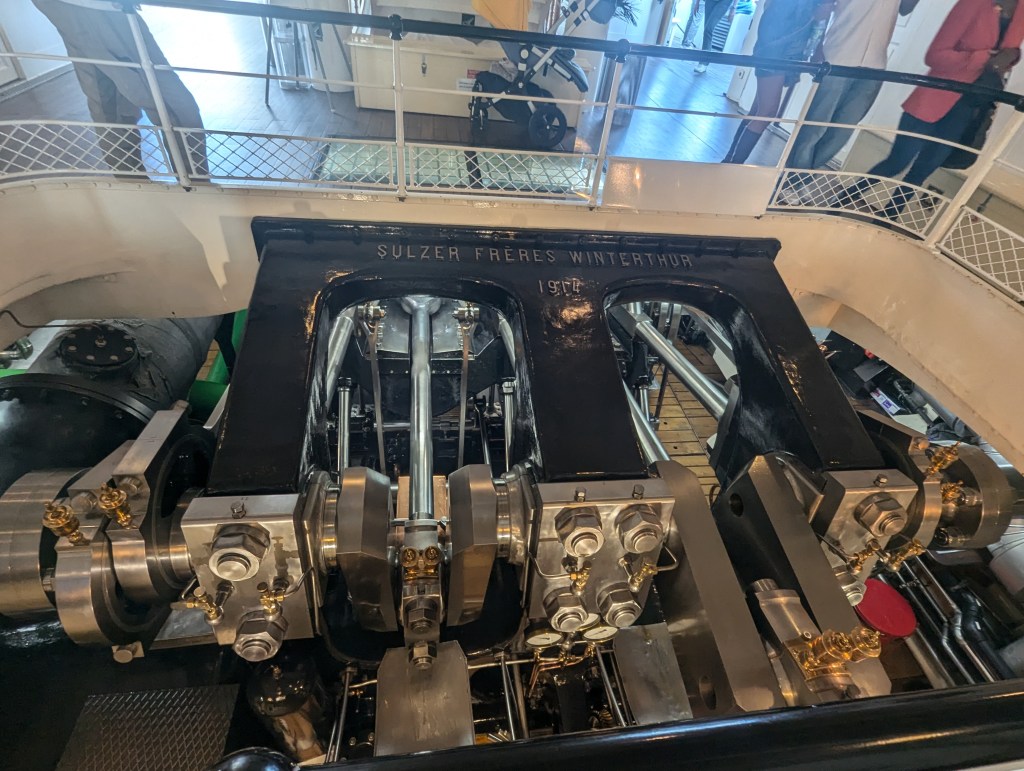
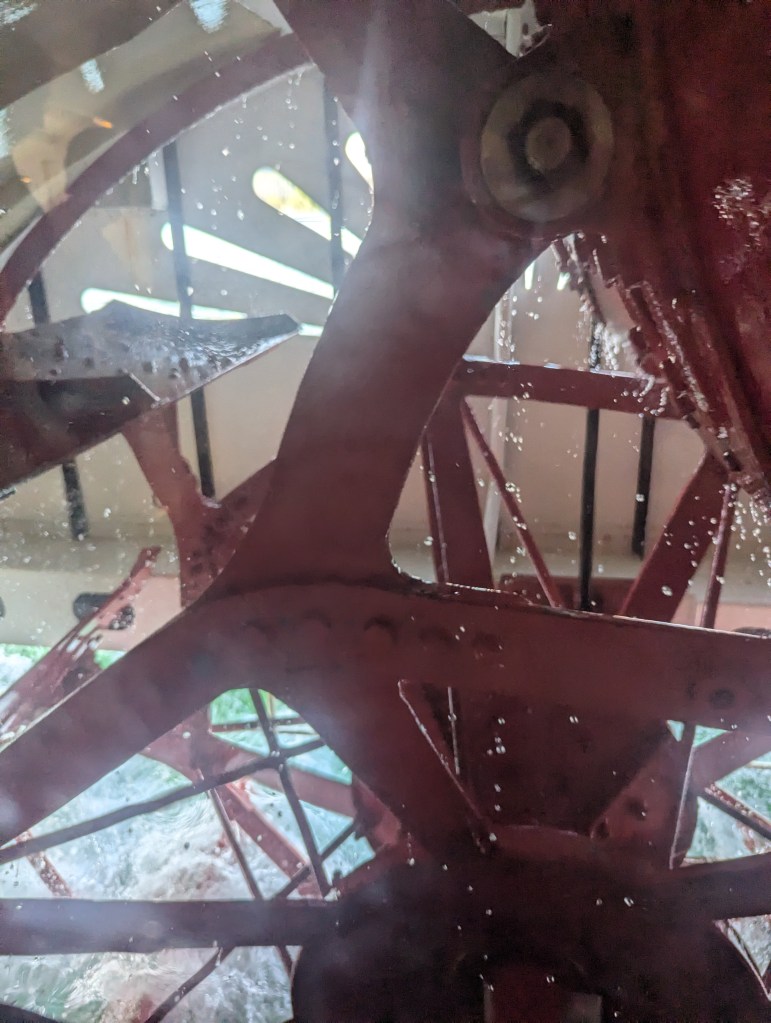
There are 2 paddle wheels, one on each side of the engine and both enclosed, visible only through a small window.
We arrived back in Geneva in the late afternoon.
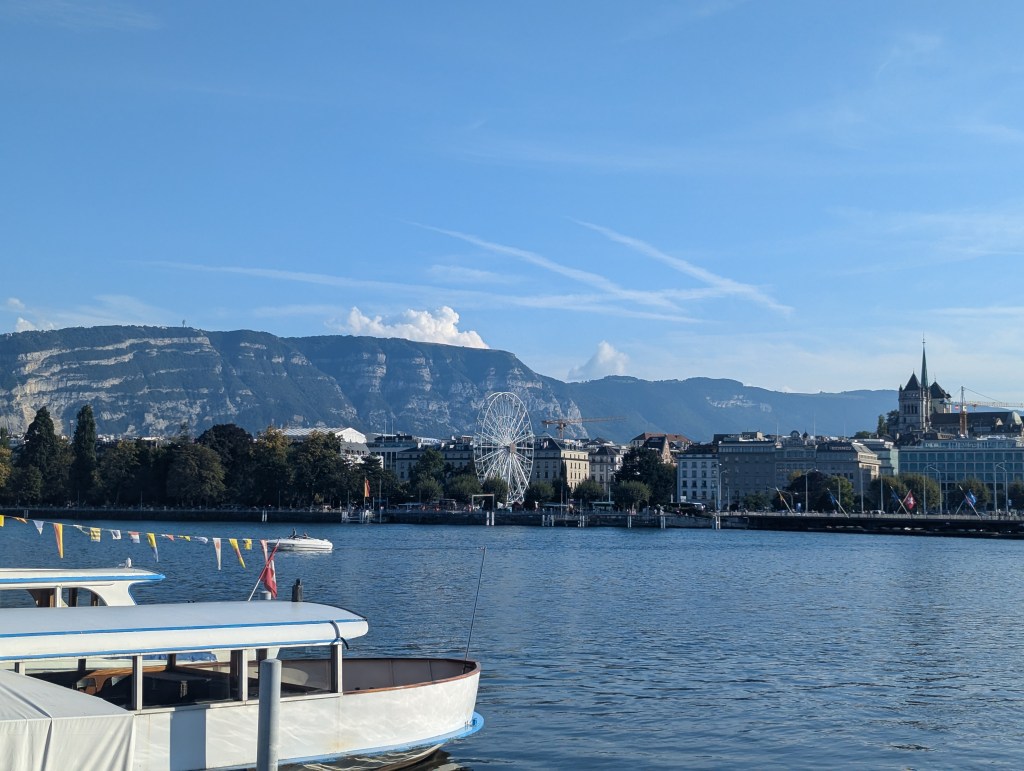
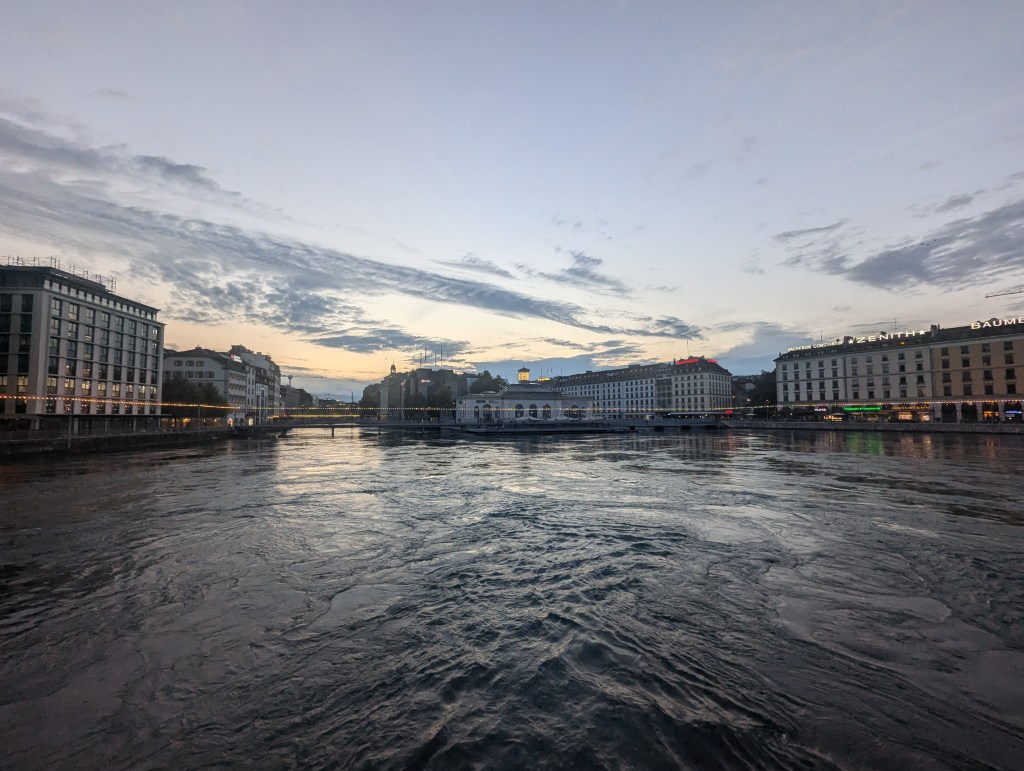
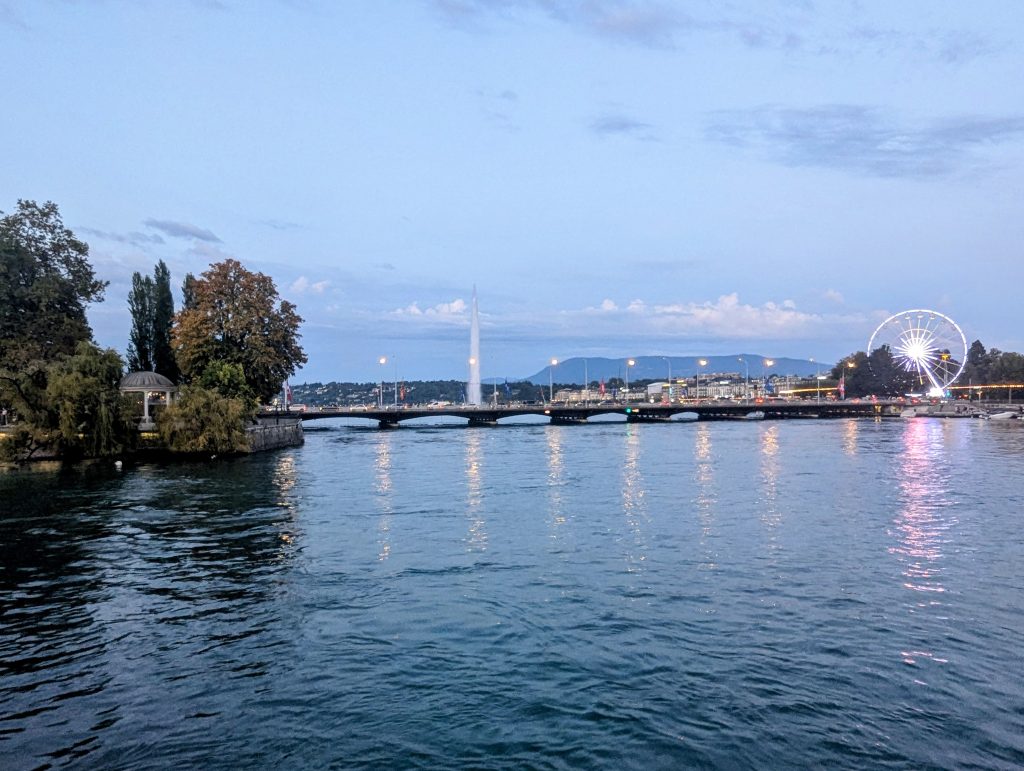
We headed to dinner at a very Swiss place right near the arsenal and enjoyed all the Swiss classics: raclette, wiener schnitzel, sausage with mustard and potato salad, all so yummy. After dinner we took an evening stroll along the southern shore of the lake and took in the views as dusk fell over the skyline.
In the morning we visited the United Nations.

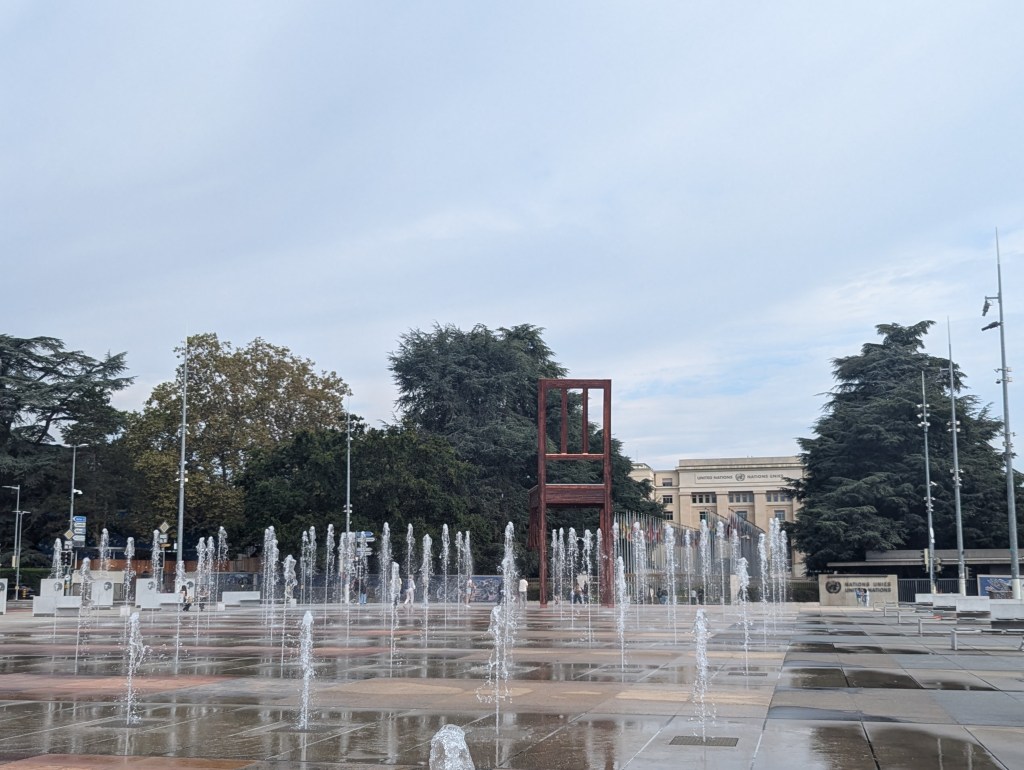
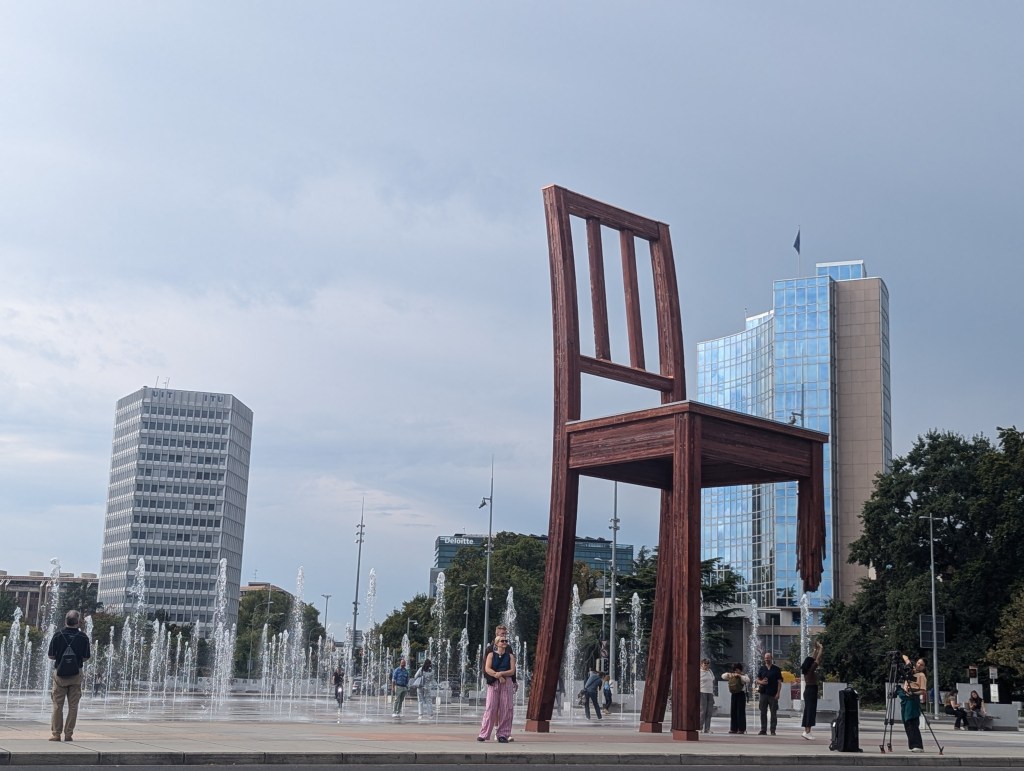
The chair with the broken leg is a work of art in wood, and symbolizes the campaign against landmines. Made out of 5.5 tonnes of wood and standing at a height of 139 feet, this impressive work of art has been dominating the Place des Nations since 1997.
We headed back to the lakeside and the Parc la Grange. I will digress here for a moment to discuss the public transportation system. Prior to our arrival, our host hotel had sent us digital transport cards via email. They were good for the train from the airport to the city and all public transport within the city. We road in a tram to the UN and a bus back to the old city, all easy to find and to determine routes and timetables.. So far 3 modes of transport, and no one had yet asked to see our cards.
Being a Sunday, most shops and sites were closed. So we decided for an afternoon stroll through the Parc la Grange. Luckily the bus we had chosen dropped us at the top of the very long hill. We hiked down to the 18th century Manor House, which is currently closed to the public. In 1864 a meeting of the first conference of the International Committee of the Red Cross was held in the Villa La Grange on the invitation of its owner, Edmond Favre (1812-1880). William Favre (1843-1918), a son of Edmond Favre, bequested the La Grange area to the city of Geneva, in 1918.

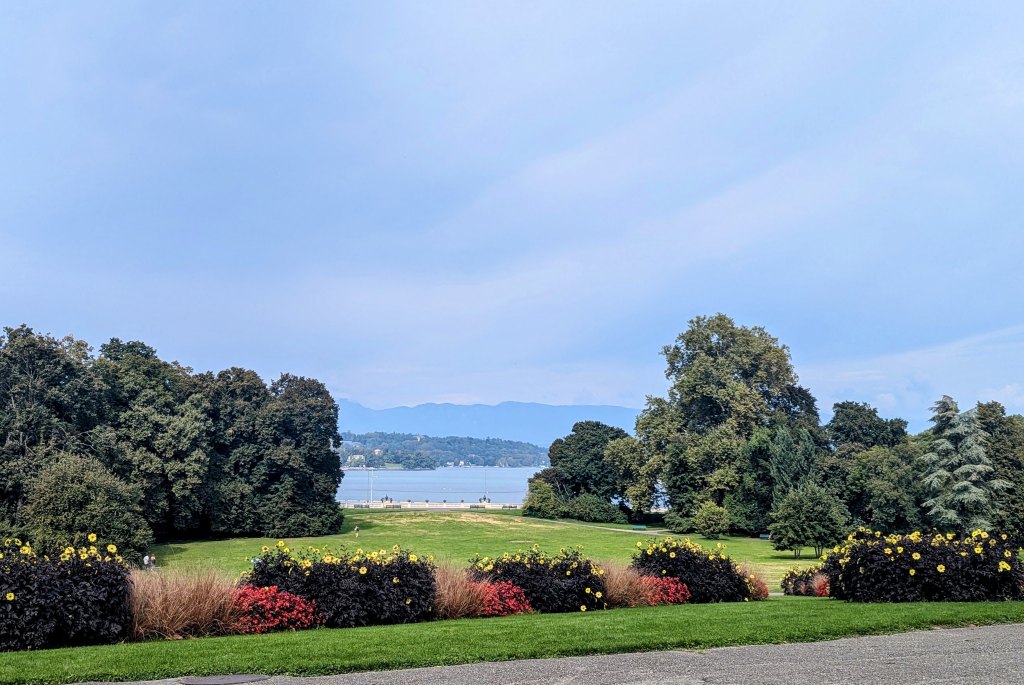
The villa is beautifully landscaped, has numerous fountains, and a spectacular view.
But what the park is most know for is the impressive rose garden.

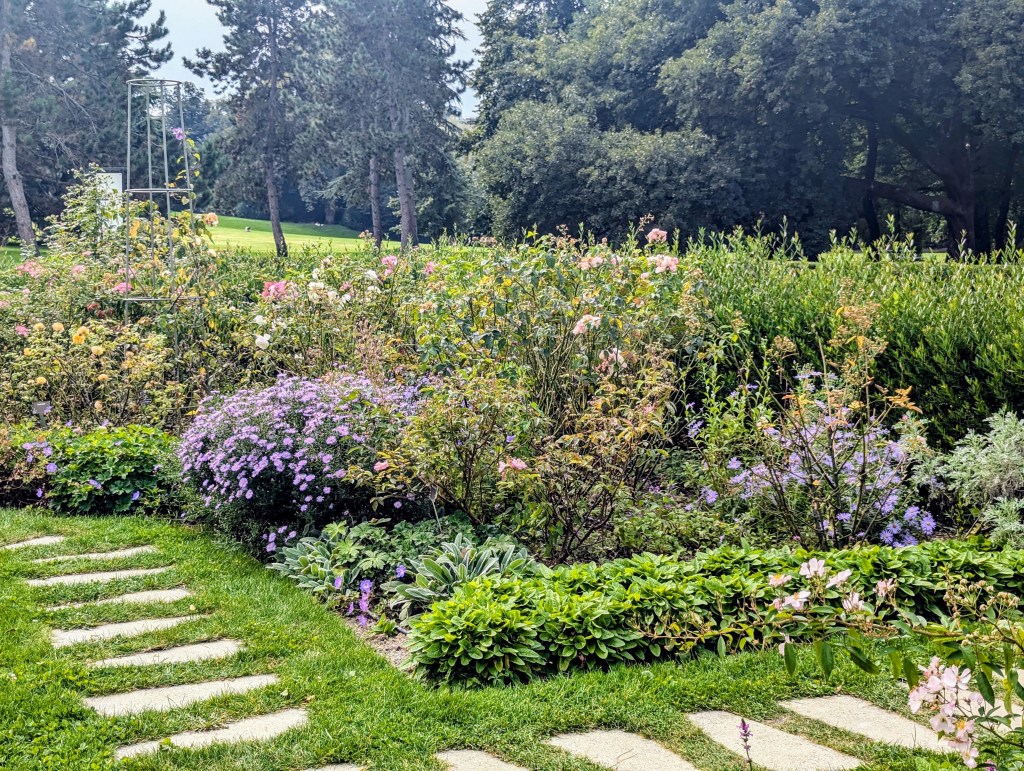
Despite this not being the season for roses,

there were plenty of perennials still in bloom on the periphery.
Having tried every other mode of public transportation available, it was time to try a shuttle boat. Geneva has 3 routes that crisscross the lower portion of the lake connecting the parks, hotels, and shopping districts. It was a fast trip across, and again, no check of our transport card.
Now it is time to mention the peoples and the restaurants. Geneva is the most multiethnic city outside of NY we have ever visited, which is especially remarkable considering its relatively small population. The UN with over 1400 employees surely must contribute to the rainbow of peoples on the streets. Our hotel happened to be situated in what seemed like Little India based on the number of Indian restaurants just on our one street. Within a couple blocks we had the choice of not only every cuisine of Switzerland: Swiss, French, German, and Italian, but also everything from Mongolian, Ethiopian, Vietnamese, Thai, Mexican, Irish, many Japanese, and the list goes on. But both previous nights on returning to our hotel, the Chinese restaurant right next to our hotel: Xiang Yiu had a line of Chinese patrons wrapped around the block. We arrived back from the gardens early and hungry and decided to give it a try. Without a reservation, the maitre’d offered us a table if we could be out in under 75 minutes. And what an amazingly different and delicious meal it was; we ordered three dishes between the two of us and gobbled it up in time!
To help digest the meal, we ambled back to the lake. It started to drizzle, and the people traffic was sparse, so we took a couple of the different shuttle boats back and forth across the lake enjoying watching the lights come on over the city.
The next day we took a train to Lausanne. Upon arrival, the city announced itself as the home of the Olympics with the recognizable circles over the entrance to the train station,
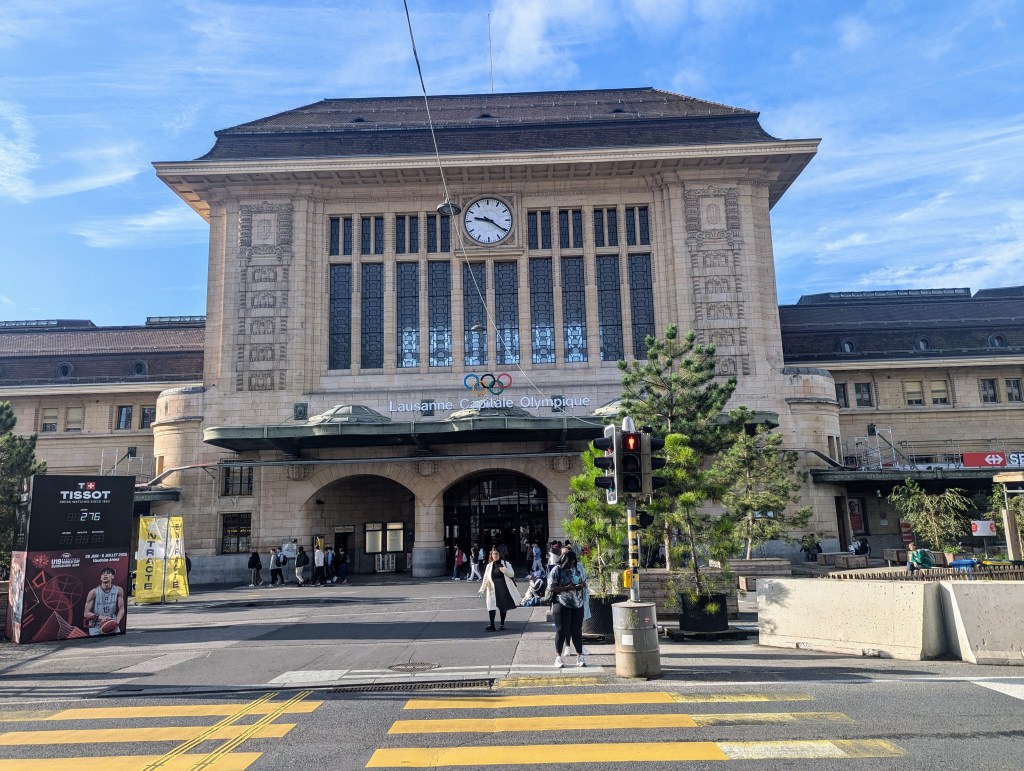
Lausanne has been voted the best city with a population <200,00 (it is about 140,000) by Monocle Magazine. It is also the only city in the world with such a small population to have a rapid transit system. We easily found the metro, which we rode to our hotel, yet another means of transportation for us in Switzerland, and again no card check despite a new one having been issued by our local hotel. The metro is completely automated; no person conducting nor checking fares. There is a distinct jingle for each stop.
After dropping our luggage, we rode the metro back up to visit the old city. Our first stop was the 12th century Notre Dame Cathedral which sits atop the highest hill of the city.
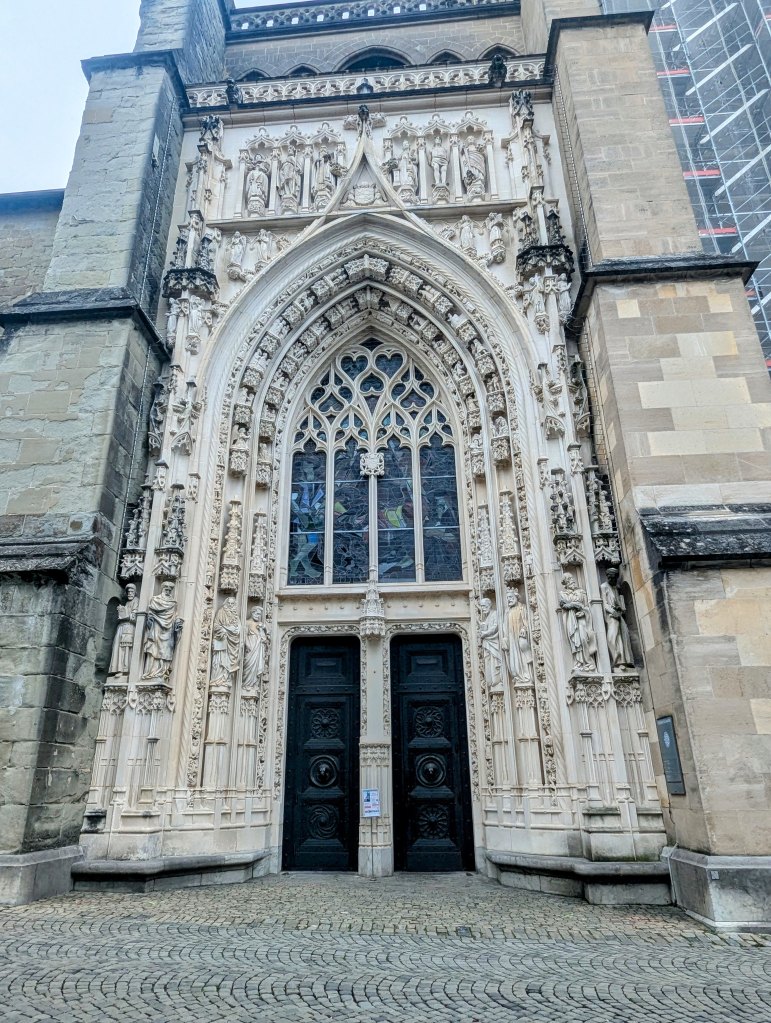
Built between 1150 and 1275, it is considered the most beautiful gothic building in Switzerland. During the Protestant Reformation, much of the interior was stripped. The cathedral was renovated in both the 18th and 19th centuries, and again in the 20th, when new stained glass windows were added. The interior reflects both the original gothic architecture
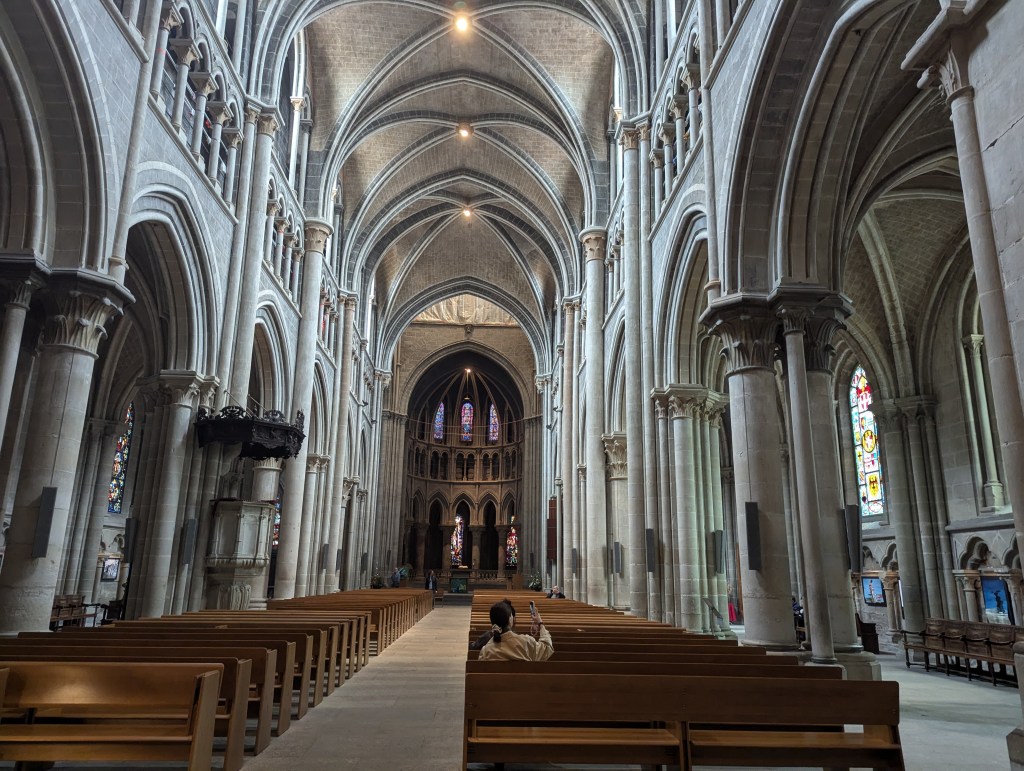
mixed with modern art
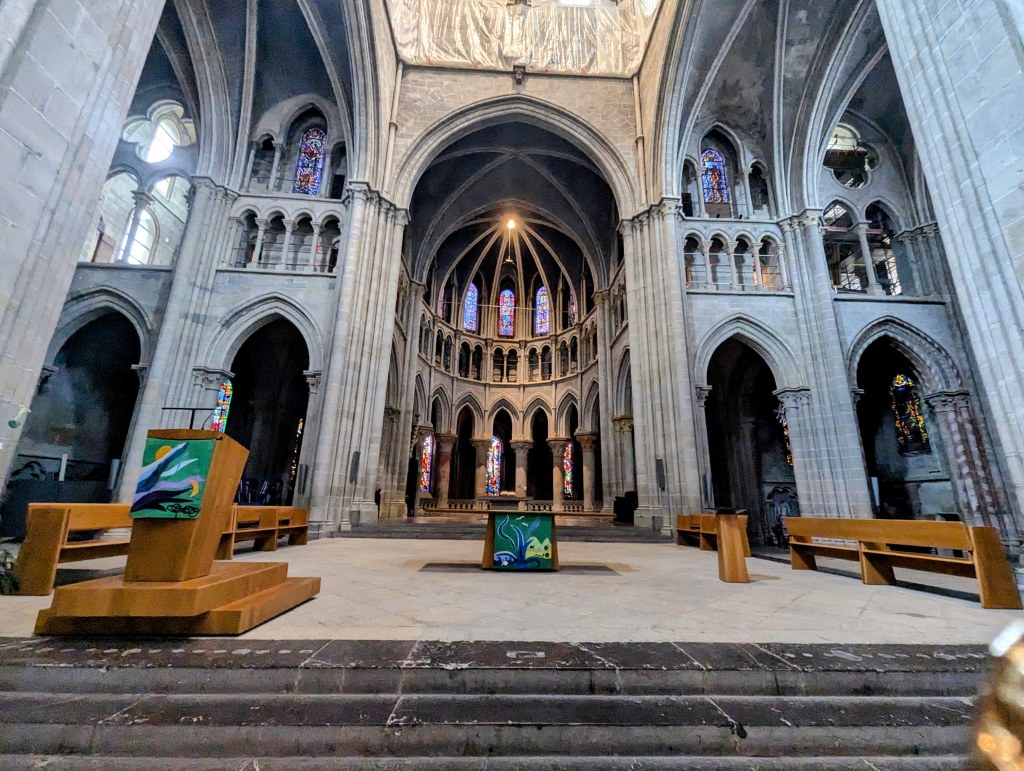
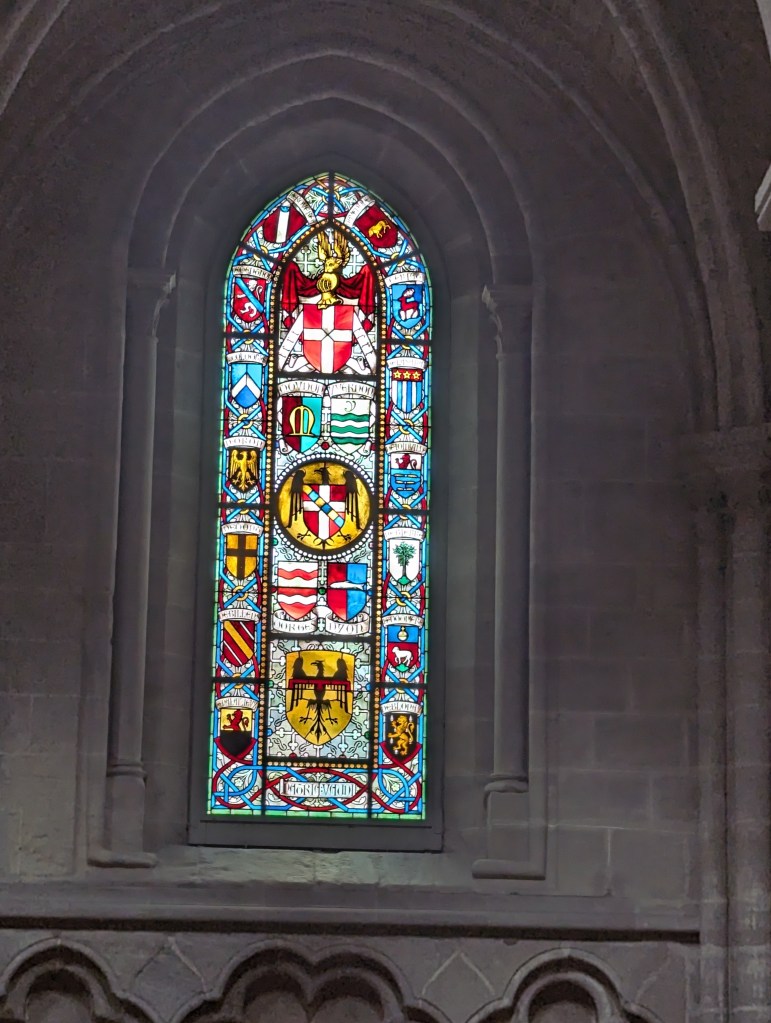
and 20th century stained glass windows.
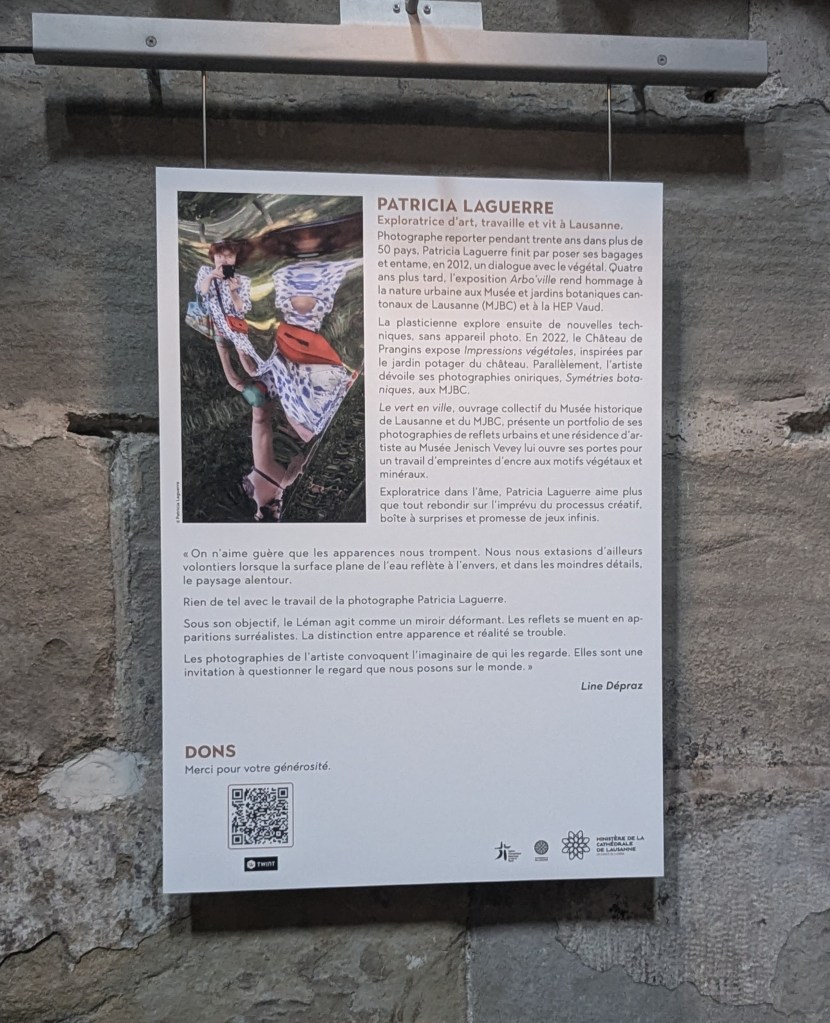
Uniquely, the cathedral had an exhibition of artwork.
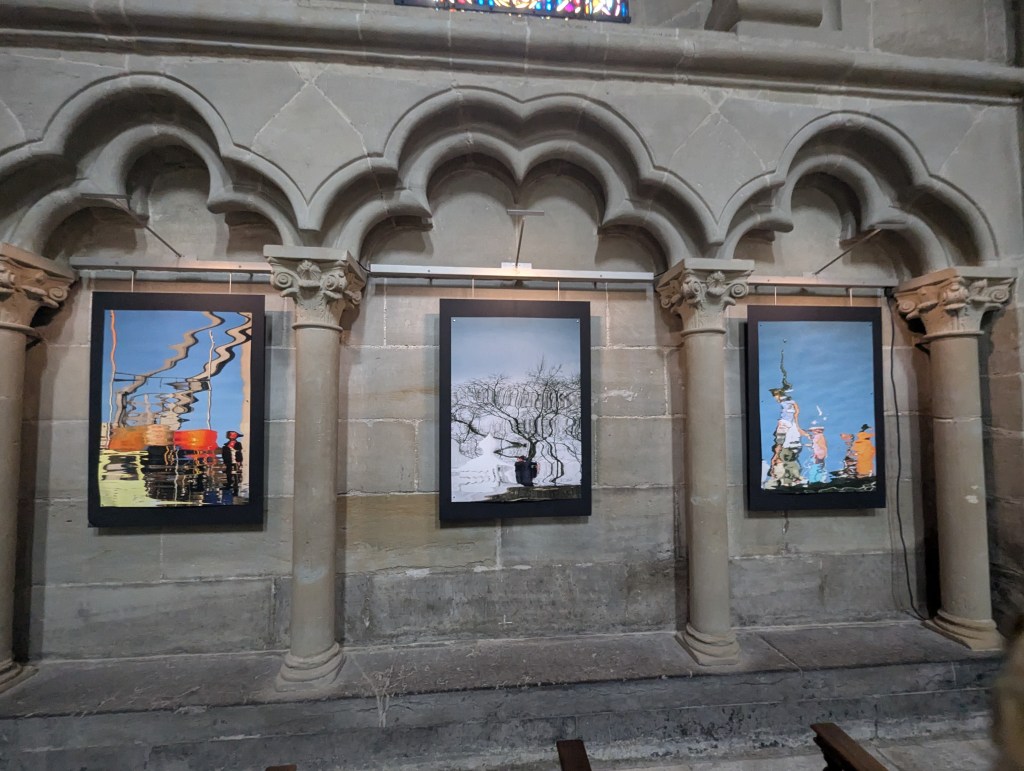
all by a single artist.
The cathedral is also known for it’s remarkable and unique rose window, a fascinating record of medieval imagery. It is essentially a medieval ‘Imago Mundi’ or image of the world arranged around the central figure of God the Father.

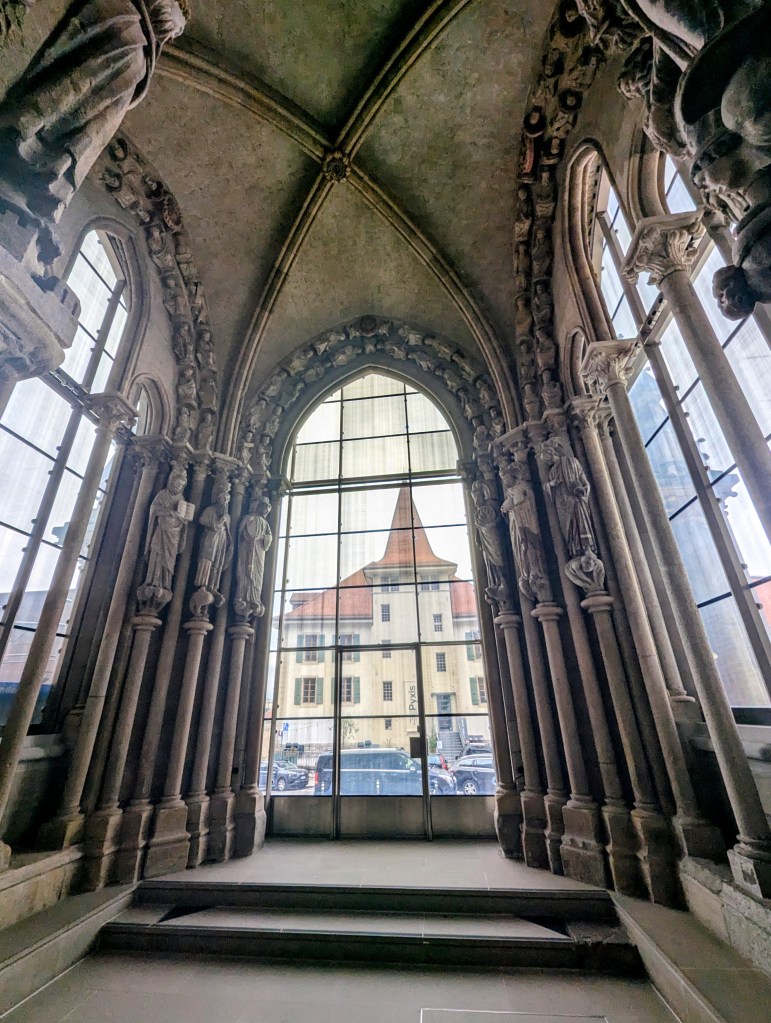
The cathedral is also renowned for it “painted portal;” the statues originally rich in polychromy no longer have the original paint.
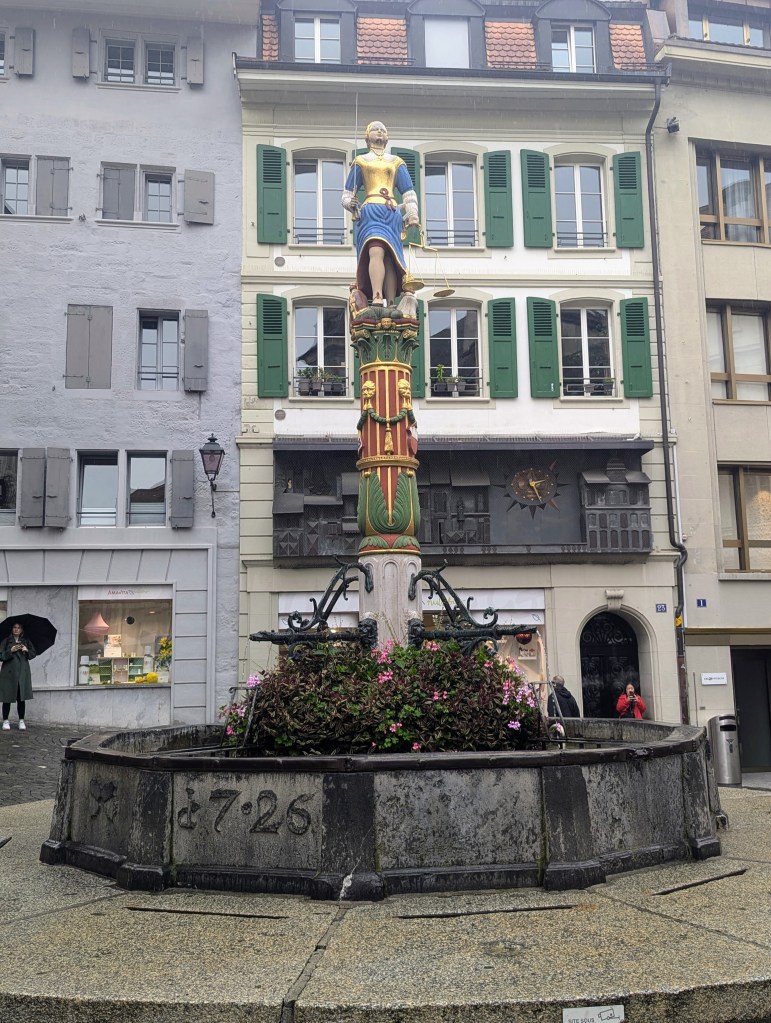
We left the cathedral and headed down the very steep sidewalks to the central square of the Old Town: Plac de Palud.
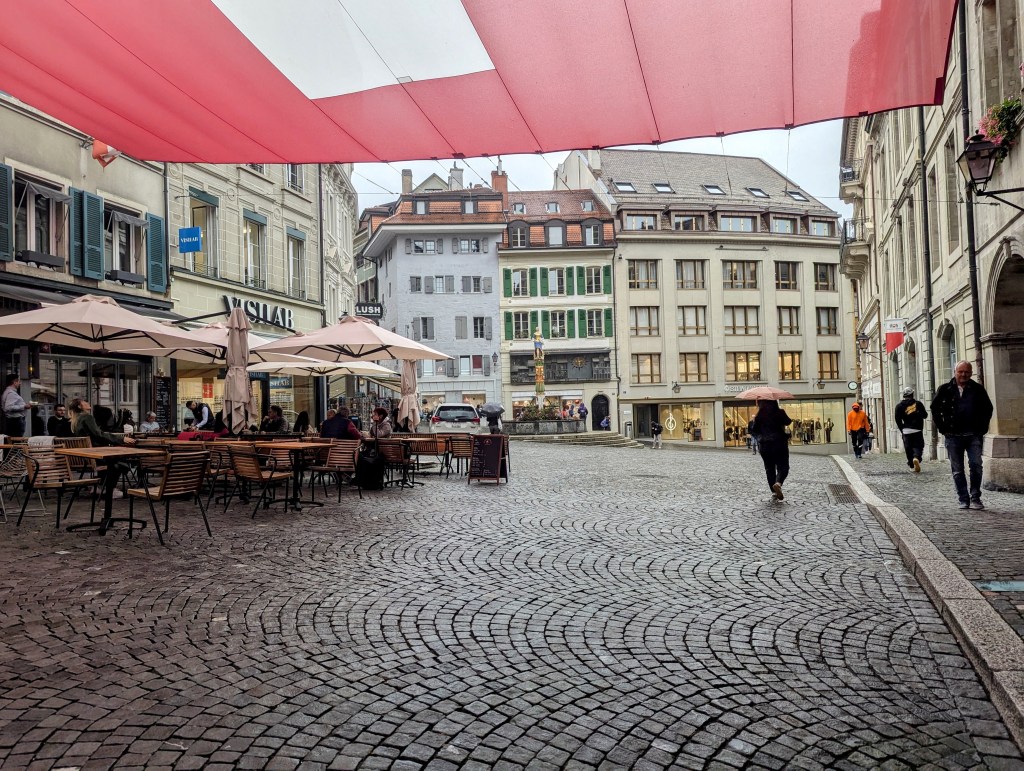
with its fountain of justice.
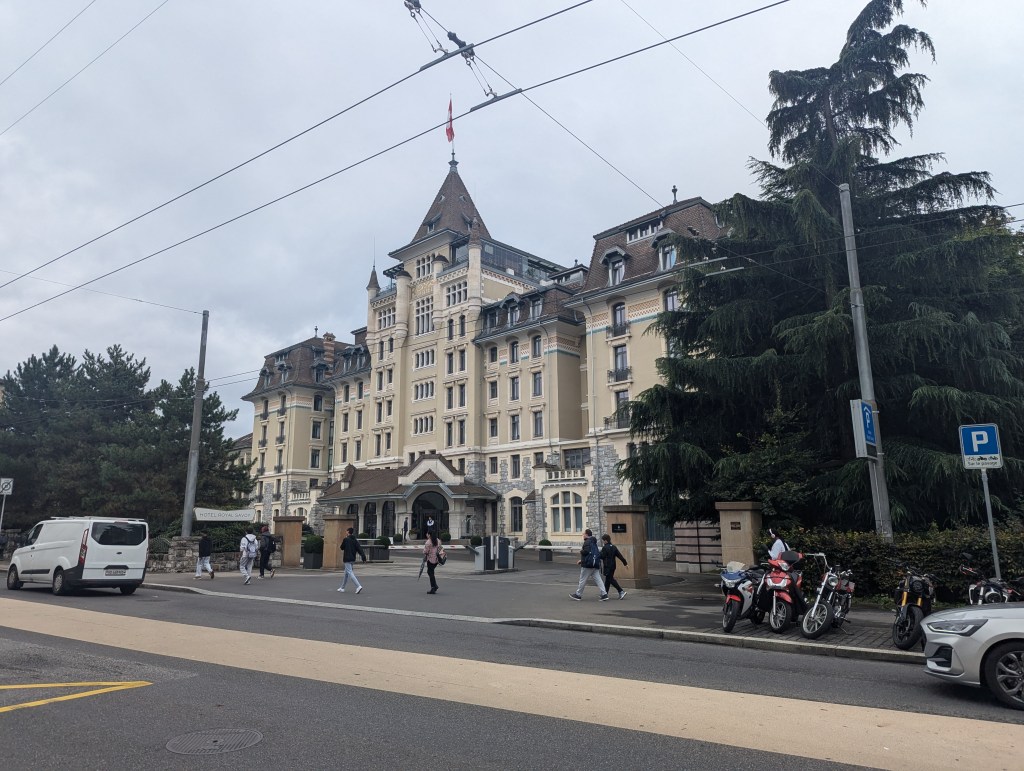
It started to rain, so we took the metro back to our hotel, which now had a room ready for us. We were not necessarily in the center of town, but we were right next to the metro and across form the famous Savoy Hotel.
For dinner we headed back to the Old Town and came out of the metro behind the cathedral, which allowed for better pictures.
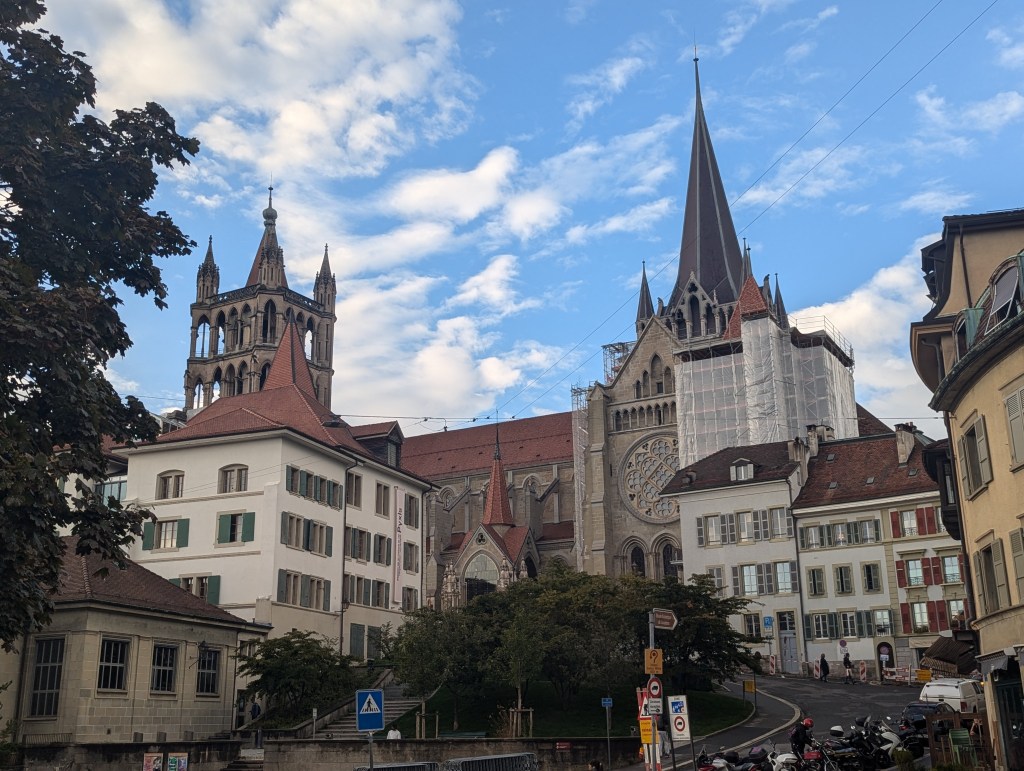
We took advantage of the break in the rain to wander around the area a bit more. We passed the Lausanne Academy. Built between 1579 and 1587, it was the first building in Switzerland to be built specifically for higher education, specifically for the pastors.

We also stopped by the Saint-Maire Castle. The château was built from 1397 to 1425 by the Bishops of Lausanne to serve as their fortified residence. Today it serves as the seat of the cantonal (cantons, or member states, of the Swiss Federation) government.

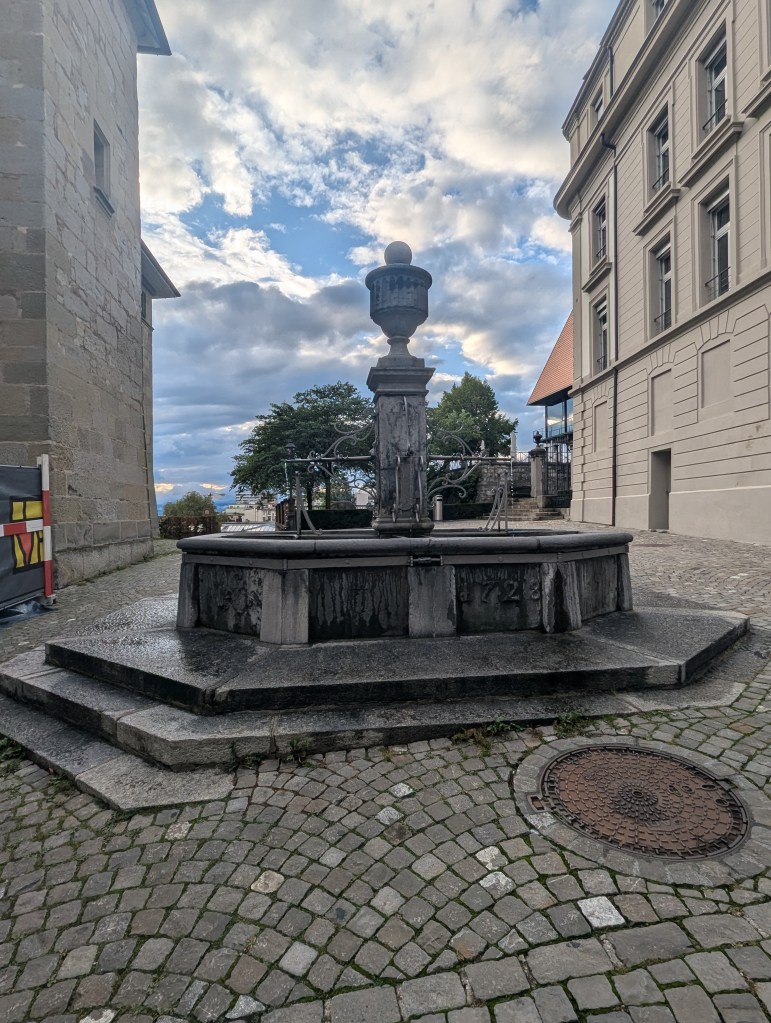
In the square was the requisite fountain.
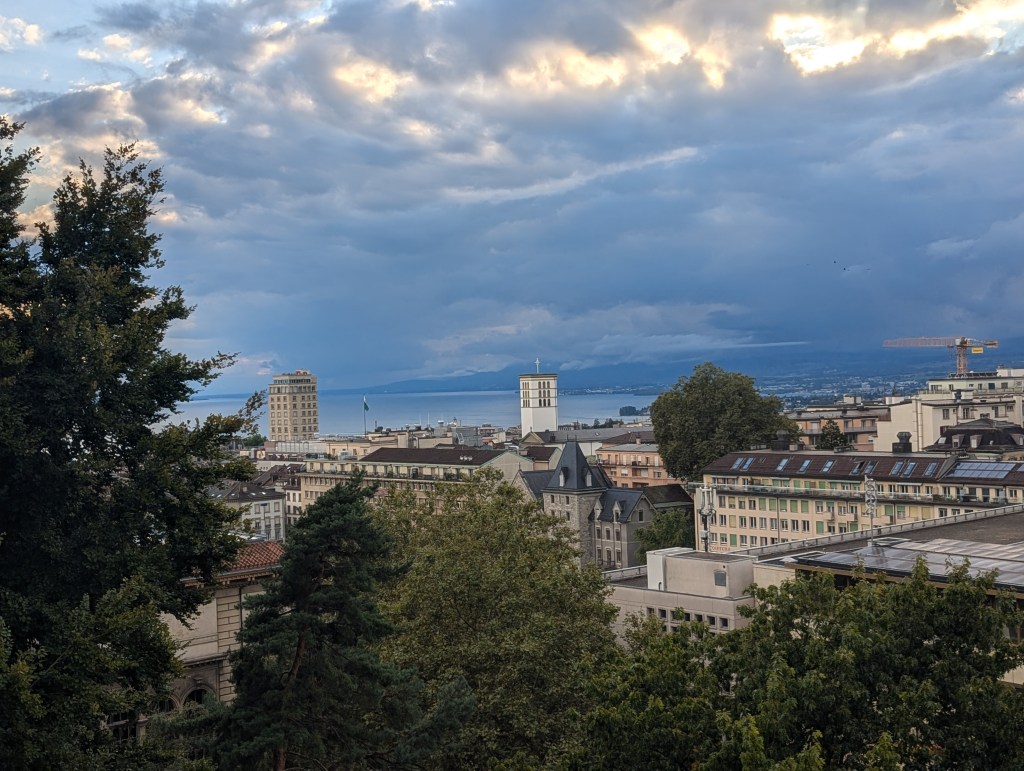
The bishops chose well for themselves re: location; the views are spectacular.
We had chosen an Italian Restaurant for dinner: Amici. It did not disappoint. The homemade pasta is to die for.

The morning brought freshness and sunshine, so we headed to the lakefront. Like in Geneva, it is lined with gorgeous hotels, but a bit more on the modest side except for this beaut:

As mentioned above, Lausanne is home to the Olympics committee. It has an impressive museum and park.
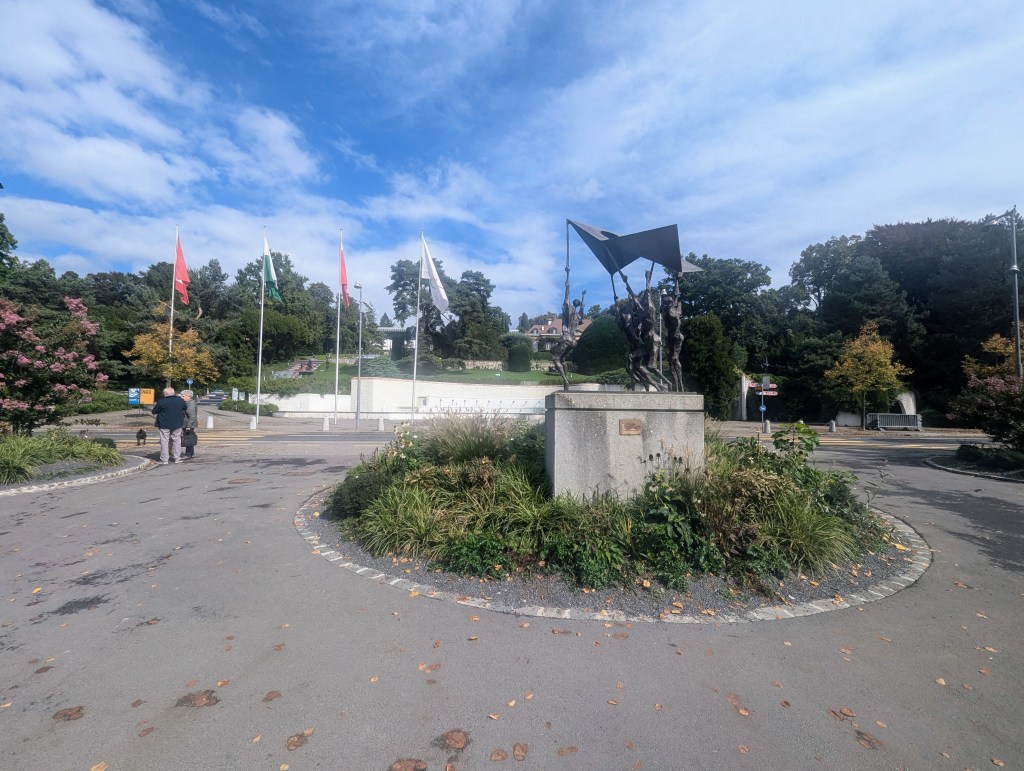


The park includes many of the different sports included in the games, and stretches all the way to the lake where there is an olympic size swimming “pool,” which is open to the public.

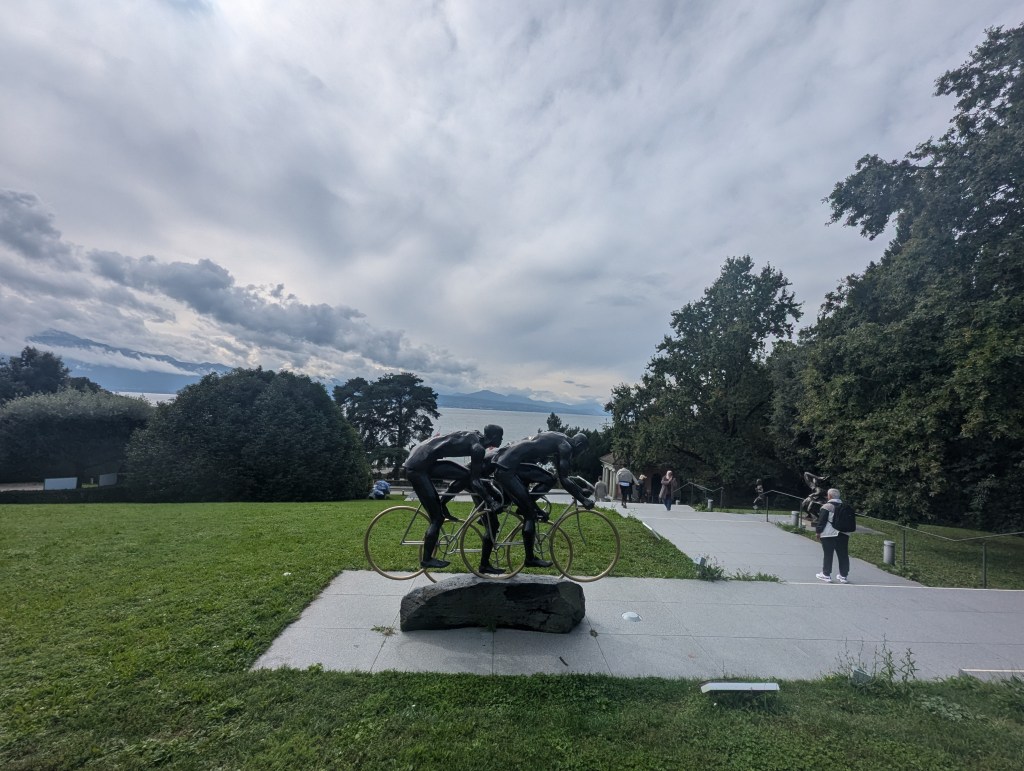
The park also contains numerous works of art on the theme of sports.

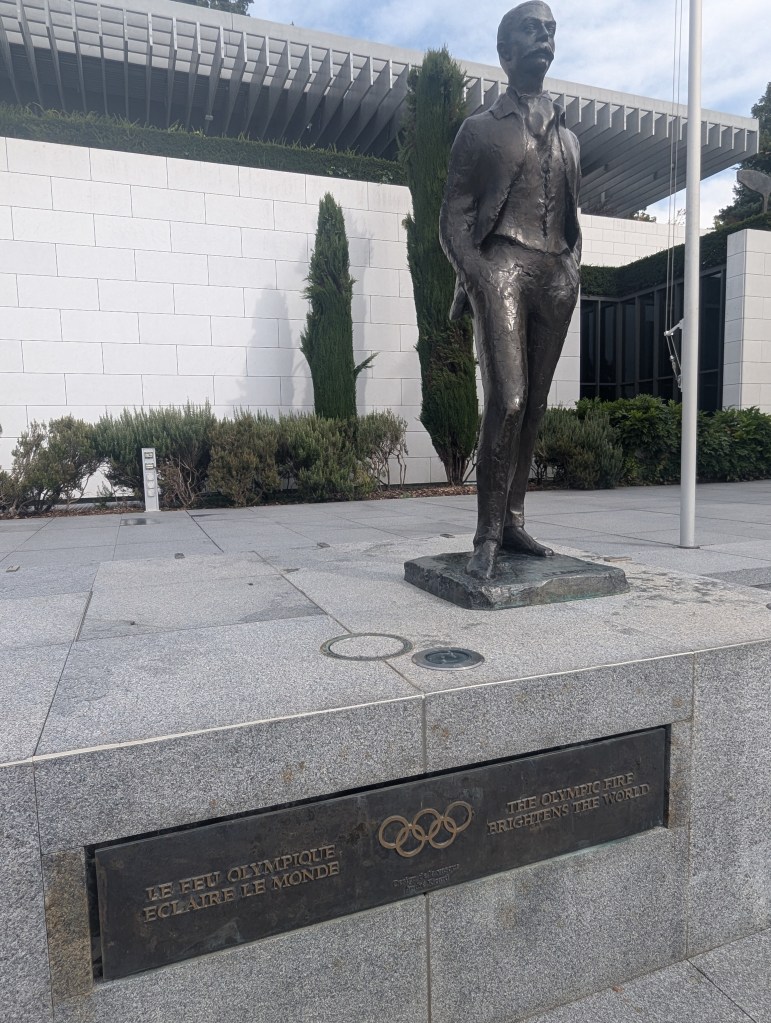
Baron Pierre de Coubertin was the founder of the modern Olympic Games. Inspired by the ancient Olympic Games held in Olympia, Greece, which ended in 393 AD, Frenchman Pierre de Coubertin decided to pursue his project to revive the Olympic Games. He first presented the idea in 1894, and the first games took place in Athens, Greece in 1896. There is a statue of him at the entrance.
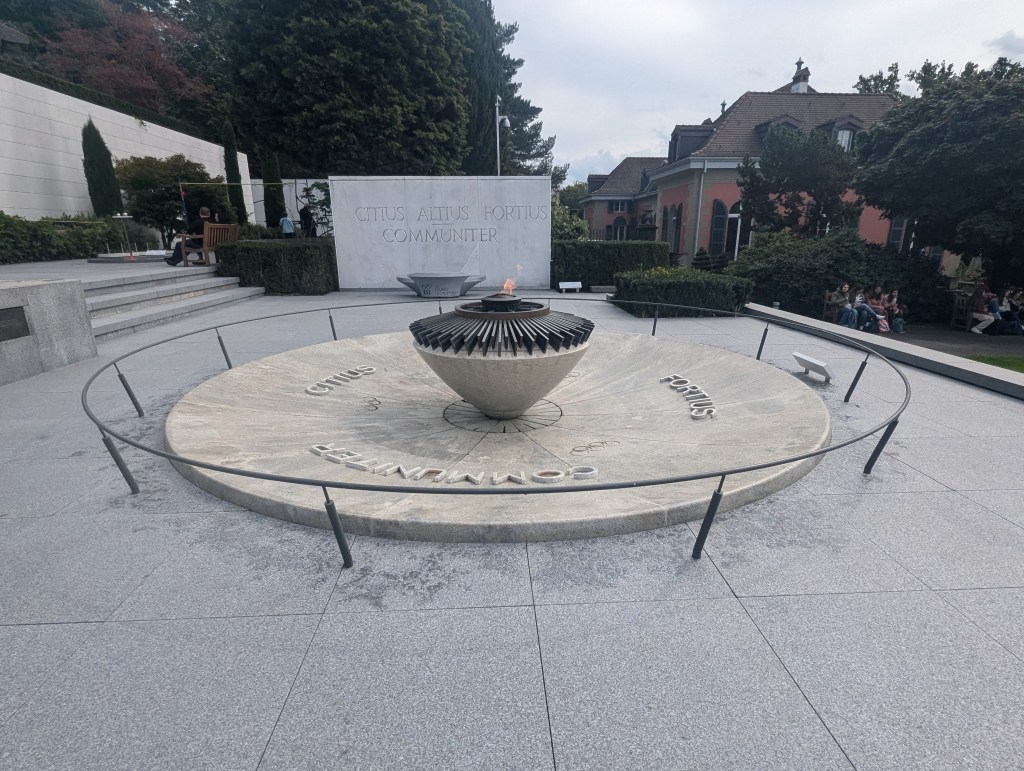
The Olympic motto is ‘Citius-Altius-Fortius’. The three Latin words translate to ‘Faster-Higher-Stronger’ in English. Pierre de Coubertin adopted it as the Olympic motto after hearing them in a school sporting event where a Dominican priest Henri Didon first uttered the words. The word Communiter (Together) was added in 2021 by the International Olympic Committee to recognize the unifying power of sports and the importance of solidarity.
The museum was full of interesting facts, lots of memorabilia from athletes around the world, and several interesting exhibitions about the history of the games.
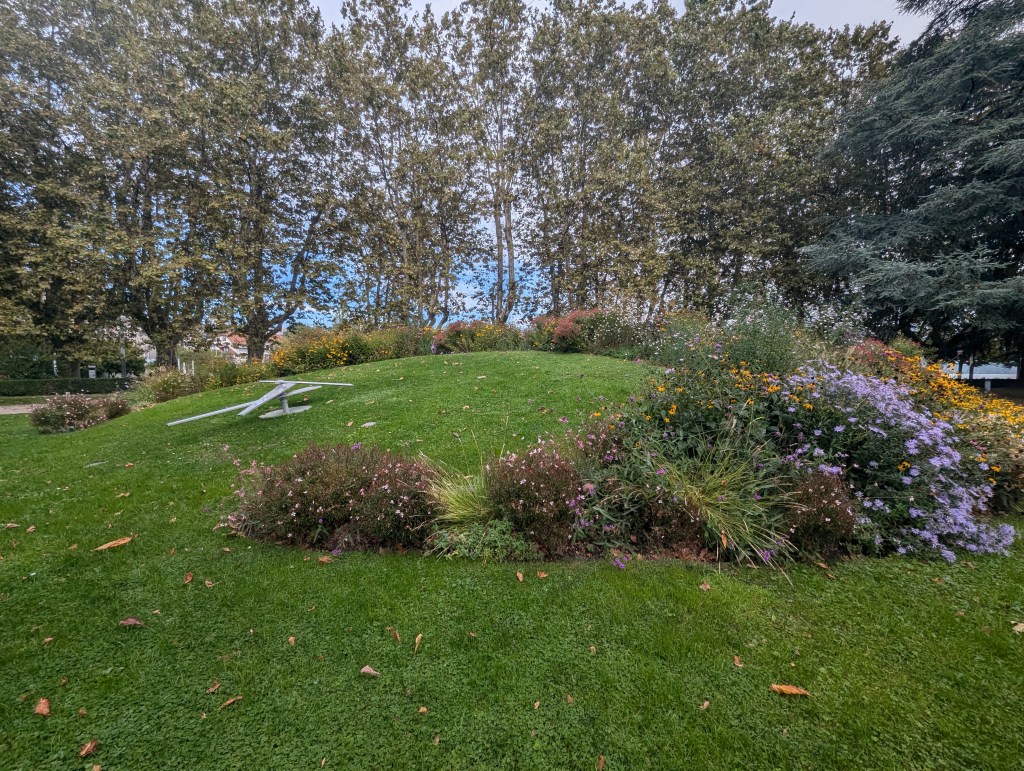
Upon leaving the museum, we headed back to the lake. There we found another flower clock, but not nearly as impressive as the one in Geneva.
We also passed some more fountains.
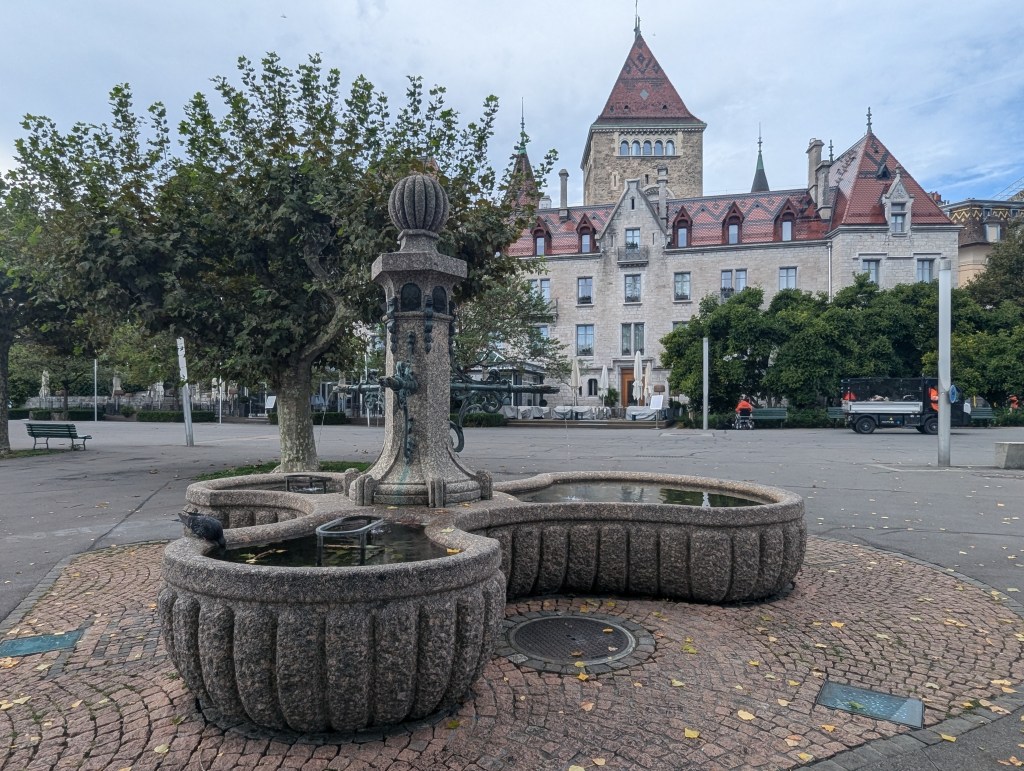
and this fun one.

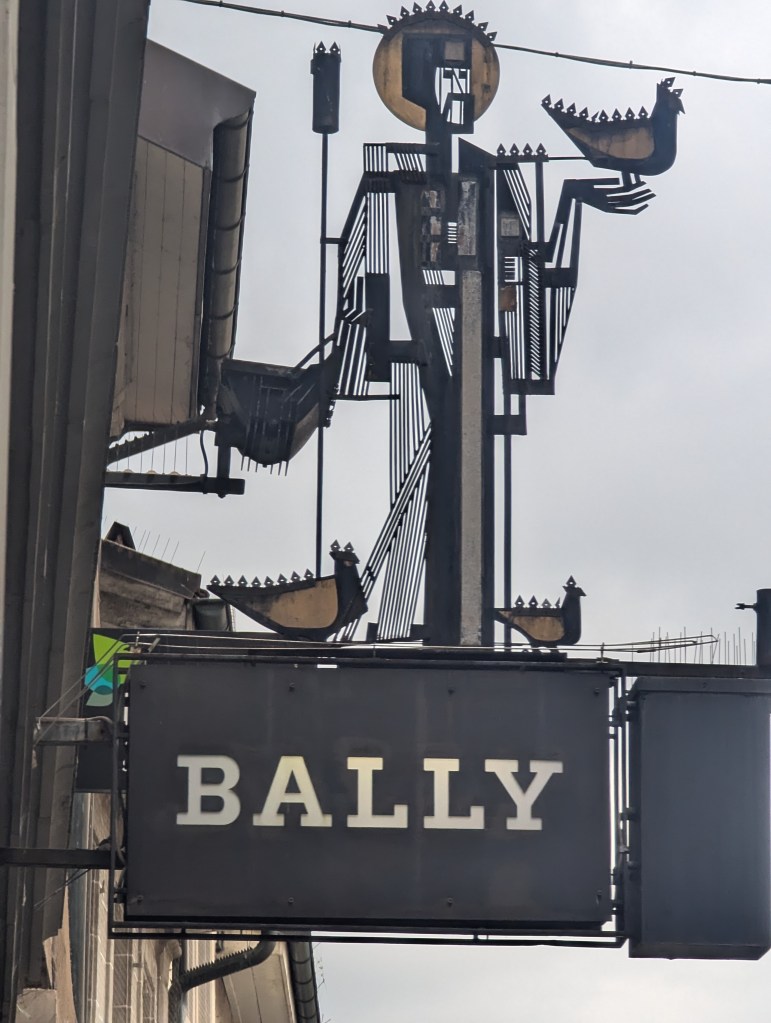
We then took the metro back into the center of town and walked around more now that we did not have to deal with the rain. We passed so many great shopping districts, similar to those in Geneva with the full array of options and price variety. But the shop signs were particularly fun.

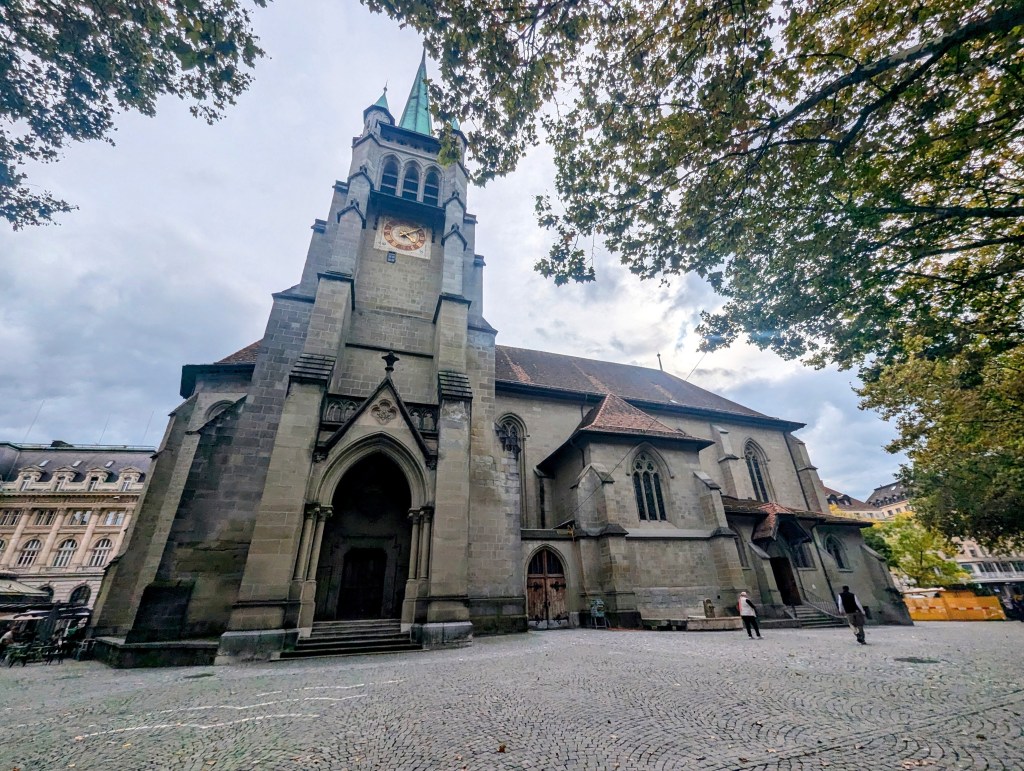
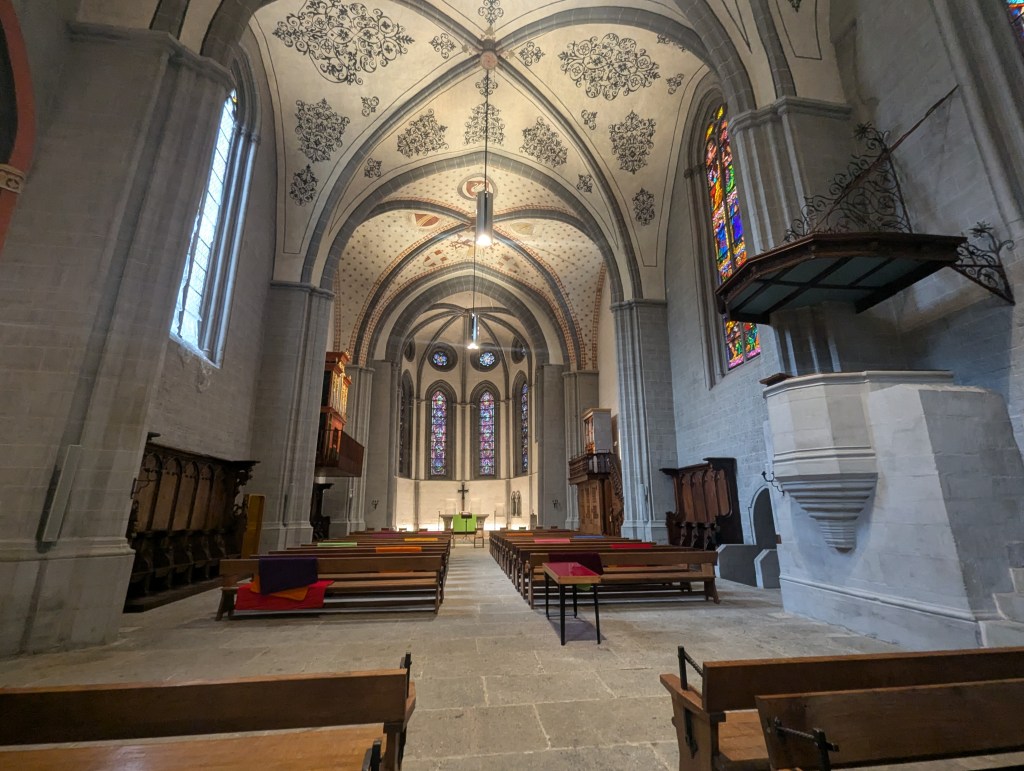
We headed to the Eglise Saint-François, part of the Franciscan convent built around 1270.
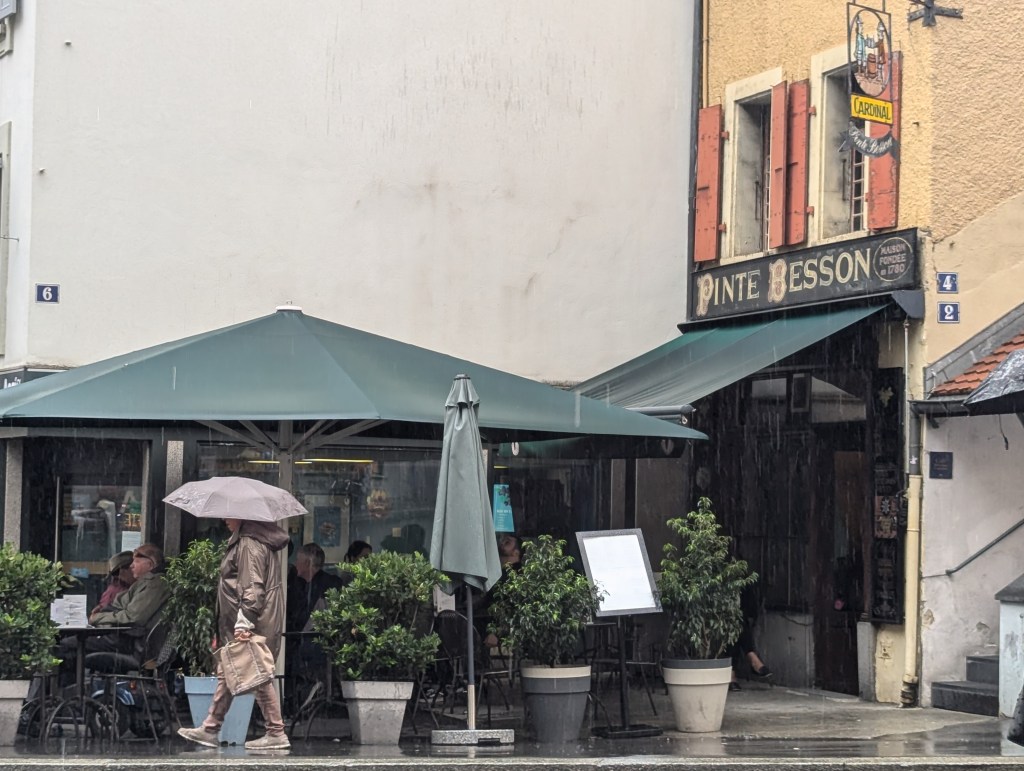
We had dinner nearby at Pinte Besson. Founded in 1780, the Pinte Besson is the oldest active restaurant in Lausanne and one of the ten oldest pubs in Europe.
We chose to to eat very Swiss: cheese fondu.

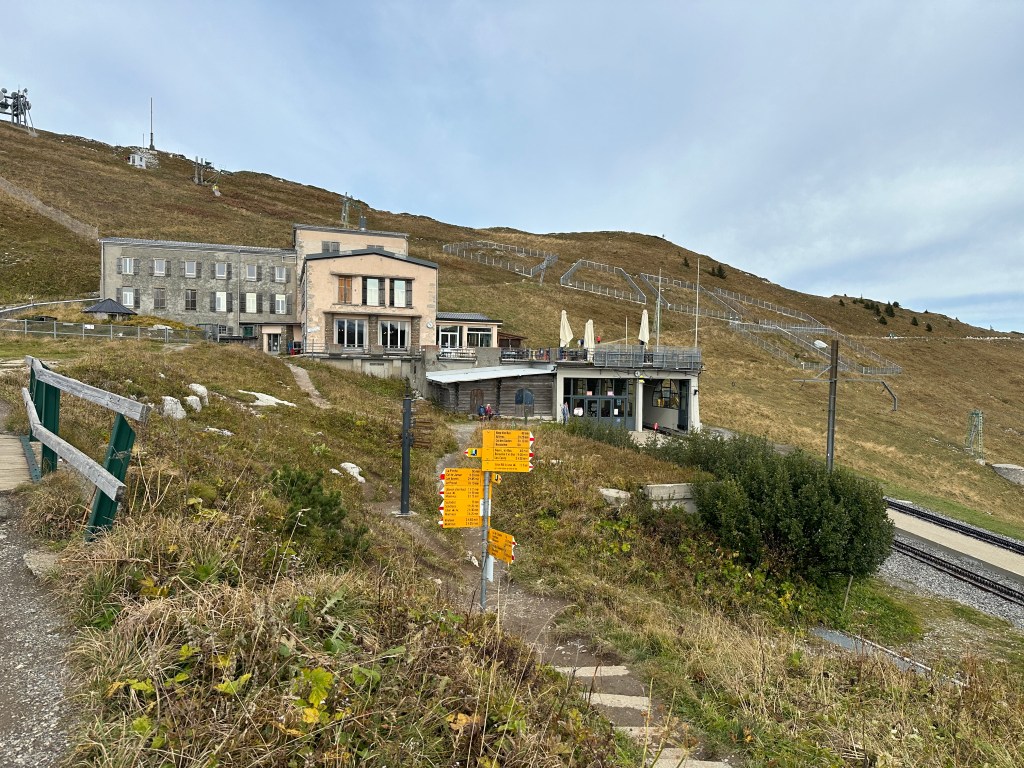
The next morning we embarked on an adventure. We took the train to the town of Montreux where we caught a panoramic train up the mountain to Les Roches-de-Naye.
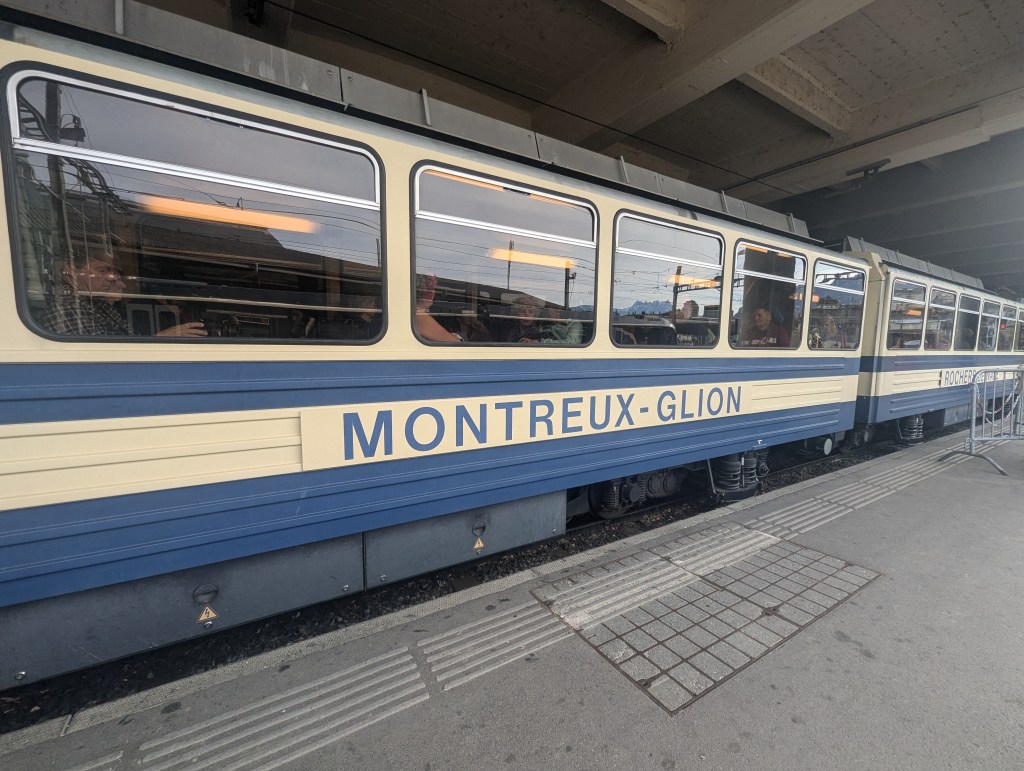
Before even leaving the station we were amused by something we had never seen before: a train wash with sprayers and brushes just like a car wash.

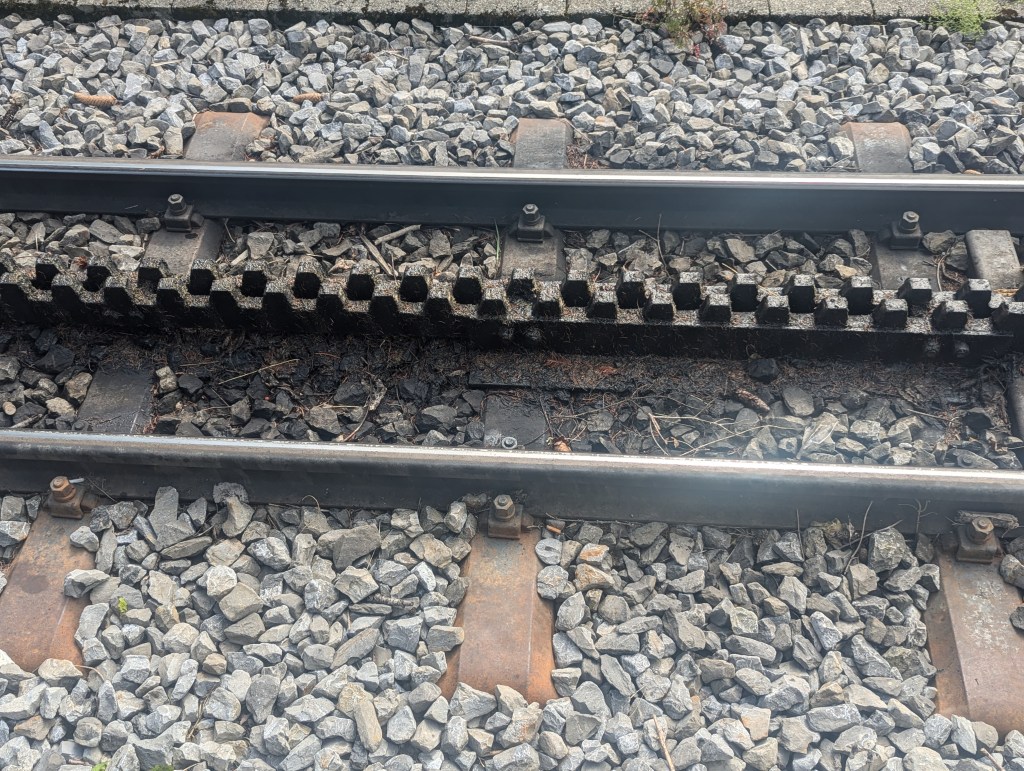
The train from Montreux begins to climb steeply almost as soon as it leaves the station and enters the first of many tunnels. The line changes direction by a series of minimum radius curves, views of Lake Geneva alternating from side to side. It makes about a dozen stops before reaching the final station at Roches-de-Naye. The line is 6.4 miles long and has a vertical climb of 5,167 ft. The line uses track of 2 ft 7 in gauge and the rack and pinion system.
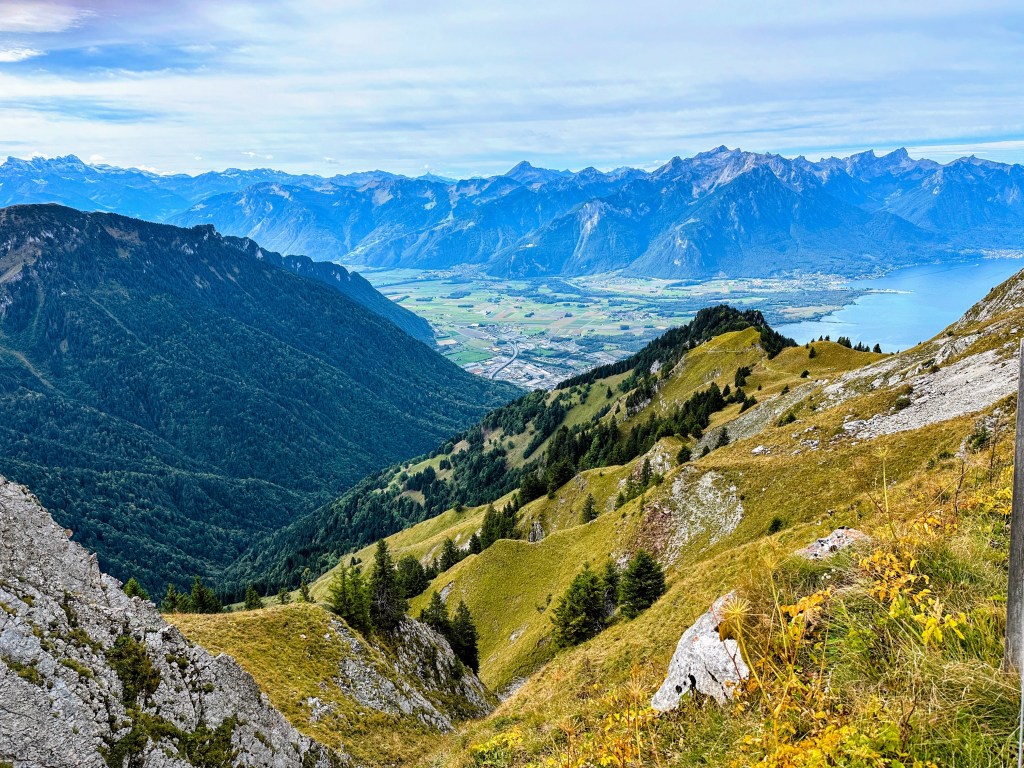
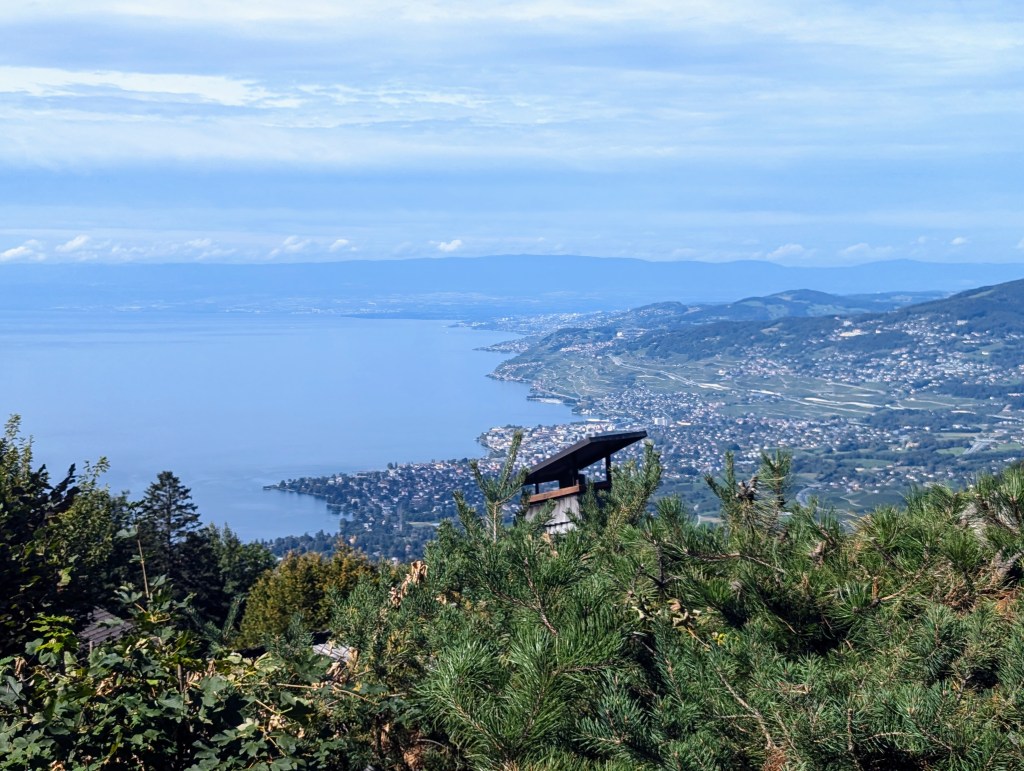
Once at the summit we were treated to stunning views of Lake Geneva.
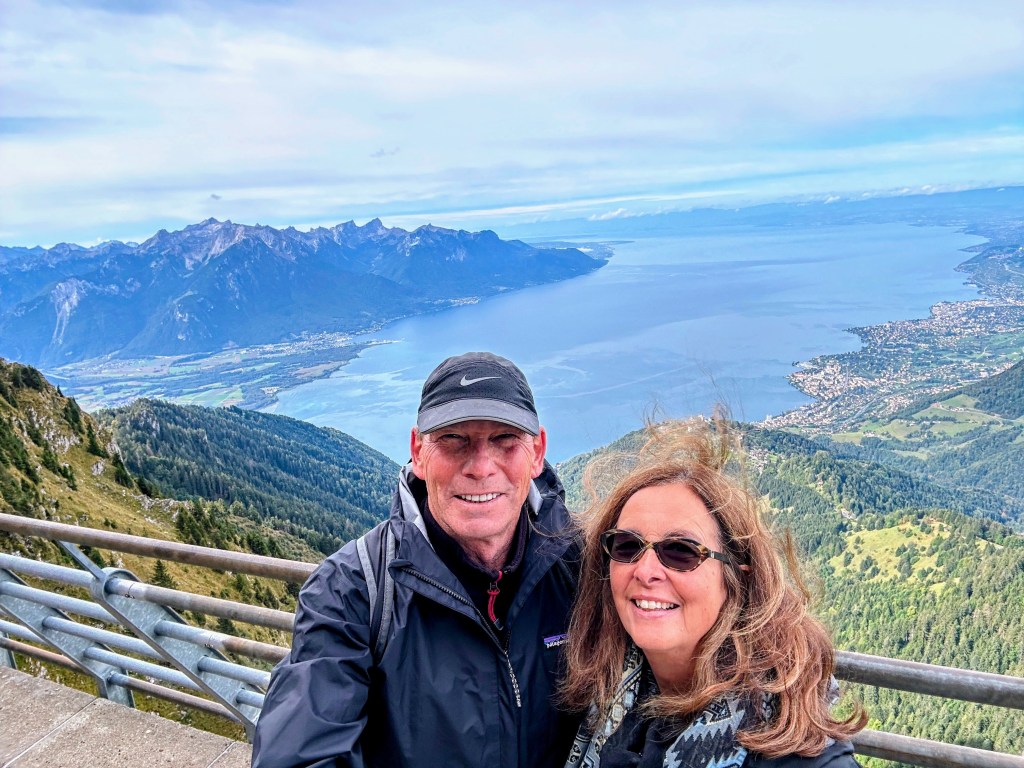
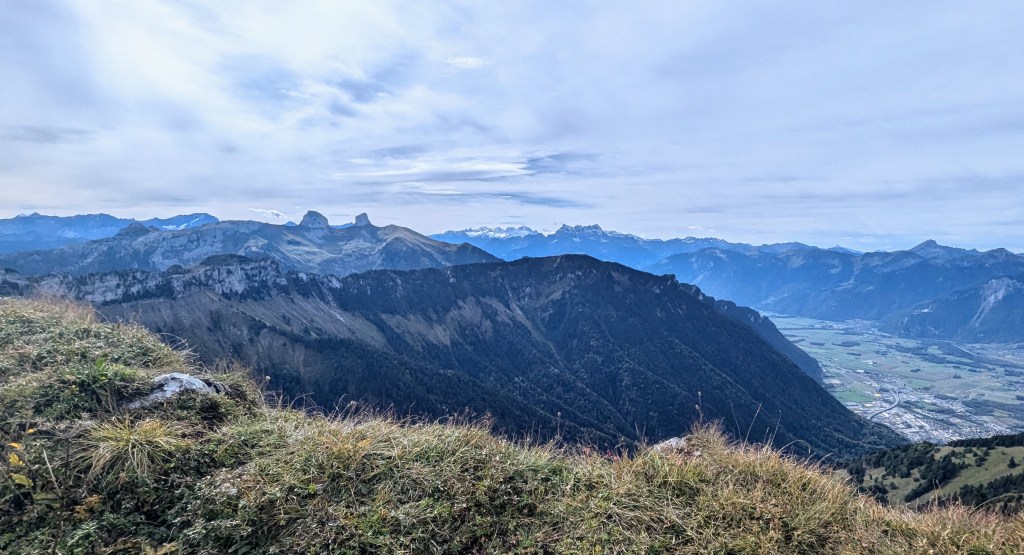
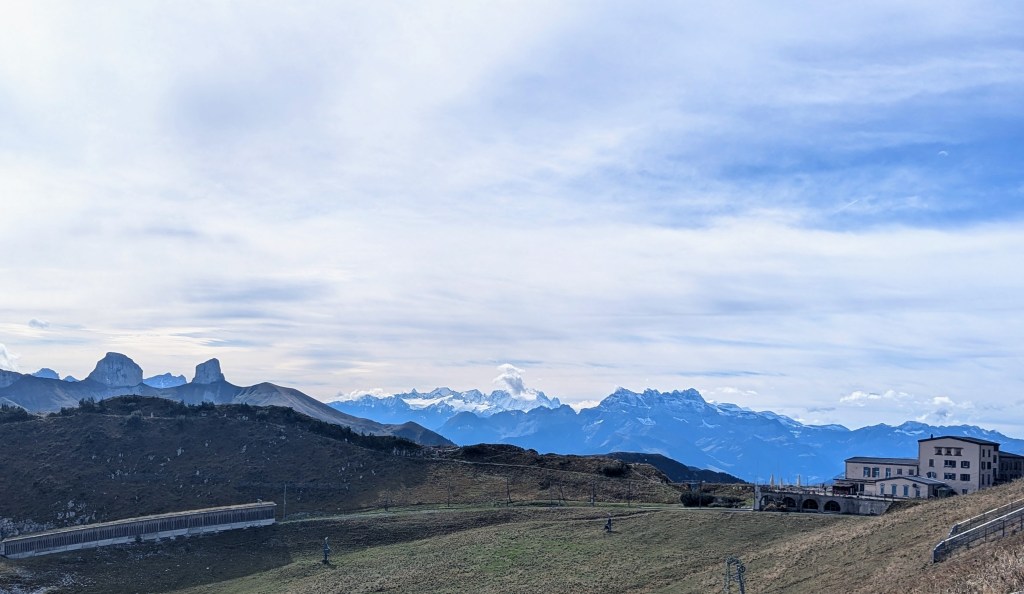
and the distant Alps.

We were impressed that the train tunnels were covered in sod so they blend into the scene.
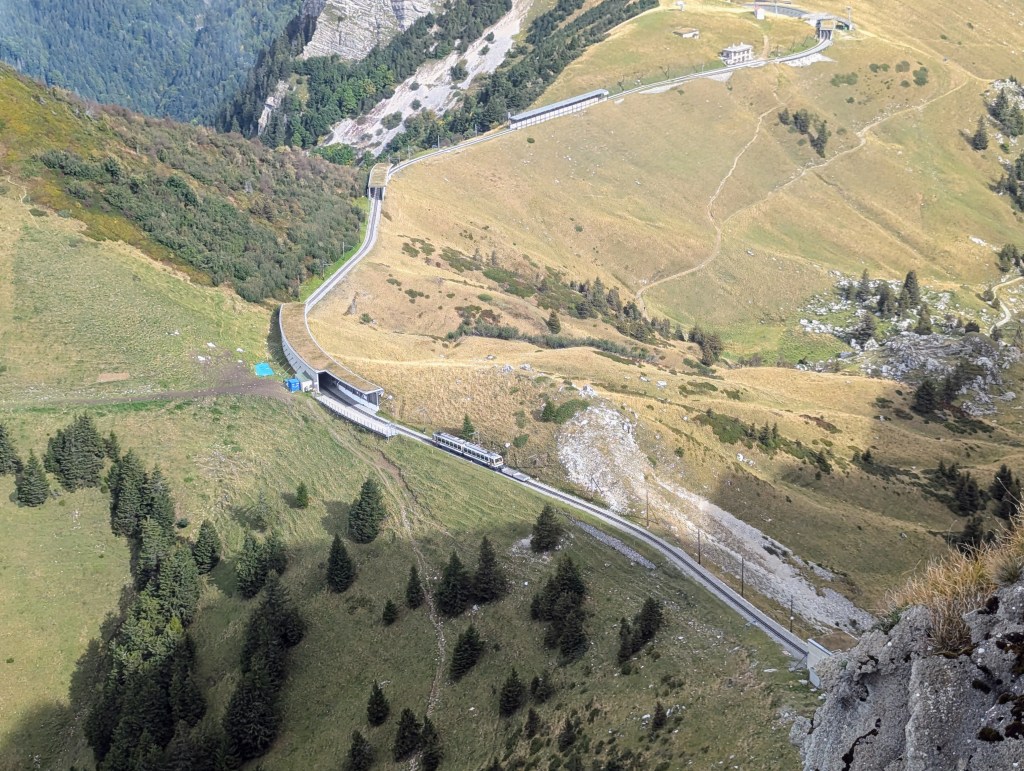
We hiked around from hilltop to hilltop for views of every different angle.

Then we headed back to the Roches-de-Naye station and caught the train back down.
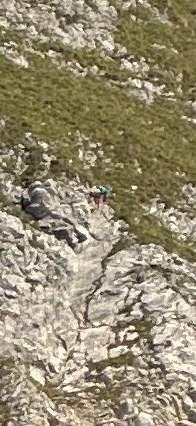
On the way we passed a mountain seen through the train window
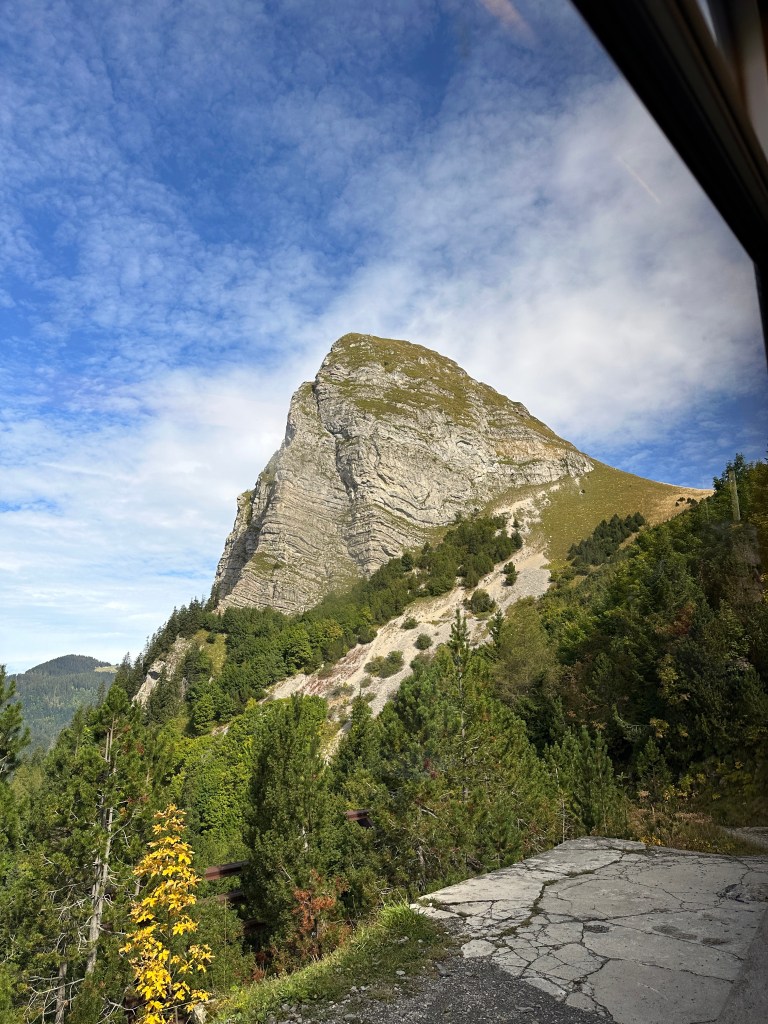
that if you look closely, climbers can be seen on the side.
We decided to hop off the train at the Haut-de-Caux stop. Homes and resorts can be seen dotting the landscape.

We had lunch at a local hotel restaurant.
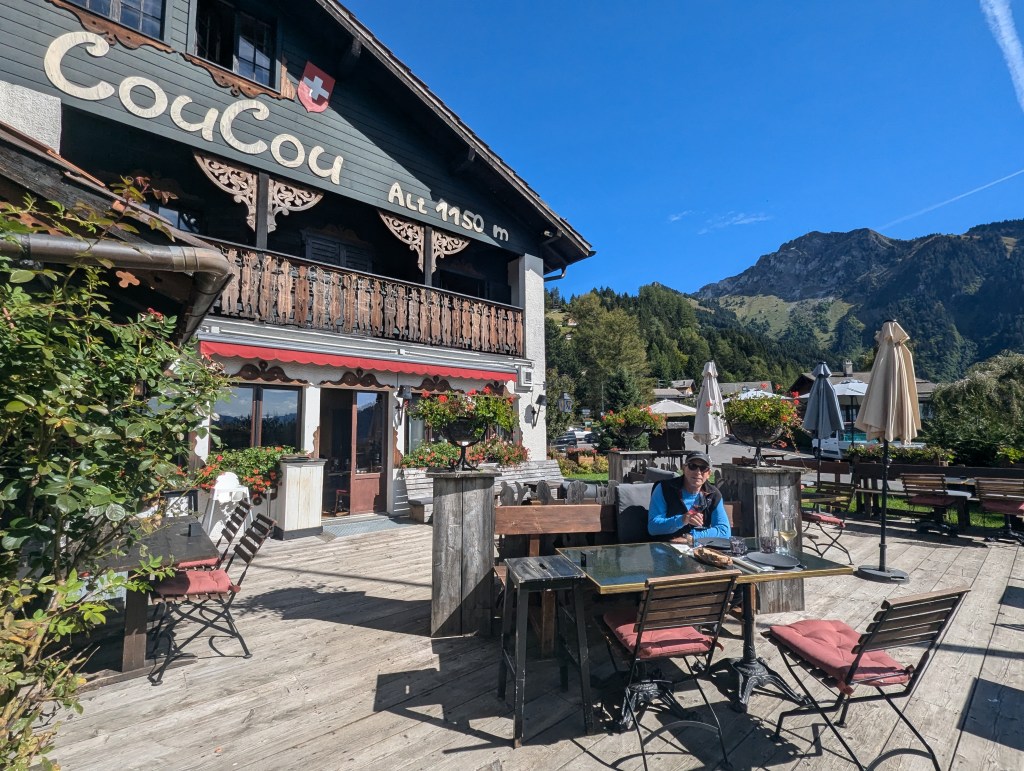
No lunch is complete without wine and cheese
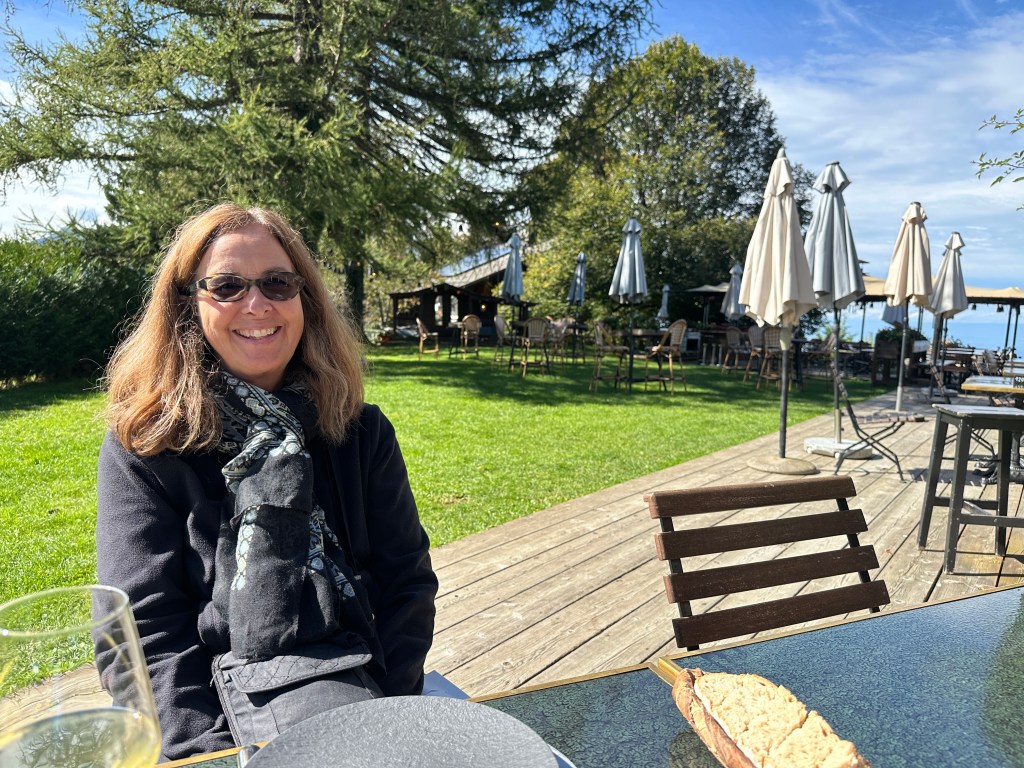
and of course stunning views.
After lunch we flagged down the train; they only stop on request from within or without.

Once back in Montreux we walked off lunch along the lakefront. Montreux is much more touristy than Lausanne. Like the other towns on the lake, there are numerous large hotels along the banks.
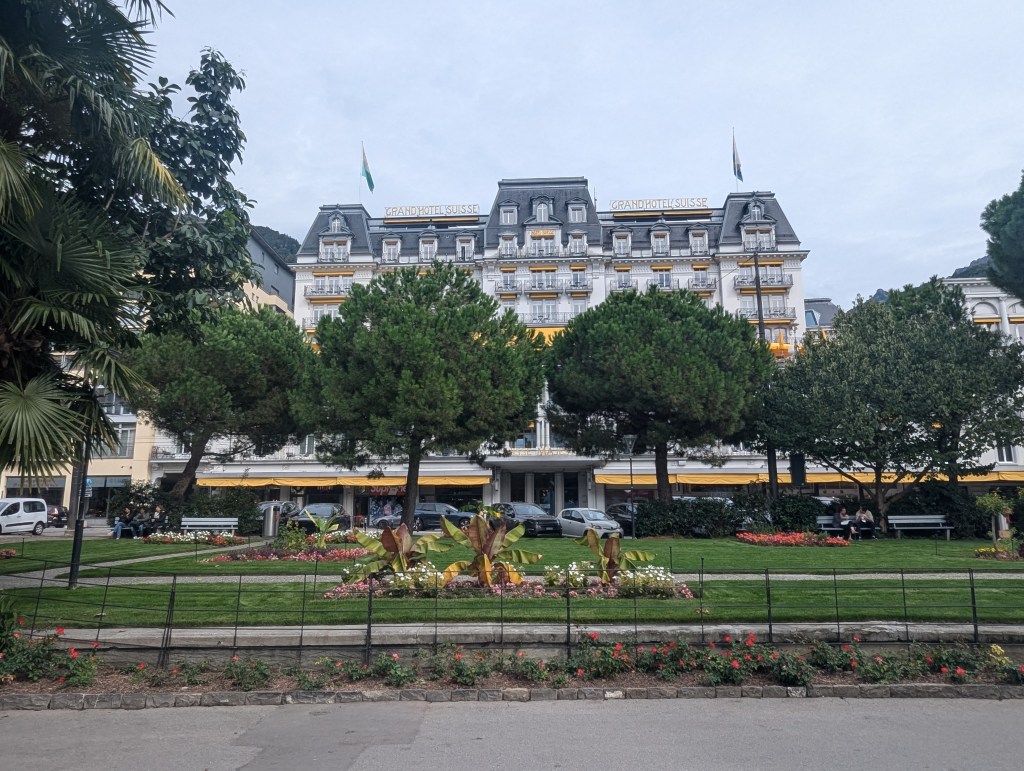
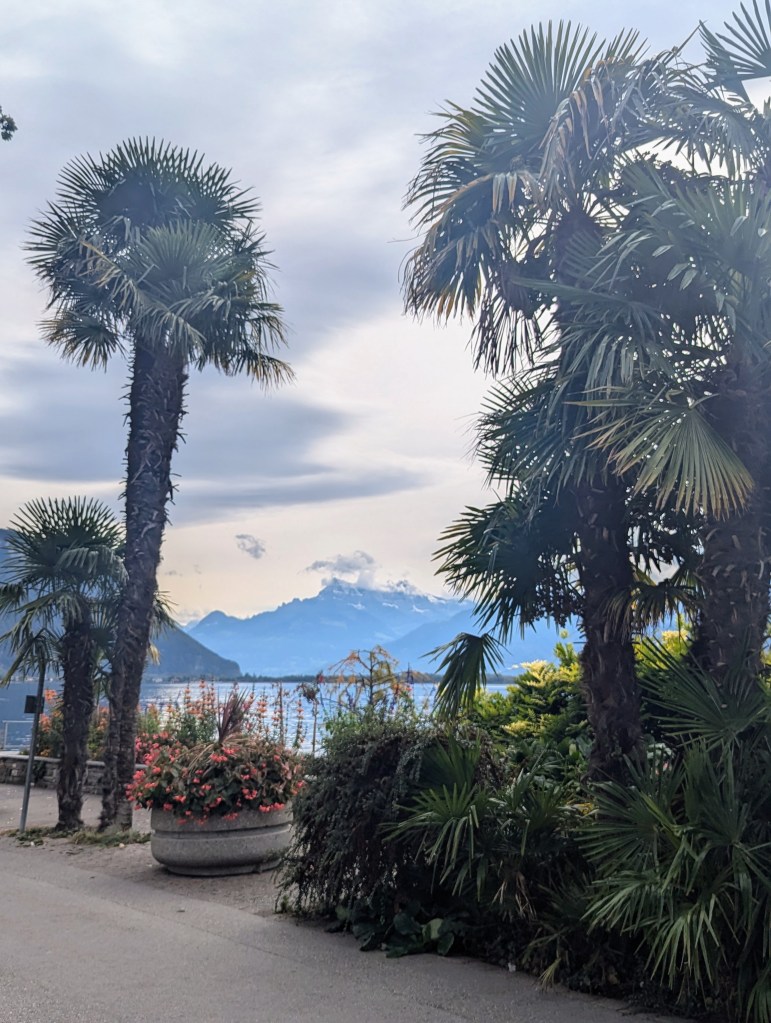
But what is particularly notable are the many palm trees growing here, which indicates a much milder climate than most of Switzerland.

Where else in the world can you see palm trees and snowcapped mountains at the same time?
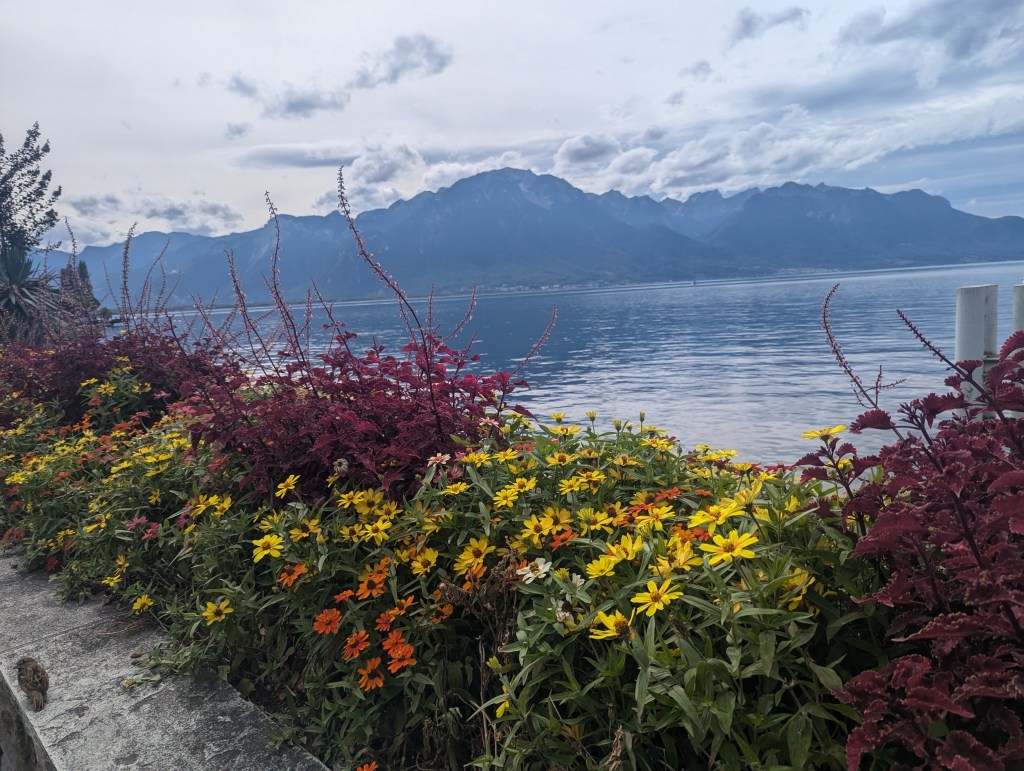
All along the lakeside promenade are planted flowers, amazingly still blooming despite the lateness of the season.
and periodically, sculptures
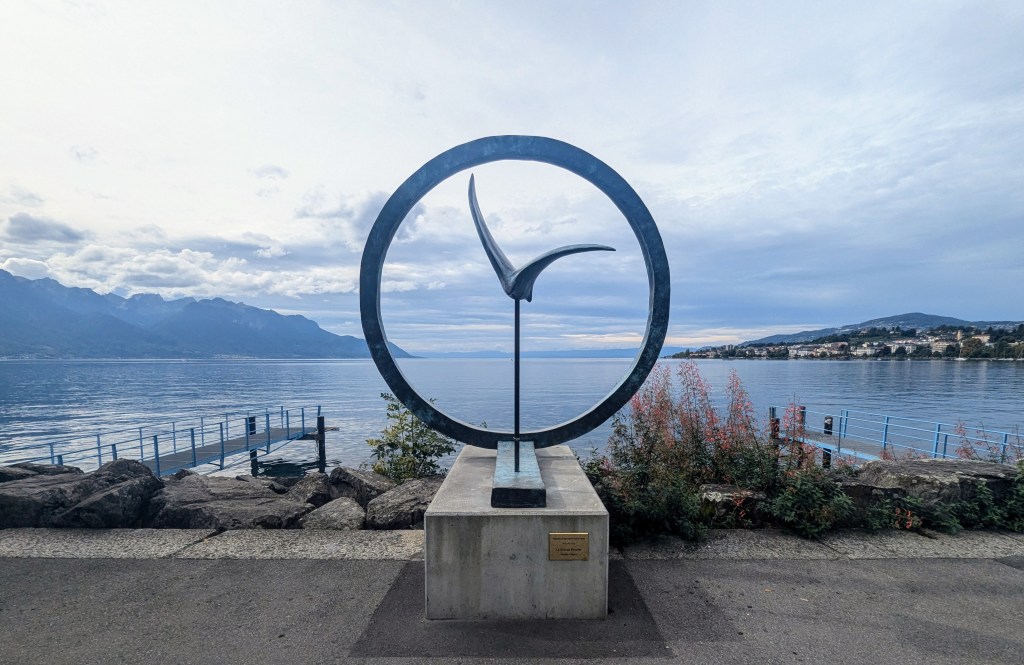
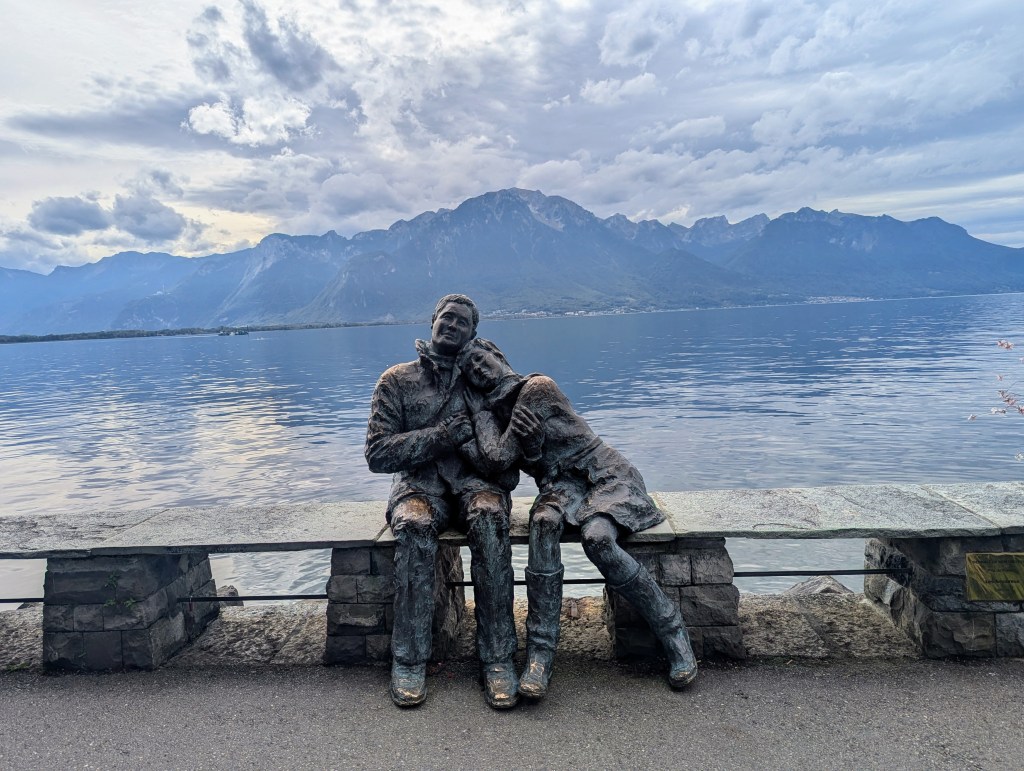
The sculpture most surprising to us was that of Freddie Mercury facing the lake.
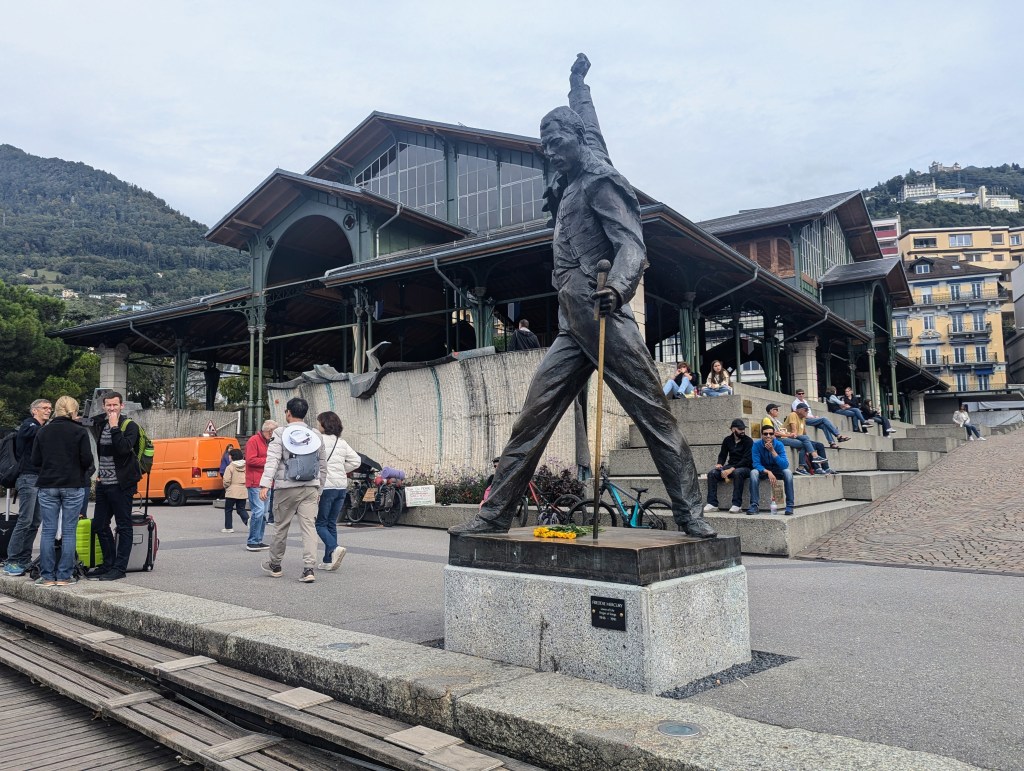
Freddie Mercury settled in Montreux where Queen, the group, had bought a Mountain Recording Studio and where he learnt to appreciate the peace and quiet. While living in Montreux he recorded six albums with Queen, including “Made in Heaven”. In memory of his presence, Freddie Mercury’s bronze statue has stood on the lakeside promenade since 1996.
Mountain Studios was a commercial recording studio founded in 1975 within the Montreux Casino. The studio was under the ownership of Queen from 1979 until 2013, after which it became the charity museum/exhibition.
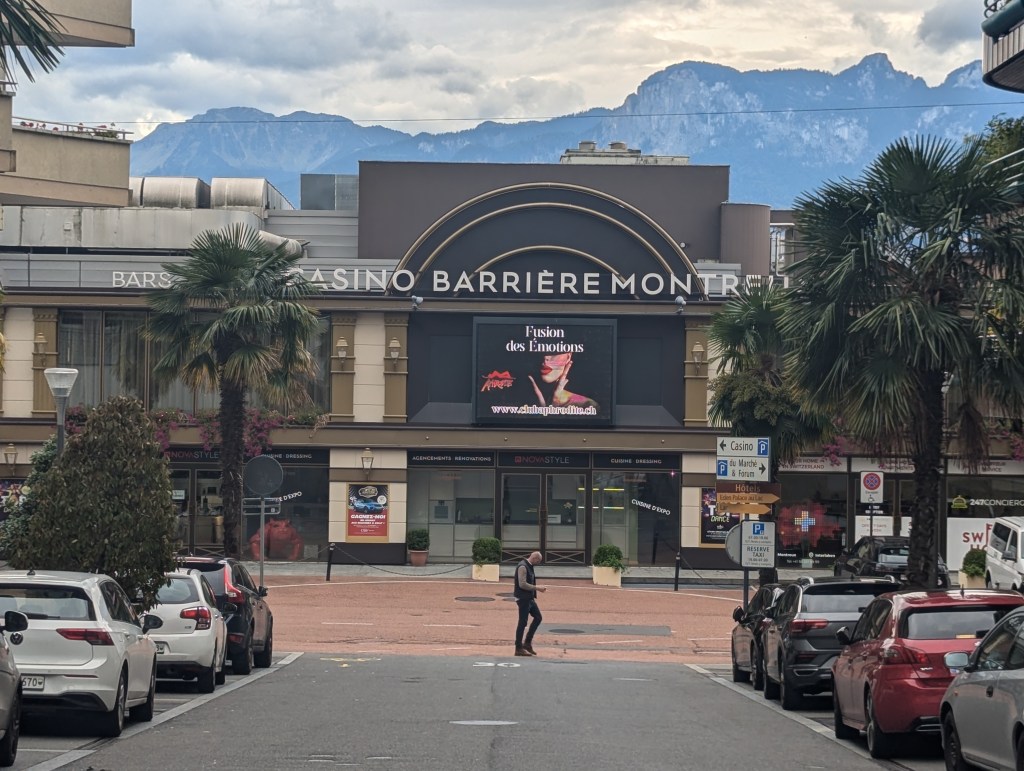
Montreux is also known for a jazz festival every July. The large performance stage stands behind the statue of Freddie Mercury.
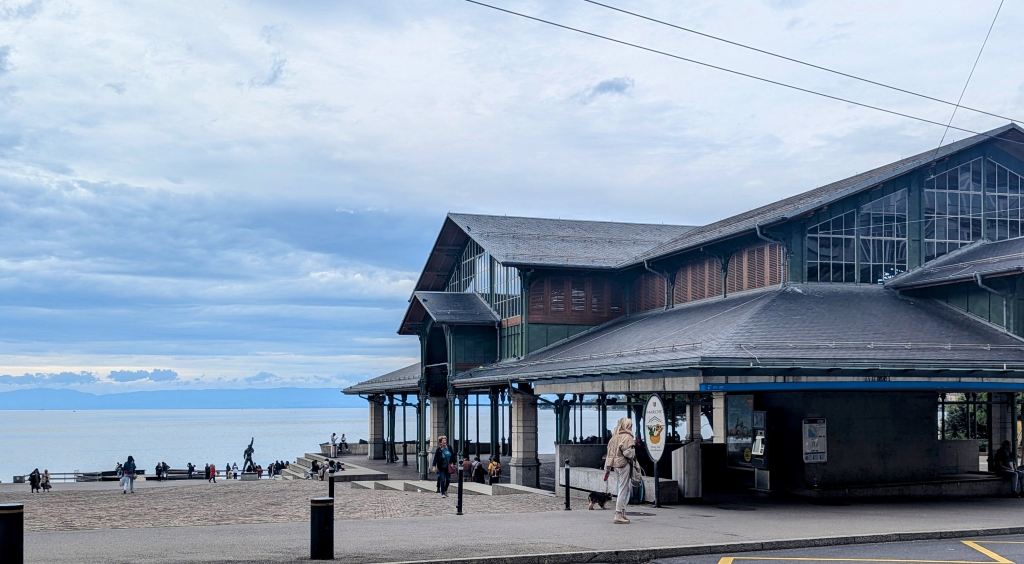
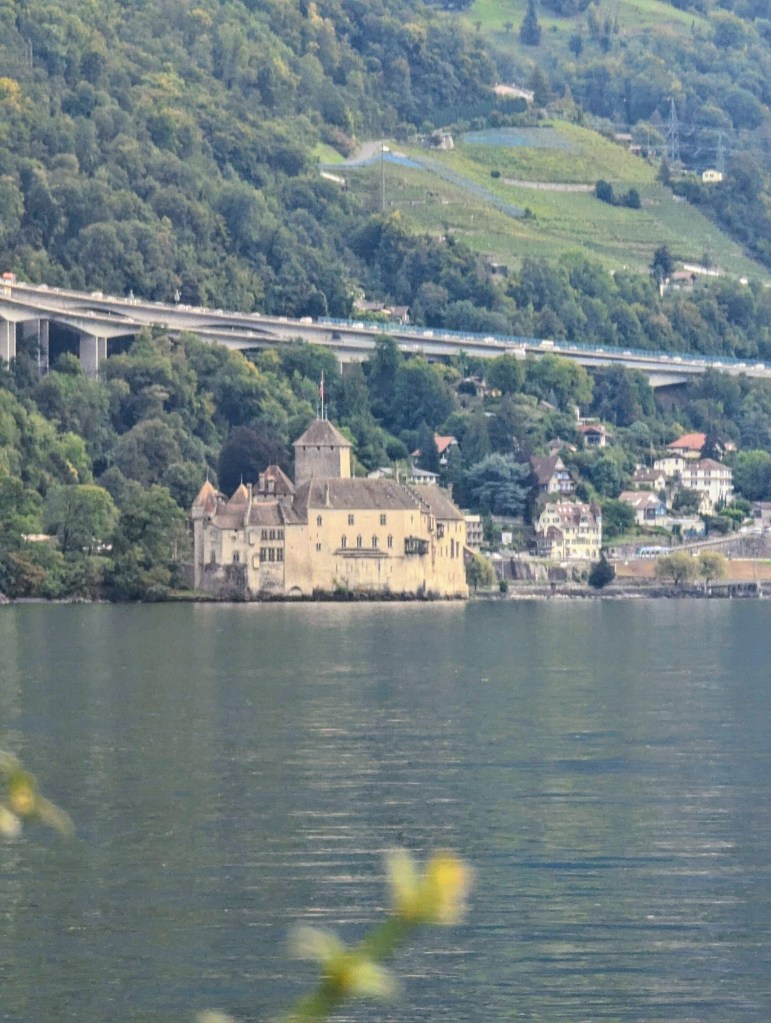
In addition, further along is Chillon Castle, an island medieval castle on the lake. Chillon is amongst the most visited medieval castles in Switzerland, but alas, we were too tired to go the extra distance.
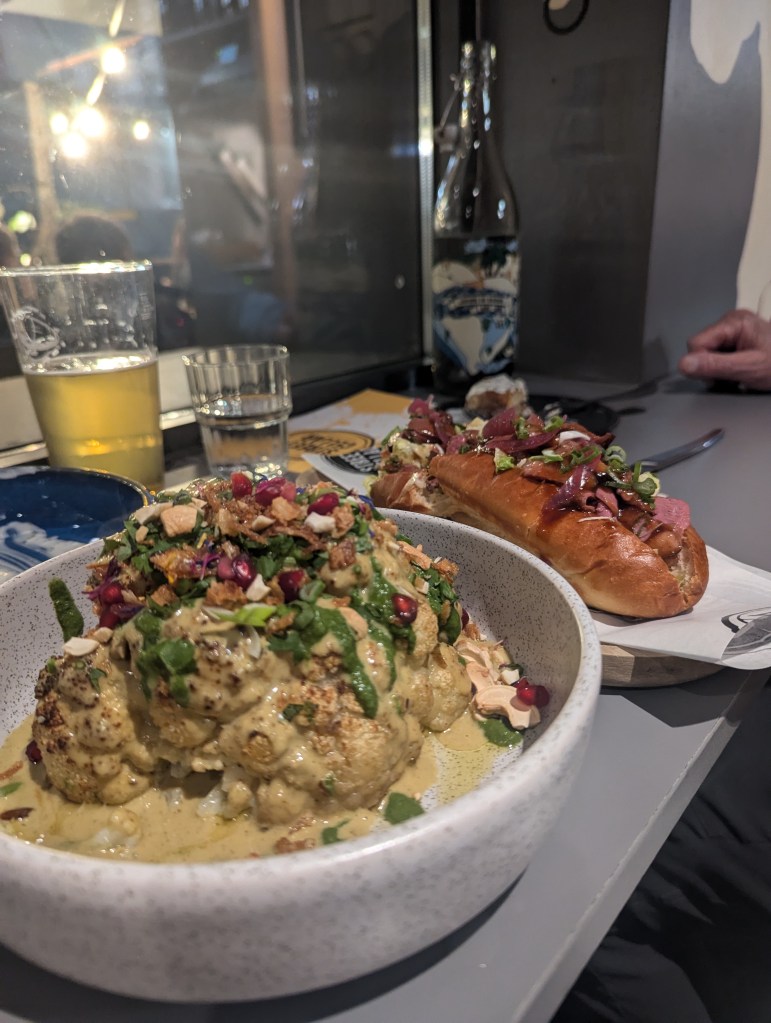
Once back in Lausanne we dragged our tired selves to Street Cellar, a pub in the nightlife district, where we had an amazingly delicious meal.
 Jo & Eric's travels