
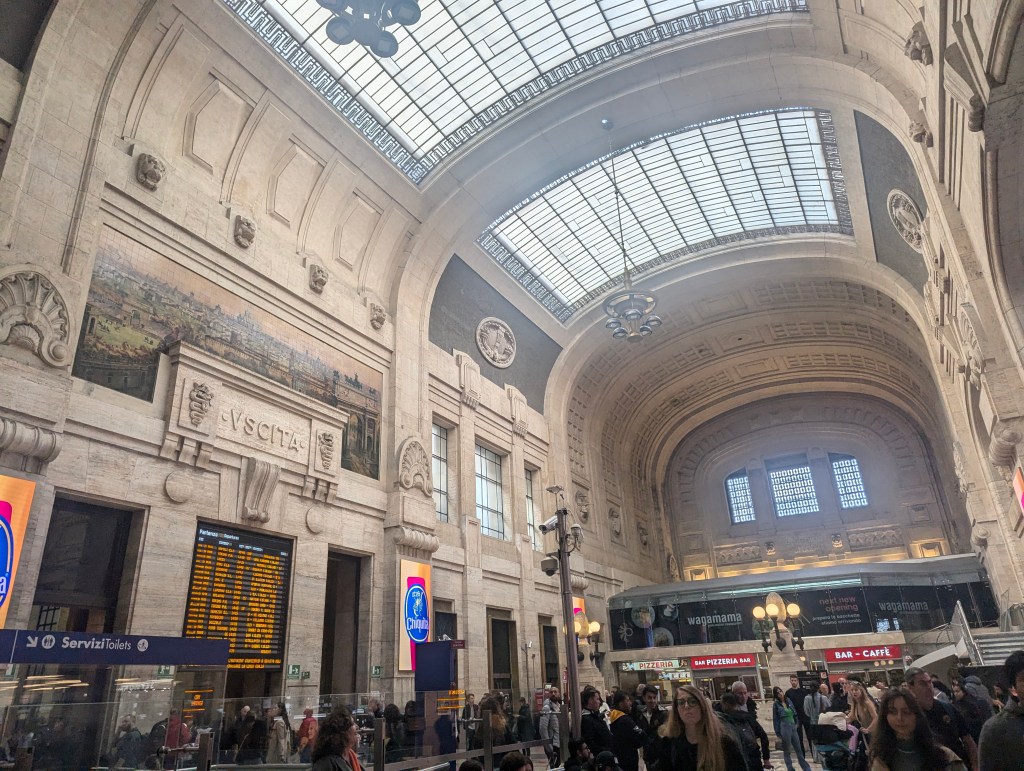
We arrived Milan via train, so easy. The central train station is huge and bustling.
We negotiated our way into the metro and rode it to the neighborhood of our AirBnb, which was well placed right off a main artery: Via Torino, yet off a courtyard in a very quiet building on a side street. After picking up some groceries and settling in, we set off to explore the Old City. We passed the Biblioteca Ambrosiana, which urged us in with the promise of the Atlantic Codex of Leonardo DaVinci; we made a mental note to return. (turns out this was the back anyway).

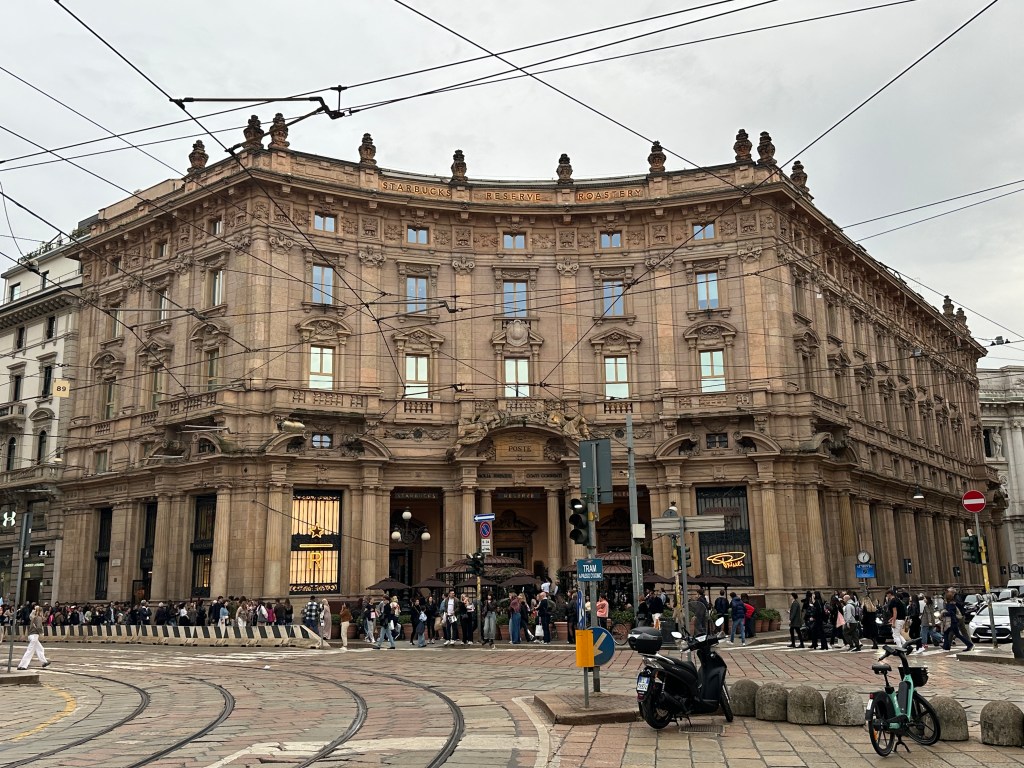
Further along we came to Piazza Cordusio where the court of the Lombard dukes once stood. It was later the financial hub of Milan until the 2010s when the financial institutions transferred to skyscrapers. Today it’s a social and commercial hub.

Assicurazioni Generali building, built in late 19th century
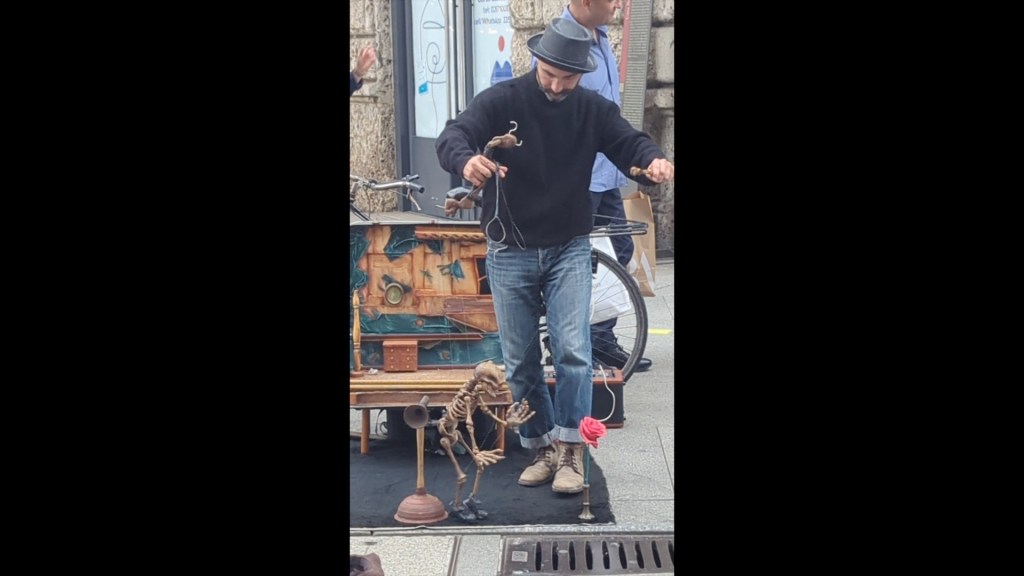
Meandering northwest from Piazza Cordusio on Via Dante, we passed street artists, shops, cafes, and sooooo many people! We took our time to take in our surroundings. We were falling in love with Milan.
Further along Via Dante we passed the Monument to Giuseppe Garibaldi (1807-1882), a national hero as a general and later politician.
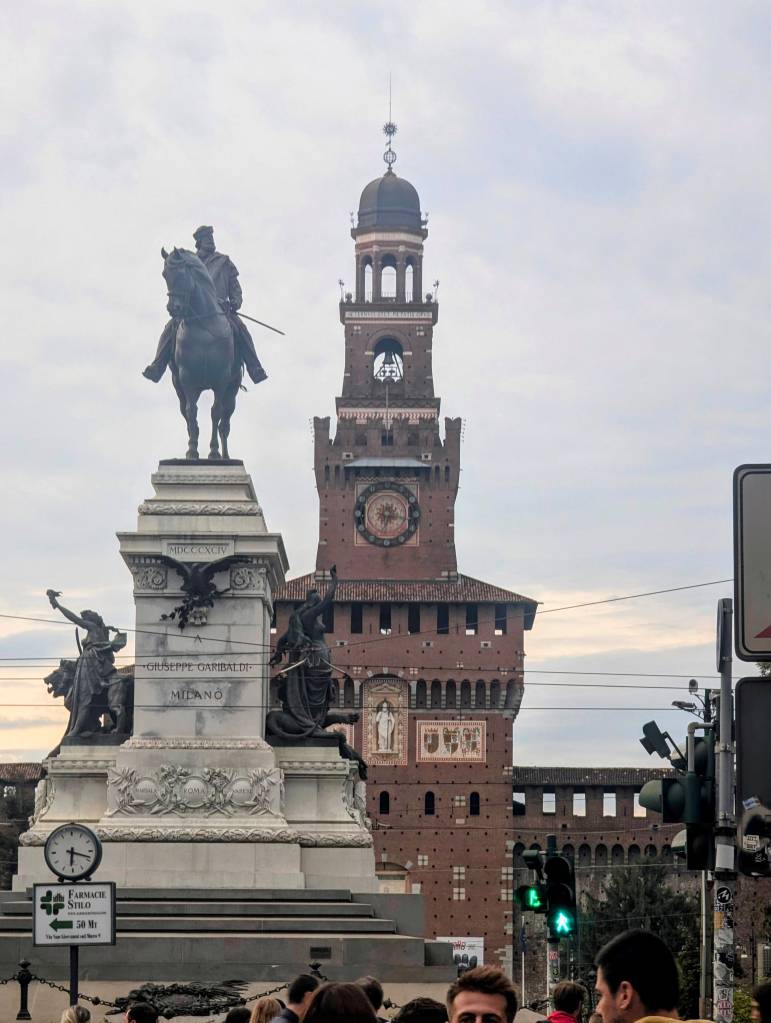
At the end of Via Dante stands the Castello Sforzesco. It was built in the 15th century by Francesco Sforza, Duke of Milan, on the remnants of a 14th-century fortification. Later renovated and enlarged, in the 16th and 17th centuries it was one of the largest citadels in Europe.
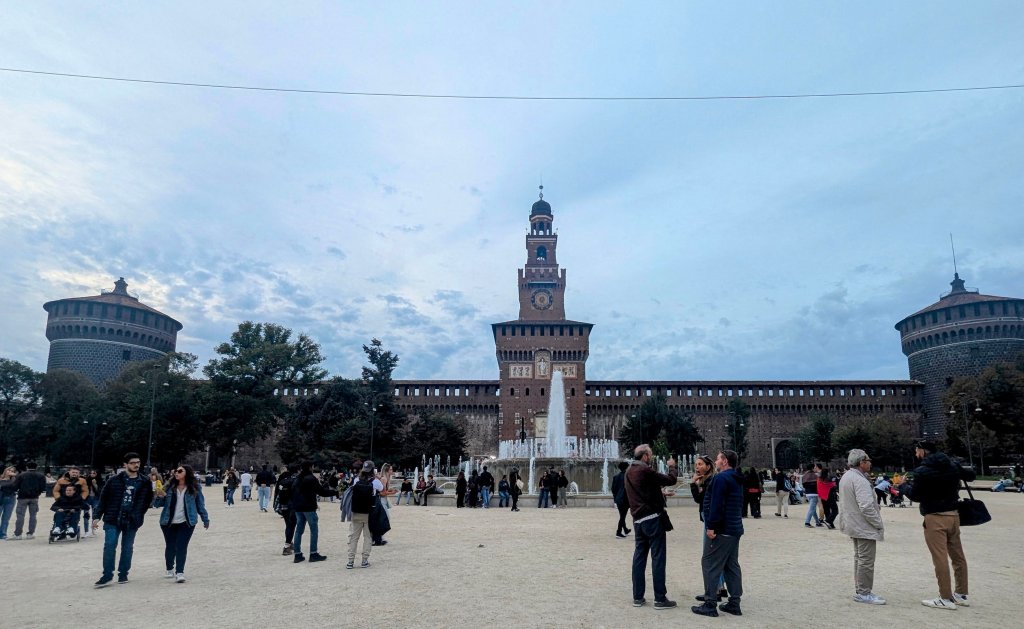
We walked around the castle grounds, but it was getting late, as evidence by the lights starting to come on, and we had a dinner reservation.
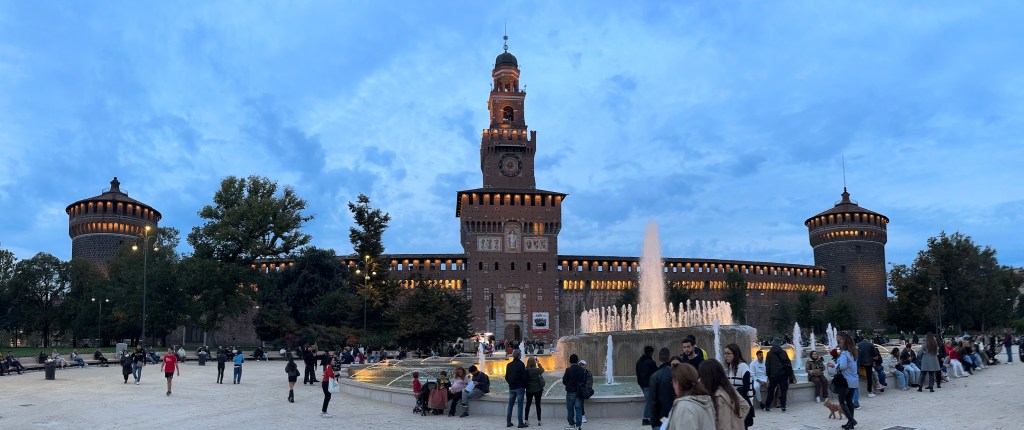
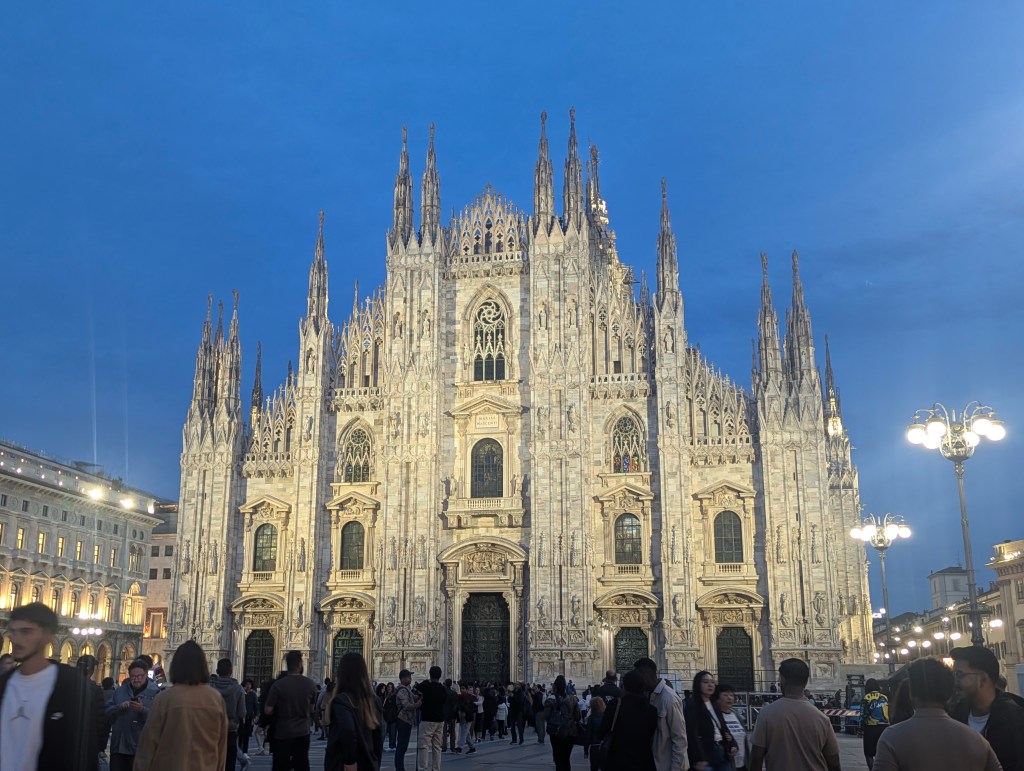
We retraced our steps down Via Dante and before turning onto Via Torino, we found ourselves in front of the Duomo, which we planned to come back to with more time, but could not resist admiring it lit up.
Dinner was just what a first night in Italy should be: pizza at Rossini.

The next morning we were up and out for our walking tour, which met in front of the Duomo. At the top of the plazza is a statue of Victor Emmanuel II (1820-1878) who in 1861 became the first king of a reunited Italy (since the 6th century).

In the plaza we met our guide Marco.

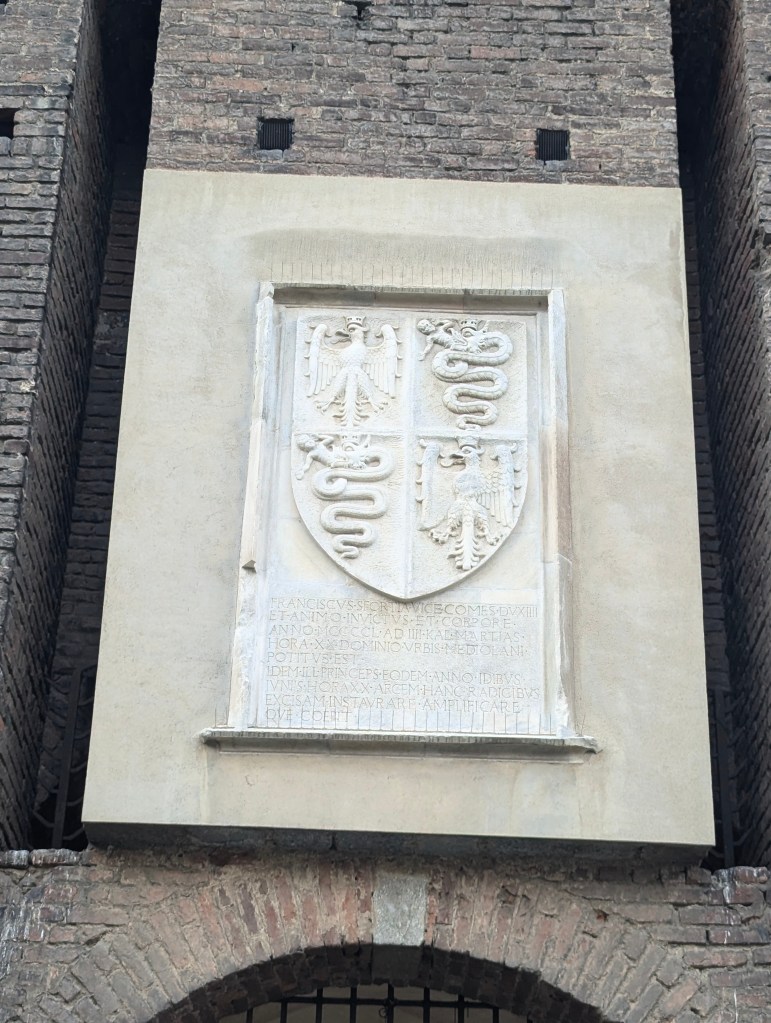
Although we met in front of the Duomo, Marco led us away to some of Italy’s history before returning to this important structure. First he showed us the snake-eating-man symbol, also known as a Biscione, which was the symbol for the influential Visconti family (1277-1477). (It is also a reference to Dante). He told us their reign is known as the second golden age of Milan. The first was in the 4th century. The Visconti family symbol is now the symbol for Milan and also has been adopted by several companies including a local TV channel, a soccer team, and Alpha Romeo cars.

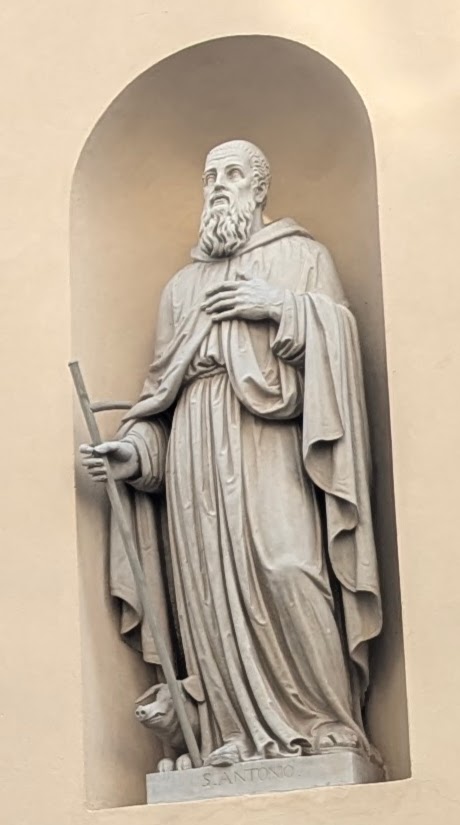
As an aside, Marco told us that the local dialect used by Dante for his poetry is what is today called Italian. He then took us by The Church of St. Anthony
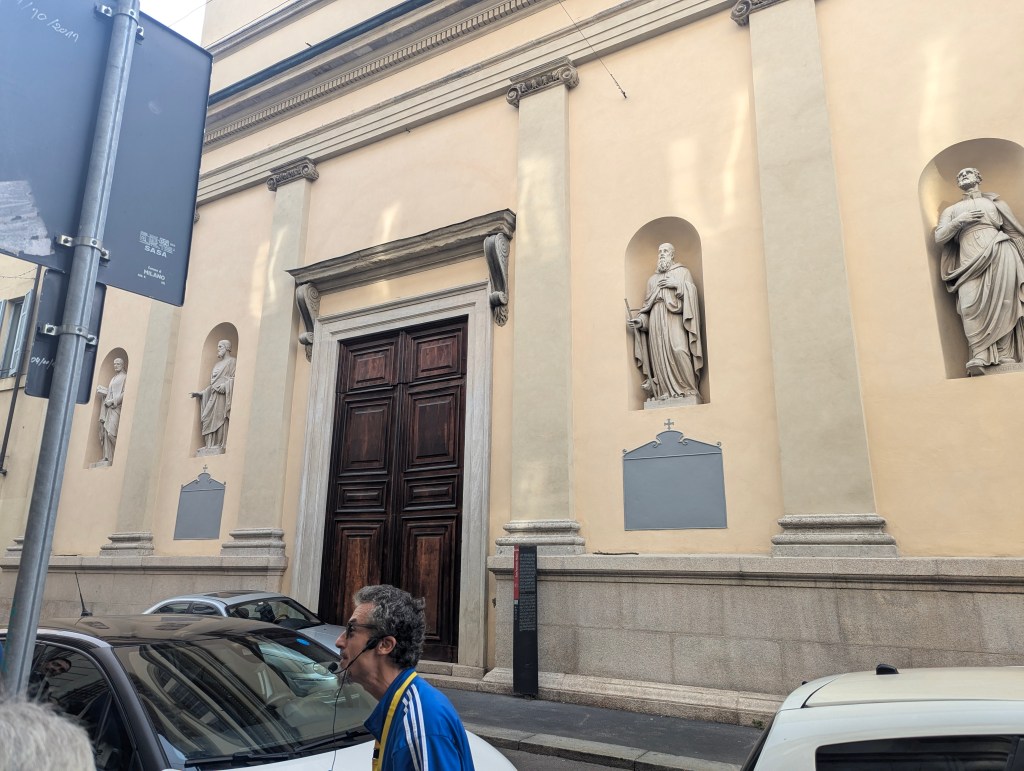
He shared with us the story of why shingles is called “St. Anthony”s fire” in Italy. St. Anthony, always pictured with a pig, as he is here, used pig fat to calm the symptoms of shingles.
Next we visited the Church of San Nazaro, dating to the 4th cetury (Milan’s first Golden Age), it is one of the oldest churches in Milan. It is the oldest Latin cross church in the history of Western art. In the 4th century, Milan was the capitol of one of the four regions of the Roman Empire, and was the first region to allow Christianity.

There have been many changes to the church through the centuries, especially after a fire in 1077. The remnants of the 4th century Roman building can be seen in the part of the wall seen with the brick herringbone pattern, a typical Roman technique.

While here Marco gave us much more Milan history. The city was completely destroyed twice. The first time was by the Ostrogoths in 476. The second was by Frederick Barbarossa of the holy Roman Empire in 1162. He was known as the Kaiser Rotbart, which in English means “Emperor Redbeard.” He leveled most of the city, which then came under the rule of the Holy Roman Empire.
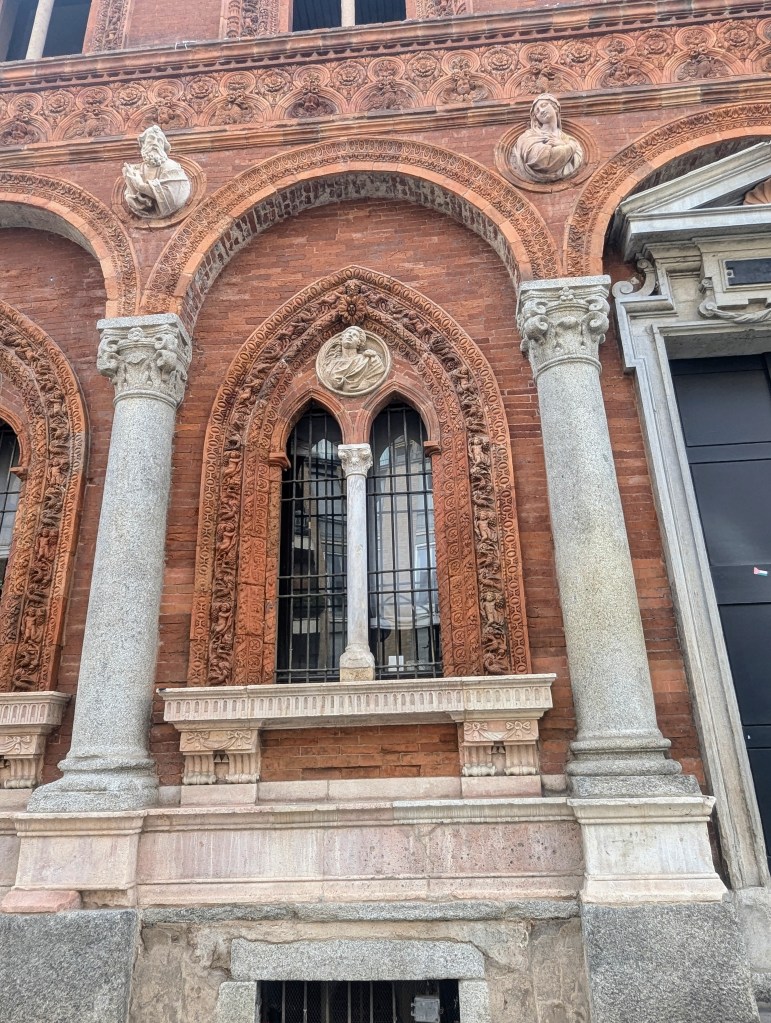
Our next stop was a former hospital of Milan which, started in 1456, remained a hospital until the 1930s when it was deemed not modern enough. It is now part of the Milan State University. It was built by the Sforzesco family (same family as the castle above). Francesco Sforza was the son-in-law of Visconti. The last Visconti duke died in 1447 without a male heir. Sforza was the duke of Milan until 1499 when Milan was invaded by France and was then a province of a foreign country until Italy was reunified in 1861.
At the time the hospital was built, it was the largest in Europe. It was also the first hospital to be devoted to actual recovery (rather than palliative care or as a shelter, which is what hospitals were at the time). At the main gate monks would assess, ie triage, and if a person was felt to be terminal, they were sent elsewhere. It was the first hospital where patients had their own bed (imagine!) and a semi-private bathroom facility. And all of this including meals was free to the patients; it was the first public hospital. The funds initially came from the founder Francesco Sforza, but later from private donors.

The hospital was the highlight of Milan in its time, made famous in 1510 by Martin Luther who described it in one of his journals.
Marco the took us by Via Laghetto. He explained to us that in ancient and medieval times cities with waterways for transportation were those that prospered. Milan needed to dig canals to connect the city with waterways elsewhere in Europe. One was dug in the 1100s, connecting Milan to Switzerland, and the second in the 1400s, connecting Milan to the rest of western Europe. Right before the French invasion in 1499, Milan was one of the most advanced, richest, and most populated cities in Europe. In the 1400s, the canals were used to bring in all the marble for the Duomo from the Candoglia Quarry. Where Via Laghetto is now was then a pond where the marble was offloaded, then taken by cart to the Duomo building site. The pond has since been filled in and covered in concrete.

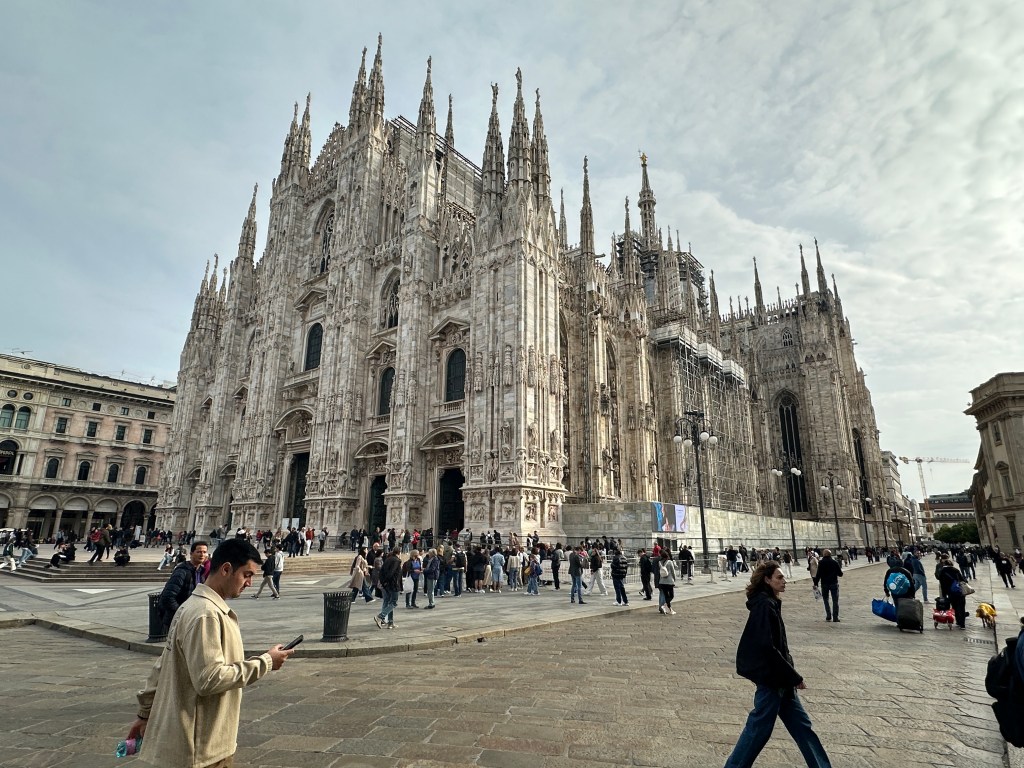
Finally we headed back toward the Duomo, a legacy of the Visconti family. It was paid for by the Duke as a way of “buying” his title of Duke for independence for Milan from the Holy Roman Empire. It was started in 1386 in the Gothic style, which was already out of vogue in Europe. It is the only Gothic style church in Italy. The main spire was finished in 1774; the front was finished in 1814; the last gates were completed in 1965. It is the largest Gothic church in the world. Part of the reason it took so long to complete was the sacking of Milan by the French in 1499 after which the funding dried up except for private donations.
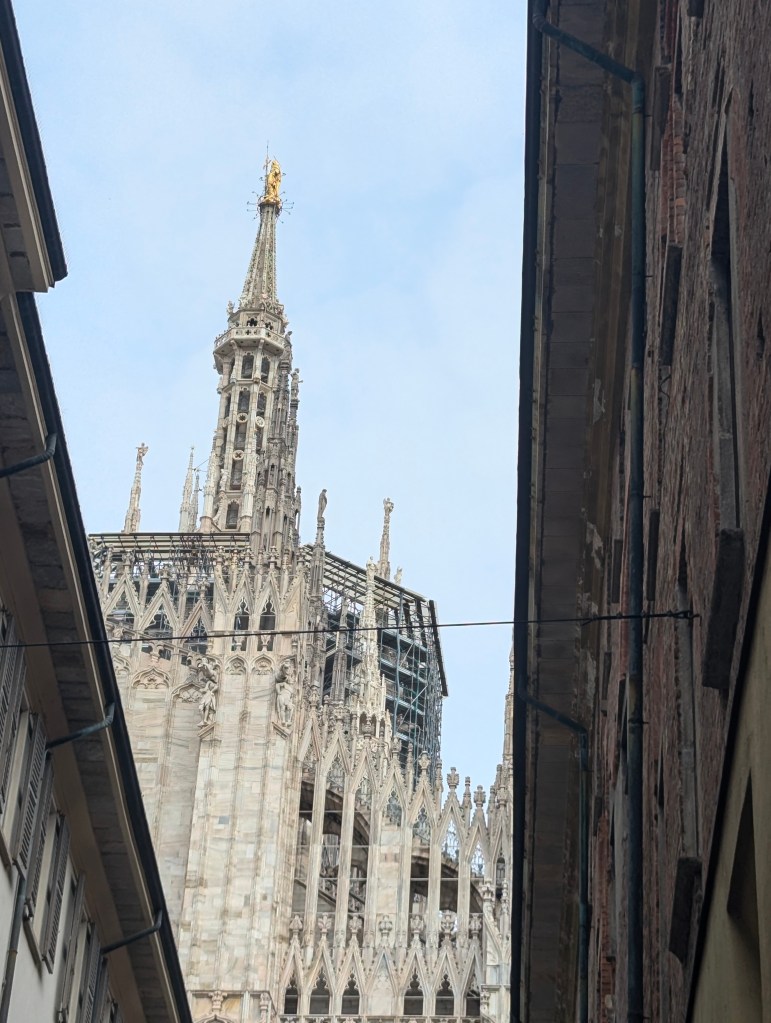
Atop the main spire is Mary, known to the locals as Madonnina because of how small she looks from the ground. In actuality, she is 13 feet tall and stands at a height of 355 feet. At the time she was placed there in 1774, she represented the highest point in Milan and it stayed that way, by decree, until 1960 when Pirelli finally won a variance for his skyscraper. Pirelli’s building, at 417 feet was higher, but in deference to her tradition, he placed a smaller version of the Madonnina atop his building; as has every building since that has reached new heights. “My Beautiful Small Lady” is the anthem of Milan.
In addition to Mary, there are over 3,400 statues in and on the Duomo.
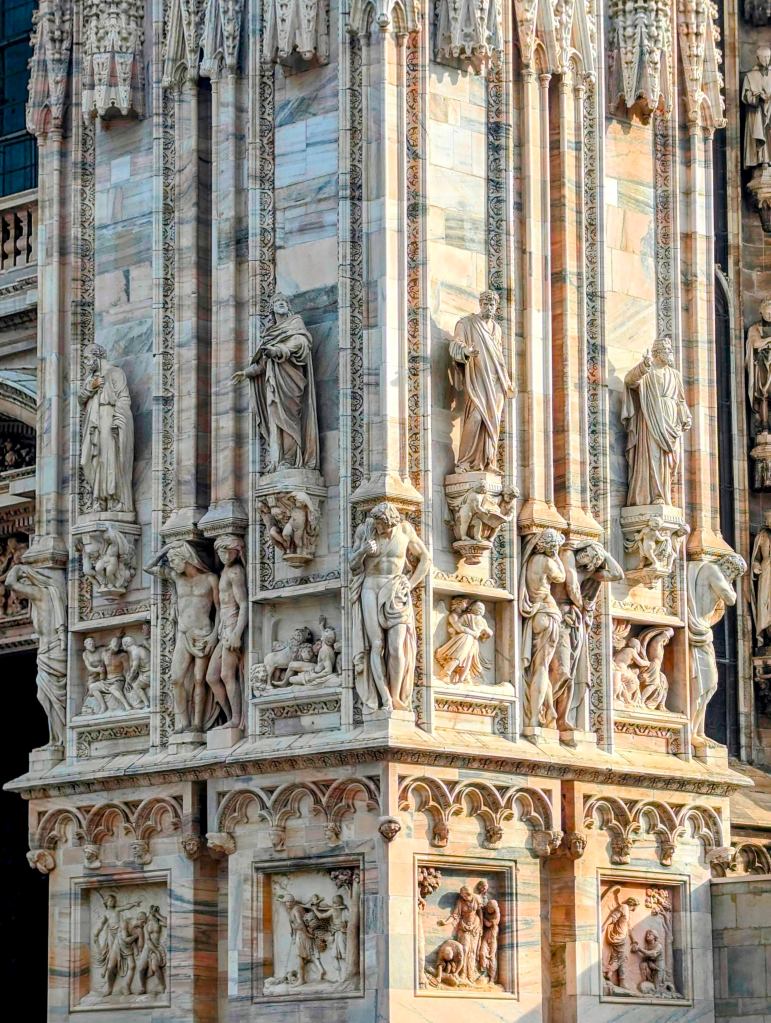
The most amusing statue is on a balcony on the front of the church. The two are labeled as New Justice and Old Justice.
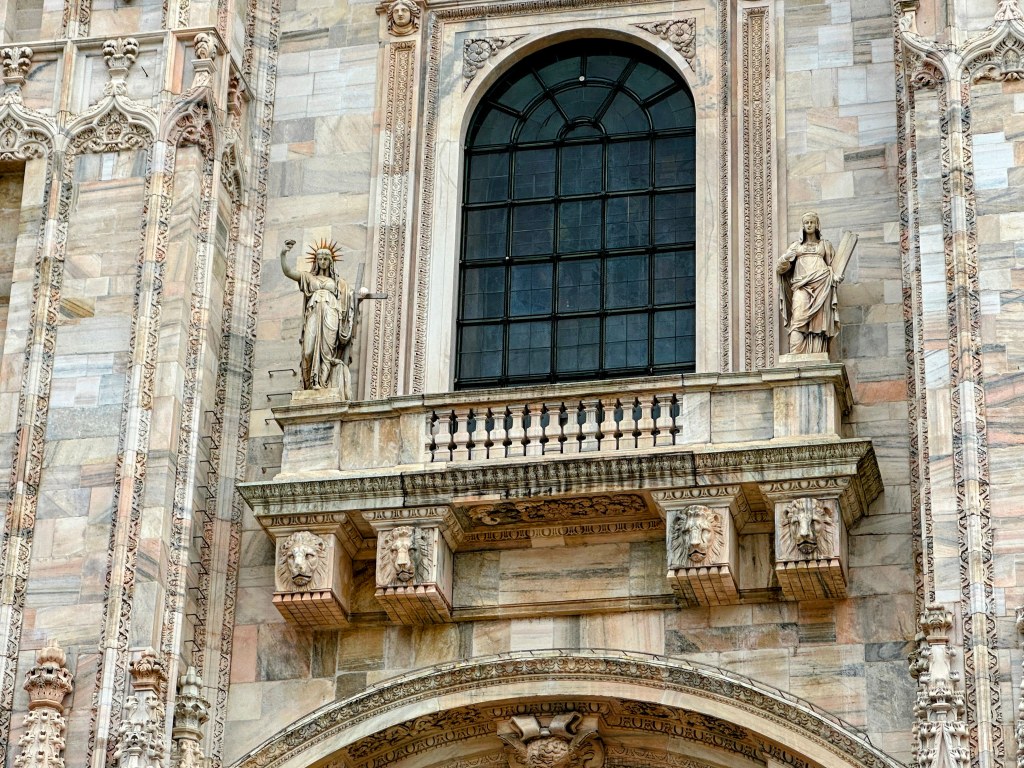
The one on the left: New Justice looks very similar to Lady Liberty in NY harbor, though she predates our gift from France by over 70 years.

Next Marco took us to the Galleria, a shopping center built to celebrate the reunification of Italy. It opened in 1867. In 1865 Milan had become the second city (after New York) to have electric lights. The Galleria was truly the gentrification of the area with it’s upscale shops and restaurants.
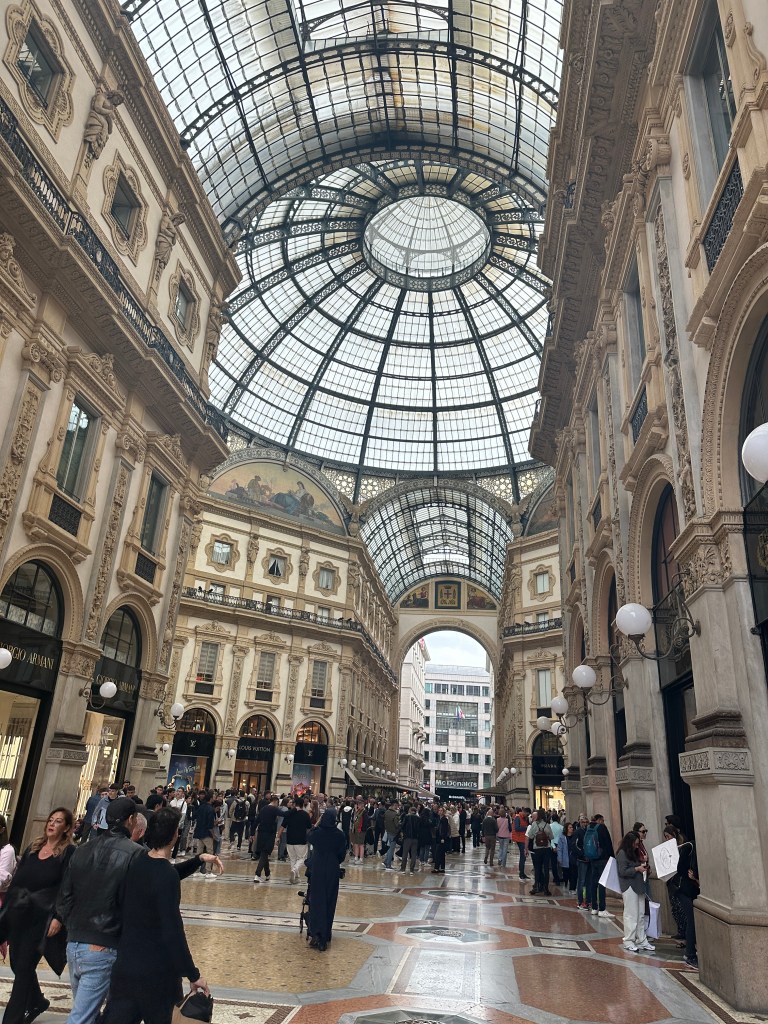
He explained to us that all the central shops are Italian; the French are only on the outer portions of the cross shaped space. All the shops must have uniform signage of gold lettering on black.

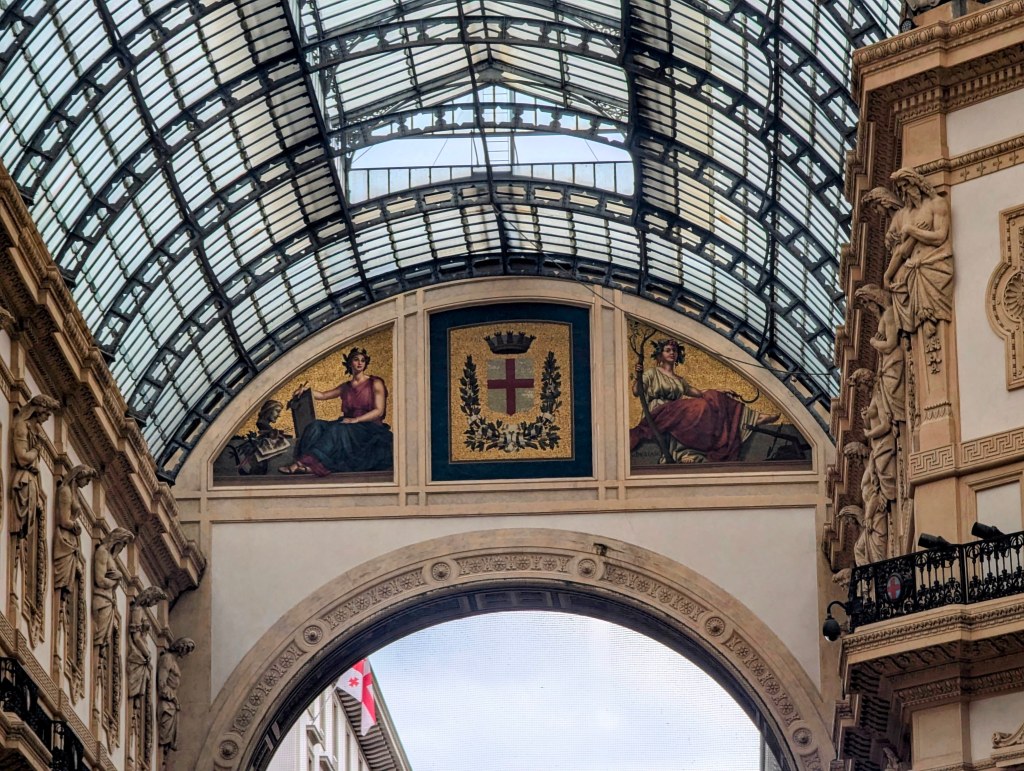
The paintings over the entrances represent the Italian flag of the reunification with its red cross.
Outside the galleria and across the street is the Scala Theater for performances in music, ballet, and opera. After a fire had destroyed the previous theater, La Scala was commissioned and built in 1778. The new theatre was built on the former location of the church of Santa Maria della Scala, from which the theatre gets its name. As with most of the theaters at that time, La Scala was also a casino, with gamblers playing in the foyer. In its first 34 years patrons would use their boxes for social life, business meetings, and even fornication during the performance. But in 1812 Rossini made his debut here followed shortly by Bellini, Donizetti, and later Verdi, four of Italy’s most famous composers. Since then, most attendees have actually enjoyed the performances at la Scala. The theater opens for its season every year on December 7, the feast day of Saint Ambrose, patron saint of Milan. Unfortunately, the entire building is currently enclosed for renovations.

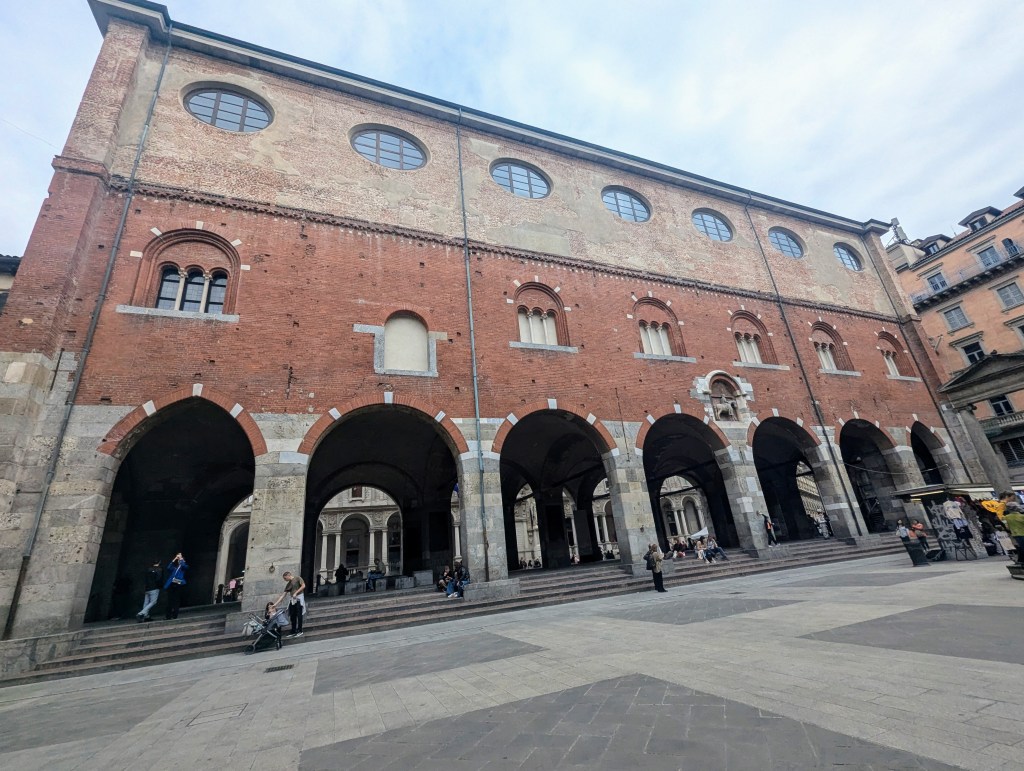
Marco next took us to the Piazza Mercanti, which, created in the middle of the 13th century, was the center of political and city life in medieval Milan.
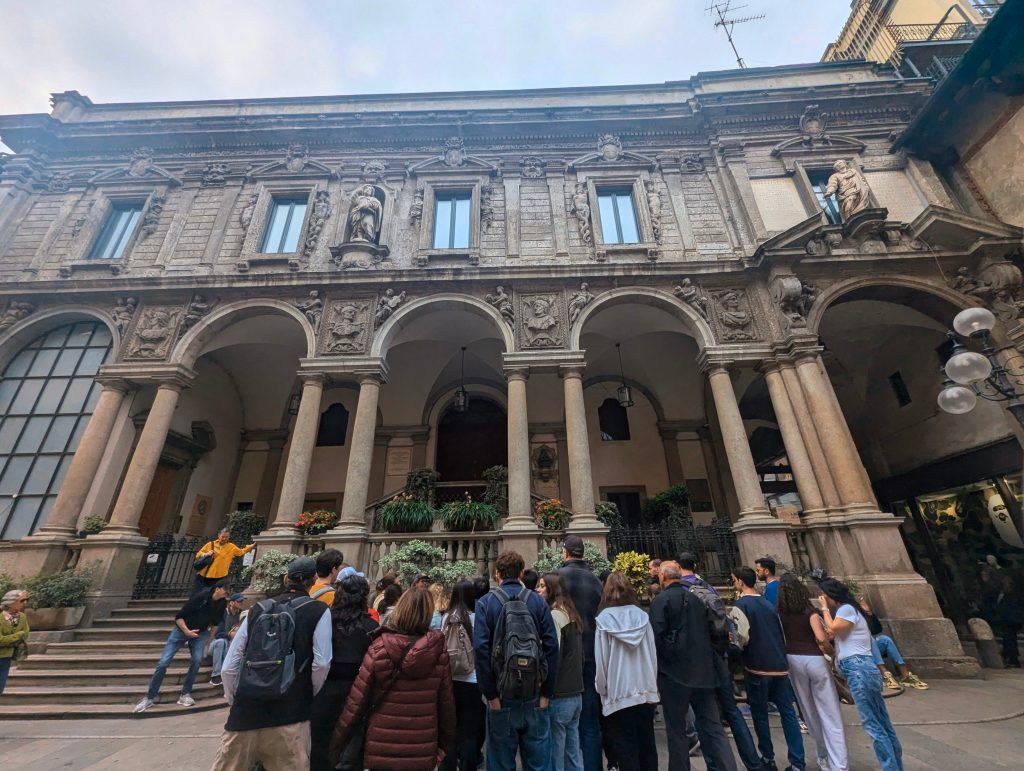
If a merchant could not pay his debts, all his goods were confiscated then his desk (Banco in Italian) was brought to the square and broken (rotto in Italian). Banco-Rotto was the origin of the word bankrupt and not just in English. Marco asked at least 6 people how banco-rotto is pronounced in their language and it was amazingly similar in every language.
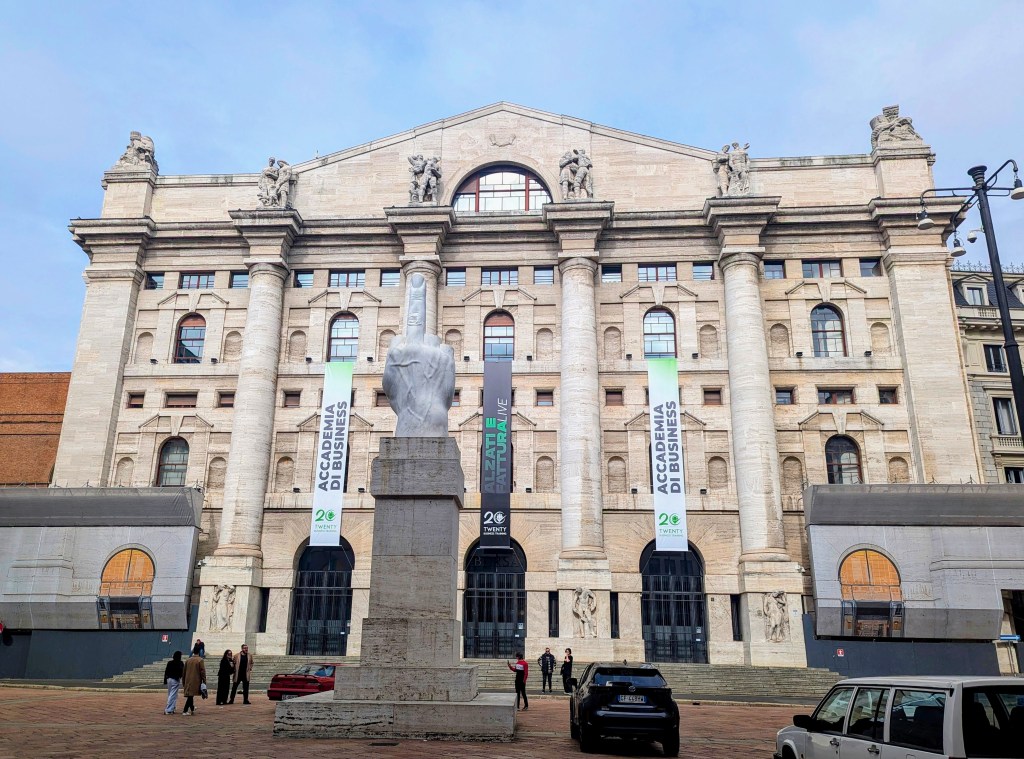
The last place Marco took us was to see L.O.V.E., commonly known as il Dito (Italian for “the finger”), a sculpture by Italian artist Maurizzio Cattalan (1960- ). The name L.O.V.E. is the acronym of “Libertà, Odio, Vendetta, Eternità” (“Freedom, Hatred, Revenge, Eternity”).
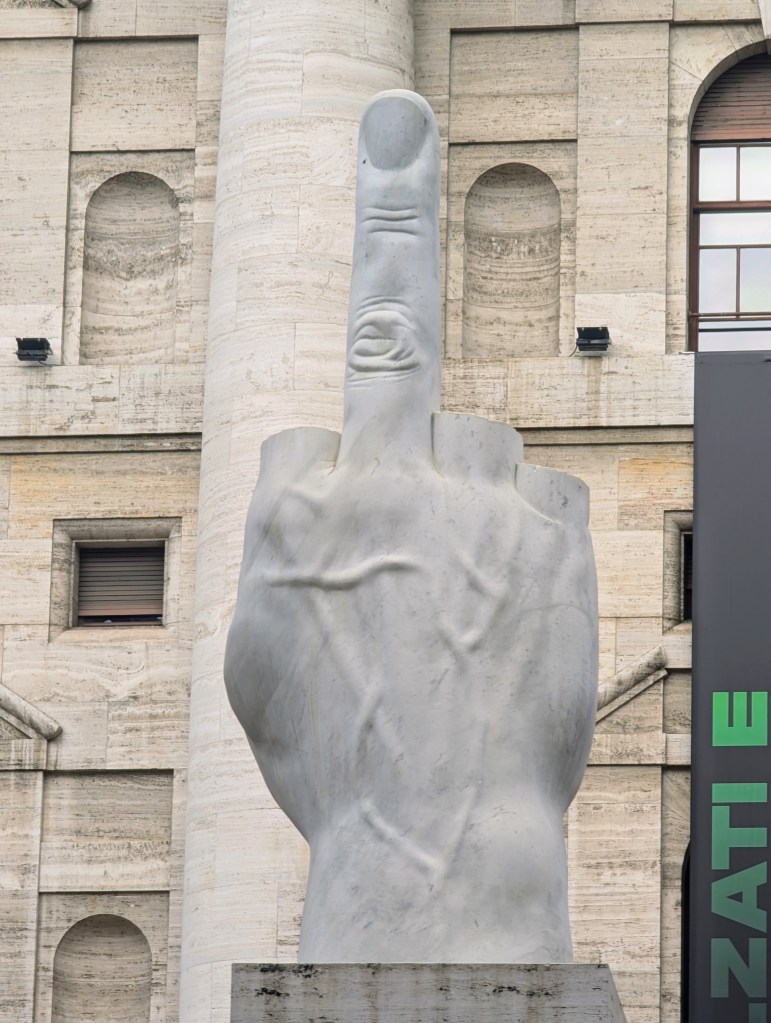
The sculpture is located in Piazza degli Affari, where the Italian stock exchange is located. Maurizio Cattelan has never disclosed the exact meaning of the sculpture. The two most accepted explanations are 1: that it represents both a critique of the Fascist salute and 2: that it is designed as a protest against financial institutions after the 2008 financial crisis. The stock exchange building was built during fascism by architect Paolo Mezzanotte and completed in 1932. But as Marco pointed out, if the first option is true, why is the finger pointed away from the stock exchange toward the viewer?
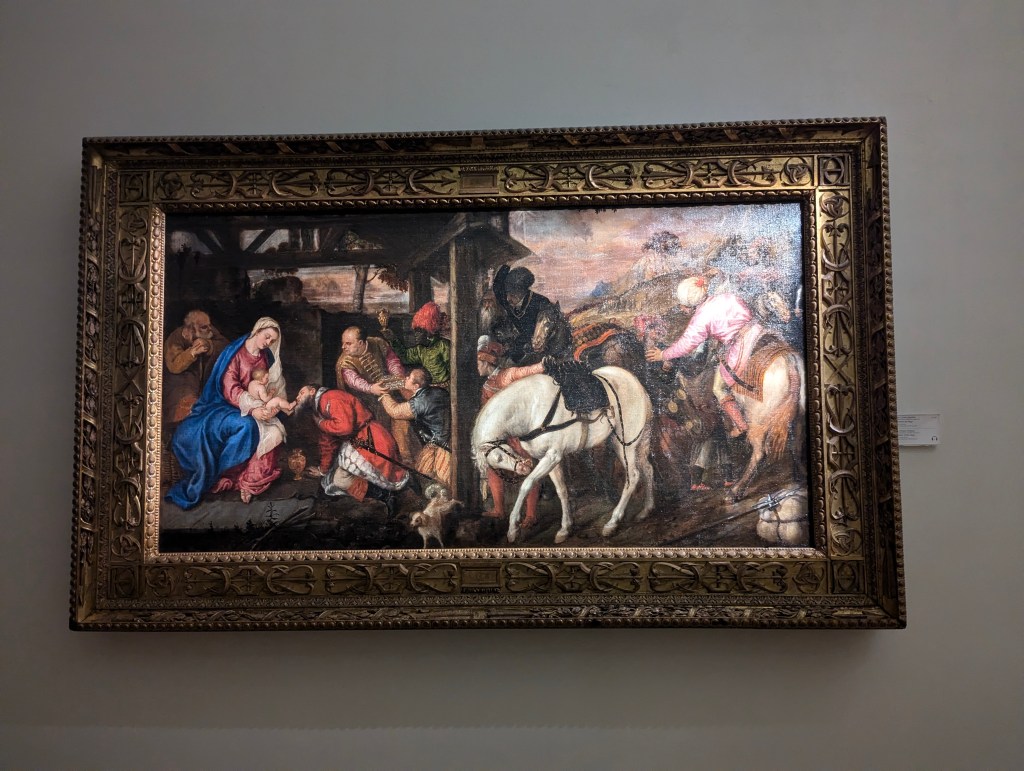
After lunch we mustered up enough energy to return to Biblioteca Ambrosiana. We got audio guides to learn about Federico Borromeo (1564-1631), Cardinal Archbishop of Milan. During his stays in Rome between 1585 and 1601, he developed the idea of a cultural institution of a high artistic, literary and scientific level. He started a collection which has been built upon through the centuries. During the Napoleonic plundering of Italy much of the contents were stolen and transferred to France. Most have since been returned. The first few rooms of the museum contain works obtained by the cardinal himself like this Titian in 1618.
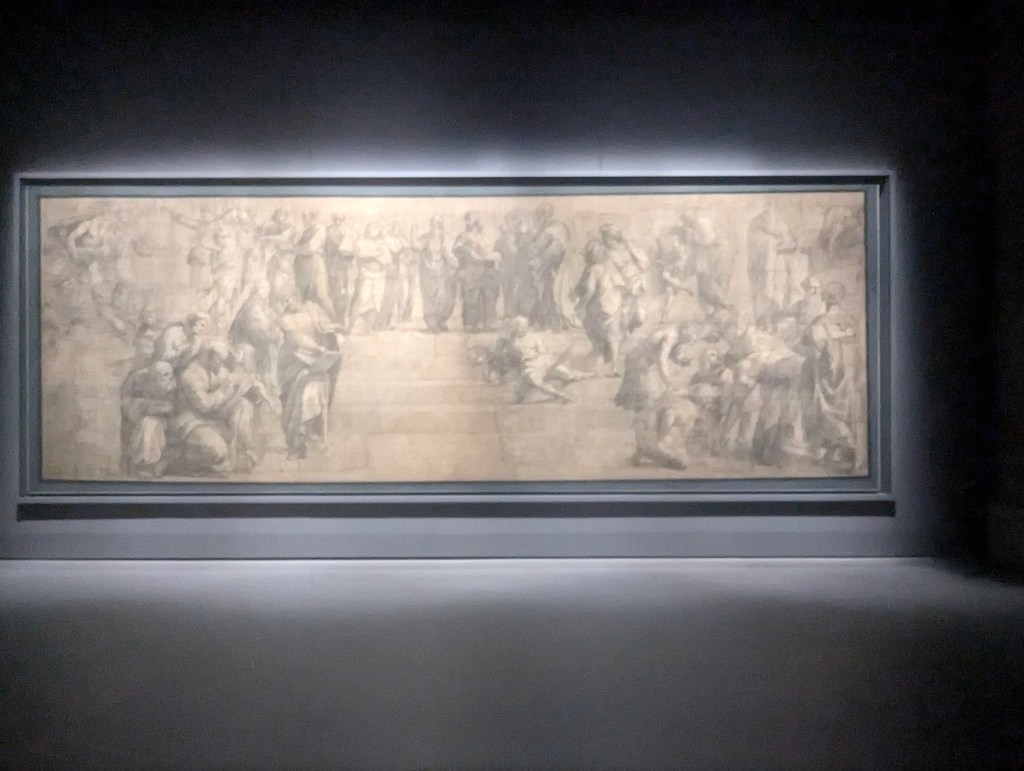
One of the most precious artworks in the collection, and in the city of Milan., is the The School of Athens by Raphael (1483-1520). It is the largest renaissance cartoon that has survived to this day, and was made by Raphael as a preparatory work for the Stanza della Segnatura room in the Vatican, which was commissioned by Julius II. It entered Federico Borromeo’s collection in 1626, when he purchased it from the widow of Fabio Borromeo Visconti for the massive sum of six hundred imperial lire. Although it is known as The School of Athens, the more exact title is Philosophy, as suggested by the allegory of the same subject painted on the vault above the fresco in the Stanza della Segnatura, as part of a very complex iconographic project. At the centre we see the two greatest philosophers, Plato (painted with the likeness of Leonardo, with his finger pointing upwards and identifiable by the Timaeus he is holding, one of his works that had enormous influence on later philosophy) and Aristotle, who is identified by his book of Ethics.
The collection includes non Italian artists, especially from the school of Flanders, like this Still Life by artist Jan Brueghel the Elder (1568-1625), one of the first Still Lifes known.

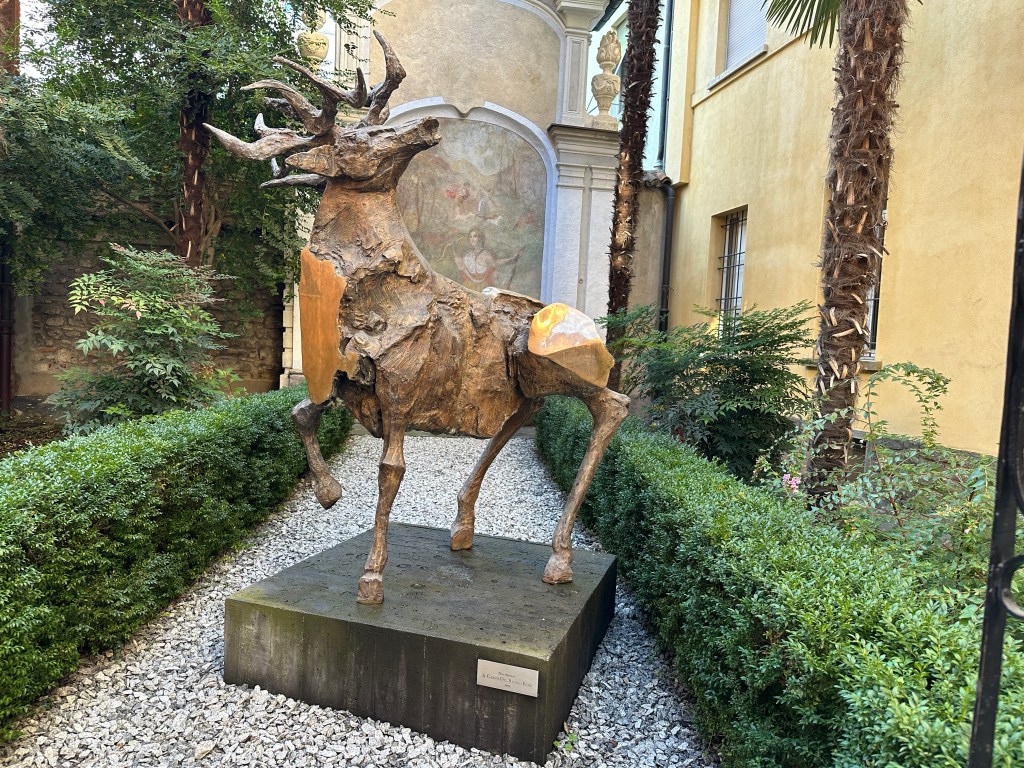
Later additions include sculptures, jewelry, and pieces like this hollow deer for serving wine. Below can be seen a pair of gloves worn by Napoleon Bonaparte.

The Biblioteca Ambrosiana is full of treasures, even the walls like these mosaics.
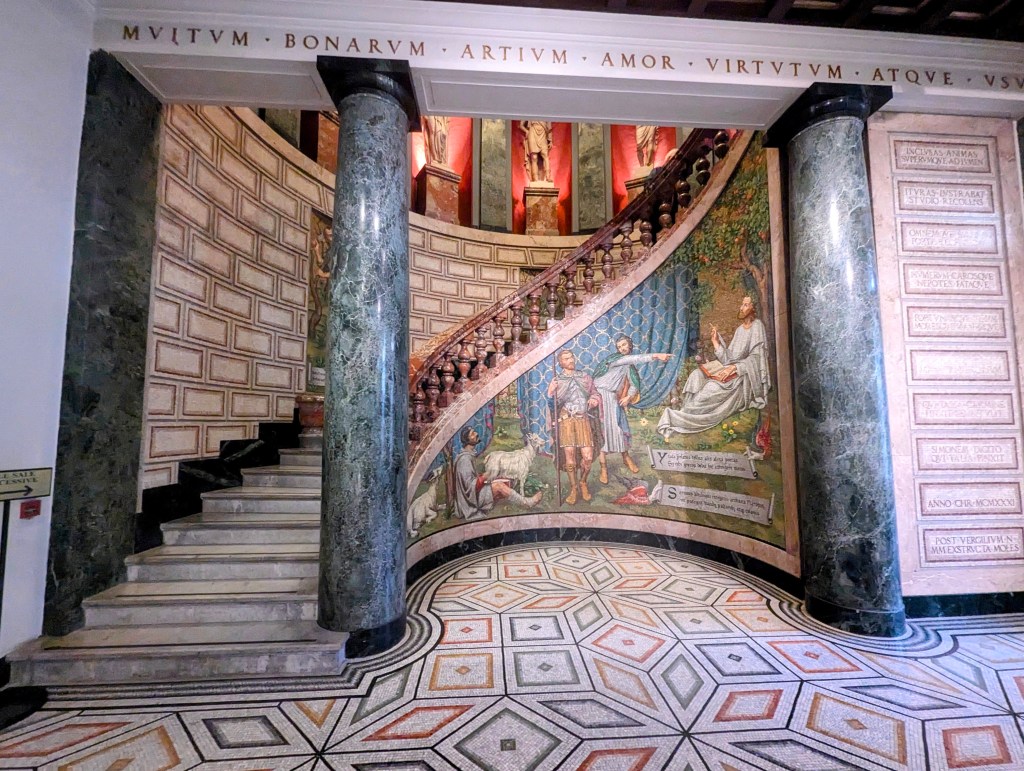
The courtyard is full of statues.

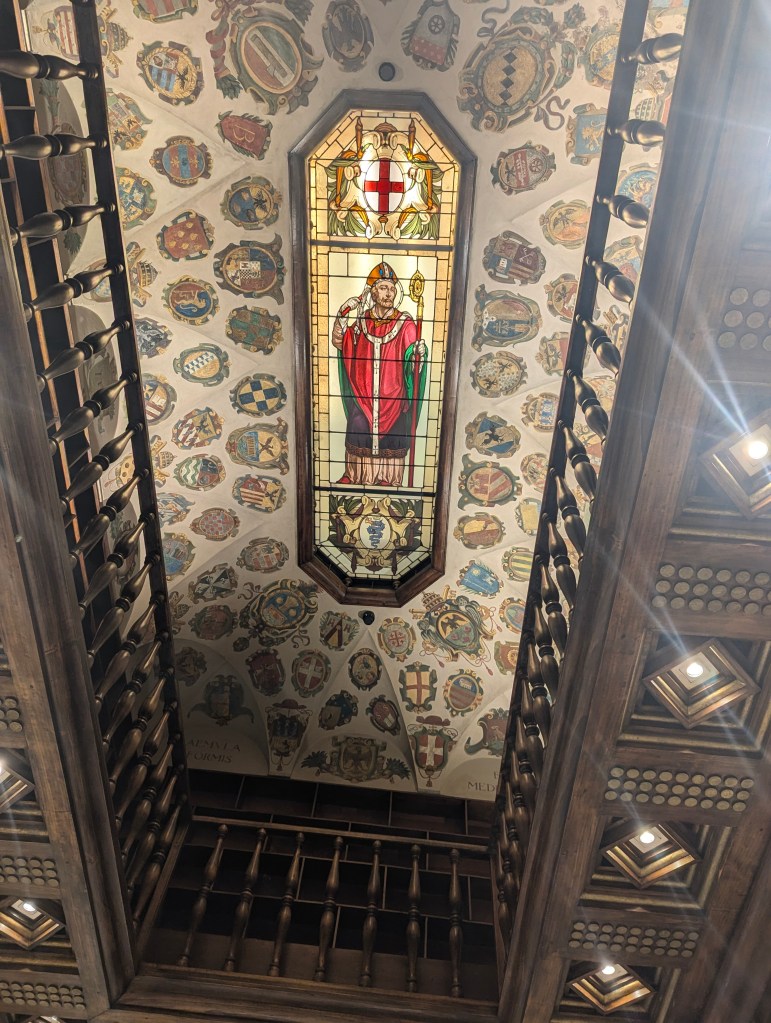
Even the ceilings are works of art.
There is an entire room devoted to works by DaVinci (and this is only one of 4 museums in Milan with works of his). Most famous is this self portrait.
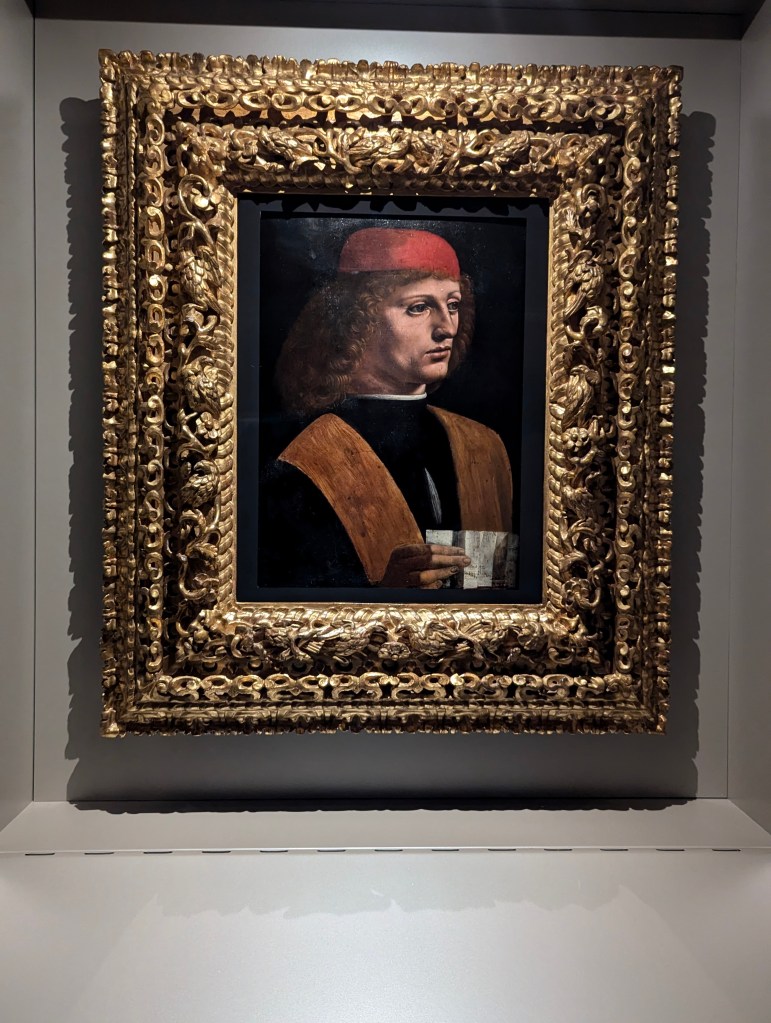
But what had drawn us into the Biblioteca Ambrosiana was the library itself and the DaVinci Atlantic Codex.
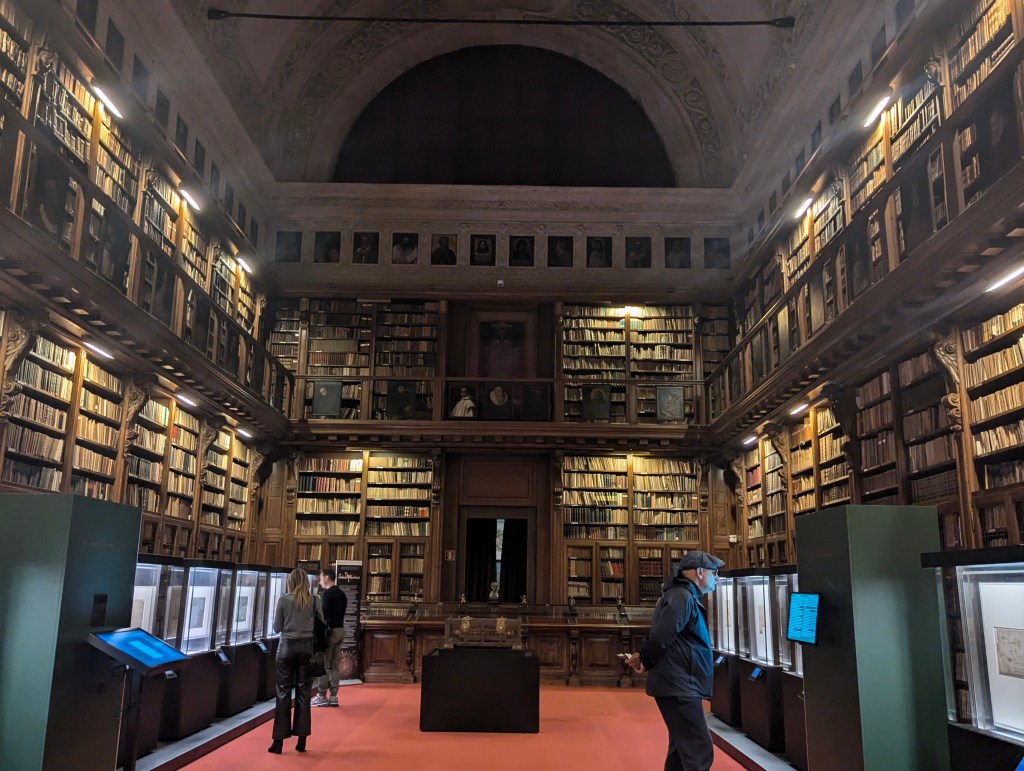

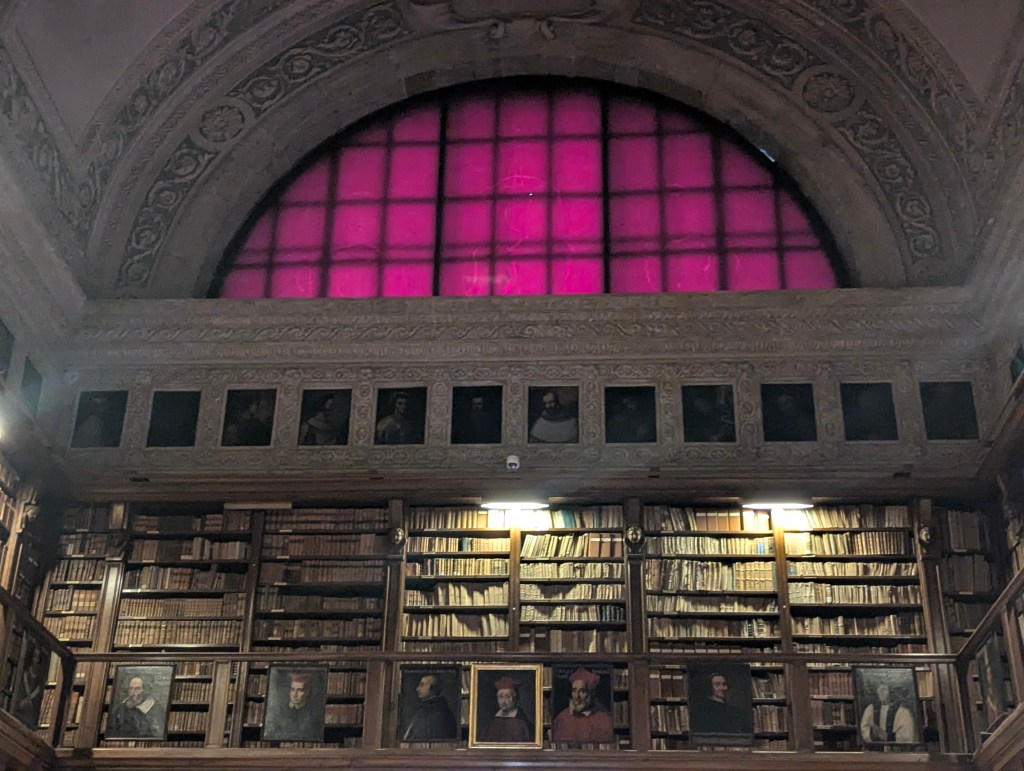
In December 2019 Dolce and Galbana donated the Chiaravalle tower clock. The large clock in fact reproduces the complex astronomical machine of the Chiaravalle Abbey completed according to the intuitions of Leonardo da Vinci illustrated in the pages of his Atlantic Codex, which is exhibited in the same room.

And finally, what we came for. The posted sign says it all best.

Fun fact, DaVinci wrote his codexes in mirror writing, ie backwards; no one knows why, but there are many theories.


After a very full day it was early to bed anticipating Howard’s and Georgia’s arrival in the morning. After they dropped their luggage and an early coffee, we set out independently. Eric and I had booked tickets to the Duomo. But first we wanted to go back to the Galleria, which is right next to the Duomo, and spend a little more time looking around.
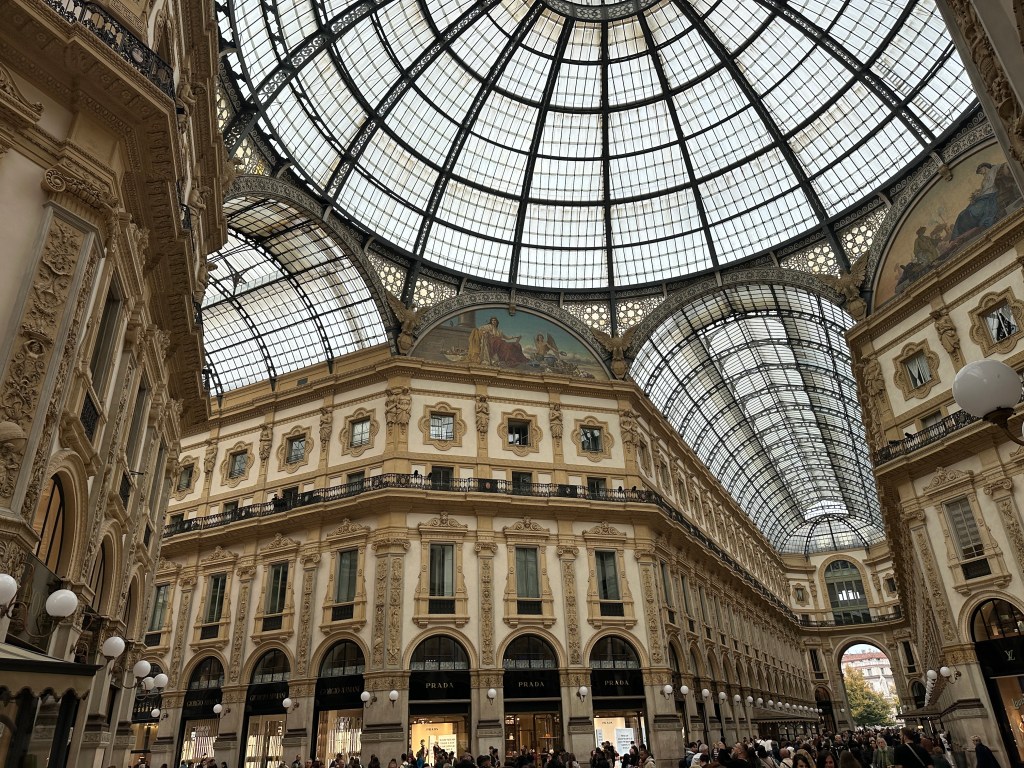
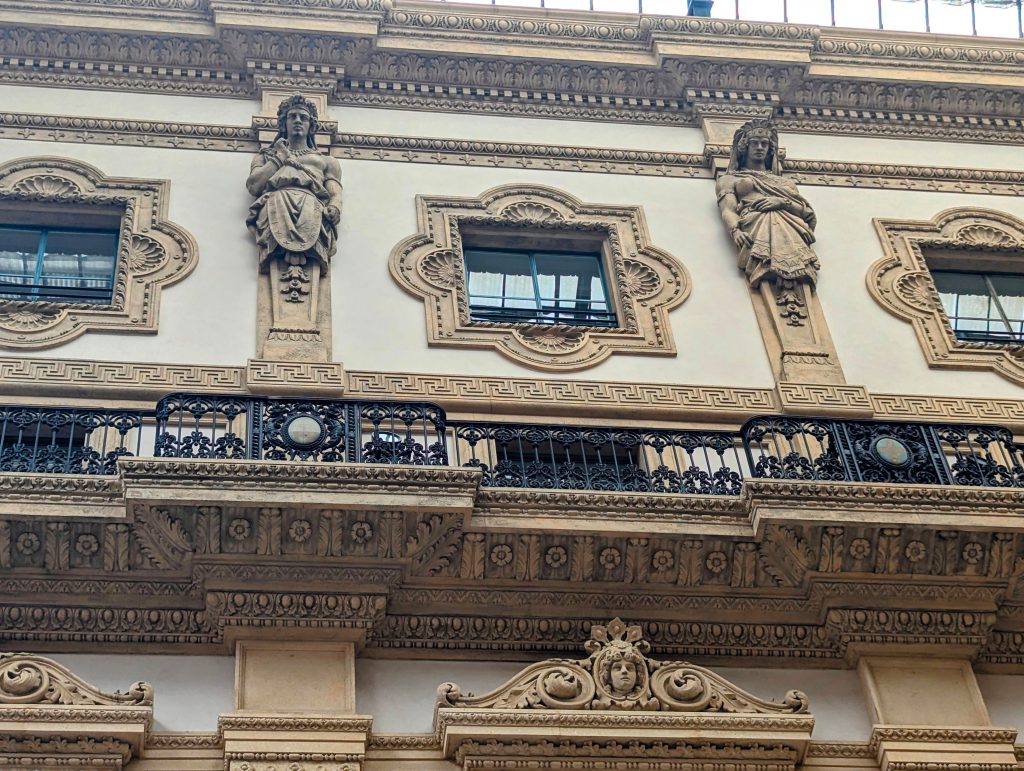
It had been so crowded with people during our tour that Marco walked through briskly making picture taking difficult. Due to the presence of elegant shops and clubs it has been a meeting place for the Milanese bourgeoisie since its inauguration. It has been nicknamed “drawing room of Milan.” It is among the most famous examples of European iron architecture, as seen in the balustrades below, and represents the archetype of the nineteenth-century shopping gallery and is often considered one of the first examples of a shopping center in the world.
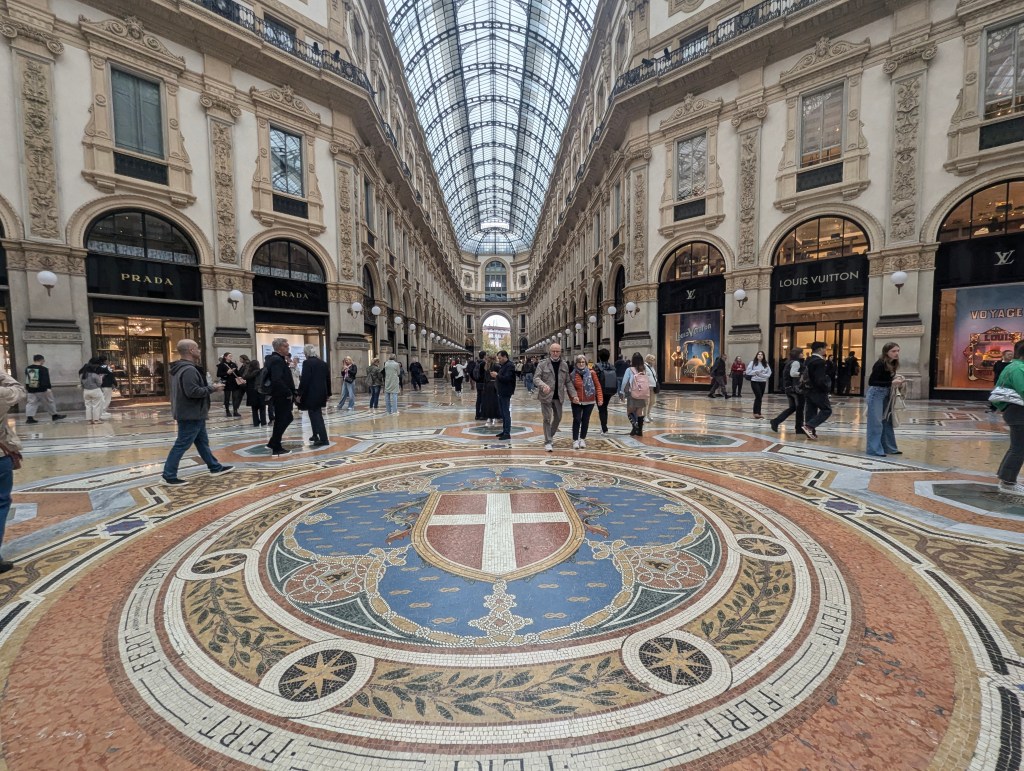
At the intersection of the arms of the Gallery is the space surmounted by the dome, called “octagon” due to its shape obtained by cutting the four corners at the intersection of the two orthogonal galleries. The floor of the octagon hosts a large central mosaic representing the coat of arms of the House of Savoy.
The tops of the four walls resulting from the cut are each decorated with a painted
lunette, 15 metres wide at the base and 7 metres high at its maximum, each representing a different continent.
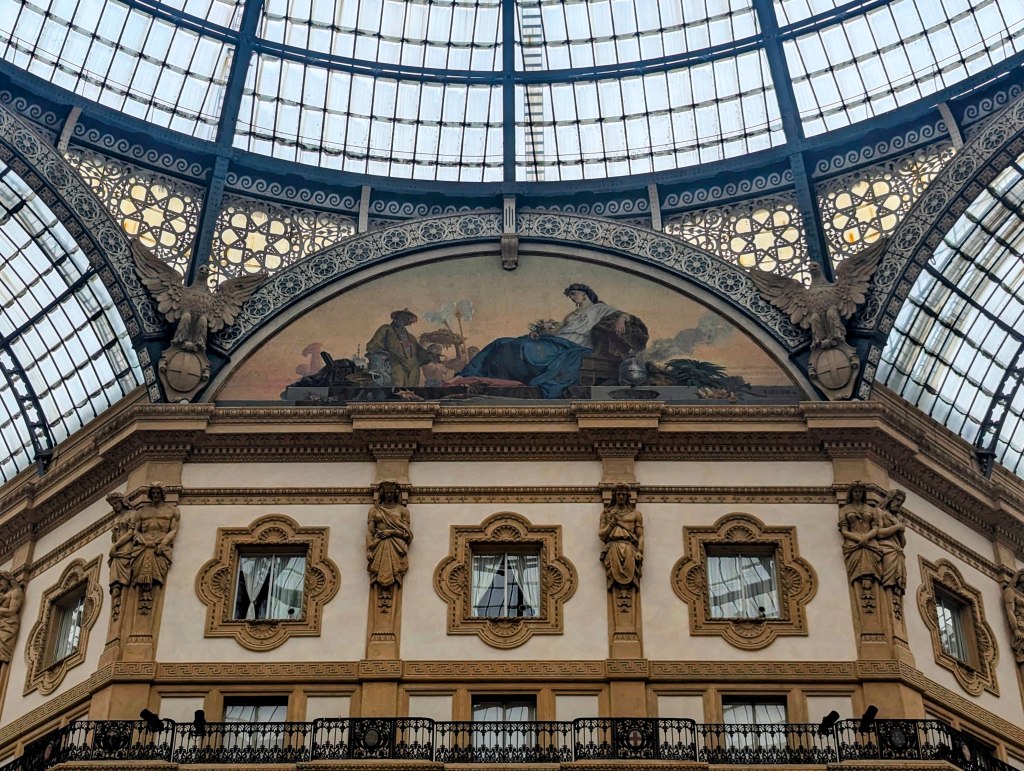
Asia represented sitting on a throne where natives and other men with Asian features pay homage to her with gifts
The floor of the octagon celebrates the historical 8 capitals of Italy, represented by their shields, plus Milan, which was never a capitol. Tradition says that rotating three times on oneself with the right heel in correspondence with the genitals of the bull depicted in the mosaic on the floor in the center of the octagon brings good luck. The gesture was originally performed as a mockery towards the city of Turin, whose coat of arms depicts the bull, and then spread simply as a superstitious rite . This ritual, repeated often every day, mainly by tourists, quickly wears out the image of the bull, which must be restored frequently.

And now it was time for the Duomo. We had bought the “Fast Track” tickets online which meant we were to ride the elevators up to the terraces first (rather than climb the nearly 300 stairs). We were let out first on the lower terrace, which was good because I needed to get used to the height. The terraces measure over 86,000 square feet over the two levels.

It was very interesting to be able to see the gargoyles (called falconaturas because they are actually for drainage of rainwater) up close. There are 150 gargoyles.
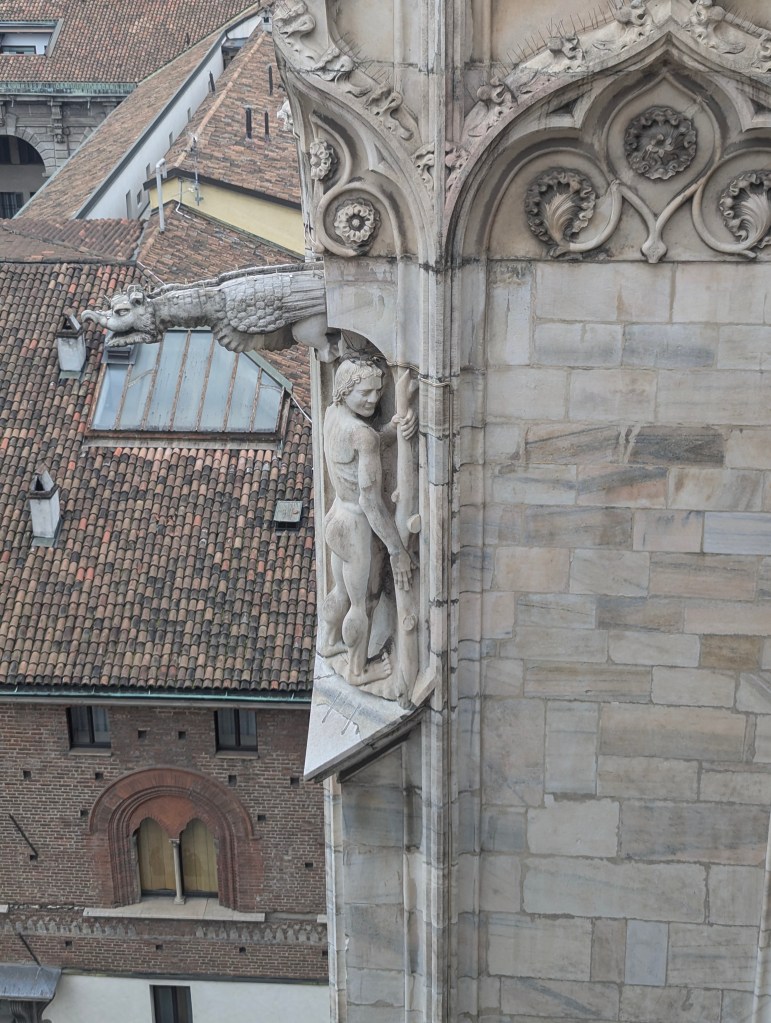
There are 135 spires. Of note, there is no bell tower. There are bells internally, but they are only rung on a few high holy days throughout the year. The bells heard daily are a recording.
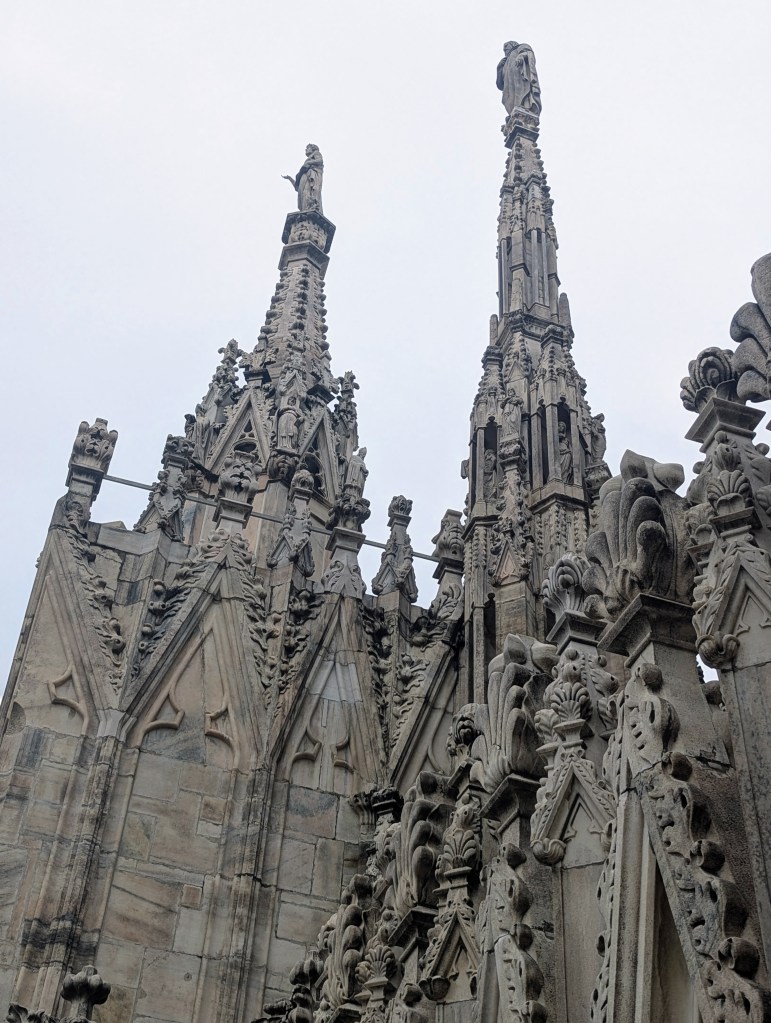
It seems by their placement on the terraces that some statues were never meant to be seen from the street. The terraces were built for visitors to the Duomo.

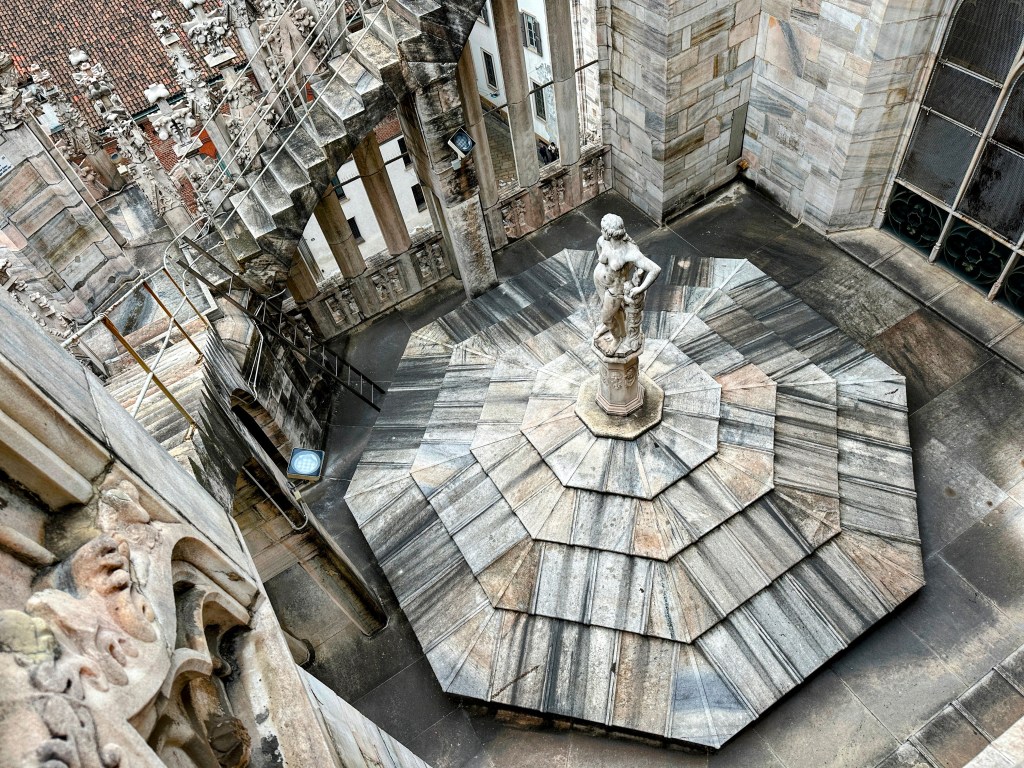

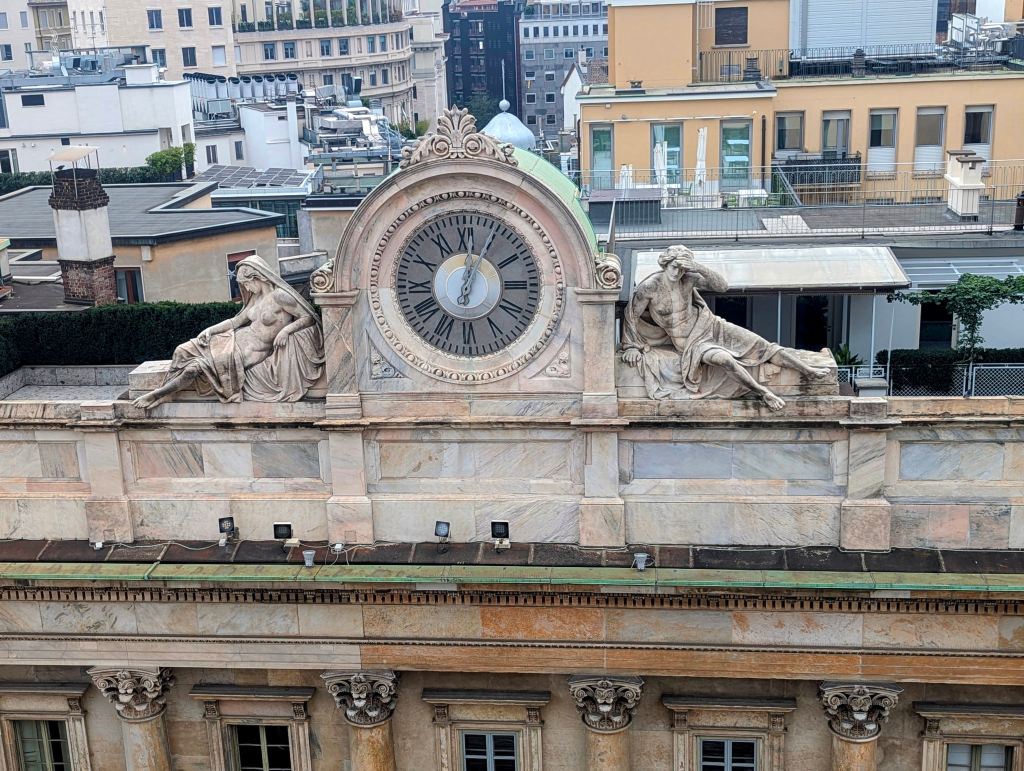
There were plaques along the way explaining some of the history. Across from the terrace the Venneranda Fabbrica building can be seen. It holds, preserves, and restores all of the documents related to the Duomo. During WWII the building was damaged by shrapnel but the large clock on it’s top was saved, supported by the statues of Day and Night.
The Carelli spire was the first built, named for Marco Carelli who, near his death in 1395 donated 35,000 gold ducats (about 30 million dollars in today’s money). Although named for Carelli, the statue is of King George.

We climbed further to reach the upper terrace.

This plaque shows damage done to a spire during the WWII bombings.

Today that spire has been restored,
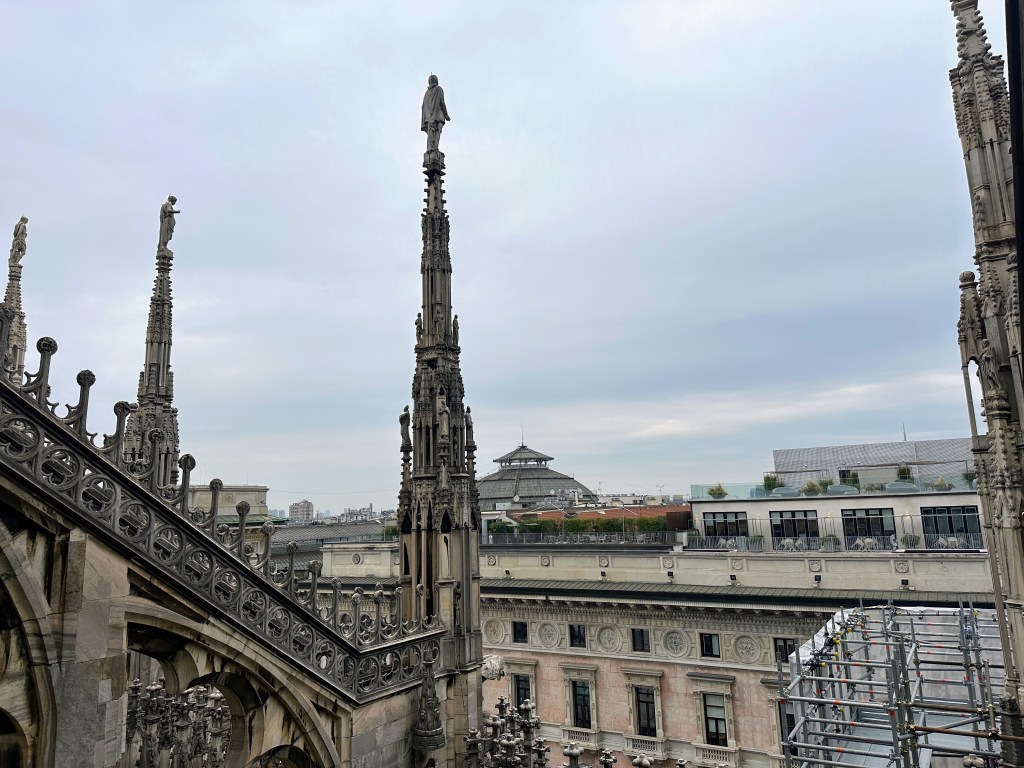
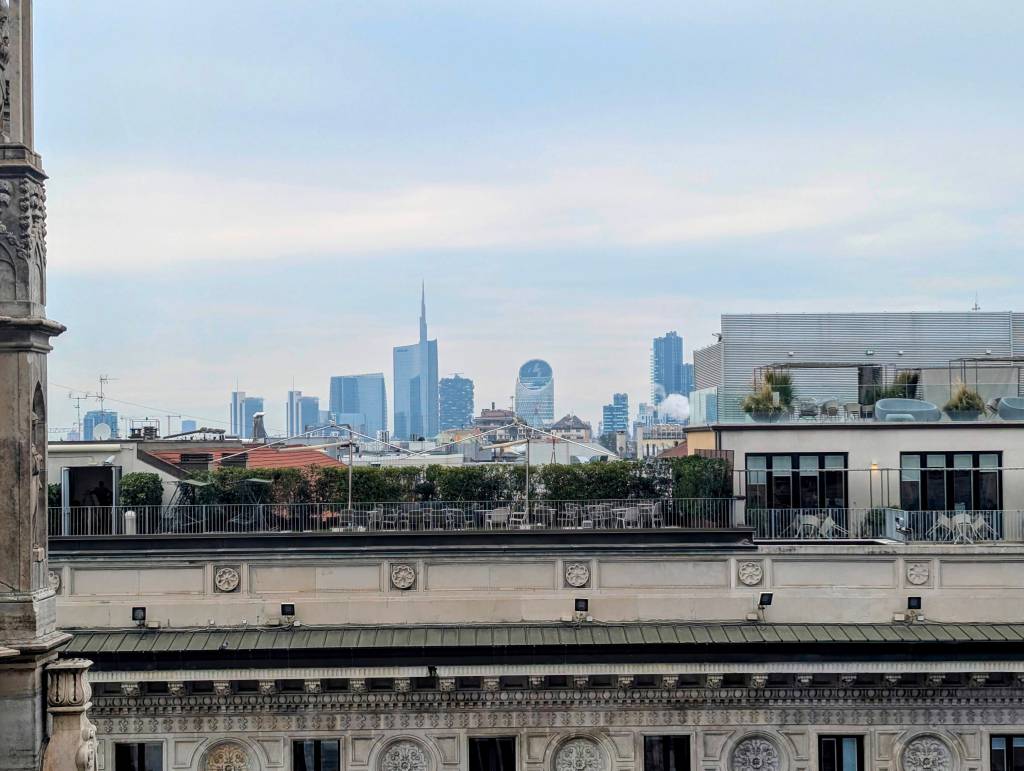
From this height one can see modern Milan in the distance.

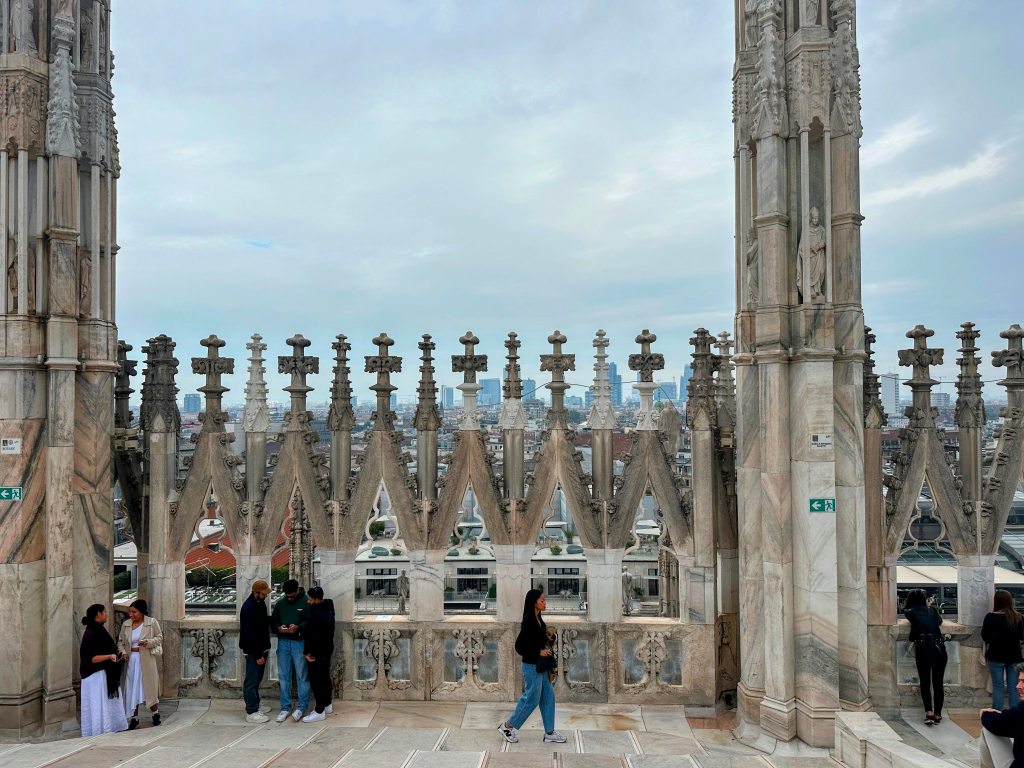
Finally we climbed the last 90 steps up to the roof. The main spire was built between 1765 and 1770. In the mid 1800s it almost buckled from the weight; a metal rod was inserted for stability.
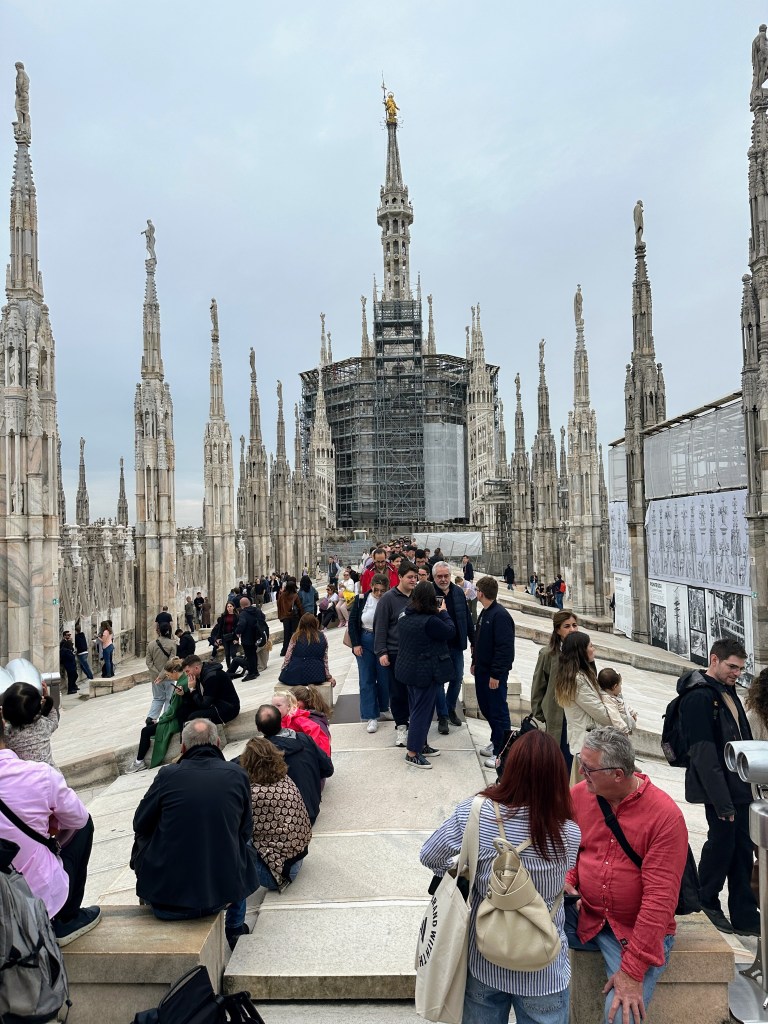
The pages of photos and text seen to the right give tribute to all those who are needed to constantly maintain and repair the marble. Seen up close, the different colors can really be appreciated. The white is the newer marble, still recovered from the same Candoglia quarry. As the marble ages it becomes first gray then black then begins to crumble.
Also from up here, though still far away, the Madonnina is close enough for a photo. She is 13 feet high, made from 33 copper plates, is covered in 600 sheets of gold leaf, and weighs over 880 pounds. In August 1943 she was wrapped in sheets of burlap so her shine would not attract bombers.
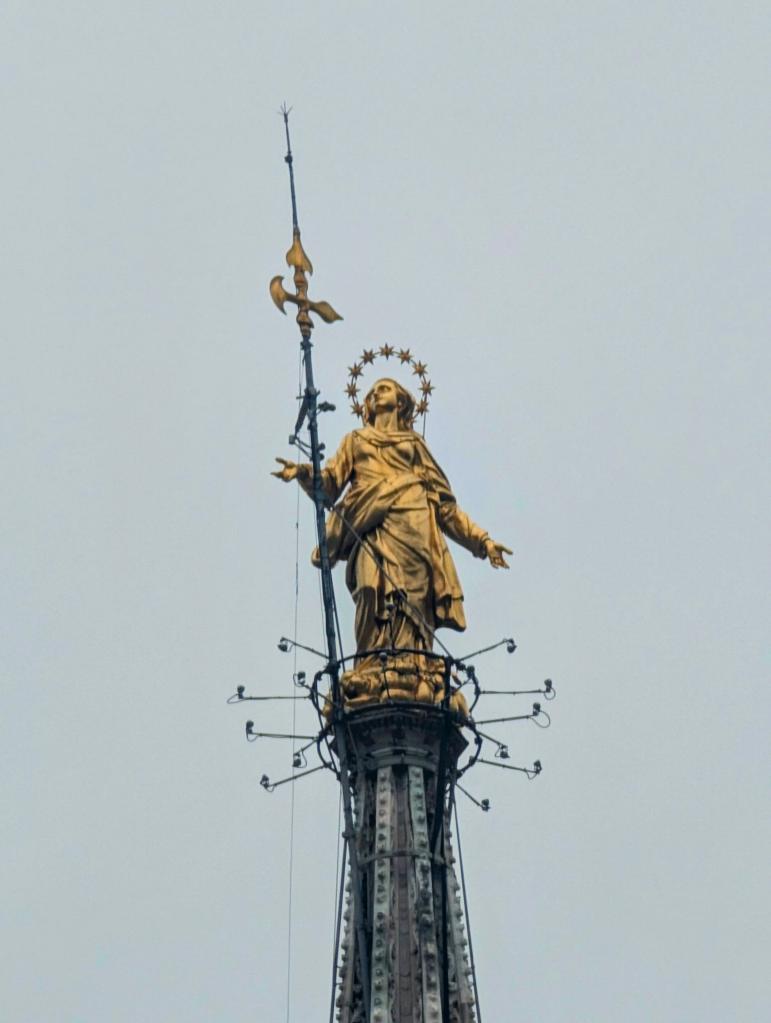
I particularly liked this small statue. There are so many of Mary in this cathedral dedicated to her.

As we began our descent, we got views of the city from the other side.
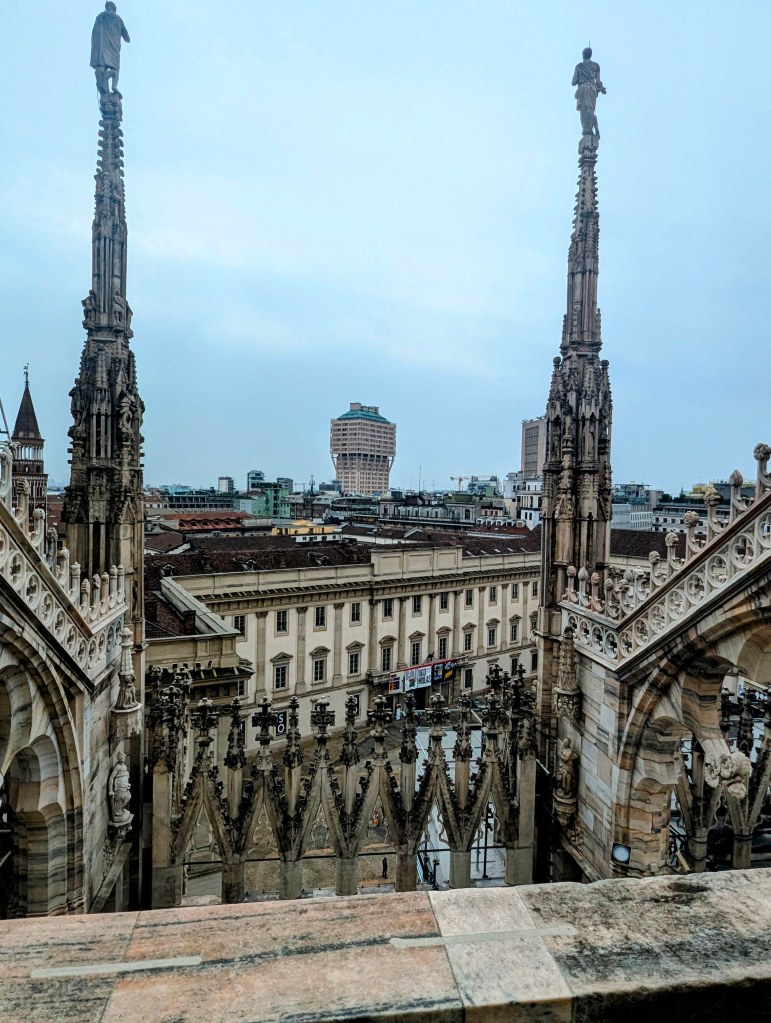
Finally we climbed down and entered the cathedral.
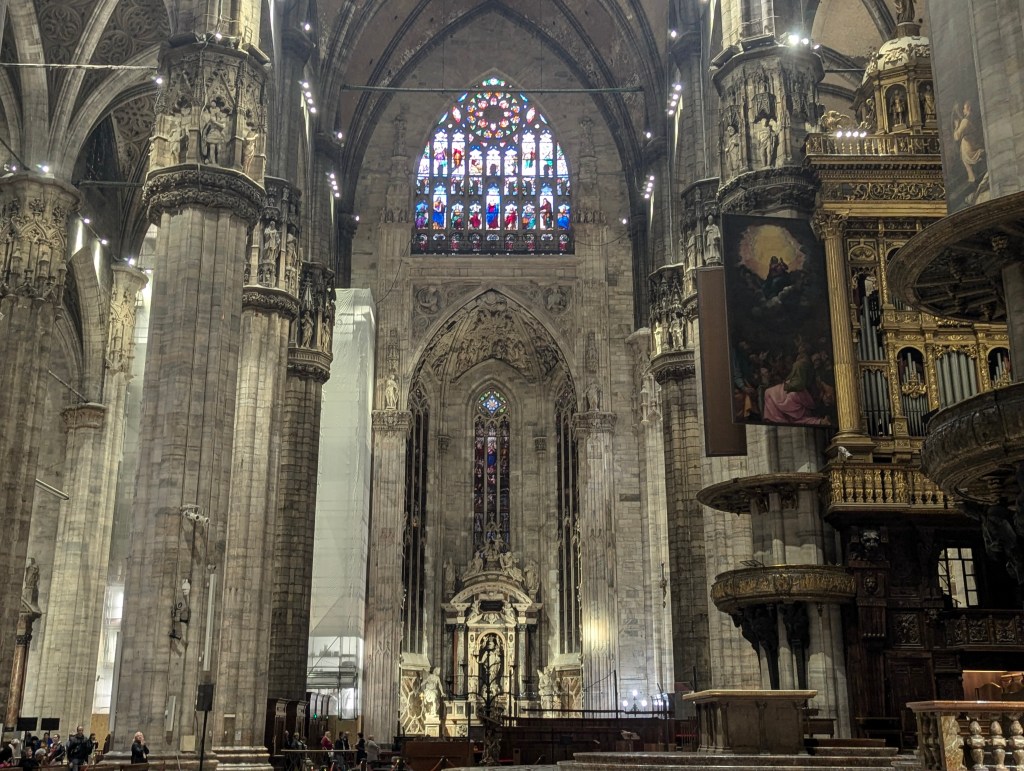
There are 52 pillars and 5 naves.

Over the entrance is the Assumption of Mary.
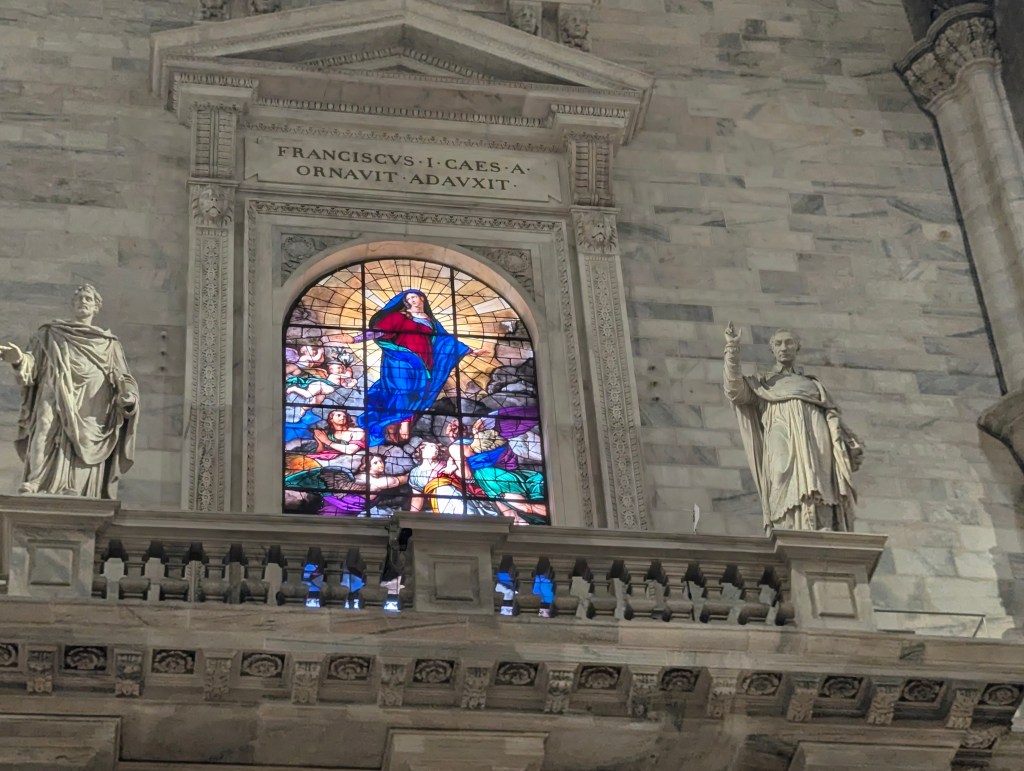
Right by the entrance is the tomb of Castrelli (I guess he deserved a primo burial spot after the gift of 35,000 gold ducats).
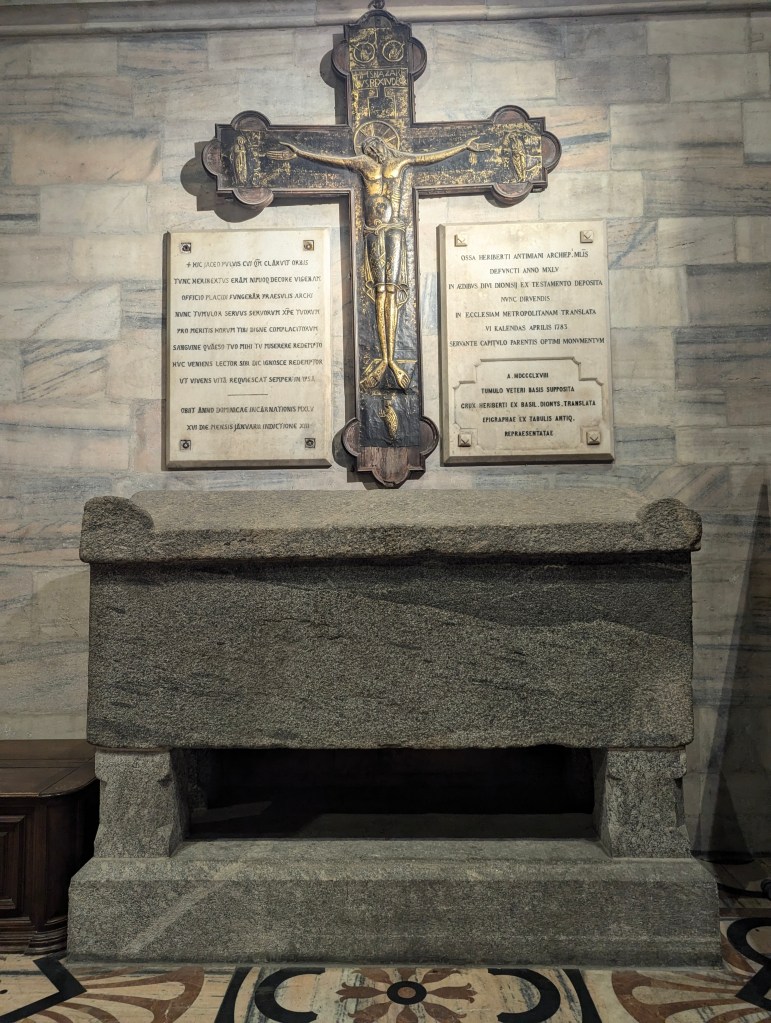
Also at the front of the church is a sundial. In medieval Italy before clocks, time was told by where a ray of light shone through a hole in the roof and landed on the floor below.

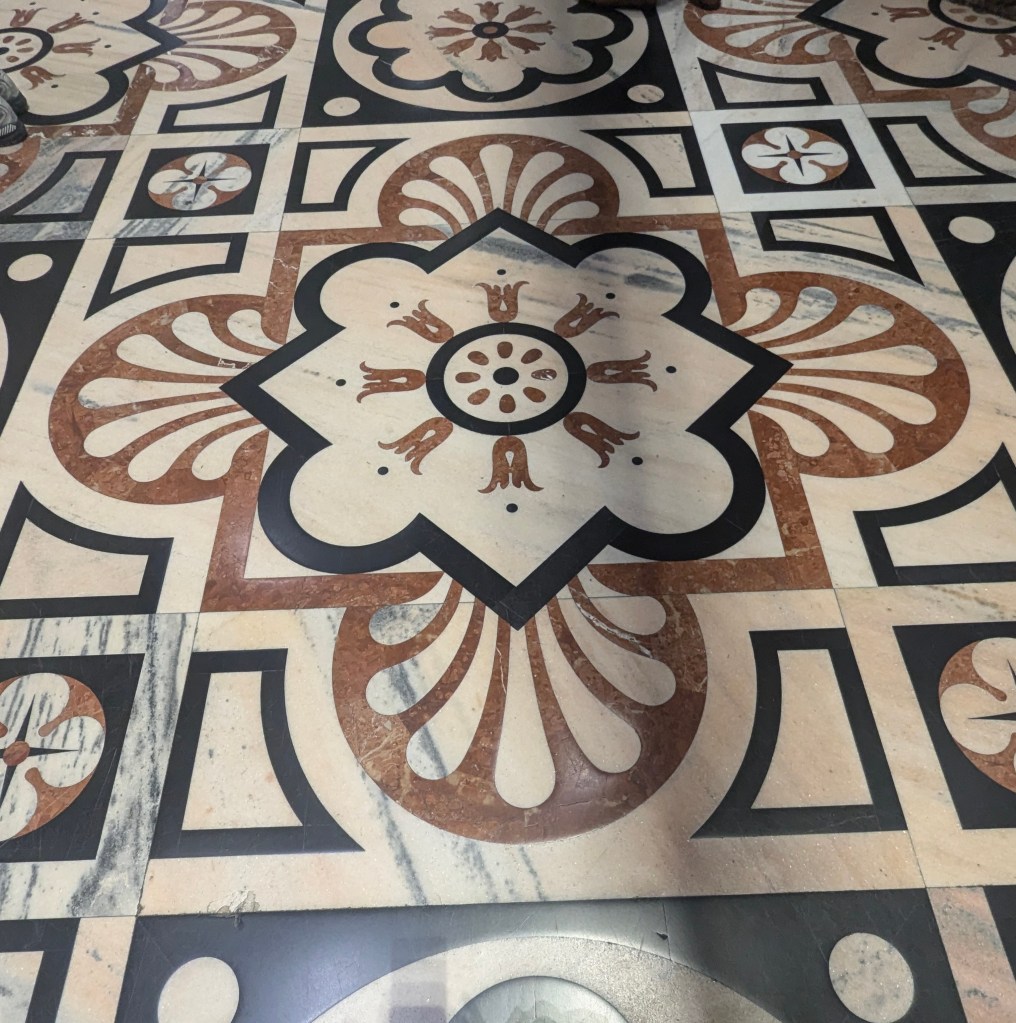
The floors are marble throughout.
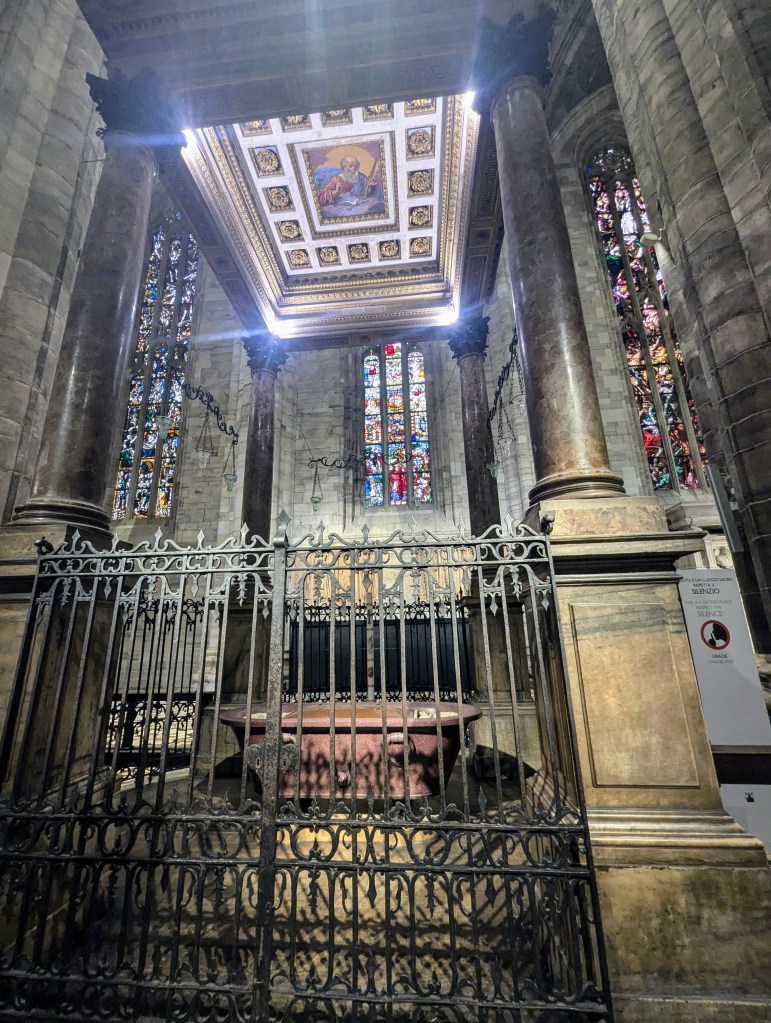
Near the front, opposite the entrance, is the Baptismal Font.
There are 164 large stained glass windows featuring more than 3000 characters. In each of the world wars more than 50 workers removed and wrapped the stained glass windows during the bombardments.
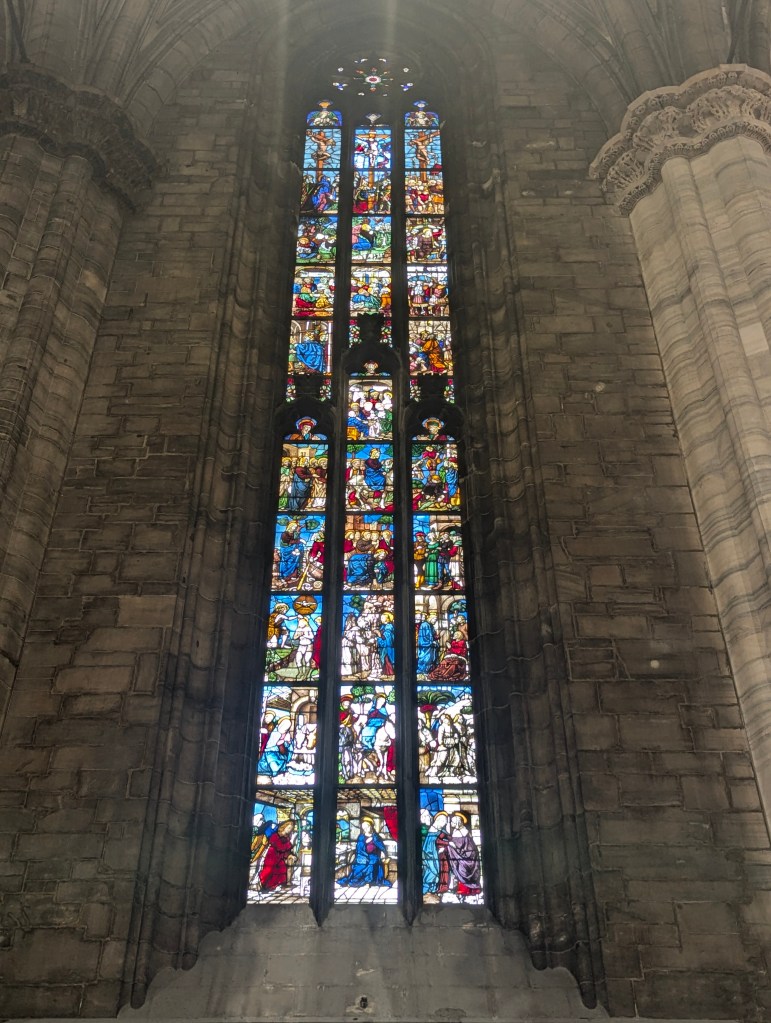
This one depicts the life of Christ with His birth at the bottom and the Crucifixion at the top.
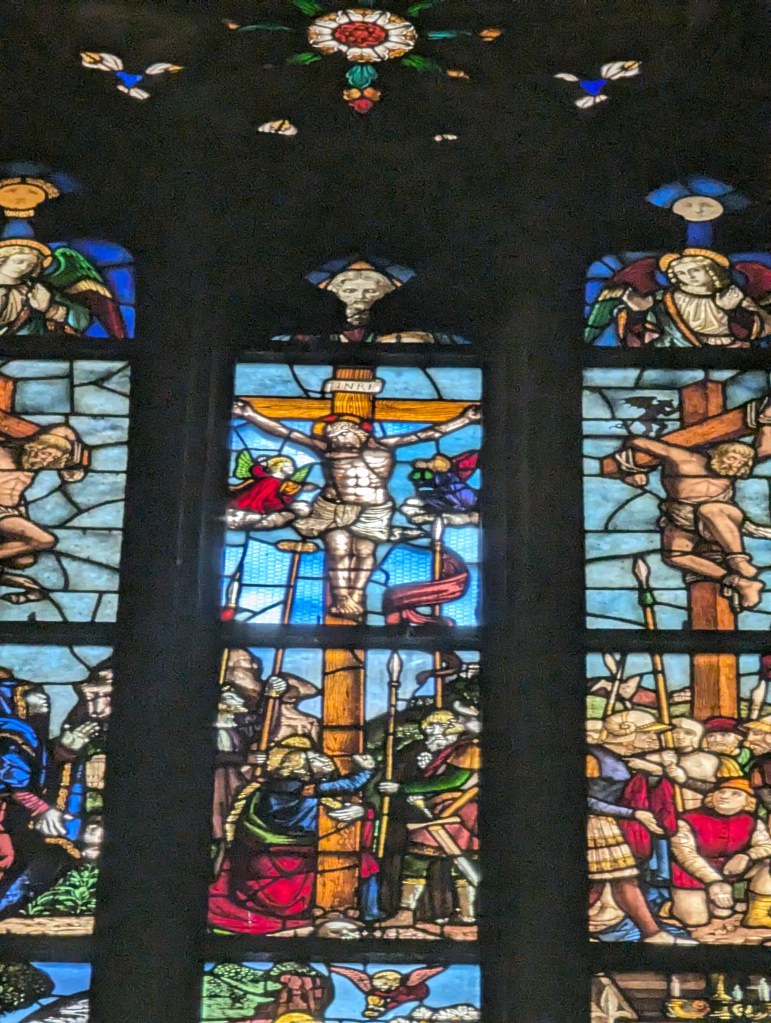
There is a large monument in the apse behind the main alter.

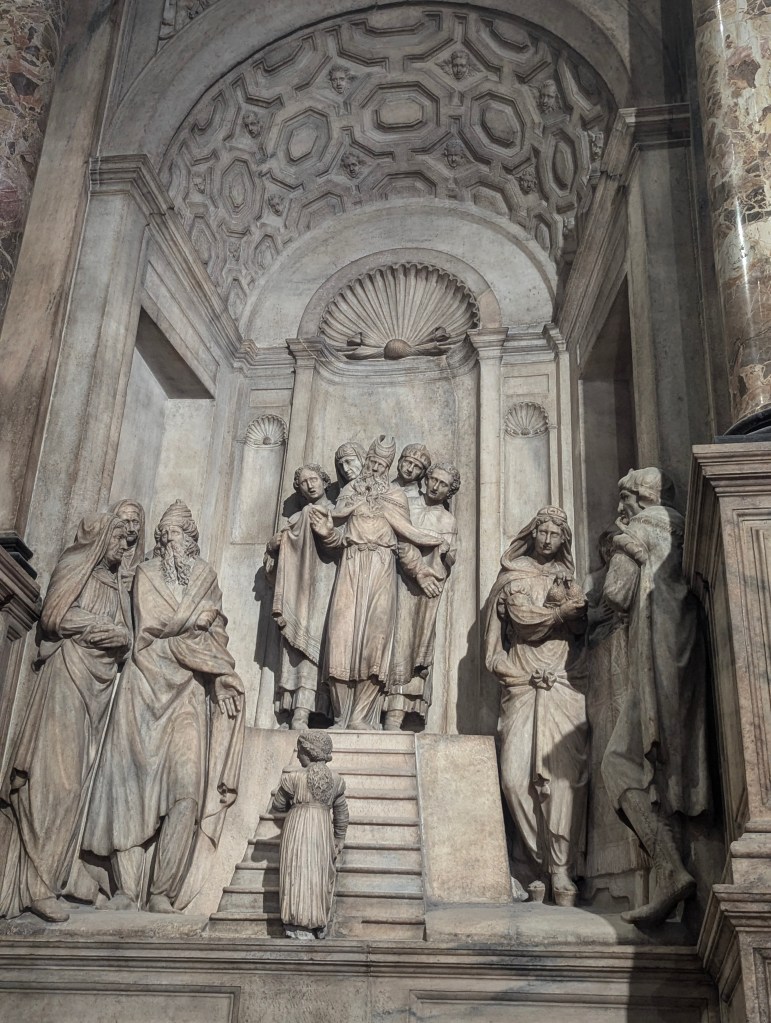
One of the side chapels, which is dedicated to Mary,
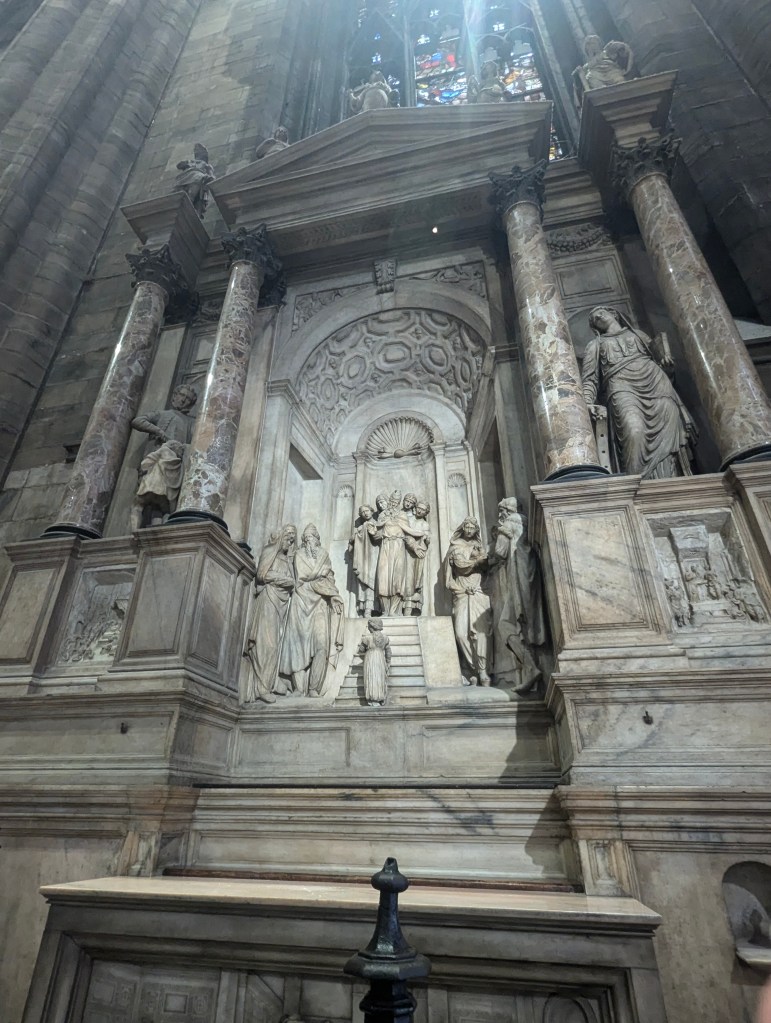
shows a statue in relief of Mary as a small child.
The organ is in the high alter.
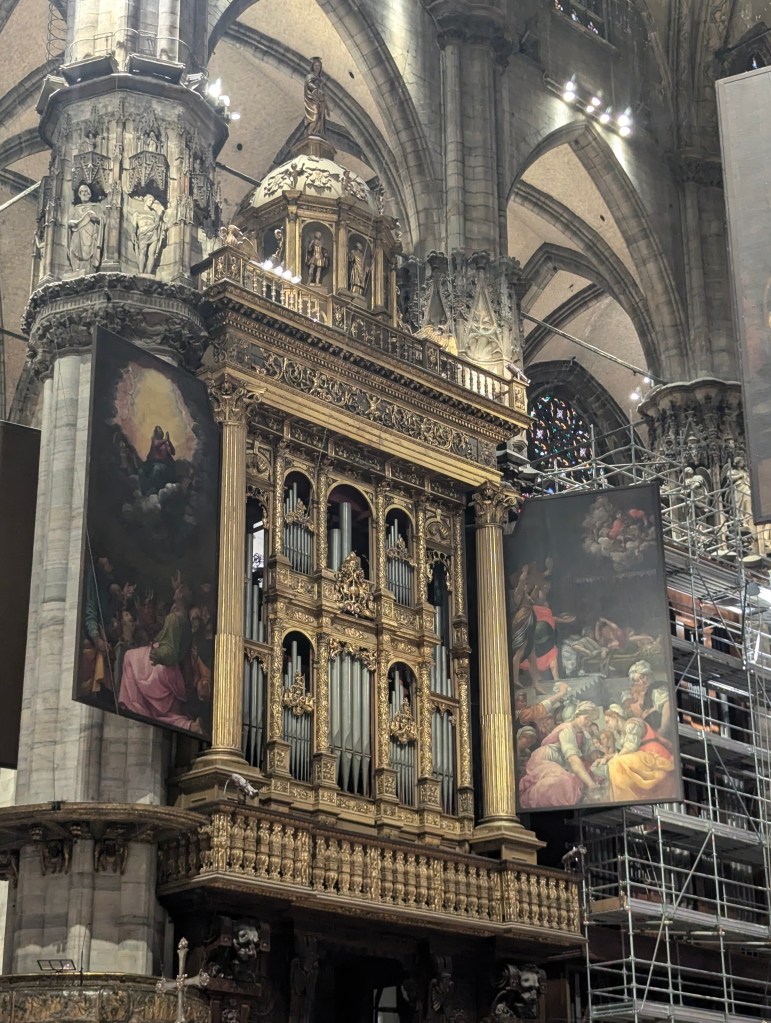
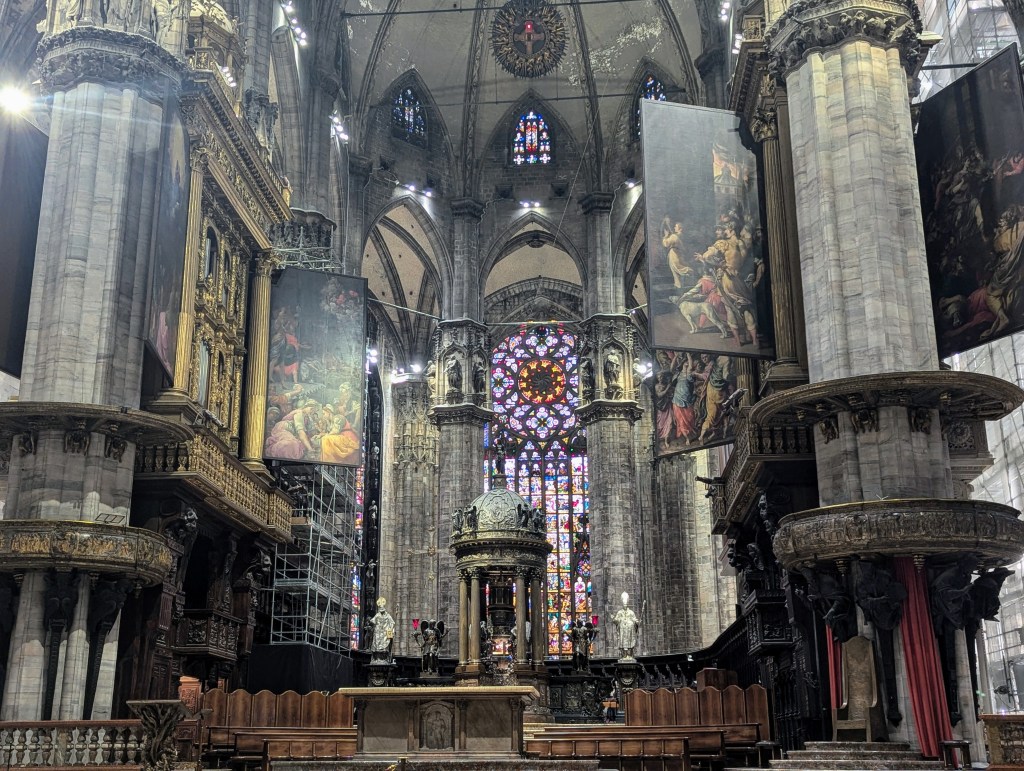
At the top of the high alter is a cross with a red light. The red light signifies where an original nail from ‘the cross of Jesus’ is kept. It is brought out every December 14th for 40 hours.

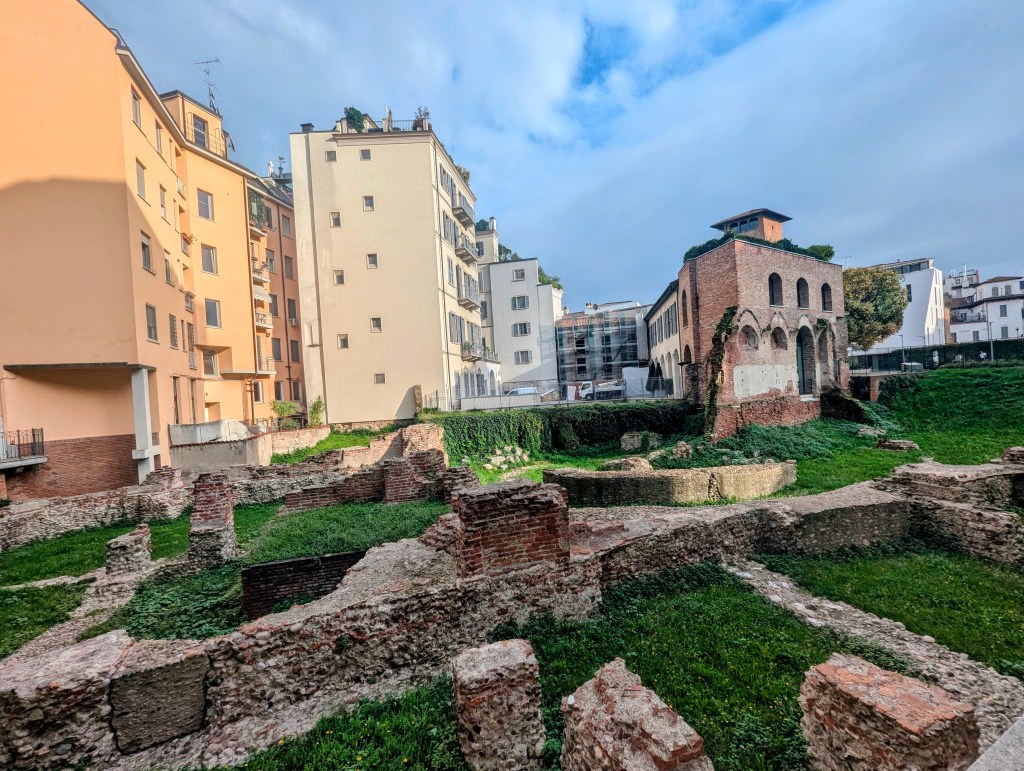
After a snack and a rest, we set out again to see the Castello Sforzesco. Along the way we passed these ancient ruins from the 4th century.
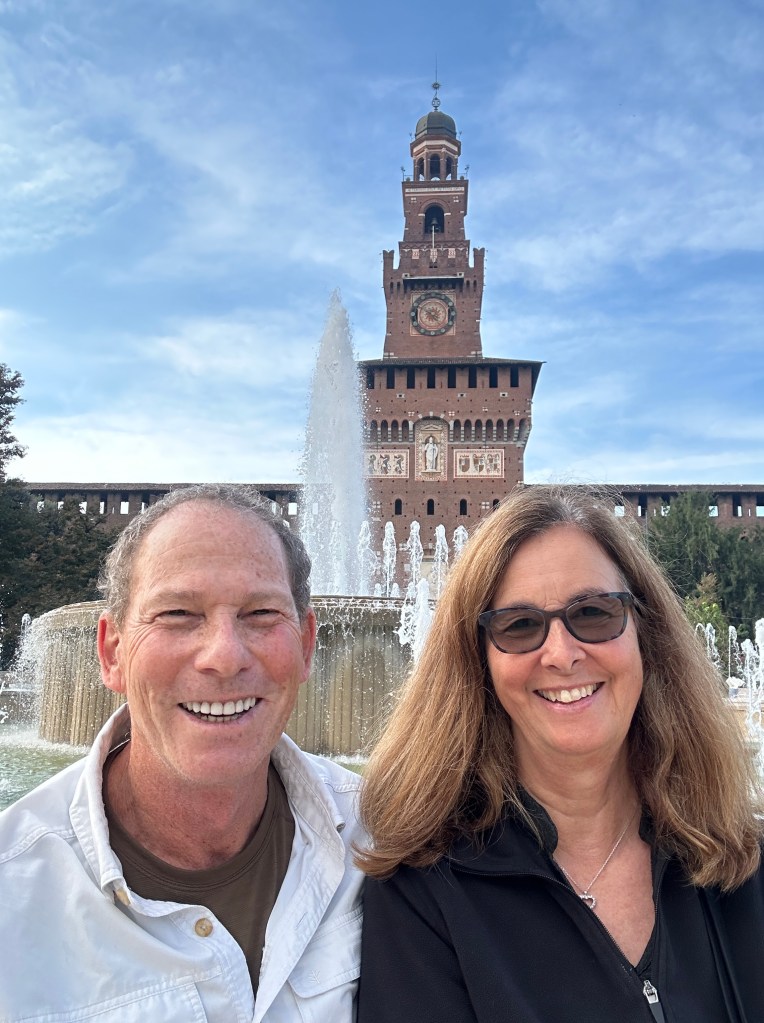
When we arrived at the castle we were dismayed to learn that the museum is closed on Mondays. We were able to spend some more time exploring the grounds of the castle.
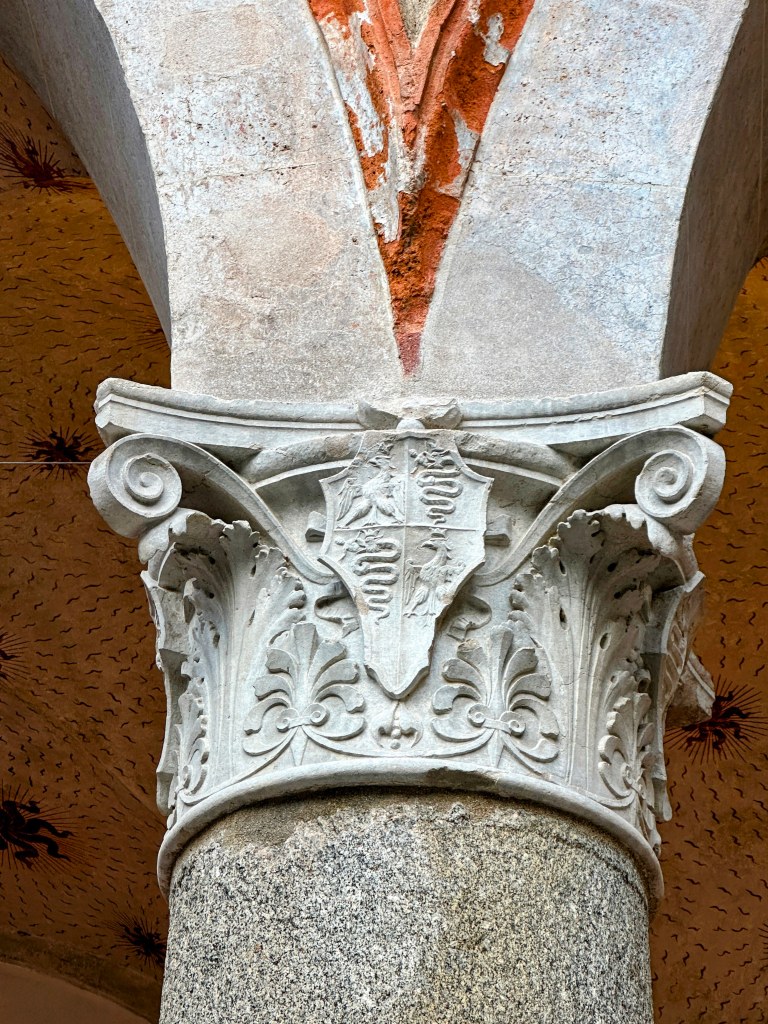
Now that the Visconti family shield had been pointed out by Marco, we saw it everywhere.
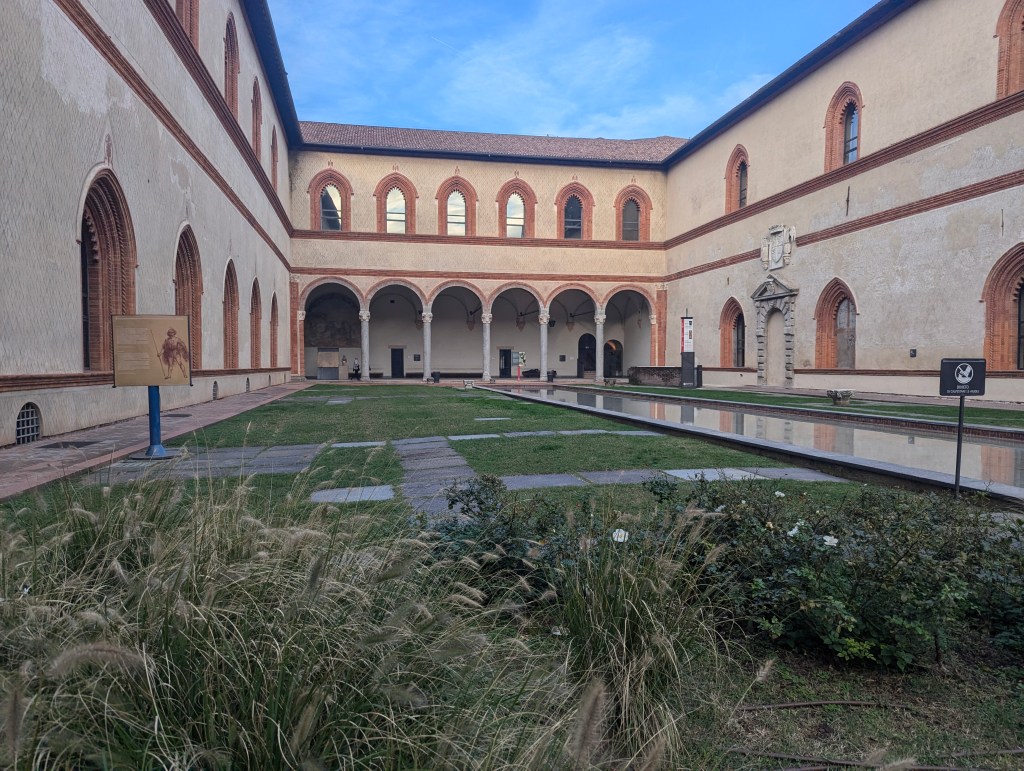
The Rocchetta courtyard had frescos that had been plastered over. They were revealed during an early 2010s renovation.
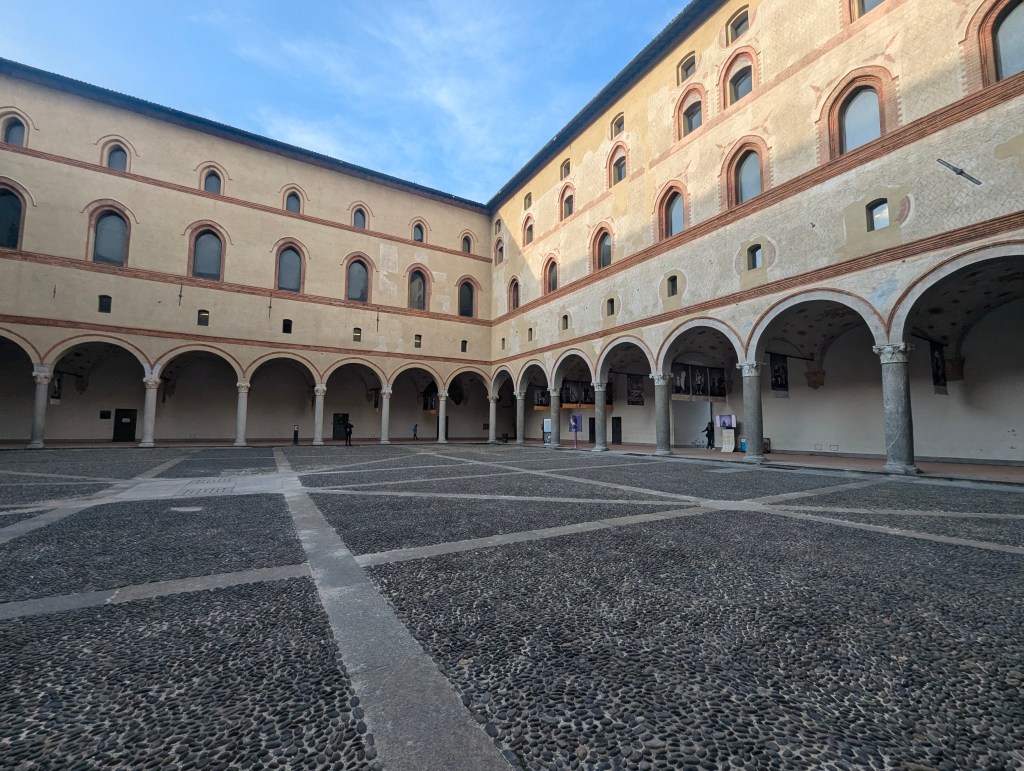
The restoration is yet incomplete on purpose to save some of the frescos for future generations.

The vaults are adorned with the Sforzo family emblems throughout.

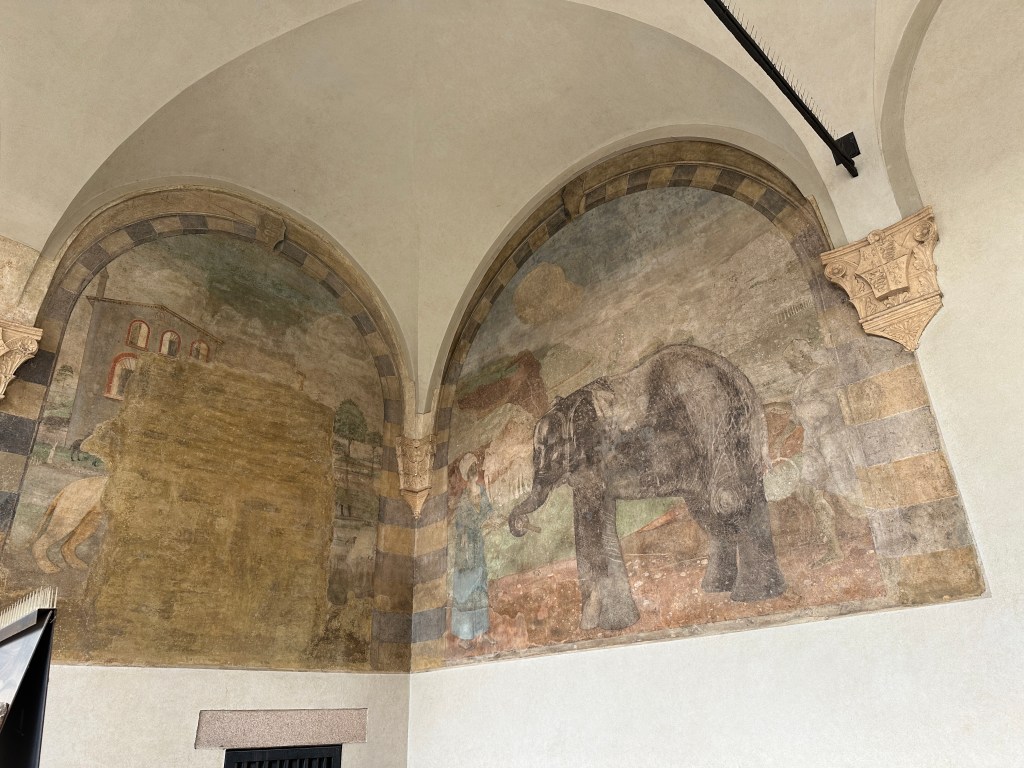
Another courtyard is called the elephant courtyard because of the elephant fresco revealed on the portico painted to look three dimensional with its surrounding architectural structures.
We walked through the castle out the back and saw what had been the moat.
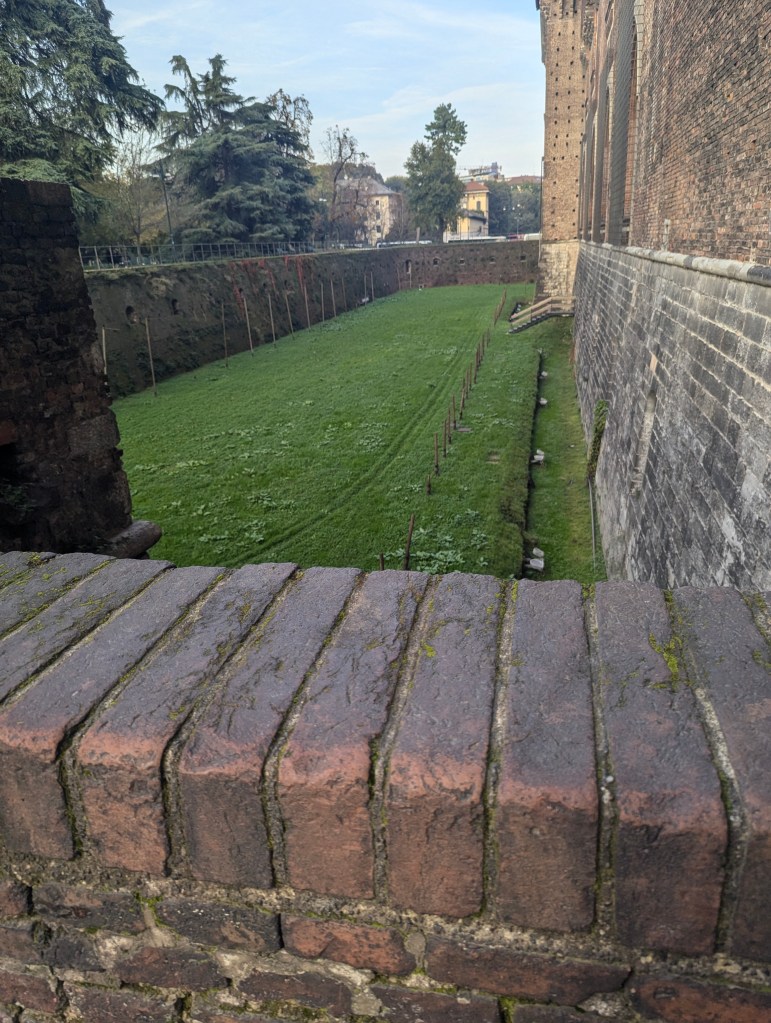
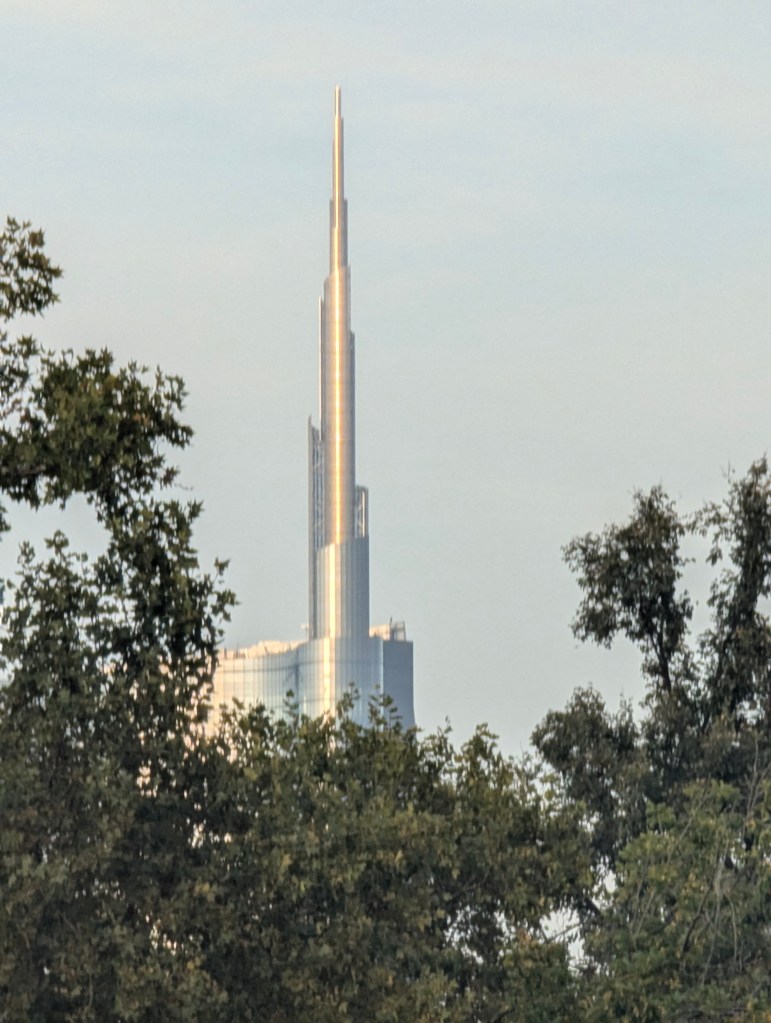
We headed to the park behind. From there we could see the Unicredit Tower in the distance.
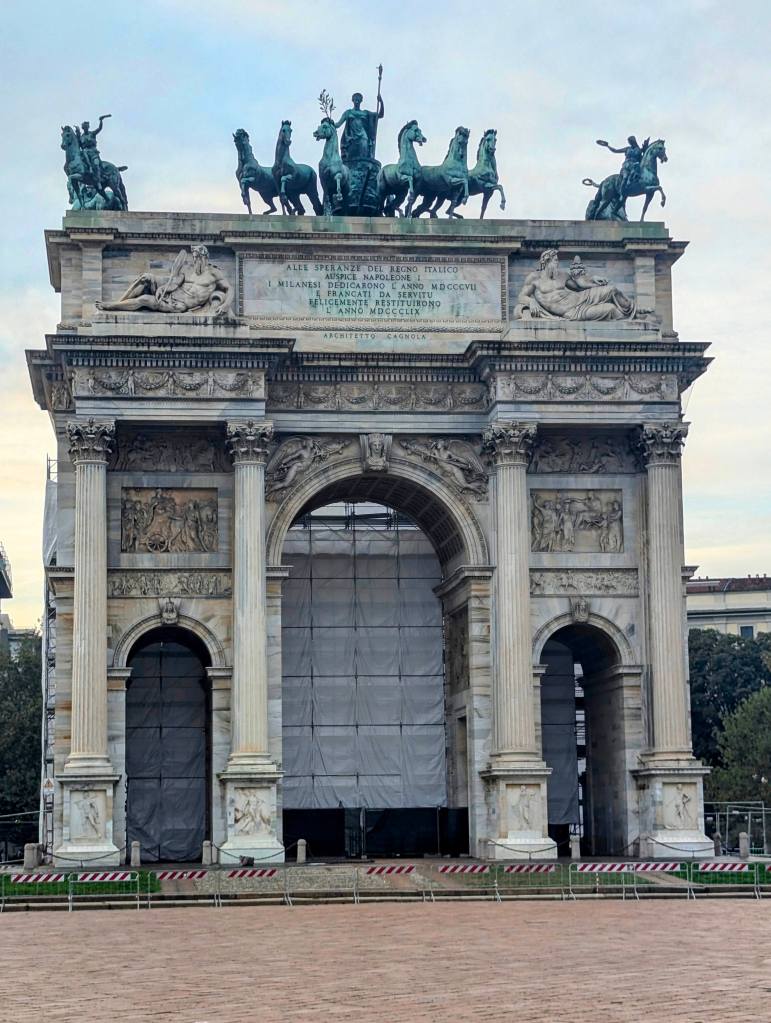
In another direction we could see Porta Sempione (“Simplon Gate”), the city gate. The name is used both to refer to the gate proper and to the surrounding district The gate is marked by a landmark triumphal arch called Arco della Pace (“Arch of Peace”), dating back to the 19th century. We headed over.


Beyond the gate our love affair with Milan intensified. We are ready to move into this neighborhood, if even for a little while.

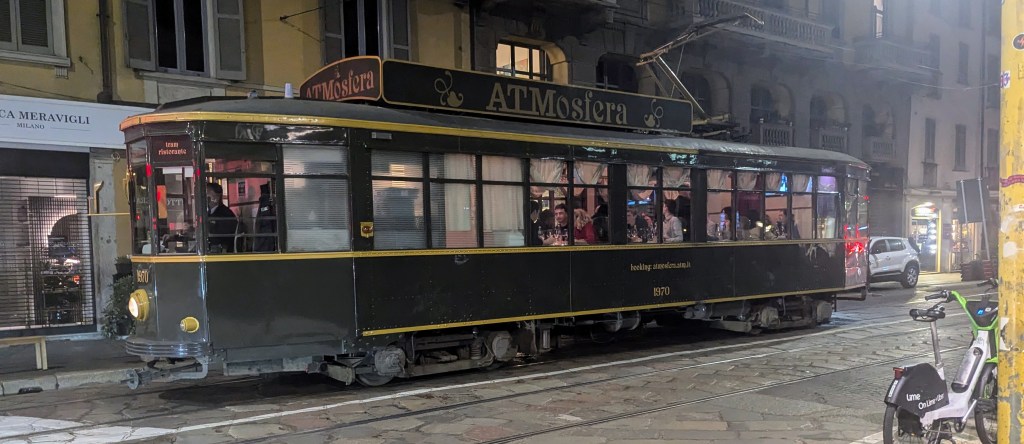
With the tree lined streets, the 1880 tram, and the gorgeous buildings, what else does one need?

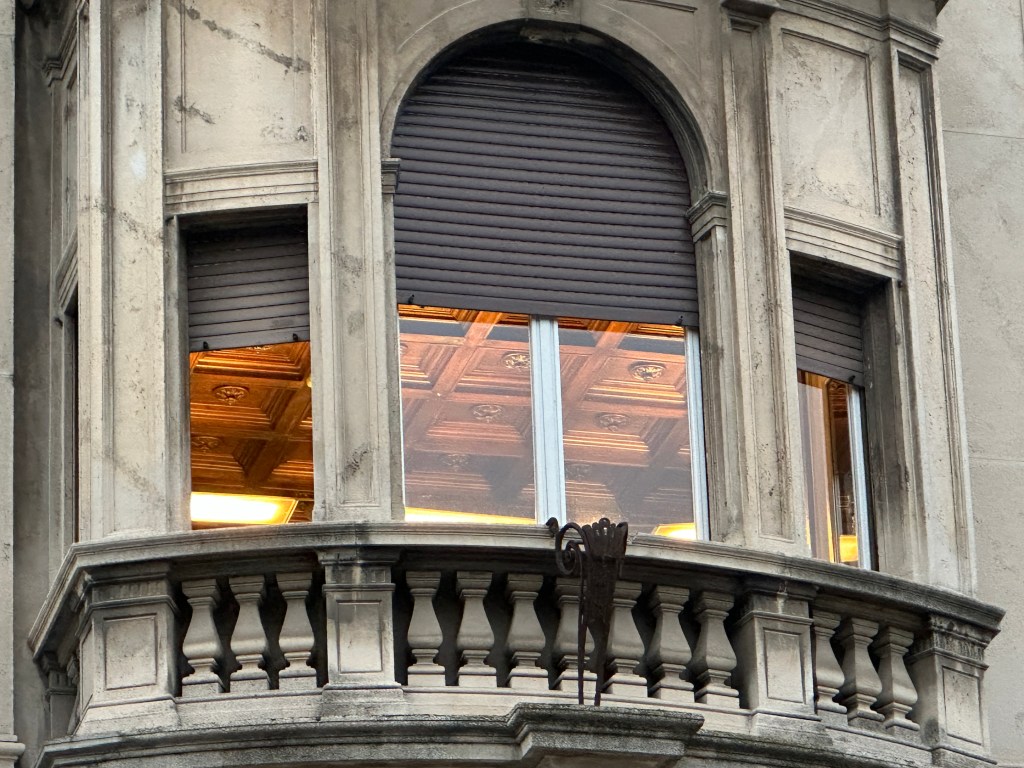
Just look at this apartment building: exquisite.

we could even peek into the ceilings: to-die-for
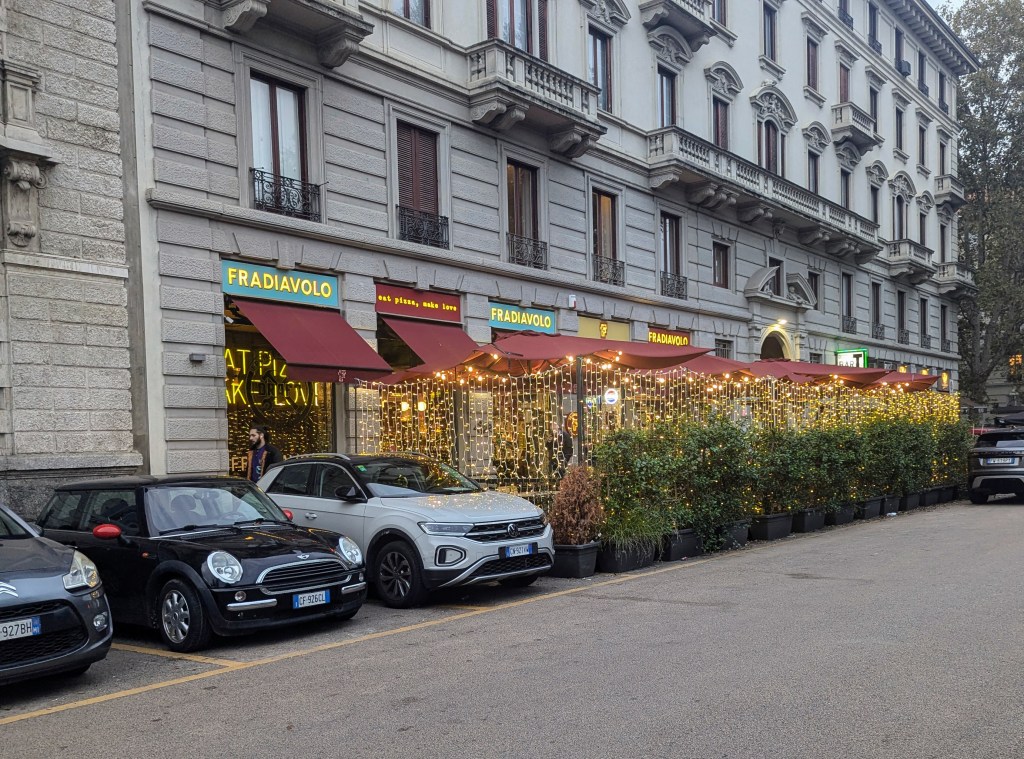
even a cute restaurant right on the block.
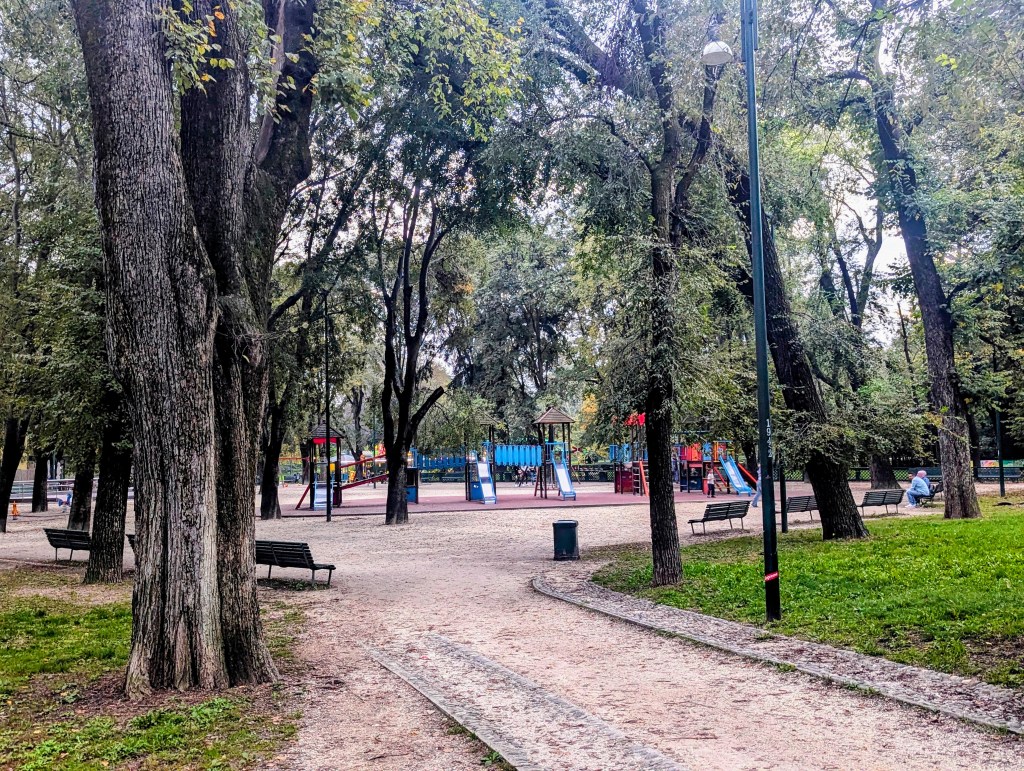
Heading back through Sempione Park, we went a different route and found this playground.
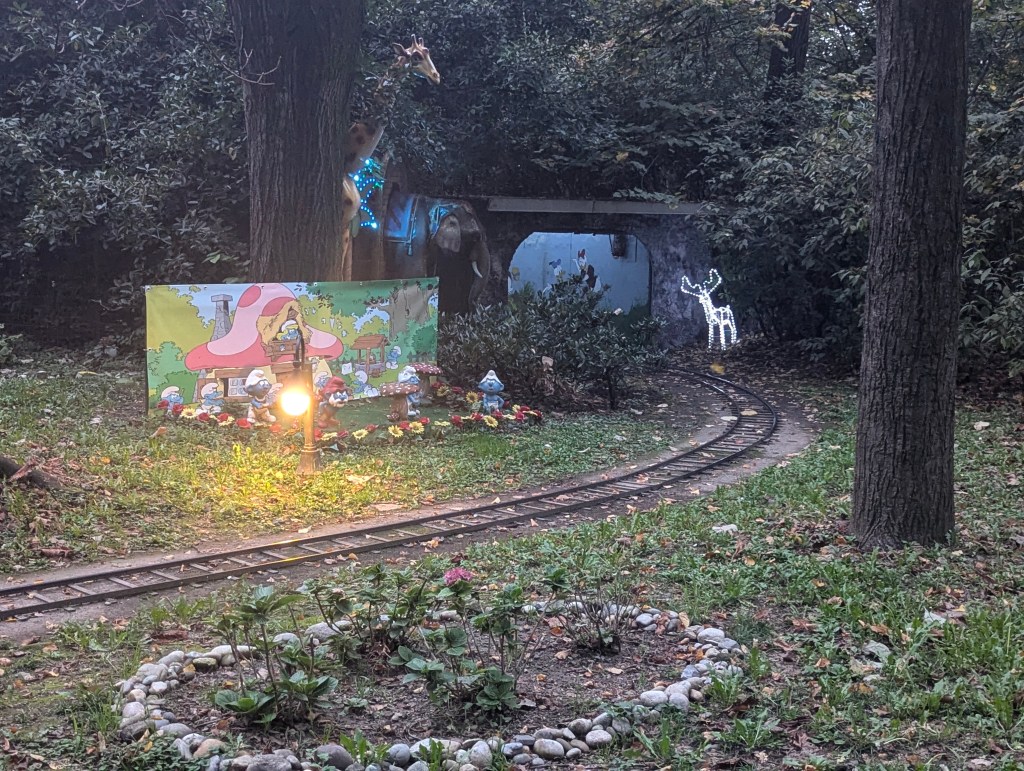
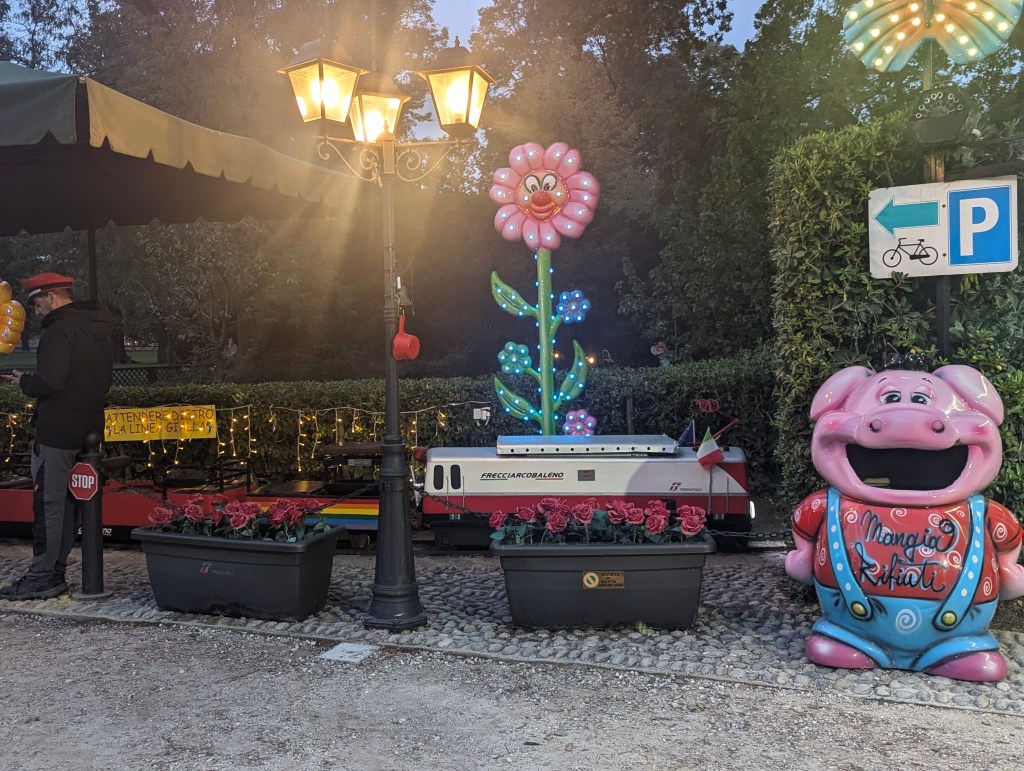
including a little traintrack. Took Eric back to his childhood days.
We even saw an exercise class happening in the park.

We saw what looked like a huge stadium and poked ourselves in to find a high school track event.

We passed back through the castle which was now lit up for the night.
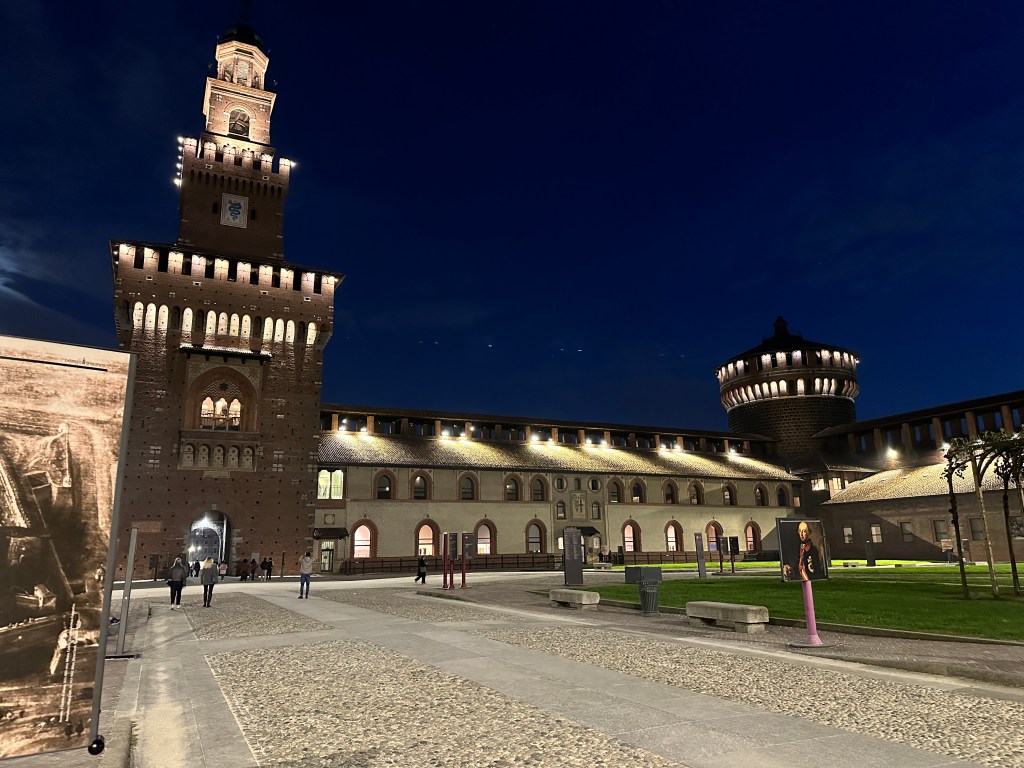
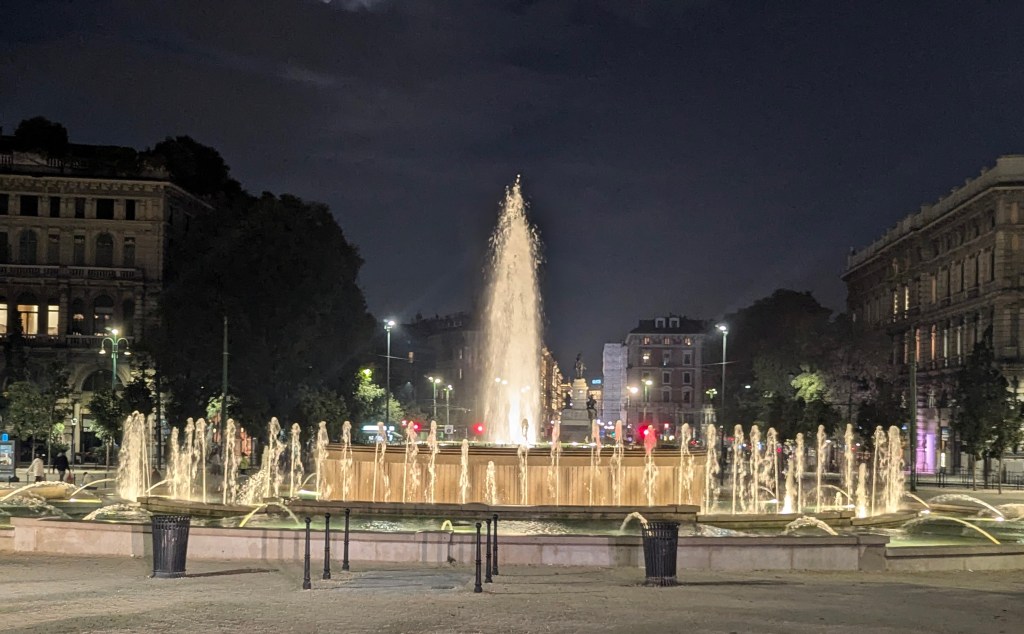

We were then passed by a dining tram, a first for us. We have seen dining trains and boats, but never a tram.
Our perfect day was topped by a perfect meal at Andry’s. One of the anecdotes told on the audioguide inside the Duomo was that of an artist who, while working on the yellow windows, as a prank, put the flower pistons he was using for dye into the risotto, and to the surprise of all, it was delicious. And so Milanese risottos (with saffron) was born. We tried it with shellfish, and it was truly delicious.
There is soooo much music, art, history, sooo many museums, and sooo many restaurants, we felt we had barely scratched the surface of this city. We hope to come back and stay for a month or two next time.
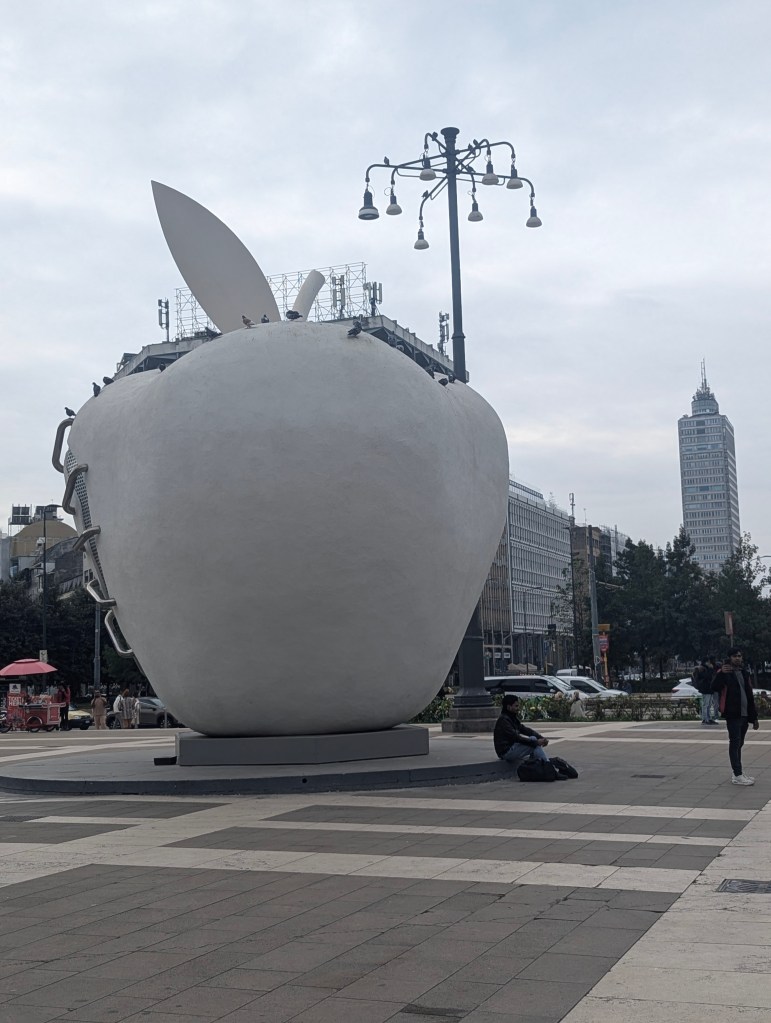
In the morning we took the metro back to the central station to pick up our rental car nearby. In the plaza outside the station we saw this, probably for the store brand, but for a New Yorker, who can resist a “Big Apple” photo shot?
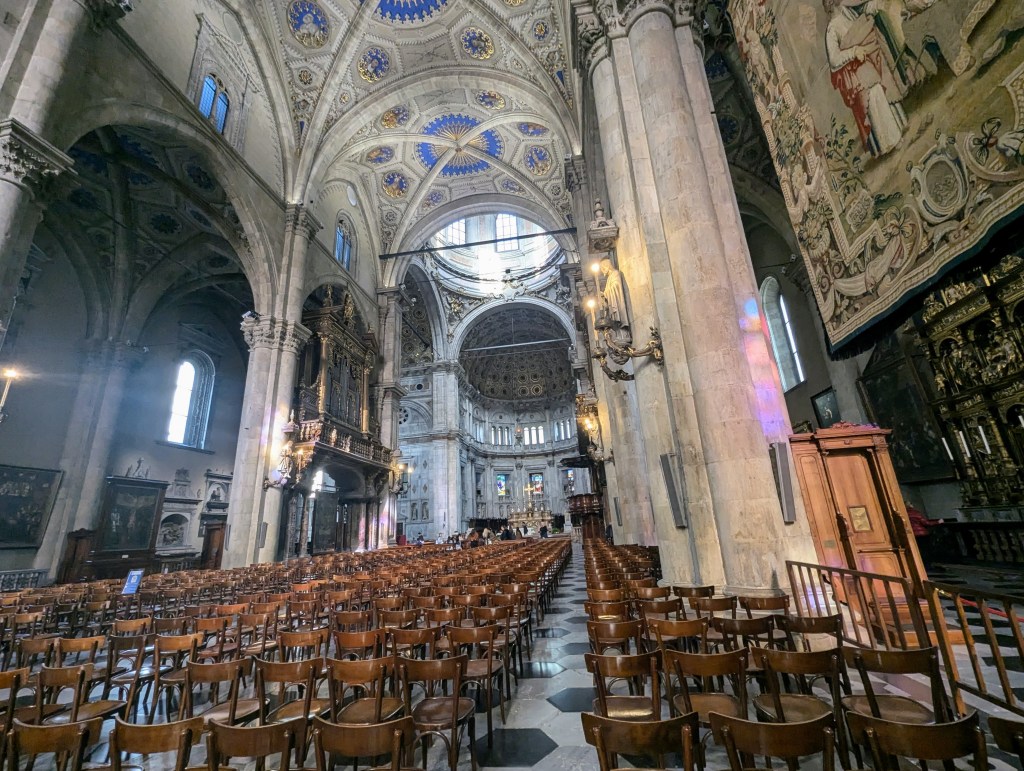
We drove north to Como where we had a room rented in an apartment building right by the water. We walked by the lake, but the weather was a bit cold and damp, so we headed toward the old part of the town. Our first stop was the Duomo di Como, reputably last Gothic cathedral built in Italy. Construction began in 1396, and although considered Gothic, it has Romanesque, Renaissance, and Baroque architectural style elements.

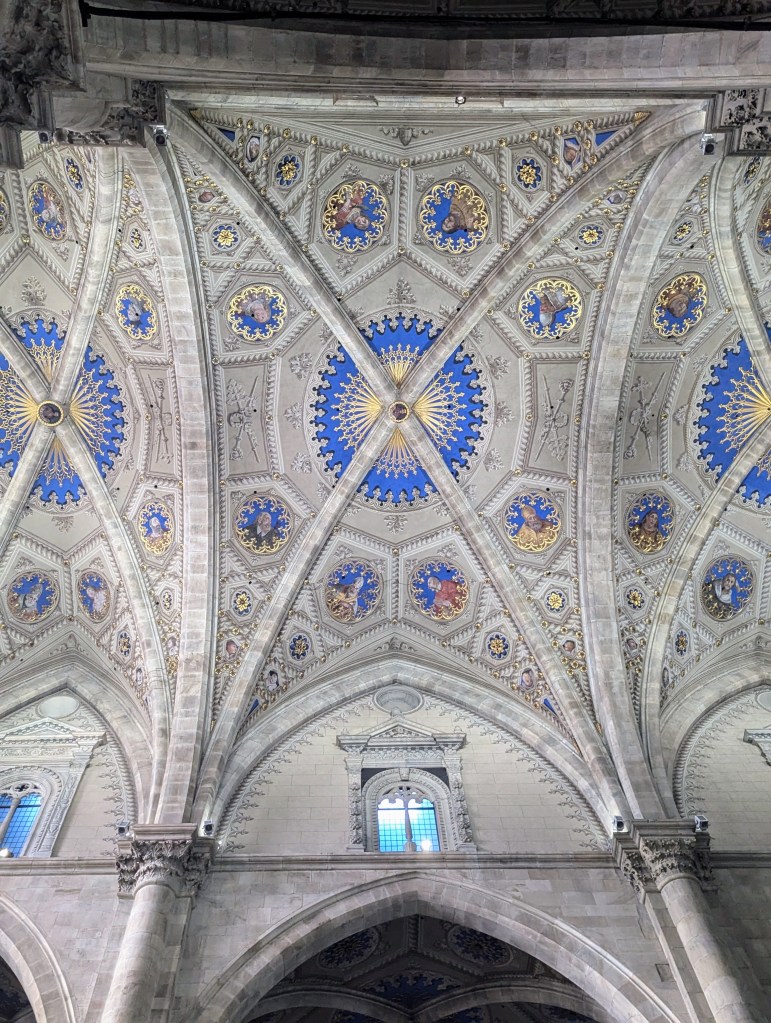
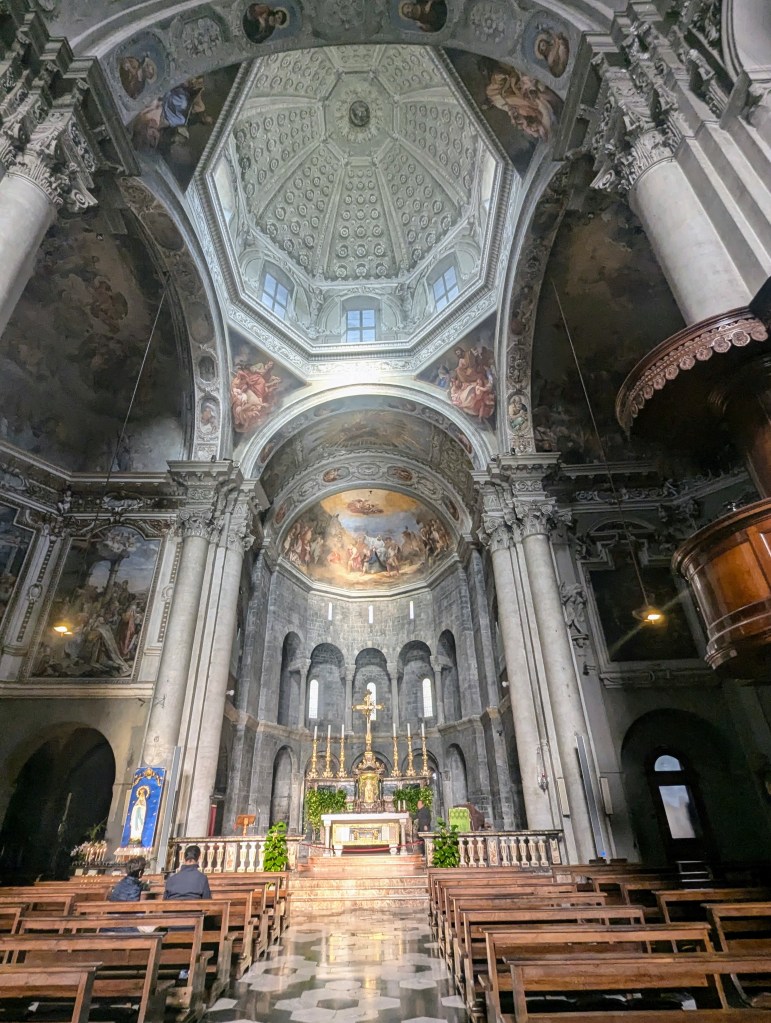
The 286-foot-long and 246-foot-wide cathedral has a Latin Cross plan. There are three naves and a Renaissance transept topped by a stunning dome.
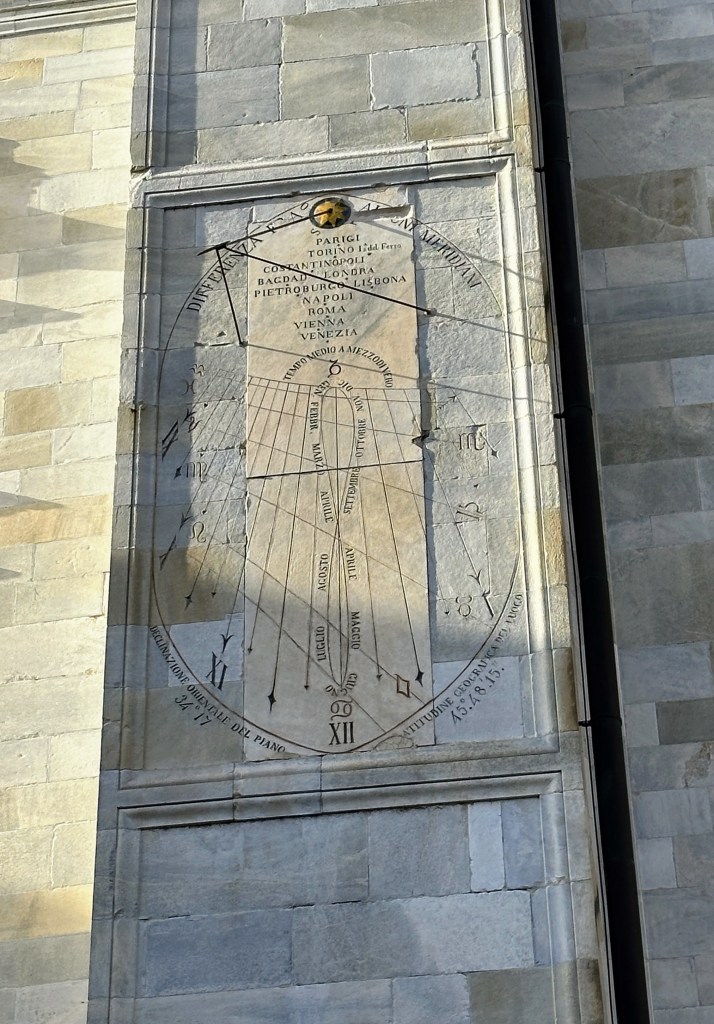
There is also a sundial, albeit different from the one in the Duomo of Milan.
Attached to the Duomo is the town hall, Broletto di Como (Old Town Hall). “Broletto” is an old term derived from the Medieval Latin word “brolo.” A brolo was a broad, walled field where people could have town meetings. Eventually, the brolo or broletto became the Town Hall. Today, it is a venue for exhibits and events. Originally erected in 1215, the Old Town Hall style is now a melange of Gothic-Romanesque-Renaissance elements.
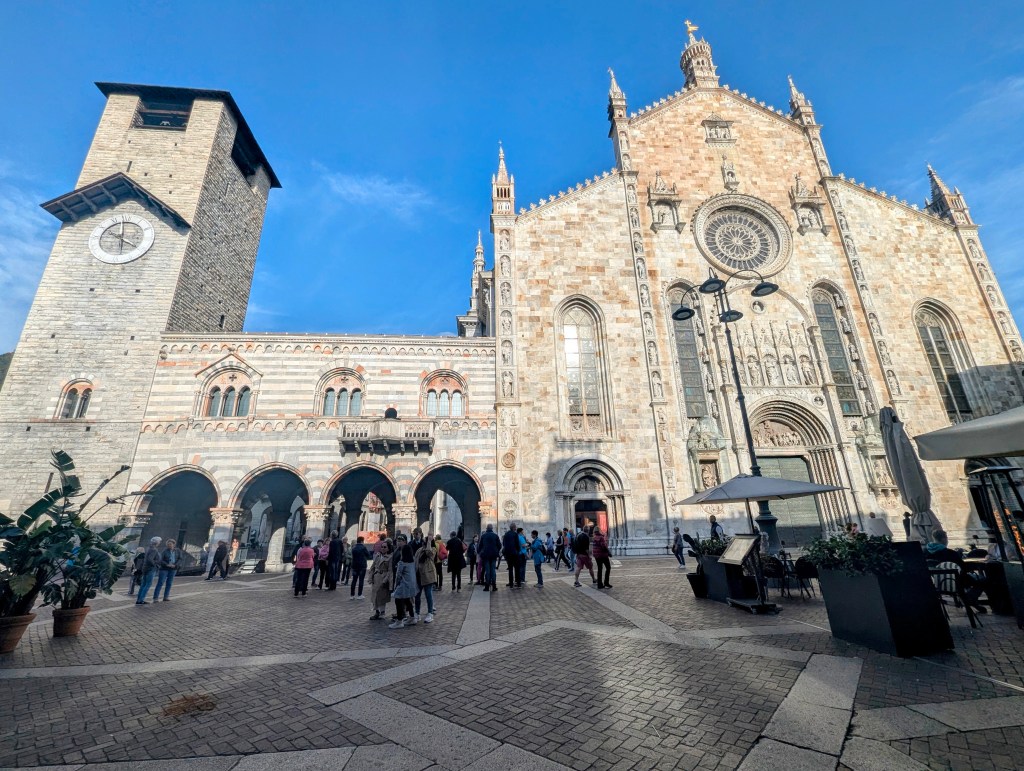
These buildings sit in a cute square
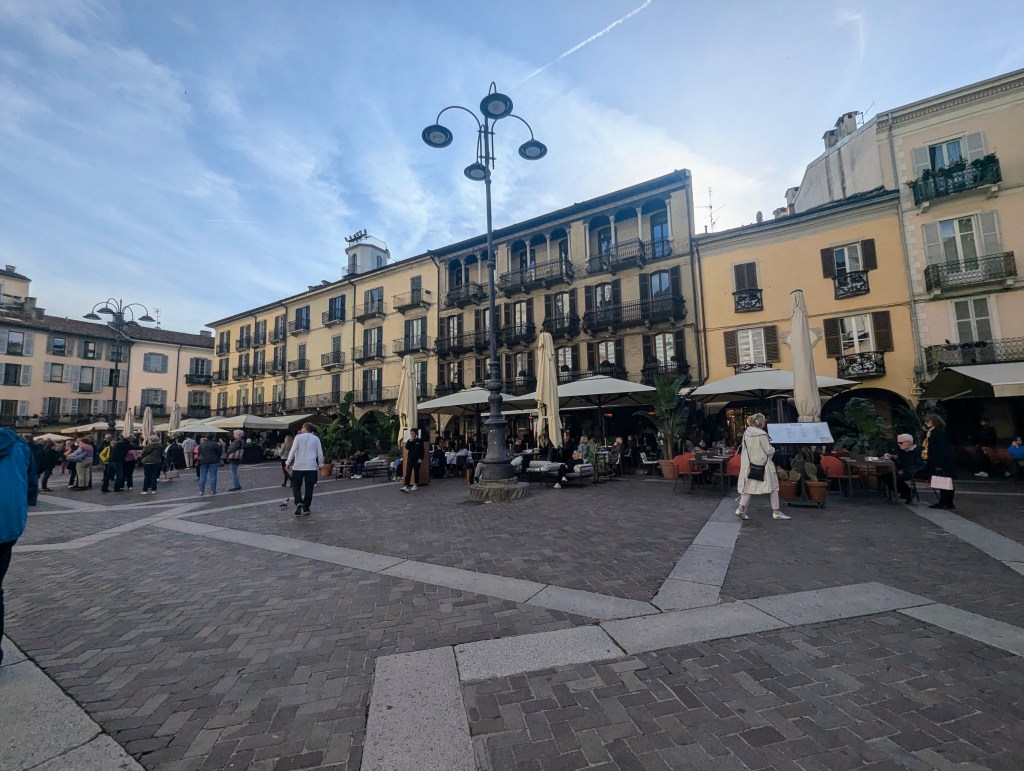
with elements of the iron architecture seen in Milan.

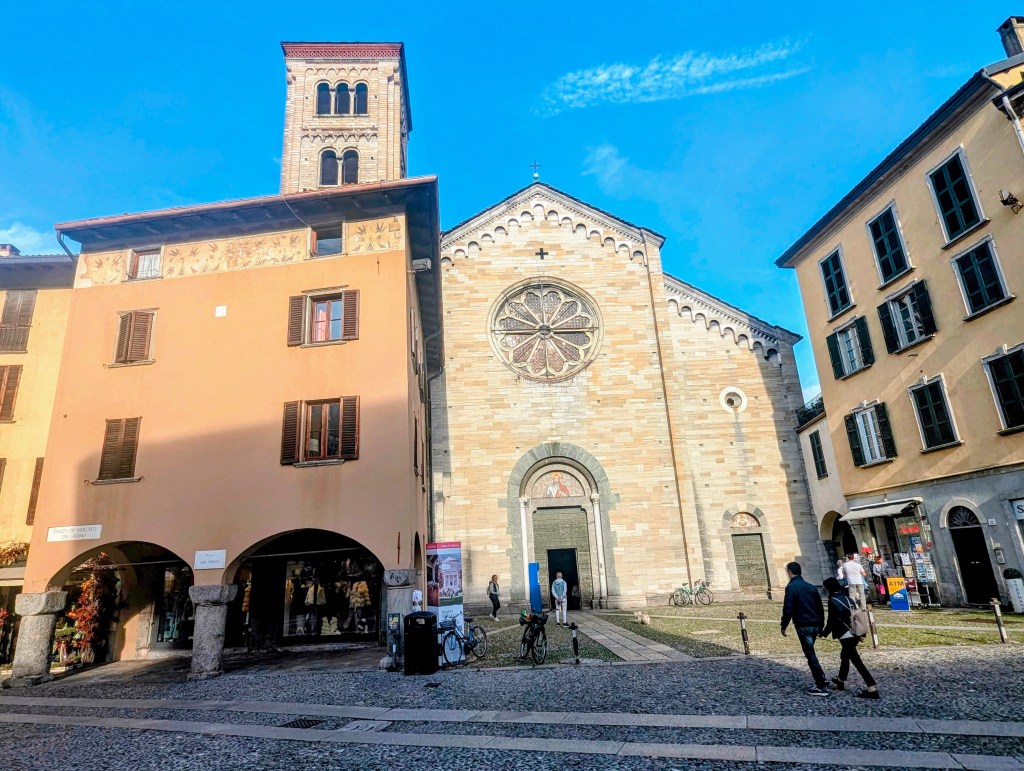
Next we visited Basilica di San Fedele (Basilica of Saint Fidelis). Saints Fidelis, Carpophorus, and Exanthus are celebrated as saints and martyrs in Como. Legend has it that they were three soldiers bent on converting pagans around Como. Ultimately they were martyred. The Basilica of Saint Fidelis is dedicated to one of these third-century martyrs. The church was erected in 1120 over a Christian church from the 7th century. The building features a Romanesque architectural style.
The ceiling is a barrel vault with a bone-arched pediment.

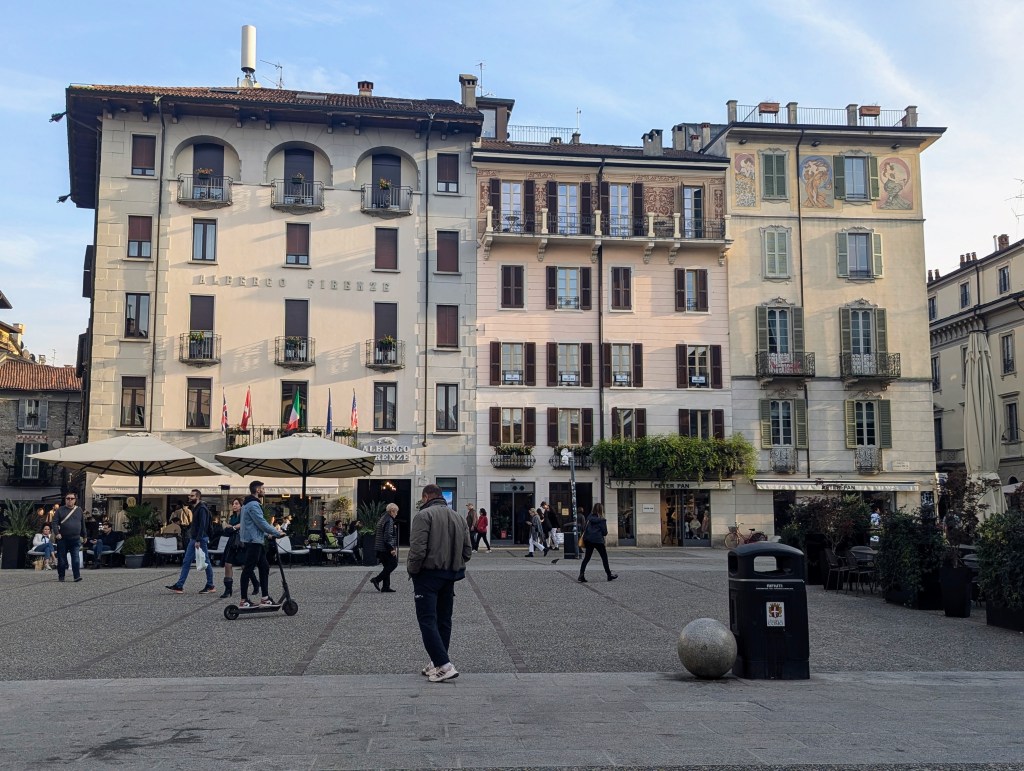
As we ventured further into the old town we happened into this square.
Here we found a statue of Volta. Alessandro Giuseppe Antonio Anastasio Volta ( 1745-1827) was an Italian chemist, physicist, inventor of the first electric generator, discoverer of methane gas, and inventor of the Voltaic Pile, the first electrical battery. He was born and lived out his last days in Como. The monument to Volta was erected in Como in 1838. Volta stands atop the high pedestal in a toga. His left-hand holds a book. The right-hand rests on the Voltaic Pile.
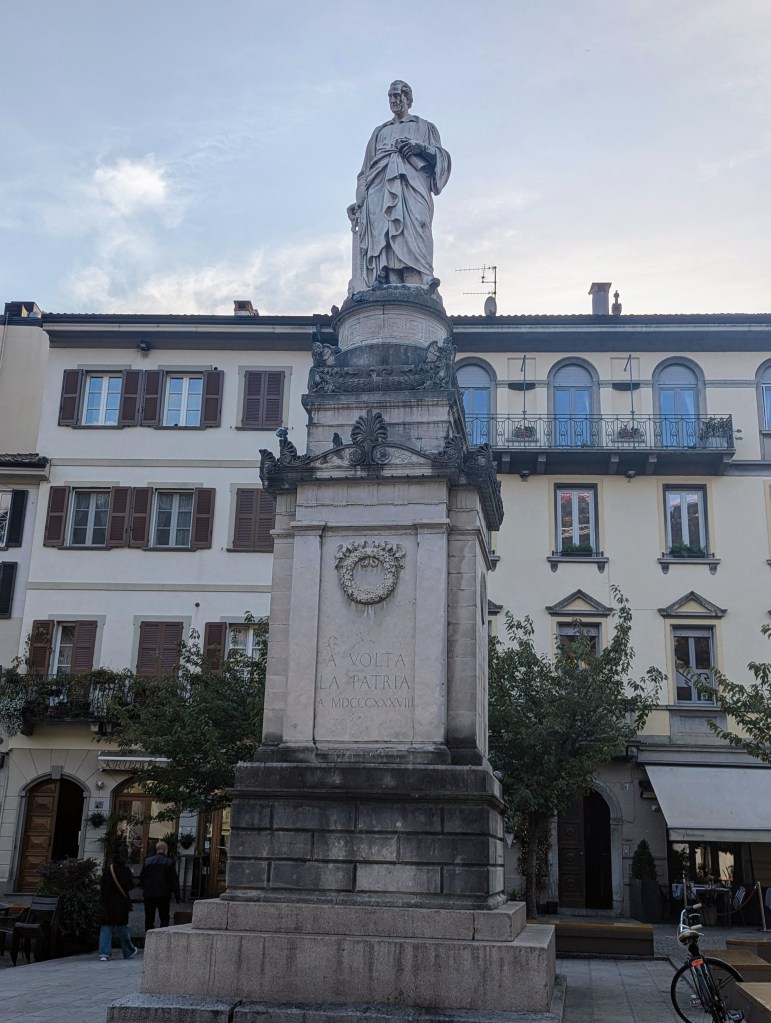
We then headed back toward the lake. We passed through Piazza Cavour (Cavour Square), the main square of Como and the heart of the historical center of the city.

We crossed back toward the lake.
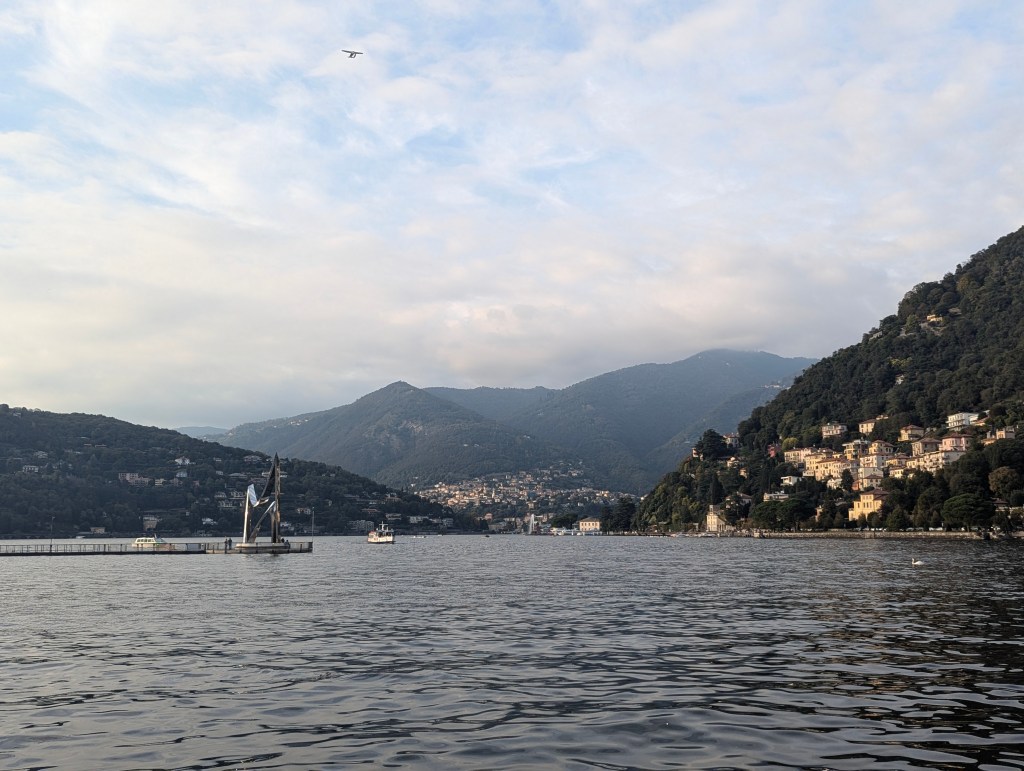
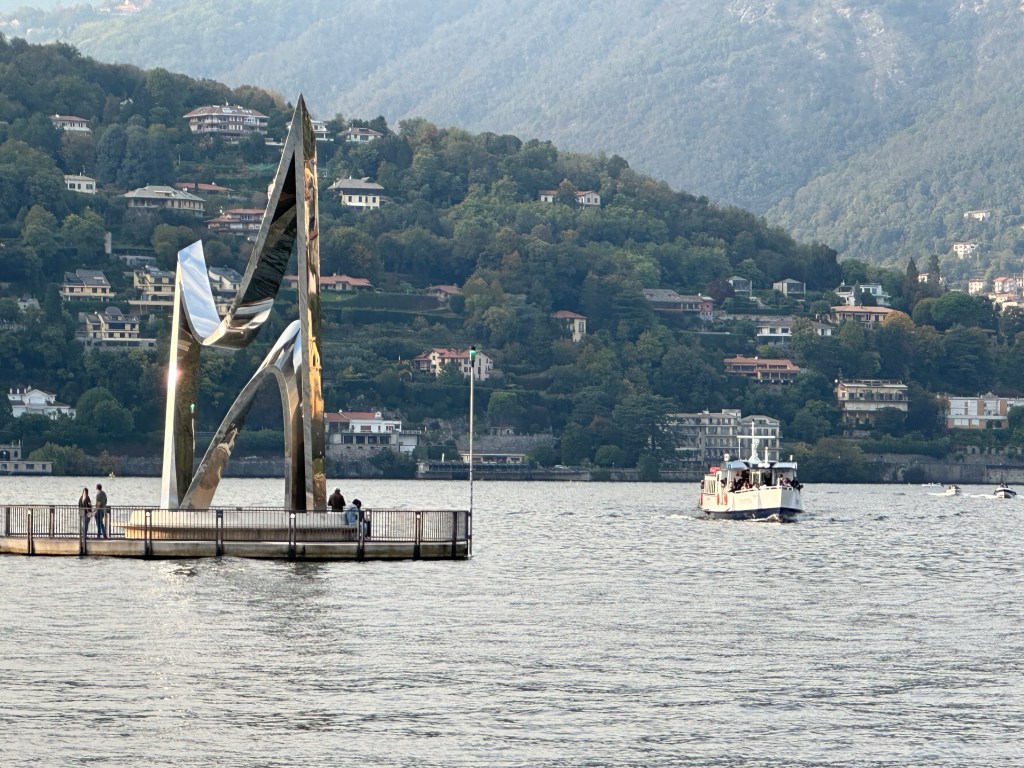
There we spied Life Electric, a sculpture celebrating Volta. It sits on the end of the Breakwater Pier (Diga Foranea) and was inaugurated in 2015. Life Electric was inspired by the tension between two poles of a battery.
For dinner we headed back into the old town to Rive Enoteca, a restaurant charming in every way, including the centerpieces.

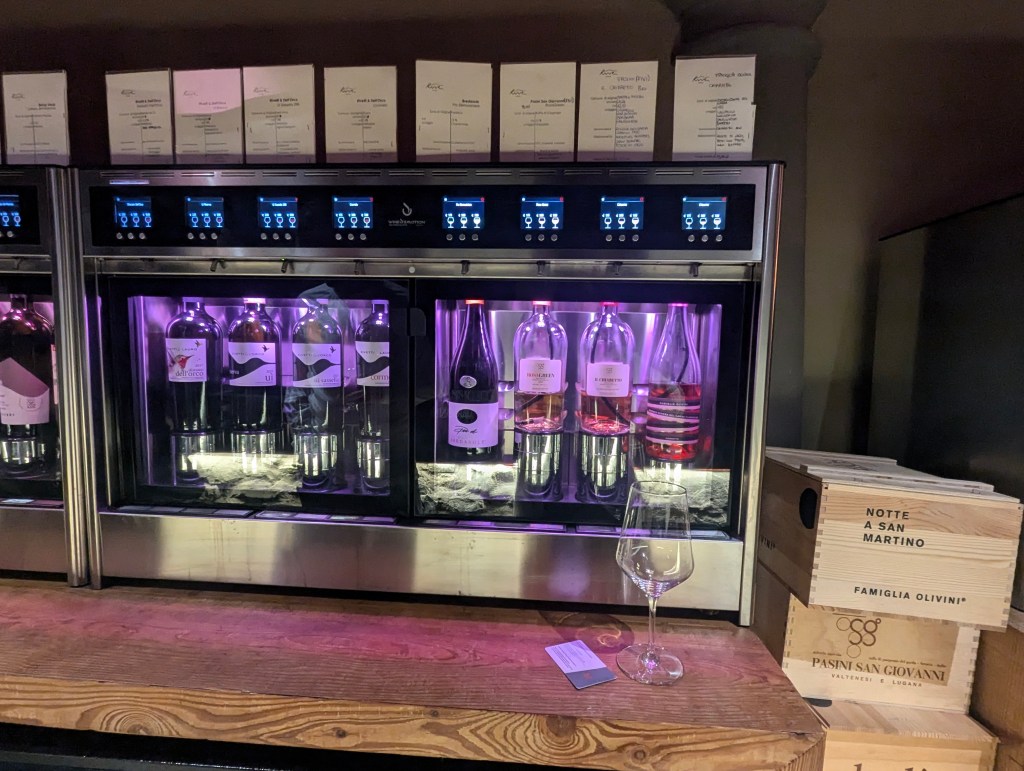
We enjoyed another Milanese saffron risotto, this time with chunks of ossobuco. Rive Enotica also had a self-serve wine bar, a new experience for me. Between us we were able to taste 7 different wines with our 3 courses, heaven.
Unfortunately, the next day the weather turned cold and rainy. We drove and met Howard and Georgia in a cute restaurant by the lake in Malgrate. But once we got back to Como we hunkered down for the rest of the day.

























































































 Jo & Eric's travels