
We arrived in Zurich on an absolutely gorgeous warm sunny day. We were immediately struck by the size of the train station with 44 tracks on two levels and one of the largest shopping malls we have yet encountered. It is the largest railway station in Switzerland. The city’s central location in the continent has historically made it a railway hub. It currently serves over 2,000 trains per day, making it one of the busiest in the entire world. In front is a monument to railway pioneer Alfred Escher.
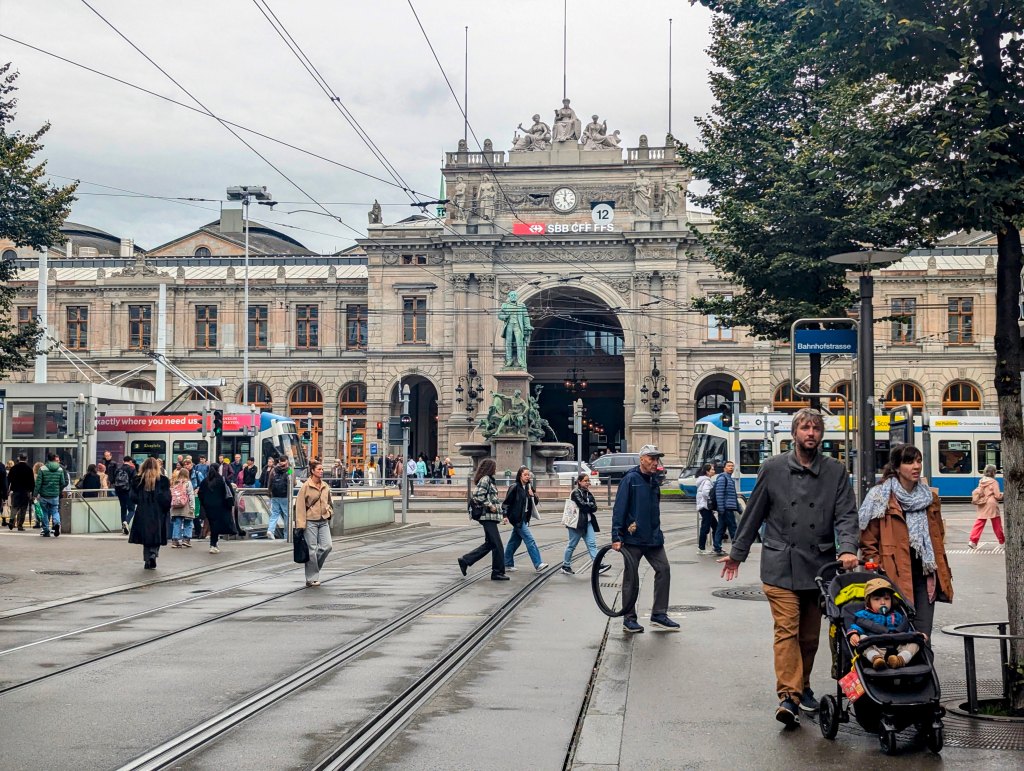
Zurich Hauptbahnhof
Walking from the station we crossed the Limmat River and got our first view of the Old City.
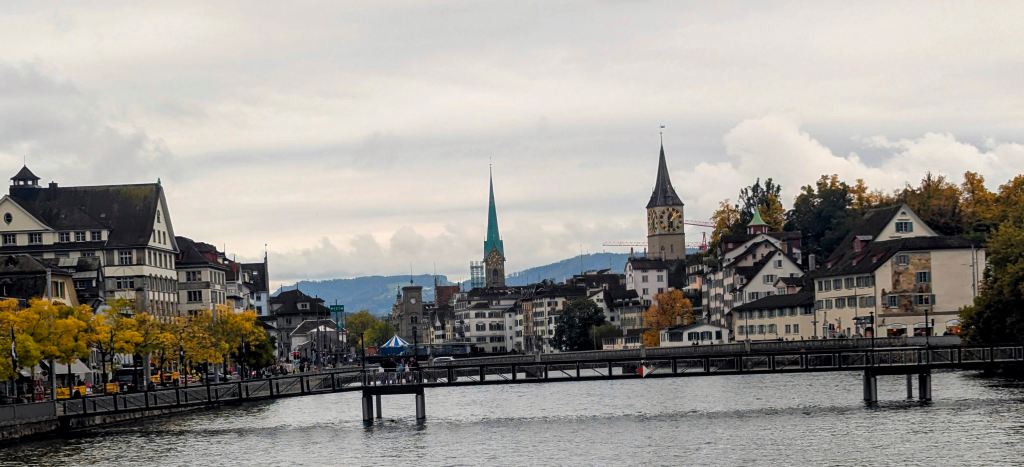
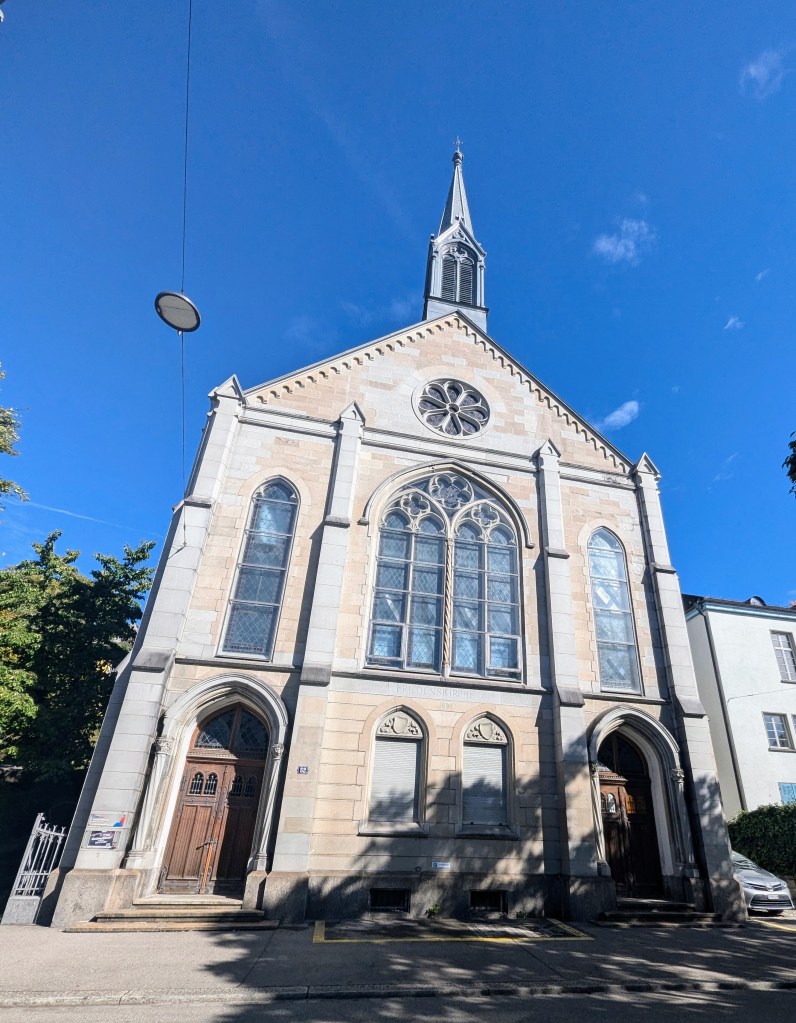
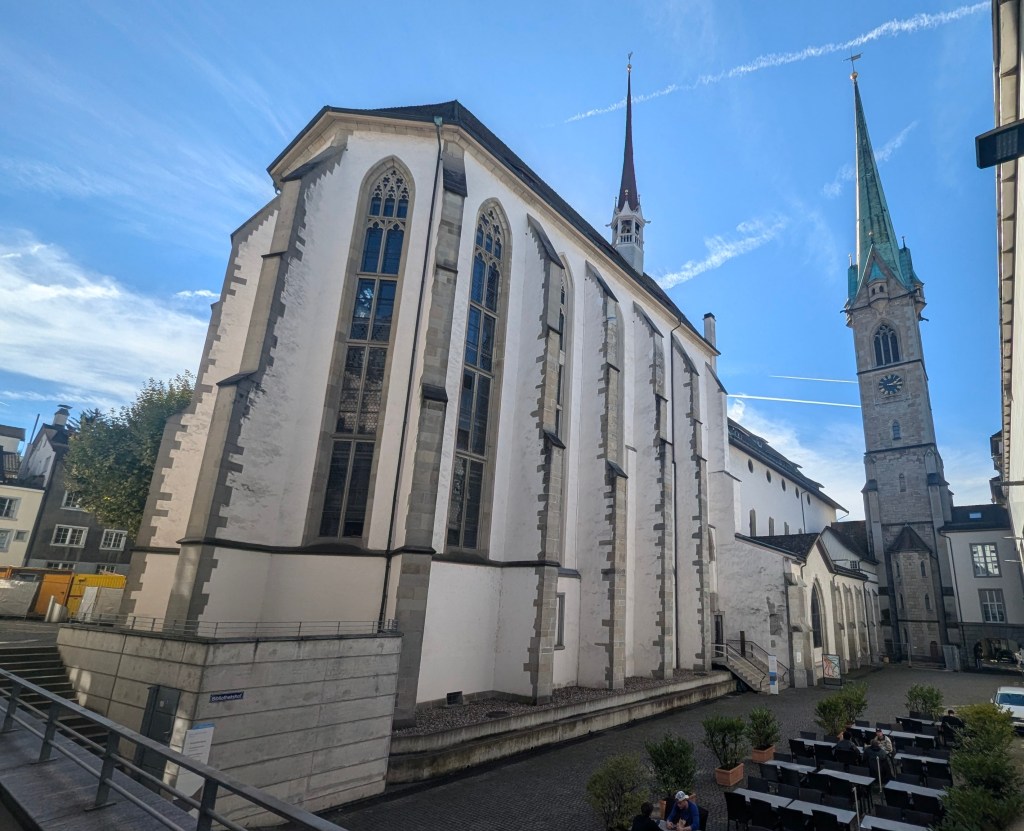
We easily found our hotel St. Josef, which was just below the university and right on the edge of the Old City. We dropped our luggage and headed out. Nearby we found the large city library which is attached to The Preacher’s Church (Predigerkirche), which dates back to 1213 when it was run by the Dominican monks. The building features Gothic forms, with one side visible from the street and the other side integrated into the city’s central library. Today it is a Protestant church.
We headed further down the narrow winding medieval side street and came out on Niederdorfstrasse, a pedestrian-only cobblestone street that parallels the eastern shore of the Limmat River. It is full of pubs and cafes. There we found Schwarzenbach Kolonialwaren, an historic gourmet grocery store and coffee roastery that has its origins in the family business that was established by Heini Schwarzenbach in 1864 and by now has become one of the most recognizable and popular destinations for local foodies and tourists alike.

The store is known for its impressive variety of products of high-quality and superb flavor such as dried fruits, natural honey, jams, syrups, rice, wine, chocolate and sweets, as well as other gourmet items, not to mention a great choice of coffee beans and teas sourced from all over the world.
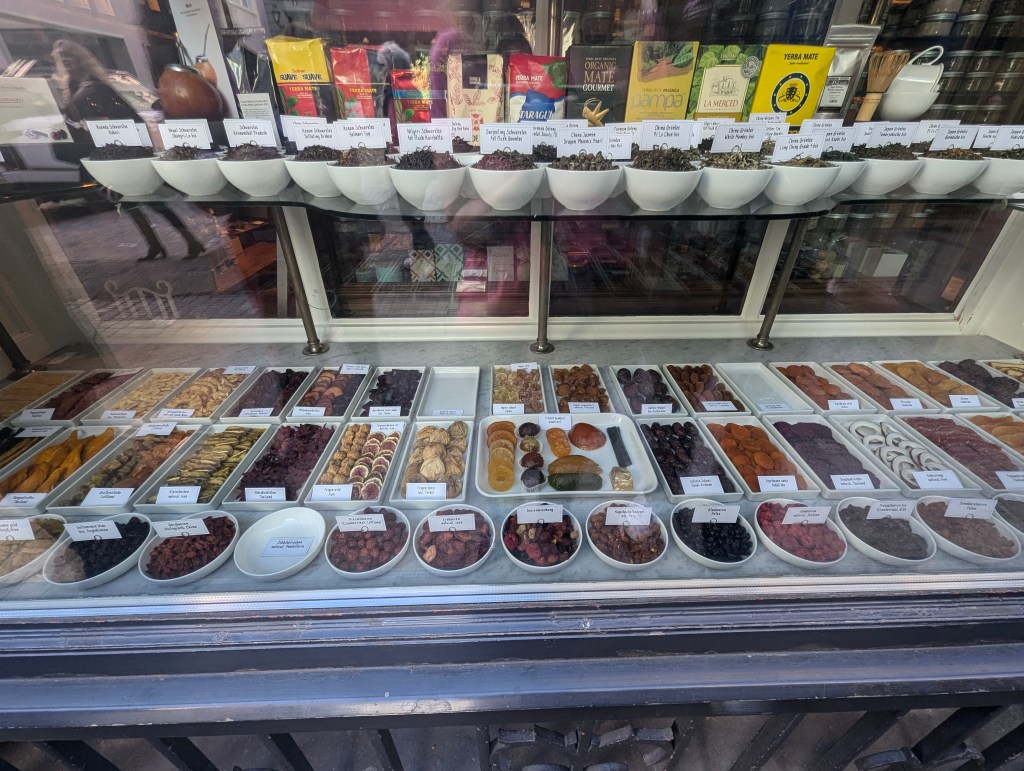
We continued down toward the river and there found the Rathaus: Town Hall, which dates to the 1690s. It was the seat of the Republic of Zurich until 1798.

Connecting the Rathaus to the other side of the river is a large pedestrian bridge known locally as Rathausbrücke. The bridge is a public square, known as “vegetable bridge” since medieval vegetable markets were held here. This is the historic center of the city, back to when the Romans called the town Turicum. The bridge is so large there are buildings on it.

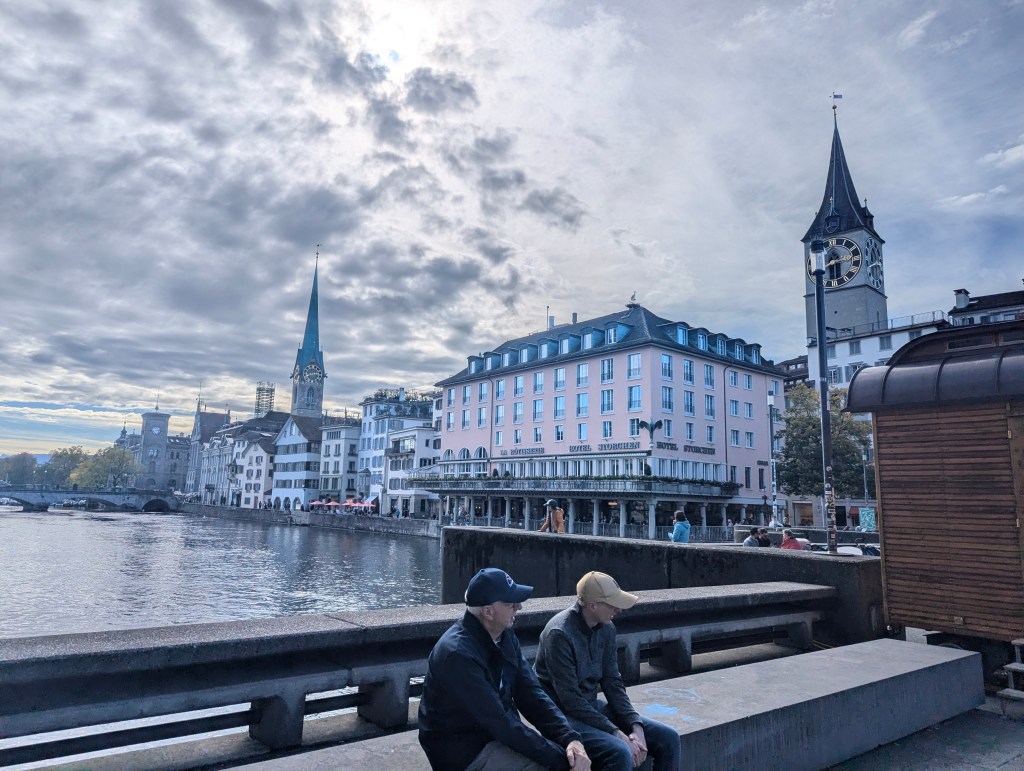
We continued our exploration of the Old City (Altstadt in German) and found Saint Peterskirche (Saint Peter’s Church). Built in the 9th century, it is the oldest church in Zurich. Up until 1911, a firewatcher manned the steeple. It was his job to look out the windows four times an hour to look for fires. If he spotted a fire, he was to sound an alarm and point to the direction of the fire with a flag. Apparently, this ended up being an effective strategy because, unlike many other European cities, Zurich never suffered any devastating fires.
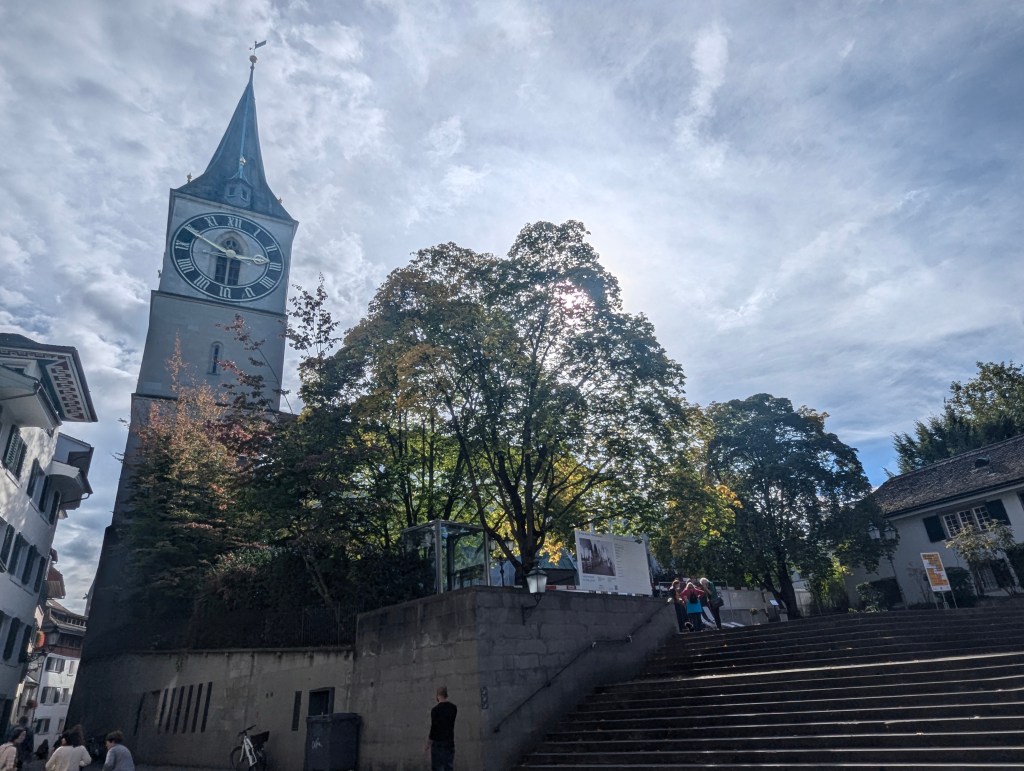
It also boasts the fame of having the largest clock face in all of Europe, measuring 28.3 feet in diameter. This translates to a minute hand that is 18.8 feet long.
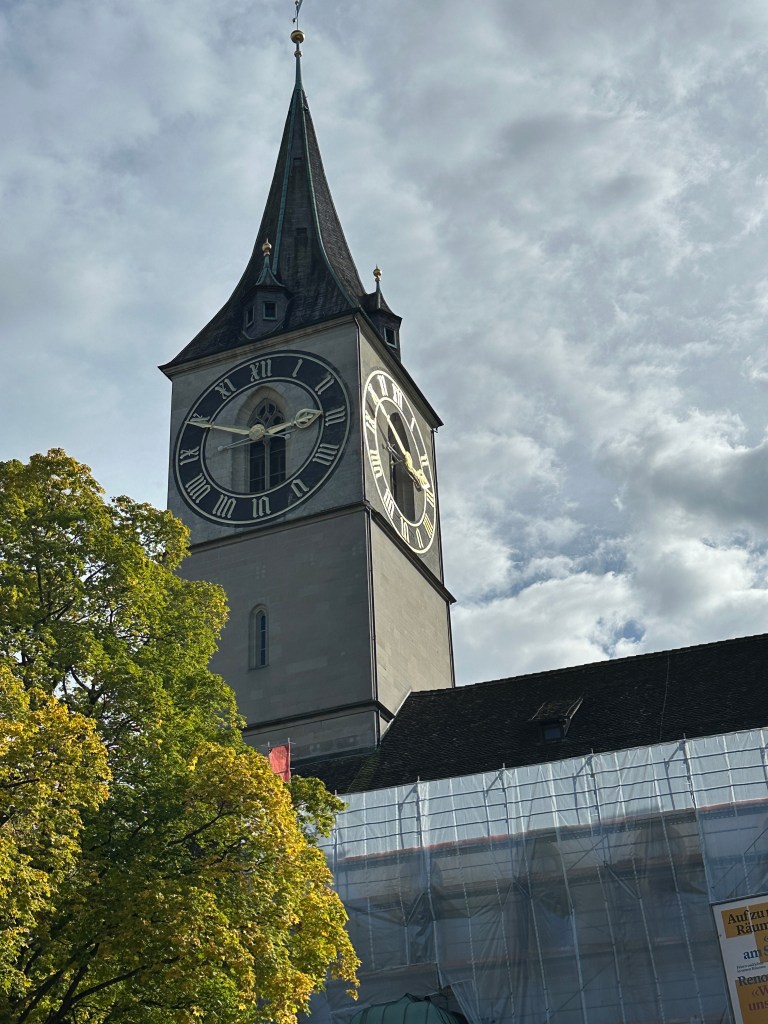
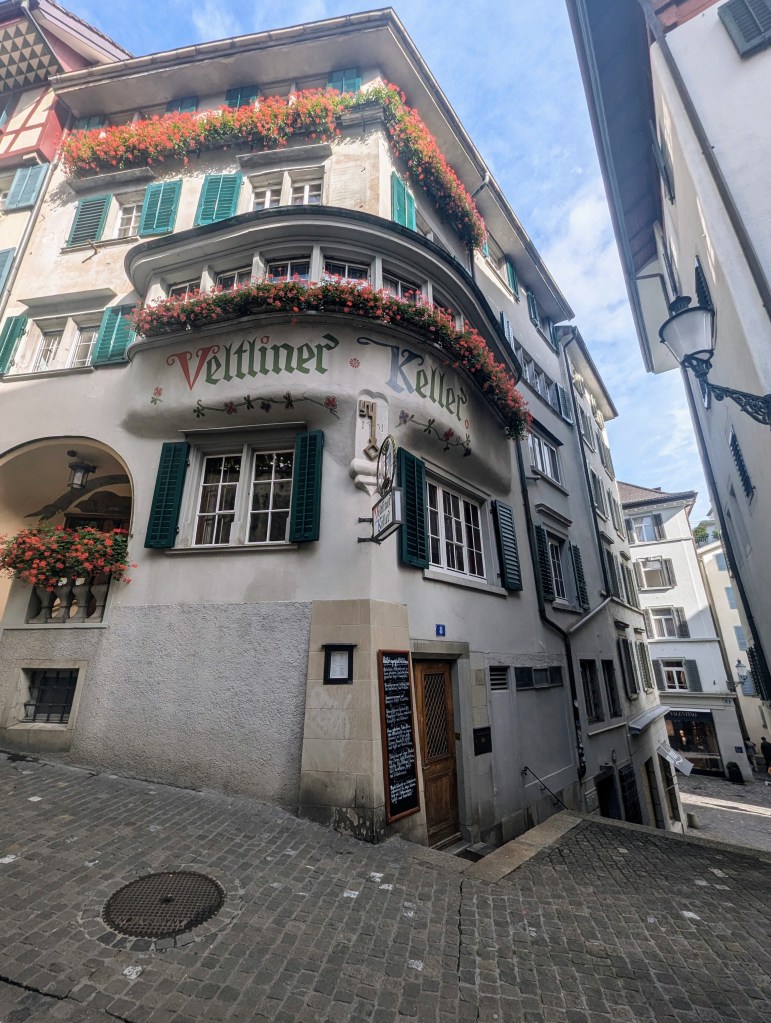
We continued winding our way through the narrow streets full of interesting houses and shops.
We stopped for a drink at a cafe in Münsterhof, historically the main square and marketplace of the medieval city, and noticed we were right next to Fraumünster, one of the oldest and largest church in Zurich. In 853 Emperor Ludwig founded a Benedictine convent on this site and his two daughters (Hildegard and Bertha) became the first abbesses of the convent. In 874 a basilica with a crypt was added. The crypt, which is still in the basement of the church, holds the relics of the martyred two Patron Saints of Zurich, Felix and Regula. The present church on the site dates from the mid 13th century. Reformation closed the convent and in 1524, the last abbess donated the church and abbey to the City of Zurich. All icons and religious imagery were destroyed.
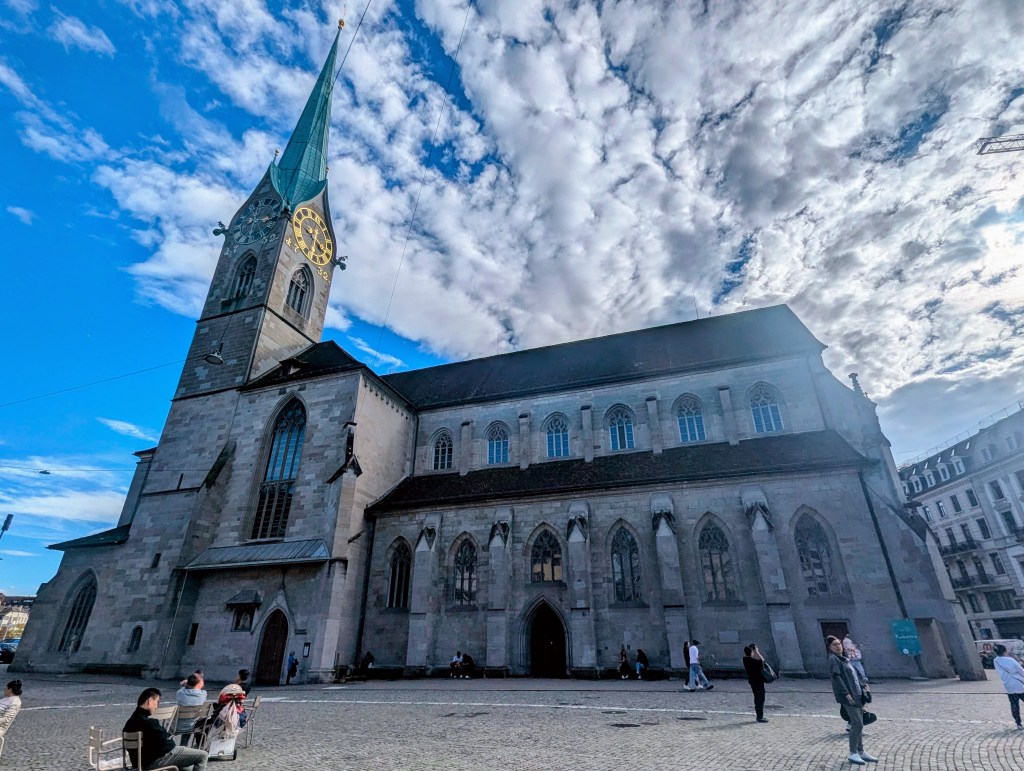
The church underwent a remodel in the 1970, with the installation of beautiful stained glass windows by Marc Chagall. We had to go in and see.
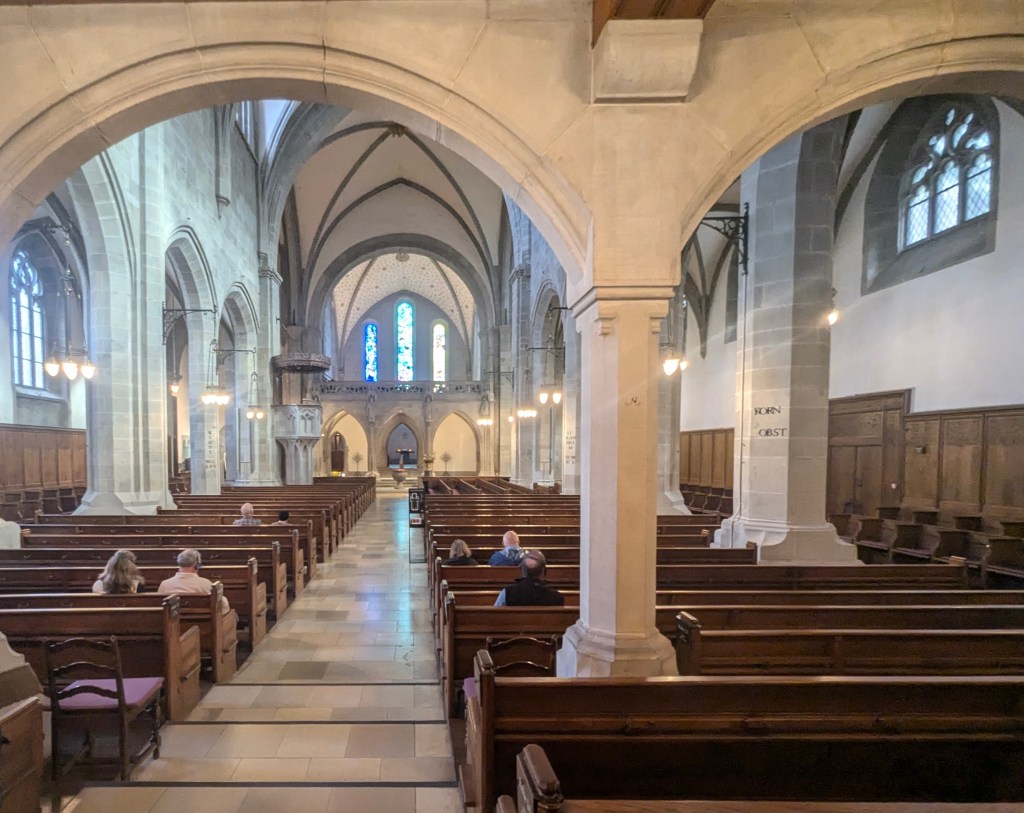
Fraumünster reflects a hybridization of Romanesque and Gothic styles due to constant construction and remodeling over the centuries.

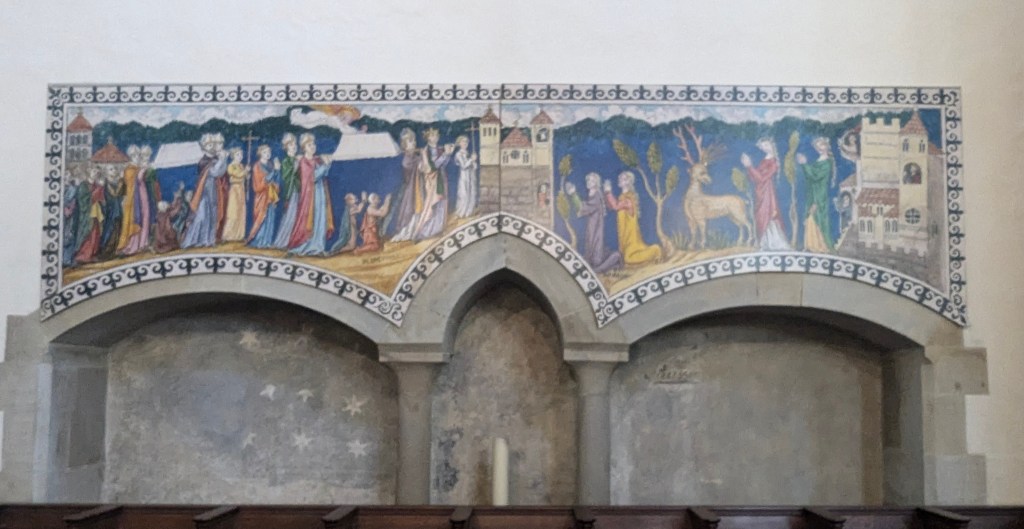
We chose an audio self-guided tour which explained the history of the church, which included the tale of the two sisters Hildegard and Bertha who were said to have been directed by God to choose the location of the church (and then became its first abbesses), as depicted in this fresco by Swiss artist Paul Bodmer (1886-1983 CE).
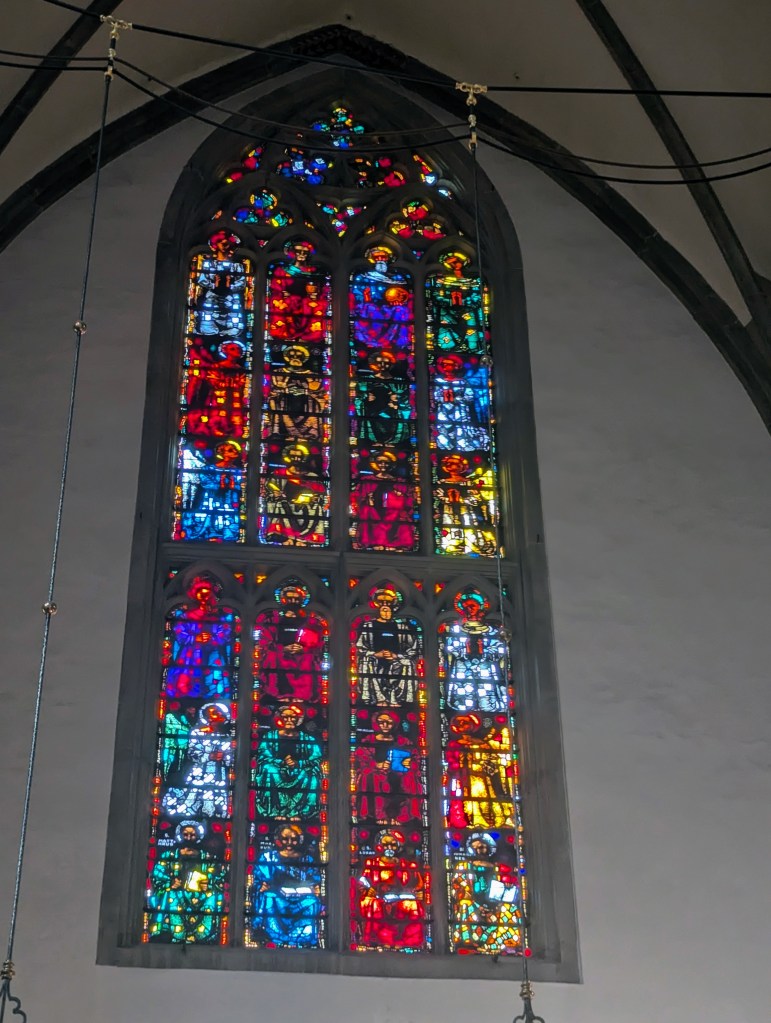
There is an 18 foot high stained glass window by artist August Giacometti on the north transept from 1945 depicting saints and angels
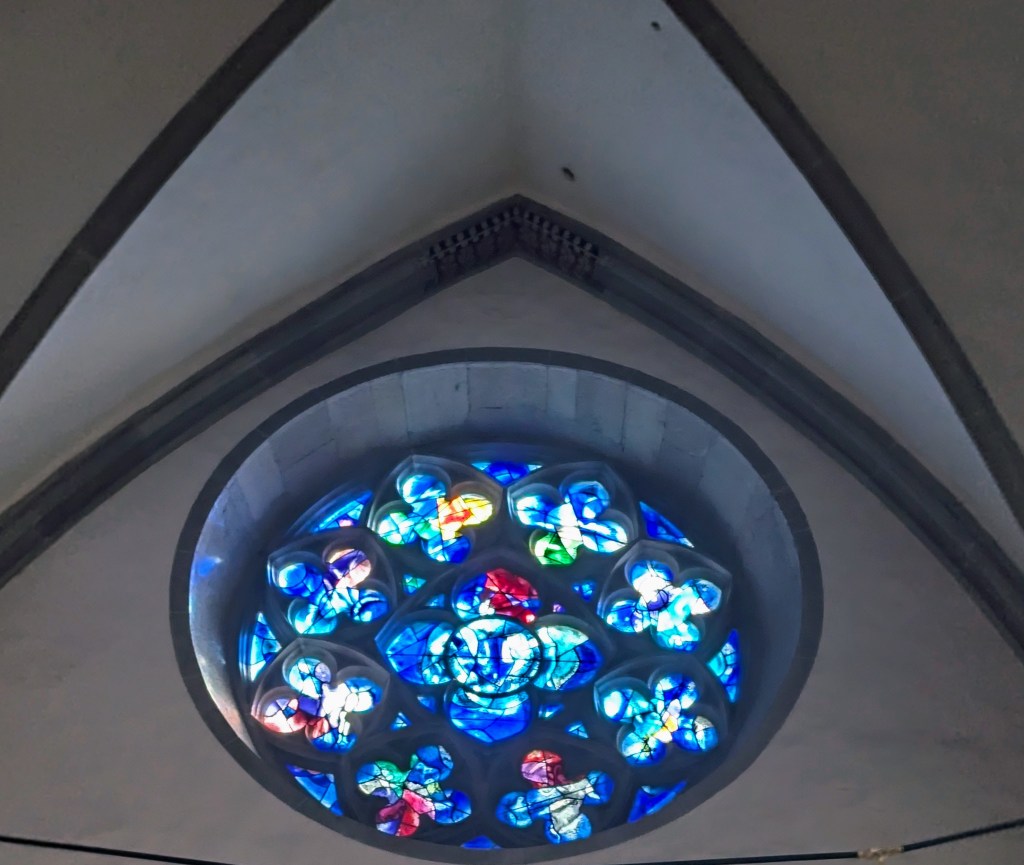
There is a beautiful rosette located in the church’s south transept.
But what we were really there to see were the Chagall windows.
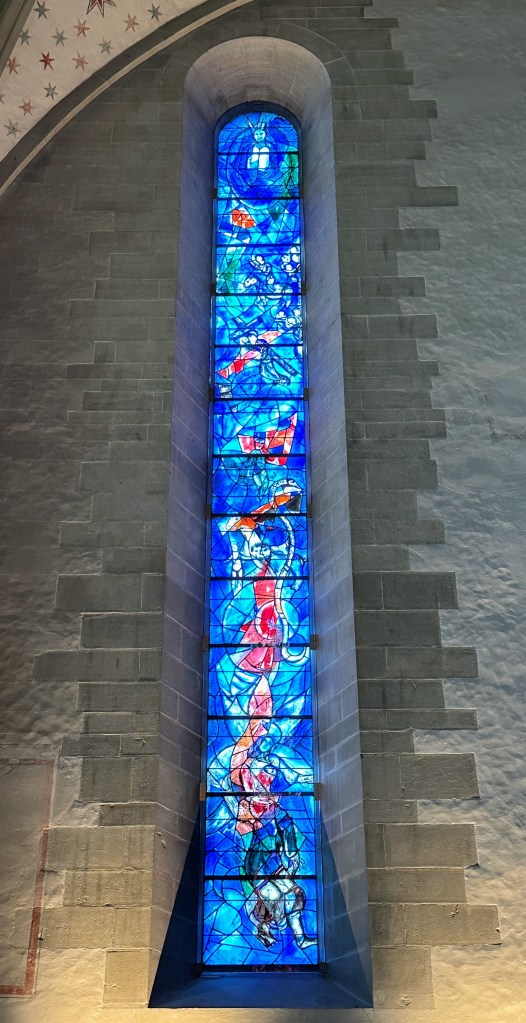
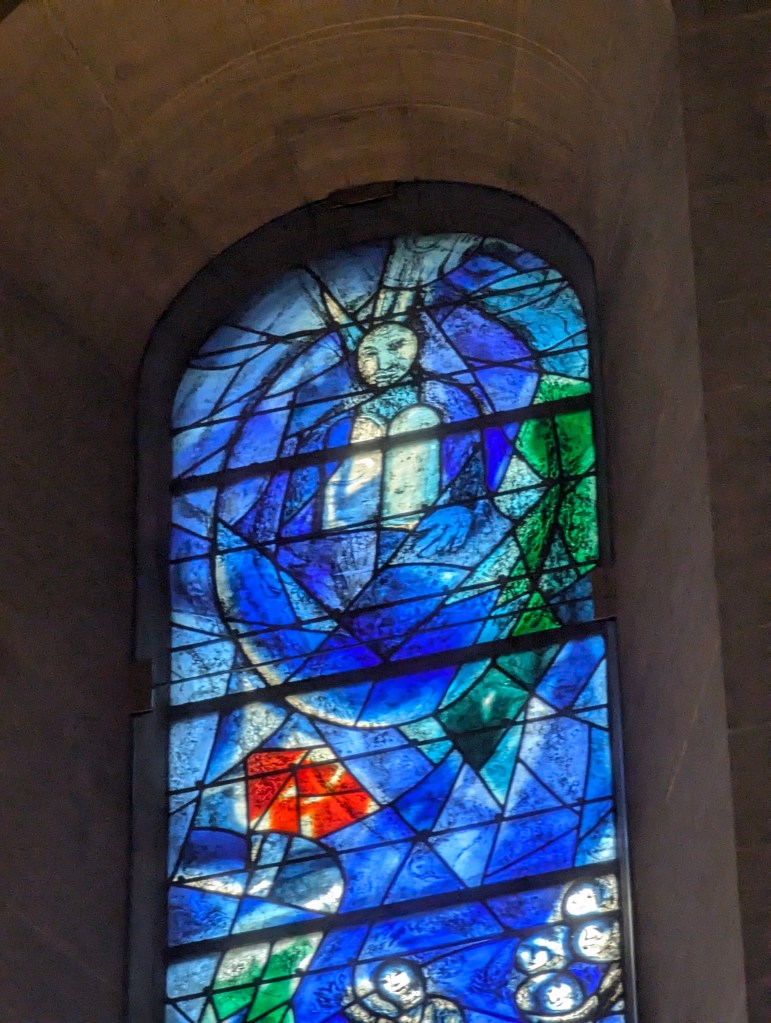
The choir of the abbey includes 5 large stained glass windows installed in 1970. Each of the 5 has a dominant color and depicts a Biblical story.
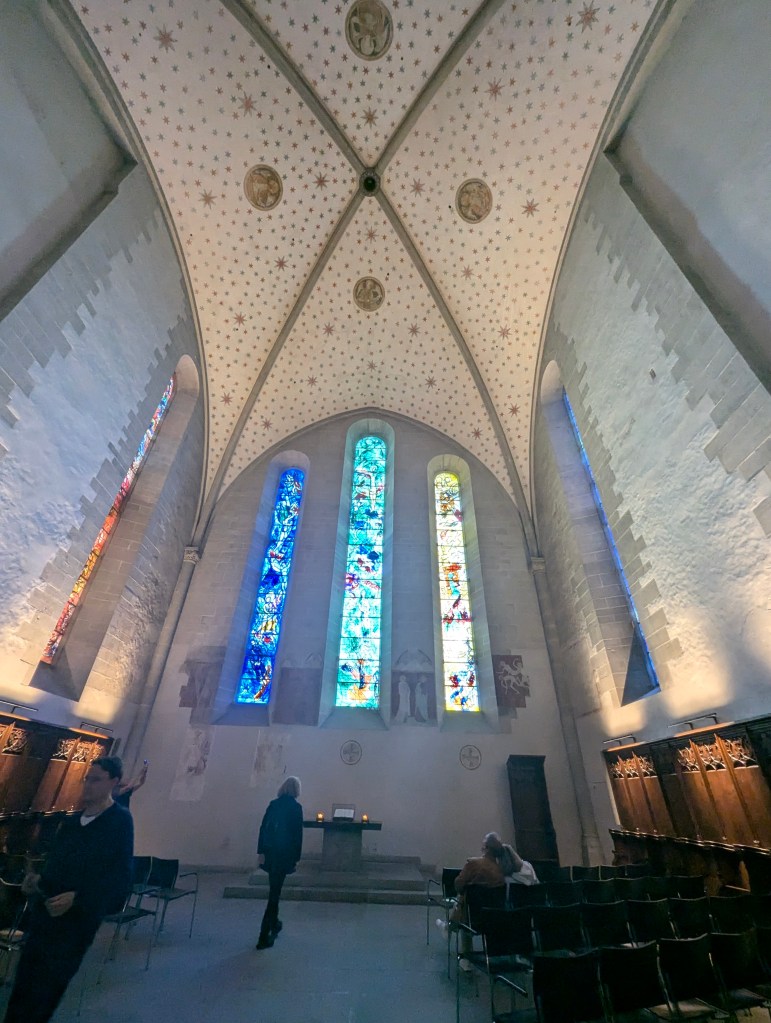
From left (northern wall) to right, the 5 works are:
Prophets: depicting Elijah’s ascent to heaven
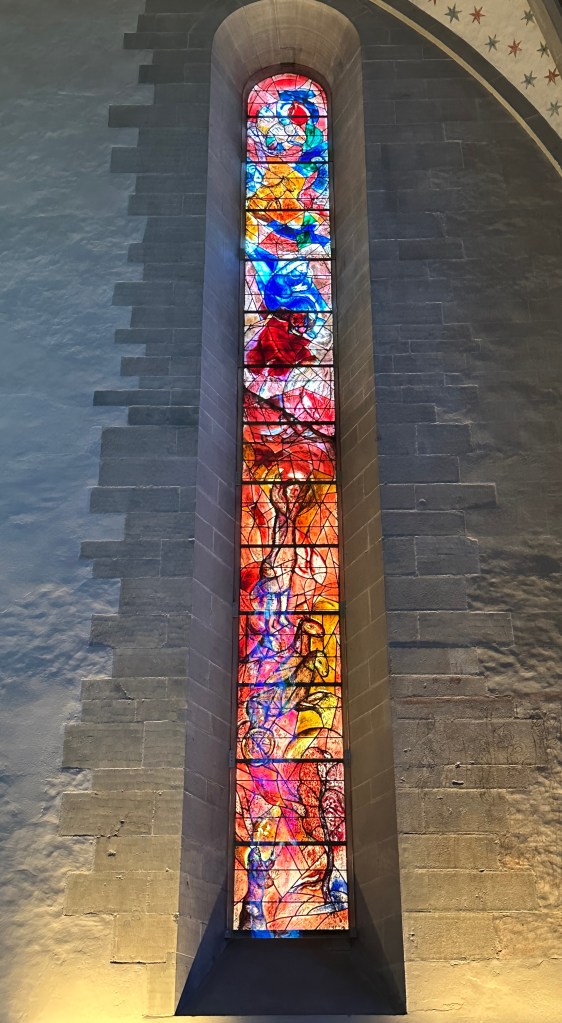

Jacob: displaying his combat, and dreams of heaven(blue below)
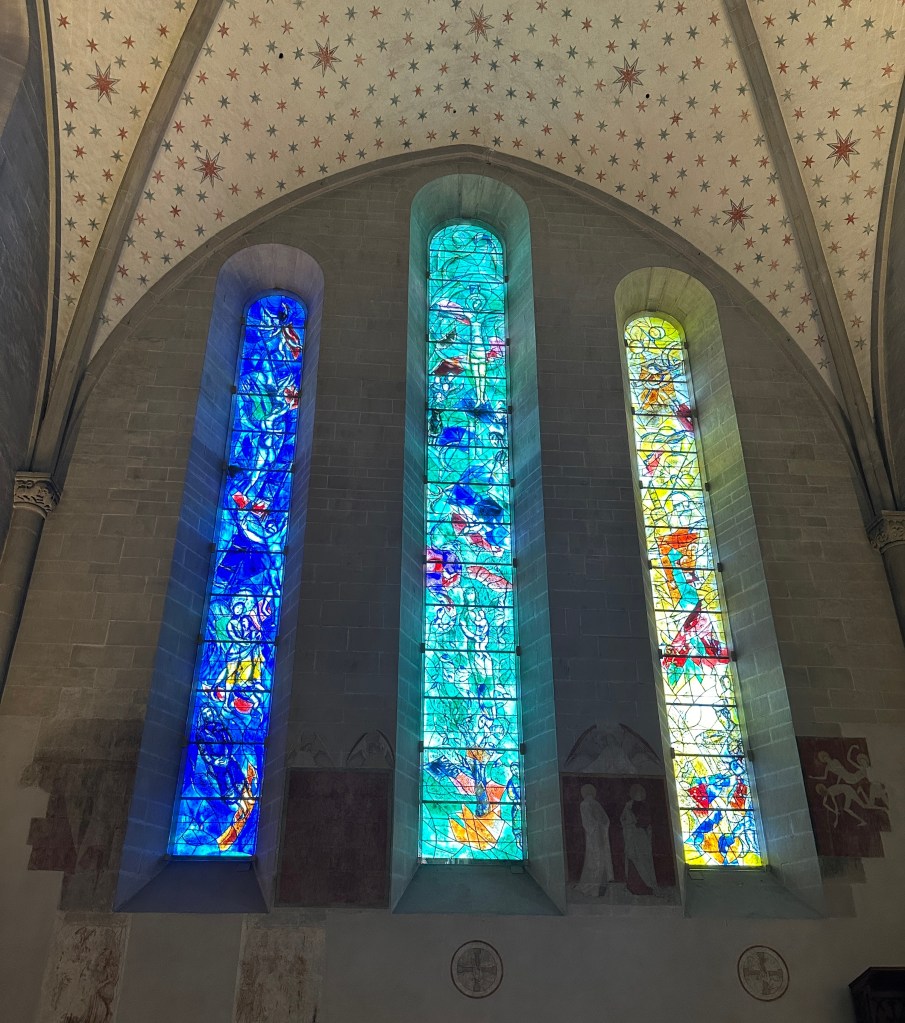
Christ: Stages of his Life

Zion: showing an angel trumpeting the end of the world
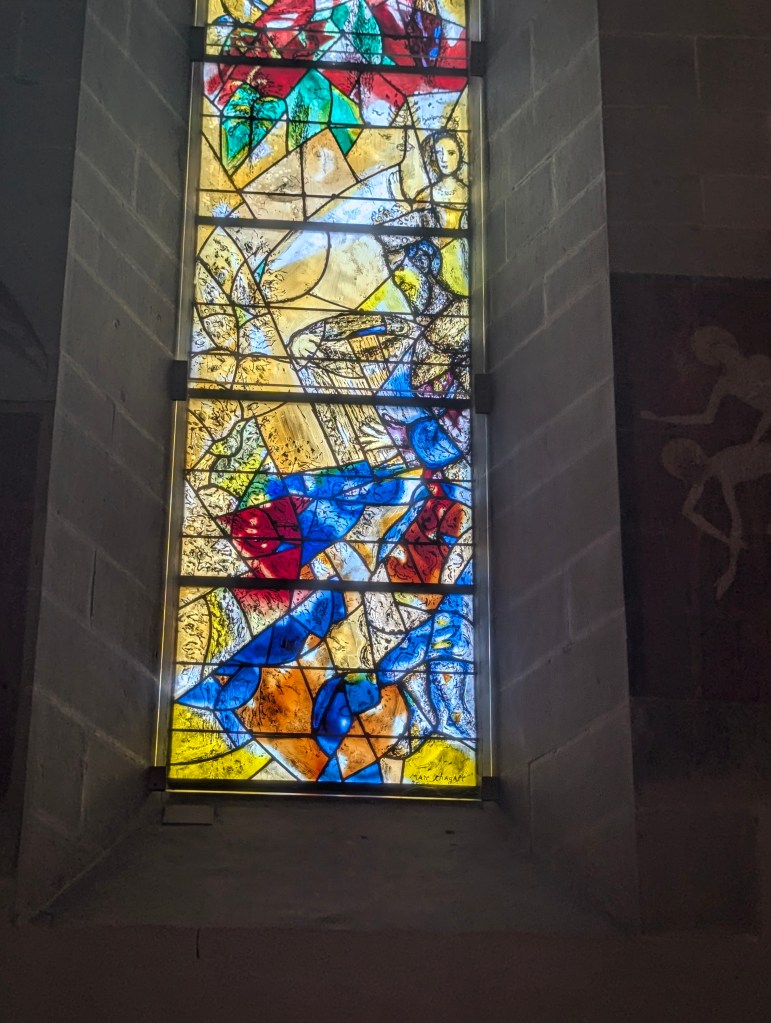
Law: with Moses looking down upon the suffering of his people
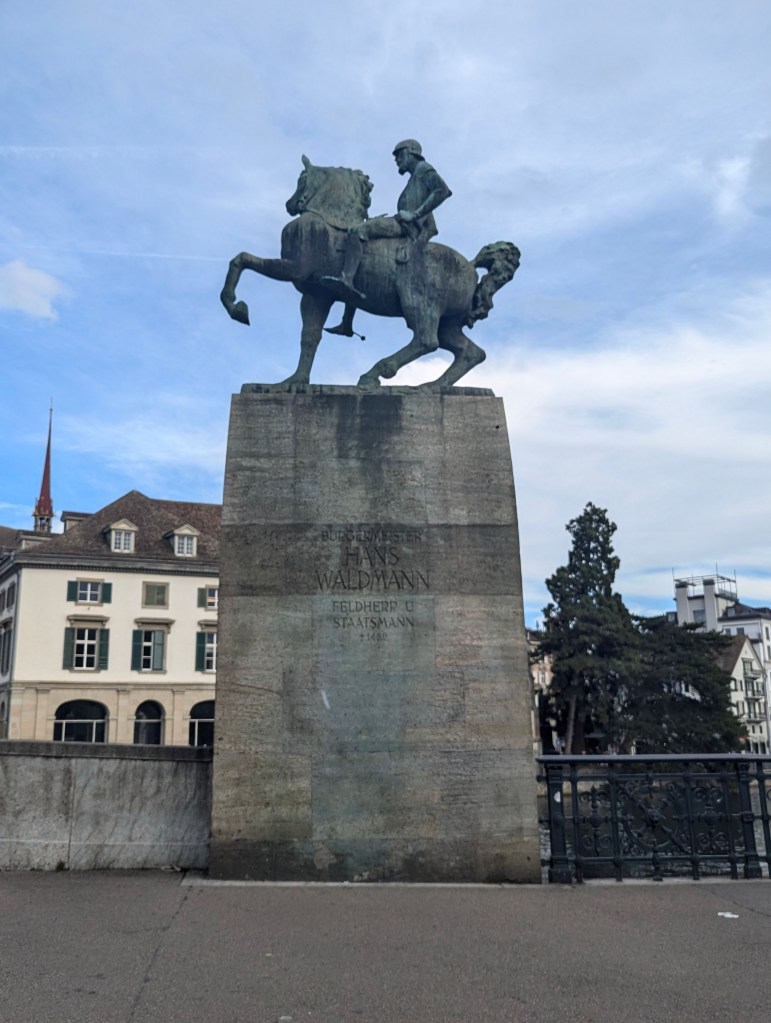
Back outside in the sunshine in front of Fraumünster on the bank of the river we found a statue of Hans Waldmann who was an ambitious military leader. He achieved great fame when he and the Swiss Confederates decisively defeated Charles the Bold in the Burgundian Wars in 1476. In 1483, Hans Waldmann was elected to the leading position of mayor of Zurich.
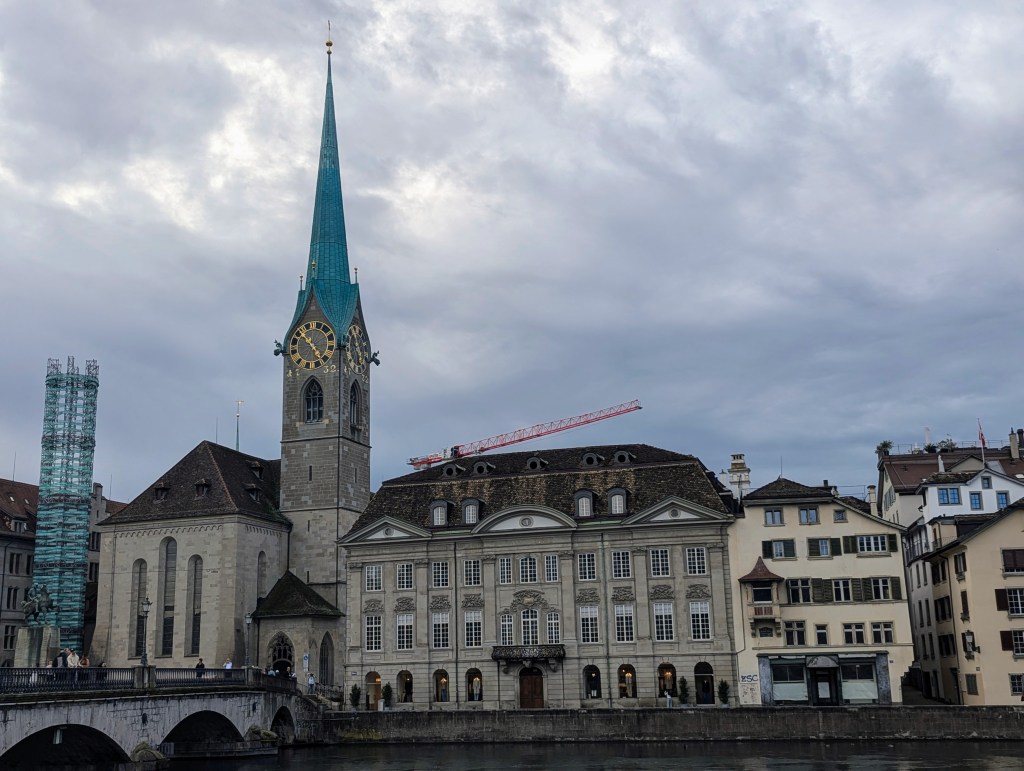
As we crossed the river, we were able to look back and see the Fraumünster more completely.
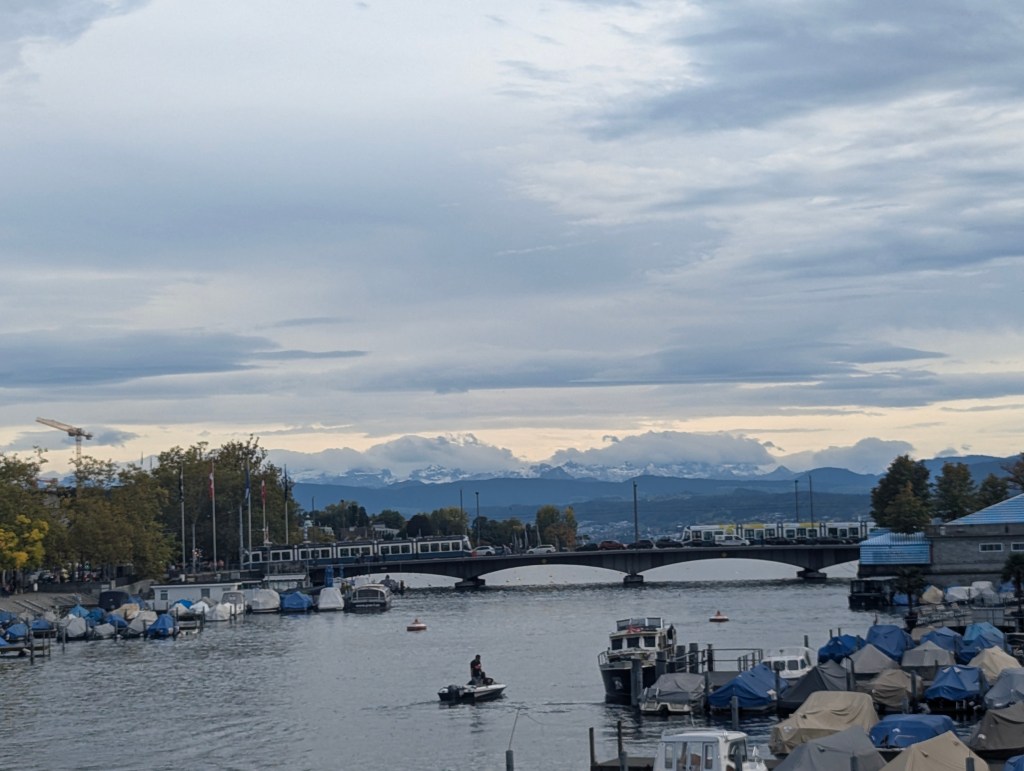
Also as we crossed the bridge, we got our first view of the Alps as seen over the Zimmat River.
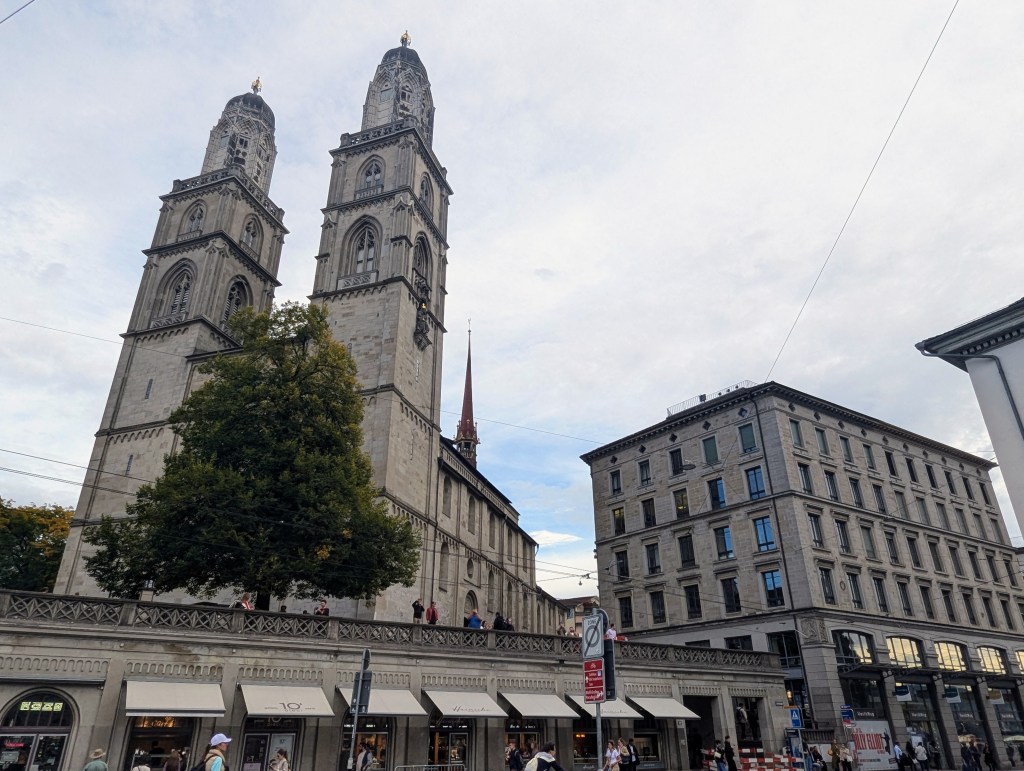
What awaited us on the other side of the bridge was another iconic landmark of Zurich: The Grossmunster Church with its Romanesque architectural style.

The Grossmunster Church holds significance as the birthplace of the Swiss-German Reformation. In 1520, Huldrych Zwingli, a key figure in the Swiss Reformation movement, initiated reforms from his pastoral office within this church. Zwingli’s debates, which he triumphed in before local authorities in 1523, led to the church’s separation from papal authority. Today its twin towers stand tall and dominate the cityscape.
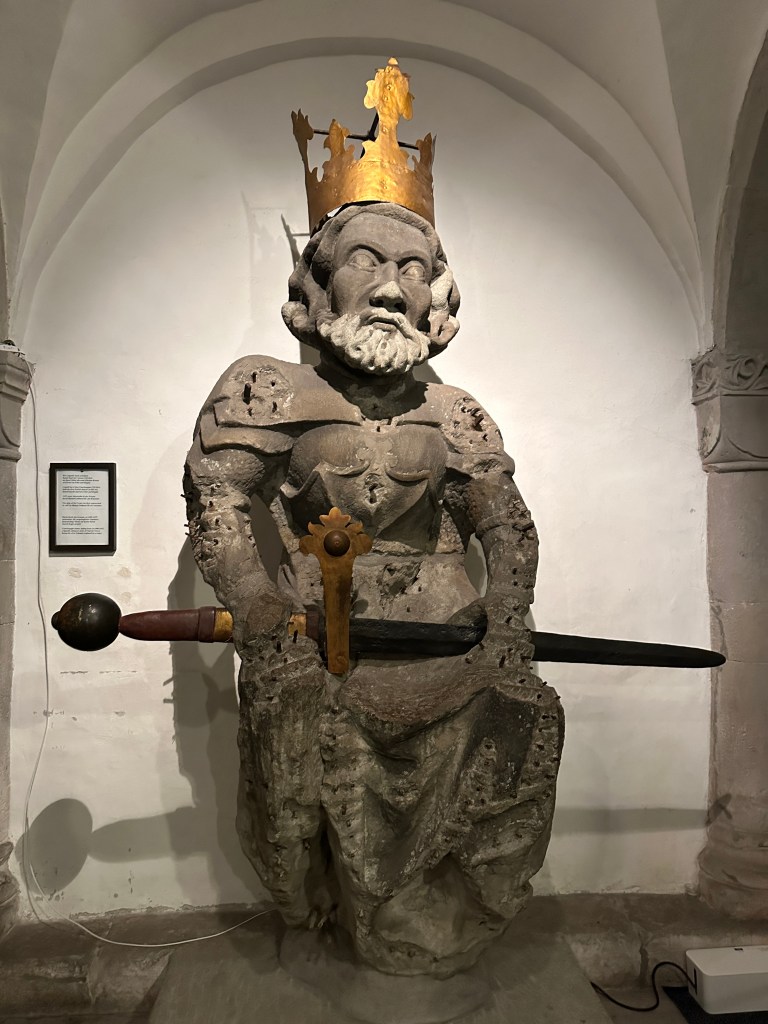
A statue of Emperor Charles the Great (Charlemagne) adorns the southern tower of the Grossmunster Church, commemorating his reign as Holy Roman Emperor from 771 to 814. Known for uniting much of Western and Central Europe, his legacy extends to language, with many European terms for “king” deriving from his name. The statue portrays Charles holding his sword, with his crown seemingly slipping from his head.

The reforms spearheaded by Zwingli and later continued by Heinrich Bullinger left their mark on the church’s interior. In 1524, iconoclastic actions saw the removal of religious imagery and the organ.

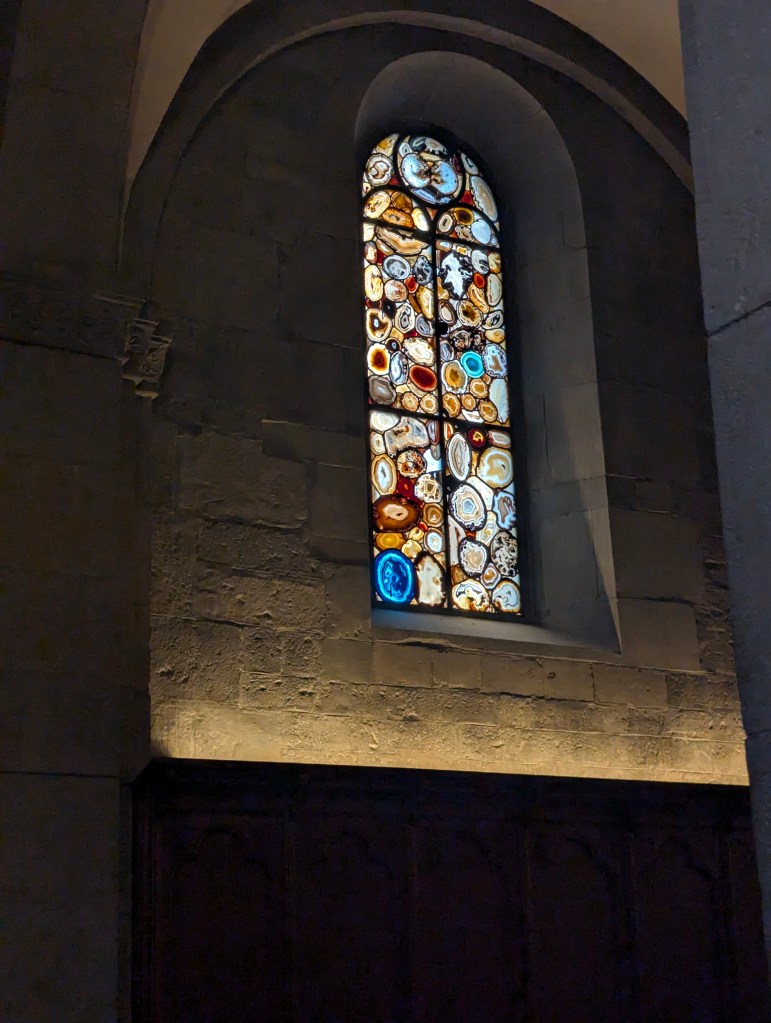
The interior including the stained glass windows are somewhat modern in appearance.
In the basement is the original statue of Charlemagne; the exterior one is a replica.
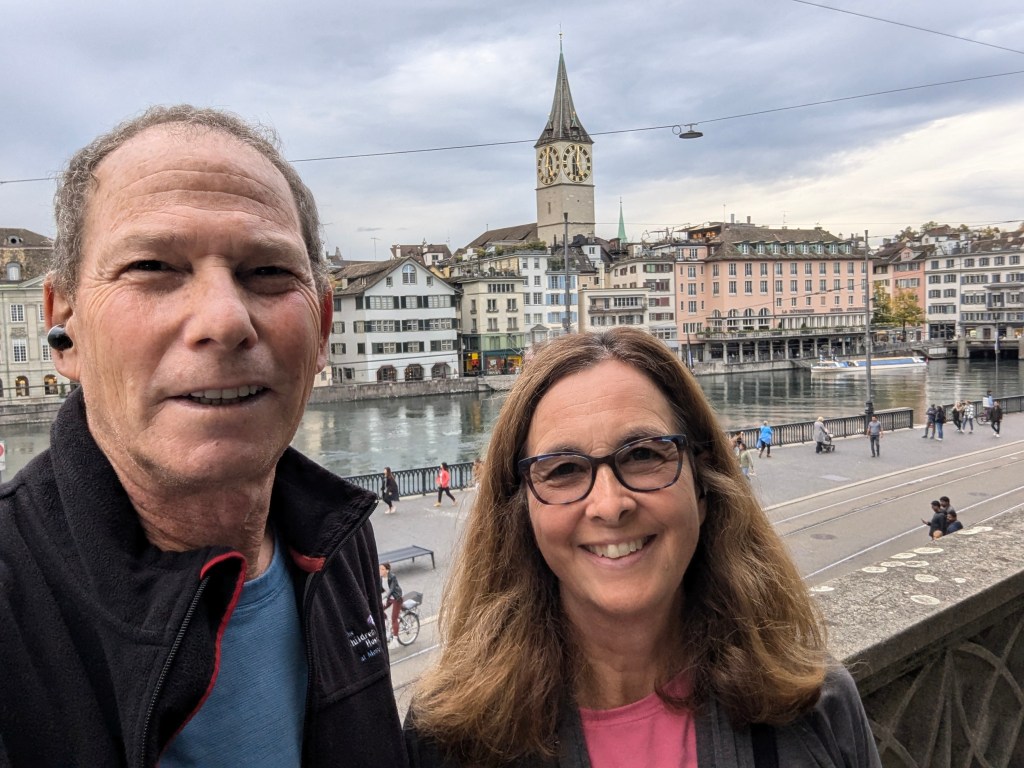
Outside the church we had a decent view of the city below.
Also outside the church we found a statue of Huldrych Zwingli.

For dinner we headed back to Niederdorfstrasse to a cute place called La Pasta.

To be honest, Zurich was not our favorite city in Switzerland. The fountains do not have the beauty nor historical and cultural significance as those in Bern.
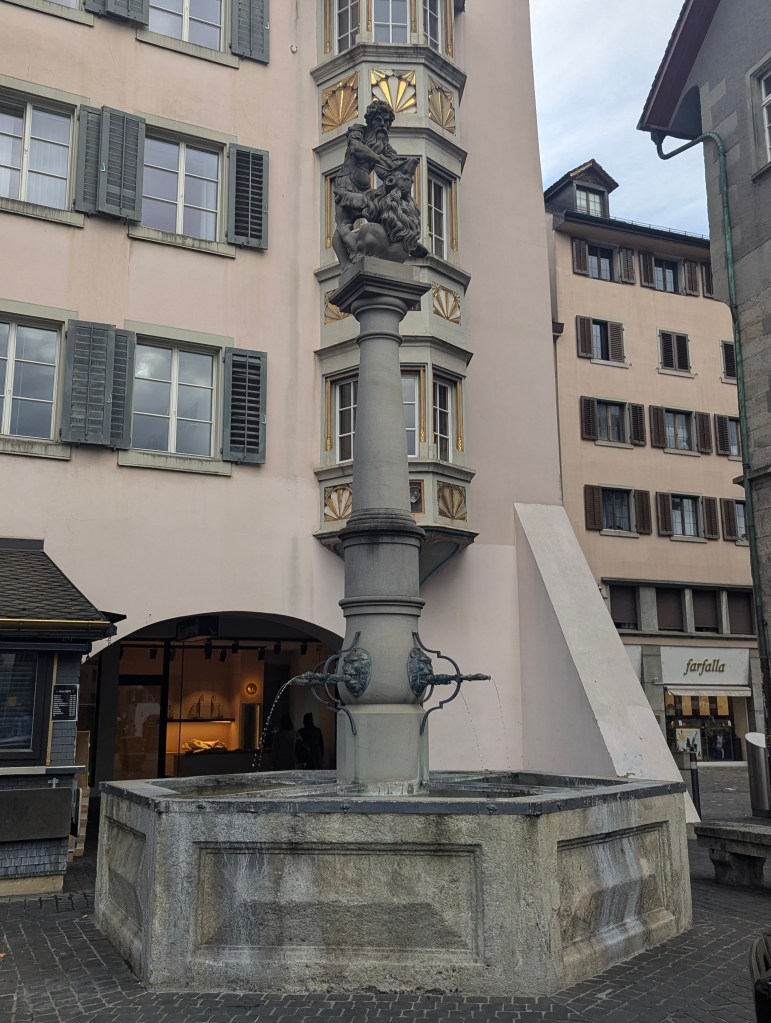
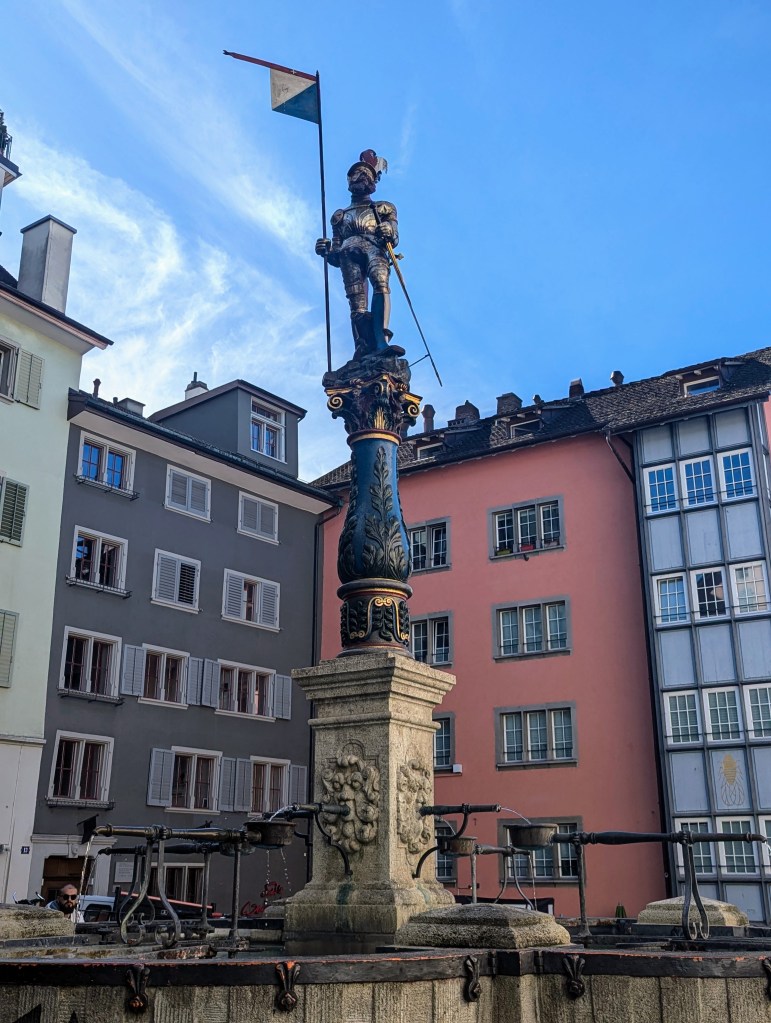
although some are indeed pretty old
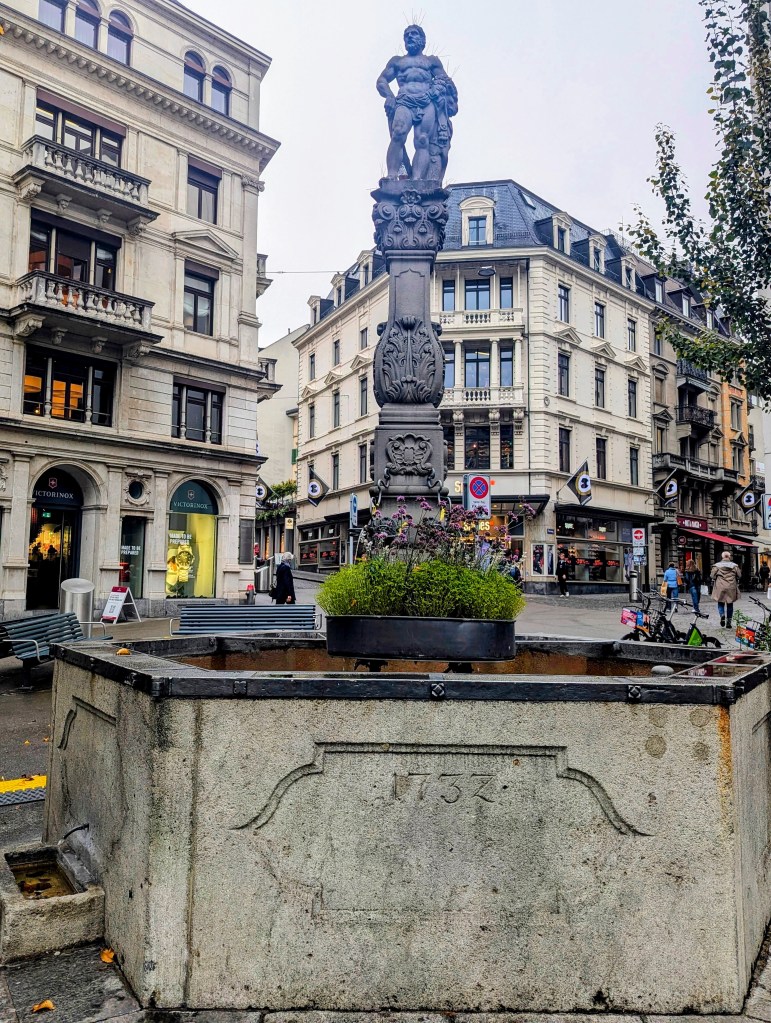
and they do provide fresh potable water
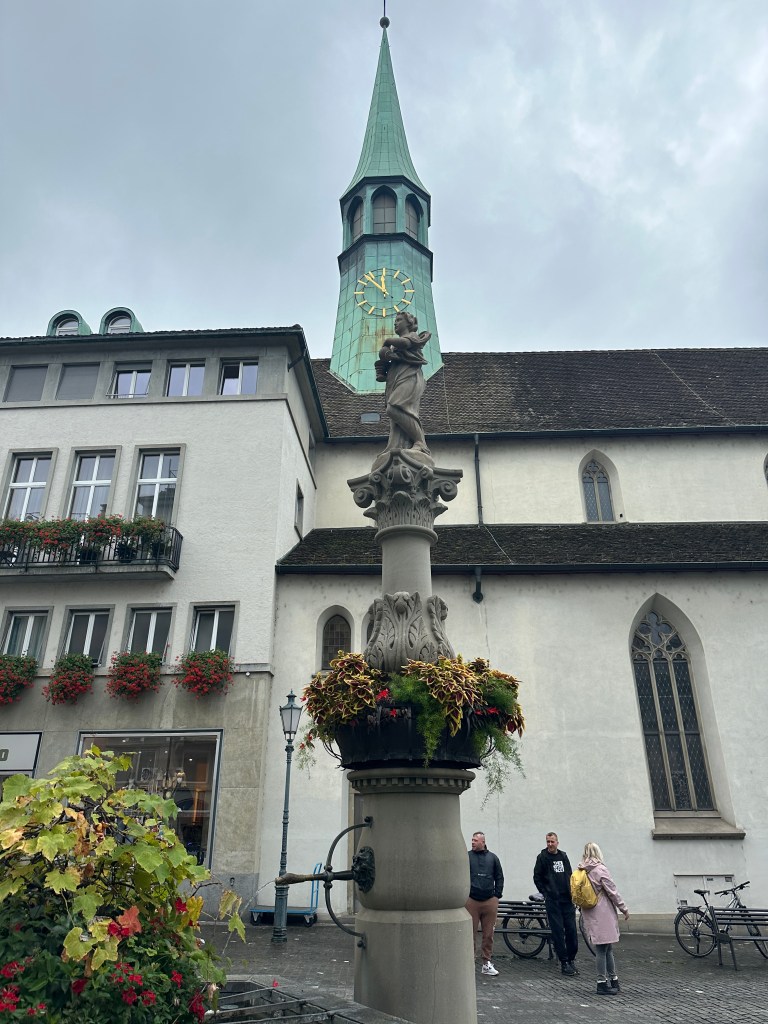
The frescos are neither as plentiful nor as spectacular as those in Lucerne
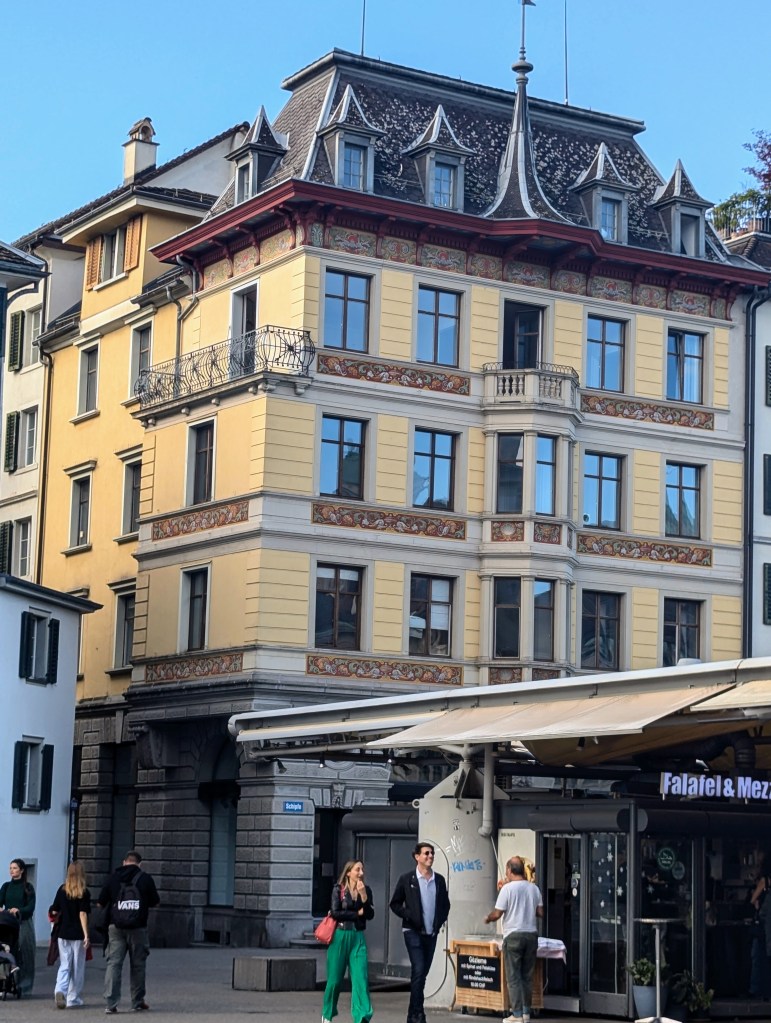
and the architecture also not as amazing as Lucerne
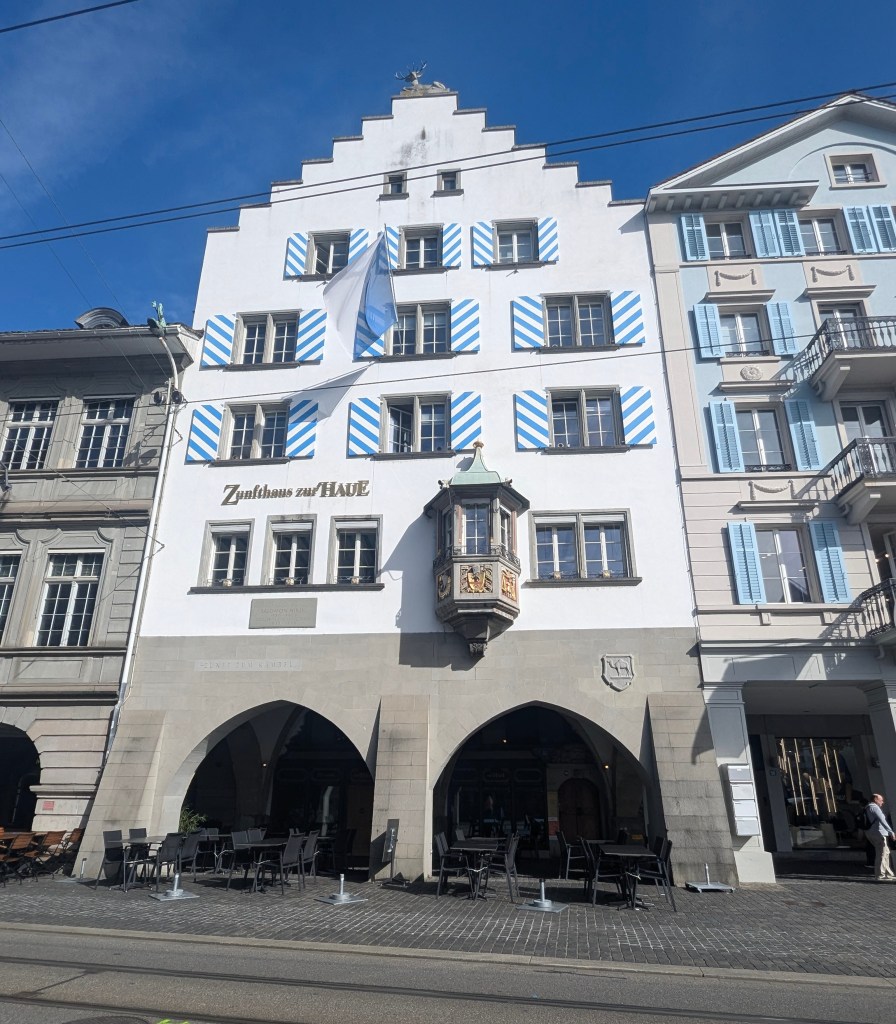
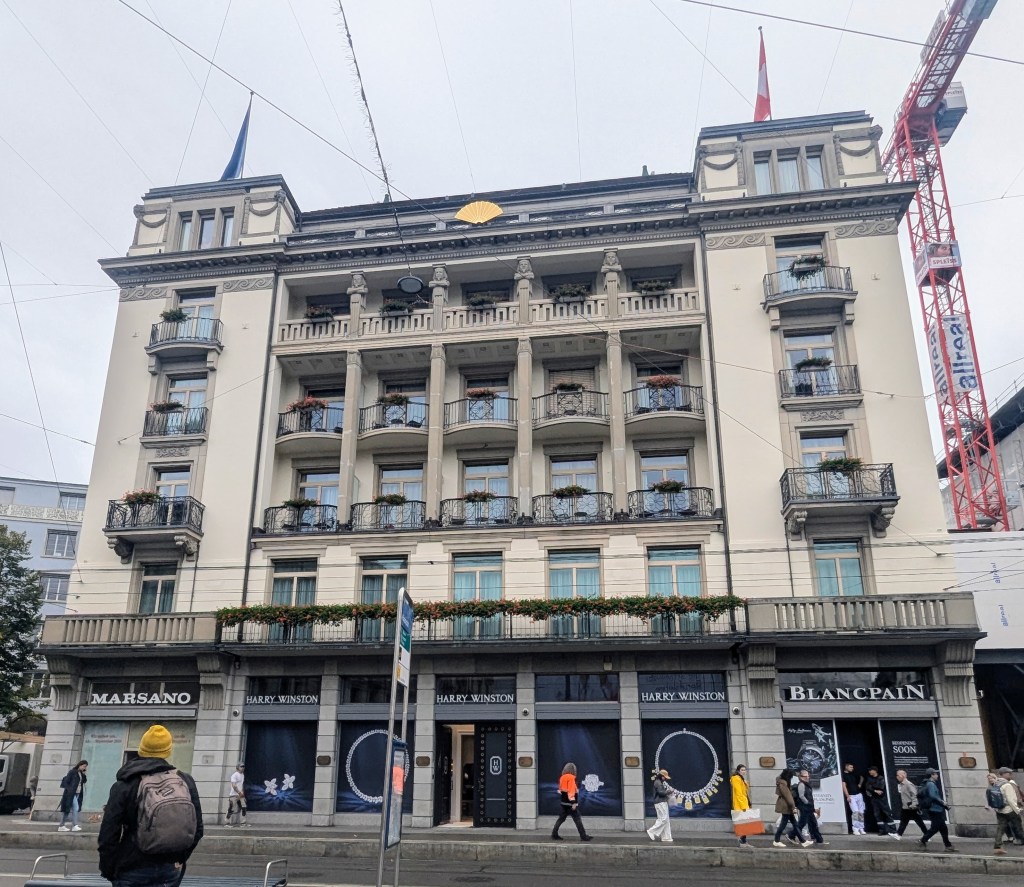
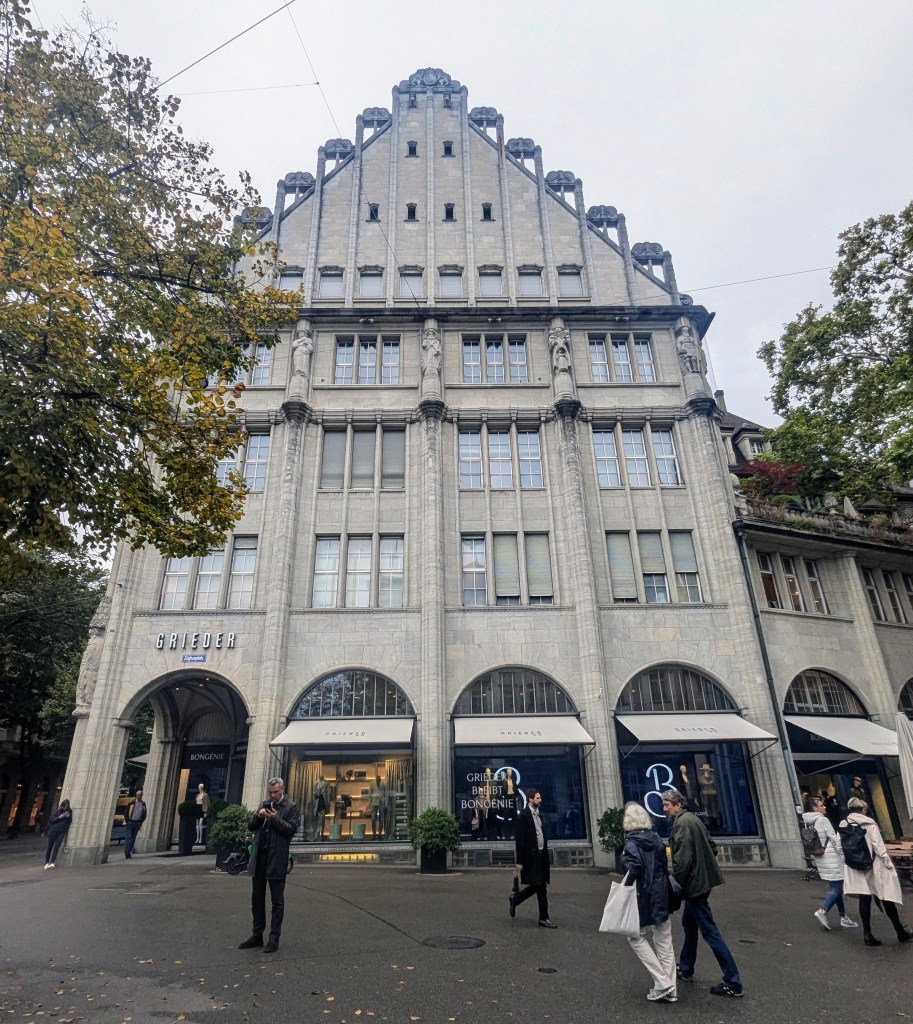
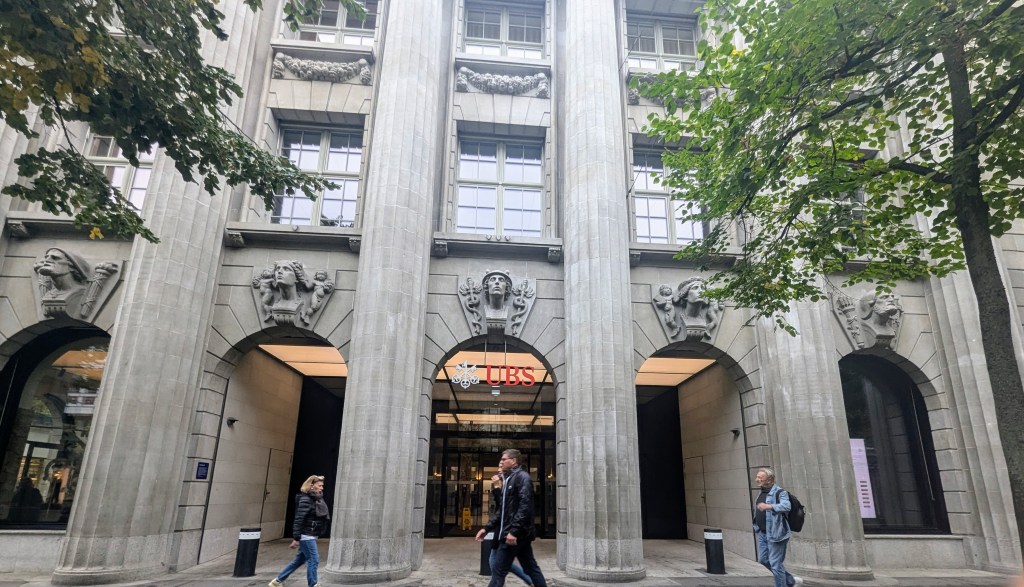
But what Zurich has best is shopping. We thought we had seen tons of high end shops everywhere, especially in Geneva. But nothing compares to Bahnhofstrasse, Zurich’s main shopping avenue. It is mostly pedestrian-only, with tram access to the city’s transportation network. Bahnhofstrasse begins at the Zurich HB central railway station, which fronts Bahnhofplatz (Station Square). From there, it continues southwards until the shore of Lake Zurich at Bürkliplatz. Along its route, the street passes through several famous Zurich town squares, including Paradeplatz. This is a notoriously expensive real estate zone, where you will find the Swiss banks headquartered, which is where we decided to start our explorations the next day.

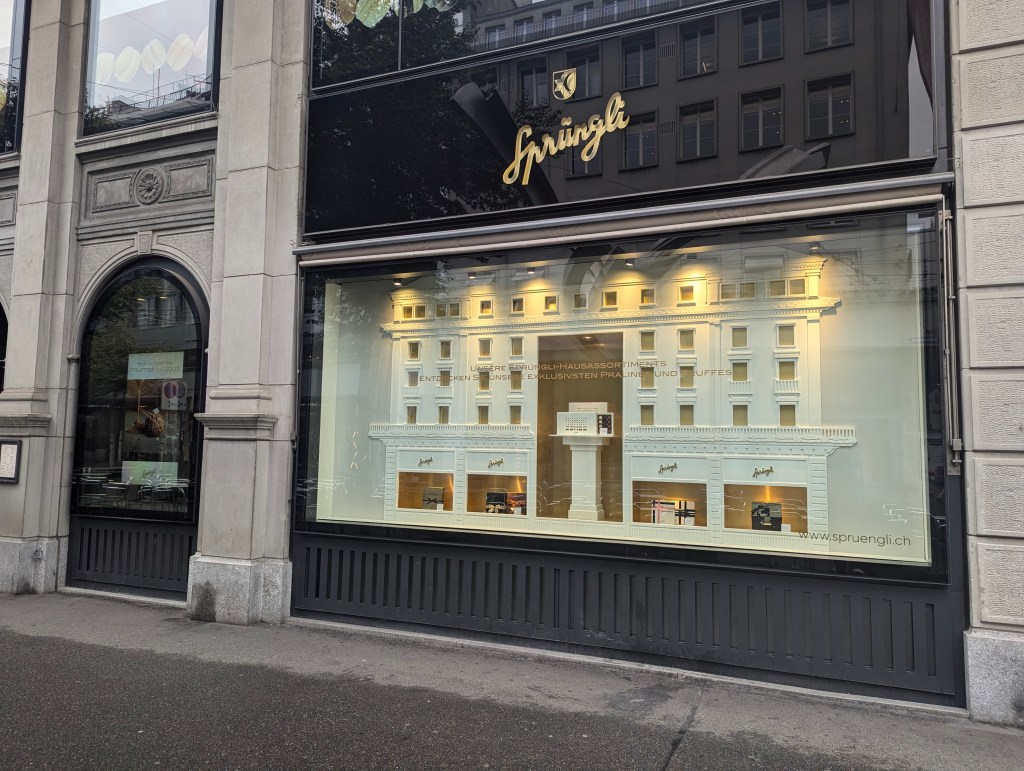
On the southwest corner of Paradeplatz sits the flagship store of Sprüngli Confectionery, synonymous with Swiss chocolate and confectionery excellence since 1836. They sell luxurious chocolates, exquisite pastries, and their famous macarons. Their shops are everywhere including the train stations.
We headed north on Bahnhofstrasse and saw every high end retailer we have ever heard of and so many more.
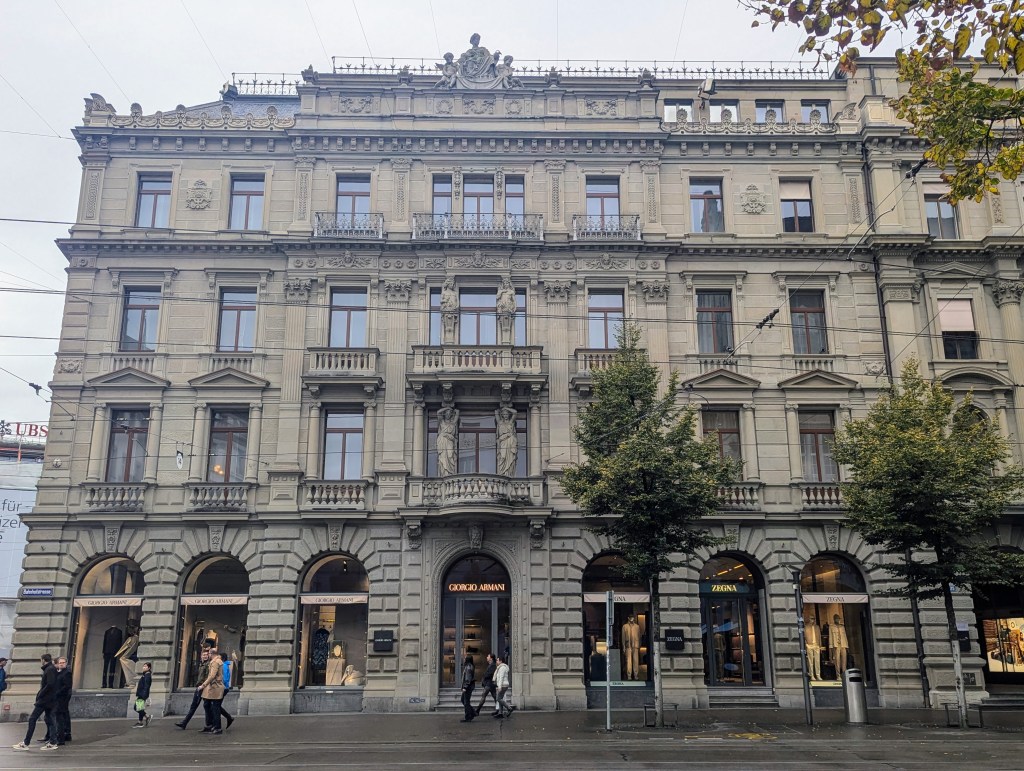
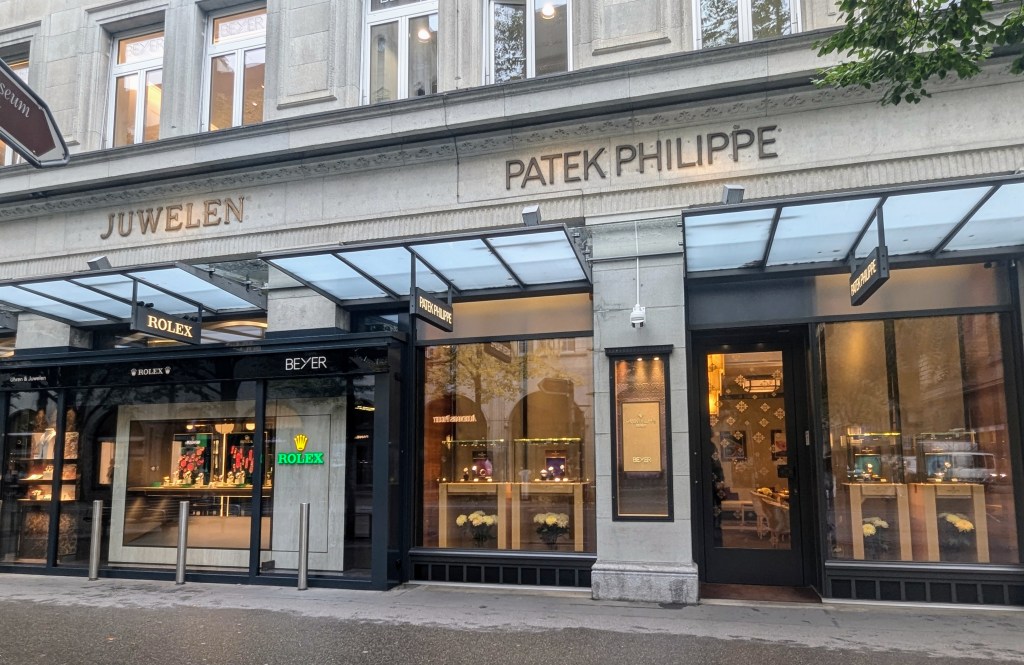
and more banks.
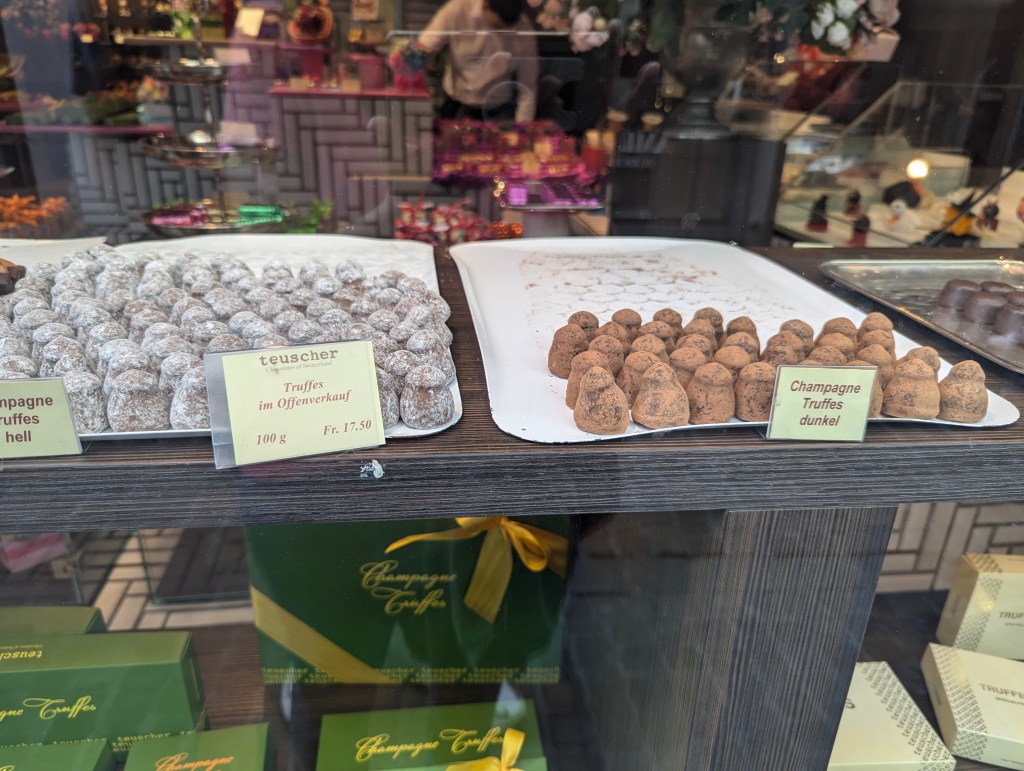
and more chocolate. We stopped at the flagship store of Teuscher Chocolates. Their handmade truffles and pralines are crafted with the utmost care and love of the trade.
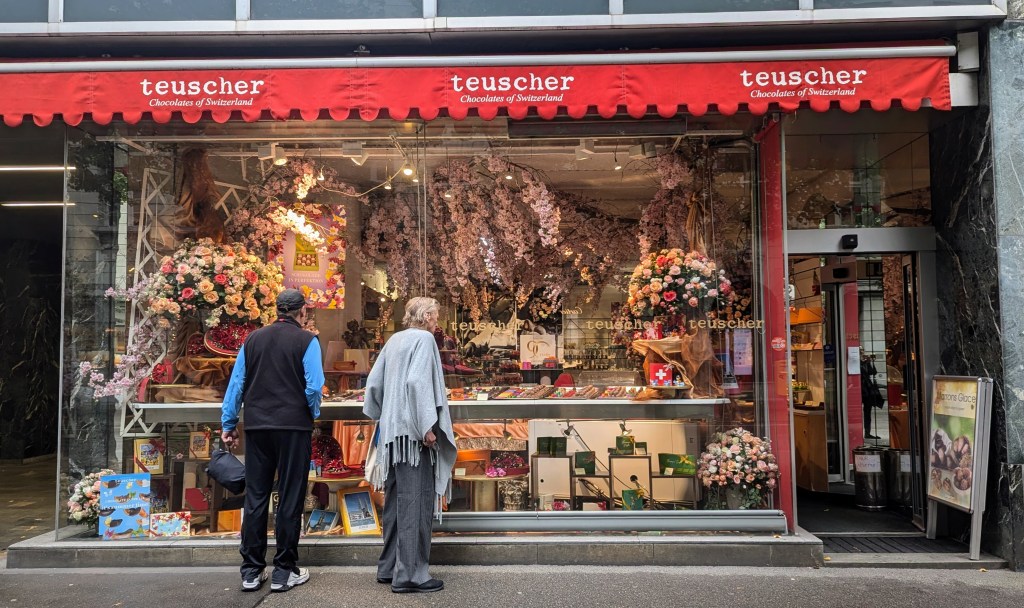
What they are most known for is their champagne truffles in either milk or dark chocolate sprinkled with confectioners’ sugar or cocoa powder respectively.
We deviated off Bahnhofstrasse to see this cute shop: Steiff Gallerie. Established by artist Margarete Steiff, who pioneered the creation of the stuffed elephant in 1880, this innovation eventually led to the birth of the iconic Teddy Bears in 1906. The Zurich outlet embodies a delightful assortment of plush wonders, featuring classic teddy bears, arctic and marine creatures, exotic animals, delightful keychains, as well as beloved rocking horses, elephants, and bears, all synonymous with superior quality. Unfortunately for us, it was closed as they prepare their Christmas displays.

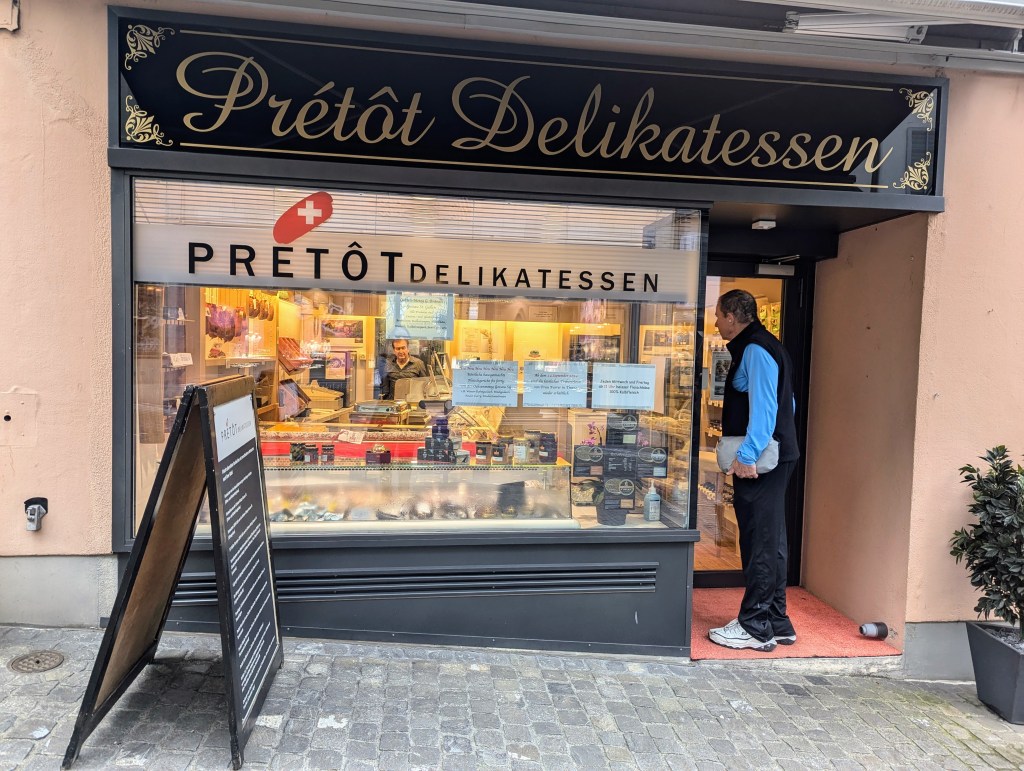
We also had to go by Prétôt Delikatessen which offers a curated selection of gourmet products, including fine wines, cheeses, and prepared meat items (charcuterie).
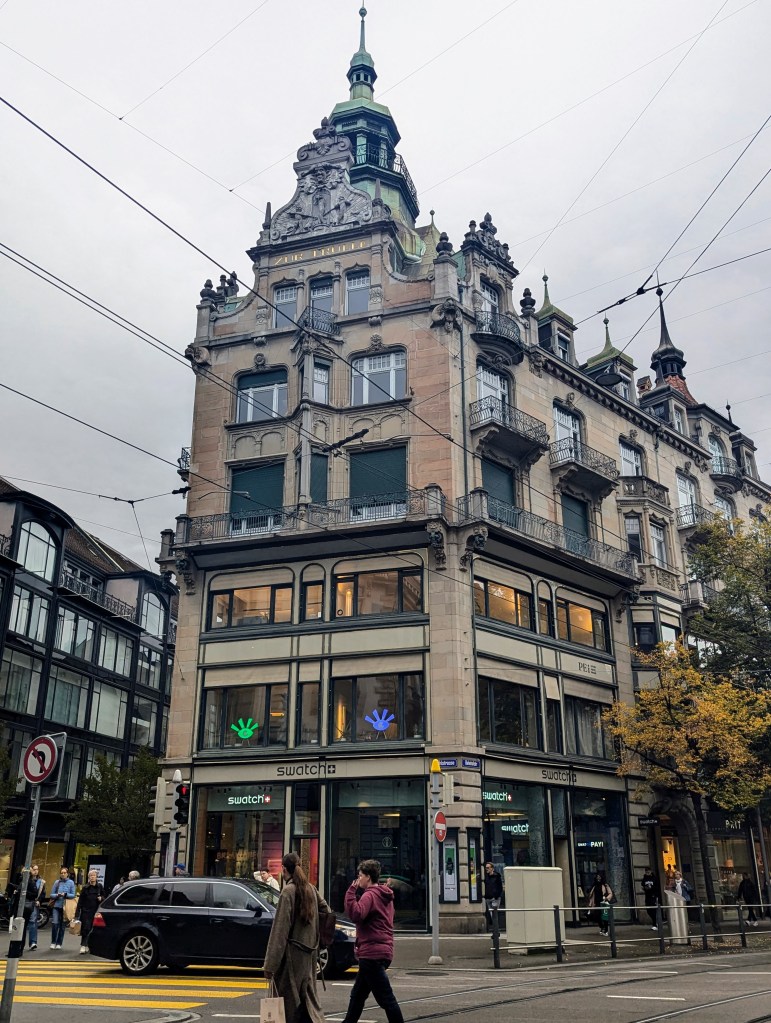
We made our way back to Bahnhofstrasse, passing so many stores along the way, so many interesting buildings.
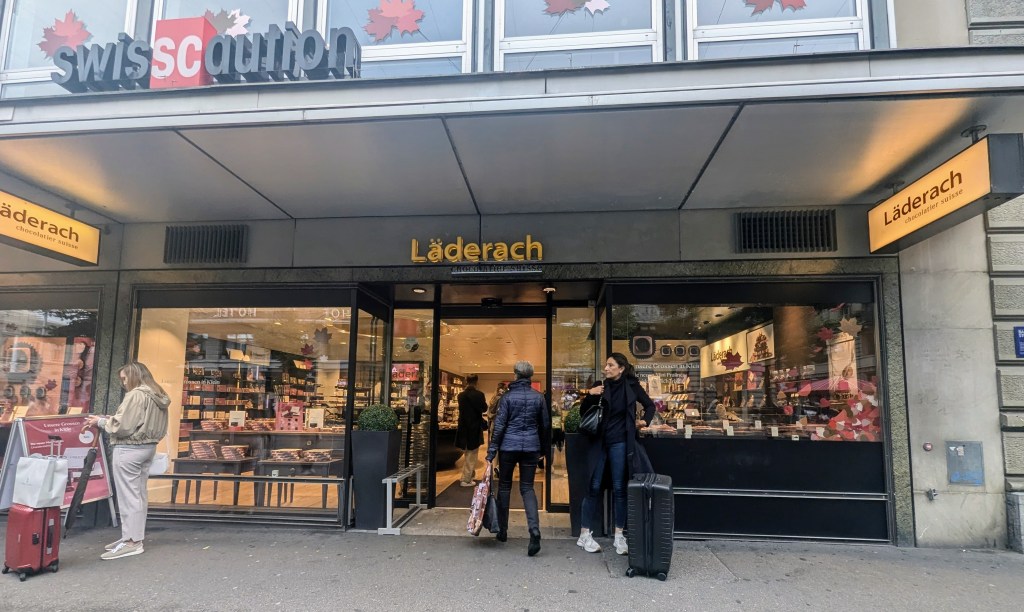
and yet another flagship chocolatier: Läderach, whose treats we had sampled first in Bern and had been enjoying in every city since. Läderach was founded in Ennenda, Switzerland in 1962 by Rudolph Läderach. Since 2018, this family-owned business has been run by the third generation of Läderach chocolatiers. In 1970, Rudolf Läderach Jr. invented a revolutionary process of manufacturing thin-walled hollow balls for truffles, rendering the professional manufacture of chocolate truffles easier and significantly improving their quality, taste and texture. In 2008 the company launched a new brand: Läderach Chocolatier Suisse, timed with the opening of confectioneries in their spacious boutiques on Bahnhofstrasse, Zurich and Spitalgasse in Bern. In 2018, Elias Läderach beat 19 international competitors to win the title of World Chocolate Masters in Paris. Today Läderach stands not only for finest premium products, but also for a family-minded social responsibility, fostering ecological thinking. Of course we bought more.
We reached the train station then headed, passed the National Museum of Switzerland
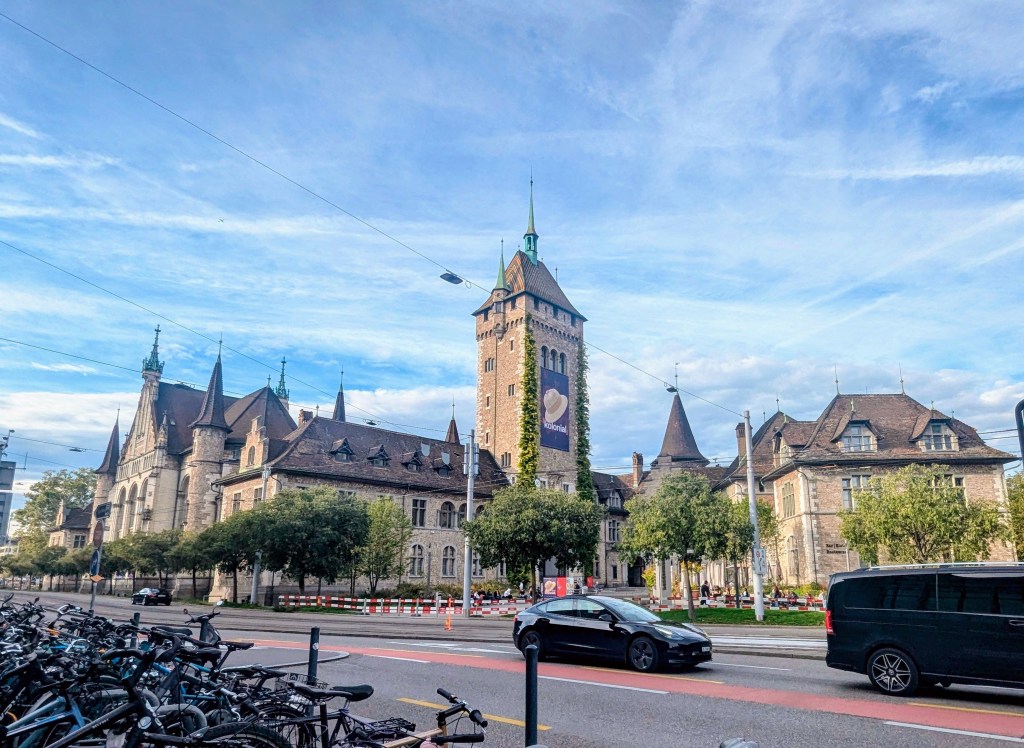
then headed back across the river toward our hotel. But we decided before heading in to take the Polybahn, a funicular railway, up to ETH Zurich, a public research university founded in 1854 with the stated mission to educate engineers and scientists, the university focuses primarily on STEM programs.
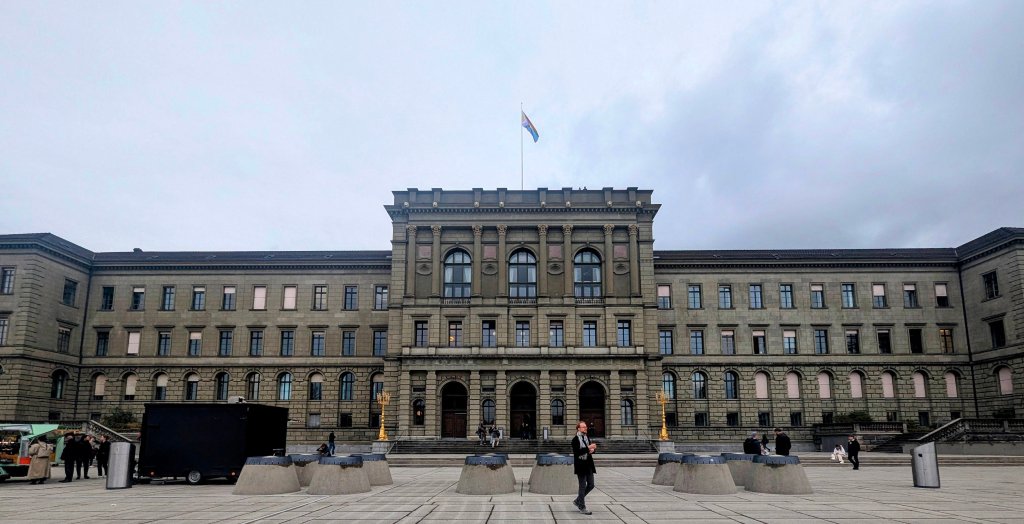
The university sits high above the city.
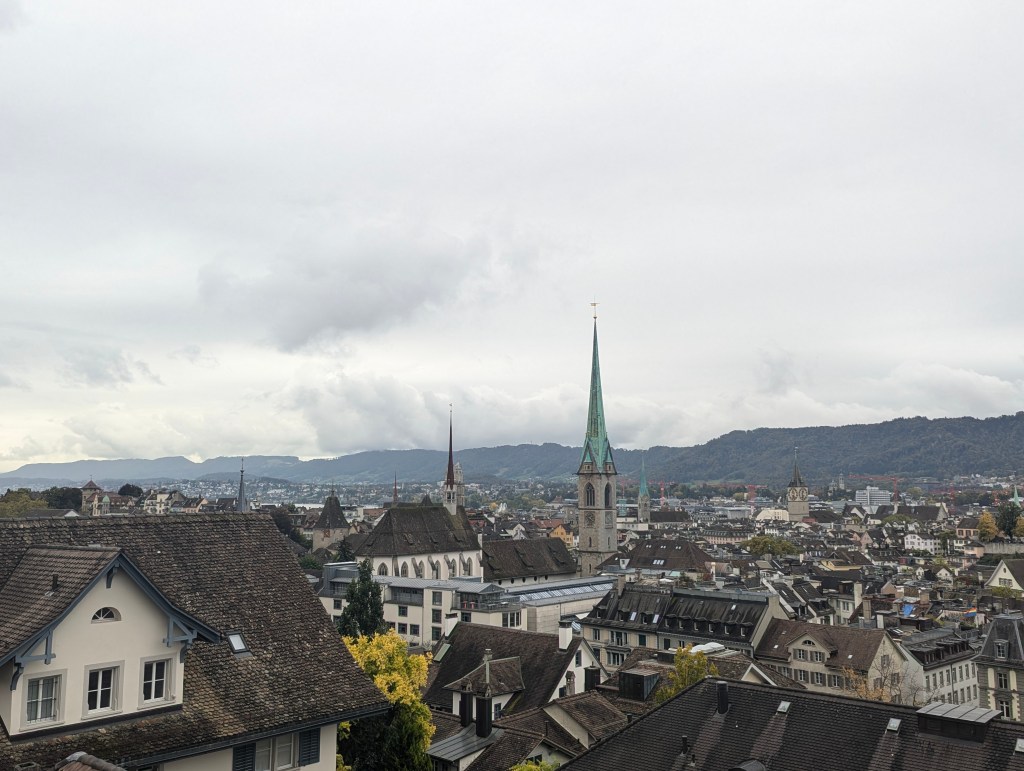
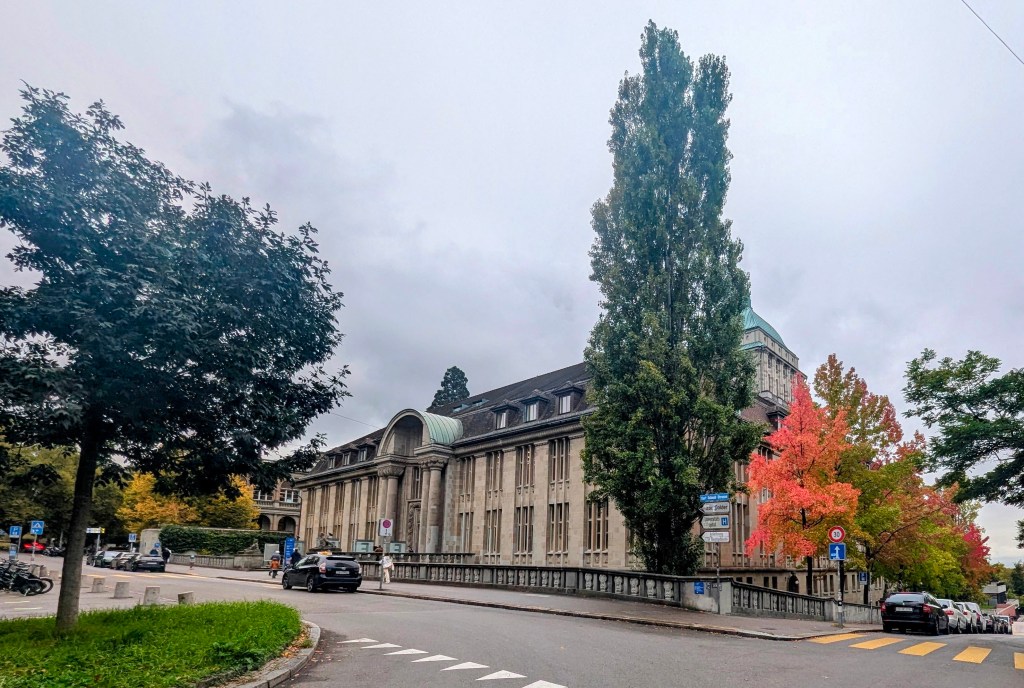
Across from the main university building is the Museum of Natural Histroy. I took this picture because it shows the first hints of autumn.
In the morning we had enough sunshine for another lake excursion. We headed to Bürkliplatz to buy our boat tickets. Bürkliplatz, where the river empties into Lake Zurich, is one of the main squares in Zurich. Not only is it a fabulous destination, but it is also a central node in the city’s transportation scheme including trams and boat excursions. At the end of the plaza is a lake overlook, featuring a prominent statue of Ganymede.
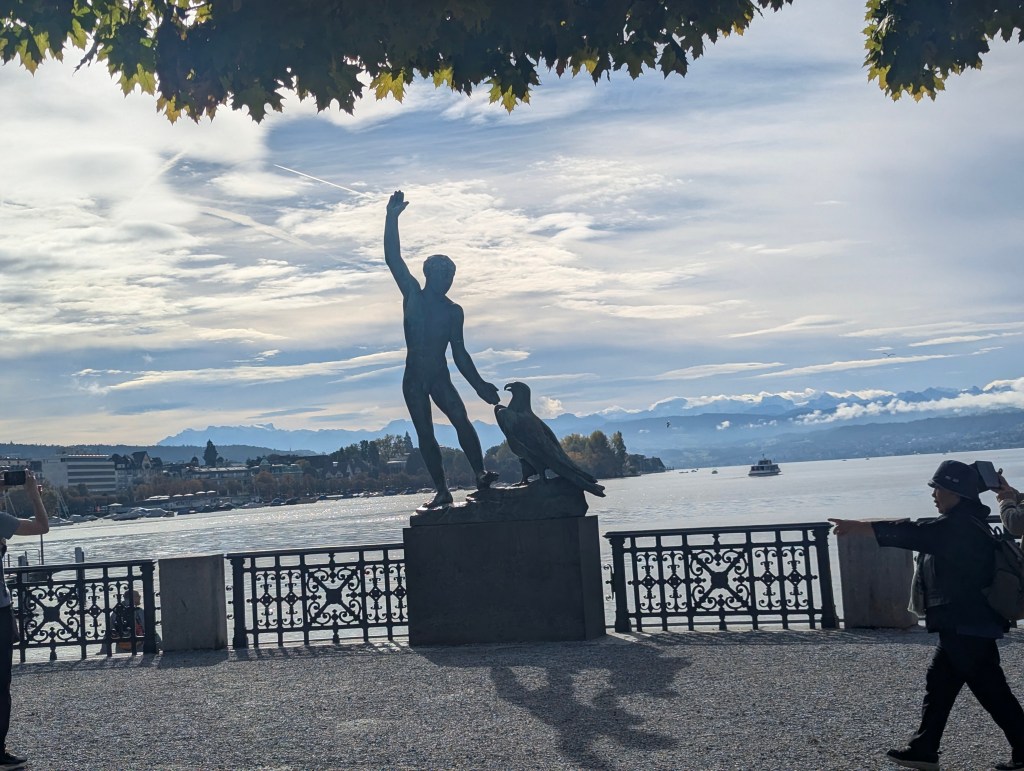
We were so happy to be out on the water again.
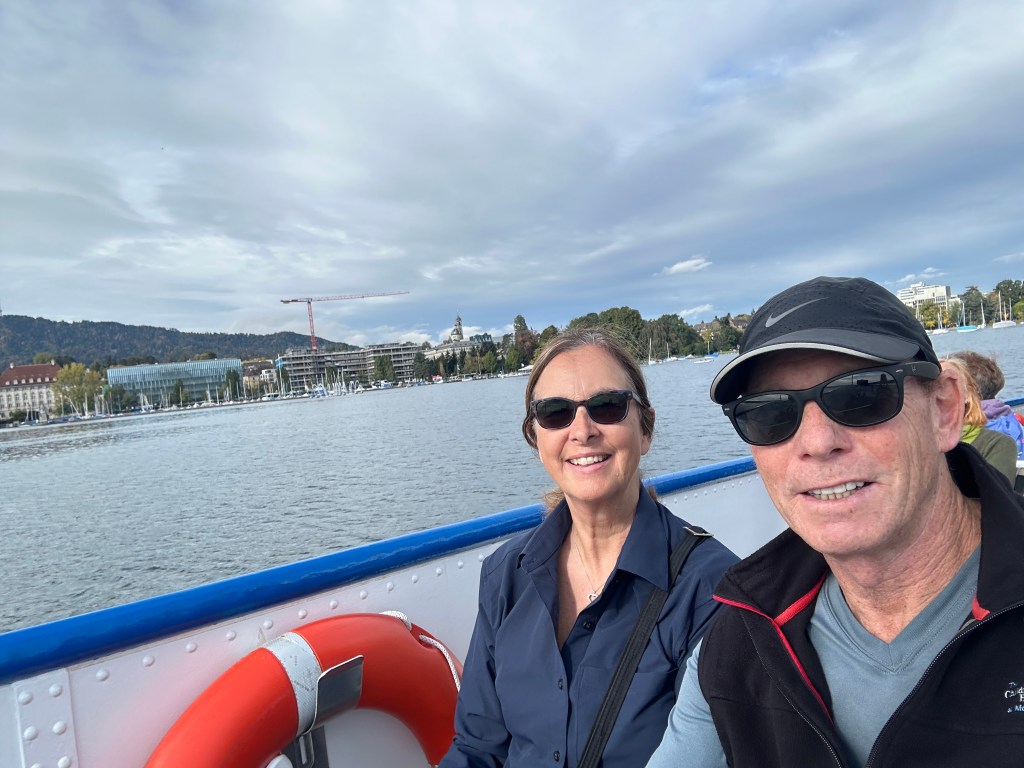
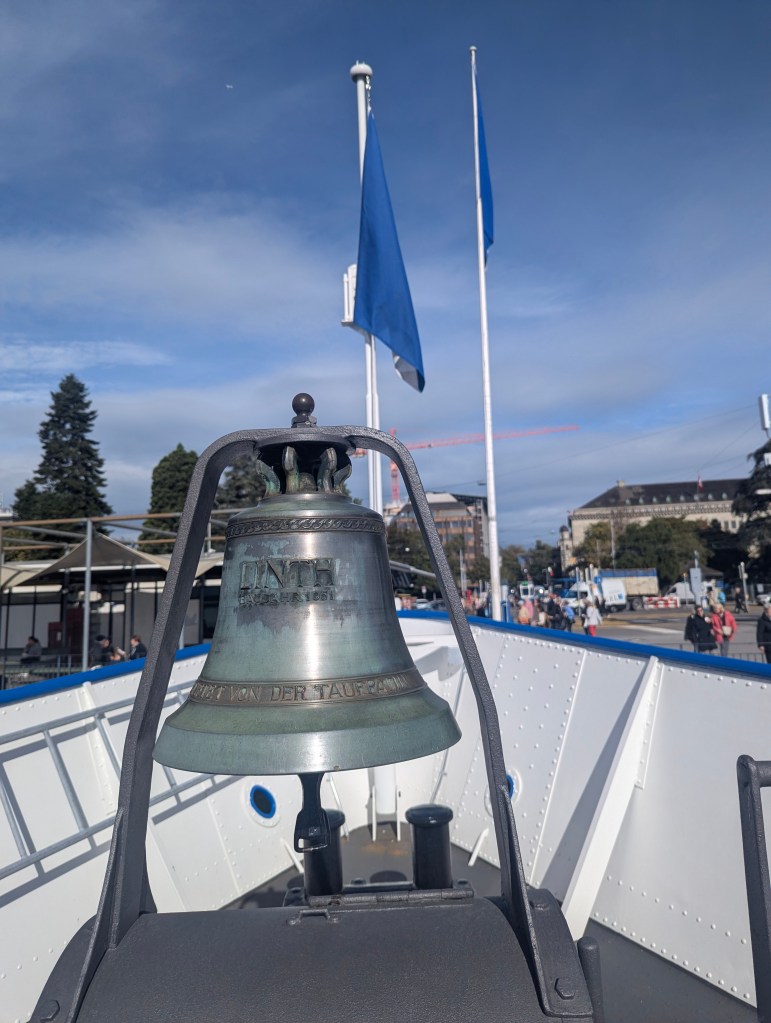
Although this boat is not as old nor as unique as those on Lake Geneva.
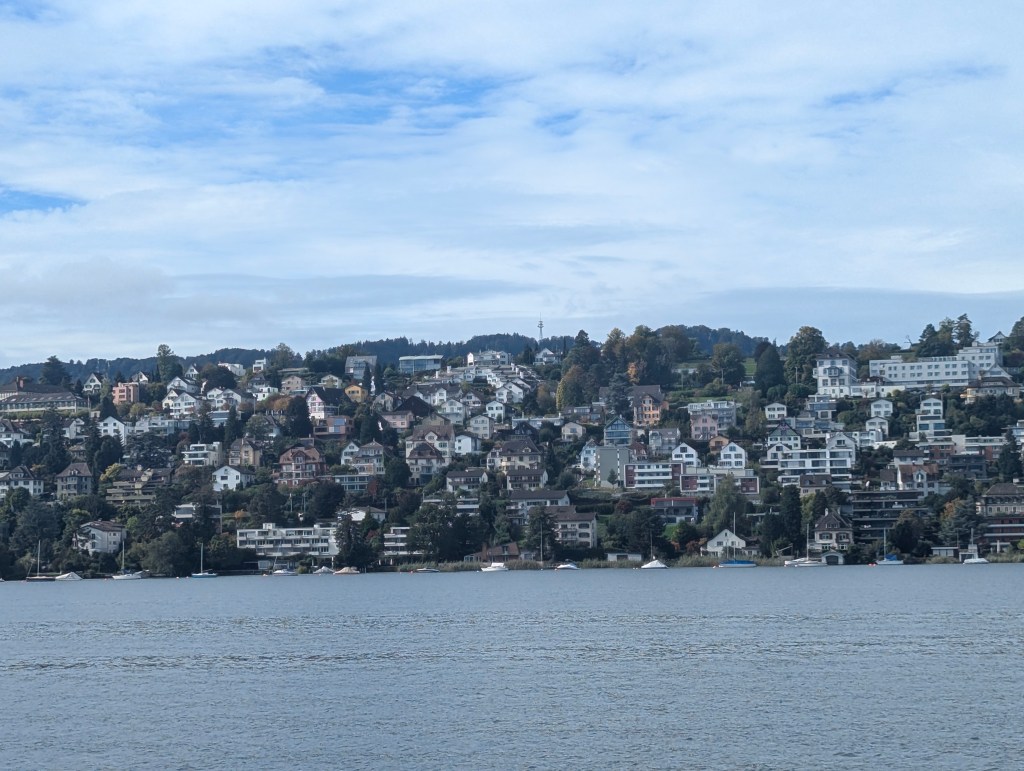
One of our first observations about Lake Zurich was how much more crowded its shores are than the other lakes we have visited.
It was not until we had been on the lake a while before we got our first glimpse of the distant alps.
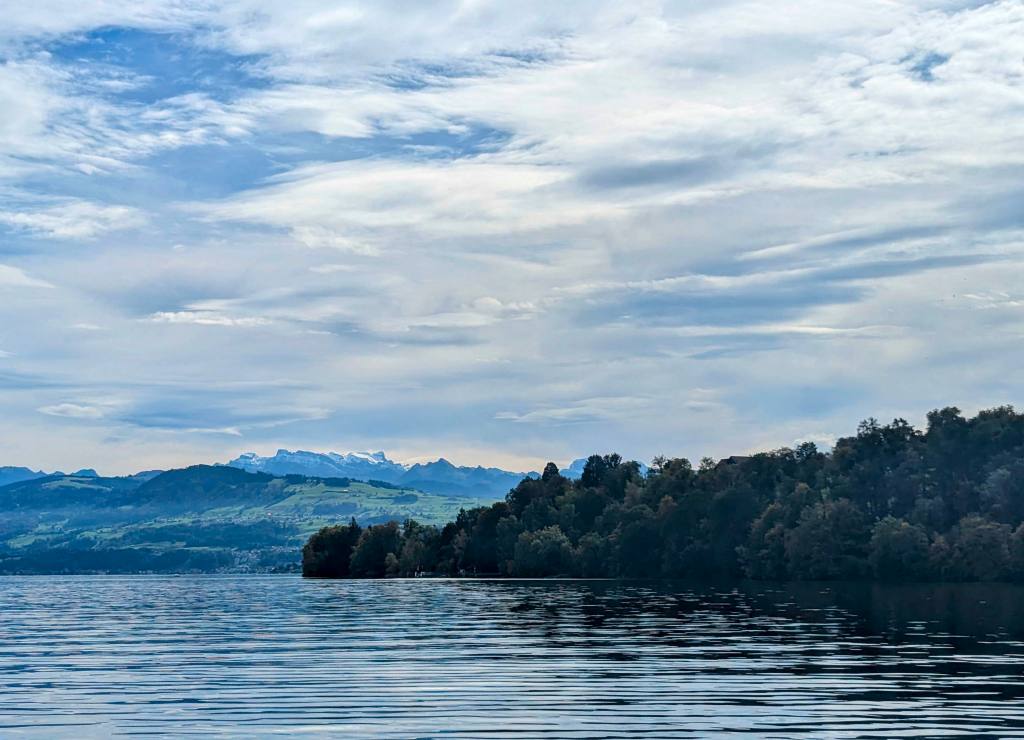
I want to take a minute here for an aside. This was our third lake trip, and I have not yet mentioned the vineyards visible on the shores of all of them.

We have been ordering Swiss wines with dinner. We have been told by the wait staff that Swiss wines are pretty much never exported both because of the low supply and also because they cannot compete on the international markets with neighbors France and Italy. We have not much loved any of the whites we have tried, but we find the Pinot Noirs quite good.

The boat made several stops along our way, one in the winery town of Stäfa.
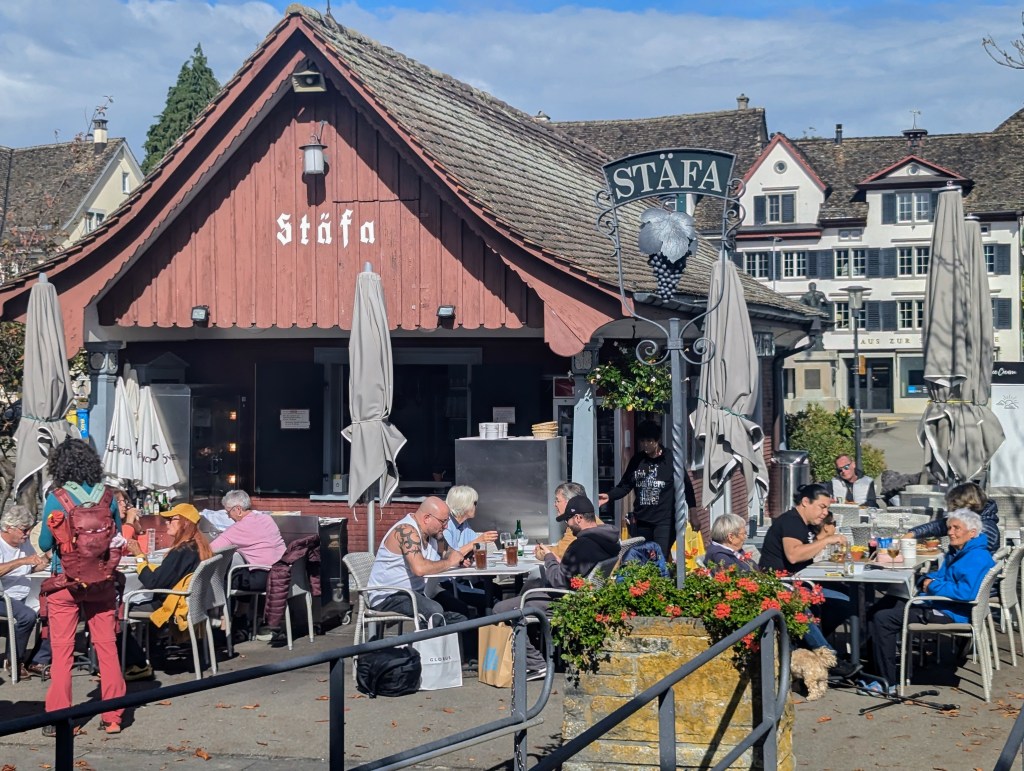
Our destination was Rapperswil-Jonah.

Upon arrival we stopped for lunch before exploring the city. Once seated, we headed into the main square

on which is the cutest art gallery full of nothing but elephants in every size and material imaginable.
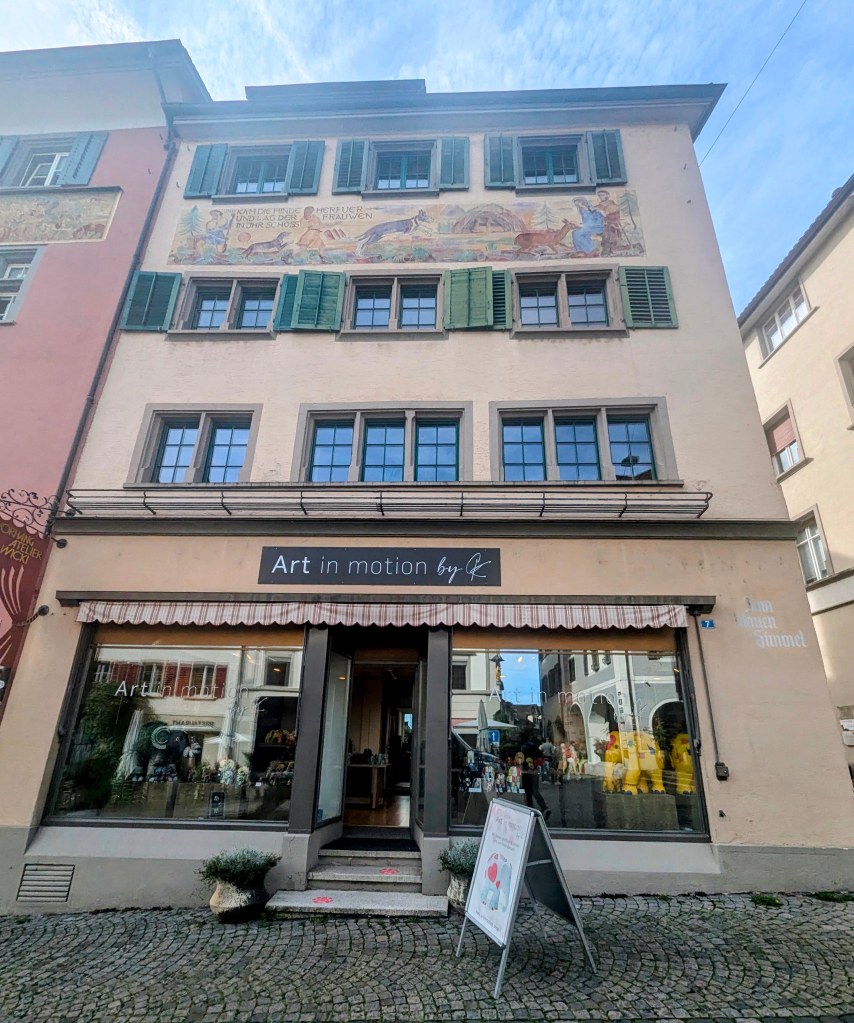
We embarked on the climb

toward the Rapperswil Castle, which was built between 1220 and 1230 on a rocky spur that extends far into Lake Zurich. It is surrounded by water on three sides and was thus well protected for centuries. Visible from afar with its high towers, it dominates the cityscape of the old town of Rapperswil below.
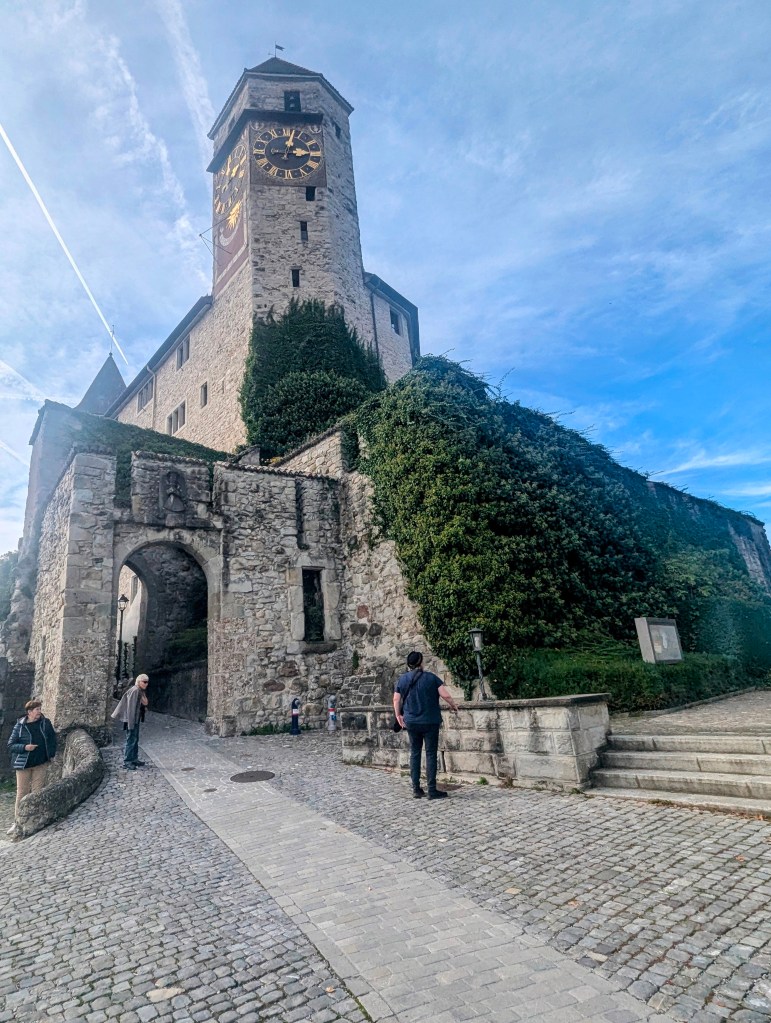
We took a moment to congratulate ourselves on the climb and check the view.
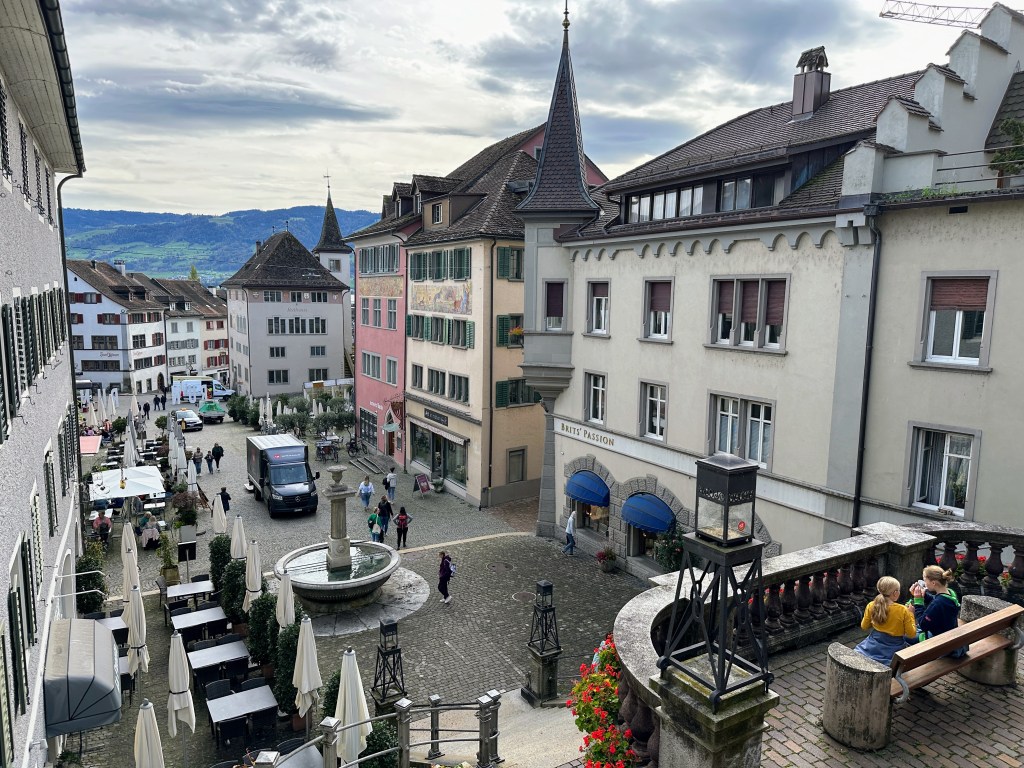
Next to the castle is Stadtpfarrkirche St. Johann (St. John’s Parish Church), a Roman catholic parish church built in the 1220s.


In 1489 the adjacent Liebfrauenkapelle (St. Mary’s chapel) was built, the cemetery chapel that still exists.
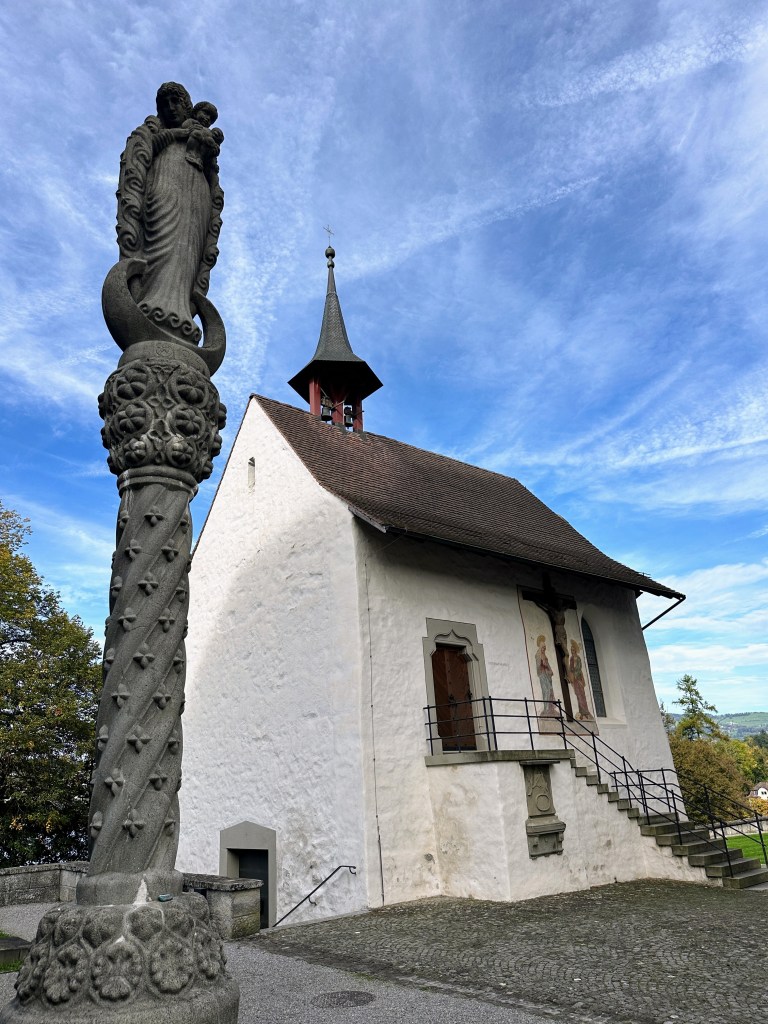
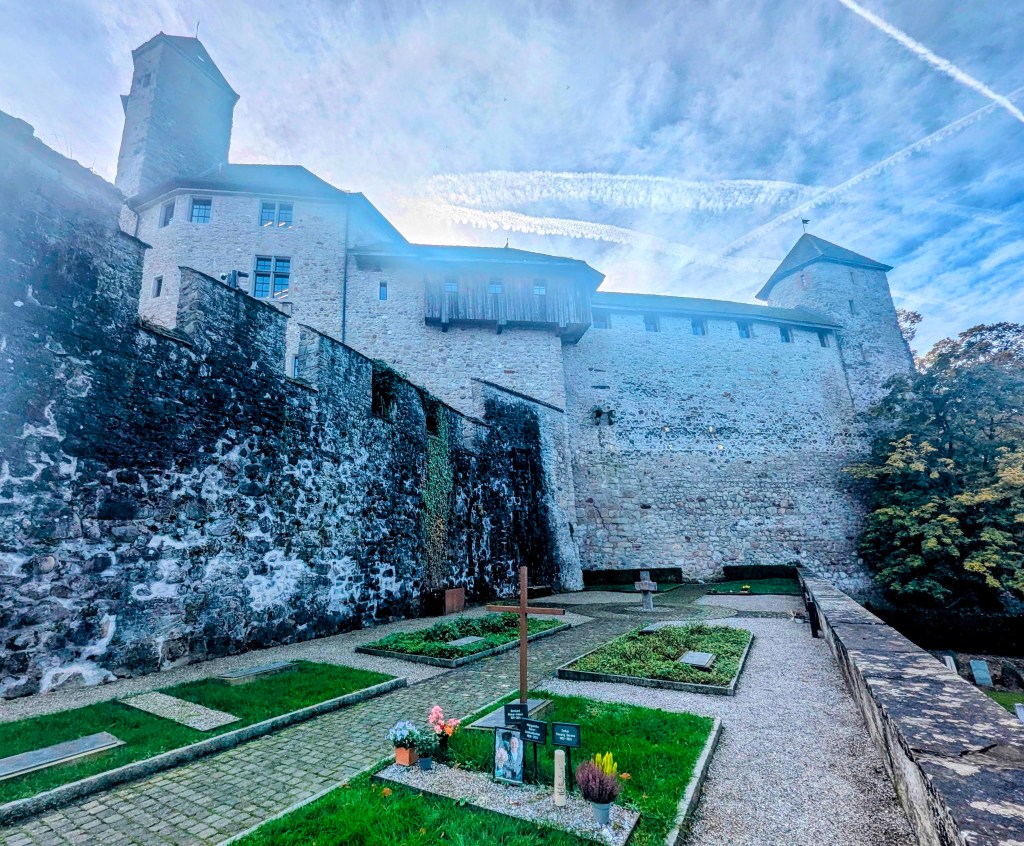
The cemetery lies between Liebfrauenkapelle and the castle.
Walking around the castle back toward the lake, there was a large park in front of the castle with a deer park. The origins of today’s town are described in the following legend: One morning, the Lord of Rapperswil , together with his wife and some servants, drove across the lake to hunt. They had barely reached the shore when his dogs tracked down a doe and pursued her to the top of the rocky ridge. Here the animal was hiding in a cave. When the hunters reached the cave, they saw that there were two calves in addition to the doe. The woman took pity on the animals and persuaded her husband to withdraw the dogs and spare the doe’s life. At midday, the count and his wife were resting in the shade when the doe appeared and laid her head in the woman’s lap to thank her for saving her life. The count was touched and ordered the three animals to be brought to Altendorf and raised in an enclosure. He saw in this event a sign from heaven and decided the very next day to build a new castle on the rock and a small town on the southern slope. Today, the deer park near the castle commemorates this 800-year-old tradition.
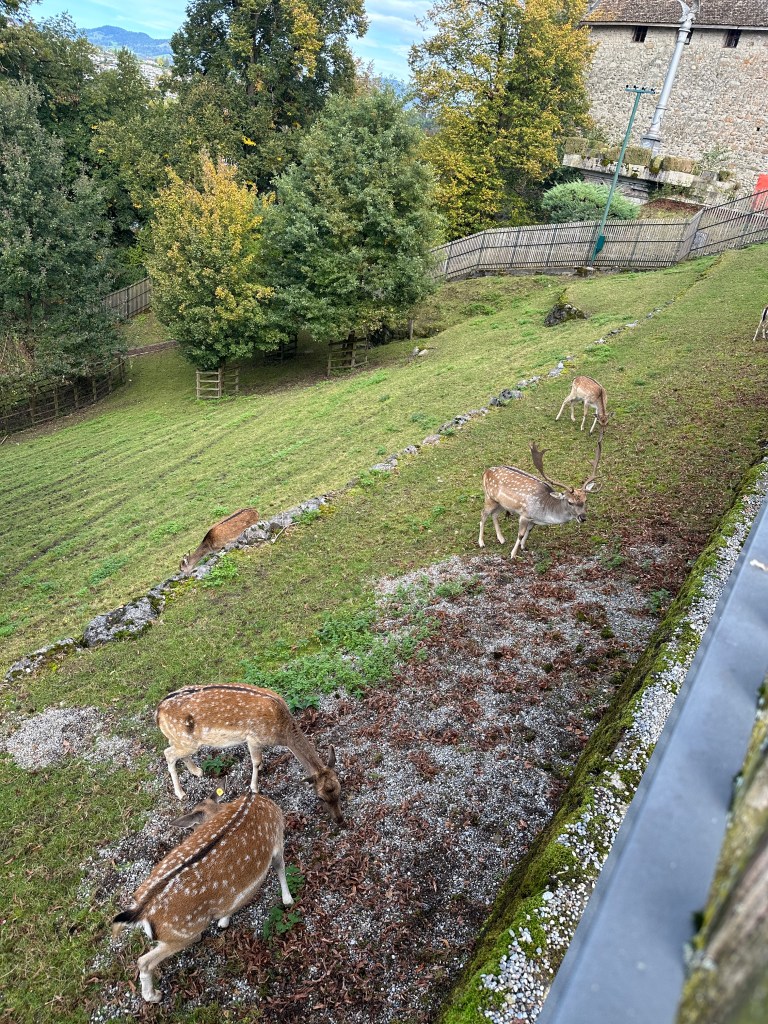
The park extends all the way down to the port.
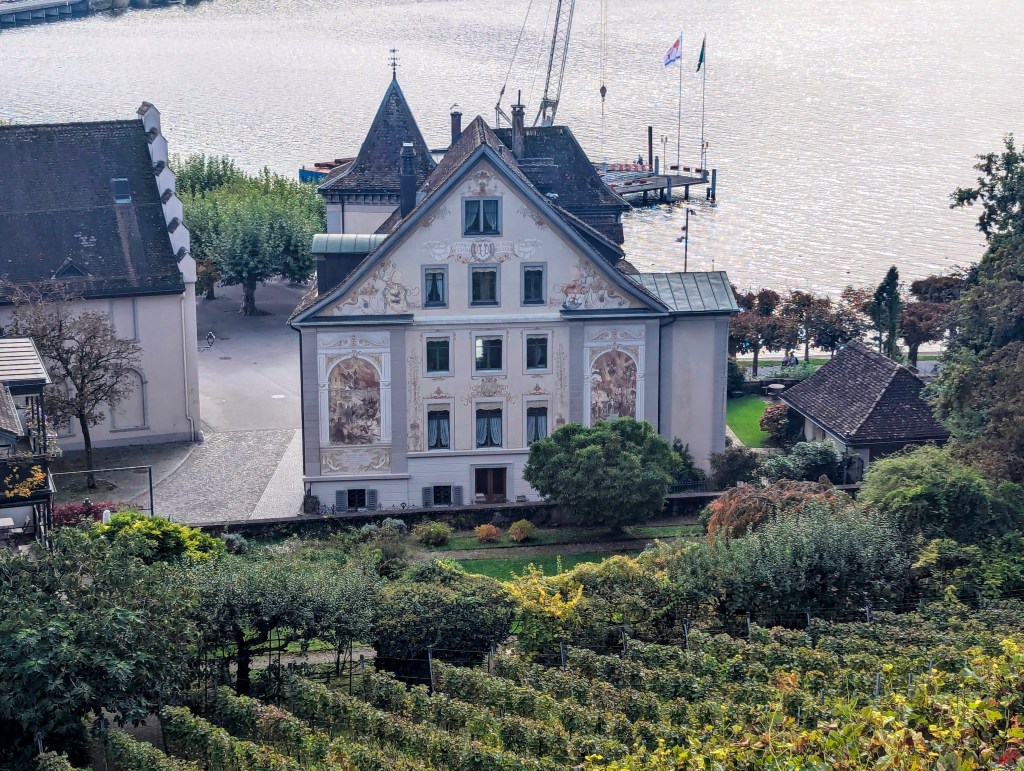
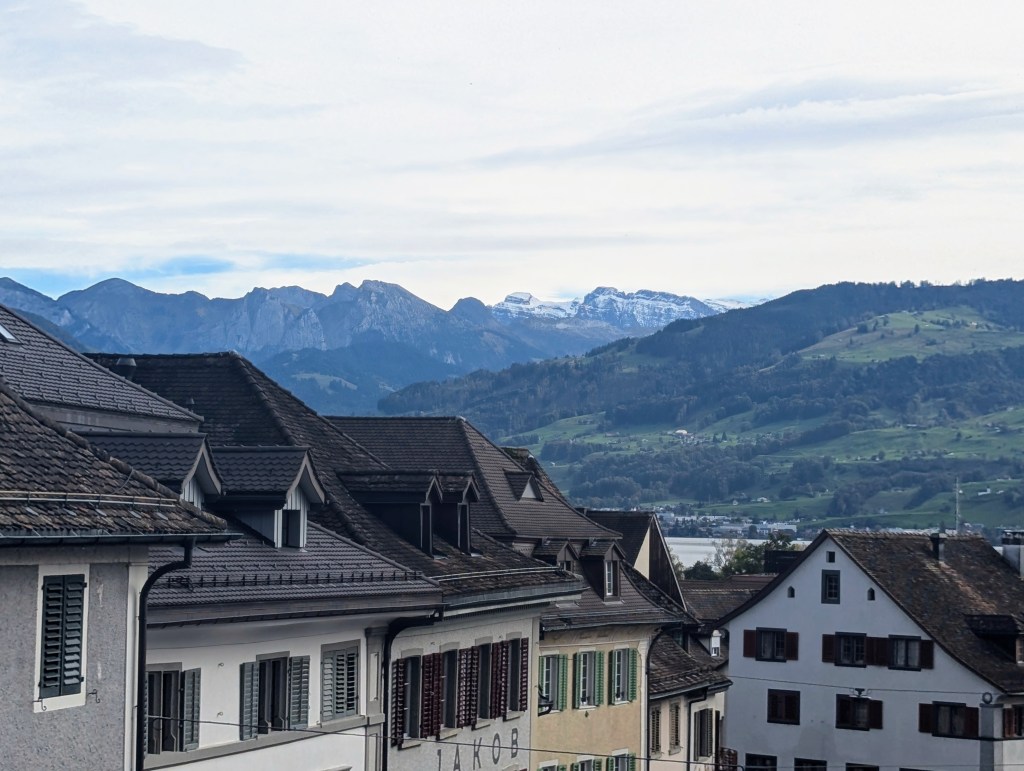
The view from the park includes the distant alps.
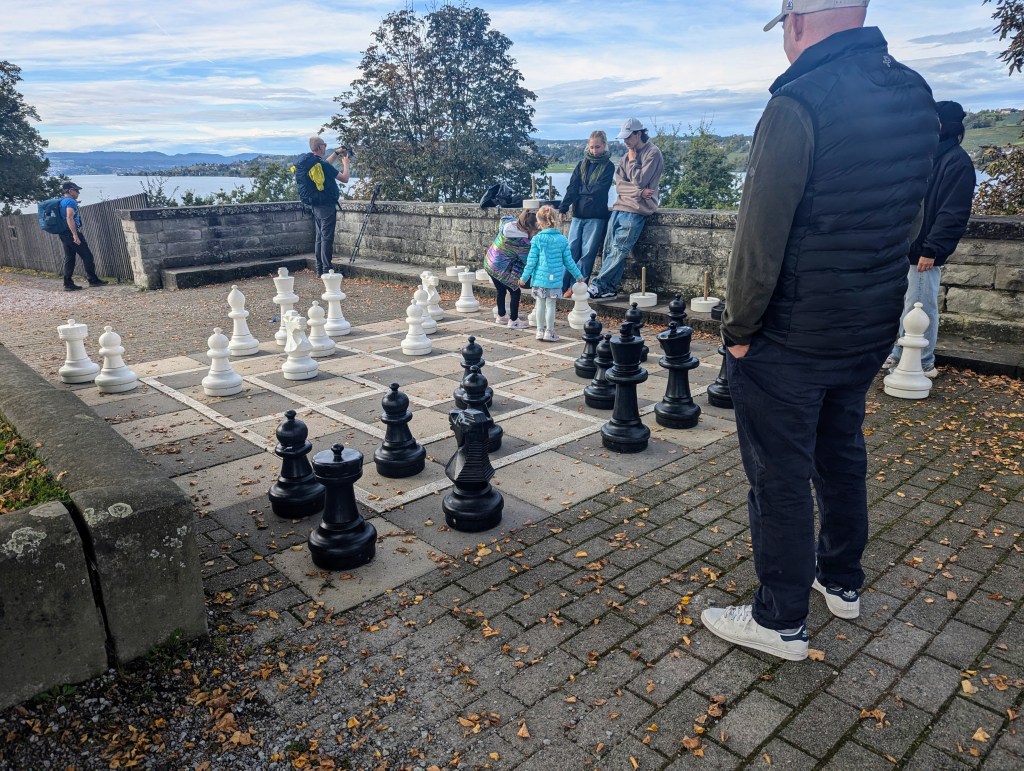
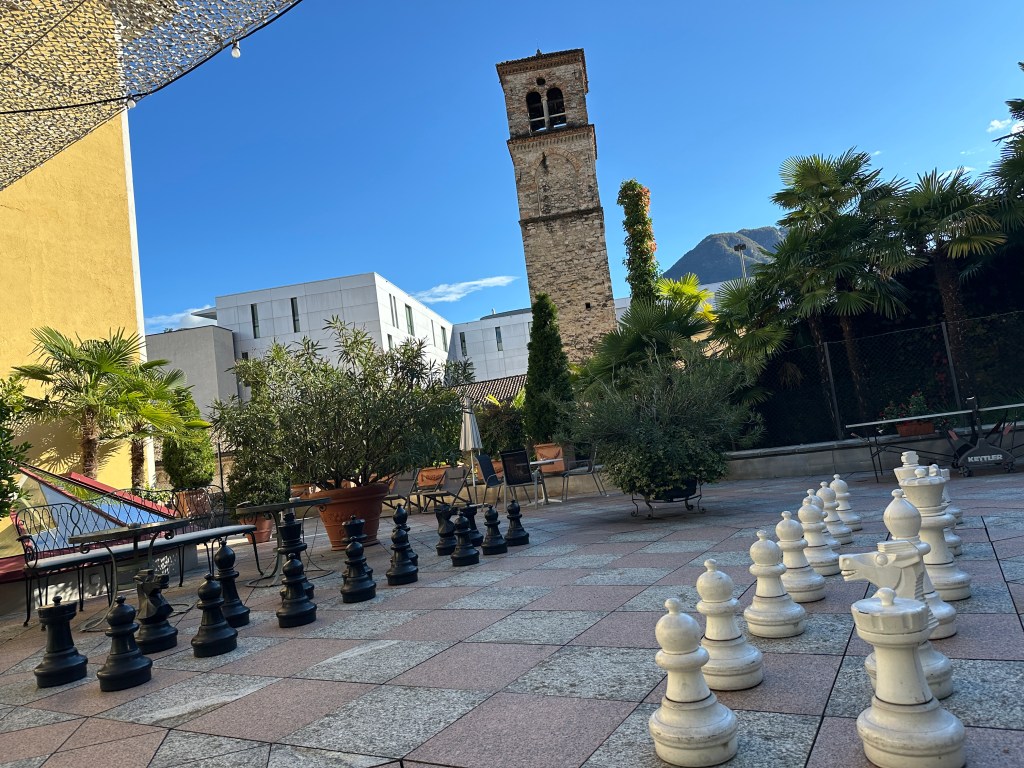
Time for another aside. One observation we have made that I have not yet commented on is this: in every city we have visited in Switzerland there has been at least one park with one large chess board.
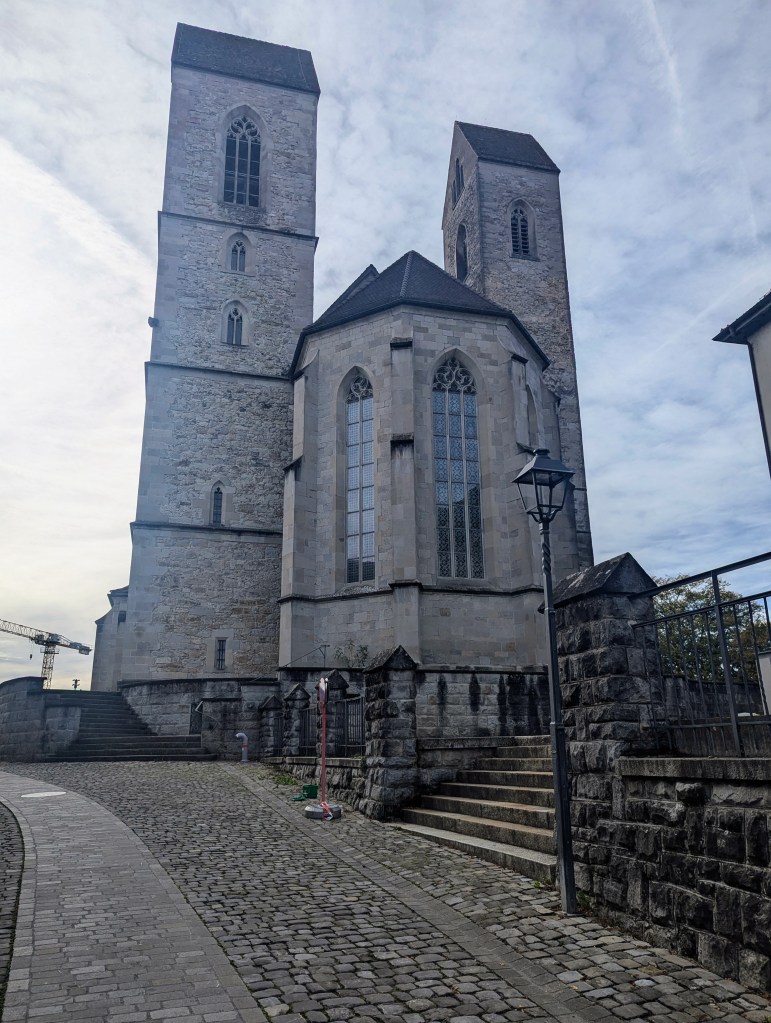
We walked back past the castle, past the church, and took a picture looking back.
then we continued on past the State Museum (Stadtmuseum).
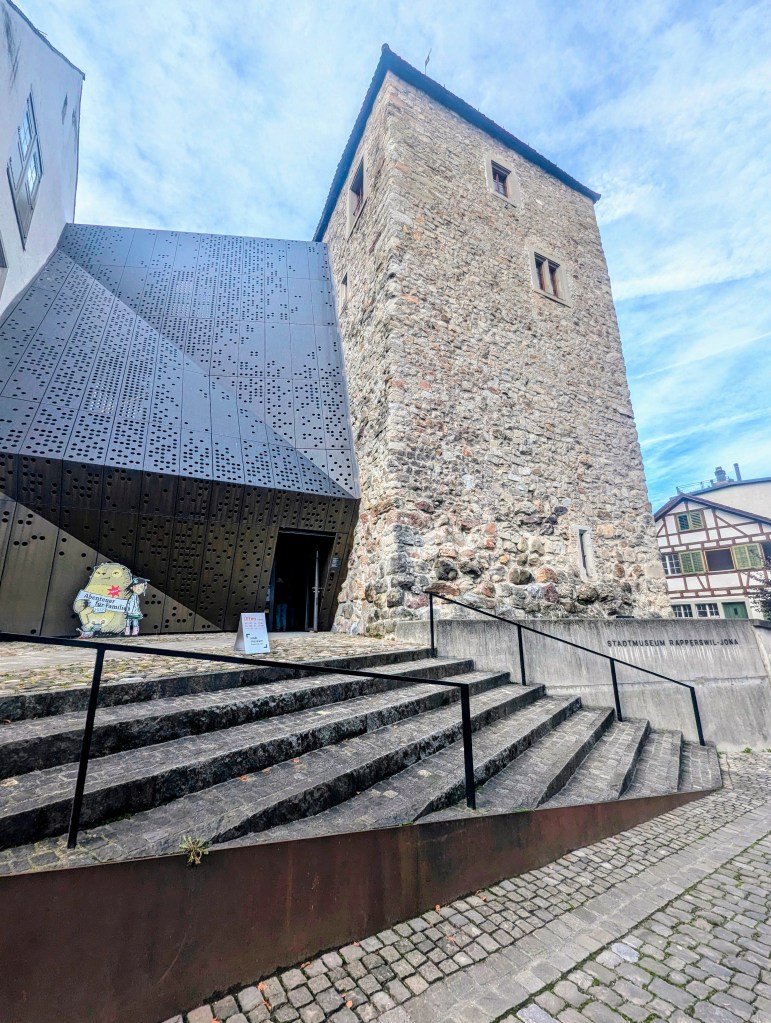
Rapperswil is often referred to as the “town of roses” (Rosenstadt) because of its extensive displays of roses in three designated parks. No less than 15,000 plants of 600 different kinds may be viewed between June and October. Alas, we were a bit late for the blooms.

Heading toward the train station we passed the Town Hall (Rathaus).

Finally we hopped on a train back to Zurich.
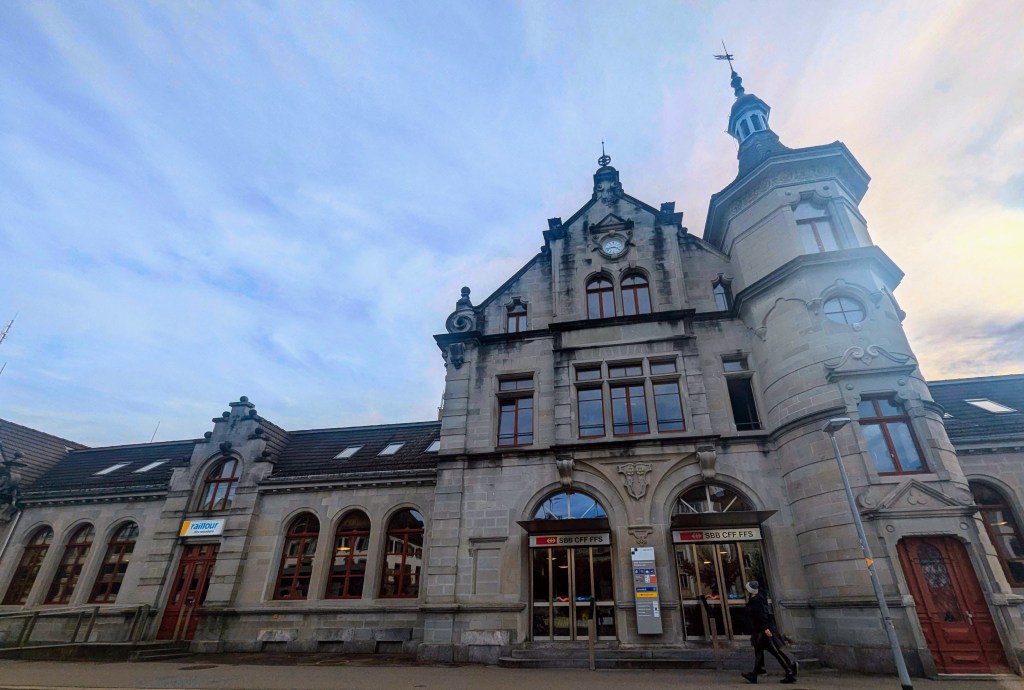
We decided while we were in a university area, we should try a beer hall for dinner. We headed to Rheinfelder Bierhalle, a no-frills brasserie for schnitzel, sausages, fries, and beer. The vibe was invigorating.
The next morning we were on our way once again, this time to Lugano, our first and only stop in an Italian Canton in Switzerland, the Ticino. As soon as we passed into the Ticino region the announcements on the train switched from German to Italian. And as soon as we stepped out off the bus from the train station into the Old City of Lugano, we could feel the cultural changes. The bus left us at the plaza right in front of our hotel: Hotel International au Lac.
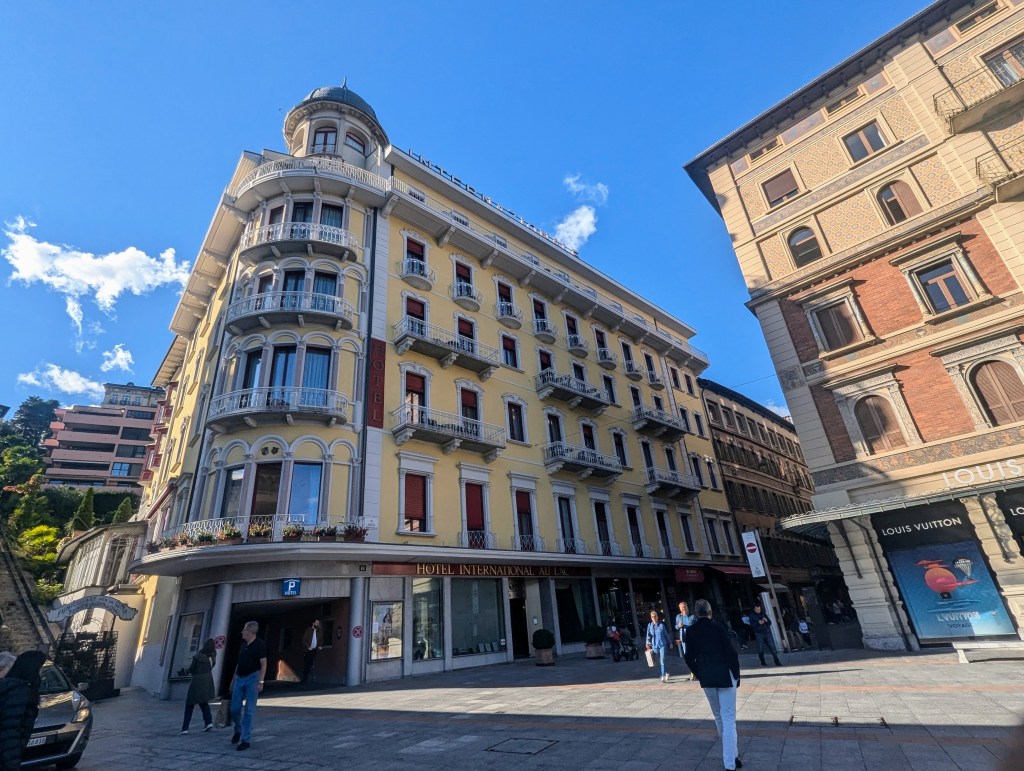
with a church on one side of the square

and shops on the other.

the cultural clincher was our room
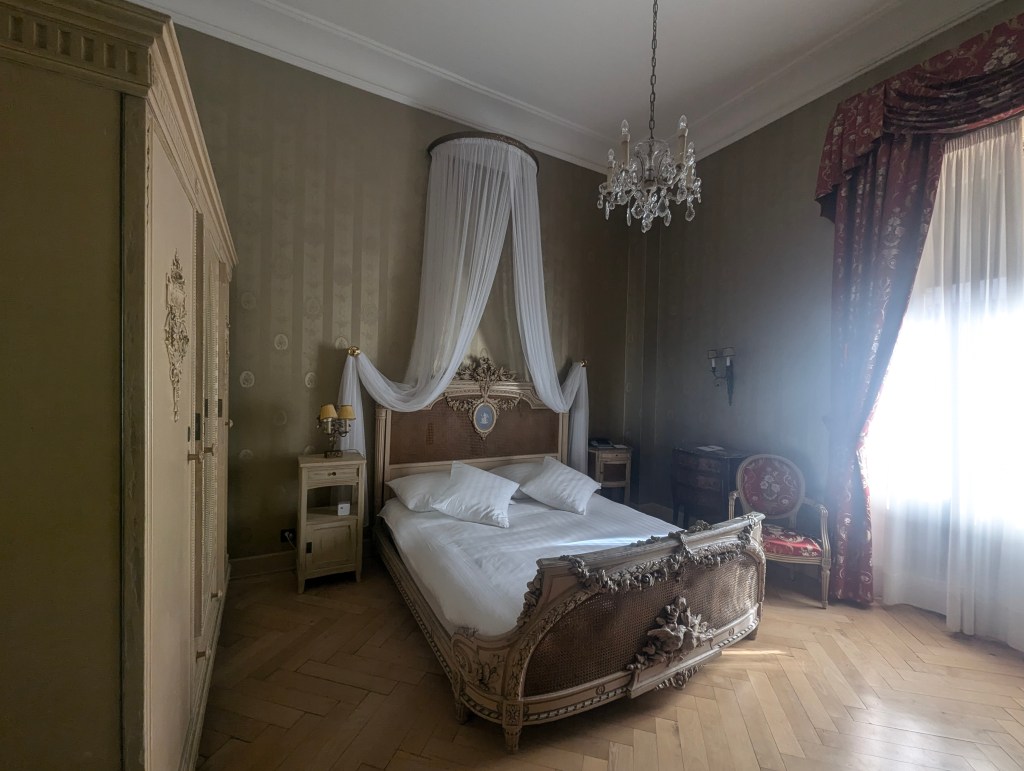
and our view
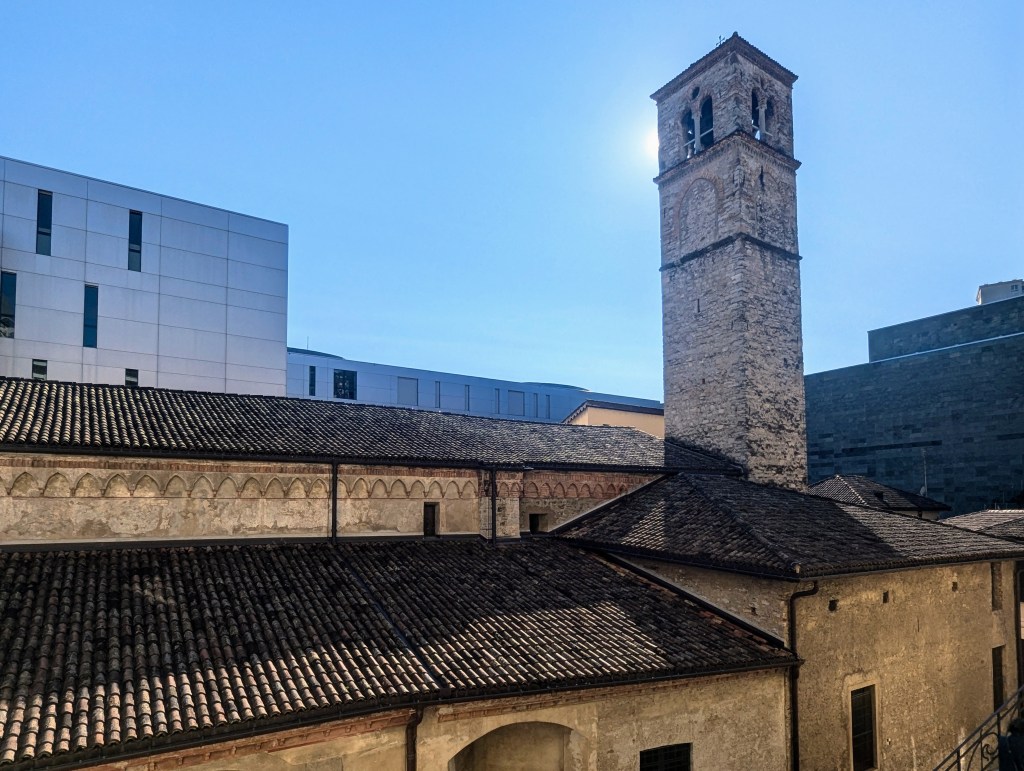
We explored the hotel a bit to see the pool and play area
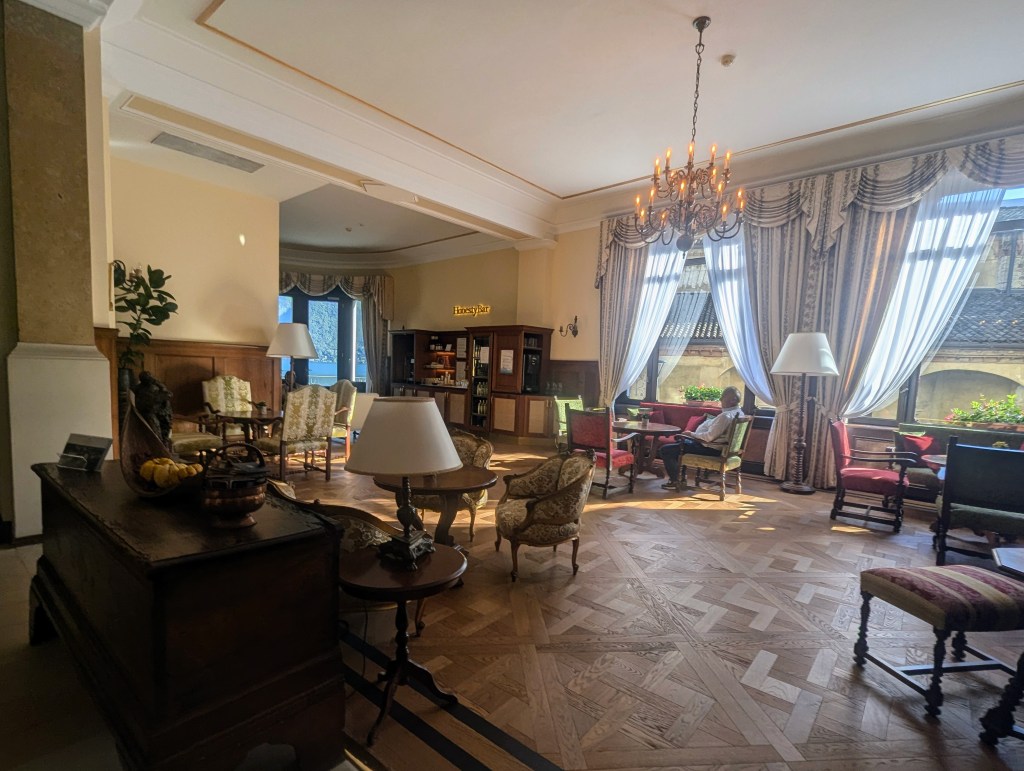
The lounge has a 24 hour “honesty bar.”
The quote from their website: “We are proudly managing our hotel in the fourth generation, opened in 1906 by our great-grandfather. Renovating our hotel and preserving its historic charm is a rare blend that we constantly seek. Roberto Schmid There is so much history throughout the hotel including this ode to eras of telecommunications and the hotel business.

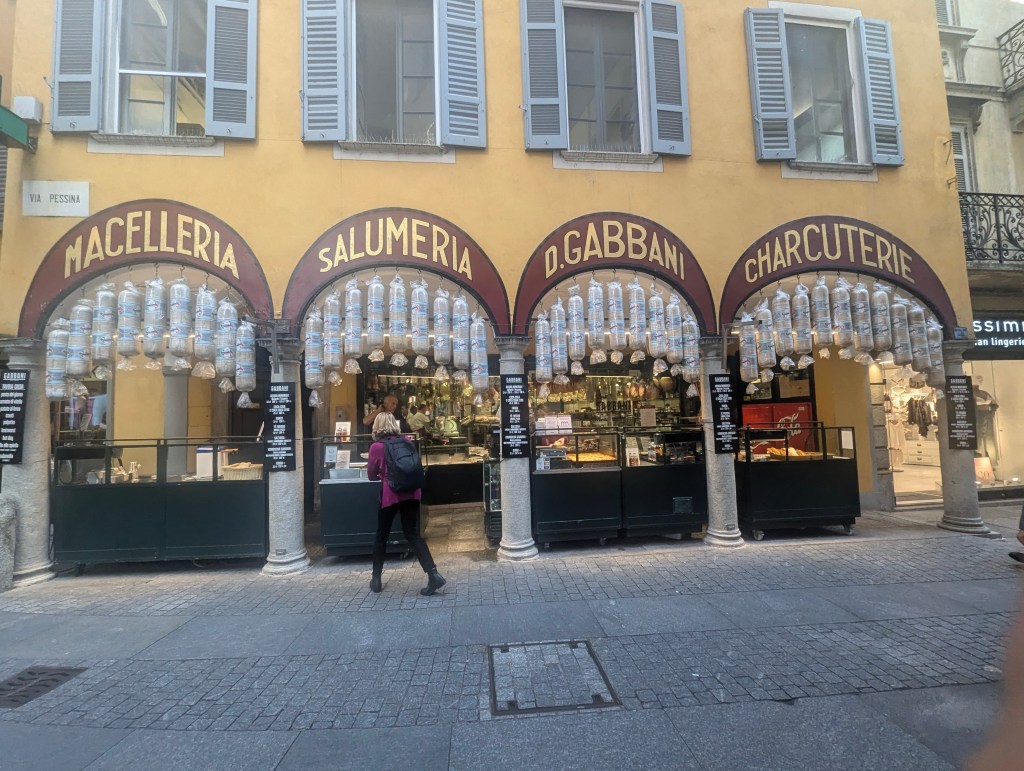
After exploring the hotel, we decided to explore the Old City a bit. We passed a salumeria whose picture needed inclusion due to the size of the salamis.
We strolled past statues

and so many interesting buildings
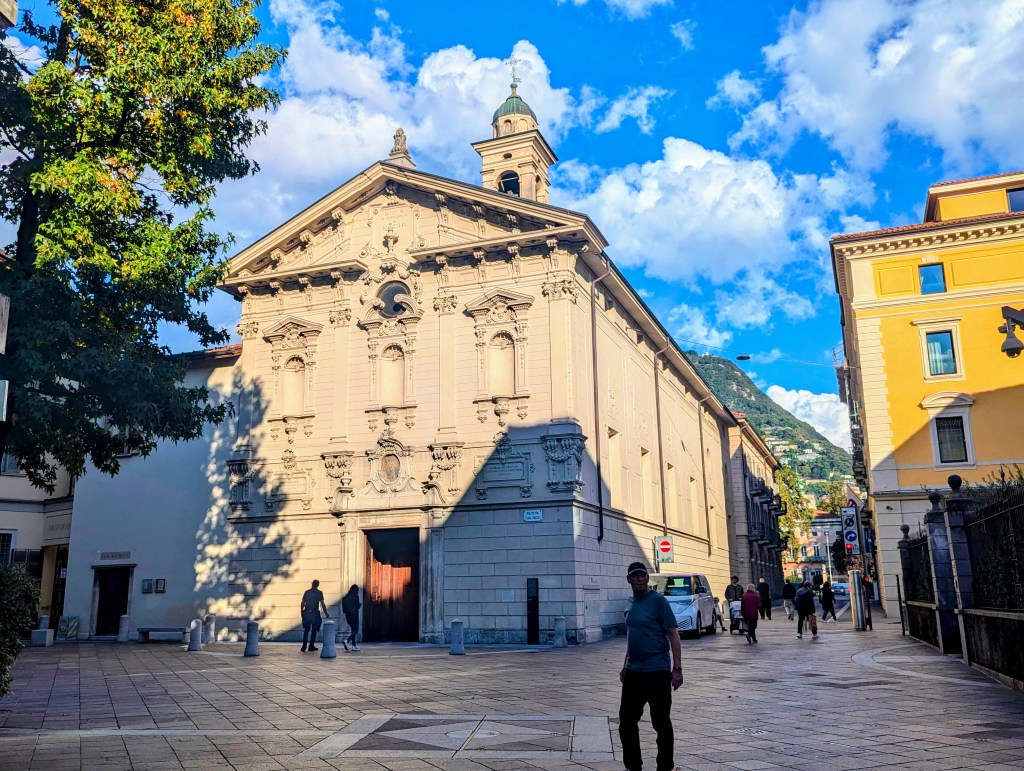

and shops

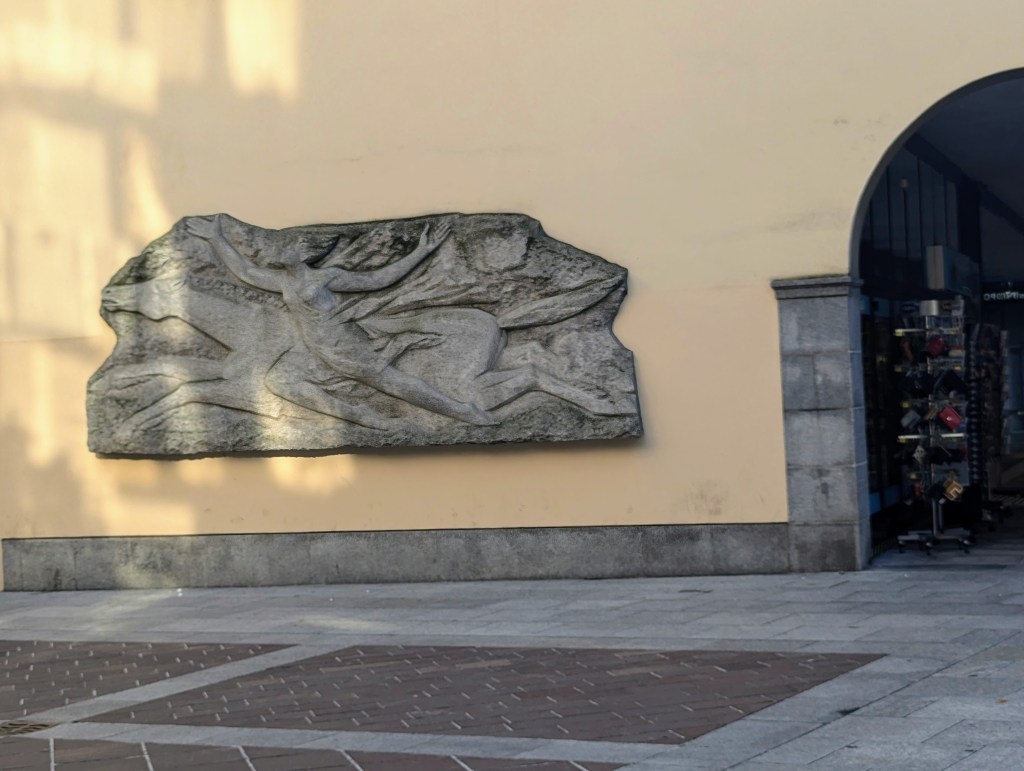
and street art
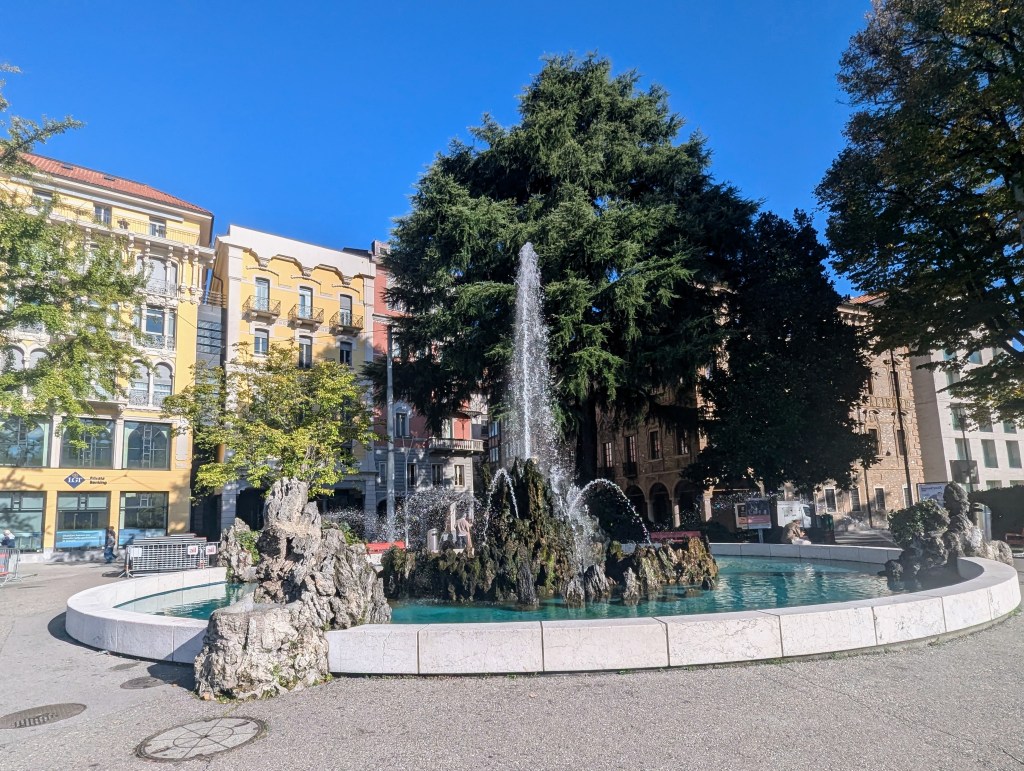
and by fountains.

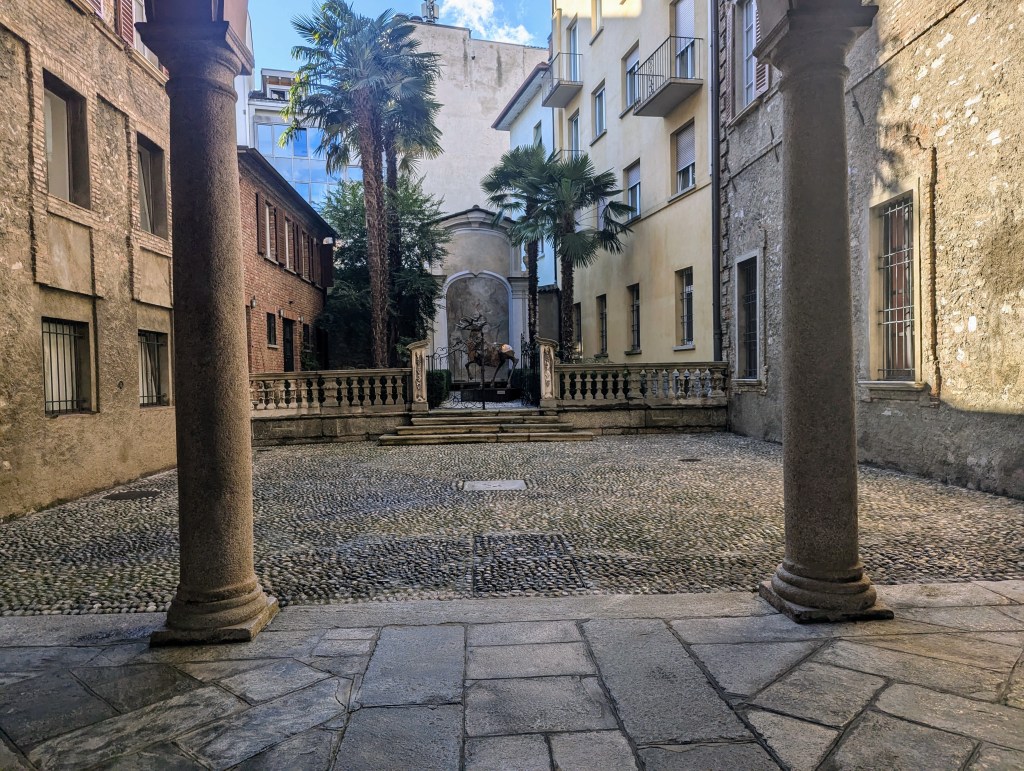
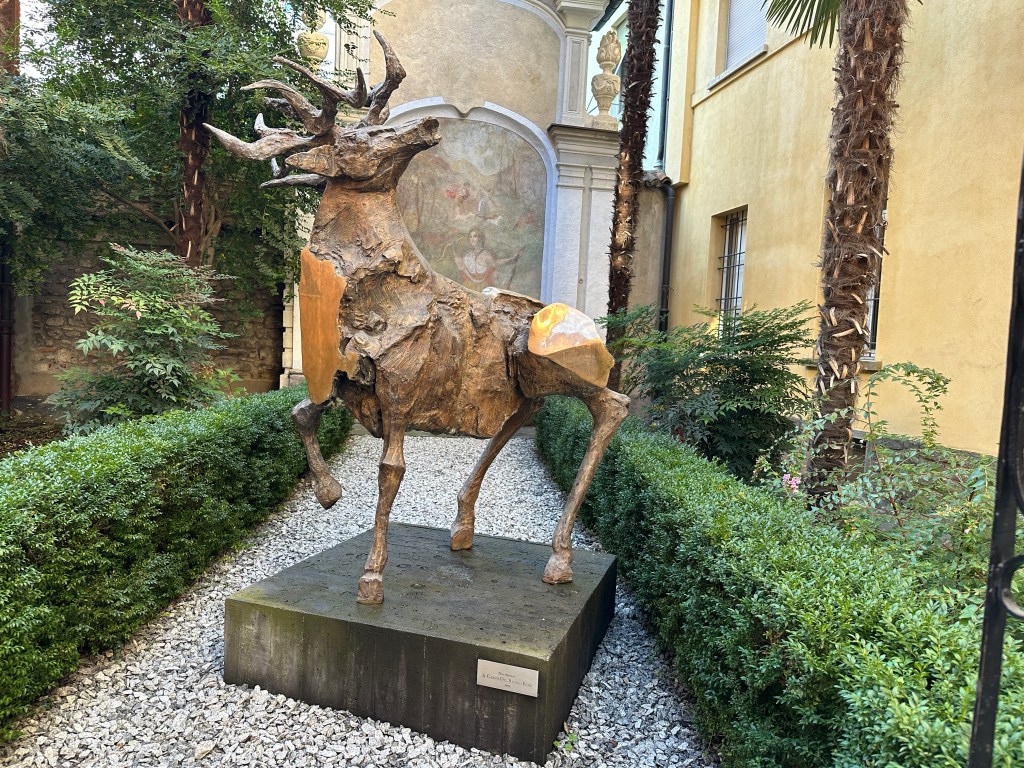
Several private residents offered a glimpse into their inner courtyard. This prior palace was particularly welcoming.
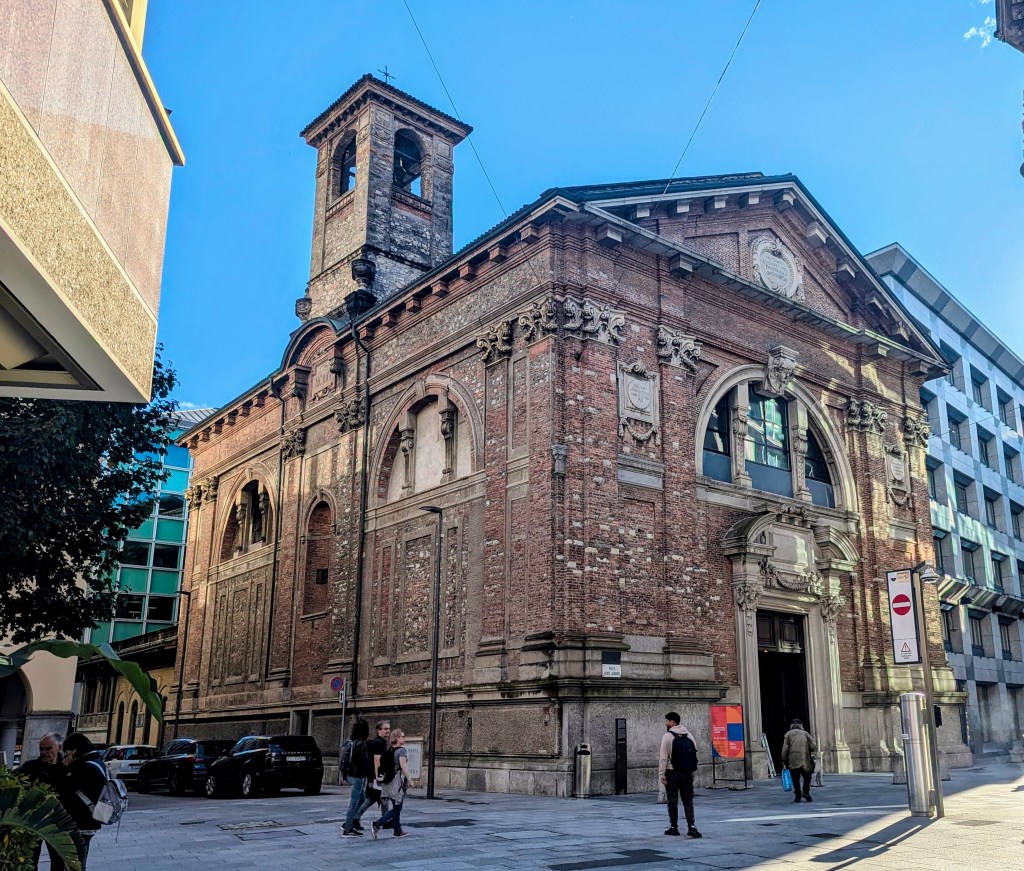
We passed the local church
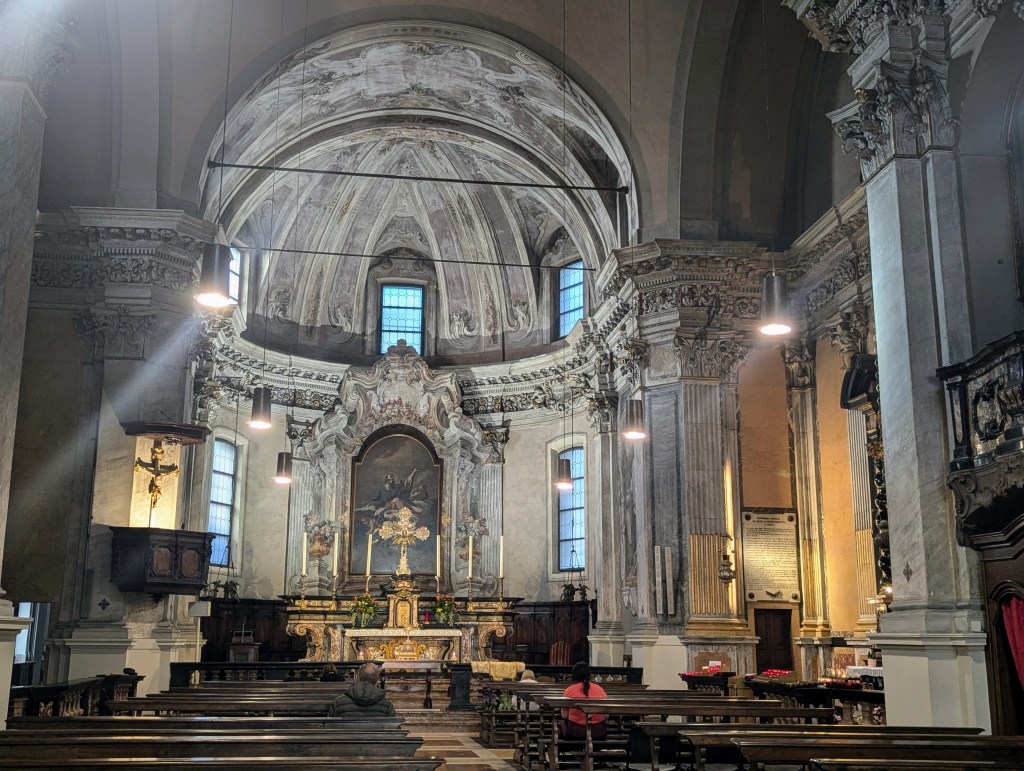
and peeked in
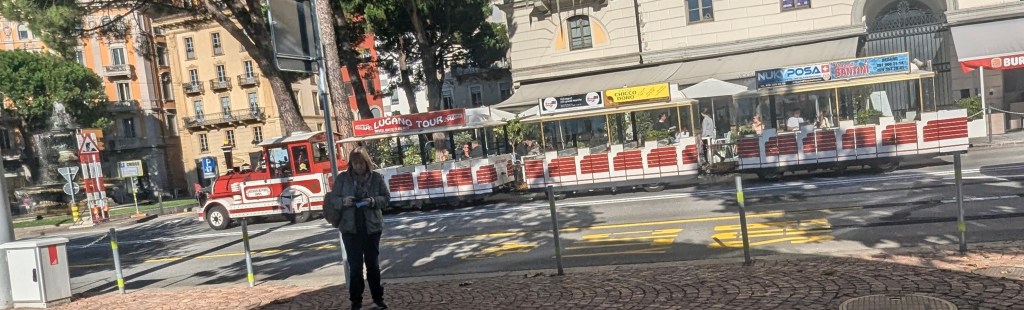
A little train rides through the streets escorting tourists.
And of course we strolled along the lake.

At some point we stopped for a pleasant outdoor dinner. In the morning we were out early. Our plans were for a boat tour of the lake, but we had enough time for a stroll through the park first. Parco Ciani is the largest park in Lugano. A historic residence built in the early 1830s by the Ciani brothers, members of a Blenio family based in Milan since the eighteenth century. It had several subsequent private owners until in 1912 it was acquired by the Municipality of Lugano which converted the park into a public promenade and the villa into a museum.
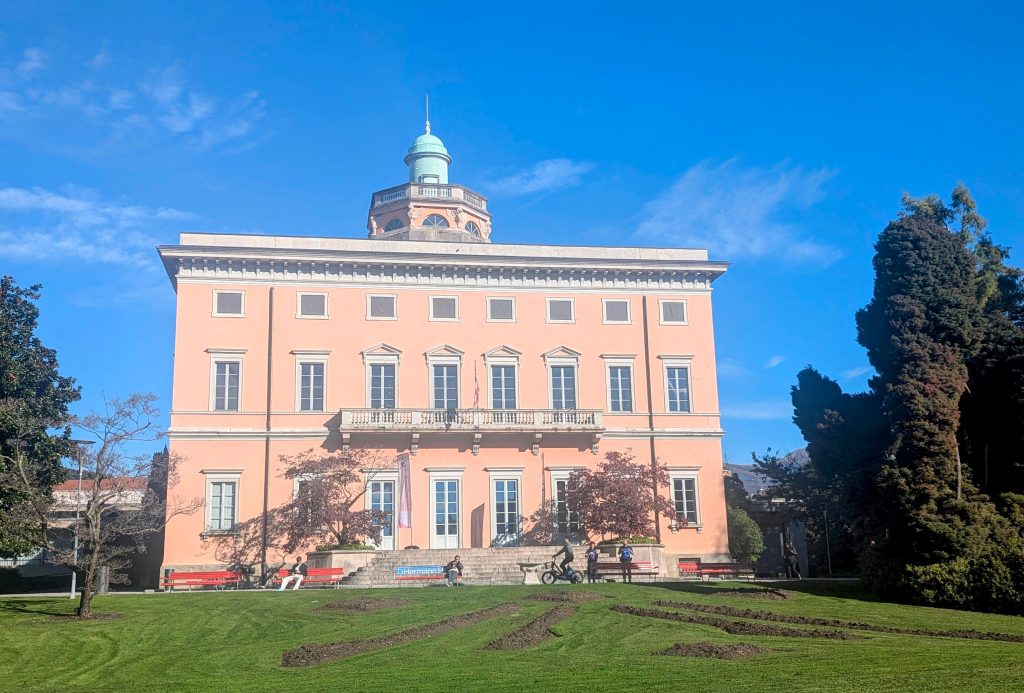
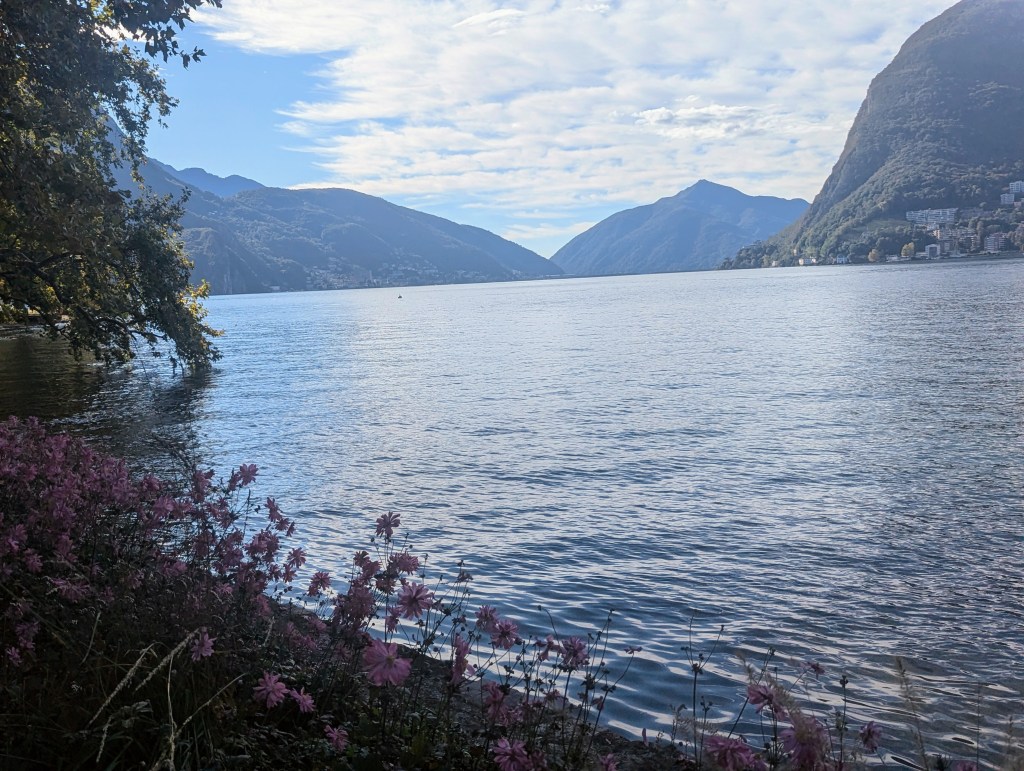
Composed of a very rich subtropical flora and Mediterranean vegetation, it has the privilege of a prime location on the lake shore.
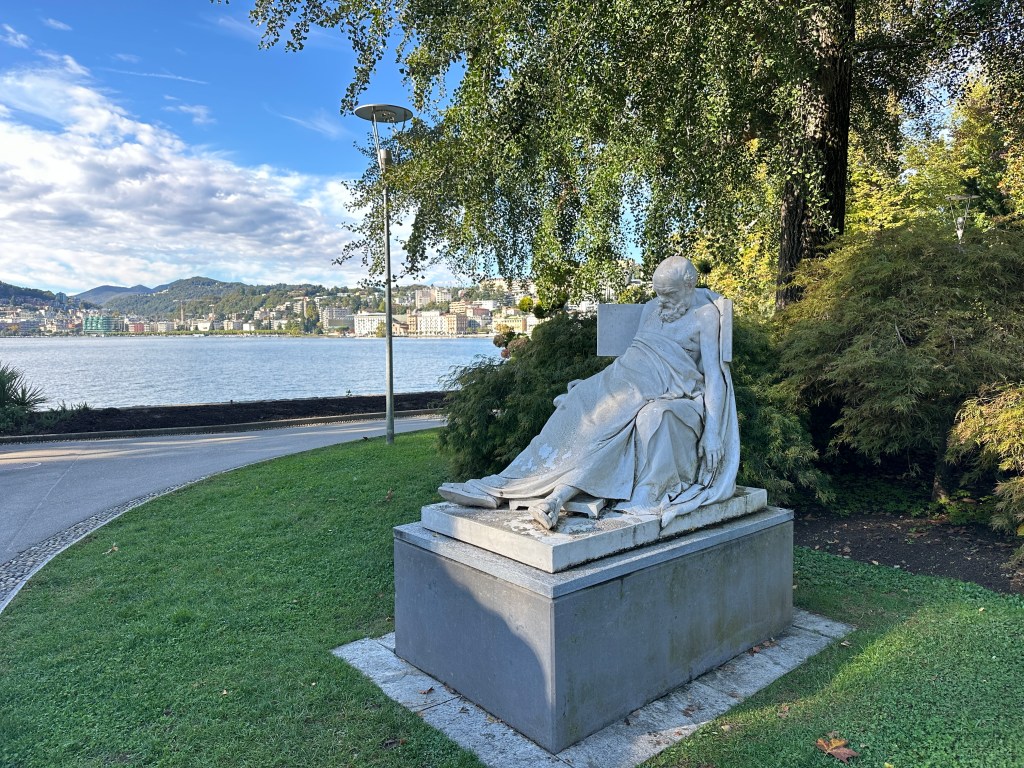
In addition to wide pedestrian path, the park boasts several statues

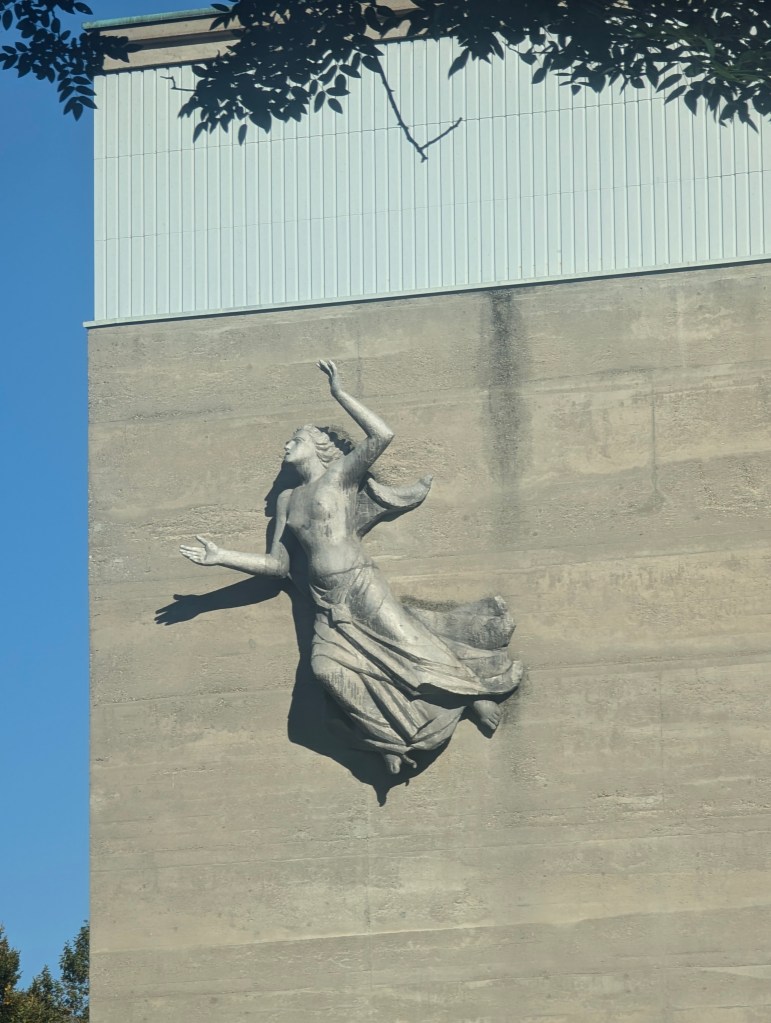
a large playground for children

and a special olive tree garden within the park: The Garden of the Righteous.

It was time to head back and climb aboard


We stopped in several ports of small towns on our tour of the lake.
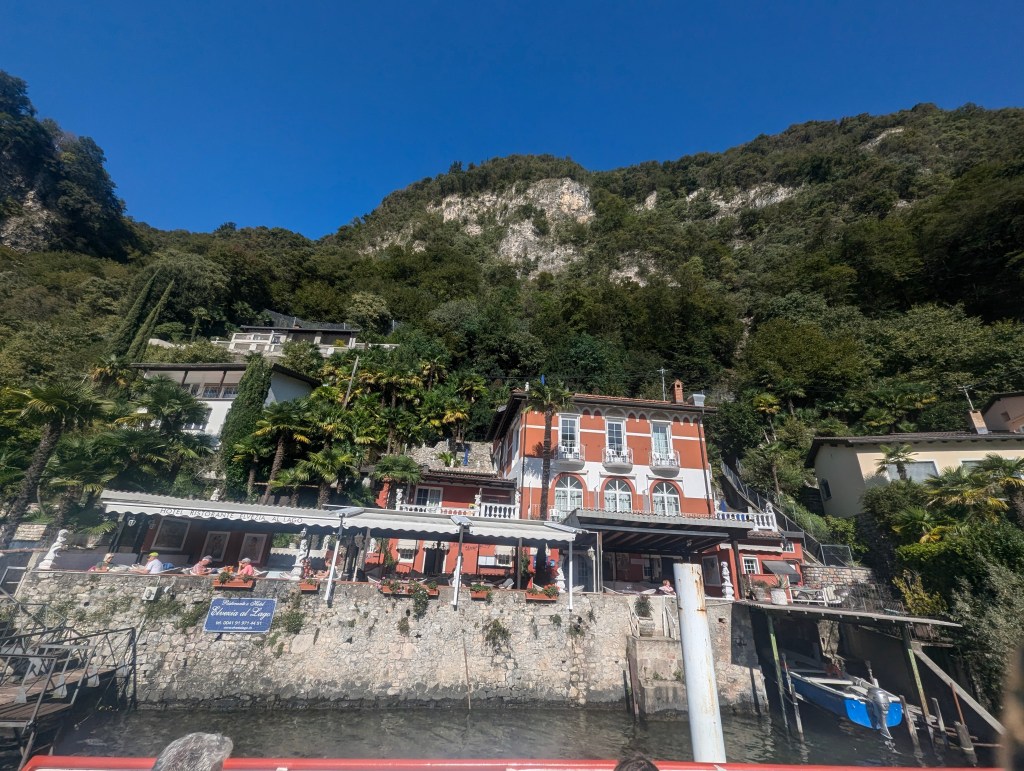
There were so many seemingly isolated tiny towns or even individual homes, we were wondering how they had access. But then we were able to make out the road winding around the mountains.
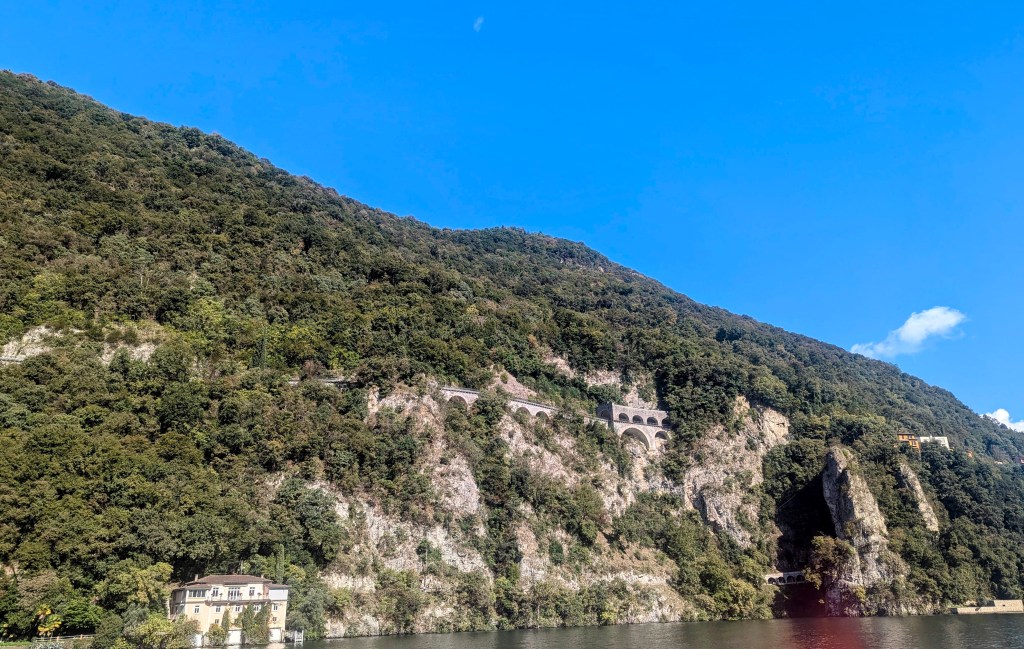
Finally we approached our hop-off town: Gandria.
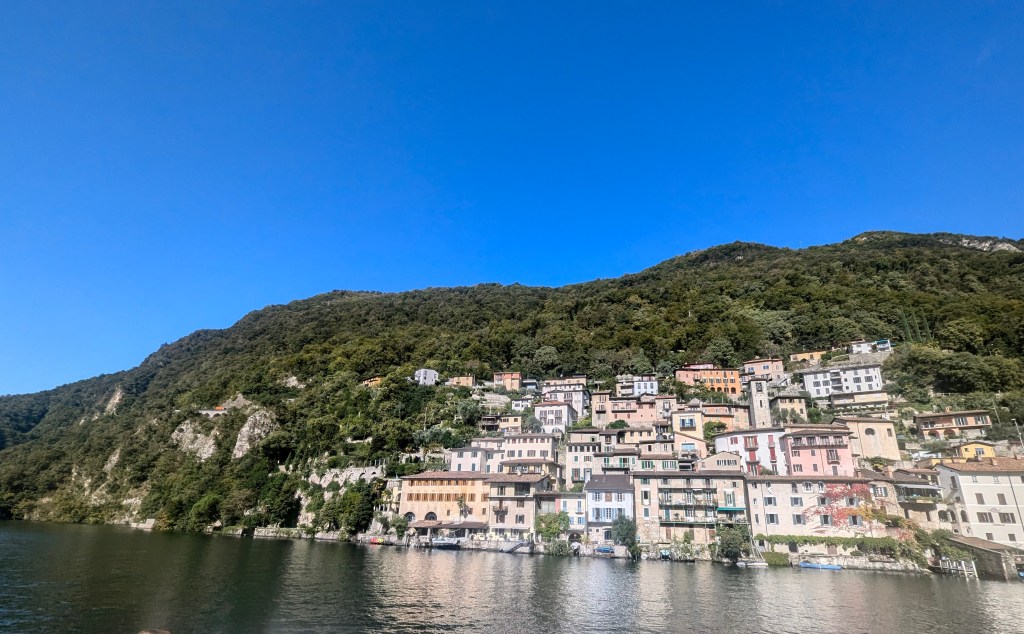
Once on land we immediately started the climb into the narrow passages of this medieval town.
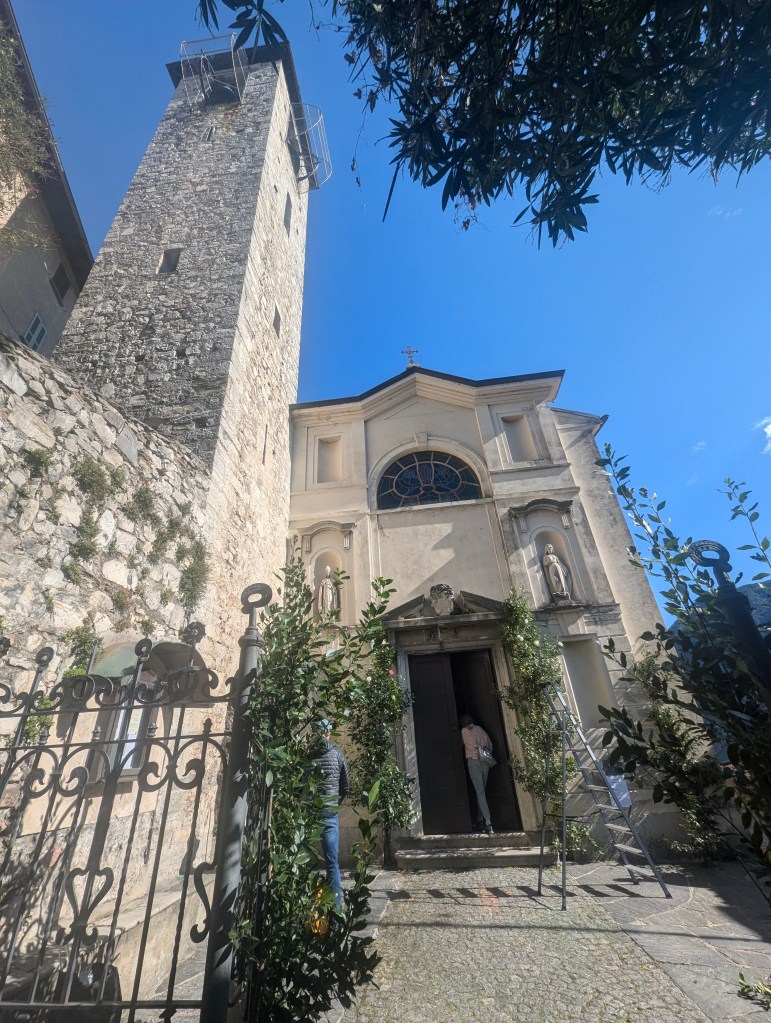
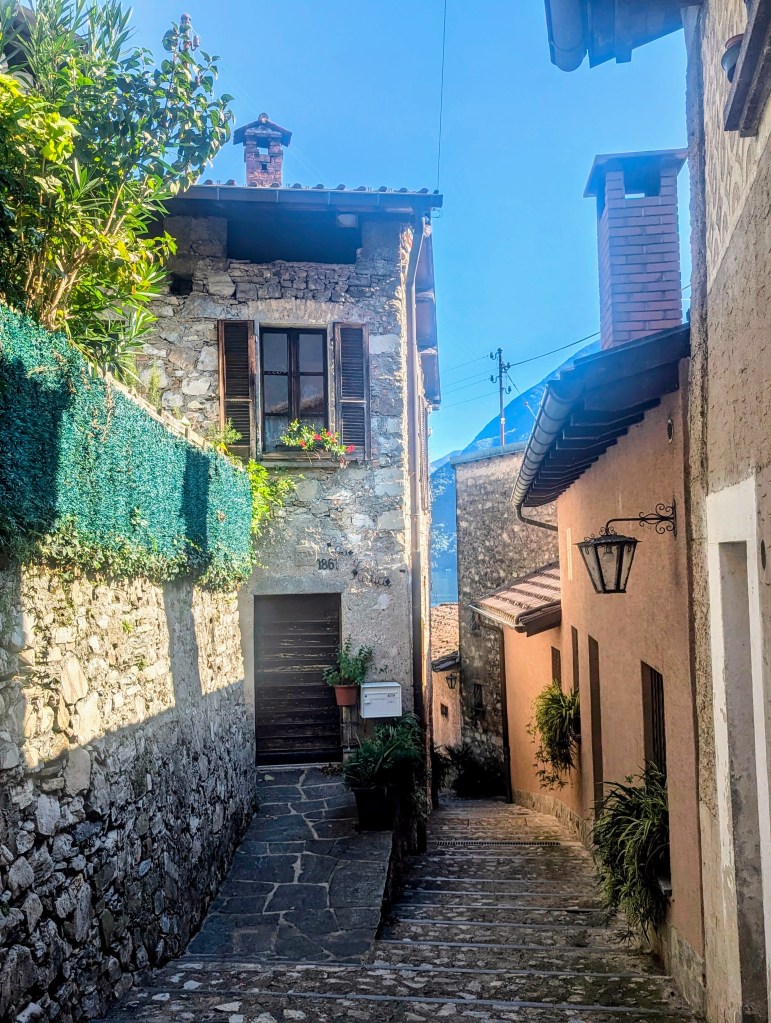
We wound back and forth, up and down through the town

until we decided we had earned a drink and a snack.
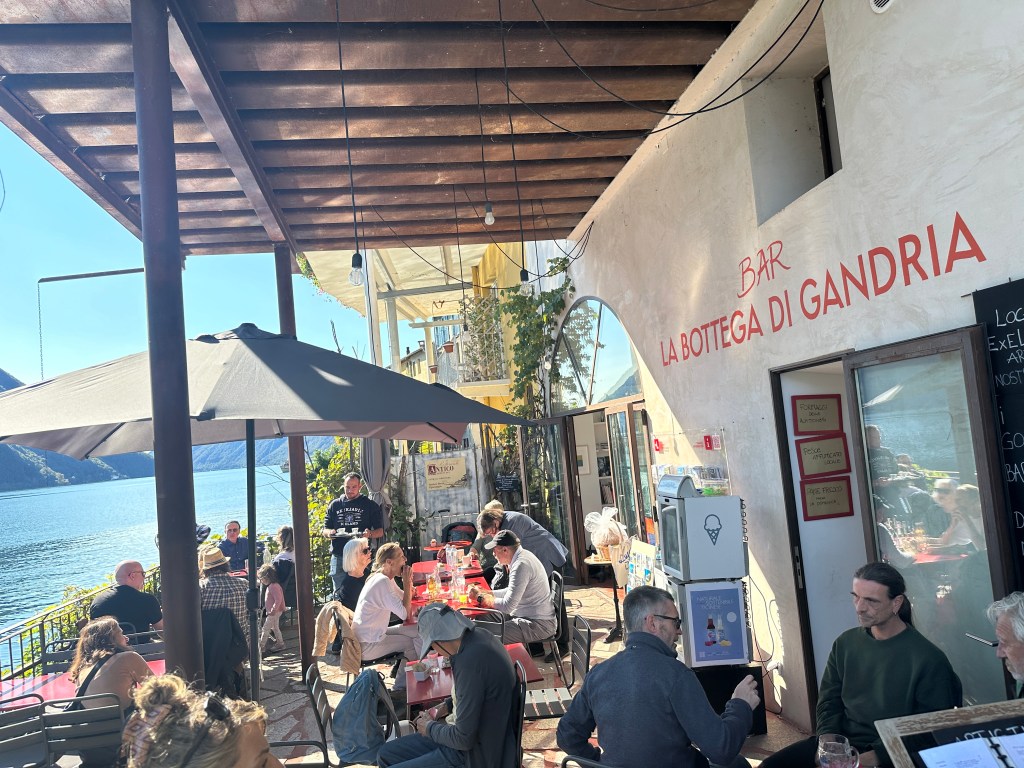
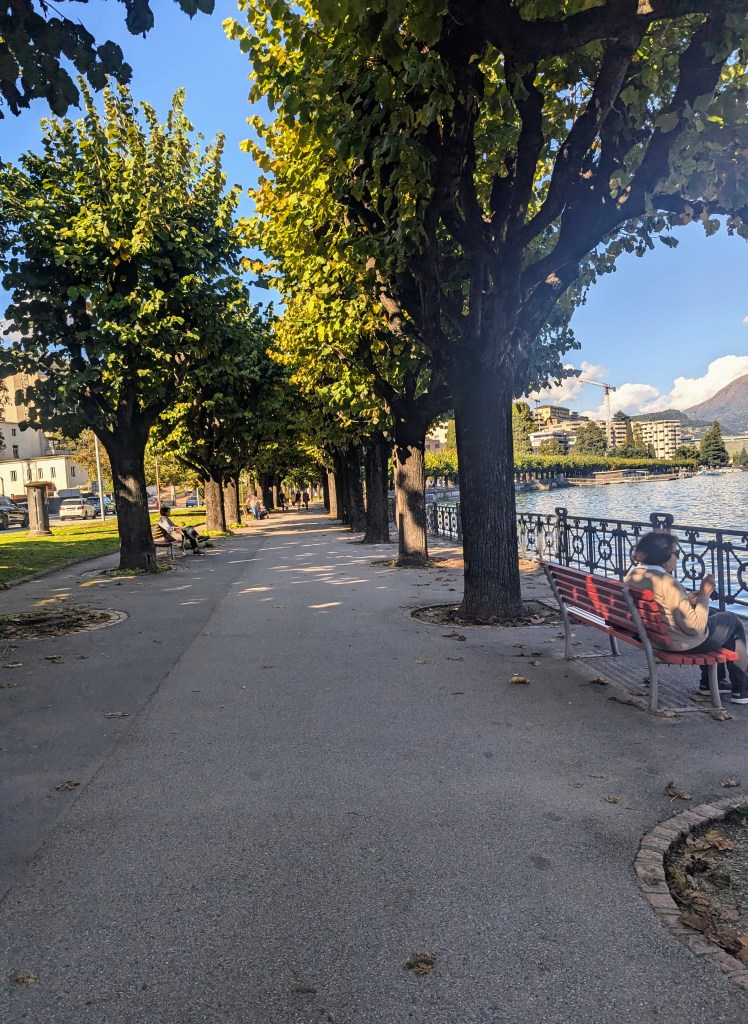
Alas we reembarked our boat for the journey back. But we got off at the stop on the other side of the lakeshore from our hotel so we could stroll through the tree lined portion of the lake promenade.
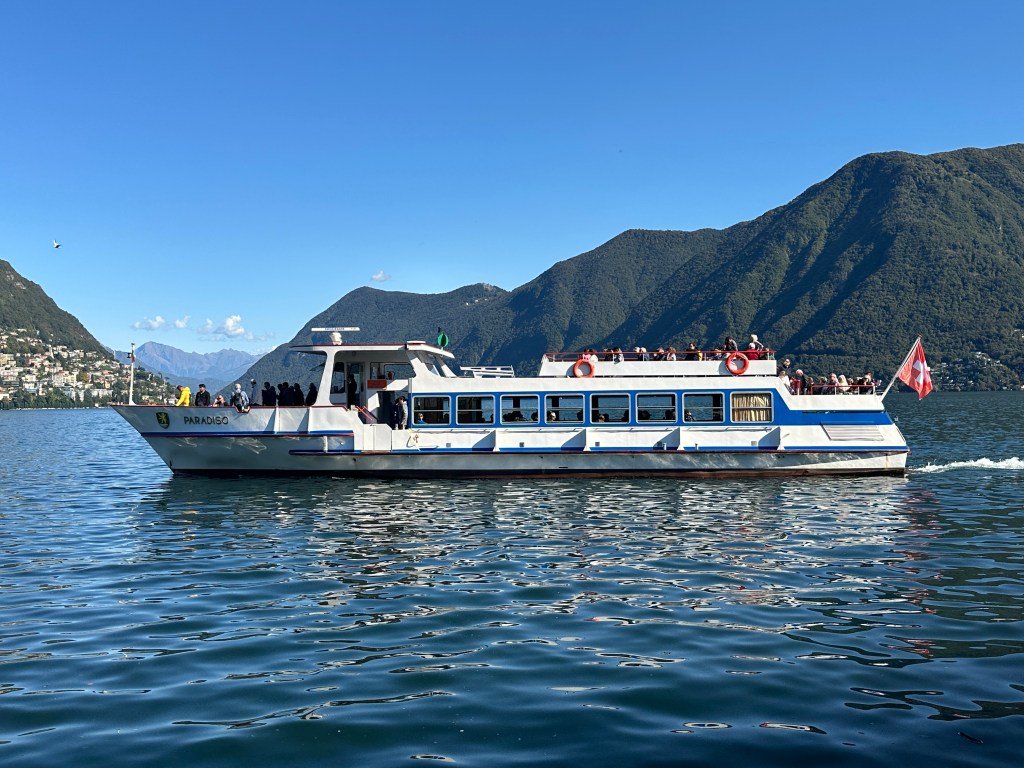
We waived to the ship as it sailed back to Lugano Center.
To our delight we discovered the lake promenade is actually a statue park right in front of the Museum of Culture..

Belvedere Garden is an 11,000 square meter garden filled with 14 modern and abstract sculptures by local Ticino artists.

a bust of George Washington sits where the Villa Tanzina used to stand, though I have no idea why he is there.

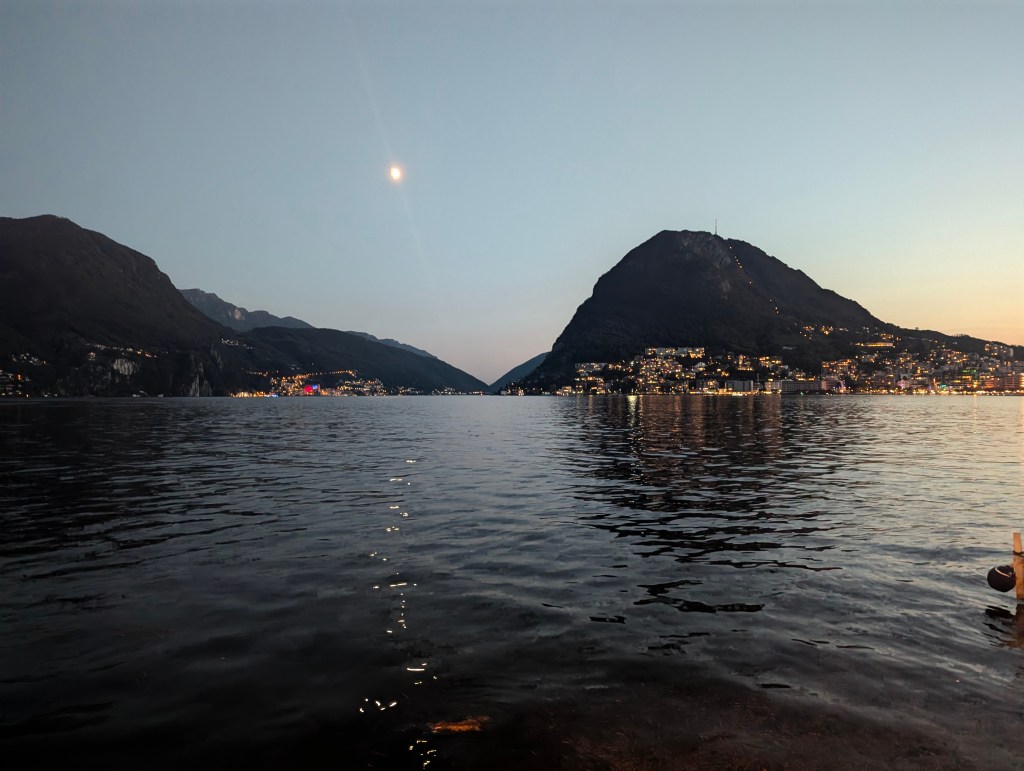
After a rest, we headed back to the lake for dinner and a goodbye to Switzerland.
 Jo & Eric's travels
Love the Chagall stained glass windows. Thanks for sharing.Sent from my iPhone
LikeLike
As always, giving Rick some competition! Especially loved the Chagall windows. Sending love
LikeLike