Emilia-Romagna Region: Modena Oct. 28-29; with Parma

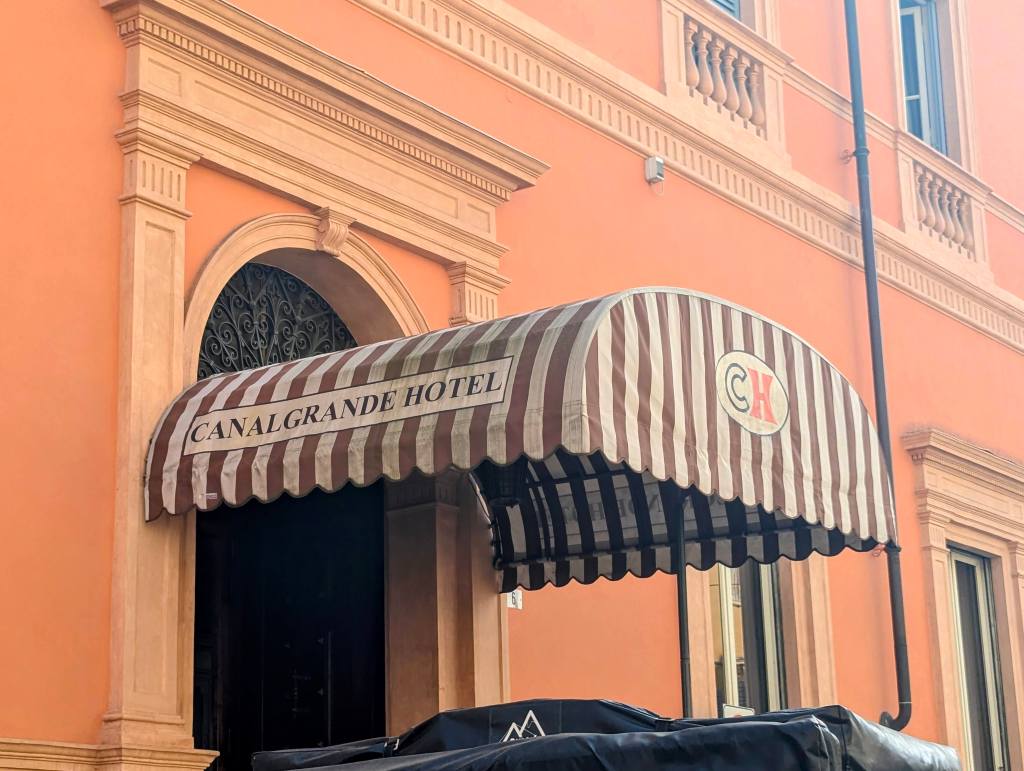
Our intent on leaving Florence had been to stop in Bologna, home of a major university. But the recent rains had caused some serious flooding problems in Bologna, which was in the middle of a massive clean-up project, so we opted to skip it. Instead we drove straight to Modena. We checked into the Phi Hotel Canalgrande, an historic home located in the old Schedoni Palace. The outside was nothing special.
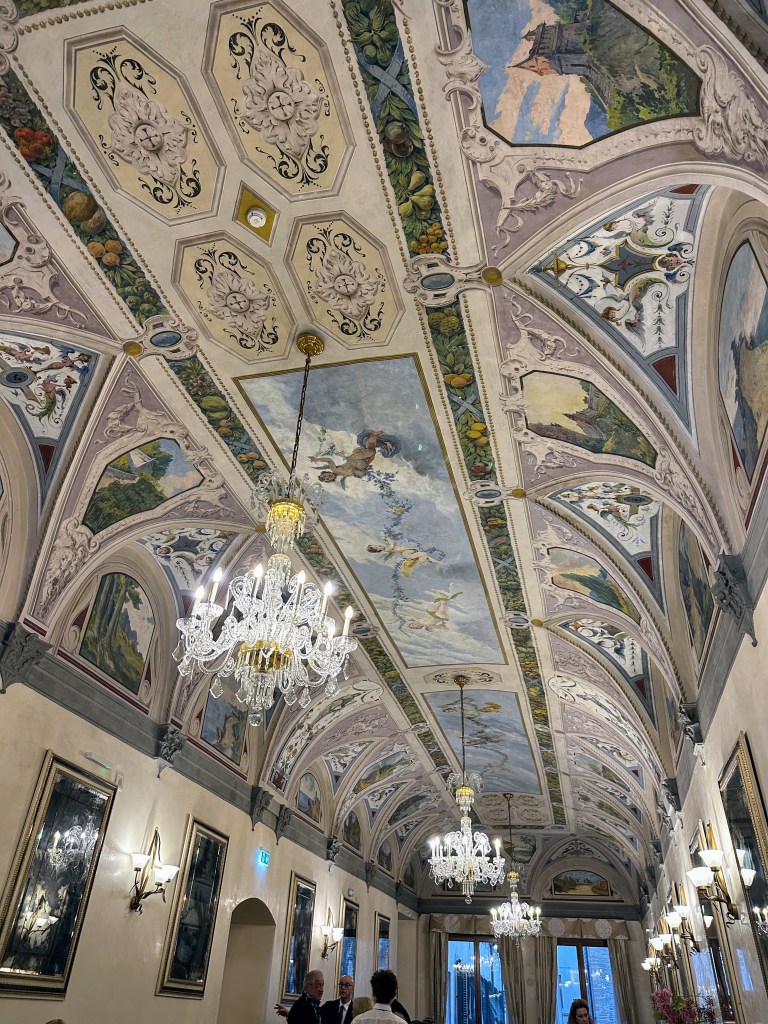
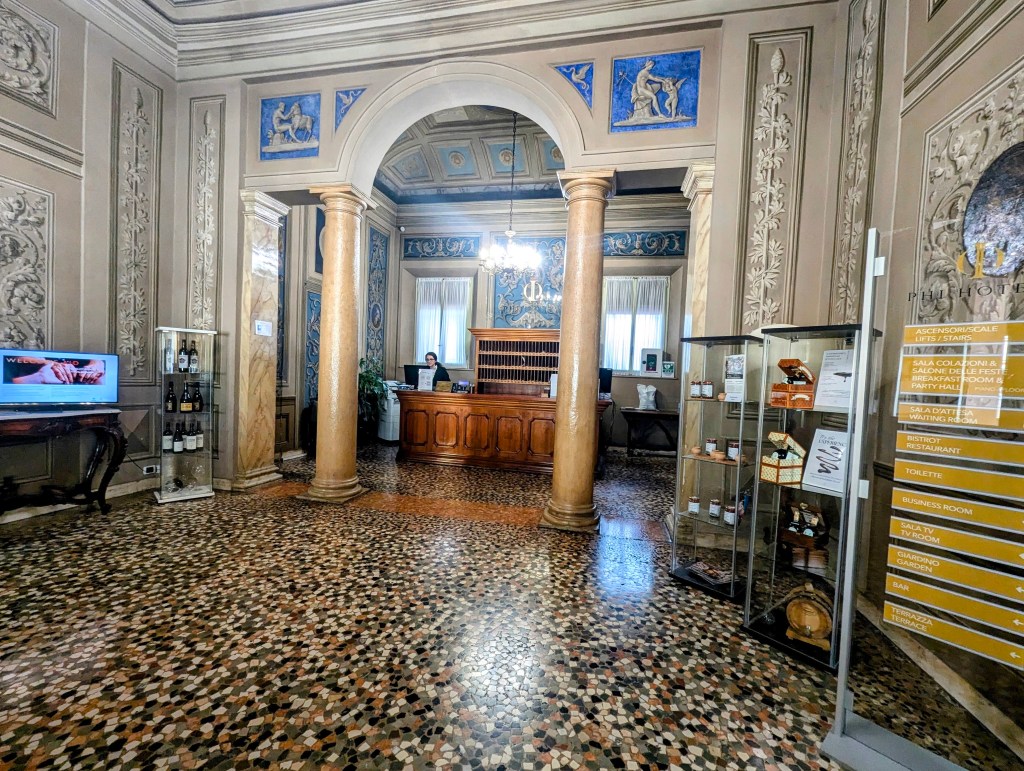
But the reception is what one would expect from an old palace.
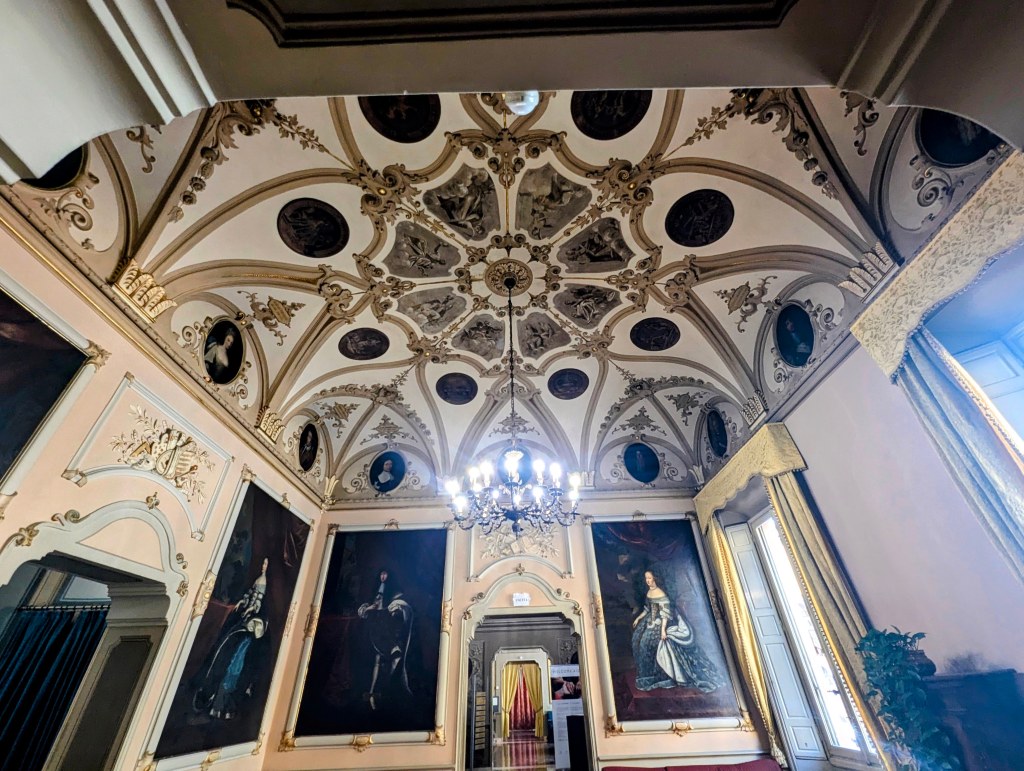
As were the sitting rooms off the reception area.
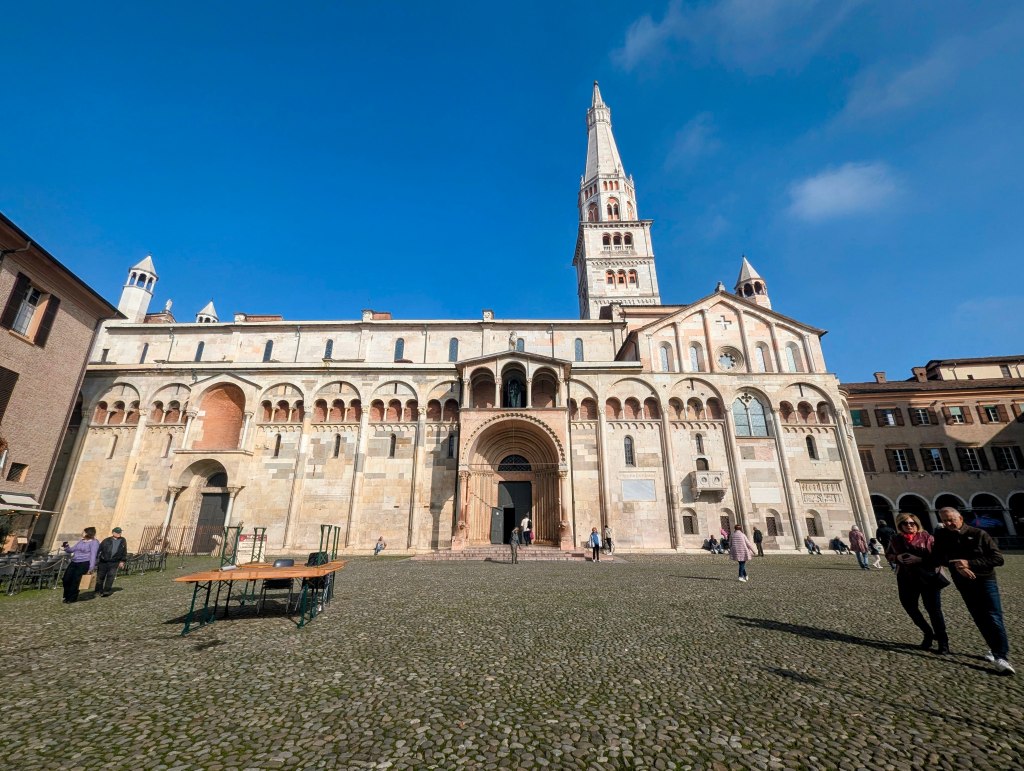
Once settled we headed out in the late afternoon sun to explore the town. Modena is most well know for its famous balsamic vinegar. But it is also known for being home to both Ferrari and Maserati. Lesser well known is that it is a seat for an archbishop; our first visit was to the cathedral. The Cattedrale Metropolitana di Santa Maria Assunta e San Geminiano, aka  Duomo di Modena, is dedicated to the Assumption of the Virgin Mary and to the city’s patron Saint Geminianus. The Duomo and the annexed campanile are a UNESCO Word Heritage Site. Its first stone was laid in June 1099 and its crypt ready for the city’s patron, Saint Geminianus, and consecrated only six years later, the Duomo of Modena was finished in 1184. 
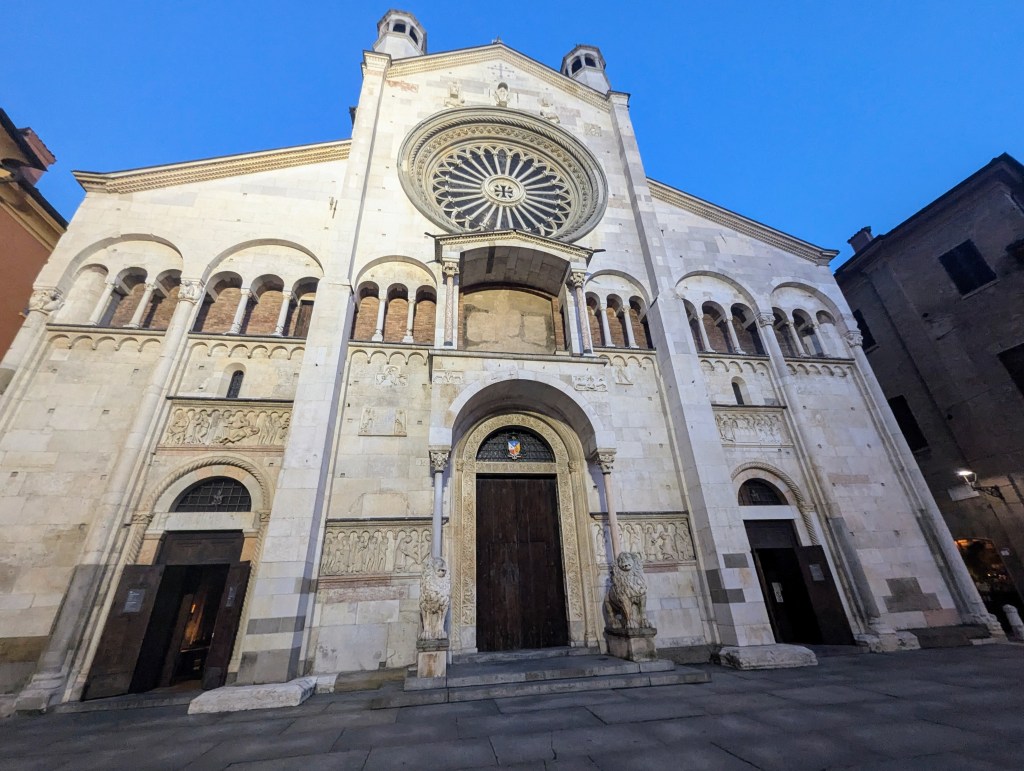
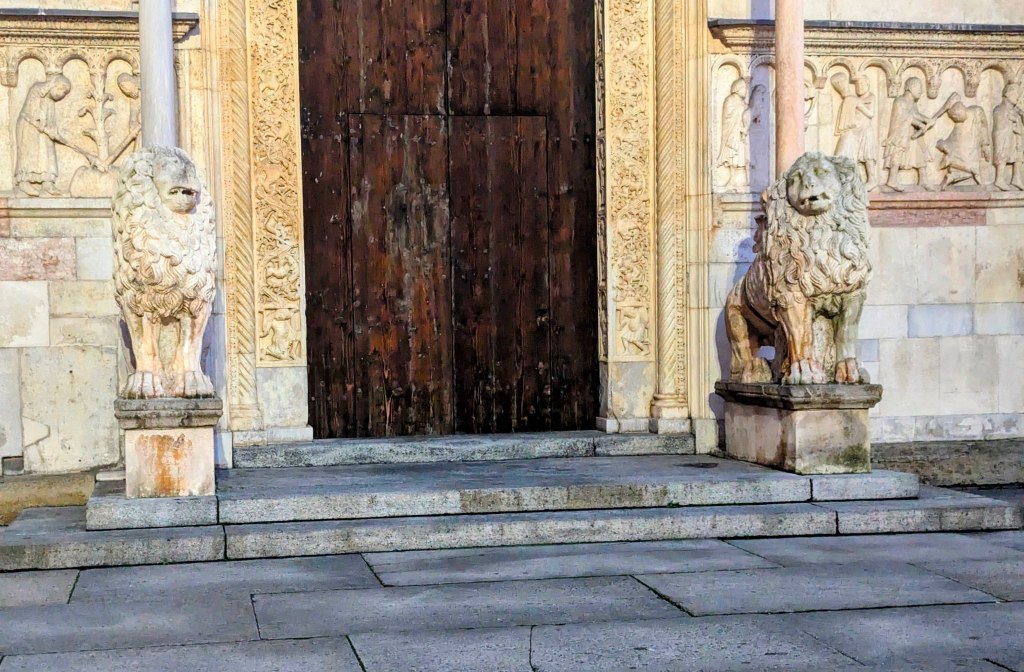
The entrance is typical to those we have seen now throughout Northern Italy: flanked by a pair of lions.
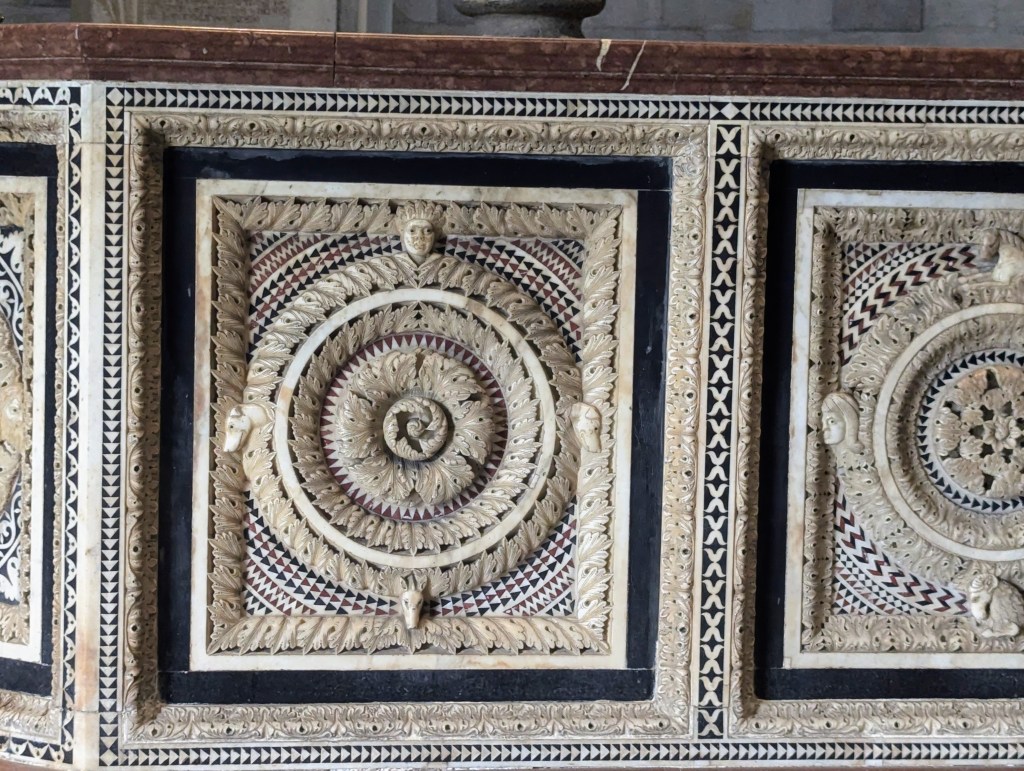
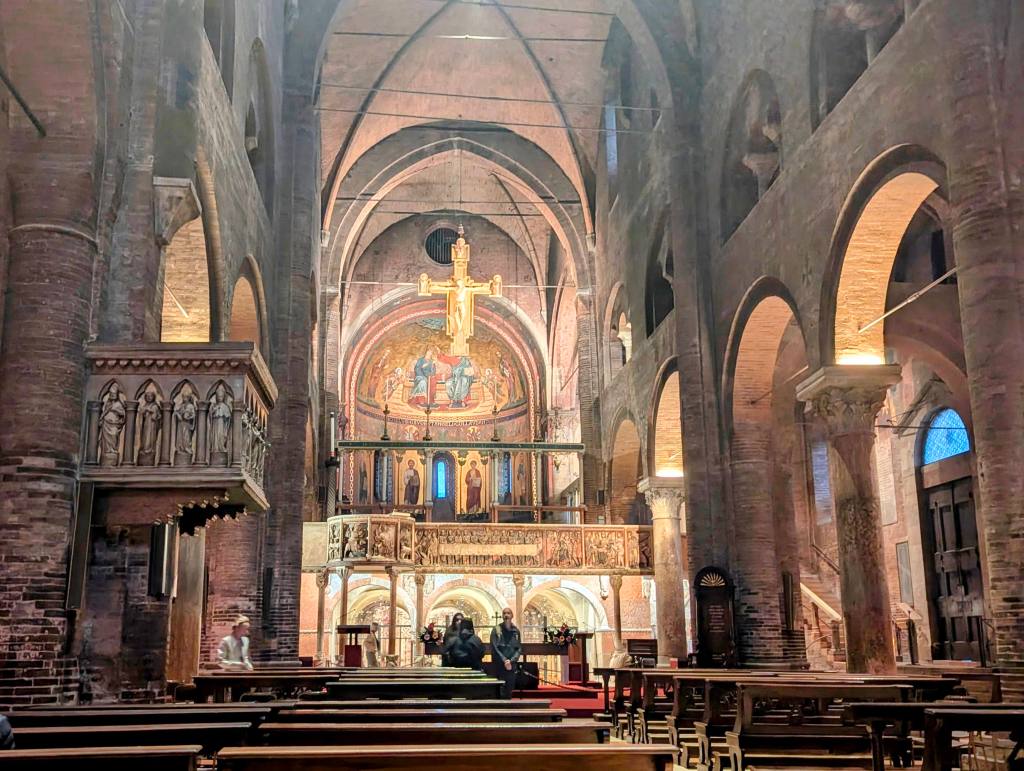
The interior is divided into three naves.  Between the central nave and the crypt is a marble parapet portraying the Passion of Christ, including the Last Supper. The  pulpit is decorated with small terracotta statues.
The Duomo also houses two nativity scenes by local Modena artists, this one from 1527.
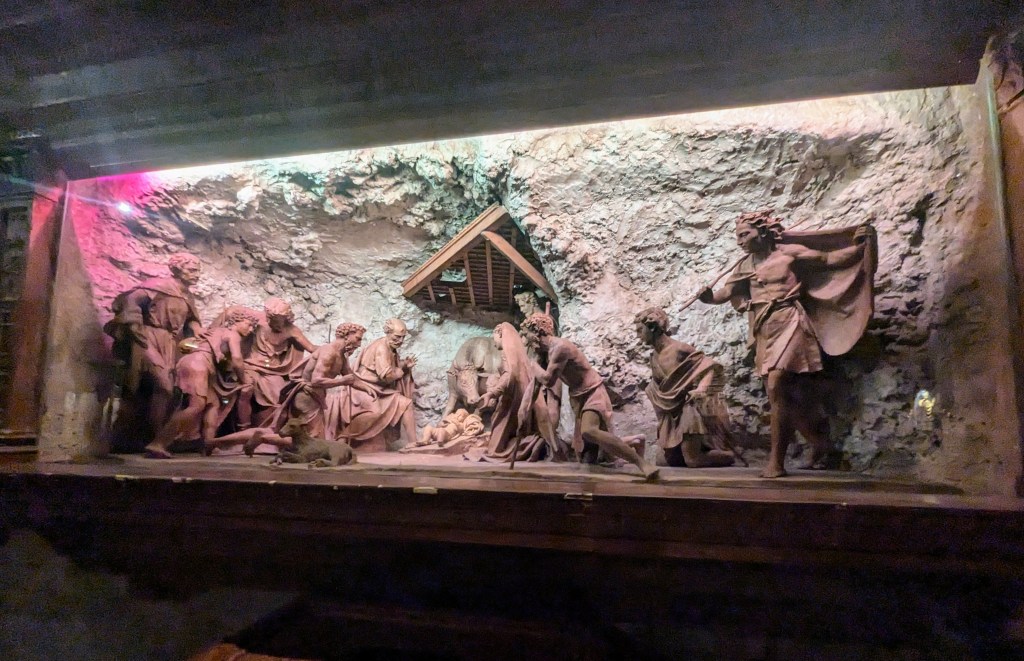
the Apse
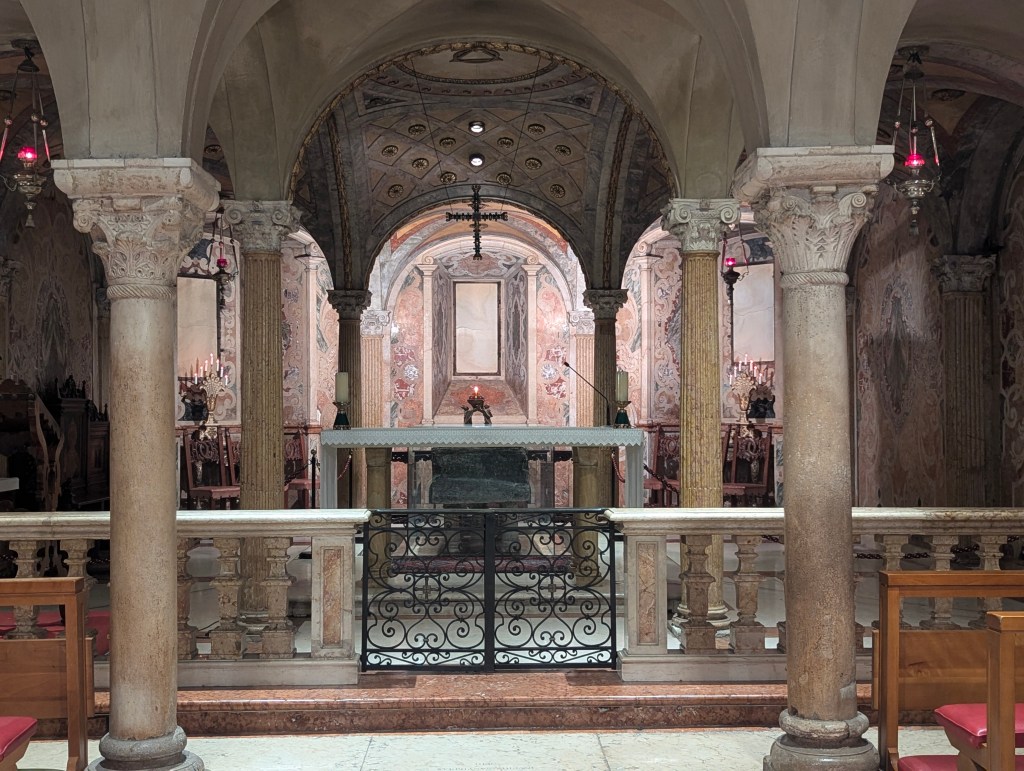
the Crypt

The Torre della Ghirlandina (the Bell Tower) built in 1179 and restored in 2008 is annexed to the church.
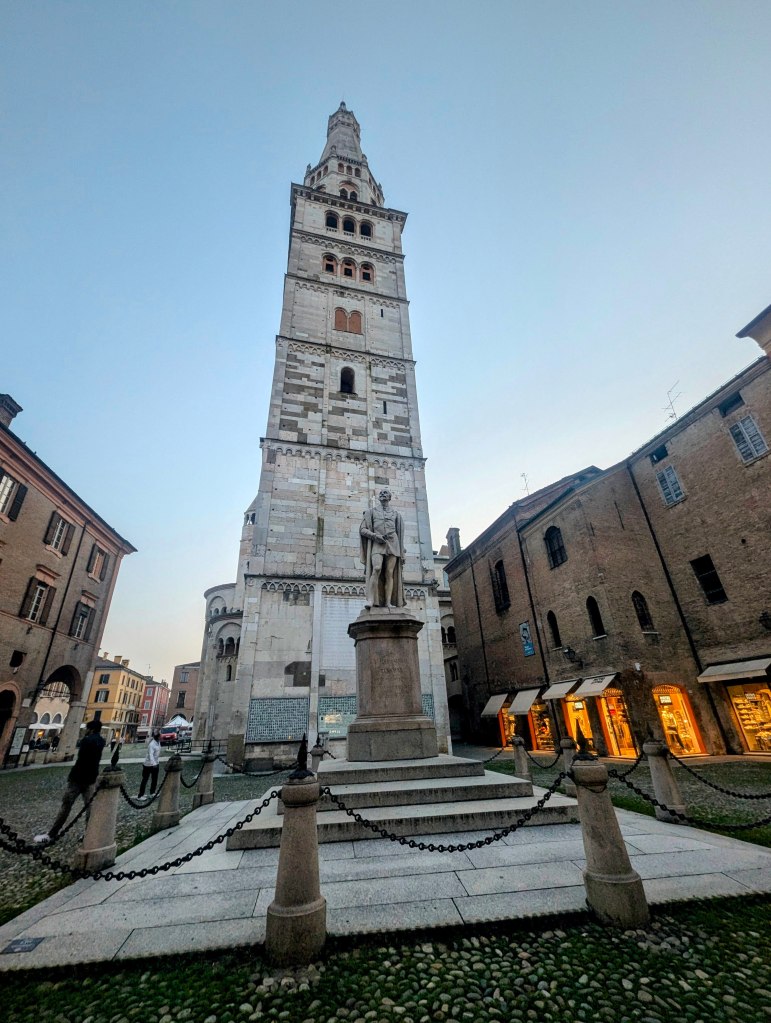
Torre della Ghirlandina

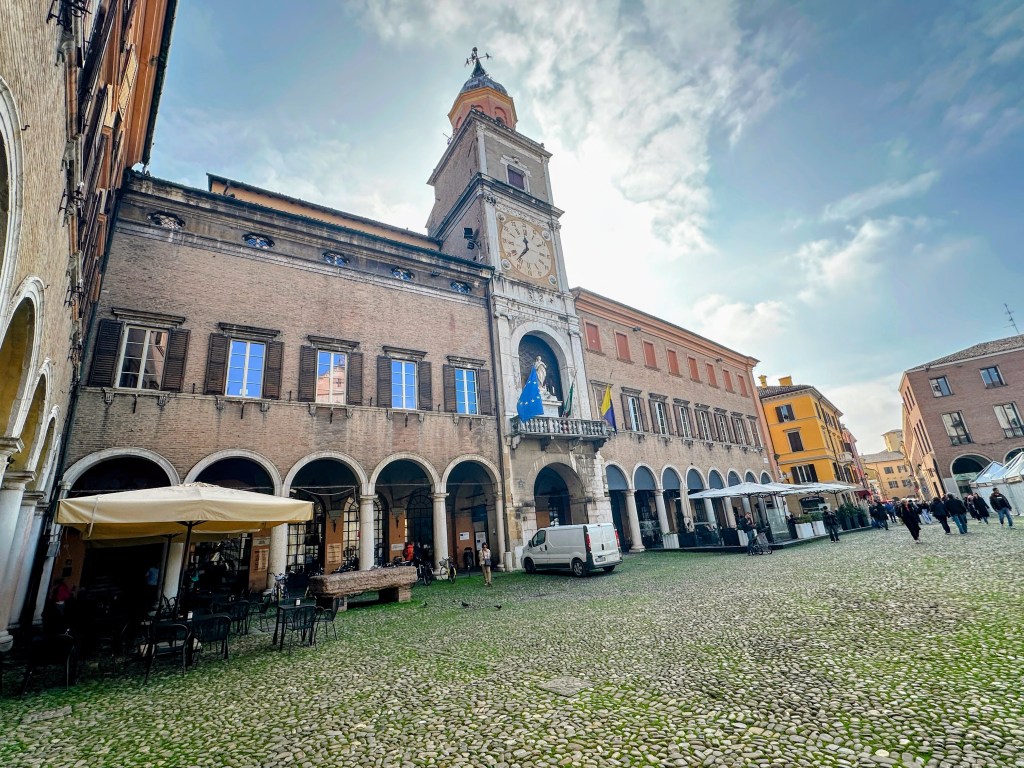
We walked around the Piazza Grande, also a UNESCO World Heritage Site, and took in the Town Hall, 17th and 18th century amalgamations of several 12th century buildings.

The Town Hall is characterized by its clock tower.
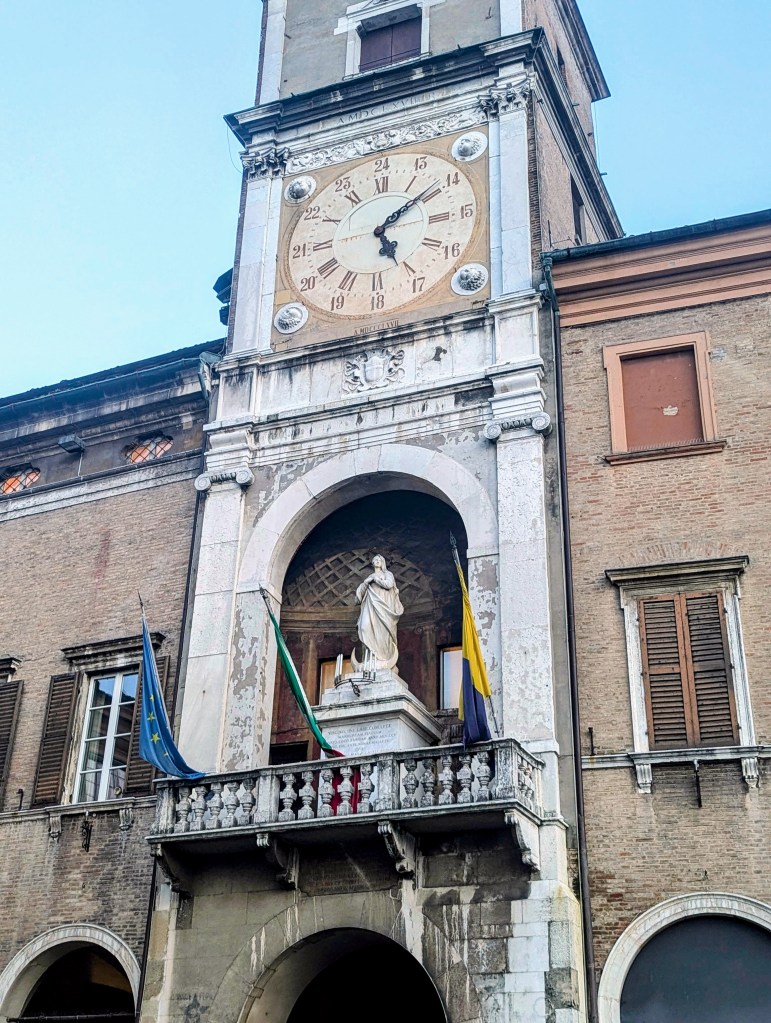
As we strolled around town we noticed what appeared to be booths being built in a couple of squares. We wondered what event was coming, but more on that later. We walked by San Vincenzo, a 17th century Baroque style Roman Catholic church.
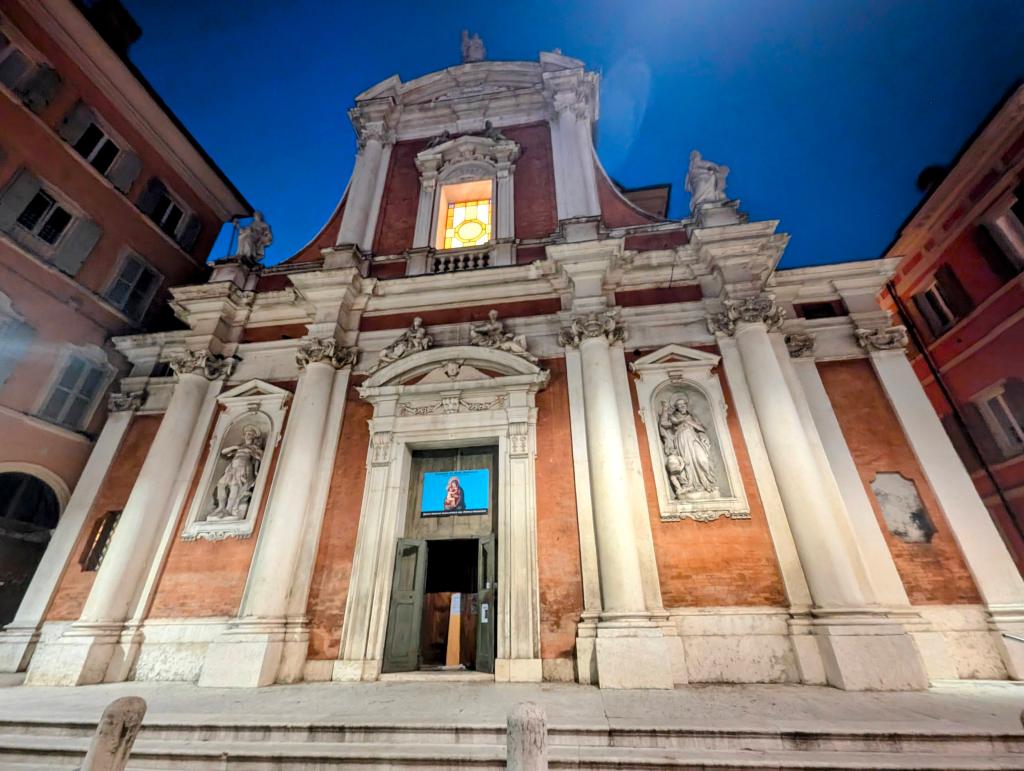
San Vincenzo

Dark descended, and we had a reservation at Frigieri, a tiny restaurant and wine bar in Modena. We were greeted by our host for the evening, Matteo, and handed our menus. Matteo, an extremely animated individual, appeared to be the host, cook, sommelier and waiter. He played each roll with zeal.
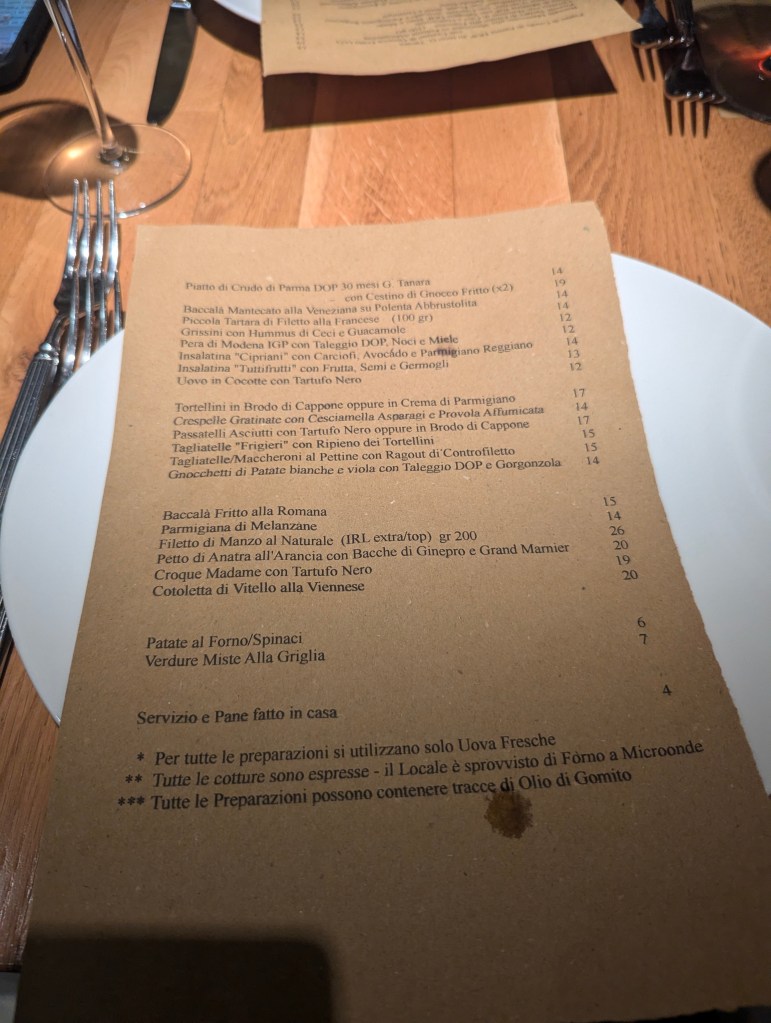
He explained that his menu is written daily, and he does not translate from the Italian because he wants to explain each dish, which he proceeded to do in the most animatedly entertaining way while also helping us to choose the correct wine to accompany our food choices. He then went into the kitchen and hand cut! our fresh pasta while we enjoyed our starters of, what else, parma prosciutto and gnocco fritto, a small puff of fried bread popular in the region. This being October in Italy, we ordered their special delicacy of pasta in olive oil with grated white truffles. It was one of the most simple and yet one of the most delicious, certainly the freshest, meal we have ever enjoyed.
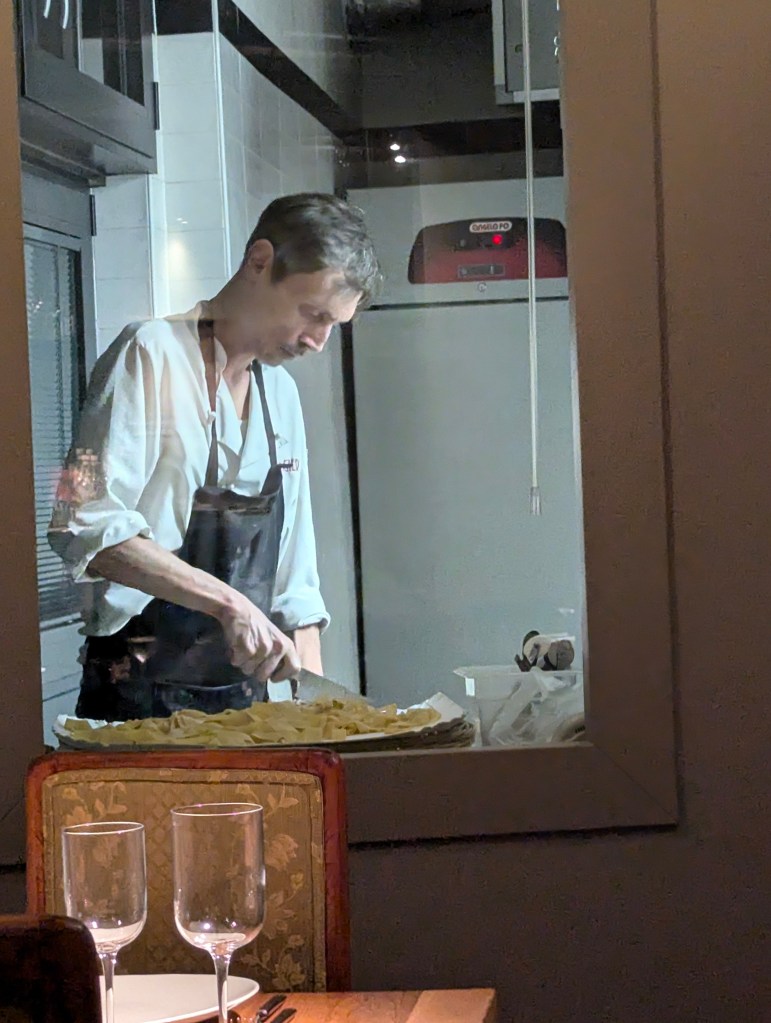
Matteo cutting pasta

In the morning, unable to find a guided walking tour of Modena in English, we embarked to explore on our own armed with a guide downloaded from “Matteo@walkingcap.com.” It took us first to the Church of San Pietro, the parish church for a Benedictine Abbey founded in 983, making it the oldest parish in Modena. The church was rebuilt between 1476 and 1518 and was consecrated in 1518.
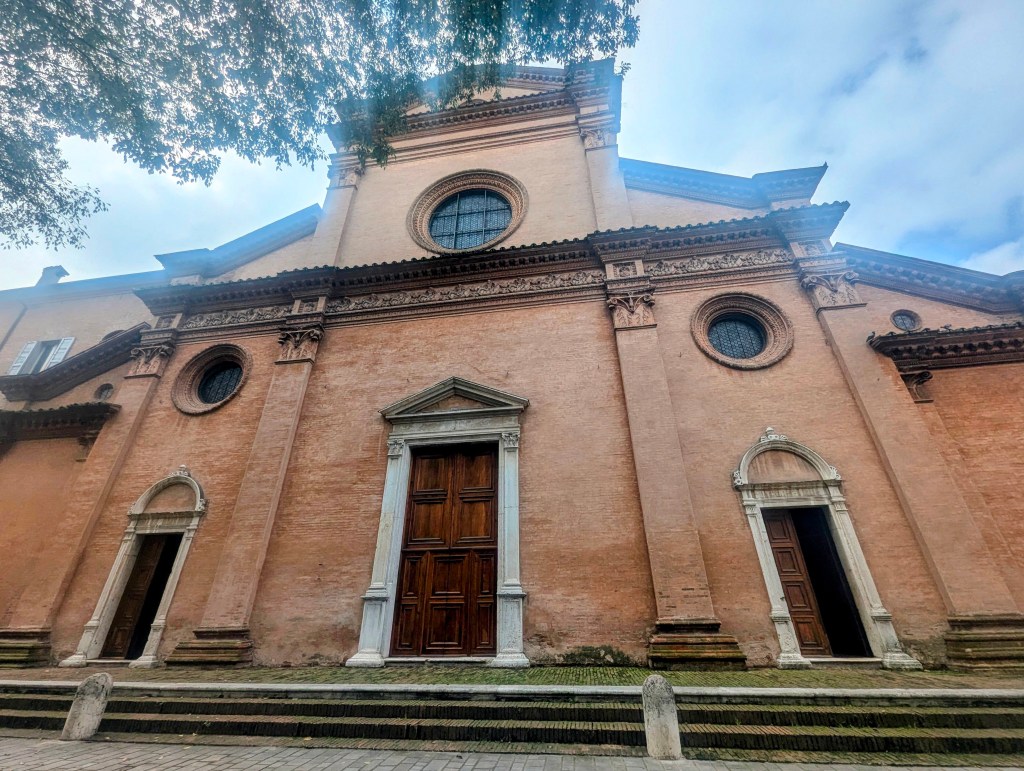
Church of San Pietro

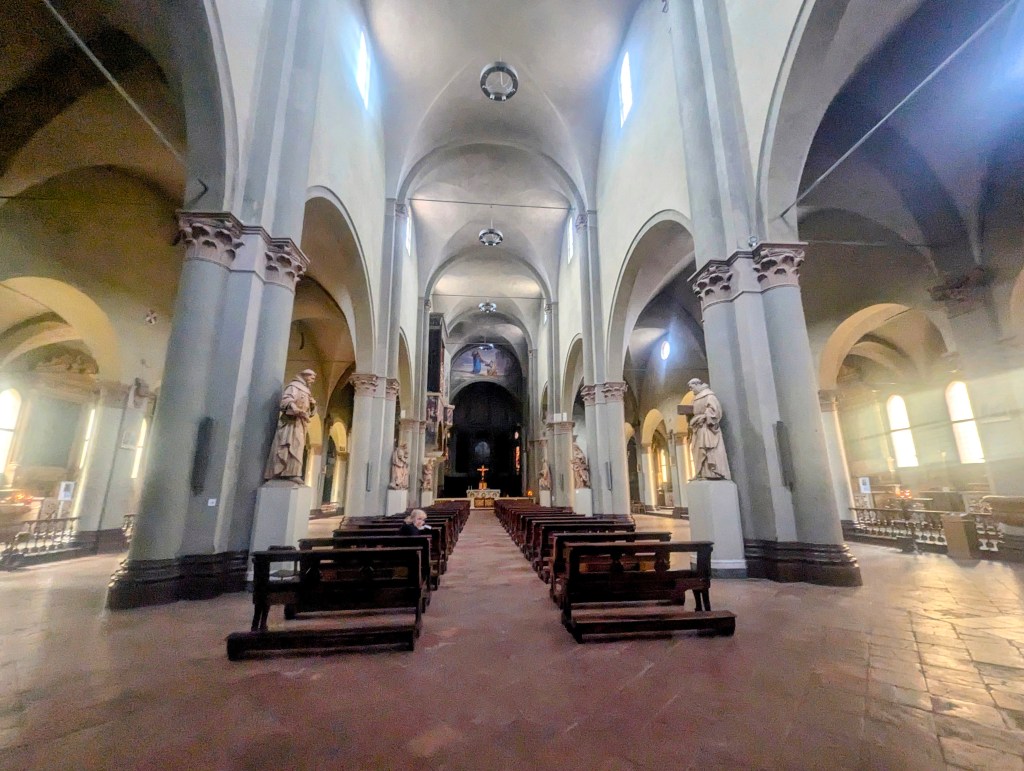
The interior was decorated during the early Renaissance by local artists.
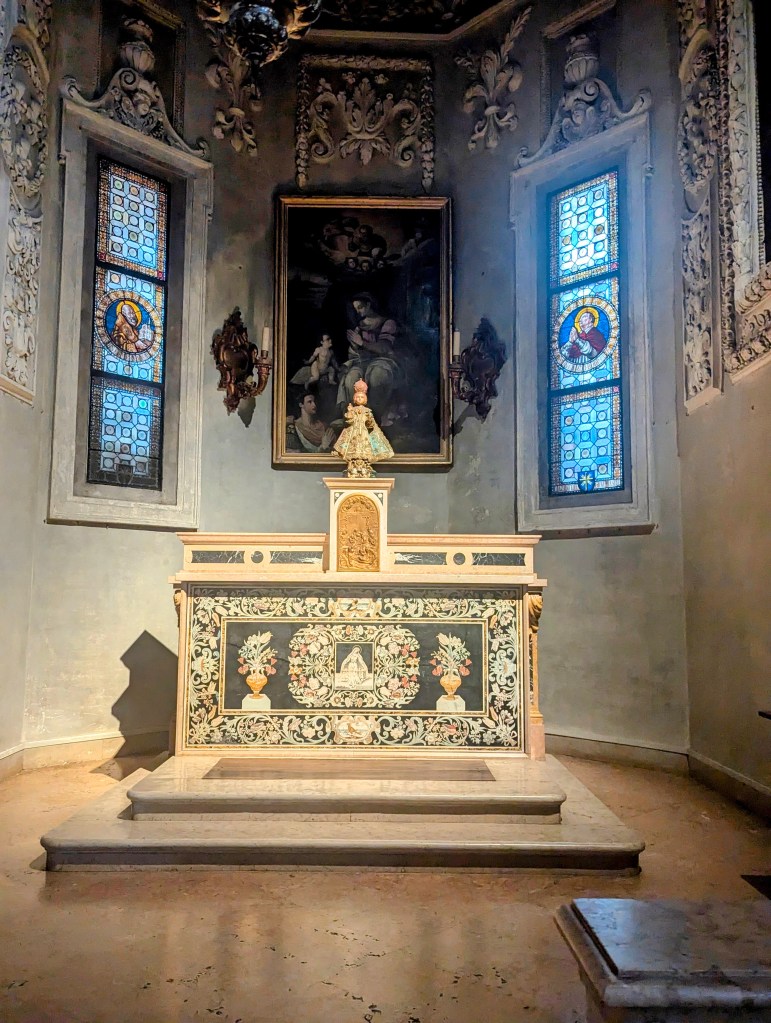
Inside what particularly caught our eye was this inlaid cabinet with a modern doll sitting atop it.
The organ was in the center nave, an unusual placement.
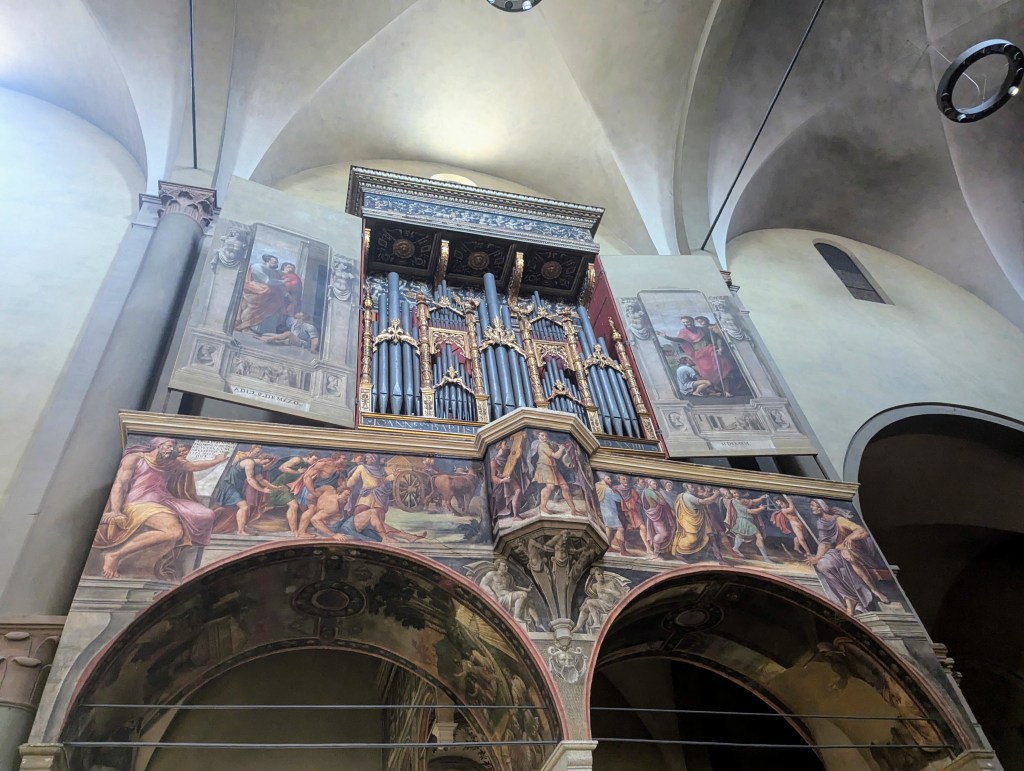
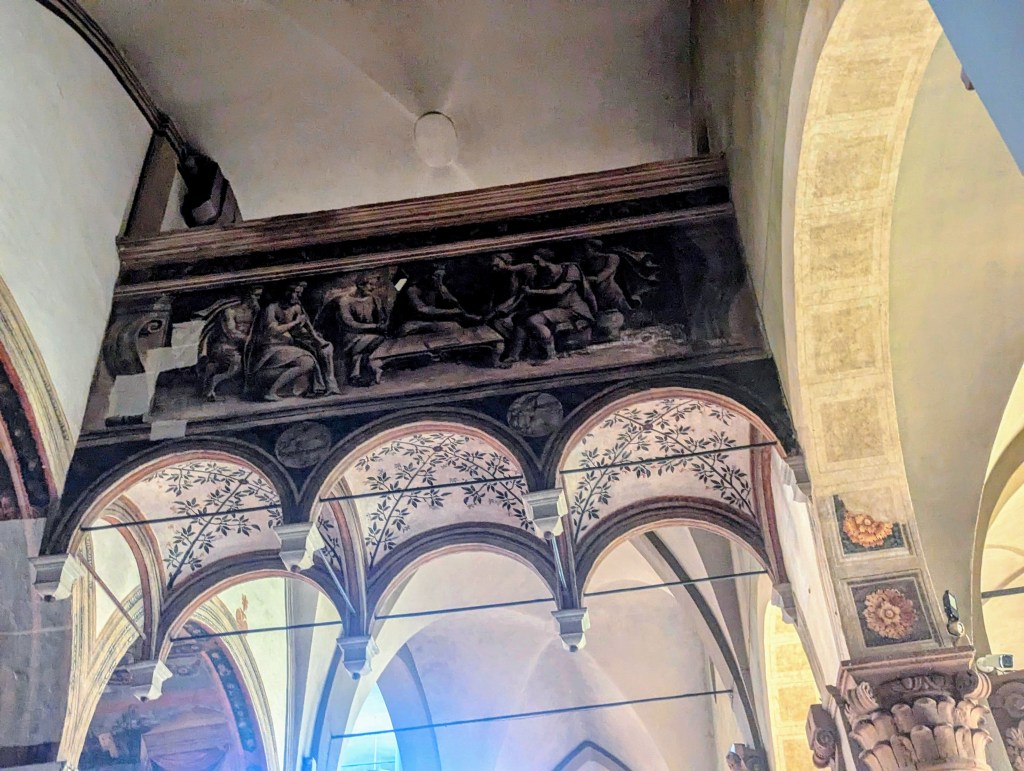
It had something we had never seen prior: a fresco decorated bridge to access the back of the organ for repairs.
Next our guide took us to the market. I apologize for the poor quality of the photo (all of these pics are from our cell phones, which have no filters).

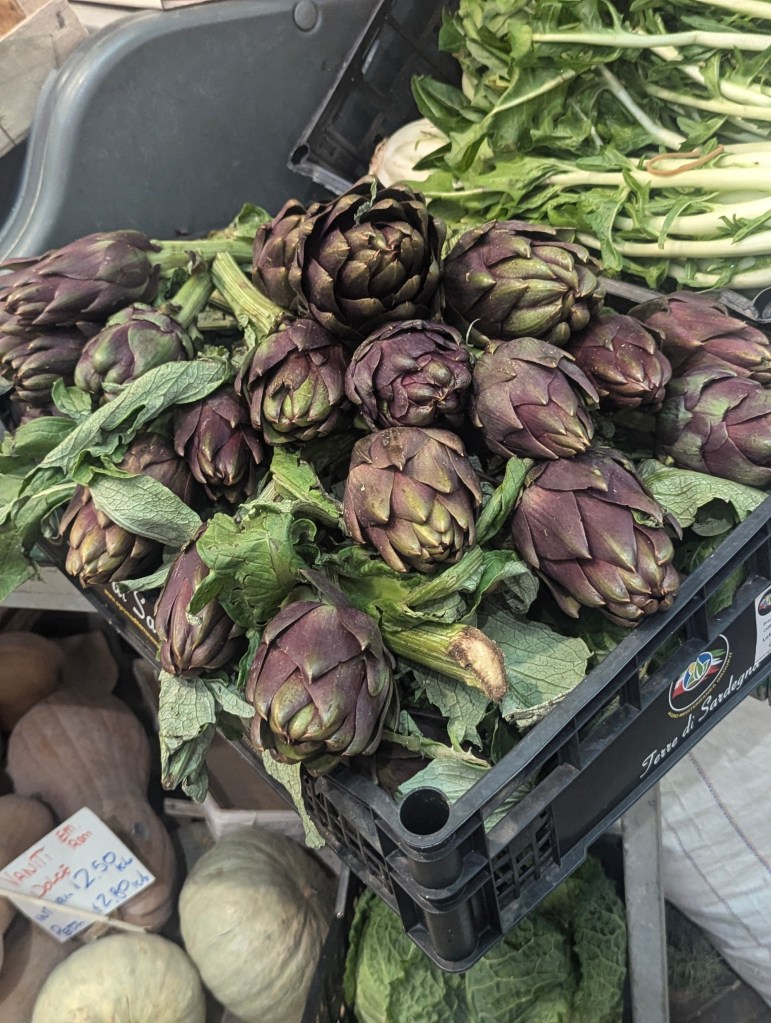
The market itself was pretty typical as markets go with the usual meats, fish, fruit and vegetables, although this one, purple artichokes, is a bit unusual for us North Americans, but very common in the cuisine of Northern Italy.
The most fun stall, and probably unusual for a market, was the wine bar.

The guide then directed us to the Piazza Grande.
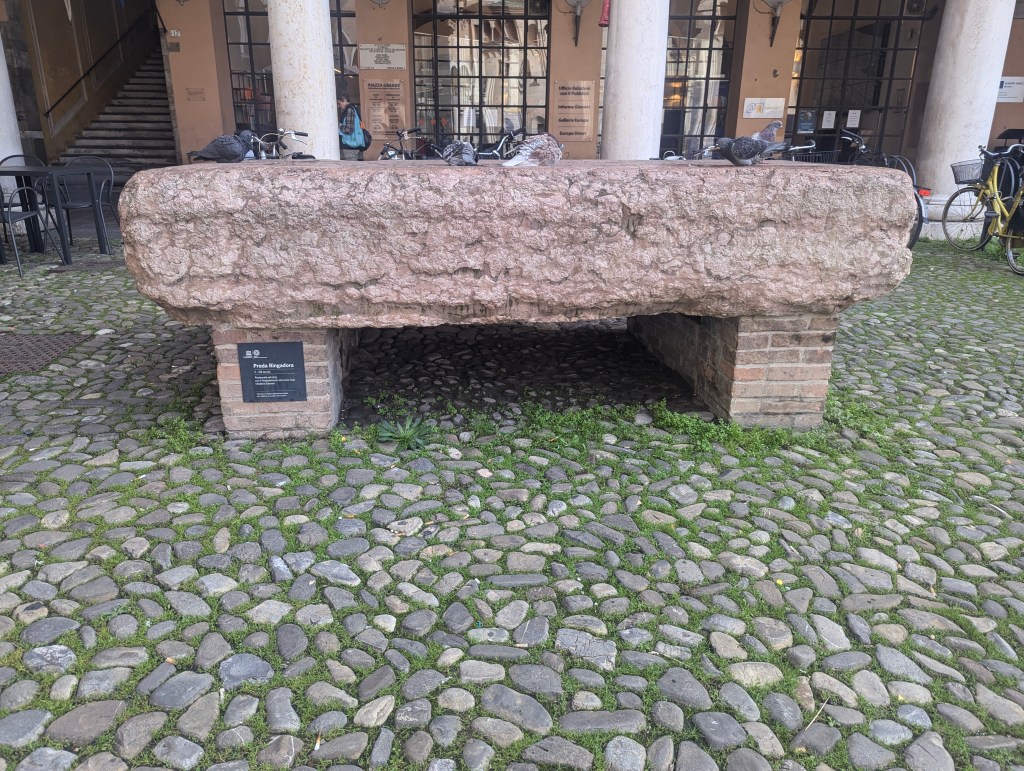
There we learned about a relic from the Middle Ages, the Preda Ringadora, a rectangular marble stone next to the palace porch, used as a speakers’ platform.
We also learned about a statue called La Bonissima (“The Very Good”) portraying a female figure. It was erected in the square in 1268 and later installed over the porch. Today, the Bonissima is so famous in Modena that if someone is referred to as “a Bonissima” it means he/she is of great notoriety.


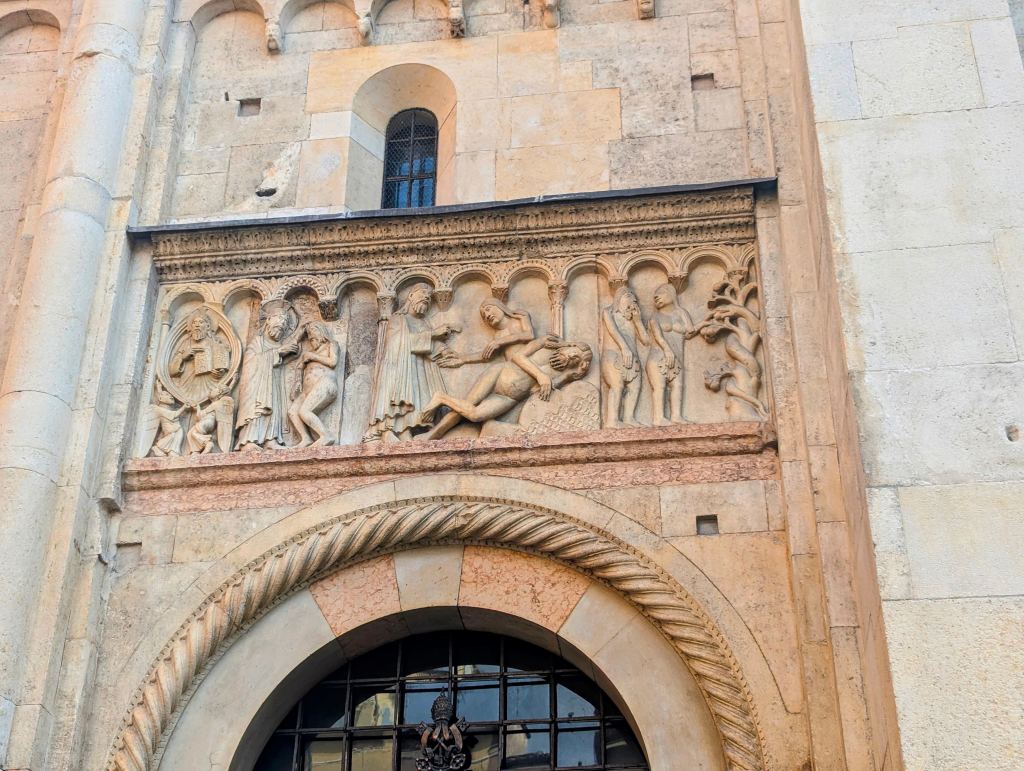
Next our attention was turned back to the cathedral. In addtition to what we had already learned about it, we now learned that the friezes on the exterior façade not only told bible stories for locals who could not read, but also tales of King Arthur and the round table.
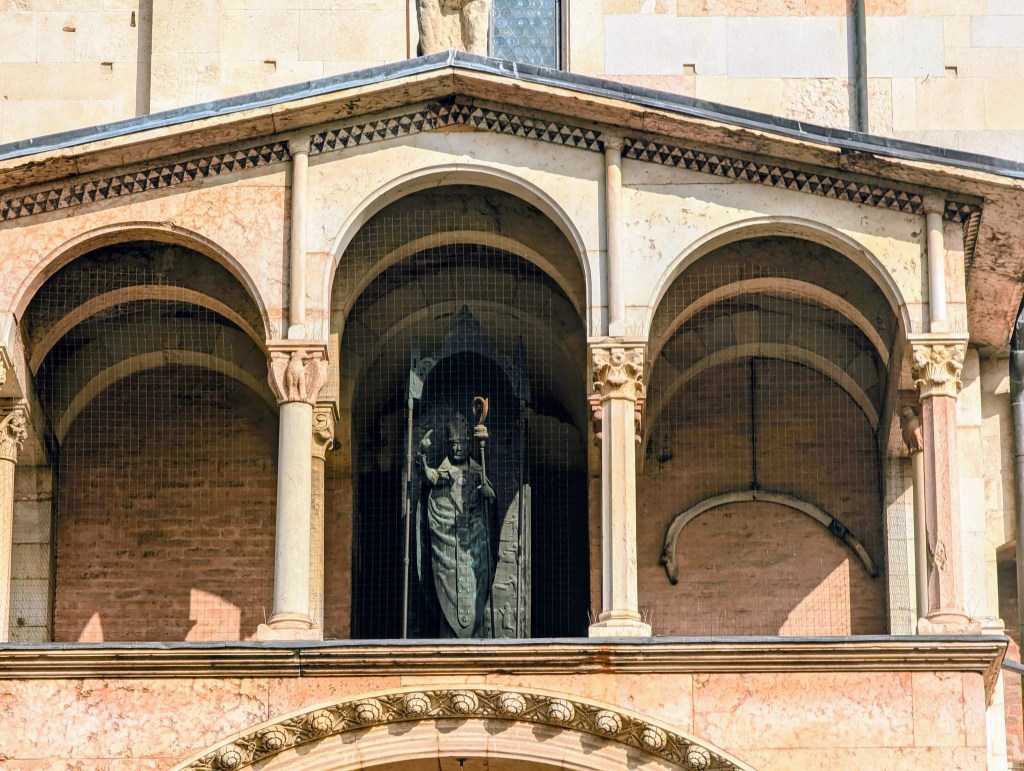
We also learned that a large whale bone was found during construction. At the time it was believed by the locals to be a dragon bone and was placed next to a sculpture of patron Saint Geminianus over the Porta Regia to drive away evil spirits.
Next our audioguided walking tour took us by the The Teatro Comunale di Modena (Community Theatre of Modena), renamed in 2007 as Teatro Comunale Luciano Pavarotti after the famous tenor’s passing. Pavarotti was born and raised in Modena; his funeral services were held in the Cathedral here. It seemed fitting to name the Opera House for its most famous hero. The exterior of the building was not special except for the statue of Pavarotti.
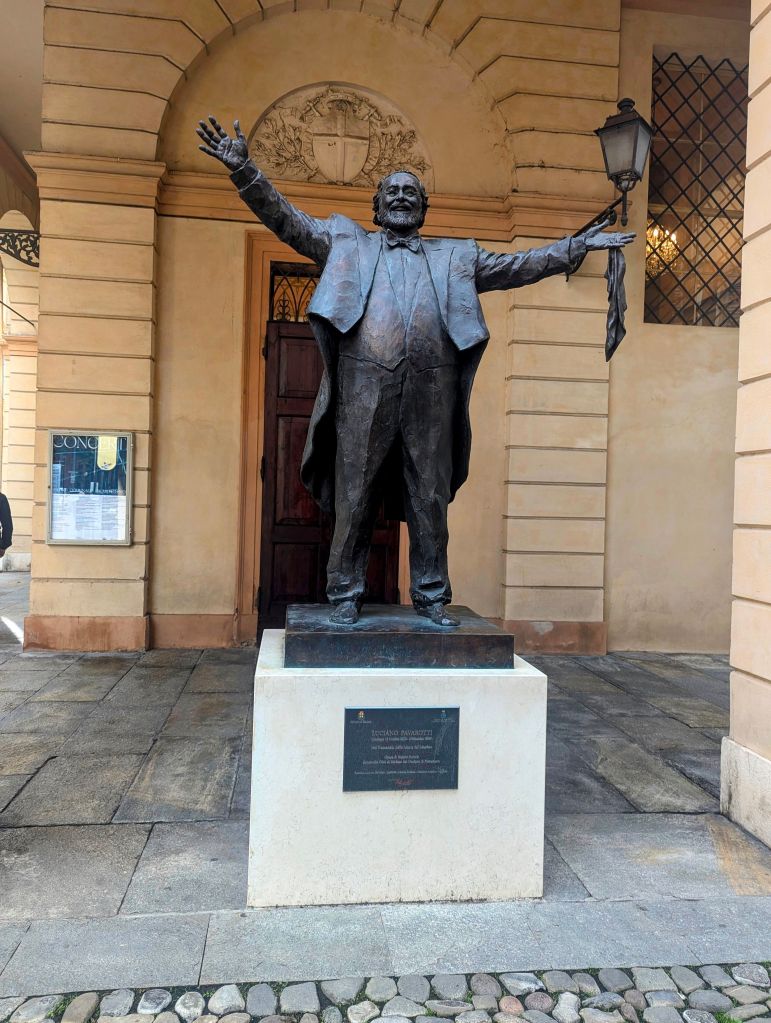
We asked in the lobby if we could peak into the theater and were told normally yes, but there was an ongoing practice for tonight’s concert. “What was the concert?” we asked. The answer was Bach’s Brandenberg Concertos, one of our favorites! We had to be up early in the morning but warily asked the price of admission and were told for seniors $21 each. Wow, for that price we could leave at intermission and at least have seen the inside of the theater. So we bought tickets and moved on. We continued through the streets of Modena, which is full of the colorful homes of Northern Italy, which we have come to love.
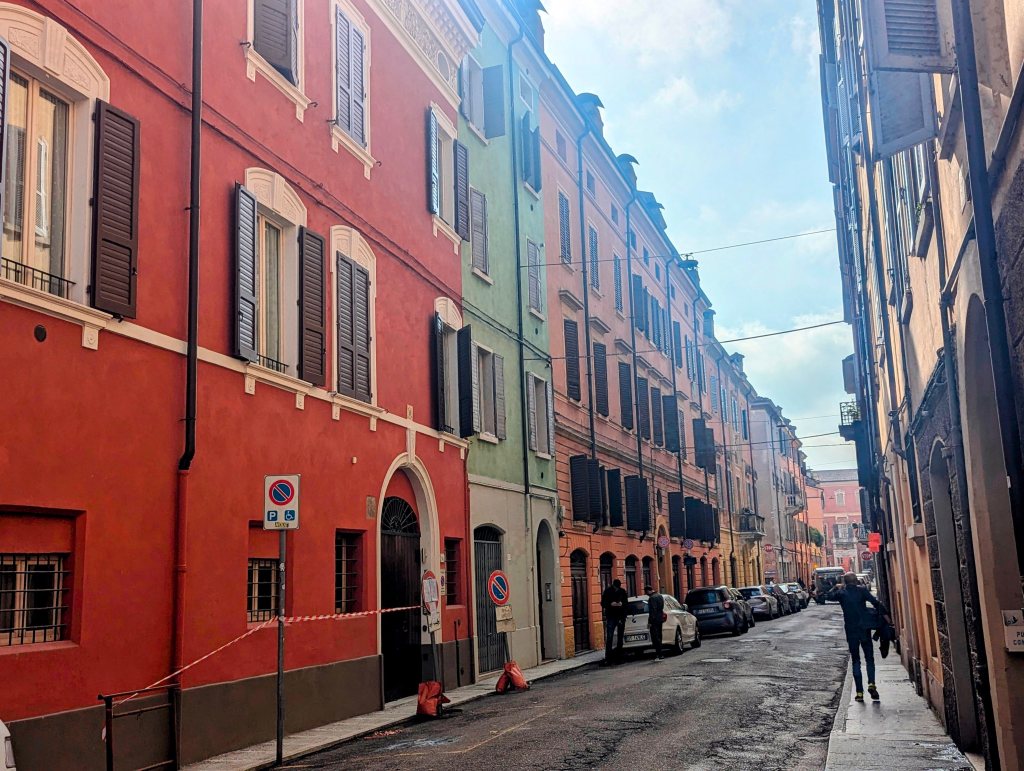
Finally we came to the Ducal Palace. The Palace, with its Baroque façade was started in 1634 and was the seat of the Este court from the 17th to 19th century. The Palace is not currently open to the public; it houses the Military Museum and a precious library.

Our walking tour of Modena now complete, we drove out of the city for our appointment at Acetaia Villa San Donnino, an aceteria: a place where balsamic vinegar is produced. From their website “Traditional Balsamic Vinegar of Modena is a DOP food condiment, obtained from the processing of typical Modena grapes, such as Trebbiano and Lambrusco. The complexity of its characteristics is given not only by the long maturation, but above all by the particular environmental conditions and microclimate of the Modena area. Its uniqueness and its many beneficial properties have allowed it to become a sought-after and appreciated product throughout the world, earning it the title of “Black Gold of Modena”. Traditional Balsamic Vinegar of Modena has very ancient roots and, as tradition dictates, its production is handed down from generation to generation, applying processing methods provided for by strict regulations.”
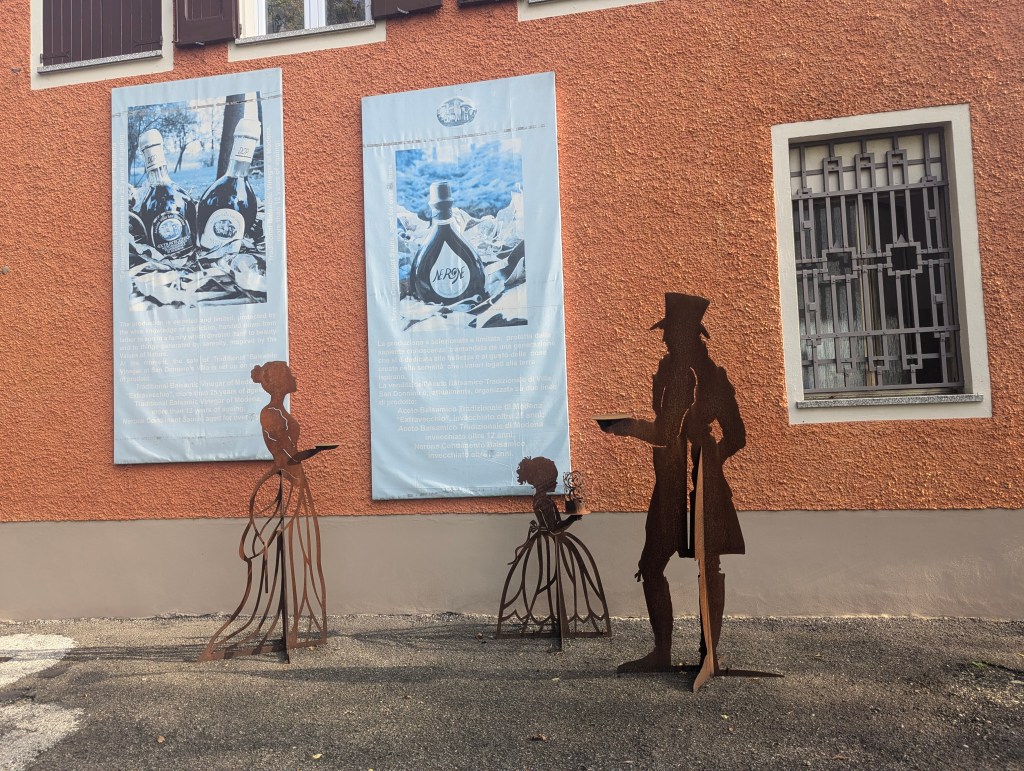
Upon entering the building, we were immediately assaulted by a very strong odor of vinegar. Our guide explained that DOP designation means that everything from the origin of the grapes to the entire process of making the vinegar is strctly regulated. There is only one ingredient on the label: grapes. All other balsamic vinegars are IGP and are allowed to say “Modena” on the label even if only one step of the process occurs there including bottling. She advised us that when buying IGP balsamic vinegar in the future to pay attention and only buy ones with 2 or at most 3 ingredients.

White grapes are used but turn the notable dark color during the aging process. Once picked and pressed, the grapes are simmered for 24 hours. It is this cooking that differentiates balsamic from other vinegars. Then it is left in a large metal barrel until the next season. Balsamic vinegar is aged in a series of ever smaller barrels, which are made from a variety of woods: oak, chestnut, juniper, mulberry, acacia, with an opening at the top covered by a cheesecloth. Old wine barrels are often used.
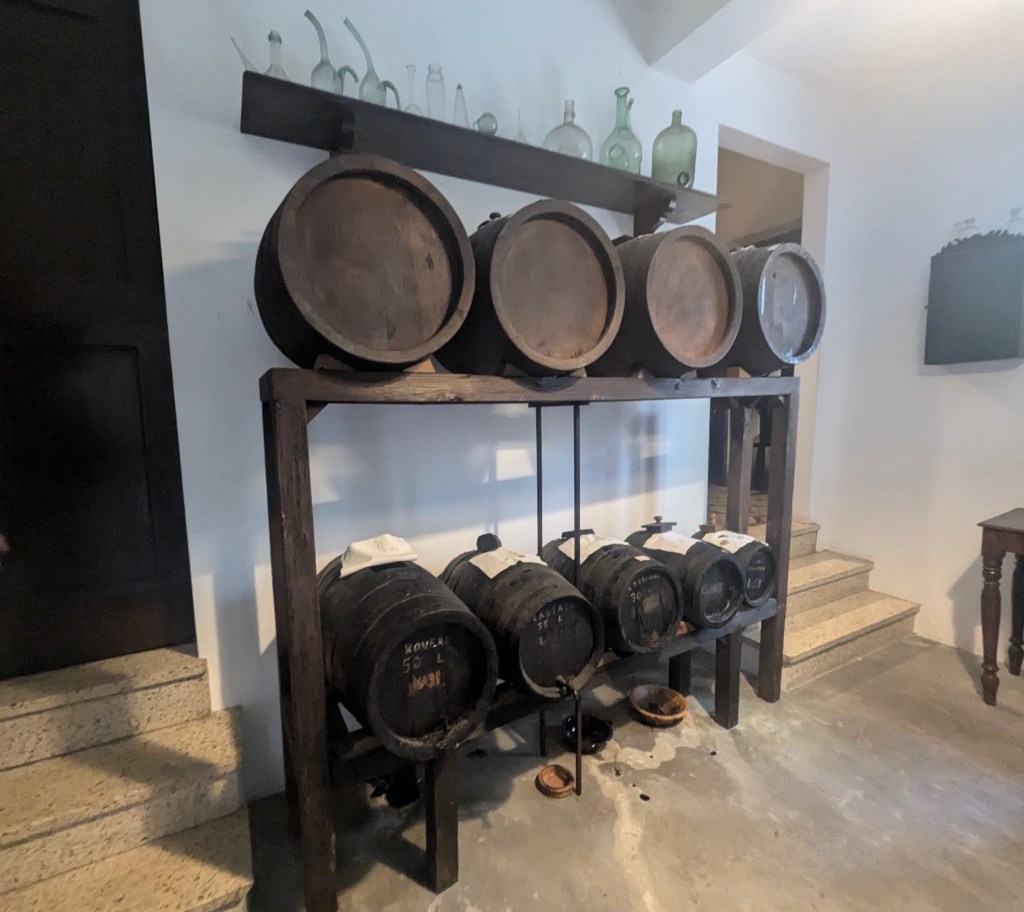
After a minimum of 12 years, one liter is removed from the smallest barrel. Because of evaporation, it has now lost more that the one liter. The amount is replaced from the next larger barrel in its set, which has also lost some volume to evaporation. This total loss is now replaced with vinegar from its next larger barrel and so on. The largest barrel in the set, which is now down several liters total, is filled using the new vinegar from the large metal barrel of the previous season. None of the barrels are ever emptied. Most of the sets are stored in the attic.

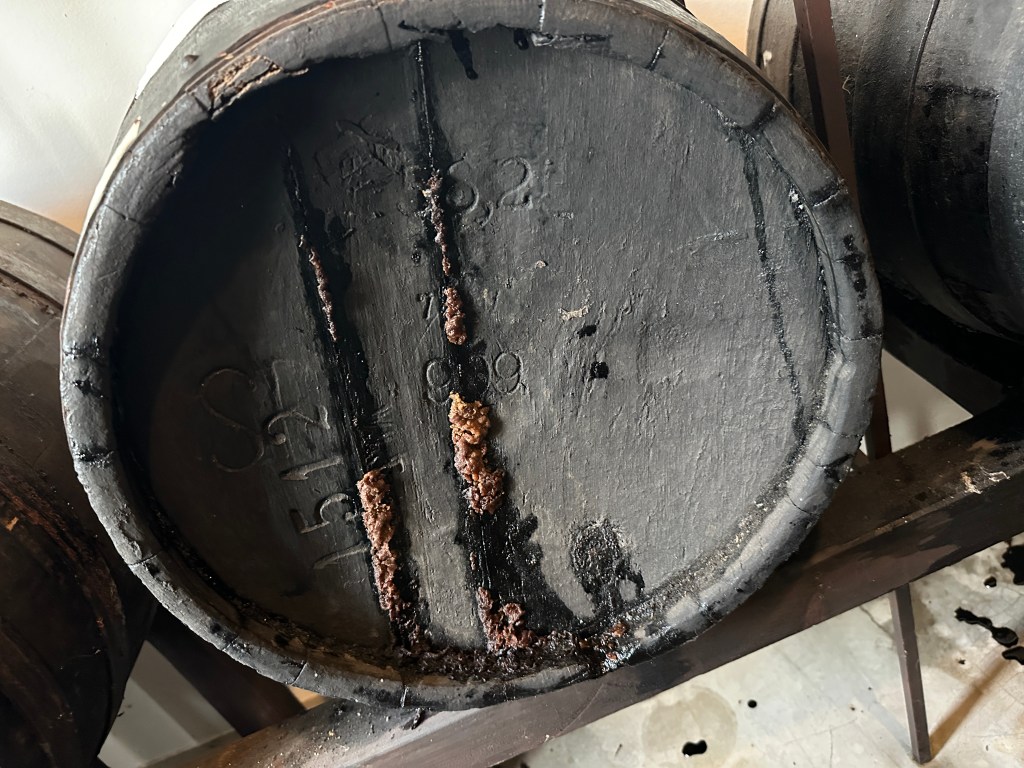
The barrels can be used indefinitely, and some are very old. This oldest is from 1512.
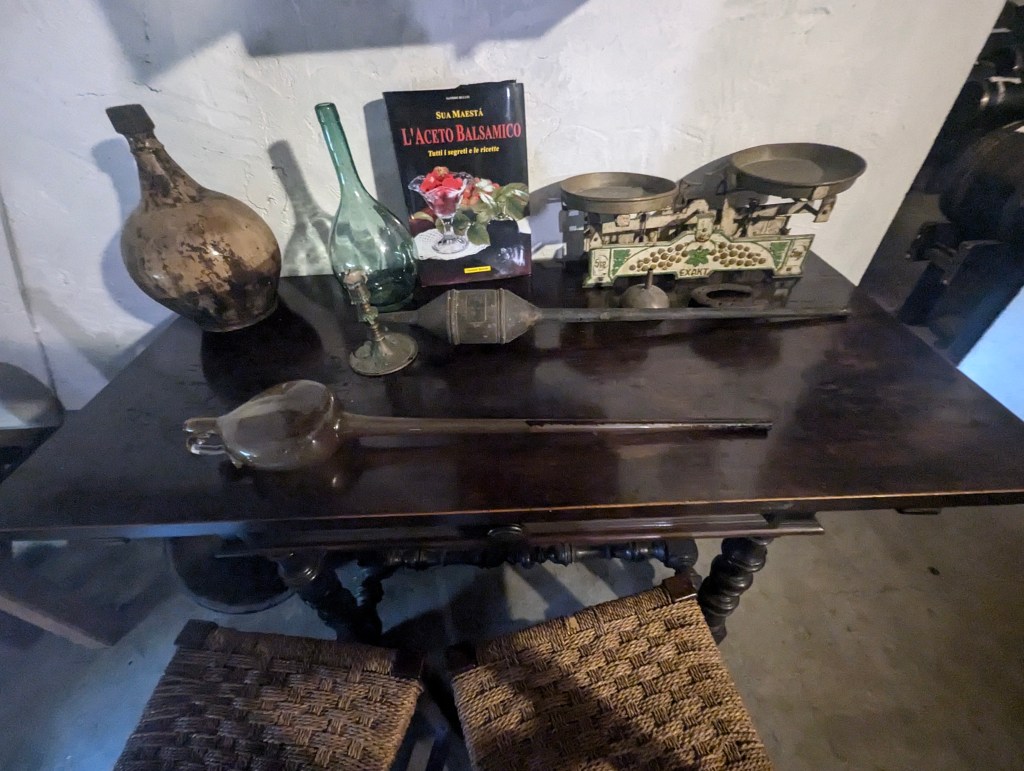
The instruments to move the vinegar from barrel to barrel today are sophisticated. But in past times they were simple siphons.
The napkin over the open hole of the barrel allows bacteria from the air to get in and turn the grape juice into alcohol. In the attic over the summer the heat allows for alcohol to turn to vinegar and some of the vinegar to evaporate. The cooler winter stops the process and allows a rest. When a new child is born, local families often start a set to celebrate the birth. The first extraction occurs when the child turns 12. Sometimes guests who visit the aceteaia decide to start their own set, as was the case with Pierce Brosnan.

Once the vinegar in the smallest bottle is at least 12 years old, one liter is removed and taken to the consortium for inspection and approval. If approved it can be bottled. All of the DOP bottles of Modena Balsamic vinegar must be in the same size (100 ml) and shape bottle. Only the label is allowed to differ. That makes 10 bottles per set per year. This acetaia produces only 3500 bottles per year., which is not a lot. Locals use the balsamic not only on just about everything they eat including eggs, but they also use it for sick stomachs and sore throats.
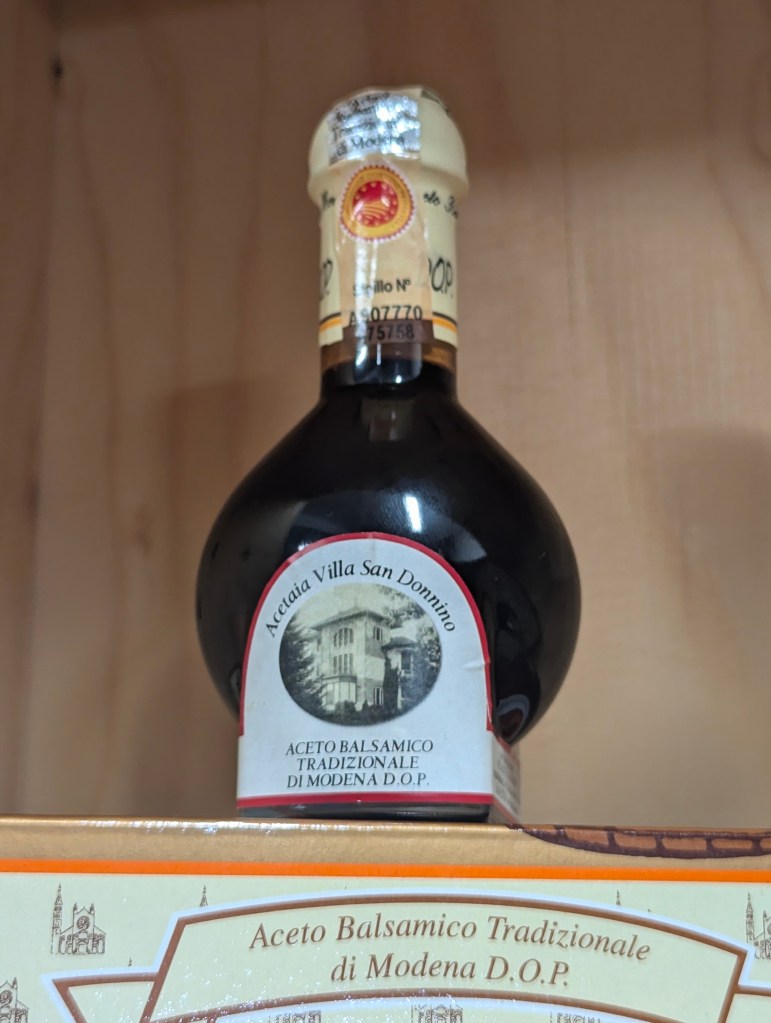
If left in the barrel for a minimum of 25 years, then the designation is “extra vecchio,” “extra old,” and it is bottled in the same size and shape bottle, but with a different color top.
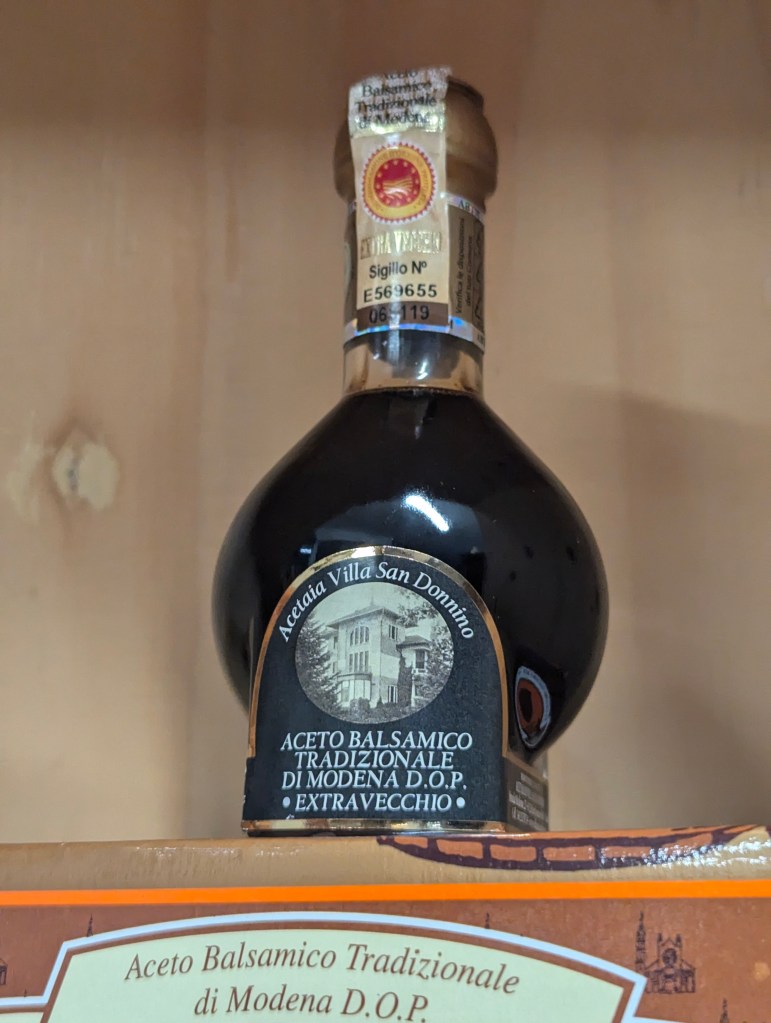
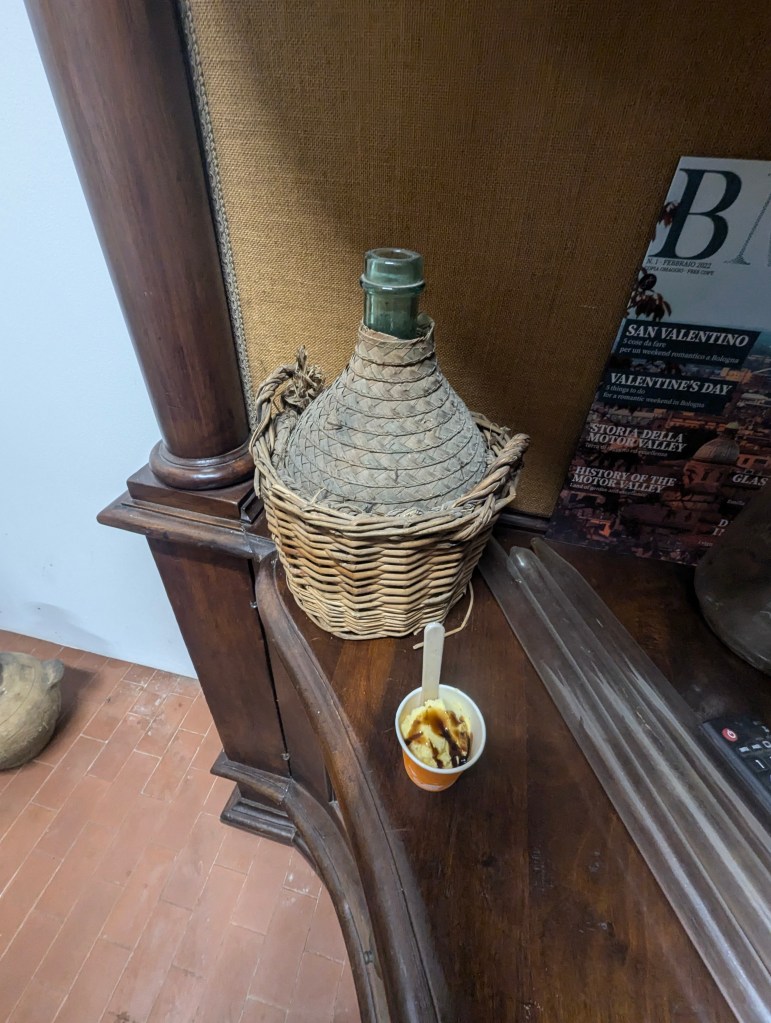
She gave us a taste of both; the extra old is much thicker, more syrupy, and sweeter. She then treated us to vanilla gelatto with a drip of the 12 year old balsamic on it, and it surprisingly tasted like caramel; so delicious!
Our tour finished, we drove back into town for a quick dinner in the Ducal Palace Piazza before heading to the concert. Our seats for the concert were in a box with only 5 seats.
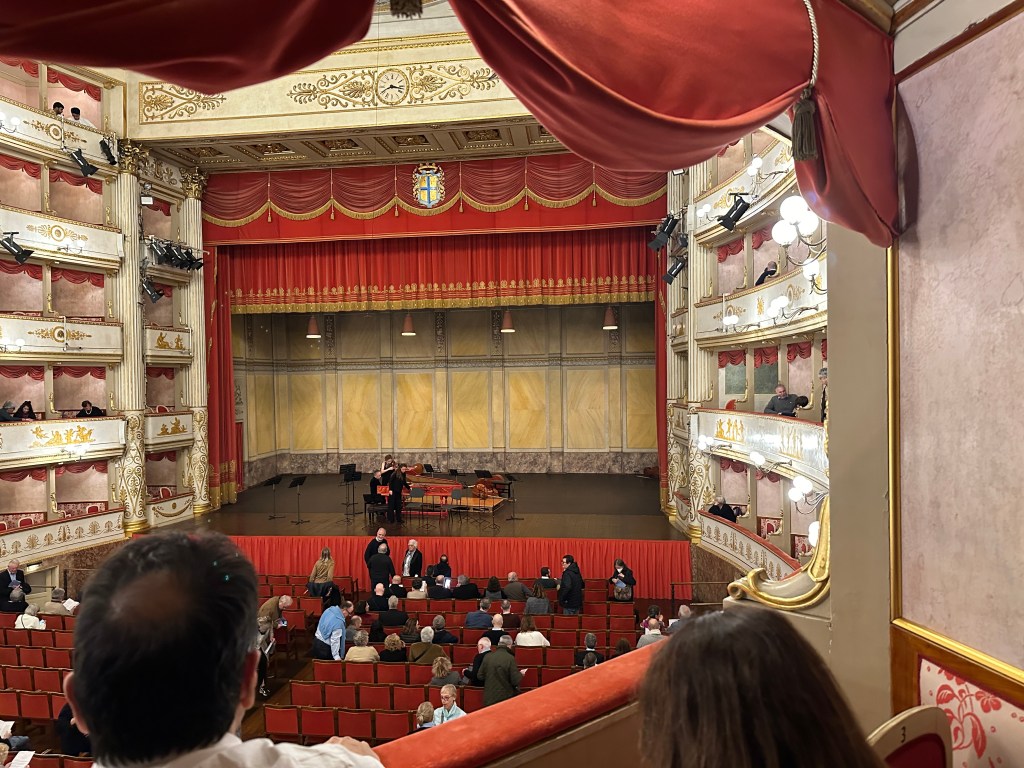
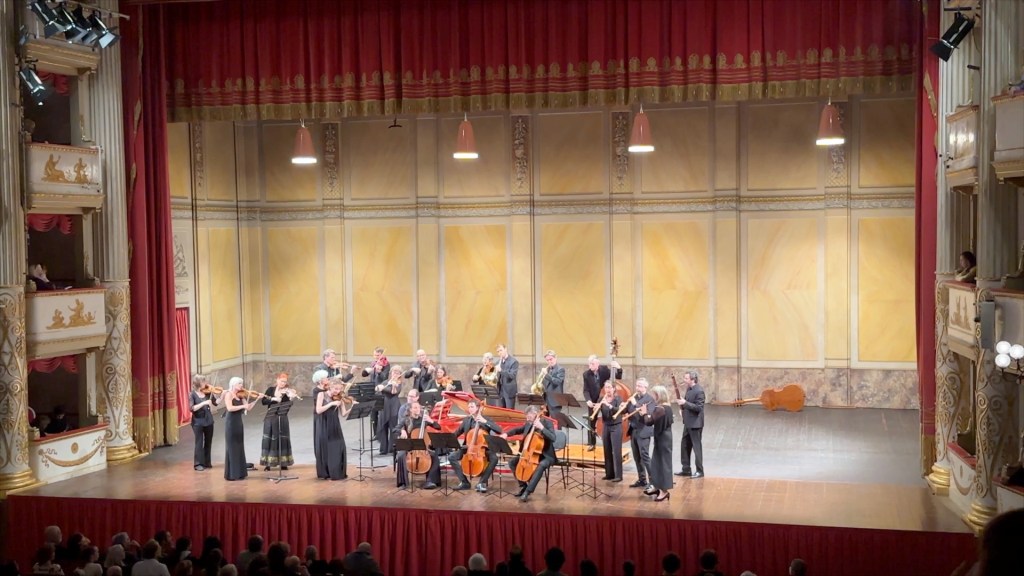
The orchestra was a group from Germany called the Freiburger Barockorchestra, a group founded in 1987 with the mission statement to enliven the world of Baroque music with new sounds”. They play without a conductor and interact with each other with animated facial expressions and body language.
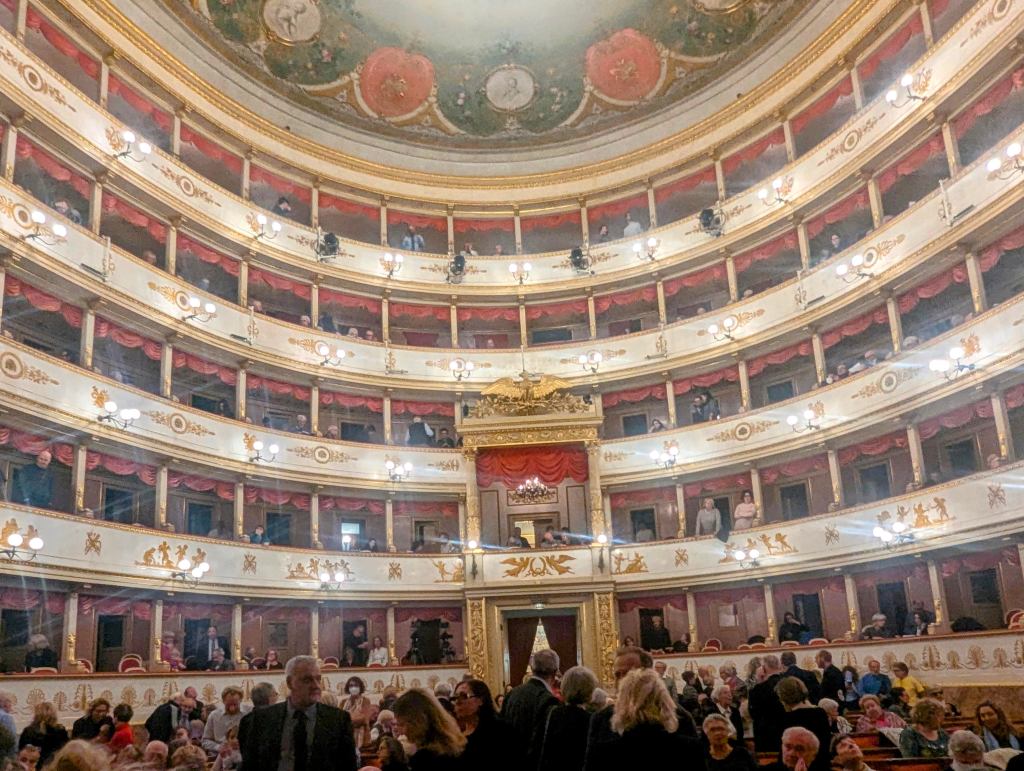
It was one of the most fun concerts we had ever been to, not to mention the music was great. Despite the late hour and our early morning appointment, there was no leaving at intermission, so I ran down to the stage and took a picture of the theater from the stage.
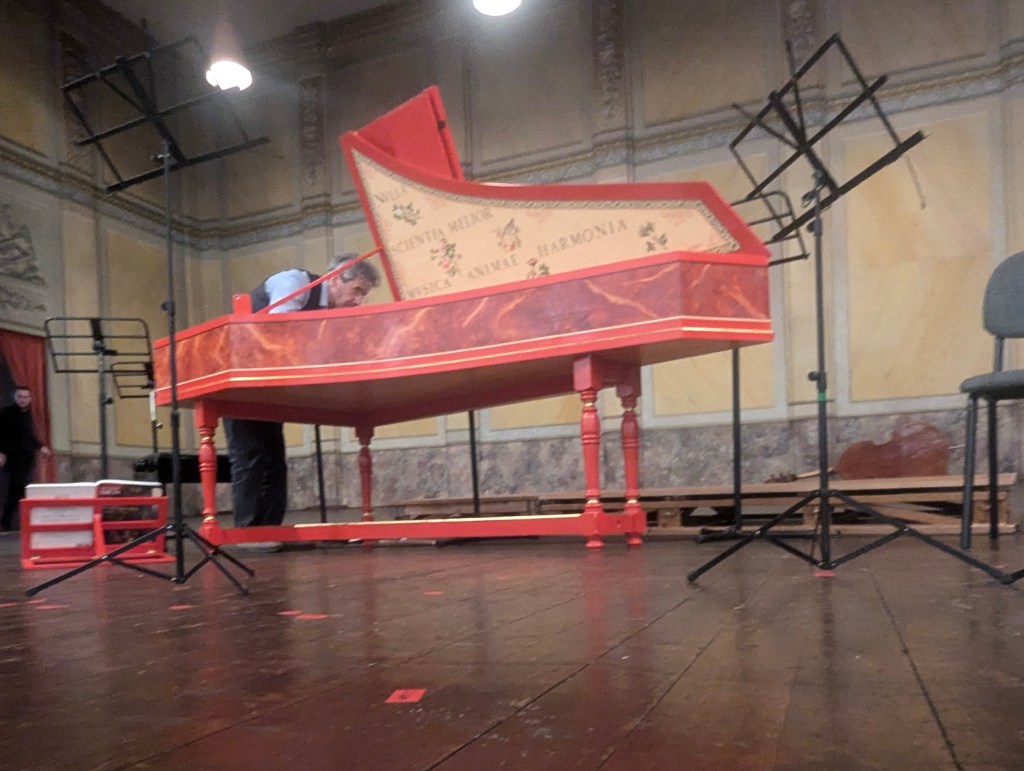
and the red harpsichord, so cool.
In the morning we were up bright and early to drive about an hour to a dairy farm just east of Parma.
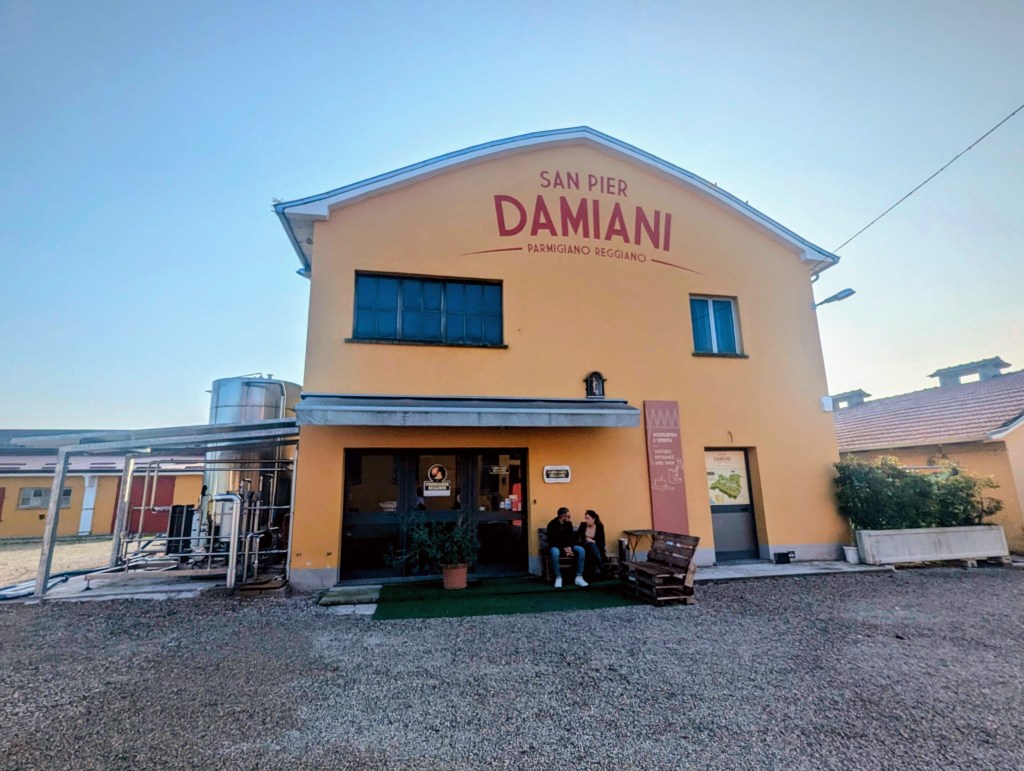
Our host here explained that like the balsamic, parmesan cheese is also regulated. All of the products. ie the cows, must be raised locally, and a specific cheese making process followed in order to obtain a DOP designation. This particular farm is run by two families: her’s, which farms and milks the cows and is responsible for the public facing part of the business, and the other family actually makes the cheese. Their cows produce 7000 liters of milk daily, which amounts to 14 wheels weighing 50 kg each (about 110 pounds).In the evening the milk is poured into containers for overnight storage. In the morning, the cream is skimmed off the top (and usually made into butter), then this skim milk is added to the morning’s whole milk in these containers. Some of yesterday’s whey, explained below, is added.
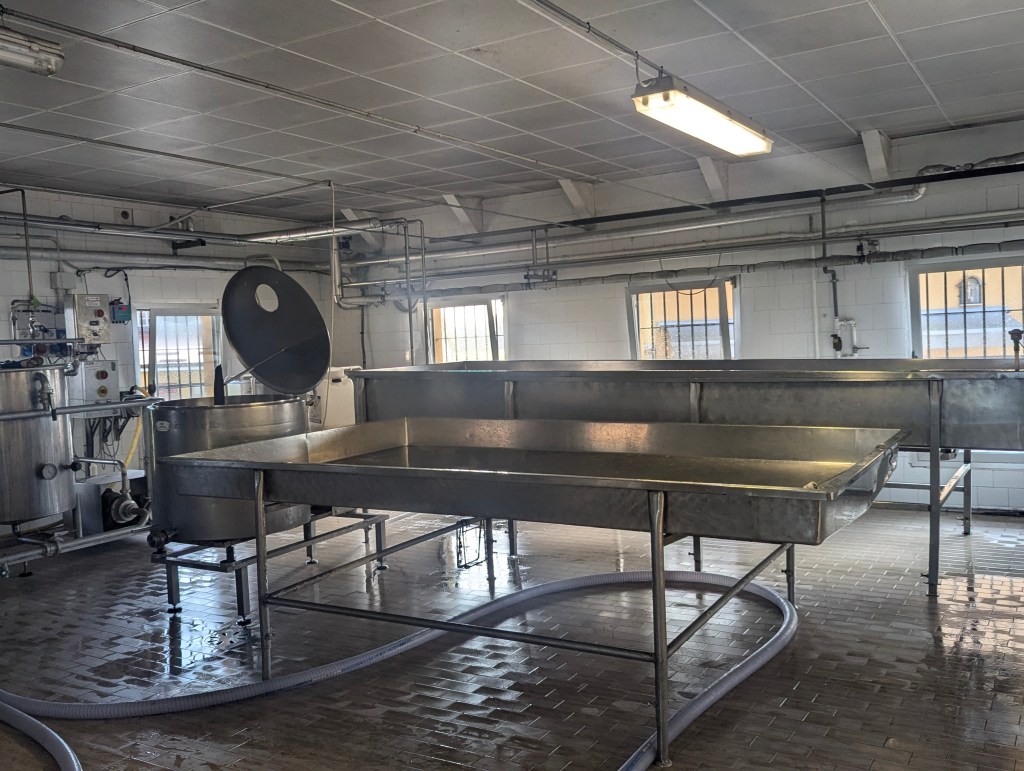
Once mixed, the milk and whey are cooked in copper pots at 131 degrees F for an hour. Then the mixture is raked to change the texture. The solids sink to the bottom and collect into a big ball.
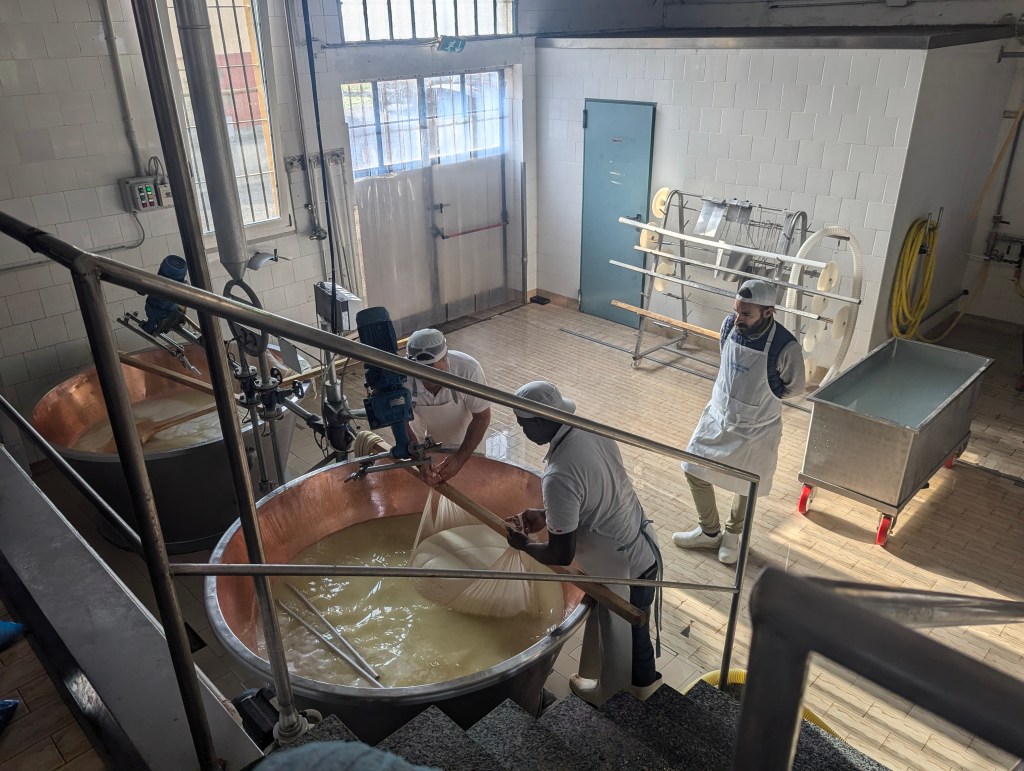
The big ball is then split into two. The remaining liquid, which is the whey, is drained. Some of the whey is saved for tomorrow’s cheese. The rest is dried and sold as whey powder. Whey proteins are popular for everything from protein drinks to skin care products.
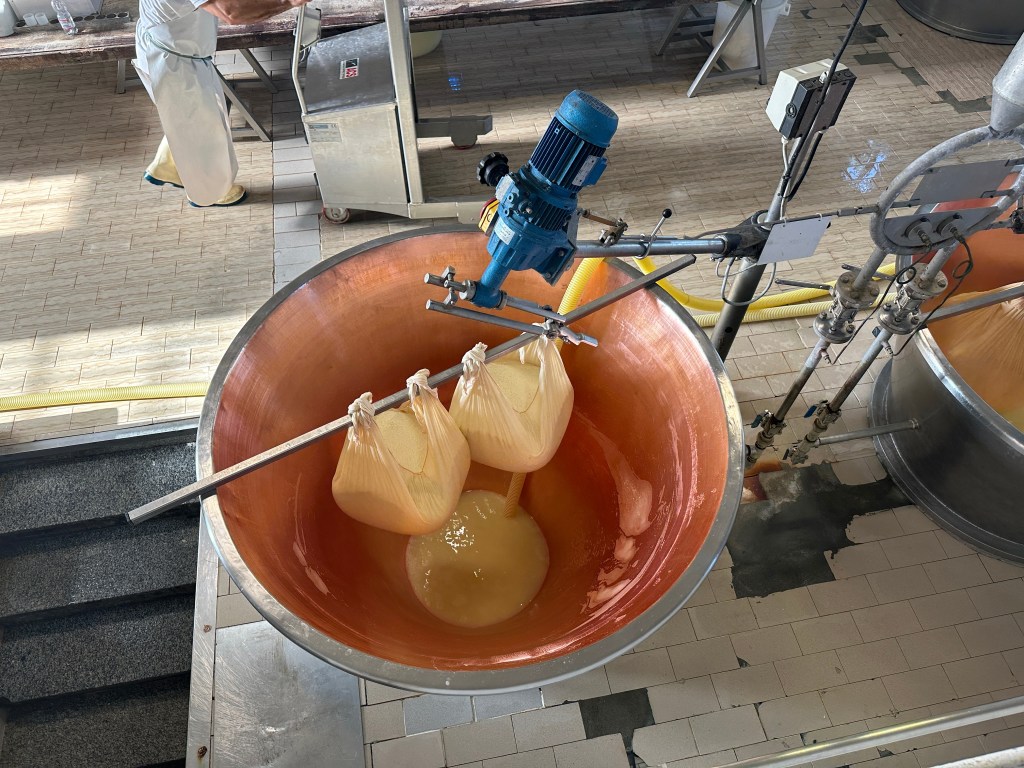
The two balls of solid milk are then lifted by this very nifty machine
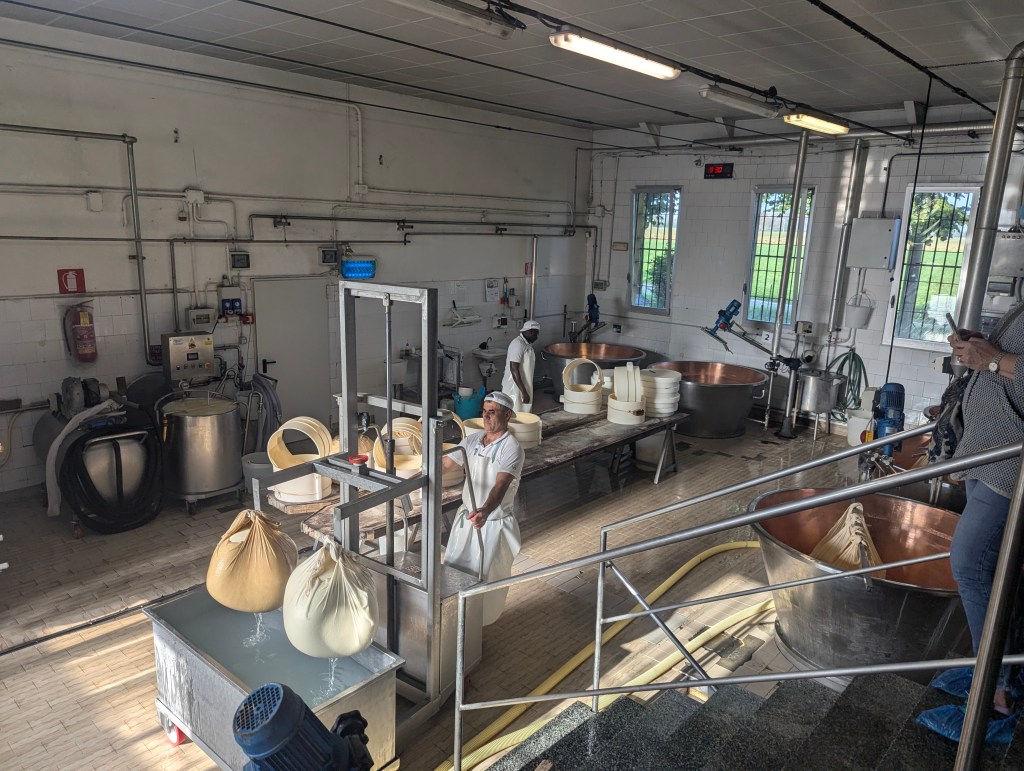
and placed into shaping wheels and turned every 3 hours.
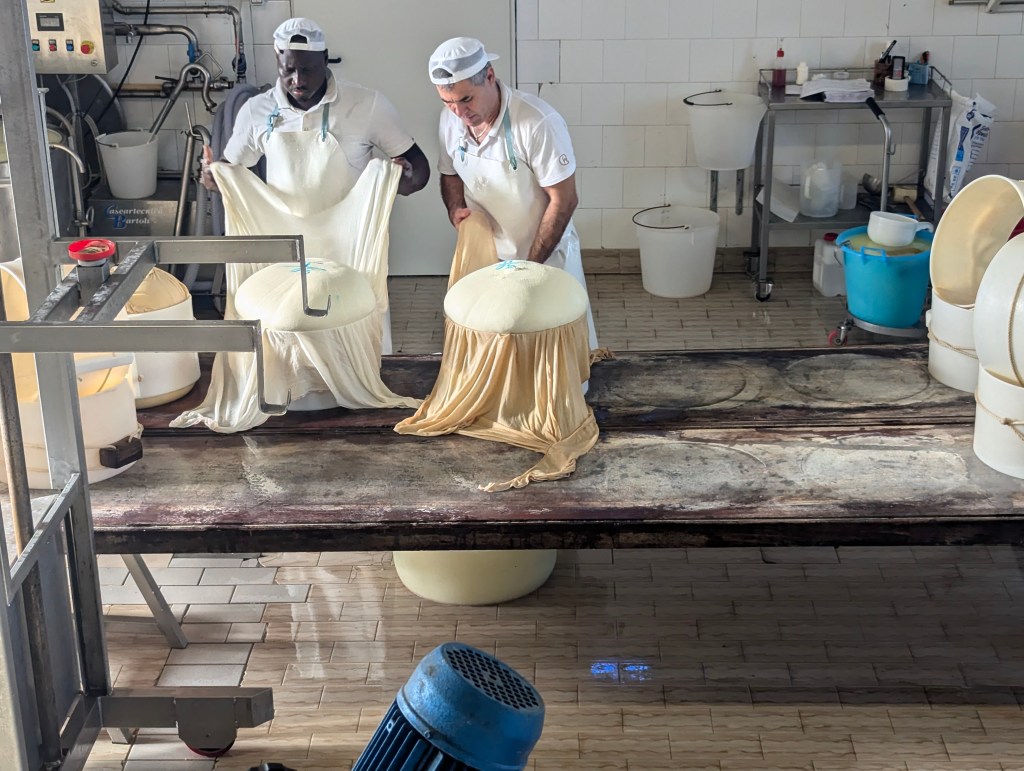
In the evening the wheels are taken into a cool room and stamped.
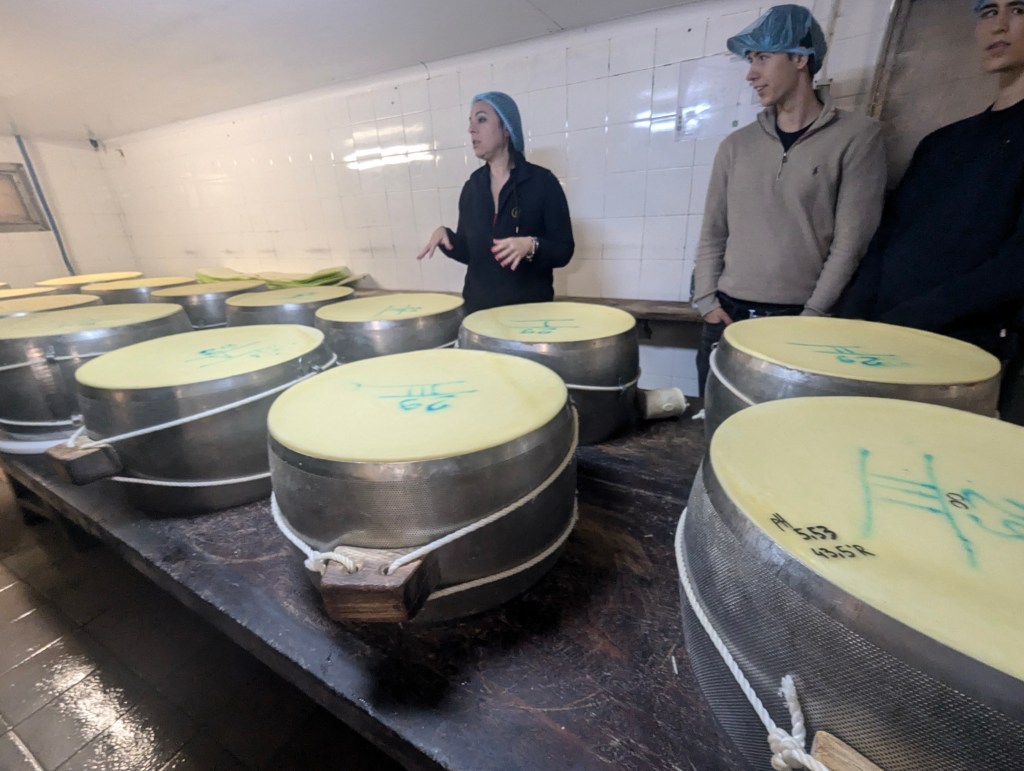
They remain on this table for 24 hours, after which they are further stamped using this plastic mold around the outside
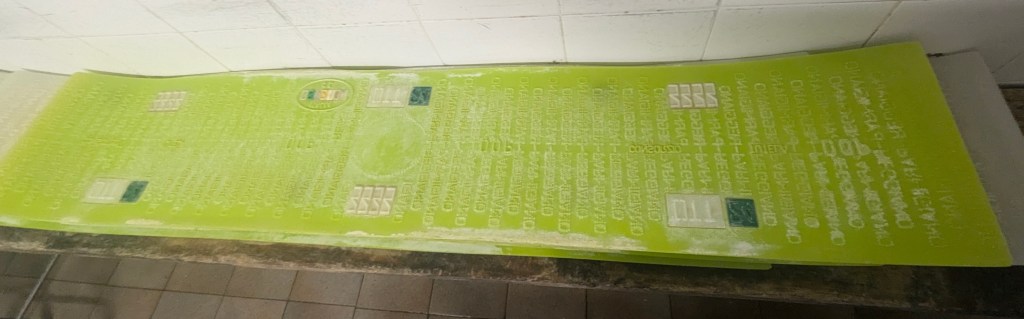
The mold can have the date changed and has a blank area, seen on the right below, for the final DOP inspection stamp.
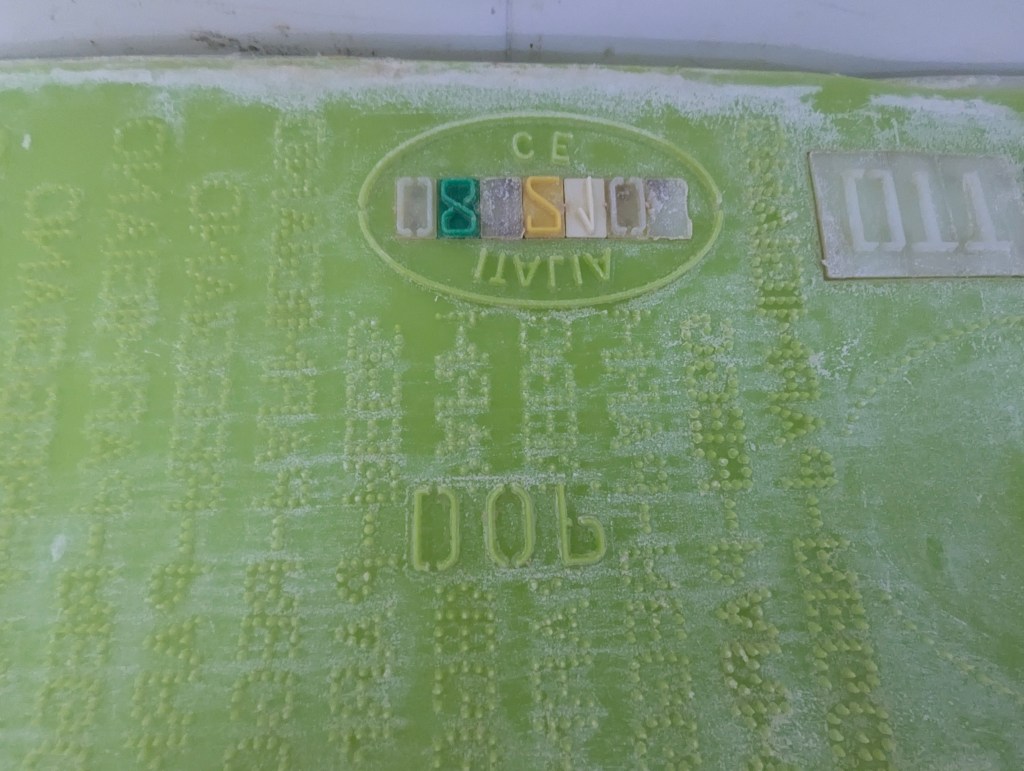
Traditional parmesan is from black and white cows. Their milk is creamier than those of the brown cow variety, but they produce less milk. This farm uses both, keeps the milk separate, and designates those from the black and white cows with this stamp on the top of the wheel.

After 1 day on the table, the wheels are placed in salt water to brine for the next 25 days, turning daily.
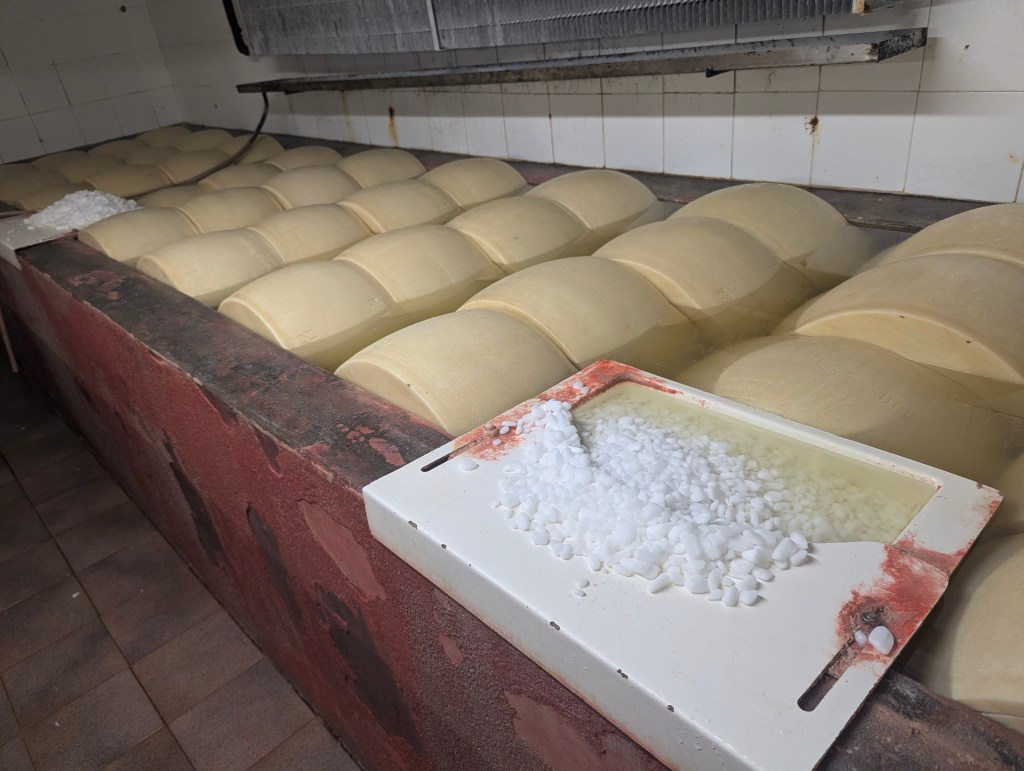
After 25 days they have lost about 10 pounds. They are then transferred to the aging shelves and kept at 65 degree F with 80% humidity. There they will loose another 10 pounds.
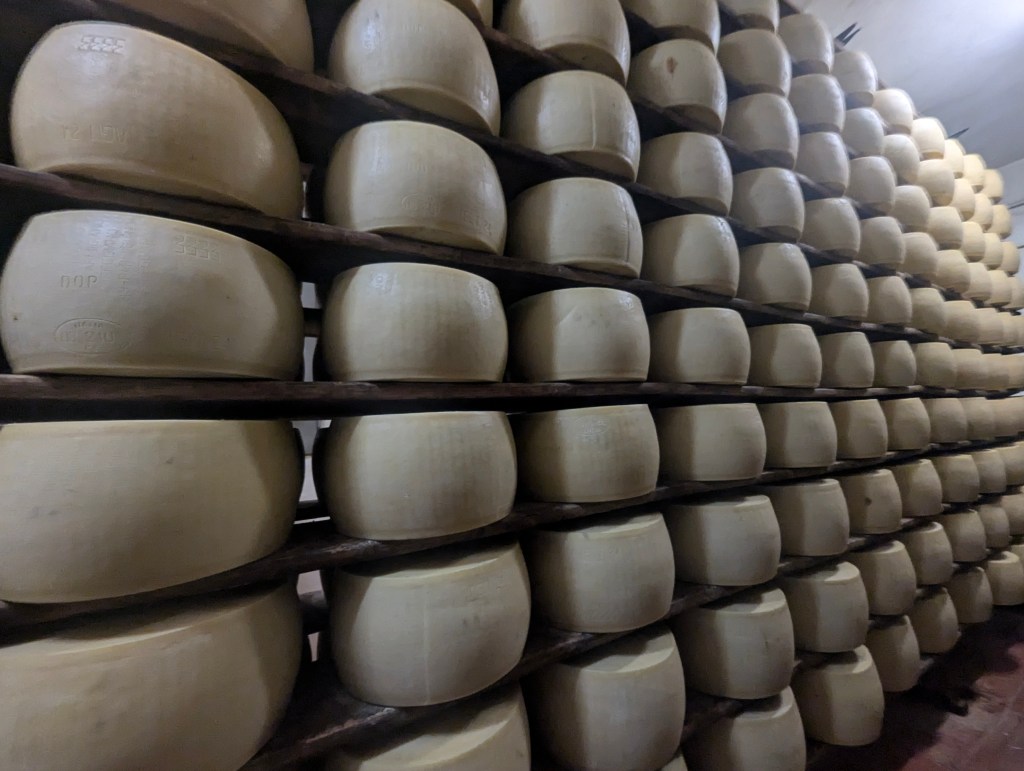
They are taken out weekly for a dusting.
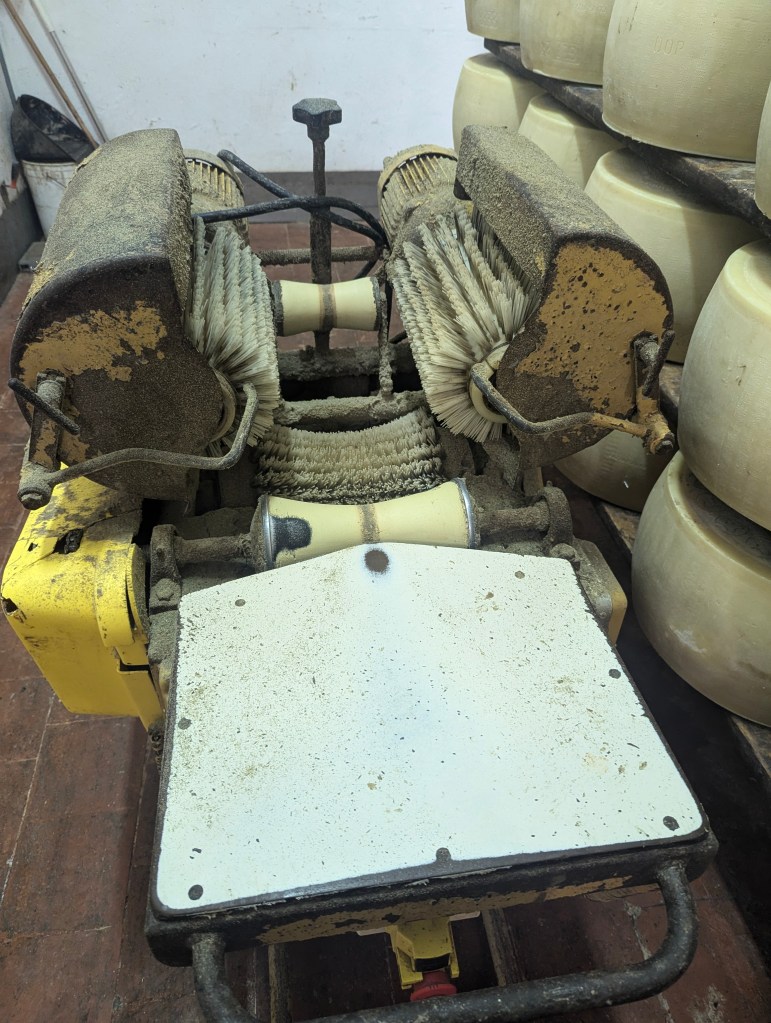
In addition to a visual inspection, the inspection at age 1 year is also an audible one using a hammer.
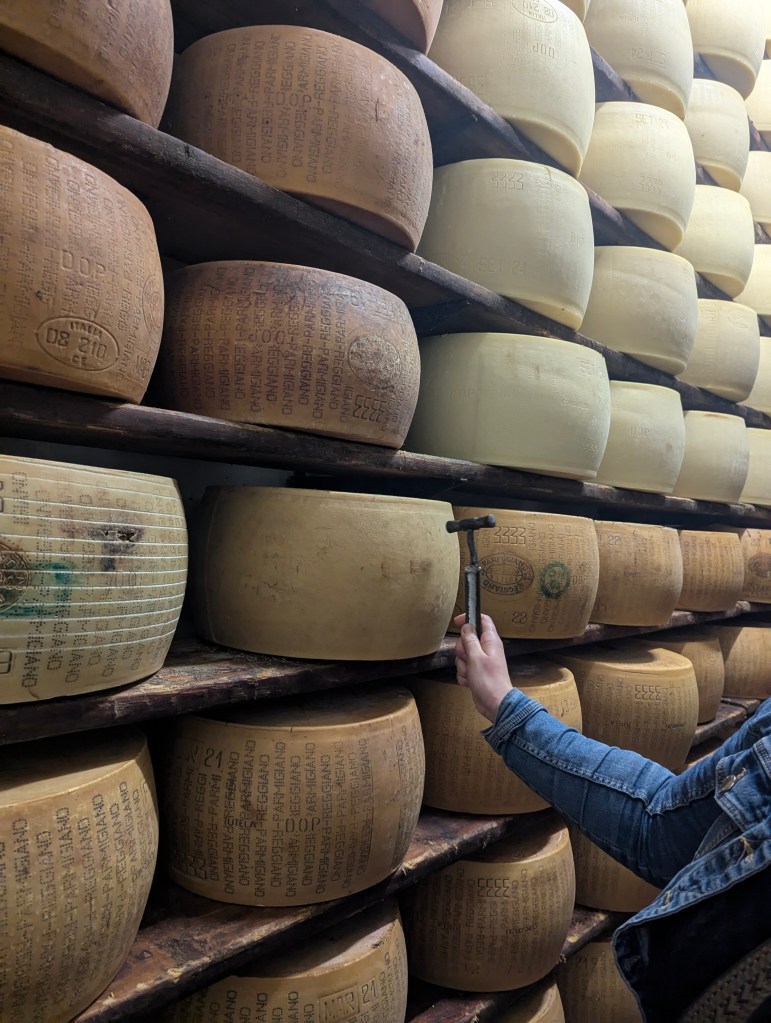
There are three levels: First gets the seal stamped. Second can be sold, but not as DOP. Third can only be sold as grated. Less than 10% do not pass.
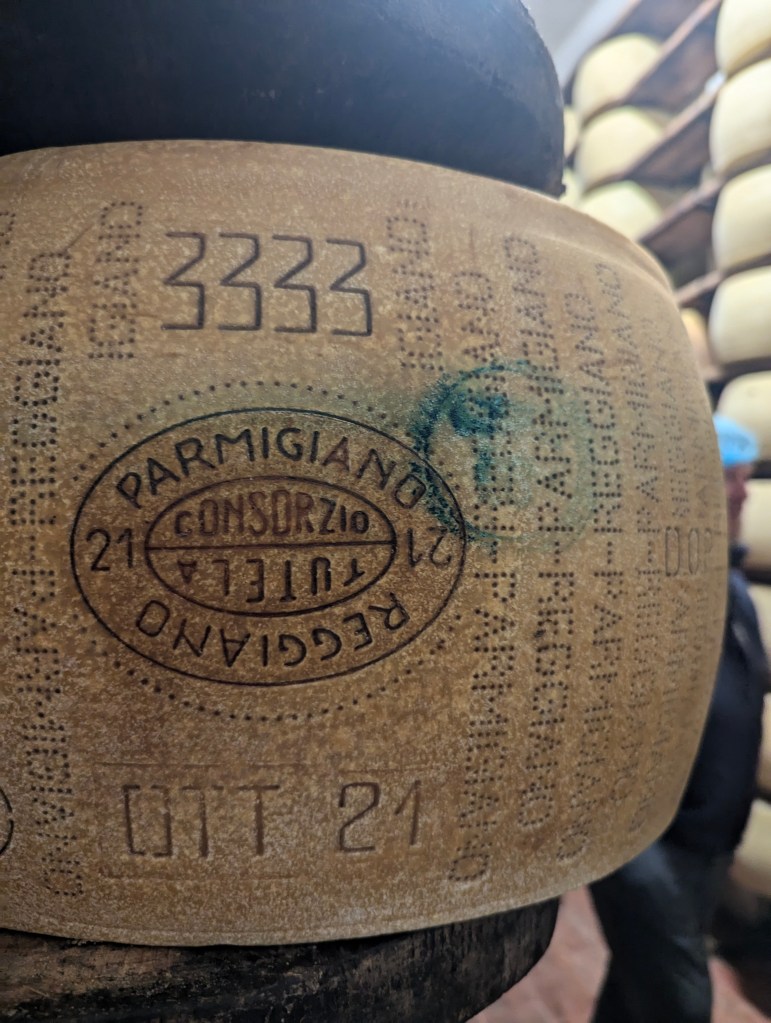
Most of their demand is aged 24 months, but there is no age too old; one below is 10 years.
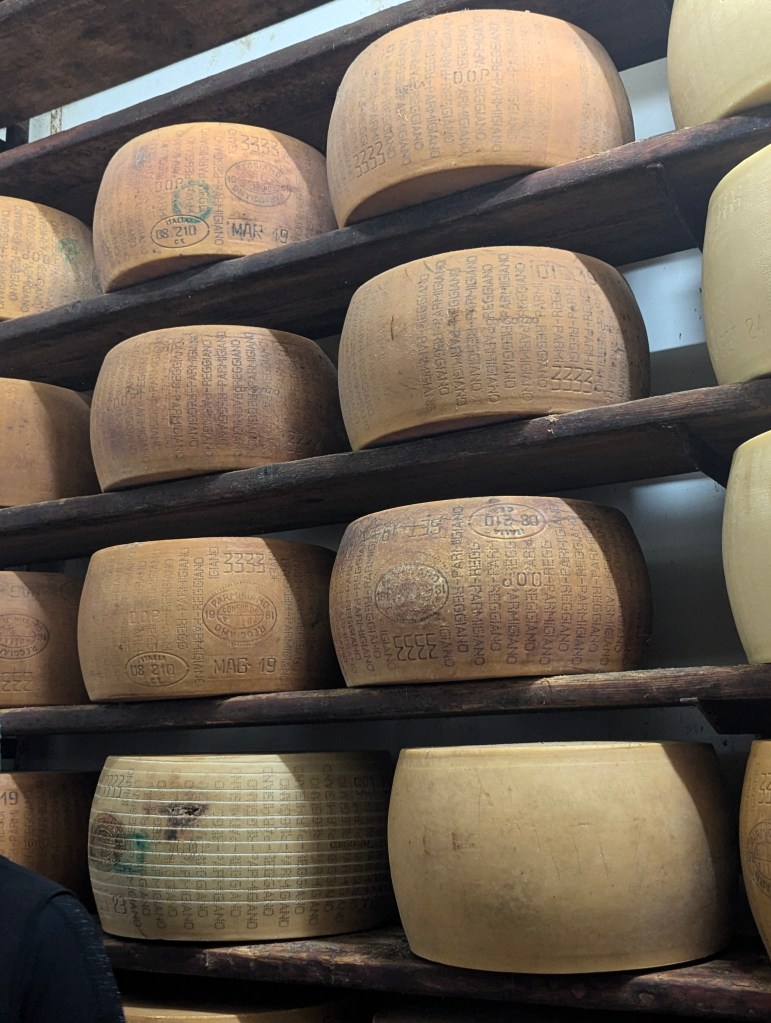
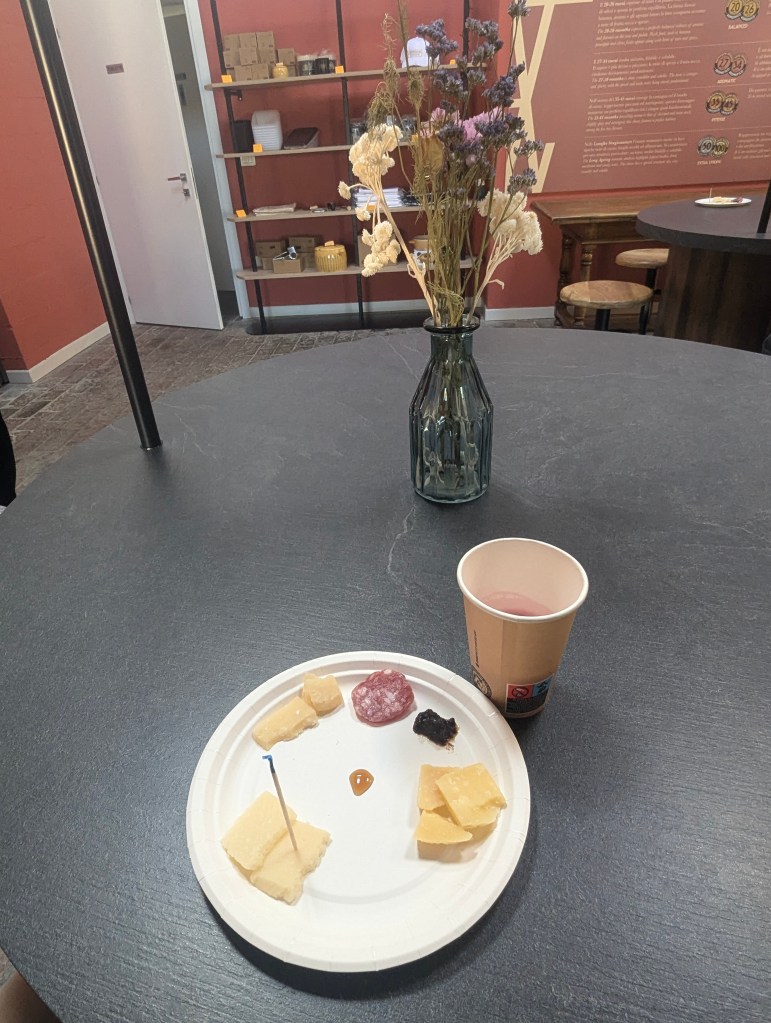
After the tour we were treated to a tasting of different aged cheeses from one of the black and white cows, a dab of balsamic vinegar, and a cup of Lambrusco, the sparkling semi-sweet wine of the region.
Then we drove along narrow, winding farm roads from the dairy farm to the Perla Parma ham factory tour. Perla, founded by two brothers, sells about 40, 000 pounds of ham a year. Our guide recounted the history of the local area which had been marshy, which is a good environment for black pigs. Starting around the year 1000, black pigs were imported from England for their desired high fat content. Today the pigs are raised locally and fed a very specific diet. Parma ham is DOP certified.
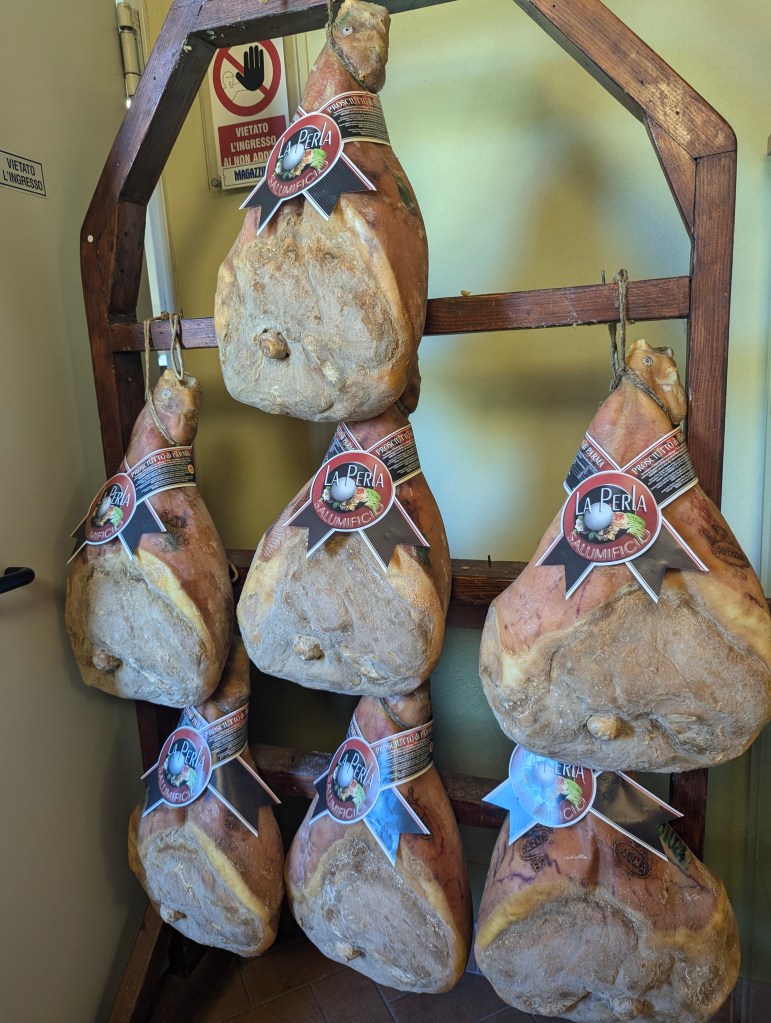
Only the back legs are used. The practice has been around for centuries; all of the other parts of the animal are used in other operations. Perla receives deliveries a couple of days a week. Even though they have been transported in temperature controlled trucks, after arrival the hams are rested at 35 degress F for 24 hours. then they are pounded to reduce the fluid and to soften the muscles.

The fresh ham is then hung by a rope and salted first by machine then by hand. After a week they receive a second salting.
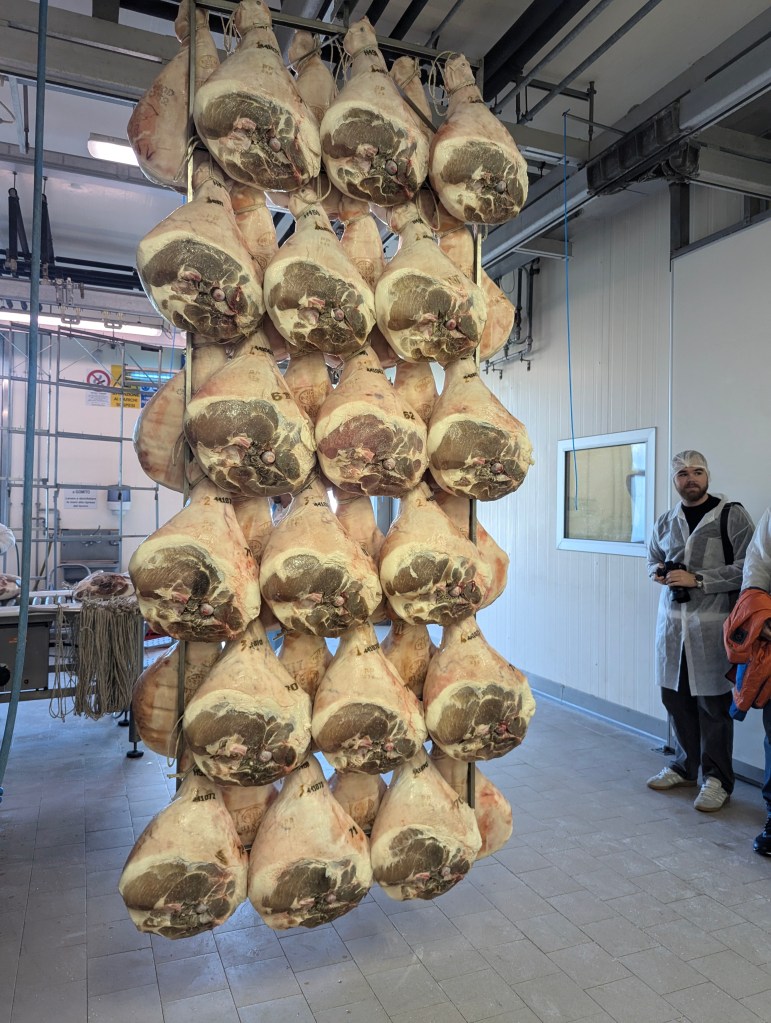
They are moved and the temperature increased to 37 degrees F and left there for 2 months. At this point they will have lost 30% of their weight.
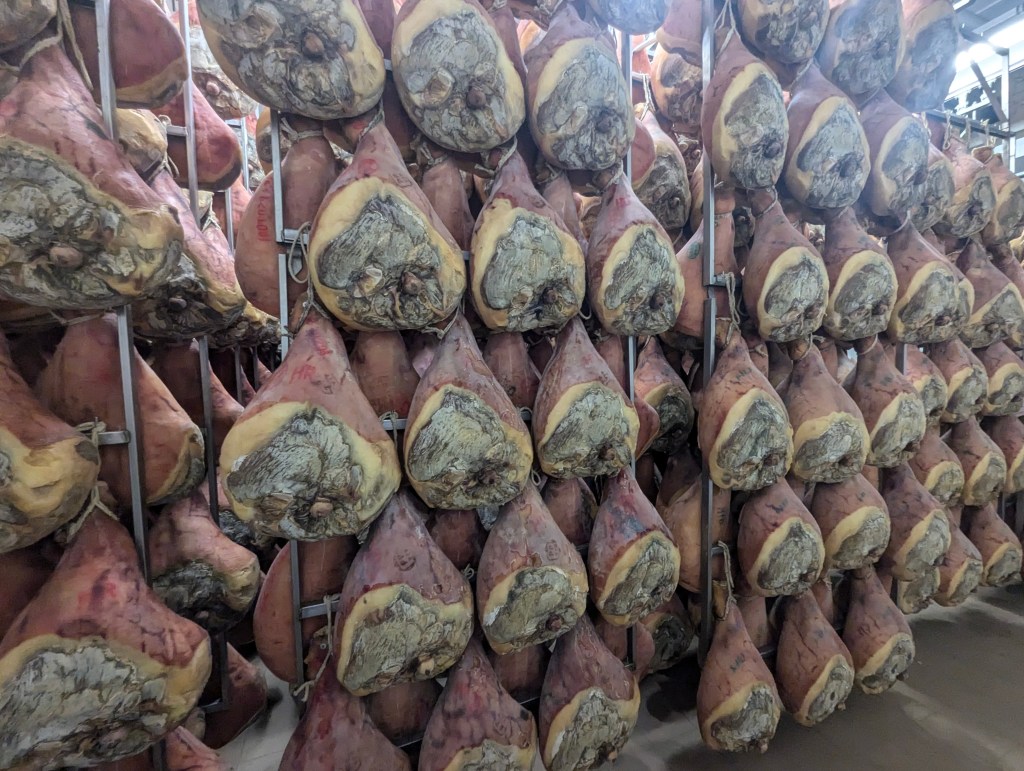
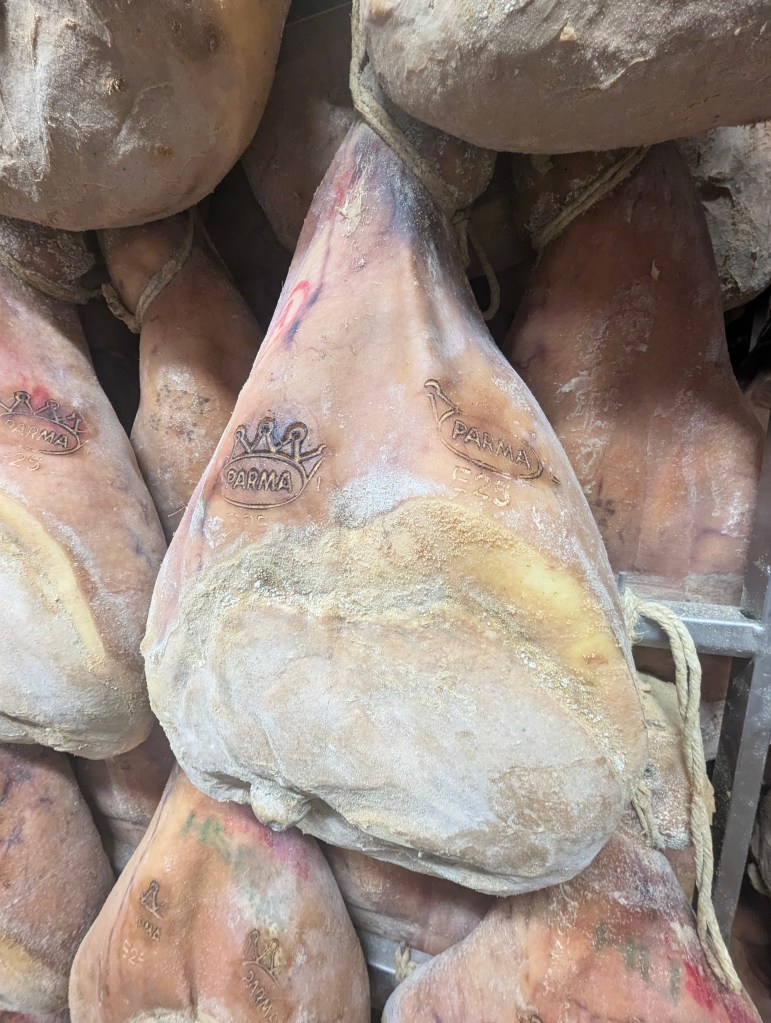
They are transferred to a dry room at 54 degrees for 3 months. After this point the exposed meat is covered with sunatura, a thick white substance consisting of rice flour, black pepper, and fat from the pig. Black pepper historically deterred the flies. The temperature is increased to 43 degrees F and the white turns to grey.
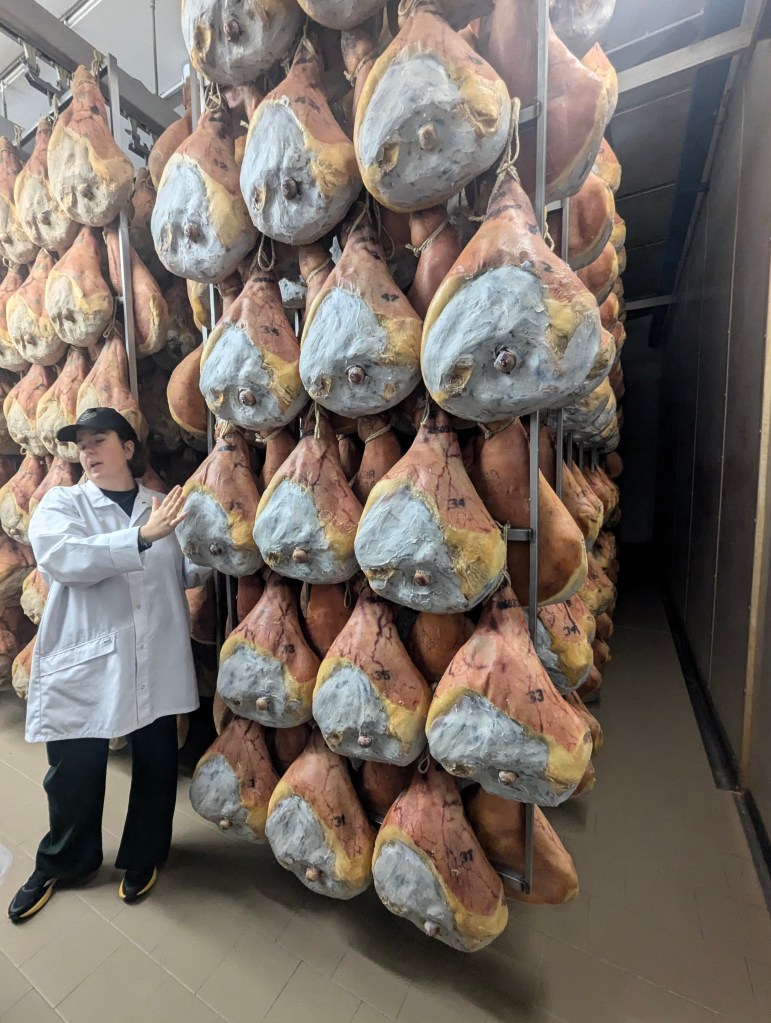
After 14 months the iconsortium inspector arrives. At any given time there are about 80,000 hams in the factory. The inspector inserts a piece of a horse’s shin bone into 5 points of the ham and smells. If it passes, it gets a stamp. It will not be sold until it is 24 months old.
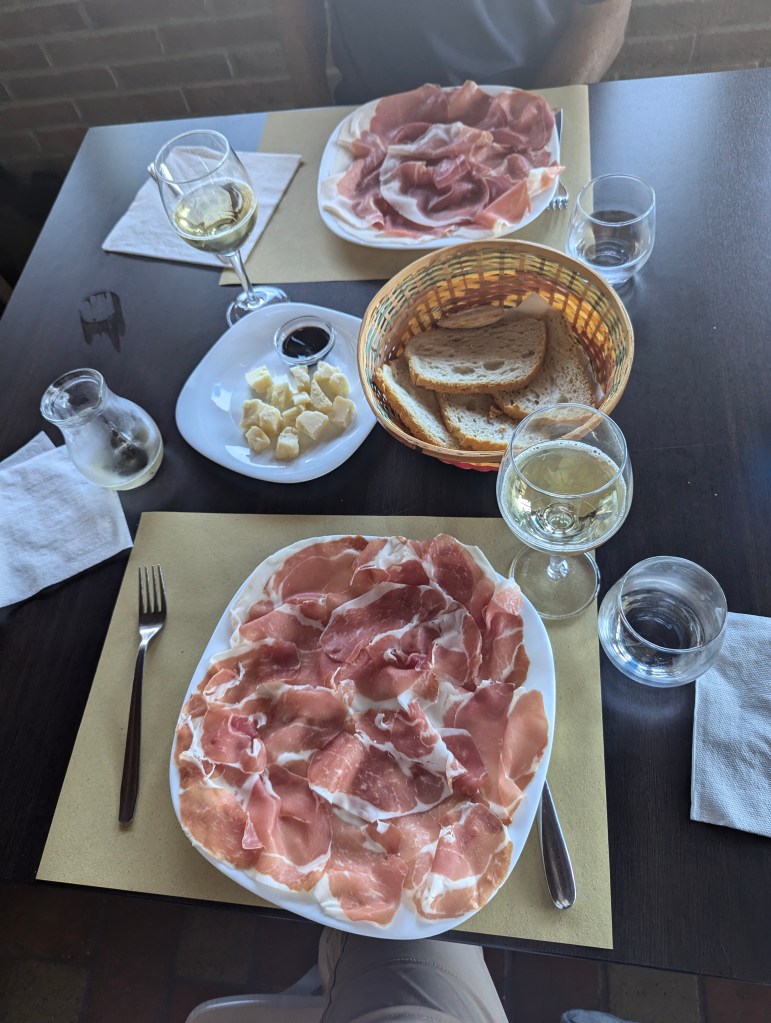
The post tour tasting here was a feast.
Already half the day was behind us and we had yet to go into Parma itself. I had a zoom meeting with friends in the evening to get back for, so we had to make our visit to Parma quick and cursory, not my favorite way to visit. Armed with another self-guided audio tour, we gave it a try. Parma is a city that has been inhabited since the Bronze age probably founded by the Estruscans then later the Romans. We went first to the main square: Piazza Garibaldi. There we found the Palazzo del Governatore (Palace of the Governor), first erected in 1283. The palace housed formerly the lord, and then Governor of the town.

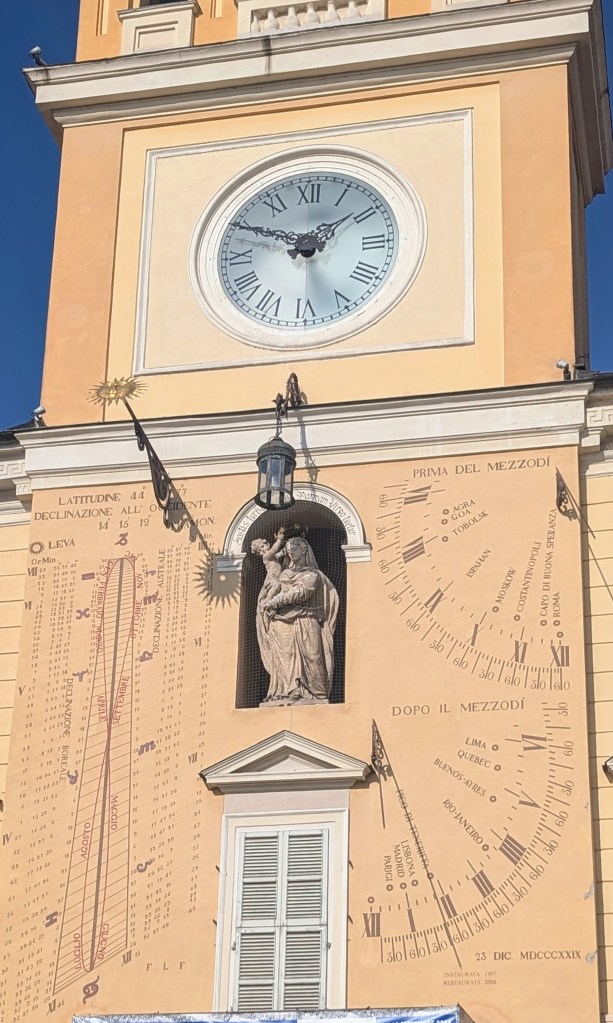
Palazzo del Governatore (Palace of the Governor)

In 1606, after the collapse of a central bell-tower, the structure underwent reconstruction. The present bell-tower was erected in 1673. On the facade, below the clock, is a niche with a statue depicting the Madonna being crowned by the child Jesus. Surrounding the statue are three sundials commissioned in 1829 by the duchess of the palace. Because of the way the sunlight falls, the sun dial is in two halves and includes the month and day of the year.
On one of the corners of the palace is a brick which was designated as the standard for measurement.
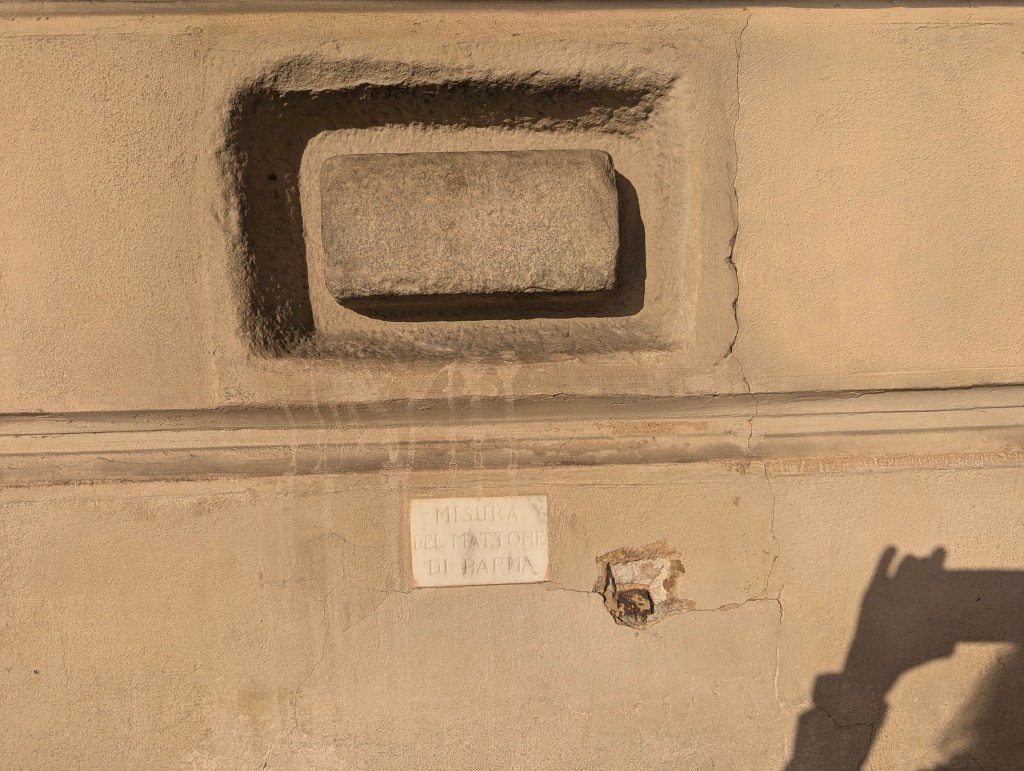
Across the busy street is the The Palazzo del Comune (Palace of the Commune or Municipality), which houses the municipal offices. The present building with its Renaissance-style façade was built in the late 17th century.

The Palazzo del Comune (Palace of the Commune or Municipality)

Across from the municipal building stands San Pietro Apostolo, a Neoclassical-style, Roman Catholic church rebuilt in the 15th century. A church to Saint Peter is first mentioned in this location in 955 built above a Roman temple.
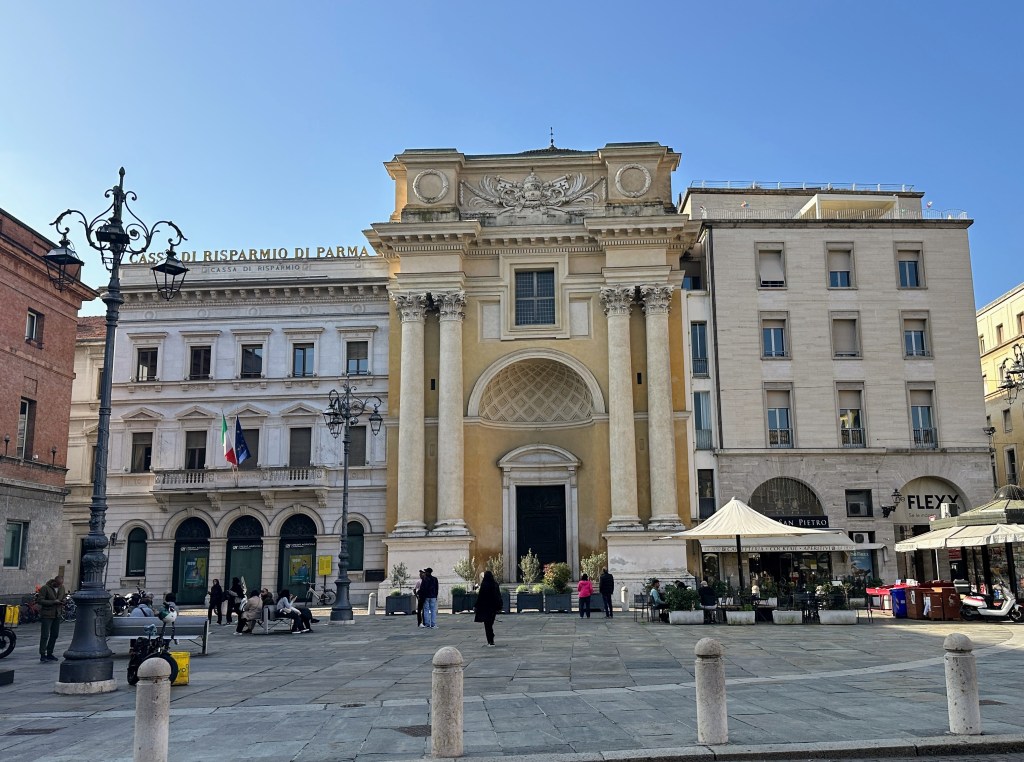
San Pietro Apostolo

We walked by the Shrine of Santa Maria della Steccata, a 17th century Renaissance church, so named because a nursing Madonna is enshrined within, but we did not go in.
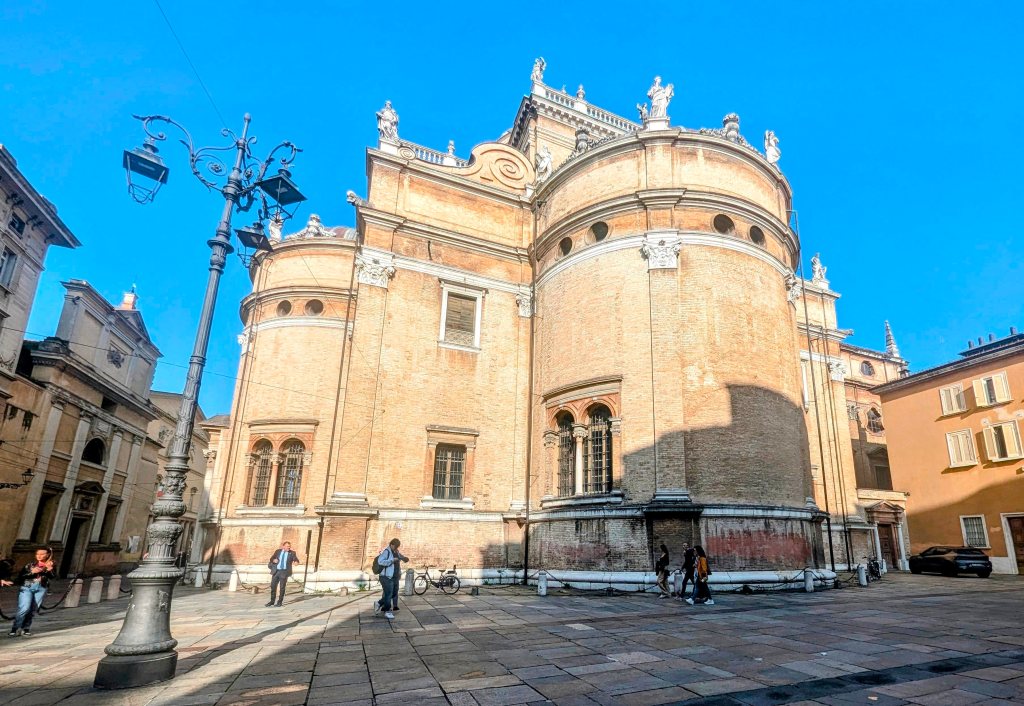
Shrine of Santa Maria della Steccata.

We also passed the Teatro Regio(Royal Theatre): city opera house built 1821–1829 (the Italians do love the opera) which had flags announcing an upcoming Verdi festival. Giuseppe Verdi (1837-1901) was born near Parma and is much celebrated here.
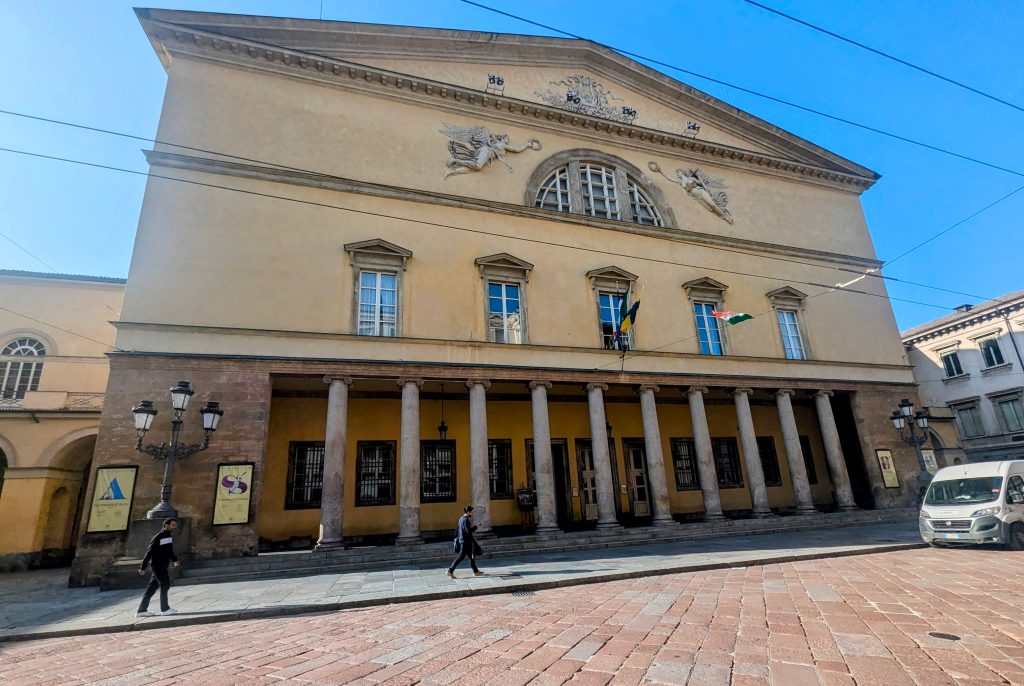
Teatro Regio(Royal Theatre) Parma

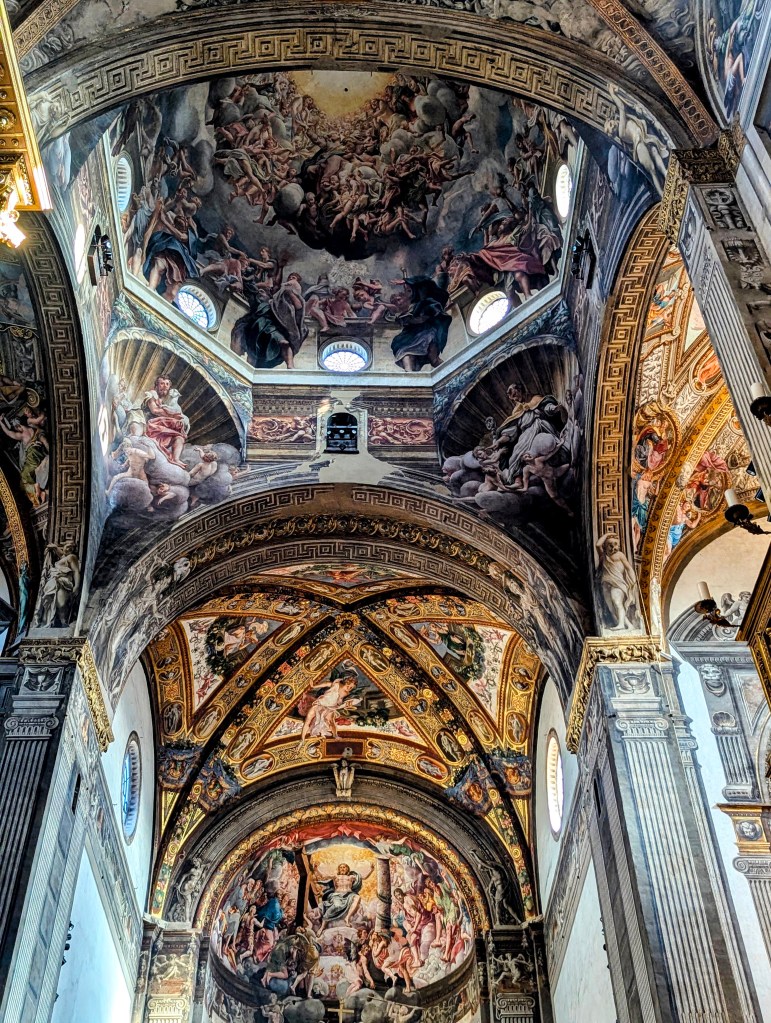
We made our way to the Duomo di Parma; Cattedrale di Santa Maria Assunta (Parma Cathedral) a Romanesque Roman catholic cathedral dedicated to the Assumption of the Blessed Virgin. After a fire destroyed an earlier basilica in 1058, the current building was begun in 1106. The Gothic belfry, topped by a gilt copper angel, was added later, in 1284-1294

Beside the Cathedral lies the octagonal Baptistry of Parma. Architecturally, the baptistry marks a transition between the Romanesque and Gothic styles, and it is considered to be among the most important Medieval monuments in Europe.
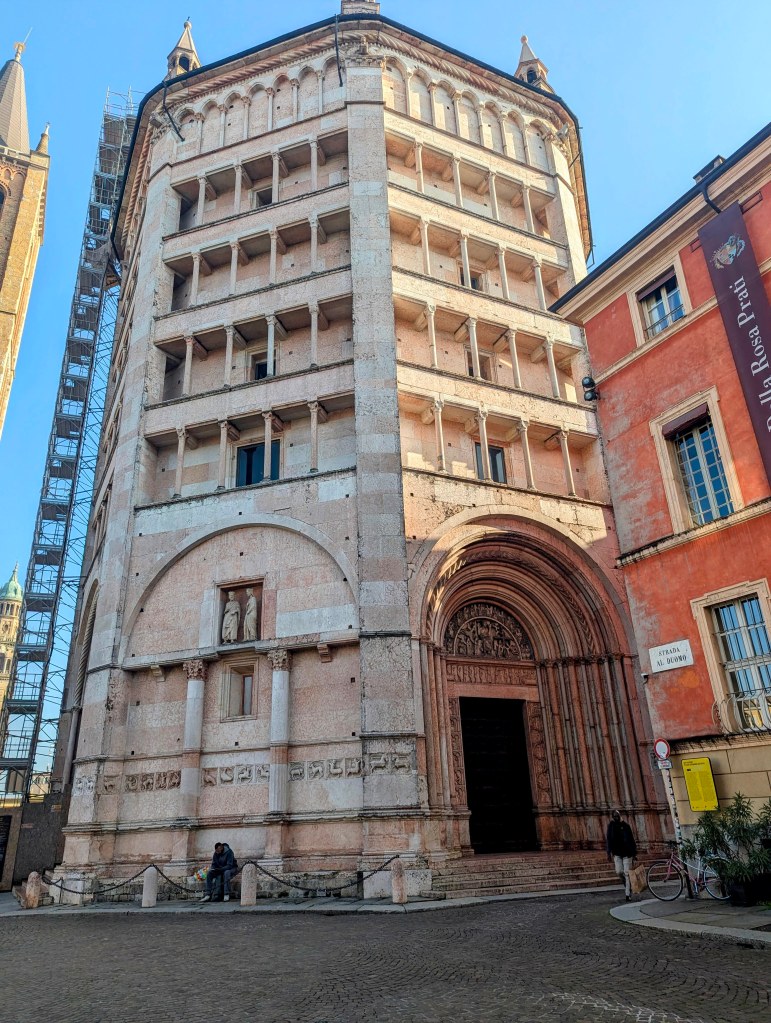
Baptistry of Parma

The two great marble lions supporting the archivolt columns at the entrance to the cathedral were carved in 1281.
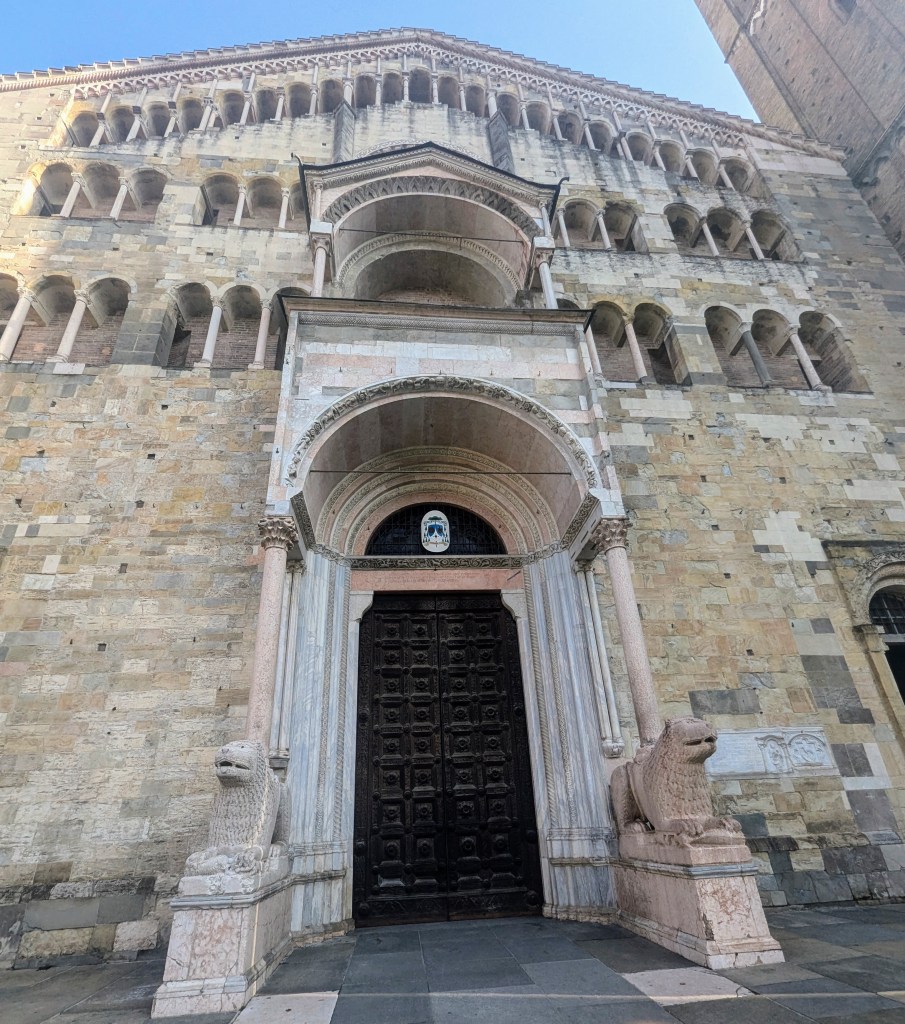
Particularly noteworthy in the cathedral’s interior are the capitals; many of them are characterized by rich decorations with leaves, mythological figures, scenes of war, as well as Biblical and Gospel scenes.
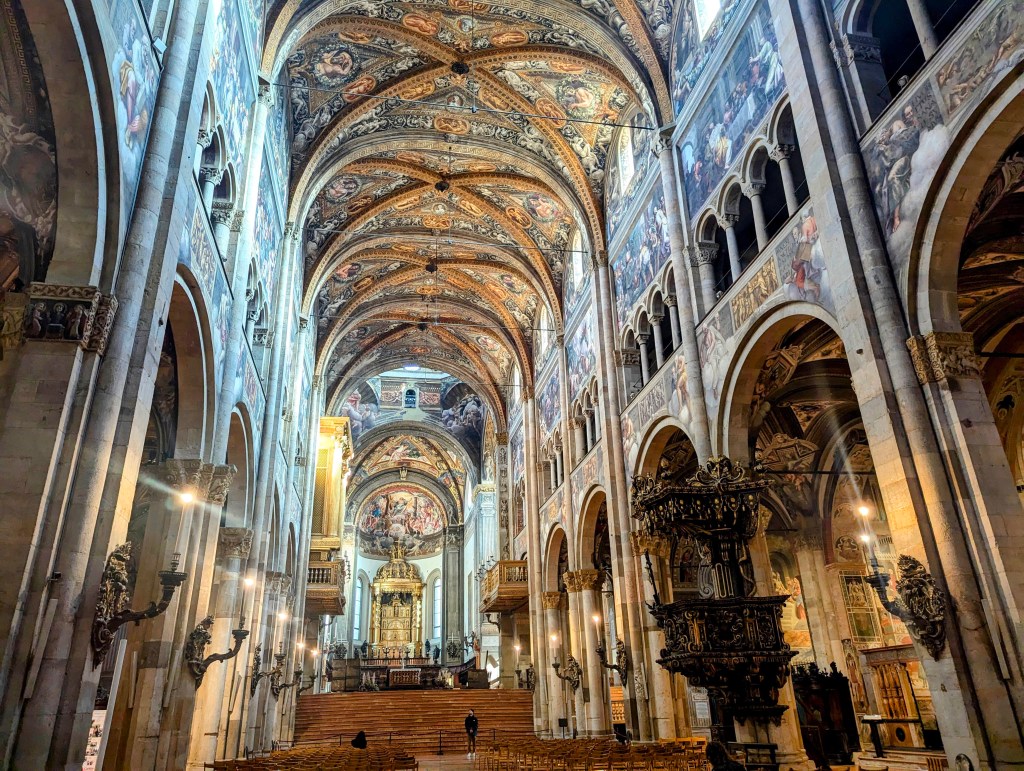
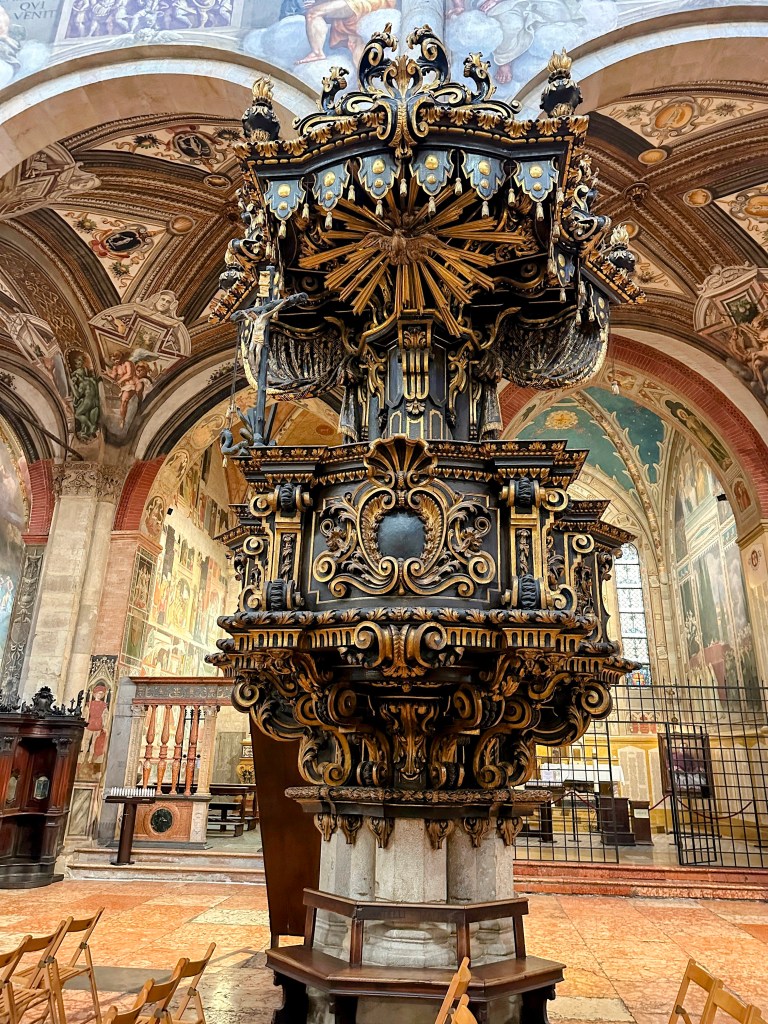
Like so may cathedrals we have been in, there were so many frescoes and so much to explore, but we had no time to dally.
On our way to check out the palace, we passed through the large Piazzale della Pace (Peace Square,) a large empty space caused by the air raids of 13 May 1944 during WWII, which destroyed the buildings that were there. Now in the space stands the Monumento al Partigiano (Monument of the Partisan). It is a commemoration to all those noble men and women who fought against Fascism and Nazism oppression in WWII.
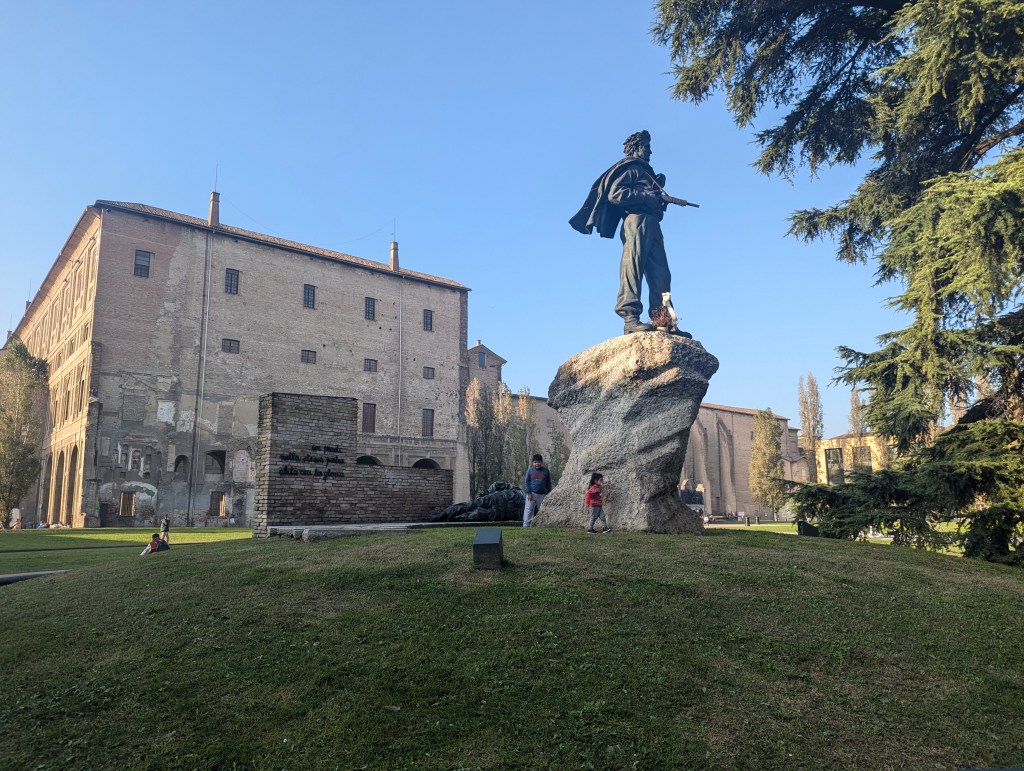
Monumento al Partigiano (Monument of the Partisan)

Also in the square is a monument to mark the centenary of the birth of the great composer Giuseppe Verdi (1837-1901). Built of granite and bronze, it was inaugurated on 22 February 1920.
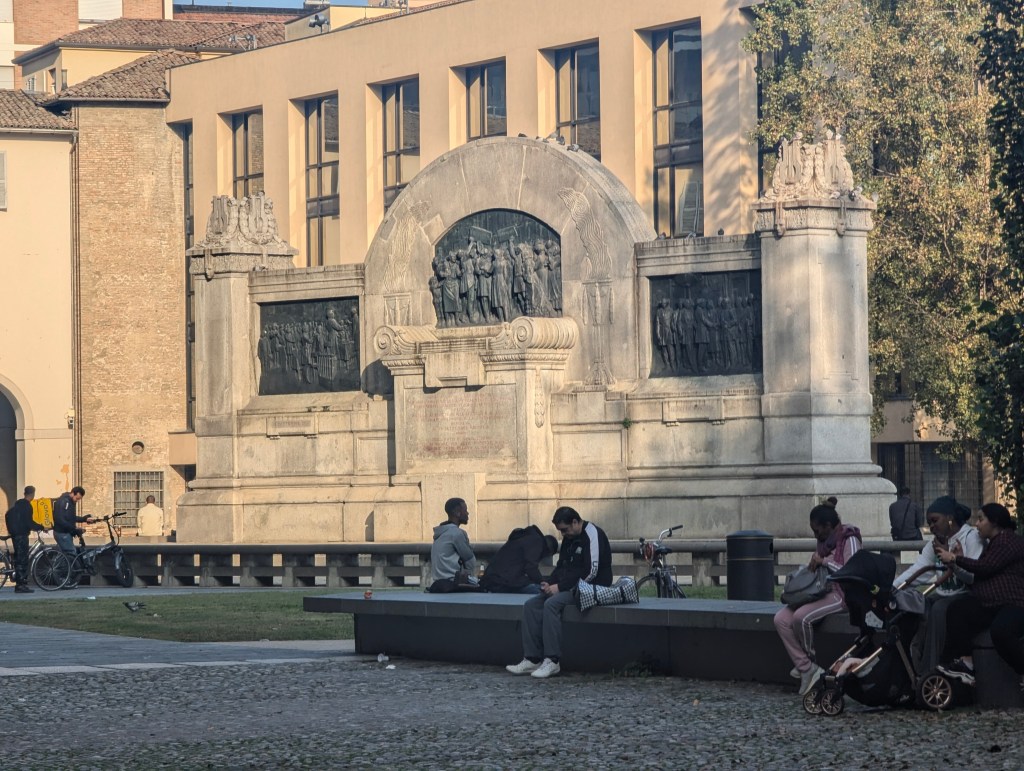
Monumento a Giuseppe Verdi

Finally we made our way to the The Palazzo del Giardino (Garden Palace) or Palazzo Ducale del Giardino (Ducal Garden Palace) which is within a very large park. It was built in the 16th century but suffered a lot of damage during WWII. It is currently closed to the public.
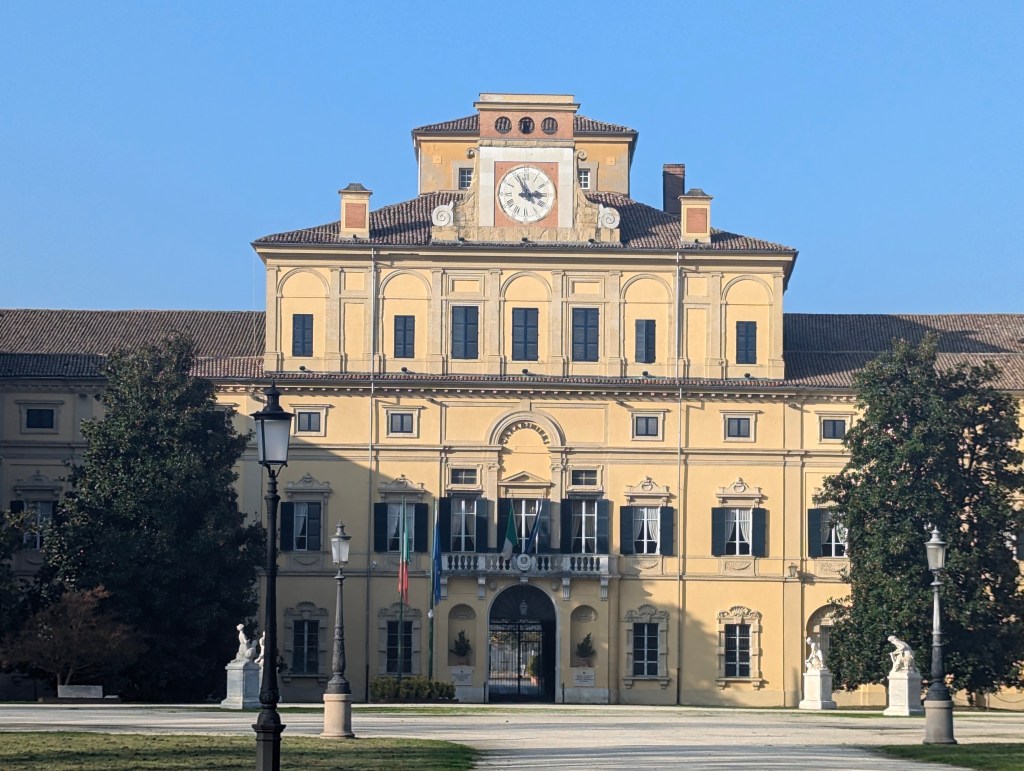
The Palazzo del Giardino (Garden Palace)

Alas, it was time to head back to Modena. When we went out later for dinner we noticed the booths that had been undergoing construction while we had been visiting were beginning to fill with wares. We found a sign announcing a chocolate festival beginning the next day, just in time!
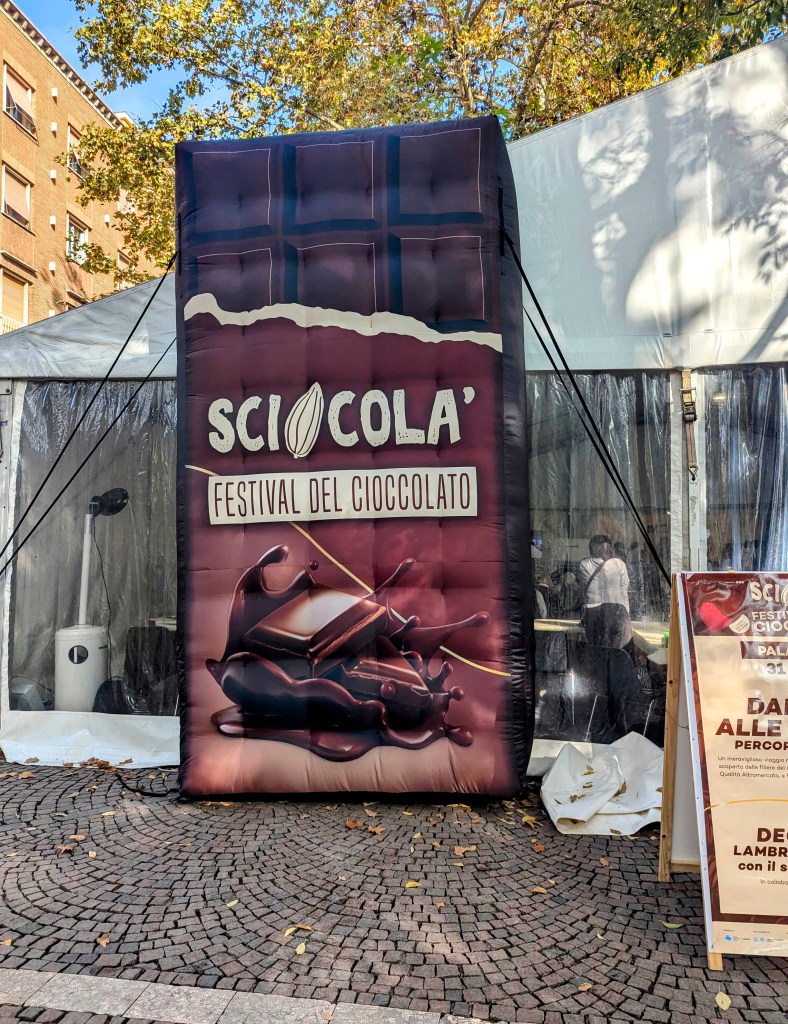
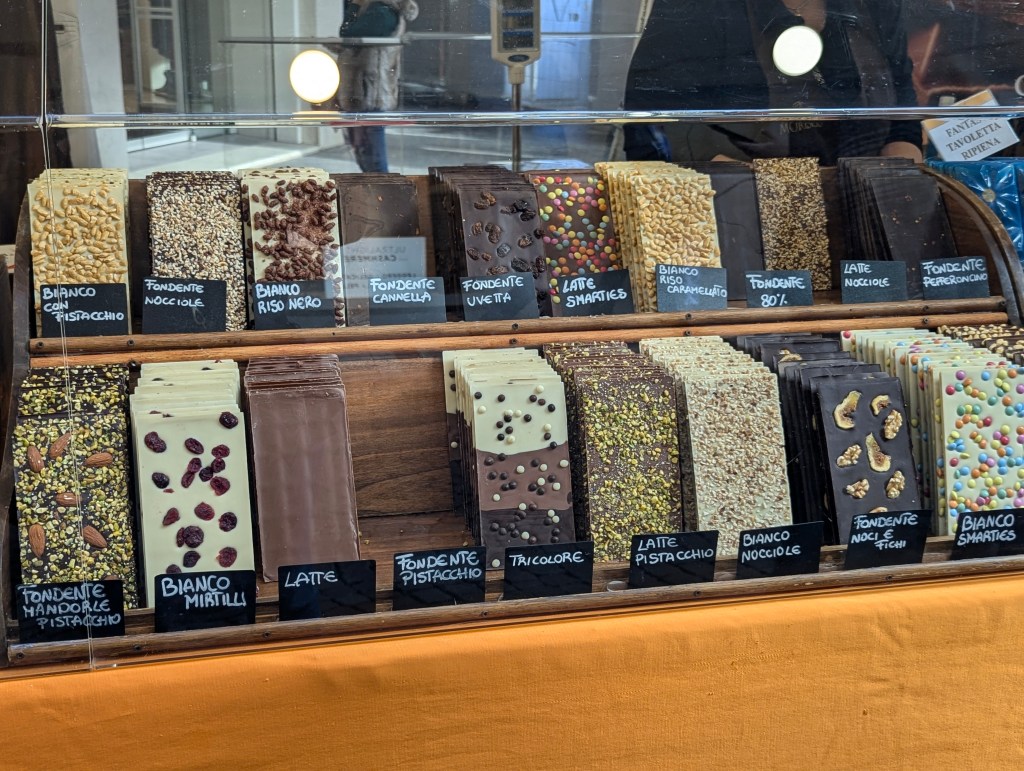
After breakfast we checked out and left our luggage with reception so we could explore the festival. And oh what fun! There were dozens of booths filling more than 5 blocks around the main plazza all with variations of chocolates from the standard bars
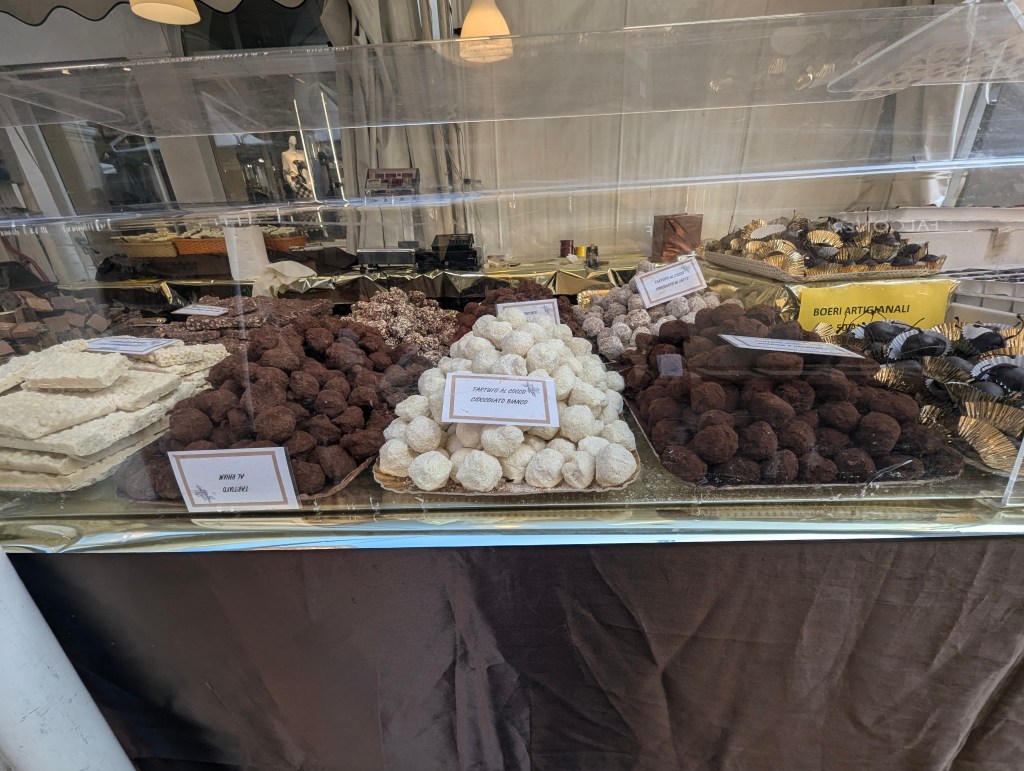
and truffles
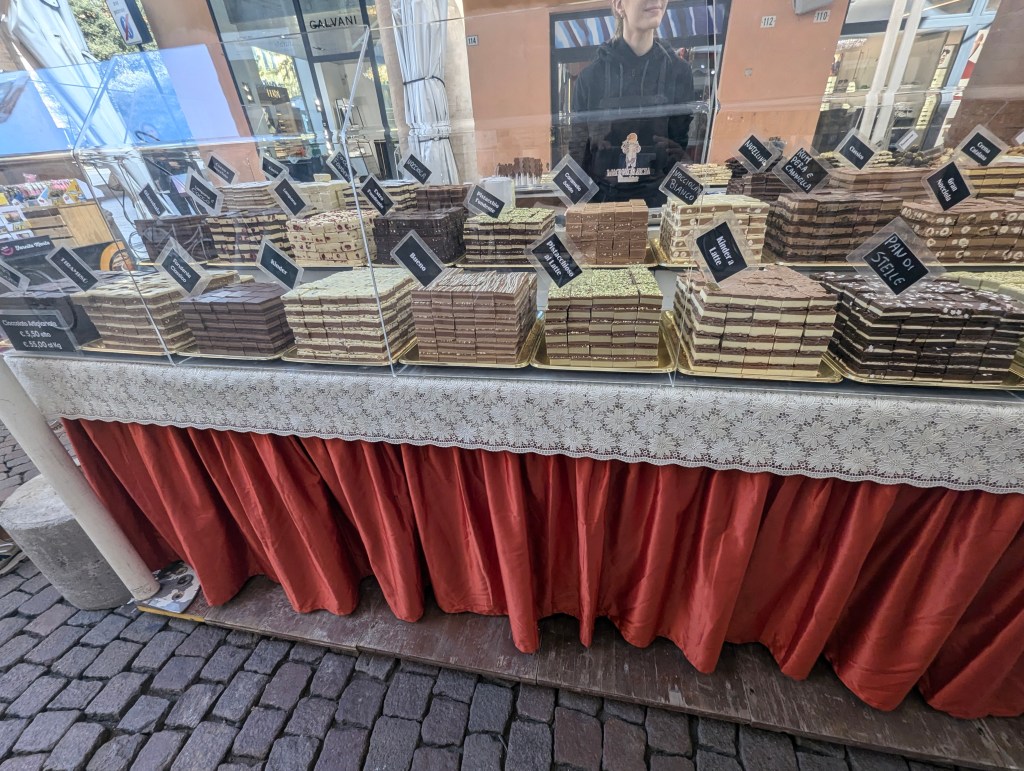
and fudge
and also chocolate covered fruits and nuts
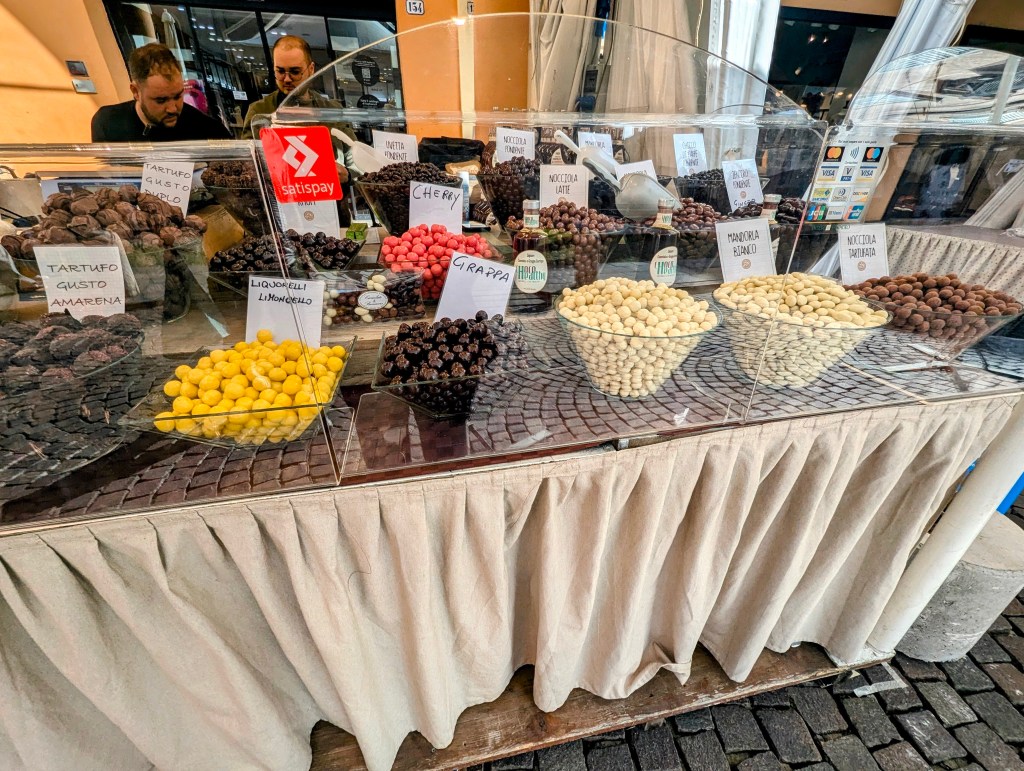
and mini cakes.

There were macarons
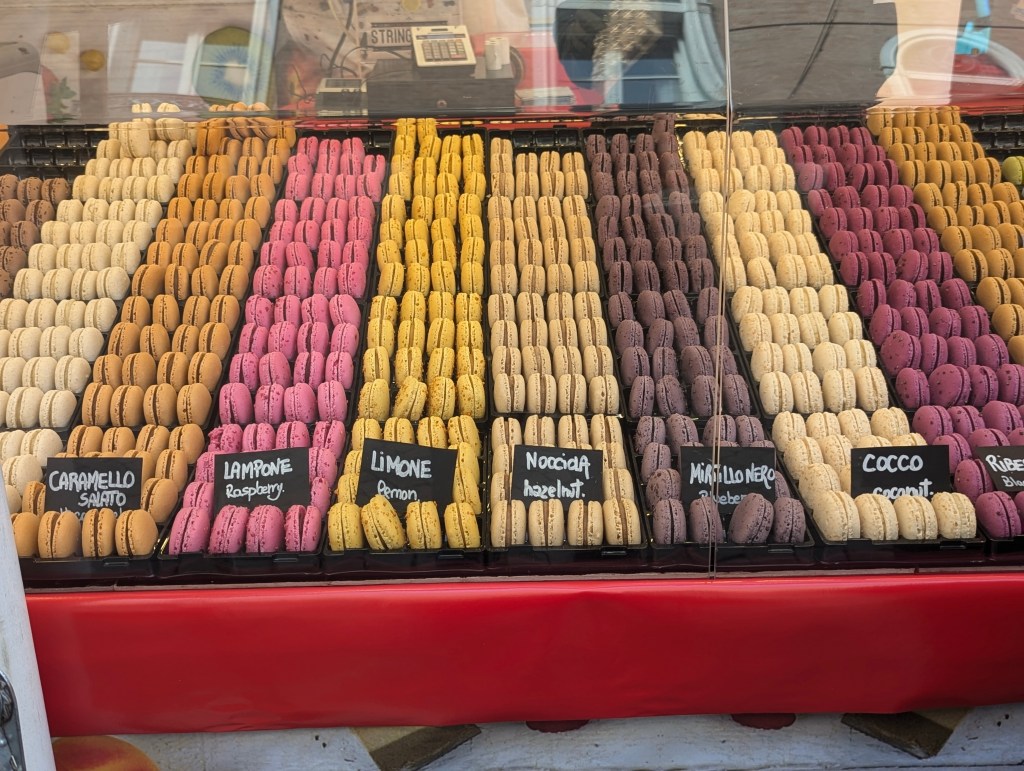
and fondus and drinks.
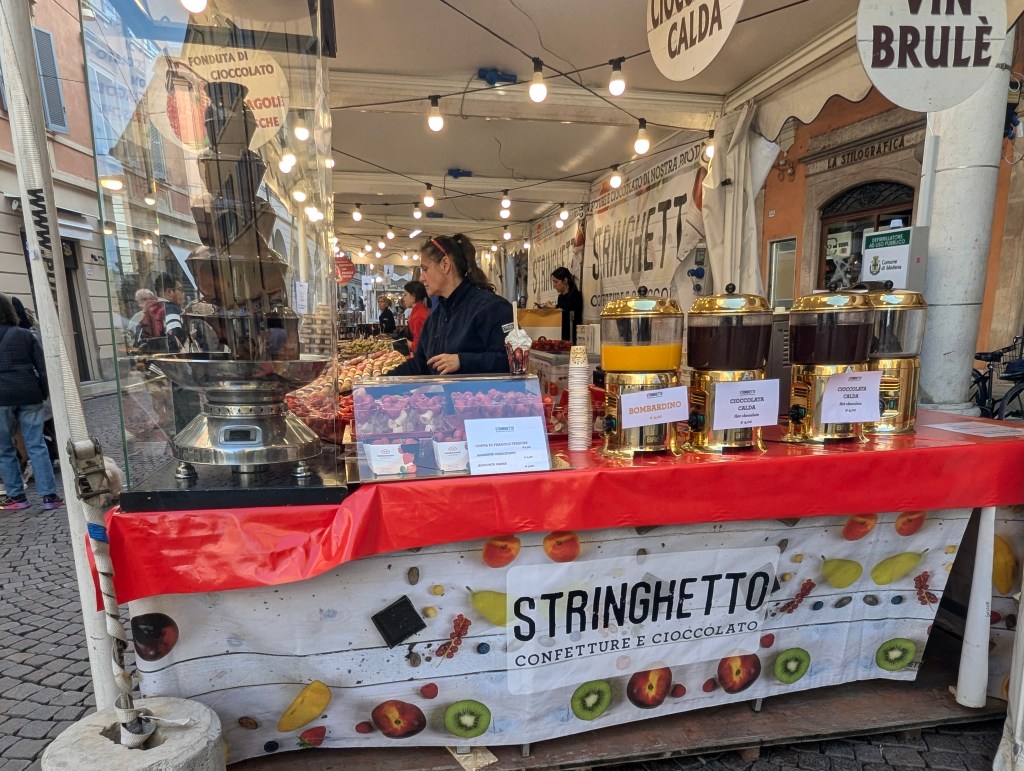
There were chocolate miniatures of everything from high heels
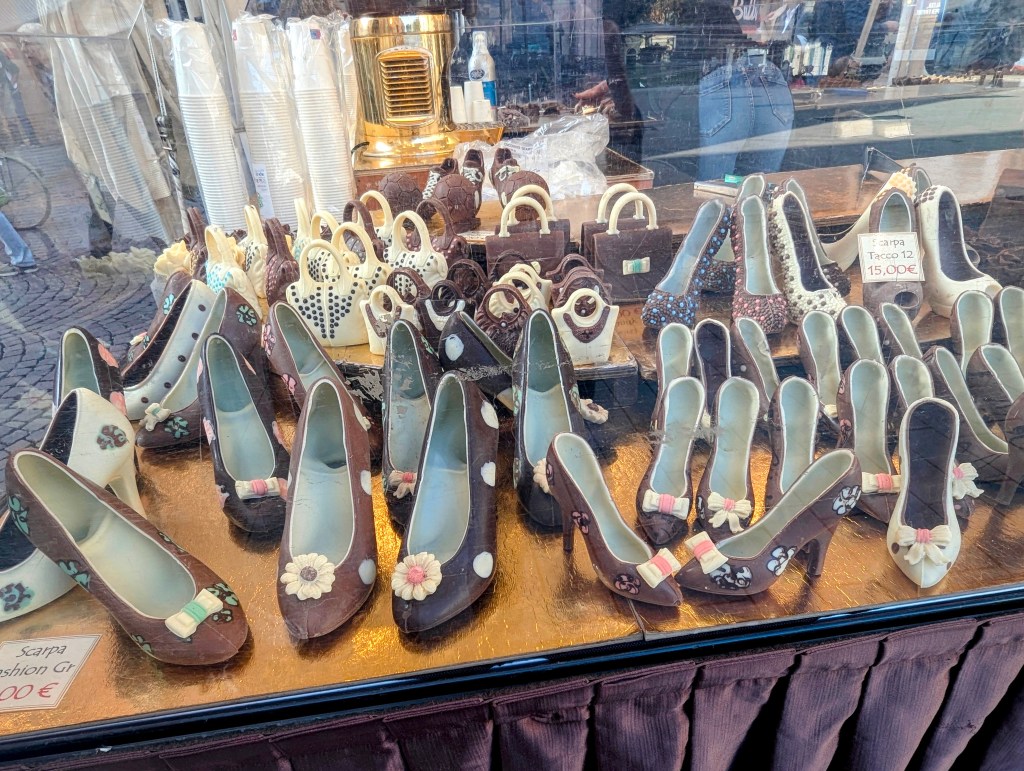
and dolls

and toys
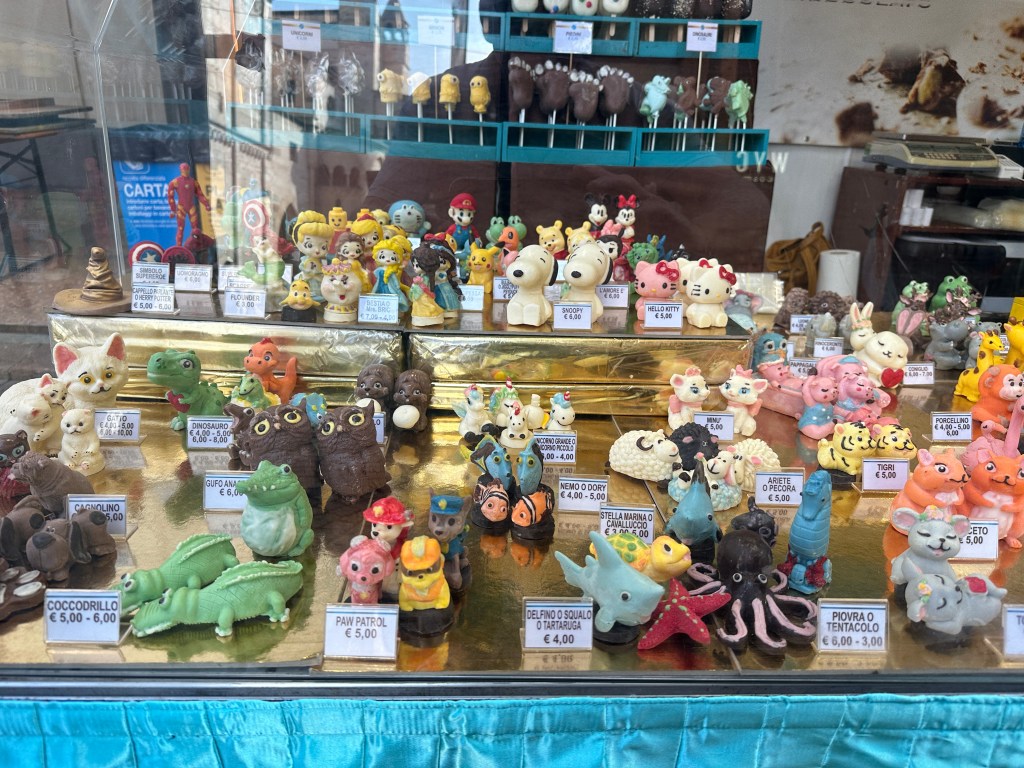
and even Halloween specialties.
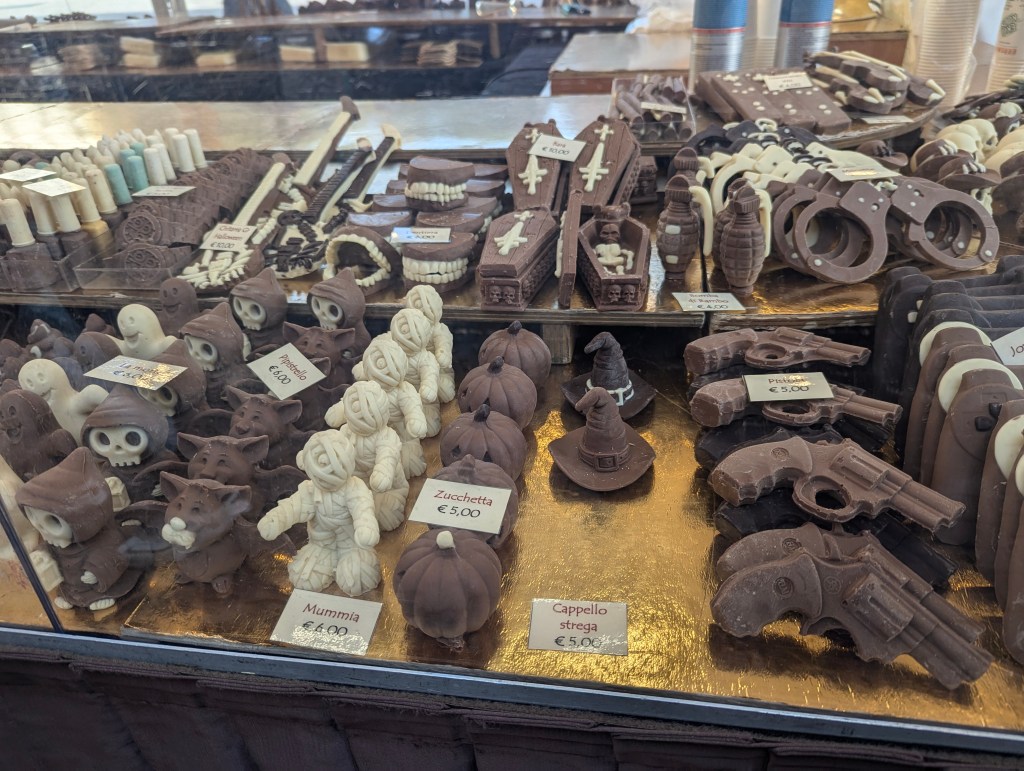
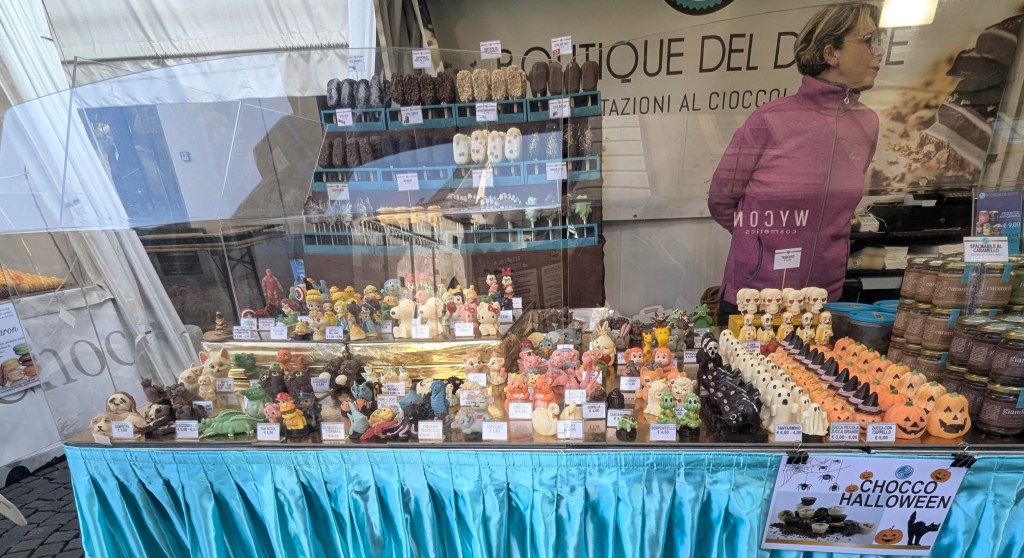
Clearly the citizens of Modena take their chocolates seriously. There was an event tent for demonstrations, classes, and competitions.

And so many of the booths were handing out free samples! We were in heaven, and so glad we had not scheduled to leave a day sooner, what luck. We were reluctant to drag ourselves away from Modena, truly a food capital in a country devoted to its cuisine. We had packed a lot into a couple of days.
Italy: Tuscany: Pisa Oct. 23-24; Florence Oct. 25-27

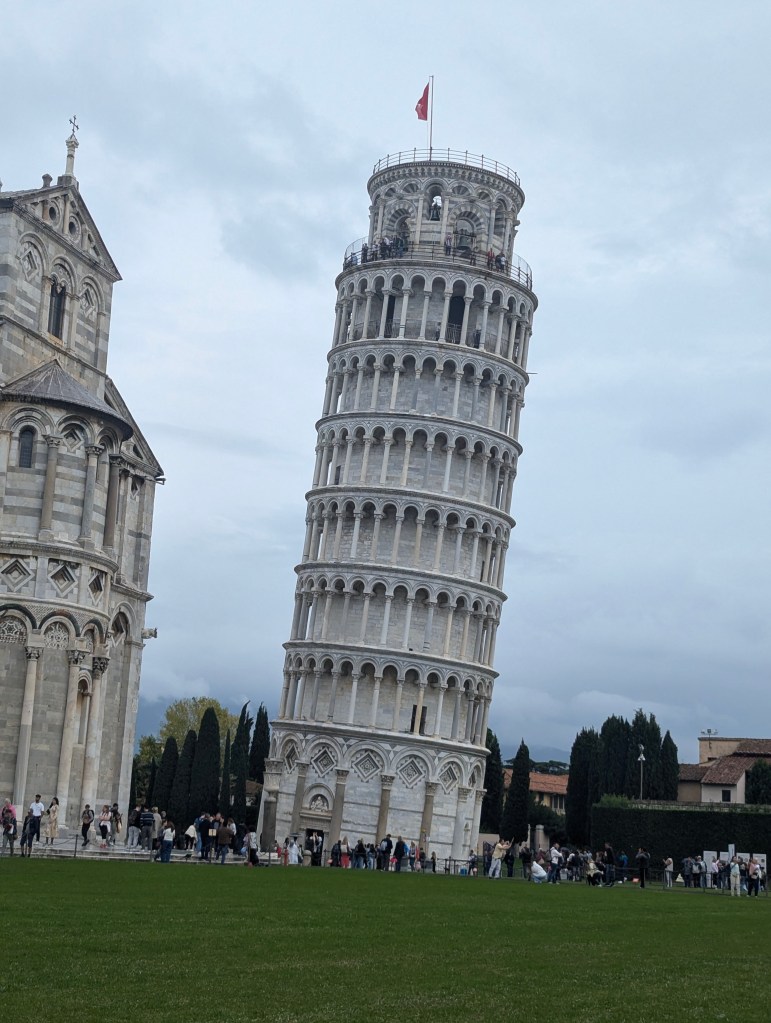
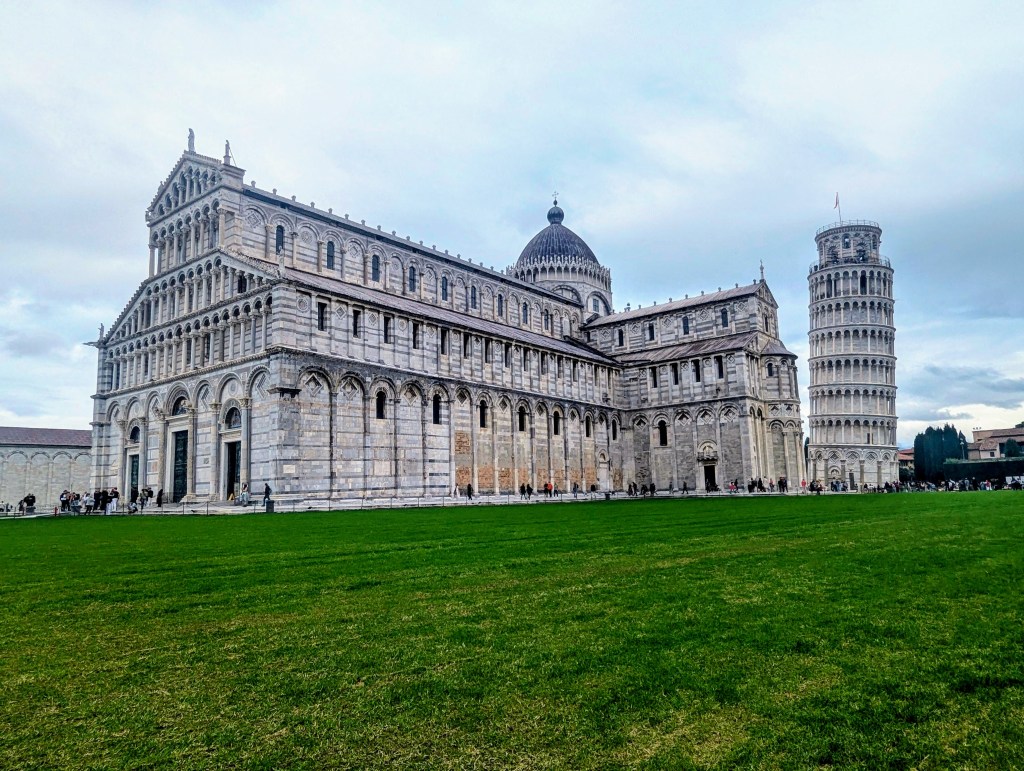
We arrived in Pisa in the pouring rain, yet again. The skies were gray when we got our first glimpse of the famous leaning tower.

Eric insisted that I take at least one of the goofy, touristy pictures of him “holding up” the tower.

But the weather gods were kind to us in that the rain lightened up a bit while we familiarized ourselves with the town, walked around, and found a restaurant for a late lunch. Gone were the Ligurian cuisine items now replaced with pappardelle with wild boar ragú and roasted meats and steaks and lots of grilled fresh vegetables on the menu.

In the morning we were blessed with plenty of sunshine for our deep dive into the Piazza dei Miracoli (Square of Miracles) aka Piazza del Duomo (Cathedral Square). Pisa means mouth, which is fitting as the city sits on the mouth of the Arno River as it spills into the Ligurian Sea – although with centuries of silt flowing down the river and depositing sediment at the mouth, the city is several miles inland currently. There is archaeological evidence that the city dates back to the Etruscans in the 5th century BC. The city was a prominent maritime center as early as ancient Roman times, as described by Virgil in the Aeneid, and due to its position near both the coast and the river, maintained that status throughout the middle ages. It was at the height of Pisa’s power and wealth that the cathedral and its accompanying structures were started in 1064.

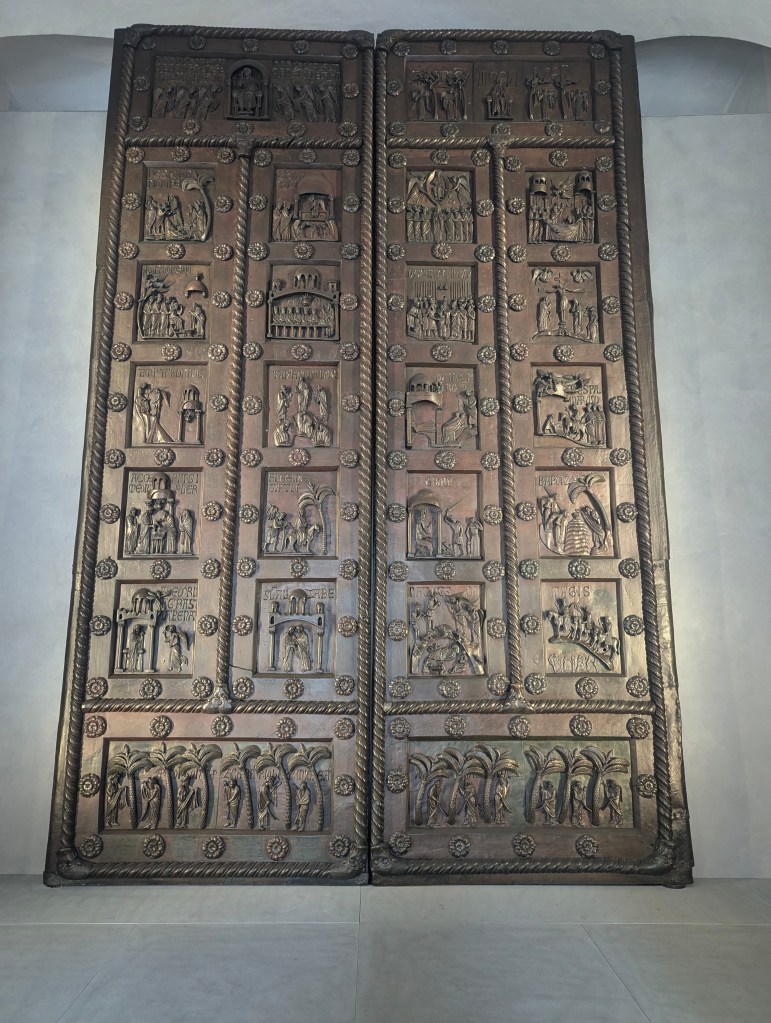
Due to timed tickets, our tour started in Palazzo dell’Opera (Opera here means “works of art”), built in several stages from the 14th century through the 19th. Originally these houses belonged to the workmen of the cathedral complex: the tailor, the gardener, the bell ringers, etc., until the 19th century when the administration offices of the Opera della Primaziale were moved in. Today it houses a lot of the original statues and artworks from the cathedral which have been replaced with replicas in their original positions to preserve their integrity. One of the first exhibited items are the bronze doors: the San Ranieri door, built in 1186 by Bonanno Pisano depicting the main episodes of the Life of Christ and originally on the entrance of the right transept of the cathedral.

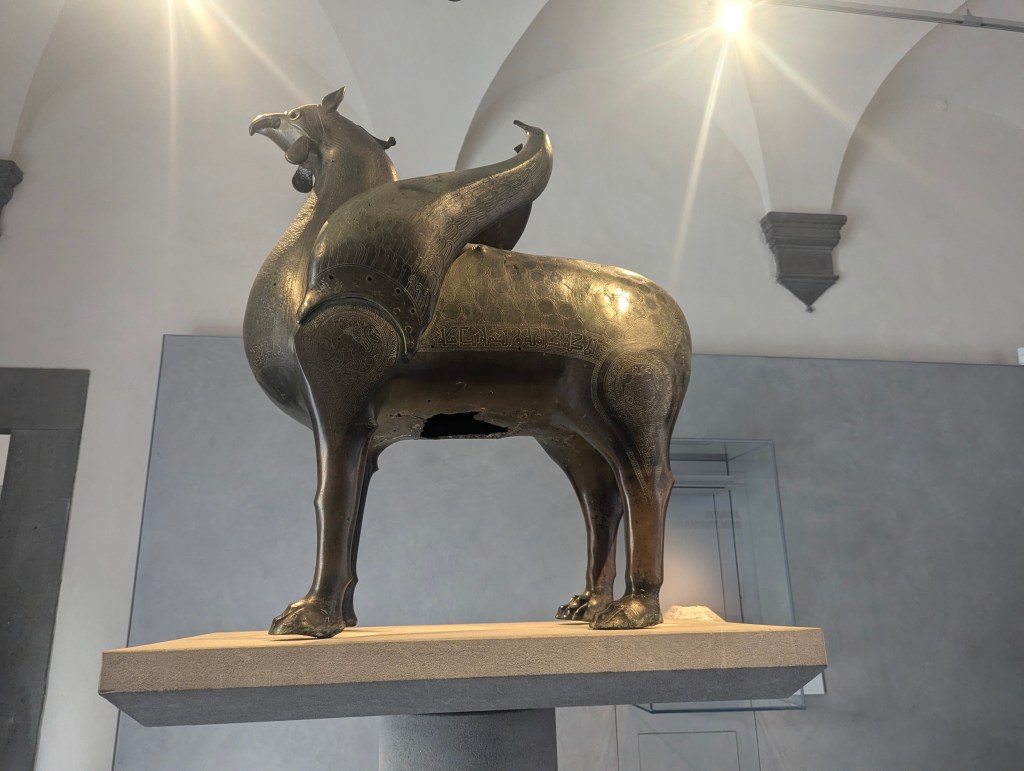
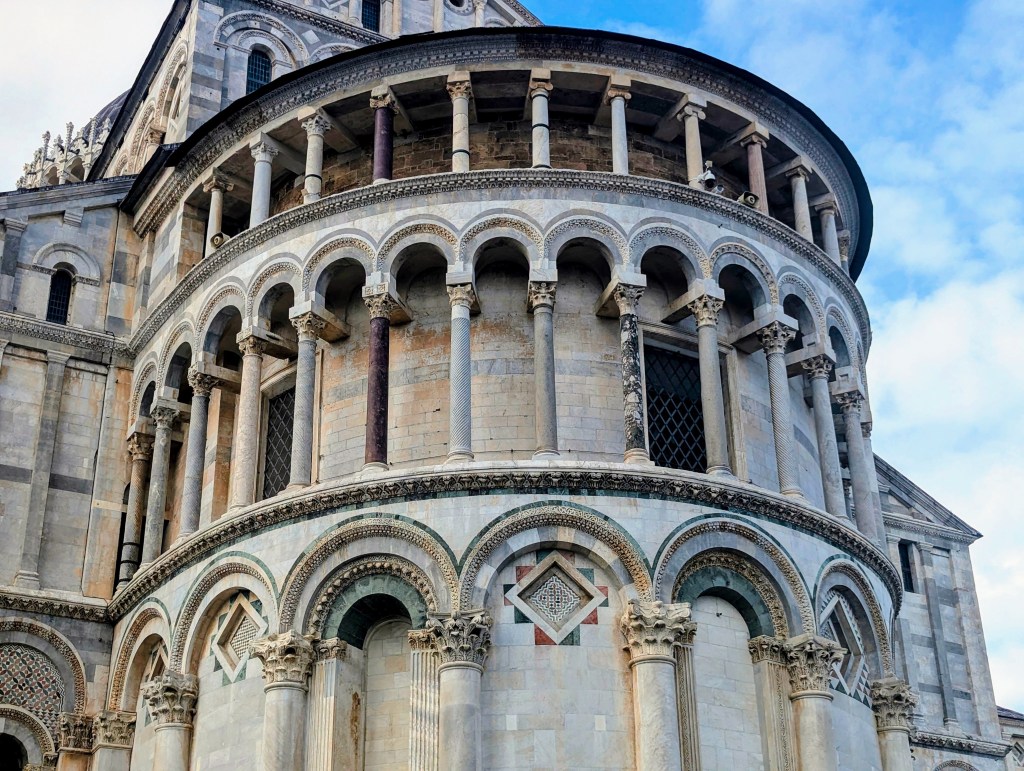
Also exhibited is the Pisa Griffin, a large bronze sculpture of a a mythical beast with head and wings of an eagle but body of a horse. It has been in Pisa since the Middle Ages despite its Islamic origin of late 11th or early twelfth century.  The Pisa Griffin is the largest medieval Islamic metal sculpture known, standing over 42 inches tall. Its original Islamic purpose is unknown, but in Pisa the griffin was placed on a platform atop a column rising from the gable above the  apse at the east end of the cathedral, probably as part of the original construction that started in 1064.

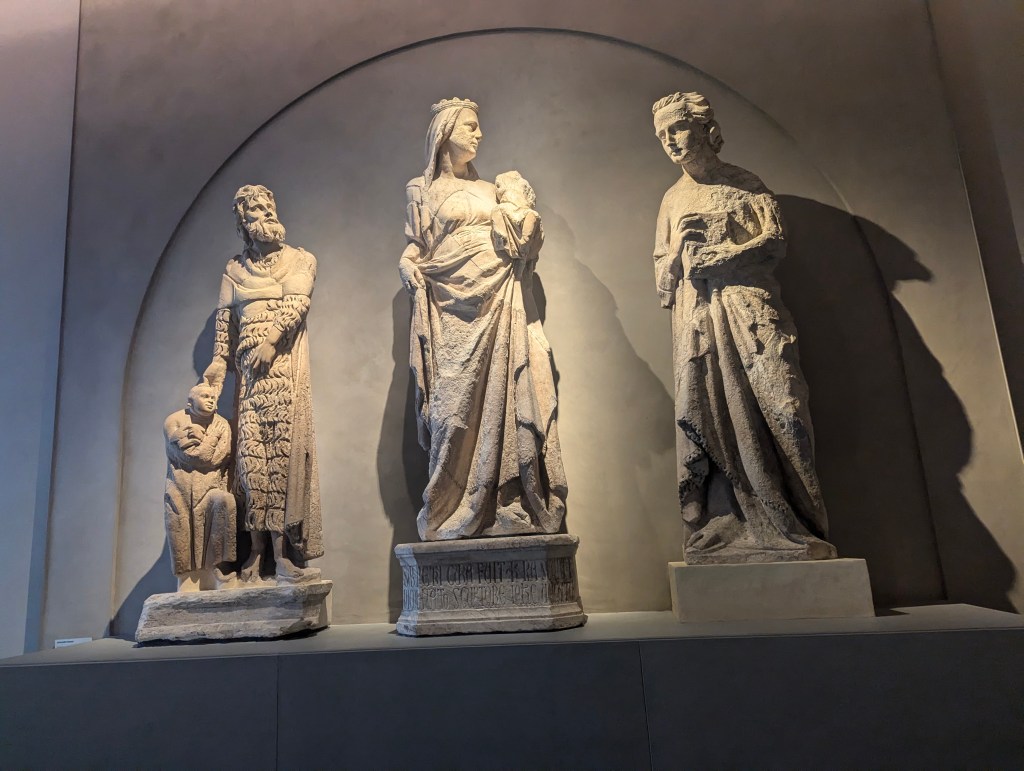
Also exhibited in the Opera are works by Giovanni Pisano (1230-1315), and Italian sculptor who trained under his father Nicola Pisano. Giovanni Pisano built the pulpit for the cathedral as well as created many of the statues for the baptistry.

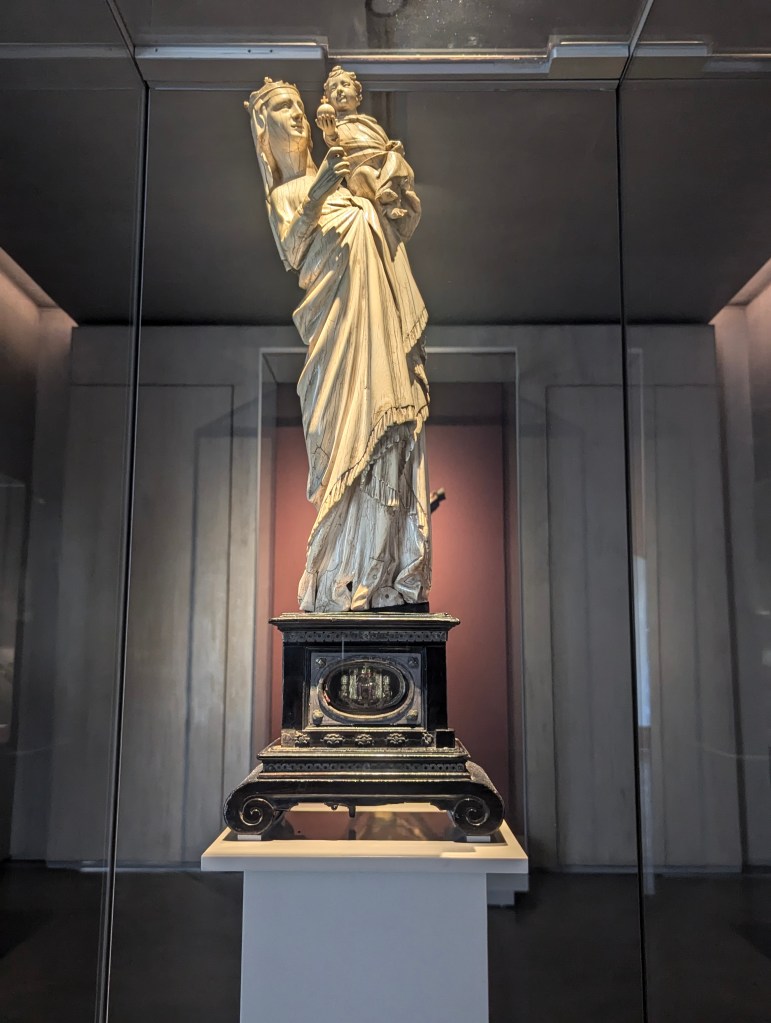
Madonna and Child, Giovanni Pisano

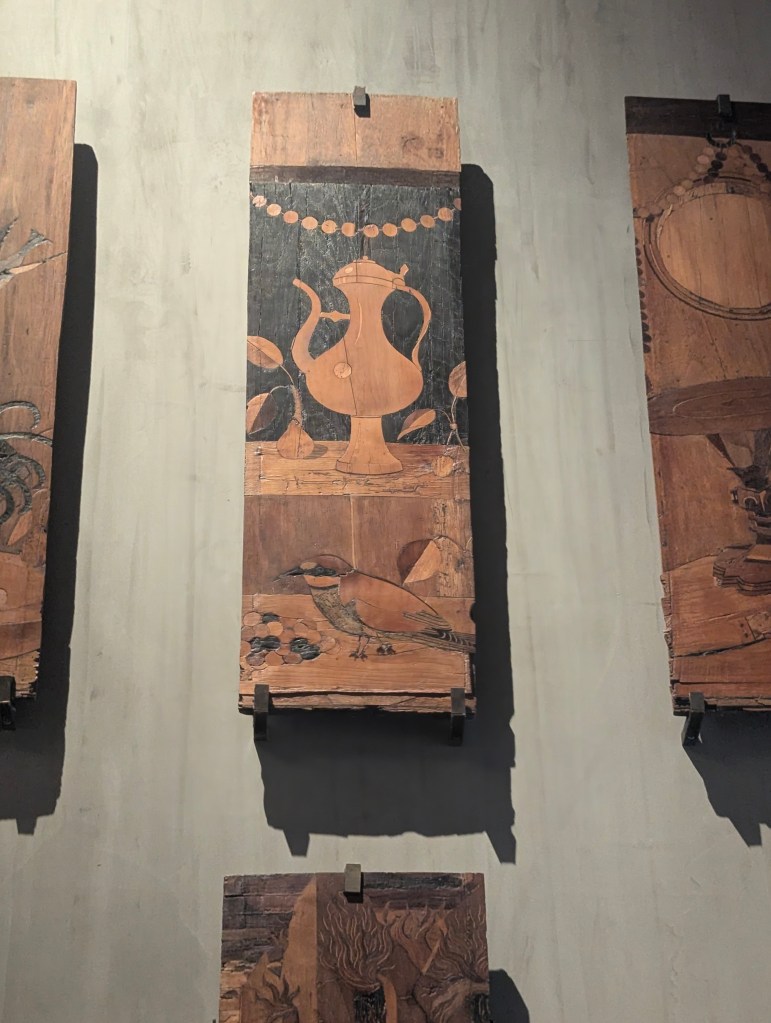
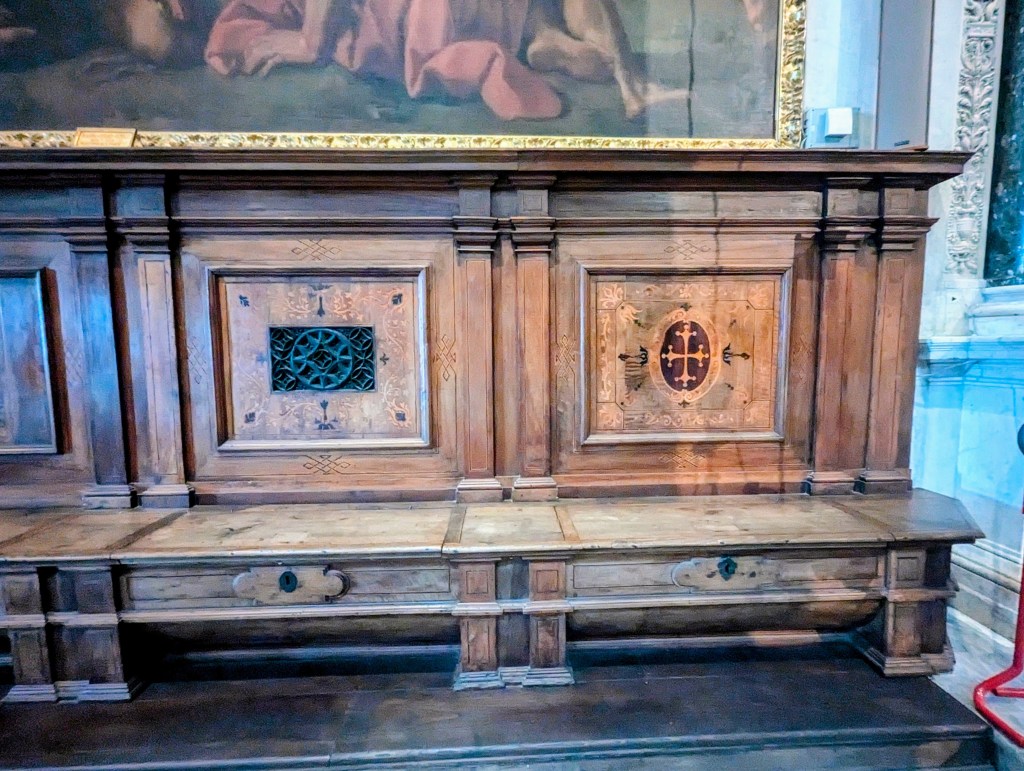
In addition to the many statues, the Opera also contained examples of the inlaid wood for the choir benches

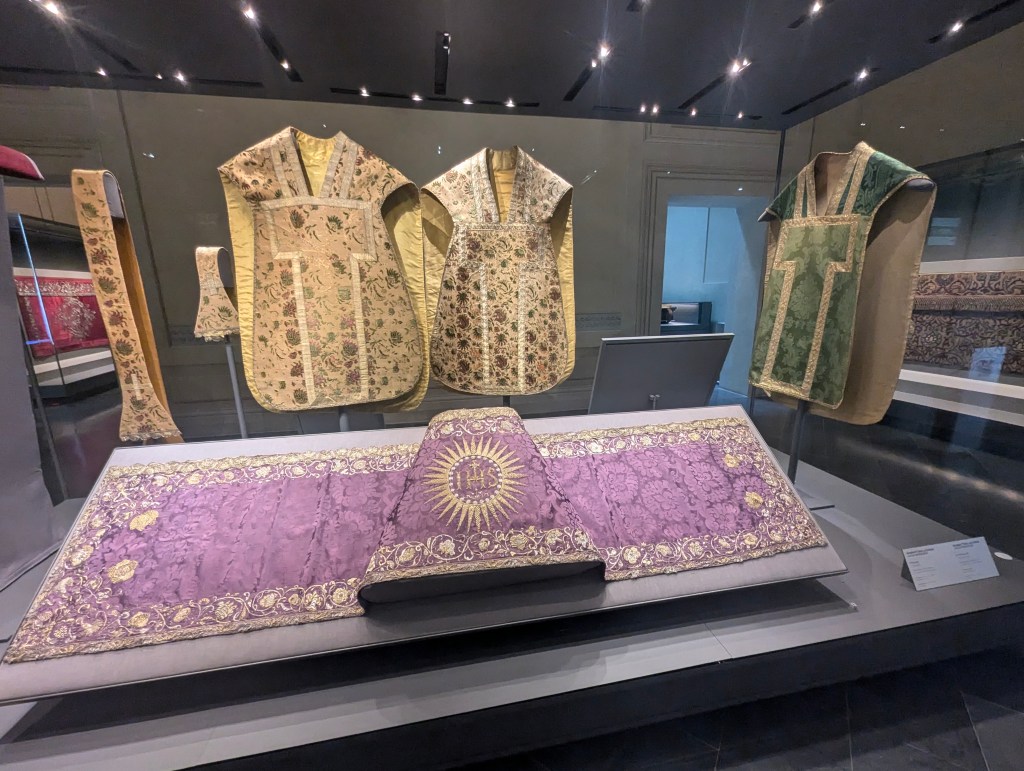
and robes for the bishops

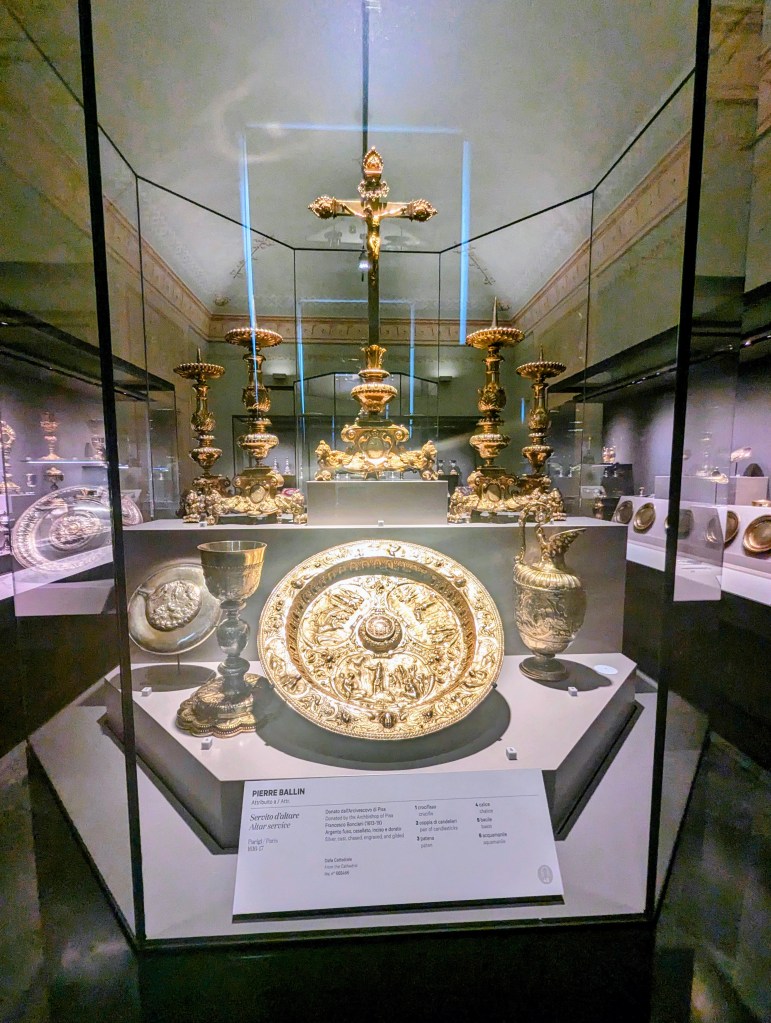
and the various pieces required for services.

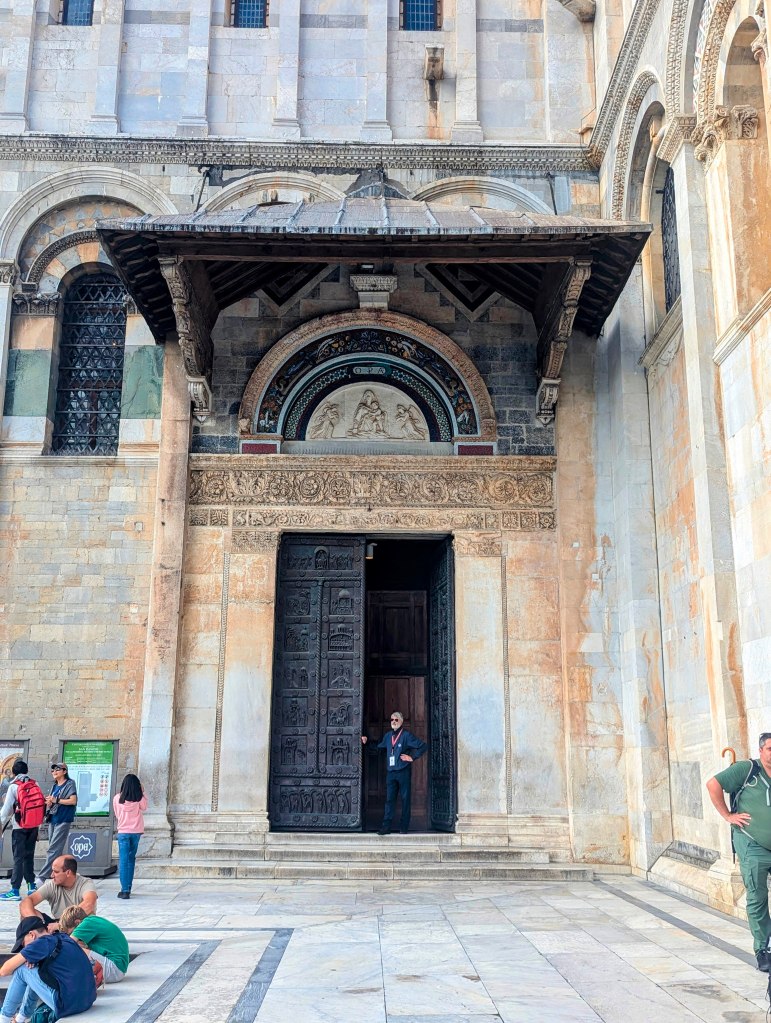
After thoroughly familiarizing ourselves with the works and artists who created them, it was time to see the cathedral. Due to ongoing renovations work, the door usually used by the public, the San Ranieri door, was closed to the public.

the San Ranieri door

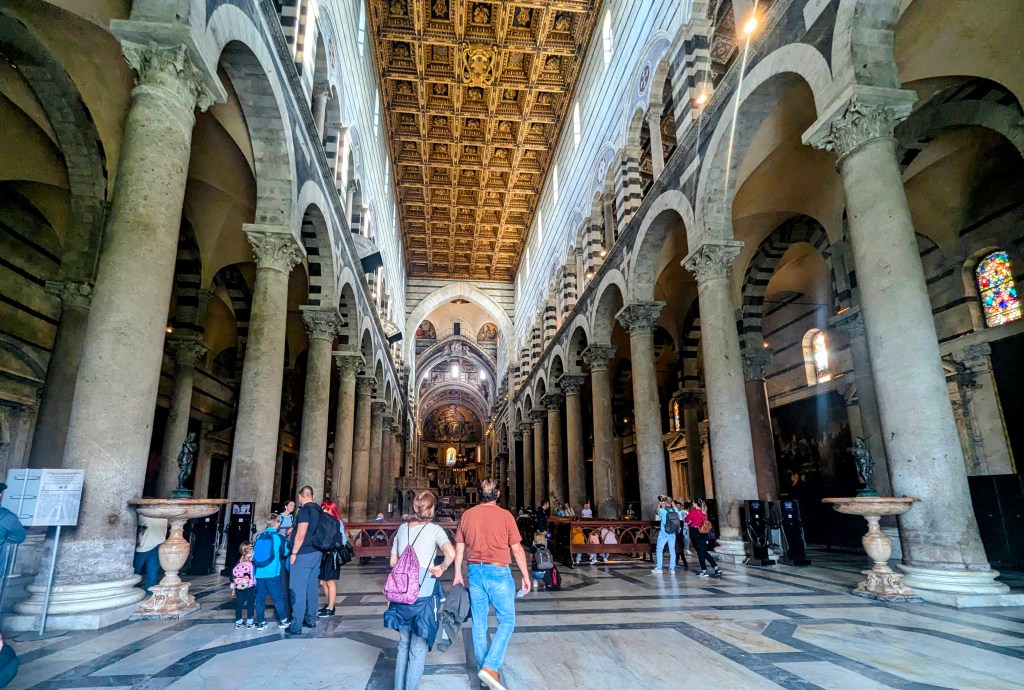
We entered from the other side. Construction of the cathedral began in 1064 to the designs of the architect Bushceto. It set the model for the distinctive Pisan Romanesque style  of architecture.

The mosaics of the interior, as well as the pointed arches, show a strong Byzantine influence. The façade, of grey marble and white stone set with discs of colored marble, was built by a master named Rainaldo.

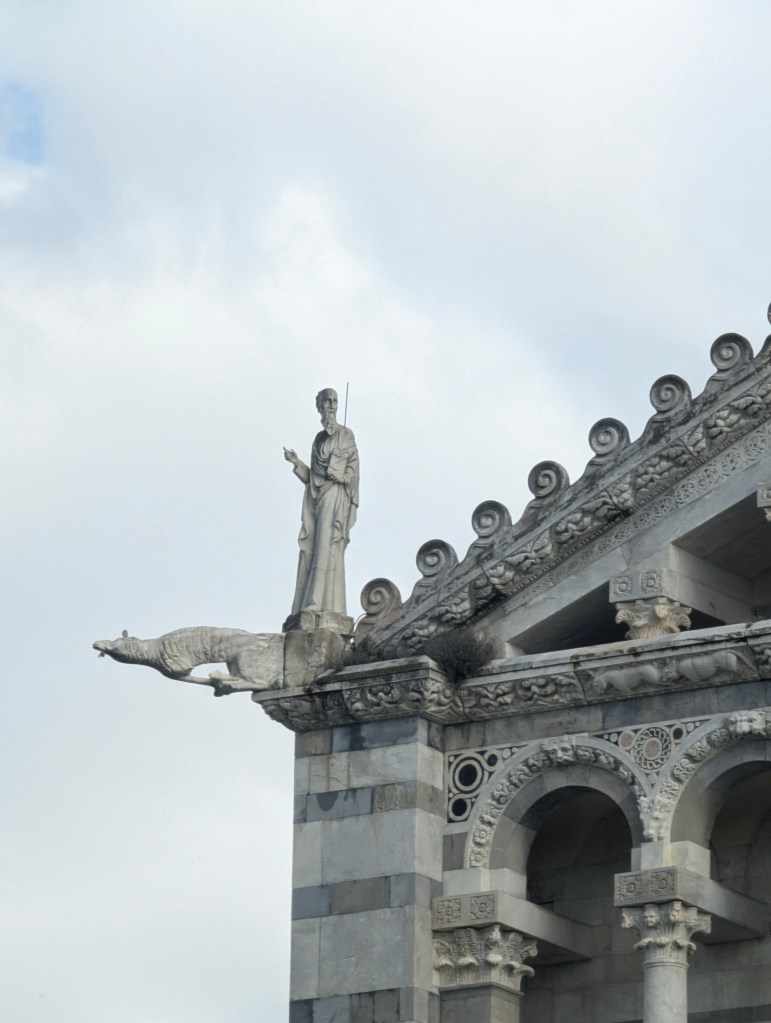
I just love the details, especially the gargoyles.

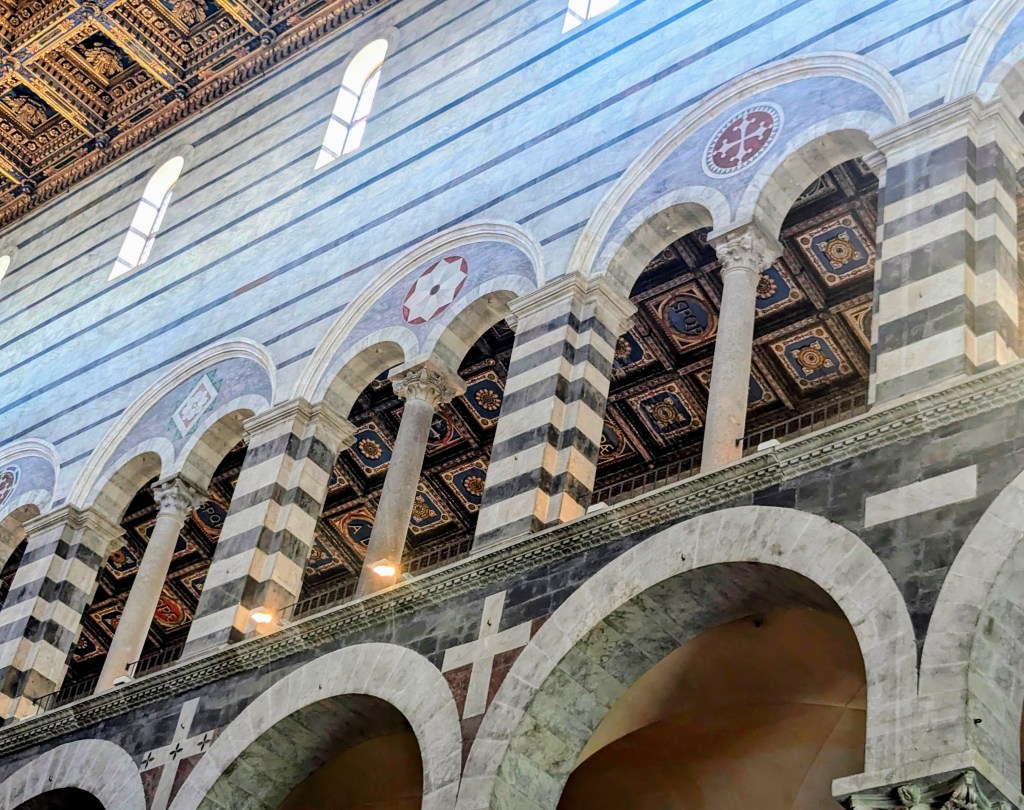
The interior is faced with black and white marble and has a gilded ceiling. It was largely redecorated after a fire in 1595, which destroyed most of the Renaissance artworks.

The coffered ceiling of the nave was replaced after the fire of 1595. The present gold-decorated ceiling carries the coat of arms of the Medici. 

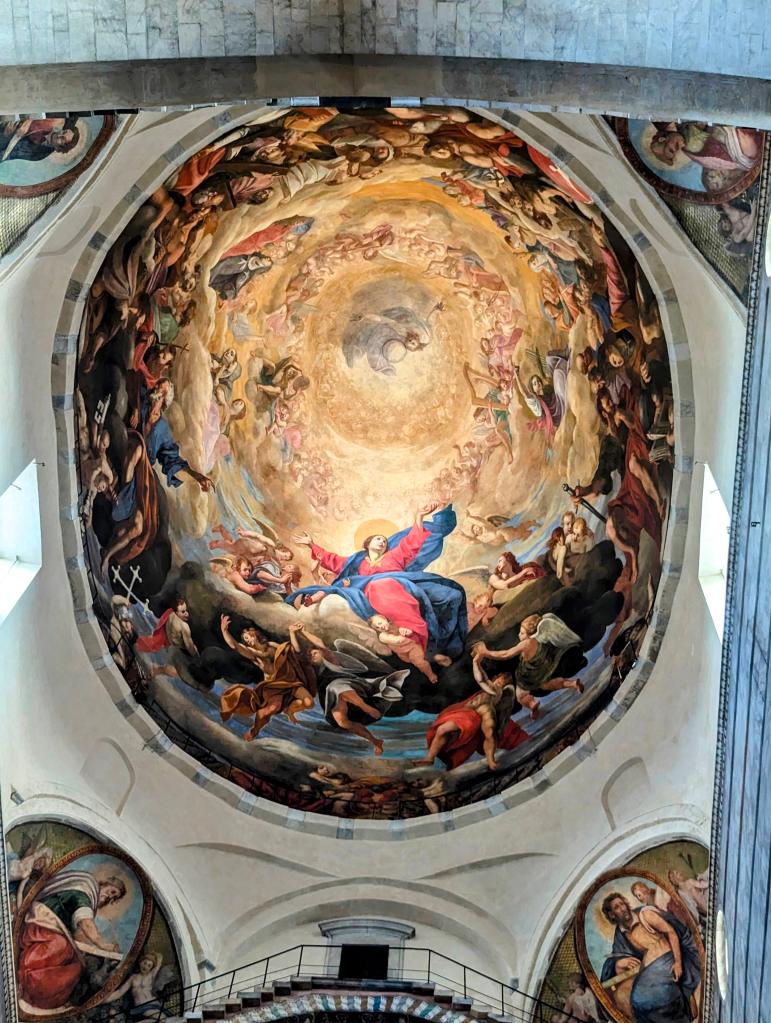
The dome has an impressive fresco.

The impressive mosaic of Christ in Majesty, in the apse,  flanked by the Virgin and Saint John the Evangelist, survived the fire.

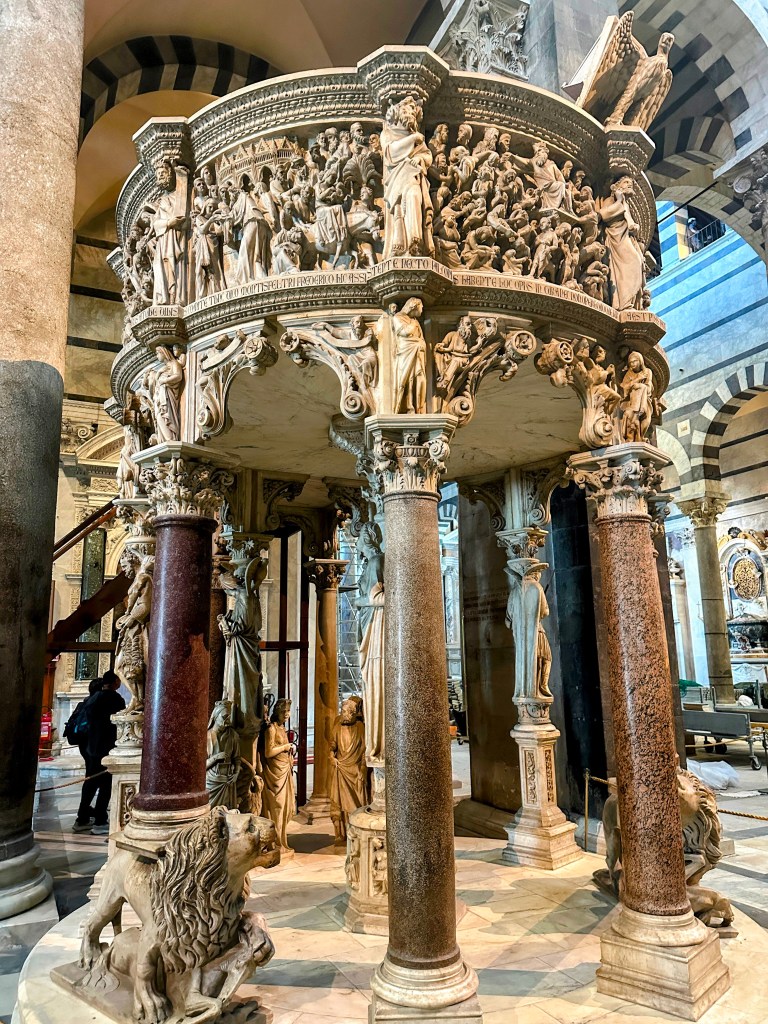
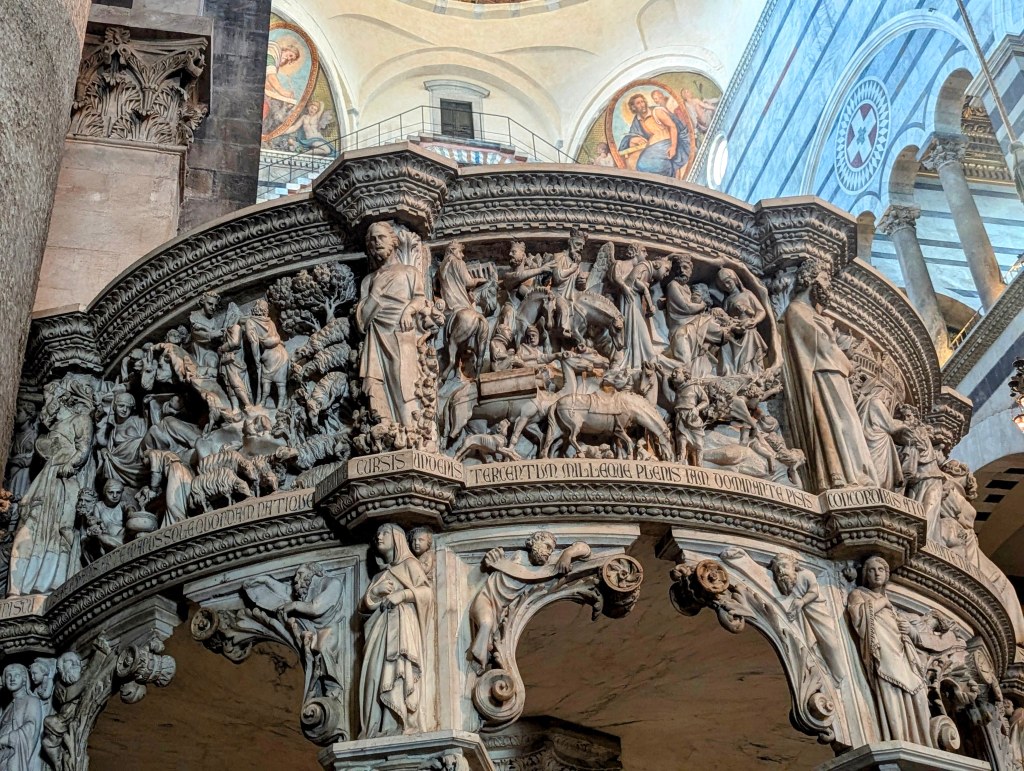
The elaborately carved pulpit, which also survived the fire, was executed by Giovanni Pisano, and is a masterpiece of medieval sculpture. Having been packed away during the redecoration, it was not rediscovered and restored until 1926. The pulpit is supported by plain columns (two of which are mounted on lion’s sculptures).

The upper part has nine narrative panels showing scenes from the New Testament, carved in white marble with a chiaroscuro effect.

There are numerous artworks found inside the cathedral mostly from the renaissance, following the fire.

and, of course, the choir stalls

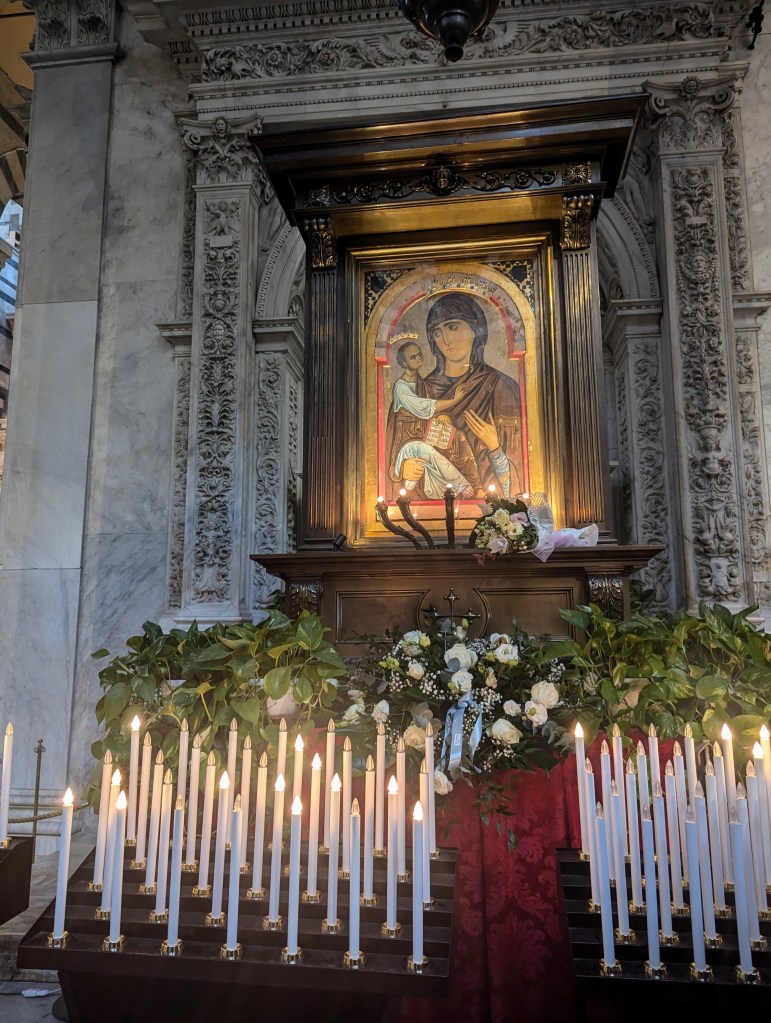
Madonna di sotto gli organi, The Madonna under the Organs is a tempera and gold painting on wood attributed to Berlinghiero Berlinghieri around 1220. The traditional name of the Madonna derives from its ancient location in the Cathedral, under the organs. When in 1494 Charles VIII of France freed Pisa from Florentine occupation, the Madonna, to whom a vow had been made, became a symbol of the newfound autonomy and from then on was invoked during all particularly dramatic events in the city.

At last it was time for us to climb the tower.

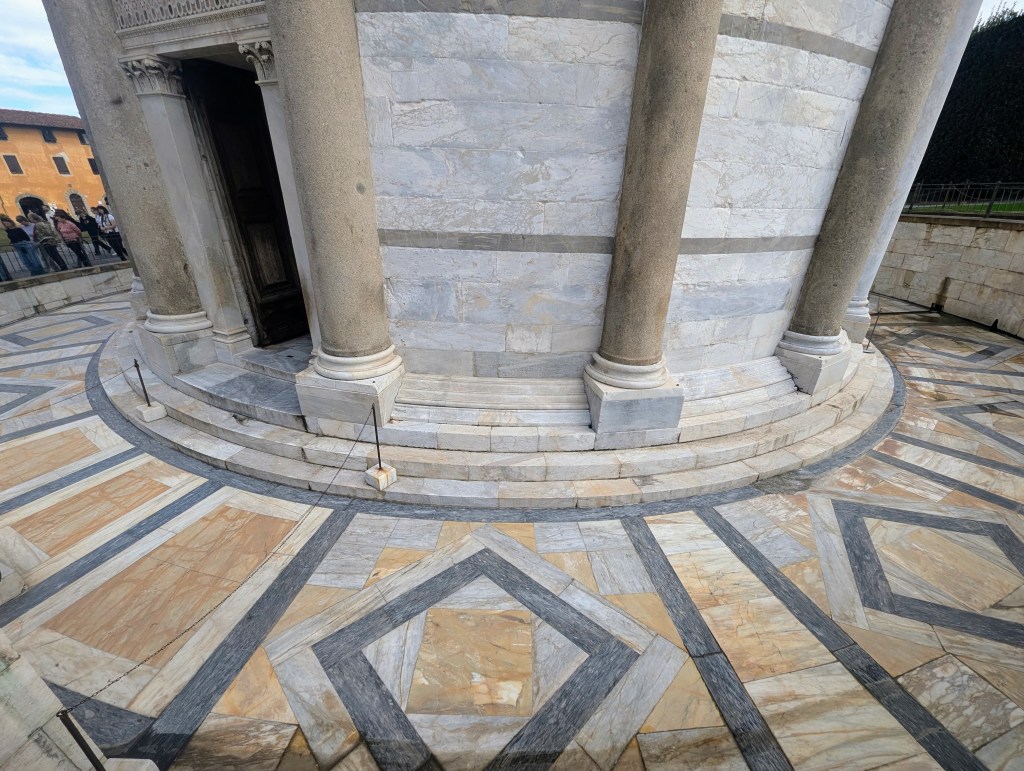
The campanile (bell tower), aka the Leaning Tower of Pisa, was the last of the three major buildings on the piazza to be built. Construction of the bell tower began in 1173 and took place in three stages over the course of 177 years, with the bell-chamber only added in 1372. Five years after construction began, when the building had reached the third floor level, the weak subsoil and poor foundation led to the building sinking on its south side.

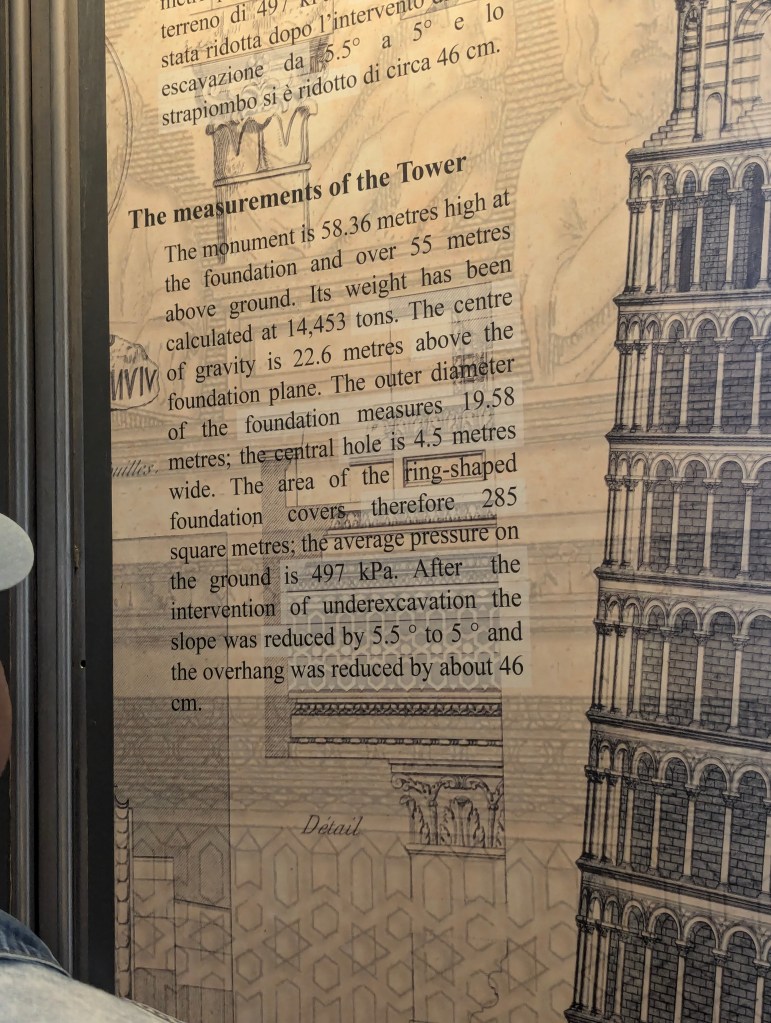
The building was left for a century, which allowed the subsoil to stabilize itself and prevented the building from collapsing. In 1272, to adjust the lean of the building, when construction resumed, the upper floors were built with one side taller than the other. The seventh and final floor was added in 1319. By the time the building was completed, the lean was approximately 1 degree, about 2.5 feet from vertical. At its greatest, measured prior to 1990, the lean measured approximately 5.5 degrees. In 2010, the lean was reduced to approximately 4 degrees using steel beams interiorly.

This is the info provided at the base.

Oh, and there are 296 steps to the top! Once there, I was mostly paralyzed with fear.

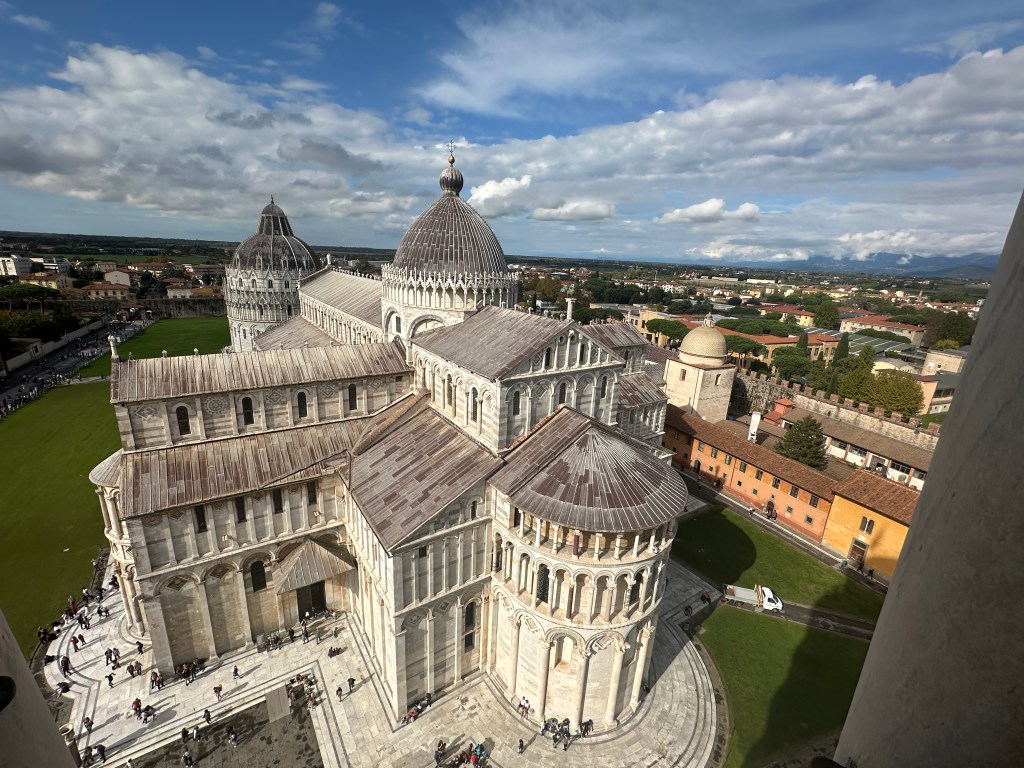
The following views from the top are all courtesy of my brave spouse.

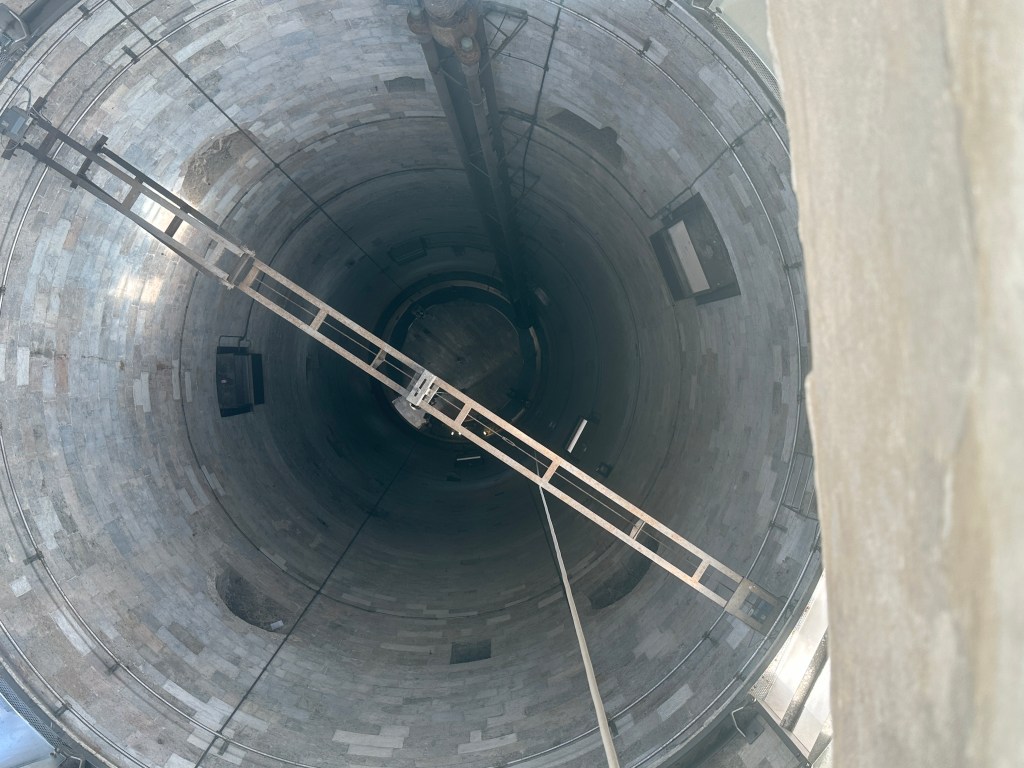
looking down the center of the tower.

The tower was built to accommodate a total of seven main bells.

I was ok on the inside of the tower by the bells.

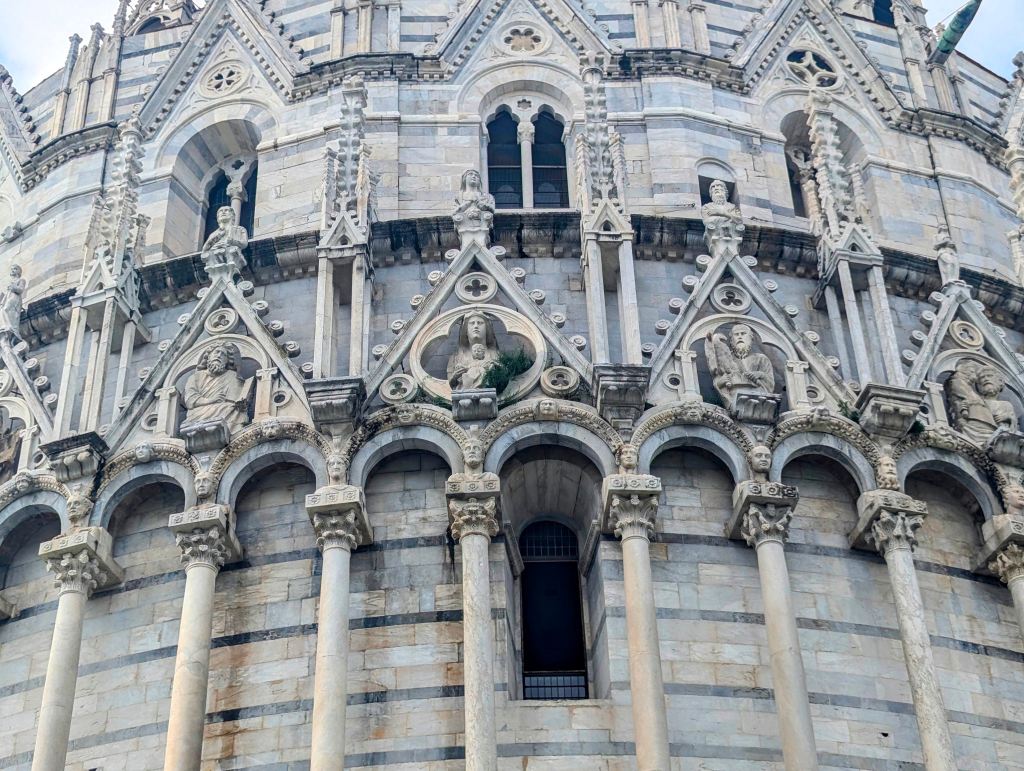
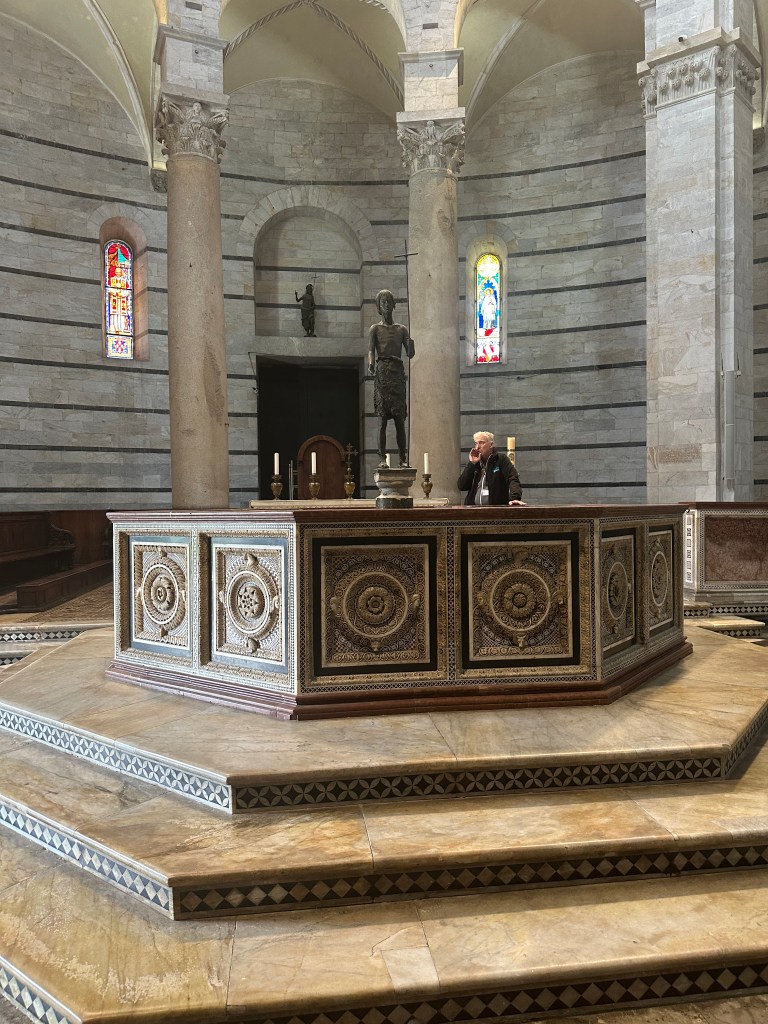
Next it was time for the baptistry, dedicated to St. John the Baptist, it stands opposite the west end of the Duomo. The round Romanesque building was begun in the mid 12th century.

Here we saw the busts and statues of Giovanni Pisano of which we had seen the originals in the Opera earlier in the day.

What was most impressive about the Baptistry were the acoustics. The was some renovation work ongoing, and one of the men had stopped for a bit and went to the central raised area and began a Gregorian chant; what an amazing sound created.

We climbed up to the balcony for a better view of the interior.

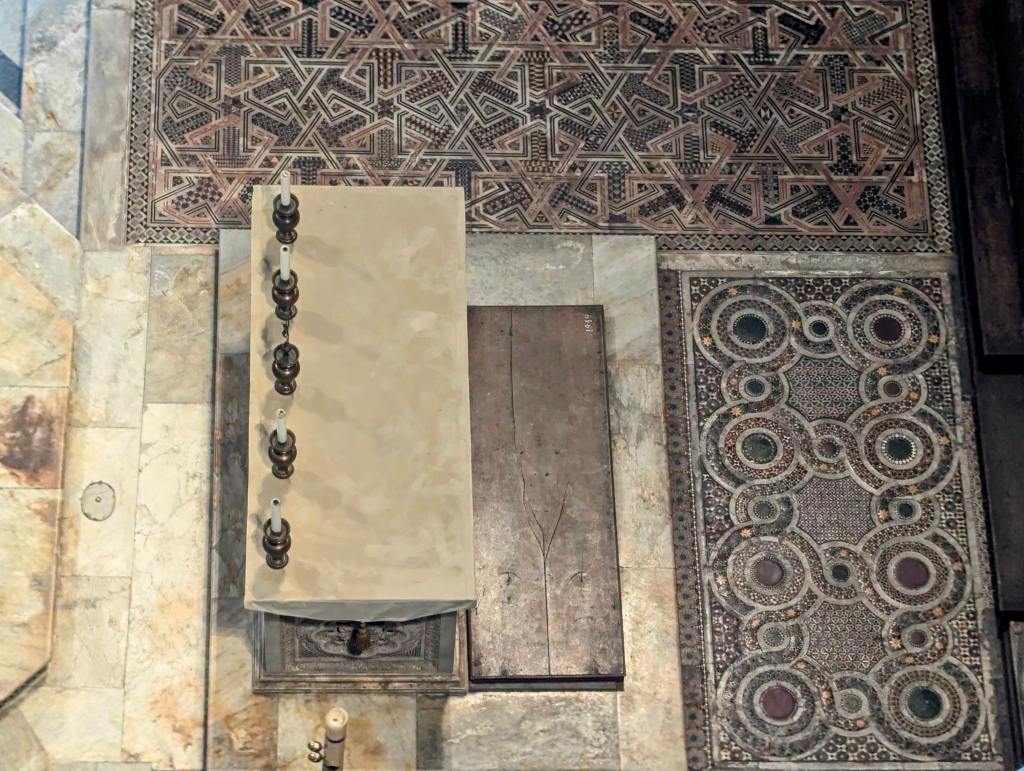
The floors were both impressive

and intriguing.

As we strode to our next stop, we noted the remnants of the medieval walls that surround the piazza.

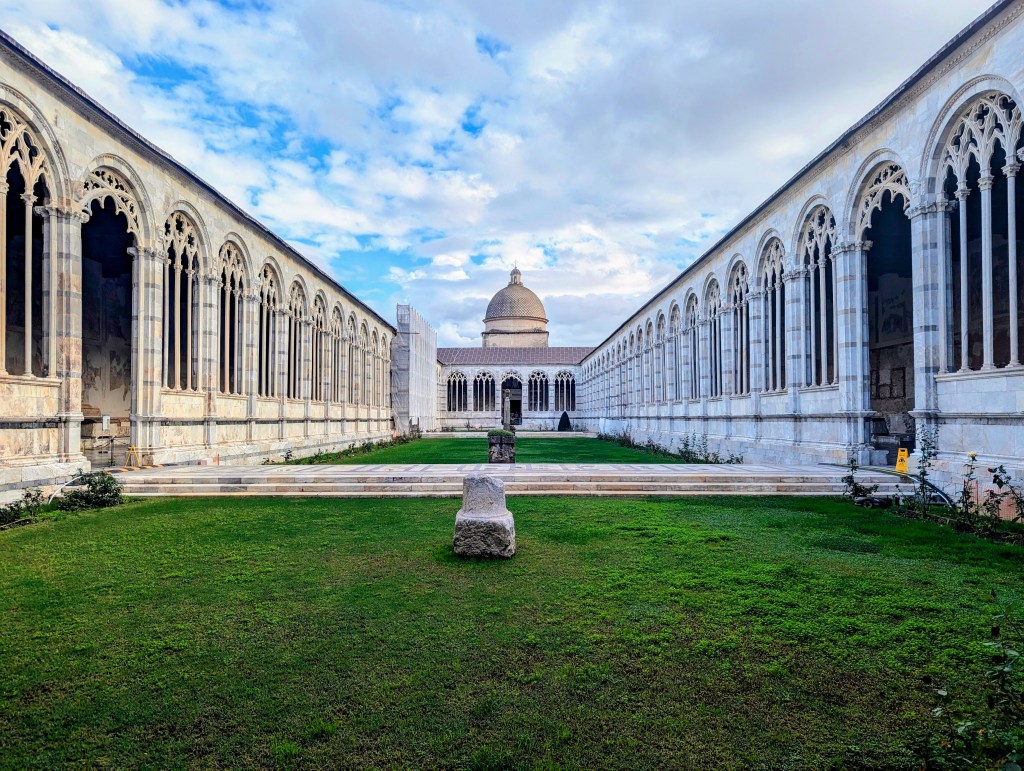
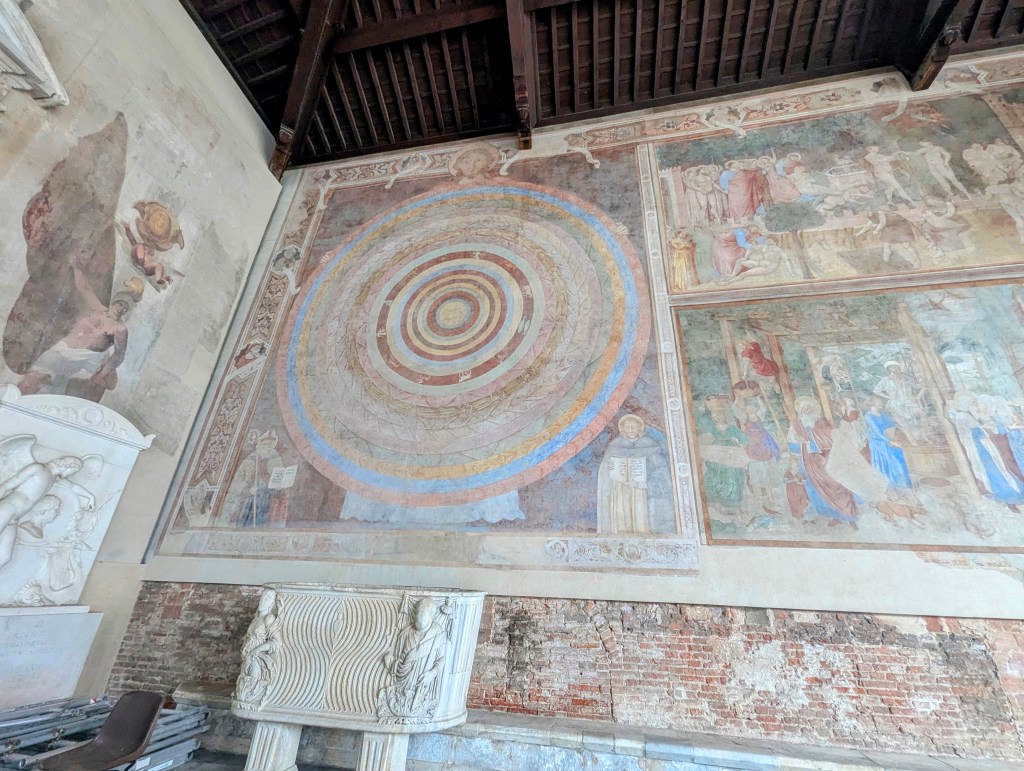
The Camposanto Monumentale (Monumental Cemetery) aka Camposanto Vecchio (Old Cemetery), is located at the northern edge of the square. This walled cemetery  is said to have been built around a shipload of sacred soil from Calvary, brought back to Pisa from the 3rd Crusade  by the archbishop of Pisa  in the 12th century. This is where the name Campo Santo (Holy Field) originates. The building of this huge, oblong Gothic cloister began in 1278 but was not completed until 1464.

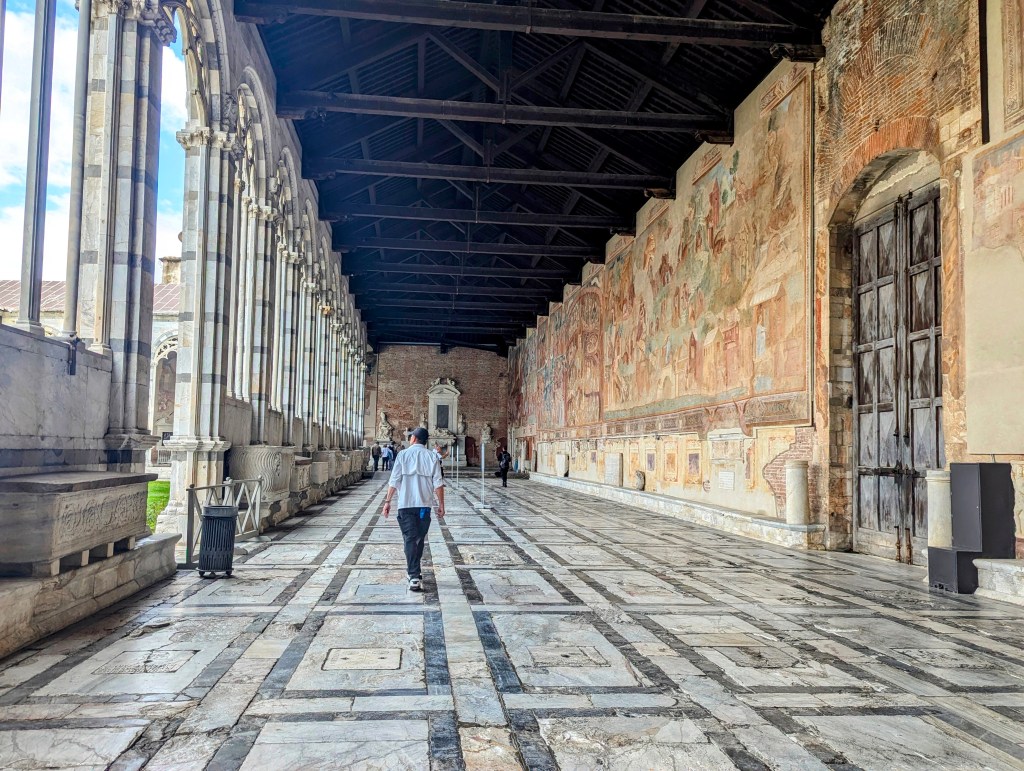
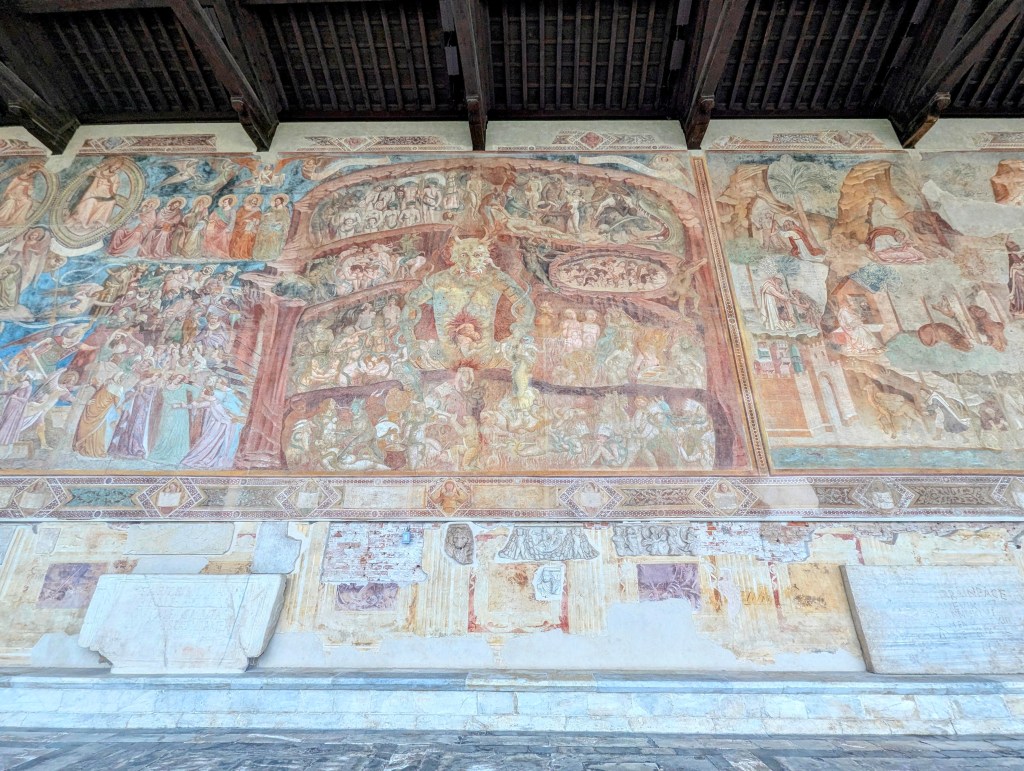
The walls were once covered in frescoes. The first were applied in 1360, the last about three centuries later.

The Stories of the OldTestament by Benozzo Gozzoli (c. 15th century) were situated in the north gallery, while the south arcade was famous for the Stories of the Genesis by Piero di Puccio  (c. late 15th century). The upper right fresco below depicts Adam and Eve in the garden.

Genesis
Judgement Day

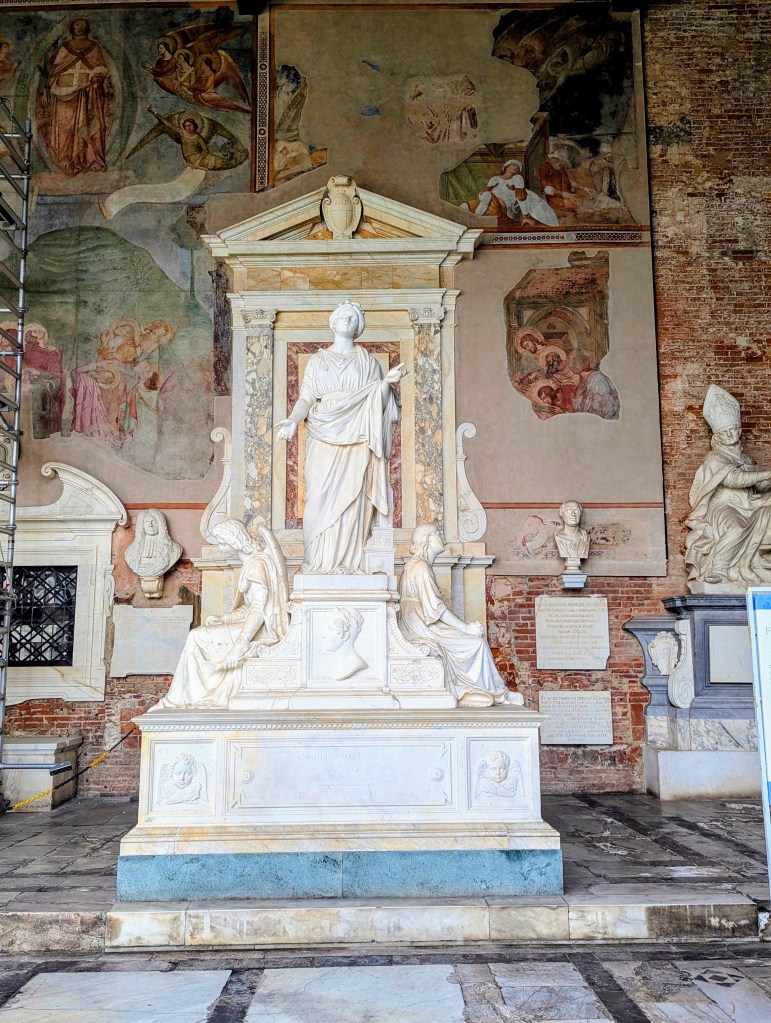
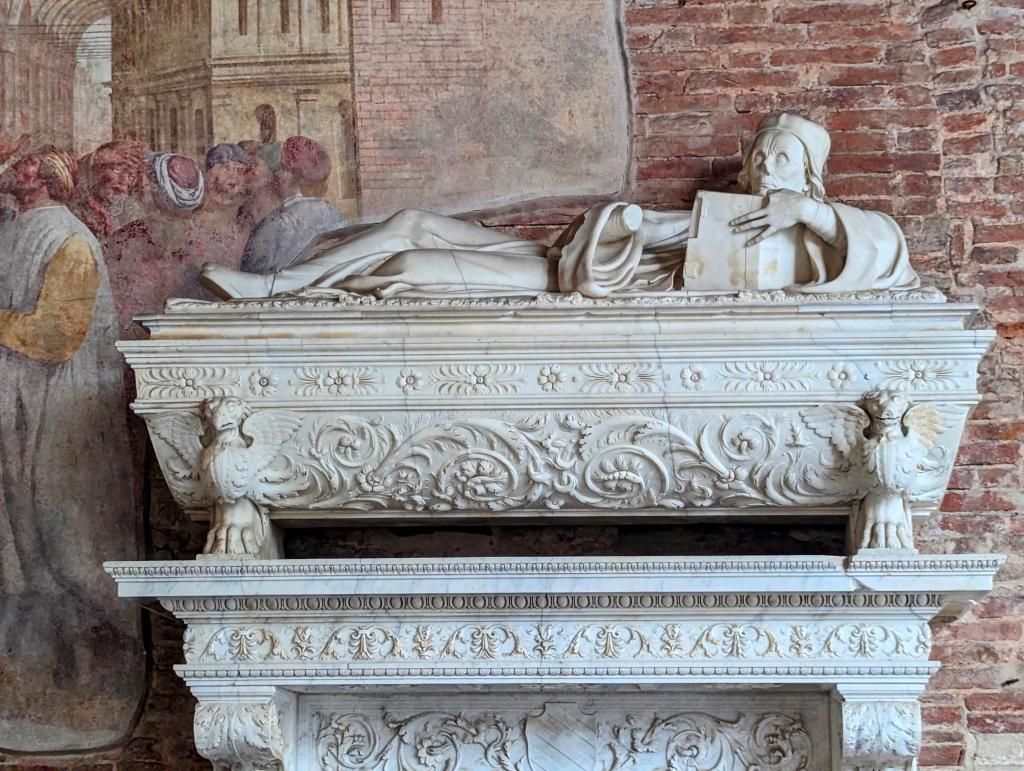
And, of course, there are tombs

and sarcophagi

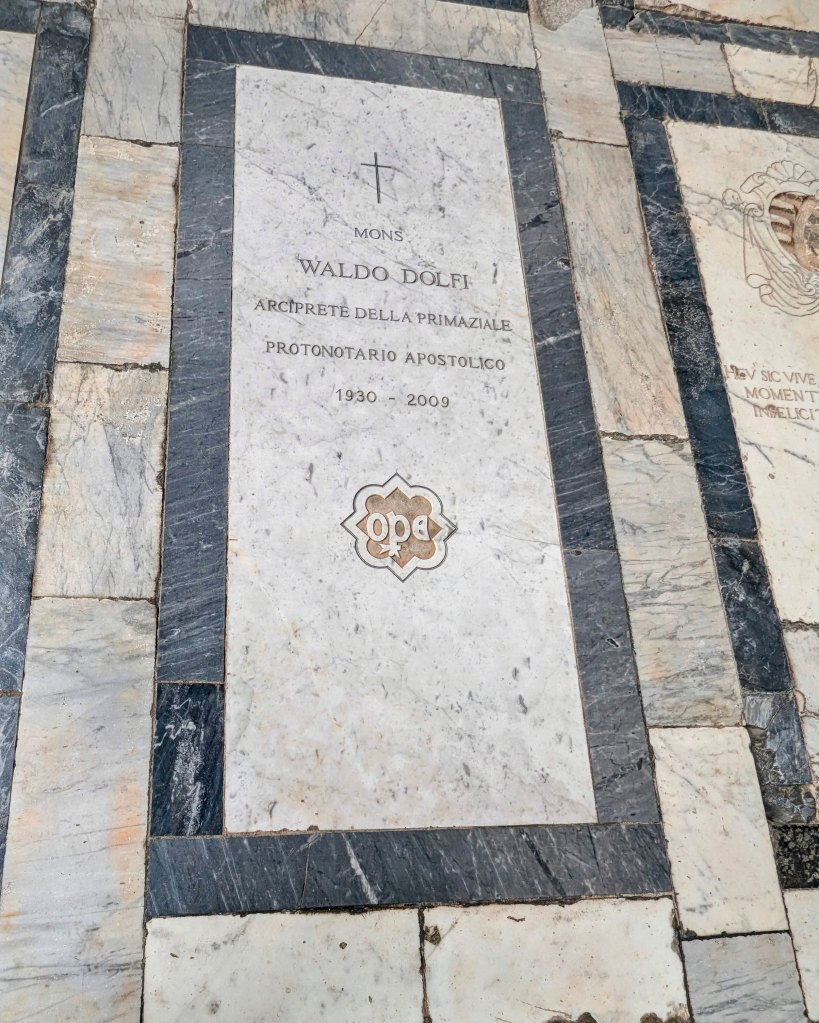
We found a grave as recent as 2009.

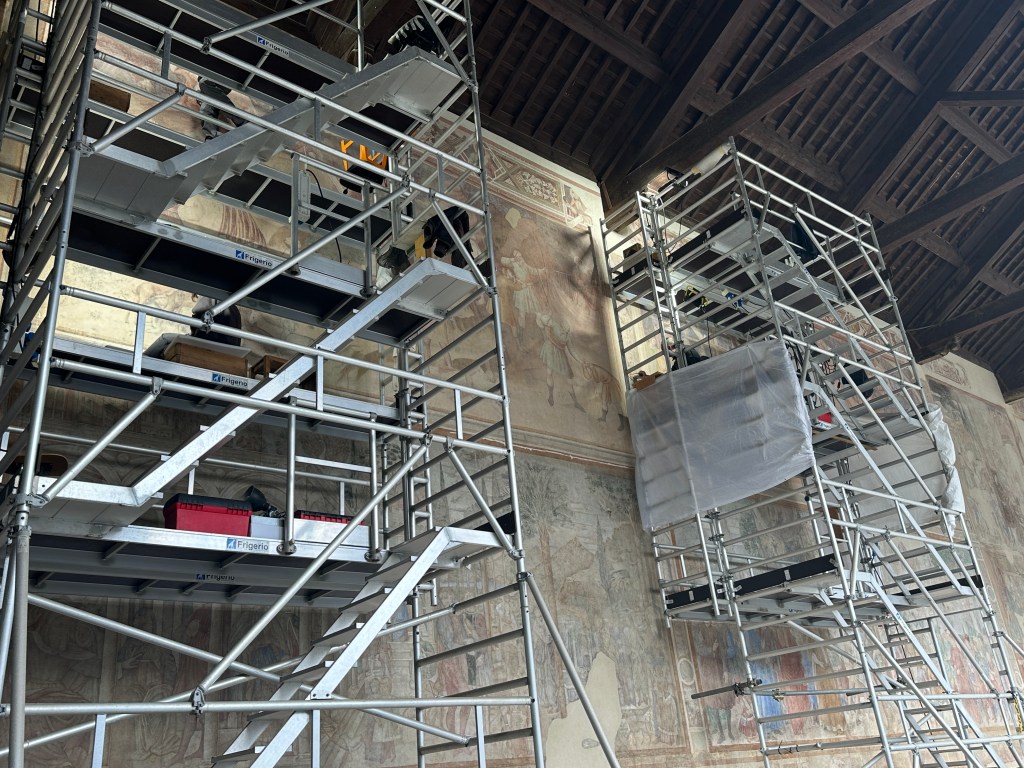
The frescoes are currently undergoing extensive restoration work. They survived a fire in 1944 after allied bombs dropped onto the roof. It is hard to see in the picture, but there are women sitting on the scaffolding painting and cleaning the frescoes.

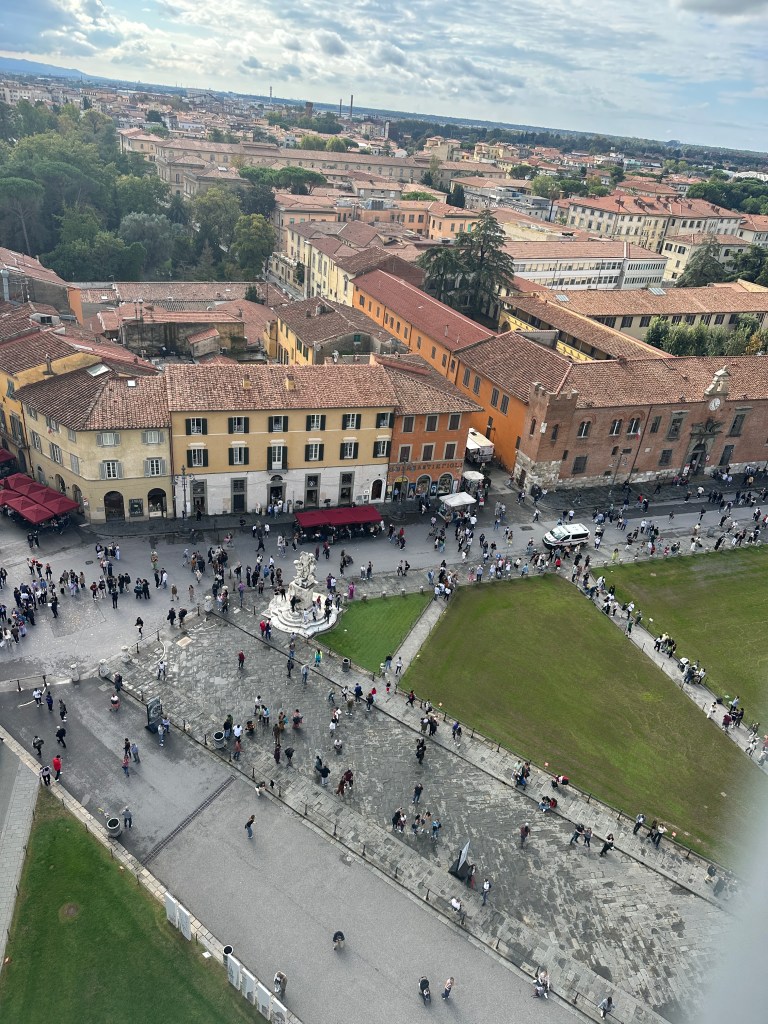
Finally, we visited The Ospedale Nuovo di Santo Spirito (New Hospital of Holy Spirit) located on the south area of the square. Built in 1257 by Giovanni di Simone over a preexisting smaller hospital, the function of this hospital was to help pilgrims, poor, sick people, and abandoned children by providing a shelter. 

Ospedale Nuovo di Santo Spirito is the building to the right seen from the tower.

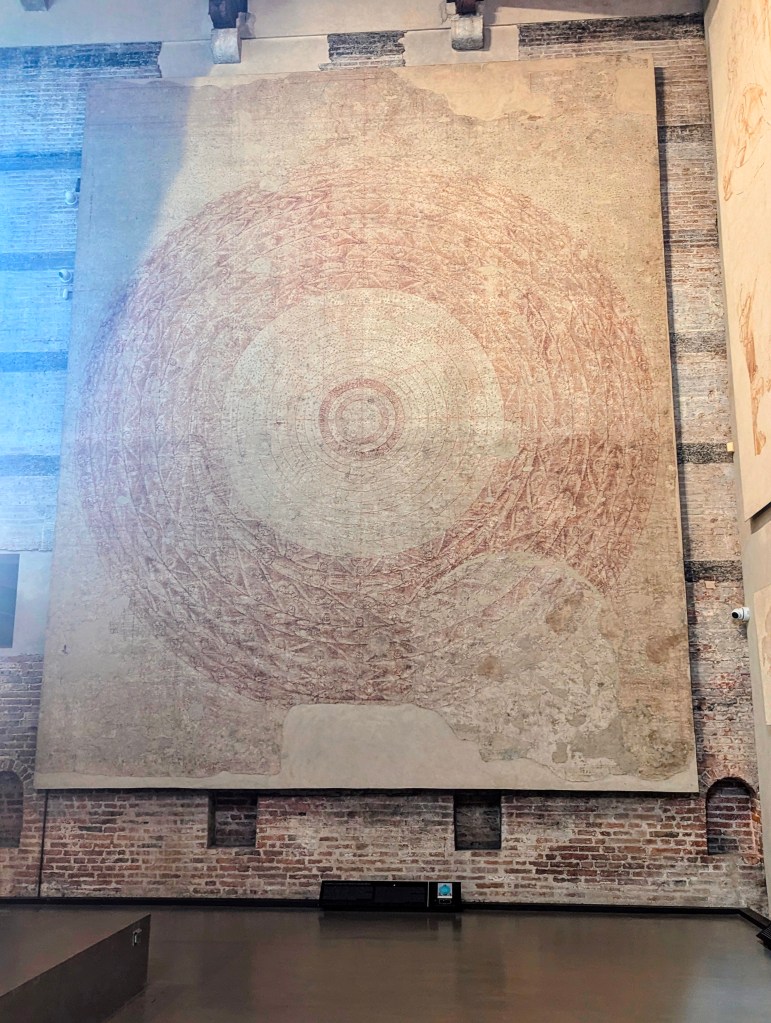
Today, the building is no longer a hospital. Since 1976, the middle part of the building contains the Sinopias Museum, where original drawings of the Campo Santo frescoes are kept.

Alas, we had seen little of the town of Pisa, only the small area confined to the Piazza dei Miracoli, but we had seen enough.

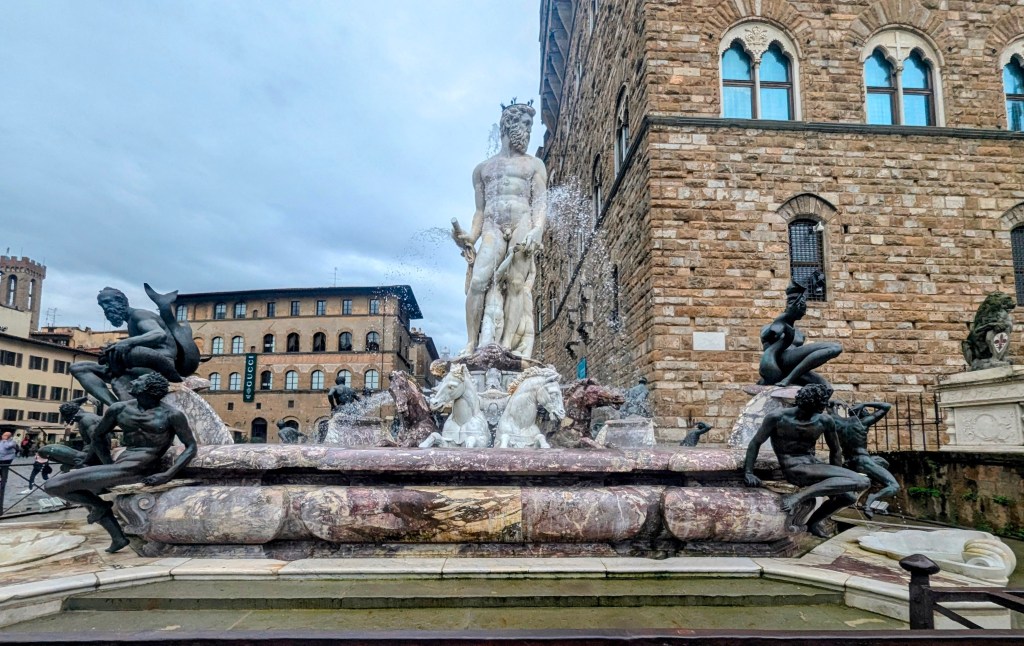
Our next destination was the first that was a repeat visit for us. We had fallen in love with Florence when we came celebrating our 25th year of marriage. We thought the hotel we had stayed in so romantic it necessitated a repeat visit. Plus I was on a mission to find the perfect leather jacket I had pictured in my mind. We drove there in more rain, of course. But after checking into the Hotel Degli Orafi, determined not to be disuaded by the weather, we set out toward the four leather shops I had decided after much internet research were the most likely to have my coveted jacket. Along the path we passed a few sights familiar to us like the Fontana Del Nettuno in the Piazza della Signoria (more on the fountain later)

Fontana Del Nettuno

and some not so familiar

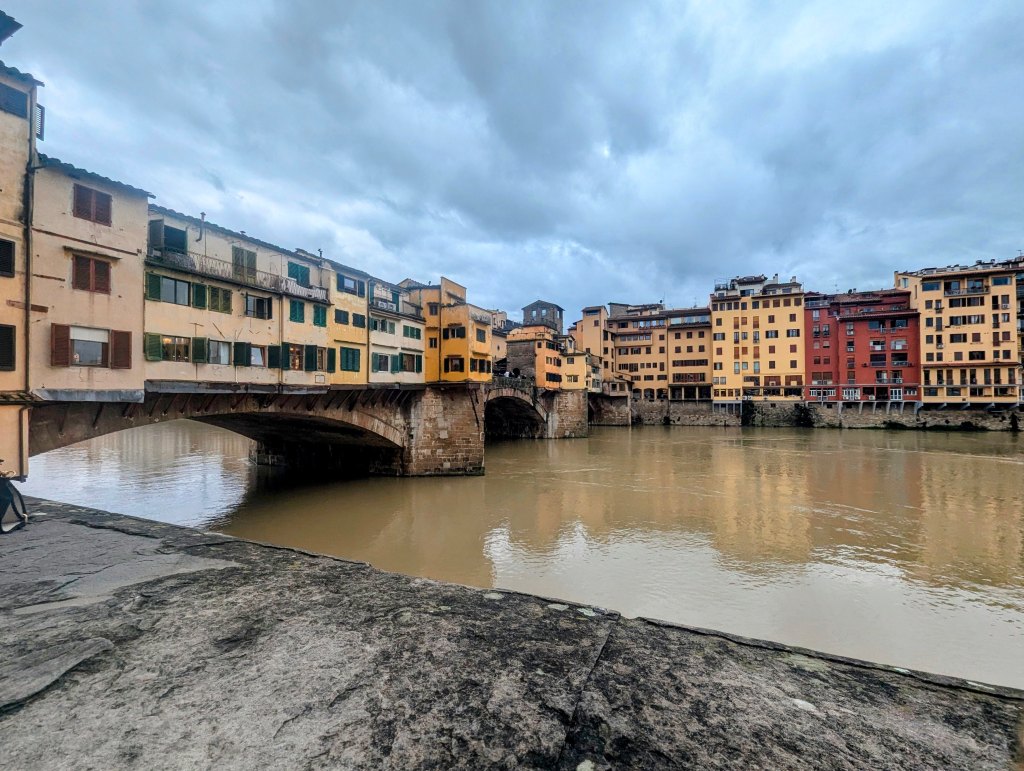
Within two hours I had found the jacket of my dreams in Casini Florence by designer Jennifer Tattanelli, and we were able to return to our hotel to freshen up before dinner. Once reinvigorated, we headed out again. Our hotel was almost directly across from the famous Ponte Vecchio (Old Bridge).

Ponte Vecchio

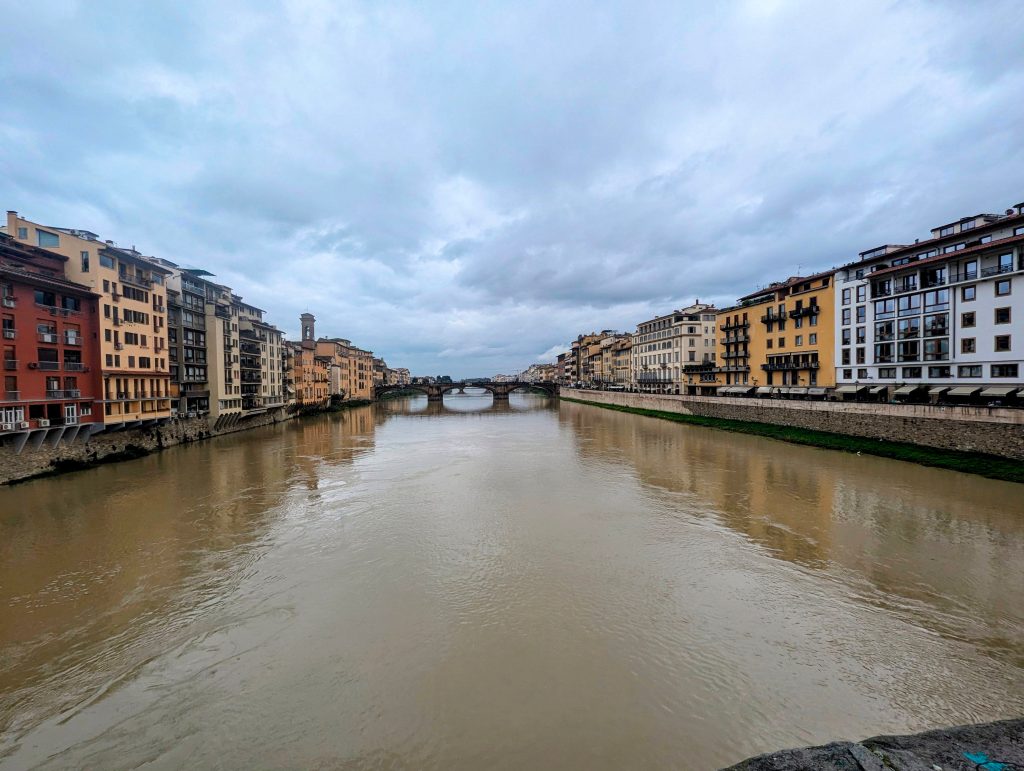
We crossed the bridge and took in the views downriver, noting how muddy the river appeared after so much rain.

After a truly delicious dinner at Ristorante dei Rossi, we strolled around this romantic city.

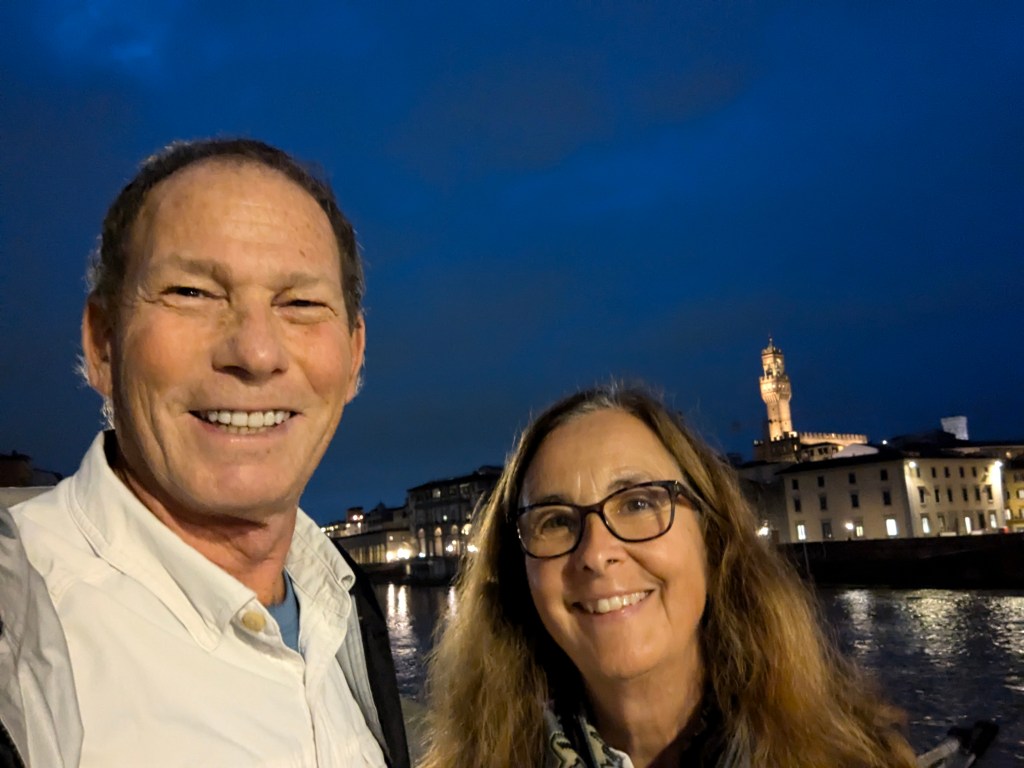
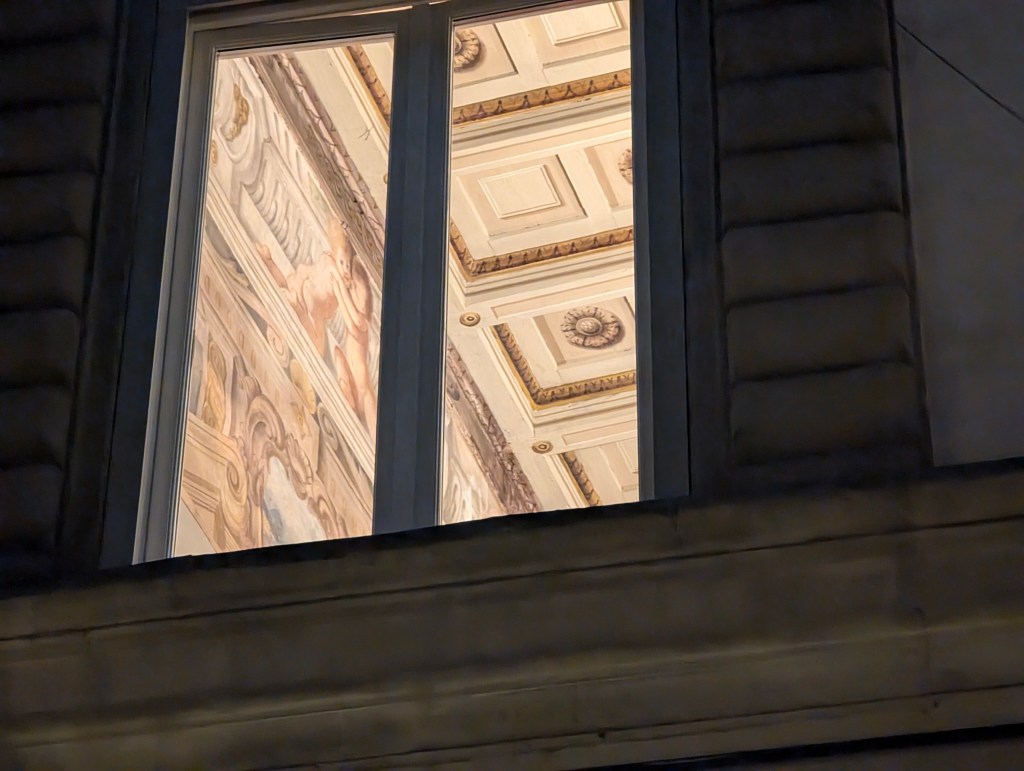
We got peaks into some of the private apartments and were once again awed by the beauty of the architectural details.

In the morning we were scheduled for a walking tour despite the still inclement weather. But first breakfast. The breakfast room at Hotel Degli Orafi is one of the many reasons we returned to this venue.

Our tour guide for the morning, Giacomo, was a student of history and architecture. Our tour was filled with fun facts starting with the Medicis, one of the most influential families in Florence’s history. The Medici Palace is closed to the public for restoration work.

But while we stood outside the palace, Giacomo regaled us with stories of how the family fortune started in the 1100s with the wool trade, but as their wealth grew, they soon became money lenders. In 1397 they became the first bankers in Florence. In the early 1400s they wanted to be the bankers for the Vatican, but two popes said no. Finally a third pope said yes, and eventually, several popes even came from the family. The Medici family’s wealth and influence grew through their connections to the papacy and the city’s elite.  The Medici family held important positions in Florence’s government and used their wealth to keep their political power. They ruled Florence from 1434 to 1737, except for two brief intervals. During this time the Medici family began sponsoring artists: Donatello, Michaelangelo, Boticelli, and more.

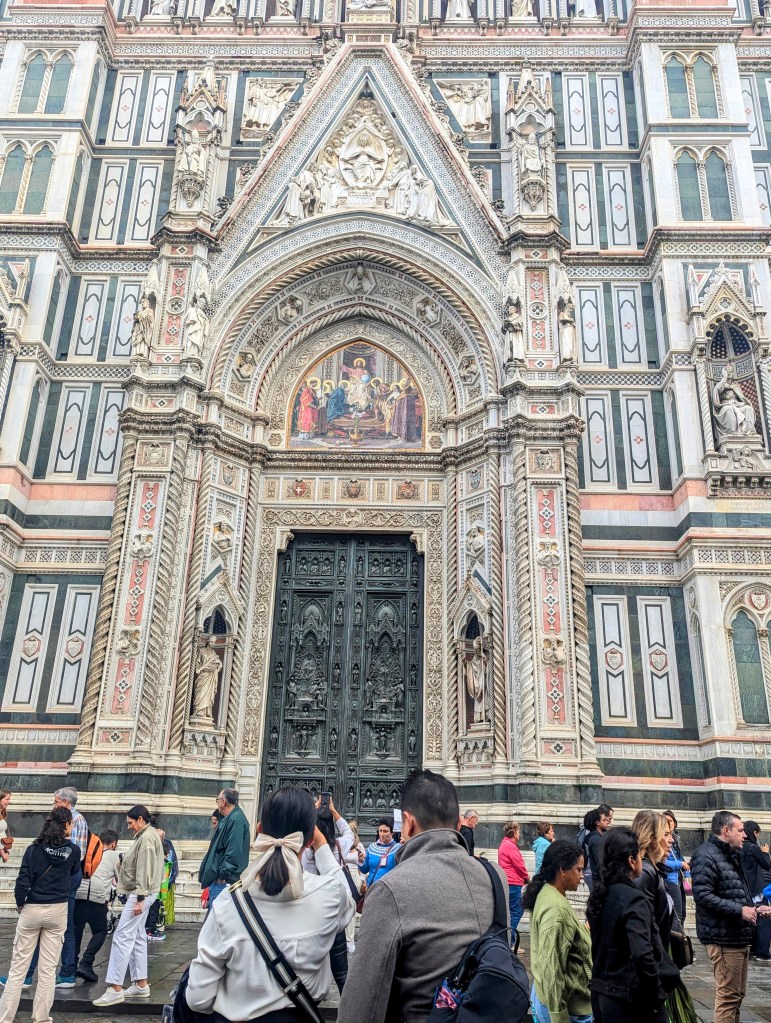
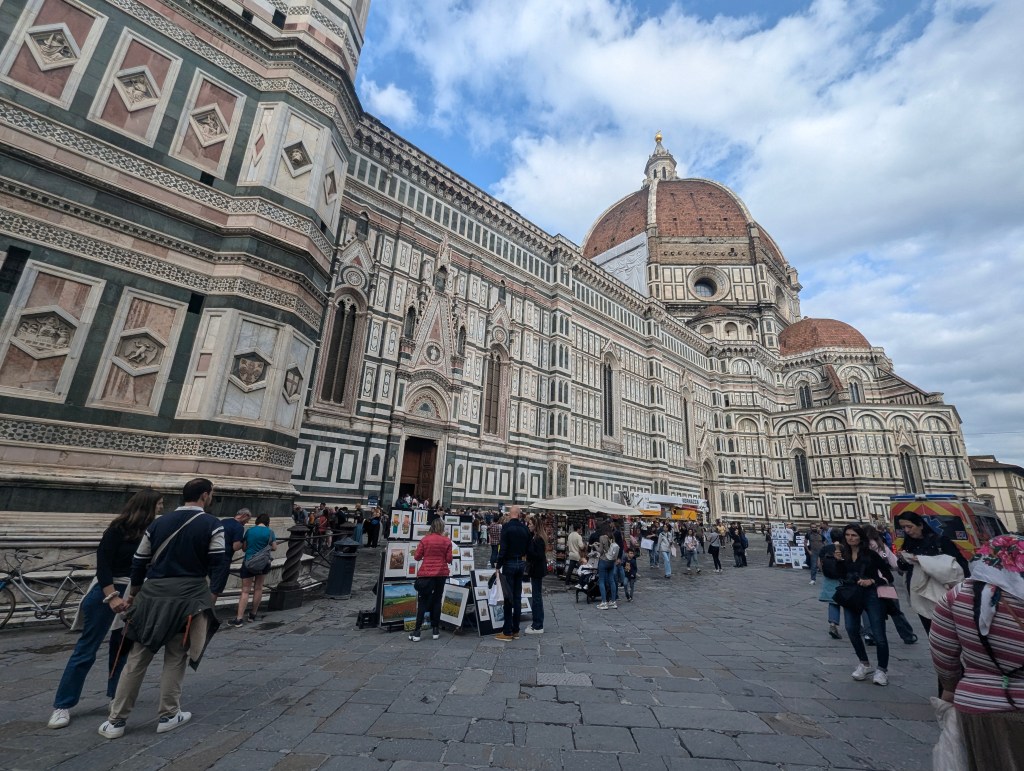
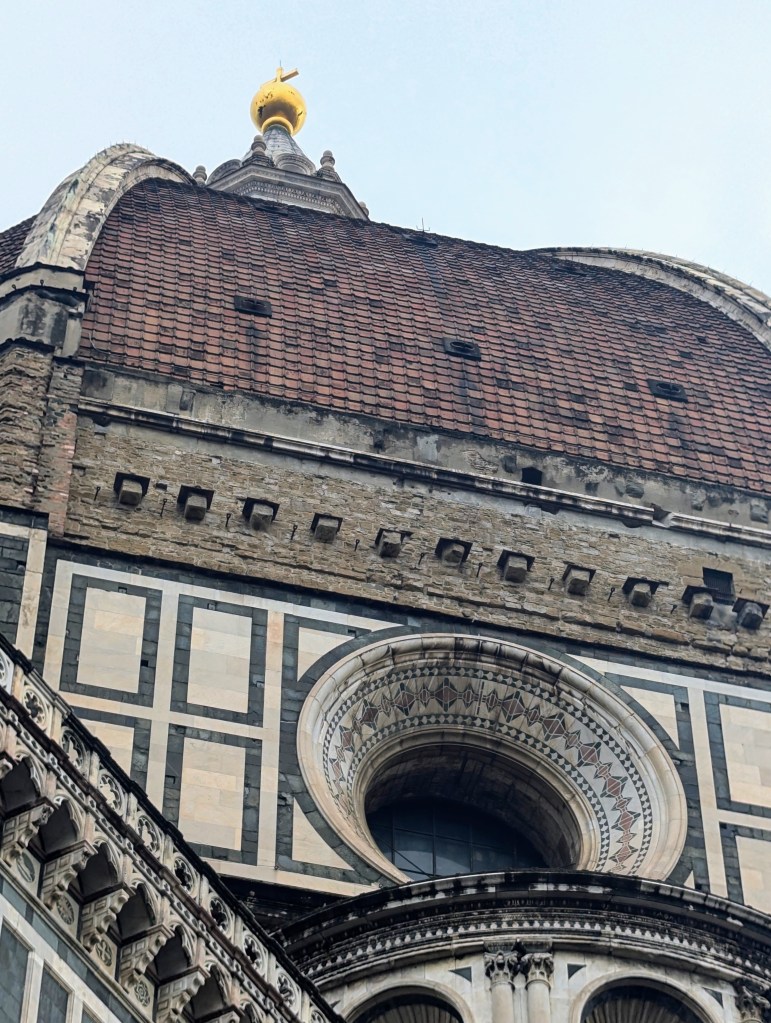
Next stop on our tour was Cattedrale di Santa Maria del Fiore (Cathedral of Saint Mary of the Flower). The name Florence comes from the Latin word floreo, which means “flower”. Building commenced in 1296 and was not completed until 1436. The cathedral complex, in Piazza del Duomo, includes the Baptistry and Giotto’s Campanille (Bell Tower). The basilica is one of Italy’s largest churches and its dome, when first built back in the 15th century, was the largest ever built in western Europe. Although it was later overtaken by St. Peter’s Basilica, it still remains the largest dome ever constructed of bricks.

The white marble is from Carrera, same as the statues. The green marble is from Prato, near Florence, and the pink marble is from Siena in southern Tuscany. These marble bands had to repeat the already existing bands on the walls of the earlier adjacent  baptistry.

Cattedrale di Santa Maria del Fiore

In the middle of the 13th century building efforts were stopped as the black plague swept through Italy. Half of the population in Florence perished during that time. When work resumed almost 50 years later, one of the first projects finished was the bell tower.

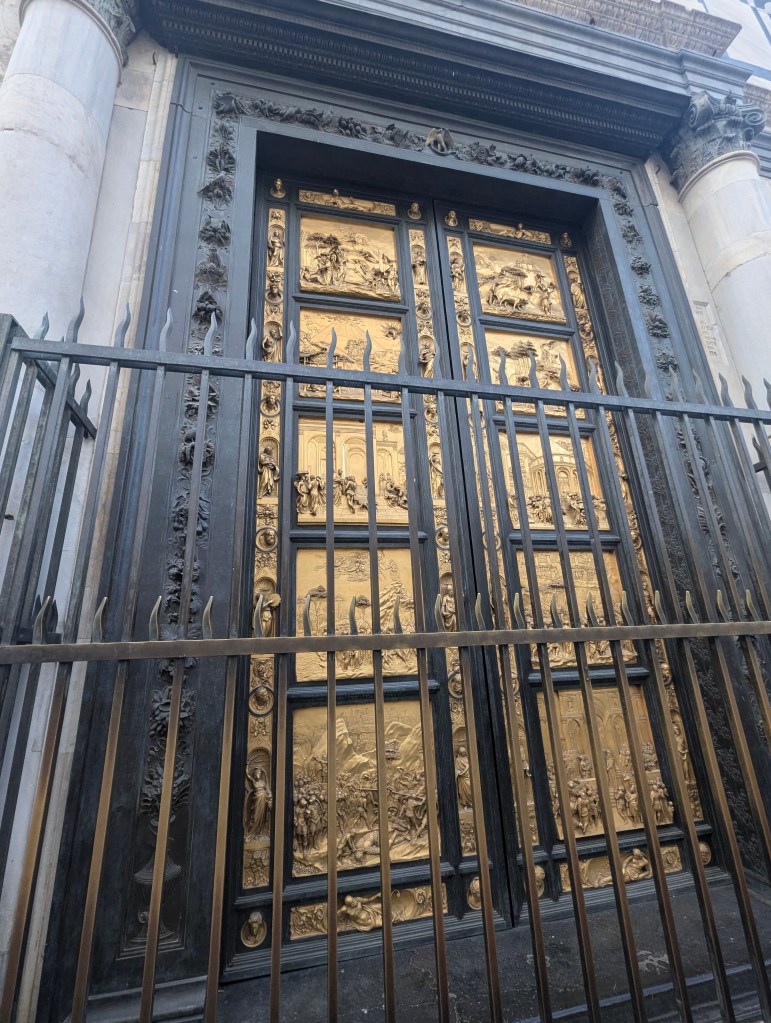
During the quarantines of the plague the rich got richer, the building grew, and the hole for the dome became so immense, no one knew how to cover it. On 19 August 1418, the Arte della Lana announced an architectural design competition for erecting the dome. The two main competitors were two master goldsmiths, Lorenzo Ghiberti and Filippo Brunelleschi, the latter of whom was supported by Cosmo de Medici. Ghiberti had been the winner of a competition for a pair of bronze doors for the Baptistery in 1401 and lifelong competition between the two remained sharp. Brunelleschi won and received the commission for the dome.

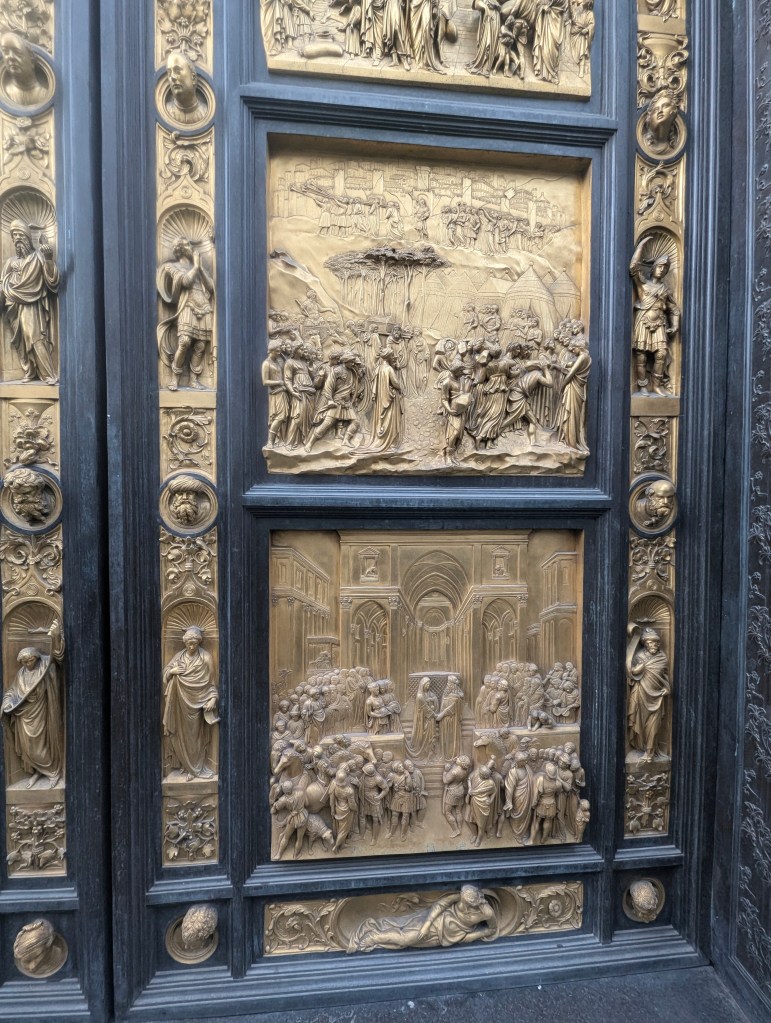
Lorenzo Ghibertis bronze doors of baptistry

It took Ghiberti over twenty years to complete the two doors which depict the life of Christ in 24 panels.

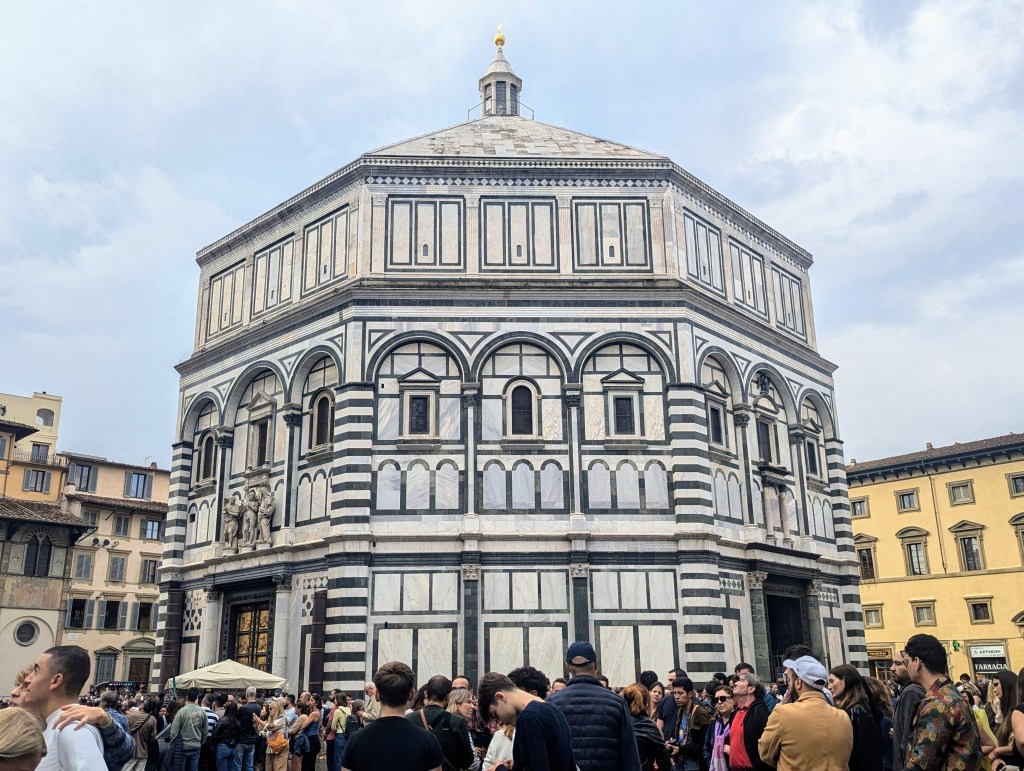
Ghiberti then went on to make a second pair of doors for the other side of the Baptistry. Those took him 27 years to complete the 10 panels. At the time the Battistero di San Giovanni (Baptistry of St. John) was finished near 1500, it was one of the most important buildings in Italy.

Baptistry of Cattedrale di Santa Maria del Fiore

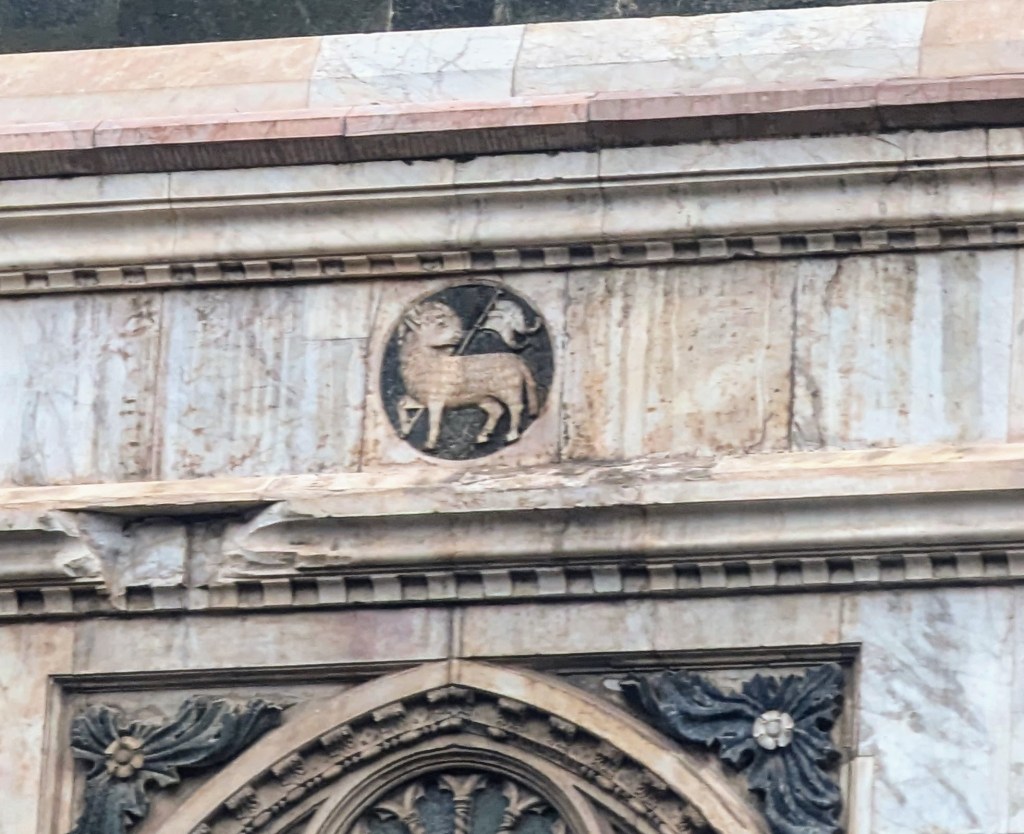
Filippo was originally a clock maker and goldsmith. But when he lost the door competition to Ghiberti, he went with his friend Donatello to Rome and studied architecture while Donatello studied Roman statues. When Filippo came back to Florence he proposed the design for the dome to be the first self supported dome in the world almost 300 feet high. The wool guild, ie the Medicis, were in control of the erection of the dome.

Symbol of the wool guild on the façade of the cathedral

So despite Fillipo’s win of the competition, Ghiberti was appointed coadjutor of the dome and drew a salary equal to Brunelleschi’s and, though neither was awarded the announced prize of 200 florins, was promised equal credit, although he spent most of his time on his other projects ie the doors. When Brunelleschi became ill, (or feigned illness in a fit of anger over the situation), the project was briefly in the hands of Ghiberti. But Ghiberti soon had to admit that the whole project was beyond him. In 1423, Brunelleschi was back in charge and took over sole responsibility. Erection of the dome had begun in 1420 and was finished in 1436.

The ceiling of the dome, decorated with a representation of The Last Judgement by Giorgio Vasari, is one of the largest frescoes ever painted, and was not completed until 1579. The building and decorating of the dome is said to have inspired Donatello, who worked on several of the statues in the cathedral, Michaelangelo, and DaVinci.

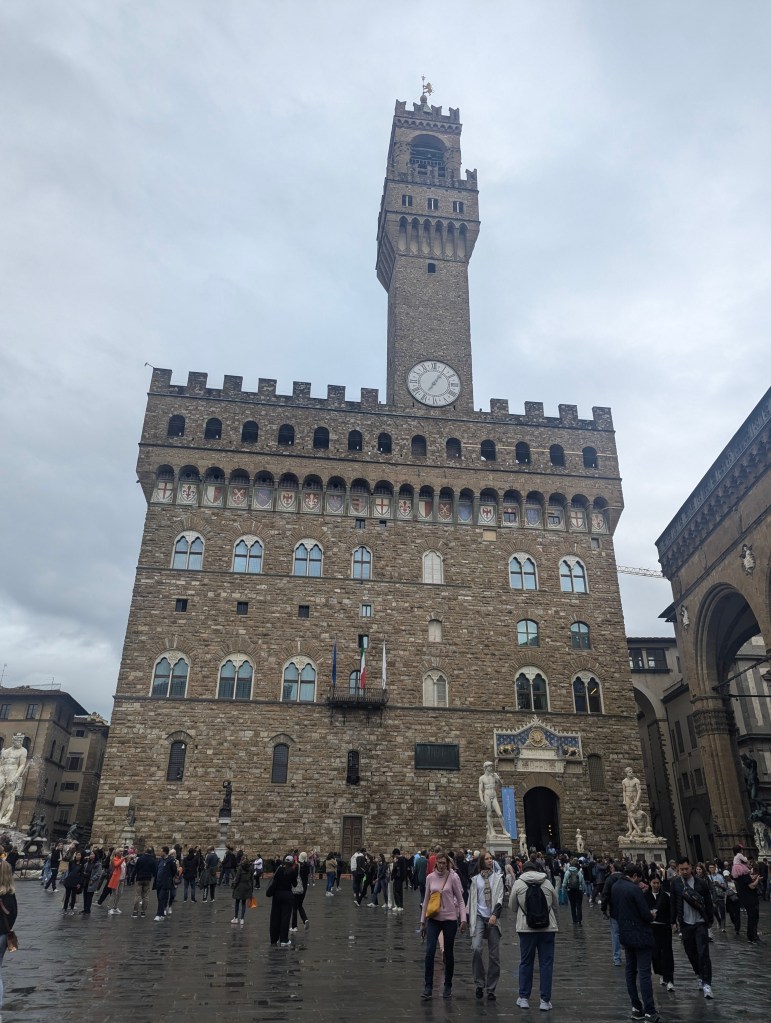
Next stop on our tour was Piazza della Signoria, named after the Palazzo della Signoria, also called The Palazzo Vecchio (“Old Palace”) is the town hall of the city. (Old Palace v the “new” palace, ie the Pitti Pace, more on that later). It is the main point of the origin and history of the Florentine Republic and still maintains its reputation as the political focus of the city. Built in the early 1300s, the Palazzo Vecchio was the second Medici palace and immediately became the seat of the government. This massive, Romanesque, crenellated fortress-palace is among the most impressive town halls of Tuscany. Overlooking the square with its copy of Michelangelo’s David statue, it is one of the most significant private palaces in Italy, and it hosts cultural points and museums.

The Palazzo Vecchio

Also in the piazza is an open air statue gallery, the Loggia del Lanzi, which has both antique and Renaissance statues as well as the Medici lions.

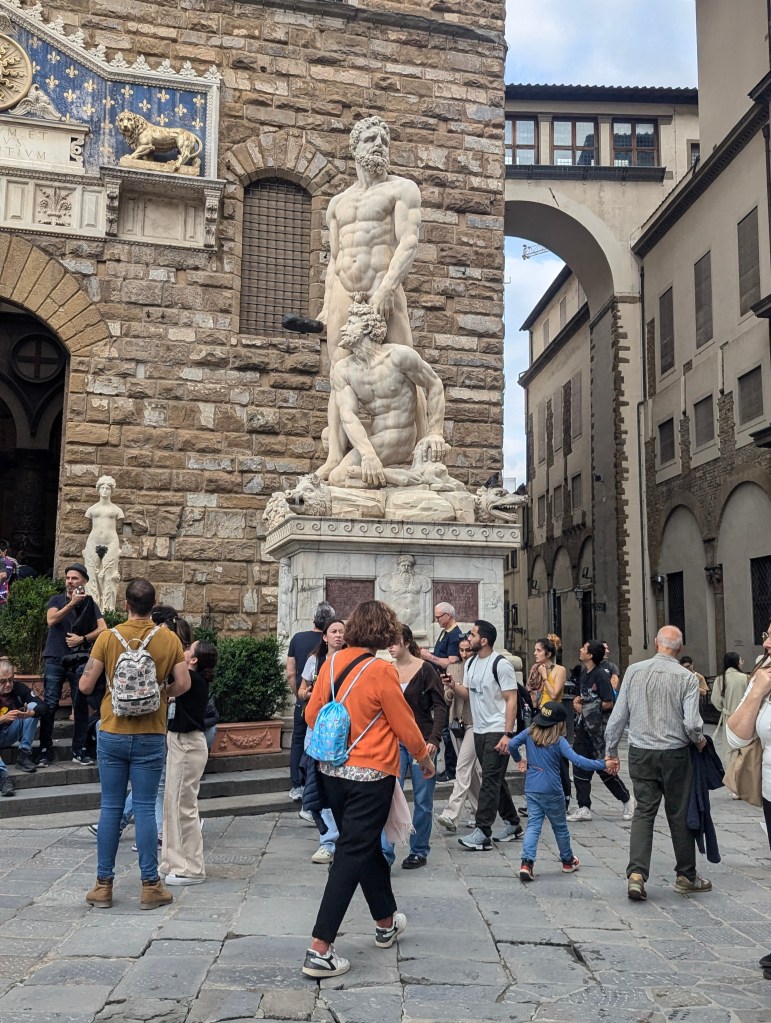
At this point our guide Giacamo pointed out the difference in the anatomical accuracy of Michelangelo’s David, a copy of which is outside the palace (more on David later) and the inaccuracy of the anatomy of the Grand Duke Cosimo I de Medici depicted as Hercules defeating Cacus by sculptor Baccio Bandinelli (1493-1560).

Grand Duke Cosimo I de Medici, Duke of Florence from 1537-1569, commissioned the Fountain of Neptune in 1559 to celebrate the marriage of Francesco de Medici I to Grand Duchess Joanna of Austria. Cosimo was responsible for a vast number of architectural and artistic elements in Florence that still exist today. The fountain incorporates a series of mythological figures and iconographies that symbolize both Cosimo I de’ Medici’s power as well as the union of Francesco and Joanna. Giacamo explained how in its time, the fountain and statue were a form of propaganda, depicting Cosimo shown naked like a Greek god on earth.

Fontana Del Nettuno

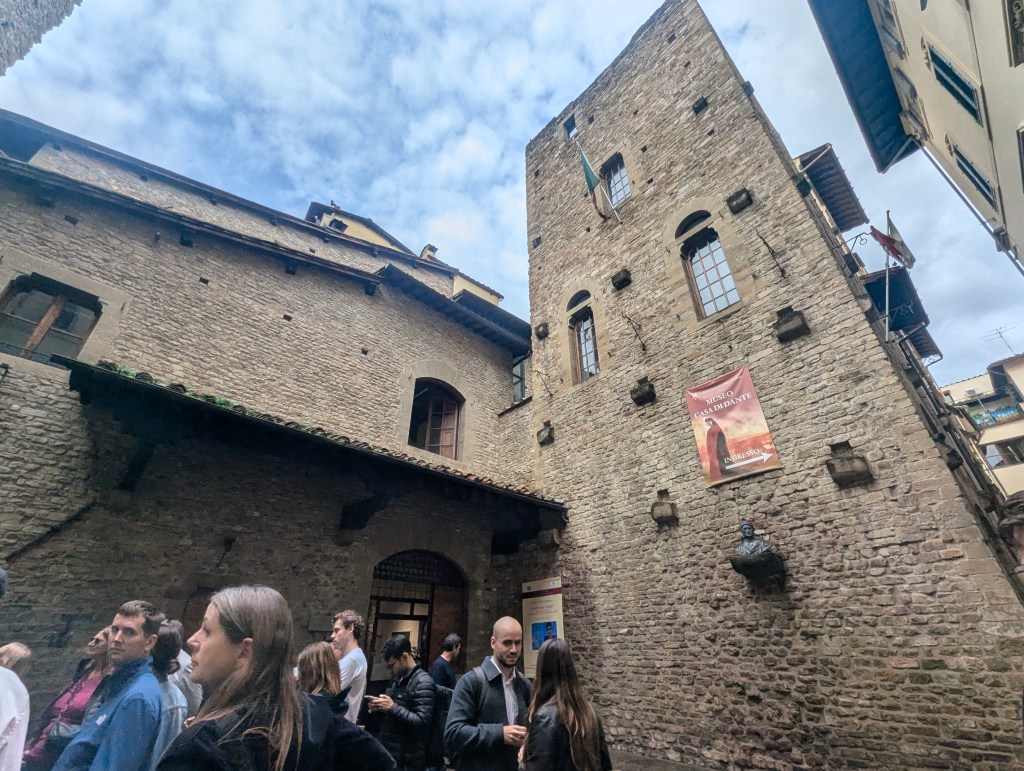
Next Giacomo took us to the house of Dante (1265-1321). Giacomo explained that although the tower was built in 1086, the house was built 1865, clearly not a place he actually lived.

But when, in 1865, Italy came together as a country, it adopted the dialect of Dante, ie the dialect of Tuscany, his birth place, as the language of the now united country. Dante had written the Divine Comedy in the Tuscan dialect so the average citizen who could not read the bible, which still appeared only in Latin, could learn about the afterlife. This house was built in 1865 in his honor.

Giacomo

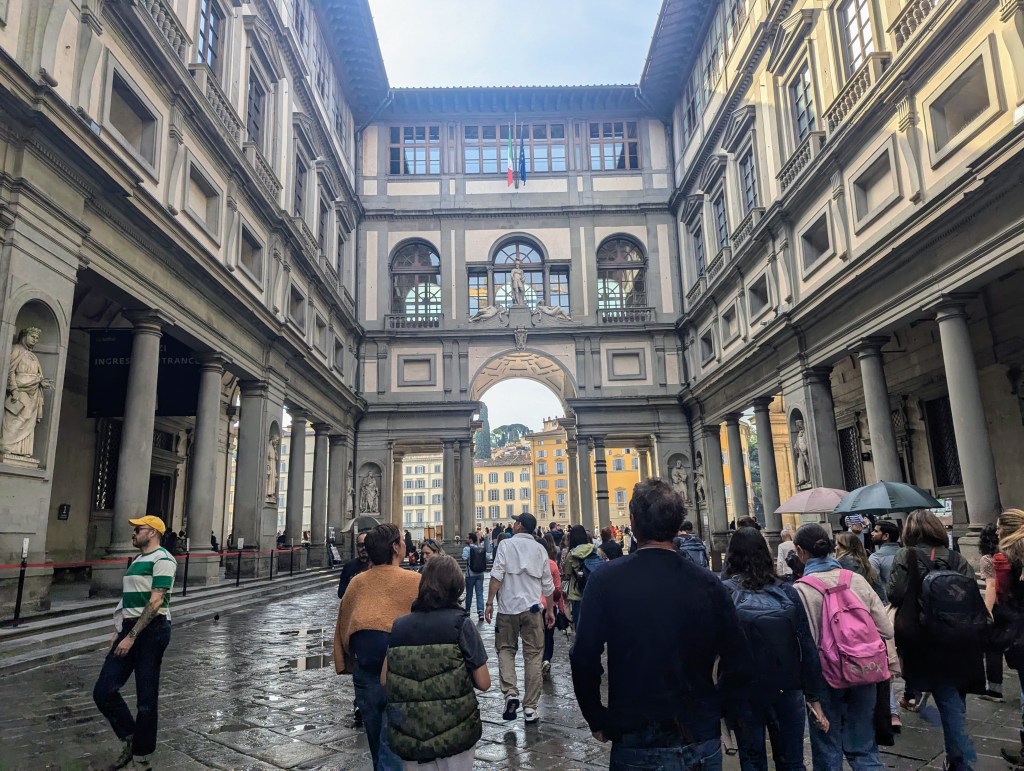
Our final stop was in the courtyard of the Uffizi Gallery, a prominent art museum. The Ufizzi Gallery is one of the most important Italian museums and holds a collection of priceless works, particularly from the period of the Italian Renaissance. The building of the Uffizi complex was begun  in 1560 for Cosimo I de’ Medici as a means to consolidate his administrative control of the various committees, agencies, and guilds established in Florence’s Republican past so as to accommodate them all in one place, hence the name uffizi, “offices”. 
.

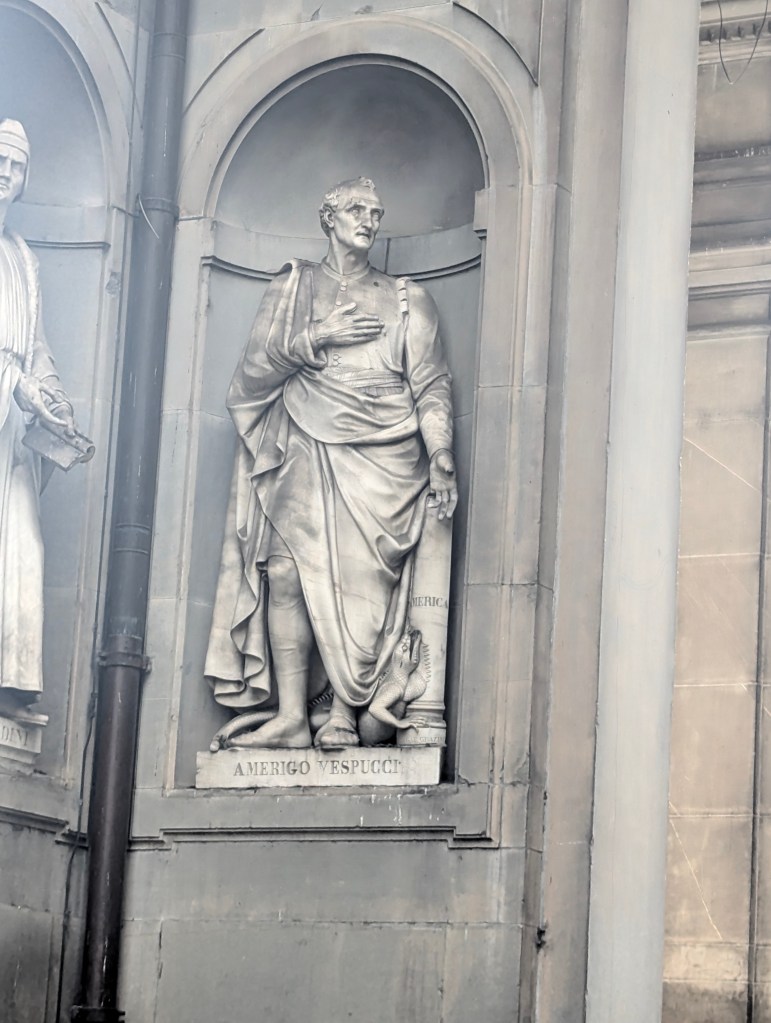
He showed us some of the many statues around the courtyard which include Gallileo

and Amerigo Vespucci.

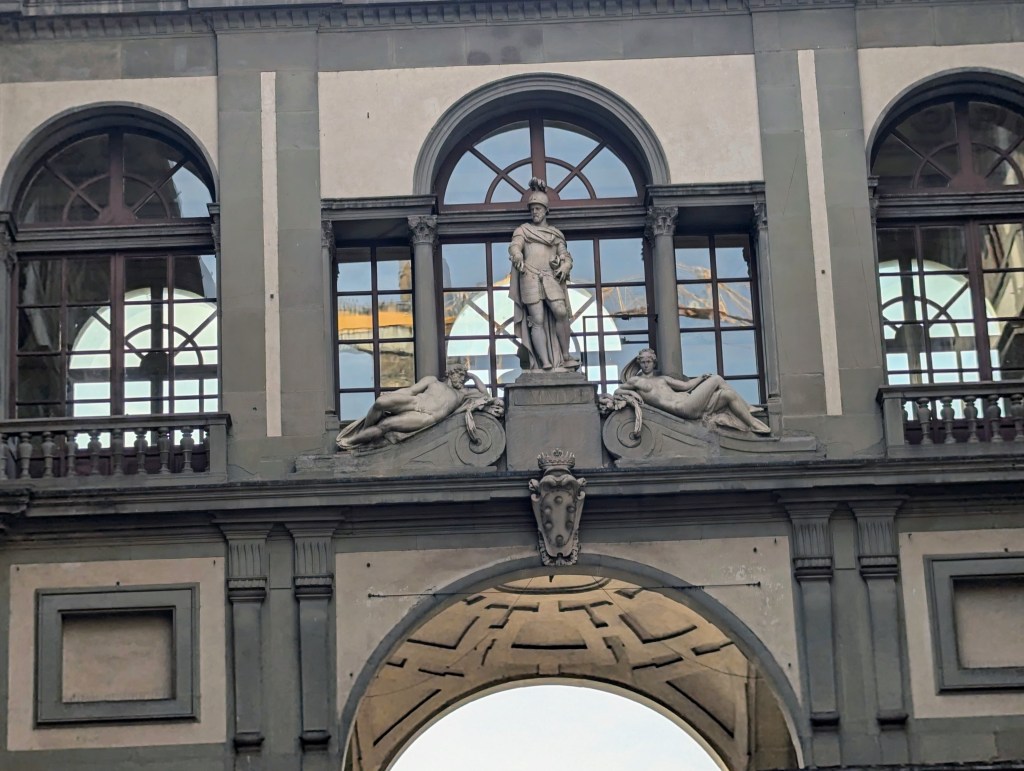
He also pointed out Cosimo I de Medici high above the arch. After the ruling  House of Medici died out, many of them from syphilis, their art collections were given to the city of Florence under the famous Patto di famiglia negotiated by Anna Maria Luisa, the last Medici heiress. The Uffizi is one of the first modern museums. The gallery had been open to visitors by request since the sixteenth century, and in 1769 it was officially opened to the public, formally becoming a museum in 1865

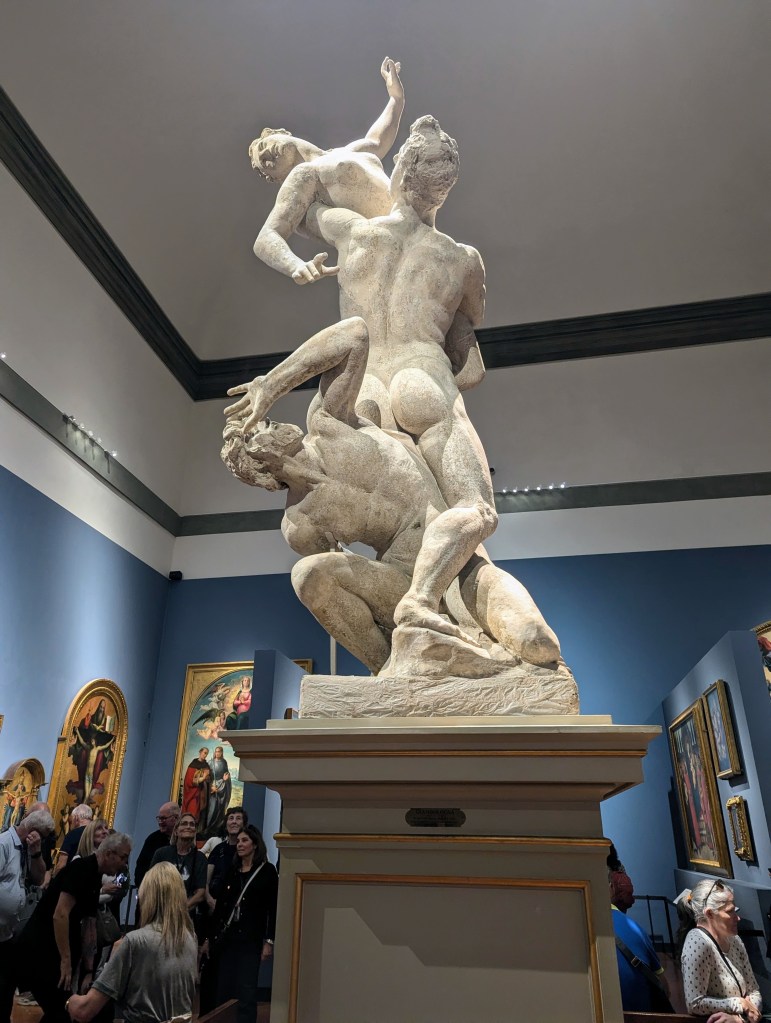
After the tour we chose not to go into the Uffizi, having done so on our first trip to Florence. But we did want to go back and revisit the David. So after lunch, we headed to the Galleria dell’ Accademia di Firenze. First we made our way through a large collection of paintings by Florentine artists. Next we saw Giambolgna’s full size plaster model for his statue Rape of the Sabine women.

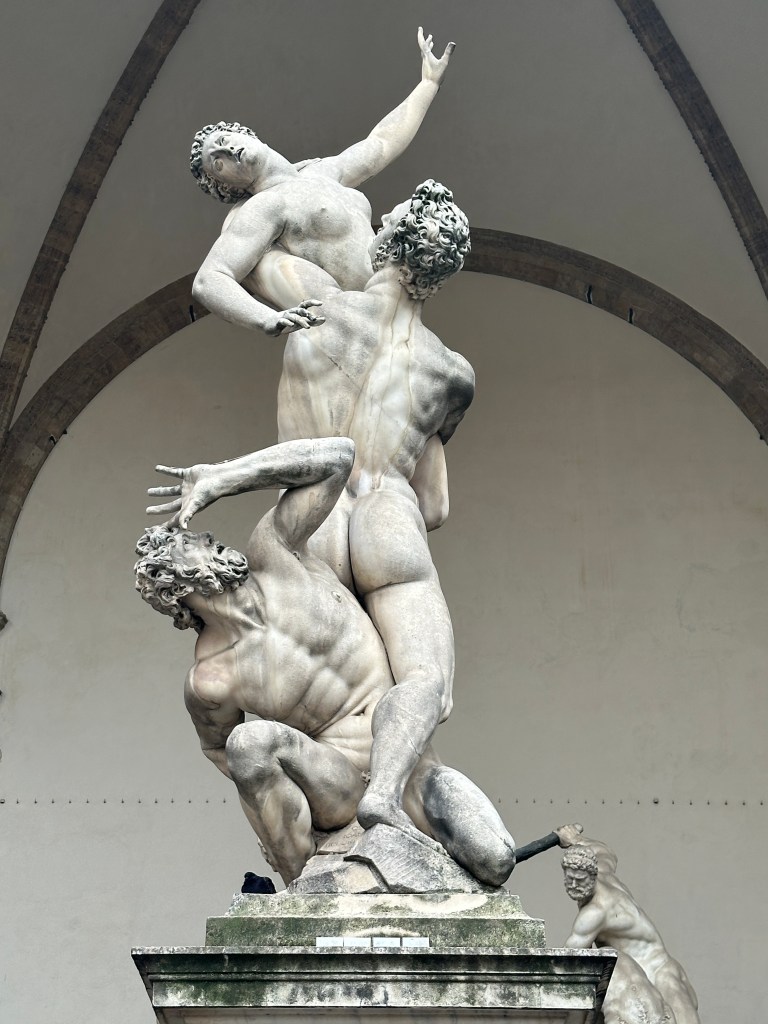
The 16th-century Italo-Flemish sculptor sculpted a representation of this theme with three figures (a man lifting a woman into the air while a second man crouches), carved from a single block of marble. This sculpture is considered Giambologna’s masterpiece. The original is in the Loggia del Lanzi.

Finally we came to the works of Michelangelo including his set of 4 prisoners “escaping” from the marble.

and the Palestrina Pieta, which recently has come into question whether it is by Michelangelo.

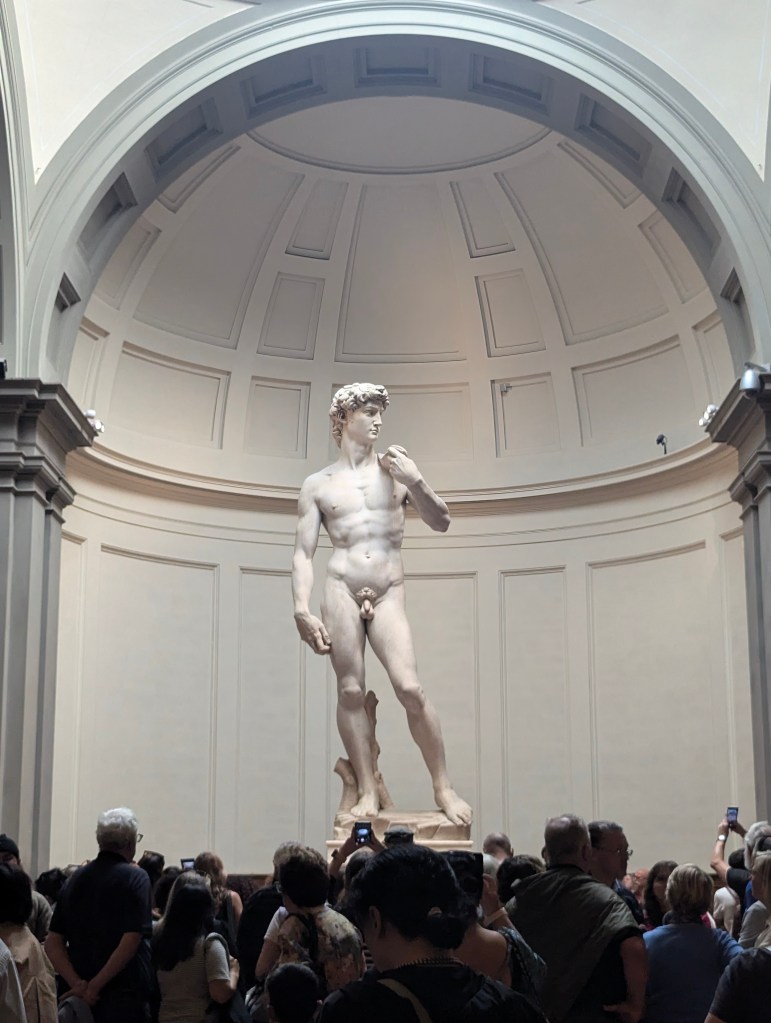
And finally the David. The statue was originally meant for the cathedral, but it was too heavy to be lifted once finished. It was then placed in front of the Palazzo Vecchio (where the copy now stands). The Academia was built to house the David for conservation purposes, and it has been housed there since 1873.

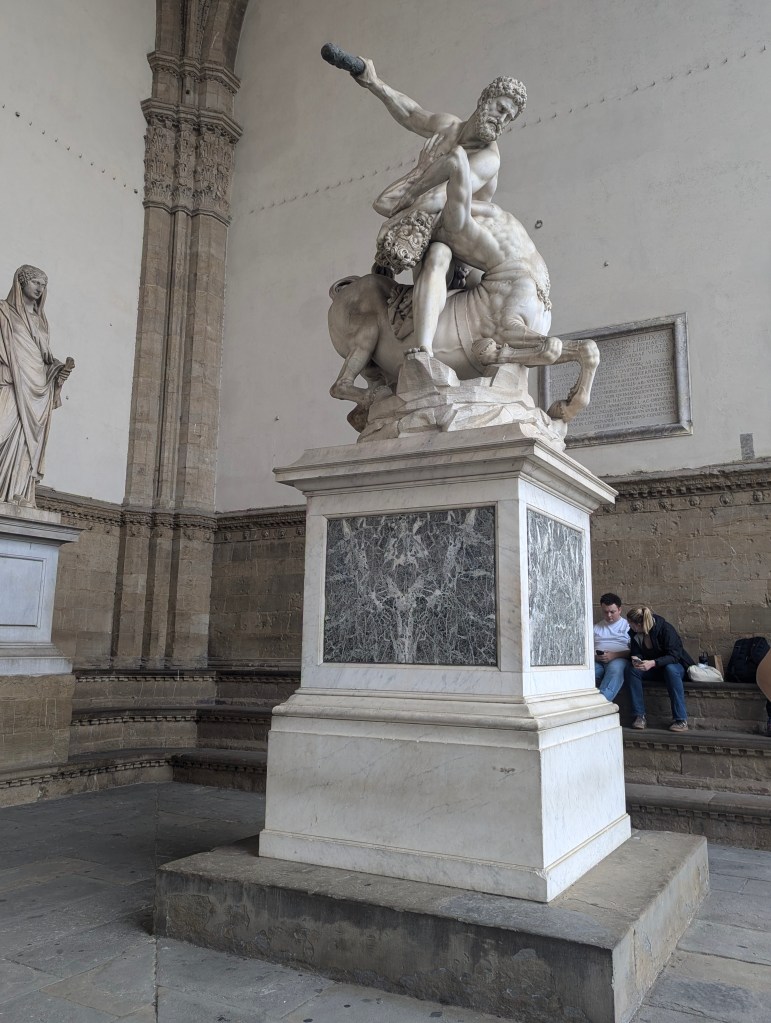
After leaving the Academia, we wandered back to the Loggia dei Lanzi in the Piazza della Signoria to take a closer look at some of the statues there, realizing now that except for the David, they are the originals. We were particularly drawn to Giambologna’s Hercules and Centaur

Hercules and Centaur

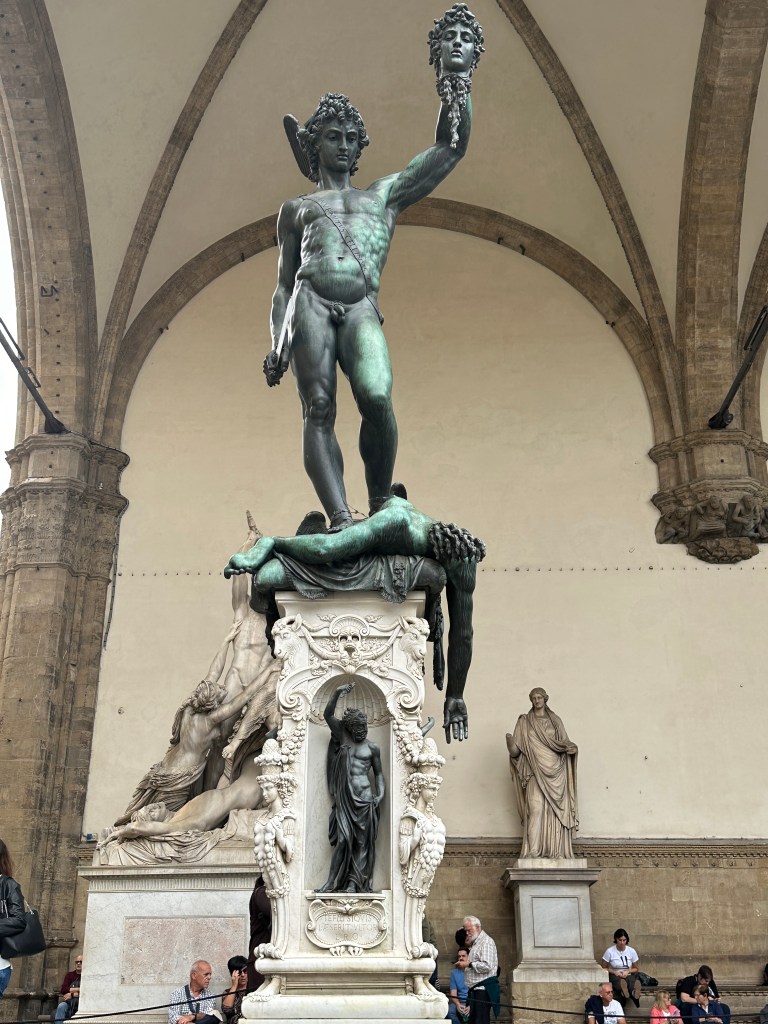
and Perseus by Benvenuto Cellini (1513-1571).

Perseus

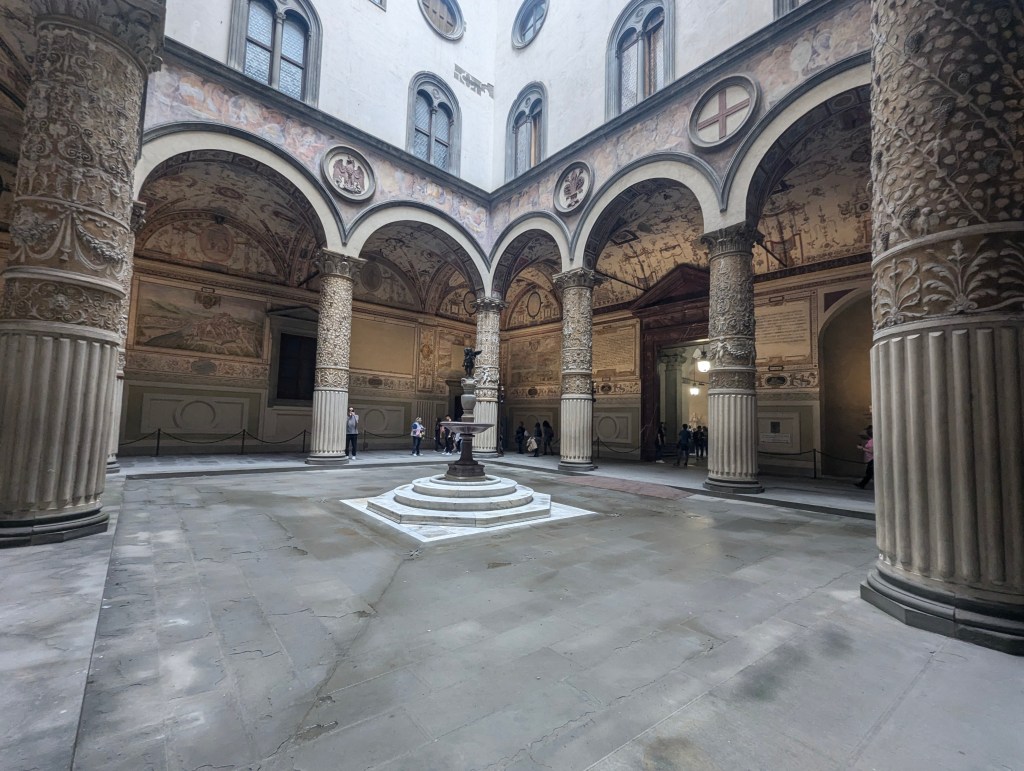
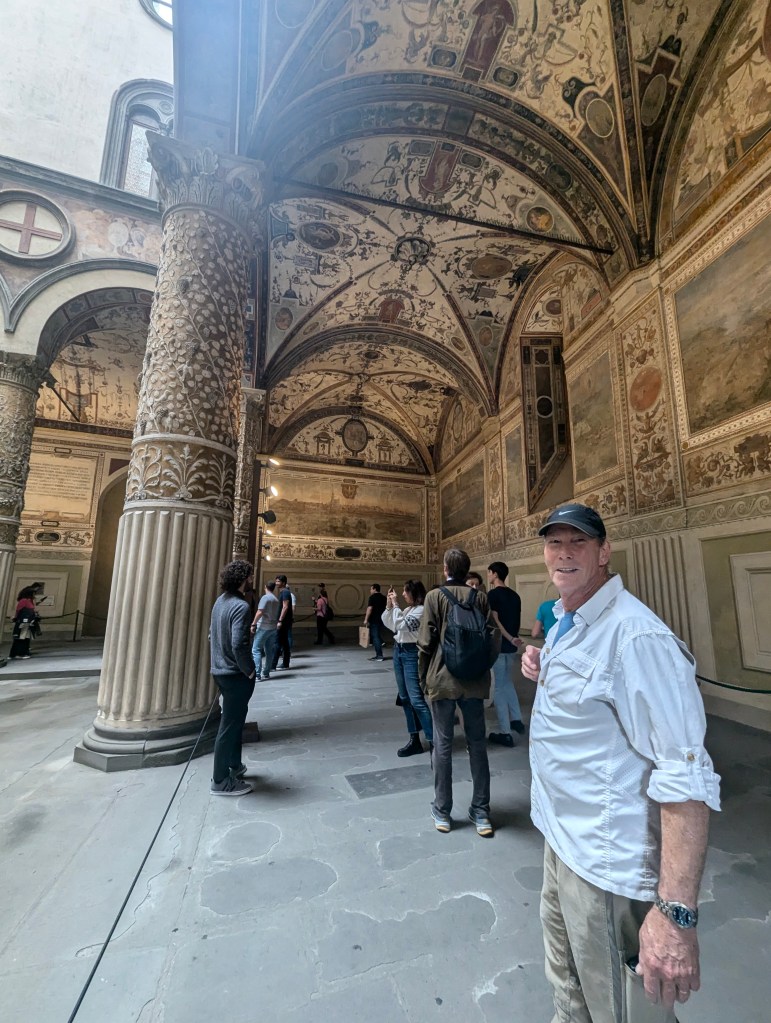
We also entered the courtyard of the Palazzo Vecchio.

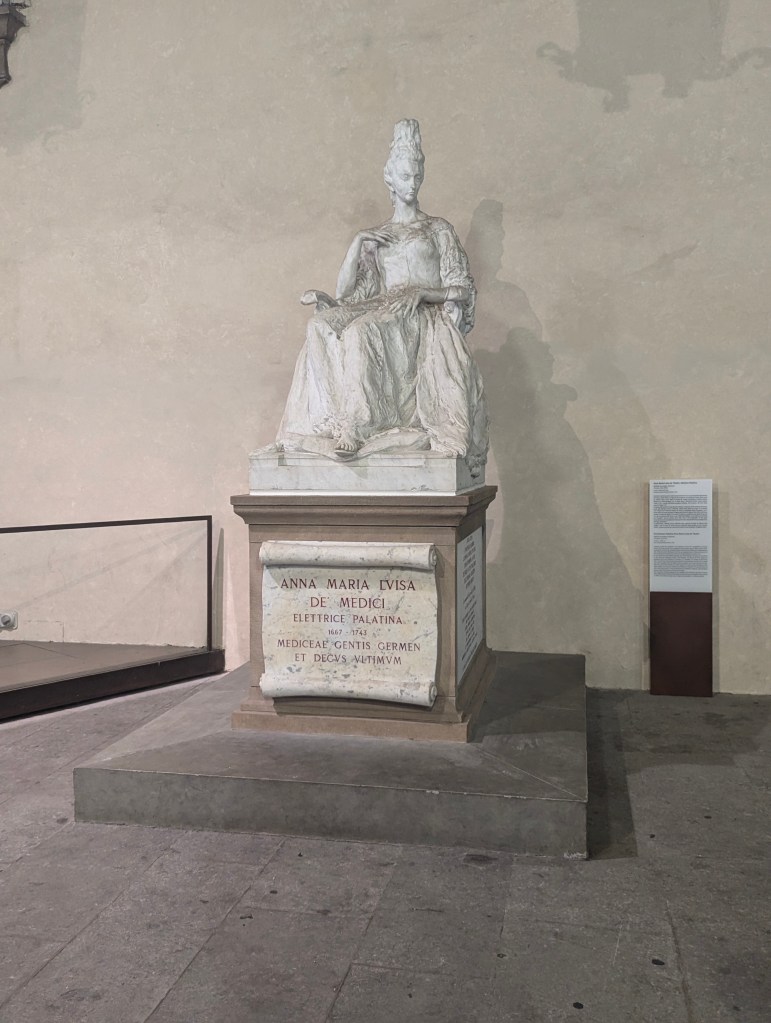
There we found a statue of Anna Marie Luisa de Medici, the last heiress and benefactress of the Florentine art world.

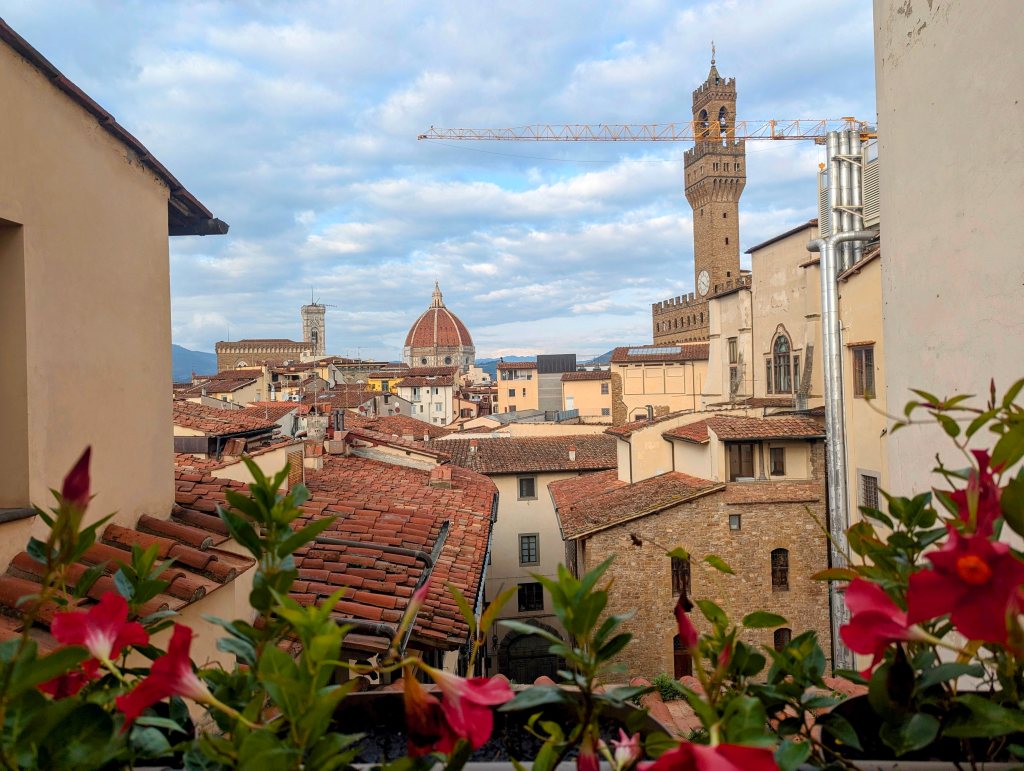
After a long day of touring, we treated ourselves to drinks on our rooftop terrace, its view another reason for our return to Hotel Degli Orafi.

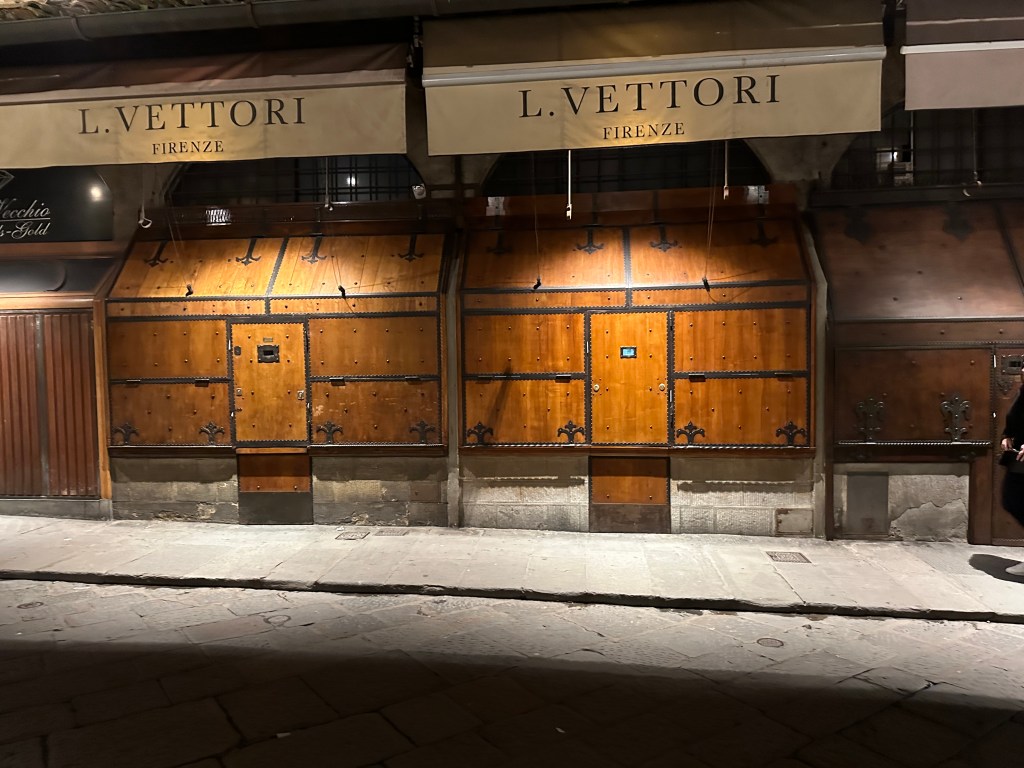
For dinner we again crossed the Ponte Vecchio to the other side. Its many shops, most of them jewelry, were closed for the night.

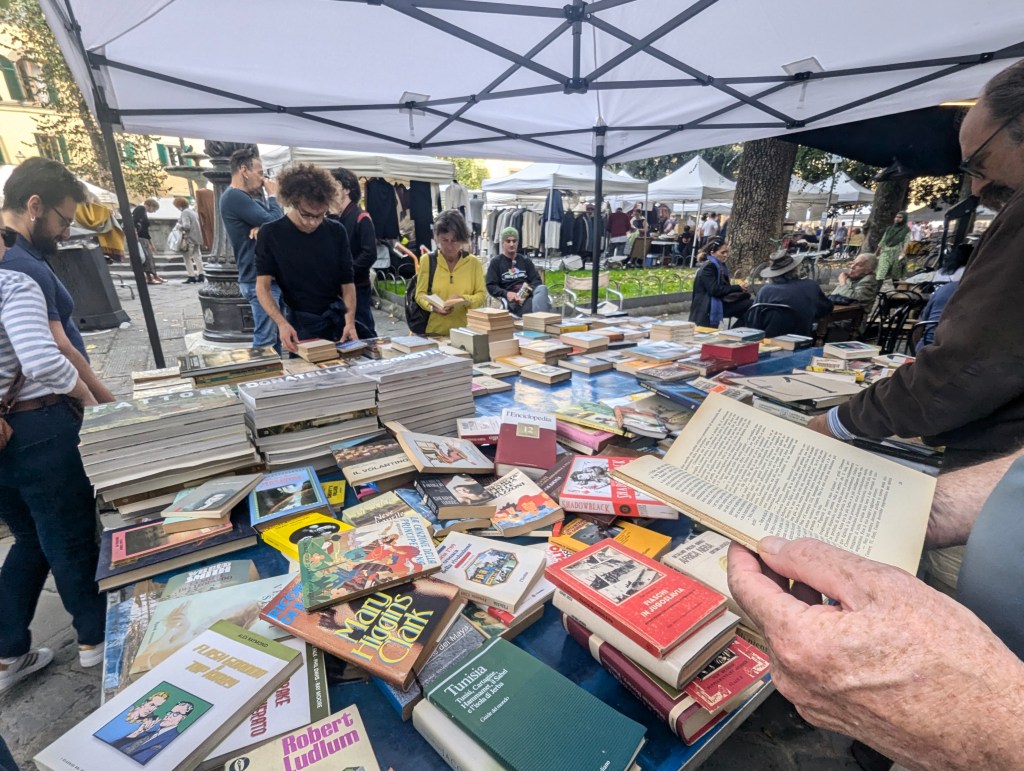
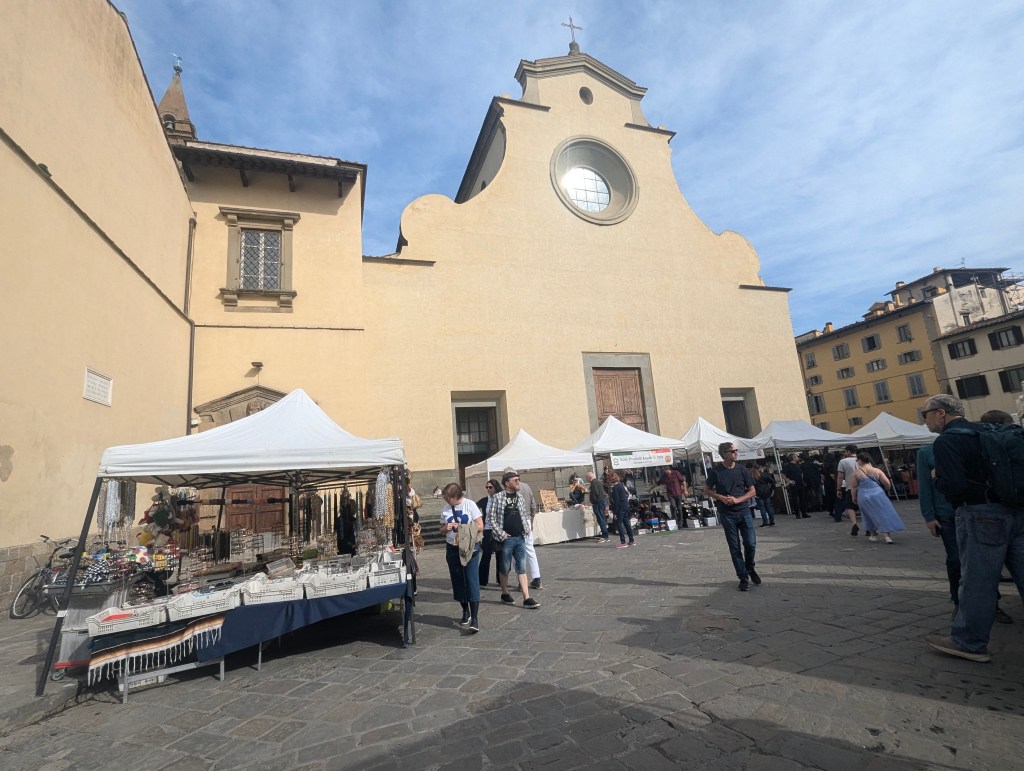
Our first stop, after another amazing breakfast, was the Sunday Santo Spirito Market, as recommended by Giacomo. Established in Florence in June 1986, the market has been a recurring event held on the second Sunday of every month.

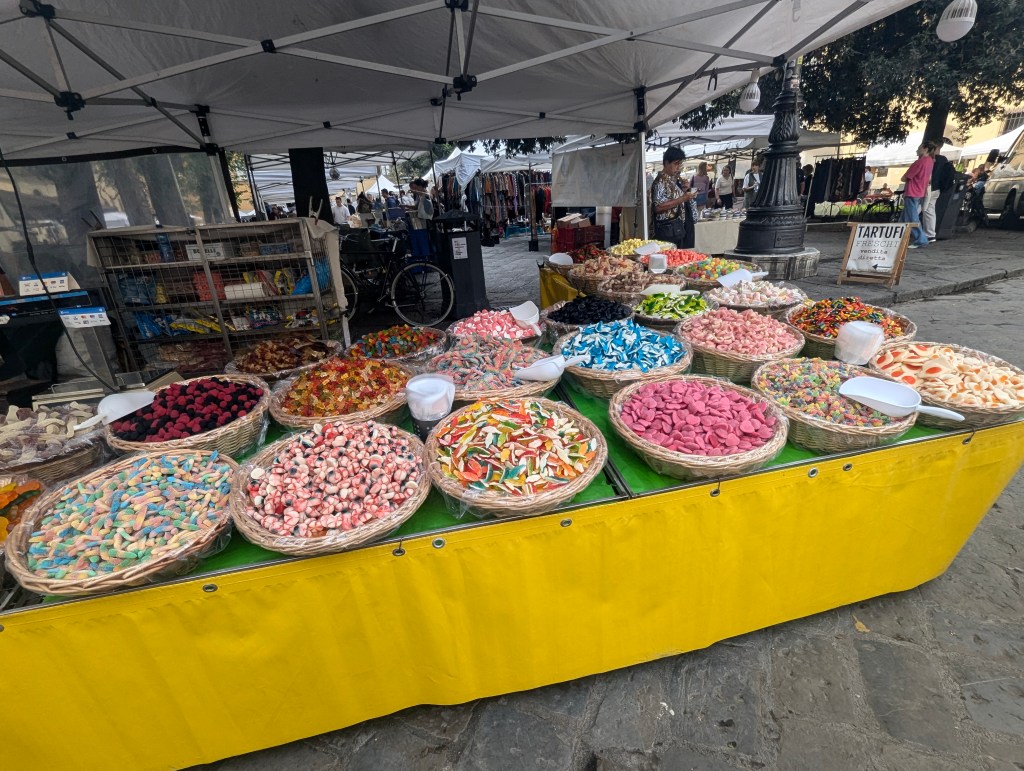
With over 100 vendors, the market specializes in small antiques, features a dedicated section for organic food, plants, and flowers, and offers everything from candies

ceramics

books

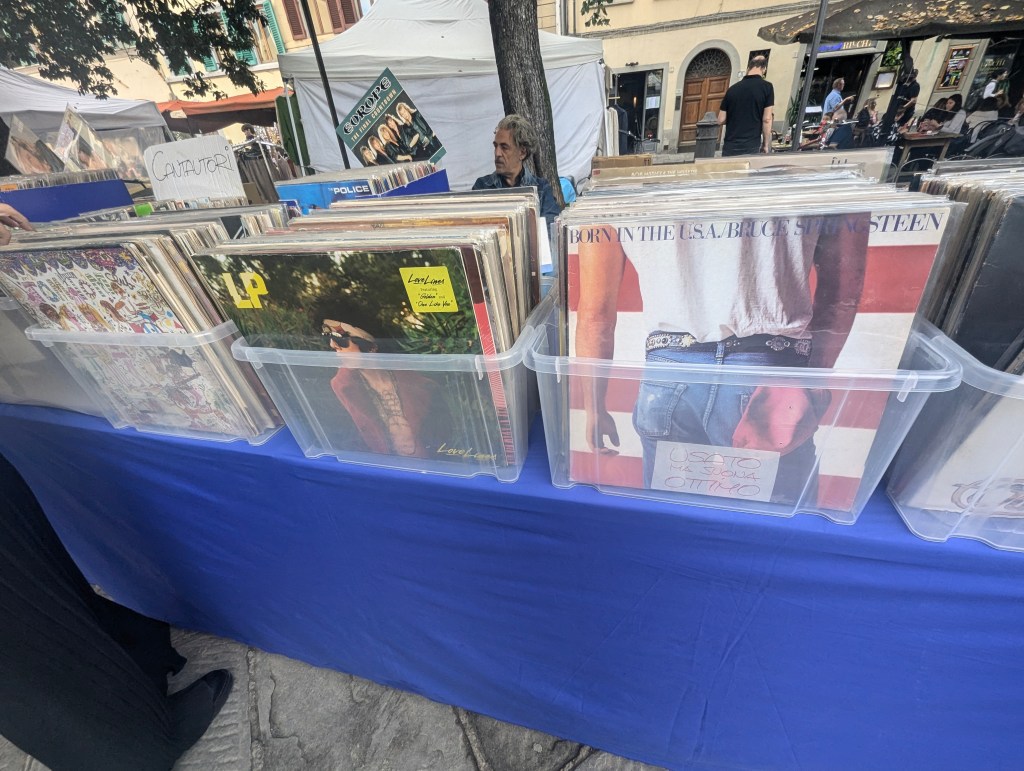
and vinyl

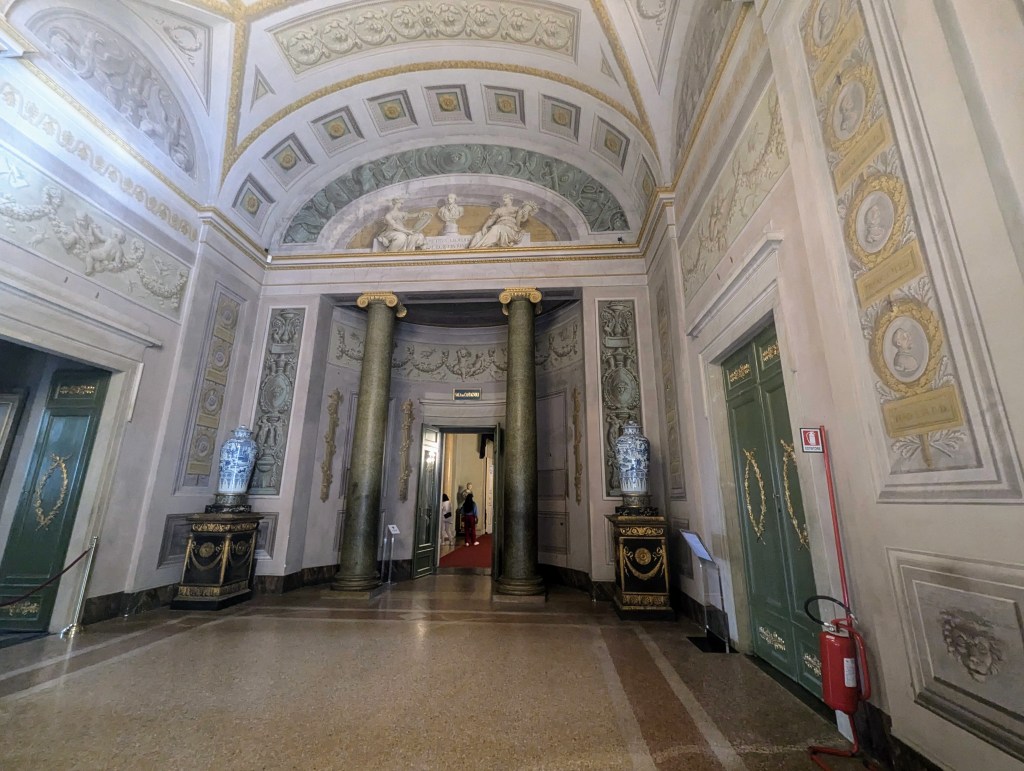
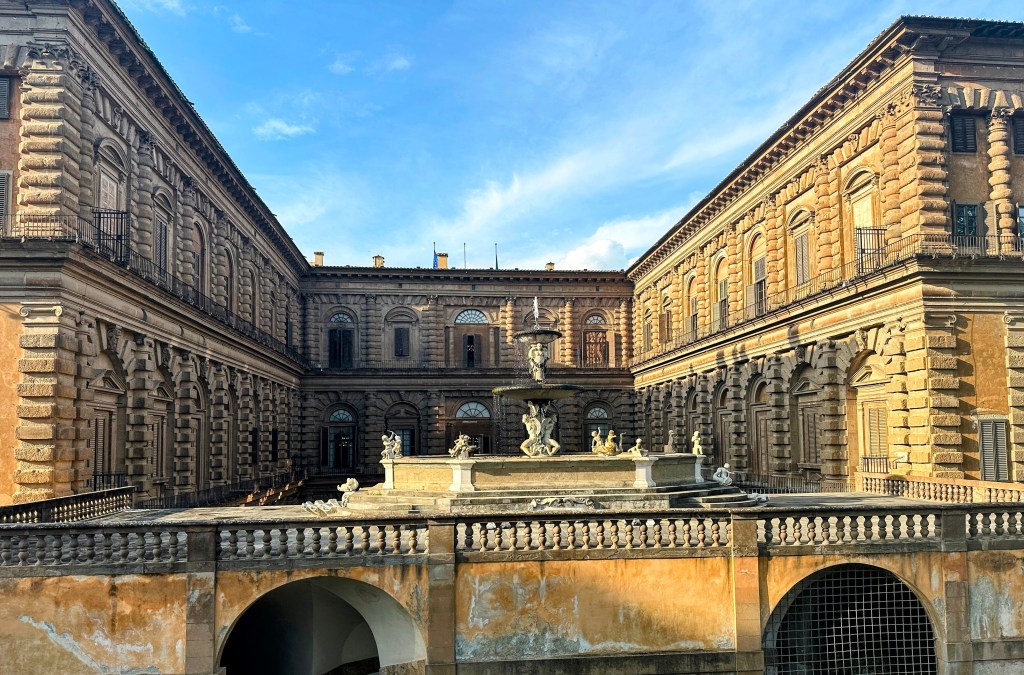
After rummaging around in the market for a while, it was time for our deep dive of the day: the Pitti Palace. Situated on the south side of the River Arno, not far from the Ponte Vecchio the Pitti Palace was the third palace of the Medicis. The palace was originally built in 1458 as the home of Italian baker Lucca Pitti. It was bought by the Medicis in 1549. It grew to be a great treasure house as later generations amassed paintings, plates, jewelry and luxurious possessions. The Medici also added the Boboli Gardens to the estate. In the late 18th century, the palazzo was used as a power base by Napolean. Amazingly, we somehow did not take a single picture of the outside of the front of the palace itself. Our first picture is of the main entrance.

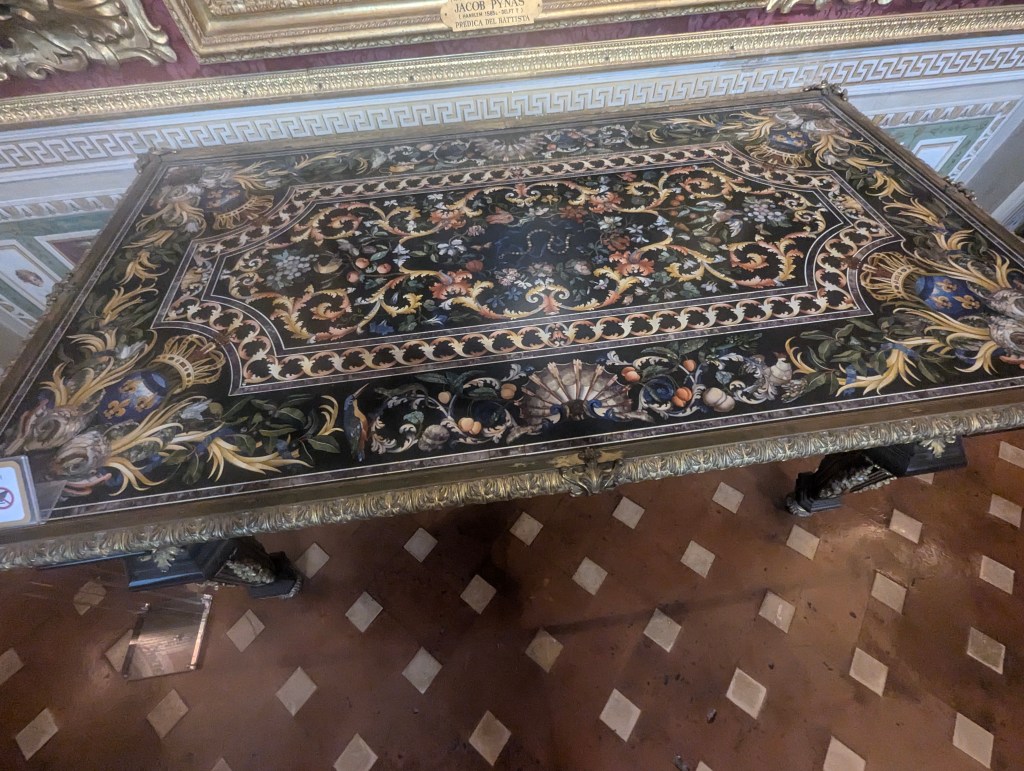
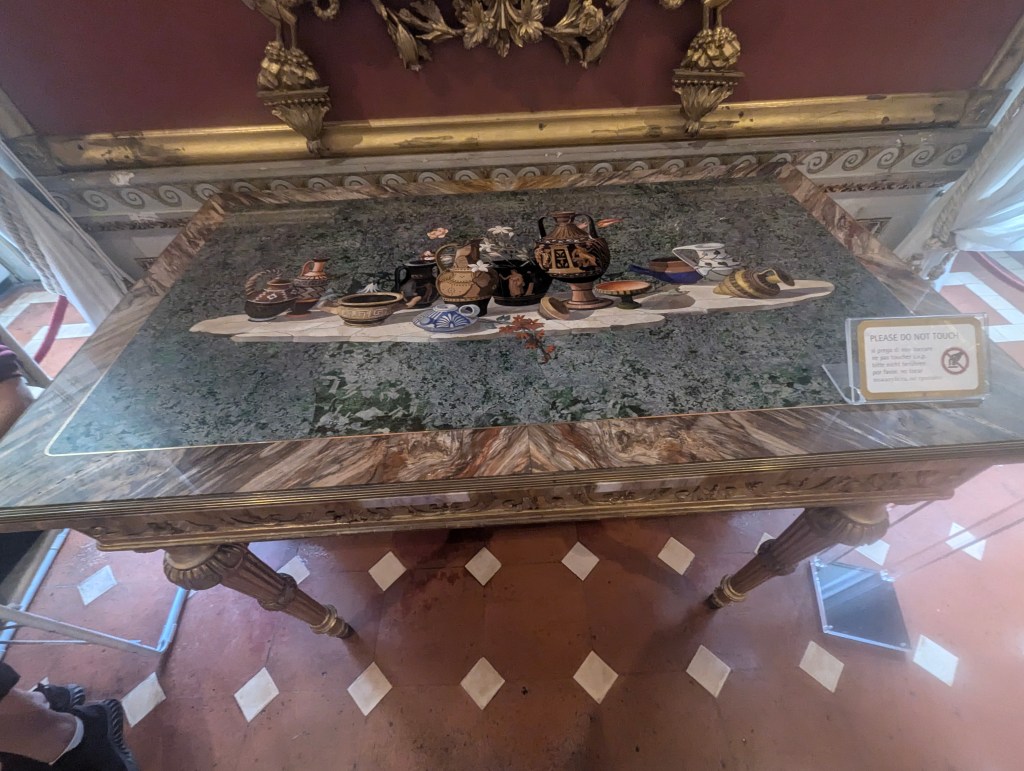
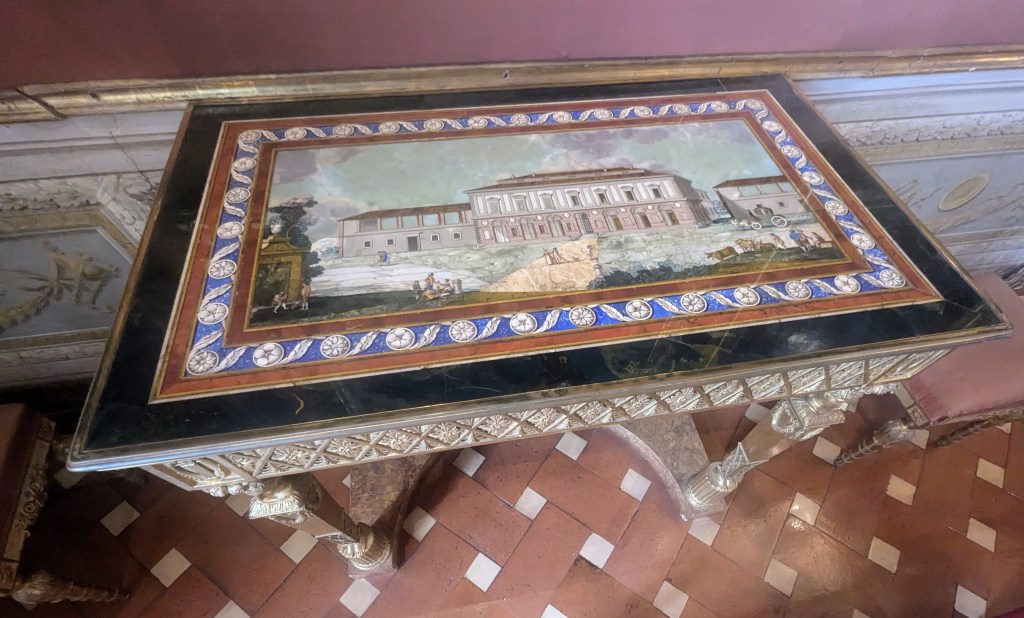
What I love about visiting palaces is that in addition to the unbelievable works of art that are frescoes on the ceilings and walls, and the numerous paintings throughout, there are the household furnishings like these inlaid tables, which are just of a few of the many that caught my eye.

Just look at this urn

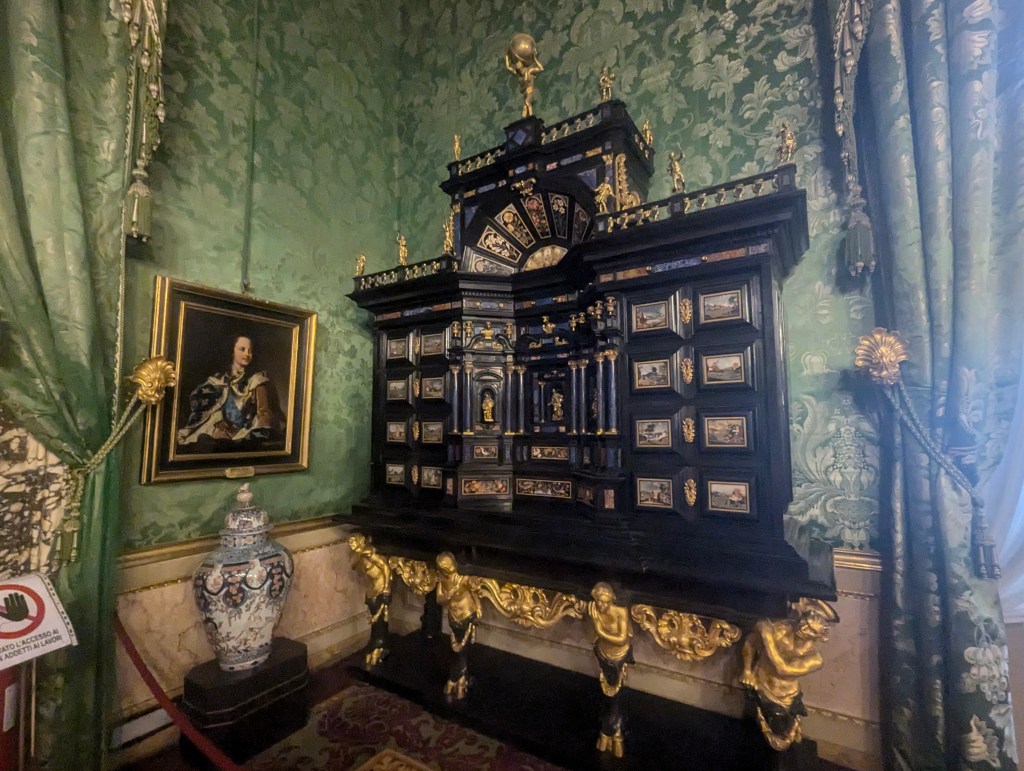
Oh, and the furniture is so exquisite.

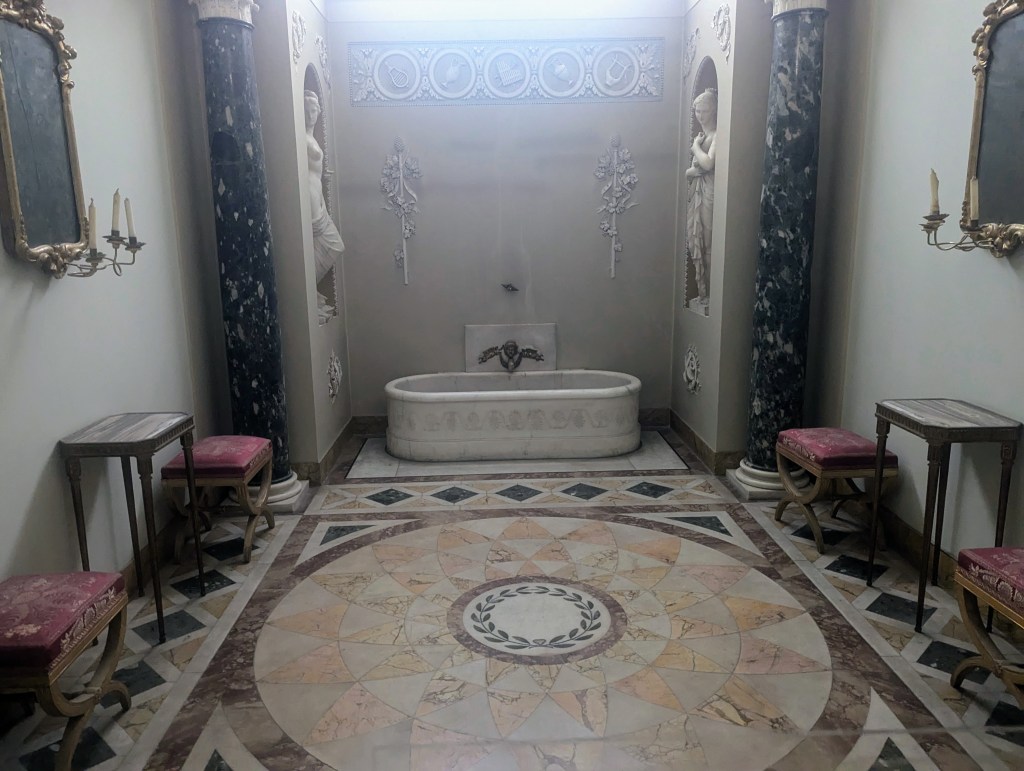
We were intrigued by this “modern” bathroom installed for Napoleon.

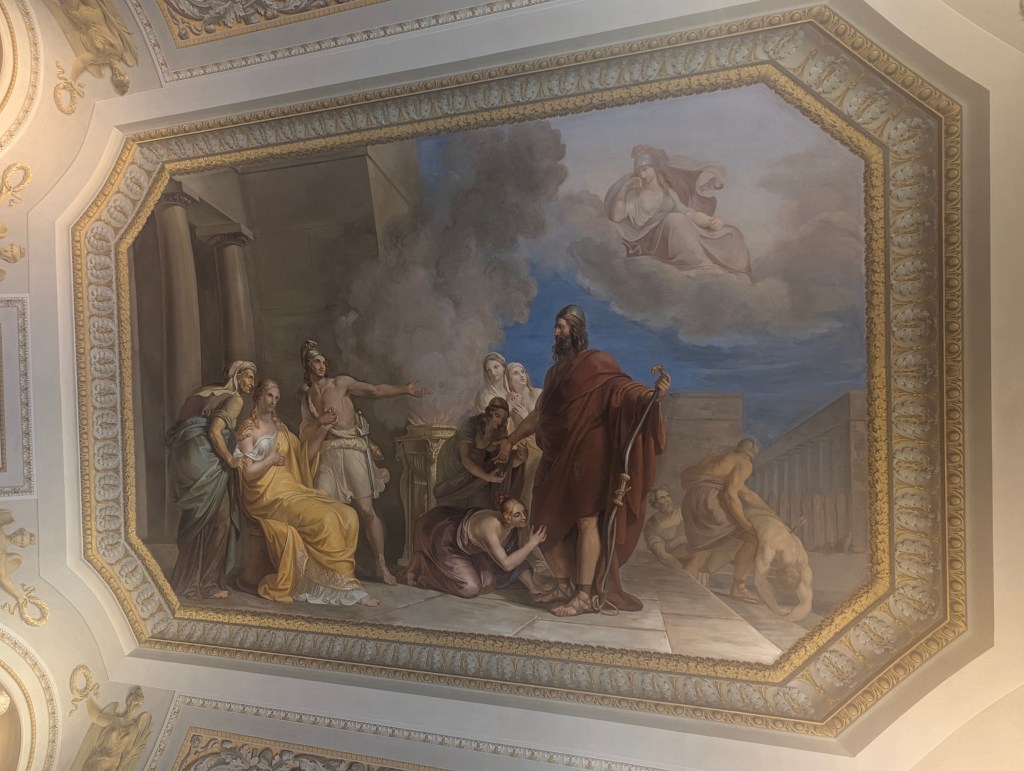
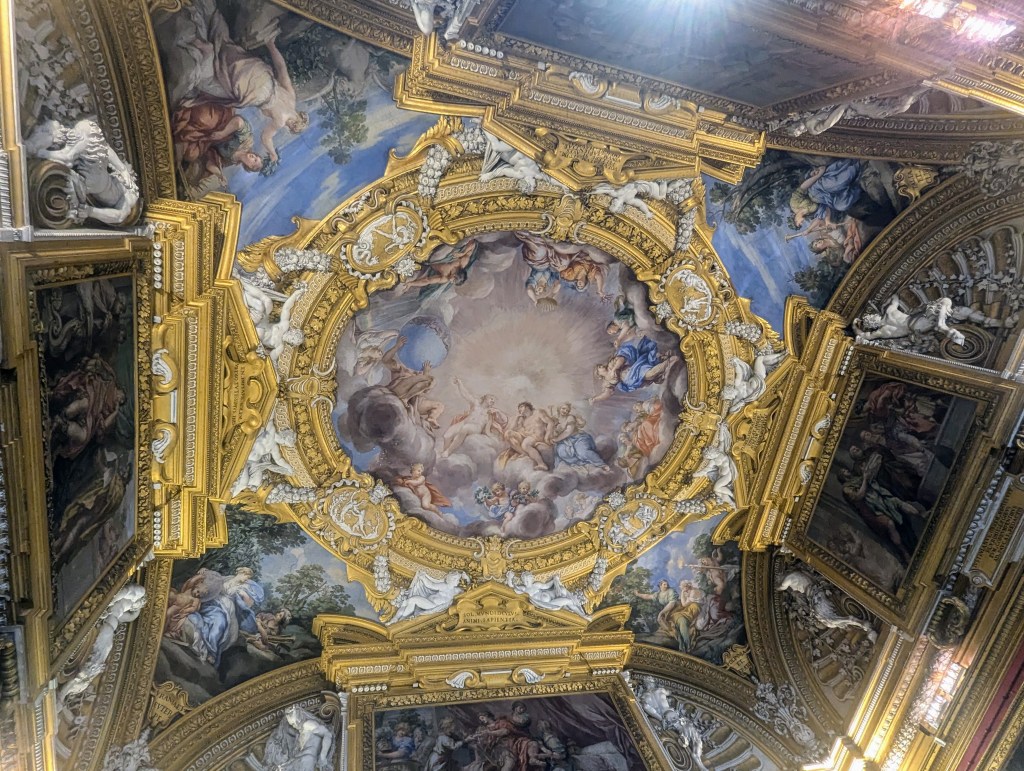
We had headsets for audio tours and diligently listened to the descriptions of the meanings of all the allegories on all the ceilings, but honestly, who can remember much of it. Suffice it to say the frescoes are mind-boggling.

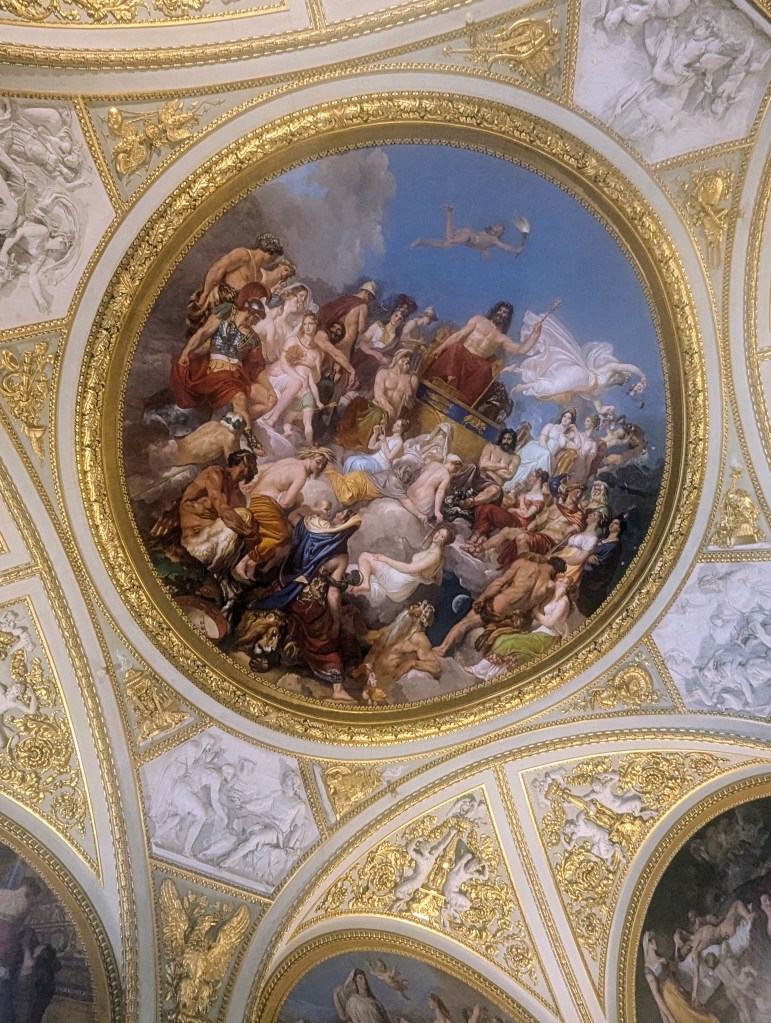
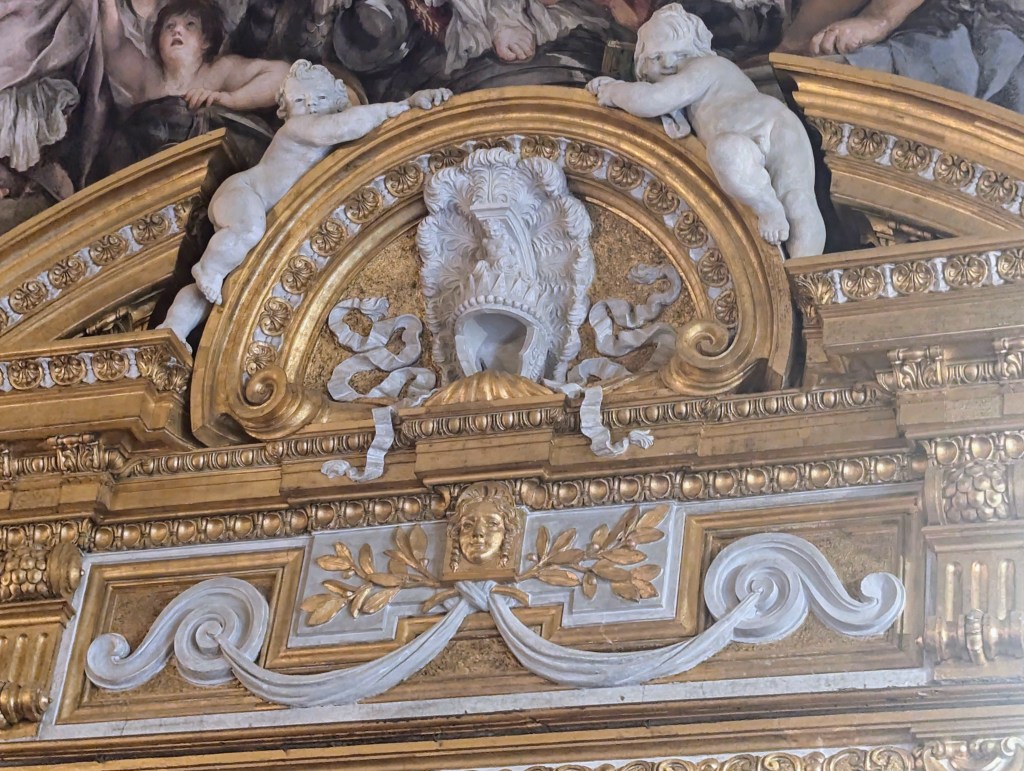
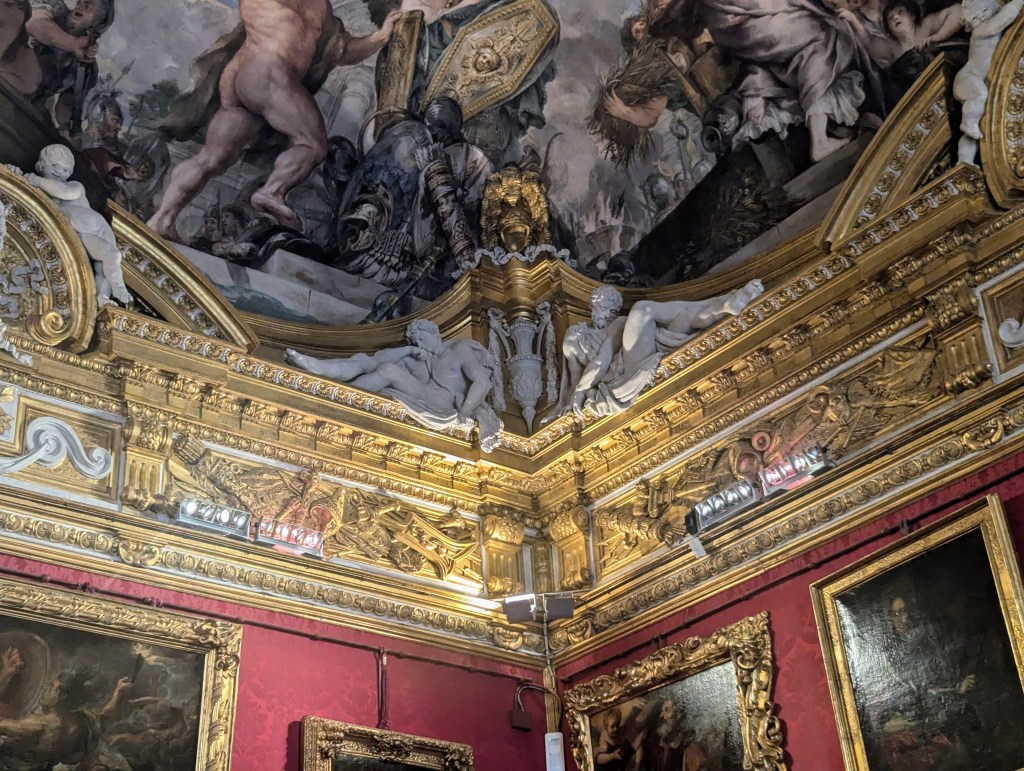
as are the many moldings and architectural details throughout.

But lost in all the glitz of the frescoes and moldings are the many, many paintings hanging throughout by Italian artists: Raphael

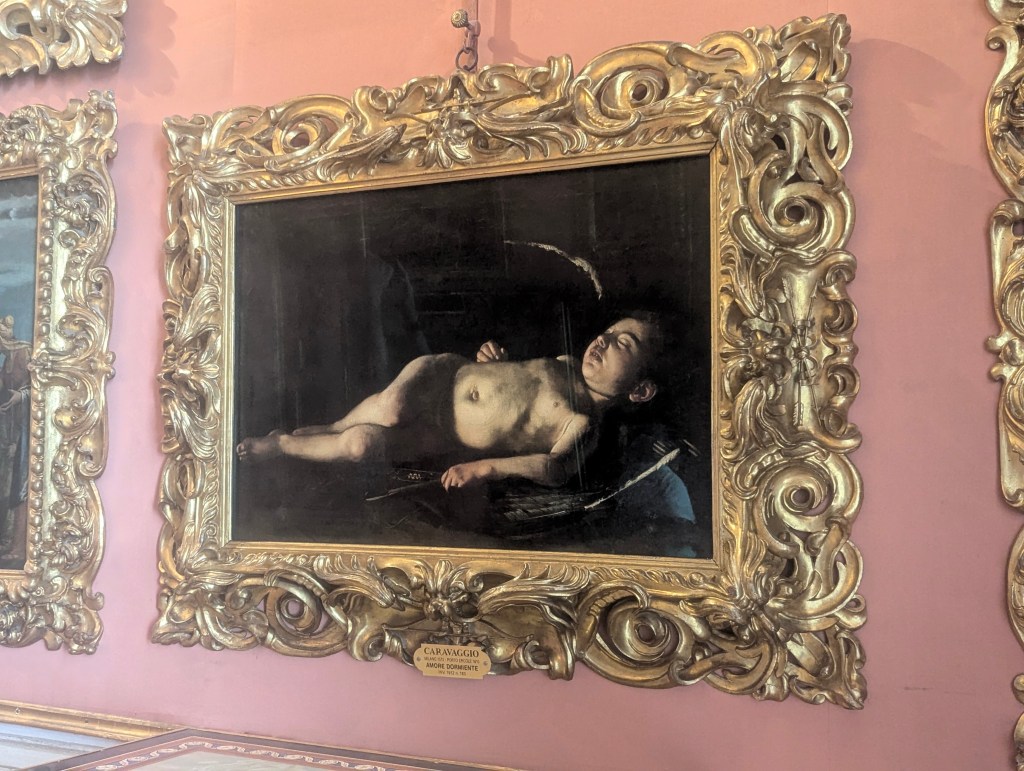
and Caravaggio

and Del Sarto, just to name a few.

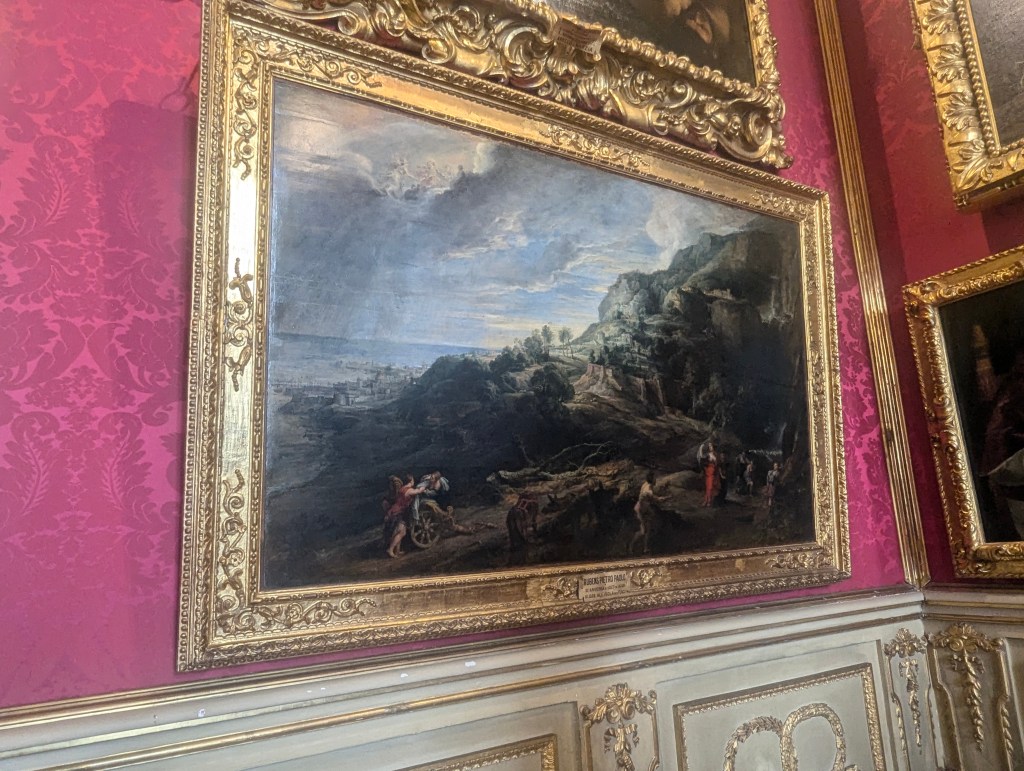
Also included are some Flemish artists like this Rubens.

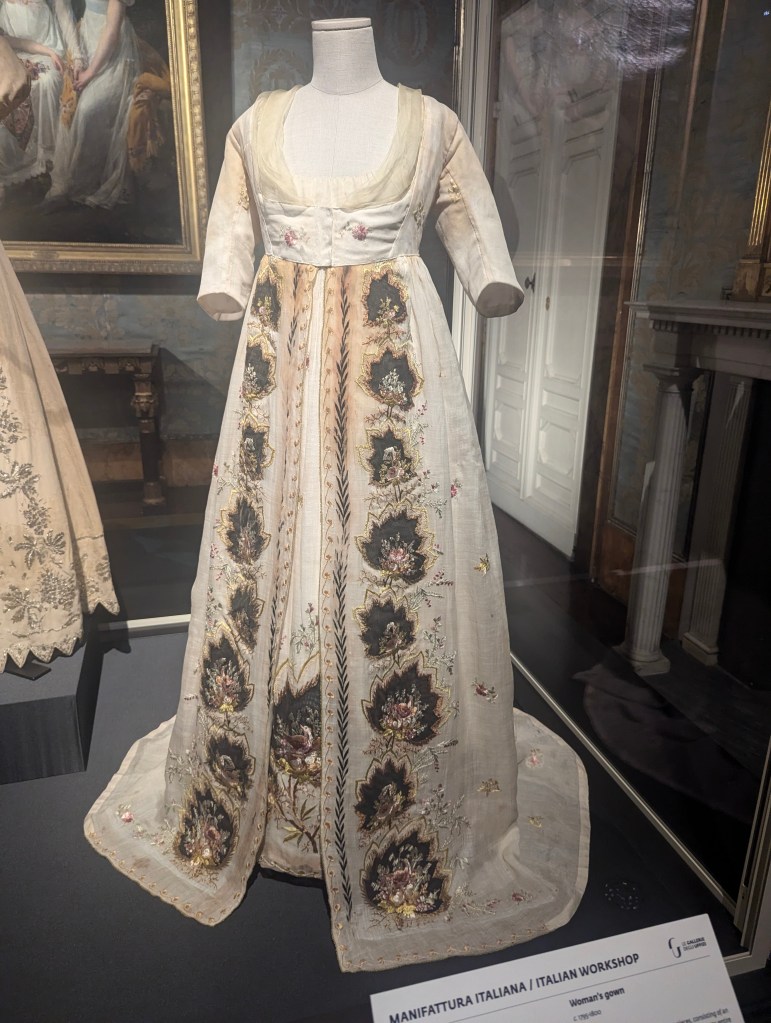
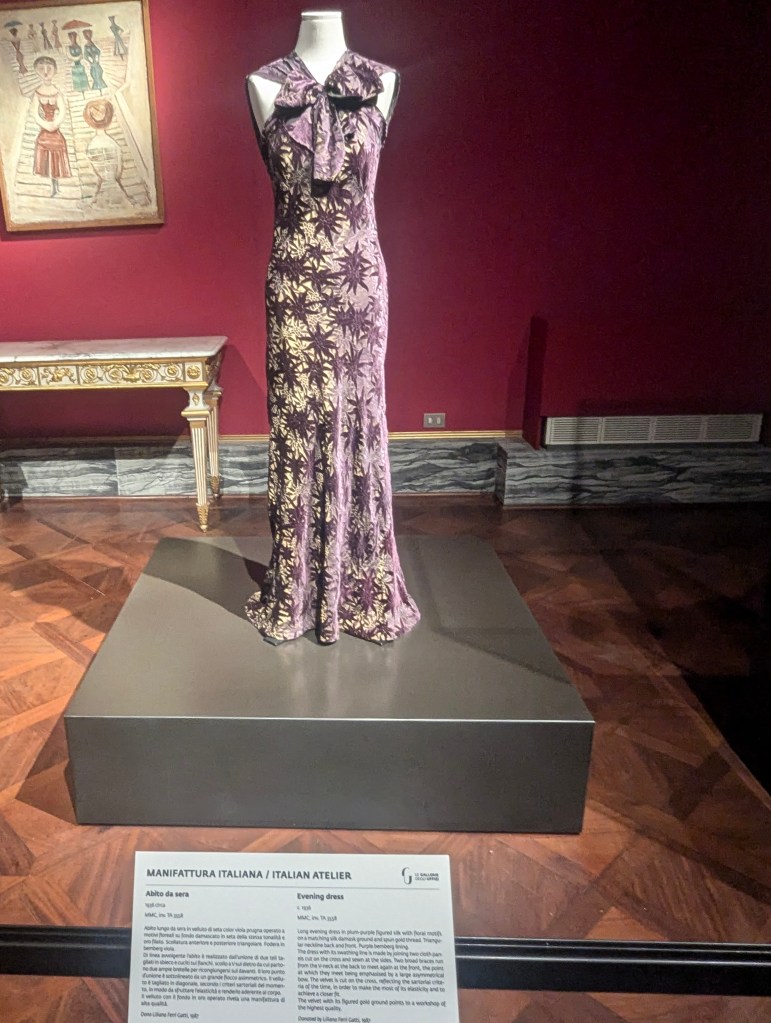
As can be seen in the picture of the urn, there ultimately was way too many paintings, way too much to look at. But before leaving the palace (after hours there) we did have to stop by the temporary exhibit which featured gowns from the 18th,

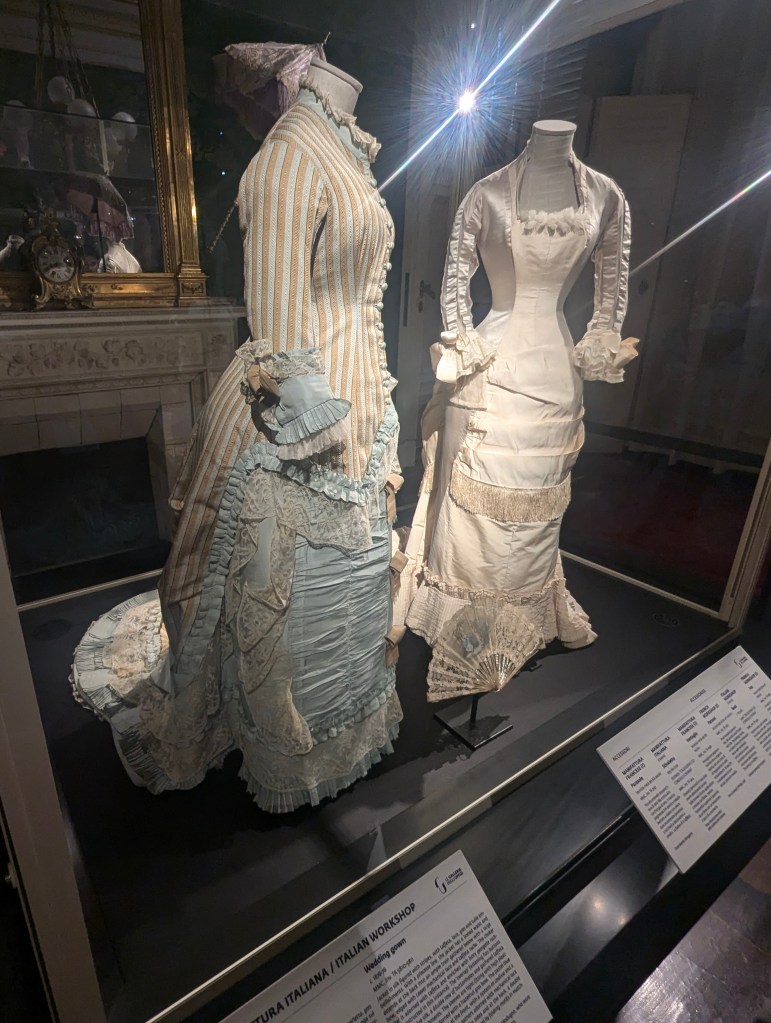
19th centuries

to the early 20th

and beyond.

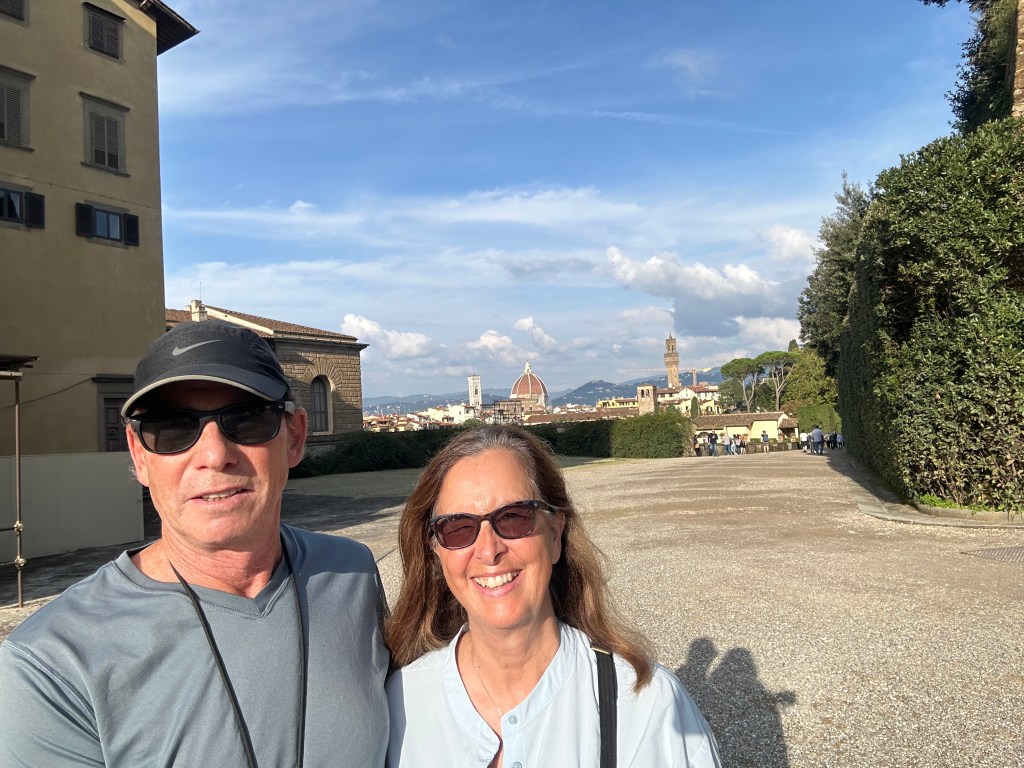
After exhausting ourselves for hours in the palace, it was time for the Boboli Gardens. The Boboli Gardens were laid out for Eleanor di Toledo, wife of Cosimo I de’ Medici. One enters from the back of the palace. At the base of the gardens is a view of Florence across the River Arno.

We failed to get a picture of the front of the palace, but this is the back entrance.

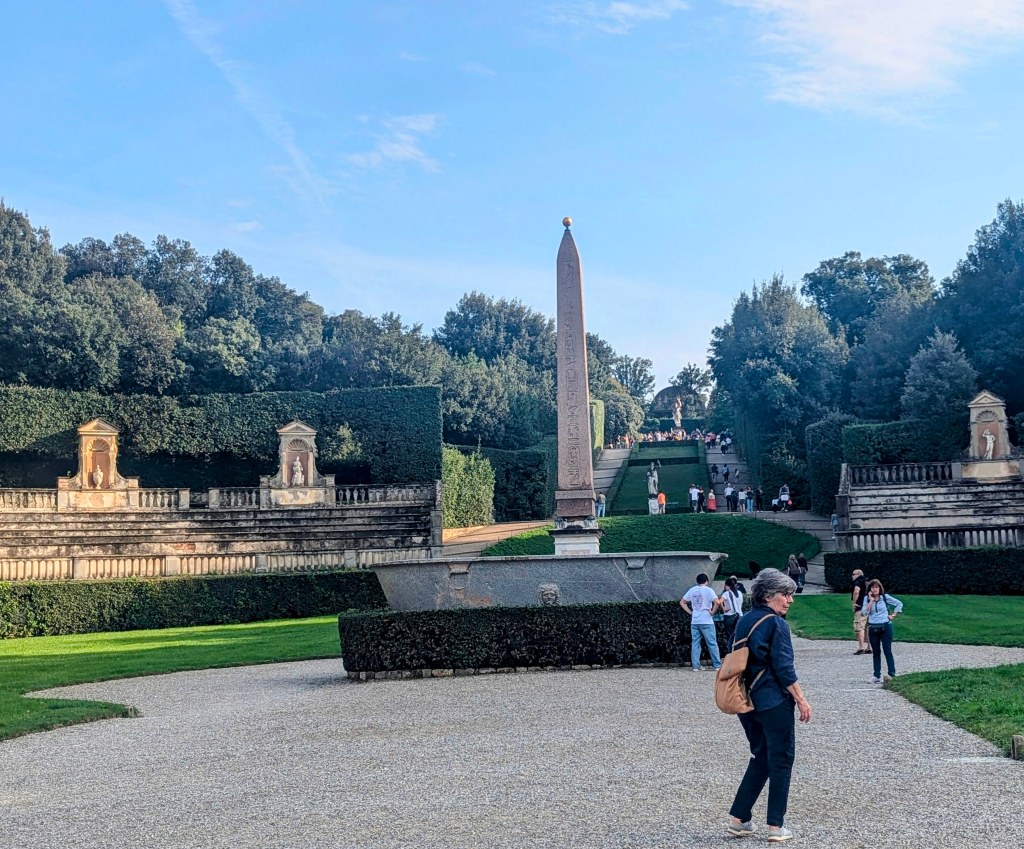
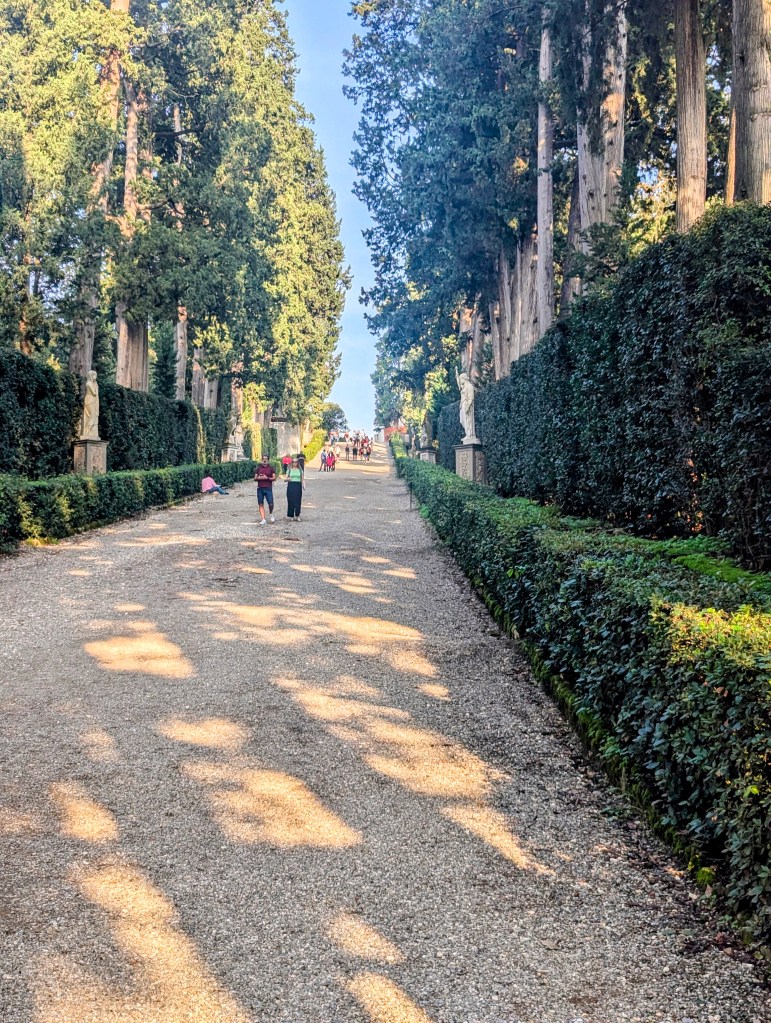
The lower part of the garden has an amphitheater-like shape at the center of which is an ancient Egyptian obelisk. The garden from there climbs a long relatively narrow path with hedges and statues on both sides.

More than halfway to the top is a statue of Neptune, a contemporary to its counterpart in the Piazza della Signoria.

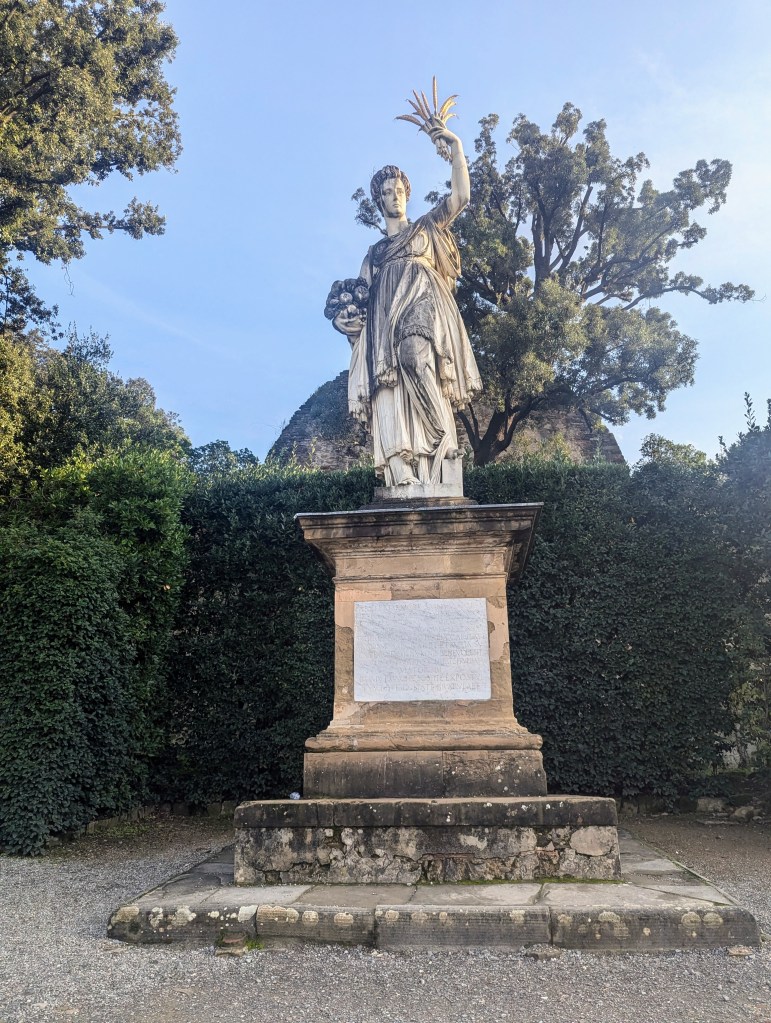
At the peak of the hill, the forceful Statue of Abundance stands out; Giambologna used Joanna of Austria, wife of Francesco I, as inspiration for its face.

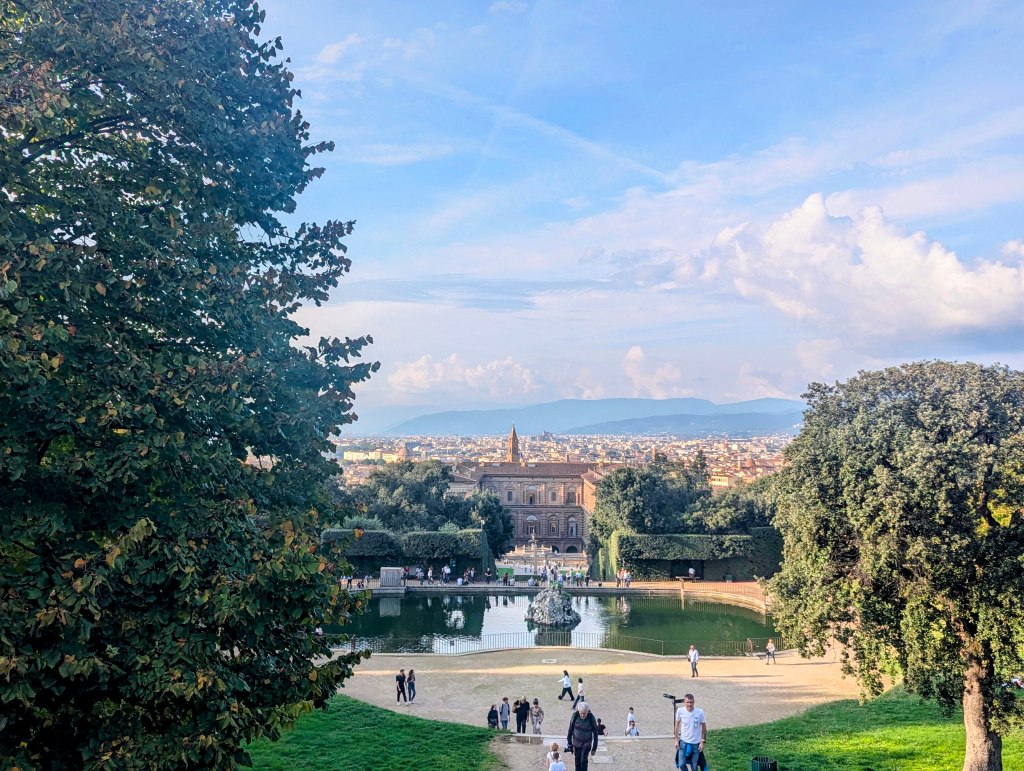
From there this is the view of the palace and Florence beyond.

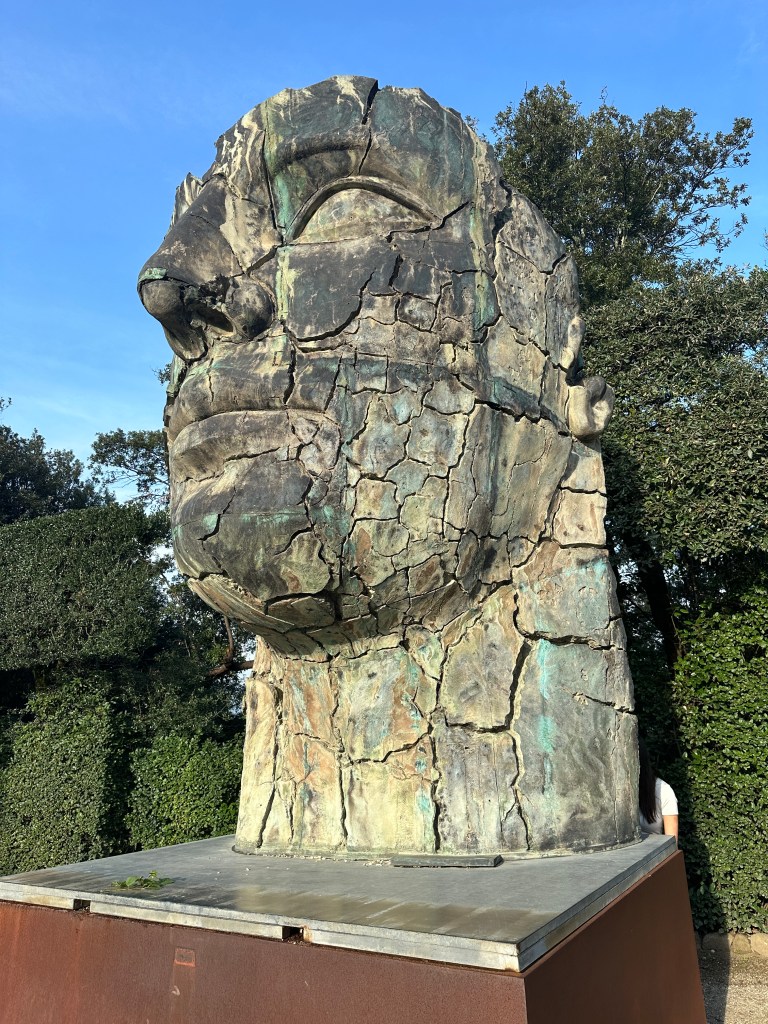
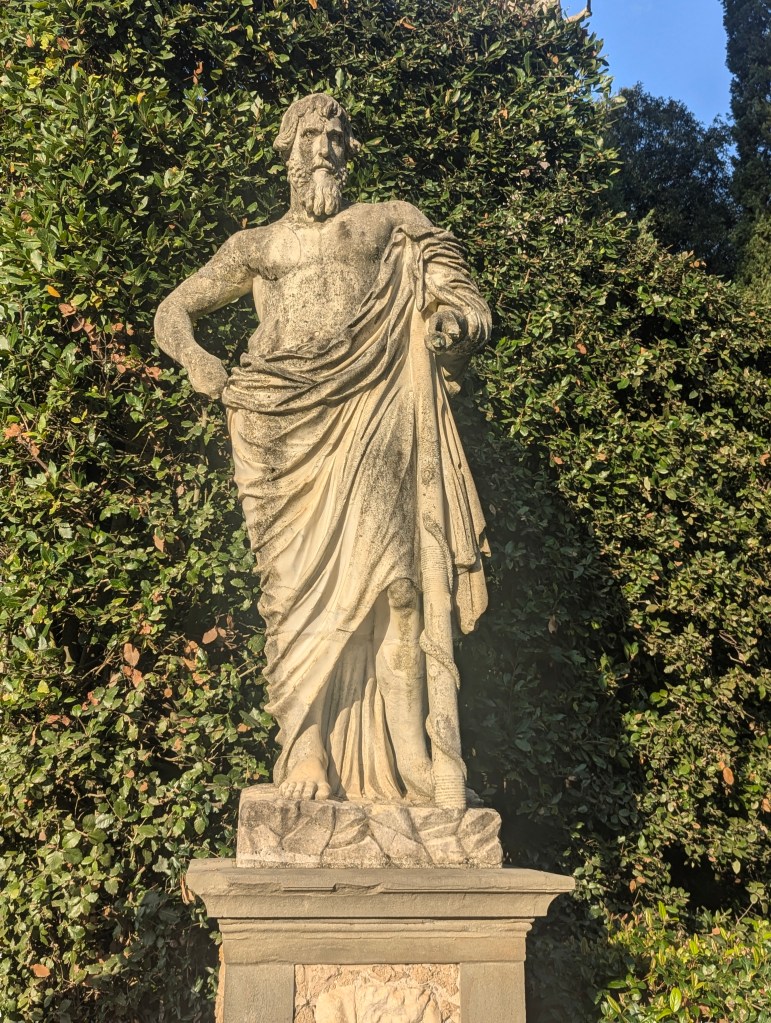
And we had not yet appreciated the extent of these gardens. We started down one side and encountered the Tindaro Screpolato, a sculpture by Igor Mitoraj (1944-2014), the only modern sculpture in the gardens. Tyndareus was the king of Sparta, father of Clytemnestra and Helen who caused the epic Trojan War in the Iliad. This sculpture is an interesting modern interpretation of an ancient story.

The path of the garden then turned parallel to the palace but moving away from it as we passed rows of trees lined with statues

both of Roman antiquity

and 17 and 18th century subjects

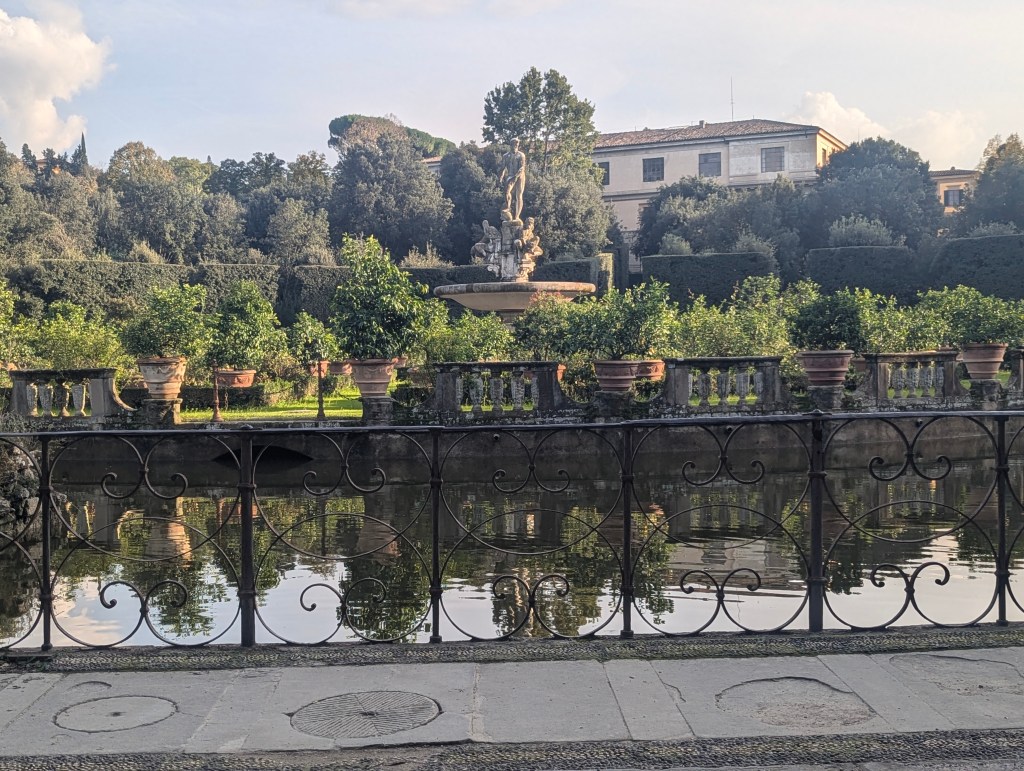
After much walking (the gardens cover 111 acres of land) we came to the the Isolotto, an oval-shaped island in a tree-enclosed pond.

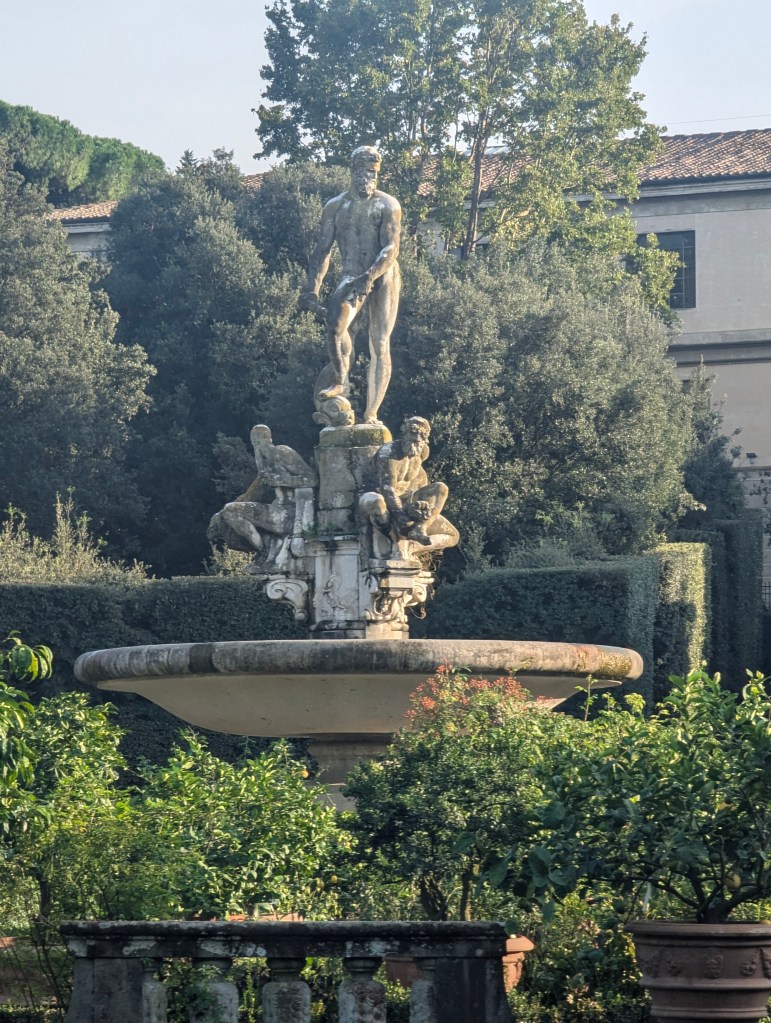
In the centre of the island is the Fountain of the Ocean.

By the time we left the garden we were thoroughly exhausted. For dinner we treated ourselves (don’t we always) to another delicious Tuscan meal including another Tuscan speciality: grilled artichokes. It was a delicious end to the Tuscan section of our journey.

Italy: Liguria: Genoa Oct. 17-18; Cinque Terre Oct. 19-22

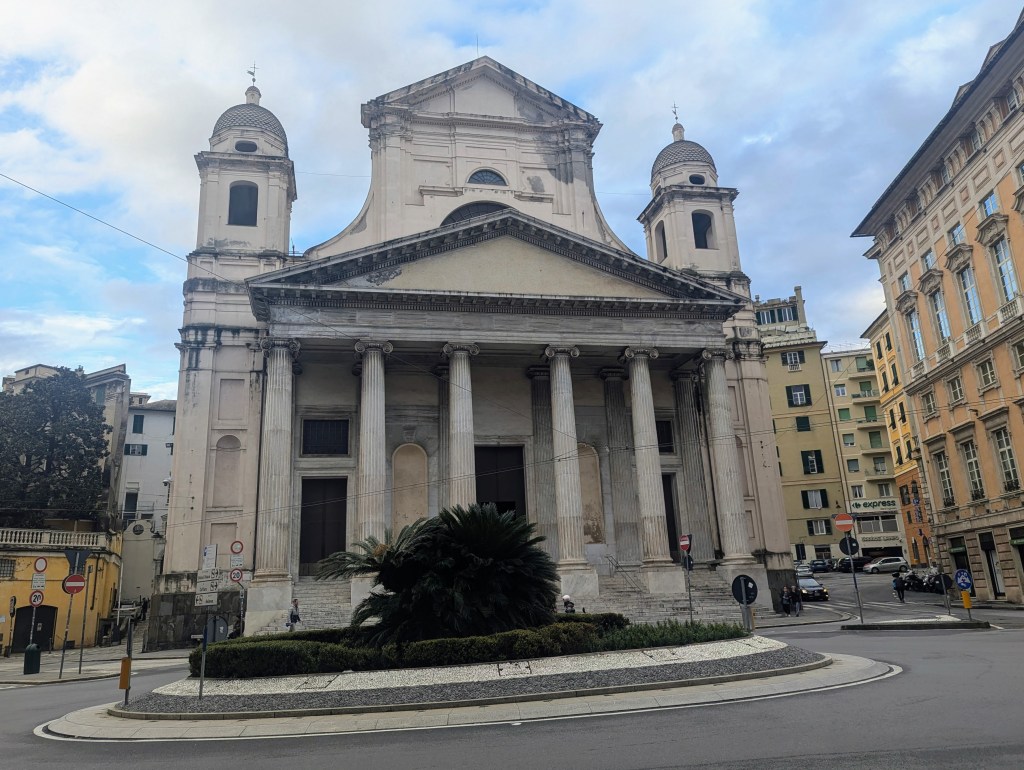
We left Como in the still pouring rain. We checked into the Grand Hotel Savoia in Genoa, which was a relic of yesteryear. According to its website …”established in 1897, in a palace whose atmospheres still evoke the joyful splendour of the Belle Époque. The refined charm of our rooms and the spacious halls in the hotel was perfectly to the taste of the Italian and European royal families who chose the Grand Hotel Savoia during their travels. Their precious Guest Book not only preserves the signatures of Italian royals, but also the most illustrious artists, actors and musicians of the last century. A meticulous salvaging and restoration has reinstated the former splendour, the majestic opulence of a late-19th century palace, the ancient charm of the building, the symbols and signs of its history.” We waited out the rain, and in the late afternoon we were able to get out and explore the city a bit. We found that actually we were on the outskirts of the Old City and had to walk a bit to get to the sites. First we visited Basilica of the Santissima Annunziata del Vastato. Vastato means “built outside the city walls,” which this basilica originally was when construction began in 1520.

Basilica of the Santissima Annunziata del Vastato

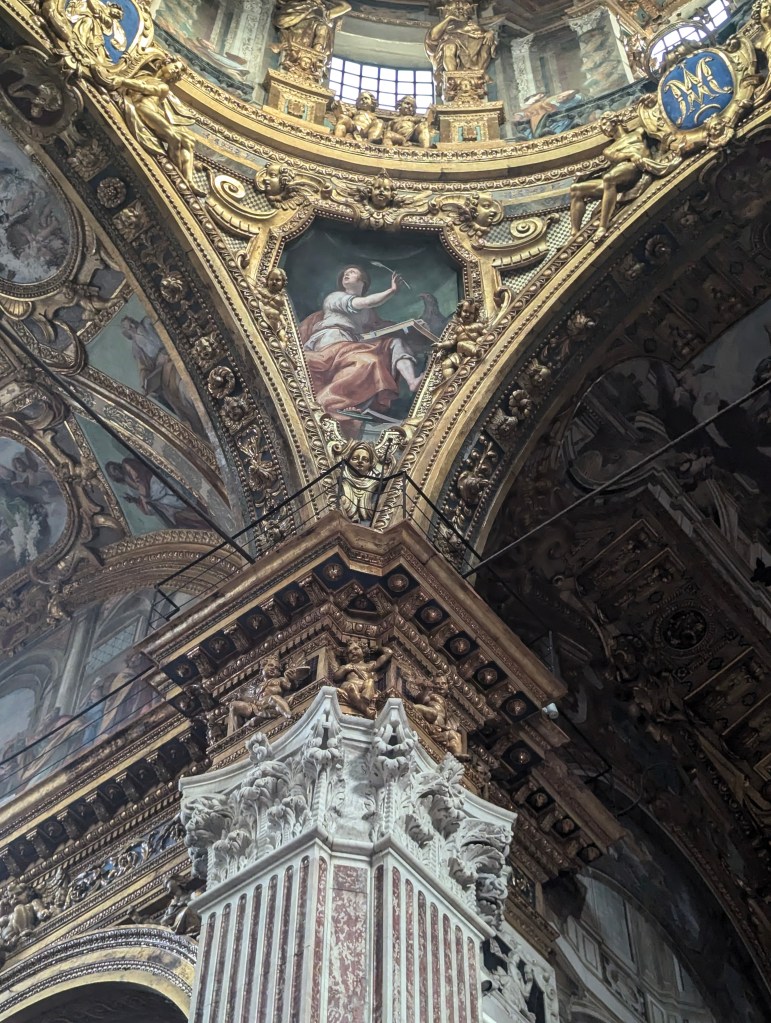
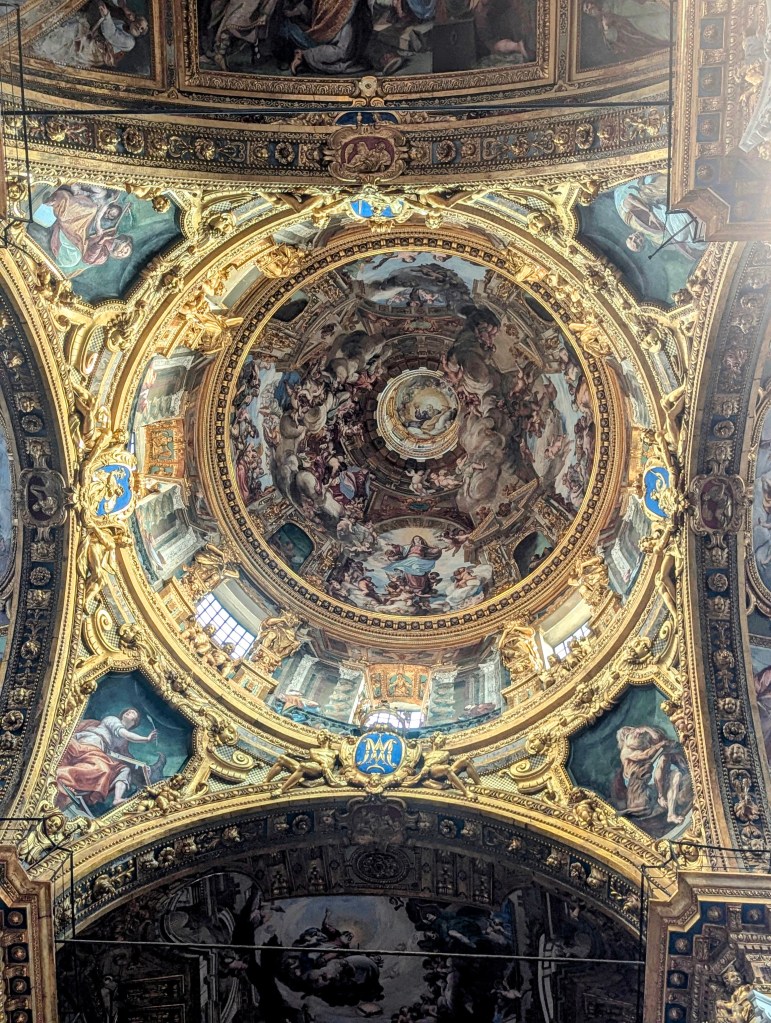
The interior is like a 17th-century gallery of art. It is lavishly decorated with inlaid marble, gilded stucco, and frescoes by 23 local artists and 13 sculptors. There was so much to see, we barely knew where to look first.

the dome

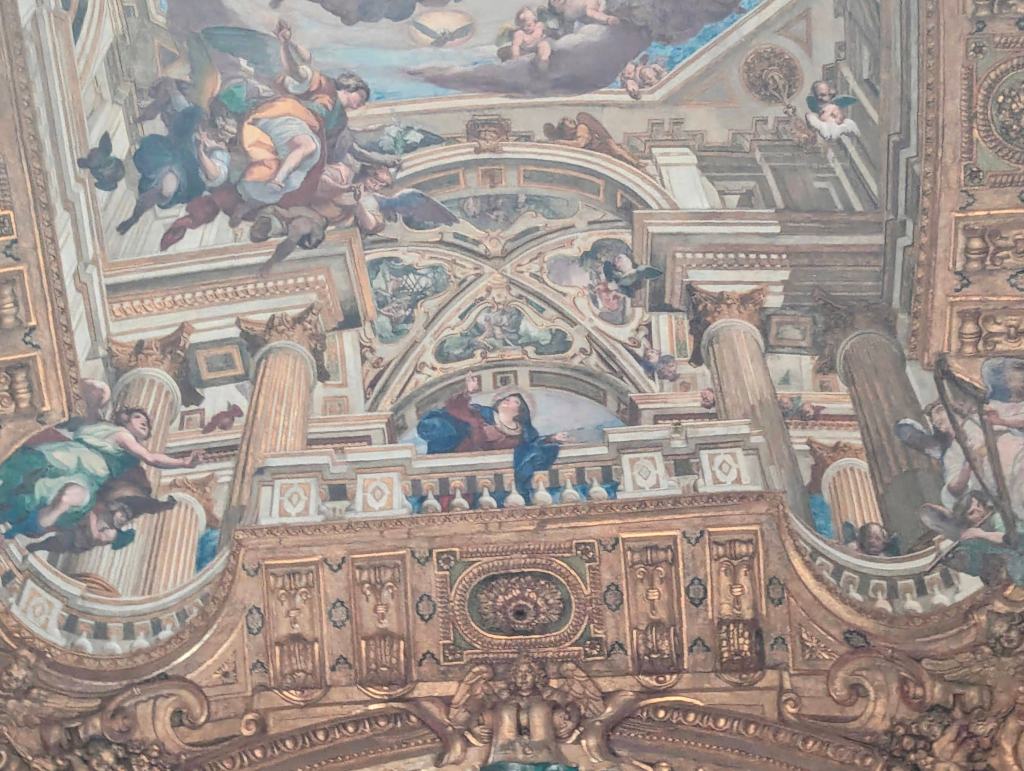
We were able to download an audio guide which explained a lot of the artwork like this fresco of Mary looking up at a ceiling full of frescos, ie frescos within the fresco.

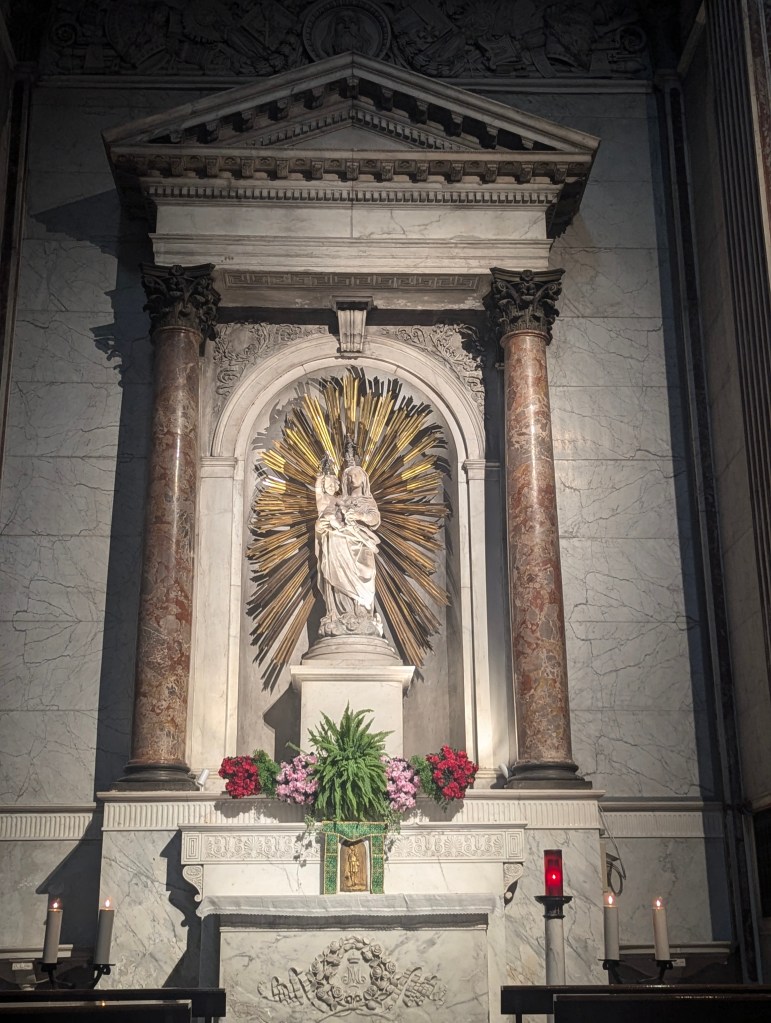
There was a chapel dedicated to Mary.

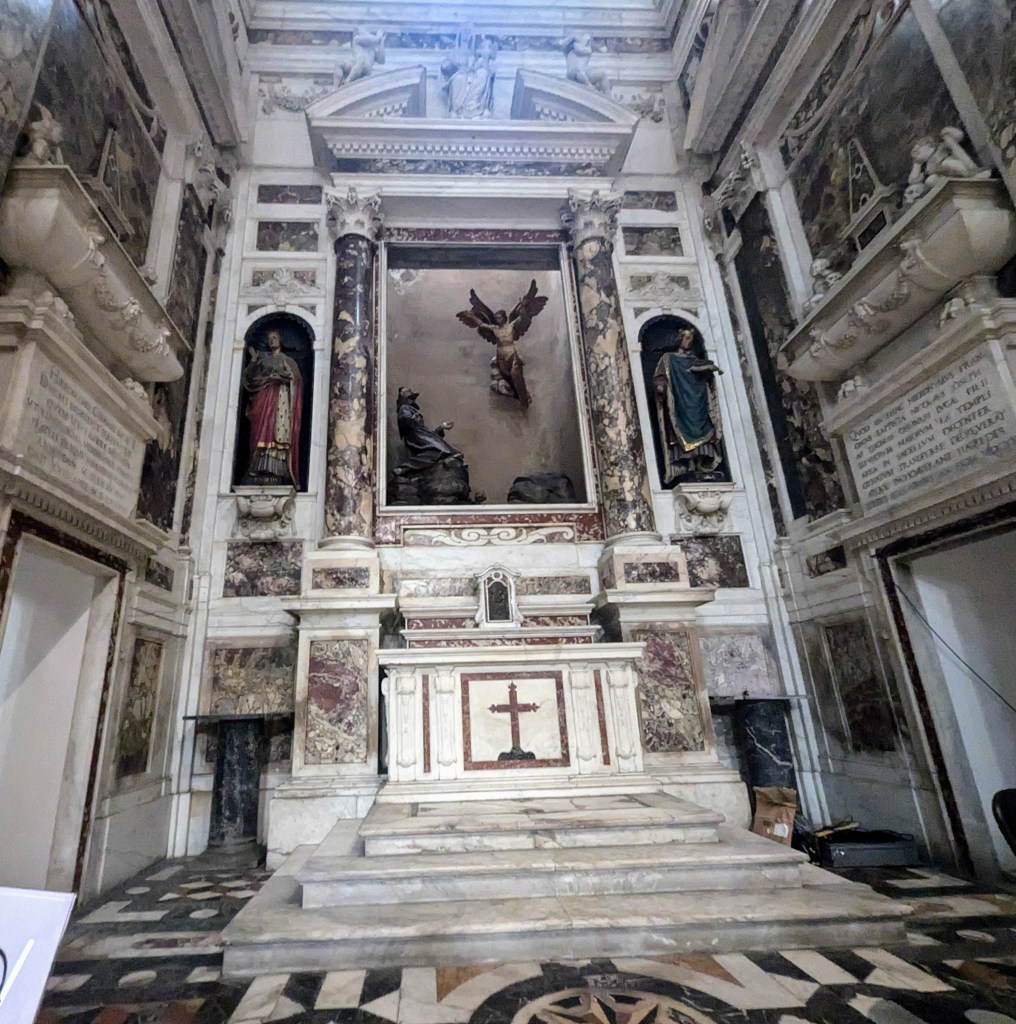
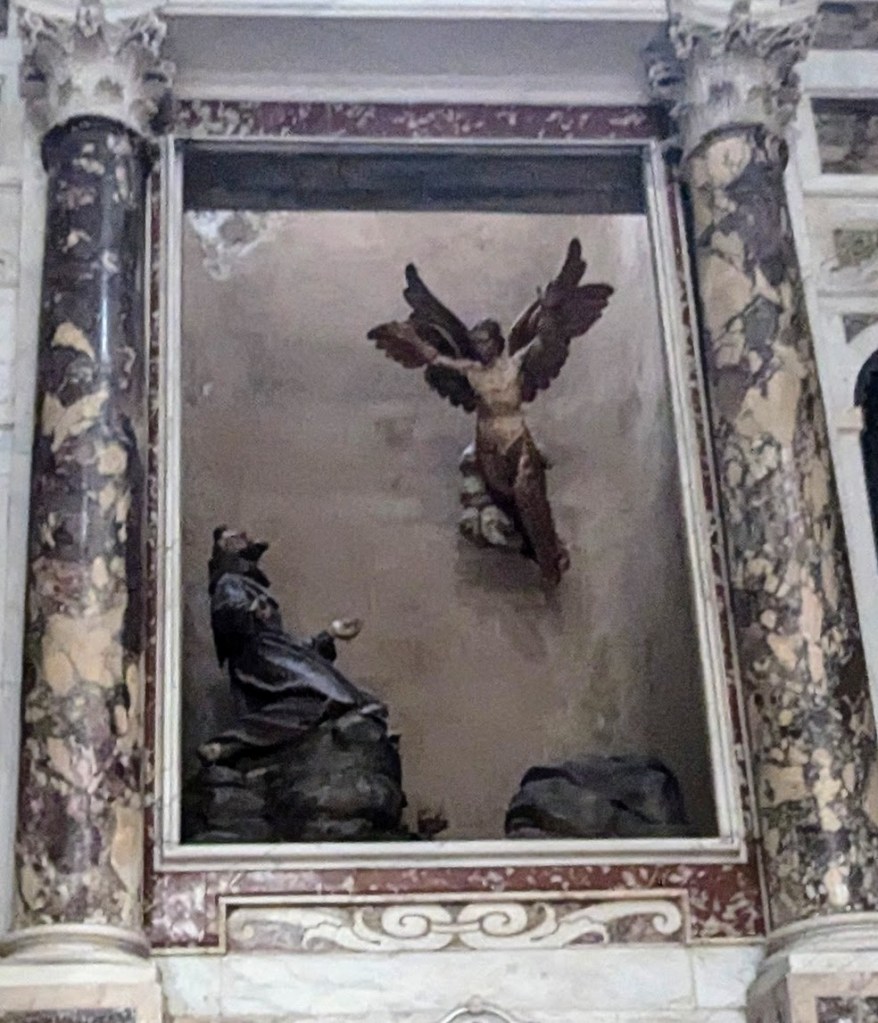
Several of the chapels had sculptures that were built like dioramas.

which may be hard to discern from the above, but a closer look may help.

The pulpit was particularly beautiful.

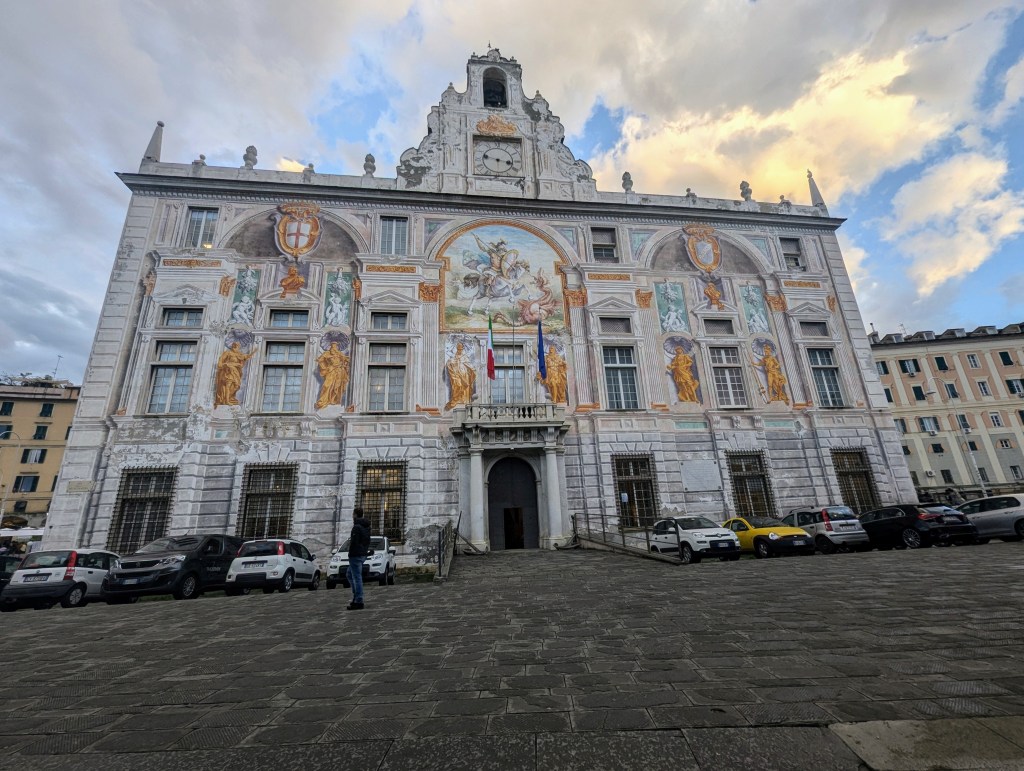
We had spent a fair amount of time in the basilica, and by the time we emerged, the weather had cleared further. We felt comfortable at this point heading toward the port. Also on the way we passed Palazzo San Giorgio (Palace of St. George). The Byzantine Emperor Michael VIII felt indebted to Genoa. Genoa had been his ally in a war against the Latin Empire. To show his appreciation, Emperor Michael donated material stripped from the Venetian embassy in Constantinople to Guglielmo Boccanegra. In 1260 Boccanegra used the material to build his waterfront dream palace. The palace has had many uses through the centuries. In the early 1300s it was a prison, one of its most famous inmates was Marco Polo. Then it was used as headquarters for port authorities. In 1400 the building became the home of the Bank of San Giorgio, one of Italy’s first banks.

Palazzo San Giorgio

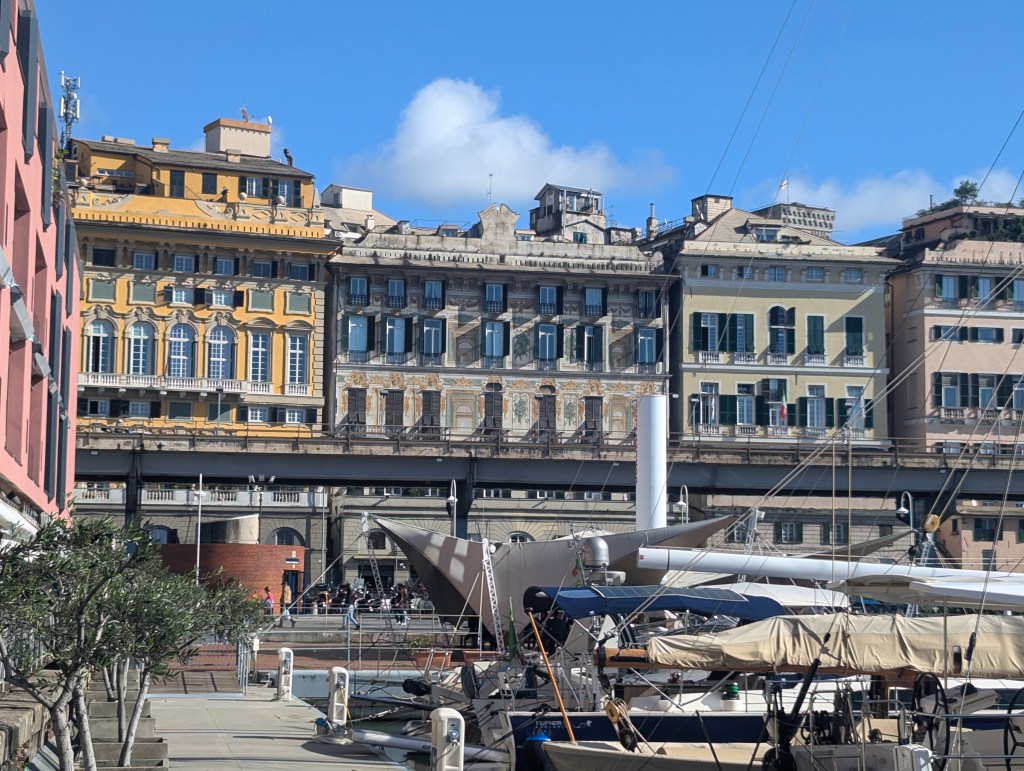
Directly across from Palazzo San Giorgio is the Porto Antico di Genova (Genoa Old Port). Genoa Old Port brings back Genoa’s golden age as a principal sea-faring city and maritime power. It was inaugurated in 1992 as part of Genoa’s 500 year celebration of the voyages of Christopher Columbus, a Genoa native.

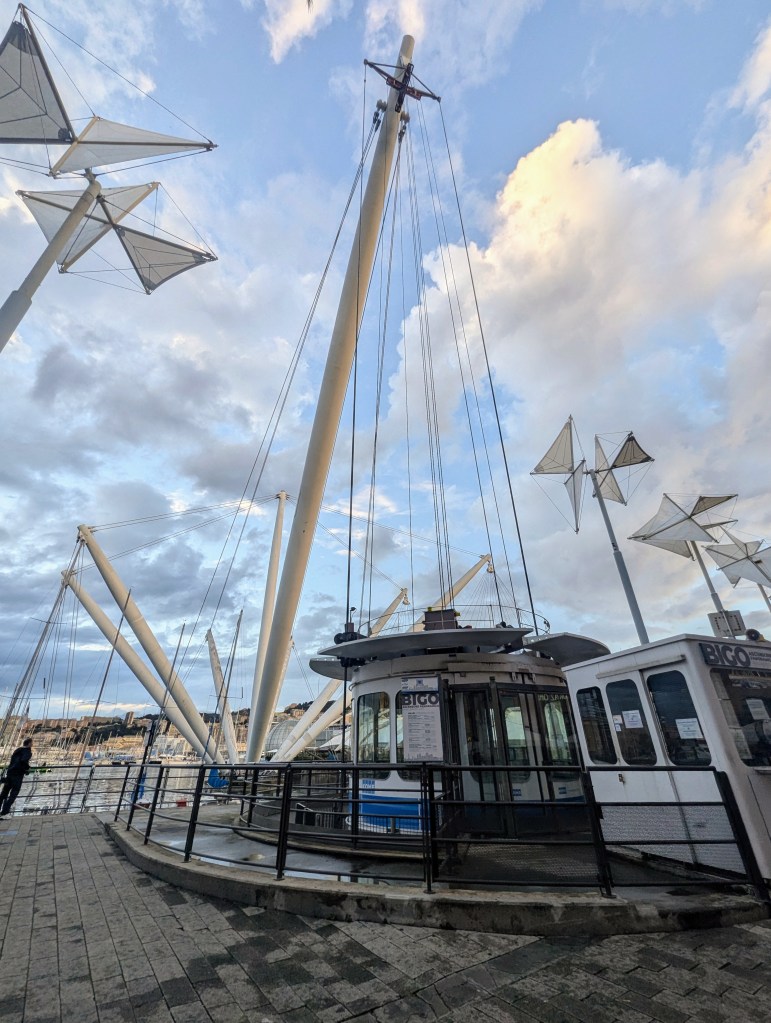
Something we had not seen before was a round “room” that these cranes lift for a panoramic view of the port and the city. (The little square building to its right is a ticket booth).

We were also intrigued by this statue of a traveller, more on him later.

Lest one looking at these pictures and seeing blue skies and doubts my claims of awful rainy weather, I include a youtube link below, which was taken nearby on the same day. We just happened to get to the port in the 15 minutes that the sun shown through the whole day.

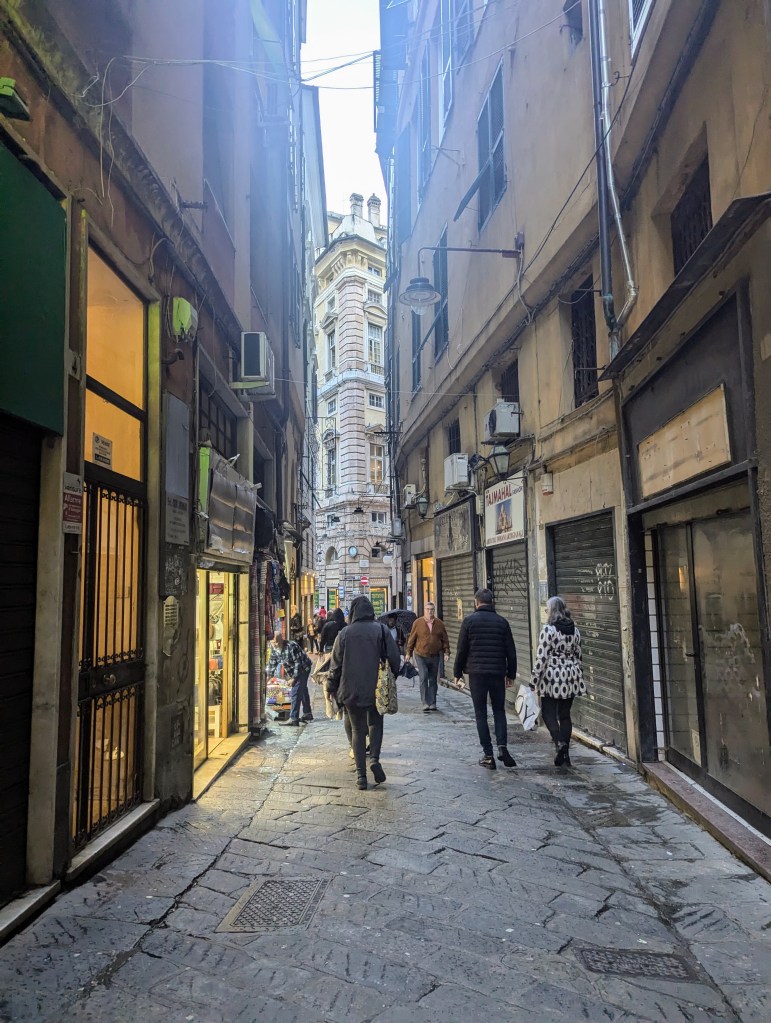
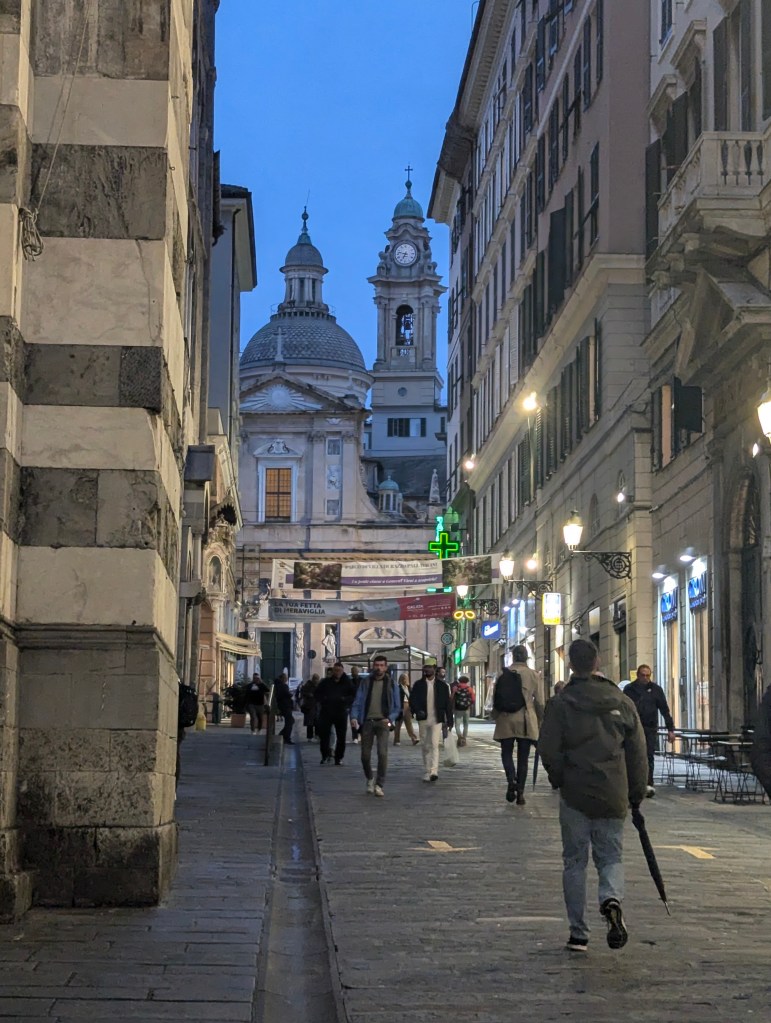
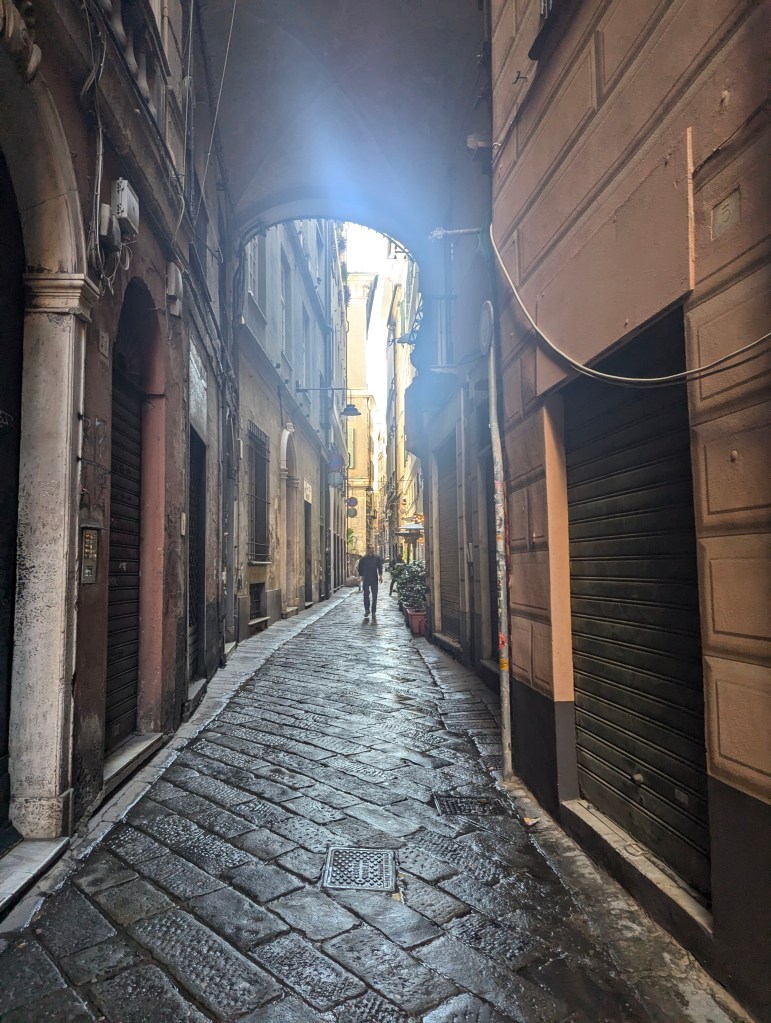
As dusk started to fall, we made our way through the winding, narrow streets

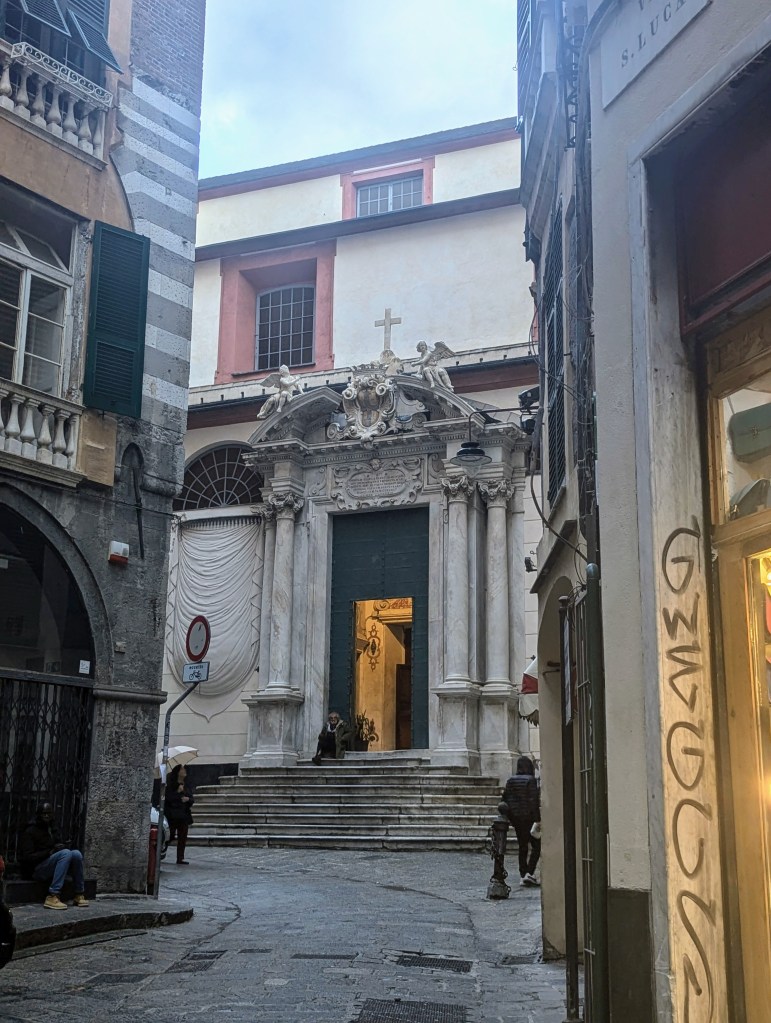
with a church around every corner

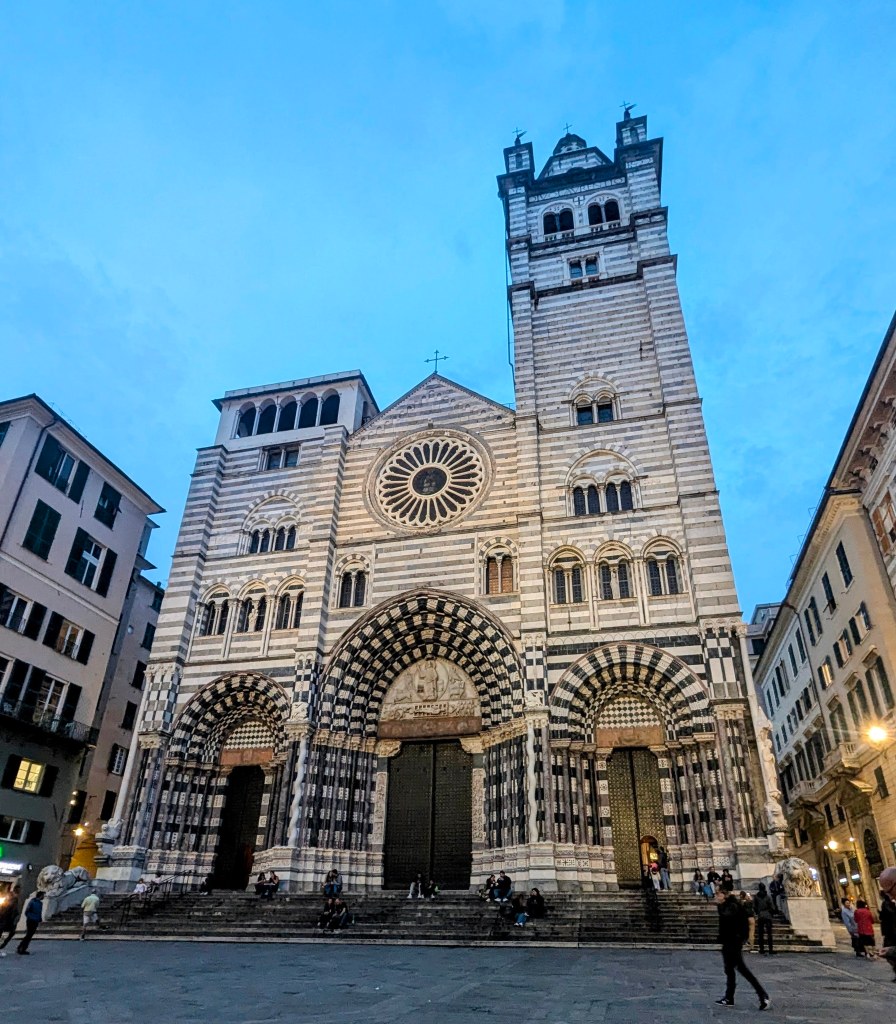
to the Cattedrale di San Lorenzo ( Cathedral of St. Lawrence) which, built around 1098, is the most dominant church in Genoa. During medieval times, the church was the center stage of social and political life for the residents of Genoa. After a disastrous fire in 1296, the church was rebuilt. The facade was completed in 1312.

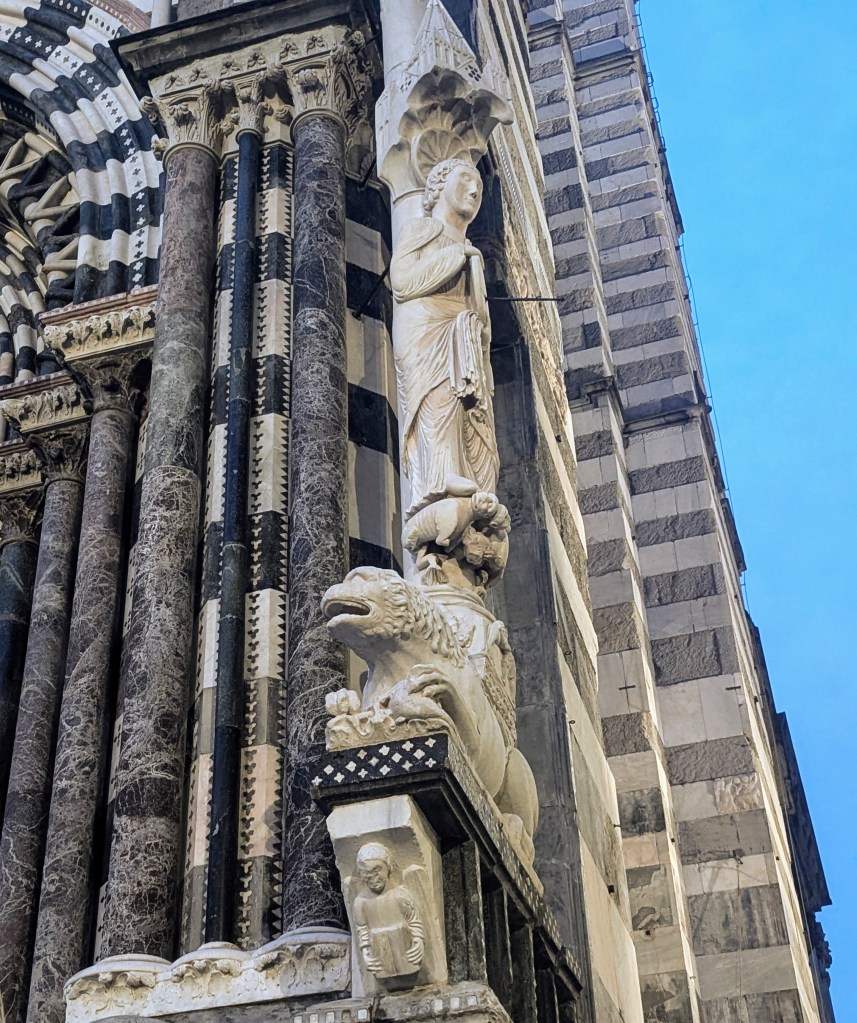
Cathedral of San Lorenzo

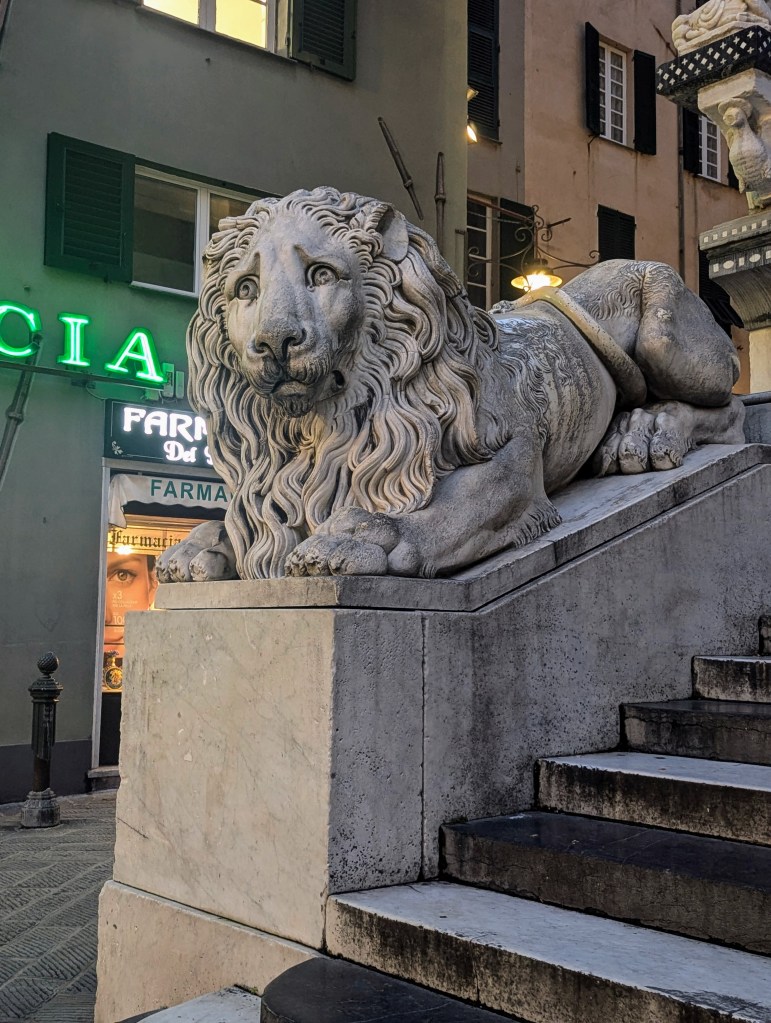
I was drawn to the sorrowful looking lions that flank the entrance.

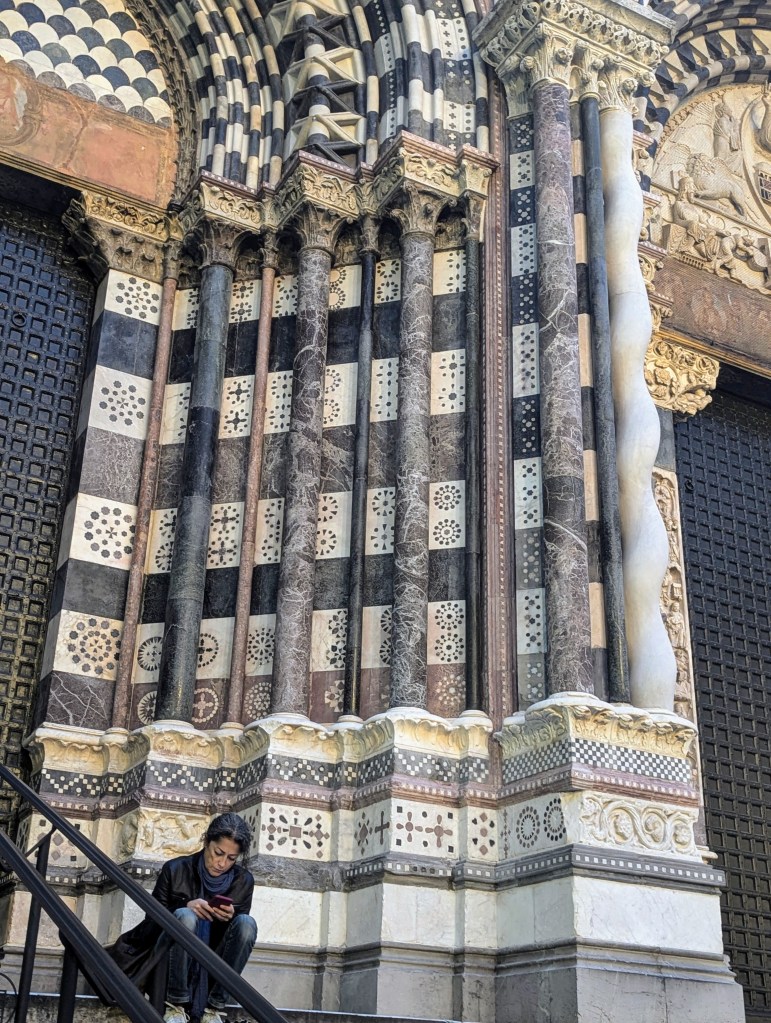
Another intriguing feature is the diversity of materials and styles of the columns.

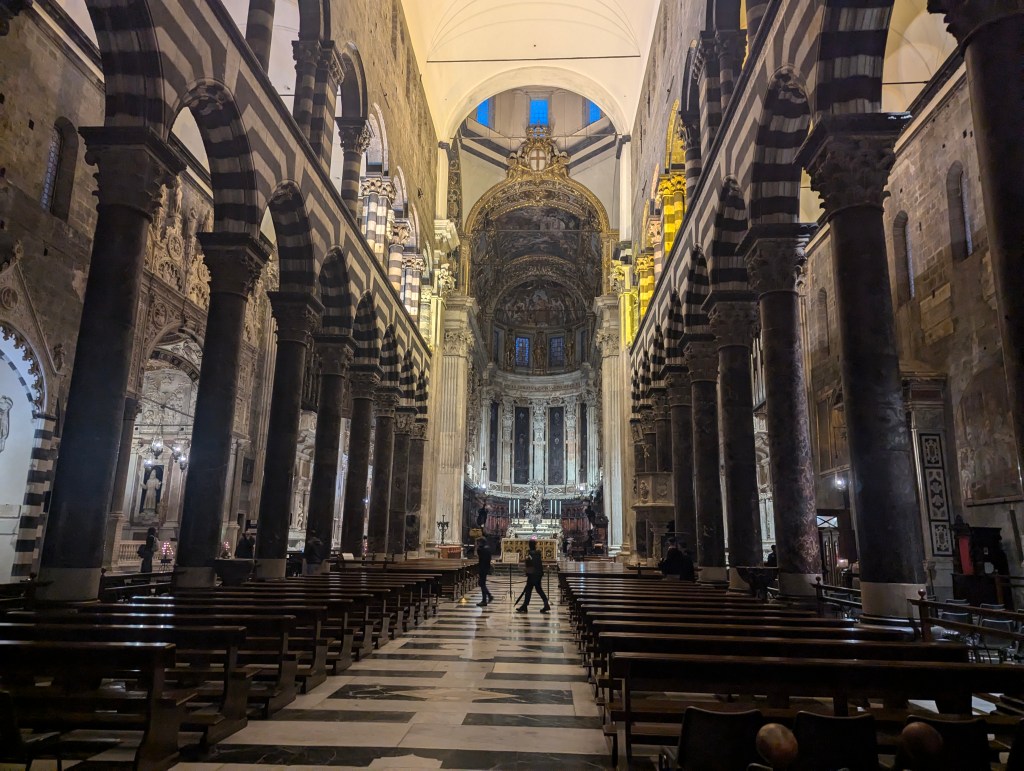
The interior has a basilica plan with a transept and choir. Three naves are divided by marble columns topped by arches with light and dark bands. Above these are smaller Romanesque arches of grey stone.

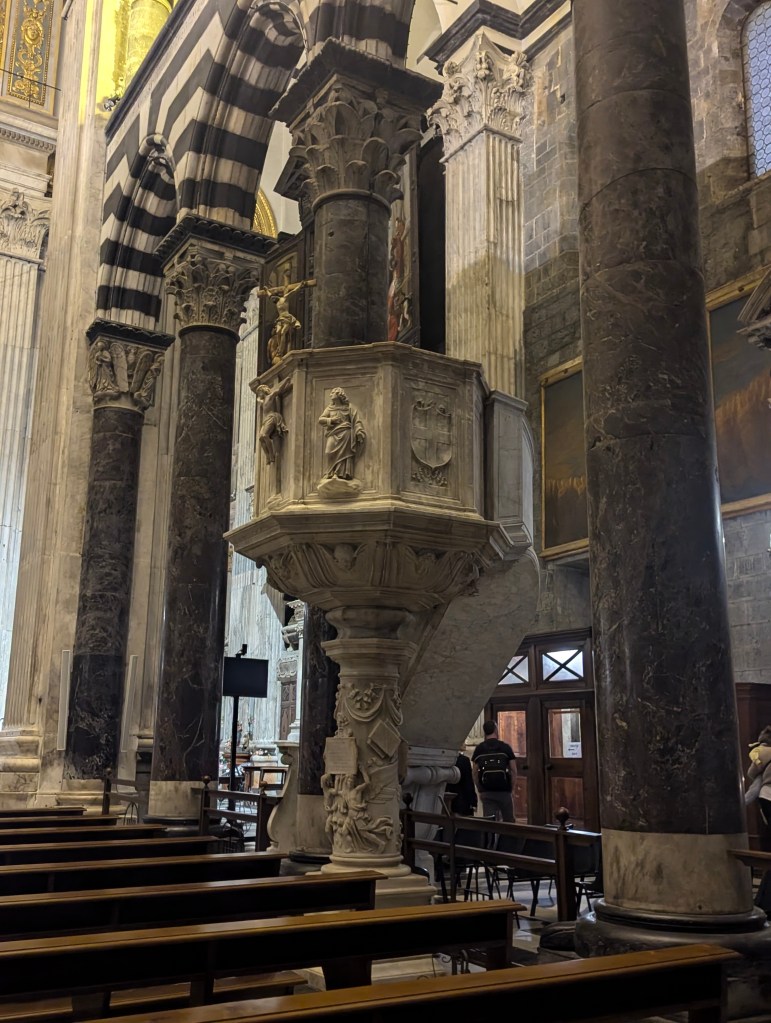
It also has a beautifully decorated pulpit.

Outside, in the vein of a church around every corner, one can be seen right behind the cathedral.

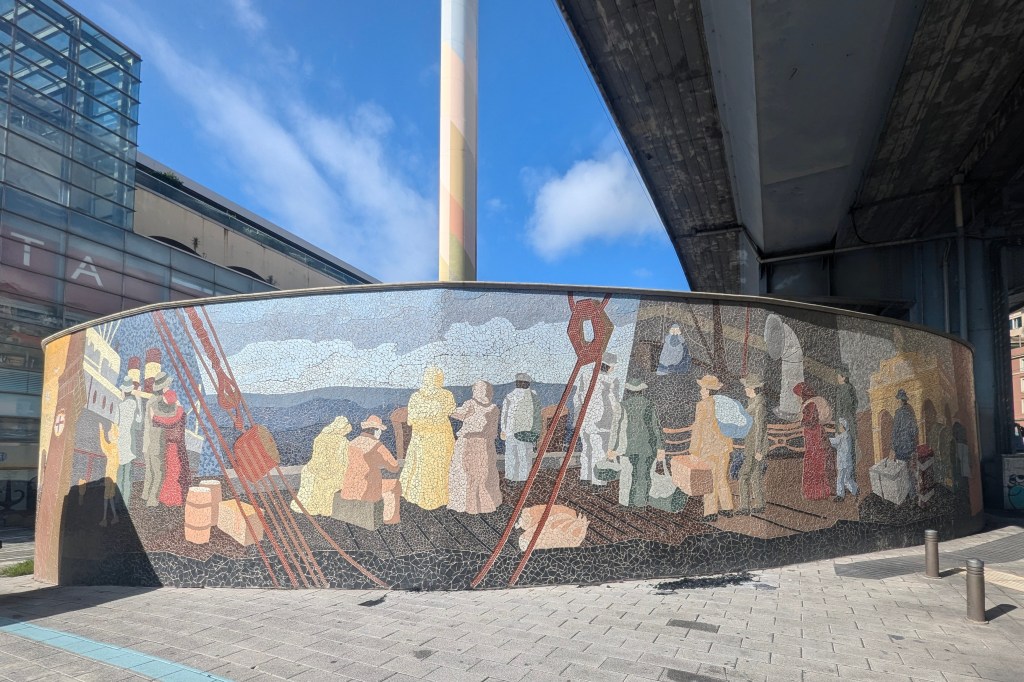
Refreshed in the morning, and with a sunny day, we set out again for the port. At the entrance we found this mosaic featuring travelers of yesteryear.

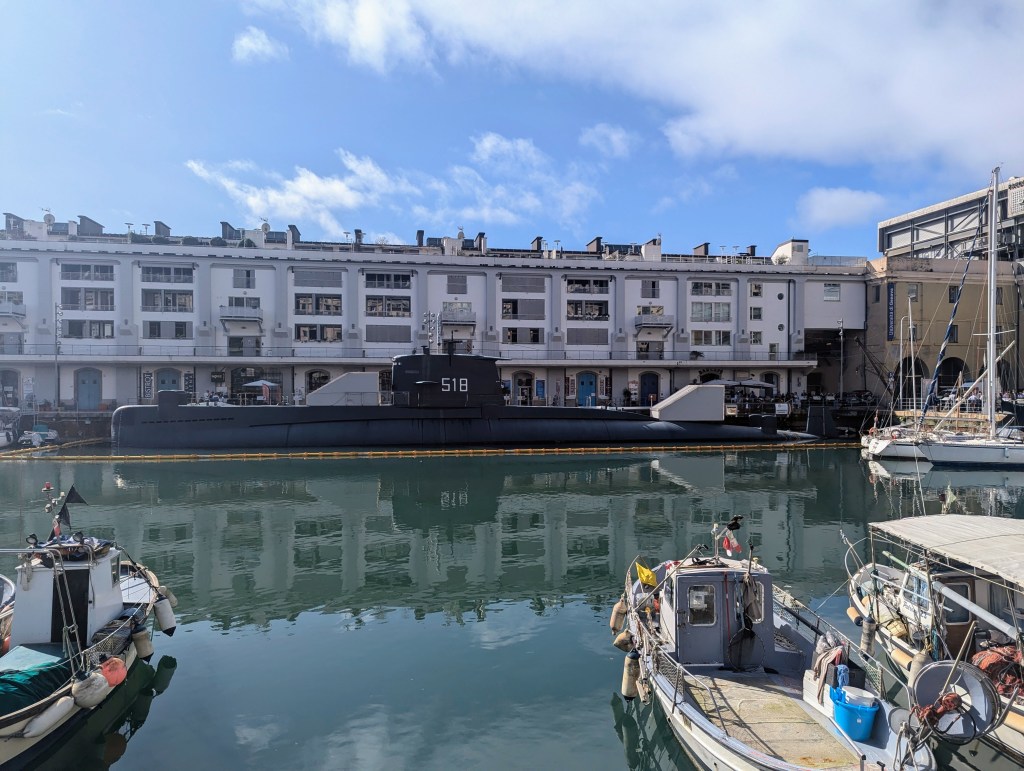
From the 11th century until the late 18th century, the city became a leading economic and military power in Europe through its maritime trade and commerce. Today one of the best reasons to visit Genoa is for the history of maritime, which to be honest, neither of us really is all that interested. We visited the Galata Outdoor Maritime Museum, but did not go into the Galata Museum itself which boasts everything from a full-scale model of a 17th-century galley to all things sailing and shipyards including the big transatlantic ocean-liners. Galata refers to the historic Genoese community of Istanbul, Turkey. It was one of the most vital Genoese colonies in the Mediterranean. In the 15th century, their presence in that community ended. In the 19th century, the Genoa municipality built a system of commercial docks, the oldest of which was named for the lost colony.

Galata Outdoor Museum

As we walked along the seaside we passed lots of buildings both residential and industrial. What is always striking when visiting Italy is how many random-seeming buildings have statues

and sometimes frescos

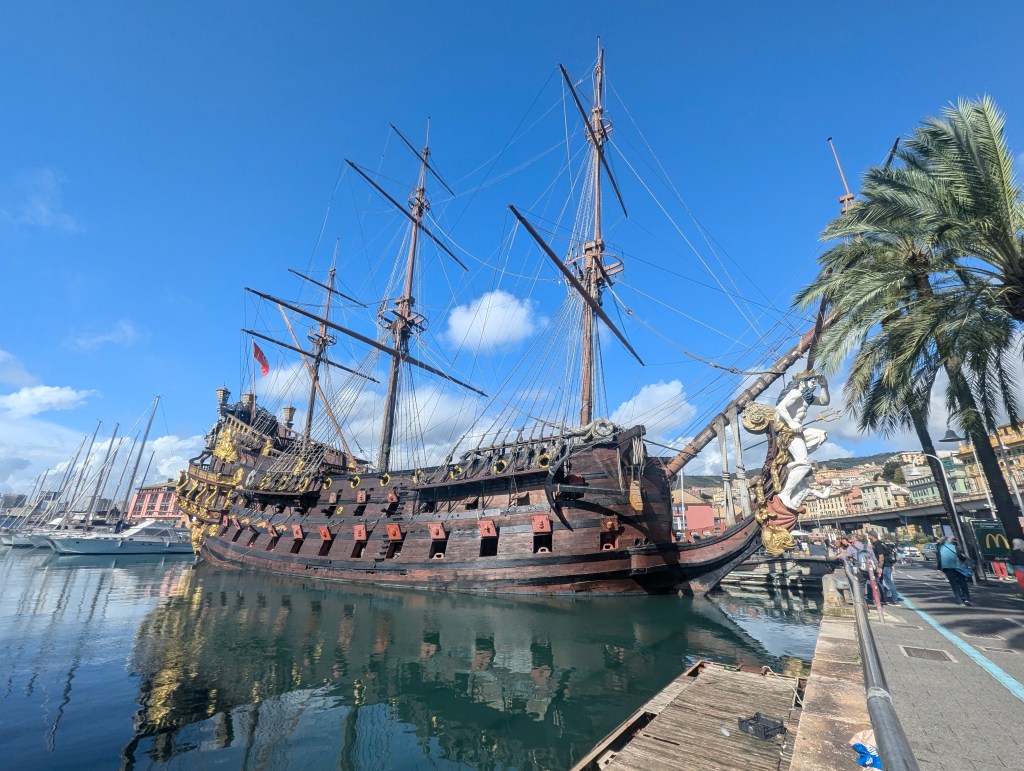
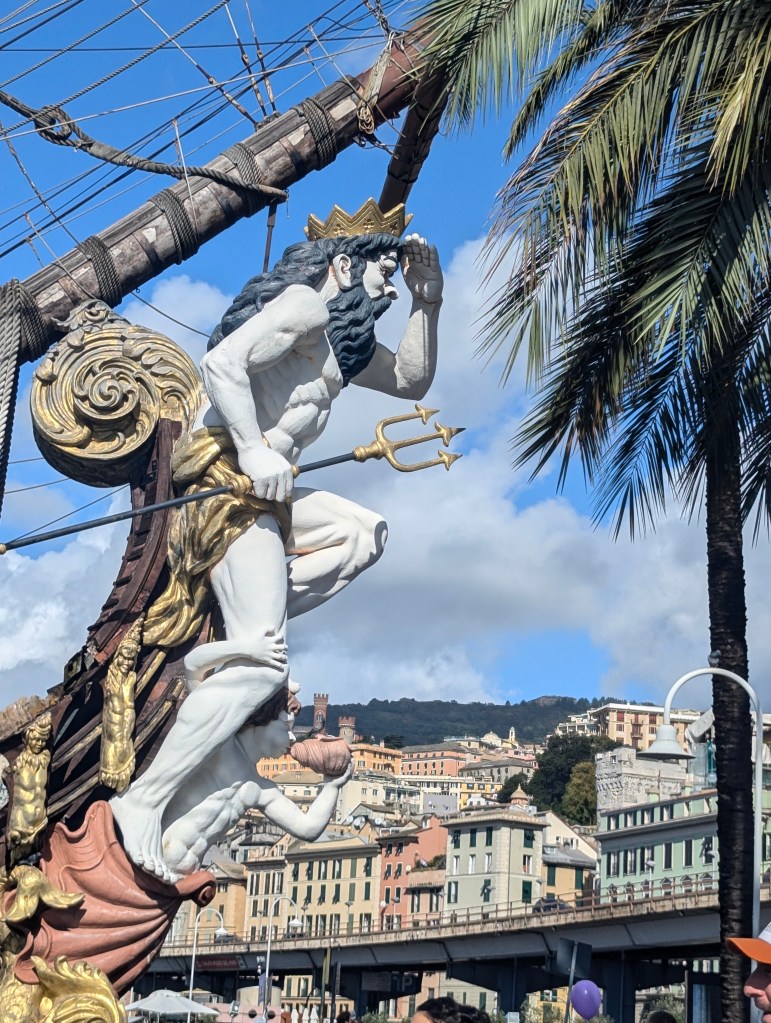
We came to the Porto Antico from a different direction than when we had visited last night and realized we had missed this big reproduction of a 15th century ship similar to those on which Christopher Columbus sailed.

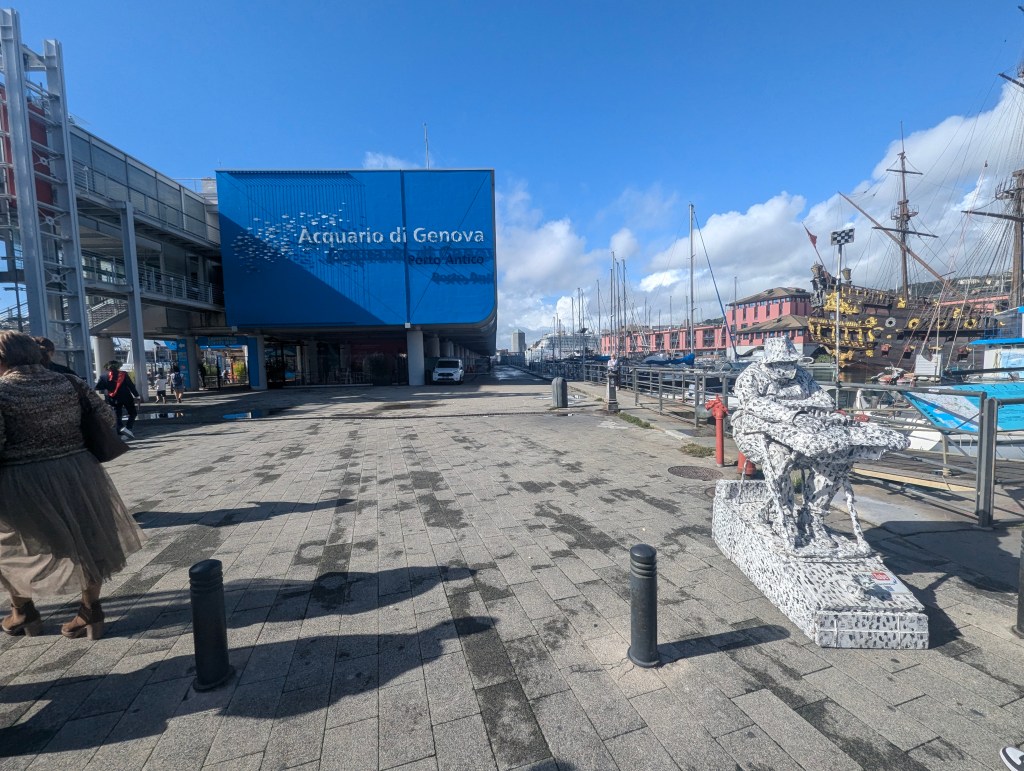
Also to be found at the Porto Antico is an aquarium, which we chose to skip today. But I really liked the human statue outside. People jumped every time he moved, which was rarely.

We continued our meandering of Genoa’s Old City’s narrow streets

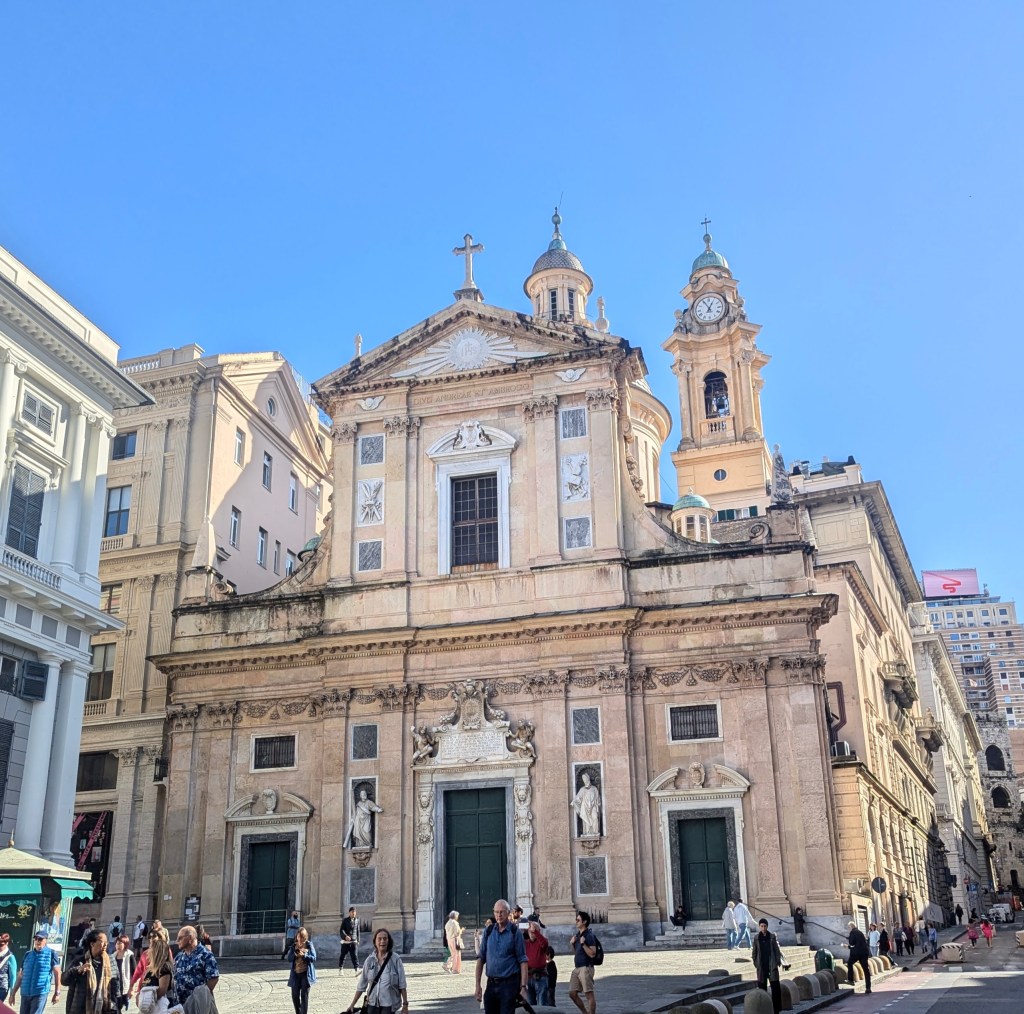
and came upon the Church of Jesus and Saints Ambrose and Andrew. In the 6th century, Bishop Onorato of Milan was on the run. He was escaping from Longobard persecutions to Genoa. There he founded his Church of Saint Ambrose. Ambrose is Milan’s patron Saint. Abandoned in the 7th century by the Milanese community, the church was taken over in the 16th century by the Jesuits.

Next we went by the Palazzo Ducale (Doge’s Palace), once the home of the Doges (heads of state or captain of the people) of Genoa. It was constructed in the 13th century when Genoa was coming into its own as a maritime power. The Doge’s Palace was reconstructed in the 18th century after a devastating fire.  Today the palace is used for exhibitions, meetings, special events, and as a library and museum. It is the result of the largest restoration in Europe, covering a building of 300,000 square meters.

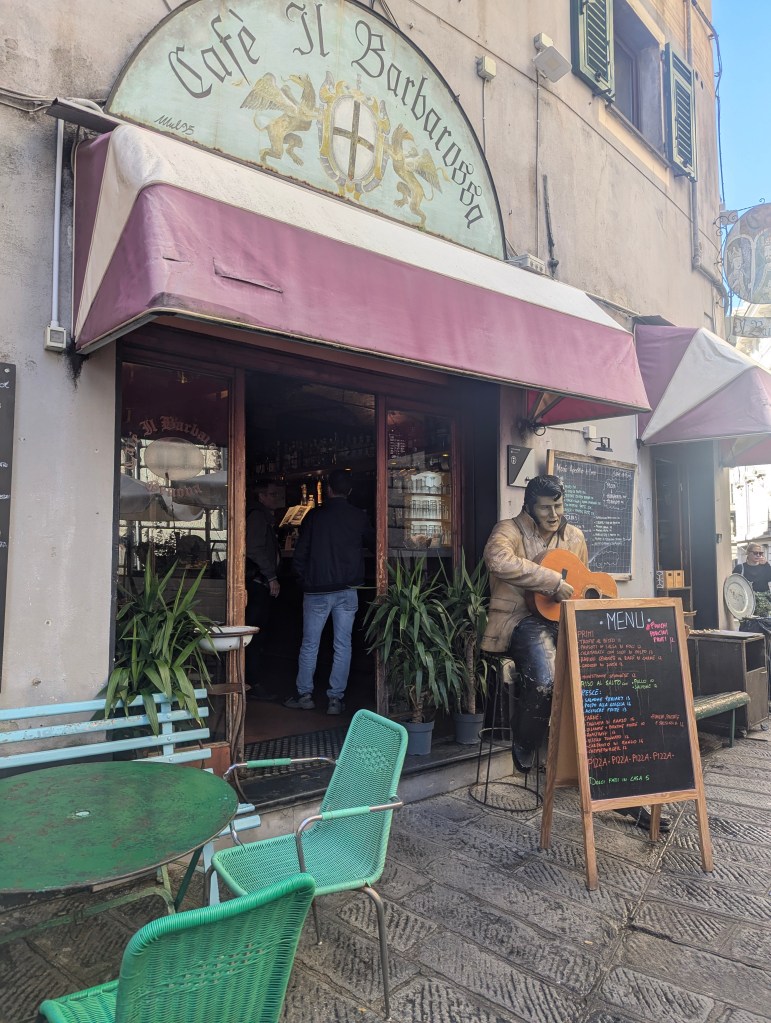
By now we were a bit hungry for some lunch, and who could resist the call of Elvis?

Honestly though, we chose this cafe for the view of these towers. The Mura (Wall ) in Genoa was started in the 9th century. This portion, known as the Barbarossa Towers, was built in the 12th century. Genoa has more and longer walls than any other city in Italy.

Just beyond these towers is a house that Christopher Columbus lived in as a child.

Columbus House

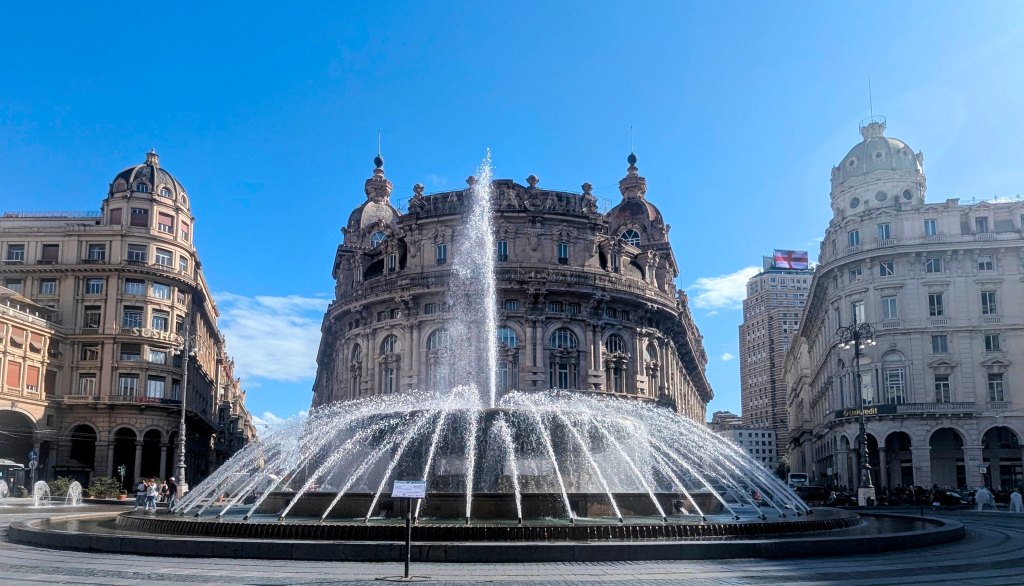
Our destination after lunch was the Piazza De Ferrari (Ferrari Square). Raffaele Luigi De Ferrari (1803-1876), Prince of Lucedio, Duke of Galliera, and senator of the Kingdom of Sardina, in 1837, acquired all possessions that Napoleon had granted in 1812. The square was christened Ferrari Square in 1877, one year after his passing. At the centre of the square, in 1936, a bronze fountain was built and it soon became one of the main symbols of the city.

Piazza De Ferrari

In the square we came upon our second traveller statue.

The prose on the signage explains it best.

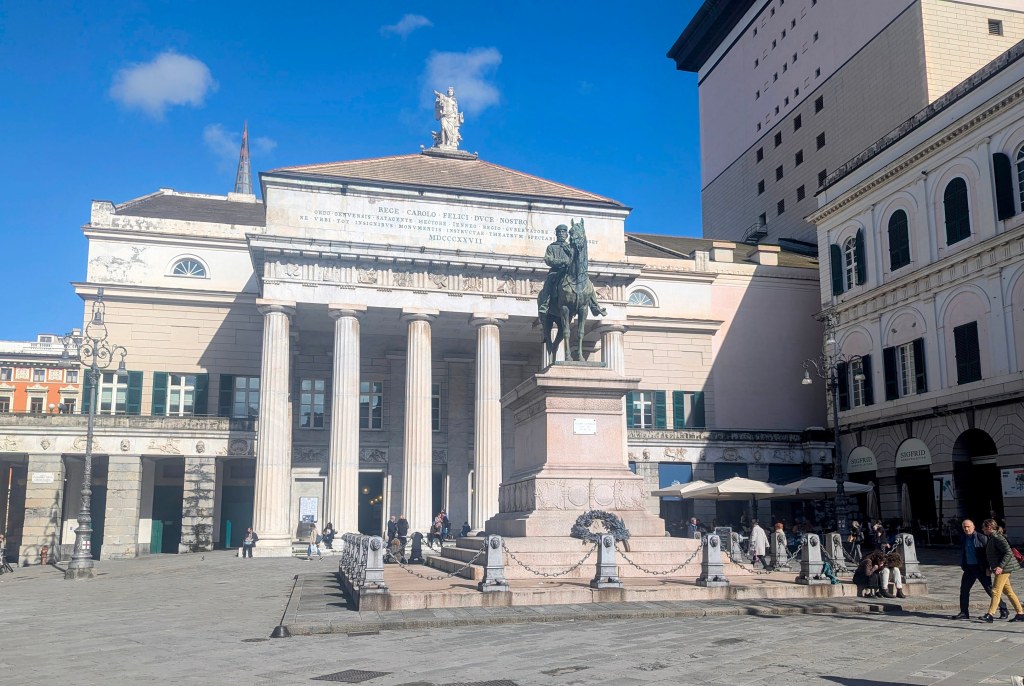
On the side of Piazza De Ferrari is the The Teatro Carlo Felice, the principal opera house of Genoa used for performances of opera, ballet, and recitals. The hall is named for King Carlo Felice, King of Sardinia  and ruler of the Savoyard States from 1821 until his death in 1831. He was the last male-line member of the House of Savoy. In front of the Teatro Giuseppe Garibaldi (1807-1882), a hero of the Italian revolution, appeared astride his bronze horse.

Teatro Carlo Felice

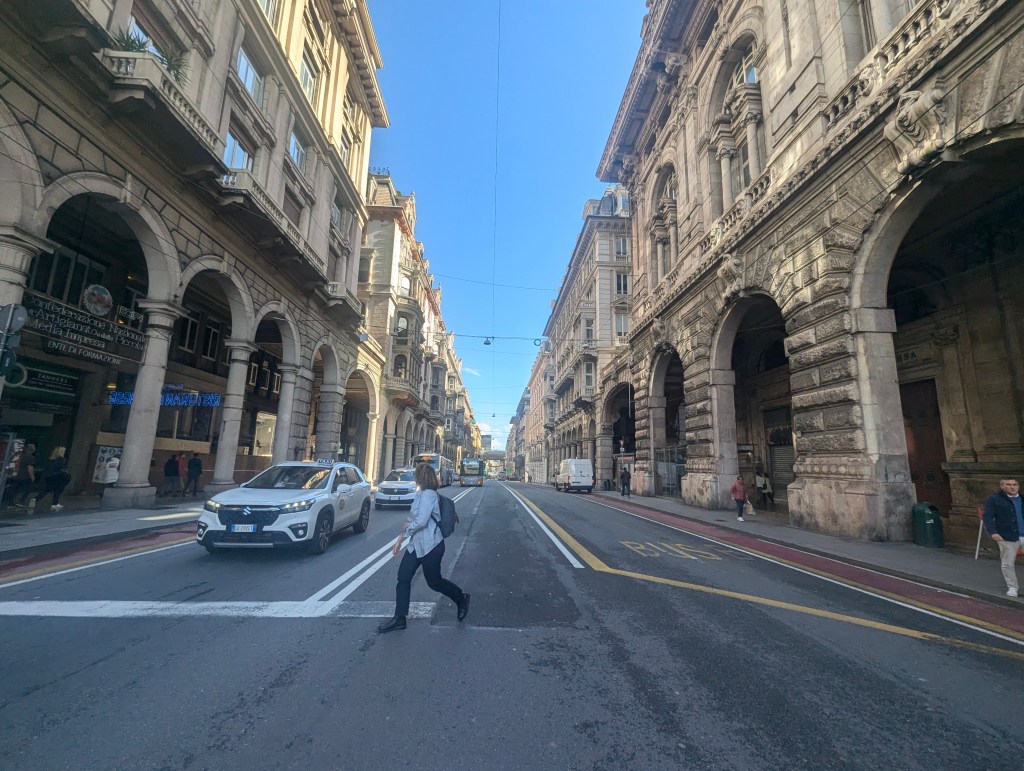
Branching off from Piazza De Ferrari is Via XX Settembre (20th September Street), named for the 20th of September 1870, the day revolutionaries stormed the Pia Gate (Porta Pia) of the Vatican. It marked the end of the temporal power of the Church, the “Risorgimento,” which ushered in the unification of Italy. It was redesigned and modernized from 1892 to 1912.

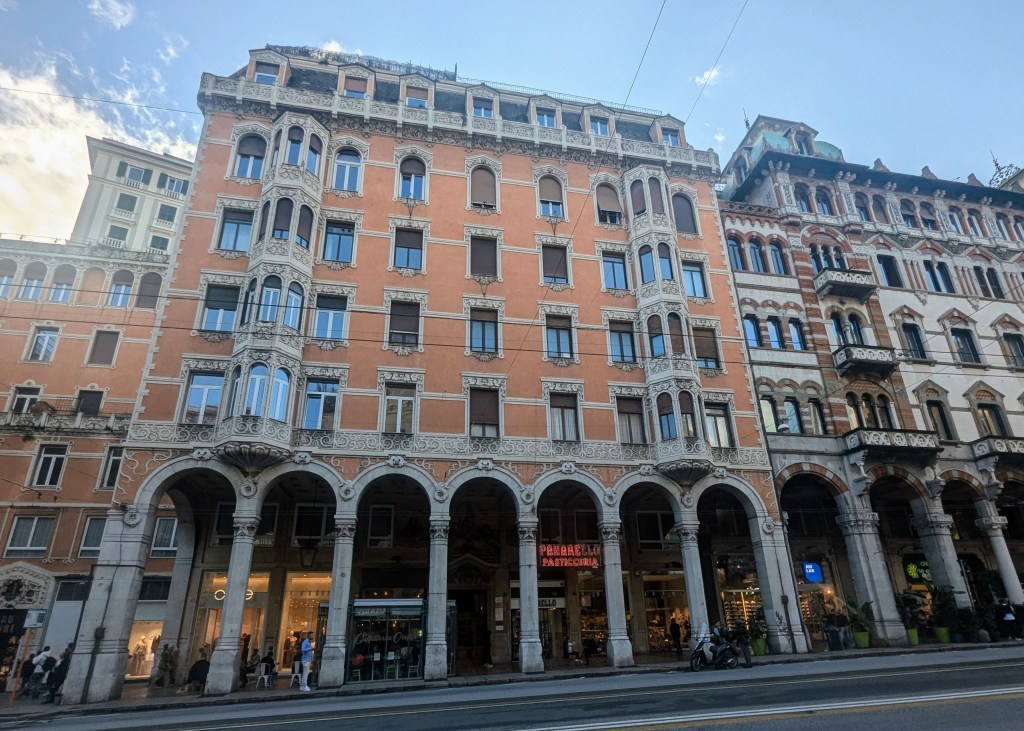
Via XX Settembre

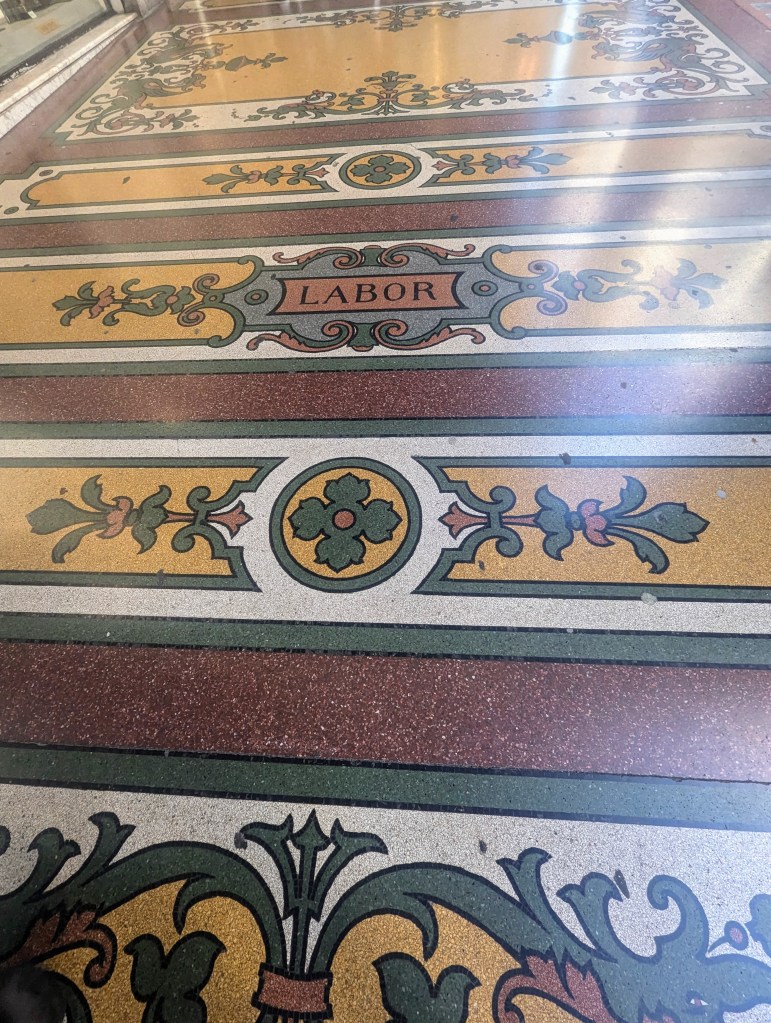
The street has a lot of Art Nouveau decorations, decorated pavements,

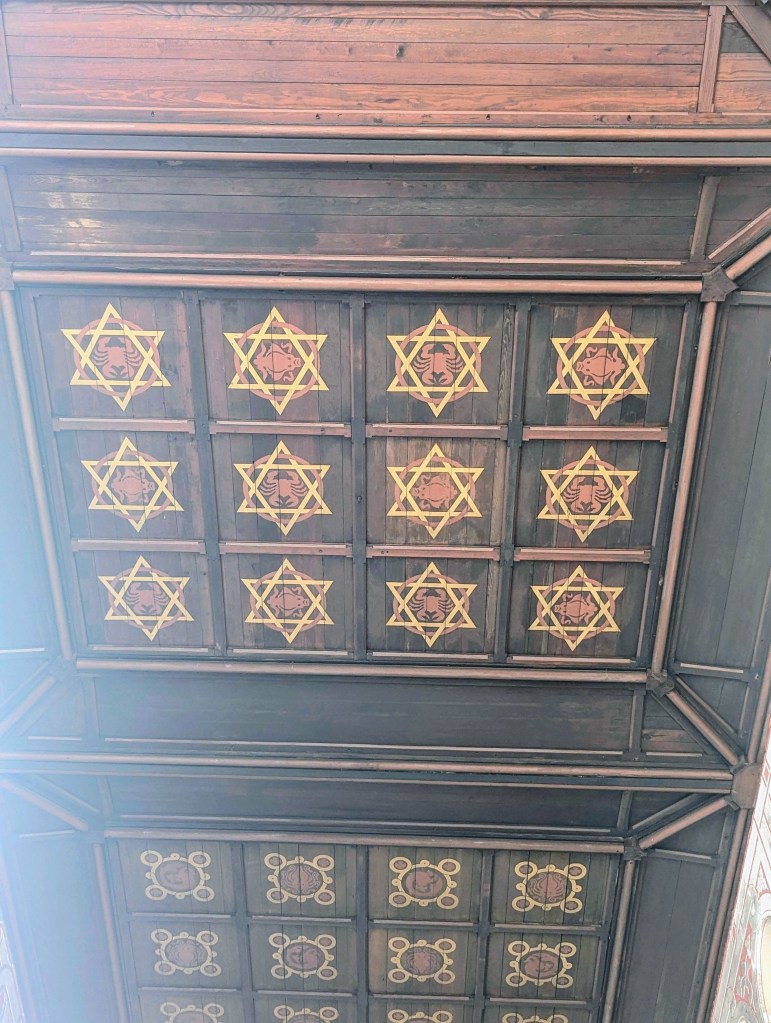
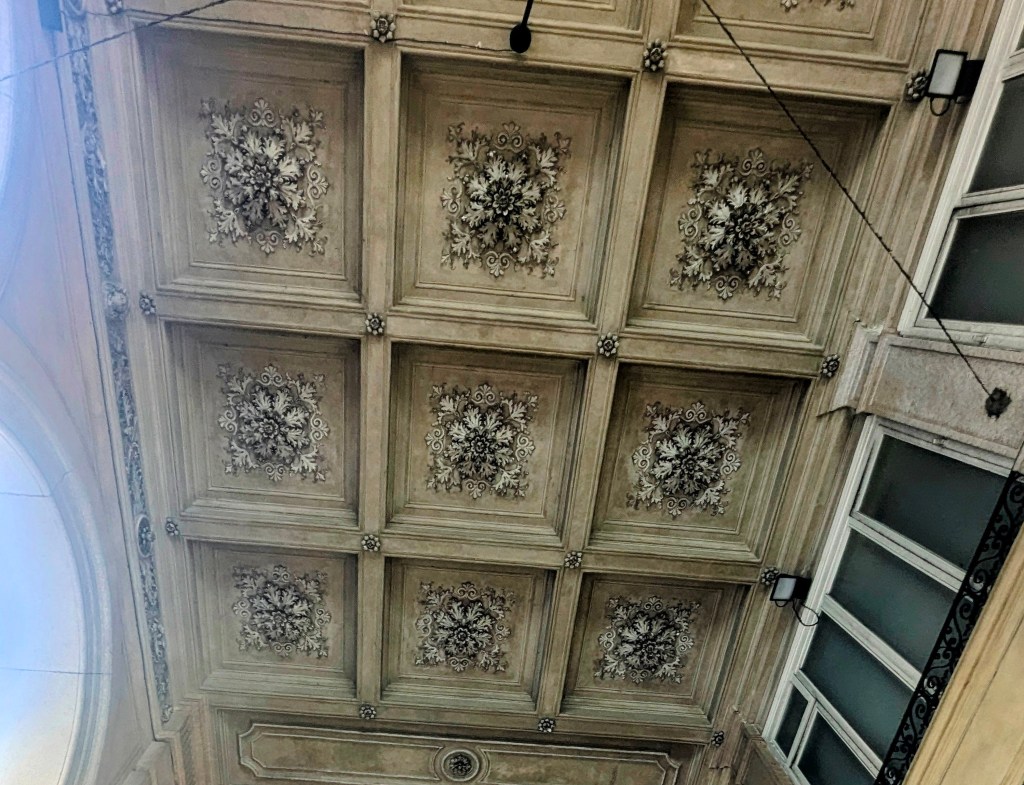
and ceilings

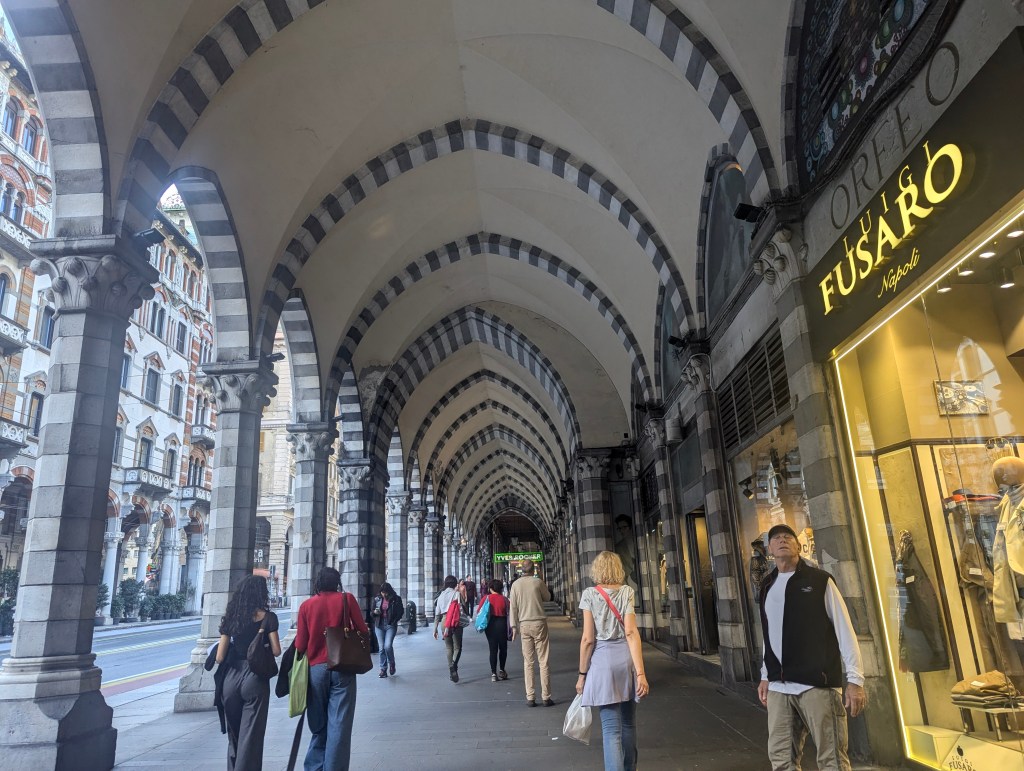
beneath fabulous architecture and colonnades offering protection from the weather.

There are about three miles of shops, usually high-end chain stores.

and some not so high end.

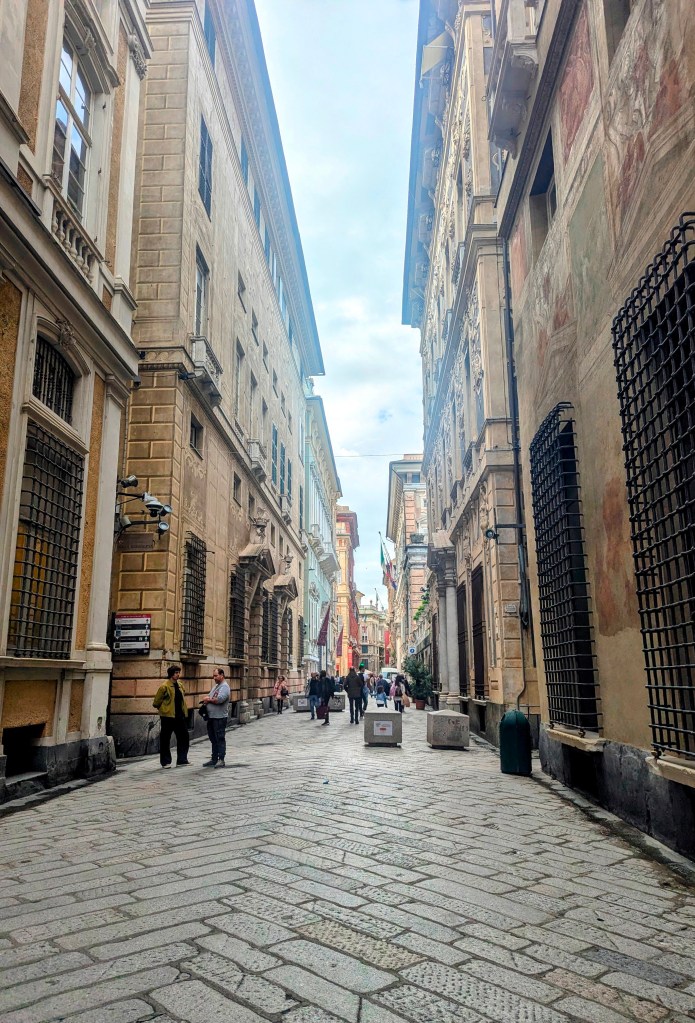
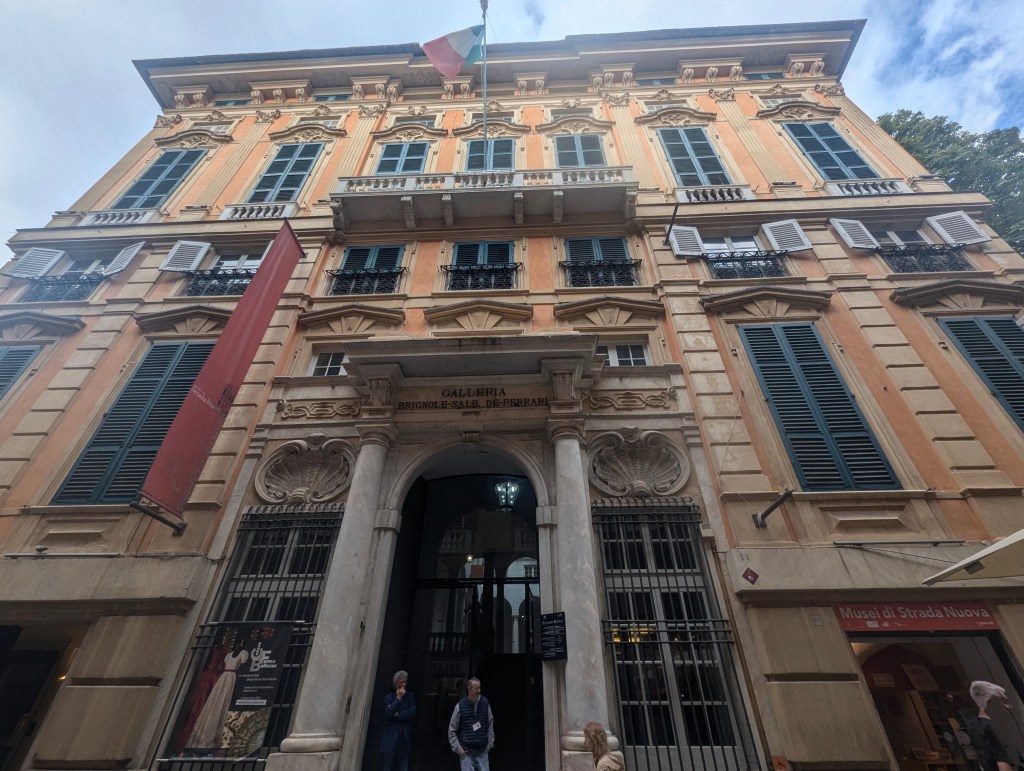
After exploring Via XX Settembre we turned our attention to the palaces. In the late 16th century, the Genoese aristocracy implemented a plan to transform the medieval city. A “New Streets” system was created to provide space for their sumptuous private palaces and mansions. In 1576 the Genoese Senate established a list of forty-two palaces that could be used as hospitality residences for notable guests from abroad, such as kings, princes, diplomats, or religious authorities. The list was updated over the years. These lists were called “rolli,” literally, “rolls.” All told, 162 palaces made the lists at least once. These palaces became a World Heritage Site in 2006. Today, the Rolli Palaces are a collective term referring to 42 of the most prominent palaces in the historic center of Genoa, situated predominantly along Via Garibaldi (formerly, Strada Nuova).

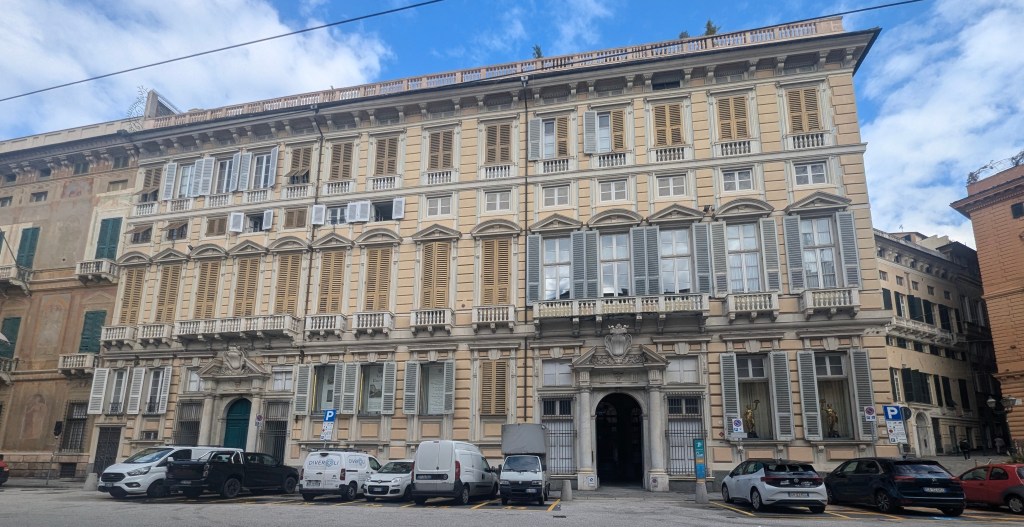
Our first stop was the Spinola Palace (Palazzo Giacomo Spinola “dei Marmi”). It was built for Giacomo Spinola between 1445 and 1450. Currently it is home to the Bank of Sardegna.

Next was Palazzo Ayrolo Negrone (Ayrolo Negrone Palace), one of the foremost Rolli Palaces of Genoa. The palace includes a building erected between 1560 and 1562 for Francesco De Ugarte, Spanish ambassador to the Republic of Genoa.

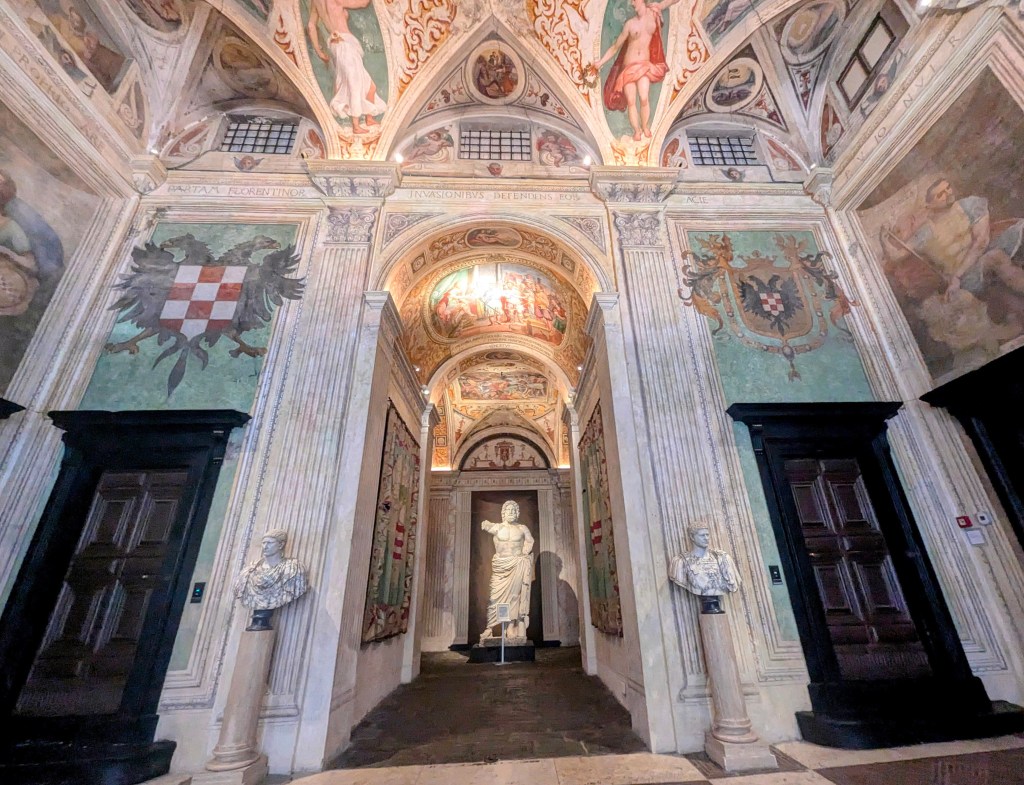
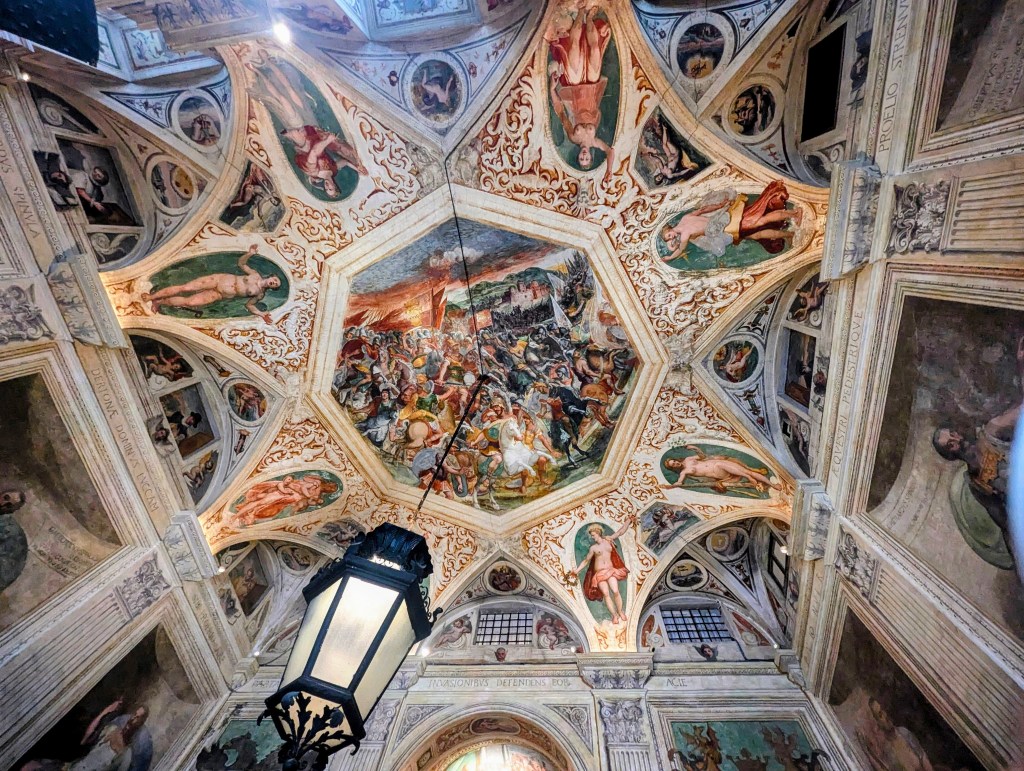
The most striking feature of the palace is a 17th-century gallery with vaults decorated with the images of Aeneas, a Trojan hero, by Giovanni Battista Carlone, commissioned by Aghostino Ayrolo. The brilliantly colored frescoes are lighted by large windows, and the balustrades bring out the effects of perspective. The story of the Trojan War is depicted here in three scenes.

Palazzo Angelo Giovanni Spinola (Angelo Giovanni Spinola Palace)  was one of the original 163 Palazzi dei Rolli of Genoa established in 1576. Today it belongs to Deutsche Bank, with limited access to the public

Palazzo Angelo Giovanni Spinola (Angelo Giovanni Spinola Palace)

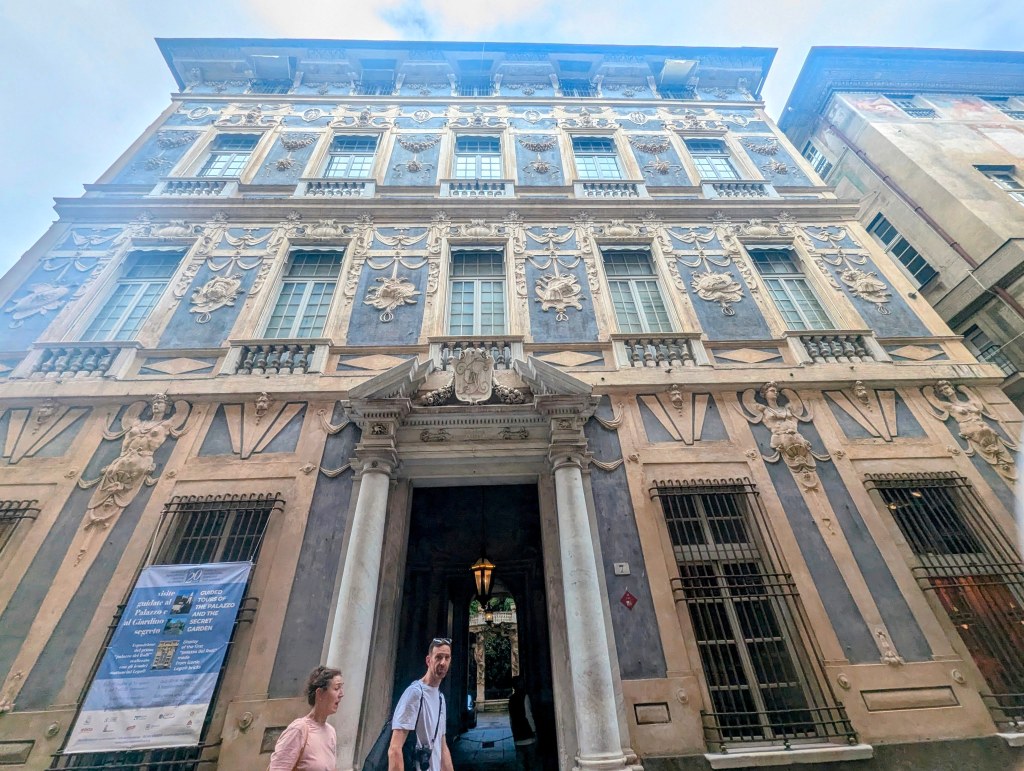
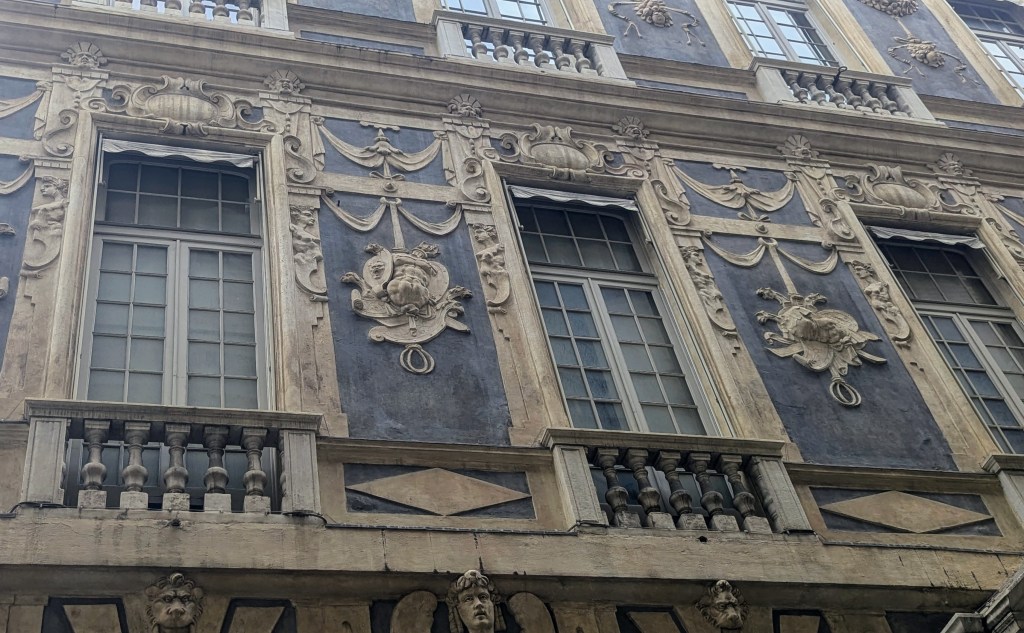
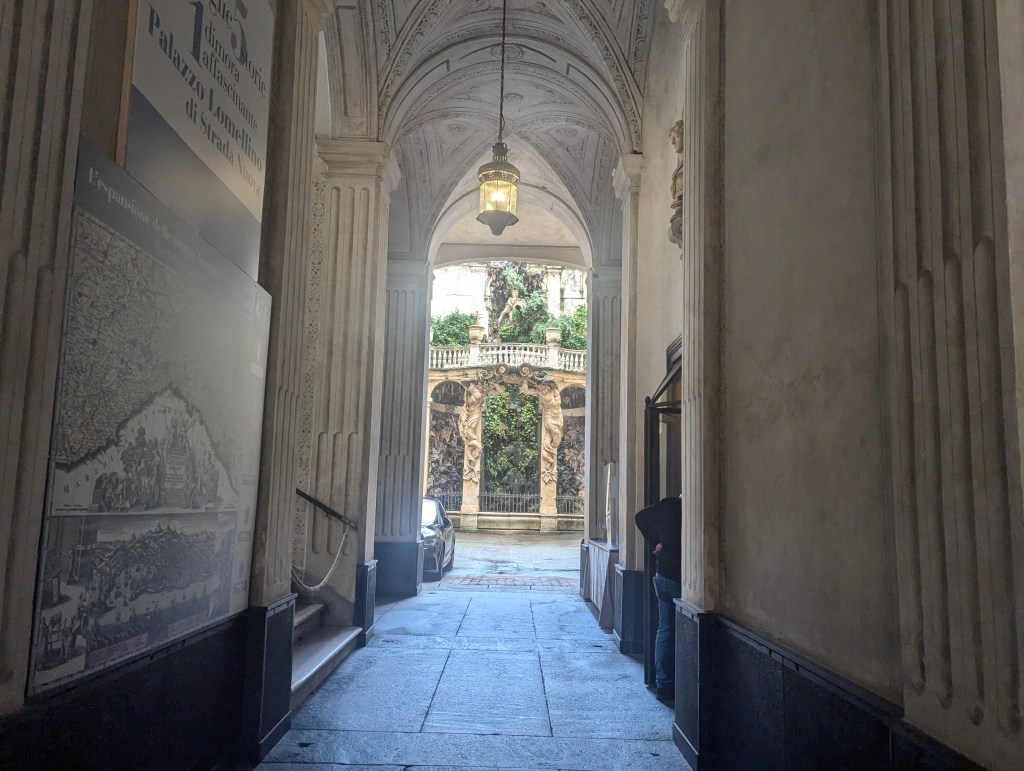
Palazzo Lomellino (Lomellino Palace) was built between 1559 and 1565,

Palazzo Lomellino (Lomellino Palace)

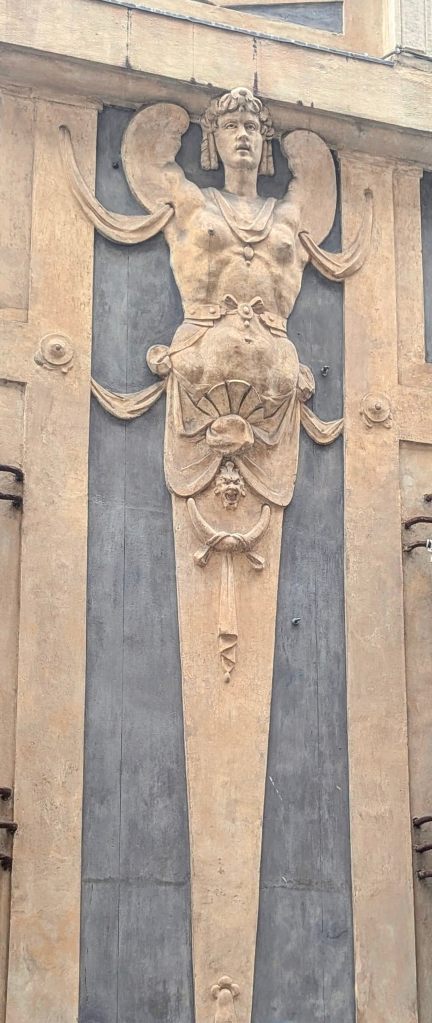
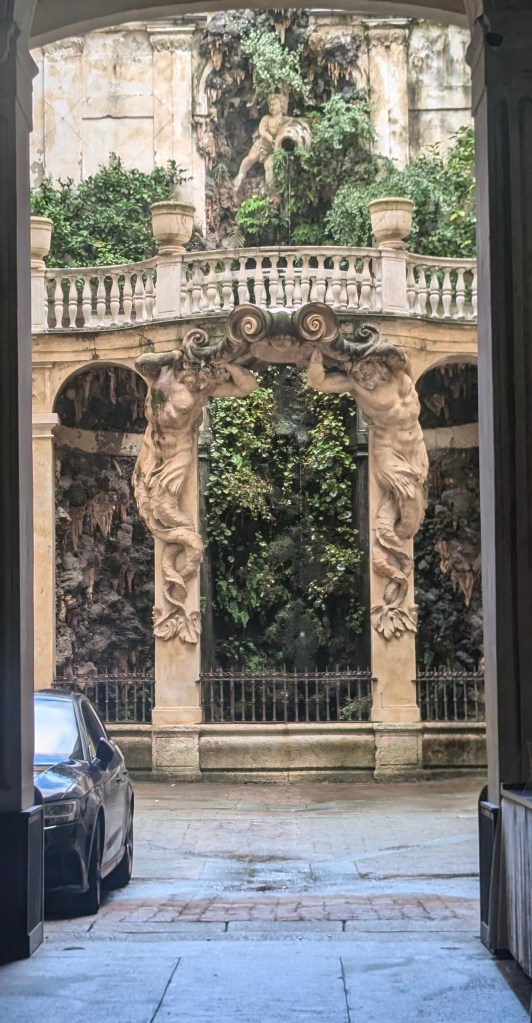
The façade, designed by il Bergamasco, is enlivened by a rich stucco decoration, with winged female herms supporting the string course on the ground floor;

and ribbons and drapes holding trophies of arms on the second floor.

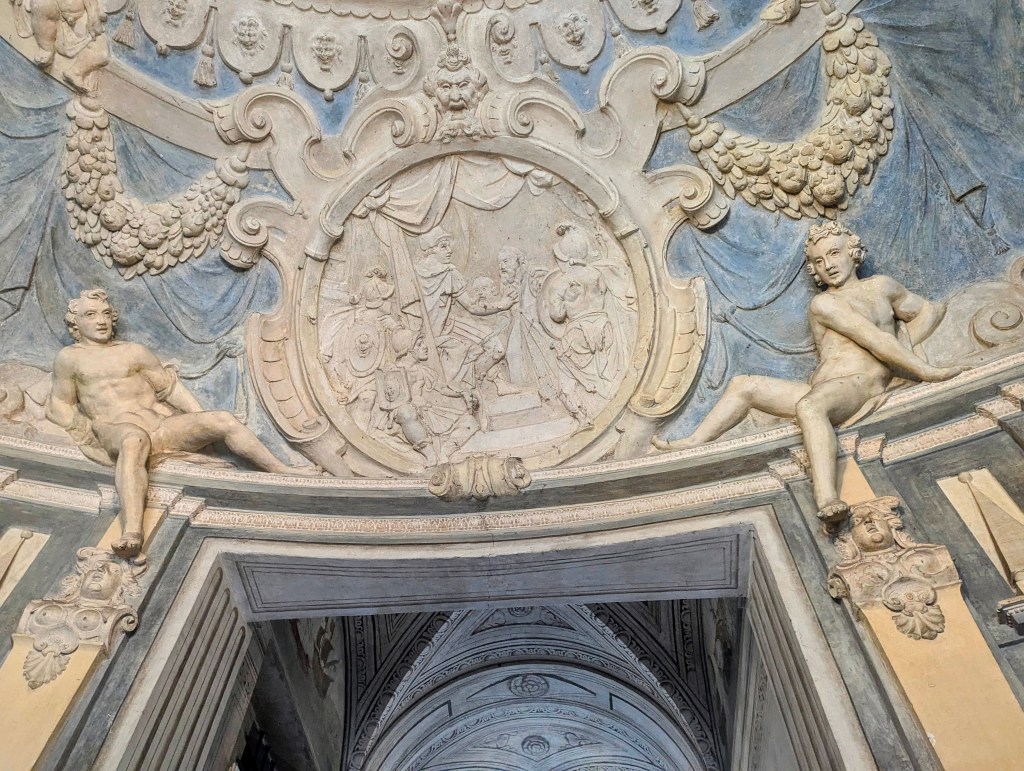
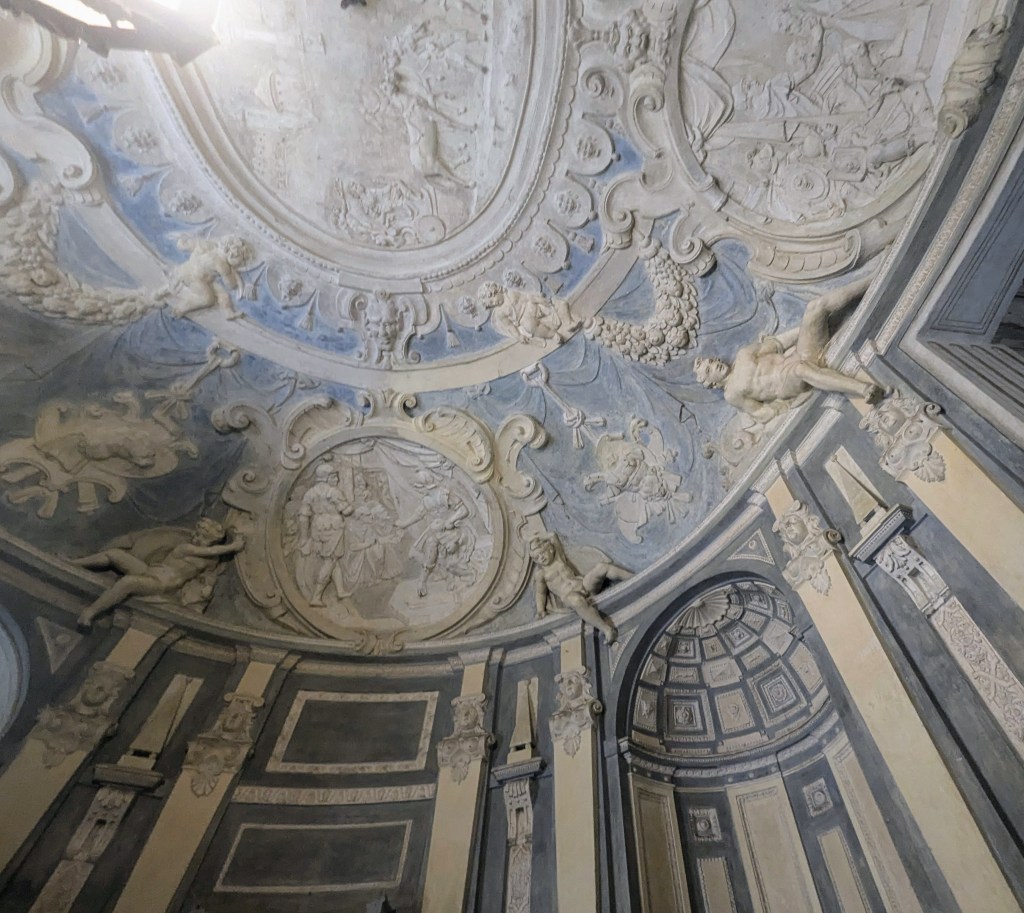
Over the door and on the ceiling of the entryway are medallions with classical figures.

The oldest pictorial work in the building is the cycle of frescoes created in 1623-1624

Palazzo Bianco (White Palace) got its name for the plain color of its facade. It was built between 1530 and 1540 for diplomat Luca Grimaldi, who was from a prominent Genoese family. 

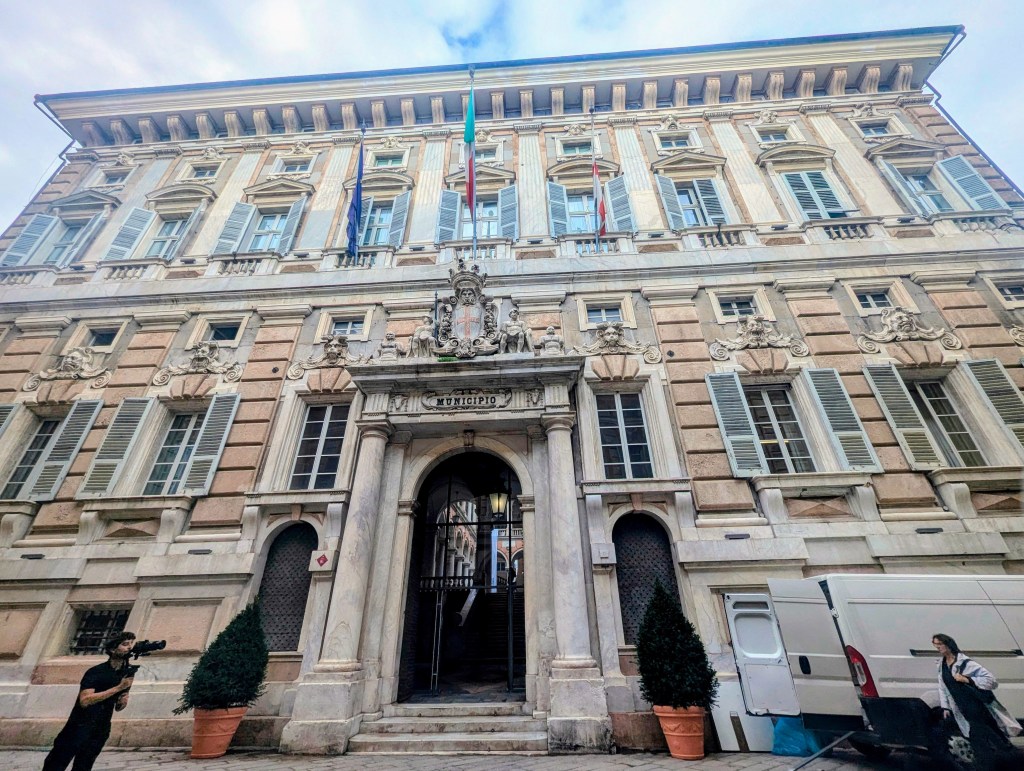
And finally, the Palazzo Doria-Tursi is by far the most impressive and important building on Via Garibaldi. Since 1848 it has been the seat of the Genoa City Hall. The palace was built starting in 1565 by  Domenico and Giovanni Ponsello for Niccolò Grimaldi (1524-1593).

As a culmination of the residential splendor of the Genoese aristocracy, the palace boasts an unprecedented and ingenious architectural solution – the succession of interior spaces: atrium, staircase, rectangular courtyard raised above the portico and double ramp staircase, creating a wonderful play of lights and perspectives.

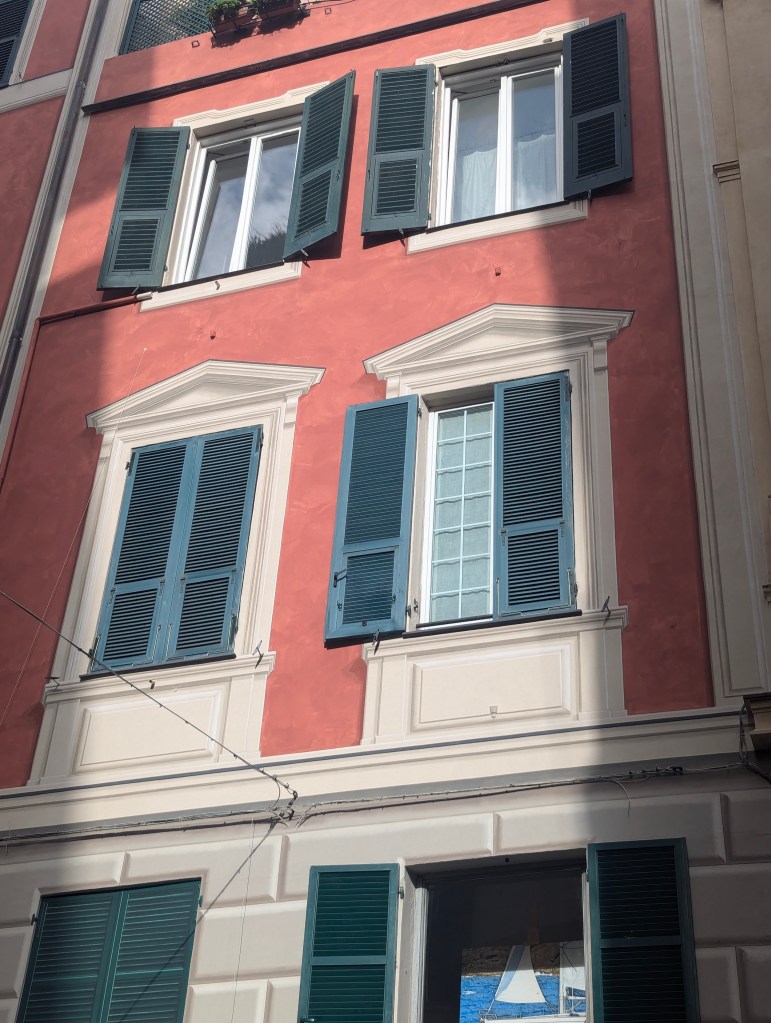
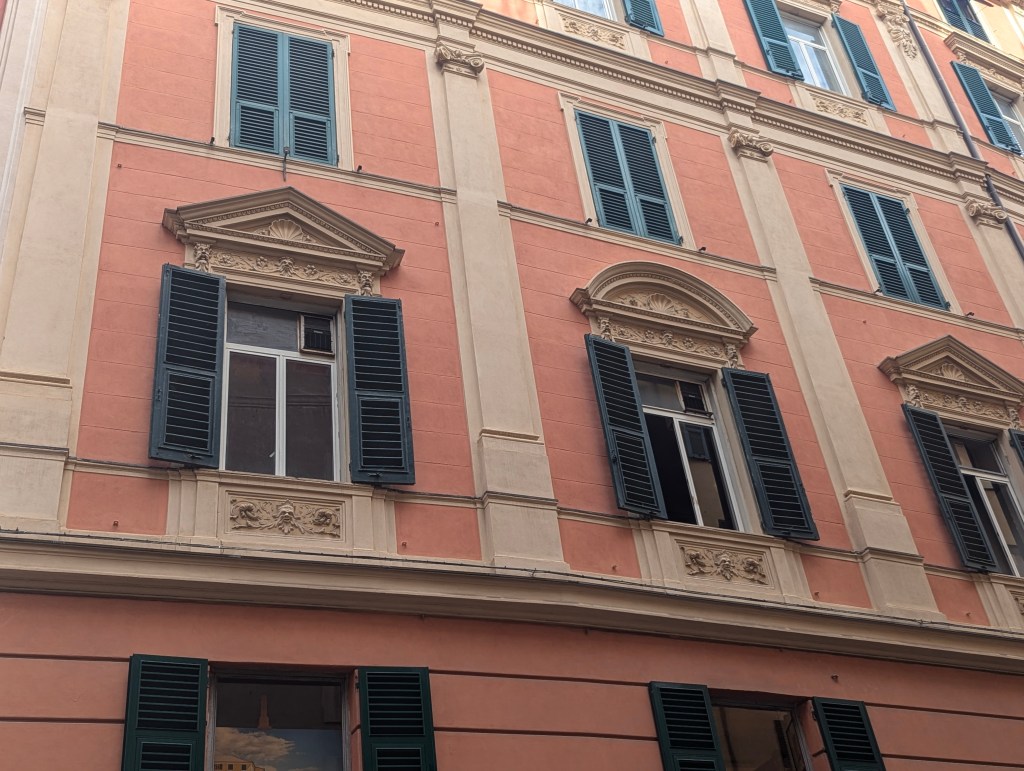
There were more castles to see, but we had grown weary and decided to head back for a break. Along the way we made several observations. In areas of high tourism and/or UNESCO protection, some of the architectural features are painted on to give visual uniformity to the street.

while the neighboring window may have actual wood frames.

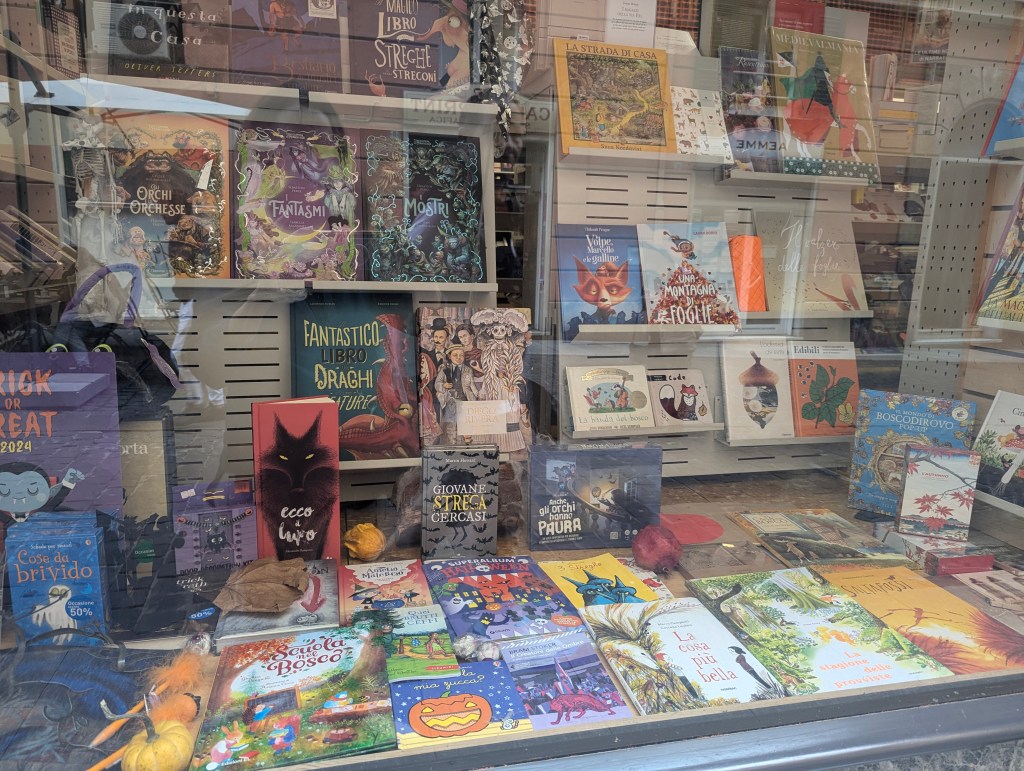
Also, we had wondered if this very catholic country celebrated Halloween at all; the indication of this bookstore is a resounding Yes.

On the way back we passed a bakery and bought two Ligurian treats to try at a later time: baci (kiss) cookies, so called because the chocolate ganache sandwiched between the two layers of hazelnut cookies look like lips.

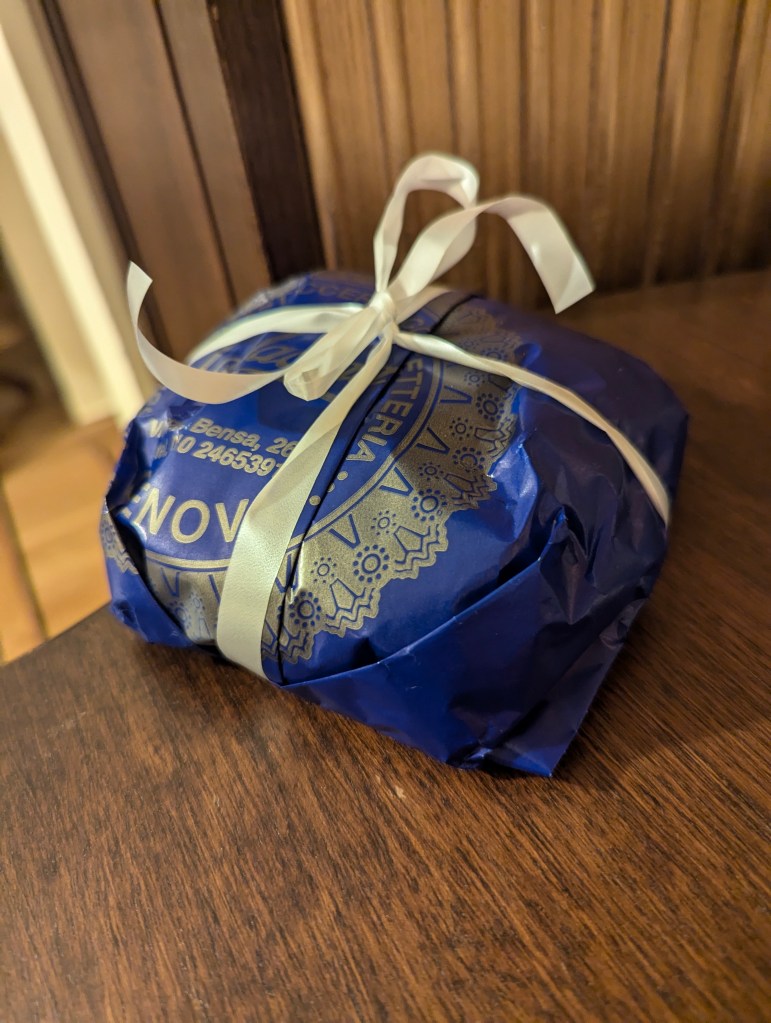
and pandolce, a sweet Italian Christmas bread from Genoa consisting of flour, sugar, butter, milk, raisins, candied orange rind, eggs, lemon juice, and pine nuts. It is sold wrapped as a gift. It tasted mostly like Irish soda bread but a little sweeter.

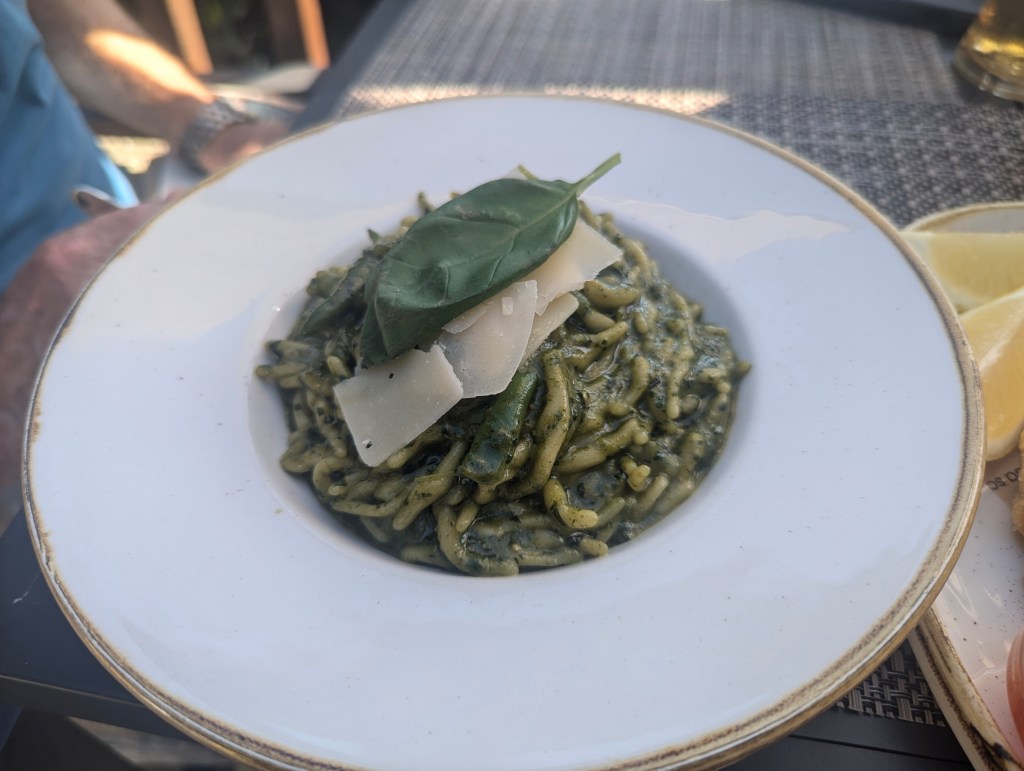
As one may be able to discern from this reading, Genoa was not our favorite city. We are not maritime buffs, and overall except for the areas with the shopping and the palaces, it is a bit of a dirty, run-down city. But the main reason to visit Genoa is for the food. Ligurian culture has produced many food favorites, the most well known is probably foccacia, but also pesto. So when in Genoa… that night for dinner we ordered two of the most famous Ligurian dishes: trofie pesto and minestrone soup.

An iconic dish of the Ligurian tradition is trofie pasta with Genoese pesto sauce. It is thought that this specific type of pasta (short and twisted) comes from Sori in the province of Genoa. The Pesto is made with P.D.O. Genoveses basil (from here, and the least minty of all the basils), local Extra Virgin Olive Oil (preferably using local Taggiasca olives), pine nuts, garlic, pecorino and parmesan cheese. The typical  version of the dish includes green beans and potatoes. 

Minestrone was born as a home dish, a dish for daily dinners sitting with family at the kitchen table. And in fact there is no precise recipe , because in minestrone they put seasonal vegetables, those that were available, and because each family had its own habits and tastes. In general, in spring minestrone was more varied and was enriched with basil pesto. In winter, when basil was not available, the few seasonal vegetables were seasoned, at the end of cooking, with a soffritto of onion and parsley. Overall, it is very different than what we call minestrone in the states.

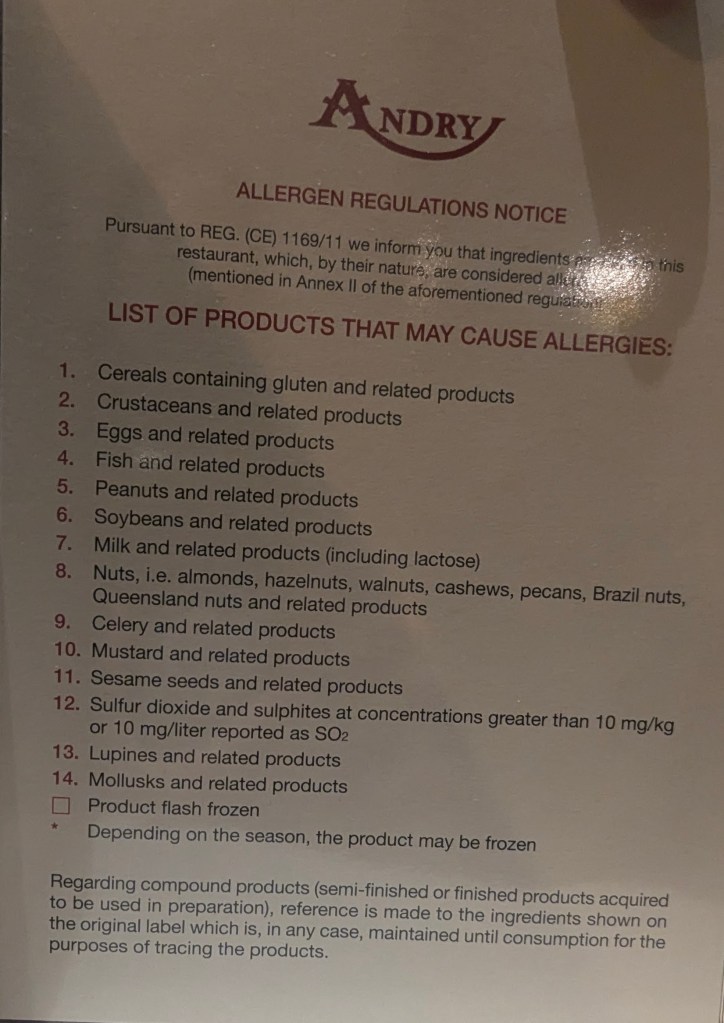
I will add here that my favorite component of every Italian menu is at the back where there is a code for every ingredient for people with food allergies or aversions. Each item on the menu has any corresponding numbers added. Some restaurants also include whether any of the ingredients had been previously frozen.

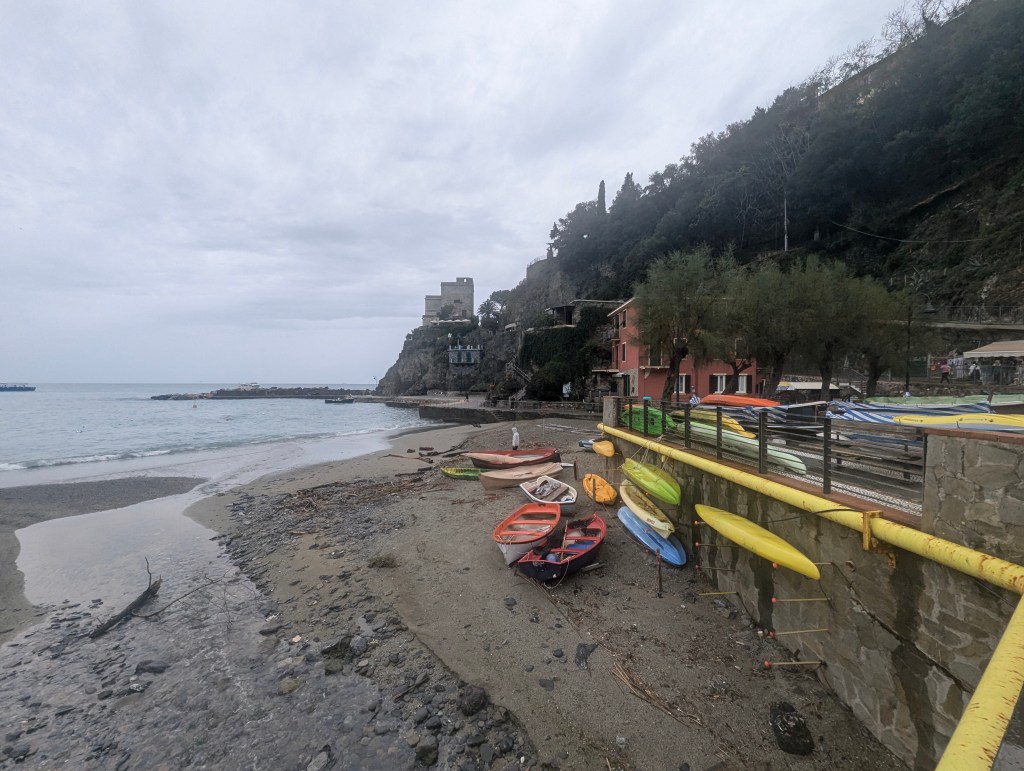
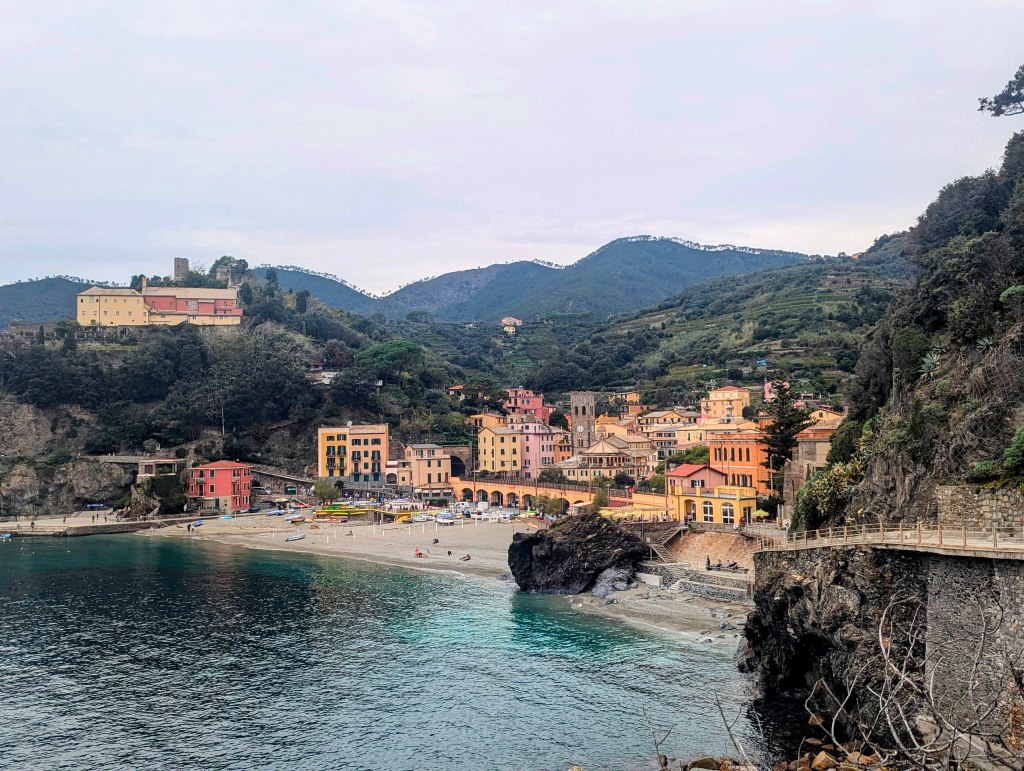
We were then on to Cinque Terre, also in the Ligurian region, so more opportunity to try new intriguing dishes. Again our travel day was one of rain. We arrived in Monterosso al Mare too early for our AirBnB check in, so we had lunch then a stroll to the beach on a very gray day.

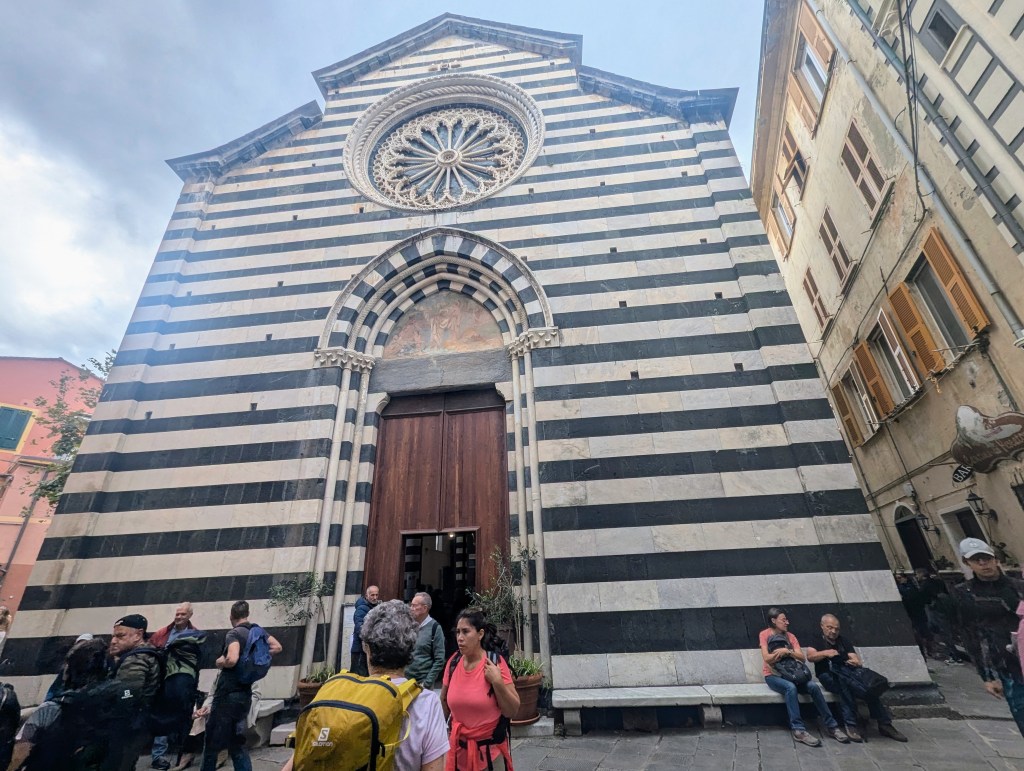
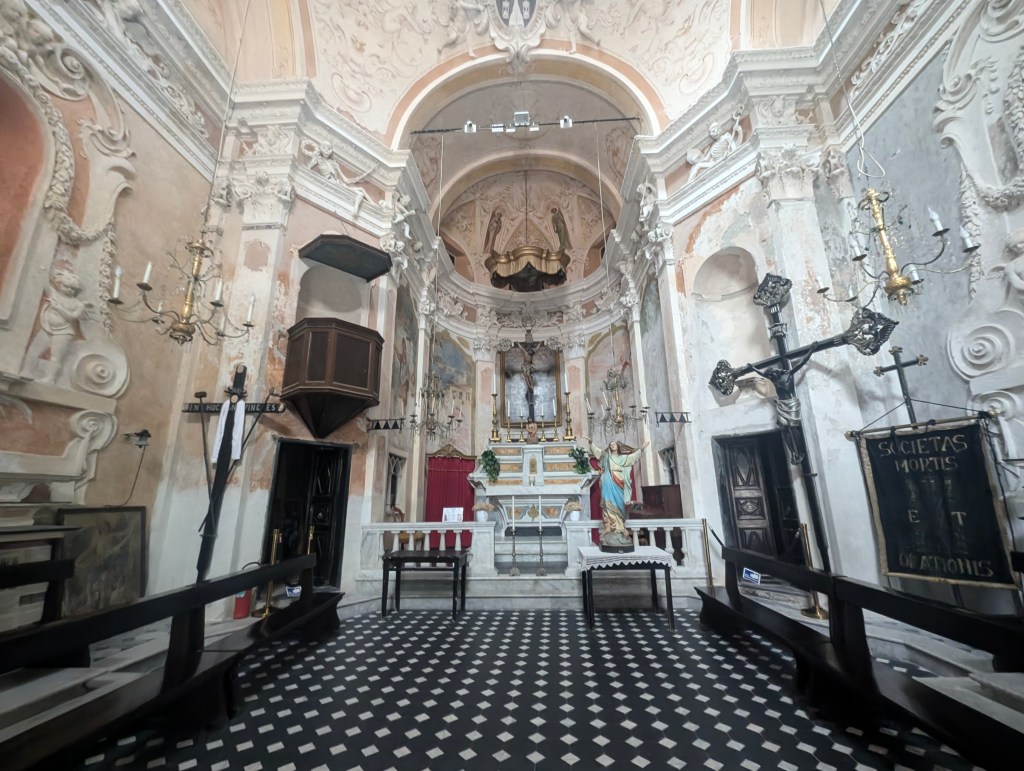
We explored the town a bit which is separated into 2 parts via a tunnel. We were to stay in the “old town,” at the center of which is a church, of course. San Giovanni Batista dates from the 13th century. The façade is of both white marble and serpentine which is typical of churches built in the Ligurian Gothic style. The rose window is composed of 18 small columns as its radii.

San Giovanni Batista

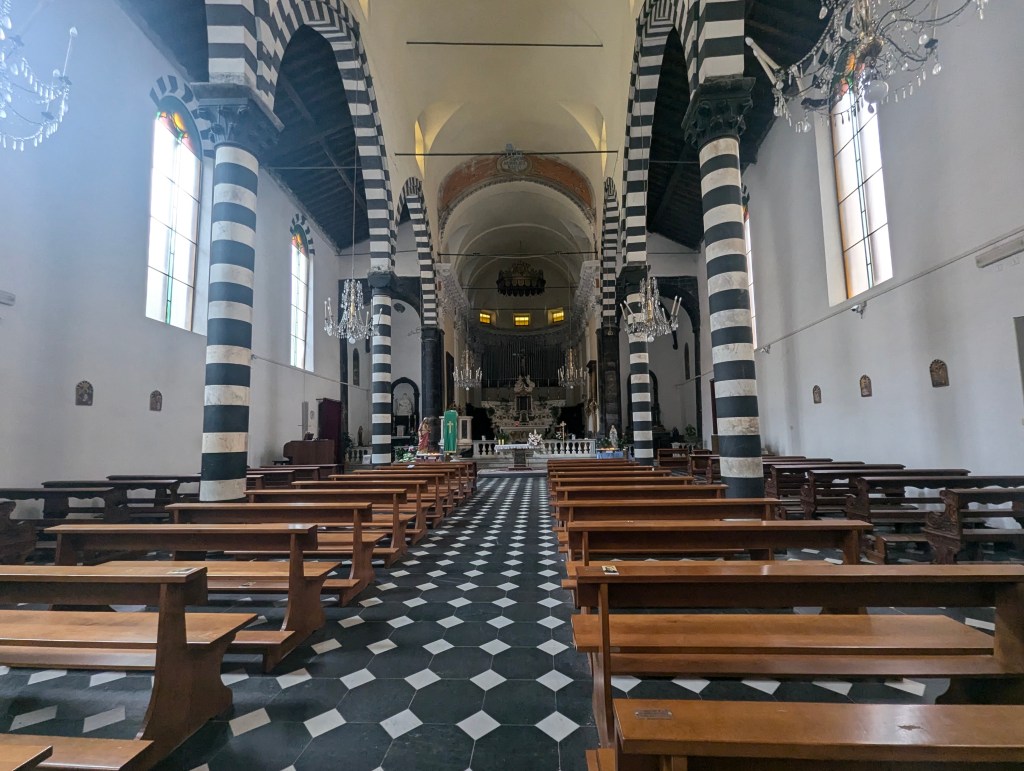
The church required significant renovations after the 2011 flood.

interior San Giovanni Batista

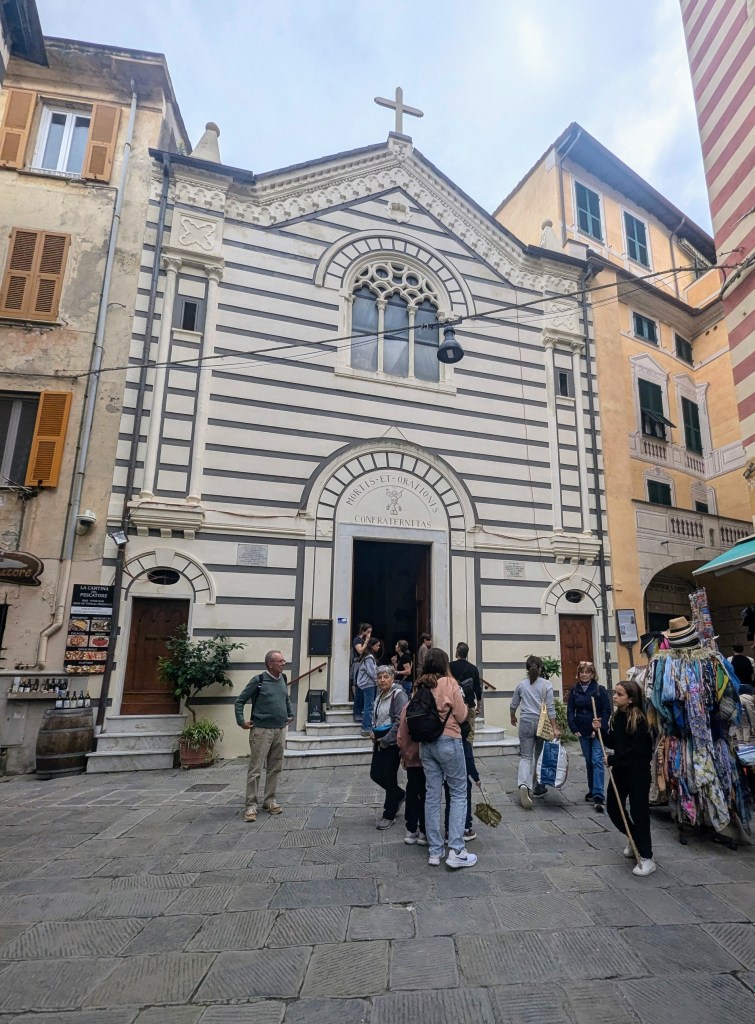
In the same square is a second religious edifice: the oratory of the Neri Brotherhood built in the 17th century.

On the façade is the Latin inscription: mortis et orationis which means death and prayer. The brotherhood was devoted to prayer and to helping the needy that could not afford a burial.

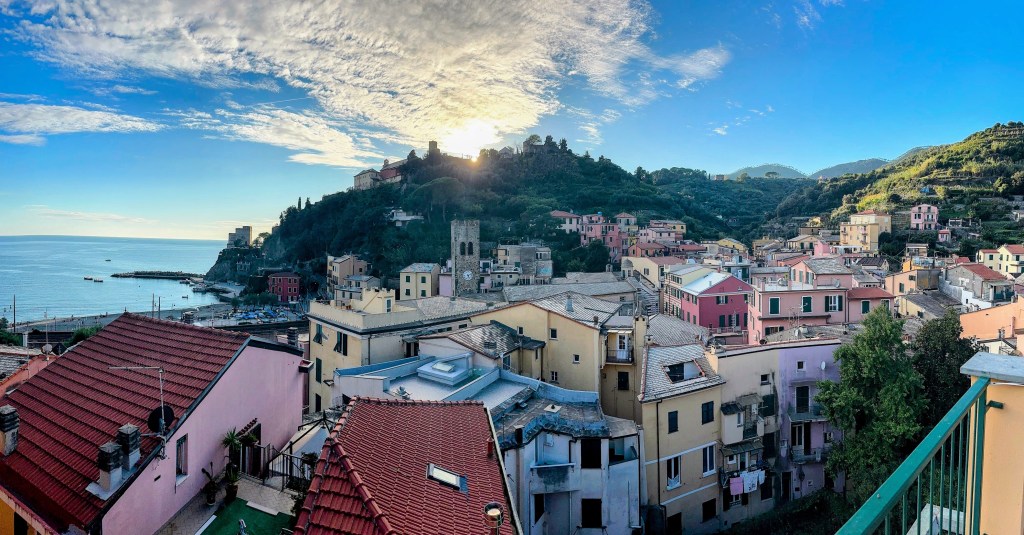
We were met by our host who showed us up the many, many flights of stairs to our apartment. But the climb was worth it. We not only had a really lovely apartment, but we had a rooftop terrace with an amazing view!

After a grocery shop we settled in for the night hoping the morning would bring sunshine, which to our relief it did. Based on the advise of our host, we bought the 5 towns unlimited train pass to explore all of Cinque Terre over the next few days. First we ventured past the tunnel and wandered into Monterosso al Mare’s “new town.”

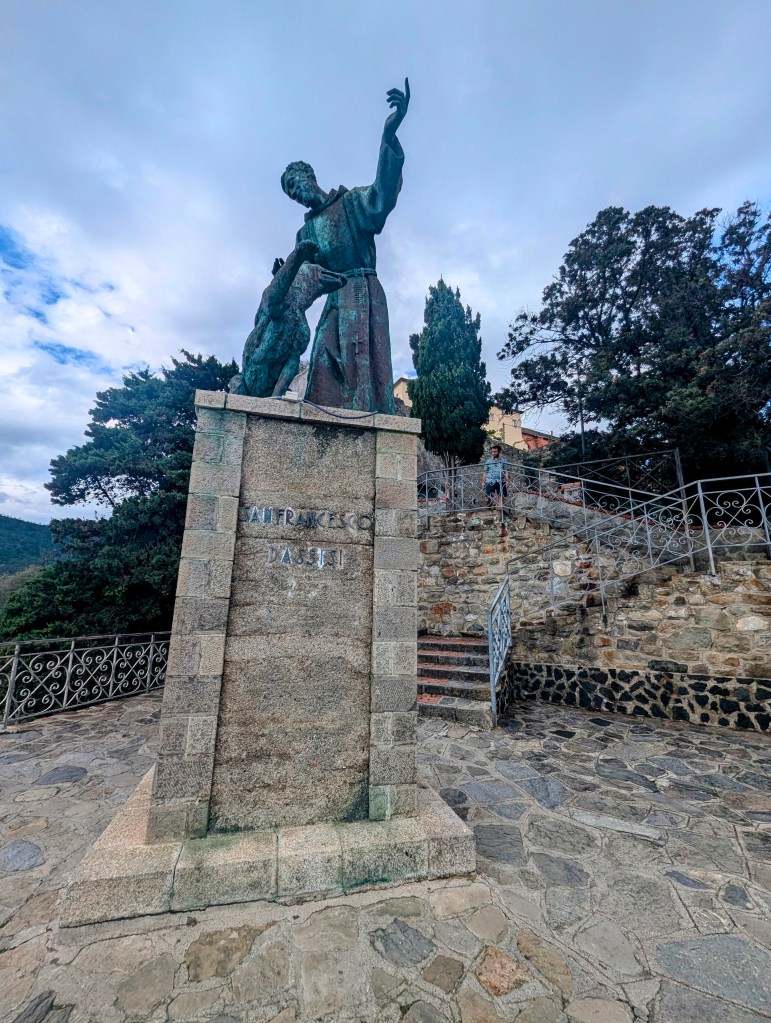
First we climbed the hill and were treated to views.

and a statue of St. Frances.
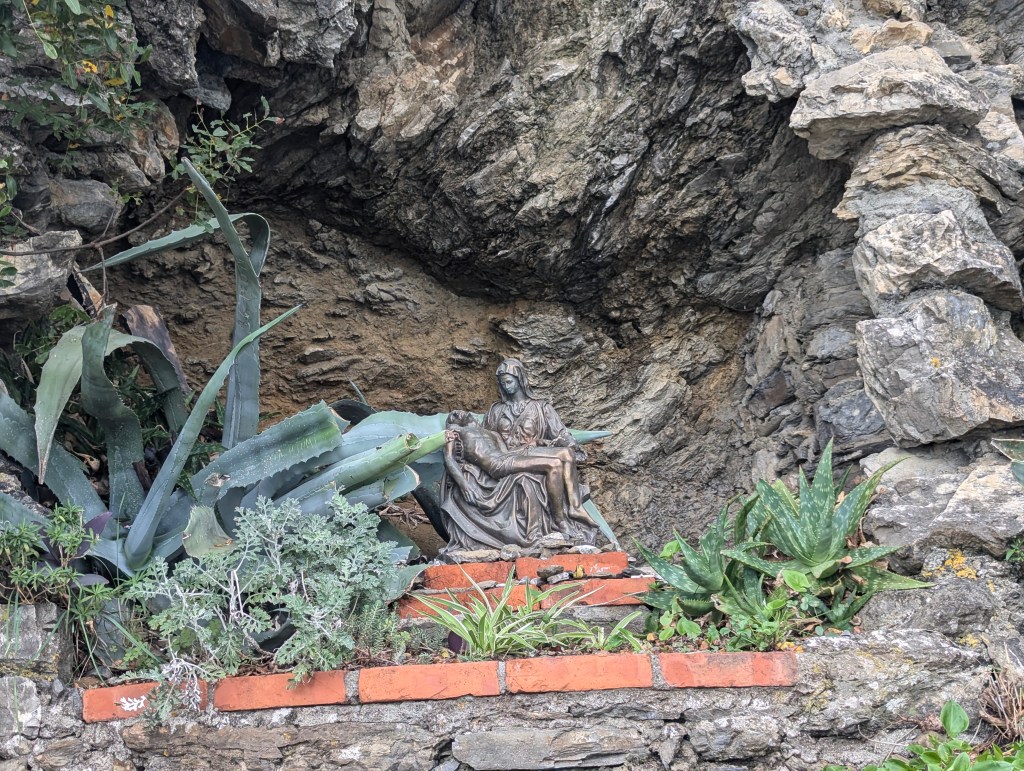
and this little pieta tucked into an alcove.
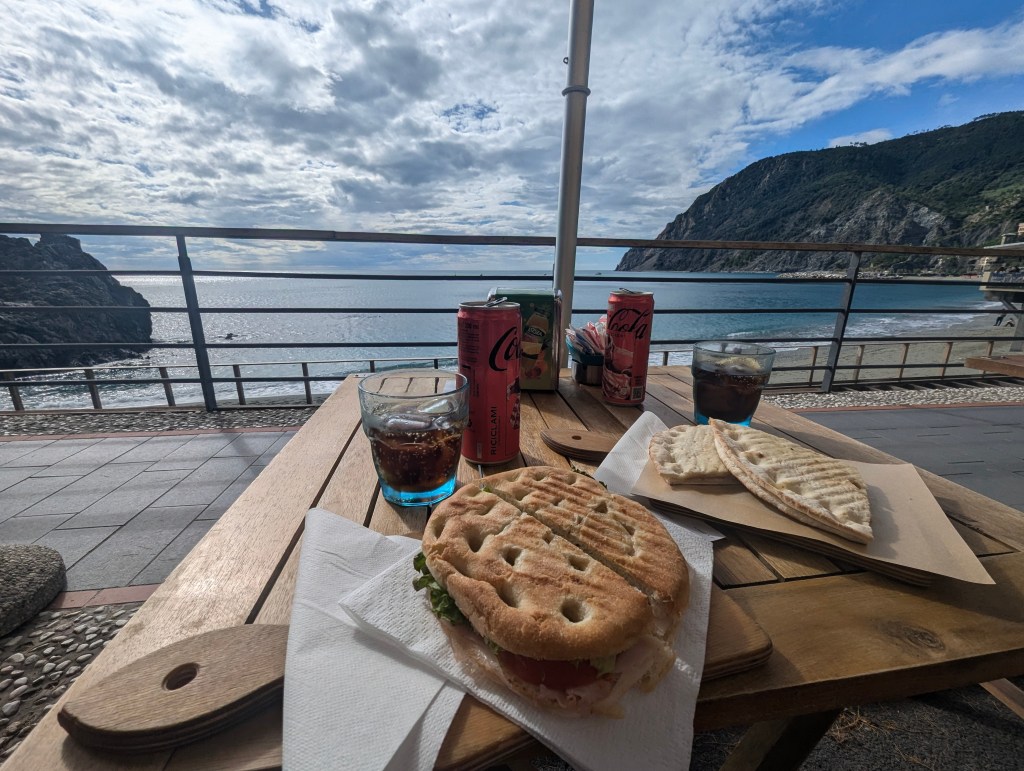
We then headed down toward the beach and stopped for a typical Ligurian lunch: a focaccia sandwhich.

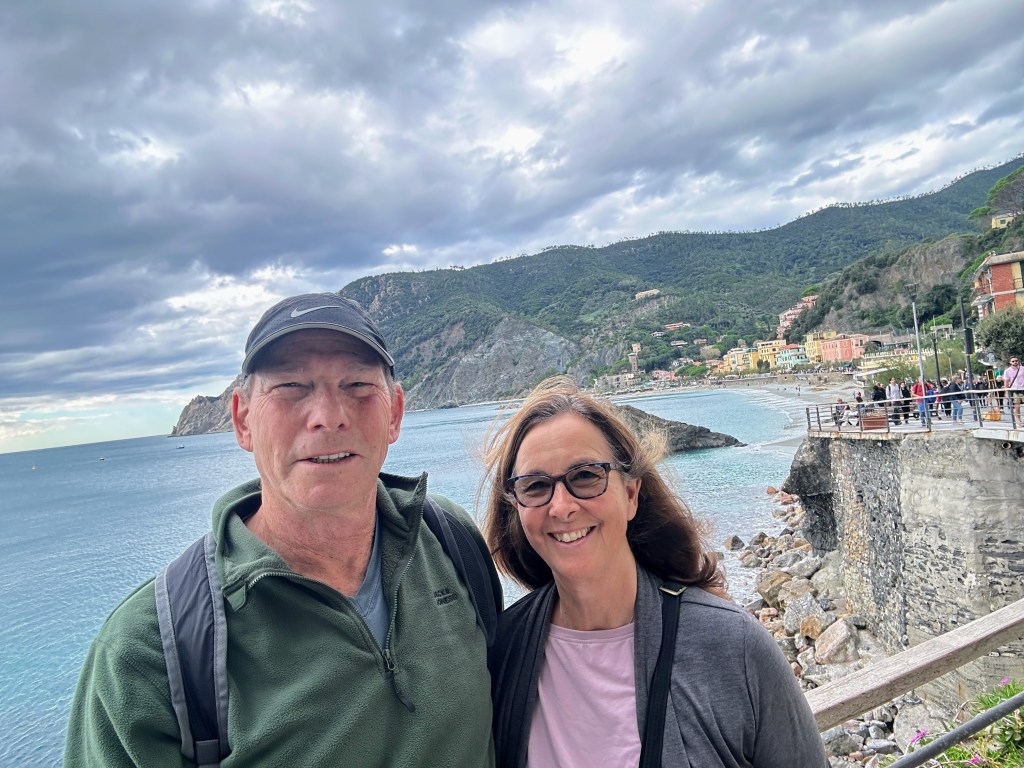
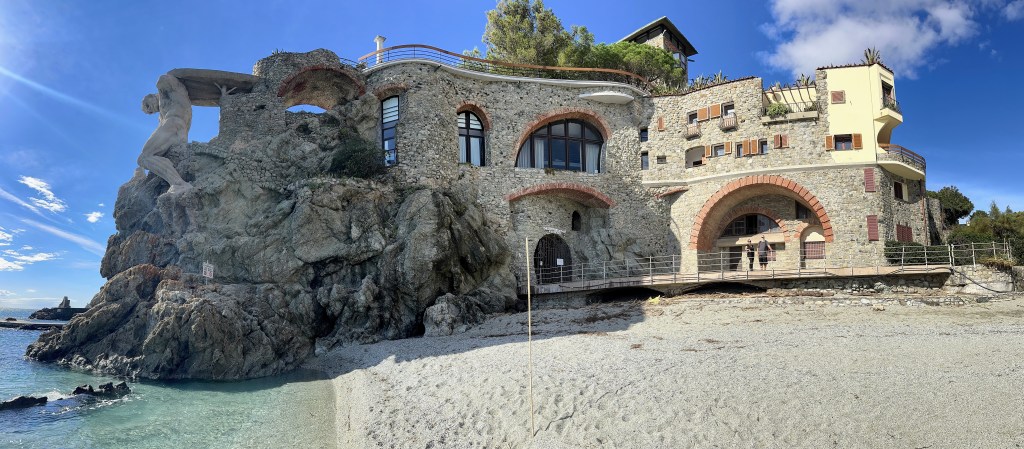
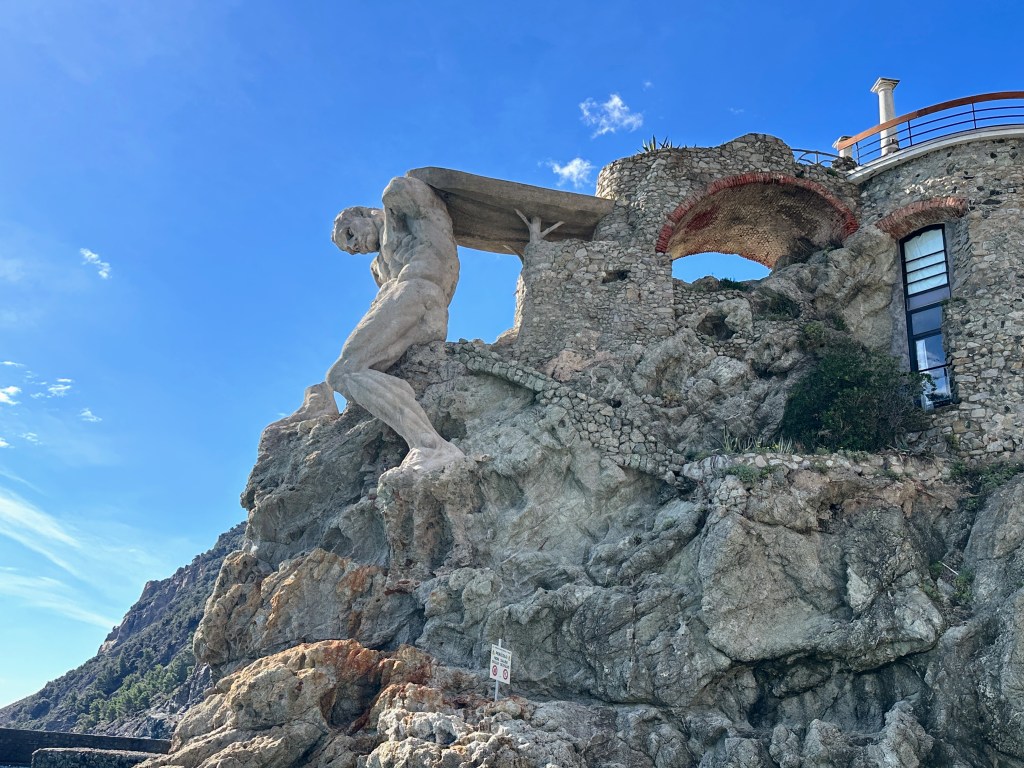
Then we strolled the promenade to the Gigante (the Giant), a 46 foot high statue of Neptune. The giant was sculpted of both rock and reinforced concrete in 1910.

It originally held upon its head a humongous seashell that was the terrace for the luxurious Villa Pastine, but it was destroyed by allied bombs during WWII.

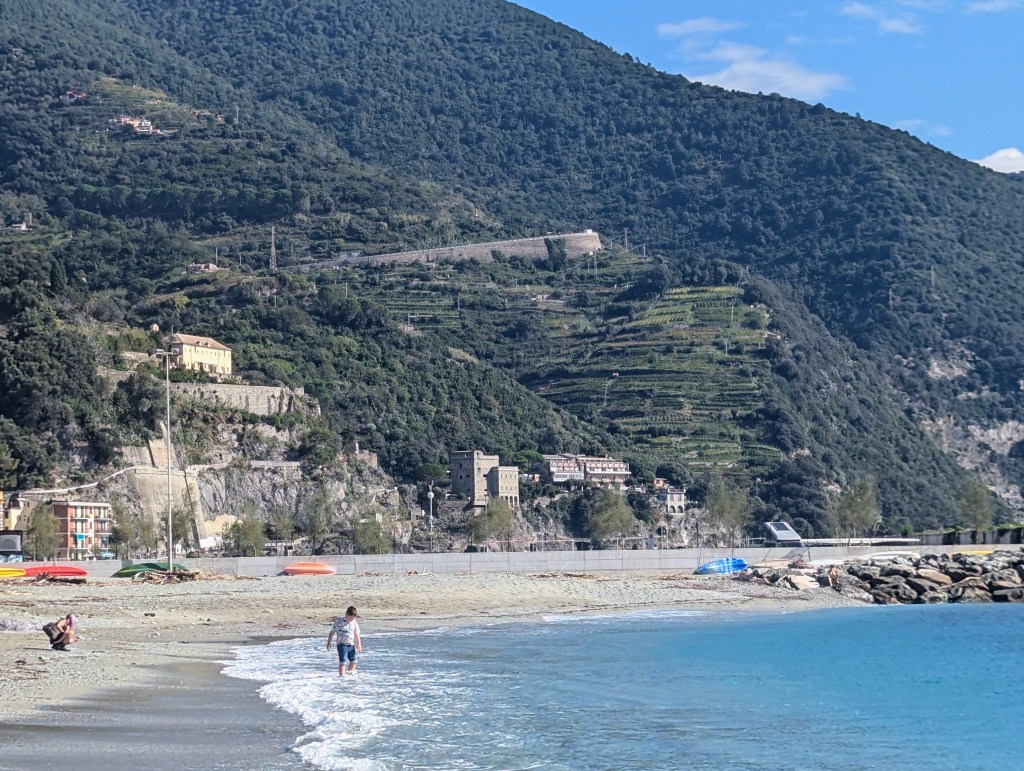
Looking back at Monterosso al Mare, we noticed the terraces for which it is famous. The terracing system has been in place since around 1000 AD to stabilize the land for farming. .  The stones are local sandstone. Over the years over 4,000 miles of mureti (walls) have been built. The most common current crops are grapes for the local wines and lemons for the local limoncini, and, of course, olives.


Next we hopped on a train and decided to get off in the very next town: Vernazza. With Monterossa, Vernazza is the oldest of the Cinque Terre towns, first mentioned in 1080.

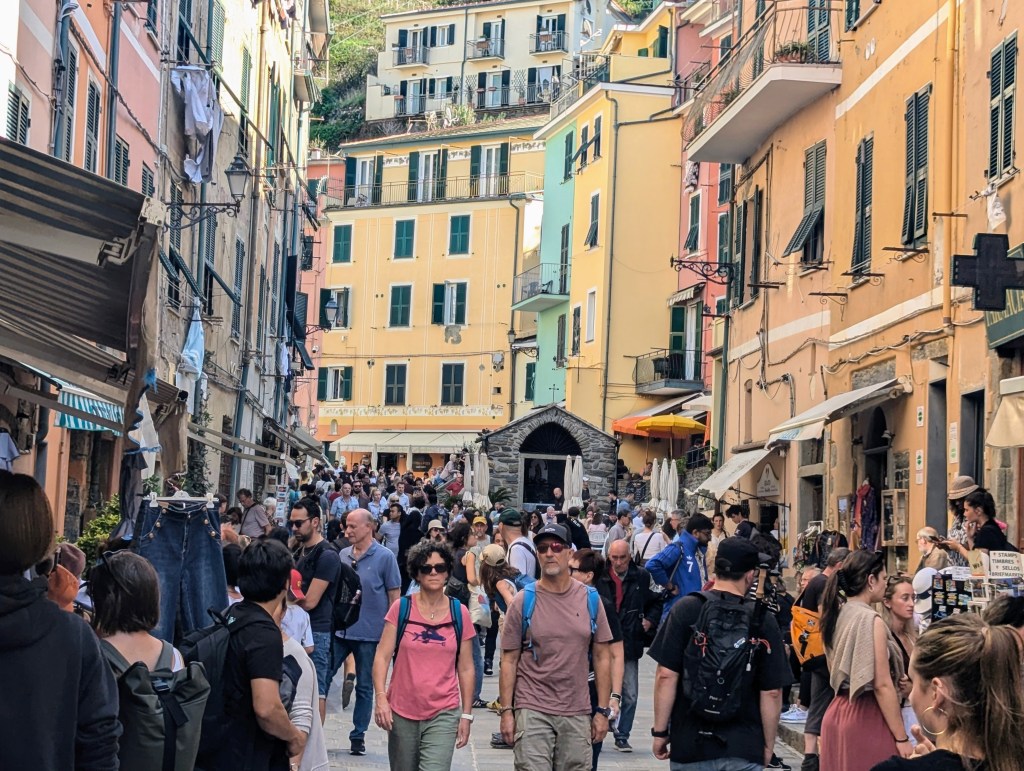
The town was packed with tourists and had restaurants literally everywhere.

We headed over to the marina

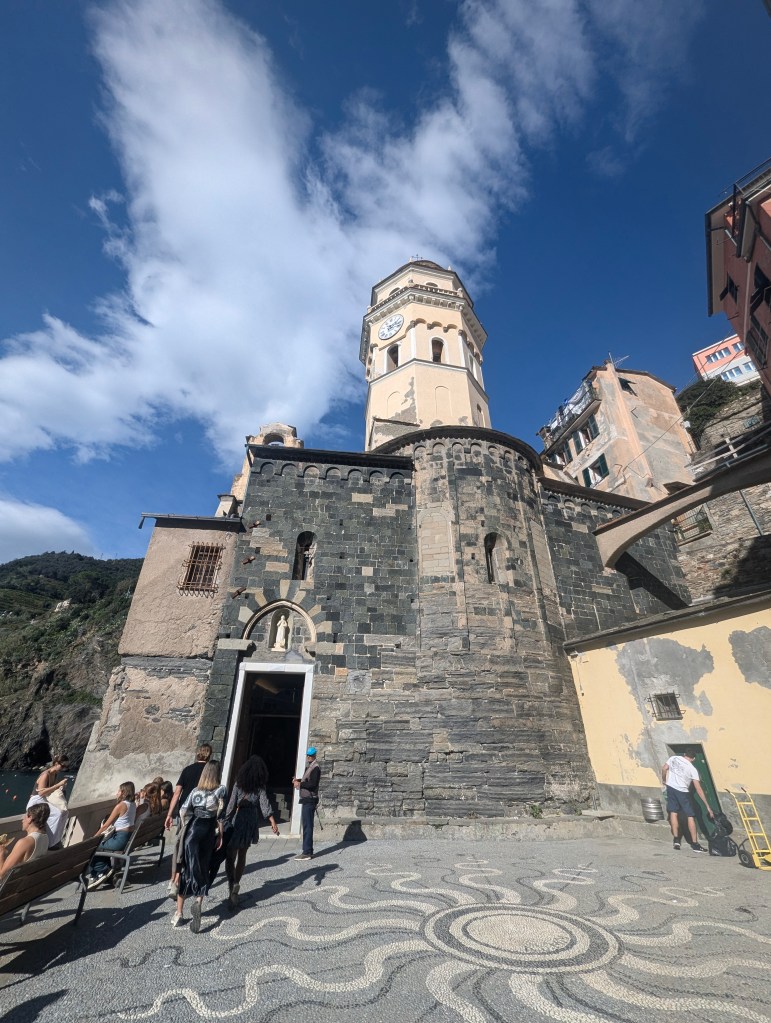
On the way back through town we stopped by the local church: the church of Santa Margherita d’Antiochia. It was built in the 13th century in the Gothic-Ligurian style on a pre-existing Romanesque building using serpentinite, a local green stone. Mentioned for the first time in 1318, it stands on a rock overlooking the sea.

The interior is a bit dark.

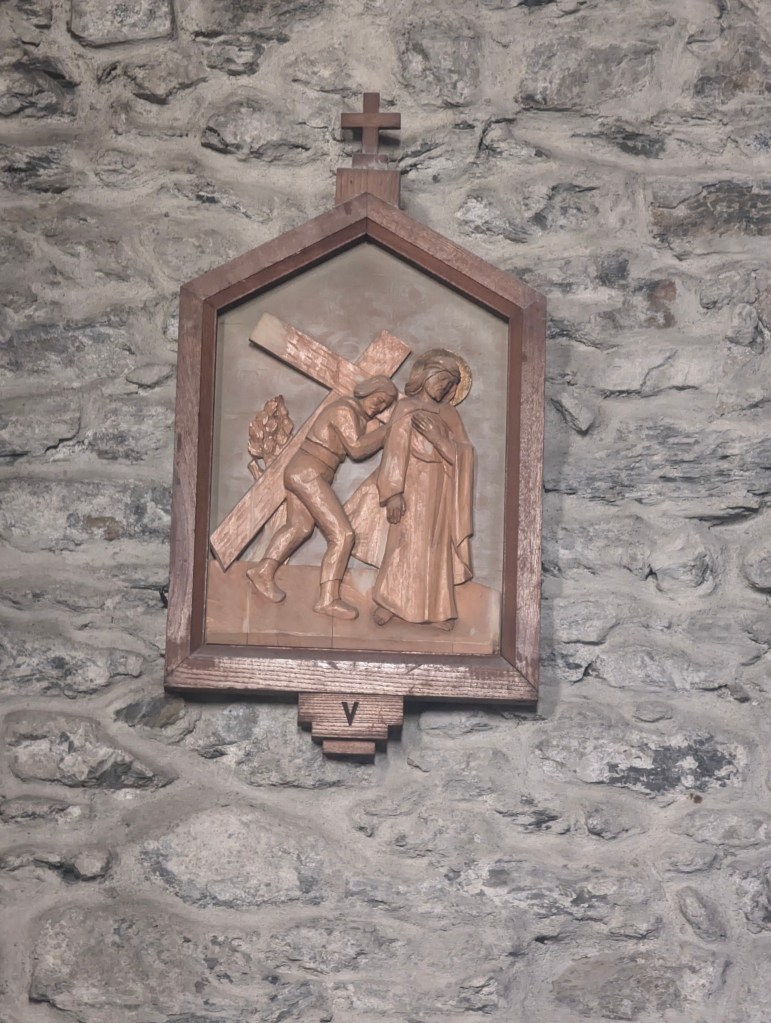
The walls are decorated with wooden plaques denoting the stages of the cross.

And the view out the window is magnificent.

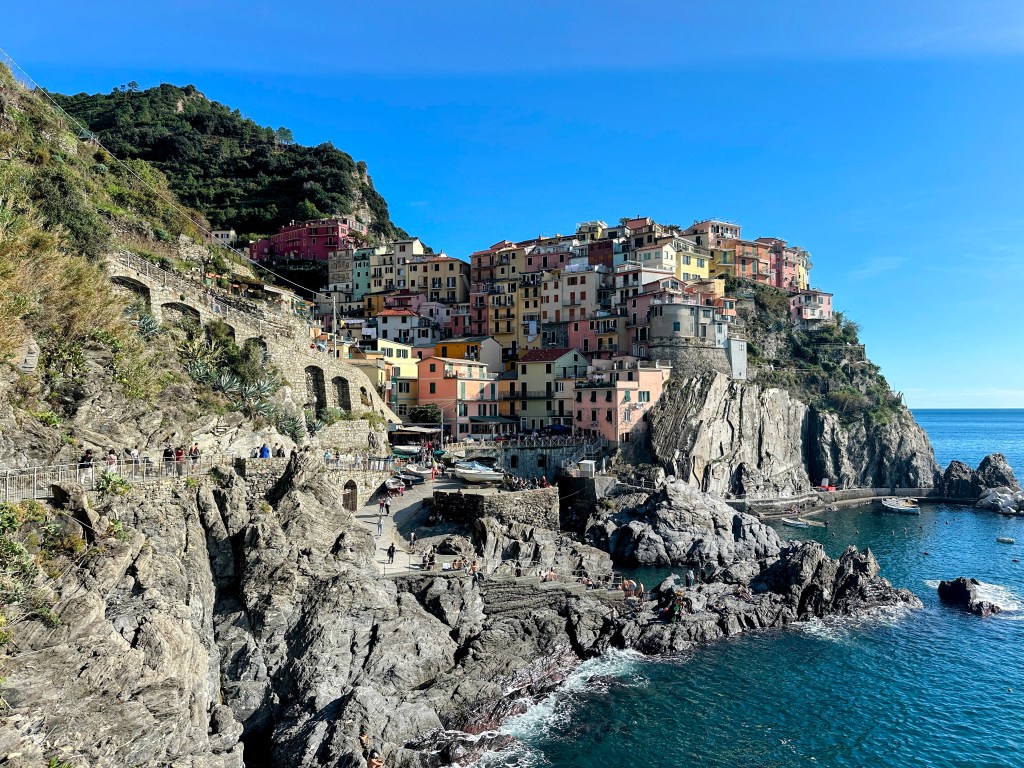
Next we hopped back on the train and we headed to Manarola. The ancient townspeople of Manarola descended the hills from the hamlet of Volastra, which they abandoned for the seaside during the 14th century plague. Upon arriving to Manarola by train, we were greeted by a plaque of the Cinque Terre National Park.

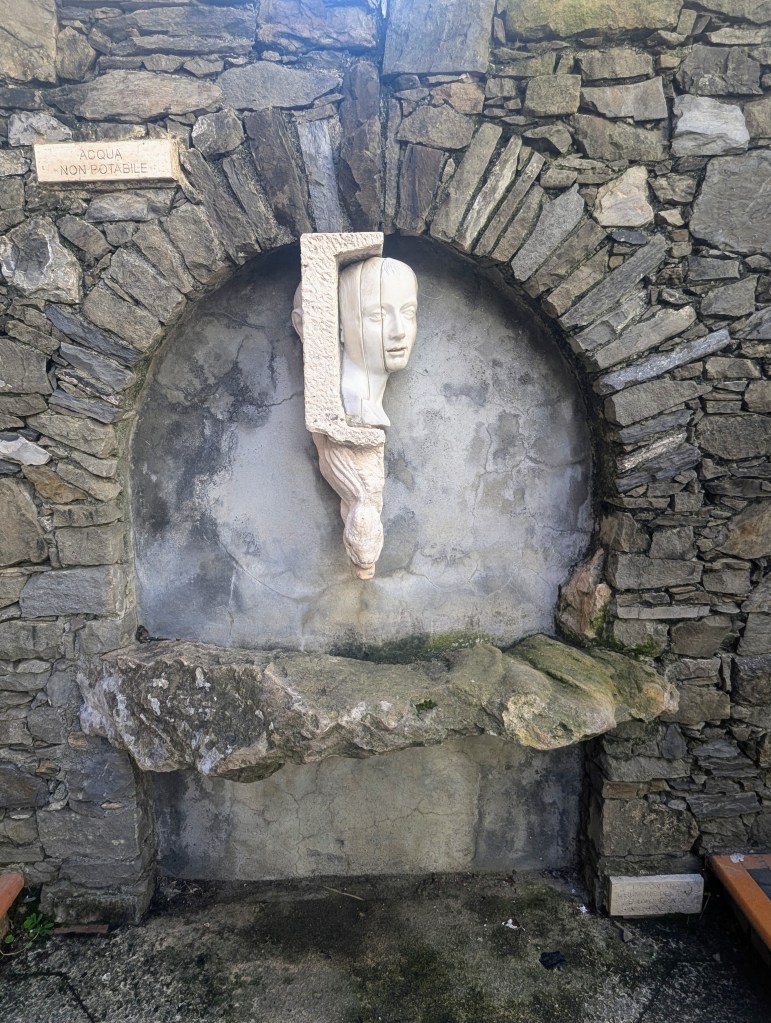
and a little statue.

Here we also saw our first hint of Christmas decor.

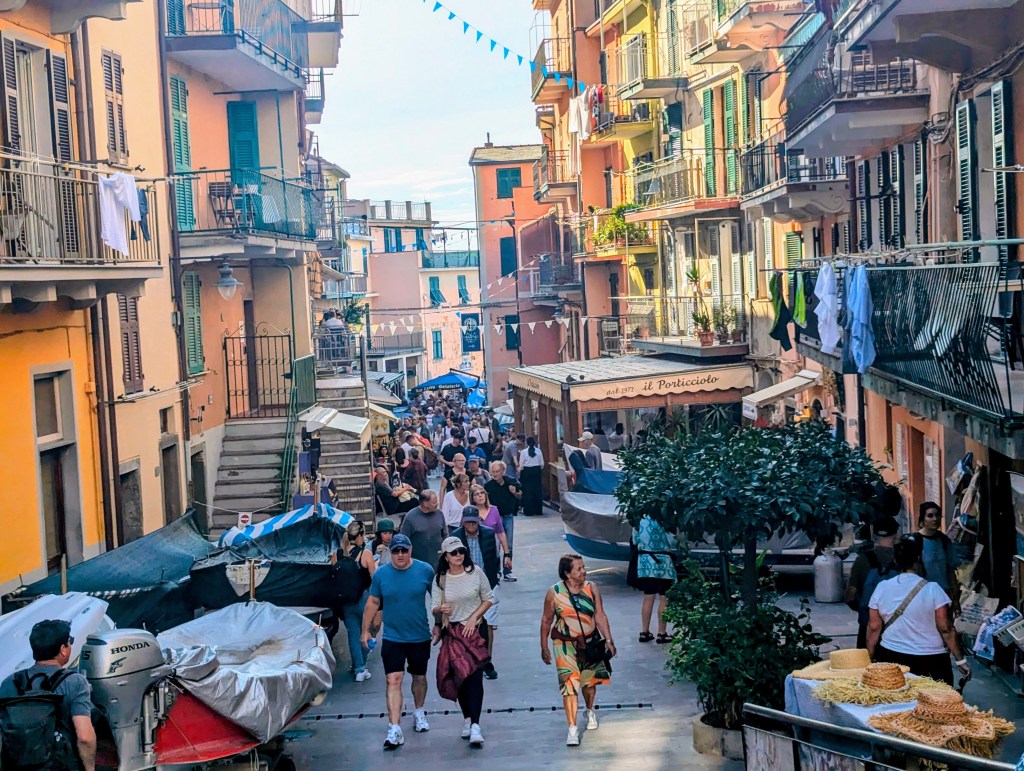
Again the streets were packed with tourists.

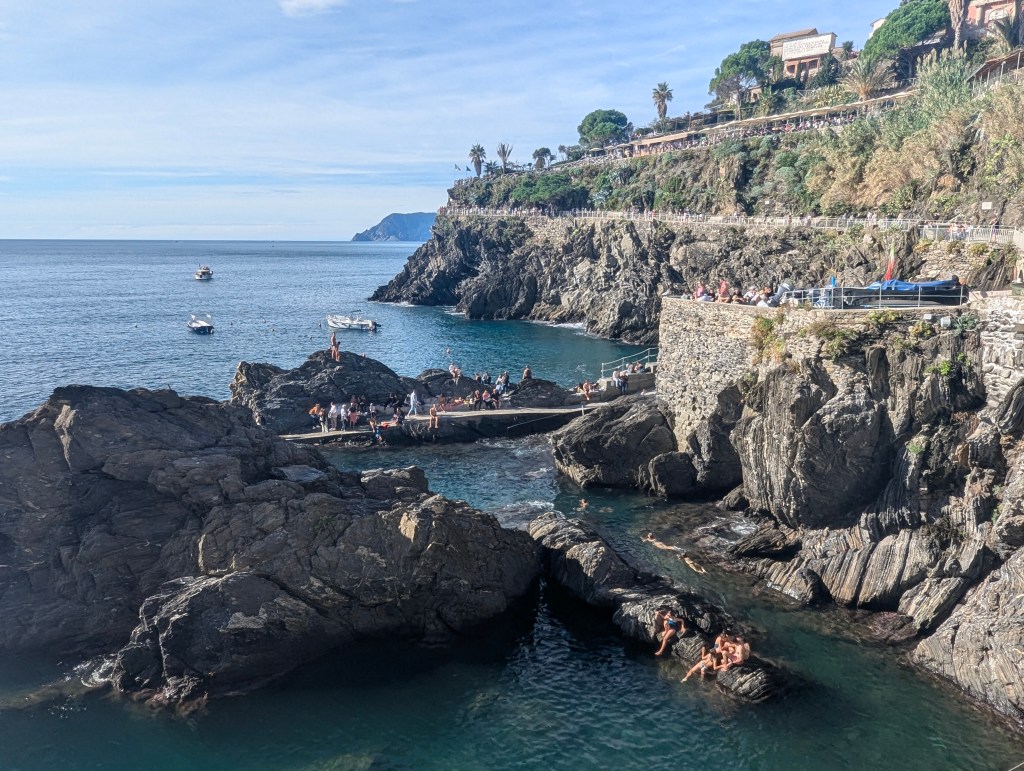
There was not much of a beach, but that did not stop some brave bathers.

We hiked out along the coastal promenade for a view back towards Manarola.

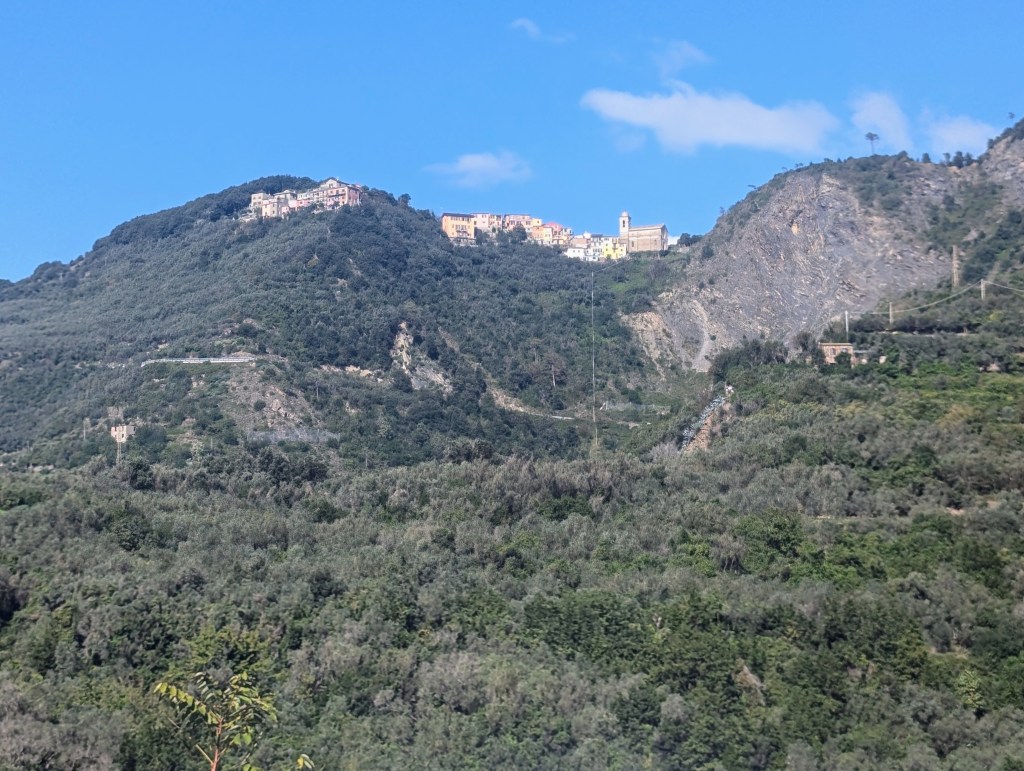
Also from that vantage point we could see the town of Corniglia up on the top of the hill.

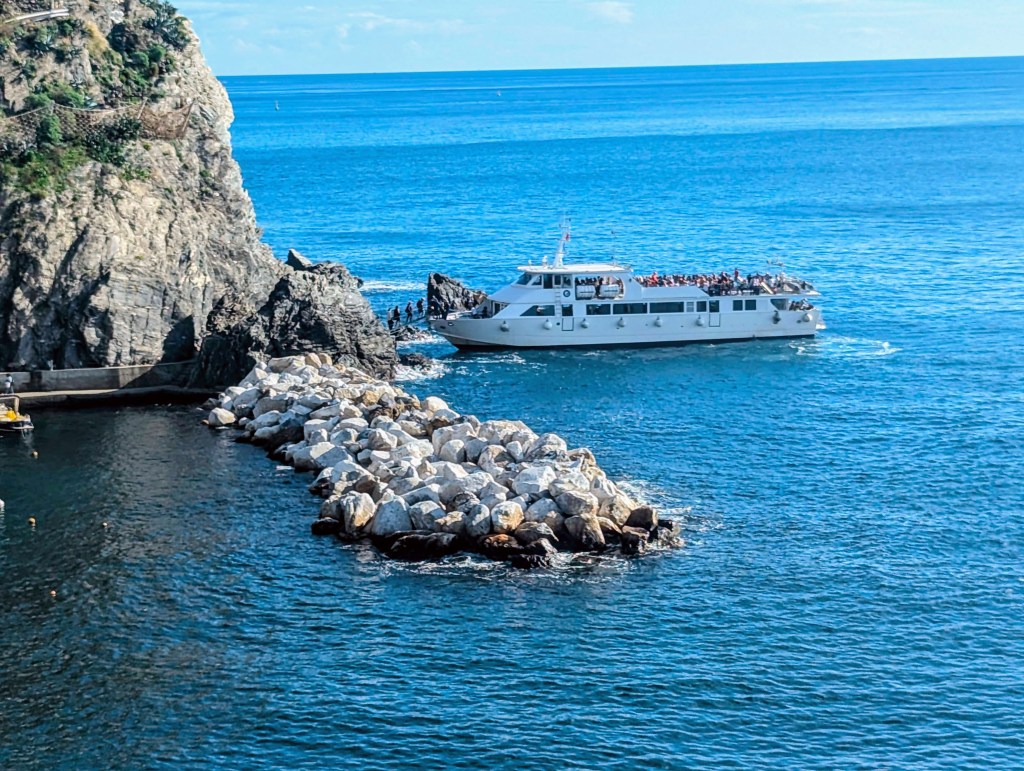
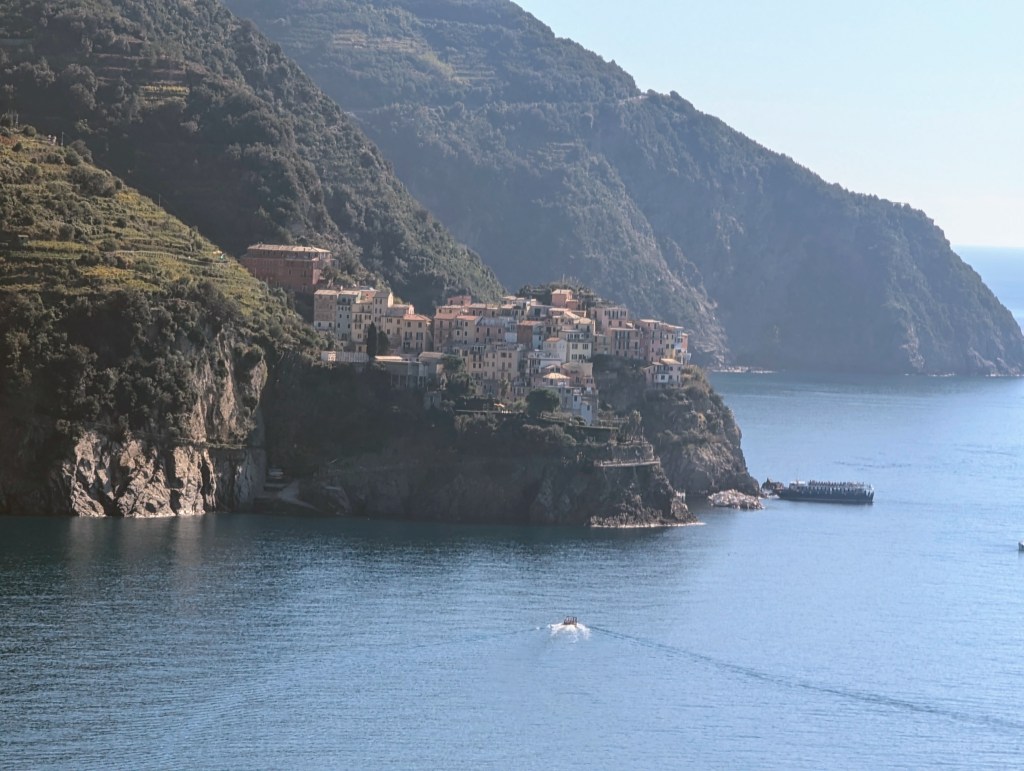
Also from this vantage point we could see the ferry that carries passengers from one Cinque Terre town to another.

There was a market set up in one of the main squares.

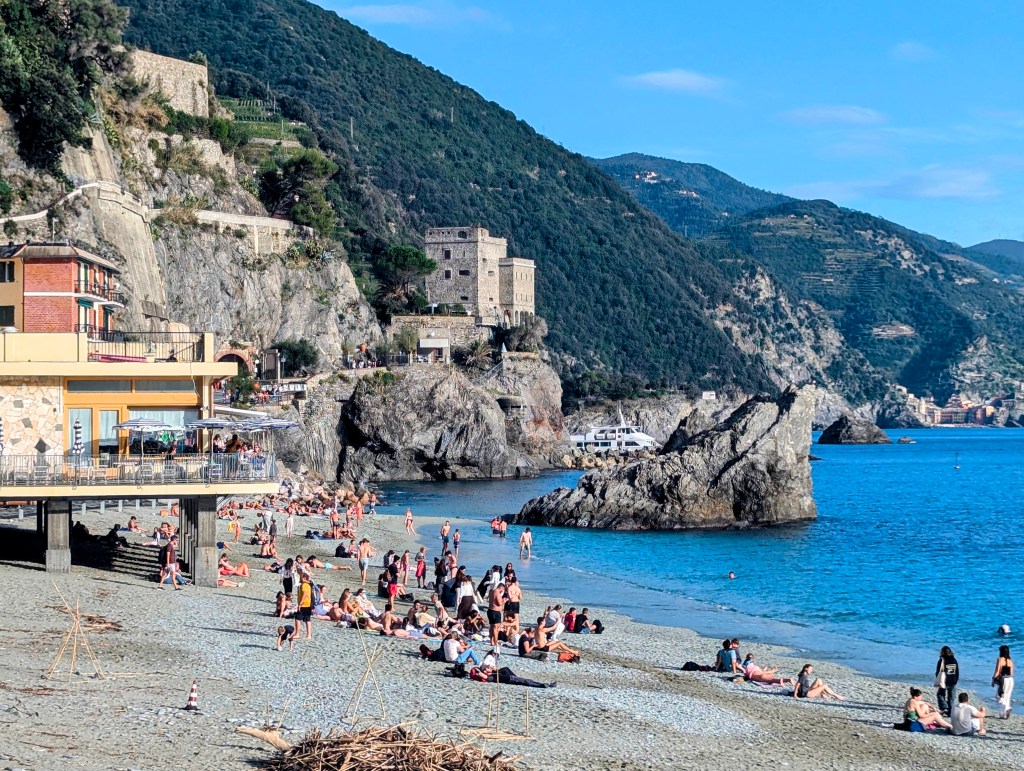
We rode the train back to Monterrosa for a stroll on the beach.

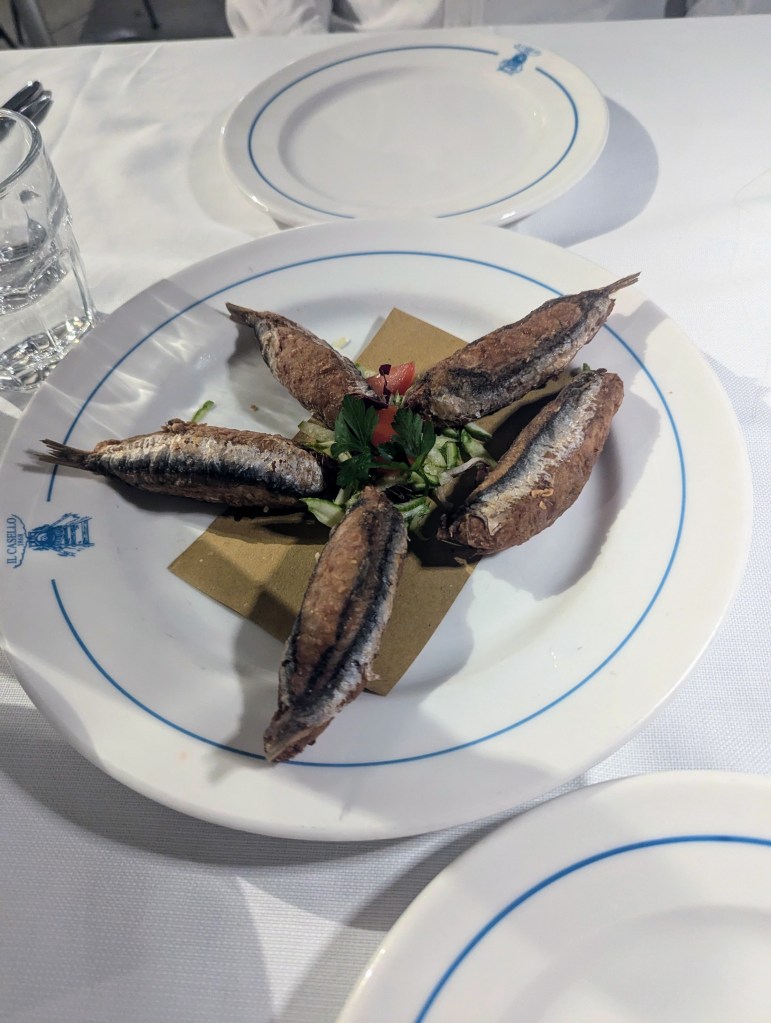
We enjoyed one of our many delicious seafood dinners that evening which included a new one for us: deep fried stuffed sardines.

Next morning we ventured back through the tunnel to the train station, this time first to Corniglia, which is the only of the five Cinque Terre towns that is not by the sea.

Corniglia on the hill

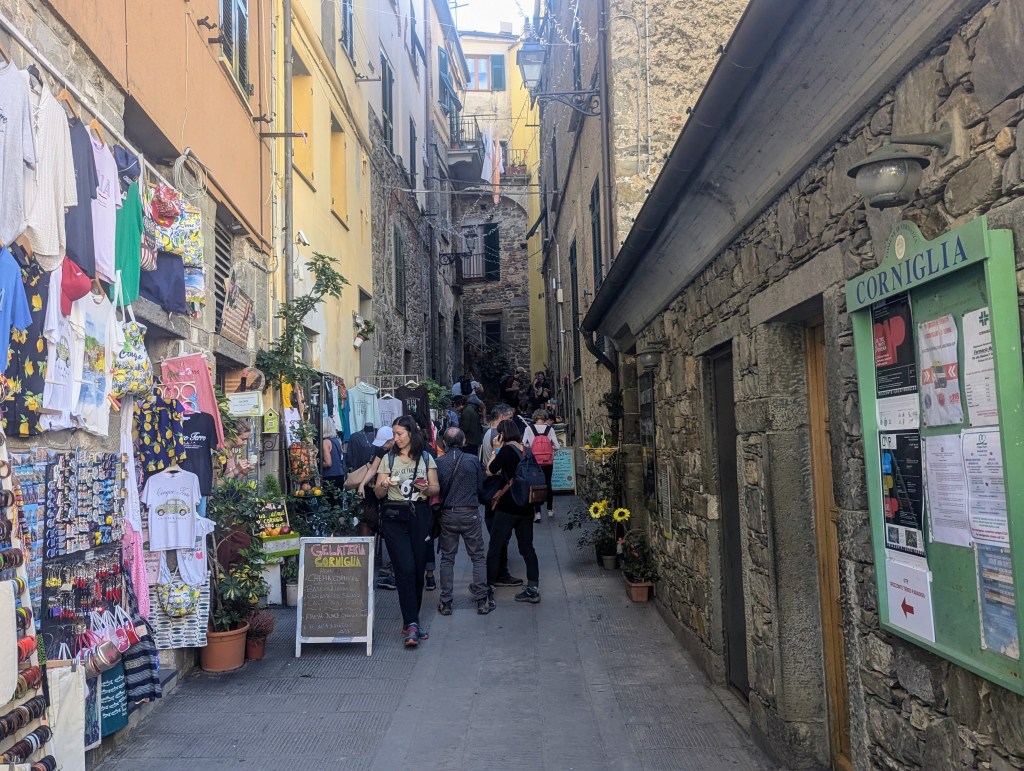
After arriving by train, we waited for the bus to transport us up the long and winding roads. Despite it being October, the wait was a bit long and hot in the sun, and the town a bit underwhelming, basically one cramped street.

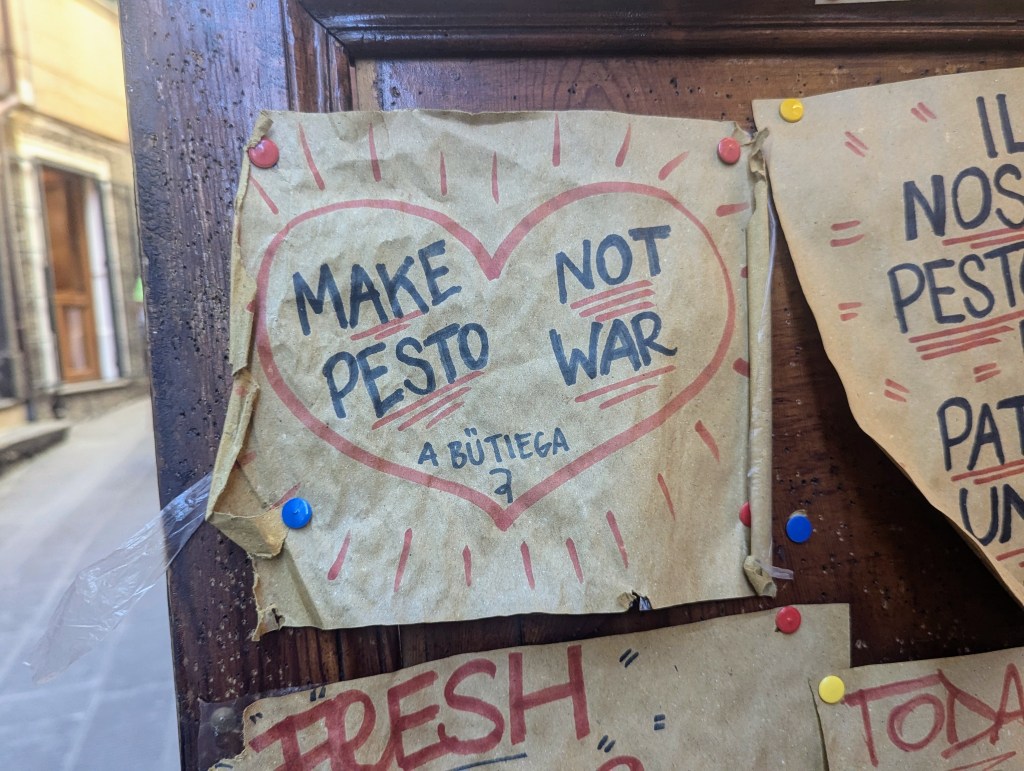
Although I do love this little Ligurian motto:

The church at the top was tiny.

From above the church is a view of Manorola.

We chose a restaurant with a view for our lunch

and enjoyed fried calamari and zucchini, another typical Ligurian dish.

Rather than wait in the hot sun for the bus back down the hill, we braved the steps, of which there were a lot.

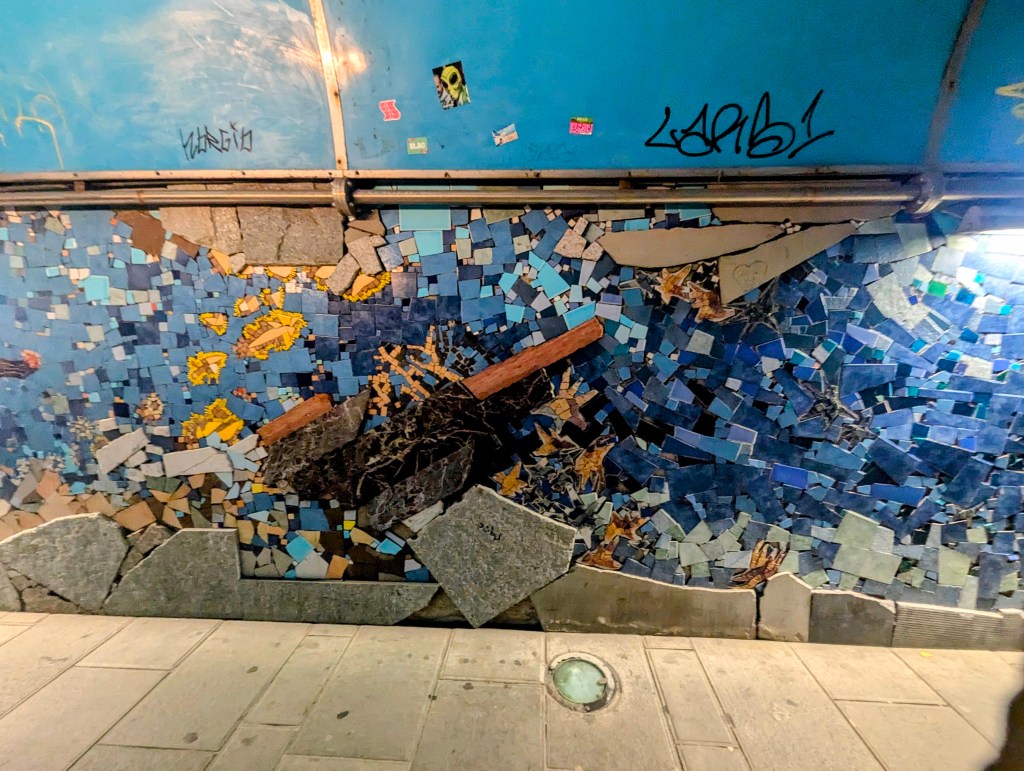
Next we rode the train to Riomaggiore, named for the “big river” that flows beneath the town. Upon arrival by train, one must pass through a tunnel which has been decorated with mosaics by artist Sylvio Benedetto.

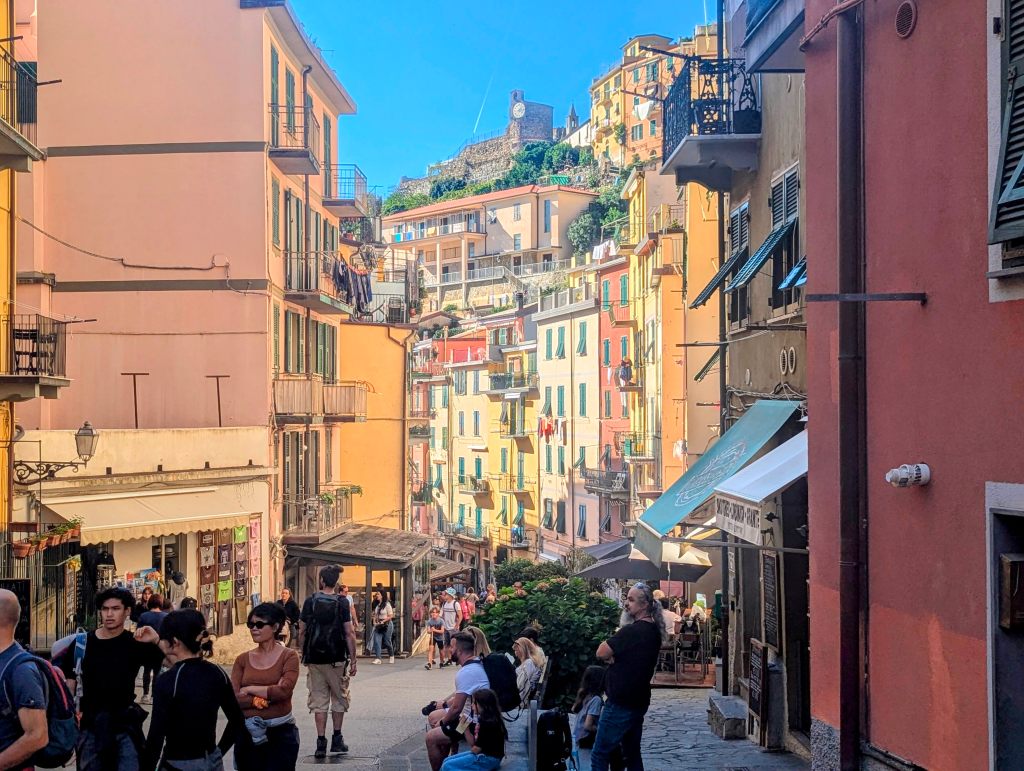
From there we entered the town of Riomaggiore.

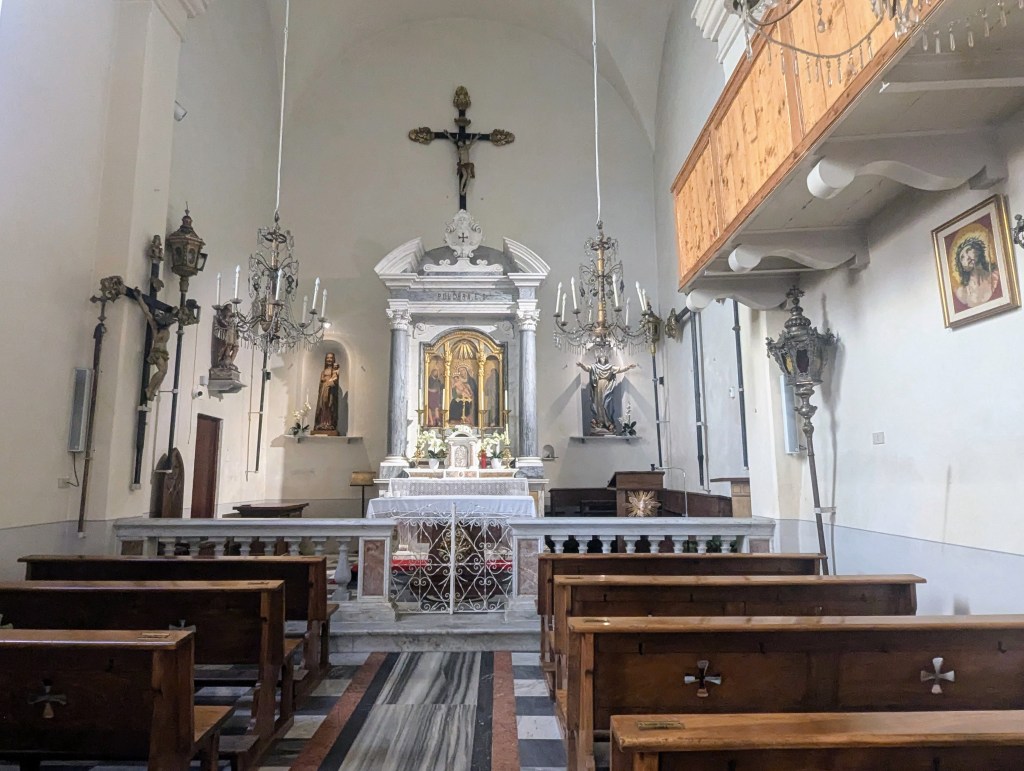
We climbed up the hill on the side of town to the church above: Oratorio di Santa Maria Assunta, a place now used for the town’s elderly to gather.

Oratorio di Santa Maria Assunta
interior Oratorio di Santa Maria Assunta

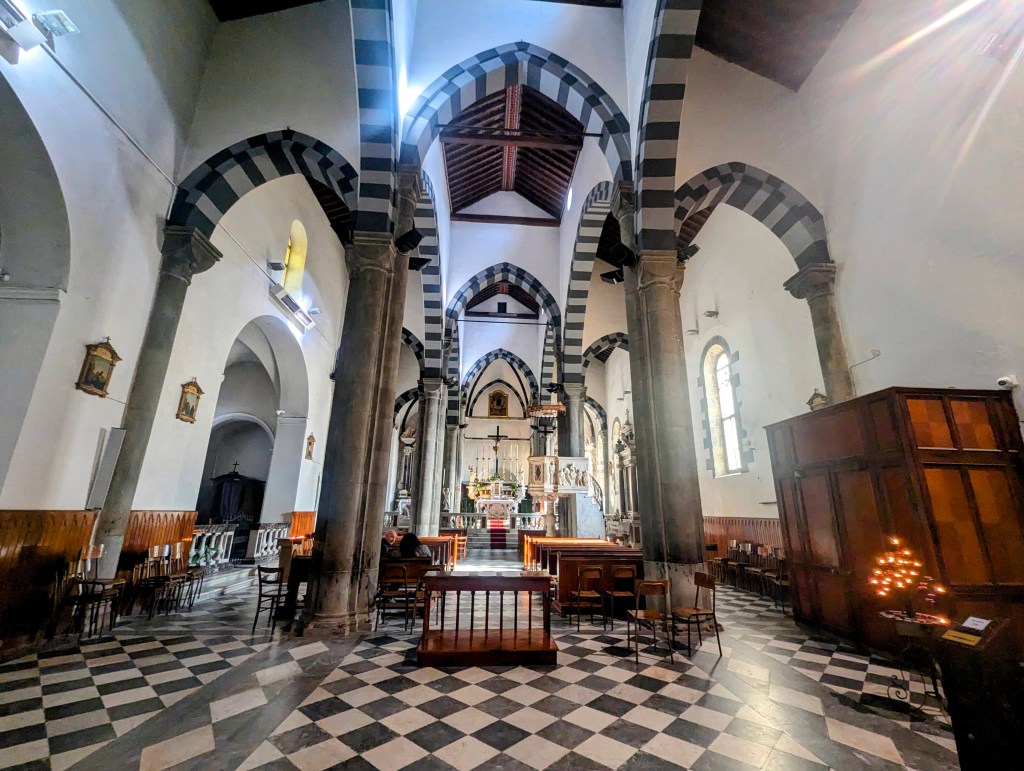
Further up the hill was the Church of San Giovanni Battista of Riomaggiore built in 1340, but the façade was restored in the 19th century.

Church of San Giovanni Battista of Riomaggiore

Inside are many chapels like this one devoted to Madonna.

interior Church of San Giovanni Battista of Riomaggiore

And still further up the hill overlooking the town is a castle built for its defense in 1260. Today the castle is part of the parks department and is used for meetings and ceremonies.

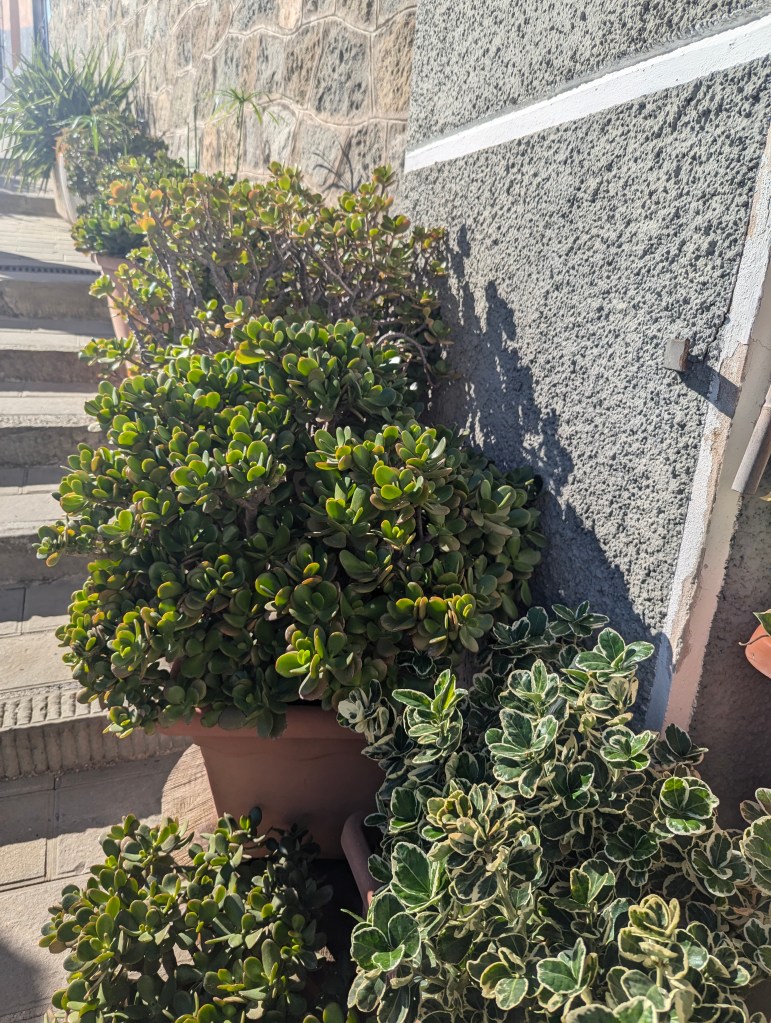
All along the path up to the castle were large plantings of succulents.

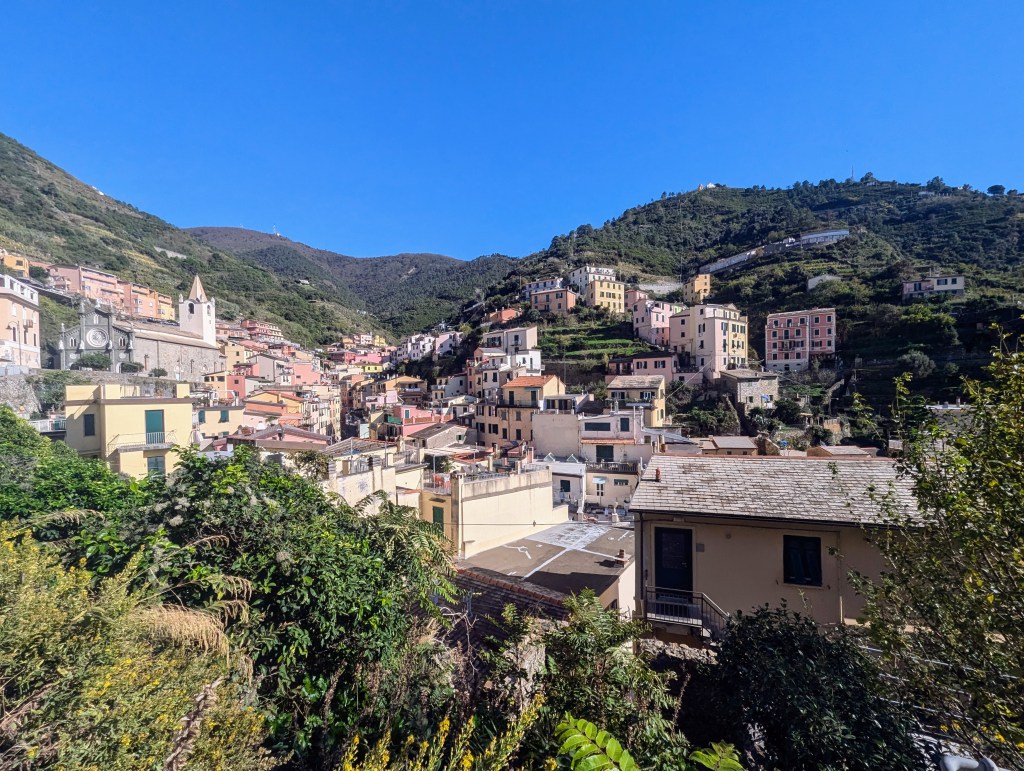
From the top we had a view looking down on the town of Riomaggiore, a little less colorful than some of the other Cinque Terre towns..

From here there was also a view of the train which runs through many tunnels connecting the towns of Cinque Terre.

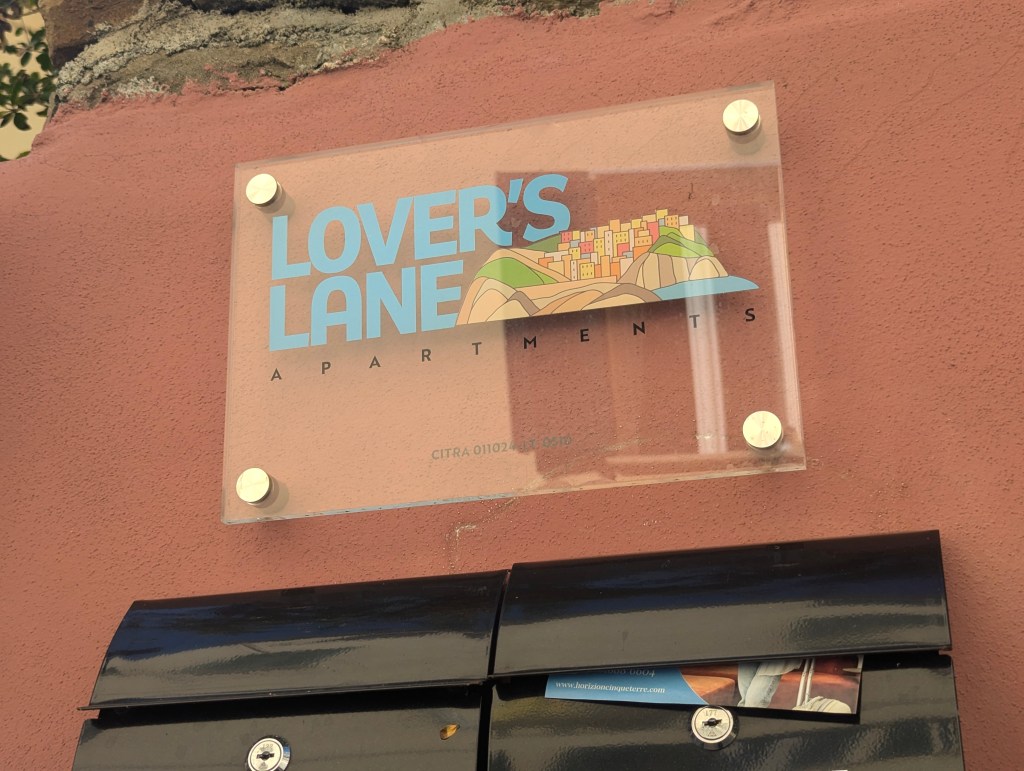
We took a different route back down and found ourselves on Lover’s Lane, which is a path that connects Riomagiorre and Manarola. Its name was coined by journalist Paolo Monelli inspired by the fact that the path was used by lovers from the two towns to meet during WWII before the rail line was built.

And finally we made our way down and out to the marina.

Then it was back to Monterosso al Mare and another walk along the promenade.

view of “Old Town” Monterosso al Mare

and another gorgeous sunset from our rooftop terrace.