
After dragging ourselves away from Modena, we arrived in Verona late in the day. We had booked an AirBnb that turned out to be about a half hour from the old city, so we stayed in for the night and did not venture into Verona until morning when we had a walking tour booked. We met our guide Lucia in front of the ancient Roman amphitheater.
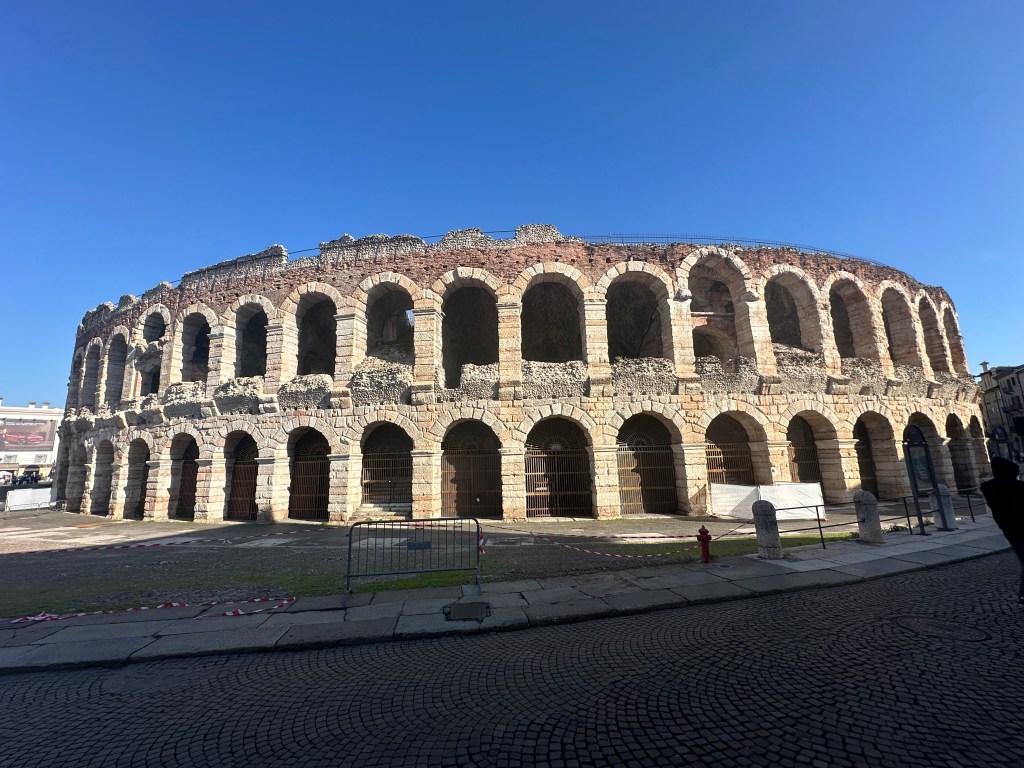
The amphitheater is in the city’s largest plaza, Piazza Bra, and is directly across from Palazzo Barbieri, which currently functions as Verona’s city hall.

Lucia explained to us that Verona had been established by the Romans from at least 300 BC and remained under their control until the 12th century at which time it was ruled by various consuls until the 15th century when it was ruled by the Scaligeri family, then, by marriage, the Visconti family. Together they ruled from the 15th to the 18th century when Napoleon took over, then Austria after Napoleon’s defeat, until 1822 when it became independent again until Italy united in 1866. The city received UNESCO World Heritage status in 2000 due it’s urban structure and architecture.
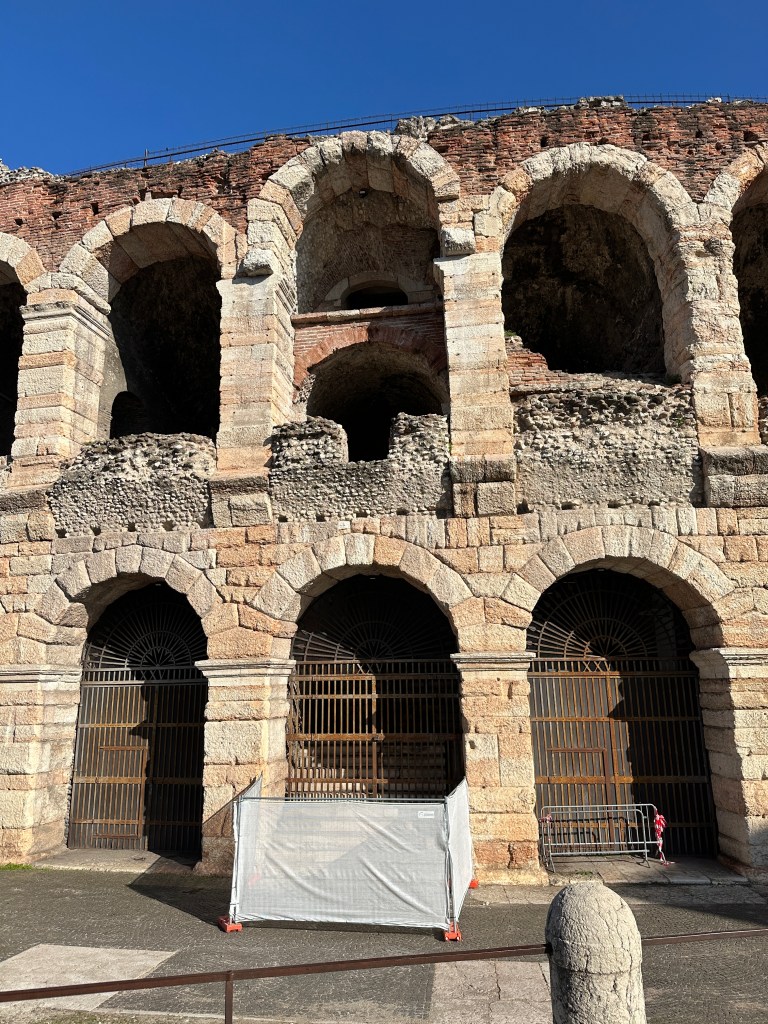
Lucia told us that the amphitheater was built by the Romans in the first century, is currently the third largest in Italy. In its day it could hold over 25,000 spectators. At that time it was outside the city walls. The events which took place inside the arena were brutal. They used sand on the floor to sop up the blood. By the 5th century the ludi shows (gladiator fighting) was stopped. In Roman times there was an outer ring, very little of which remains today. The stones were used to extend the wall of the city to include the arena. The arena lost even more stones during the earthquake in the 12th century after which time it became illegal to remove stones.
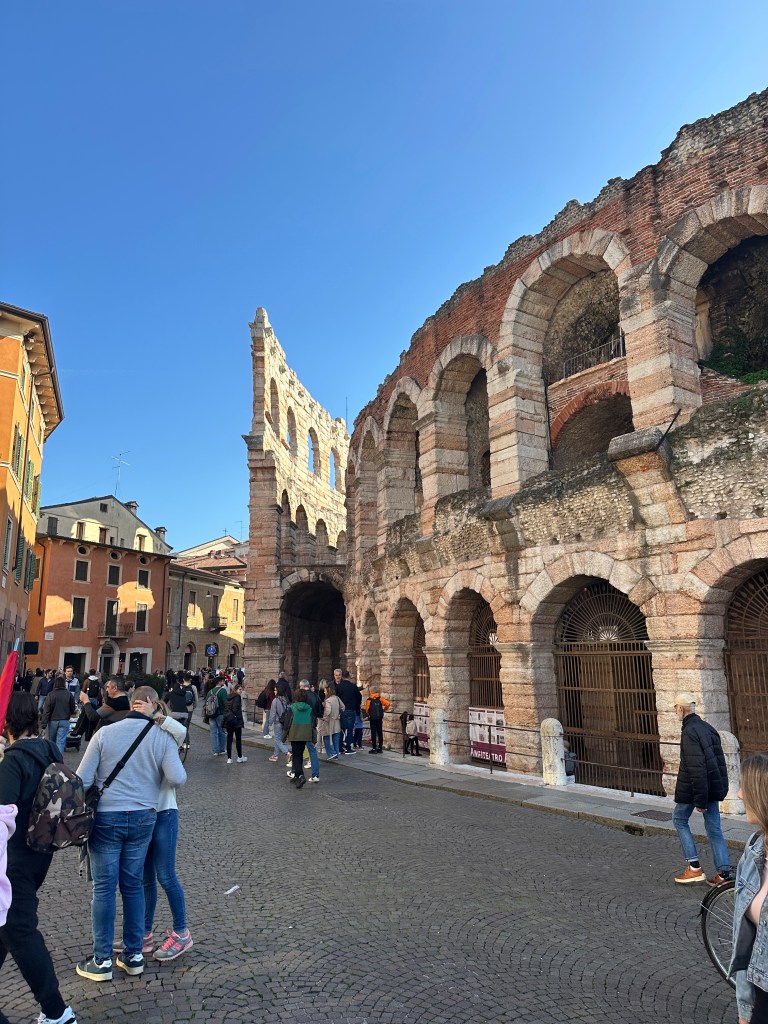
In Roman times the inner arches were used both for prostitutes to stand under and to display art. In 1913 Aida was the first opera performed in the arena and now is performed every year there. The arena is used throughout the year for performances but is currently, unfortunately, closed for rennovations.
Lucia then showed us a map of the city from medieval times. The city was well protected by the hill across the river and the river itself. River Adige, the second longest in Italy, circles the city on three sides forming a protective peninsula. The map also shows the large central plaza, Piazza Bra, which means wide, crossed by both main streets: Corso Cavour and .
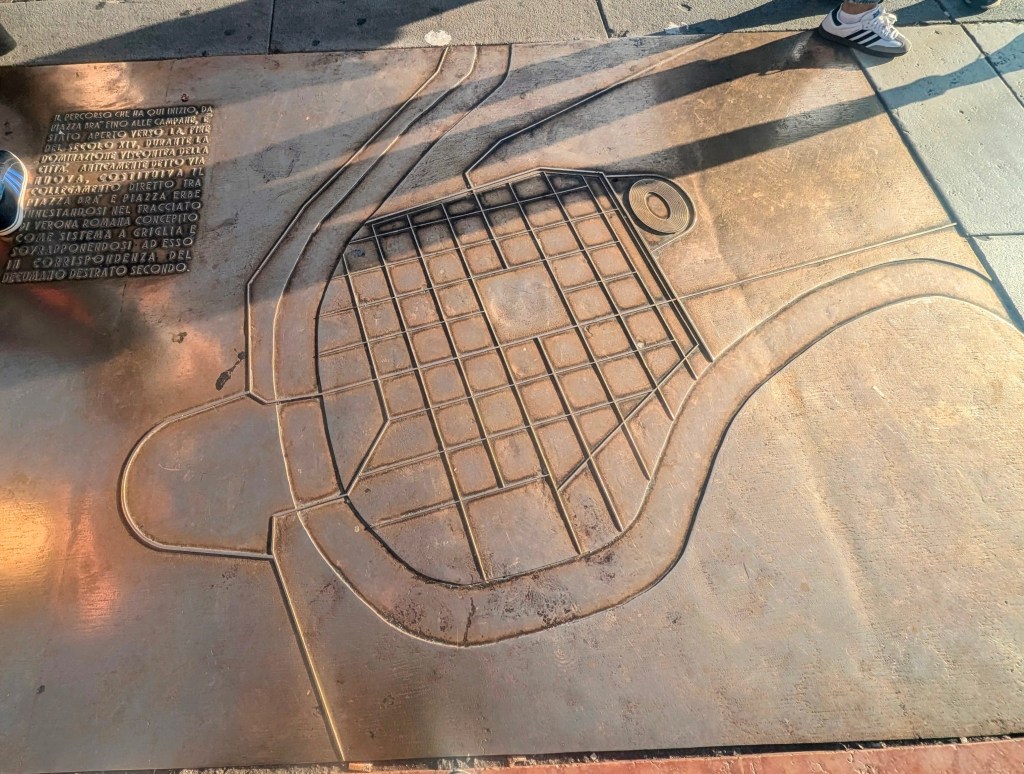
The municipal walls of Verona, recognizable due to their scalloped shape, were the defensive walls erected starting in the 12th century to the south of the historic city center to connect the Piazza Bra and the arena with the rest of the city using the stones from the outer ring of the arena.

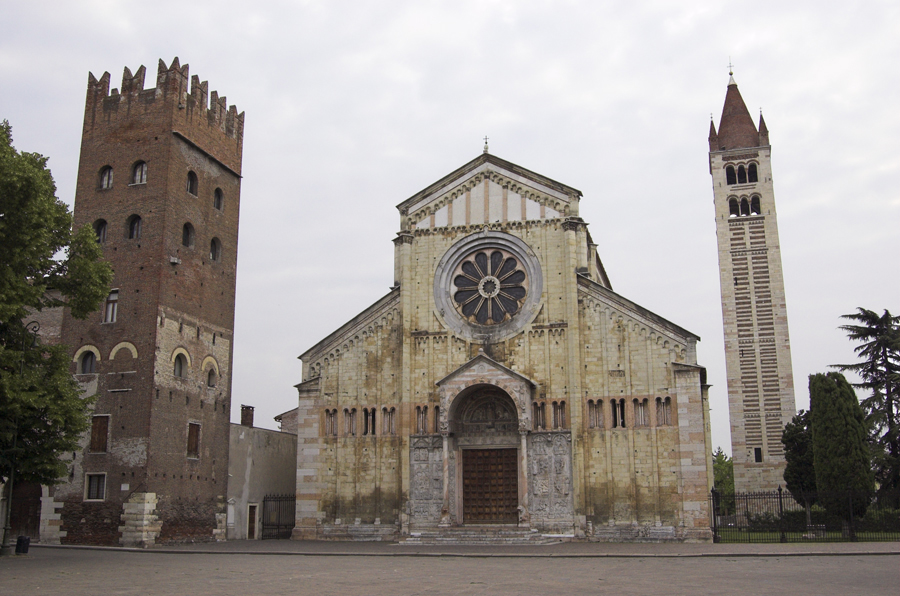
We passed The Basilica di San Zeno, a minor basilica constructed first in 967 as a shrine to St. Zeno, Verona’s patron saint, but then destroyed in the 12th century earthquake, and rebuilt in 1120s. Its fame rests partly on its Romanesque architecture and partly upon the tradition that its crypt was the place of the marriage of Shakespeare’s Romeo and Juliet (more on them later).
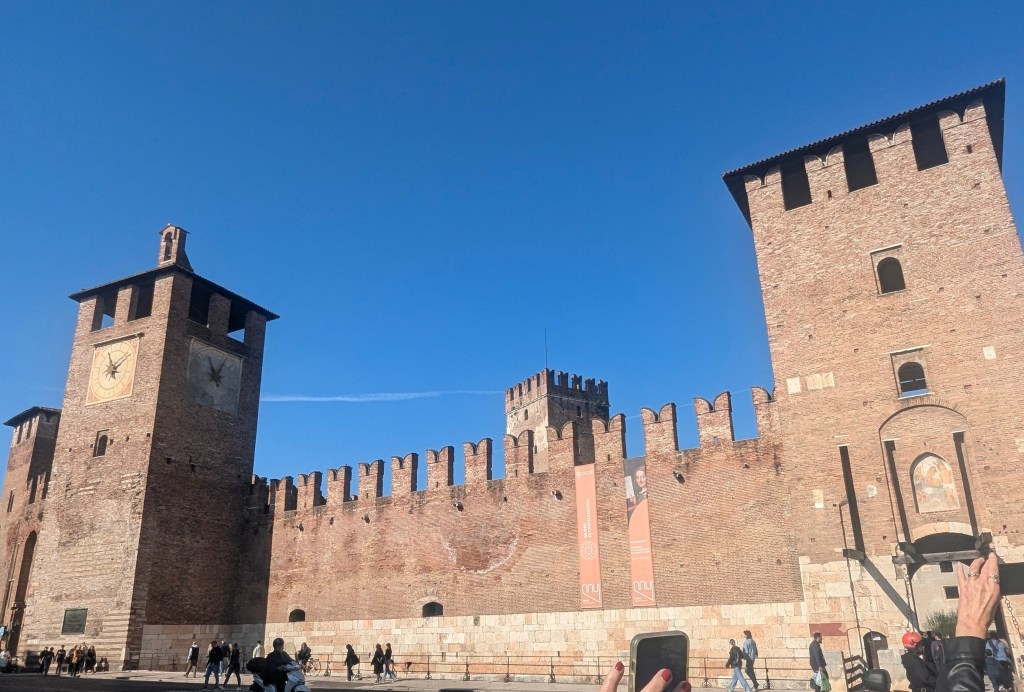
Castlevecchio (Old Castle) was the first castle built in Verona; it was erected in the 14th century for the Scaligeri family. It is a vast military fortification with high defensive towers, and it also had a residence for the Scaligeris. At the time it became an instant standard for military architecture because it had a double wall, considered double strong. But first Napoleon destroyed the castle, then it received heavy destruction during WWII. Today it has been renovated and houses important collections of medieval, Renaissance, and modern art.
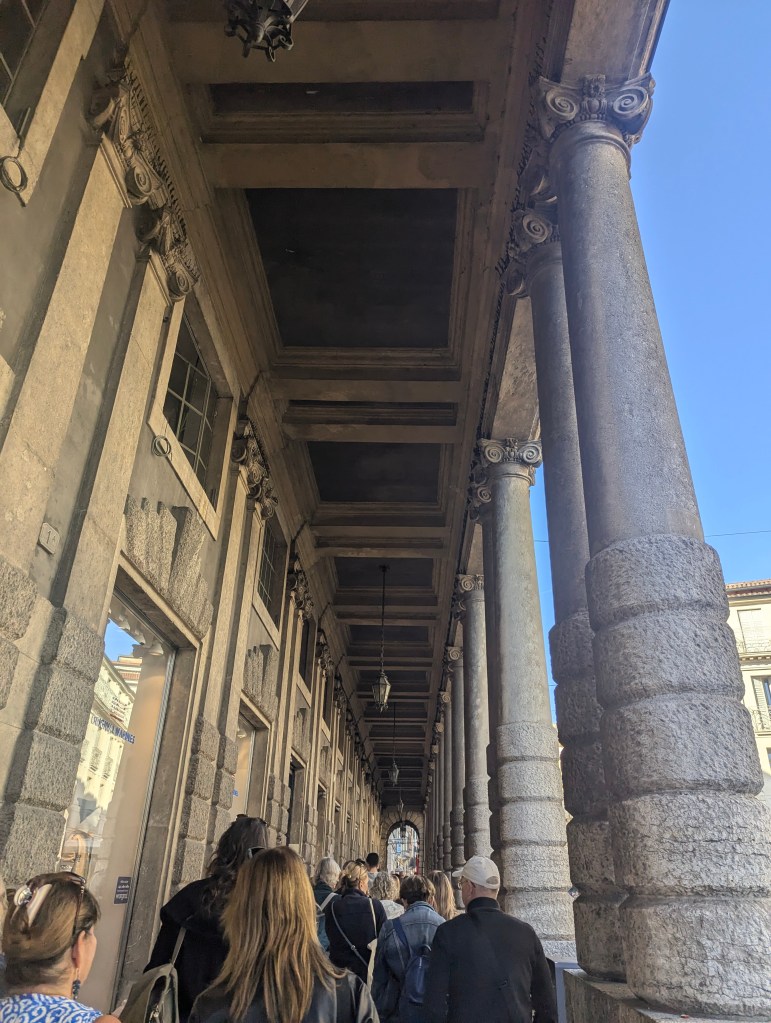
As we walked from Castlevecchio Lucia explained that porticos became very popular in the region, adopted from Bologna architecture, where they are most commonly found (although we have seen them even in Bern, Switzerland).
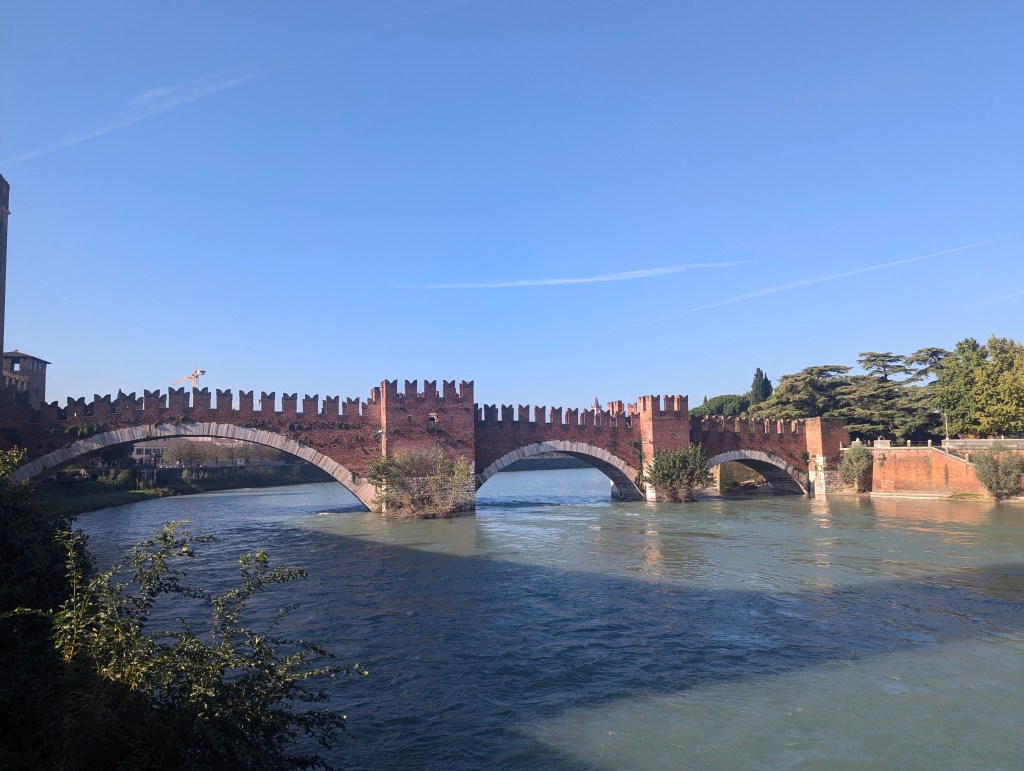
Next she showed us The Castelvecchio Bridge, a three-arched crenellated and fortified structure, which is an outstanding example of 14th-century military engineering. Two of the arches have survived intact. The bridge, like most bridges in Italy, was destroyed by retreating Germans at the end of WWII. The third arch was rebuilt larger to accommodate bigger boats.
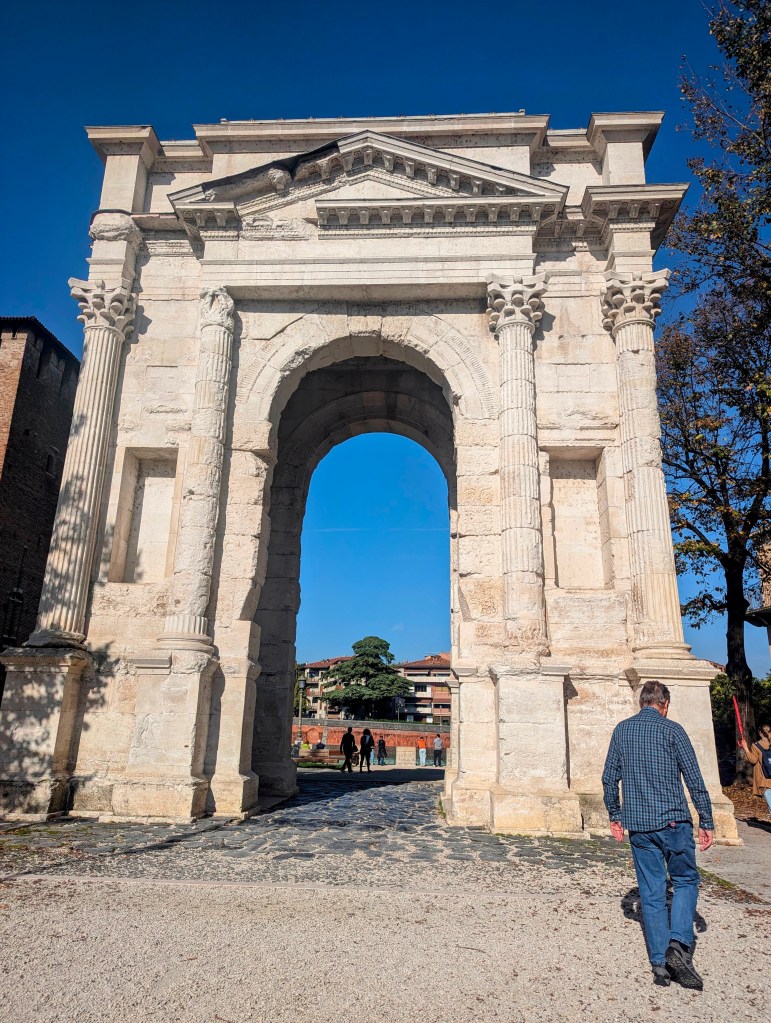
Just beside Castlevecchio now stands the Arch of Gavi, a very rare case of an honorary and monumental arch for private use in Roman architecture. It was built around the middle of the first century, originally near the clock tower and was used as a gate to the city. During the Renaissance it was one of the most highly prized of Verona’s antiquities. Napoleon’s armies destroyed it in 1805 because it impaired the movement of its troops into the city. Due to its popularity, numerous reliefs had previously been produced which made it possible for it to be reassembled by anastylosis and restored in 1932 in its current location. The black stones beneath the arch were originally on the first century Roman road.
Porta Borsari is one of the gates that opened along the Roman walls of Verona and constituted the main entrance to the Roman city. Borsari is the Roman term for soldiers to whom taxes are paid. The gate is now missing the original two towers, It is now covered for cleaning.

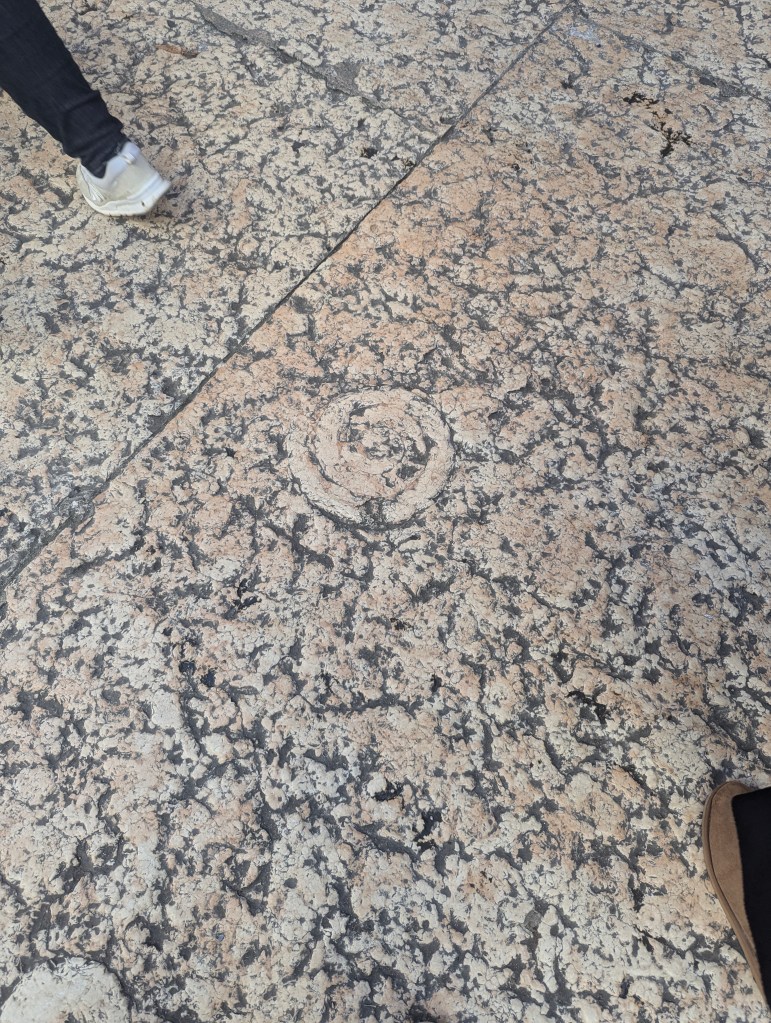
On the street in front of Porta Borsari Lucia pointed out the swirl of an ancient snail fossil, evidence of the area once having been a sea bed. The pink and white stone originates from Verona.
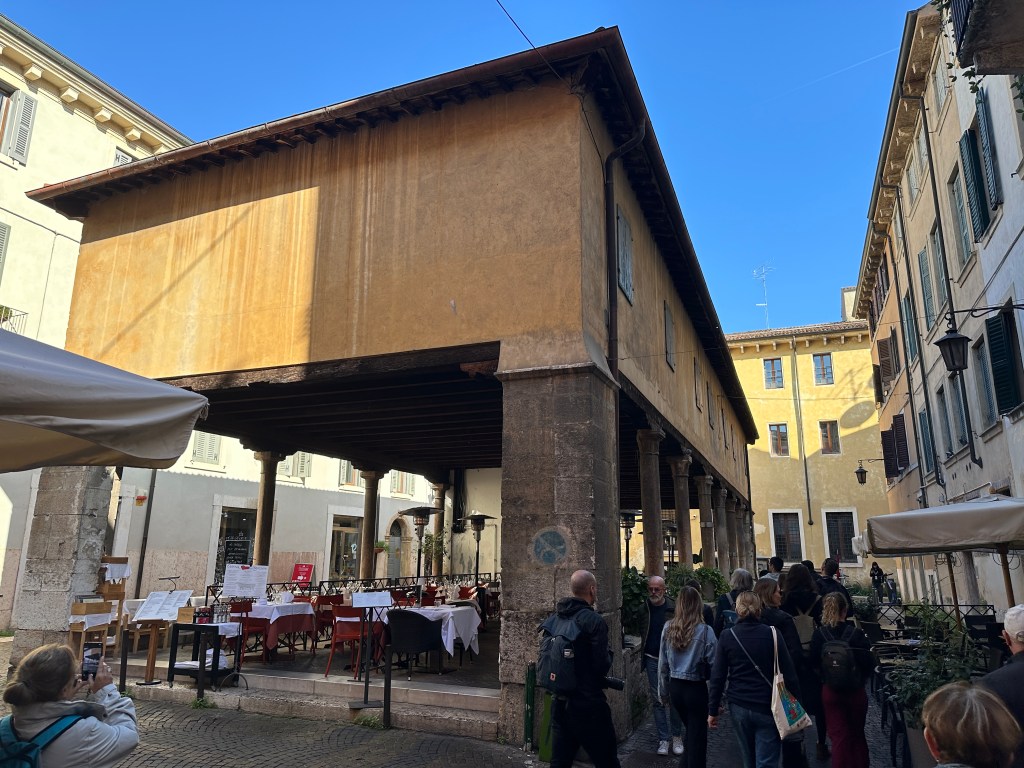
The industrial zone of the medieval city was very wool based. During the 13th century the activity of the Veronese wool industry became increasingly significant, to the point that the production techniques and finished products became highly sought after in the various markets of northern and central Italy. Corte Sgarzerie is a monumental complex linked to the working of wool. Underneath the square porticos from Roman times have been found and are now archaeologic sites open to the public.
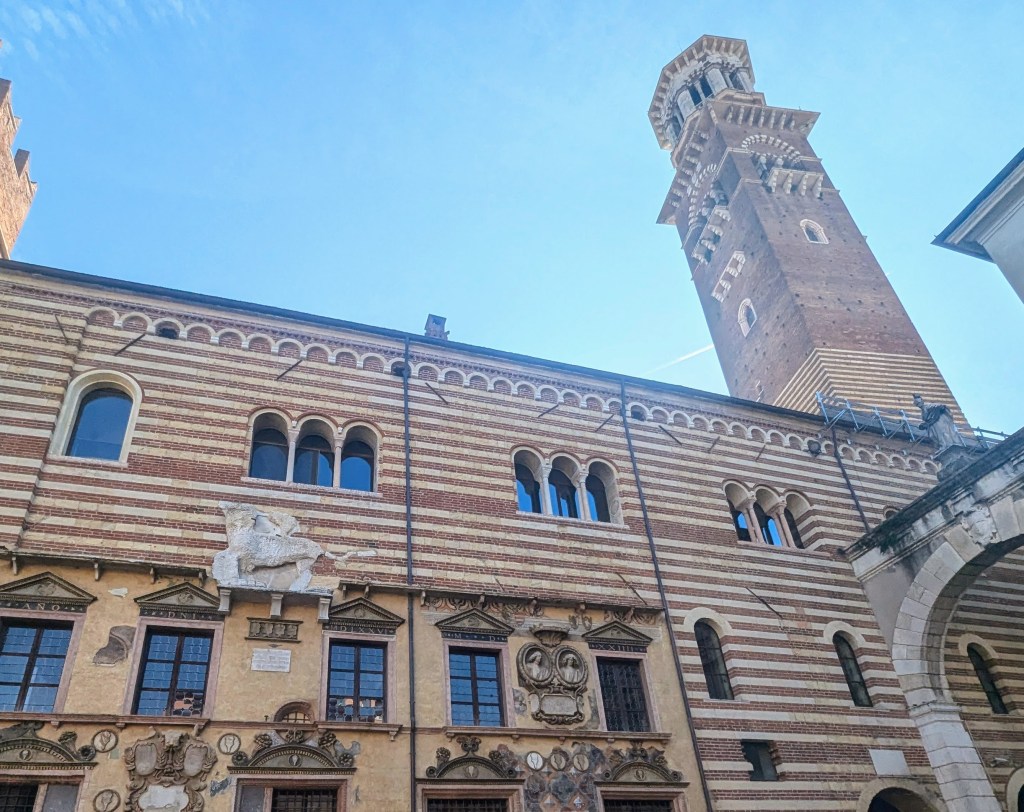
Finally we made our way to Piazza delle Erbe (Market’s square), which was the town’s forum in Roman times. The northern side of the square is occupied by the ancient town hall, the 12th century Torre dei Lamberti (Lamberti Tower), the Casa dei Giudici (Judges’ Hall) and the frescoed Mazzanti Houses.
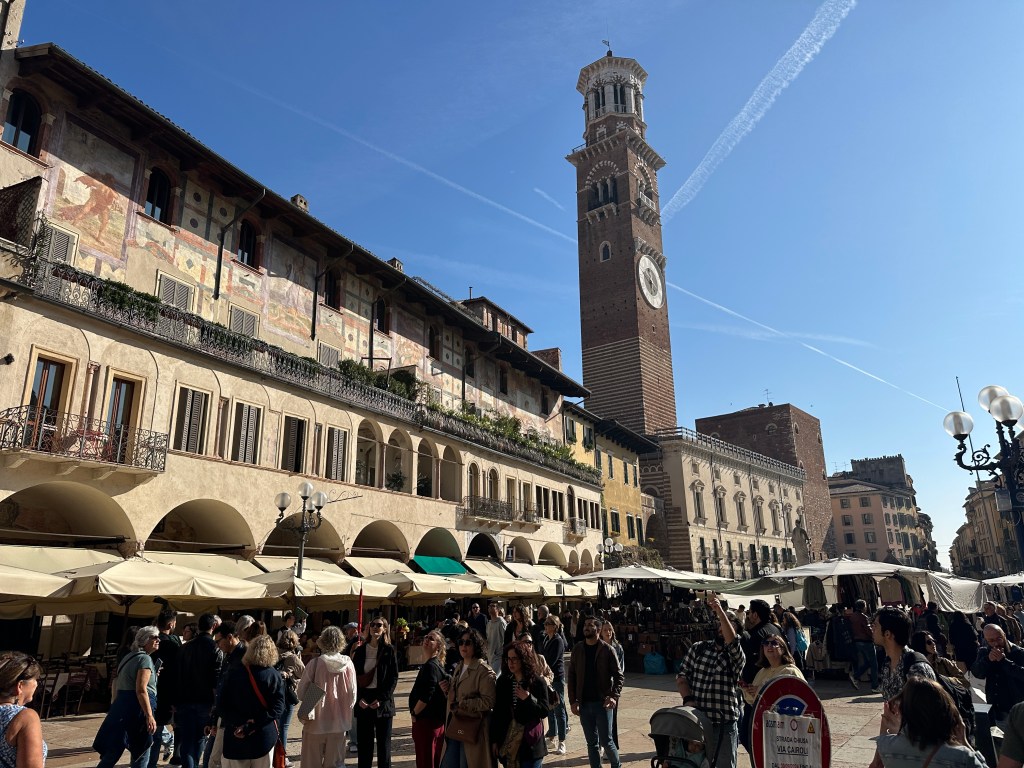
The fresco decors on the outer walls of buildings that we see today were made in the 16th century, but the practice began in medieval times as a less expensive way to appear wealthy for those who could not afford marble.
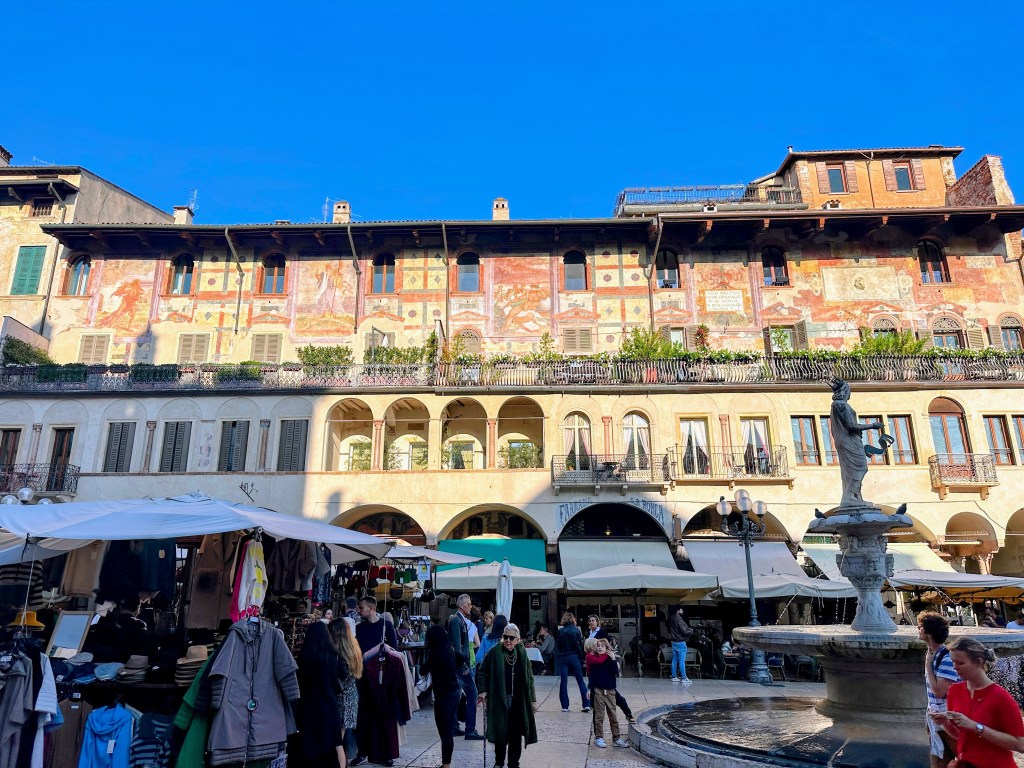
Piazza delle Erbe today looks very different than it did in Roman times. One of the biggest differences are all the winged lions, which are the symbol of the St. Mark, Veneto’s patron saint, therefore the symbol of the Republic of Venice. They were placed in Verona by the Venetians. The western side of Piazza delle Erbe features the Baroque Palazzo Maffei, decorated by statues of Greek gods. It is faced by a white marble column, on which is St. Mark’s Lion.
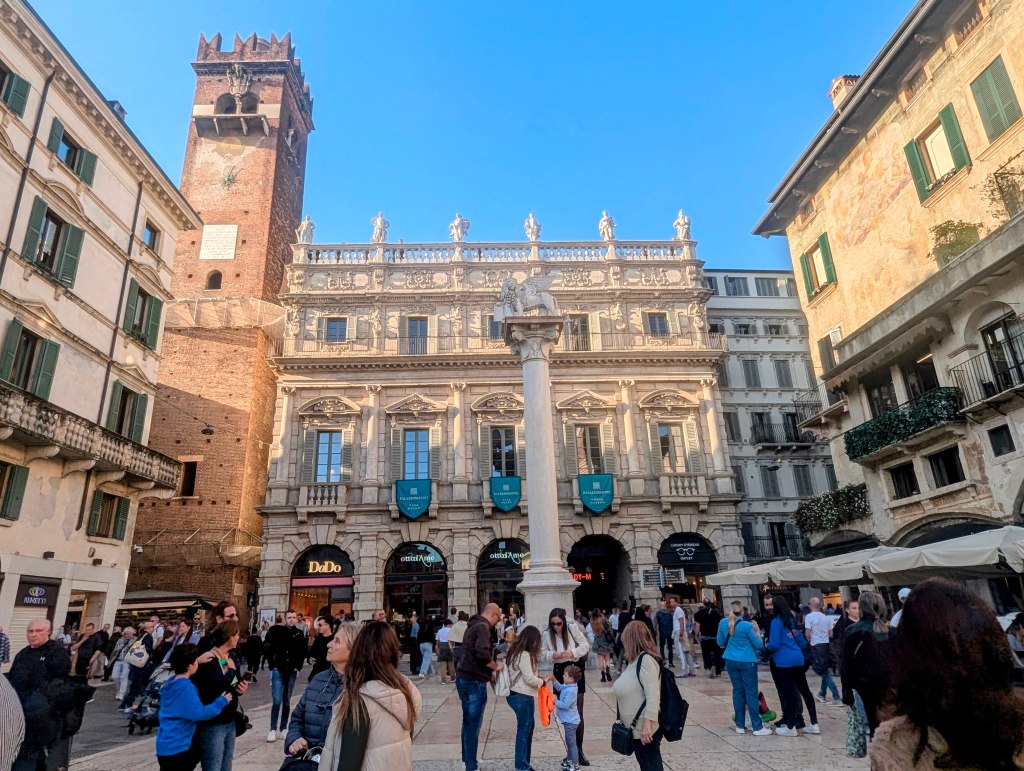
There are other winged lions around the square.
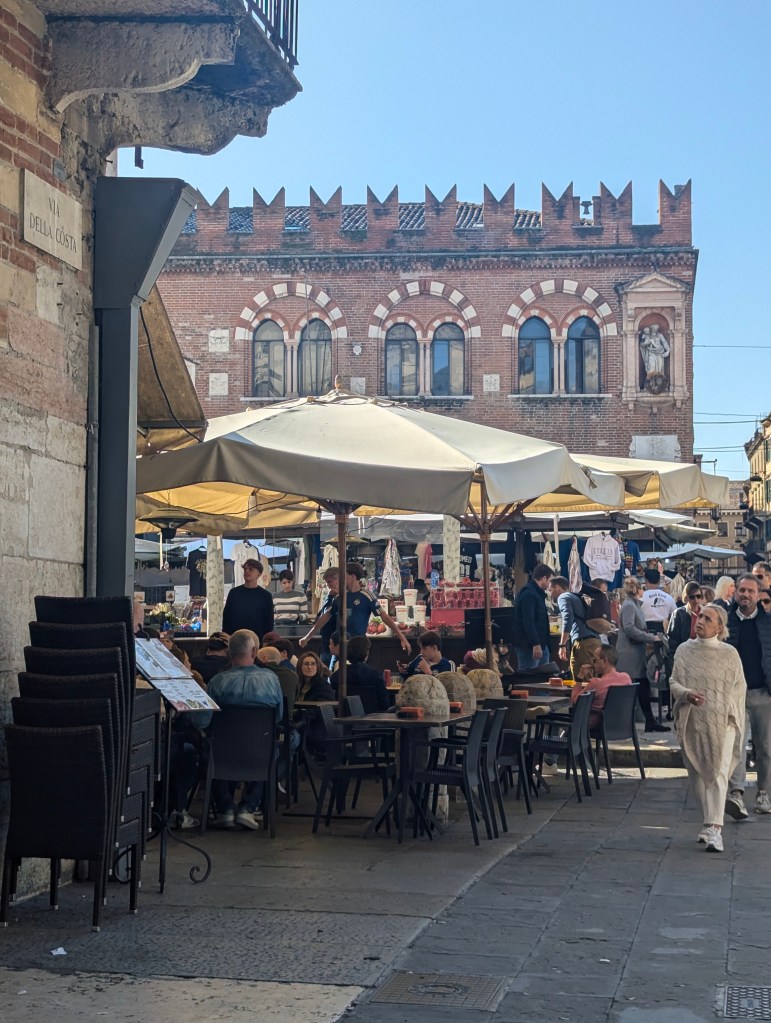
On the southern side is the crenellated Casa dei Mercanti (House of the Merchants), now the seat of the Banca Popolare di Verona. Today the square still has markets regularly.
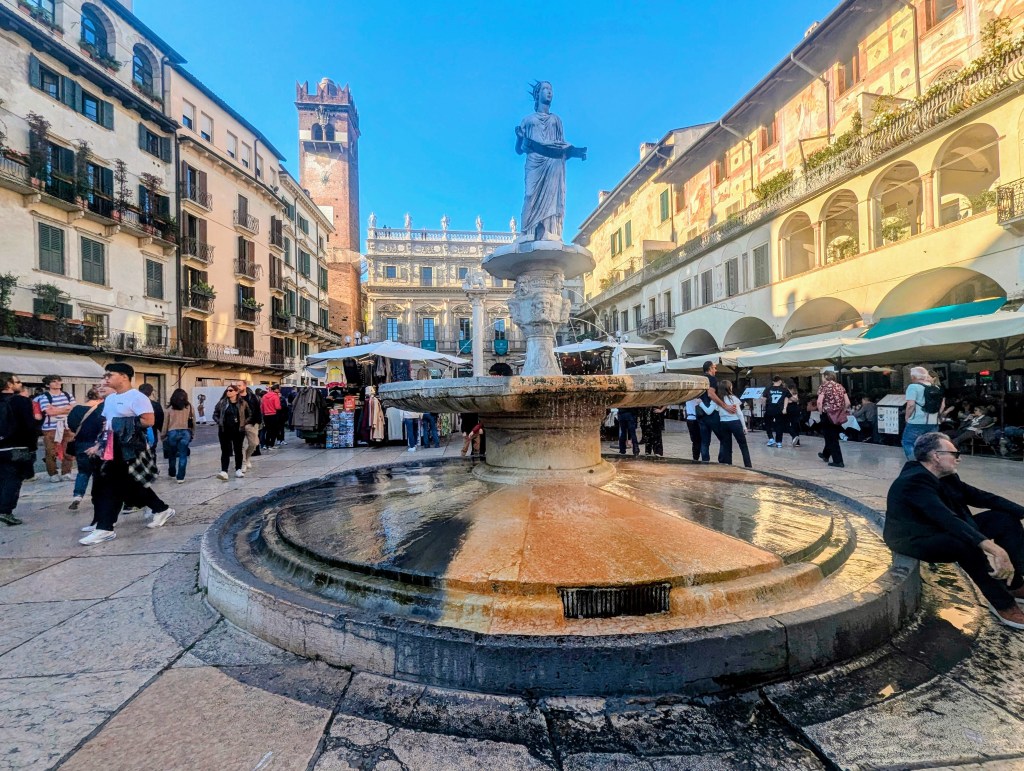
The square’s most ancient monument is the fountain built in 1368 for the Scala family surmounted by a statue: Madonna Verona which is Roman and dates to 380 AD.
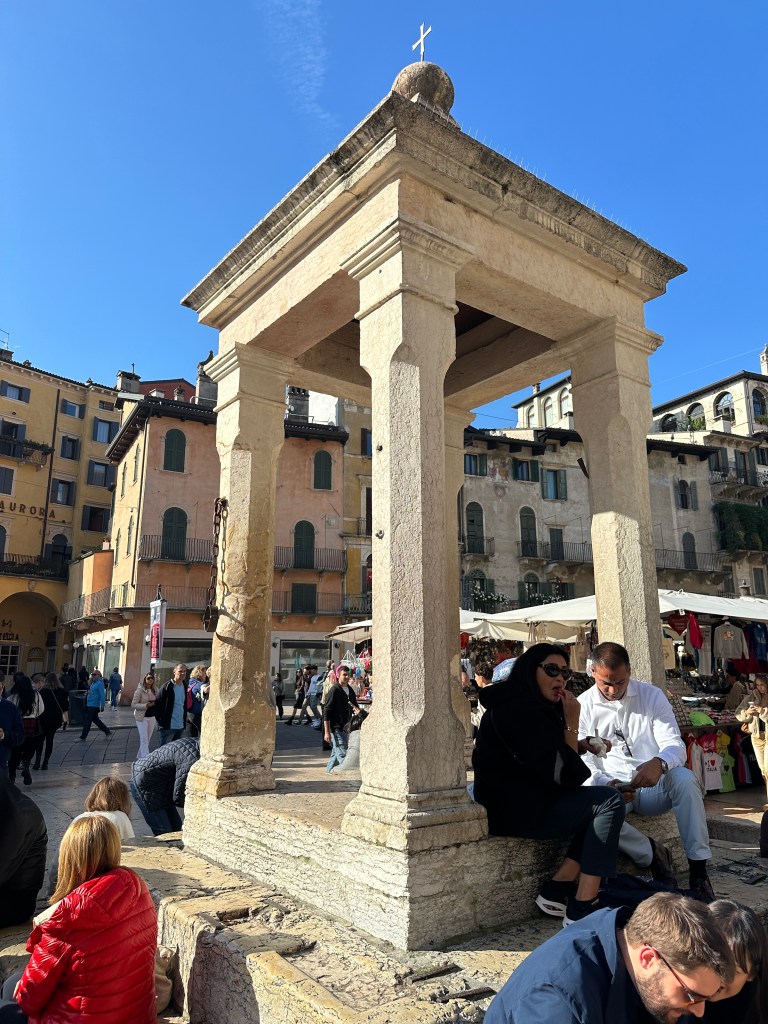
Another historical monument in the square is the capitello. In the past its function was twofold: on the one hand as a place used for the election of the Lords and Podestas of the city and as a place to deliver news. Also it was used as a meter, the standard for measurement for the merchants, as can still be seen in the intact parts of the capital.
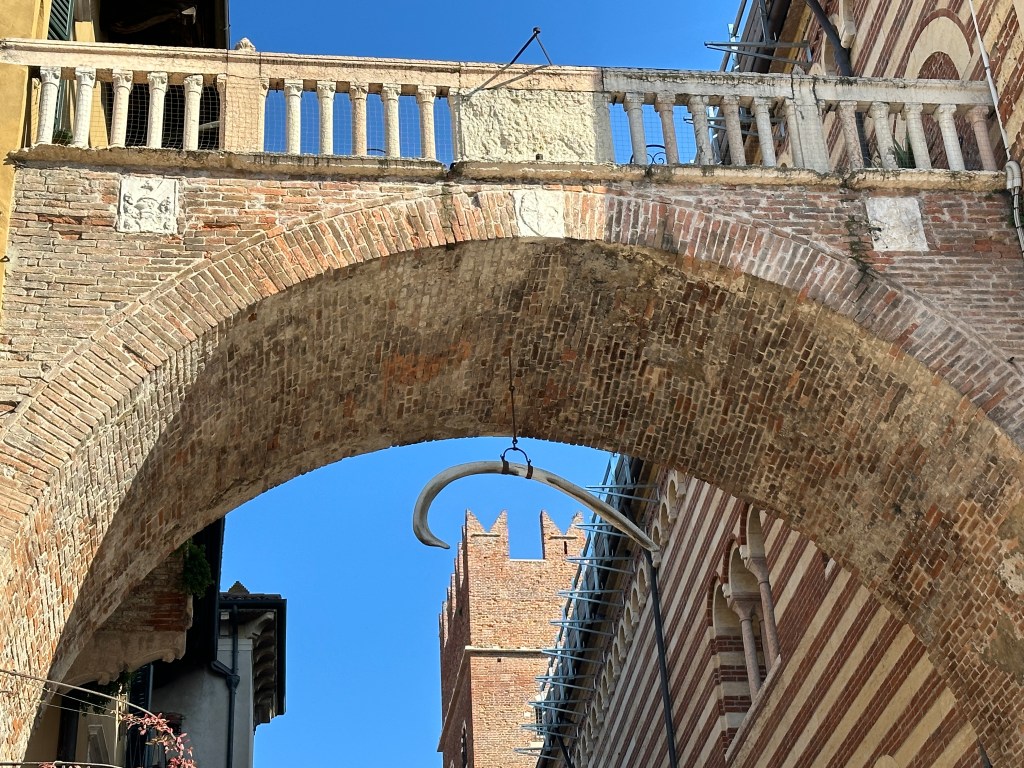
Passing from Piazza dei Erbe into Piazza dei Signori, we passed beneath another remnant of the ancient sea: another whale bone. As in Modena, it was hung as a protector for the city.
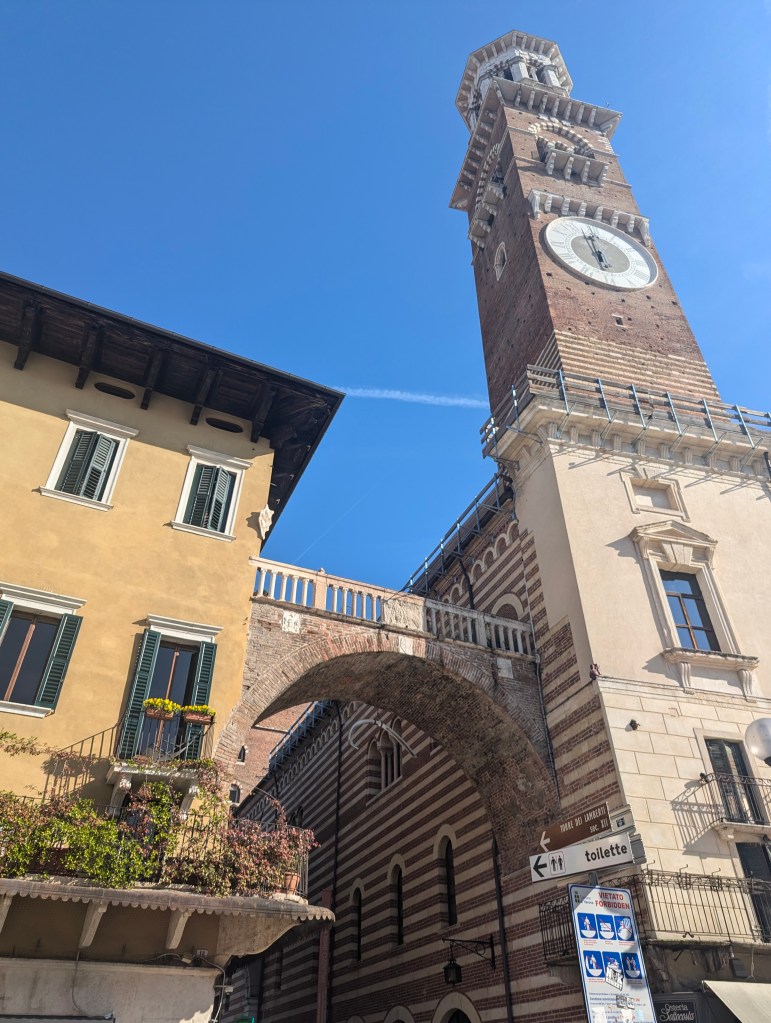
Piazza dei Signori has several important Romanesque buildings including Palazzo Domus Nova, formerly city hall, currently a museum, and La Casa della Pietà, formerly a private home and now a home for the less fortunate children.
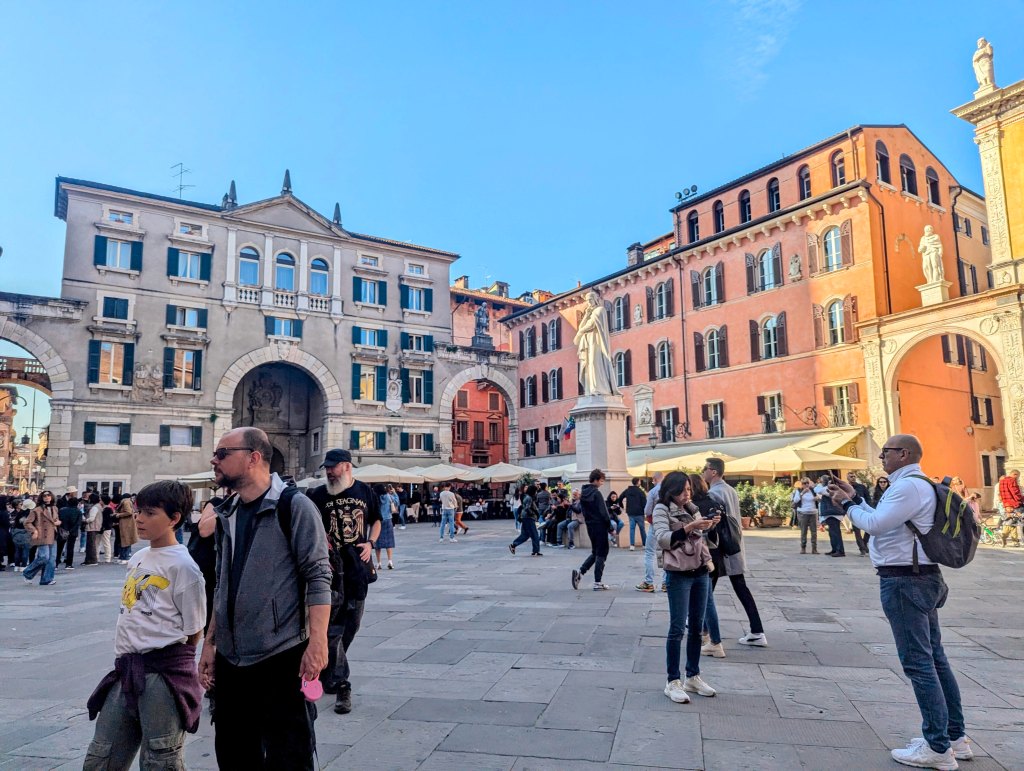
In the center of the square is a statue of Dante.

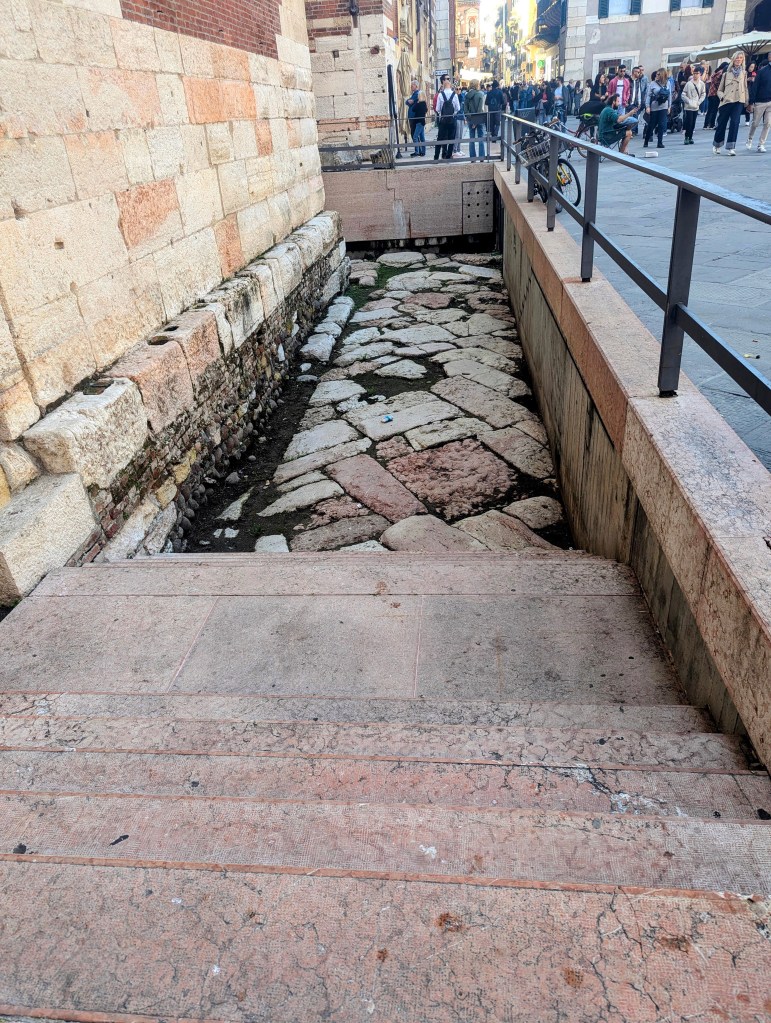
On the edge of the square is a preserved portion of the original Roman road.
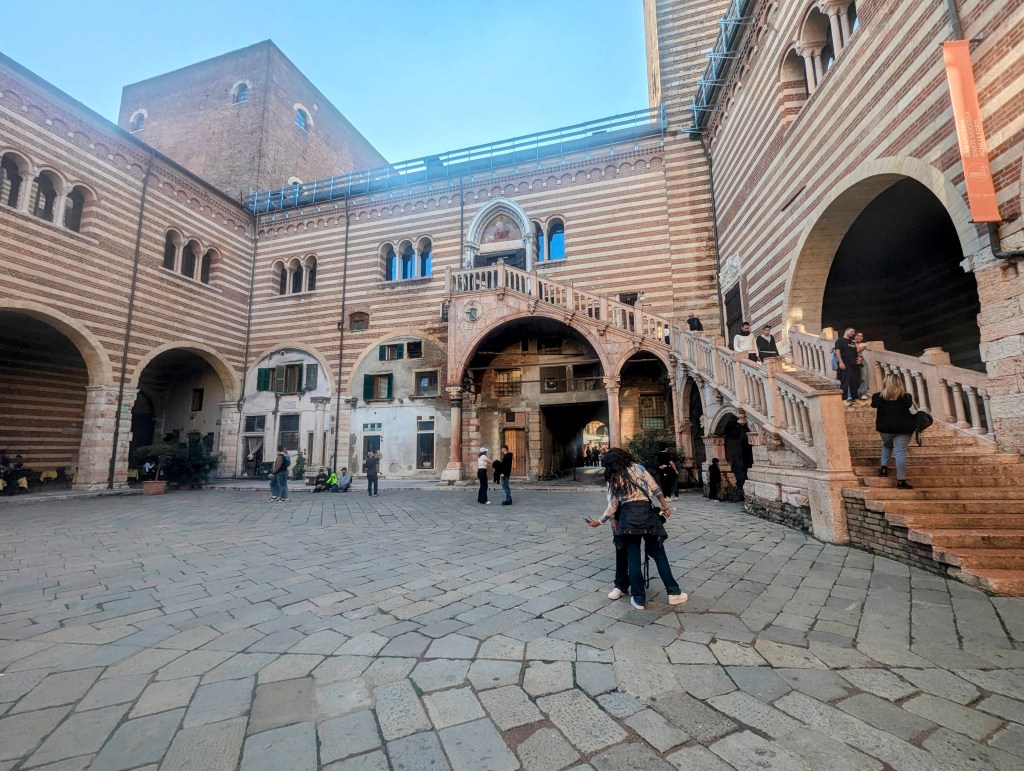
Straddling the two squares is the The Palazzo della Ragione (Palace of Reason), so named because during the rule of the Republic of Venice, it housed the court. It was built in the late 12th century.
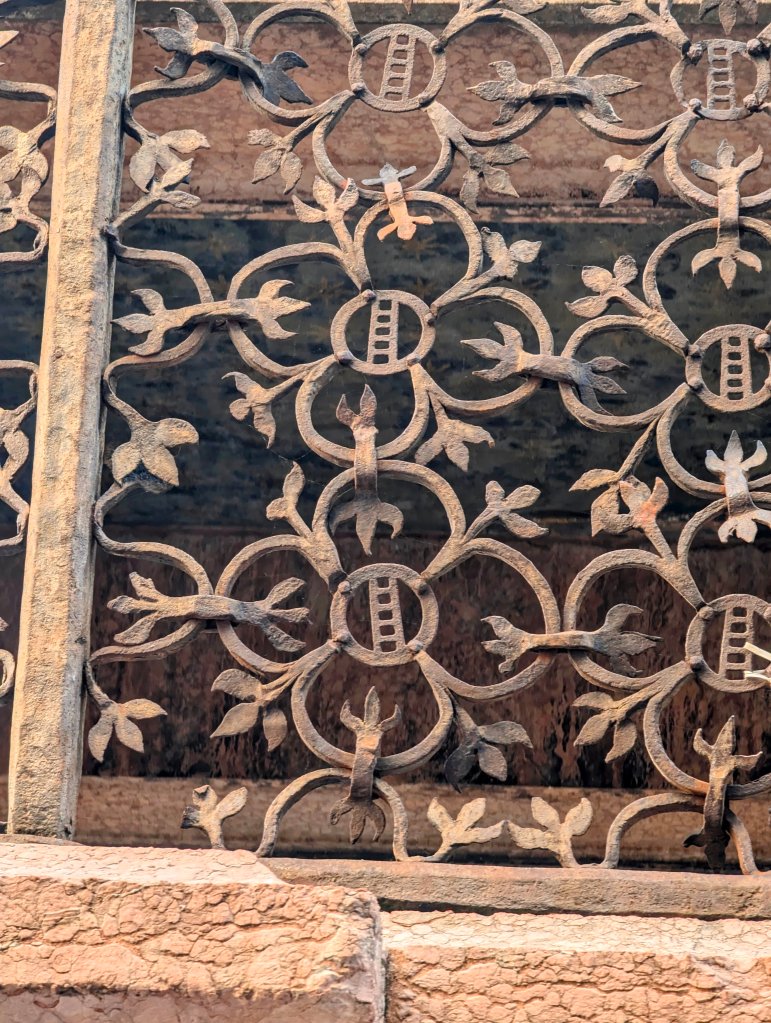
Beyond Piazza dei Signori are the Scaliger Tombs, a group of five Gothic funerary monuments celebrating the Scaliger family, dating from the 13th to the late 14th century. The tombs are located in a court outside the church of Santa Maria Antica, the private church of the della Scala family, and separated from the street by a wall with iron grilles.
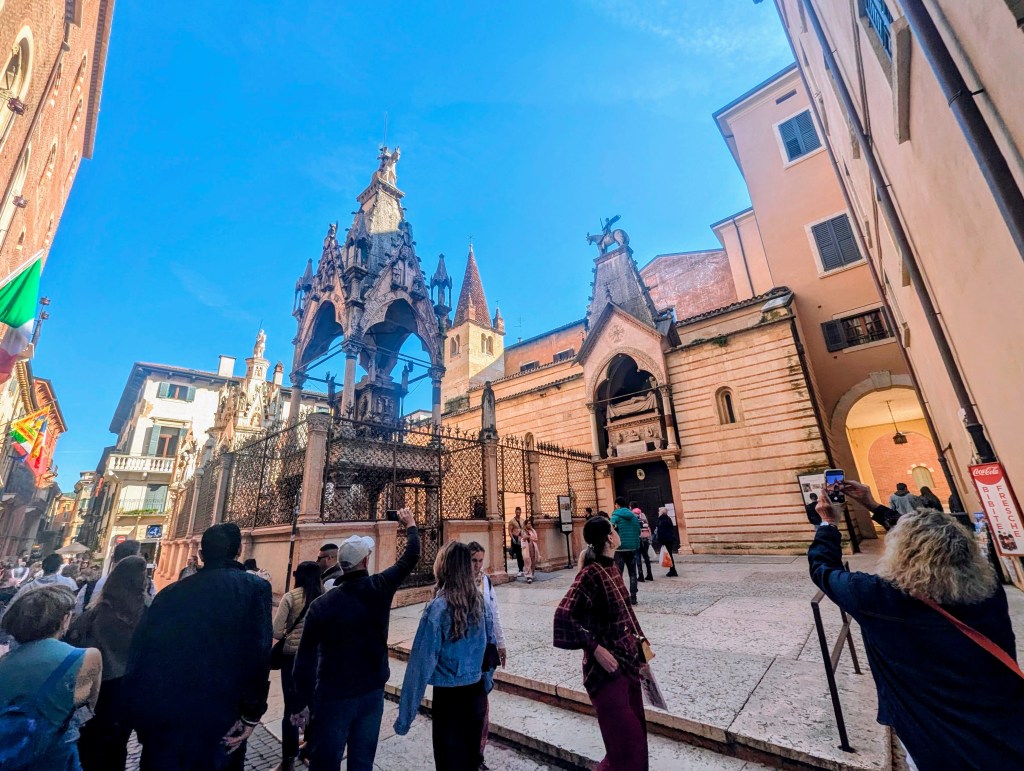
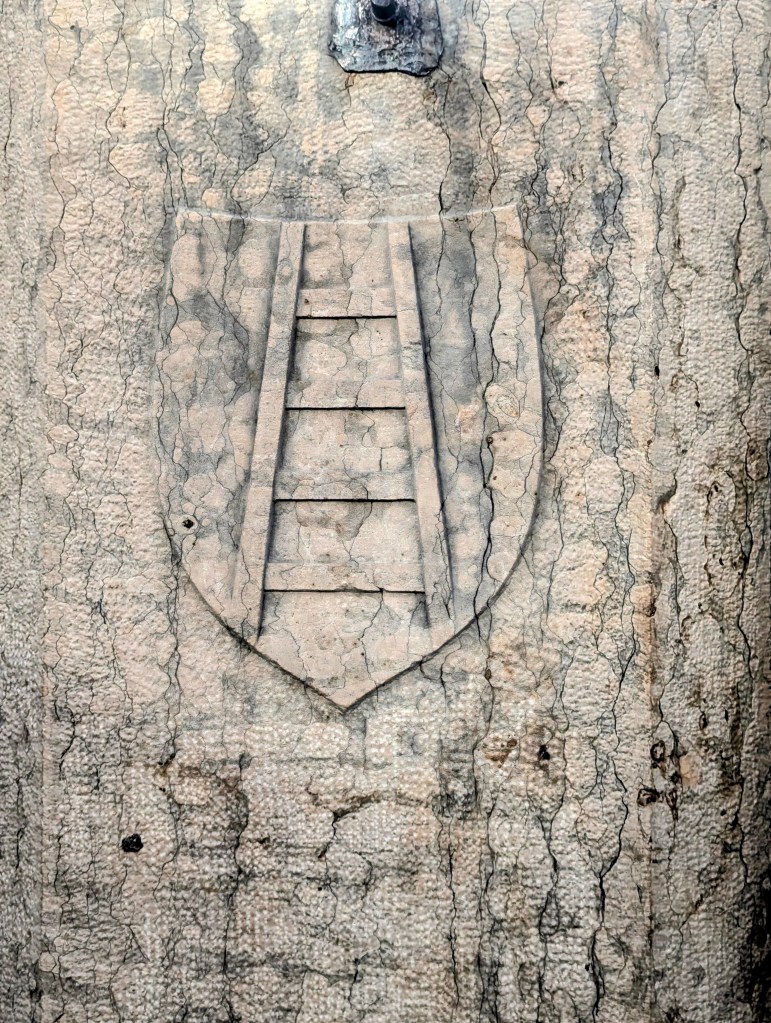
The tombs are placed within an enclosure of wrought iron grilles decorated with a stair motif, referring to the name of the Della Scala family, meaning “of the stairs” in Italian.
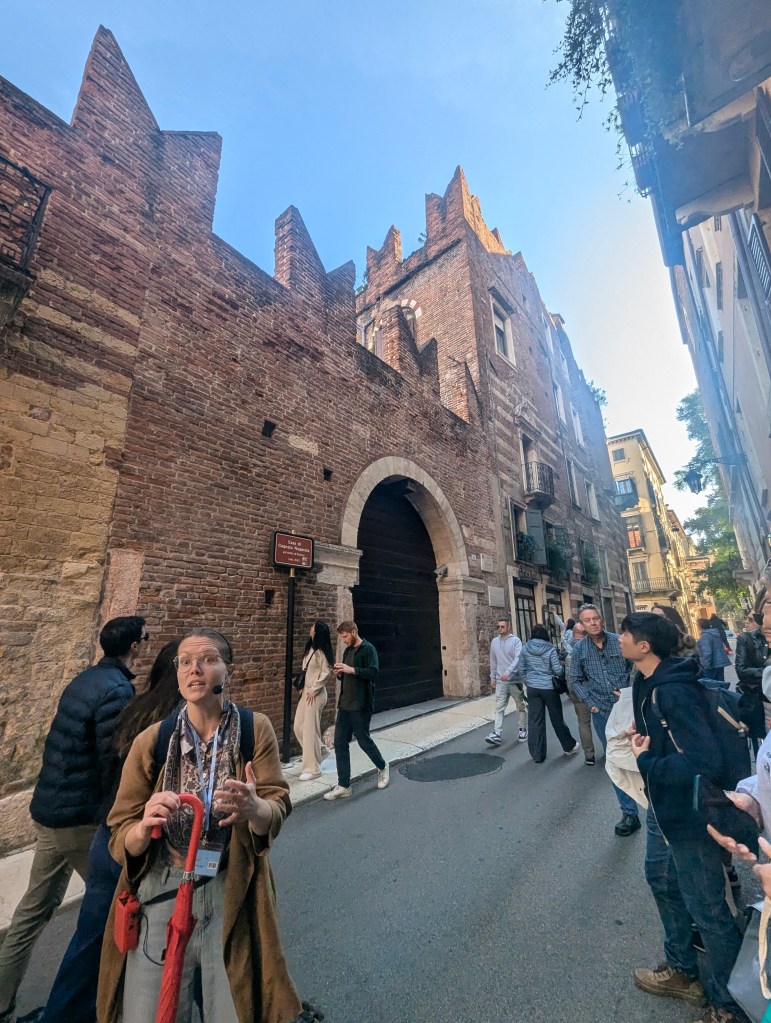
Across from the Scaliger Tombs is the medieval house of Romeo. At the time Shakespeare wrote “Romeo and Juliet,” it was known that Romeo’s family was a real family from Verona. However, there is no real evidence that this home was truly his home. A private family resides there now; it is closed to the public.
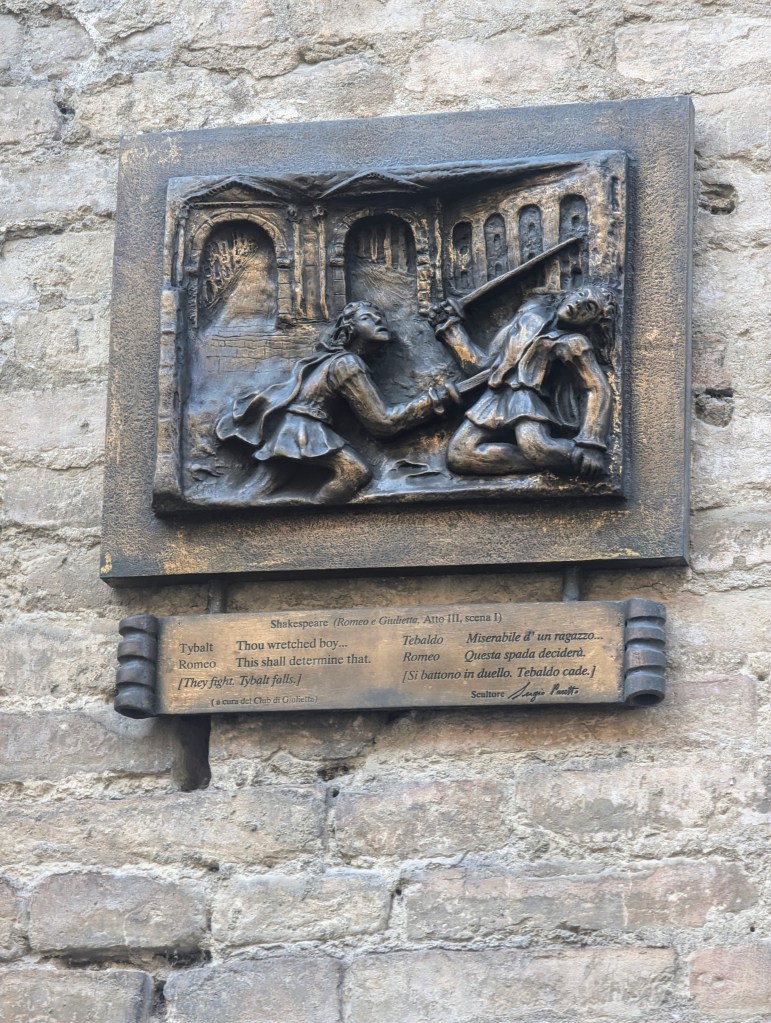
There is also no evidence that Juliet’s family was real or if so that they ever lived in Verona. However, that has not deterred thousands of Juliet fans from flocking to Verona yearly to see their romantic sites in the play. The Juliet Fan Club has placed little reliefs around the town denoting locales mentioned in scenes of the play.
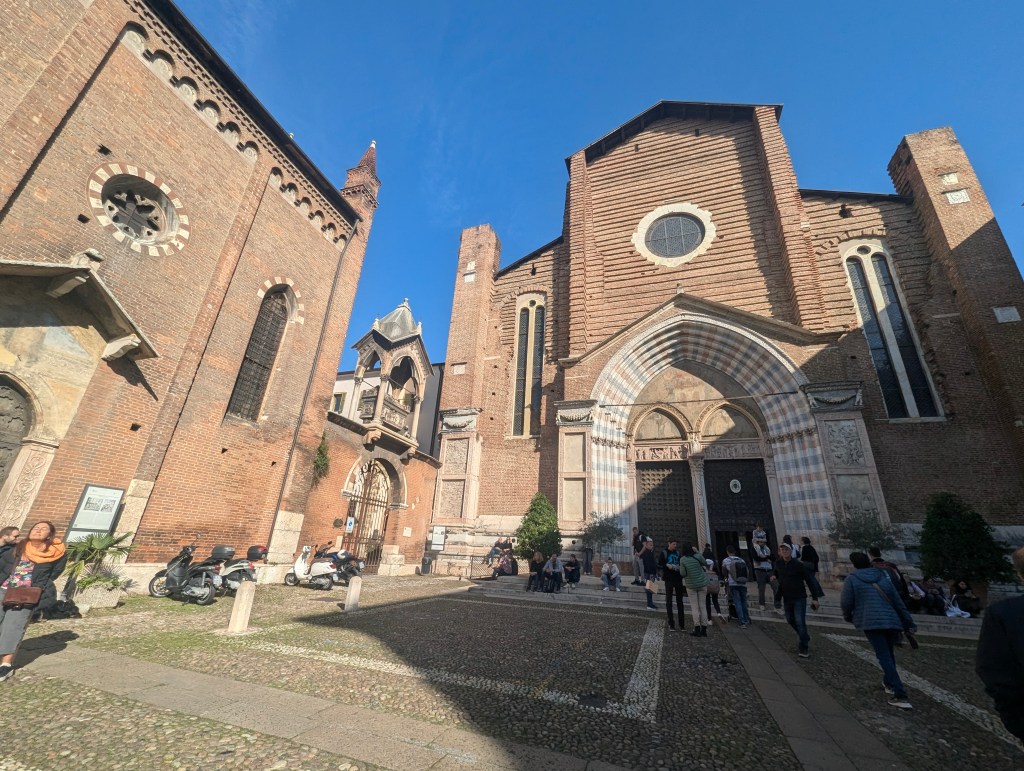
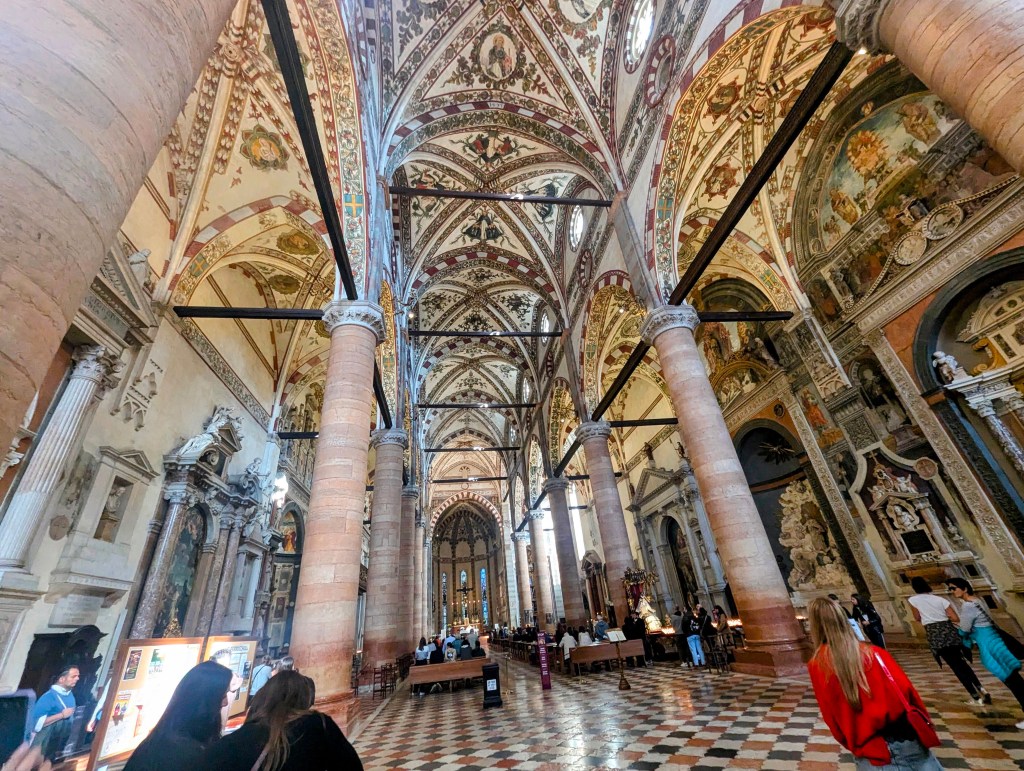
Basilica di Santa Anastasia (Basilica of Saint Anastasia), is the largest church in Verona, but is not a cathedral. Construction was started in the 15th century by the della Scala family, but when they lost their fortune, building was stopped, and the church was never finished.
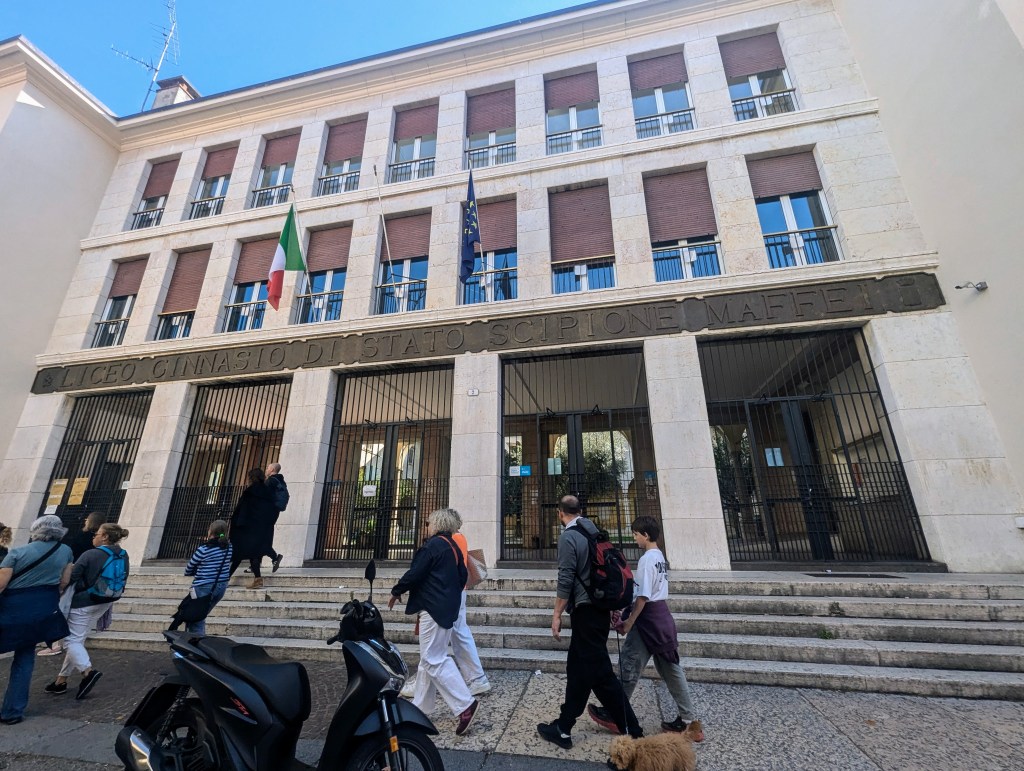
The state high school “Scipione Maffei,” established in 1804 is the first Napoleonic high school established in Veneto.
The last stop on our walking tour was in a square with a view of St. Mark’s Hill. Lucia highly recommended that we cross the bridge and climb the hill for the views of the city.
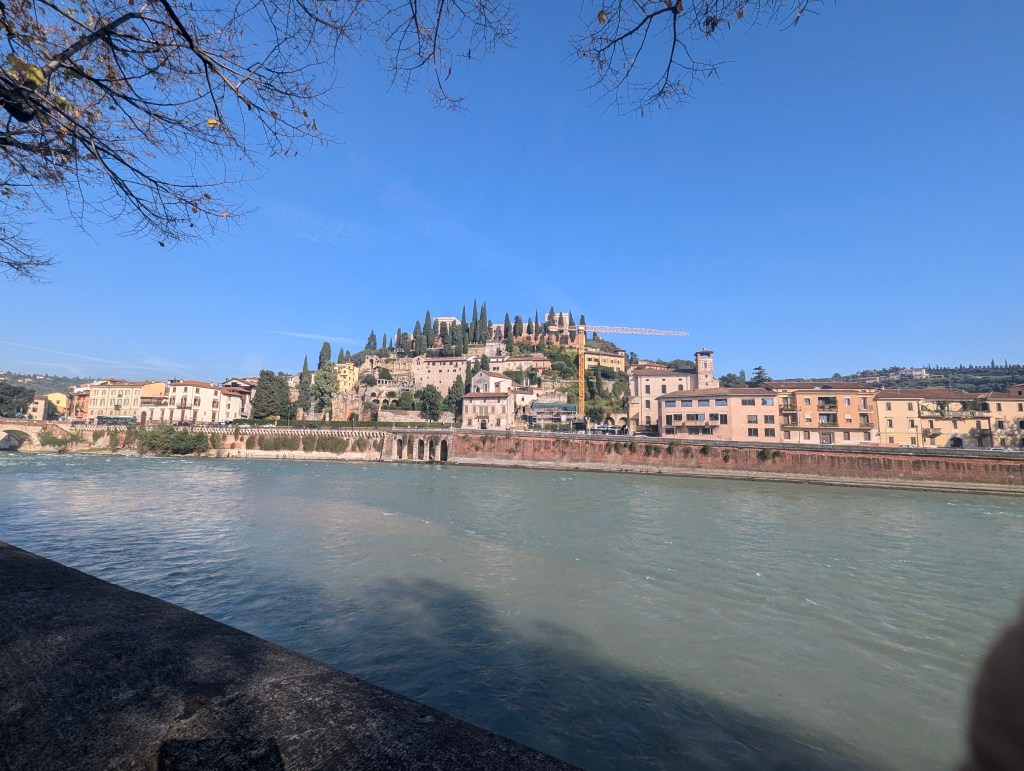
To get there we needed to cross the Pietra Bridge, a stone bridge which is the oldest in Verona. A wooden bridge had been placed there in 148 BC, but later replaced with a stone one. Despite damage through the centuries due to flooding and bombing (WWII), two of the arches have survived intact.

Once across we rode the tram to the top, had lunch at the cafe and enjoyed the views.
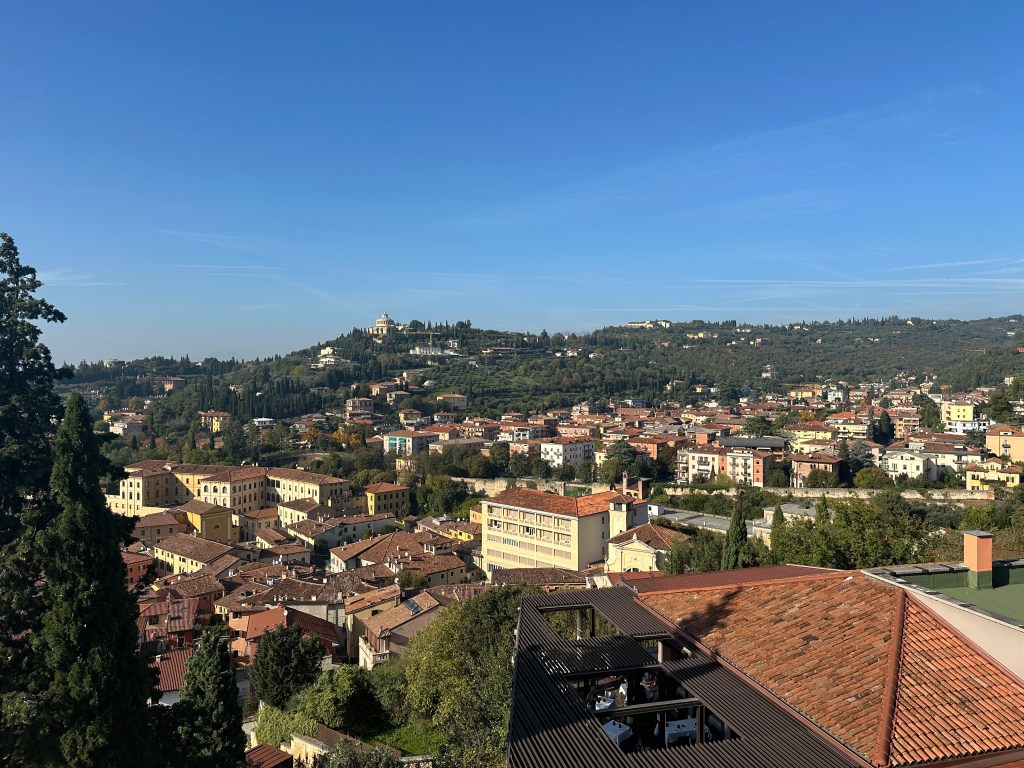
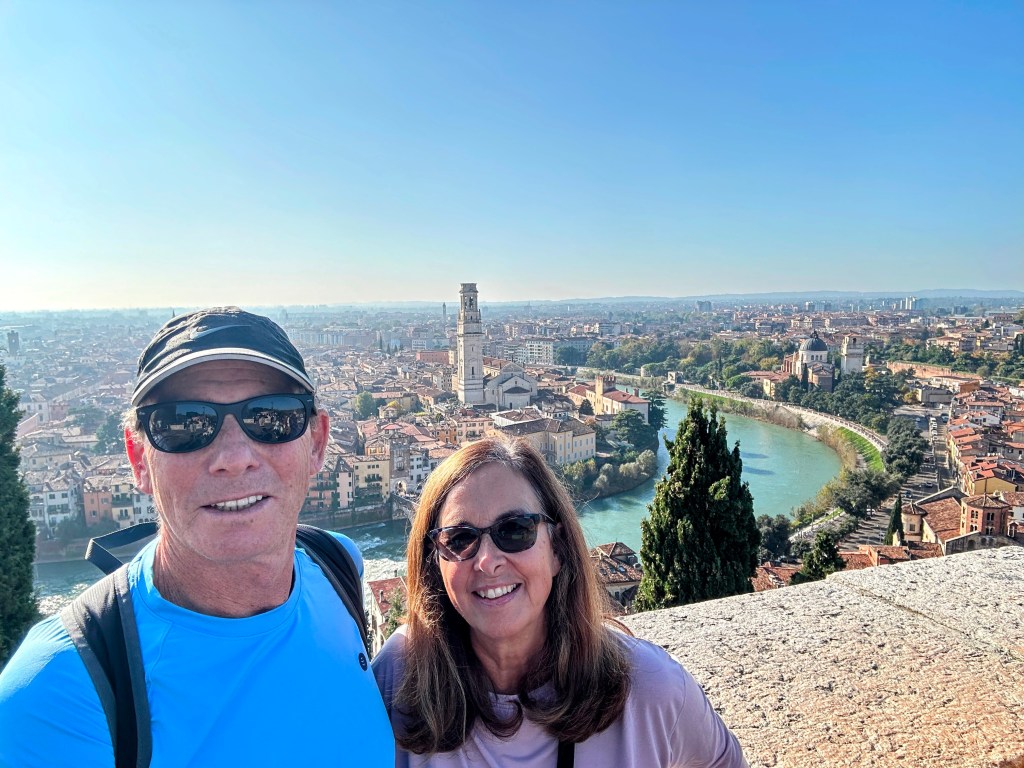
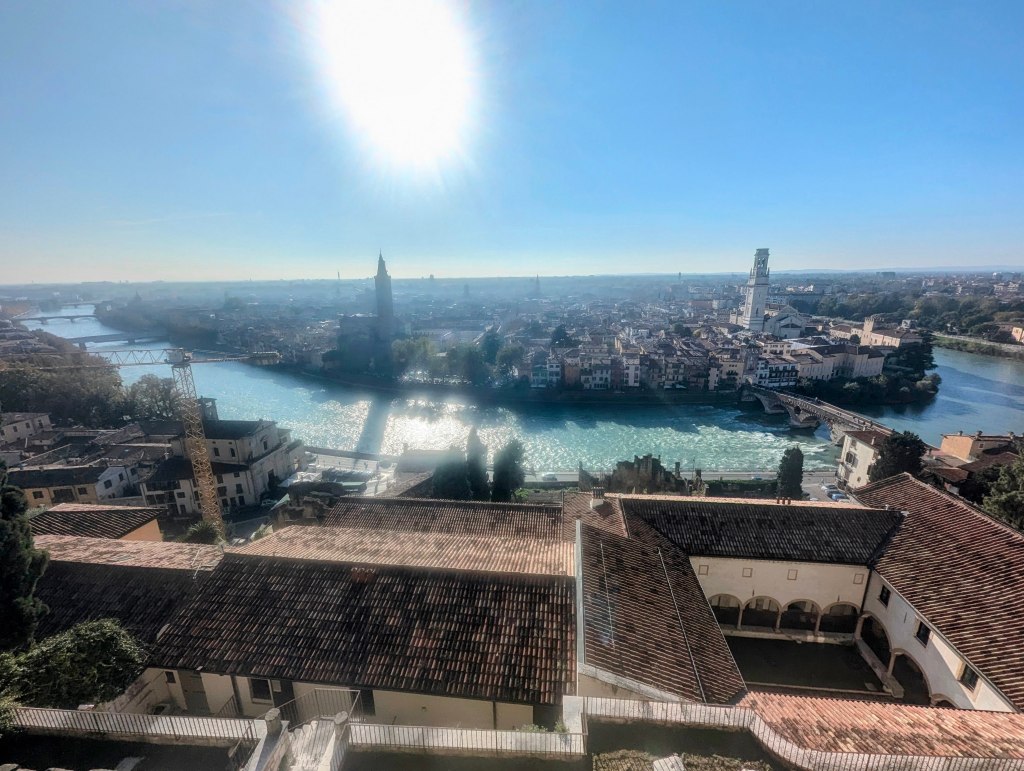
From up high, the bend of the river surrounding and protecting the city is clear.
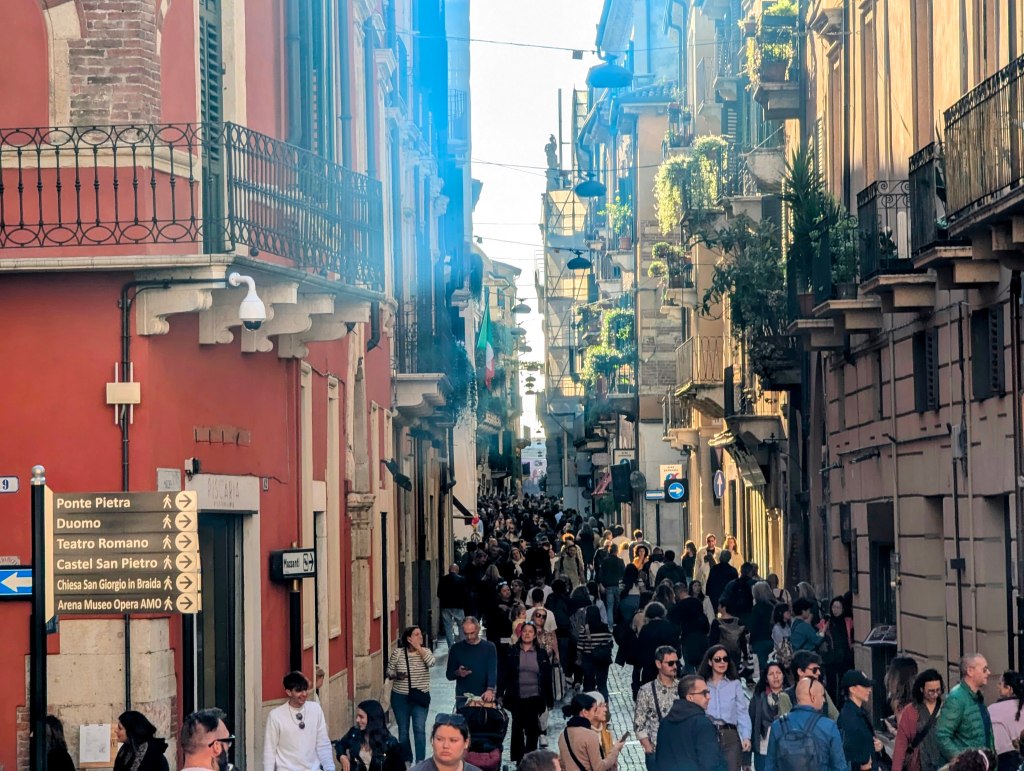
In the late afternoon, we strolled around the city a bit more.
Now that we were aware of the della Scala stair symbol, we saw it everywhere.

The next day was sunny and warm, and we headed to Lake Garda, as did the rest of Italy. All Saints Day is a Bank Holiday in Italy which meant a three day weekend with glorious weather! The traffic was unbelievable. The crowds seemed consistent with those of the summer. We were headed to Sirmione on the end of the peninsula at the southern end of the lake. As we neared and huge crowds were walking from much further away, we feared we would not find parking and would be stuck in a quagmire of traffic. As we passed Villa Pioppi, the restaurant opened for the day. We were waved over by the staff and told we could park all day for €8, and if we ate at the restaurant, it would be credited toward our bill. What luck! We happily paid and merrily joined the sea of people streaming toward Sirmione.

The big attraction is The Castello Scaligero di Sirmione, (Scaligero Castle), a fortress from the Scaliger era. It is one of Italy’s best preserved castles. It was built in the latter half of the 14th century for the Della Scala (Scaligeri) family.

We joined the very long queue to enter the castle. We noted the Della Scala stair symbol and the Winged Lion of Veneto.
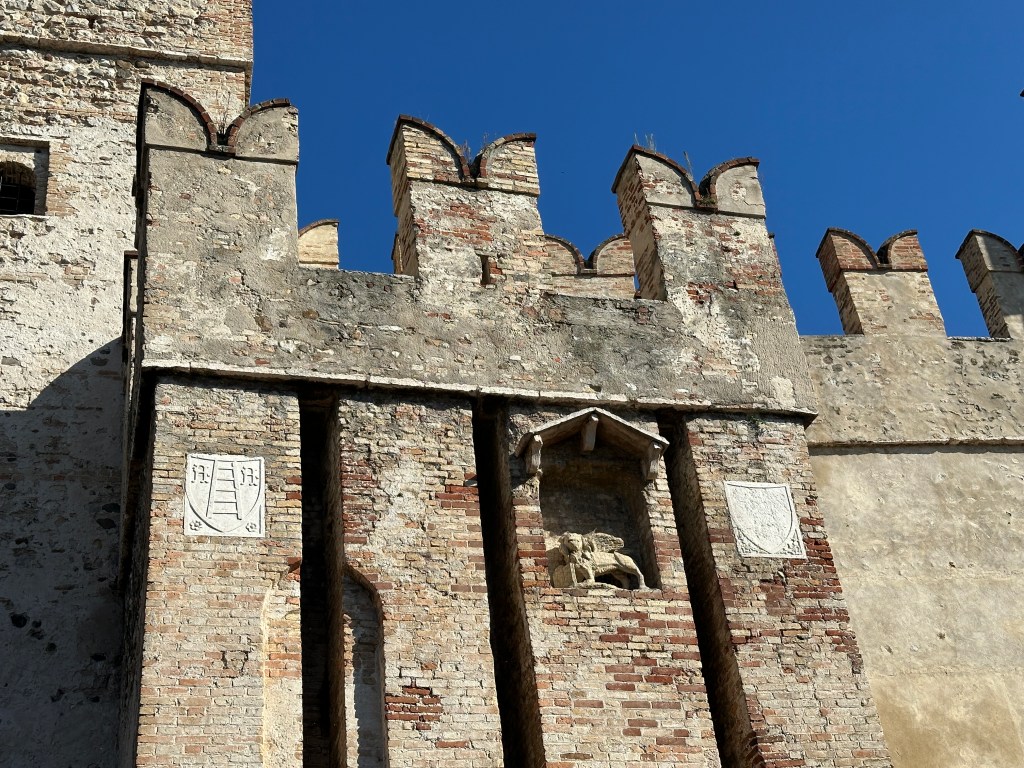
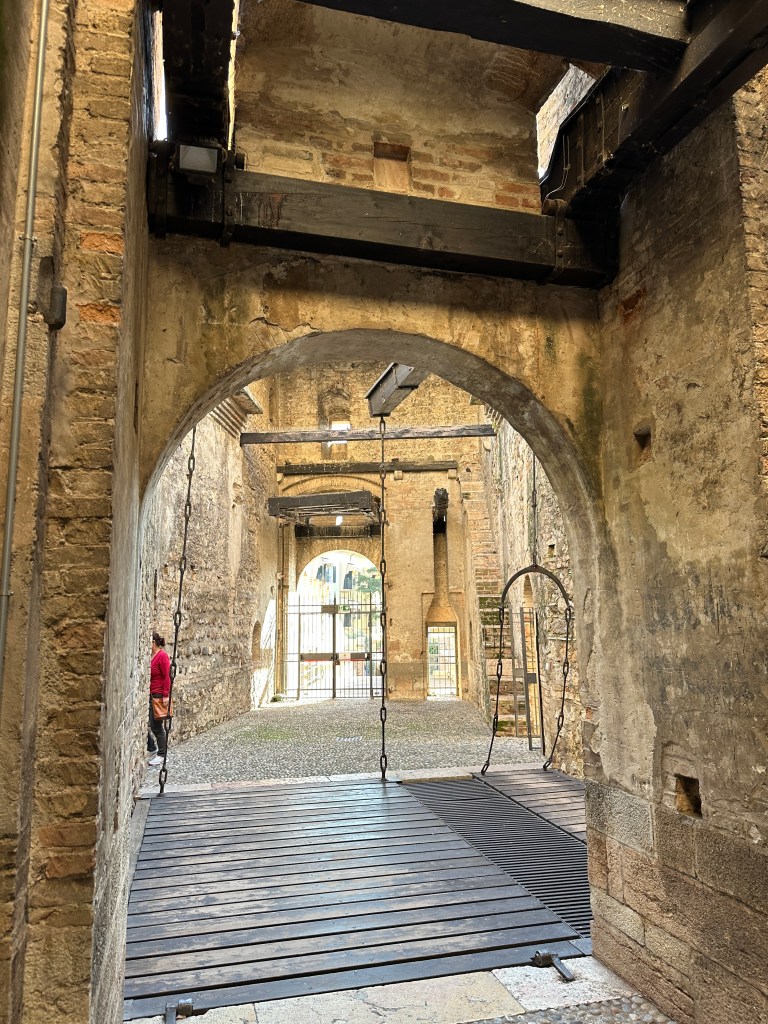
We entered through the drawbridge.

The castle is amazingly well preserved.
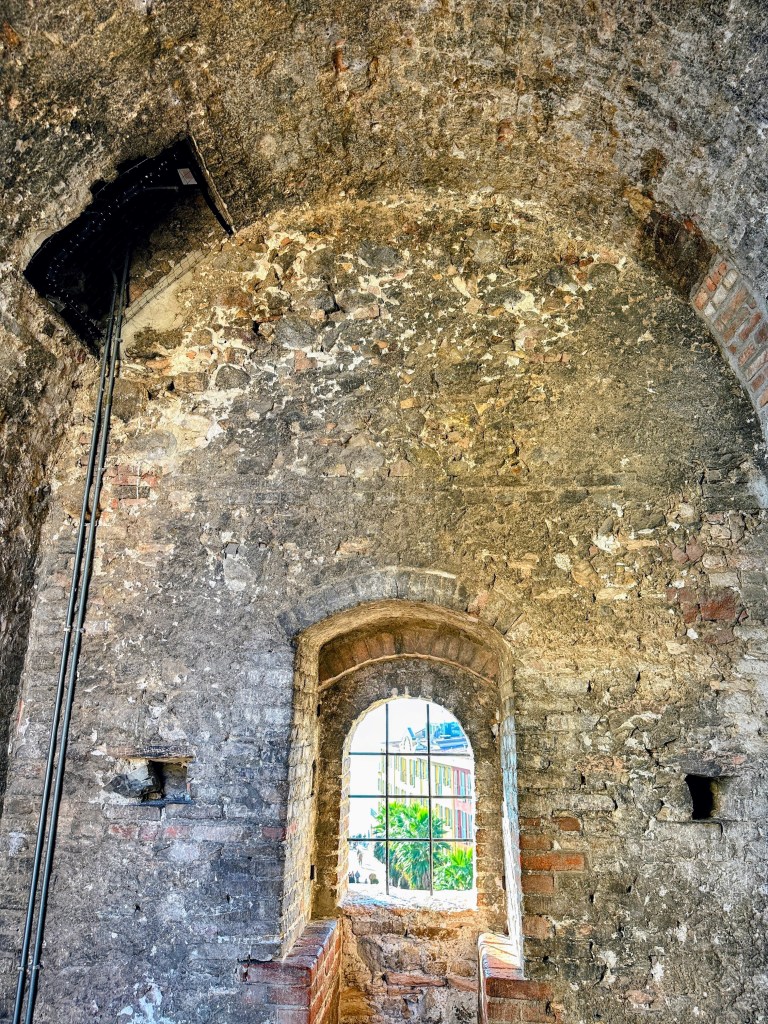
We climbed to the first level and took a look out toward the back.
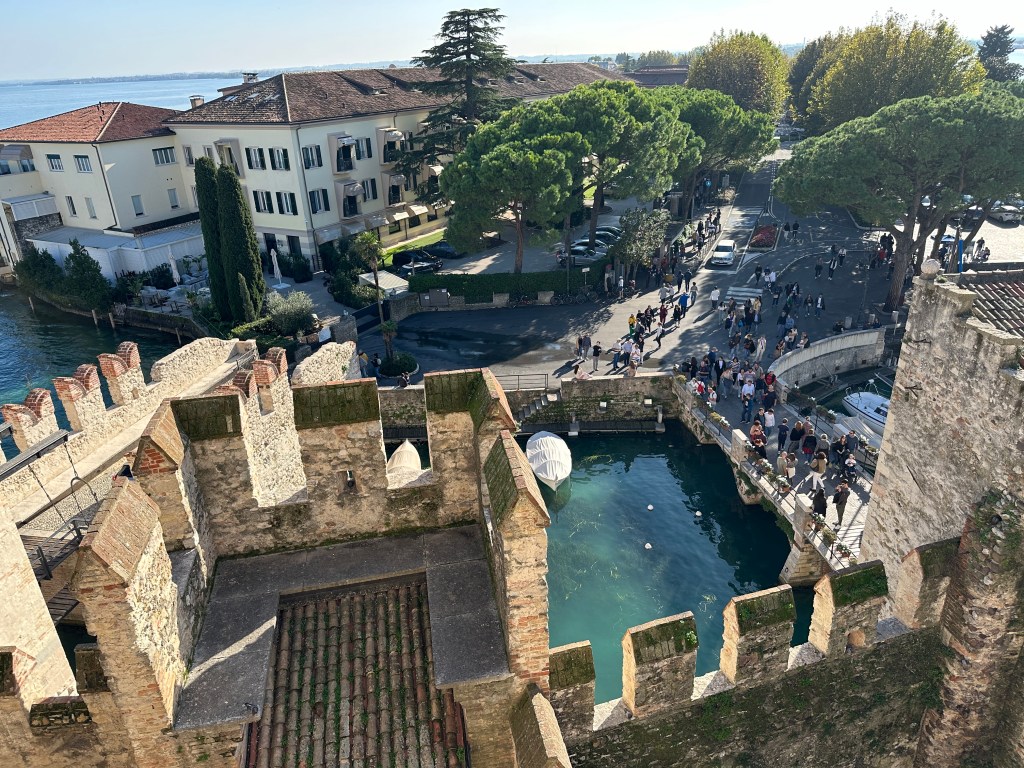
After exploring around the various areas, we climbed to the next level. Looking out the front we could see all the folks still waiting to come in.
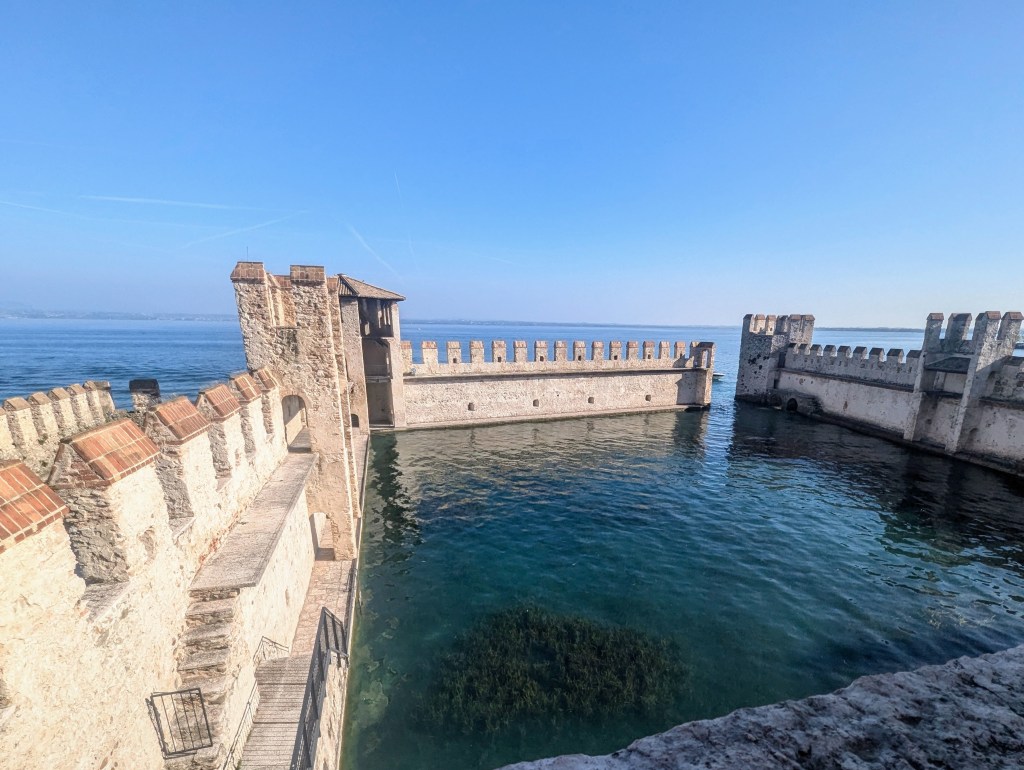
Both the front and back of the castle are well protected.

Another level up and we were able to see the end of the peninsula, across Lake Garda, and make out the northern shore in the distance.
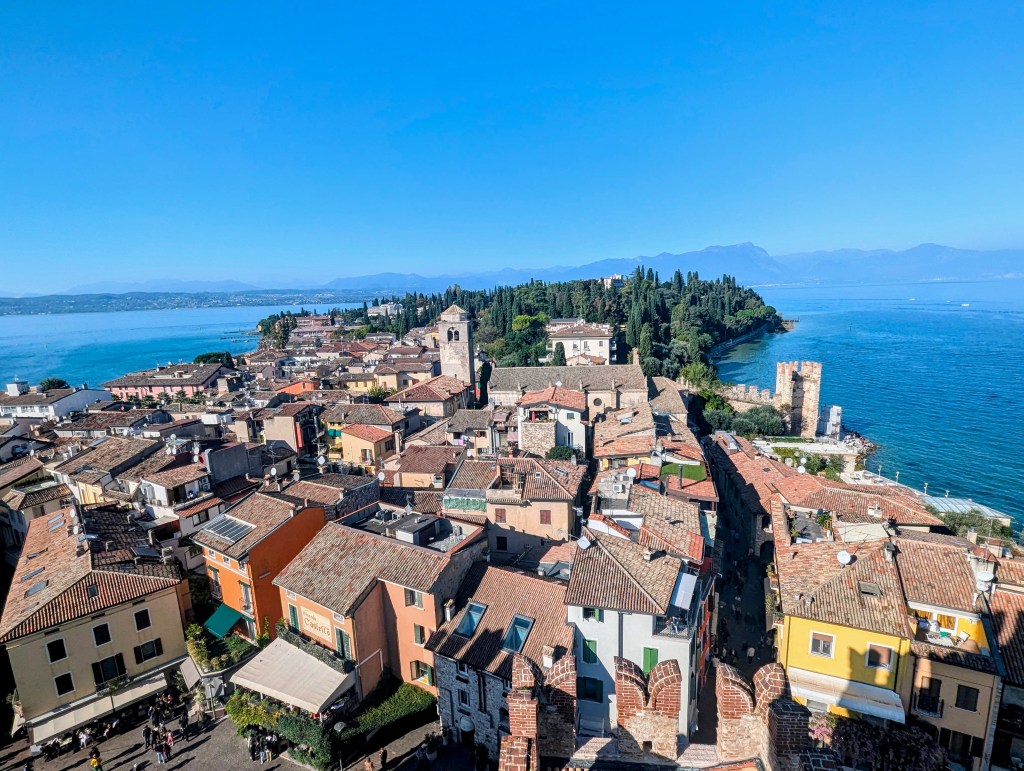
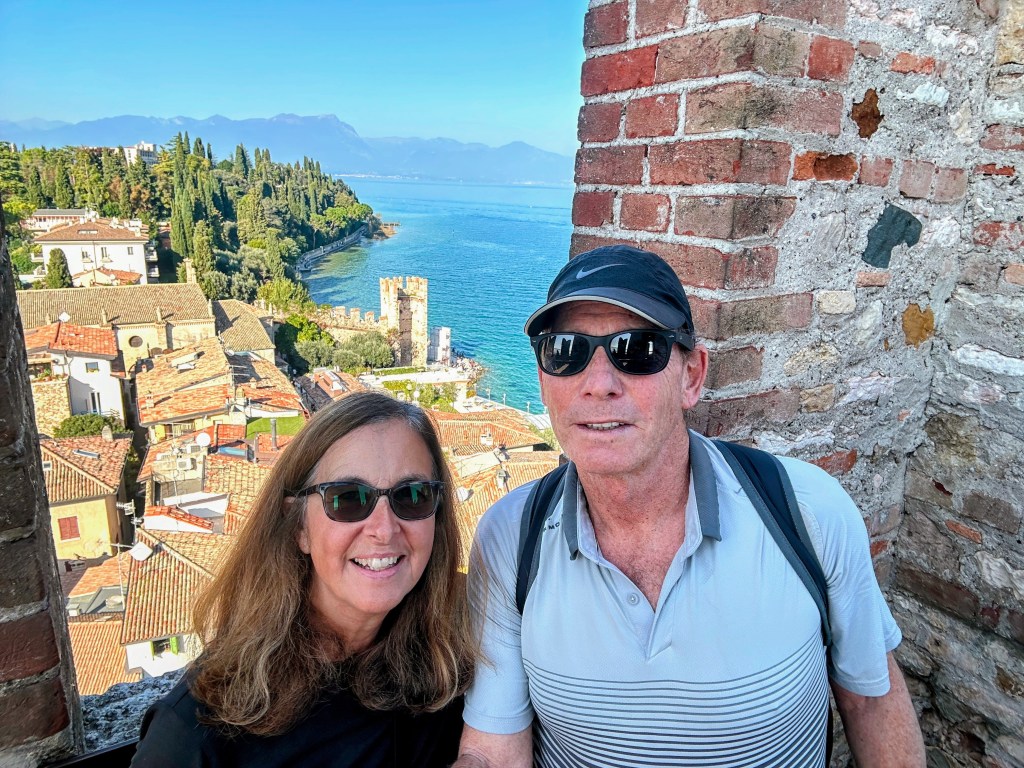
We could see the port of Sirmione.
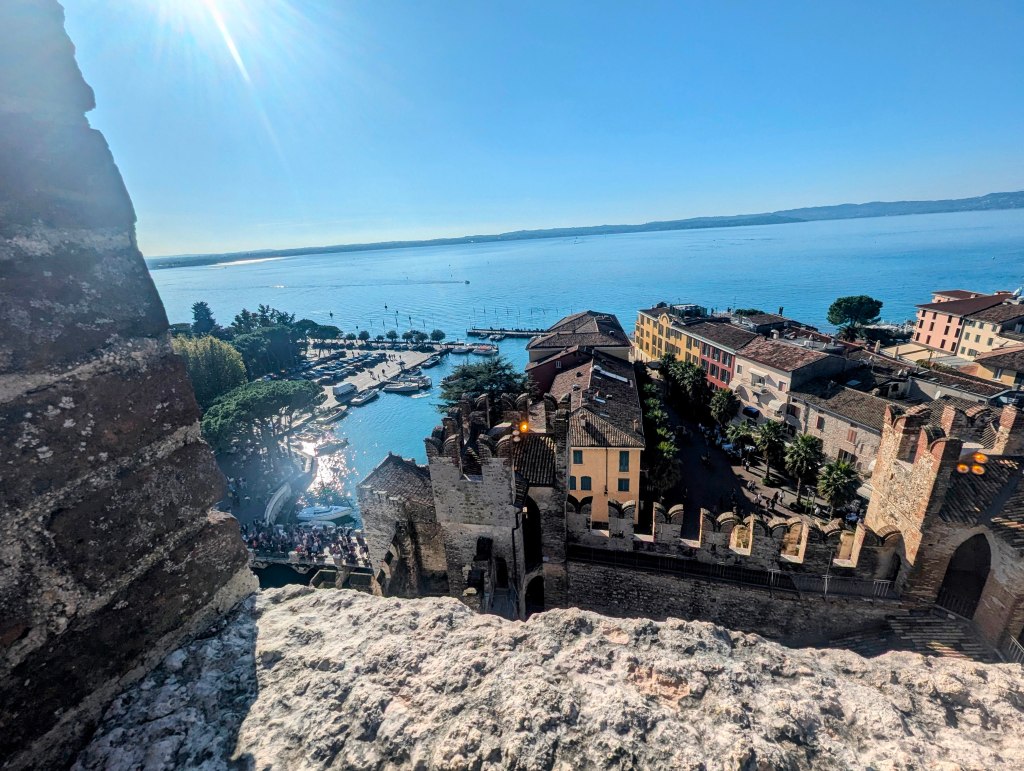
One more flight up, and we were at the top.
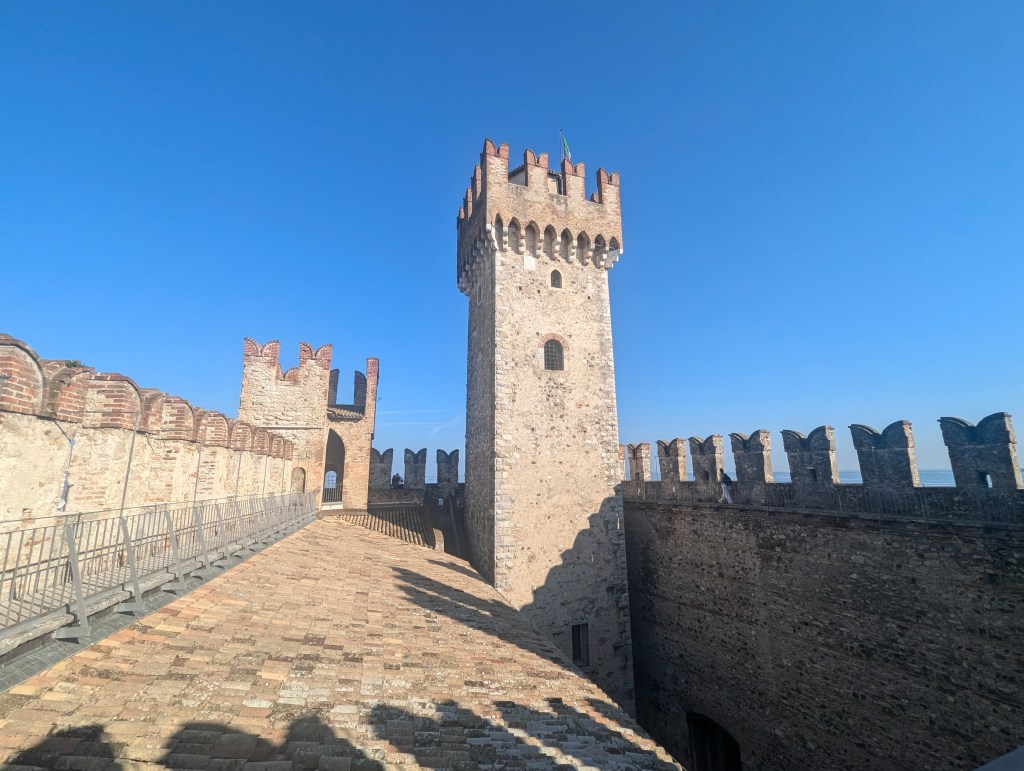
It definitely would be hard to sneak up on this castle.
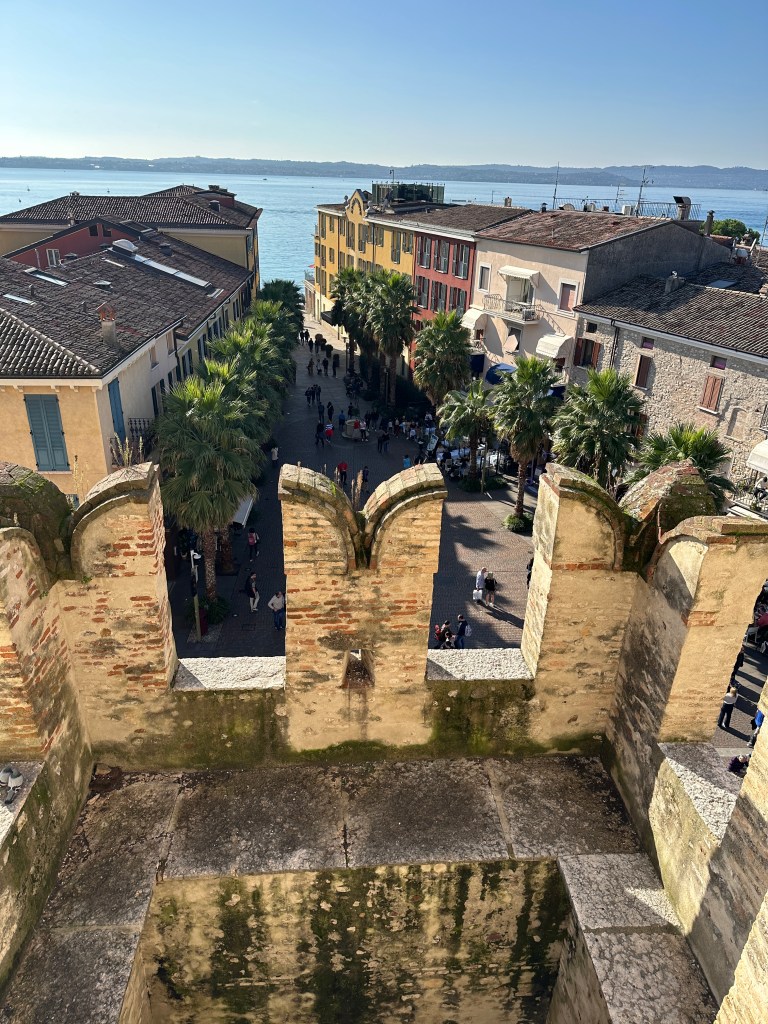
Not my favorite, I was ready to descend.
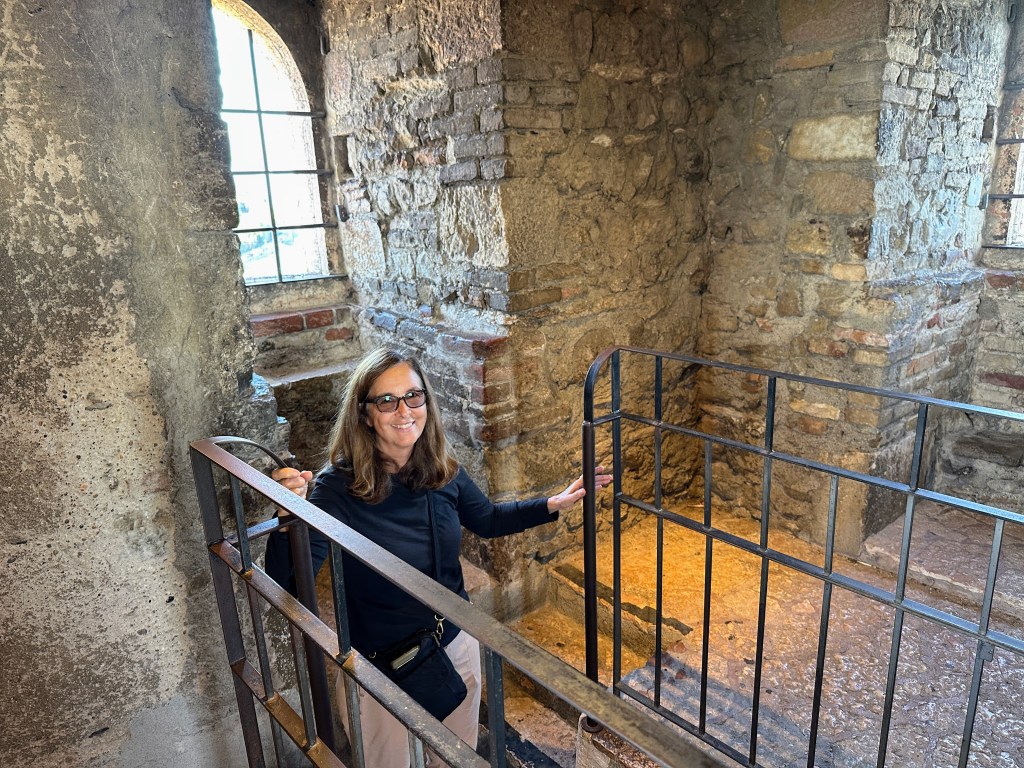
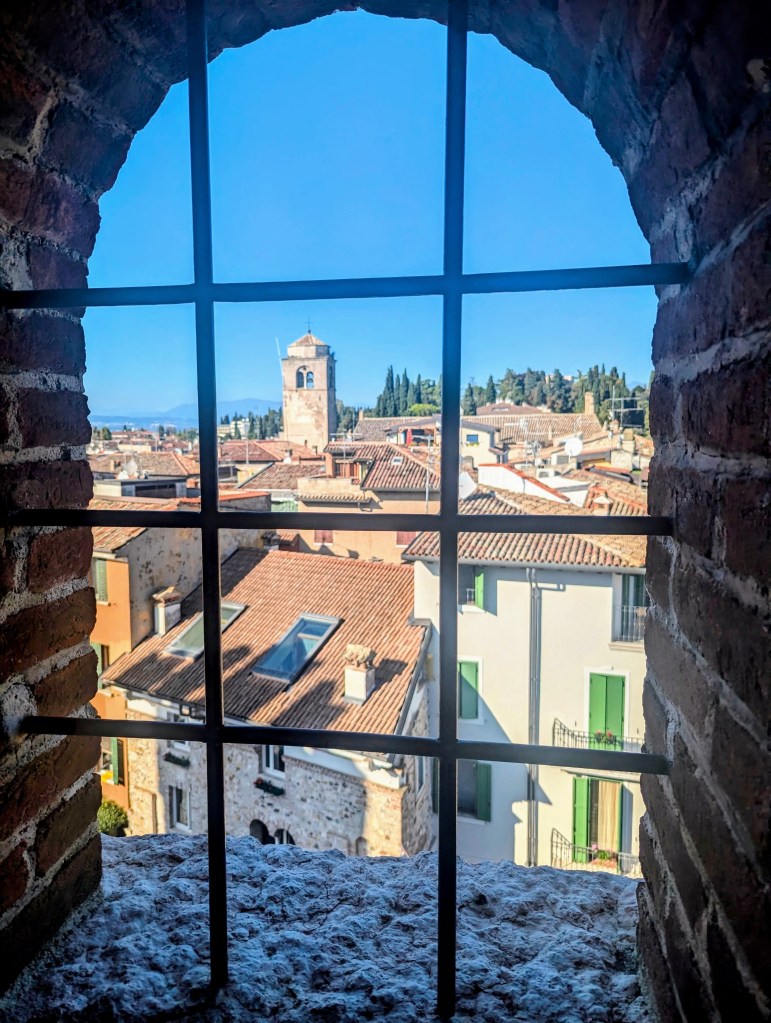
We exited back through the drawbridge.
We explored the tiny town packed with restaurants and cafes

and some really cute shops. I include this one for all my purple loving friends and family.
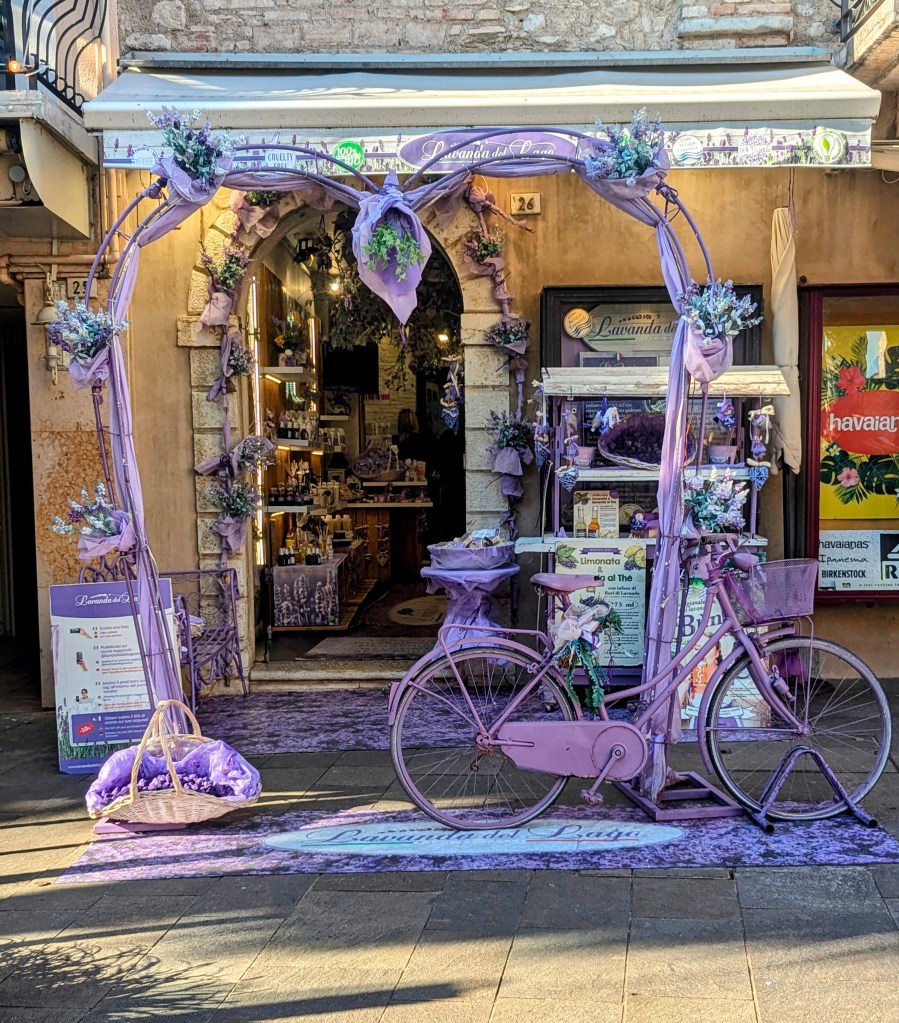
It was time for a very late lunch. Villa Pioppi had good reviews and great views, so we headed back.
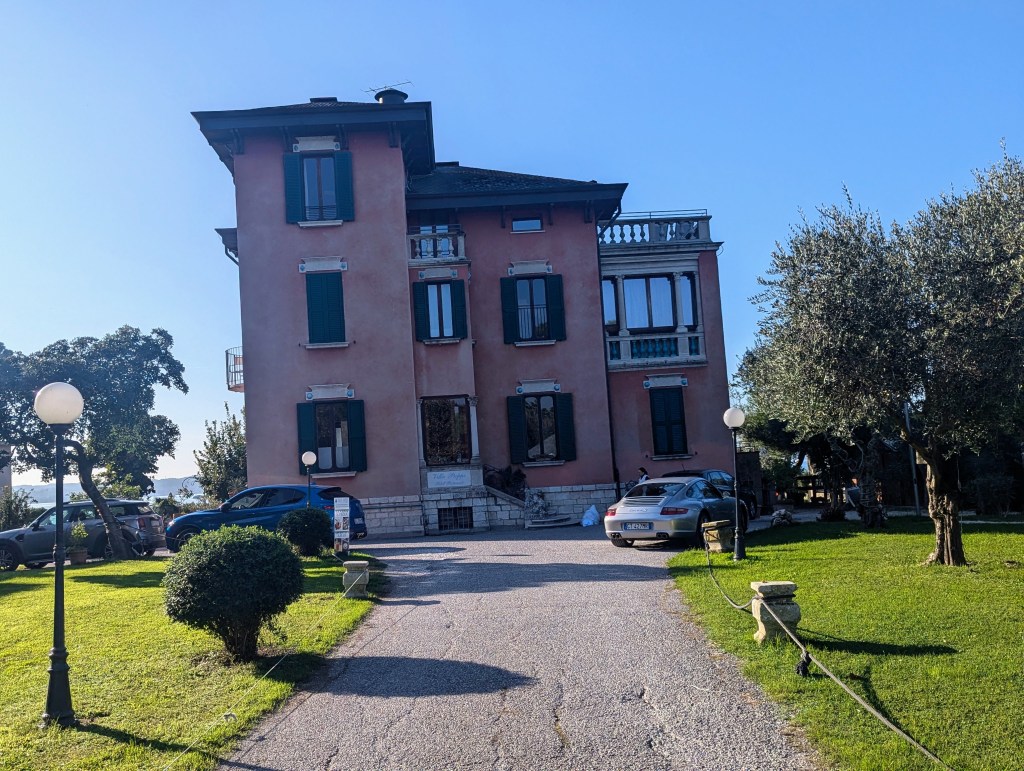
The next morning we were off to Venice. We had hoped to stop by Padua, another Shakespearean setting, but with our trip to Lake Garda, we had run out of time. Our car rental was due, and our AirBnb host was awaiting our arrival. We dropped the car near the main train station. As our host had recommended, we bought multi-day passes for the water bus system and headed to the canal. This is what a bus stop looks like from the water.
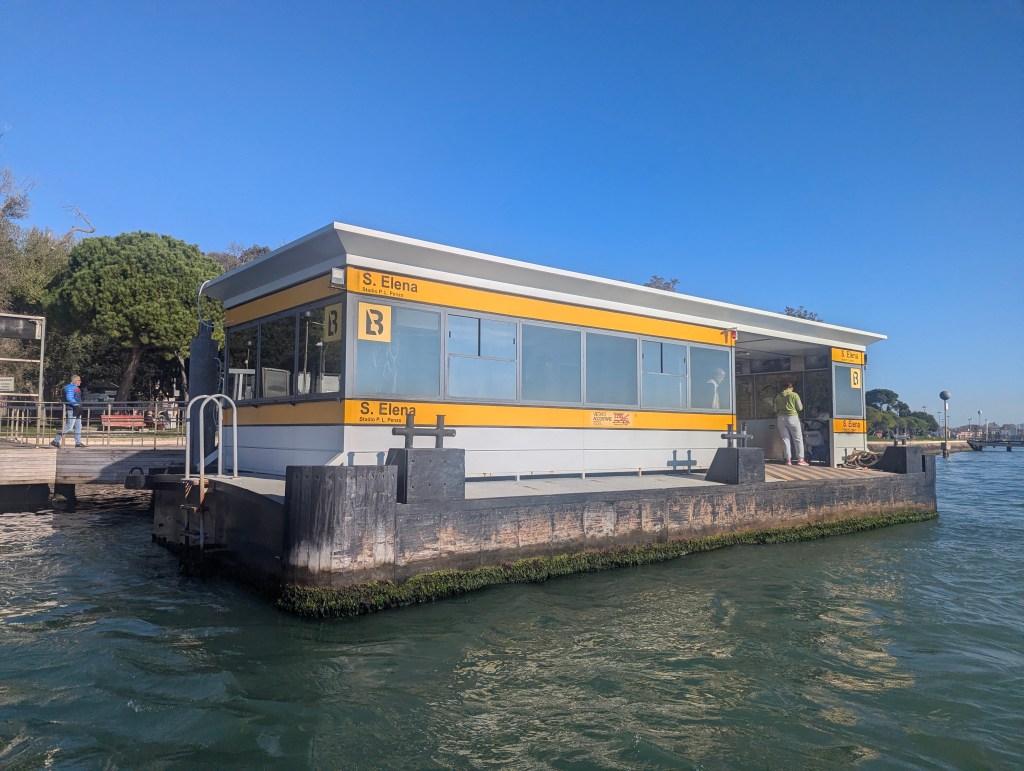
We met our host and settled in. This is our view from the apartment.
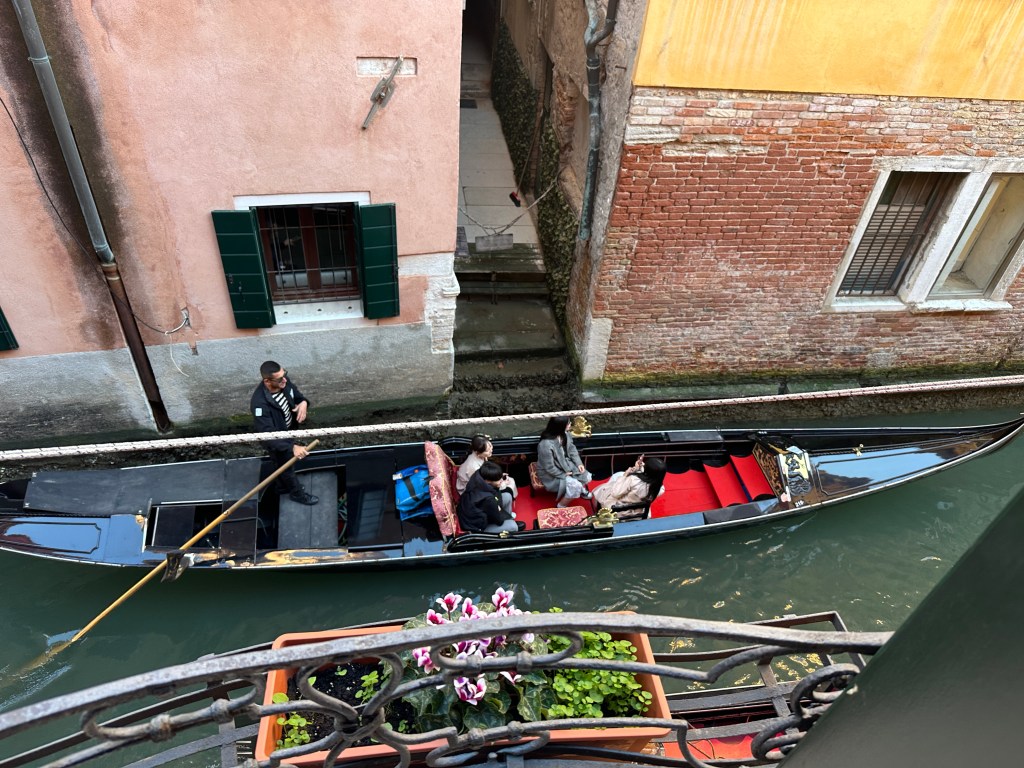
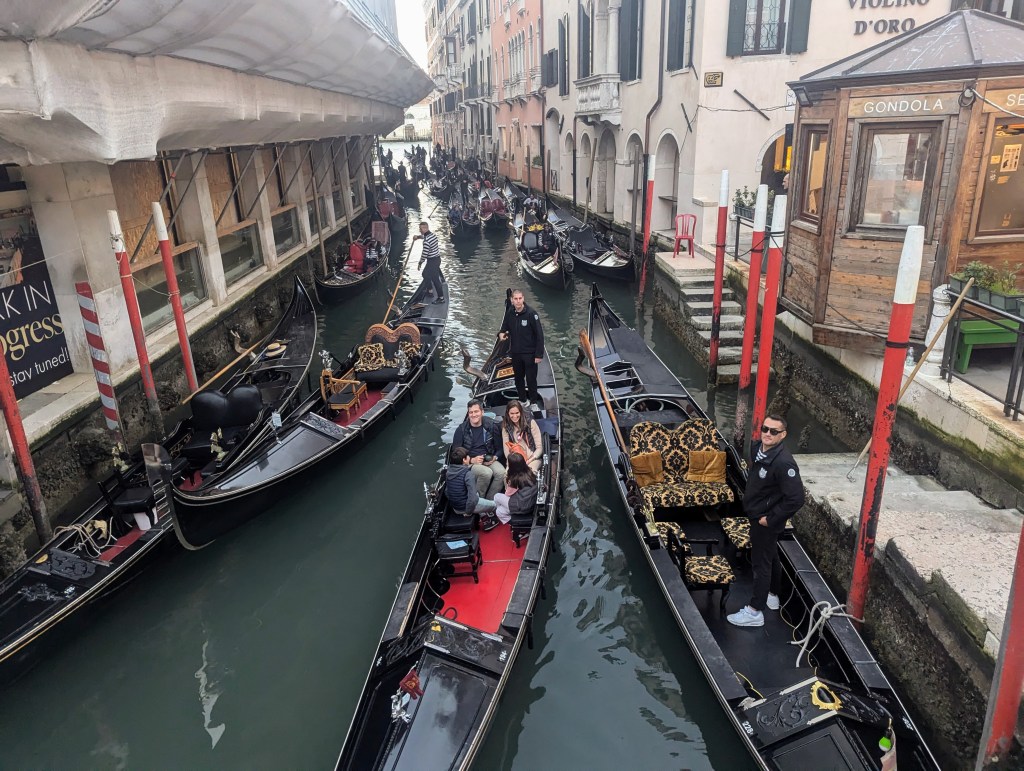
We brought in groceries for the few days. By the time we were done, it was already getting late into the day, so out we set again to explore. We learned that we were on a bit of a thoroughfare for the gondolas, so lucky. For the rest of our visit we would periodically hear the serenade of a gondolier.
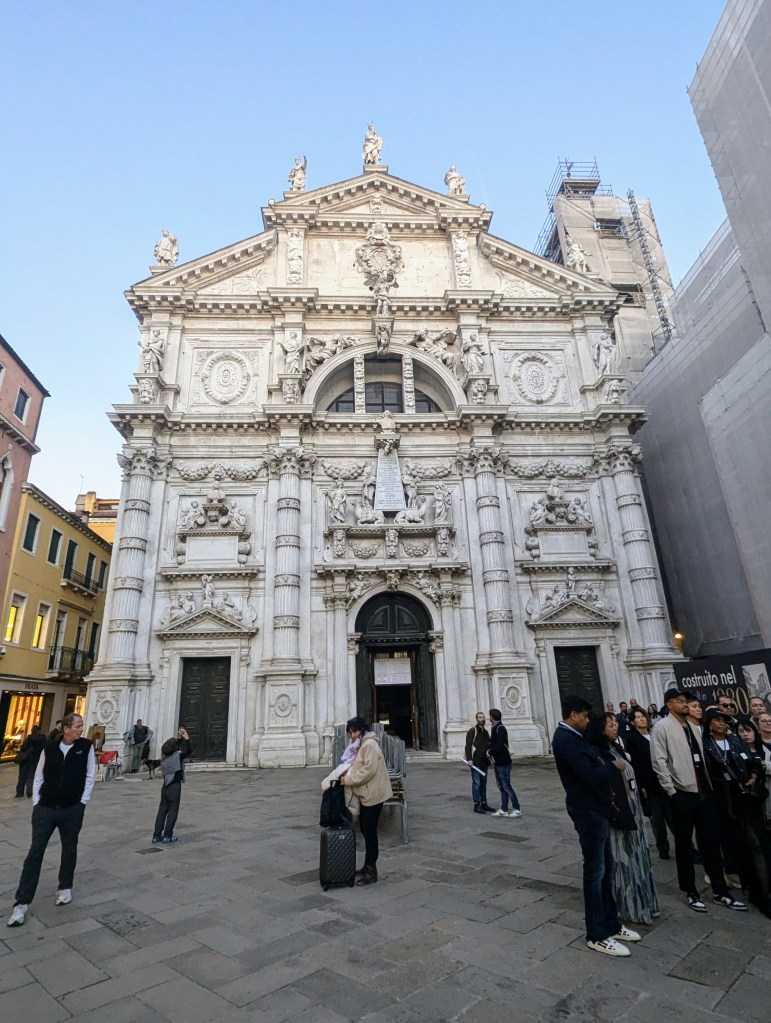
Along the way we passed Chiesa di San Moisè (Church of Moses), which we were to pass daily for the next several. The church was built initially in the 7th century. It is dedicated to Moses because, like the Byzantines, the Venetians often considered Old Testament prophets as canonized saints. Its elaborate Baroque façade profusely decorated with sculpture dates to 1668.
And so it was that our first visit to San Marco Plaza (St. Mark’s Square) was as the sun was starting to set.
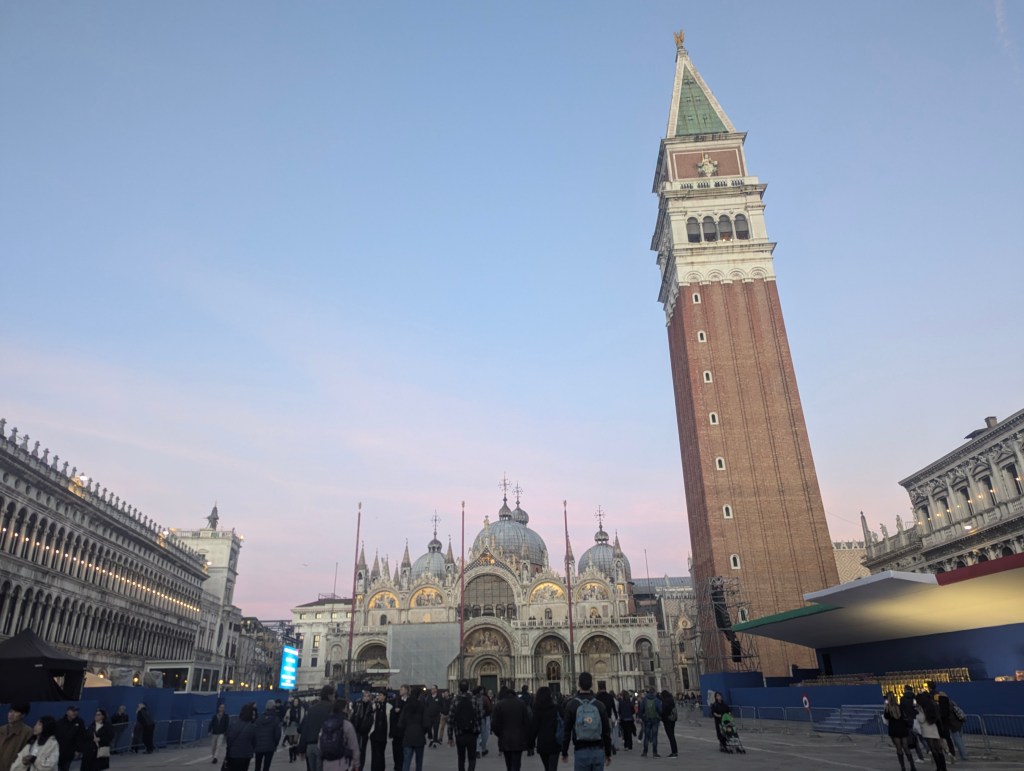
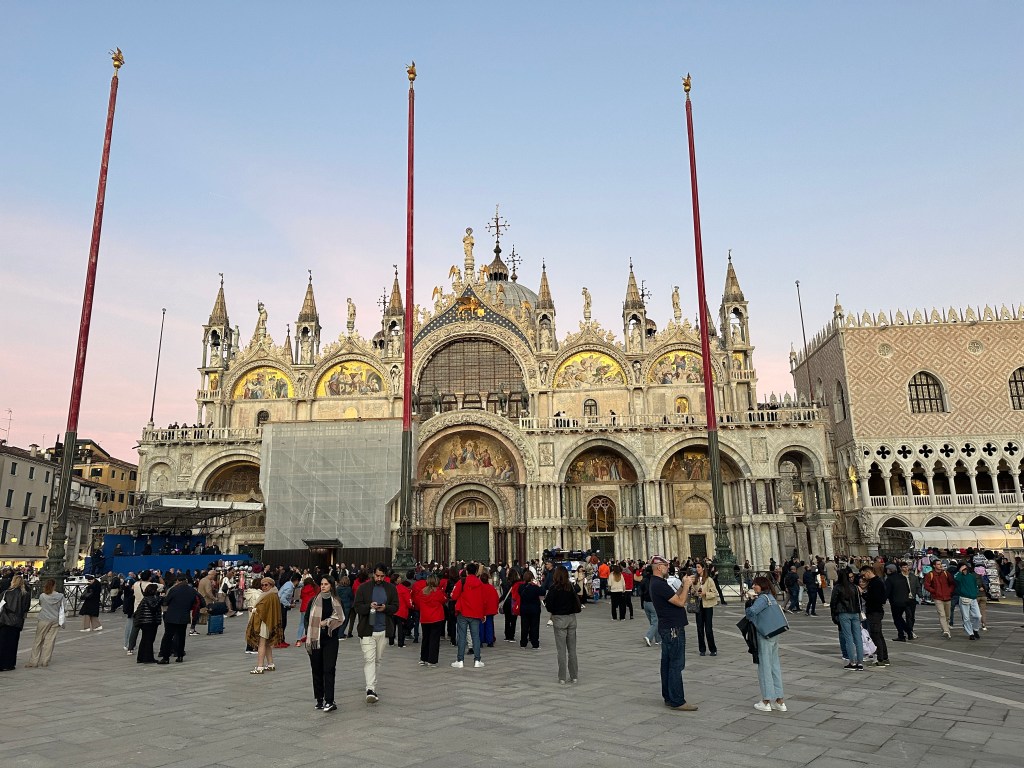
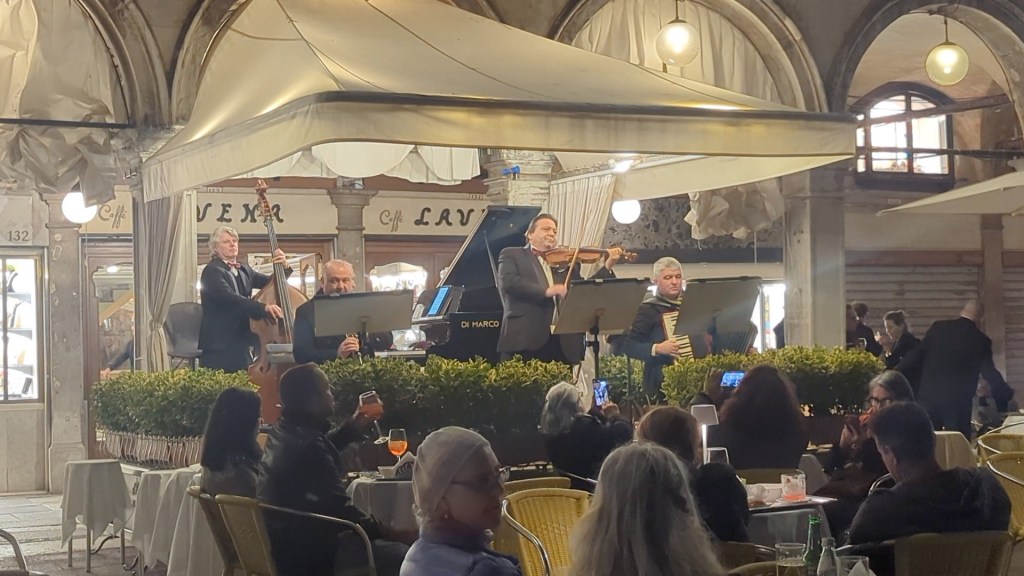
We walked around, enjoyed the music playing from some of the outdoor restaurants, and took it all in.

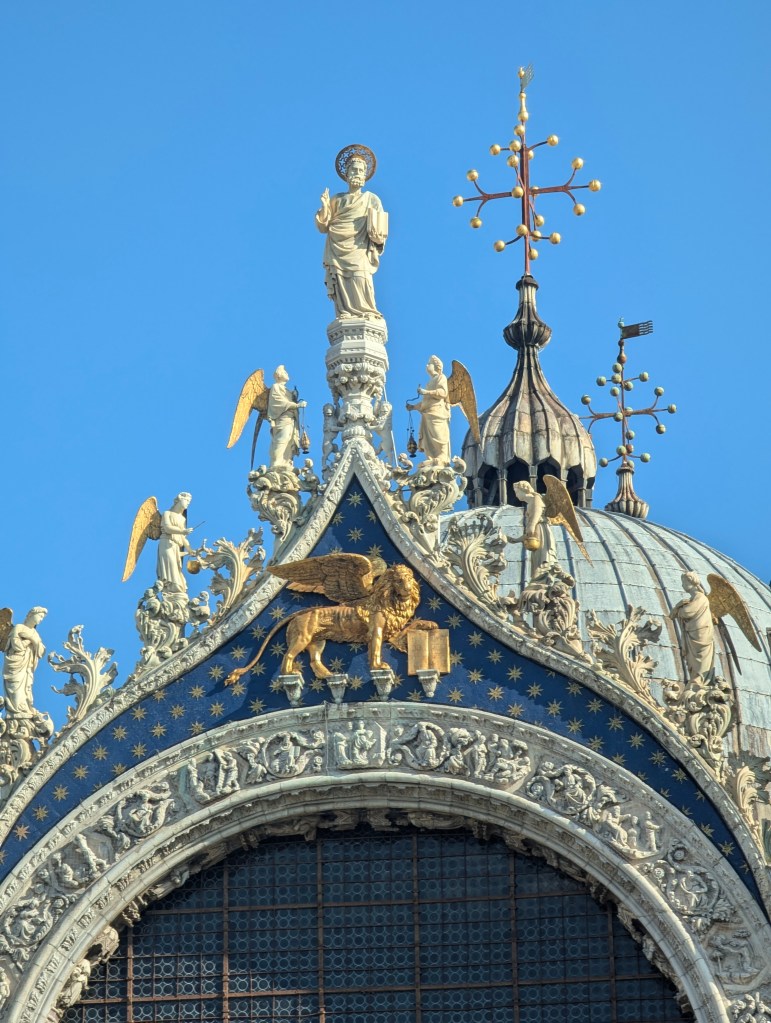
The winged lion represents St. Mark, and it is proudly displayed over the main entrance of the basilica dedicated to him.
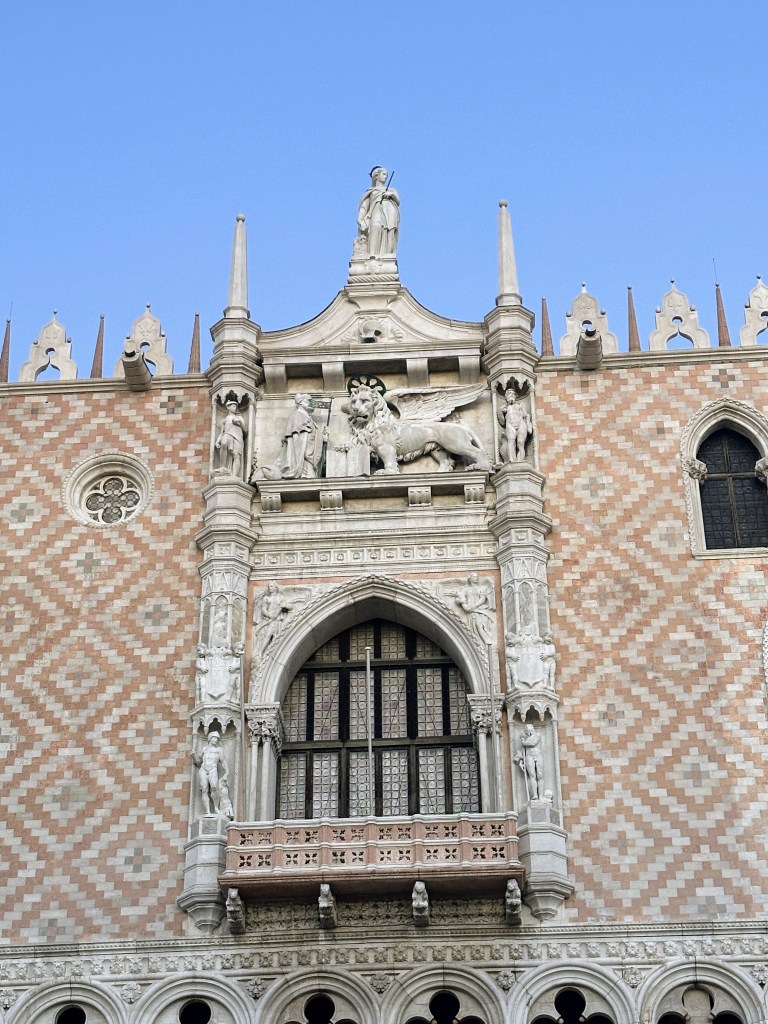
and on the Doge’s Palace
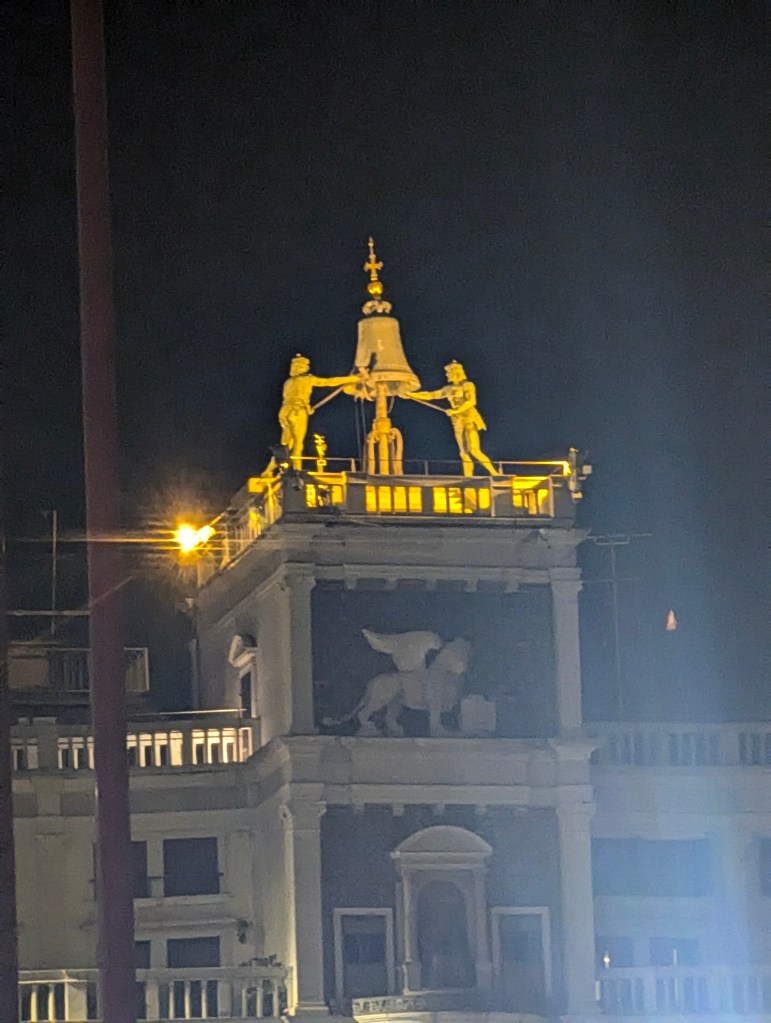
as well as on the clock tower.
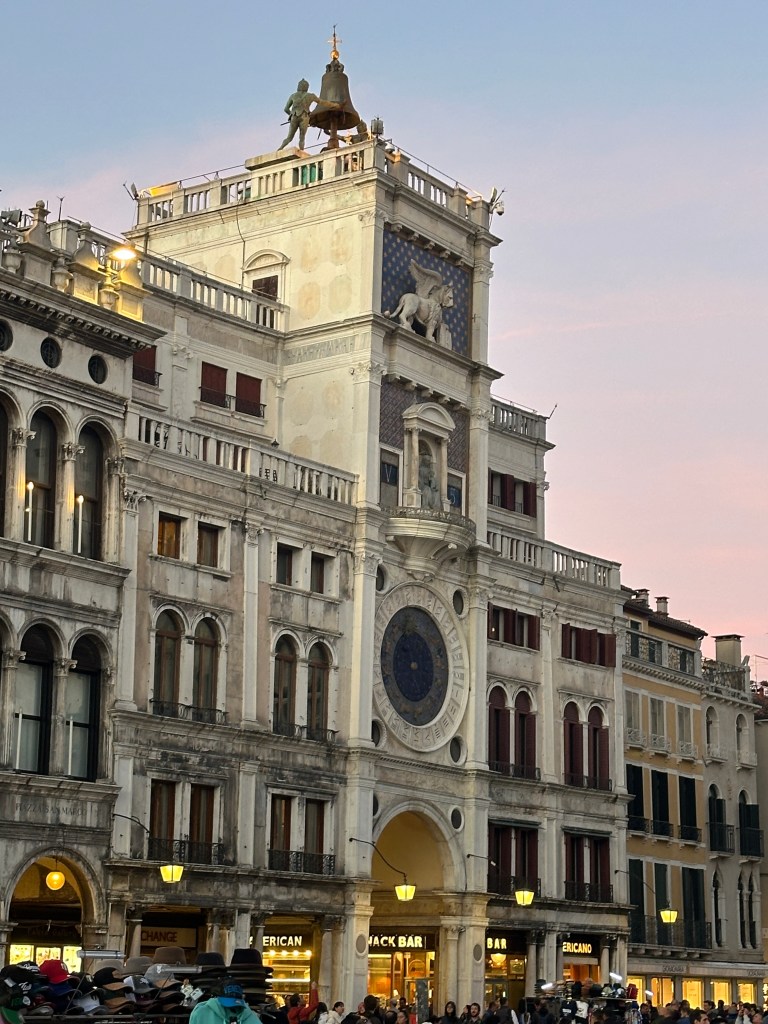
As the hour strikes, the figures strike the bell.
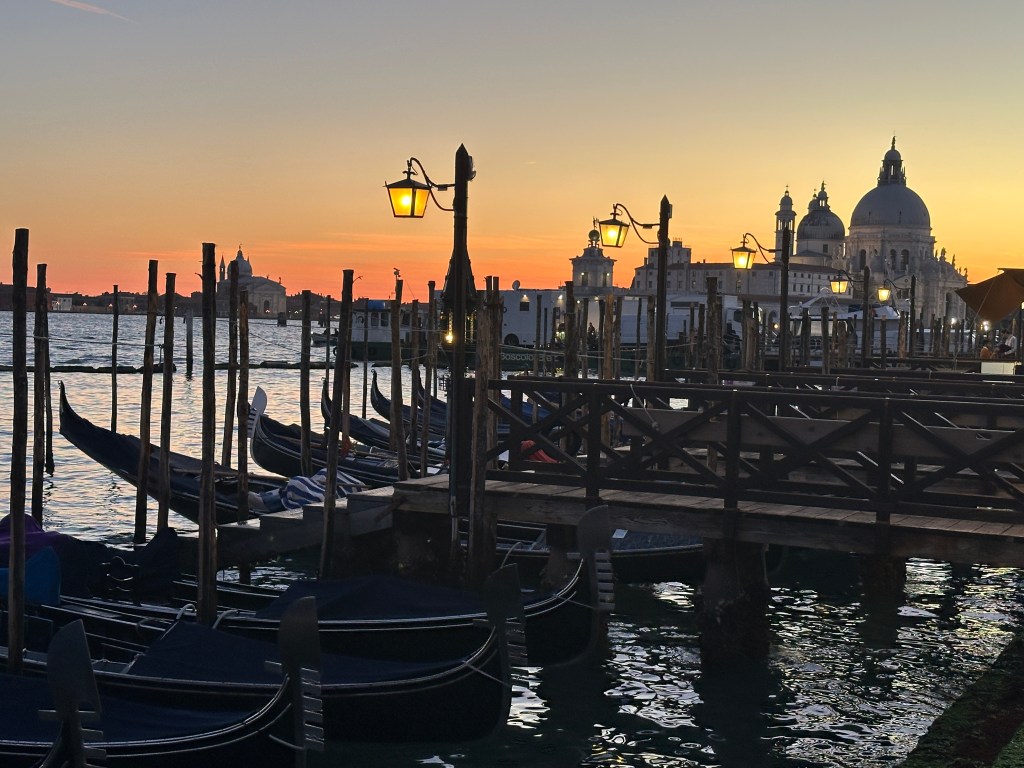
How very beautiful is the setting sun.
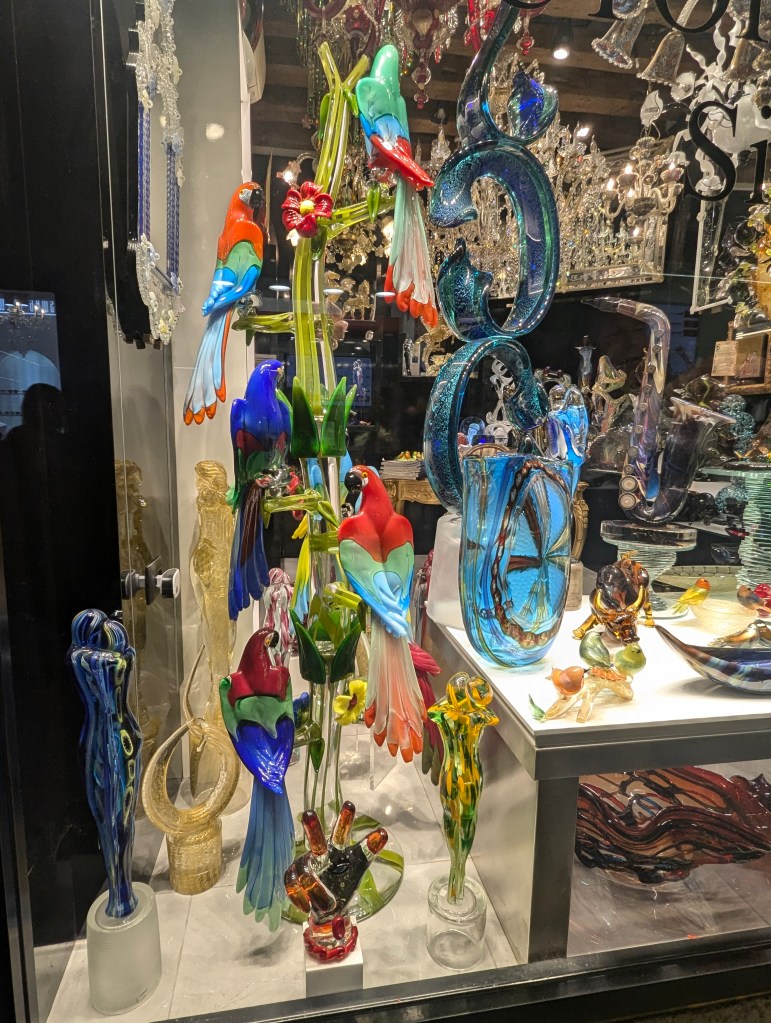
Venice is known for many things, one of which is glass. In the plaza we saw some our first impressive glass shops, every piece a masterpiece, literally.
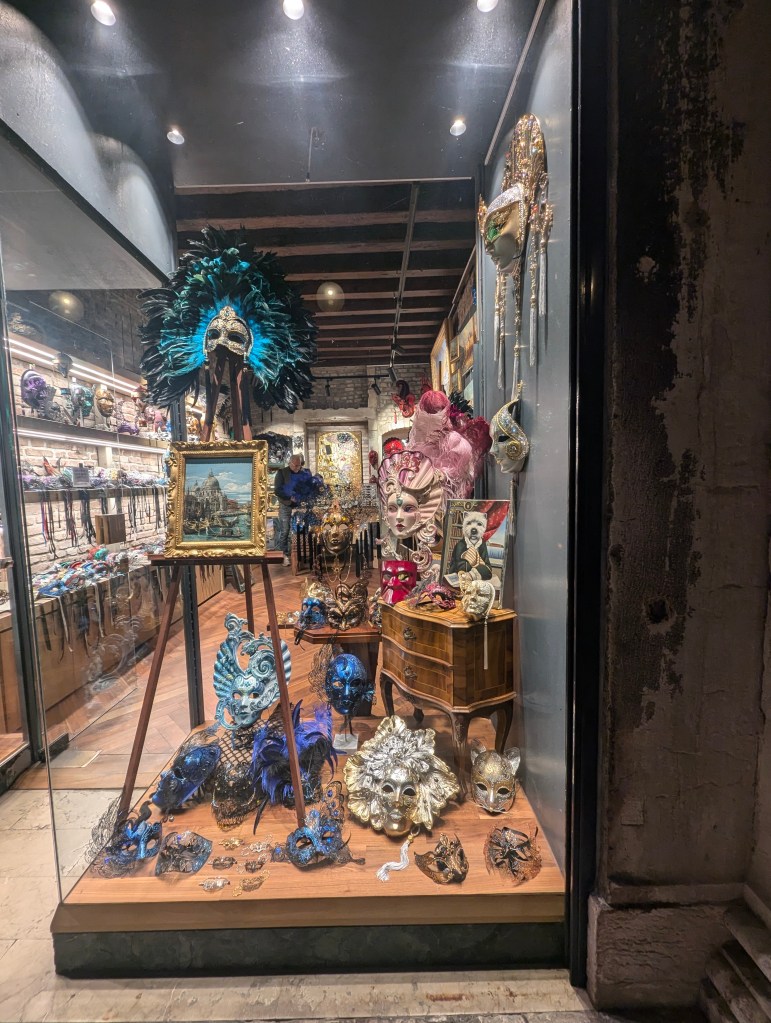
Another attribute of Venice are the masks of Carnival, which was begun in 1097. There are shops for Carnival masks everywhere in absolutely every price range from the street vendor to the the high end to the pure art.
We enjoyed yet another amazing meal in Italy, and went in early; we had an early walking tour. In the morning we crossed the Grand Canal to meet our guide Elena in Campo Sant’Agnese.
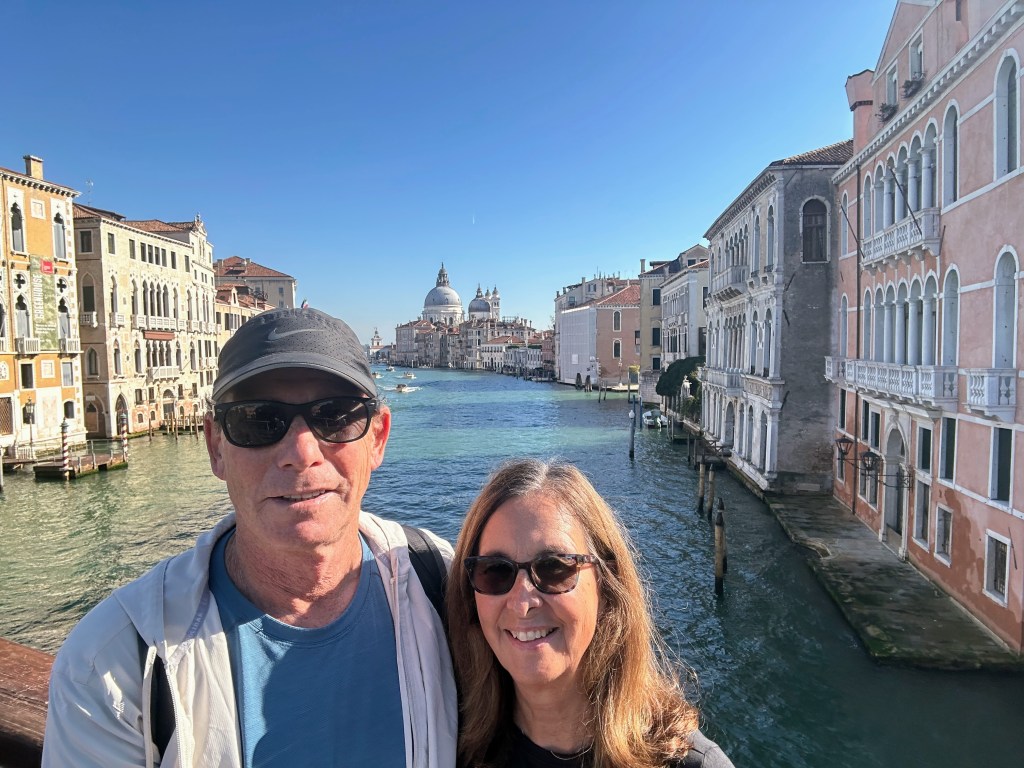
Although the square itself was not of interest, it was a quiet area away from crowds to allow her to give us the history of the city succinctly so we could better appreciate what we were to see over the next few days, which is exactly why we take these tours. (I take notes on my phone.) Many of the things she talked about were not seen in the scope of the tour, but we sought out later. For clarity, I am going to include those pictures taken in the days to come here for the visual.
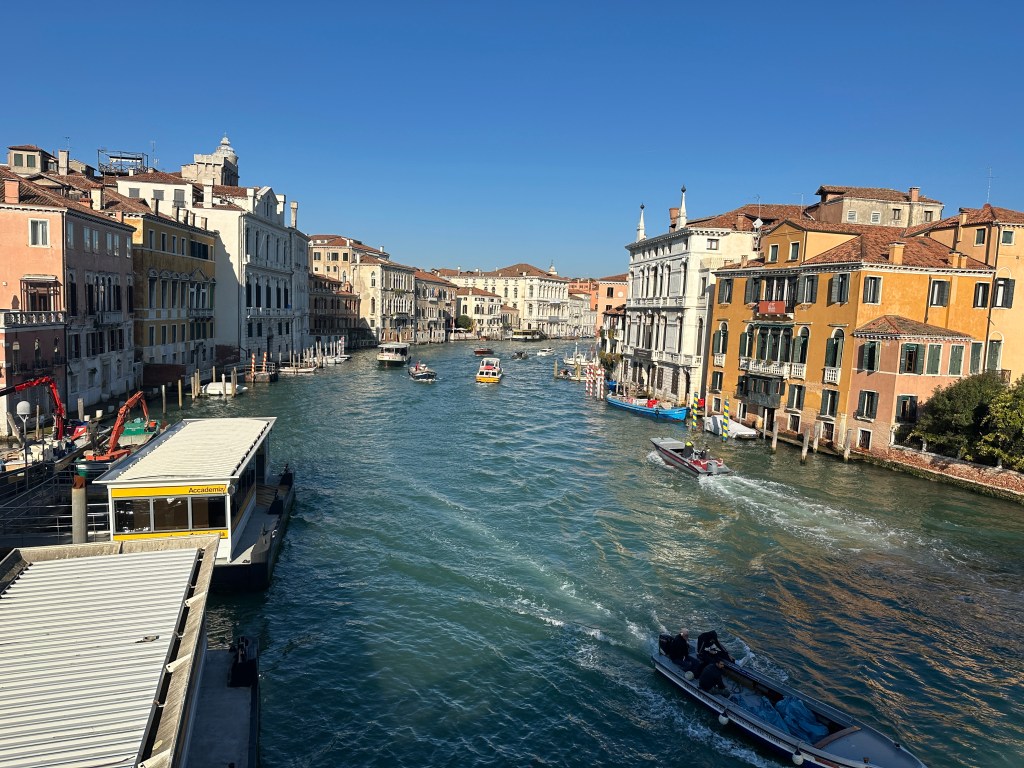
Venice today is 124 separate islands connected by bridges. There are over 80 churches in Venice because before before the 9th century, when the first bridges were built, one could only cross between the islands by tying boats together and walking across the boats. Each island was its own parish necessitating a church. The 9th century bridges were wooden; they had no stairs, no rails. Today there are 423 bridges, 300+ stone, the rest wood and iron. The Academy Bridge, which we had crossed this morning, was the first, of now four, that cross the Grand Canal. It was built in 1854 by the Austrians during the Hapsburg Rule.

In 1933 it was one of two bridges in the city intended to be replaced with stone. But the locals fought to keep the original, which was renovated in 2008 and reinforced with iron along with all of the remaining wooden bridges at the time. It took exactly one year to build in 1854 and one year to renovate in 2008.
The bridge that crosses the Grand Canal and was replaced with a stone bridge in 1933 is the Rialto Bridge.
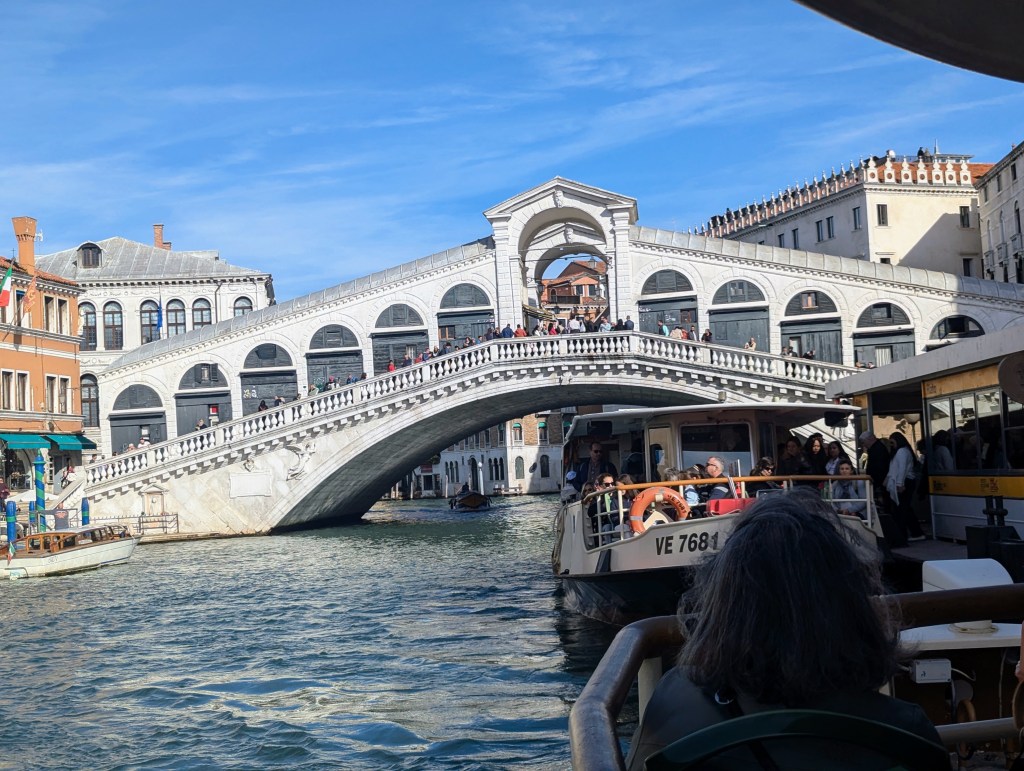
The Ponte degli Scalzi, named for the nearby church of Santa Maria di Nazareth, better known as the church of Scalzi (barefoot). It is near the railway station. A wooden bridge had been built at this site in 1858, but was too low to allow for large boats to pass beneath. The current bridge, constructed of Istrian stone (limestone from what is now Croatia), was built in the mid 1930s along with the construction of the railway station.
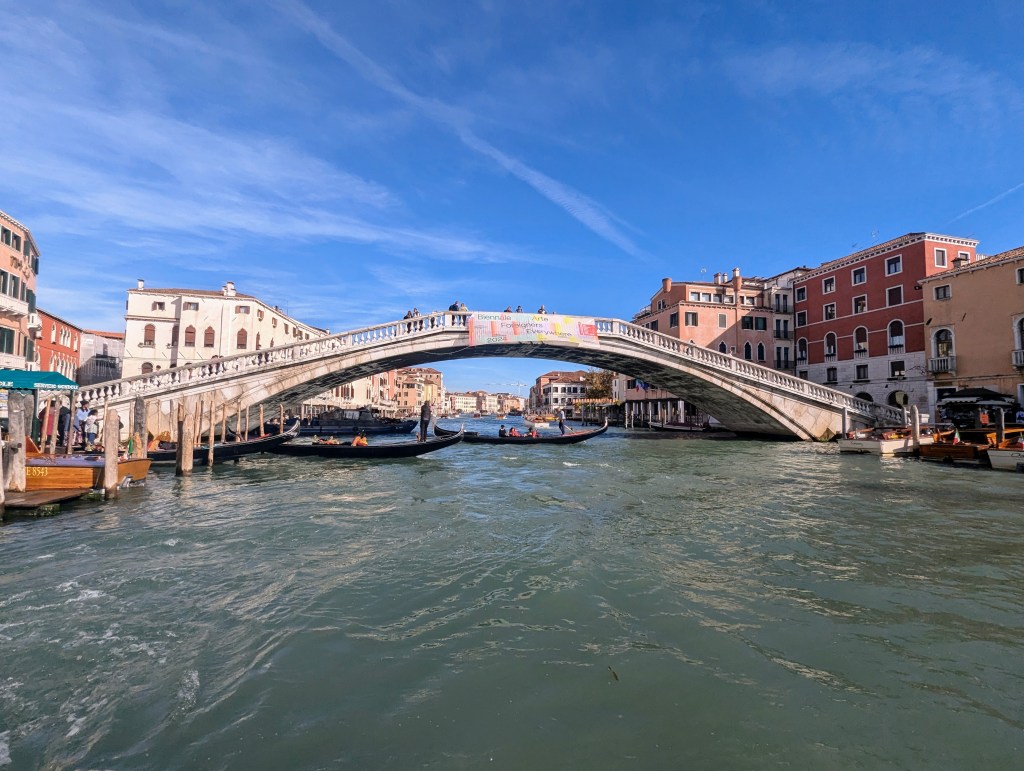
The Freedom Bridge connects Venice to the mainland, which we had crossed the prior day. The most recent fourth bridge to cross the Grand Canal is the The Ponte della Costituzione (Constitution Bridge) connects the train station with the piazzalle roma. I nstalled in 2008, the official name was adopted to celebrate the 60th anniversary of the Italian Constitution in that year.

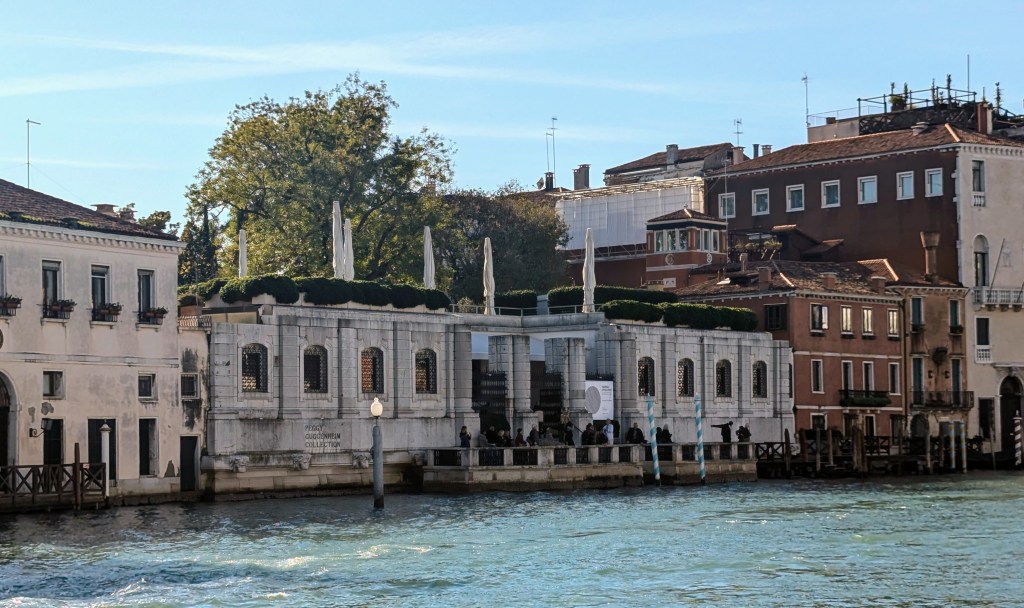
Elena next pointed out the Guggenheim House located on the Palazzo Venier dei Leoni, so named because the original owner of the house kept lions, was commissioned by the Venier family in 1749. Peggy Guggenheim was the third owner of the house. The house itself is white, plain, unfinished. It is rumored that the house is this way because the original owners ran out of money while building, but others say it was because of complaints from the neighbors who did not want their view obstructed. Only the first of its originally planned five stories was built. The second owner filled the inside of the house with gold and art. Peggy Guggenheim, who had previously lived in Europe and had been collecting art in America and Europe, in July 1949 purchased the palazzo and the garden behind it, and made it her home for the following thirty years. In the same year she organized an exhibition of contemporary sculpture in the garden. After some interior remodeling and with the collection finally installed, in 1951 Guggenheim began to open her home and collection to the public, free of charge, three afternoons a week from Easter to November, and continued to do so until her death in 1979. Peggy is now buried in the garden. Like all structures on the Grand Canal, the main entrance to the house is on the canal.
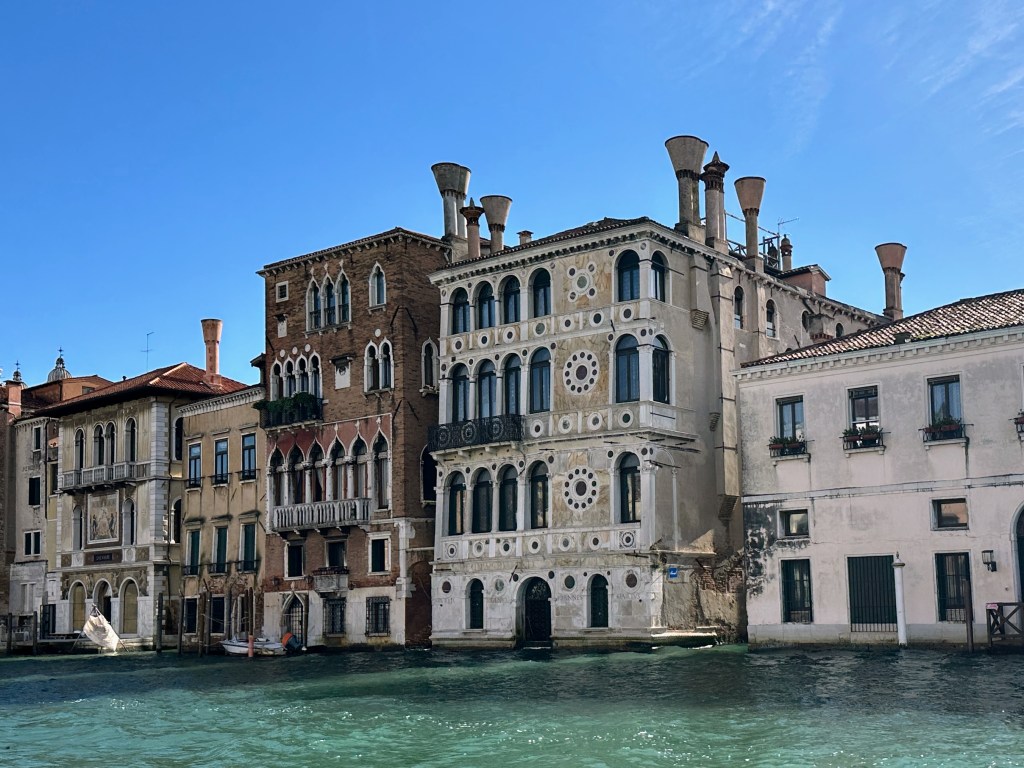
Next Elena took us to see Palazzo Dario, first built in 1451. The house (or ca for short) is believed to be cursed; the original owners died right away after building before ever having a chance to live in it. One rumor is that it is cursed because it was built on an ancient temple or cemetery. But we know today that cannot be true; it is built on land that was filled in, as were many canals, using petrified wood as a base to make fewer islands. The Dario Ca sits on this type of filled in land. The Palazzo Dario sat empty for centuries after the next 3 owners died relatively quickly after purchasing the ca. In the 1600s it was renovated, but the curse continued as that owner lost his fortune then committed suicide. The area is full of wealthy homeowners due to the great views of the Grand Canal, but the Palazzo Dario still sits empty for sale.
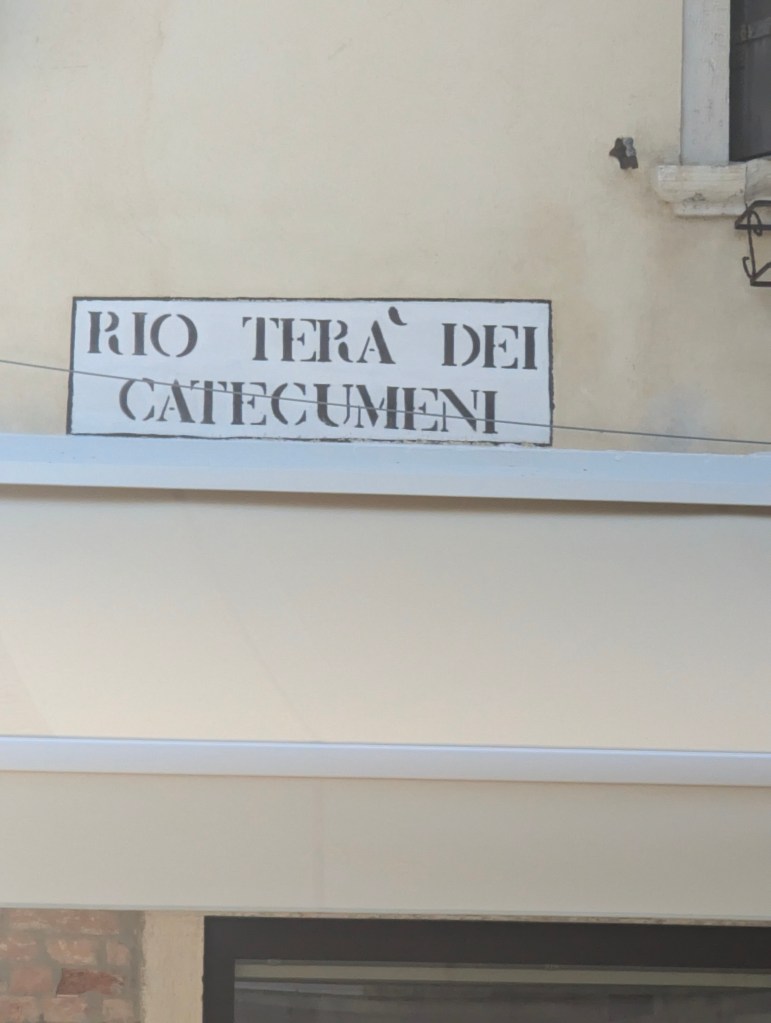
The alleyway next to the Daria Ca still has “Rio” (River) in its name in remembrance of the canal that had previously been here, now Tera (Earth). Rio tera literally means filled in canal.
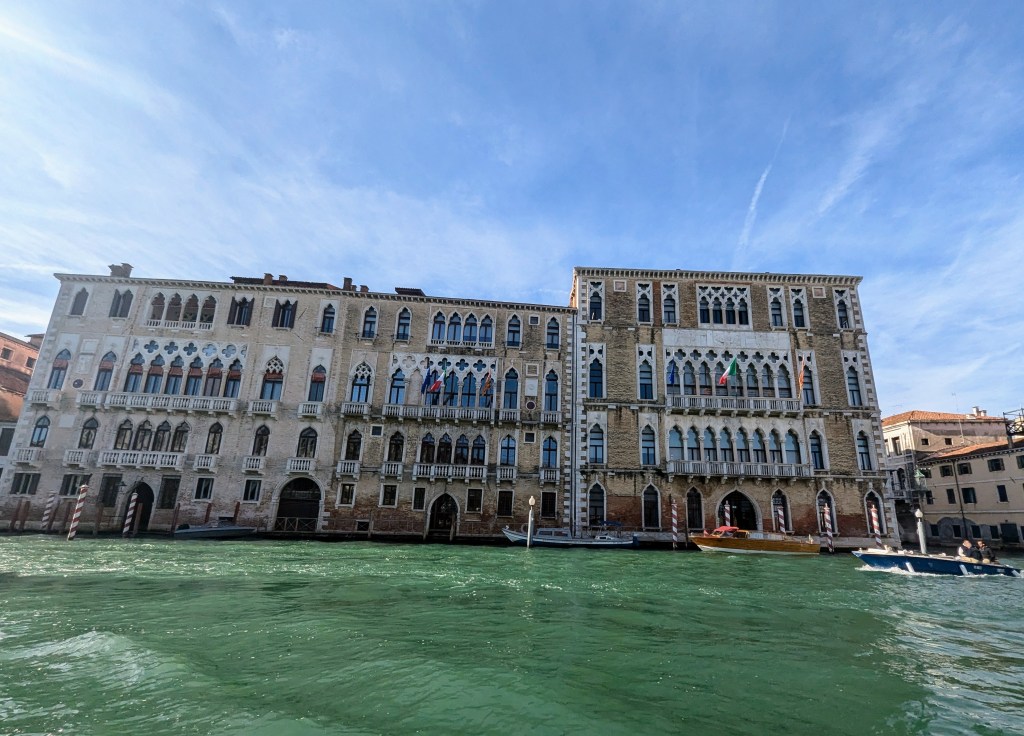
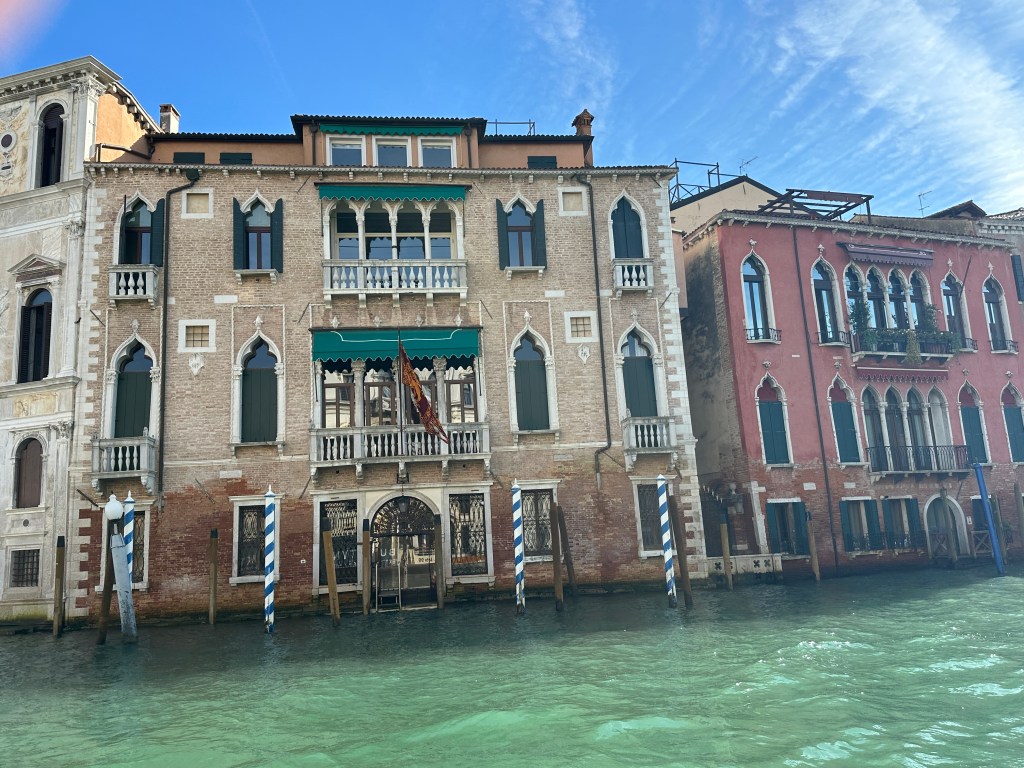
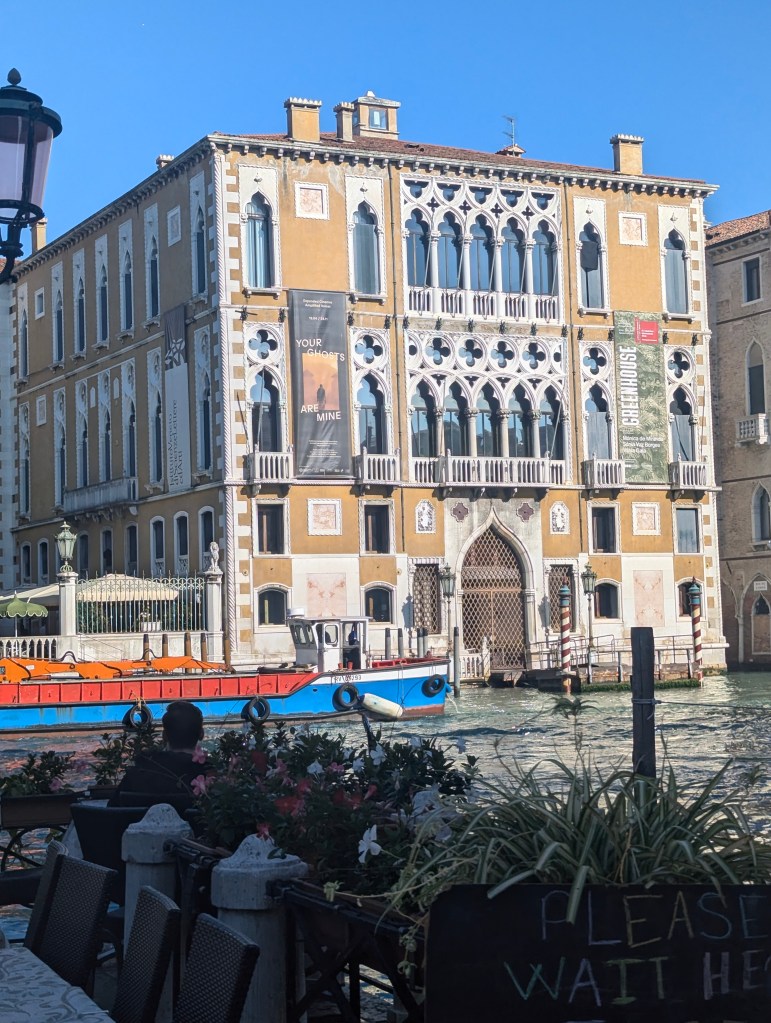
Elena then gave us a brief overview of the history of Venice. It was founded in 421 by the Celtics. In 453 Attila the Hun invaded, but locals hid in the lagoons and mostly survived the invasion. Originally the land was controlled by the Byzantine Empire, the center of which was in the far east allowing mostly for independence of the Venetians but with trading rights along the Adriatic Sea. In 726, the first Doge, a chief magistrate for the republic of Venice, was seated in Venice establishing a republic that would last over 1000 years. The city was well placed in the middle ages for trade between East and West, and it flourished financially during that time. This tie to the Byzantine Empire explains the Byzantine influence seen in the architecture of many of the palaces along the canals.
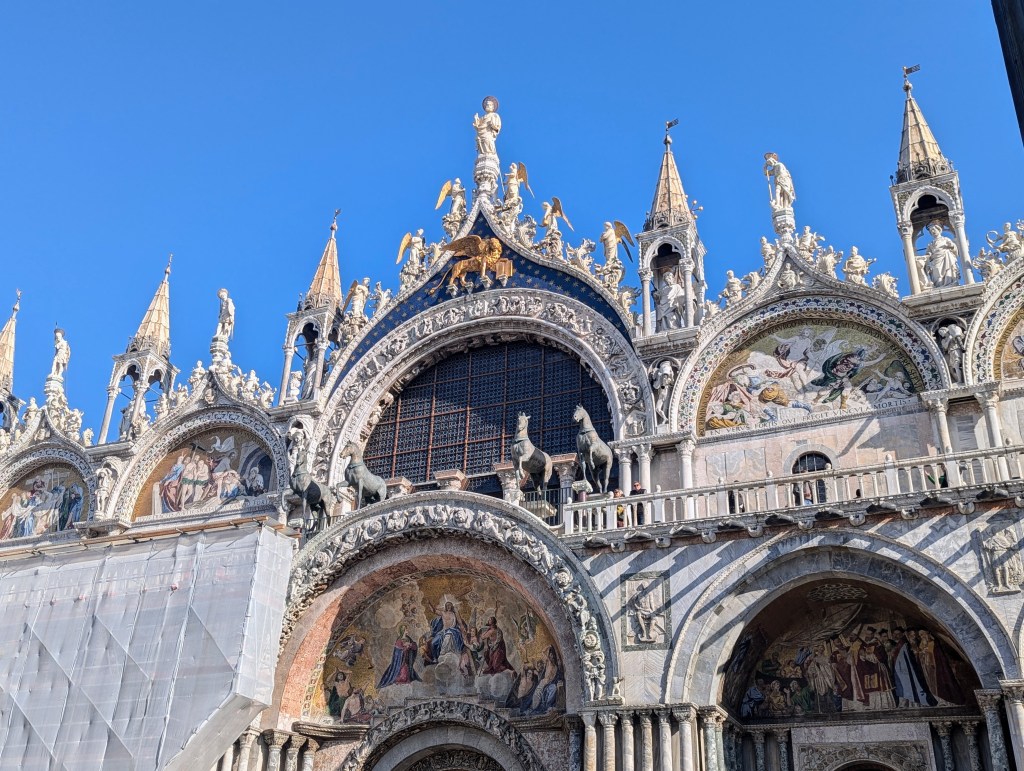
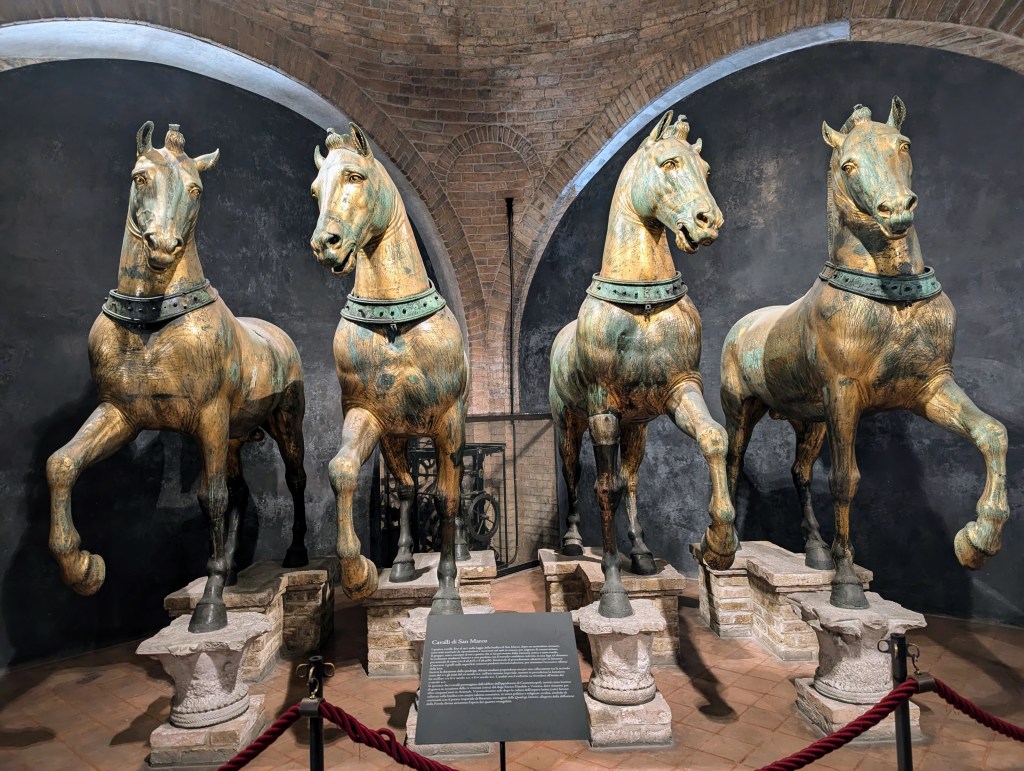
Venice became an imperial power following the Fourth Crusade which culminated in 1204 by the capturing and sacking of Constantinople and establishing the Latin Empire. As a result of this conquest, considerable Byzantine plunder was brought back to Venice. This plunder included the gilt bronze horses from the Hippodrome of Constantinople that were placed above the entrance to St. Mark’s Basilica. The originals are currently in the basilica museum and have been replaced with replicas.
In the 1300s Venice’s influence moved inland conquering local areas including Verona, Lake Garda, and more. By the late 13th century, Venice was the most prosperous city in all of Europe. The Venetian governmental structure was similar in some ways to the republican system of ancient Rome, with an elected chief executive (the doge), a senator-like assembly of nobles, and the general citizenry with limited political power, who originally had the power to grant or withhold their approval of each newly elected doge. The decline of Venice was long and slow, starting with the plague, aka The Black Death, in the early 14th century, again in 1575 killing over 50,000 people in the following 3 years, and again in 1630 again killing a third of the 150,000 inhabitants. In the late 15th century the Ottomans took over Turkey and Greece; Constatinople was lost. And after 1492, the trade center shifted from East to West with new products like tobacco increasing in importance. But in the 17th and 18th centuries, Venice again became a cultural center for art. By the end of the 1700s there was little money left when Napoleon invaded in 1797, ending the over 1000 year republic. In 1815, after Napoleon’s defeat, Venice was traded to the Austrians. The Austrians under the Hapsburgs’ rule, modernized the city and built more bridges. It was not until 1866 that Veneto, like the rest of Italy, became part of the united Kingdom of Italy.
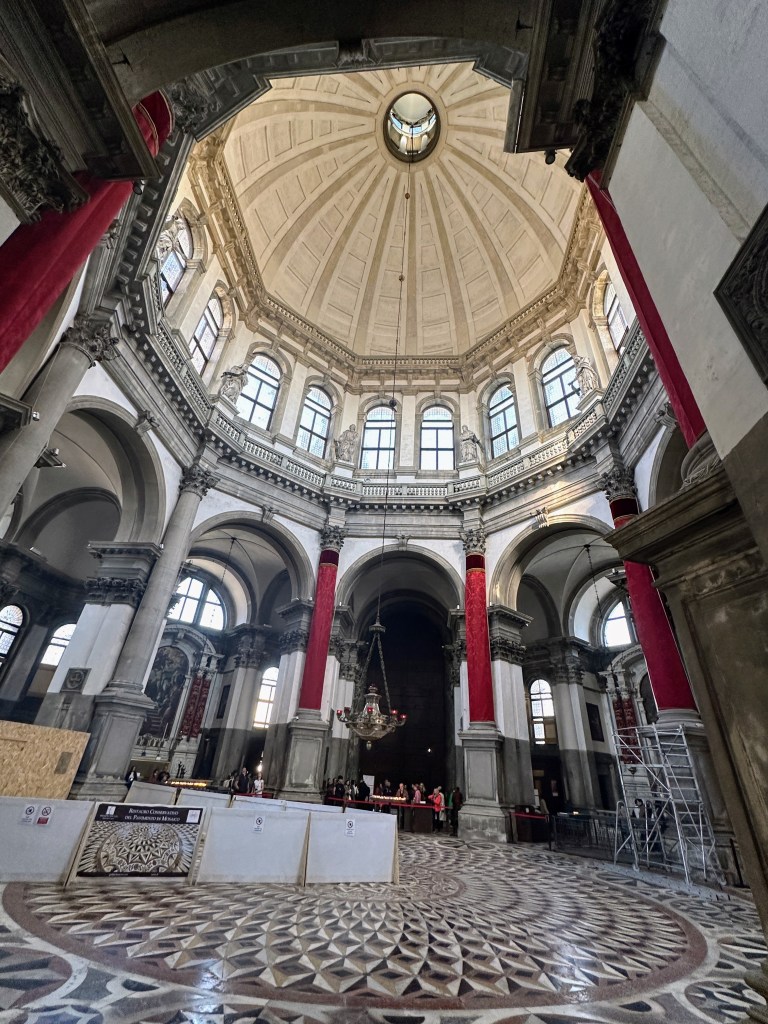
Next Elena showed us Saint Mary of the Health which was built in 1630 after not only 50,000 died of the plague in Venice, there were over 160,000 deaths in Italy. It is in the over-the top Baroque style with eight sides, 8 being, on its side, the symbol of infinity.
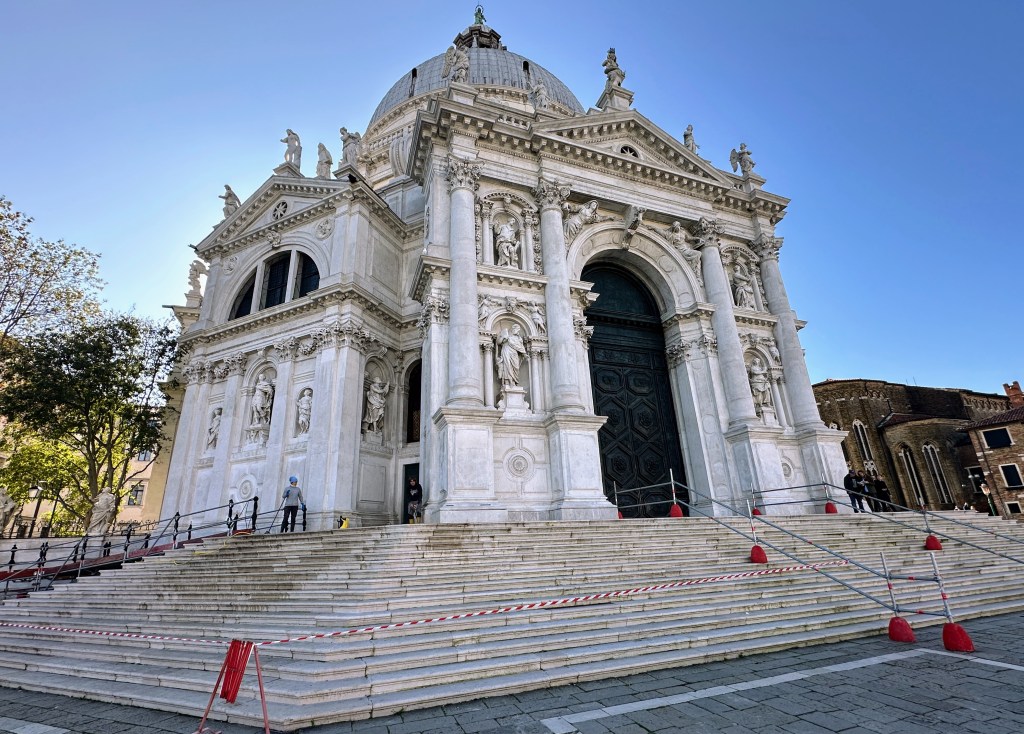
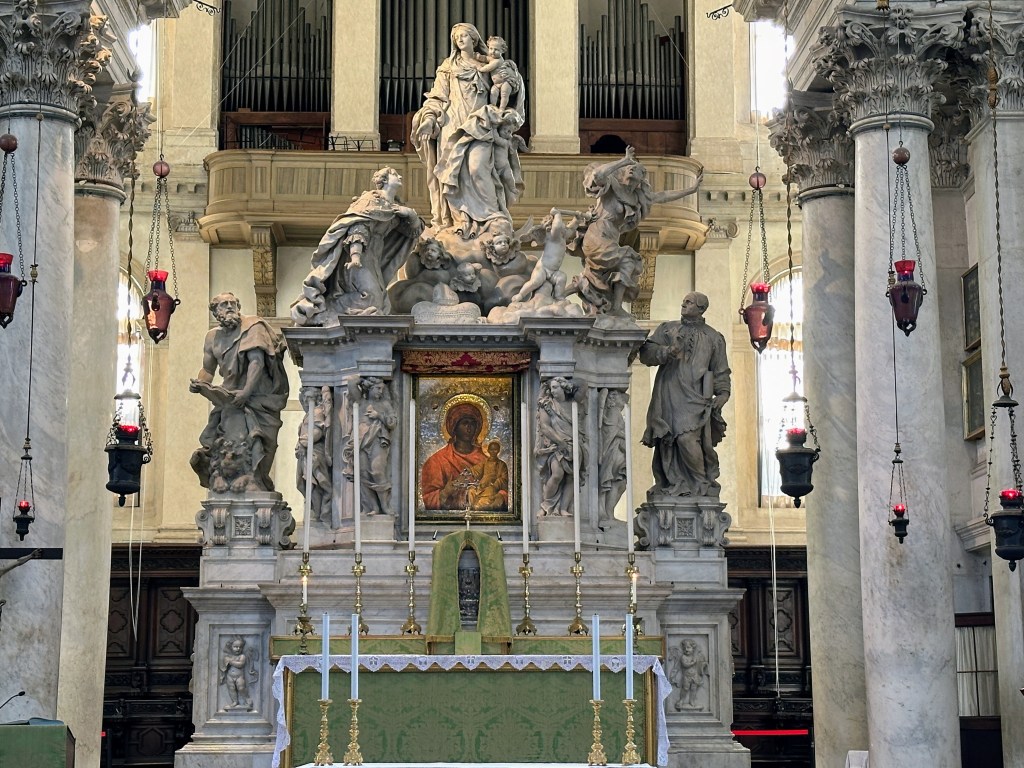
Mary is the patron saint and protector of the navy. Inside Mary is surrounded by 8 obelisks.

On the statue, beneath Mary and child, an old ugly woman, who represents the plague, is being chased away by a young woman wearing doges’ clothes, thus symbolizing Venice.
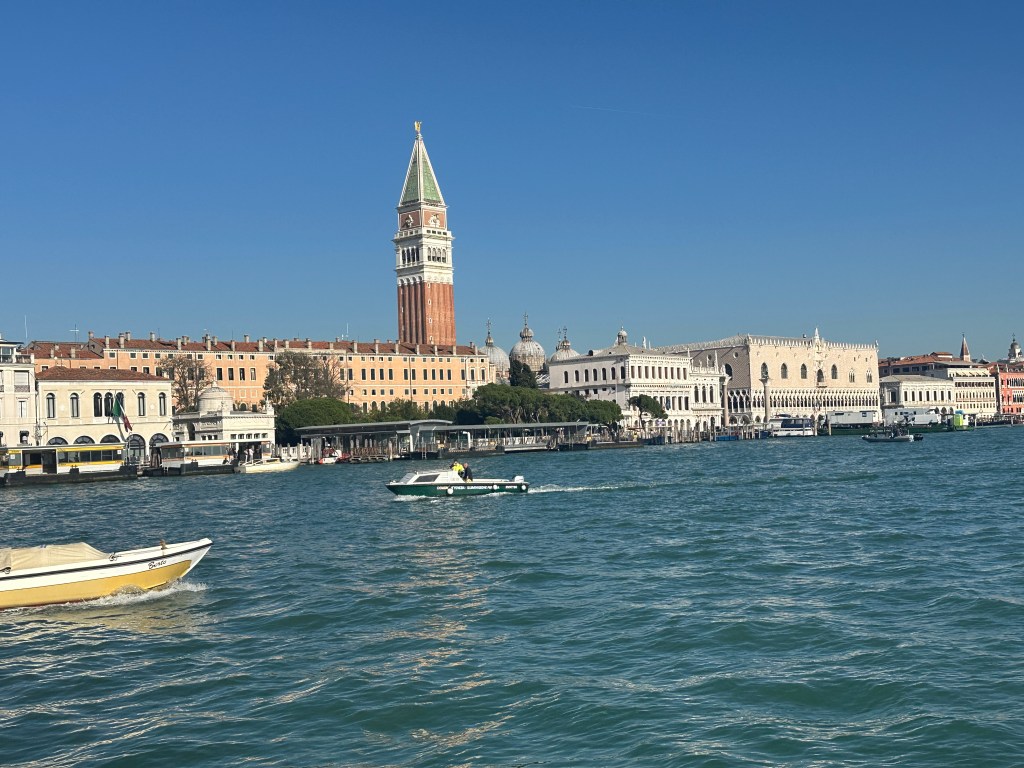
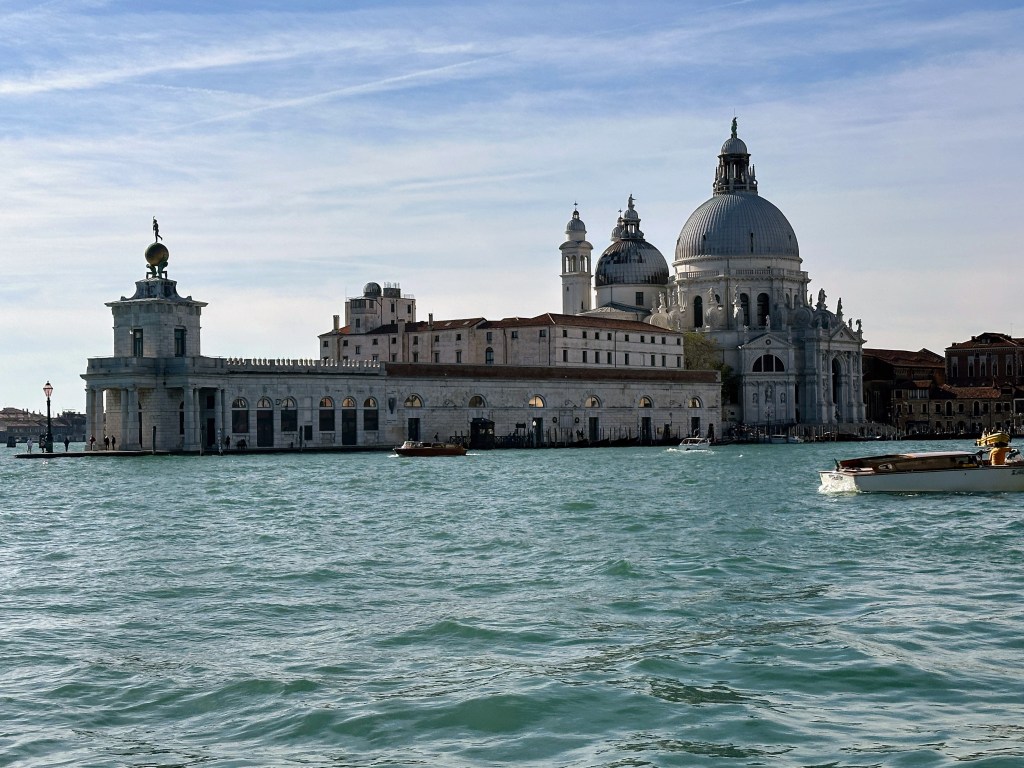
Finally, Elena walked us out to the peninsula directly across from San Marco Plazza for a view from across the water.
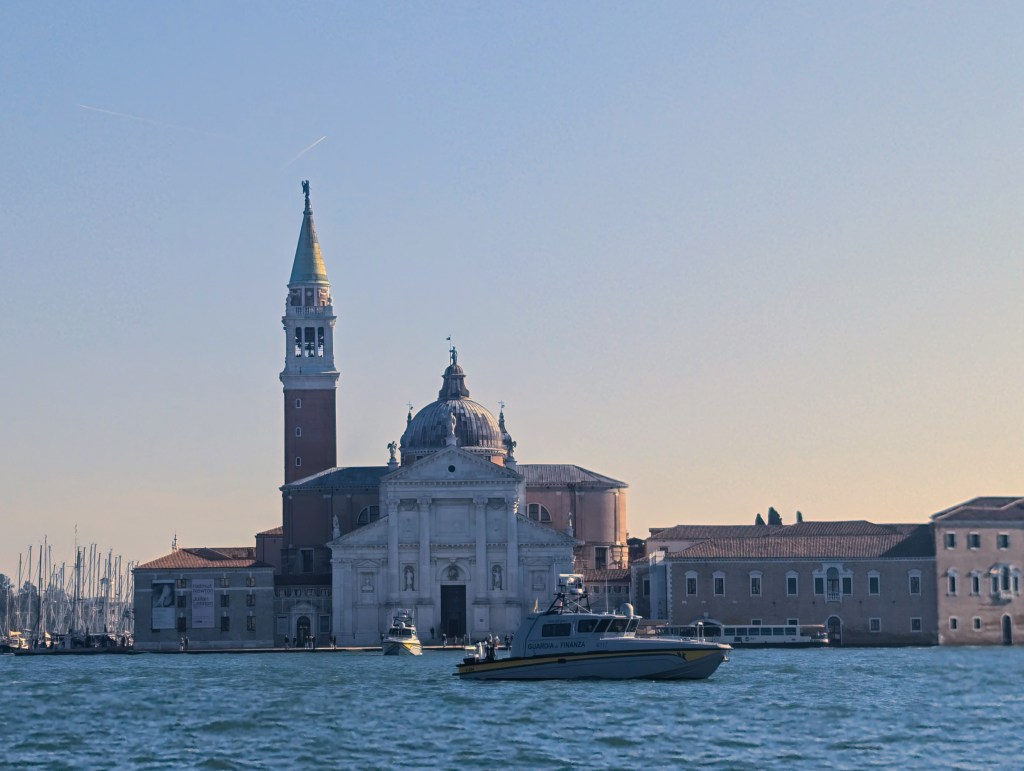
From there we could see, across the water in the other direction, Chiesa del Santissimo Redentore (The Church of the Holy Redeemer), which was also built to celebrate those who survived the plague. It is traditionally the centre of the great feast of the Redeemer, celebrated on the third Sunday of July in memory of the danger averted from the Black Death.
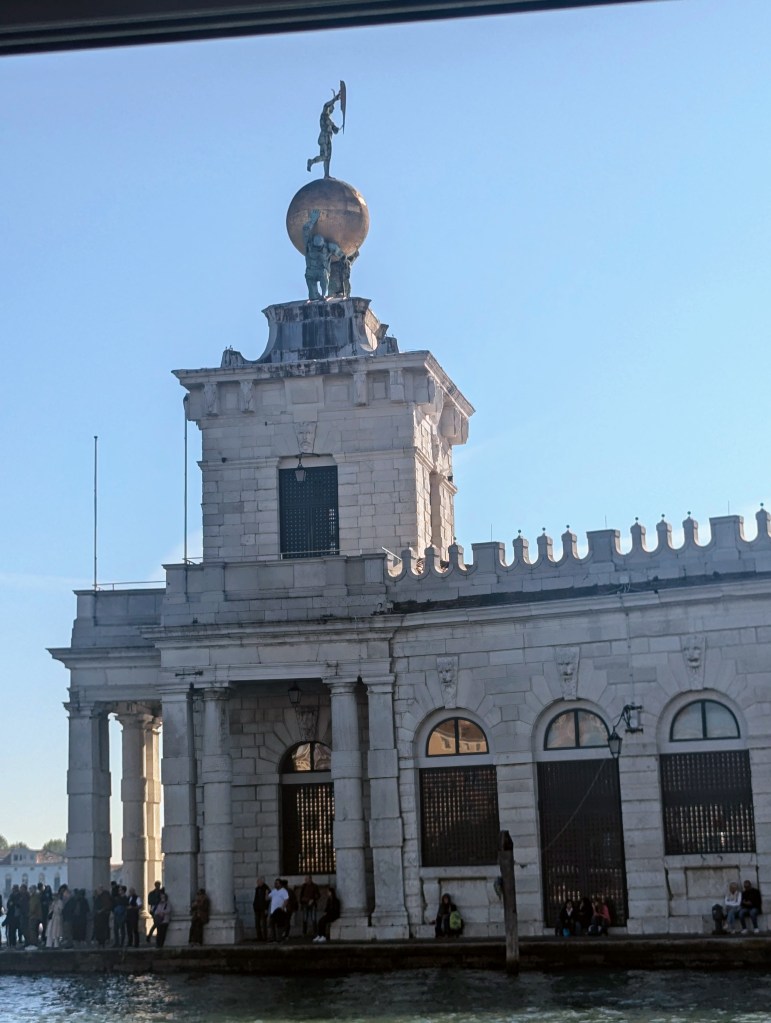
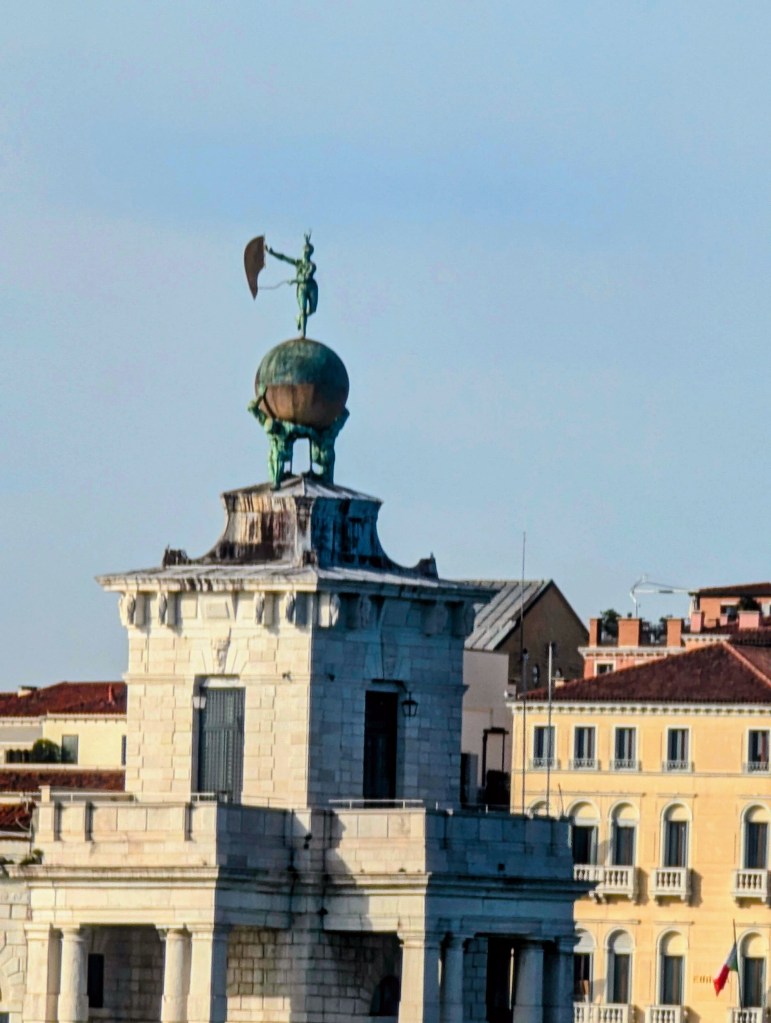
Elena also pointed out the weathervane above us. The statue represents two Atlases supporting a gilded globe upon which stands the allegory of Fortuna, that indicates the direction of the wind. One’s fortune can change with the wind.
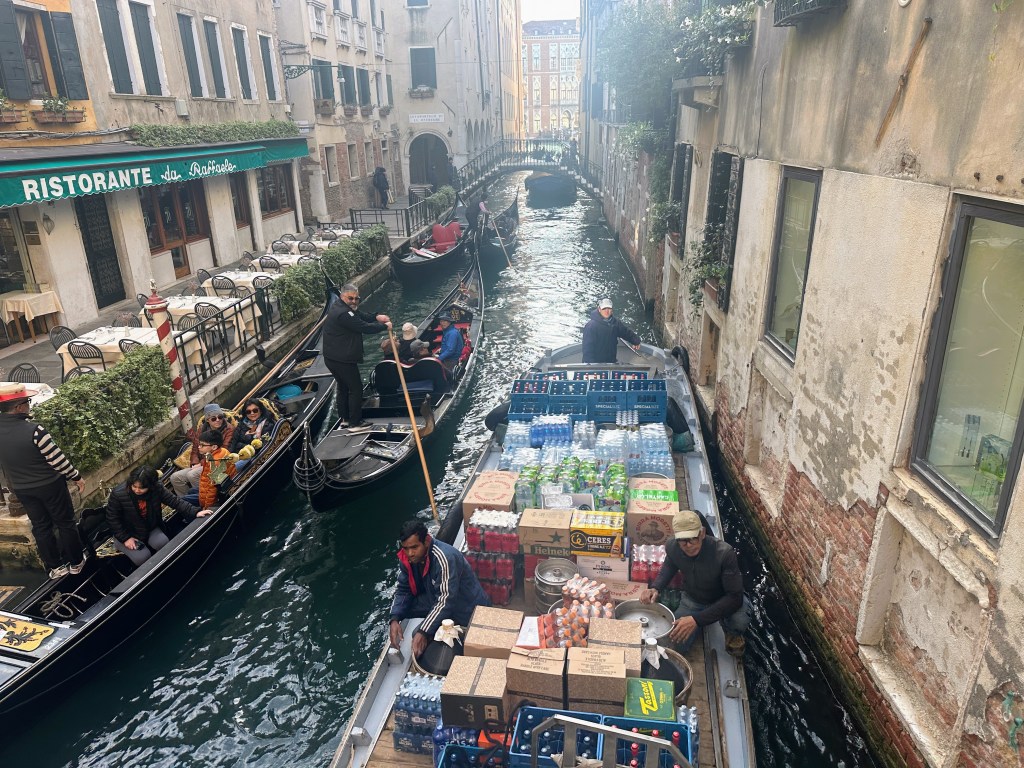
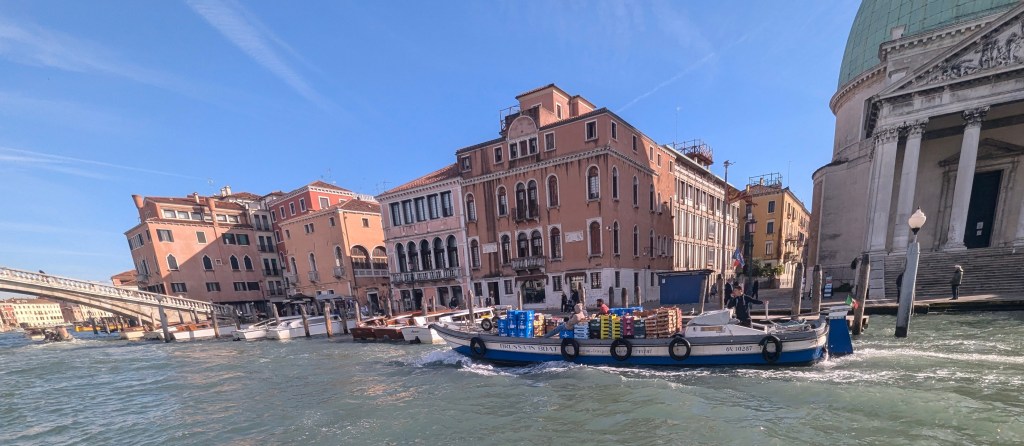
This completed our walking tour. Elena encouraged us to ride up and down the Grand Canal over the next few days to see all the sights, which advice we heeded. But first we were off to Murano. We took a water bus, which took about an hour to get there. Along the way, we were struck how every aspect of life in Venice is conducted on the water. We passed delivery vessels
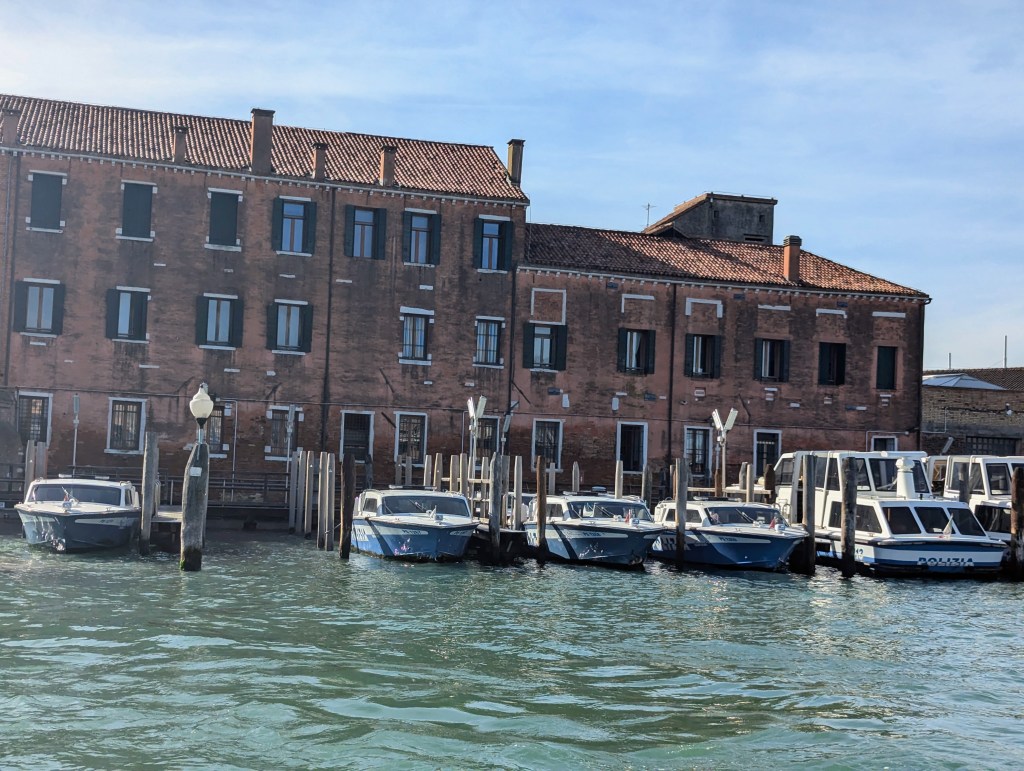
and police, which are the local authorities
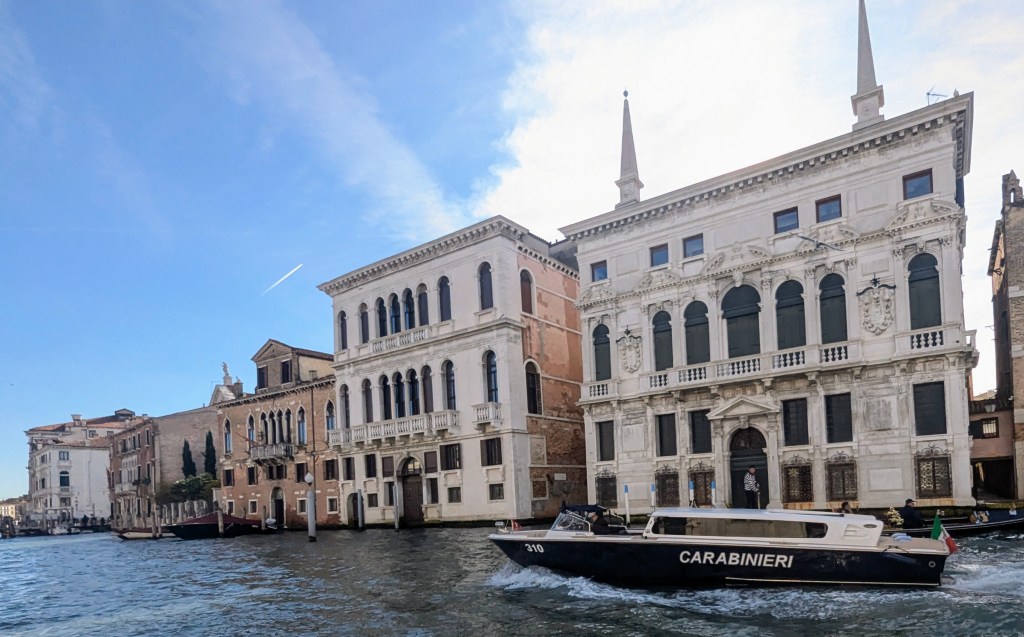
as well as carbinieri, somewhat equivalent to our National Guard
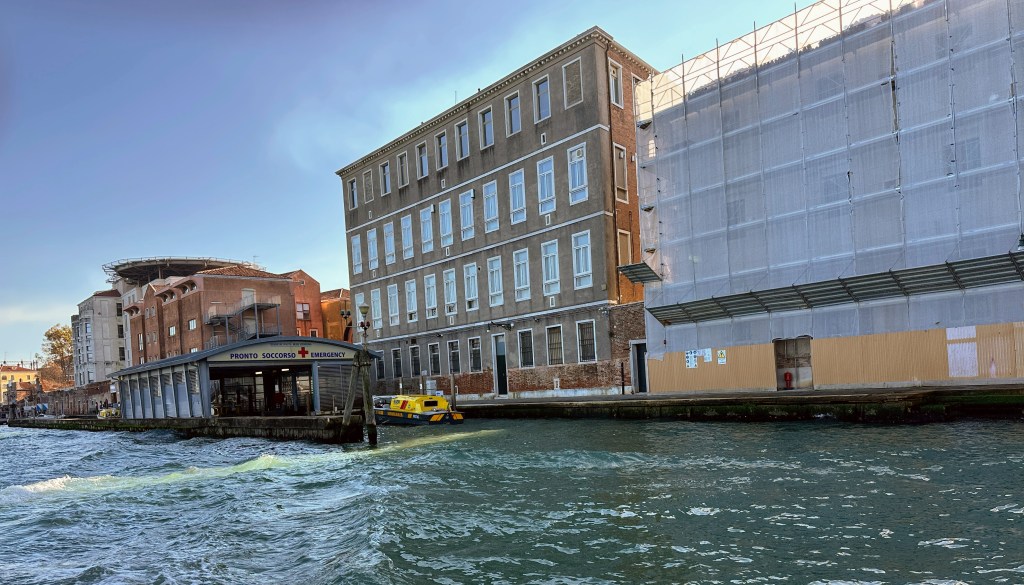
We passed an emergency room complete with water ambulances.
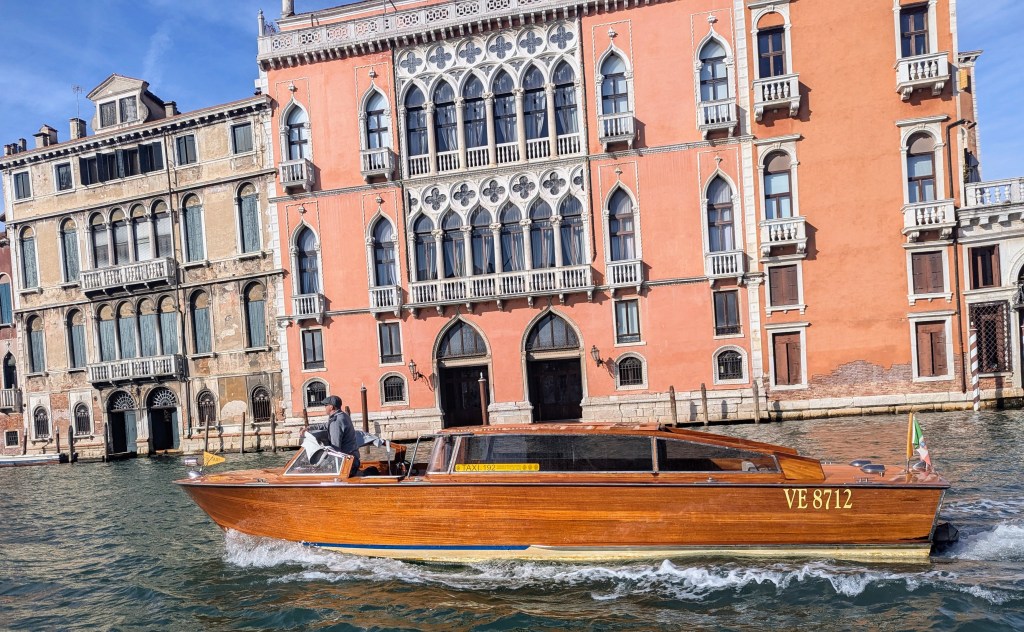
and, of course, taxis.
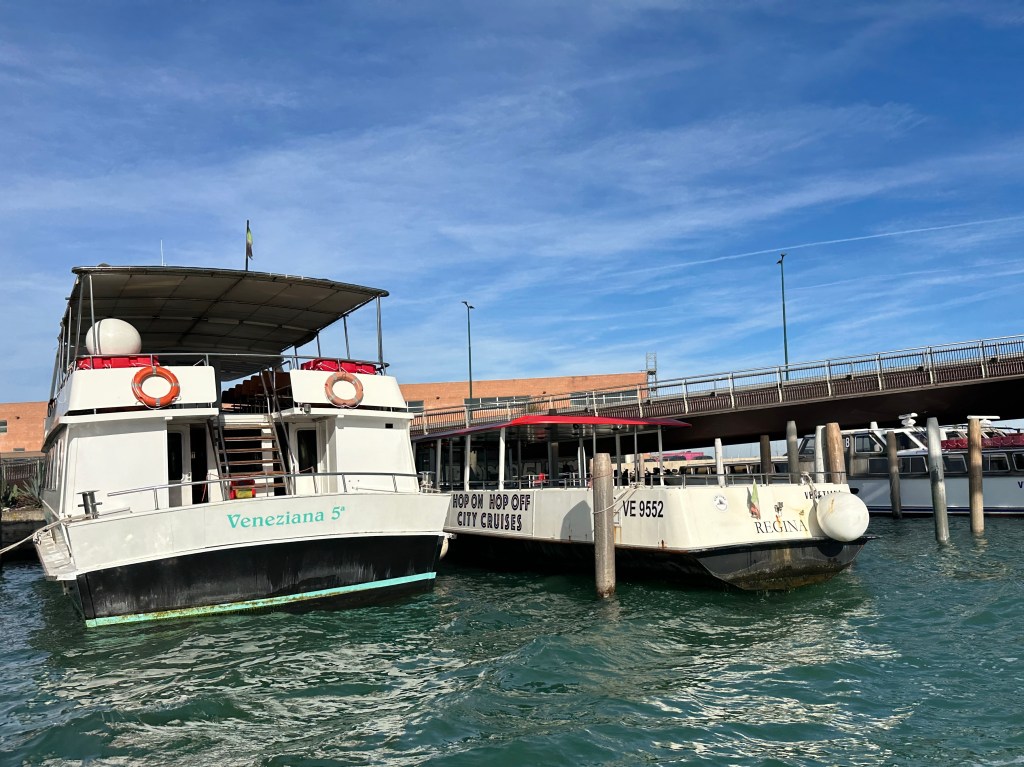
We even saw a hop on/hop off water bus.
We also saw this really interesting statue
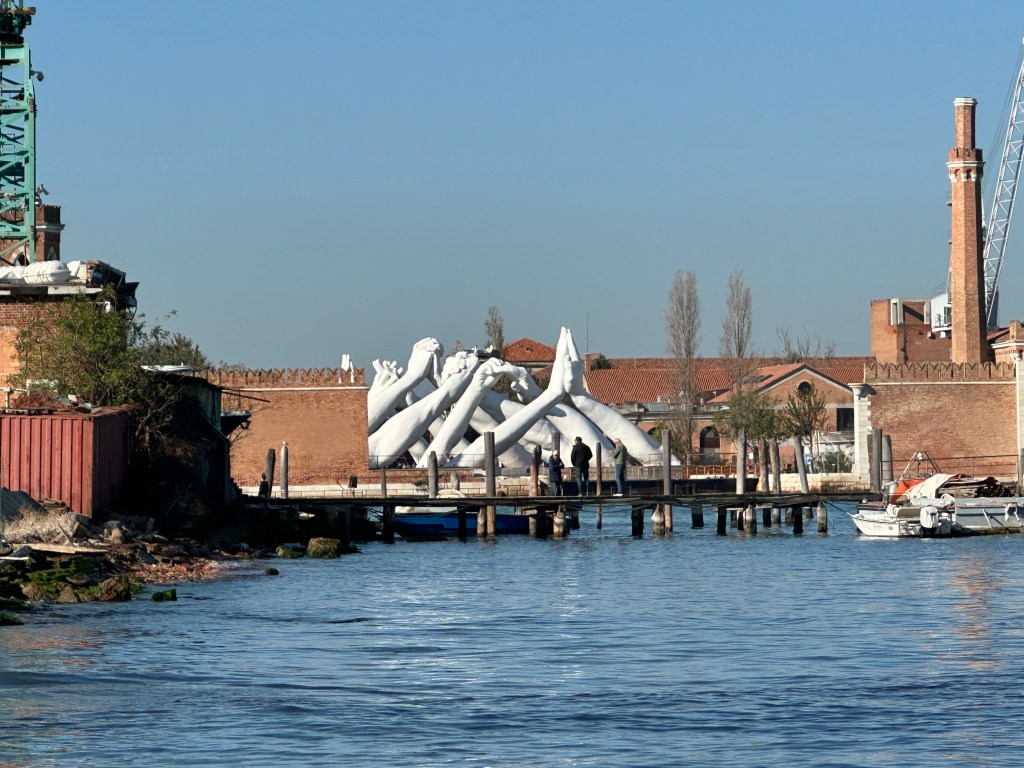
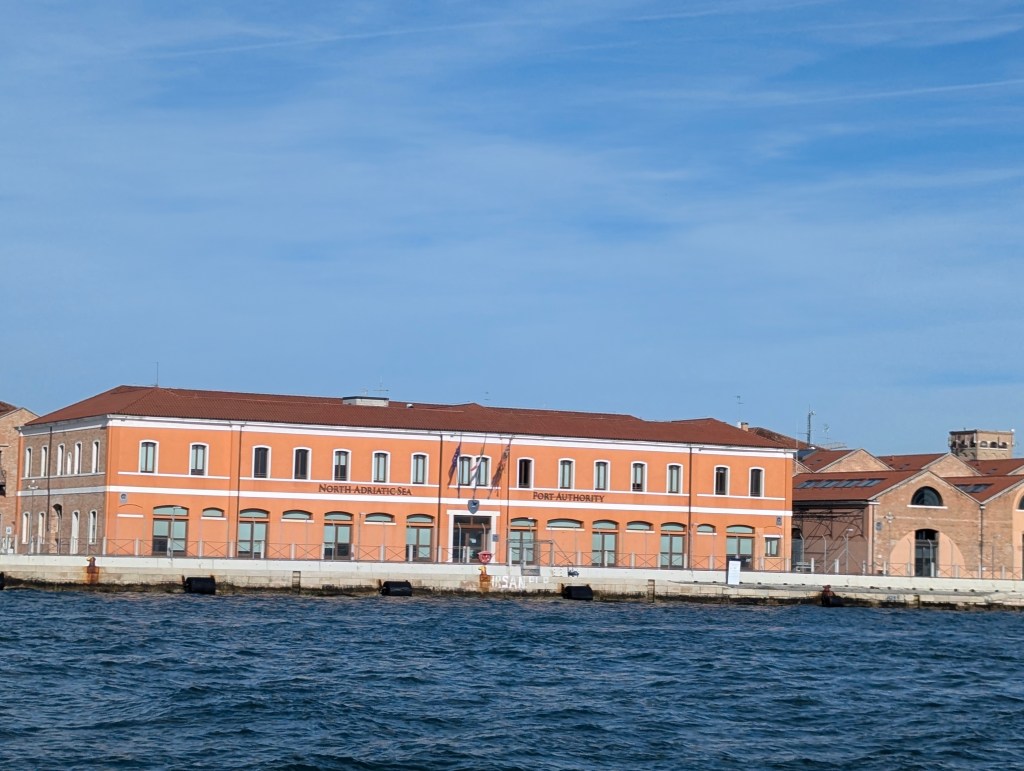
right near the Port Authority.
We arrived in Murano starving for a very late lunch before heading to the Glass Cathedral for our glass blowing demonstration.
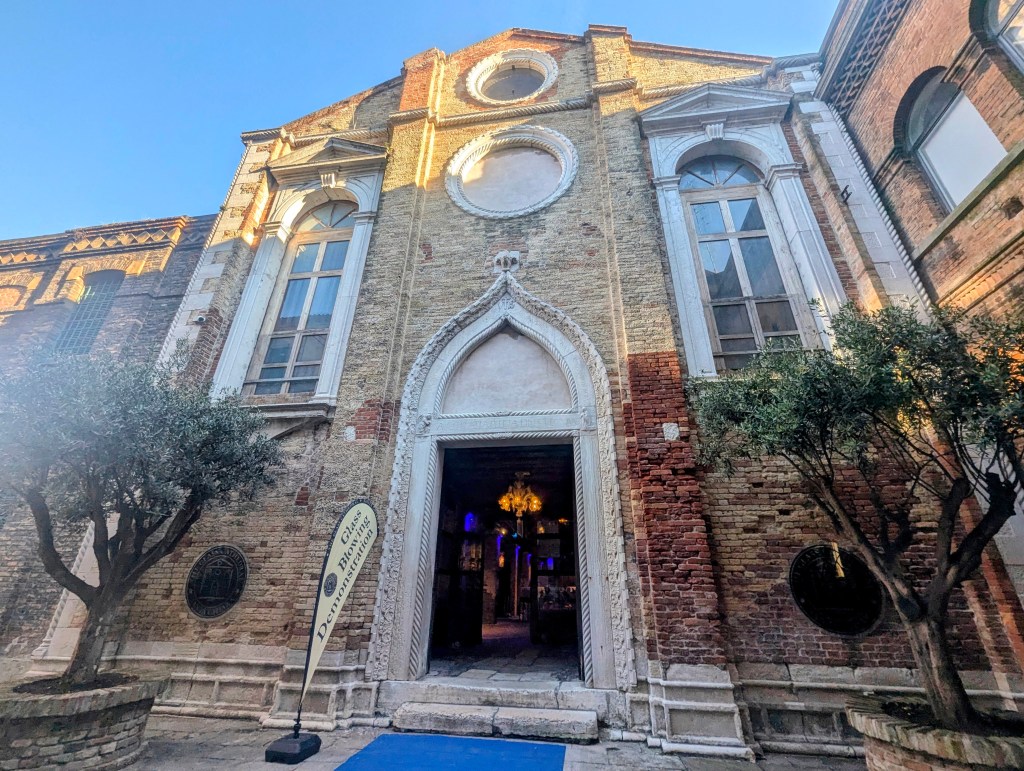
Inside we were treated to beautiful works of art
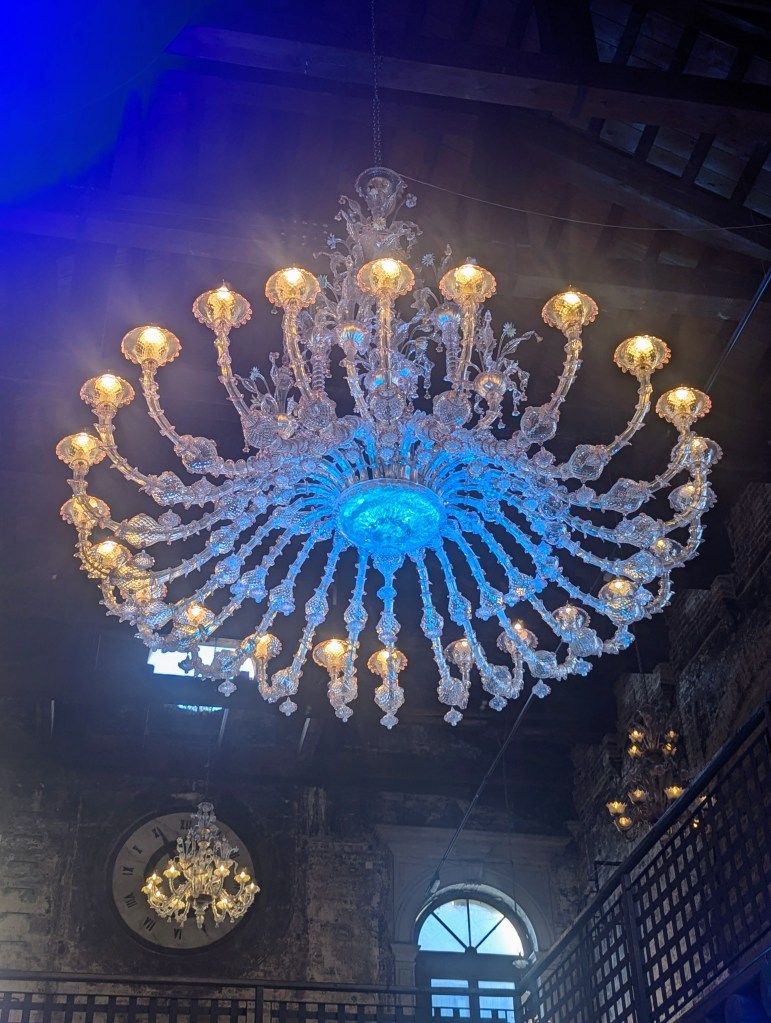
before our demonstration of both blowing
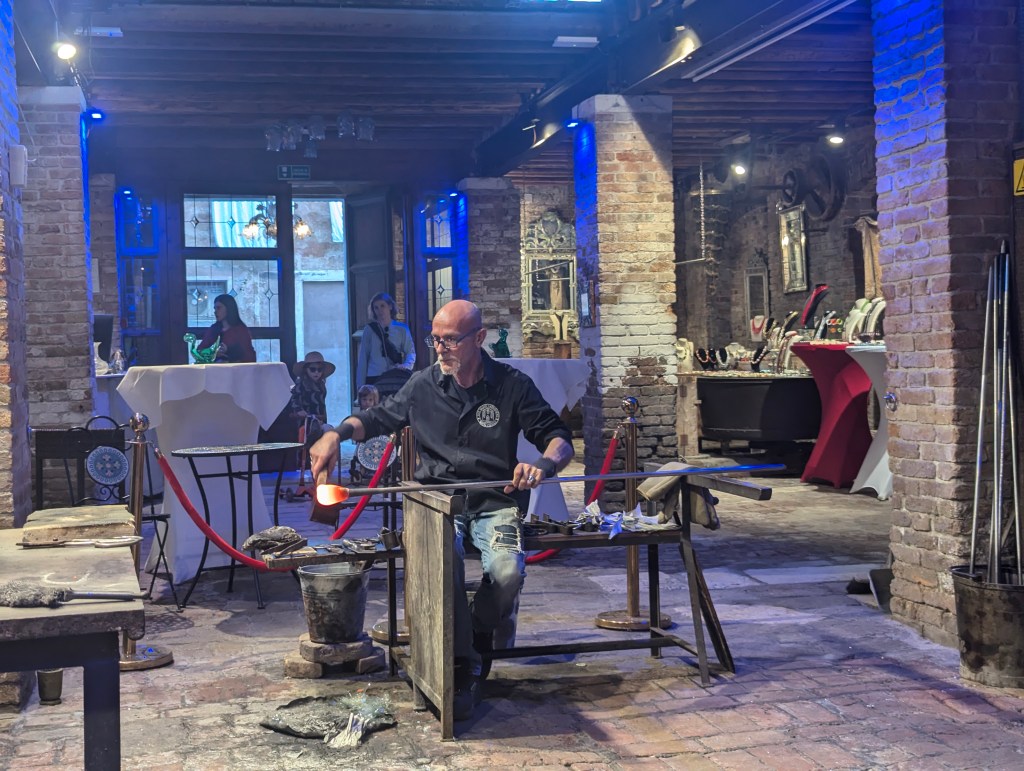

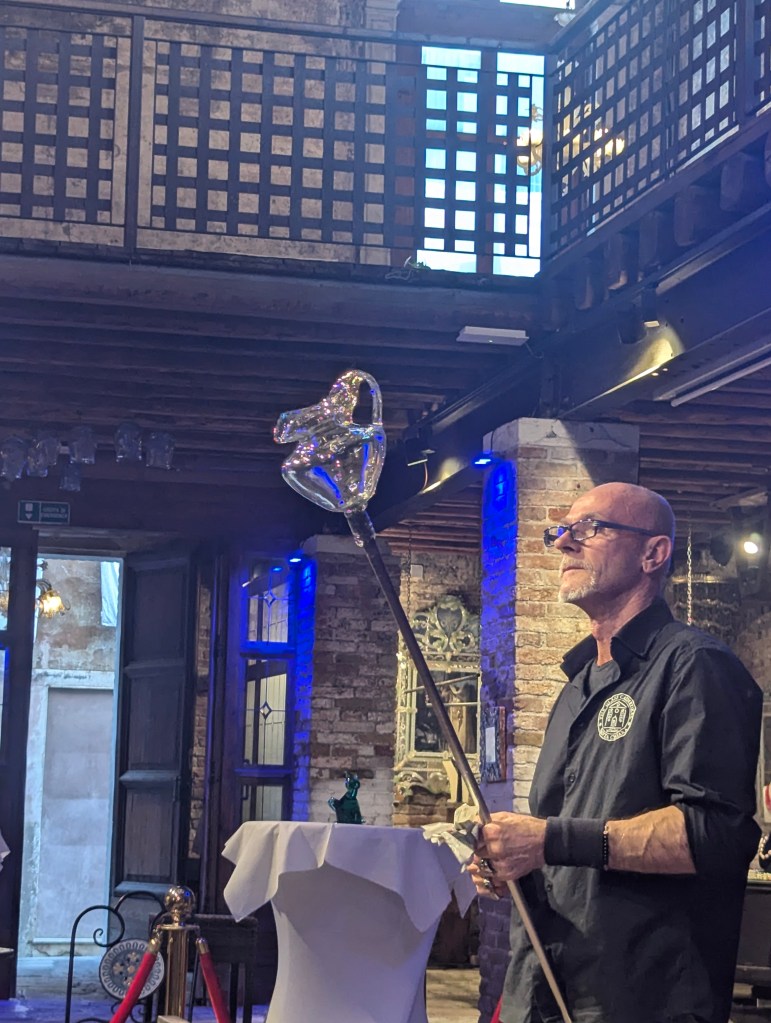
and sculpting. First a swan
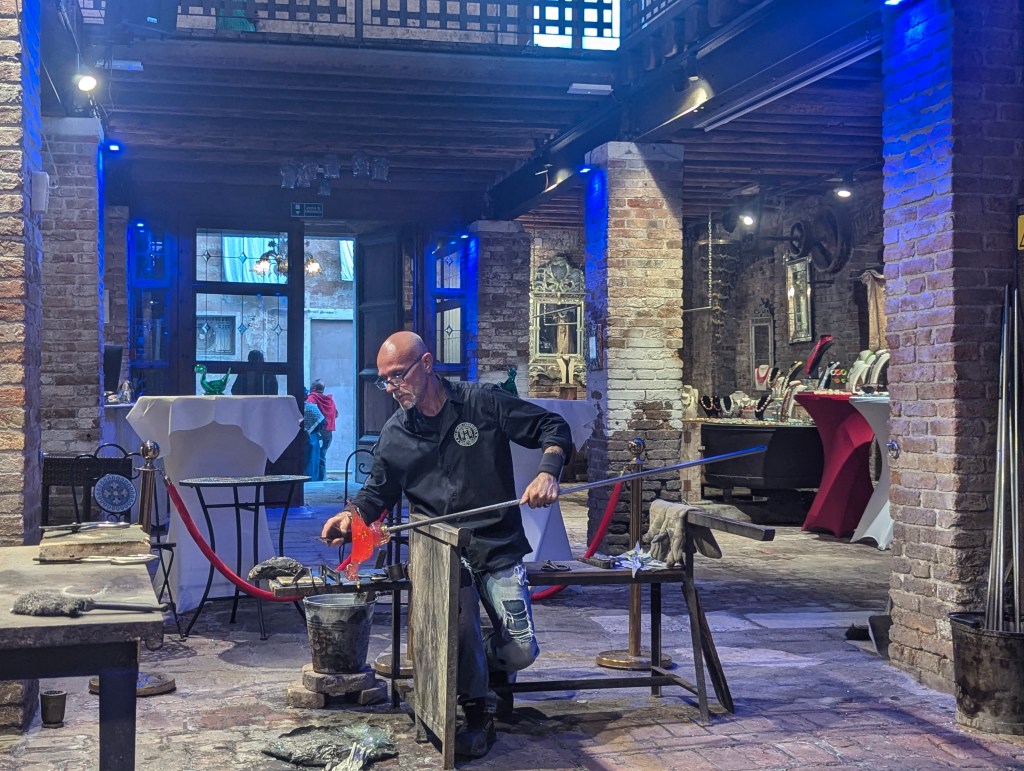

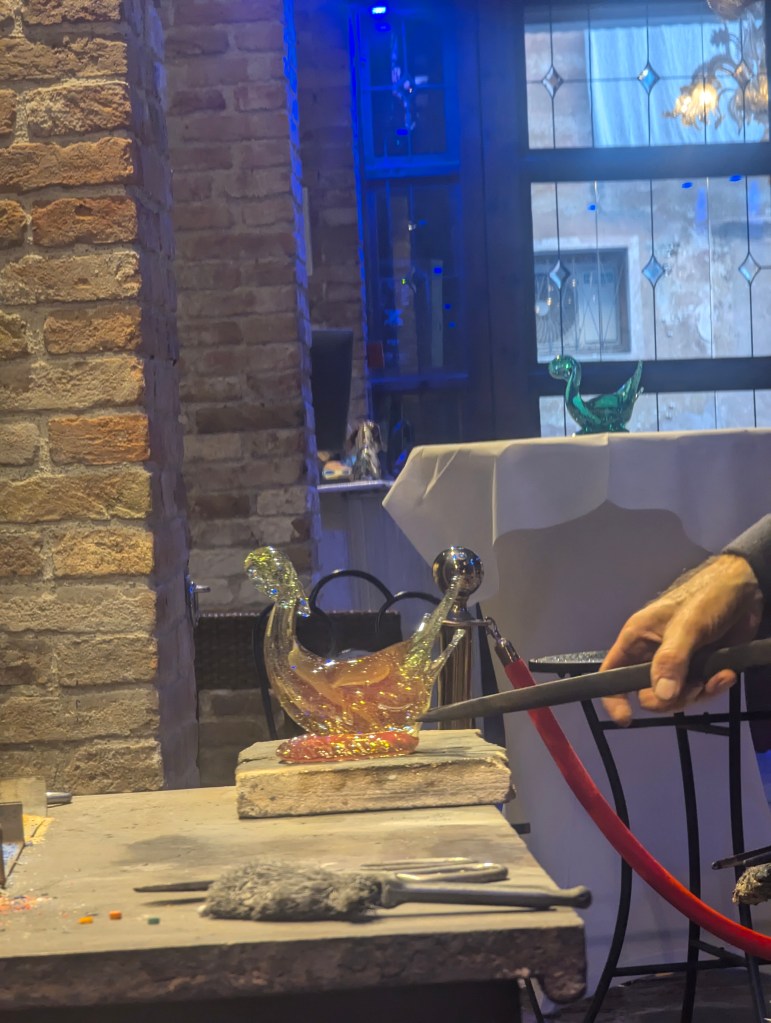
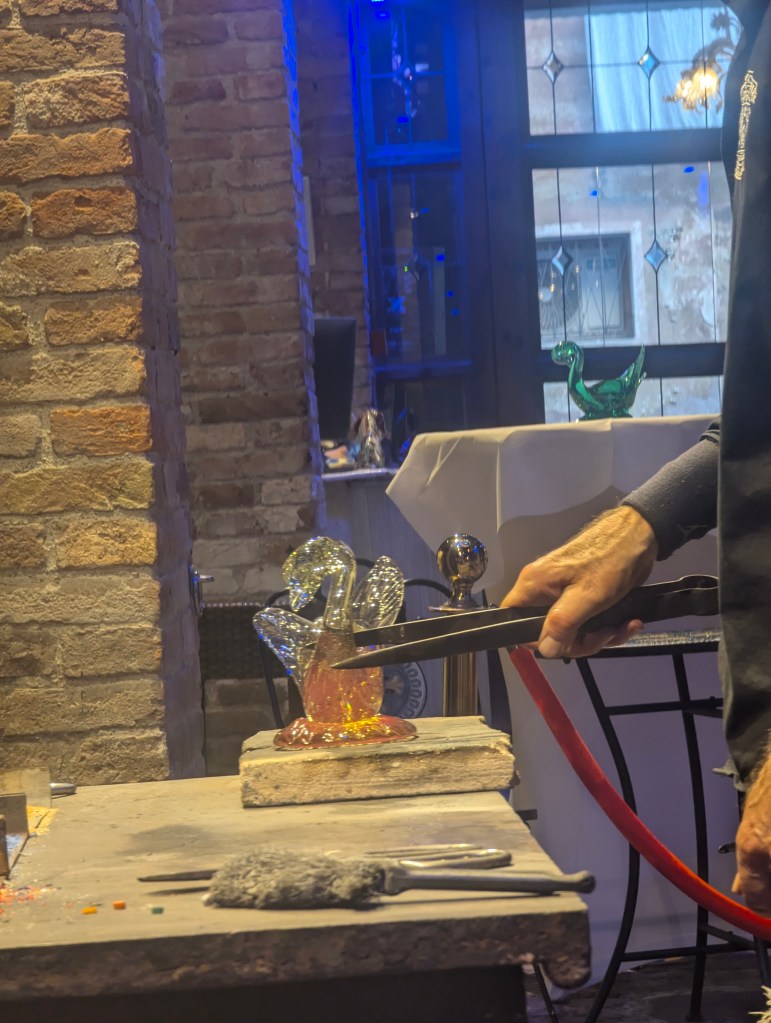
and then a fish.
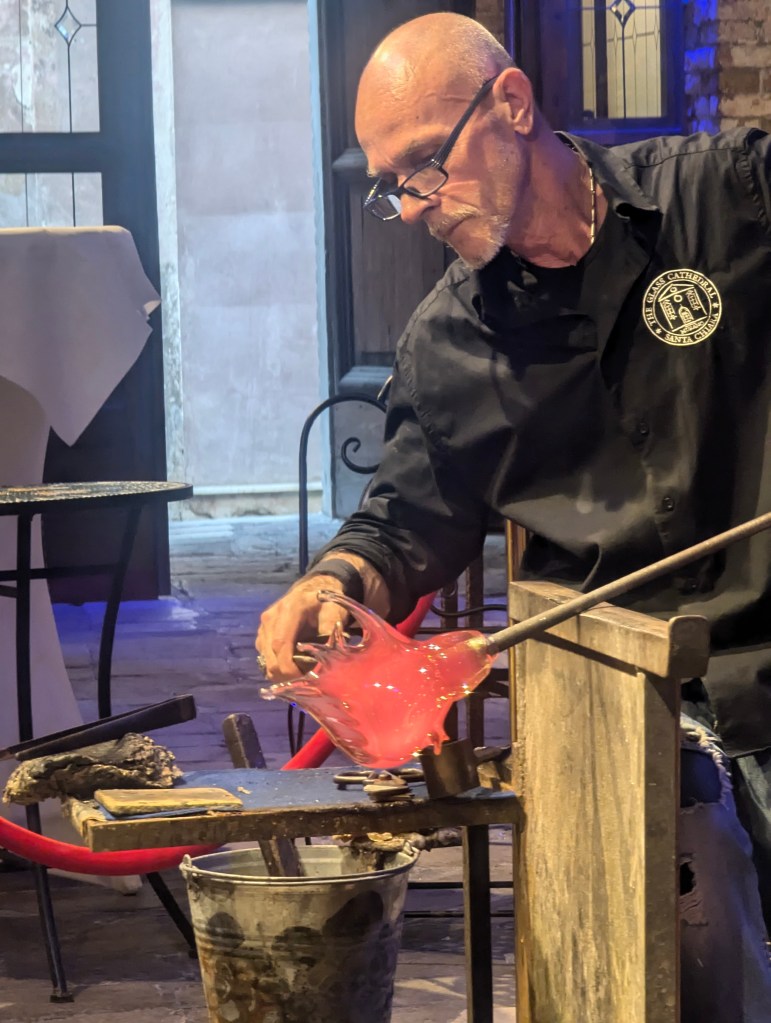
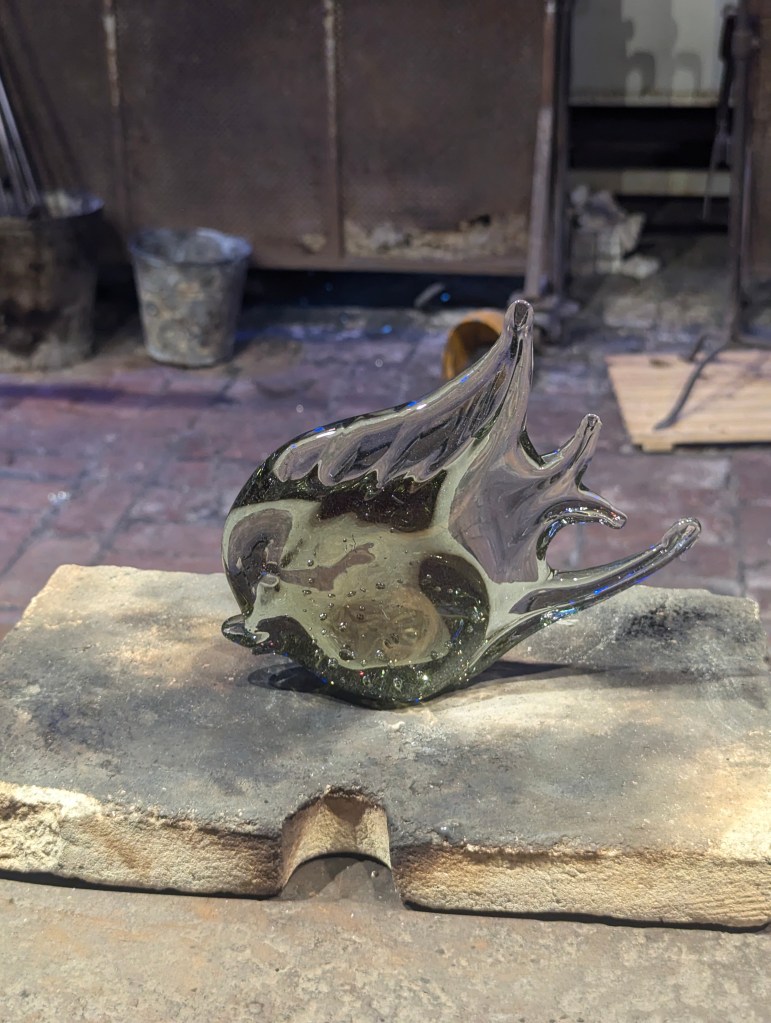
We strolled around Murano peeking into the windows to see all the gorgeous works of art.
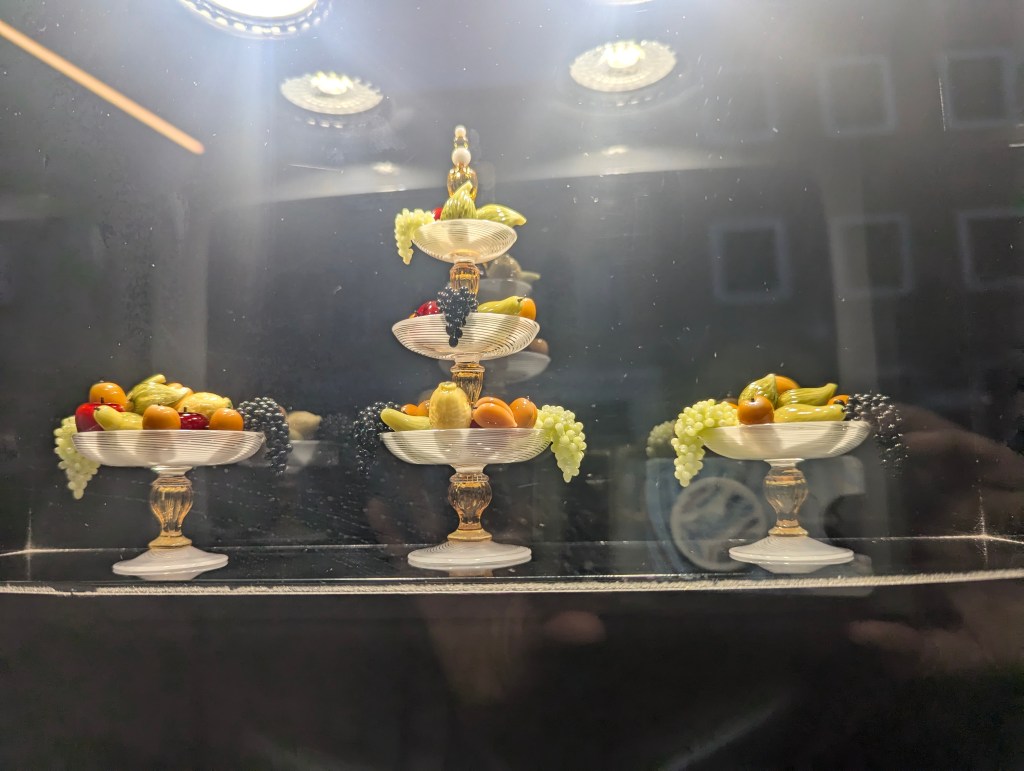
But it was late in the day, and many were closing up. But we happened into a tiny place in a back alley where the artist explained to us how the rods were “manufactured” locally by laying colors of glass together, then heating and stretching them into very thin rods,
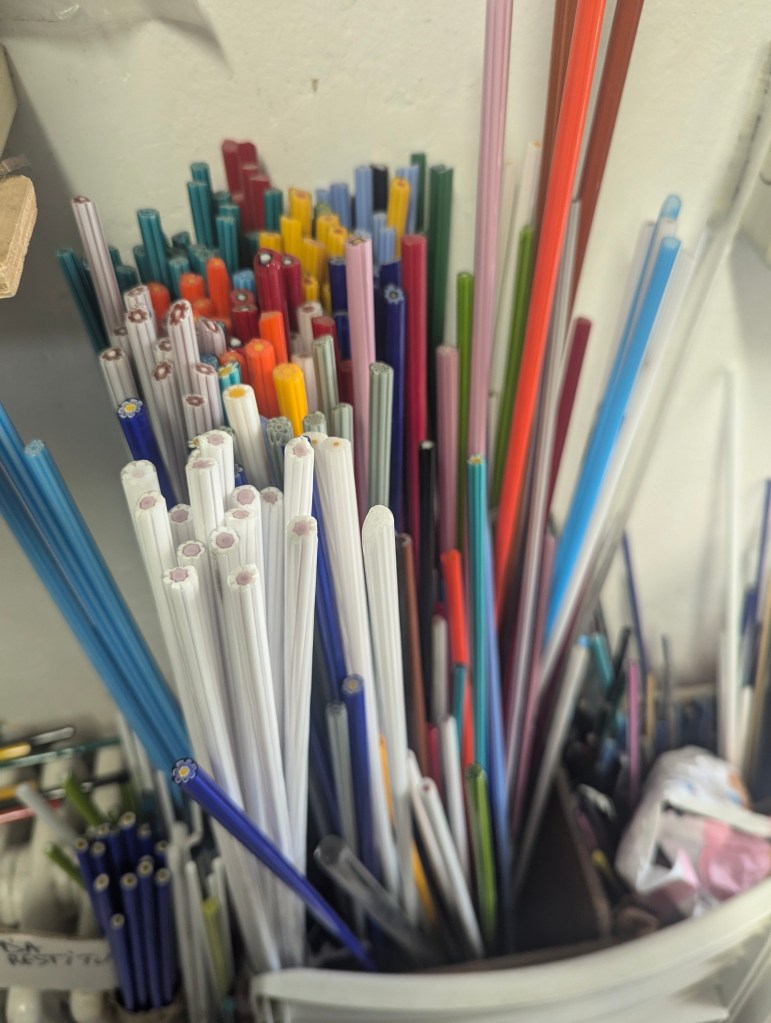
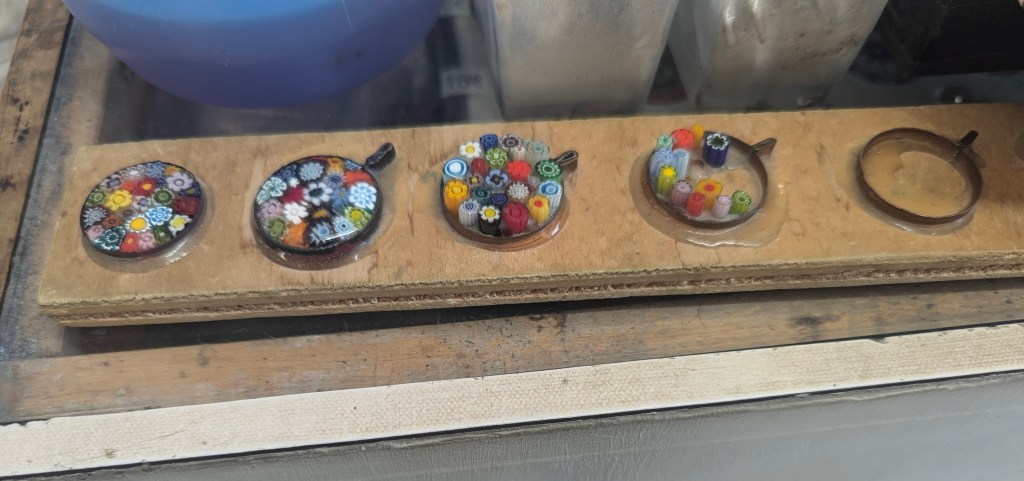
and the rods are then cut and laid side by side, melted, and covered in a clear layer to create jewelry and other items like coasters.
It was time to get back on the water bus.
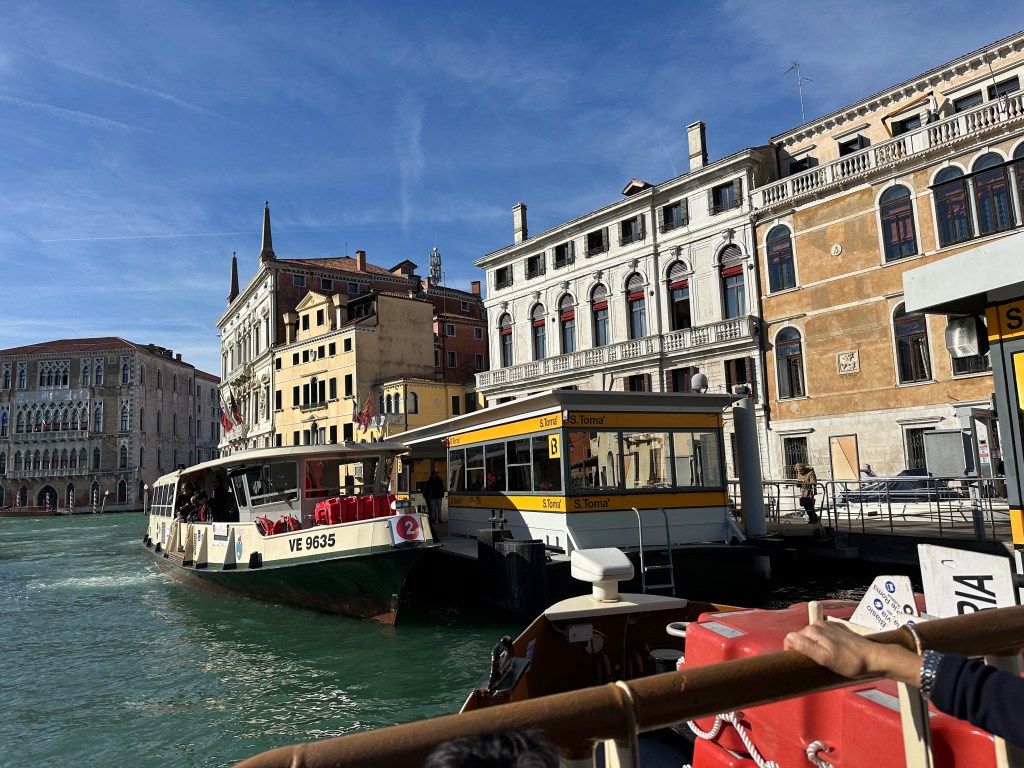
and head back to St. Mark’s Square.

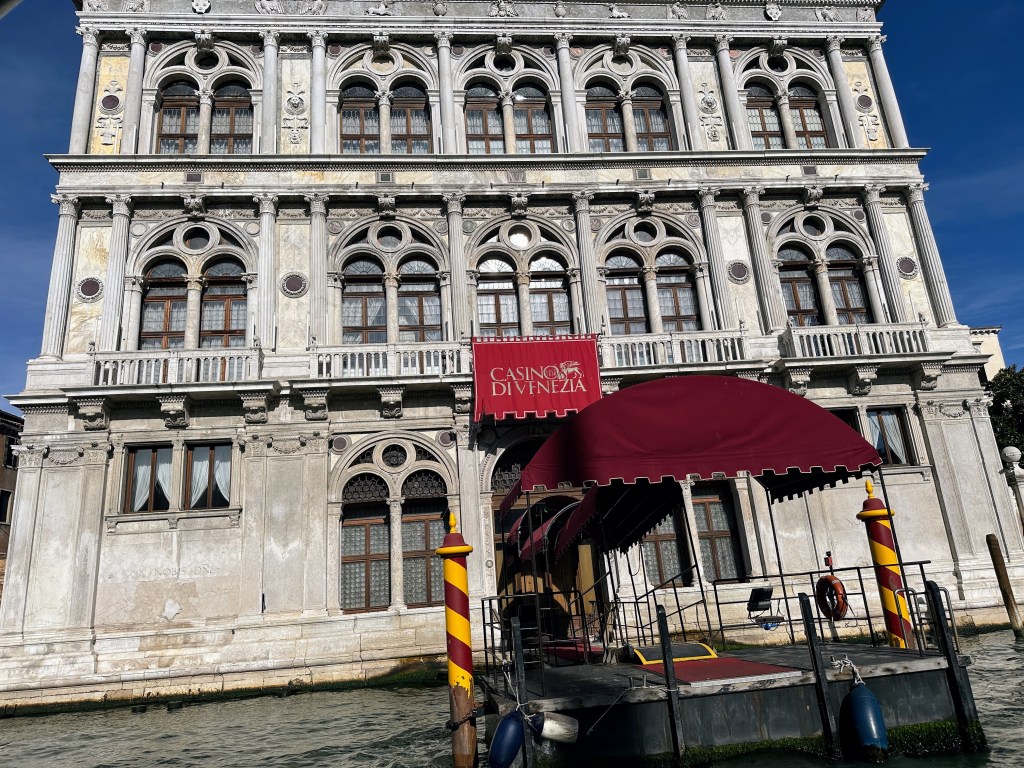
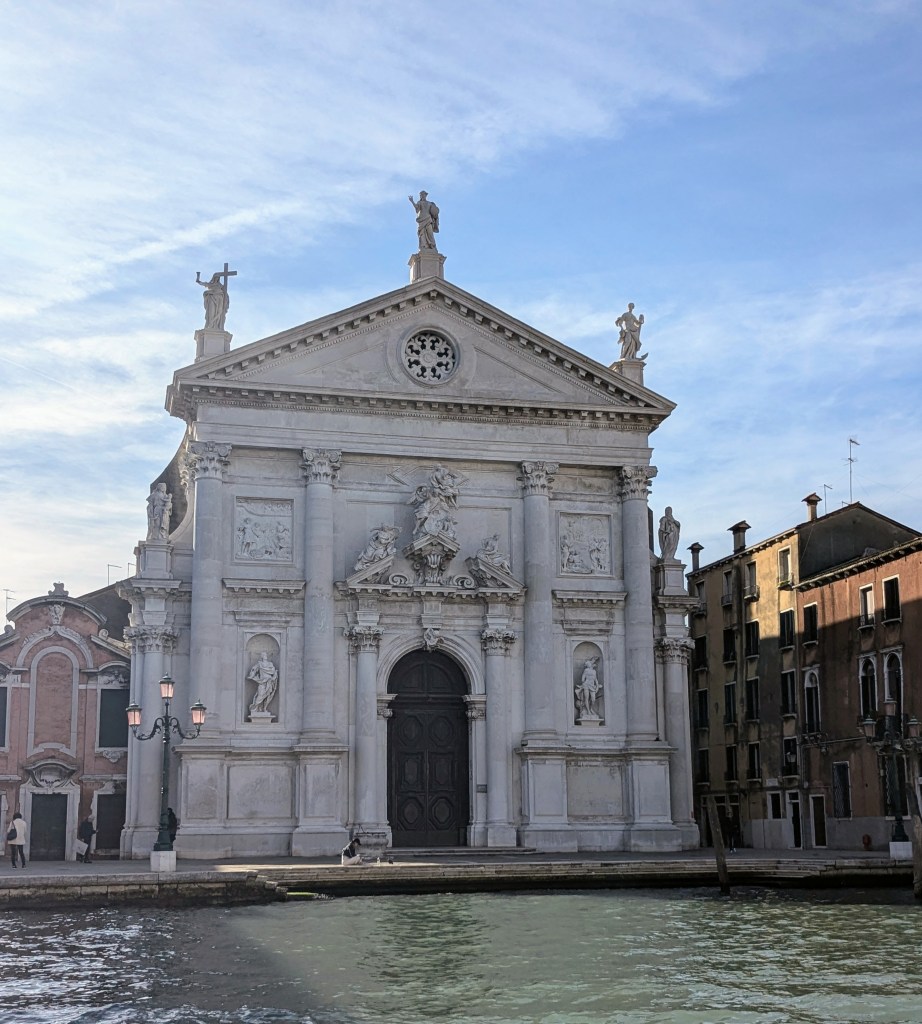
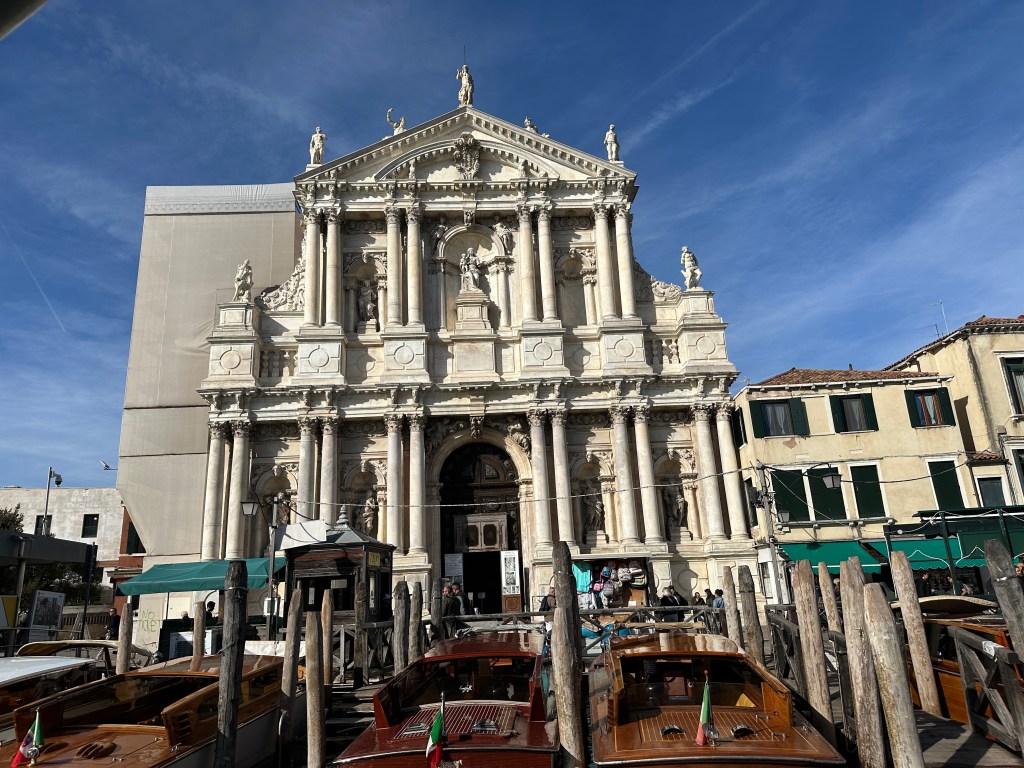
We had a long day and as we needed to be out early the next morning, we settled in for the evening. Bright and early the next morning we took the water bus to the train station to head north for a booked Prosecco tasting tour. But as bad luck, and Italian labor, would have it, there was a strike of the railroad personnel. After wasting the morning with many phone calls, attempted taxi hiring, and frustrating delays, the tour was cancelled. We decided to spend the rest of the afternoon riding the water buses around the canals, which is when many of the above pictures were taken as well as those of that follow:
of the casino
and several churches

We got a better view of St. Mary of the Health.
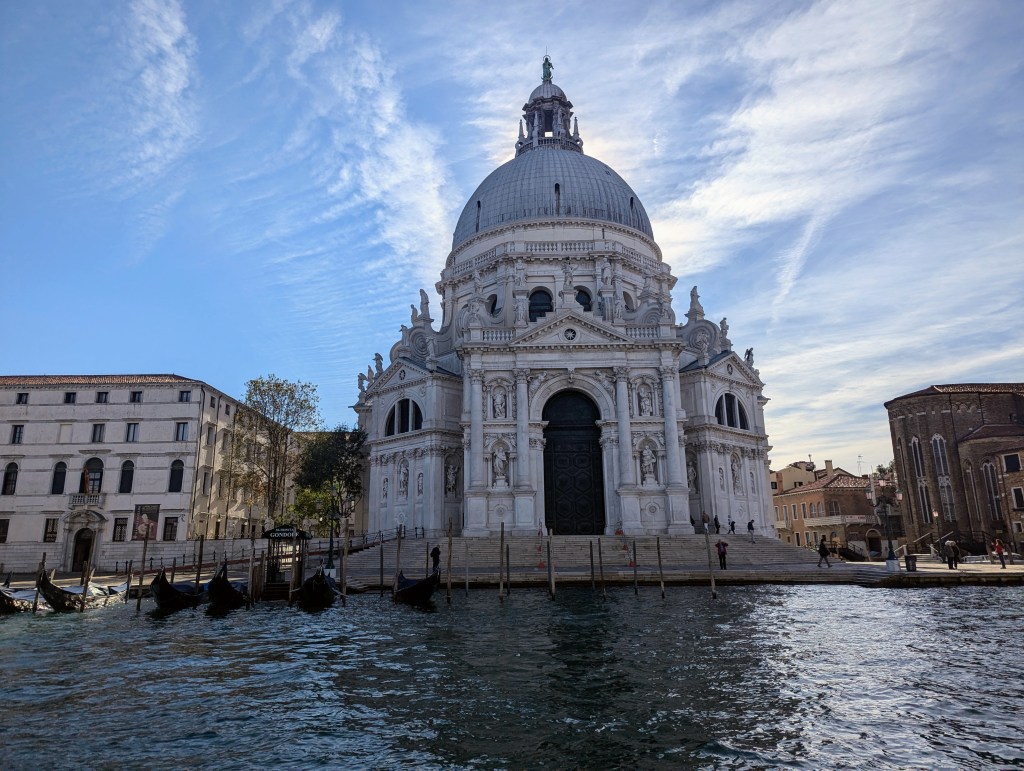
And a full view of Saint Mary of the Health with the wind vane from across the water.
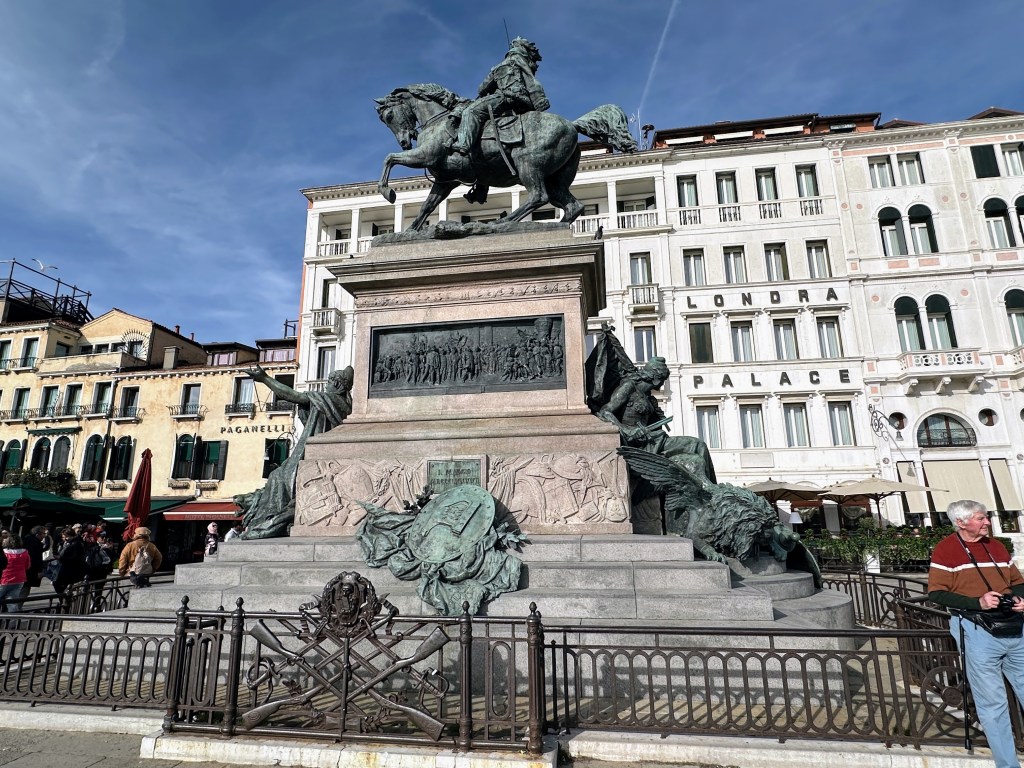
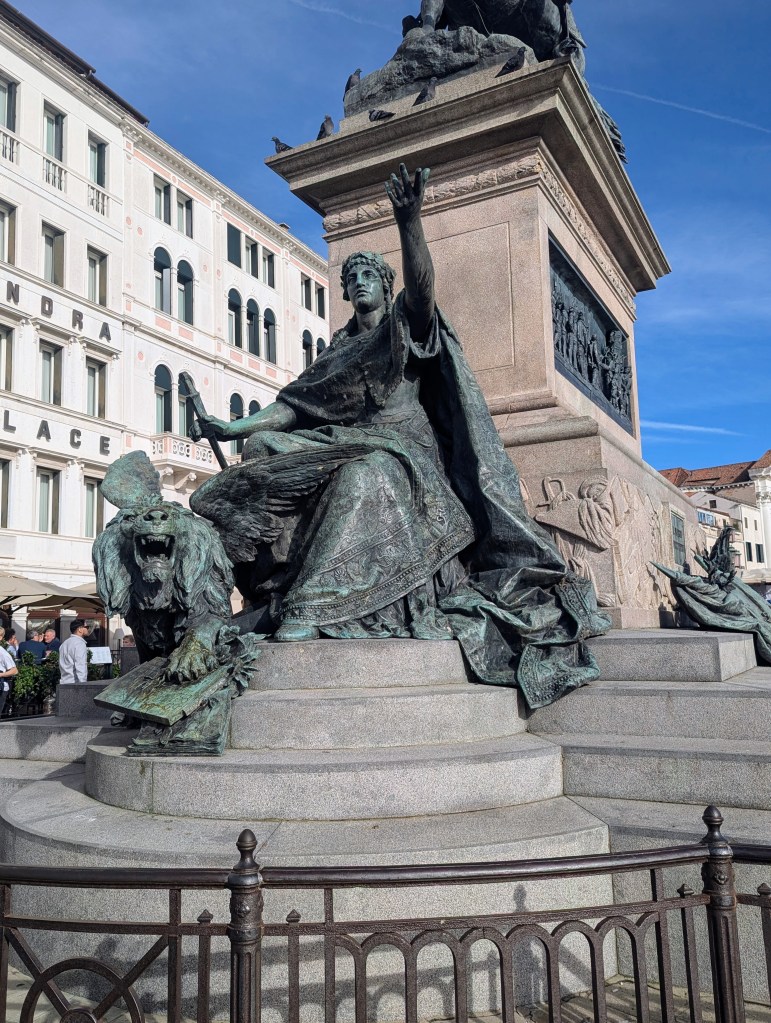
We arrived back at St. Mark’s stop and stopped to look at the victory statue we had passed several times already, but never took the moment to admire. It was created in 1887 to honor the Kingdom of Italy’s first king.
Once off the water bus, we had lunch in a very cute little restaurant off a back street, which had not only delicious food, but all the symbols we had come to know as Venice: the winged lion
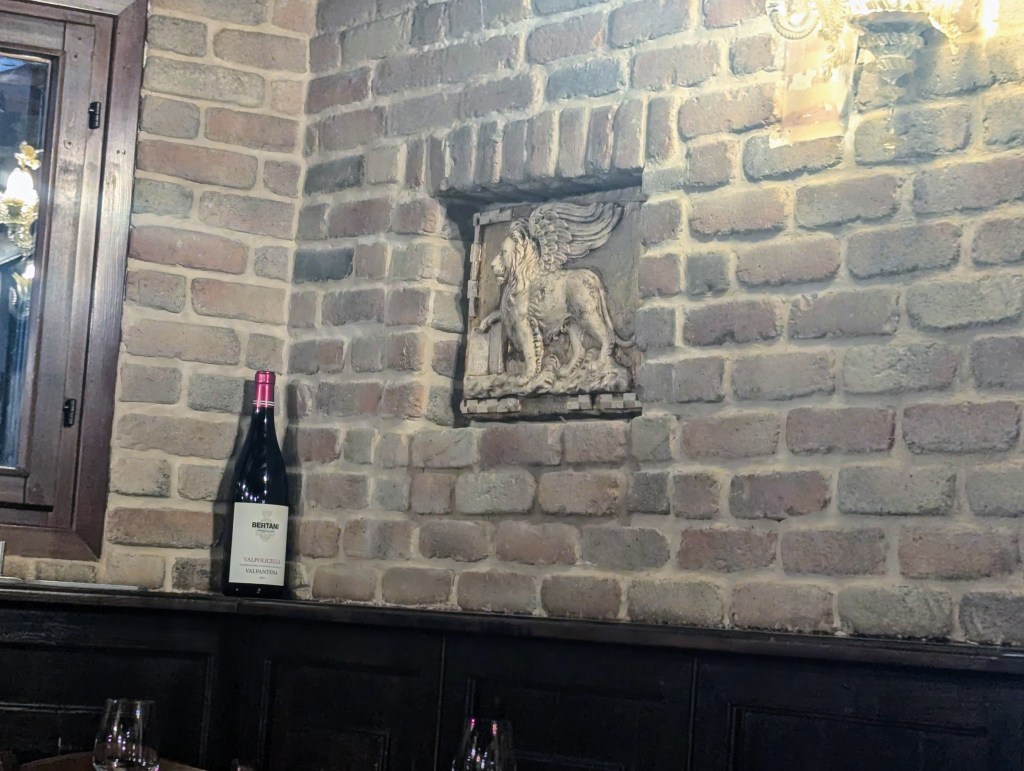
and Murano glass sconces.

After lunch we aimlessly meandered the winding streets of Venice.
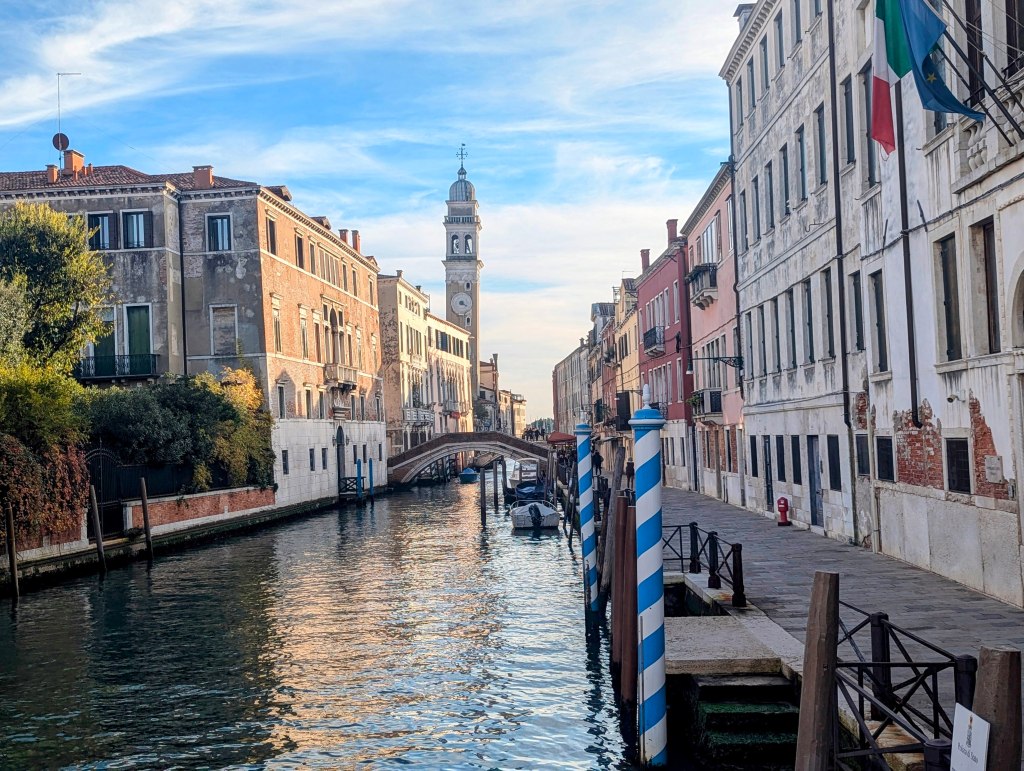
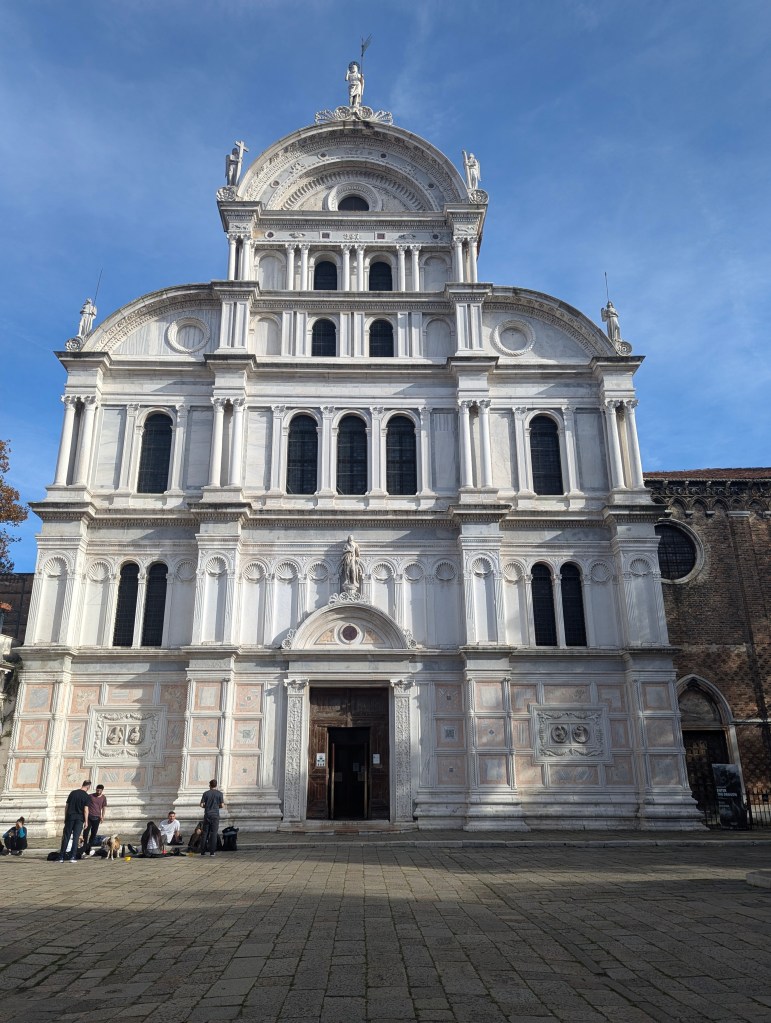
Again, there was a church in every neighborhood.
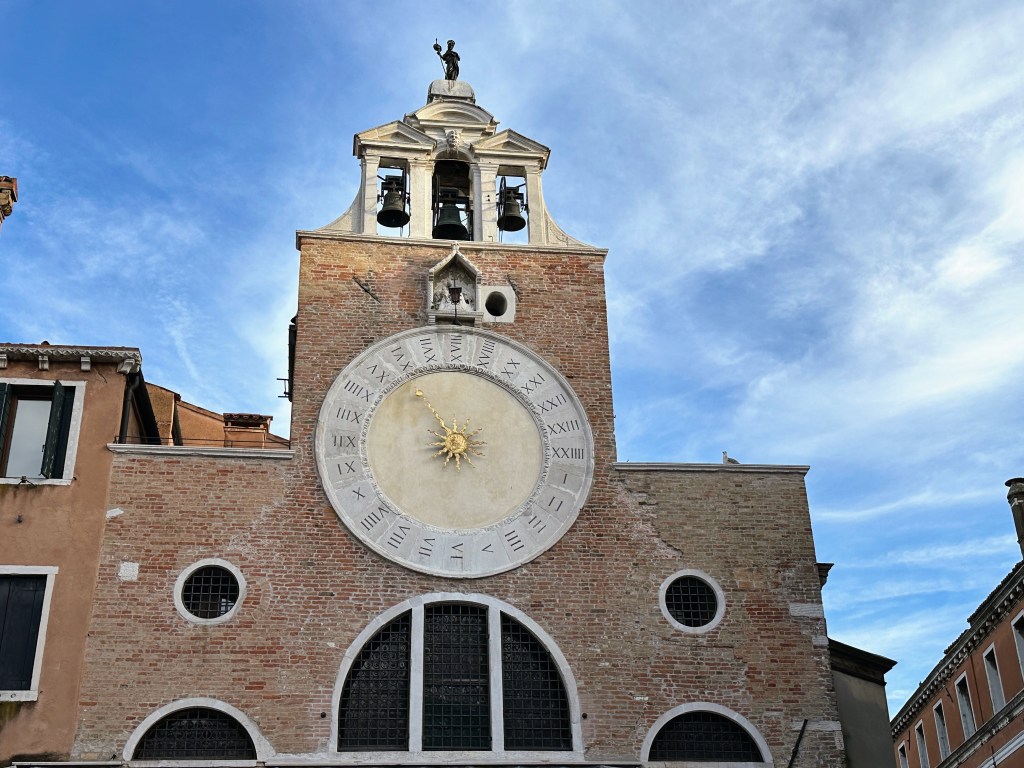
In one church square we noted something popular in Venice, of which we were soon to see more: a 24 hour clock.
We noted the many intriguing doorbells and knockers.


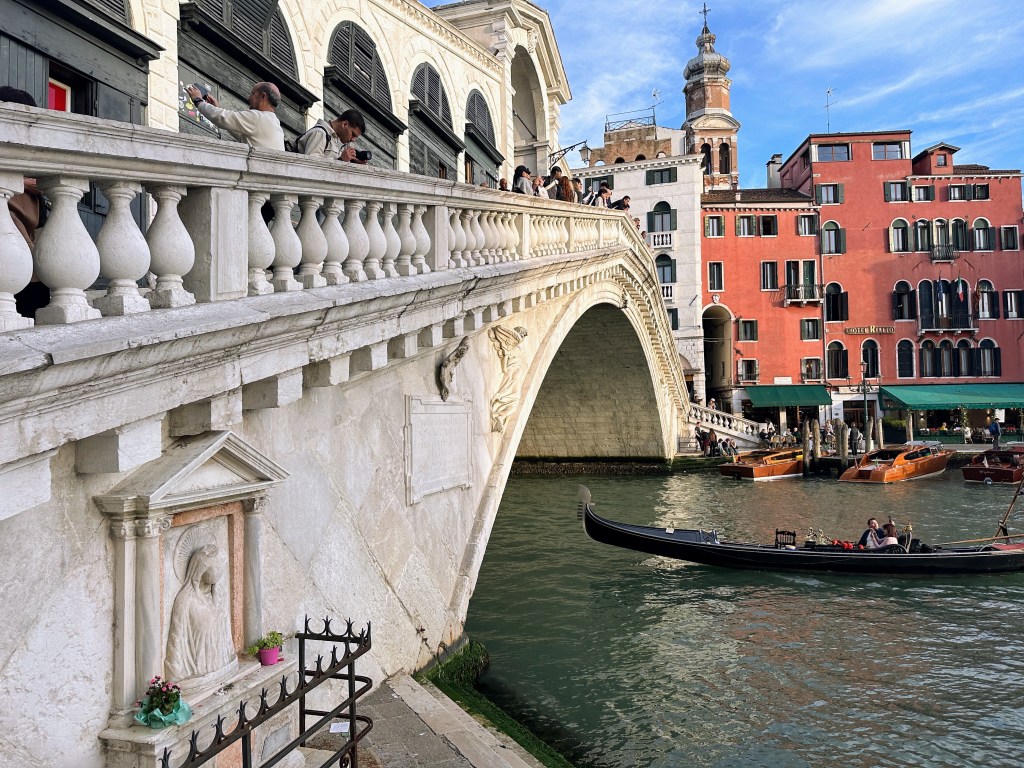
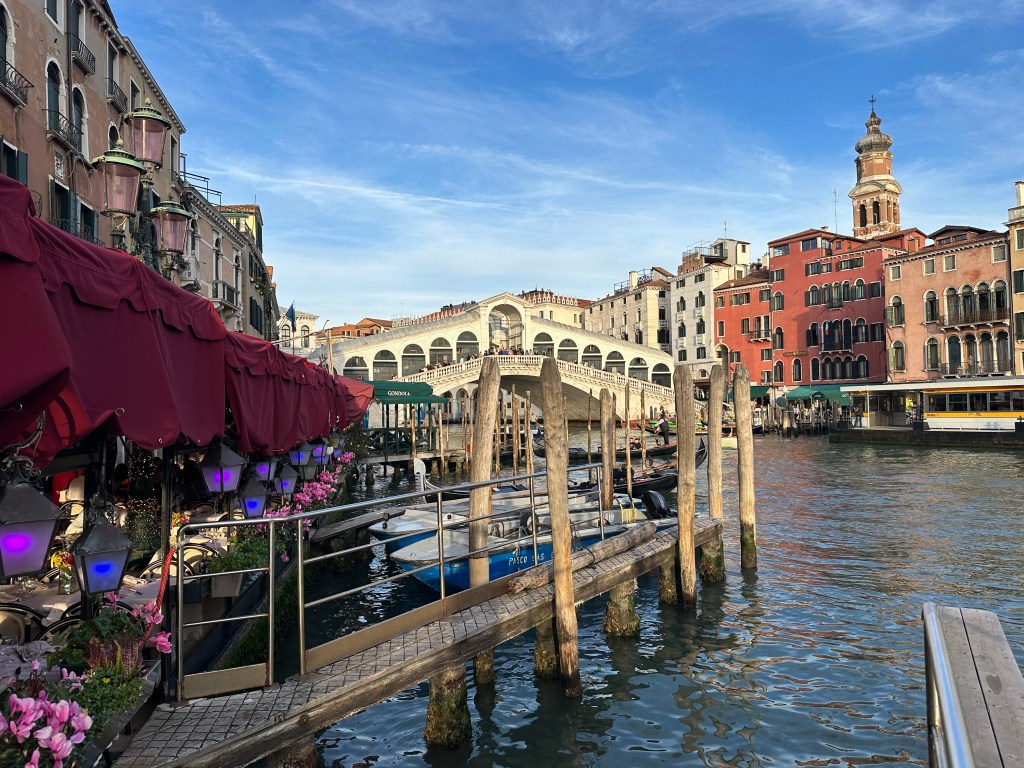
We headed to the Rialto Bridge which we had passed under many times, but not yet crossed on foot.
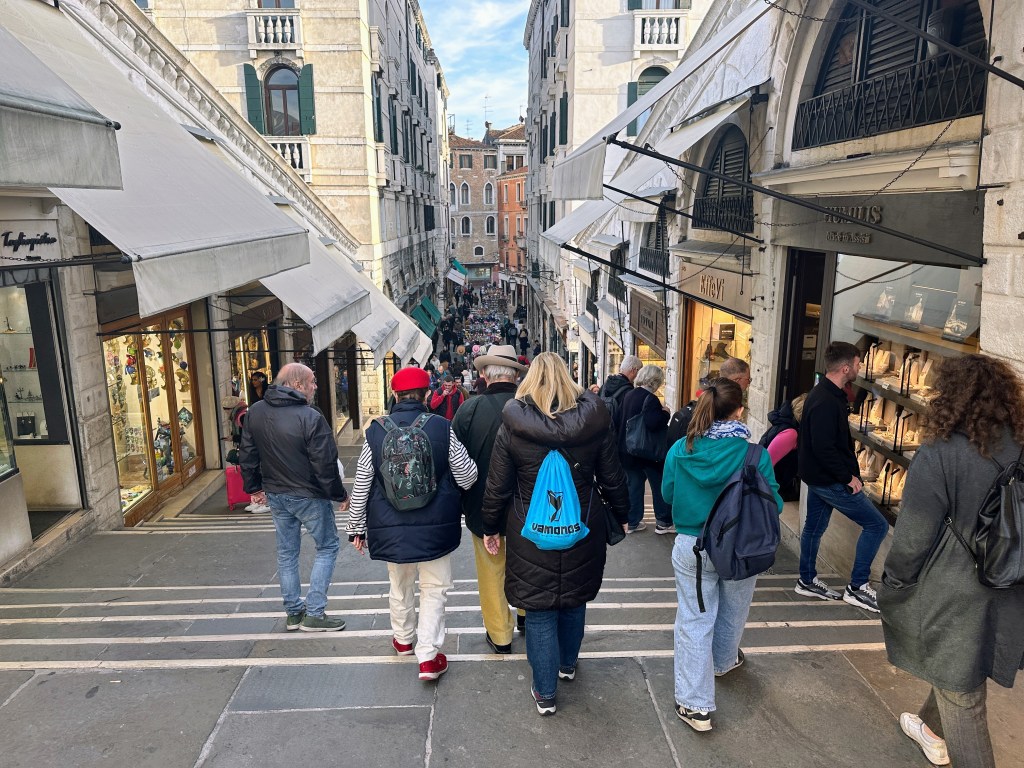
We took some pics of the bridge from the other side.
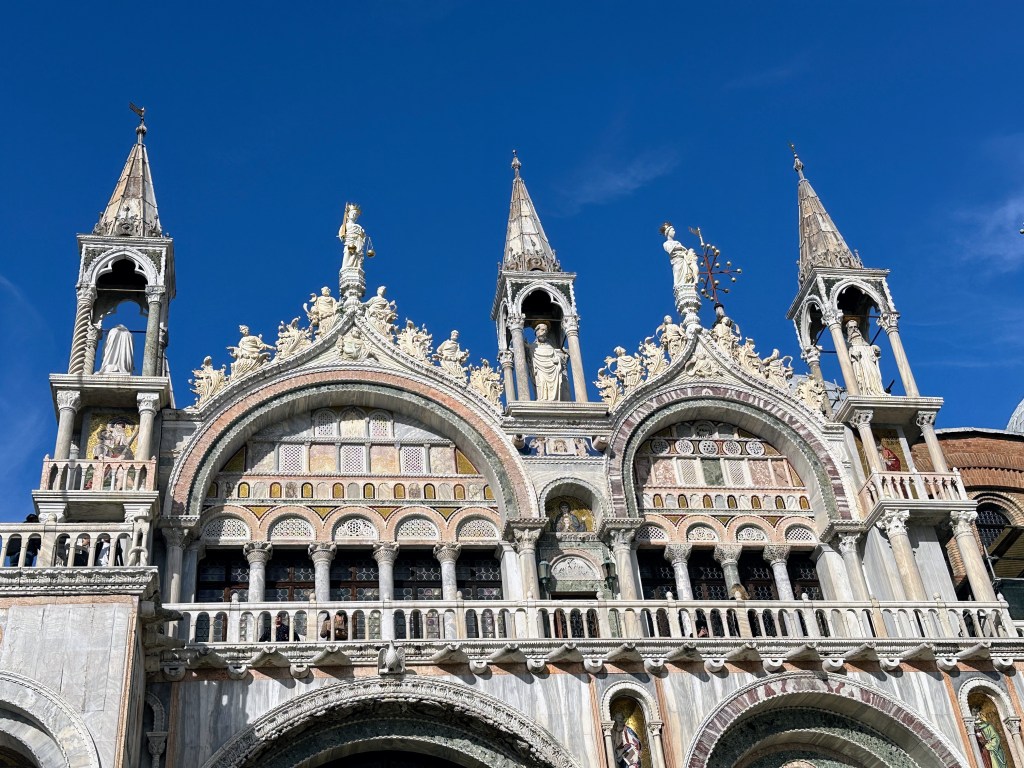
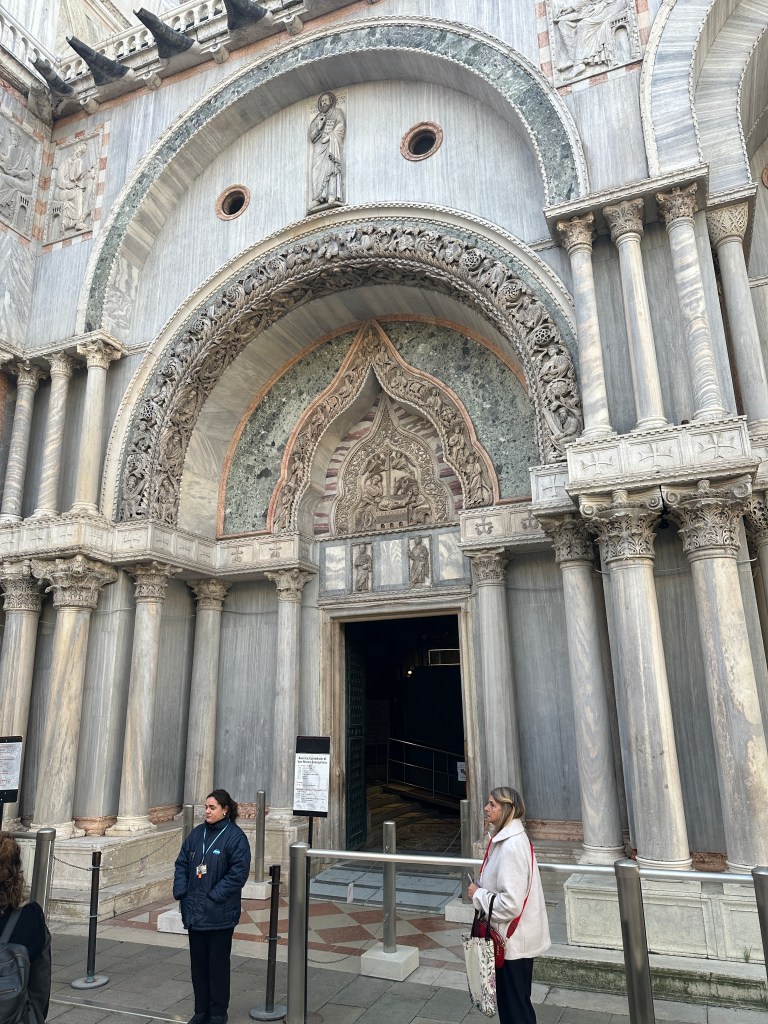
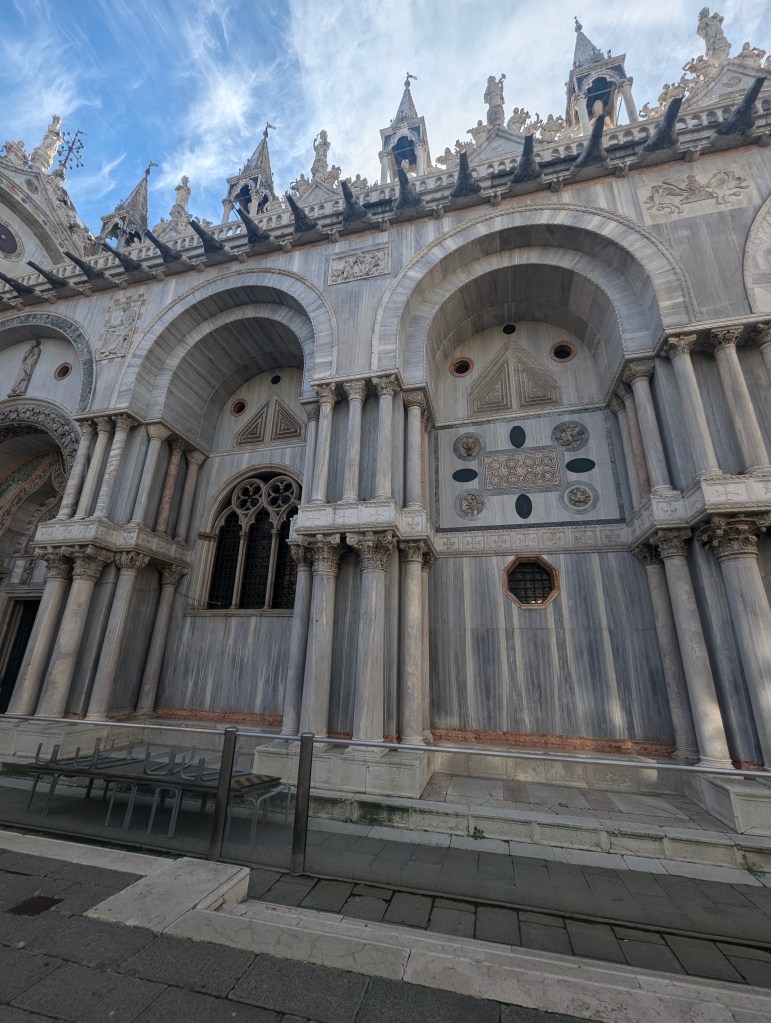
On the following day it was time to enter St. Mark’s Cathedral. The body of St. Mark the Evangelist was brought to Venice from Egypt by two merchants in 828. The remains were initially placed in a corner tower of the Doge’s residence, currently the Doge’s Palace. The church was built in honor of St. Mark and to house his remains. Prior to the fall of the Republic in 1797, it was the Doge’s chapel. The present church is the third built at this site begun in 1063 after a huge fire burned down most of the cathedral. St. Mark’s body was found hidden in a column during a reconstruction project in 1094. Like its two predecessors, it was built using as its model the sixth-century Church of the Holy Apostles in Constantinople. It’s influences were Middle-Byzantine, Islamic, and Romanesque with Gothic elements incorporated later. To convey the republic’s wealth and power, the original brick façades and interior walls were embellished over time with precious stones and rare marbles, primarily in the thirteenth century. Many of the columns, reliefs, and sculptures were spoils stripped from the churches, palaces, and public monuments of Constantinople as a result of the Venetian participation in the Fourth Crusade, including the bronze horses, as mentioned earlier.
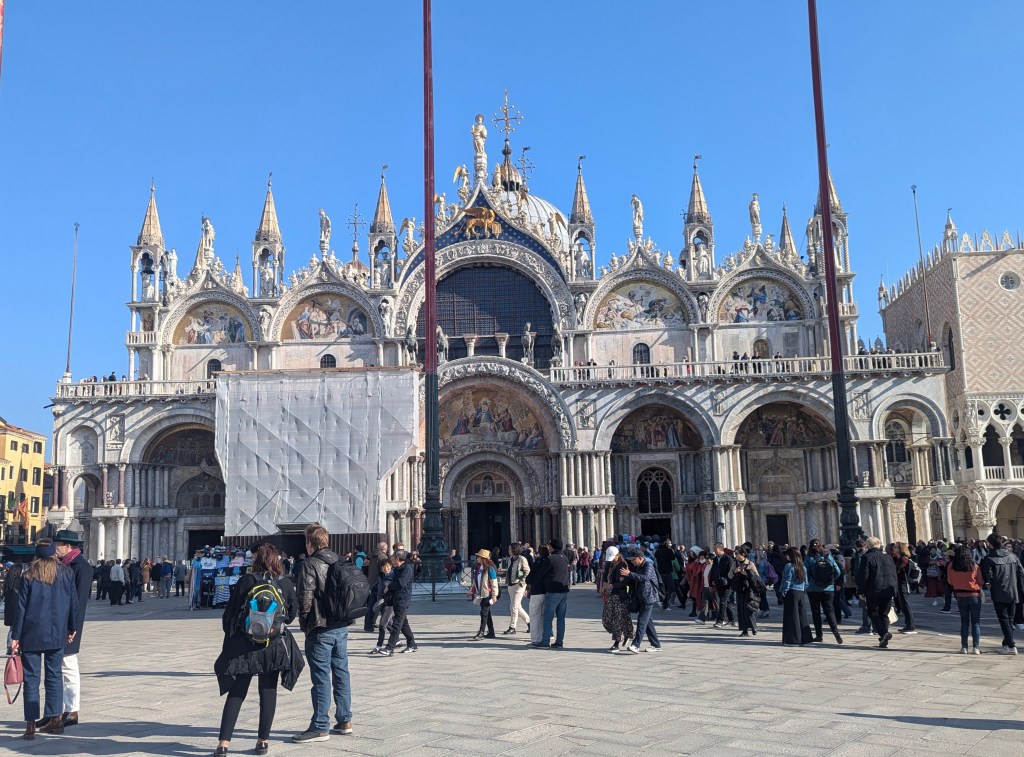
Before entering, we took some close ups of details of the cathedral’s exterior.

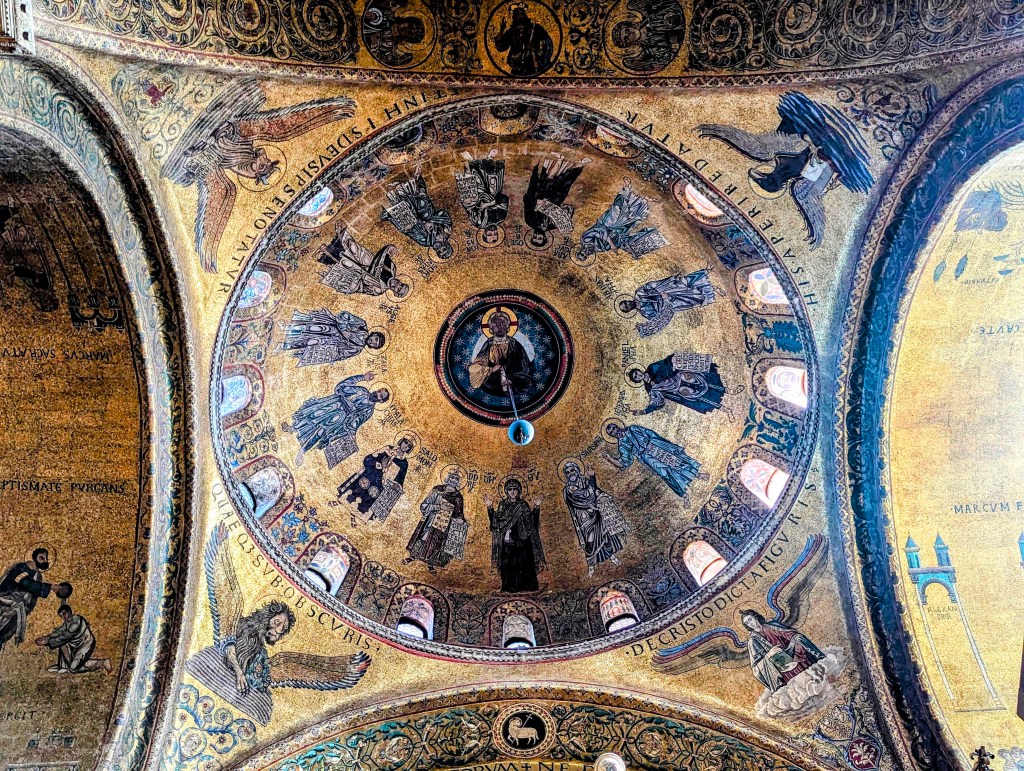
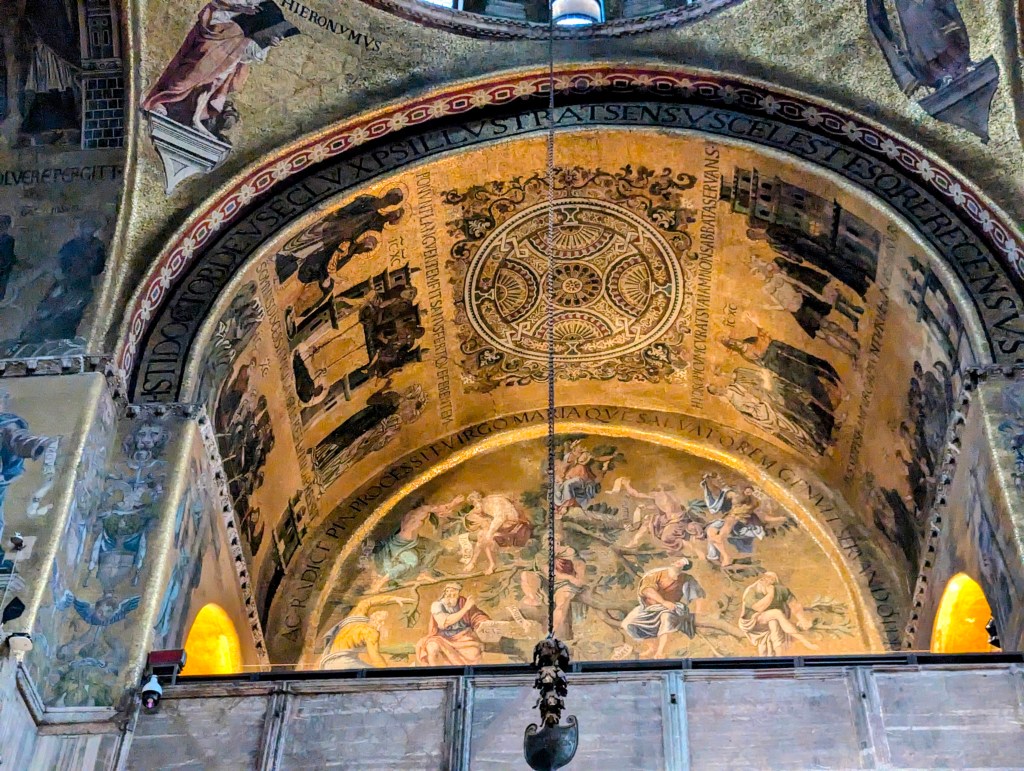
The interior of the domes, the vaults, and the upper walls were slowly covered with gold-ground mosaics depicting saints, prophets, and biblical scenes. Many of these mosaics were later retouched or remade as artistic tastes changed and damaged mosaics had to be replaced, such that the mosaics represent eight hundred years of artistic styles.
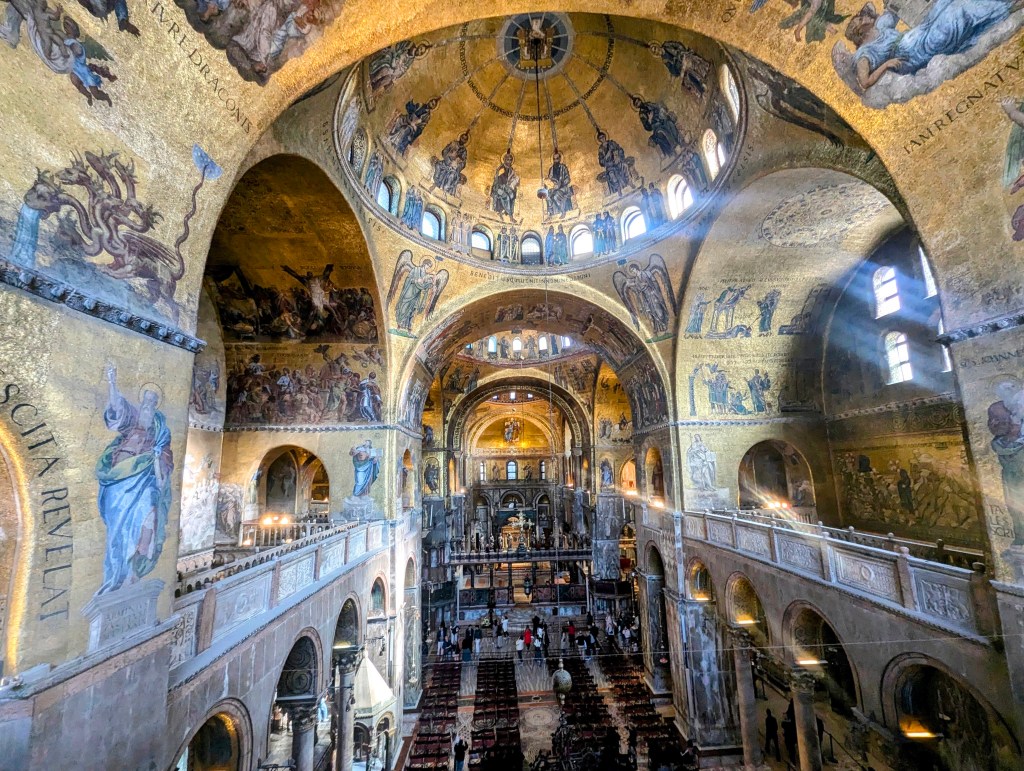

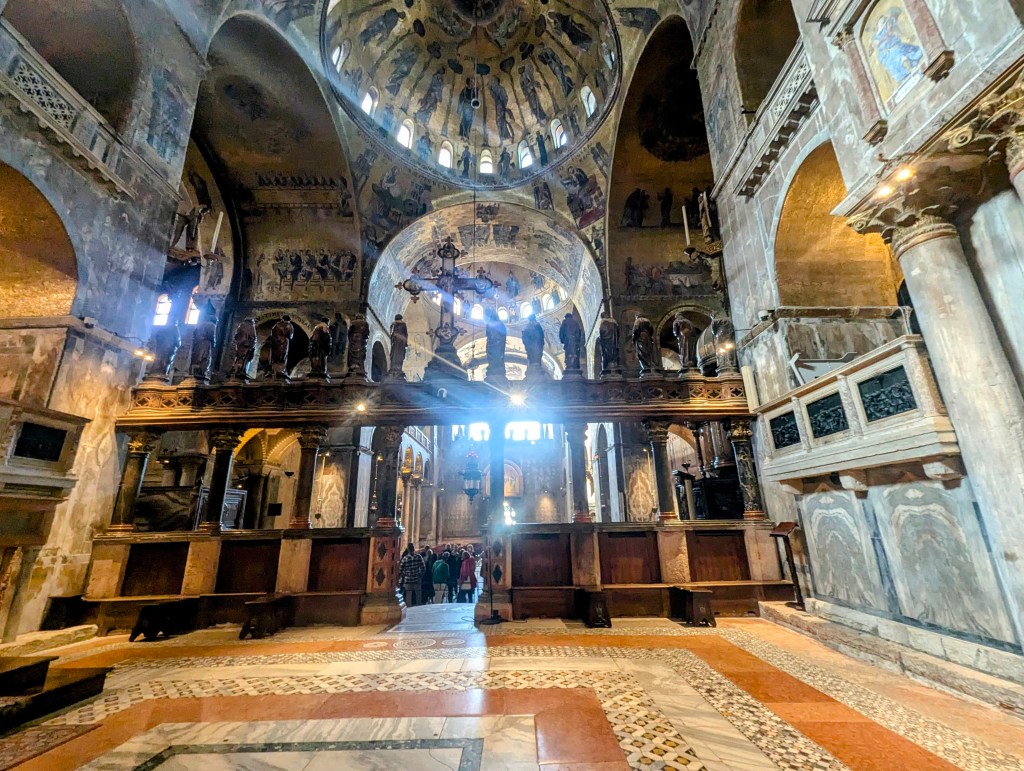
The chancel is enclosed by a Gothic altar screen, dated 1394. It is surmounted by a bronze and silver Crucifix, flanked by statues of the Virgin and Saint Mark, together with the Twelve Apostles.
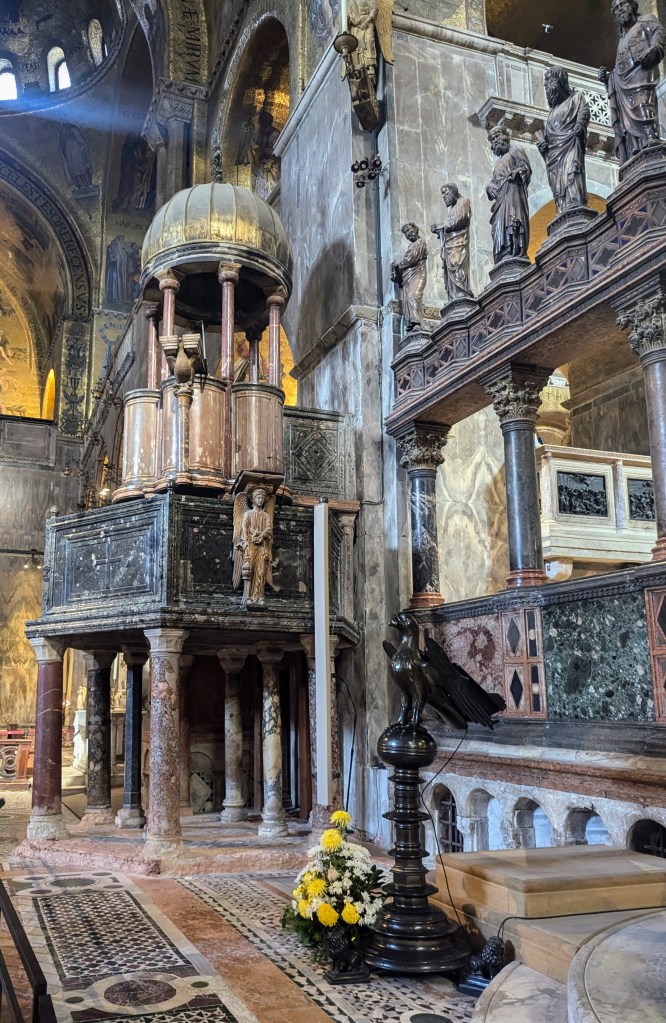
There are pulpits on both sides.

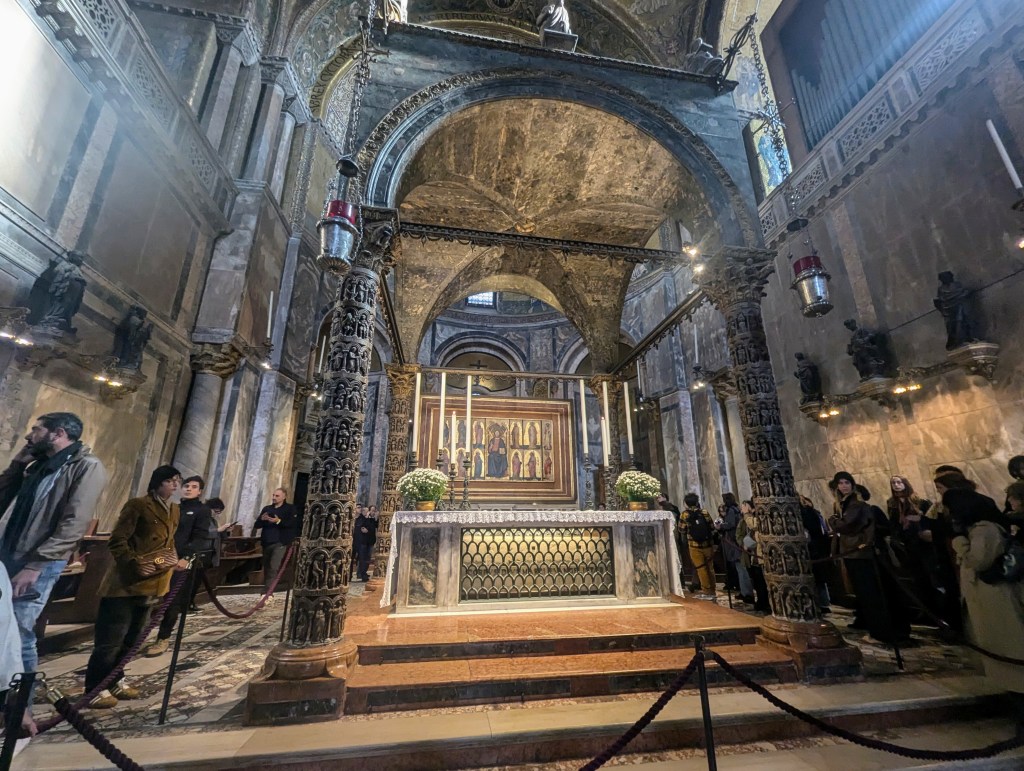
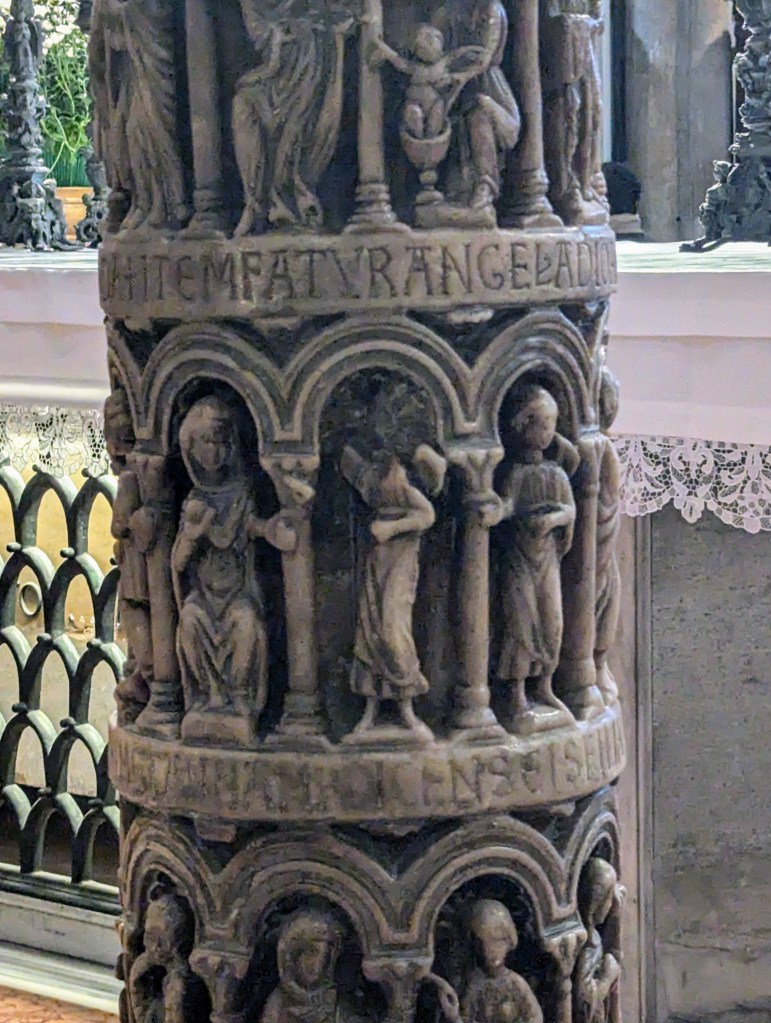
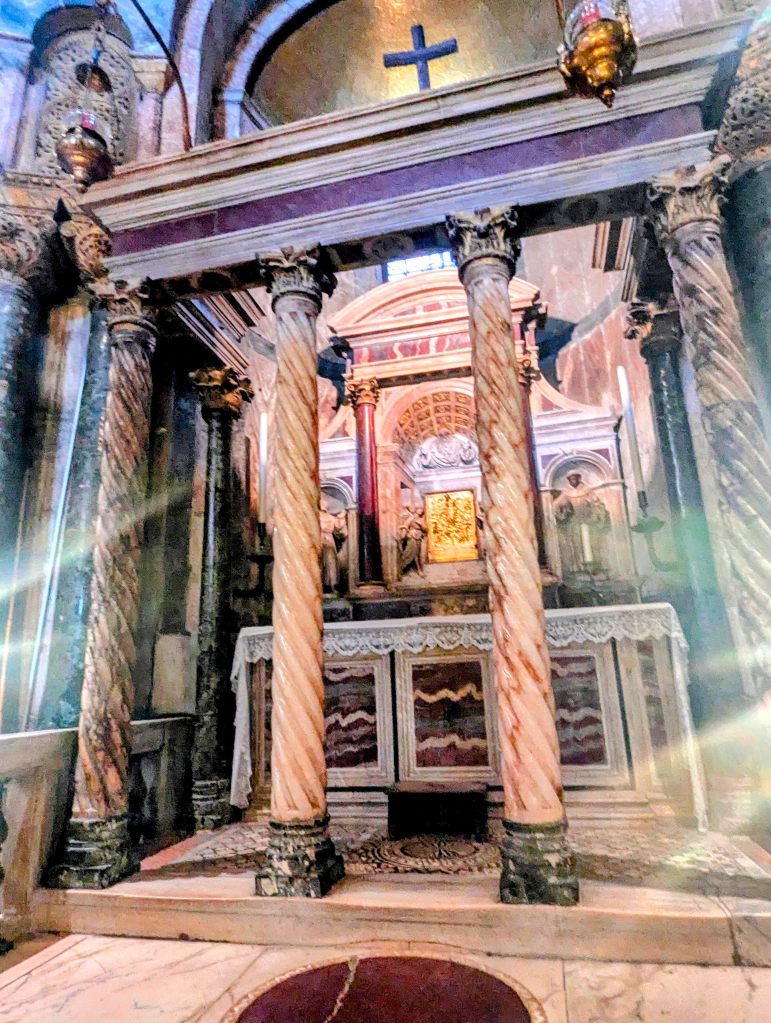
The Pala d’Oro, believed to have been created in the tenth century, is a highly ornate altarpiece studded with 1,300 pearls, 300 emeralds, 300 sapphires, 400 garnets, 100 amethysts, rubies, and topazes, making it the most precious Byzantine altarpiece. The altar depicts Biblical scenes like the enthroned Virgin Mary with the baby Jesus and Christ Pantocrator. Visitors to St. Mark’s Basilica can view the Pala d’Oro and appreciate its exceptional beauty and historical significance. When Napoleon took over Venice he was told that the jewels were made of glass; he did not remove it to Paris.
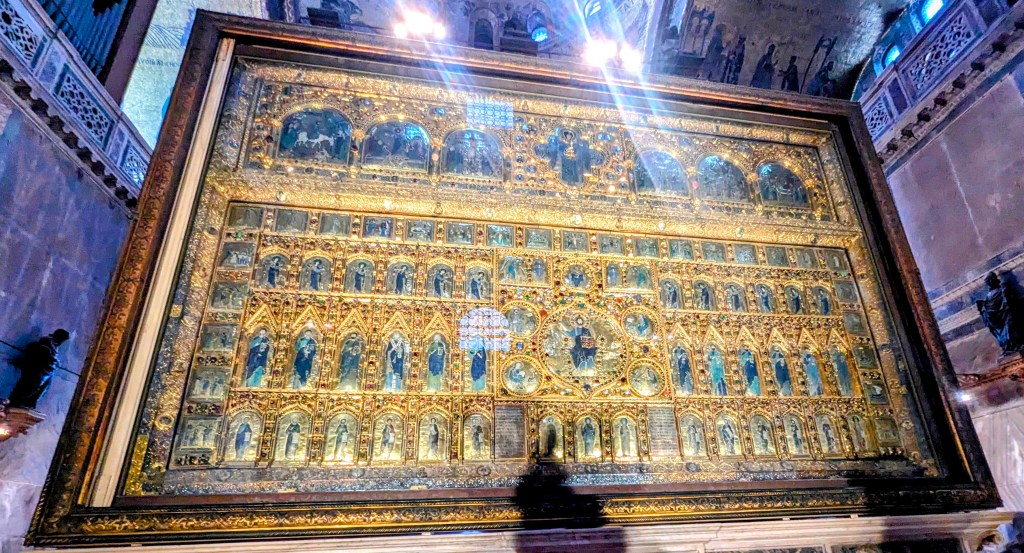
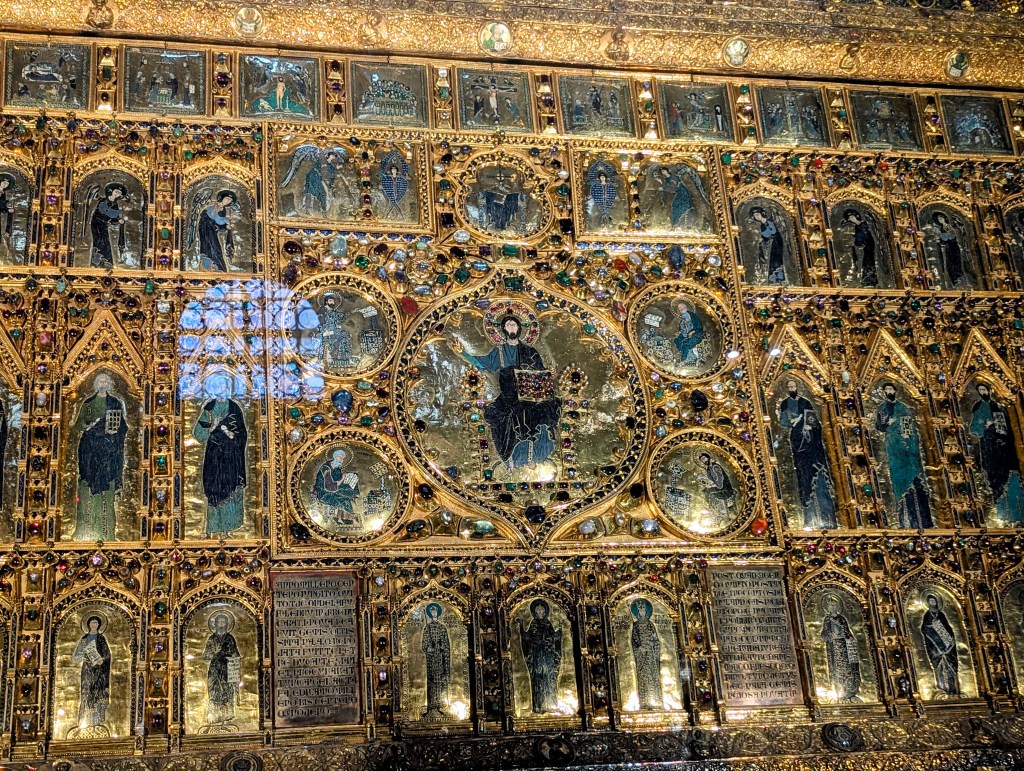
Every item in the basilica is a work of art.
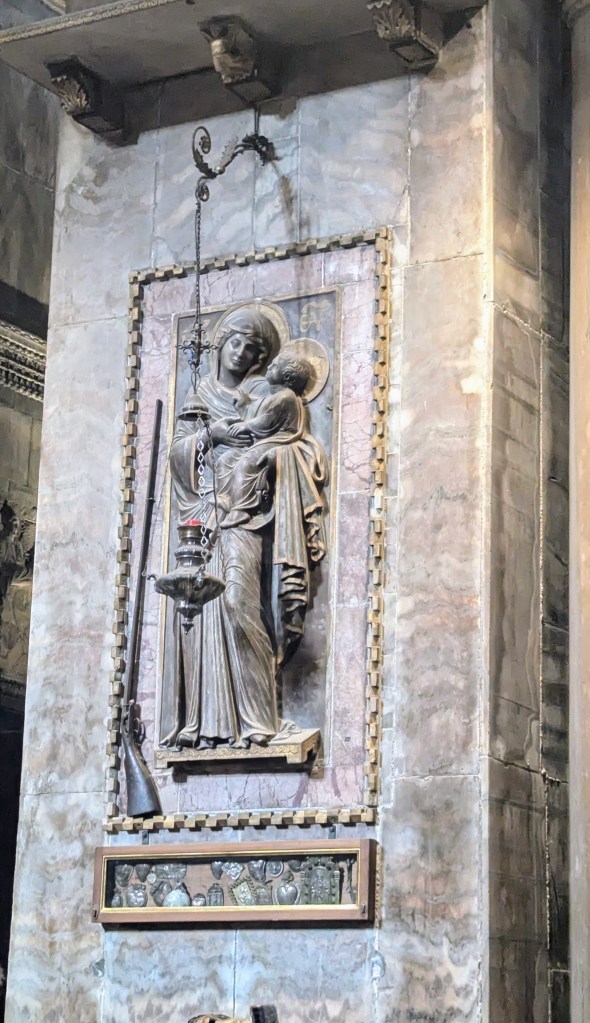
Madonna of the gun was dedicated by the navy for protecting them during the Austrian invasion. The relief dates to the 13th century; the gun was put there in 1849 by Venetian sailors who survived the explosion of an Austrian bomb in Marghera (a city near Mestre).
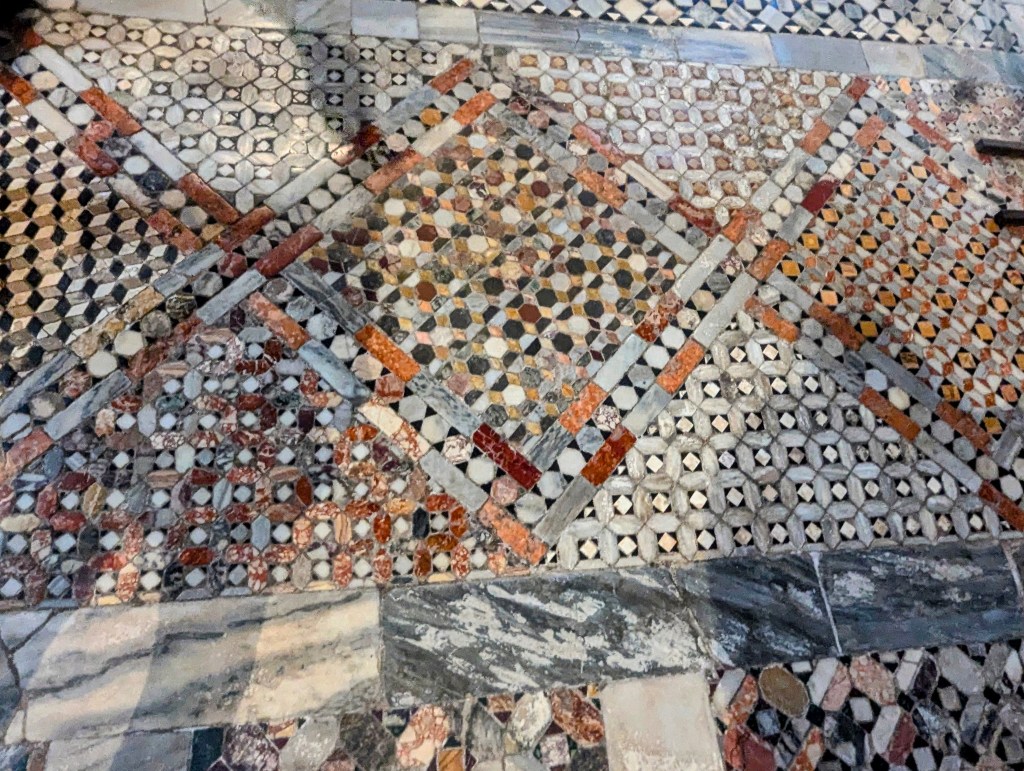
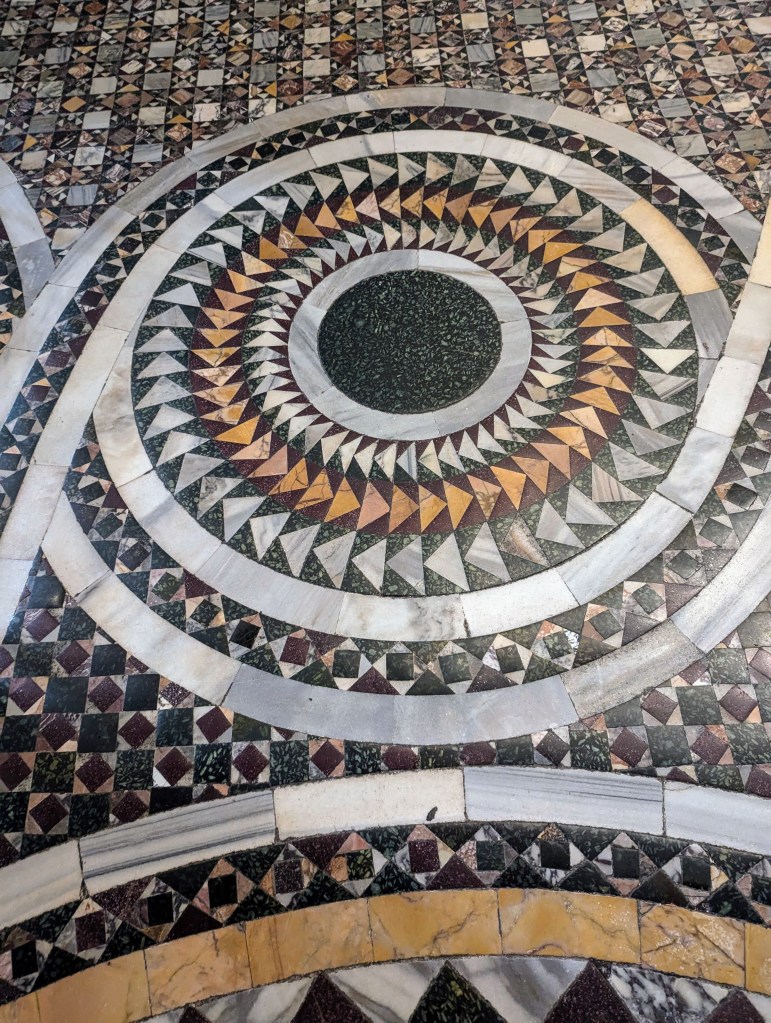
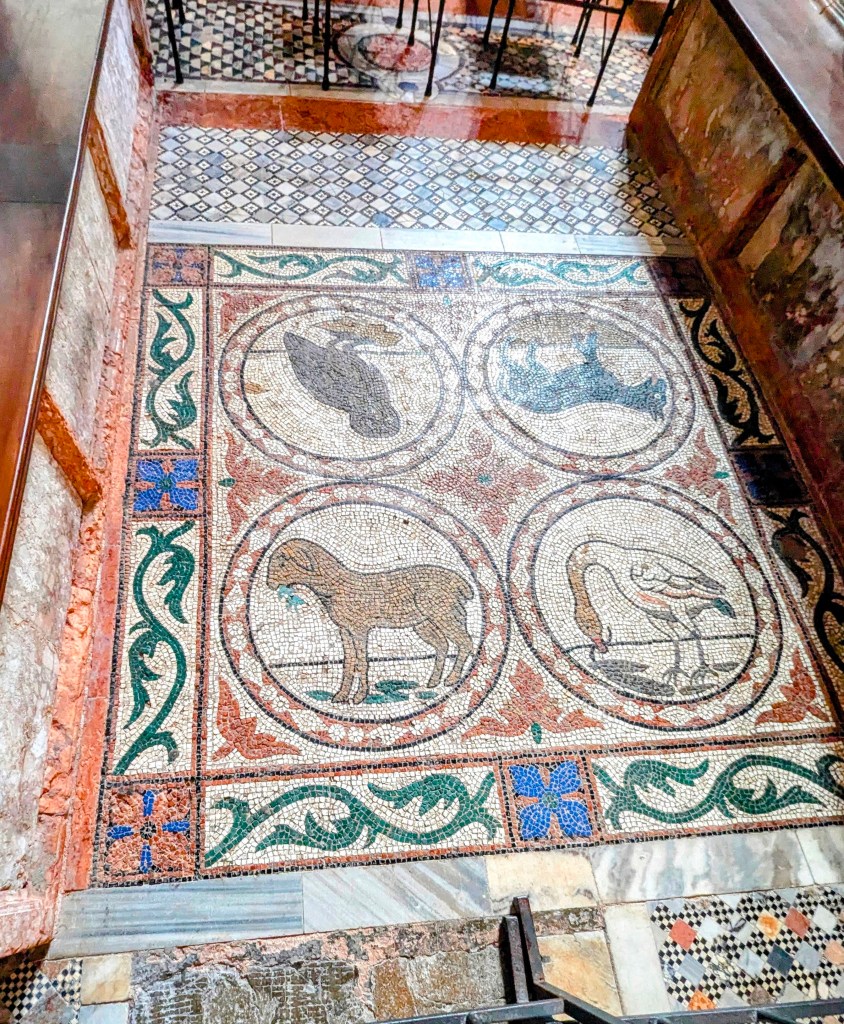
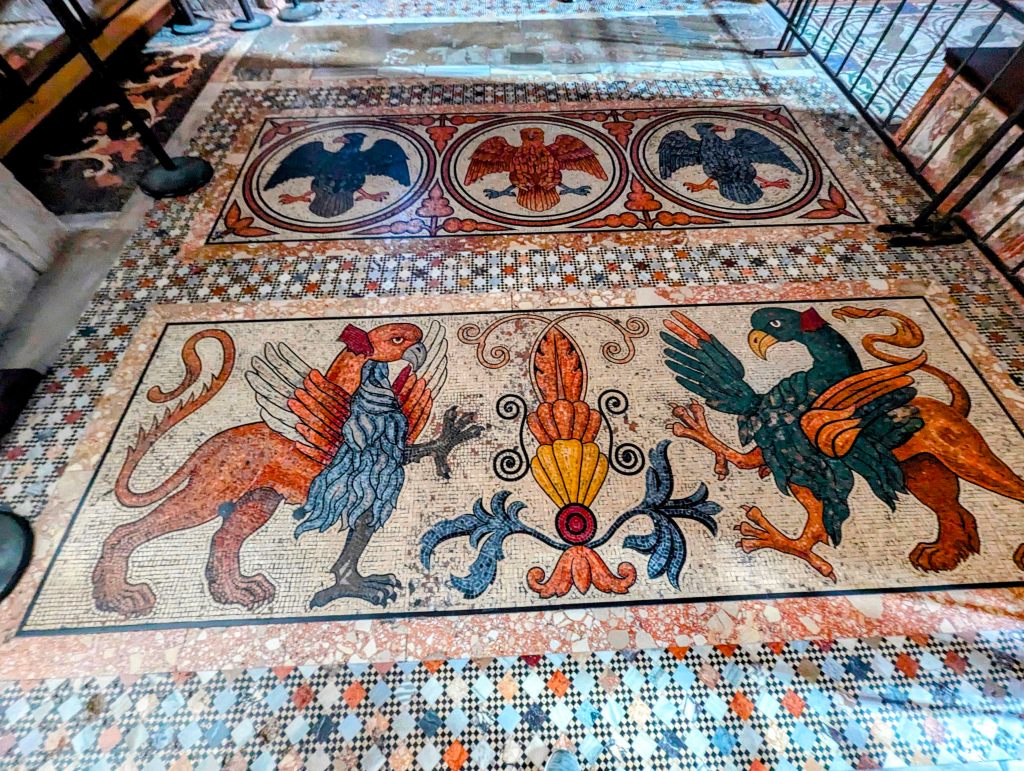
The floors cover over 2000 square meters and are made of marble of 60 different types, mostly from the East.
After thoroughly exploring the basilica, we headed upstairs to the museum. There we saw the original bronze horses, brought from Constantinople in 1204, which became the symbol of victory until they were taken to Paris by Napoleon. They were brought back to Venice by the Austrians in 1815.
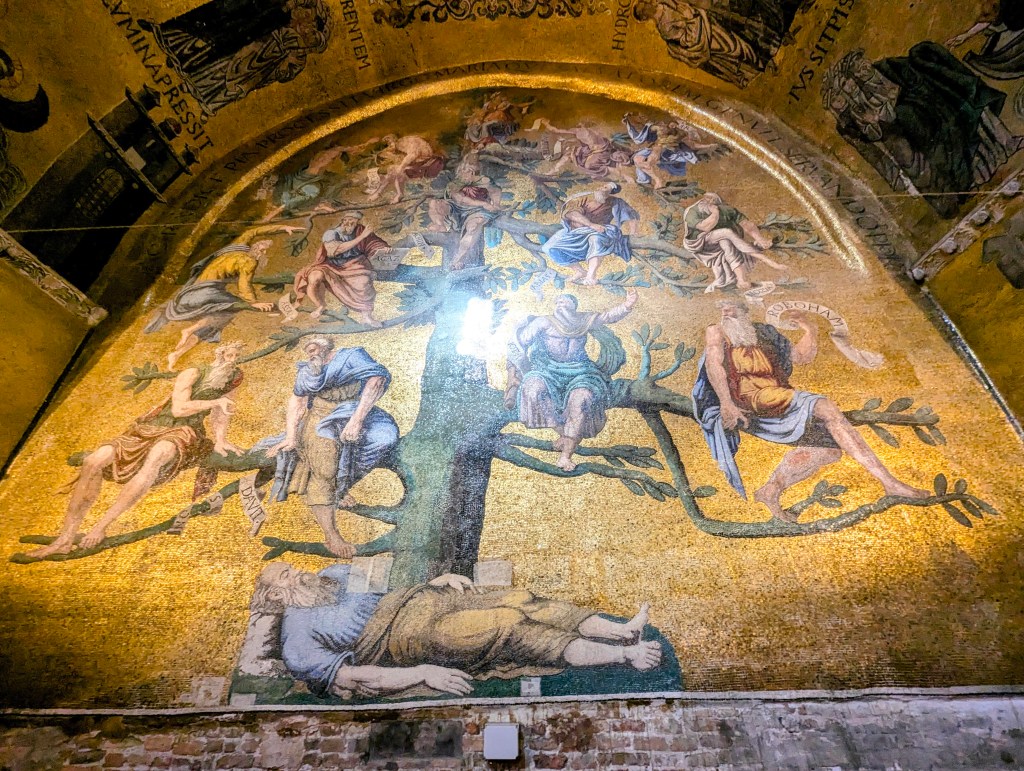
We saw other works of art that had been removed from the basilica for the sake of preservation. One included this family tree of the Virgin.
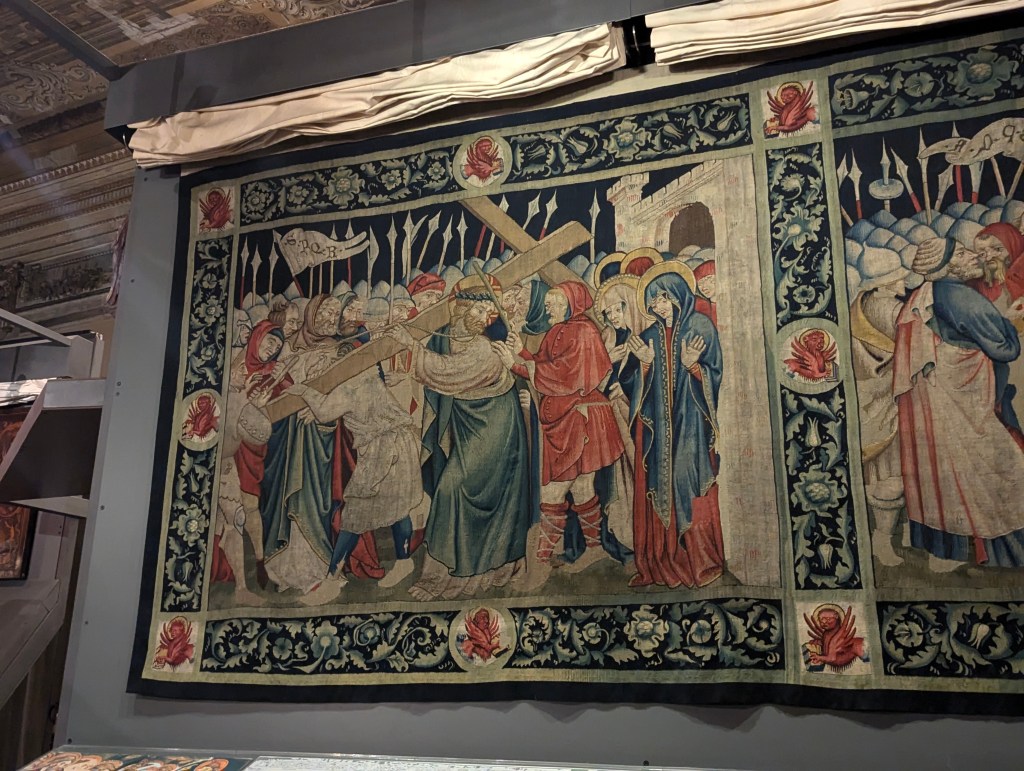
We saw tapestries
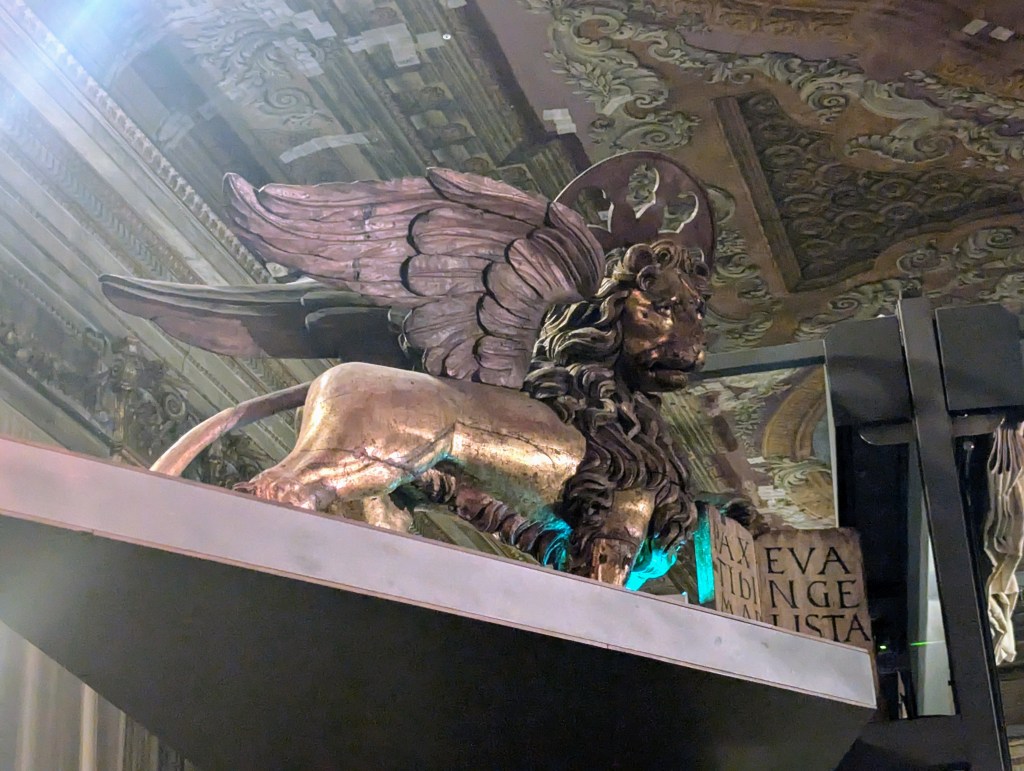
an original bronze winged lion
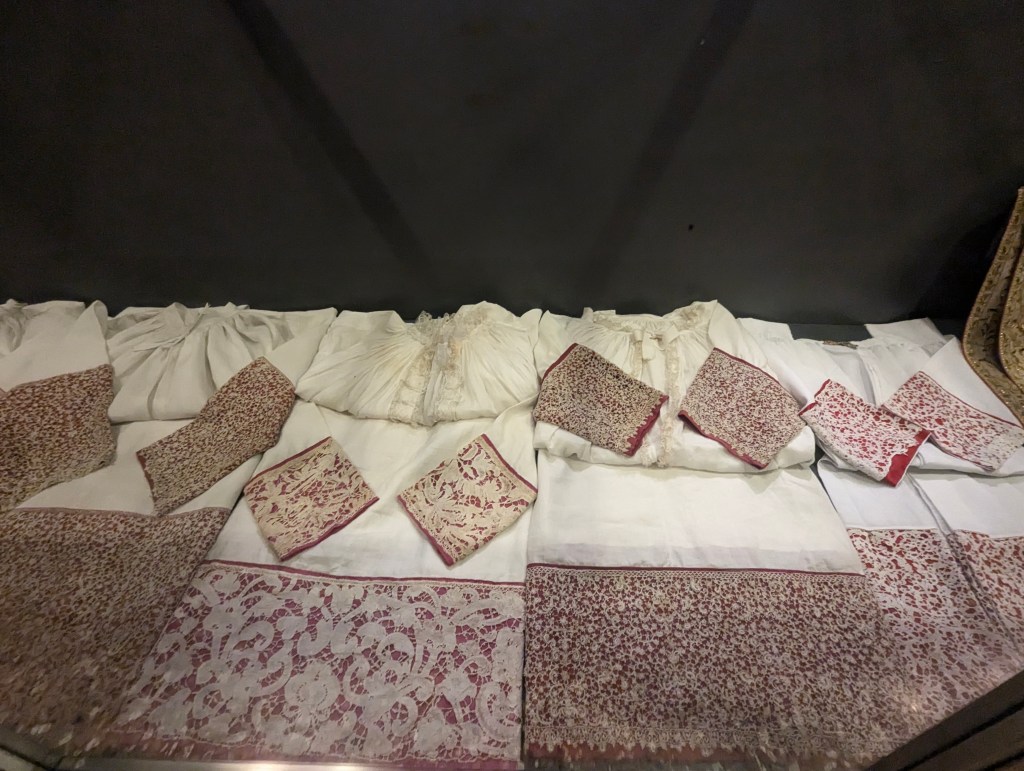
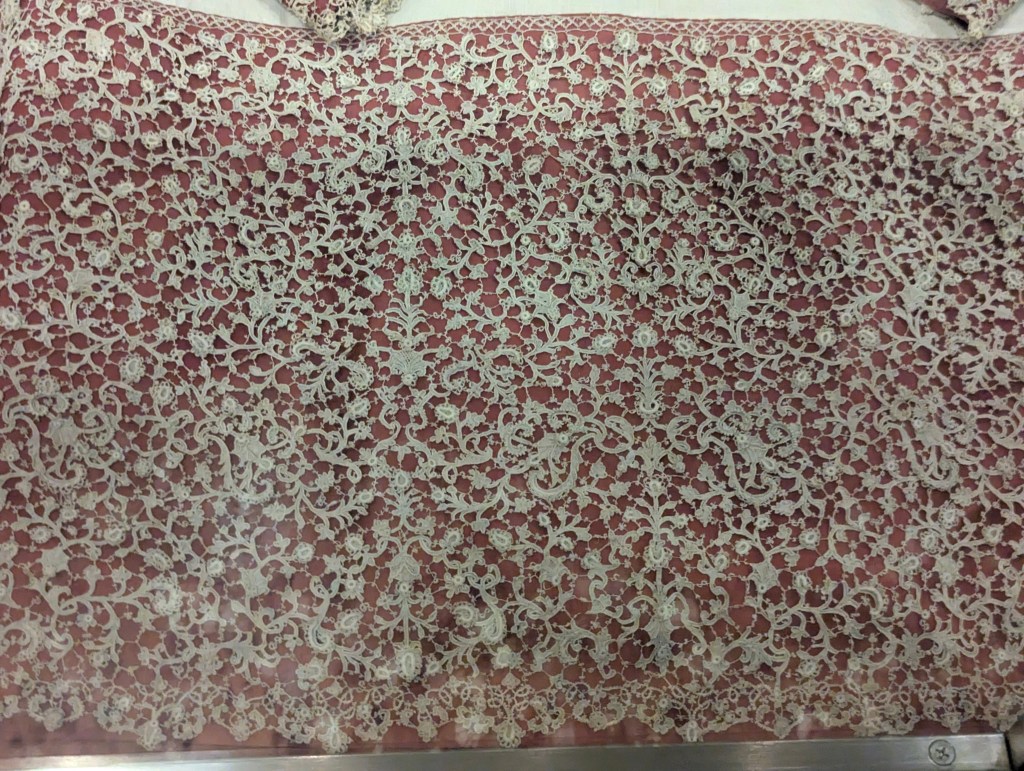
And examples of the famous Venetian lace which adorned the robes of clergy.
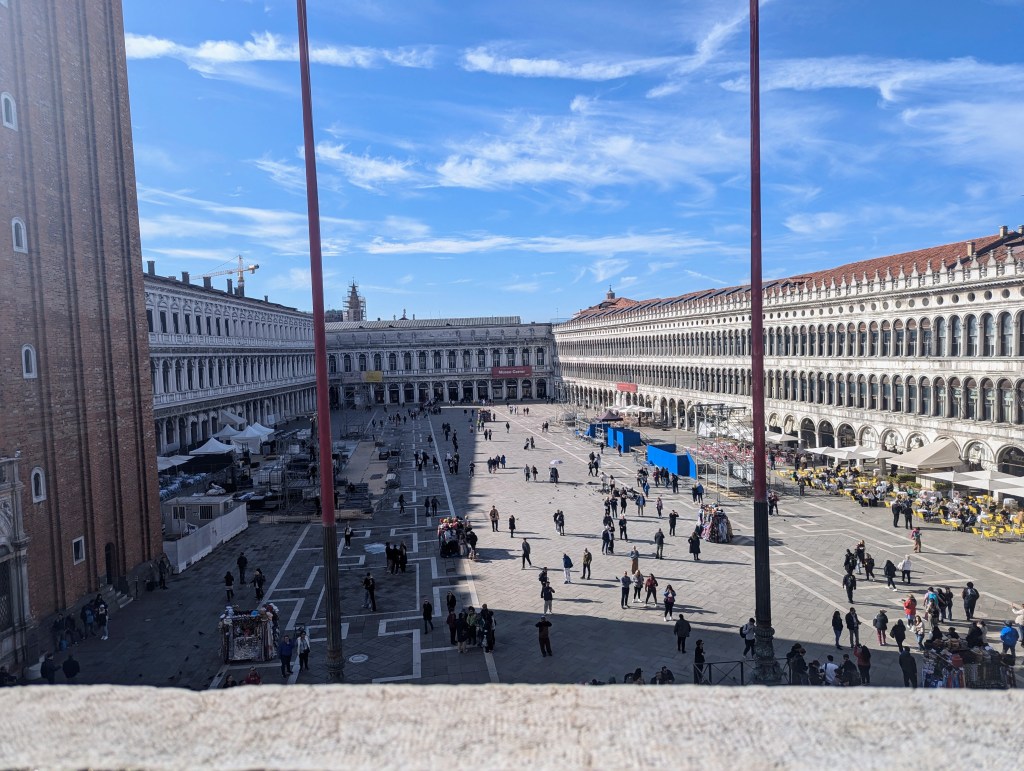
From upstairs we had a view of the plaza.
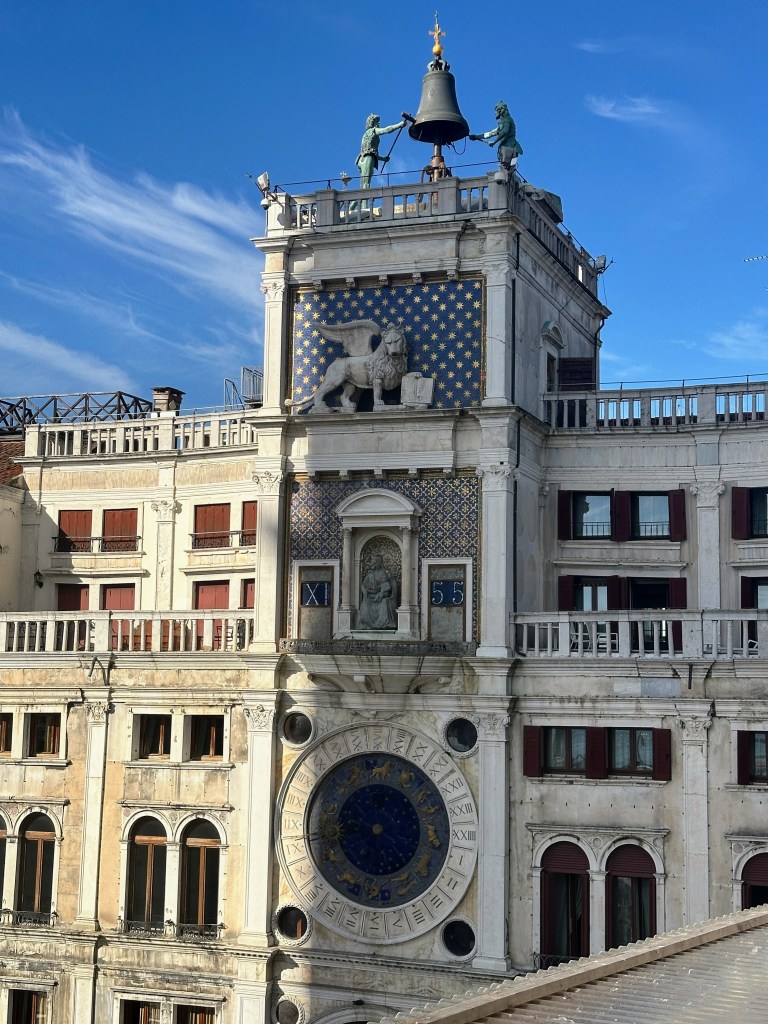
And we learned that on July 14, 1902 the Bell Tower collapsed. It was rebuilt over the next 10 years.
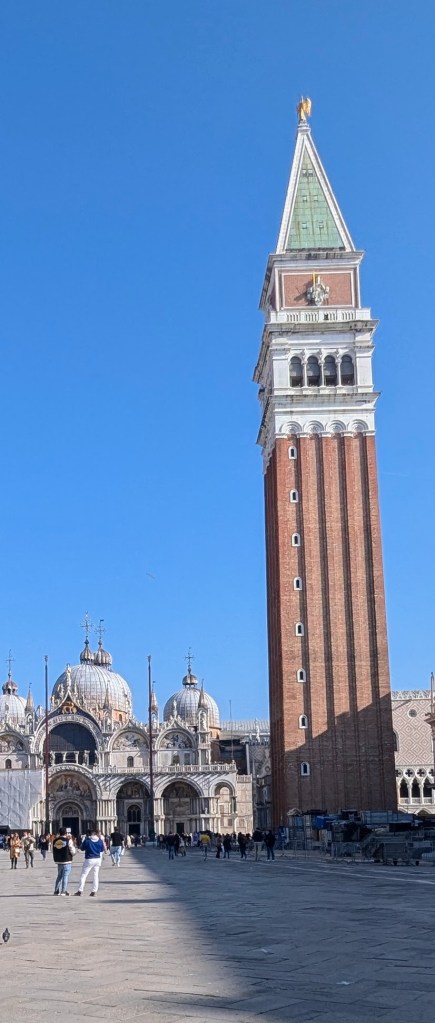
When we exited the basilica back into the plaza, we were approached and offered a free taxi ride to Murano. We had wanted to return as we had gotten there late in the day and did not get a chance to fully explore, but had been reluctant to spend the over 40 minutes in the water bus to get there, so why not? The ride took only 15 minutes this time and we were taken to a private shop
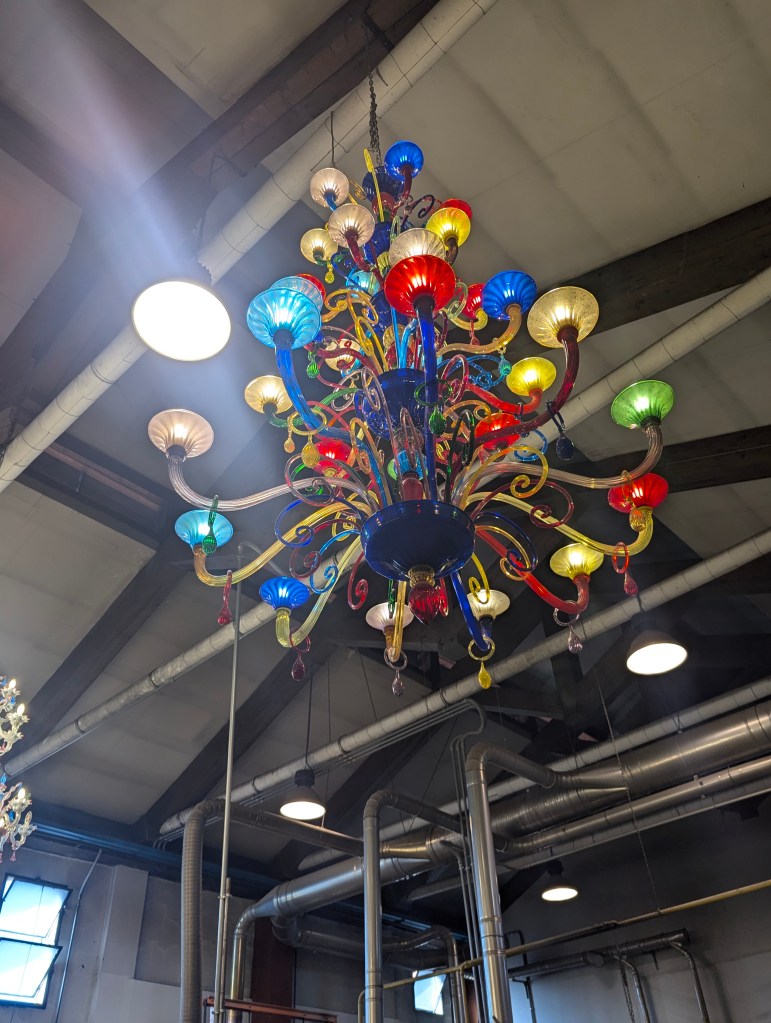
and treated to another glass blowing and sculpting demonstration.
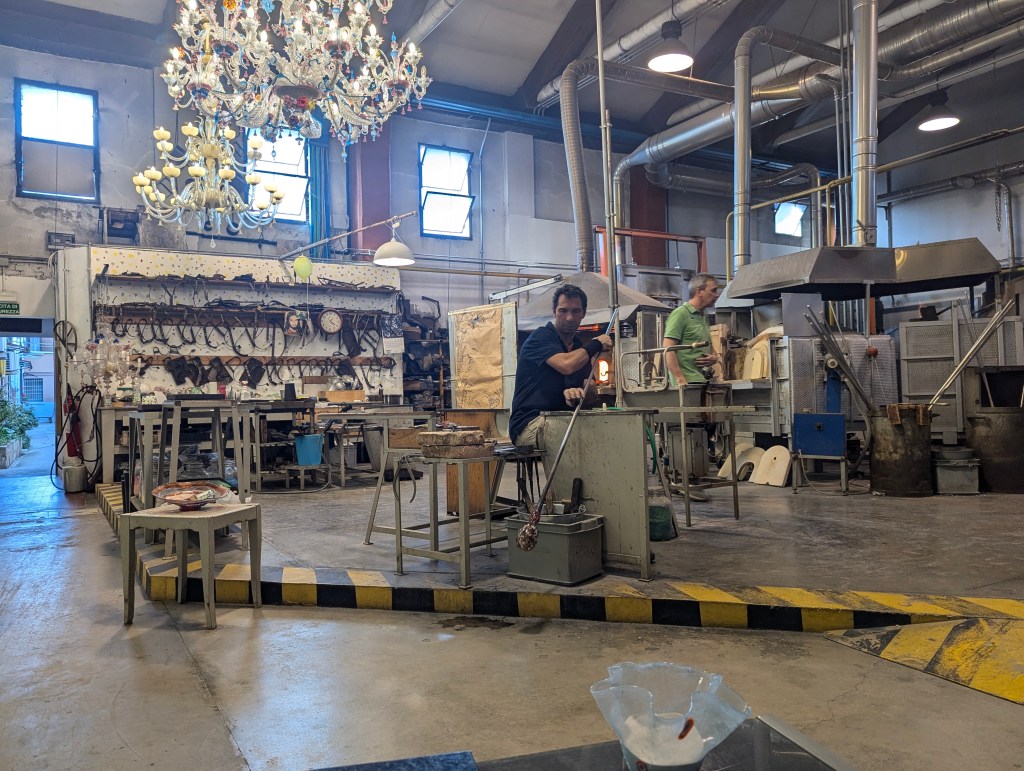
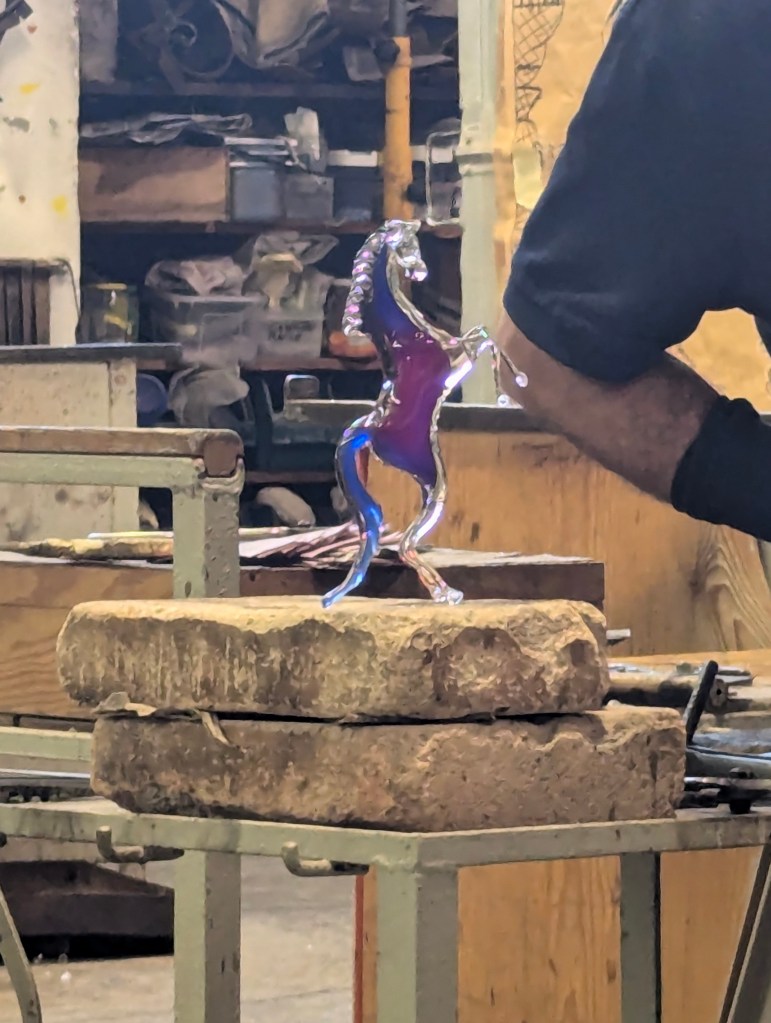
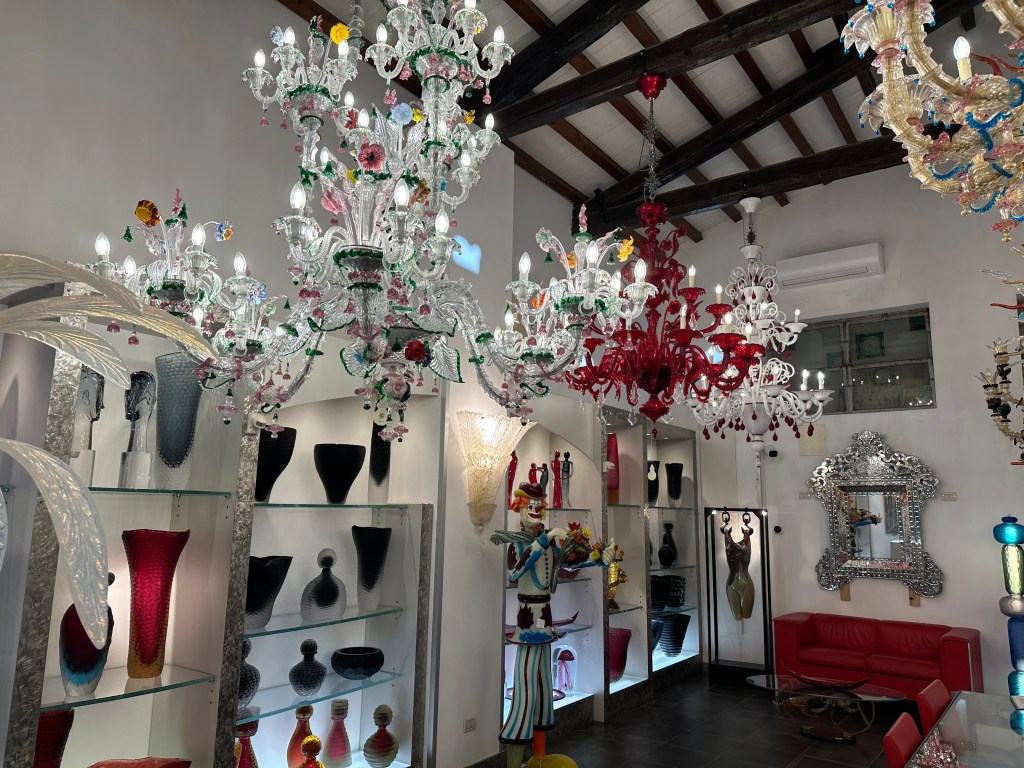
We then were guided throughout this huge shop with its many floors and so many works of art! It was better than most museums with works by dozens of masters. Unfortunately, photos were not allowed. We had to keep reminding ourselves that we do not have a home for any of these gorgeous (and very pricey) masterpieces. We then walked all around Murano, not able to get enough of these beauties.
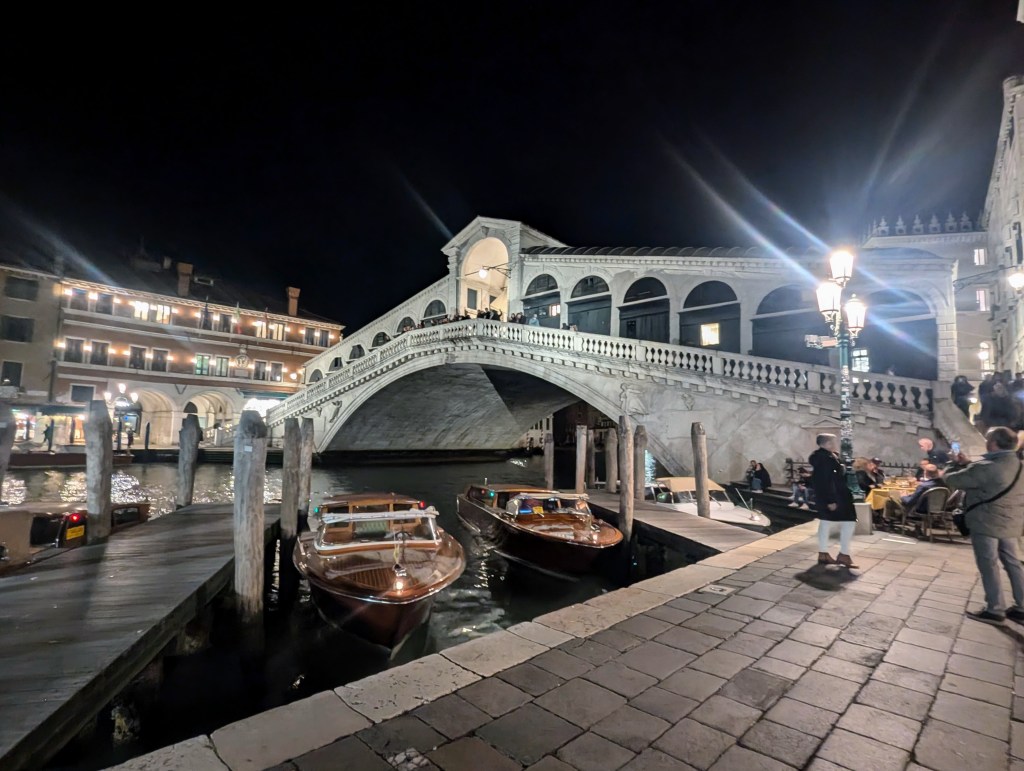
Once we’d had our fill of Murano glass, we headed back and enjoyed a dinner near the Rialto Bridge, which was beautiful lit up at night.
For our final day in Venice we had tickets to visit the Doge’s Palace. With the ticket came a ticket to the Correr Museum, which we were to see first.
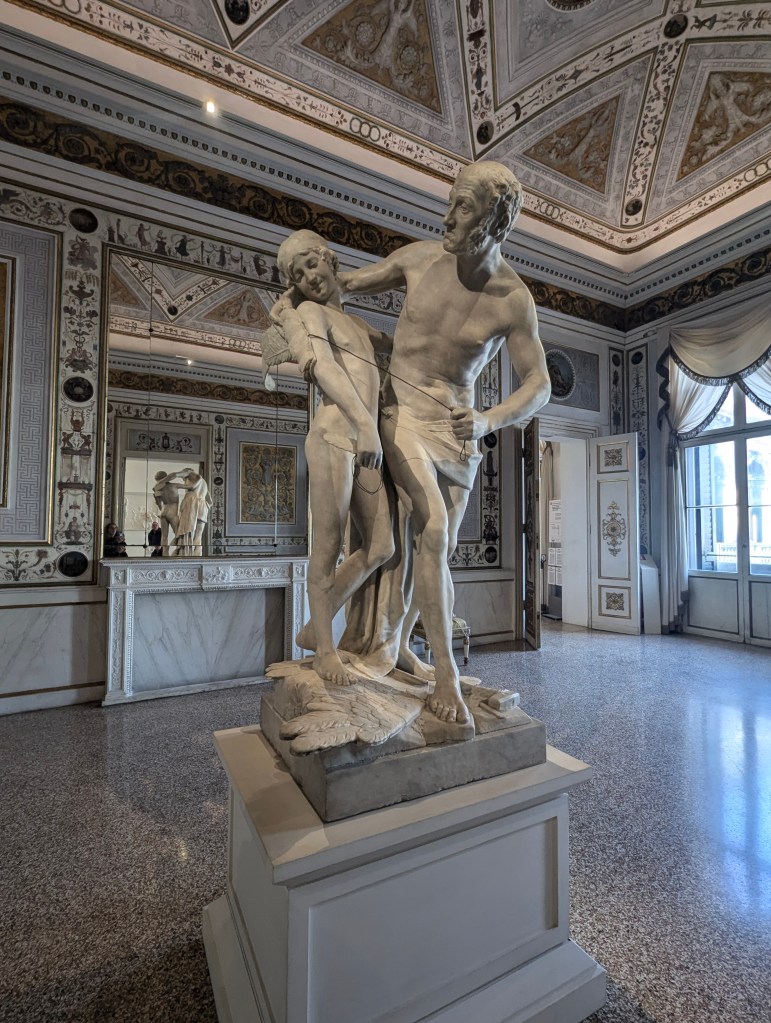
I can only say that this was the most poorly curated museum I have ever visited with little sense to the layout or collections. It had ancient sculptures
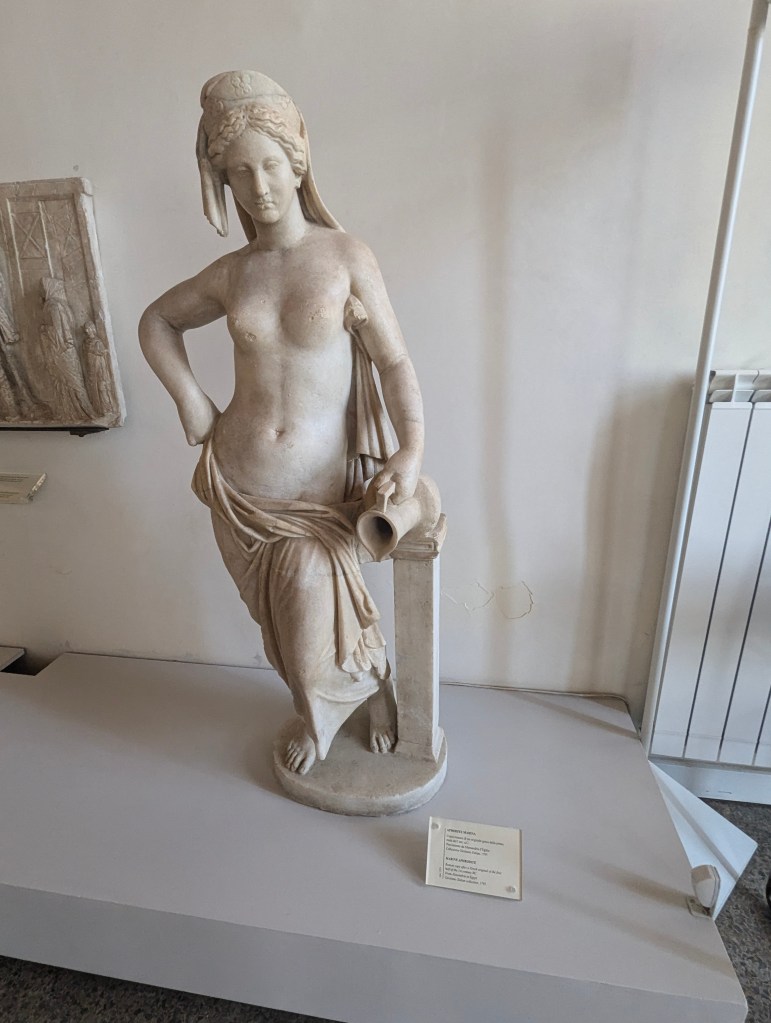
and renaissance sculptures
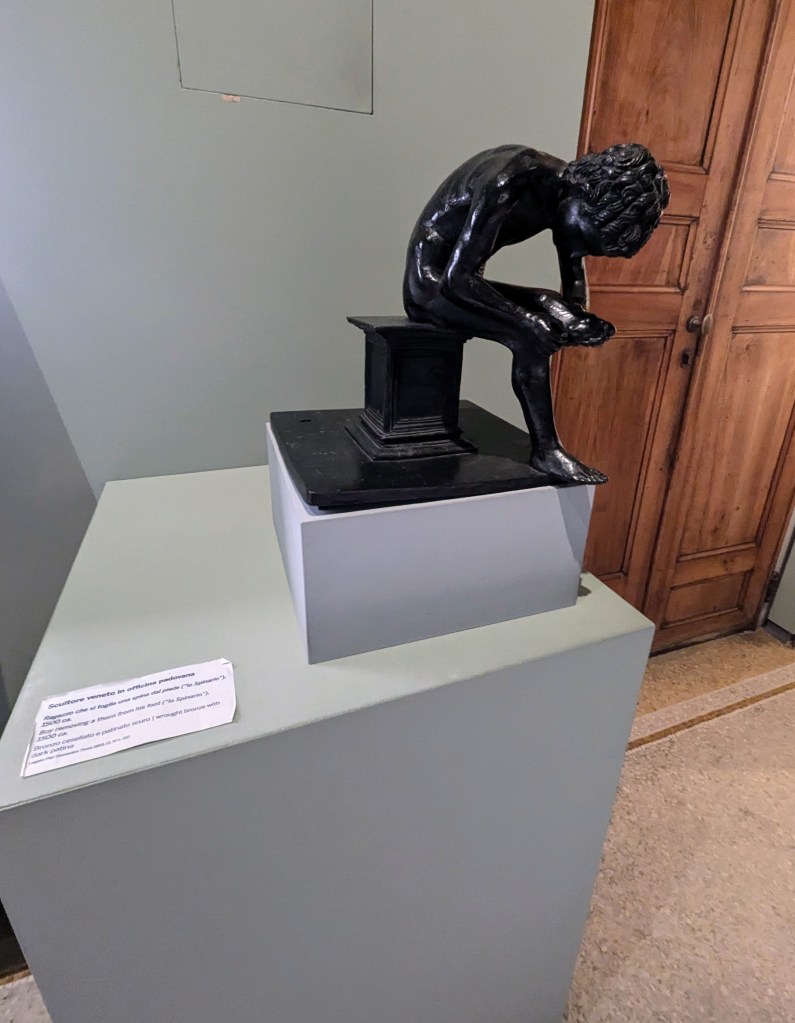
and some interesting architectural elements

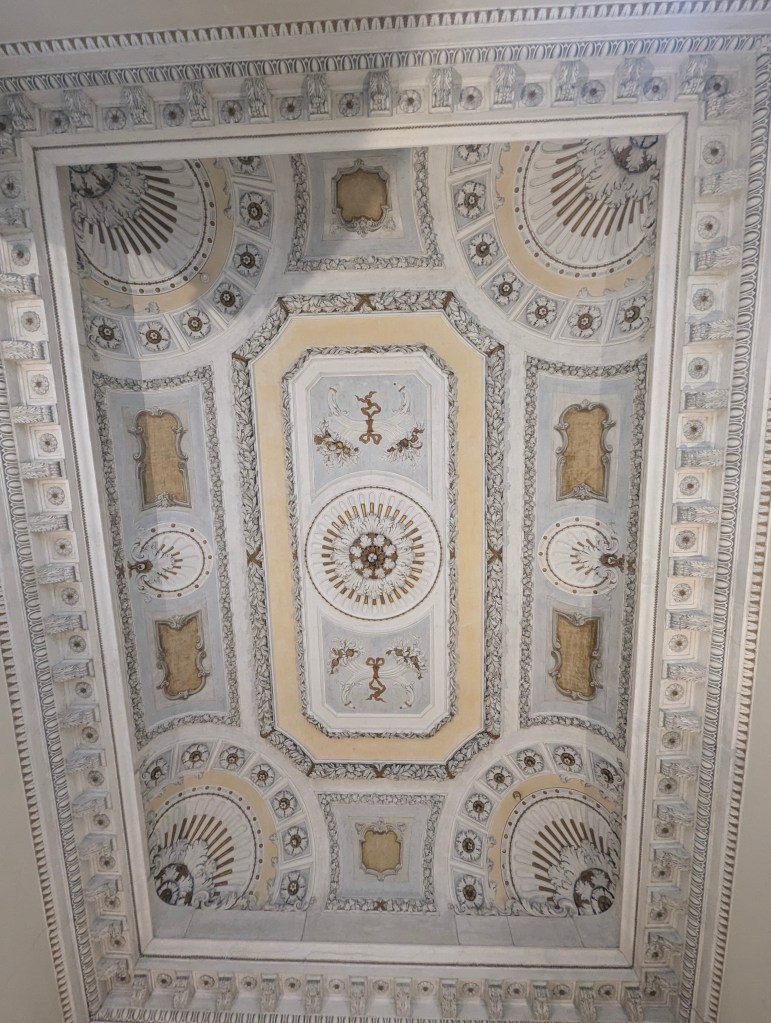
But overall, it was mostly a waste of time. We did see a few tidbits worth noting. There was a mint for making coins.
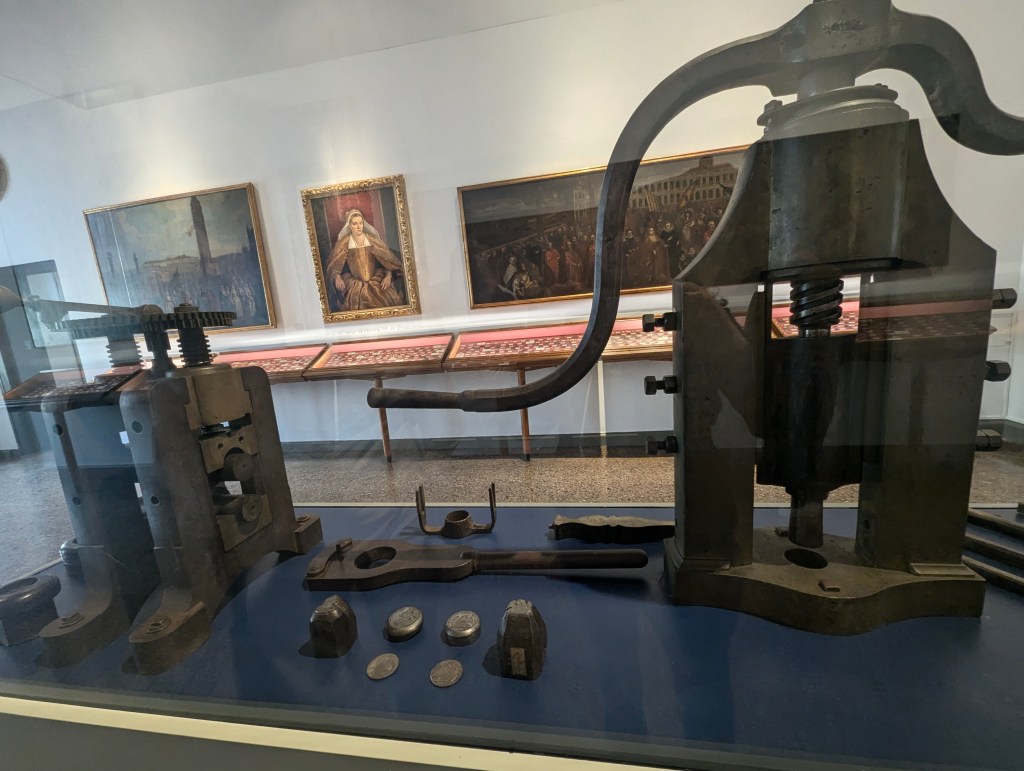
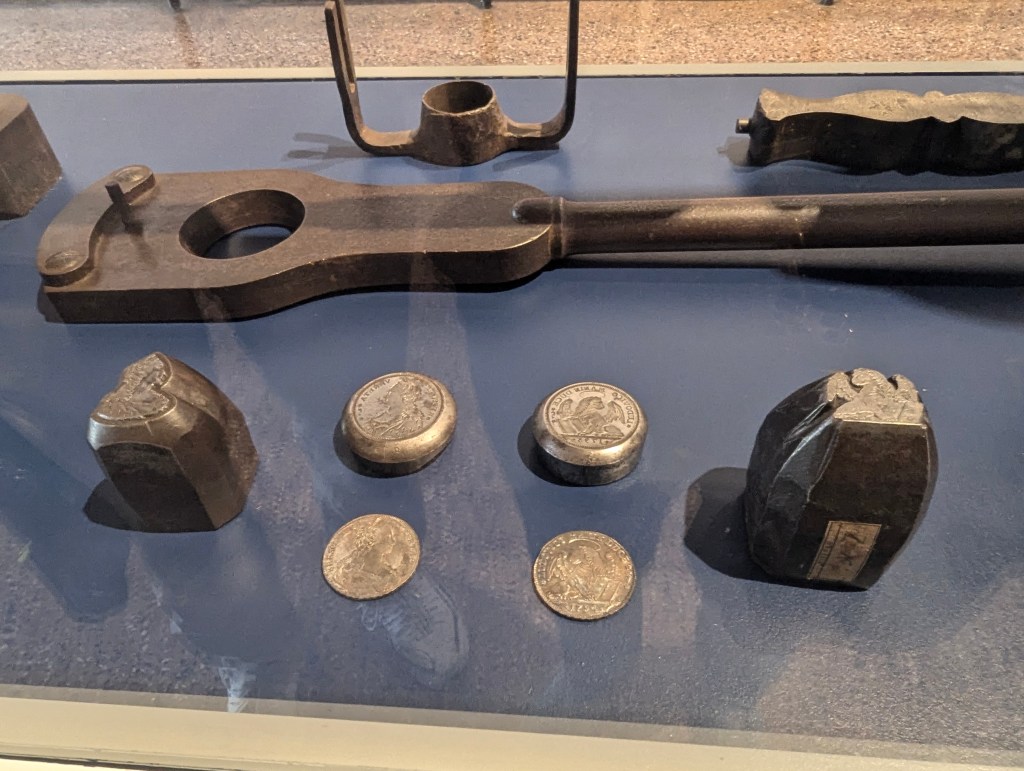
There were sailing implements
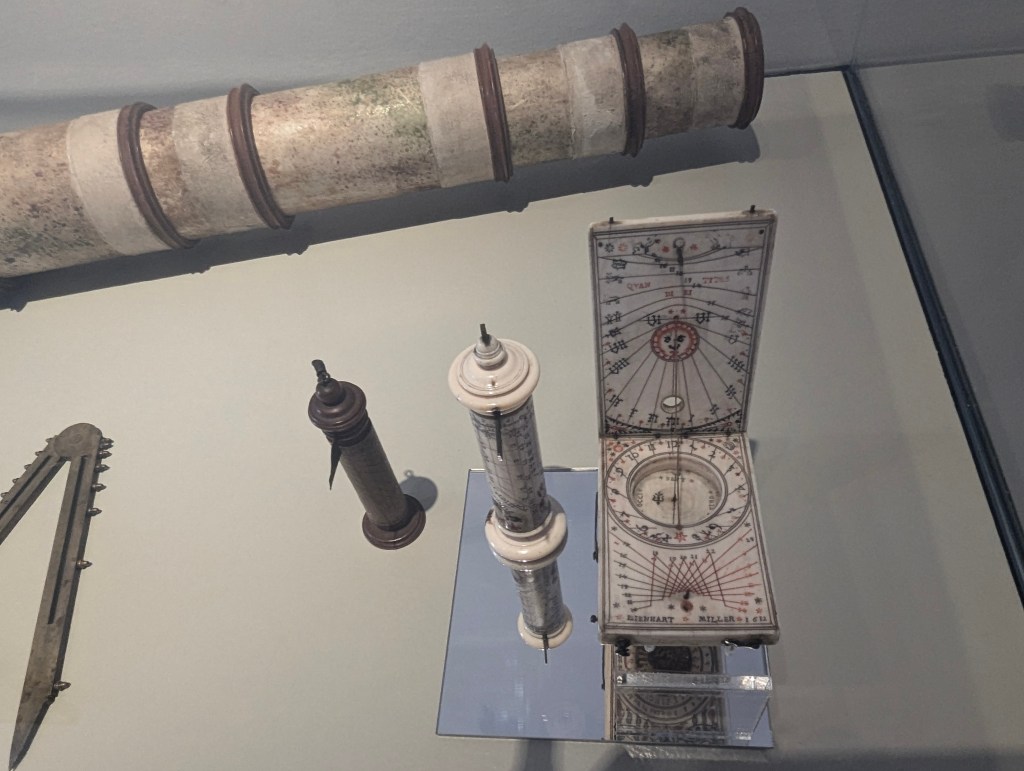
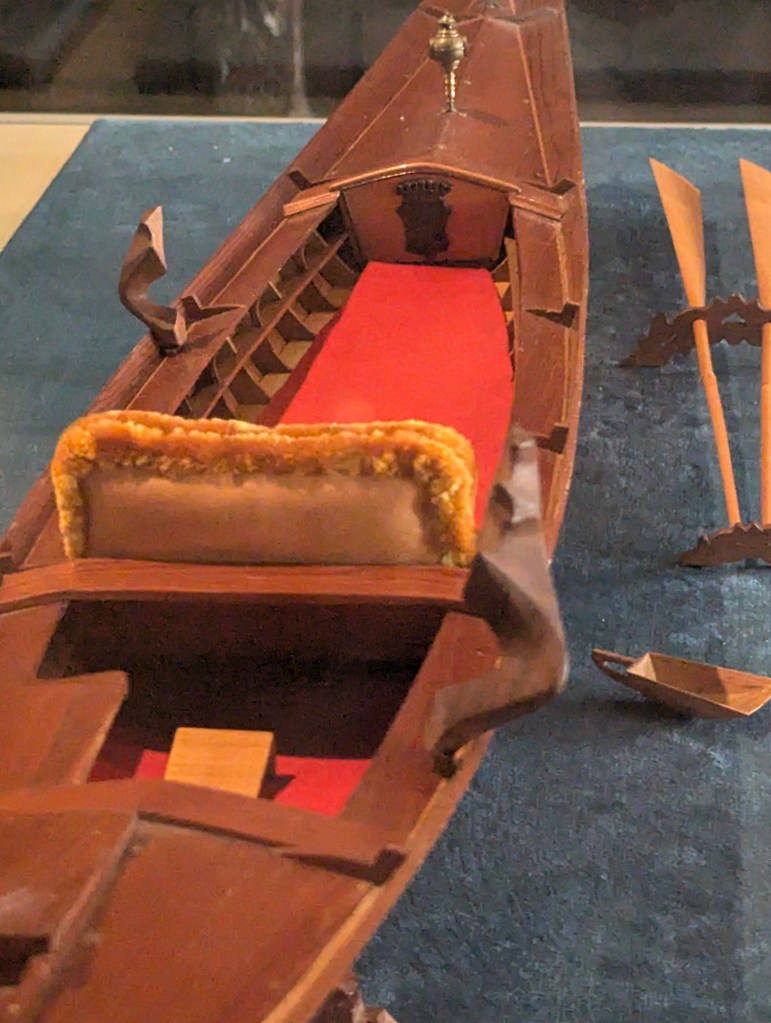
and the funky shaped oarlocks for which Venice is famed.
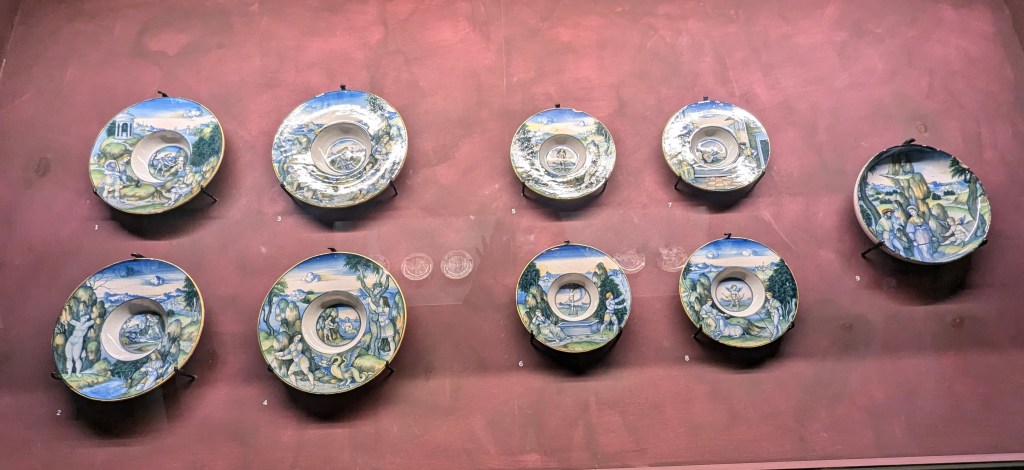
and some collections of porcelains brought from the East.
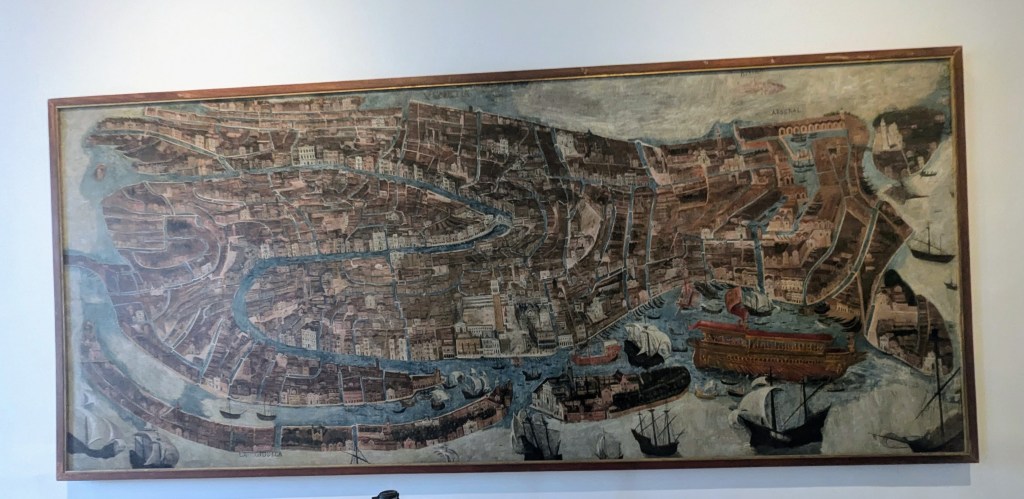
There were medieval maps of Venice.
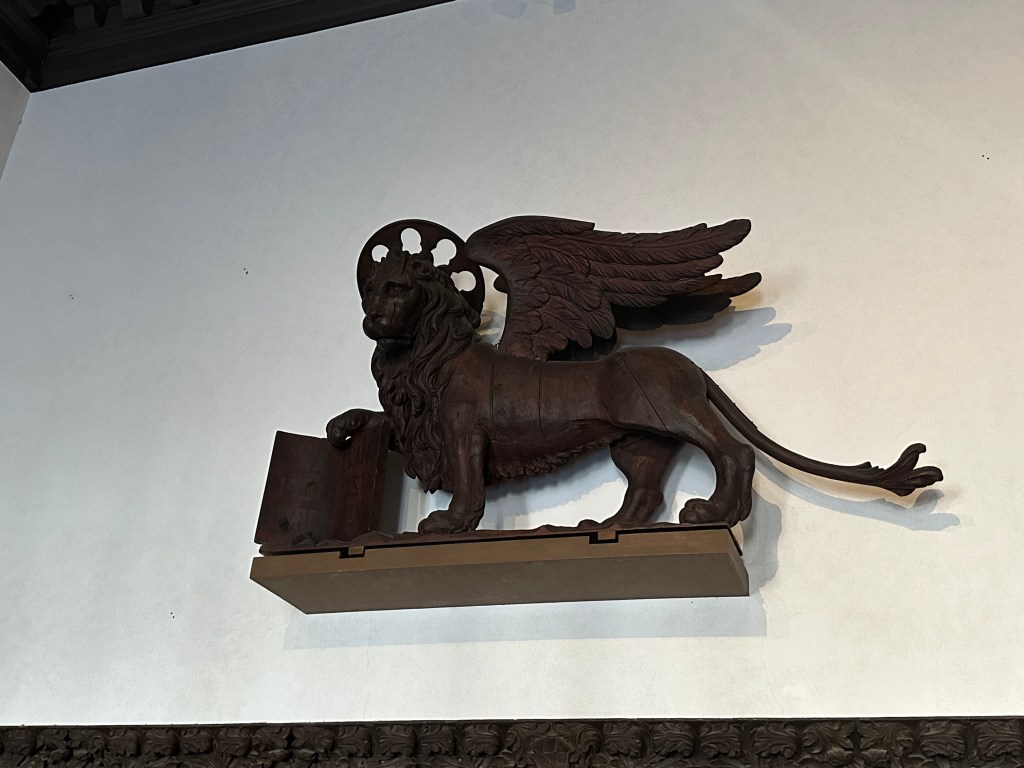
and several depictions of the lion with his paw on an open book: the symbol for St. Mark the Evangelist.
Finally it was time for our entrance to the Doge’s Palace.
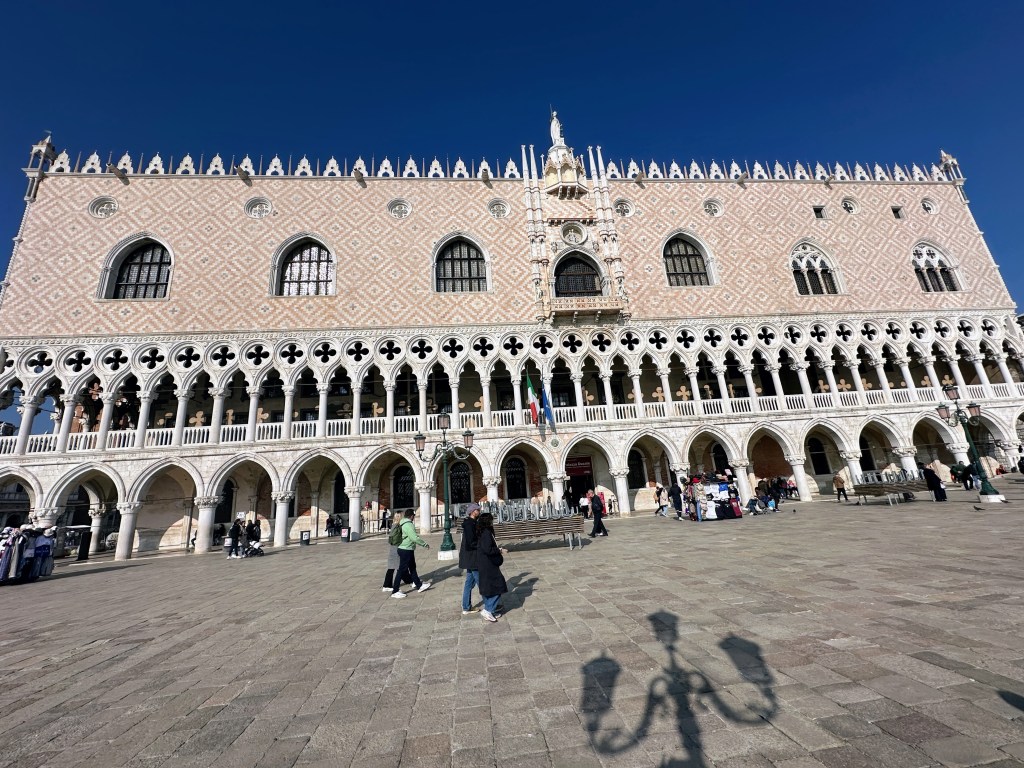
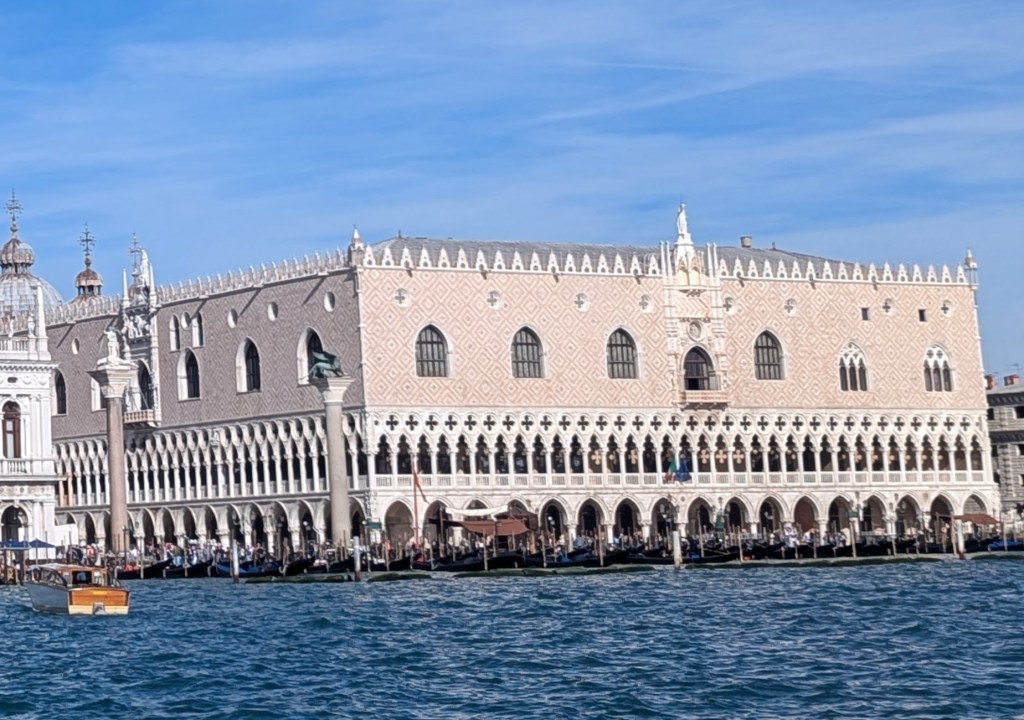
Doge is elected for life, the only position in the republic for which this is true. The first nucleus of the Doge’s Palace was built in the 810; none of it remains. It was rebuilt in 1340 with modifications made through the centuries. The oldest part of the palace is the wing overlooking the lagoon, the corners of which are decorated with 14th-century sculptures.
The north side of the courtyard is closed by the junction between the palace and St Mark’s Basilica , which used to be the Doge’s chapel. At the centre of the courtyard stand two well-heads dating from the mid-16th century.
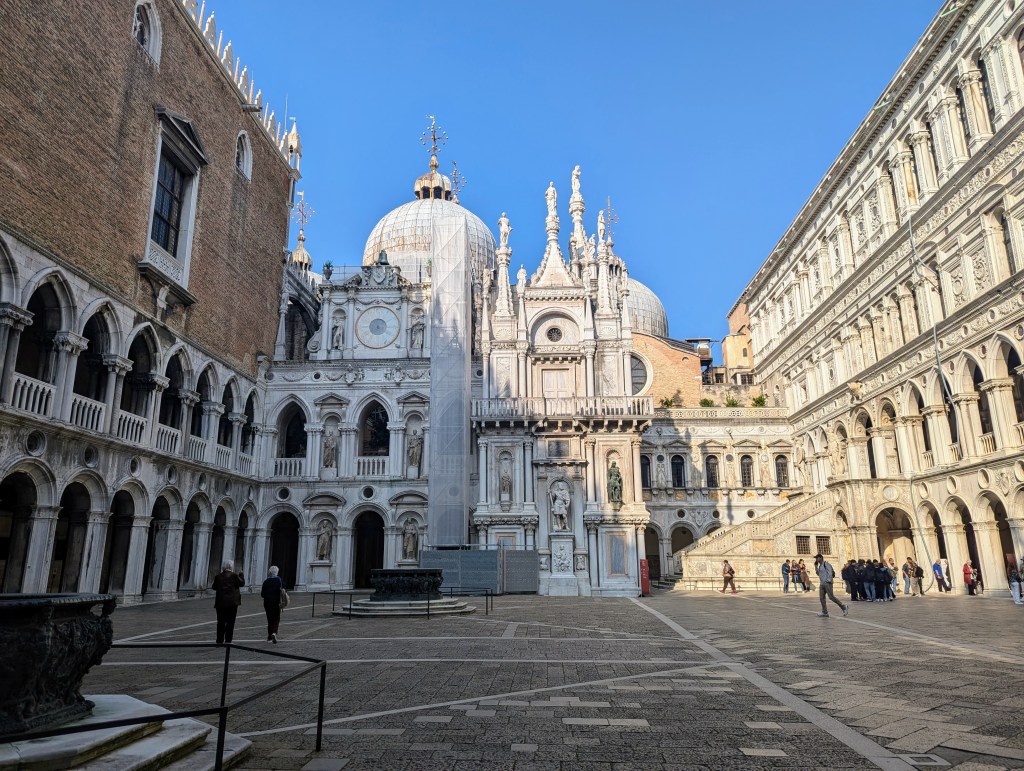
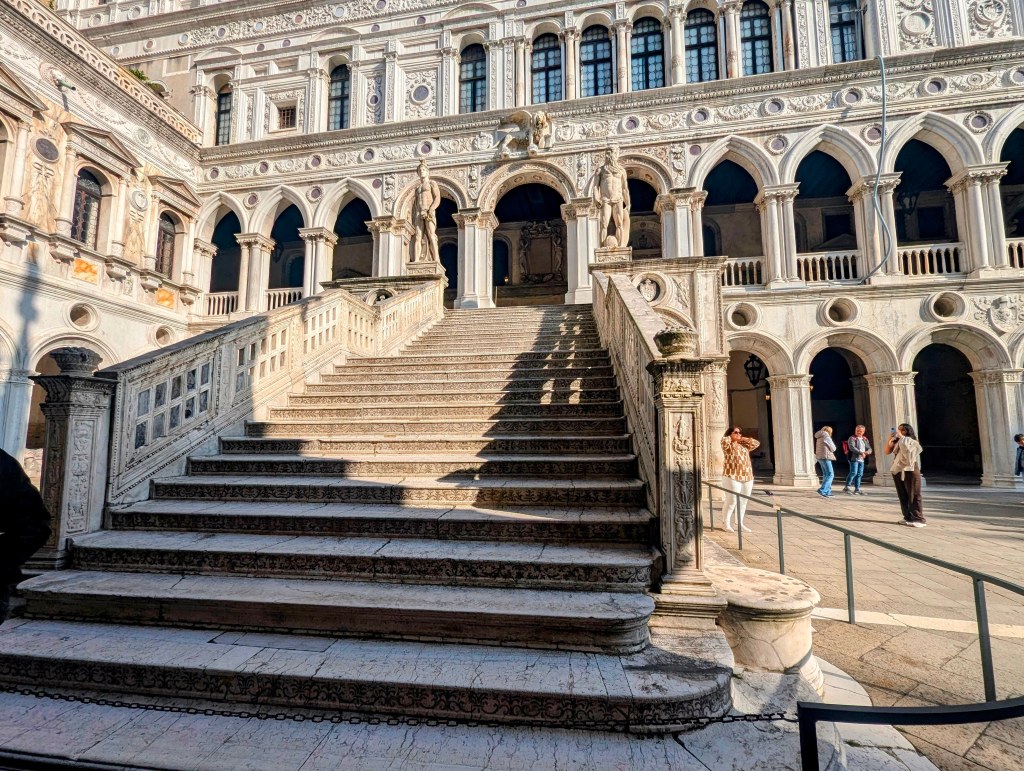
In 1485, the Great Council decided that a ceremonial staircase should be built within the courtyard.
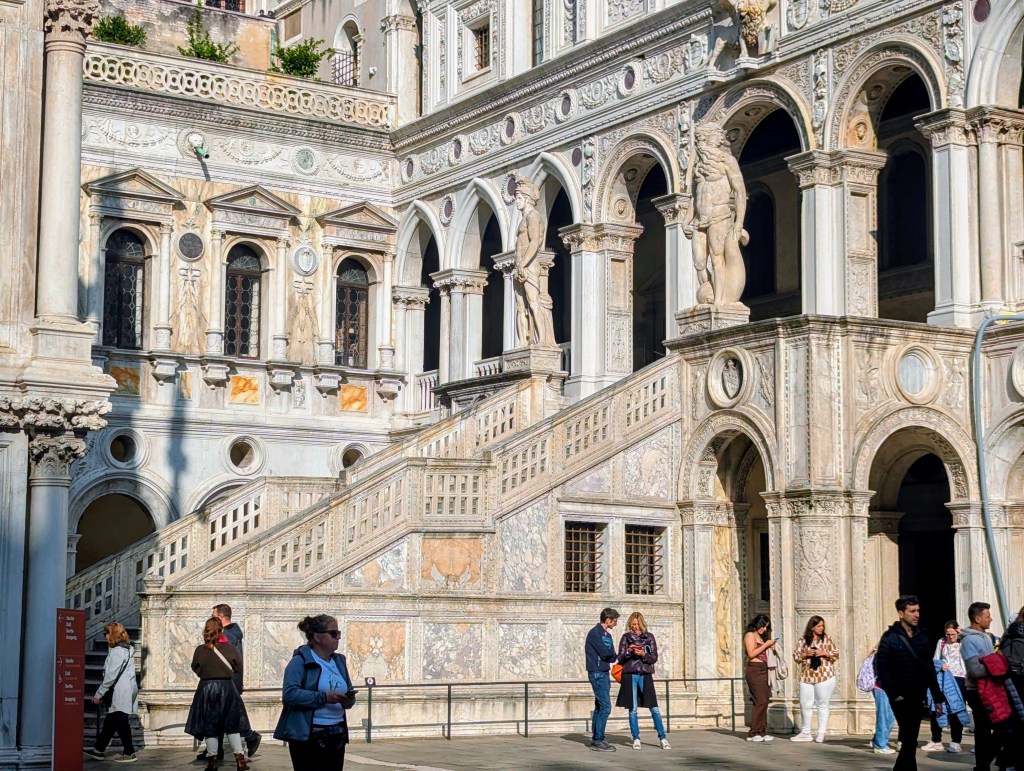
Since 1567, the Giants’ Staircase is guarded by two colossal statues of Mars and Neptune, which represents Venice’s power by land and by sea, and therefore the reason for its name.
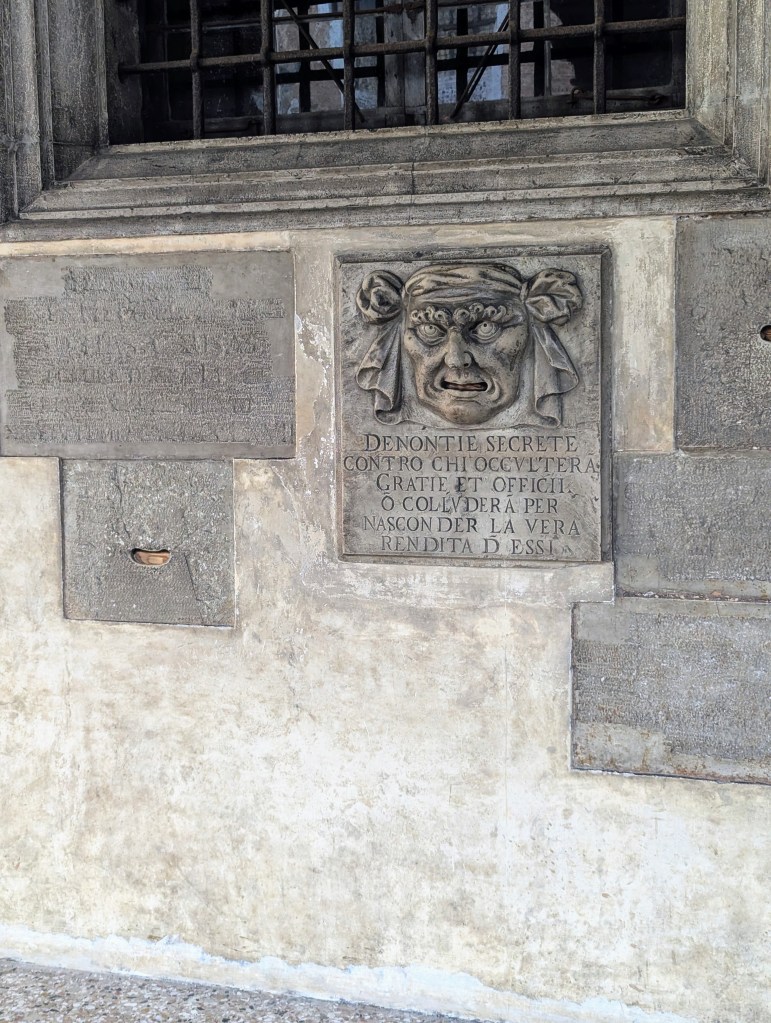
In the courtyard is a hole in the mouth of a monster which passes into the Doge Palace through which secret “suggestions” may be placed.
The palace is entered from the courtyard
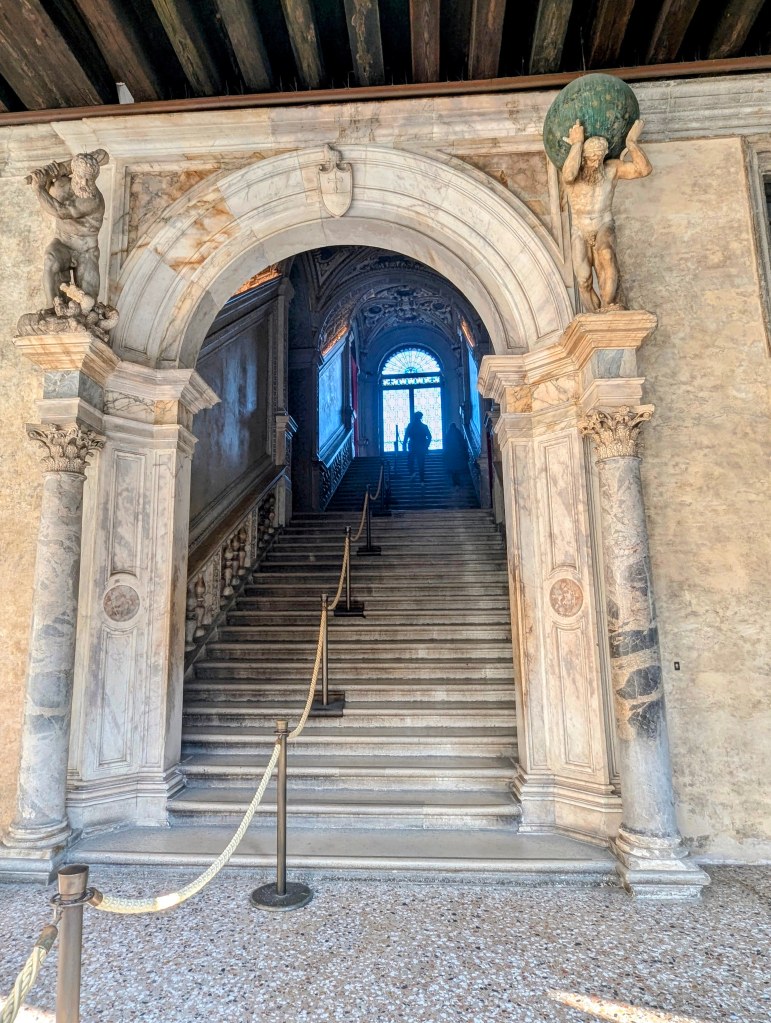
and onto the Golden Staircase, which was built to separate the courthouse, located to the south, from the doge’s private flat to the north. The first of its five flights is dedicated to Venus, Venice in allegory.

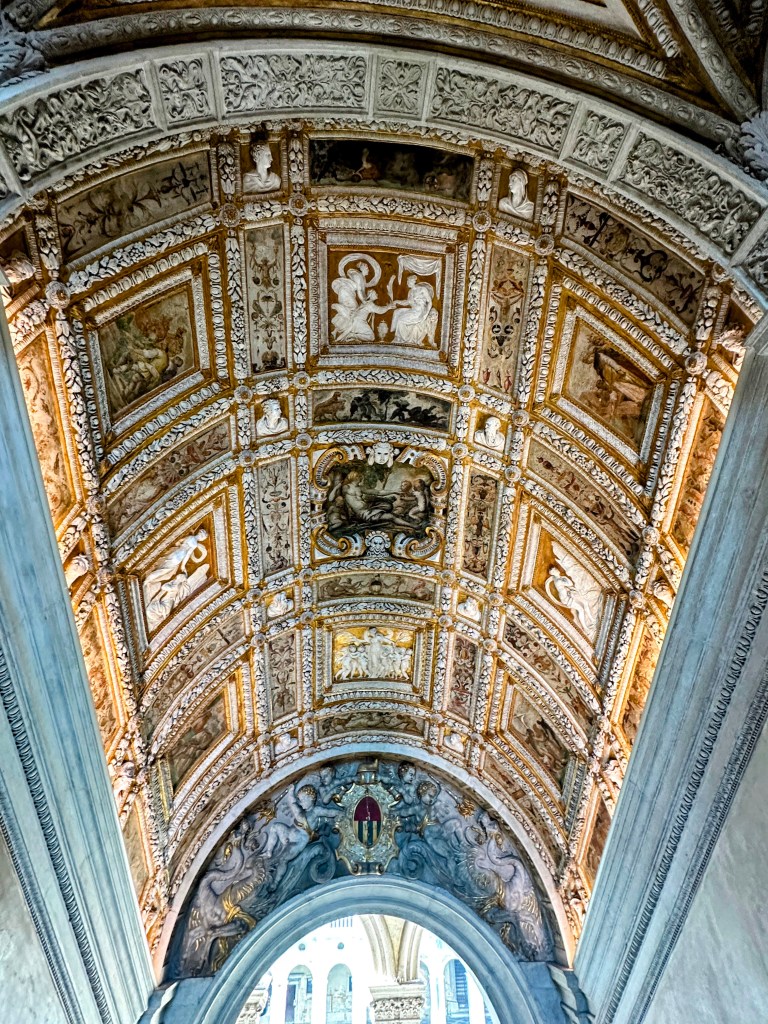
The second is dedicated to Neptune, representing the city’s dominion over the sea.
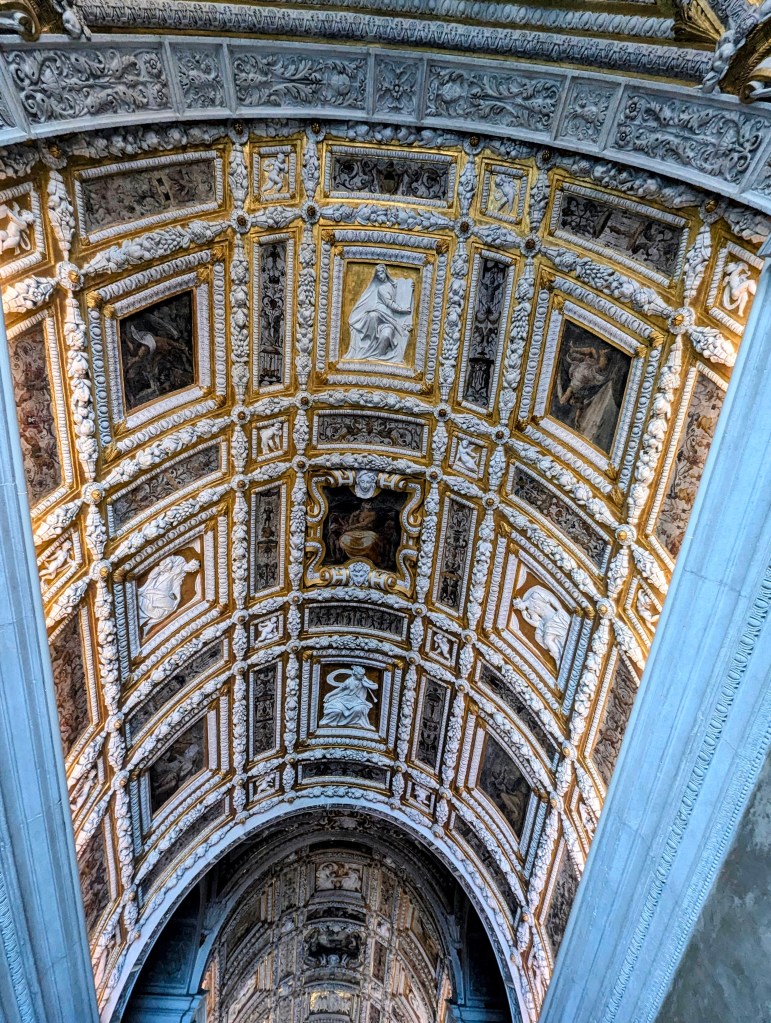
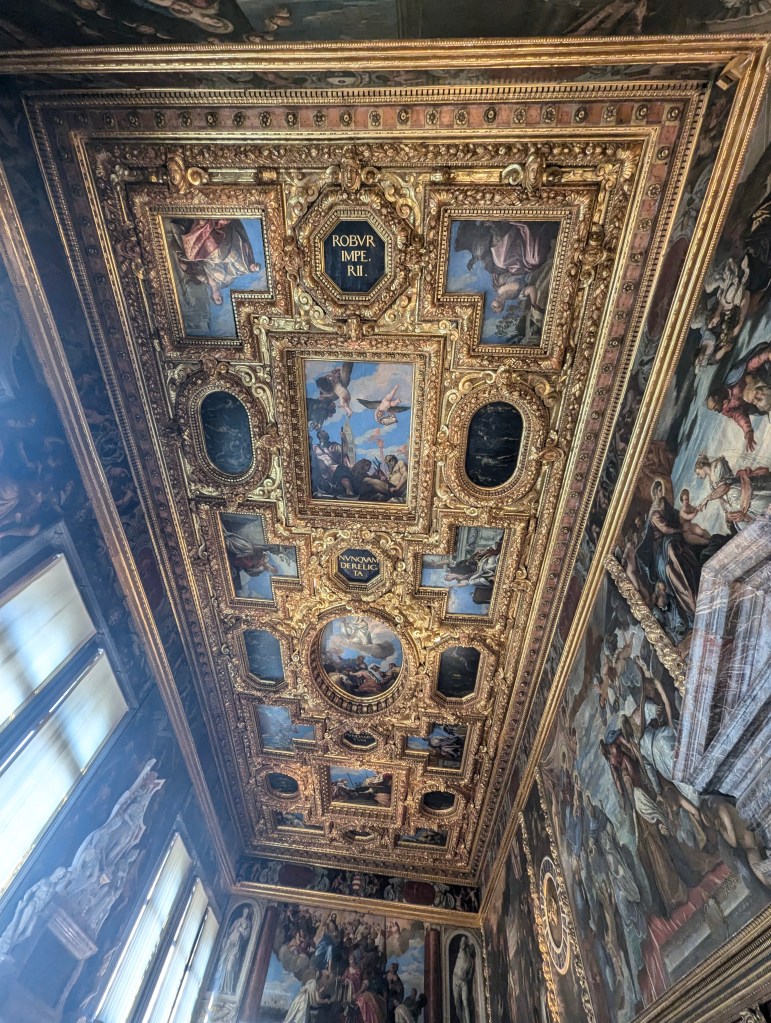
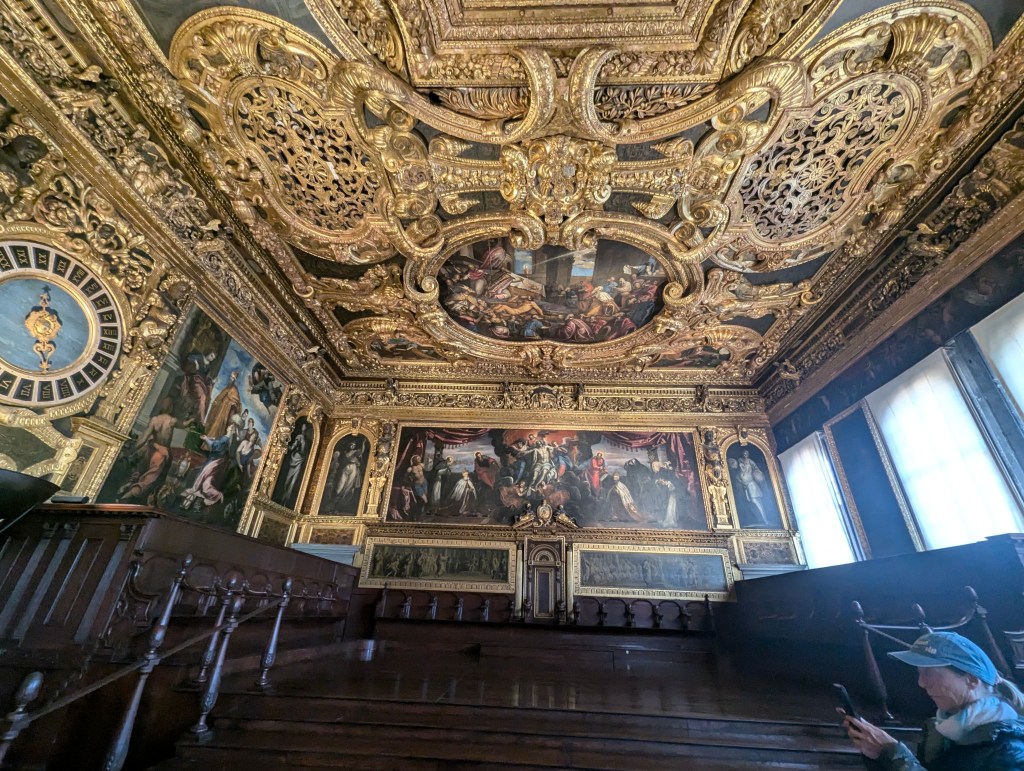
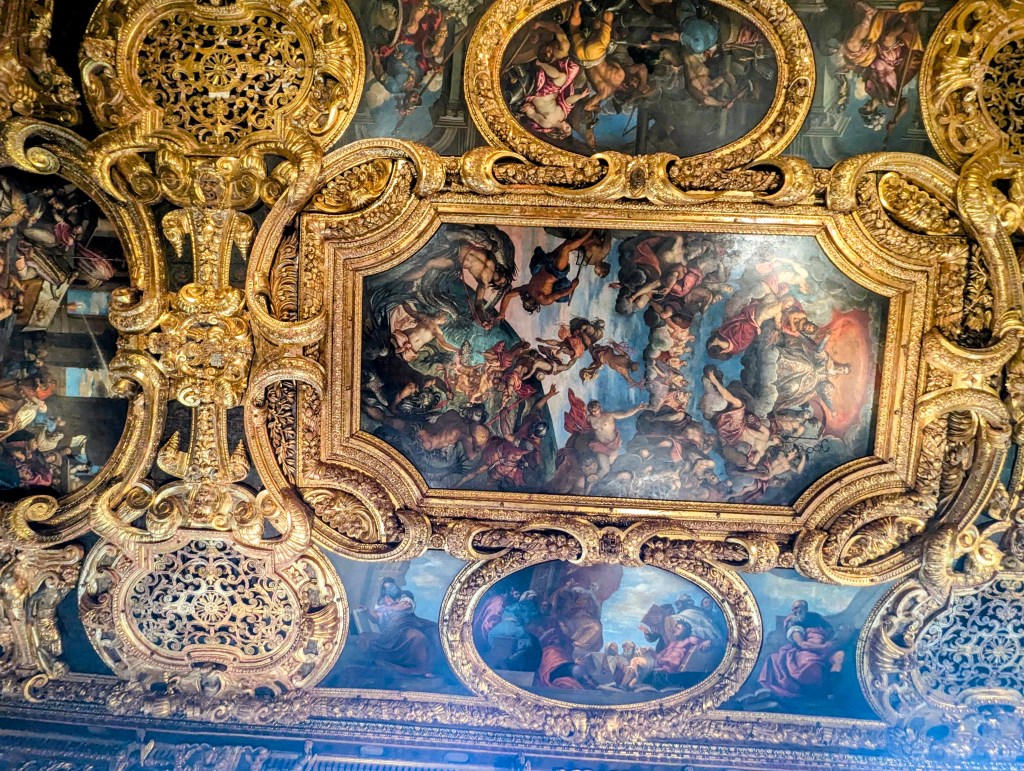
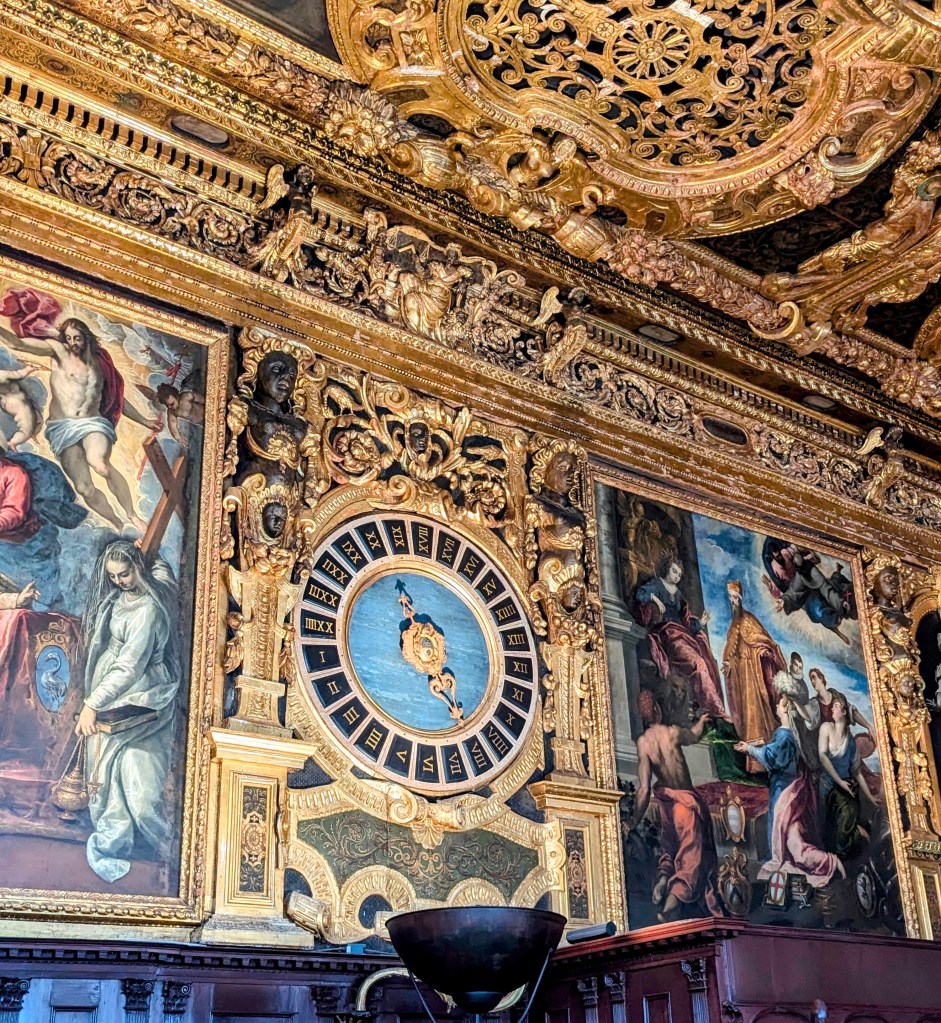
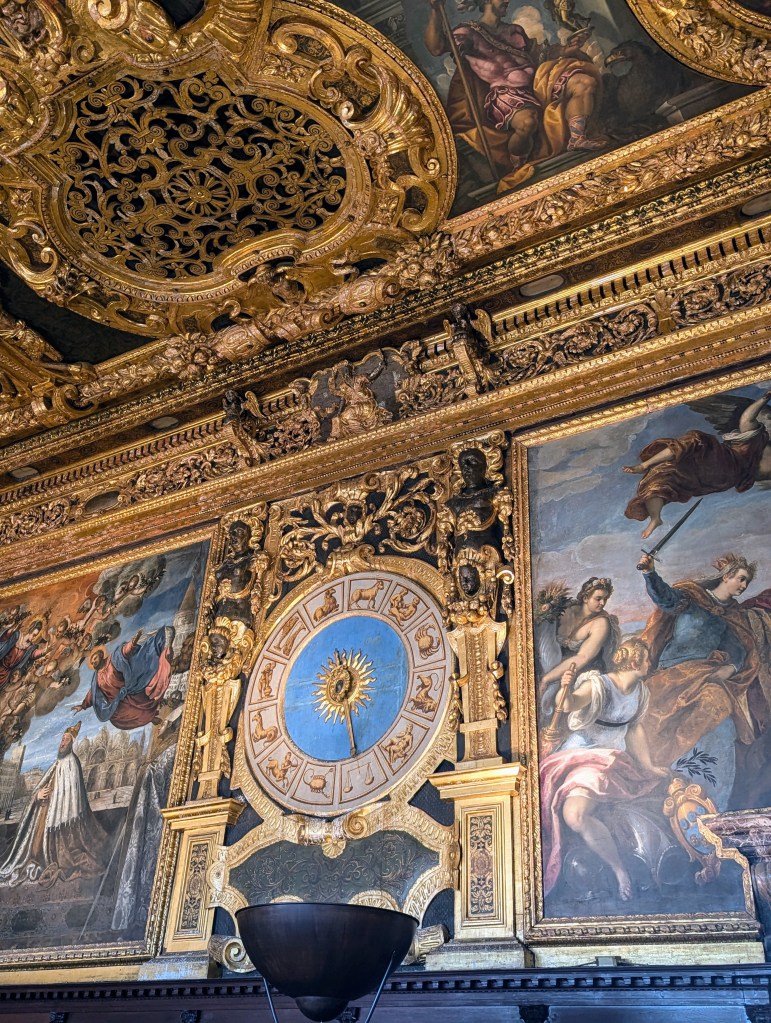
Once upstairs, we entered the meeting rooms of the different councils. We had audio guides which explained the purpose of each room and the ceiling frescoes and wall art that depicted scenes from history relevant to the works of each committee. But it was way too overwhelming to remember much other than to be able to recognize the Doge’s hat and to know that an olive branch always symbolizes peace. Also there were two large fires. The first in 1574 involved the lower government floors; the second in 1577 involved the rooms in the upper councils’ wing. In both numerous artworks were lost, but there was no structural damage. Here are some of the pictures of the government meeting rooms.

Note another 24 hour clock.
and another clock using the zodiac symbols
Each of the mythological scenes depicted is also an allegory of the Republic’s government.
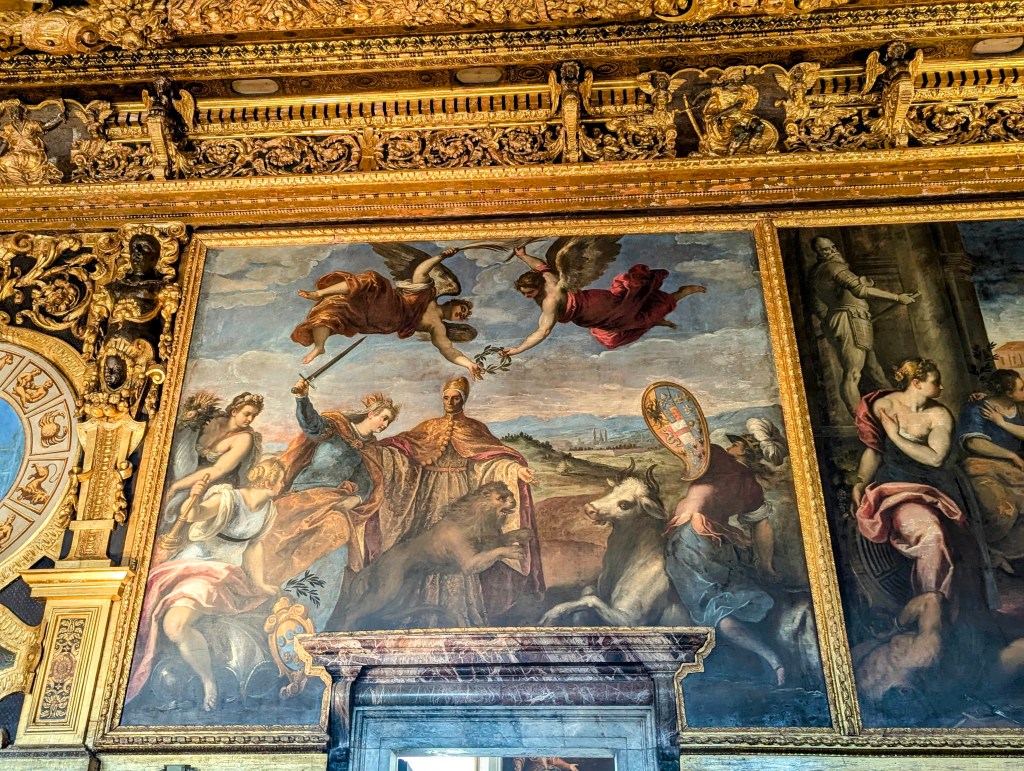
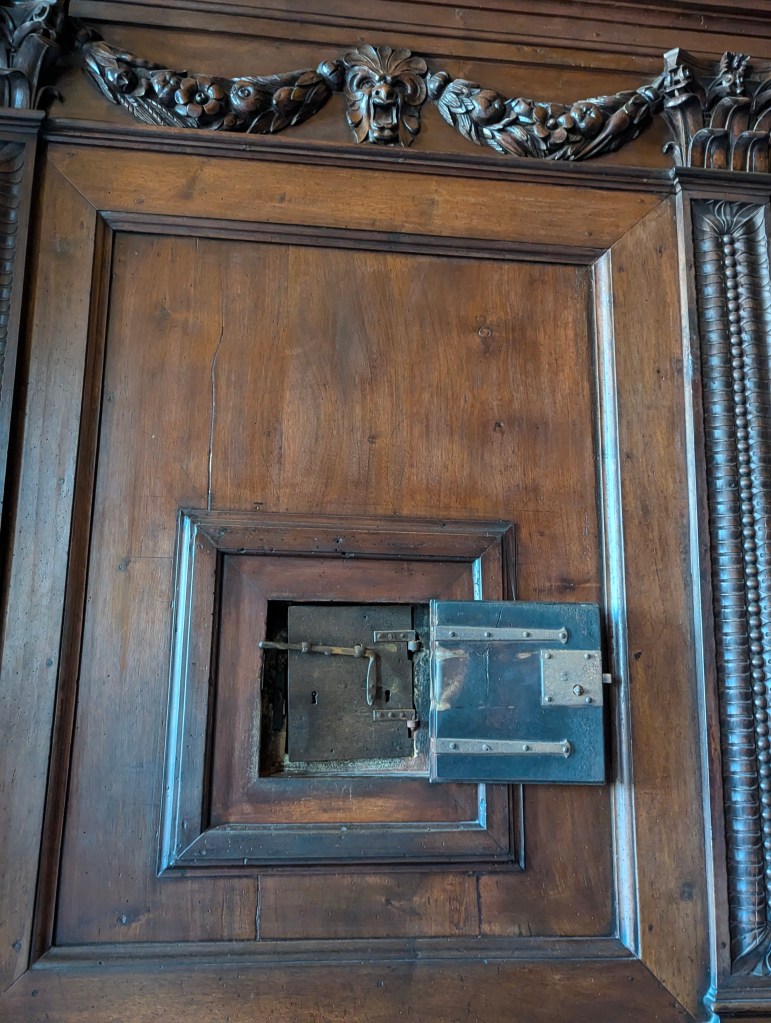
There is also a secret “suggestion box” internal.
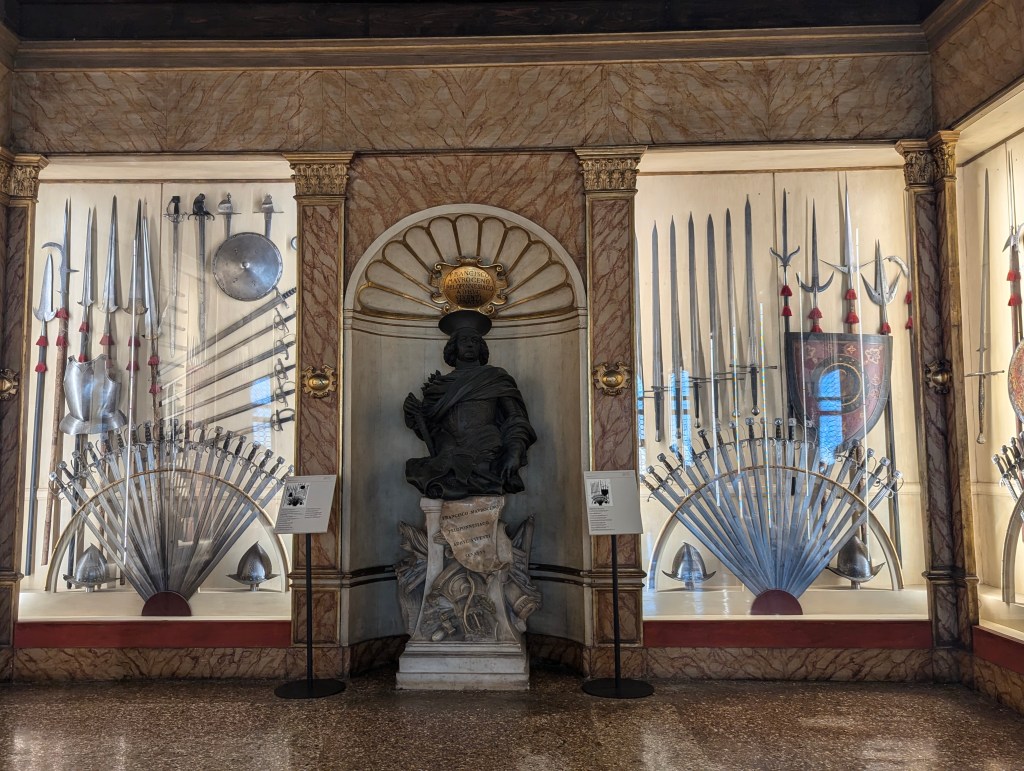
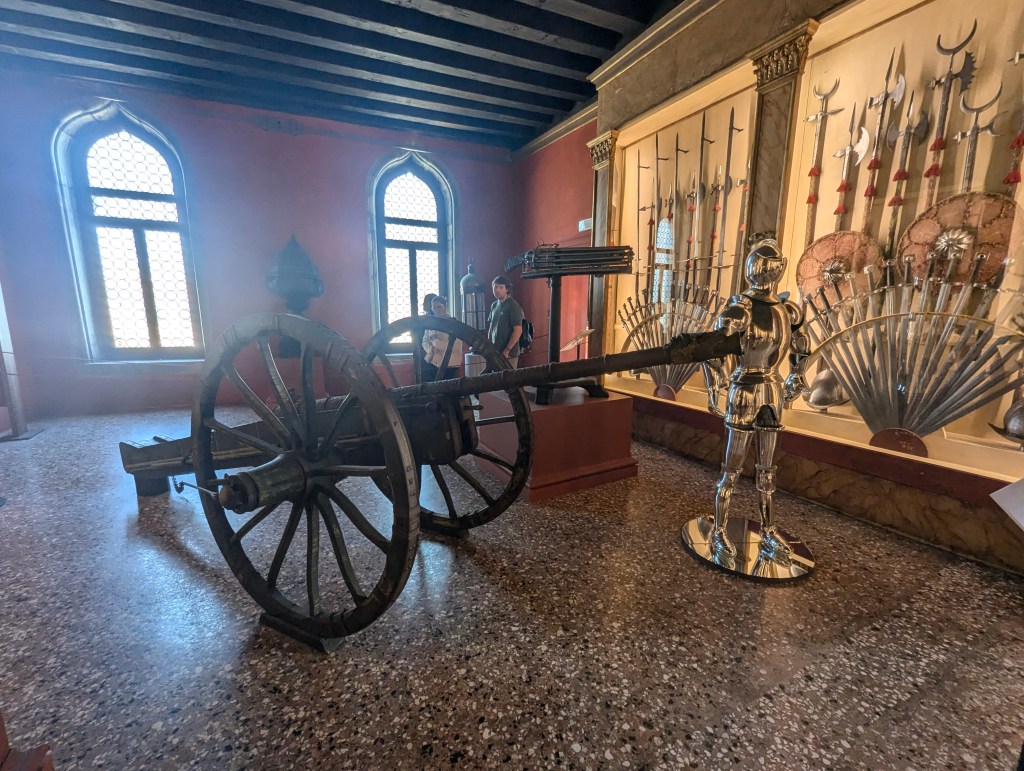
We were taken through the armory
with a precursor to the modern machine gun

and a mobile cannon.
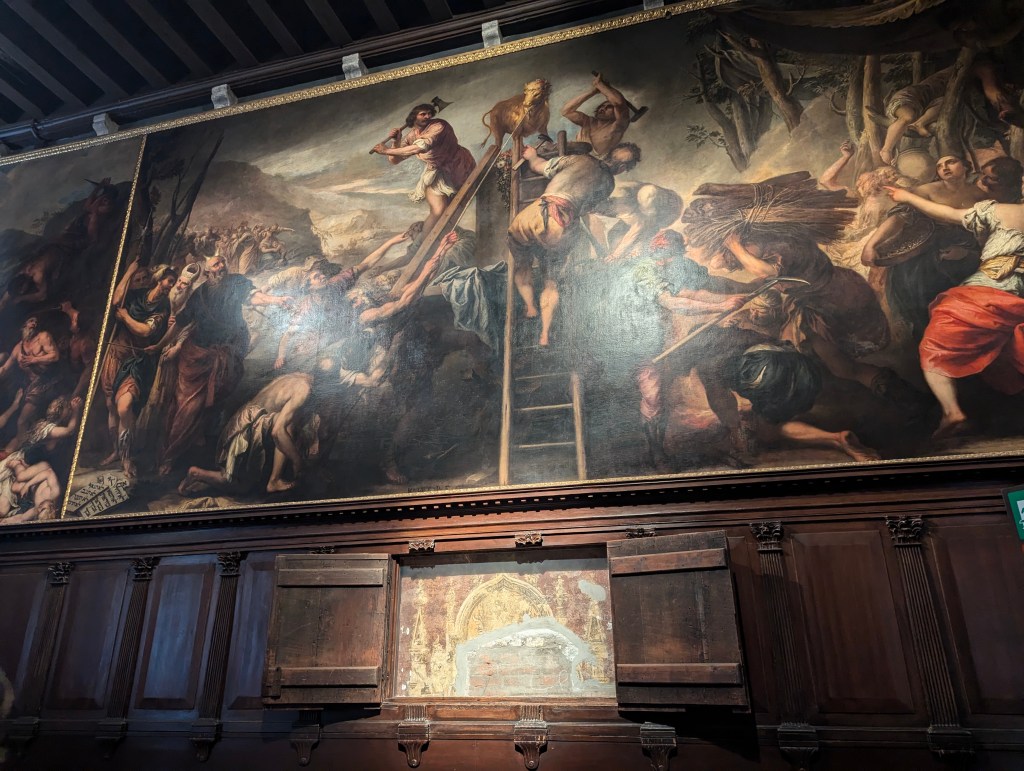
In areas that were redecorated after the fires, a window to the preexisting frescoes was saved.
The largest meeting hall, the Chamber of the Great Council, is 180 feet long by 82 feet wide and is one of the largest in Europe and could hold more than 2,000 people. Here, meetings of the Great Council were held, the most important political body in the Republic. A very ancient institution, this Council was made up of all the male members of patrician Venetian families over 25 years old, irrespective of their individual status, merits or wealth. This was why, in spite of the restrictions in its powers that the Senate introduced over the centuries, the Great Council continued to be seen as a bastion of Republican equality.
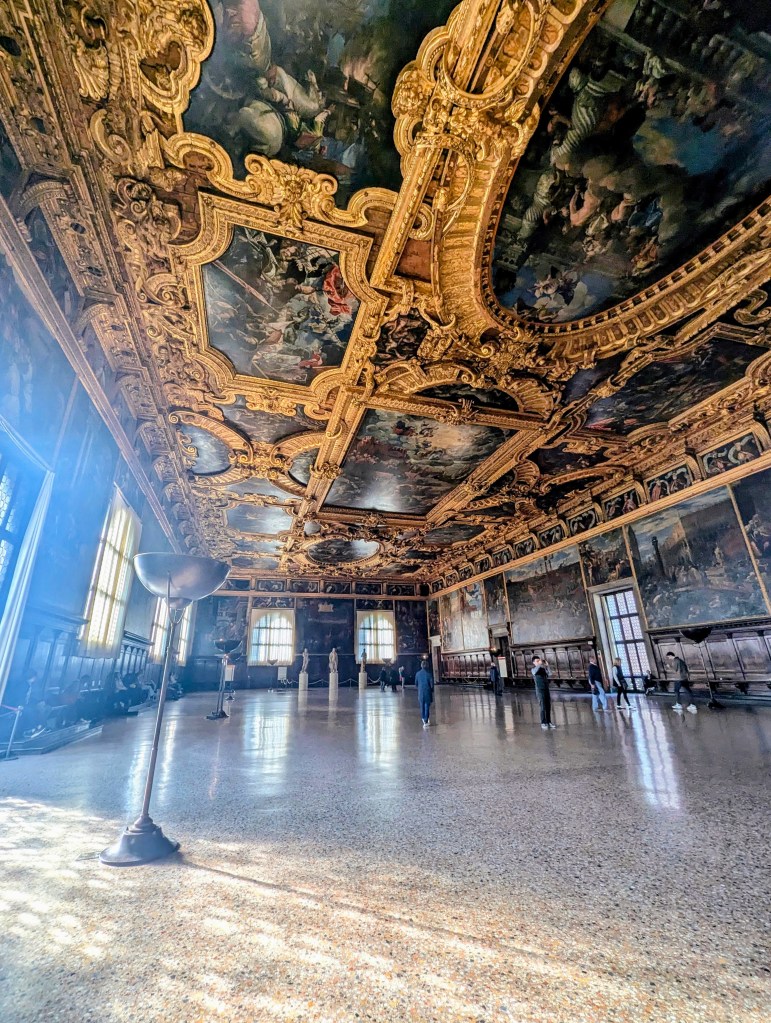
This is one of the rooms destroyed in the 1577 fire. The current works mostly date from the late 16th century. On the walls are large canvases depicting episodes from Venetian history such as The Fourth Crusade of 1202, on the side facing the basin, and The Peace of Venice, the theme being the city’s relations with the papacy and the Holy Roman Empire.
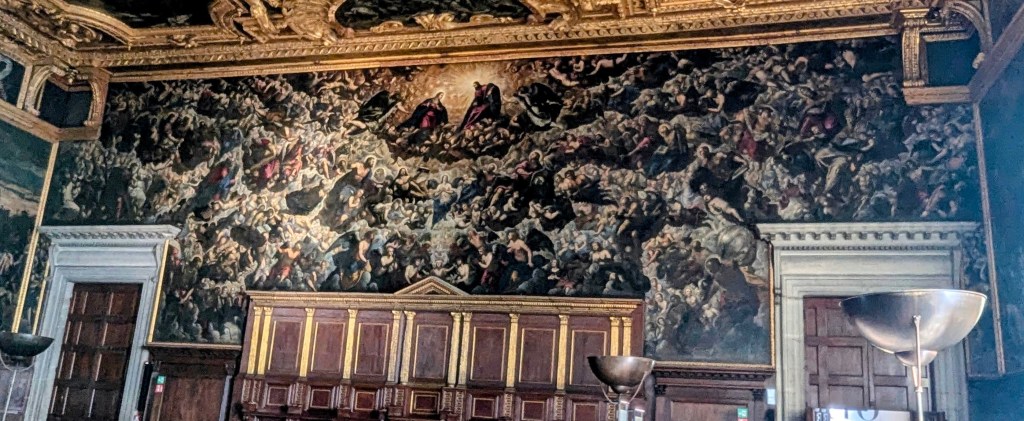
On the far end is a canvas depicting the Il Paradiso painted by Tinteretto and is the longest painted canvas in the world. The theme is not only religious but also the Allegory of Good Government, the light is the divine essence that enters the figure of the doge and allows him to always make the right decision.
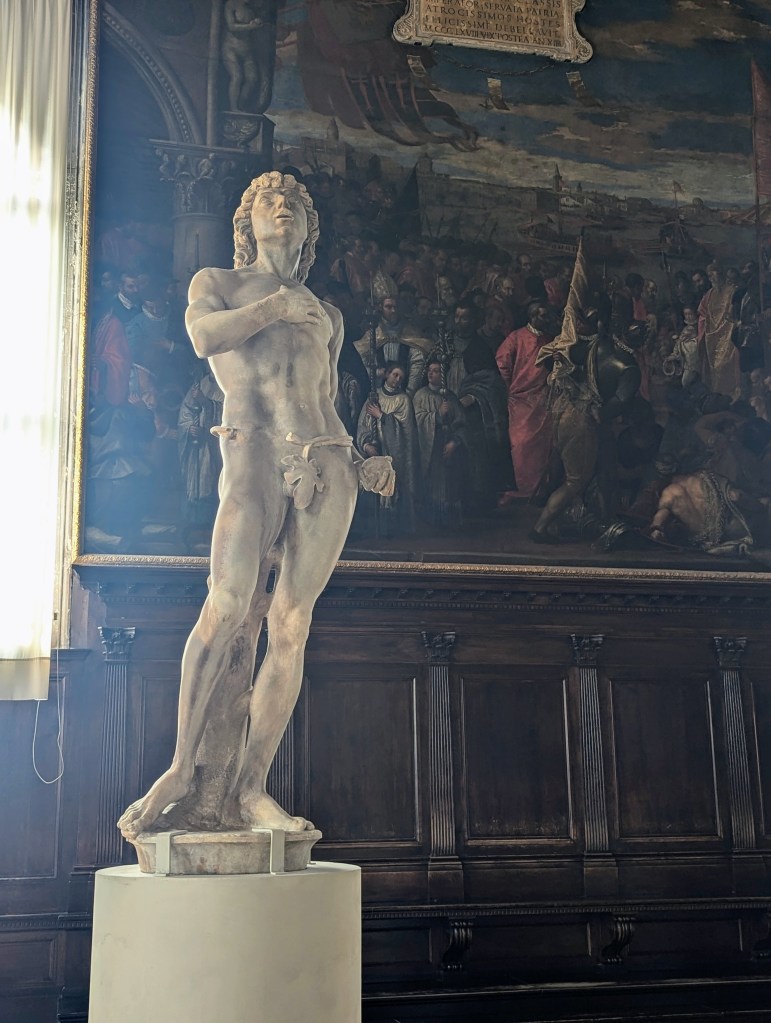
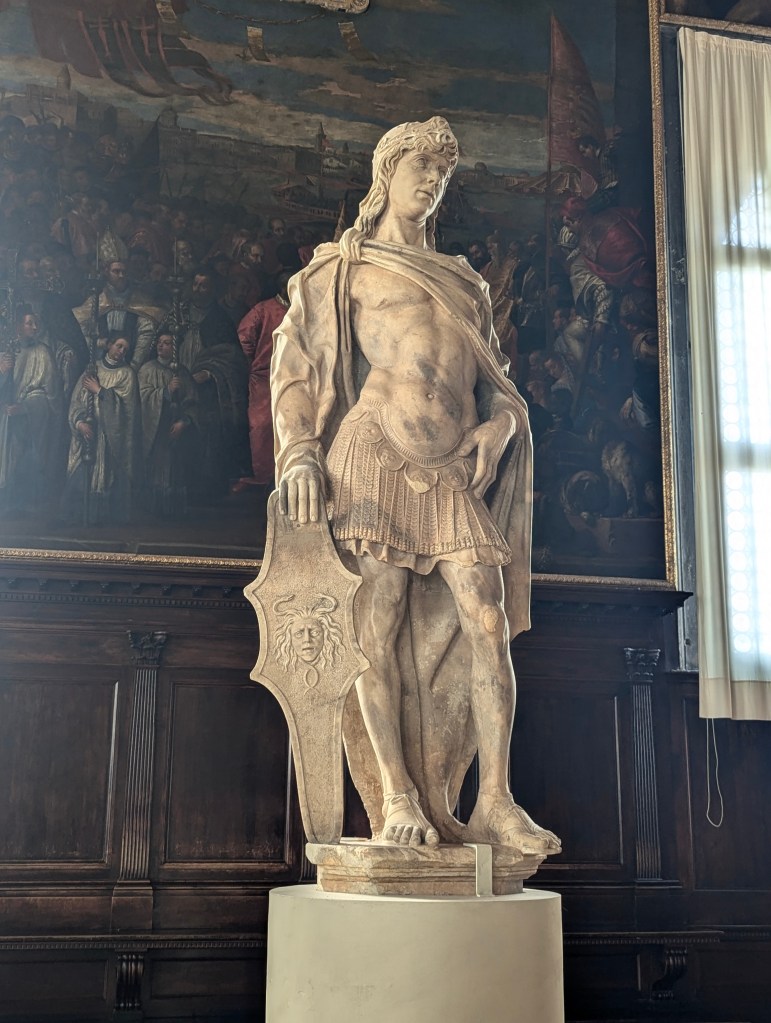
At the other end of the Chamber of the great council stand three 15th century Renaissance statues depicting Adam, Eve, and Mars, the Warrior. They originally stood in an alcove in the courtyard and required restoration several times in the 18th and 19th centuries. They were moved for safety during WWI, and it was decided to replace the originals with bronze statues and the originals were moved inside.

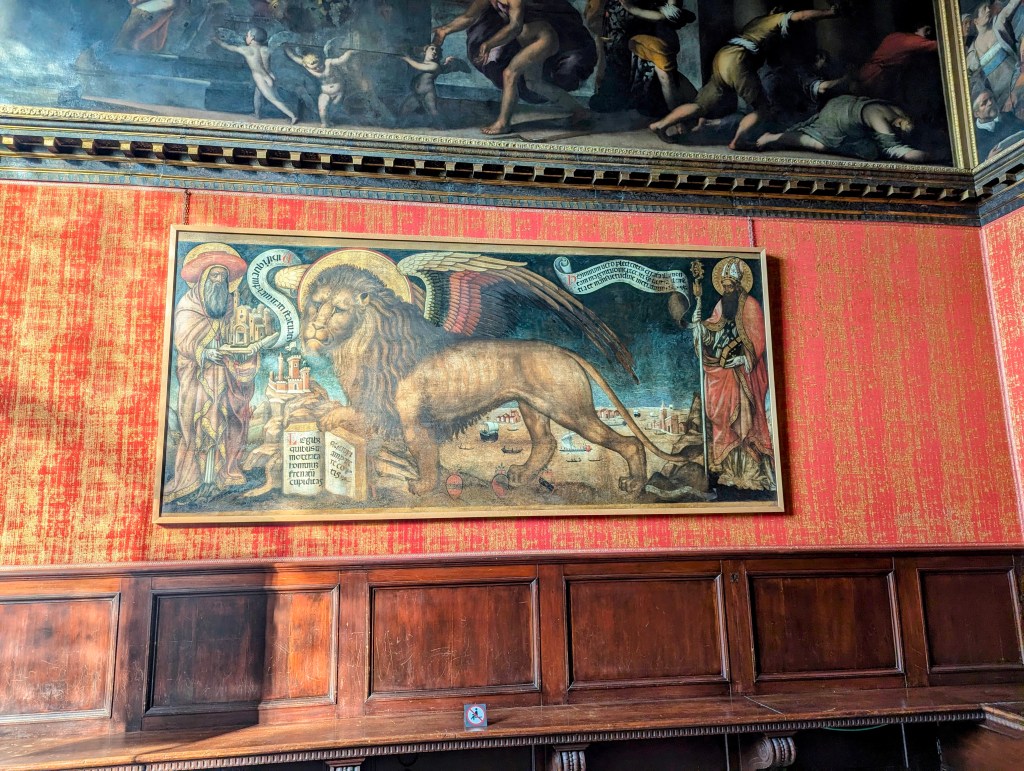
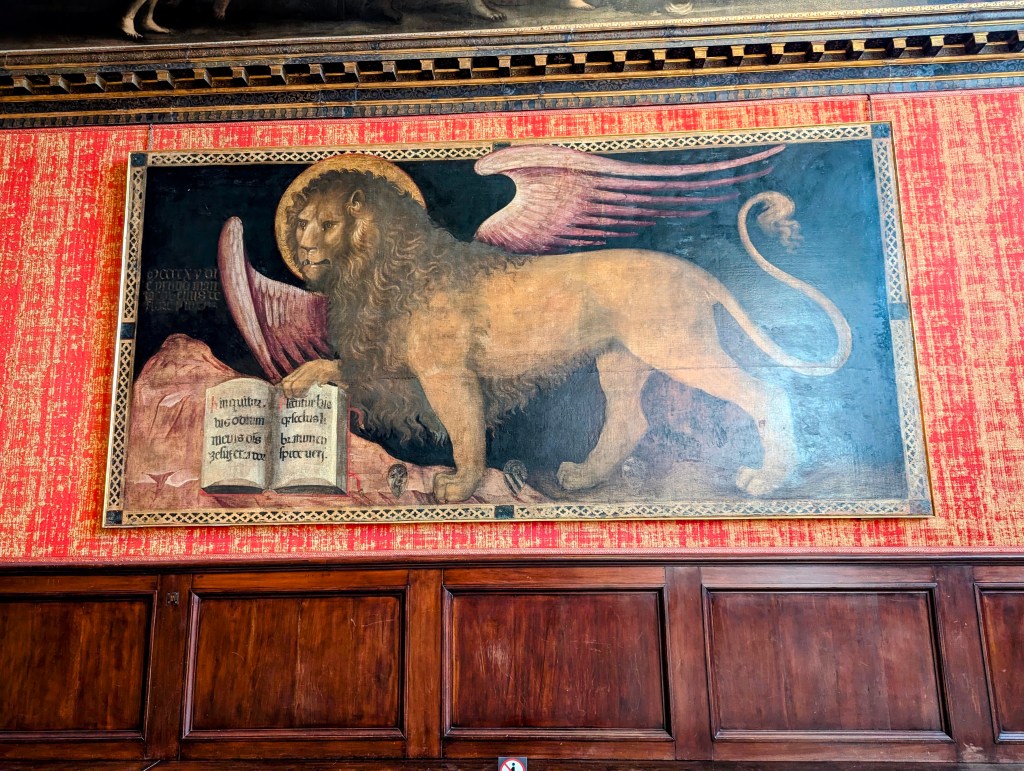
As we toured through the Doge’s private rooms, we saw several depictions of St. Mark/Venice as the winged lion with his paw on the book.

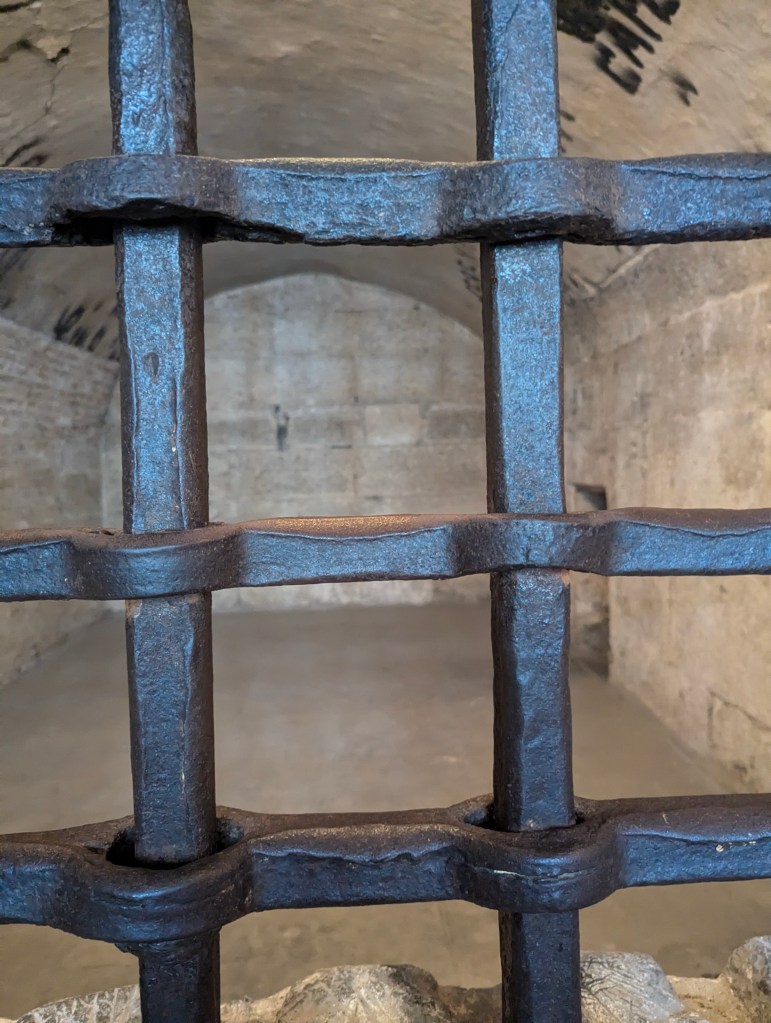
Finally we made our way into the prisons. Prior to the 12th century, there were holding cells within the Doge’s Palace but during the 13th and fourteenth centuries more prison spaces were created to occupy the entire ground floor of the southern wing. In 1591 yet more cells were built in the upper eastern wing. Due to their position, directly under the lead roof, they were known as Piombi. A corridor leads over the Bridge of Sighs, built in 1614 to link the Doge’s Palace to the structure intended to house the New Prisons. The famous name of the bridge dates from the Roman times and was supposed to refer to the sighs of prisoners who, passing from the courtroom to the cell in which they would serve their sentence, took a last look at freedom as they glimpsed the lagoon through the small windows.
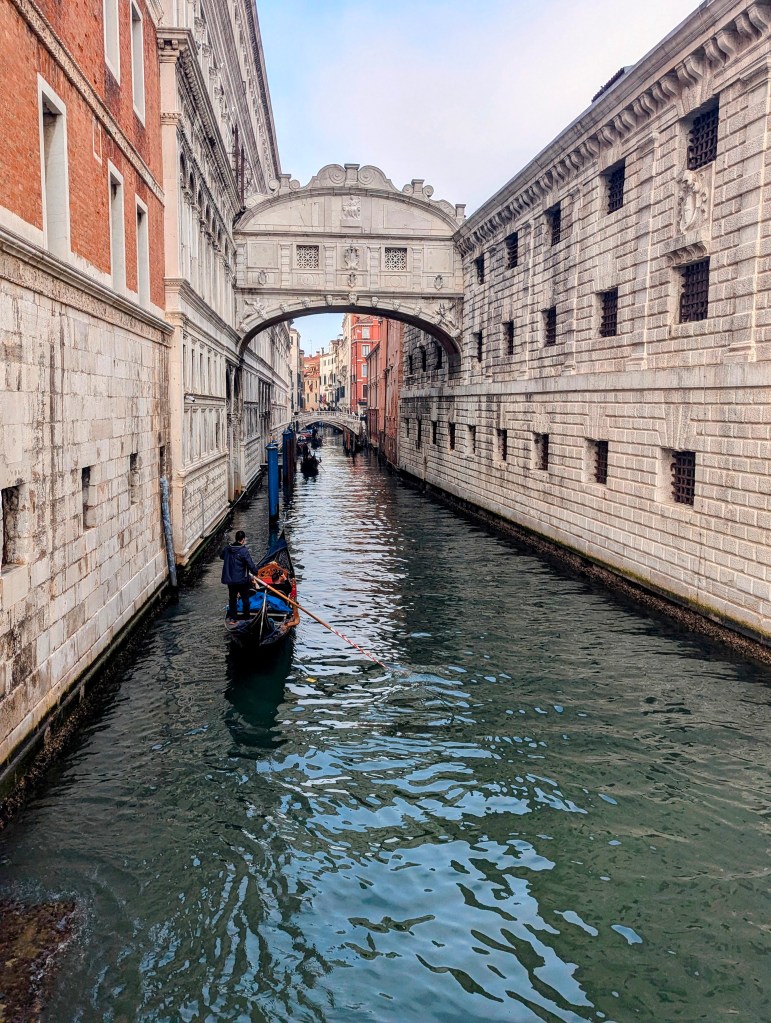
In the mid-16th century, it was decided to build a new structure on the other side of the canal to the side of the palace which would house prisons and the chambers of the magistrates known as the Notte al Criminal. Ultimately linked to the palace by the Bridge of Sighs, the building was intended to improve the conditions for prisoners with larger and more light-filled and airy cells.
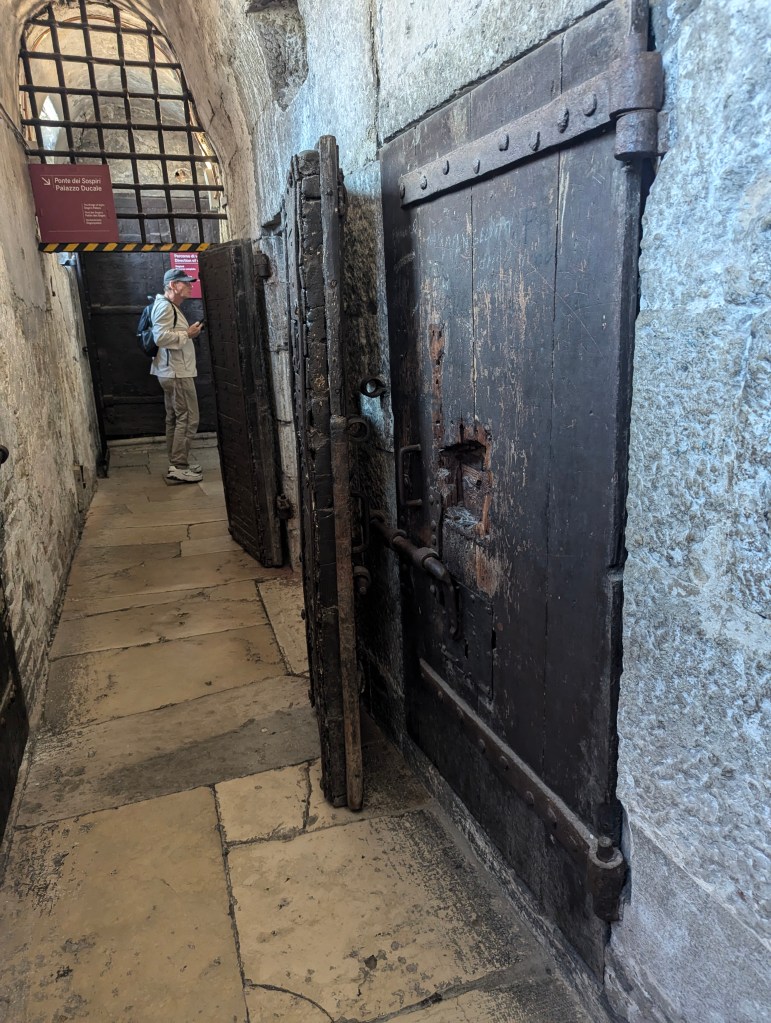
However, certain sections of the new prisons fall short of this aim, particularly those laid out with passageways on all sides and those cells which give onto the inner courtyard of the building. In keeping with previous traditions, each cell was lined with overlapping planks of larch that were nailed in place.
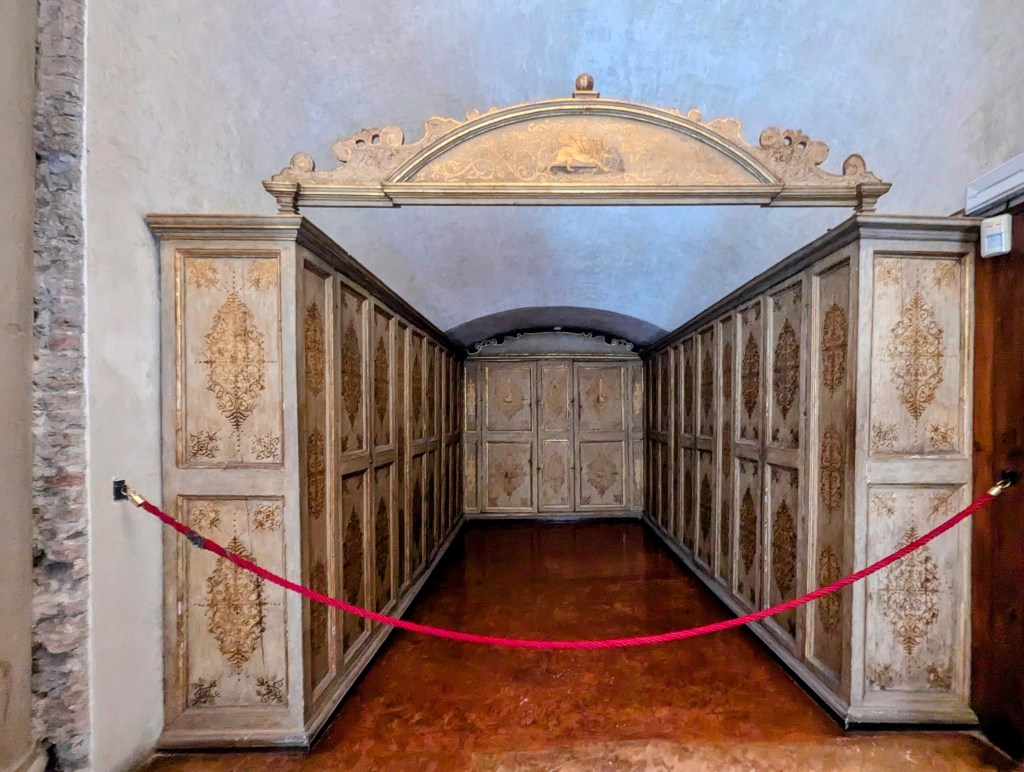
The last room on our tour of the Doge’s Palace was the archival room.
We made our way out of the palace, through the courtyard, and back into St. Mark’s Square for a final visit before our final evening meal in Venice. Once again we enjoyed our visit and felt we could have stayed longer; there is so much to see and do in all of these amazing Italian towns.
 Jo & Eric's travels