
We had a long drive from Saint John, New Brunswick to Cape Breton, Nova Scotia. Once there, we stayed with family on a gorgeous river-front home

complete with a blood pressure lowering hummingbird feeder.

After a good night’s rest, we ventured out to Louisbourg, a small fishing village with a population under 1000. The harbour had been used by European mariners since at least the 1590s, when it was known as English Port and Havre à l’Anglois, the French settlement that dated from 1713 in a fortress, more on that later. We stopped for lunch at North Star, a resort recently purchased and now operated by international designers Colin and Justin, whose shows have aired on HGTV and Cottage Life in Canada. We had watched the week prior, a 4 hour documentary of their purchase and subsequent renovation of North Star called ‘Colin and Justin’s Hotel Hell’.
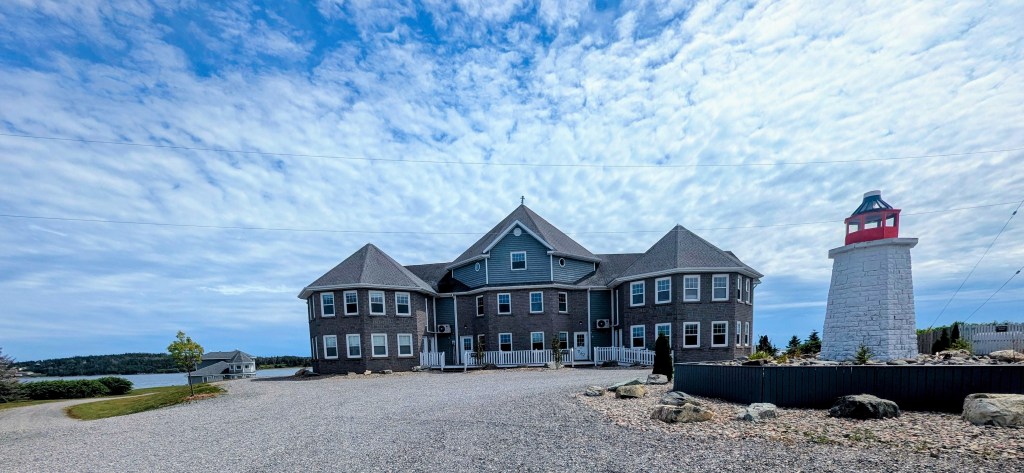
We explored the property for a bit
before enjoying our “usual” lunch for the next few weeks: seafood chowder and lobster rolls. After fortifying ourselves with a hearty meal, we headed to the Fortress of Louisbourg, a National Historic Site of Canada. Much to our surprise we learned that all national sites, parks, monuments, etc. were free for the summer of 2025. It was later explained to us, by family members living in Canada, that this was one of the many ways Canada’s government has pushed back against some of Trump’s tariffs and threats; it was an incentive to keep Canadian tourists in Canada and not in the US. We boarded a bus and were driven to the fort.
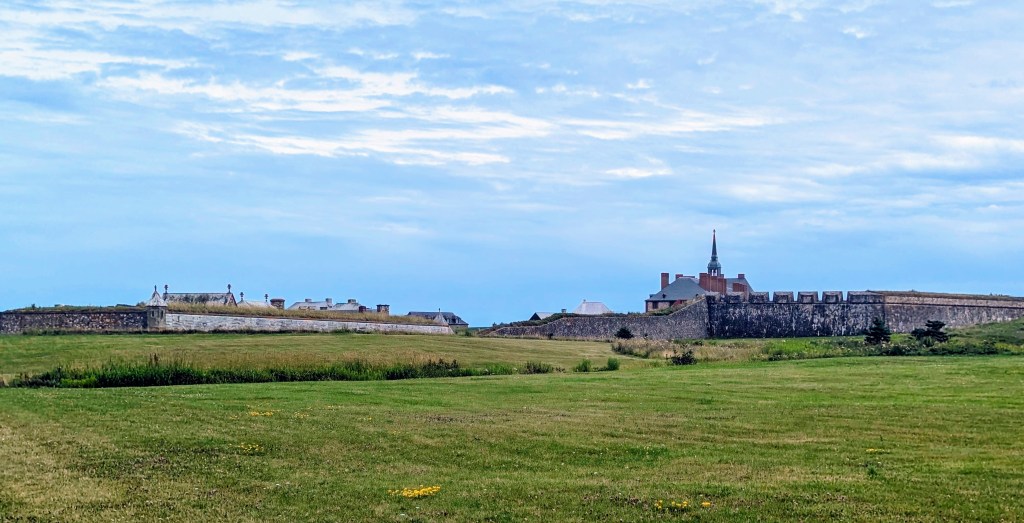
The original settlement was founded in 1713 by settlers from Newfoundland, and initially called Havre à l’Anglois. Subsequently, the fishing port grew to become a major commercial port and a strongly defended fortress. The fortifications eventually surrounded the town. The walls were constructed mainly between 1720 and 1740. By the mid-1740s Louisbourg, named for Lous XIV of France, was one of the most extensive (and expensive) European fortifications constructed in North America. The fortress and town were partially reconstructed, in a project that started in 1961 and continued into the 1970s. Additional restoration was completed in 2018–2020 and again in 2022–2023 after Hurricane Fiona.
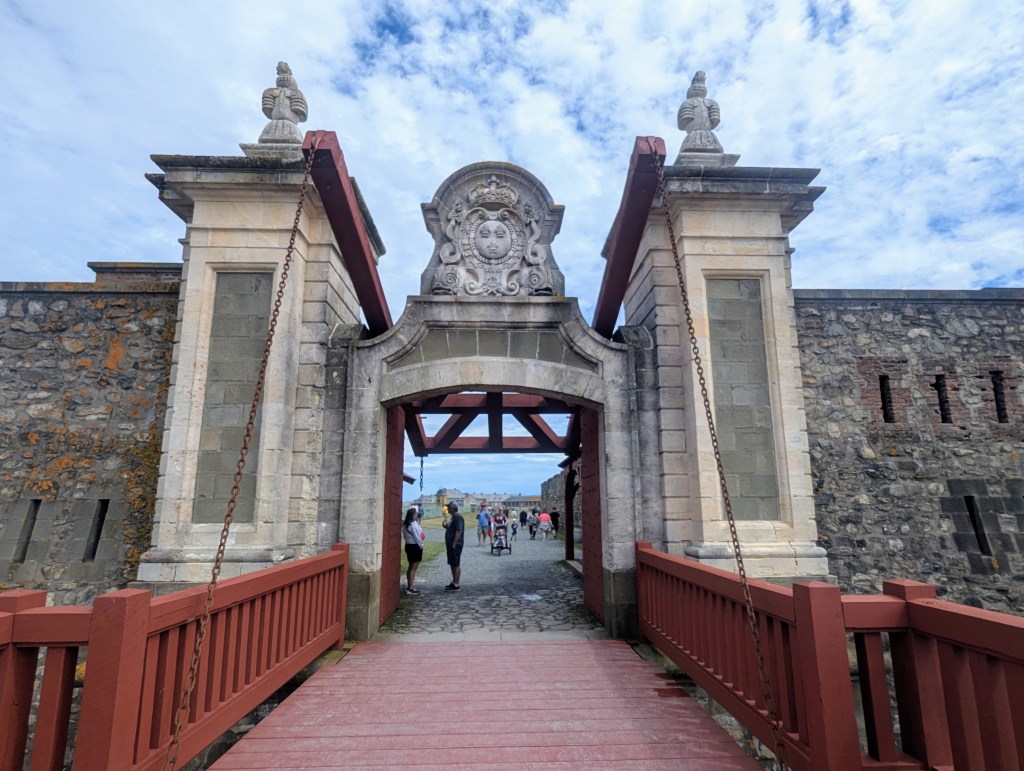
The guard rooms closest to the entrance were for those most responsible for protecting the fort.
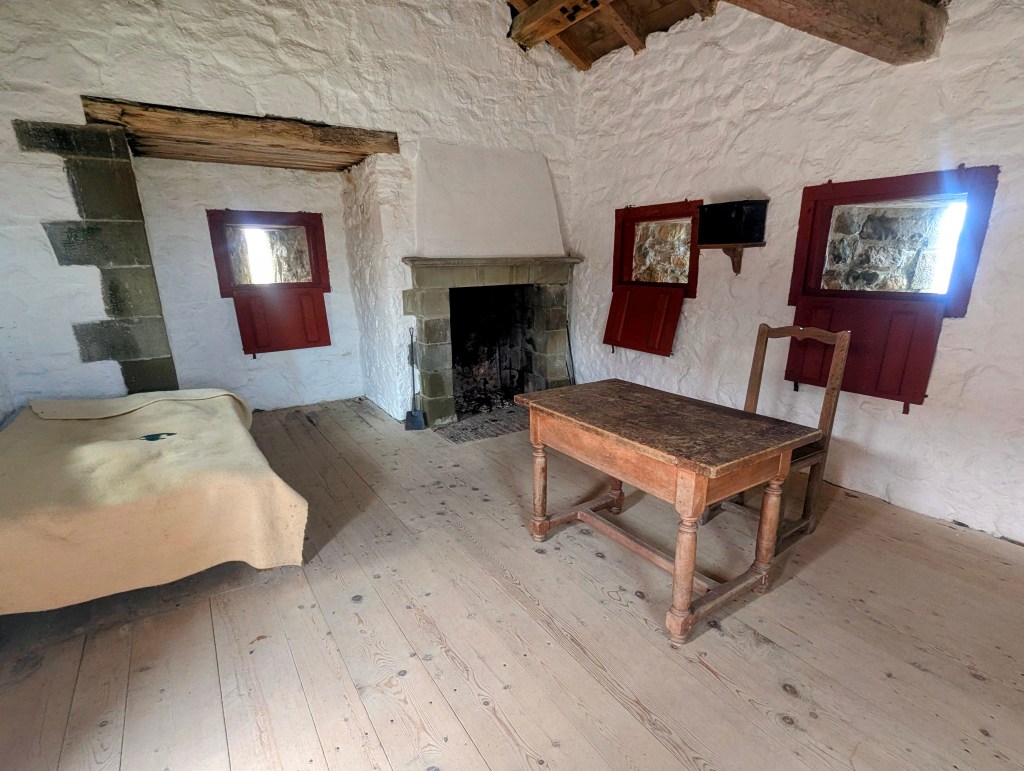
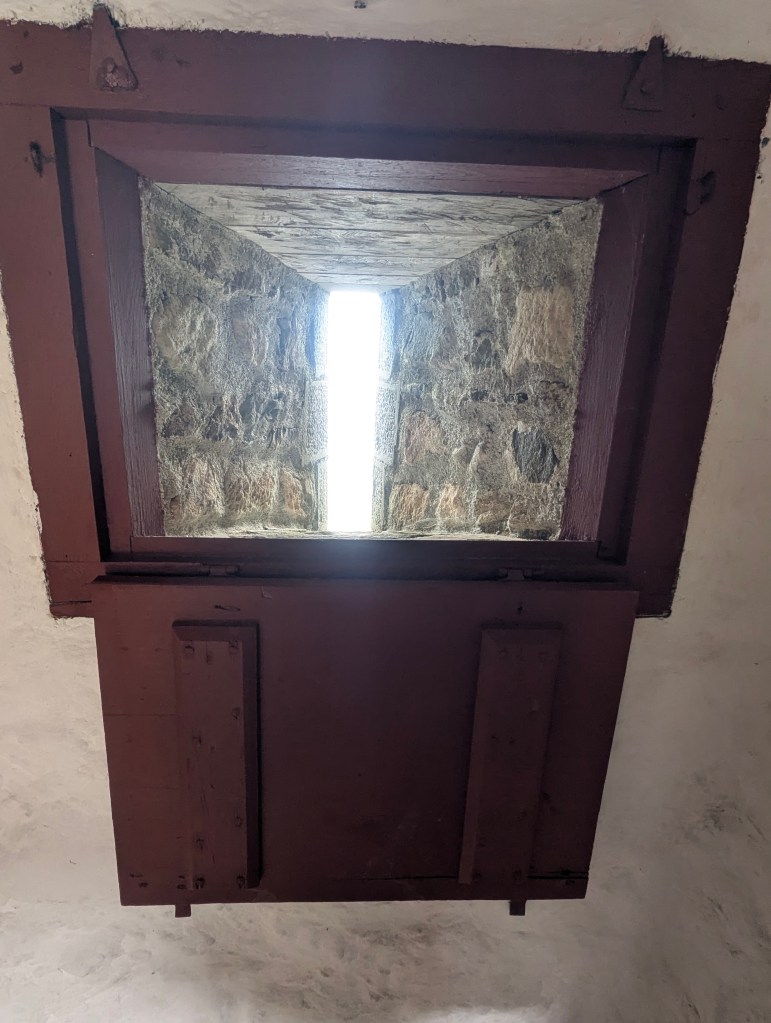
Note the windows from which a rifle can be fired while protecting the shooter.
The original budget for the fort was four million French livres, but the total cost of building ultimately cost France 30 million livres, which prompted King Louis XV to joke that he should be able to see the peaks of the buildings from his Palace in Versaille. Two and a half miles of wall surrounded the entire fort. On the western side of the fort, the walls were 30 feet high, and 36 feet across, protected by a wide ditch and ramparts.
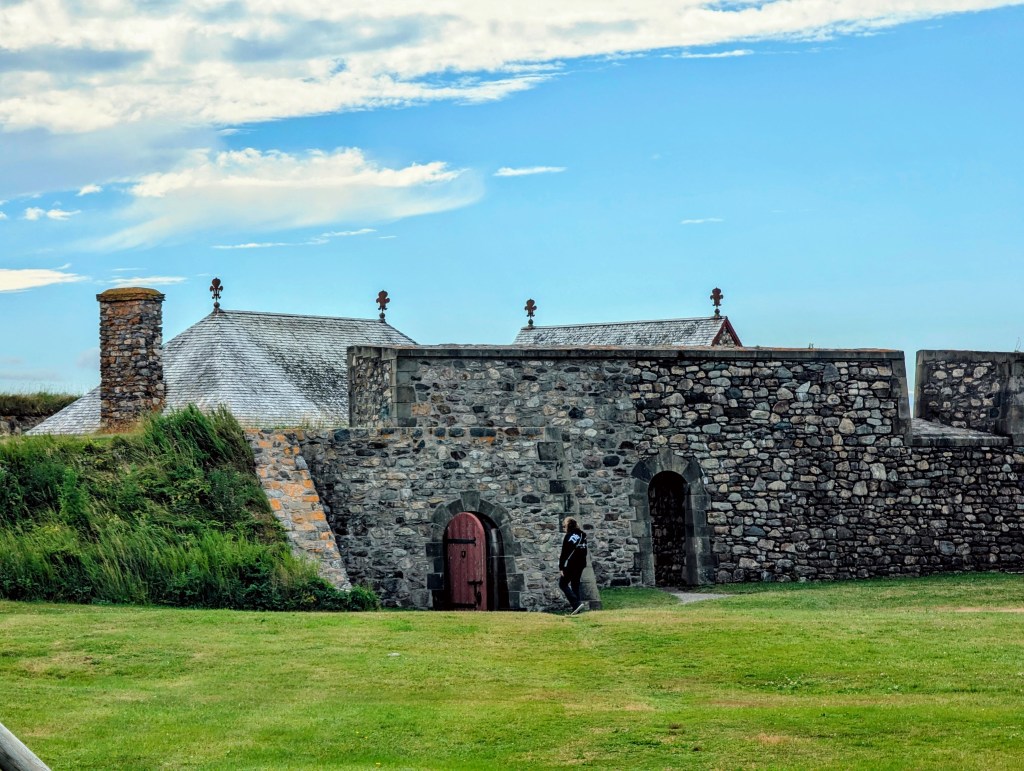
Past the guard rooms, we entered the fortress community. As we walked about we learned about the daily life of the militia and their families. There were two sieges on the fortress. The siege of Louisbourg in 1745 resulted in the capture of the settlement by a combined British/British North American force during King George’s War in the British colonies. It was returned to the French in exchange for border towns in what is today Belgium. It was captured again during the siege of 1758 by British forces in the Seven Years’ War, after which its fortifications were systematically destroyed by British engineers. The British continued to have a garrison at Louisbourg until 1768 but had abandoned the site by 1785.
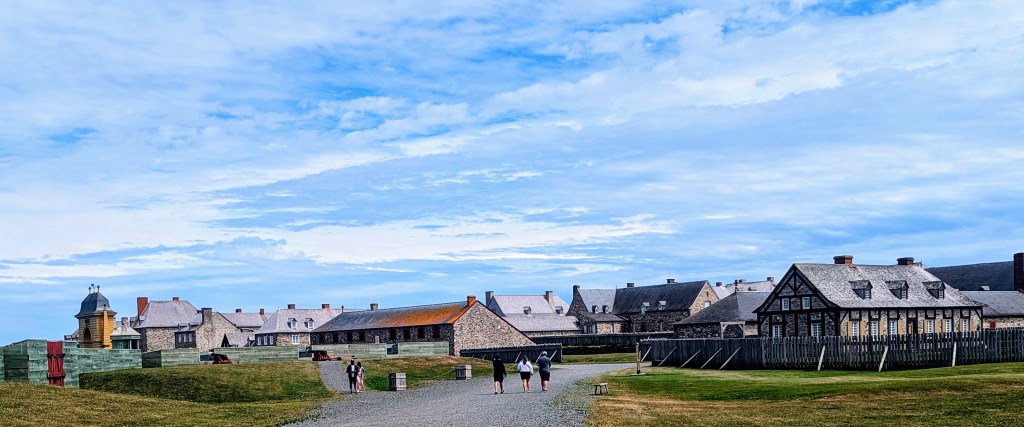
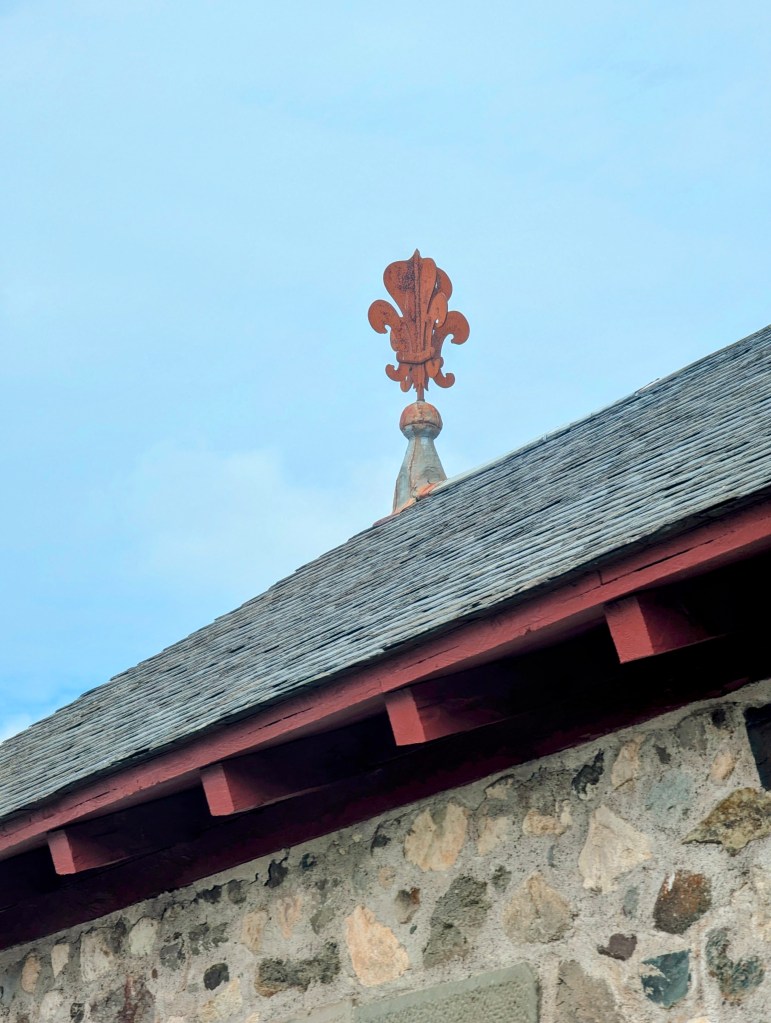
Most of the buildings are topped by a fleur-de-lis , a stylized lily, or iris, that has been a prominent symbol in heraldry, art, and culture for centuries, notably representing French royalty, in this case King Louis XIV.
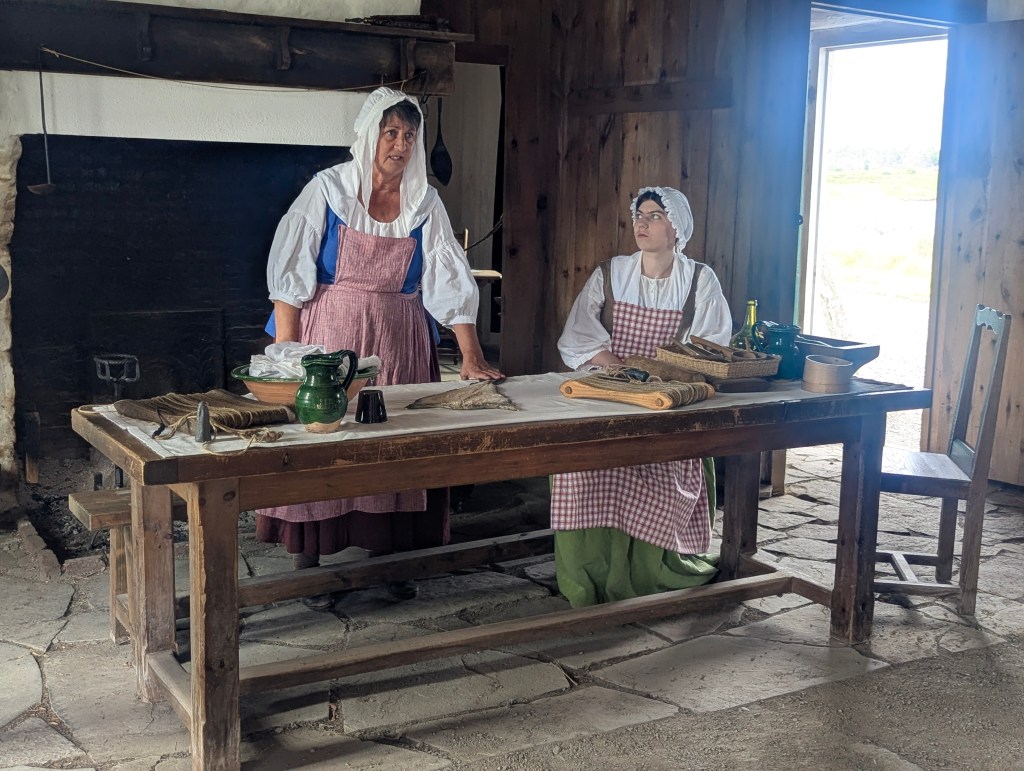
Many of the first settlers were Basque. Their diet and trade were heavily dependent on cod, as we learned from these docents. Unlike most other cities in New France, Louisbourg did not rely on agriculture. Louisbourg itself was a popular port and was the third busiest port in North America. It was also popular for its exporting of fish, and other products made from fish, such as cod liver oil. The North Atlantic fishing trade employed over ten thousand people, and Louisbourg was seen as the ‘nursery for seamen.’ Louisbourg was an important investment for the French government because it gave them a strong commercial and military foothold. For France, the fishing industry was more lucrative than the fur trade.
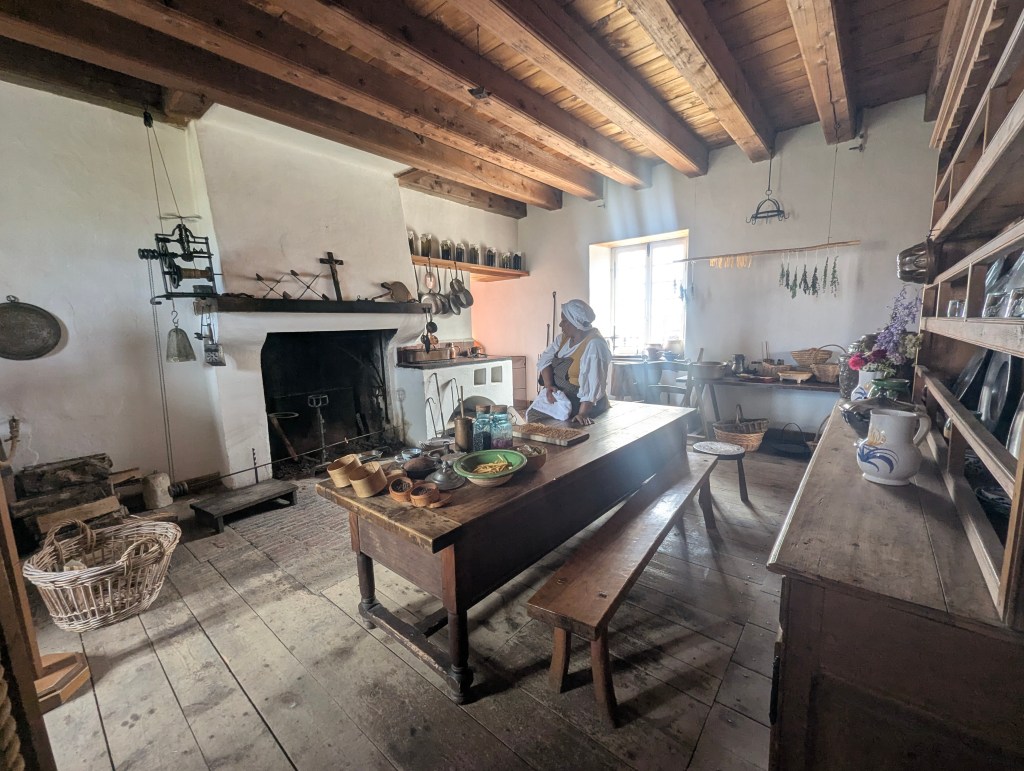
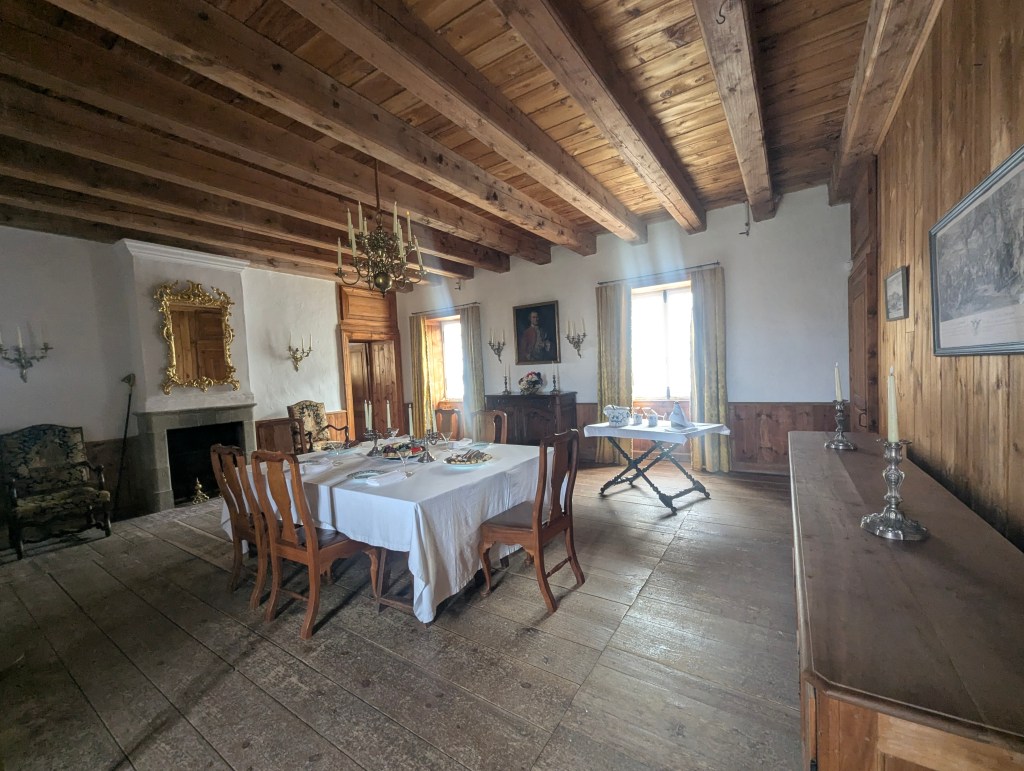
Over the years, restoration included about 60 buildings and two bastions. Many of the workers learned 18th century French masonry techniques and other skills to create an accurate replica. We looked in on several homes and visited kitchens
dining rooms
salons
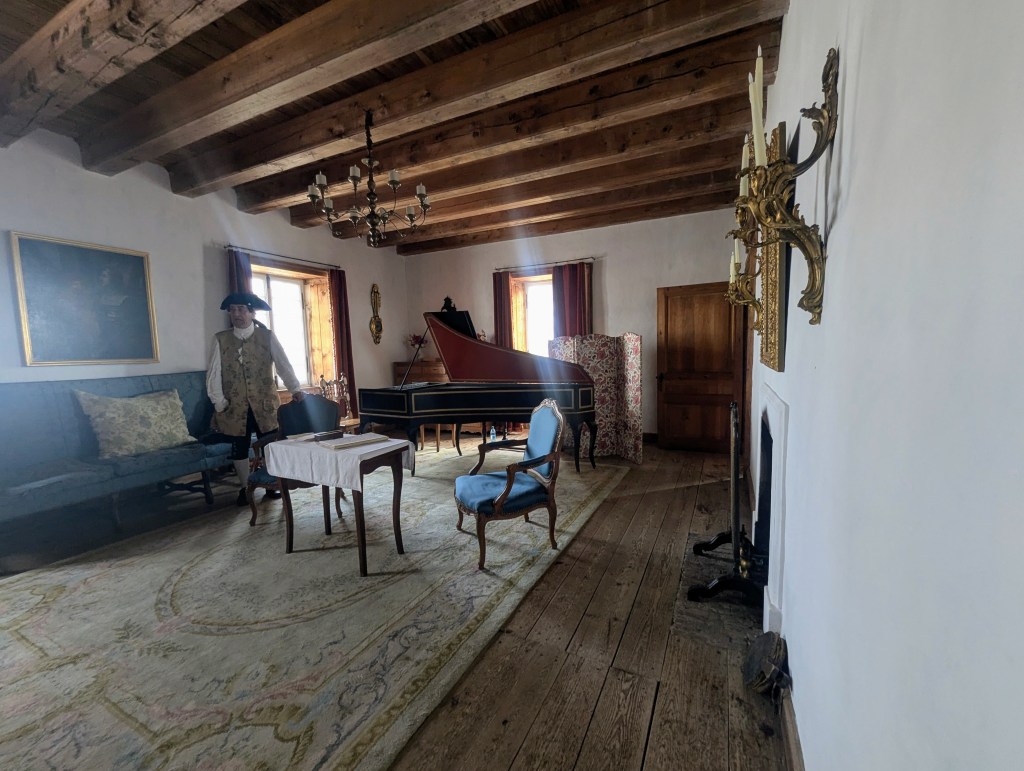
offices
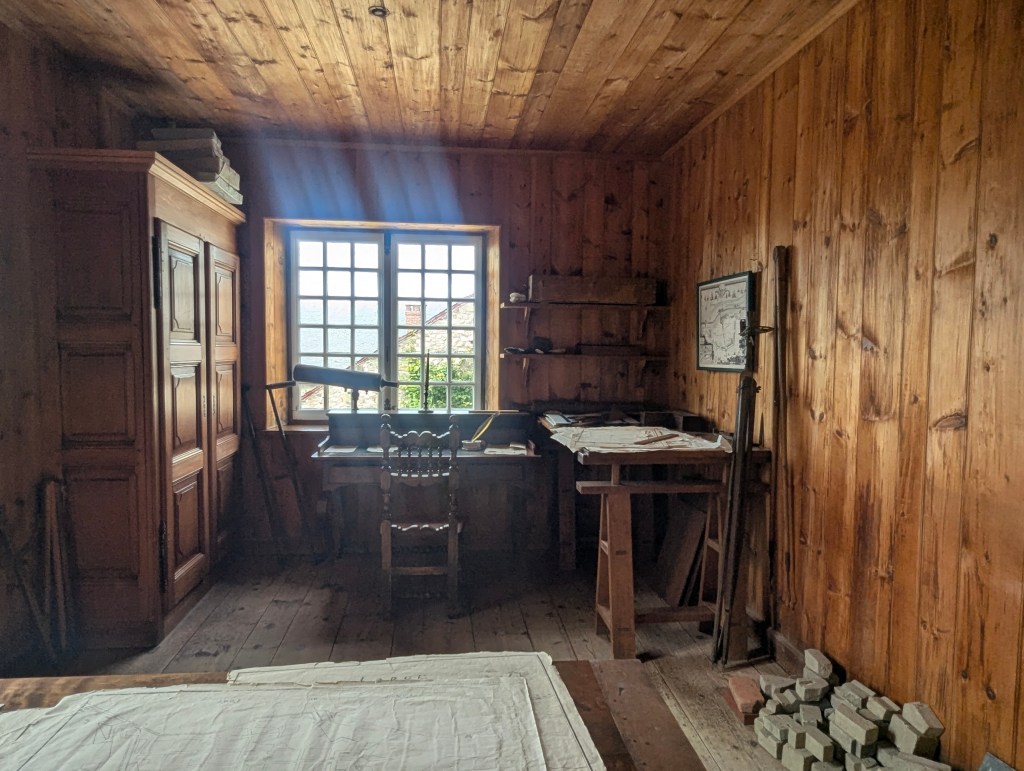
and bedrooms.
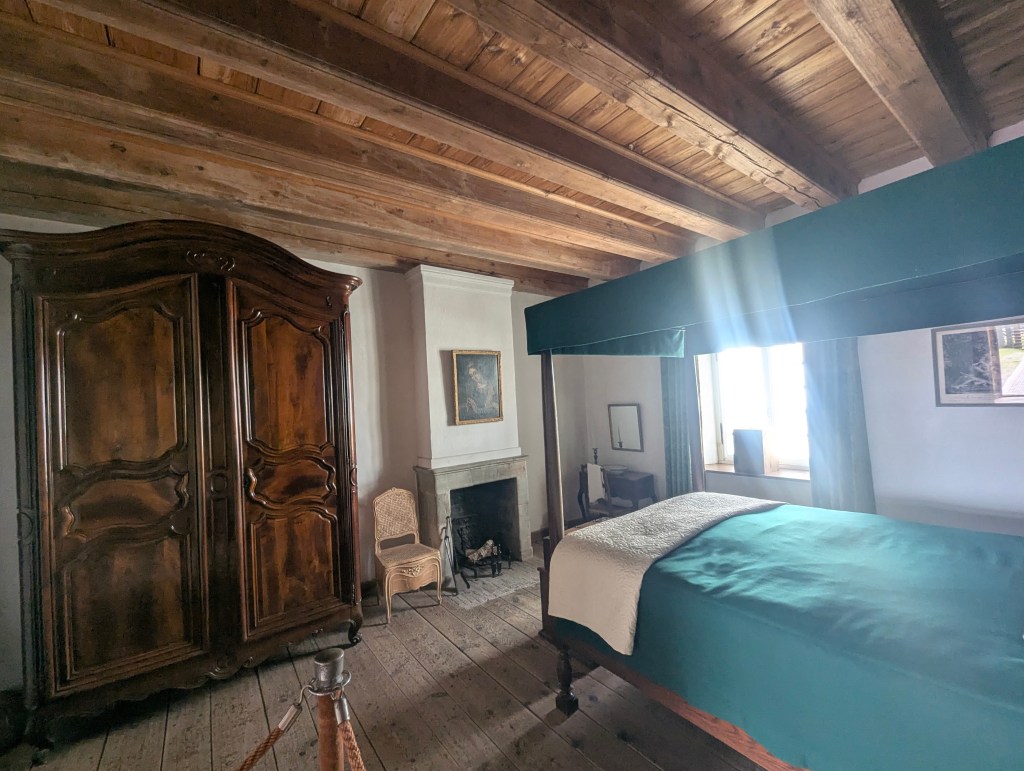
Even the barnyards

and vegetable gardens have been restored to their original functionality.
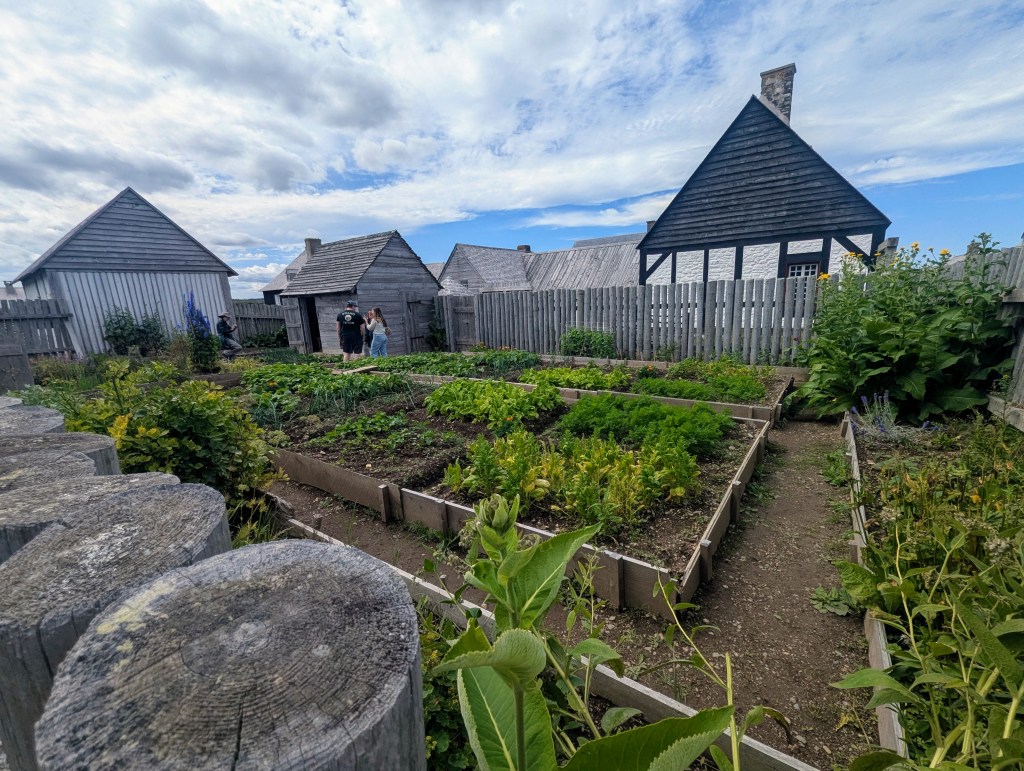
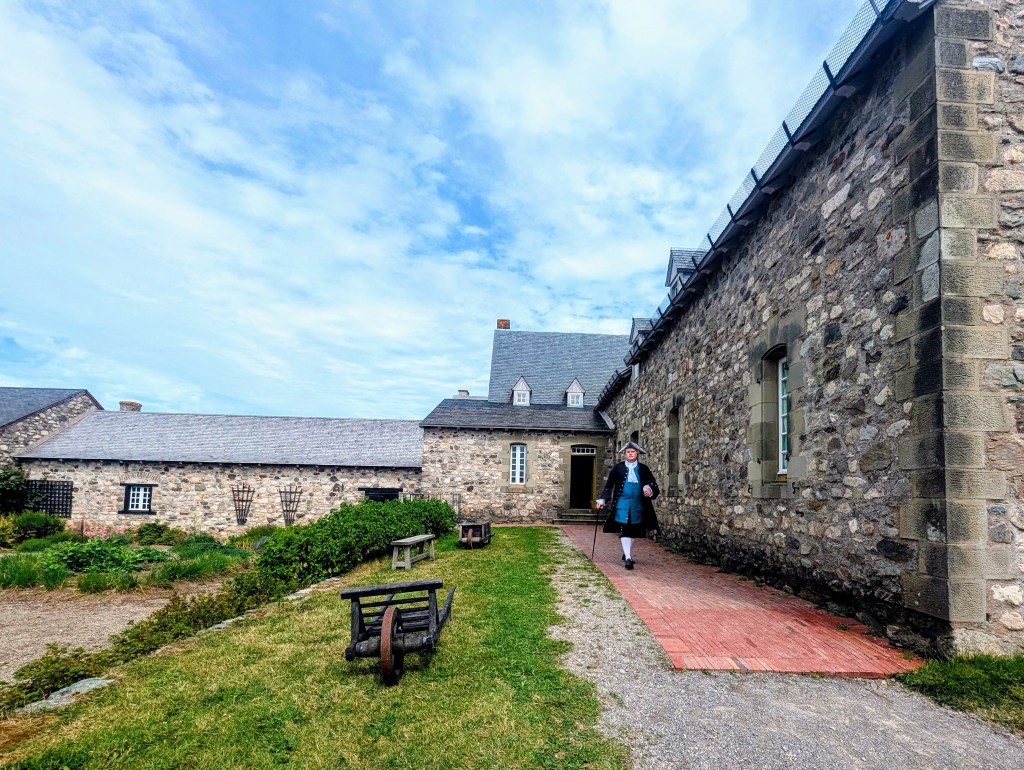
There are not only 18th century attired guides positioned throughout the fortress,
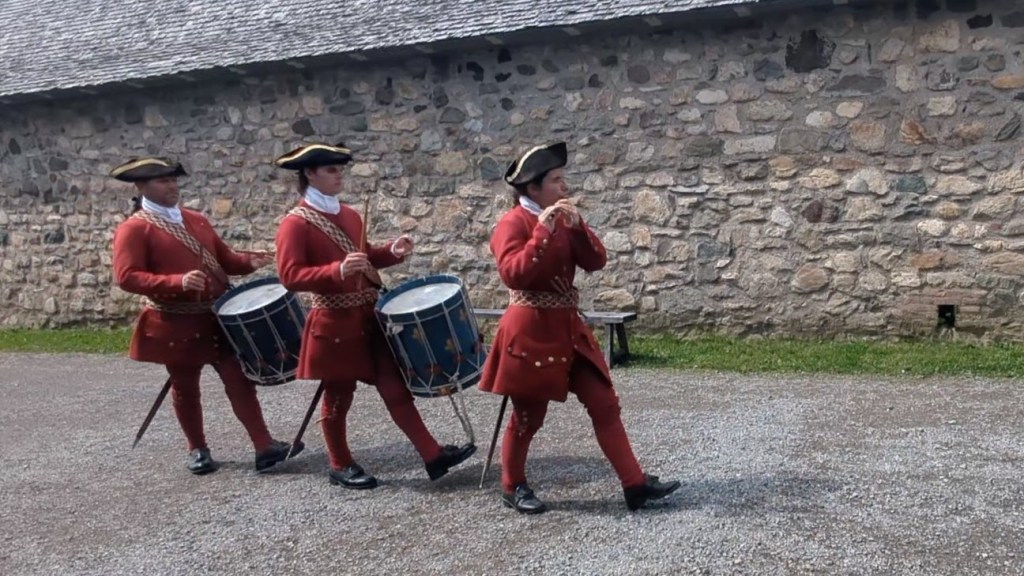
at 3 PM, a fife and drum band marched by playing.
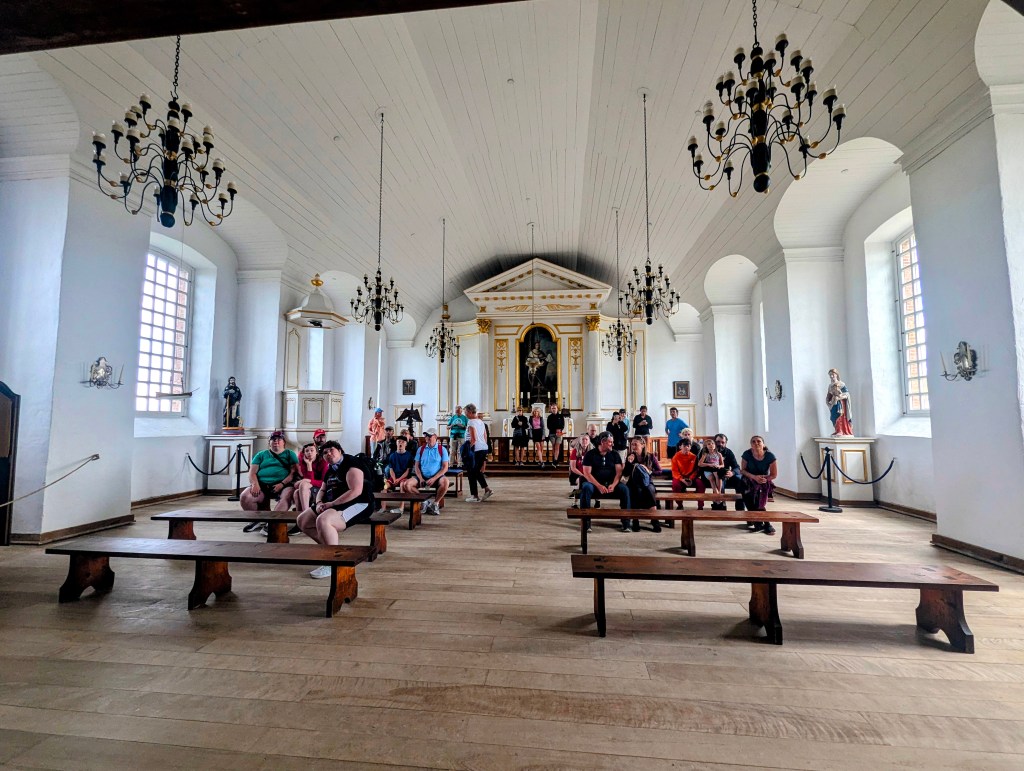
Although most of the population was Roman Catholic during French control of the site, the Church was not powerful or wealthy. The Military Chapel was staffed by Recollets (missionaries) and everyone was welcome to attend the services.

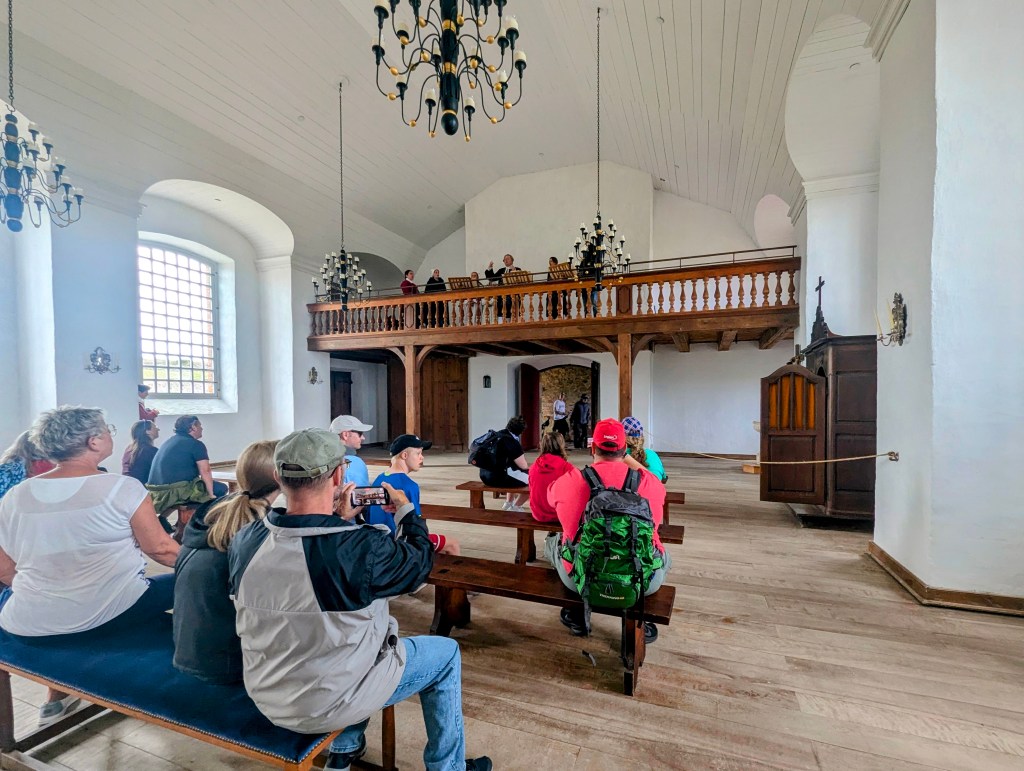
We were pulled inside by the sounds of singing
and found the choir on the balcony above.
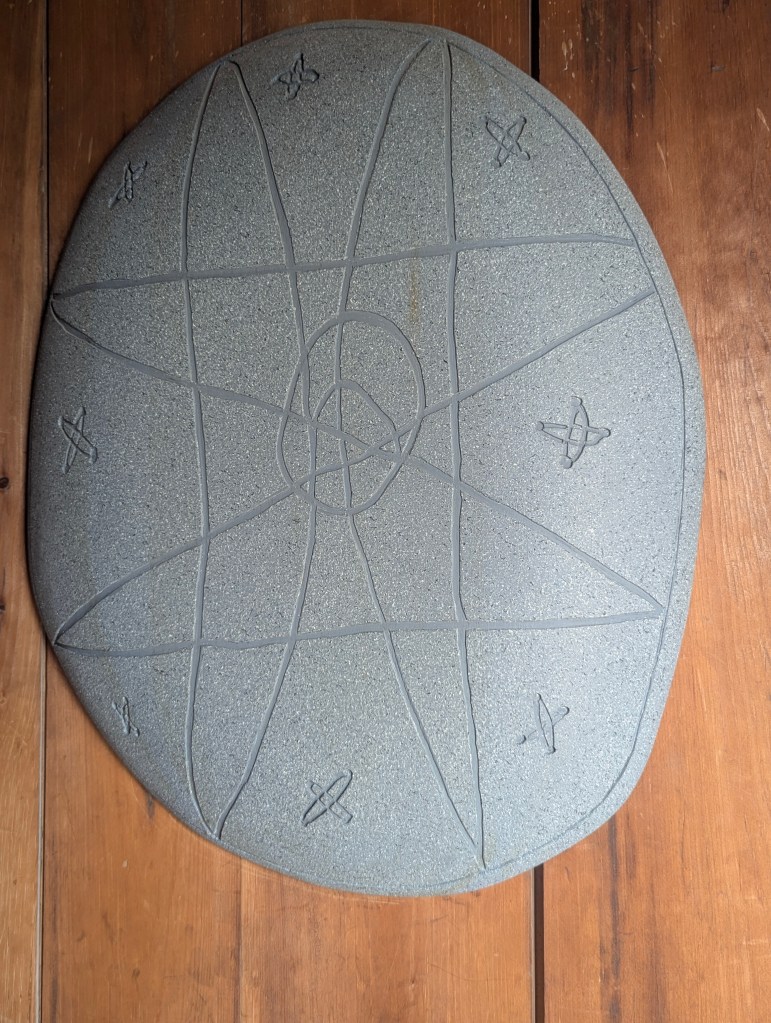
One building is a museum celebrating the Indigenous Mi’kmaq people of the area. The eight-pointed star is an important symbol for the Mi’kmaq; it symbolizes the sun, representing spirituality and life, and the Mi’kmaq Sacred Circle, symbolizing natural cycles and interconnectedness. The star represents unity, the four cardinal directions, and the concept of balance within nature and oneself. Ancient Mi’kmaq petroglyphs of the star, indicate its deep historical roots, predating European contact
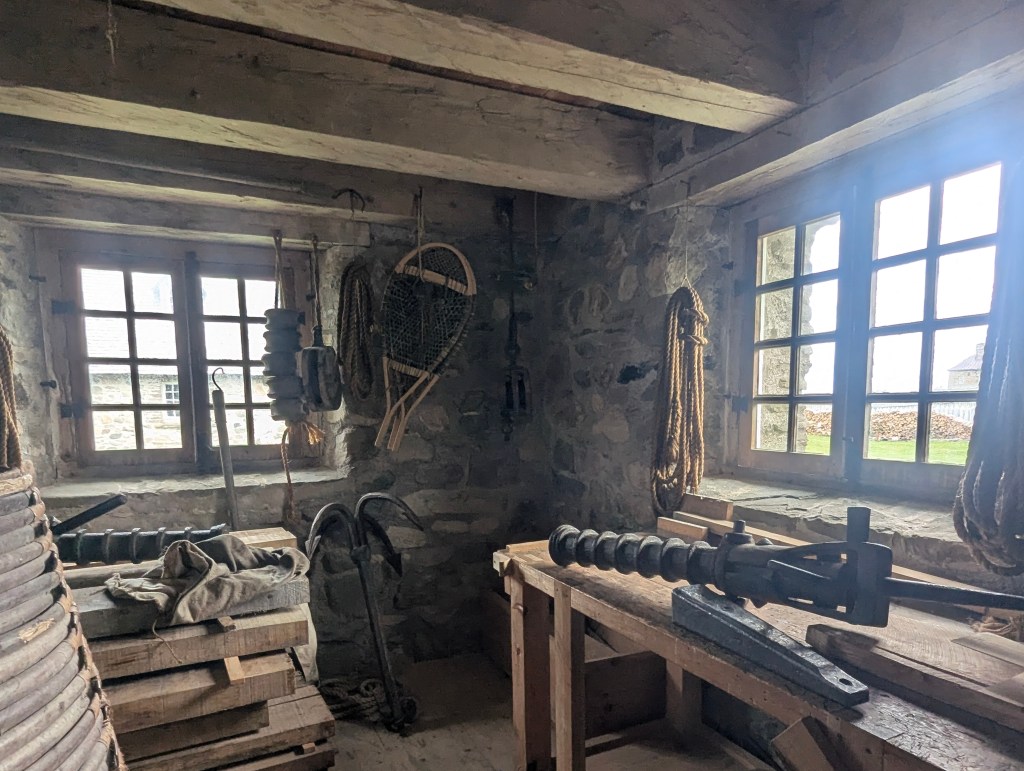
There is a huge warehouse that displays gear for winter and for use by fisherman
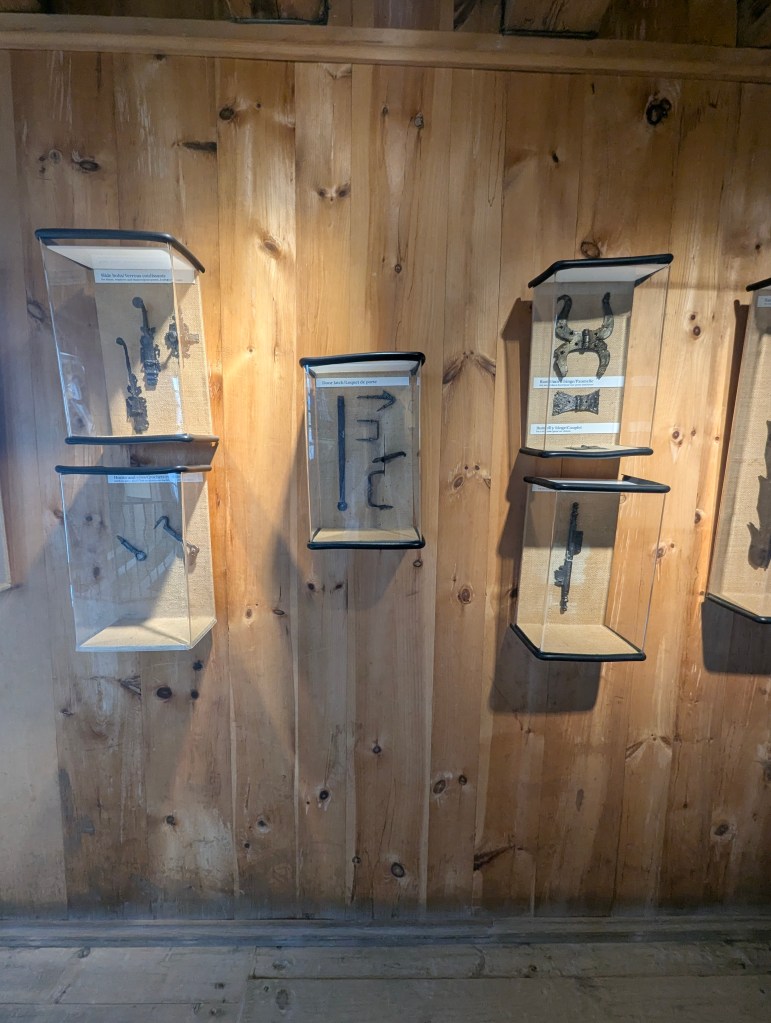
as well as tools for daily use.
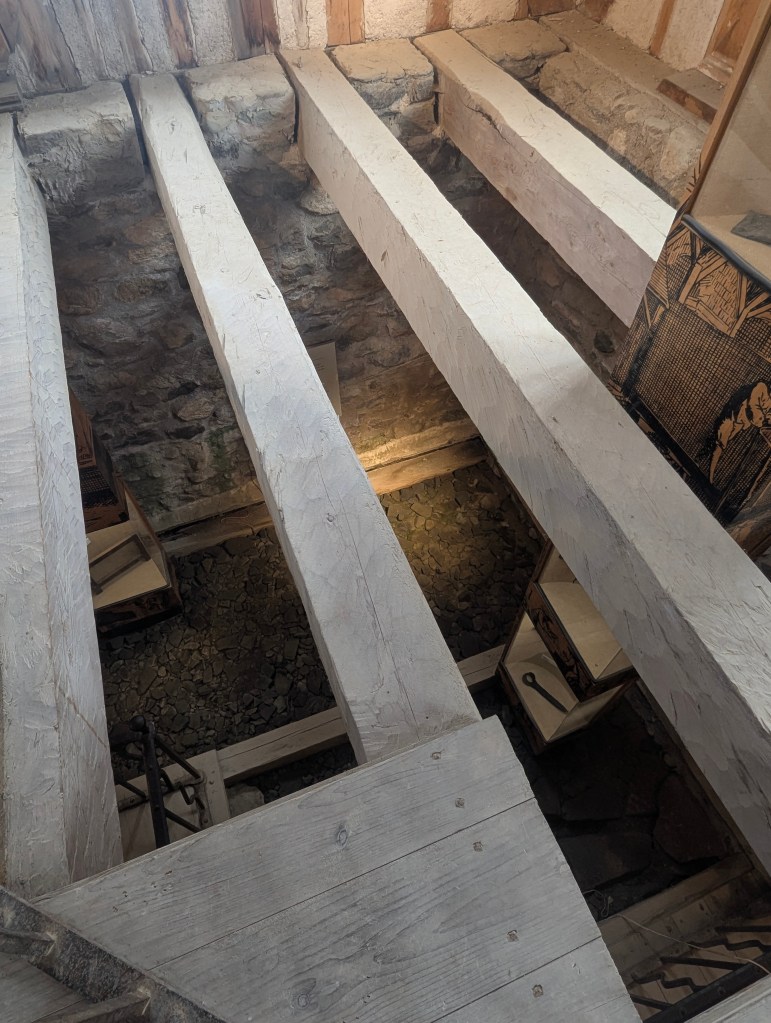
We were impressed with there method to prevent entrance of rodents; broken glass was wedged beneath the foundation stones .
There were originally four gates, only two of which have been restored. The Frederick Gate was the waterfront entrance.
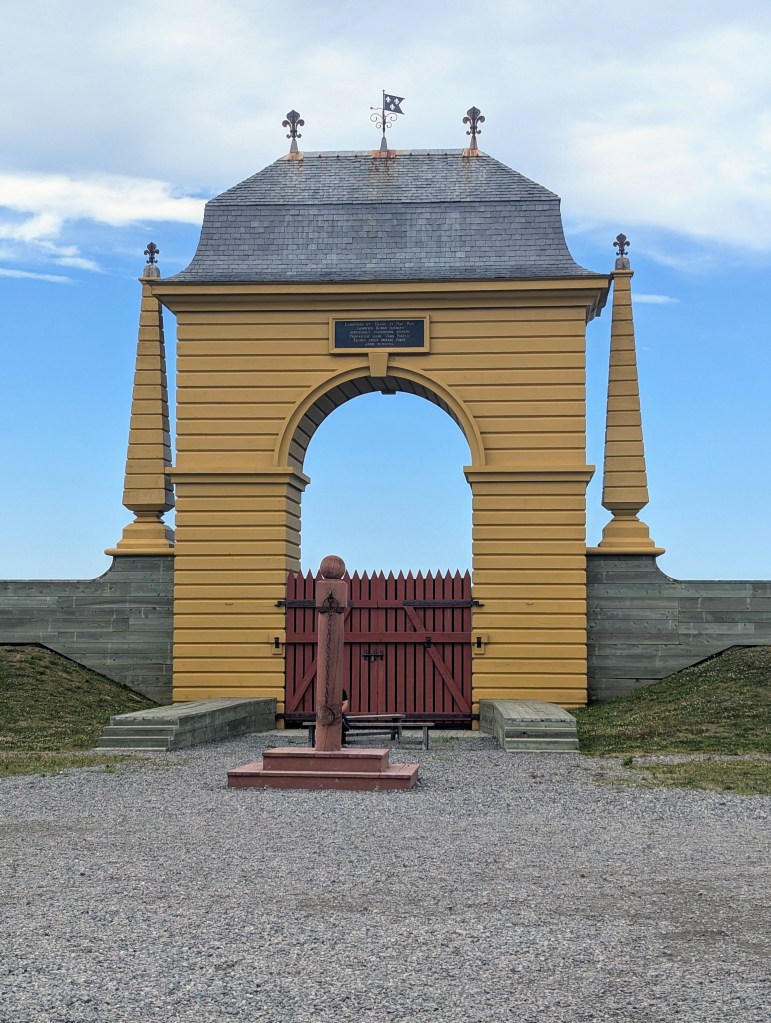
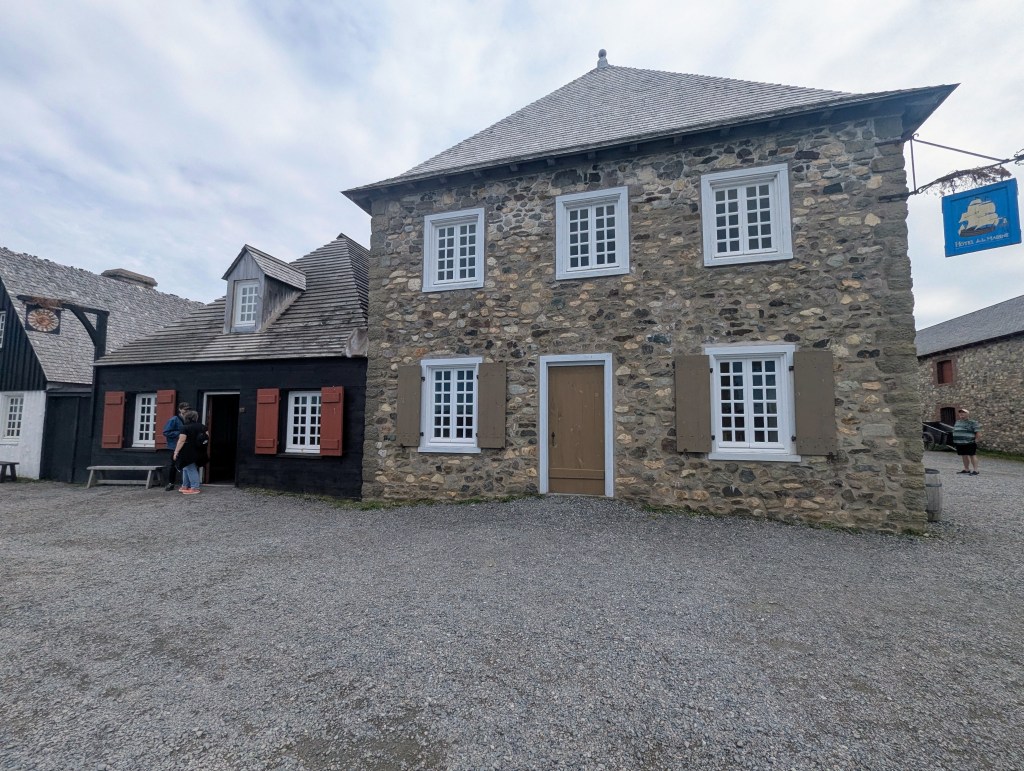
The fortress site provides opportunities for overnight stays in period-style accommodations as well as enjoying a meal in a local “inn.”
We left the fortress and drove to the lighthouse point. The Louisbourg Lighthouse is the fourth in a series of lighthouses that have been built on the site, the earliest was the first lighthouse in Canada.
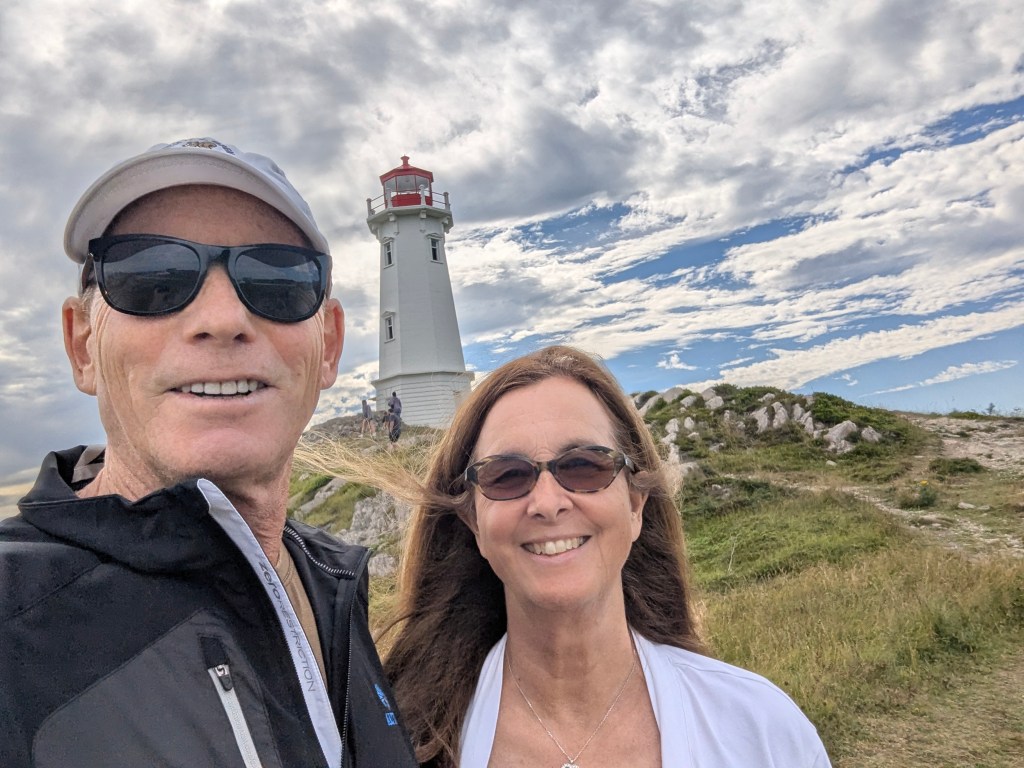
Construction began on the lighthouse in 1730 to assist navigation to the Fortress of Louisbourg. Lighthouse Point played a decisive role in both the Siege of 1745 and 1758 as, once captured, it provided a commanding gun battery location to bombard the fortress. This lighthouse was badly damaged in 1758 during the Final Siege of Louisbourg and abandoned by the British after they demolished the fortress. Stonework ruins from the first tower are still visible at the site.
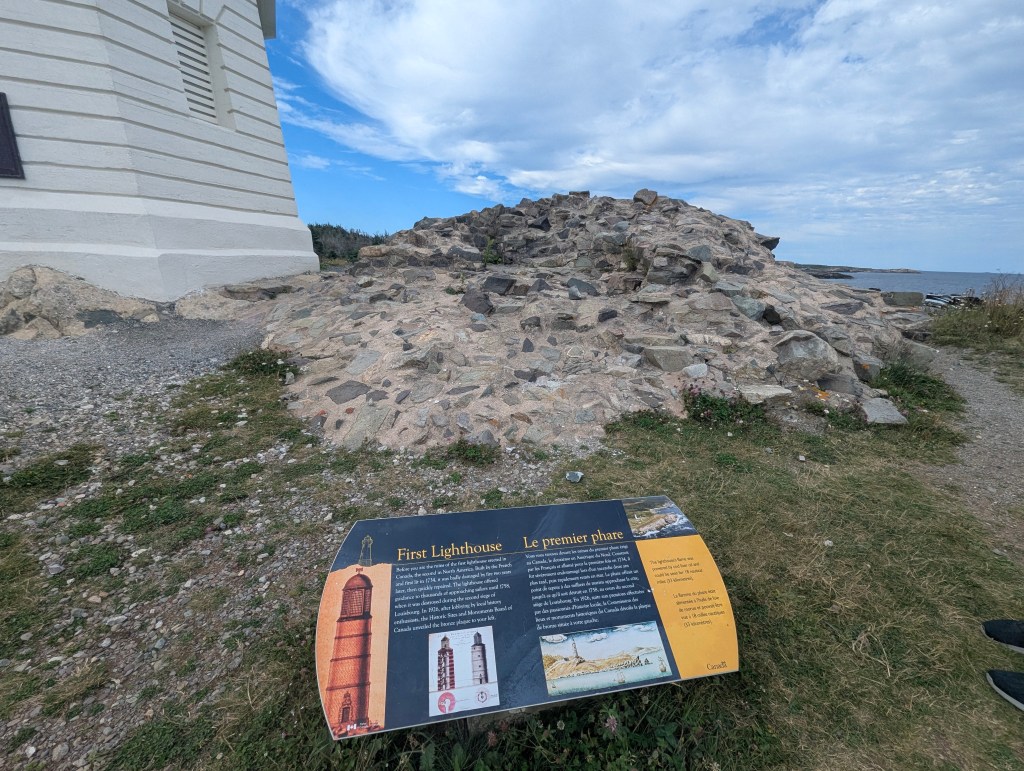
There were two more lighthouses that had been destroyed by fire. The current lighthouse, an octagonal concrete structure decorated with neoclassical architectural features, was built in 1923. The Louisbourg lighthouse was destaffed in 1990.

The fortress can be seen across the bay.
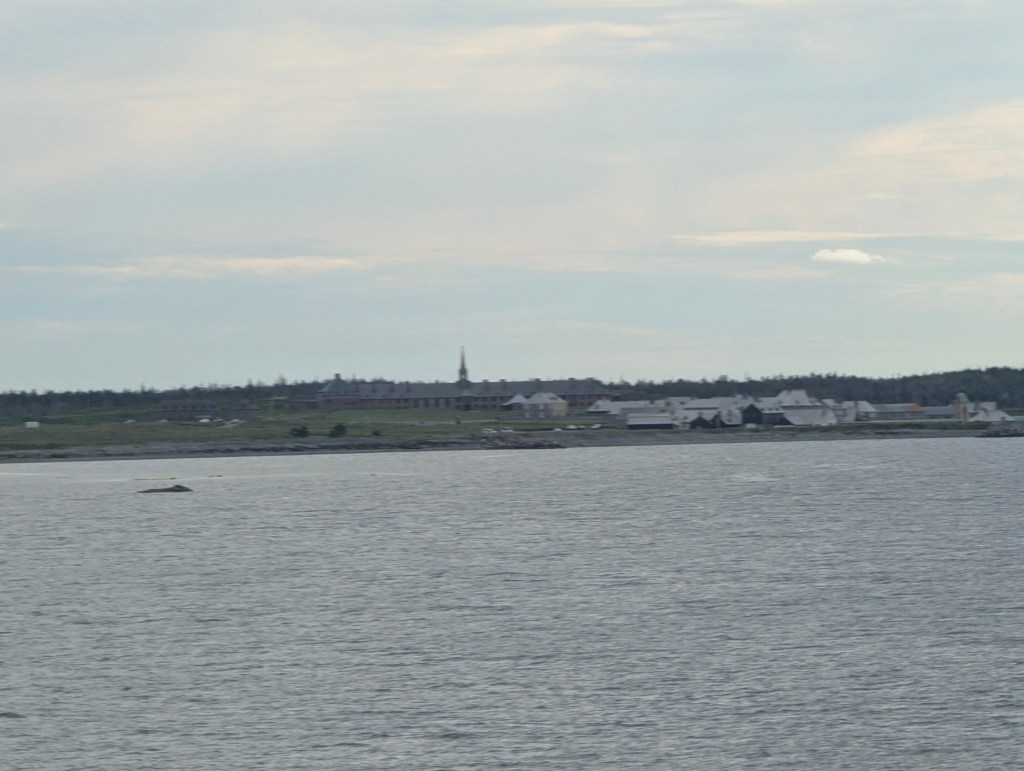
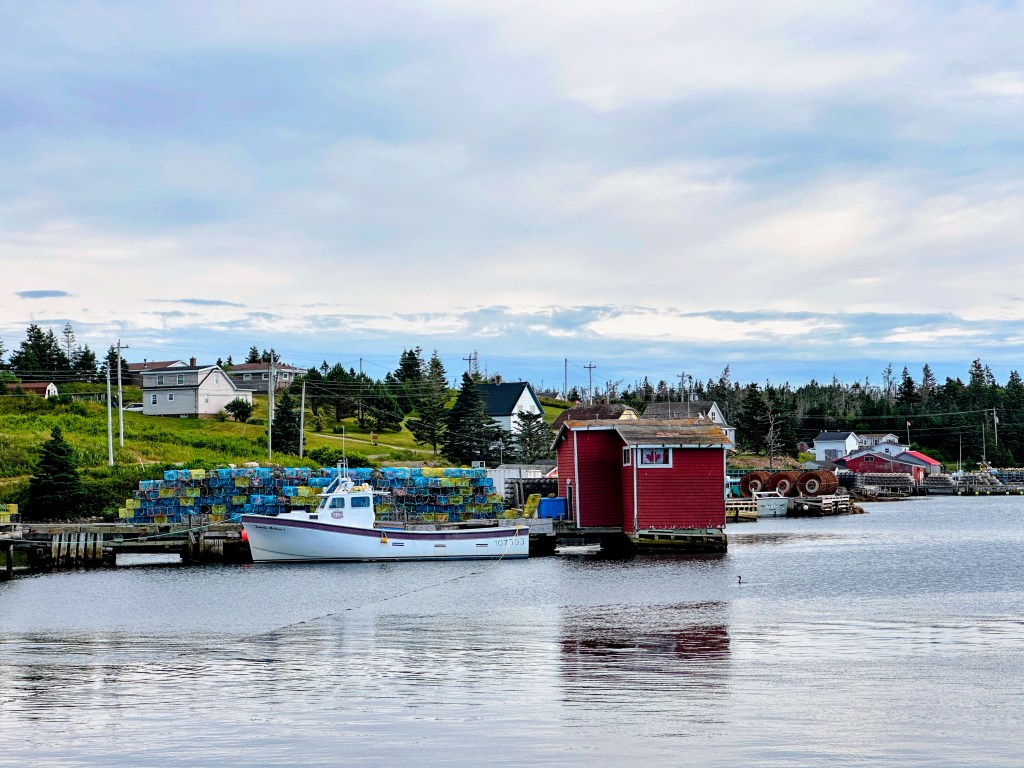
After the capture of the fortress in 1758, its fortifications were demolished in 1760 and the town-site abandoned by British forces in 1768. A small civilian population continued to live there after the military left. English settlers subsequently built a small fishing village across the harbor from the abandoned site of the fortress. The village grew slowly with additional Loyalists settlers in the 1780s. Today it remains a predominantly fishing village as evidenced by the stacks of lobster pots seen by almost every home. We were told that historically lobster was considered poor people’s food; locals would hide the shells in the garbage to avoid detection by their neighbors. Lobster transformed into a luxury item through changes in transportation, the development of canned lobster, and promotion by wealthy diners in cities like Boston and New York in the late 19th century.
We returned to North Star where we met with our family to enjoy dinner at The Bothy Restaurant.
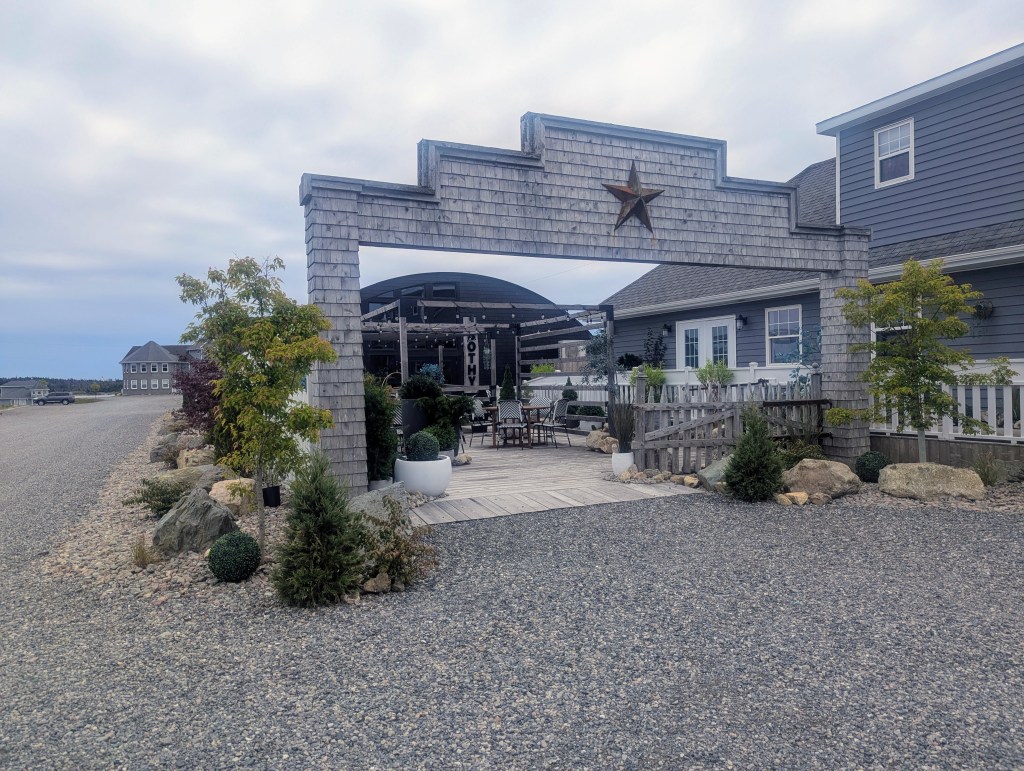
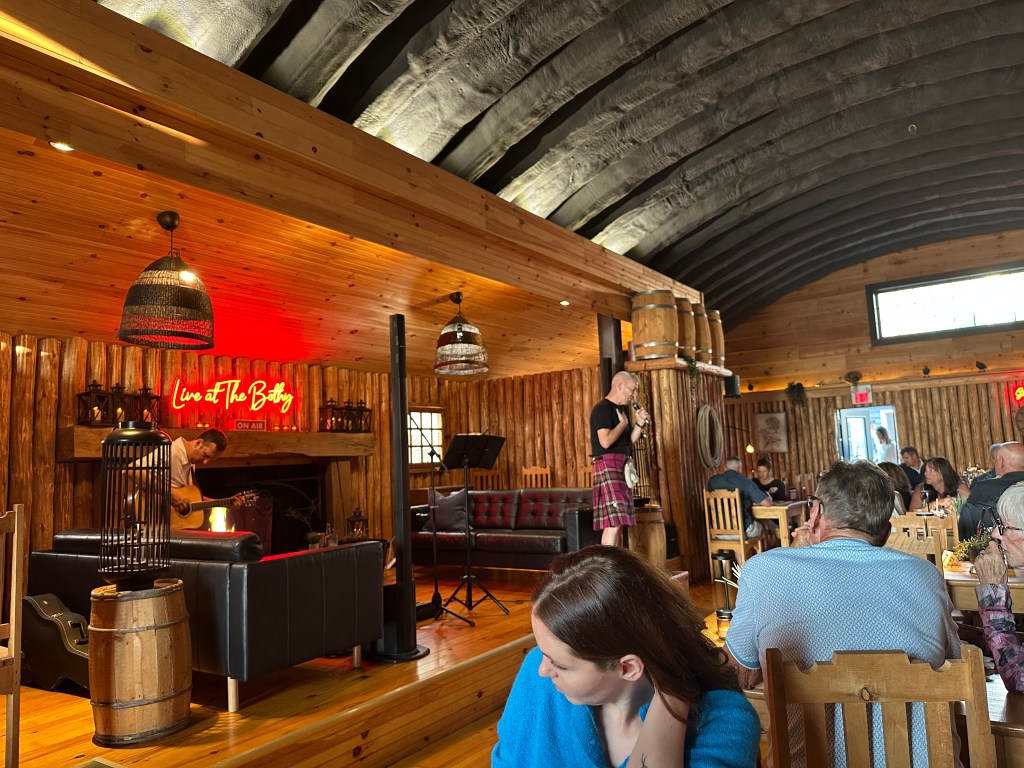
We enjoyed chatting with Justin, Colin, and their staff especially after watching many of them in the documentary. In addition to enjoying lots of fresh seafood, we were entertained with live music and Scottish dancing.
The next day found us back in Louisbourg for their annual crab fest
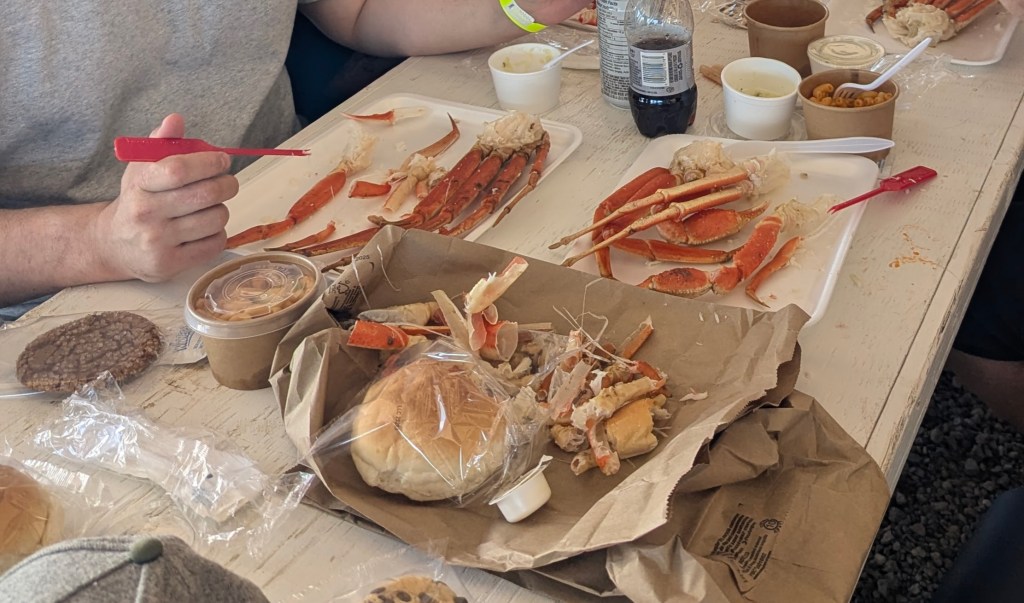
which also featured live music.
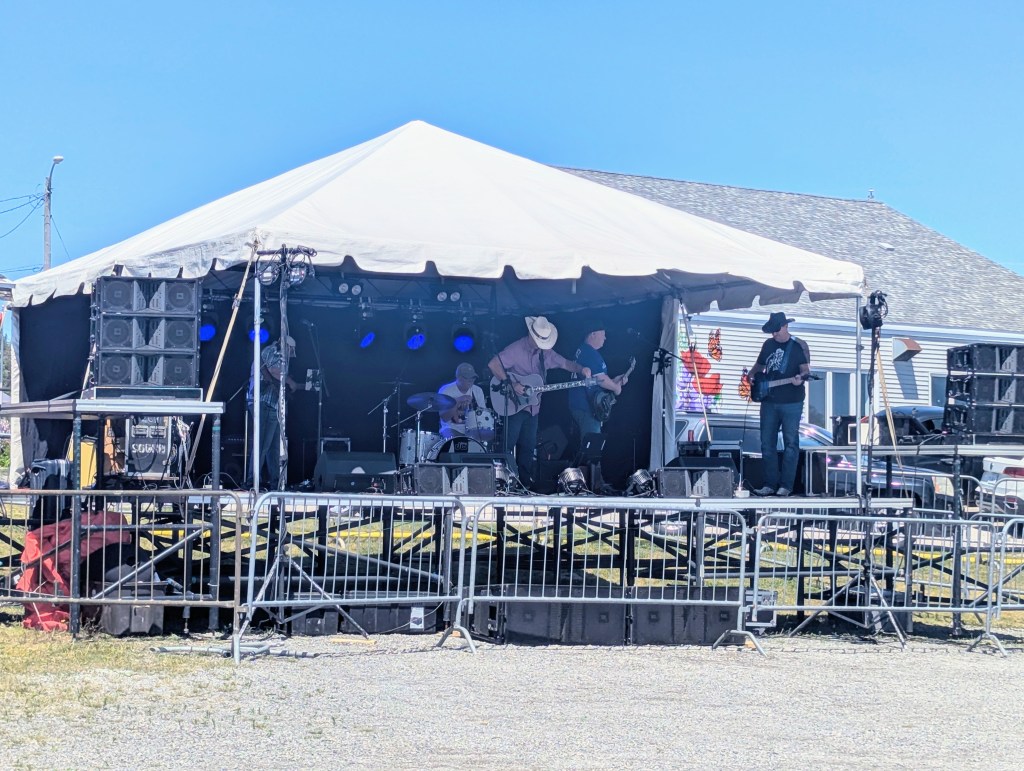
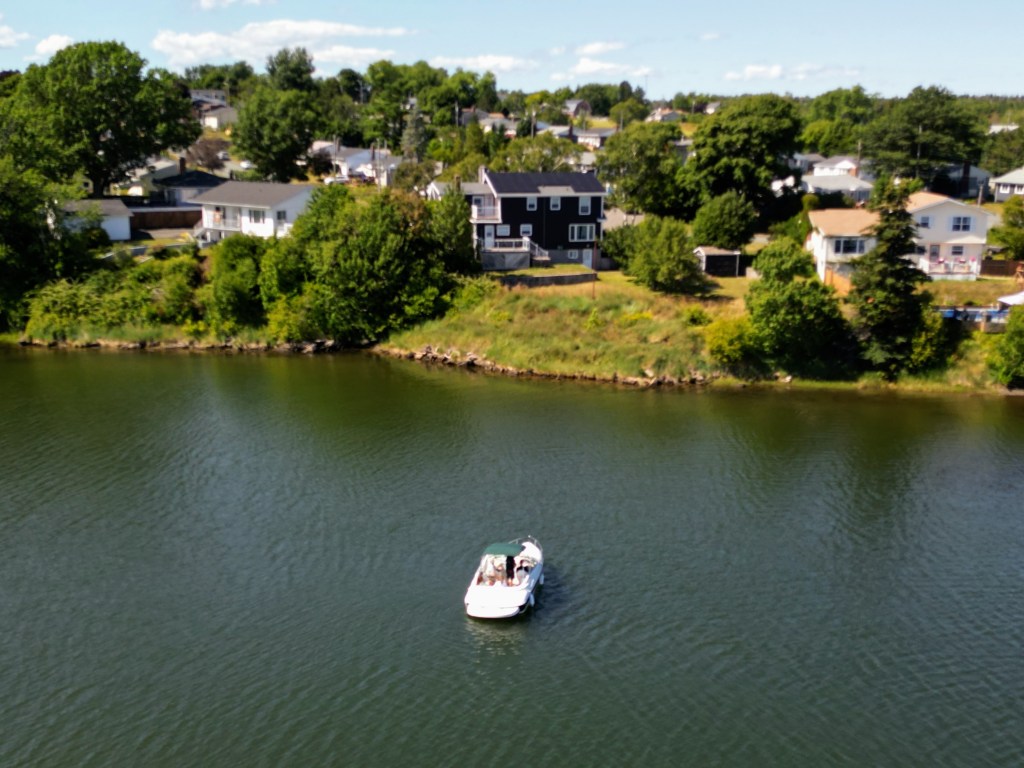
After filling our bellies with crab, we went out for a boat ride. There are rivers, bays, and coastline everywhere on the island of Cape Breton; one is never far from the water and/or a view of it. Eric sent up the drone to capture our adventure.
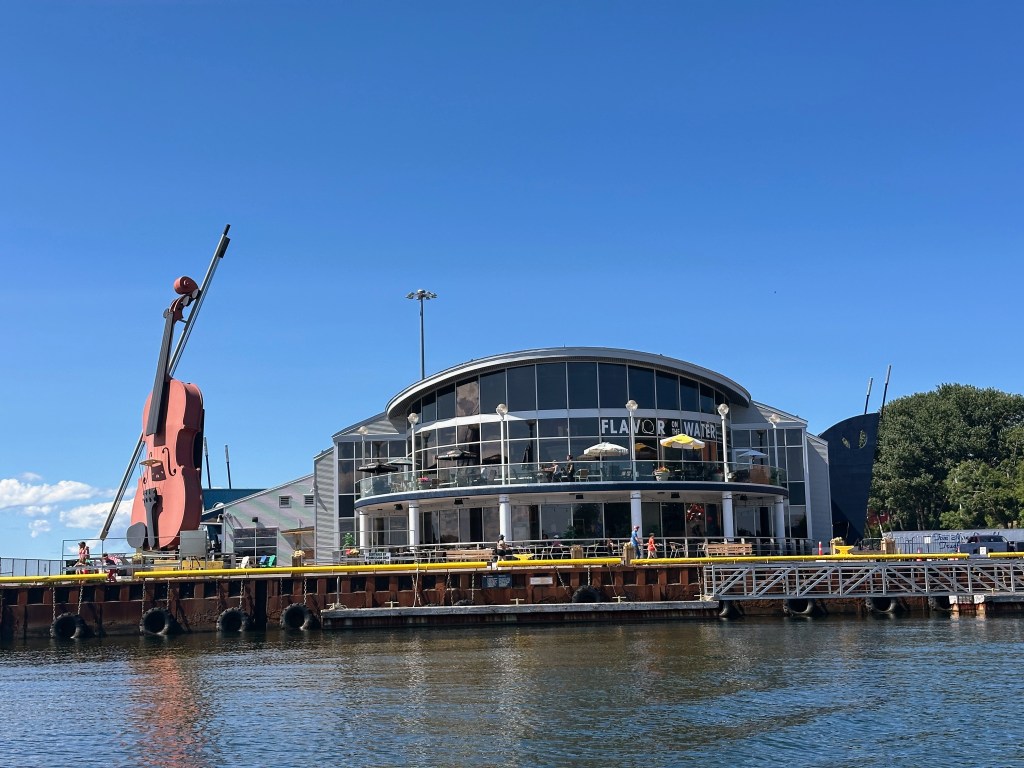
We motored past the Big Fiddle, the world’s largest fiddle, which is located on the Sydney waterfront. The fiddle and bow reach a height of 60 feet. The Big Fiddle was designed and constructed by Cyril Hearn in 2005. It is a tribute to the folk music and traditions of the province’s Celtic community.
The next day we left our family and drove along the Cabot Trail, a 185 mile route encircling Cape Breton Island, renowned as one of the world’s most scenic coastal drives with spectacular ocean, forest, and mountain views. This popular road trip offers opportunities for hiking, whale watching, and exploring charming fishing villages. We stopped by Saint Joseph du Moine for the view.

We continued along the coast, stopping frequently.

We admired the Mackenzie River Valley.
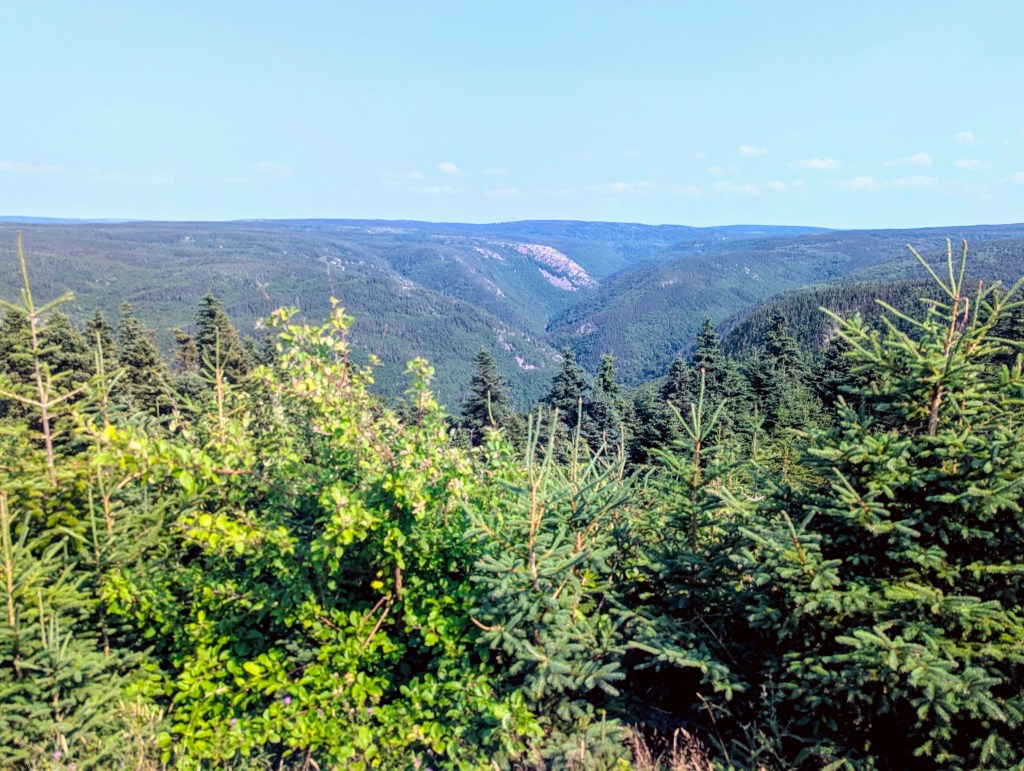
We drove through Cape Breton Highlands National Park, around the northern tip of the island, then passed onto the eastern side.

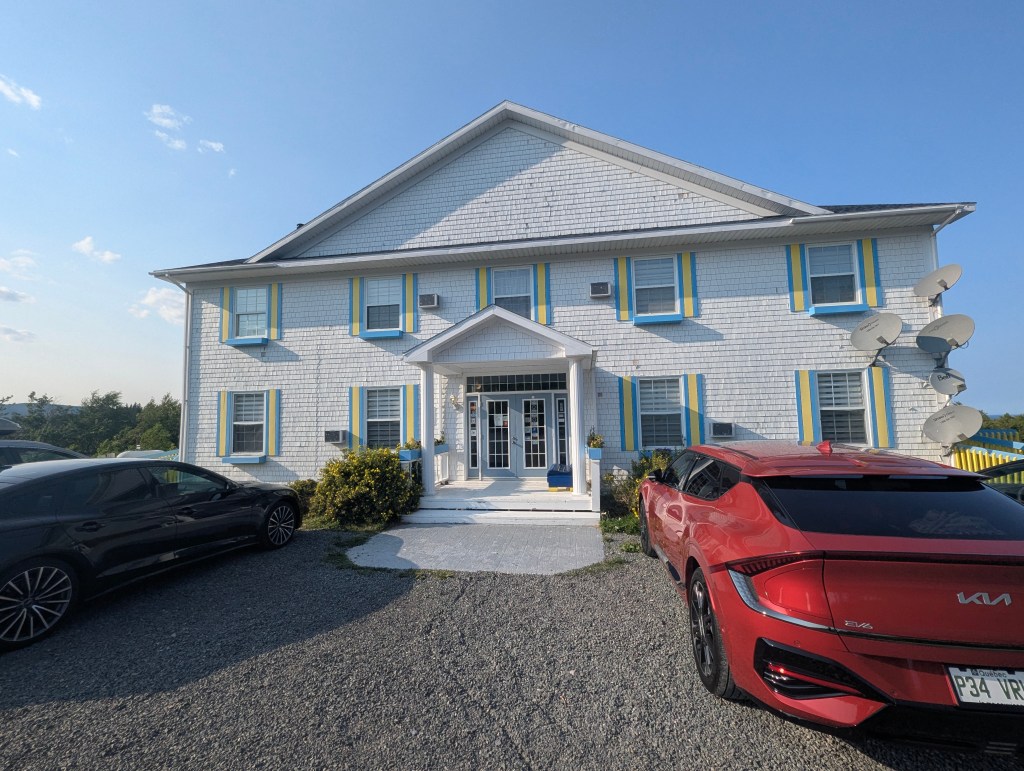
We checked into the Castle Rock Country Inn, a really cute bed and breakfast,
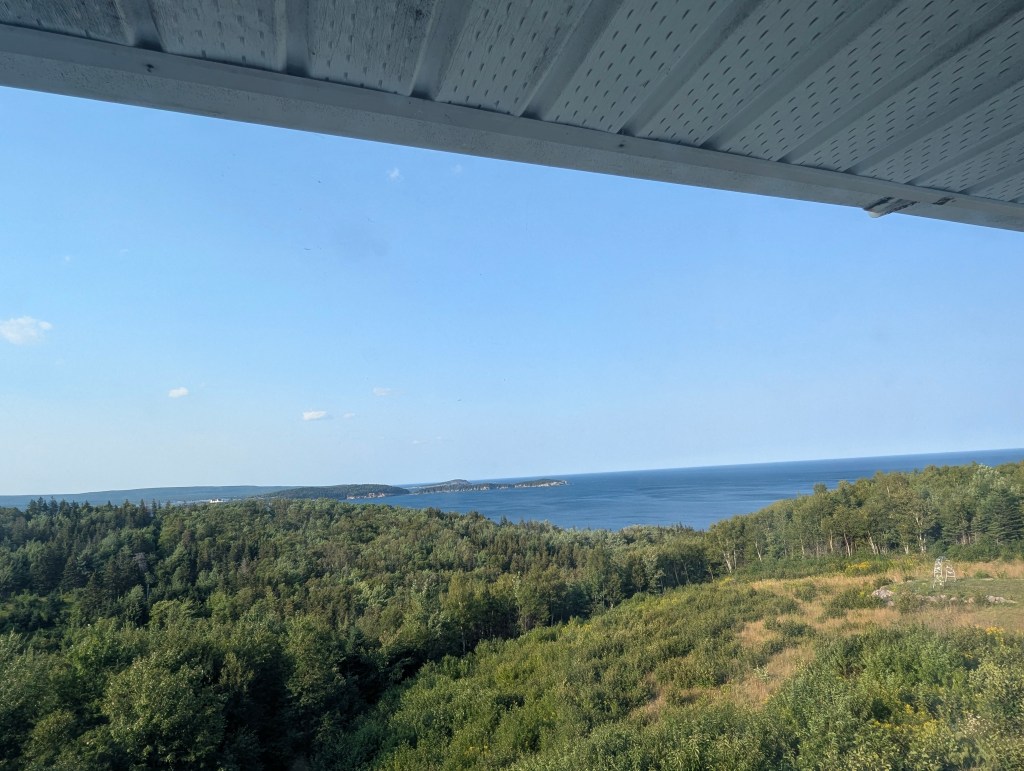
from which we had a great view of the North Atlantic.
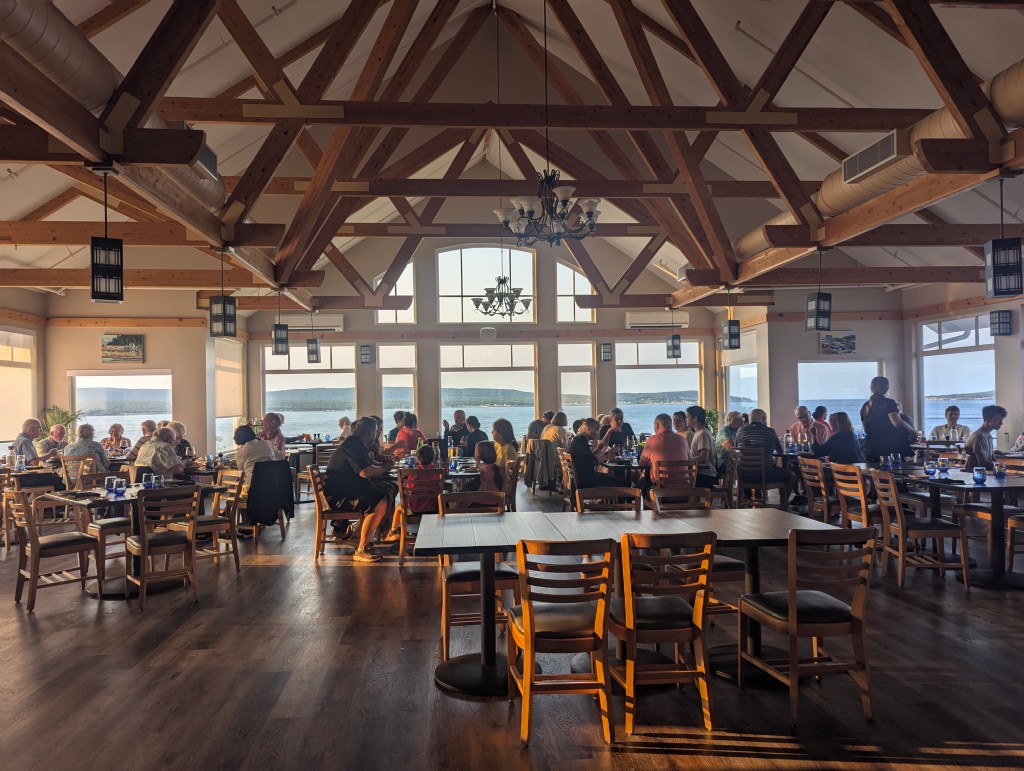
We went out to dinner at The Arduaine Restaurant at the Keltic Lodge and enjoyed fresh seafood specialties.
The following day we headed to Prince Edward Island (PEI). We stopped in Antigonish to visit Peace by Chocolate, which began with the Hadhad family’s thriving chocolate business in Damascus, Syria, which was destroyed in a bombing in 2012, forcing the family to become refugees in Lebanon before immigrating to Antigonish, Nova Scotia, in 2016. Supported by their new community, they rebuilt their chocolate-making legacy, establishing the Peace by Chocolate company that same year. The company’s story has since become a symbol of resilience, a celebration of Syrian heritage, and a message of peace and inclusion. We had watched the 2021 fim by the same name.

We boarded the Northumberland Ferry in Pictou, then settled in with a steaming cup of seafood chowder while enjoying the crossing on this overcast day.
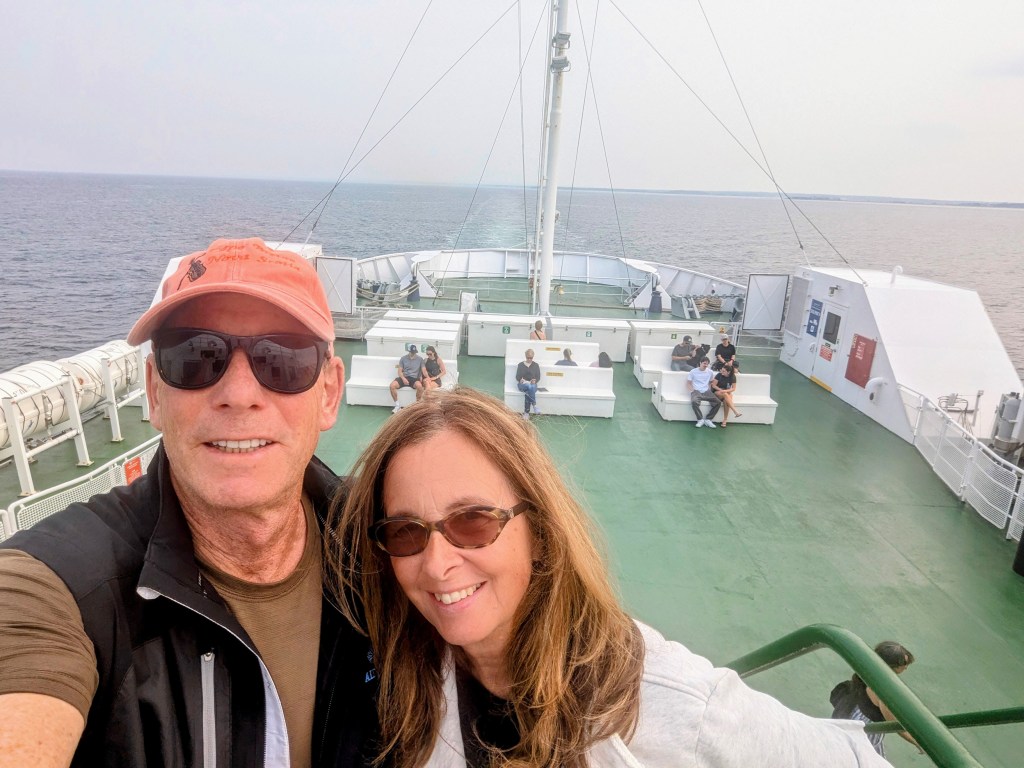
We arrived PEI at Wood Islands
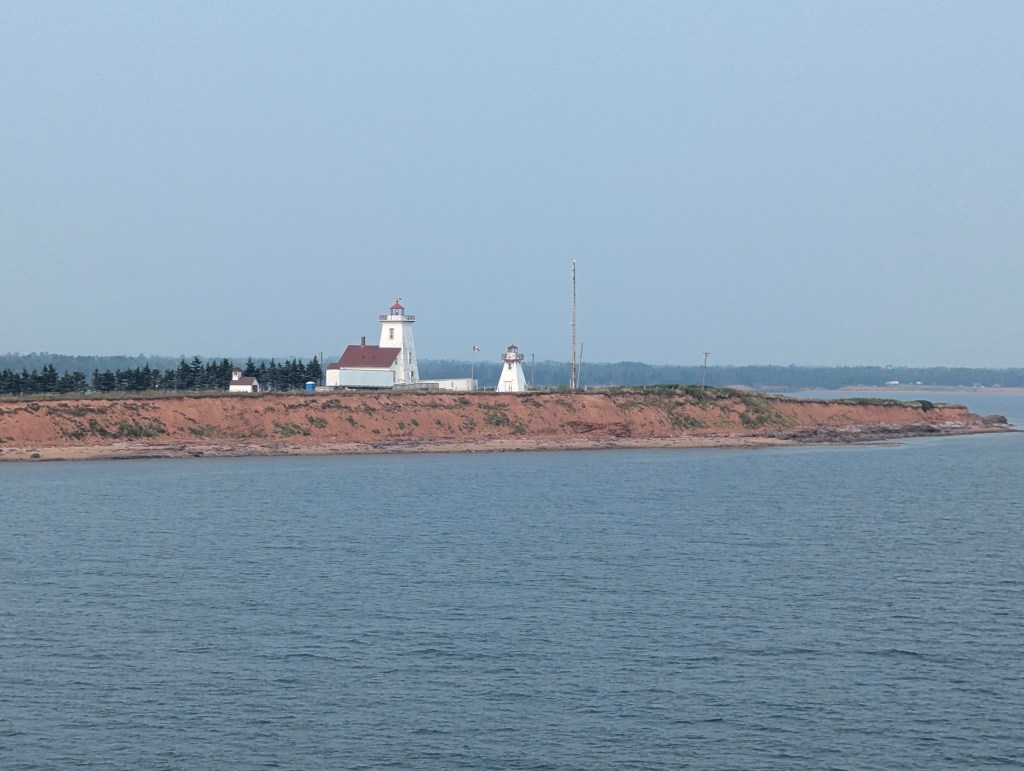
then drove the 40 minutes to Charlottetown where we were booked in an extremely cute bed and breakfast, Inn on the Harbor,
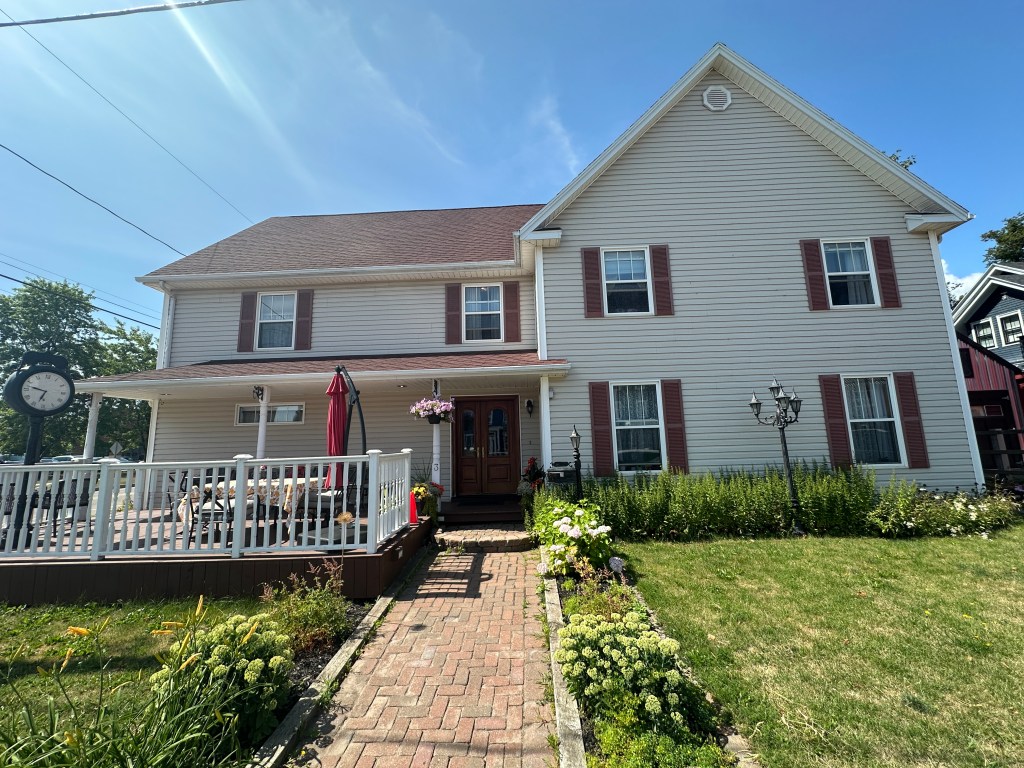
where we had the most comfortable room.
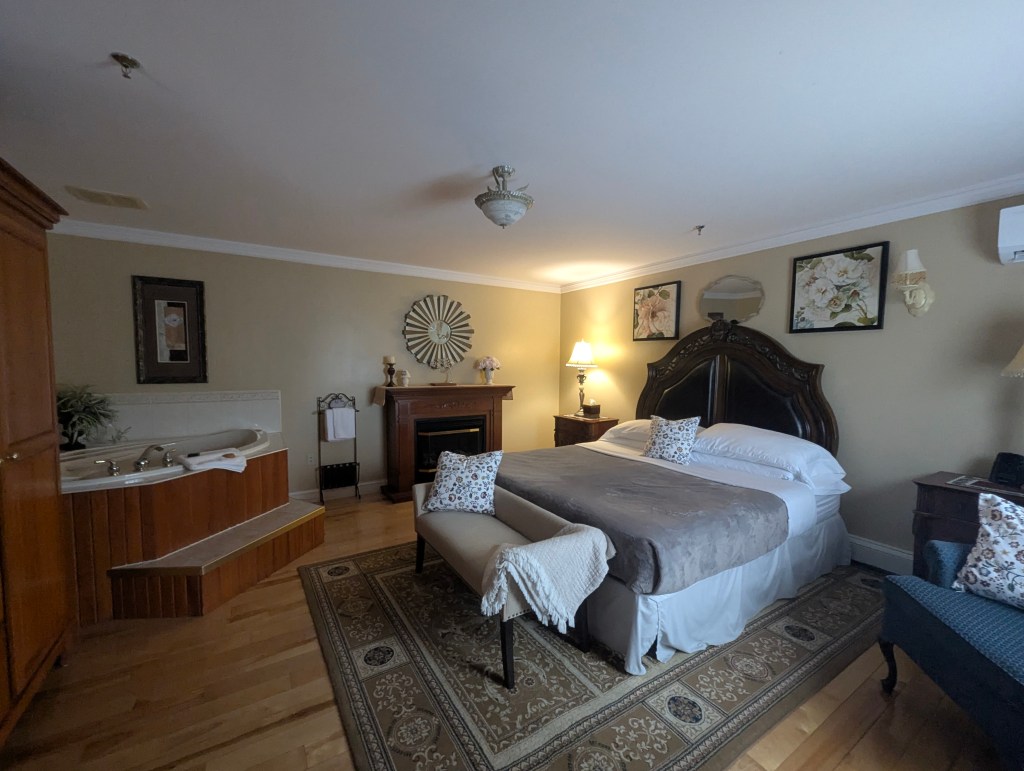
We dropped our stuff and headed right out to explore the port
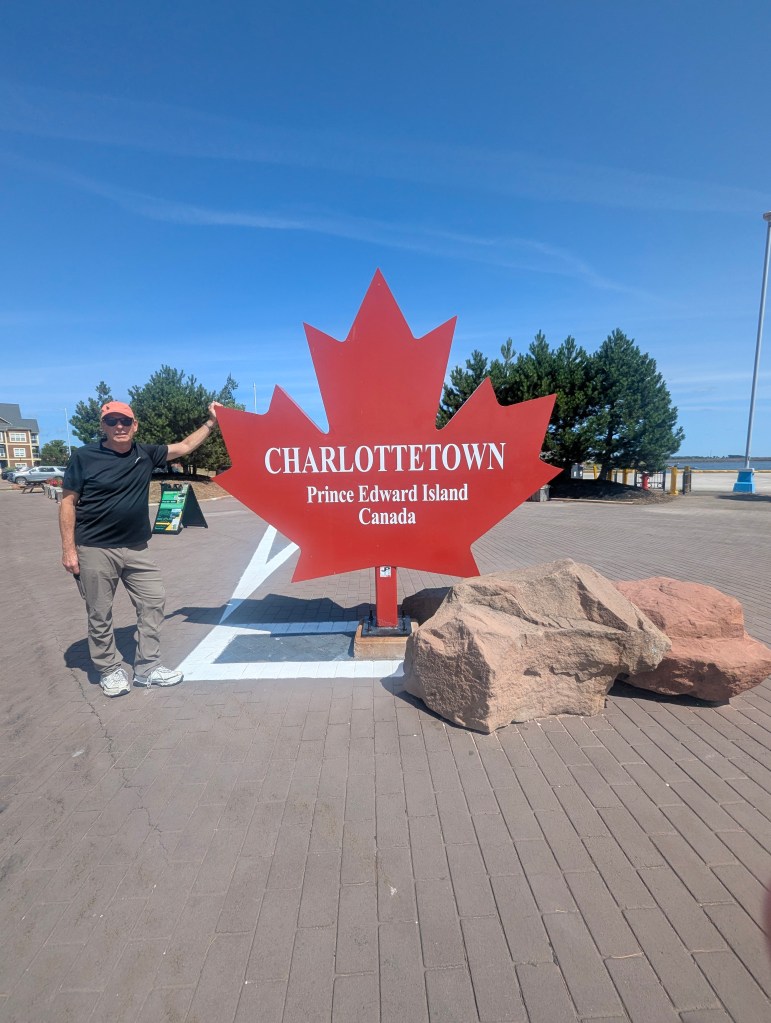
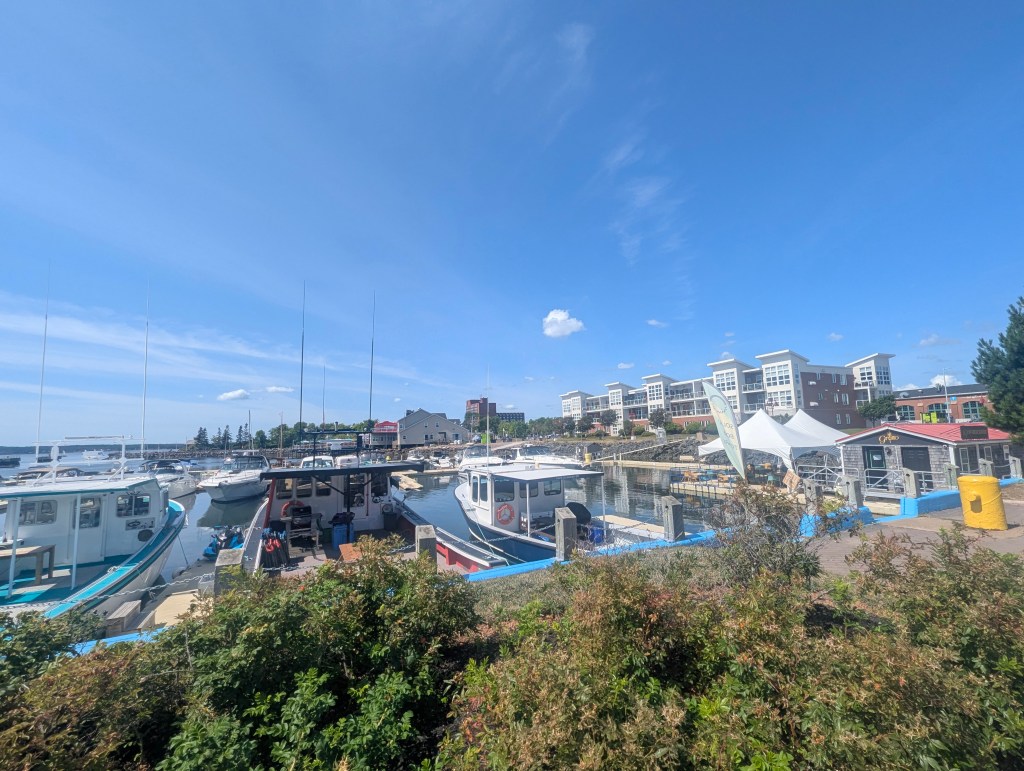
before heading to Victoria Row to check out the nightlife then heading to Claddagh Oyster House for dinner.
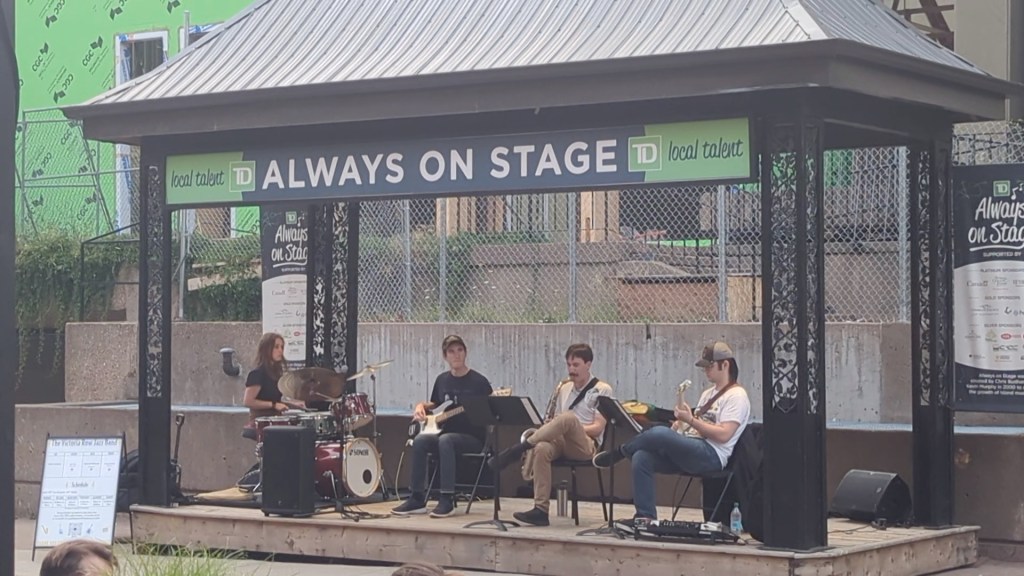
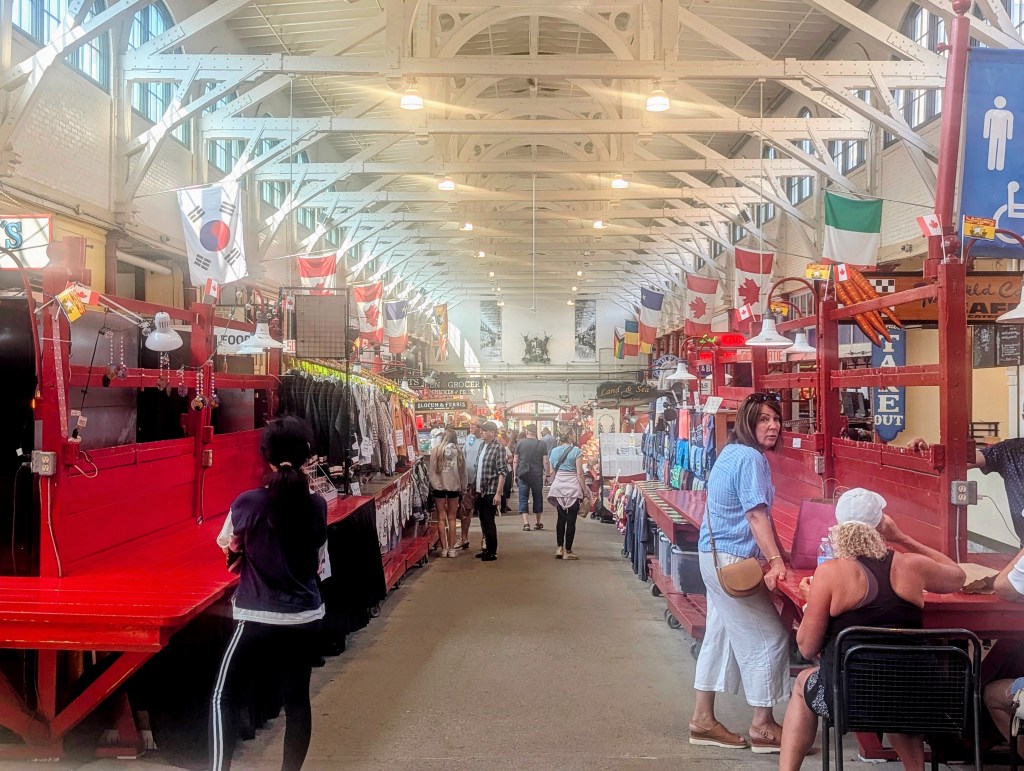
We had a walking tour booked for the morning. We meandered along the Hillsboro River, a watershed covering over 135 square miles,
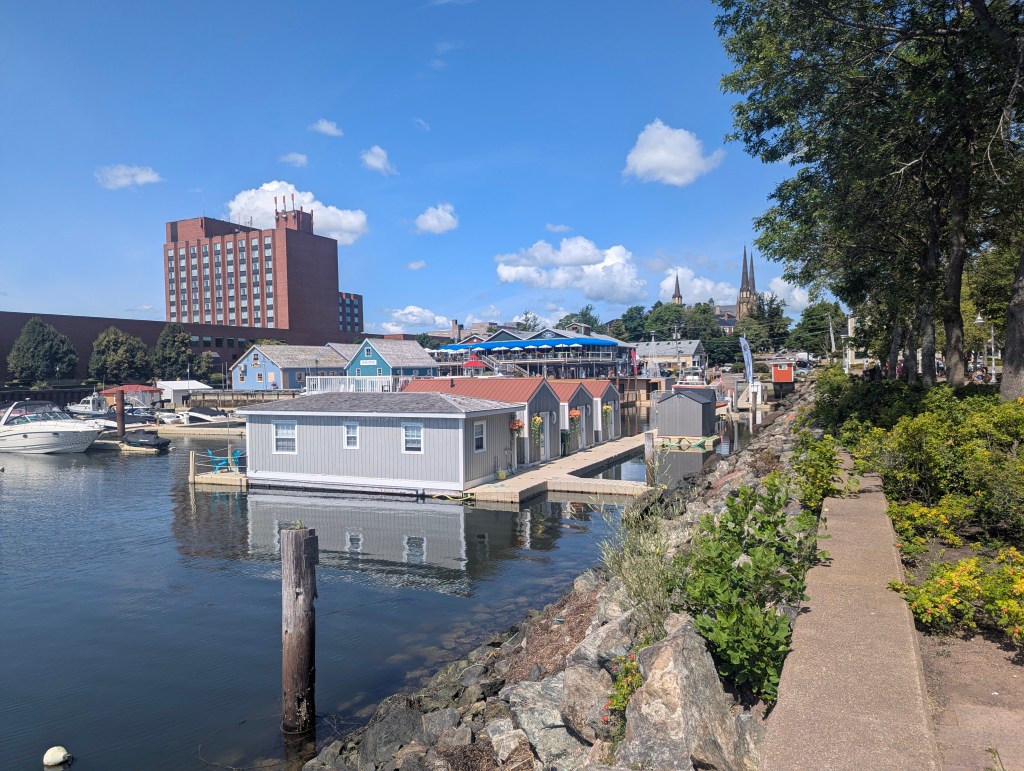
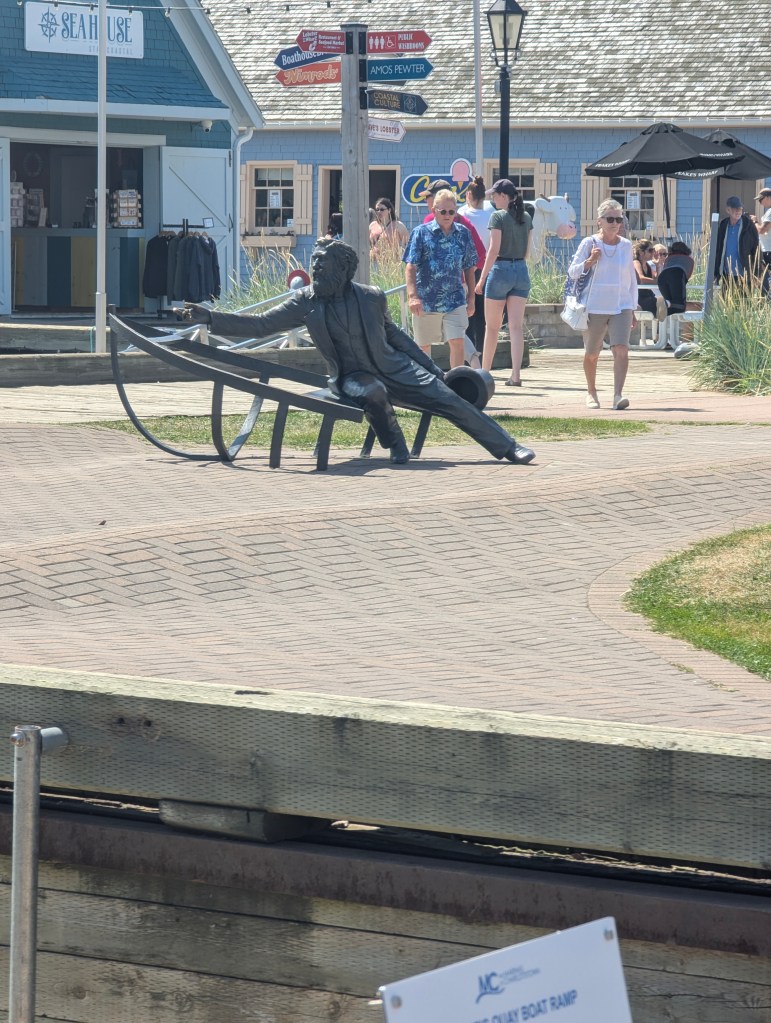
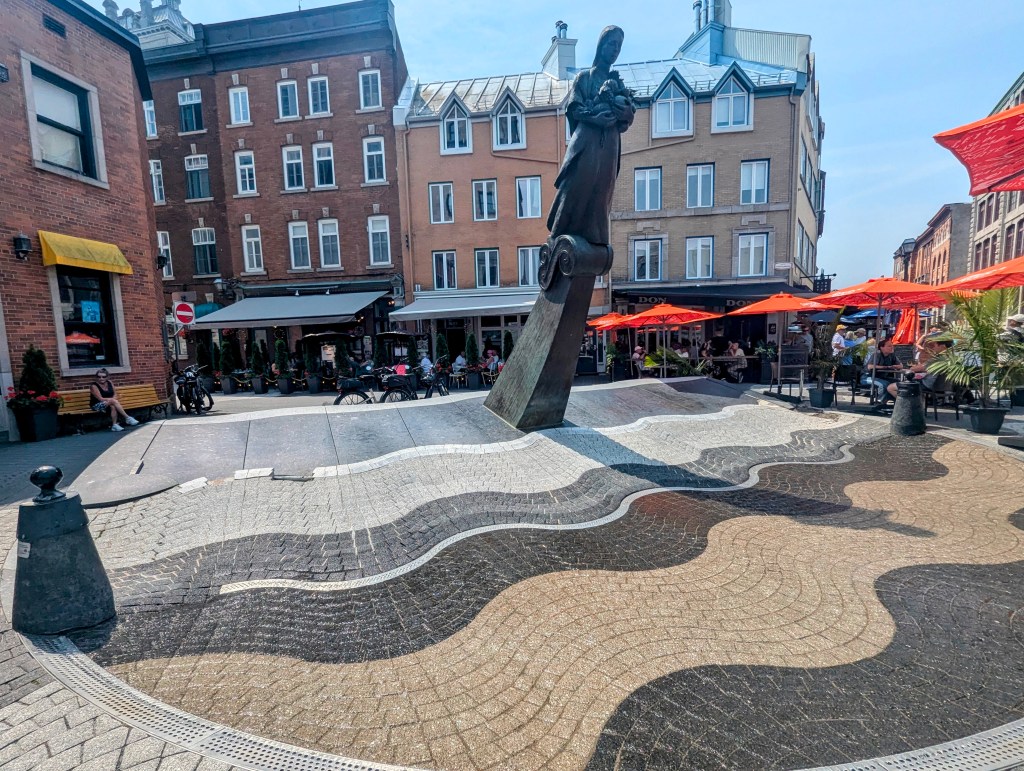
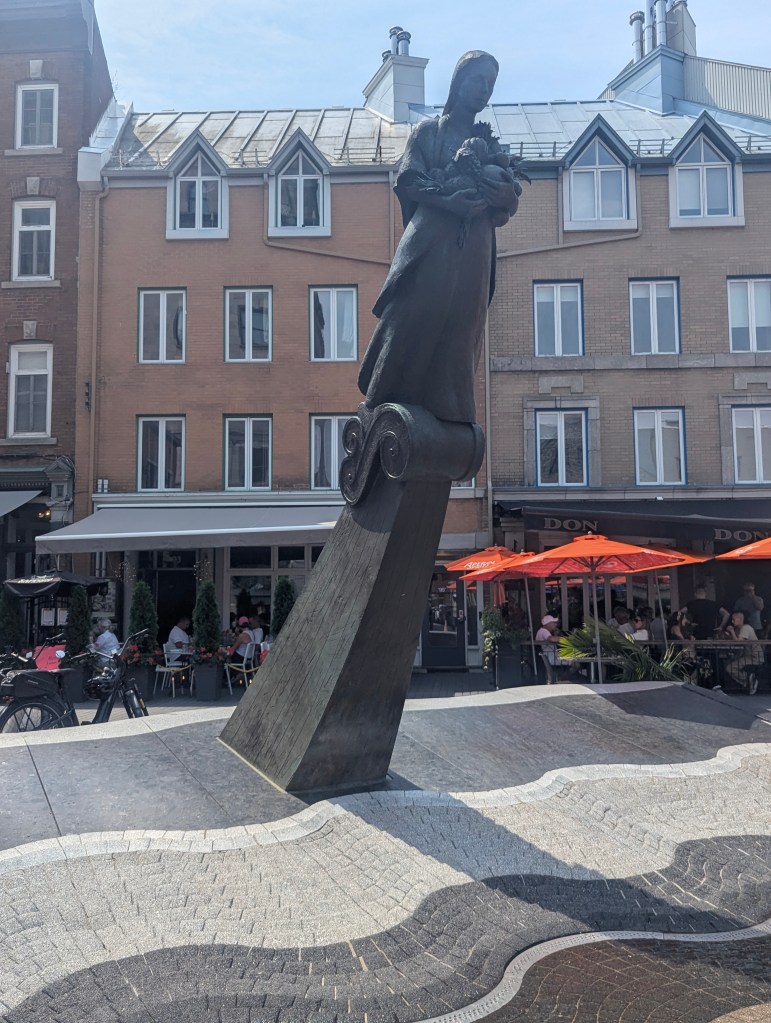
and into Confederation Park, where we met our guide Jonah. He started with the background history of PEI: the Mi’Kmaq arrived thousands of years ago via ice bridges. The first caucasians arrived in 1594. The French established the first settlement in 1713. Originally the island was named Saint John by the French, but when the English took over it was renamed in 1799 to honor Prince Edward, Duke of Kent and Strathearn, the fourth son of King George III and the father of Queen Victoria. He was so honored due to his service as commander of British forces in the Maritimes and his interest in the colony’s development, even though he never visited the island. In 1864 the growing city held a conference of provinces: New Brunswick, Novas Scotia, and Province of Canada (at the time included both Ontario and Quebec) to negotiate for a larger single confederation. (PEI was included in the conferences but joined the Confederation later, in 1873.) On the day the delegates were due to arrive there was a circus in Charlottetown. There had not been a circus in over 20 years; it was much more interesting to the majority of the population. There was no one working at the public wharf at the foot of Great George Street when the Canadian delegates arrived on the steamship SS Victoria, so Prince Edward Island representative William Henry Pope (1825-1879) had to handle receptions by himself, including rowing out to greet the new arrivals. The statue below, on Confederation Landing, represents that greeting. The brick walkway appears undulating to represent the waves.
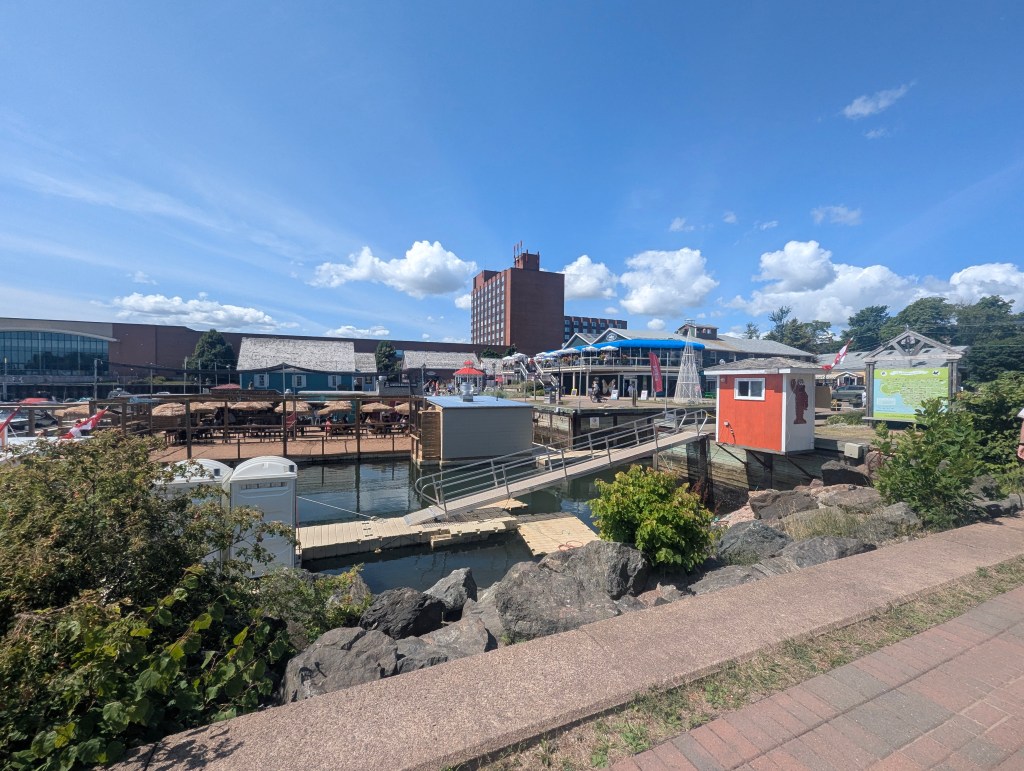
Peake’s Quay, named for James Peake Jr. (1842-1895), was a successful banker and shipbuilder. The Peaks family was one of the wealthiest in Charlottetown until about 1880 when the town’s decline began due to the loss of trees for export as well as competition from other developing cities like Montreal, Toronto, and Halifax. The decline continued until the 1980s when restoration projects began which in turn promoted tourism. Peak’s Quay is now a bustling hub of shops and restaurants as well as a marina. (Of note, PEI suffered further loss of trees when hurricane Fiona came through in September, 2022 taking over 40% of the islands trees down.)
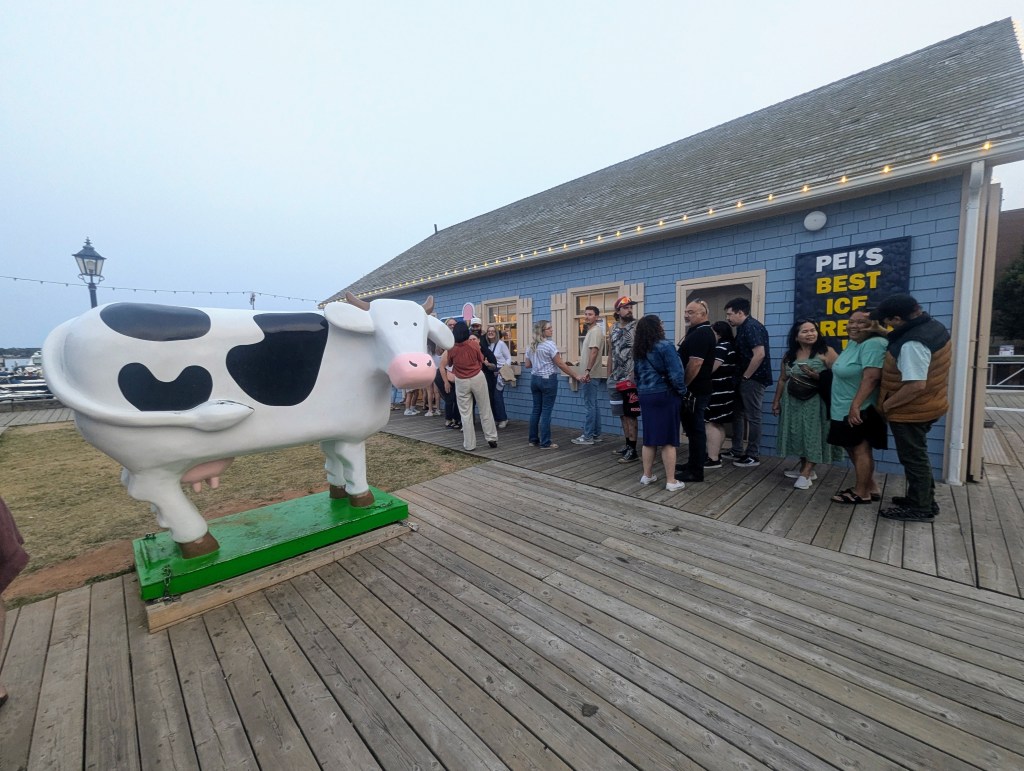
Also found on the quay is Cow’s ice cream, made first here on PEI, but now a favorite throughout PEI and Nova Scotia.
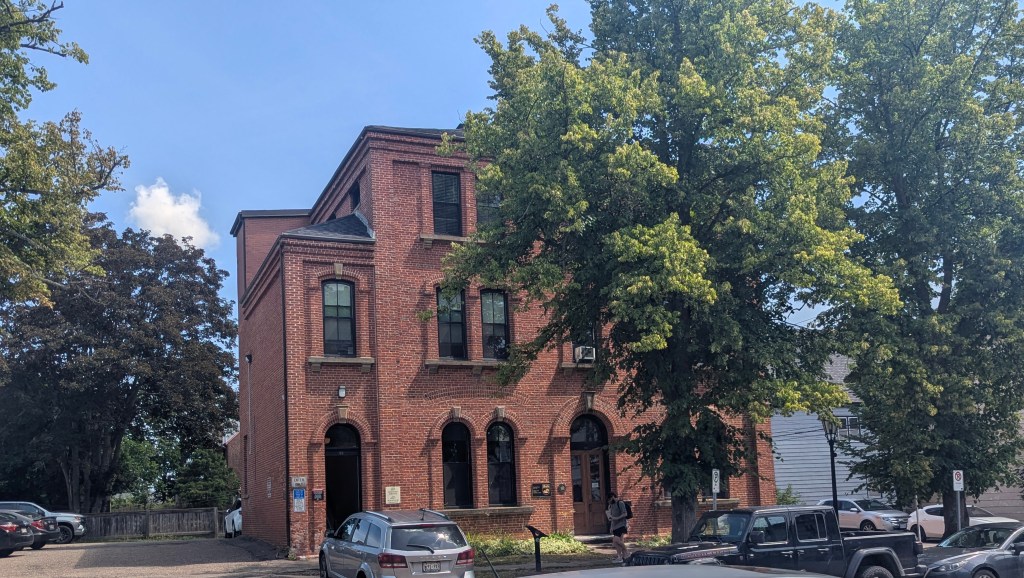
The building for the first bank of PEI, constructed in 1867, is made of island brick and reflects the need then for a local bank and currency during the shipbuilding era. Over time the building has served various purposes including a Customs House and offices for both Federal and Provincial governments. Jonah pointed out that it had a drive though window which, by today’s standards, is very high because it was built to accommodate a horse and buggy.
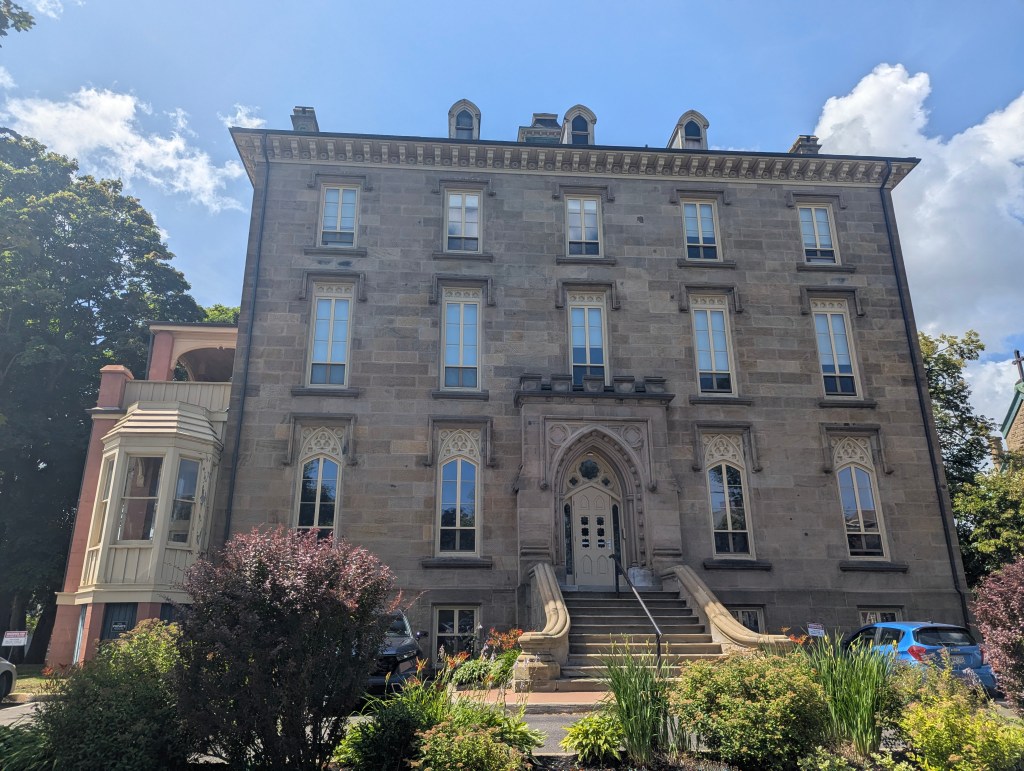
The Bishop’s Palace in Charlottetown was the former residence of the local bishop and is now part of St. Dunstan’s University (SDU).
St. Dunstan’s Basilica is named for St. Dunstan, an 11th century English bishop and Benedictine monk. This is the fourth church on this site. The first Catholics to arrive were French from different New France settlements, but the second wave of Catholics later were Scottish, who had the first small wooden chapel built in 1758. After a fire in 1897 destroyed the second wood church, the first stone St Dunstan’s Cathedral was built and completed in 1907. The present stone structure was built between 1913 and 1919 after a fire destroyed the original cathedral in 1913. It was built in the Gothic Revival architectural style. The cathedral was blessed by the Pope in 1929 and elevated to a basilica.
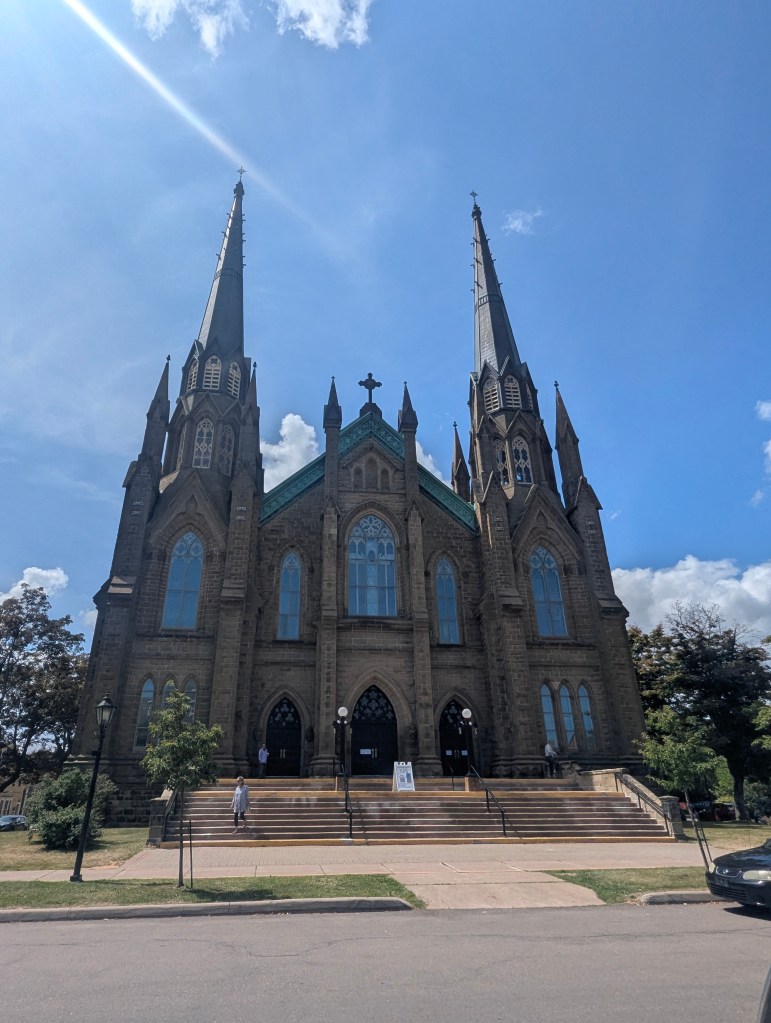
Angus Bernard MacEachern (1759-1835) was the first Bishop of the Diocese of Charlottetown in 1829. Prior the town did not have its own and had to share with other communities.

We took a look inside.
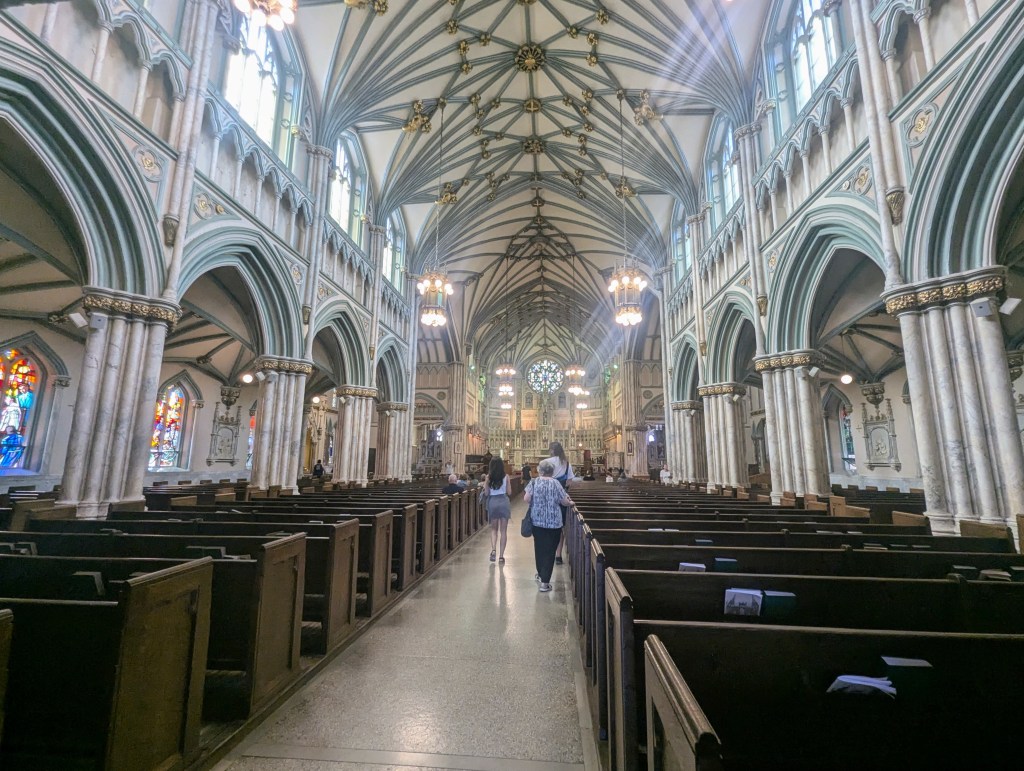
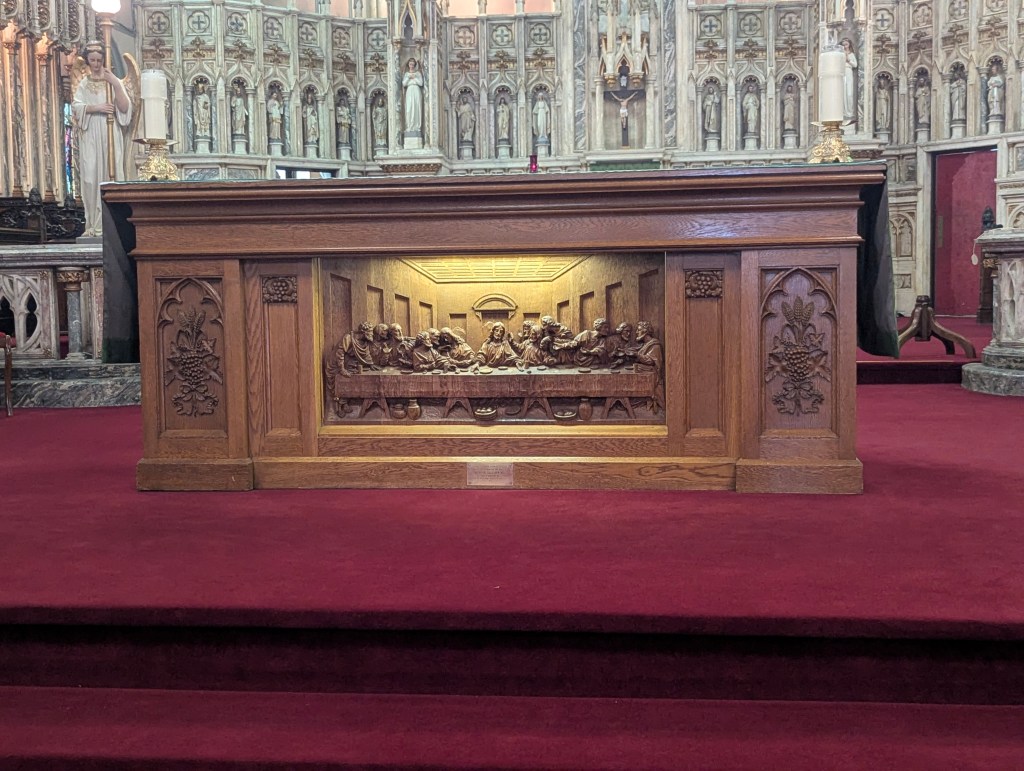
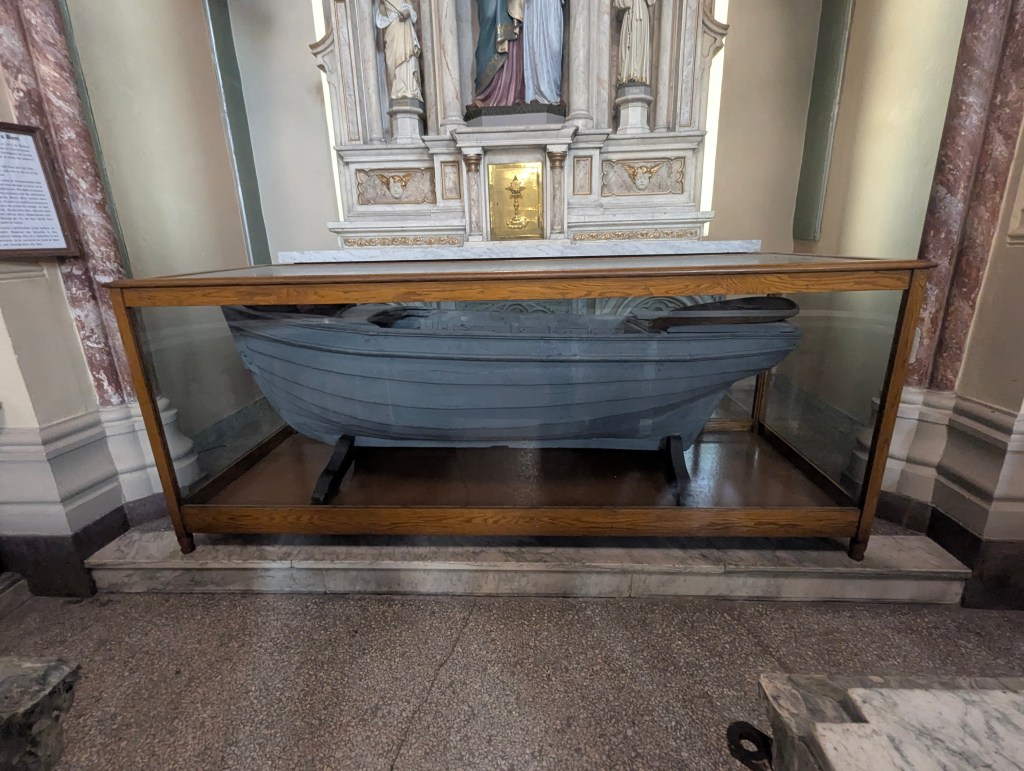
Jonah regaled us with the story of how, before Charlottetown had a bishop of its own, the bishop would travel 12 miles on the river in a small boat every week for services. The community loved and appreciated him. His tomb is in a side chapel of the basilica,
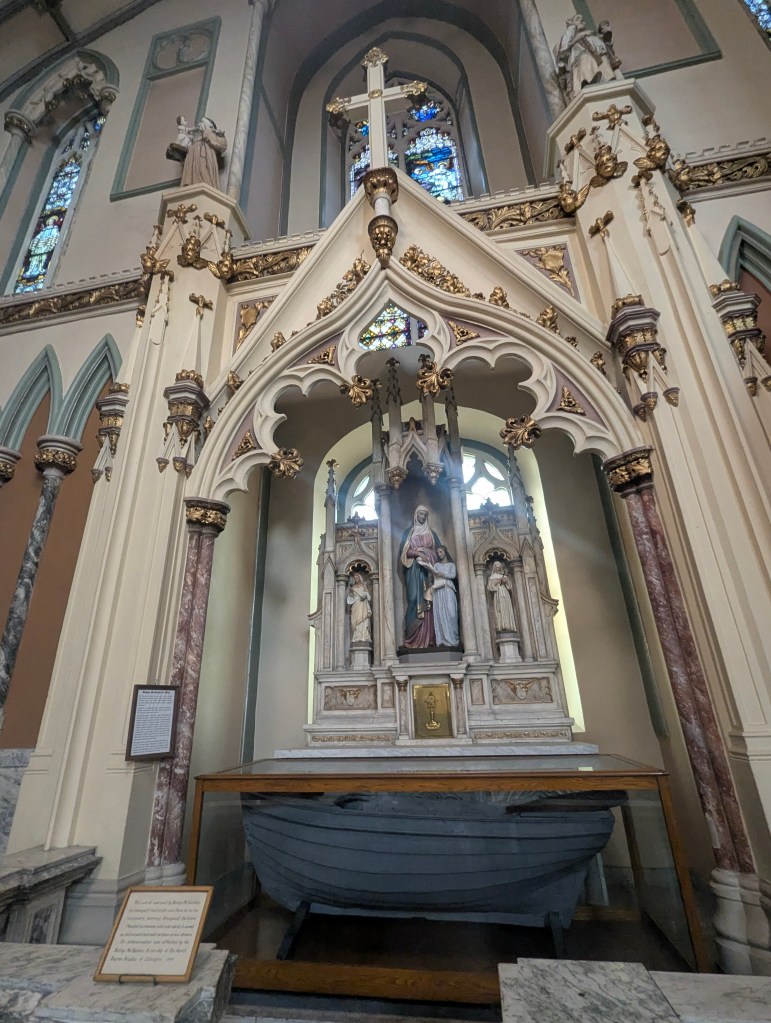
and his boat is preserved within.
Sculptor Nathan Scott’s statue commemorating two Fathers of Confederation both named John Hamilton Gray, one a Prince Edward Islander and the other a New Brunswicker stands squarely in the middle of Great George Street. It depicts the two Grays in conversation in 1864 debating the merits of confederation vs individual provinces, a subject on which they had opposing views.

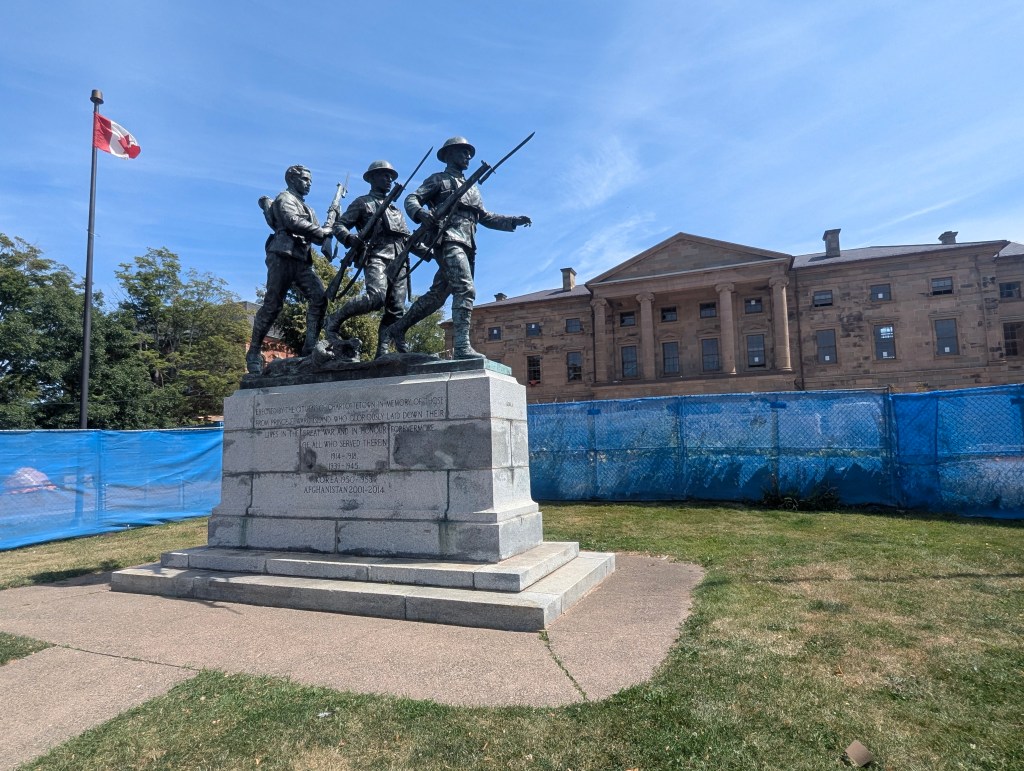
Province House is where the PEI Legislature has met since the structure was built for PEI by the Brits in 1847. Because the soil on the island is rich in iron and other nutrients, growing corn and potatoes was lucrative in the early days of the island. As farming and hence the population grew, there was a push for self-governance. Province House was designed for “responsible government.” Prior government had been provided by the crown; PEI was the first province to establish self-governance. The building is currently undergoing extensive renovations which began in 2015 with an estimated budget of $10 million over two years. It has cost over $238 million with no end in sight. Jonah joked, “There are two seasons on PEI: winter and construction.”

The war memorial in front of Province House was unveiled on July 16, 1925, to commemorate soldiers from PEI who died in the First World War. The memorial now also pays tribute to islanders who lost their lives in the Second World War, the Korean War, and the Afghanistan War.
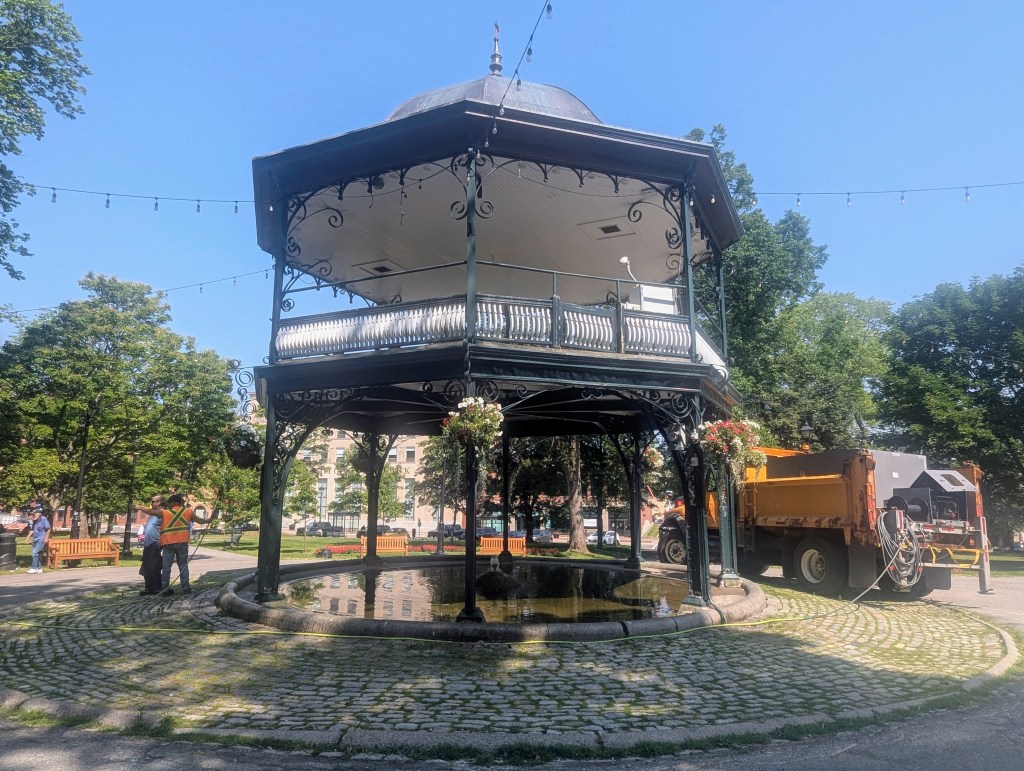
Province House sits at one end of what had been Queen Square, which was the central square in Charlottetown. All of the land below Water Street is reclaimed land. At the time of the confederation meetings, Queen Square was the main square and Victoria Row the main thoroughfare.

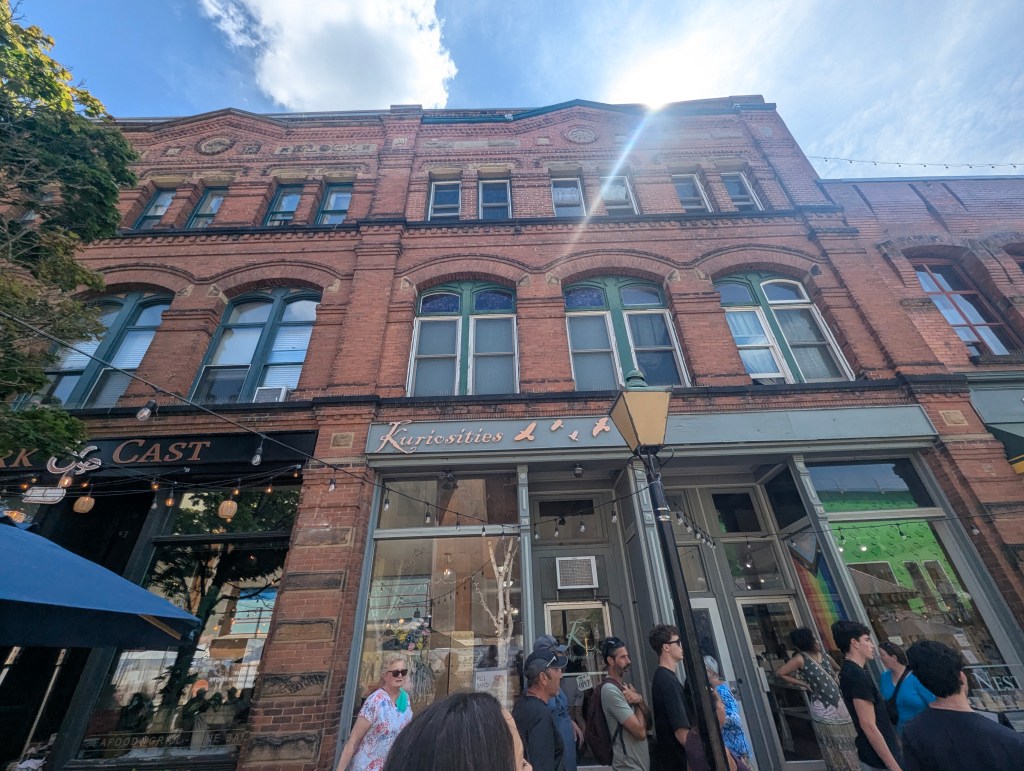
Victoria Row, historically known as the south side of Victoria Square, is a street mall located on Richmond Street between Queen and Great George Streets. The architecture surrounding the cobblestone street dates back to the victorian era. It is currently all built from red brick after the original structures burned down in the fire of 1883. Because of excessive autos, the street is now closed to vehicular traffic during the summer months. It is home to various boutique shops and restaurants and is considered a main tourist attraction in Charlottetown.
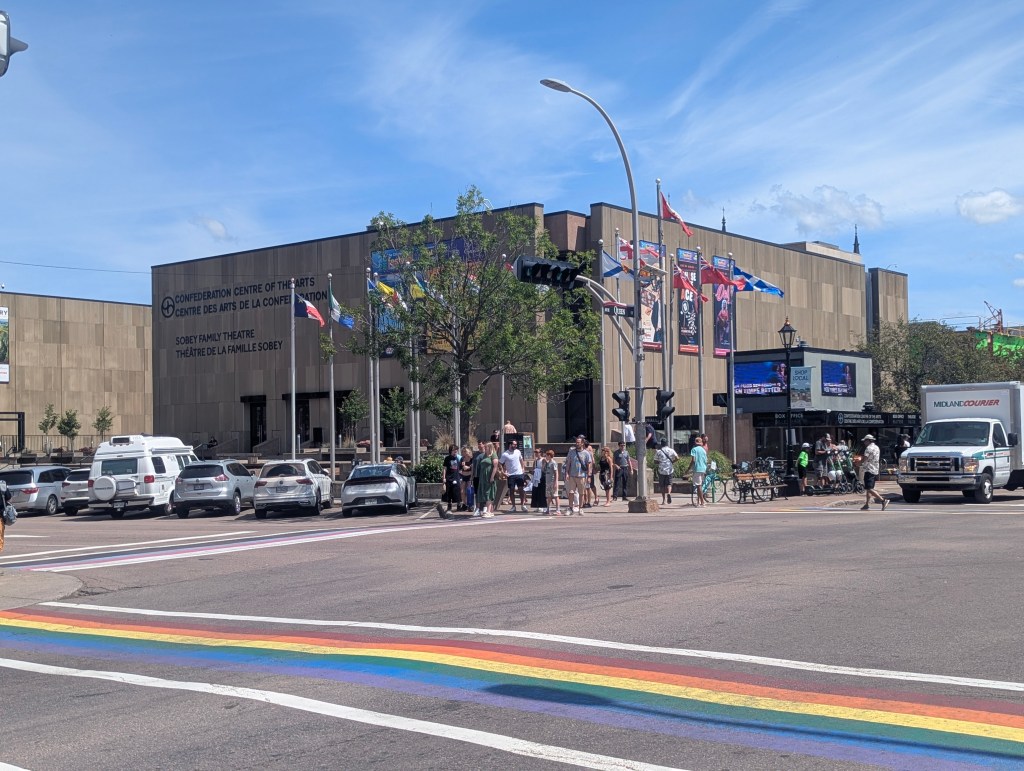
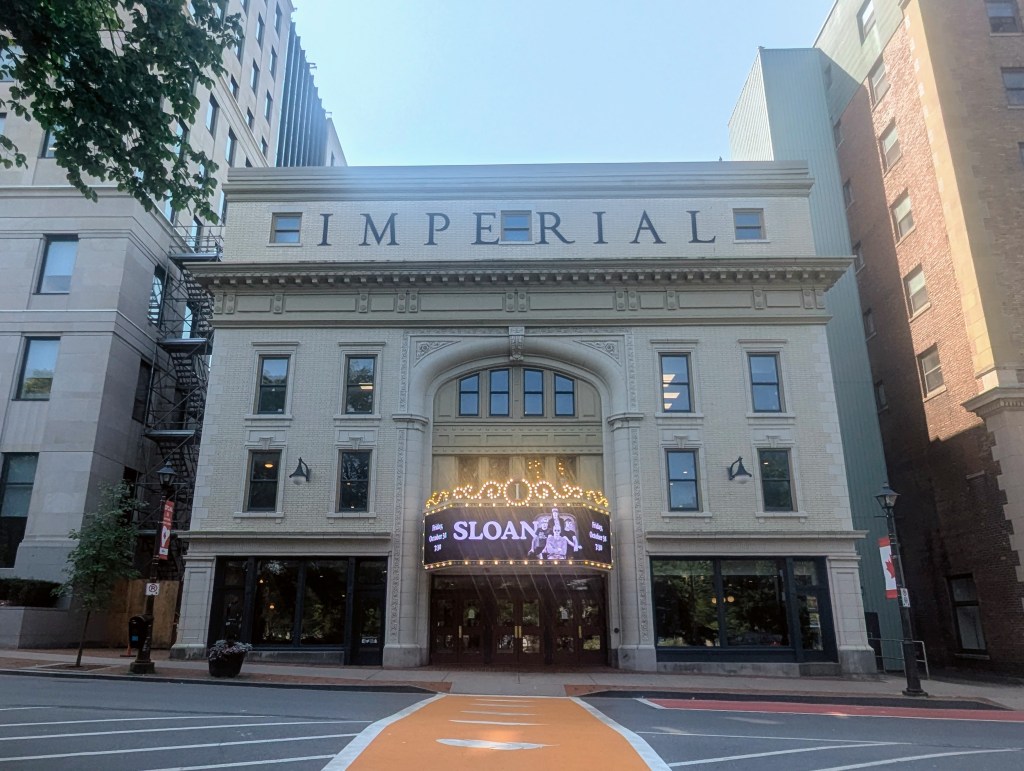
The Confederation Centre of the Arts is a national memorial and performing arts centre, dedicated to the 1864 conference that led to Confederation. It hosts live performances, runs an art gallery with Canadian visual art, provides arts education programs, and holds heritage activities that facilitate discussion about Canada. Constructed to commemorate the 100th anniversary of the Charlottetown Conference and serve as a national memorial to the Fathers of Confederation, the center was designed in a Brutalist style, opened by Queen Elizabeth II in 1964, and was designated a National Historic site in 2002.
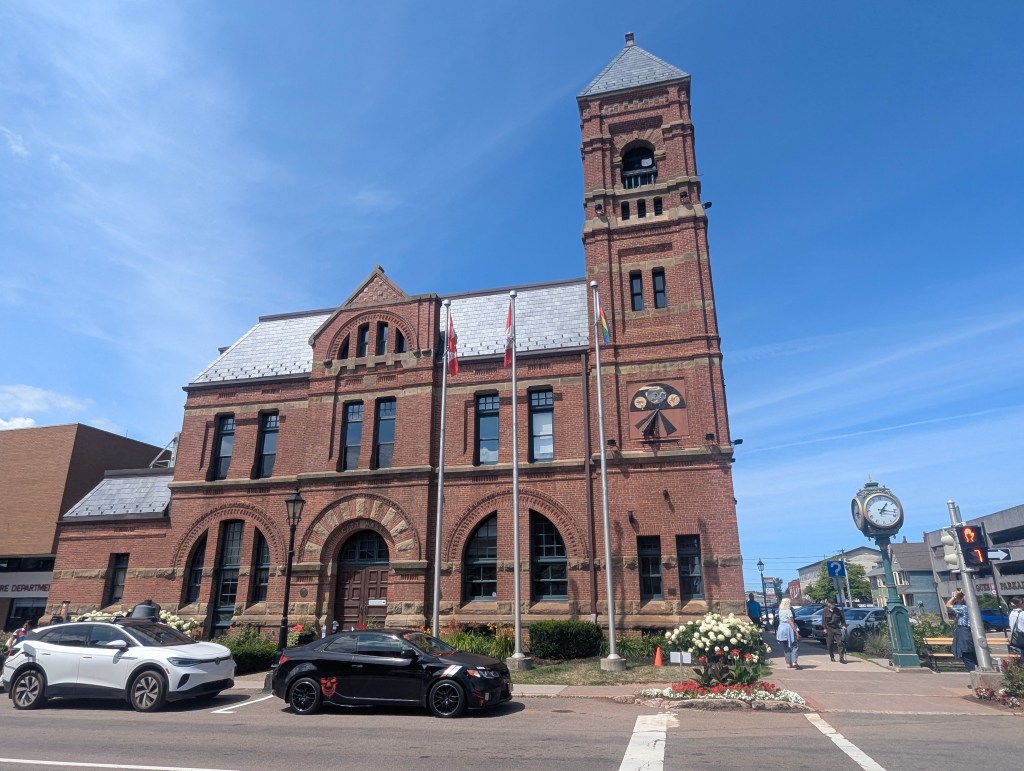
Charlottetown City Hall is the seat of the City Council. It was designed in the Romanesque Revival style. It was built beginning in 1887 and was completed in 1888.
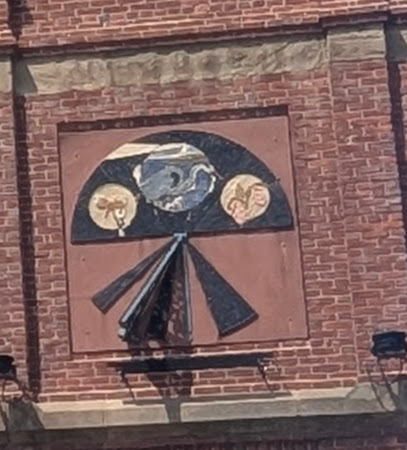
The peoples who had inhabited the island were first the indigenous, then the French, and finally the Brits. The clock on the bell tower has symbols of a fox, a flower, and a great heron as an amalgamation to represent each.
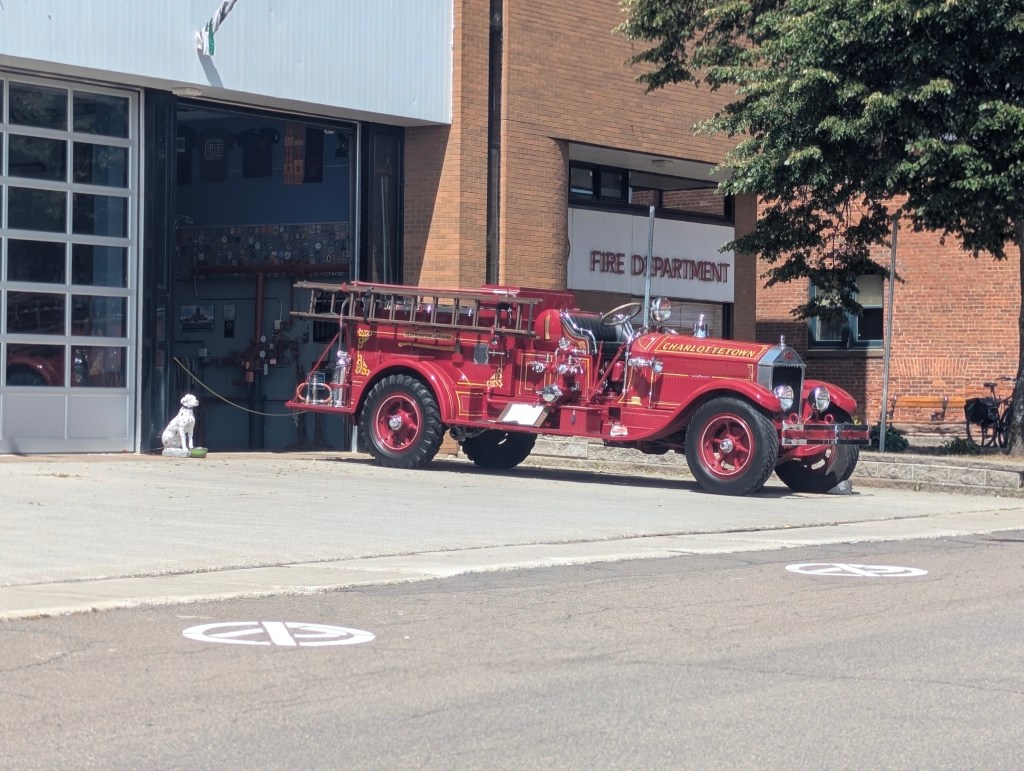
The fire hall opened in 1916.
Rodd Charlotte is a town hotel built in the 1880s, originally as a railway station.

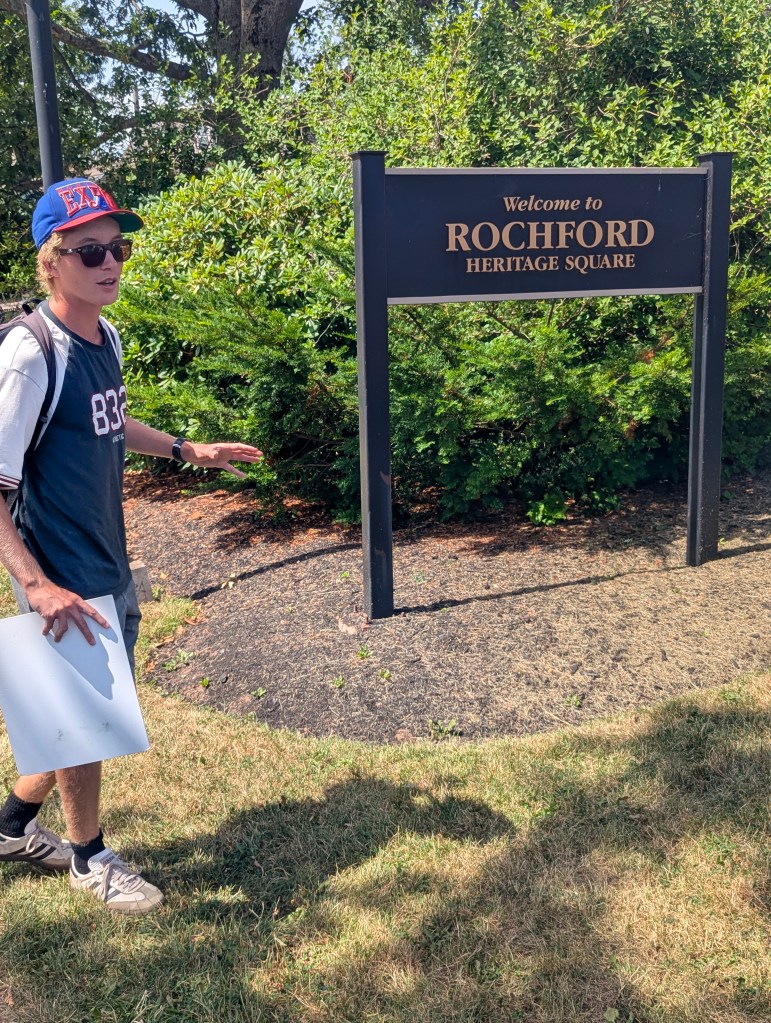
Jonah explains to us that in the late 19th century, everything north of Rochford Square was considered rural.
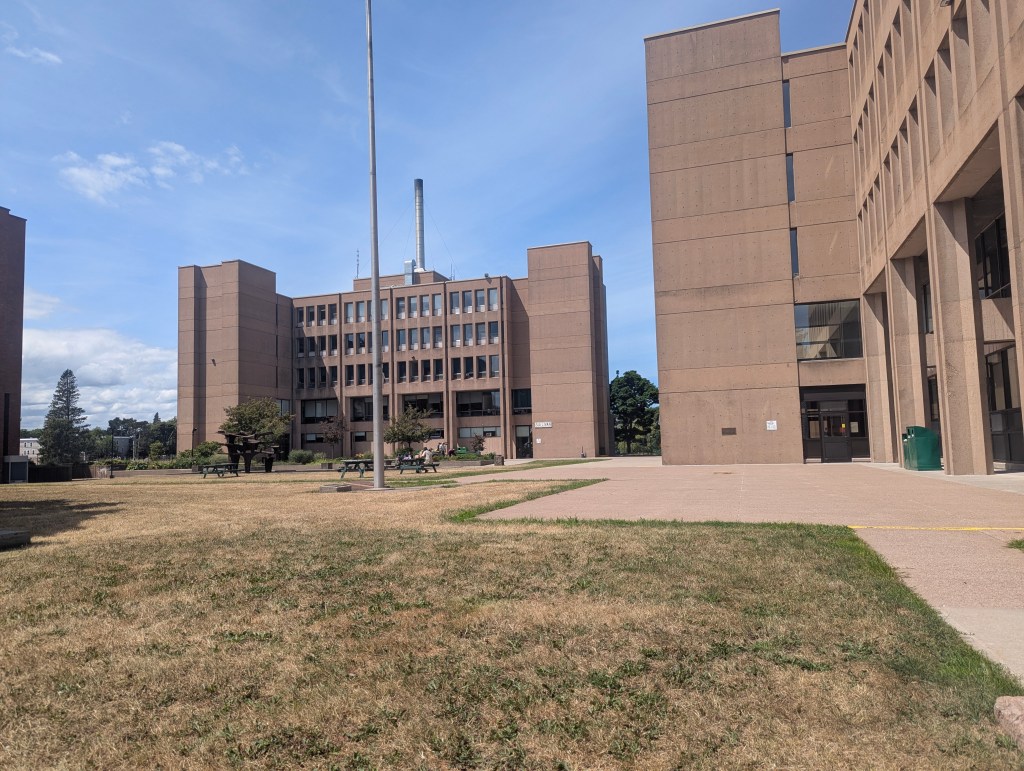
Where today’s (unimaginative architecturally) government buildings now stand was once a bog which was home to Africans.
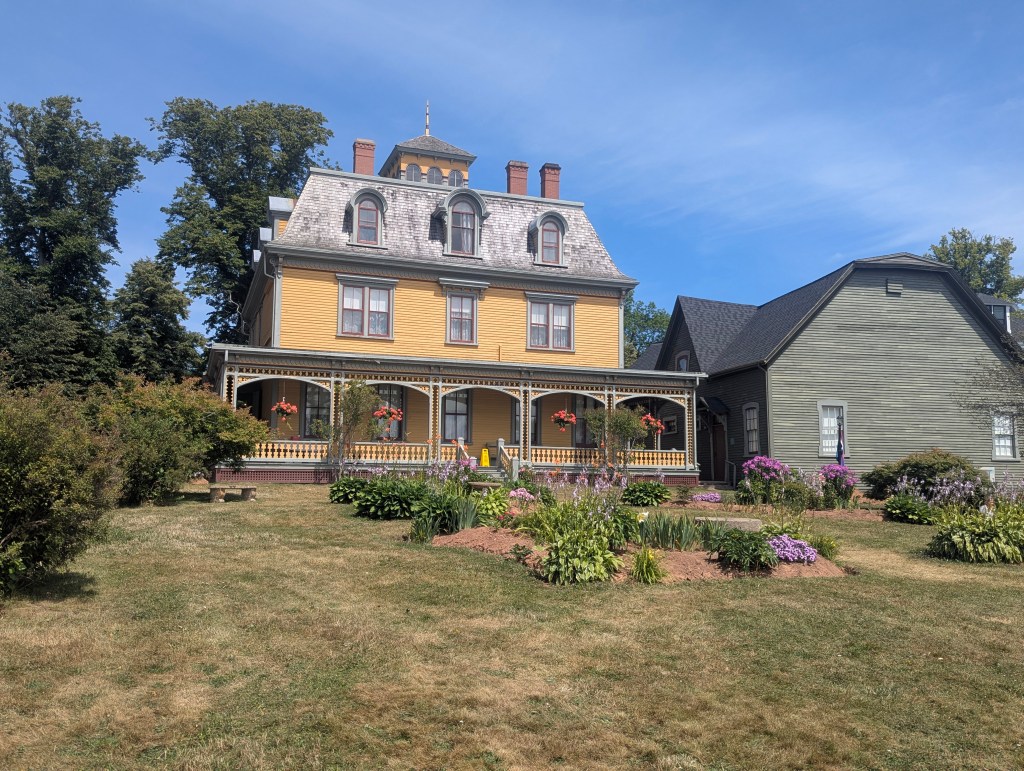
Beaconsfield Historic House was built in 1877 for wealthy shipbuilder James Peake. It was considered one of the most elegant homes in Charlottetown. The house was designed by architect W.C. Harris and featured modern amenities for its time, including gas lighting, central heating, and indoor plumbing. In the 1970s the house served as a ladies’ residence and later as a residence for student nurses.
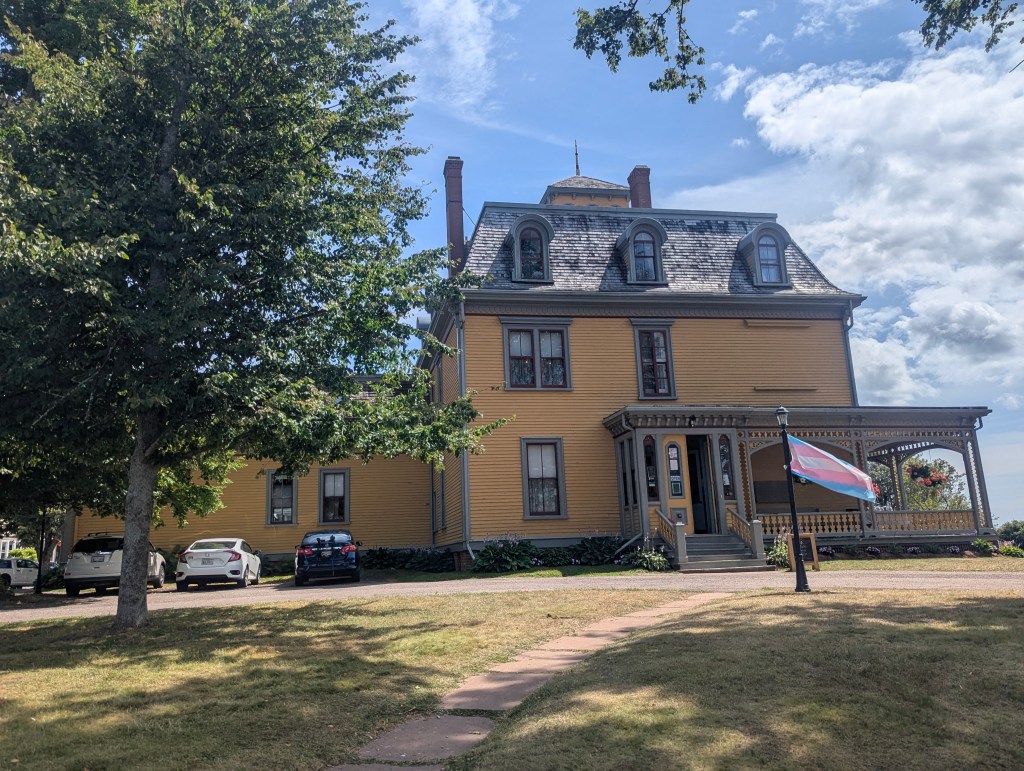
Today, it is a museum and a symbol of Victorian elegance, open year-round for tours and special events.
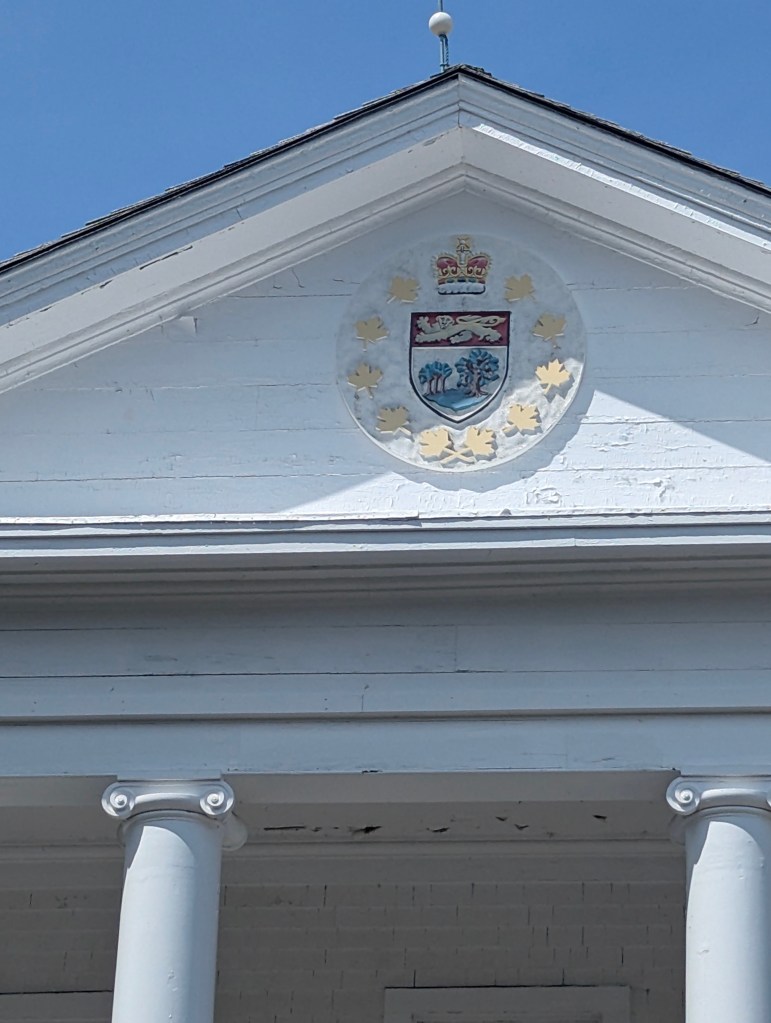
The Government House is the official residence of the Lieutenant Governor of Prince Edward Island. The house was built in 1834 and is located within Victoria Park, overlooking the Charlottetown harbor.
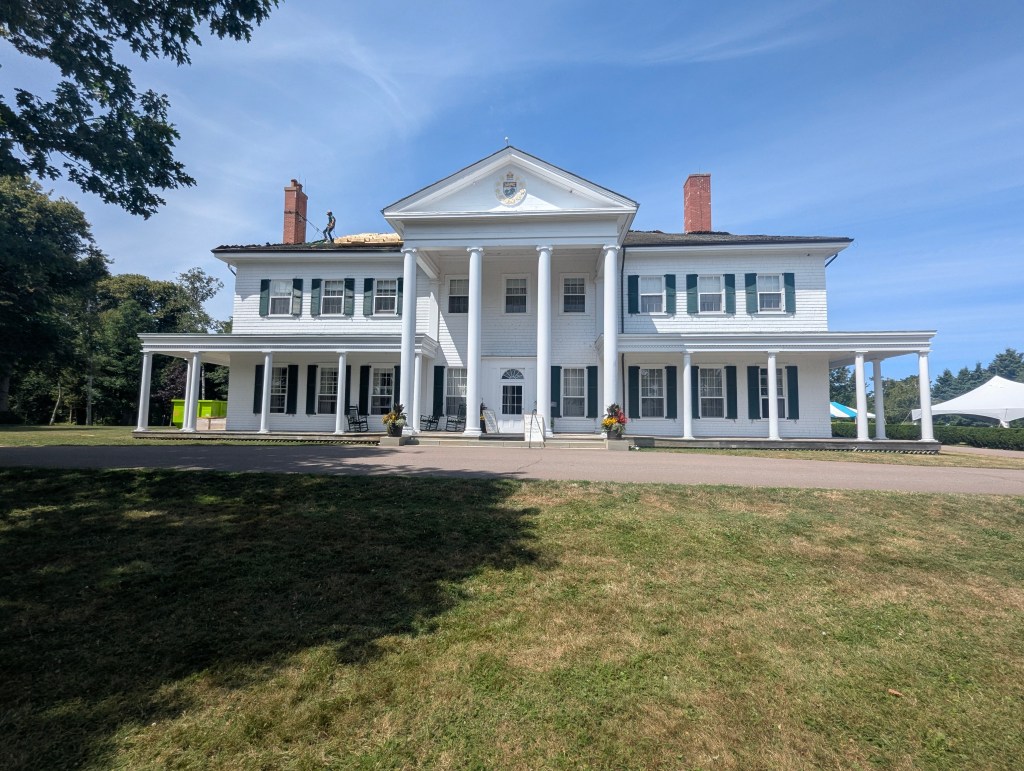
It is owned by the royal family, whose members stay here when visiting the island.
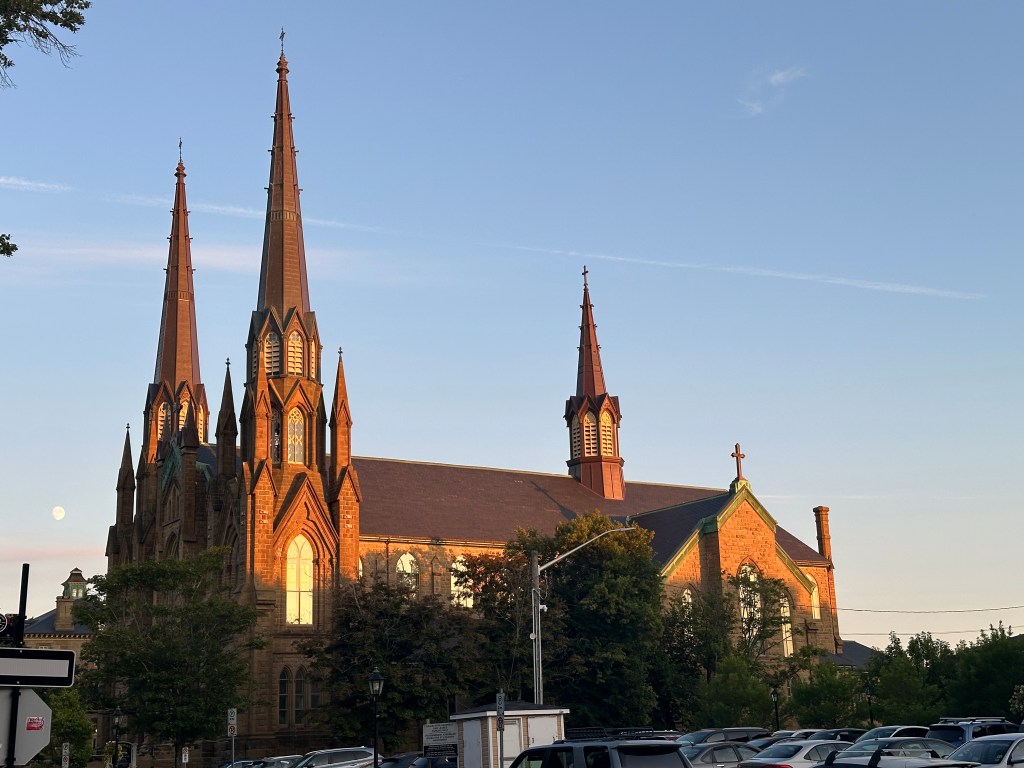
After the tour we continued to walk around Charlottetown for a while until it was time to return to Victoria Row for dinner and a view of the St. Dunstan’s Basilica in the setting sun.
In the morning we headed north to visit the Greenwhich Trails.
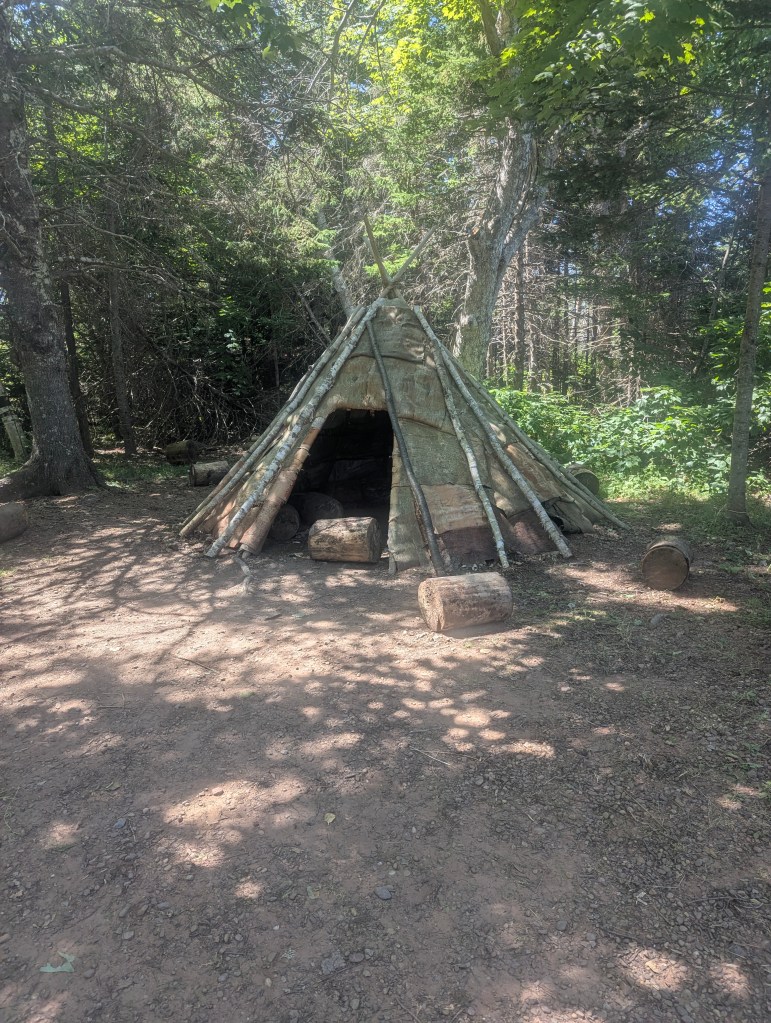
We hiked through the woods and came out at a clearing with a view of St. Peters Bay.
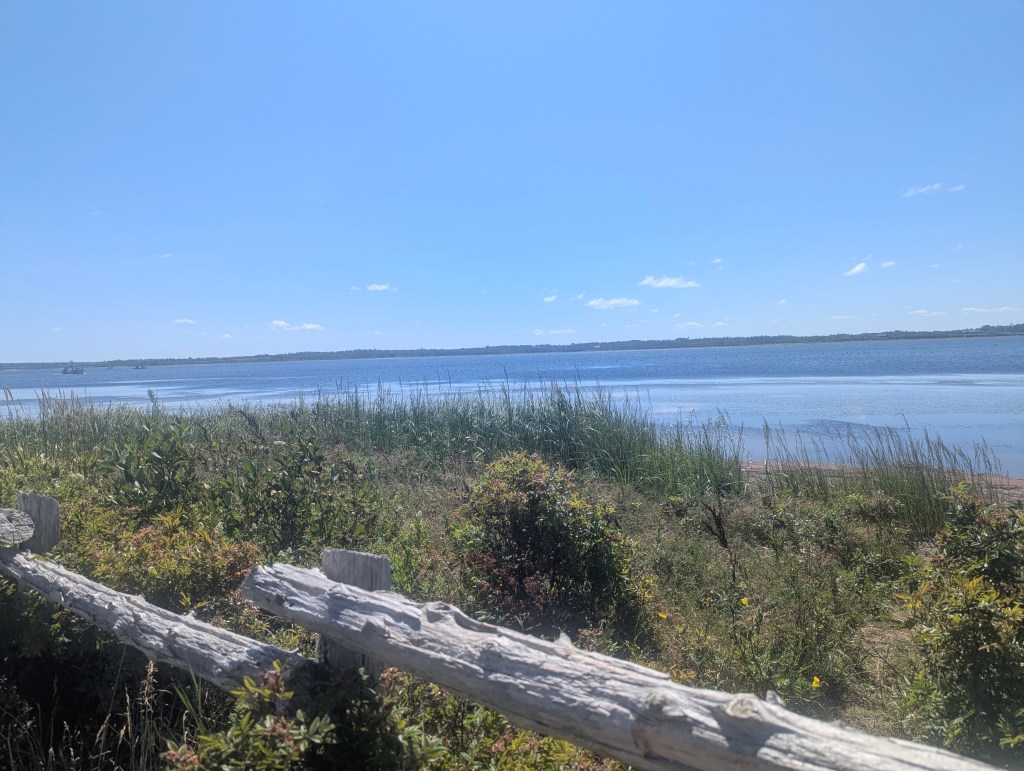
There we saw fishermen collecting traps. Both PEI and Nova Scotia have very strict regulations with dates of when/where lobsters and oysters can be removed.

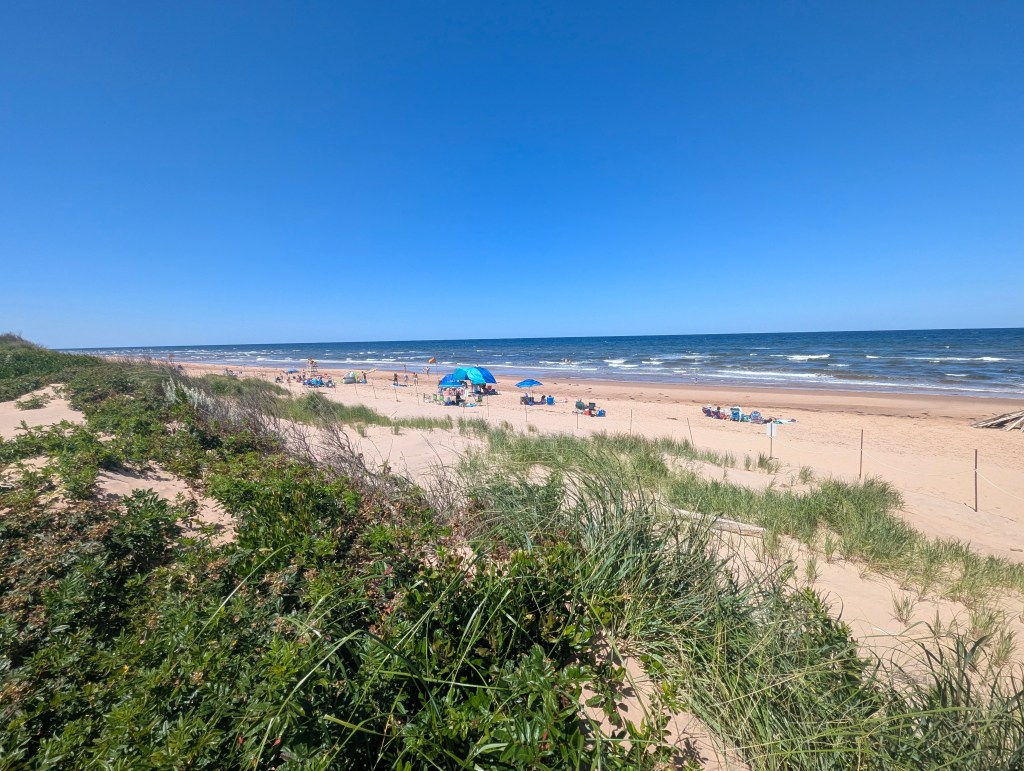
We visited the nearby beach.
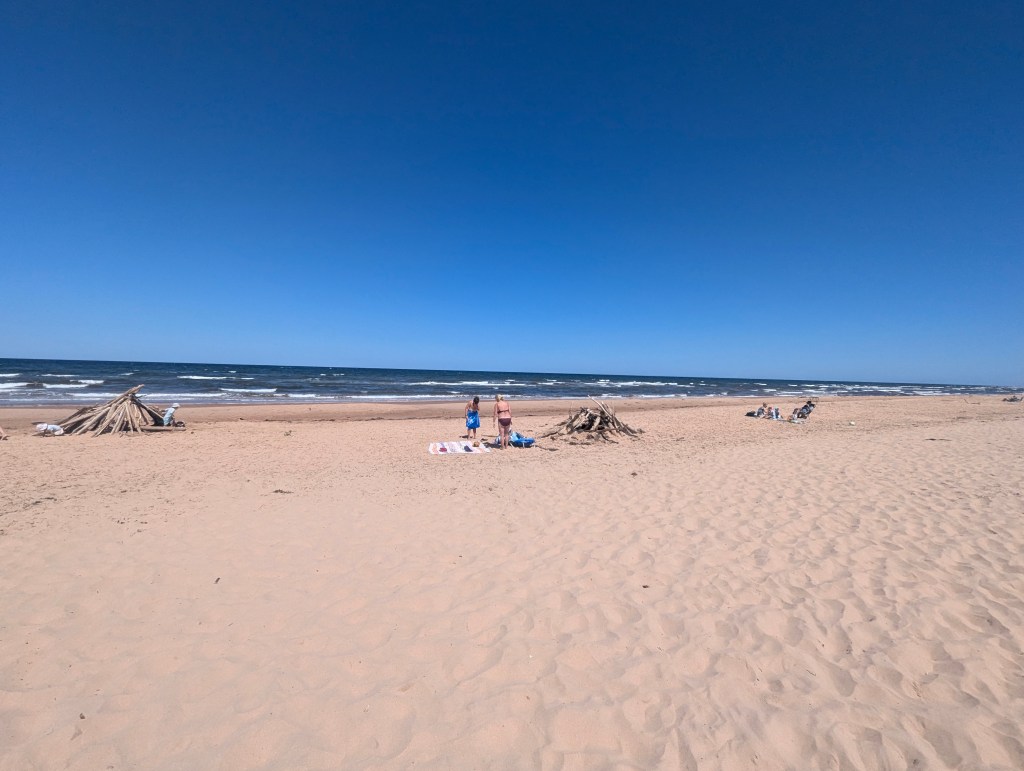
Then we got back in the car and visited another beach.
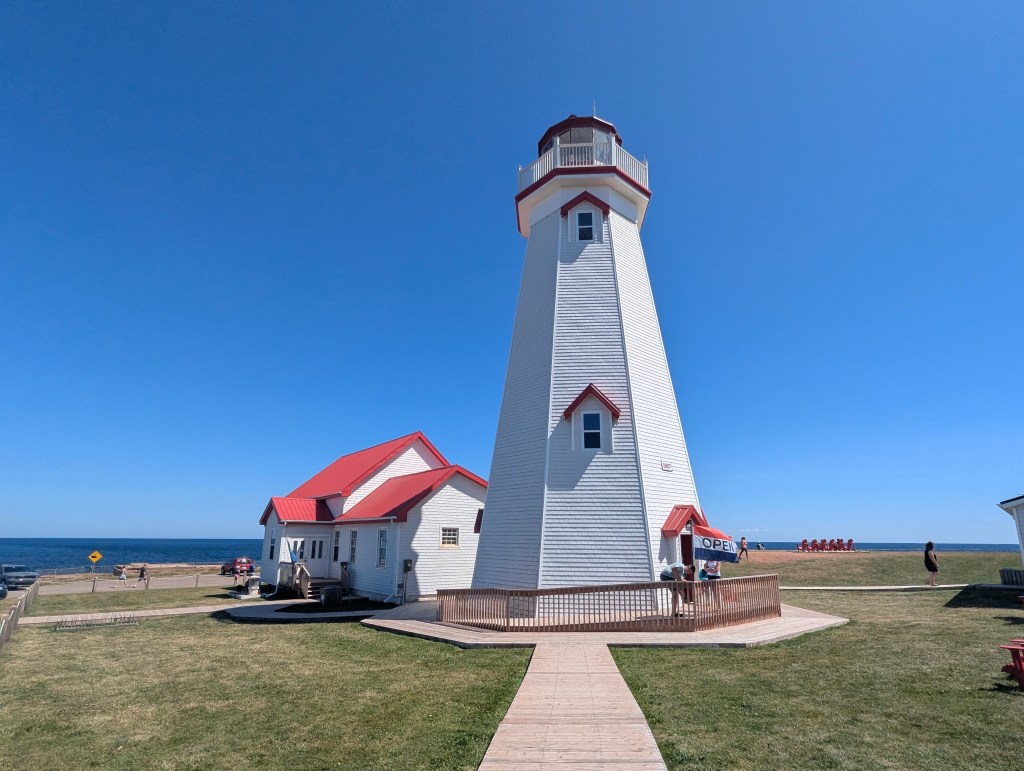
We continued our drive along the northeastern most shore of PEI until we came to the East Point Lighthouse. Built in 1867, it is known as Canada’s Confederation Lighthouse. The lighthouse stands 64 feet high and has 67 steps to the top.
We then drove to our destination for the evening: The Inn at Bay Fortune. Dating to 1913 and originally a summer home for a Broadway playwright, this refined inn (open seasonally) is a five star resort with a restaurant run by Chef Matthew Pigeon.
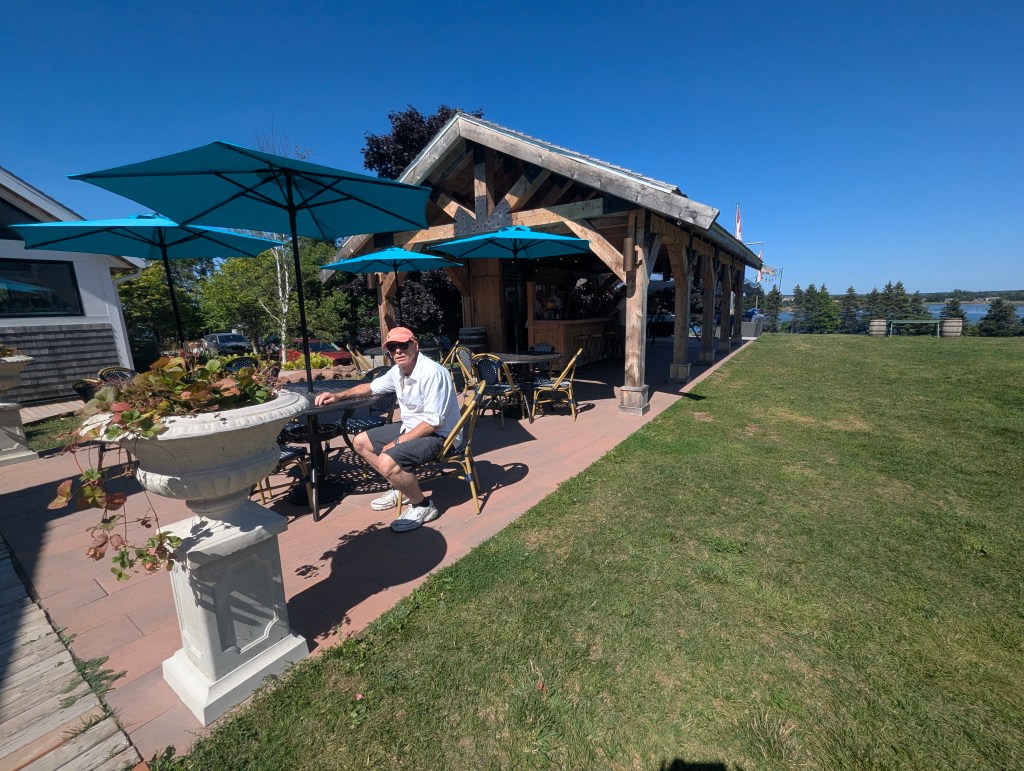
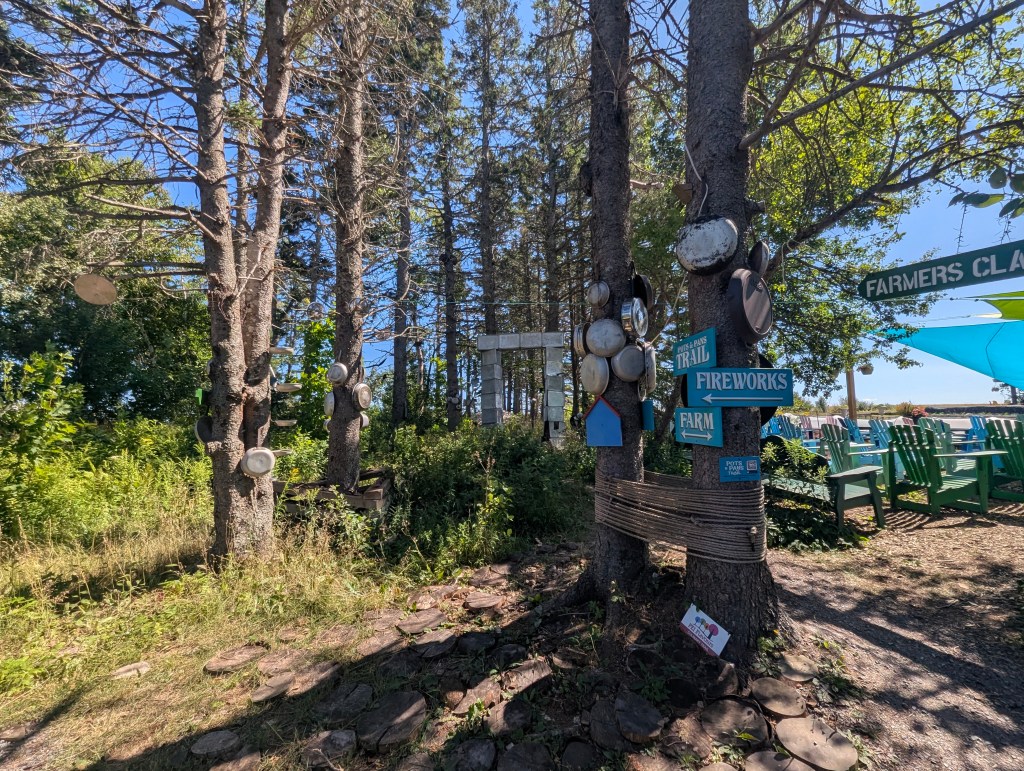
As instructed, we had arrived early so we could explore the grounds on our own for a bit before the meal. We hiked through the pots and pans trail
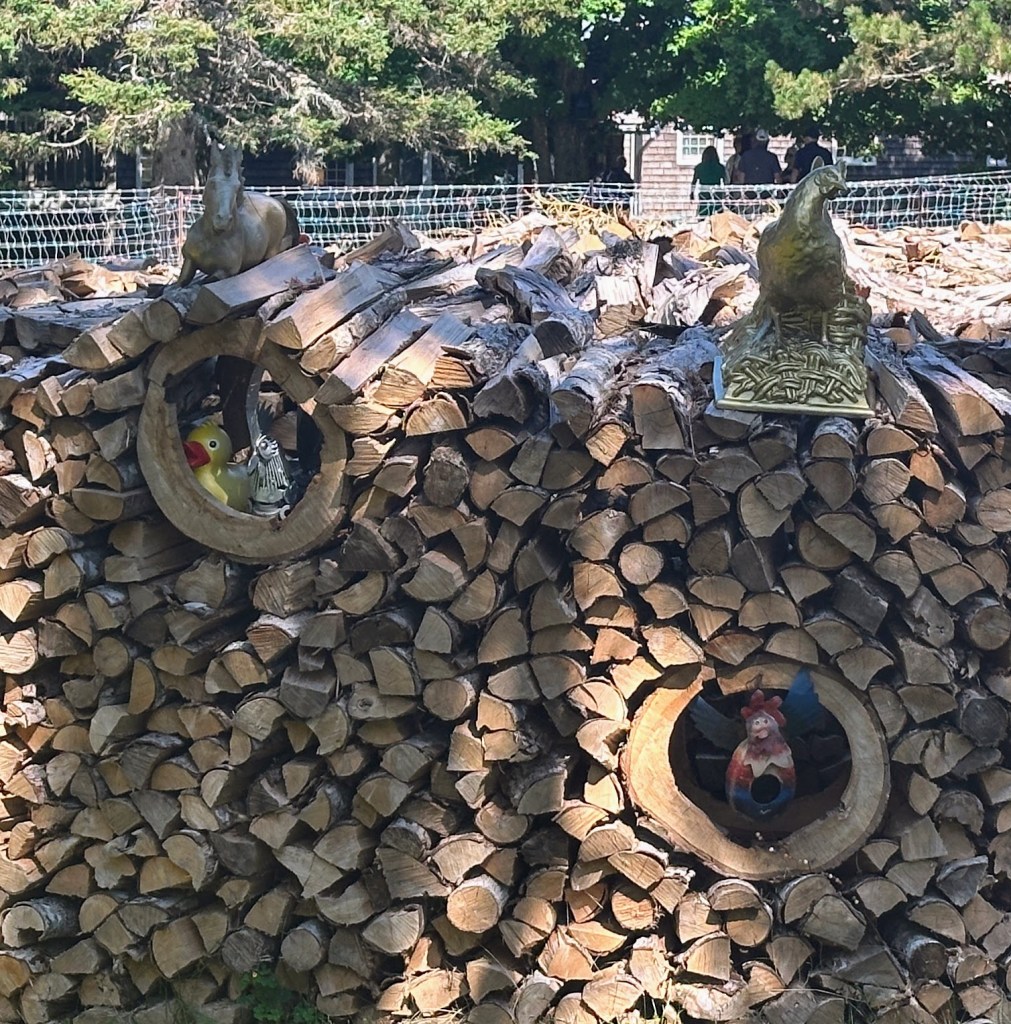
and into the Arts Forest where we discovered woodland animals “hiding” in the wood piles.

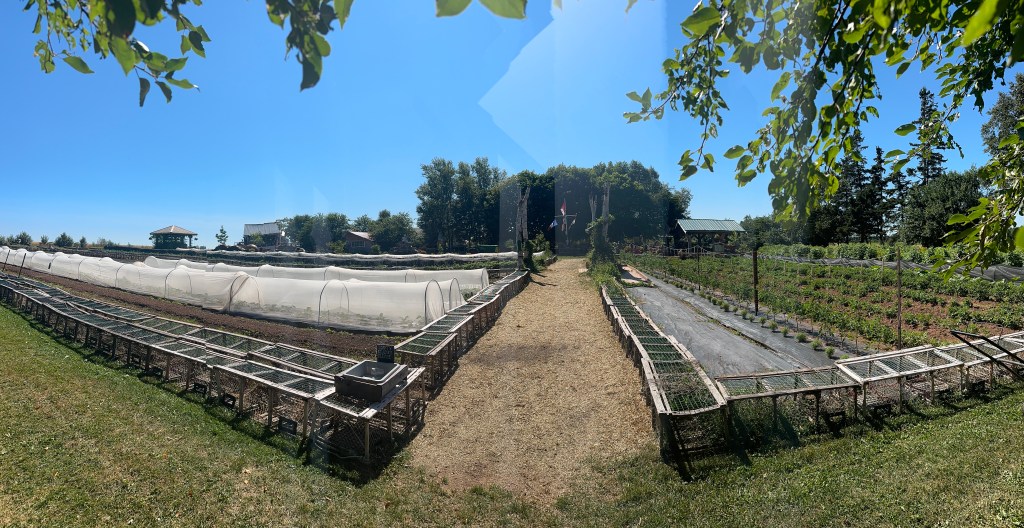
We strolled through the farm.
The meal is called the fireworks feast because all of the food is cooked on open fires. Here the fire is getting started at the Fire Alter.
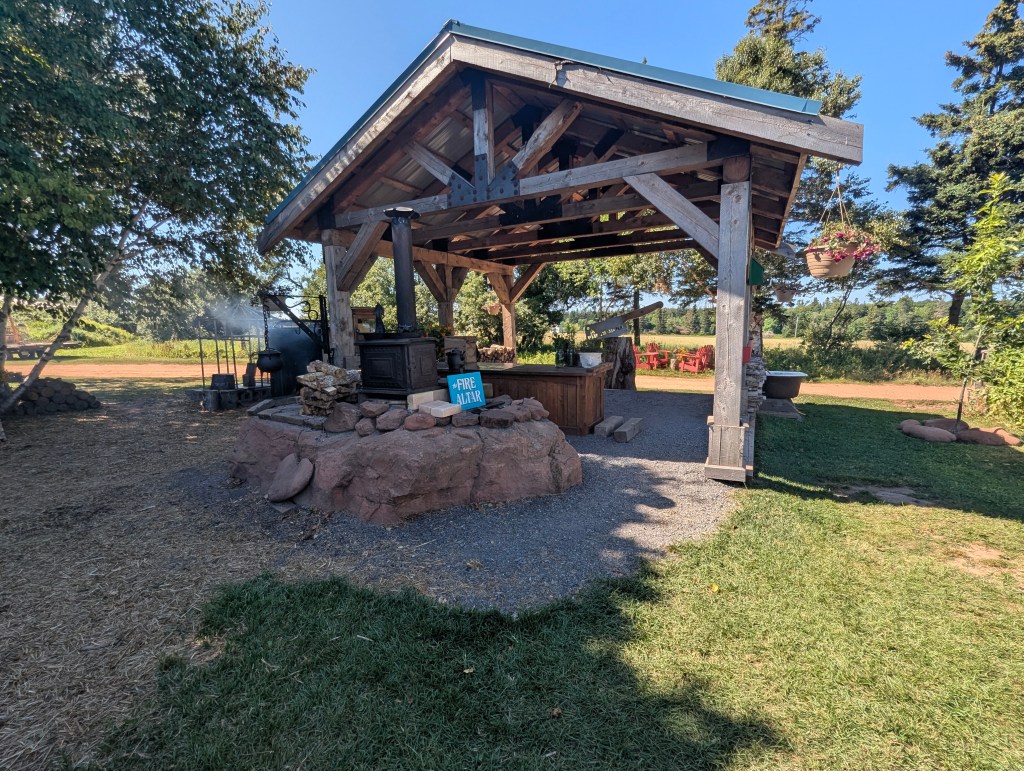
There are plenty of spots to sit, relax, and enjoy the surroundings.
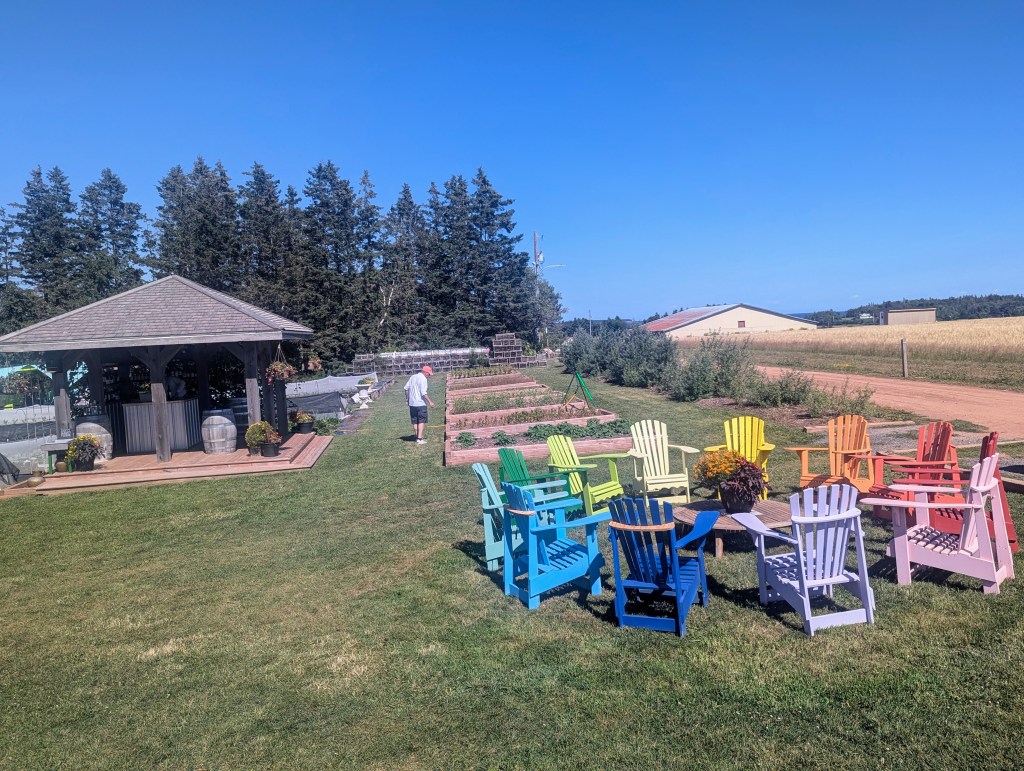
Even the bar is whimsically decorated.

In the back of the woods are huge piles of oyster shells labeled with the year in which they were consumed.
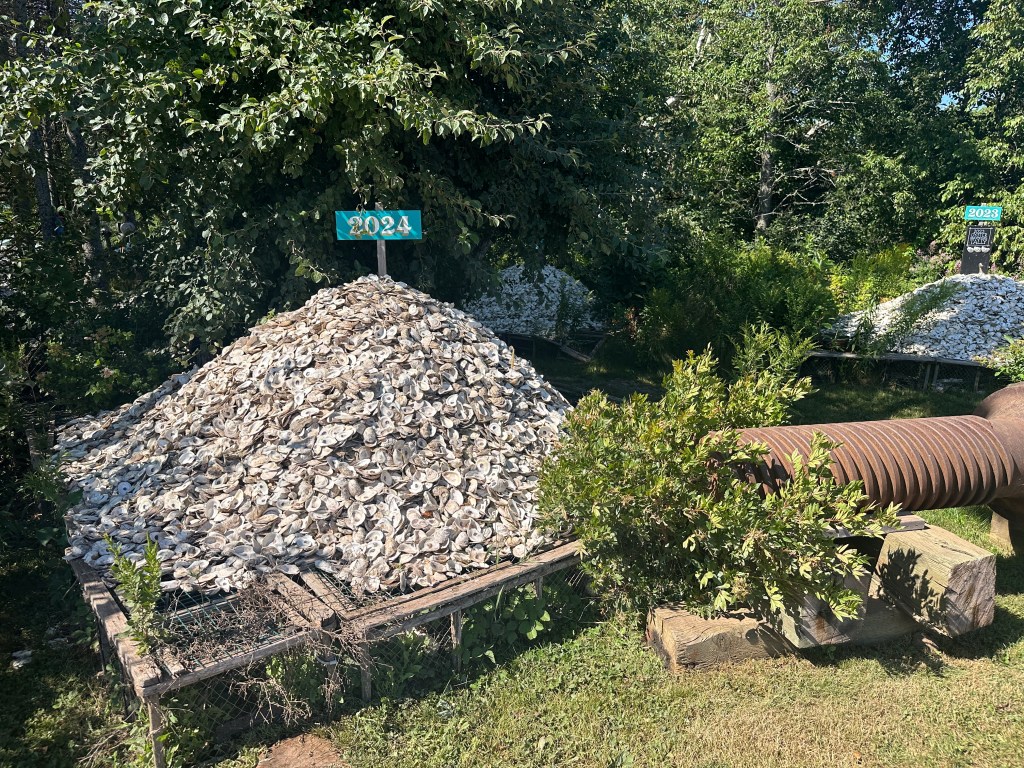
The pile for 2020 was sadly quite small.

At 4 o’clock we were invited to join Chef Matthew in his “classroom” where he introduced himself. Together with the chief farmer Kevin Petrie and forager Nick of the North, they provide all of the ingredients for the food of the fireworks festival from local sources. Even the wheat for the bread is grown locally. Chef Matthew explained the concept of regenerative agriculture. The quote from his website:
“As farmers we understand that our first responsibility is to our soil, to the earth around us. We naturally focus on the life of our plants, but they come and go while the life of the soil endures. We’re inspired by the circle of life: the ongoing connection between healthy soil, a healthy environment and healthy, happy humans. We know that the more nutritious an ingredient is the better it tastes and the better the earth it came from. Our systems continuously strengthen the incredibly diverse and productive microorganisms within our soil. Sustainability is just our starting line, with one foot planted in the past and another firmly in the future we deploy a wide array of fascinating natural techniques to ensure long-term vitality.”
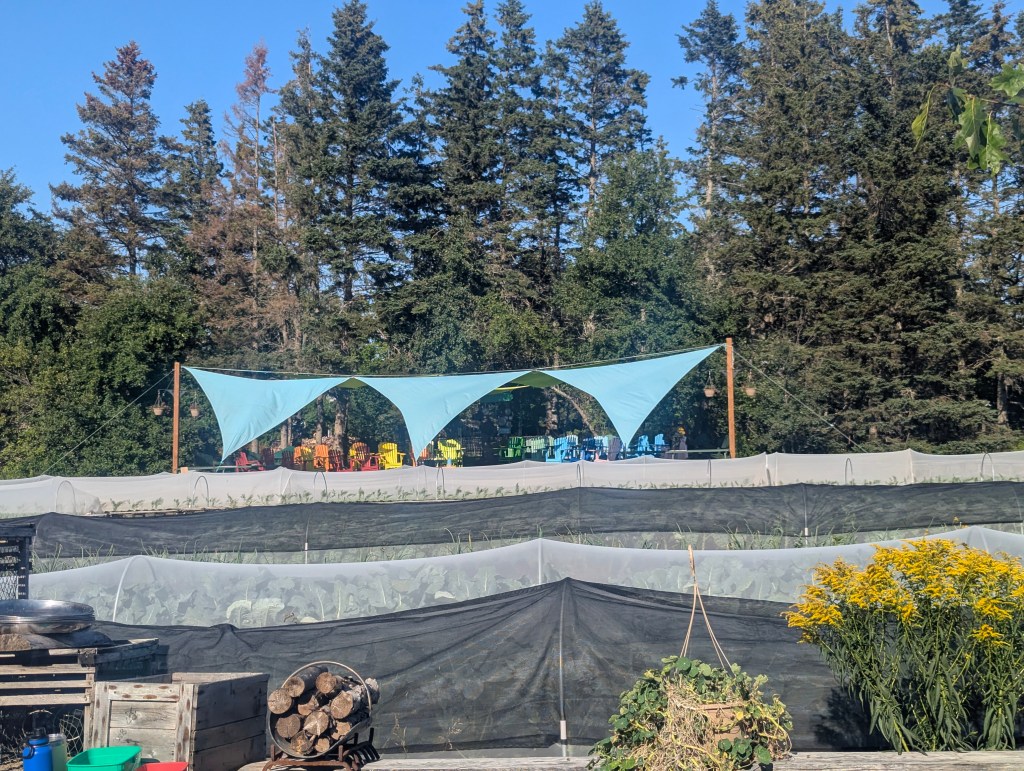
After an informative session on culinary farming, we were invited to taste our amuse-bouche of fresh tuna caught that afternoon.
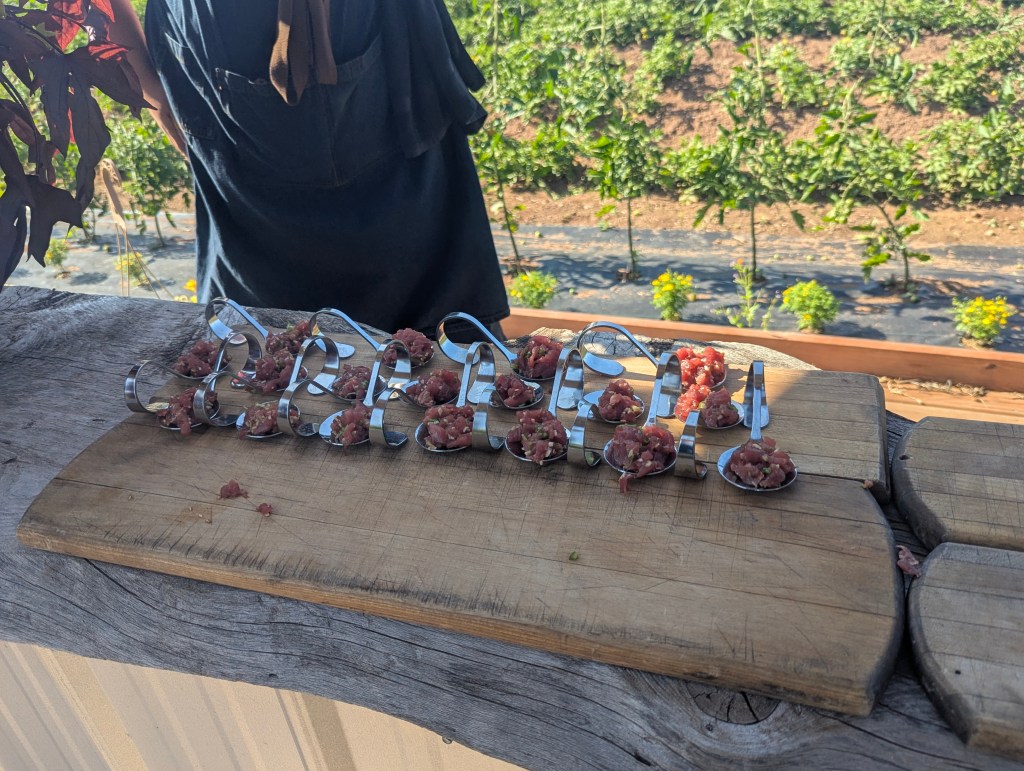
Then the tasting hour was begun! There were stations at the various fire pits plus Chef Matthew and a couple of his staff stood and shucked oysters only hours out of the Bay Fortune, all we could eat! We only managed about a 8-10 each because there were so many things to try including pulled pork tacos, more tuna, baked oysters. The most unique thing we tried was duck hearts fried in bone marrow. Every bite was so delicious.

Once the tasting hour was complete, we joined Chef Matthew on the main lawn for a champagne toast.
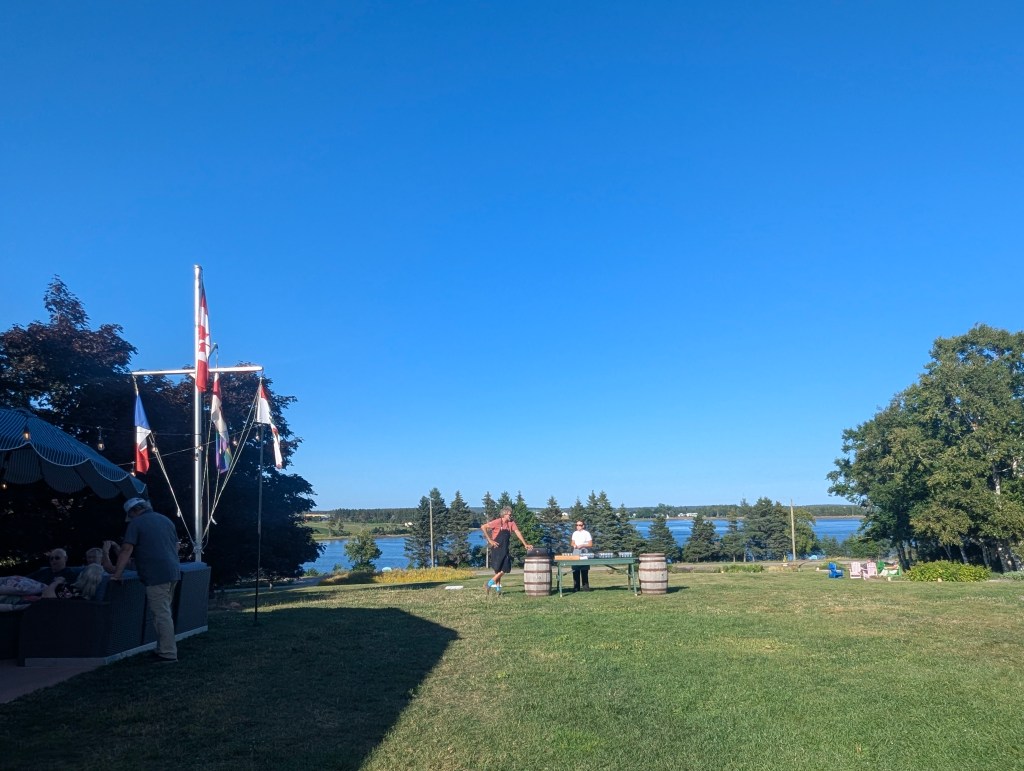
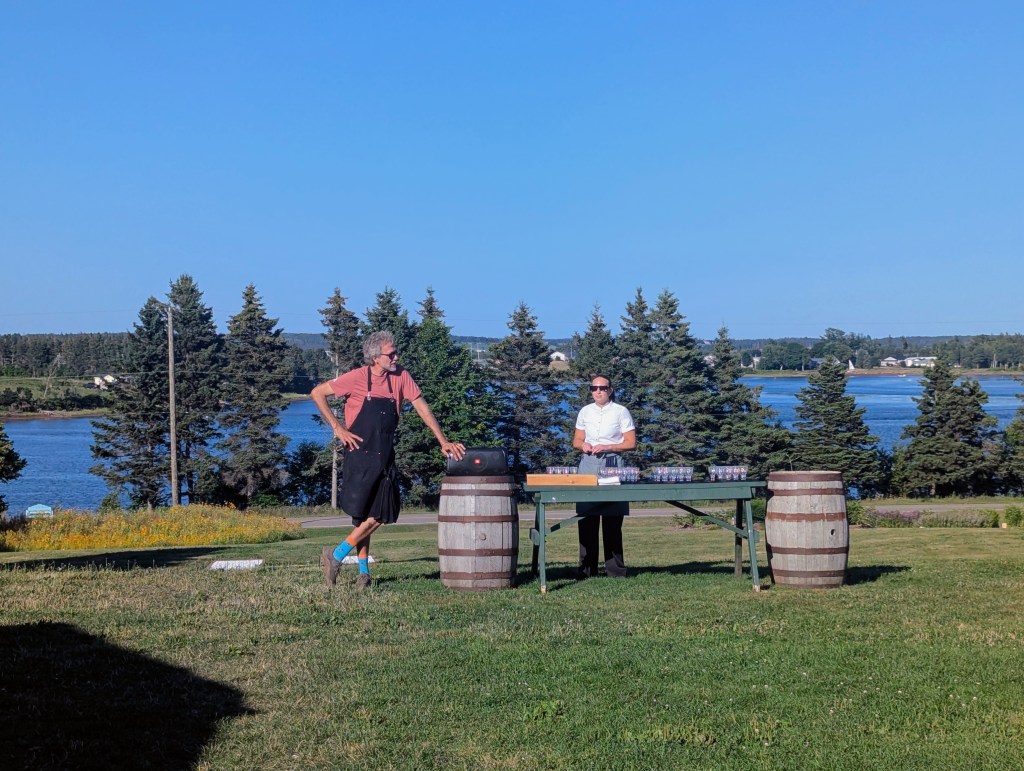
Even the sparkling wine is locally sourced.

Next we were invited into the dining room. We were seated family style at long tables and given the tasting menu for the night.

This would not be Prince Edward Island without first a bowl of seafood chowder, which was different than any we had yet had, and OMG so good!
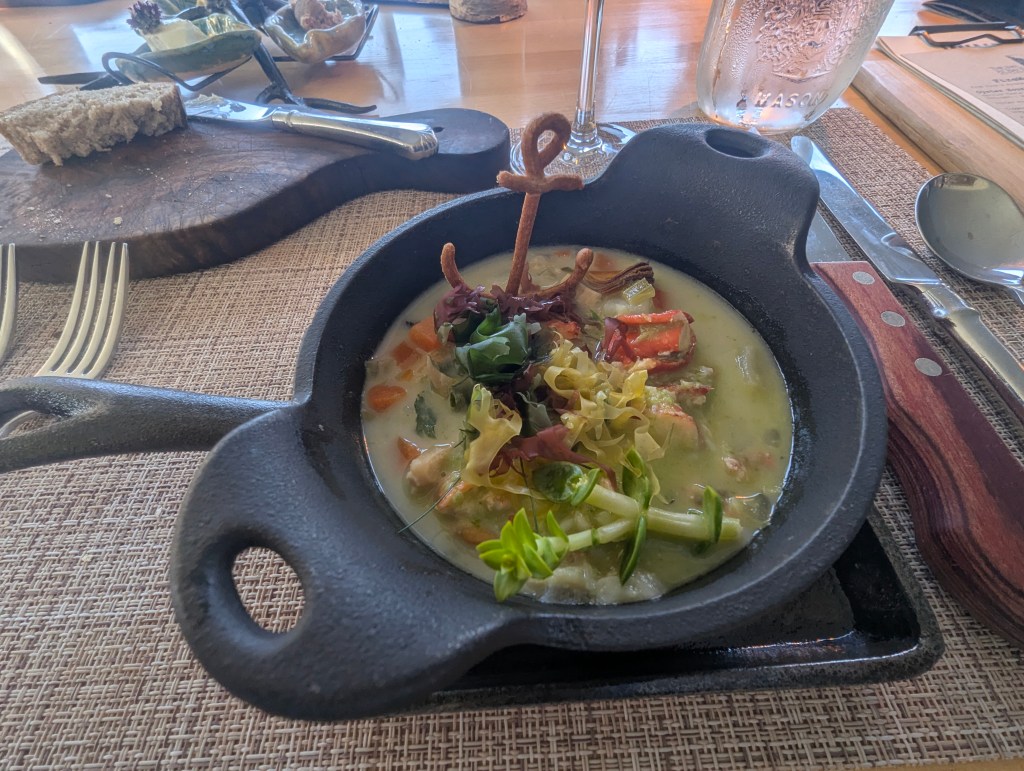
Soup was followed by some light veggies

and then the most ingredients I have ever seen in a harvest salad.
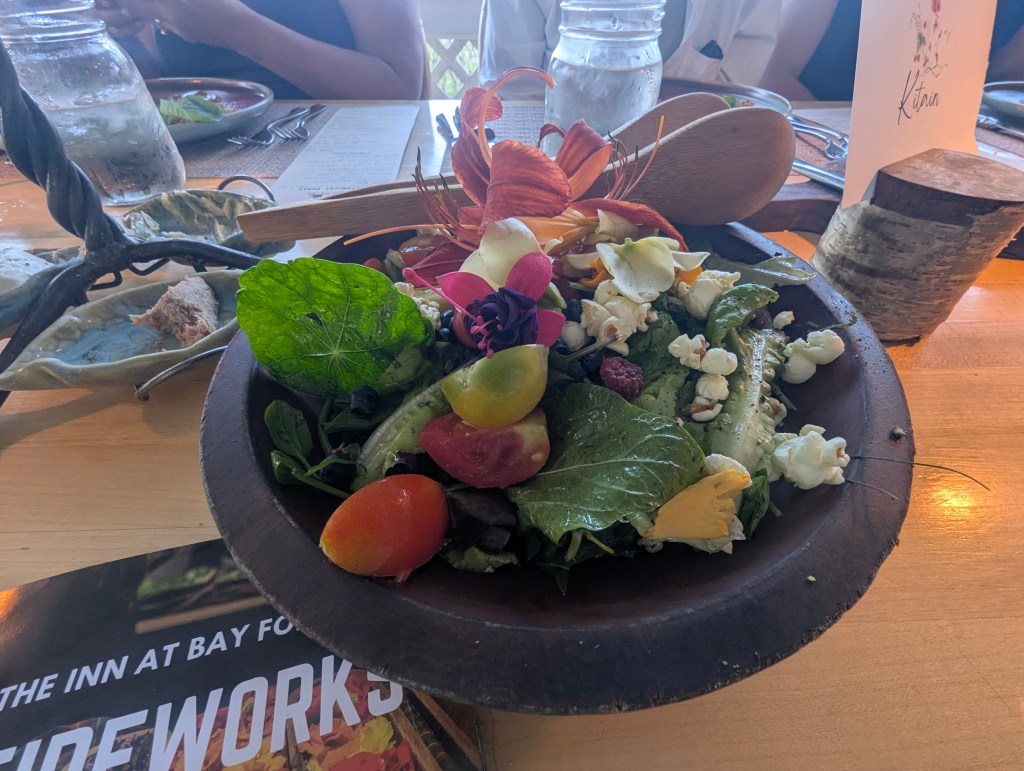
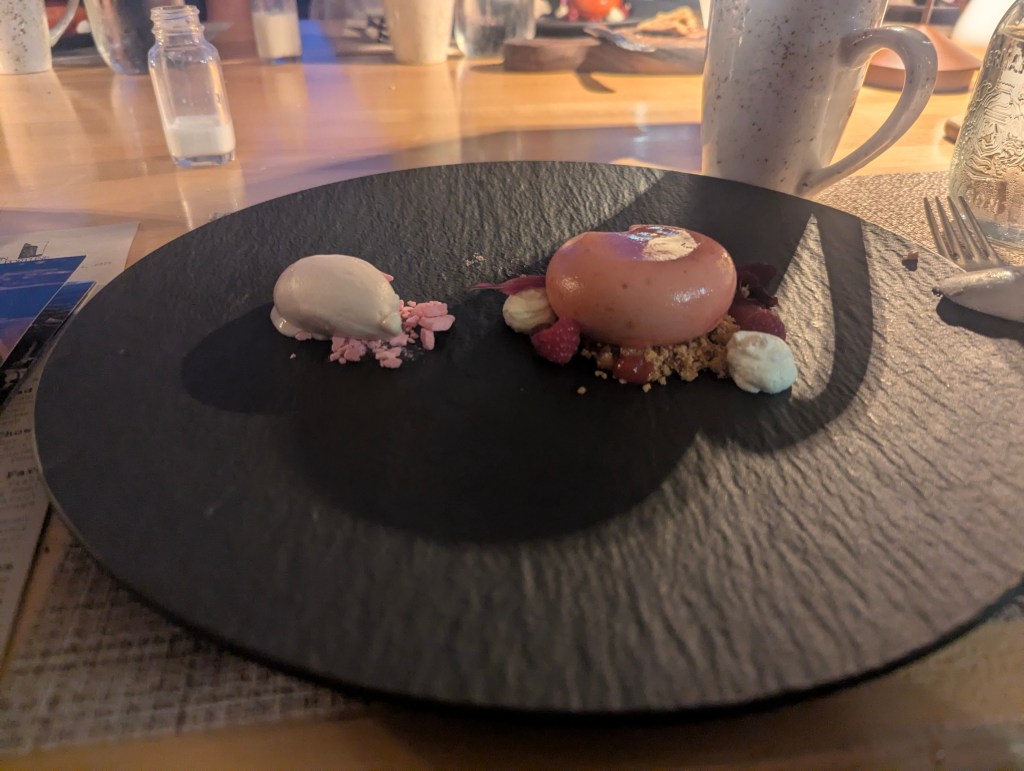
We got to chatting with our table neighbors and eating all the delicious food, so I missed taking a pic of the breads, meats, and potatoes. As everything is seasonally themed, desert was appropriately raspberry in several different forms. By the time we left, we had been eating for 5 hours, a most memorable meal.
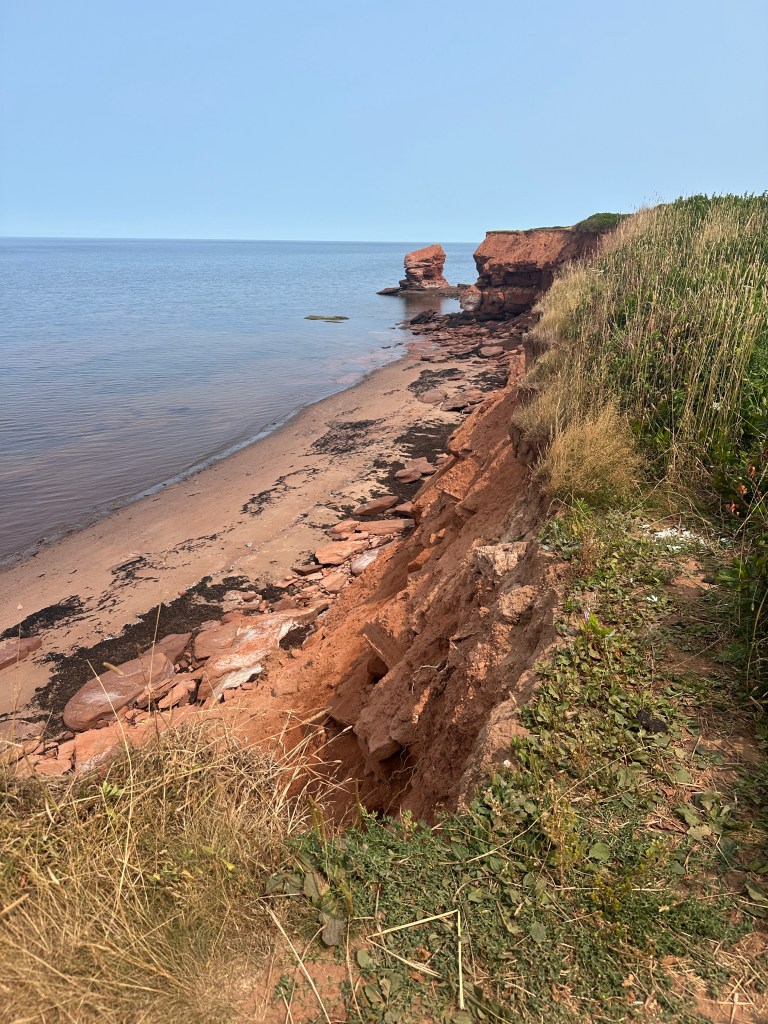
The next morning we set out to see the famous red beaches on the southern shores of PEI. Unfortunately, the tide was a bit too high to see much.

But we certainly could appreciate how much iron is in the soil.

We then set out for Green Gables. Neither of us had ever read Anne of Green Gables, so we decided to listen to it on Audible as we drove around the island.
Author of the beloved children’s novel, Lucy Maud Montgomery grew up in nearby Cavendish, PEI. Her mother had died of tuberculosis when Lucy was 21 months old. Grief stricken, her father placed her with her grandparents. It was her nearby aunt and uncle that owned the home in Cavendish, PEI that became the inspiration for Green Gables.

Anne of Green Gables has been translated into at least 36 languages and has sold more than 50 million copies, making it one of the best selling books worldwide to date in any language, and is taught to students around the world. The building was initially erected during the 1830s, by the MacNeil family, relatives of Montgomery, who was born near the homestead. Interest in the Green Gables property grew in the decades after Montgomery published her novels, resulting in Green Gables’ purchase by the government of Canada in 1936. The government initially operated the home as an historic house that depicted 19th century farming life on Prince Edward Island. However, by the 1970s plans were undertaken to refurbish the building to resemble Green Gables as depicted in Montgomery’s novels. Since 1985, Green Gables and the larger National Historic Site operate as a museum of Lucy Maud Montgomery and her novels. One enters through the parlor.
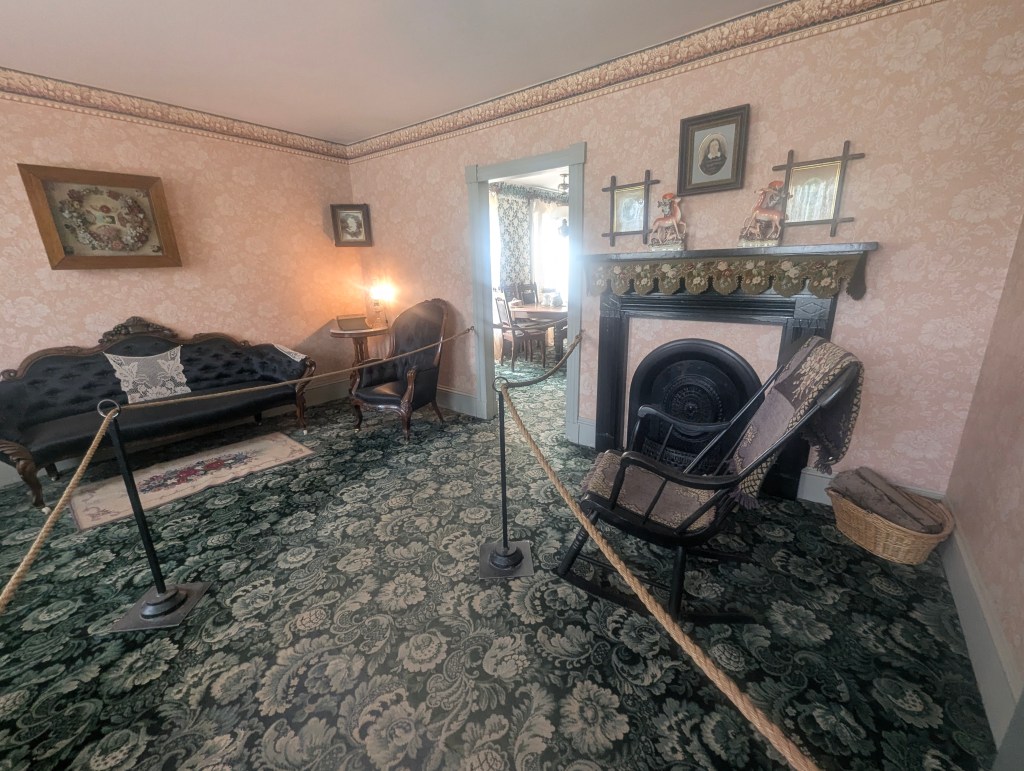
There is a downstairs bedroom, in the book occupied by Matthew, the elderly brother.

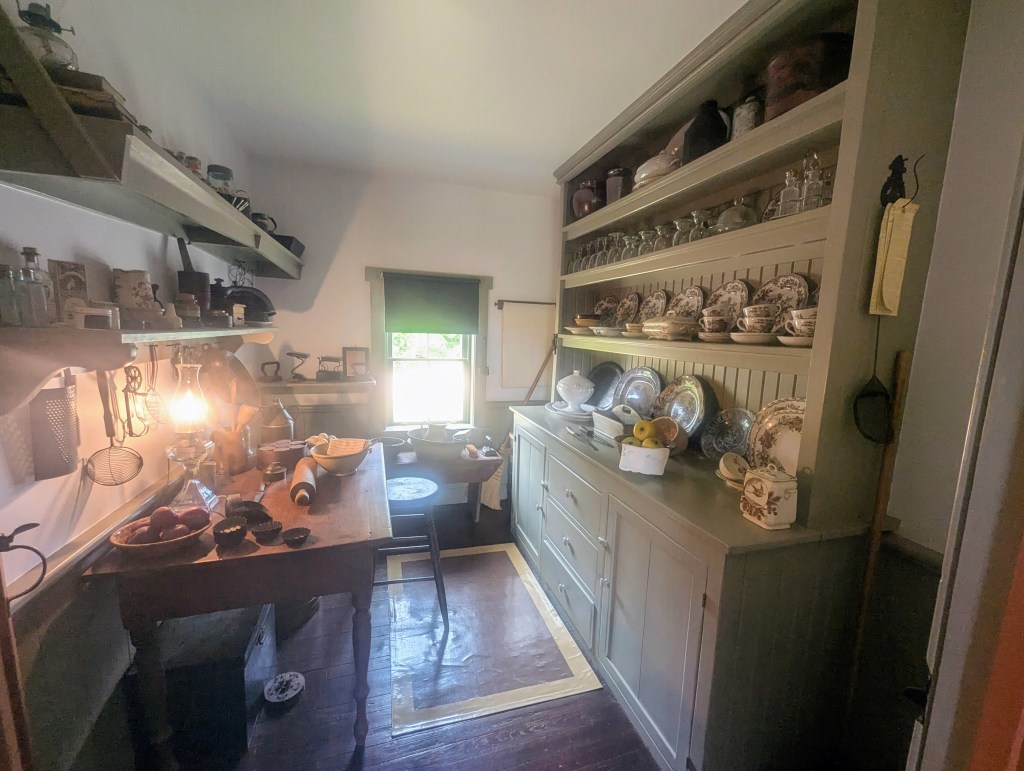
The kitchen has also been restored to reflect a 19th century farmhouse.
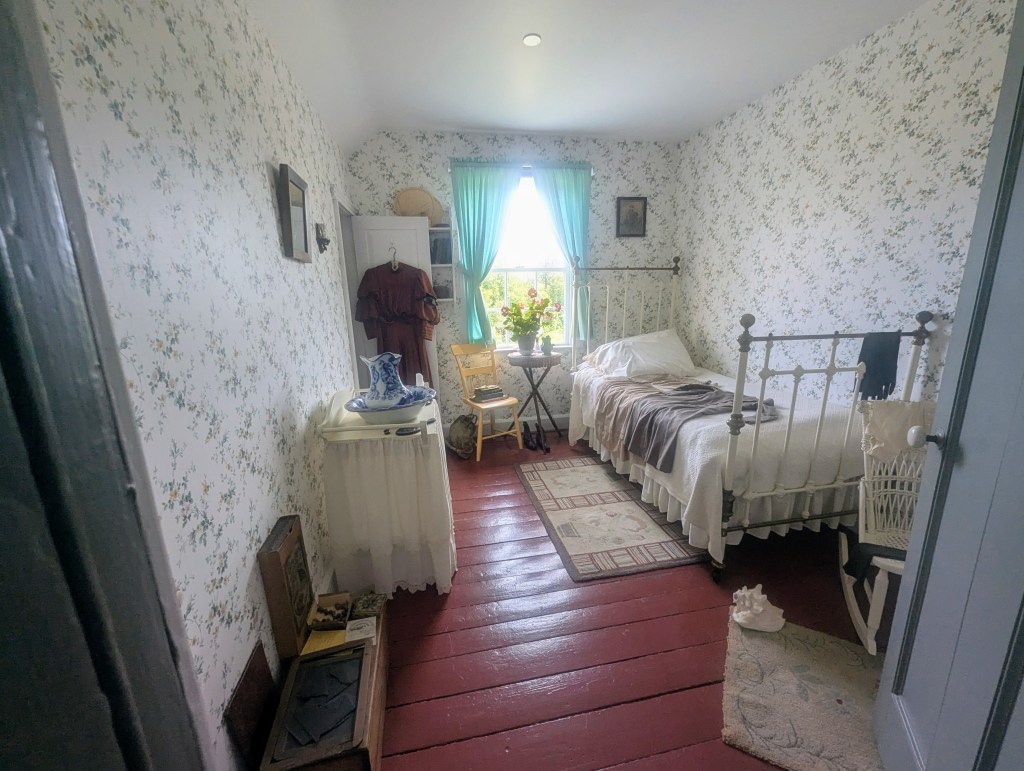
The upstairs bedroom is where Anne lived.
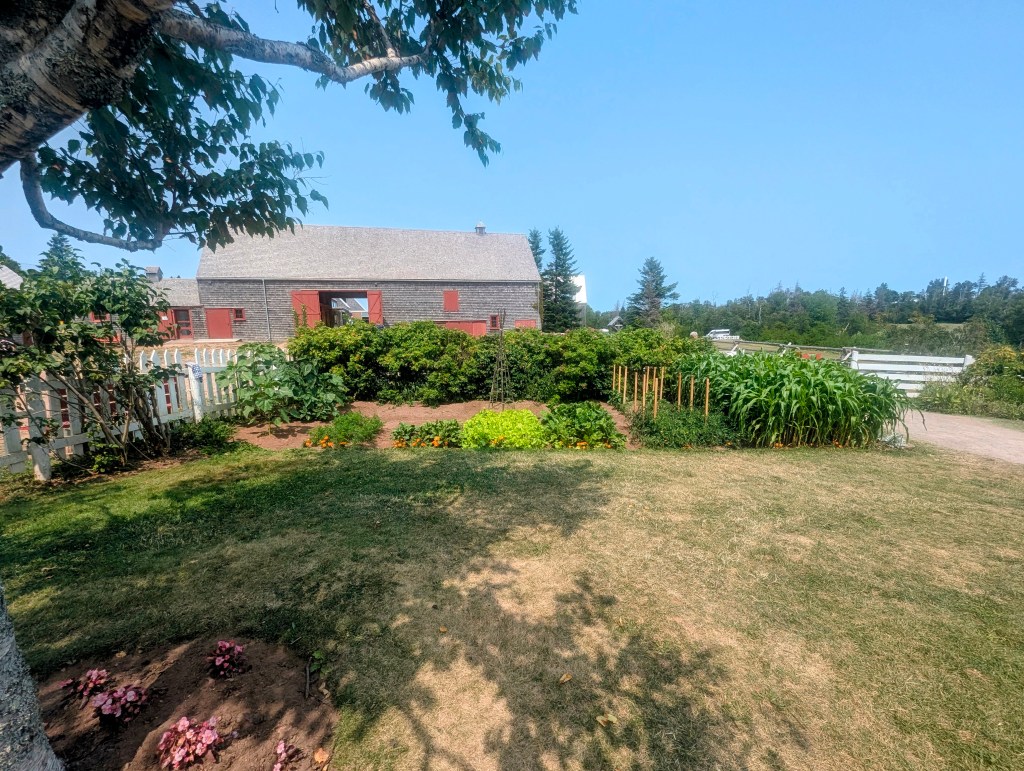
Even the gardens have been restored to their original function.
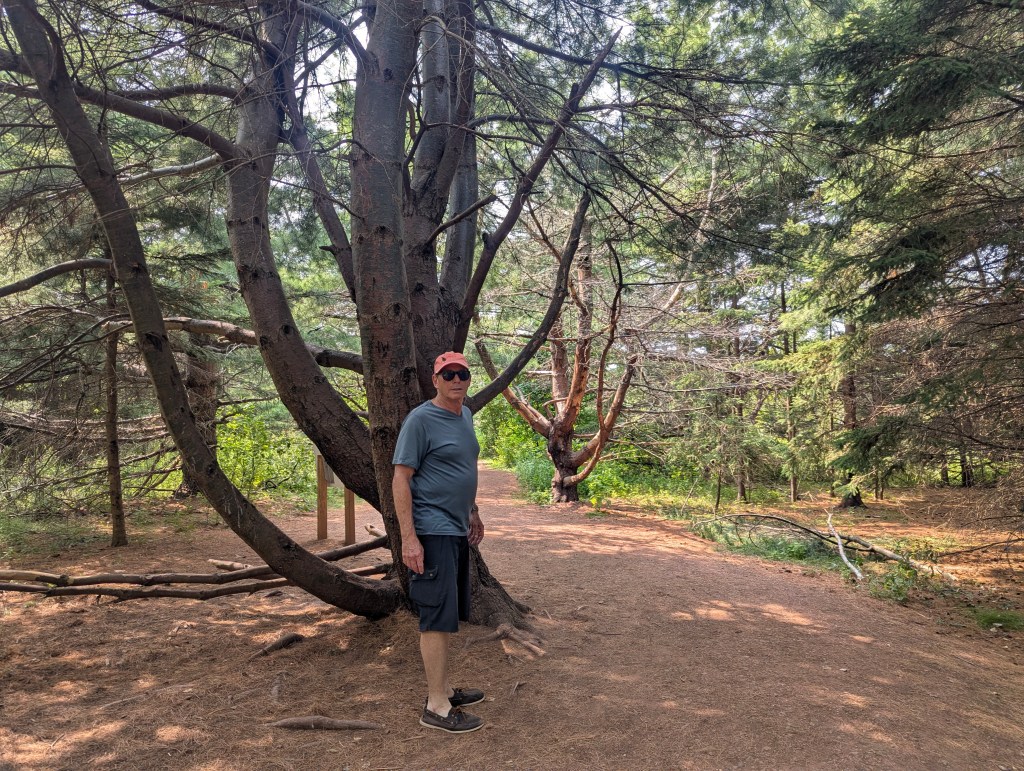
In her books, Montgomery describes the haunted forest, not so haunted on this gorgeous summer day.
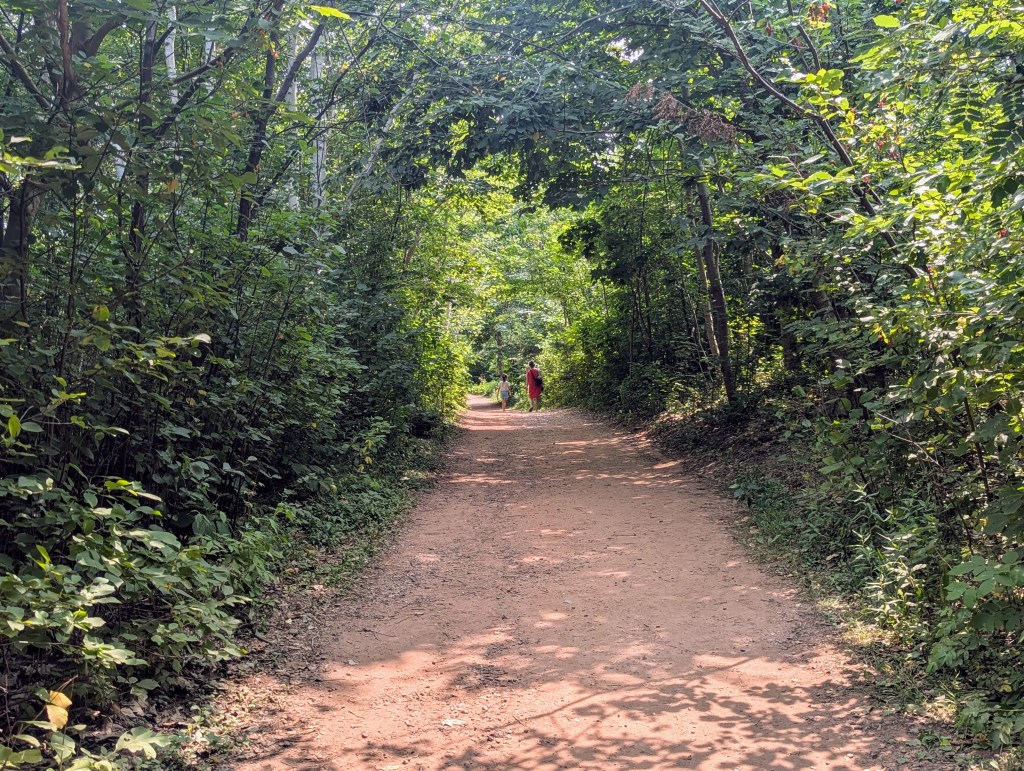
They have even preserved Anne’s beloved Lovers’ Lane.
After a thorough tour of the Green Gables museum and property, we took a ride along a different part of the north shore of PEI than that which we had explored the previous day.

The scenery is truly spectacular.
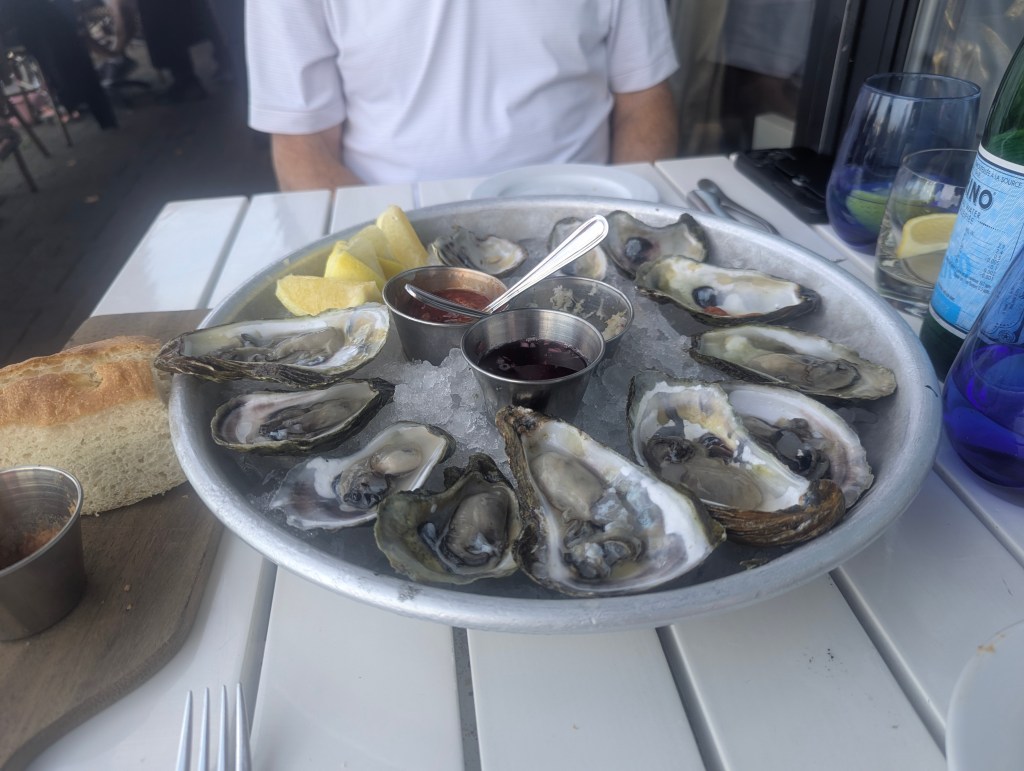
After a long day, we headed back to Charlottetown for another scrumptious seafood meal, started, of course, with a dozen oysters. Then in the morning we bade farewell to PEI.
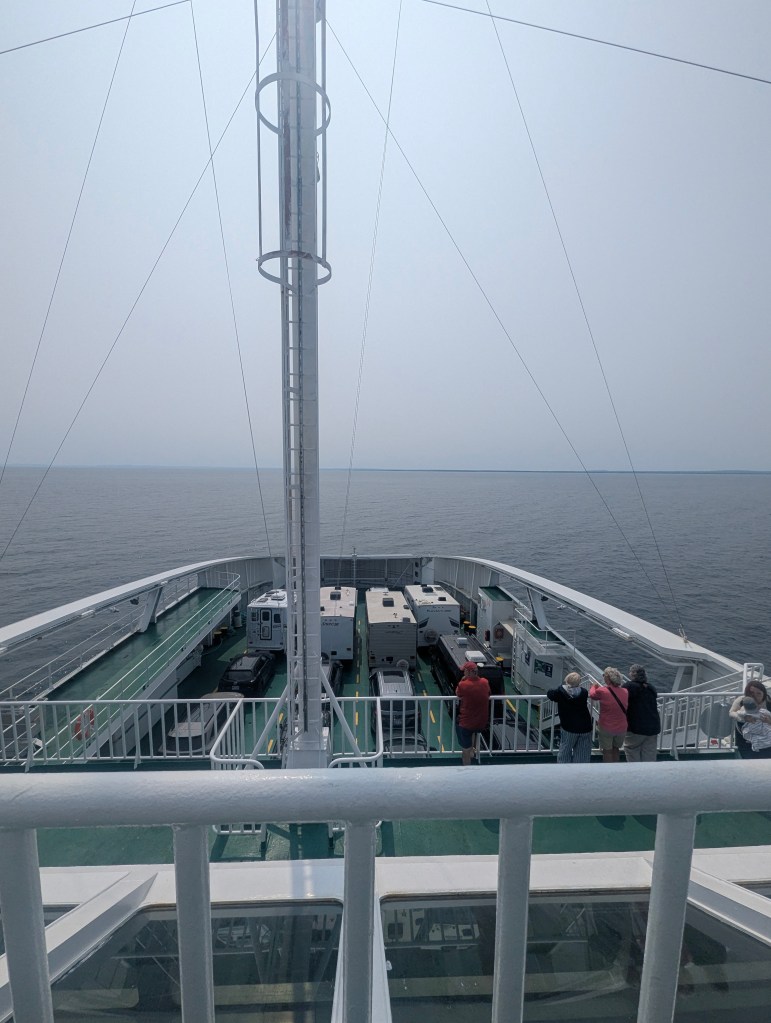
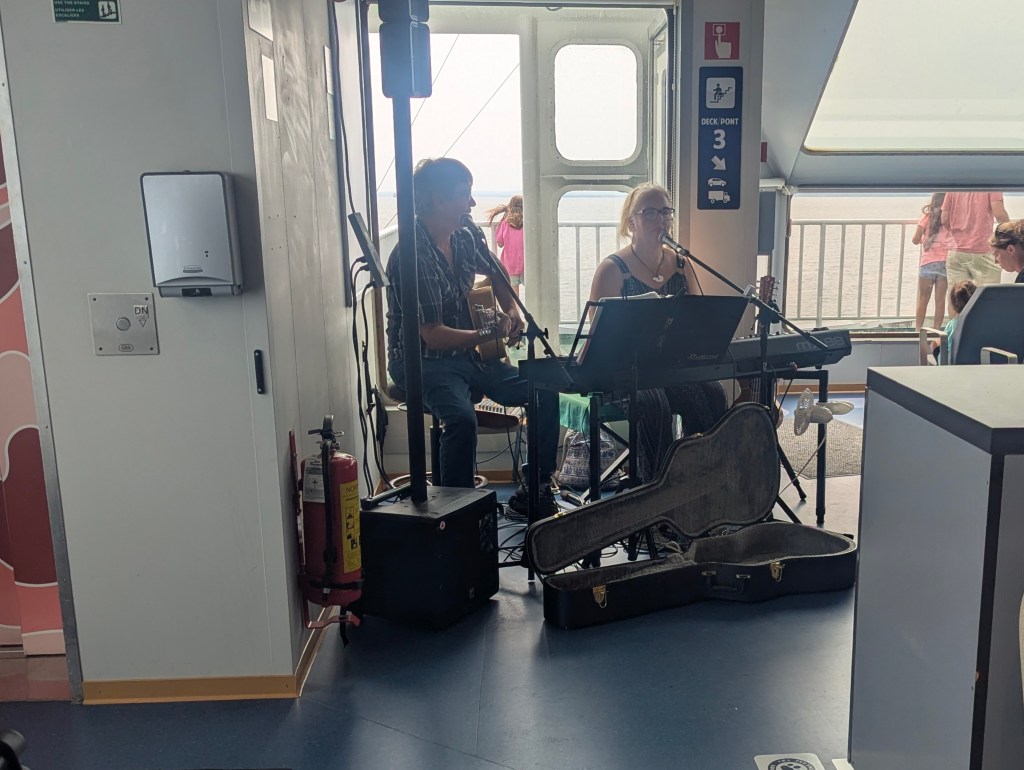
The weather on the return ferry was much more gray than it had been on our first crossing. So we meandered inside for yet another bowl of yummy seafood chowder and were happily surprised by the entertainment we found there: a 70s cover band.
We drove the short distance from the ferry to our home for the next few nights: Halifax Marriott Harbourfront Hotel.
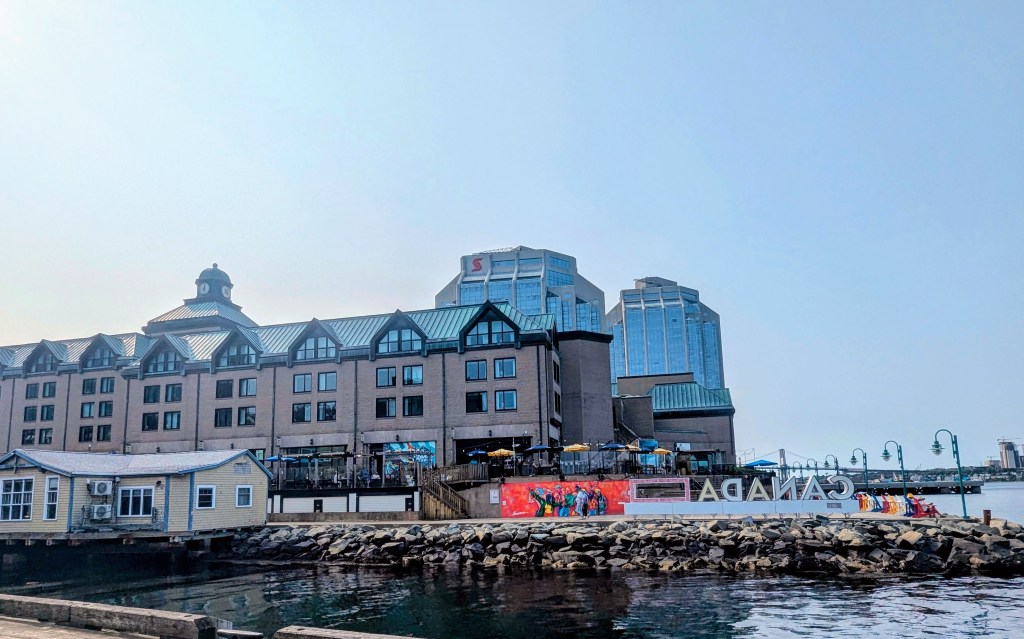
As the day was still young, and we had plenty of energy, we headed out to have a look around. Halifax is located on the ancestral lands of the Mi’kmaq who lived in the area long before Europeans arrived. Mi’kmaq called the area “Great Harbor”. The city itself was established by the British in 1749 in violation of treaties with the Mi’kmaq. The establishment of the city led to Father le Loutre’s War, otherwise known as the Anglo-Micmac War. General Edward Cornwallis brought nearly 1,200 settlers to the new town of Halifax, which was named after the 2nd Earl of Halifax in England. Due to his success in extending American commerce, the Earl became known as “father of the colonies”. One of the first places we encountered was Province House, the seat of the Nova Scotia House of Assembly. The three-story building is built in the Neo-Classical style with Nova Scotia sandstone. It is the oldest legislative building in Canada and has been the meeting place for the Nova Scotia legislative assembly since 1819. The building is a National Historic Site of Canada.

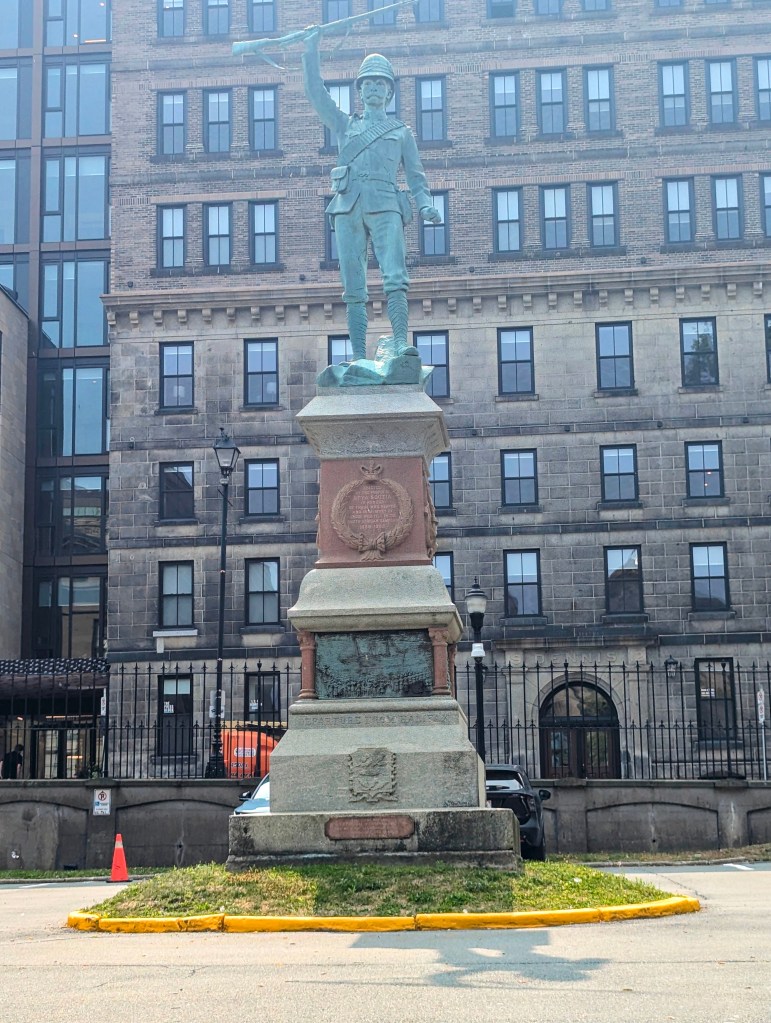
Next to the Province House is a memorial honoring those who served and died during the South African (Boer) War, which took place from 1899 to 1902.
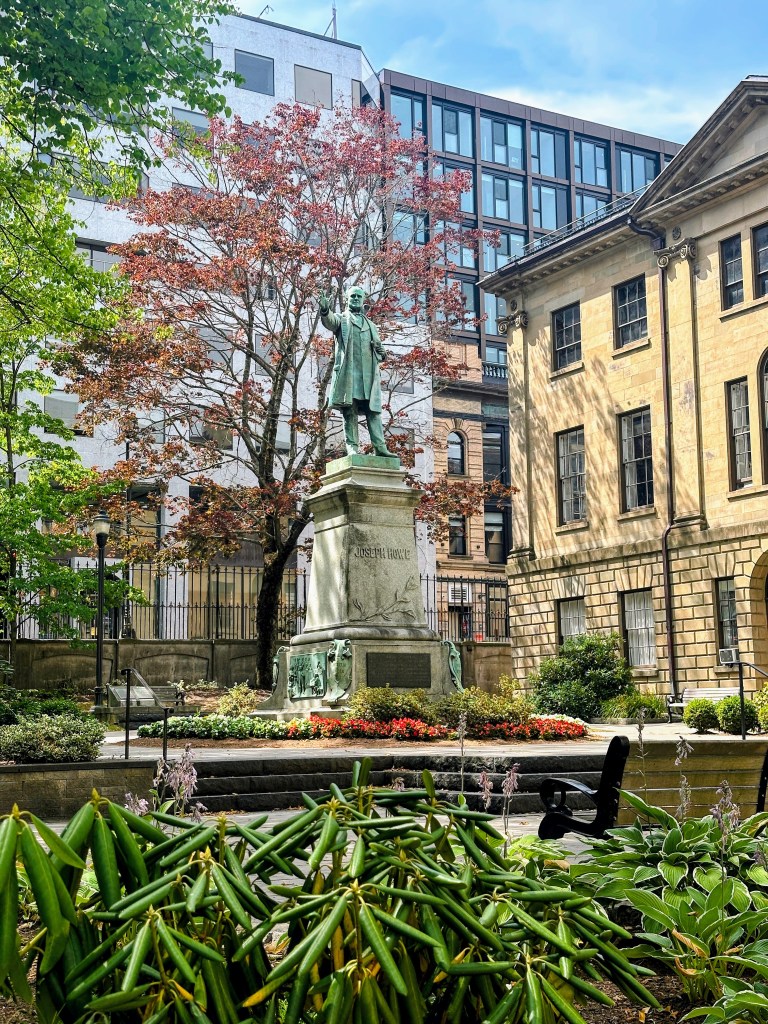
On the other side of Province House is a statue of Joseph Howe (1804-1873, erected in 1904 to commemorate the centennial of Howe’s birth. It was the first public statue of a Nova Scotian to be erected in the province. Joseph Howe was a journalist and politician who championed responsible government and argued in his own defense to establish freedom of the press in Nova Scotia.
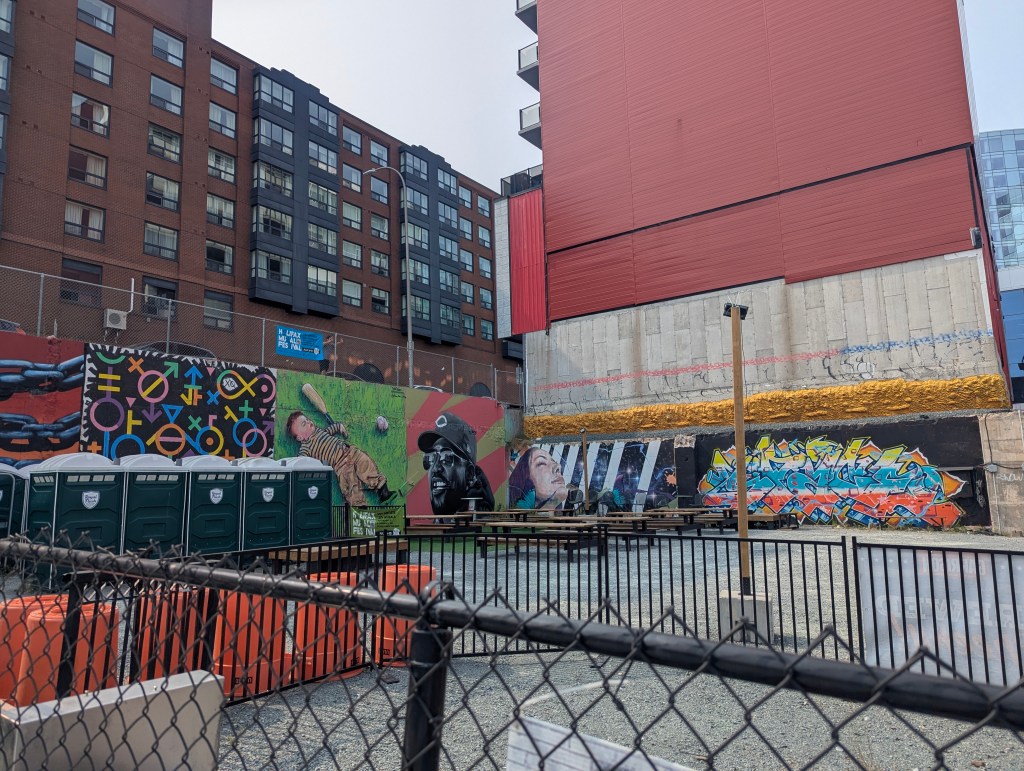
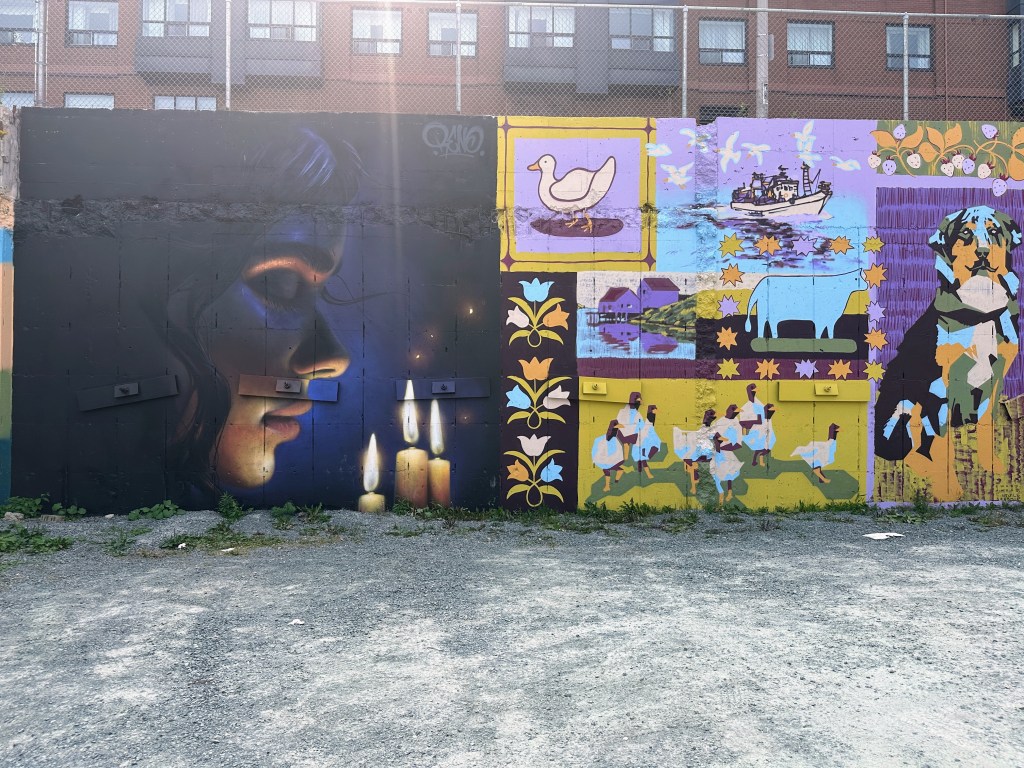
As we walked around the old city for a while, we were struck by how many murals there are everywhere.
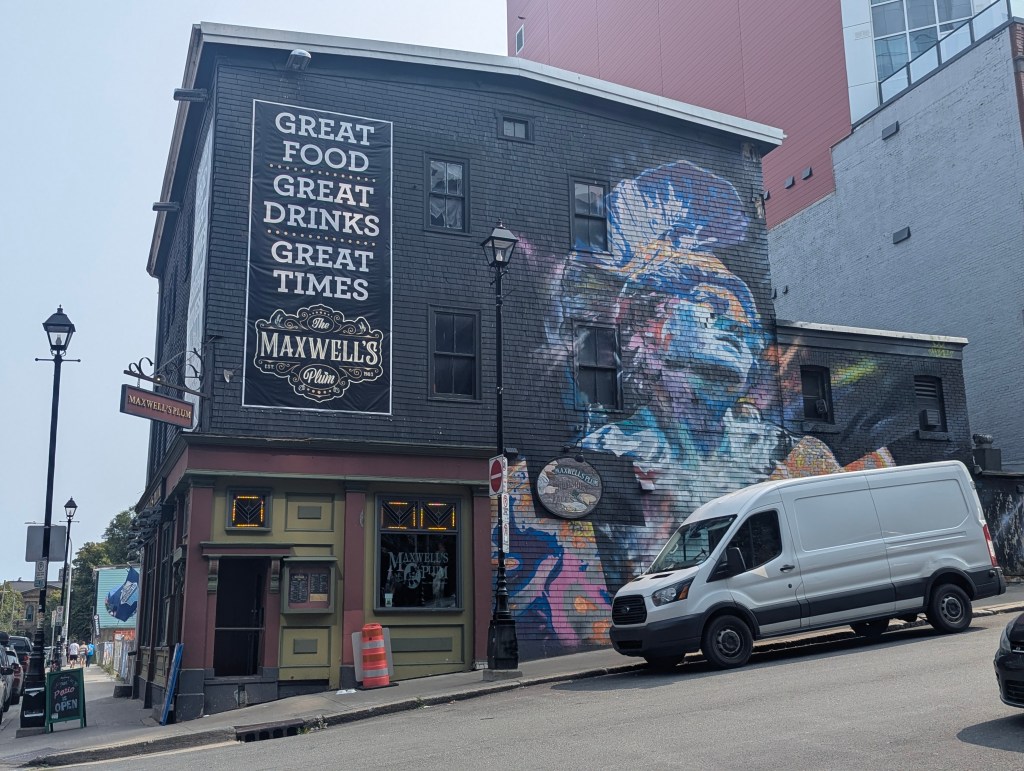
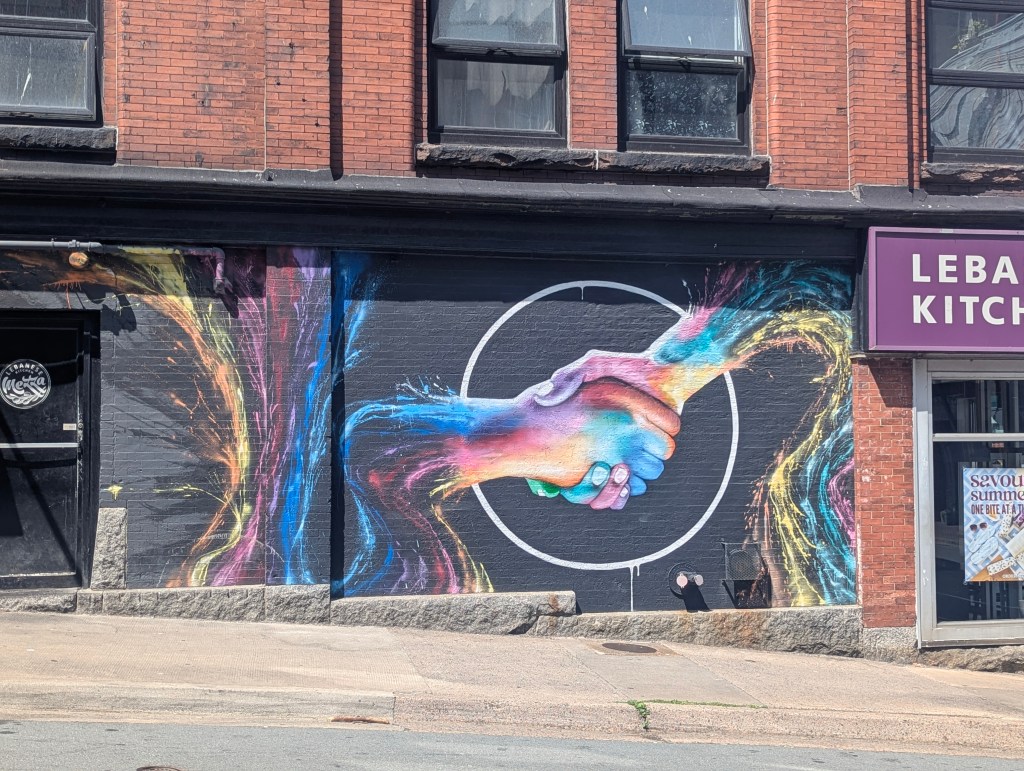
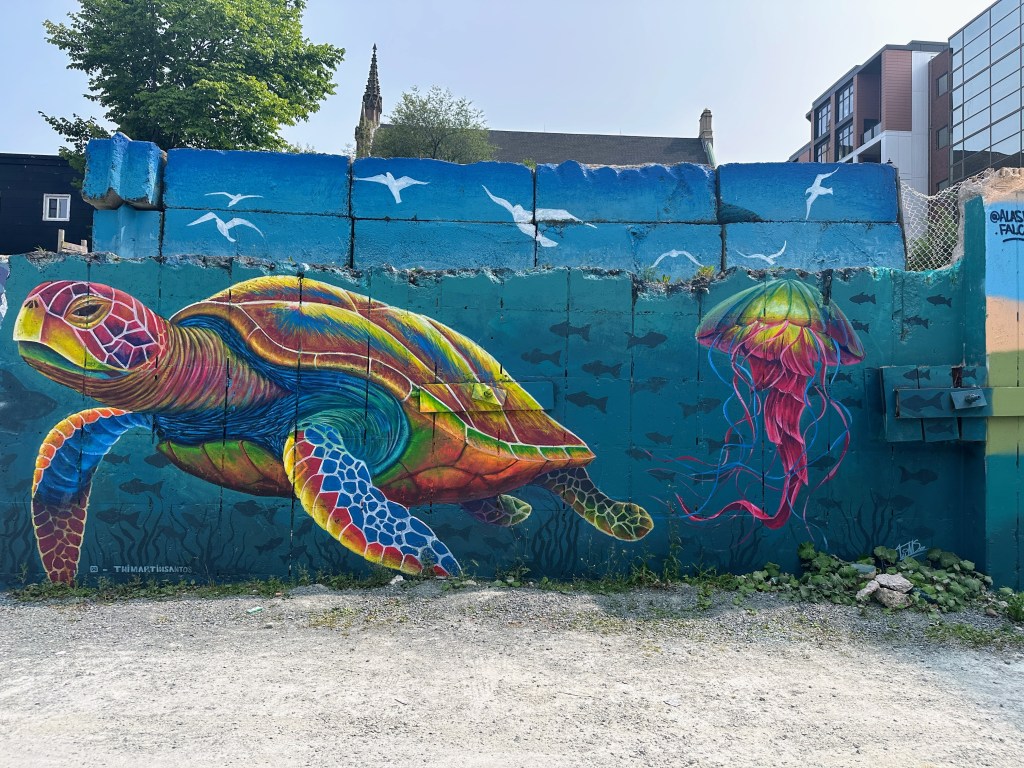
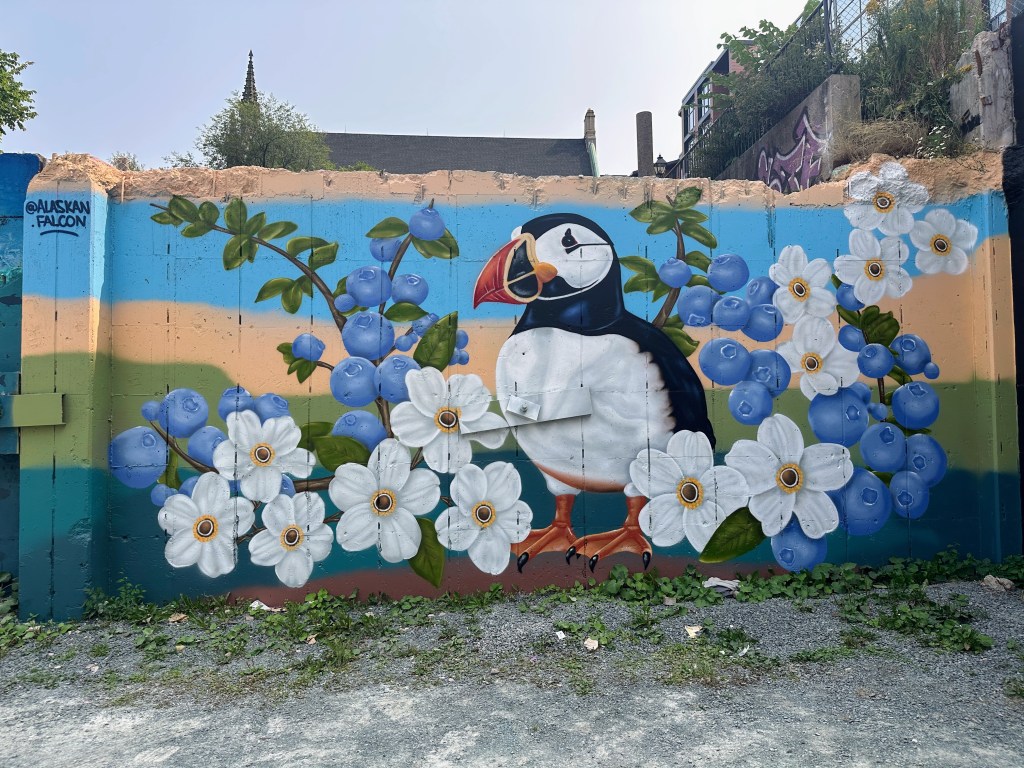
We found a lot with a whole lot of murals and signage explaining that there had been a mural and music festival in the second week of July.
Guided by the GPSMyCity app, we embarked on a self-guided walking tour. First we stopped to admire the Town Clock, also known as the Old Town Clock or the Citadel Clock Tower. It is one of Halifax’s most recognizable landmarks. This historic clock tower, a reconstruction of an early 19th-century Palladian-style structure, remains a symbol of the city’s military past and architectural heritage. The idea for the Town Clock was conceived by Prince Edward, Duke of Kent, who served as the commander-in-chief of British North America’s military forces. Concerned about punctuality within the British Army and Royal Navy garrison in Halifax, he commissioned a turret clock before his return to England in 1800. The clock was manufactured by the prestigious House of Vulliamy, a renowned London-based firm of Royal Clockmakers. The Town Clock officially began keeping time for Halifax’s garrison on October 20, 1803 and continues to function with its original mechanism: an intricate system of three weights, gears, and a 13-foot pendulum housed in a cast-iron frame. The bell chimes every quarter-hour and hour, maintaining the discipline of timekeeping established over two centuries ago. The clock face, set on all four sides, features Roman numerals, with “4” traditionally written as “IIII” rather than “IV” for aesthetic balance. The clock’s slow-moving mechanism has contributed to its longevity, requiring twice-weekly manual winding by employees of Citadel Hill National Historic Site, under the care of Parks Canada. At noon daily there is a gun salute.
Behind lies the Citadel, completed in 1856 with an 8 pointed star configuration surrounding the fort. The garrison grounds are now an amphitheater and artillery park. We chose not to visit having seen the citadel in Quebec City.

We found ourselves in the Grand Parade, a military parade square that dates to 1749. When the first contingent of British settlers in Halifax arrived in June 1749. Charles Morris, the Chief Surveyor, worked on the town layout which comprised an urban grid made up of oblong, rectangular city blocks with the Grand Parade at the center of the town. The plan stipulated a church at the southern end of the square, and a courthouse and prison at the northern end. Today the square is used for public events, concerts and special celebrations.
The monument shown is the Halifax Grand Parade Cenotaph unveiled on July 1, 1929, to commemorate the men and women of Halifax who died in the First World War. It was later updated to include the years of the Second World War and the Korean War.

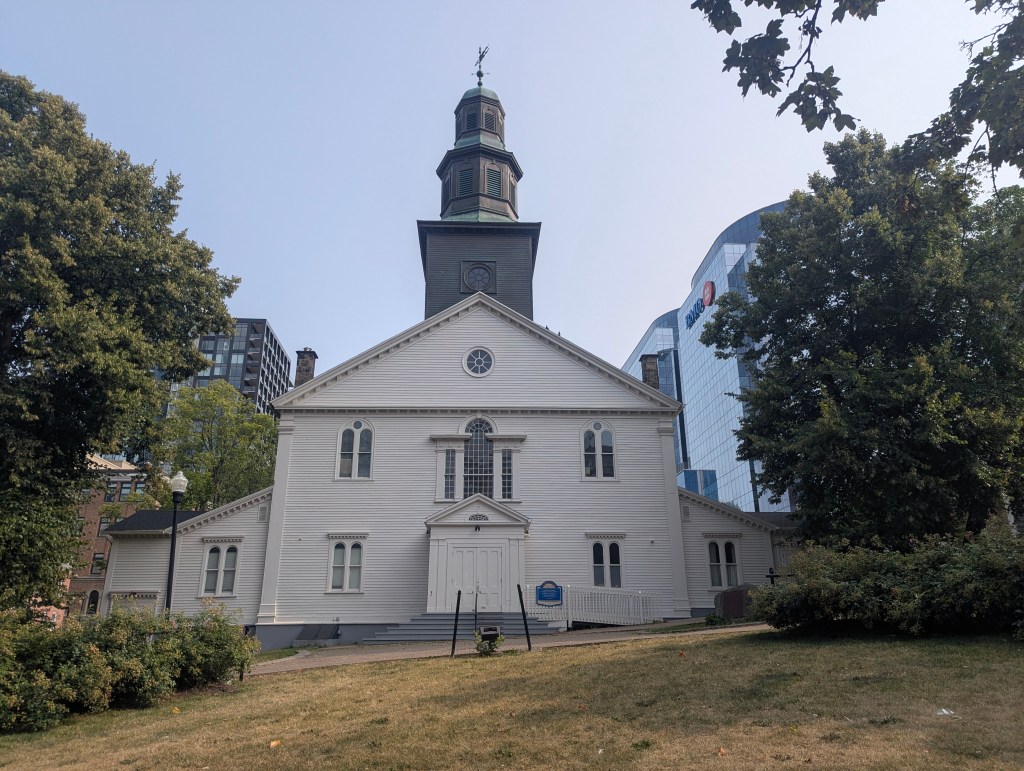
The Saint Paul’s Church, on the southern end of the Grand Parade, opened in 1749. It was the first Protestant Church in Canada and is also the oldest building in Halifax. Architecturally, Saint Paul’s is a significant landmark as the first Palladian-style building in Canada. It has undergone numerous expansions over the centuries. The church’s present structure includes wings added in the 19th century, making it one of the few Anglican churches worldwide with five aisles. The church was also the official place of worship for the garrison until 1844. Many notable figures have been associated with Saint Paul’s, including Governor Edward Cornwallis, Prince Edward (the future Duke of Kent).
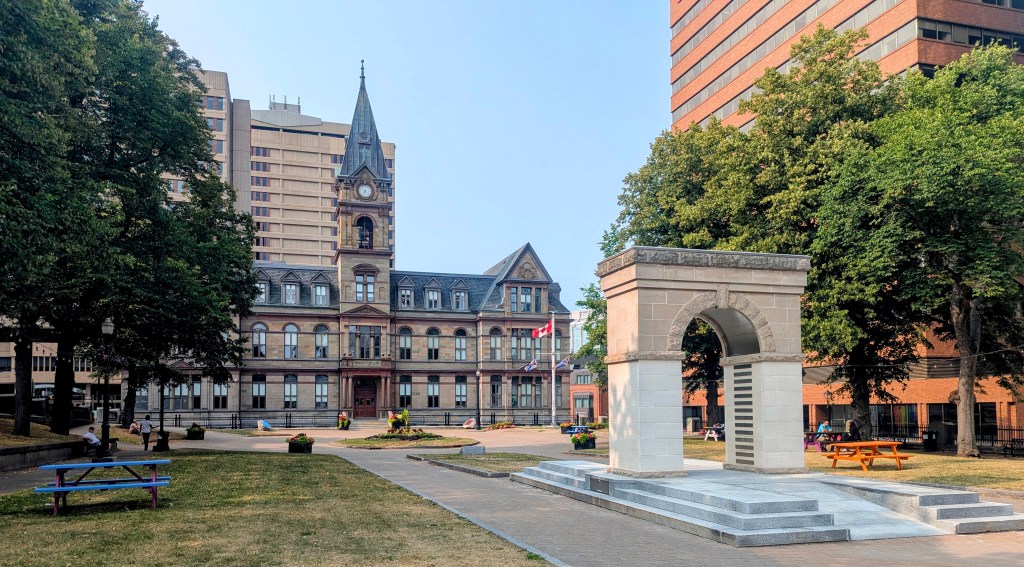
Halifax City Hall was built in 1890. It was originally built to replace the old courthouse and for other public use. Halifax City Hall is notable for being one of the oldest public buildings in Nova Scotia. With four floors and a seven-story clock tower, it is also one of the largest.
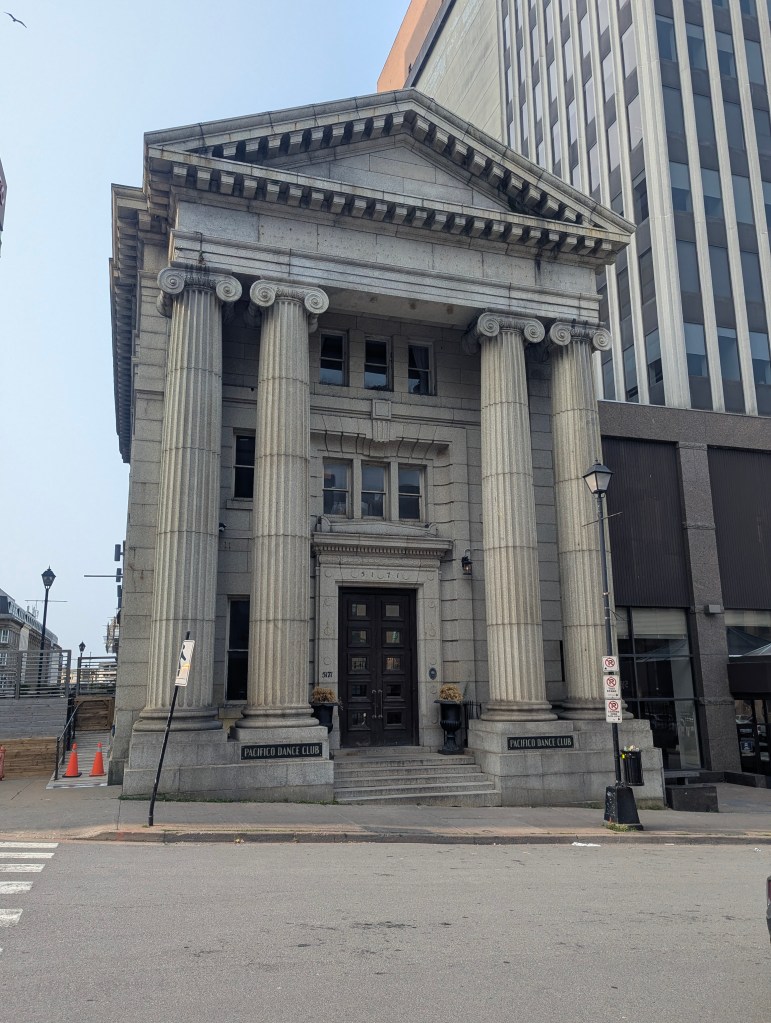
City National Bank building, which has a neoclassical architectural style, was formerly a bank and is now a bar and is on the National Register of Historic Places.
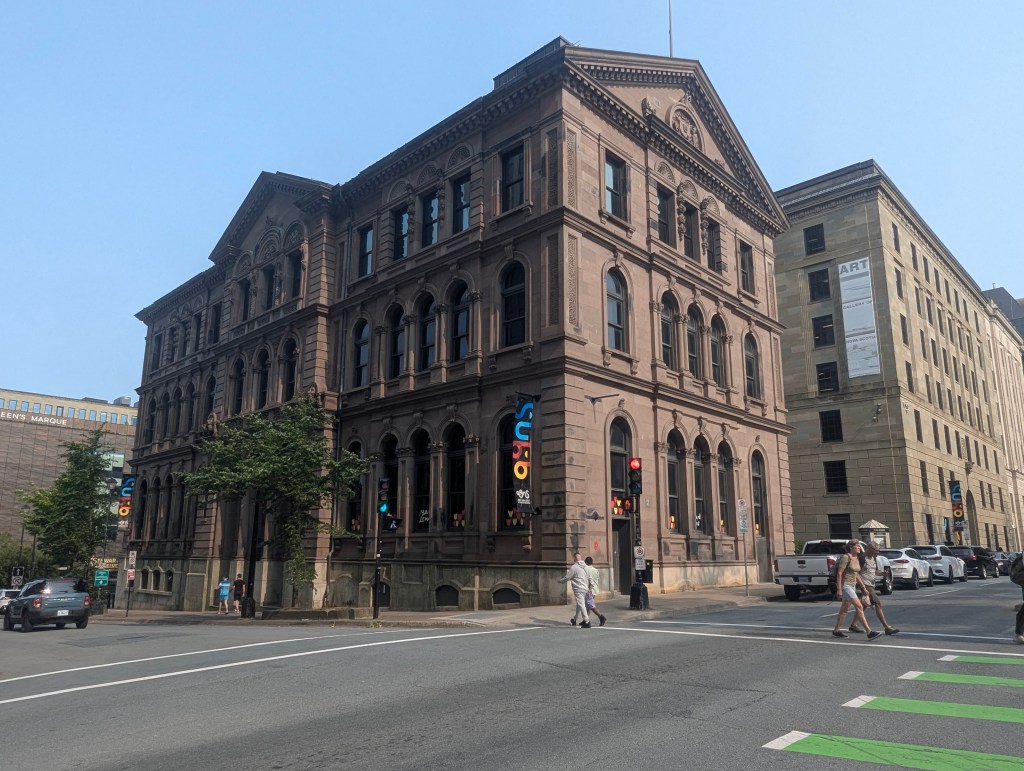
The Art Gallery of Nova Scotia was originally built as the customs house and post office in 1868. The exterior is constructed with Nova Scotia sandstone, and the building’s design was inspired by an Italian Renaissance palazzo. The museum’s collection includes historical and contemporary art from Nova Scotia, Canada, and around the world.
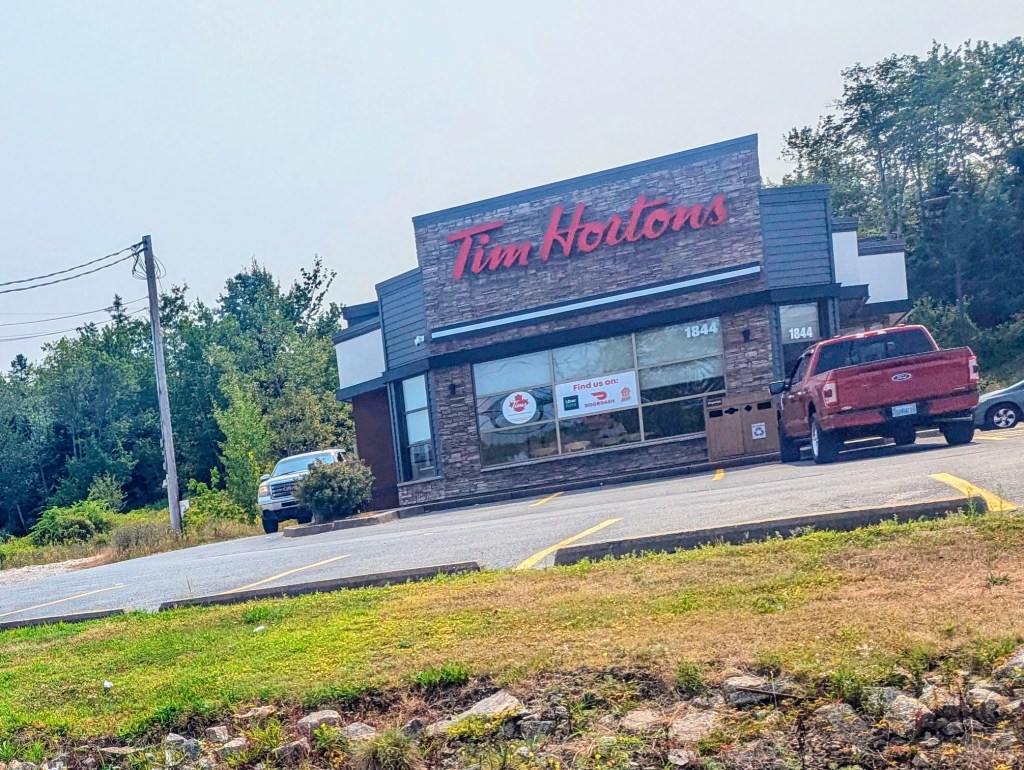
I digress from our self-guided walking tour to include this Tim Horton’s. At this point we had been in Canada for over 2 weeks, and it occurred to me that I have yet to include one. Driving throughout Canada, Tim Horton’s is as ubiquitous as Starbucks and Subway combined in the US; there is one in almost every gas station. We stopped a couple of times to try the coffee and snacks, but honestly, we are not big fans of either.

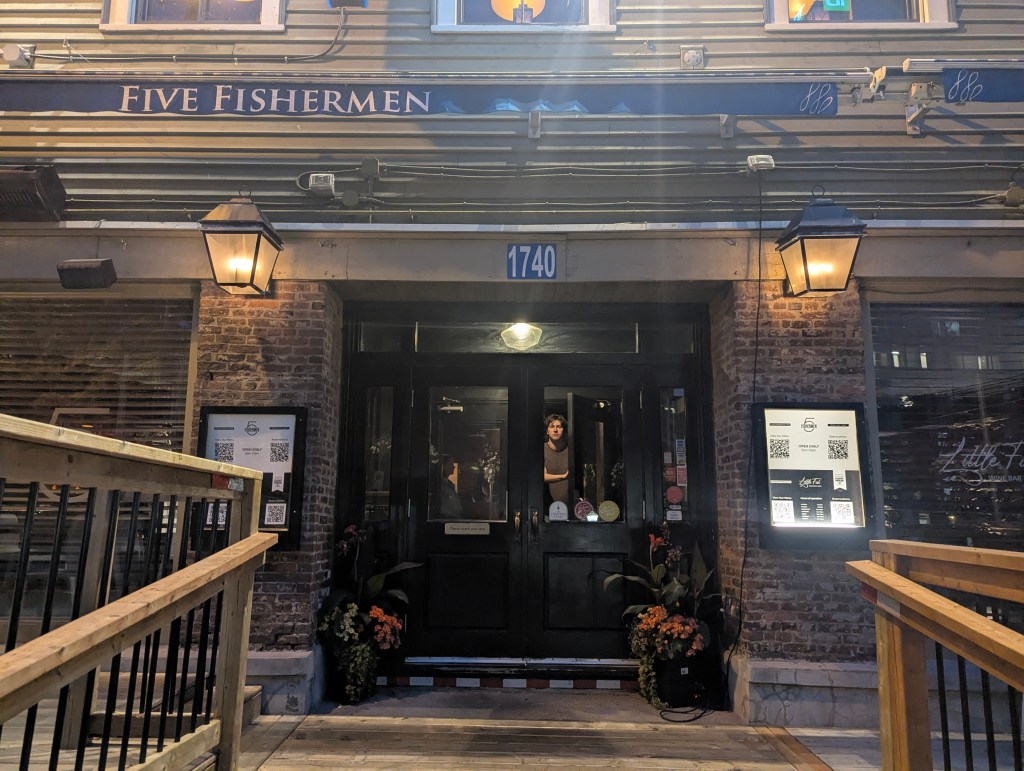
At this point it was starting to get late. We freshened up a bit before setting out for what turned out to be a most delicious dinner at the Five Fishermen.
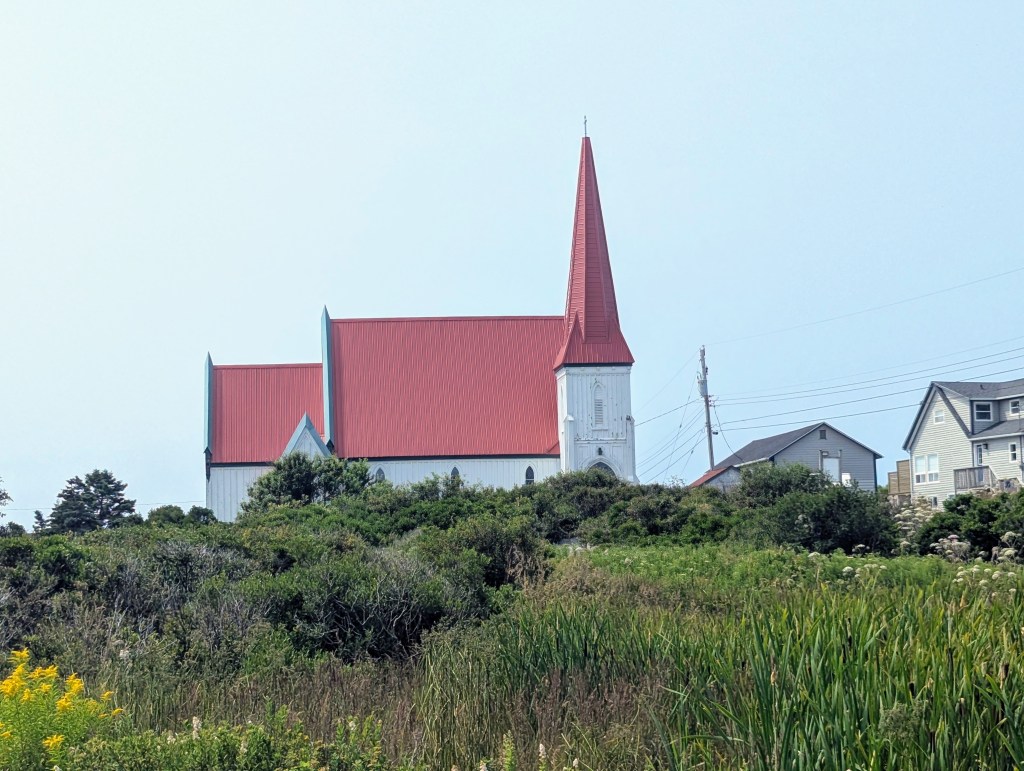
In the morning we dicided to drive to Peggy’s Cove, a small rural community located on the eastern shore of St. Margarets Bay, less than an hour drive from Halifax. Due to the large volume of tourists, we had to park out of town and walk. A short distance before we got to the town of Peggy’s Cove, we passed St. John’s Anglican Church which was constructed in the Gothic Revival style in 1893. It replaced a previous church that was destroyed by fire in 1881.
The first recorded name of the cove was Eastern Point Harbour or Peggs Harbour in 1766. The village is likely named after Saint Margaret’s Bay (Peggy being a nickname for Margaret), which Samuel de Champlian named after his mother Marguerite Le Roy.
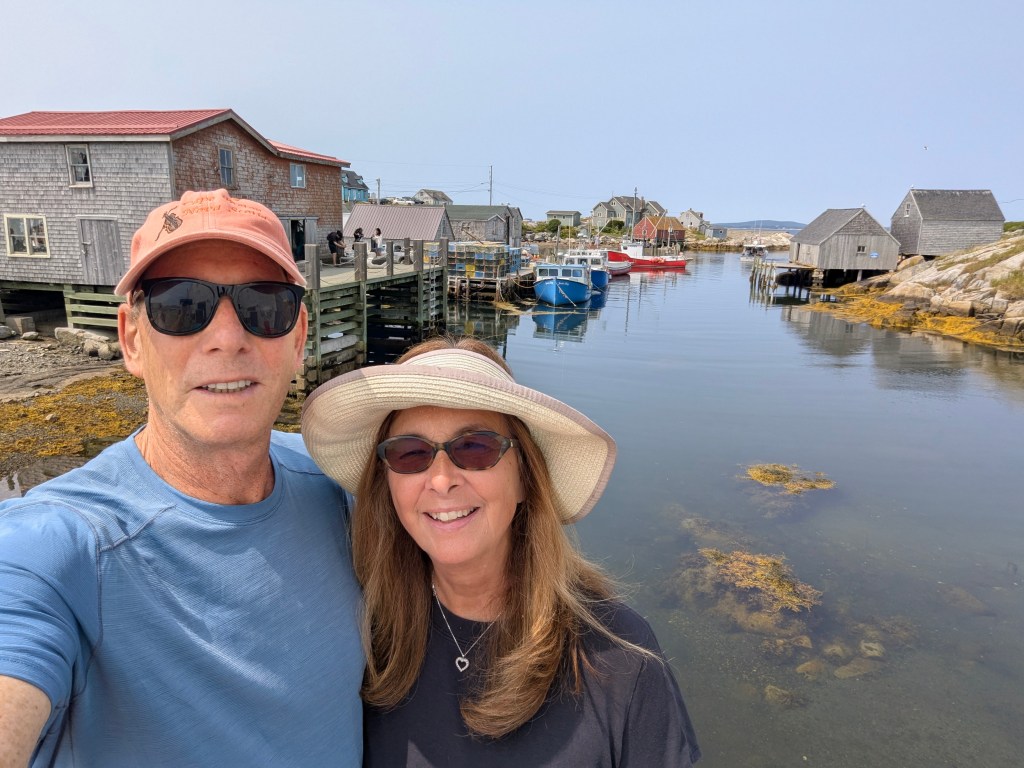
The village was founded in 1811 when the province of Nova Scotia issued a land grant of more than 800 acres to six families of German descent. The settlers relied on fishing as the mainstay of their economy but also farmed where the soil was fertile.

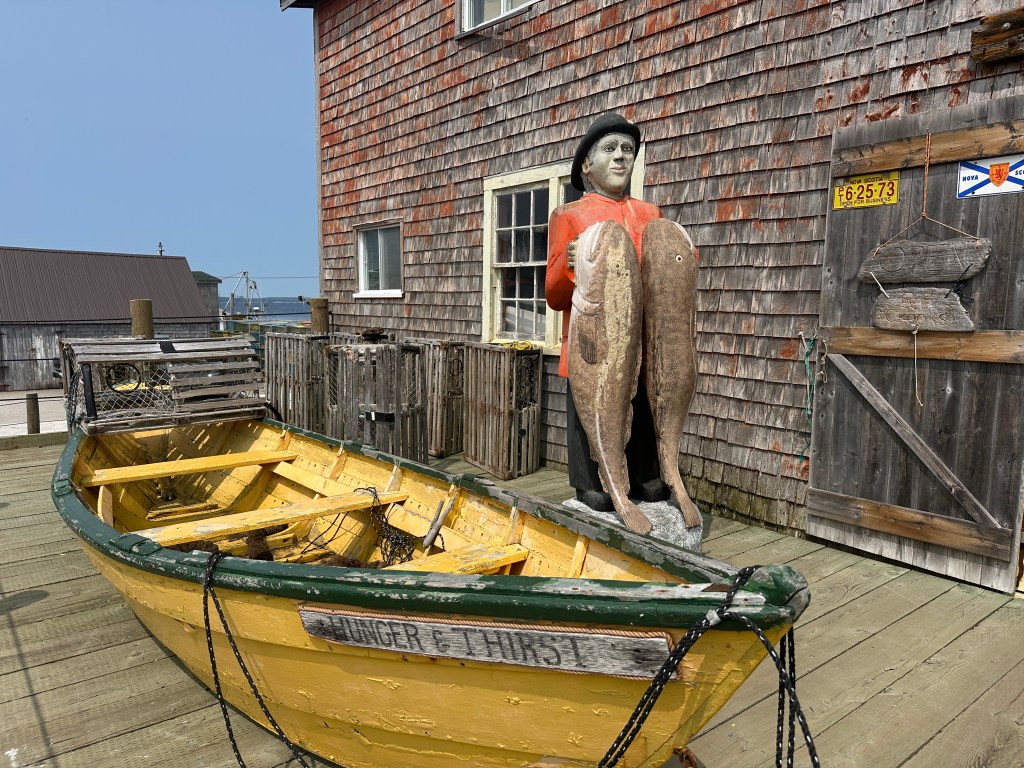
Many artists and photographers flocked to Peggy’s Cove. As roads improved, the number of tourists increased. Today the population is small but Peggy’s Cove remains an active fishing village and a favorite tourist destination.
Peggys Point Lighthouse, also known as Peggys Cove Lighthouse, is an active lighthouse and an iconic Canadian image.
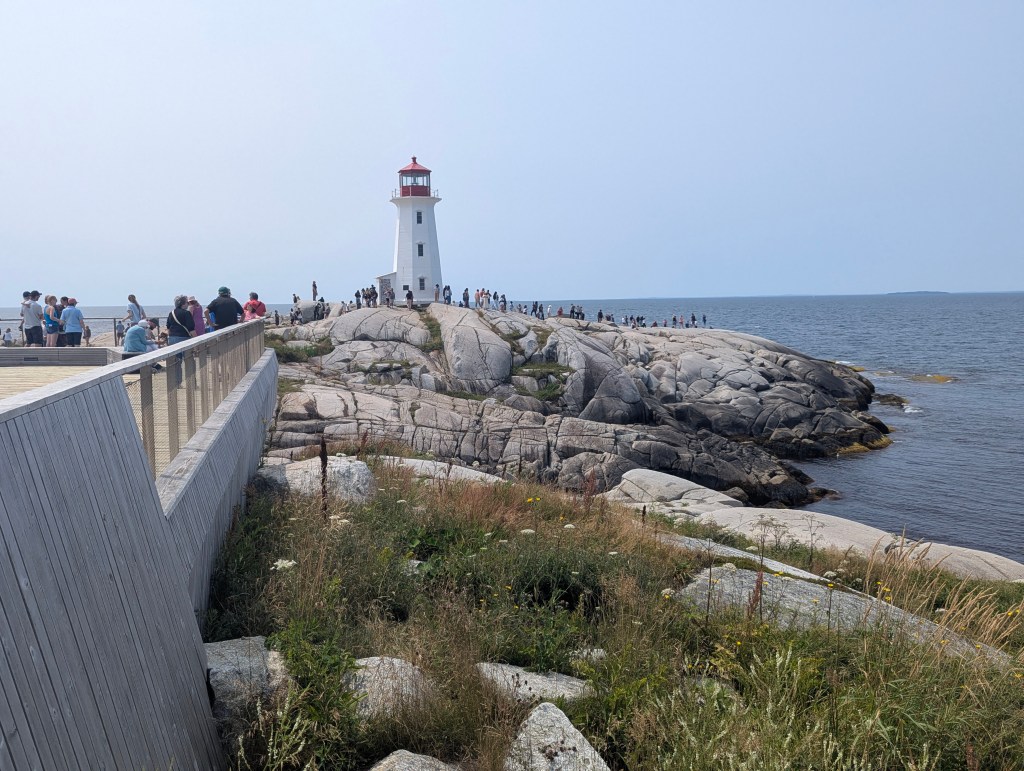
The classic red-and-white lighthouse is still operated by the Canadian Coast Guard and is situated on an extensive granite outcrop at Peggys Point. This lighthouse is one of the most-photographed structures in Atlantic Canada and one of the most recognizable lighthouses in the world.

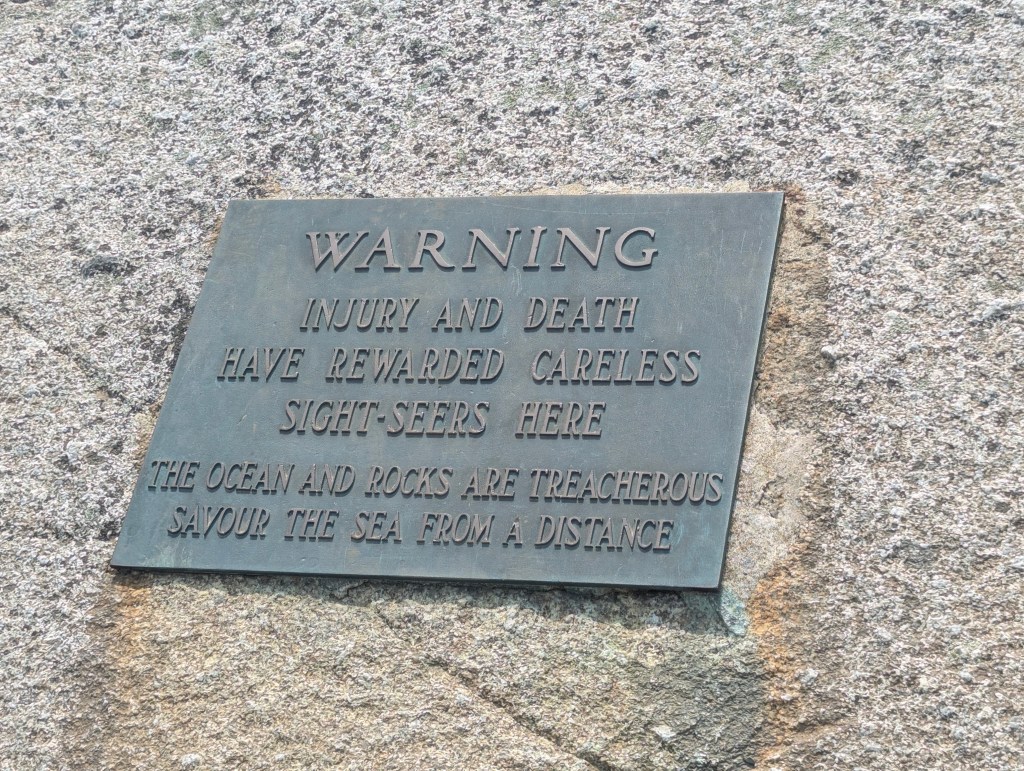
Despite numerous signs warning of unpredictable surf (including one on a bronze plaque on the lighthouse itself), several visitors each year are swept off the rocks by waves, sometimes drowning.
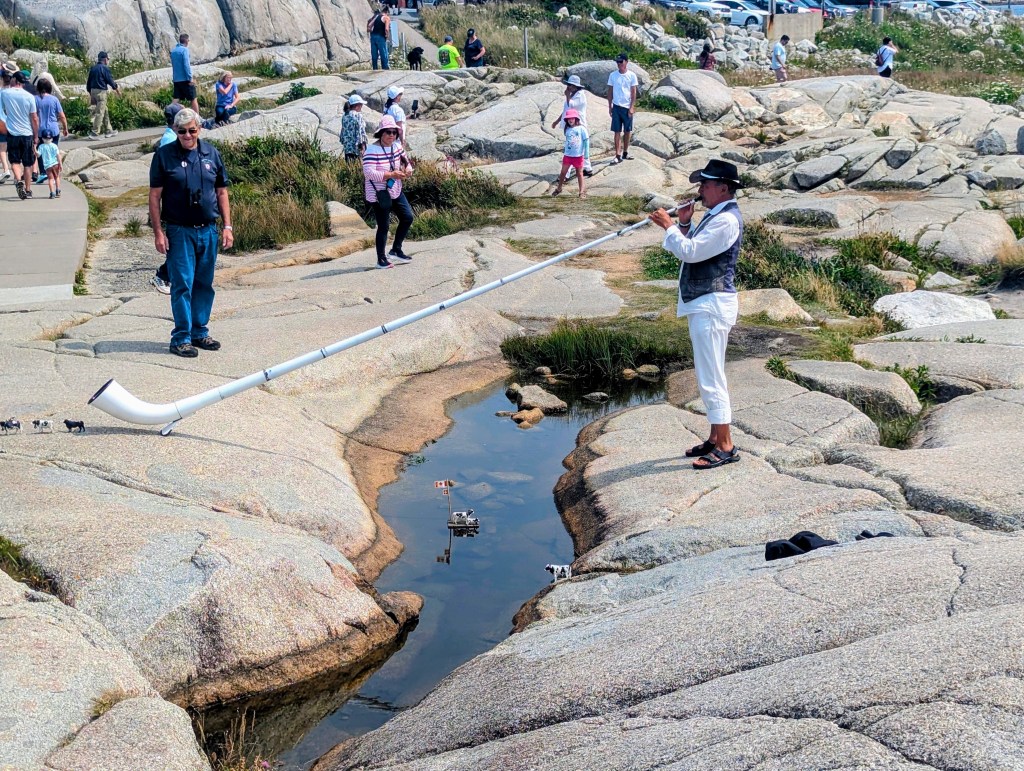
There were several musicians hoping for tips from tourists including a man playing bagpipes and this guy playing an Alphorn (not very well…we were in Switzerland just last year).
More than 400 million years ago, in the Devonian Period, the plate tectonics movement of the Earth’s crust allowed molten material to bubble up from the Earth’s interior. This formed the rocks seen today and are part of the Great Nova Scotia batholith, a large mass of intrusive igneous rock. The landscape of Peggy’s Cove and surrounding areas was subsequently carved by the migration of glaciers and the ocean tides.
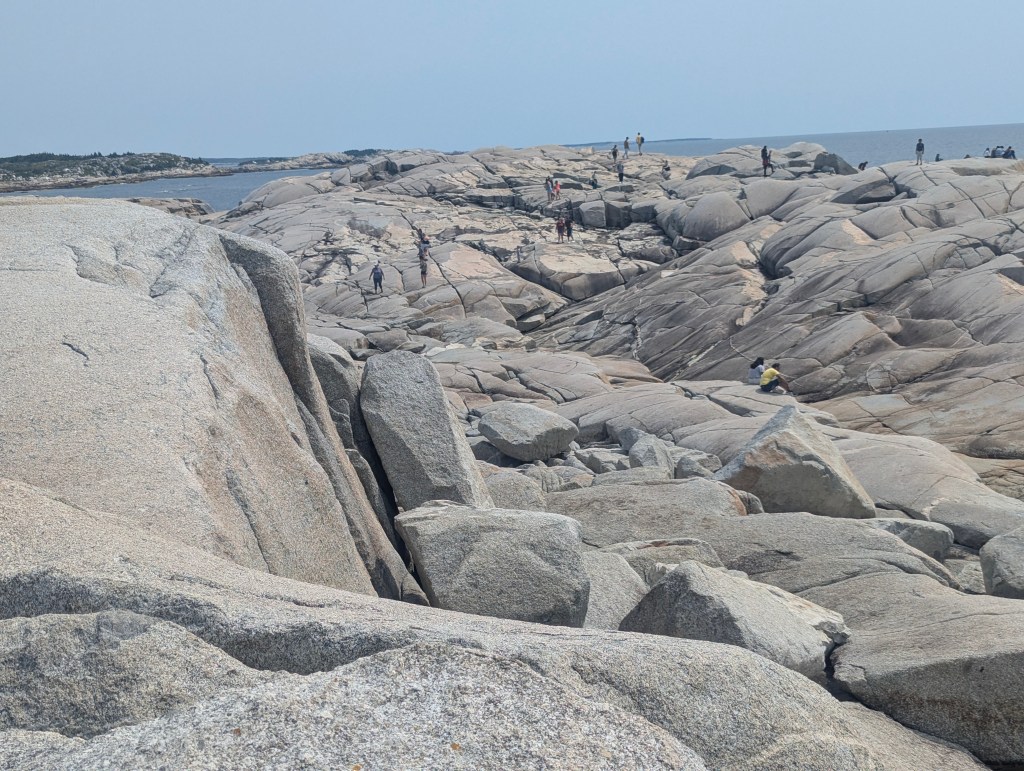
Peggy’s Cove has been declared a preservation area to protect its rugged beauty.

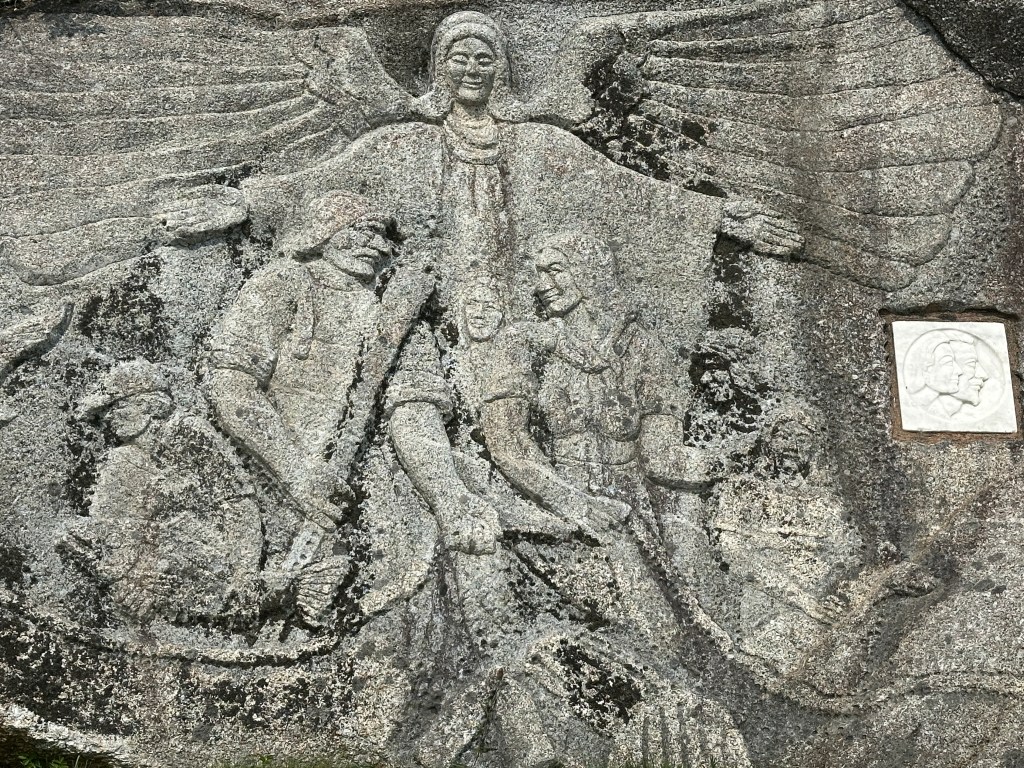
William Edward deGarthe (1907–1983) was a Finnish painter and sculptor who lived for much of his life in Peggy’s Cove. In the late 1970s, deGarthe began a ten-year project to sculpt a “lasting monument to Nova Scotia fishermen” on a 100 ft granite outcropping behind his Peggy’s Cove Home. In 1976 deGarthe invited one of his students, J. Rene Barrette to help him with the sculpture. They worked together for 5 years. The project was about 80-per cent complete when the artist died in 1983.
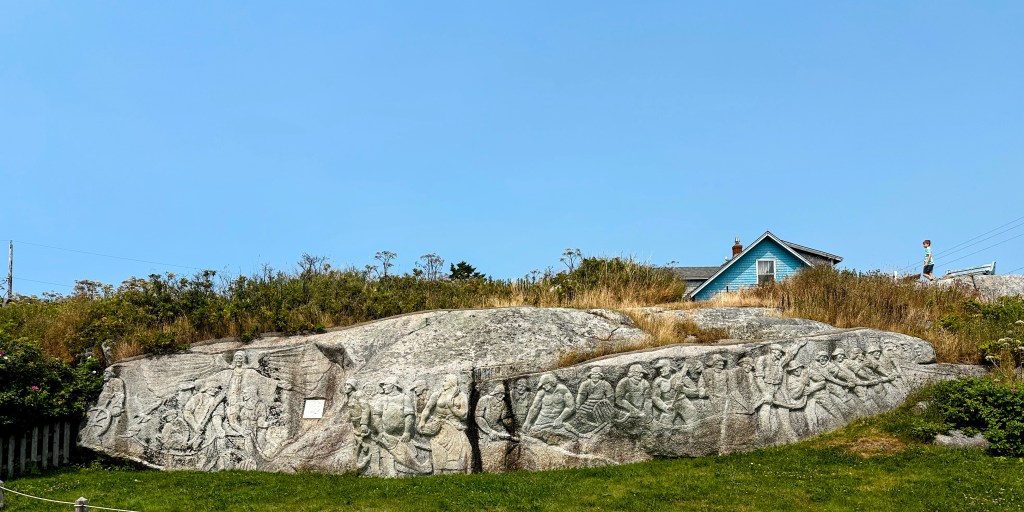
The work depicts thirty-two fishermen and their wives and children enveloped by the wings of the guardian angel St. Elmo. It also features the image of Peggy, a legendary late-18th century shipwreck survivor deGarthe believed gave her name to the village. deGarthe bequeathed the sculpture to the province of Nova Scotia, and it can be viewed in a park located behind his former home.

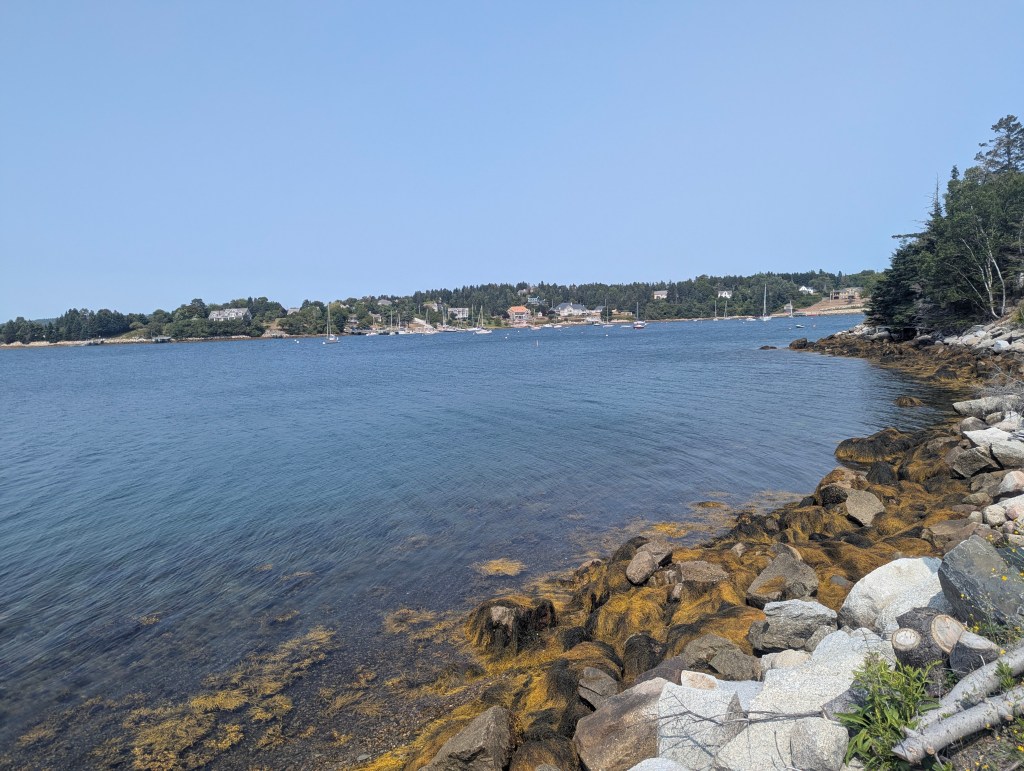
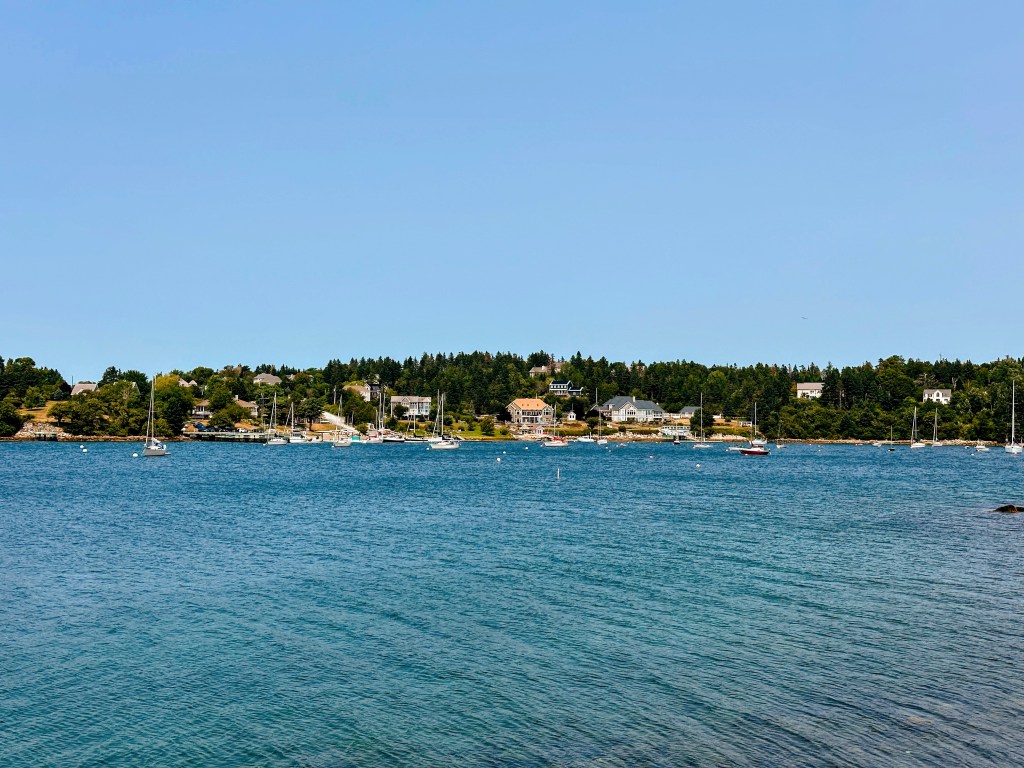
We traveled back to Halifax along a different route from which we had come to see more of the coastline. We were rewarded with some magnificent scenery.
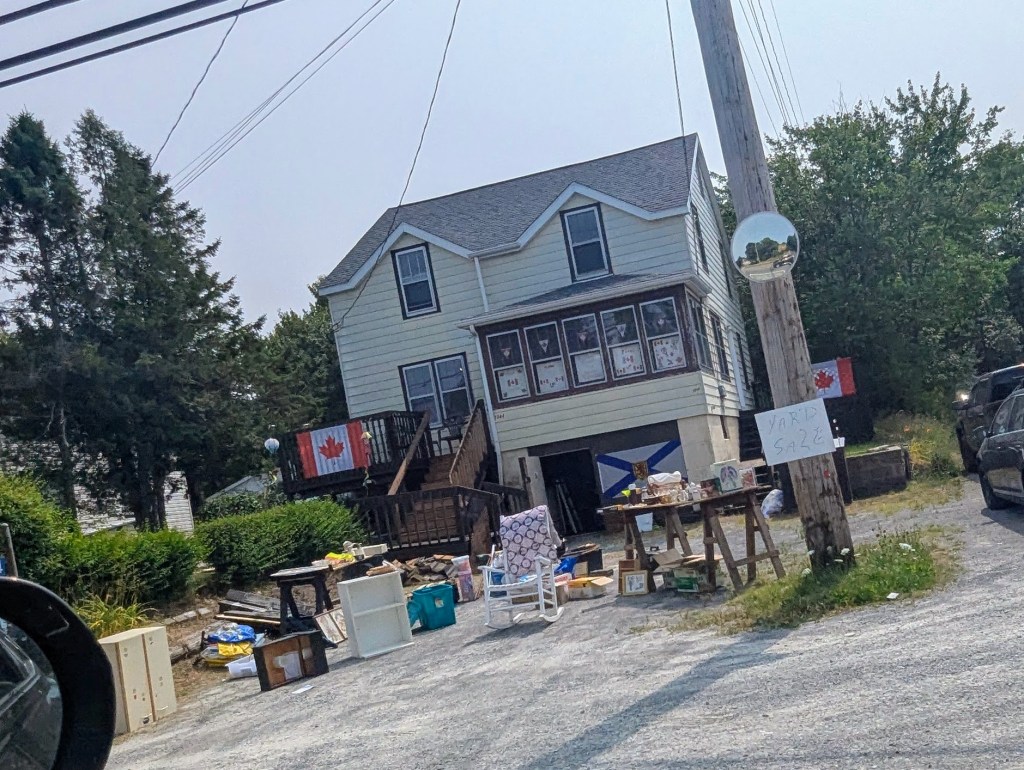
One observation during our time in Canada that I have failed to mention is the plethora of Canadian flags on so many homes and businesses.
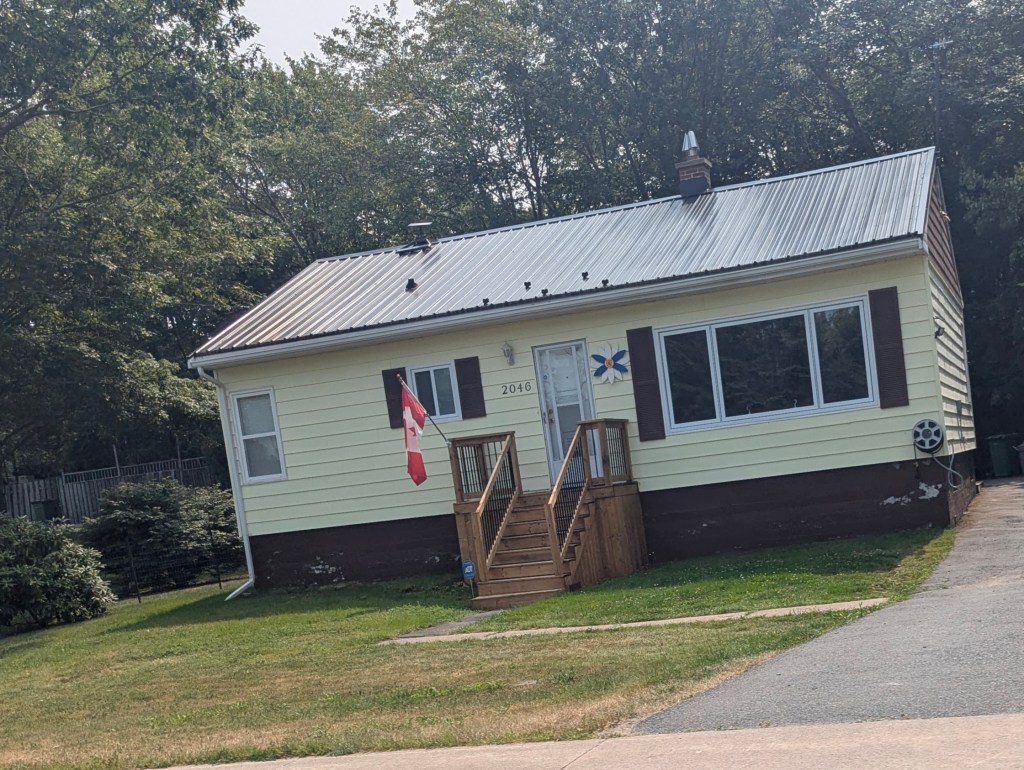
We wondered whether this is typical of Canadians or if it was inspired by their current anti-American (ie anti-Trump) sentiment.
And of course no road trip in Canada is complete without passing a Tim Horton’s (or 2 or more).
Once back in Halifax we embarked on a stroll along the Halifax Waterfront Boardwalk. The boardwalk stretches from Halifax Seaport to Casino Nova Scotia. It is about a two mile walk, making it an easy excursion. It has everything one would imagine on a boardwalk. We started in front of our hotel.

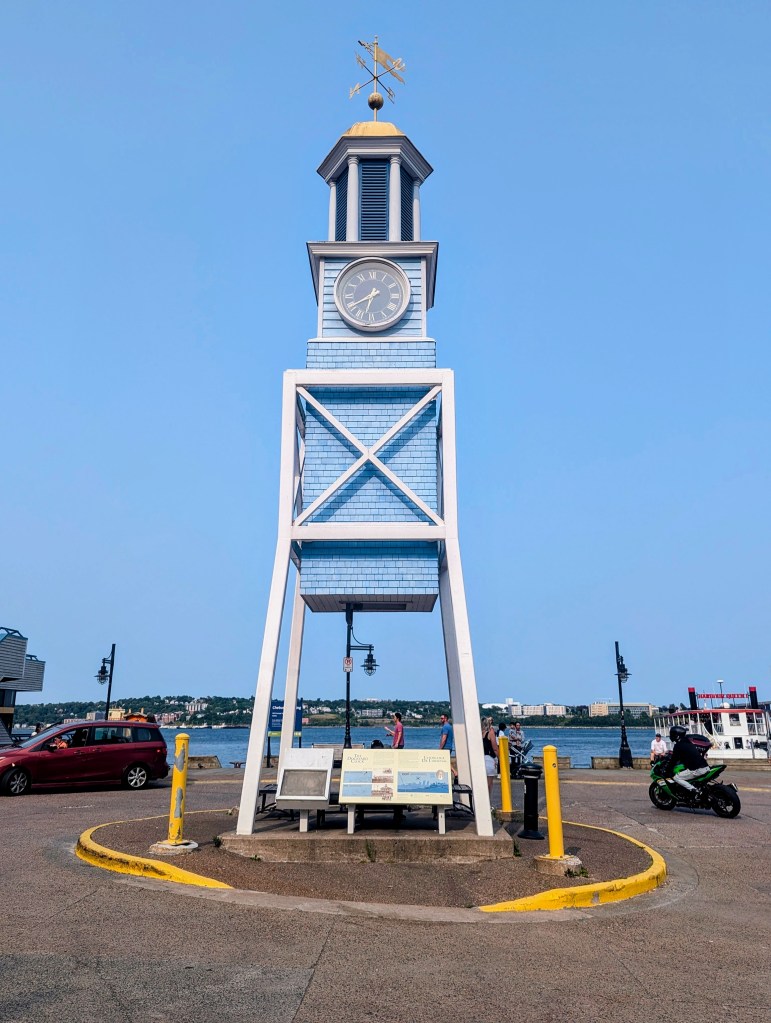
and continued walking. About central is the Dockyard Clock. Originally installed in 1772 in the domed cupola of the Hauser Stores, which were part of the original Halifax Naval Dockyard, it is the last remaining architectural feature of the original Naval Dockyard. It is one of the oldest turret clocks in Canada. The clock has been relocated three times and its current location is at Chebucto Landing.
Further along the boardwalk we passed the The Maritime Museum of the Atlantic, the oldest and largest Maritime Museum in Canada. The original concept of the Museum can be credited to a group of Royal Canadian Navy officers who envisioned a maritime museum where relics of Canada’s naval past could be conserved. Starting with a small space at the Halifax Dockyard in 1948, the museum then moved to quarters in the Halifax Citadel in 1952, and became the Maritime Museum of Canada in 1957. Floods and fires in the early 1960s caused temporary relocations to a variety of sites until 1965, when a home was found in a former bakery building at the Navy’s Victualling Depot. The Museum became the Marine History section of the Nova Scotia Museum in 1967. We kept thinking if the weather turned rainy, we would venture inside. But alas, the summertime sun was so gorgeous, we never got around to it.

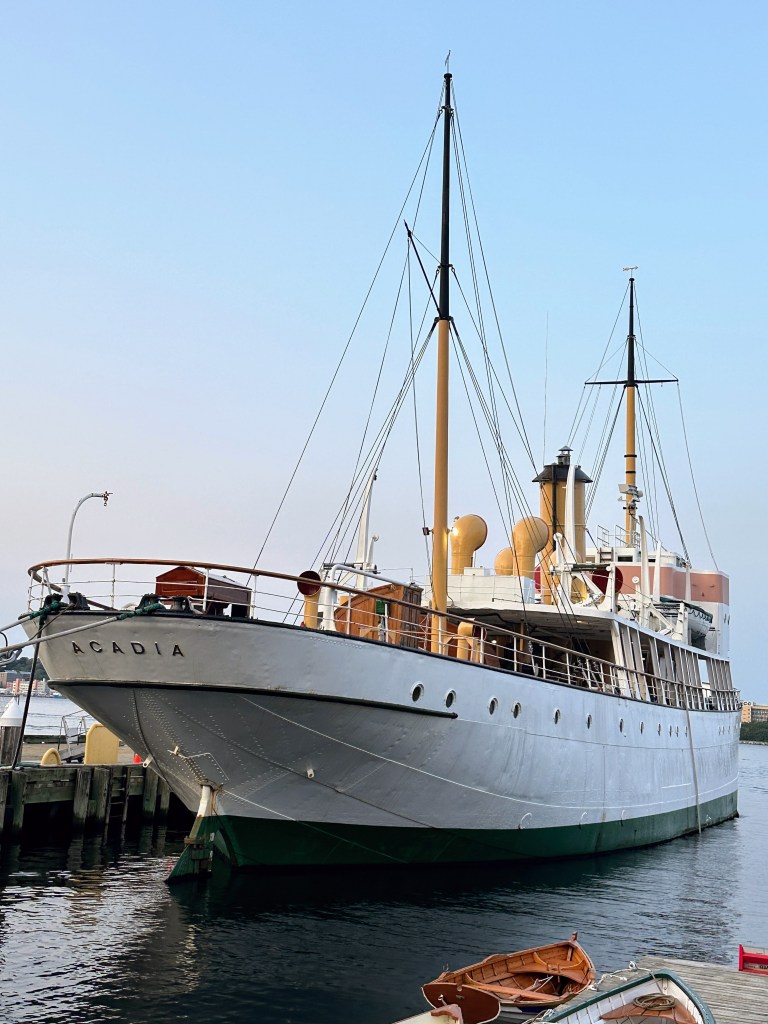
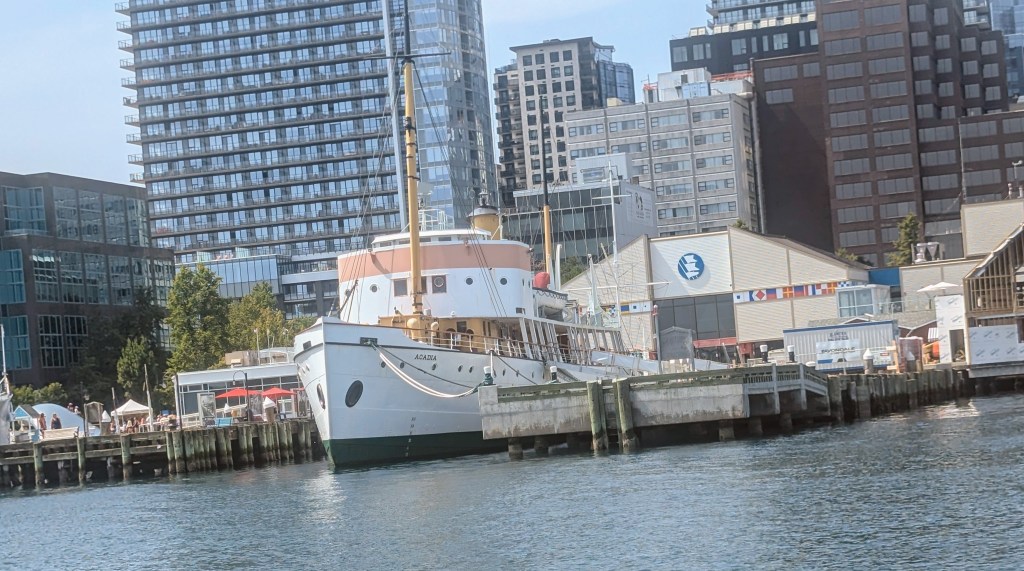
In front of and part of the Maritime Museum is the CSS Acadia, a former hydrographic and oceanographic research ship. The ship served the Hydrographic Survey of Canada and the Canadian Hydrographic Service from 1913 to 1969, charting the coastline of Eastern Canada. It is the only ship still afloat that served in the Royal Canadian Navy during both World Wars and was present during the 1917 Halifax Explosion, more on that later.
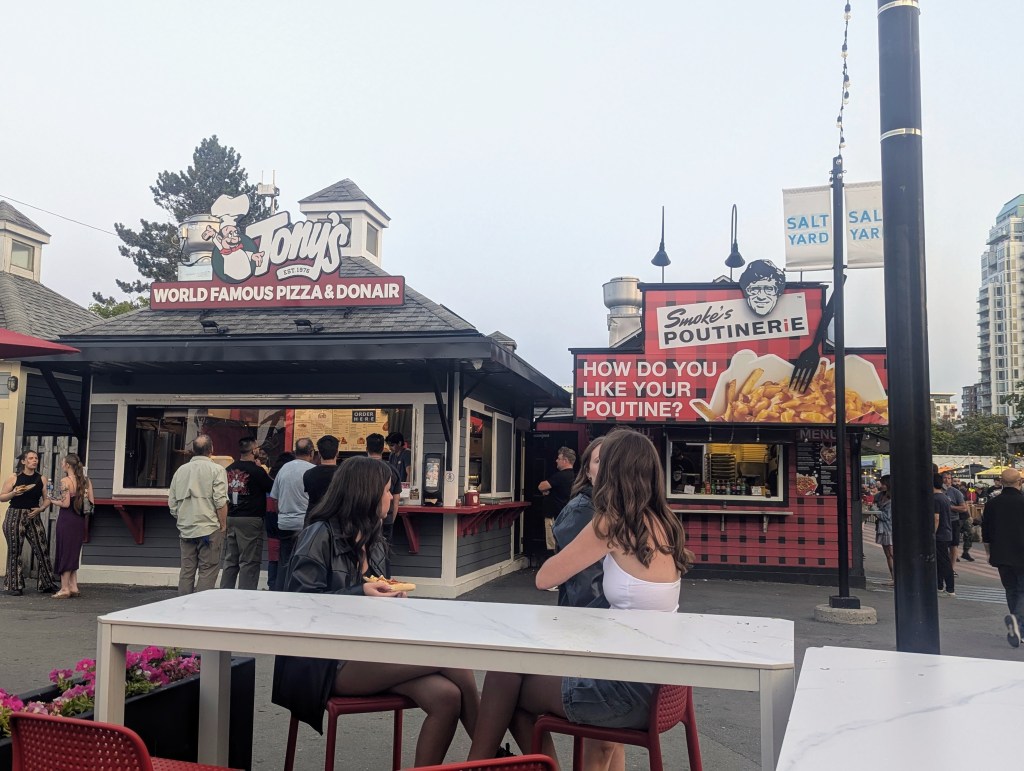
All along the boardwalk are restaurants, coffee shops, souvenir shops, and plenty of things to see, do and buy. This very Canadian fast food spot serves poutine, a Canadian dish consisting of french fries and cheese curds topped with a hot brown gravy. Poutine originated in Quebec in the 1950s and has become a popular symbol of Québécois and Canadian cuisine. We tried it once but were not at all fans.
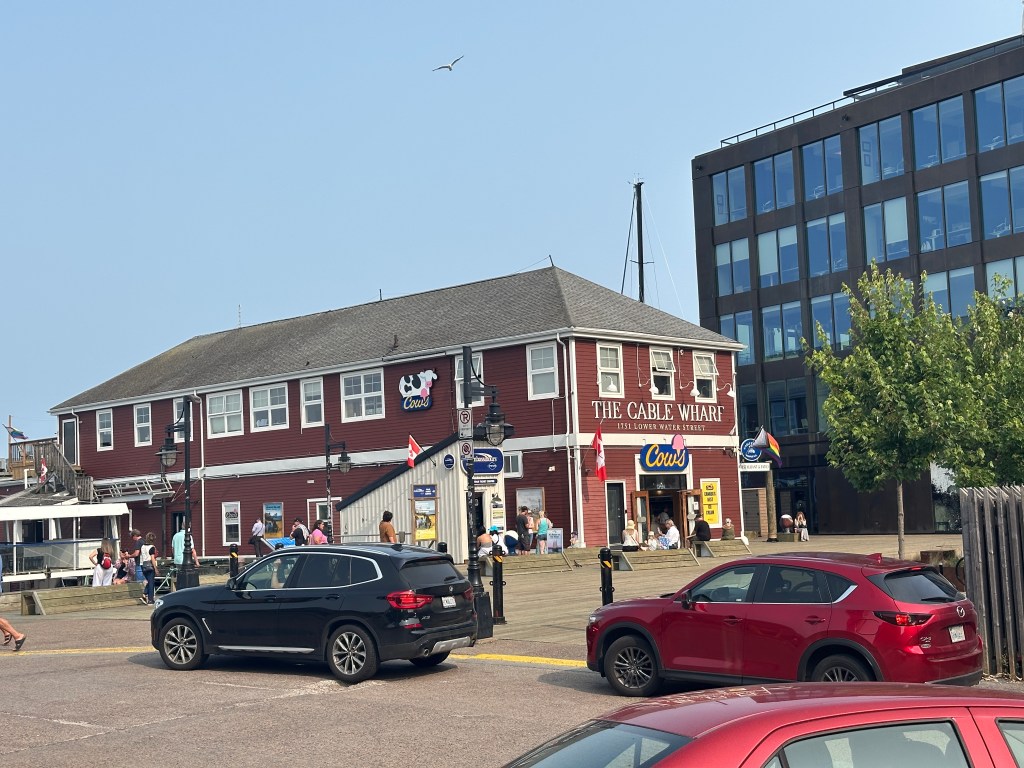
There is, of course, also a Cow’s Ice Cream shop.
There were also multiple statues on the boardwalk,
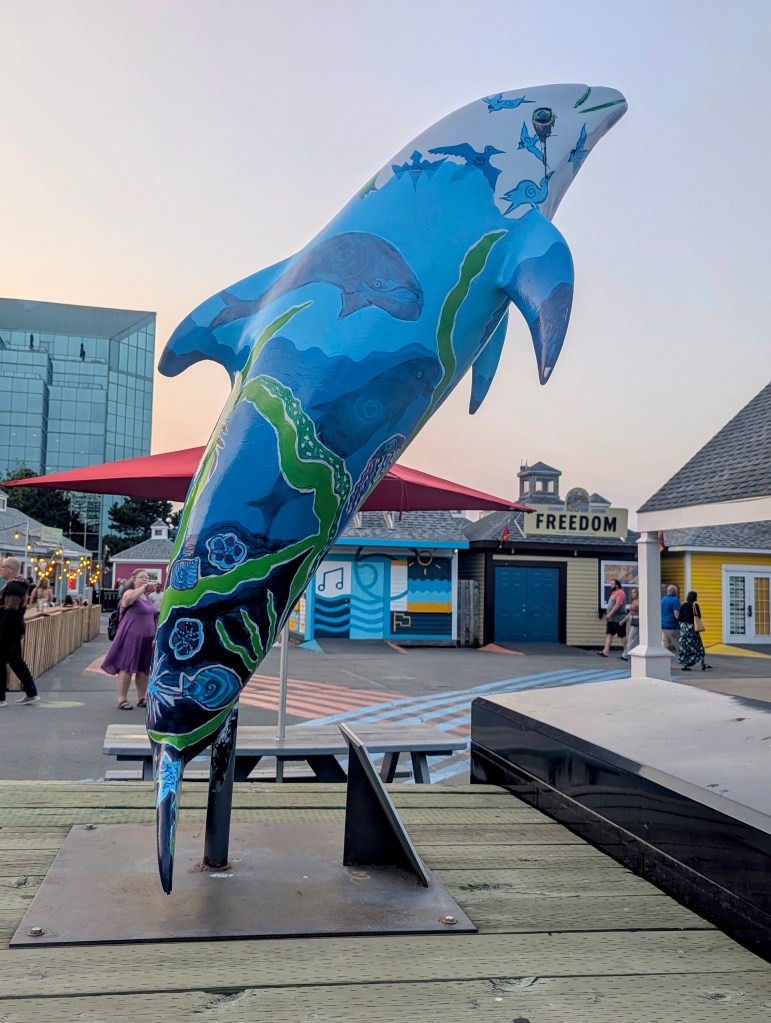
even a Lebanese one. This statue was unveiled in September 2018 to commemorate 130 years of Lebanese immigration to the city and to honor the early Lebanese settlers. It depicts a young man in traditional Lebanese clothing, facing away from the harbor as if he has just arrived to begin a new life. The monument is a universal symbol of a proud, strong, and globally united Lebanese community.
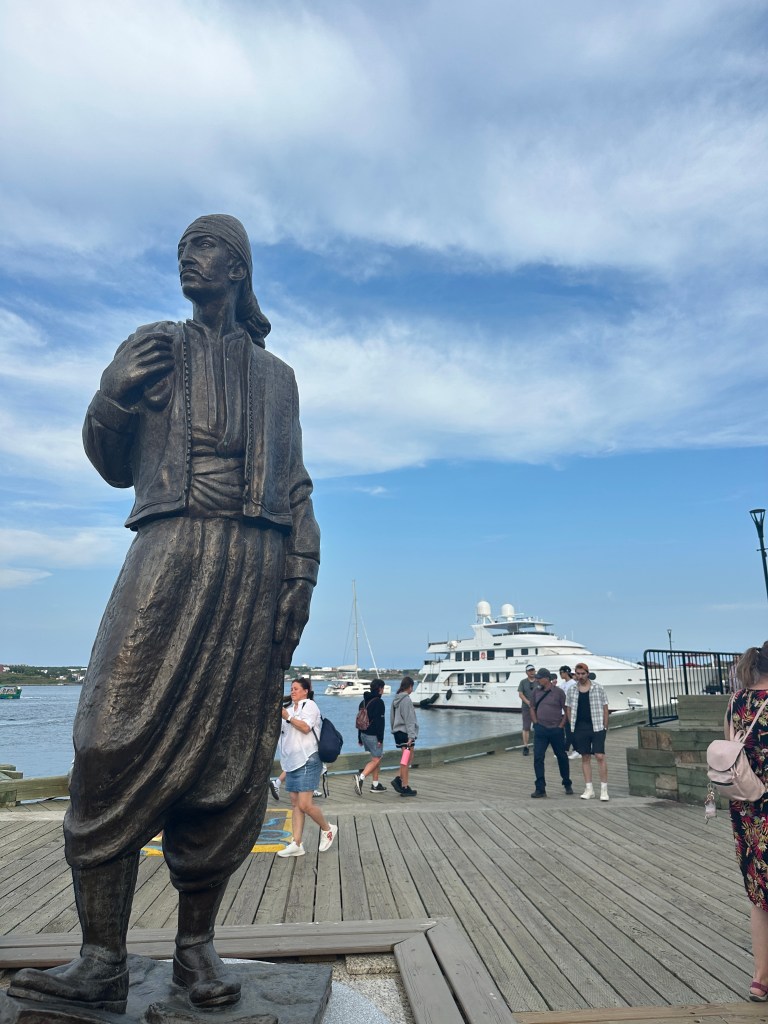
But the statue that amused us most was this one that despite the sign was never without folks young and old atop it when we passed.


There we also more murals on the boardwalk
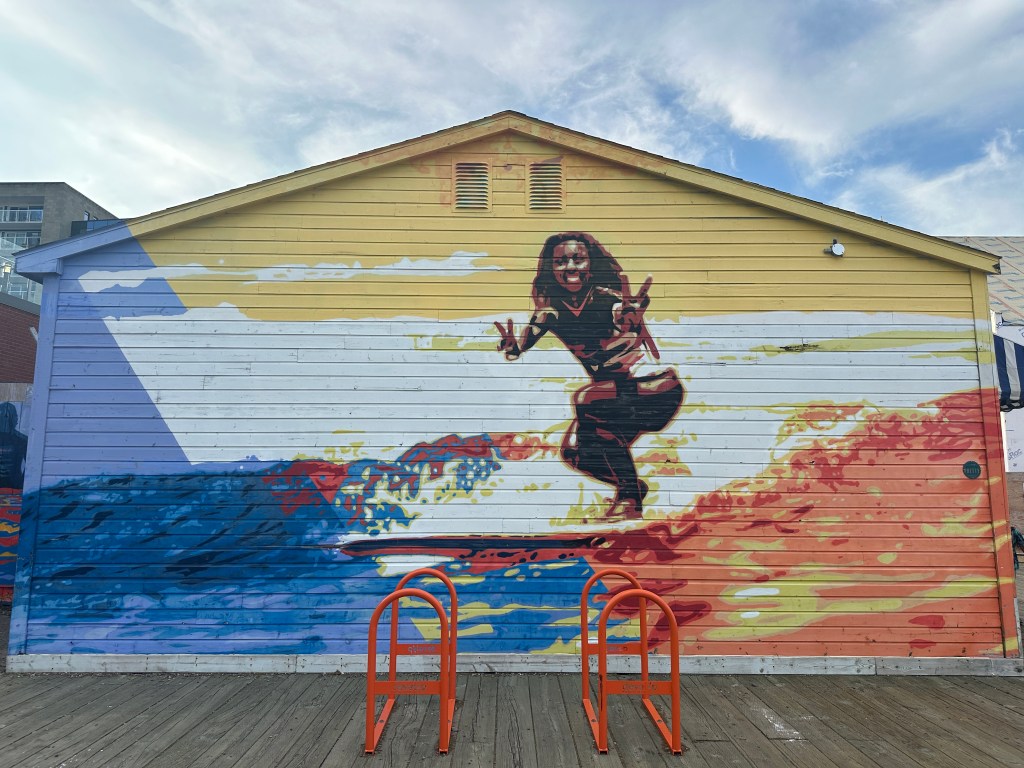
this one right in front of our hotel, party time!
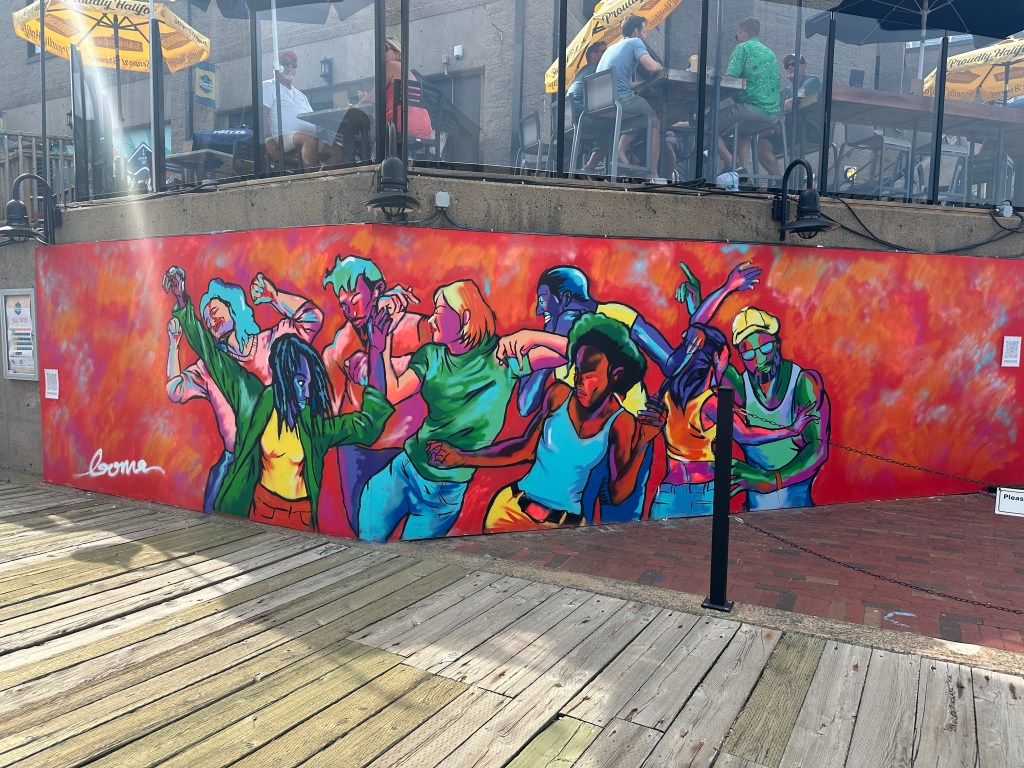
In the Harbor are plenty of ships all the time.

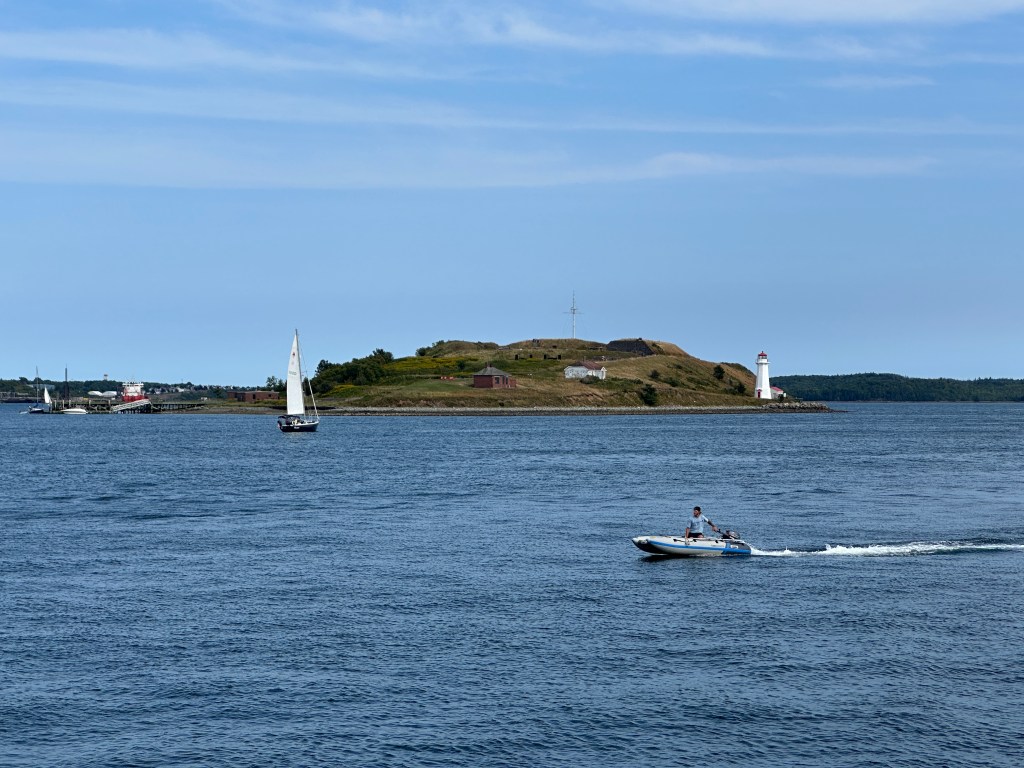
Also there is a view of Georges Island. The island is a glacial drumlin that has been a strategic military fortification since the mid-18th century. It was part of the “Halifax Defense Complex” and served as a prison and an Acadian internment camp. Georges Island is only accessible by sea, and visitors can take a ferry or use a private boat, canoe, or kayak. The lighthouse on the island was first established in 1876, with the current concrete lighthouse built in 1919 after the original was destroyed by fire.
We found a spot for dinner before calling it quits for the day. We had our usual Nova Scotia fare.
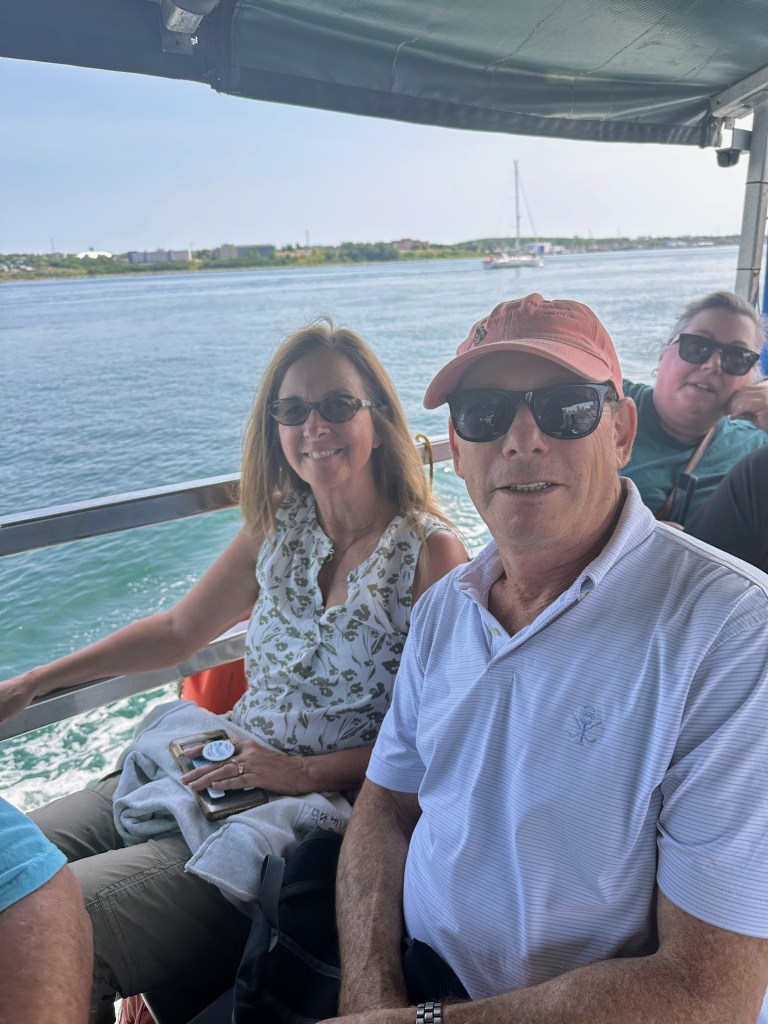
In the morning we had booked a Harbor Hopper tour. The bus part of it whipped around the city so fast that we got very little out of the experience; we had done better with our self-guided walking tour. We learned two important facts: Spring Street is so named because natural springs run beneath it. It was previously the busiest of all streets and lined with Victorian homes, only one of which survives today. The second interesting fact is that the Halifax Harbor is the second deepest city harbor in the world after Sydney Harbor, Australia. Many office buildings use the water in their air conditioning systems. But then the amphibious machine turned into a boat and took us out onto the water making the tour worth our while. We got great views of the harbor.
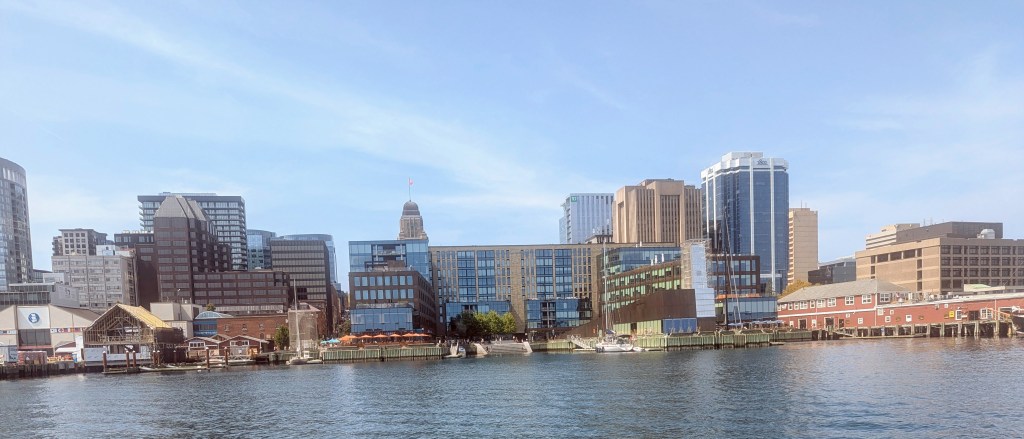
We could see out hotel
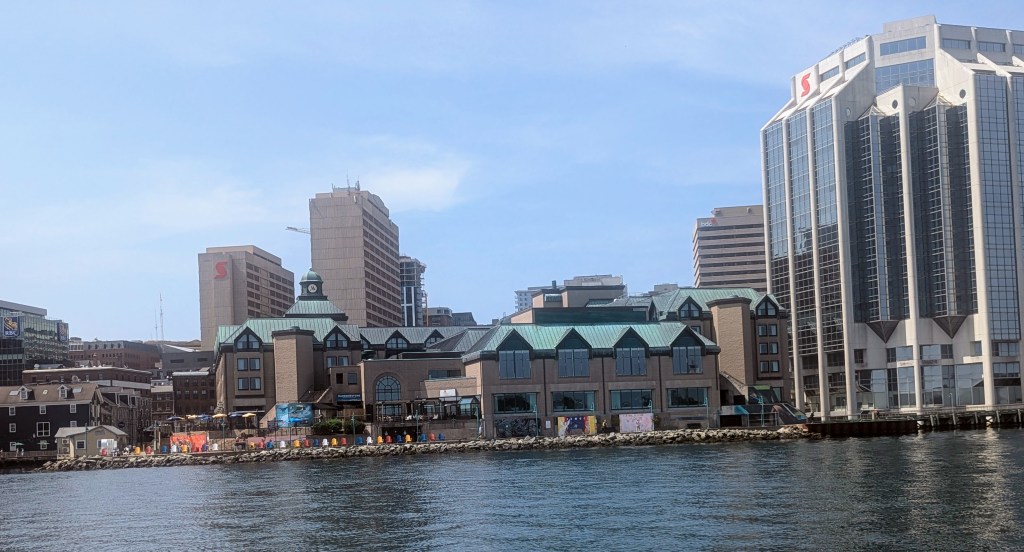
and the dockyard clock
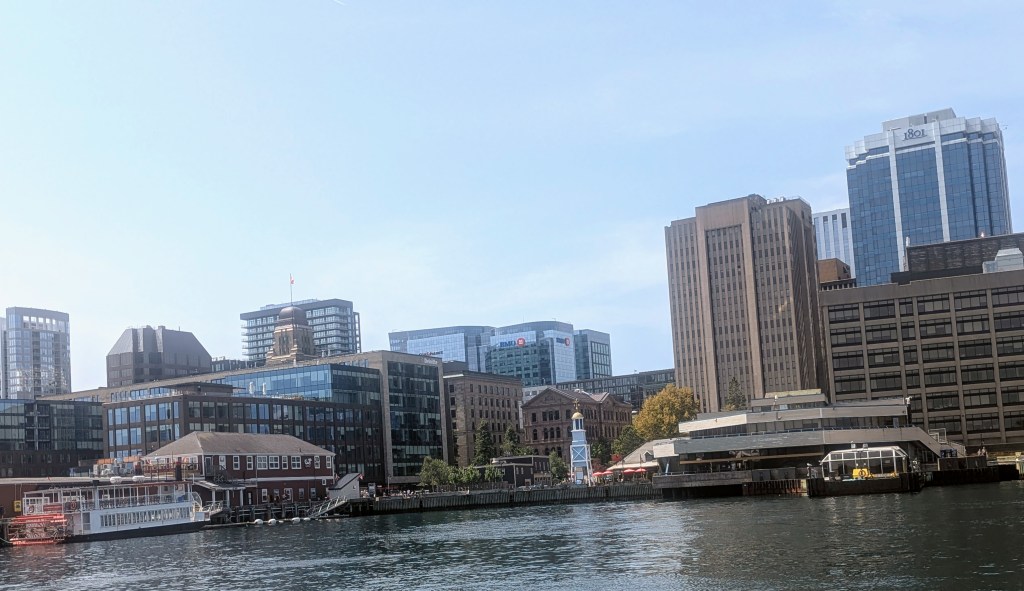
and the CSS Acadia docked in front of the Maritime Museum. The Acadia, now part of the museum and used for science research, was the only ship to survive the Halifax explosion of 1917.
While on the water, our guide explained about the Halifax explosion of 1917. On the morning of 6 December 1917 at 8:45 am, the French cargo ship SS Mont-Blanc collided with the Norwegian vessel SS Imo in the harbor. Mont-Blanc, laden with high explosives caught fire and detonated. At least 1,782 people, largely in Halifax and Dartmouth, were killed by the blast, debris, fires, or collapsed buildings, and an estimated 9,000 others were injured. The blast was the largest human-made explosion at the time. A tsunami created by the blast wiped out a community of Mi’kmaq who had lived in the Tufts Cove area for generations. Rescue trains were dispatched from across Atlantic Canada, as well as the northeastern United States. The response to the explosion from Boston and the appreciation in Halifax cemented ongoing warm relations. In 1918, Halifax sent a Christmas tree to Boston in thanks and remembrance for the help that the Boston Red Cross and the Massachusetts Public Safety Committee provided immediately after the disaster.[That gift was revived in 1971 by the Nova Scotia government to continue the goodwill gesture and to promote trade and tourism. The tree is Boston’s official Christmas tree and is lit on Boston Common throughout the holiday season.
We thoroughly enjoyed our excursion out onto the water.
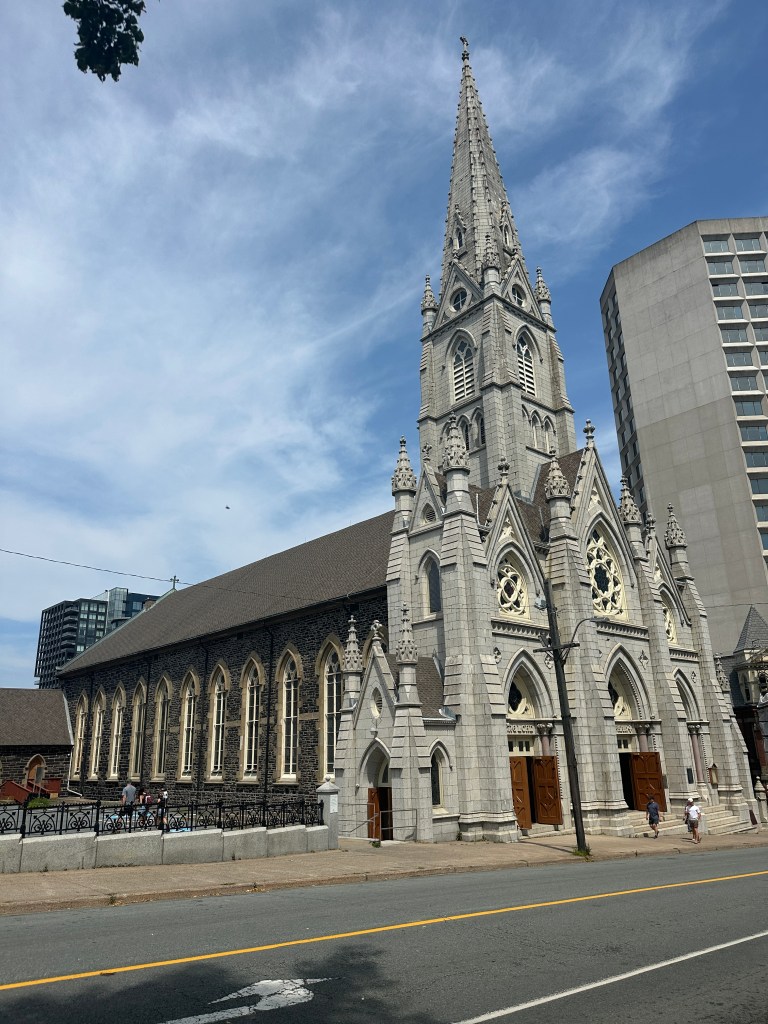
Once back on terra firma, we decided to continue our self-guided walking tour. First stop was Saint Mary’s Cathedral Basilica, a Gothic Revival style Catholic cathedral and the mother church of the Roman Catholic Archdiocese of Halifax-Yarmouth. It was built on the site of a wooden chapel from 1784, with the cornerstone of the current stone building laid in 1820. Though consecrated in 1899, it was made a basilica in 1950. The interior of the cathedral suffered great damage during the explosion of 1917. Most of the cathedral’s stained glass windows were shattered and some of the bells were cracked. Renovations have repaired the windows and restored the bells to their previous grandeur.
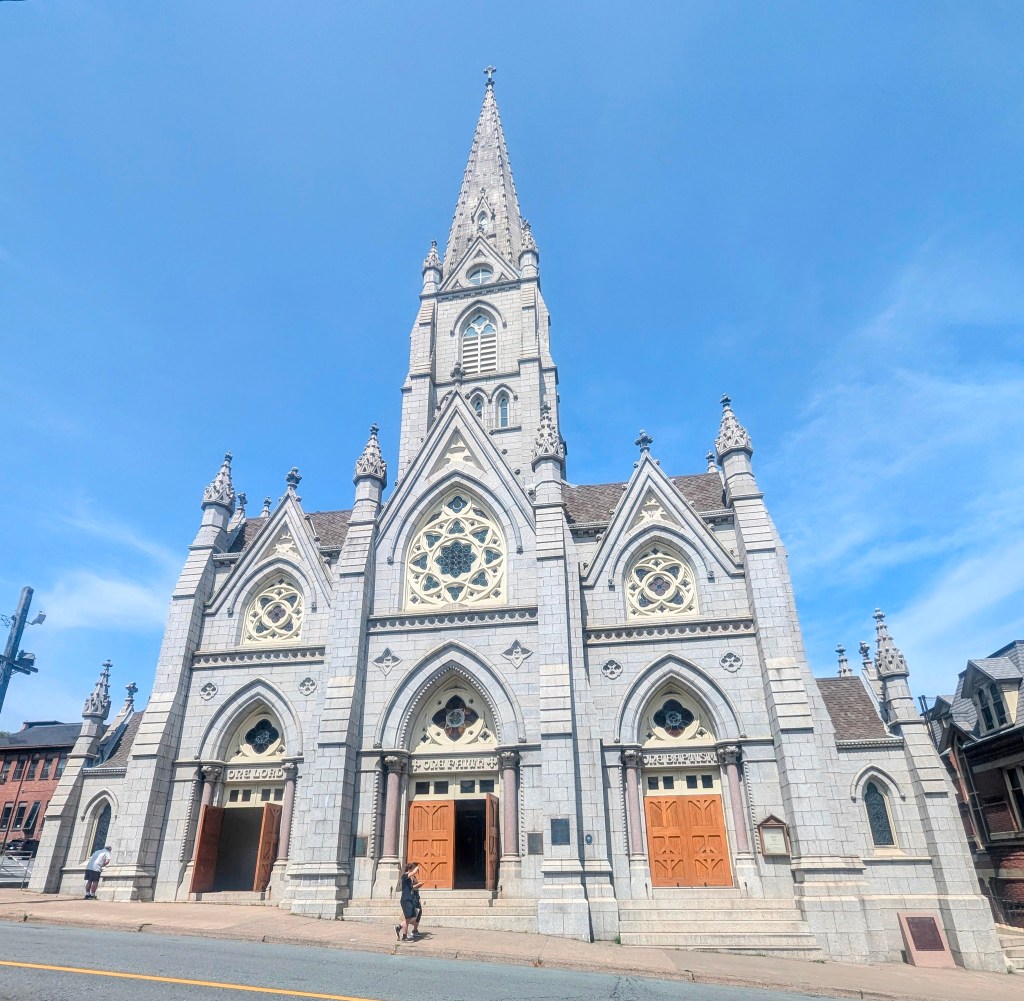
The cathedral’s spire is the tallest polished free-standing granite spire in North America.
The Government House of Nova Scotia, located on Barrington Street, serves as the official residence of the lieutenant governor of Nova Scotia. Construction of Government House was commissioned in 1800 by then-Governor Sir John Wentworth to replace the previous Government House, which stood on the site now occupied by Province House. Although the building was still incomplete, the governor and his family moved in by 1805.
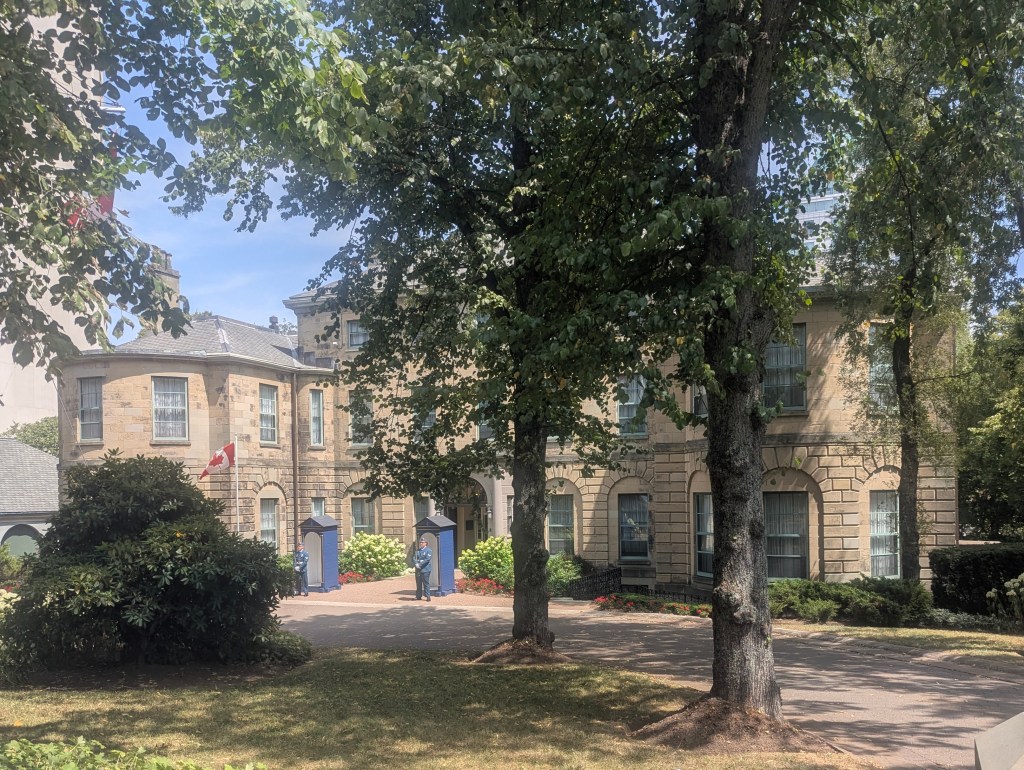
As we wandered inside, there just happened to be a tour in English about to start, so we joined. The wallpaper is all hand painted.
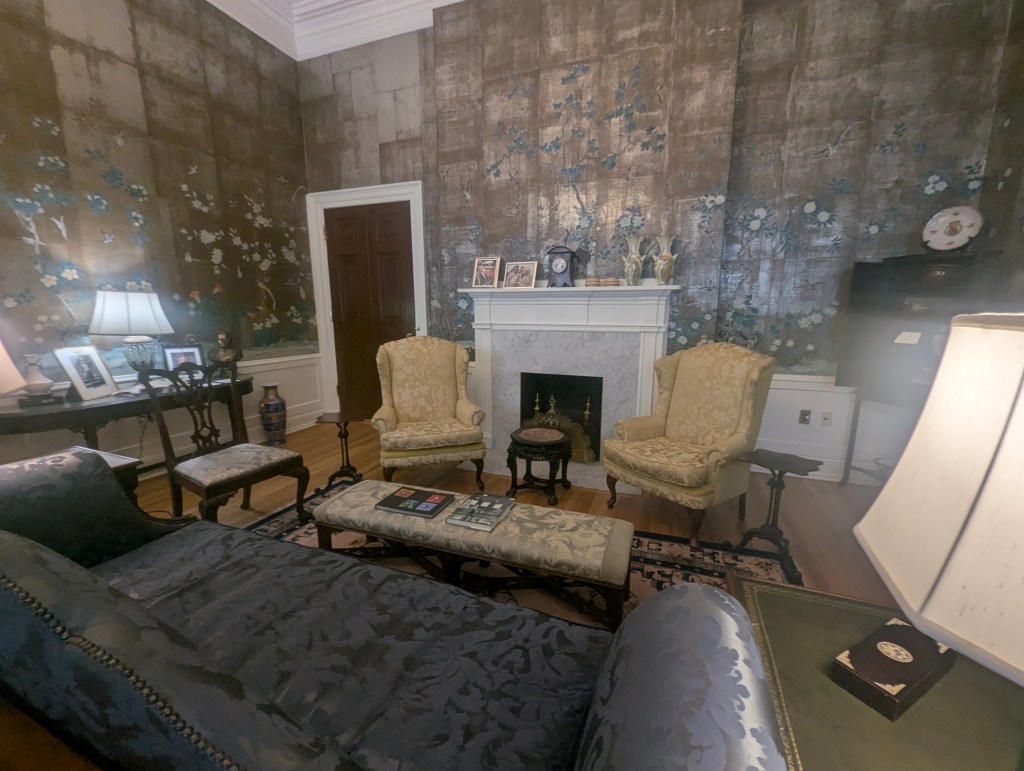
The dining room has the only original piece of furniture: a mahogany dining table.

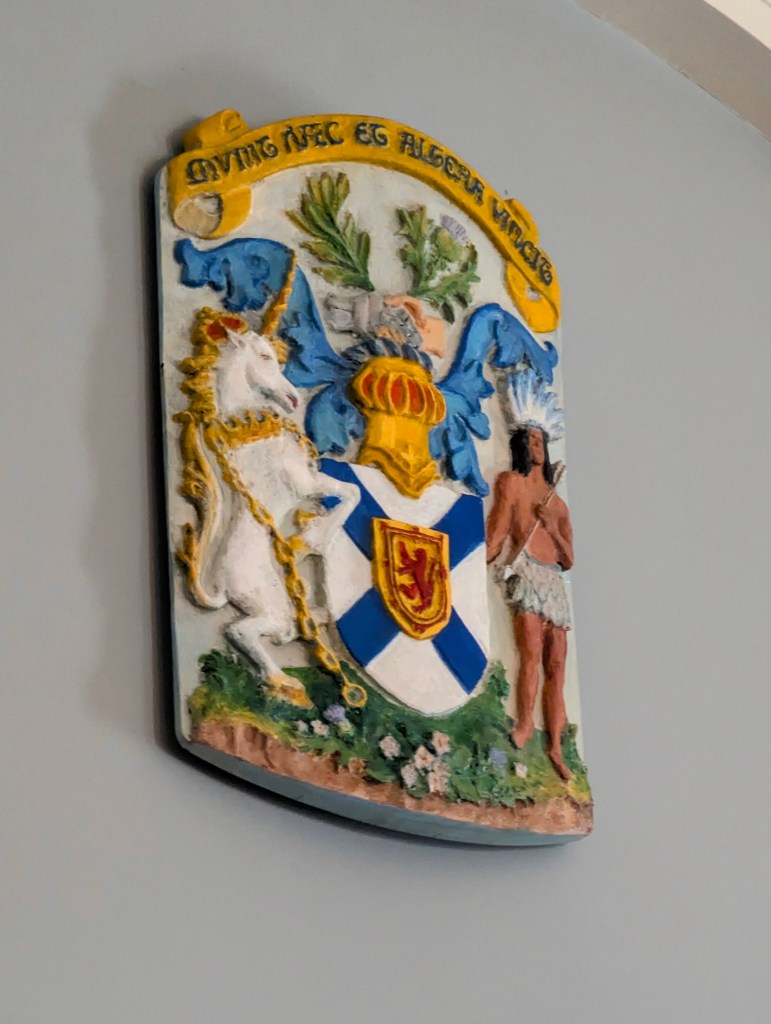
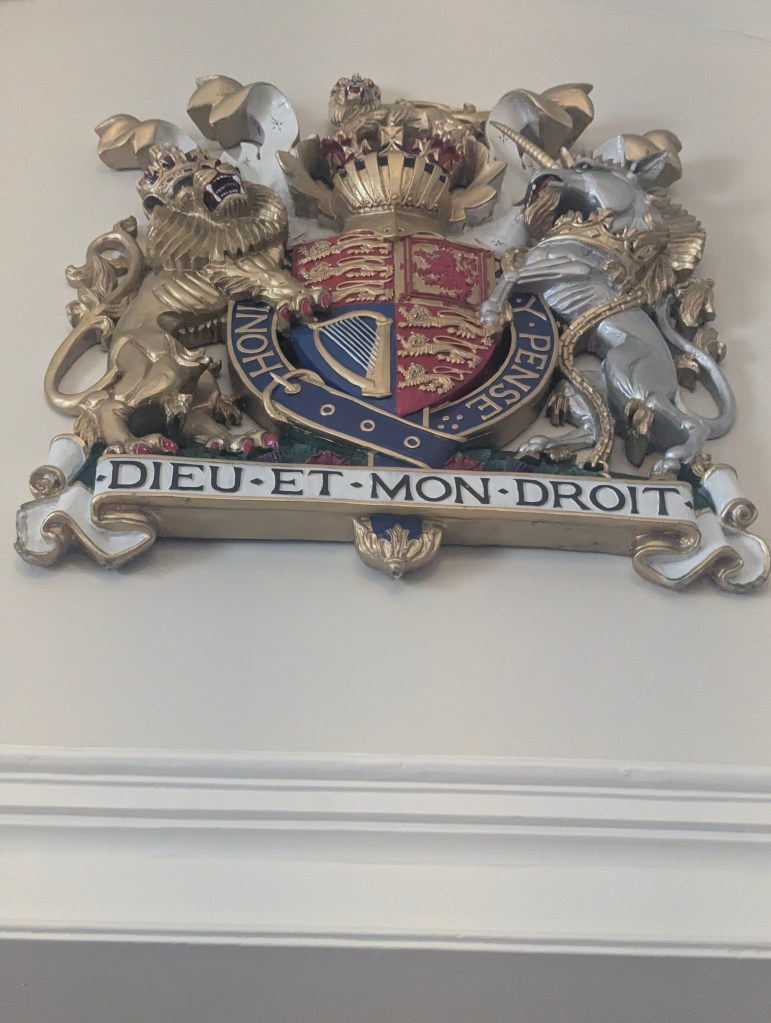
On opposite entrances to the dining room are the two coat of arms: Nova Scotia
and the royal family.
There are also several interesting objects of art
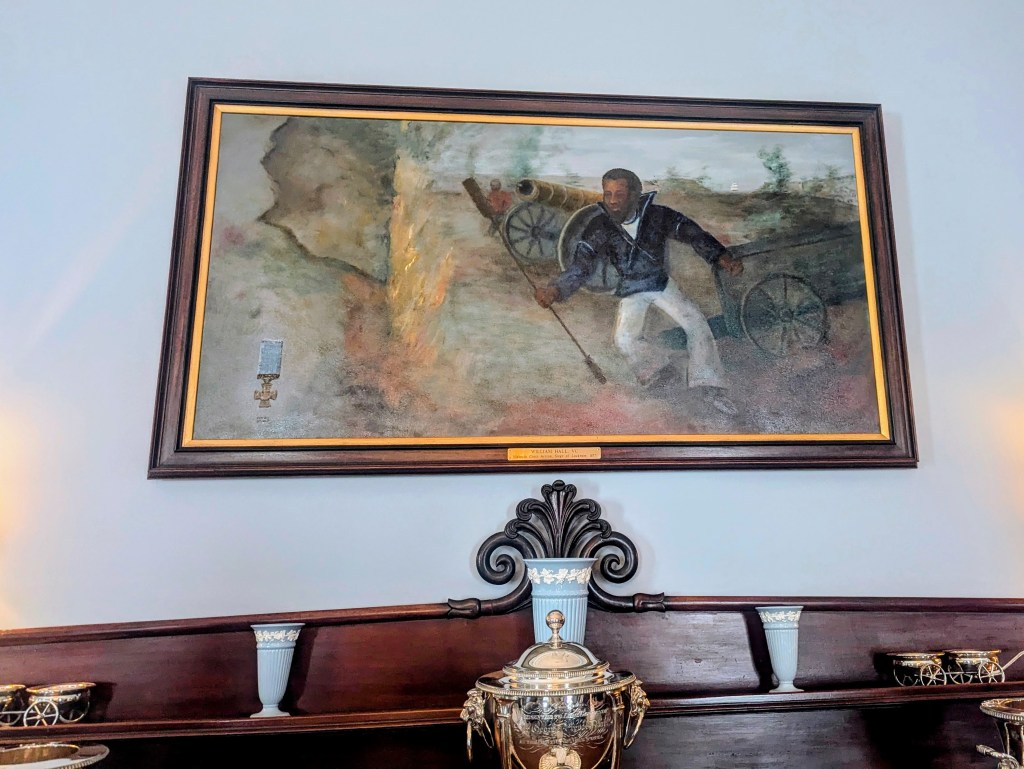
and silver service.
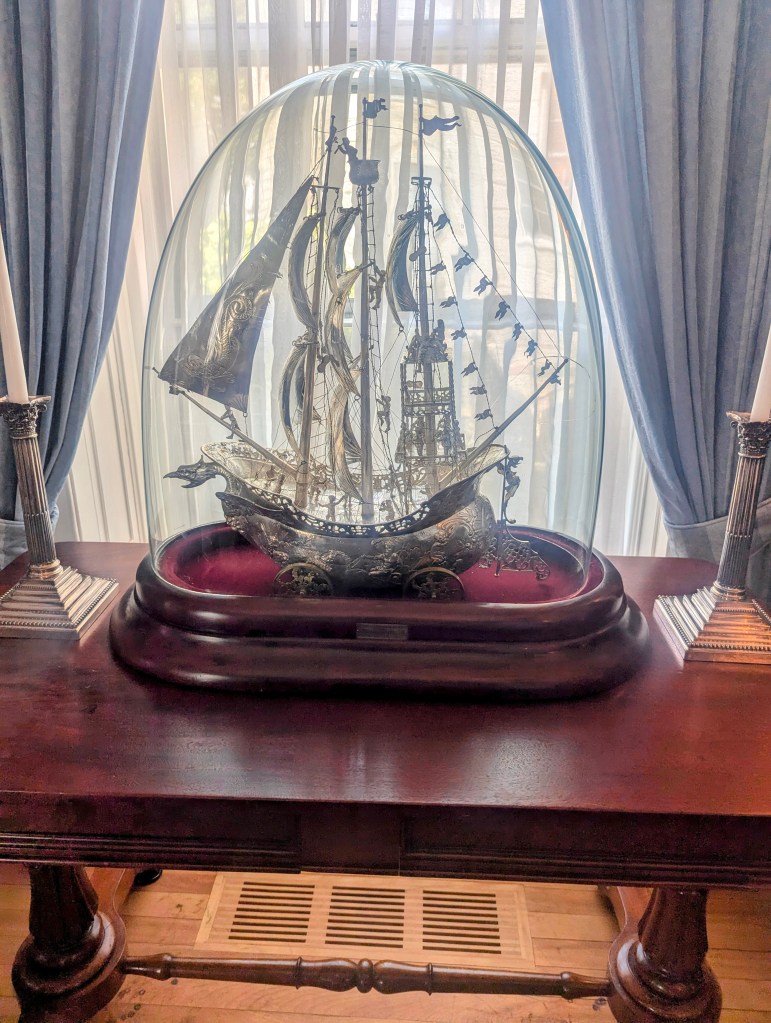
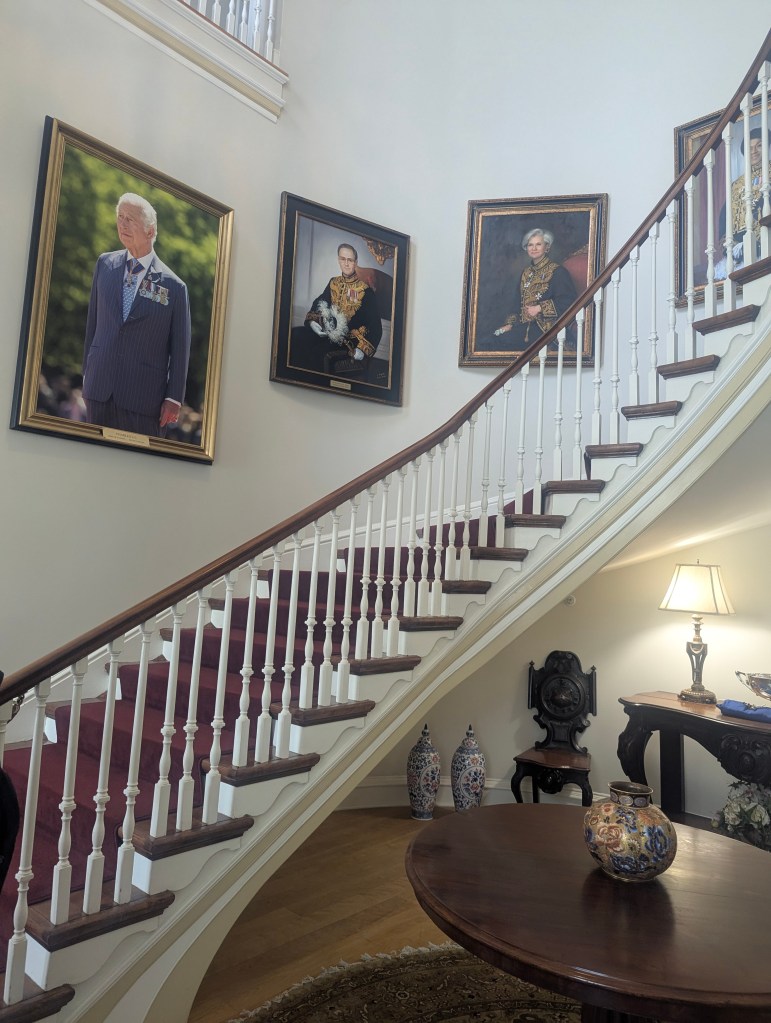
Over the years, Government House has hosted numerous royal guests. Prince Edward (later King Edward VII) was the first in 1860, followed by Prince Arthur (1869), Prince George (later King George V) in 1883 and 1901, and Prince Albert (1913). King George VI returned in 1939 with Queen Elizabeth, who later visited as the Queen Mother. Queen Elizabeth II made multiple visits. Other royals included Princess Margaret, Prince Andrew, Prince Edward, and Prince Charles with Princess Diana. Queen Elilizabeth last visited in 2021. The staircase to the private rooms is the longest unsupported staircase in Canada.
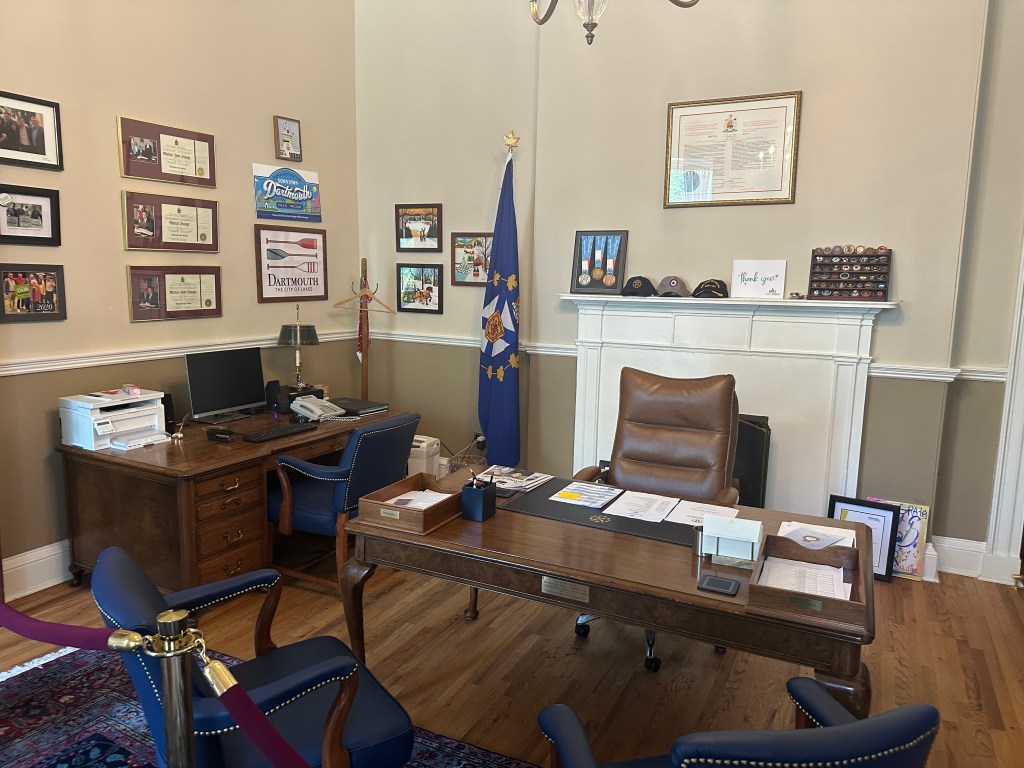
We were informed that the Lieutenant Governor very much still lives and works here, but is currently out of town, which is why we were invited into his office.
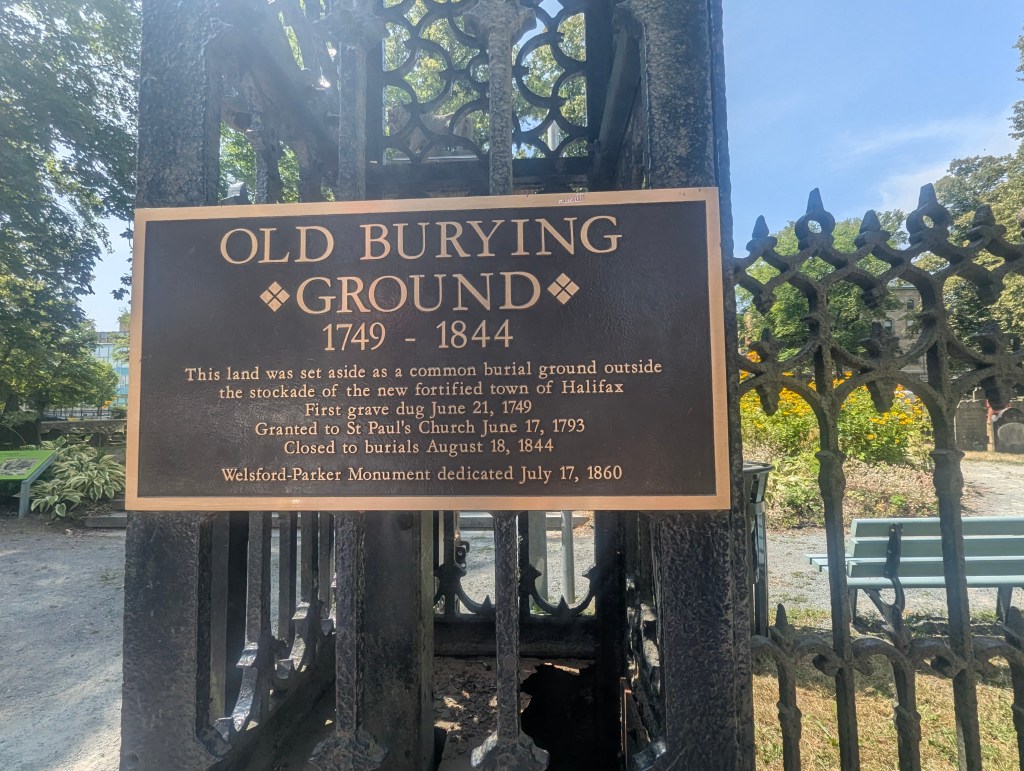
Across the street from the Government House is an old burial ground. The Old Burying Ground was established in 1749 and served as the city’s main cemetery until 1844.
The Welsford-Parker Monument is a triumphal arch that commemorates two Nova Scotian officers, Major Augustus Welsford and Captain William Parker, who died in the Crimean War.
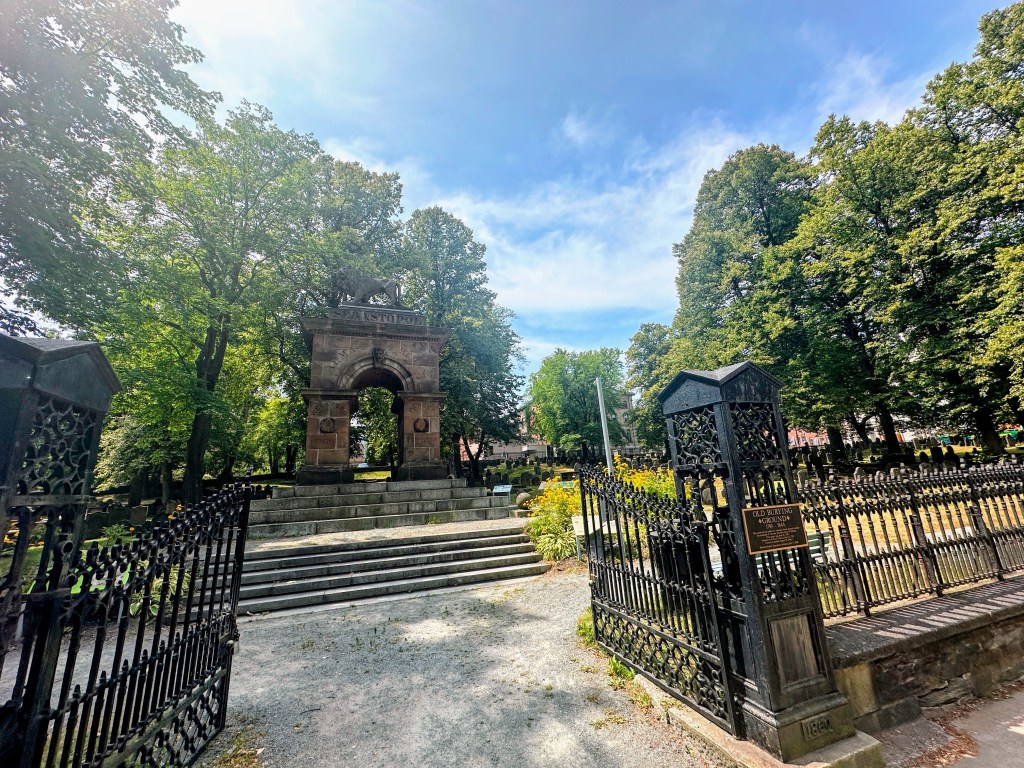
The monument was erected in 1860 and is the only Crimean War monument in North America.

St. Matthew’s United Church is one of the oldest Protestant church communities in the city. Established in 1749, the same year as the original colony, it initially served as a place of worship for various dissenting Protestants from New England who did not align with the Church of England. The congregation originally gathered at Saint Paul’s Church until it secured its building at Hollis and Prince Streets in 1754. However, this structure was lost to a fire in 1857, leading to the construction of the current church on Barrington Street. The church also made use of the Old Burying Ground in Halifax. The congregation became part of the United Church of Canada in 1925, and has been known as St. Matthew’s United Church since then.

We passed the Halifax Court House, a historic building the main section of which was completed in 1863. It has housed both county and provincial courts since its completion. The architecture is noted for its imposing facade with a classical pediment and Tuscan columns.
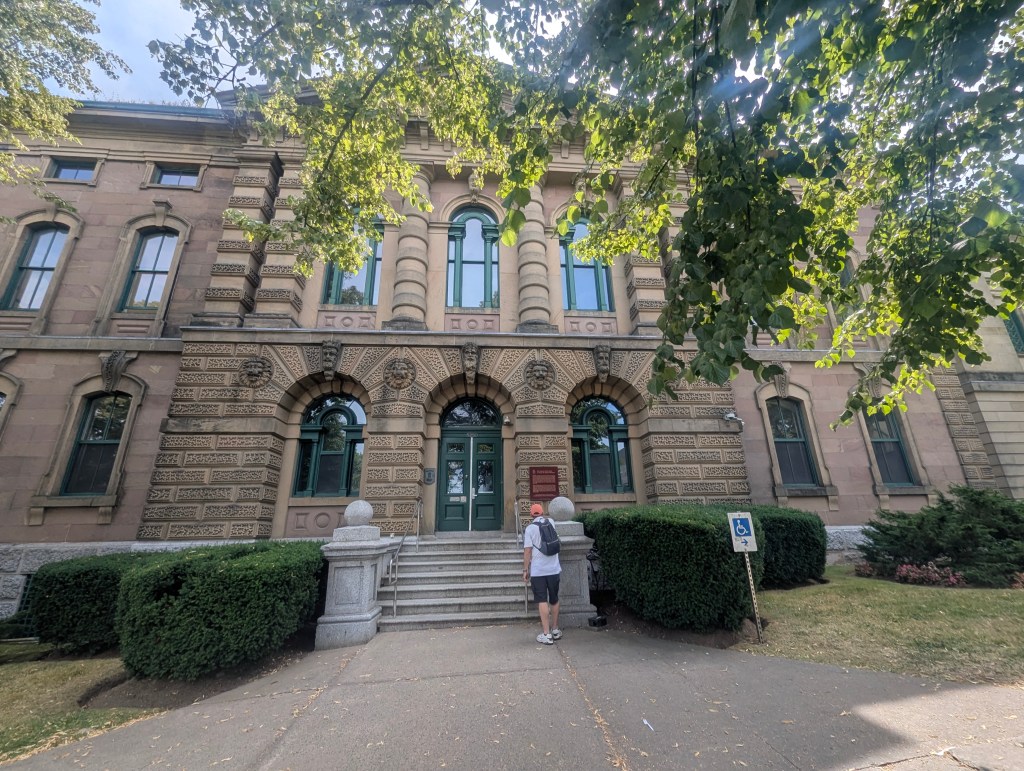
We also passed the former Halifax Memorial Library. The library was opened in 1951 as a memorial to soldiers who died in the World Wars. It was the main branch of the Halifax Public Libraries until 2014, when it was replaced by the Halifax Central Library. The Halifax Regional Municipality is currently exploring options for the site’s future, which may include demolishing the building and turning the area into a park with “historical interpretation”.
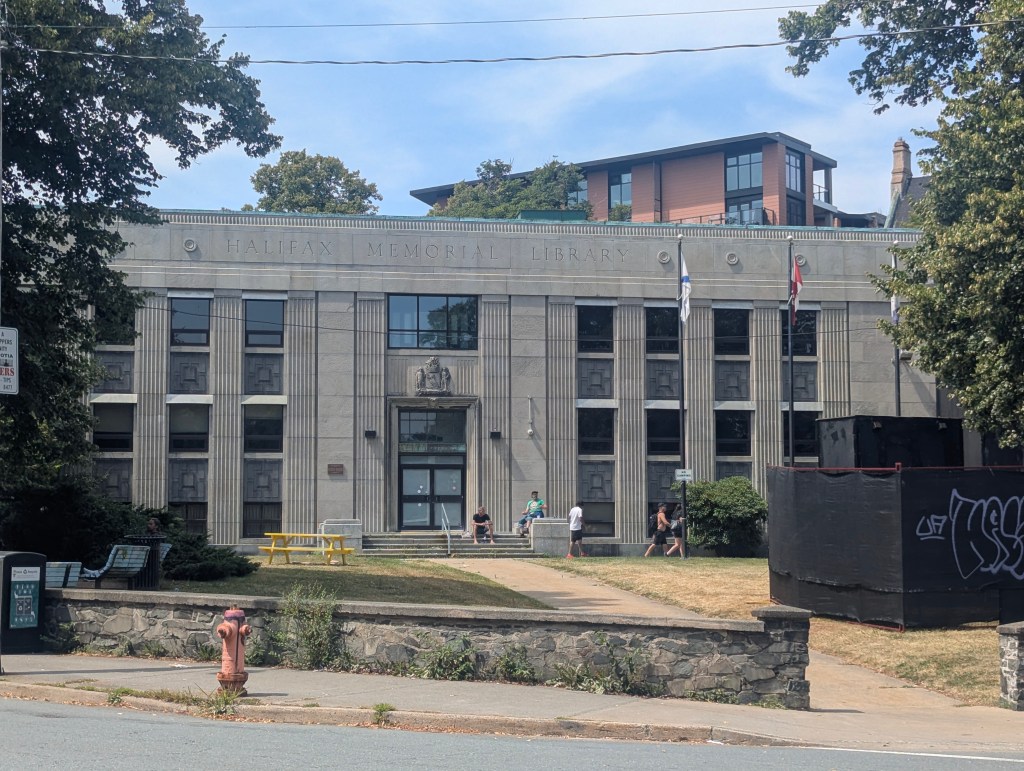
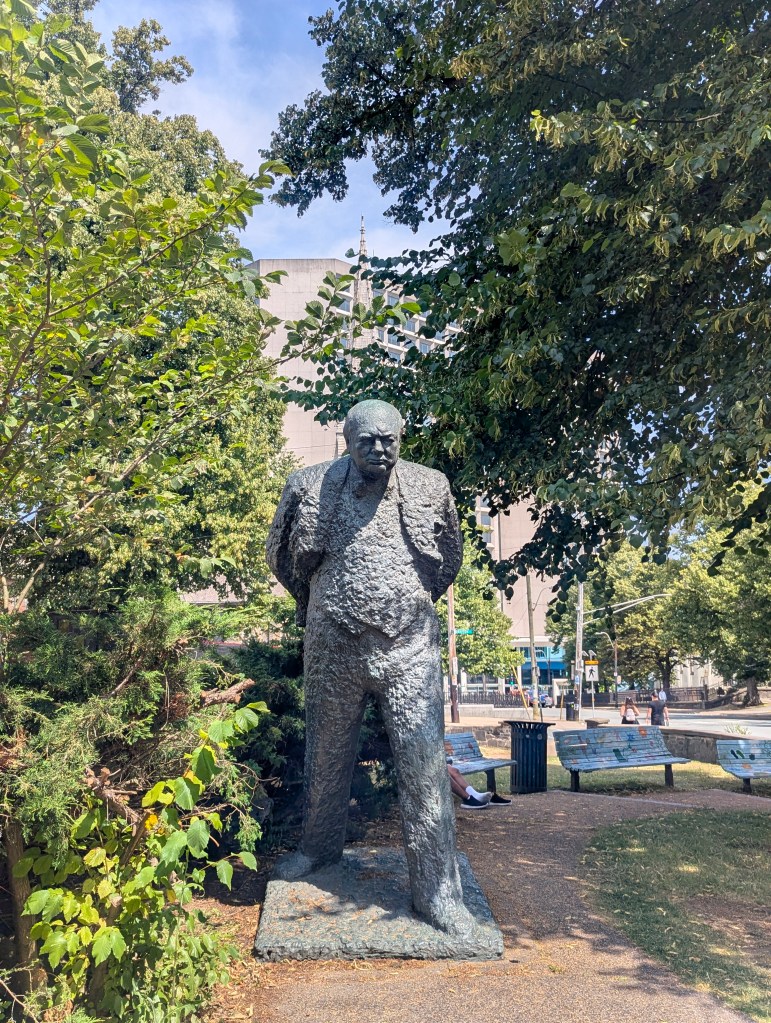
On the grounds is a 10 foot bronze statue of Winston Churchill. It was sculpted by Oscar Nemon and unveiled on January 20, 1980. The statue was created to honor Sir Winston Churchill, who visited Halifax in 1943 and 1944.
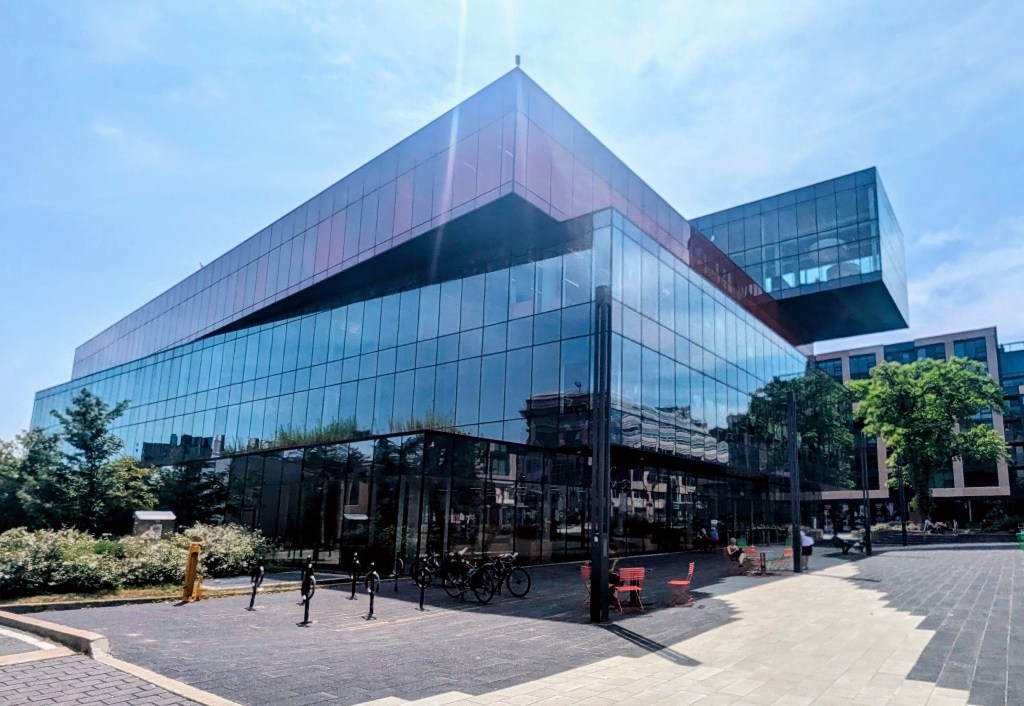
Halifax Central Library is the flagship library of the Halifax Public Library System. This library was completed in 2014 in a Modern architectural style designed. The library is notable for its ultra-modern design. It has the appearance of multiple levels stacked atop each other at varying angles. This includes the fifth floor, which juts over the plaza providing shade to the benches and tables below.
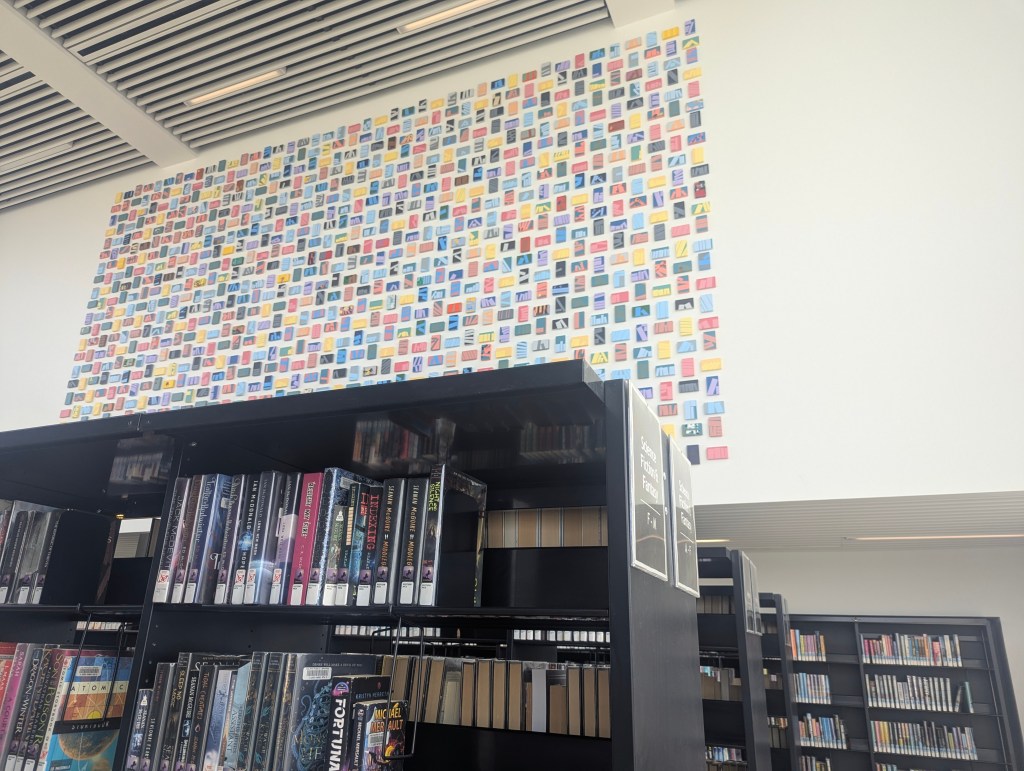
The library is also home to public artwork created by Cliff Eyland. Eyland painted 5,000 miniature paintings on canvas the size of library cards, fittingly called “Library Cards.”
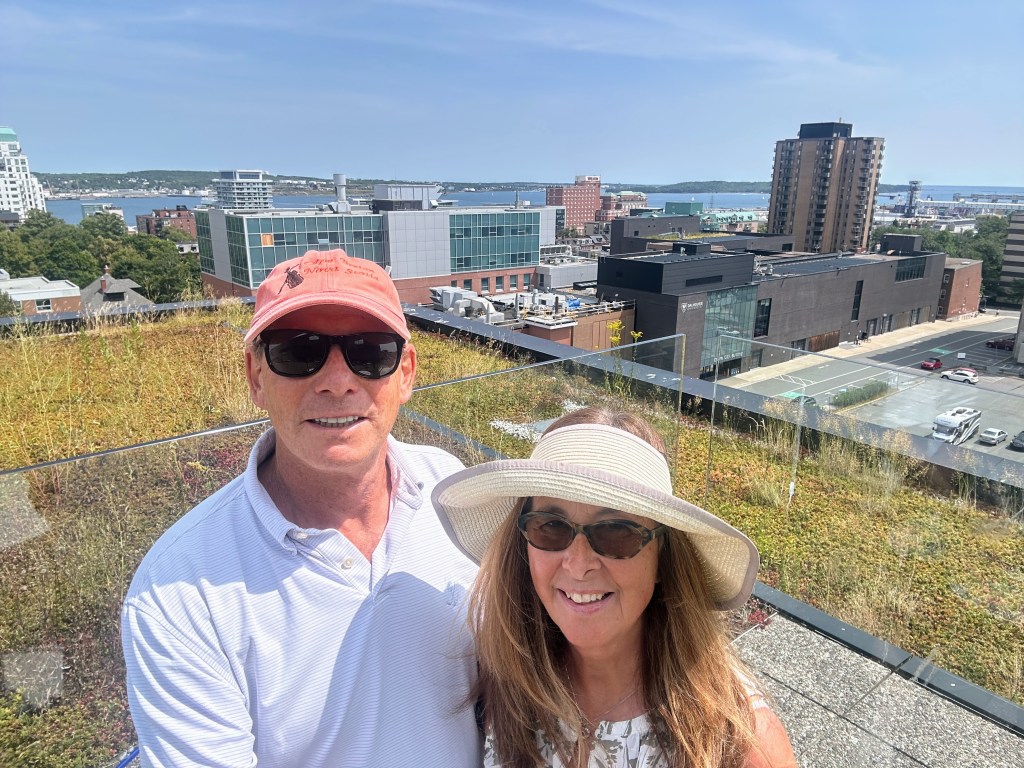
Along with books, the library offers community rooms, an auditorium and two cafes. The rooftop terrace is a popular spot for visitors to get a beautiful view of Halifax from a unique location. We went up for a look.
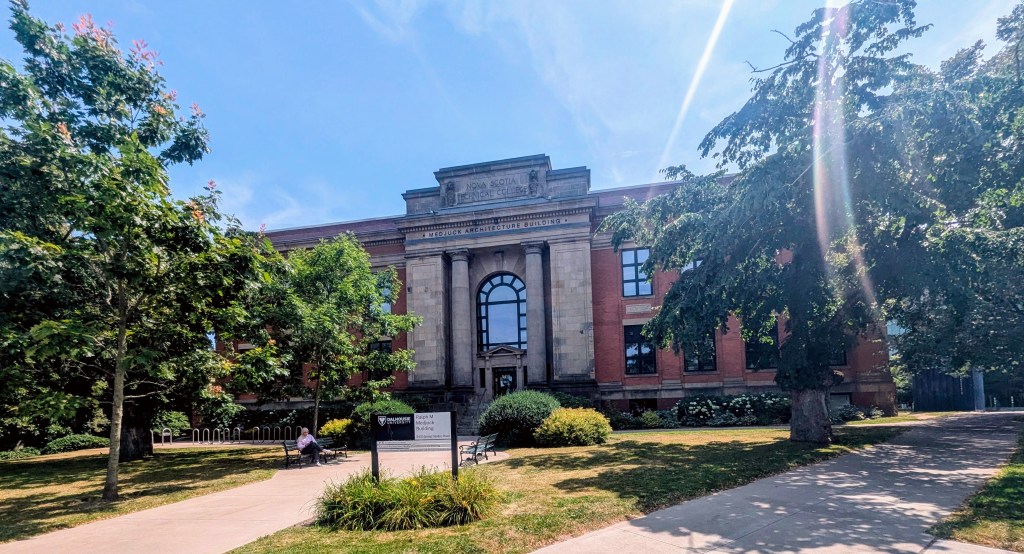
The Ralph M. Medjuck Building, also known as the “H Building,” located on the Sexton Campus of Dalhousie University, was originally constructed in 1909 as the main building for the Nova Scotia Technical College. It is currently home to the university’s School of Architecture and Planning.
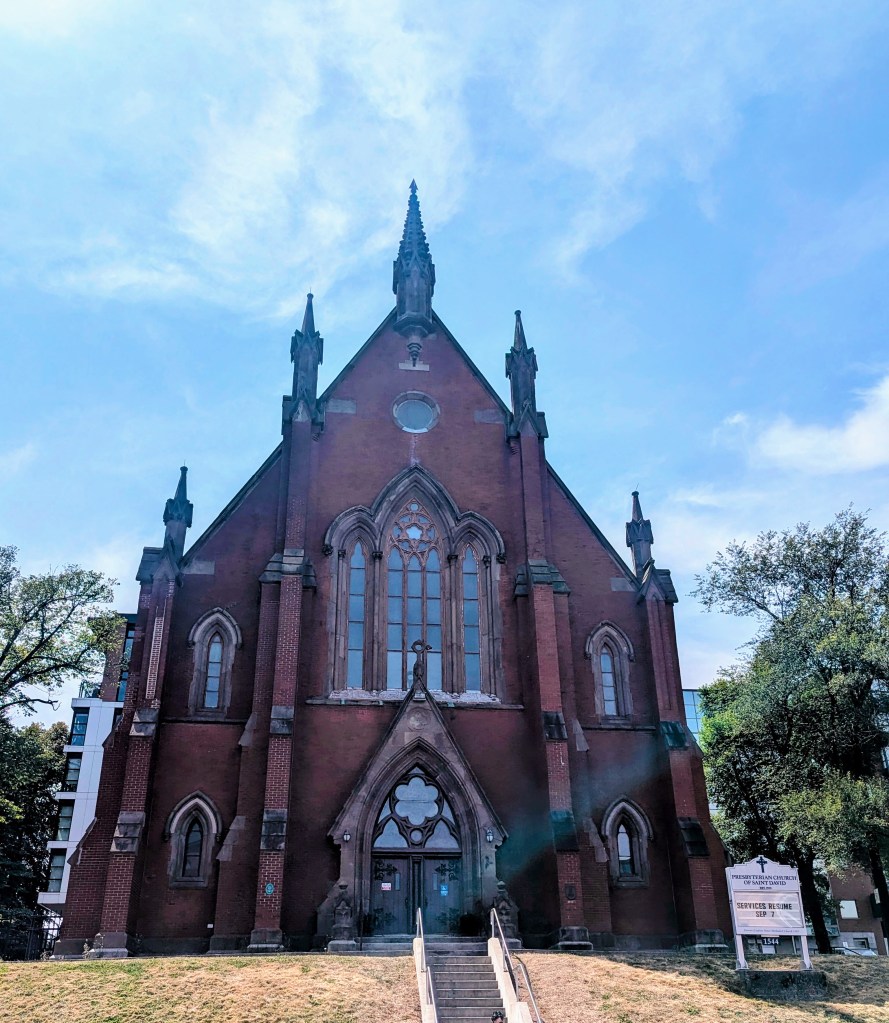
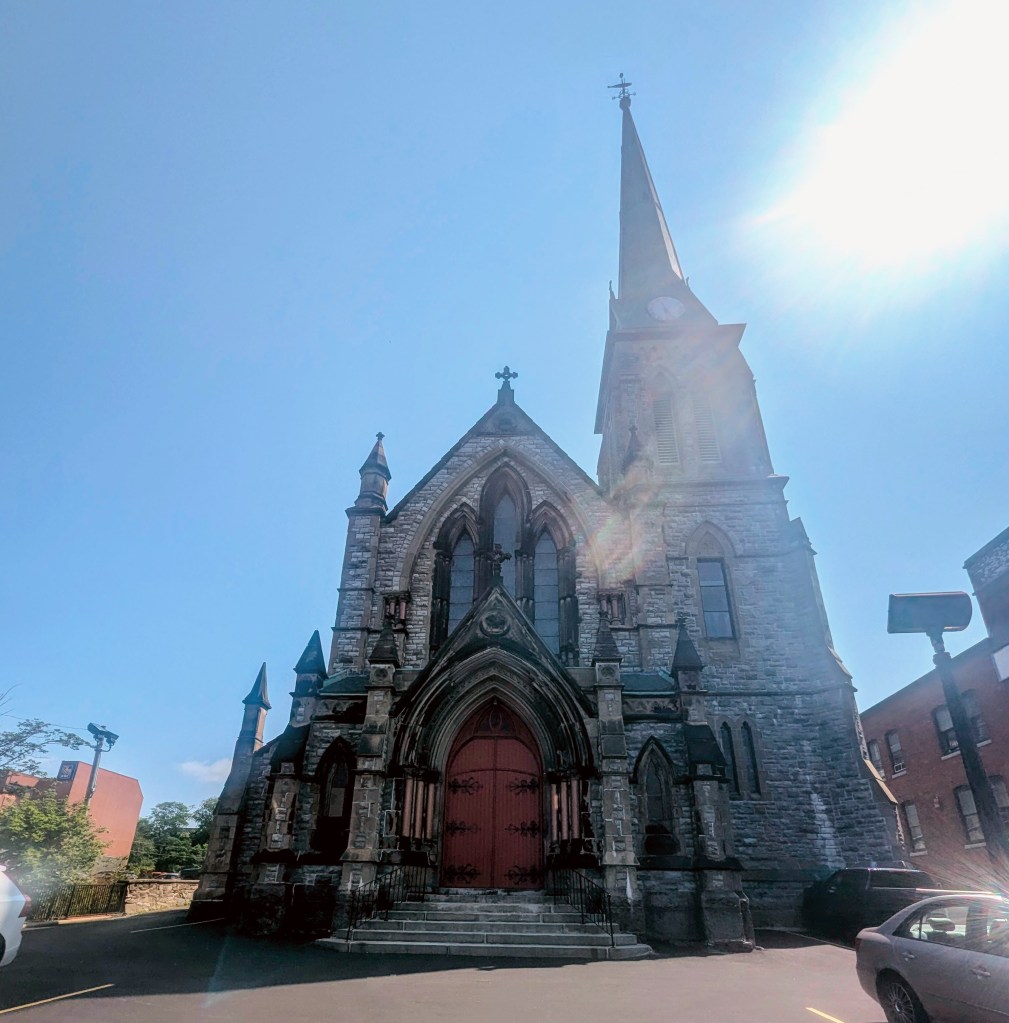
The Church of Saint David was established in 1925, when the Presbyterians leased and then purchased the former Grafton Street Methodist Church as their congregational home. Much valued for its historical and spiritual association with Methodism and the creation of the United Church of Canada, the place is also valued for its association with the talented and renowned architect, David Stirling. Designed in the Victorian Gothic style, Sterling’s creation is a rare, if not unique, example of such architecture, constructed in brick from the province. The building is highlighted by its great front gable with tall Gothic buttresses and five detailed finials that project above the roof line. Most notably, the church was built without a steeple. Initially named simply the Presbyterian Church, the temple was renamed in 1930 in honor of the saintly King David I of Scotland, who reigned from 1124 to 1153.
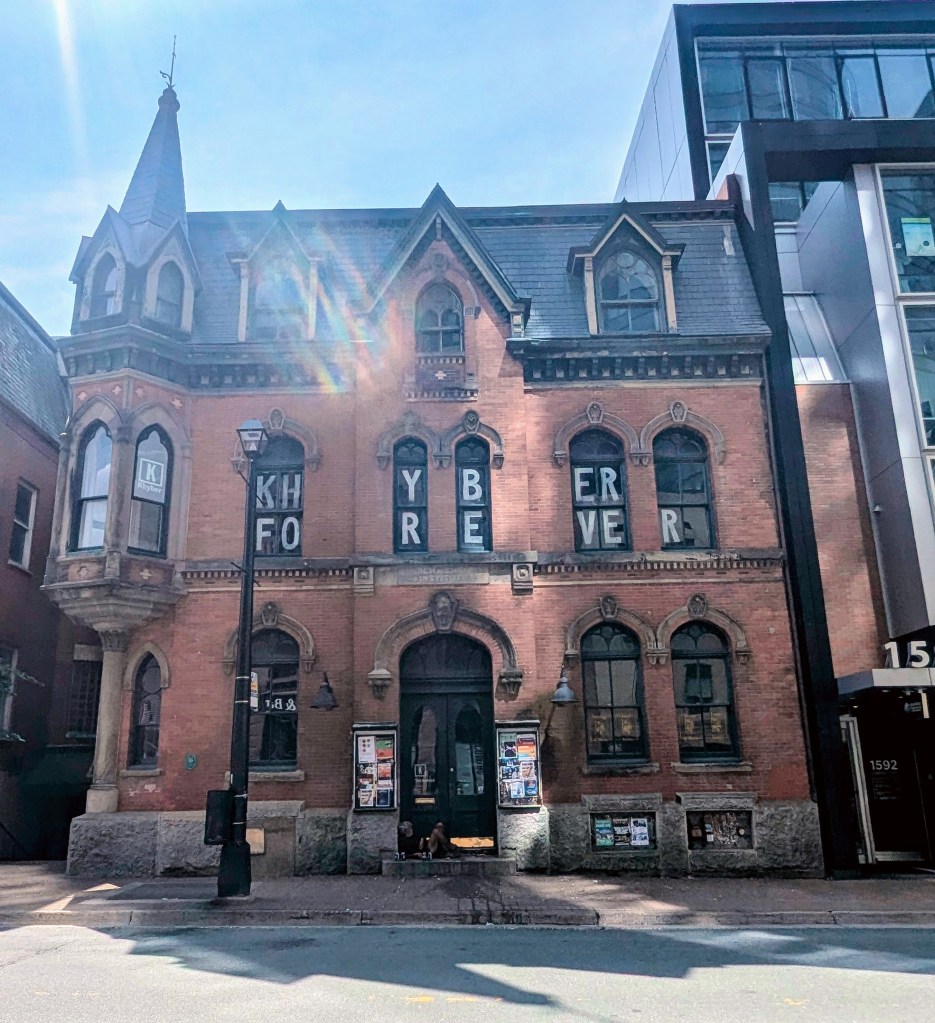
Located on Barrington Street, the Khyber Building has been a cornerstone of Halifax’s cultural scene for over a century. Originally erected in 1888 as The Church of England Institute, this Victorian Gothic Revival structure has evolved through various identities, from a religious institution to a vibrant artist-run center, music venue, and social space. It’s cultural reinvention began in 1994, when Halifax’s City Council repurposed the building as an arts hub, leading to the establishment of the Khyber Arts Society in 1997. By 1998, the Khyber Club emerged as a contemporary art gallery and performance space, fostering Halifax’s underground music and visual arts communities. Over the years, it became synonymous with artistic experimentation and creative energy, hosting countless exhibitions, concerts, and community events.
However, in 2014, the Halifax Regional Municipality closed the building due to hazardous materials, putting its future in limbo. A passionate movement emerged to reclaim and restore the space, and in March 2023, the Barrington Street Building Preservation Society secured $200,000 in federal funding and an additional $250,000 from the municipality to assist in remediation efforts. This funding marks a significant step toward reopening the Khyber as a thriving cultural venue under the stewardship of the Khyber Centre for the Arts.
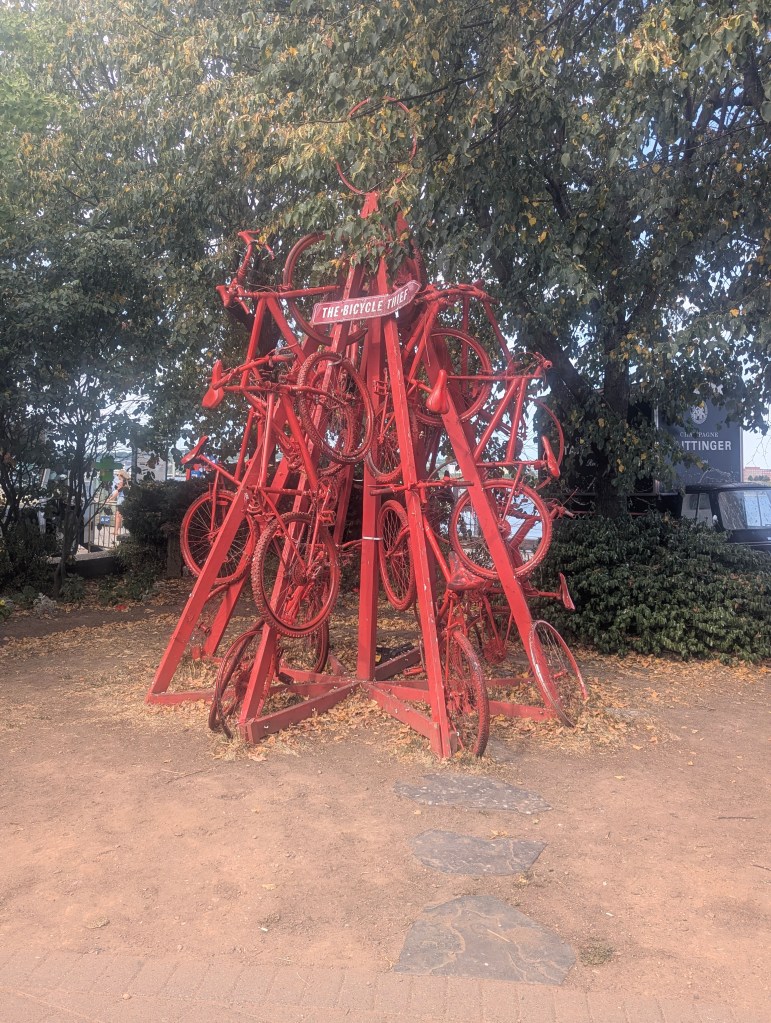
We had our final dinner in Canada on the waterfront at The Bicycle Thief. Of course we started with a dozen oysters and dined from there.




























 Jo & Eric's travels