
Our trip to Costa Rica started with a delay of over an hour due to a flat tire on the plane requiring us to deplane after having already settled into our seats. We arrived in San Jose as the sun was setting and still had a drive through the Friday night traffic; it would take over three hours to reach La Fortuna, San Carlos in the Alajuela Province: our destination for the night. On our way out of town our driver pointed out 3 active volcanoes in the region and a coffee plantation. Costa Rica is a rugged, rain-forested Central American country with coastlines on the Caribbean and Pacific. Though its capital, San Jose, is home to cultural institutions like the Pre-Columbian Gold Museum, Costa Rica is known for its beaches, volcanoes, and biodiversity. Our first destination was the Arenal Conservation Area. It started raining while we were on the road. We were very happy to have a driver who knew the roads well as the visibility was limited at times. We reached the Arenal Moana Resort late and in the pouring rain. We had a quick dinner and went to bed anticipating our morning tour.
The rain continued in the morning. We were picked up and driven to Lake Arenal to begin our hike. Manmade, with a dam built between 1970 and 1973, Lake Arenal, which rests at the base of the volcano, supplies a high percentage of the country’s hydroelectric energy. At over 21 miles in length, Lake Arenal is the second largest lake in Central America. Prior to construction of the dam, there had been homes nearby. But an unexpected volcanic eruption in 1968 which lasted for several days killed many people and livestock, buried three villages, and ruined crops, properties, homes, and livelihoods. Since that time building in the area has been prohibited.

We met our local guide Martin, boarded our boat and headed across the lake.
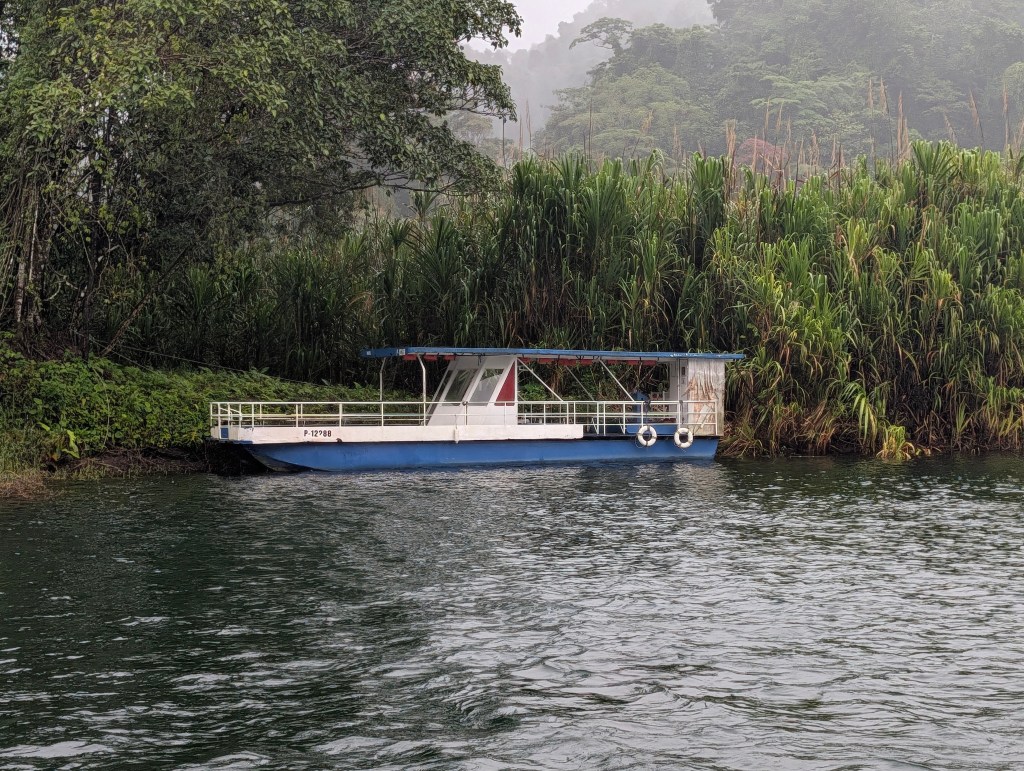
As we drove across the lake, Martin explained to us that the mountain range here is part of the Continental Divide; we are on the Caribbean side of the divide. The second volcano in the area, The Chato Volcano, is inactive; it has not erupted in over 5000 years.
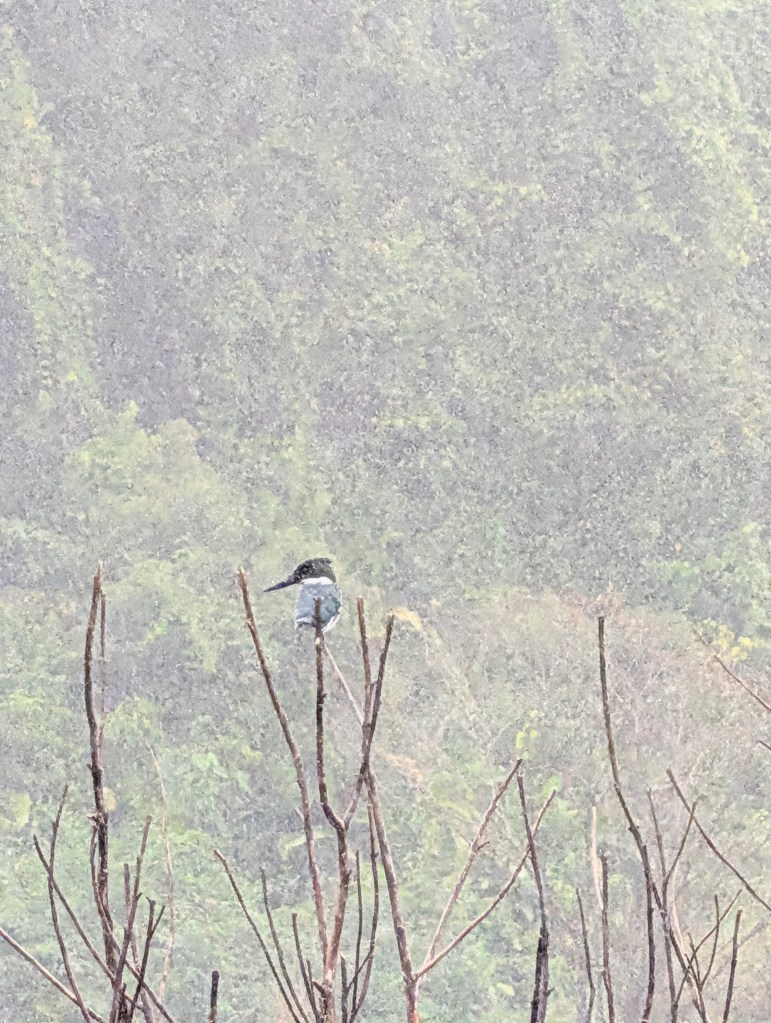
Despite the rain we passed a few birds; first a female Belted Kingfisher, a large, stocky, blue-gray bird with a shaggy crest on its head and a thick, pointed bill. The male would have orange on the chest. The species is native to North America and commonly found near clear water bodies like rivers, lakes, and shorelines. They feed primarily on fish, which they catch by diving headfirst into the water. Their presence is often announced by a distinctive, loud rattling call.
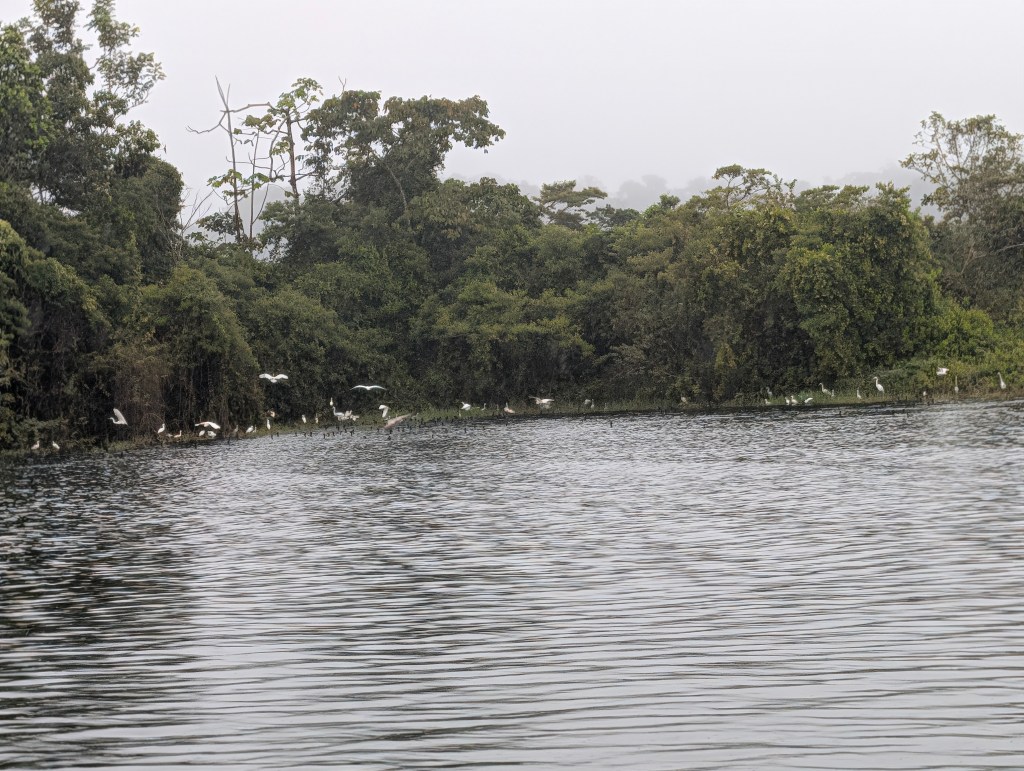
We also passed a large flock of Snow Egrets, Great Egrets, and Cormorants which often are found cohabitating.
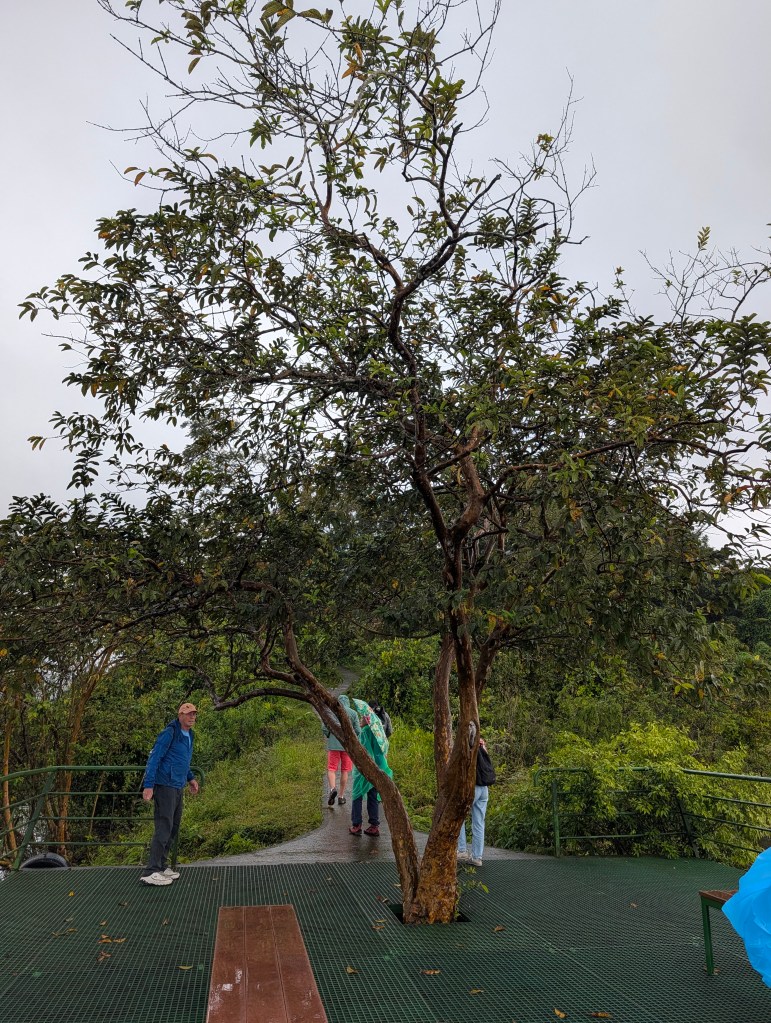
We climbed out of the boat onto La Peninsula Trail of the Arenal Volcano National Park. The Arenal Volcano National Park is located within the much larger Arenal Conservation Area, which protects more than 500,000 acres of rain forest, rivers, lakes and old volcanic lava fields. This area contains a great wealth of geologic and biological complexity. The volcano itself is approximately 5,500 feet high and has gone through several eruptive cycles. Within the national park, short trails pass through secondary forest as well as lava fields from previous eruptions. On land we were greeted by a large guava tree.
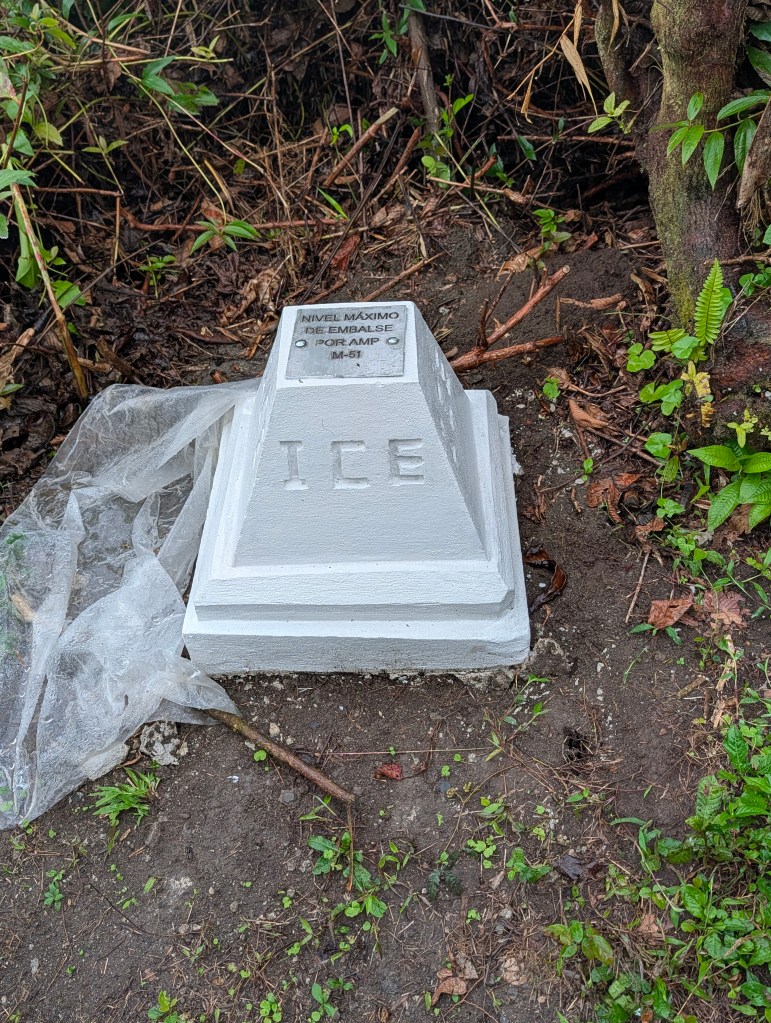
Martin pointed out t a concrete marker which indicates the maximum reservoir level. ICE refers to the Instituto Costarricense de Electricidad, the state-owned entity responsible for electricity and telecommunications, a crucial public utility providing nearly 100% renewable energy and telecom services under the Grupo ICE umbrella. It is a major national institution founded in 1949, vital for the country’s clean energy model and infrastructure.
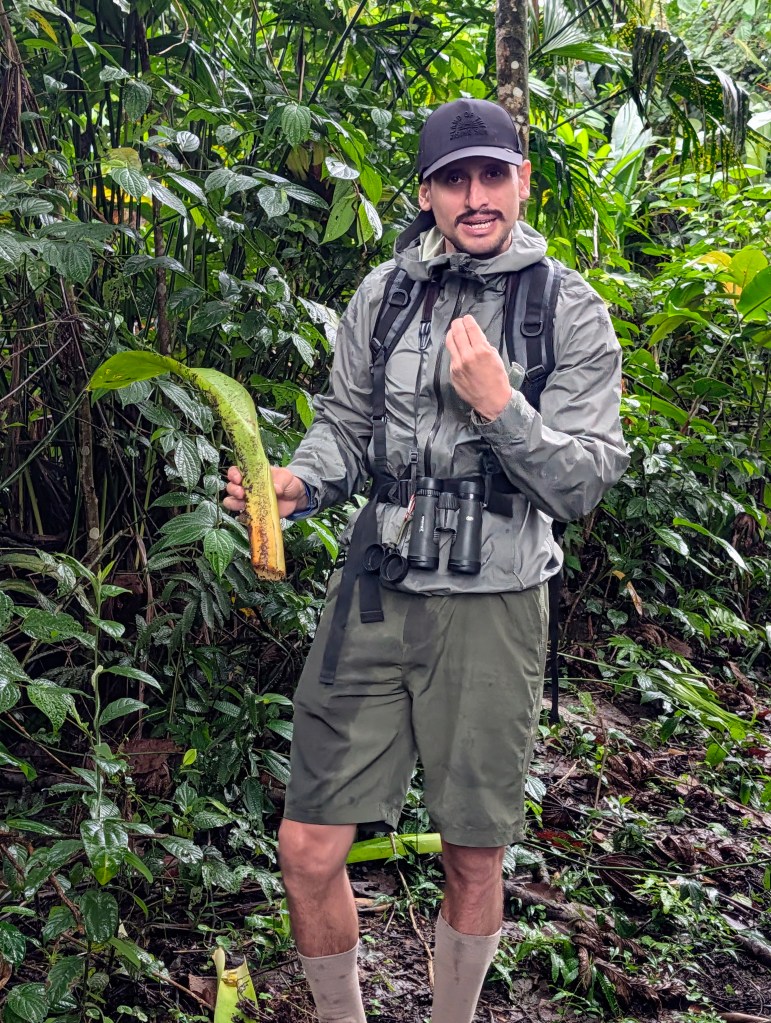
Martin pointed out a bromeliads leaf, a family of plants with many species of which the pineapple is one. The leaves of this one have a large hollow base which catches water which animals can drink in dry times. Monkeys eat the white part of the leaf.
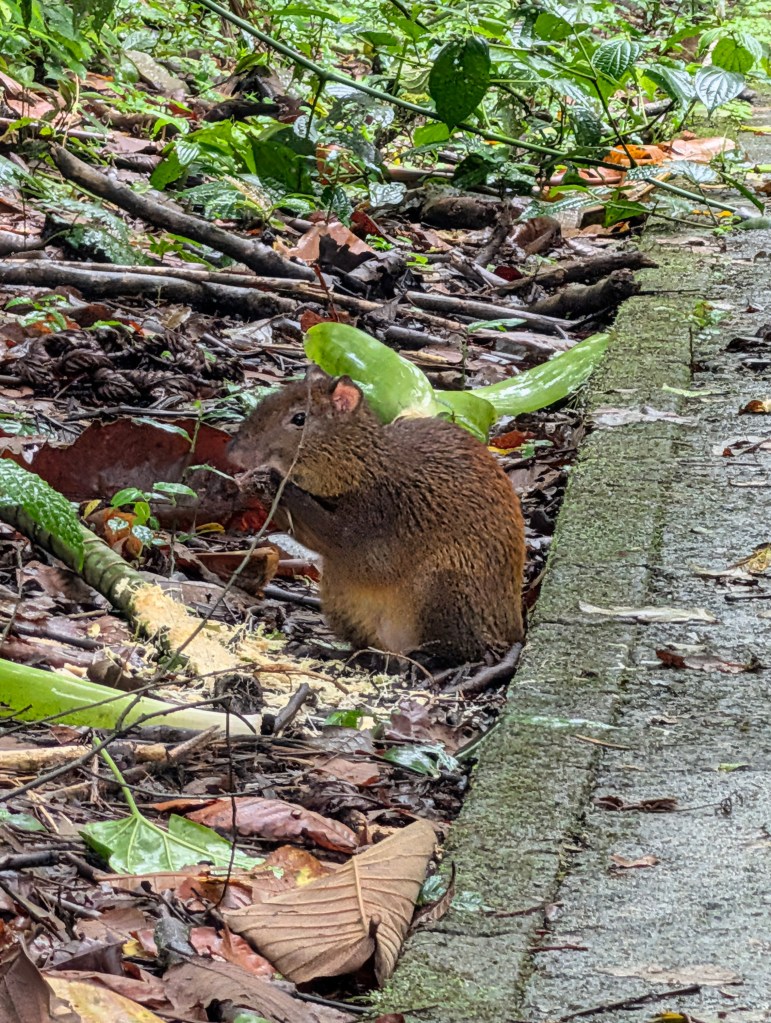
We then saw an agouti eating the stem of a palm tree. Agoutis are the largest rodents in Costa Rica. Their diet consists of fruits, seeds, shoots, leaves, and nuts. Known as nature’s gardeners, they aid in seed dispersal by burying seeds for later consumption and then forget where they have been left. When alarmed, they may thump their hind feet, erect their rump hairs, or run away with high-pitched barks.
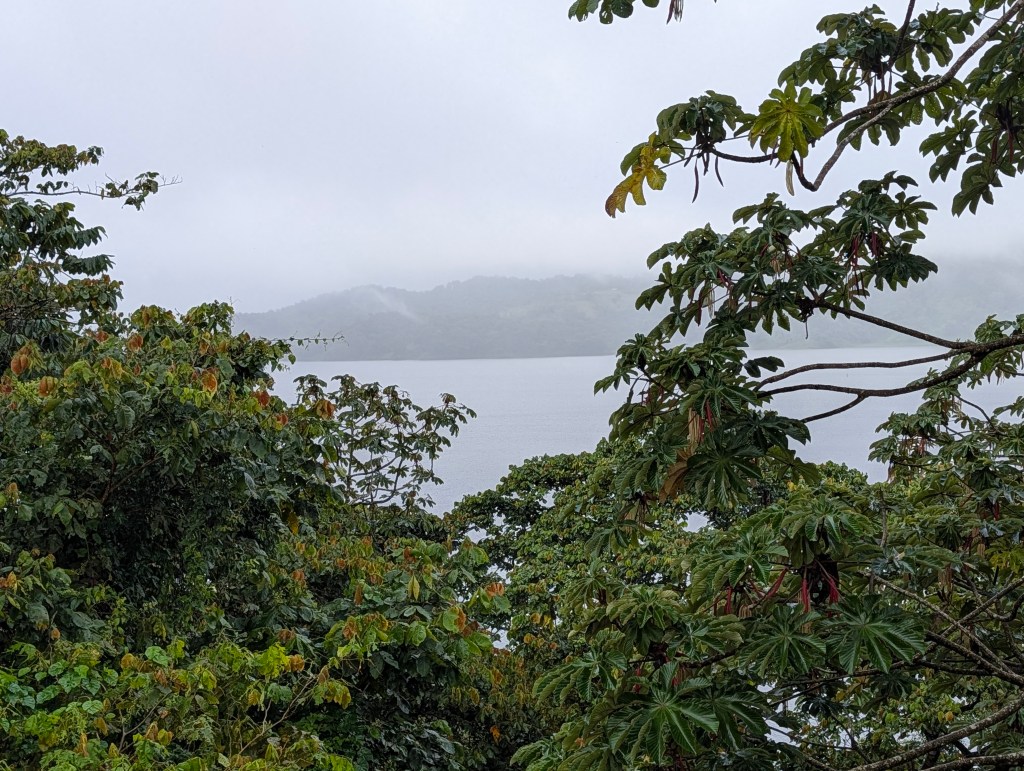
Along the hike we had several views of Lake Arenal.
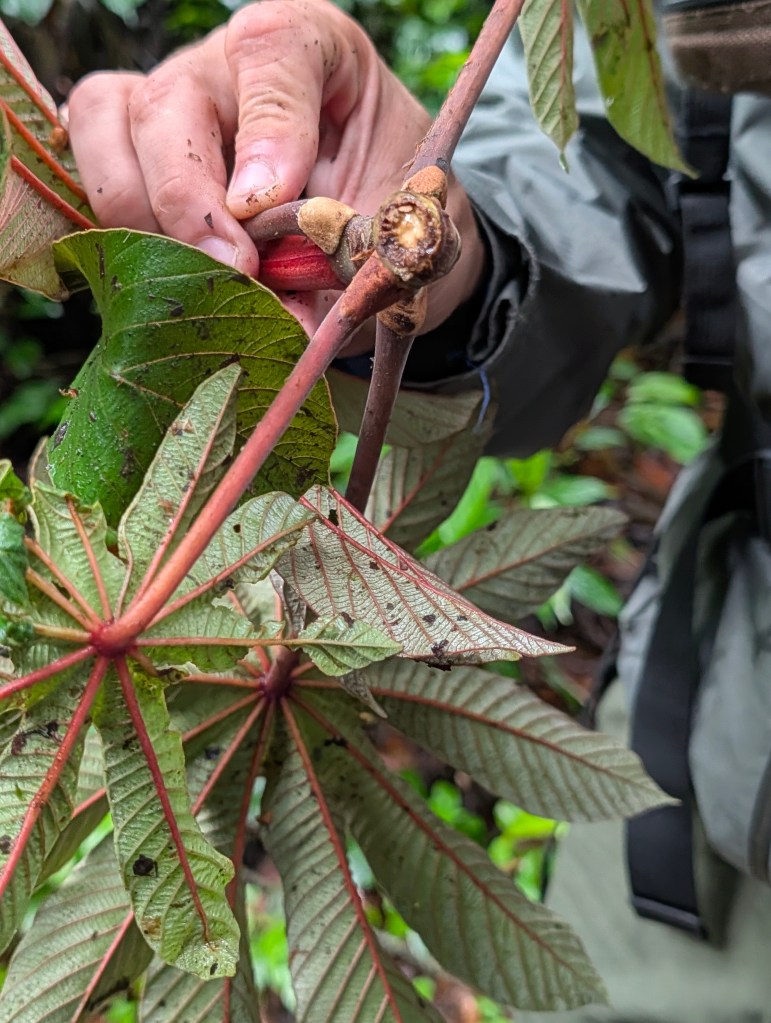
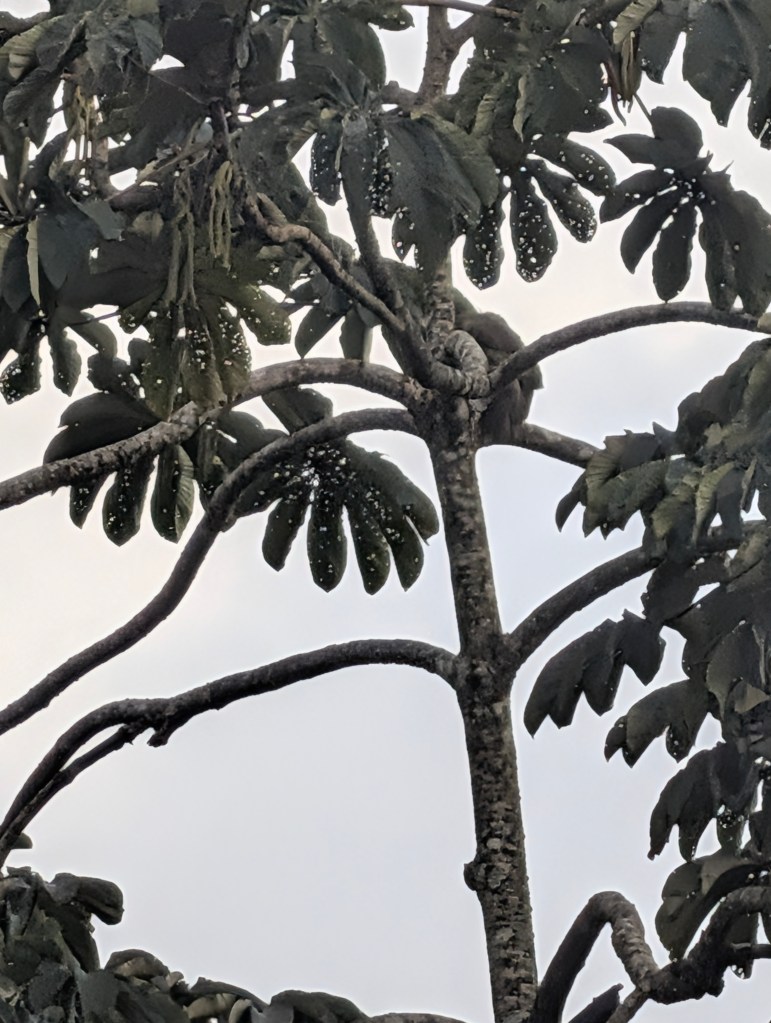
Martin then pointed out a trumpet tree from the genus Cecropia, commonly known as guarumo in Central America. Common names include trumpet tree, snakewood, and tree-of-laziness, as sloths are often spotted in their branches, centered below. Cecropia species are fast-growing, dioecious trees found throughout the Neotropics. They are considered pioneer plants, often the first trees to grow in clearings caused by deforestation or fire, helping to regenerate vegetation.
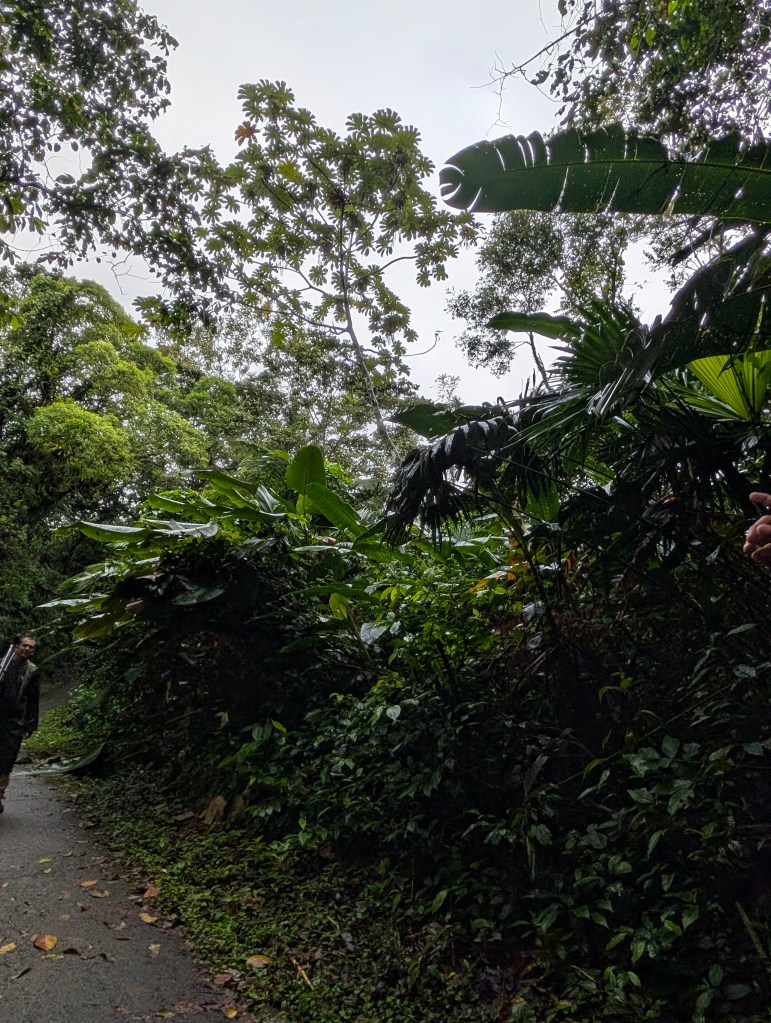
Sloths will eat many leaves, but the leaves of the Cecropia are their favorite.
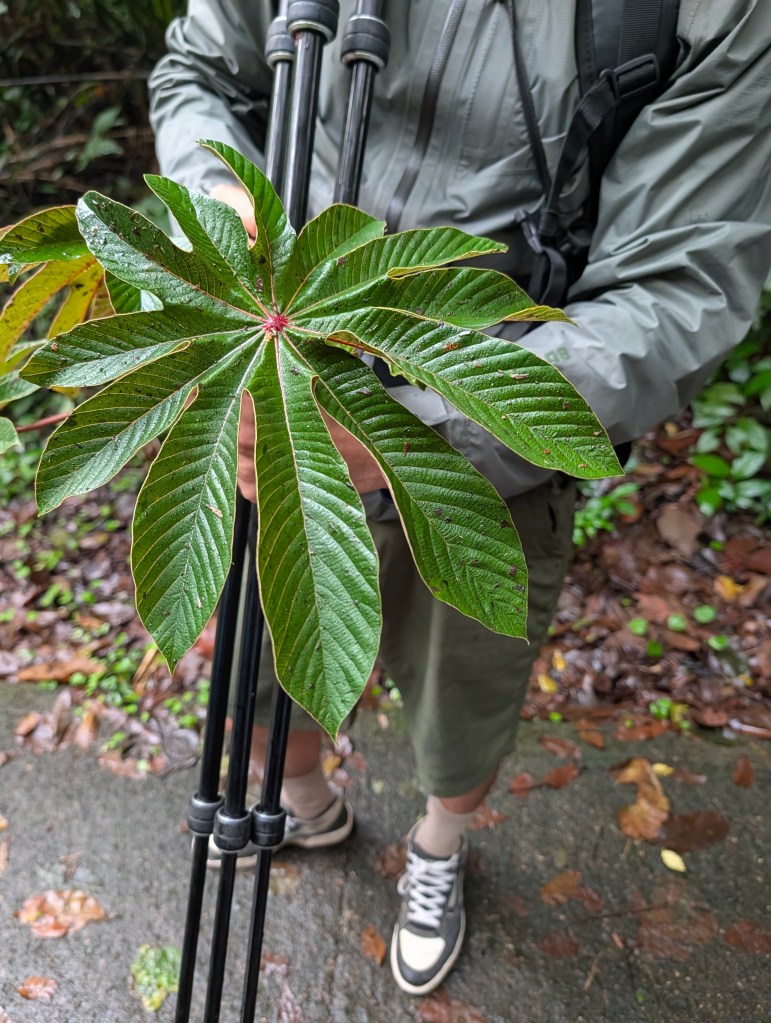
The squirrels love the fruits of the Cecropia.
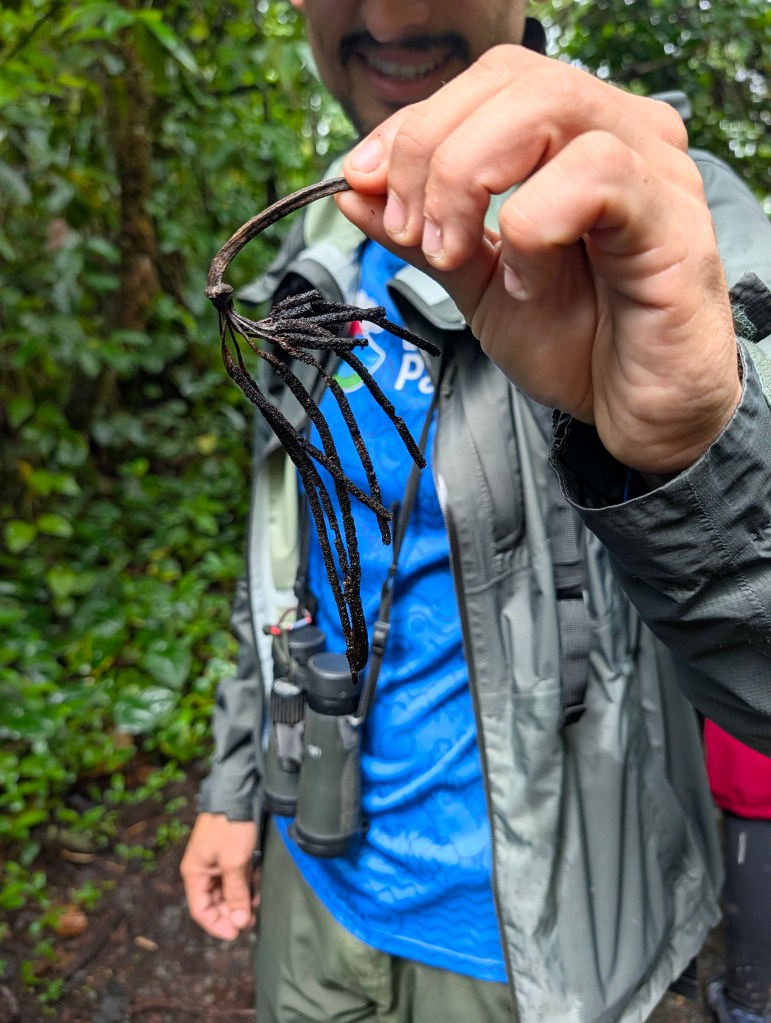
The Cecropia trees have hollow, branched stems.
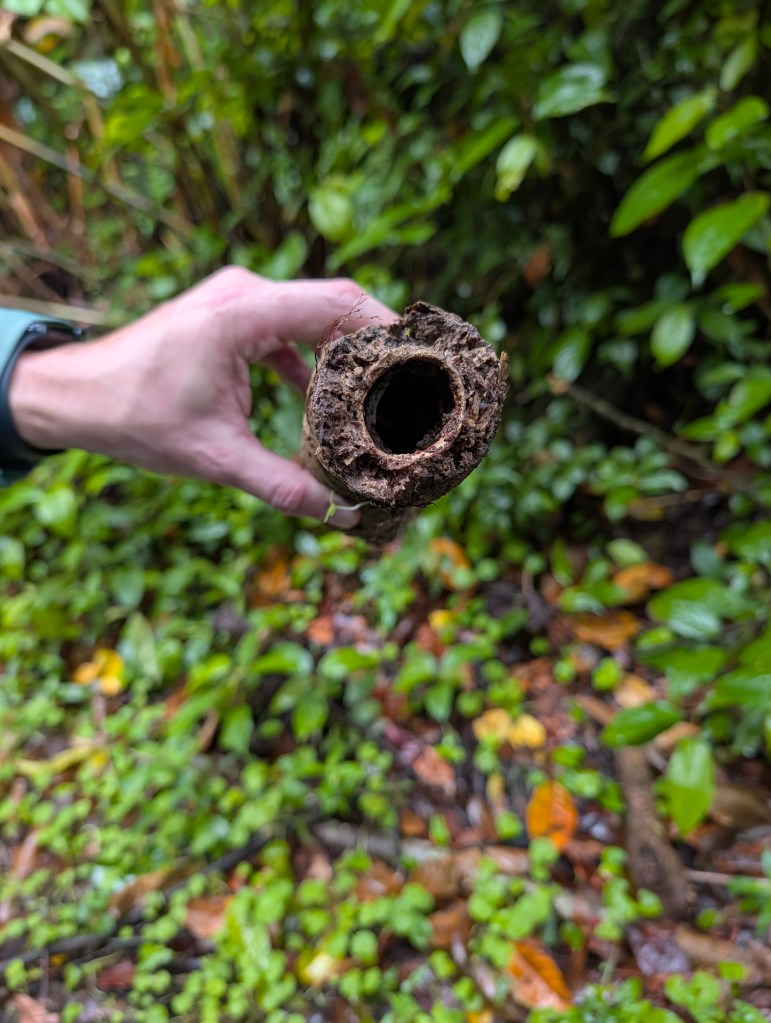
The trees have a symbiotic relationship with ants. The axillary buds are full of glucose on which the ants feed. The ants live inside the hollows of the trunk and branches making the tree uninhabitable to other plants like orchids and vines, thus saving the tree from parasites.
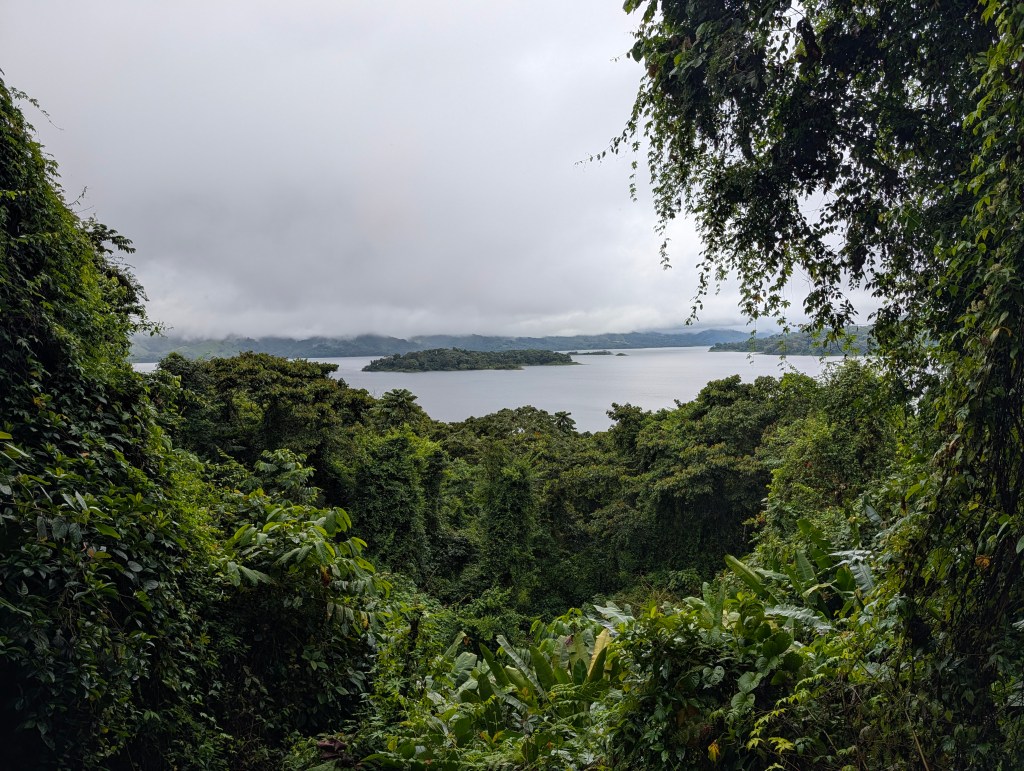
At this point we were treated to another view of Lake Arenal.
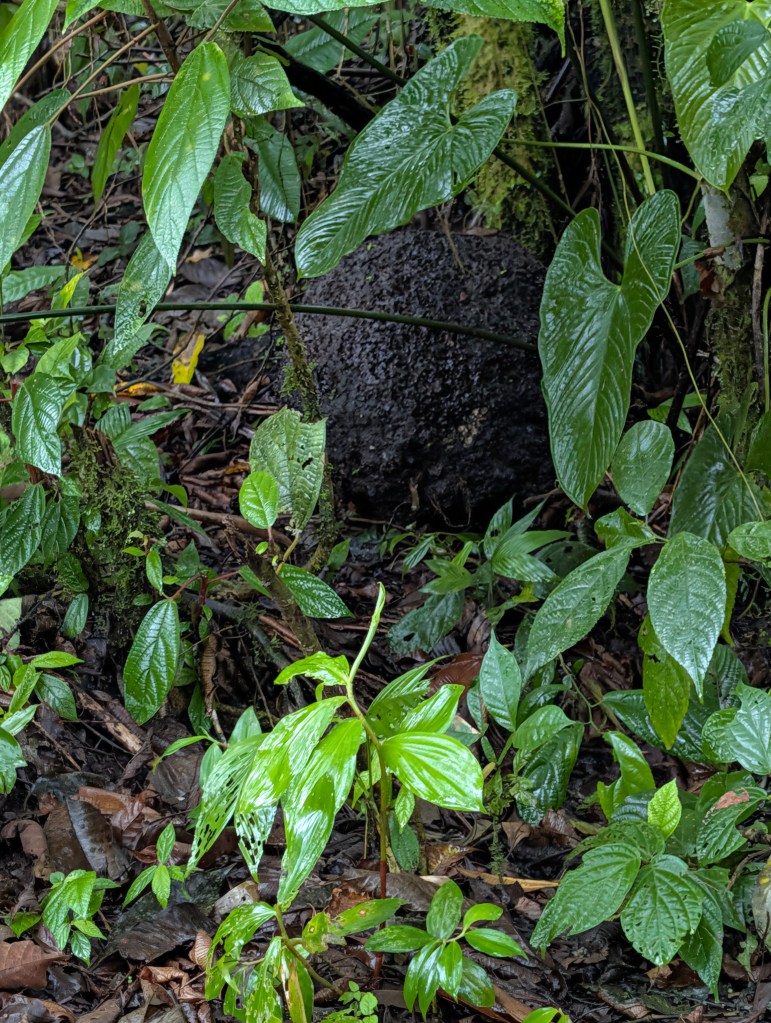
Martin pointed out an abandoned termite nest and explained that once abandoned they are often used by birds such as Parrots and Kingfishers for nesting.
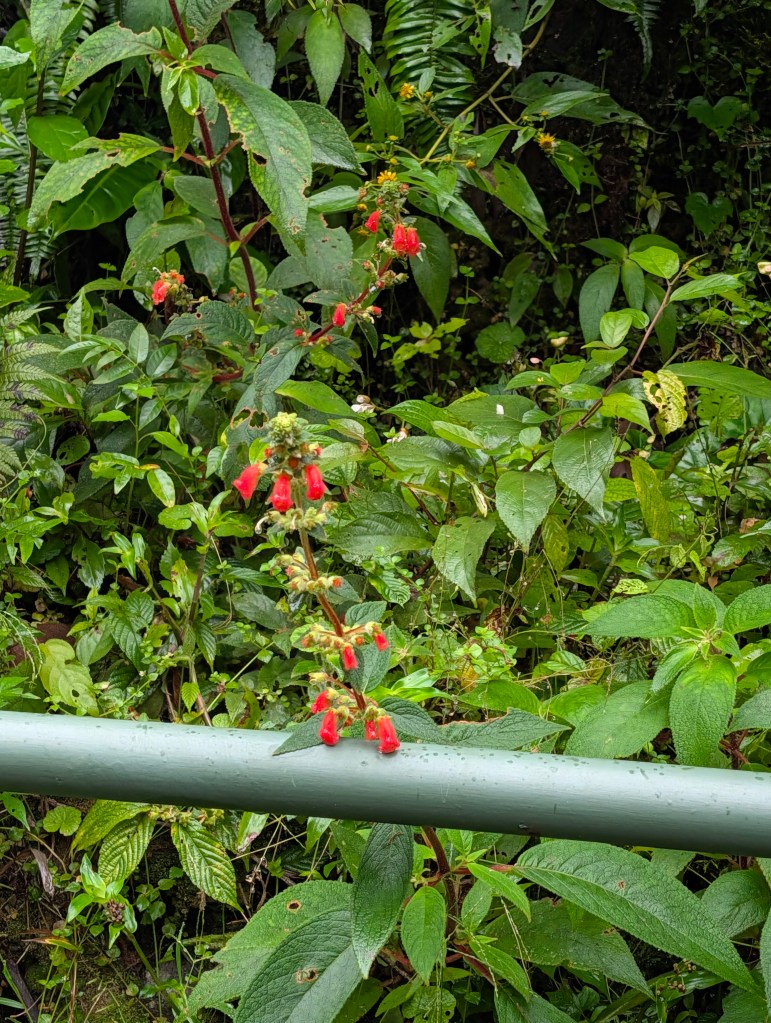
Martin showed us a kohleria spicata, a flower favored by hummingbirds and pollinator bees.
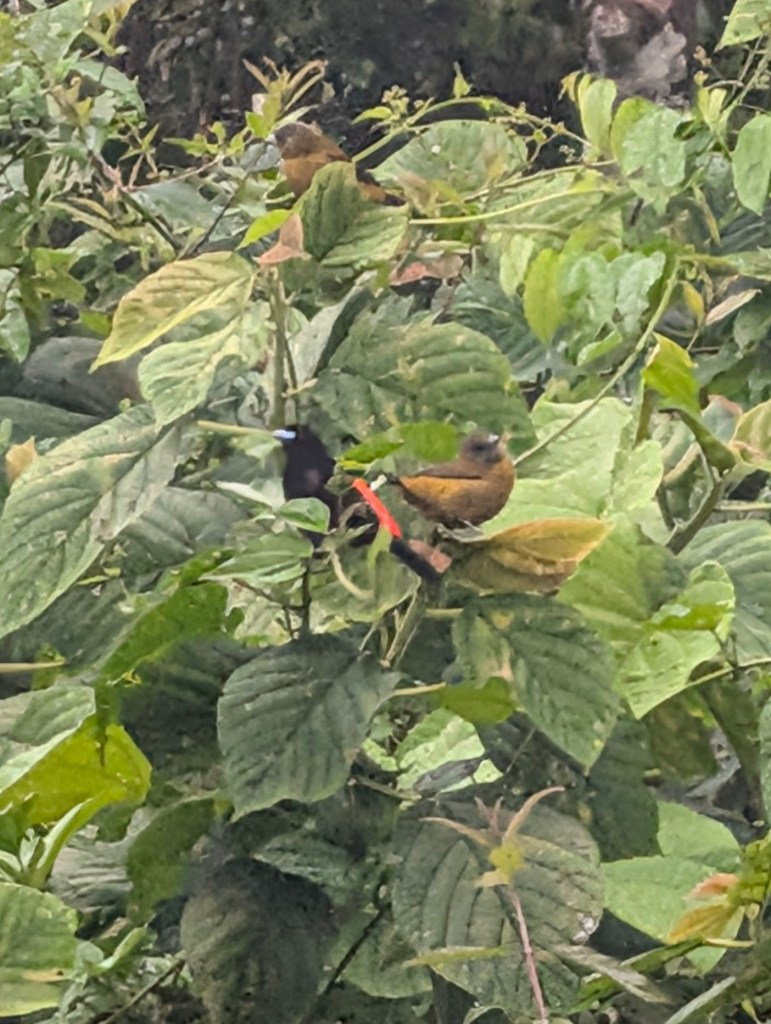
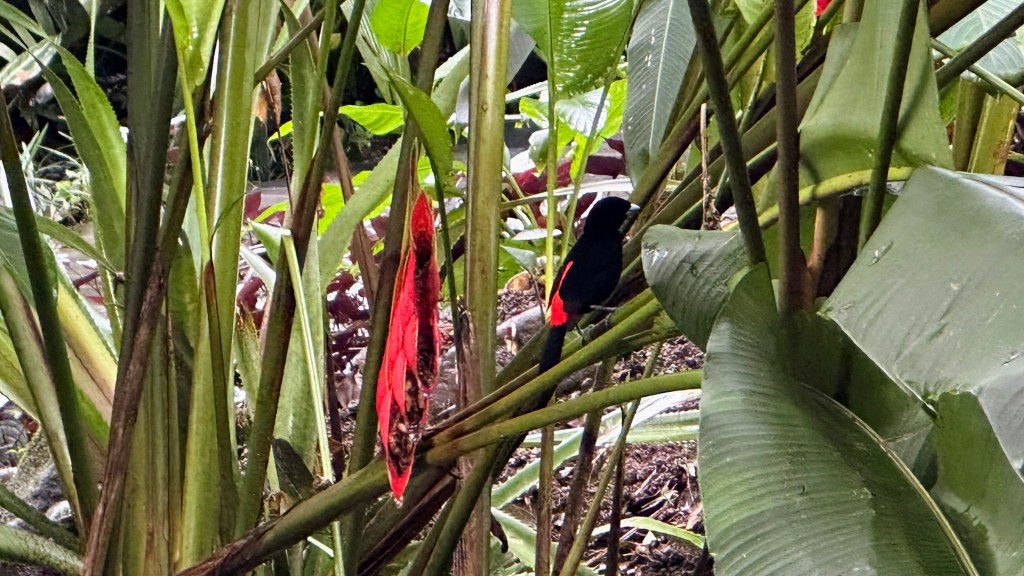
He also showed us a pair of Scarlet-rumped Tanagers. The two birds in the image display the species’ distinct sexual dimorphism: The bird on the right is a female, characterized by her olive-brown tones and a bluish-white bill. The bird on the left is a male, which has glossy black plumage and a bright scarlet-red lower back and rump. Tanagers primarily feed on fruits, insects, and small arthropods. This species is a resident breeder in the Pacific lowlands of Costa Rica and western Panama. They are fairly common in humid tropical lowlands, favoring forest edges and plantations.
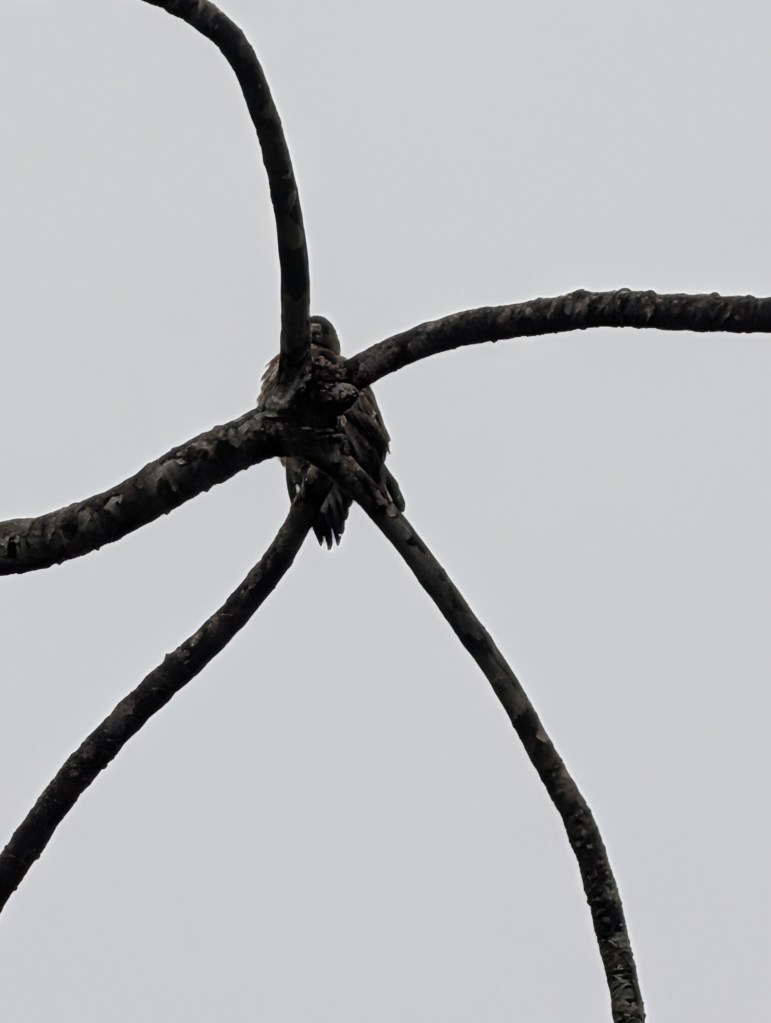
As we left the forrest we found a hawk high up in a tree.
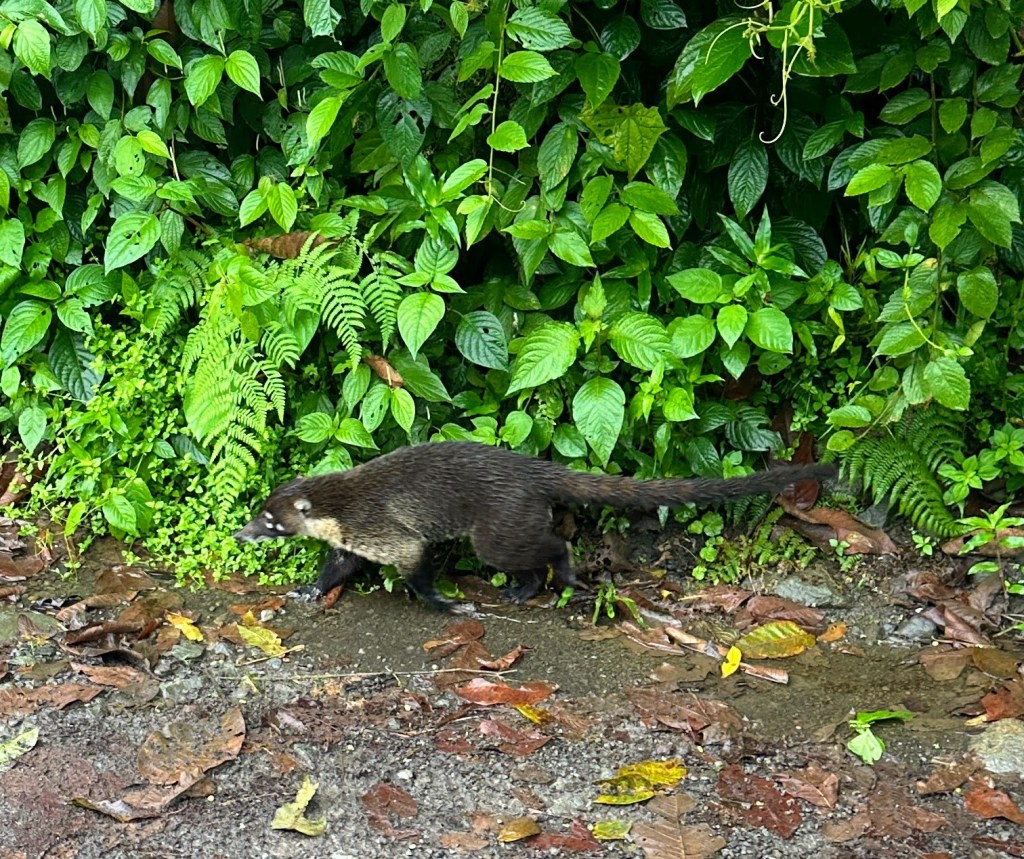
As we left La Penninsula Trail and boarded our van to drive to the Coladas Trail we saw a White-nosed Caoti. In the Racoon family, Coatis have a long, flexible snout and strong claws, which are well-adapted for foraging for food in crevices and holes. They are omnivores, eating everything from fruit to small animals like mice and lizards. The species typically weighs between8.8–13.2 lb and can reach a nose-to-tail length of about 3.6 ft. They use their long, semi-prehensile tails for balance.
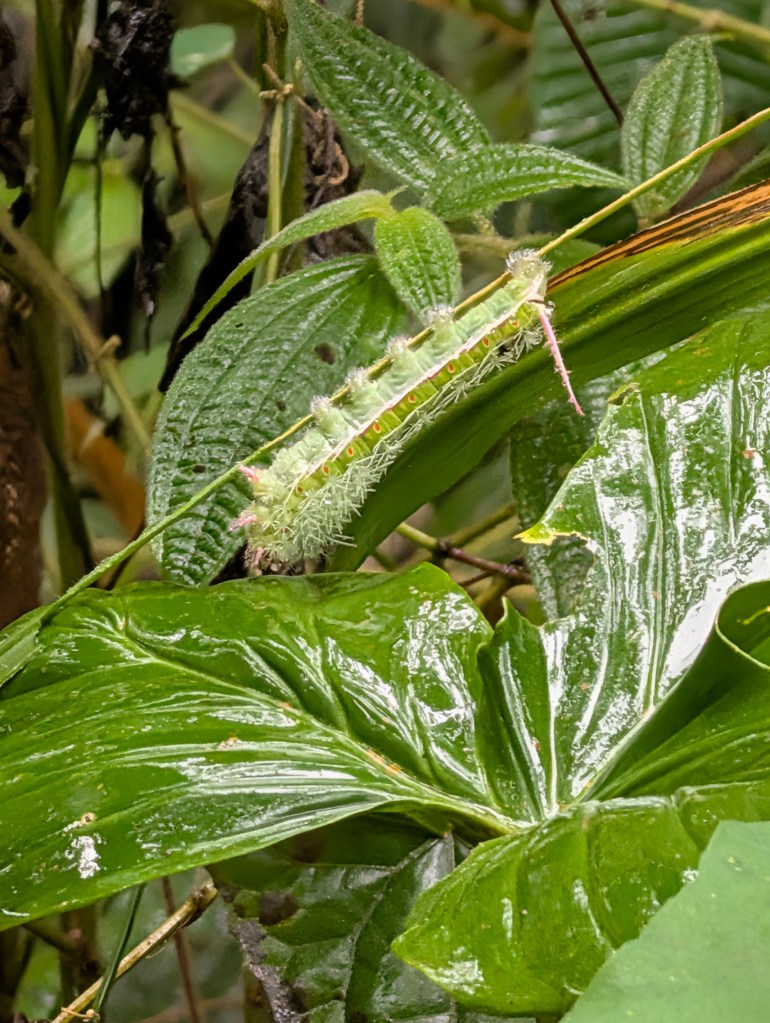
We embarked on the Coladas Trail, which includes areas that were once destroyed by volcanic activity and are now in the process of regeneration. There we found an “armored” caterpillar of the silk moth family known for their striking appearance: covered in spines and bristles. The bristles are urticating hairs, which means they can cause adverse skin reactions or stings if touched.
We hiked about three quarters of a mile to the pinnacle of the trail which was formed by relatively recent lava flows. From the end of the trail we were supposed to have a great view of the Arenal Volcano. But alas, it was completely engulfed in clouds. We had hiked in the rain and received no reward for our efforts, bummer. I did like the sign one does not see just anywhere. Although volcanic activity has decreased since 2010 and is now mostly fumarolic with occasional phreatic eruptions at the top of the mountain – this means there are no lava flows – hiking up close to the crater remains dangerous.

On our way back we saw a banderita Española, a plant common as a first settler after a catastrophic deforestation like lava. Martin explained the difference in primary forests, ie old growth forest with large trees at least 400 years old versus secondary forests, which are those found after catastrophic events including fires. This area had been a primary forest until the 1968 volcanic eruption; the previous eruption had been 1592.
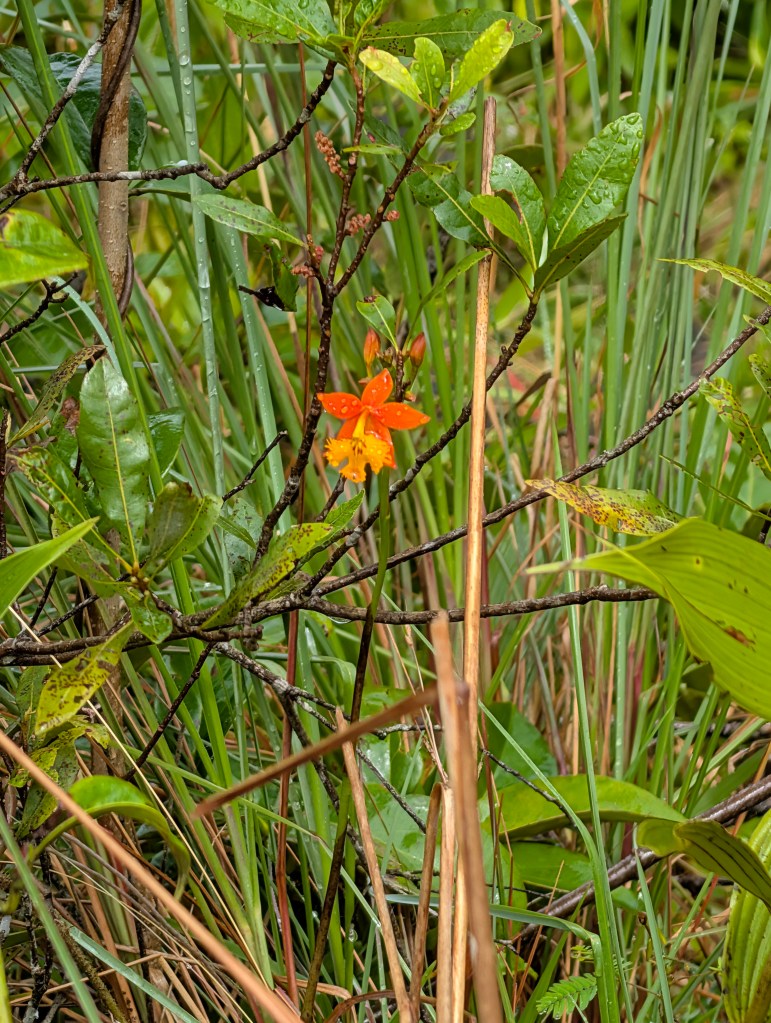
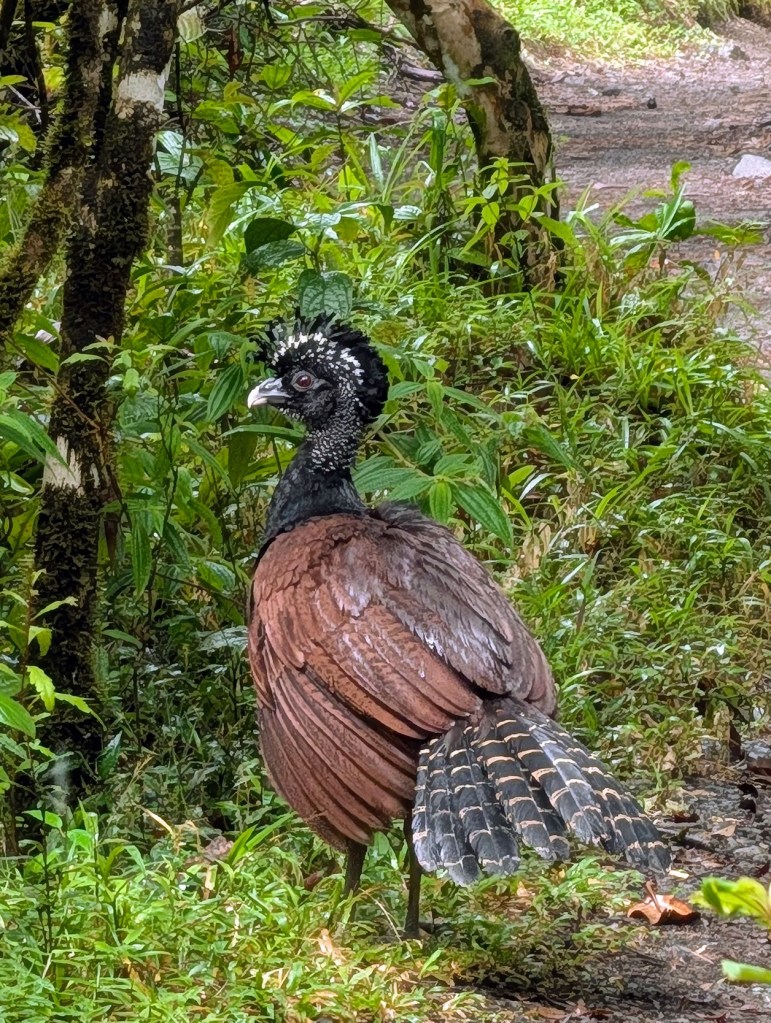
Along the hike back we were treated to a female Great Curassow, more on them later.
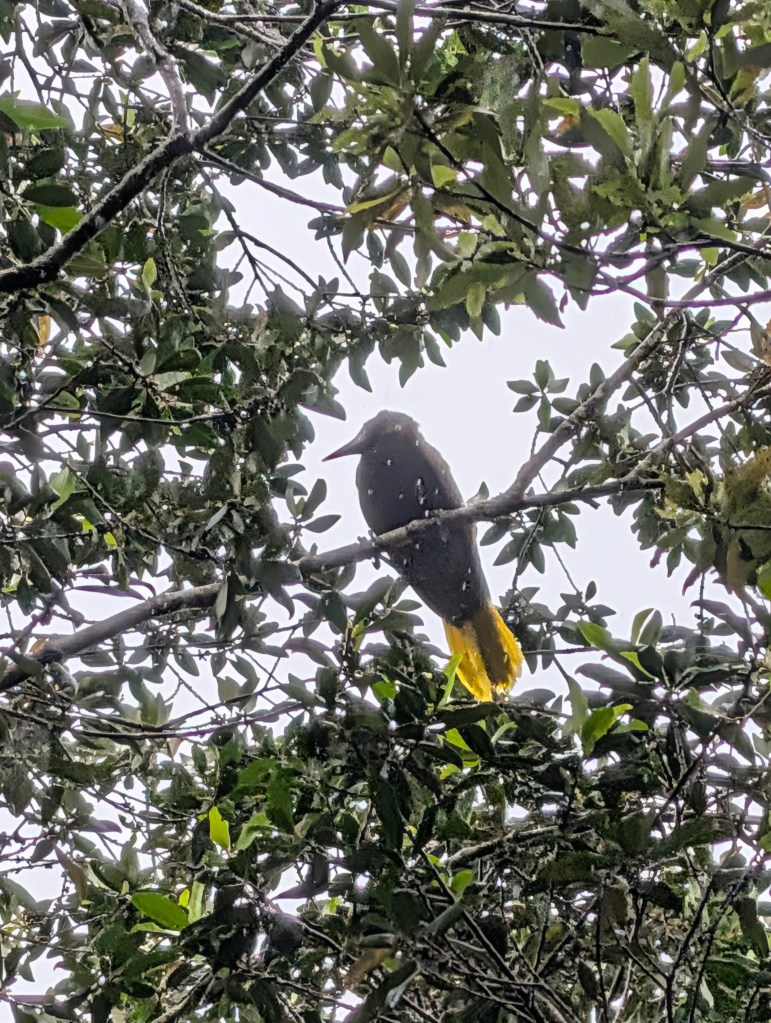
We also saw a Yellow-rumped Cacique. Key characteristics of this species include: They build unique, hanging woven nests and are widely distributed across northern South America. They have mainly black plumage with a sharp yellow rump and a pale, ivory-colored beak. A distinctive feature is their striking, sky-blue eyes. These birds are highly social, often seen in flocks, and are known for being accomplished mimics. (The dots on the picture are rain drops. Yes, it was still raining.)
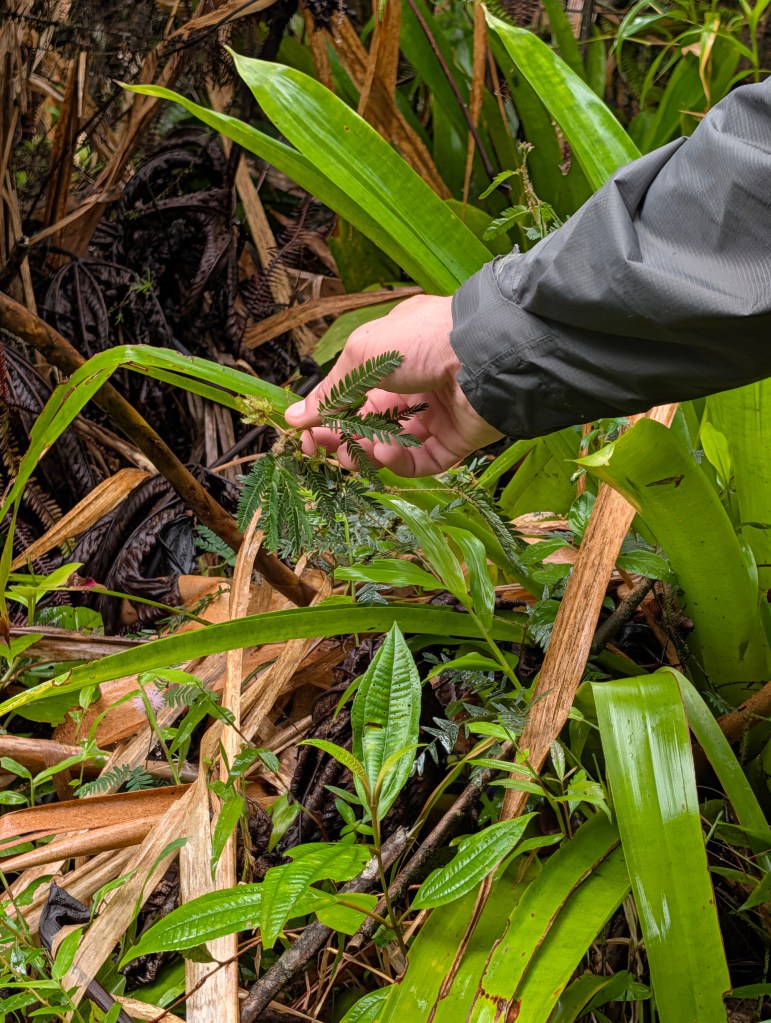
Martin showed us a Mimosa pudica, commonly known as the sensitive plant, sleepy plant, or touch-me-not. It is a creeping annual or perennial flowering plant native to South and Central America. Its fern-like leaves are famous for rapidly folding inward and drooping when touched, shaken, or exposed to heat. This movement is a defense mechanism to deter herbivores and protect the plant from potential harm. The leaves are prickly to the touch. The plant may also produce small, spherical, pink, or purple flowers during its growing season.
Back at our resort Arenal Manoa the bellhop pointed out a resident sloth high up in the tree. We had hiked in the forest all morning and not seen one.
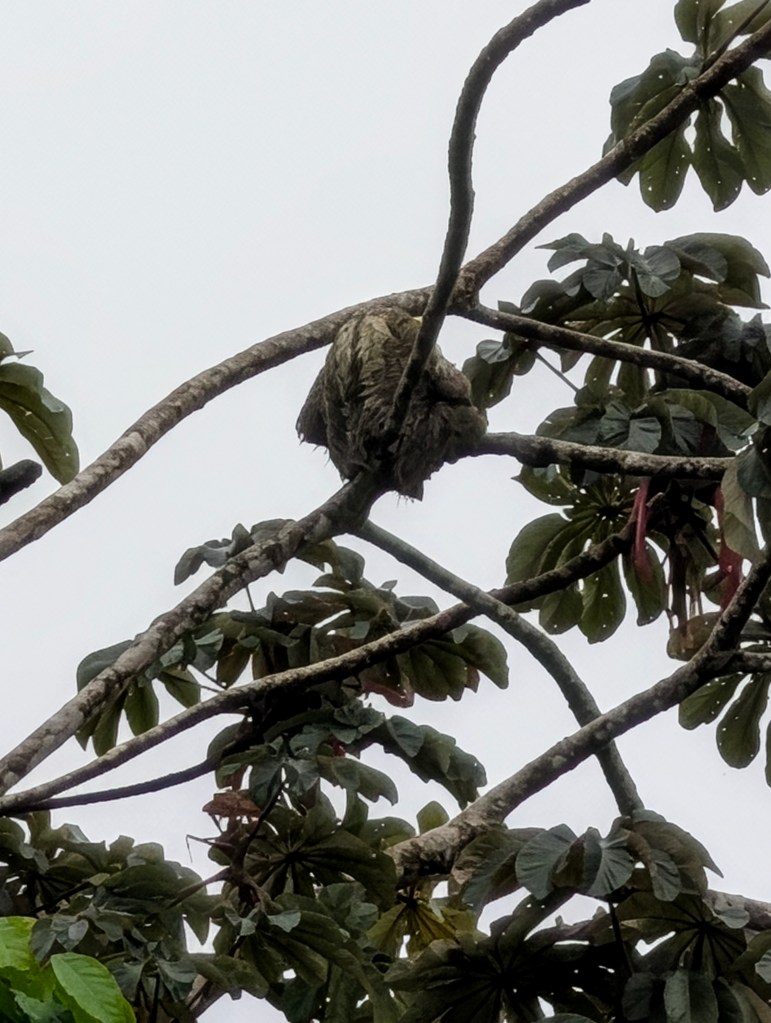
The rain continued all afternoon but finally broke in the late evening long enough for us to head into the small town of La Fortuna. We strolled around a bit before treating ourselves to a large steak dinner.

After breakfast we were driven to Mistico Hanging Bridges, a privately owned reserve containing about 2 miles of trails which include eight fixed bridges and 5 hanging bridges, which are between 160 – 330 feet long and 10-150 high, all which were designed to blend with the natural environment, leaving the forest virtually intact. From their website: “Mistico Arenal Hanging Bridges Park encompasses a unique fusion of several different ecosystems that promote high biodiversity in plant and animal species. Located between the edges of two forest types, the region integrates both highland and lowland landscapes into one beautiful and unique vegetation strip.”
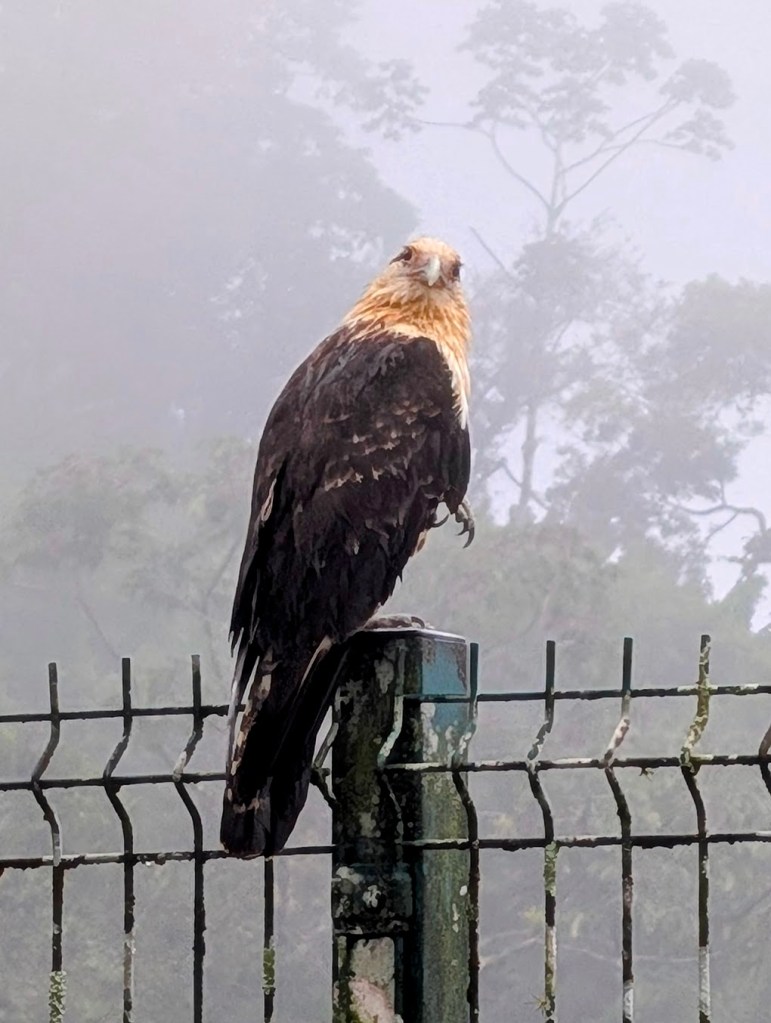
Before reaching Mistico we passed Lake Arenal and found perched there a Yellow-headed Caracara, a bird of prey belonging to the falcon family. It is found in tropical and subtropical regions from Central America south to northern Argentina and Uruguay. Unlike most raptors, it is omnivorous and often scavenges for food. Adults have a pale, buffy head and underparts with dark brown wings and back.
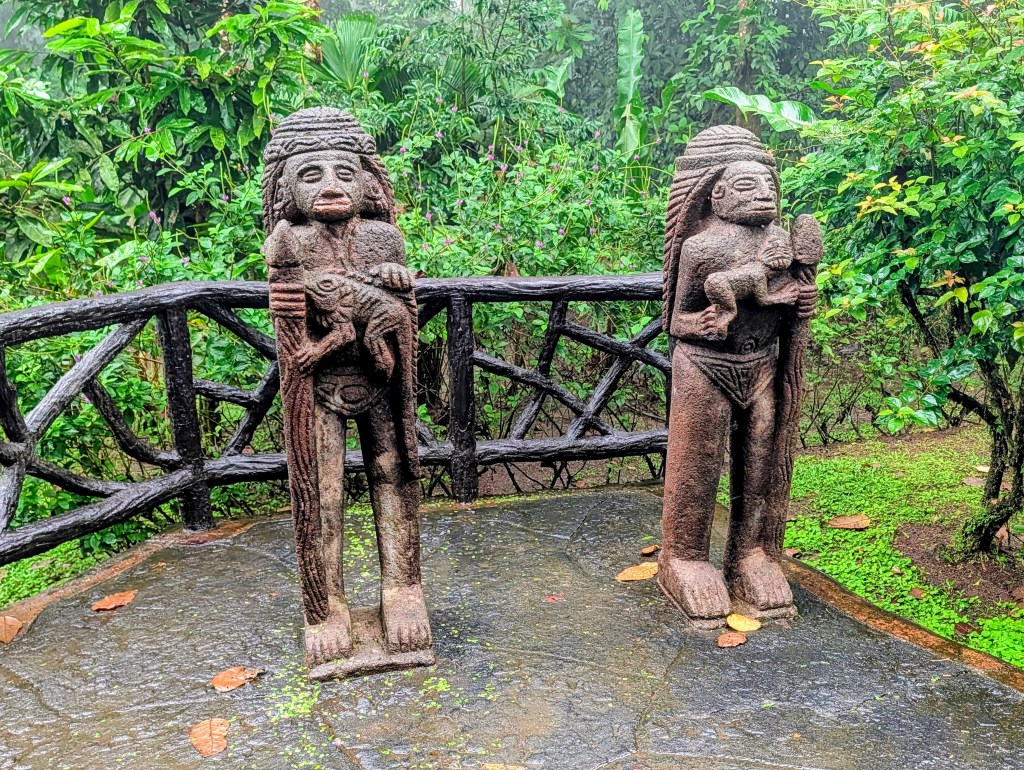
Upon arrival at Mistico our group of 10 was met with our guide Mey. At the entrance of the trails were stone statues created by the Chorotega, ancient inhabitants of Guanacaste using advanced techniques. The works reflect their rich culture and beliefs and are a testament to their artistic skill and deep connection with nature.
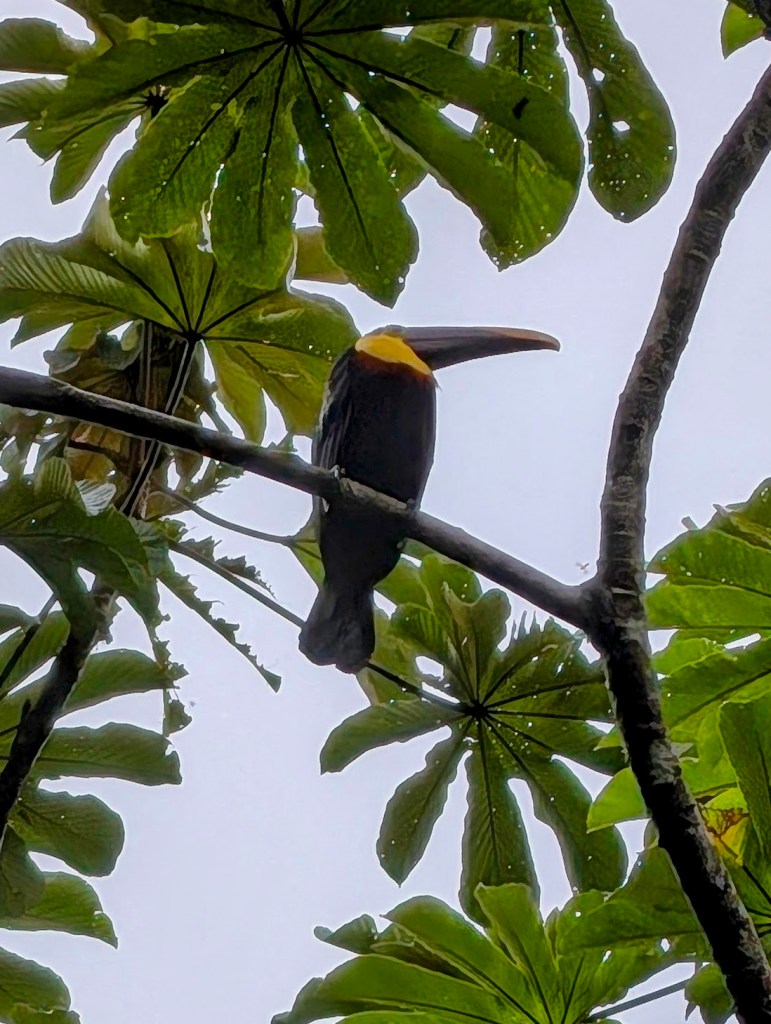
Our first sighting was a a Chestnut-mandibled Toucan, a subspecies of the Yellow-throated Toucan. Their diet is omnivorous, consisting of fruits, insects, and small animals. It is one of the largest toucan species, known for its bright yellow throat and dark, chestnut-colored lower mandible. The species is found in tropical jungles from Honduras south into northern South America. They typically travel in small flocks within the forest canopy. Mey told us there are 6 species of toucan in the park, and they mostly eat wild fruit. She also told us that toucans prefer cloudy, rainy days (did I mention it is still raining?) because their black bodies absorb too much heat on sunny days.
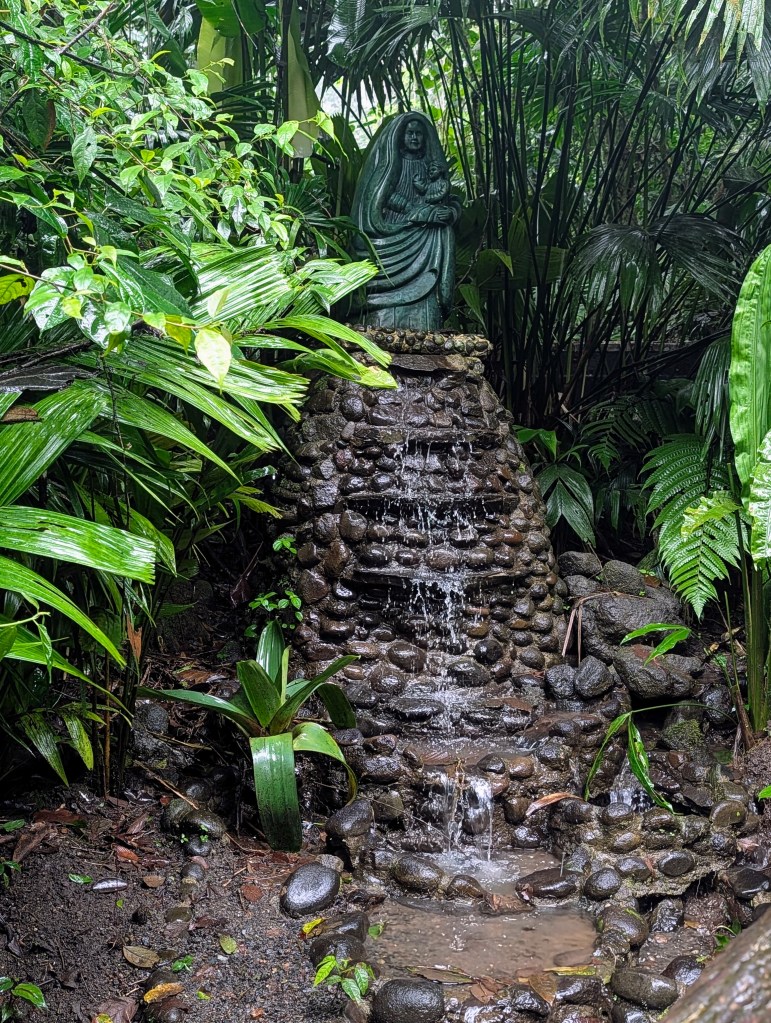
Next we saw St. Mary of the Angels or “La Virgin de los Ángeles.” According to tradition, la negrita is a small about 3 inches representation of the Virgin Mary found in August 1635 by a native woman named Juana Pereira. As the story goes, when she tried to take the statuette with her, it miraculously reappeared twice back where she had found it. The townspeople then built a shrine around the statue. In 1824, the Virgin was declared Costa Rica’s patroness saint. La negrita, composed of jade, volcanic stone, and graphite, now resides on a gold, jewel-studded platform at the main altar in the Basilica de Nuestra Señora de los Ángeles in Cartago.
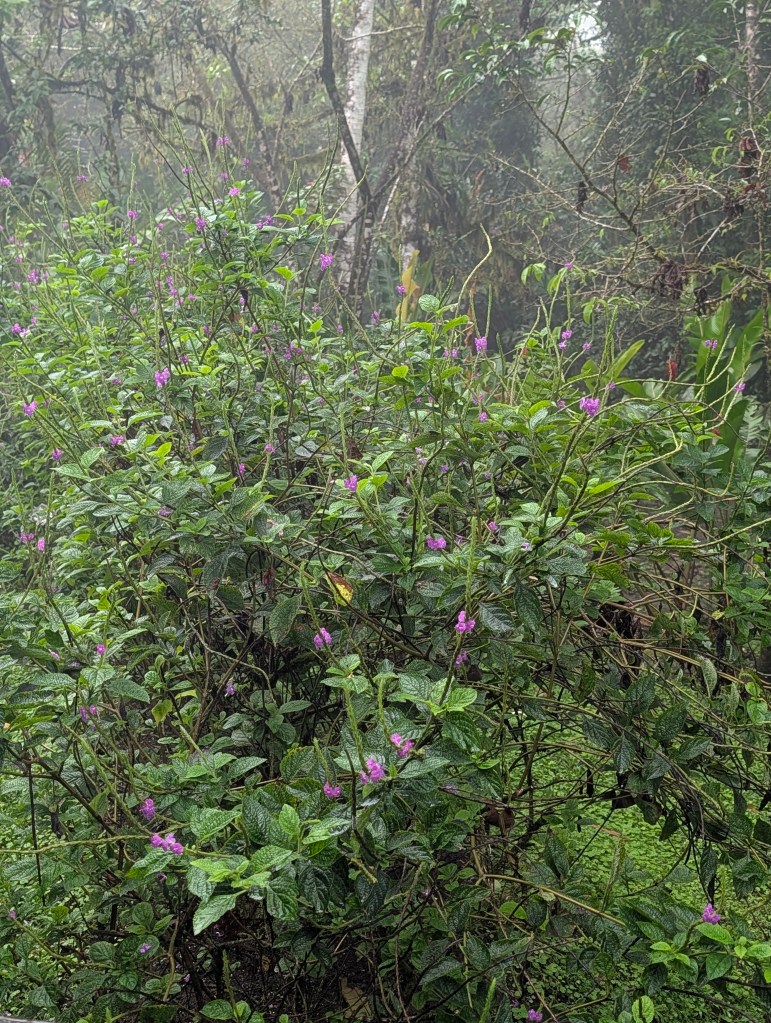
Stachytarpheta cayennensis is a species of flowering plant in the verbena family known by many common names, including blue snakeweed, Cayenne snakeweed, dark-blue snakeweed, bluetop, nettle-leaf porterweed, rattail. This plant has some uses in traditional medicine. Several Latin American peoples recognize extracts of the plant as a treatment to ease the symptoms of malaria. The boiled juice or a tea made from the leaves or the whole plant is taken to relieve fever and other symptoms. It is also used for dysentery, pain, and liver disorders. Here its primary purpose is for the hummingbirds.
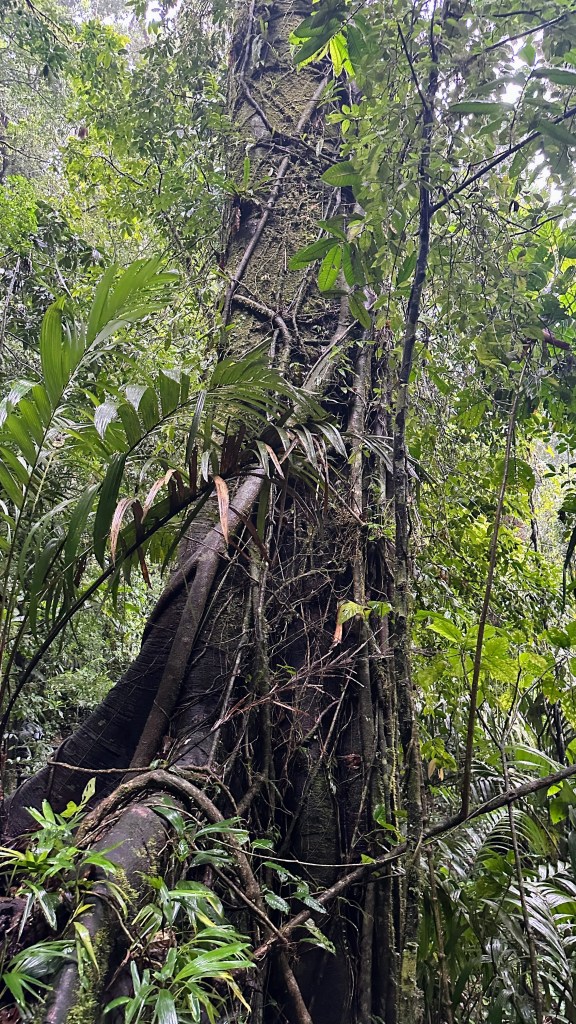
Mey pointed out a 300 year-old ficus tree.
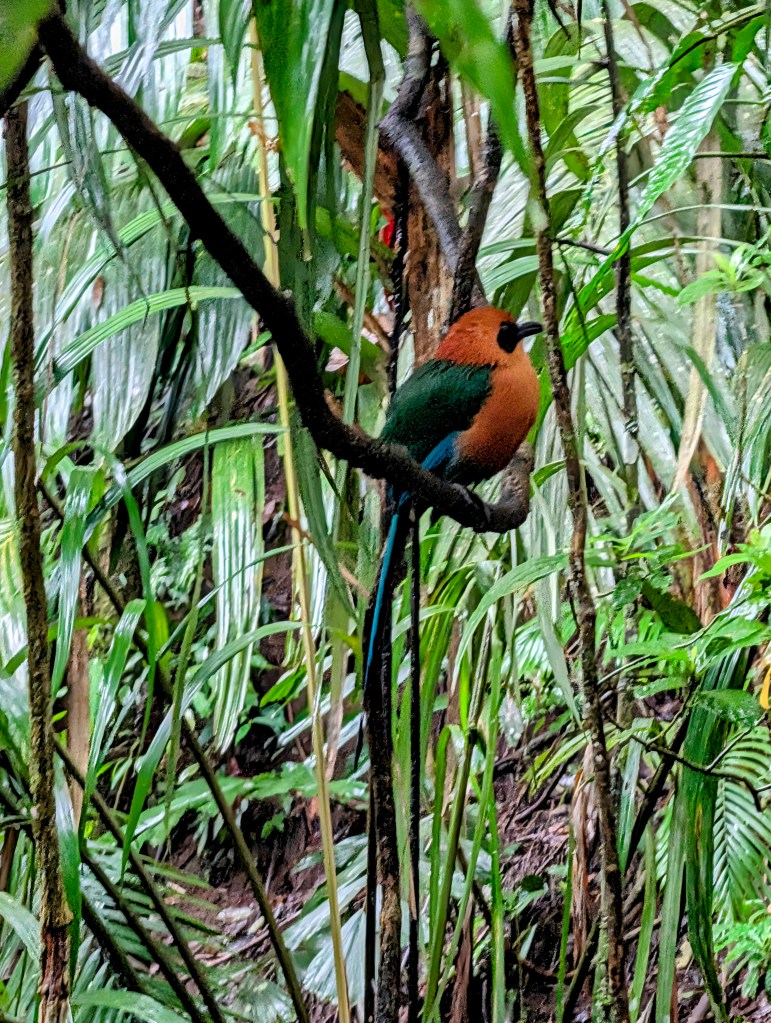
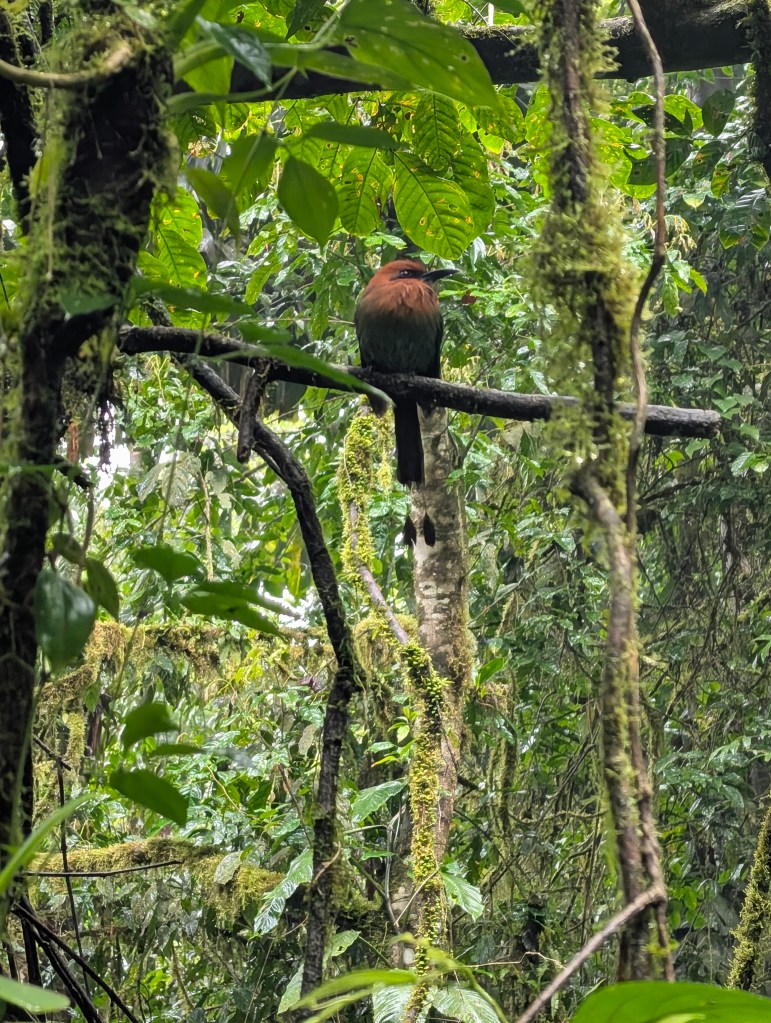
We found a a Broad-billed Motmot (It was actually our second Motmot of the day, but we did not get a good photo of the first.) The broad-billed motmot is a fairly common Central and South American bird. They are nonmigratory, sedentary birds that are most frequently seen in singles or pairs. There exist six subspecies of the broad-billed motmot. At about 12 inches long, the broad-billed motmot is one of the smallest members of the family. They have dark eyes and feet. Most of its upper body, including its head, neck and chest, is a cinnamon-rufous color. There is a black patch on either side of its head that covers the cheeks and auricular area, as well as one on the centre of its chest. The lower half of its body is more greenish above and becomes more bluish below. The broad-billed motmot has a long tail that gradually changes from blue to black. It also has two racquet-shaped central feathers which are much longer than the rest. As its name suggests, the broad-billed motmot has a broad, flattened bill. Its bill is black, has serrated edges, and has a keel on the upper mandible. This species does not demonstrate sexual dimorphism, which means that both the male and female look alike. This bird resides in humid forests, warm lowlands and foothills, and is found at elevations below 3,000 ft. The broad-billed motmot’s diet consist mainly of insects and their larvae as well as some small vertebrates such as snakes, frogs, and lizards. Unlike other species of the Momotidae family, broad-billed motmots do not consume fruits.
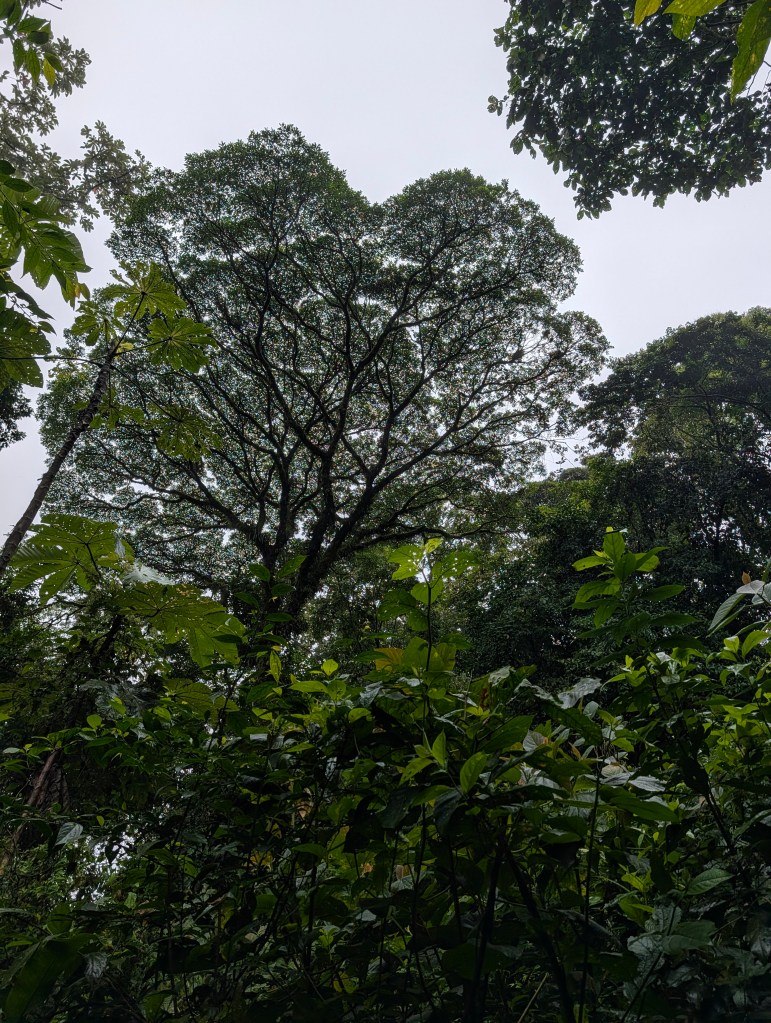
Mey pointed out a kapok tree, often referred to as the “Broccoli Tree” due to its distinctive, symmetrical crown when viewed from below. The tree is known for its cotton-like fluff from seed pods, which are used for stuffing.
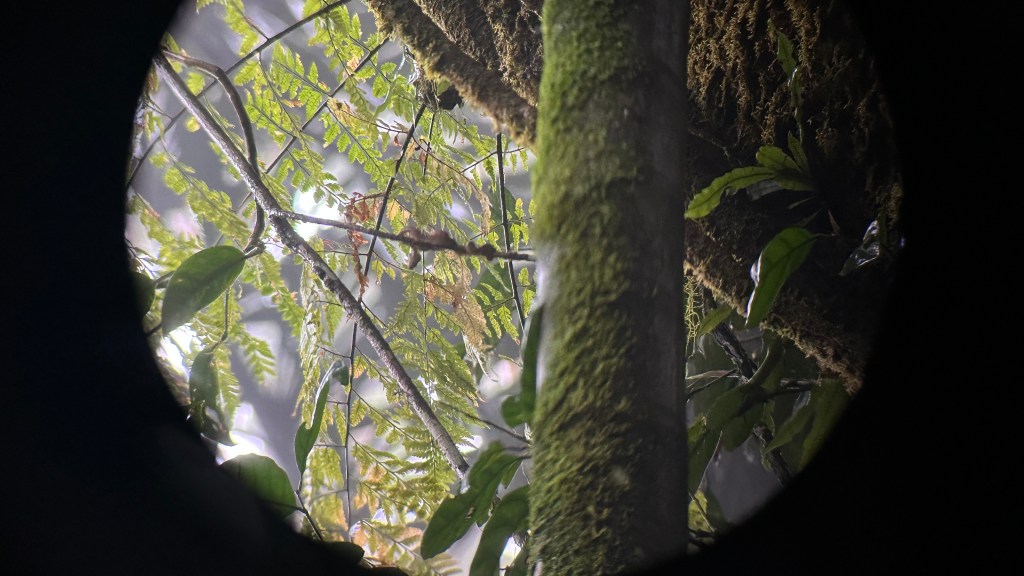
Mey found a brown viper which she enlarged for us through her scope. There are 5 species of viper in the park, all of which are poisonous. This one has been coming to this same tree for 5 years, making him easy to find.
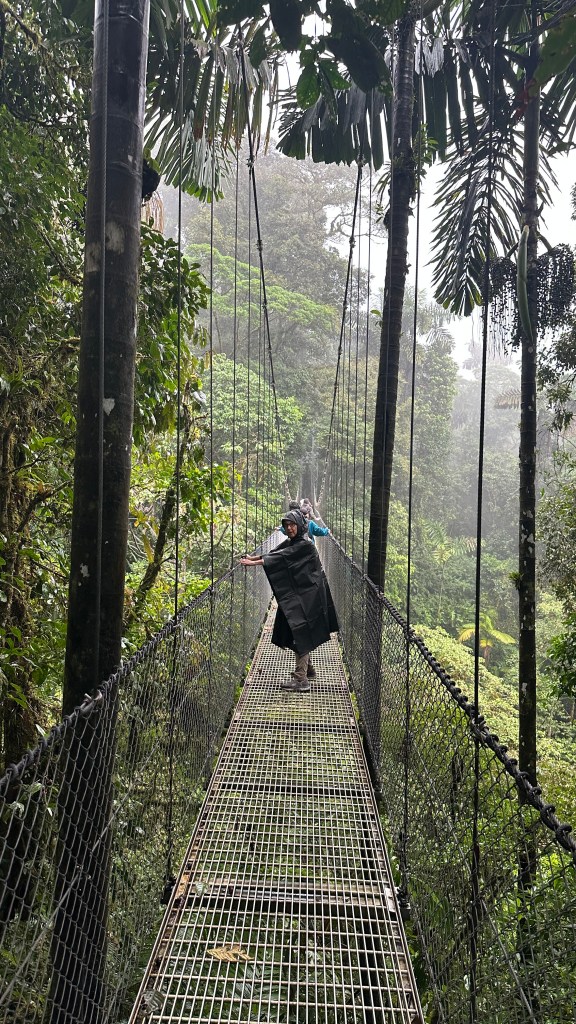
By this point on the trail we had crossed several fixed bridges, and now we came to our first hanging bridge.

I was not a huge fan of them; I had to have both hands holding on at all times. I would wait until my group was mostly across before attempting to cross so I would not have to stop along the way.
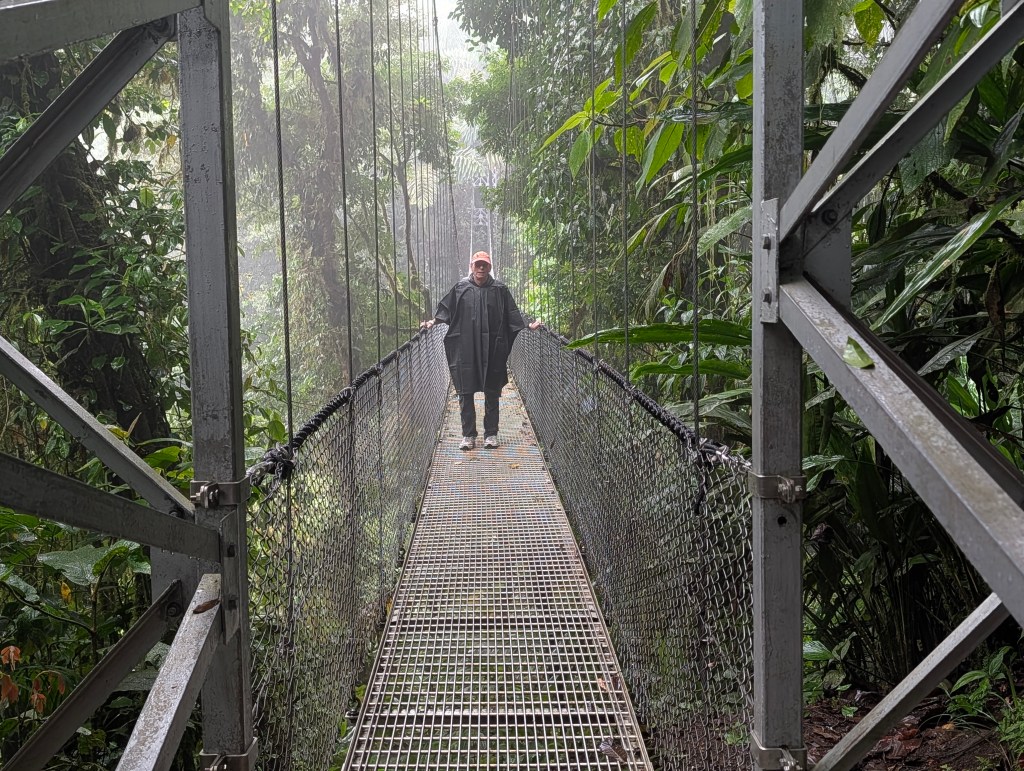
Eric, on the other hand, traversed with no problem.
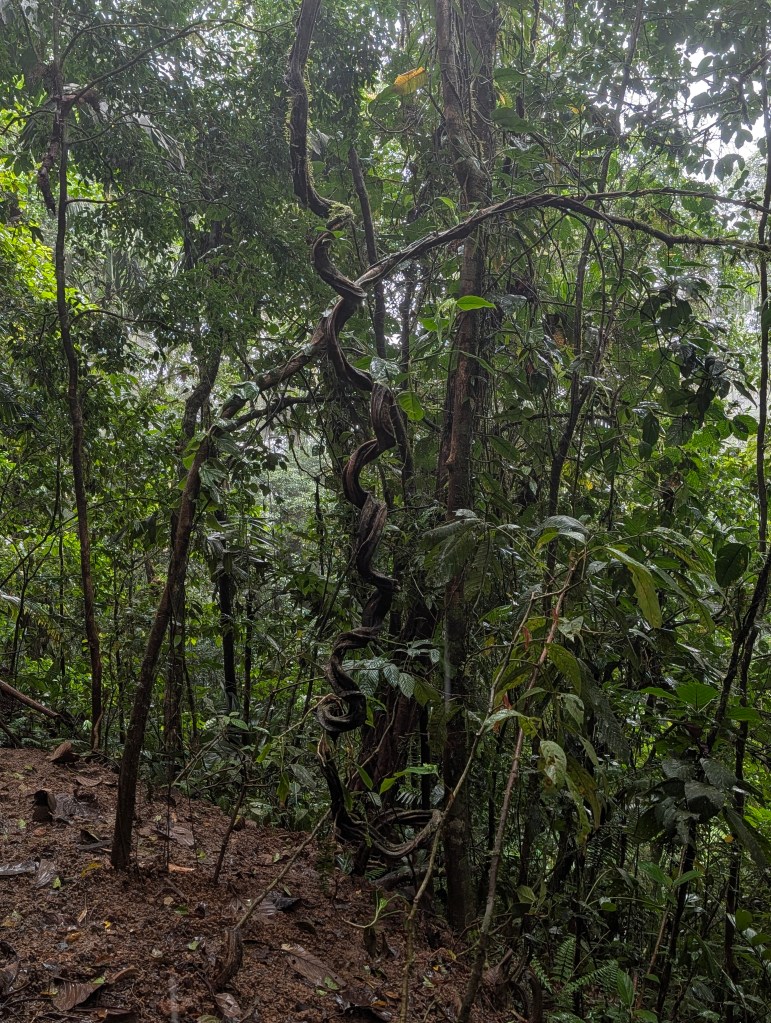
Mey pointed out the “monkey vine,” with its distinctive curly shape, so named because the monkeys use the vines to travel from tree to tree. Unfortunately, due to the rain, we did not spot any monkeys.
Even looking back at the bridges we had passed and seeing how high they were made me anxious.
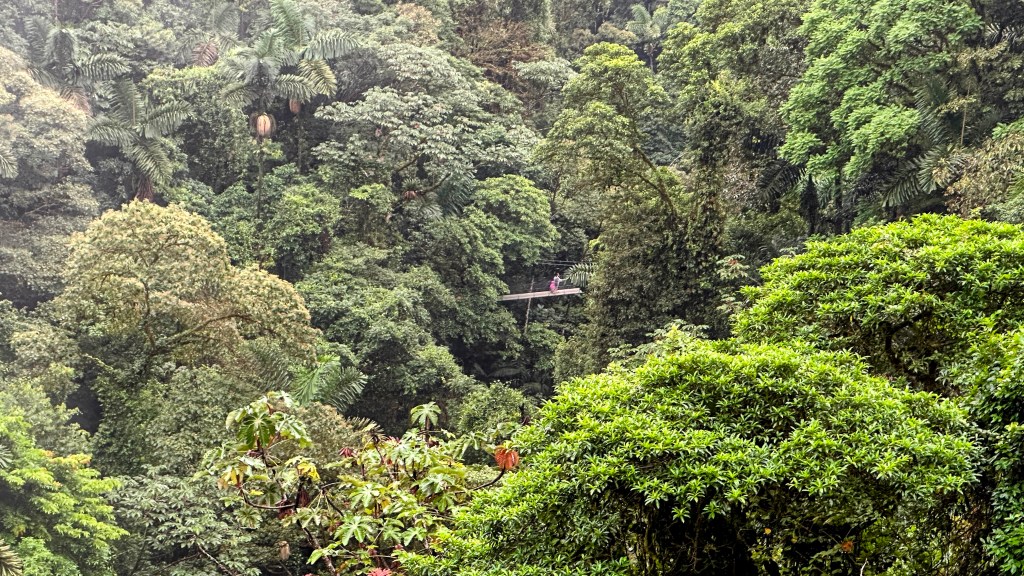
We took a side path to view the Blue Morpho Waterfall.

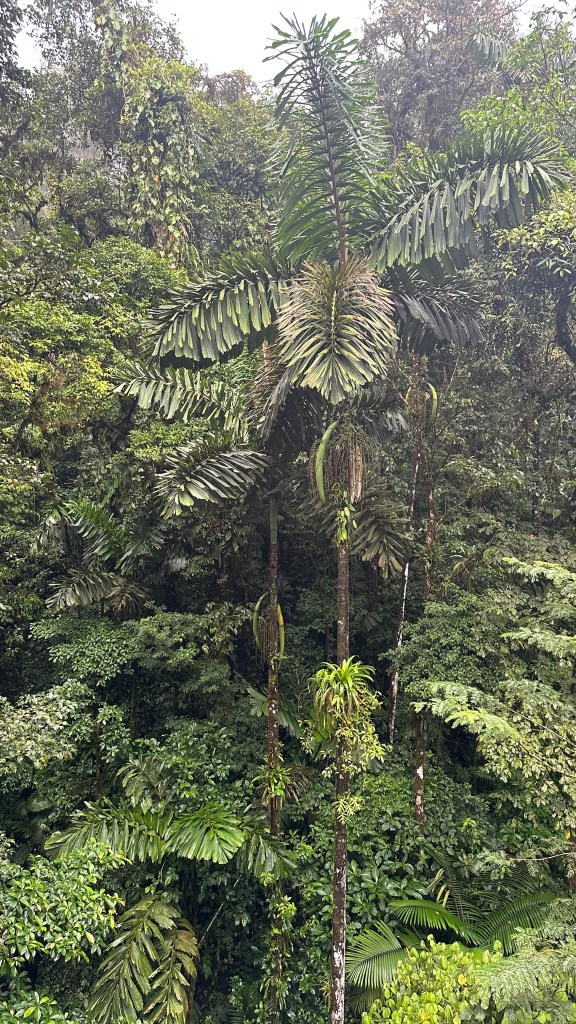
Mey pointed out a “walking palm” tree so nicknamed because it has roots grow on the outside in the direction toward the sun, then will release the roots on the shady side from the ground; the tree appears to “walk” toward the sun over time.
We then found another Broad-billed Motmot. Motmots nest by excavating long tunnels in earthen banks, road cuts, or occasionally termite mounds. They are cavity nesters that create, rather than build with twigs, burrowing tunnels 5–14 feet long with a nesting chamber at the end.
Mey also found for us an Eyelash Viper, a venomous pit viper native to Central and South America, so named because of its distinctive modified scales above its eyes that resemble eyelashes. These scales protects its eyes as it moves through the trees. Like other vipers, it is venomous and should be treated with caution. The snake is arboreal (tree-dwelling) and highly variable in color, up to 10, which aids in camouflage. But unlike a chameleon, it is born a single color which it remains for life. Adults typically range from 20 to 31 inches in length.
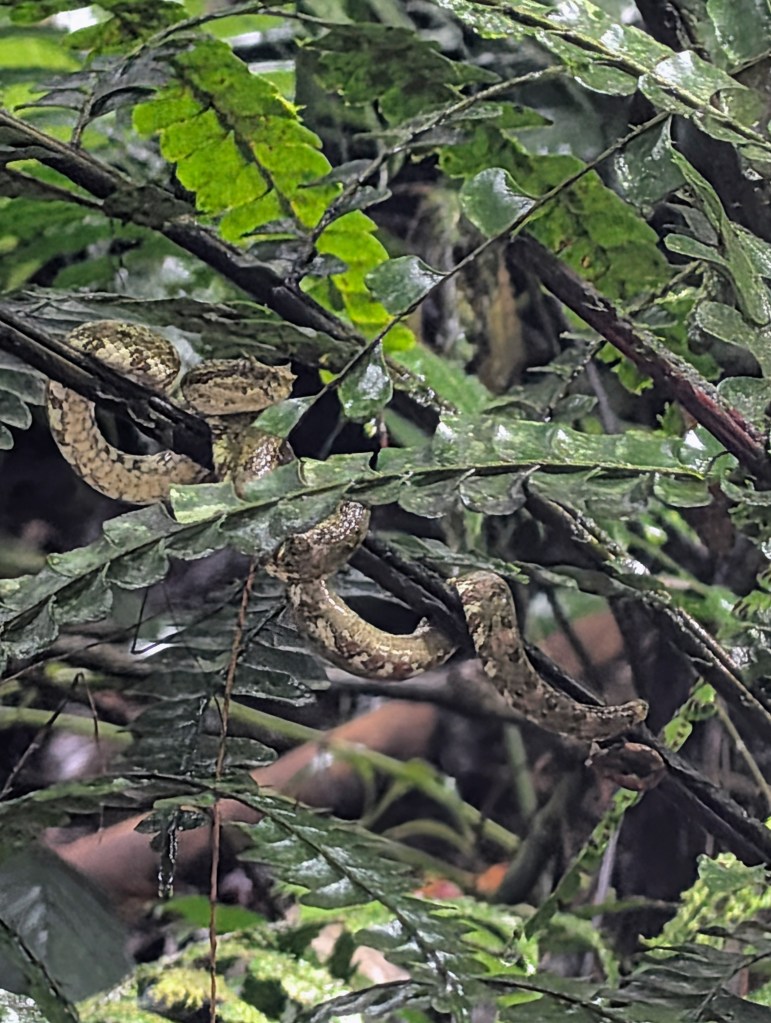
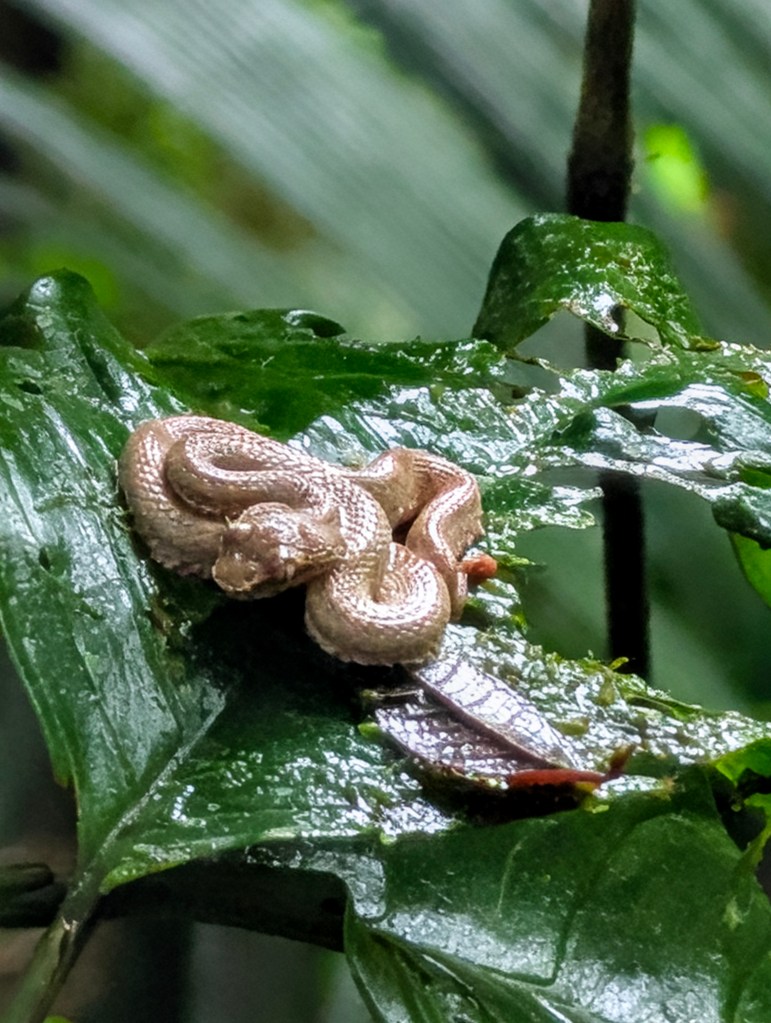
Mey also found a baby eyelash viper. She explained that the babies’ venom is actually more dangerous to humans than that of the adults because they have not yet learned that we are not edible, so they waste too much of their venom trying to immobilize us to no avail.
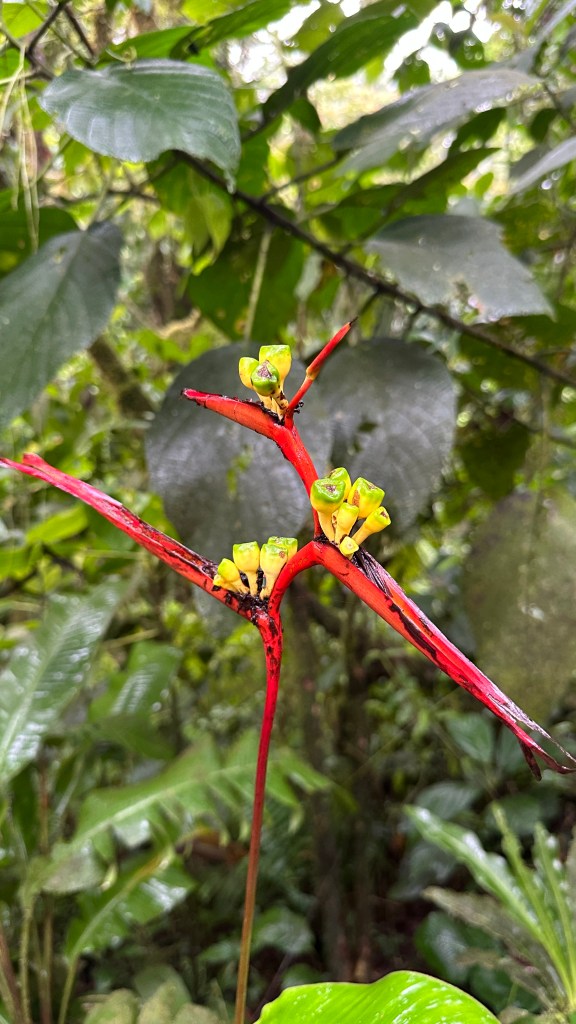
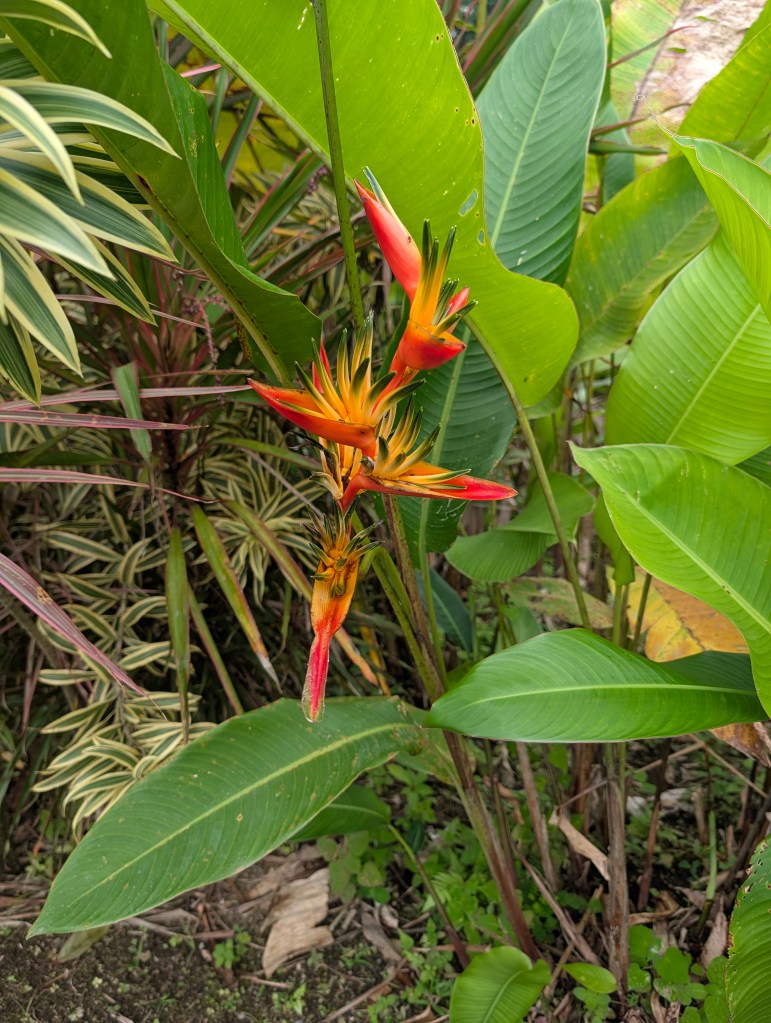
I particularly liked this variety of Heliconia plant. Heliconias are large herbs closely related to bananas and are known for their vibrant, unique inflorescences (flower heads). The colorful parts are actually bracts (modified leaves) that protect the true flowers inside. Hummingbirds are the primary pollinators of Heliconias in the Americas, attracted by the abundant nectar and the specific color and shape of the flowers.
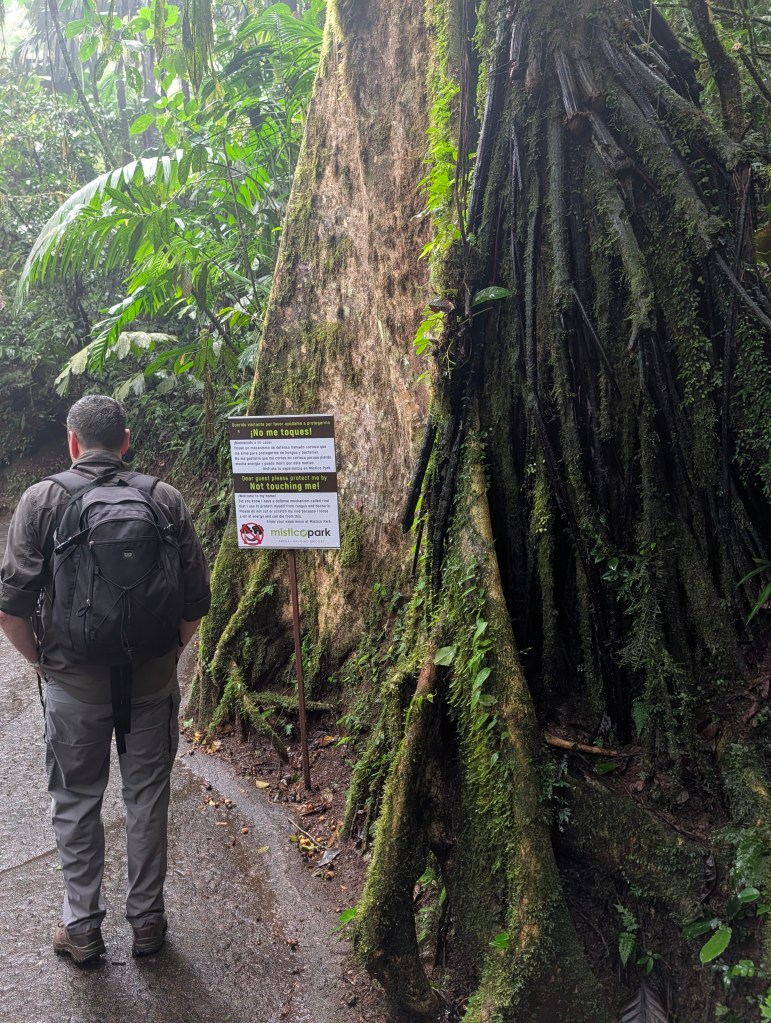
The “Dragon’s Blood” tree is prized for its red sap which has antiseptic properties and is used in healing. This tree has been scraped for its sap by so many people that the park had to erect a “Do Not Touch” sign.
A flower we saw often on our walk was the vibrant red ginger flower, also known as ostrich plume or pink cone ginger. It is a quintessential tropical bloom, known for its bold, architectural, and vibrant form. The actual flowers are small and white, emerging from the top of the showy red bracts (modified leaves) that form the cone shape. We saw a few remnants of these, but they had mostly been knocked off by the heavy rains. The plant is native to Malaysia but is widely found in tropical regions, including Costa Rica. It is a popular perennial herb used for both ornamental purposes and sometimes to flavor cooking.
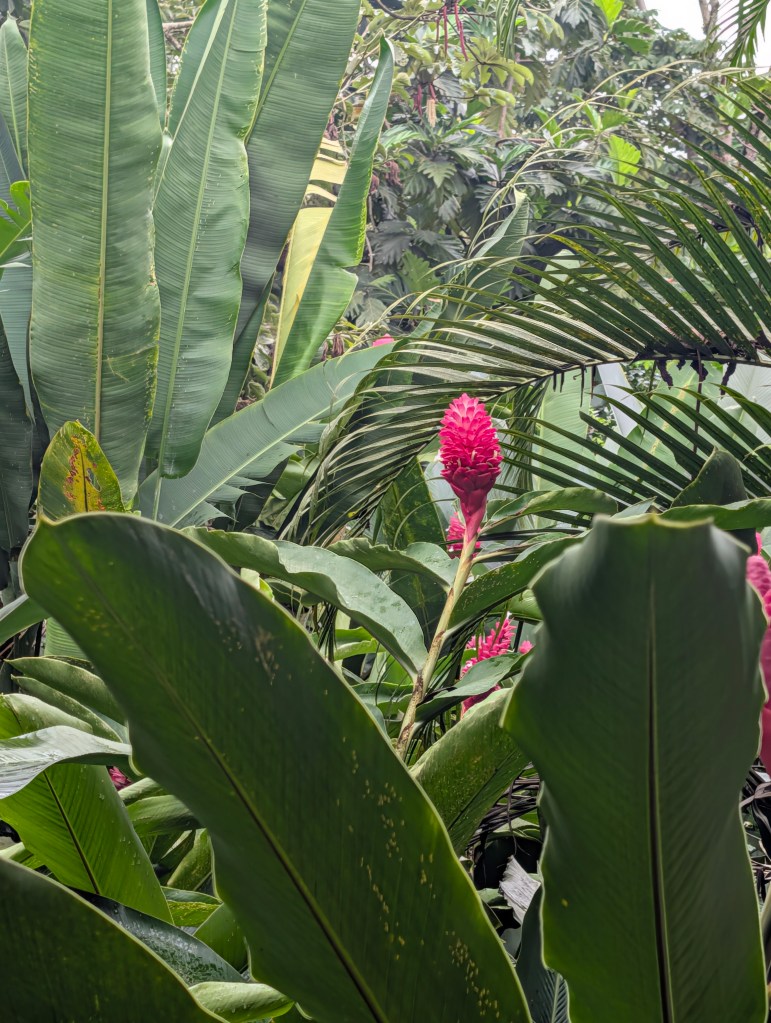
Mey was a bit disappointed that the rain had kept all the monkeys away. The park is home to howler, white-faced and spider monkeys. Howler monkeys are considered the loudest land animals in the world with calls reaching up to 140 decibels, equivalent to a jet engine taking off, and audible from three miles away, and yet we heard none.
As we headed back to the resort for lunch, the sun started to peak out. After lunch we took the break in the rain as an opportunity to explore the resort a bit. We found the hot springs.

The waters are heated geothermally by the Arenal Volcano.
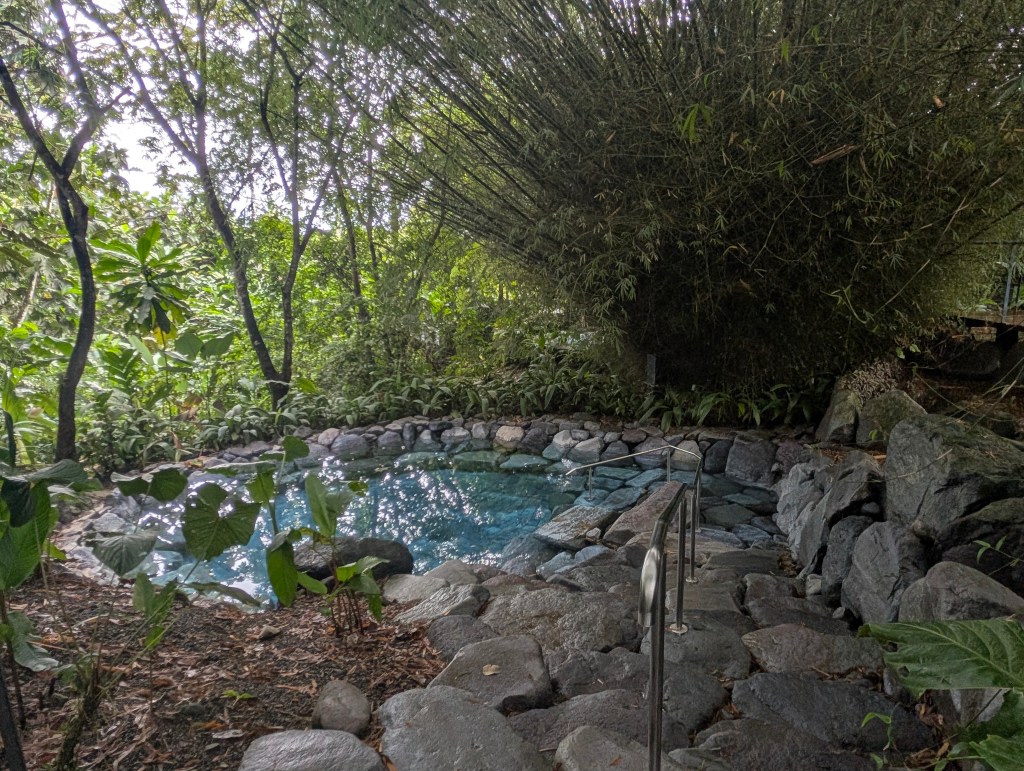
Our resort has a total of 8 pools plus a waterfall.
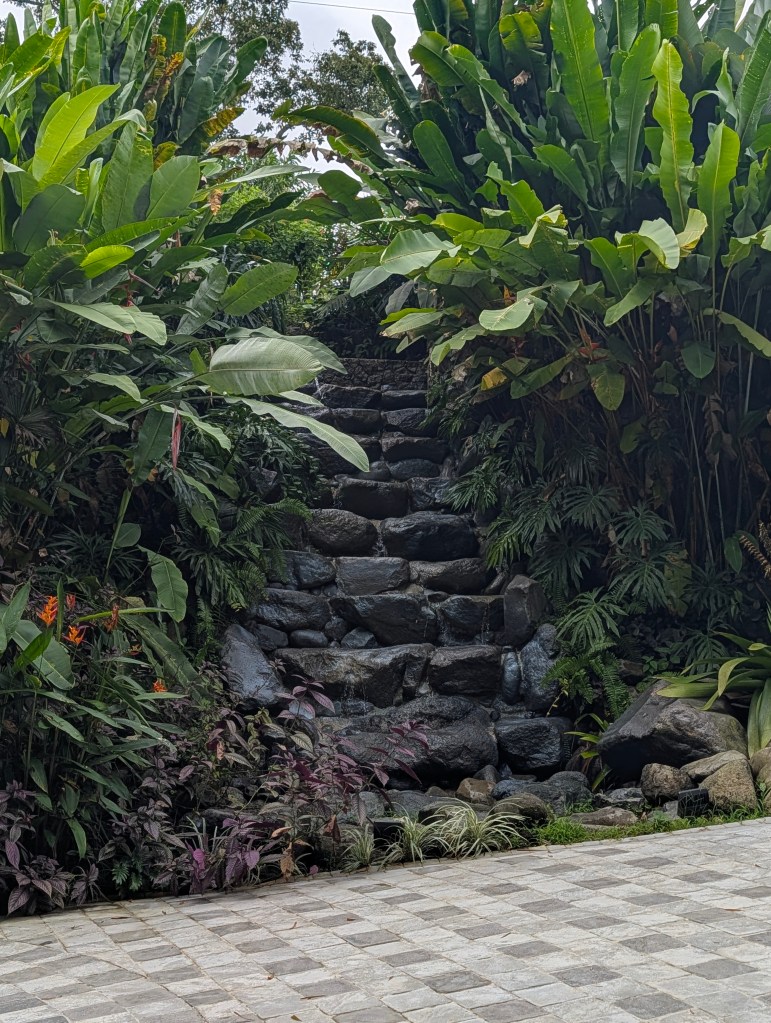
The landscaping around the pool is gorgeous. We found a male scarlet-rumped tanager sitting on a Heliconia.
Having been wet all morning, we were not anxious to jump in. Apparently we wer not alone in this thought as the pools were mostly empty.
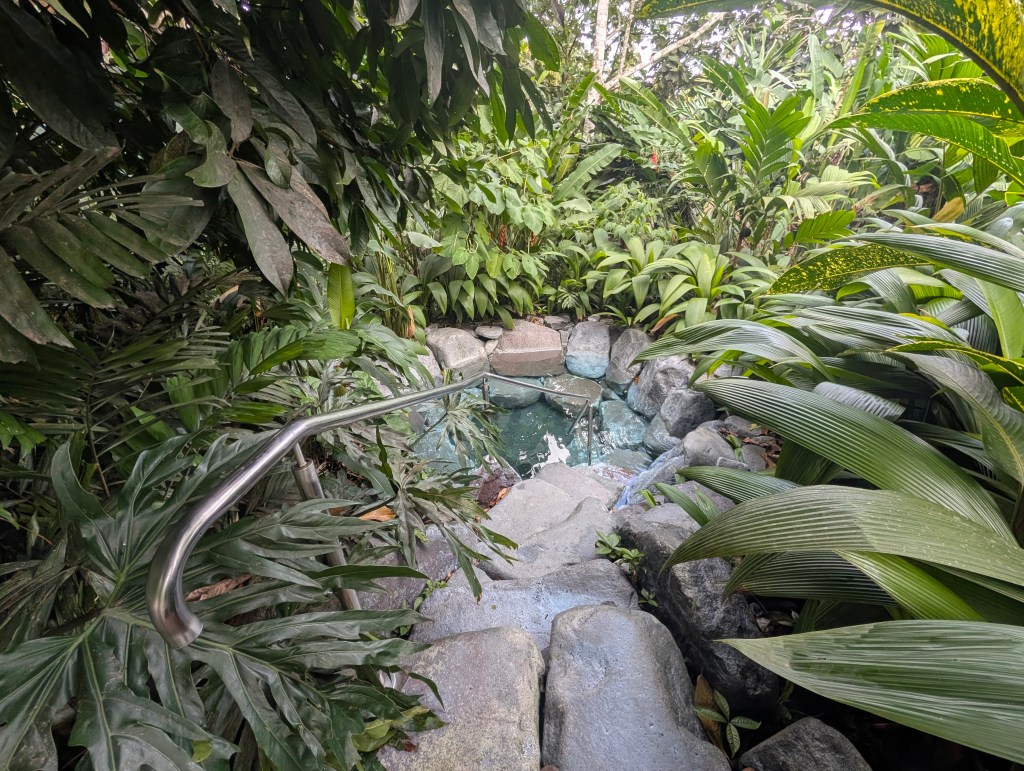
The entire property has gorgeous gardens.
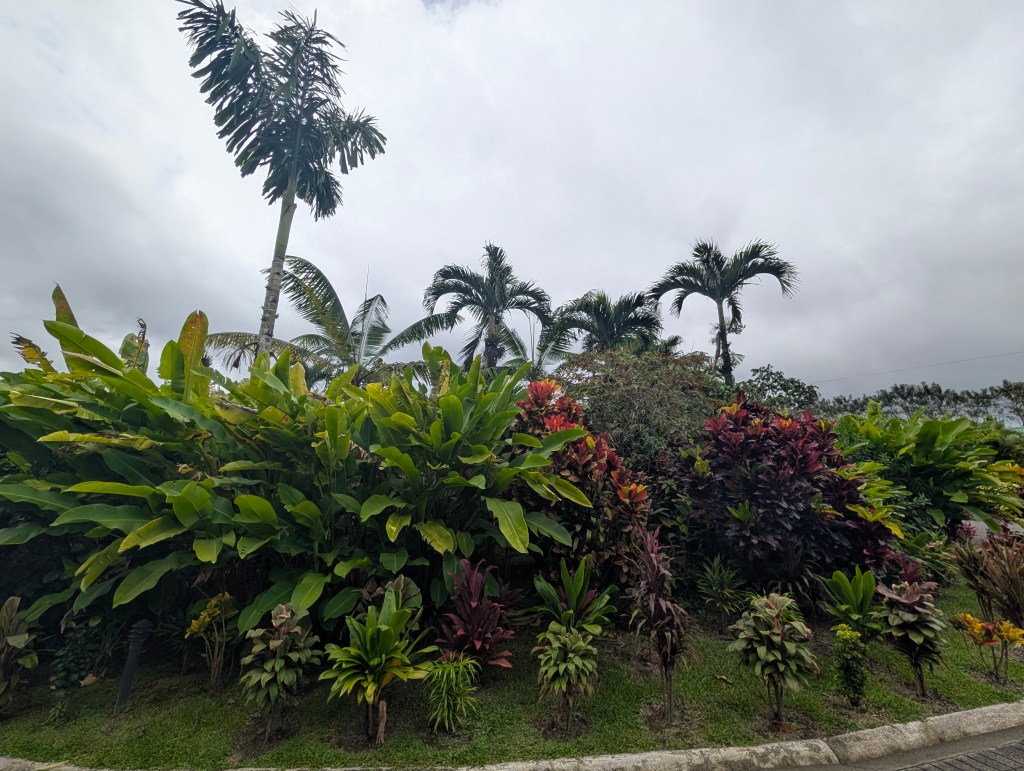
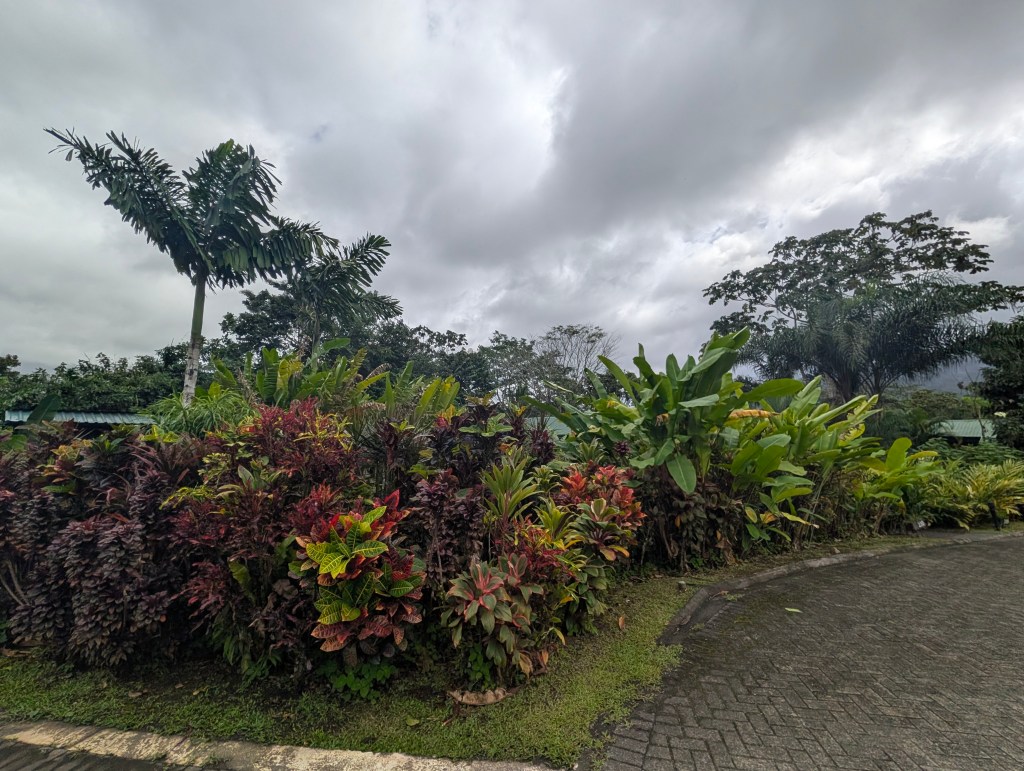
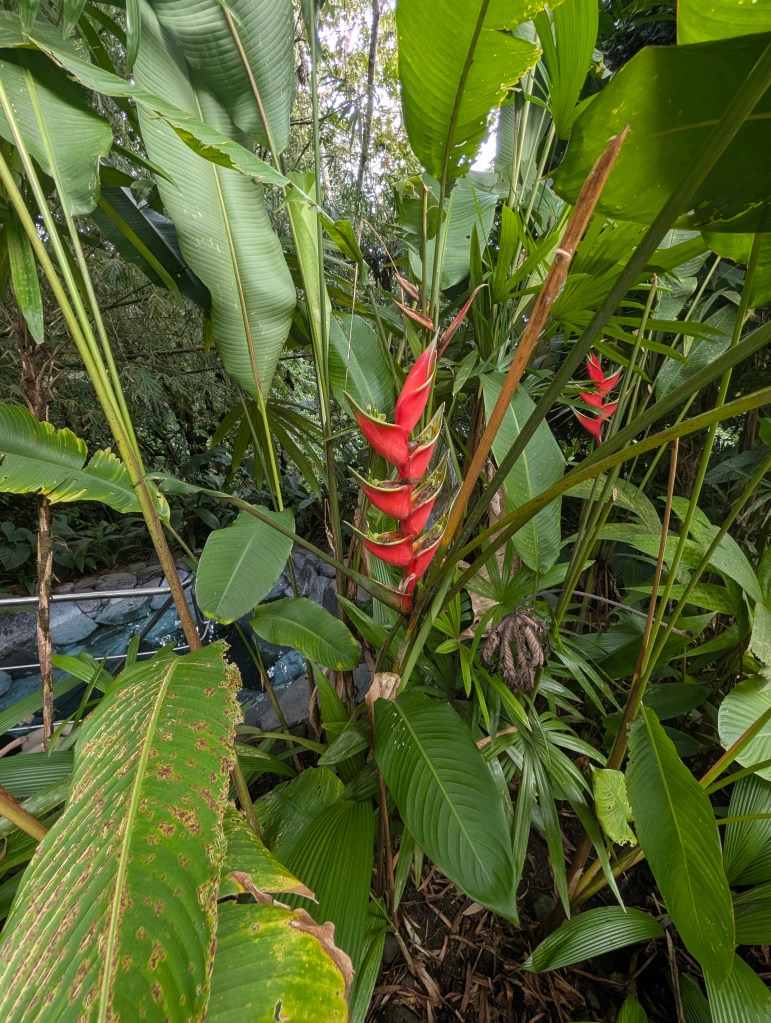
There are many species of Heliconias.
Each room is actually a little villa. Our entrance from the road was hidden until
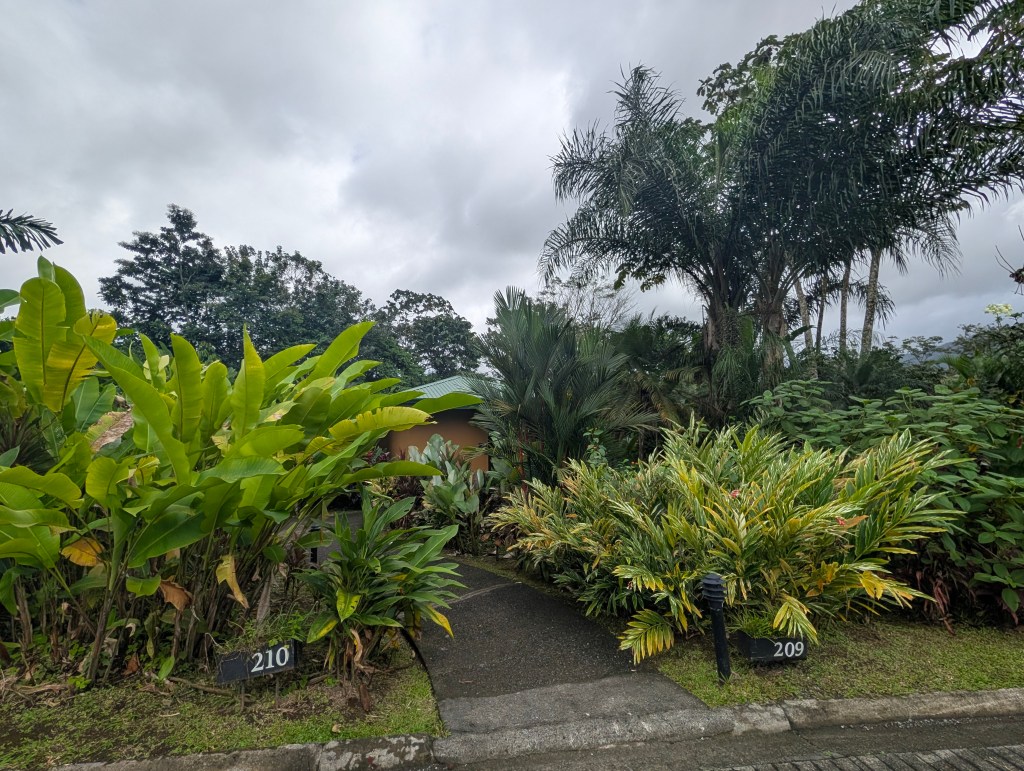
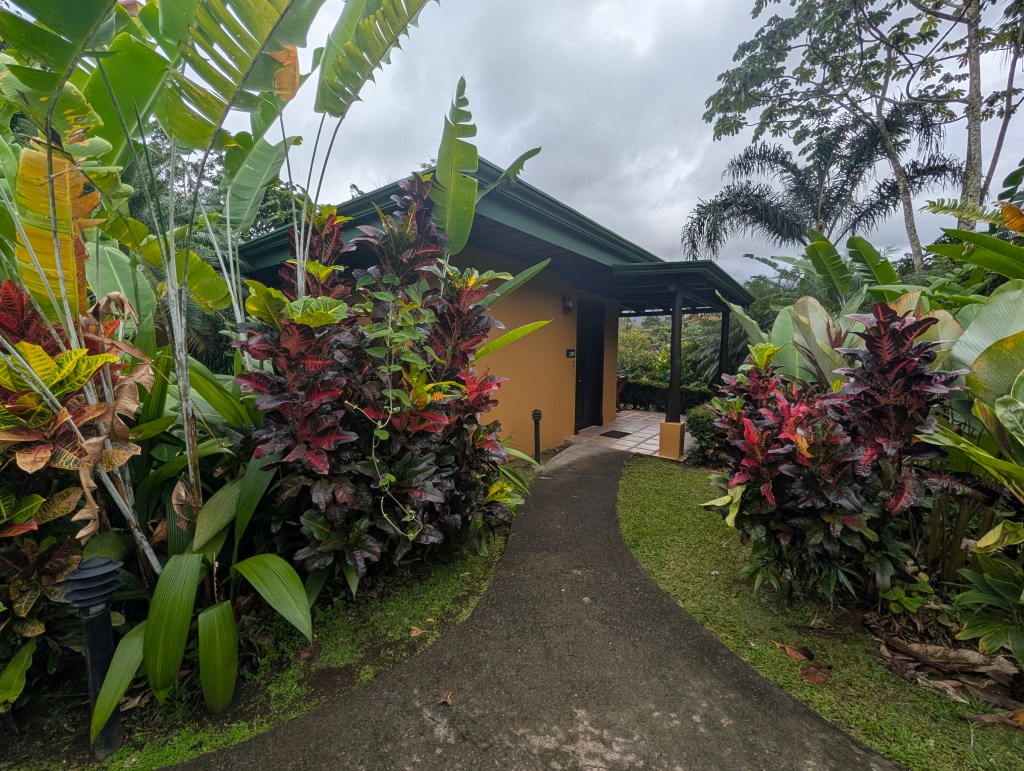
we followed a path to our room.
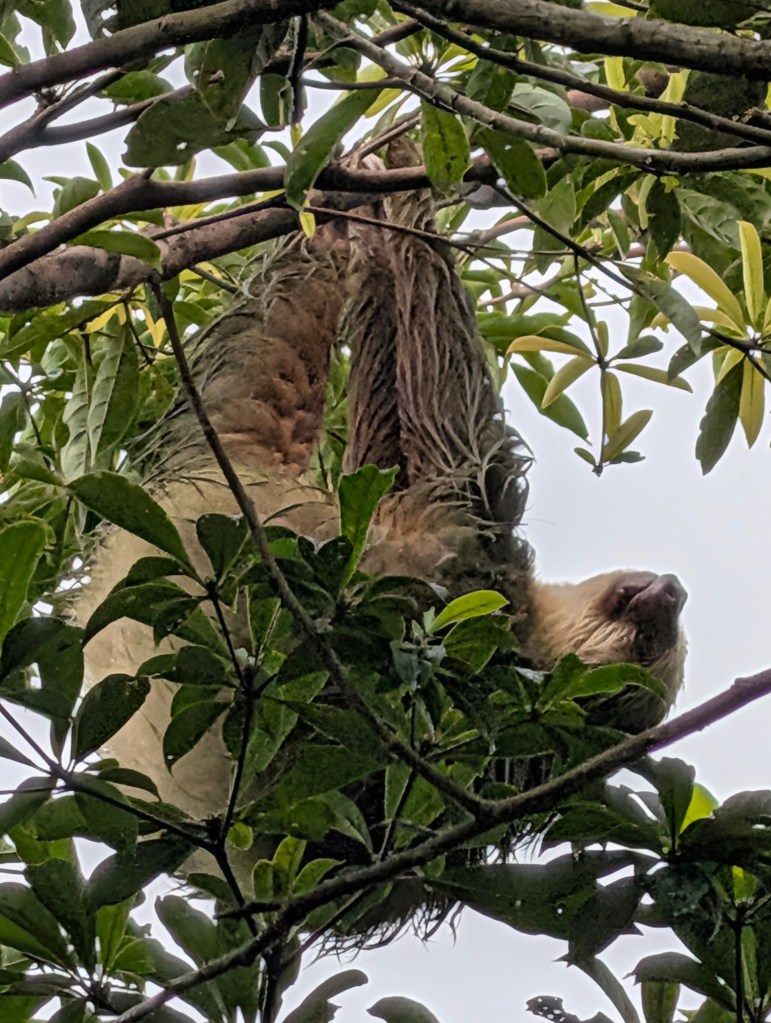
Our afternoon adventure was a trip to the Sloth Observation Conservatory. Of course, the rain had started up again. We were met by our guide Steve who explained that in is unlawful to cut down trees along the Lava River which makes this property along the river with its very tall trees a perfect habitat for sloths plus they can move back and forth across the river. Sloths live mostly in the trees. They generally sleep for 20 hours a day because it takes them so long to digest their food, they need to conserve energy. They must leave the tree to defecate, which they do only once a week, generally only at night. When they are on the ground they are vulnerable to predators which include pumas, boas, and hawks. Although they leave the tree to defecate, they give birth in the tree. Sloths are herbivores and eat many types of leaves, but they like those of the Cecropia tree the best. There are two species of sloths in Costa Rica: the two-toed sloth with a pointier nose, and a three-toed sloth with a rounder, smiley-looking face, the latter is the one most often characterized in advertisements. Having told us all of this about the sloths, Steve went on to explain that they are nocturnal and generally hard to find during the day.
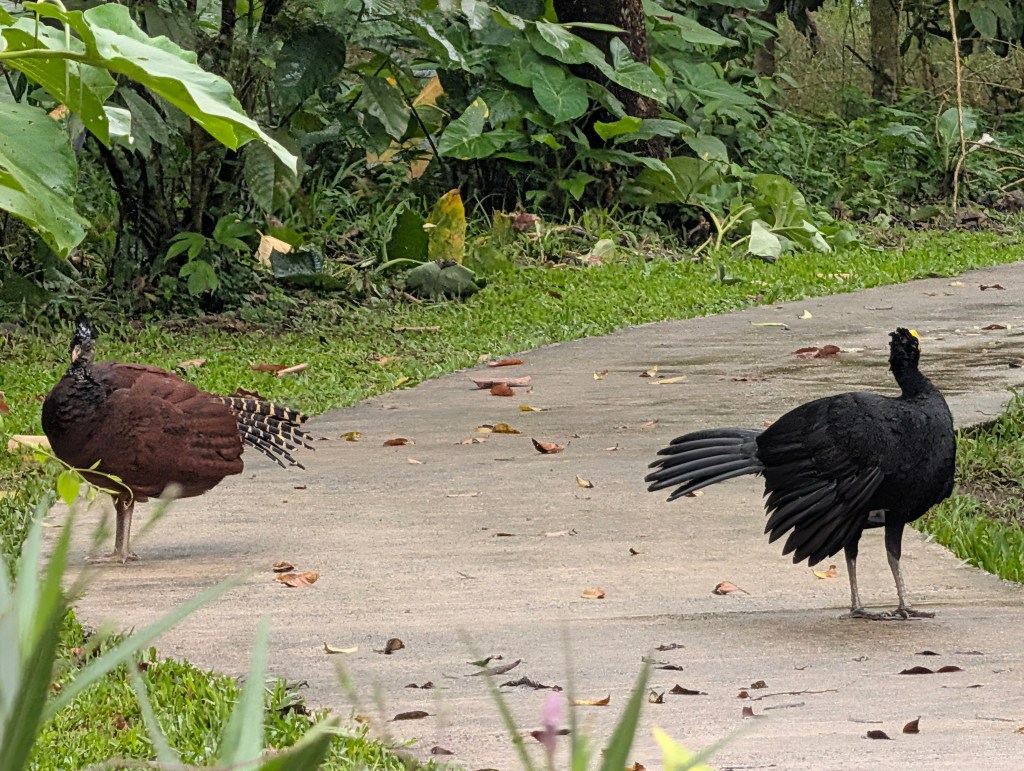
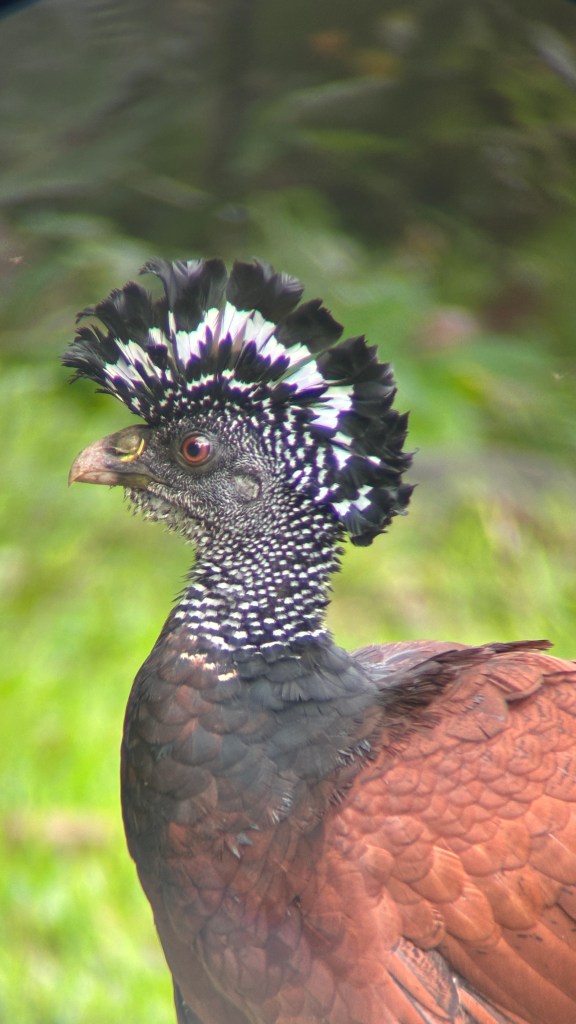
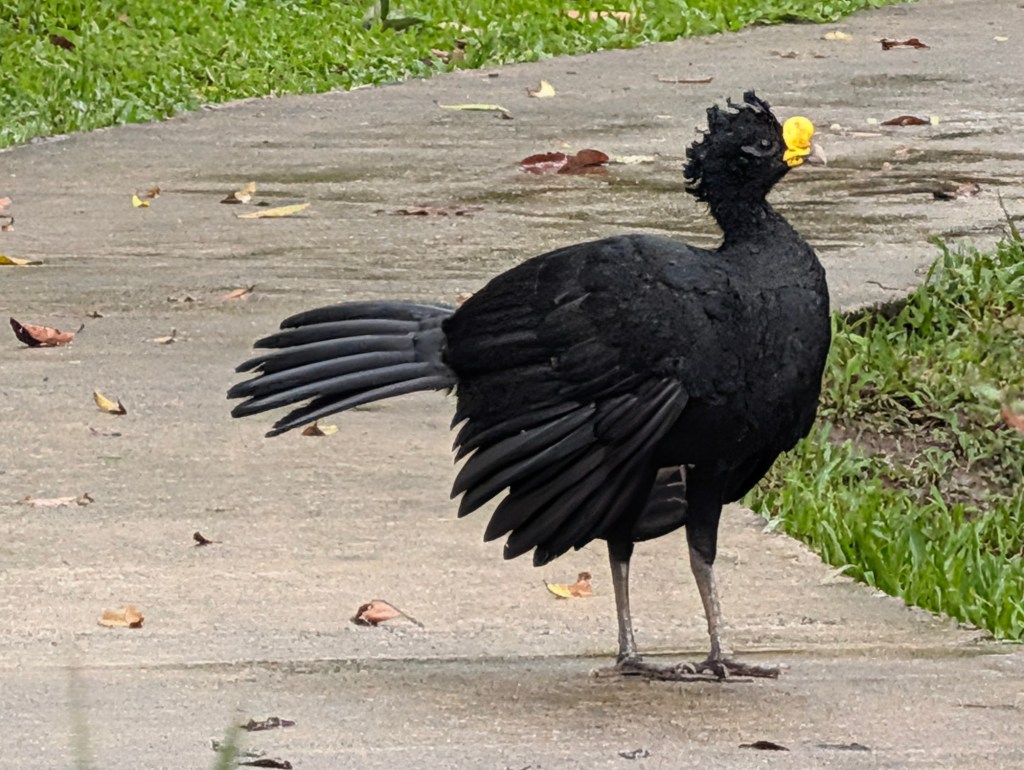
Our first encounter was with a pair of Great Curassows. The bird on the left is a female, and the one on the right is a male. Great curassows are large, pheasant-like birds native to the Neotropical rainforests, ranging from eastern Mexico to northwestern Ecuador. They are the largest of the pheasant/turkey family. They are often seen on the forest floor, but also feed in trees. Males are typically glossy black with a distinctive yellow knob on their bill and a curly crest, while females can exhibit rufous, barred, or black color morphs. The female in the image is a rufous morph. They are large, robust birds, with males weighing around 8.8 lbs. The species is rarely found outside of protected areas due to over-hunting.
I had a picture of a female above, but her head is so beautiful, I am including a closeup here.
And here is a better picture of the male revealing his distinctive yellow knob.
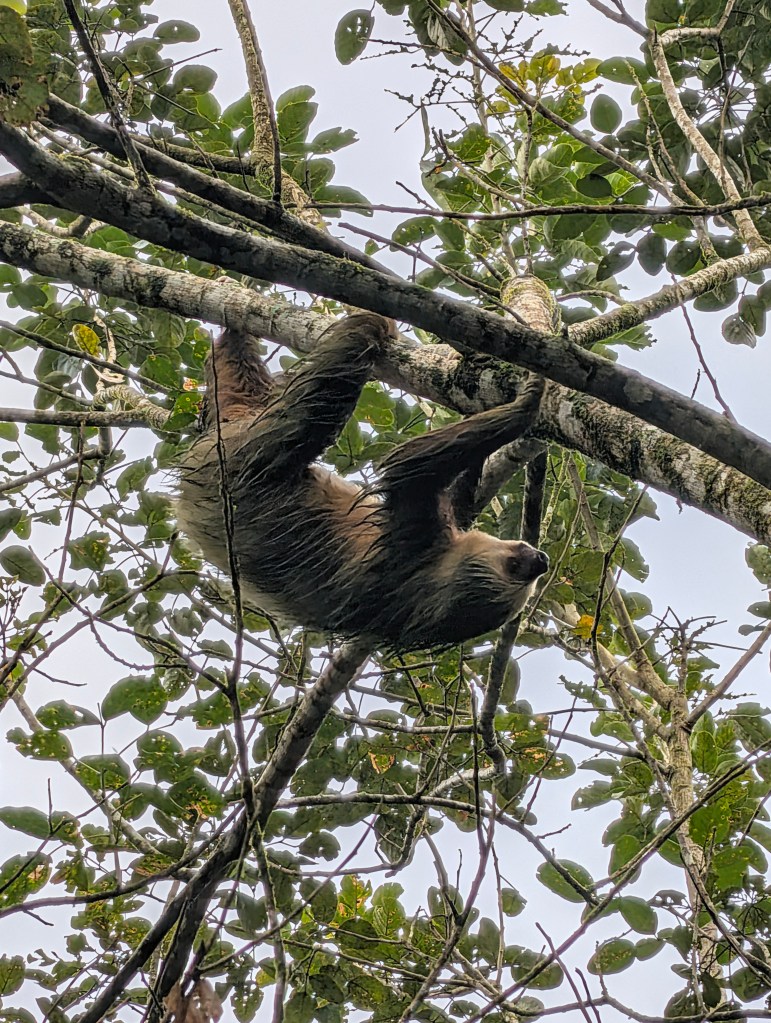
As we ventured down the path we immediately found a two-toed sloth in the typical sleeping position.
But this guy was not asleep!
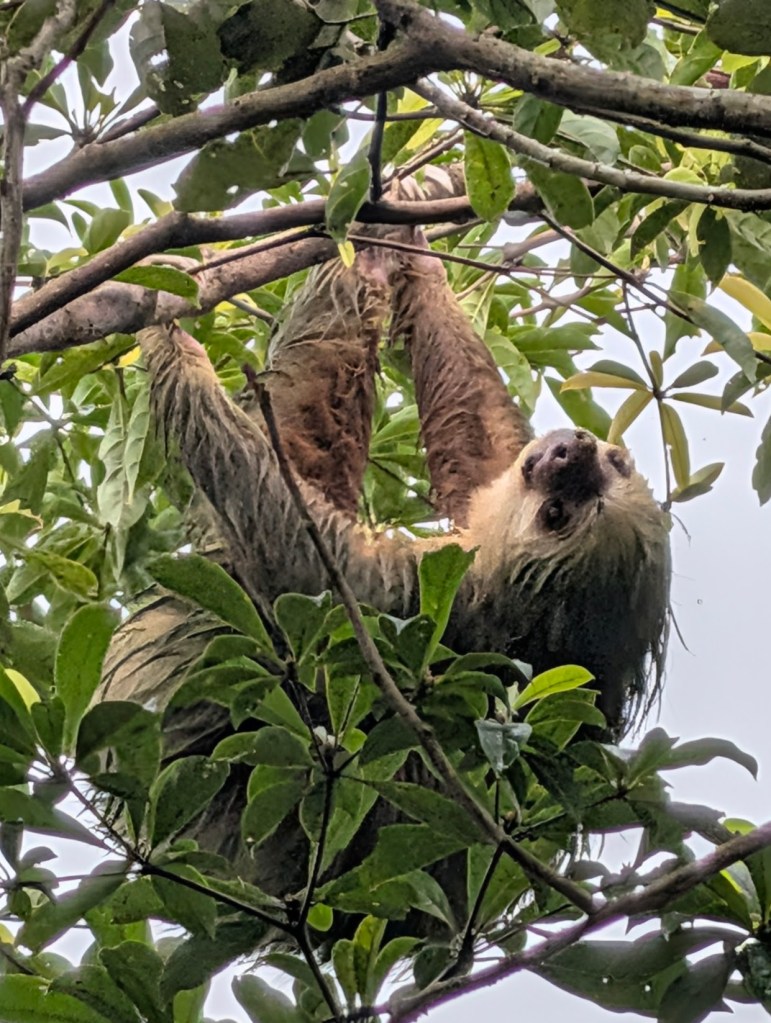
Steve was very excited as the sloth started to move. He kept telling us how very unusual it is to see a two-toed sloth this active in the afternoon. We stayed for several minutes and took several videos, which unfortunately are not compatible with this blog format.
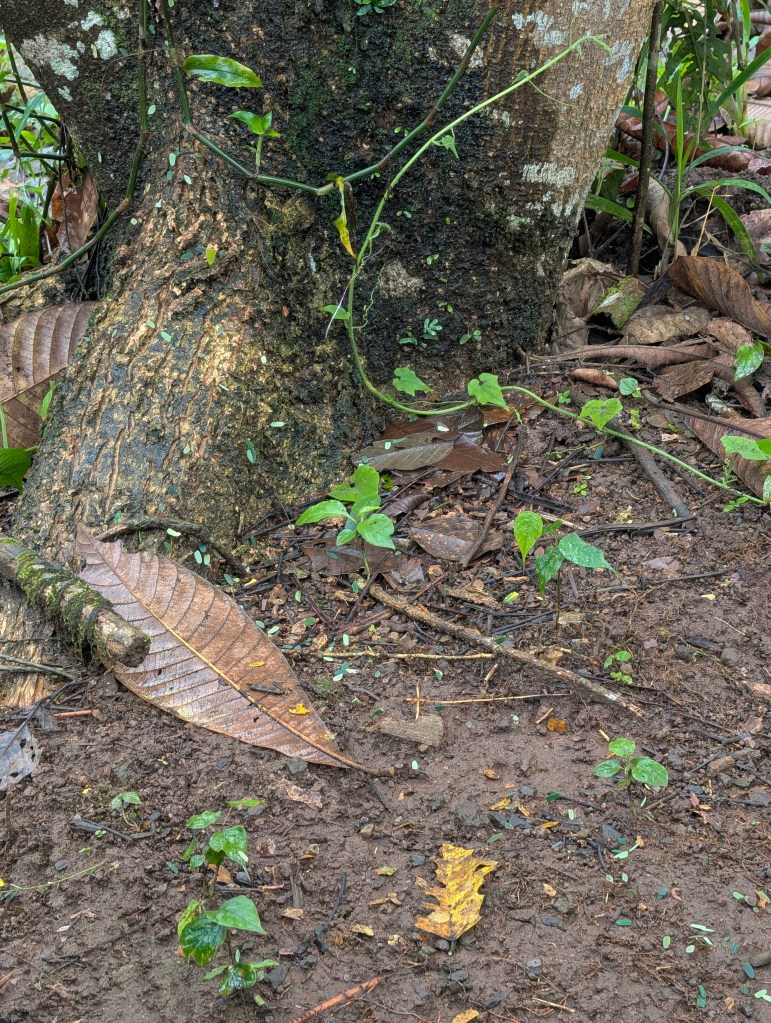
We saw a busy colony of leaf-cutter ants. Steve explained that they are known for their extensive foraging trails where they carry leaf pieces to their massive underground nests. They are considered nature’s farmers, demonstrating advanced agriculture by growing their own food source. They don’t eat the leaves; they use them as mulch to grow a specific fungus, their actual food source. Colonies have distinct roles, with soldiers guarding and workers foraging and tending the fungus. They are recognizable by their long, clean lines of ants carrying leaf pieces many times their body weight. In the picture below find the little green dots that start in the lower right-hand corner and extends past the upper edge of the large, prominent brown leaf to the base of the tree.
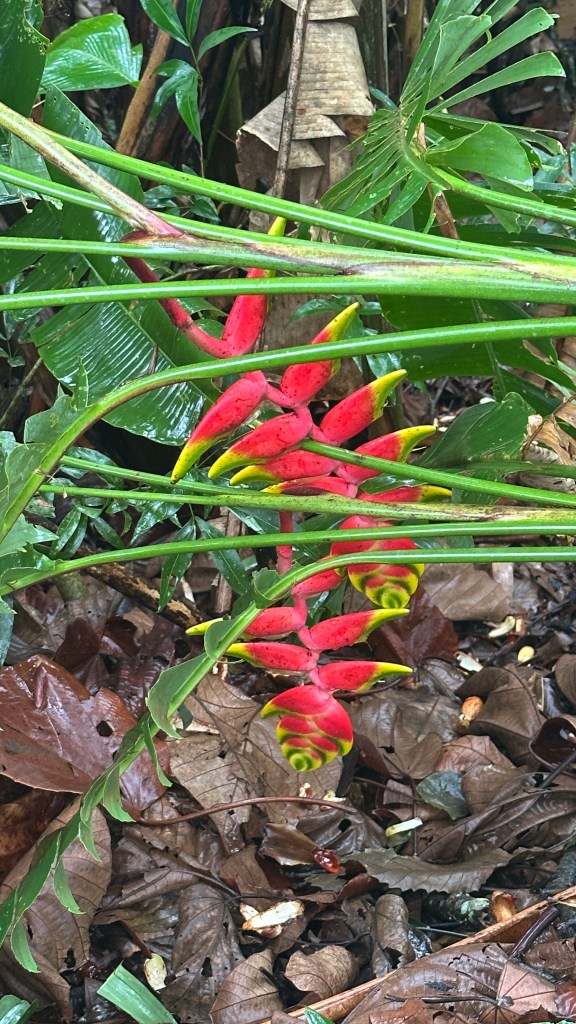
And we saw yet another variety of Heliconia.
Next we found a Hoffmann’s Woodpecker. This individual appears to be a female, as it lacks the red crown patch found on males. They are resident birds found along the Pacific slope from southwestern Honduras to central Costa Rica. They are common in open woodlands, forest edges, gardens, and urban areas.

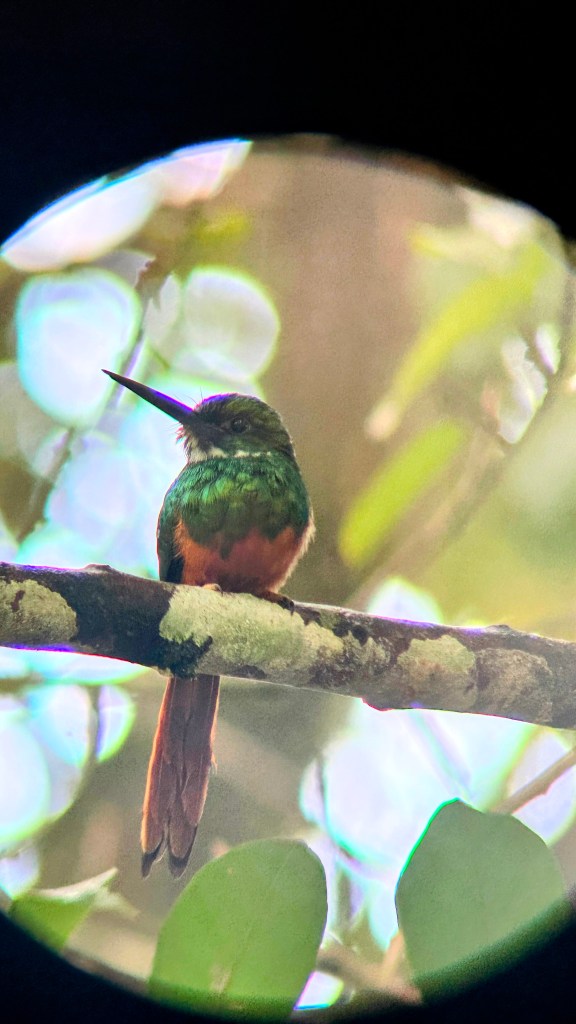
And we found a Rufous-tailed Jacamar. It is known for its iridescent green upper parts and rufous (reddish-brown) underparts and tail. The bird is typically around 10 inches long. The bird is an aerial hunter, using its distinctive long, sharp bill to catch flying insects like butterflies, dragonflies, and wasps mid-flight. This species is common in Costa Rica and can be found from southern Mexico down to southern Brazil and Ecuador. They typically perch upright on exposed branches or vines at mid-height in forest edges and clearings.
We crossed yet another hanging bridge, the sixth for the day.

When we returned to our resort, our resident sloth was high up in its tree doing what sloths do best: sleeping.
After a delicious sushi dinner by the pool, despite the rain, we called it a night.

In the morning it was time to say goodbye to La Fortuna withour ever having seen the volcano for which the area is named. And yes, it was still raining. We joined a bunch of other folks on a boat for the Lake Arenal crossing.
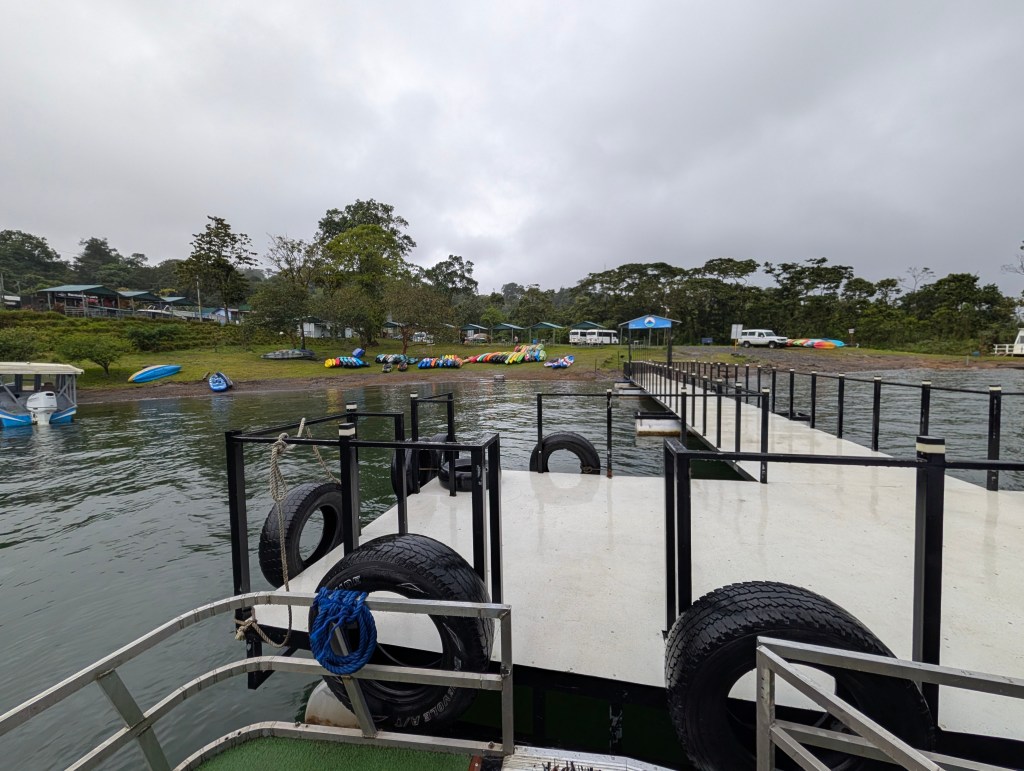
Today not only we but also our luggage were to get wet.


The views from the boat were nonexistent.

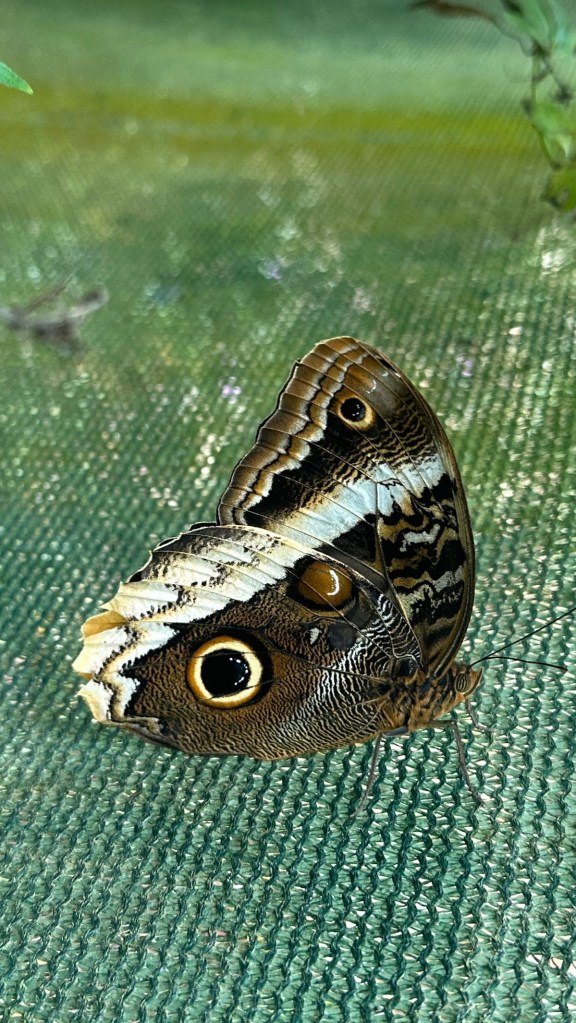
The highlight was the visit from this Owl butterfly, so named because of the markings that resemble an owl’s eye, a defense mechanism to fake predators.
Once on the other side of the lake we all boarded a bus headed to Monteverde, which sits at a high elevation in the Tilarán Mountains, generally ranging from about 4,600 to 5,900 feet above sea level, creating its famous cool, misty cloud forest climate and high biodiversity. After a couple of hours we made a pit stop in this cute cafe that actually encouraged graffiti; we all signed.

We were dropped off at our new accommodations: Böëna Monteverde Lodge and Gardens.

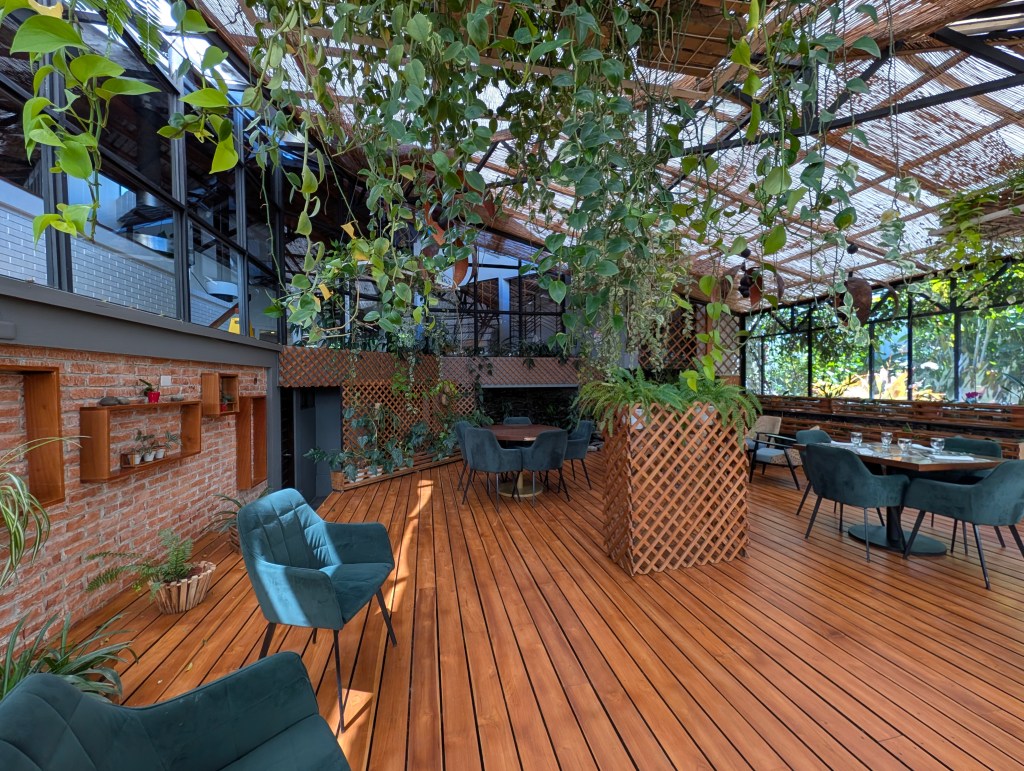
We had a lovely spacious room with a balcony that purportedly had a view, but forest growth had blocked it mostly. But the lodge had some really warm and comfy places to lounge.
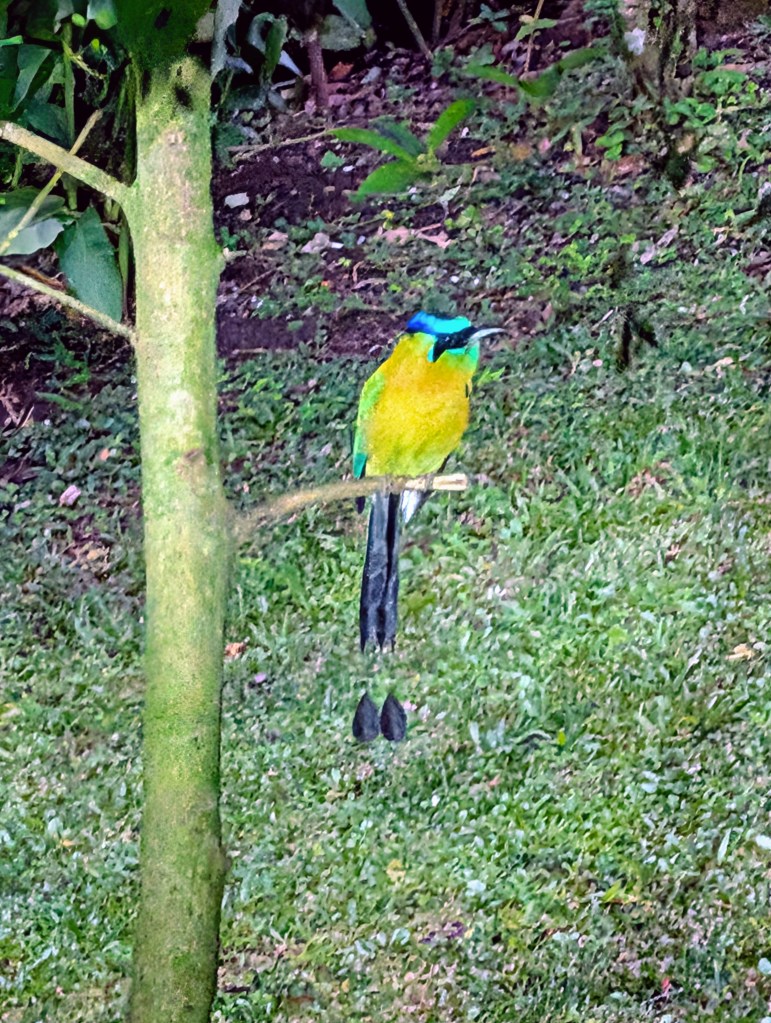
We were picked up in the evening for our night tour of the forrest. Our guide for the evening was Carlos who told us there are over 940 species of birds in Costa Rica, including migratory ones, which represents over 10% of the world’s species in one tiny country. The reason is Costa Rica is a country with multiple ecosystems (rainforests, cloud forests, coasts, wetlands) packed closely together. Of course for us it was still raining, which is a detraction for the wildlife as well as for us. But we did manage to see a Lesson’s Motmot, also known as the blue-diademed motmot. It has a vibrant blue crown with a distinct black central patch. There are 6 species of Motmot in Costa Rica: the Lesson’s Motmot is the only one found at Monteverde’s high elevation.
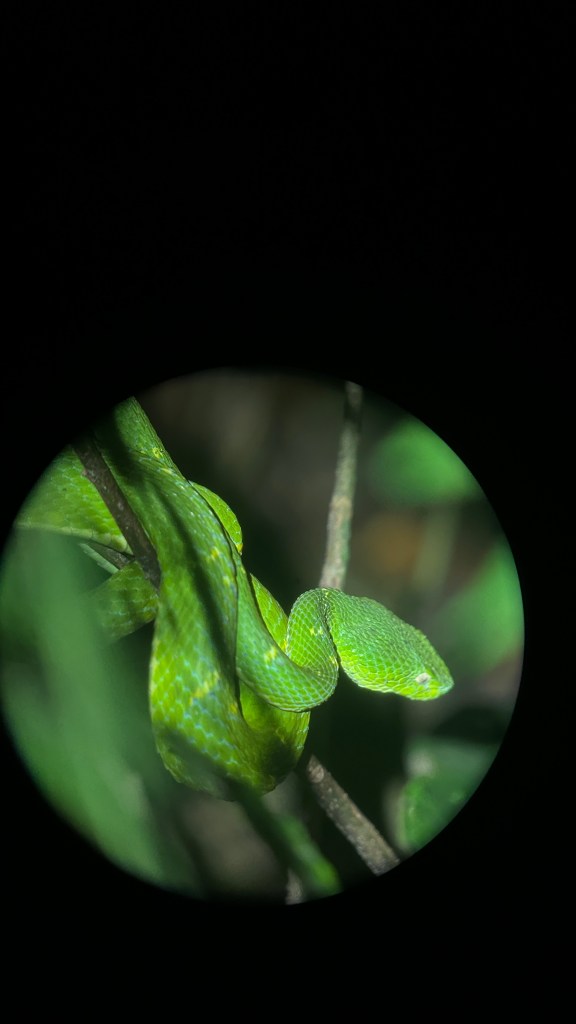
Next Carlos spotted a Side-striped palm-pit viper, a venomous snake found in Central America. Adults typically average between 60 and 70 cm in length, with a thin body and a well-differentiated head. It is known for its vibrant green coloration and a yellow-white stripe running along its side, which helps it camouflage in tropical foliage. This species is arboreal (tree-dwelling) and a master of ambush. It is native to the mountainous rainforests of Costa Rica and western Panama.
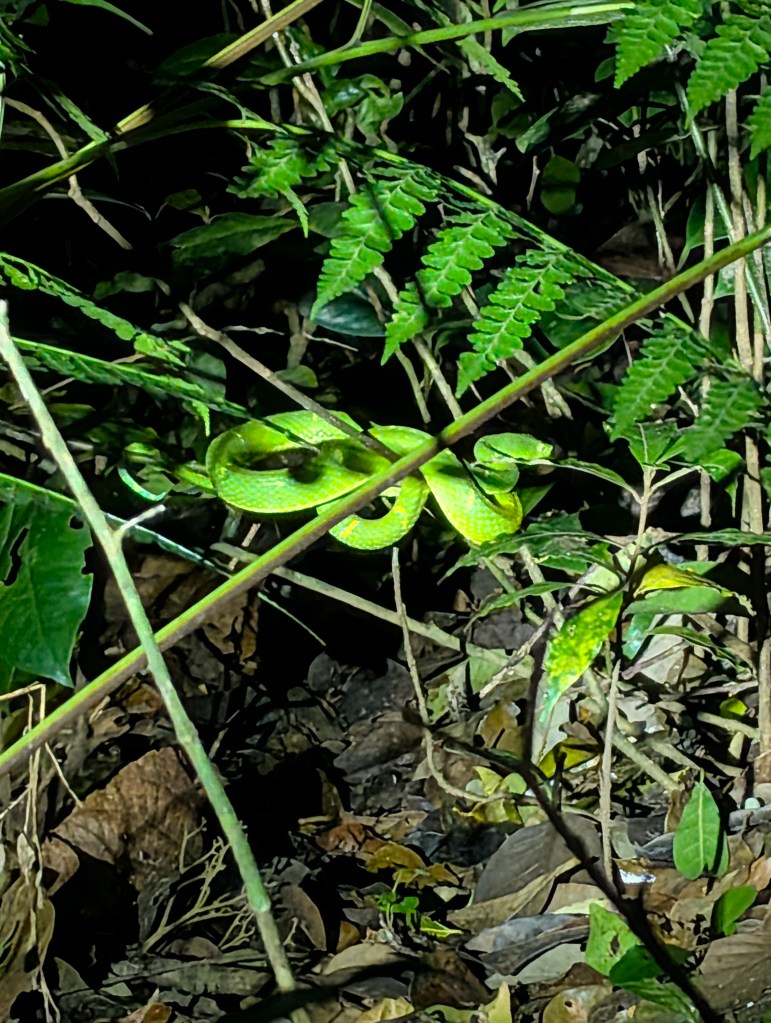
Carlos explained that in general the way to distinguish a poisonous snake from one that is not is by the shape of the head. A poisonous snake will have a flattened, somewhat heart-shaped head while a nonvenomous snake will have a thinner, pointy head.
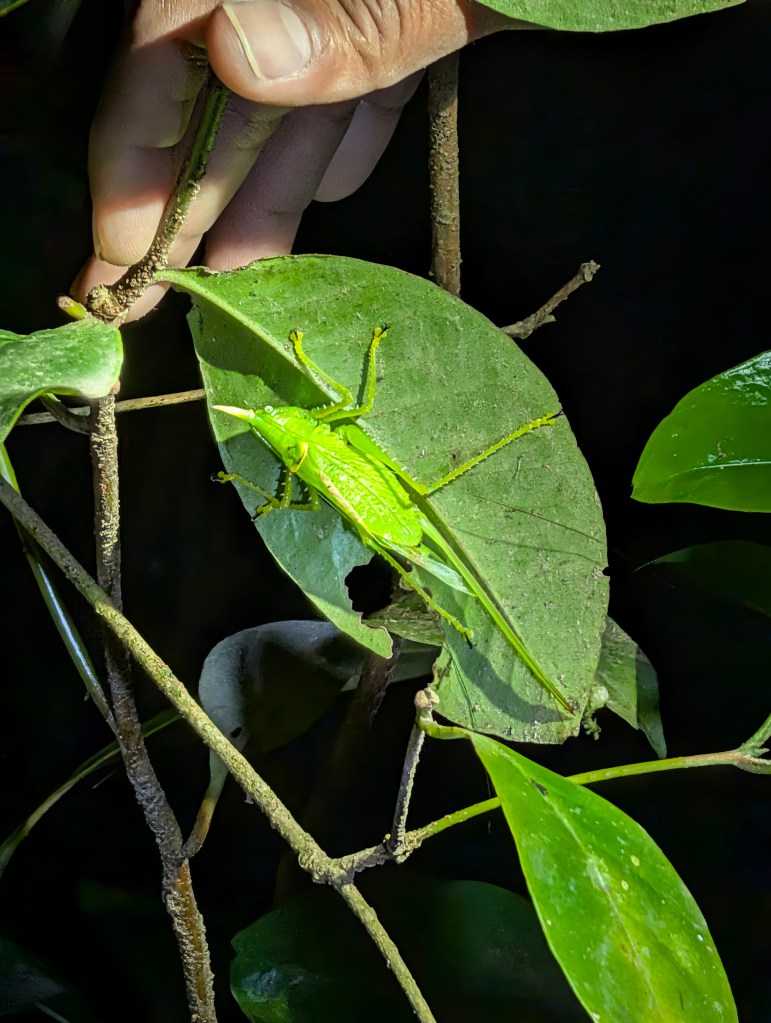
Next Carlos spotted a rhinoceros katydid, a species of conehead katydid found in Central America. Like many members of its family, this species is omnivorous, feeding on insects, snails, lizards, berries, foliage, and seeds. It is known for the distinctive, long, horn-like projection on its head, which it uses to fight other males or deter predators. This one, however is a female, which can be discerned by the long tail through which she lays her eggs; males have no tail. These katydids can grow up to 3 inches in length. They are nocturnal insects.
Carlos showed us a 400 year-old strangler ficus (fig) tree, proof that this is a primary forrest.
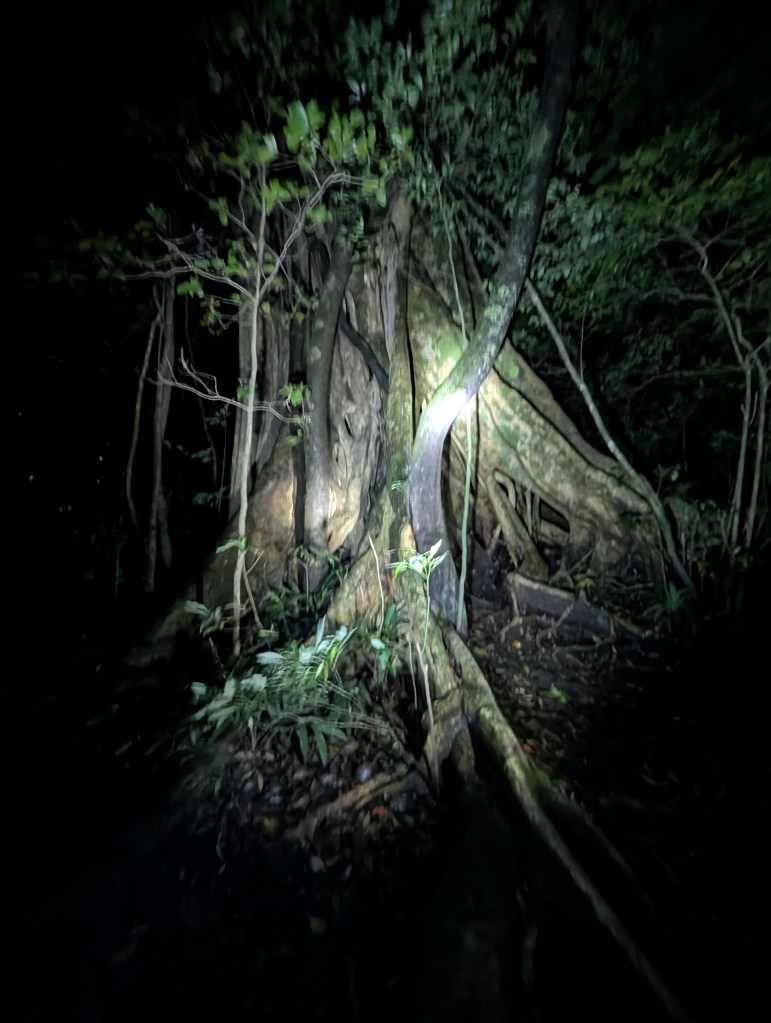
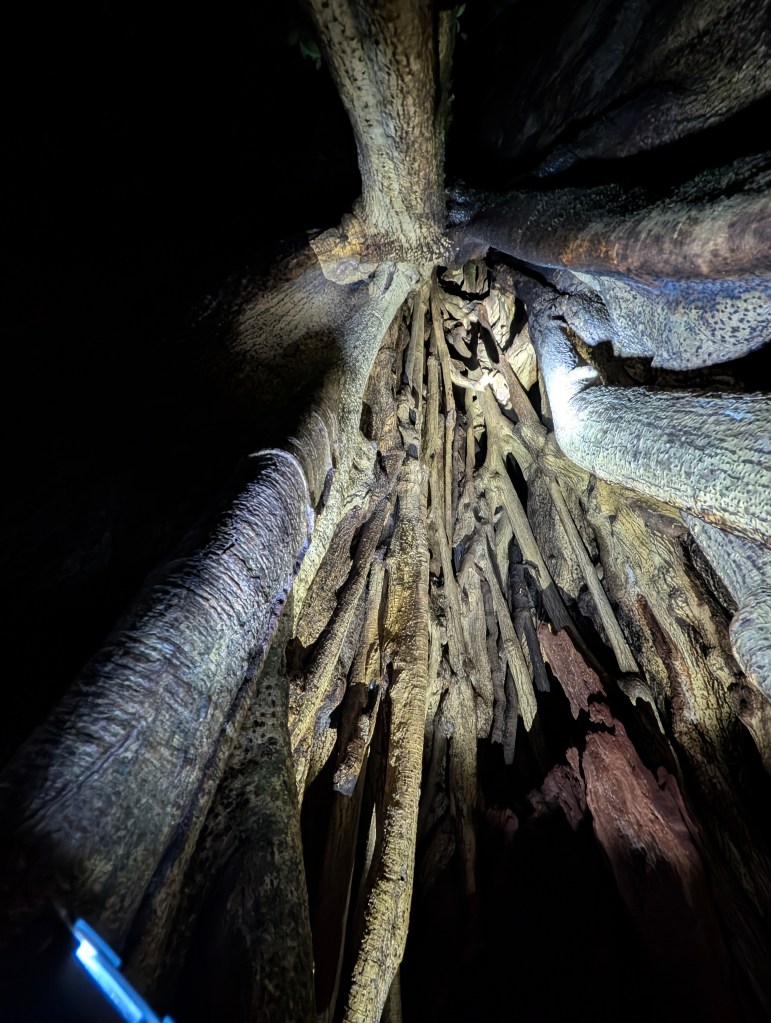
He explained to us that strangler figs begin their life as epiphytes in the canopy of a host tree. Over time, they send roots down to the forest floor, which thicken and eventually envelop and outcompete the host tree for resources and sunlight. The host tree eventually dies and decays, leaving the hollow, intricate structure of the fig tree. The picture below is looking up into the hollow of the strangler ficus.
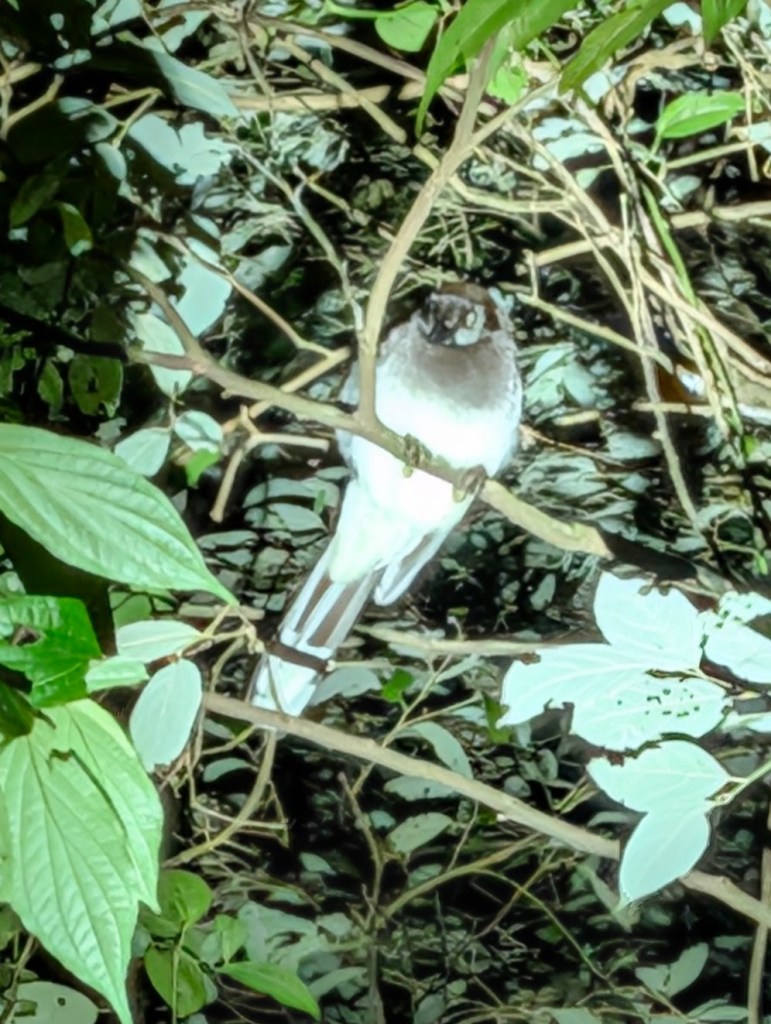
We found several Brown Jays sleeping in the trees. Carlos told us that birds generally sleep on the out branches of trees so if a predator ascends the trunk, the bird should feel the vibrations, awaken, and fly away. With the heavy winds accompanying the rains, the birds will sleep poorly not being able to differentiate the source of the vibrating branches.
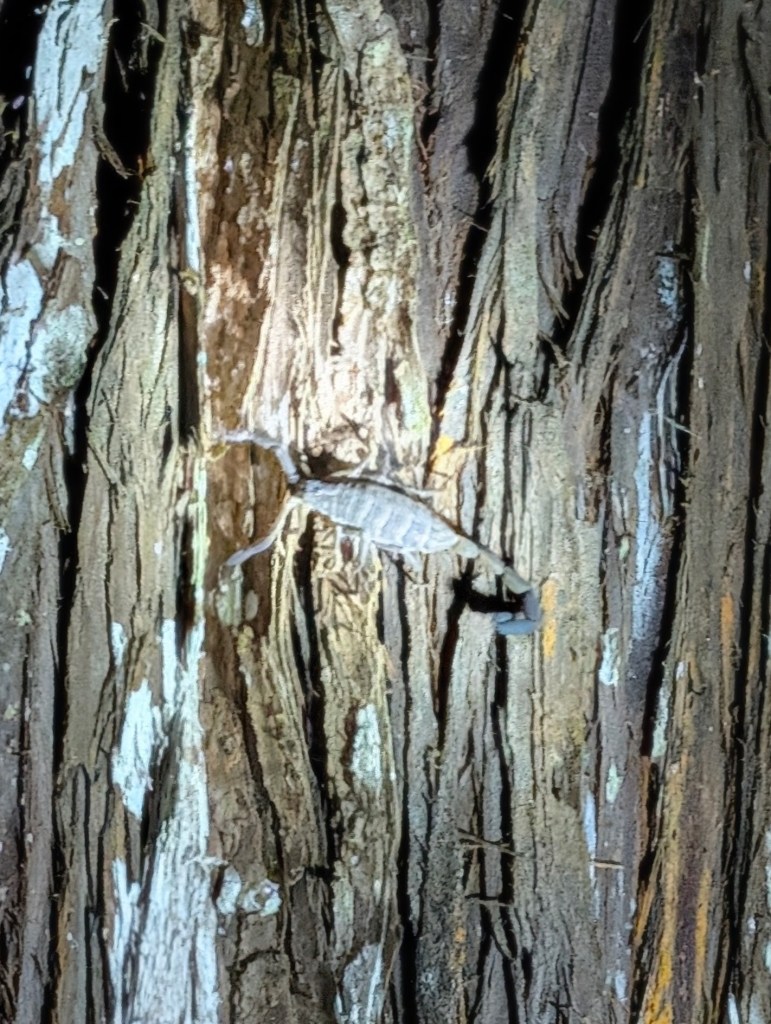
Another guide with a group called us over to see a bark scorpion they had found using an ultraviolet light. Scorpions are arachnids and nocturnal predators that feed on insects and spiders. The venom of most scorpions found in Costa Rica is not lethal to humans; stings are generally comparable to a bee sting. There are 14 species of scorpions in Costa Rica.
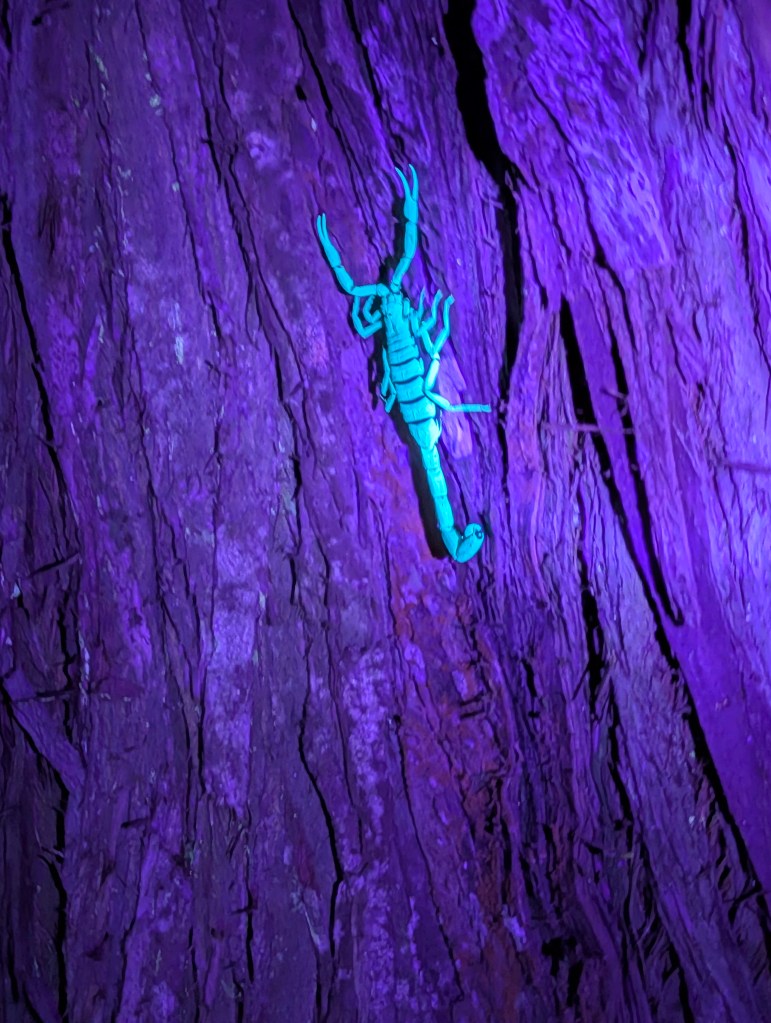
Scorpions are ancient creatures, with ancestors dating back around 435 million years. They are shy and tend to hide during the day, often found in wooded areas. The bark scorpion is named for its tendency to burrow into the barks of trees. However, without the aid of the ultraviolet light, it would be difficult to find even in bright light.
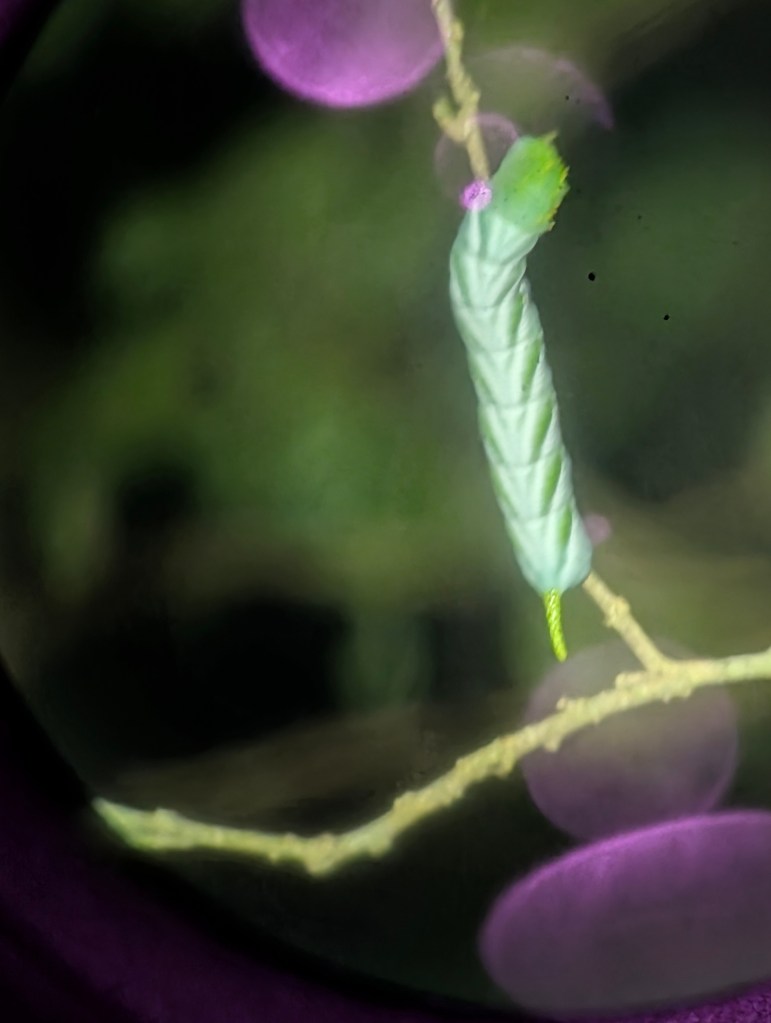
Carlos pointed out a Oleander hawkmoth caterpillar. These caterpillars are known for their bright, vibrant colors. They feed on oleander plants.
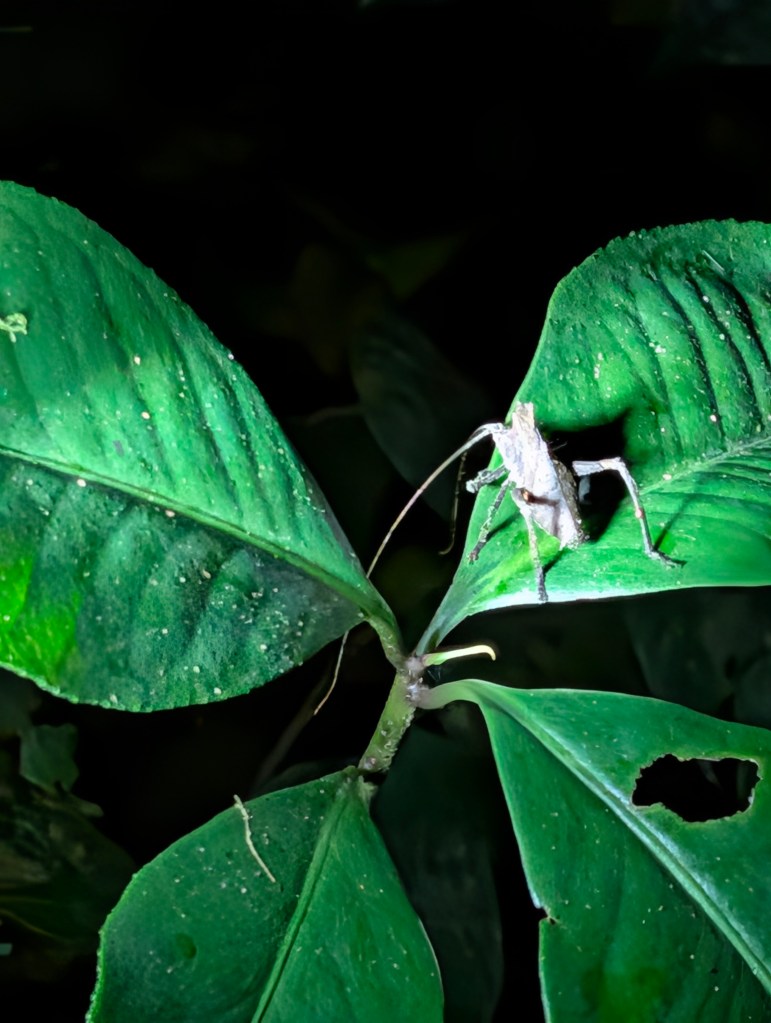
Carlos also found a baby leaf-mimic katydid. They often use crypsis, blending into their background to evade predators. Some species have detailed patterns, veins, and even “bite marks” on their wings to look like damaged or decaying leaves.
The highlight for me of our night tour was our final find: a hummingbird nest with two babies in it. (I am not a huge fan of insects.) Carlos told us that hummingbirds, the smallest of the birds, have the smallest nests and the smallest eggs, about the size of a jellybean. Hummingbirds always lay 2 eggs about every 2 years and live only 4-5 years total.

We did not see much else that night. We headed back to our lodge to get dry and enjoy dinner.
Monteverde is a peaceful community made up of dairy farmers, naturalists and tourism service providers who have joined together to create a model for sustainable development and protection of the environment that is becoming known throughout the world. The town was founded in 1954 by a group of Quakers searching for a peaceful place to live; it is now home of Monteverde Cloud Forest Reserve, which is where we met Carlos in the the morning, yes, still raining. The reserve was established in 1972 and named after a scientist George Powell who, while visiting the area, became concerned about conserving Monteverde’s rich biodiversity. Quakers in Monteverde also contributed to the creation of the reserve which encompasses great numbers of species. The Monteverde Cloud Forest Reserve initially covered some 810 acres of forested land. Nowadays, its protective reach extends over 35,089 acres. Whereas the night prior on a private farm we had been at an altitude of about 4000 feet, the Cloud Forest Reserve is at about 5000 feet, a different microclimate. With over 8 miles of trails available for visitors to explore, we headed out.
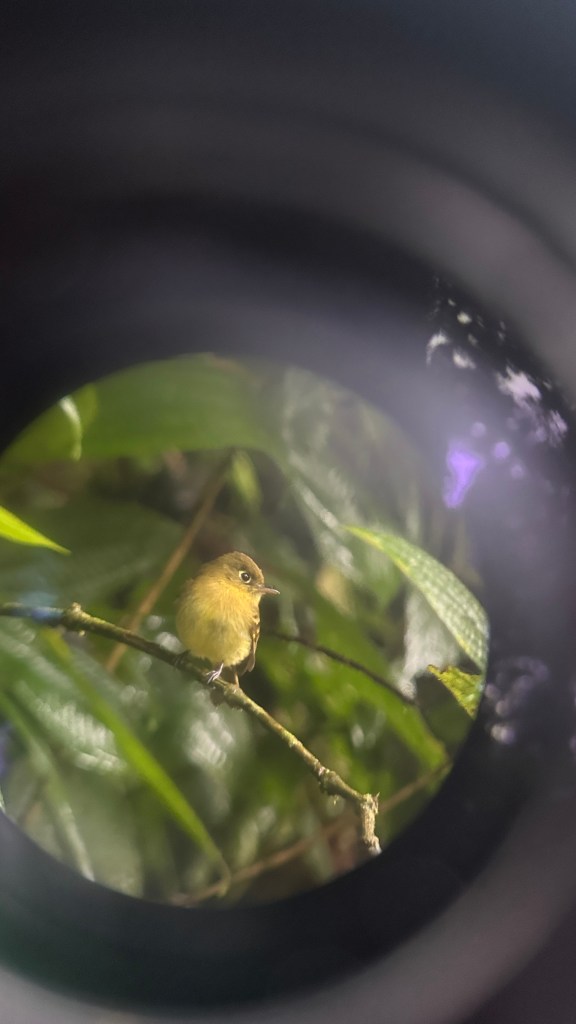
Our first siting, which Carlos lined up in the viewfinder for us, was a Yellowish Flycatcher, a small passerine bird, meaning it has feet suitable for perching. It typically forages for insects, often flicking its tail upwards when perched.
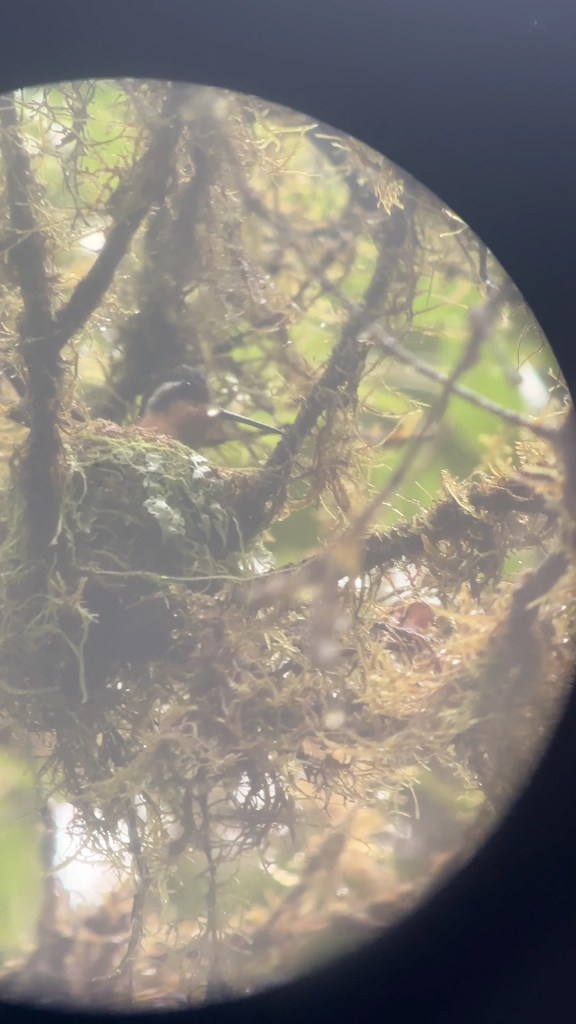
Next Carlos found for us a hummingbird sitting in her nest. We stopped and watched for a while, noting how territorial she behaved chasing off whenever another bird came near.
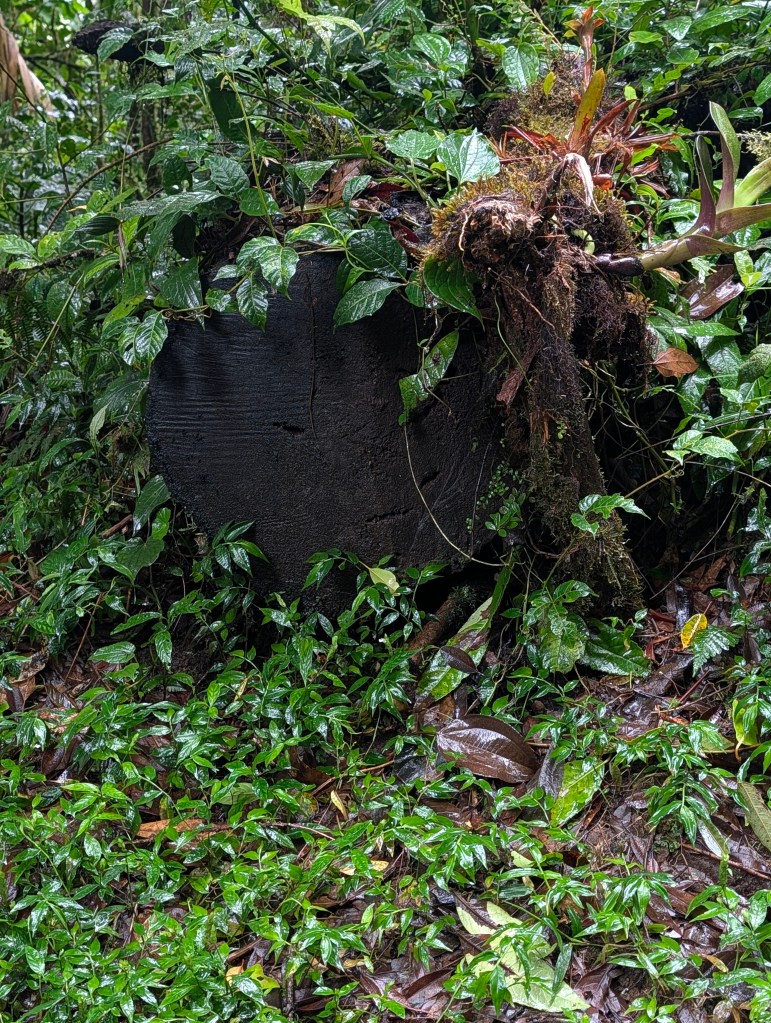
Carlos explained to us that trees in Costa Rica have no rings. There are no typical seasons of summer and winter, only the “dry” season (which we were in, ergo the quotes, because not so dry yet for us) and the rainy season. Trees grow prettty much continuously. Without a dormant period, no rings develop. Trees must be dated by carbon and size.
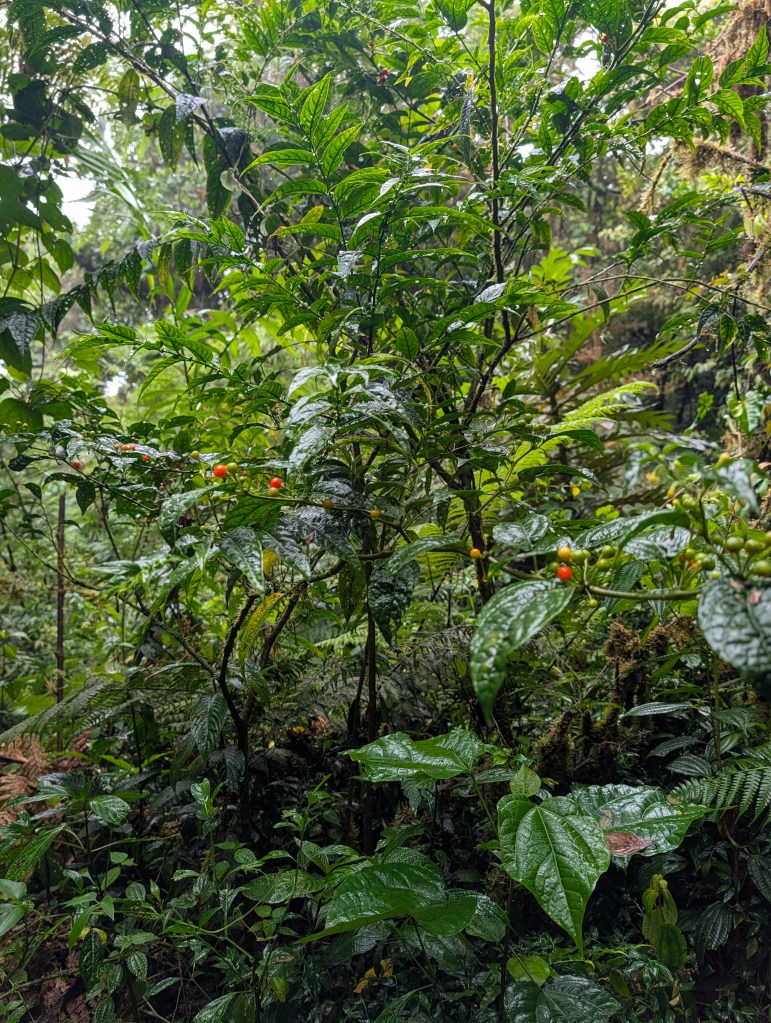
With little wildlife stirring in the rain, we focused on the flora. With only about 1-2% of the light reaching the forest floor, there is much competition for growth. We found a bush with a small red wild cherry: Jerusalem cherry, a type of shrub found in tropical and subtropical environments. It is in the nightshade family, and, indeed, the berry smells like a tomato. Although the birds love the berries, it is ill-advised for humans to eat because ithey have an extremely strong laxative effect. Carlos advised us that except for fungi, of which there are many extremely poisonous varieties found here in the cloud forest, there are no poisonous plants here, only ones with some bad side effects.
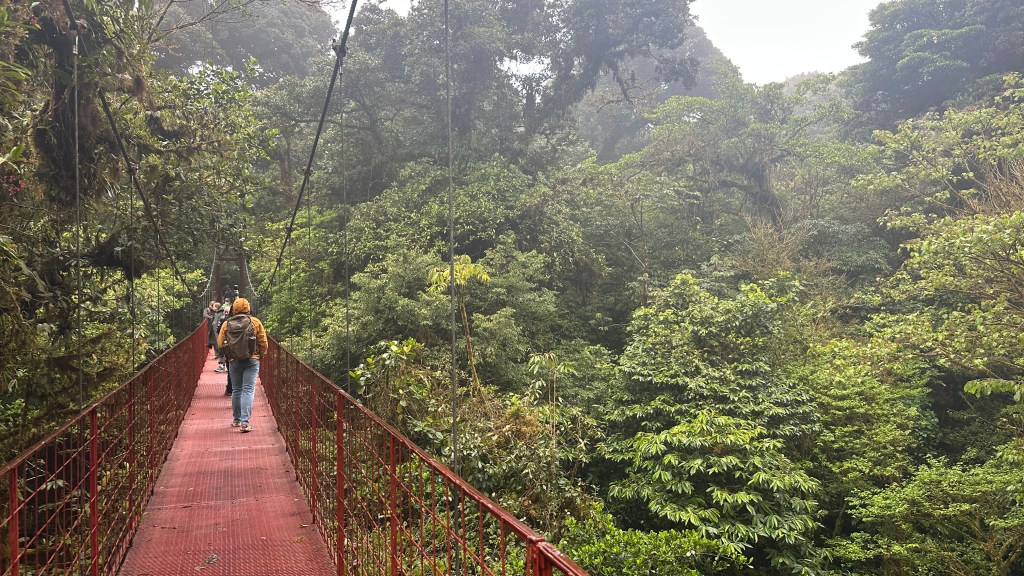
We crossed yet another hanging bridge; I was starting to get used to them.
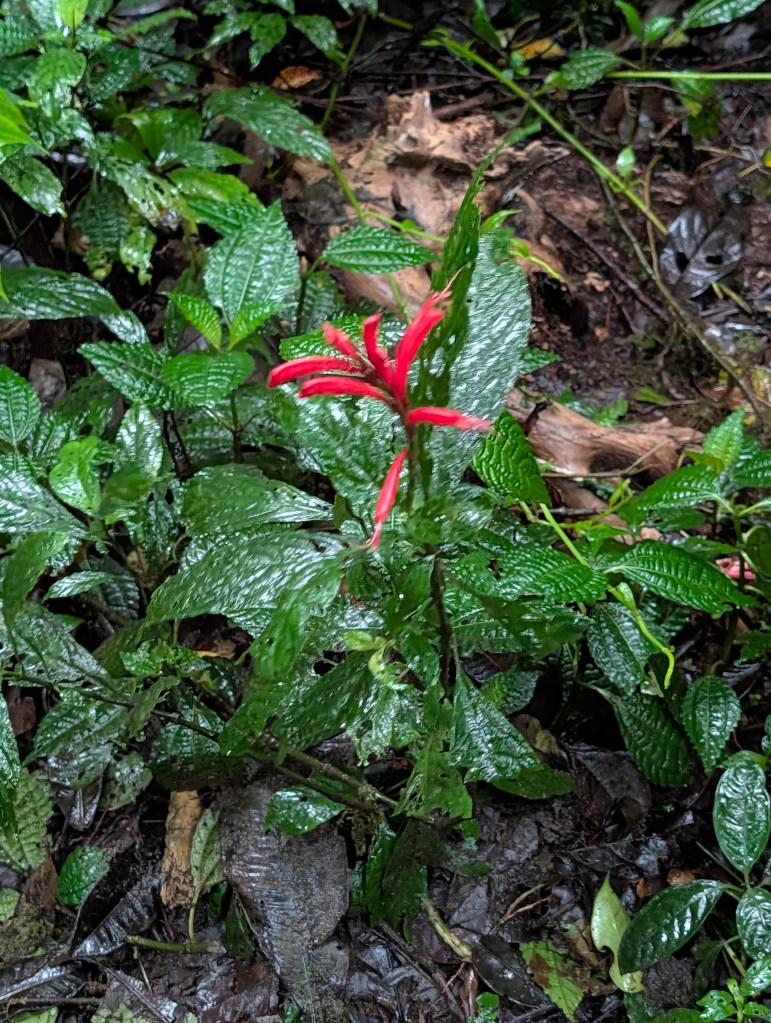
Carlos pointed out the flower of the aptly named shrimp flower. The red shrimp plant is a common, vibrant, red-flowered plant in the Monteverde Cloud Forest, specifically adapted for pollination by hummingbirds. Is distinctive shape allows it to deposit pollen on the backs of feeding hummingbirds.
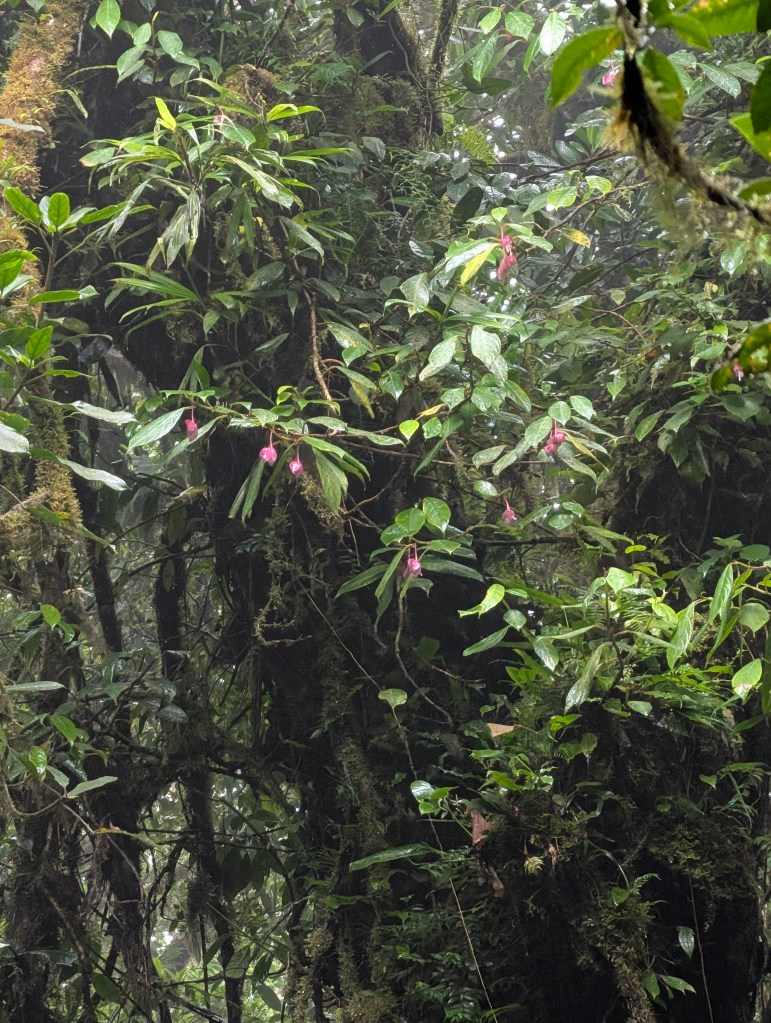
Although not a lot of plants are blooming this time of year in the forest, high up in a tree we spotted a wild species of hearty fuchsia, also known here as hummingbird fuchsia.
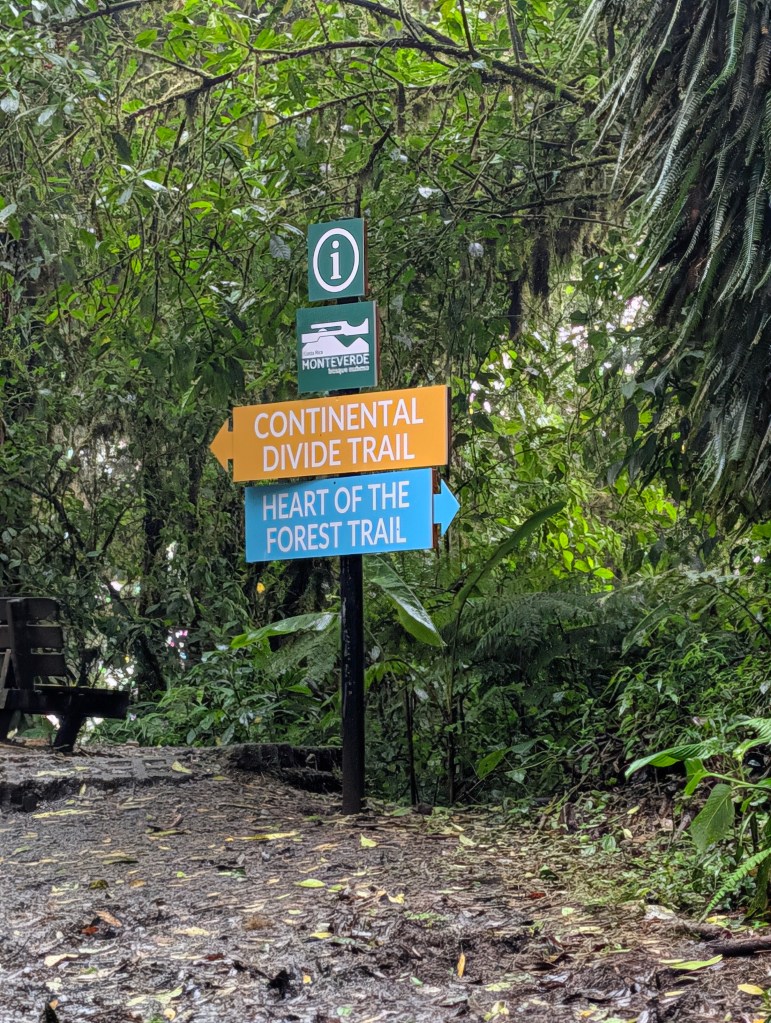
Monteverde sits right on the continental divide: the Caribbean is to the East, the Pacific to the West. Weather (ie rain) comes from both directions, which is what makes it a rain forest. (Although we are told it is generally a cloudy mist this time of year, not the pouring rain we have been experiencing). Cloud forests make up less than 1% of all forests on earth. We continued along the Heart of the Forest Trail.
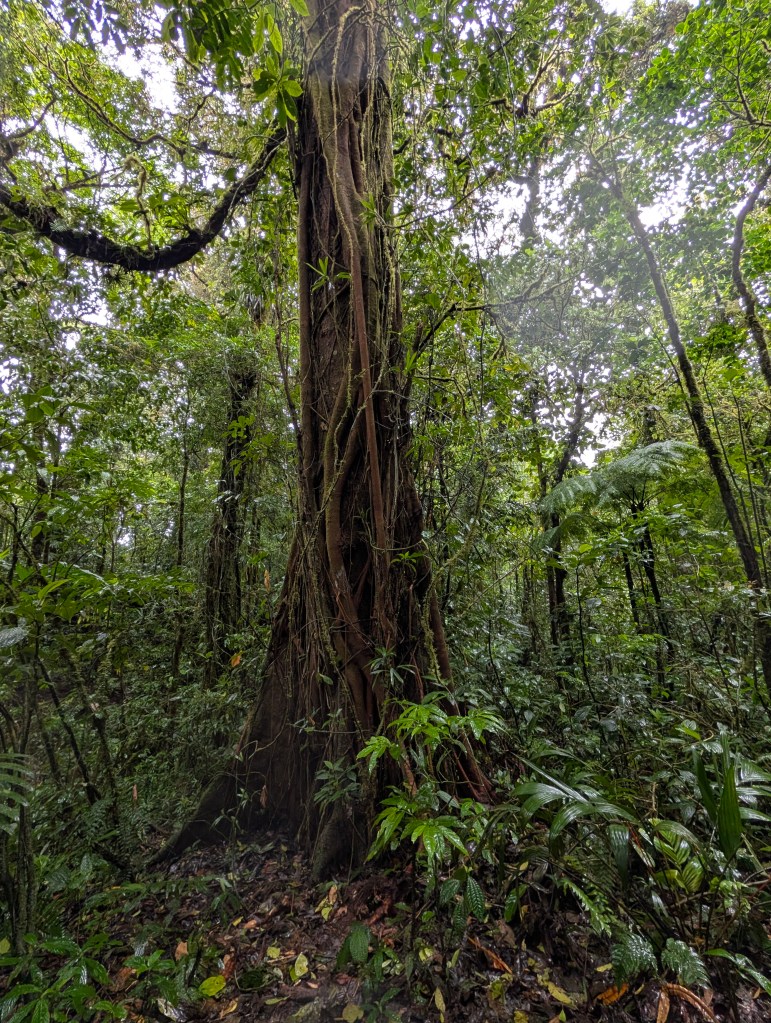
Carlos showed us a baby ficus just beginning to strangle its host tree. In many years it will look like the one we saw the previous night.
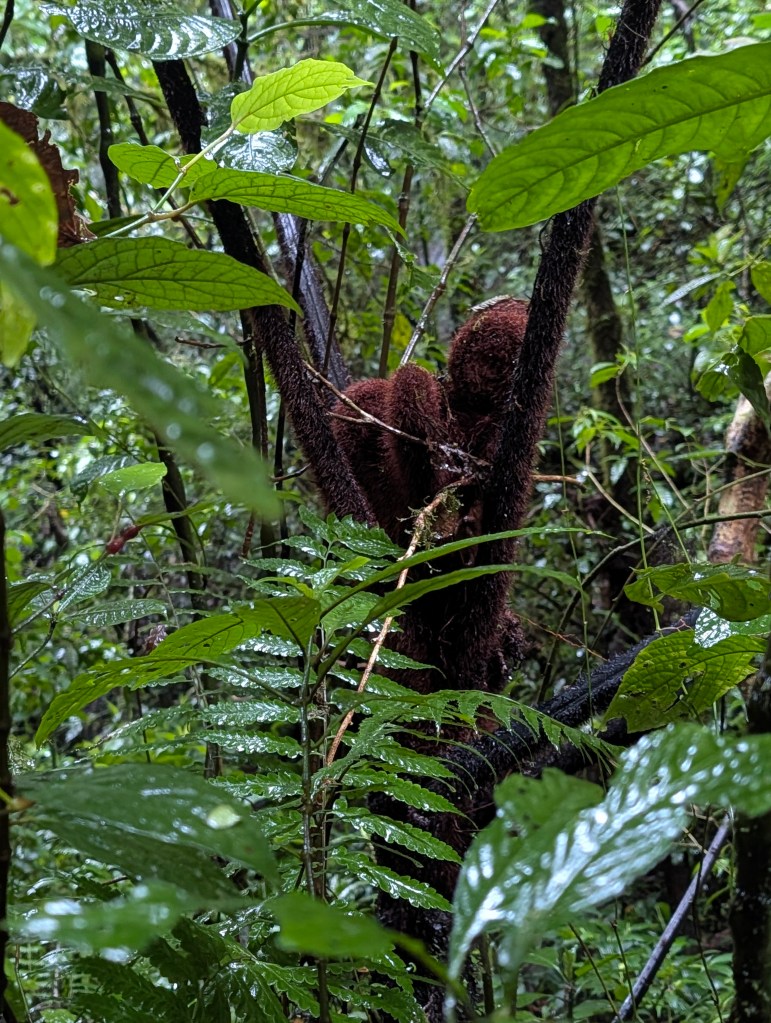
The monkey tailed fern is also aptly named.
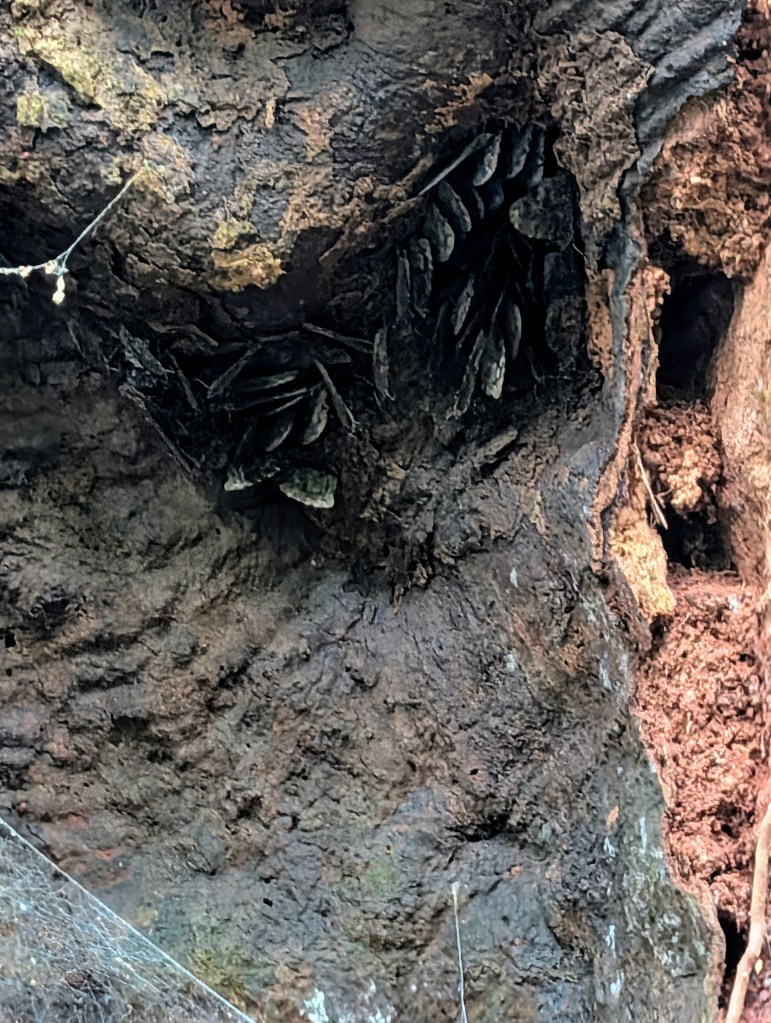
Carlos found a bunch of butterflies sleeping in the shelter of a hollow in a tree. Butterflies are cold blooded and prefer warmth; they do not fly in the cold rain.
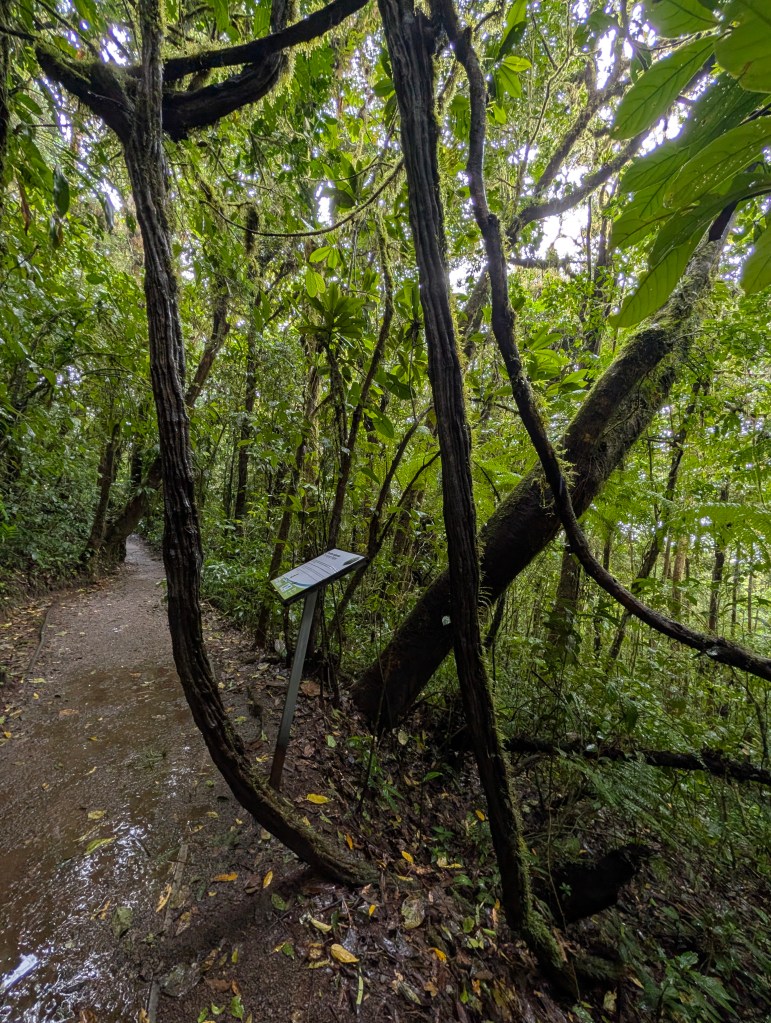
These lianas are thick, woody vines that are rooted in the soil but climb up trees to reach sunlight in the canopy. They are a major structural component of tropical forests, often creating dense, tangled networks between trees. Lianas vines are called hanging bridges because monkeys use them to cross from tree to tree. Humanity has been inspired to use lianas in artisanal products to the point of reducing their presence in the forest. The Monteverde Cloud Forest Preserve is actively protecting them.
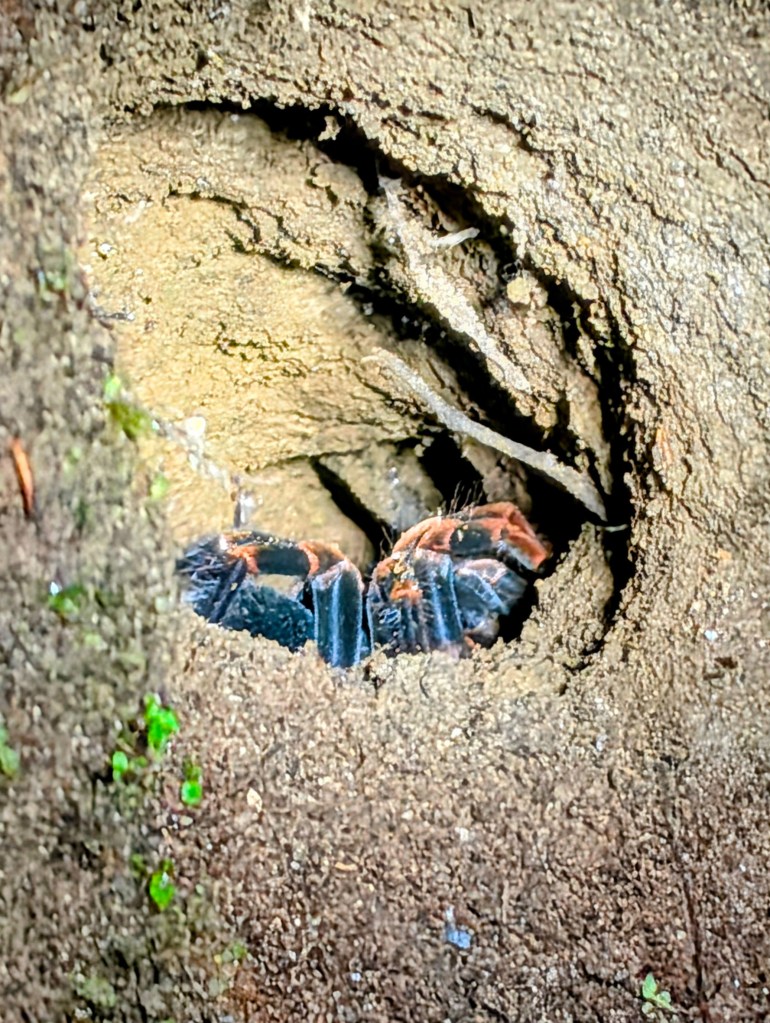
Hiding in a deep hole in the dirt we found a Costa Rican Orange Knee tarantula, a large, striking, and relatively slow-growing tarantula endemic to Costa Rica, particularly found in the Monteverde Cloud Forest. Known for its dark abdomen and bright orange leg markings, this species is typically found on the forest floor, where it feeds as a nocturnal hunter. Generally considered docile, they may flee or flick urticating hairs from their abdomen if disturbed. Their venom is not considered medically significant to humans, although their bite can be painful.
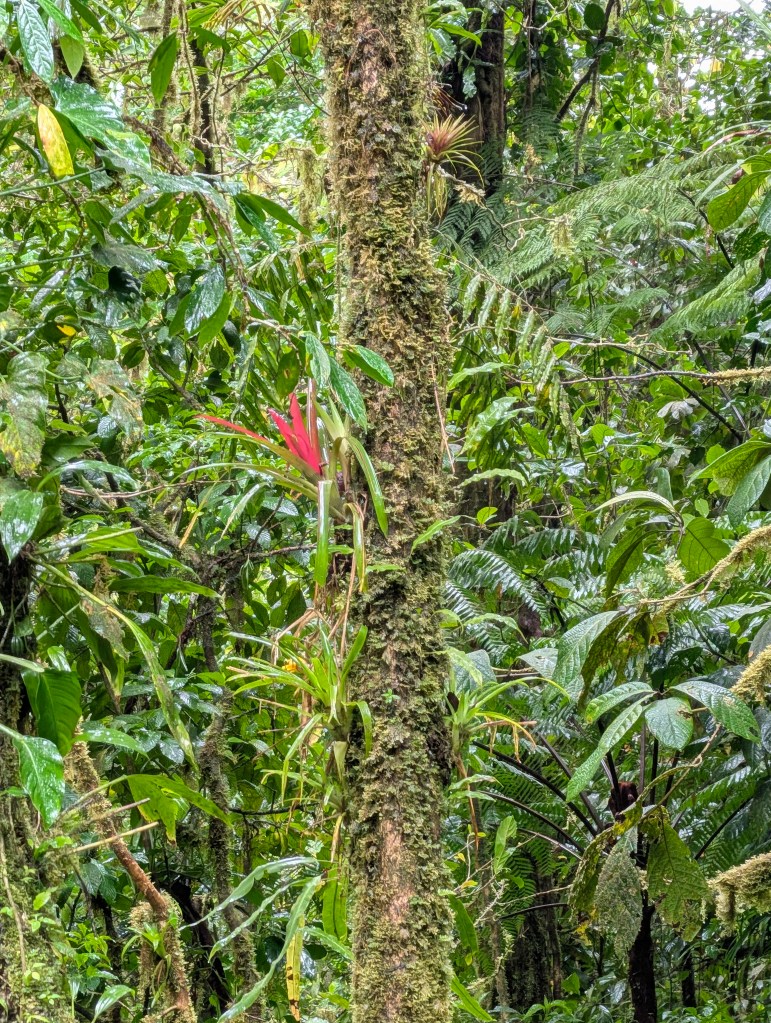
At this point it is worth distinguishing endemic, as the above tarantula is to the Monteverde Rain forest, which means it is only found here, from indigenous, which means it originated here but also elsewhere. Which subject brings me to bromeliads and orchids. The majority of species of both plant families are epiphytes: plants that grows on another plant but are not parasitic, obtaining their nutrients from air and using the host plant, generally a tree, only for stability of structure. Monteverde is home to an extraordinary diversity of orchids, with over 500 species identified in the region, 34 of which are endemic to Monteverde. While few to no bromeliads or orchids were in bloom at the time of our visit, we could see literally thousands hanging from branches everywhere. This one branch has dozens of each (one lone bromeliad in bloom) plus moss.
After leaving the preserve trail we took a quick break.
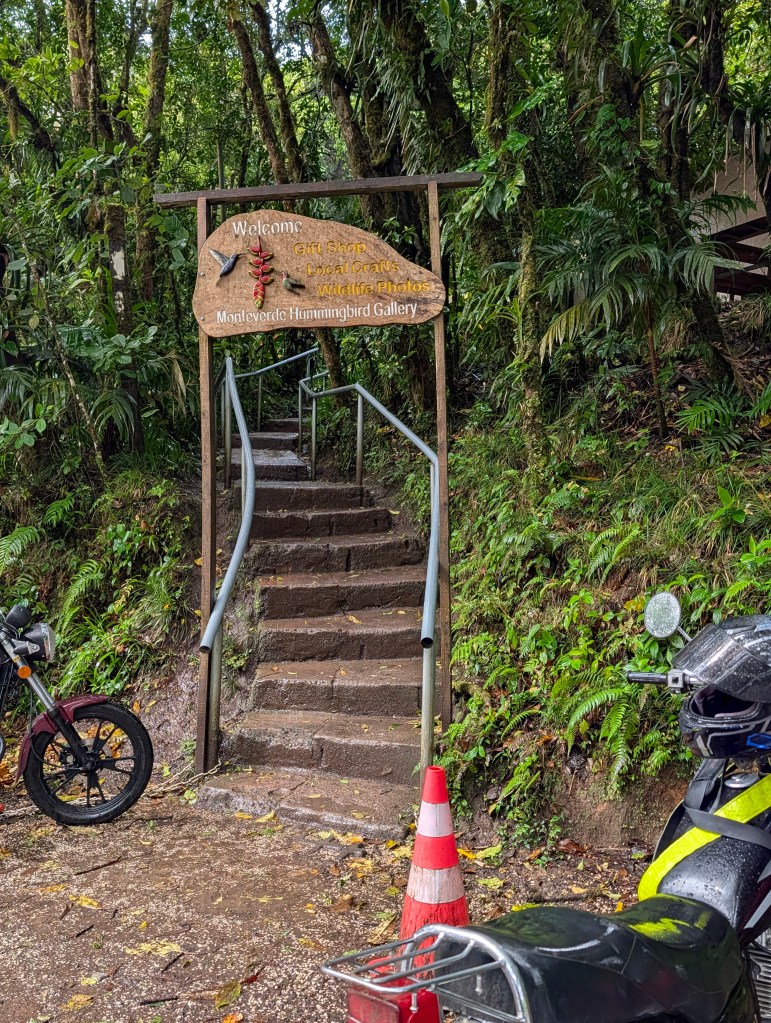
Of the over 360 species of hummingbirds in the world, 54 species can be found in Costa Rica, most of which live in the Monteverde Cloud Forest. The preserve has set out feeders with sugar water, which apparently does not adversely affect the behavior or health in the wild, for the tourists. This area is called the Hummingbird Gallery.
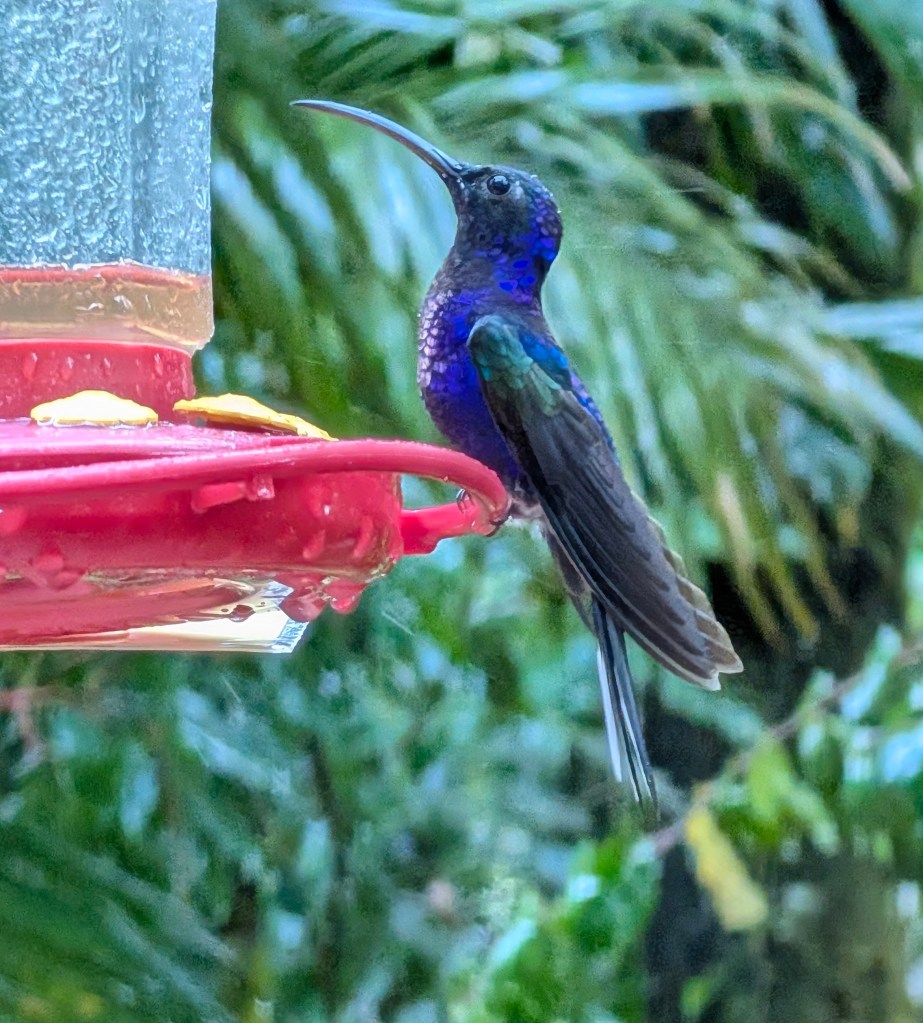
There are 8 species which frequent the gallery. The most striking is this male Violet Sabrewing hummingbird, one of the largest hummingbirds found in Mexico and Central America, measuring 5.1 to 5.9 in in length. They are known to be spectacular and aggressive birds. Males are known for their vibrant, metallic violet and blue plumage, with a contrasting green back and distinctive white tail patches. The species inhabits humid evergreen forests in highlands and foothills.
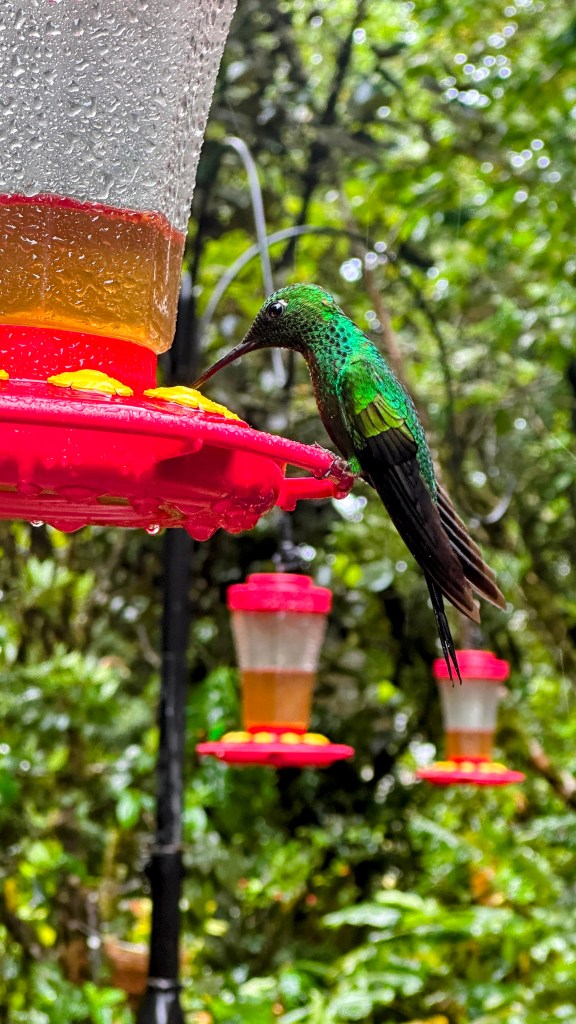
Also stunningly beautiful is the male Green-crowned Brilliant hummingbird, commonly found in Costa Rica and Panama. It is a relatively large and slender hummingbird with a long, straight bill.
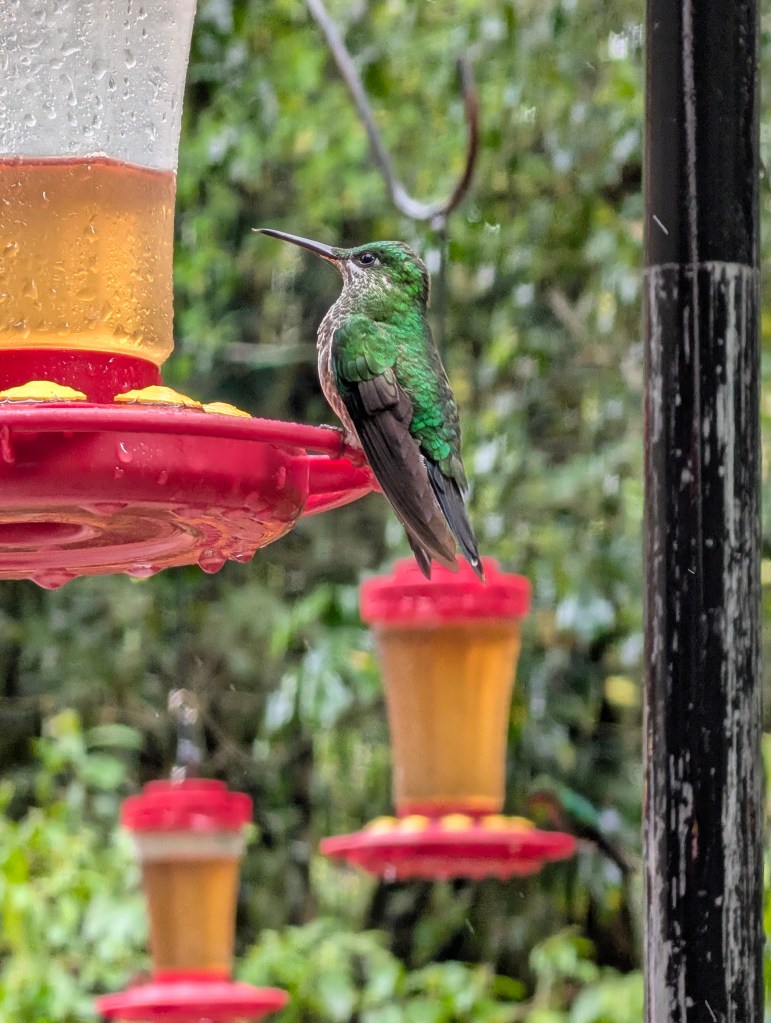
The female Green-crowned Brilliant hummingbird has a green-spotted chest, a distinct white whisker mark, and a white spot behind the eye.
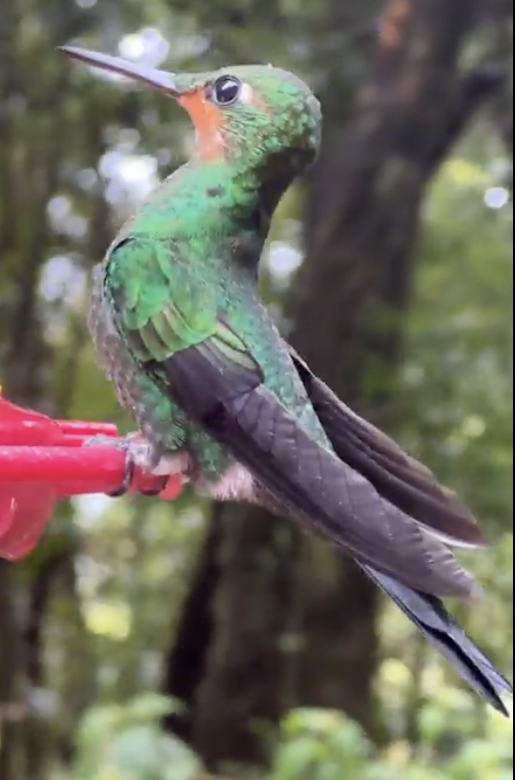
The male Green-crowned Brilliant hummingbird may also have an orange throat, whcih can be confusing.
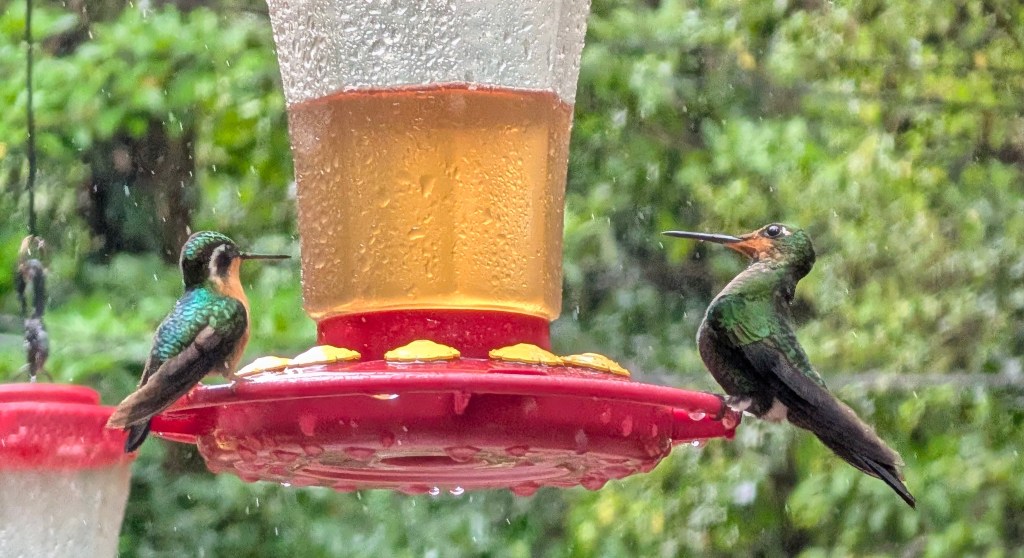
Below on the right is the male Green-crowned Brilliant hummingbird sharing the feeder with a female Purple-throated Mountain-gem hummingbird; the females do not have the purple throat but instead have bright fluffy underparts, a black cheek, and a white line behind the eye. (You can also see the raindrops in this picture.)
Next is a juvenile Magenta-throated woodstar hummingbird. Males have a distinctive red throat (gorget), while females have white-tipped tail feathers and no red throat.
Fun facts: Hummingbirds can fly forwards, backwards, and hover in mid-air. The bird’s wings beat at high frequencies, creating the characteristic “humming” sound.
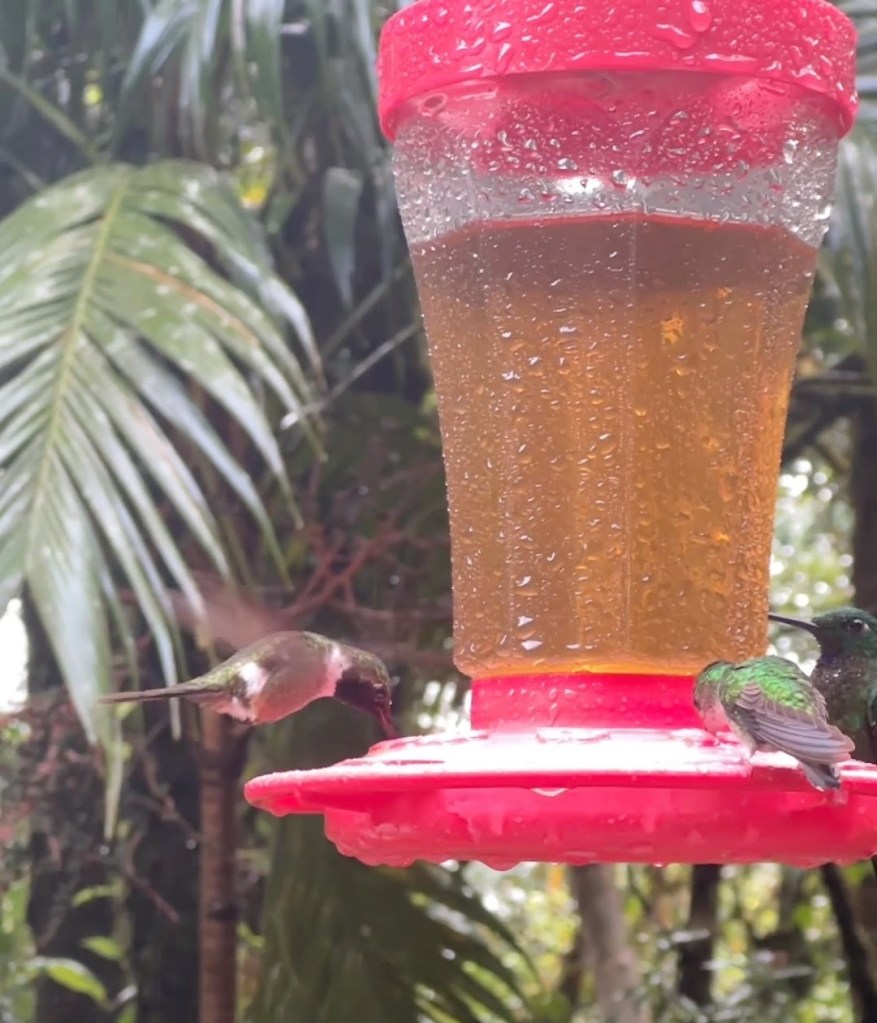
The coppery-headed emerald humming bird is a small humming bird measuring only about 3 inches long and weighs about 0.1 ounce. It is one of only 3 species of birds endemic to costa Rica.
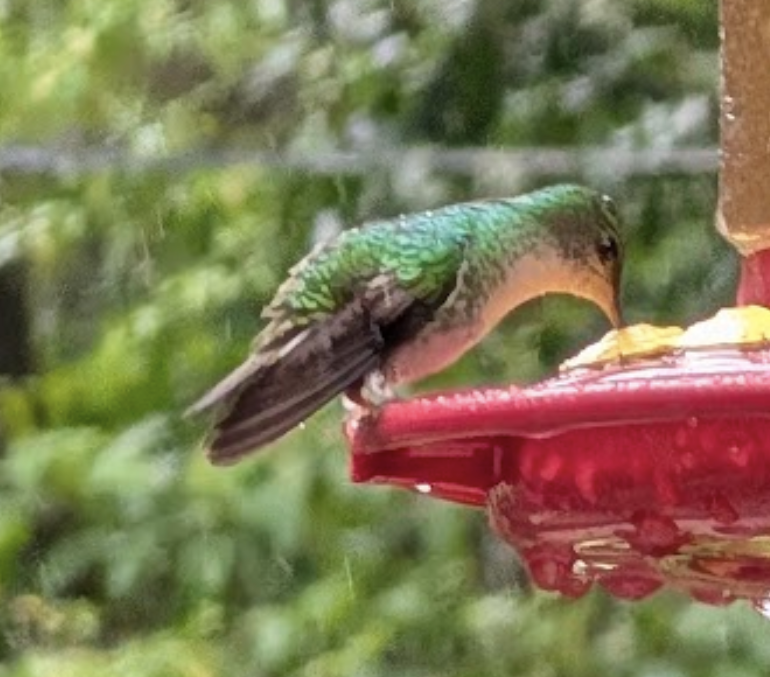
Green Violt-ear hummingbird is known for its iridescent green plumage and a prominent violet-blue patch behind the eye. The male flares these violet “ear” feathers during displays.
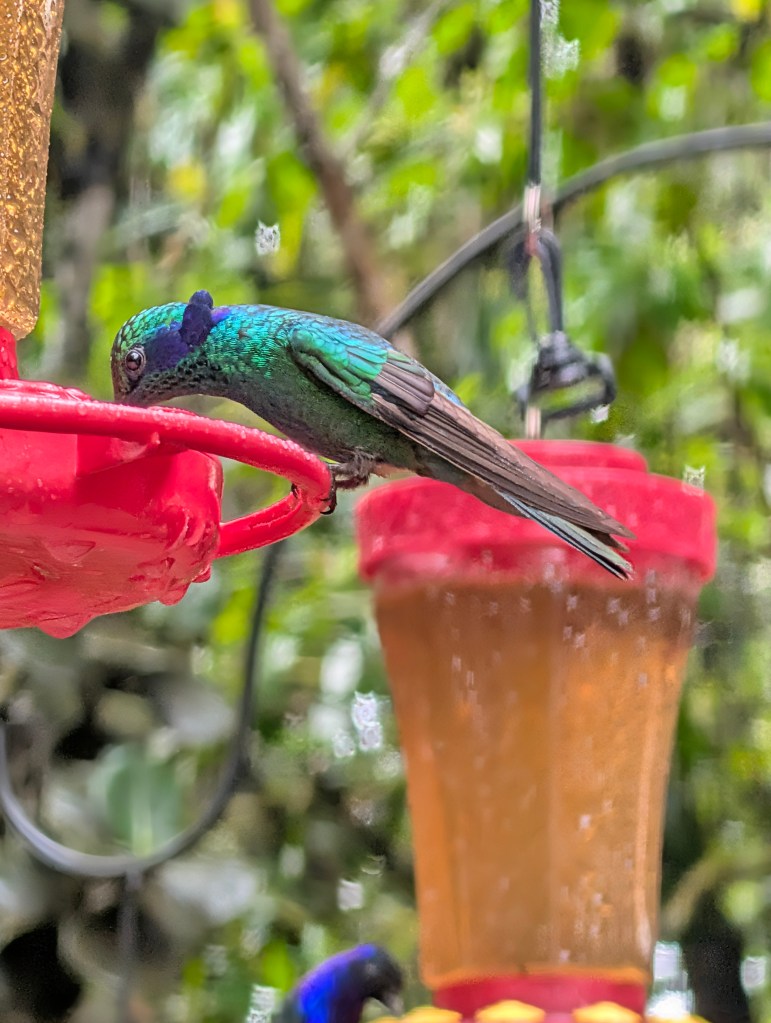
We had managed to see 6 of the 8 species that frequent the feeders, and we were very cold and wet. We headed back to our lodge for a warm, dry meal and some rest. These tours started very early, which is not generally our preference.
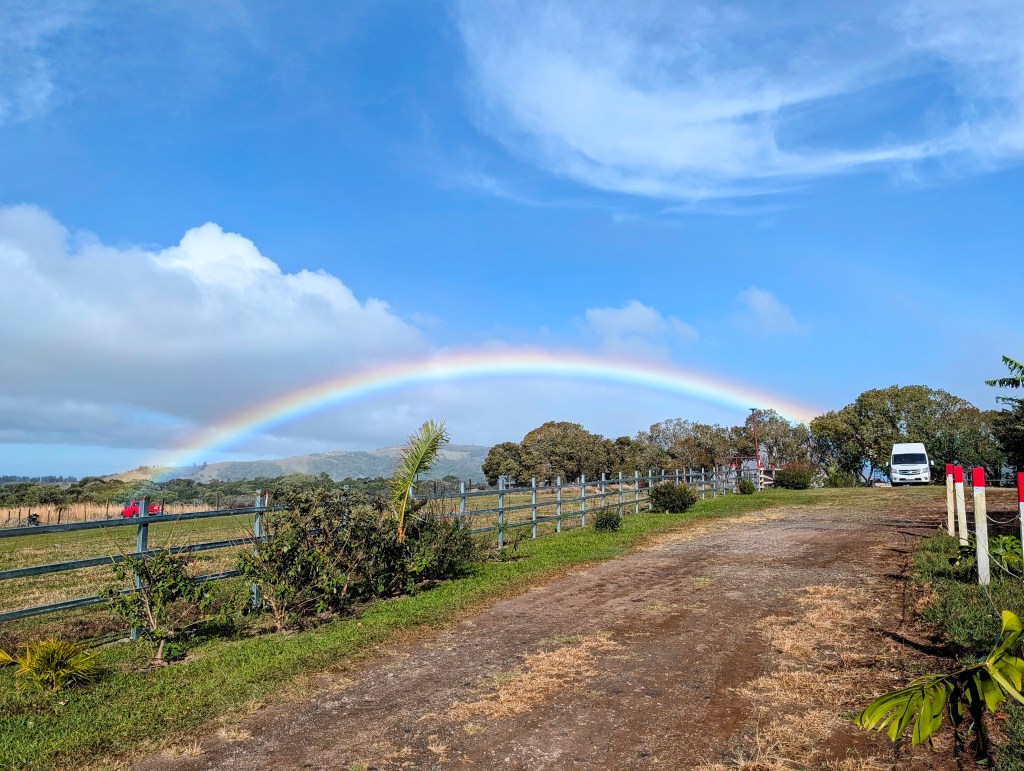
When we woke in the morning the sun was shining! We were treated to a rainbow on our way to the next park.
We arrived at the Treetopia Park and were assigned a group and our morning guide: Sebastian. By the time we hit the trail, it was raining again.

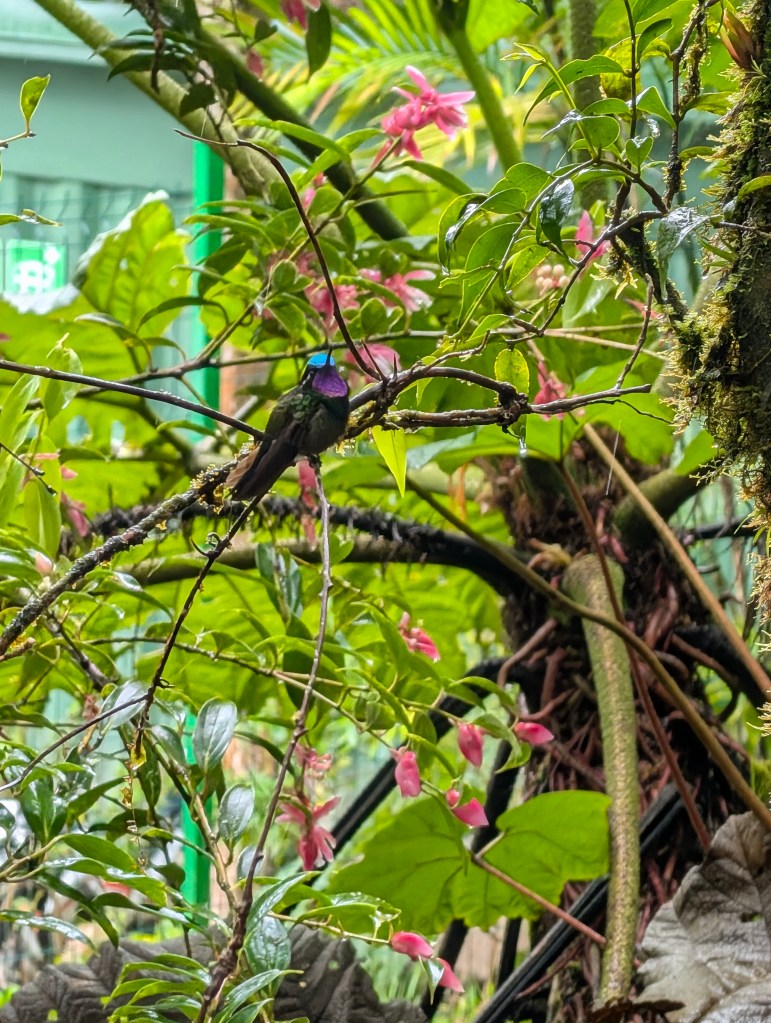
Sebastian’s first find of the day for us was a male Purple-throated mountaingem. Males are distinguished by their bright purple throat, blue crown, and a white line behind the eye. This medium-sized hummingbird is found in the mountains of southern Nicaragua, northern Costa Rica, and western Panama, typically inhabiting forested areas and hilly terrains at altitudes from 2,600 to 8,200 feet. Sebastian reiterated what Carlos had said the day prior: hummingbirds are the only birds that can fly backwards. They eat twice their weight daily.
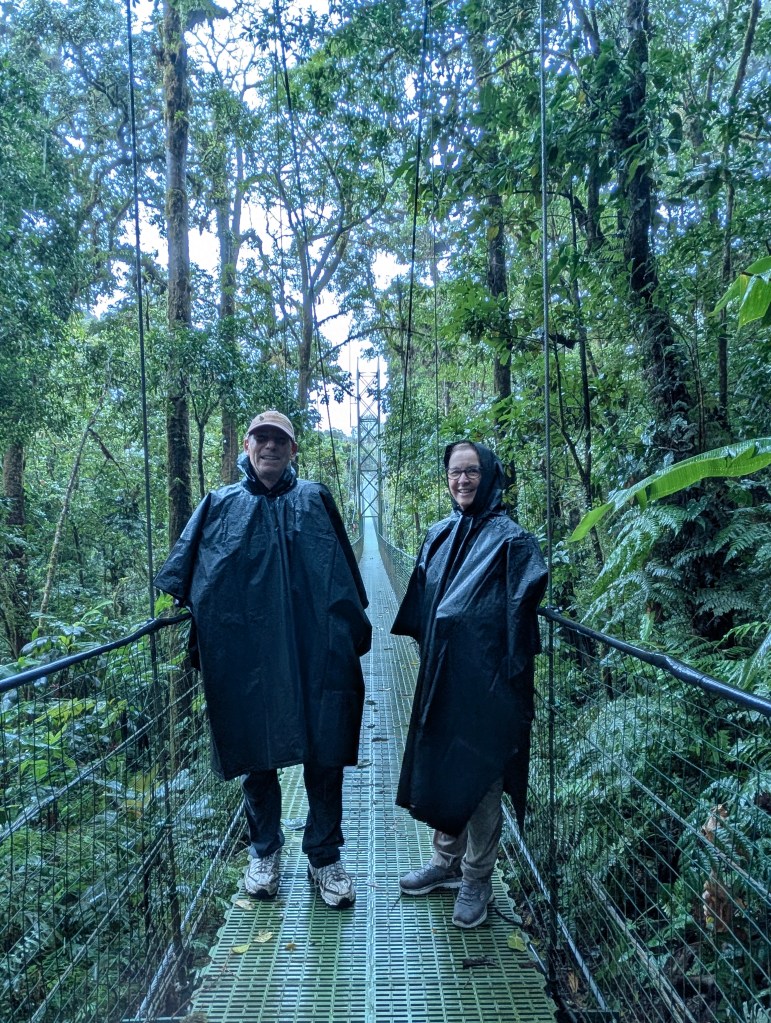
Our first hanging bridge of the day is also Costa Rica’s longest spanning 774 feet.
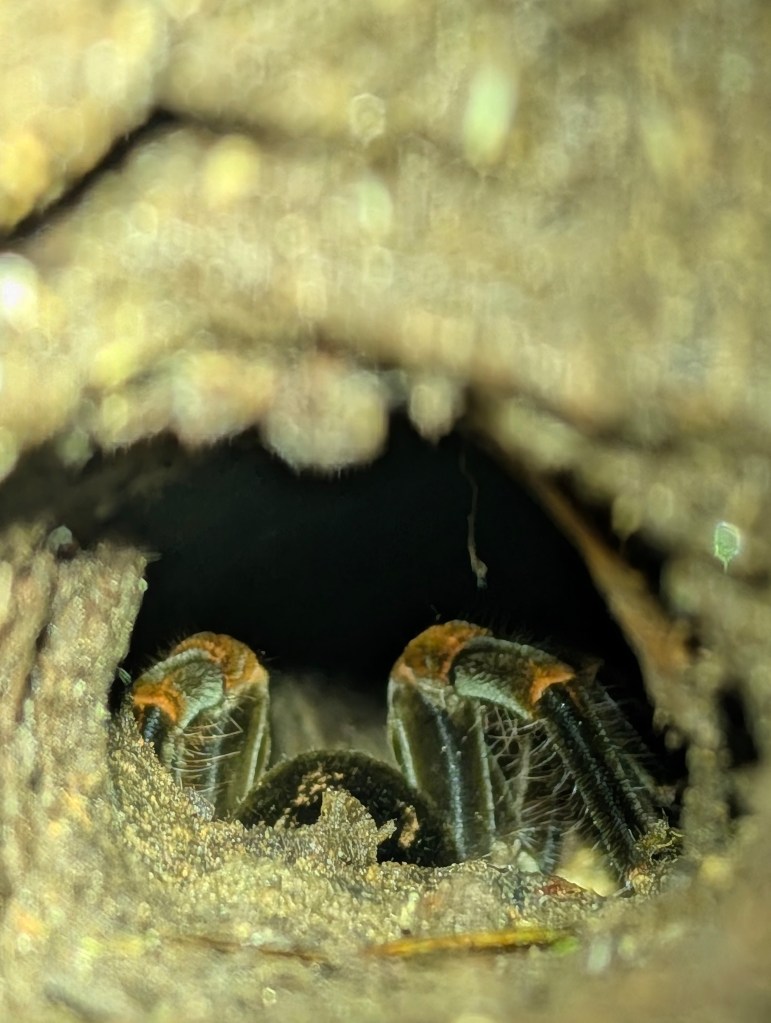
Sebastian also found us an orange-kneed tarantula, but he had a lot more to say on the subject. The female lives in the same hole, dug by someone else, for her entire life, which can be 20 years. She sits and waits for her food to come to her. She sleeps with only half of her brain at a time, so she is always alert. The male hunts outside the hole and has a life expectancy of only 4-5 years. He also hates the sun; he hunts at night. Although they have eyes, they use trichobothria, specialized, highly sensitive mechanosensory hairs on a tarantula’s legs and pedipalps that detect minute air currents and vibrations, often referred to as “hearing hairs,” to detect prey movement, avoid predators, and navigate by sensing air movements as small as 10 millionth of a millimeter. They mate after the female is 4-5 years old. The male hands her a bag of sperm which she uses to self fertilize. She will lay thousands of eggs at a time, but then will eat some while waiting for other food to appear. Only 1% of the eggs hatch. The hatchlings spend only a few weeks in the nest before venturing out. All tarantulas in the world are venomous because they are all carnivores and use their venom to kill their prey which includes mammals as large as a rat. The tarantula in turn is prey to a wasp which also uses venom to paralyze the tarantula, digs a hole in its middle, and lays eggs there. The wasp eats the tarantula over the course of a month without killing it, starting first with the legs then finally the heart, which then finally kills it.
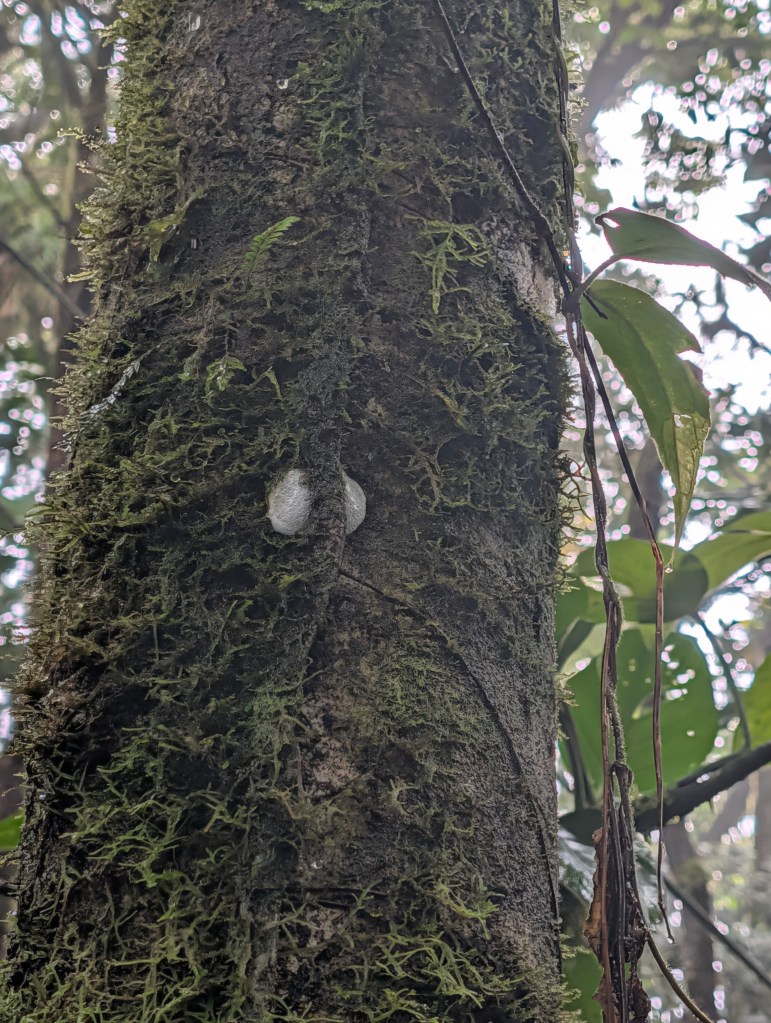
When asked about the many “bubbles” we saw on the trees, Sebastian responded that they are sap beetles, which surround themselves in a bubble of sap.
With irony Sebastian pointed out a strangler ficus strangling a fig tree, which is also in the ficus family. Figs are among the oldest known cultivated plants, with evidence of farming dating back roughly 11,000 years. Fig trees are fertilized exclusively by tiny fig wasps in a specialized, interdependent relationship. A female wasp enters a fig’s small opening, pollinating its internal flowers while laying eggs, often losing her wings and antennae in the process. After laying eggs, the female wasp dies inside the fruit. He reassured us that figs we buy in the grocery store have been engineered and do not contain dead wasps nor their eggs.
Fig trees communicate within forest ecosystems primarily through an underground, interconnected network of mycorrhizal fungi, often referred to as the “wood-wide web”. Through this network, fig trees share resources like carbon, nutrients, and water, while sending warning signals regarding threats. It prevents them from all fruiting at the same time so animals will not decimate their fruit supply all at once.
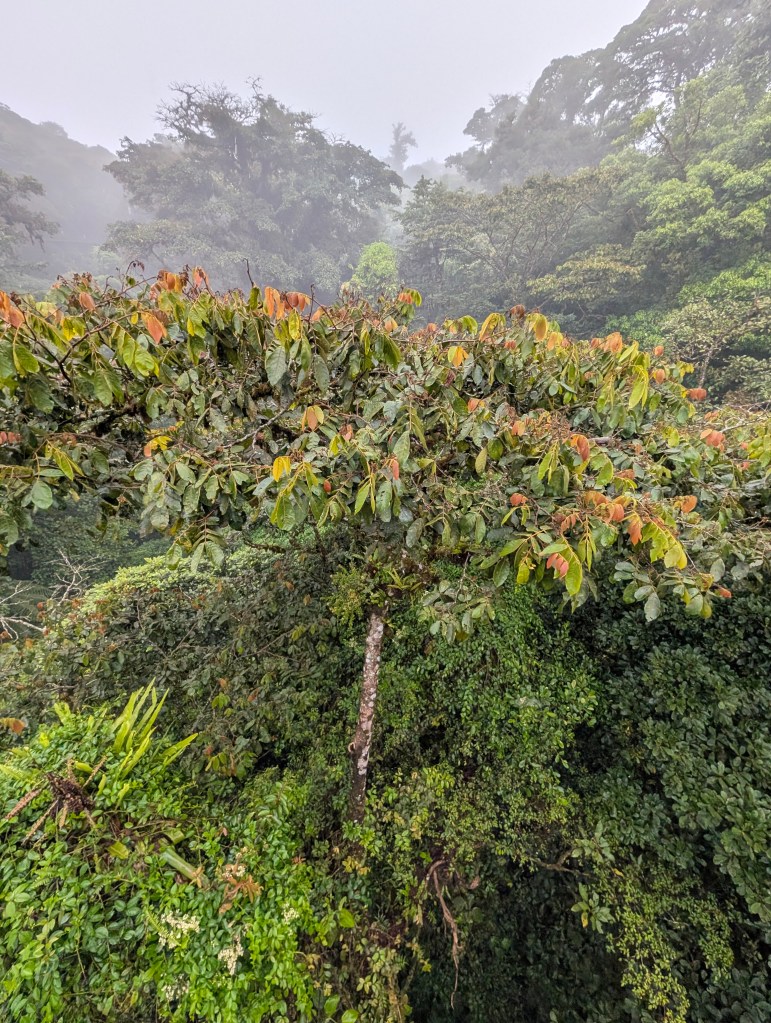
Sebastian reiterated that there is no season of dormancy for the trees. Why, then does the following species of cacao tree have brown leaves on its tips? The answer is that the new growth comes in green first; it is a defense mechanism of the tree to protect its fruit from mammals like monkeys.
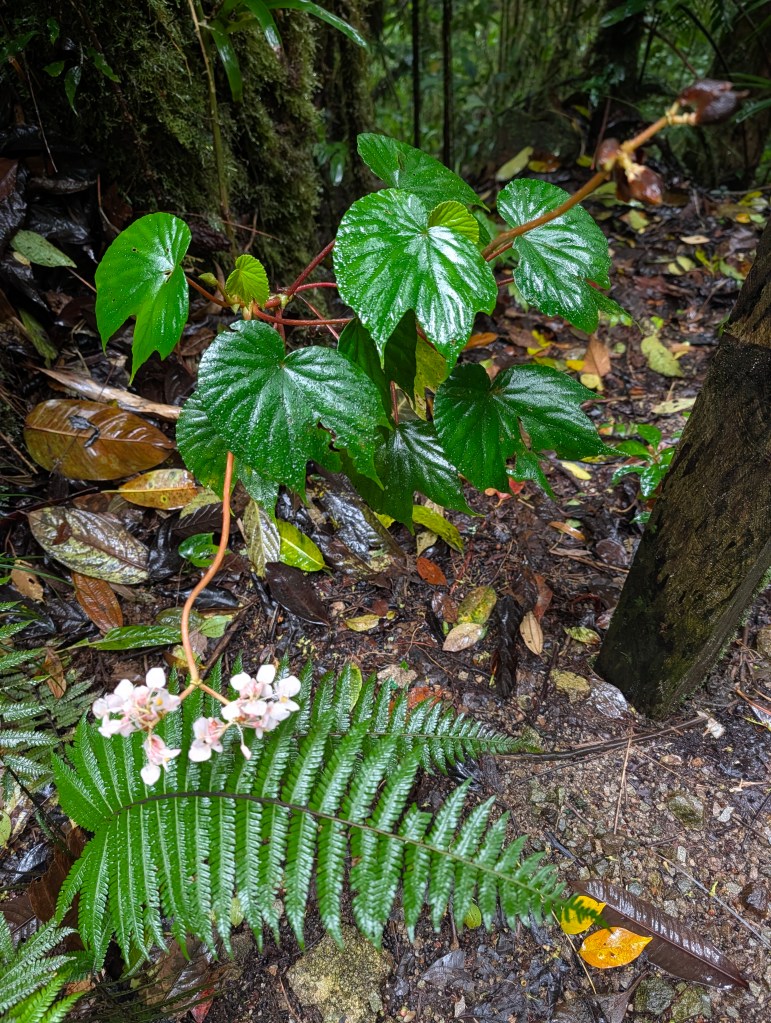
Sebastian pointed out an angel wing begonia, named for the shape of the leaves.
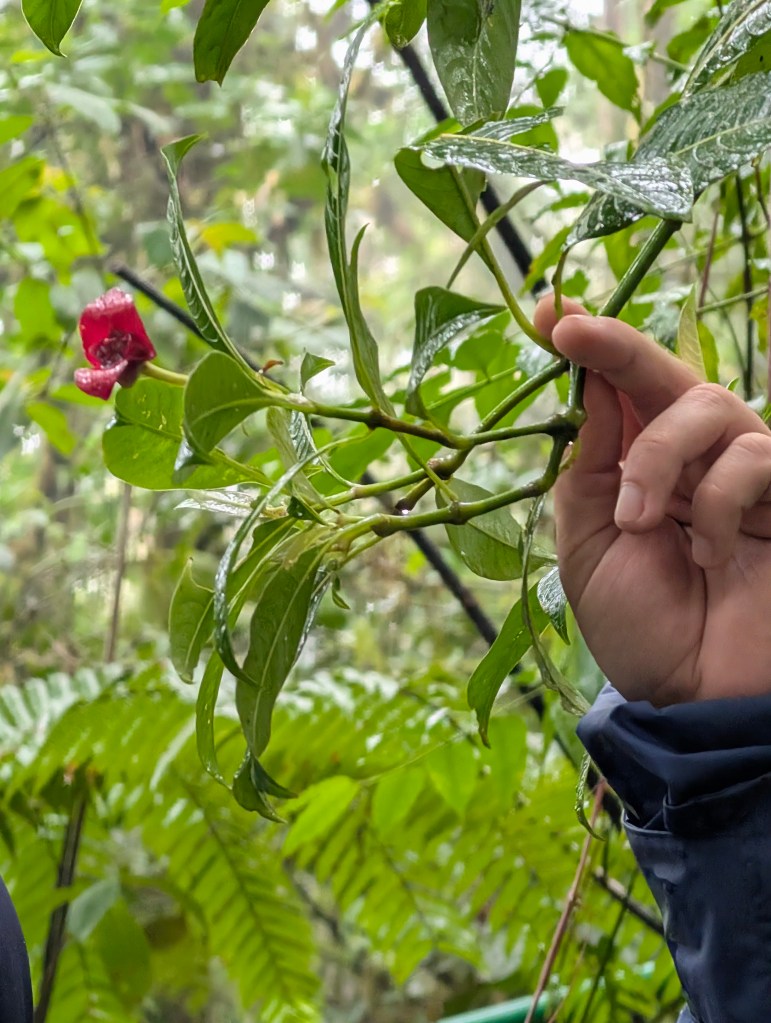
He jokingly told us when in doubt of the name of a plant, just look at it; most names reflect the appearance like this hot lips plant, a member of the coffee family
and this three flower lantana, A shrub in the verbena family that can grow up to 3 meters tall. It has small, fragrant, lavender-pink-purple flowers that bloom in clusters of three, followed by small purple berries.
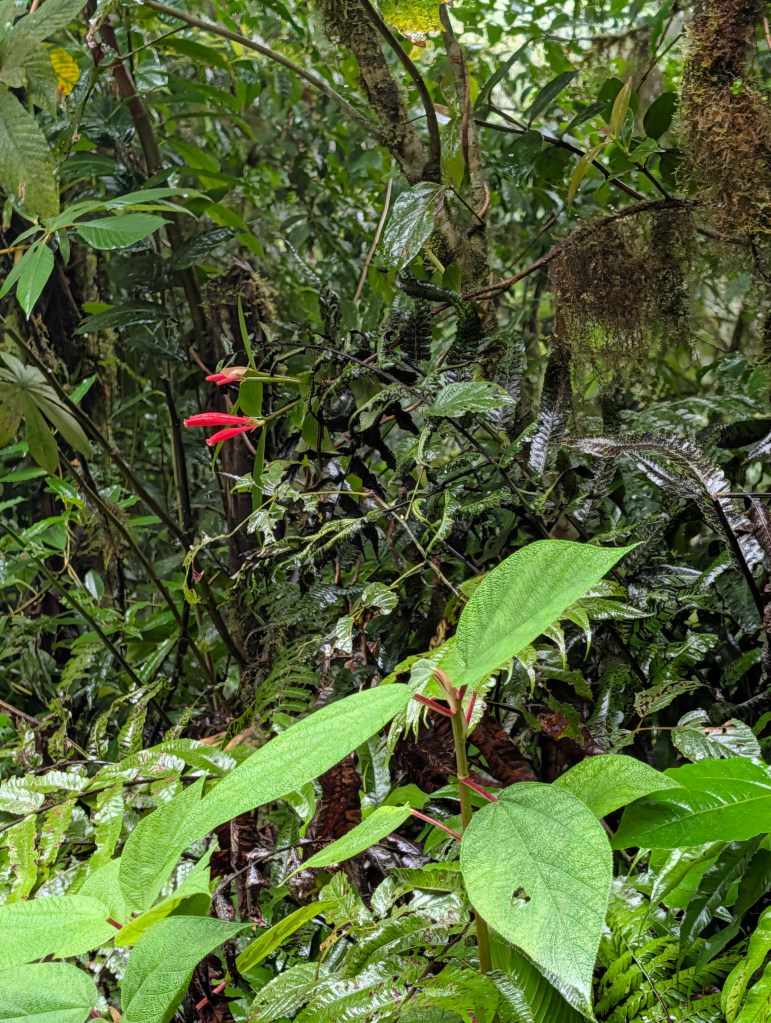
The monkey tail fern, which we had seen before.
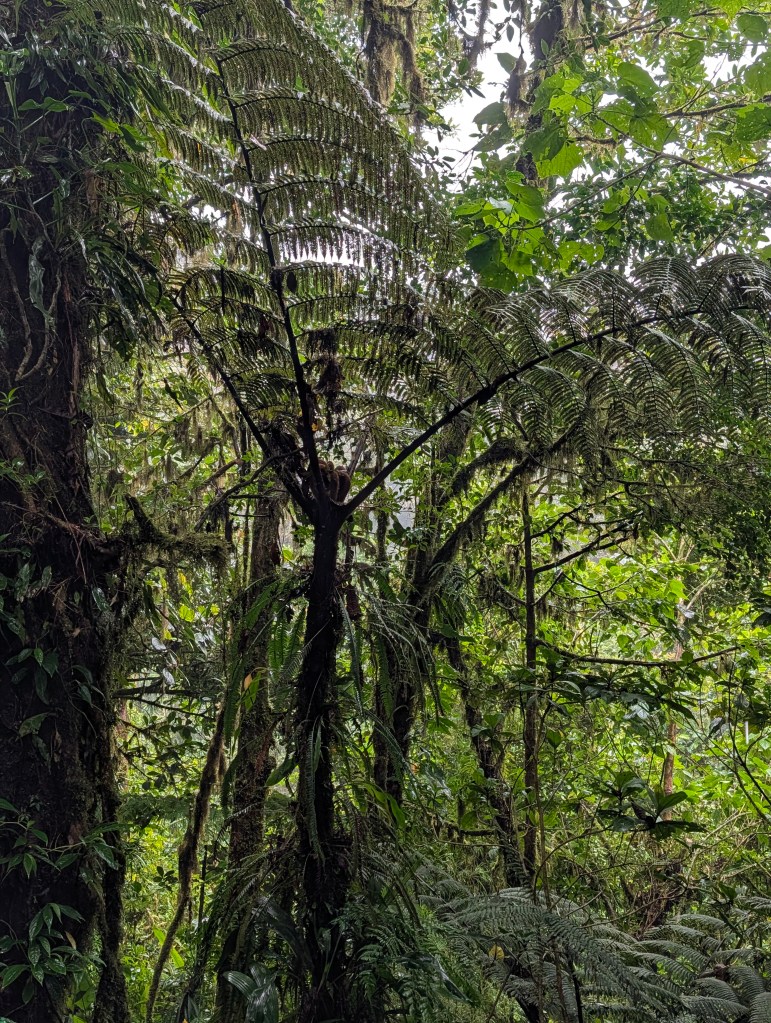
and the broccoli tree
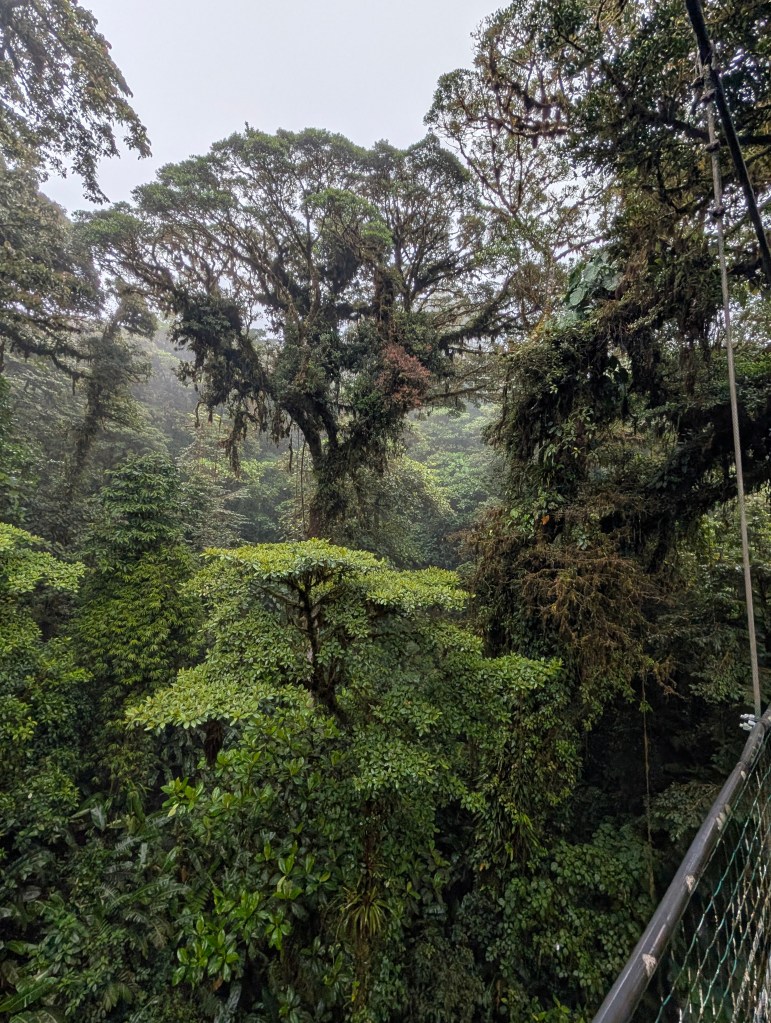
Time to talk orchids. There are over 30,000 recognized species of orchid in the world, over 1,125 found in Costa Rica with over 800 in Monteverde. They represent one of the oldest flowering plant families, existing for roughly 100,000 years. They smell good despite the lack of nectar. They have developed highly specialized, sometimes deceptive, methods to attract specific insects for pollination. Orchid seeds are minuscule, with one capsule containing up to 3 million seeds. The plants vary greatly in size ranging from tiny, nickel-sized blooms to plants weighing over one ton.
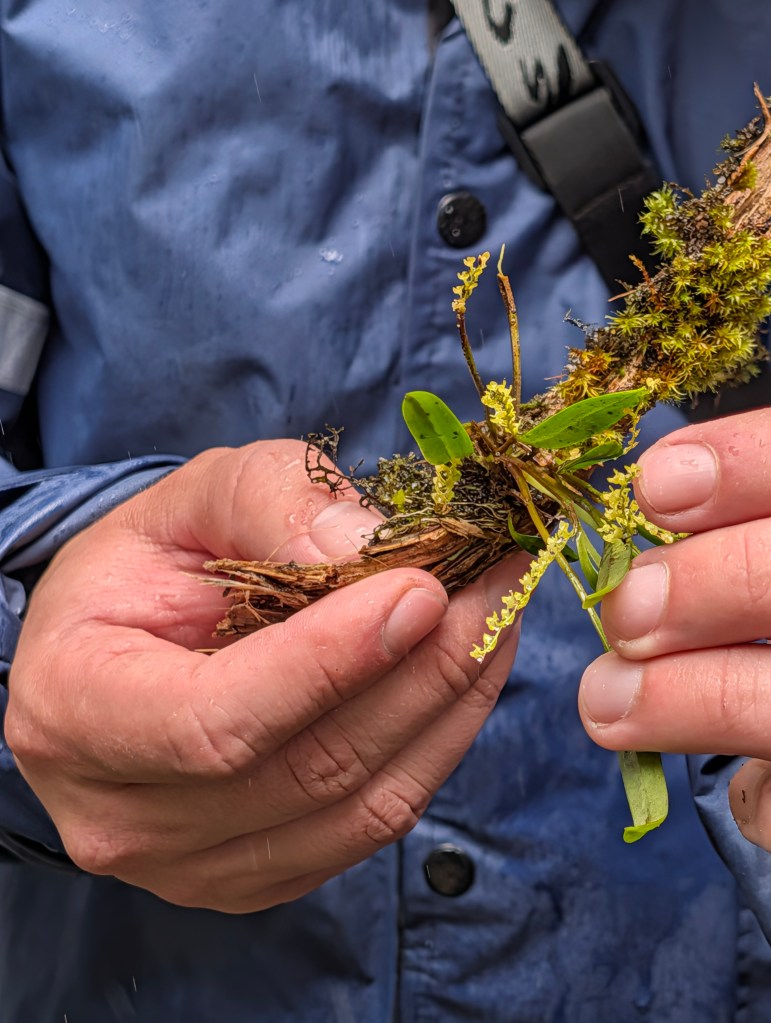
Sebastian showed us the platystele jungermannioides, purported smallest orchid in the world. It is pollinated by male mosquitoes. (Sebastian then took a moment to point out the relative lack of mosqutoes in the rain forest which is attributed to the nearly 60 species of bats living here.)

Most orchids are epiphytes, meaning they grow on other plants or trees for support rather than in soil.
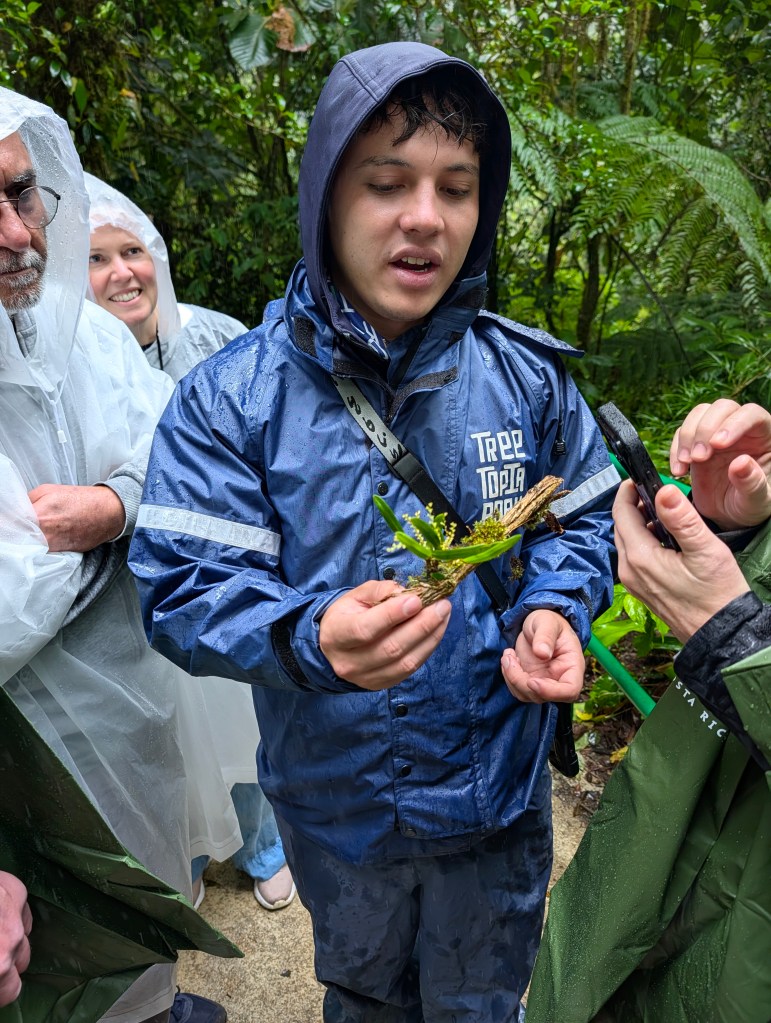
The flower has identifying features: bilateral symmetry, 3 sepals, 2 petals, one lip (labellum: one of the petals is highly modified to serve as a specialized landing platform for pollinators), one column, and pollinia (waxy pollen masses. Instead of loose, powdery pollen, orchid pollen is aggregated into solid, waxy masses called pollinia. This adaptation ensures that a pollinator carries the entire pollen load at once, increasing the efficiency of cross-pollination).
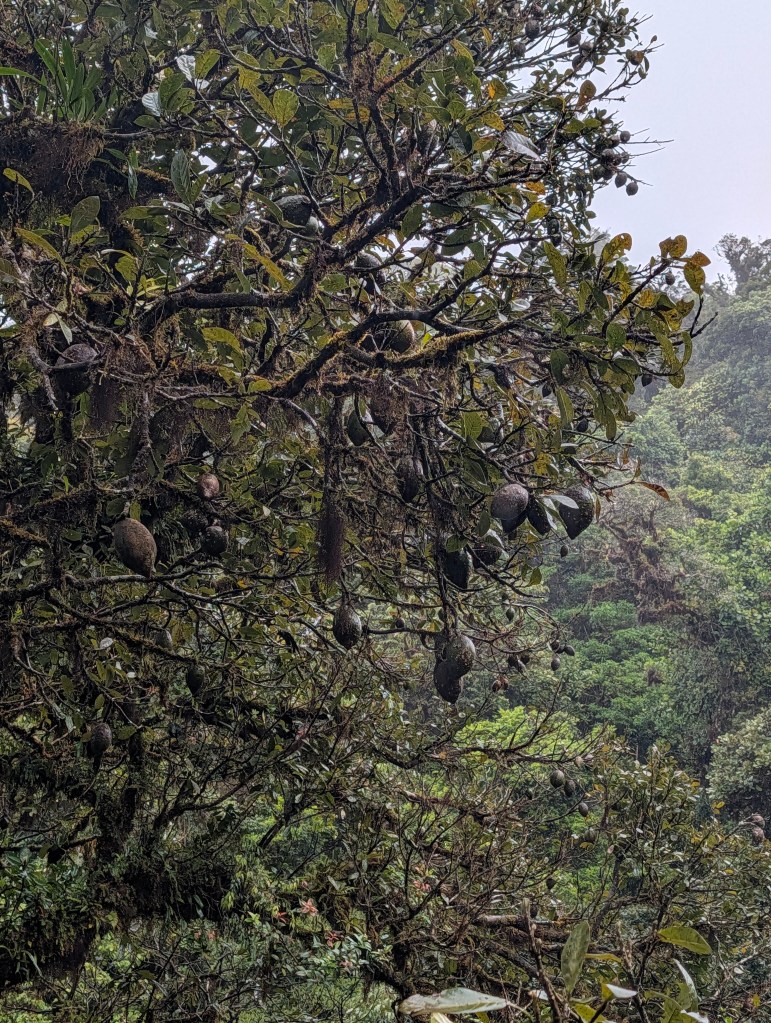
Sapota (Sapodilla in English) is a sweet, brownish, tropical fruit is also referred to as naseberry, mudapple, or dilly in various regions. It has a grainy, brown, pear-like flesh and is commonly cultivated in India, Mexico, and Central America. It is generally not favored by humans because ripe it is mostly water and farely tasteless; the green fruit is a strong laxative.
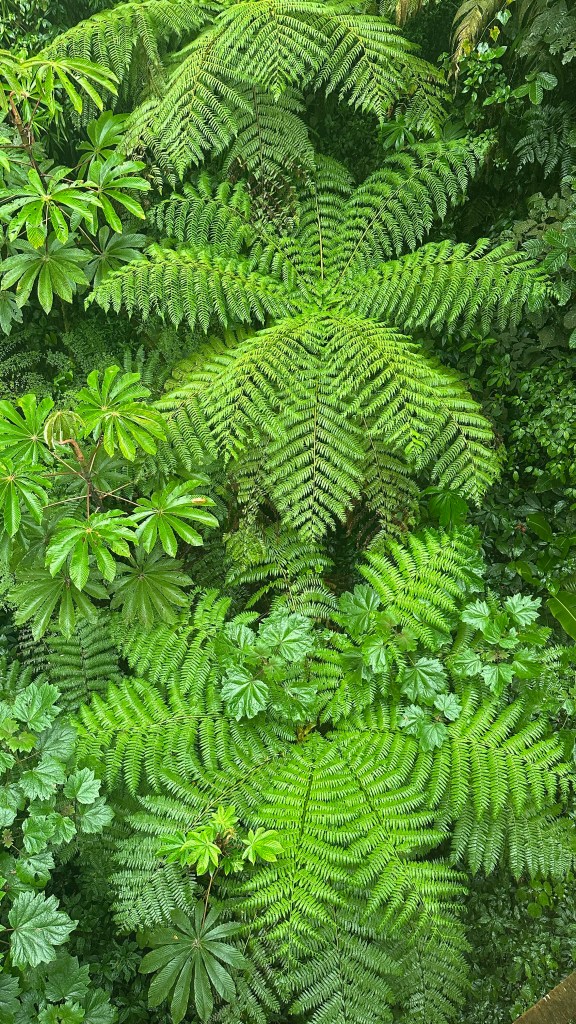
The most dominant group of plants in the forest are ferns, which are also the third oldest group of plants and the oldest group of vascular plants on Earth, with a history spanning over 360 to 380 million years.
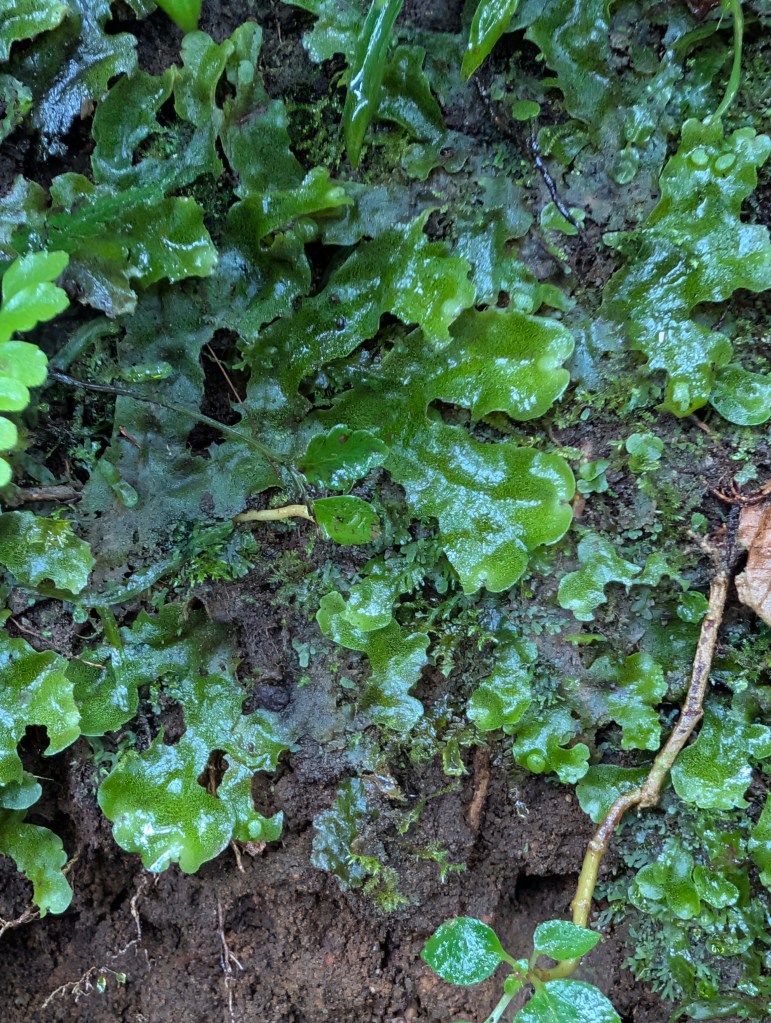
The second most dominant plant found in the forest are mosses which are the second oldest plants on Earth, with a history spanning approximately 400 to 450 million years. They were among the first organisms to transition from aquatic environments to colonize land. The oldest organism in the forest are the fungi and lichen. Lichen are a symbiotic, composite organism consisting of a fungus (the mycobiont) and algae or cyanobacteria (the photobiont). Lichen fossils date back 600 million years.
Once our tour with Sebastian was completed, we were scheduled for the tram ride to the observatory at 6000 feet. We bravely got on the gondola.

The ride up was more scary than fun with basically no views except the dense clouds surrounding us. The wind was blowing so hard at the top we did not even get off the gondola but chose to ride it right back down.
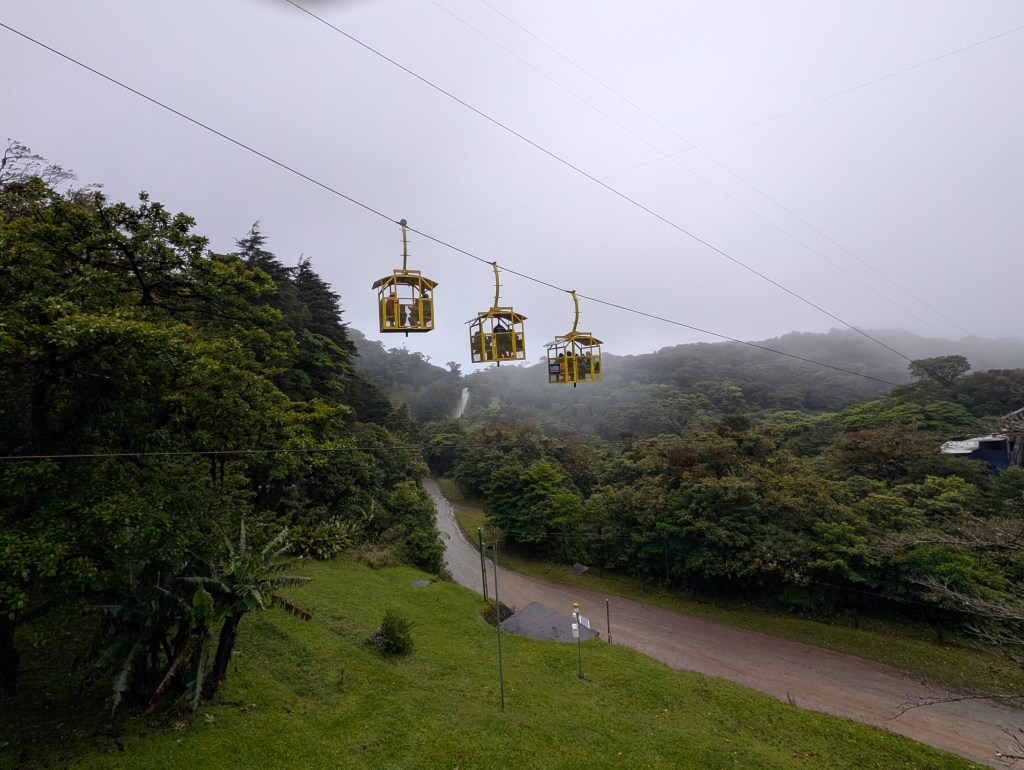
We warmed up while enjoying a lunch at the park. We no sooner finished eating and the sun came back out. We were disappointed that we had not had clear skies for our tram ride, but decided to hike on some bonus trails offered for self exploration. Off in the distance we could see the zip-line towers; that was an adventure not in our wheelhouse.
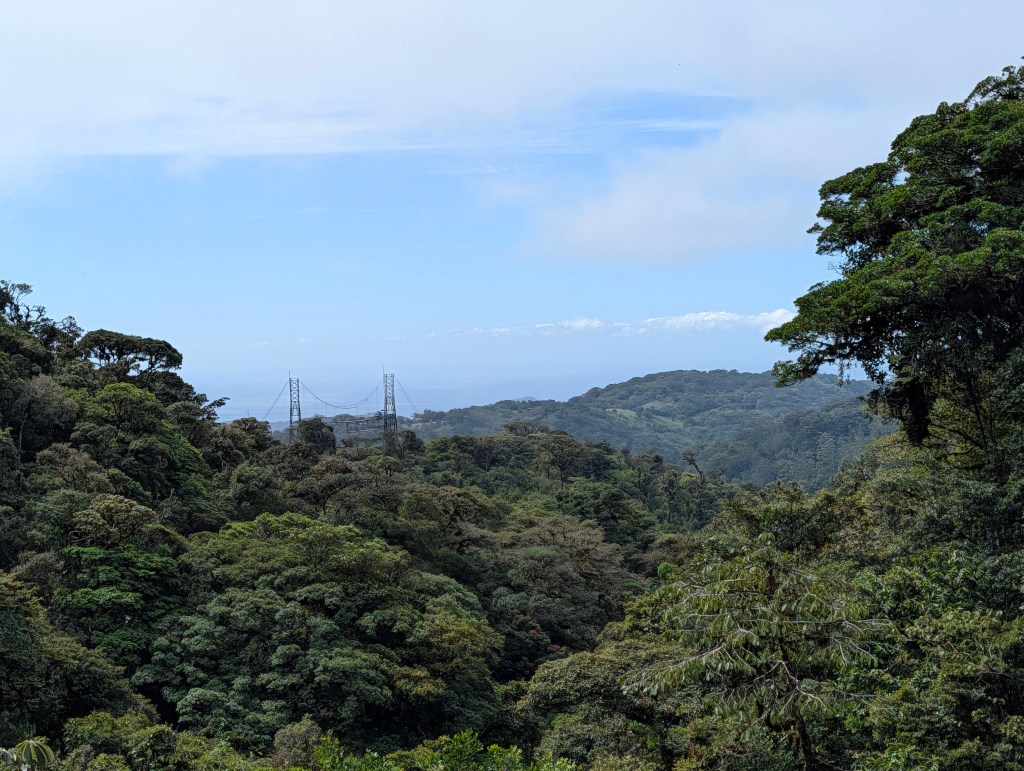
I was proud enough of myself for braving the hanging bridges.
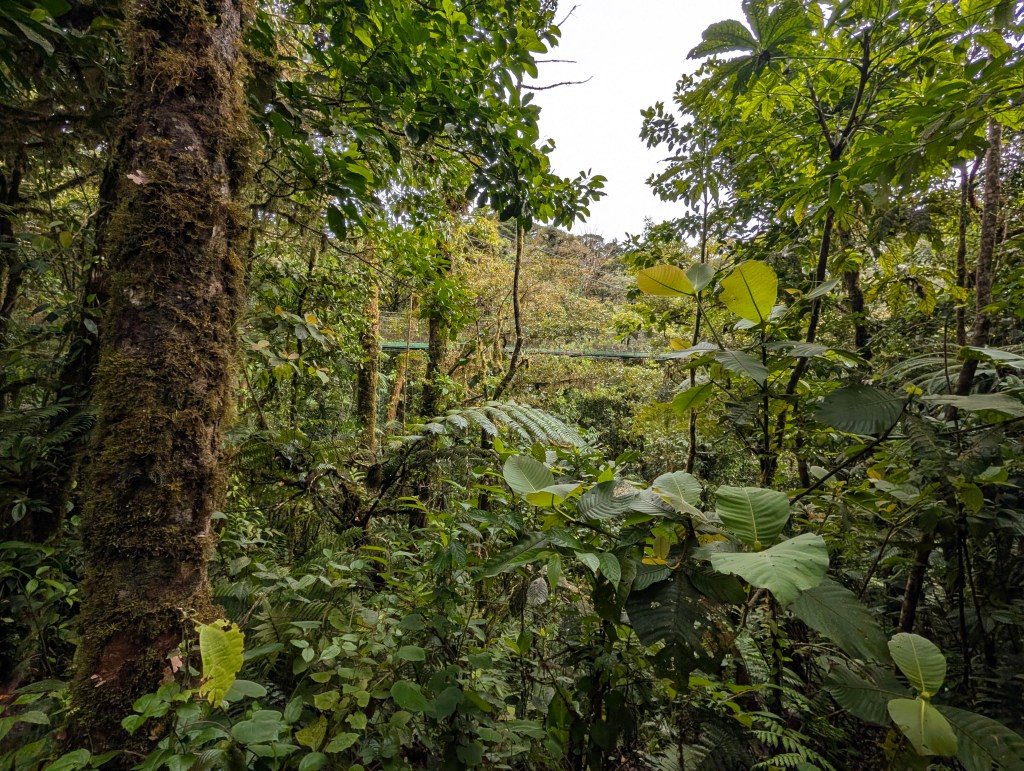
On our own we found a yellowish flycatcher. A distinctive feature is its white eye ring, which broadens into a small triangle behind the eye.

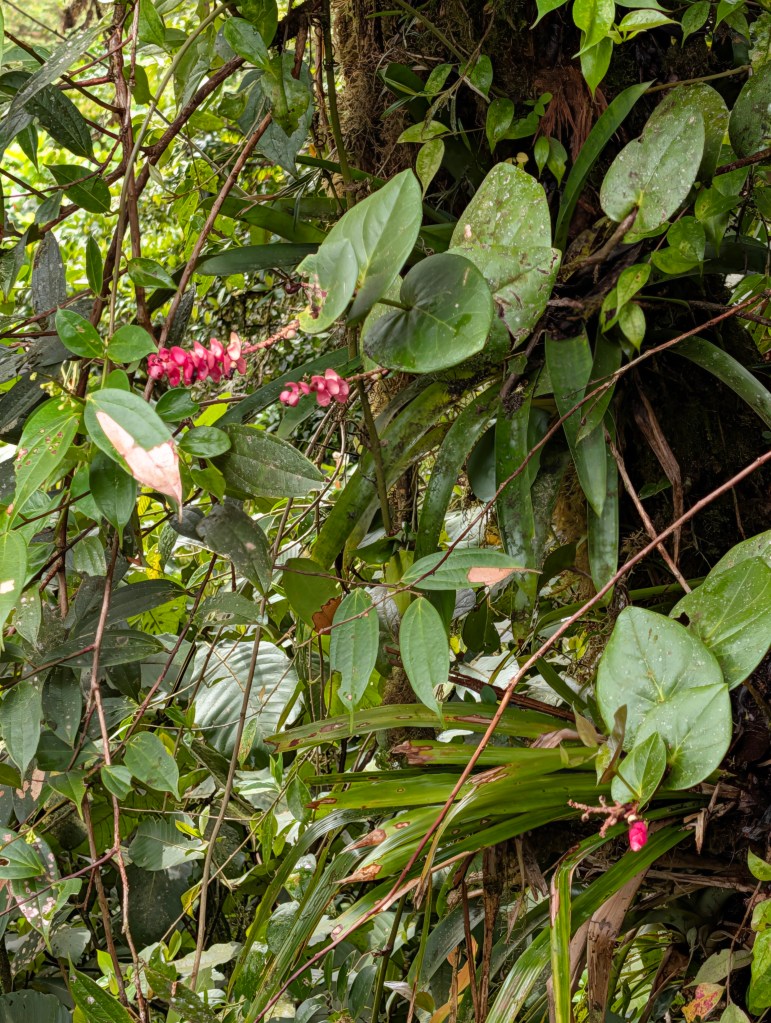
We also found a Cavendishia complectens, an epiphytic shrub native to Central and tropical South America. It is a woody perennial plant that typically grows on the trunks and in the canopies of other trees in cloud forests. It belongs to the family Ericaceae, which also includes blueberries.
The rain held off long enoough for us to make our way back to our lodge. We had planned to venture into town for dinner, but it was back to raining and blowing hard so we decided on Tiki’s Seafood, a delicious little place steps from our lodge. We had poke bowls and were happy.
 Jo & Eric's travels