
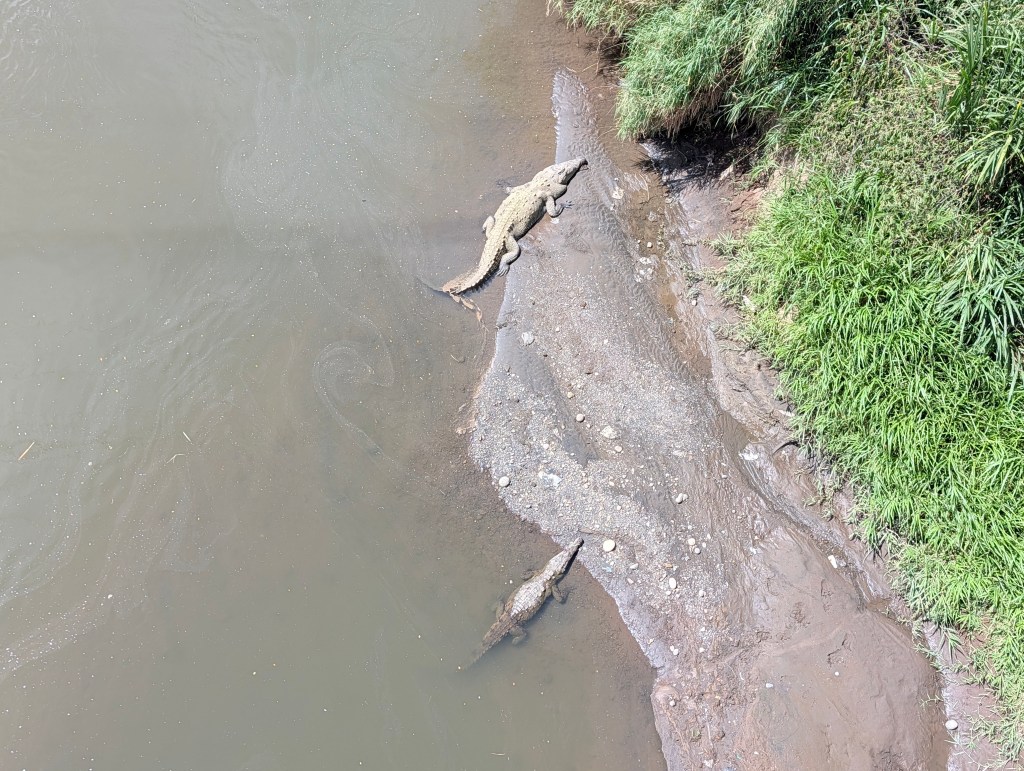
We left Monteverde on our first sunny morning since arriving in Costa Rica. Our drive was long to reach the Pacific, but we made a few stops along the way. The first was at Puento Rio Barranca, a very touristy spot to view the American crocodiles. This is an American crocodile, a species found across the Neotropics. They are the most widespread crocodile species in the Americas, found in freshwater rivers, lakes, estuaries, and saltwater habitats. American crocodiles can grow over 20 feet long.
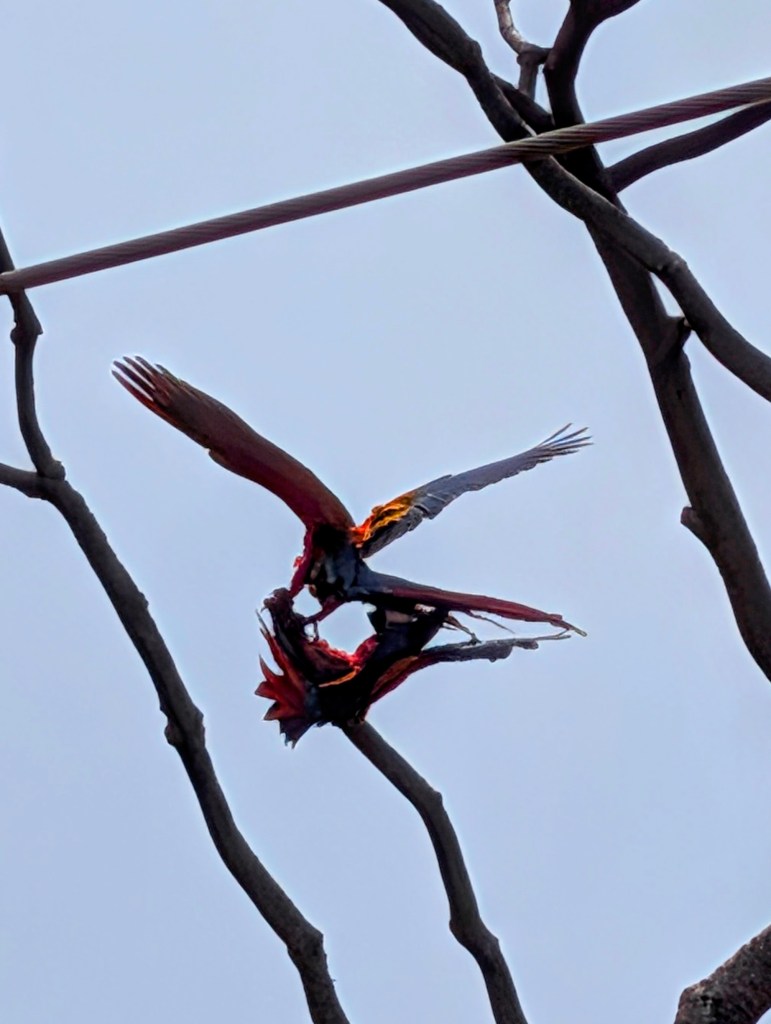
We also made a stop to take a picture of a couple Scarlet Macaws, large, vibrant parrots native to the humid evergreen forests of the Americas. They are easily recognizable by their brilliant red, yellow, and blue plumage. Their powerful beaks allow them to crack even the hardest nuts. These two were either fighting or mating, hard to distinguish from our vantage point.
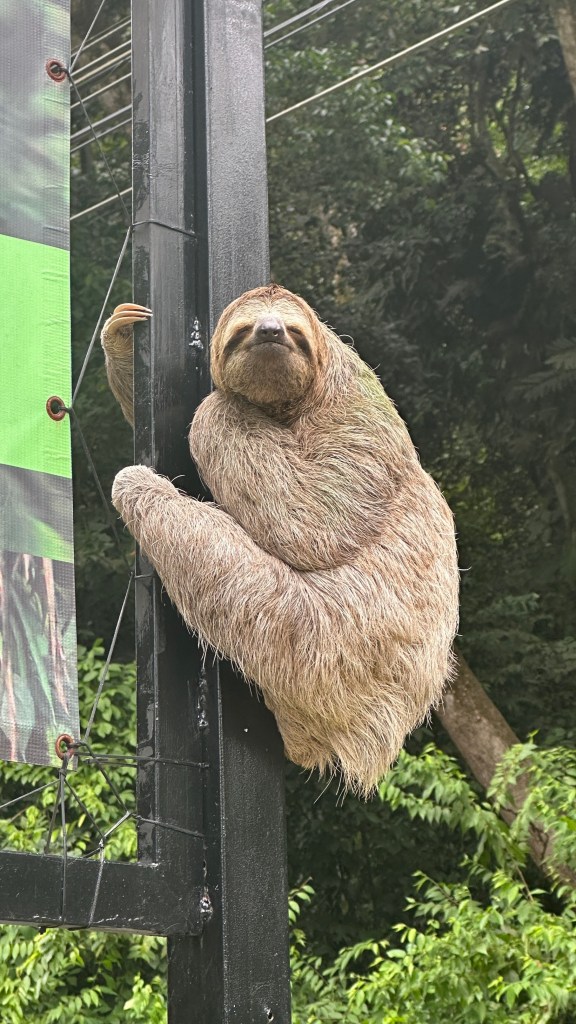
As we neared or destination we saw a large crowd on the side of the road. Our driver pulled over when we noticed everyone taking pictures of this adorable 3-toed sloth who appeared to be posing for the pics.
We arrived at the Parador Resort in the late afternoon.

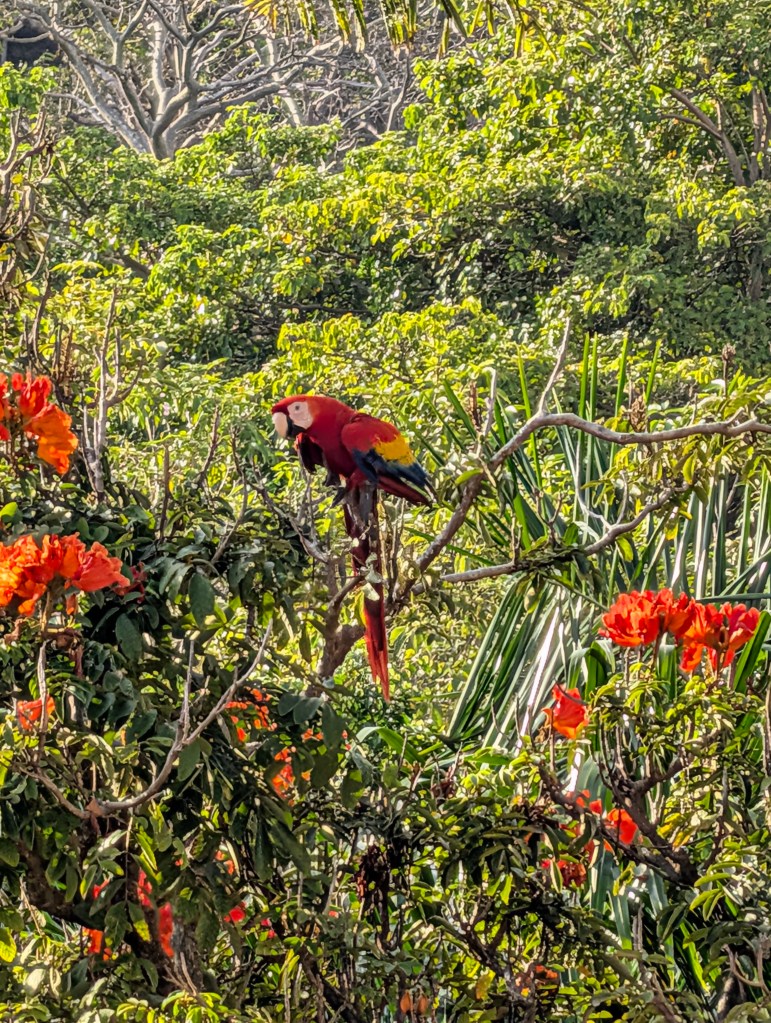
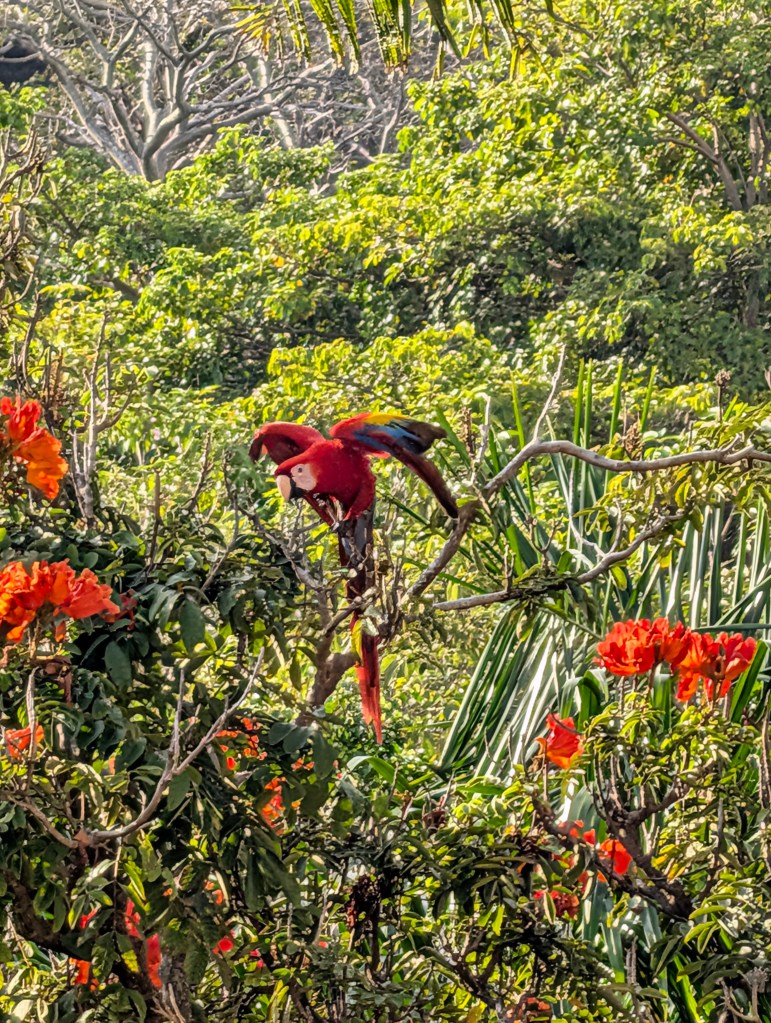
The resort is so large, after check-in we were driven by golf cart to our room. We settled in and immediately saw another pair of Scarlet Macaws. These birds can be up to 32 inches long, with their long, flowing tail making up more than half that length.
We spent the remainder of the afternoon exploring the resort with its interesting mix of old Spanish style
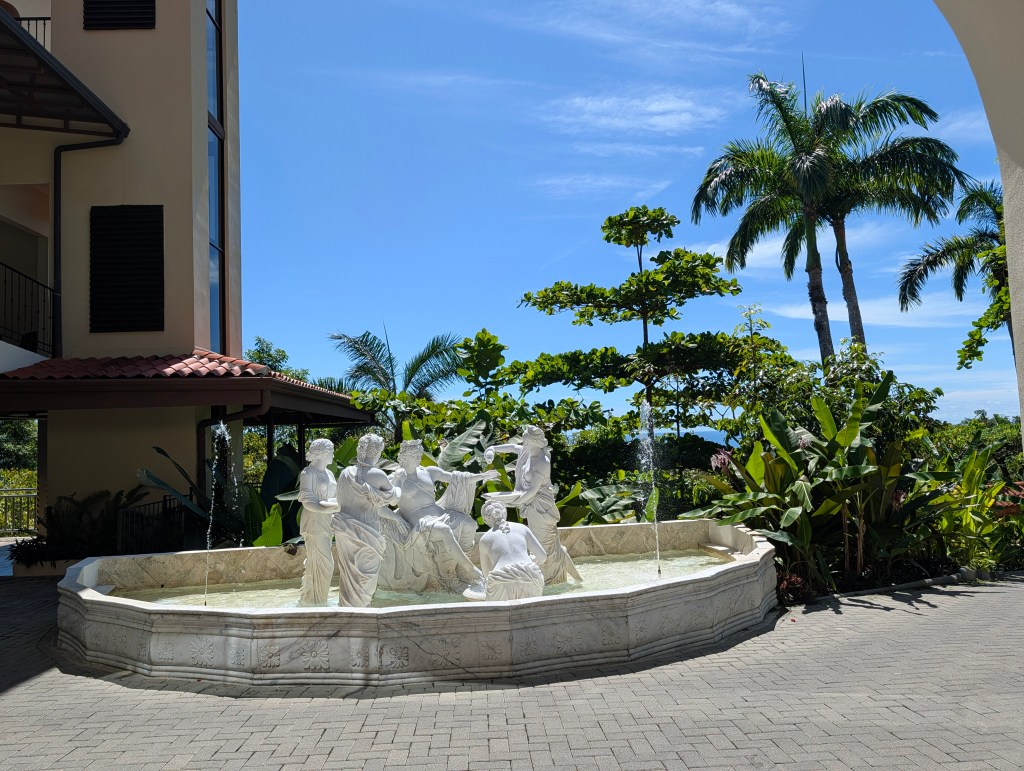
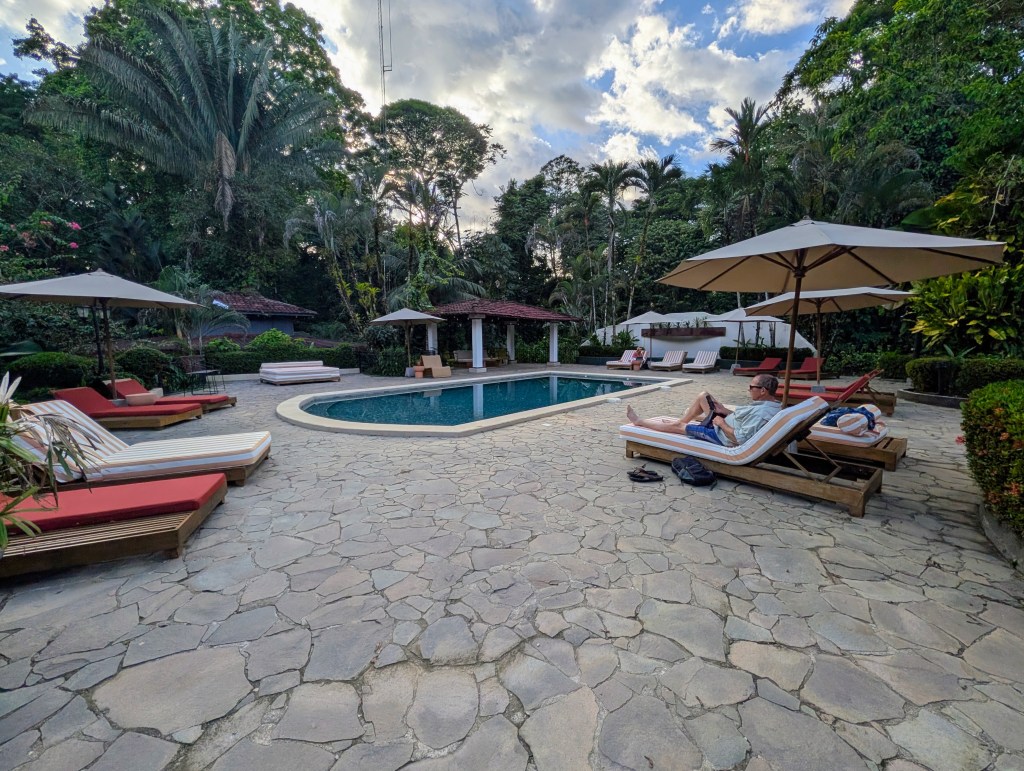
and Caribbean charm. We had a very late lunch by the pool.

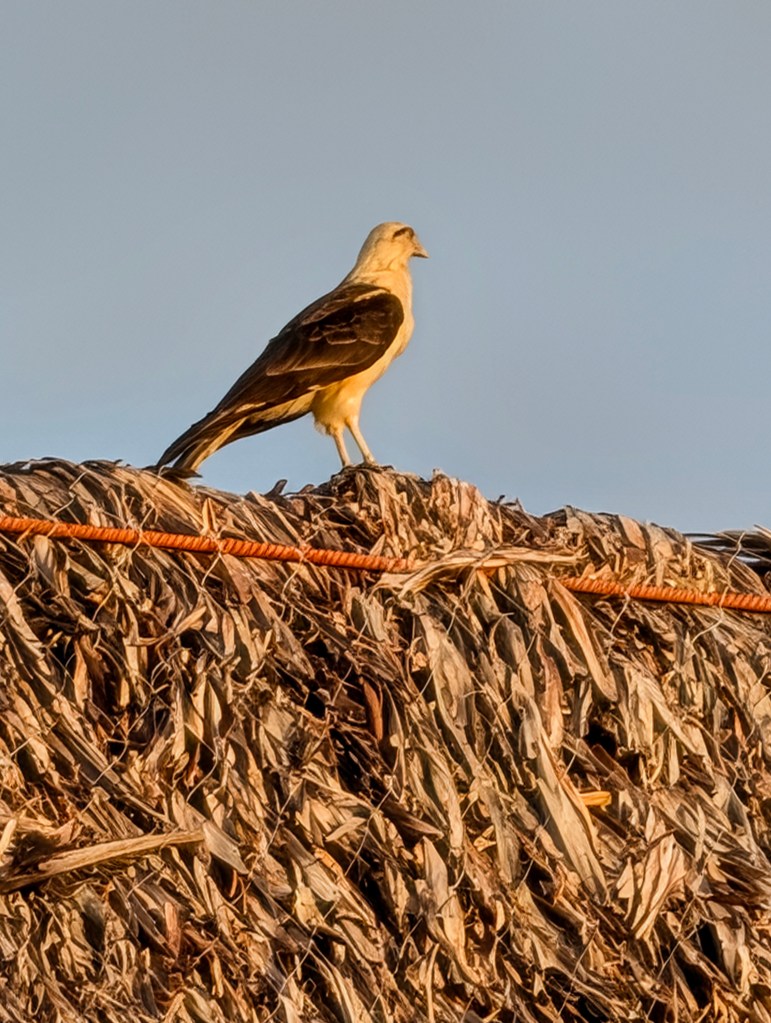
On our way back to our room we spied an yellow-headed caracara. The yellow-headed caracara is a bird of lightly treed open landscapes, like savanna with palms and scattered trees, ranch lands and pastures, and the edges of forests. In elevation, it mostly ranges from sea level to 3,300 ft.
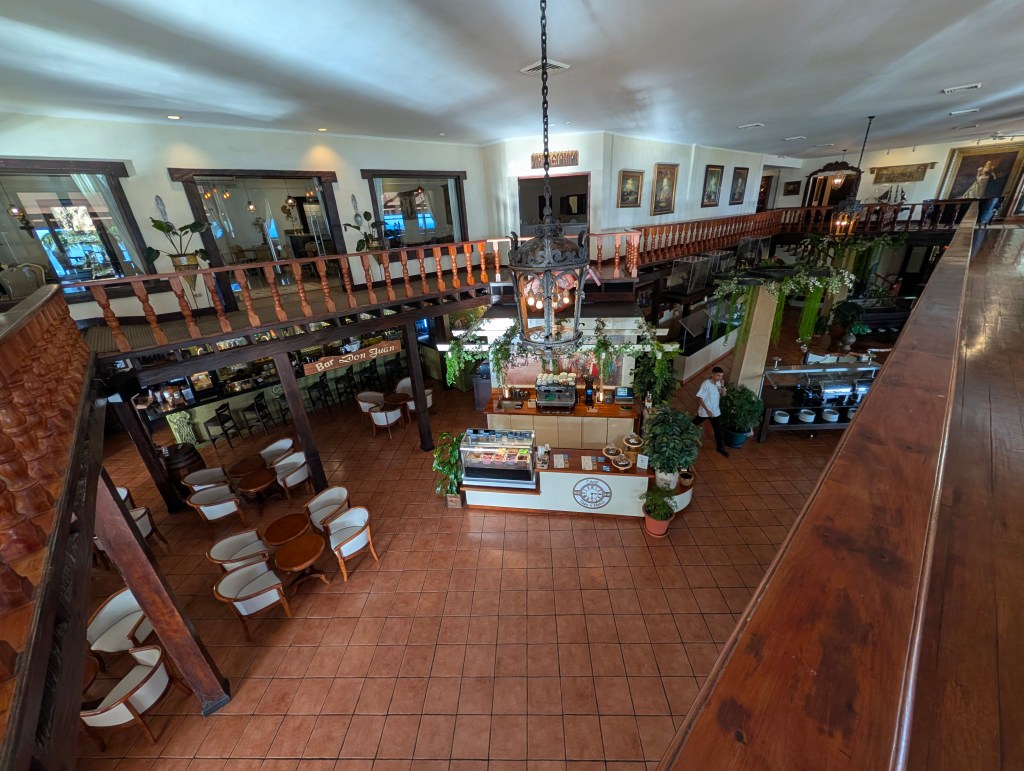
The next morning, after breakfast in the lovely dining room
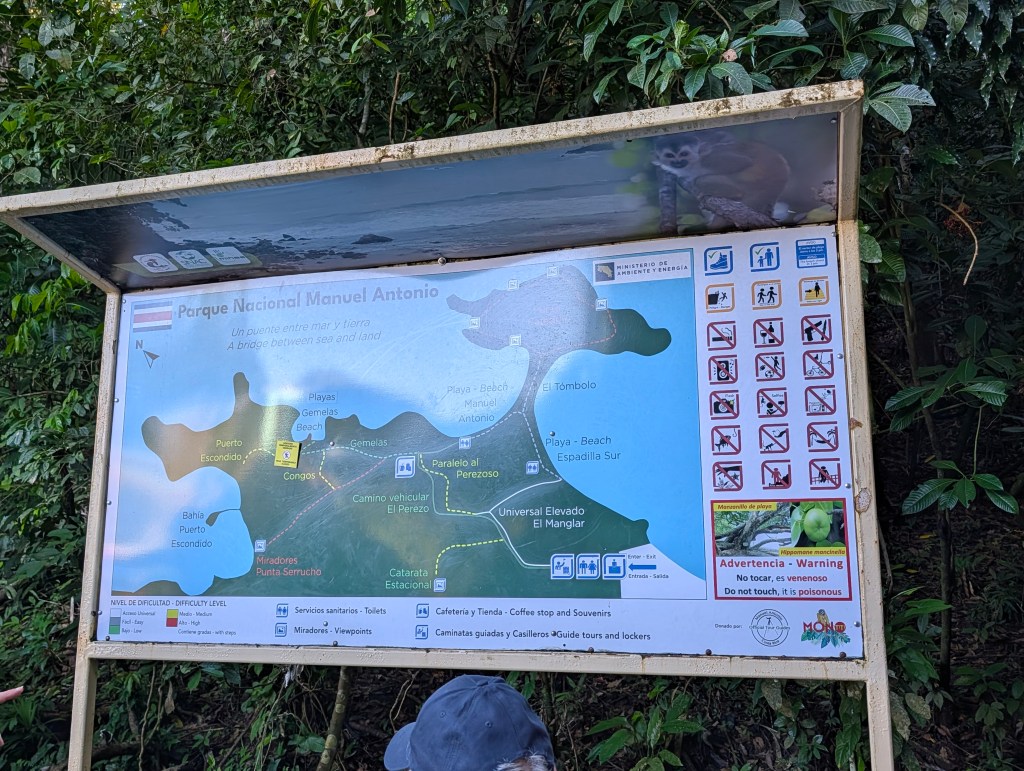
we were driven to Manuel Antonio National Park by our driver and Roberto, our guide for the day. Along the way Roberto told us that the park was established in 1972, when the local community, encouraged sought to conserve the natural environment by prohibiting development and destruction planned by a then large banana industry. They also protested the beach restrictions imposed by foreign owners on locals. The park has a land area of 4,900 acres and 63,340 acres of water. The park is crossed by a network of trails equipped with universal accessibility facilities, rest areas, and scenic overlooks.
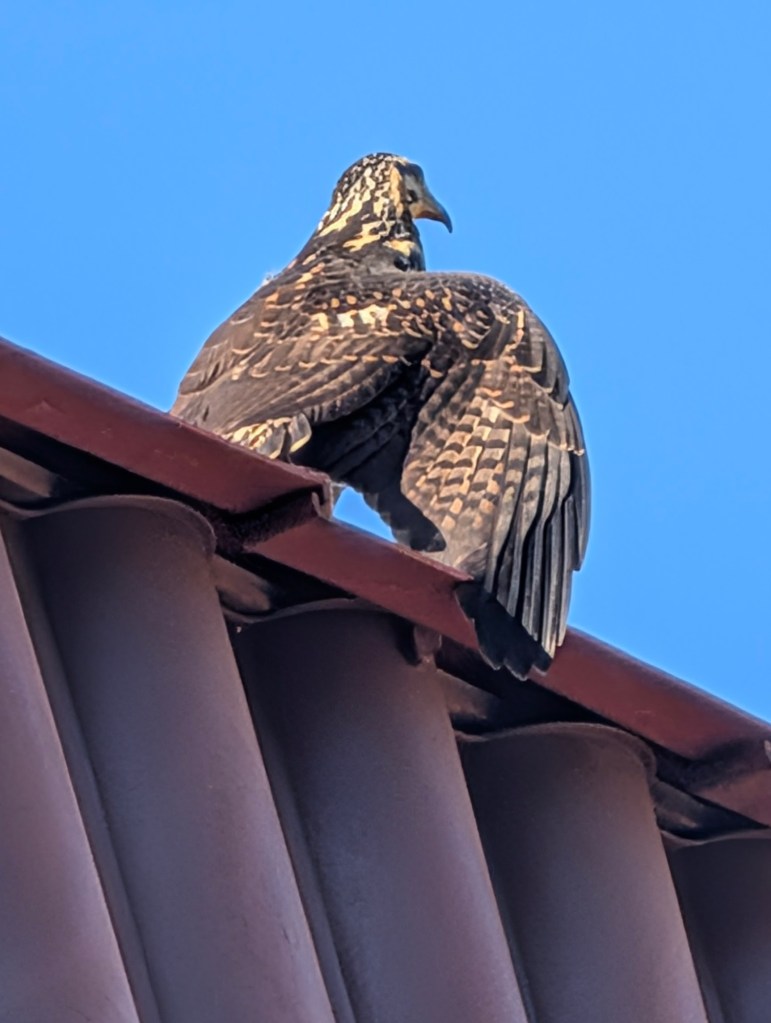
While waiting on line for entrance to the park, we saw a juvenile black hawk drying and warming its wings in the early morning sun. Black Hawks are apex predators in the jungle and particularly like crabs and fish. They are commonly found in Costa Rica’s coastal mangroves, rivers, and wetlands. Adults, weighing roughly 2.5 pounds, are known for their broad wings, short tail with a white band, and yellow legs, while juveniles have a brown-streaked appearance.
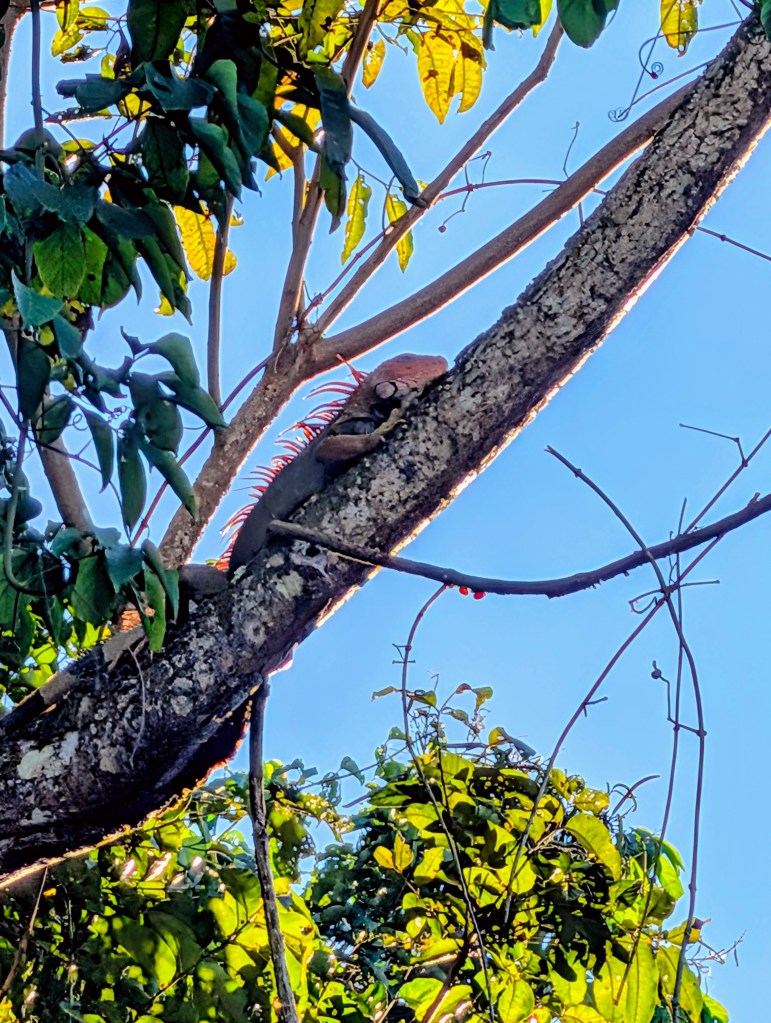
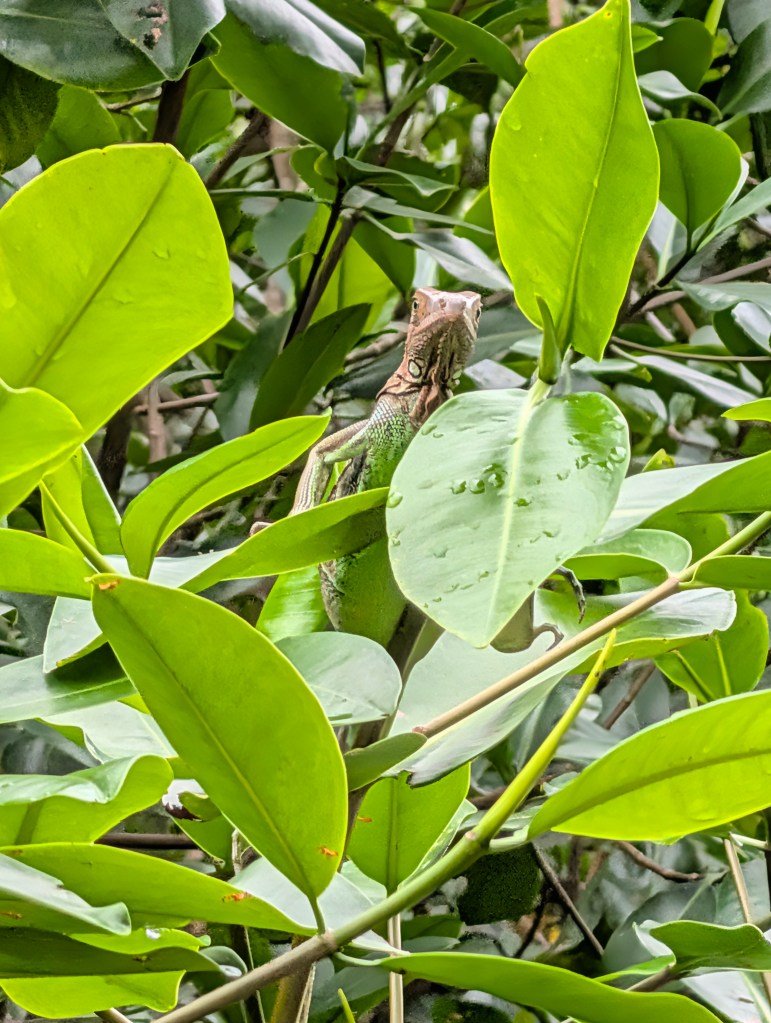
The entrance search was thorough; the preserve is quite careful., especially regarding food and plastics. Once through the security, but still waiting for entrance to the park, we saw a green iguana, a large, arboreal (tree-dwelling) lizard native to tropical regions of Central and South America, as well as the Caribbean. They are herbivores, primarily eating leaves, flowers, and fruits.
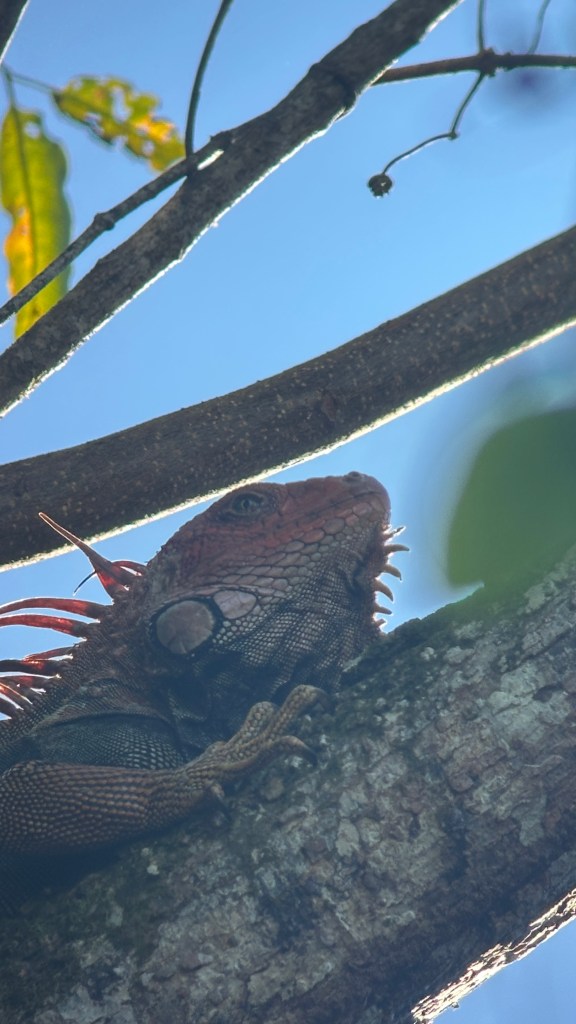
Roberto identified this one as a male due to his crest, and he is in breeding colors, which can turn orange or reddish during mating season to attract a mate. Males can grow to over 6.6 feet in length.
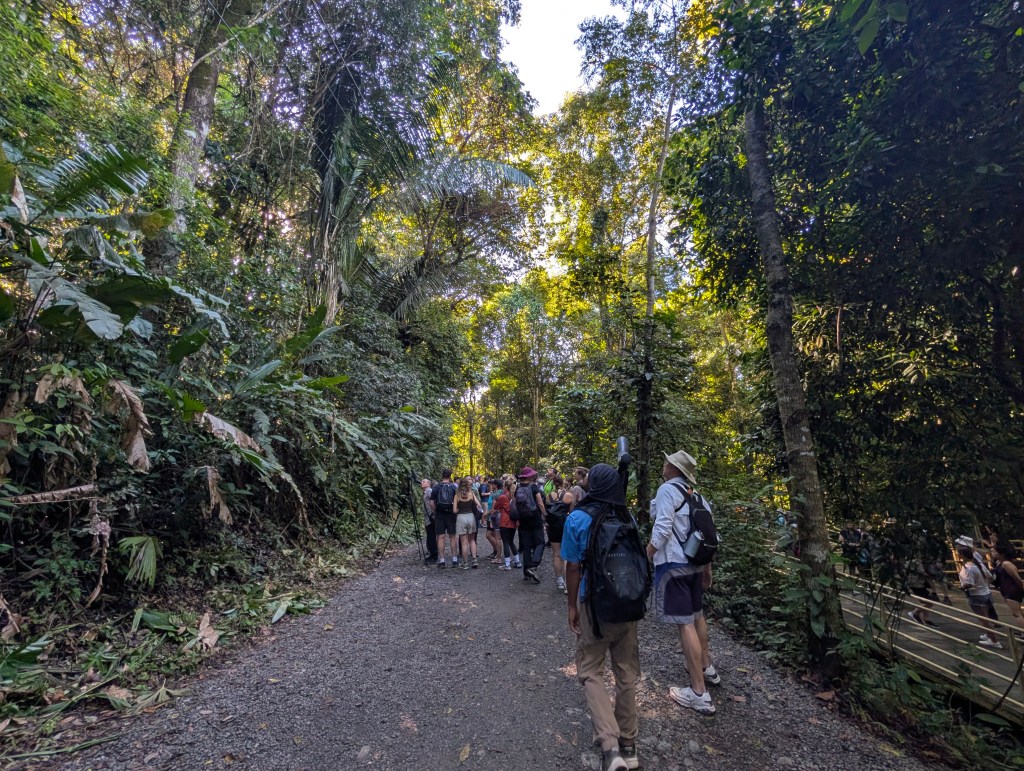
Manuel Antonio is a gallery forest, ie a forest restricted to the banks of a river or stream. We entered the trail.
Our first sighting inside the park was a smooth helmeted iguana, also known locally as the helmeted basilisk. They are arboreal, meaning they live in trees, and are active during the day (diurnal). They are New World lizards found in tropical forests, ranging from southern Mexico to northwestern Colombia. Adults can grow to be up to 14 inches (35 cm) long.
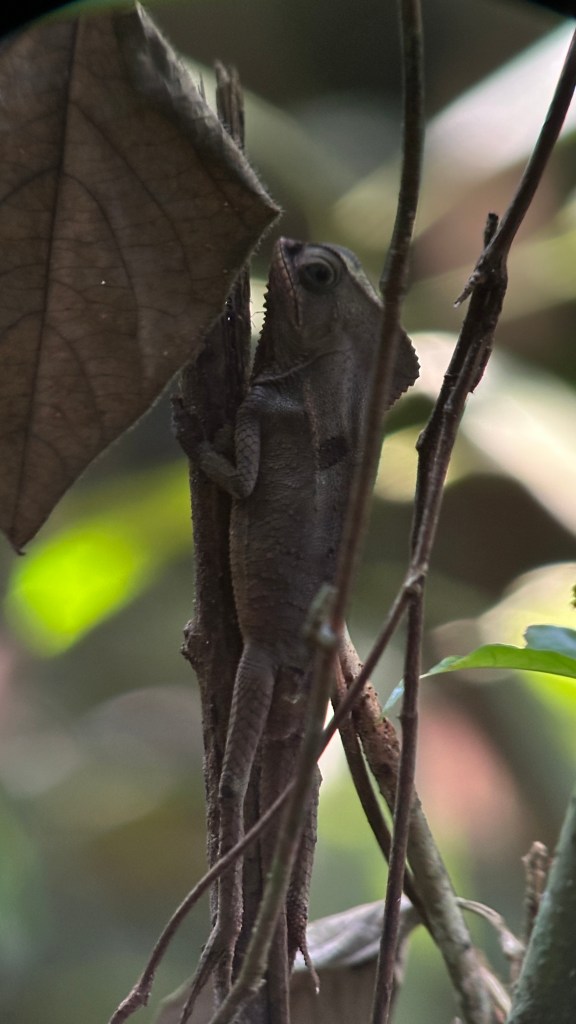
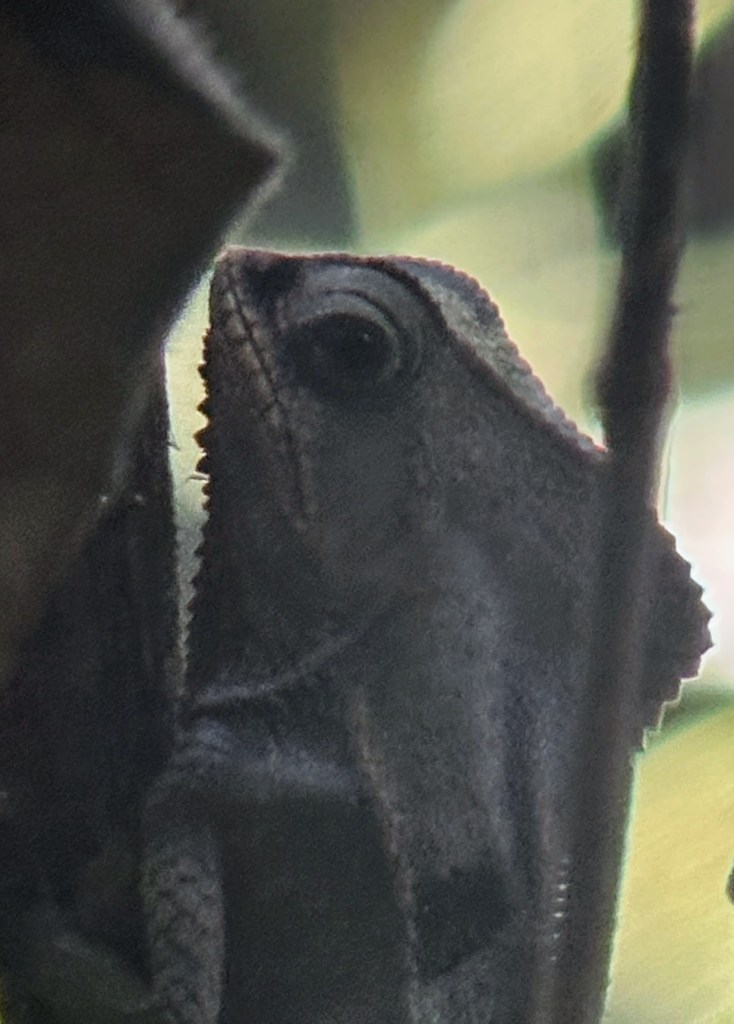
The prominent, helmet-like crest on their head is a distinctive feature.
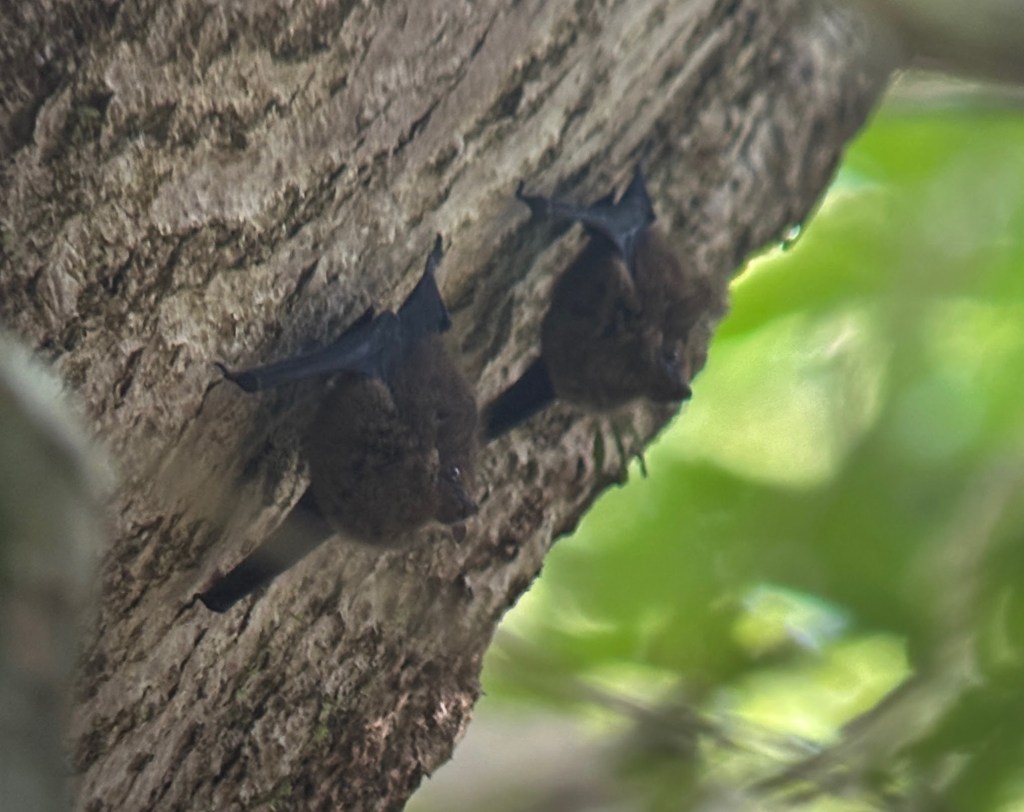
We found two White-lined bats, small, insectivorous bats identified by two distinct white stripes along their backs. They are commonly found in lowland forests, often roosting in groups on tree trunks or abandoned buildings, and are known for their unique hovering flight and complex vocalizations. They help keep the mosquito population down by eating as many as 3,000 mosquitoes (roughly a third of their body weight) a night.
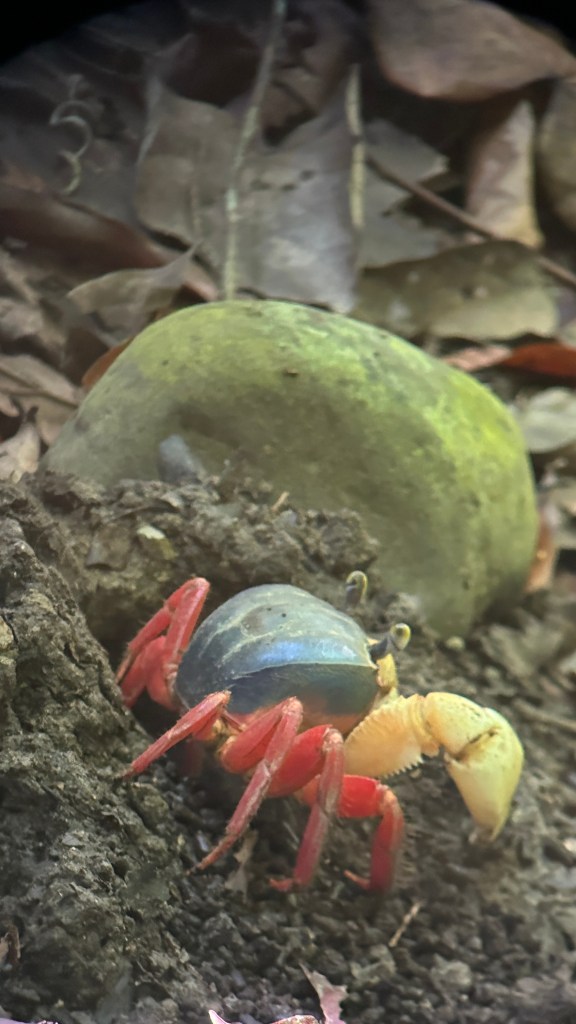
Very common here in the park are Halloween moon crabs. They are primarily herbivores, feeding on leaves, fruits, and flowers. It is a species of terrestrial crab found in the coastal tropical eastern Pacific from Baja California to Peru. The crab is recognizable by its distinct coloration: a purplish-blue shell (carapace), red legs, and white or yellowish main pincers. They are common among mangrove roots, where they typically build their burrows, which help develop the soil.
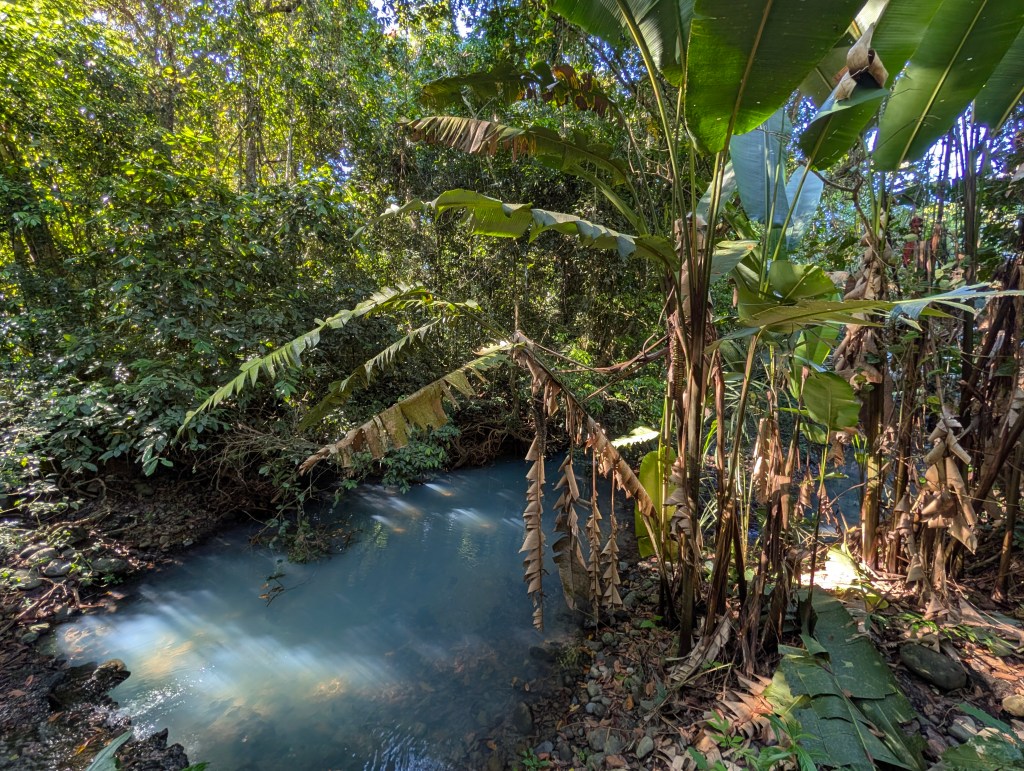
Roberto pointed out that the discoloration of the water in the river is not pollution but rather minerals, especially large quantities of calcium.
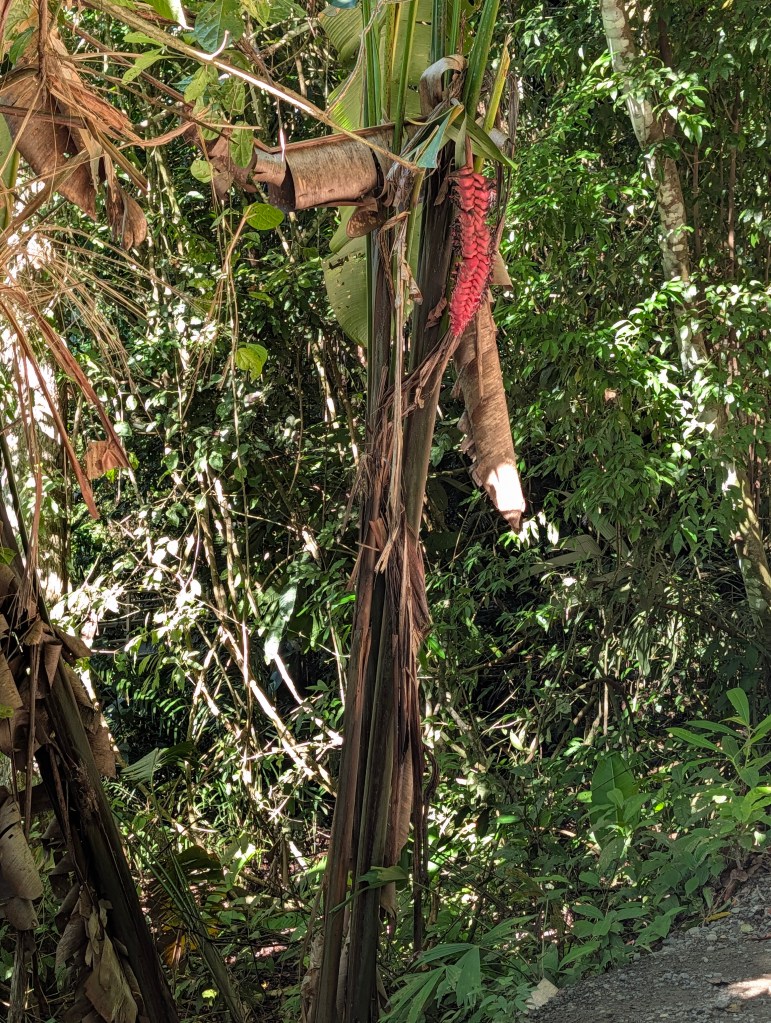
I was particularly drawn to this plant, a Beefsteak Heliconia, native to Central and Northwest South America. The plant is known for its large, pendent (hanging) inflorescences that resemble a beefsteak, which can grow up to 2 feet in length. These inflorescences consist of many blood-red bracts (modified leaves) arranged in two rows.
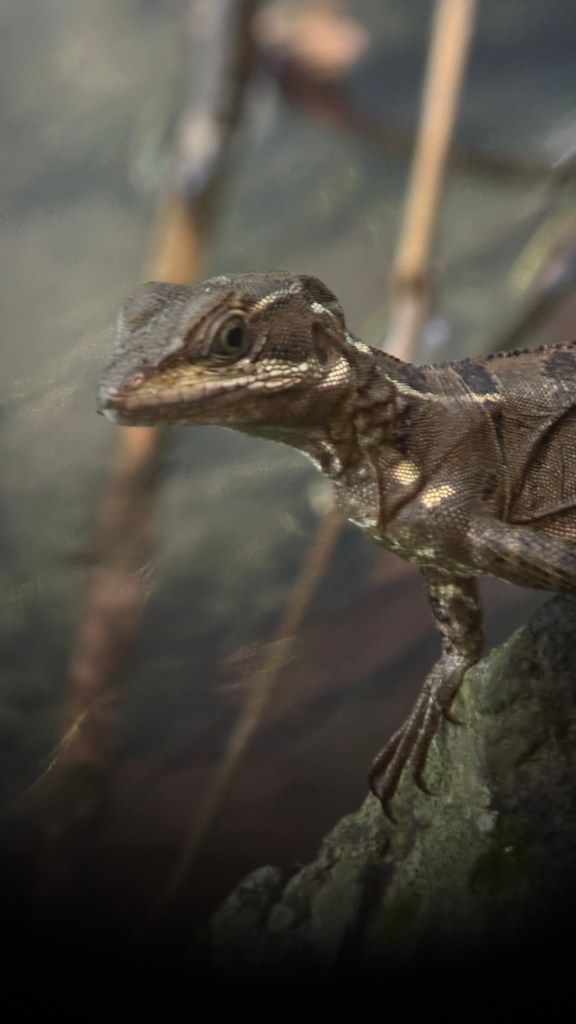
This is a common basilisk, known locally as the Jesus Christ lizard because of their ability to run across the surface of water to escape predators. This ability is due to specialized skin flaps on their back feet that expand upon striking the water, creating enough surface tension to support them for a brief period.
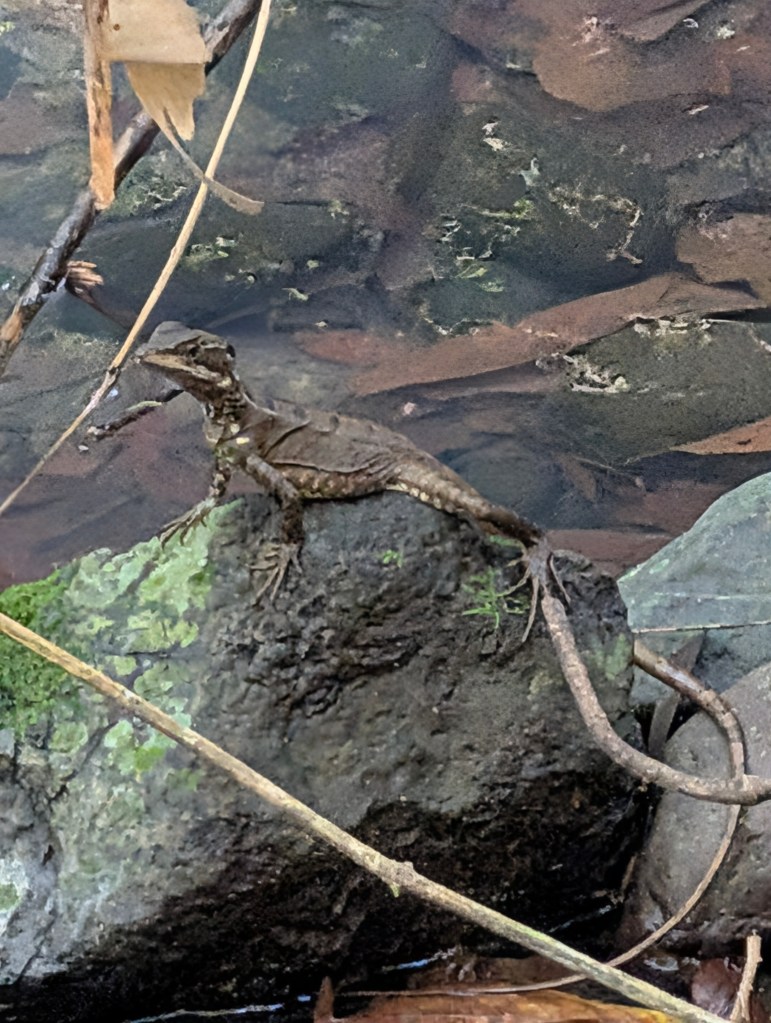
They are found in Central and South American rainforests near rivers and streams. They can reach up to about 3 feet in total length. This is a female because she is lacking a crest on her head.
We saw another male green iguana, this one has a different mating color.
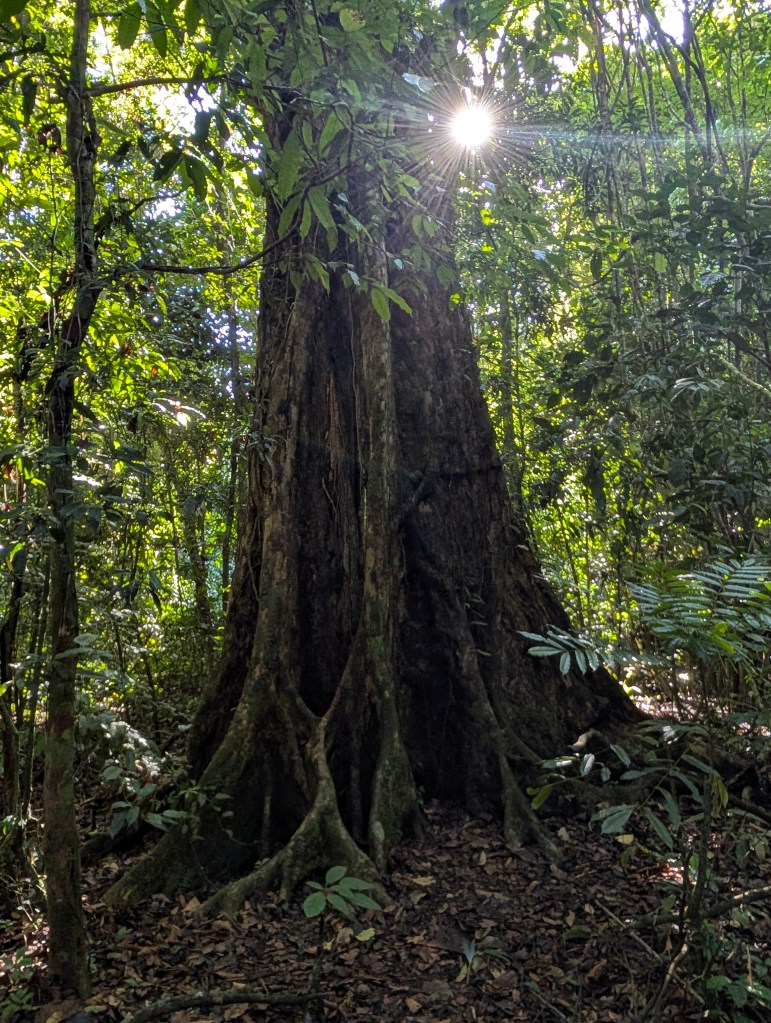
This tree is in the beginning stages of being strangled by the strangler ficus vines.
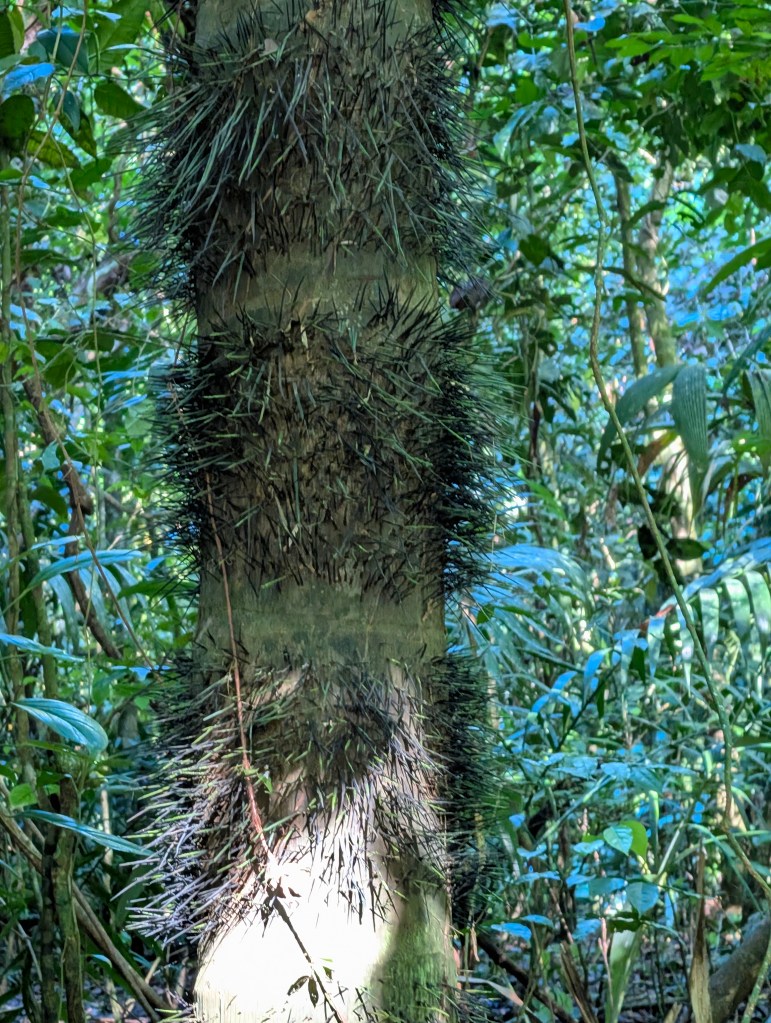
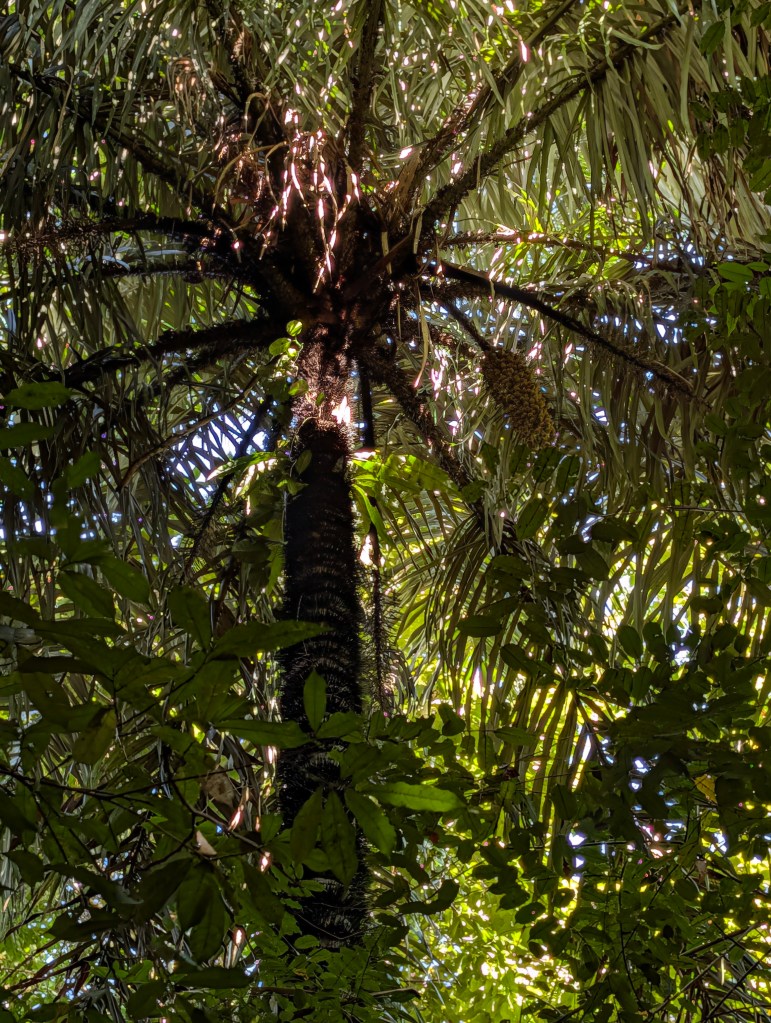
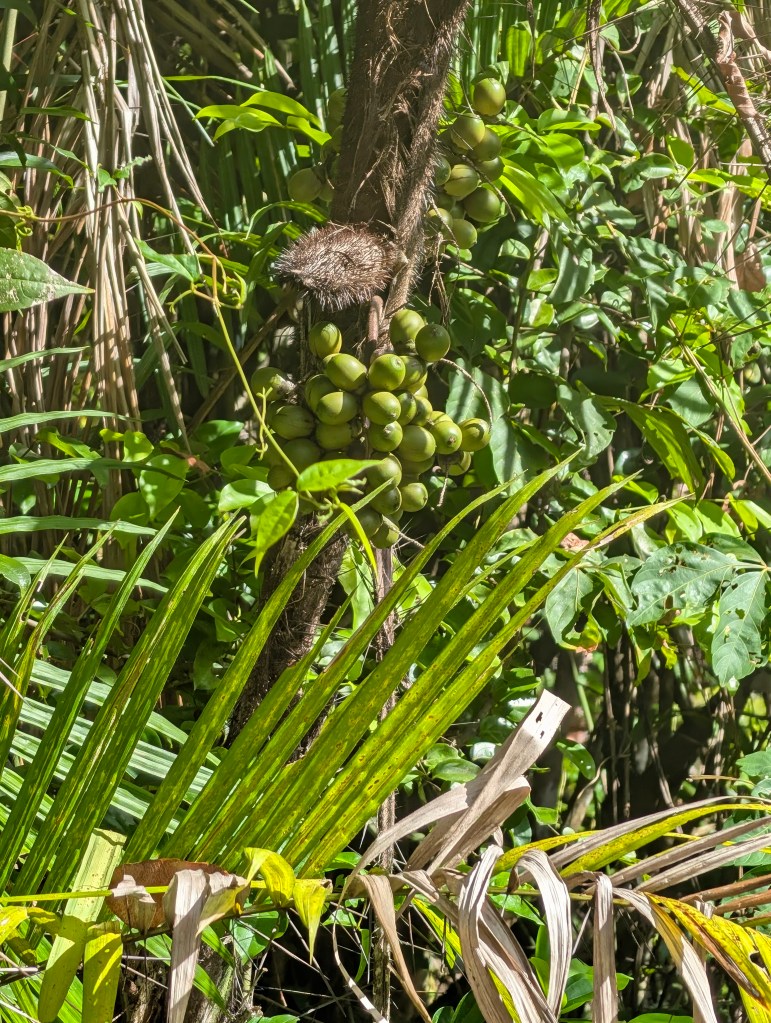
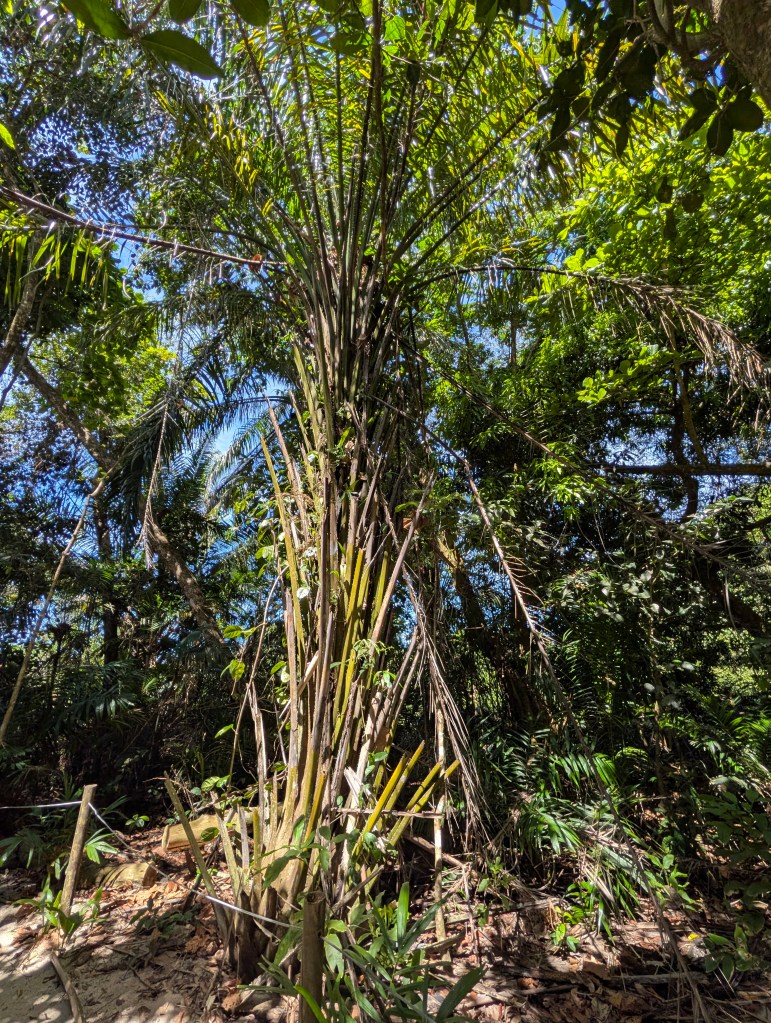
The Chung Palm, referred to as the “porcupine palm”, is a spiky-trunked palm found in rainforests. It is characterized by extremely sharp, long black spines covering its trunk and leaves, which act as a defense mechanism with spines sometimes reaching up to 8 inches long. The spines are often used to produce fiber for baskets, hats, and, traditionally, fishing nets.
The spiky palm produces a type of date seen below in the hanging bunch at about 4 o’clock.
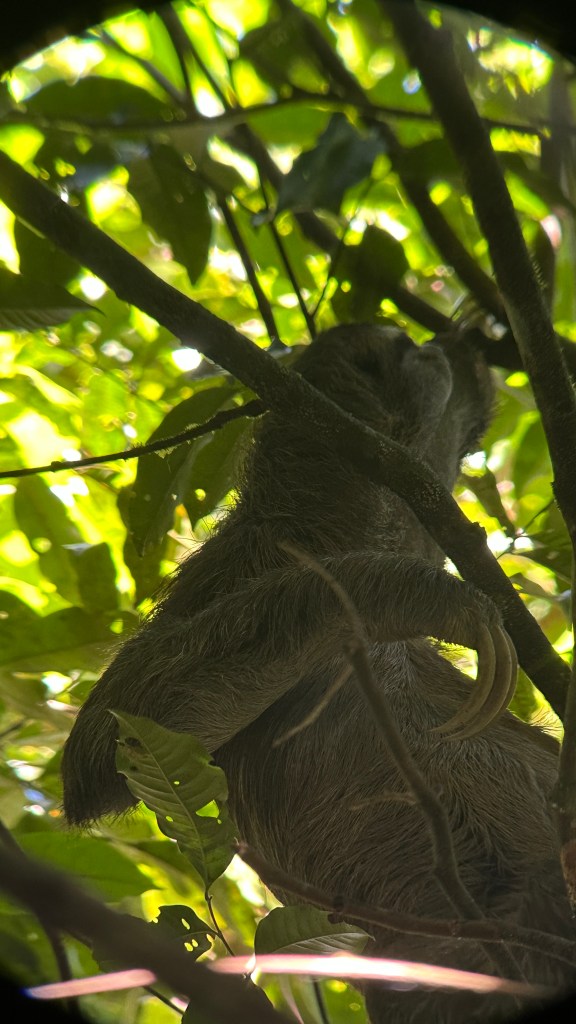
There was a crowd gathered trying to get pictures of the 3- toed sloth. The 3- toed sloth incubates for 9 months; the cub stays with its mom for only 6 months. Compared to 2 toed sloths, 3-toed sloths are smaller, diurnal (vs the nocturnal 2-toed), possess distinct dark facial markings resembling a smile, and have a more restricted diet of leaves.
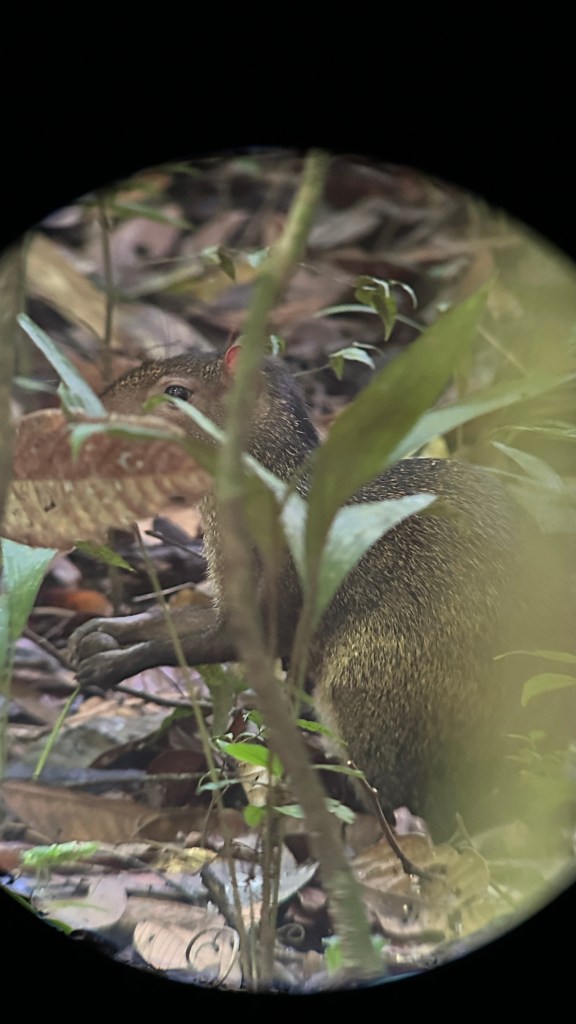
We spied an agouti hiding in the brush. We did not see him nearly as well as we had seen the one in Arenal. More agouti fun facts: they are famous as the only animals capable of cracking open tough Brazil nut pods. They are highly agile, capable of jumping up to 6 feet high, and are generally monogamous.
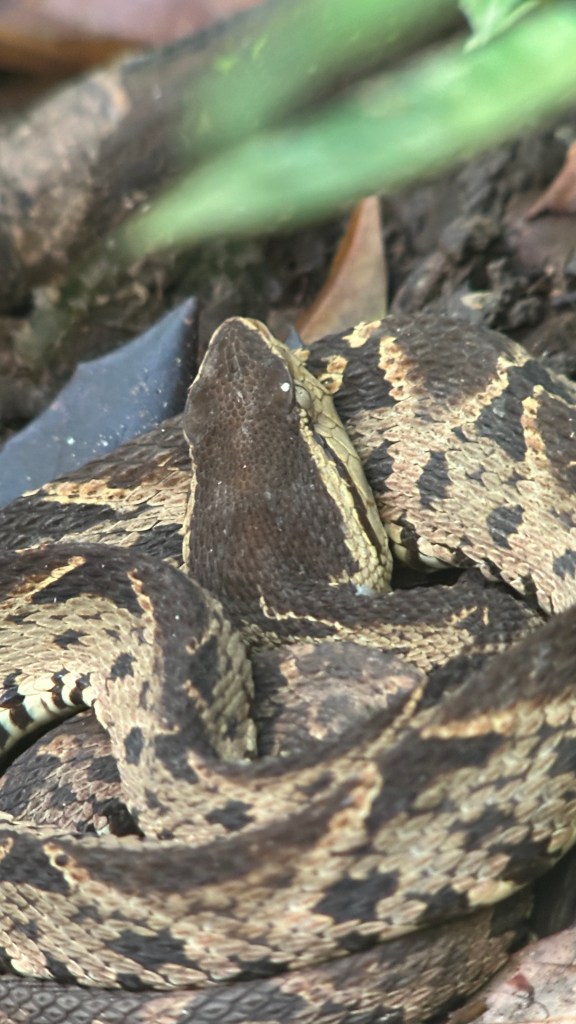
Roberto showed us a Fer-de-lance, a highly venomous pit viper species found in Central and South America. He reiterated what every guide has told us, “Always stay on the path.” Due to its potent venom and tendency to live near human habitations, it is important to watch your step in areas where these snakes are present. It is one of the largest and most dangerous venomous snakes in its habitat and is responsible for 80% of all bites in costa Rica, but most commonly the bites occur to those harvesting on banana, coffee, or chocolate plantations.

The venom can cause significant hypotension and renal failure in severe cases. Anti-venom is produced using horses. Guides do not carry anti-venom. Some people are allergic to the ani-venom, so it can only be used by a doctor in a hospital setting.
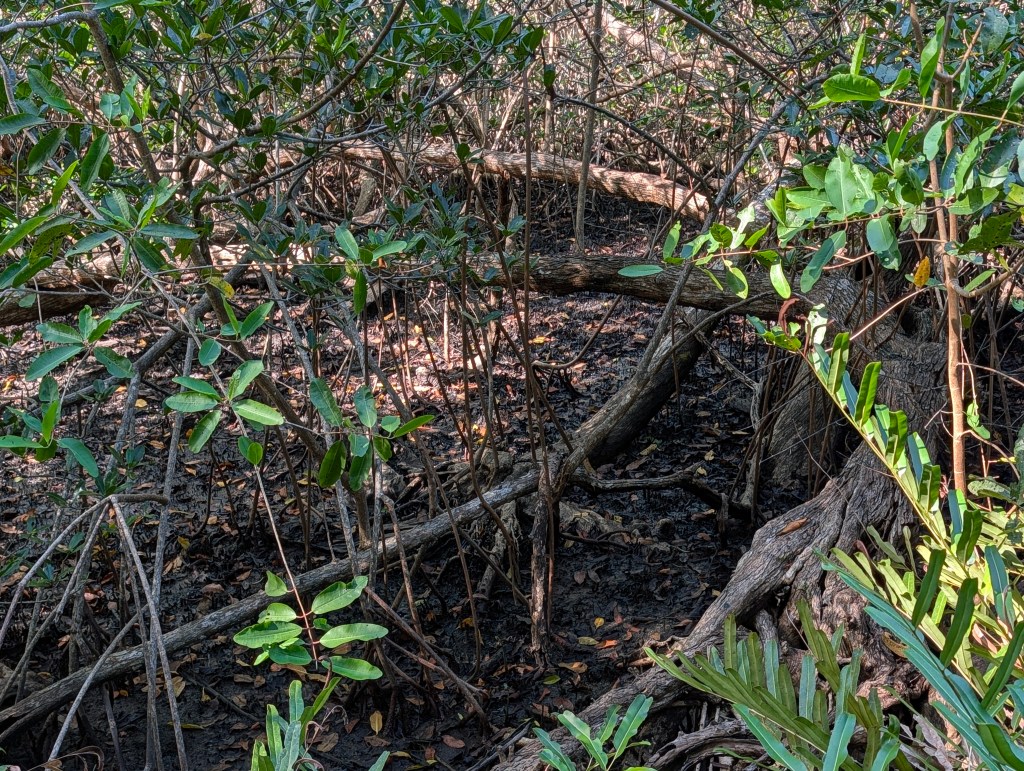
We started to leave the gallery forest and enter the mangrove forest. Here the water is brackish: a mixture of salt and fresh water. These white mangroves are notable for their areal roots.
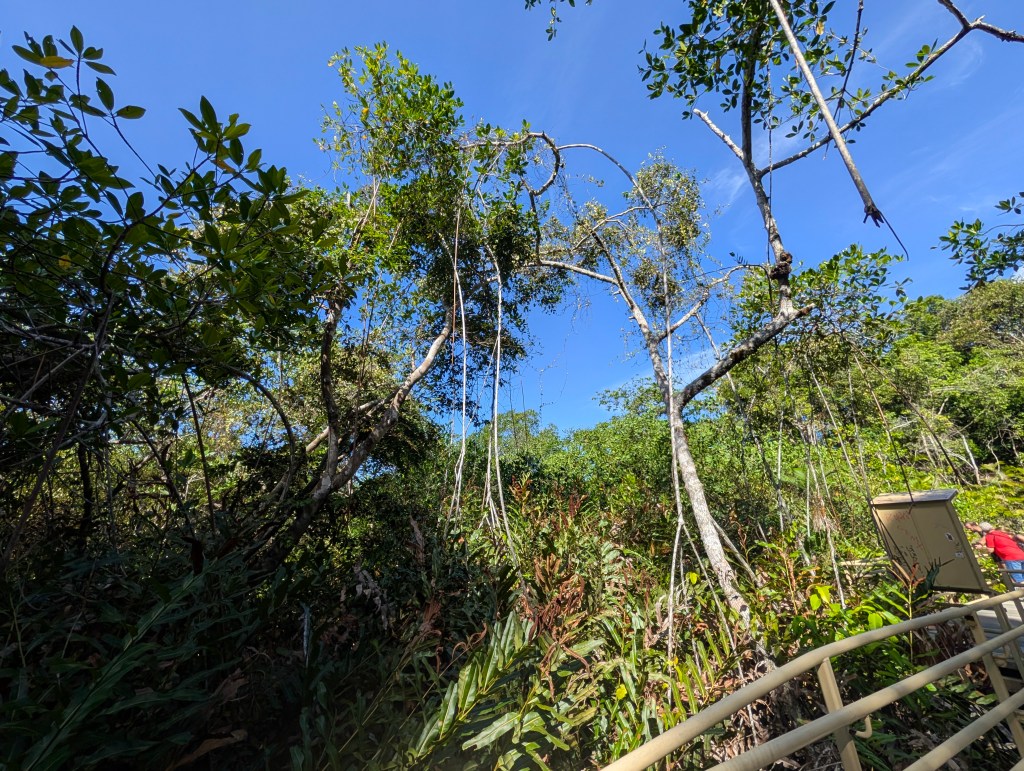
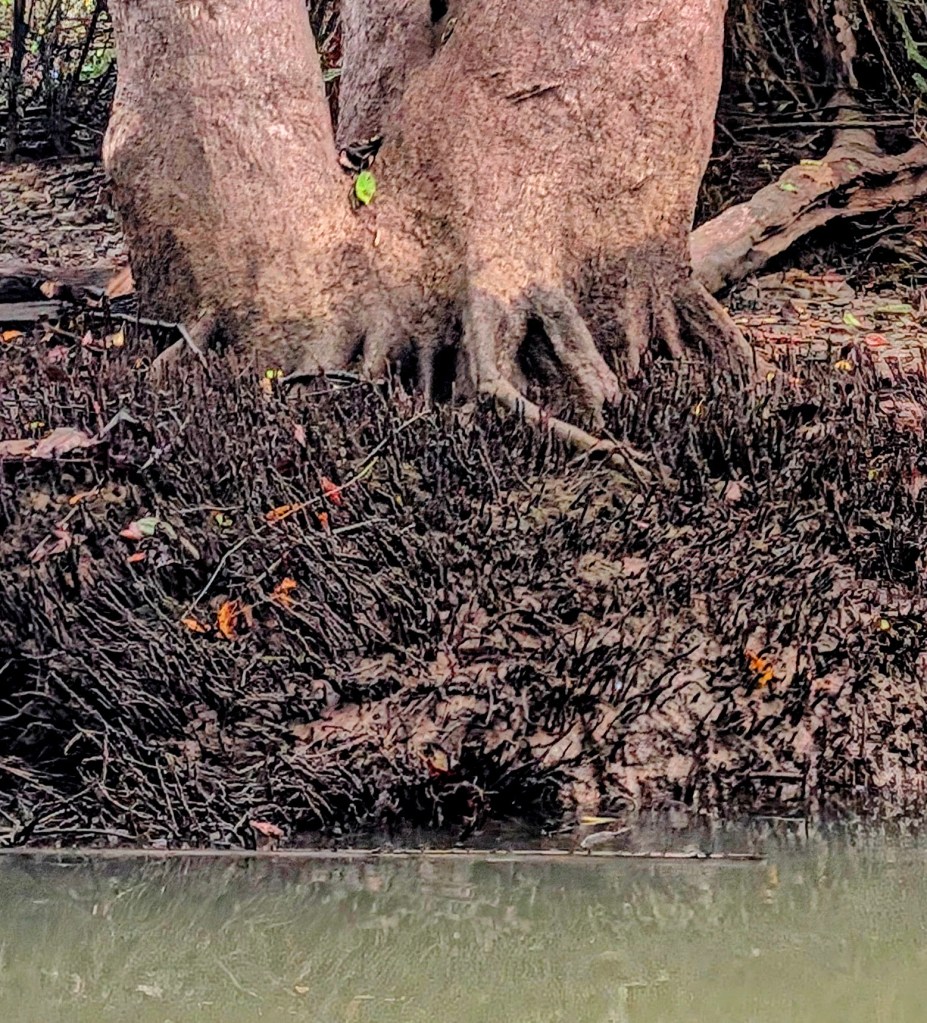
While the black mangroves breath via spikes from the underground upward. Mangrove wood is highly water resistant; in past years it was popular for making furniture. But mangrove gardens are an important ecosystem producing 10 times more oxygen per area than the rain forest. In Costa Rica cutting down a mangrove is a crime equivalent to murder with a minimum sentence of 6 years in prison.
Roberto showed us a Tucum palm whose leaves contain a strong fiber used for making fishing nets, ropes, and hammocks. This genus of palms is native to Mexico, South and Central America, and the Caribbean. The fruits are ovoid and ripen from green to bright yellow or orange. The fruit pulp is edible and described as sweet with a grape flavor.
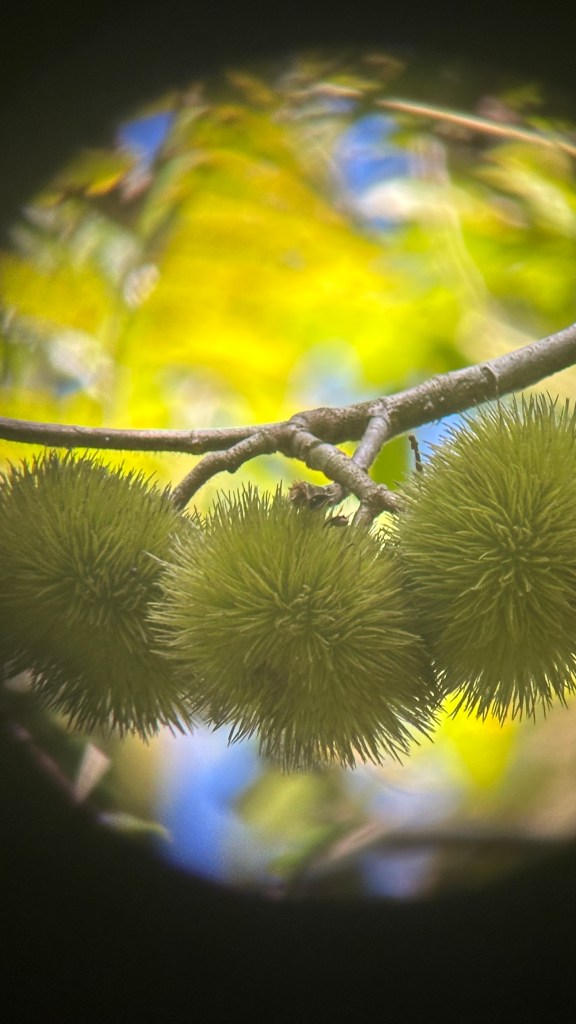
He also pointed out aptly named monkey brushes, which are actually chestnuts from the the Guiana chestnut tree, a common nut-bearing tree in Costa Rica, often called the Provision tree. Thriving in wetlands, it produces large pods with edible seeds that taste like peanuts or chestnuts when roasted.
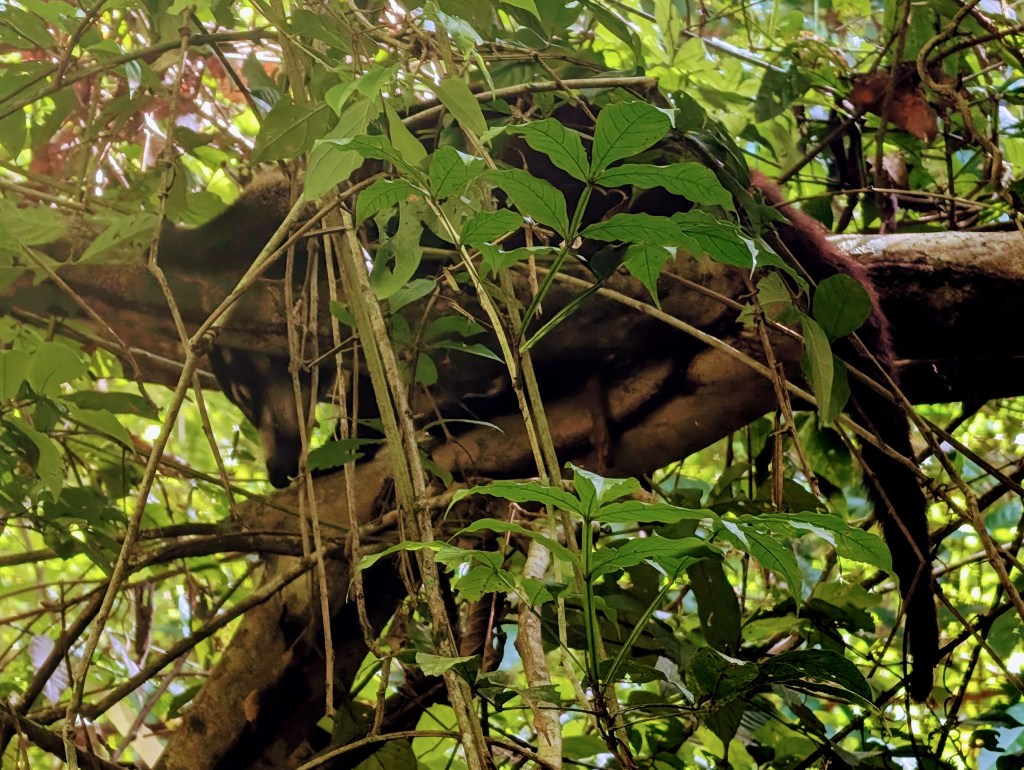
Another small crowd piqued our curiosity; we found them photoing this sleeping White-nosed Caoti. These highly social, diurnal, and omnivorous members of the raccoon family are found from Arizona to Colombia. Known for their long, flexible, white-tipped snouts and striped tails, these creatures live in female-led bands, utilize double-jointed ankles to climb down trees headfirst, and are skilled foragers.
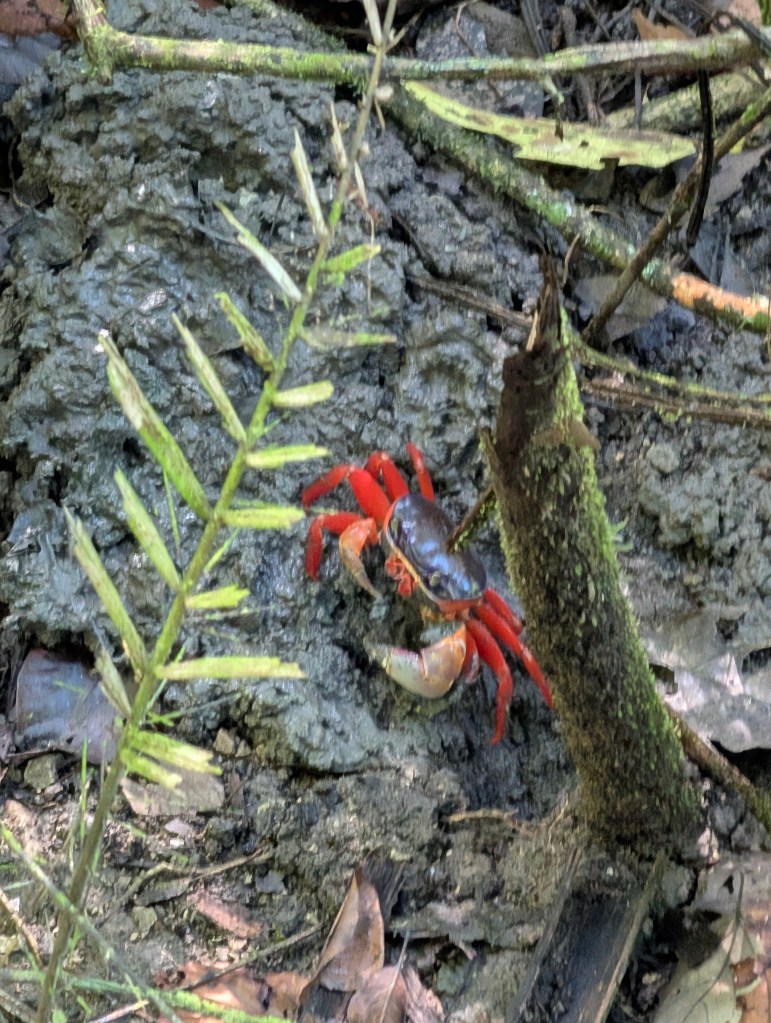
We saw many more Halloween crabs. These nocturnal, 2-4 inch burrowers are not true marine crabs, relying on high humidity to breathe while acting as colorful, mostly herbivorous scavengers. If injured or threatened, they can regrow limbs during their molting process. They are not ideal for group housing in captivity, as they can be very territorial and fight with each other. After shedding their exoskeleton, they will eat their old shell to regain nutrients. With proper care, they can live for about 8-10 years.Despite returning to the water to spawn, they are land crabs and cannot swim.
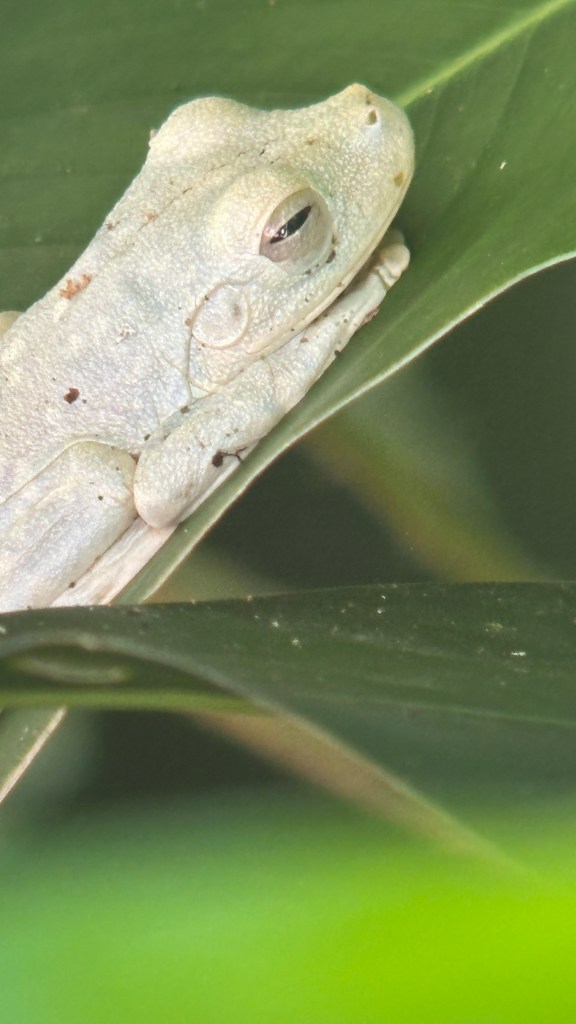
We stopped to note an albino tree frog, amphibians known for their ability to climb and live in arboreal environments.
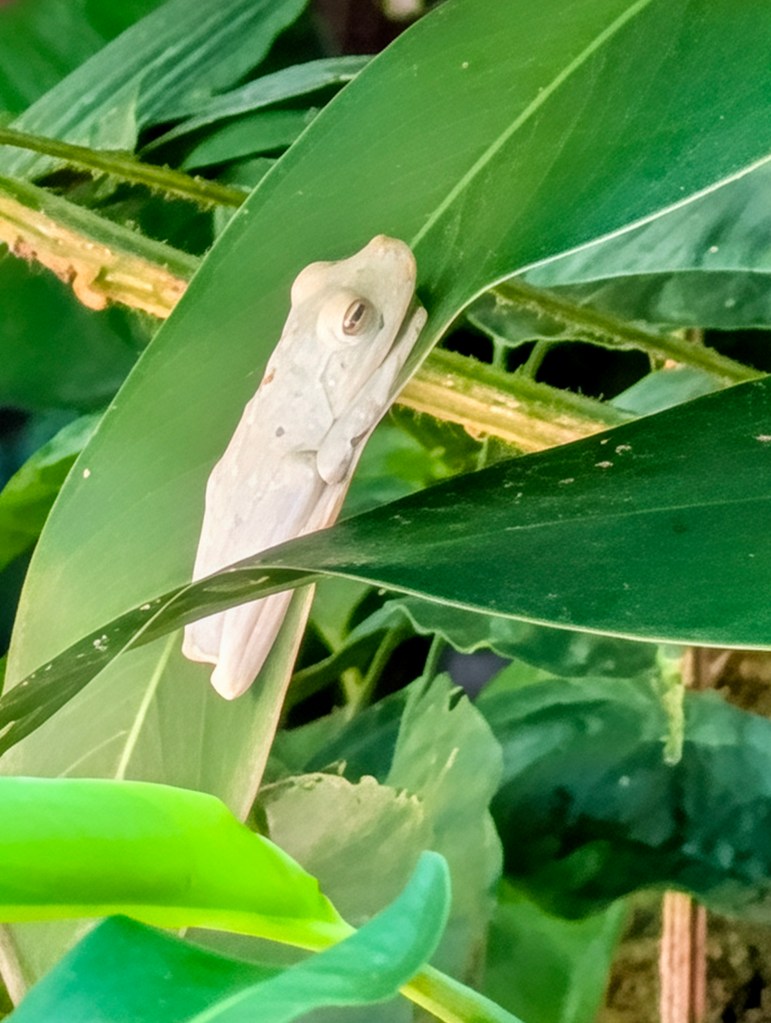
Their coloration can vary widely, often changing to match their surroundings for camouflage.
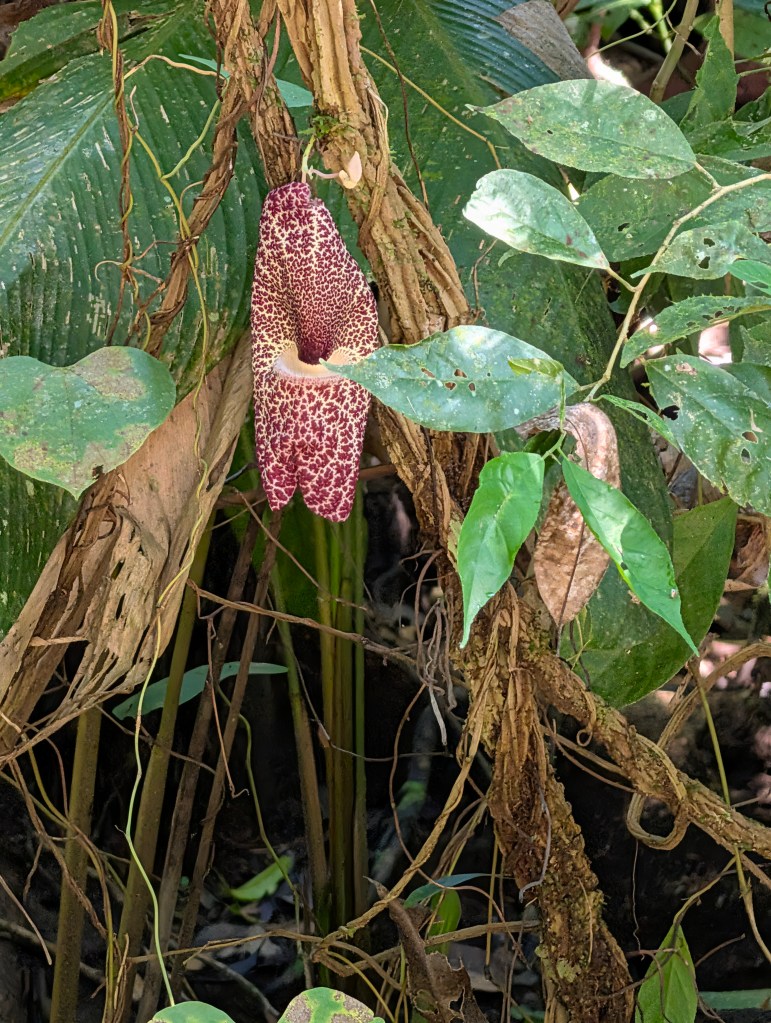
The Dutchman’s Pipe is a spectacular, fast-growing, evergreen, woody, tropical, climbing vine. Native to the humid forests, it features large, heart-shaped leaves and unique, massive, pipe-shaped, maroon-white flowers that can grow up to 30 cm long, often emitting a carrion-like scent to attract flies.
At this point we had been teasingly asking Roberto, “where are all the monkeys?” We had been in Costa Rica and not seen one. Granted they do not like to come out in the rain any more than we do, but it was a warm sunny day. Surely they must be hungry.

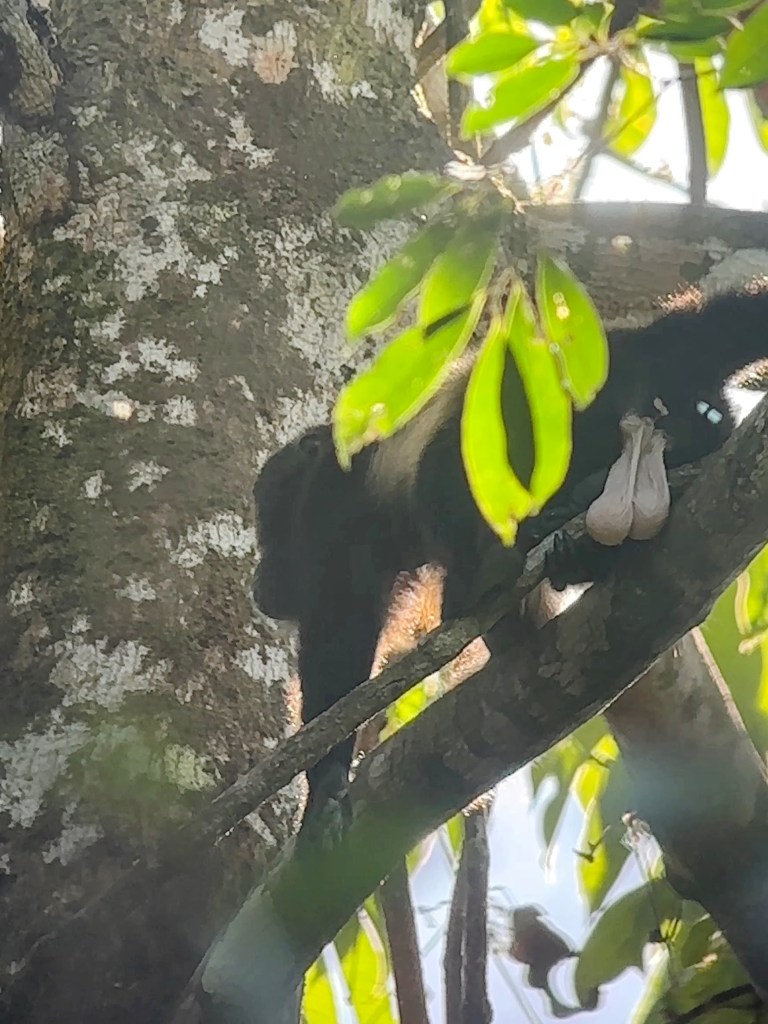
Roberto no sooner insisted that this is where they are most commonly found, and sure enough a family of howler monkeys were first heard, then spied in the trees above. Howler monkeys tend to live in family groups of 15-20 with a single alpha male. They are herbivores. They are primarily arboreal, living in Central/South American treetops, rarely descending to the ground, and using their 5x body-length, prehensile tails as a fifth limb.
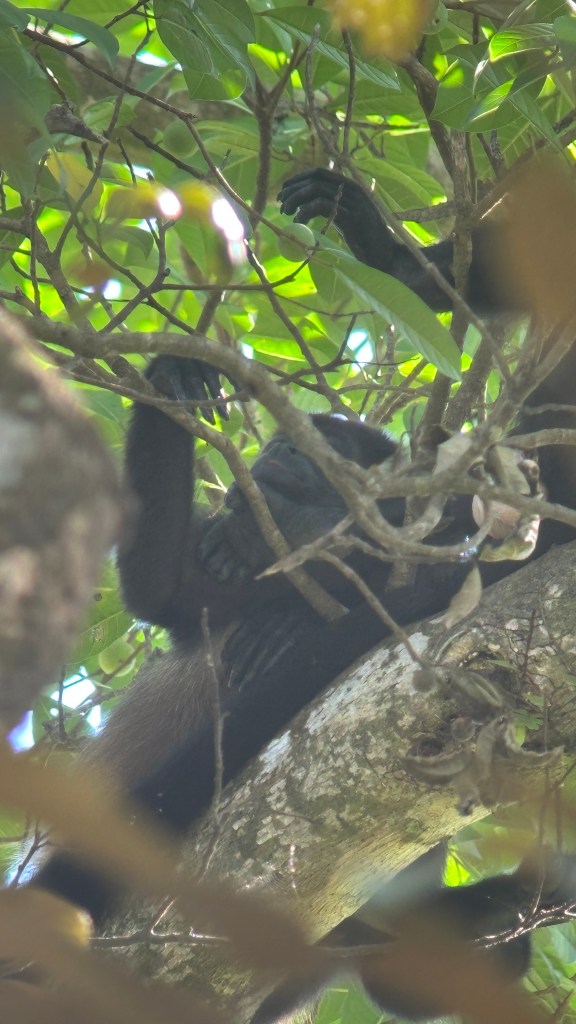
Roberto found the alpha male.
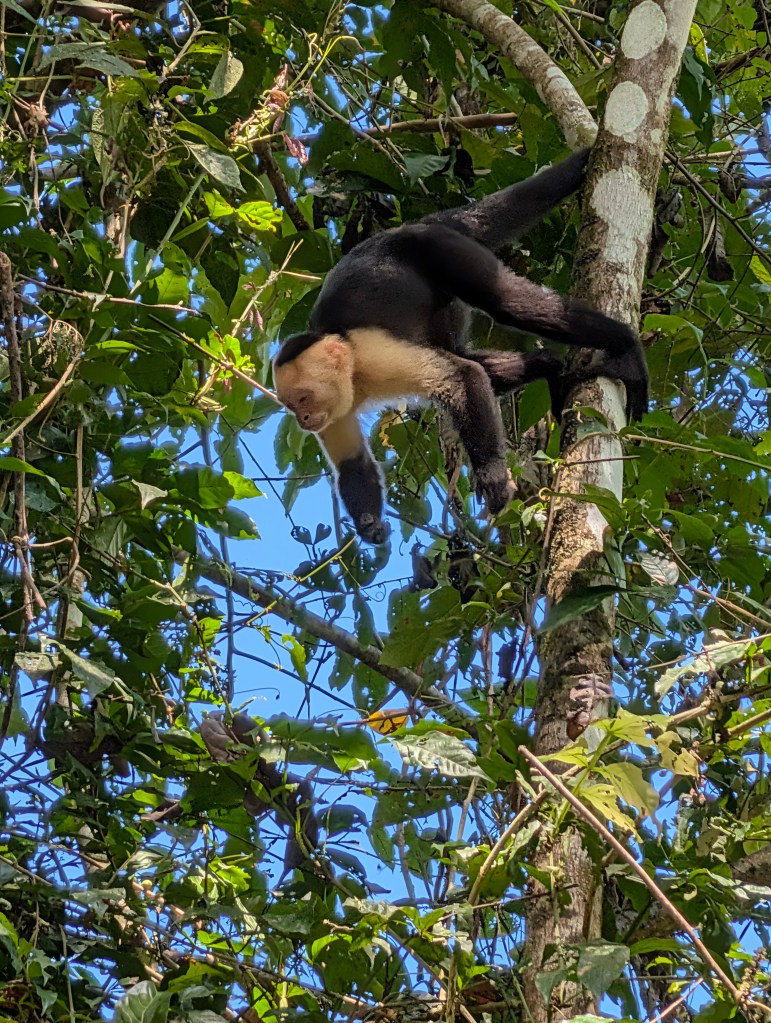
We no sooner finished filming the howler monkeys, and the white-faced capuchin monkeys made an appearance. They are highly intelligent, social primates found in Central and South American forests, recognized by their black bodies and white-faced “cap.” Known for using tools like stones to crack nuts, they are incredibly social, living in troops of 15–30, and are famous for their varied diet, including fruits, insects, and small vertebrates.
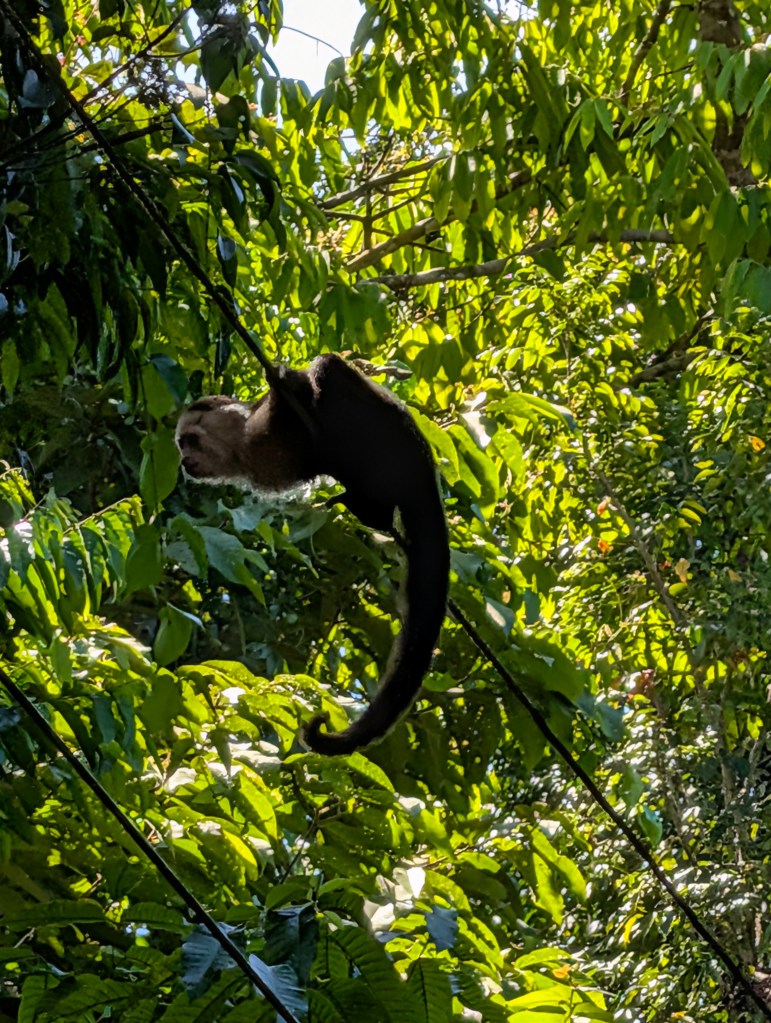
Suddenly they sere everywhere all around us. Their long tail is semi-prehensile, often carried coiled up, and used for balance or to help anchor them while feeding.
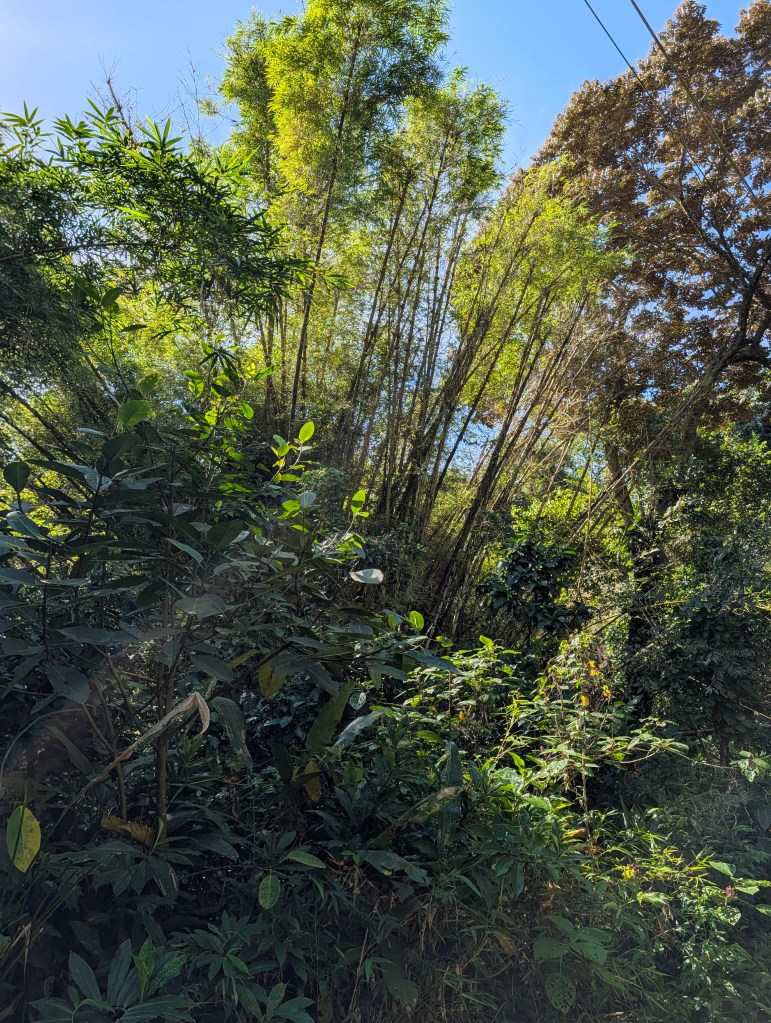
Roberto told us that bamboo is not native to Costa Rica but was brought here many years ago for making furniture. It is now invasive.
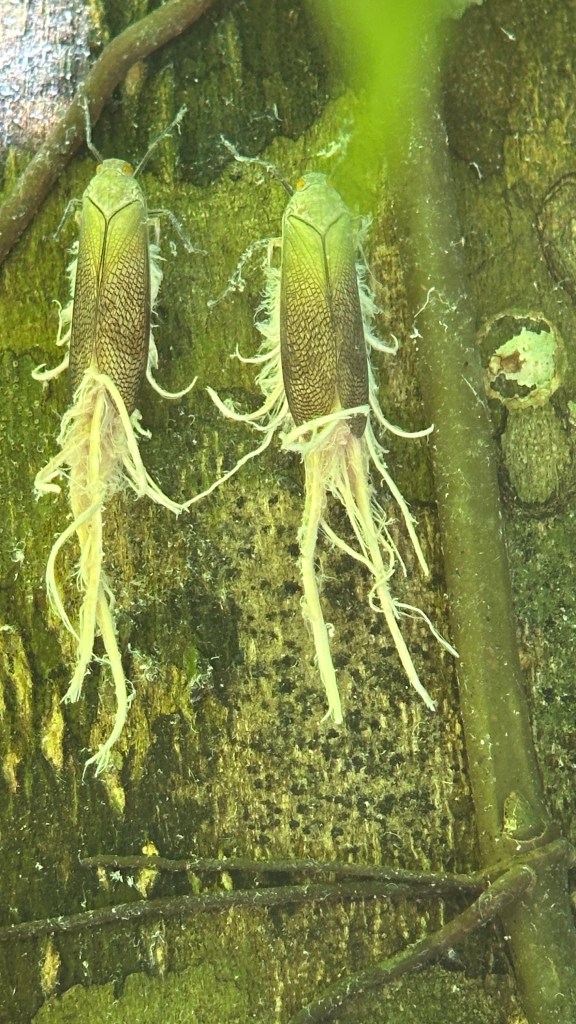
Further along the trail we found a pair of wax-tailed grasshoppers. They are known for their distinguishing long, white, hair-like structures which are are wax plumes projecting from their abdomens produced from plant nutrients they consume. They are small, sap-sucking insects found in tropical and subtropical regions. The exact function of these plumes is unknown, but entomologists believe they may serve a defensive purpose, possibly distracting predators. The insects feed by inserting their mouthparts into the phloem of plants to consume the sap.
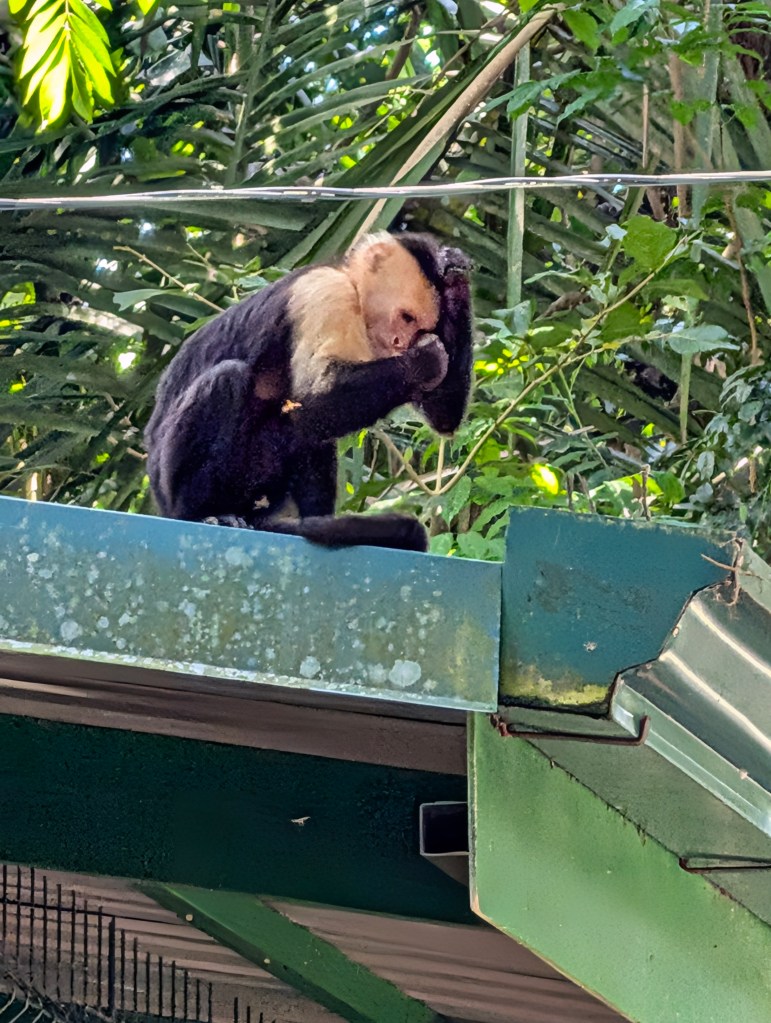
Ultimately we saw so many monkeys and took so many pictures, I will only include some of my favorites here like this guy scratching his head.
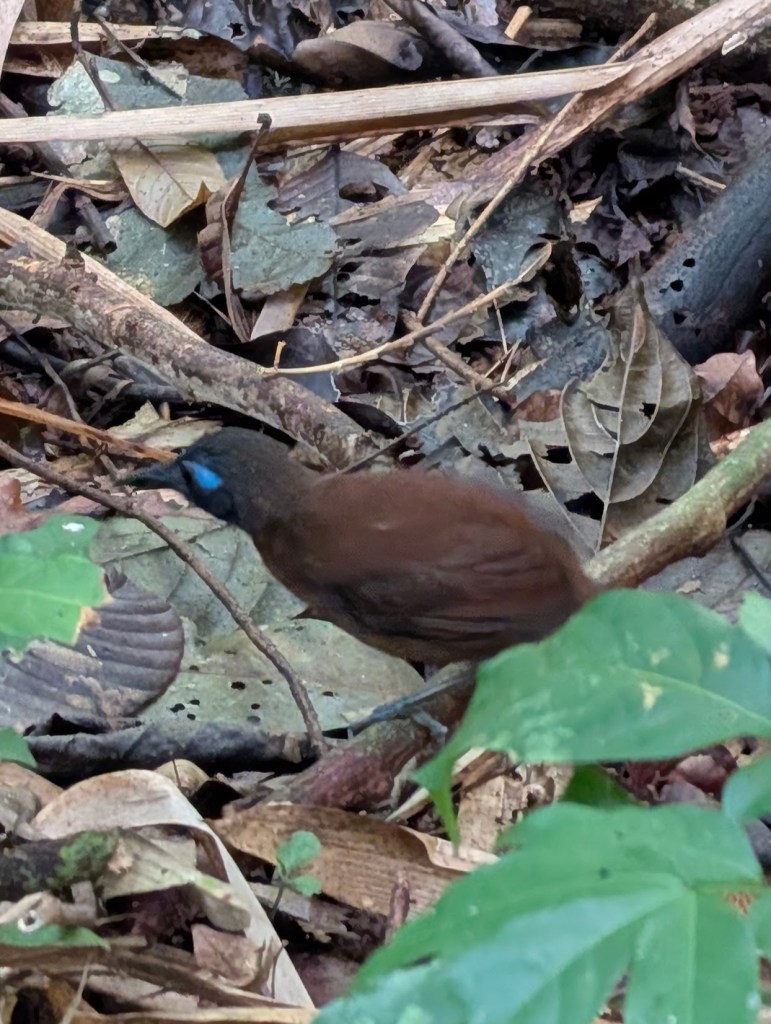
After a snack of fresh fruit inside a caged enclosure (roof of which is seen above) to keep the food from the monkeys, we chose not to relax on the beach; too little time, too much to see. We hiked a small extension and were rewarded first with this chestnut-backed antbird. These birds primarily live on insects, with frogs and lizards as occasional additions to their diet. It is a passerine bird found in humid forests in Central and South America, specifically in Colombia, Costa Rica, Ecuador, Honduras, Nicaragua, and Panama. They are known to be monogamous and a pair will defend their territory year-round.
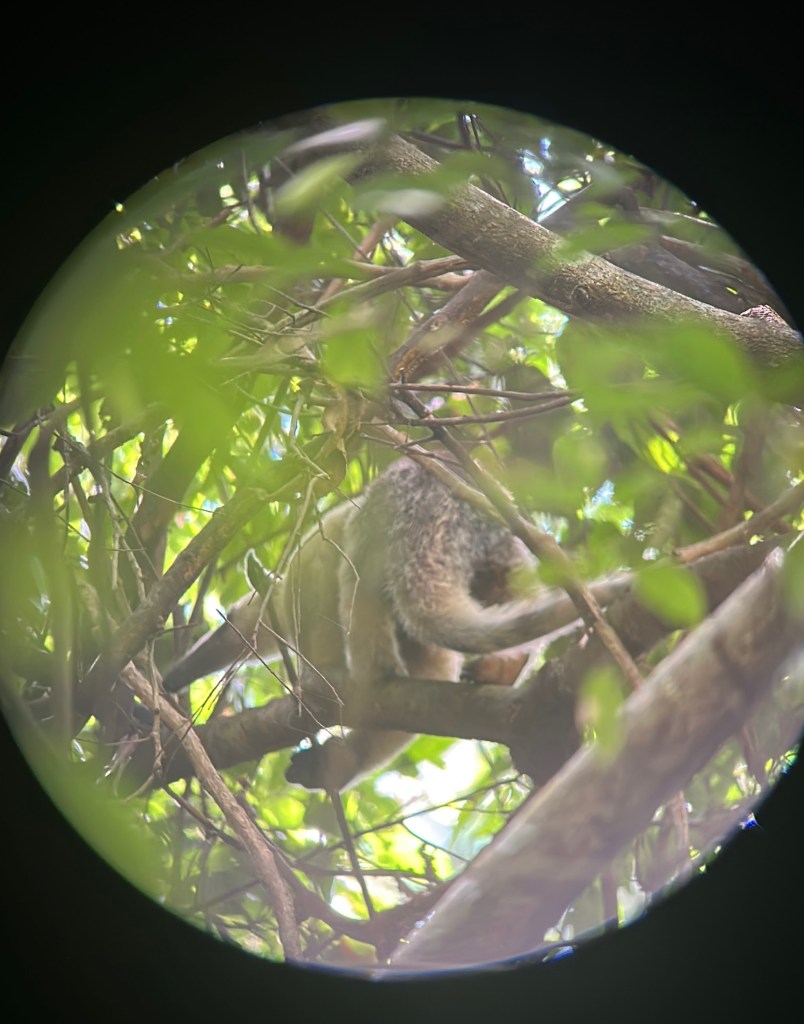
The even bigger reward came in the sighting of a tamandua, one of two species of anteaters found in Costa Rica. They are found in tropical and subtropical forests and grasslands from southern Mexico to the edge of the northern Andes. They primarily forage for ants and termites, using their long, tubular snouts and sticky tongues to feed. These animals are semi-arboreal, meaning they spend a significant amount of time in trees, aided by their partially prehensile tails.
We also found a beautiful female arrow-shaped orbweaver. This species of spider is known for its unique and beautiful appearance and for building spiral, wheel-shaped webs. It plays a beneficial role in the ecosystem by helping to control insect populations. The female has a distinctive, arrow-shaped abdomen, often with a bright red or orange color, and is harmless to humans.

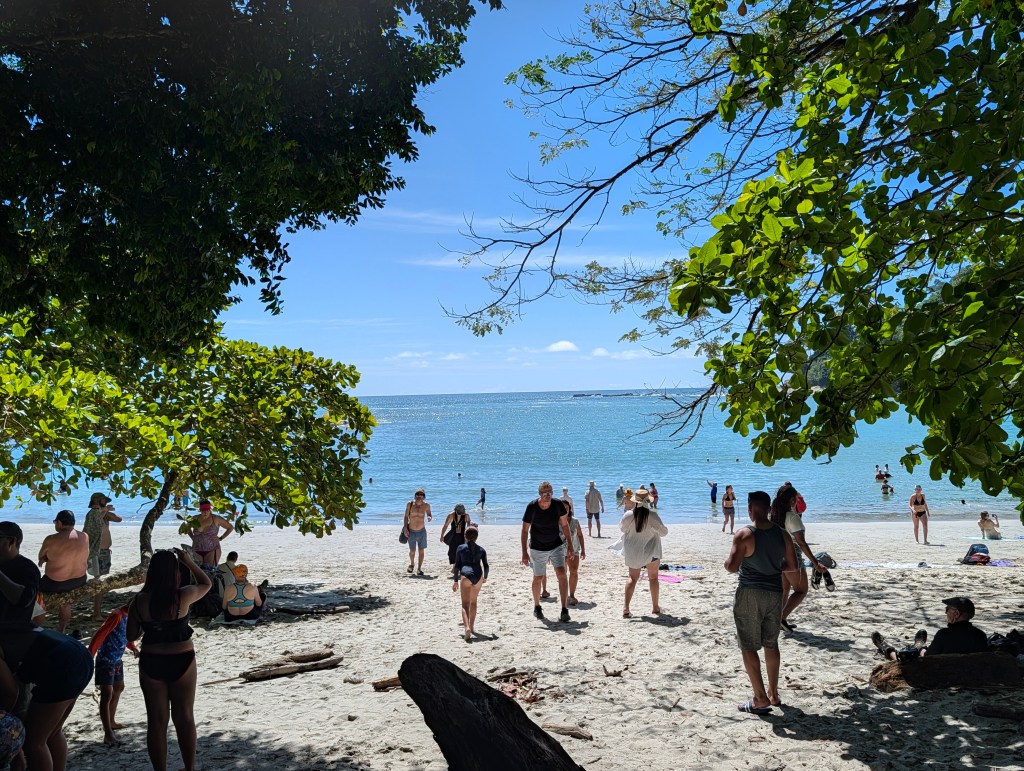
We did pass by the beach, one of the most popular to visit in all of Costa Rica.
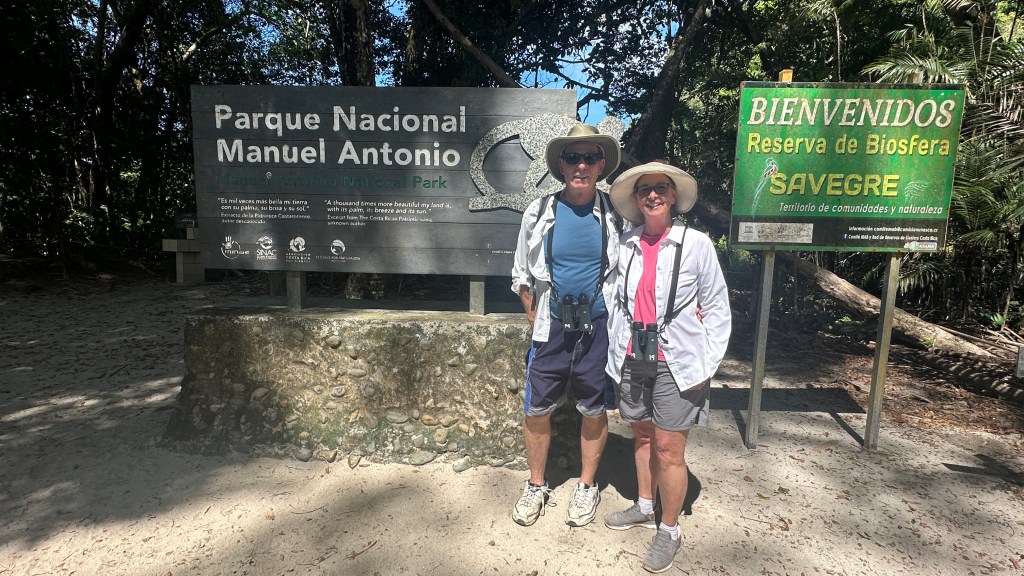
Roberto had us pose in front of the national park sign as he told us each national park in Costa Rica has a unique animal figure: this one has a monkey, seen behind Eric’s head.
The blue flags are part of the “Bandera Azul Ecológica” (Ecological Blue Flag) program. This is an award in Costa Rica for beaches, marinas, and boats that meet stringent environmental, safety, and accessibility criteria.
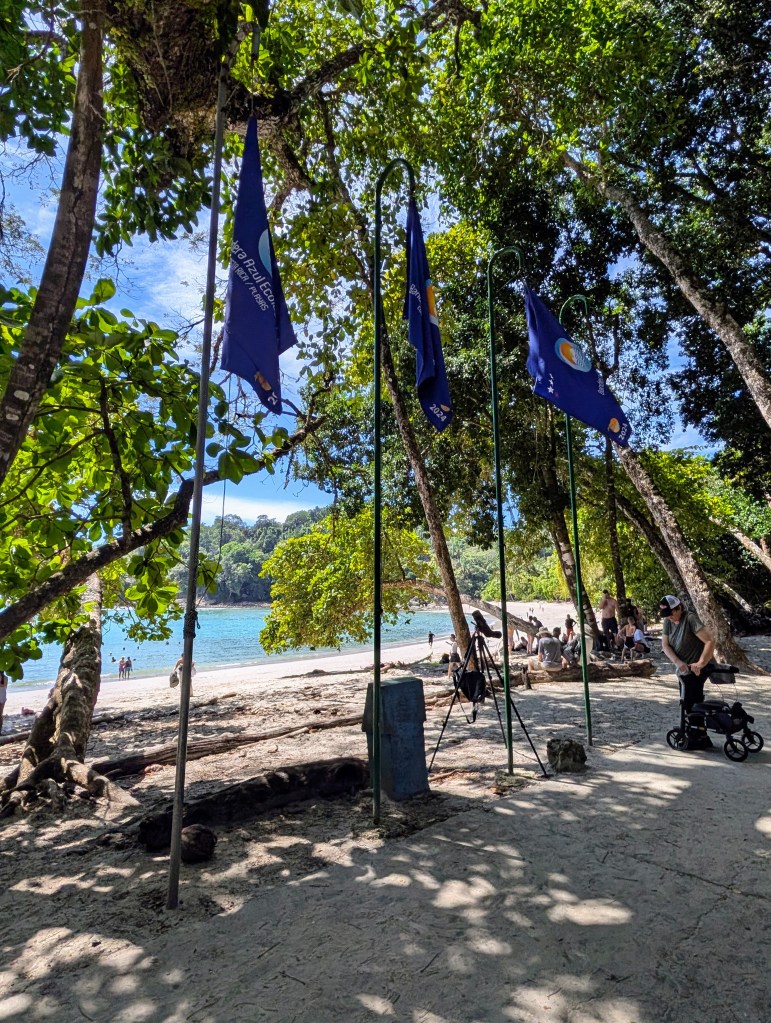
Roberto explained that the extended part of the beach to the right in the picture below (and is the extension seen at one o’clock in the above trail map) is called a tombolo: a narrow strip of land (isthmus) connecting an island to the mainland. Formed by wave refraction and longshore drift, these depositional features create a “tied island”. They represent a sensitive, evolving coastal microclimate.
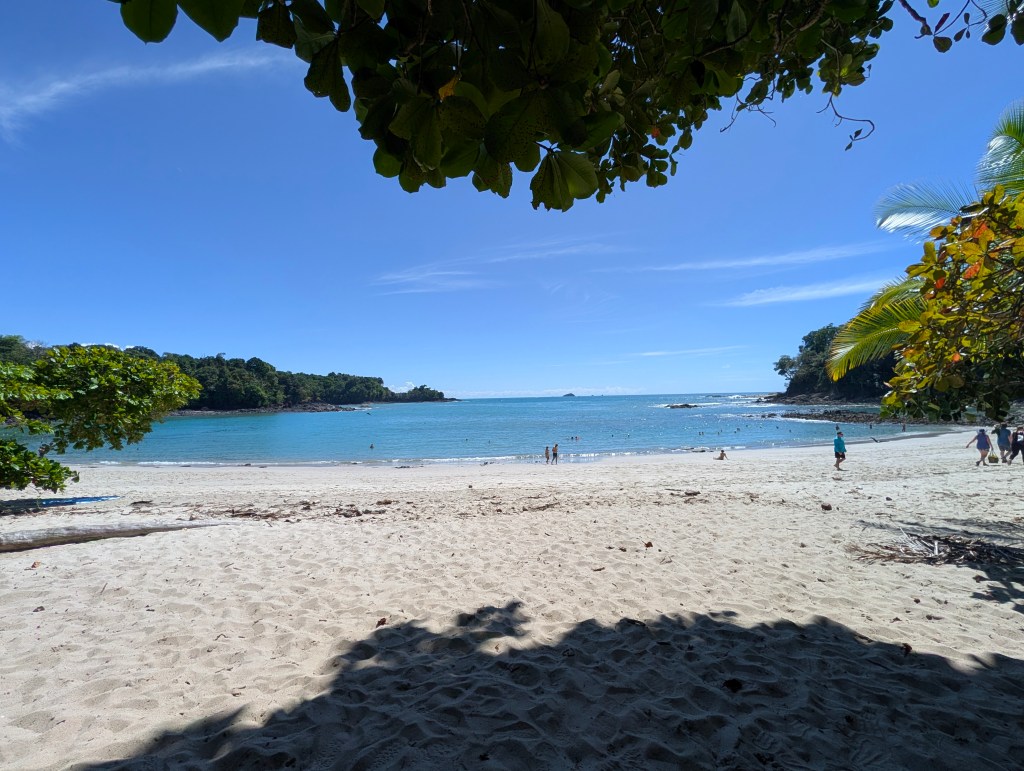
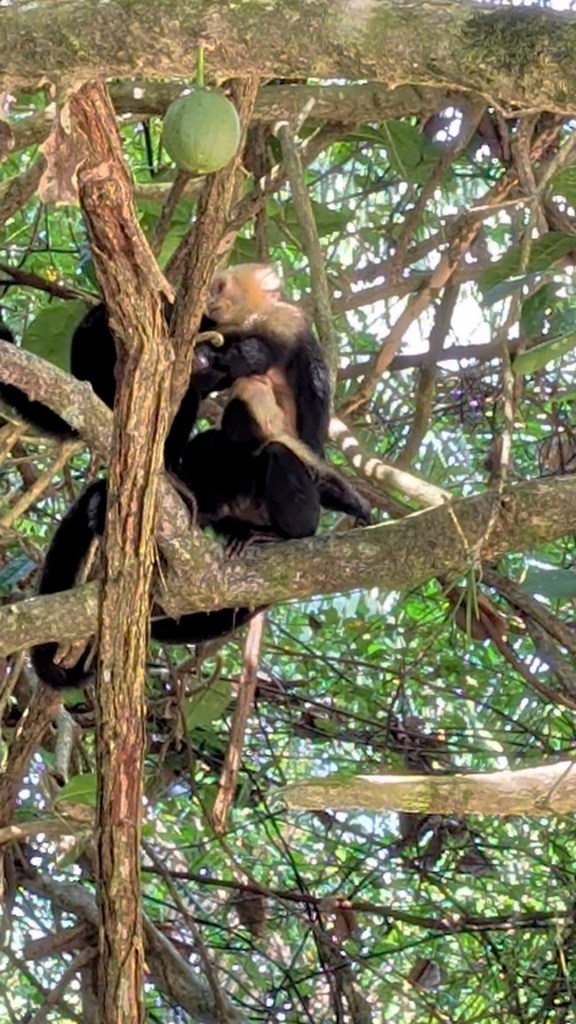
Near the beach were so many more monkeys.
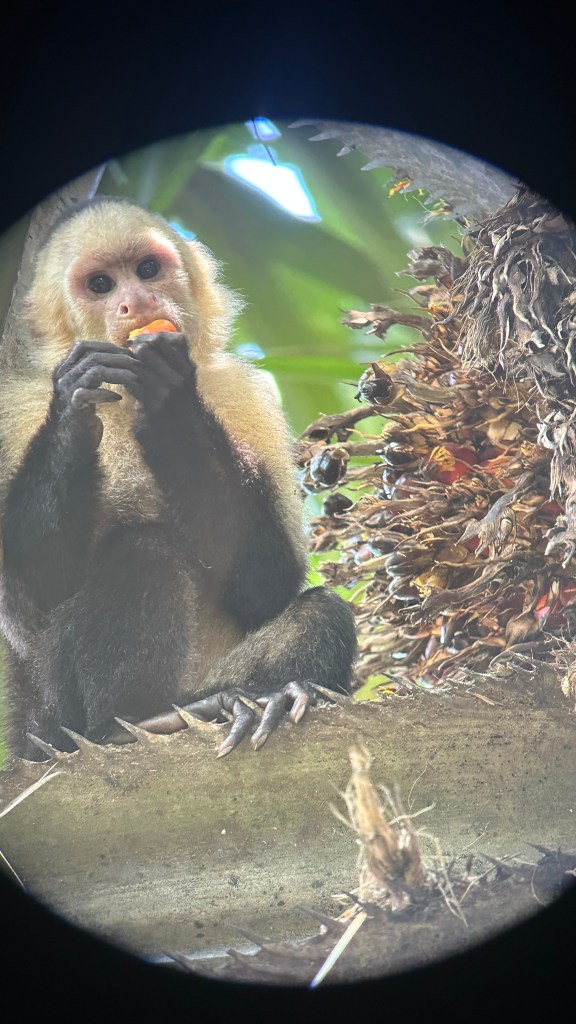
But of all my monky pictures, the following is my favorite. I actually took a video of a momma breastfeeding her baby while climbing from tree to tree; this is a still from that video.
Out on the rocks were dozens of pelicans.
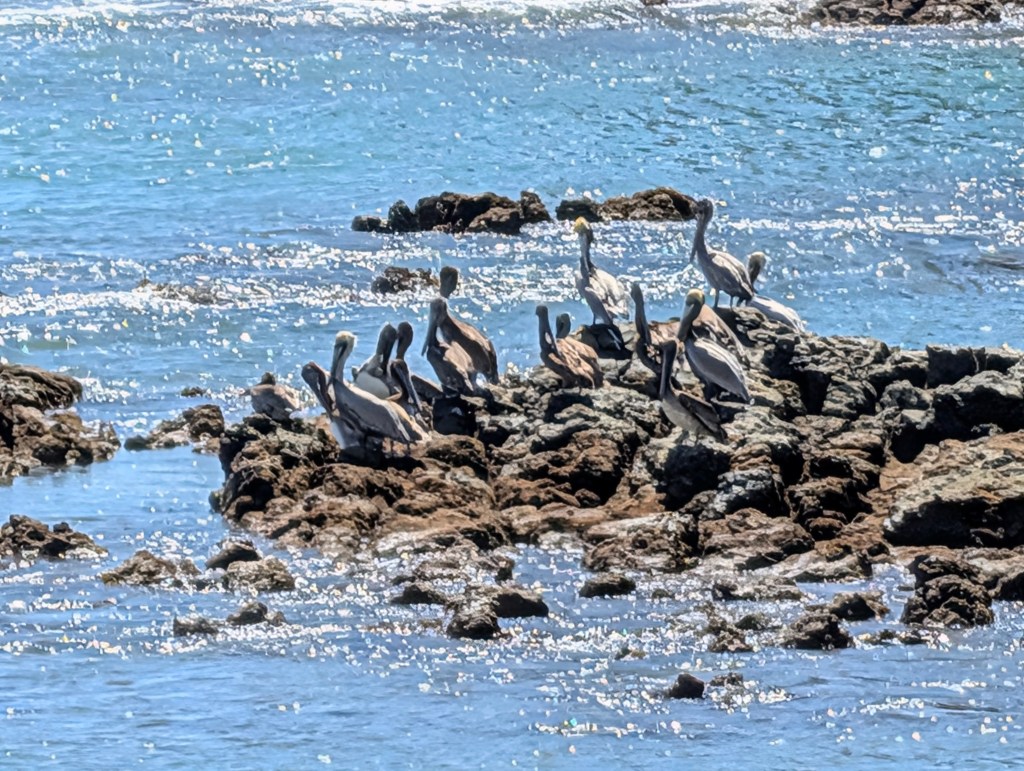
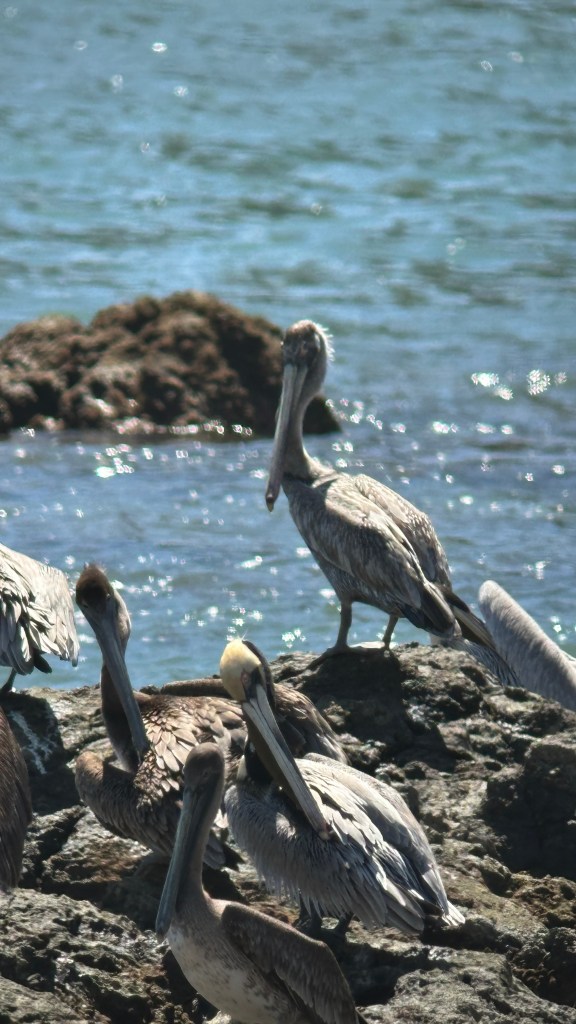
The males are those with the white heads; the females have grey heads.
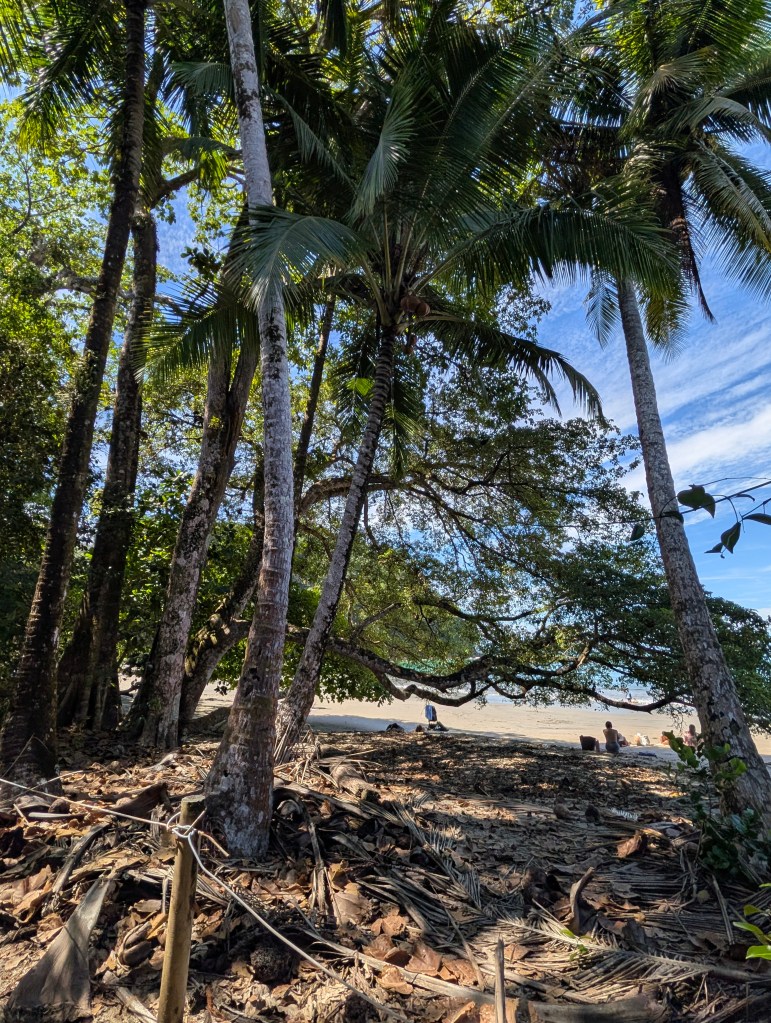
The “death tree” in Costa Rica is the Manchineel, often called “little apple of death.” It is considered the world’s most dangerous tree, with all parts, including its milky sap and small, green apple-like fruit, containing potent toxins that cause severe skin blisters, blindness, and intense, potentially fatal respiratory distress if ingested. There are signs not to touch, and yet, Robertos tells us, many ignore the sign. It is the one below leaning out over the beach with people sitting under its furthest branches.
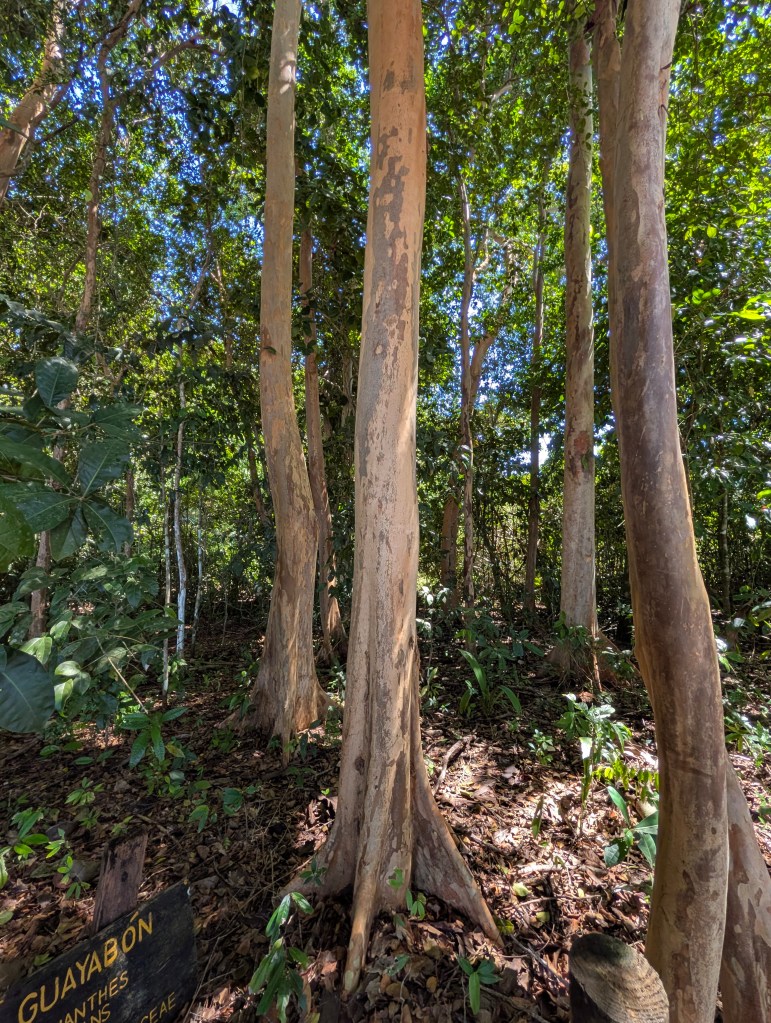
The Guayabón tree is a large, fast-growing tropical hardwood native to Central and South America, often reaching heights of 30 to 45 meters.It is known for its smooth, tan-colored bark and strong, durable wood used in construction and furniture. It was planted here in the park in the beginning as an attempt to reforest the land after the banana plantations were removed, generally considered pioneer species in disturbed habitats. However, Roberto informed us, the fauna here in the park have yet to figure out a use for the tree.
The African oil palm is not native to Costa Rica; it is native to West Africa. However, it is the primary source of palm oil. and has been brought here to replace the bananas as a significant commercial crop. It can quickly grow up to 60 feet tall.
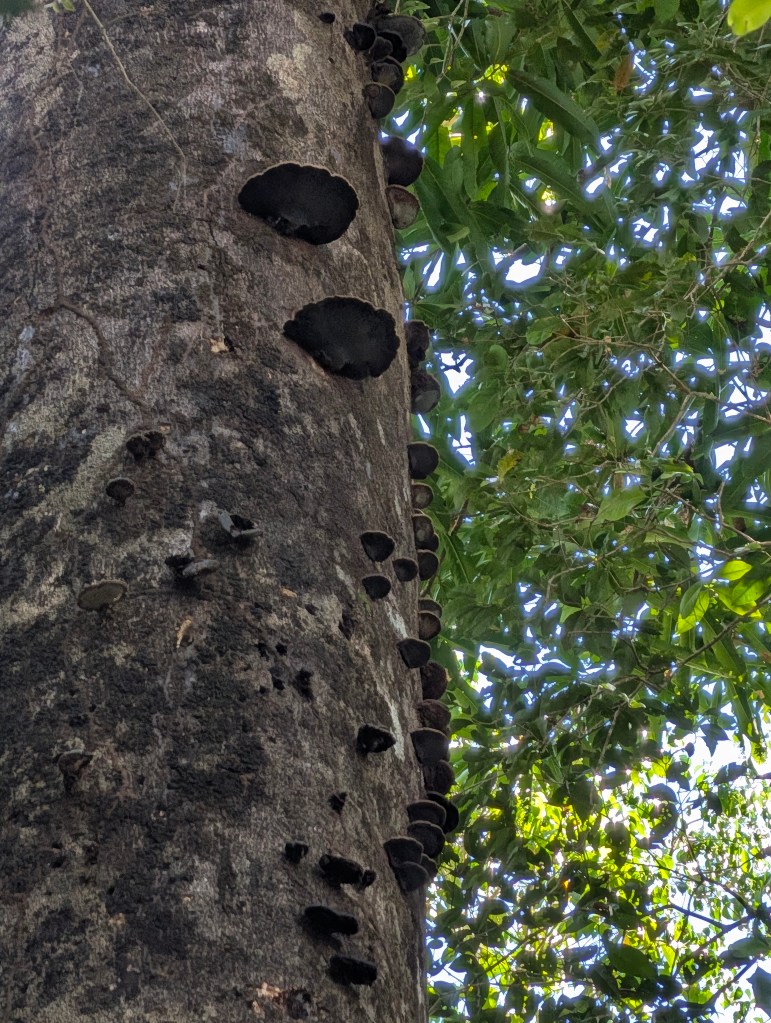
Trametes versicolor, also know as turkey tail mushrooms owing to its shape being similar to that of a wild turkey’s tail feathers, are often used in Eastern medicine. They contain an abundance of physiologically bioactive compounds, most notably β-glucan polysaccharides, which are responsible for antioxidant, neuroprotection, hypolipidemic effects, immune-modulating effects, and anticancer effects.
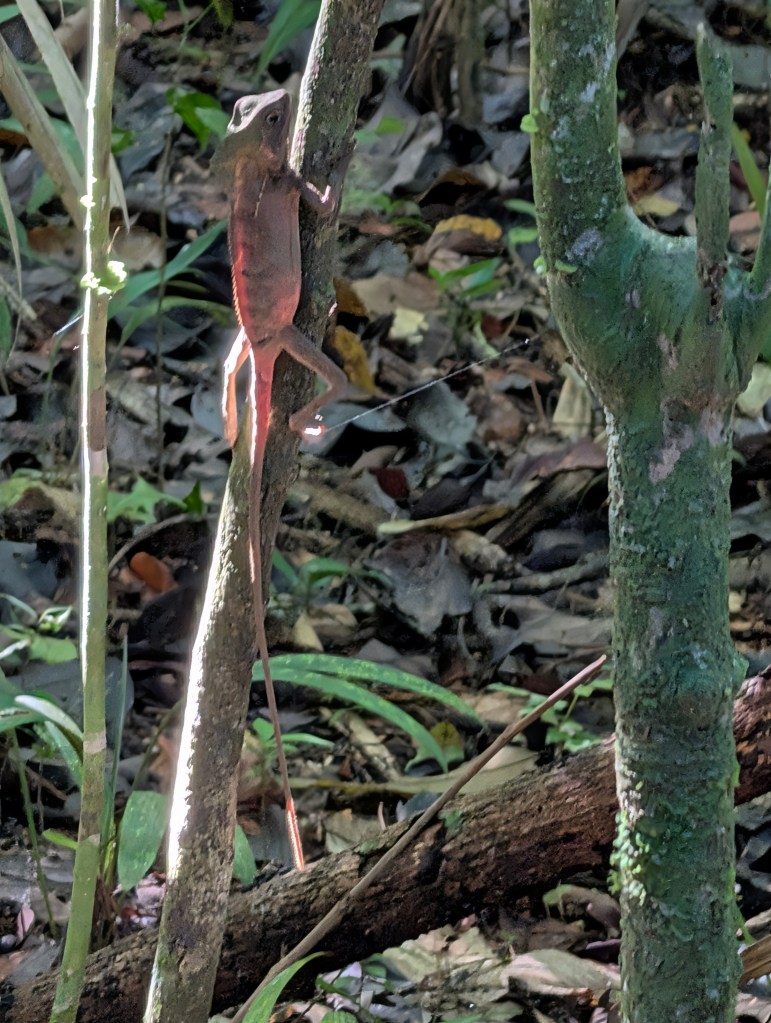
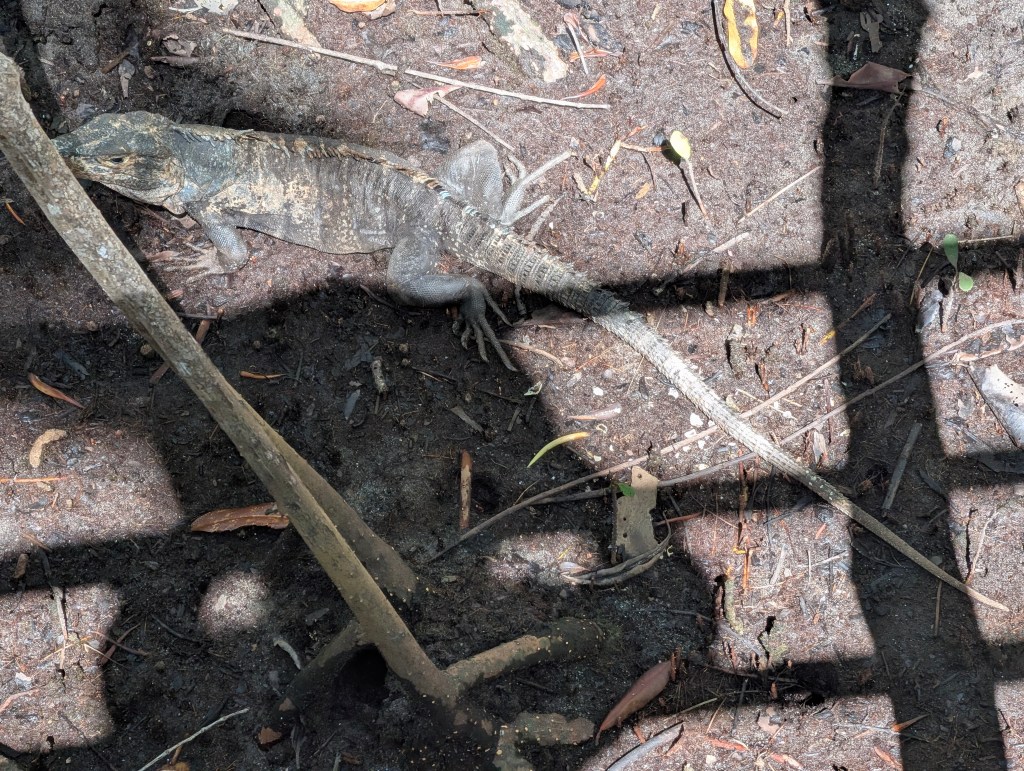
A black spiny-tailed iguana, also known as the black iguana generally is predominantly black, but the back may show black bands on a grayish background. This species is native to Mexico and Central America. Adult males can reach up to 18 inches long, with an additional 18 inches for the tail. They are primarily herbivores, eating leafy greens, flowers, and vegetables, but younger iguanas may also consume small insects. This species is known to be highly gregarious and territorial, often living in colonies with a strict social hierarchy. They are the fastest runners among lizards, clocking in at over 21 mph.
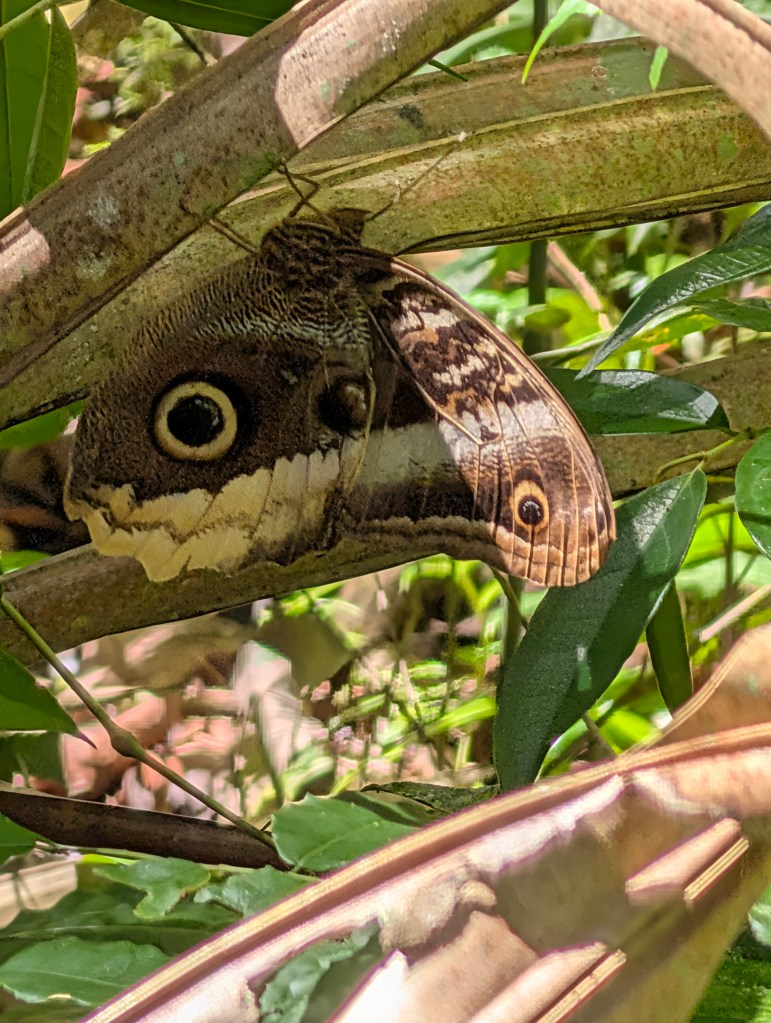
On our way out of the park we spotted this owl-eye butterfly. It was unusual to find one at mid-day as they are crepuscular, meaning they are most active during dawn and dusk. Adults primarily feed on the juices of rotting fruit, such as bananas, papayas, and mangos.
We left the park happy with our many finds
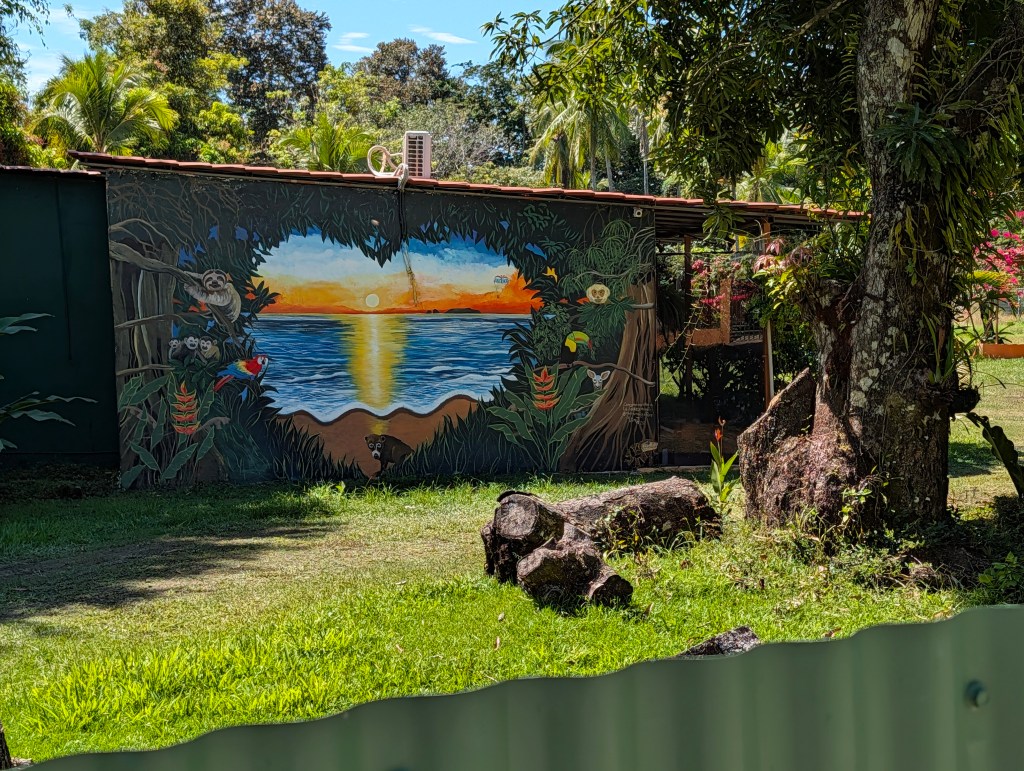
then headed back to the resort to spend the remainder of the day at the adults-only swimming pool.
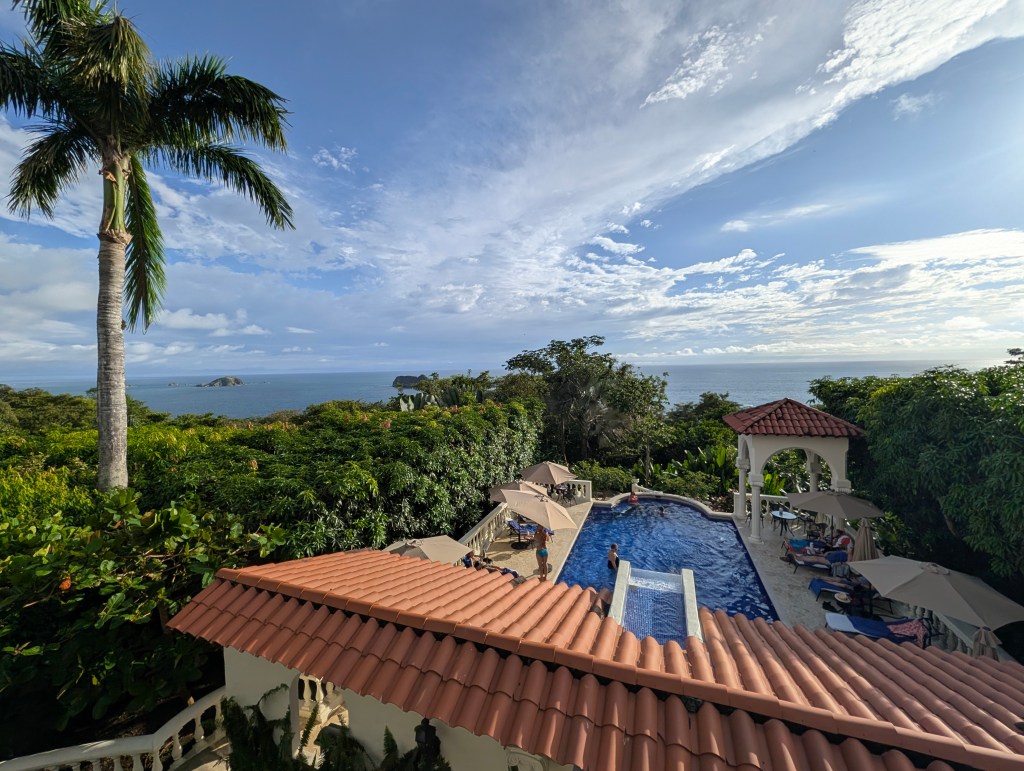
A resident sloth was also taking an afternoon snooze.
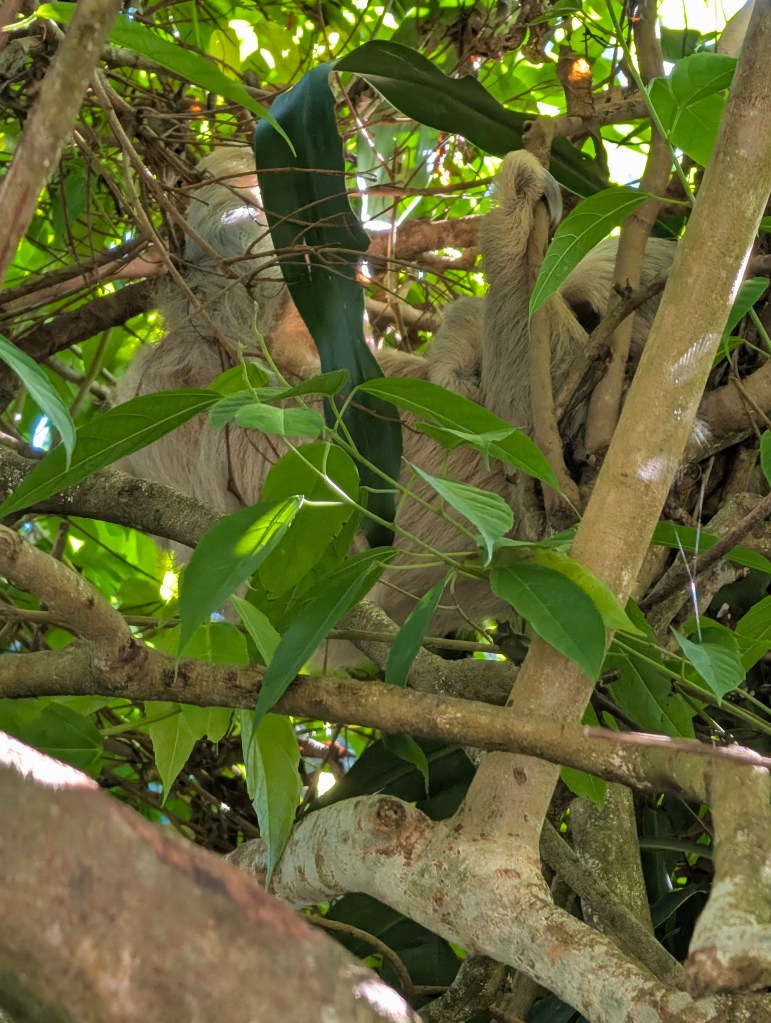
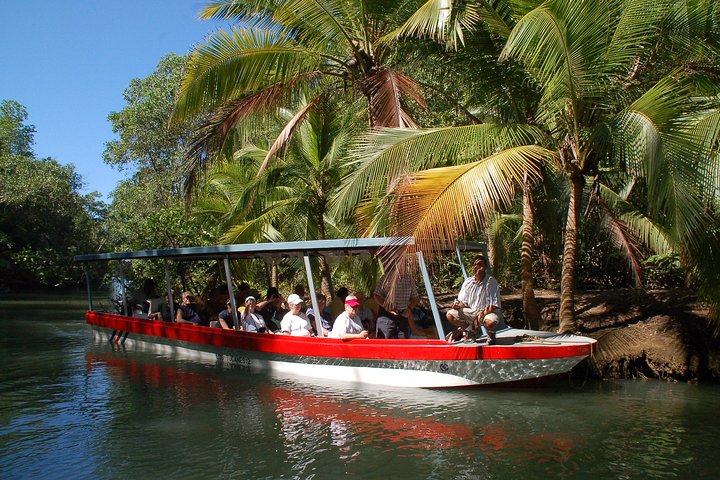
The next day’s adventure was a boat tour of the estuary of Damas Island. We were picked up by our guide Warner at 6:30 am because we had to arrive at the estuary at high tide or it would not be deep enough for the boat. As we drove Warner informed us that prior to the 1920s the local town of Quepos was a mangrove forest until a banana company came in and plowed it under. Currently if it rains excessively, the entire town floods and crocodiles can be spotted in the streets. In the 1960s a Panama fungus began killing the banana trees. Since then African palm trees have mostly replaced the bananas. There are currently 160,000 acres cultivated for palm oil in the region. When we boarded the boat, I failed to take a photo; I have included a stock photo here instead.
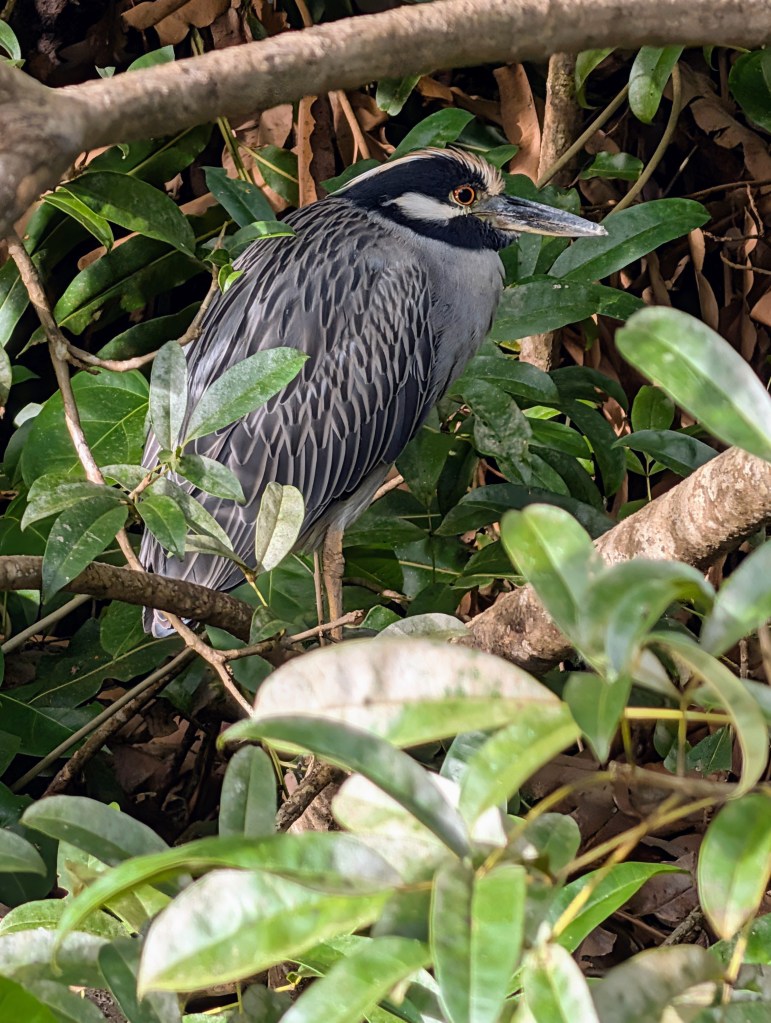
The estuary contains over 1300 acres of mangroves. The first area of the river is brackish water and is home to many species of birds. The first we saw was this yellow crown night heron. Adults have a distinctive black and white face pattern, a pale yellow or white crown, and red eyes. Their body plumage is primarily gray, sometimes appearing with a slightly bluish-violet tint. They are stocky, compact herons with thick necks and a black bill. Unlike the Black-crowned Night Heron, the Yellow-crowned Night Heron is found exclusively in the Americas.
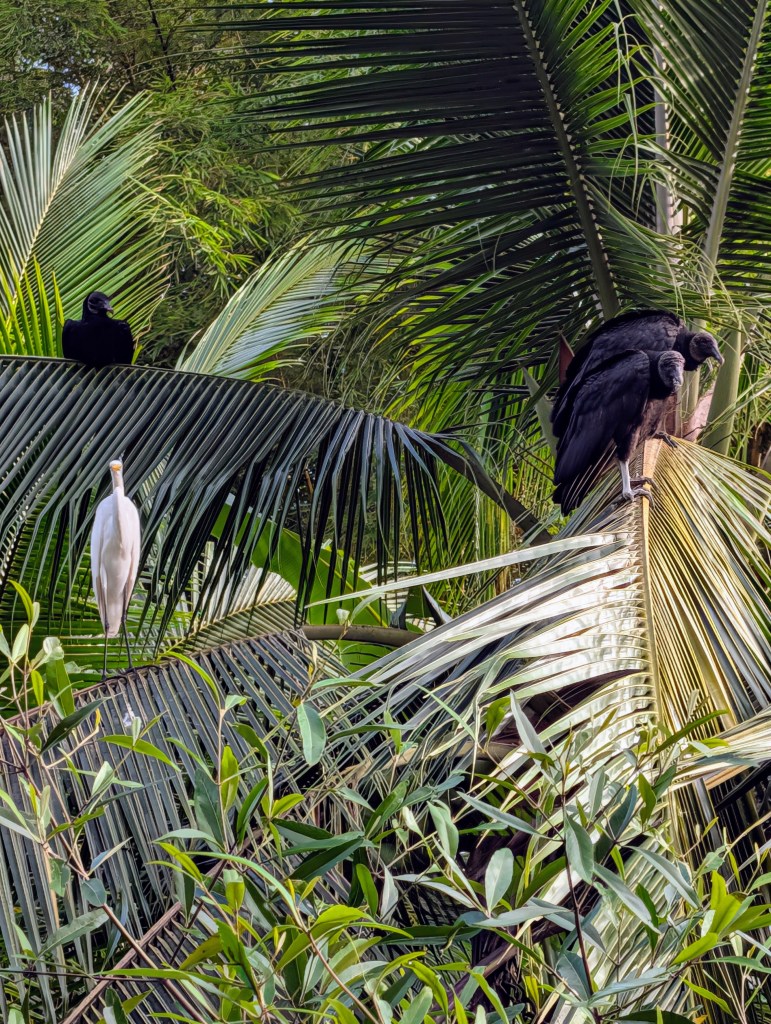
All around us were many black vultures. They are large, entirely black birds, including their featherless heads and necks. Black vultures are scavengers that primarily feed on carrion (dead animals). They often soar in flocks and are known for having a shorter, broader tail compared to turkey vultures. In flight, they display distinctive silvery-white patches on the undersides of their wingtips.
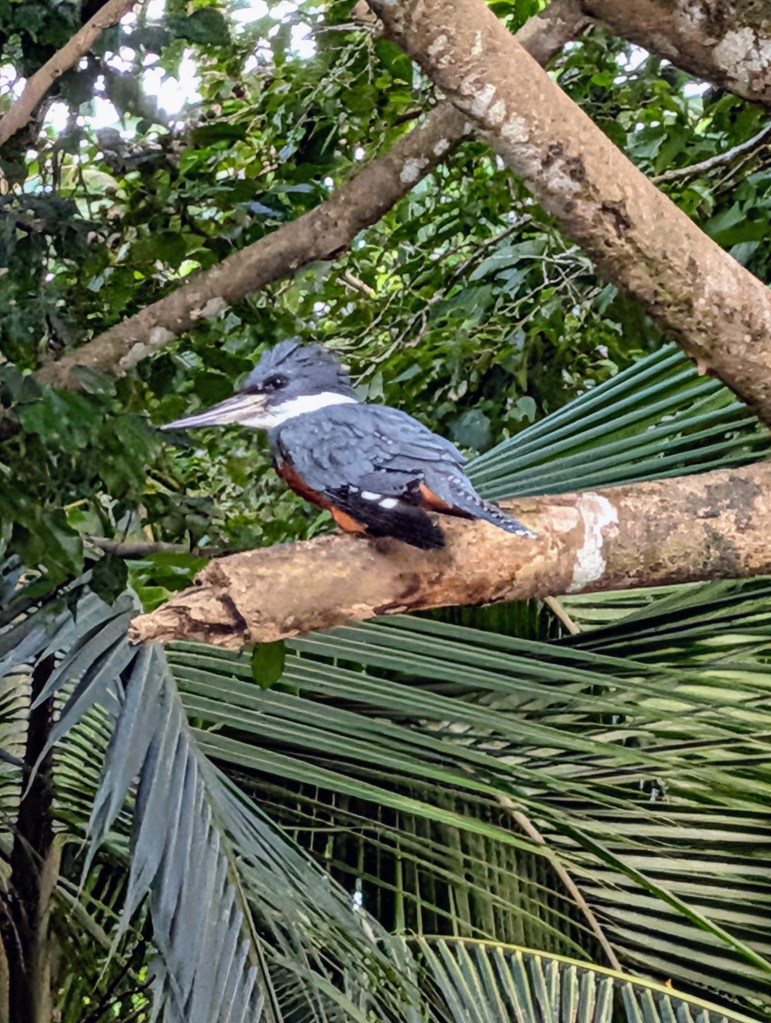
Warner showed us a female Ringed Kingfisher, the largest kingfisher found in the Americas. They are known for their loud and raucous calls. Females have a blue-gray breast band and a chestnut or rufous belly, separated by a narrow white border. The bird has a shaggy crest and a very large, heavy bill. They are commonly found along rivers and streams, where they hunt for fish from a prominent perch.
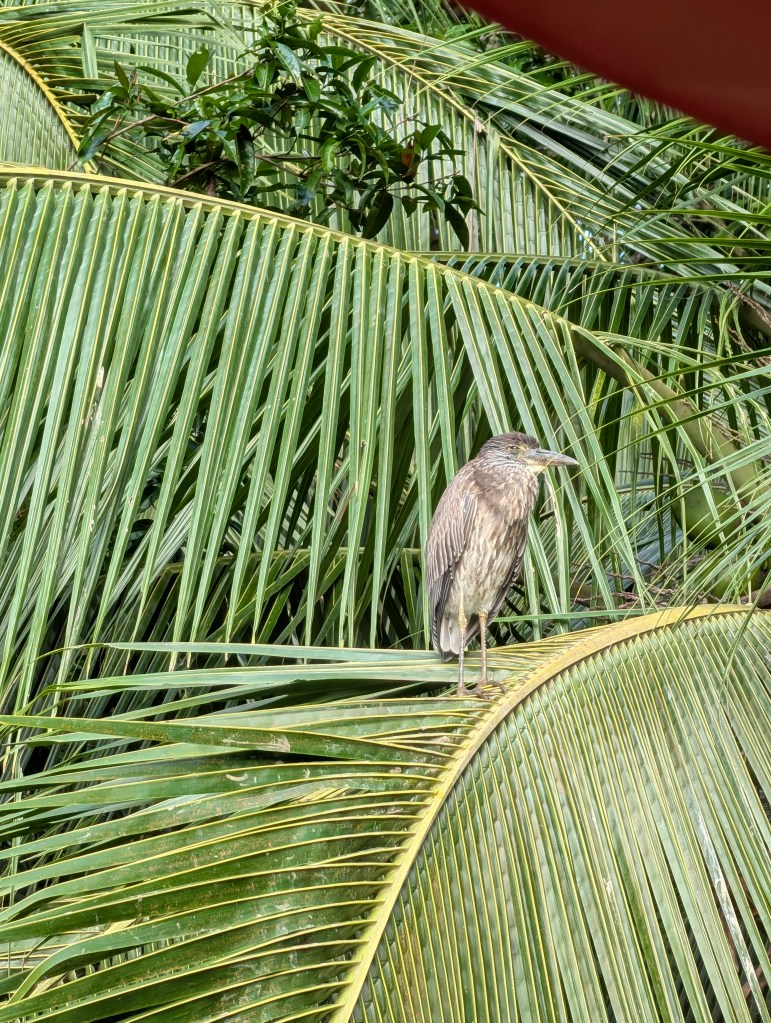
Juvenile yellow crown night herons have streaked brown and white plumage, which helps them camouflage. It takes approximately three years for them to fully acquire their adult plumage.
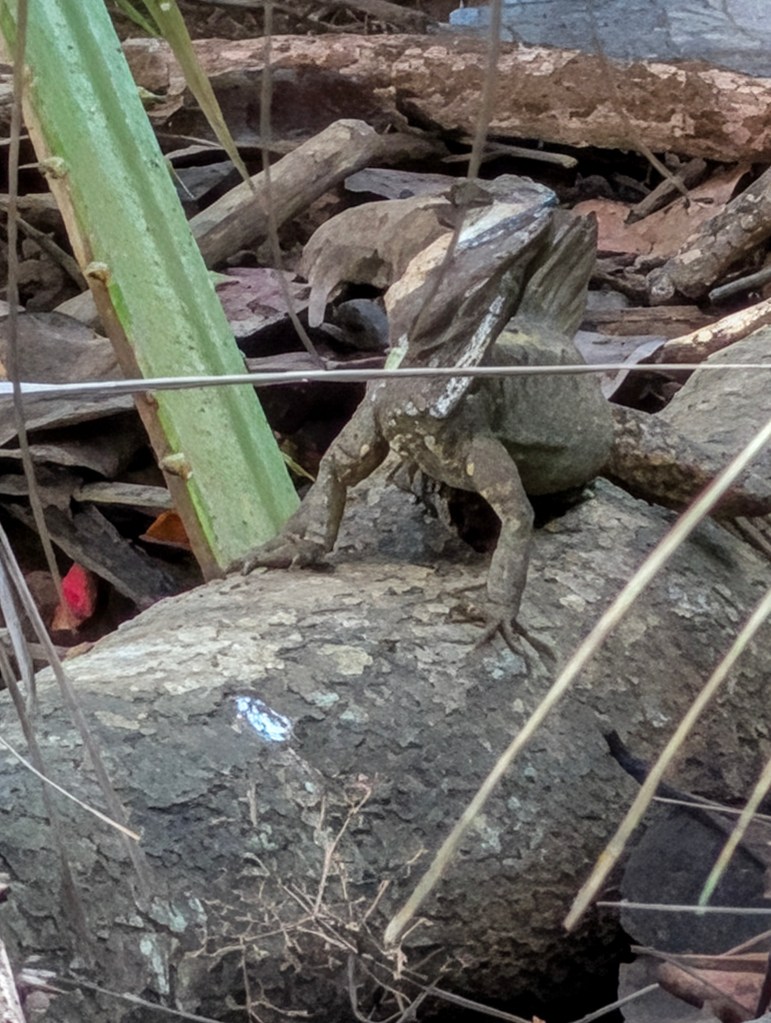
We found another Jesus Christ lizard. At speeds of 5 feet per second. Native to Central American rainforests, these lizards can travel 15+ feet on water, are excellent swimmers, and can dive for up to 30 minutes.
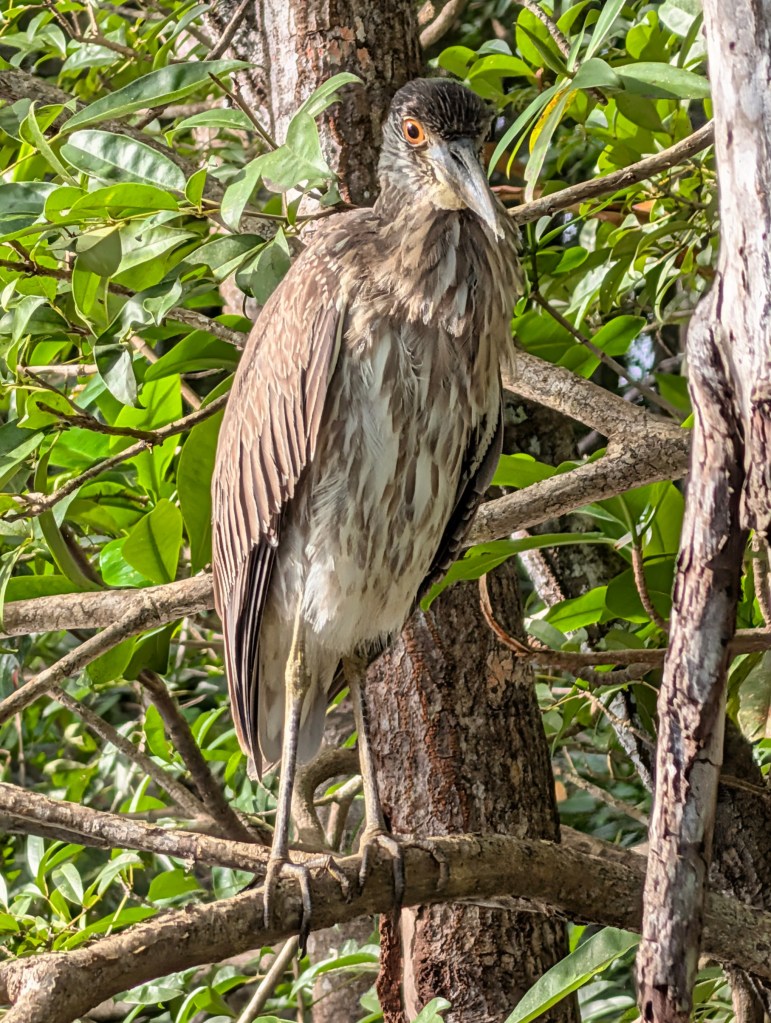
And another juvenile yellow night crown heron, this one not hiding in the brush so we could see its full height. Yellow crown night herons are specialized crab-eaters with highly acidic stomachs that dissolves shells. Unlike most night herons, they are active both day and night, using their stout bills to crush prey. They are known for their unique, sometimes tool-using, hunting techniques.
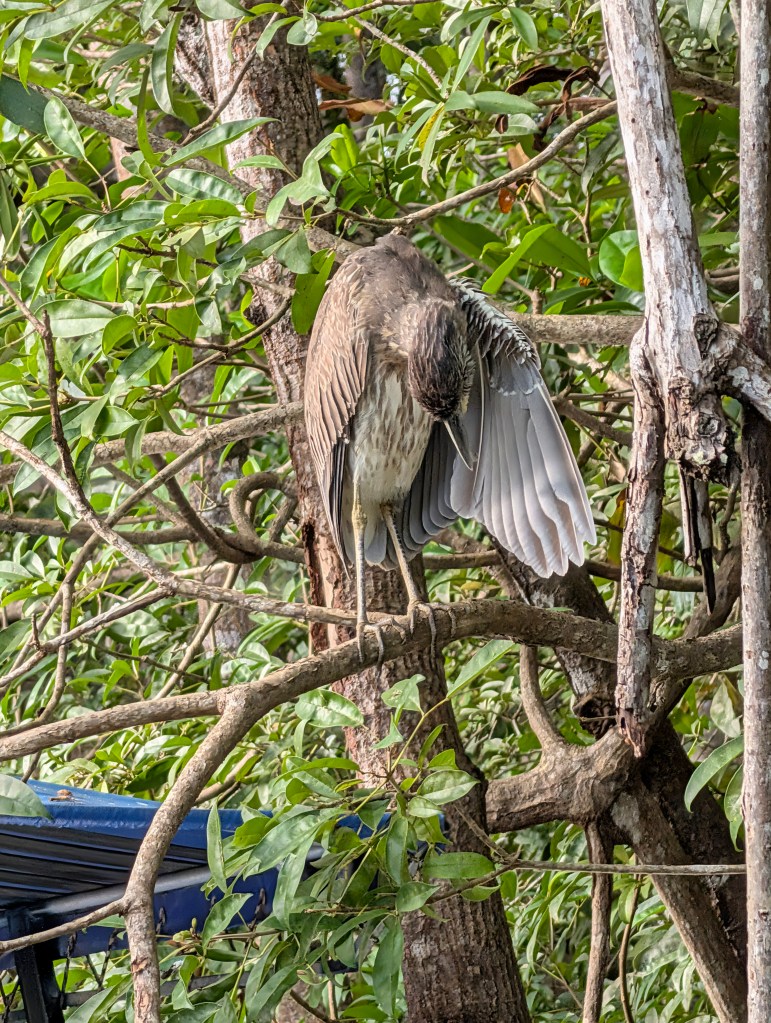
Yellow-crowned Night Herons are meticulous groomers that spend significant time maintaining their plumage, which is essential for waterproofing and protection against parasites. Their grooming routines are often intensive, particularly during the breeding season when they need to display pristine plumage to attract mates.
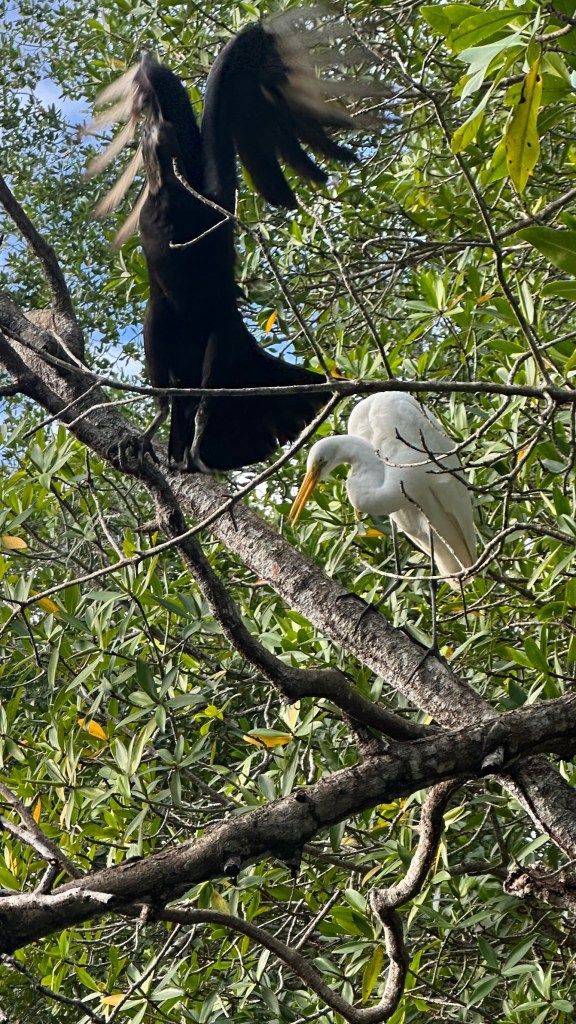
Great Egrets are common in the estuary. It is a large, all-white bird, approximately 3 ft tall with a wingspan of about 4.5 ft. Key identifying features are its bright yellow bill and entirely black legs and feet. It is a widespread and common species found across the globe, including the Americas, Europe, Africa, Asia, and Australia. During breeding season, the bill can become more orange, and it develops long, lacy plumes on its back.
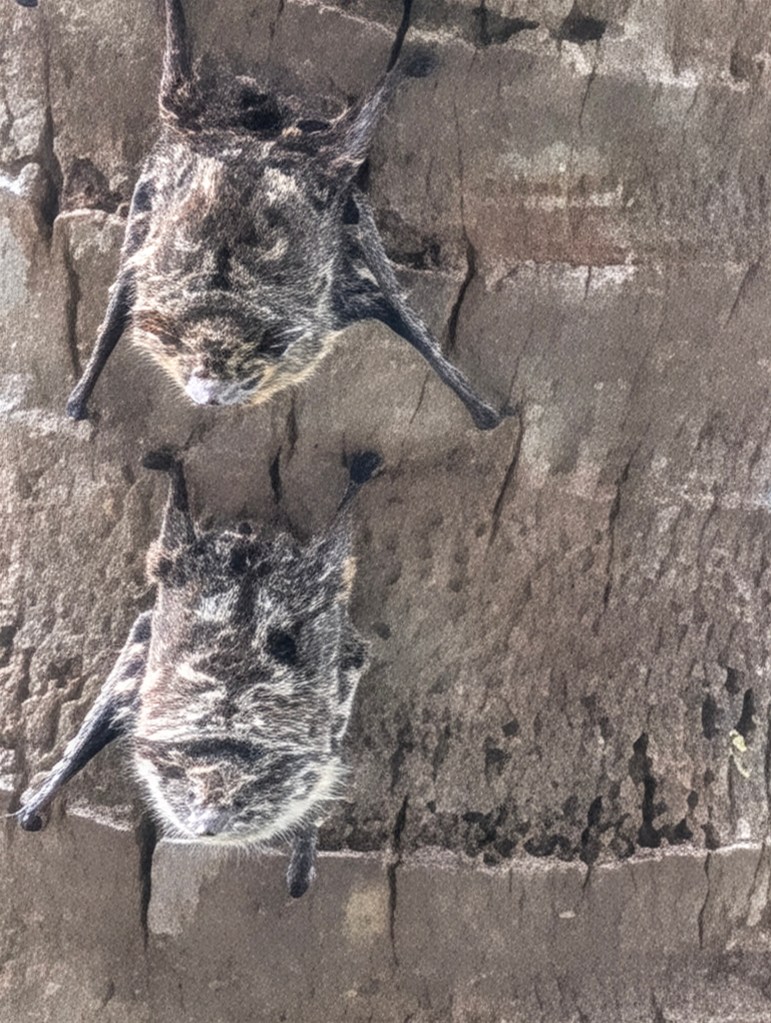
There are about 120 species of bats in costa Rica. Warner pointed out a row of Proboscis bats, also known as the Brazilian long-nosed bat. They are found in Central and South America, typically along rivers and streams. Unlike most bats, they are active during the day and can be found in colonies of up to 100 individuals.
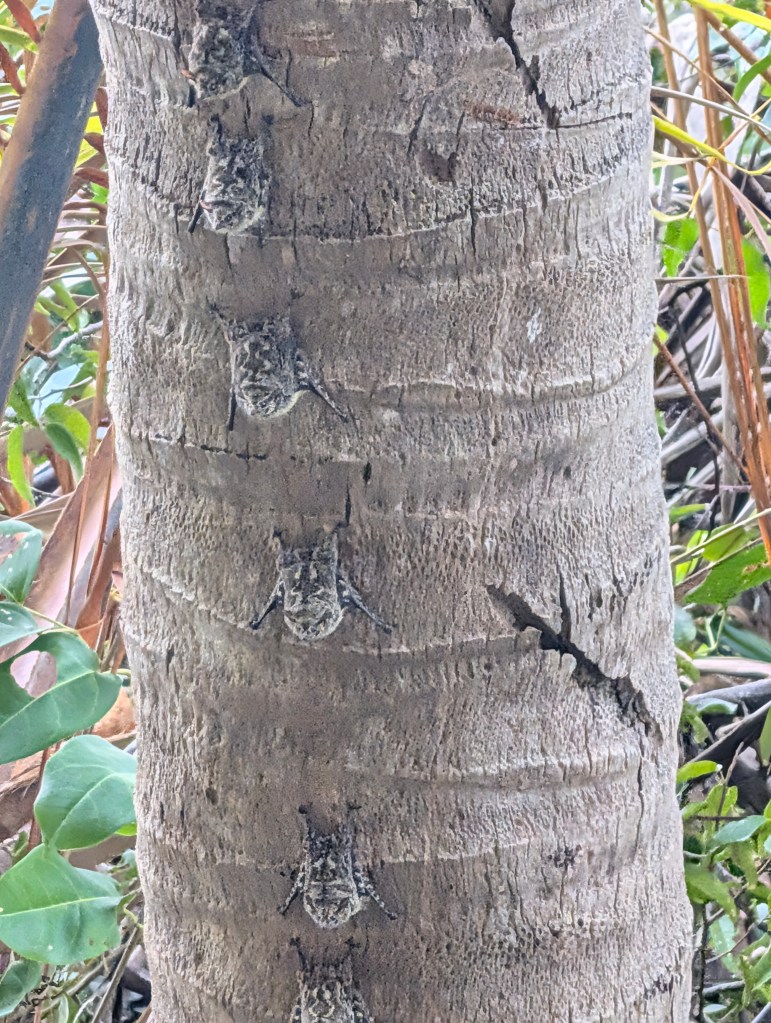
They are small, measuring about 6 cm (2.4 inches) in length, and feed on small insects caught in flight over water. They roost in well-lit areas, often on tree trunks or branches.
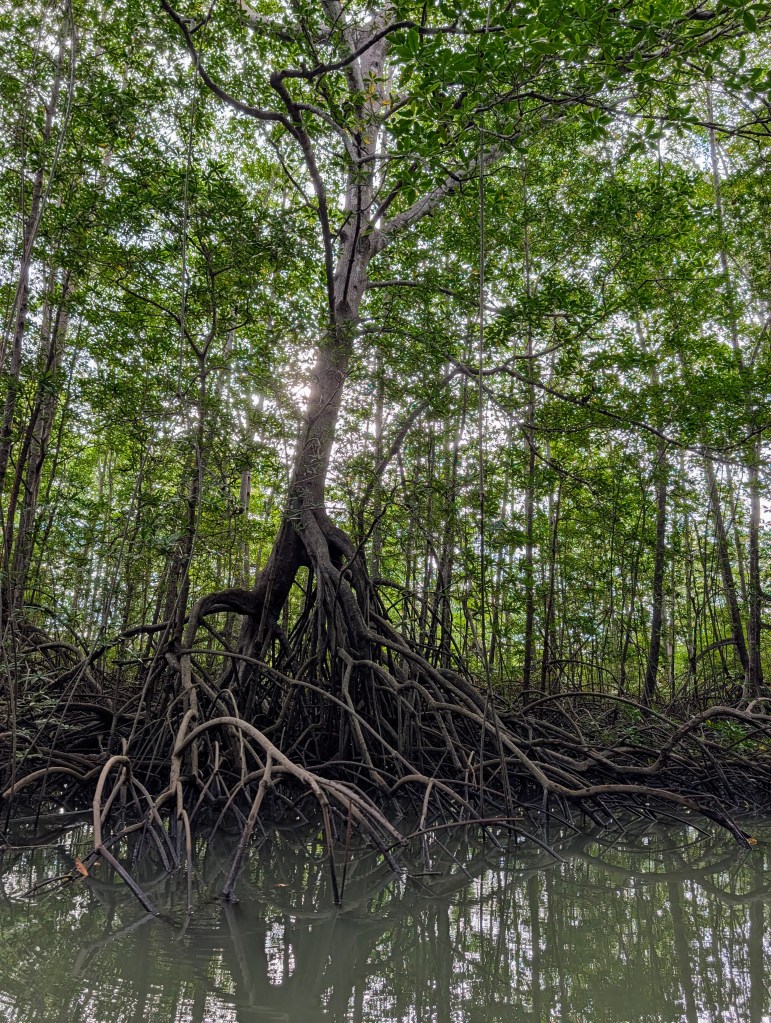
As we continued along the river Warner explained that there are four distinct species of mangrove in the estuary, with varying methods of extruding salt from their system. The tallest, most upright is the white mangrove. It extracts salt through glands in the leaves. The salt then accumulates on the leaves giving them a white appearance.
The yellow mangrove is shorter and bushier. It too has glands in the leaves that extract salt, but it then kills the leaf which turns yellow and ultimately falls from the tree.
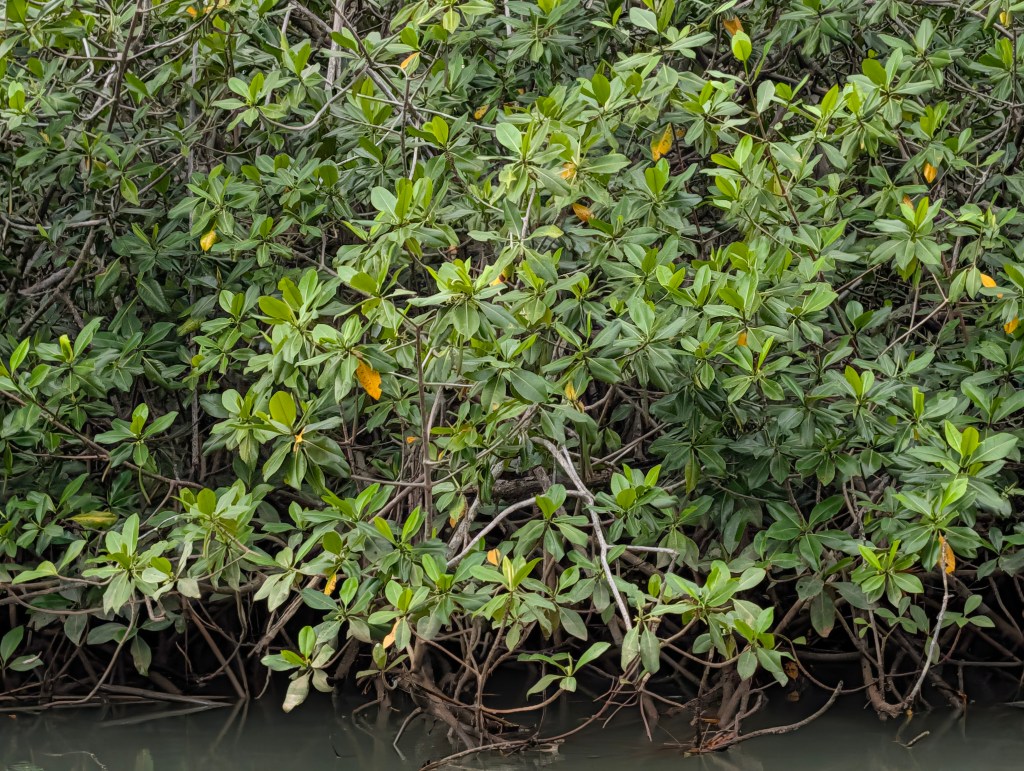
The Red Mangrove is the fastest growing. Red mangroves manage high salinity through a two-part exclusion and storage mechanism: utilizing ultra-filtration in their roots to block salt uptake, and storing excess salt in older leaves, which then turn yellow and fall off. Unlike white and yellow mangroves, they do not have specialized leaf glands to excrete salt. They are typically found in the most seaward, high-salinity zones.
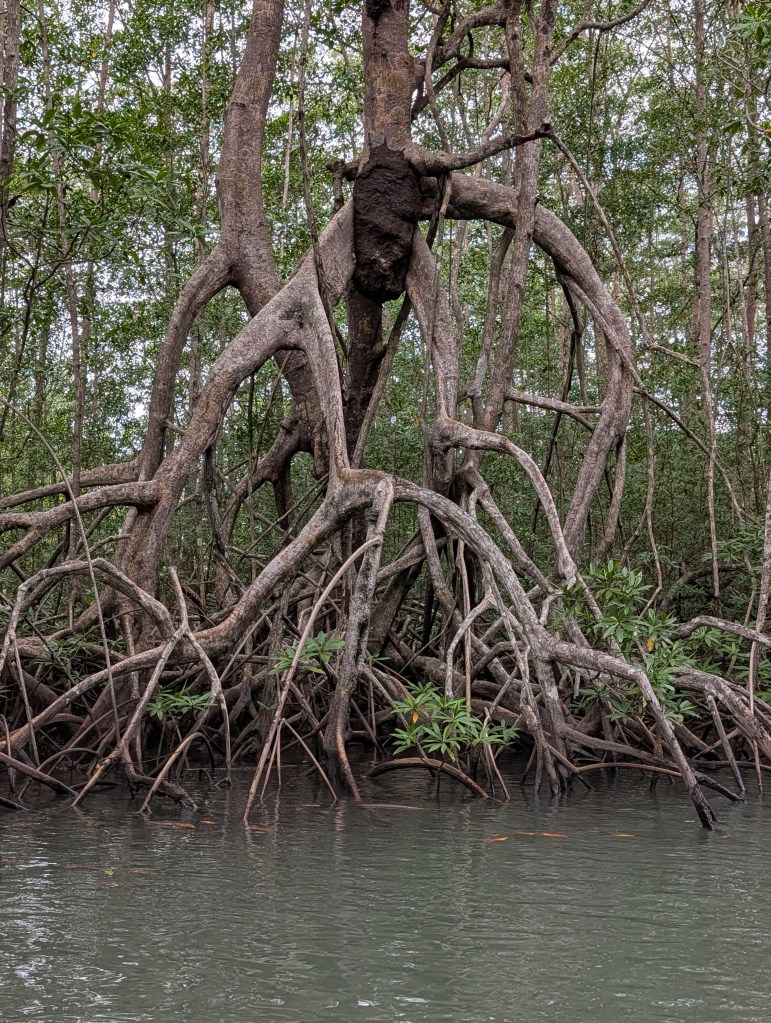
Black mangroves also manage high salinity by absorbing saltwater and excreting excess salt through specialized glands on their leaves. Visible salt crystals often coat the leaves, especially during the dry season.
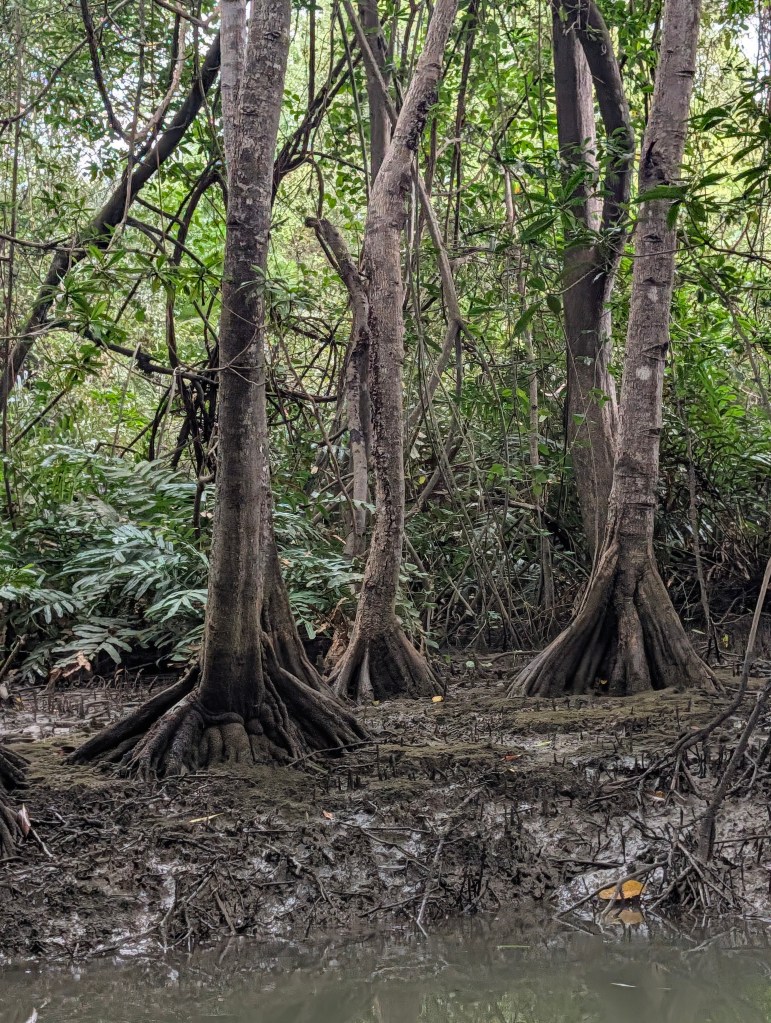
Black mangroves also use pneumatophores (snorkel-like roots) to breathe in anaerobic mud.
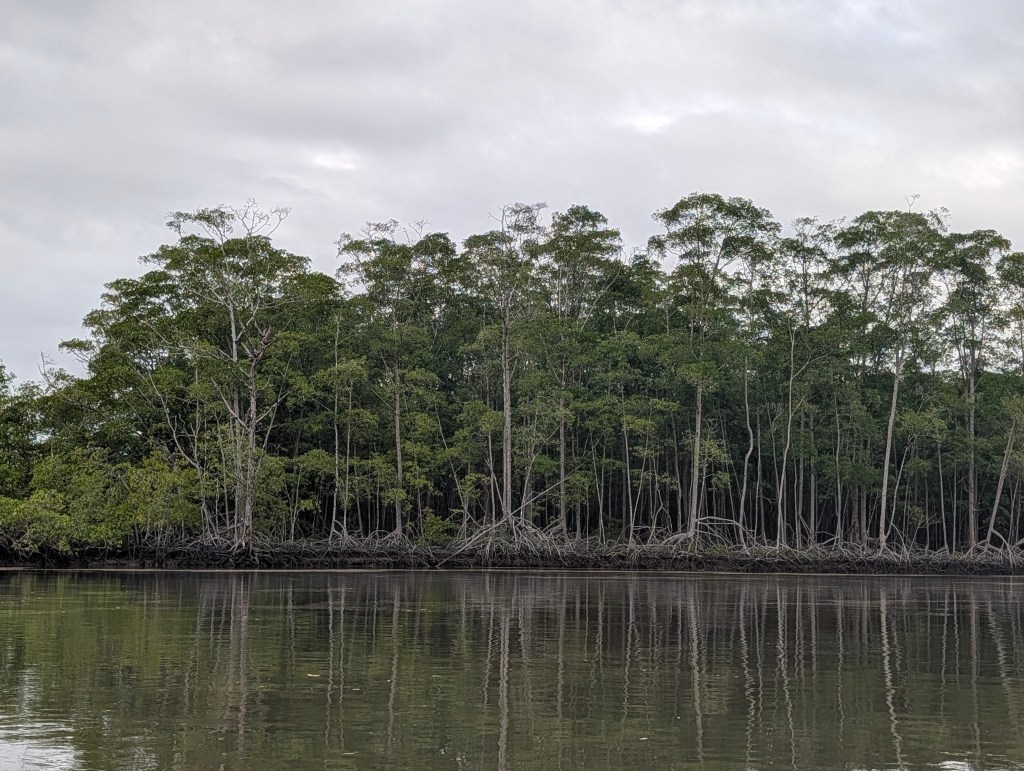
An important aspect of a mangrove forest is the maturation of crocodiles. Crocodiles are cannibals; they will eat their own young. The baby crocodiles hide in the tangles of the roots of the mangrove forest where the large adults cannot penetrate.
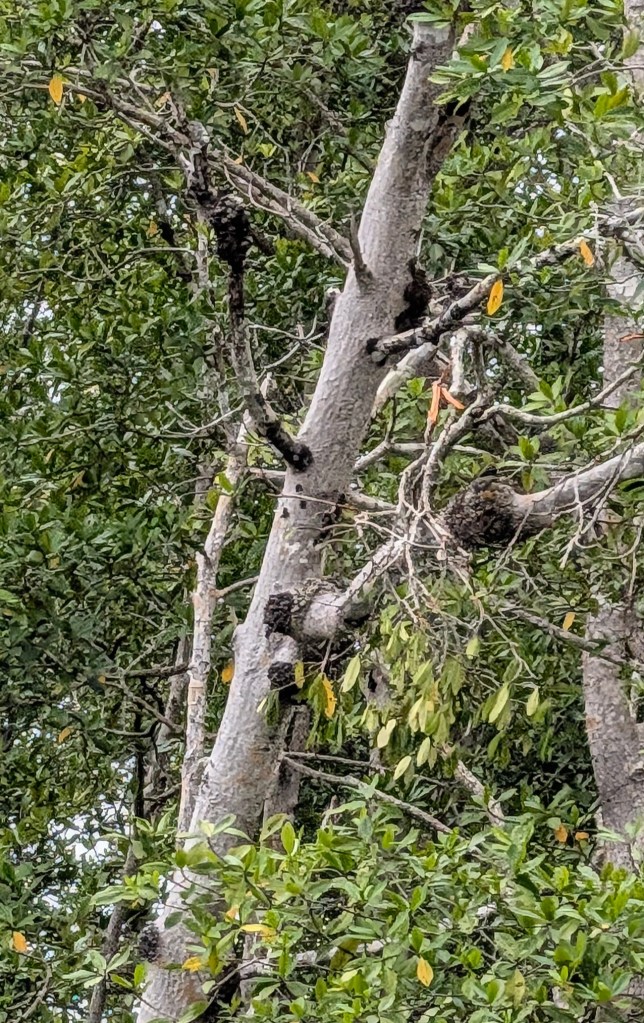
Termites do not eat green wood; they do not harm their host tree. They only eat dry dead wood. Warner taught us that inner, honeycomb-like “carton” material of a termite nest is often dry, lightweight, and fibrous, making it excellent fire starter if one is camping or lost in the woods.
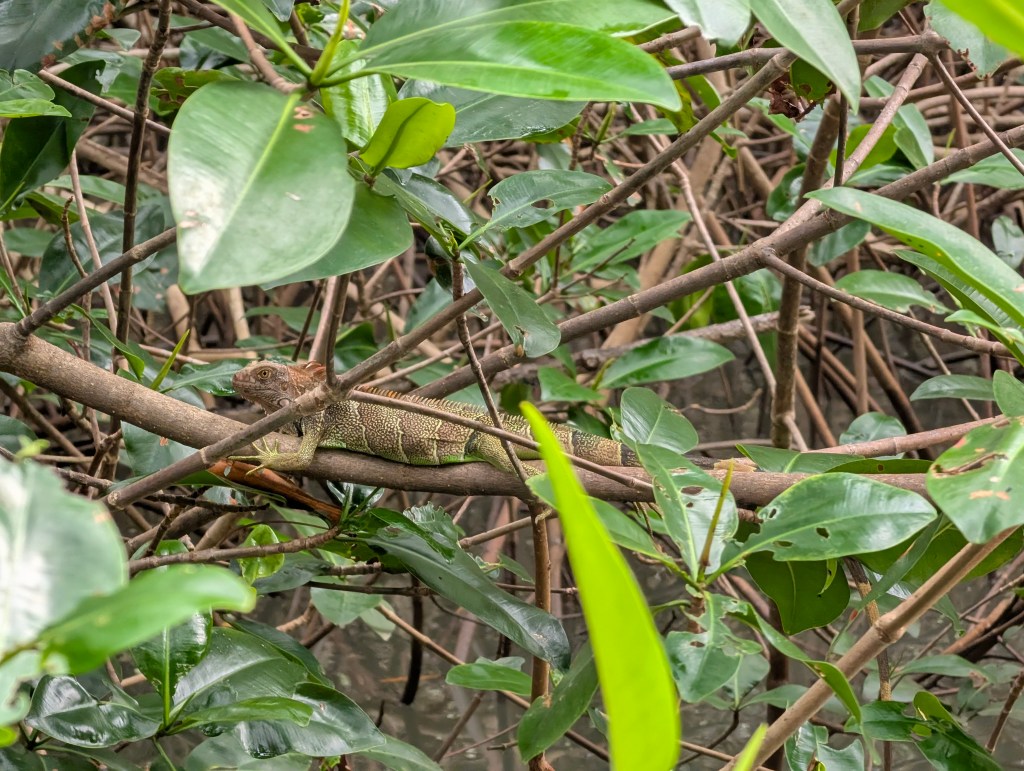
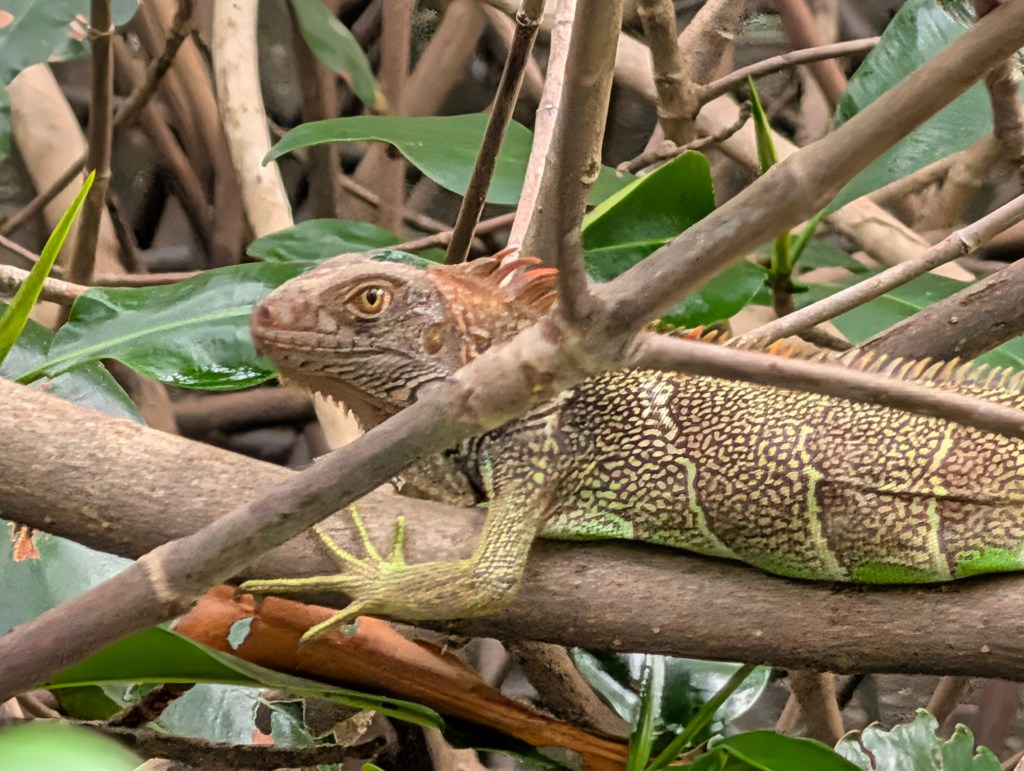
We saw yet another green iguana.
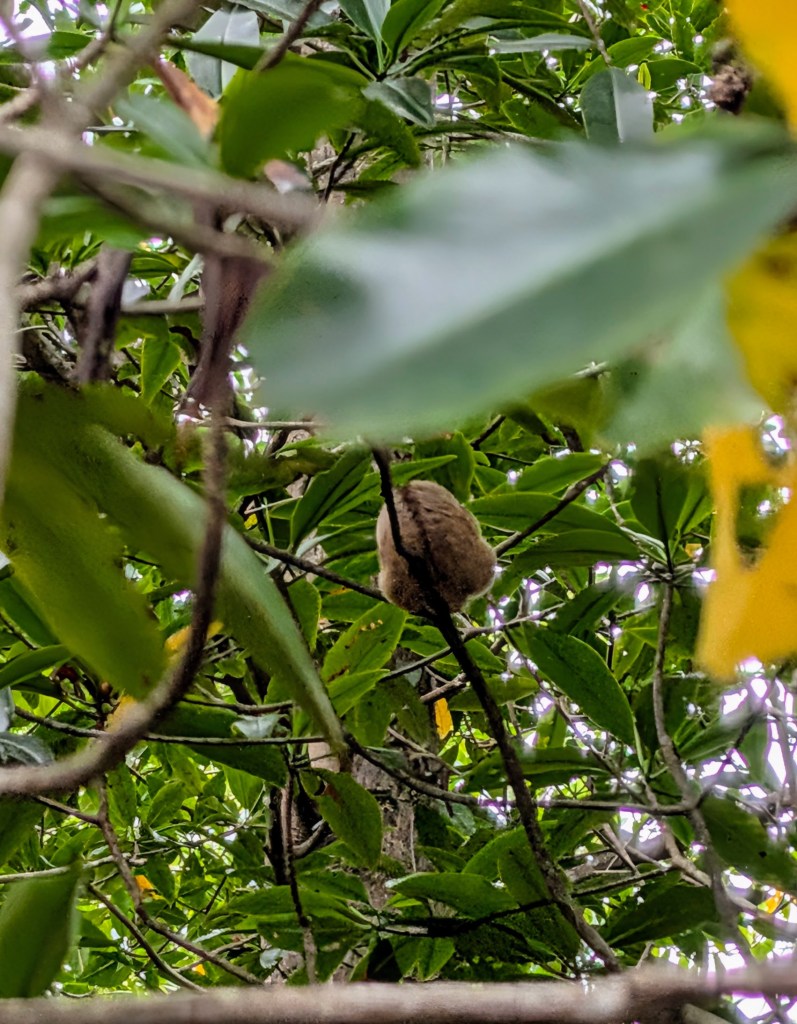
One of the women on the boat was anxious to see a silky anteater, also known as the pygmy anteater. Found in southern Mexico, and Central and South America, it is the smallest of all known anteaters, measuring 14-18 inches and weighing 6-14 ounces. It is nocturnal, arboreal, and has a semi-prehensile tail used for gripping branches. Warner found us one, albeit curled up sleeping.
The baby green iguana is great at camouflage.
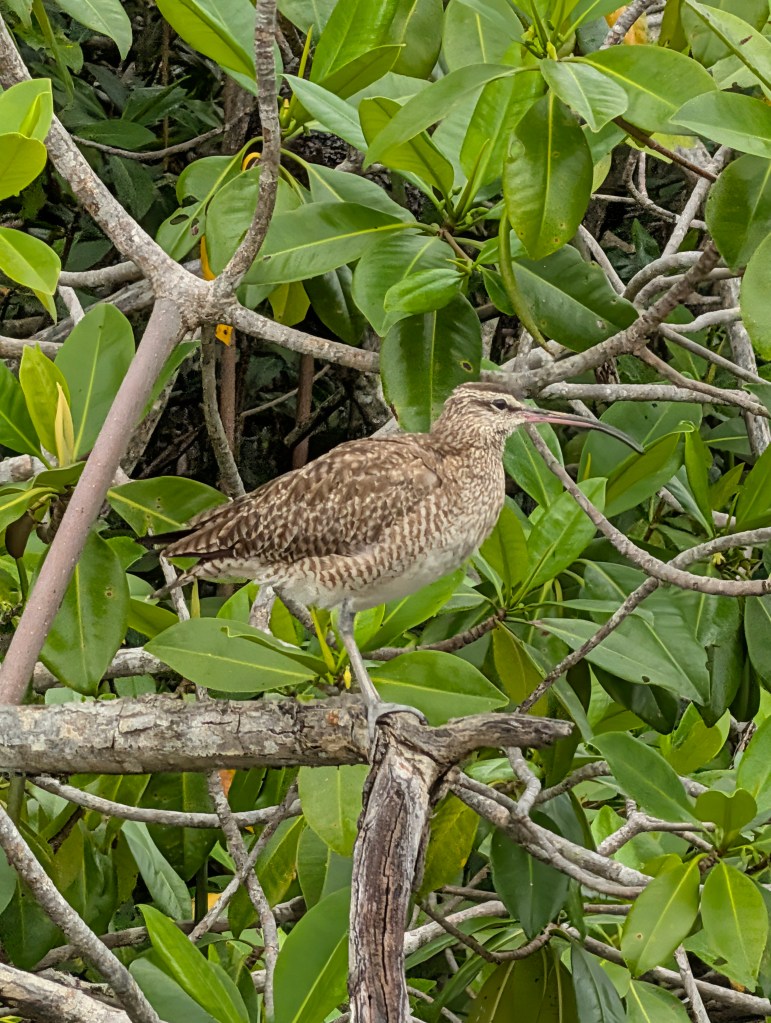
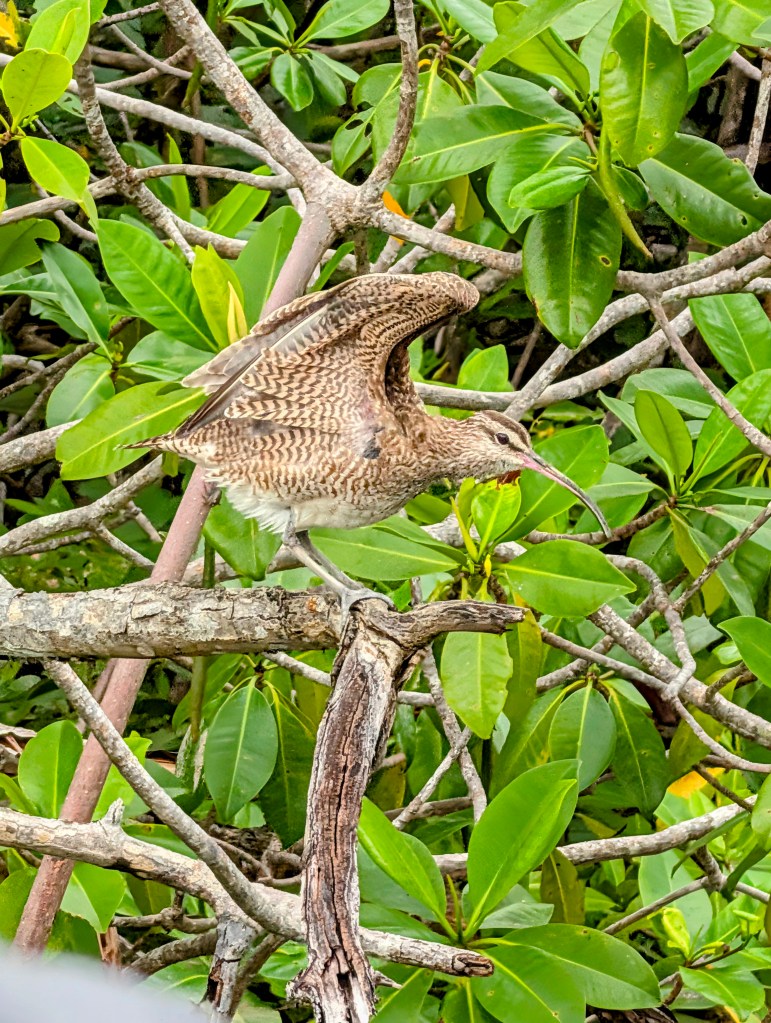
A Eurasian Whimbrel, a type of wader in the sandpiper family, is a medium-sized bird, identified by its distinctive long, down-curved bill used for probing in mud and sand for prey. The plumage is mottled brown, with a striking crown pattern marked by a dark stripe down the center.
Whimbrels are migratory birds, breeding in Alaska. They are fairly gregarious outside of the breeding season. Over 300 species of birds commute from Alaska and Canada to Costa Rica this time of year.
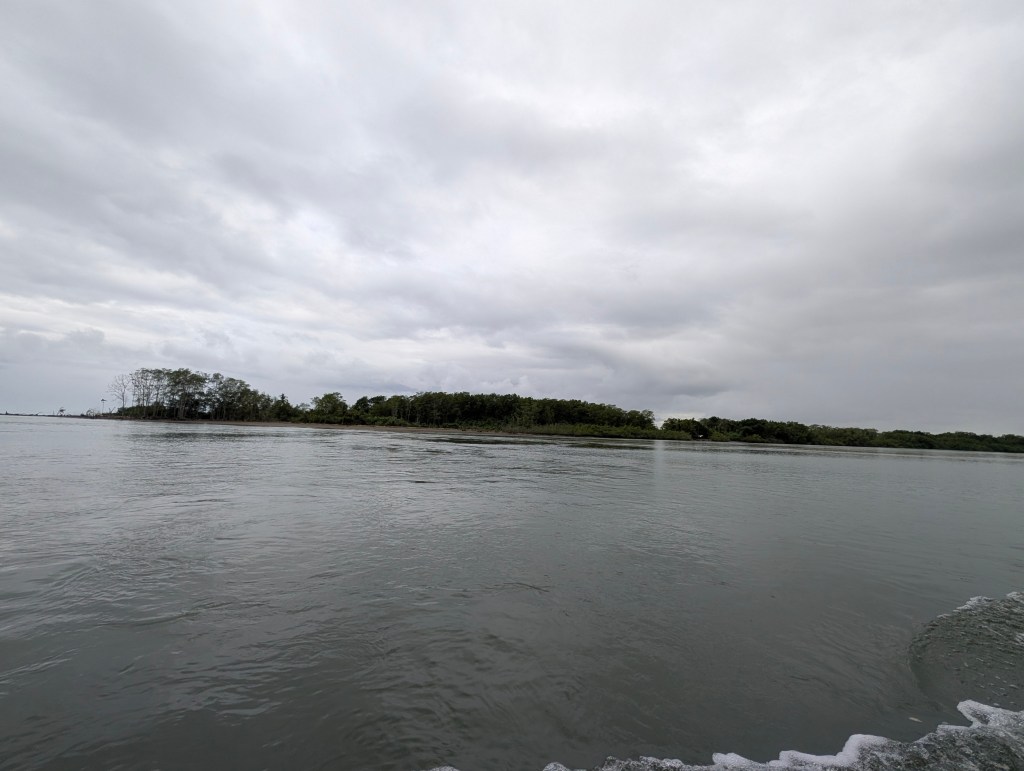
We made it out to Damas Island before turning back.
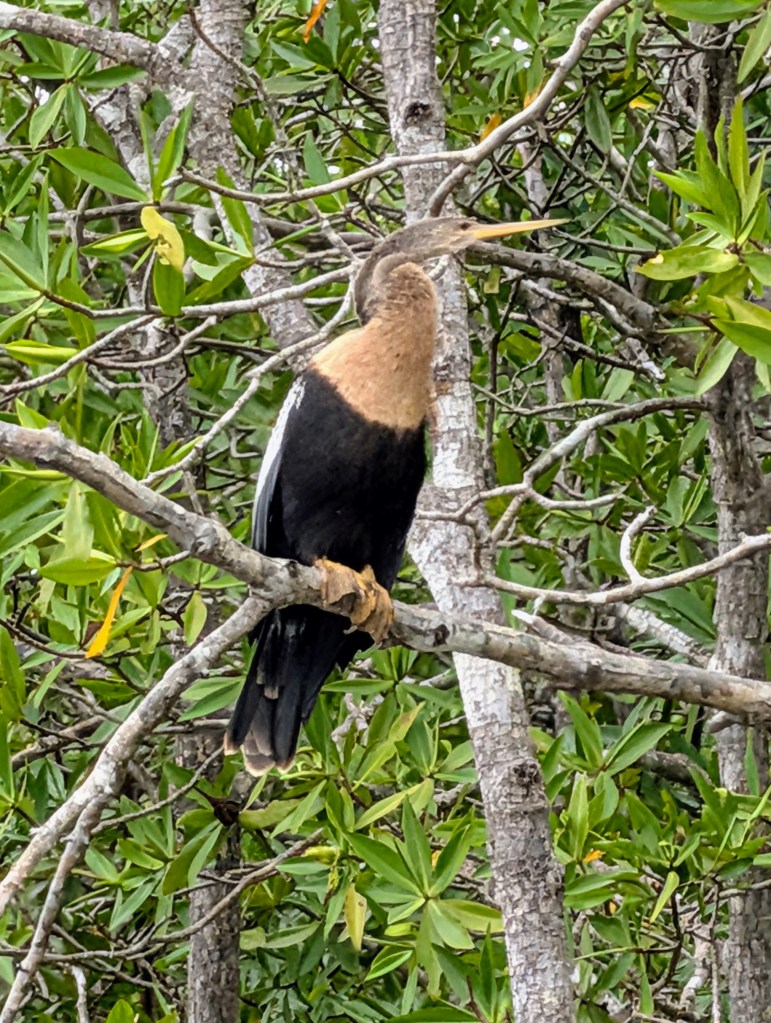
We found an Anhinga, also commonly known as the snakebird or darter. When swimming, they often keep only their head and long, S-shaped neck above the water, which makes them look like a snake. Anhingas are large waterbirds found in the warmer regions of the Americas, inhabiting swamps, mangroves, and lakes. They are known for their unique hunting style, diving underwater and spearing fish with their sharp, dagger-like bills. Unlike many waterbirds, their feathers are not fully waterproof, which allows them to achieve neutral buoyancy for diving but requires them to perch with outstretched wings to dry their plumage afterward.
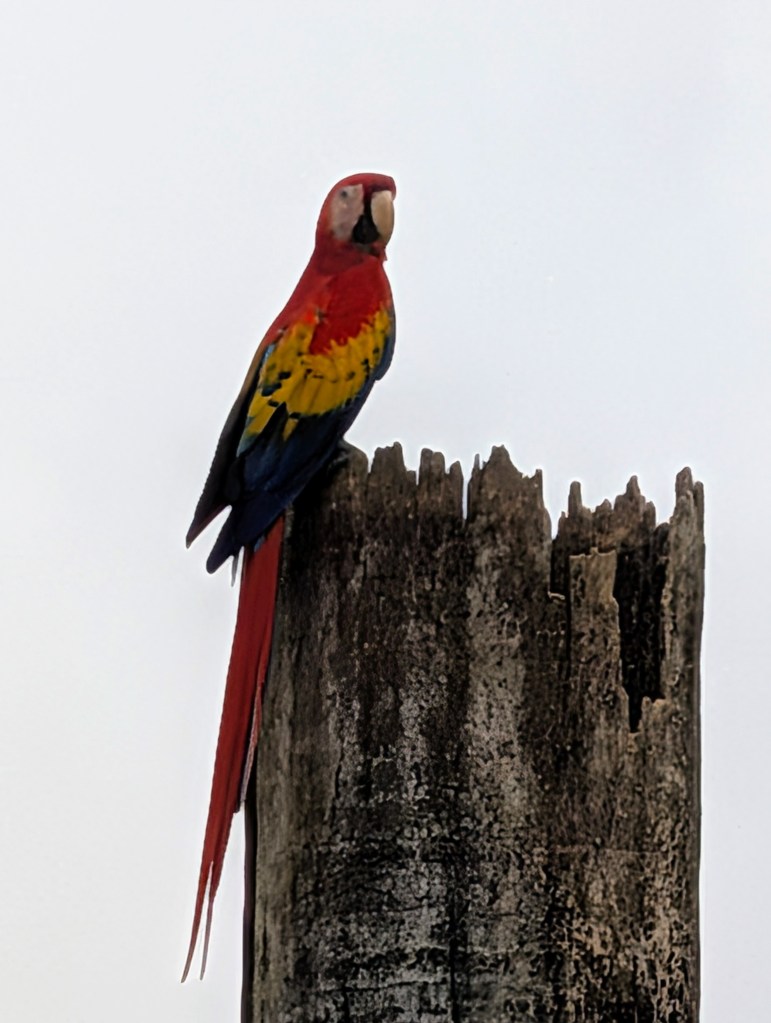
After the boat ride we were treated to a delicious typical Costa Rican breakfast of eggs, rice and beans, and fried plantains. On our return to the resort we pulled over to take pictures of a macaw perched atop a dead tree stump. Warner explained that macaws often nest and lay eggs inside dead trees. They are generally found in pairs. They can live up to 70-80 years and remain monogamous as long as their mate is alive. But if the mate dies, they will find a new one. They had become endangered in Costa Rica in the 1970s when owning them as pets became illegal. Since then their population has increased by 280%.
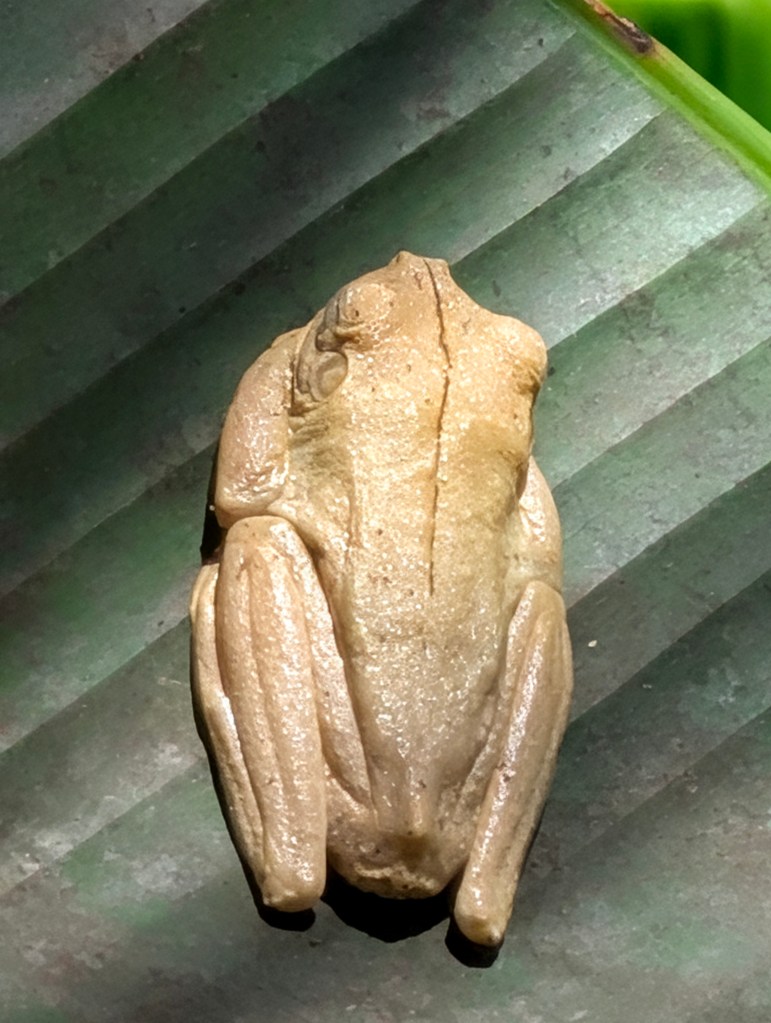
We dropped a couple at their lodgings and there found a tree frog warming itself in the sun. They possess specialized, adhesive, toe pads that allow them to cling to, and climb vertical surfaces like glass or, waxy leaves
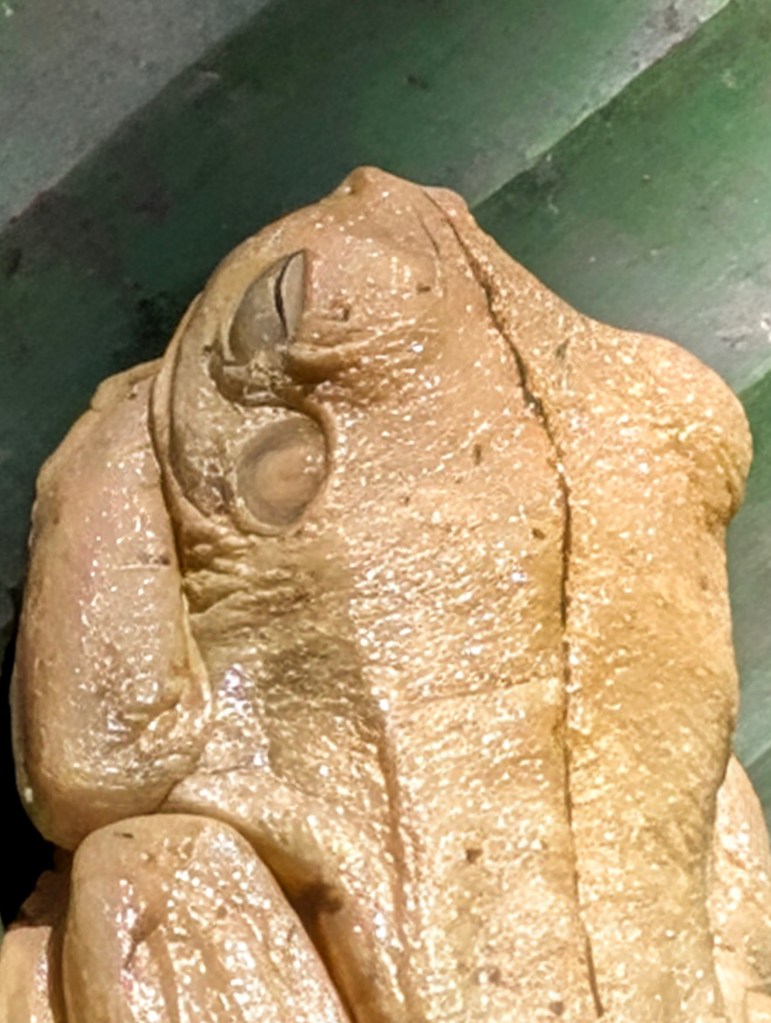
Tree frogs sink their large eyes into their skull to help push food down their throat.
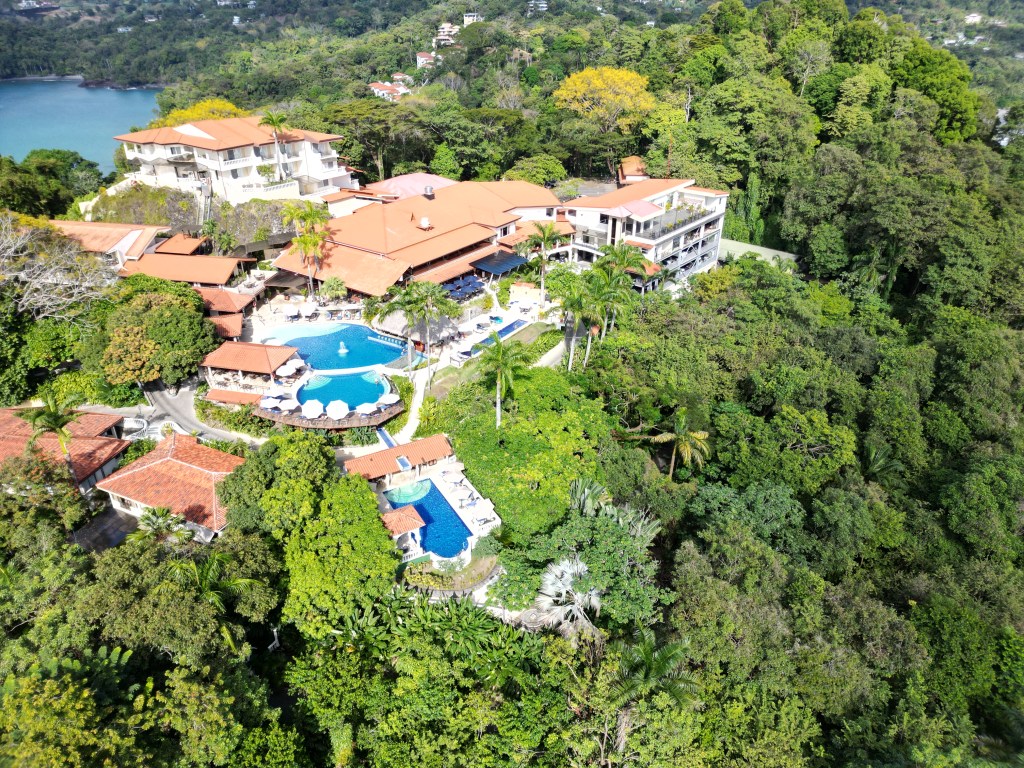
Once back at the resort we spent the afternoon again lazing by the pool. Eric sent up his drone to take a picture of the resort.
In the morning we were driven to a boat landing where we were joined by a fun couple from Tennessee and staff of our lodge including the dive master Rafael. Our luggage was stored in huge dry-bags and loaded onto the boat.
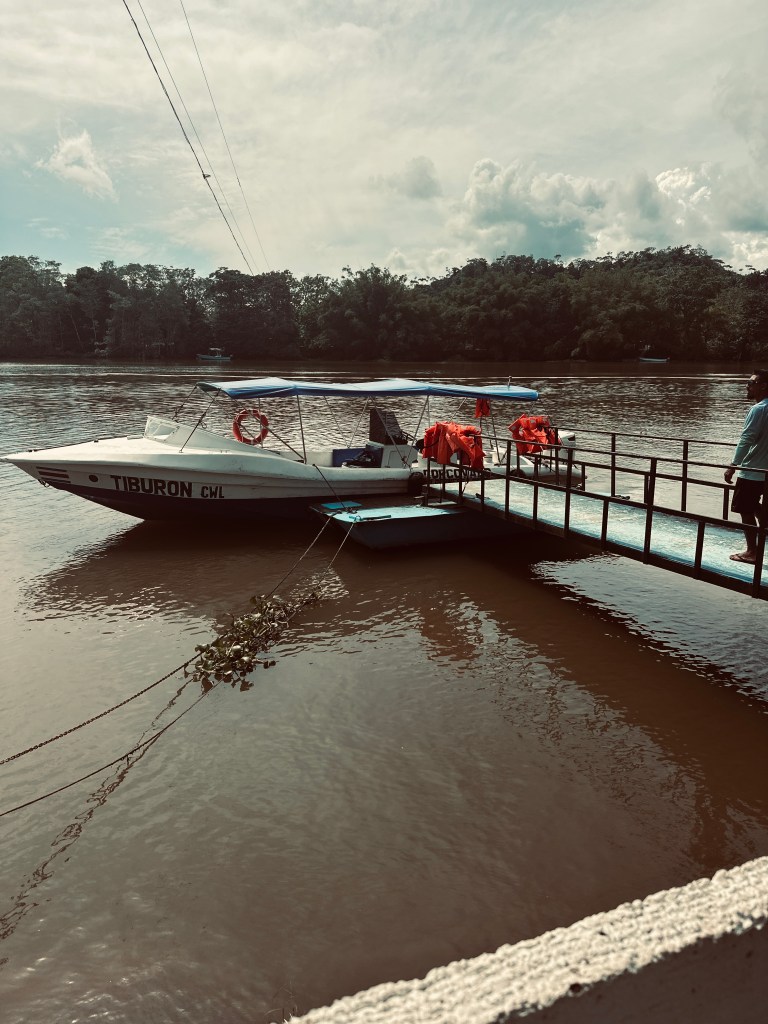
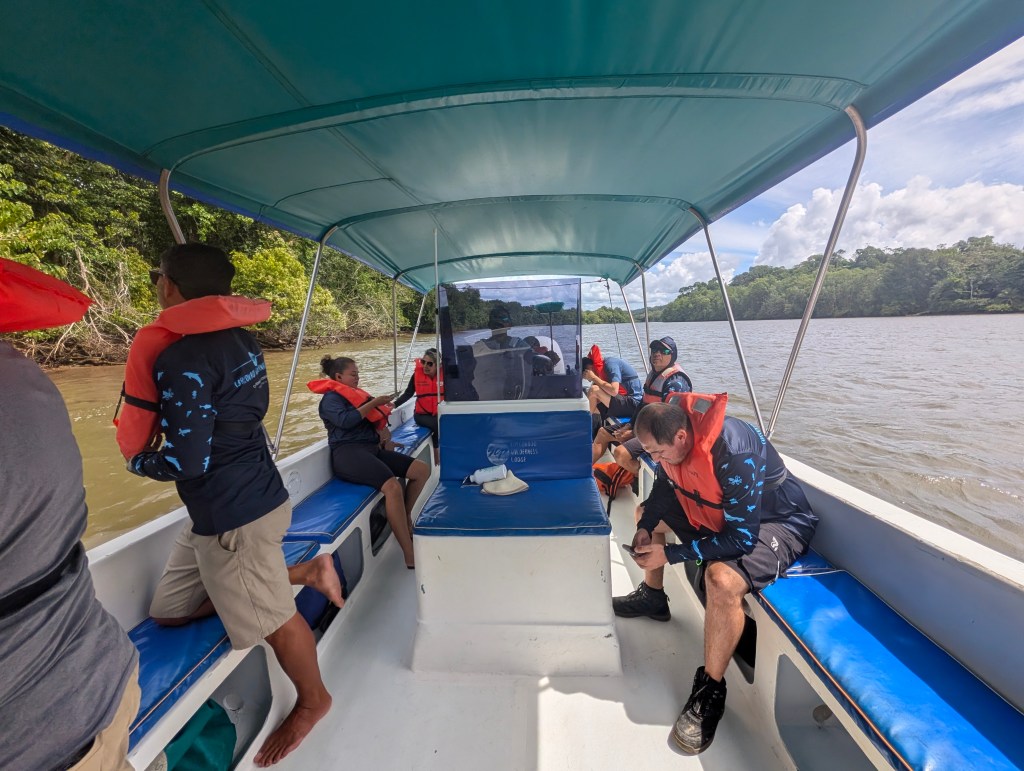
And off we sailed.
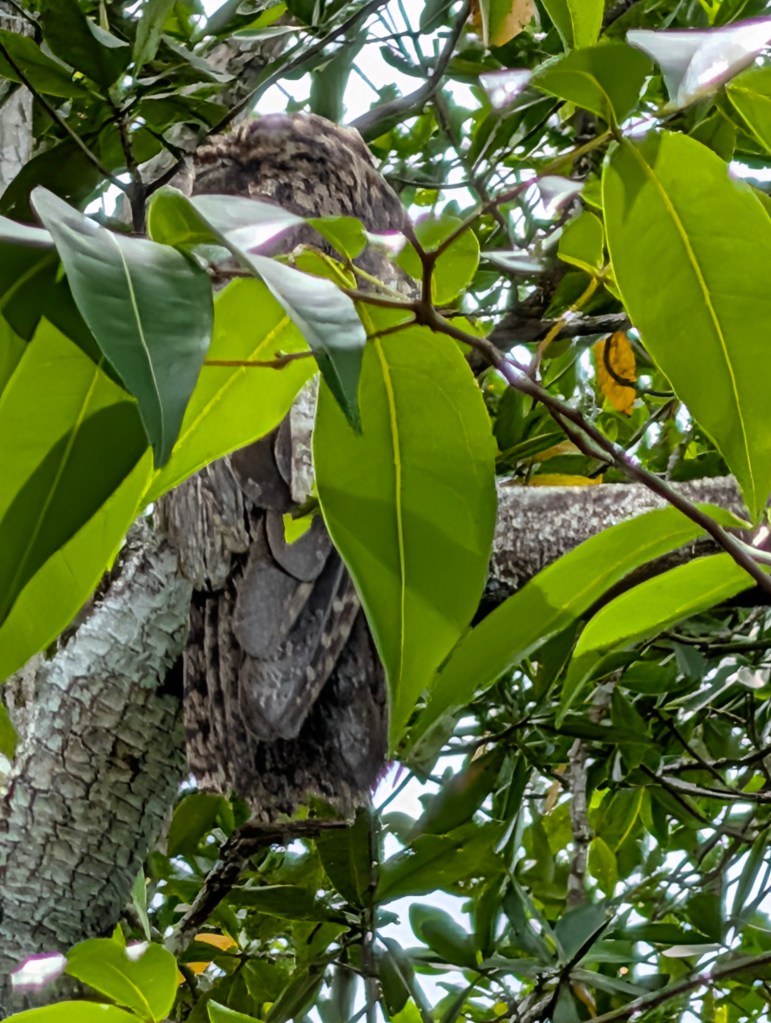
Along the way the captain pulled close to shore so Rafael could point out the pootoo bird, a type of nocturnal bird known for its incredible camouflage, mimicking broken tree branches or stumps during the day to avoid predators. At night they hunt insects using their large eyes for low-light vision.
When we arrived we had to remove our shoes and climb to shore via the beach. The captain was expert in avoiding the rocks.
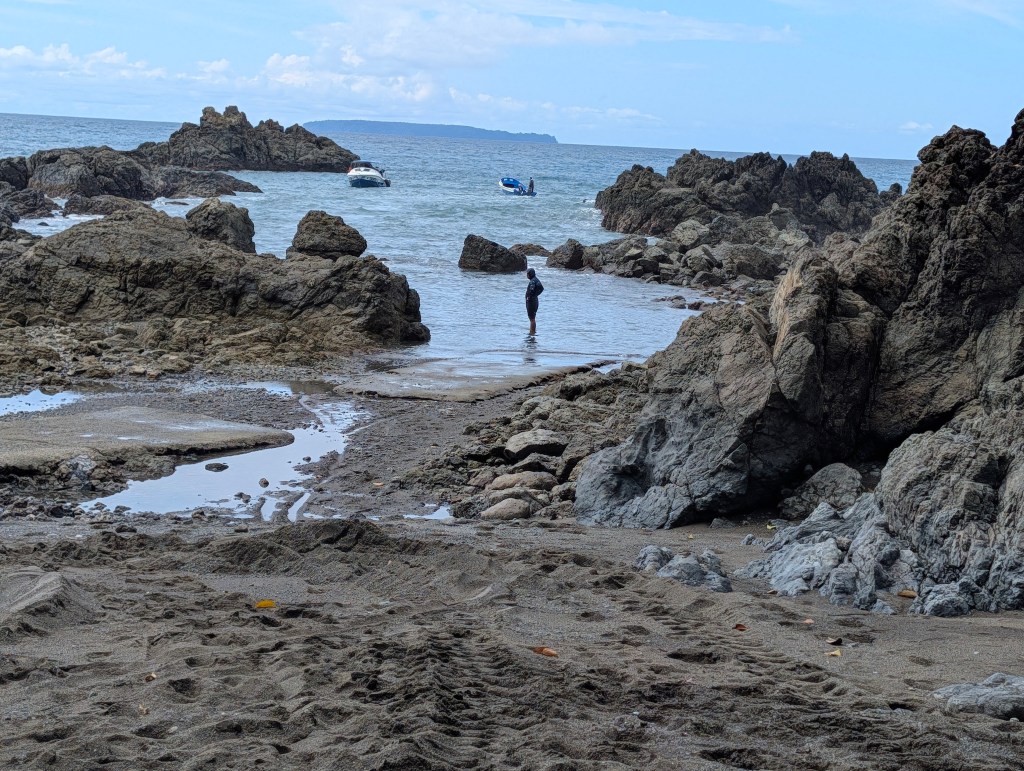
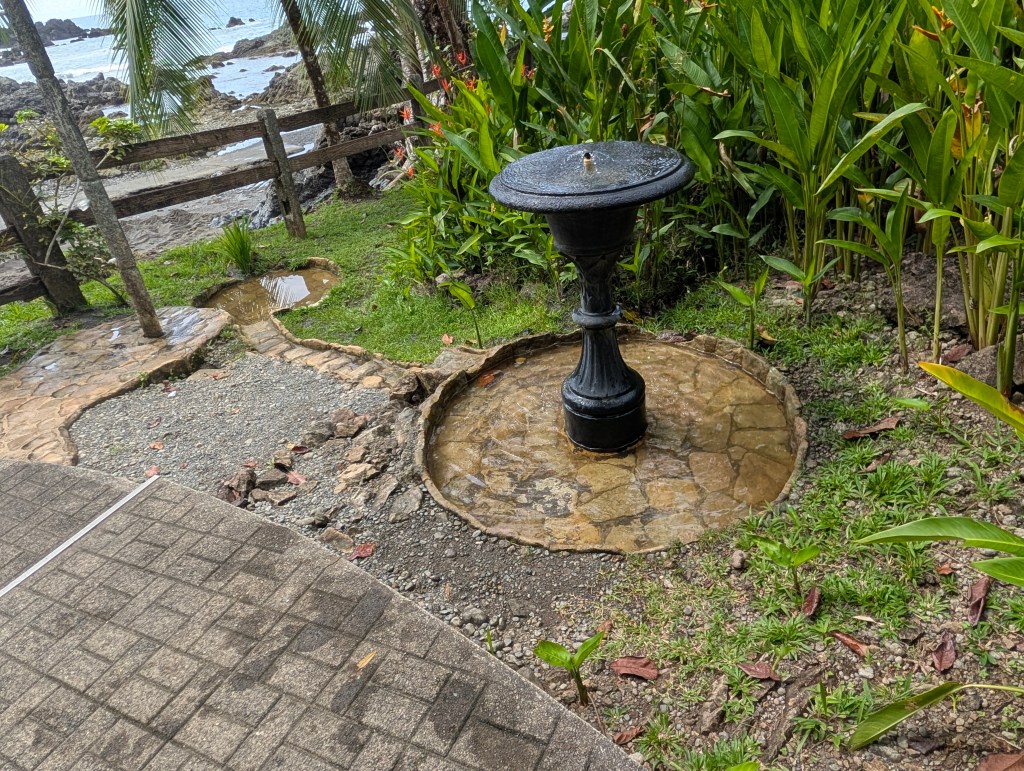
First activity was washing all the sand off our feet in the lovely foot-bath provided.
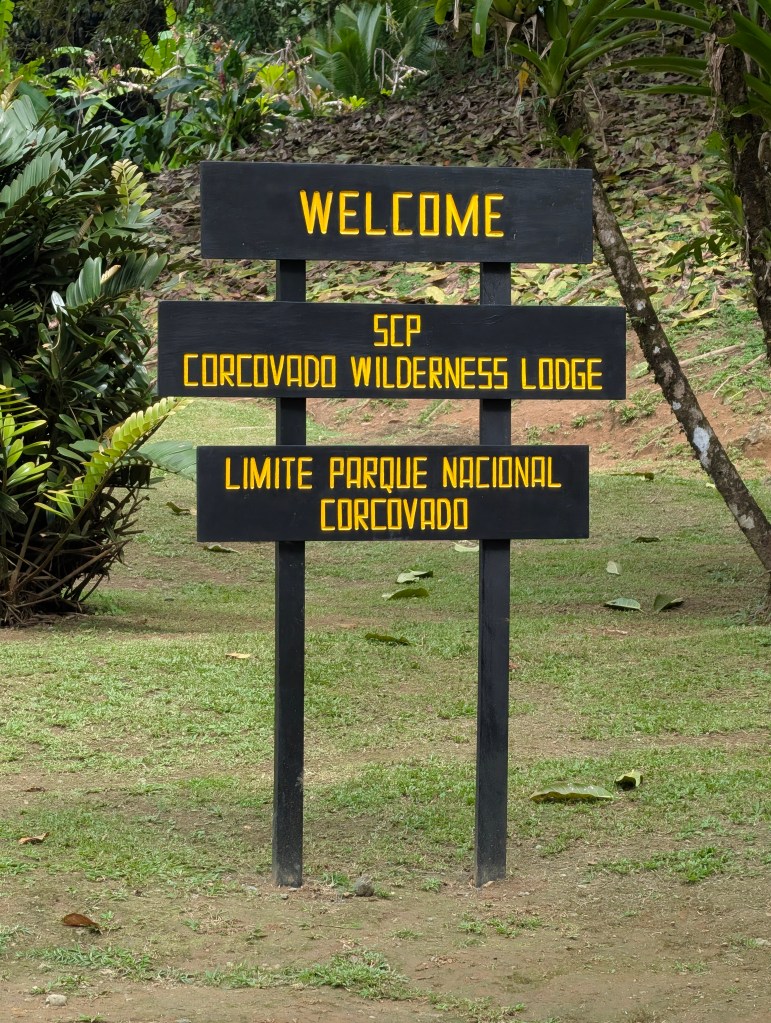
We were welcomed to our new home: the Corcovado Wilderness Lodge.
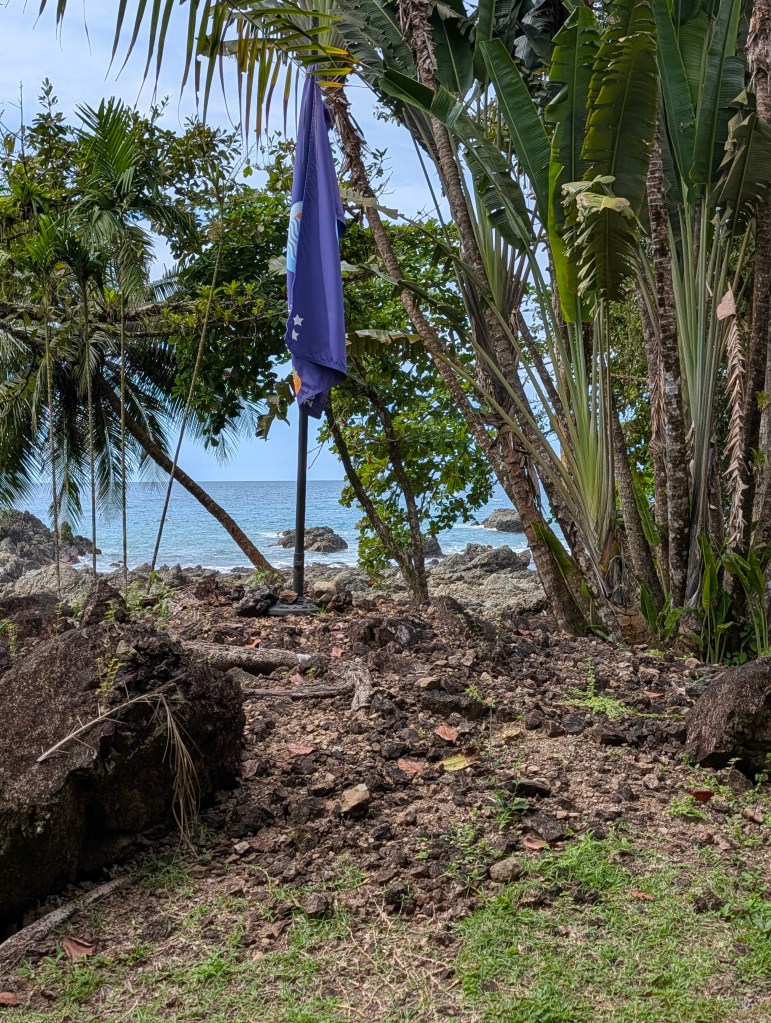
We immediately took note of the blue eco flag, making us feel good about the choice of lodgings..
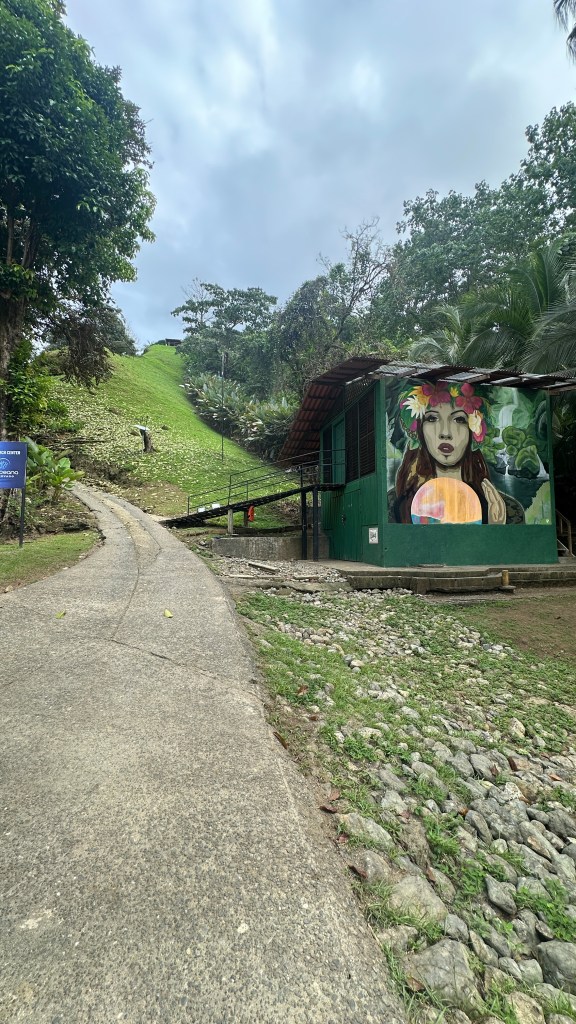
But glancing up the path, we were a bit disturbed by the steepness of the path but were quickly reassured that a limo was coming for us.
While waiting for its arrival, we enjoyed the beautiful surroundings. The Traveler’s Tree, also known as the Traveler’s Palm, is native to Madagascar; it thrives in warm, humid tropical climates and can grow quite large with a sturdy trunk.
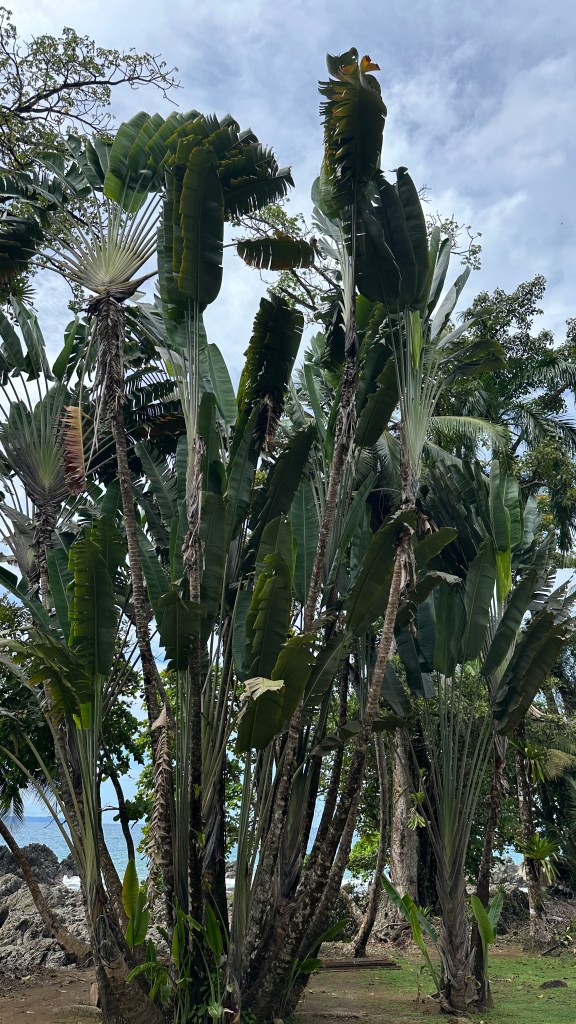
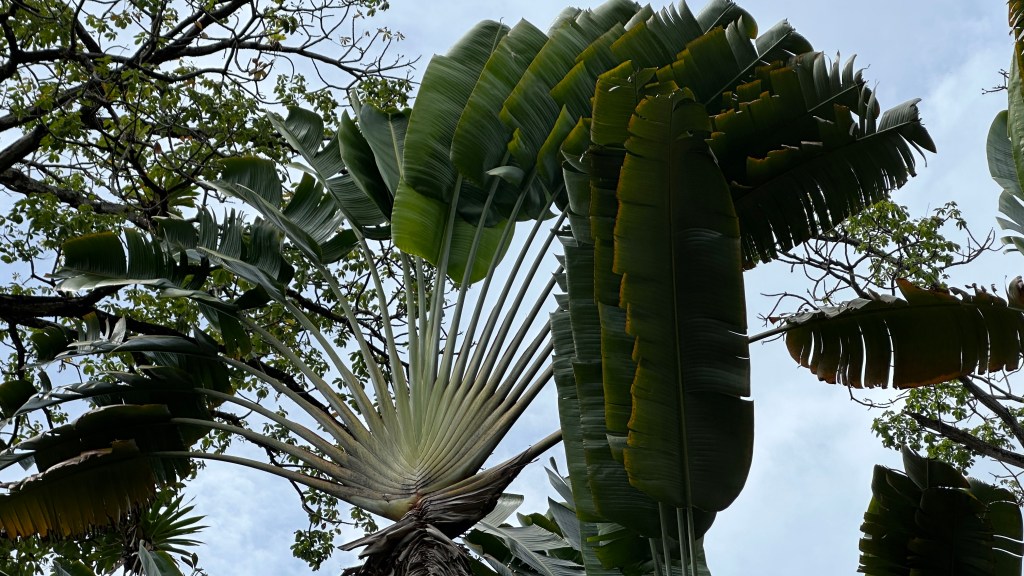
It is famous for its large, fan-shaped arrangement of leaves that look similar to a banana tree. The common name derives from the anecdote that thirsty travelers can obtain water collected within its leaf sheaths.
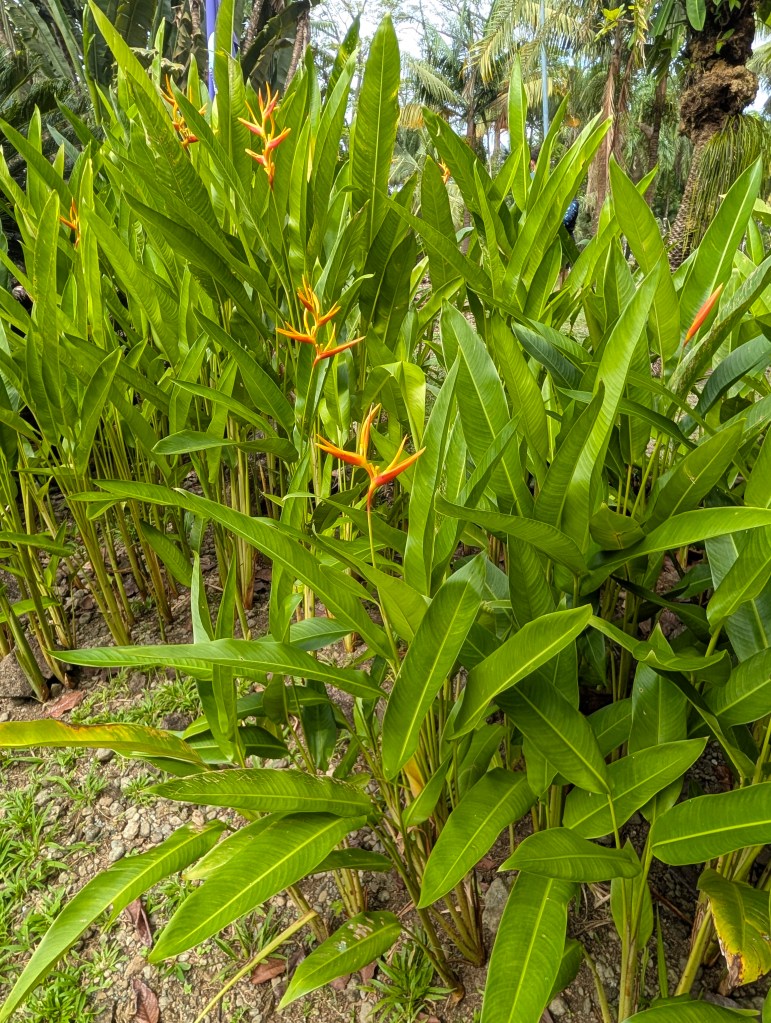
A native to Central America and most warm, humid tropical climates is the t Parrot’s Beak, Parakeet Flower, or, more commonly, False Bird-of-Paradise. It is in the Heliconia family, a family of plants I am truly starting to love.
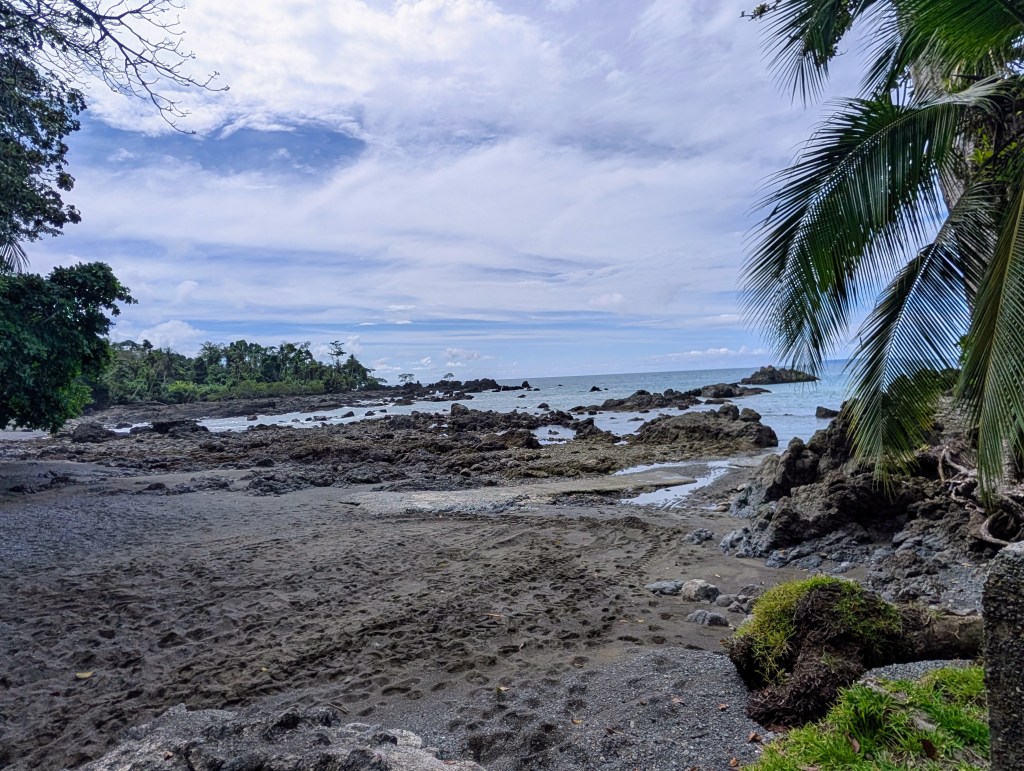
A last look at the beach and,
our carriage arrived. The tractor was for all the luggage and staff.
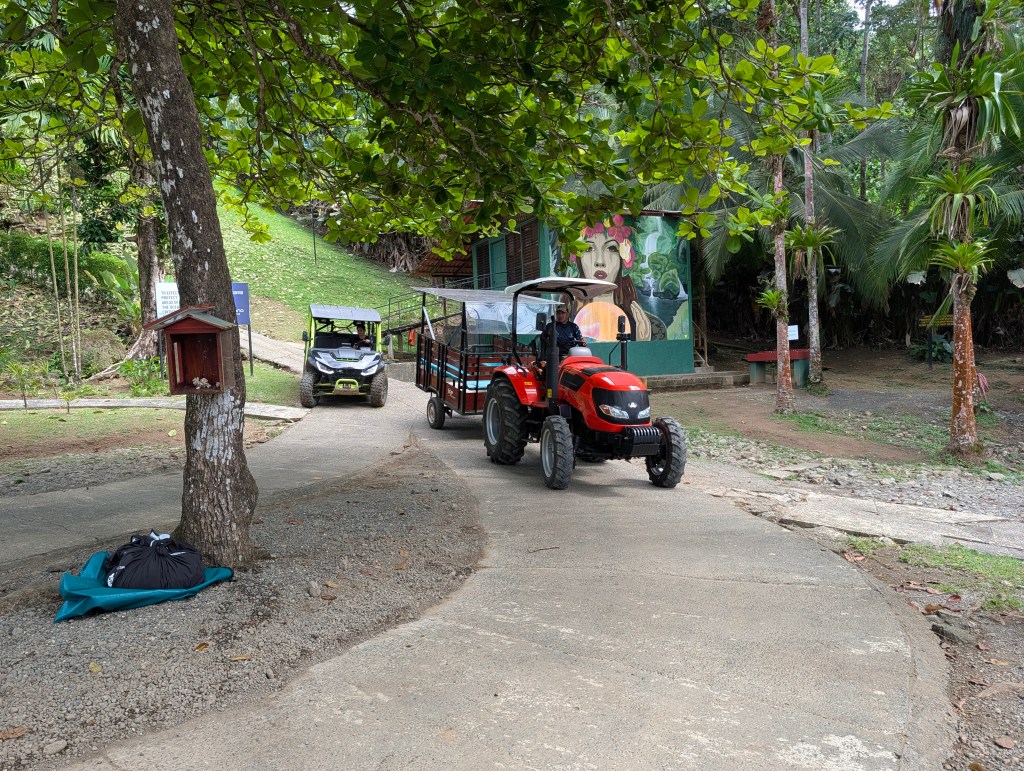
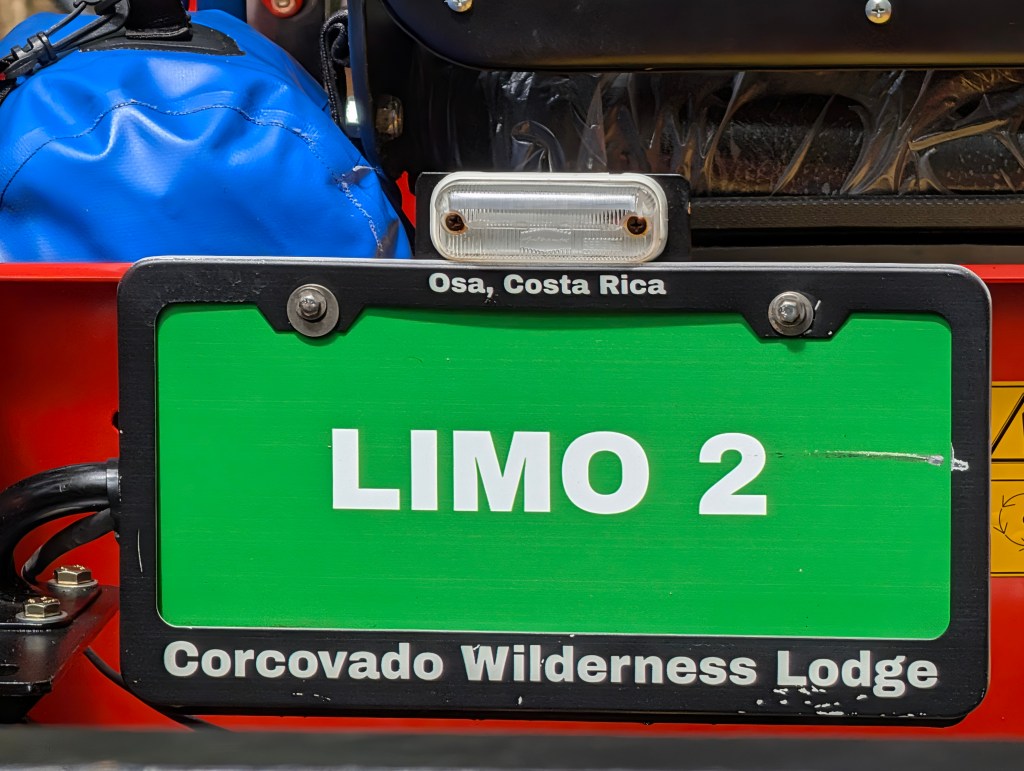
We rode in the little jeep.
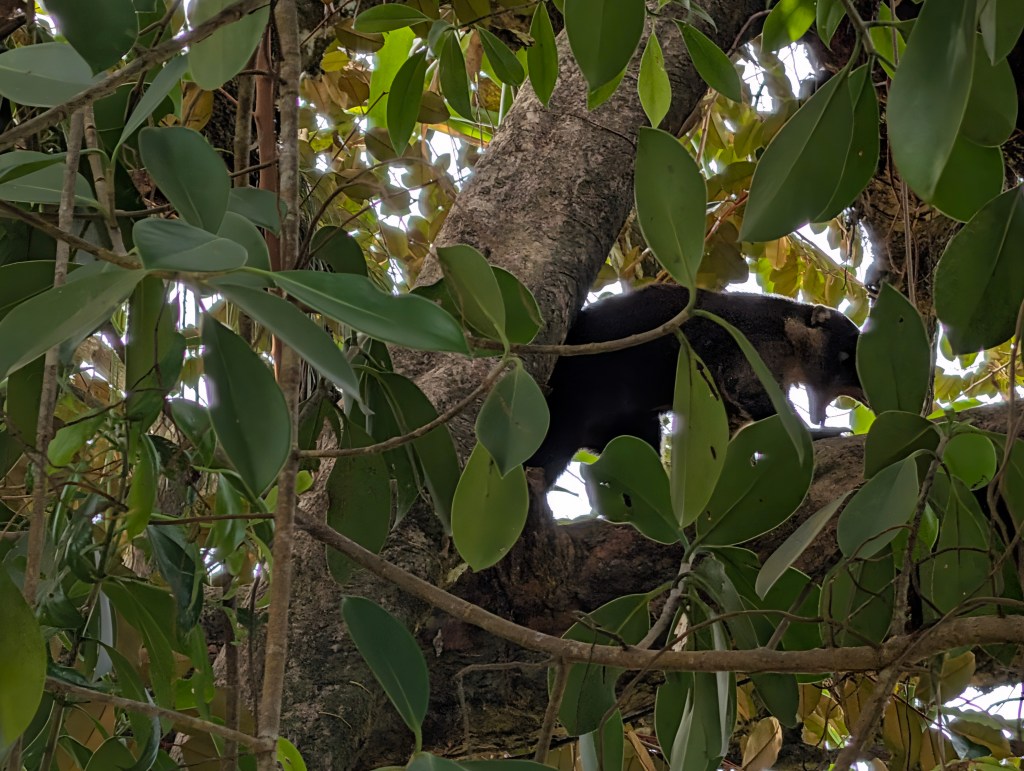
On the ride up to reception we saw a caoti sleeping in a tree.
We were checked in
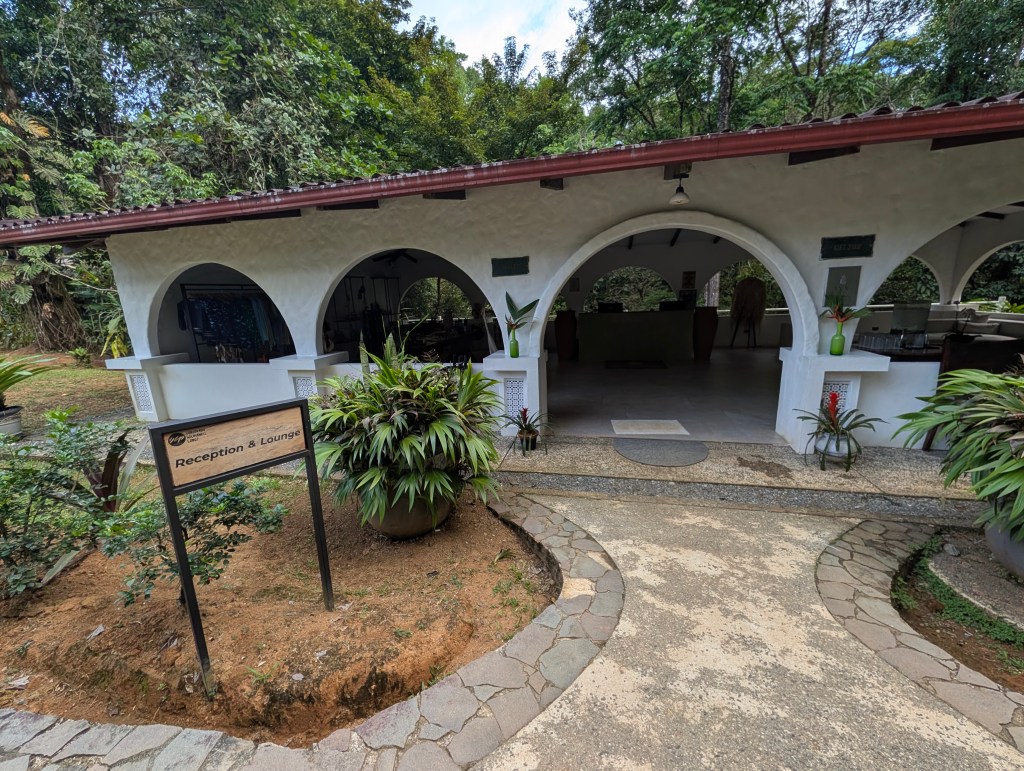
and fed lunch before being taken to our cabin.

We have stayed in a lot of places around the world. This was one of the most beautiful rooms anywhere ever.
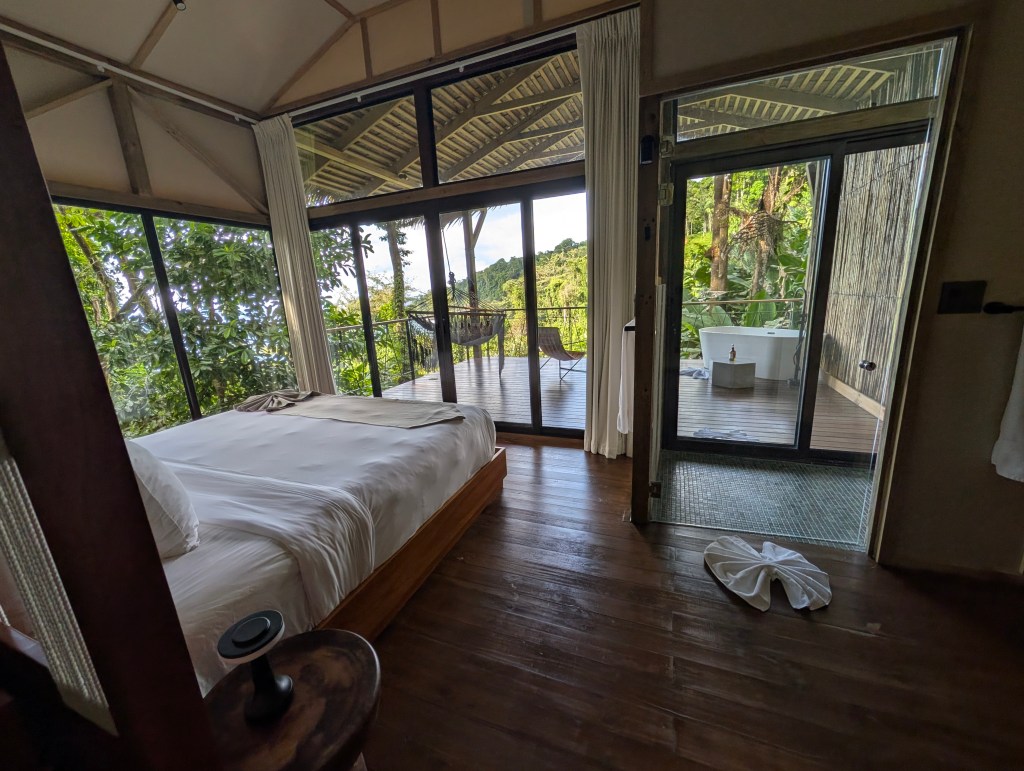
And what a view!
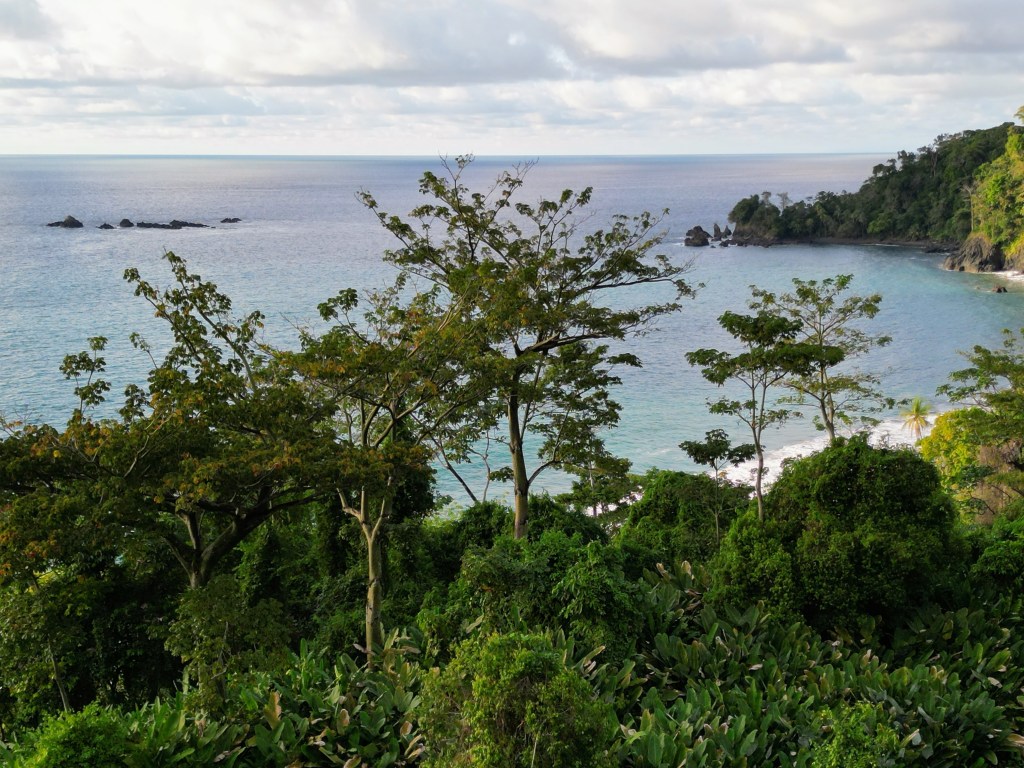
While we relaxed for a bit, Eric sent up the drone for some pics.
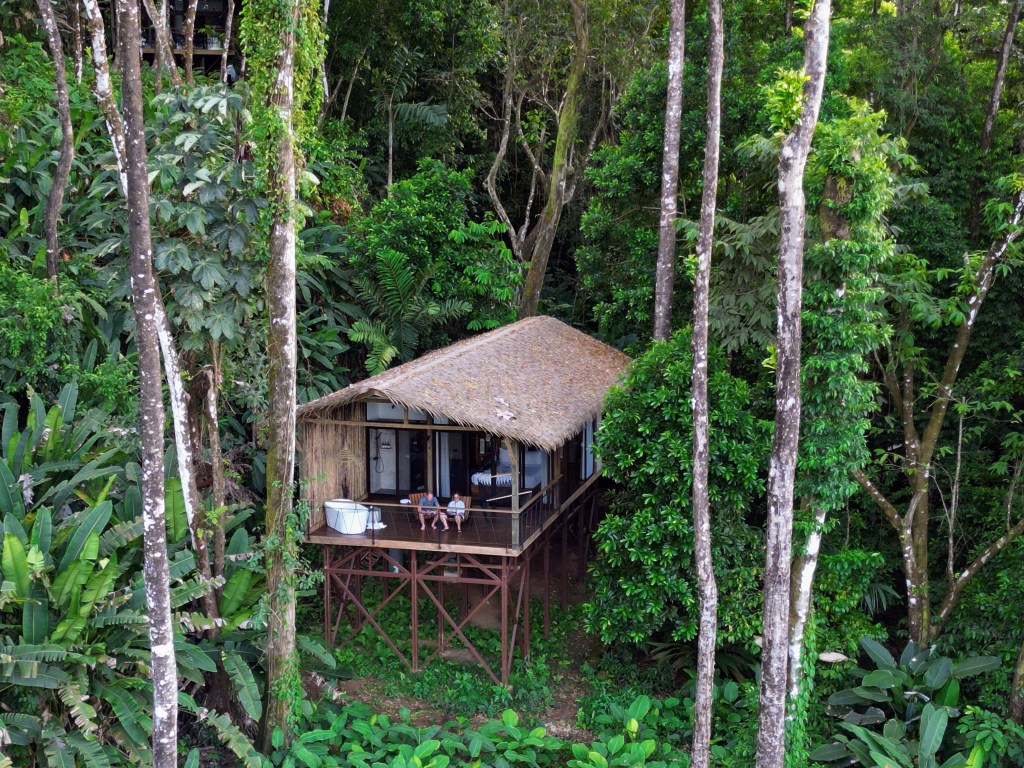
We hung out and enjoyed a peaceful sunset.
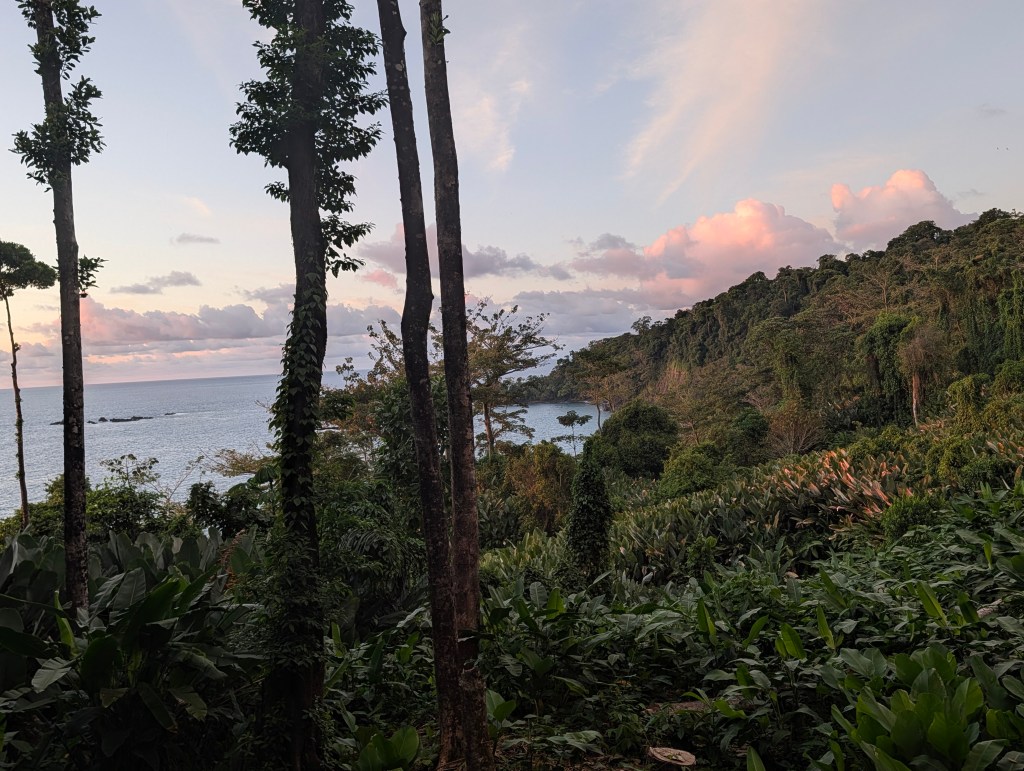
Having had such a late lunch we had a late, light dinner before heading to bed early. We were scheduled for an early morning snorkel. After breakfast in the morning, we joined Rafael and some other guests for our briefing. Unfortunately it poured rain during the entire briefing which scared away one of the couples. The rest of us jumped on the limo and headed for the beach. It was a bit of a rough 45 minute crossing to Caño Island where we joined a bunch of other boats.
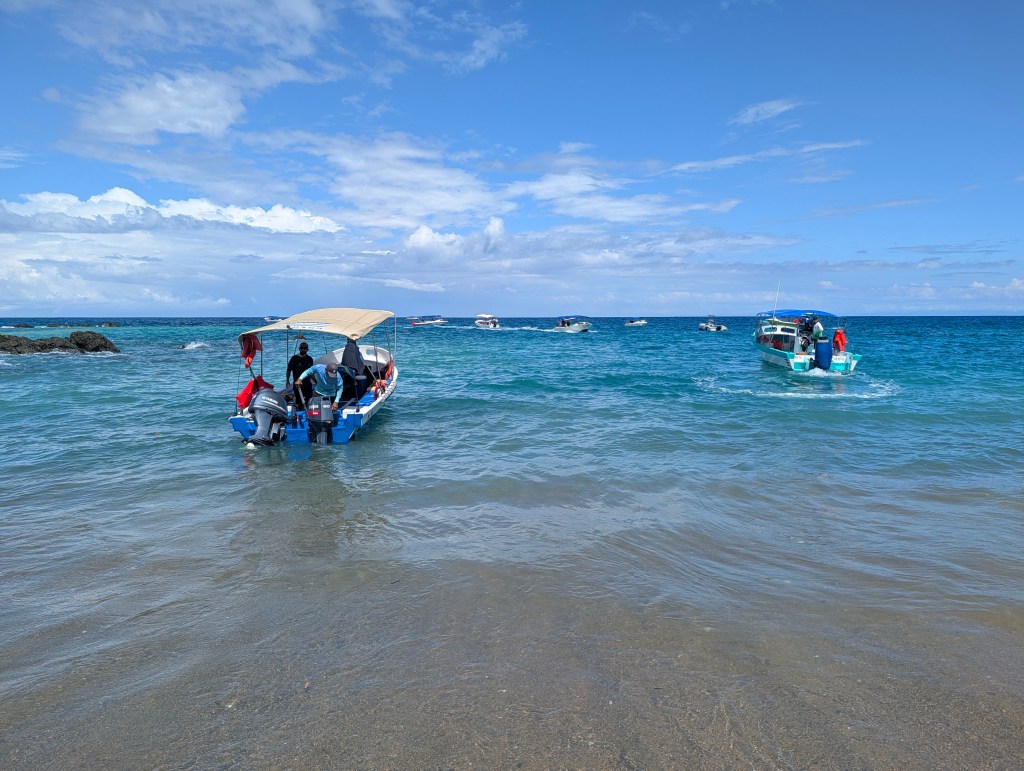
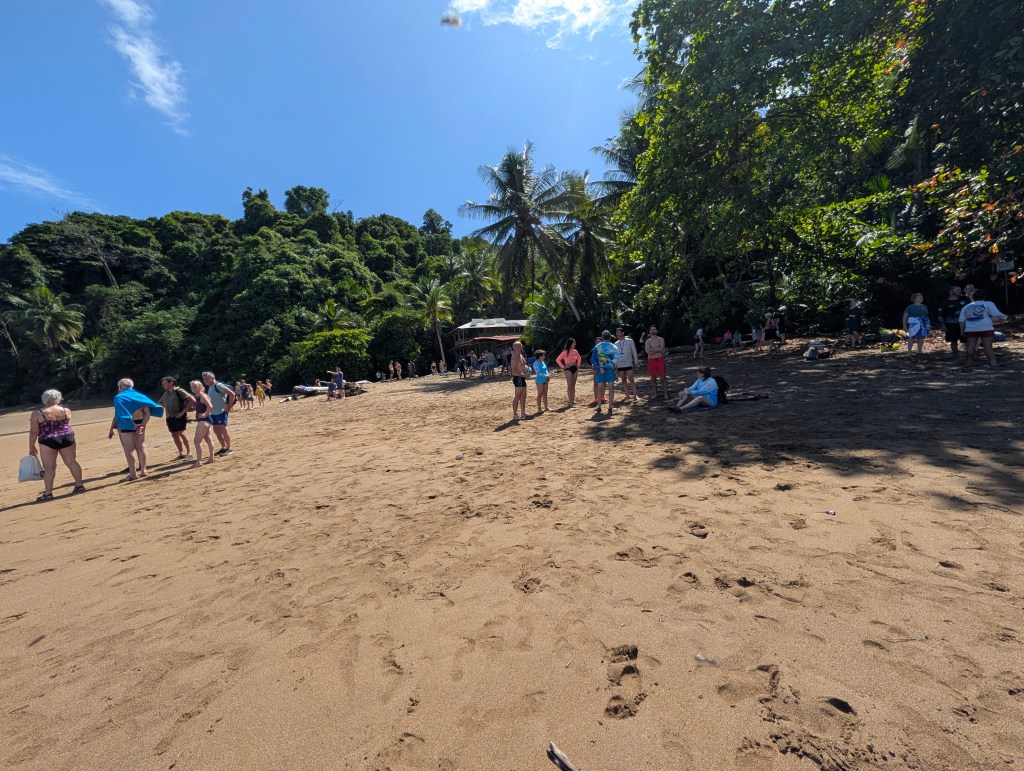
Unfortunately the snorkeling was not great. With the turbulent sea, there was too much stirred up silt to see a lot. After about 45 minutes we gave up, and the boat took us to the island’s beach for a fresh fruit snack. The beach was teeming with tourists.
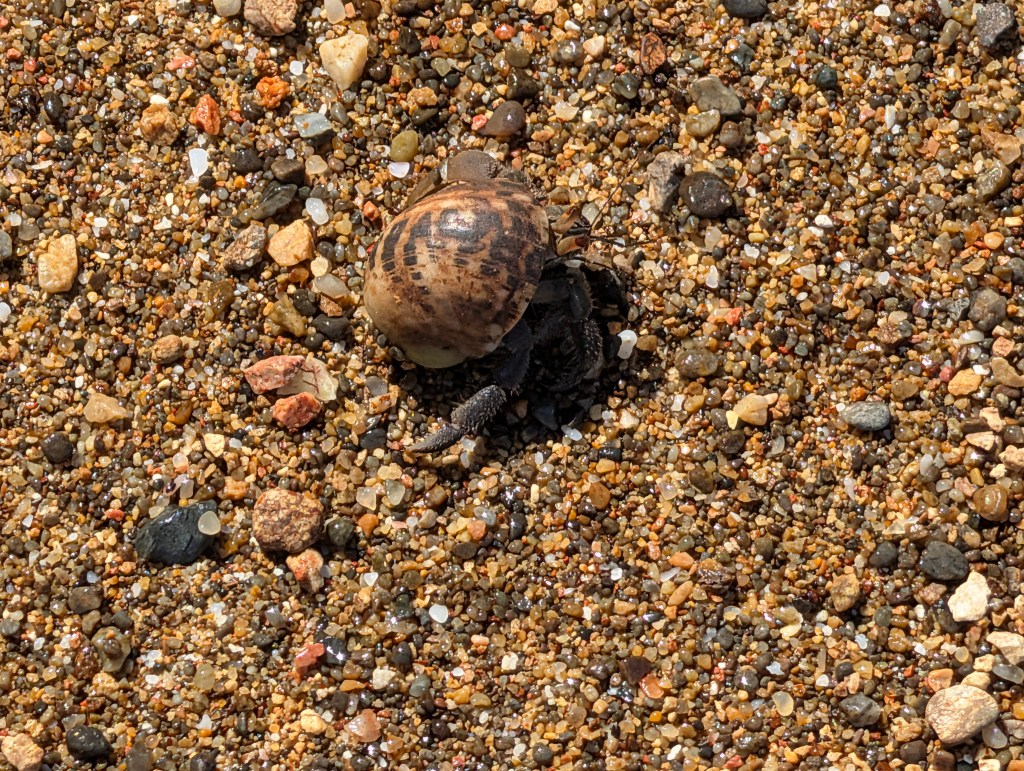
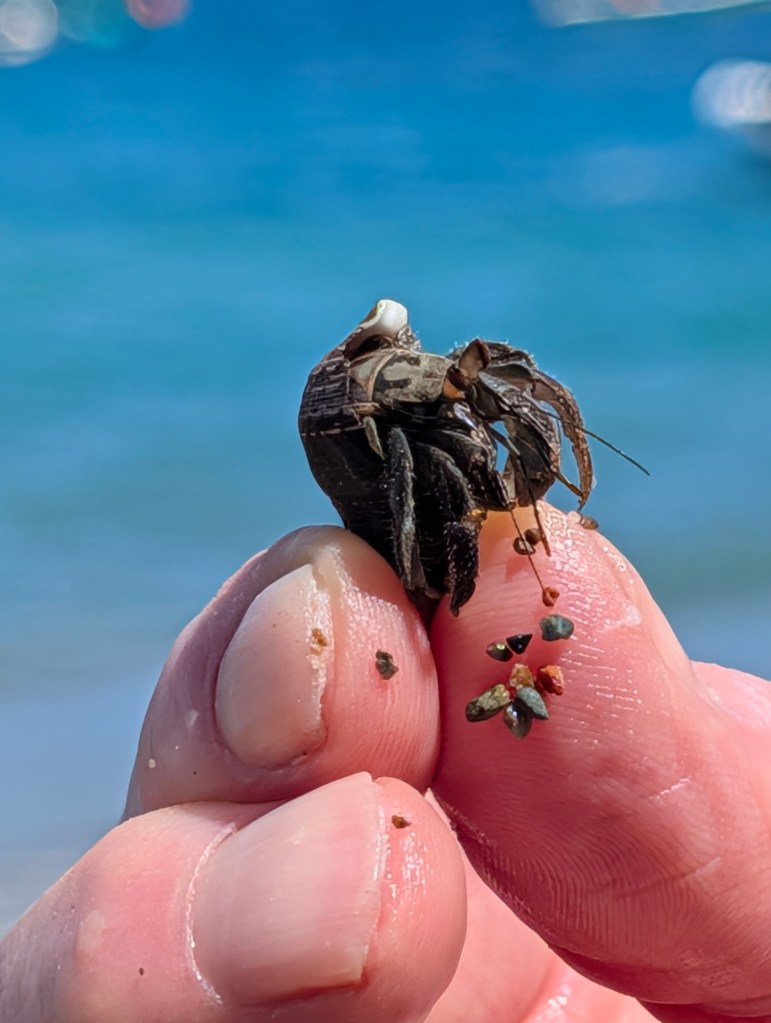
It was also crawling with tiny hermit crabs.
After a respite the boat returned for us.

On our second snorkel we were blessed by visits from four sea turtles. Unfortunately I do no have an underwater camera, so no photos of them. The journey back to the lodge was not nearly as tumultuous as the journey out. We arrived back in time for another late lunch. We spent the afternoon lounging and exploring the property.
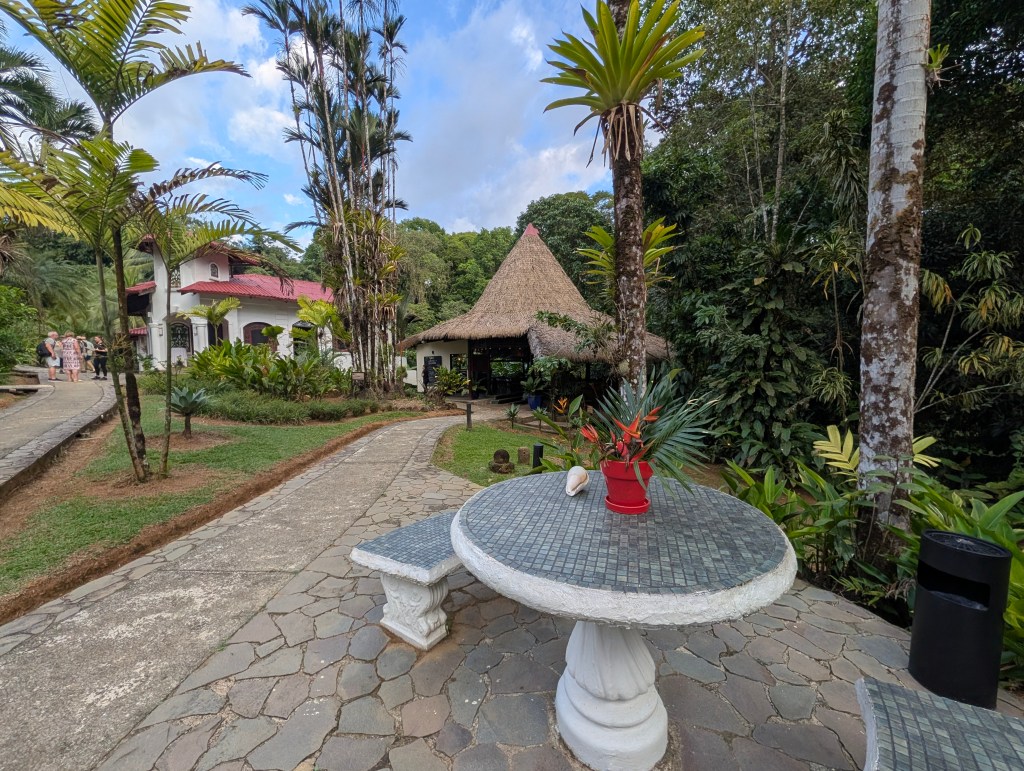
The central resort area had two dining areas: one for breakfast and another for evening drinks or dinner some nights.
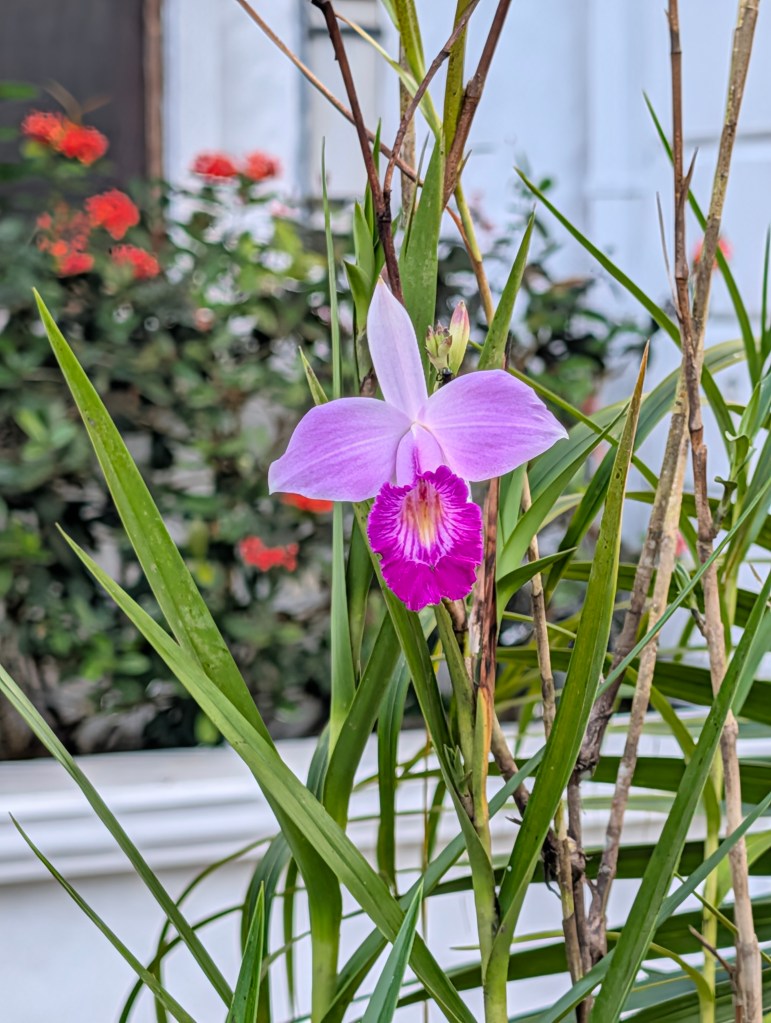
It was all beautifully landscaped with ornamentals including this stunning Bamboo Orchid, a ground orchid that prefers full sun, high humidity, and well-drained soil. It has slender, reed-like stems that resemble bamboo and can grow up to 6 feet tall and cattleya-like fragrant flowers that that are typically light pink to white with a vibrant magenta or purple lip.
Another interesting flower was this Crinum Lily, characterized by large, strappy green leaves with burgundy or purple variegation and showy, fragrant white flowers with spidery petals and pinkish-red anthers. This plant thrives in full sun to partial shade and prefers consistently moist to wet soil, making it suitable for bogs or water gardens. All parts of the Crinum plant are poisonous if ingested, and the sap can cause skin irritation.

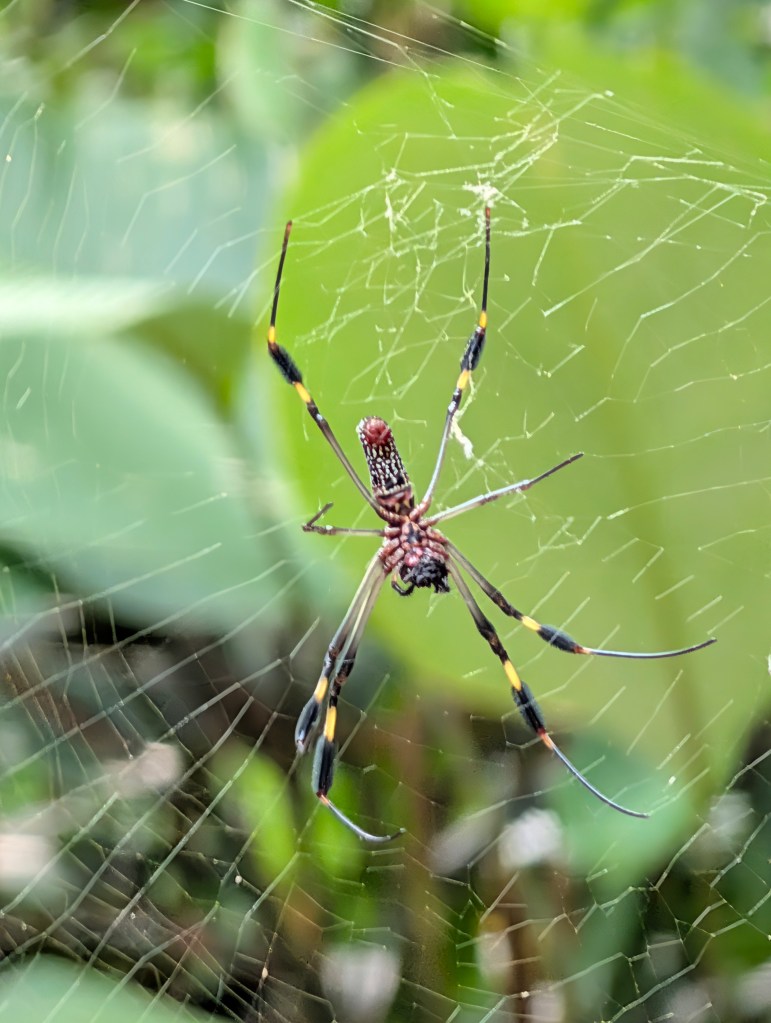
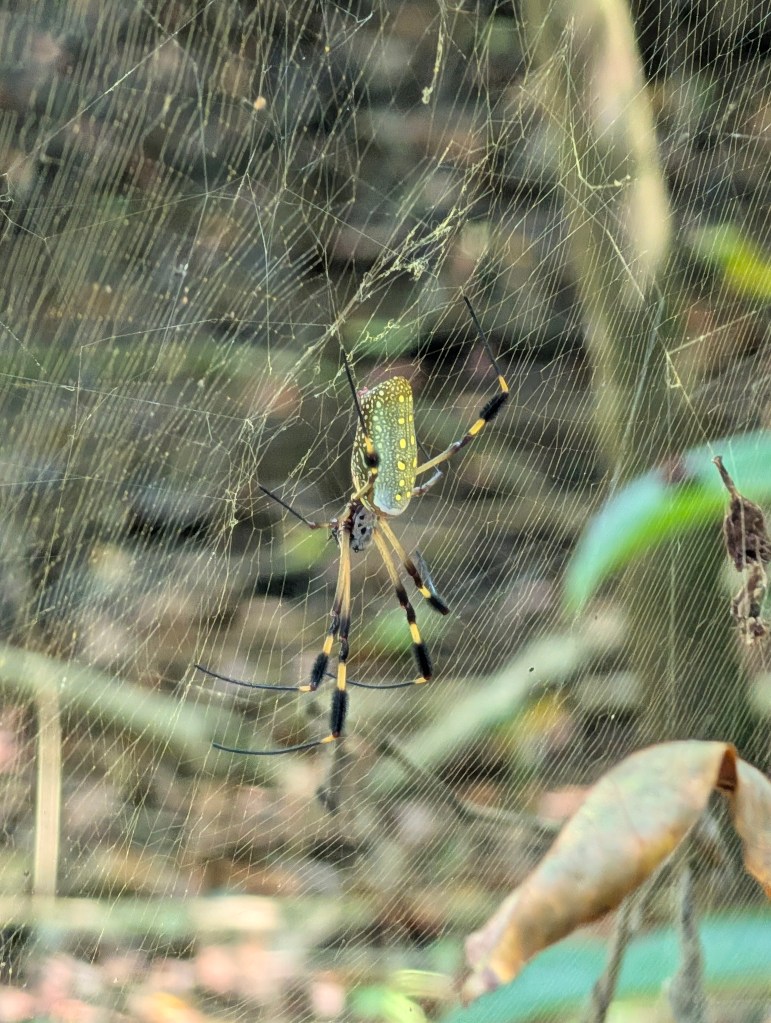
At the start of the path between the road and our cabin we found a Golden Silk Spider, also commonly known as a golden silk orb-weaver or banana spider. These spiders are large with orange and brown bodies and distinctive black and yellow markings. They are famous for constructing very large, strong webs that have a golden sheen in the sunlight.
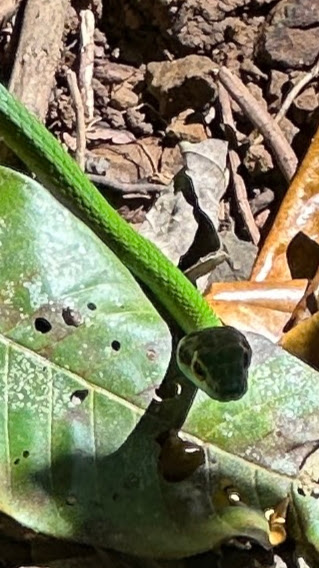
We were visited right outside our cabin by a Rough Green Snake. They have bright green skin that provides excellent camouflage against leaves and branches. These snakes are typically non-venomous, harmless to humans, and are excellent climbers that spend most of their time in trees and bushes.
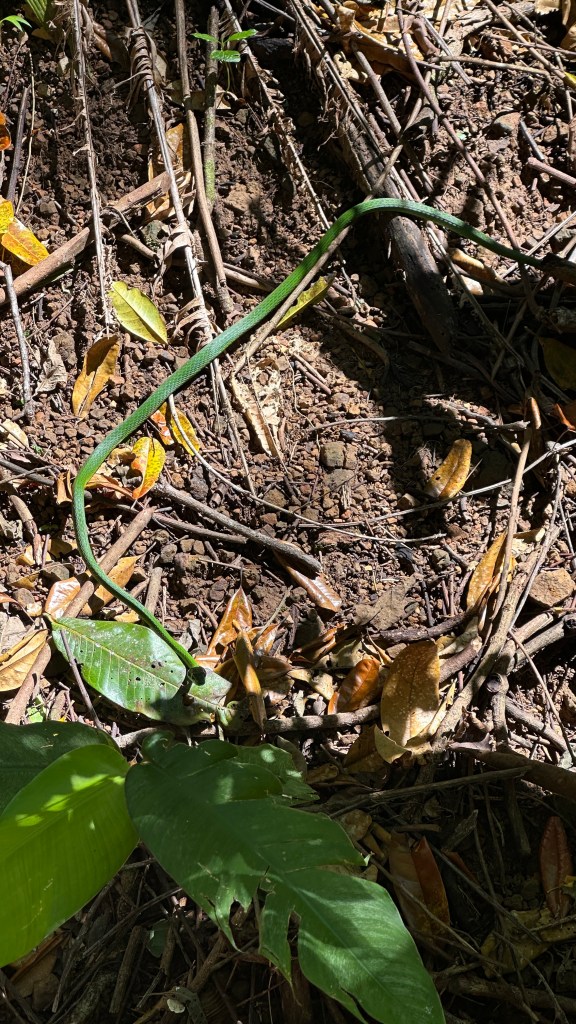
Rough Green Snakes primarily feed on insects, spiders, and other small invertebrates.
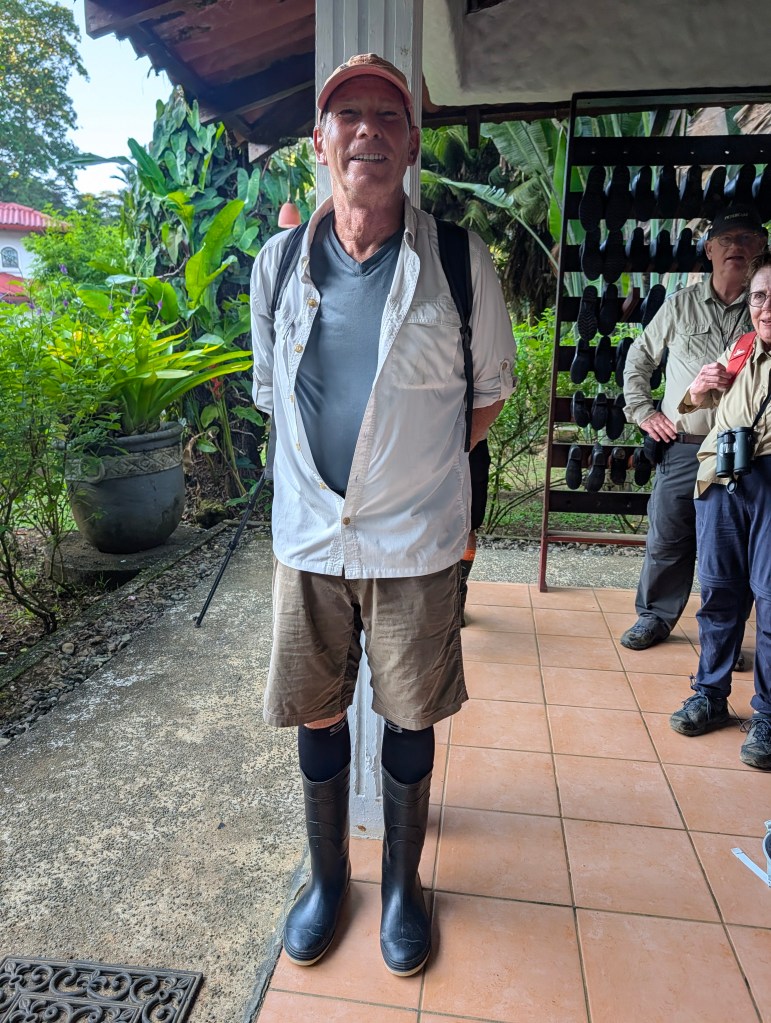
After another early breakfast the following morning, we embarked on our last hike in Costa Rica. We told our guide Jose and the other two couples hiking with us that despite two weeks in Costa Rica we had only seen one of the supposedly ubiquitous toucans, and that was from a distance. We requested all to keep a careful eye out for us. We were advised that the trail was quite muddy from the previous day’s rain, so we donned boots.
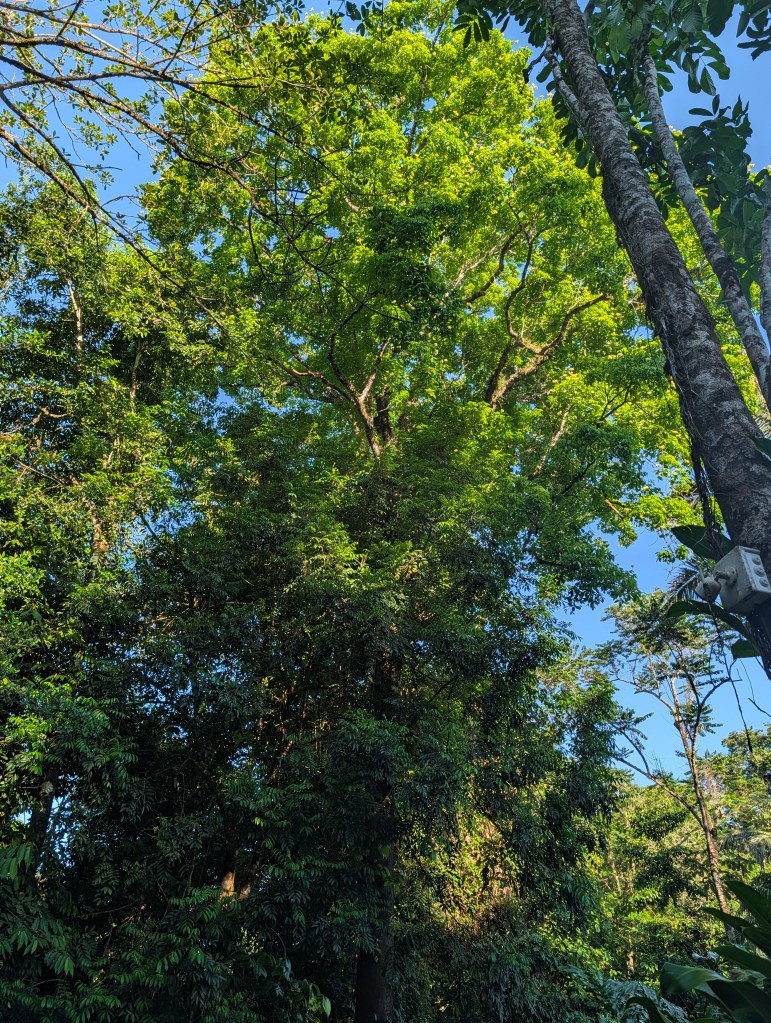
As we descended the path toward the beach, the first thing Jose pointed out to us was this Garlic Tree, a massive, long-lived, endemic tree found in Costa Rica’s tropical forests, particularly in the Osa Peninsula. Known for its strong garlic odor emitted from its yellow flowers, it is a key component of the rainforest ecosystem, often pollinated by bats.
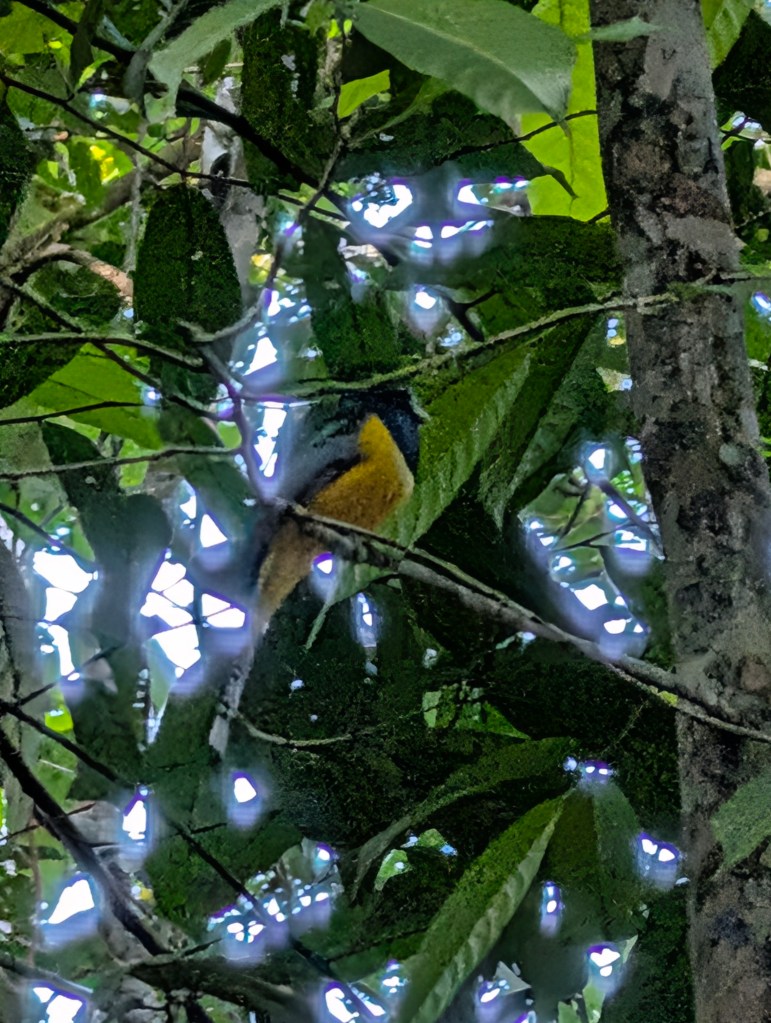
Once down on the beach our search for birds began. First sighting was a male Black-throated Trogon, a medium-sized bird with a brilliant metallic green back, head, and upper breast. These birds are typically found in the understory of humid forests in Central and South America. The male has a black face and throat, a prominent blue or pale eyering, and a bright yellow belly.
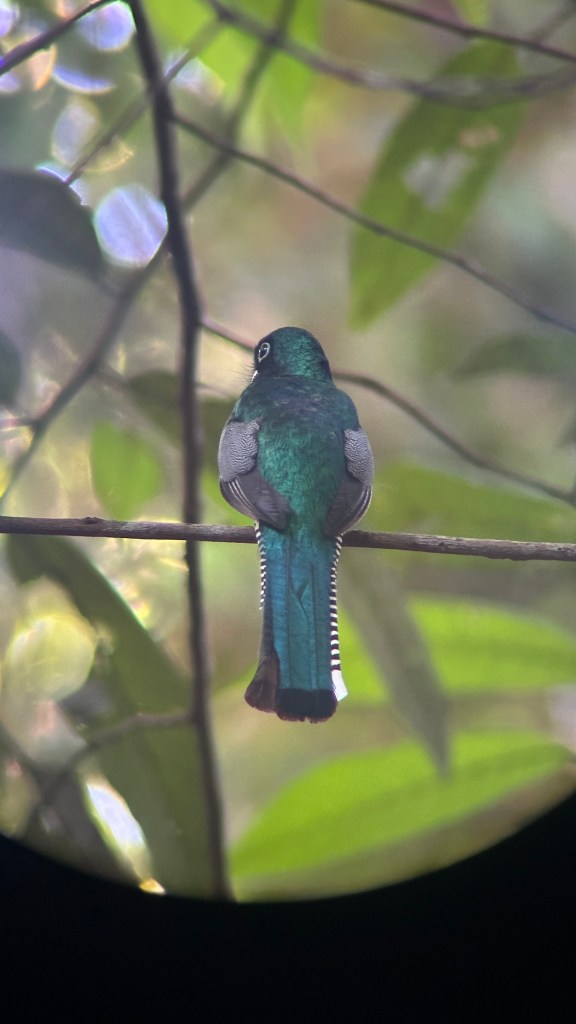
Through the scope from the back, he looks like a completely different bird. Its long tail is distinctive, featuring a dark blue-green top side and intricate black-and-white barring underneath.
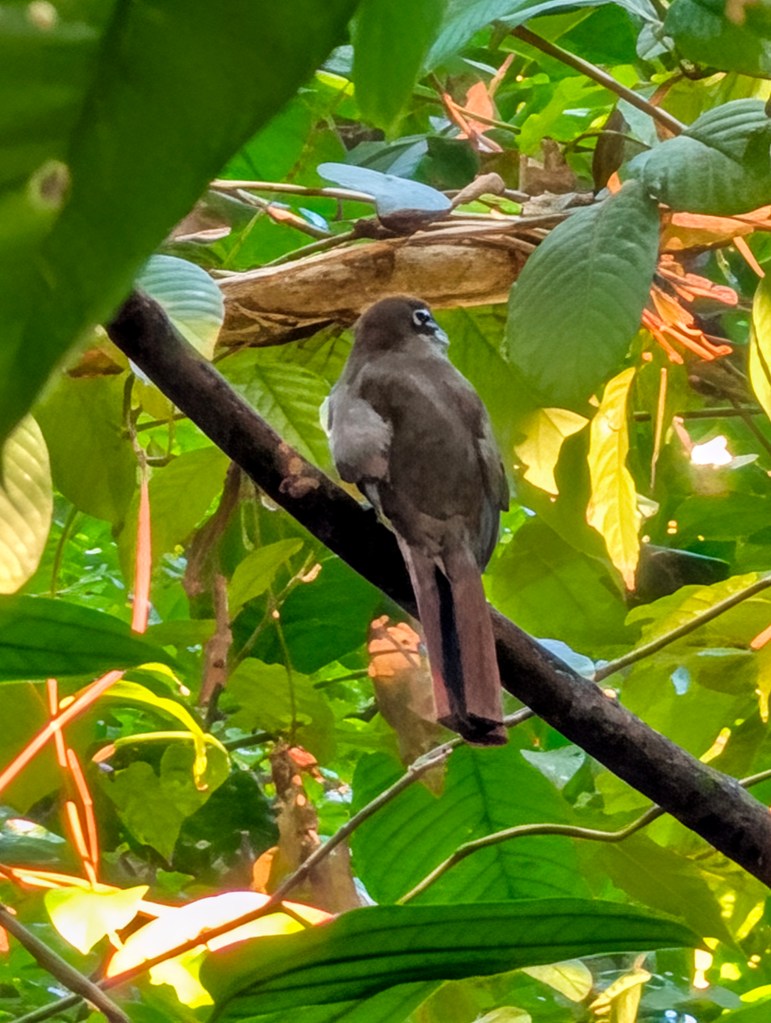
The female black-throated Trogons often have more muted coloring like brown or grey. These birds are often seen perching midway up trees, waiting to catch insects or forage for fruit.
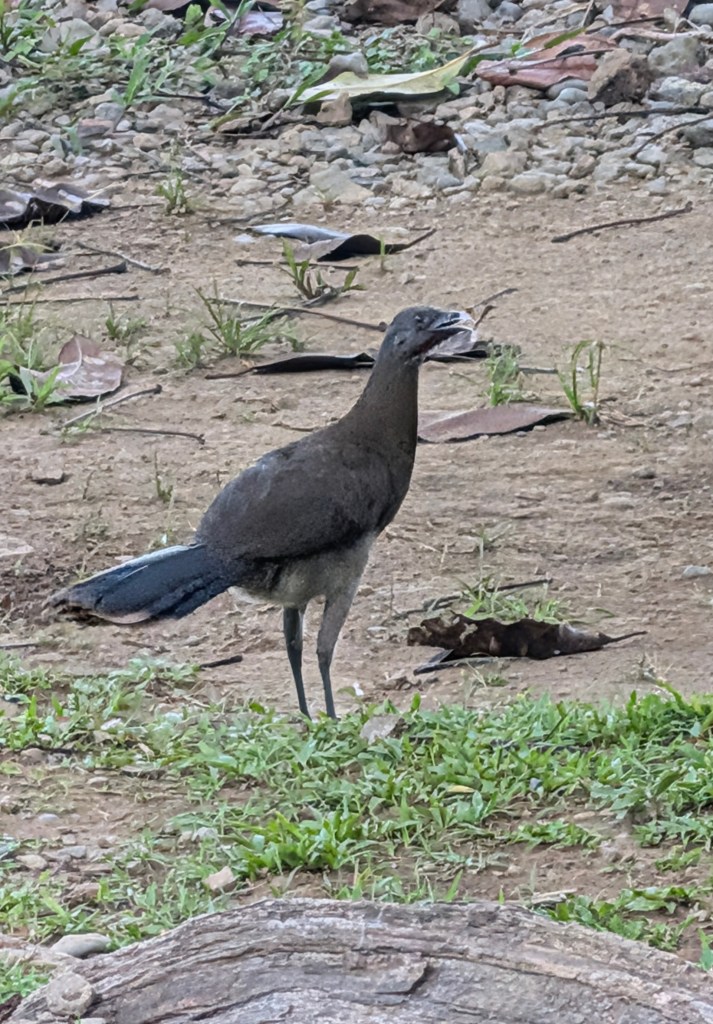
Next we found a Gray-headed Chachalaca, a medium-sized bird belonging to the Cracidae family. They have brownish-gray plumage on their back, a paler chest, a small head, and a long tail.
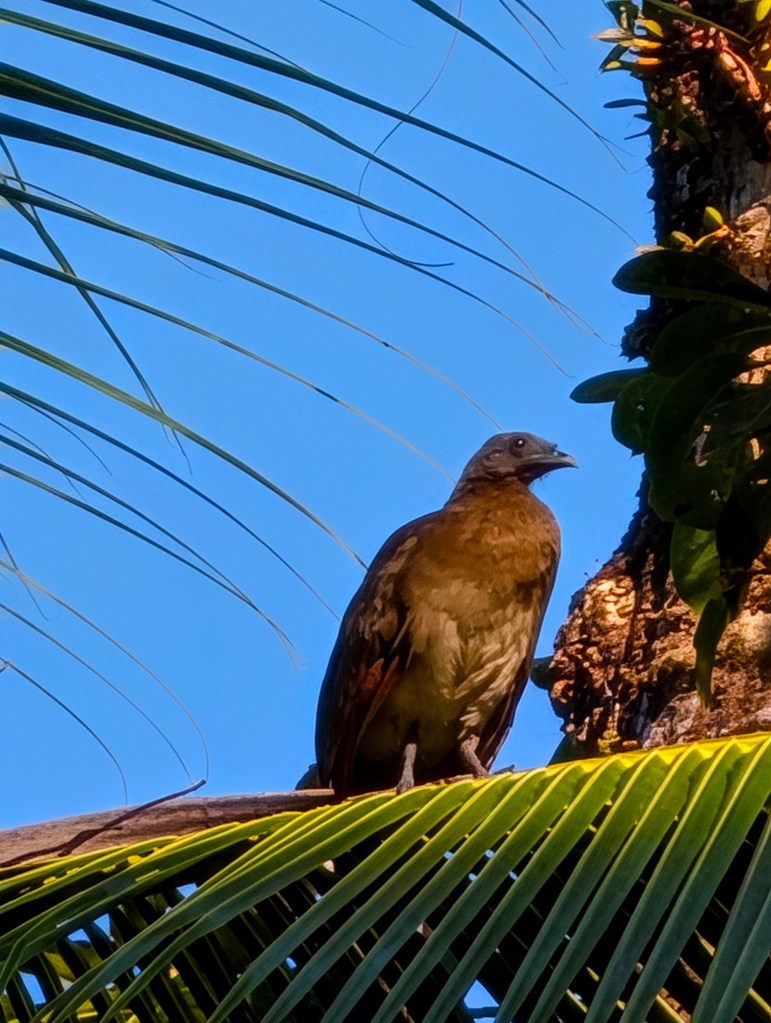
Chachalacas are typically found in the treetops of humid forests and second-growth habitats in Central America and northwestern Colombia
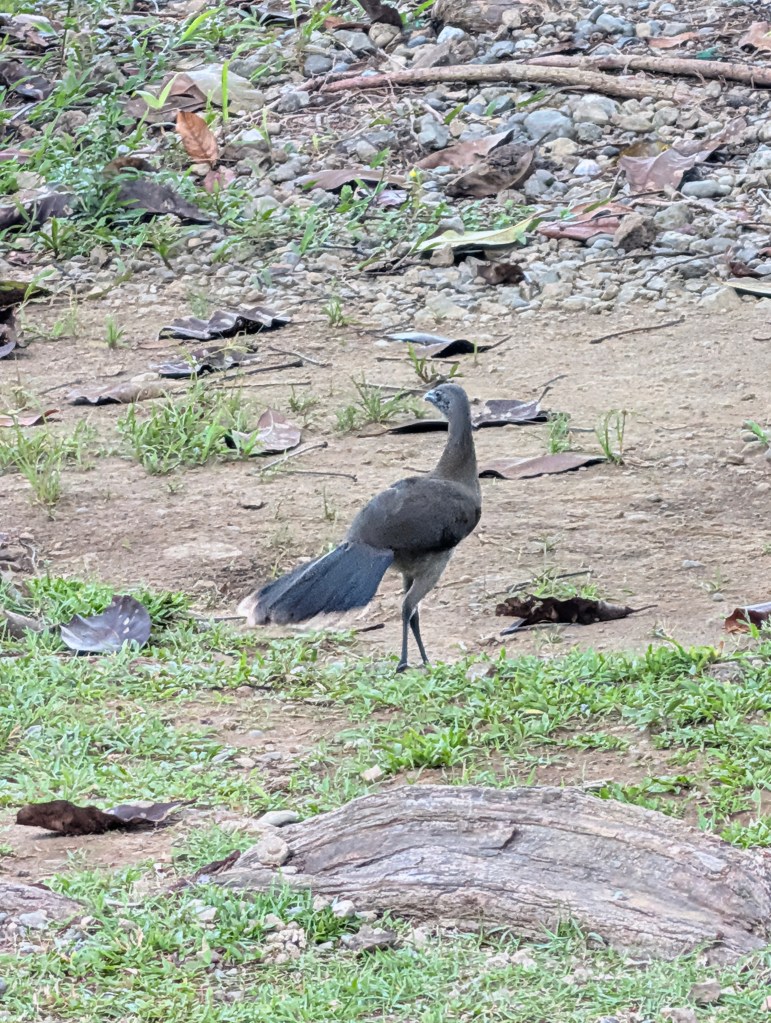
They are social, often seen in small flocks, and known for being very noisy, especially at dawn and dusk. Their diet consists primarily of fruits, seeds, and occasionally insects.
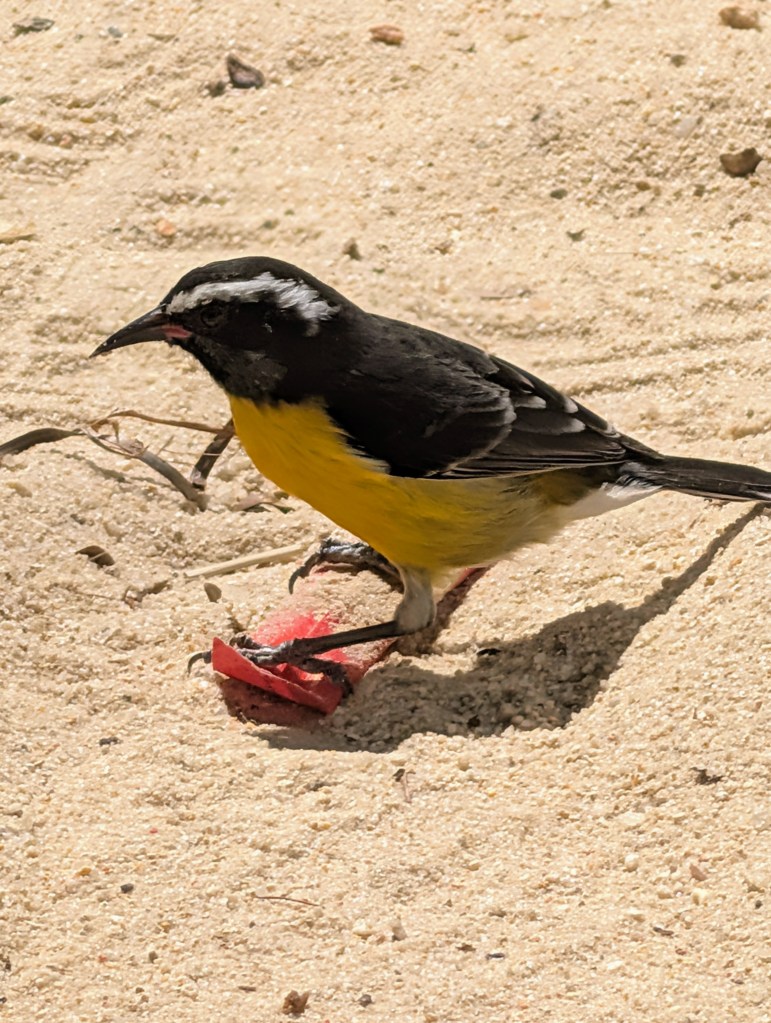
We then found a bananquit, a very common species in the Caribbean. They are small, about 4 inches long, with a yellow chest, black upperparts, and a bold white line above the eye. These birds are nectarivores, often piercing the base of flowers to steal nectar, and they also eat fruit.
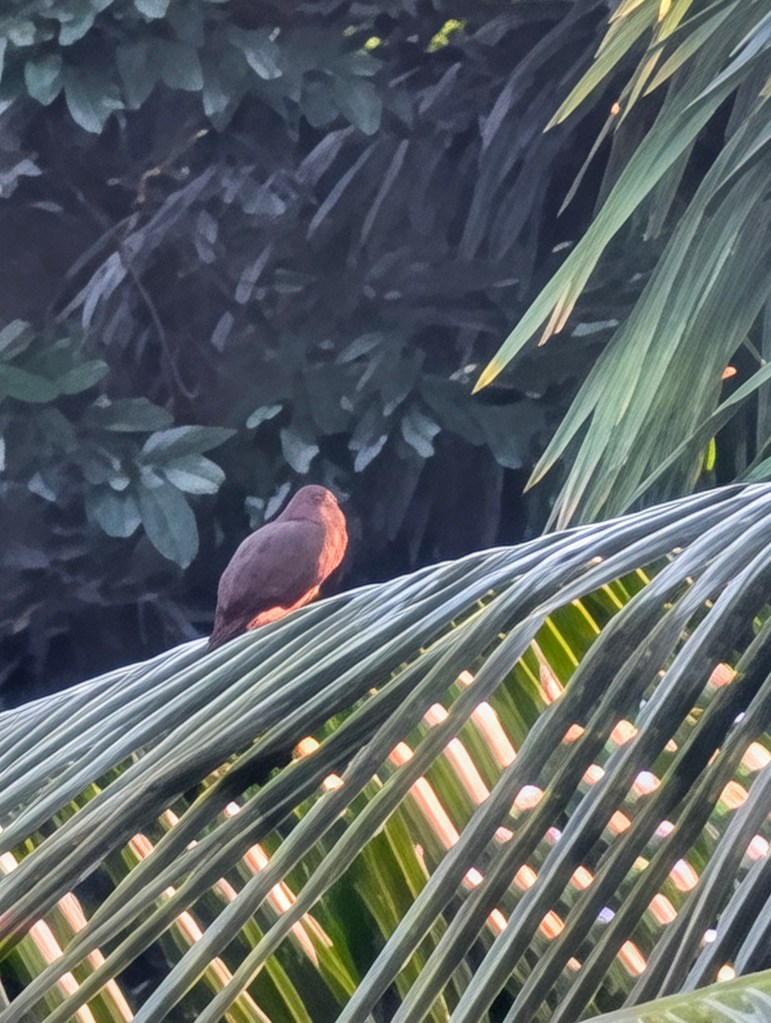
A bit far away (not my best picture) we saw a White-tipped dove, a plump, shy, ground-dwelling bird found from South Texas to Argentina, known for its distinct, hollow “ooo-wooooo” call that sounds like blowing over a bottle. Unlike other doves, they are surprisingly aggressive, often chasing rivals while foraging. They are year-round residents with a 9-year lifespan, often feeding on fallen fruits and seeds.
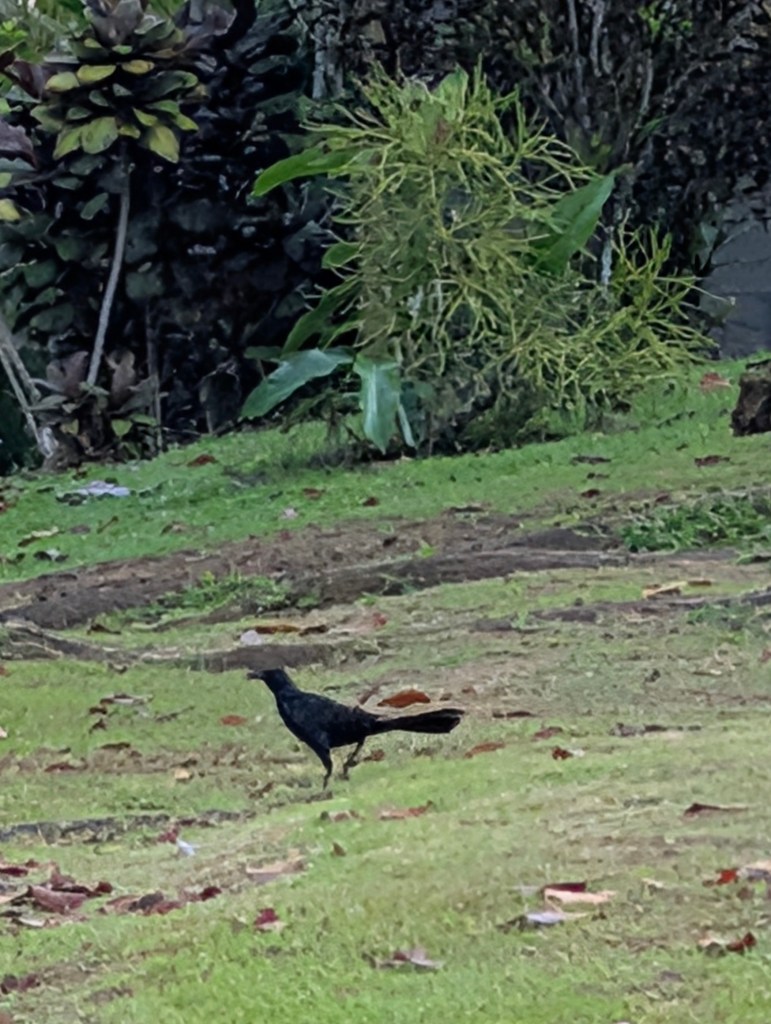
All around on the ground, very active, was a group of Great-tailed Grackles , the one I caught on camera was a male, distinguished by his iridescent black feathers and long, prominent tail. They are highly social, adaptable birds frequently seen foraging in urban areas, parks, and near farms. Their diet is highly varied, consisting of grains, insects, lizards, and small mammals. They are common year-round residents in South and Central America, including the Caribbean.
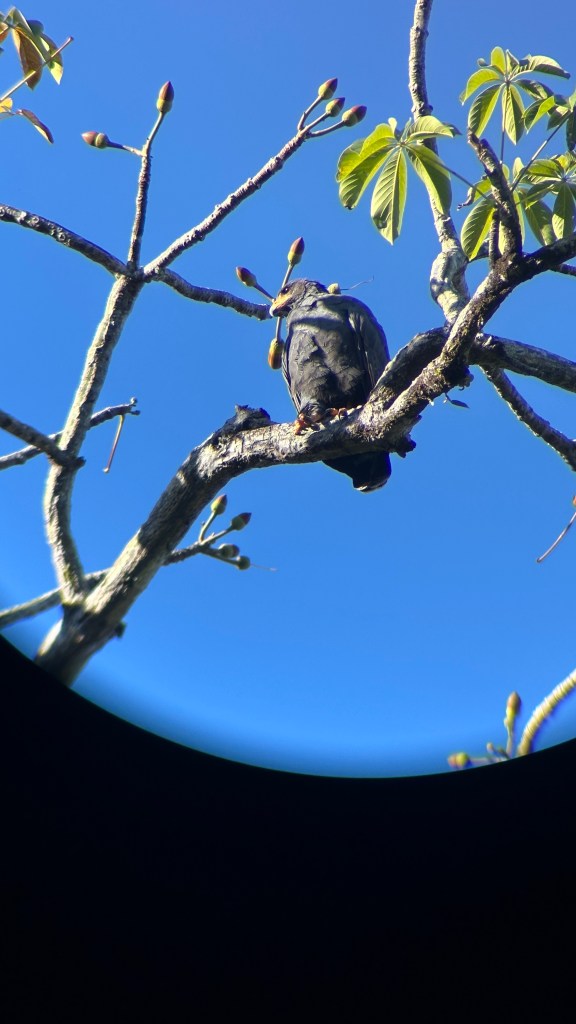
The Common Black Hawk is a striking, stocky, and largely black raptor often found near water in the southwestern U.S., Mexico, and Central America, characterized by its bright yellow legs, broad wings, and a distinctive single white band on its tail. They specialize in hunting crabs, fish, and frogs, frequently wading in shallow water to catch prey.
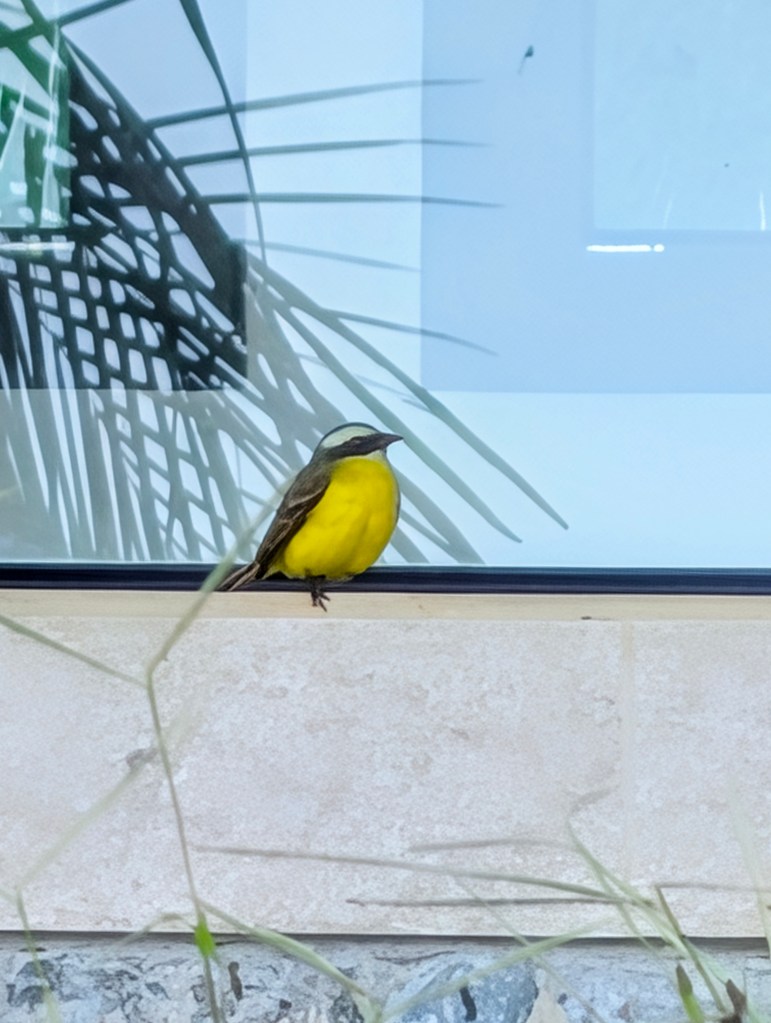
Flitting about and tough to catch on camera was this Social Flycatcher, a species common in the Americas. Known for its bright yellow underparts, dark wings, and a distinctive white stripe above the eye, it is frequently found in open woodlands, forest edges, gardens, and near human habitation. It is highly social, often foraging in groups and nesting in colonies. It primarily eats insects caught in flight but also feeds on berries and small fruits.
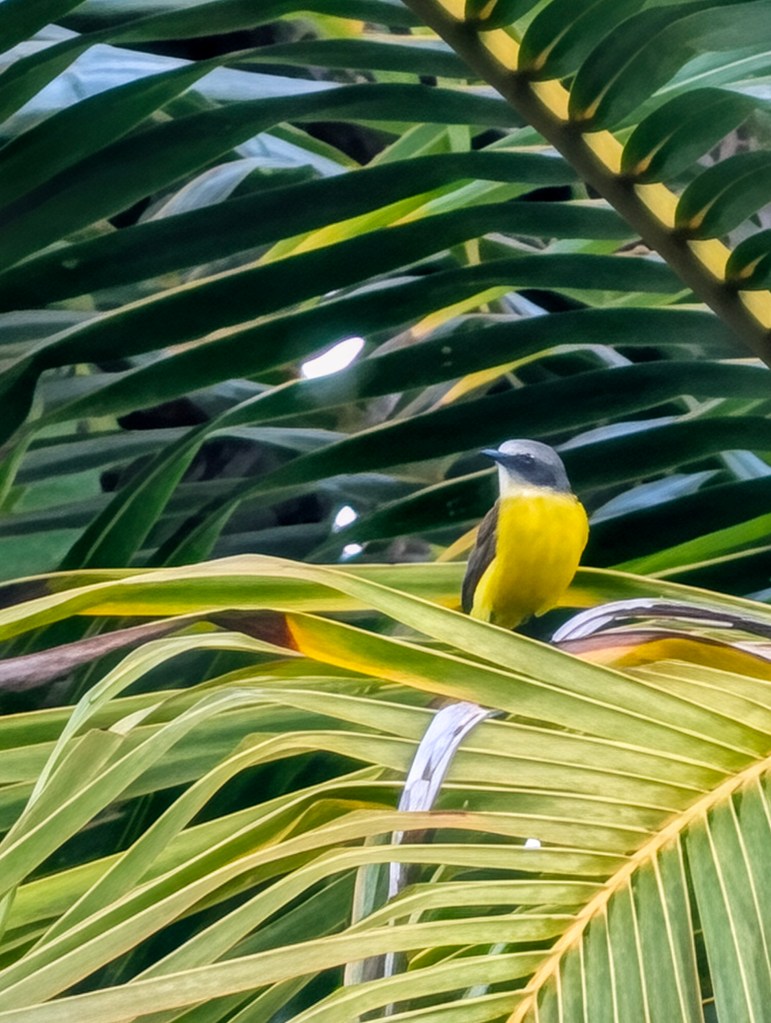
Nearby we found its cousin, a Grey-capped Flycatcher, a small passerine bird from the tyrant flycatcher family. Unlike similar flycatchers like the Social Flycatcher, this species lacks a strong, striped head pattern. It features a distinctive grey head, a white throat, and bright yellow underparts. They are often found in pairs or small groups near forest edges and gardens.
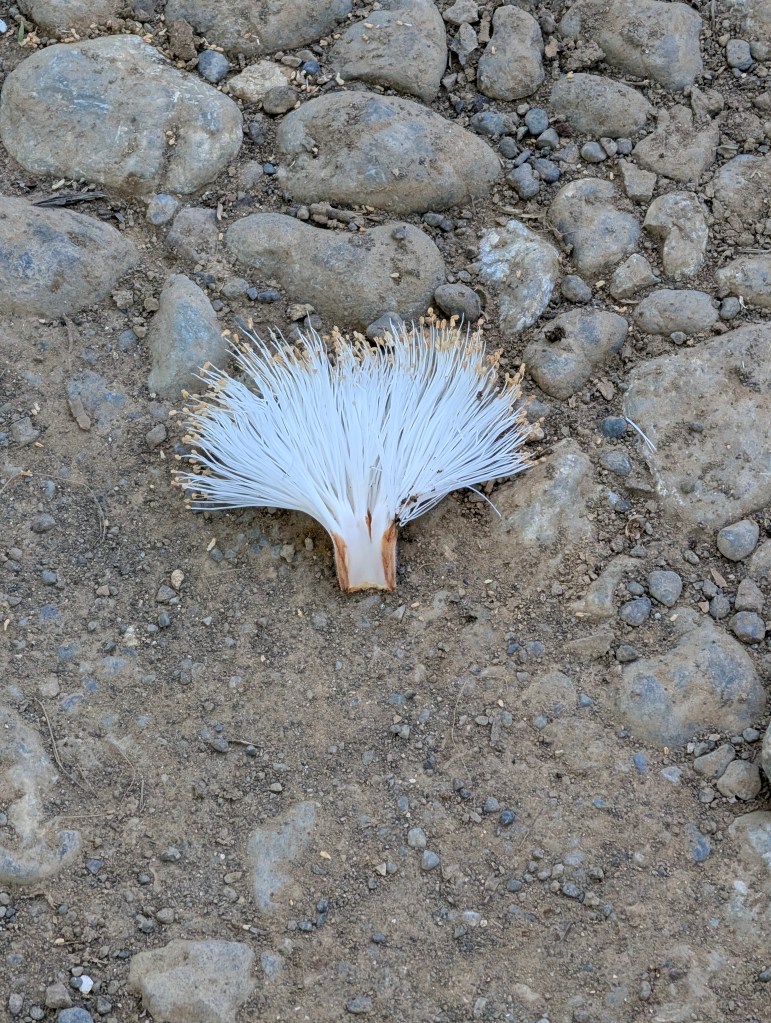
One of the women in the group was asking about these funny shaped flowers strewn all over the beach. Jose told us they are from the Pseudobombax septenatum tree, often referred to as a barrigón. The tree is native to tropical regions in Central and South America. These flowers are temporary, lasting only a few days before falling. These flowers typically appear when the tree is deciduous, making the flowers highly visible.. but the tree was pretty barren looking
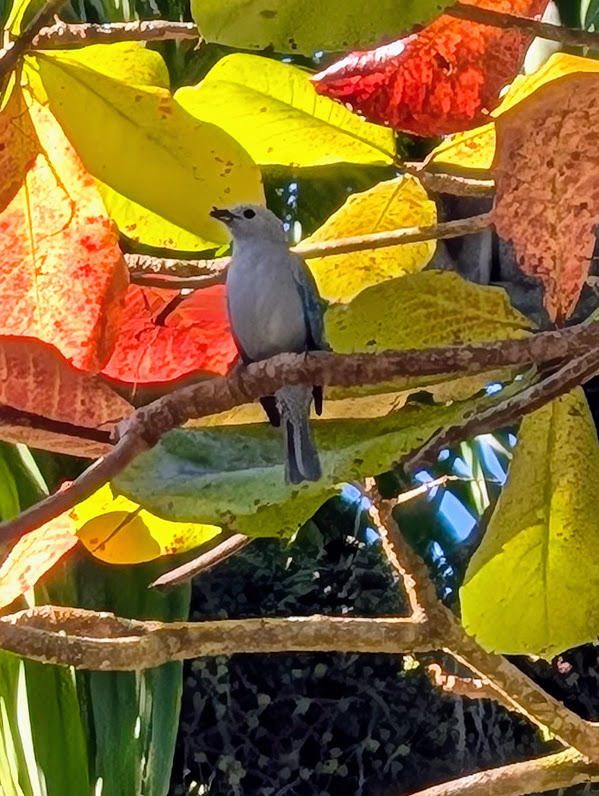
The next bird we spied was a Blue-gray Tanager, a common South American songbird also found in parts of the Caribbean. They are known for their pale gray and bluish plumage and often feed on fruit. This species is very adaptable and frequently seen in gardens and urban areas.
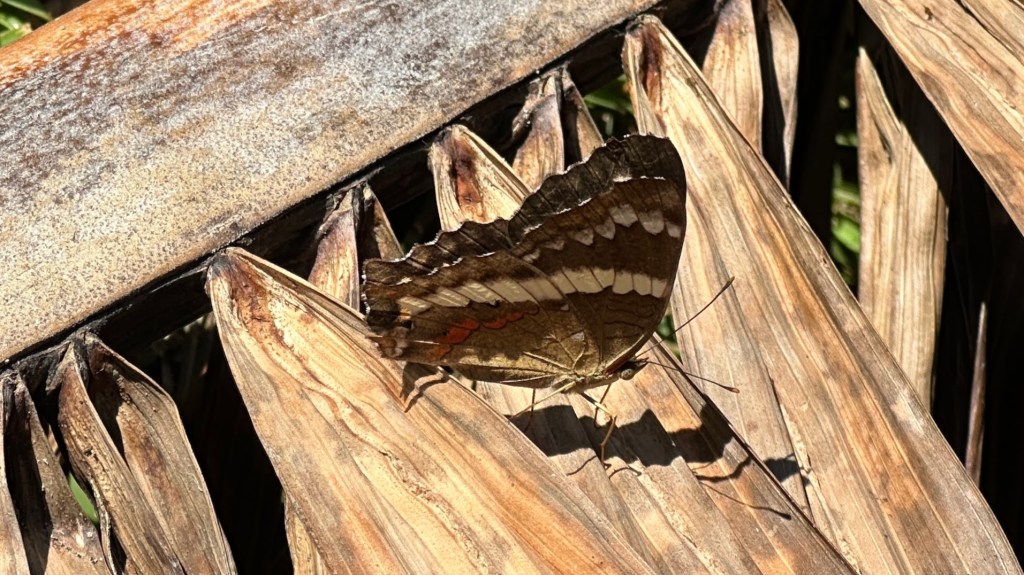
For variety we focused a moment on a butterfly, specifically a Banded Peacock butterfly, with dark brown or black wings with distinct white bands and red markings near the body. Their wingspan typically measures between 2.0 and 2.75 inches.
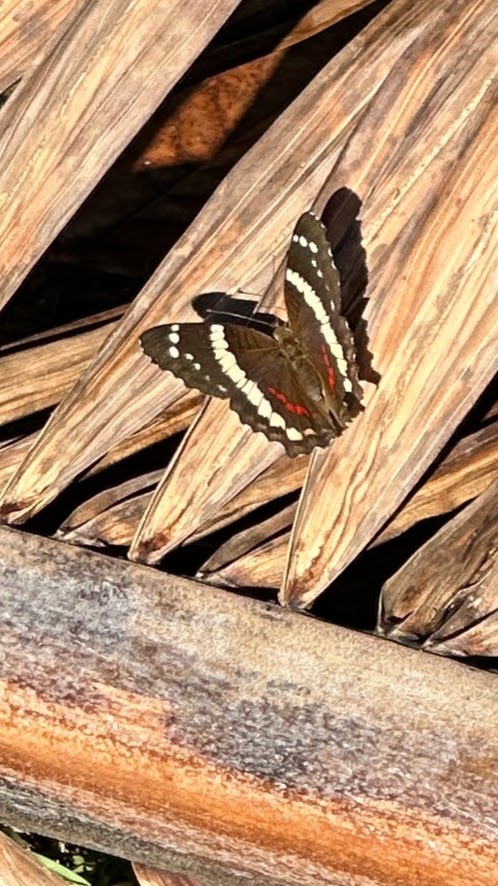
The Banded Peacock butterfly are commonly found in moist areas, such as near rivers, in subtropical climates. They are native to Central America, Mexico, and southern Texas.
Brunellia costarincensis, a plant native to Costa Rica, but more commonly found at higher elevations, is a harbinger of the dry season.
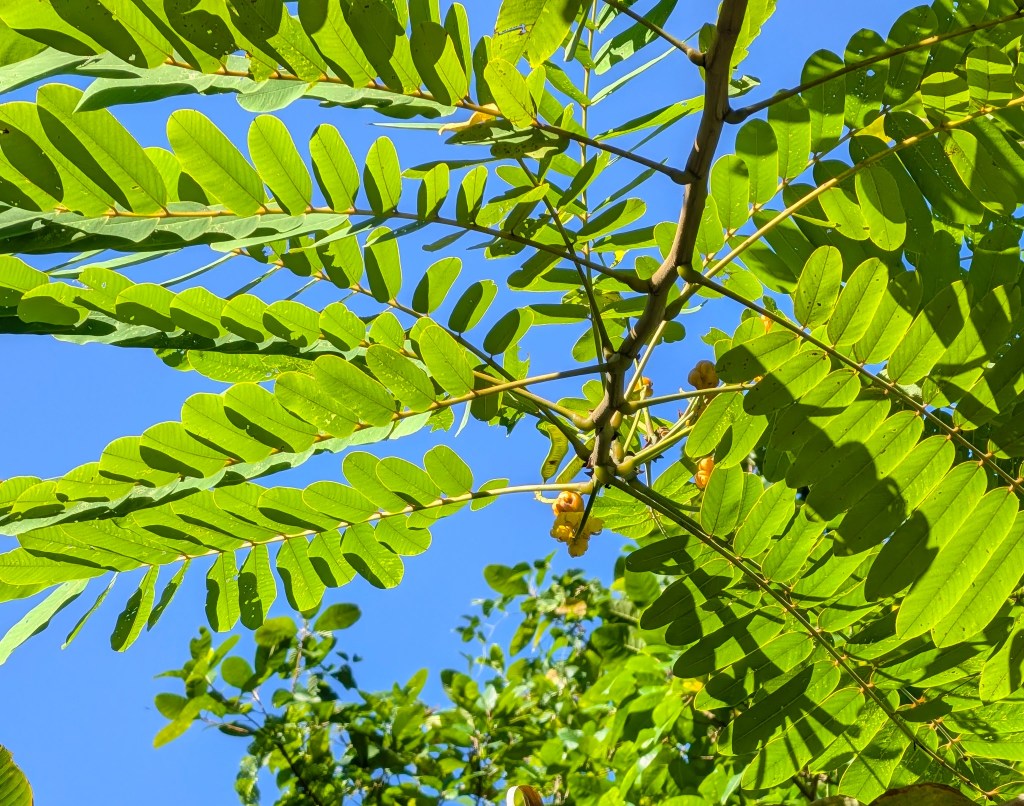
Coyol palm, a species of palm native to the tropical regions of the Americas, is widely known for producing a traditional alcoholic beverage called taberna, made from the fermented sap of the tree. Locally taberna is called cyol wine and is a common drink of the campesinos (peasants). It is said if one gets drunk the night before on coyol wine and goes to work in the sun, one is drunk again by the afternoon.
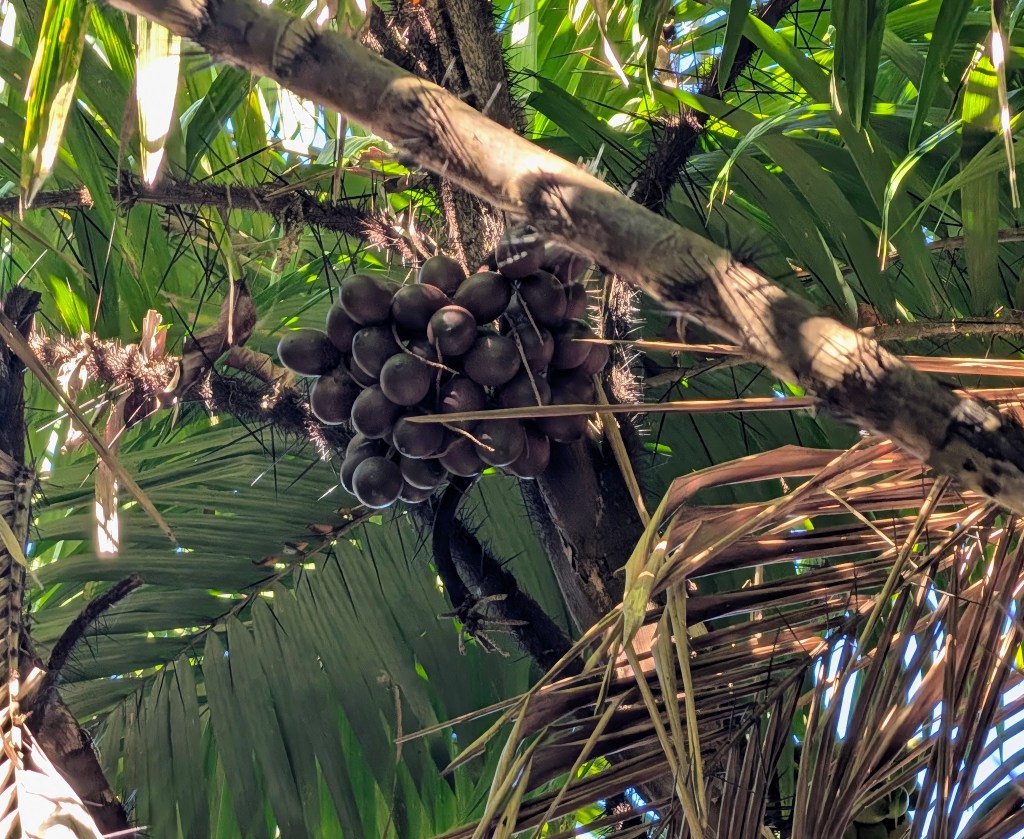
We saw yet another Jesus Christ lizard. I have said enough on them already.
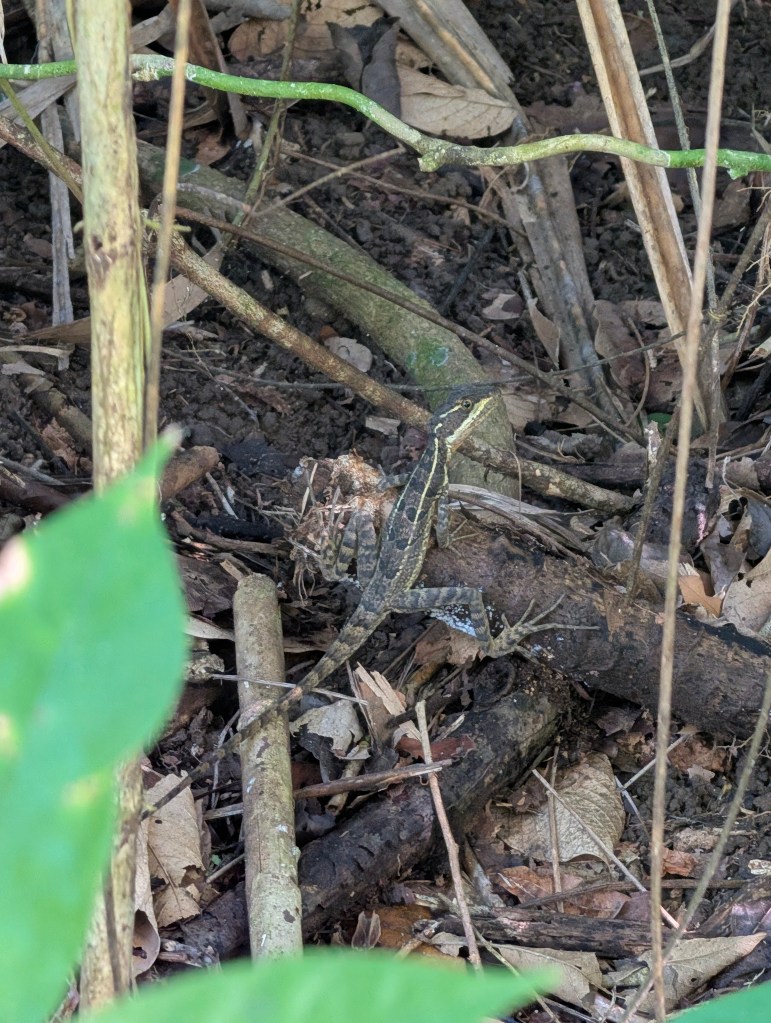
The seed pod of the Mucuna vine, commonly known as a velvet bean or sea bean, have a dense, velvety covering of hairs that can cause severe skin irritation if touched. Mucuna plants are found in various tropical environments, including jungles in Central and South America. They grow on woody vines in tropical and subtropical regions.
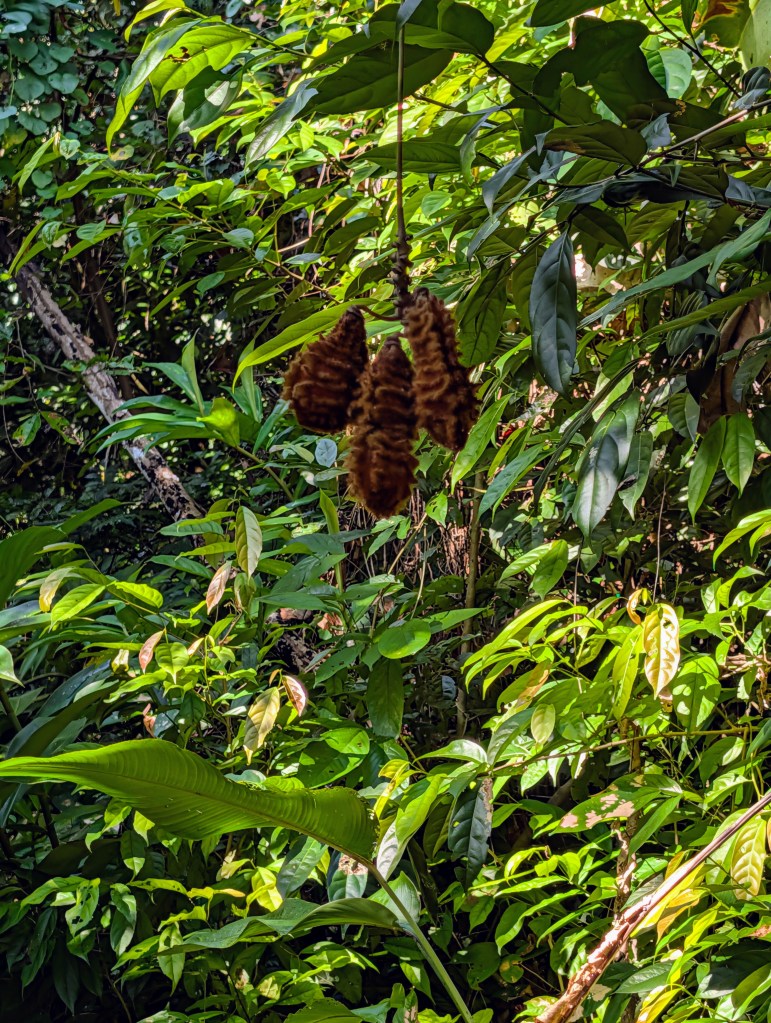
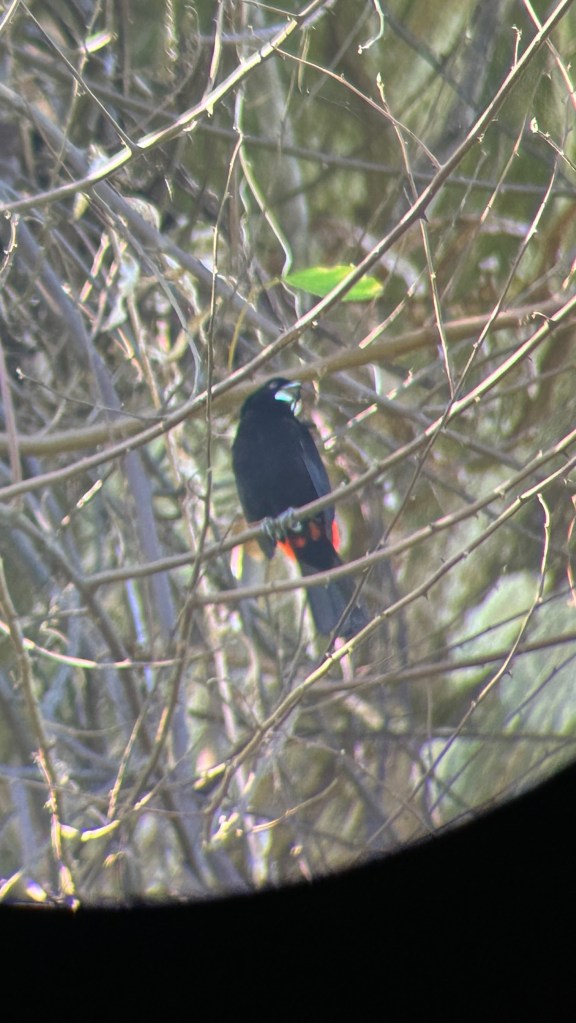
This next beauty is a male Scarlet-rumped Tanager, one of which we had seen in Arenal. Their diet consists mainly of fruits and arthropods. These birds are commonly found at forest edges, clearings, and second-growth areas in Central America.
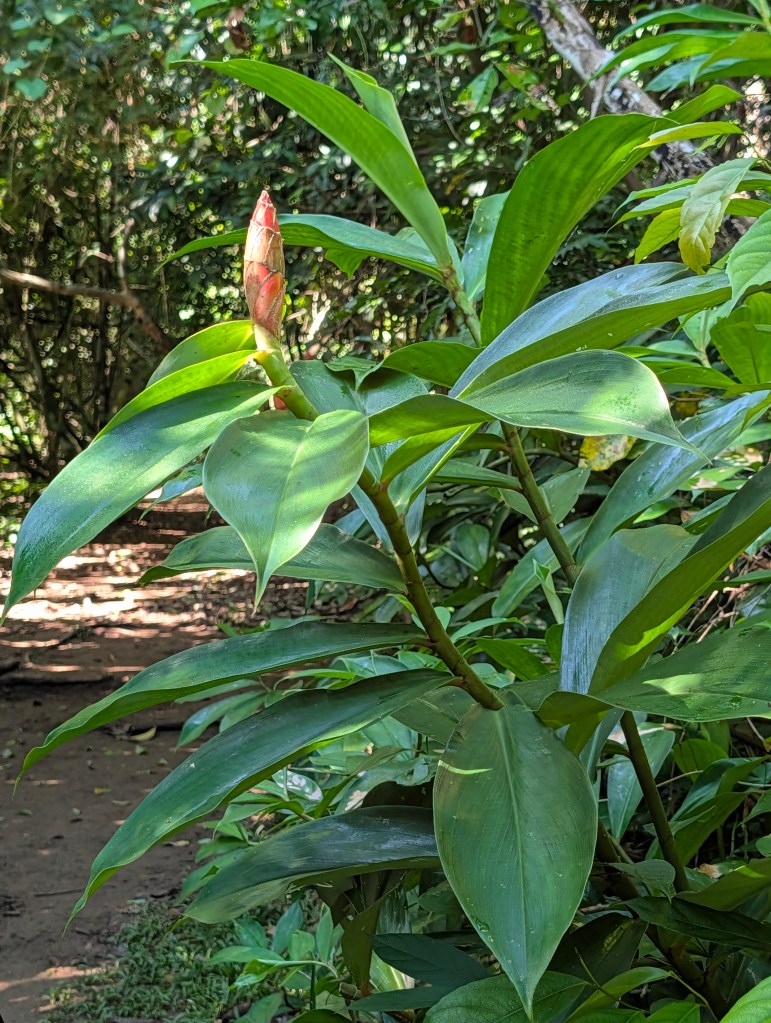
A spiral ginger features a striking red, cone-shaped inflorescences comprised of overlapping bracts. The stems grow in a distinct spiraling pattern. These plants thrive in tropical environments and are often grown for their ornamental beauty.
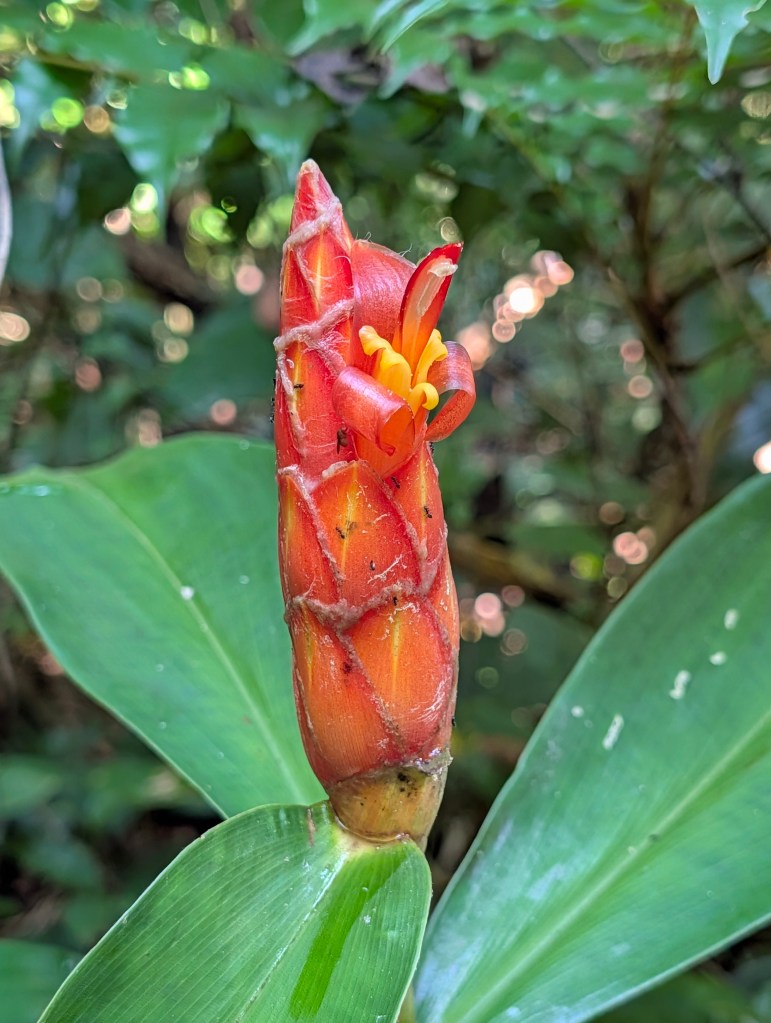
Often called the insulin plant, the spiral ginger provides significant medicinal benefits, including blood sugar regulation for diabetics, anti-inflammatory, and antimicrobial properties. Traditionally the spiral ginger has also been used locally for cramps both gastrointestinal and those suffered by women, eg period or postpartum cramps. The flower emerges from the bracts.
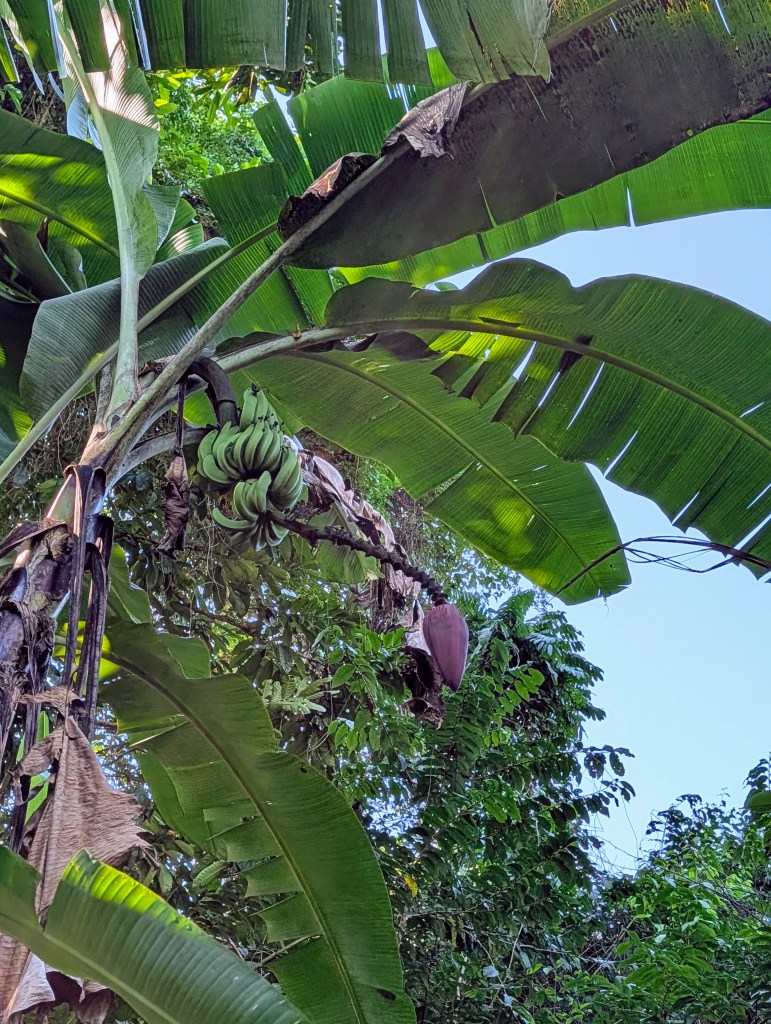
Banana plants, which are actually the world’s largest herbaceous flowering plant, are not trees, as they lack woody stems and are composed of tightly packed, succulent leaves. They grow up to 25 feet tall from an underground corm, with leaves that can reach 9 feet in length. They can grow up to 5 feet in a single day. The fruit grows in clusters or bunches on a stalk that emerges from the center of the plant. The green bananas shown are the female flowers that have been fertilized; the purple bud at the bottom contains male flowers that typically do not develop into fruit.
Banana blossoms (the purple bud) are edible and often prepared like artichokes in many tropical regions. After fruiting, the main stem dies, but the plant produces new, genetically identical pups (shoots) from the underground root system.
Hiding in the trees we can barely make out a Black-hooded Antshrike, a fascinating, skulking bird endemic to the Pacific coast of Costa Rica and Panama. Despite their striking appearance, they are notoriously difficult to spot, preferring to stay hidden in dense undergrowth. They are known for being very sluggish foragers, sometimes pausing for up to 30 seconds to scan for prey. They move slowly through vine tangles and dense vegetation, often in the lower to mid-story of the forest. Like other antshrikes, they have a heavy, slightly hooked bill (similar to a true shrike) used to probe and tear apart dead leaves to find insects. Their song is described as a loud, accelerating, dry “chuckle” that rises in pitch and ends with a longer, raspy note. They occasionally follow army ant (Eciton) swarms to catch insects, spiders, and other arthropods that are flushed out by the ants.
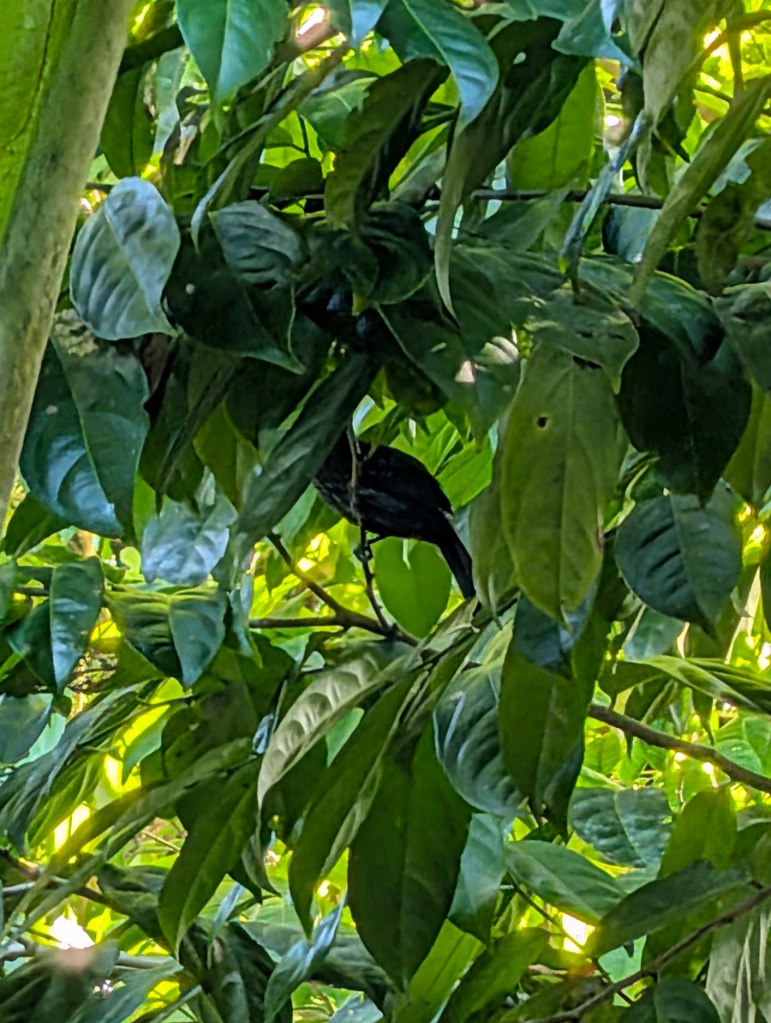
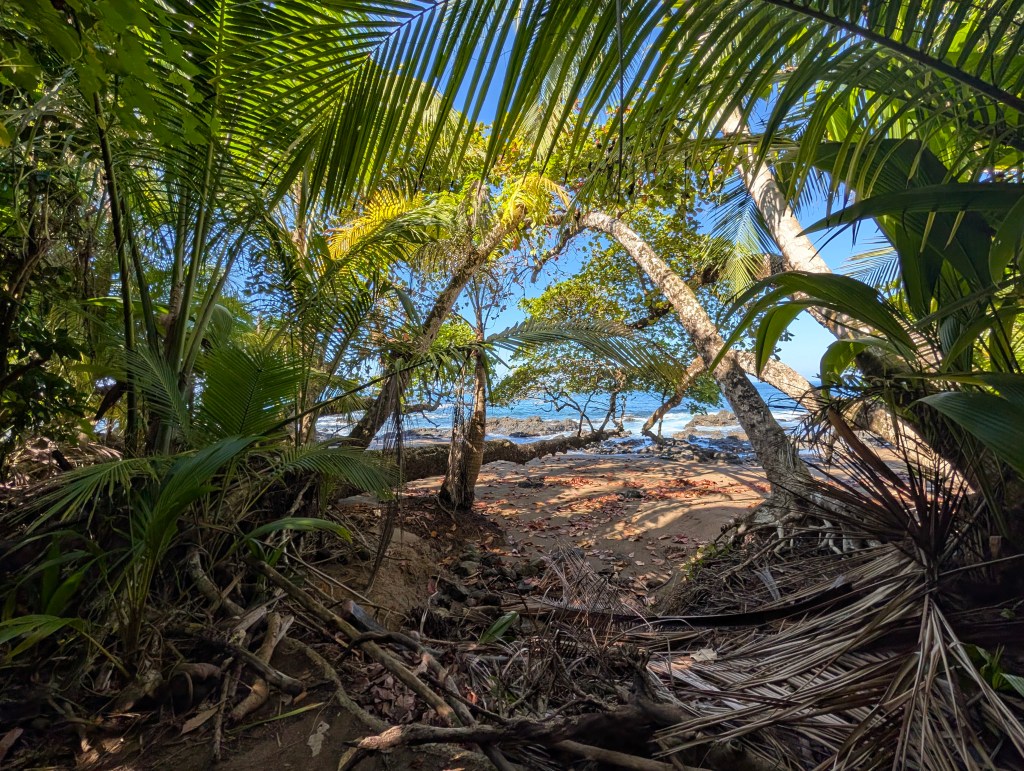
I just had to include this next picture because I so love the beach vibe.
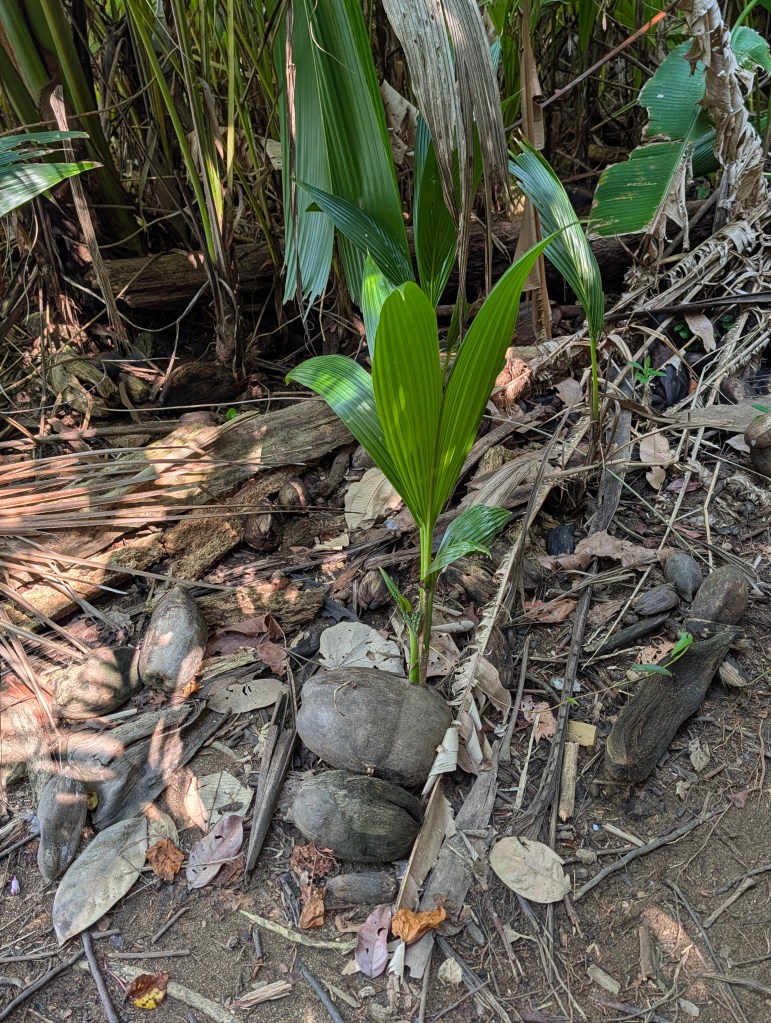
There were lots of coconuts fallen from the trees scattered along the path. Many were growing new trees. Jose told us the roots develop downward first before the leaves pop out. Coconut trees, often called the “tree of life,” can live up to 100 years, growing up to 100 feet tall while producing 50–180 coconuts annually. Technically a drupe rather than a nut, coconuts can float thousands of miles to propagate. Nearly every part of the plant is usable, from food and water to crafting, building materials, and fuel. The leaves look solid is this baby,
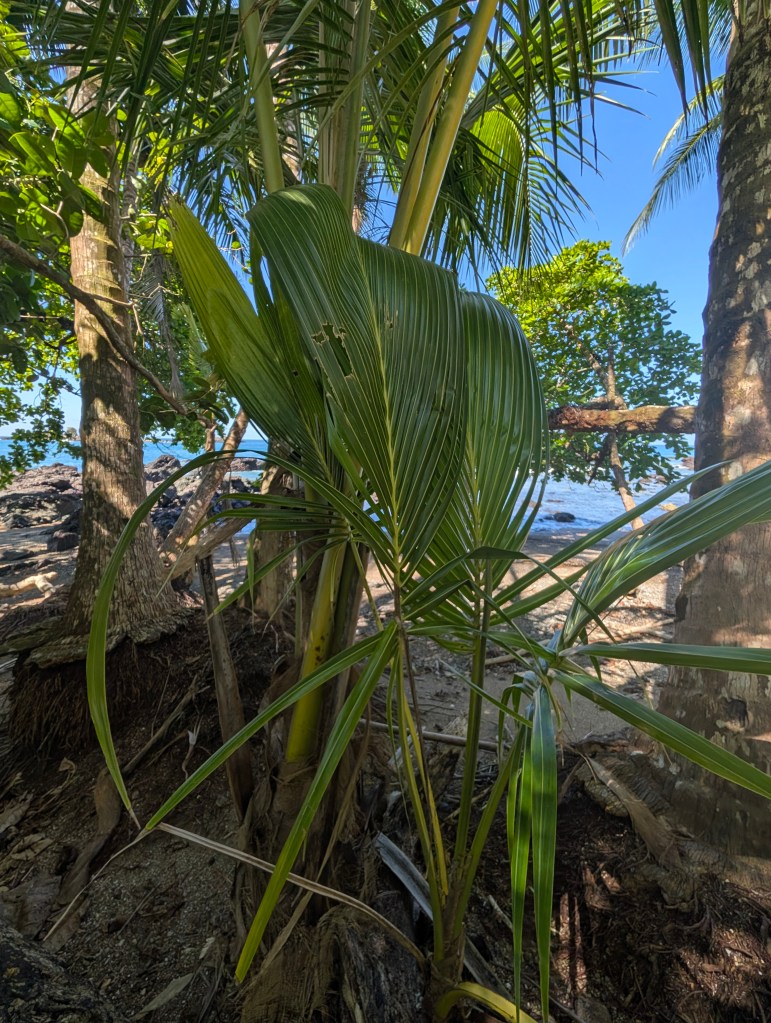
but as the tree grows, the leaves separate into the fronds which we are used to seeing.
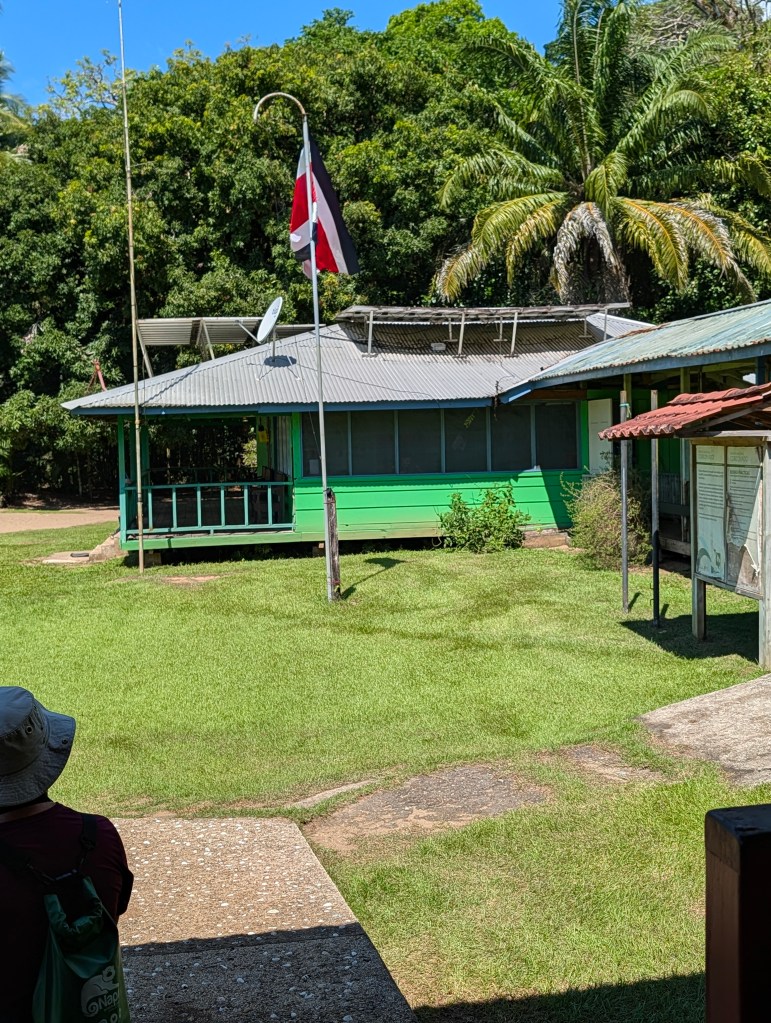
We had hiked to the Rangers’ station where we signed in, paid our park entry fee, and were checked for food and plastics. The flag of Costa Rica flies out front.
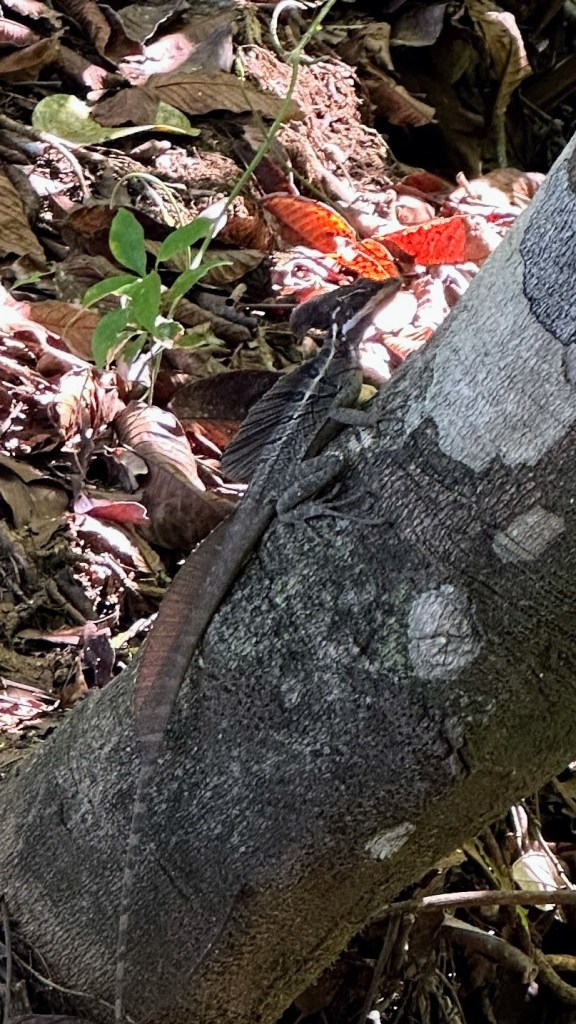
There we found yet another male Jesus Christ lizard. I include him because he has such an impressive crest.
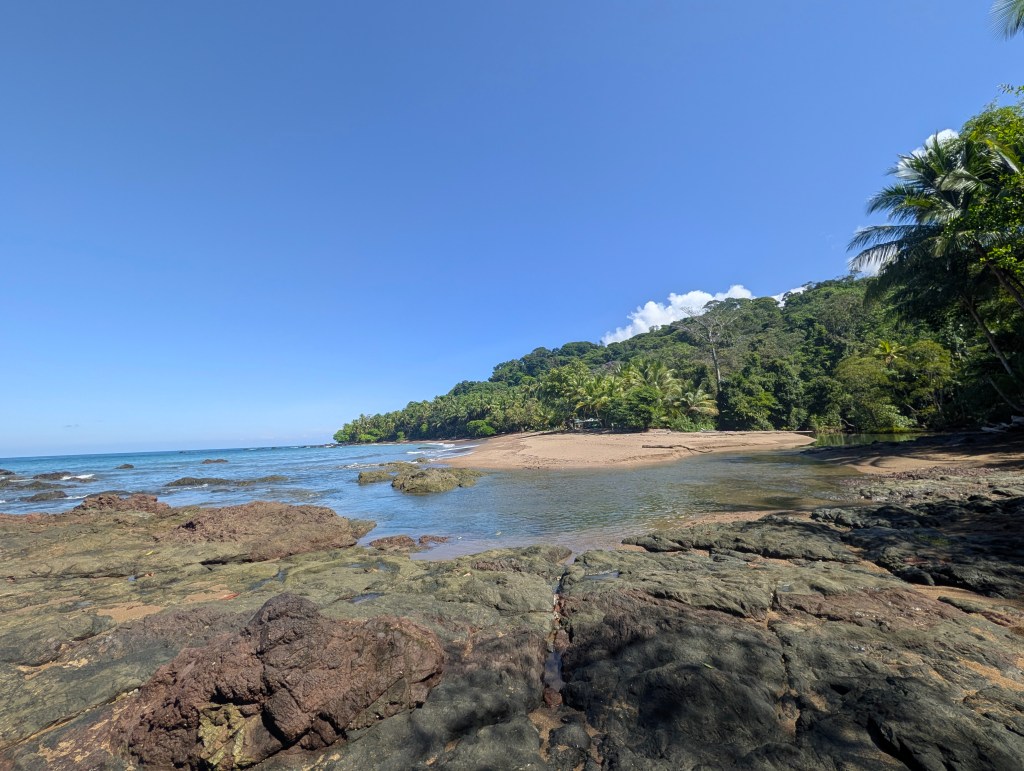
The beach at the station is beautiful. We all had to take off our shoes and socks (and yes, even the boots because of the depth) to cross a small river to continue our hike on the other side.
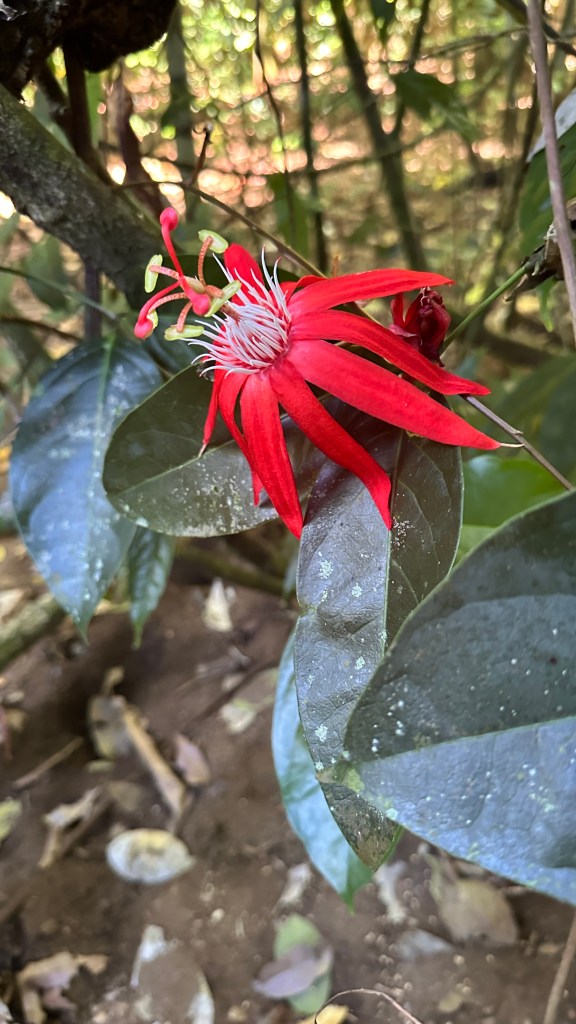
Once our feet were dried and clad, we found a Red Passion Flower, a vibrant vine native to Central and South America. It is easily recognized by its bright red flowers with long petals and a central white filament structure. The flower is designed to attract pollinators such as hummingbirds and butterflies.
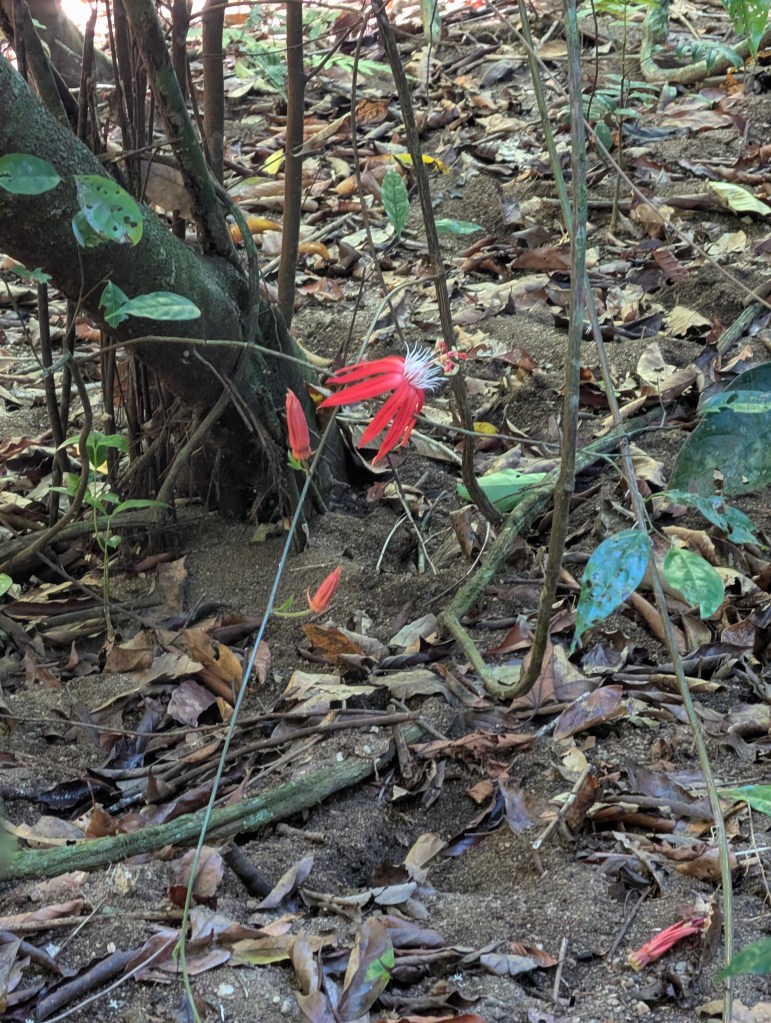
The passion flower thrives as an understory vine in rainforests, often growing along the ground or climbing up surrounding vegetation. It produces small, edible fruits similar in size to a grape.
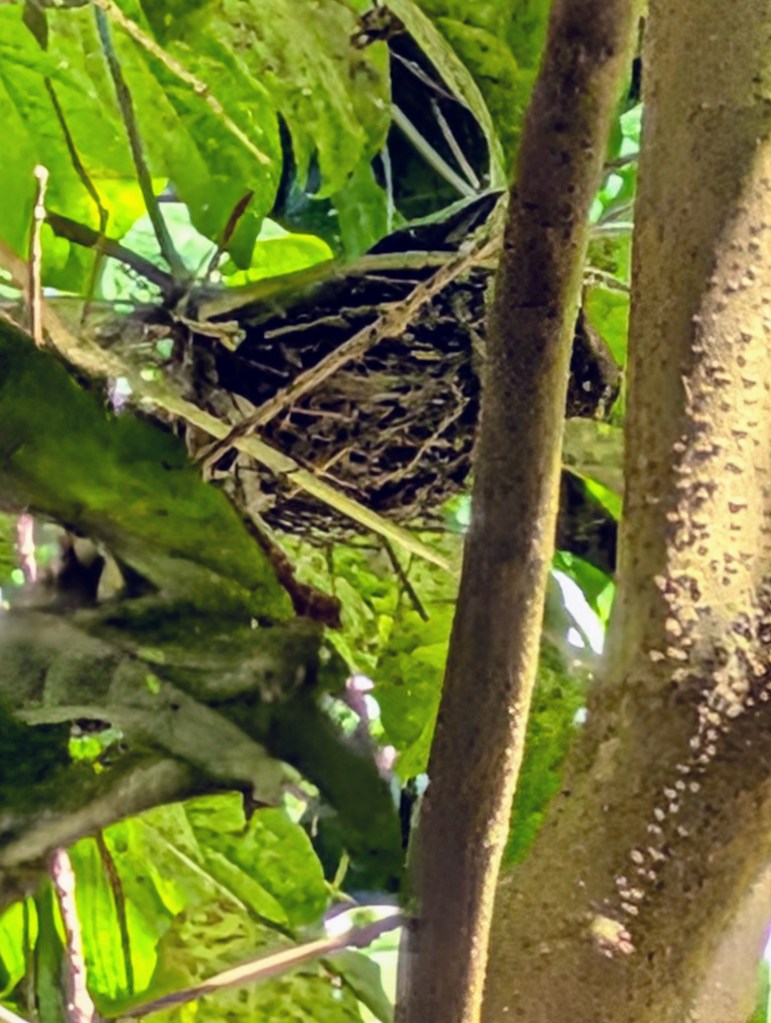
We found a Black-hooded Antshrike sitting on her nest. They build a “roomy” open cup nest made of fine rootlets and fibers, which they attach with spiderwebs to horizontal branches
The beach is full of beach almond trees providing shade over the sandy shore. Beach almond trees are highly valued for their ability to thrive in sandy soil and tolerate salt spray, making them ideal for coastal environments. These trees are commonly found in tropical coastal areas, known for their large, sprawling branches and wide leaves.

The trees produce fruits containing an edible seed, often referred to as “Indian almond” or “tropical almond”.
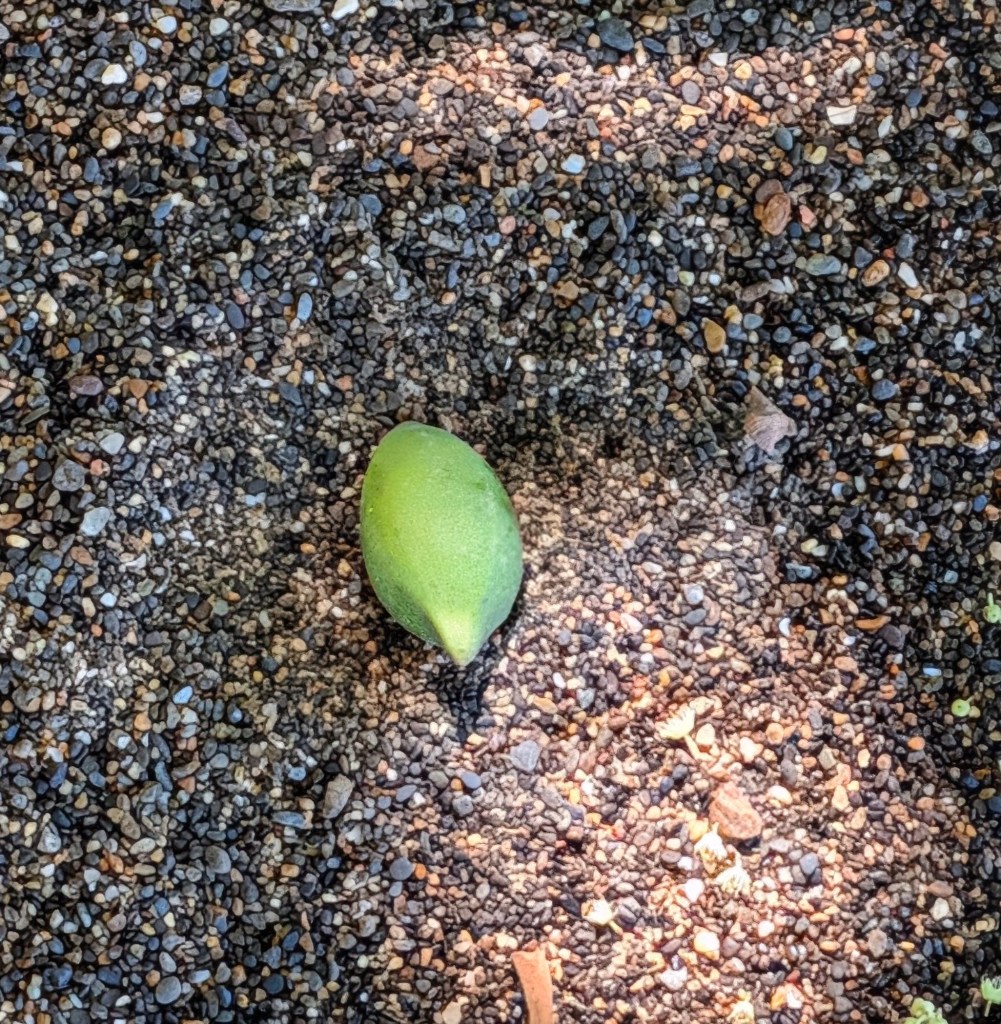
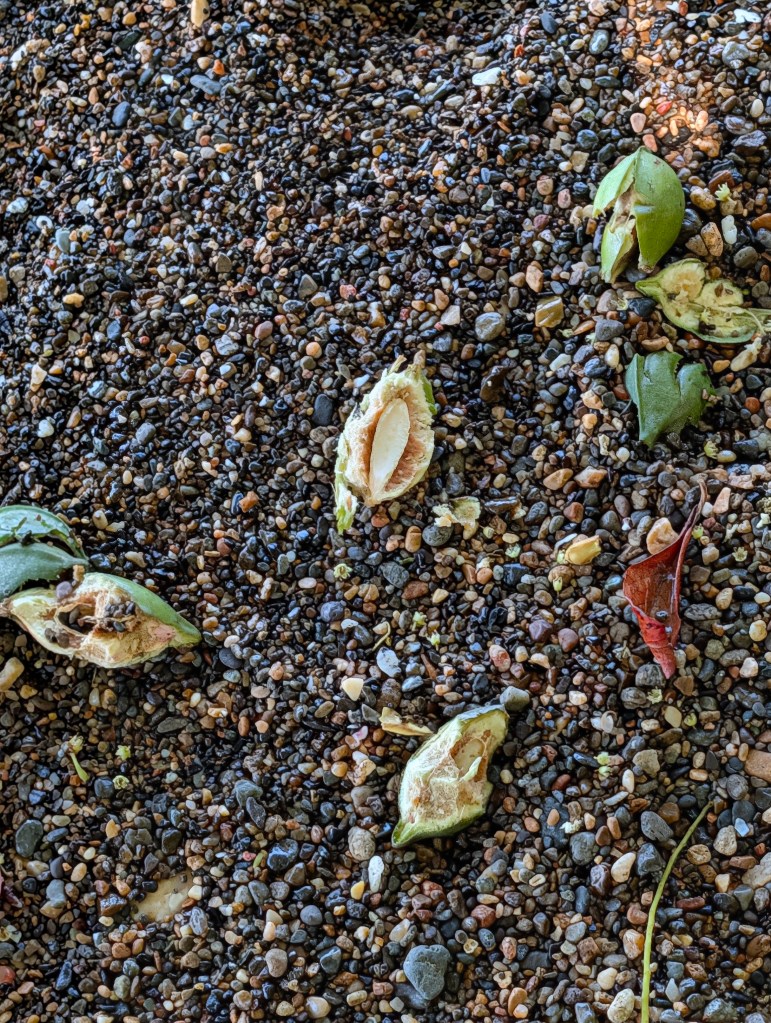
Macaws love to eat the beach almonds.
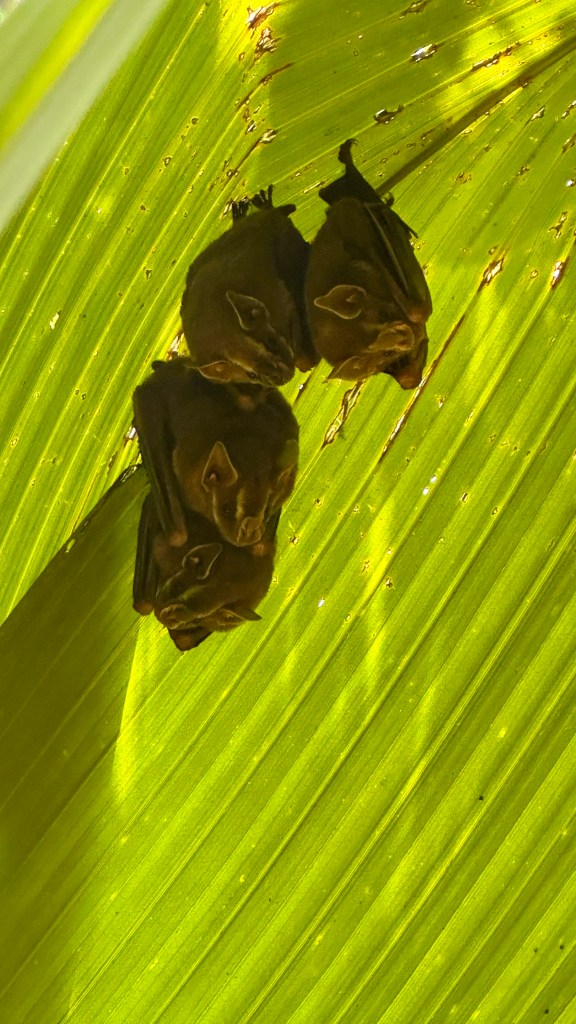
Jose pointed out some Tent-making bats, identifiable by the white stripes on their faces. These bats are typically found in tropical and subtropical regions of Central and South America. They are nocturnal mammals that primarily feed on fruit and nectar.
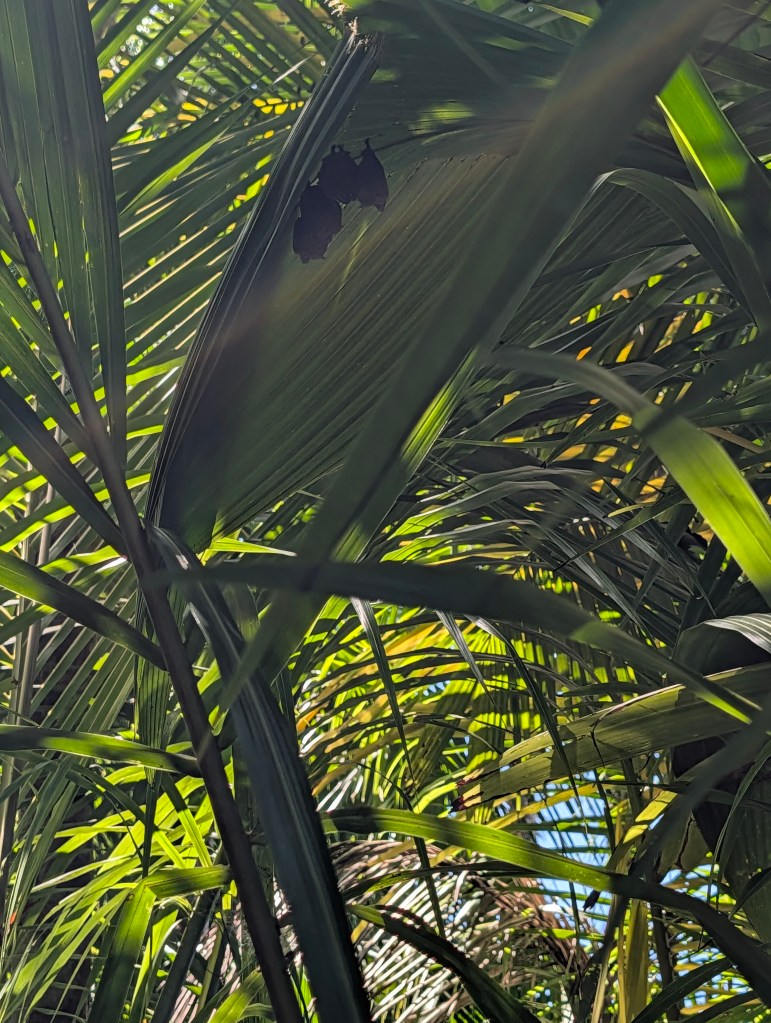
Tent-making bats are known for chewing the midribs of large leaves, causing them to bend downward and form a “tent” for shelter.
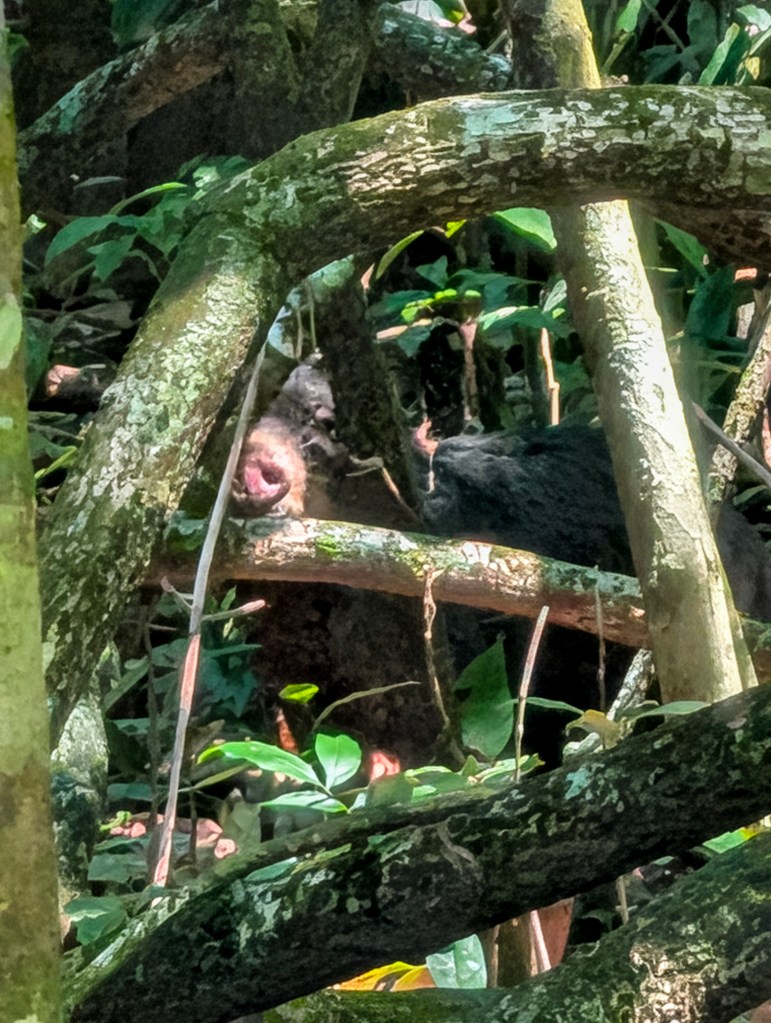
A herd of wild pigs was crashing through the forest. We could only get glimpses of them through the trees. But one stopped and poked his nose toward us. Jose warned us to stay quiet because they can be known to be aggressive. Wild pigs in Costa Rica are not true pigs but a distinct family (Tayassuidae) that split 40 million years ago. Known as “skunk pigs” for their pungent scent glands, they are social creatures vital to forest health, often spotted in national parks like Corcovado. We did not get close enough to get a whiff.
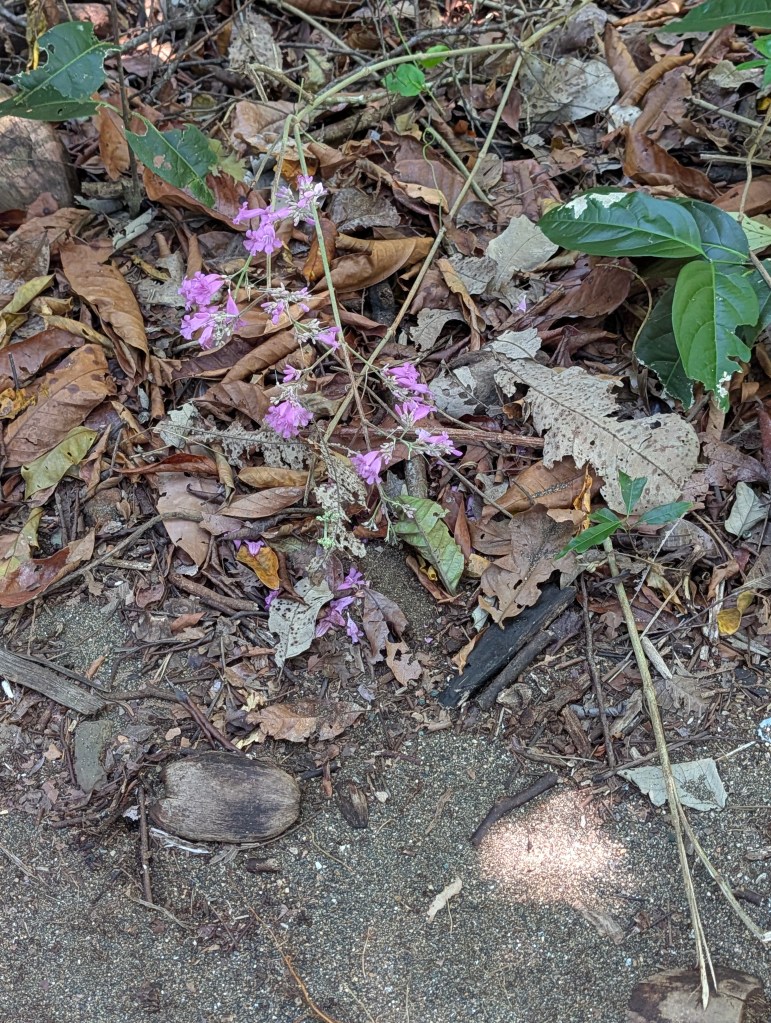
So little was in bloom in the forest this time of year that I was drawn to every bit of color. A vine common to the tropical environment is the Fridericia rego plant. The purple, tubular flowers are characteristic of this genus.
We spied another golden silk orb-weaver spider. While they are large, they are generally not dangerous to humans; their bites are typically mild and only cause localized pain. They are typically found in forests and wooded areas throughout tropical and subtropical regions, including the Caribbean.
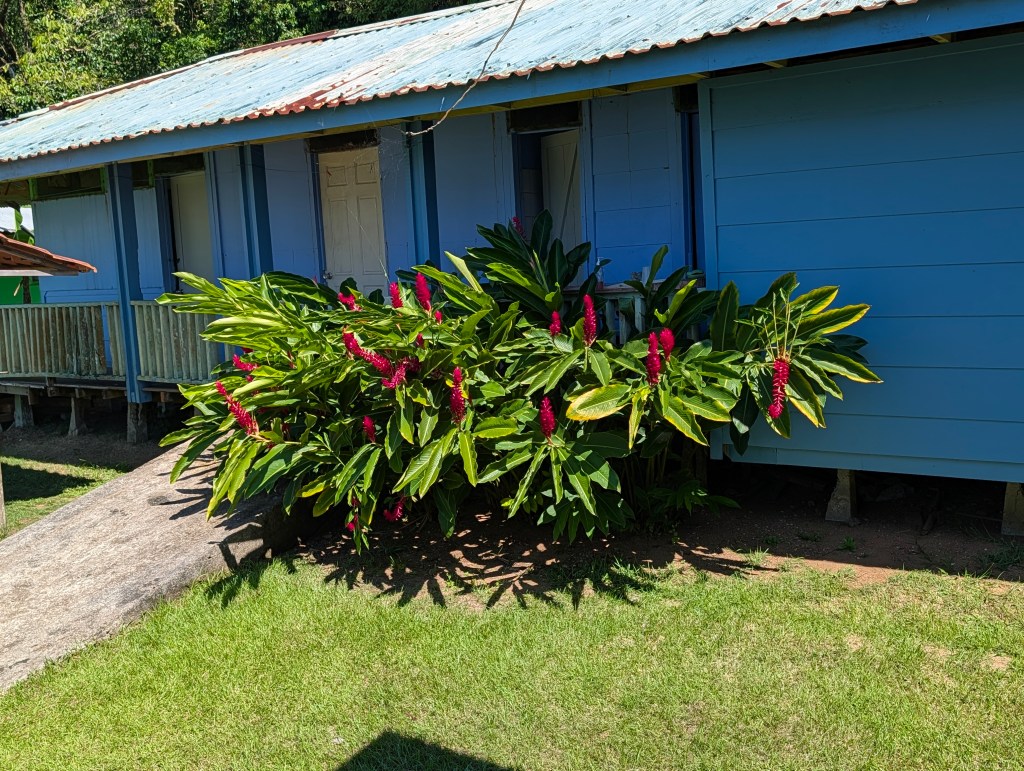
We made our way back to the ranger staton for a break. Outside the building is a magnificent Red Ginger, a vibrant tropical plant commonly used in landscaping. that is not native to Costa Rica. This perennial features showy, bright red bracts that hold small white flowers. They thrive in warm, moist climates, preferring well-drained soil and partial shade.
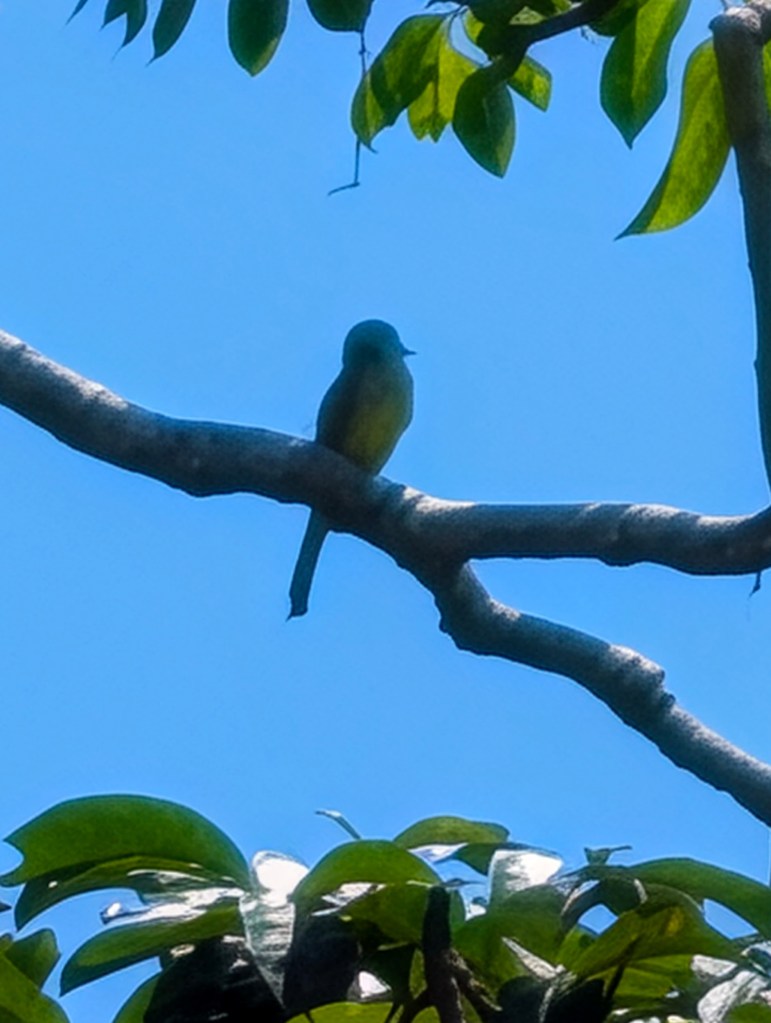
The Tropical Kingbird is a highly visible,, and vocal resident in Costa Rica, easily identified by its bright yellow belly, grayish head, and forked tail. They are known as fearless “tyrant flycatchers” that aggressively defend their territory from larger birds like hawks and owls.
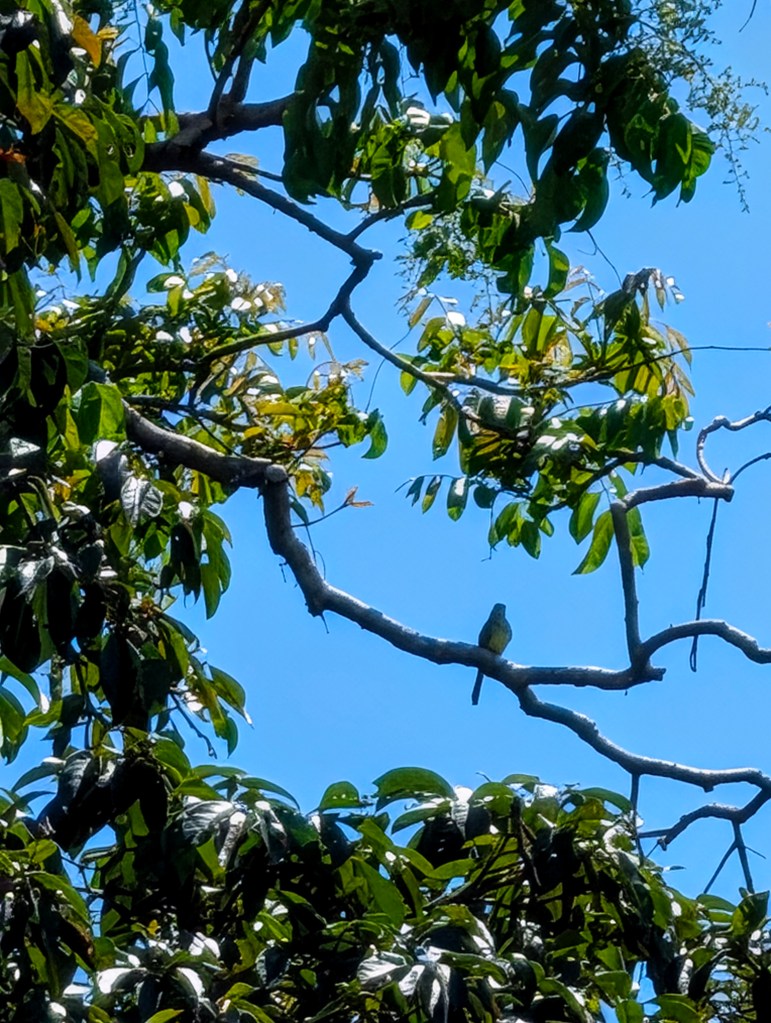
While primarily insectivores, the Tropical Kingbird also feed on small fruits, particularly during cooler weather. During breeding season, they perform “butterfly-like” flight displays and emit soft calls to maintain their pair bonds. Females build open-cup nests, often in the canopy or mid-story, and are solely responsible for incubation. They are thriving in Costa Rica, with a global population estimated at 200 million, often increasing in areas where forest has been cleared for agriculture.
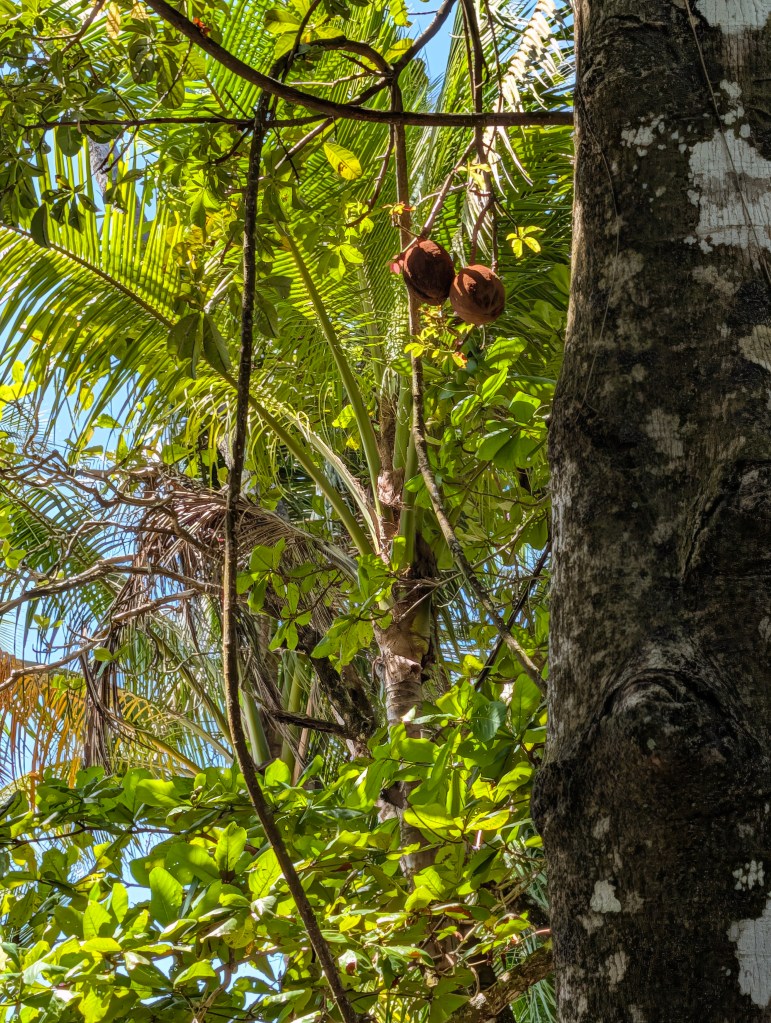
Jose pointed out the fruit pods of a Pachira aquatica, commonly known as a Money Tree or Guiana Chestnut. The large, reddish-brown pods contain seeds that are edible when roasted, boiled, or fried.The Money Tree is a tropical wetland tree native to Central and South America and, in many cultures, believed to bring good luck, prosperity, and wealth, often sold as an indoor houseplant.
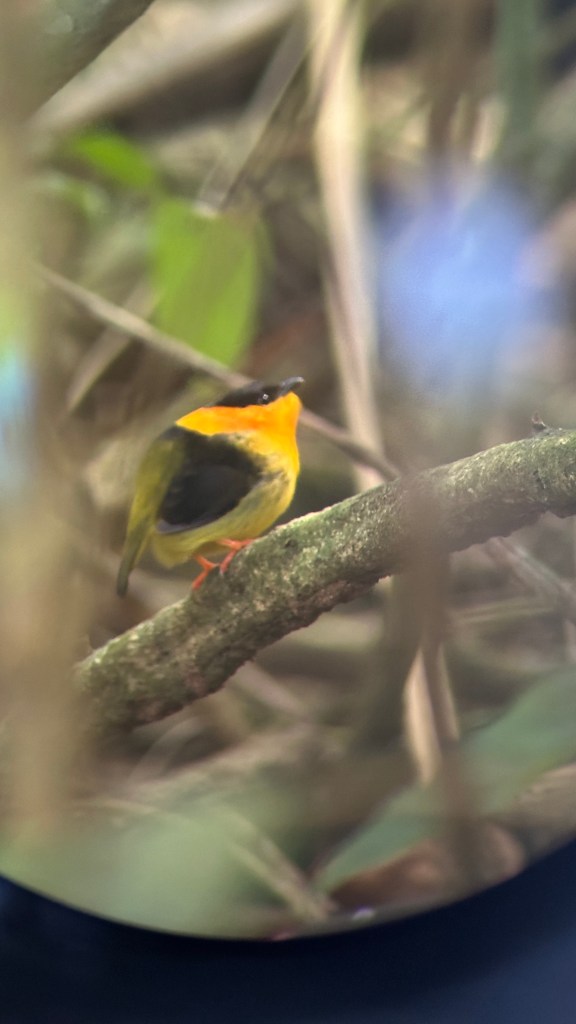
Our final find of the hike was a male Orange-collared Manakin, a small, plump bird, approximately 10 cm in length, with a distinctive bright orange throat and collar contrasting with a black head, back, and wings. This species is endemic to the forests and secondary growth of Costa Rica and western Panama. They primarily feed on small fruits and berries found in the forest understory. Orange-collared Manakins are known for their elaborate courtship displays; the male often creates a snapping sound with its wings during mating rituals.
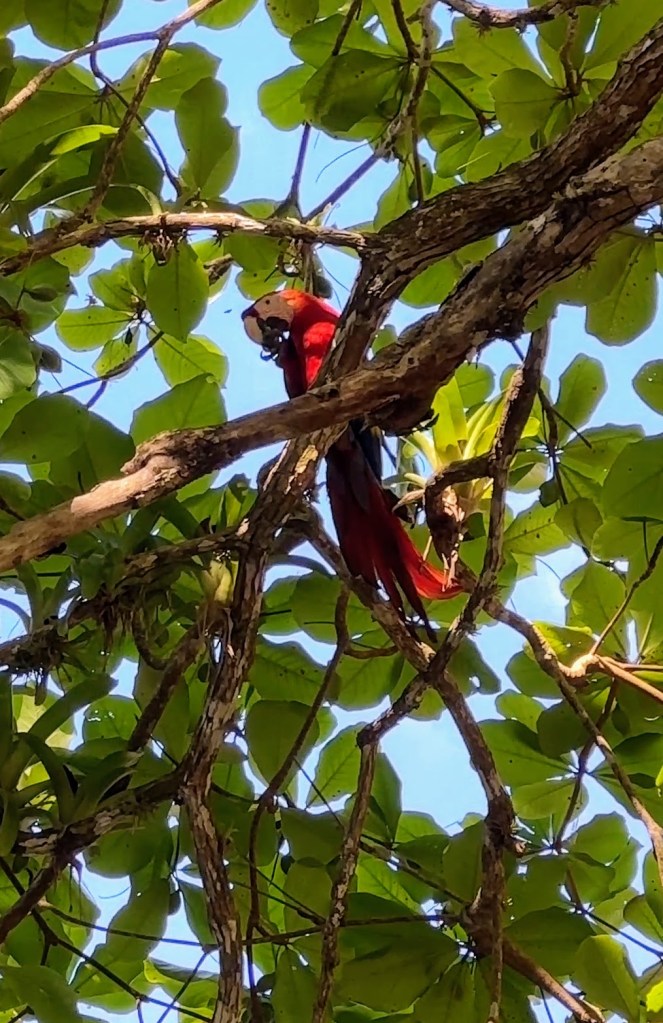
As we crossed the beach toward lunch, Jose found a macaw munching on beach almonds., a great find. But alas, the tour was over, and we had yet to find a toucan.
After over 6 hours of hiking, we were famished and downed a hearty meal at the facility on the beach. We then lounged in the afternoon. We looked at the adults-only pool, which had very cold water,
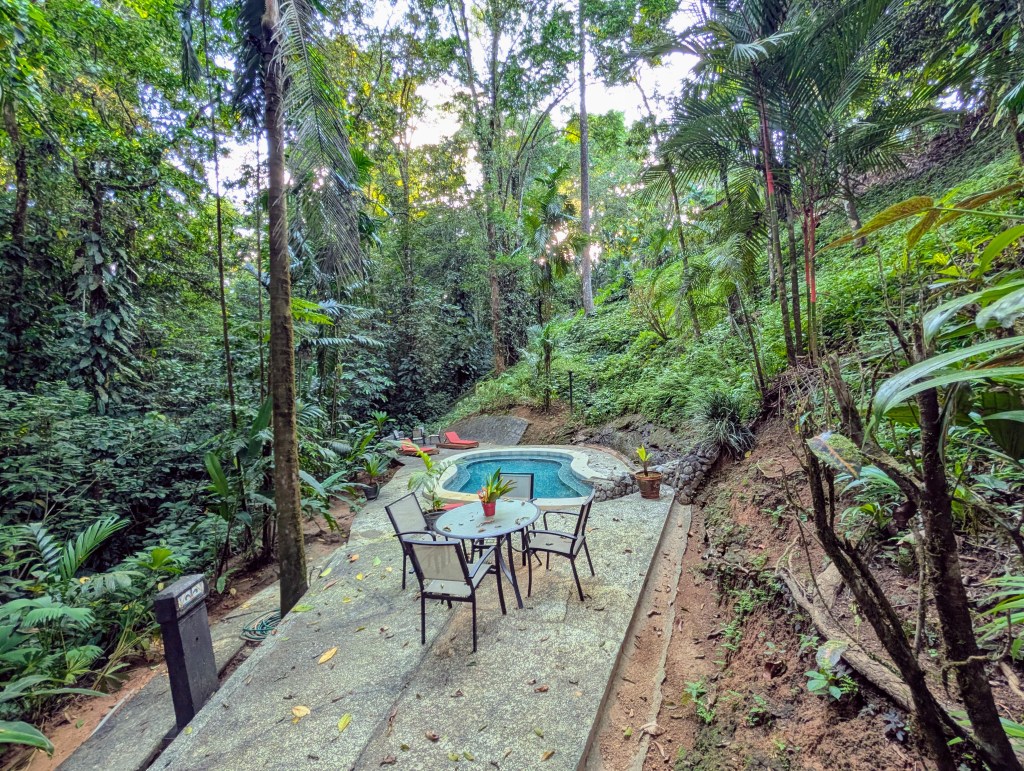
and instead opted for the larger, warmer family pool. While we relaxed there we were entertained by a family of howler monkeys that were romping through the trees. Unfortunately they were too mobile and obscured to catch their images.
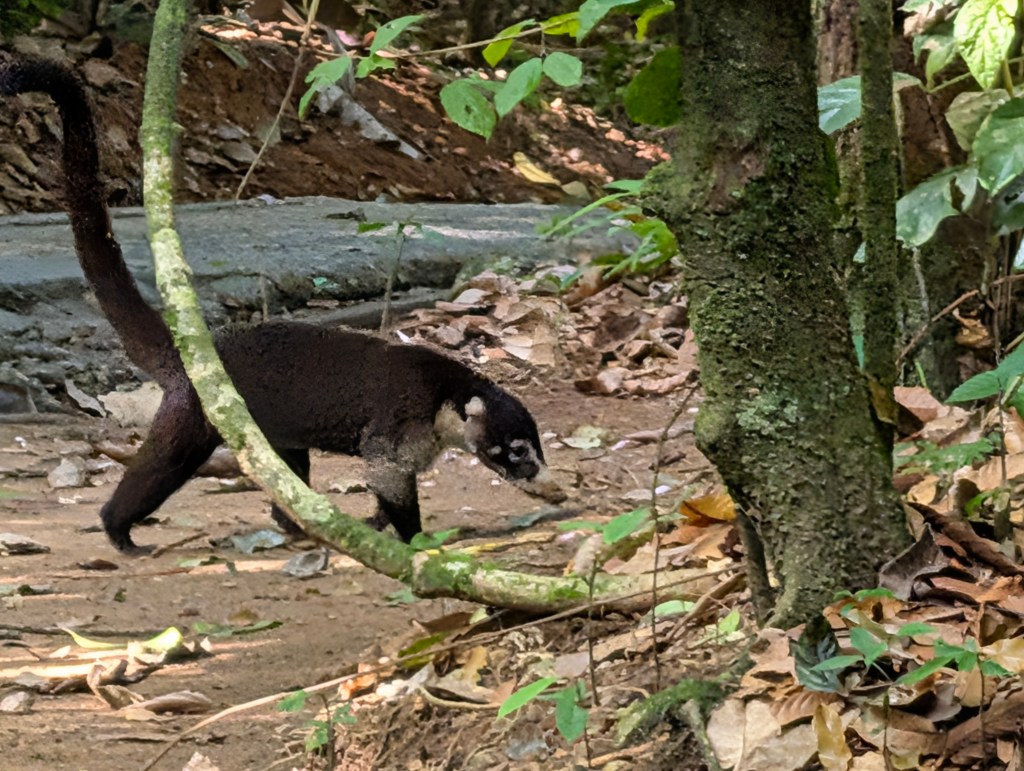
On our final morning as we descended to the beach for our return trip, a caoti was walking along the road in front of us.
We took a boat ride to Drake Bay. From there we were driven to the Drake Bay airport.

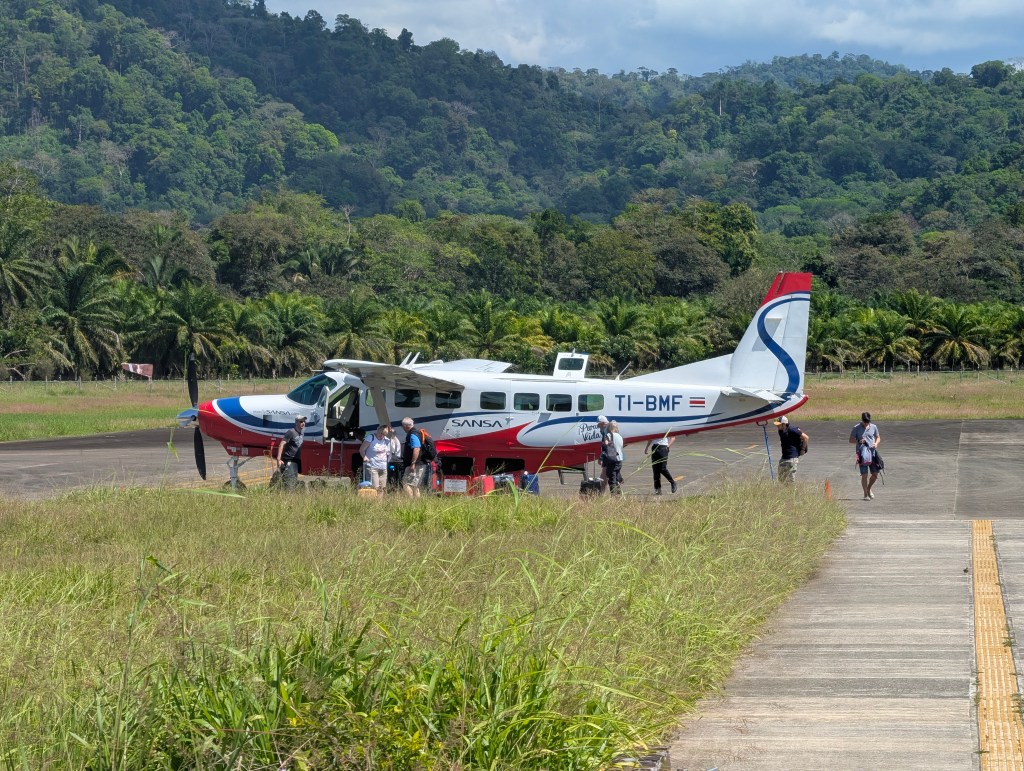
When we checked in for the flight, first our luggage was weighed, then our backpacks were weighed, then we were weighed with our backpacks! They are very strict about the amount of weight allowed on the plane.
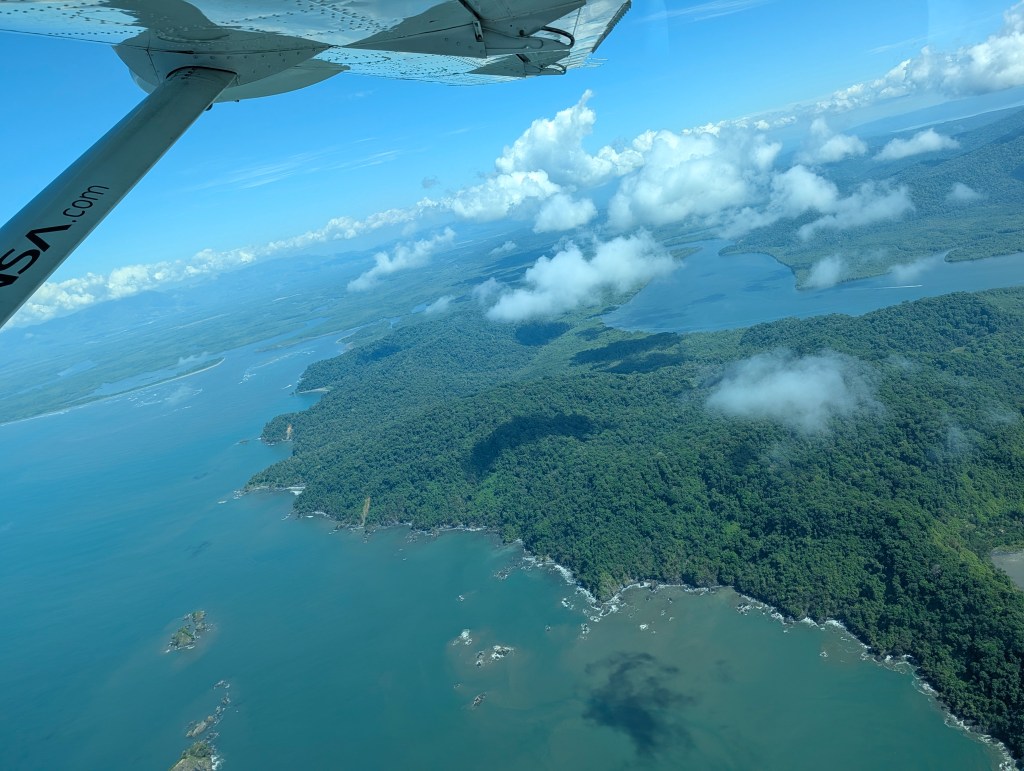
The flight to San Jose lasted about 45 minutes.
We landed at the domestic terminal where we were handed our luggage directly off the plane before being escorted inside.

We were to fly home in the morning. We checked into our hotel for the night and found a casino across the street. Of course Eric had to investigate. And yes, there is a poker room, but no one was there playing.

We headed to dinner at dusk and heard the squawking of parrots. We had heard many during our hike in the forests, but had yet to catch one in a frame. We had been in the country for 2 weeks and had no parrot pics, and here on our last night right by the airport were hundreds coming in for the night. We watched and took videos for several minutes. They were White-eyed parakeets, medium-sized green parrots native to South America. They are known for the white bare skin around their eyes. They typically inhabit tropical and subtropical forests and are often found in small flocks. They feed on a diet consisting mainly of seeds, fruits, and berries
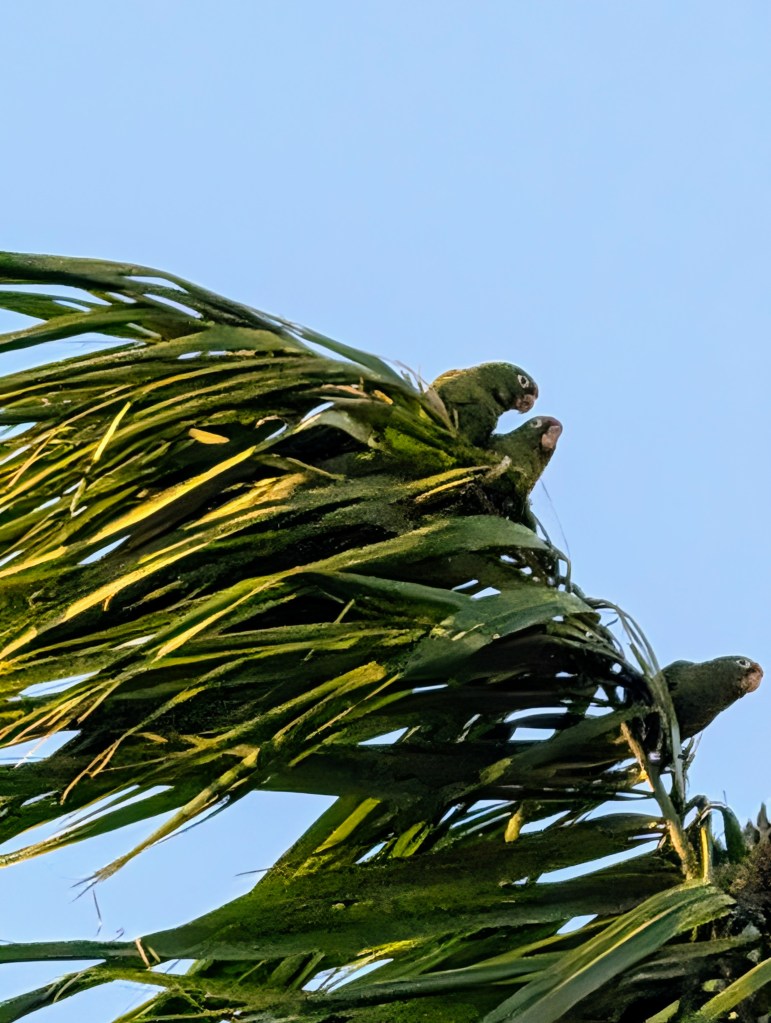
What a fitting final picture for our trip to Costa Rica.
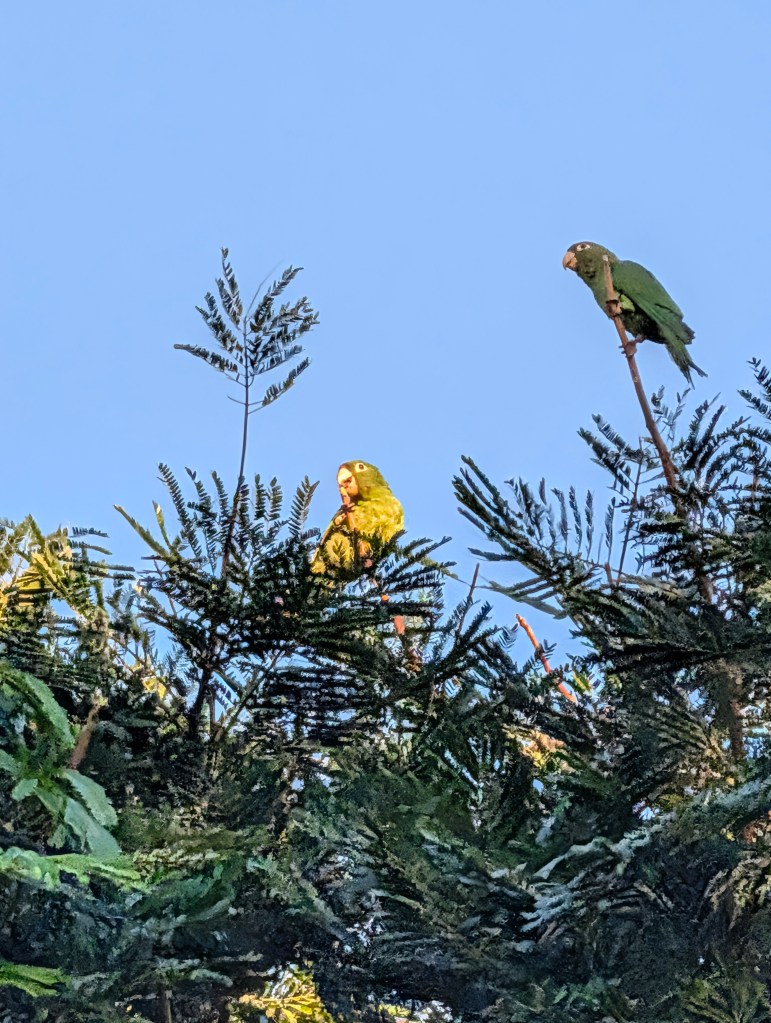
One of the many things we loved about Costa Rica is their unofficial national slogan: Pura Vida, and you hear it everywhere. It is used daily as a versatile, all-purpose phrase for greetings/farewells (hello/goodbye), affirmation (everything is good), gratitude (thank you/you’re welcome), and as a way to downplay stress or misfortune. In 1956, a Mexican film titled “¡Pura Vida!” graced Costa Rica’s screens and became an instant hit. The film portrayed an eternally optimistic character who often used the phrase, even in challenging situations. Costa Ricans quickly embraced “Pura Vida” in the same spirit. The meaning of pura vida, of course, is “pure life,” and it’s come to symbolize the simple, cheerful outlook and lifestyle of what is often called the happiest country in the world.
 Jo & Eric's travels