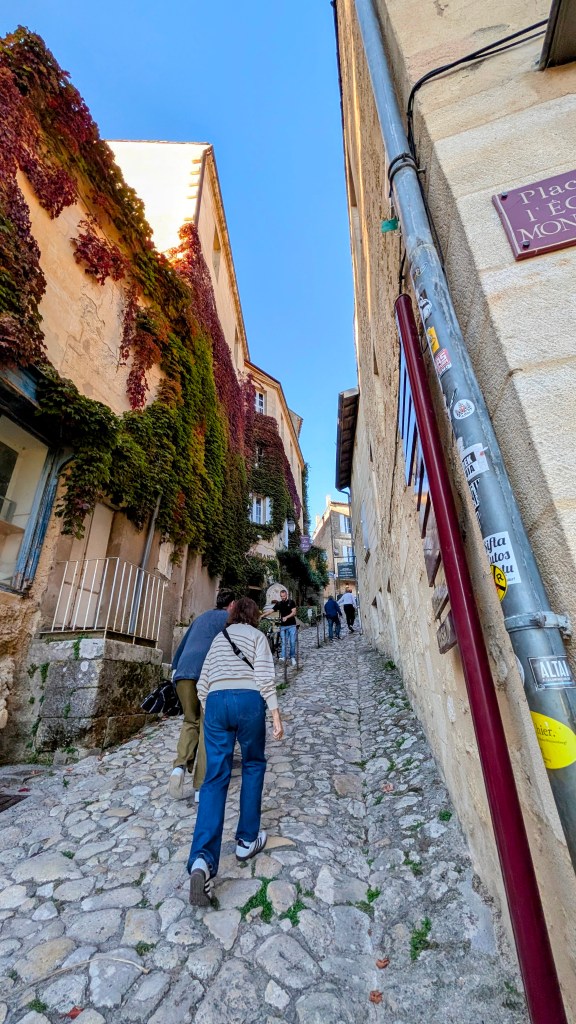
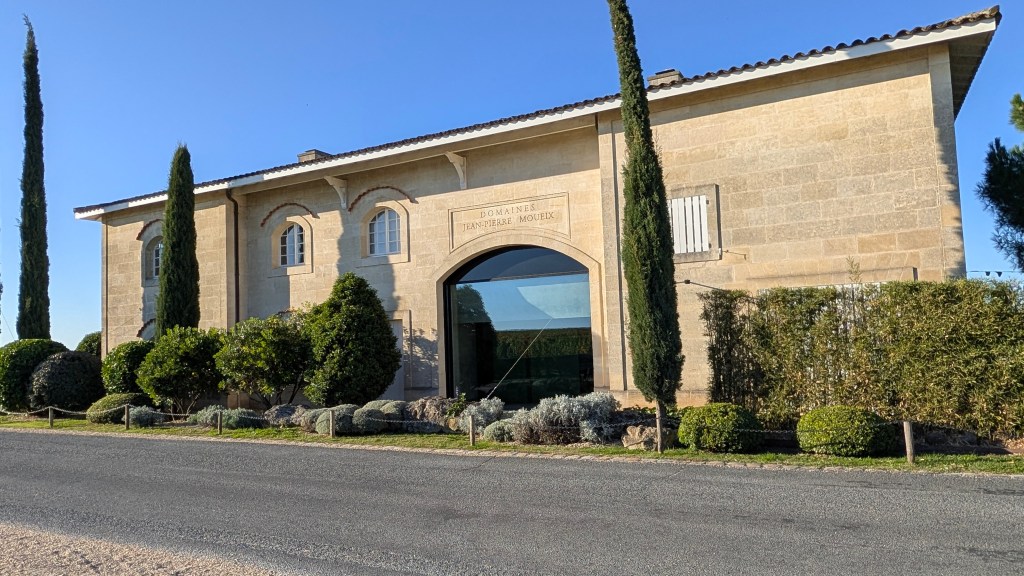
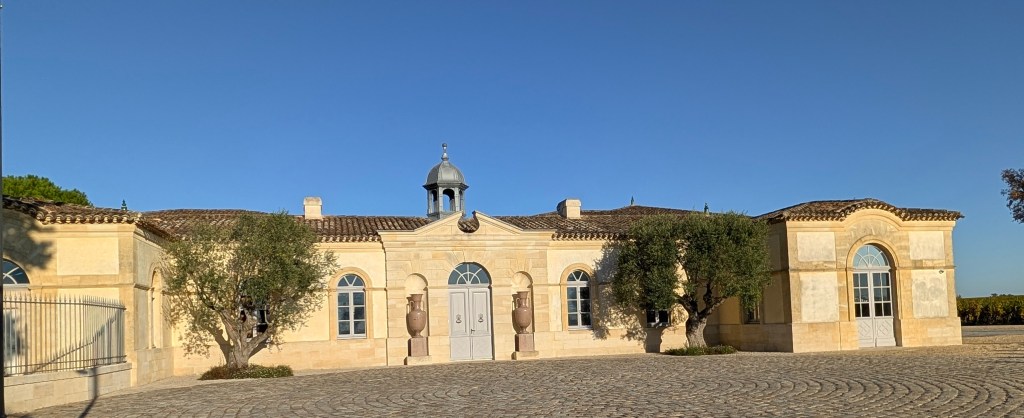
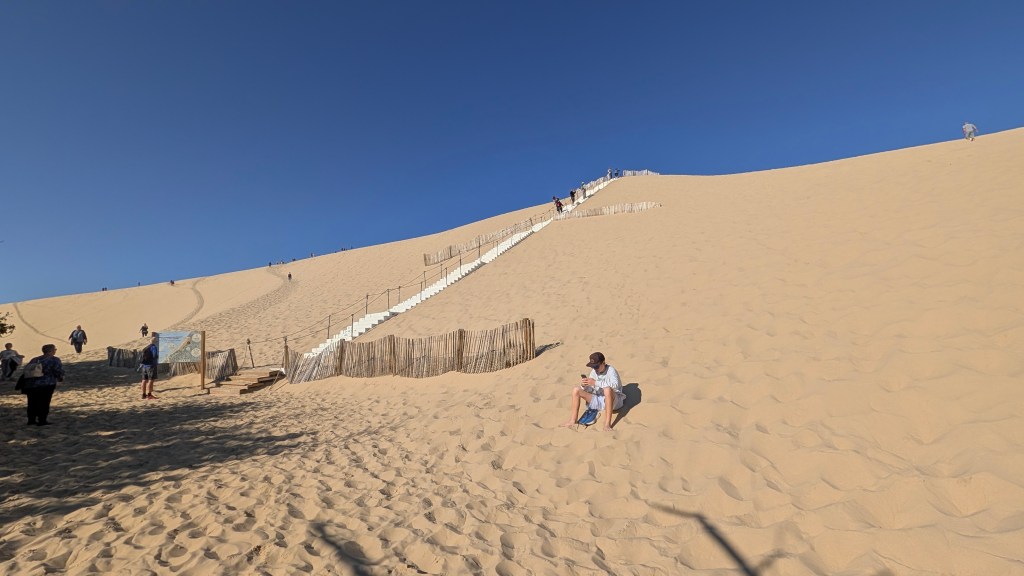
France: Bordeaux City Oct. 18-19; Médoc Region Oct. 20; Paris: Montmartre Oct. 21-22, 2025

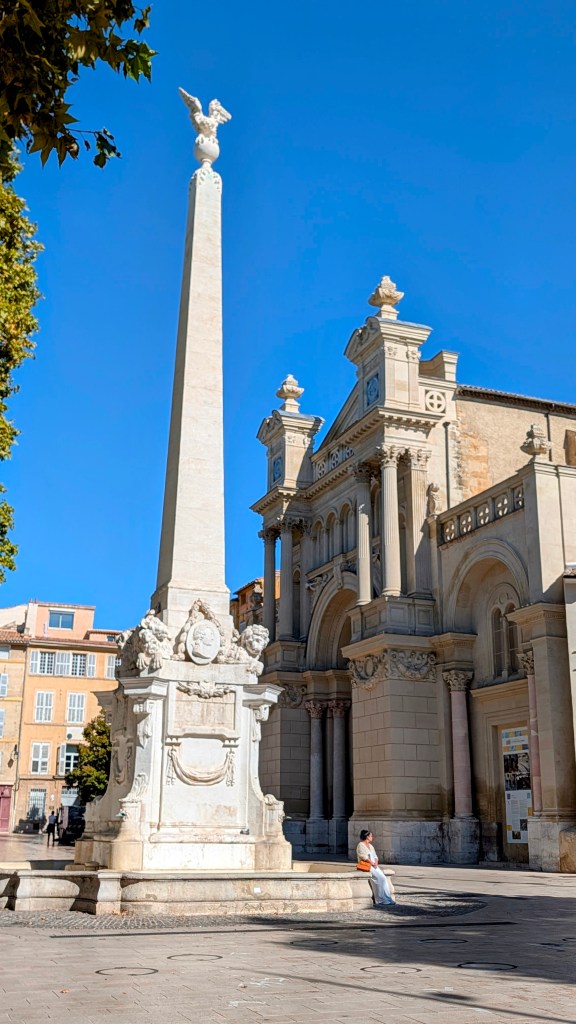
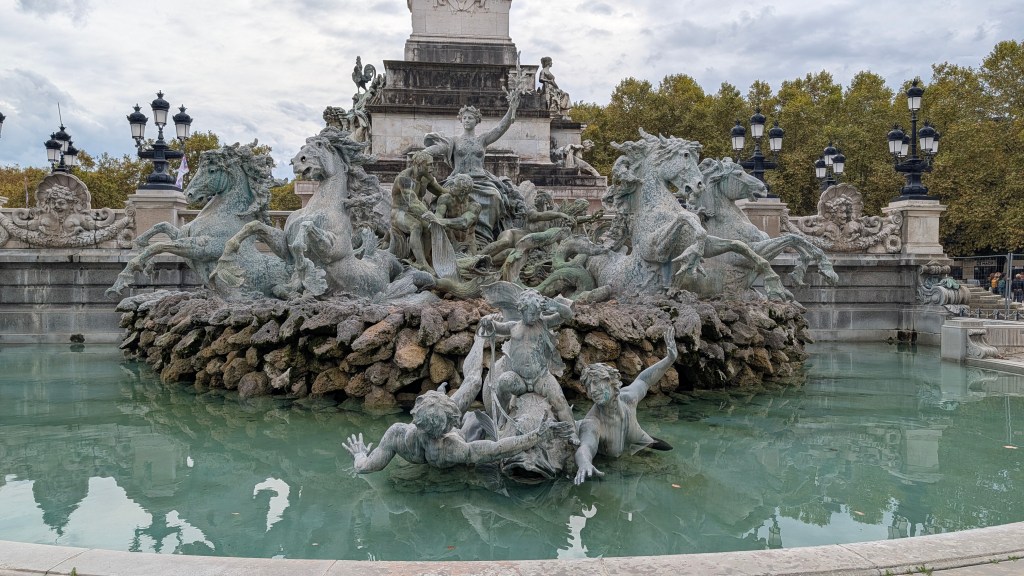
Our tour of the city of Bordeaux was with Sarah who met us in our lobby at Villas Fuchs. As we walked across the street Sarah told us that the city is now a UNESCO World Heritage site because of the large number of 17th century buildings still standing. The 17th century was the boom time for this city. We started in front of the Monument aux Girondins (Girondines Monument), a tribute to the revolutionaries, located in the Place des Quinconces, covering 40 acres, it is one of the largest city squares in Europe. The monument was built between 1894 and 1902 to honor the Girondins, a moderate political faction who were arrested and beheaded in 1793 after losing a power struggle during the French Revolution to the more radical Montagnards because they had not killed the king.
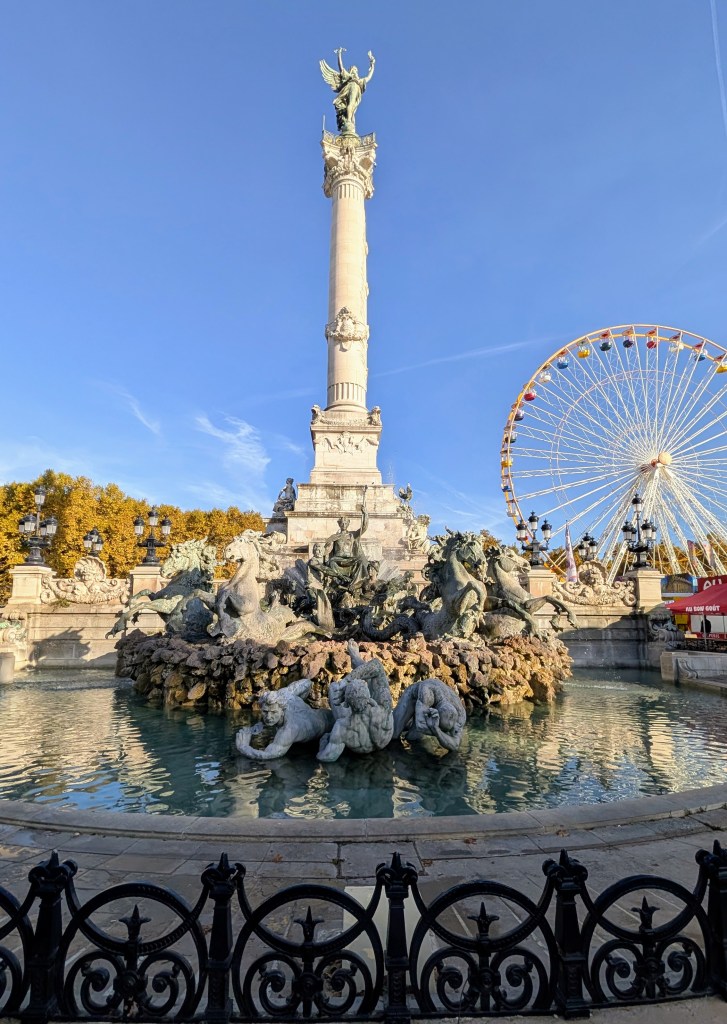
The project was led by architect Henri Deverin and sculptor Alphonse Dumilâtre.  The base of the fountain includes allegorical sculptures representing the Republic’s triumph, eloquence, and history.
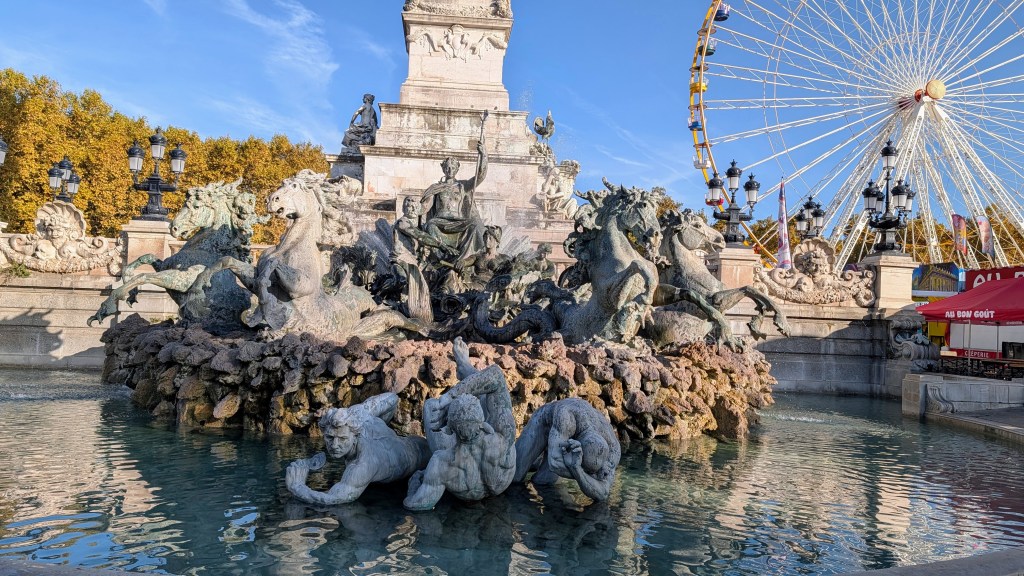
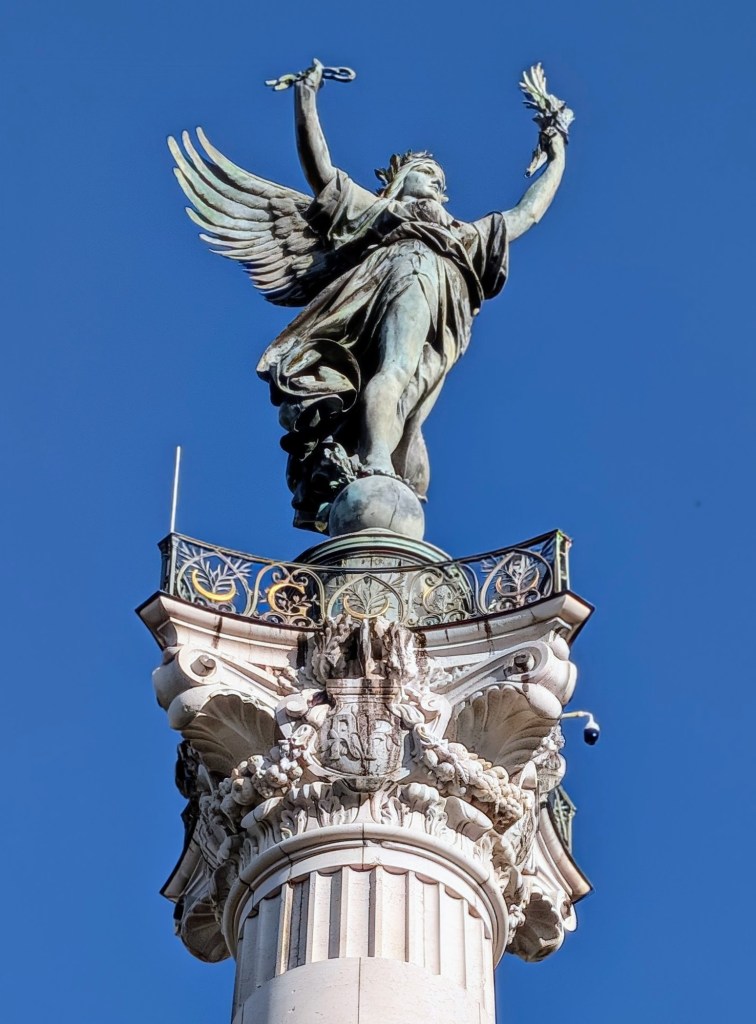
It features a 141 foot column topped by a bronze statue representing Liberty breaking her chains, culminating at a height of 177 feet.
The central woman with the stick and orb is Marianne, a symbol from the revolution of France. She represents the Republic, the triumph of justice, liberty, and reason.  She is often depicted wearing a Phrygian cap. She appears on stamps, currency, and as statues in public buildings. Notice the fantastical details of the webbed hooves of the horses.
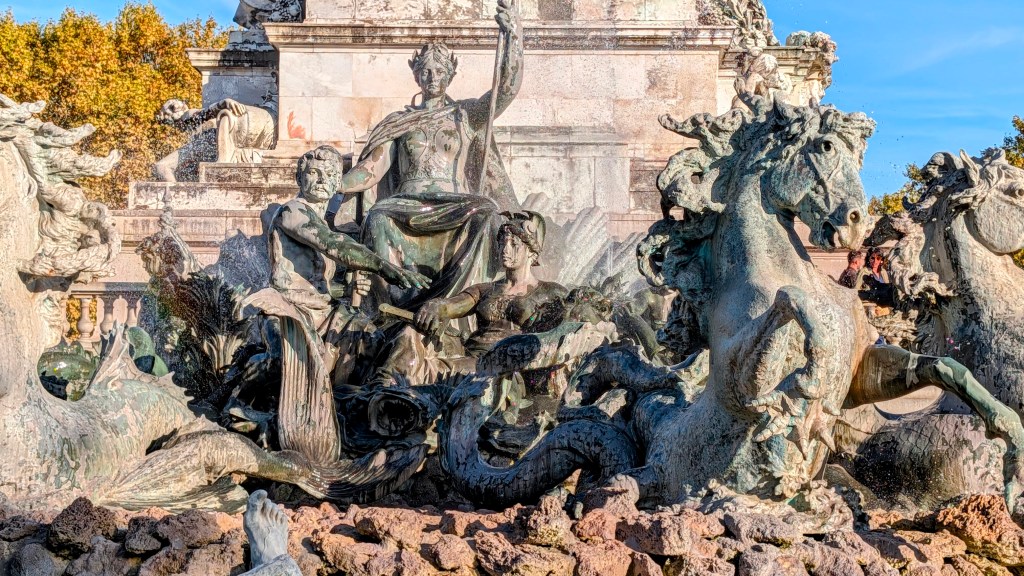
Marianne

Here Marianne is banishing dishonesty, lies, and ignorance.
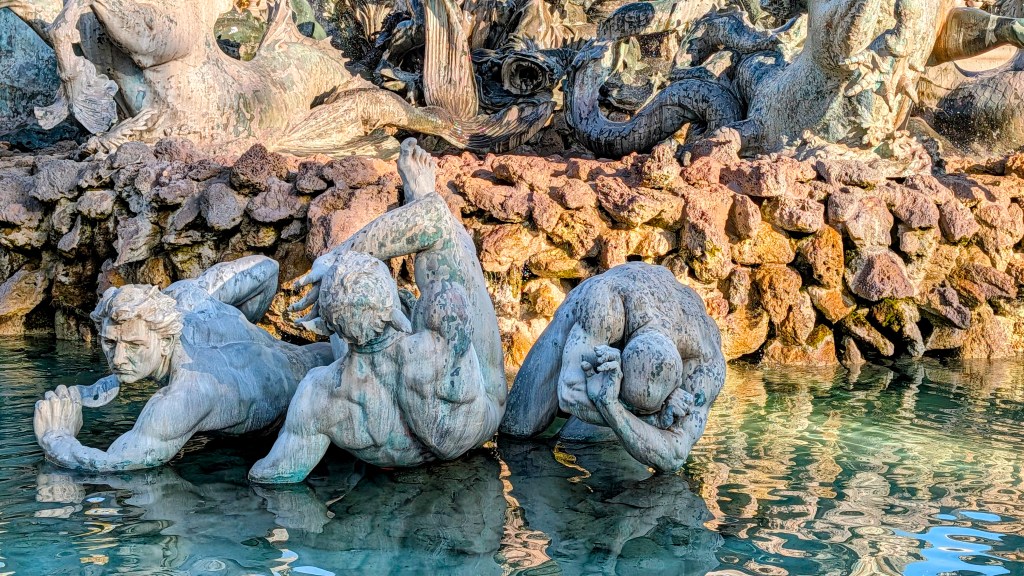
During the German occupation in 1943 the bronze sculptures were dismantled by the Nazis to be melted down for weaponry. They were saved by French workers who hid them in a factory in Angers. The statues were rediscovered in 1945 and eventually returned to Bordeaux. The fountain remained “empty” for decades until the statues were finally reinstalled in 1983.
Le Coq Gaulois (The Gallic Rooster) symbolizes the French peoples’ attitude of “cock”iness, ie vigilance strengthened by their rural roots. It is frequently used by national sports teams.
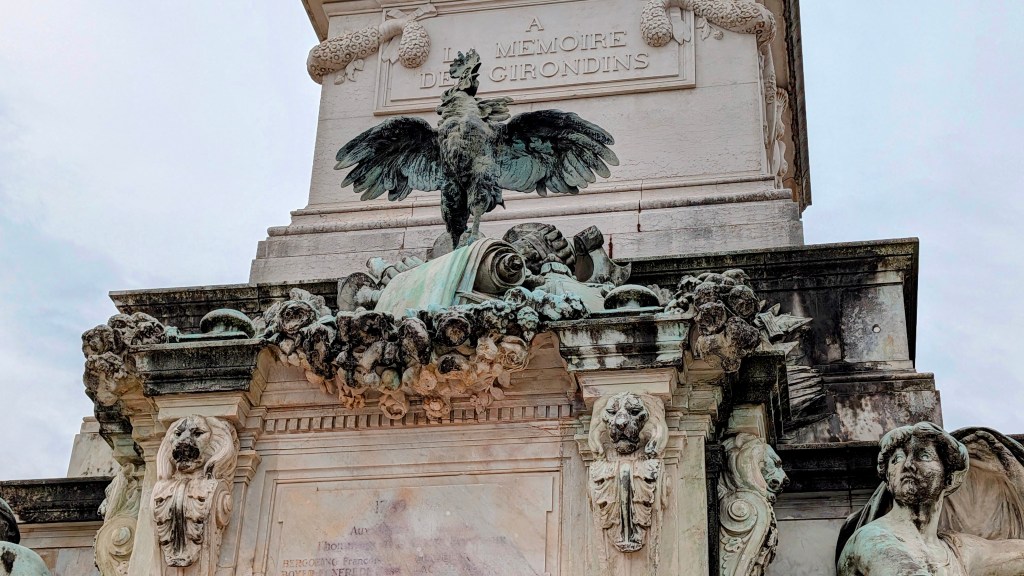
Le Coq Gaulois (The Gallic Rooster)

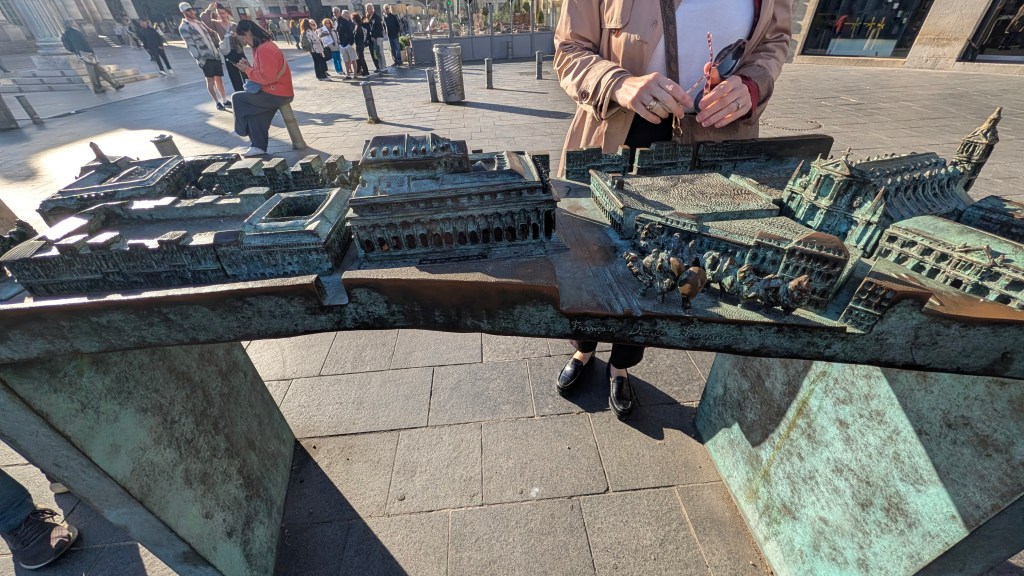
As we walked toward Place de la Comédie, Sarah explained some of the city’s history. Bordeaux, founded as Celtic Burdigala around 300 BC, became a flourishing Roman trade hub and capital of Aquitania. In the middle ages (approximately 1100-1400) the city was controlled by the English. For centuries there was a wall around the city both for protection and to ensure collection of duties. Most of the wall was destroyed during the 18th century building projects. The 17th century was the height of the city’s prosperity owing to its central location for trade of wine from local wineries, slaves from West Africa, and sugar, cocoa, and coffee from Haiti. Sarah showed us a miniature model of the city.
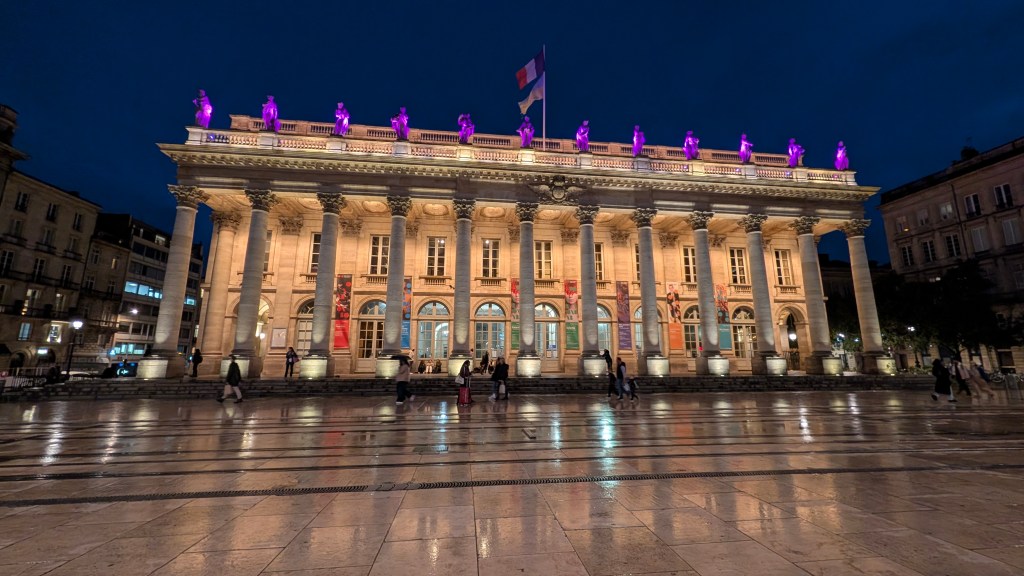
The 17 and 18th century buildings were almost entirely in Neo-classical architecture, with the crown jewel being the Opera House.
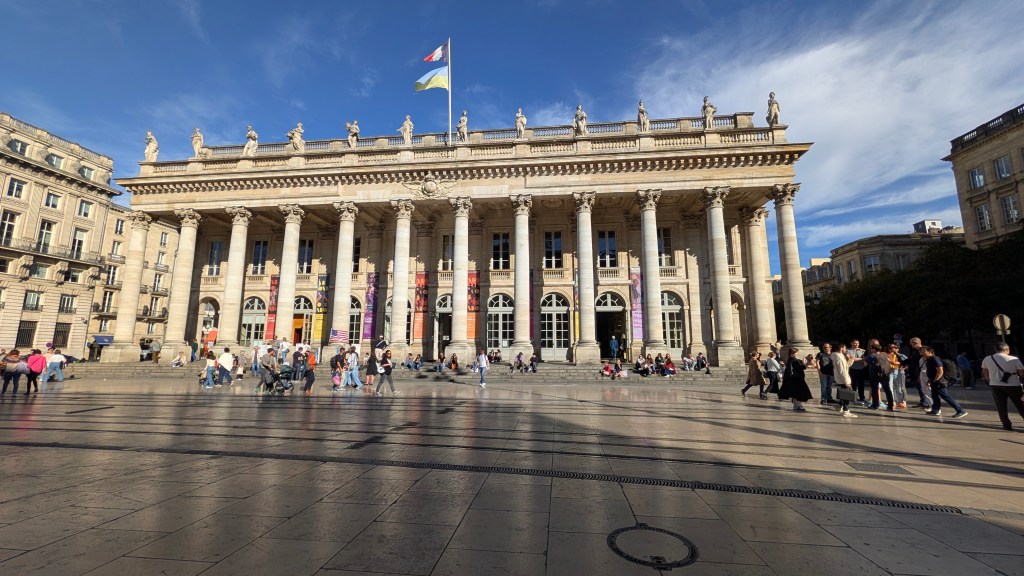
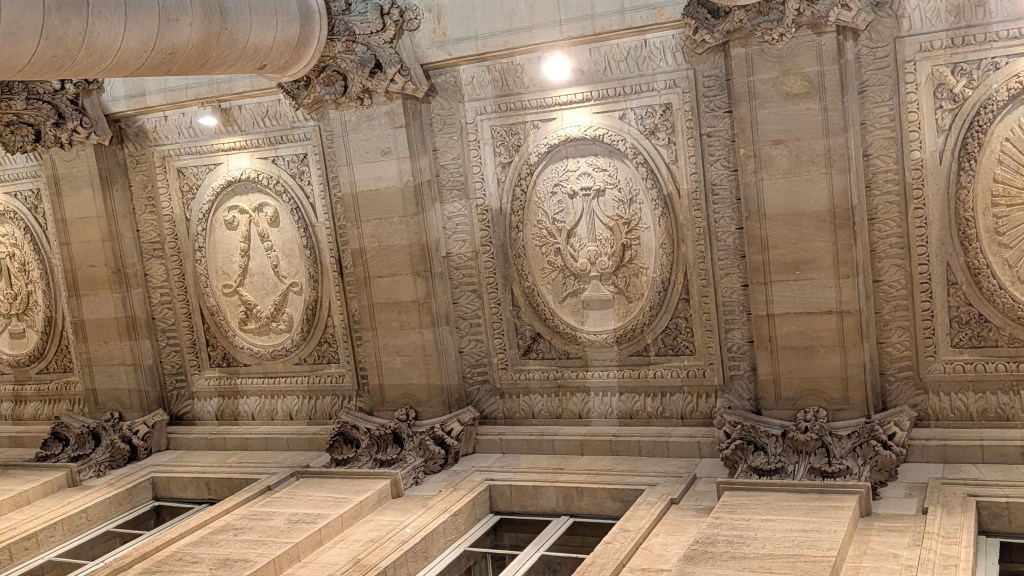
Even the ceiling of the portico is intricately detailed with decor.
Facing the theater, on the other side of the square, stands the InterContinental Bordeaux – Le Grand Hotel, which opened in 1789, and remains a prominent landmark in the city. 
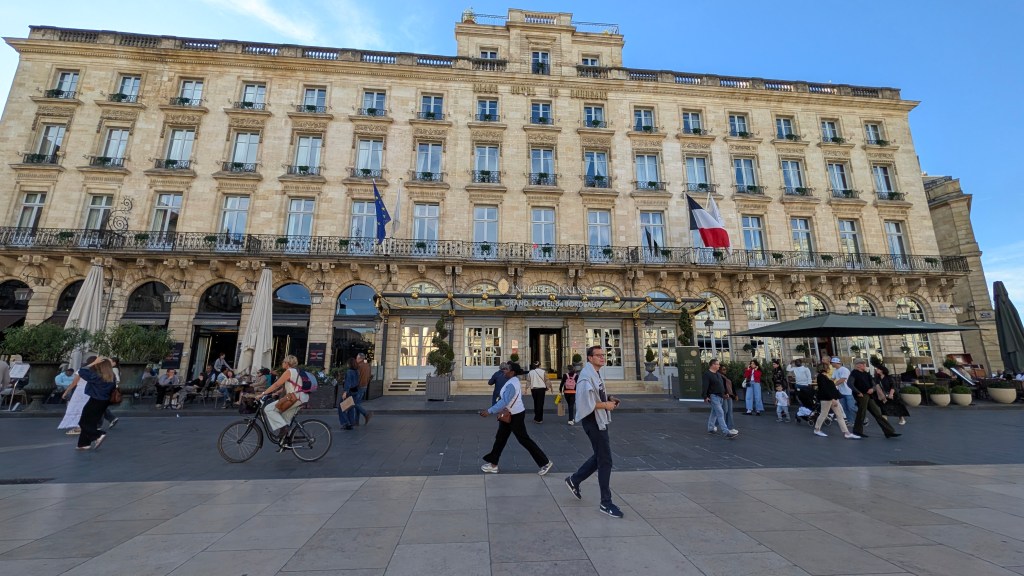
InterContinental Bordeaux – Le Grand Hotel

Sarah pointed out the the Bar à Vin and the École du Vin (Wine School), the official wine bar of the Bordeaux Wine Council. 
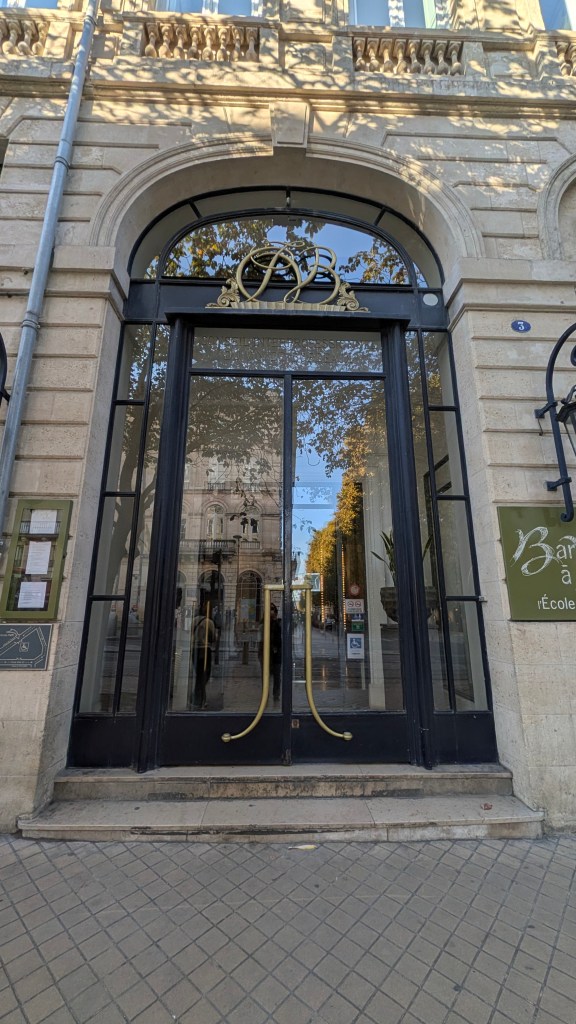
Bar à Vin and the École du Vin (Wine School)

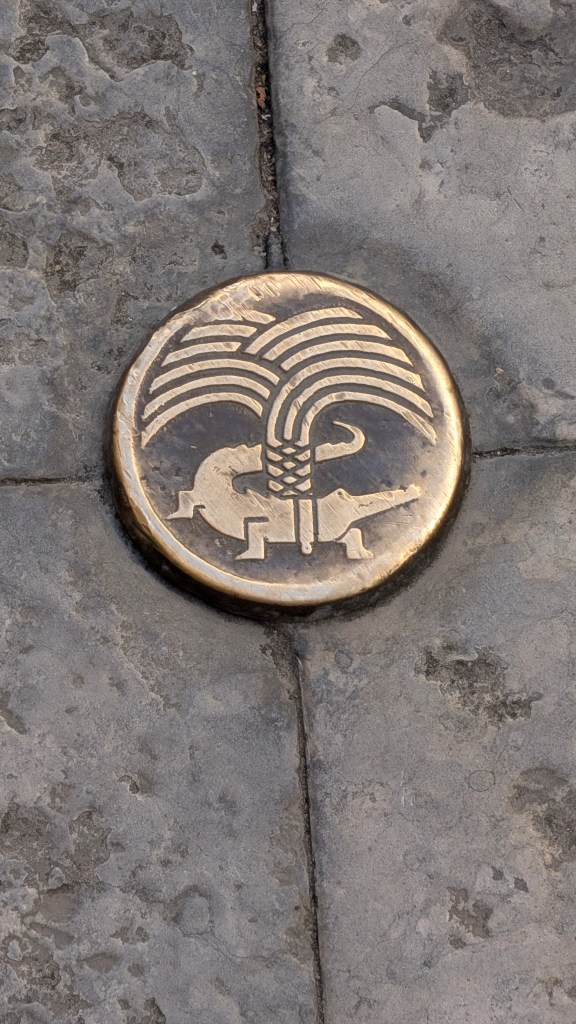
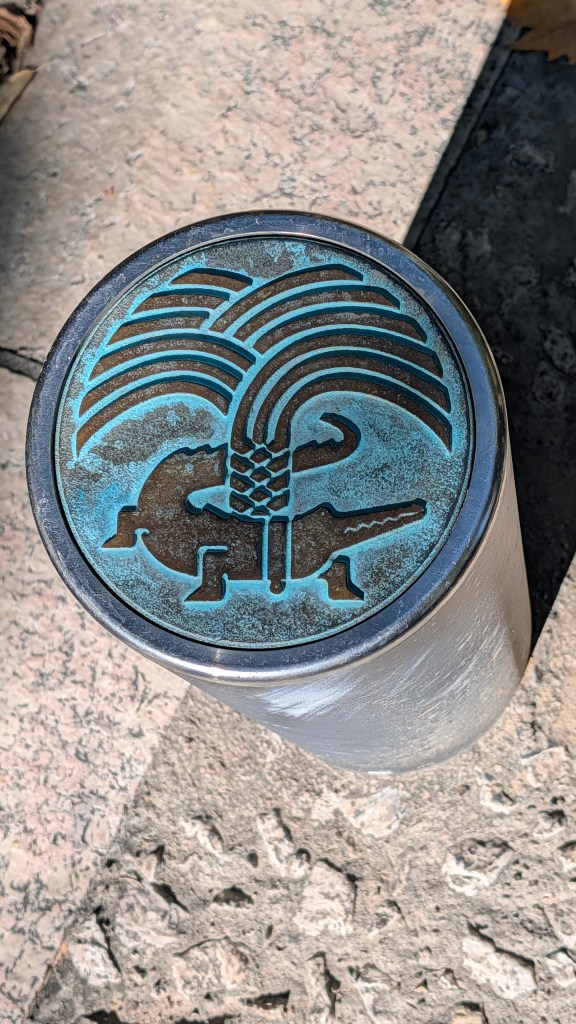
The city symbol is selfevident.

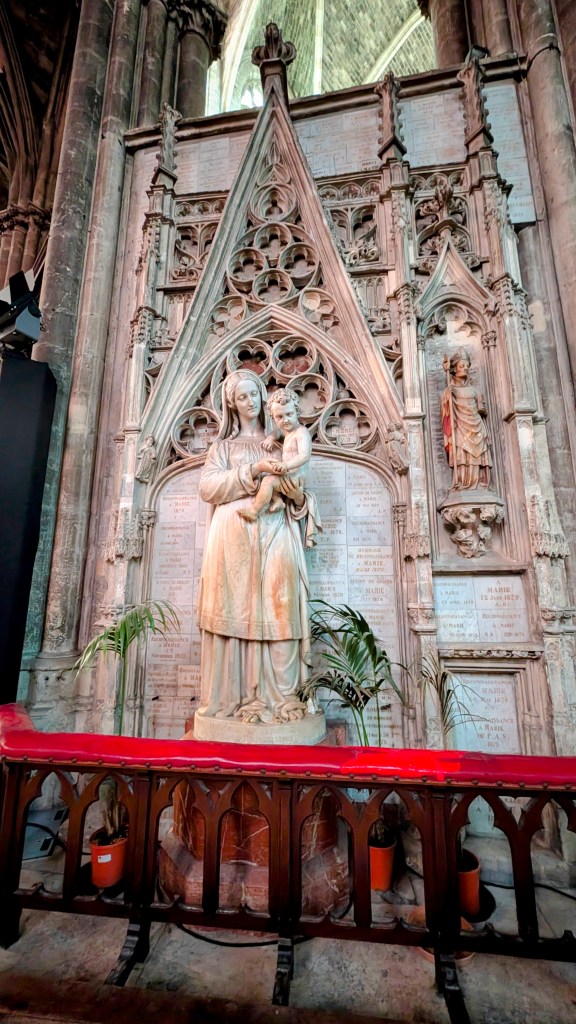
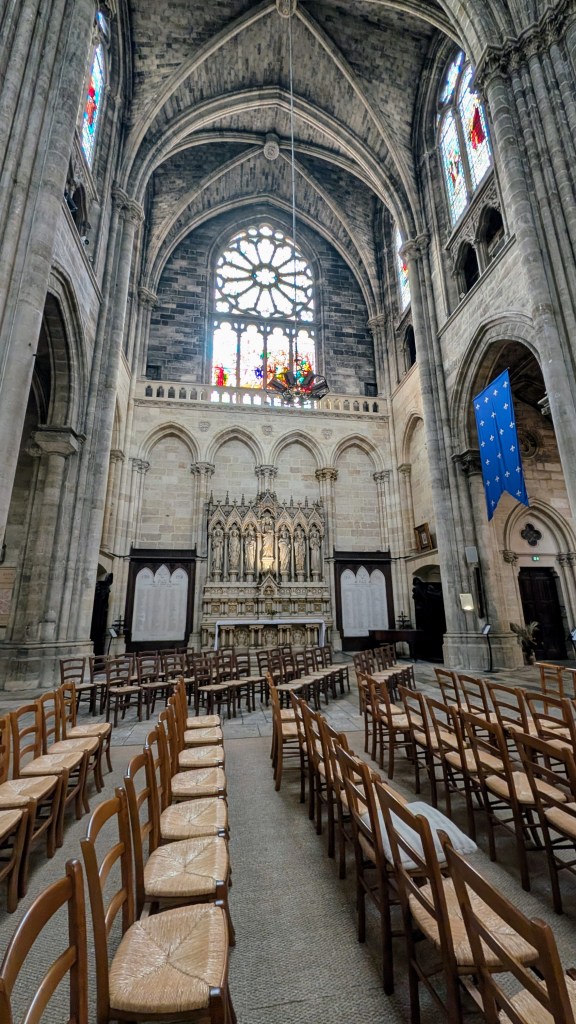
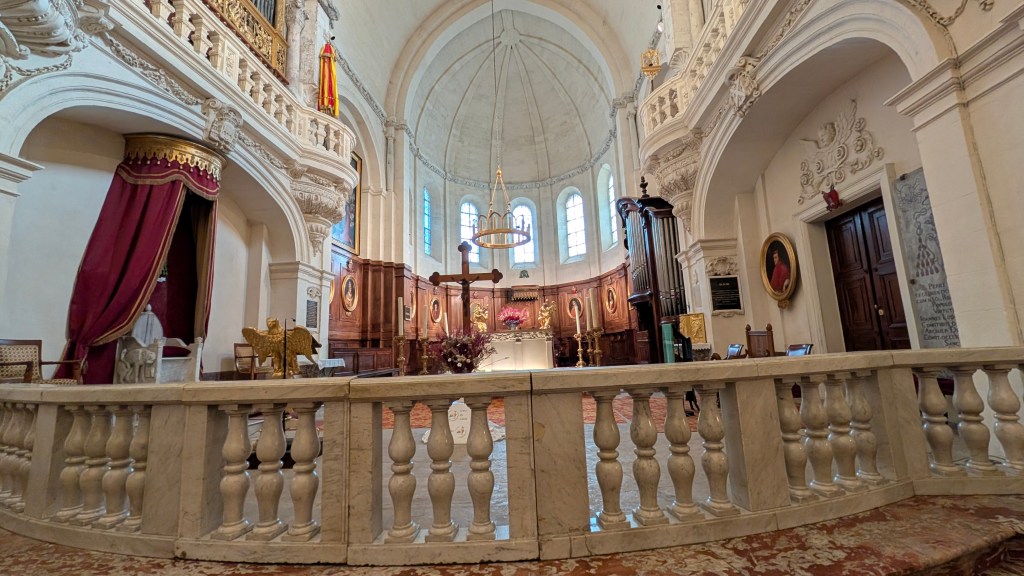
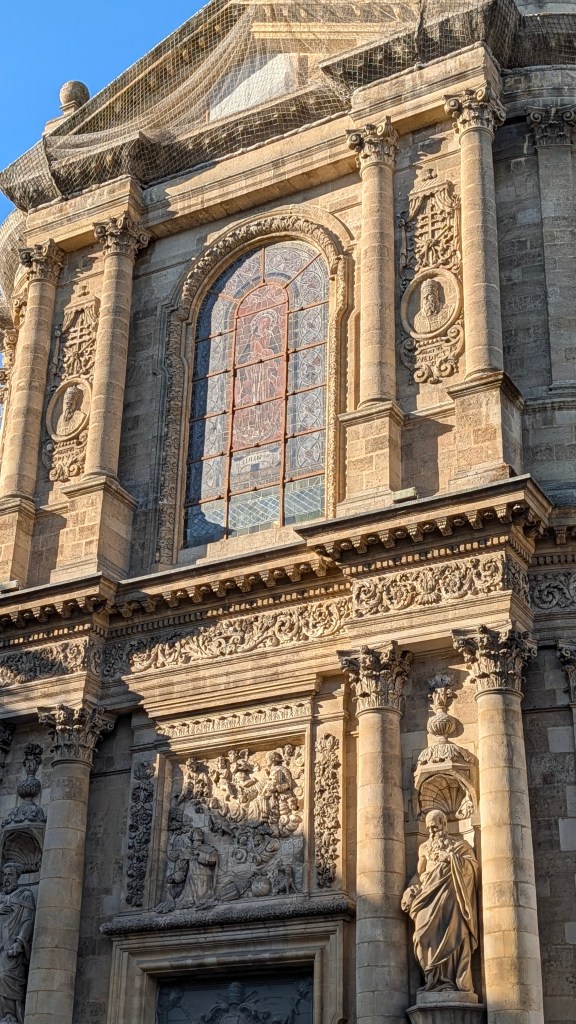
Sarah directed us to Place du Chapelet where we found Église Notre-Dame de Bordeaux (Notre Dame of Bordeaux Cathedral), a Baroque church constructed in the late 17th century. It is dedicated to the Virgin Mary. It was part of a 13th-century Dominican monastery; the adjacent, formerly ruined cloister was restored and is now the Cour Mably. The original church was demolished in 1675 by order of Louis XIV as part of urban planning changes, leading to the construction of the current church.
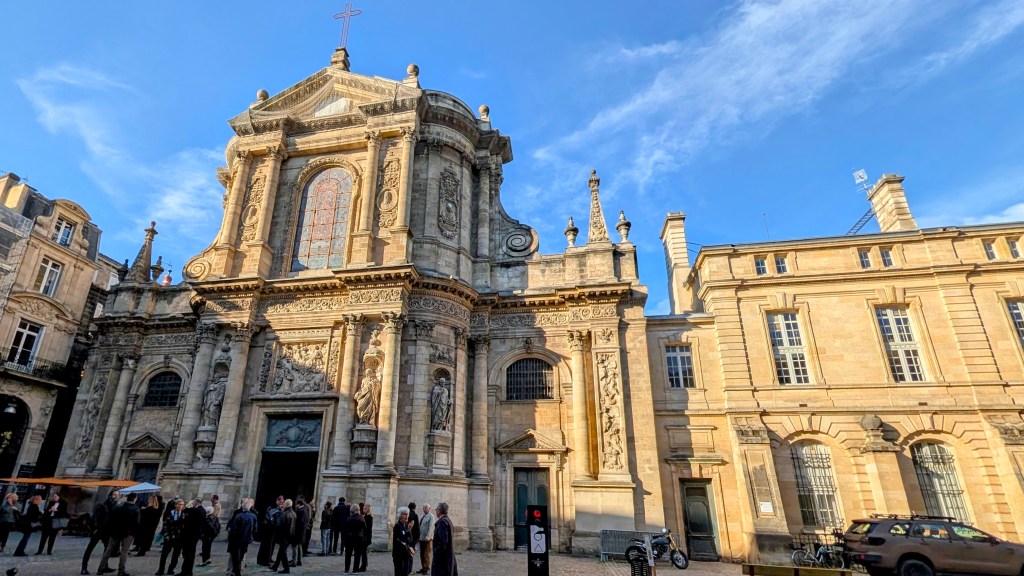
Église Notre-Dame de Bordeaux (Notre Dame of Bordeaux Cathedral)

The facade is known for its intricate Baroque architecture, featuring sculptures and detailed stone carvings.
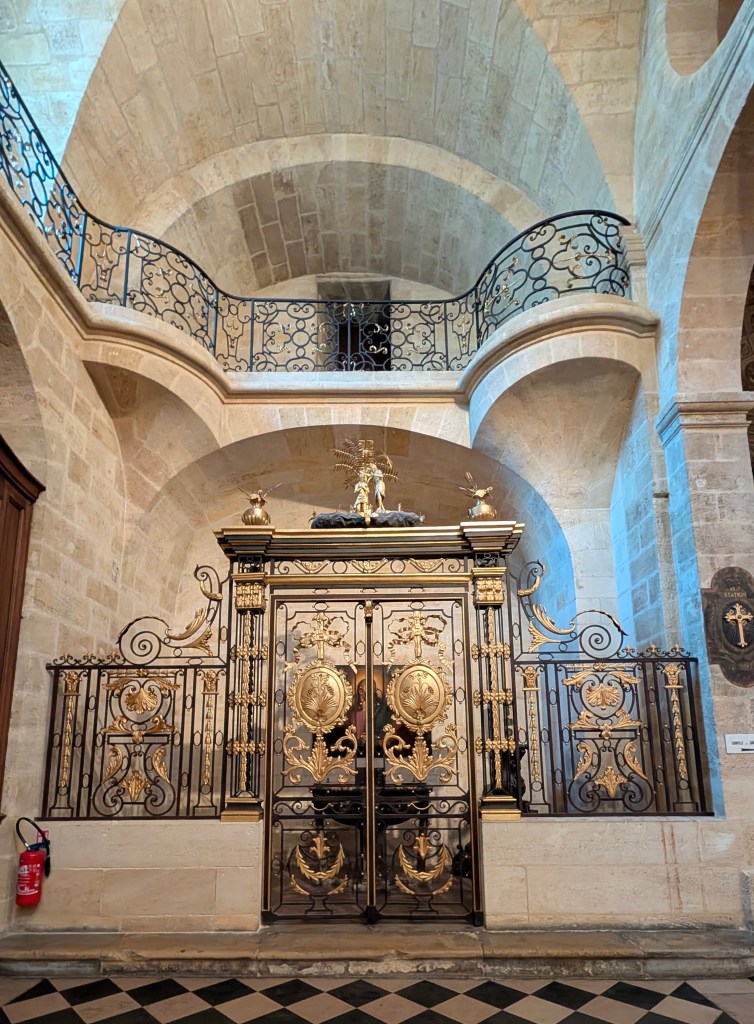
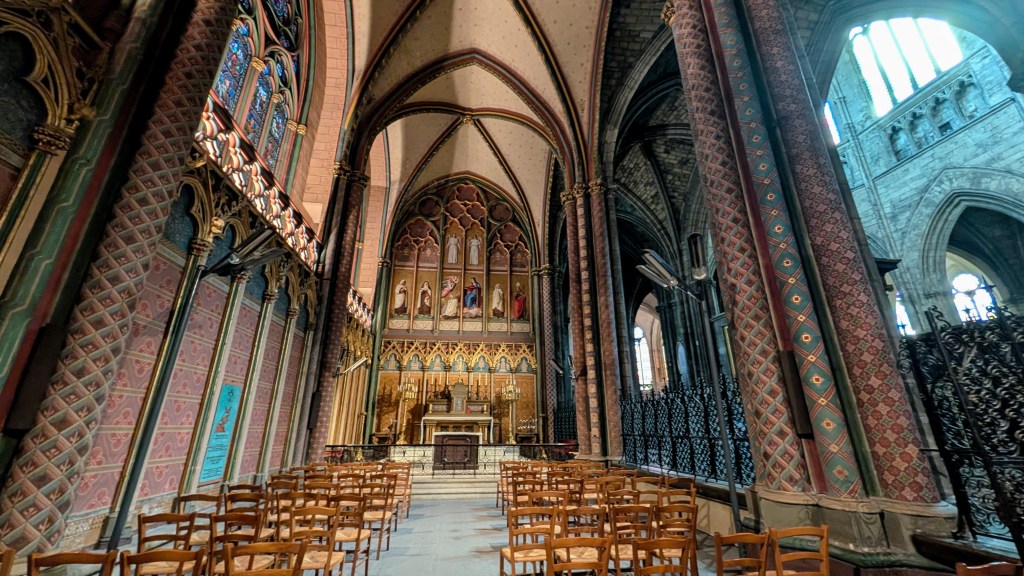
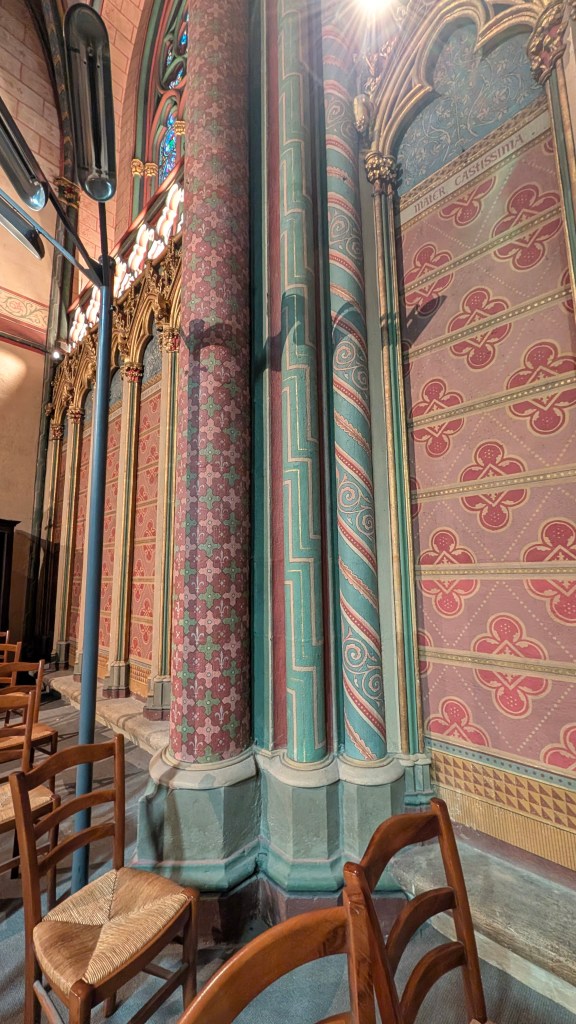
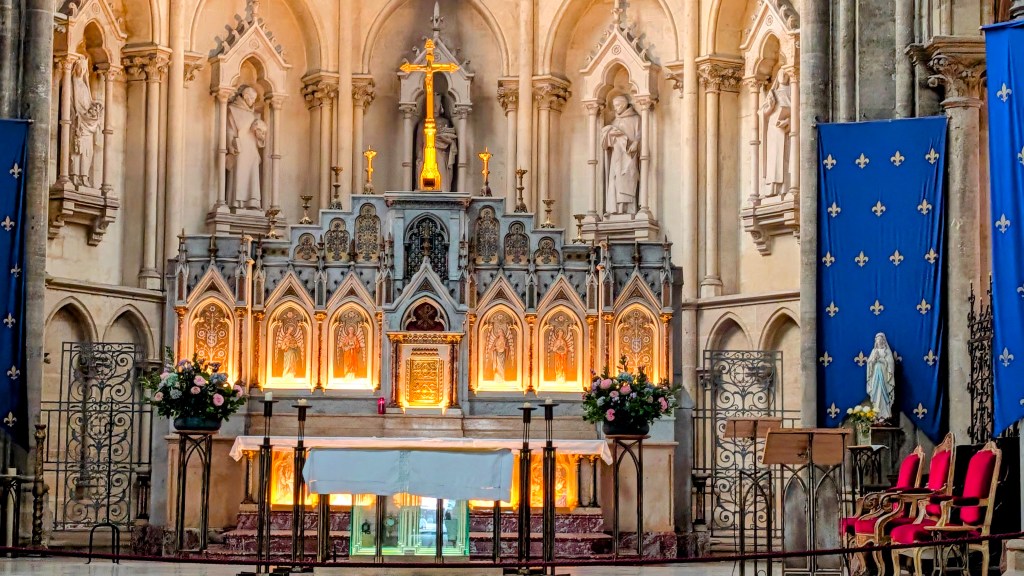
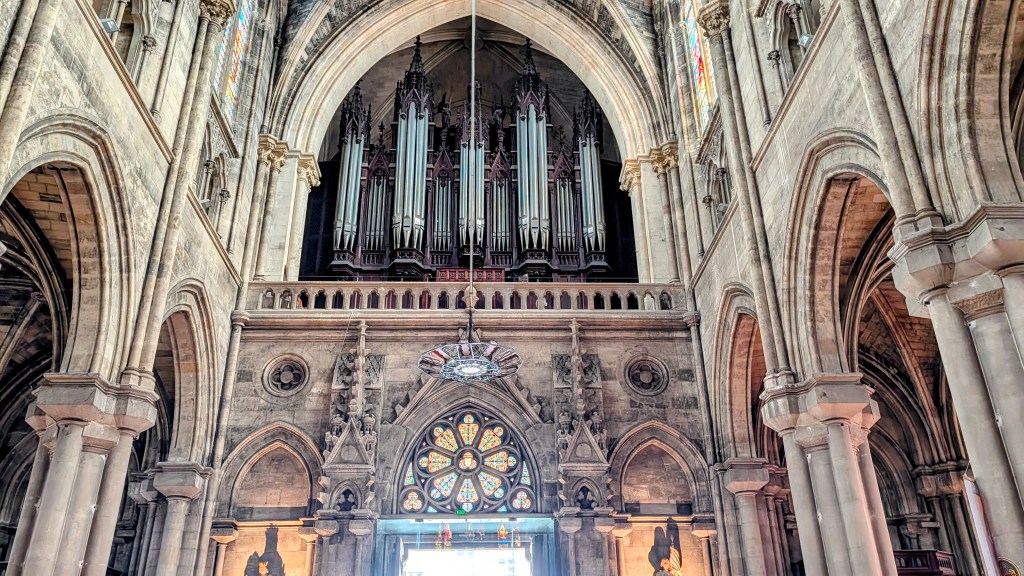
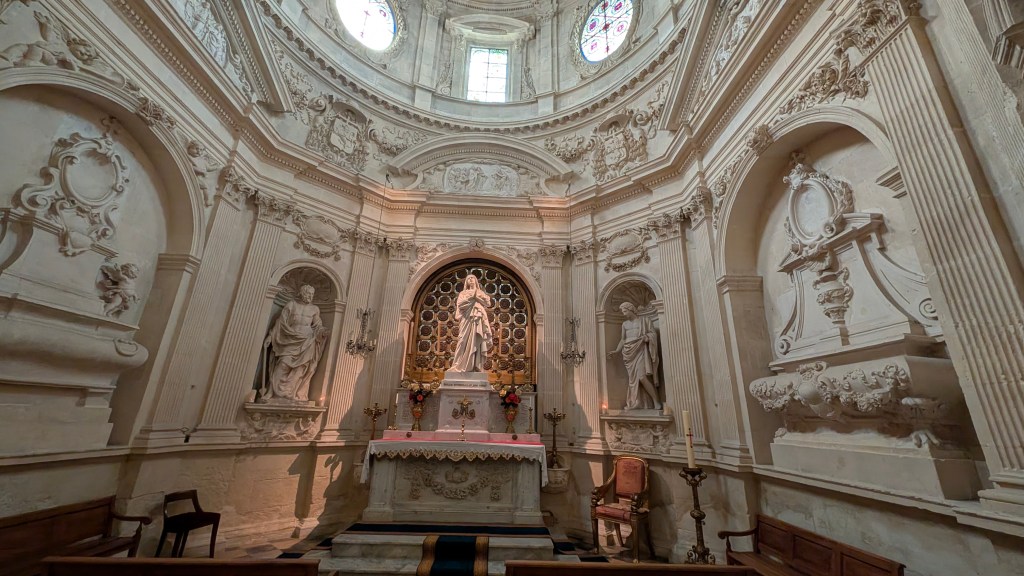
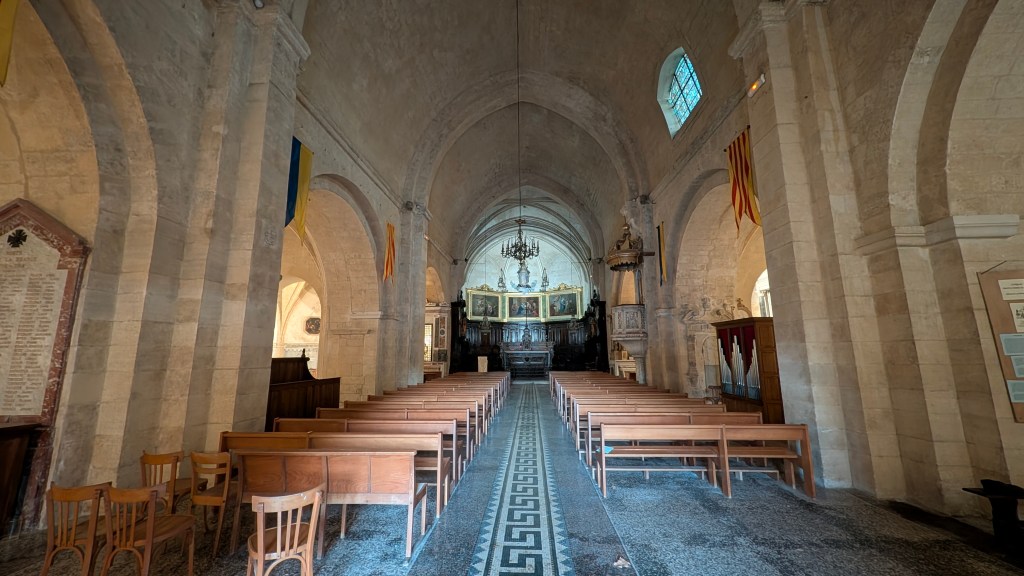
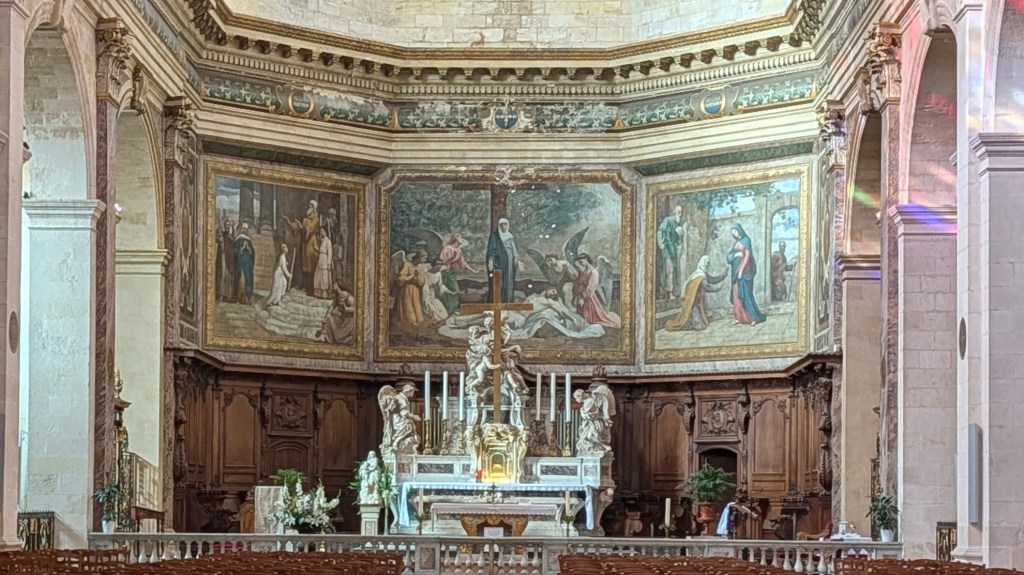
Inside the cathedral the wealth of the city can be found including elaborate marble alters
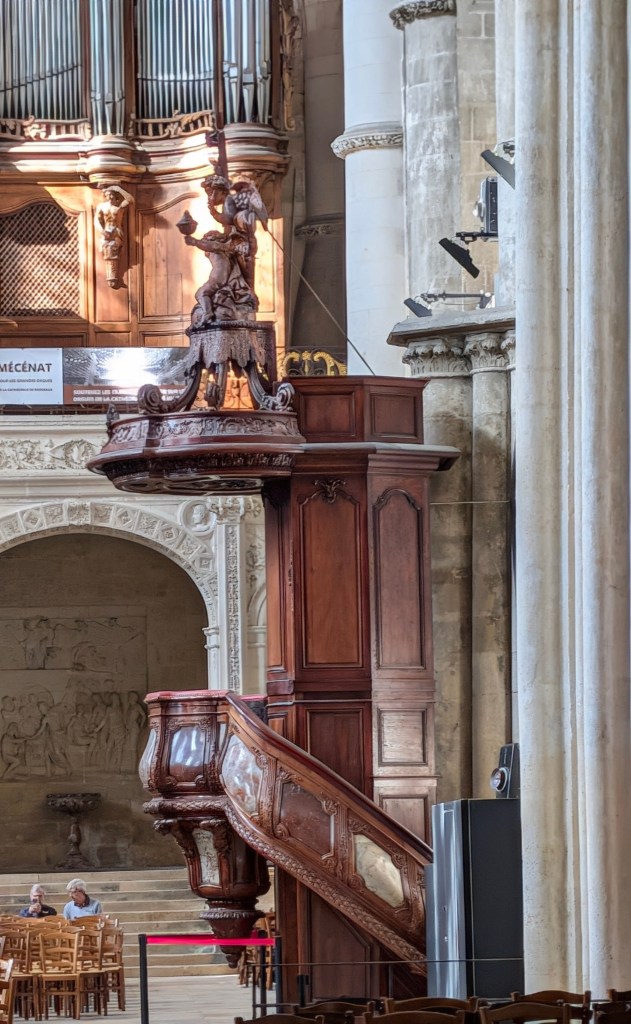
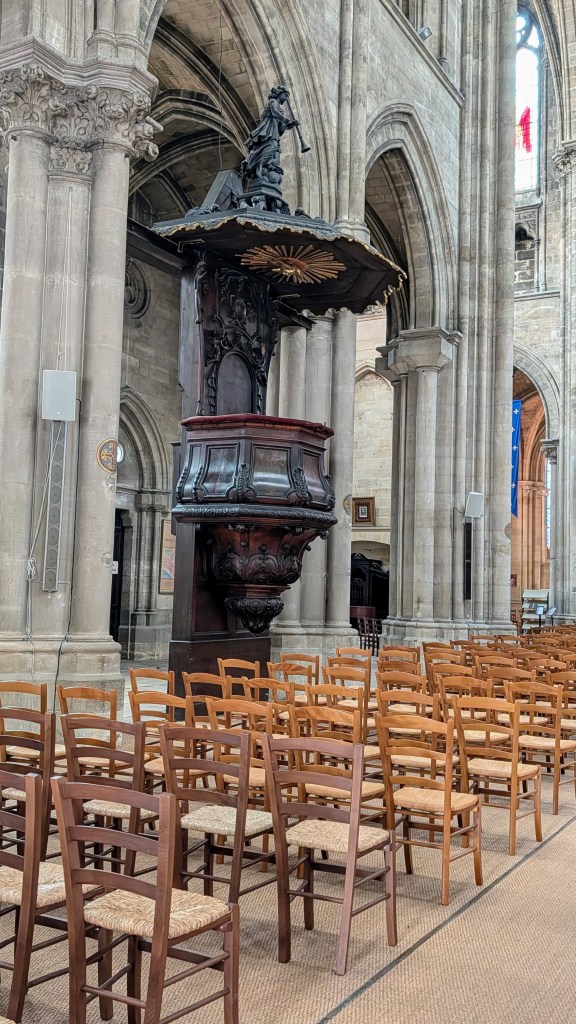
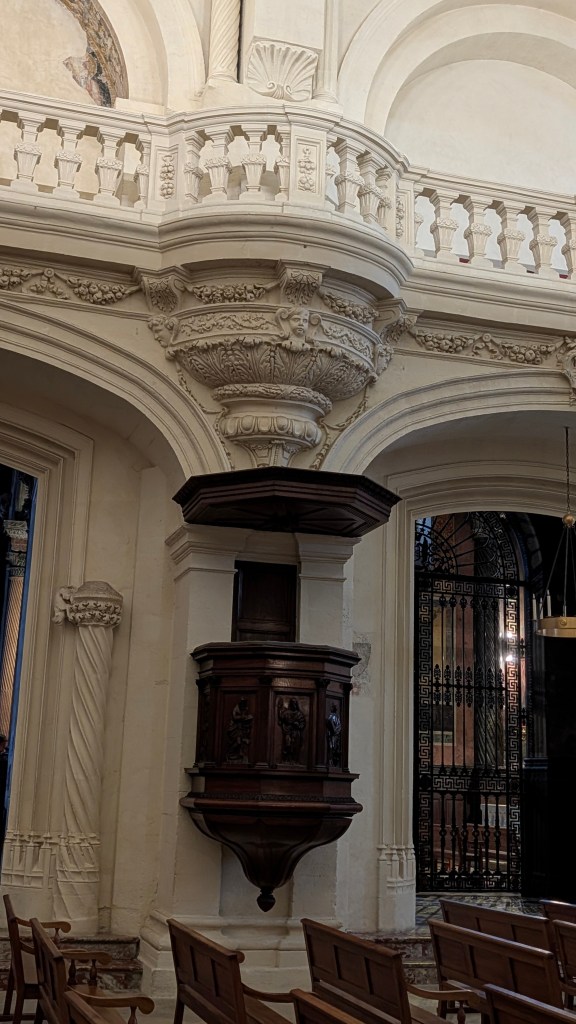
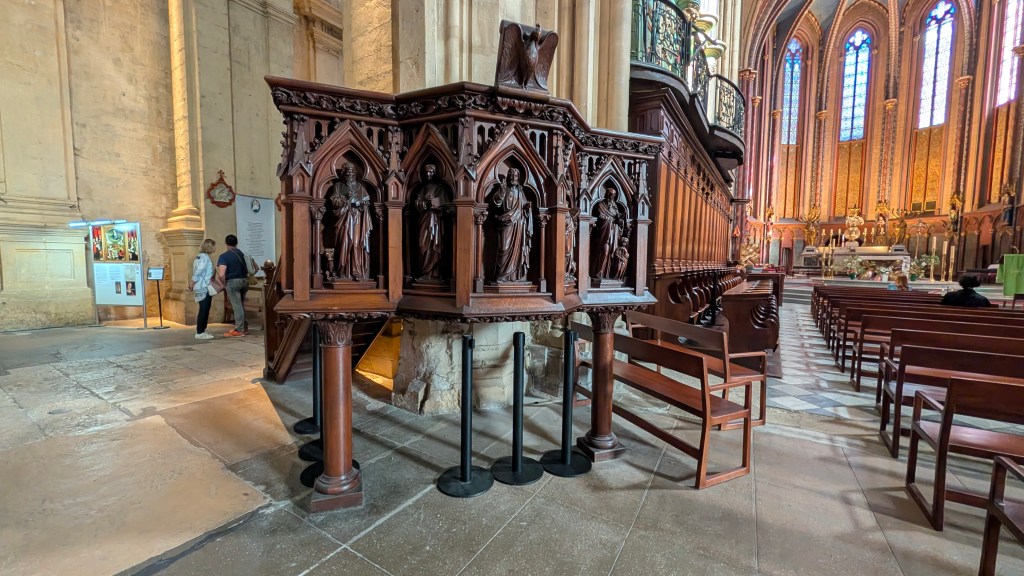
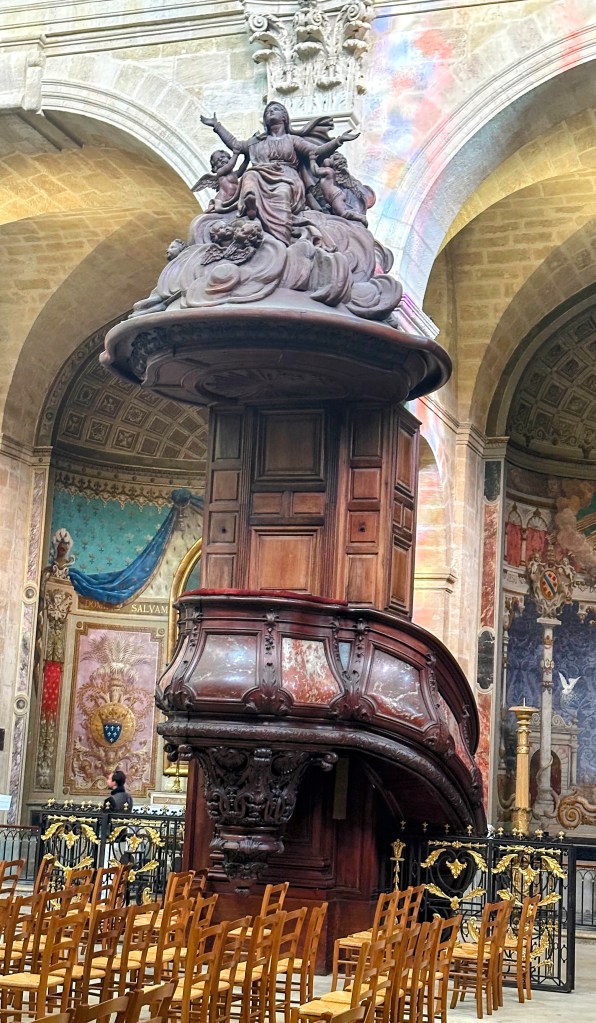
and a pulpit of carved mahogany from the Caribbean inlaid with marble from the Pyrenees.
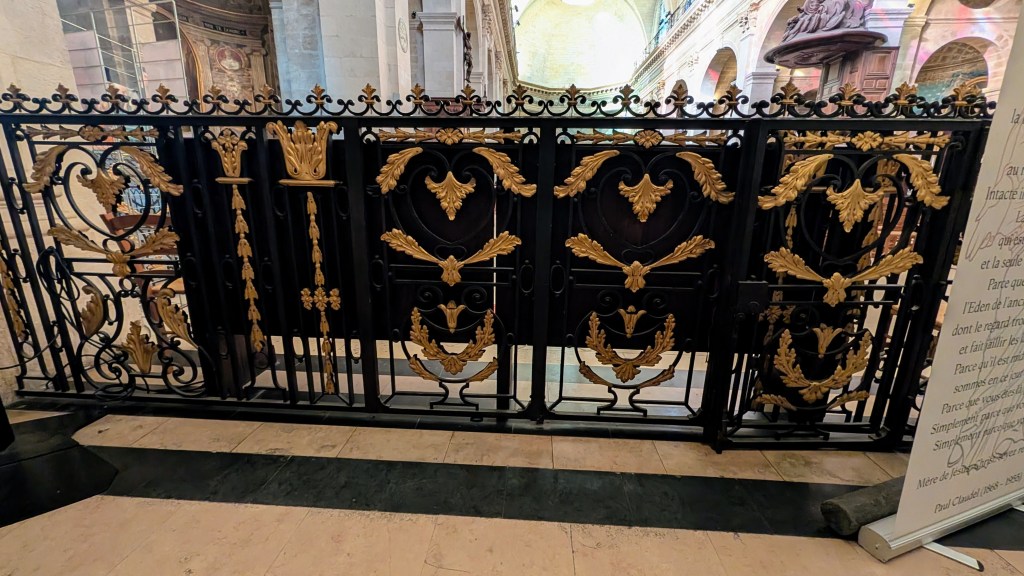
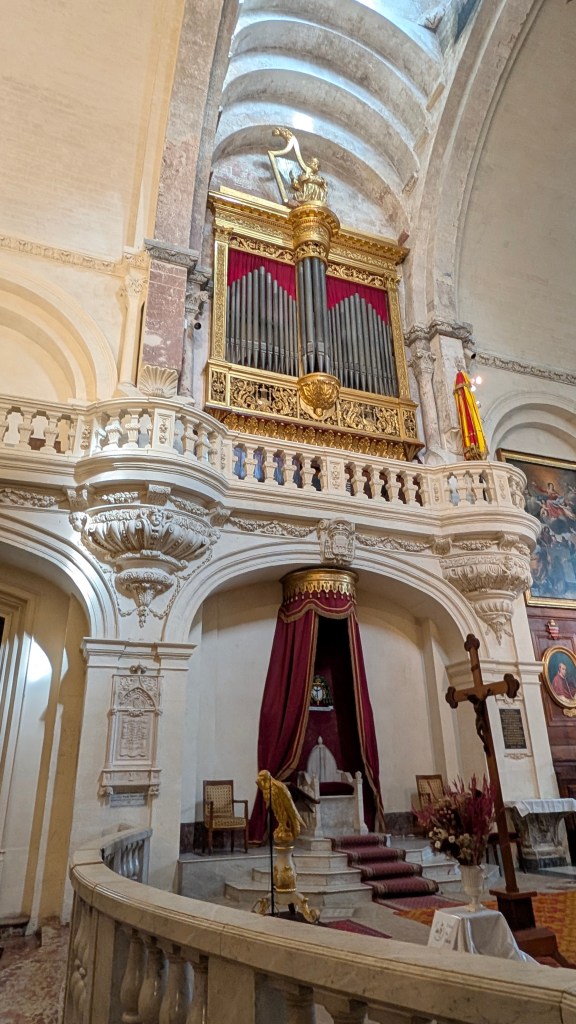
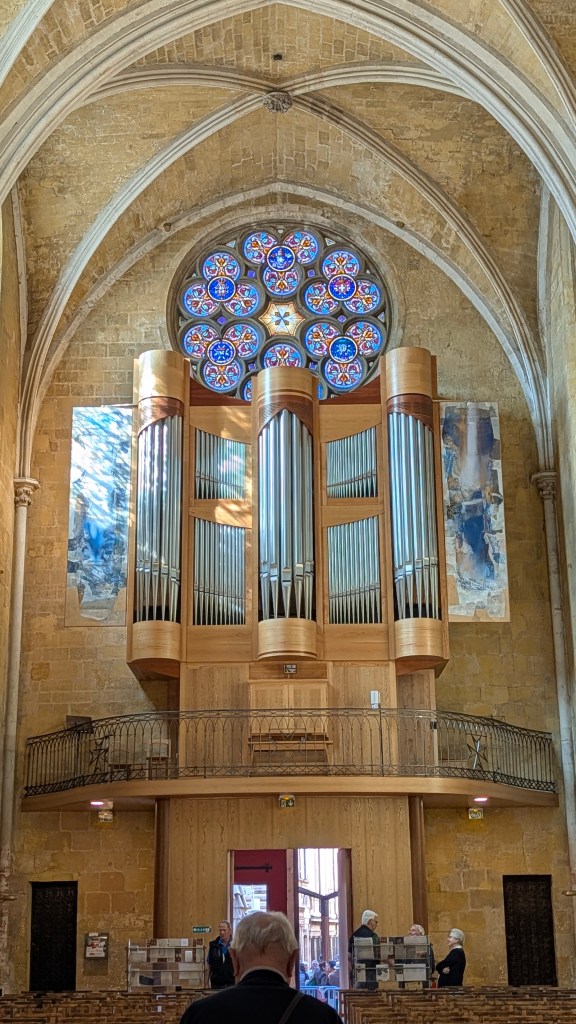
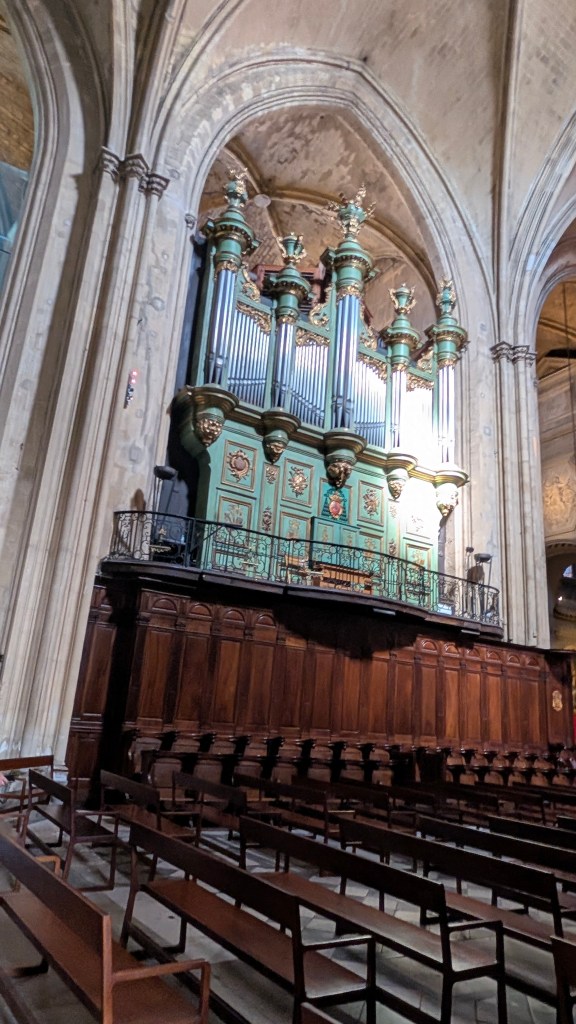
The organ at the Église Notre-Dame de Bordeaux, built in 1785 by Godefroy Schmidt, is housed in what is considered the most beautiful 18th-century mahogany and oak case in the region. This historic instrument features four manuals, 58 stops, and approximately 4,238 pipes, offering exceptional sound tailored for the church’s amazing acoustics.
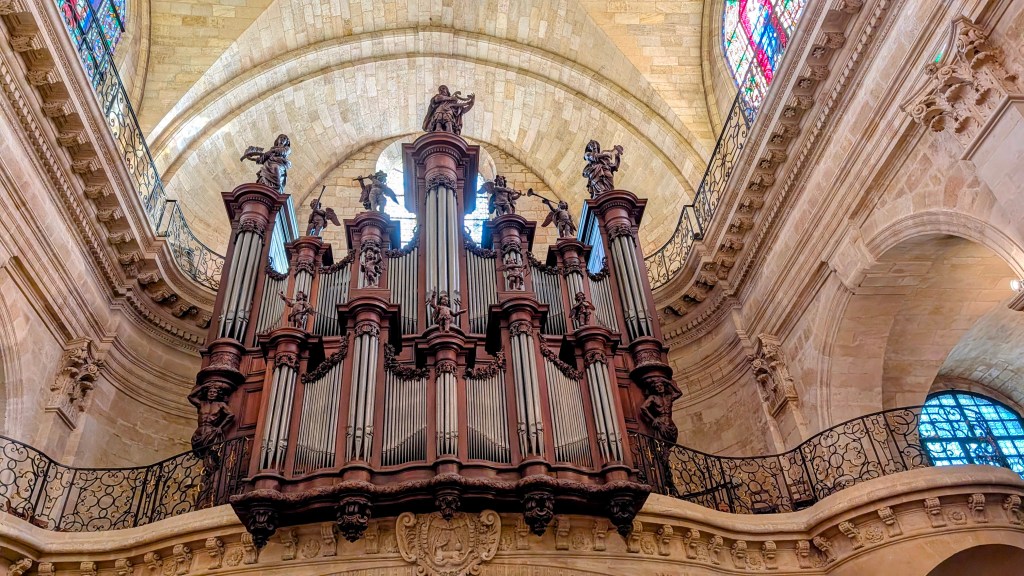
During the French Revolution, the church was stripped of its religious function and served as a “Temple of Reason”. It also spent time as a military warehouse, a political club, and even a library before returning to the church in the 19th century.
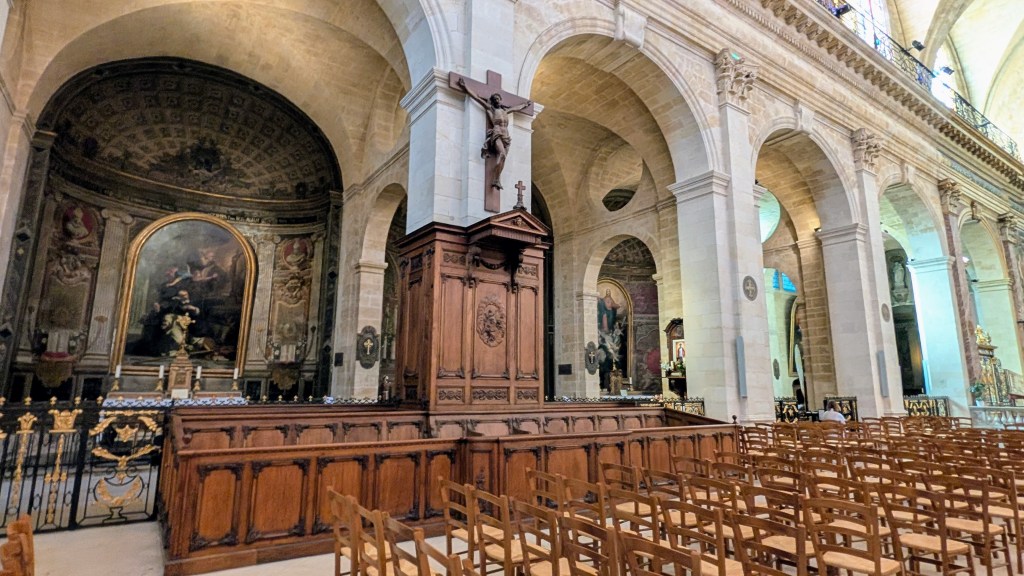
As we walked to our next stop Sarah regaled us with a tale of Goya:  Franciso Goya left Spain in 1824, disillusioned by the political oppression of King Fernando VII, and moved to Bordeaux, where he spent his final years, dying here in 1828. After 60 years, Spain requested his remains be returned, but it was discovered that his head was missing from the skeleton.  The head was never found, leading to theories that it was taken for scientific study (phrenology) or stolen as a model for a painting of a skull which was found in an antique shop in 1928 with an inscription on the back: “Skull of Goya, painted by Fierros”. When the Spanish consul in Bordeaux, Don Joaquin Pereyra, reported the missing skull, the directive from Madrid was to proceed with the repatriation anyway.  Goya’s body, minus the head, is now buried in the Real Ermita de San Antonio de la Florida in Madrid.

We walked through the Passage Sarget, a historic covered shopping gallery built in 1833. It is located in the city center, connecting the Cours de l’Intendance to the Rue Sainte-Catherine.  The arcade is the 18th century precursor to the 20th century shopping mall.
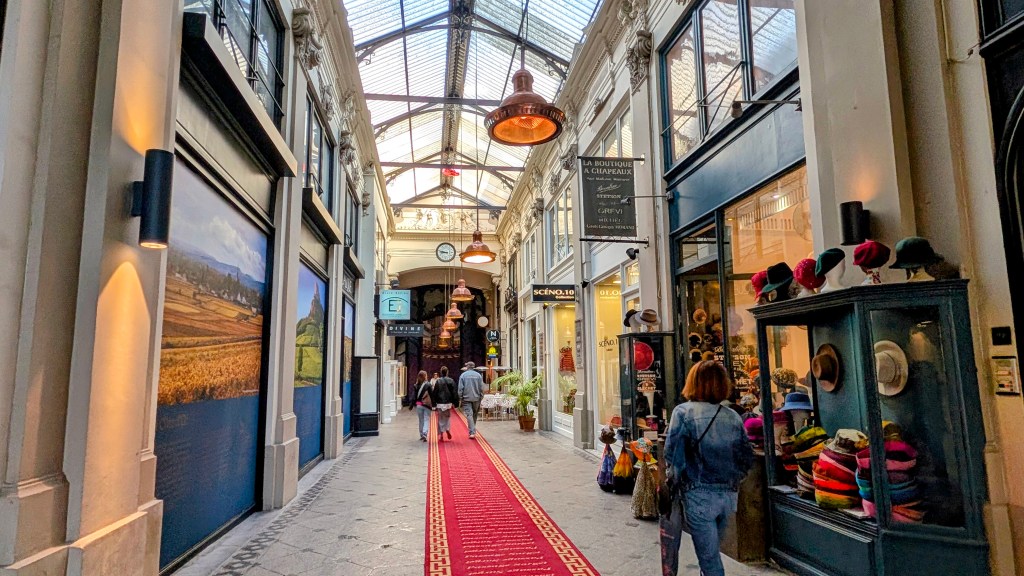
Passage Sarget

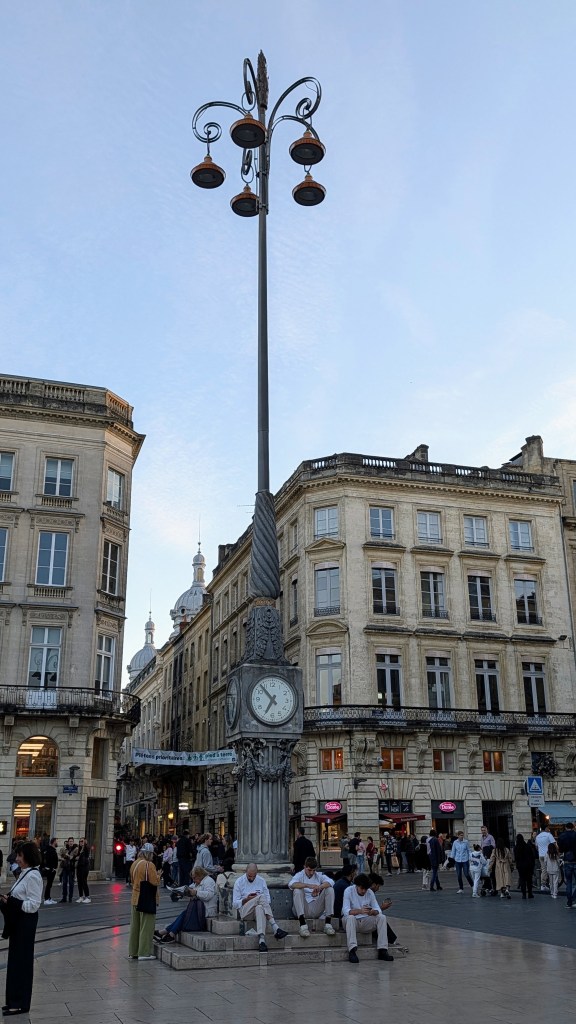
The gallery is known for its atypical charm, high glass roof, and unique boutiques.  It also features the copper topped lights found throughout the city.
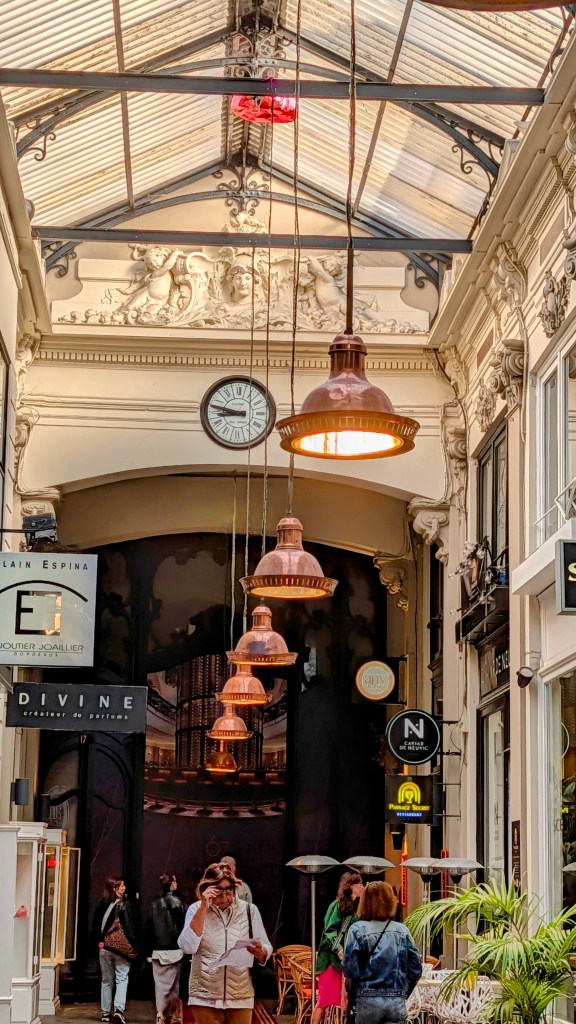
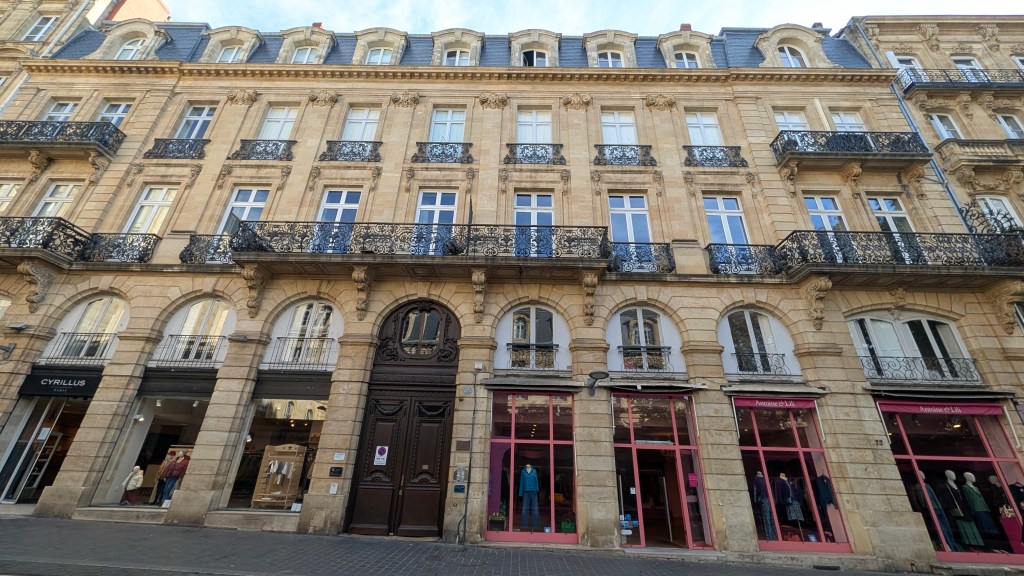
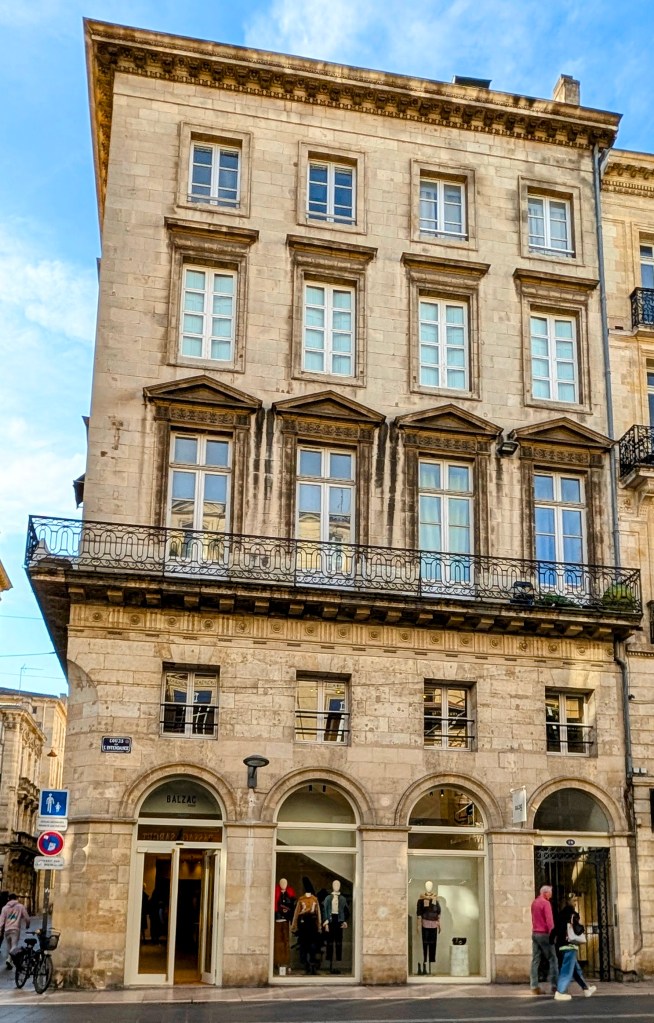
Sarah took us to the main boulevard to take a moment and explain the 17th century architecture. As we had seen in Paris, the bottom is the main wares house, or business establishment. The next floor up, with the small windows, was for the many clerks and bookkeepers who worked for the establishment. The next level up with the ornate terraces were the receiving rooms for the family, above which are the family bedrooms, and at the top the servants’ quarters.
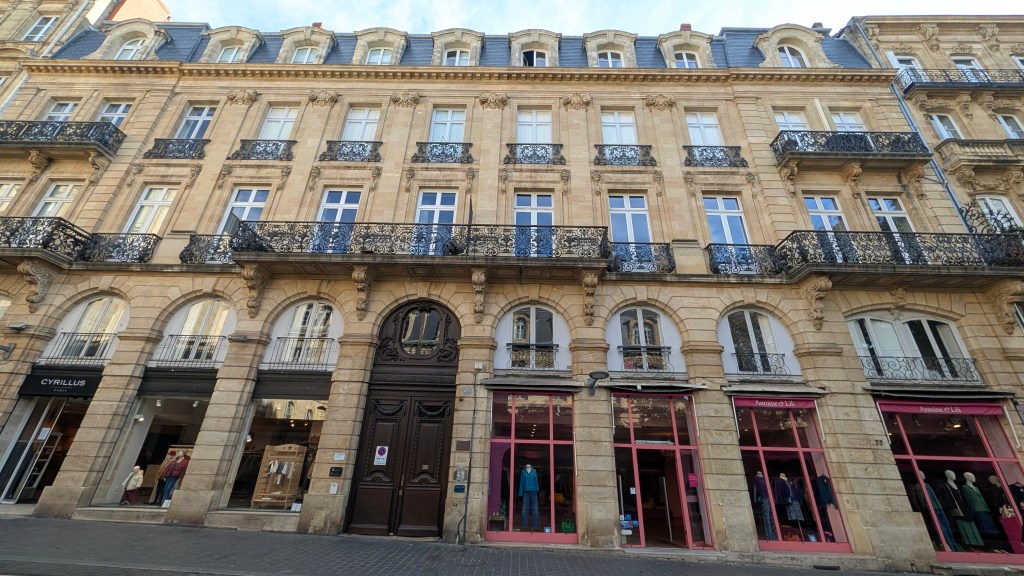
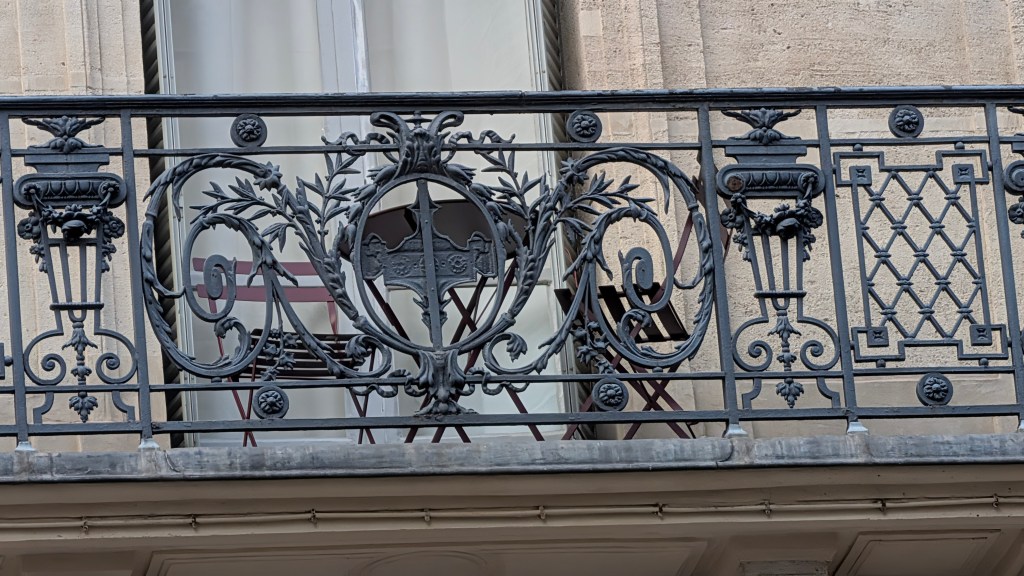
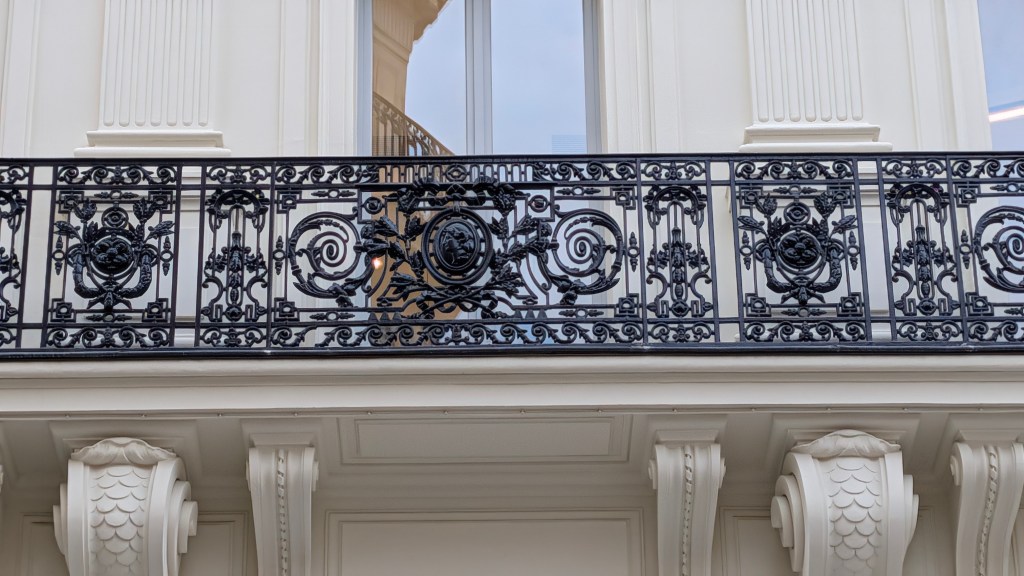
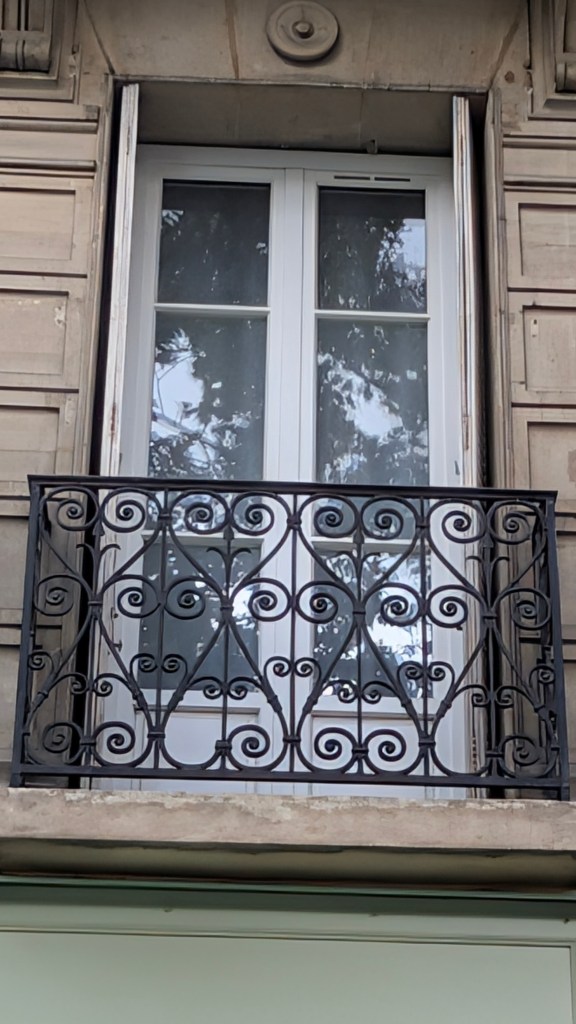
And as in Paris, the grill work on the terraces can be ornate. The claim here in Bordeaux is that decorating with grillwork initiated here prior to its adoption in Paris.
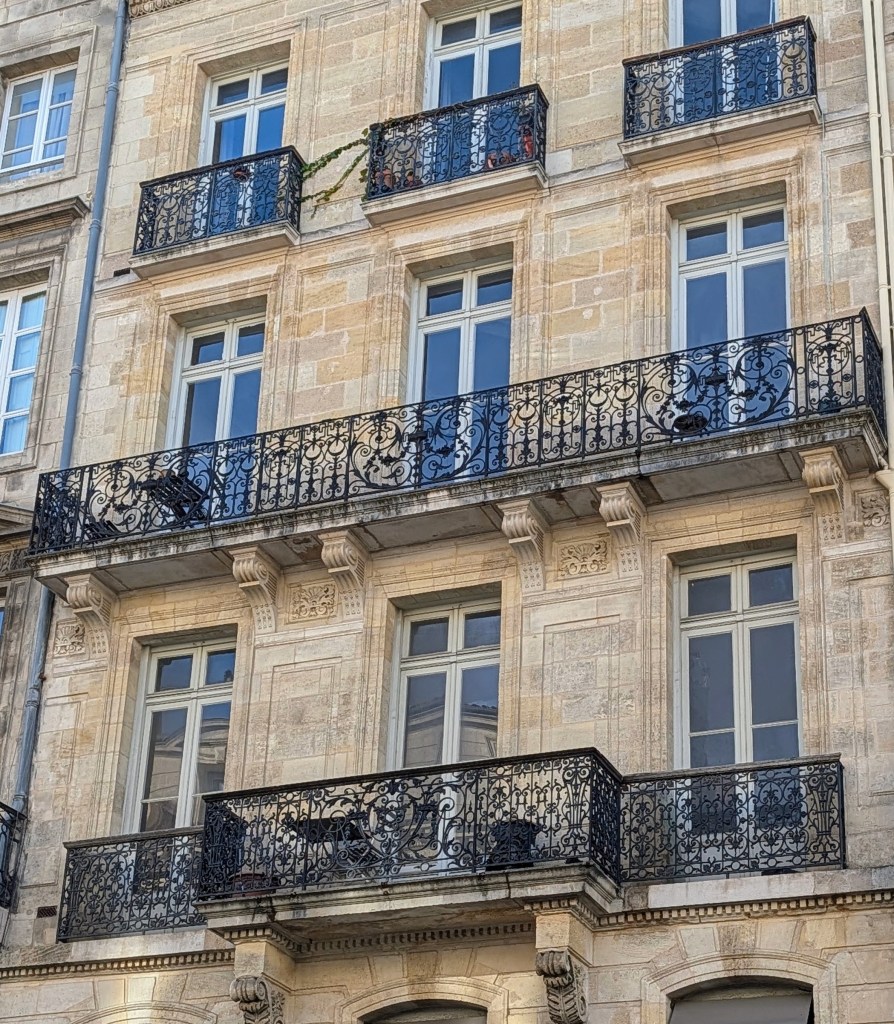
The wrought iron is brought from Sweden. Some are quite elaborate as a manner of showing off one’s wealth. Those with spikes are teasingly coined the “cuckold” protectors.
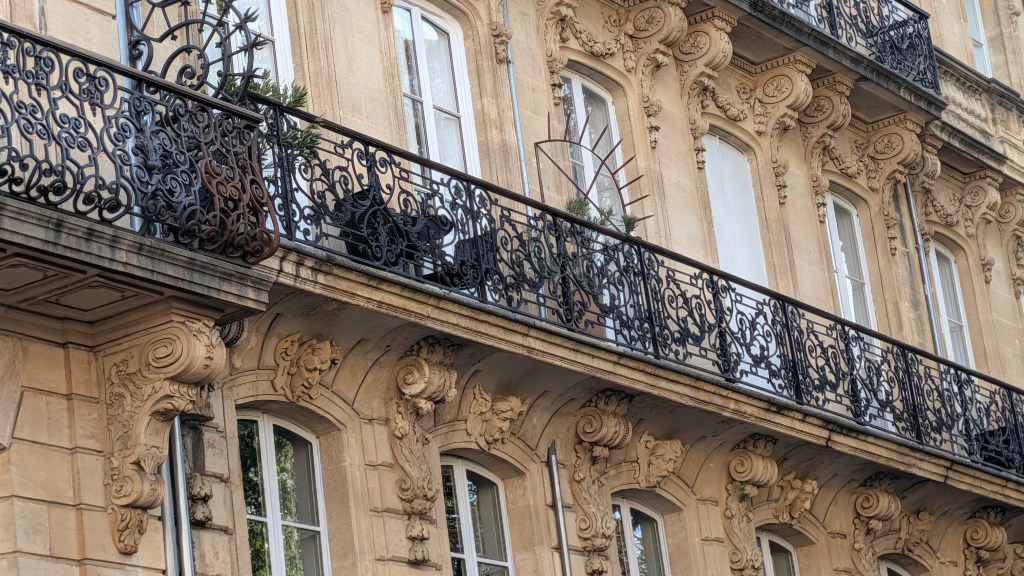
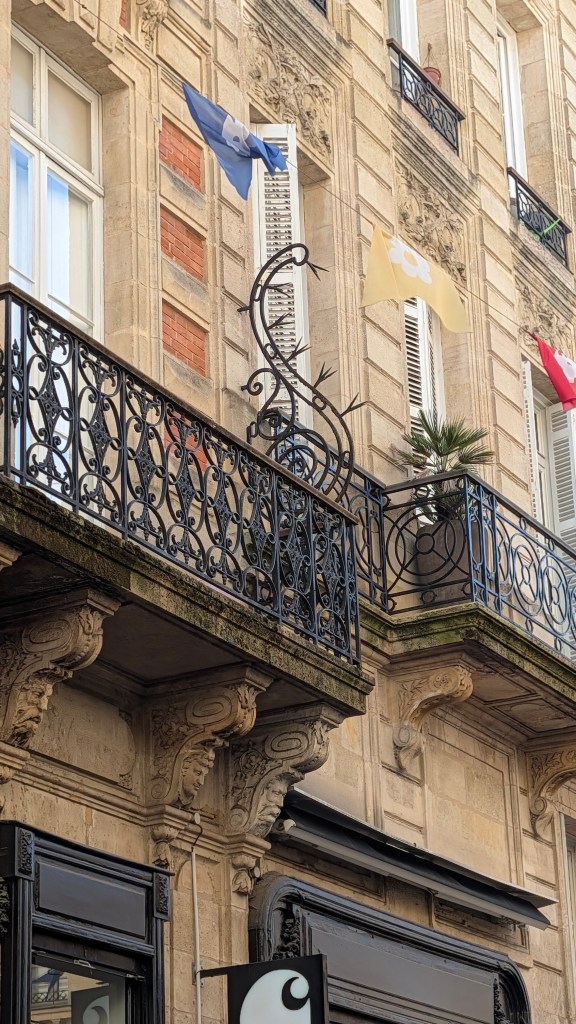
I found the conept hilarious and this one the funniest.
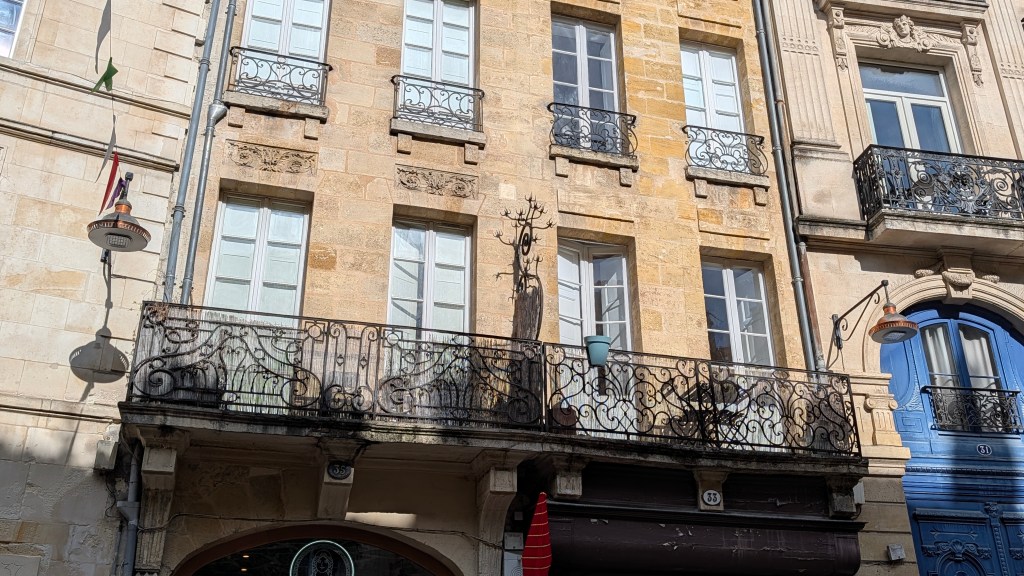
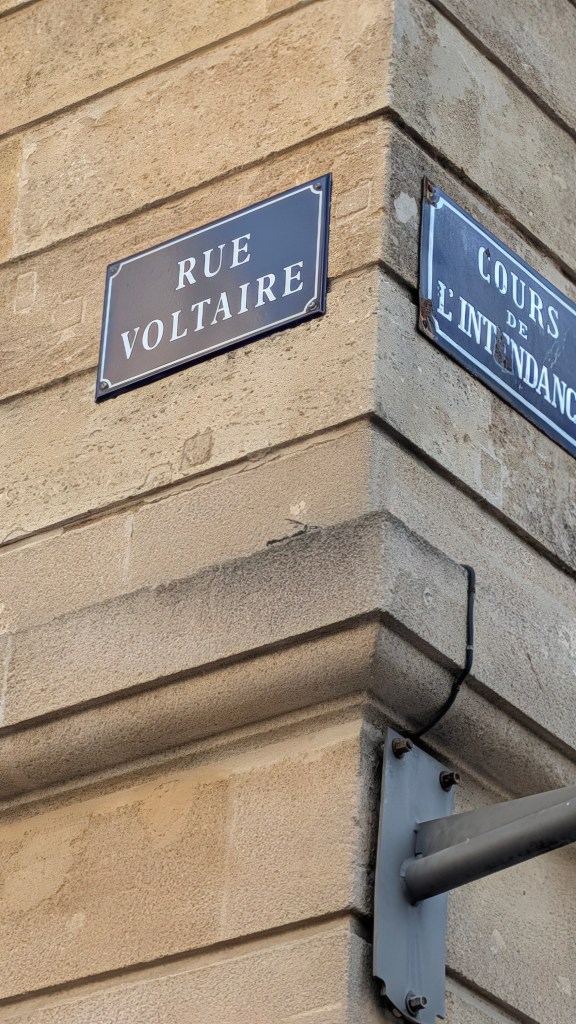
As this was a very wealthy area, and it was the age of enlightenment, many of the streets were named for the “thinkers” of the time.
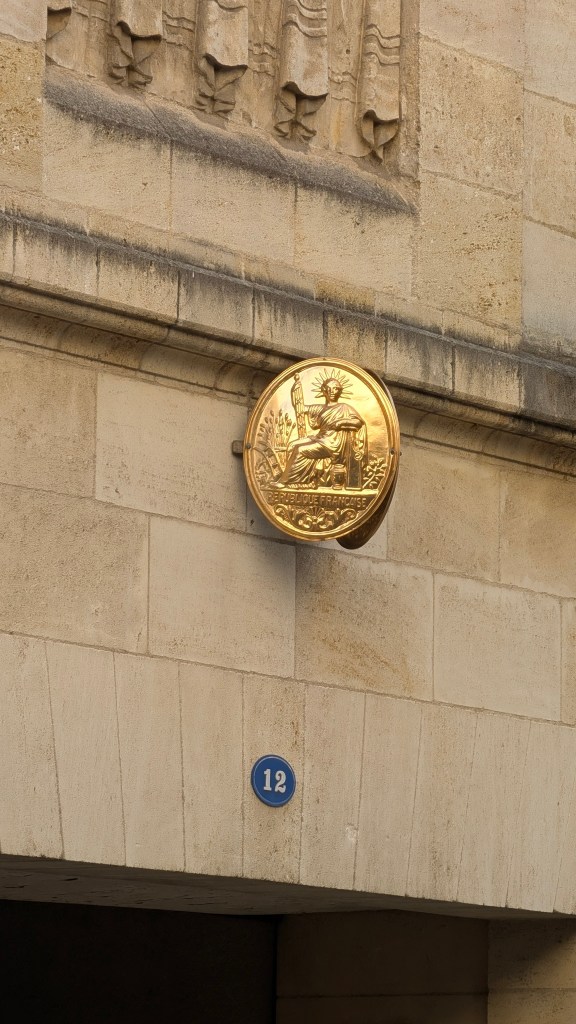
We asked Sarah about the gold notary signs we see above some doors. She explained that notaries in France have a lot of specific and strict requirements which, once attained, come with a lot of special privileges. The distinction is often inherited.
The Porte Dijeaux (Gate of Jews) in Bordeaux is an 18th-century, neoclassical triumphal gate built between 1748-1753 from Frontenac stone. Originally an entrance to the old walled city marking the western Roman entrance, its name derives from Gascon, meaning “Gate of Jews” because Jewish communities historically lived beyond it.
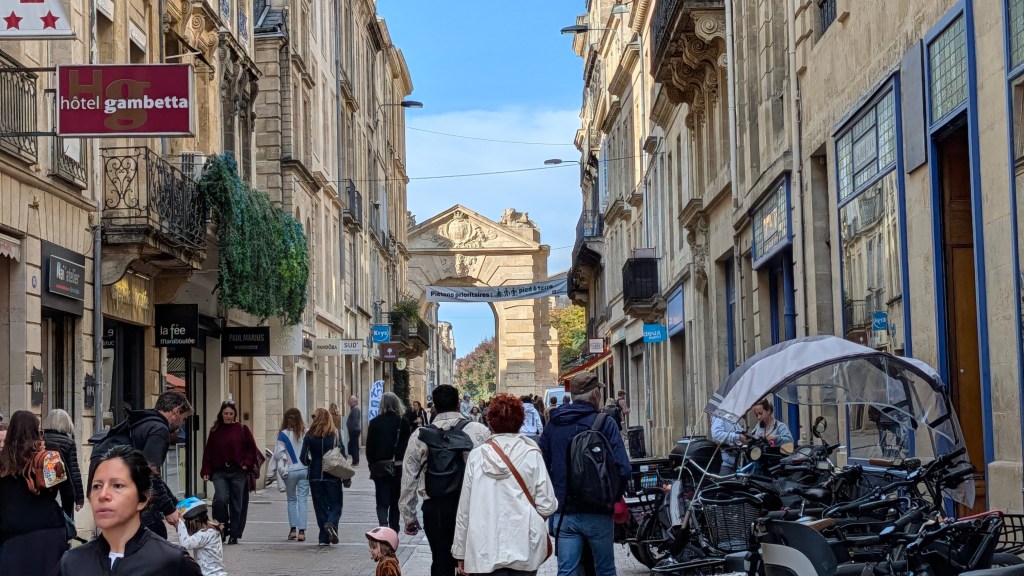
Porte Dijeaux (Gate of Jews)

Librairie Mollat, a famous independent bookstore is considered the largest independent bookstore in France, spanning over five connected historic buildings. Founded in 1896, it is a significant cultural landmark in the city. The store offers a vast selection of over 300,000 titles across various genres and includes a large English section. 
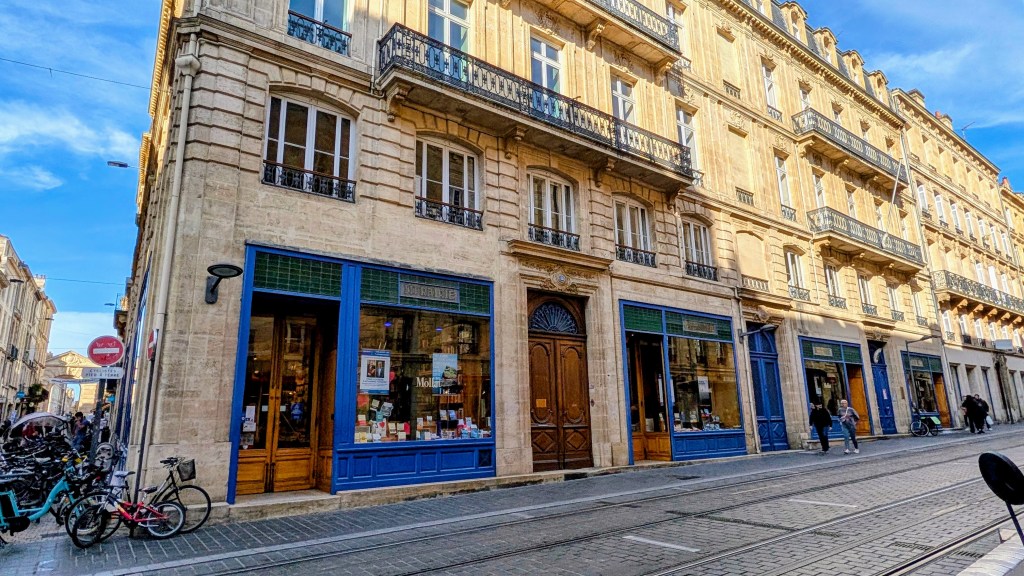
Librairie Mollat

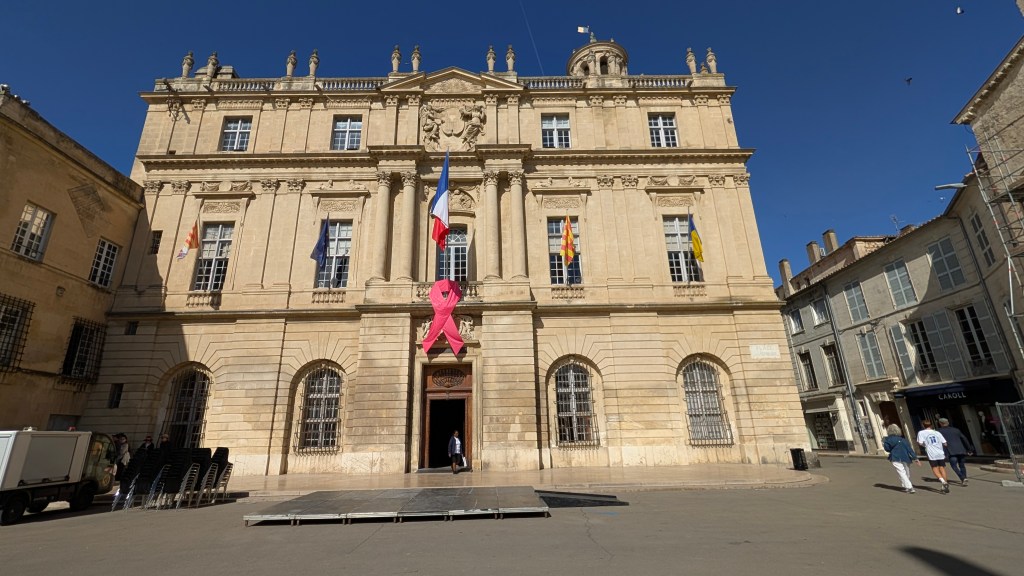
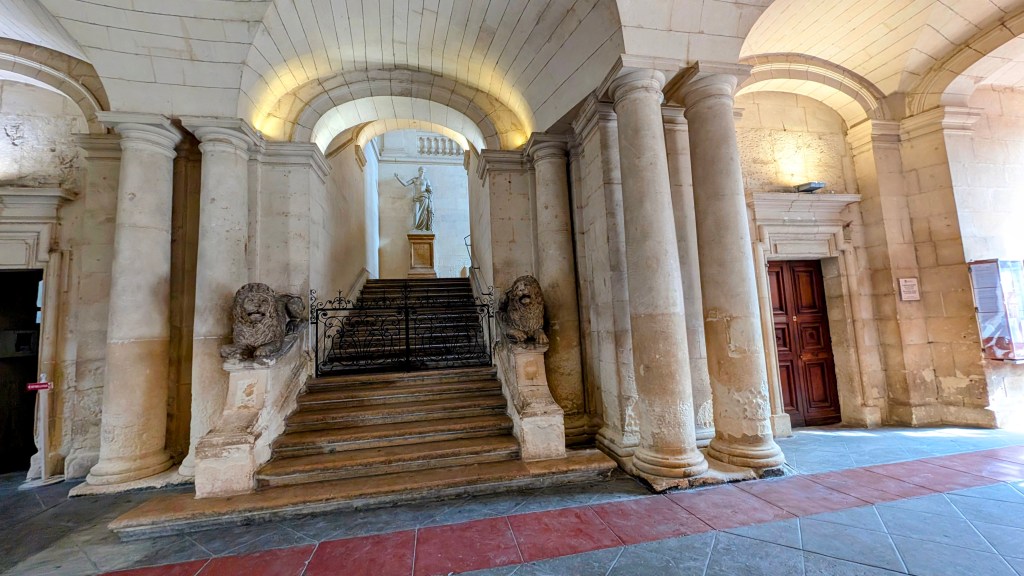
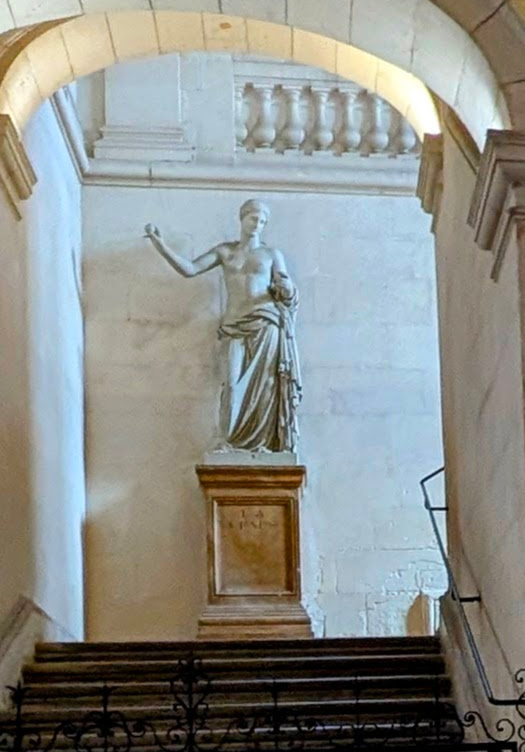
Three times in history Bordeaux became the capital of France. The government relocated to Bordeaux during the Franco-Prussian War (1870–1871), the beginning of World War I (1914), and during the German invasion in World War II (1940). Palais Rohan, which serves as the Hôtel de Ville (City Hall) of Bordeaux since the 1830s, was built in the 18th century as a monumental residence for the Archbishop of Bordeaux. It features an austere Louis XVI-style façade and a renowned grand staircase. Refugees fleeing from the north during WW II stayed here while awaiting visas to the Americas.
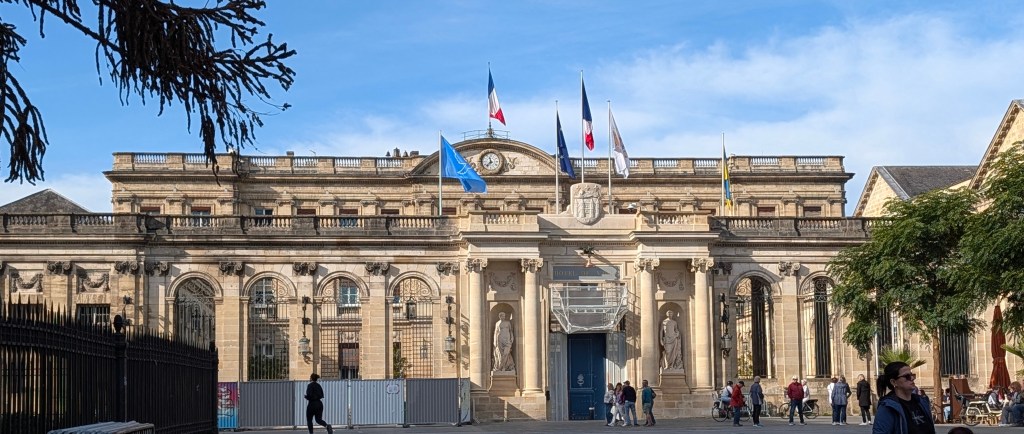
Palais Rohan

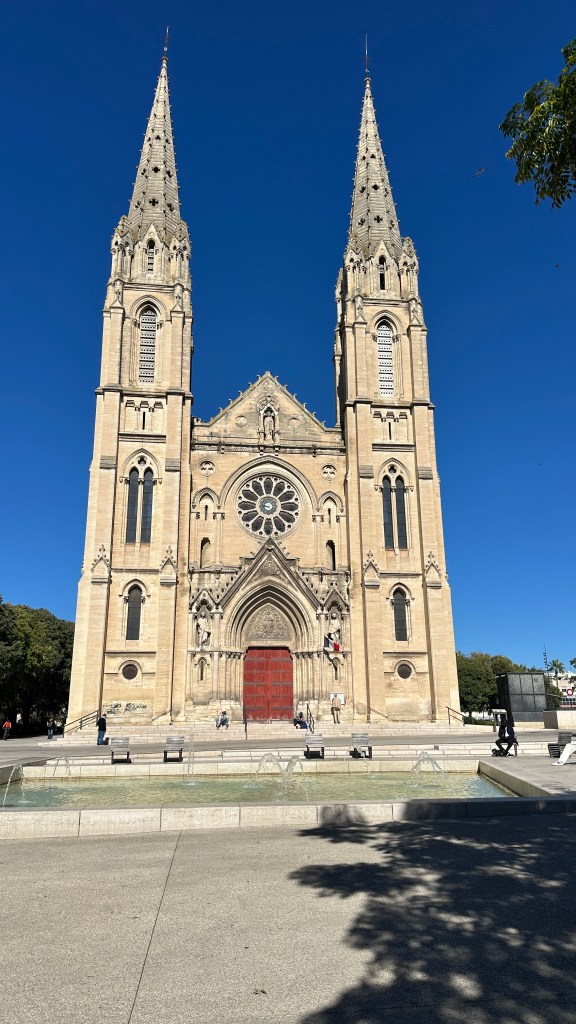
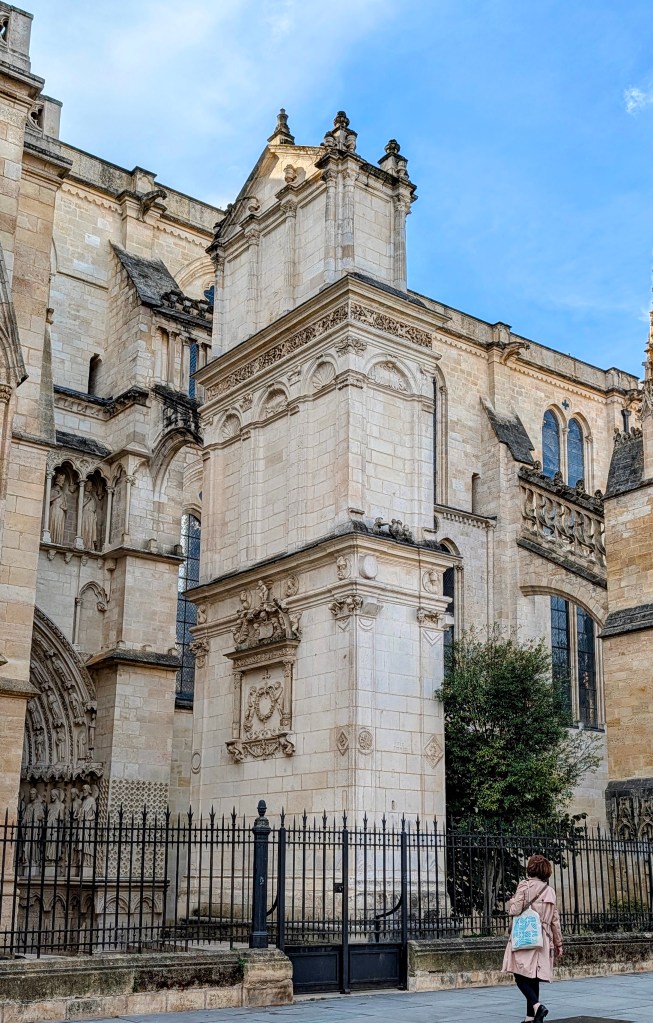
Next door to Palais Rohan is Cathédrale Saint-André (Bordeaux Cathedral of Saint Andrew), a stunning example of Gothic architecture, with construction spanning from the 12th to the 16h century.  It serves as a central symbol of Bordeaux and is located near the City Hall in the heart of the city. Due to being built over 400 hundred years, the cathedral has a heterogeneous mix of architectural styles, featuring different colors of stone on its facade.
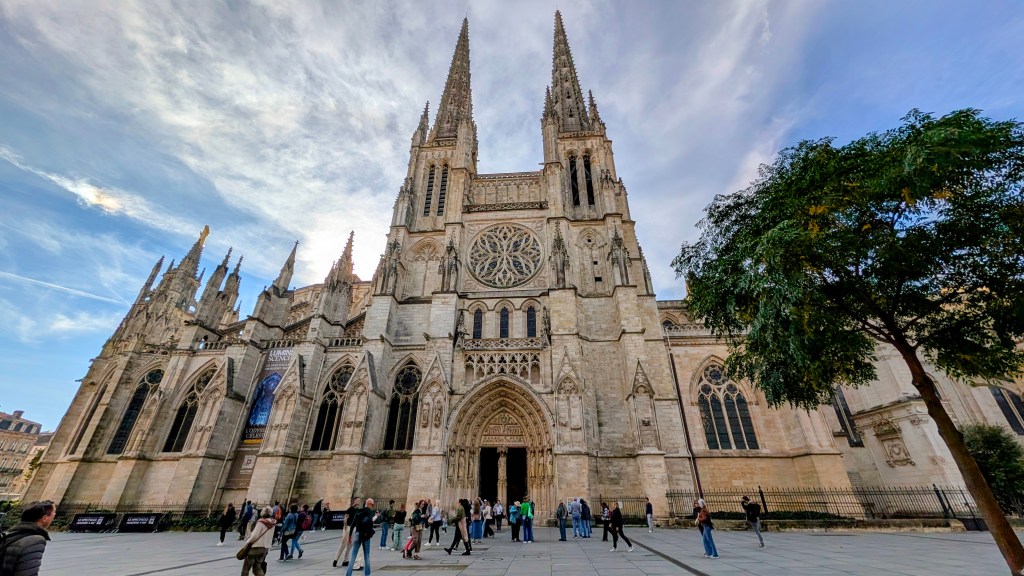
Cathédrale Saint-André (Bordeaux Cathedral)

 This cathedral was the site of significant royal weddings, including Eleanor of Aquitaine to the future King Louis VII in 1137. 
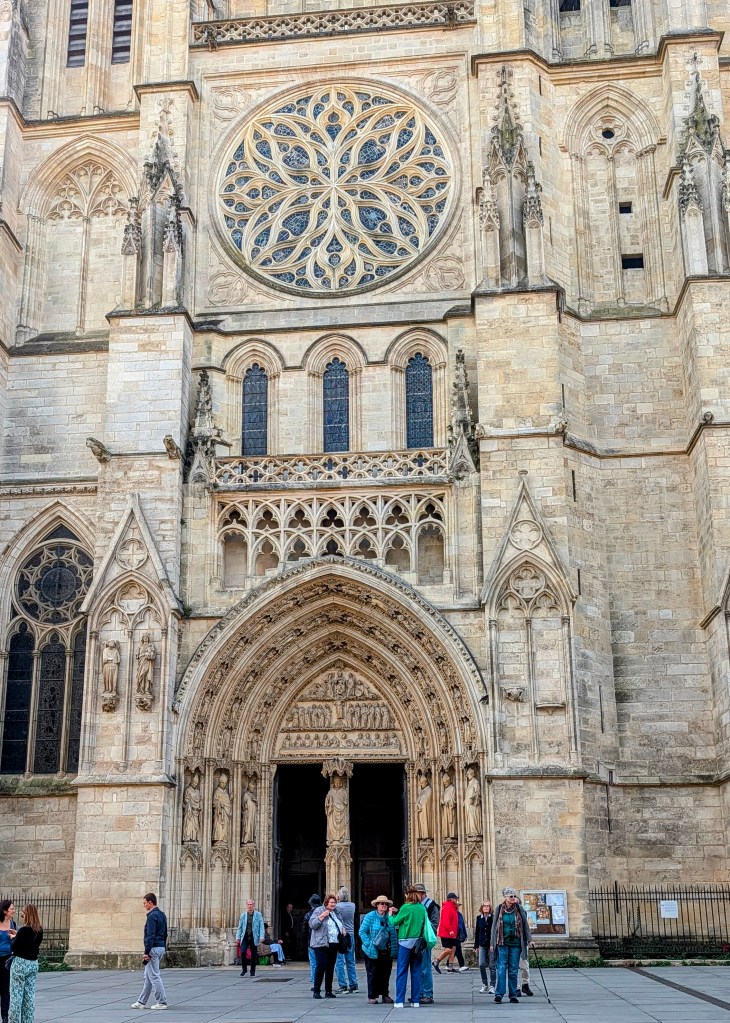
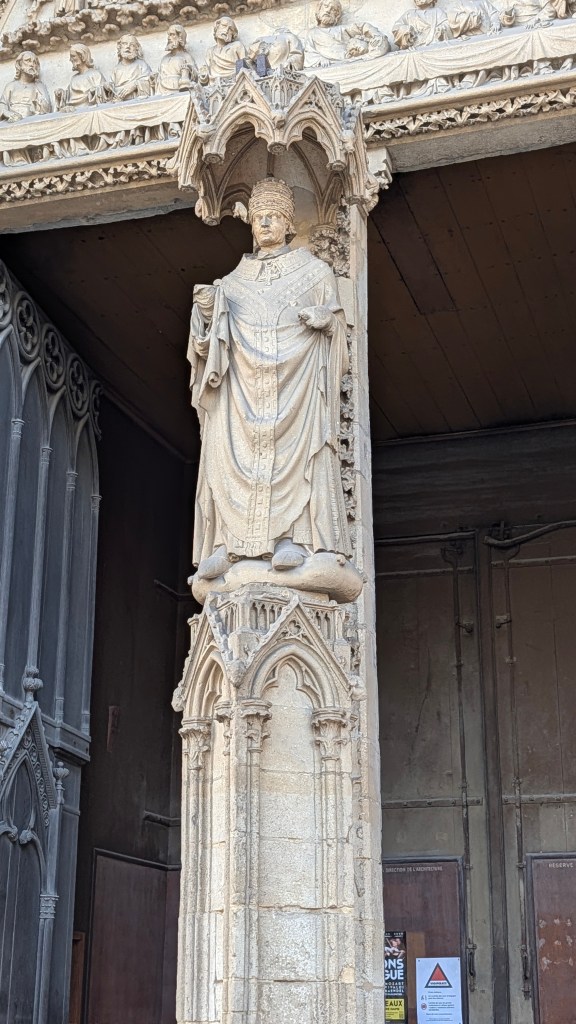
The first Pope of Avignon was a bishop of Bordeaux.
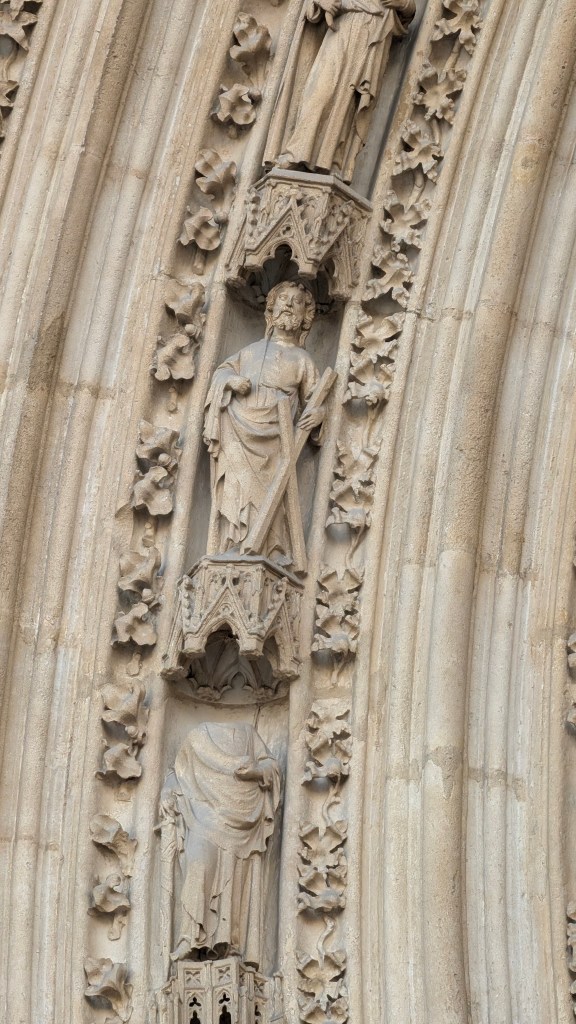
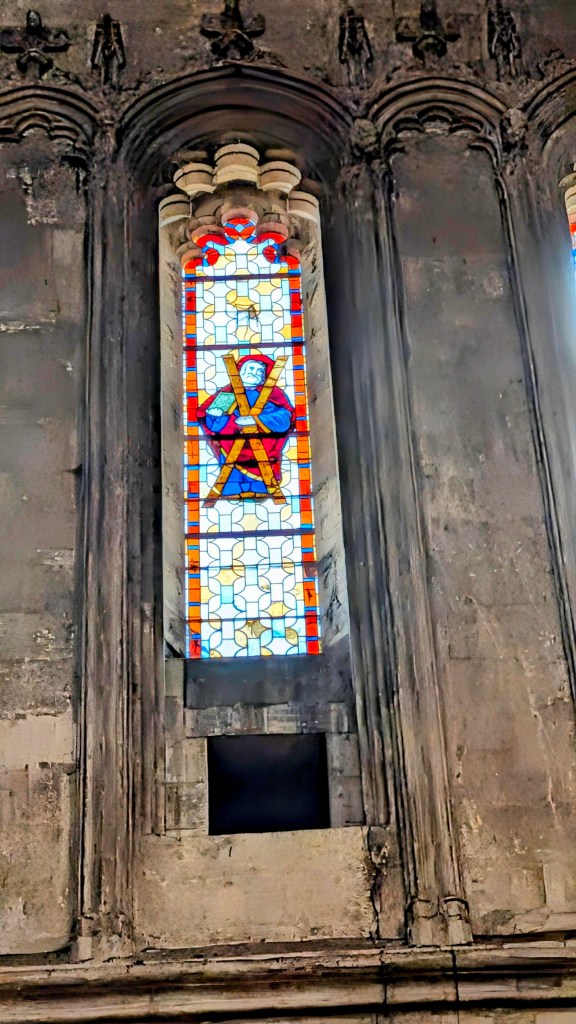
Saint Andrew was crucified on a cross and is thus often depicted.
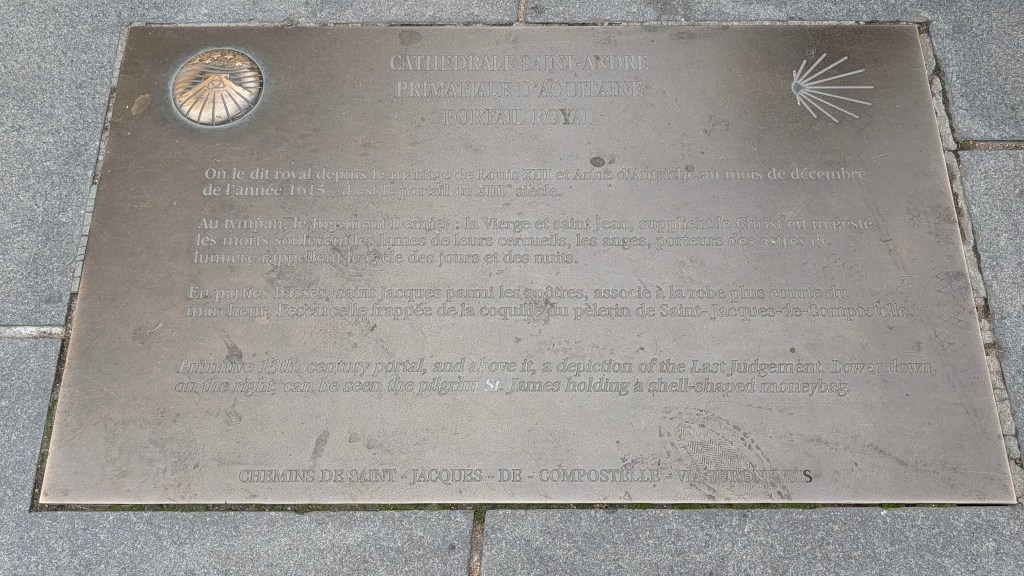
The first Cathédrale Saint-André opened in 1090. The 1200s portal from that time is of the French Gothic style and has statues that were recently cleaned using laser technology.
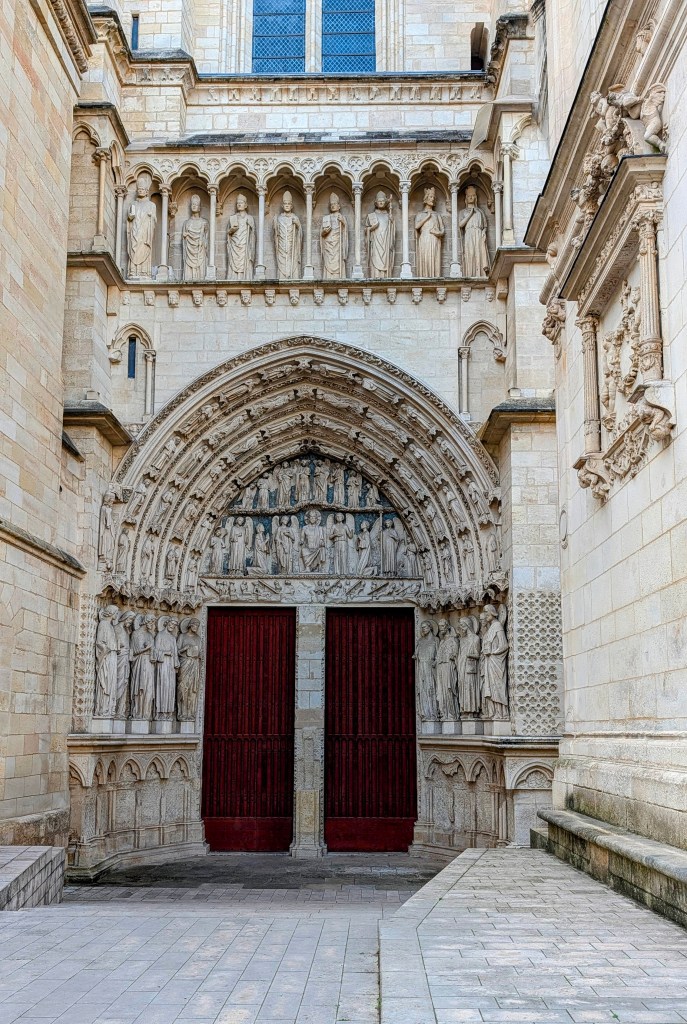
From here one can begin the Camino de Santiago trek.
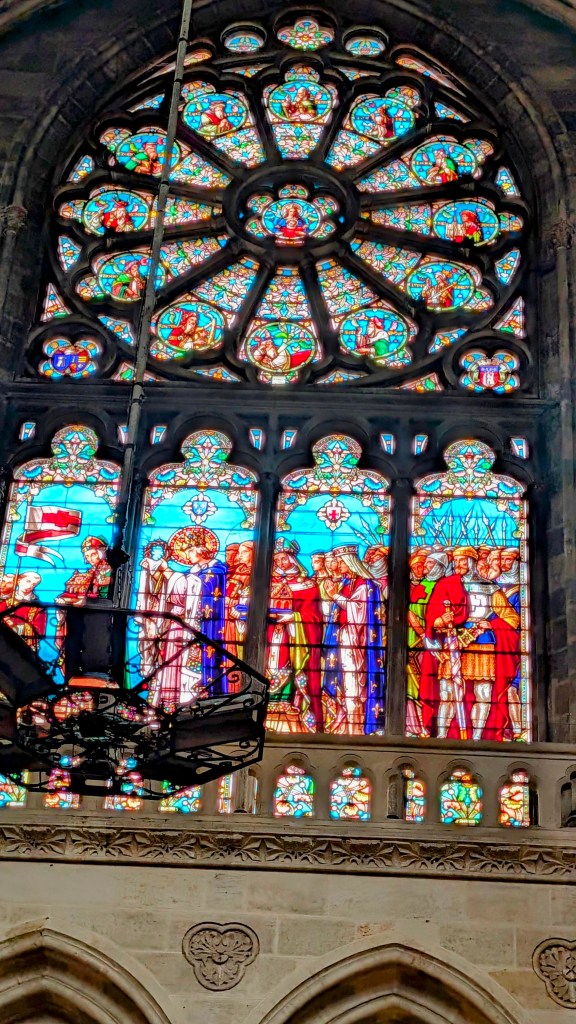
Inside St. Andrew can be found in the stained glass.
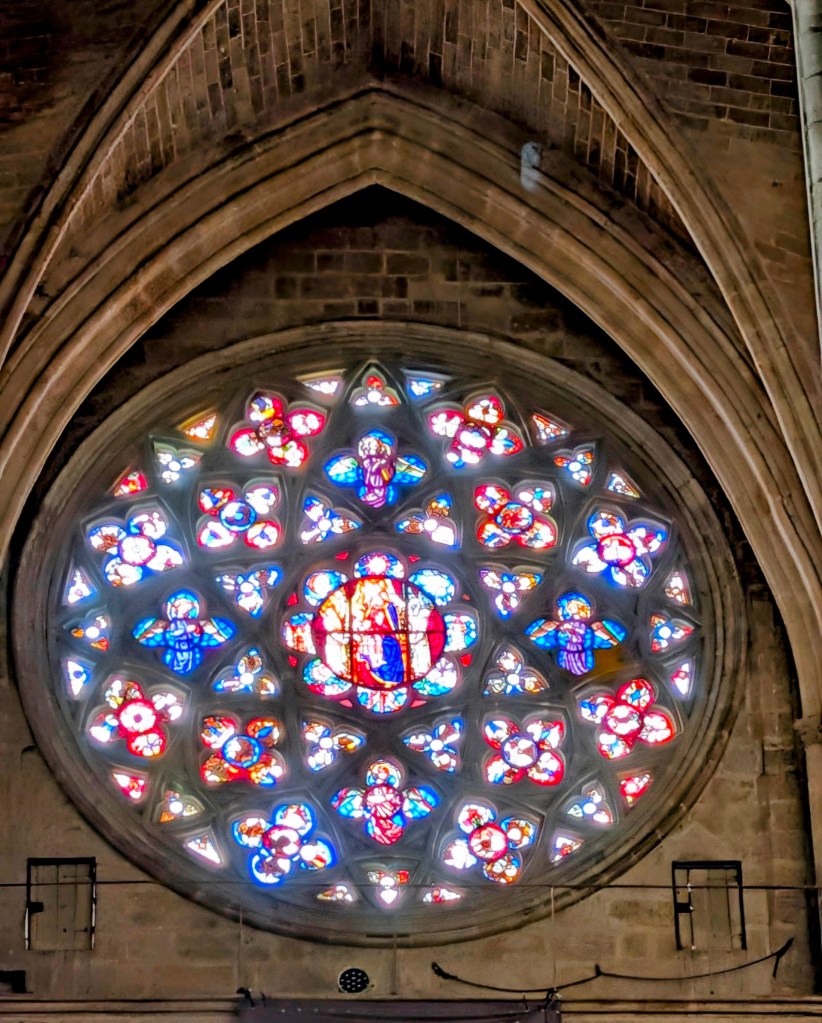
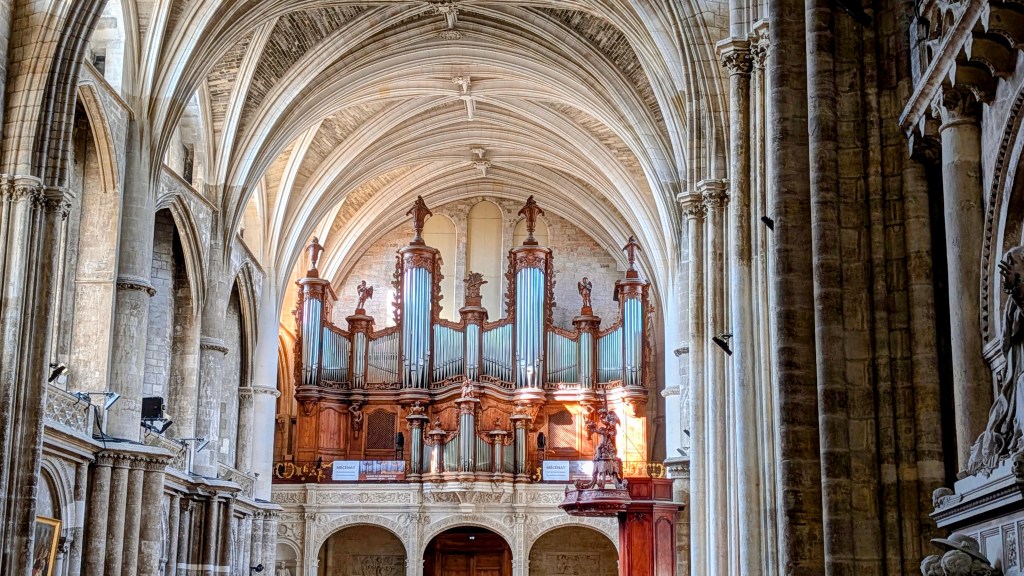
The 18th-century organ case is one of the largest in France, housing a heavily utilized organ,
 The interior boasts a rich collection of liturgical art, sculptures, and medieval illuminated manuscripts.
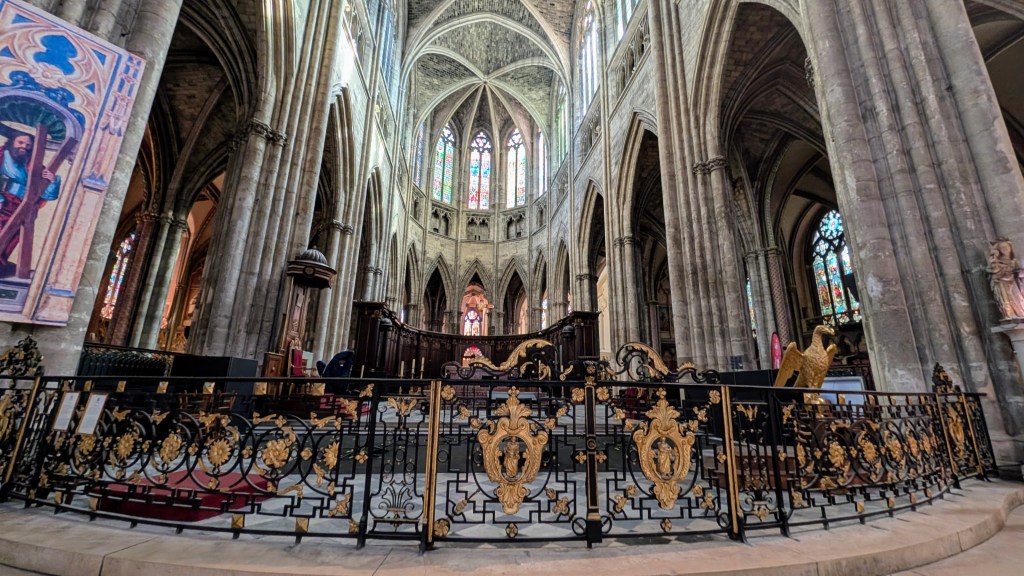
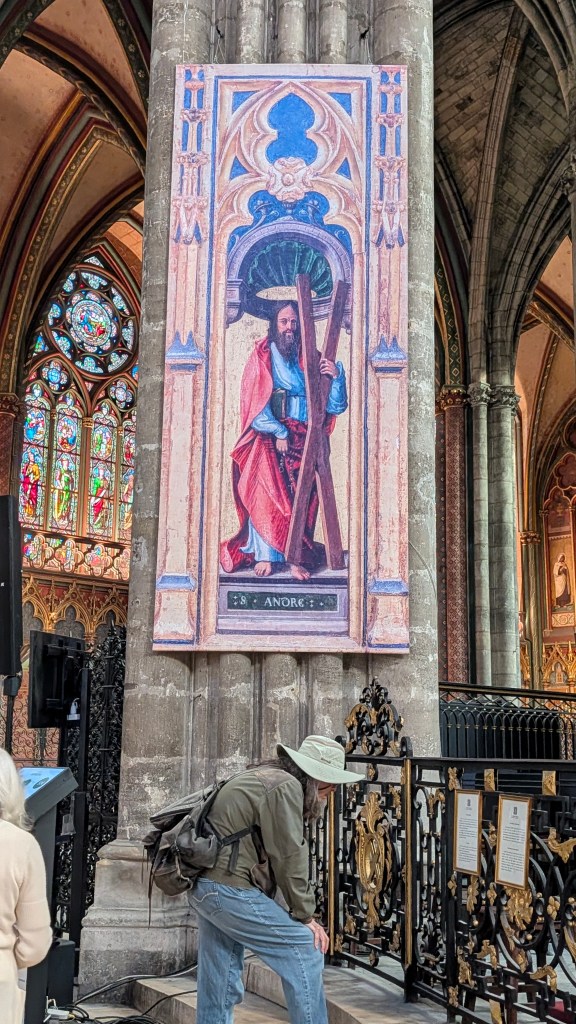
I particularly loved the columns.
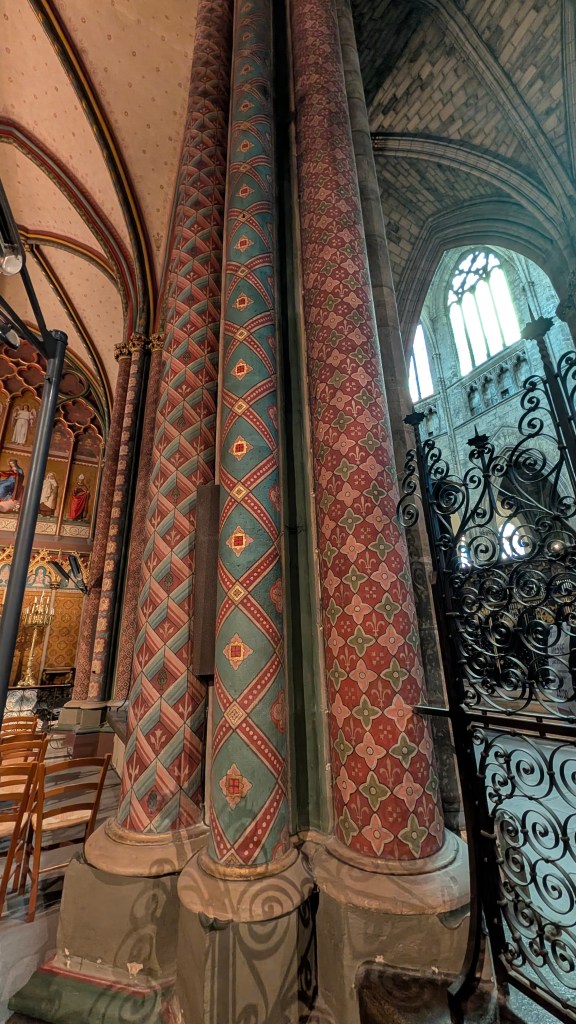
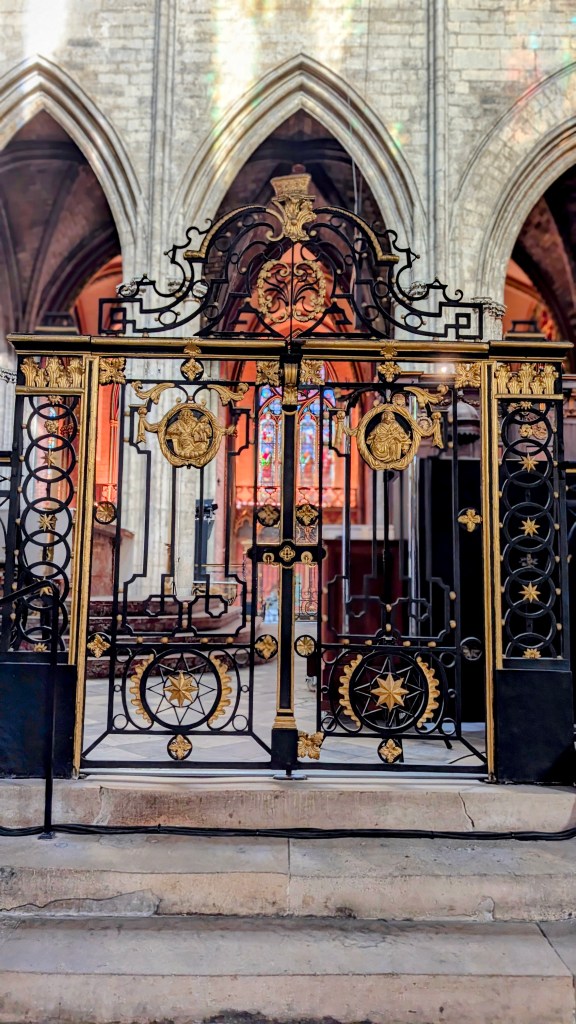
and the grill work.
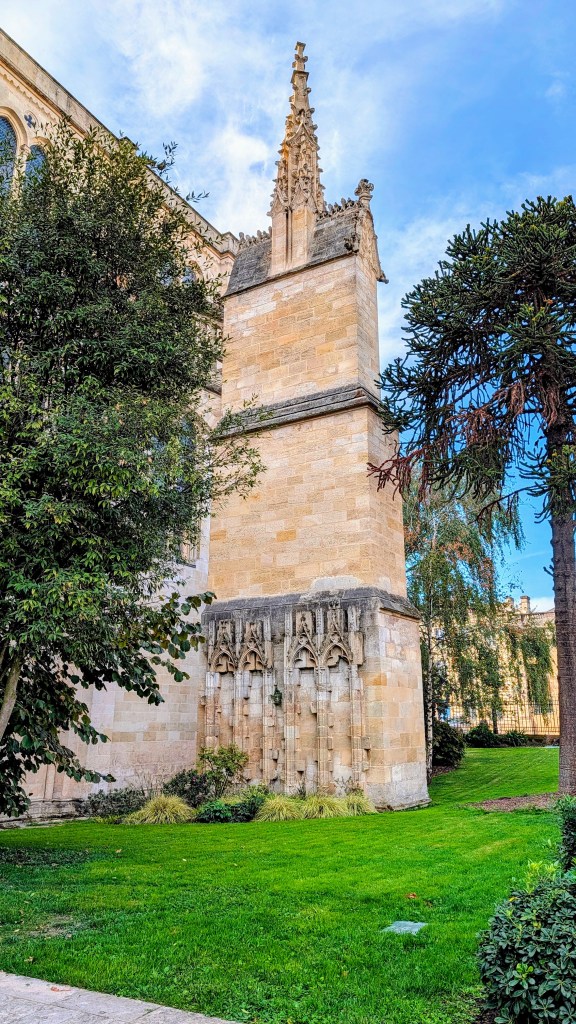
The Tour Pey-Berland, built in the 1400s, stands separately from the main cathedral to avoid vibrations from its massive bells damaging the main structure.
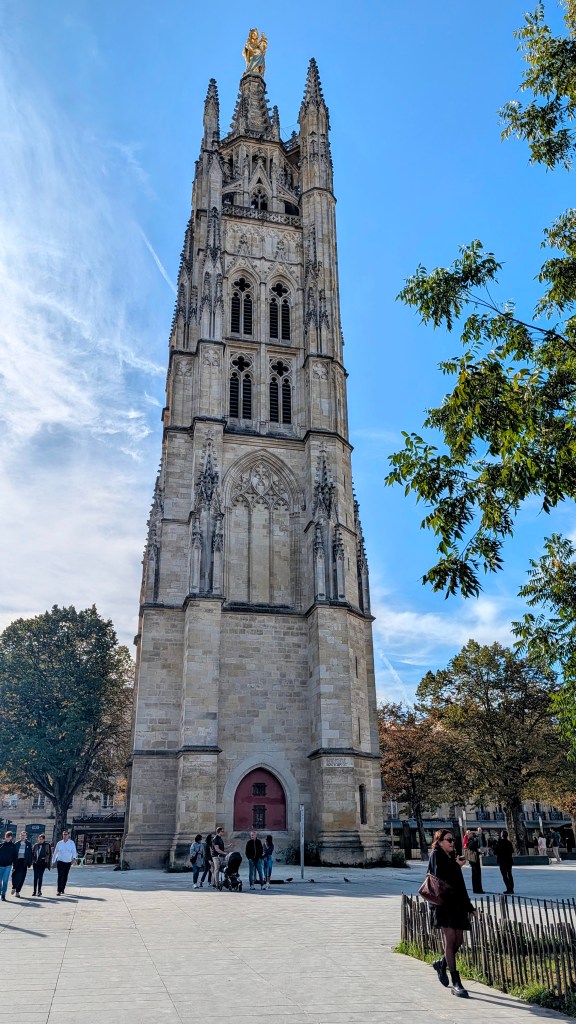
Tour Pey-Berland

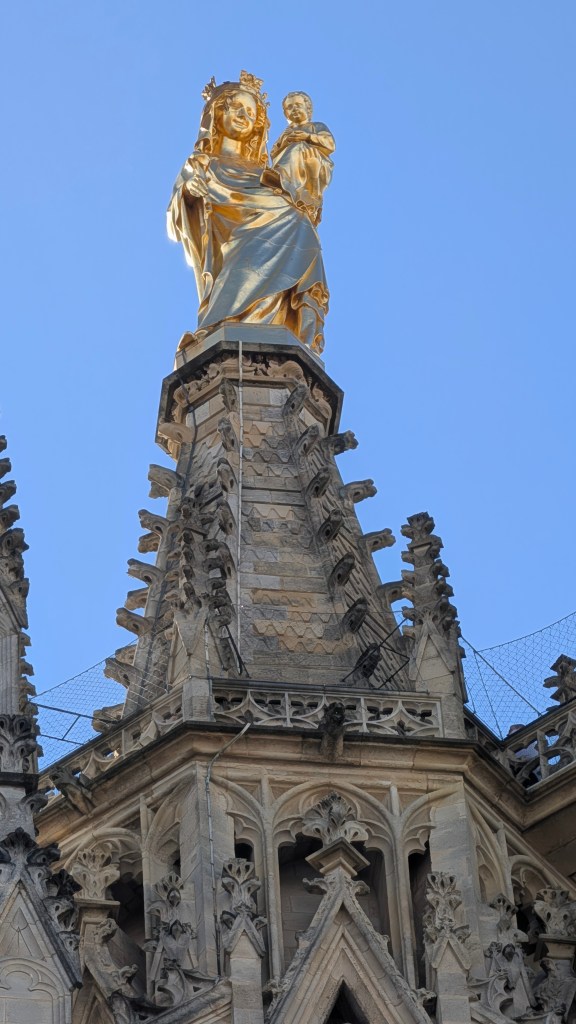
A gilded statue of the Virgin Mary, Notre-Dame de Aquitaine, sits atop the tower since the 1800s. She is facing the Médoc wine region.
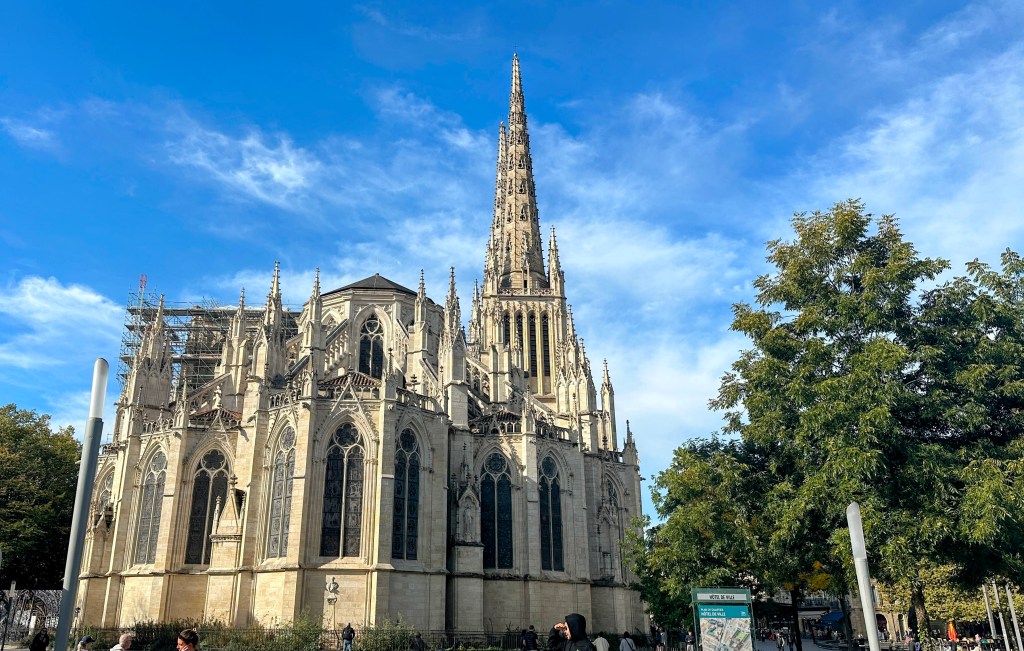
As we walked away we had a great view of the back of the cathedral.
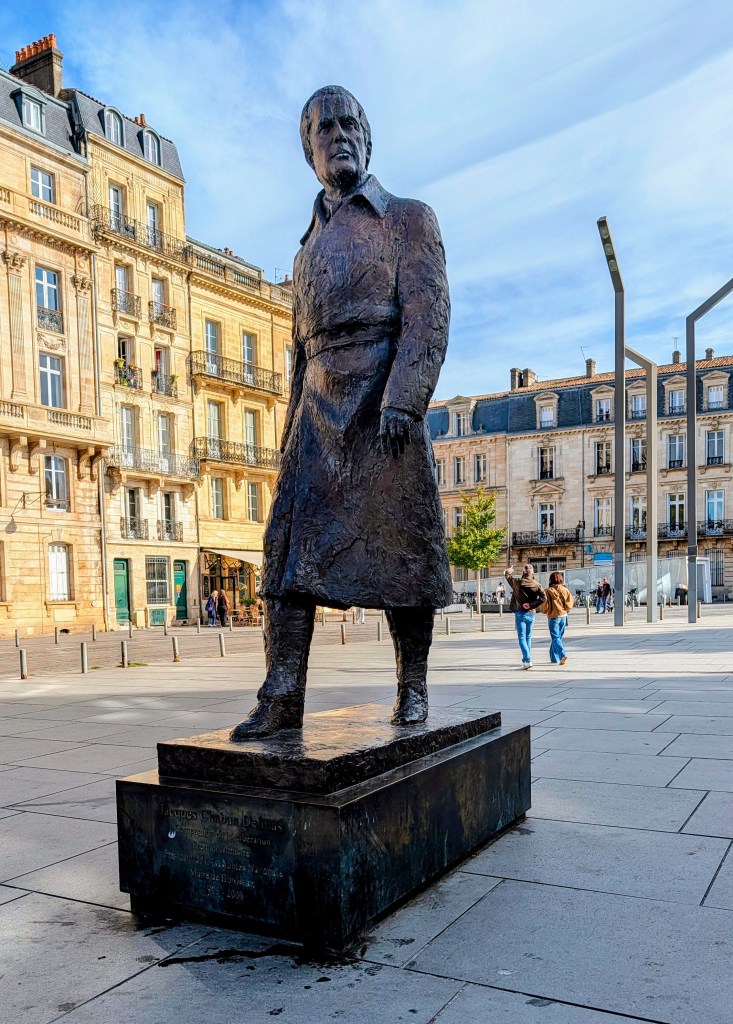
Jacques Chaban-Delmas, a friend of Charles DeGaulle and a former Prime Minister of France, was the mayor of Bordeaux for nearly half a century. 
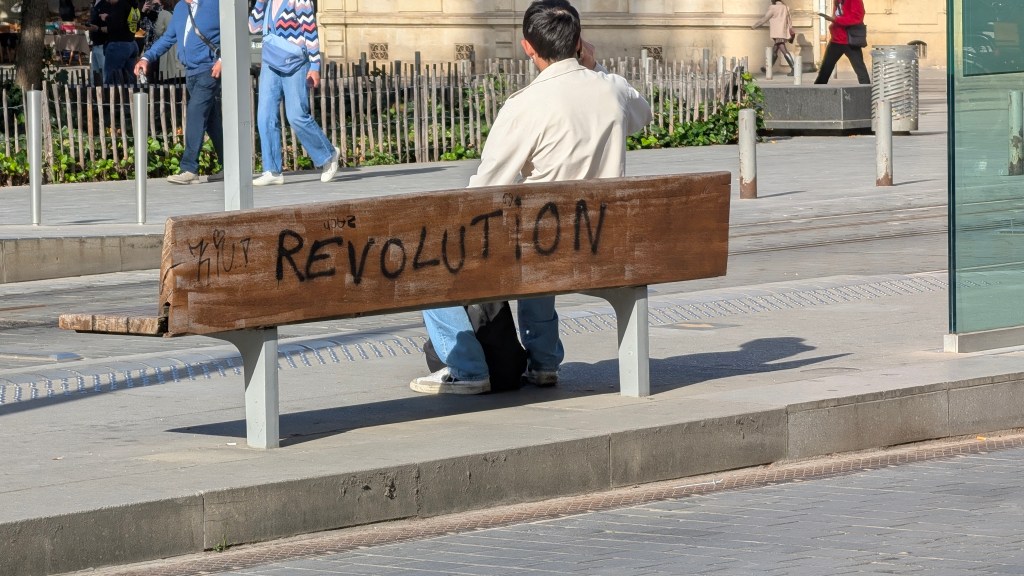
I just love this picture and what it says about France, the French, and the vibe.
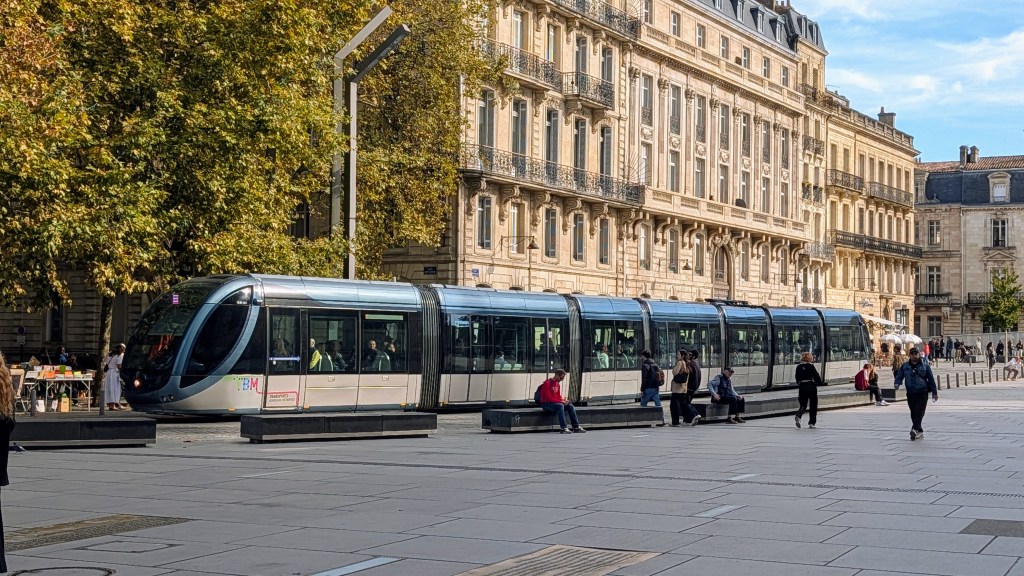
The tram passes directly behind the cathedral. To preserve the historic center, Bordeaux implemented a ground-level power supply system in the 2000s, making it the first city in France with a fully wireless tram in its core
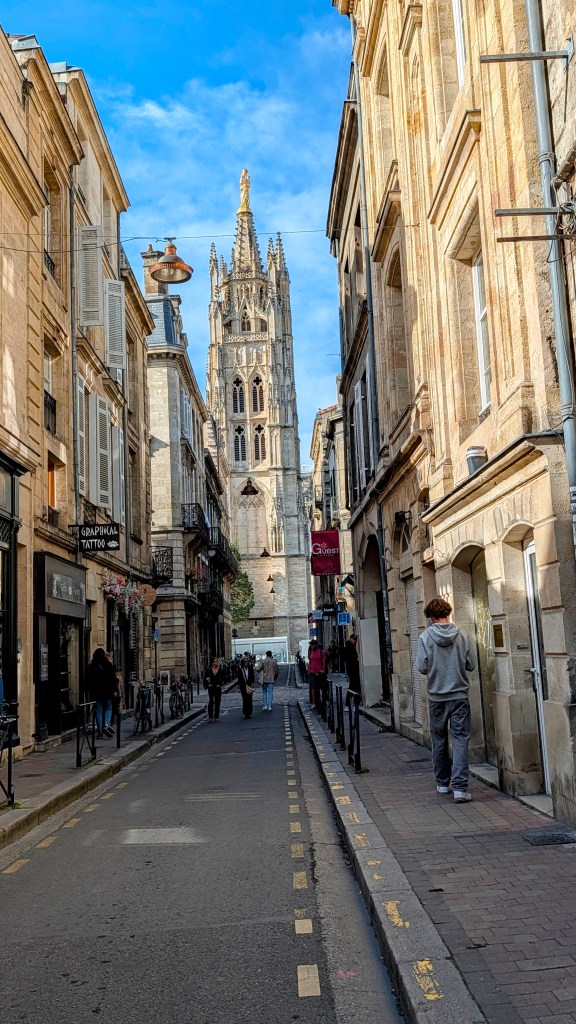
Walking down the street, we had a last glimpse of the Tour Pey-Berland.
Rue Sainte-Catherine, originally part of the Roman way, is a mile long artery known as one of Europe’s longest fully pedestrianized shopping streets. Running from Place de la Comédie and the opera to Place de la Victoire, it serves over 230 shops, houses underground rivers. Sarah told us on a Saturday afternoon it is teen central.
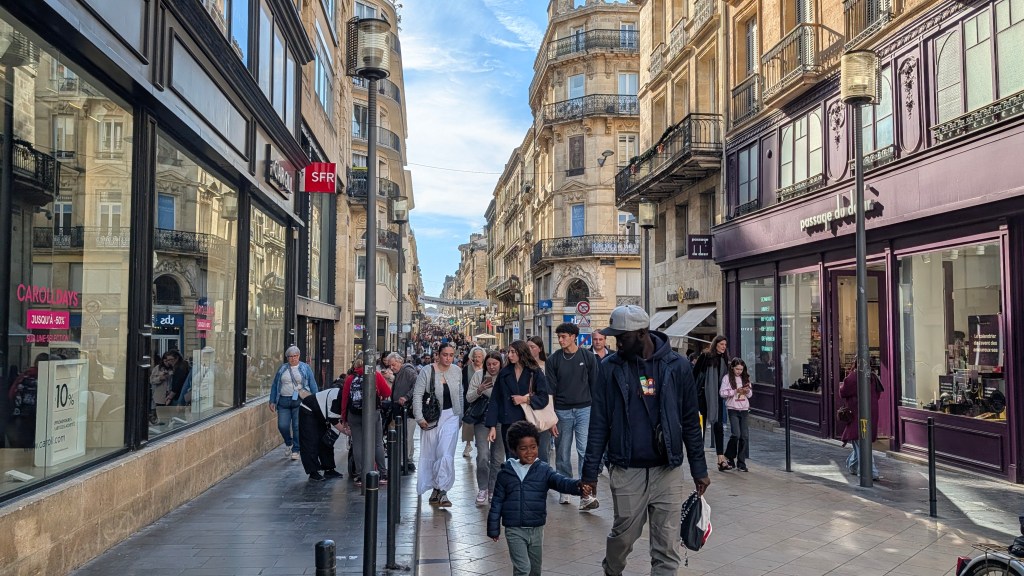
Rue Sainte-Catherine

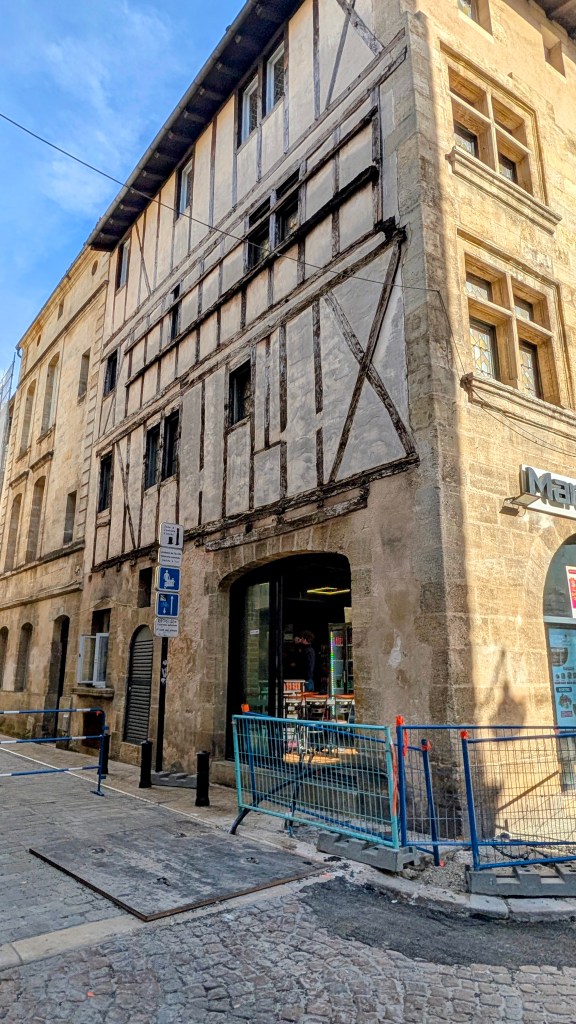
Sarah pointed out a traditional timber-framed house, a style prominent in the region during the medieval and early modern periods, this one c 1500s.  The facade features exposed wooden beams and masonry that have been preserved to reflect the city’s architectural heritage.
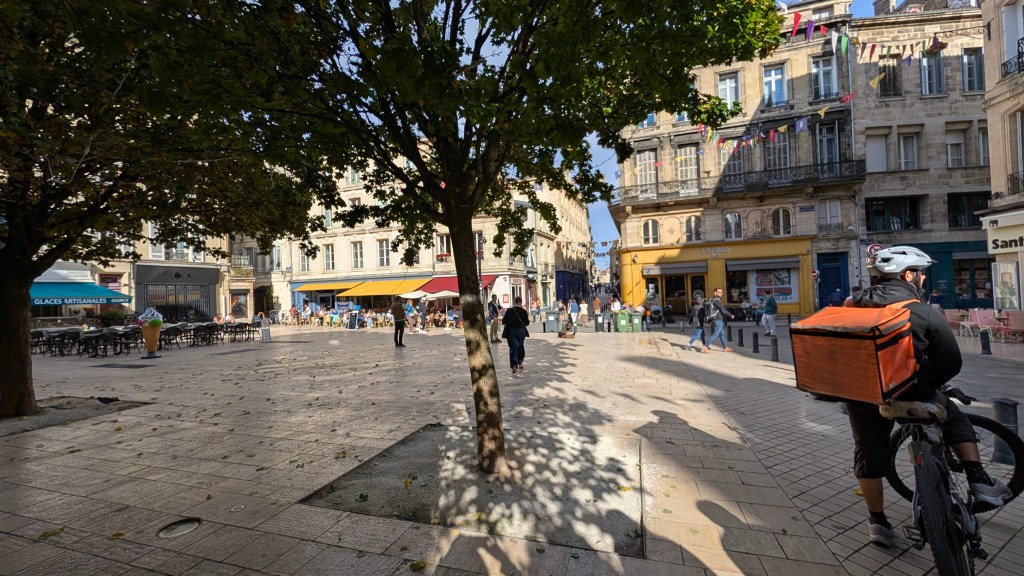
As we once again passed through Place de la Comédie, Sarah told us that prior to the heat wave of the summer of 2025, only 15% of private homes had air conditioning. Now they are irapidly becoming the majority.
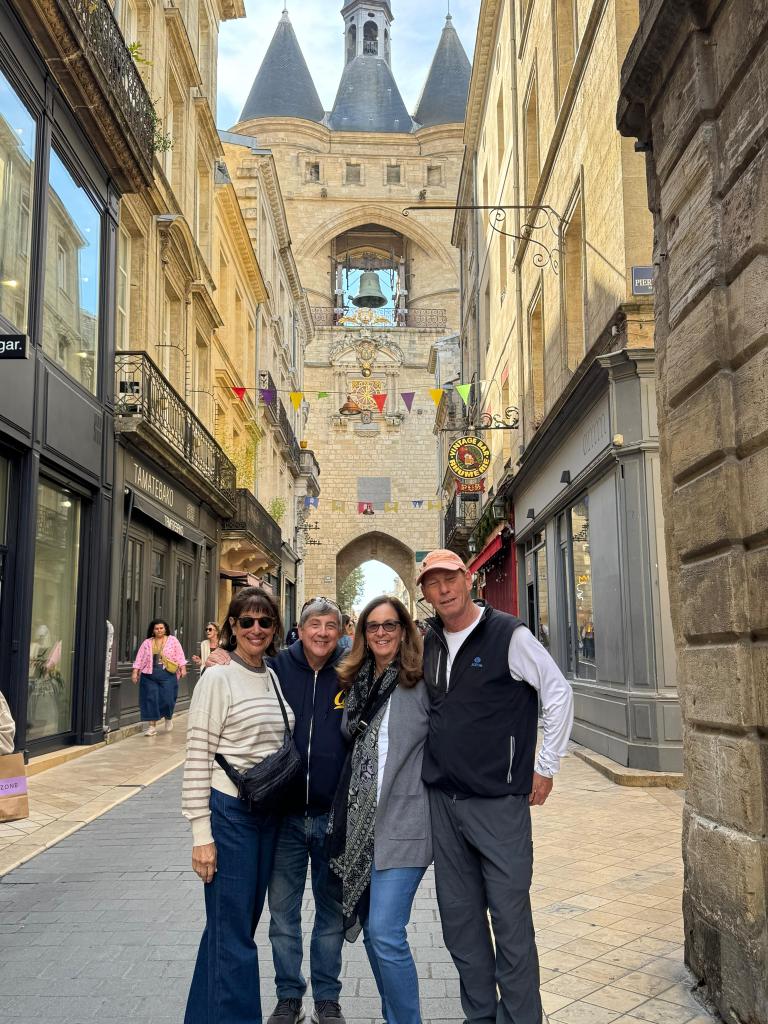
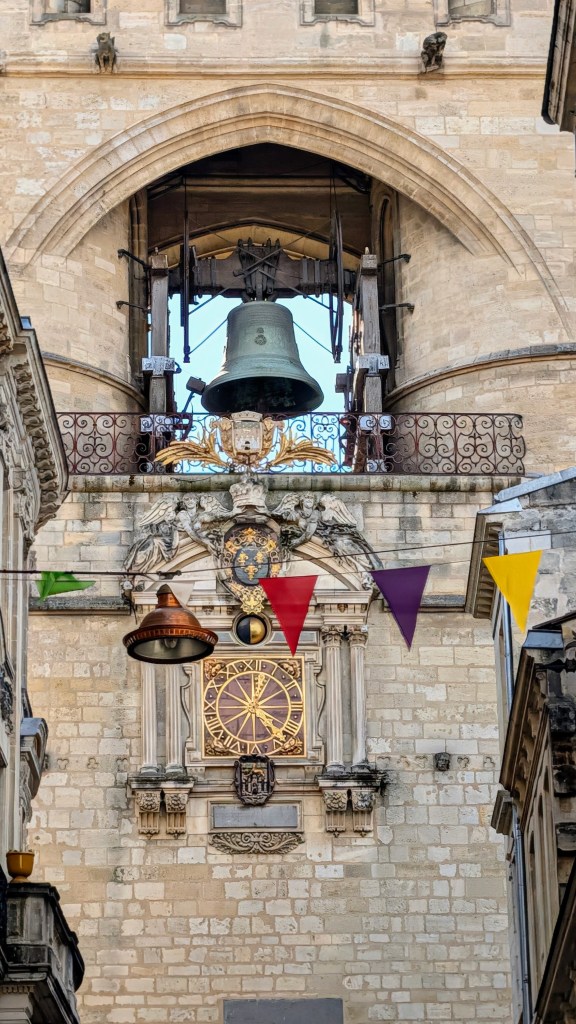
Originally built in the 15th century, the Grosse Cloche (Great Bell), is a historic monument and one of the oldest belfries in the country. The structure has served as a gateway, a defensive belfry, and even a prison.  The bell itself, named “Armande-Louise”, weighs 7,750 kilograms and was cast in 1775.  
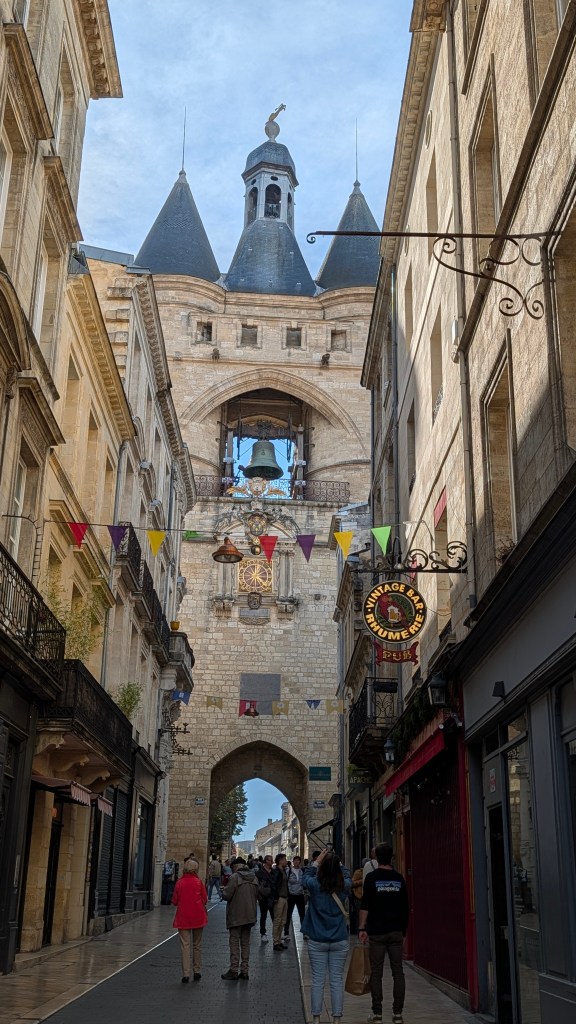
Grosse Cloche (Great Bell)

The bell only rings six times a year for major celebrations (including Bastille Day and May 8th), plus the first Sunday of every month at noon.
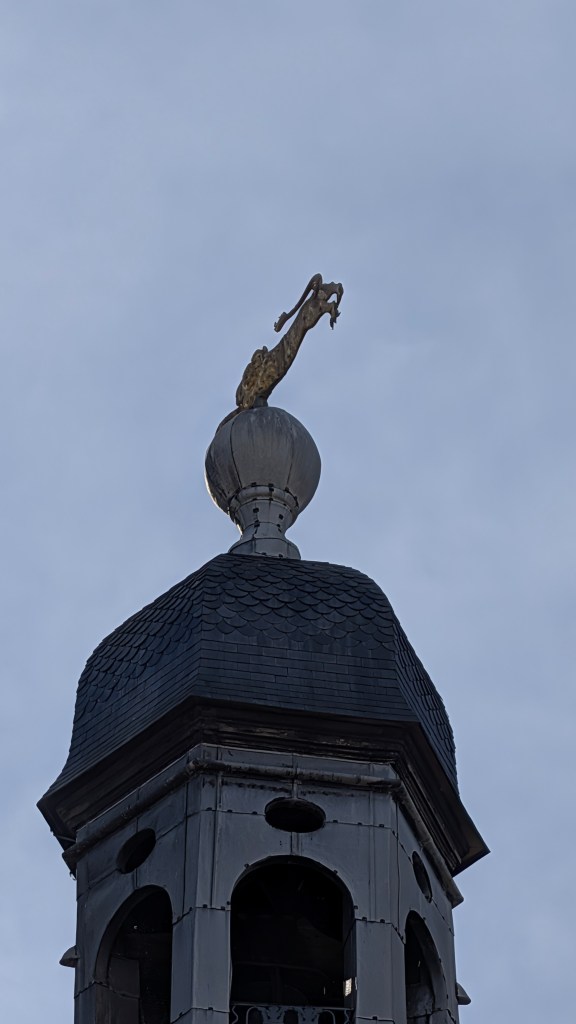
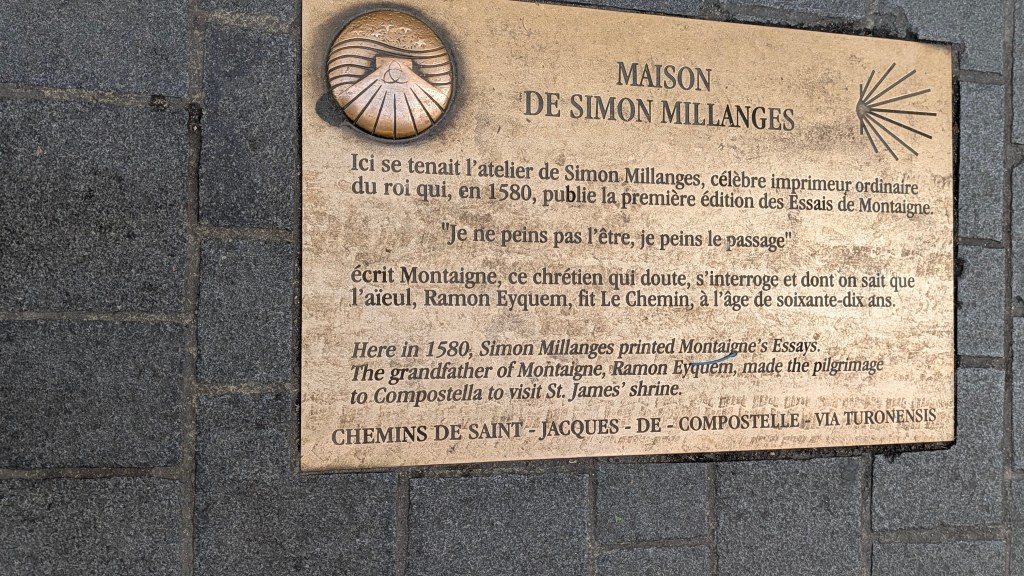
This plaque commemorates the site of Simon Millanges’ printing workshop, where the first edition of Montaigne’s Essays was published in 1580. Millanges was printer to the King. Montaigne preached tolerance and invented the style of essay writing. The plaque features a famous quote from Montaigne: “I do not portray the being, I portray the passing.” It also mentions that Montaigne’s grandfather, Ramon Eyquem, made the pilgrimage to Compostella via the Via Turonensis route.
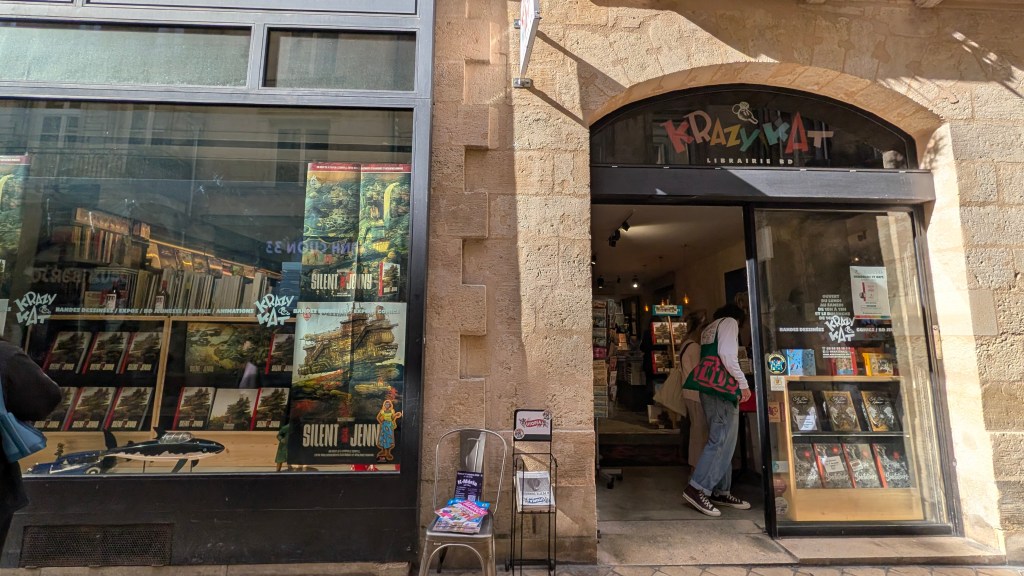
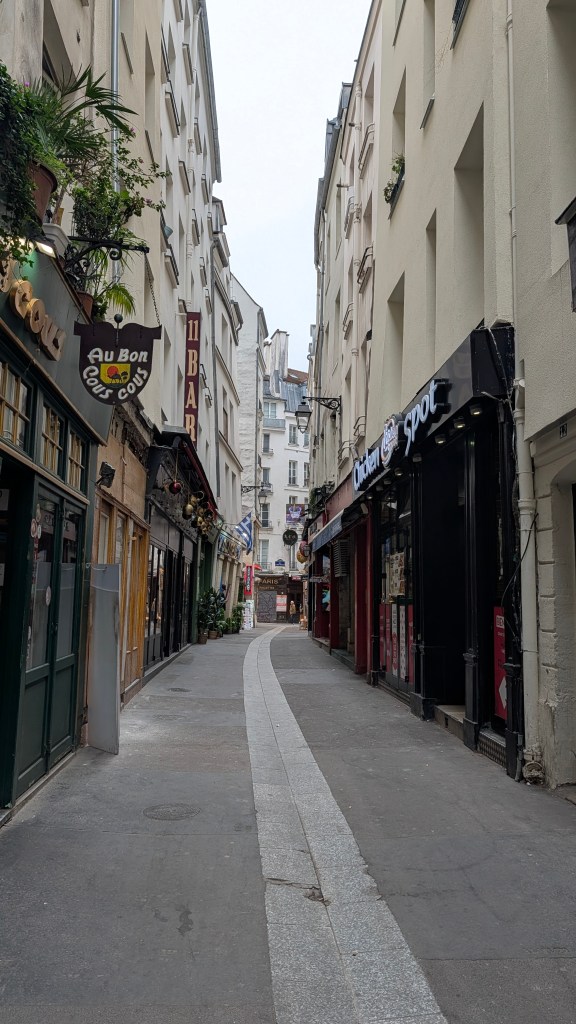
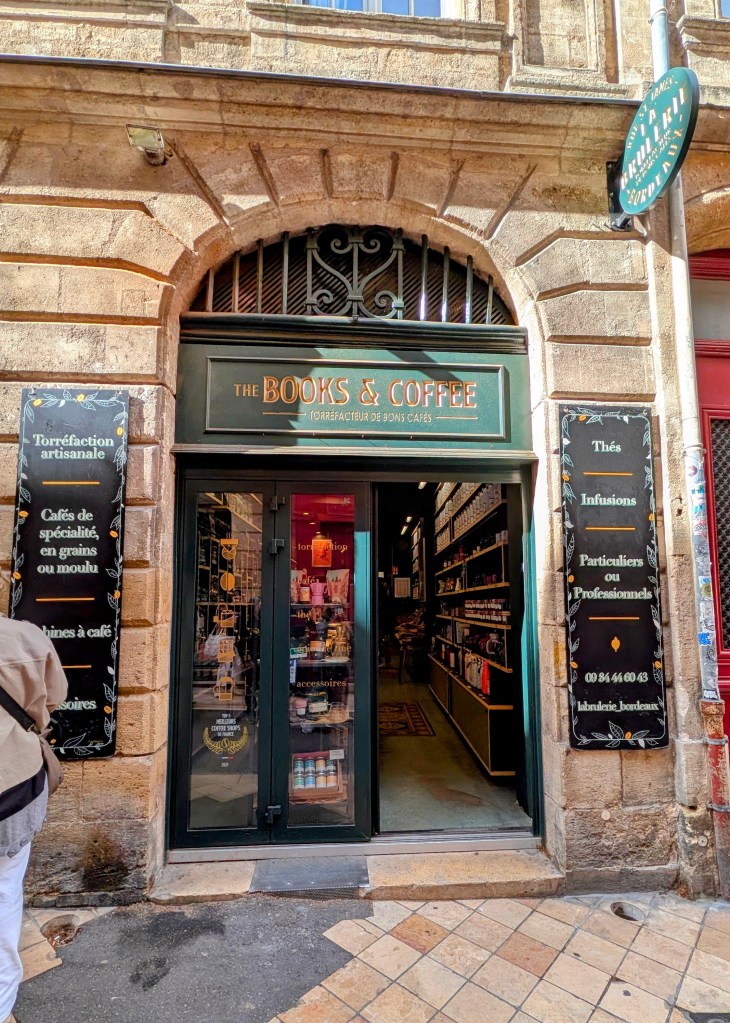
Along this street, St. James, we found several more independent coffee, books, and books plus coffee shops.
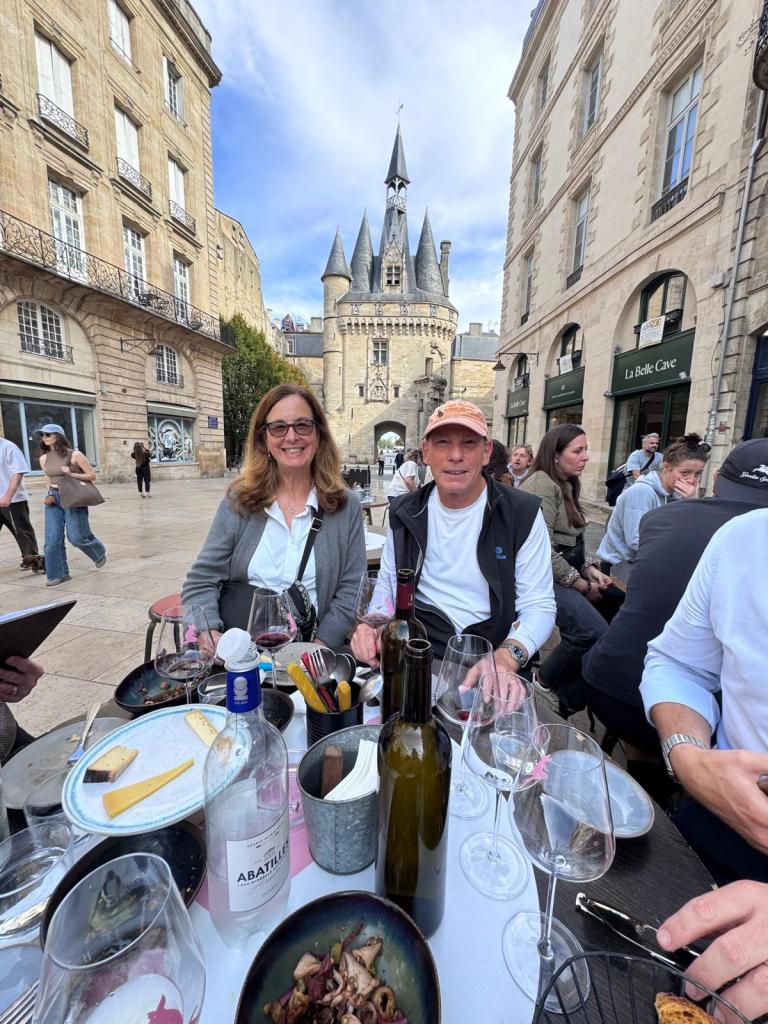
We got a glimpse of the Porte Cailhau, a historic defensive gate built between 1493 and 1496 to commemorate King Charles VIII’s victory at the Battle of Fornovo. 
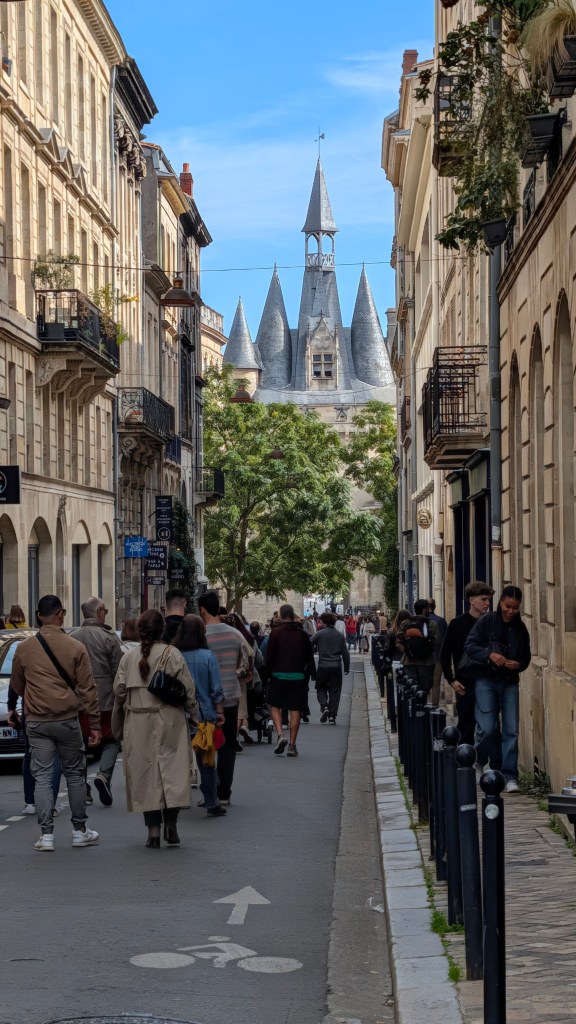
Porte Cailhau

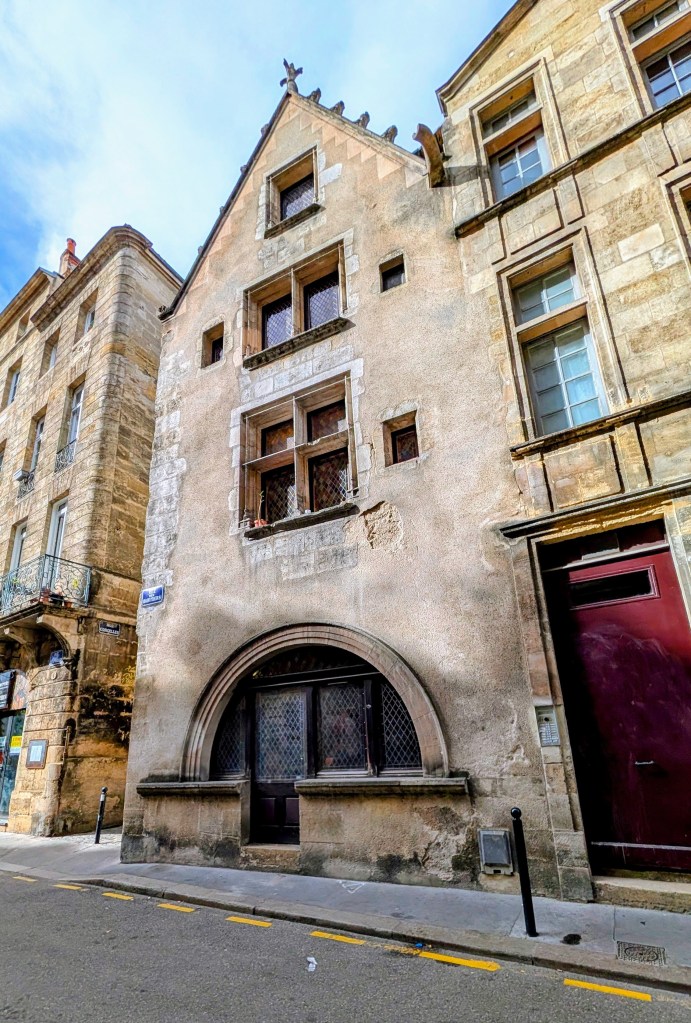
Sarah pointed out a very old church which, she told us, can be dated to before 1600 by its pointed gables and mullioned windows.
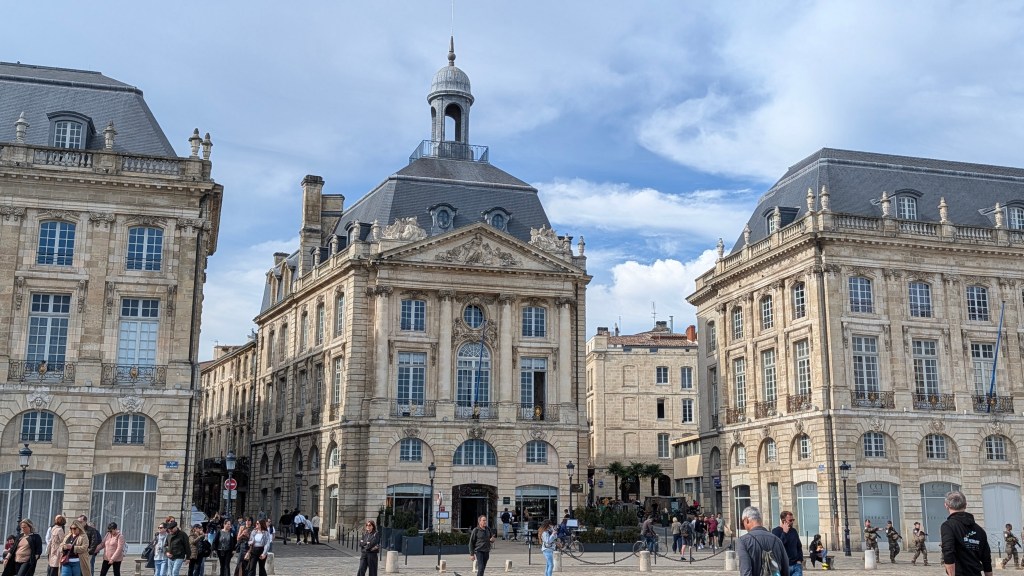
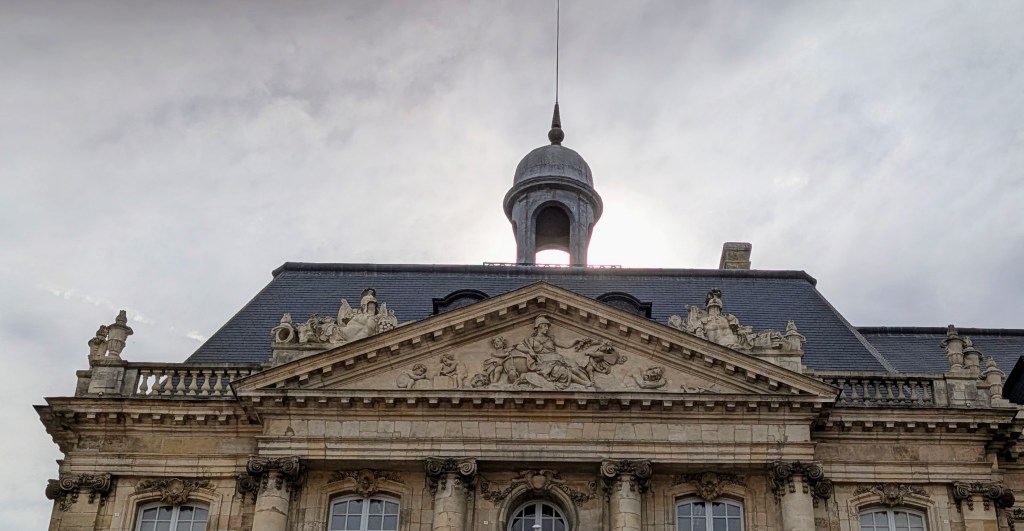
Place de la Bourse was designed between 1735 and 1738 by Jacques Gabriel, and built by his son Ange-Jacques Gabriel, the principal architect of King Louis XV. It was built as the stock exchange, but it now serves as the Chamber of Commerce.
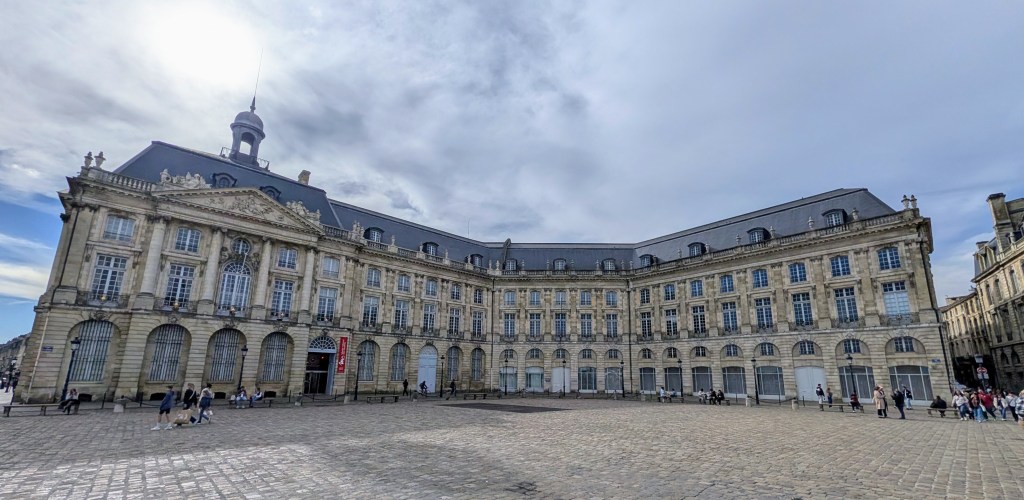
Place de la Bourse

Historically, it served as a symbol of Bordeaux’s wealth and opening up to the world, breaking down the medieval walls of the city, which were mostly destroyed at that time.
In the original plan, a statue of Louis XV was erected on the square, which was destroyed during the French Revolution and melted into a cannon.
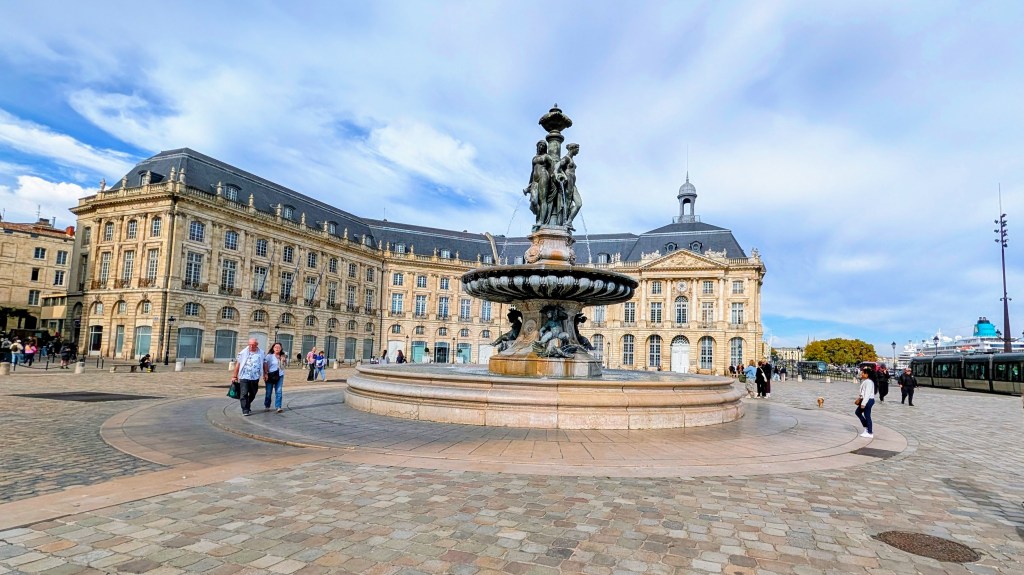
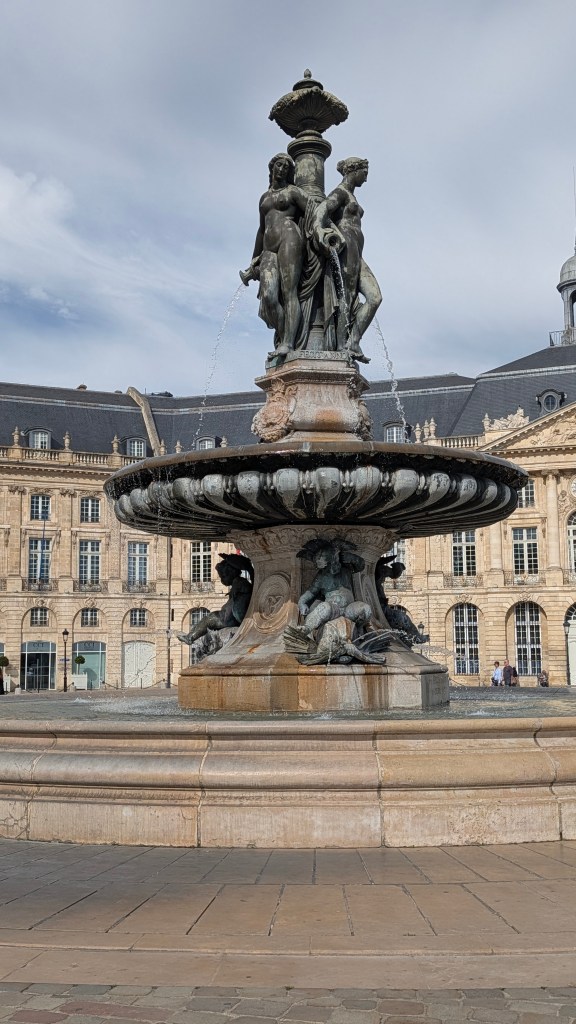
The fountain of the Three Graces in the center was added in1869.
The slate roofing and urns on top of the ballustrade were all classically French post Versailles in the 1750s.
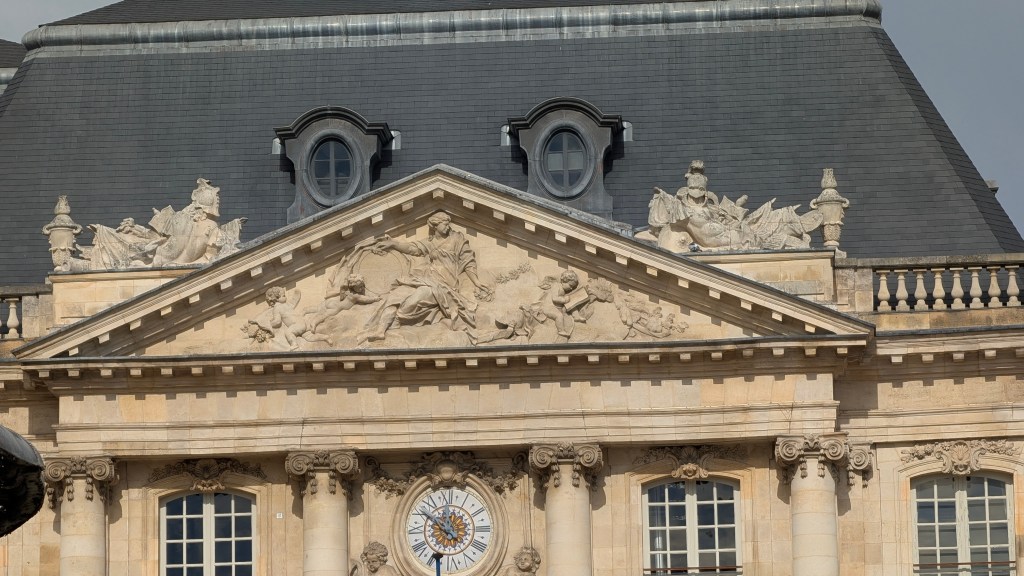
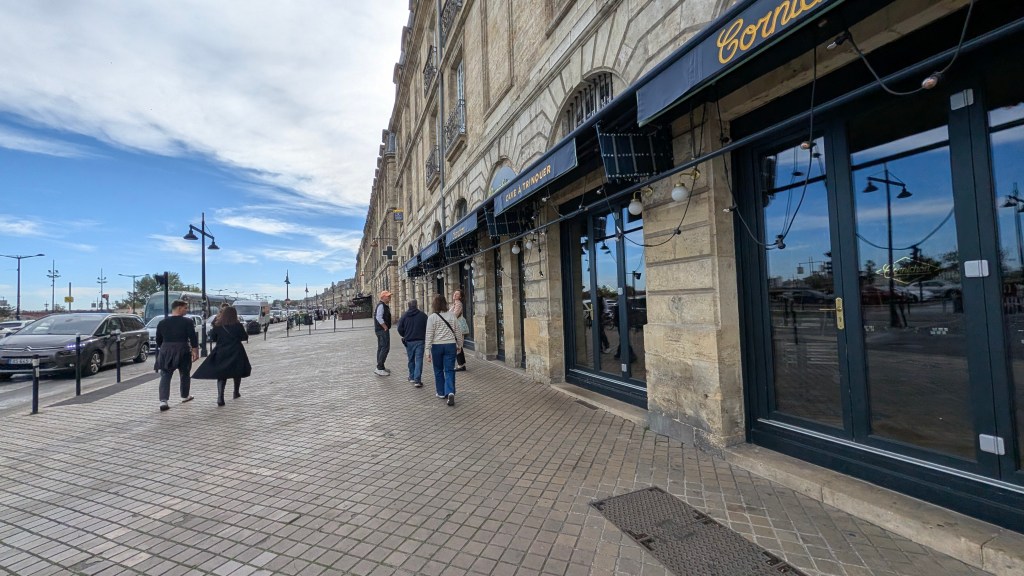
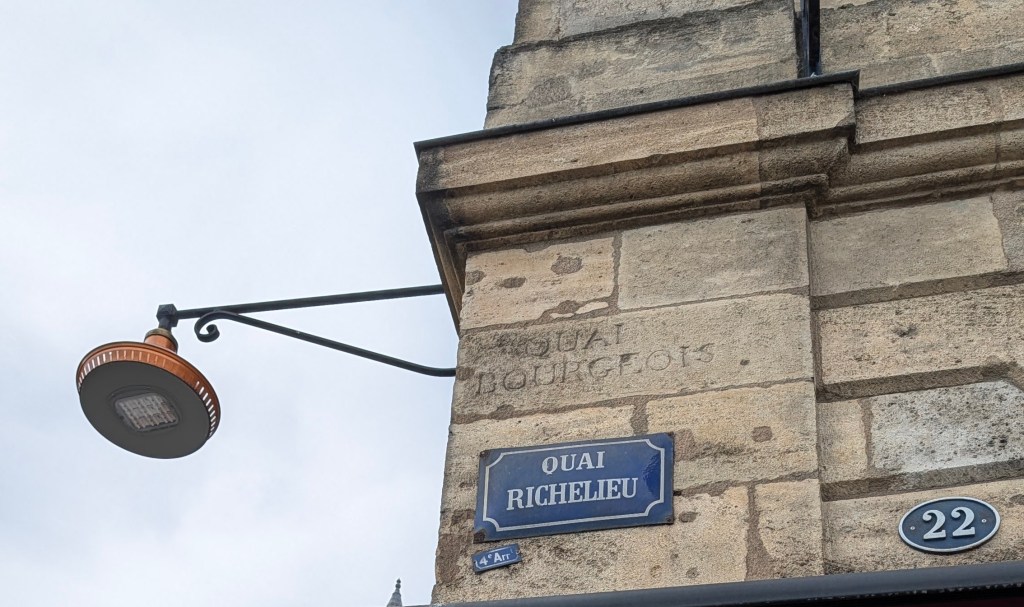
During the 1700s the walls and buildings on Quai Richeliu, which is along the Garonne River, were torn down and new ones built of uniform height and style.
On the buildings here can be found mascarons, which are carved faces commonly found above doorways or windows, particularly in Europe, typically featuring grotesque, human or mythological faces intended to frighten away evil spirits.
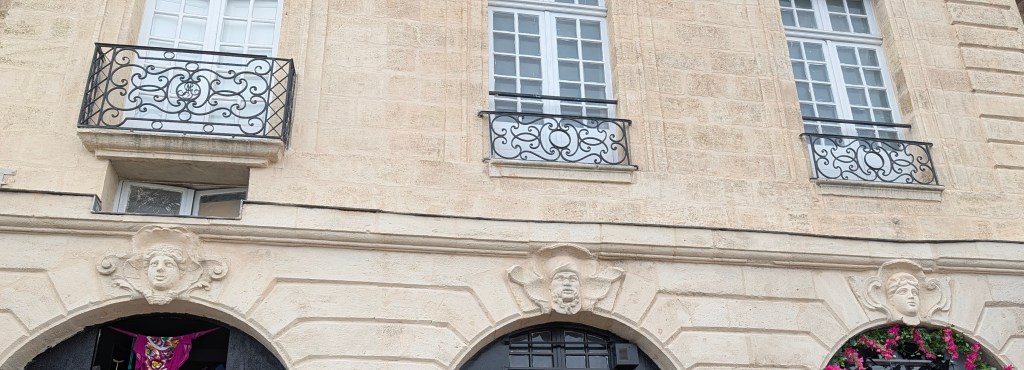
mascarons

We headed back to Porte Cailhau, a a blend of Gothic and Renaissance styles. It stands at 115 feet high. 
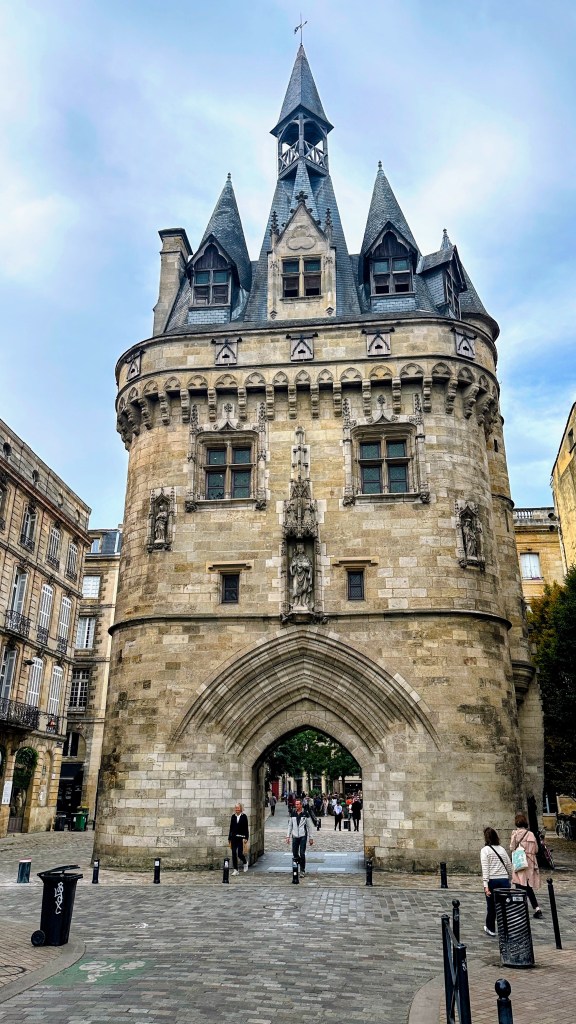
Porte Cailhau

Once through we found ourselves in Place du Palais,  a vibrant, pedestrian-friendly square that was once the site of the 10th-century Palais de l’Ombrière, the former residence of the Dukes of Guyenne and later English kings.
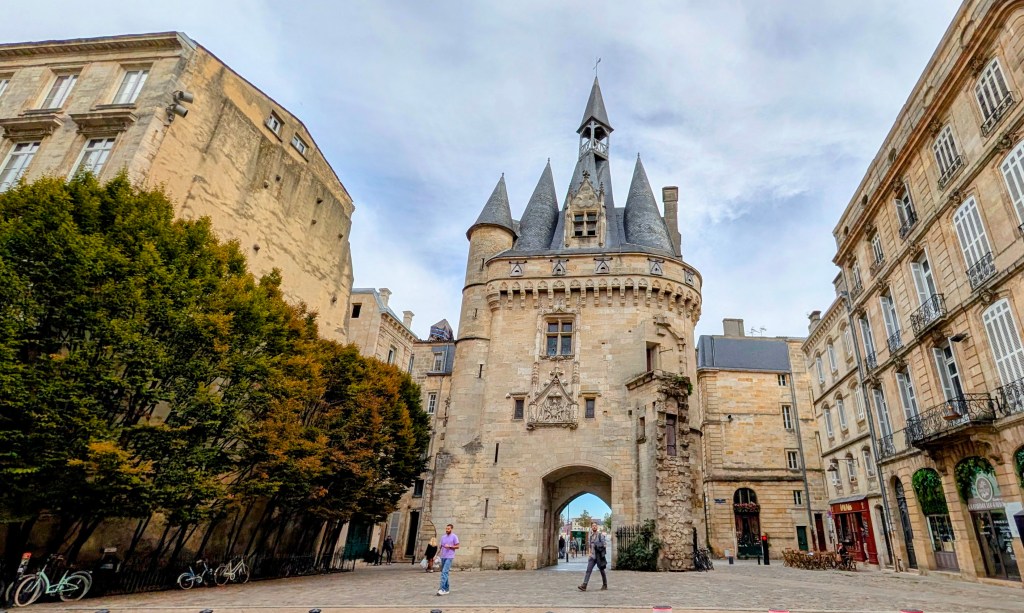
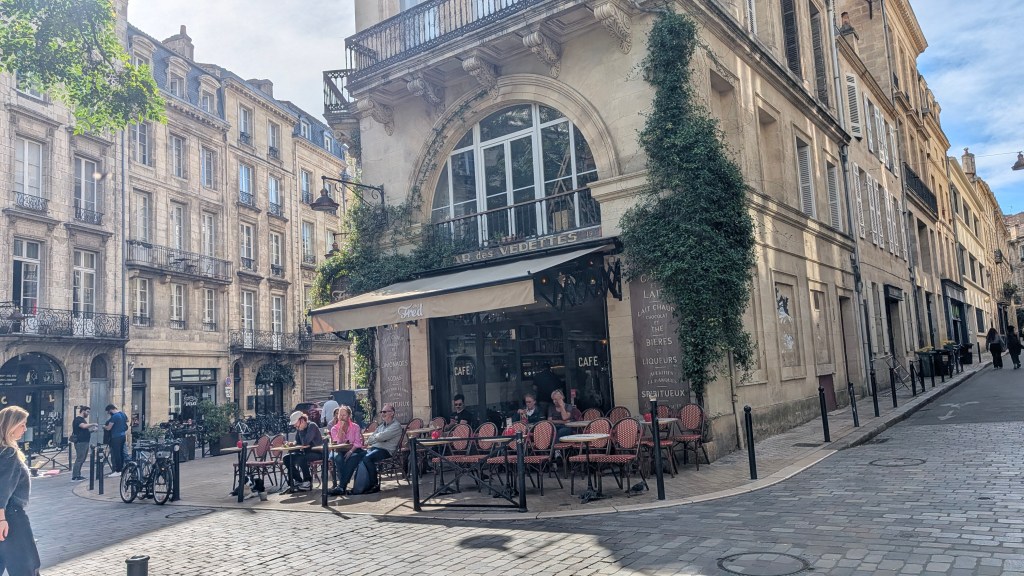
Place du Palais
Place du Palais

It was time for lunch,

which meant time for some wine too, of course.
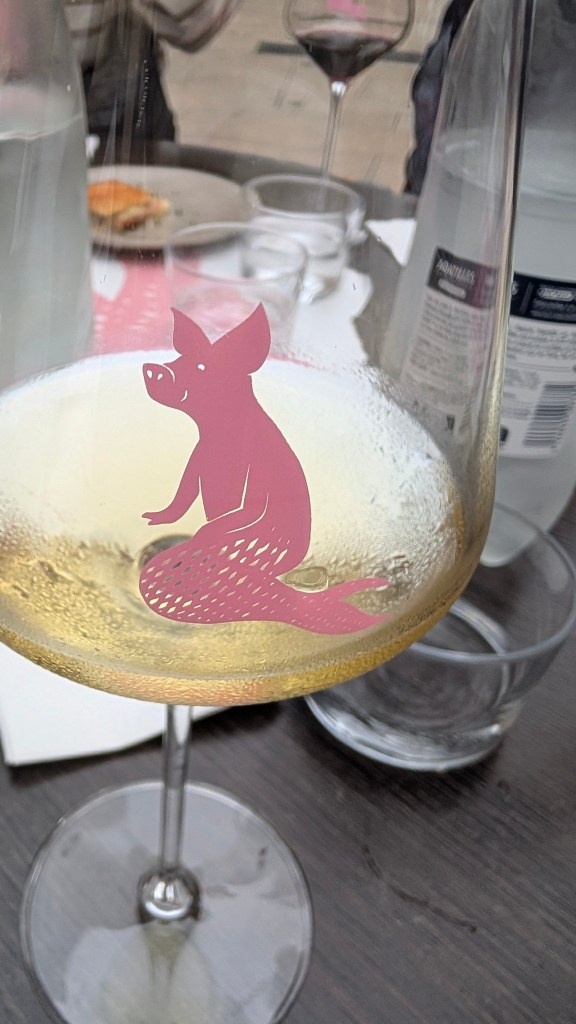
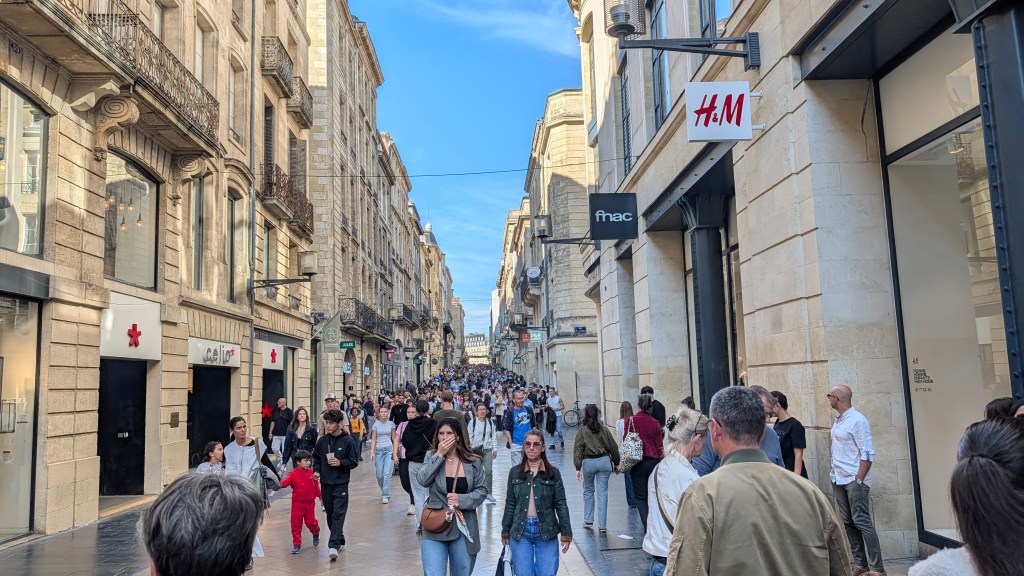
After lunch the ladies decided it was time to do some shopping. Sarah told us that the French term for window shopping translates literally to window licking; we were ready. We headed back to Rue Sainte-Catherine, which was much more crowded than it had been earlier.
We visited La Galerie des Grands Hommes, a distinctive, circular shopping center in central Bordeaux, which opened in 1991 on the site of a former 19th-century metal market. It is located within the upscale “Golden Triangle.” 
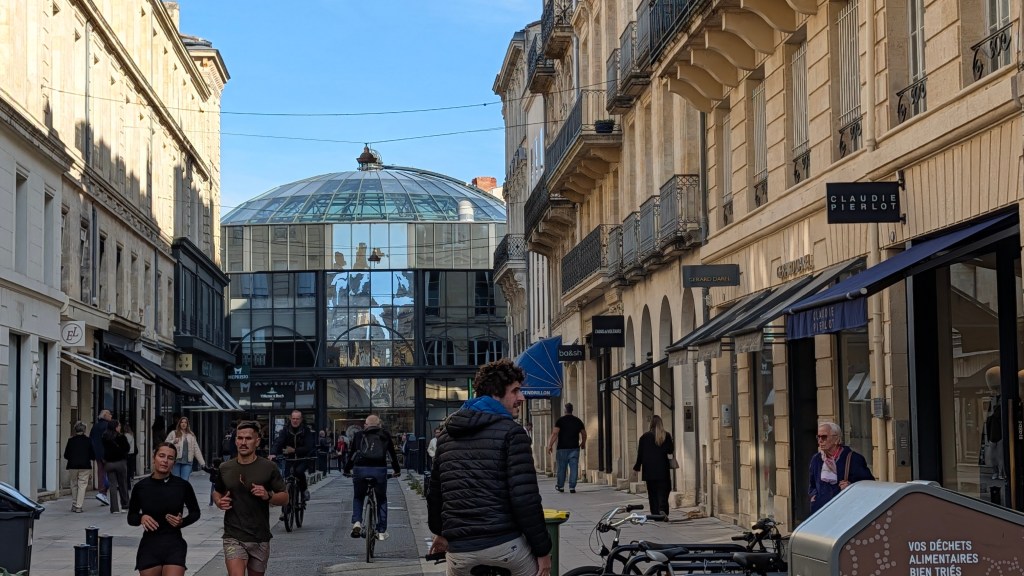
La Galerie des Grands Hommes

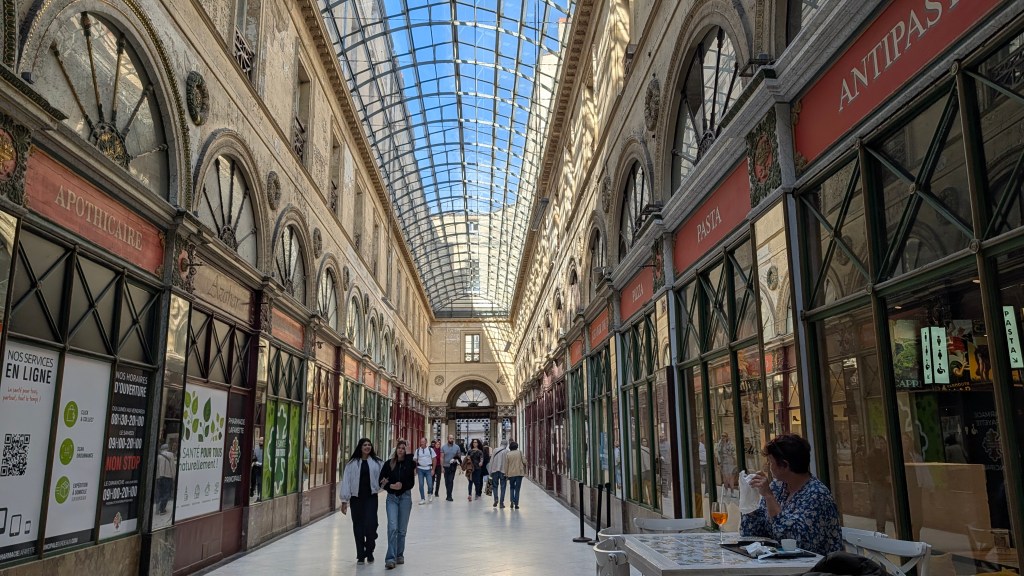
We passed both familiar and new to us shops.
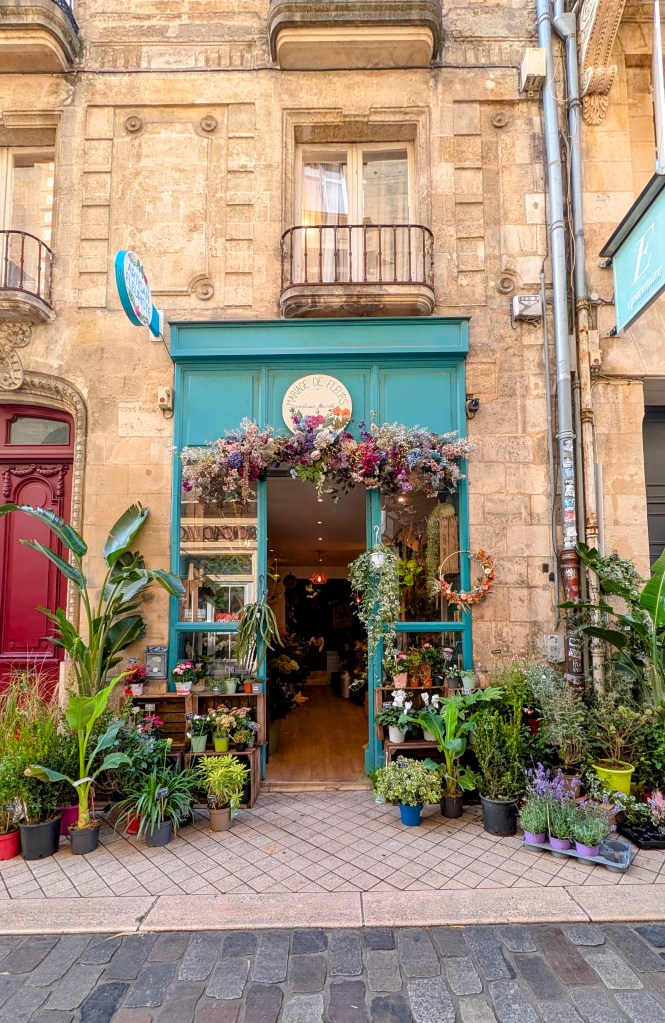
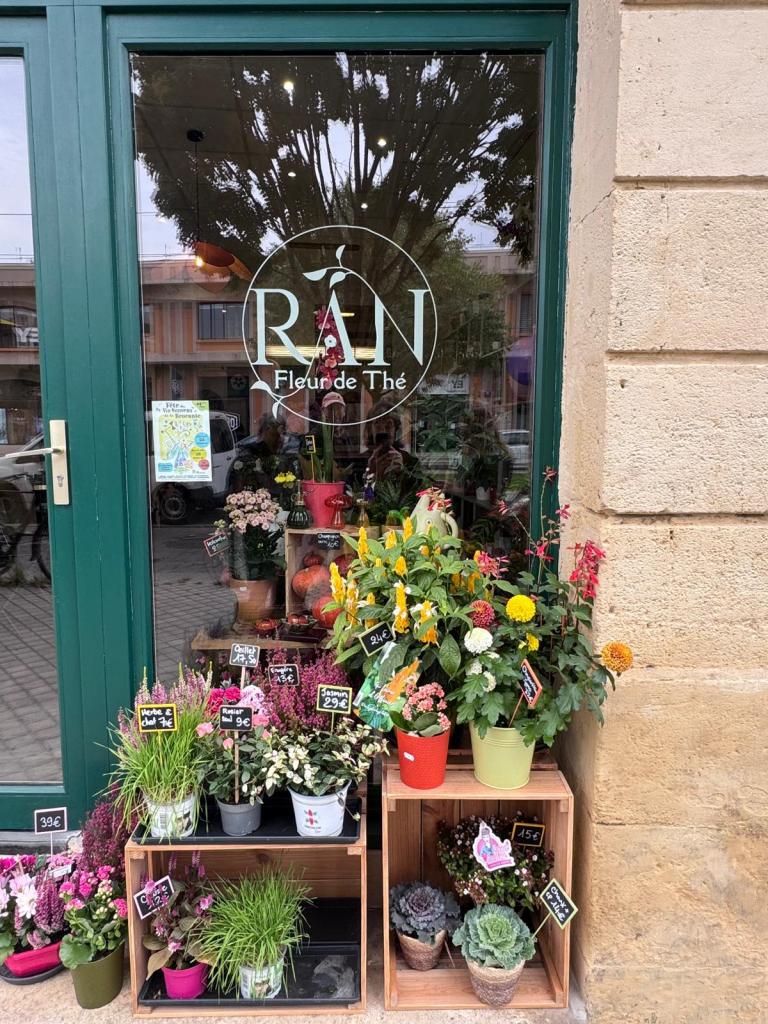
Two of our favorite shops were these little flower shops.
Along the way we got a better look at the Porte Dijeaux.
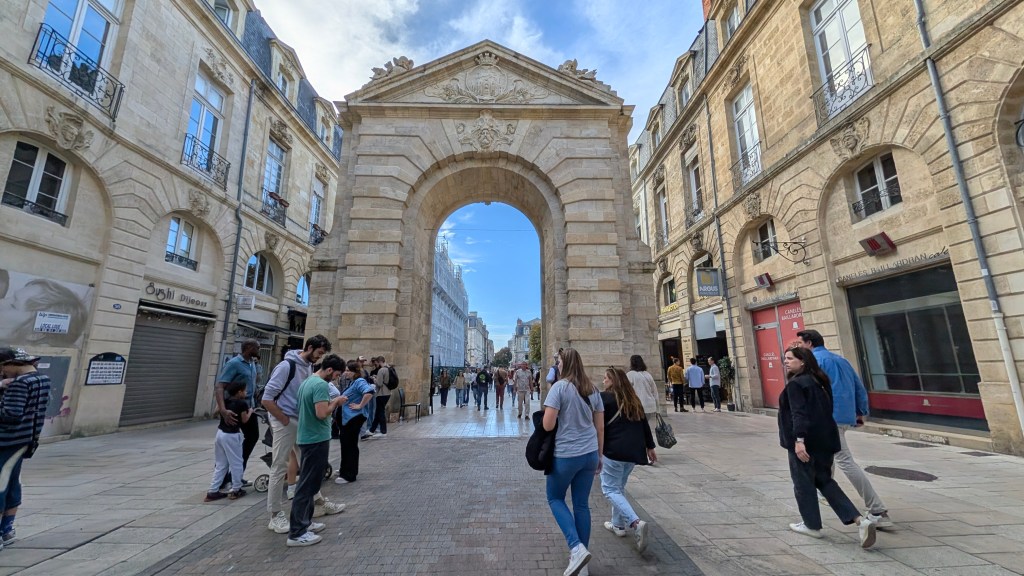
Porte Dijeaux

Once we returned to Place de la Comédie, we realized that it was a “No Kings” protest day in the U.S., and several expats were displaying signs in front of the opera house.
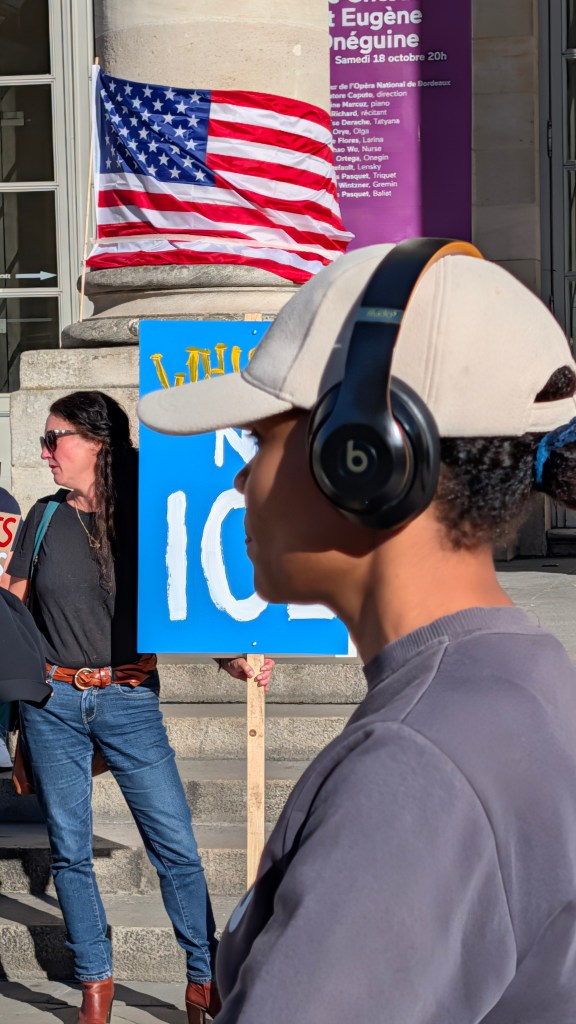
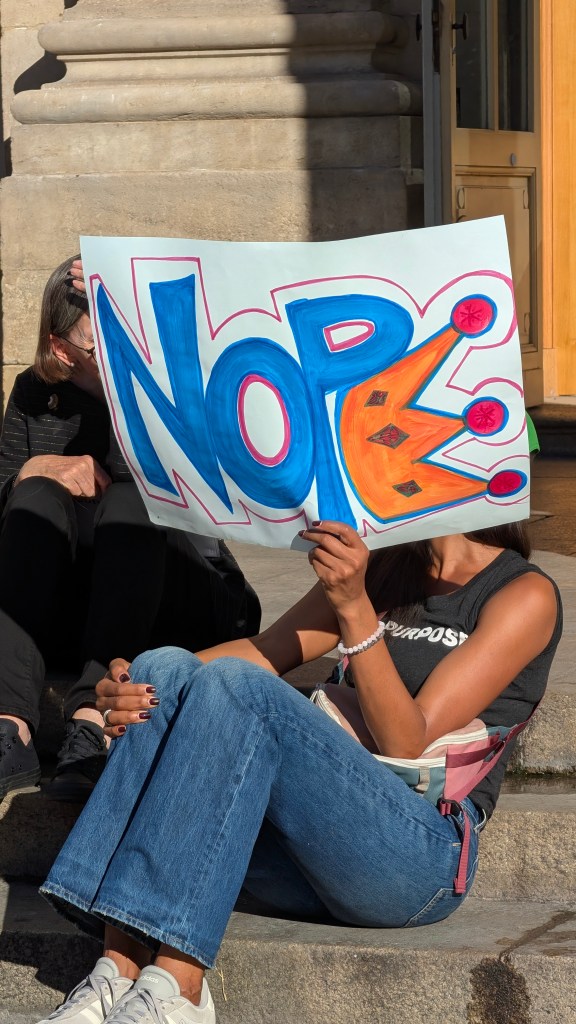
Also in the square, not previously mentioned by me, is Sanna, a monumental sculpture by Catalan artist Jaume Plensa. The seven-metre tall cast-iron head was originally installed in 2013 as part of a temporary exhibition of eleven sculptures throughout the city.  Due to its popularity, the sculpture remained in place permanently following a public fundraising campaign.  The work is designed to create a serene contrast with the hustle and bustle of the surrounding urban landscape. 
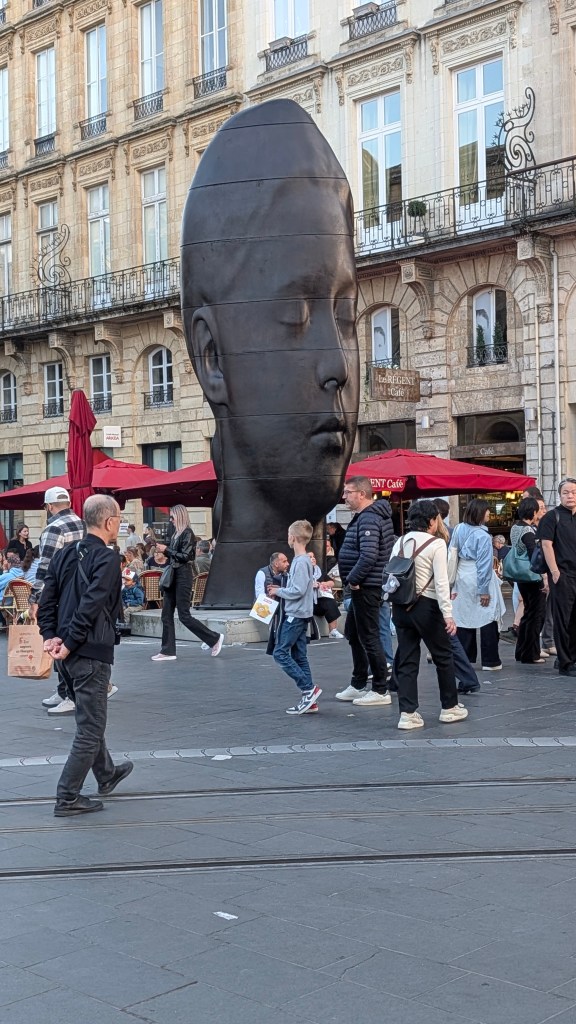
Sanna

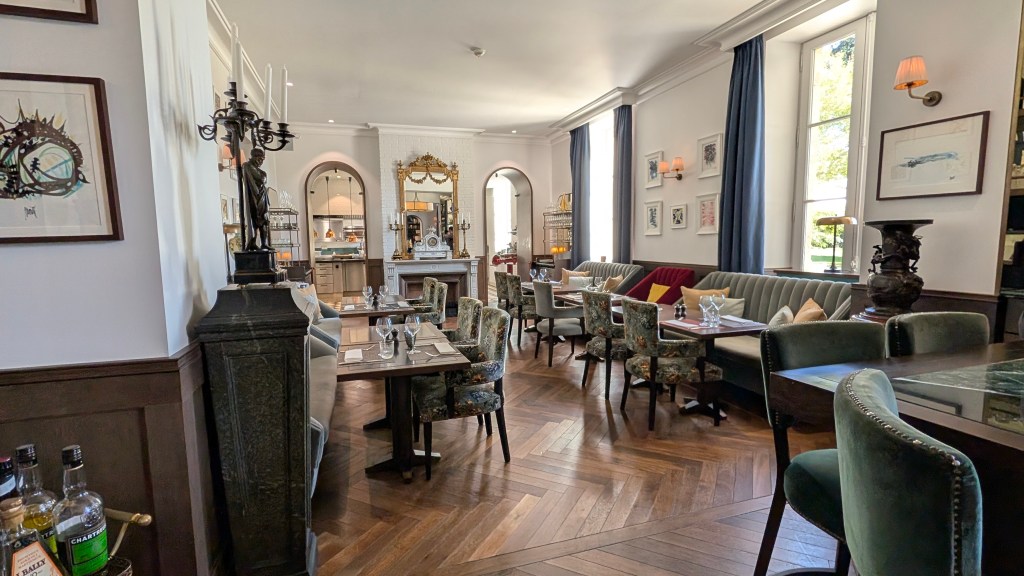
After a bit of a rest, it was time to head out into the evening for dinner at Bistro 1554.
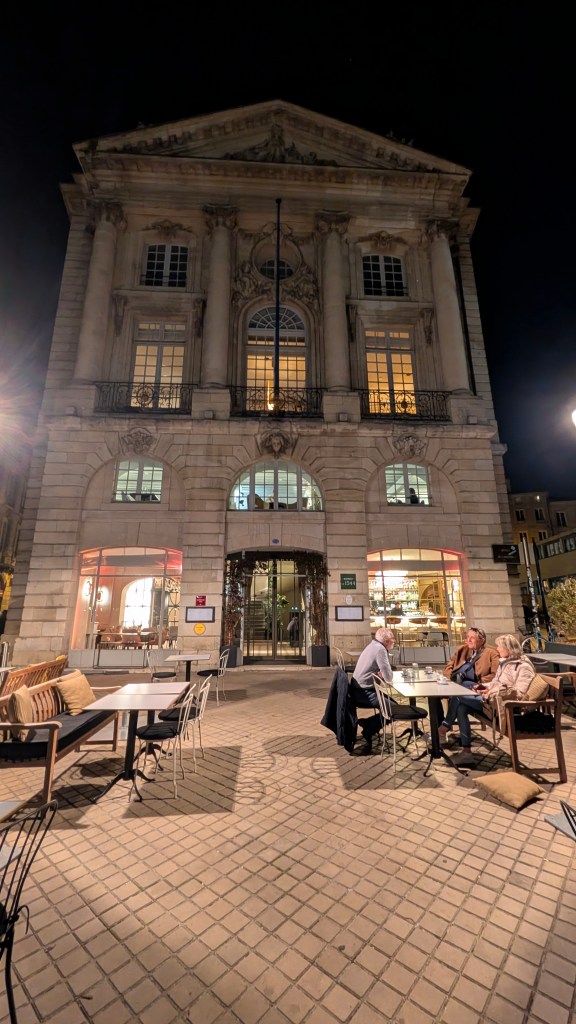
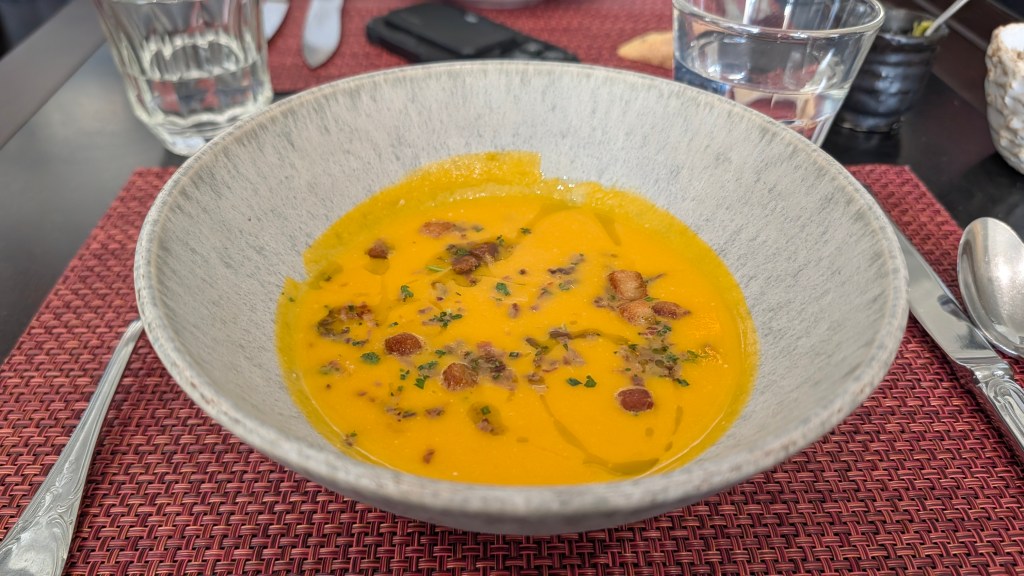
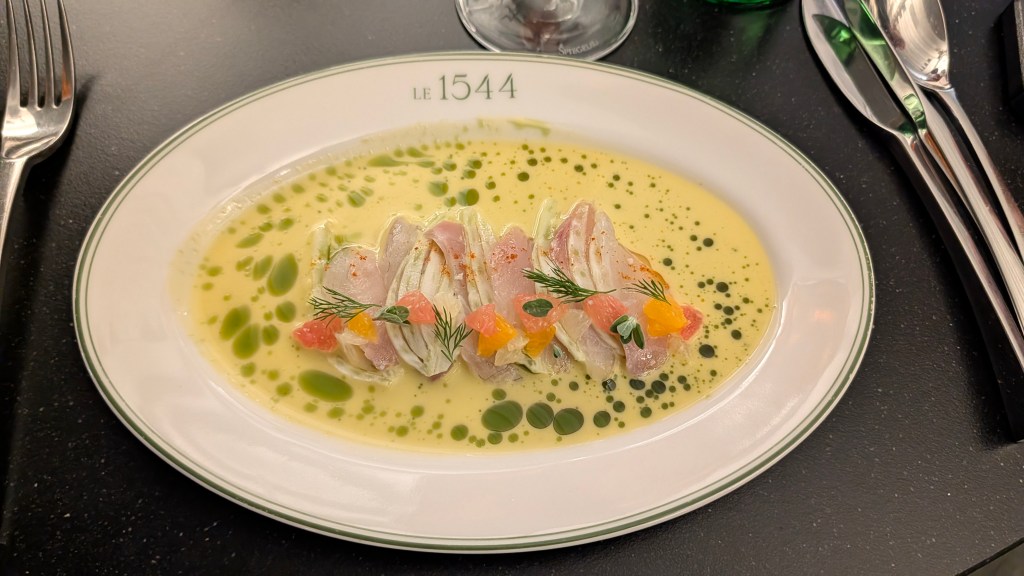
It was yet another elegant dinner of multiple courses from soup
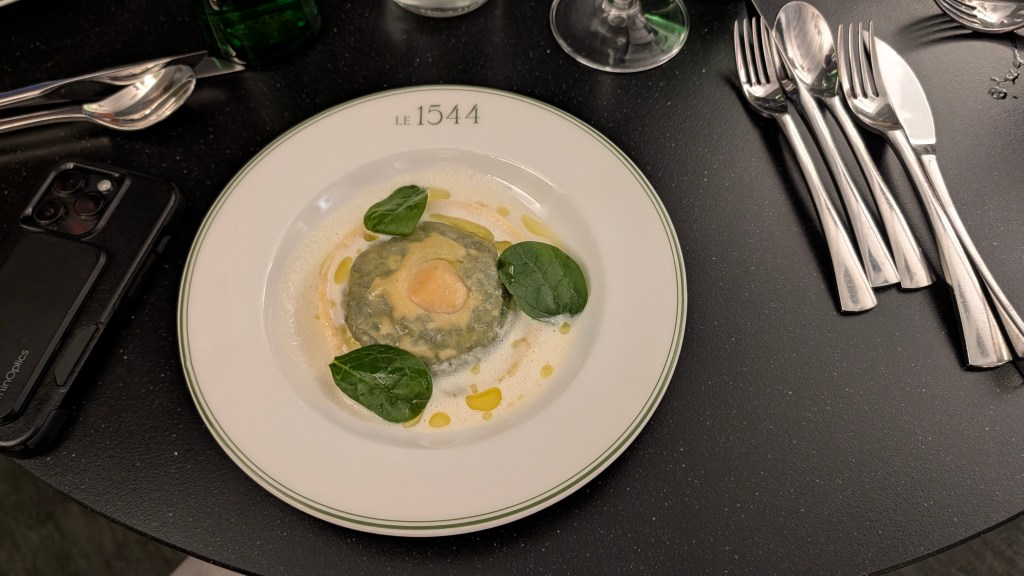
and ravioli
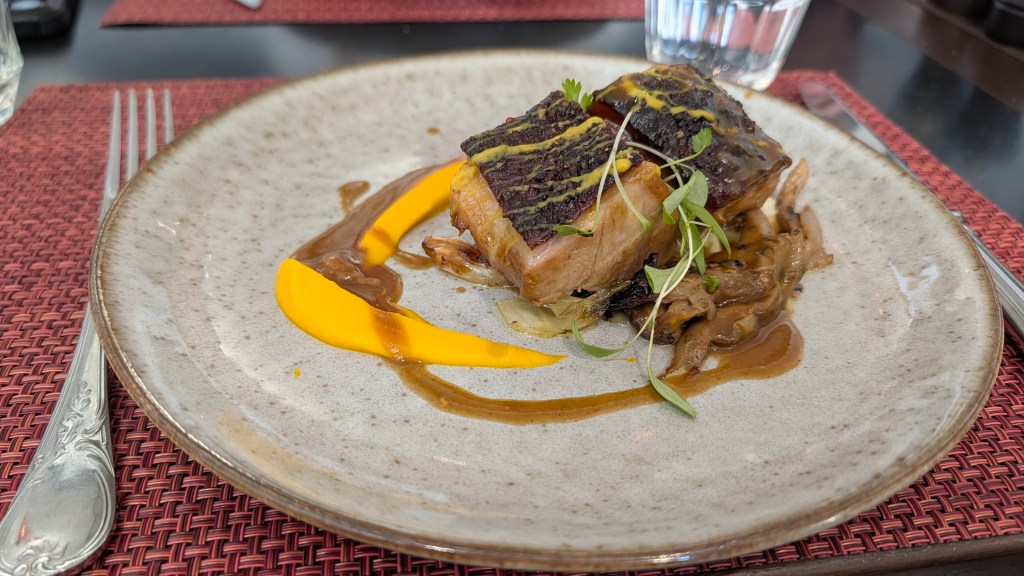
to meat
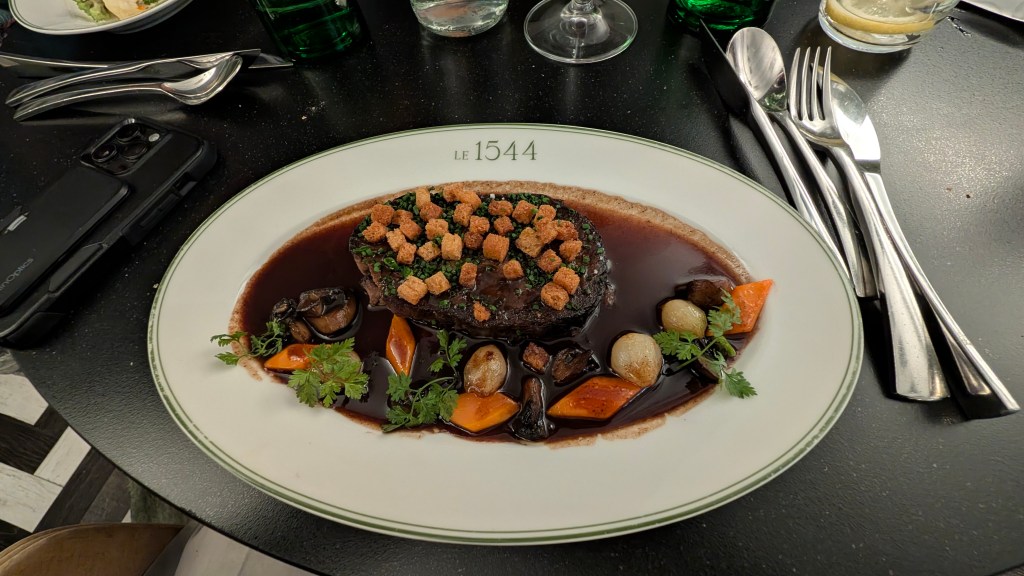
and desert.
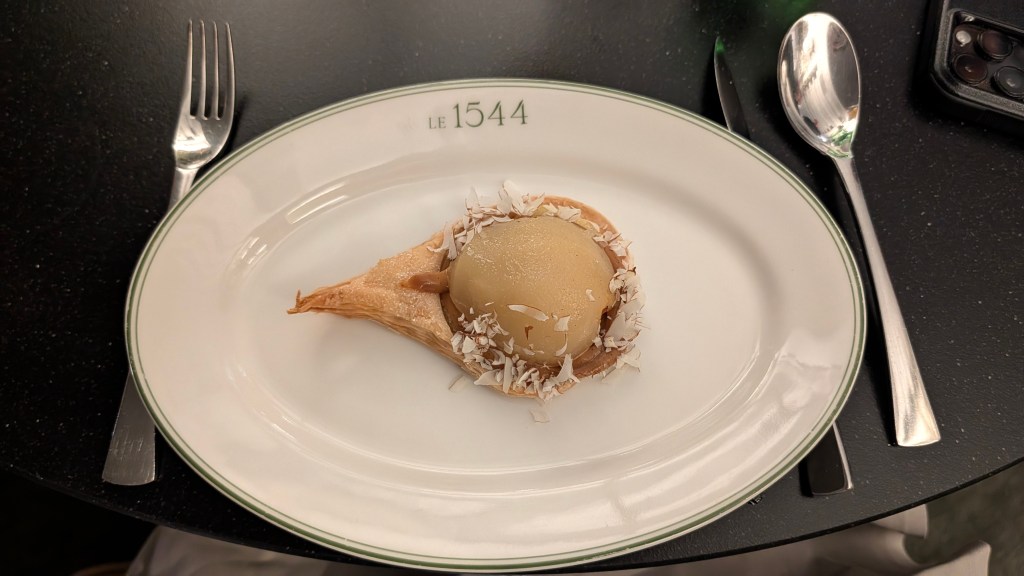
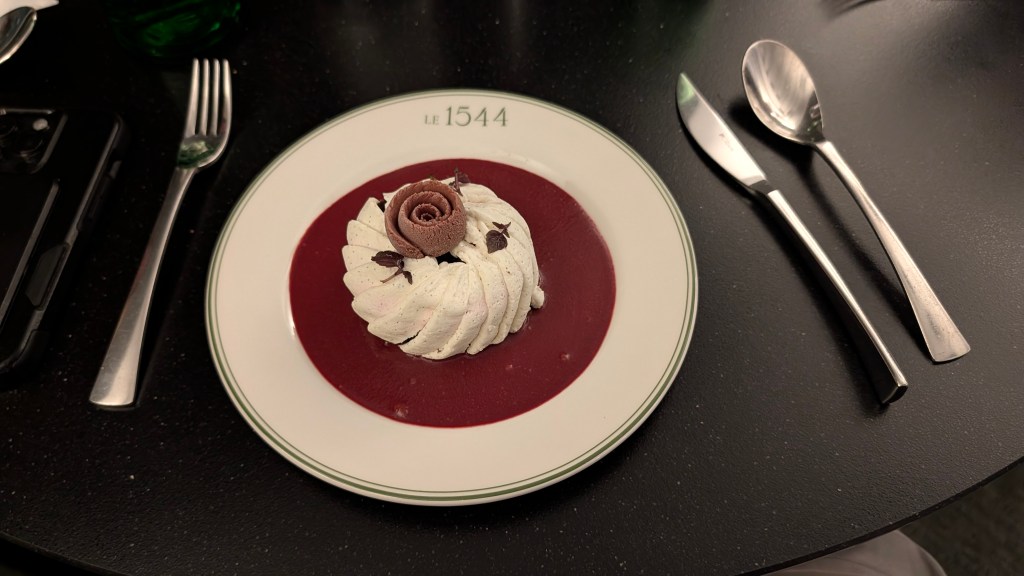
Having stuffed ourselves, we decided it was prudent to walk it off. We headed to the river for the night views.
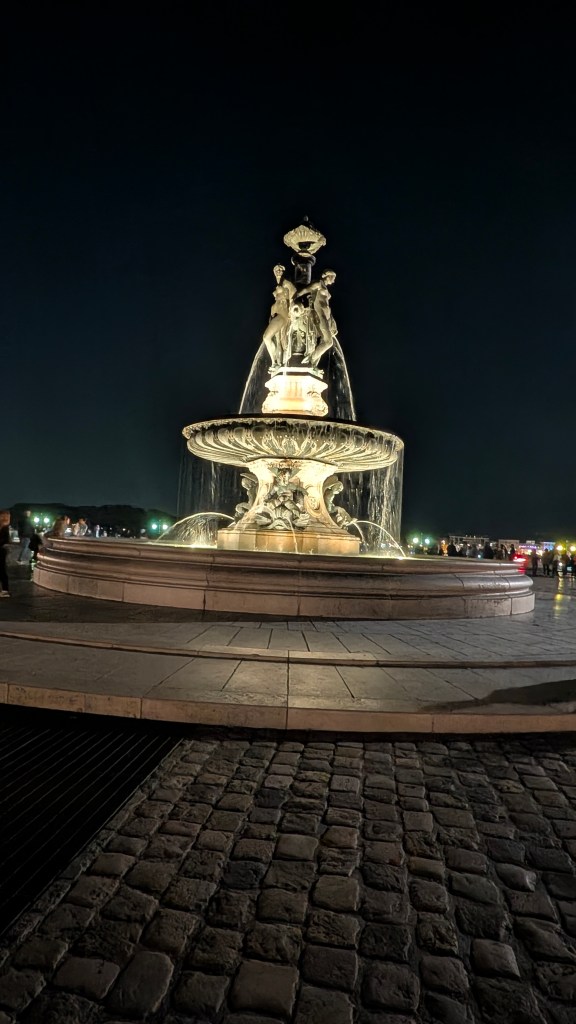
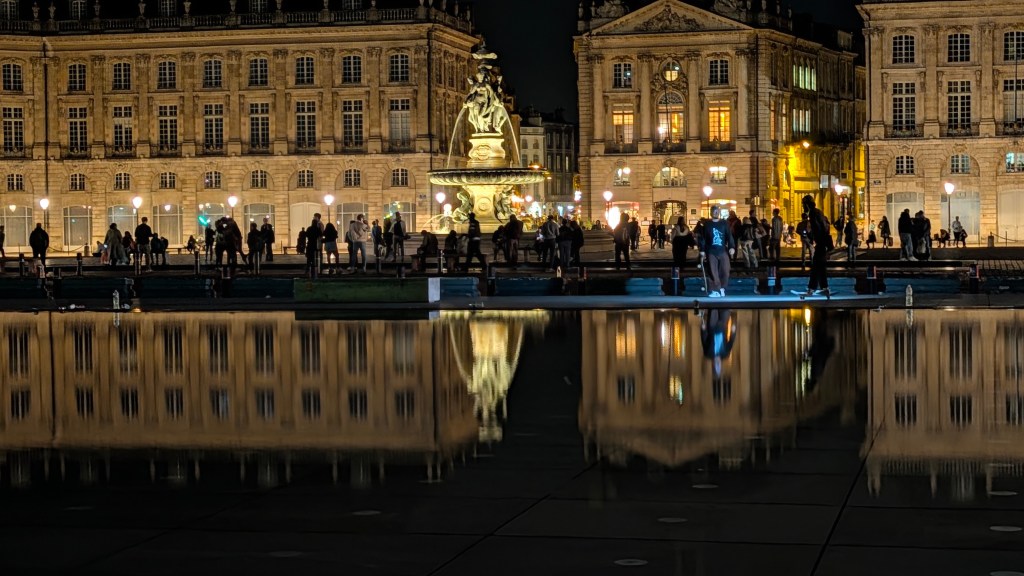
The Miroir d’eau (Water Mirror) in is a reflecting pool covering 337,100 sq ft. Located on the quay of the Garonne River in front of the Place de la Bourse.  It was built in 2006 and creates a stunning reflection.
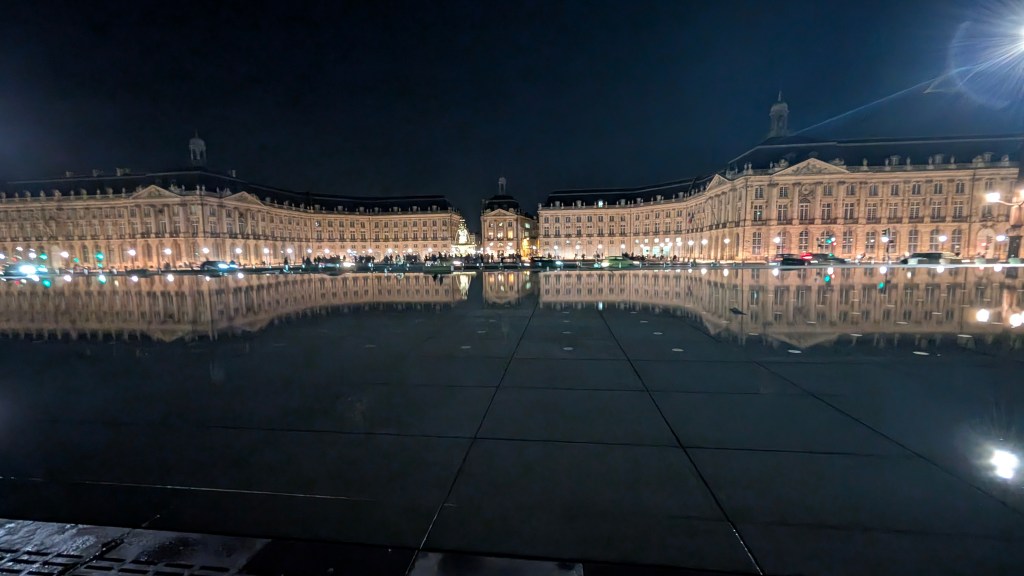
Miroir d’eau (Water Mirror)

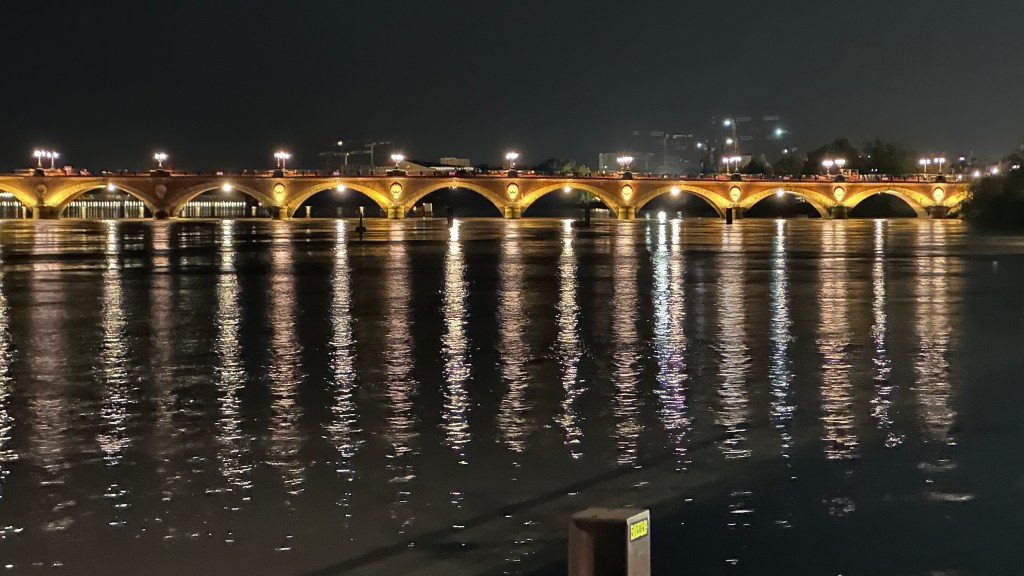
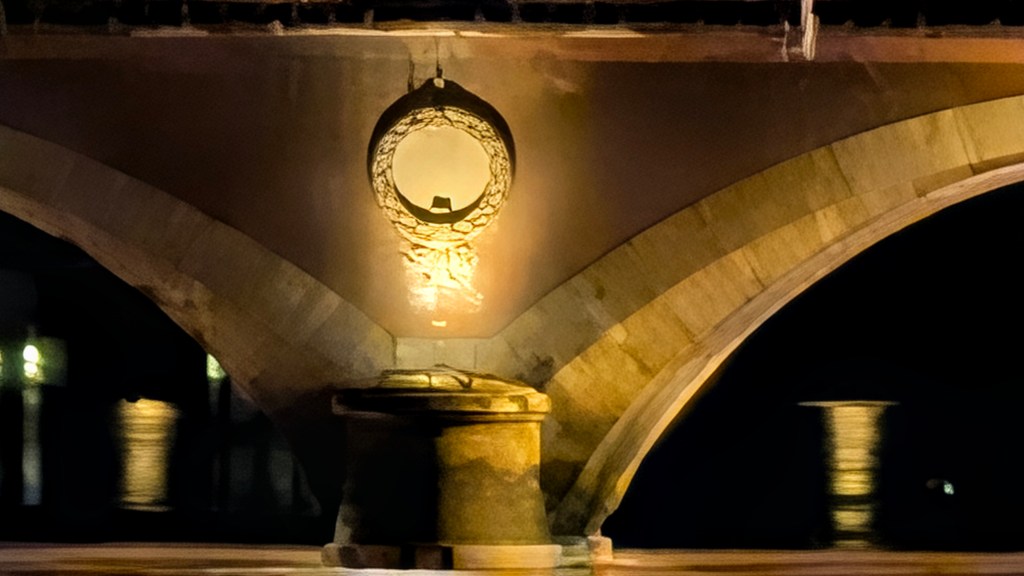
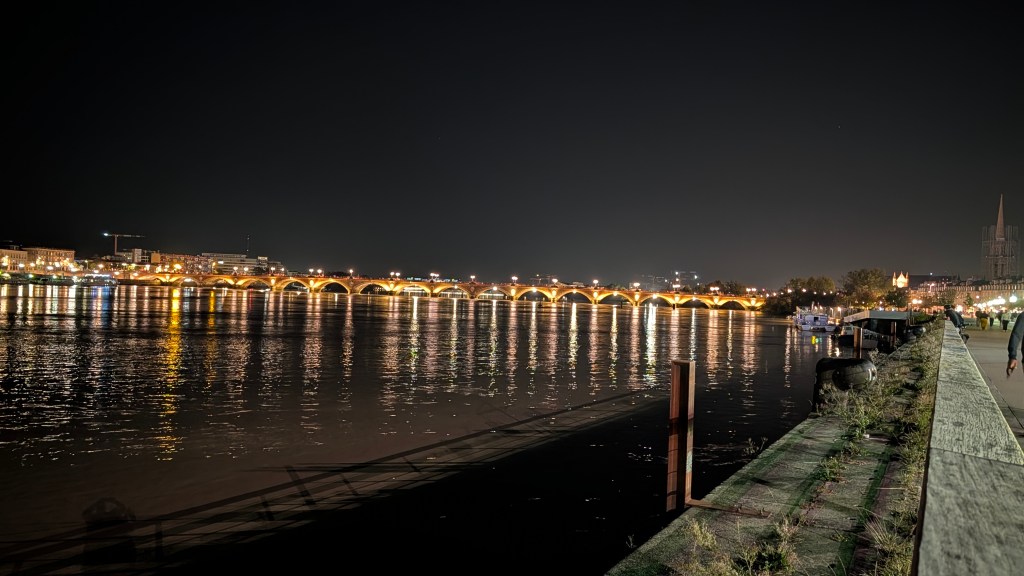
The river also beautifully reflects the lights from the bridges.
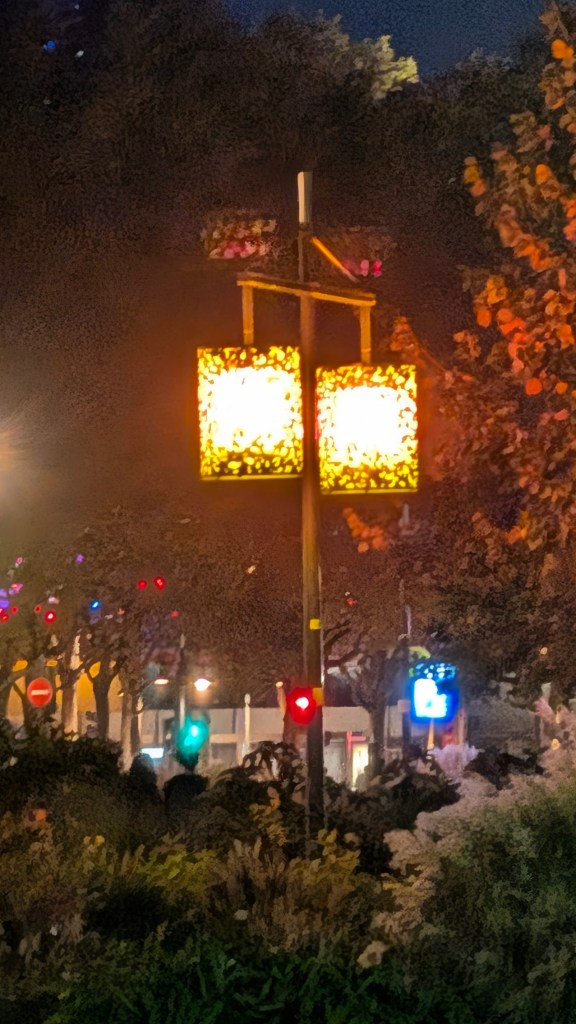
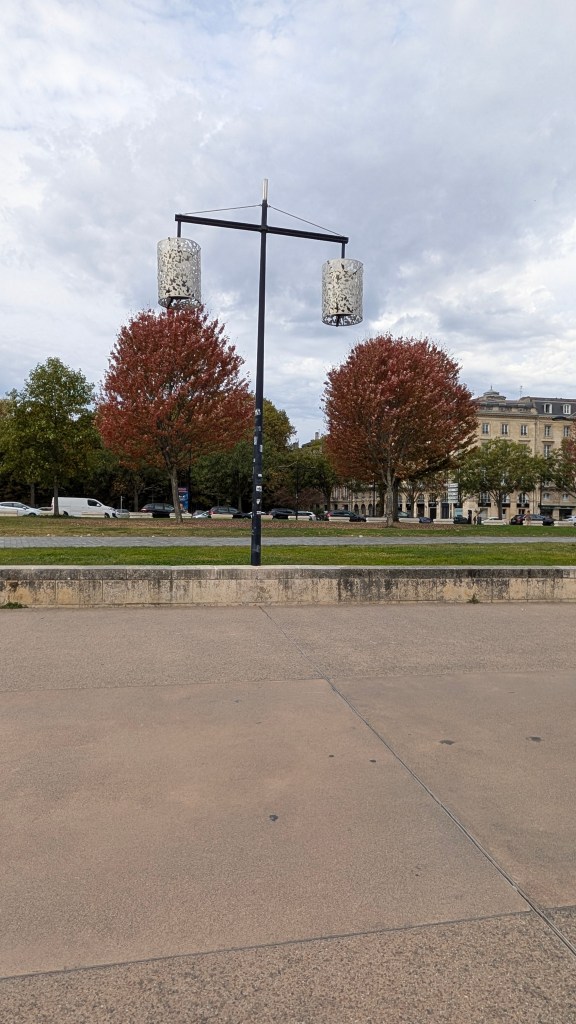
Even the street lights along the river are beautifully designed.
The following day we were on our own in the city. We headed back to the river.
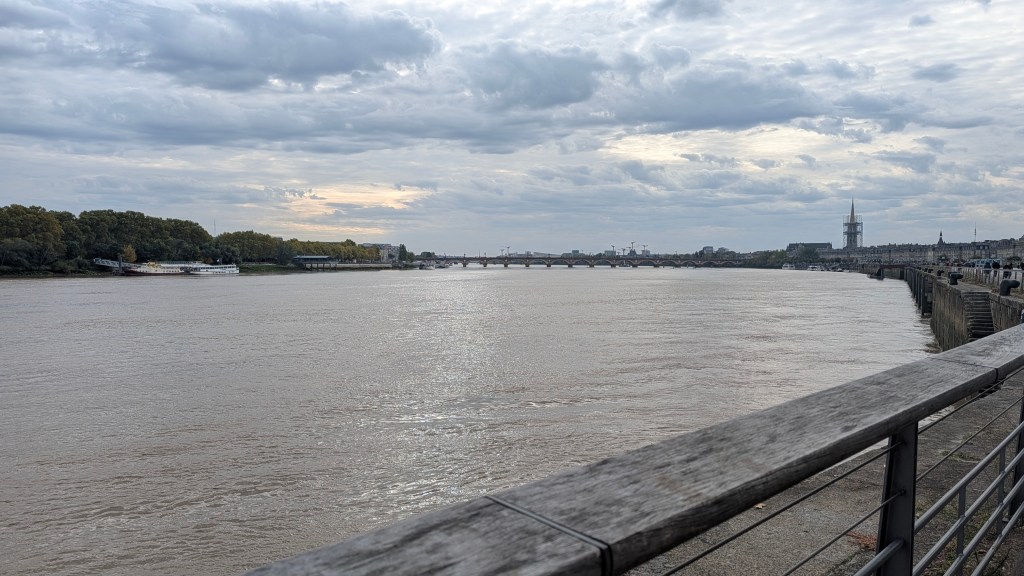
The street lights were even more beautiful in the daylight.
We passed the Bourse Maritime (Maritime Stock Exchange). Built between 1921 and 1925, it was designed as a replica of the central pavilion of the nearby 18th-century Place de la Bourse.  The building served as a hub for the city’s maritime commerce and is now a significant landmark in the UNESCO World Heritage-listed historic center of Bordeaux. 
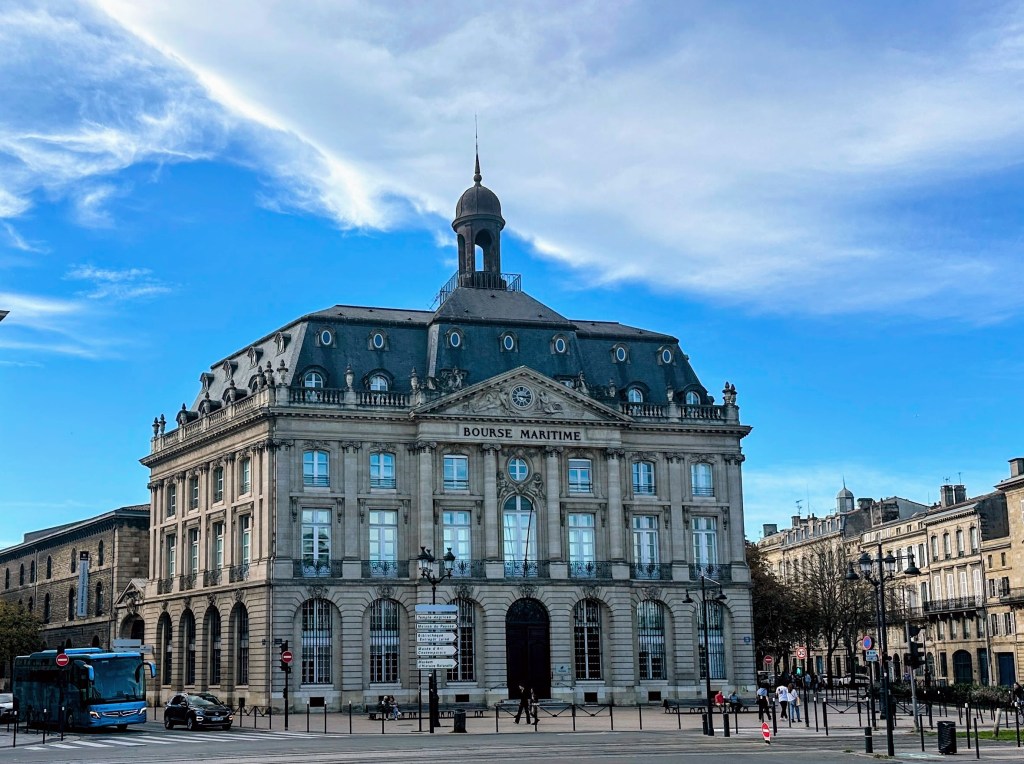
Bourse Maritime (Maritime Stock Exchange)

In front of which stands a bronze statue which depicts Modeste Testas (also known as Marthe Adélaïde Modeste Testas), an enslaved African woman who was born in East Africa and brought to Bordeaux in the late 18th century. The monument serves as a memorial to the city’s historical involvement in the slave trade. The statue represents the resilience of enslaved people, with broken shackles depicted at her feet. It was sculpted by artist Kafack F. and inaugurated in 2019.
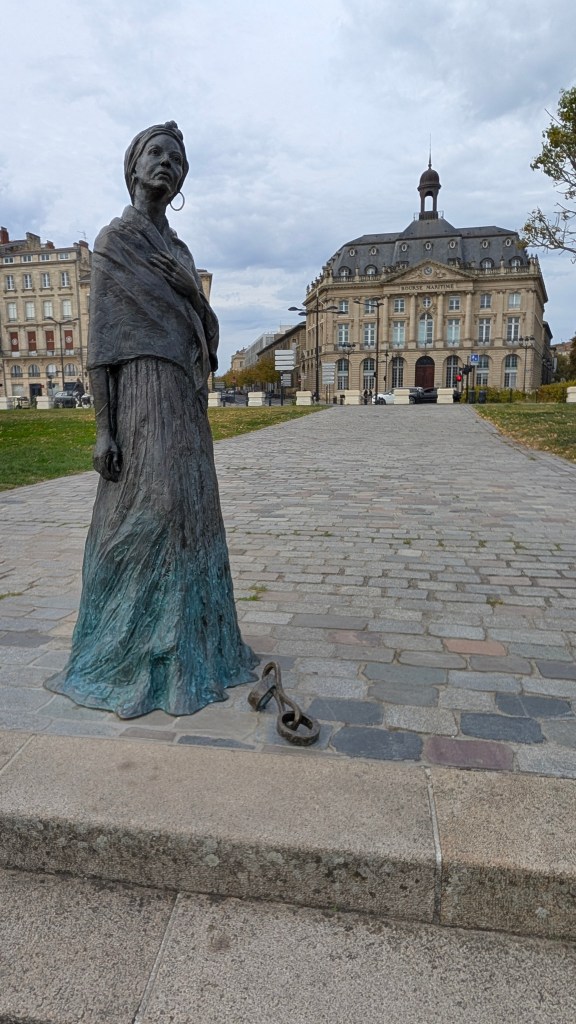
Marthe Adélaïde Modeste

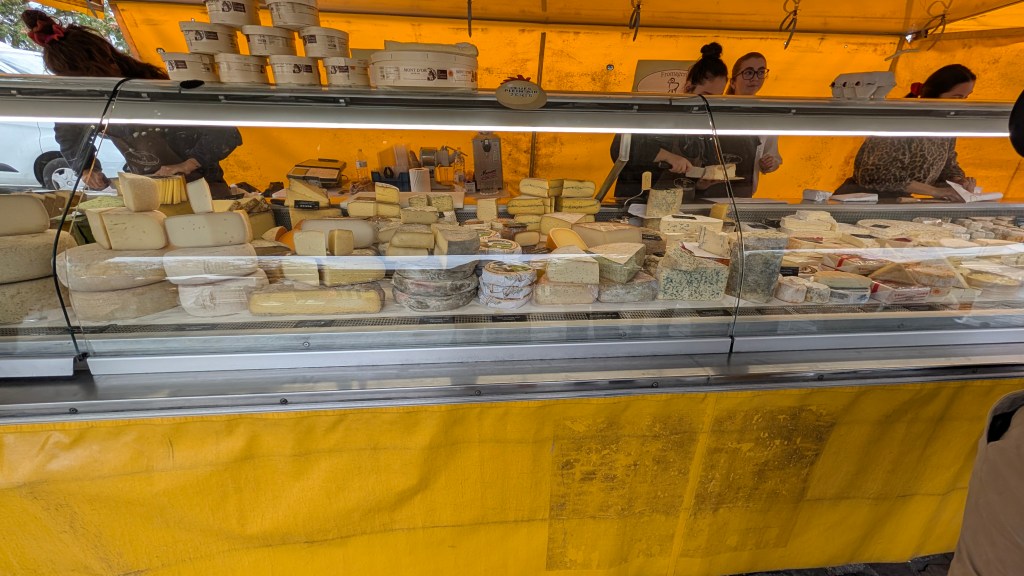
We made our way to the Sunday market which featured all the usuals for a French market: cheeses,
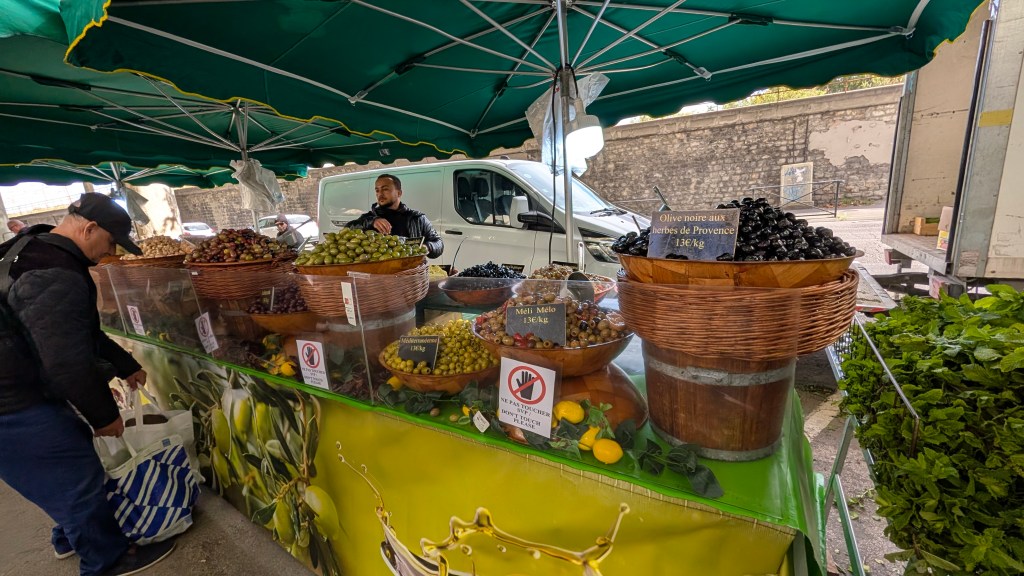
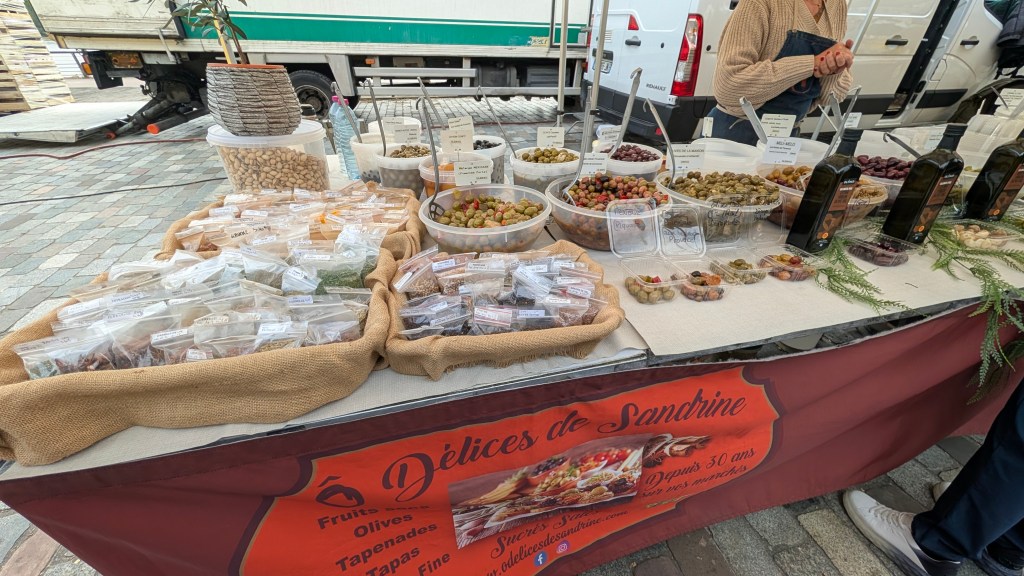
olives,
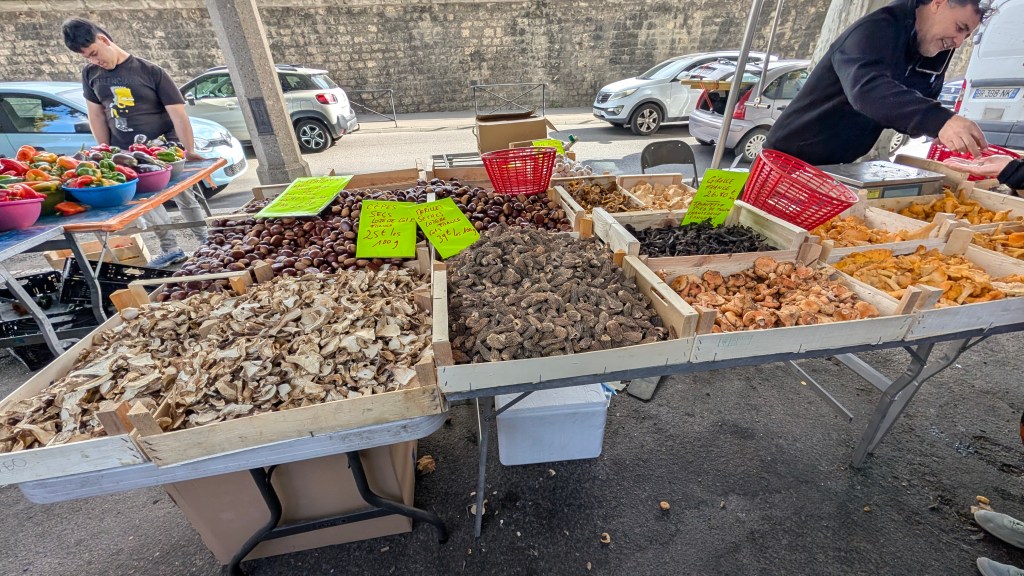
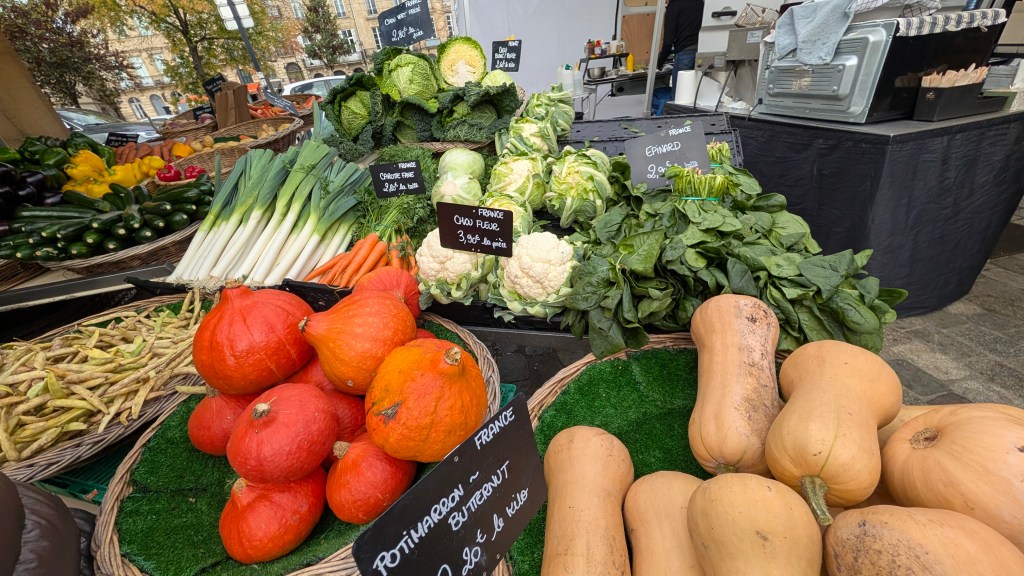
colorful autumnal veggies,
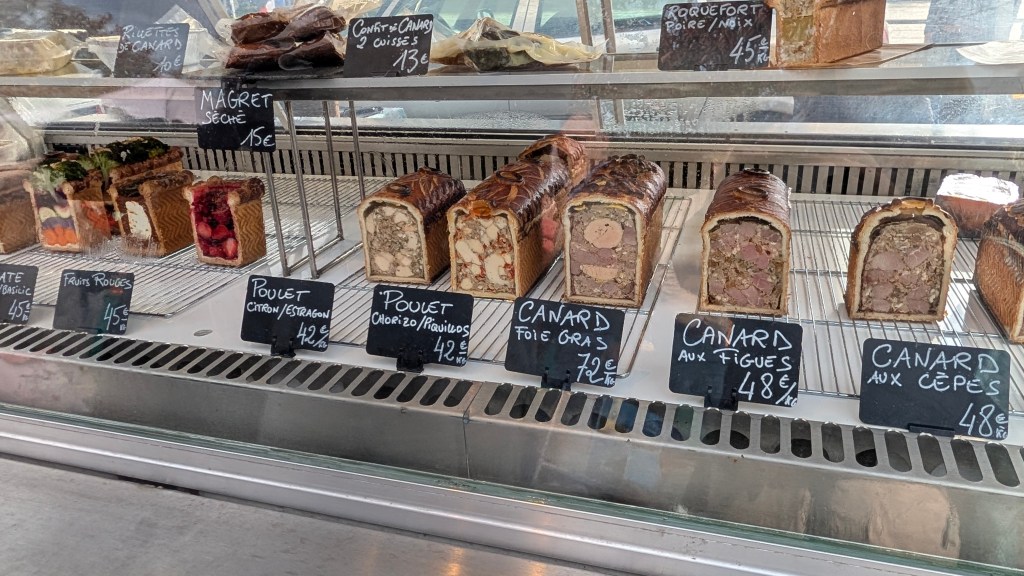
patés,
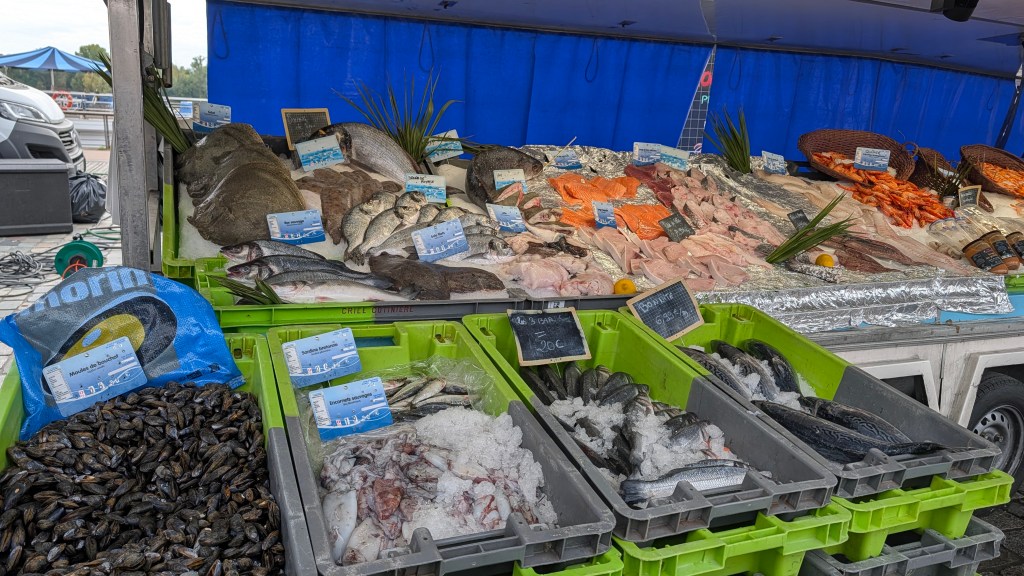
and fish.
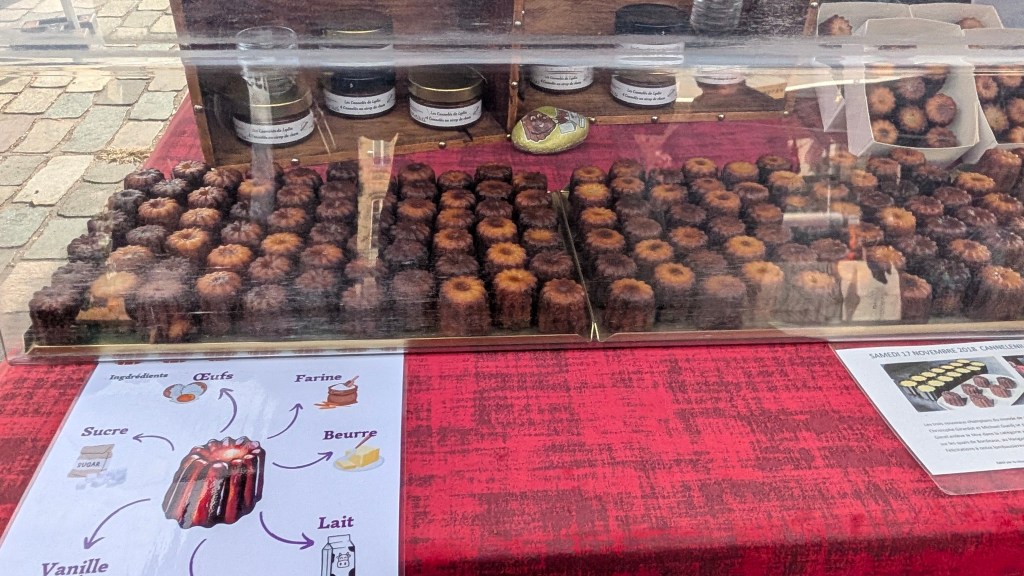
The special Bordeaux inclusion here Cannelé.
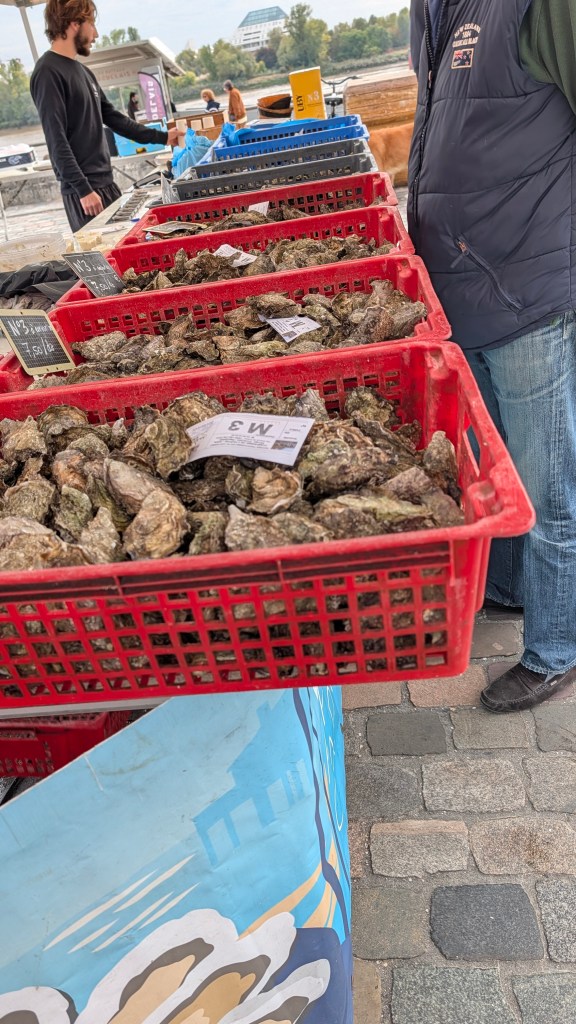
And very special to this market were oh so many oysters, which we tried on the spot.
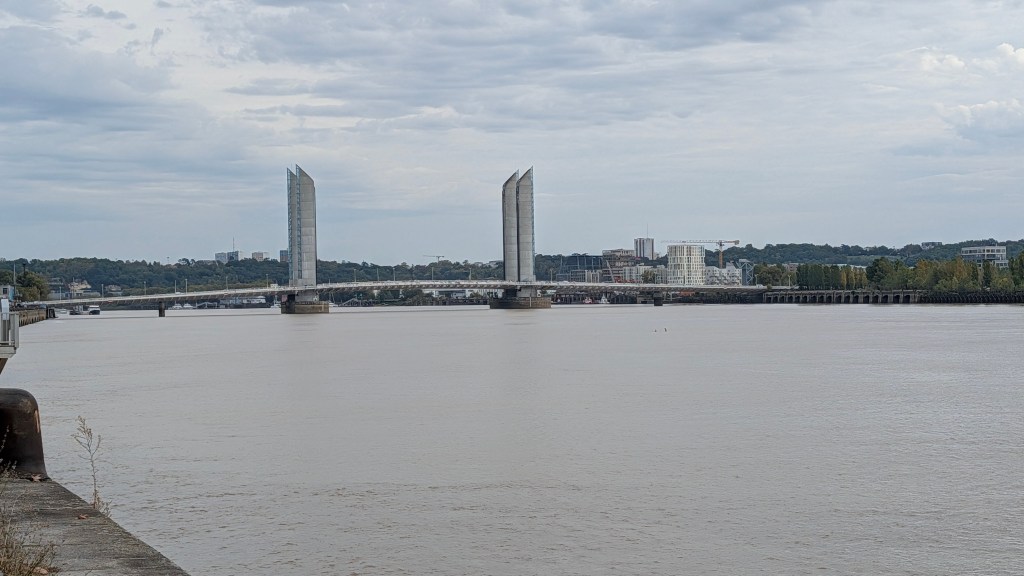
Ahead we could see the Jacques Chaban Delmas Bridge.
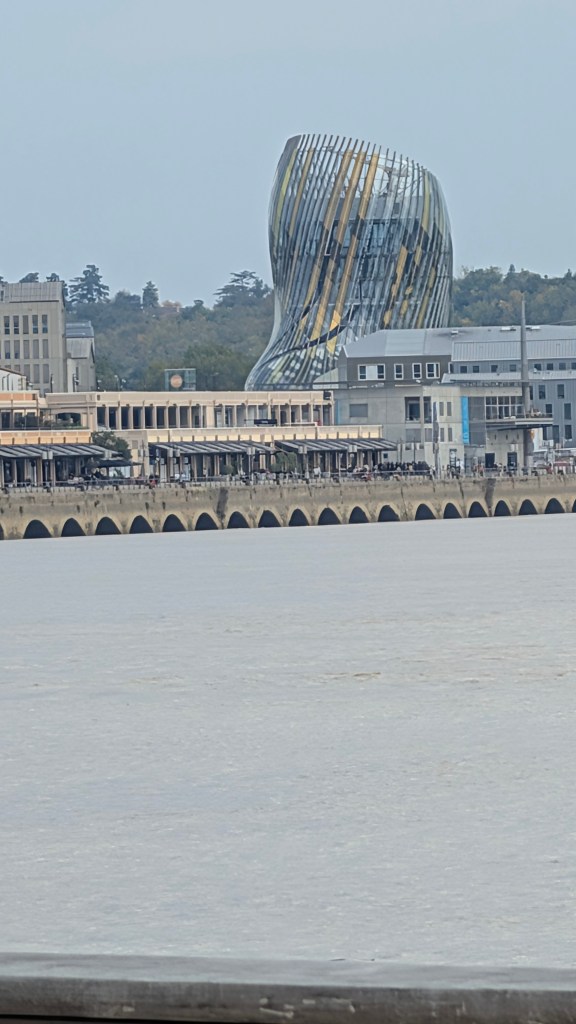
Off in the distance we could see Cité du Vin, a modern museum dedicated to wine culture from around the world.  The unique architecture is designed to resemble a swirling glass decanter or a knotted vine stock.  We did not make it that far into the city.
Instead we turned inland and explored some side streets.
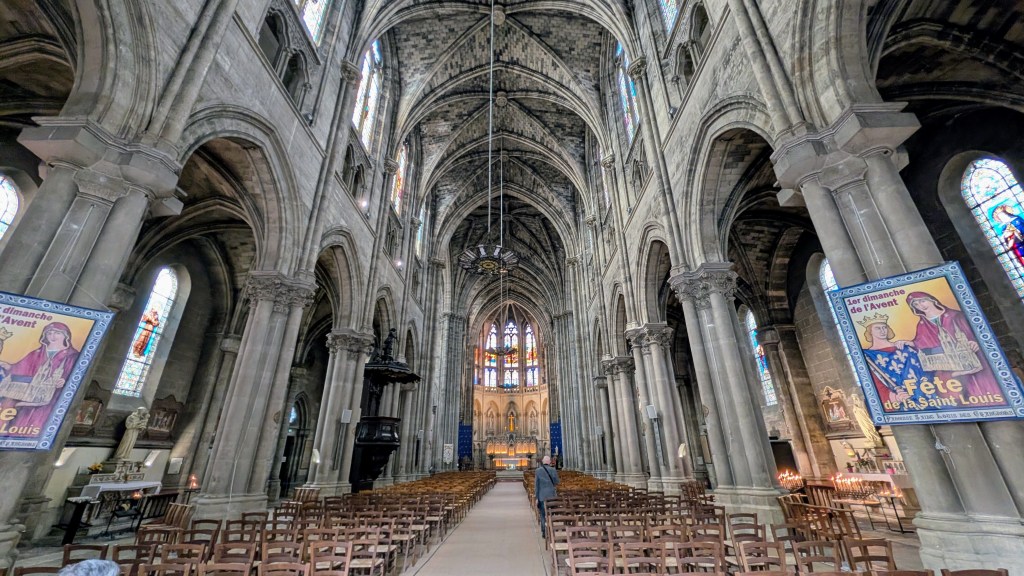
We found a small local Église Saint-Louis-des-Chartrons (Church of Saint-Louis-des-Chartrons), a Roman Catholic church designed in the Gothic Revival architectural style built between 1874 and 1880.  Situated in the historic Chartrons district of the city. the church is named after and dedicated to Saint Louis, King of France.
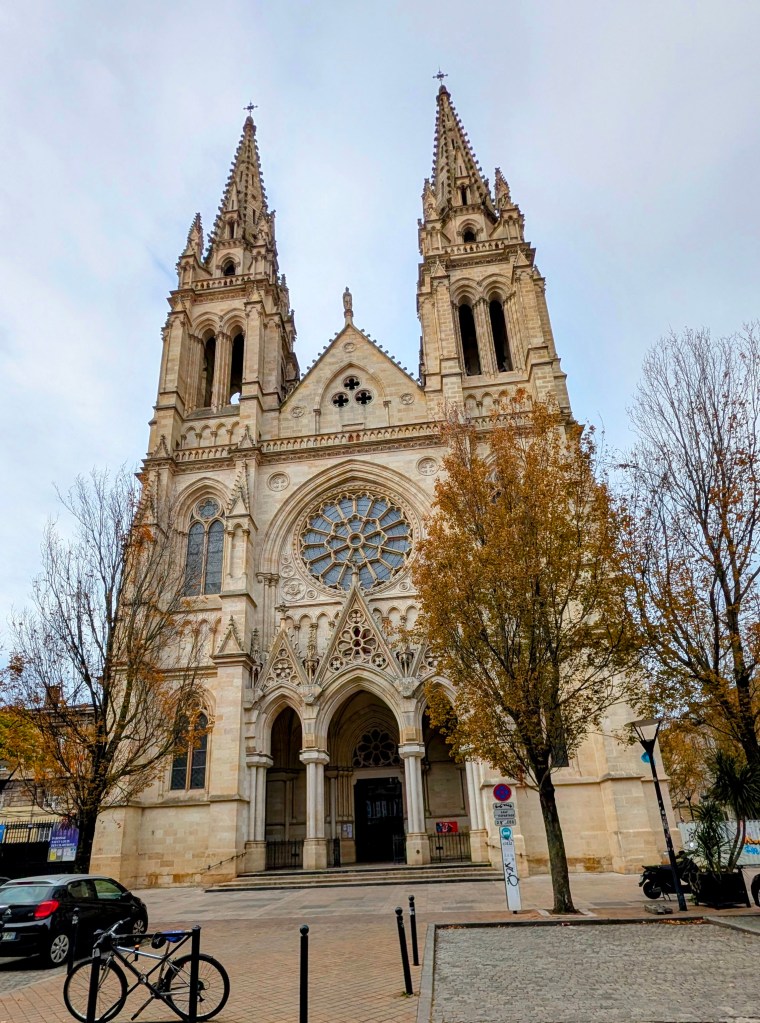
Église Saint-Louis-des-Chartrons (Church of Saint-Louis-des-Chartrons)

We went in and looked around.

On our way back to our hotel, we passed a bronze statue of Jeanne d’Arc (Joan of Arc) created by French sculptor Jules Déchin. It was erected in 1950. 
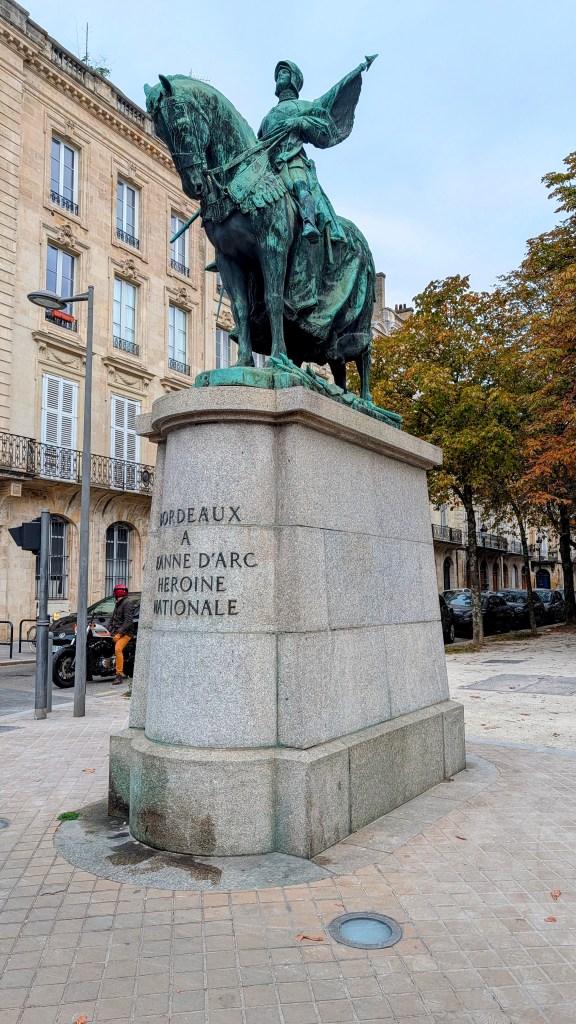
Jeanne d’Arc (Joan of Arc)

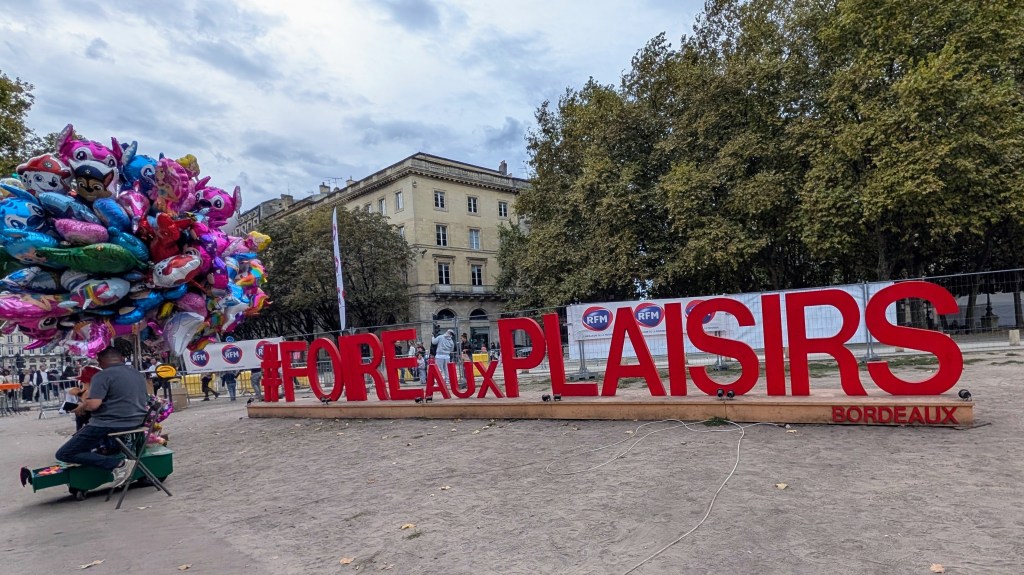
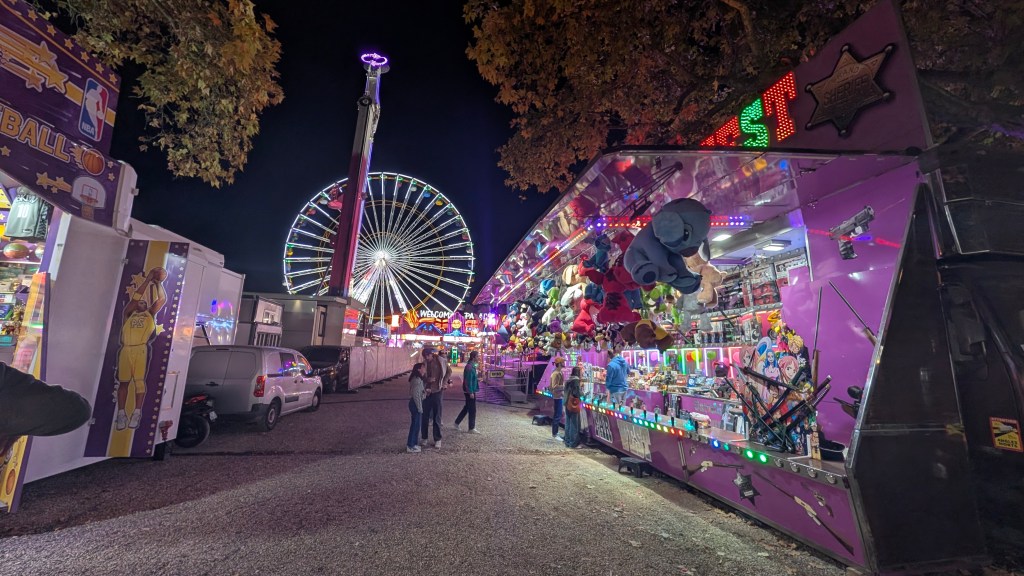
We wandered back by the fair.

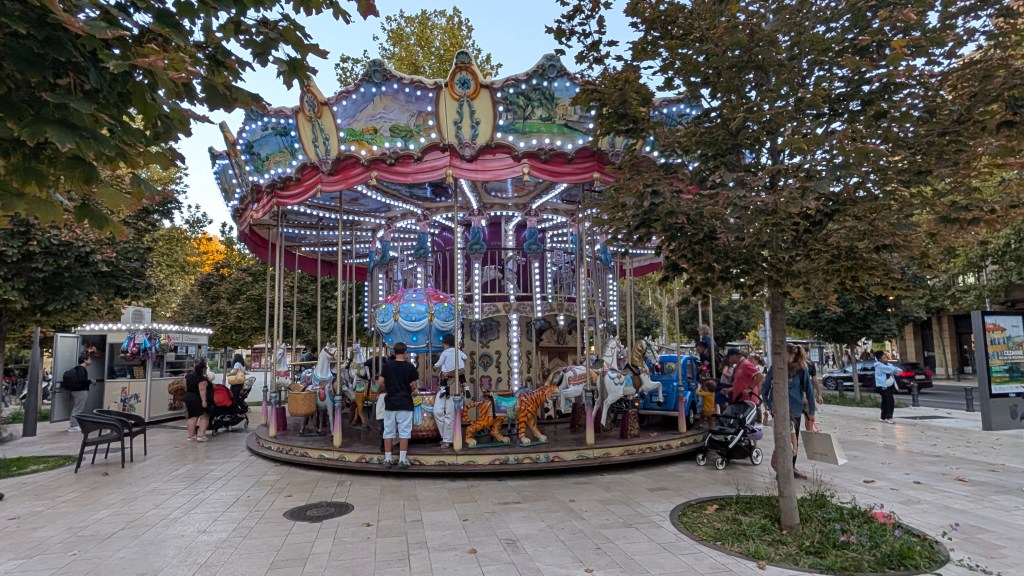
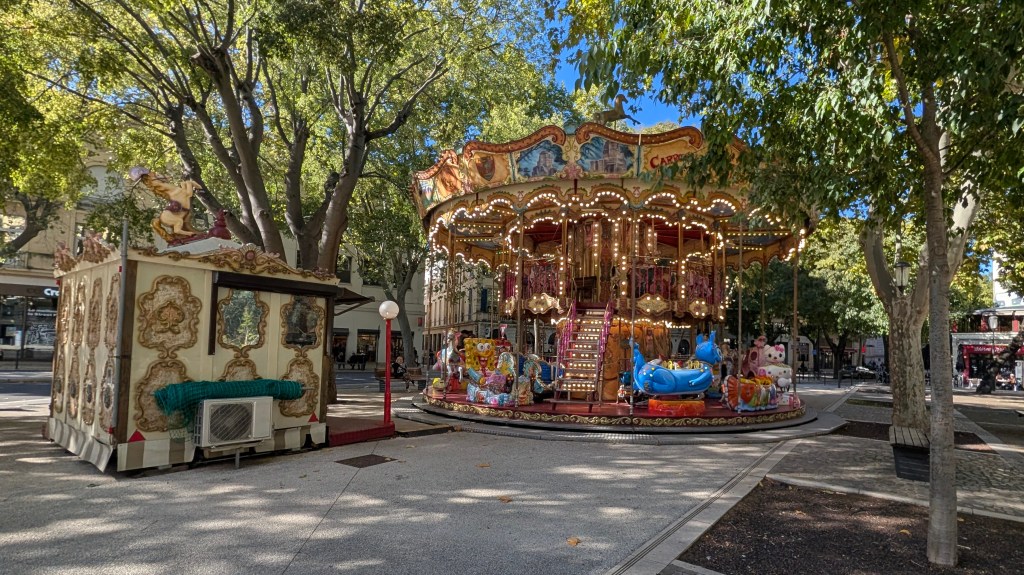
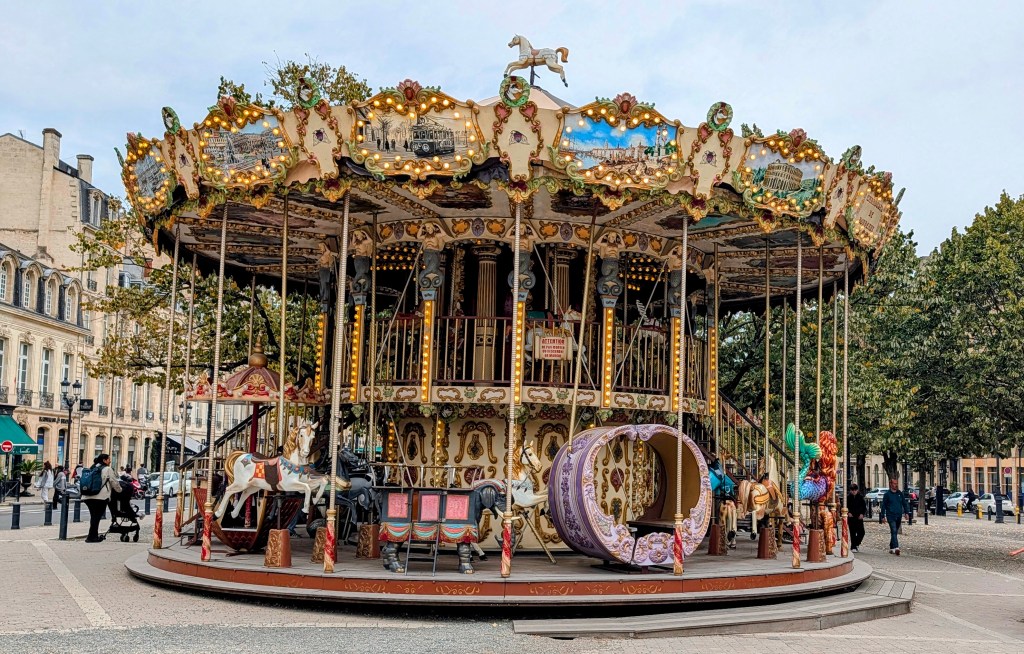
And did I mention there was, of course because this is France, a carousel.
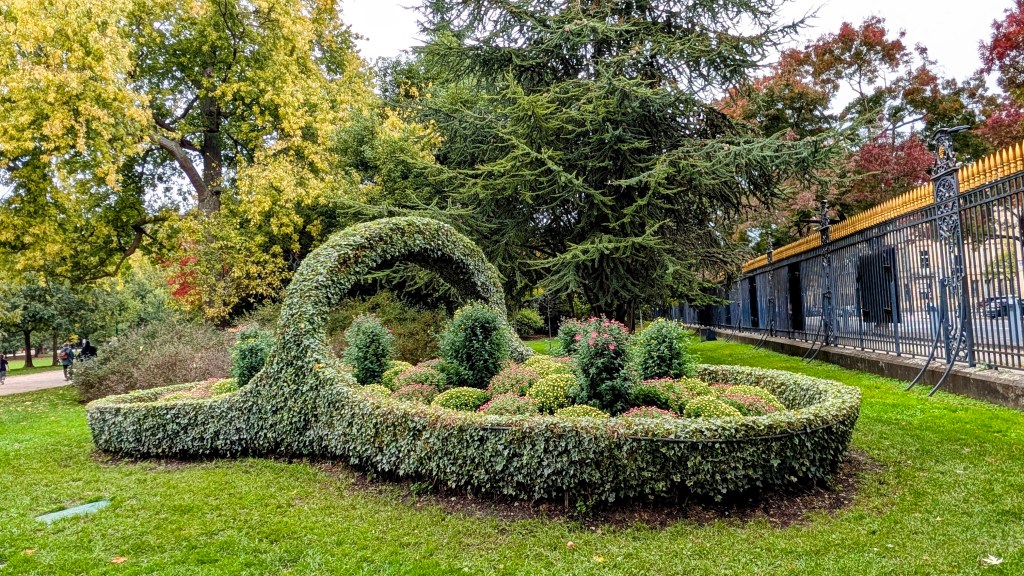
We took a walk through the public gardens, which were beautiful despite the late season.
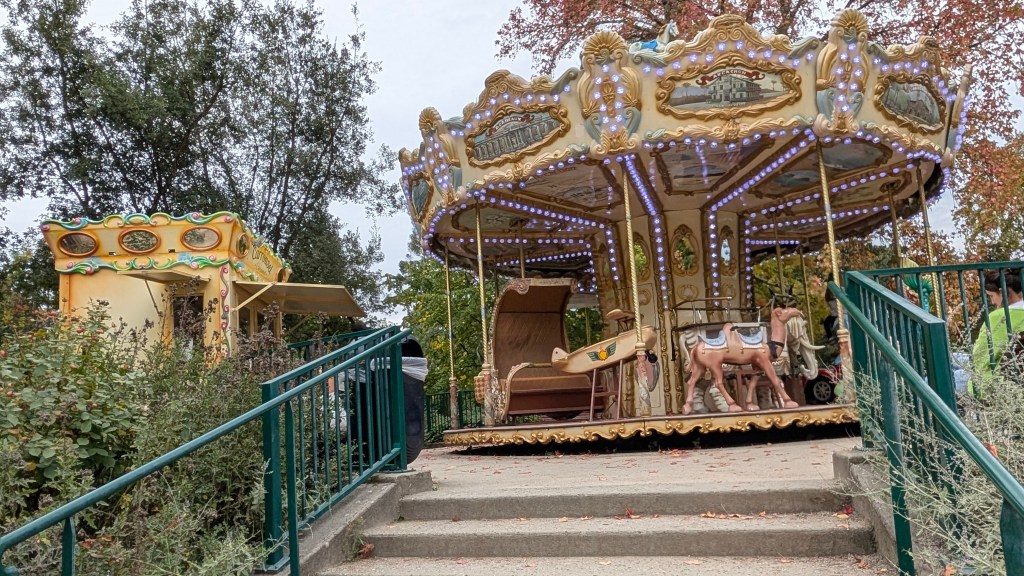
And in the garden we found yet another carousel!
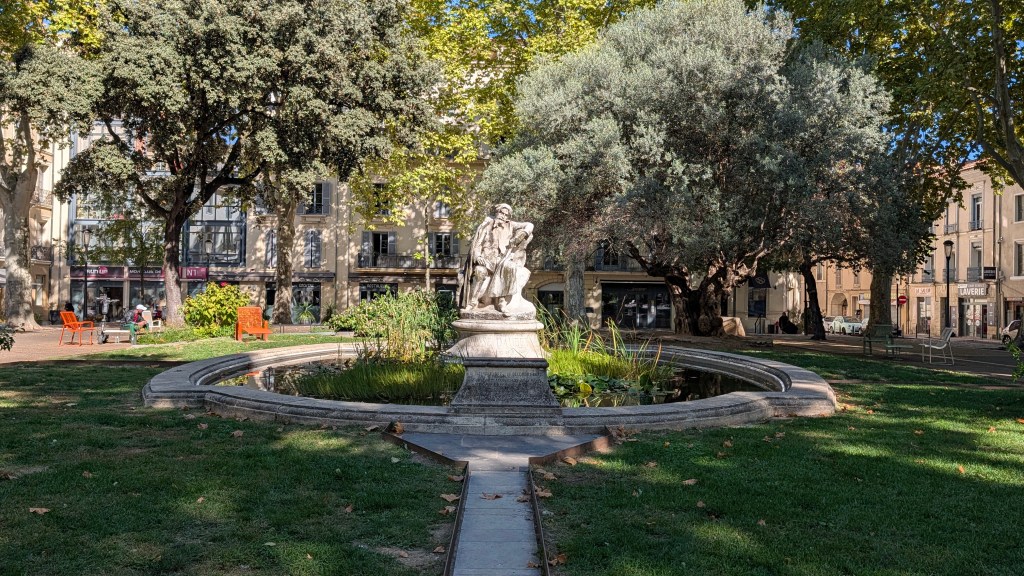
We came upon a statue of Louis-Urbain-Aubert de Tourny (1695-1760). In 1743, he became intendant of Guyenne, an old French province which corresponded roughly to the Roman province of Aquitania Secunda and the Catholic archdiocese of Bordeaux. He is the one responsible for the beautification of the quays on the Garonne adding buildings, opening avenues, and creating a public garden.
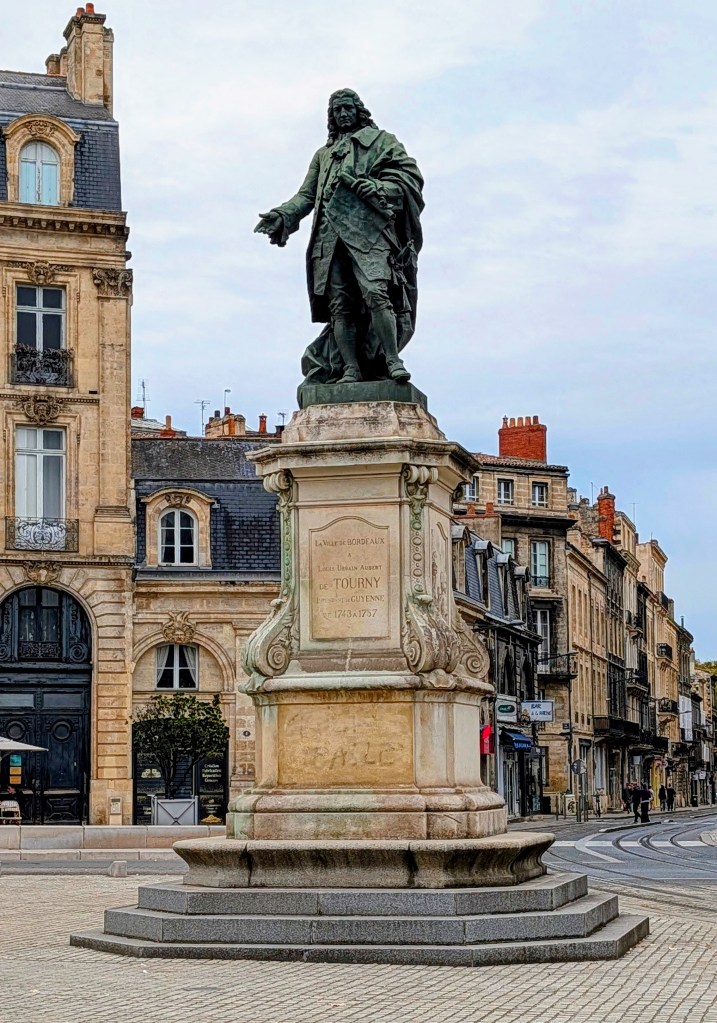
Louis-Urbain-Aubert de Tourny

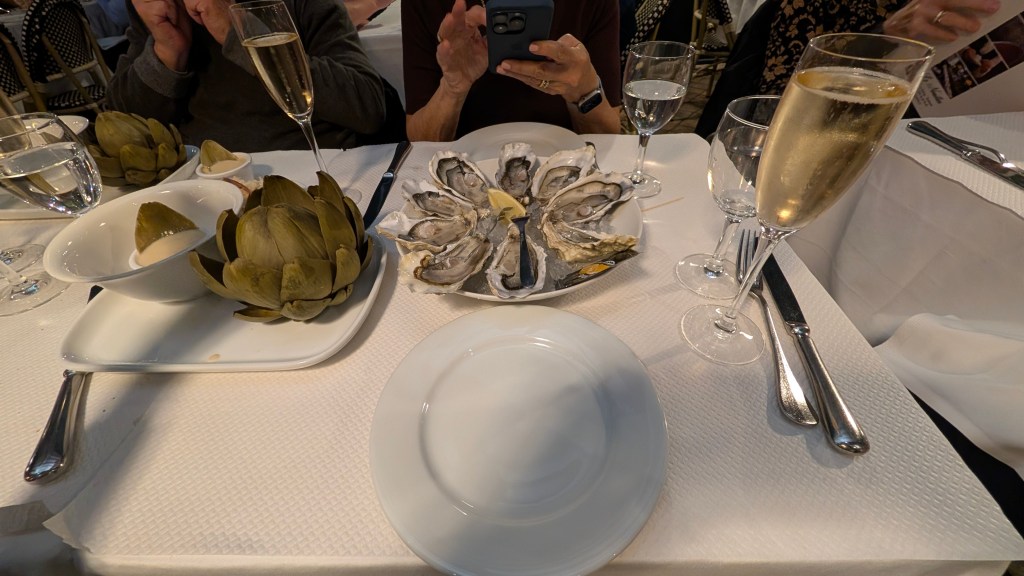
Dinner was simply French: oysters, artichokes, and champagne at Brasserie Le Noailles.
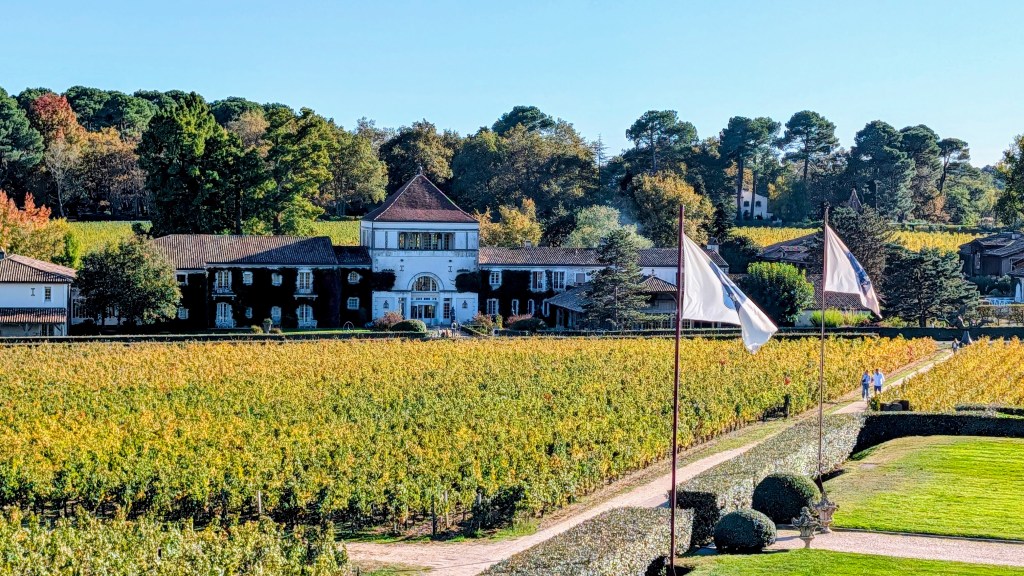
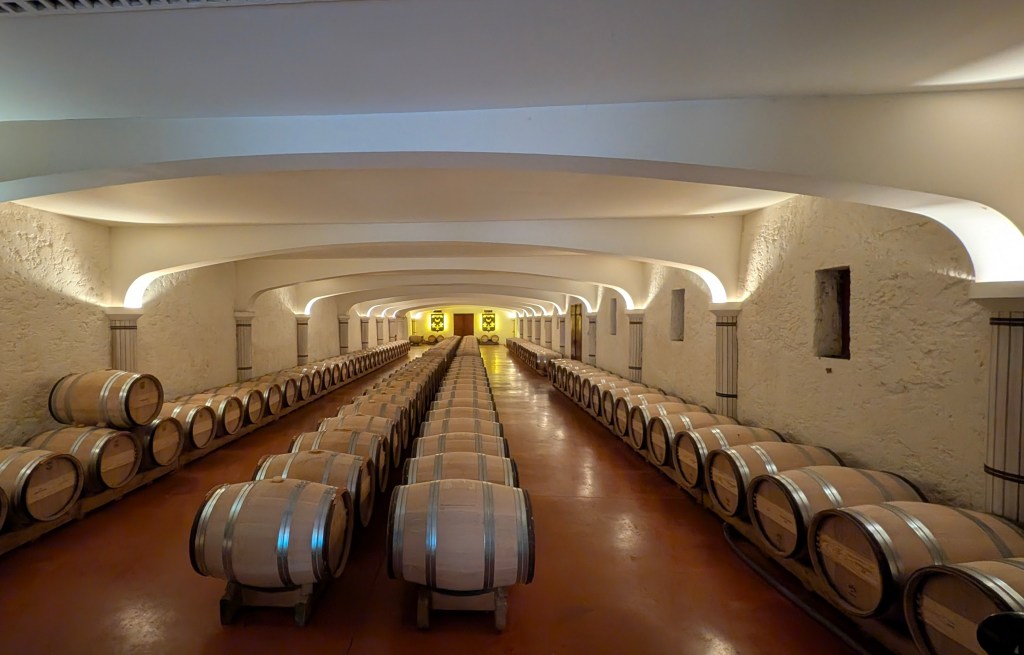
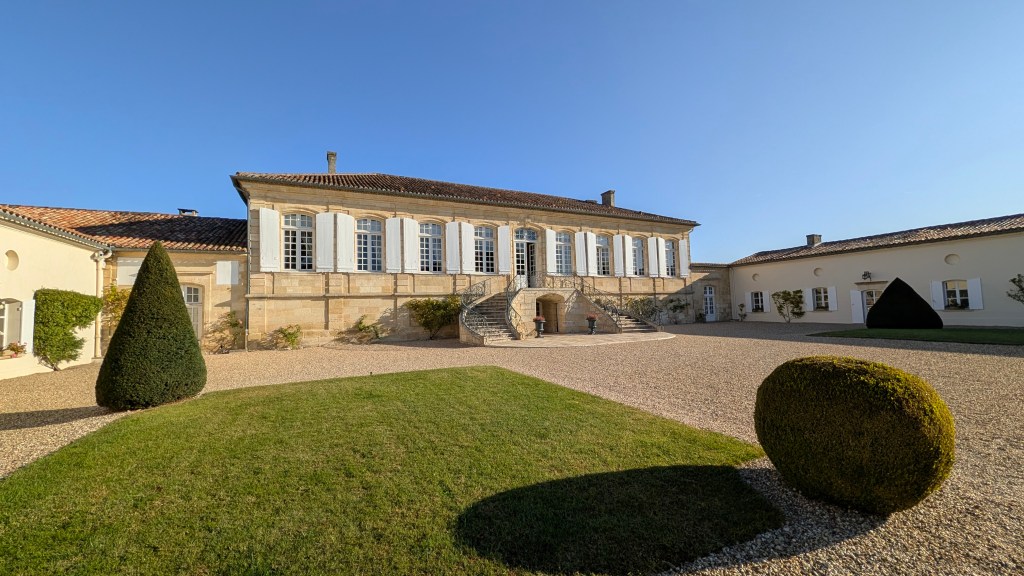
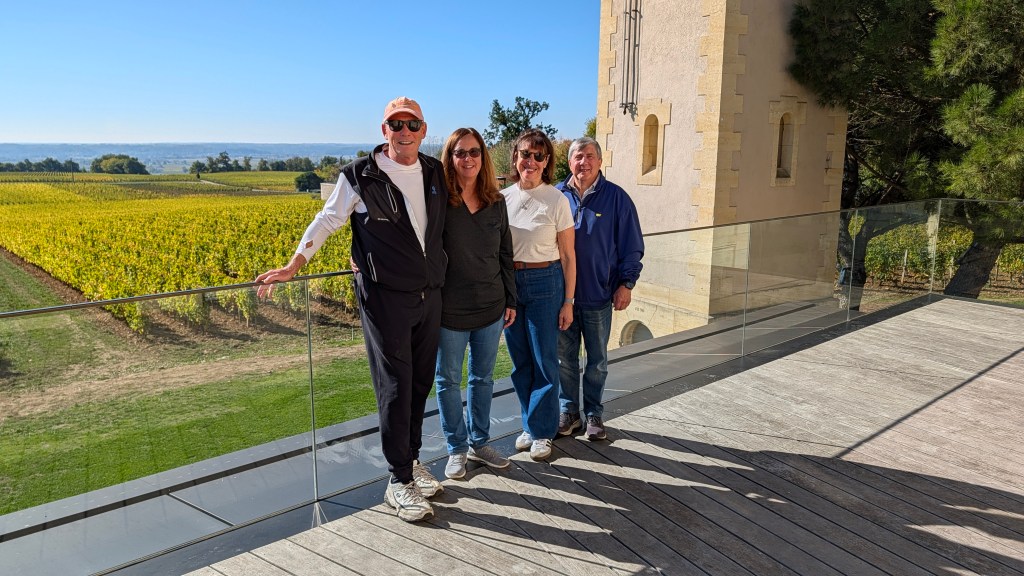
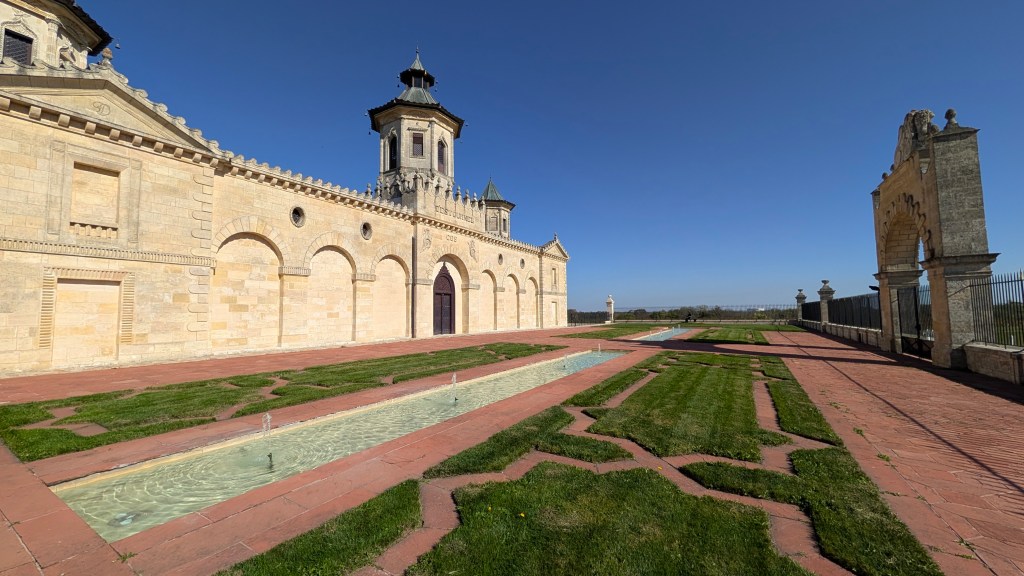
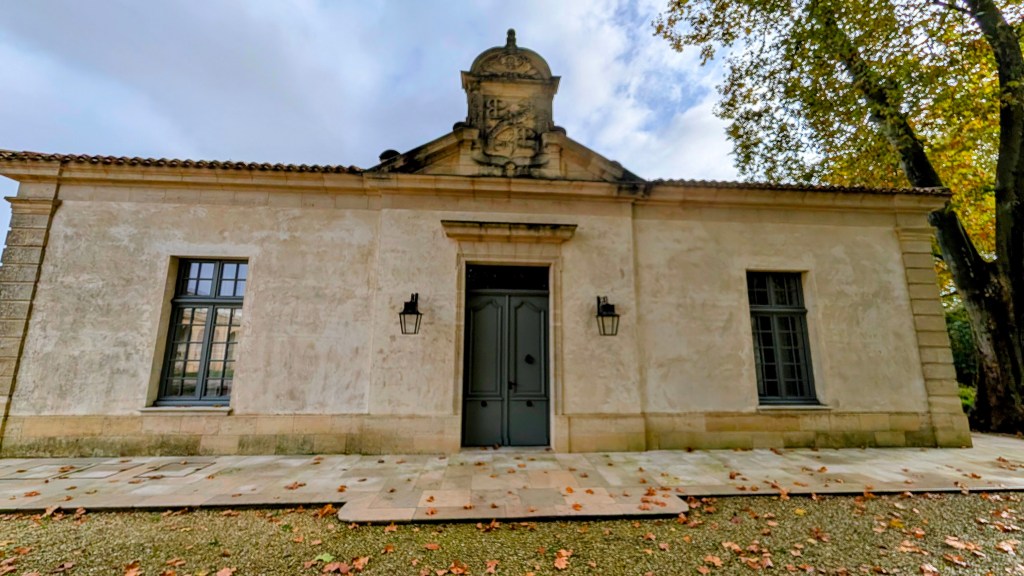
The next day we returned to wine tastings. Our morning was spent at Château Marquis d’Alesme, a historic winery located in the Margaux commune or appellation of Bordeaux. 
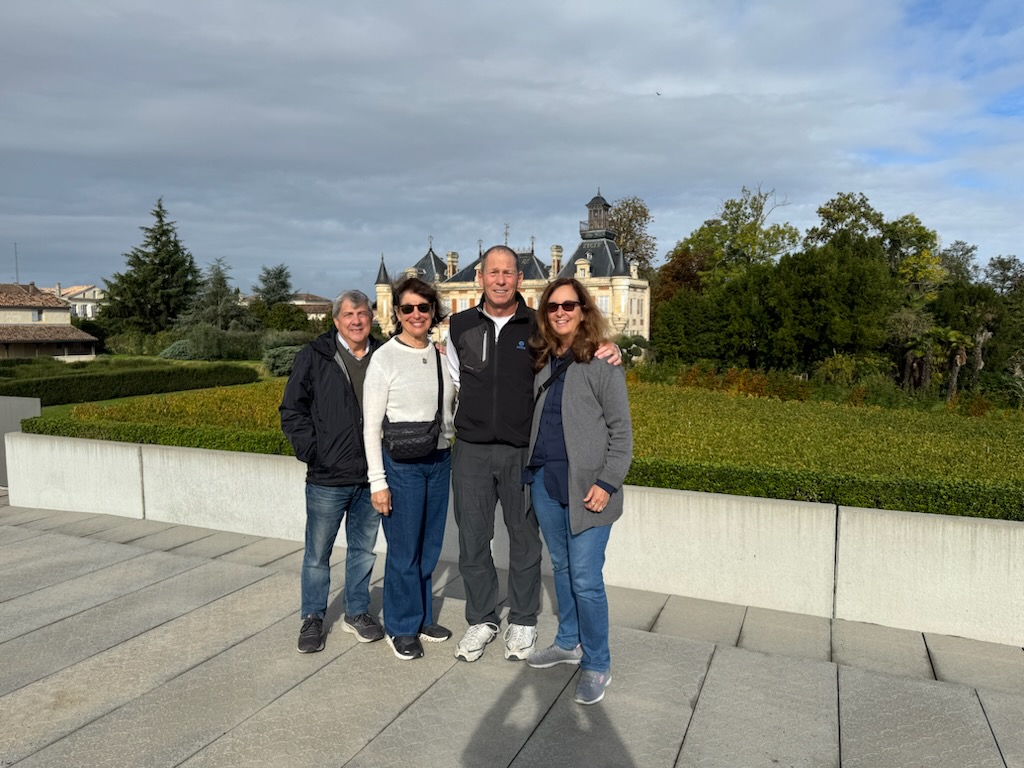
Château Marquis d’Alesme

The estate, founded in 1585 by François d’Alesme, is classified as a third growth (Troisième Grand Cru Classé) in the official 1855 Bordeaux classification. Marquis d’Alesme was a conseiller in the Bordeaux parliament and first horseman of King Edward.
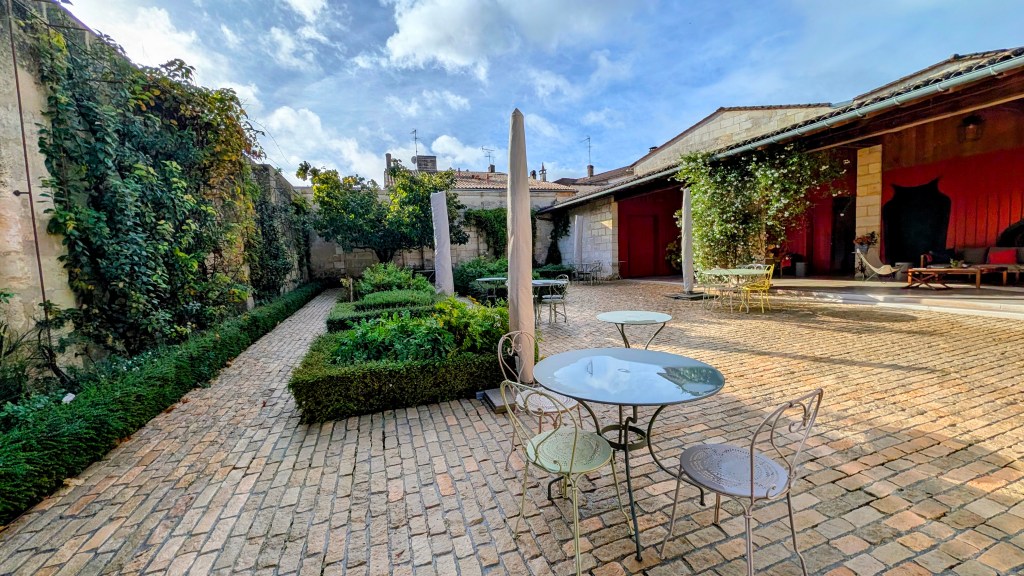
Château Marquis d’Alesme

Our guide Pascal gave us more history of the estate. Dutch merchant Jan Bekker Teerlink bought the estate in 1809, renaming it Marquis d’Alesme-Becker.
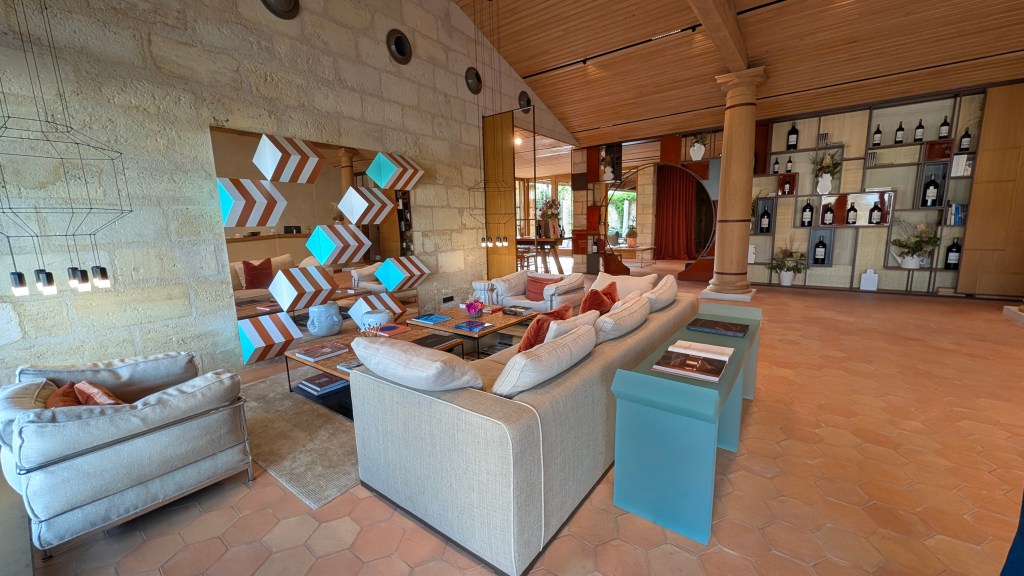
The estate saw a succession of owners, including English firm WH Chaplin & Co and the Zuger family, until it was sold in 2006 to petrochemical industry businessman Hubert Perrodo, who had bought his first estate in 1989 and had elaborate plans of combining several of his Margaux estates. But Perrodo was killed in a skiing accident later the same year as he had purchased this estate.
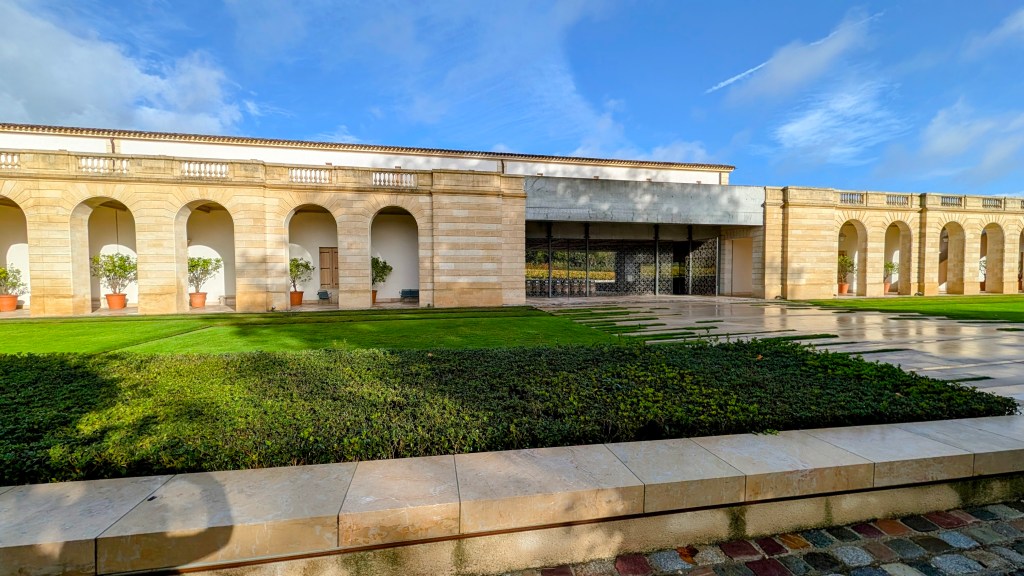
The estate is currently run by his second child, Nathalie Perrodo. She destroyed pretty much all of the buildings on the estate and rebuilt the entire property. She is half Chinese and has brought much of the Eastern cultures into details of her design. She used local artisans to blend cultures into the decor. Construction commenced around 2016.
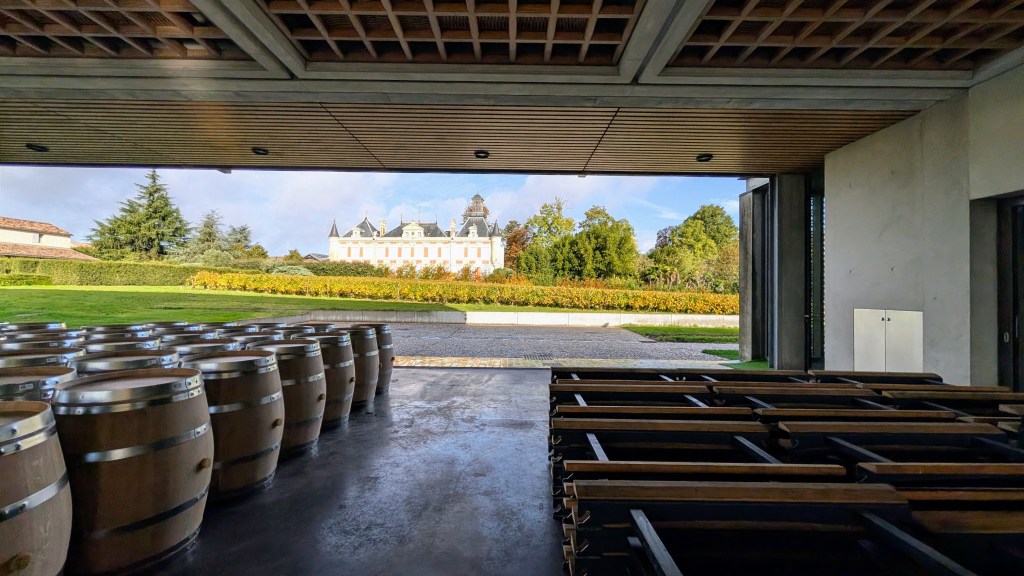
The harvesting hall was inspired by a Roman palladium. It has no echo.
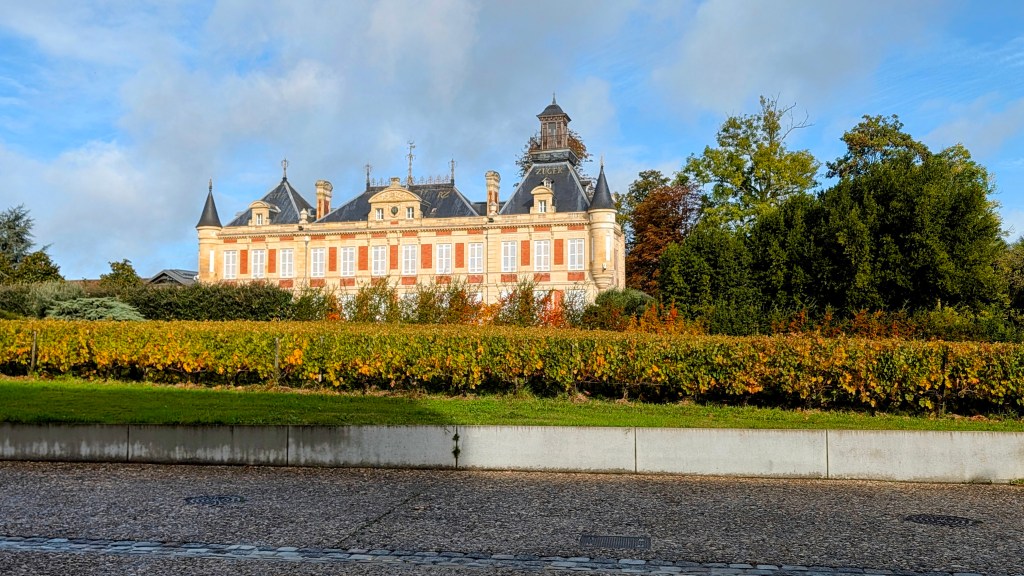
In the 2006 sale of the property Mrs. Zuger kept the house and continues to live there today.
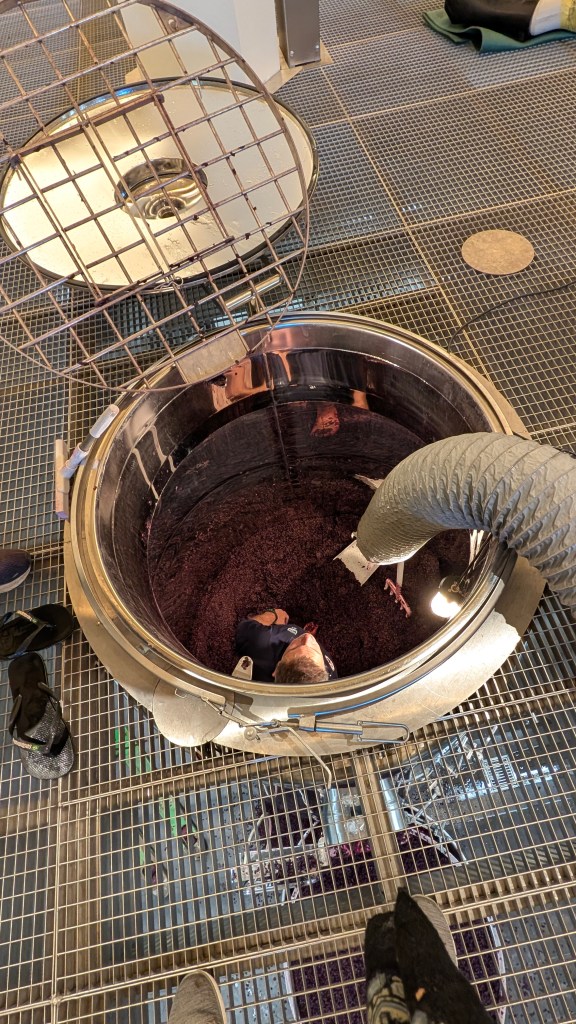
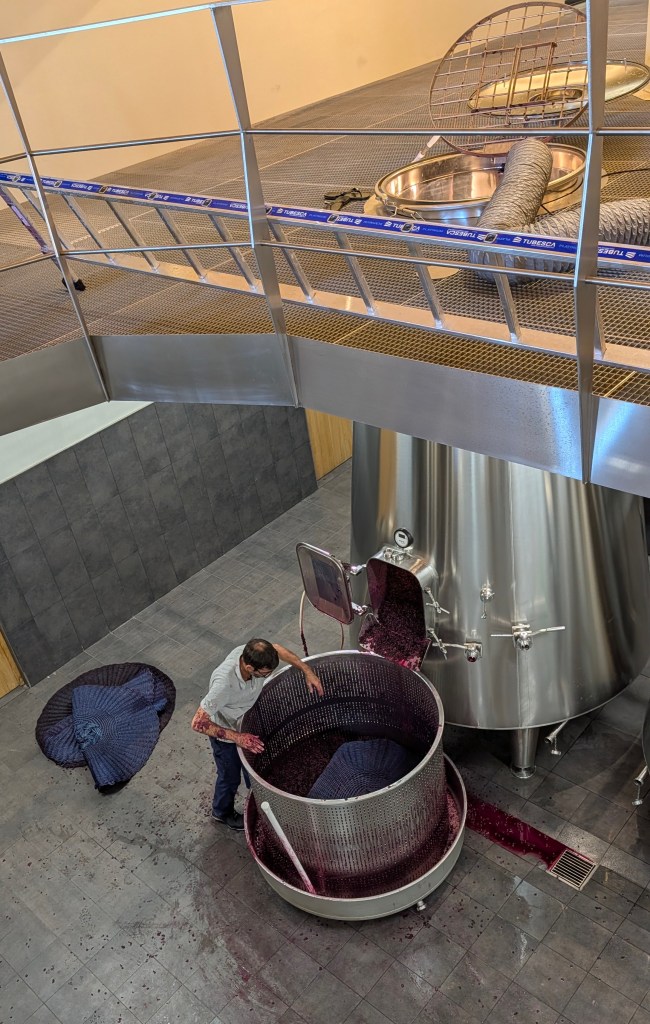
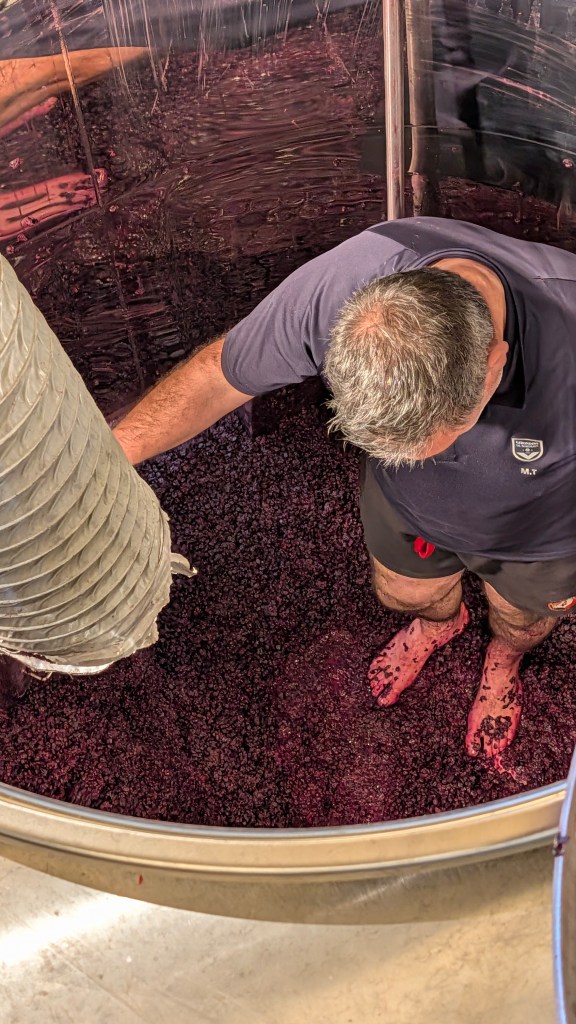
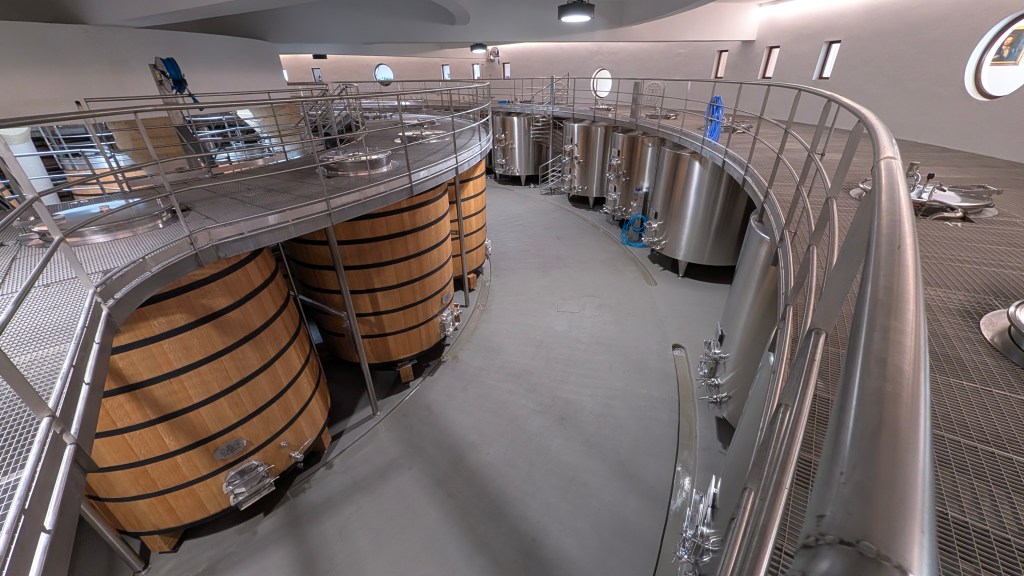
Pascal took us up to the top of the vats and explained that here, like most of the wineries we have visited in Bordeaux, gravity is used to fill the tanks and crush the grapes.
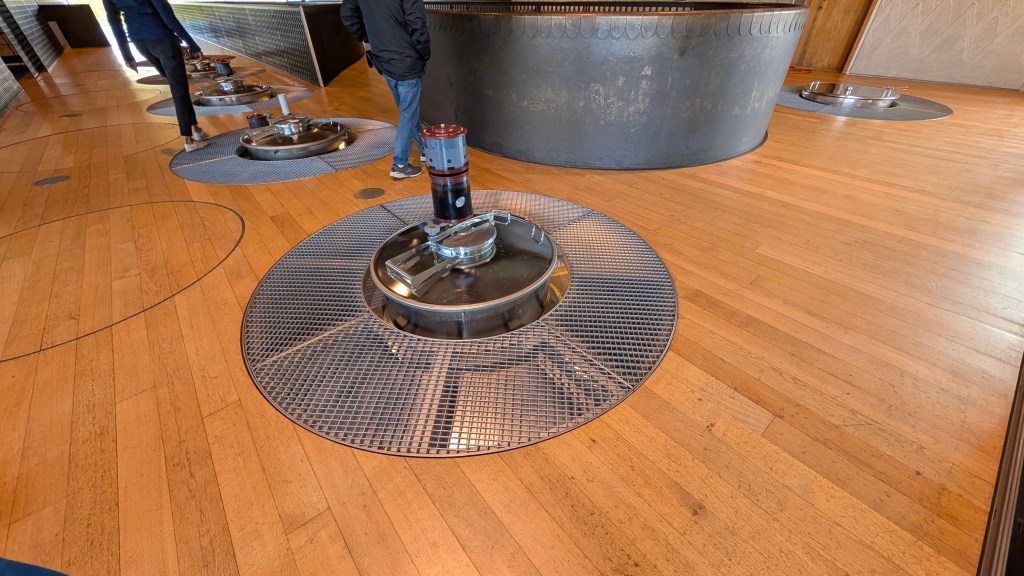
The harvest having been recent, the maceration is about done, and they have moved on to mixing and removing solids.
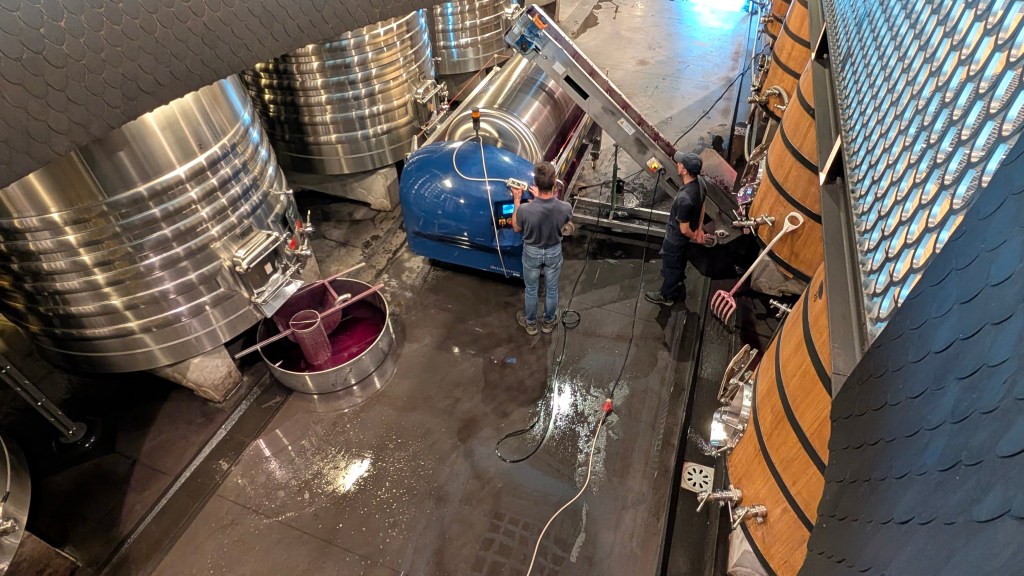
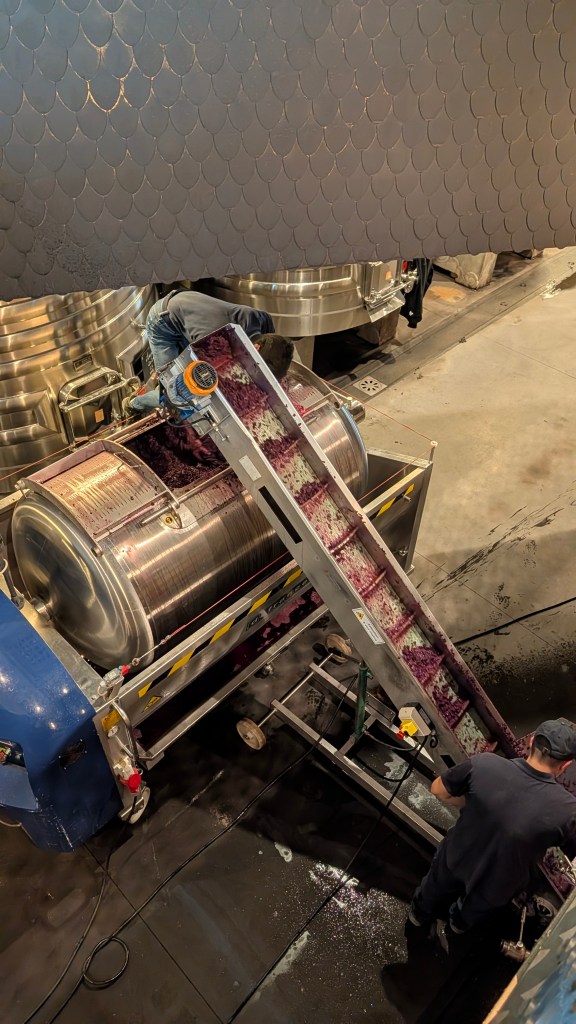
The estate produces 600,000 bottles a year.
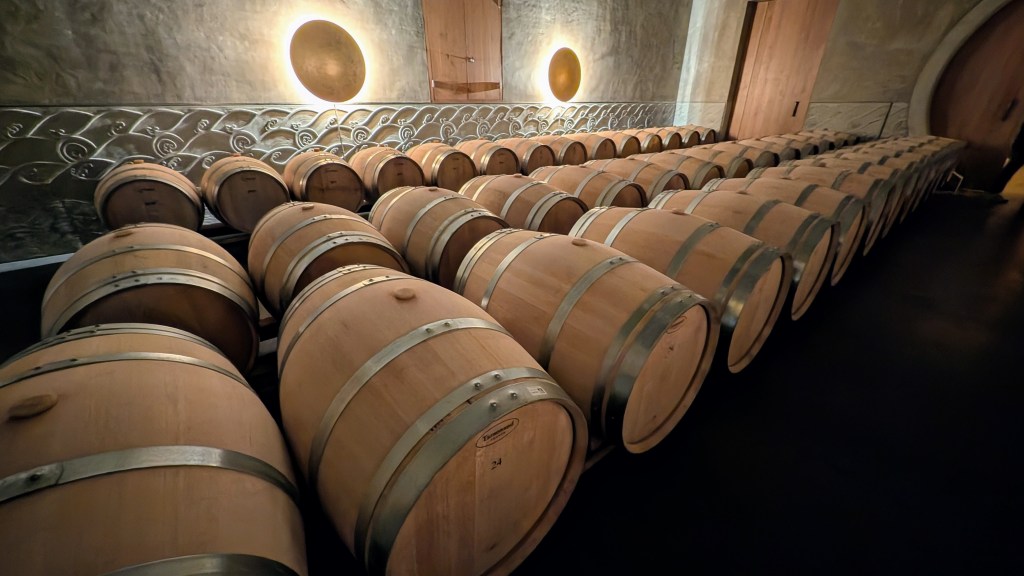
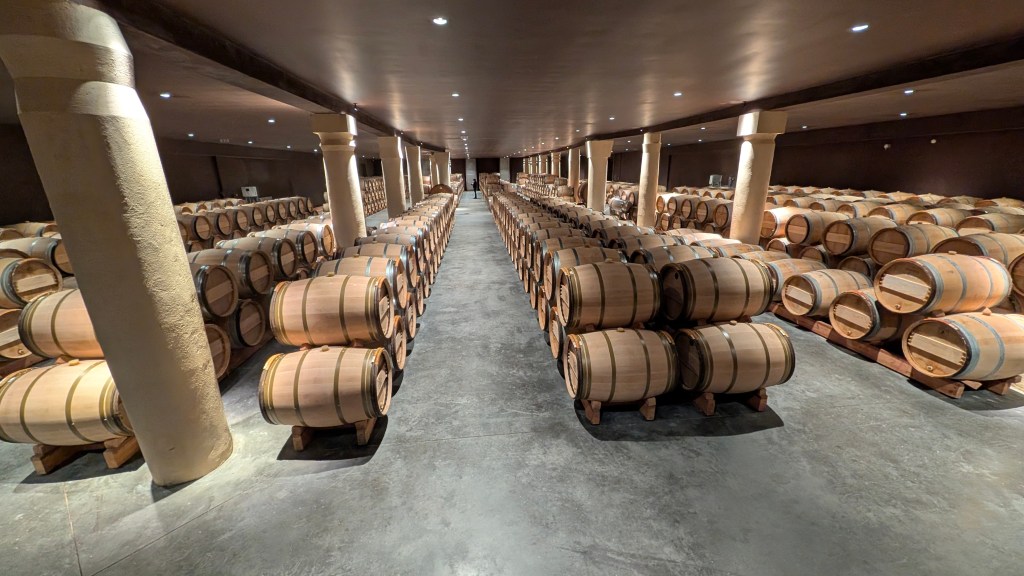
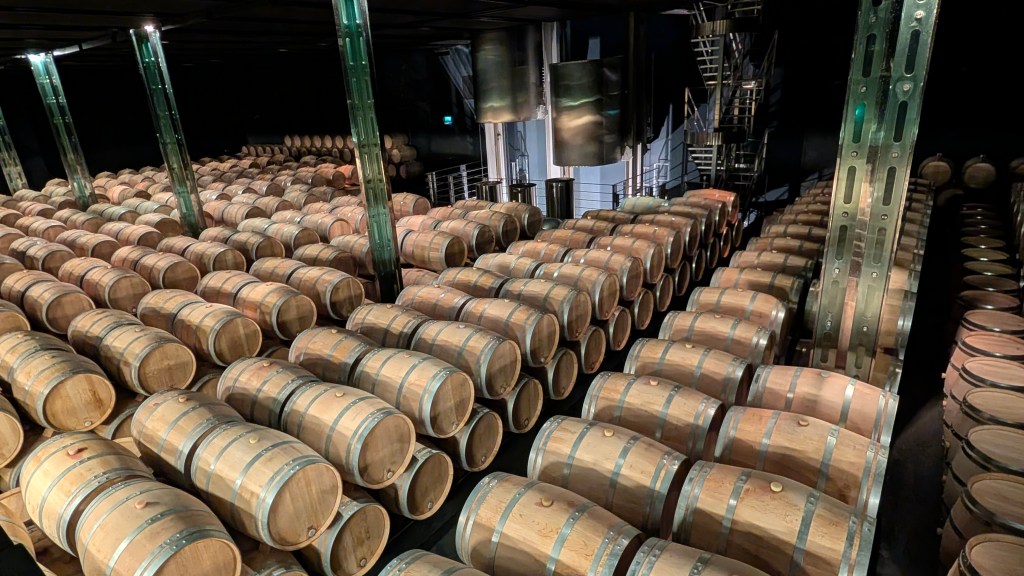
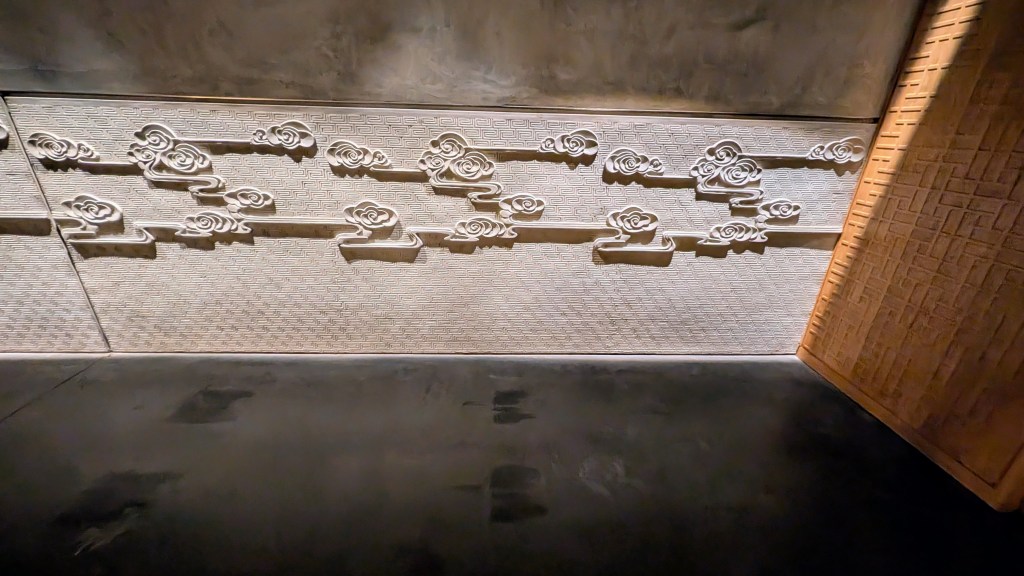
The decor on the walls of the barrel rooms is of Chinese influence. Water is on the walls of even years, as above; wind is on the walls of the odd years, as below.
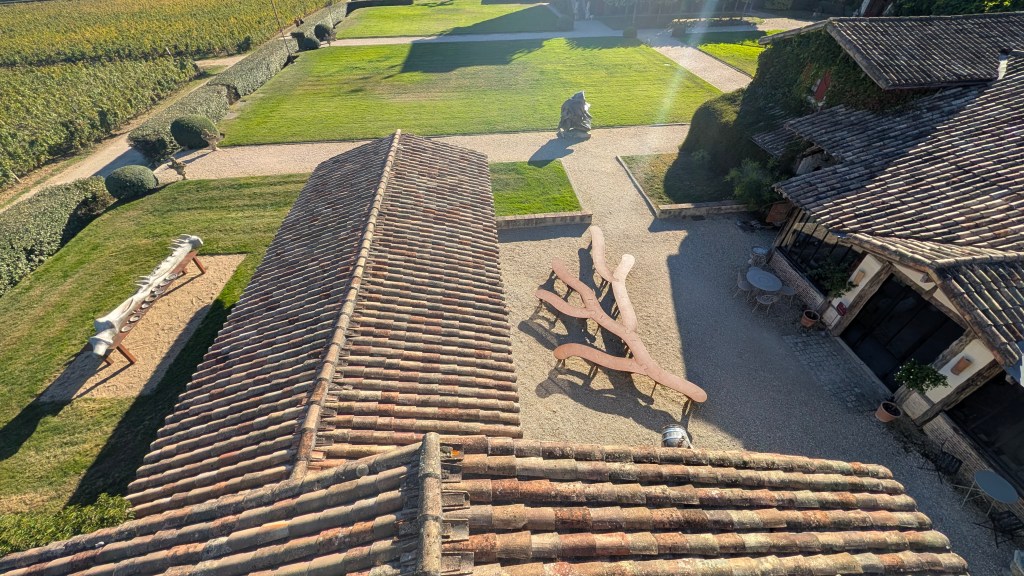
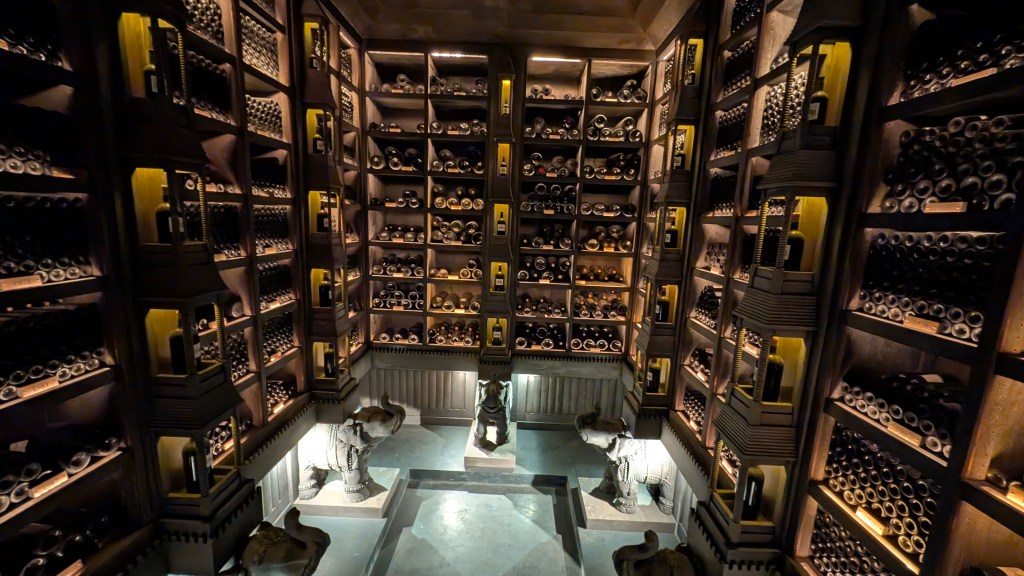
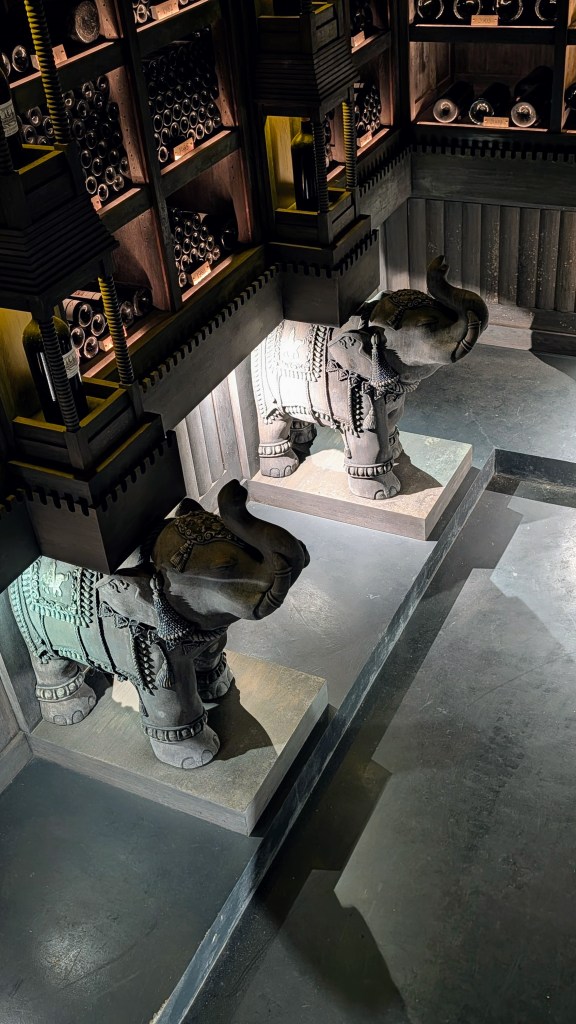
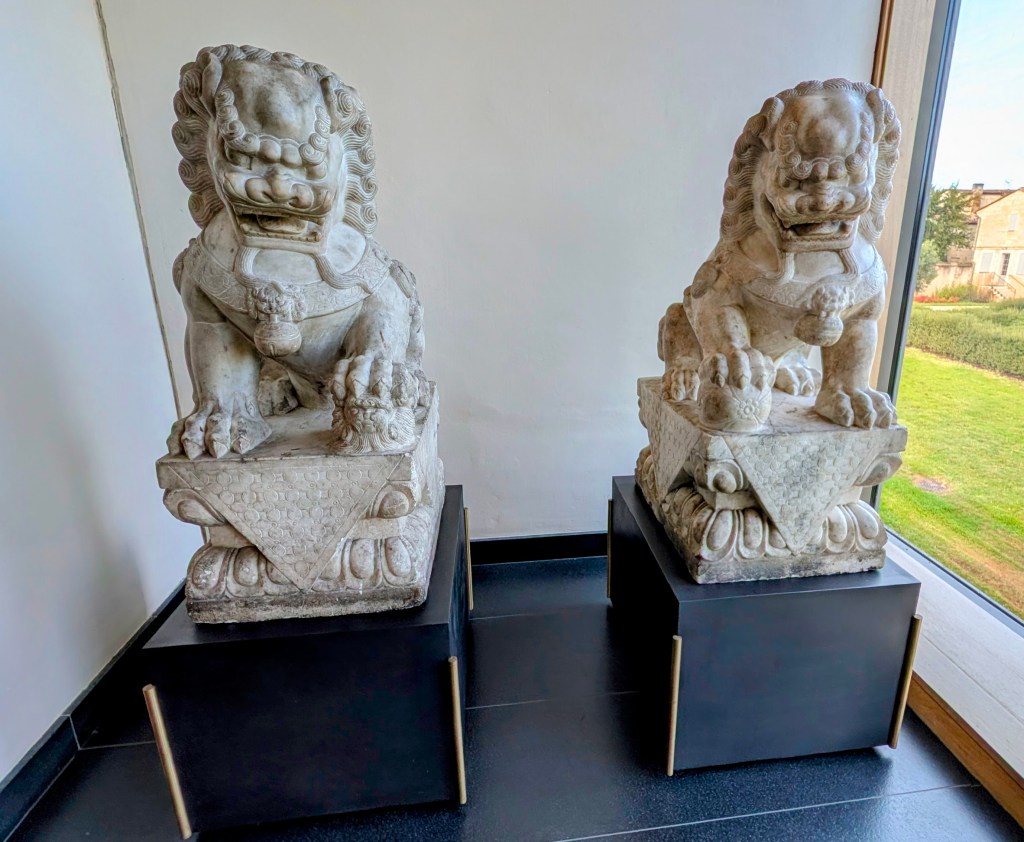
As we climbed to the roof, Pascal pointed out the pair of antique Chinese white marble Foo Dog guardian lion statues, historically positioned in pairs to symbolize protection, strength, and the balance of yin and yang. They are traditionally placed at entrances to protect against negative energy and ward off evil.  One lion (male) typically has its paw on a ball (symbolizing wealth and power), while the other (female) rests a paw on a cub (symbolizing nurture). 
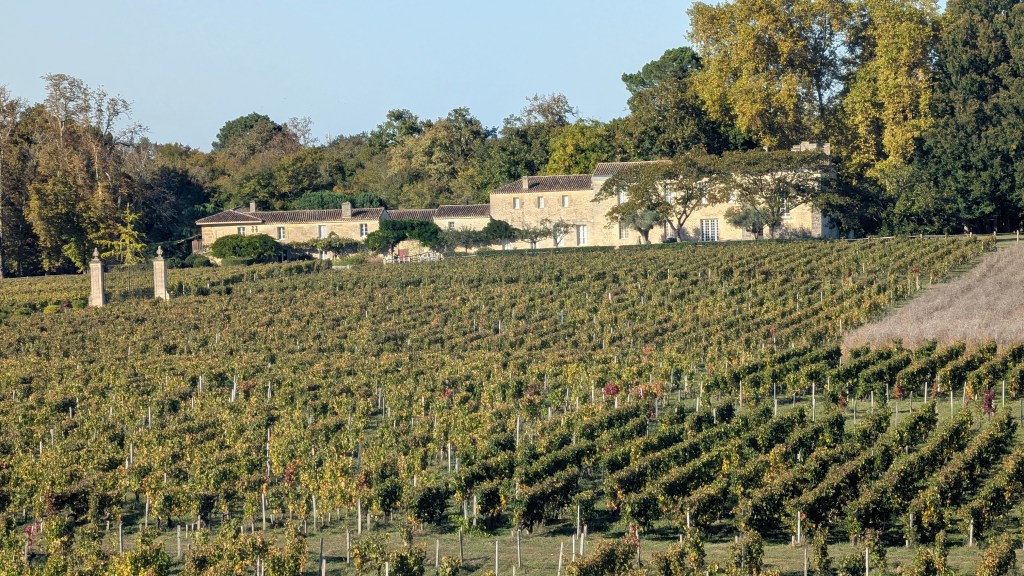
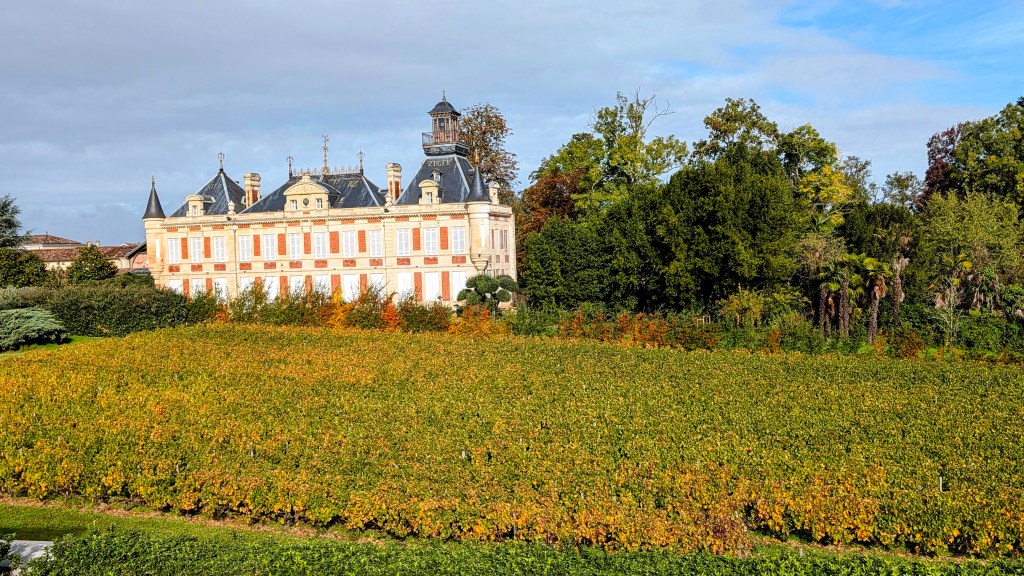
From the roof we had a great view of Mrs. Zuger’s home
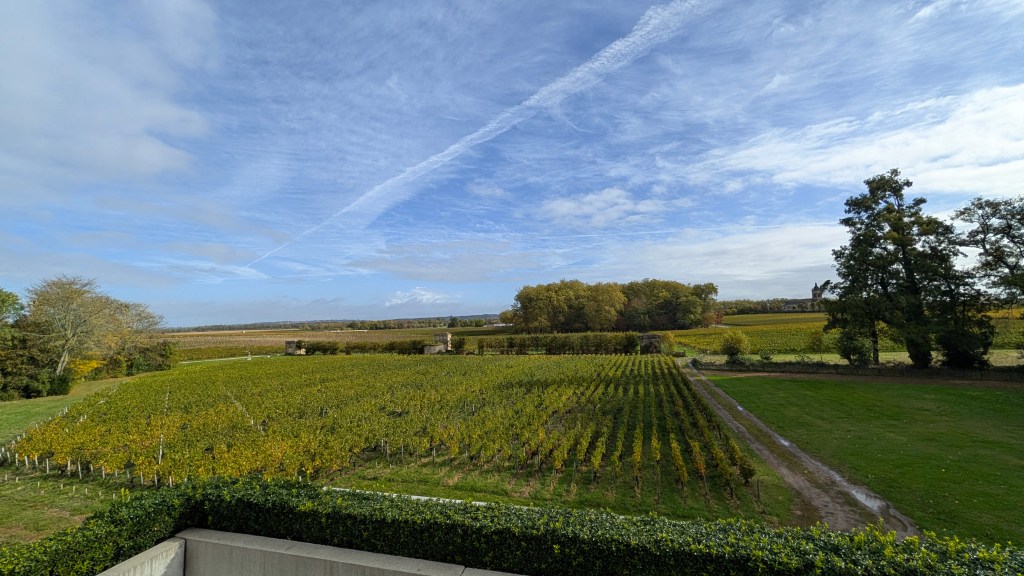
as well as the vineyards, which are beginning to change with autumnal colors,
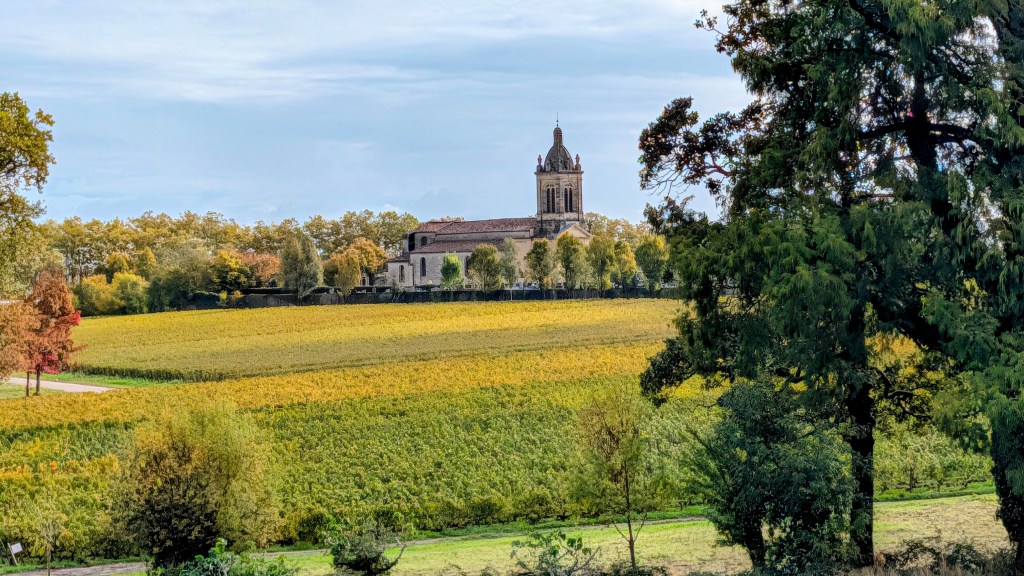
and a traditional church in the distance.
During the reconstruction of the estate, the building which houses the tasting room was moved to its current location from a previous site by artisans stone by stone with attention to correct placement for the correct feng shui.
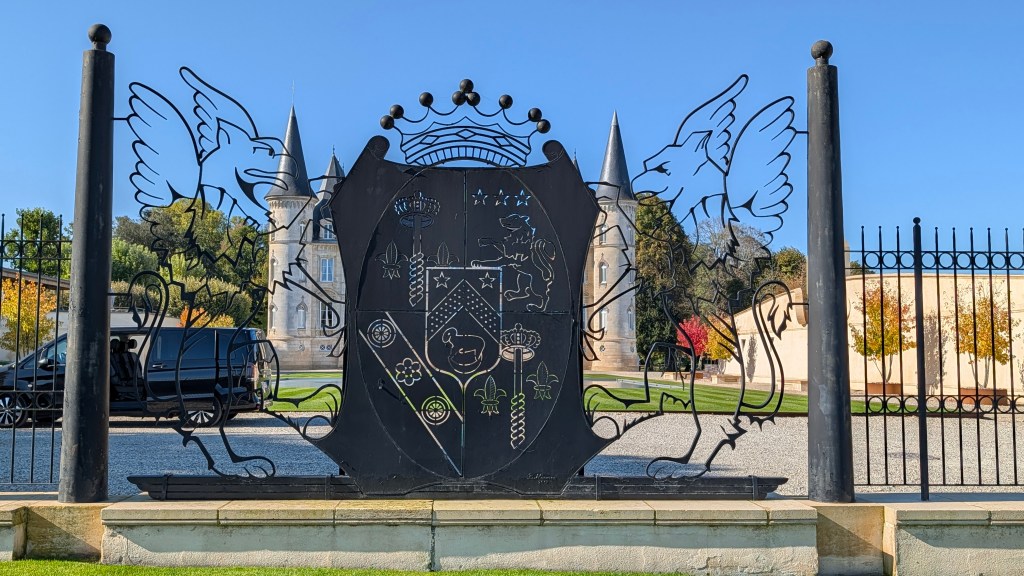
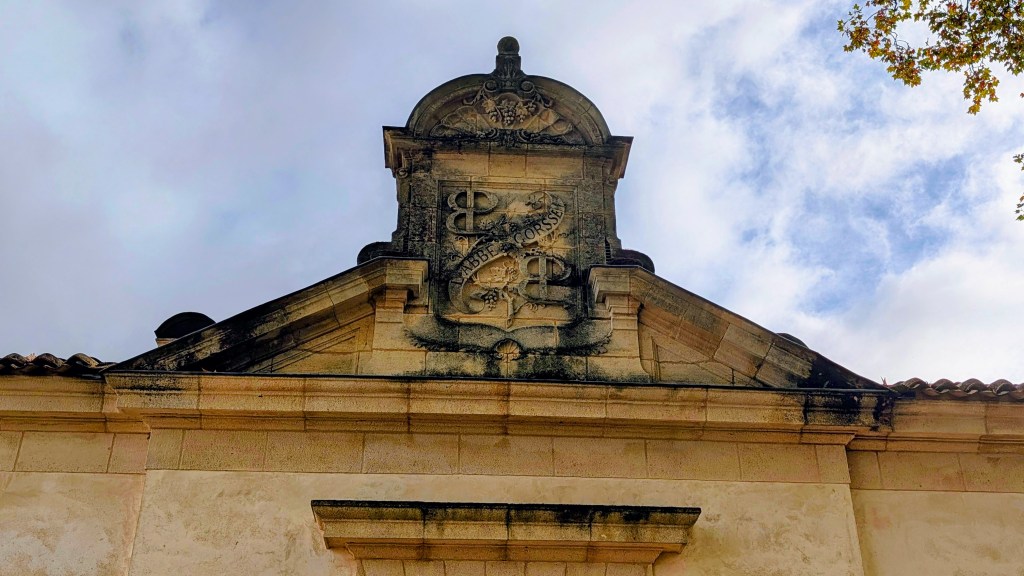
Above is the original shield of the d’Alesme family.
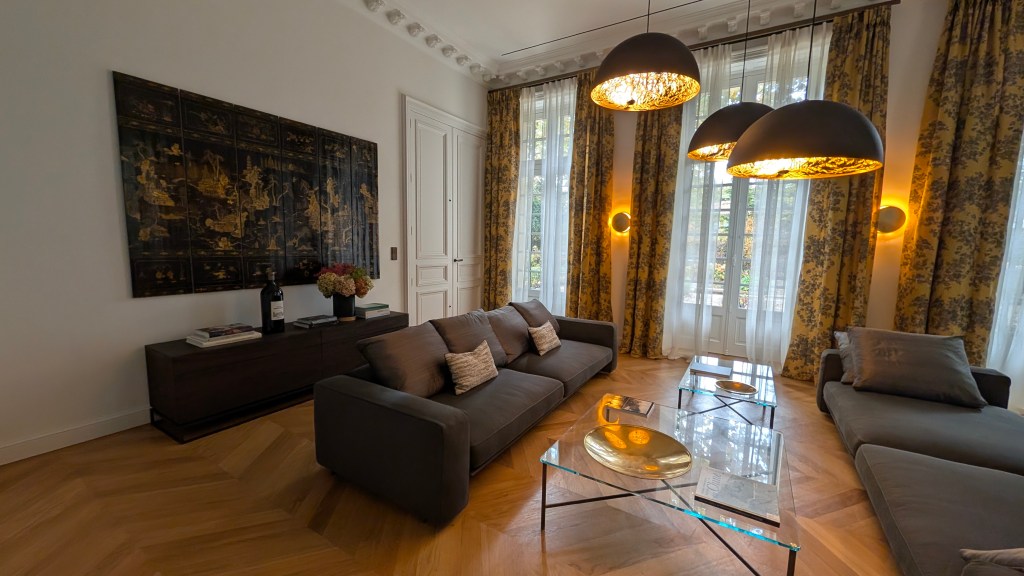
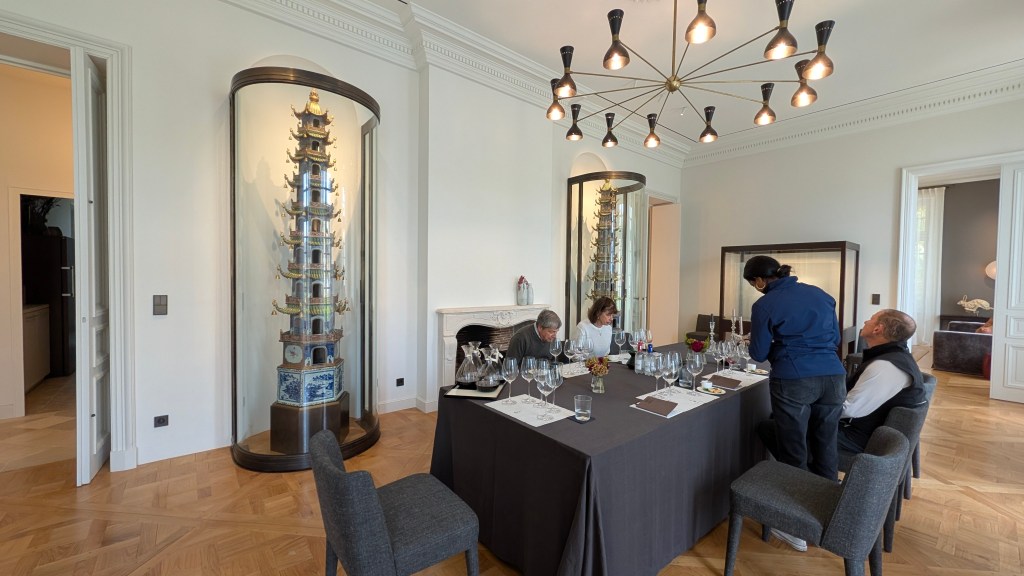
Inside is packed with antiques and objects of art.
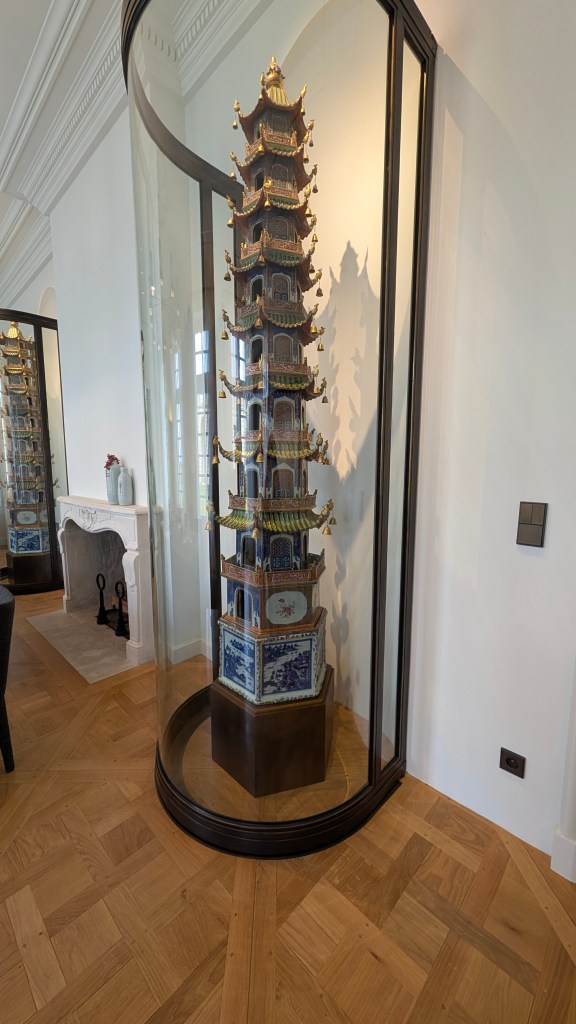
The 14th century pagodas were a gift from the emporer to his parents. There are only 6 of these in the world; the other 4 are in Buckingham Palace.
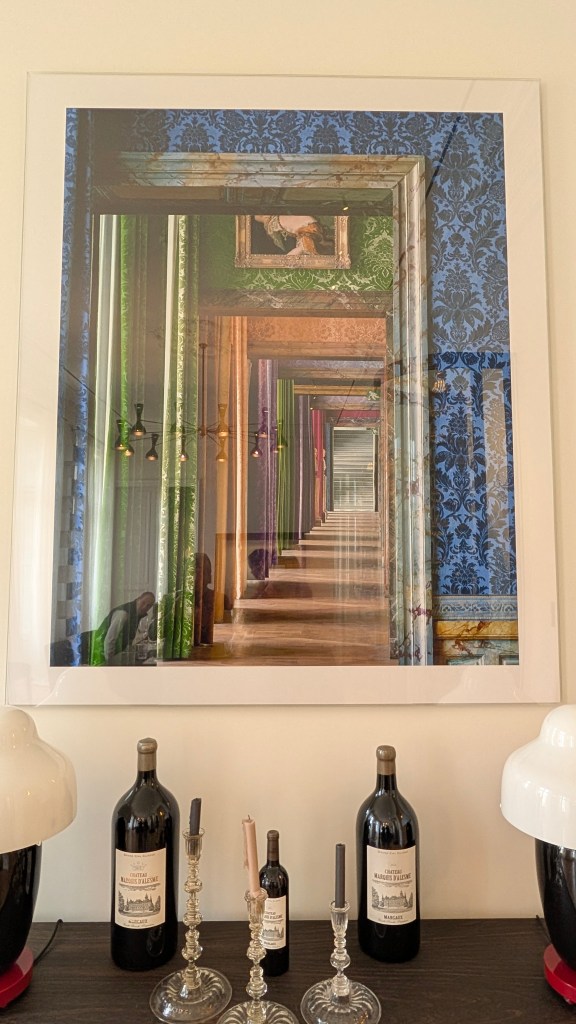
The photo is from Versailles and represents all the varietal colors of grapes.
We were seated in this magnificent room for the tasting.
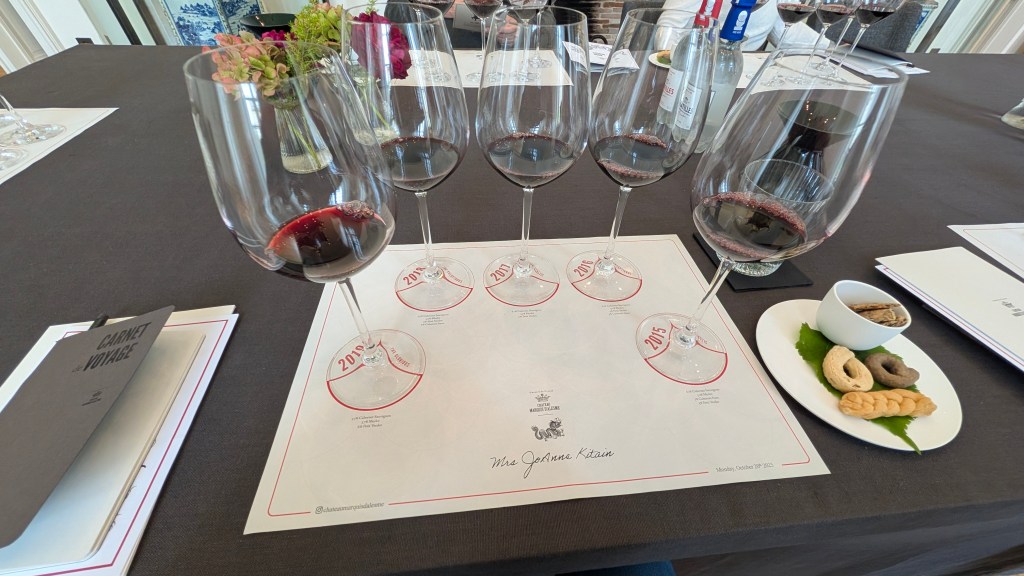
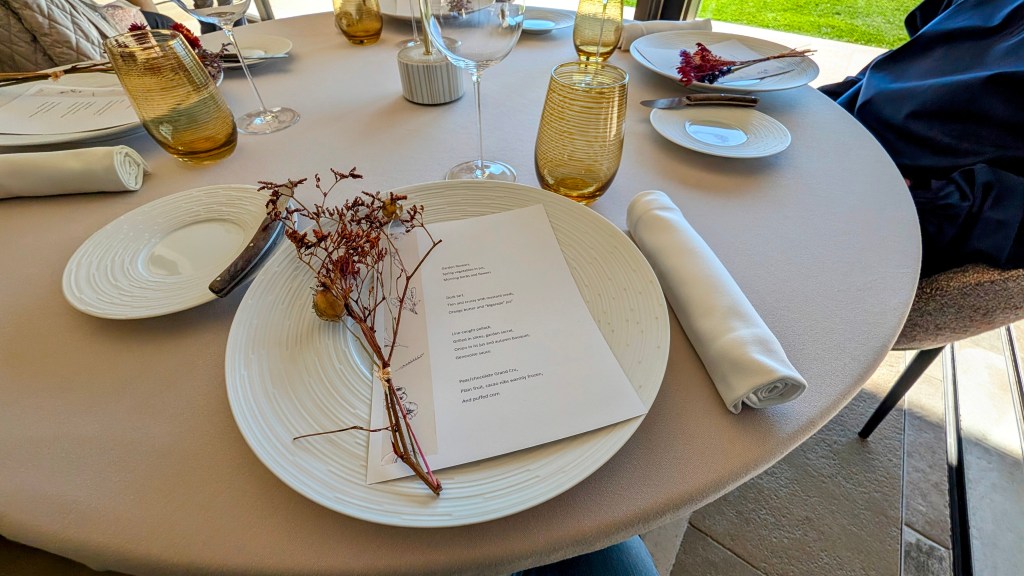
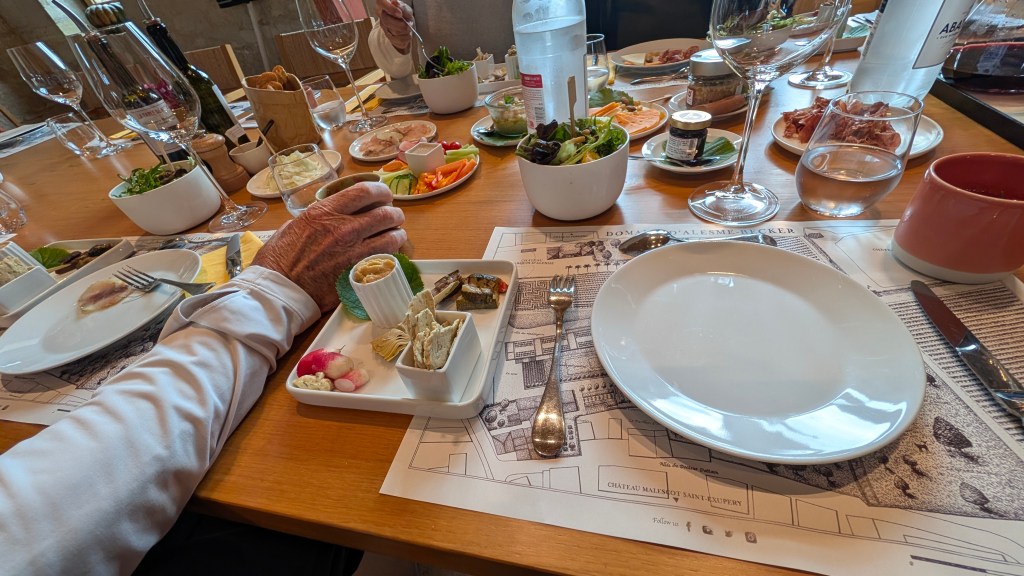
Lunch here was different than it has been throughout this experience. Here rather than serving courses, many small plates were served family style to all of the guests seated together.
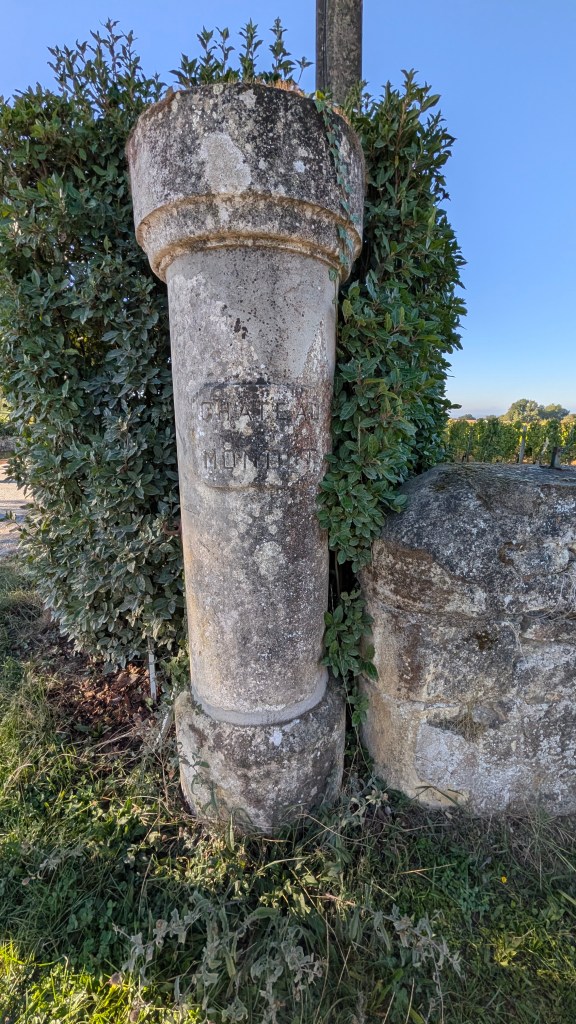
After lunch we moved on to our last, but certainly not least important, winery: Château Mouton Rothschild. Acquired in 1853 by Baron Nathaniel de Rothschild, Château Mouton Rothschild is a premier Pauillac estate that famously rose to First Growth status in 1973. It had been ranked as a Second Growth in the official 1855 Bordeaux classification. It is now owned by three siblings of the 6th generation of Rothschilds.
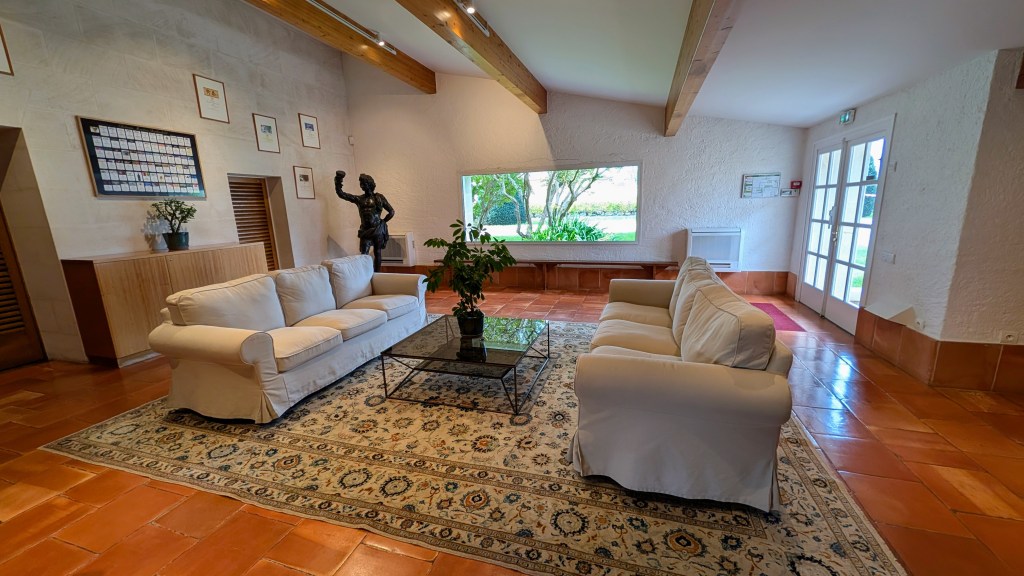
Château Mouton Rothschild

Our guide Camille explained that the estate was revolutionized by Baron Philippe de Rothschild, grandfather of the current owners, from 1922, introducing on-site bottling and creating a world-class reputation. He decided to change the labels yearly, hiring an artist for a unique design each year. The estate has been in collaboration with Robert Mondavi at Opus One since 1979.
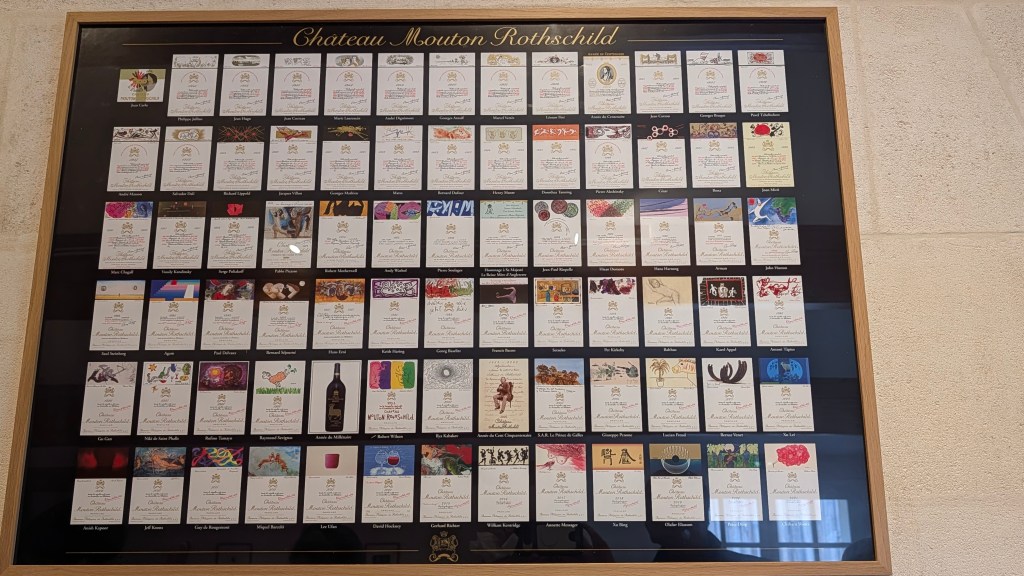
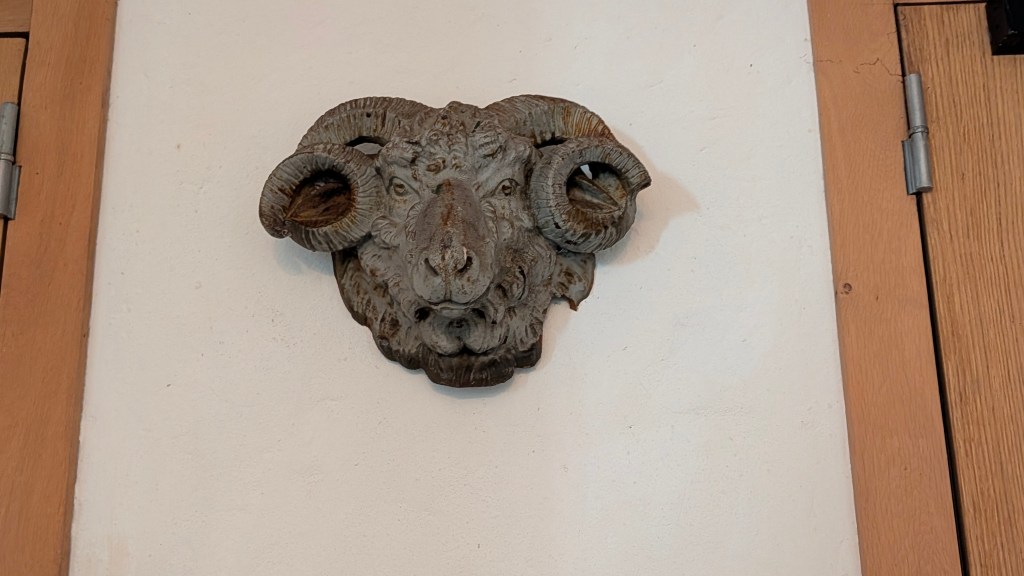
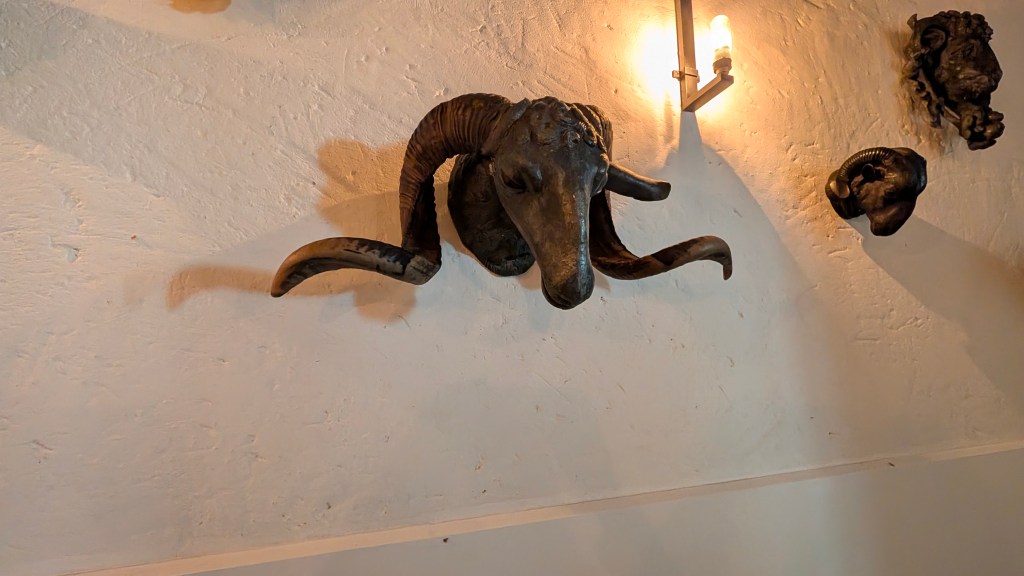
Baron Phillippe was an Aries, so rams are seen represented frequently both in the art he collected and on the labels.
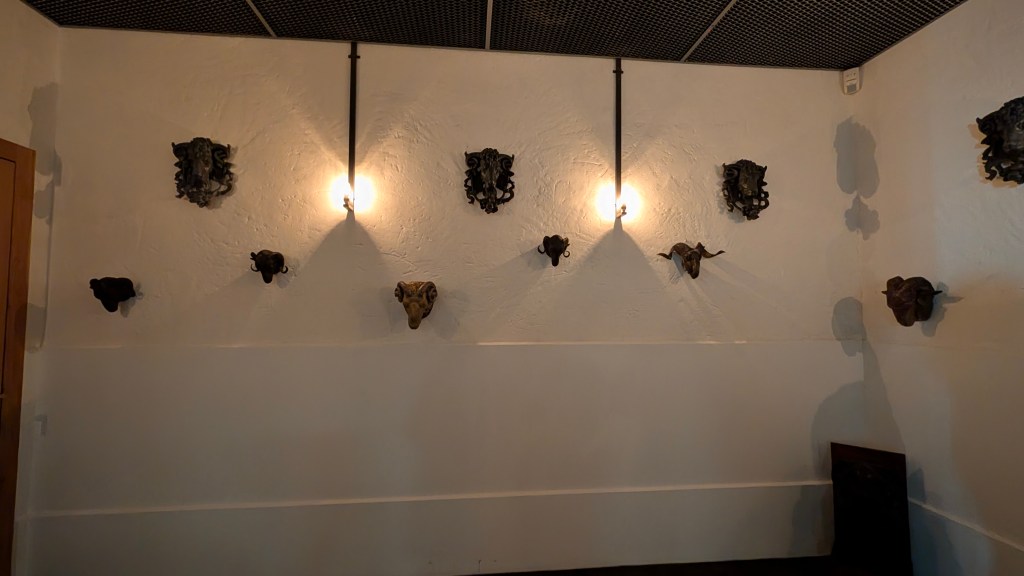
Mouton means sheep, but it also means little mount; the terroir includes about 25 feet of gravel.
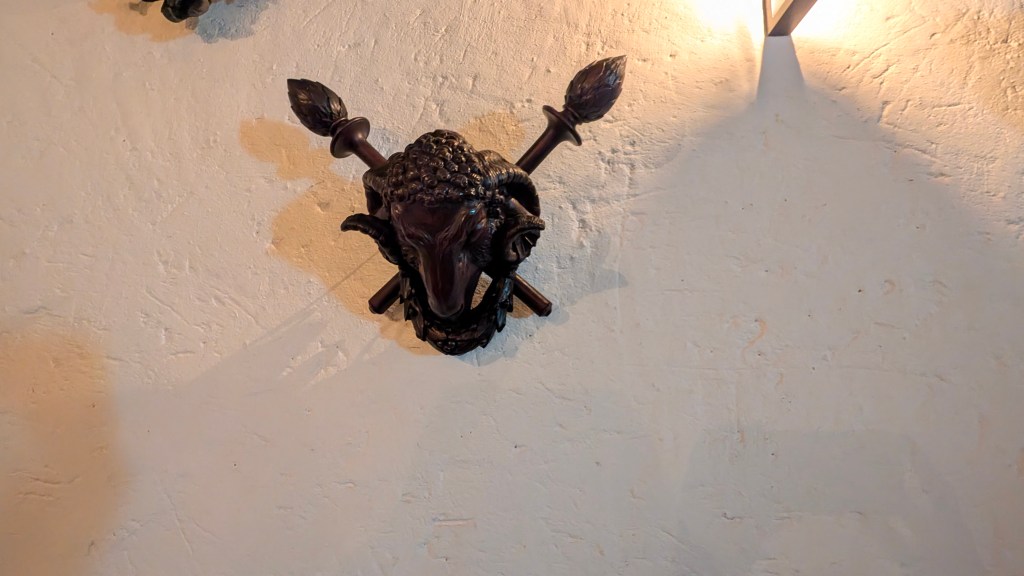
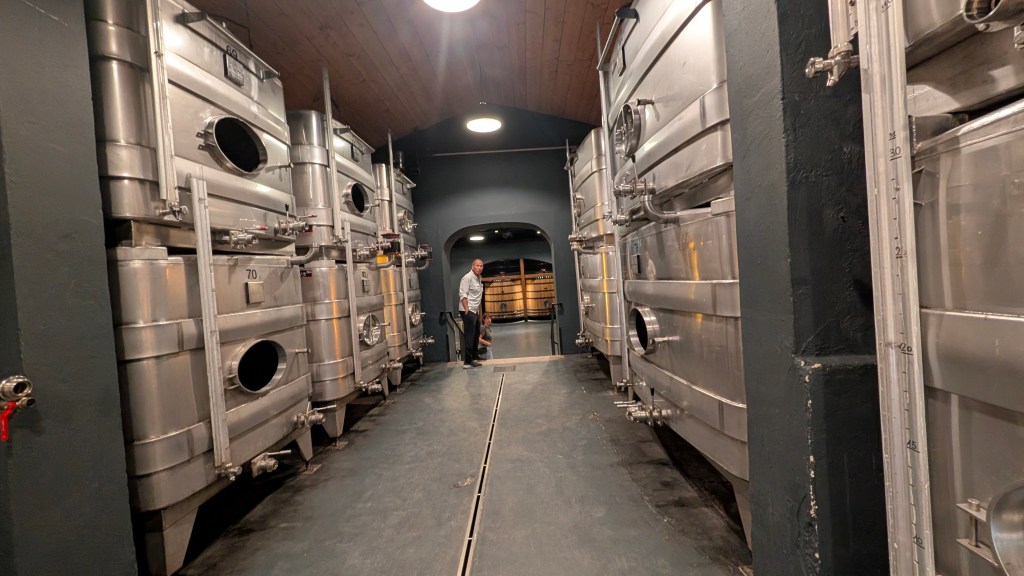
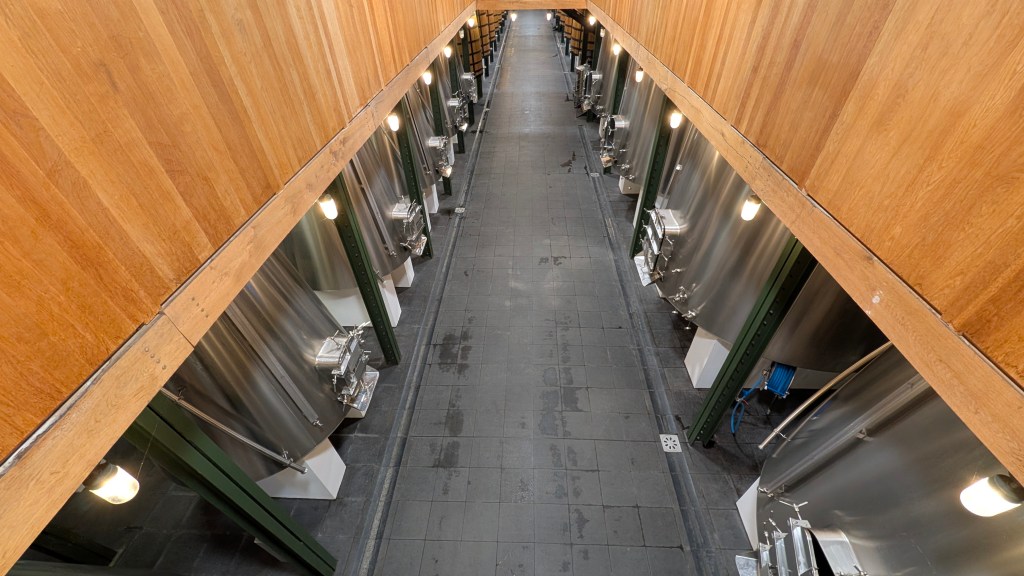
Camille showed us the steel vats
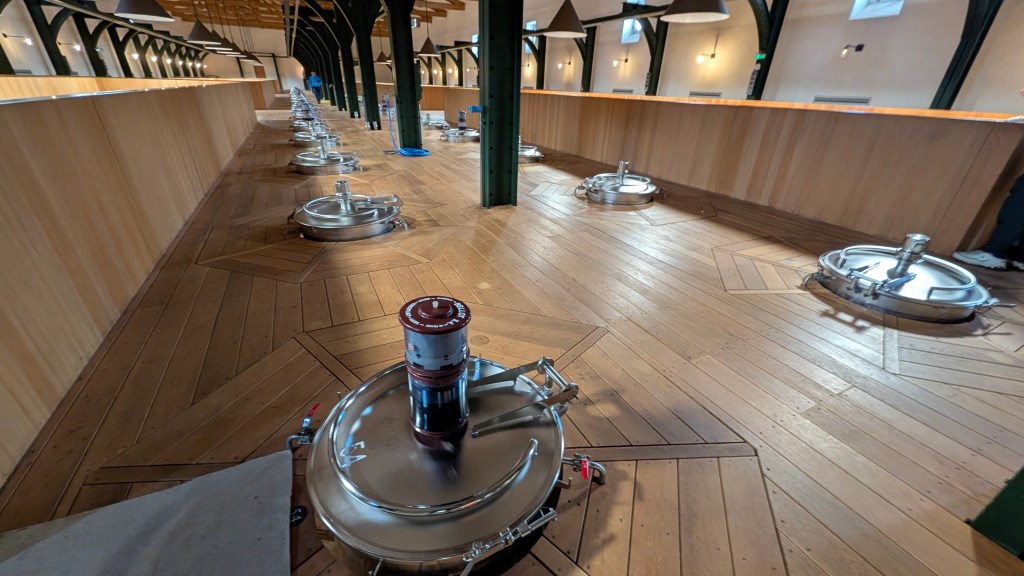
and their tops from which the grapes are added. The tops of the vats are sealed, but there is a one-way valve through which CO₂ can escape.
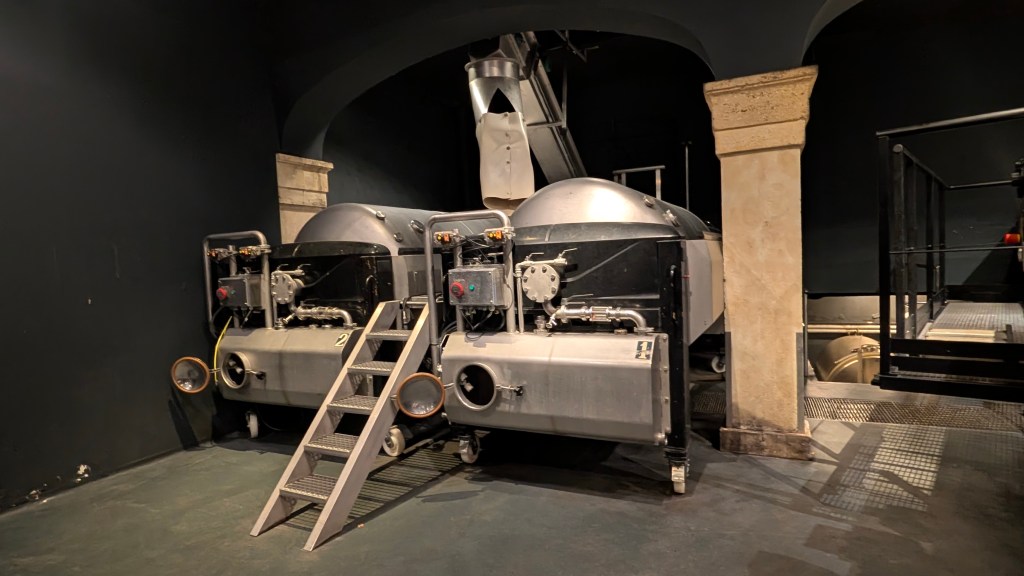
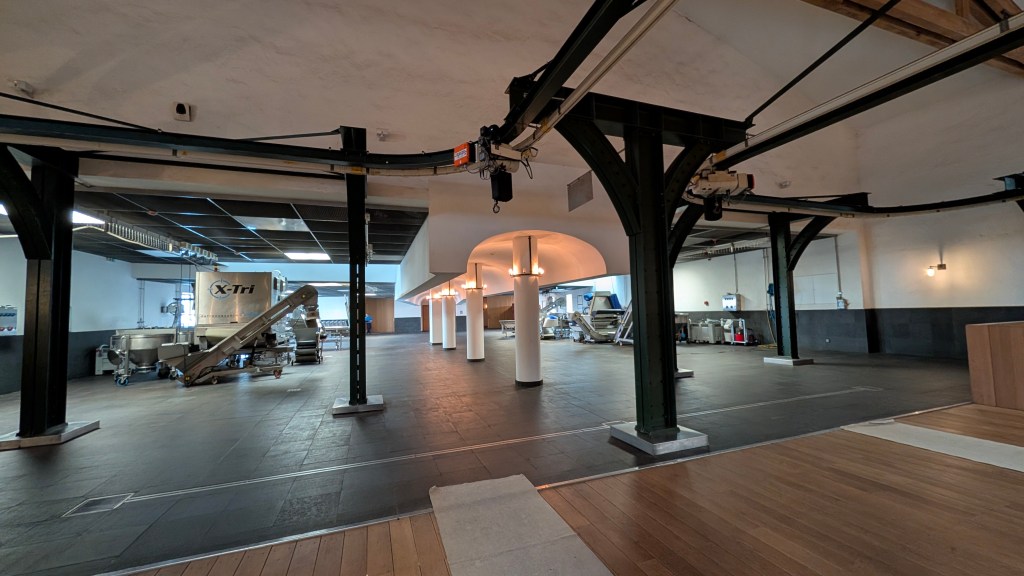
Unique here is a rail system for the trolleys that move the grapes.
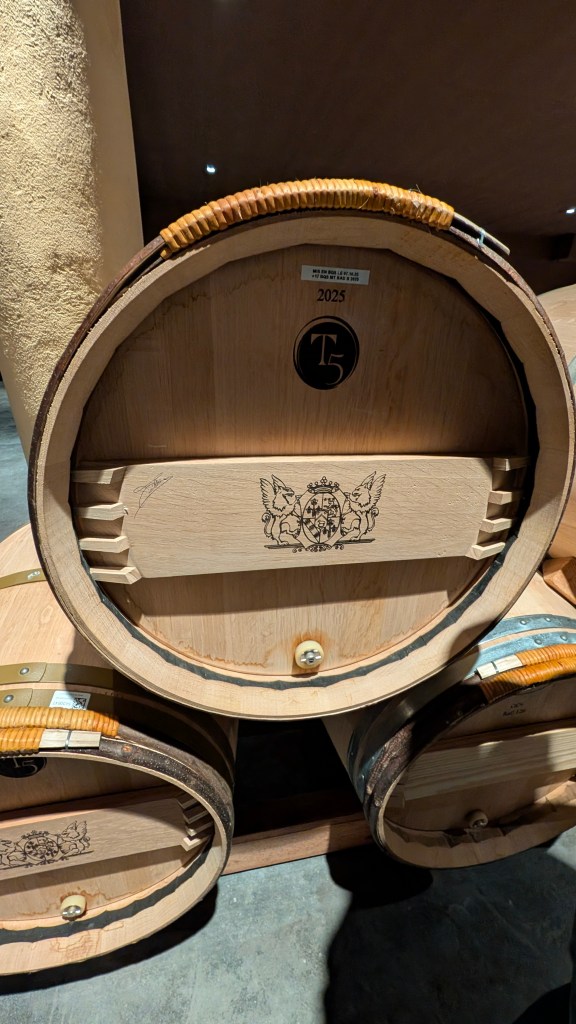
The wood vats are custom made for the winery with windows to show the wine.
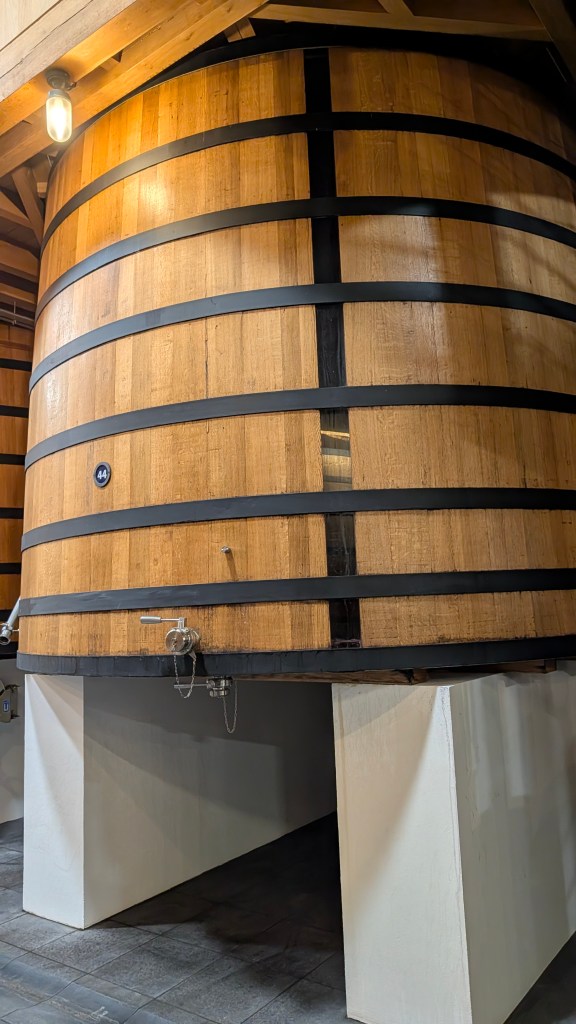
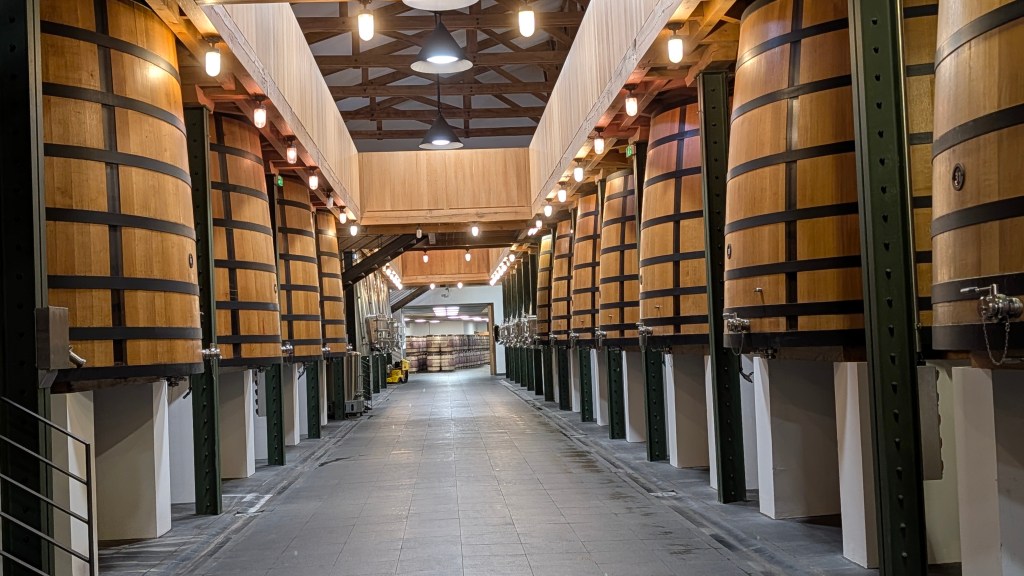
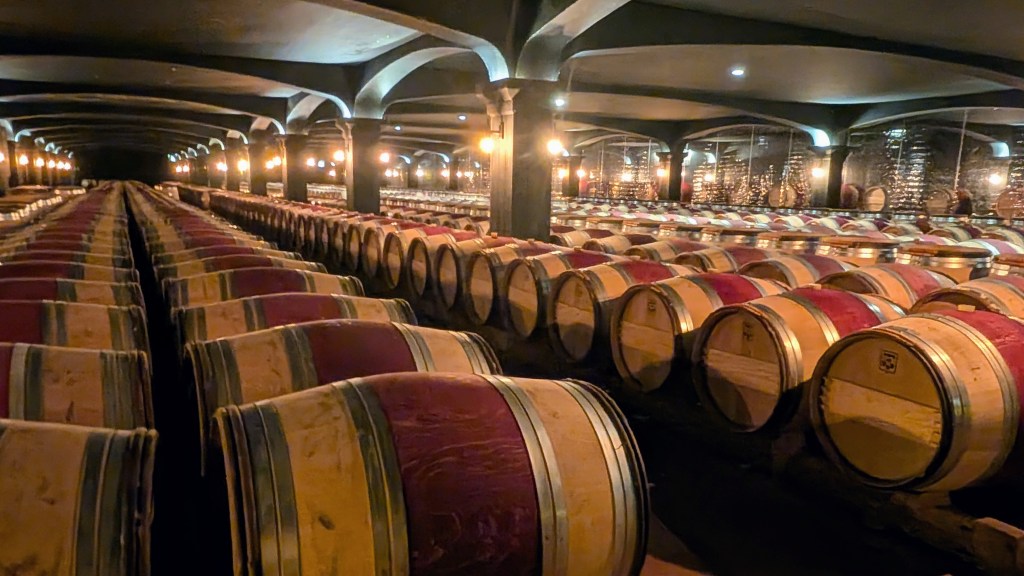
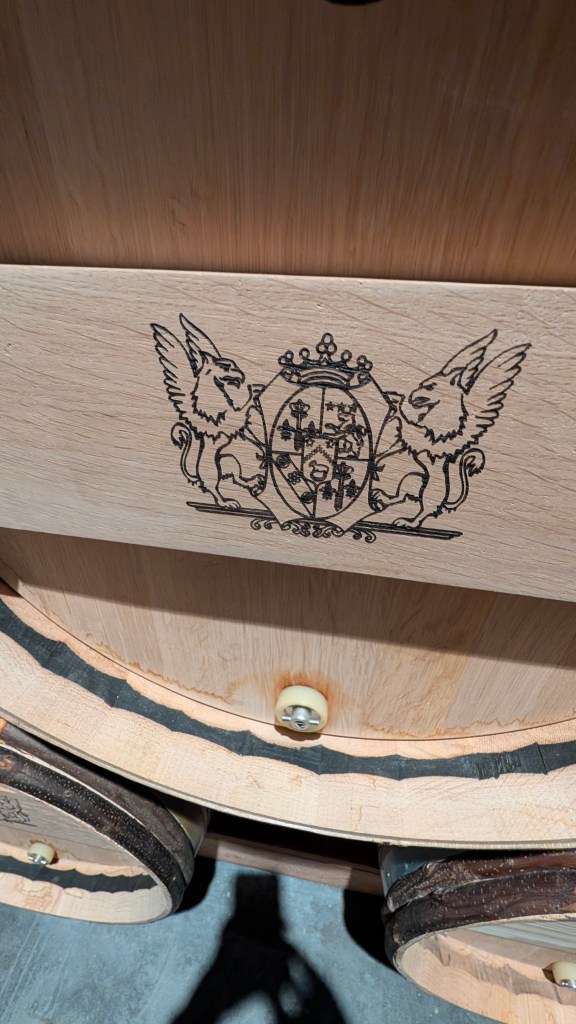
The cellar dates from 1926. The clarity of the wine is checked every 3 months using a glass and a candle. Three whipped egg whites are poured into each barrel toward the end of the aging process, then left for 40 days to precipitate sediments.
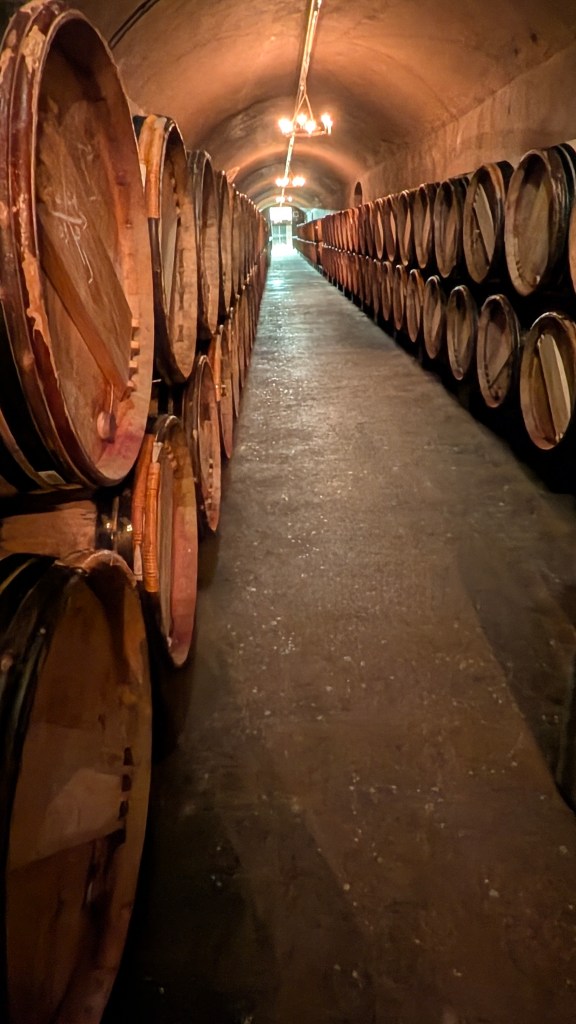
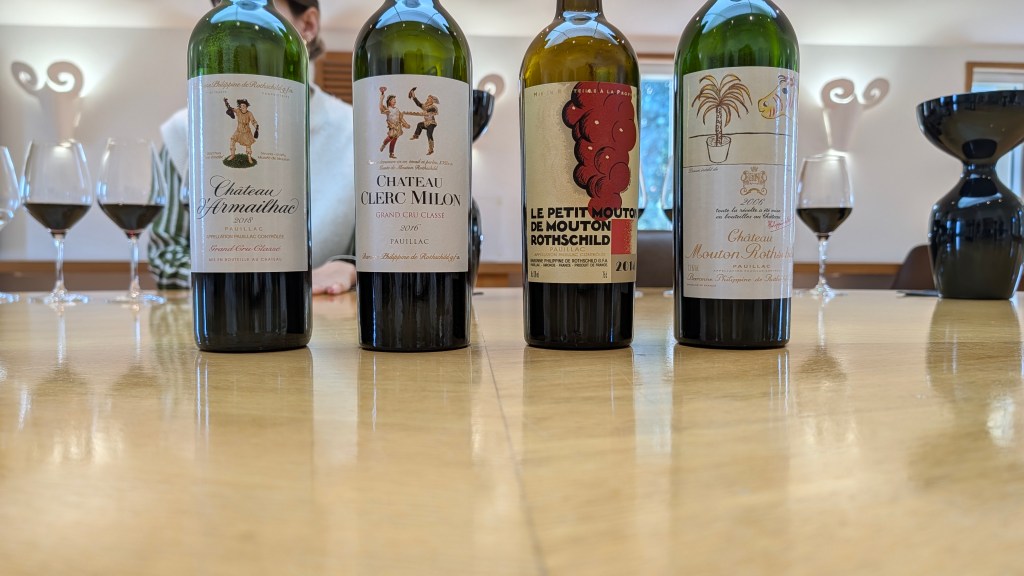
The old cellar is now used as an art museum to showcase the family’s extensive art collection as well as a museum containing original artist renditions of each year’s label. Unfortunately, we were not allowed pictures in either museum.
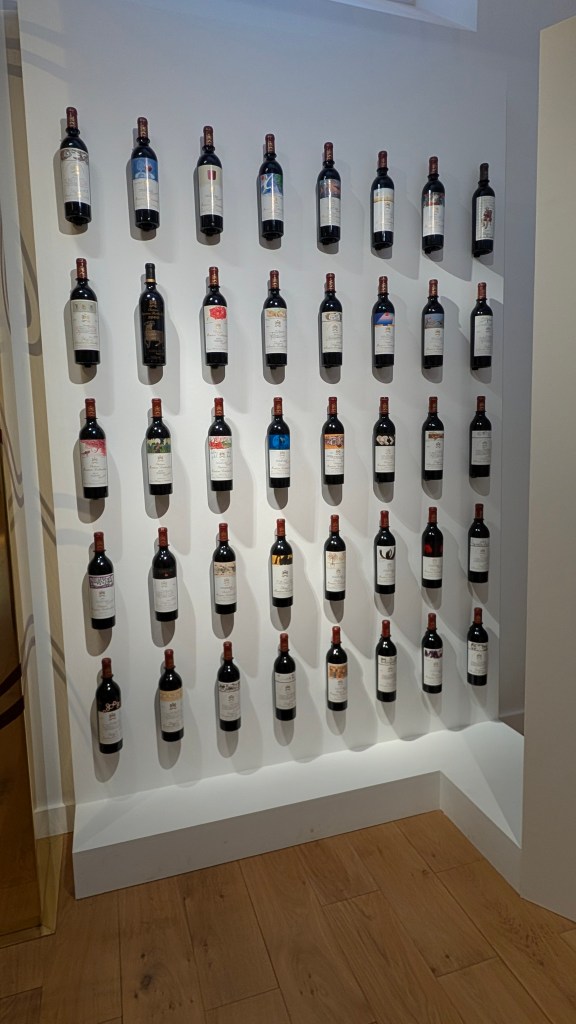
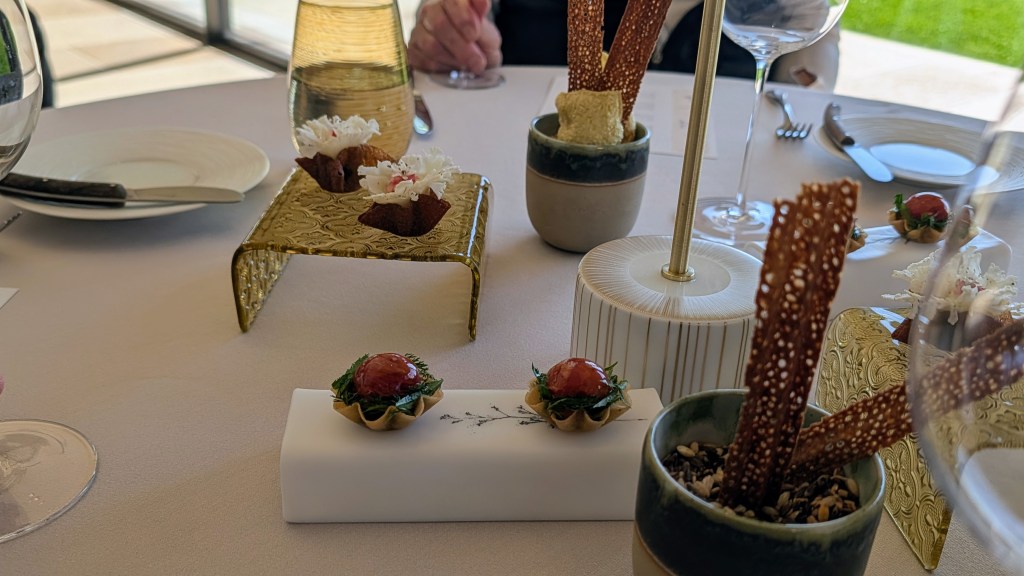
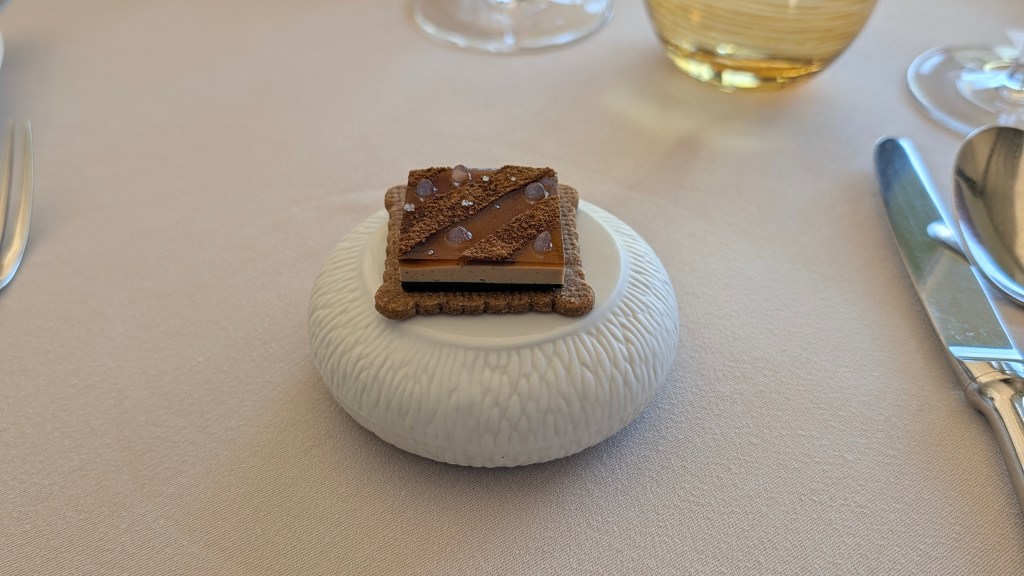
We finished the day with a spectacular tasting.
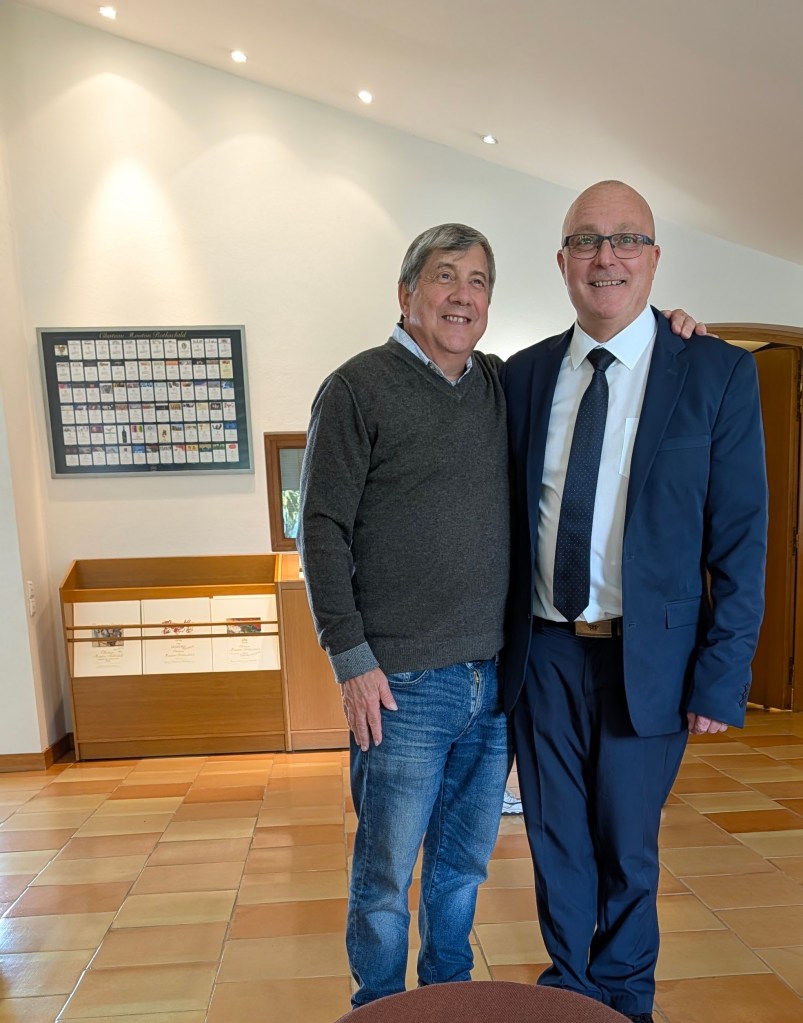
As it was our last day, Jeff posed with our driver.
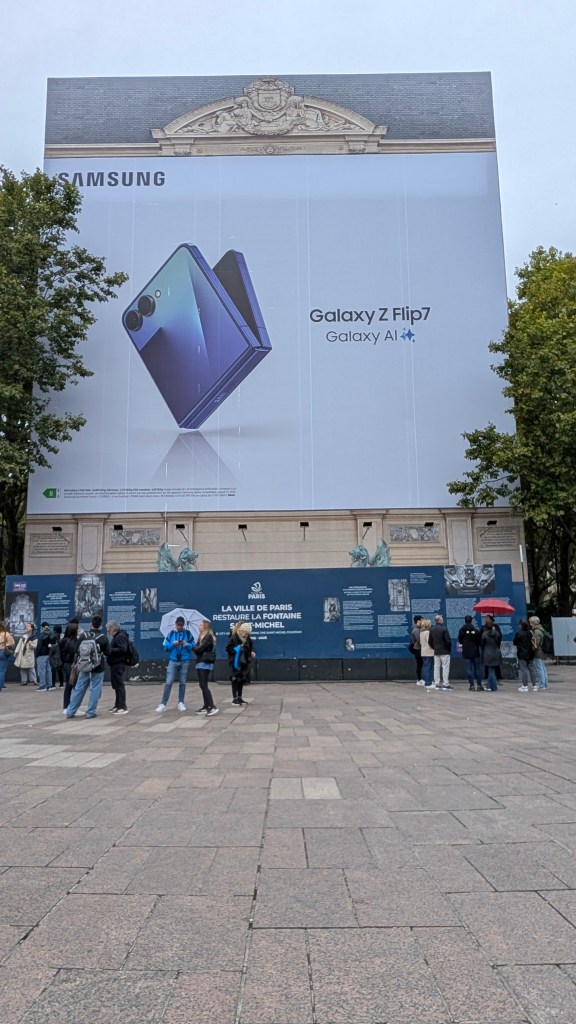
The next day we all road the train back to Paris where we parted ways. Eric and I continued on the metro to Montmartre, a historic hilltop neighborhood in Paris’s 18th arrondissement. Upon emerging from the metro we were greeted by a statue entitled “La Quatrième Pomme” (The Fourth Apple). Being New Yorkers, we could not resist a pic of “The Big Apple.” The sculpture was created by French artist Franck Scurti and inaugurated in 2011. It serves as a tribute to the 19th-century French philosopher and socialist Charles Fourier, referencing his concept of the “fourth apple” in relation to industrial society.  
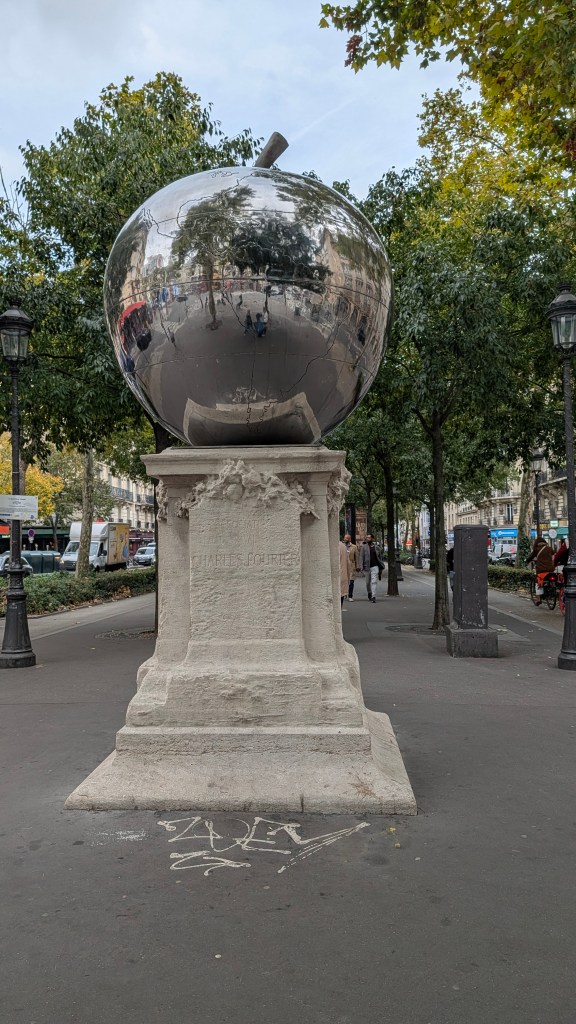
“La Quatrième Pomme” (The Fourth Apple)

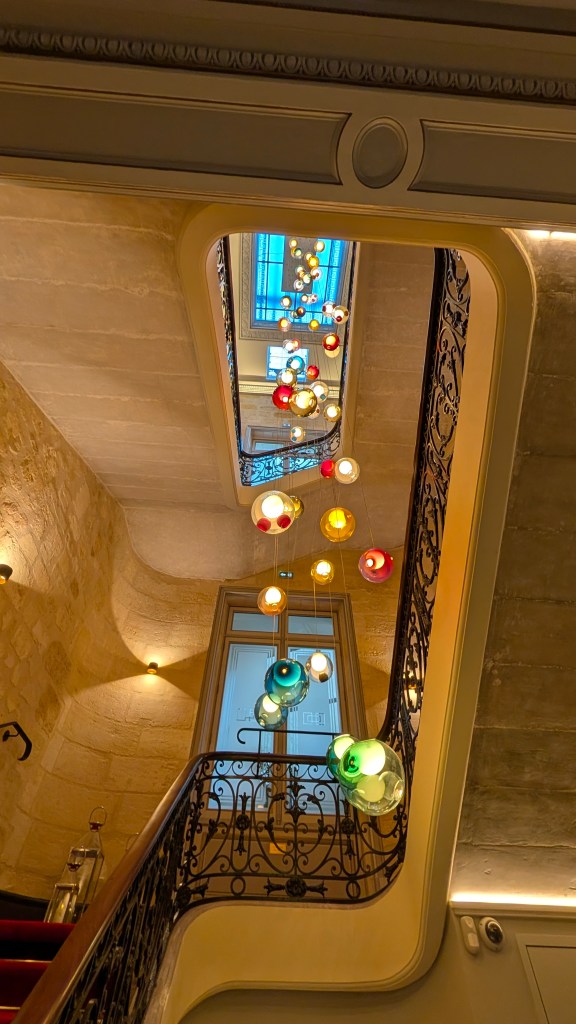
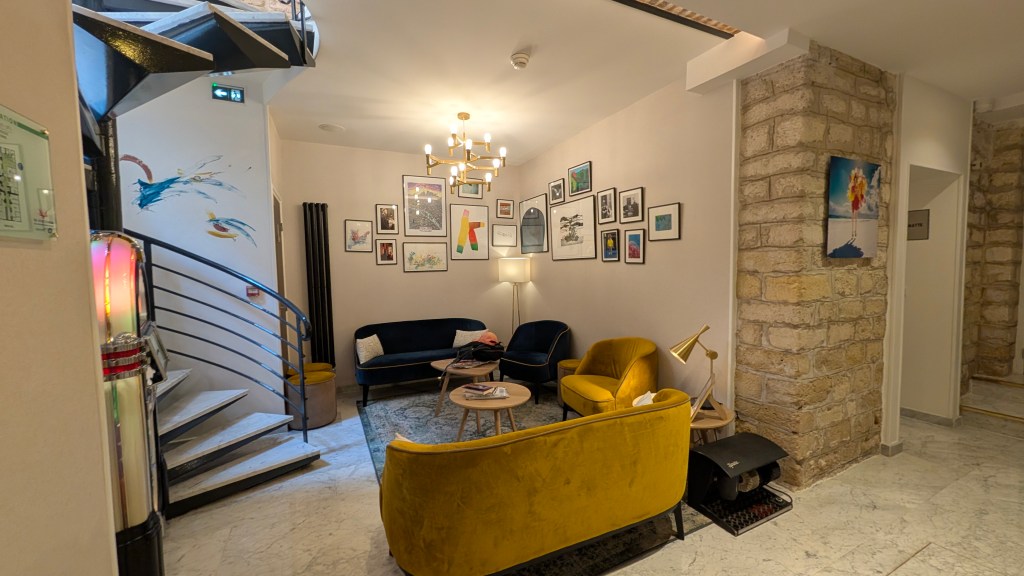
We walked to Hotel Des Arts and checked in. Both the upstairs lobby
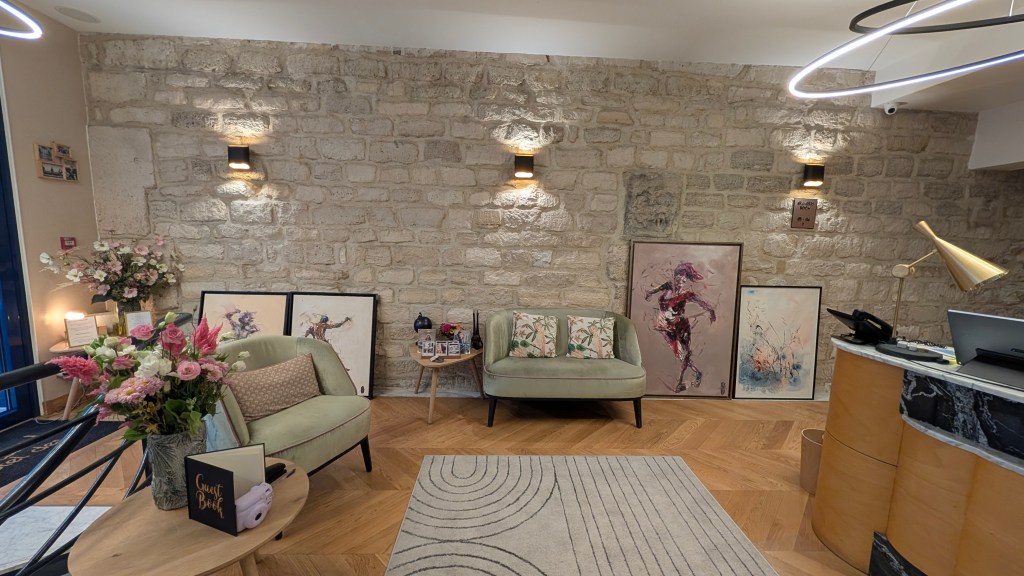
and the one below are both chock full of artwork from local artists. Montmartre is renowned for its bohemian artistic history.
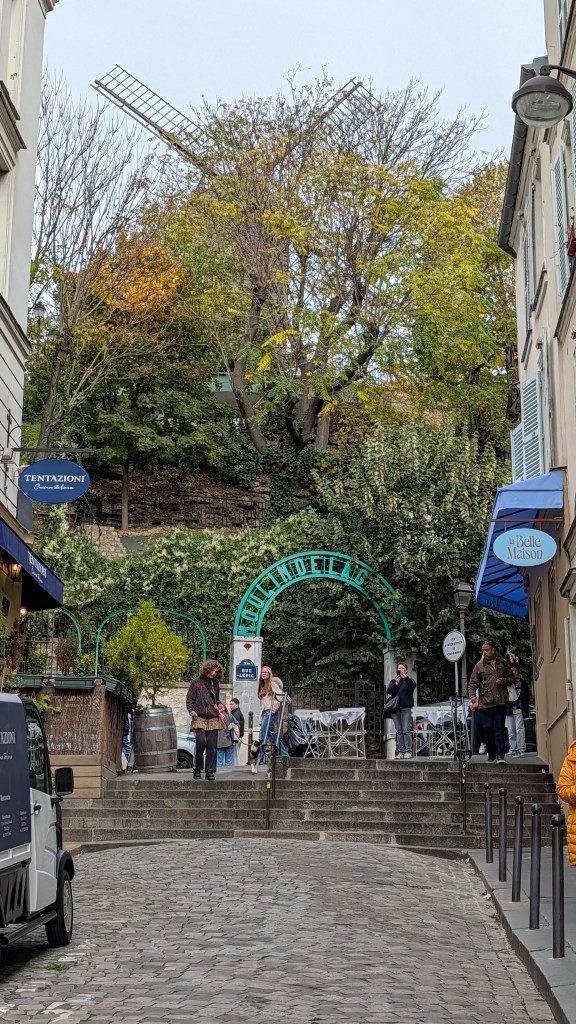
After settling in, we headed out into the late afternoon to explore the neighborhood. As we headed up our street, we spied a windmill above the park at the top of the street.
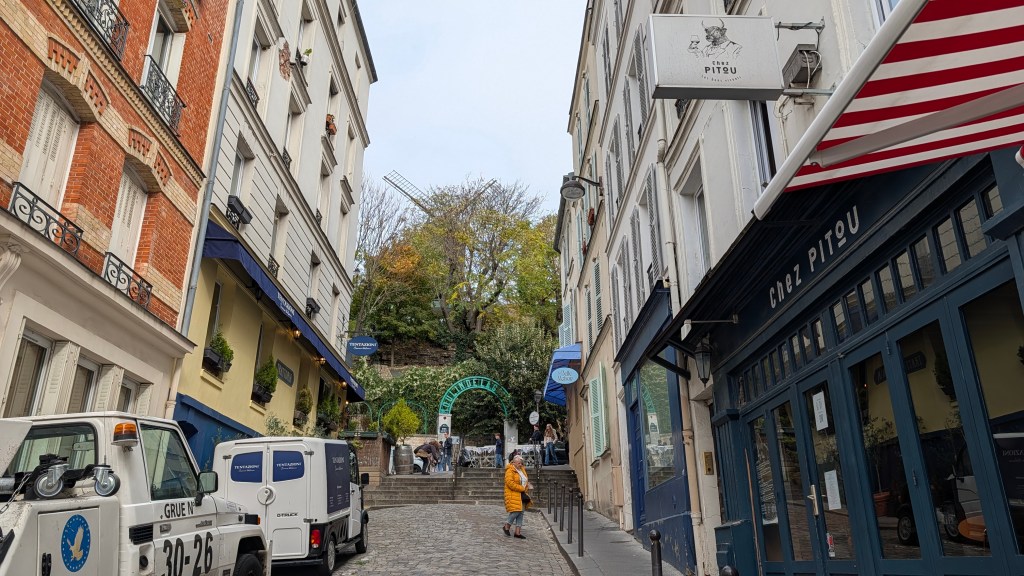
It is one of the last remaining functional windmills of the many that once dotted the Montmartre hill, but more on them later.
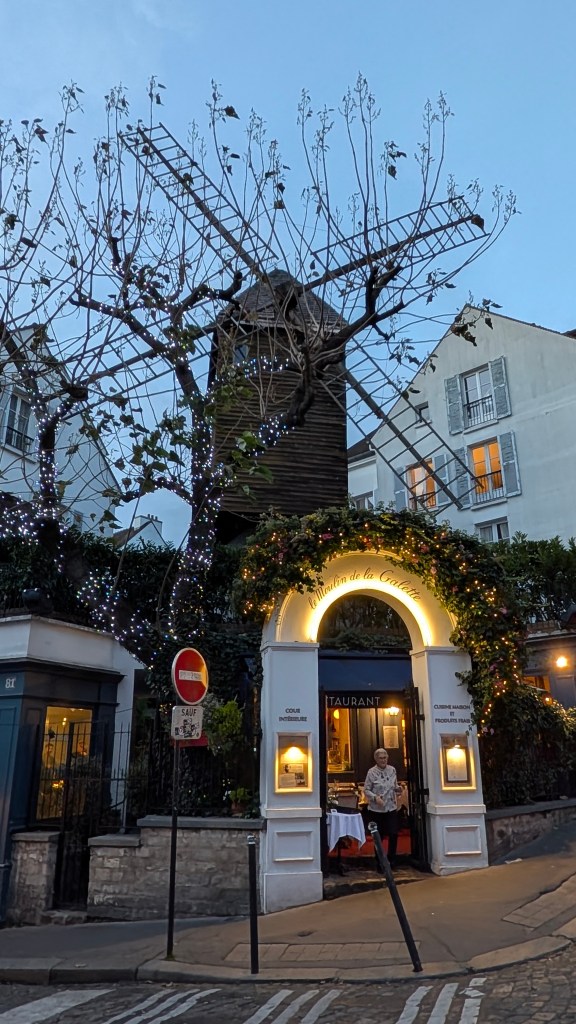
As the sun set, we reached the windmill that is now a part of Le Moulin de la Galette. Originally built in 1622, it was once a working flour mill before becoming a popular 19th-century dance hall.  It served as inspiration for famous artists like Pierre-Auguste Renoir, who painted the scene in 1876, and Vincent van Gogh. 
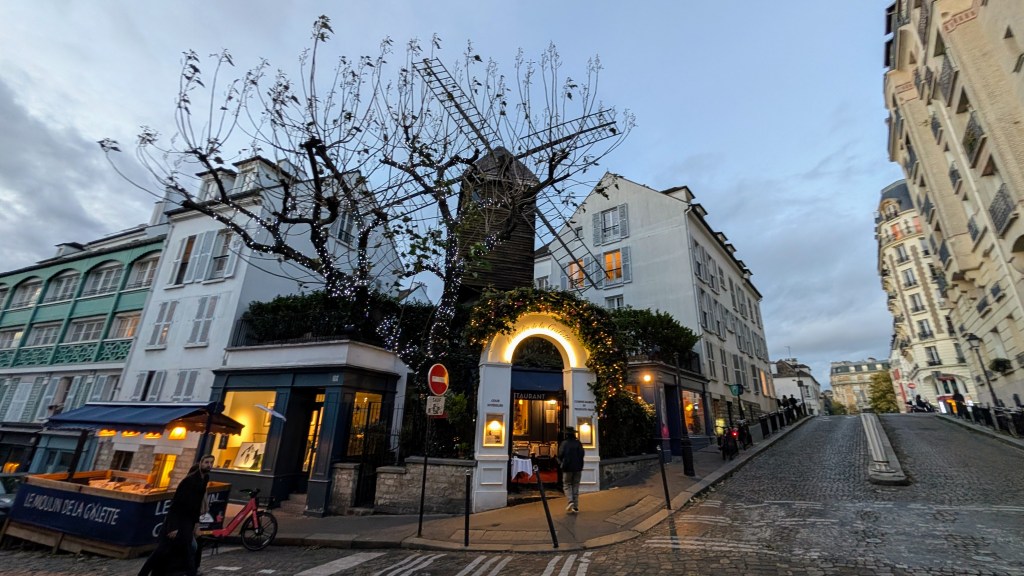
Le Moulin de la Galette

Today, it operates as a restaurant.

As we continued up the hill we passed several closed art galleries.
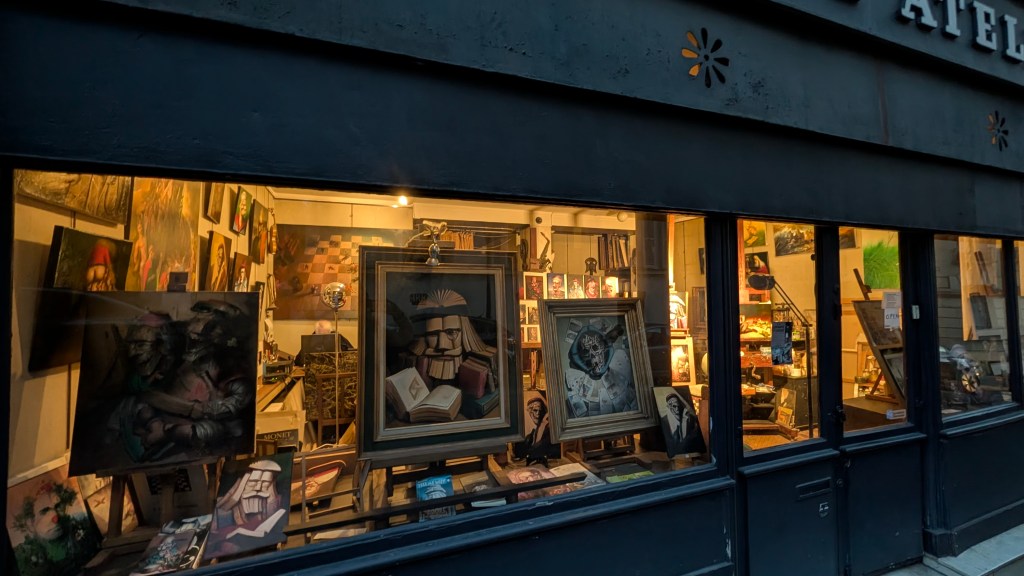

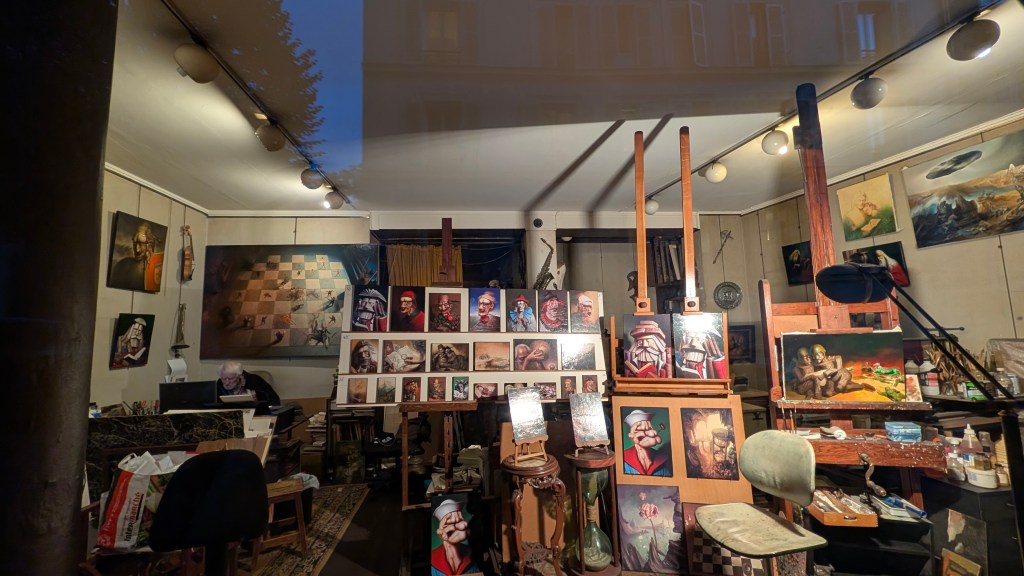
We peeked inside a few.
Near the top we entered Place du Tertre, a famous, albeit touristy, square filled with craft shops and artists painting portraits and landscapes.
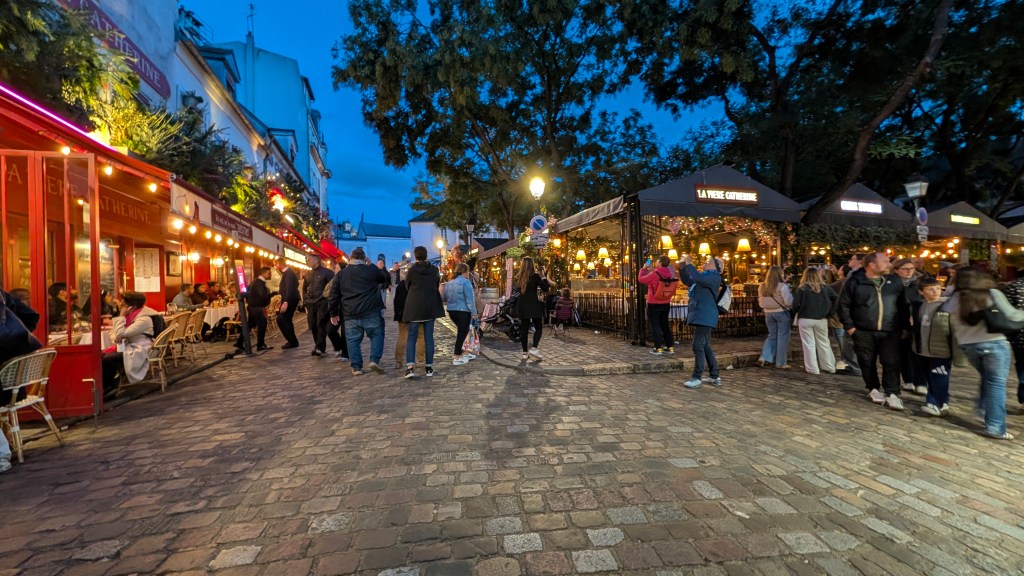
Place du Tertre

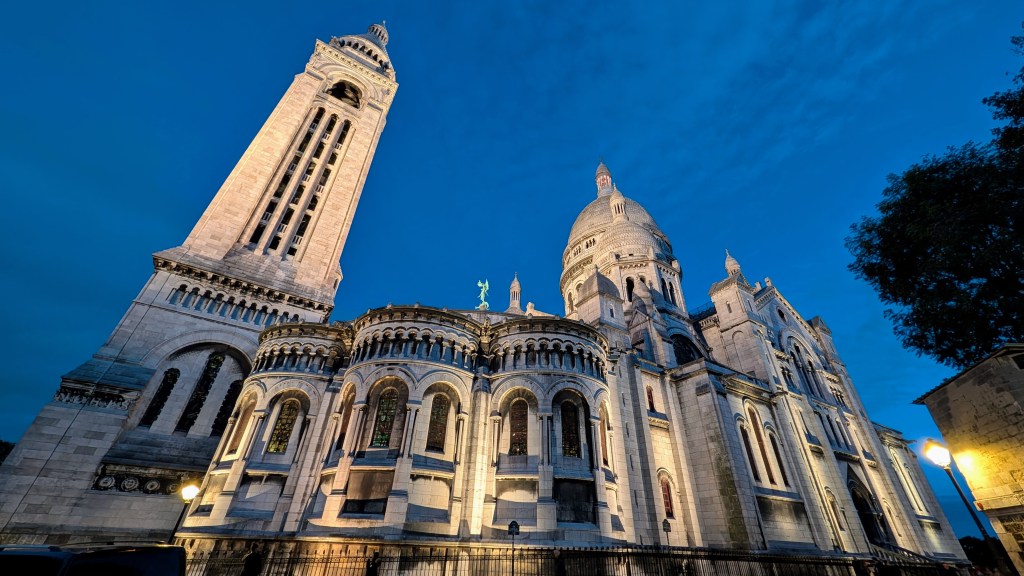
At the very top we found Sacré-Cœur Basilica (Basilica of the Sacred Heart) situated at the summit of the Montmartre butte, the highest point in the city. 
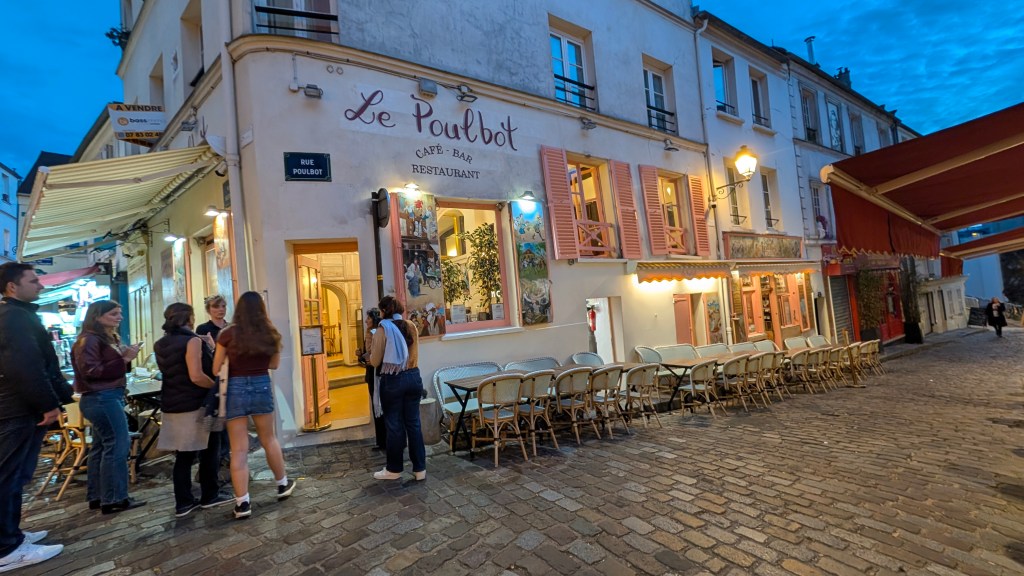
It was time for our reservation, so we headed back past Place du Tertre to Le Poulbot Restaurant.
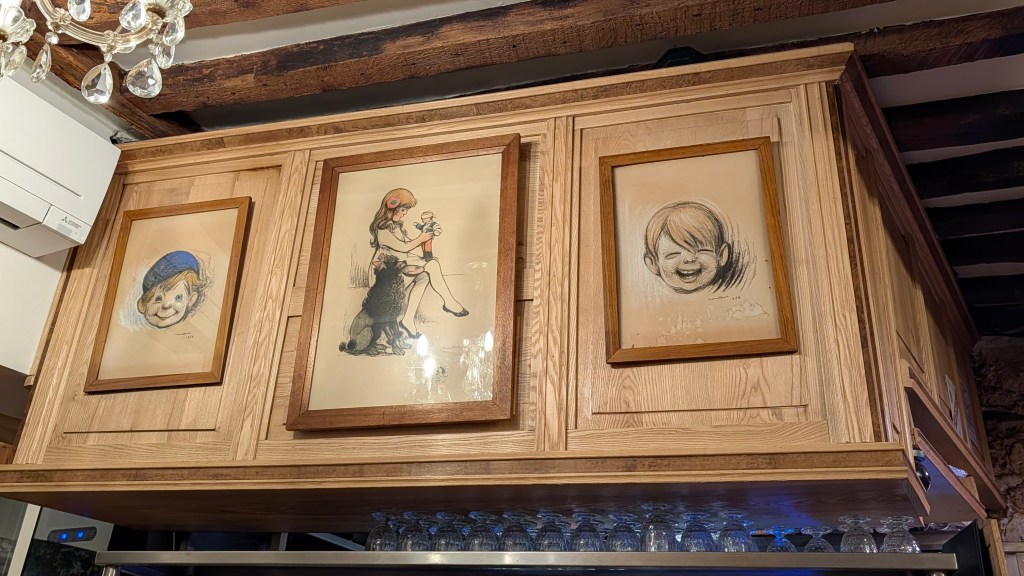
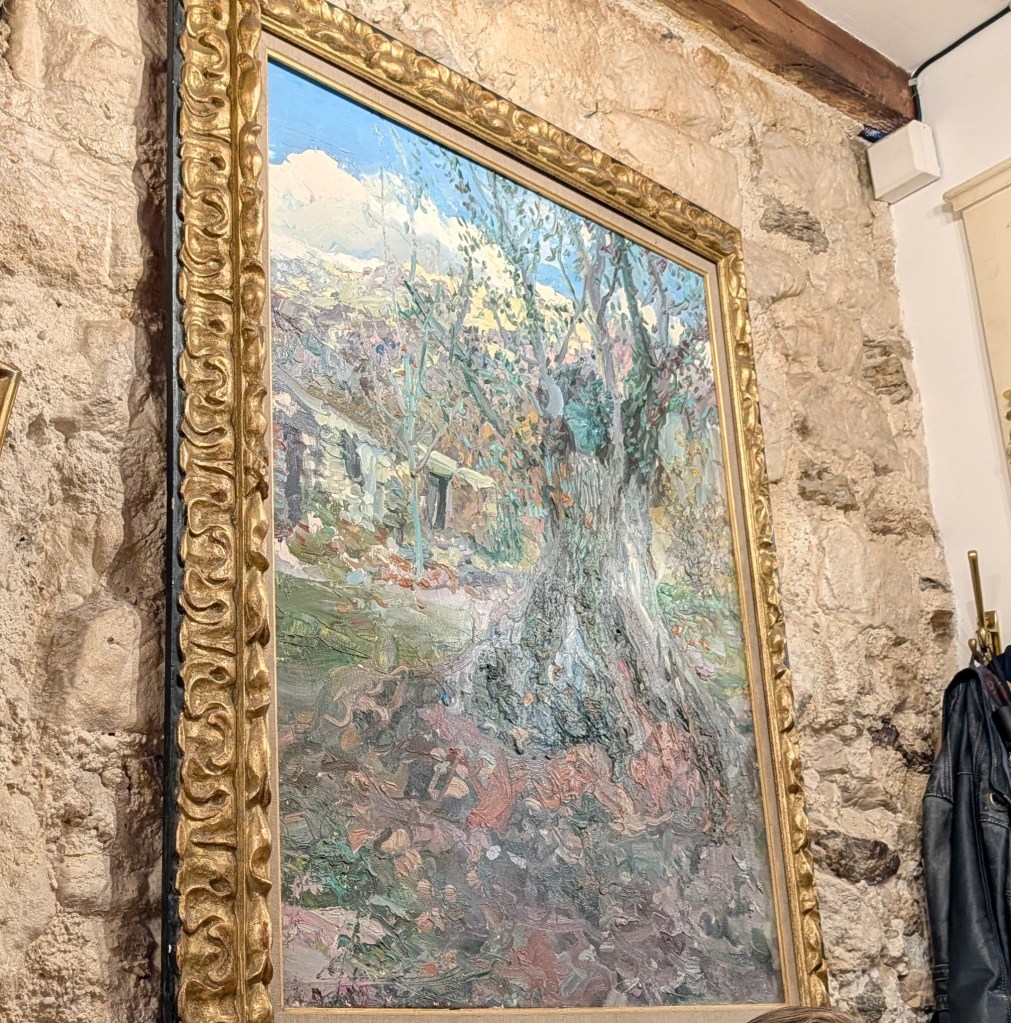
Inside, of course, more art was on display.
Having been in France at this point for nearly 3 weeks, and not yet having had a bowl of onion soup, it was time.
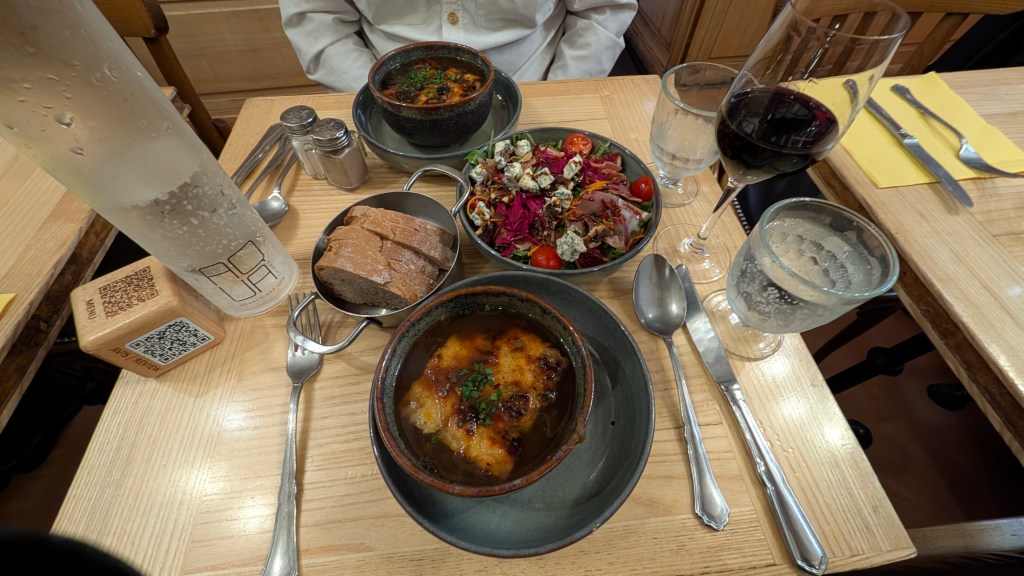
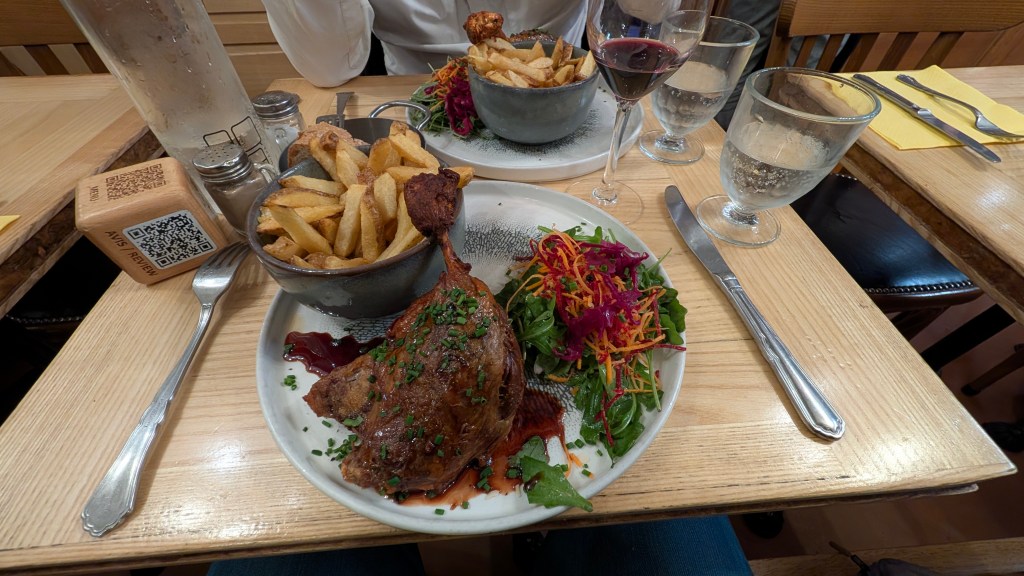
Ditto for the duck.
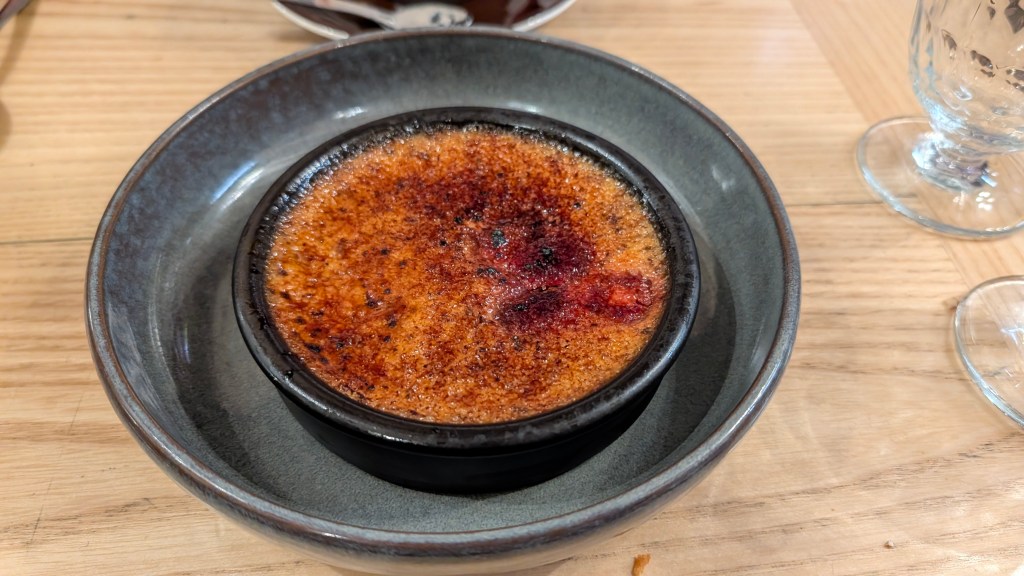
And the same for one of my all time favorite deserts: crème brûlée.
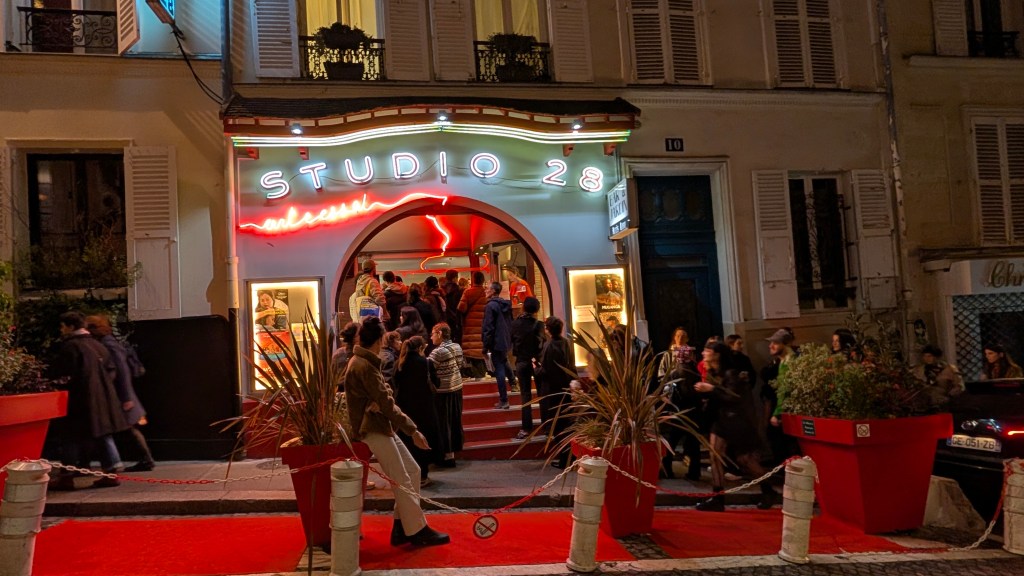
On the way back down the hill, we noted that the area was hopping with an active night life.
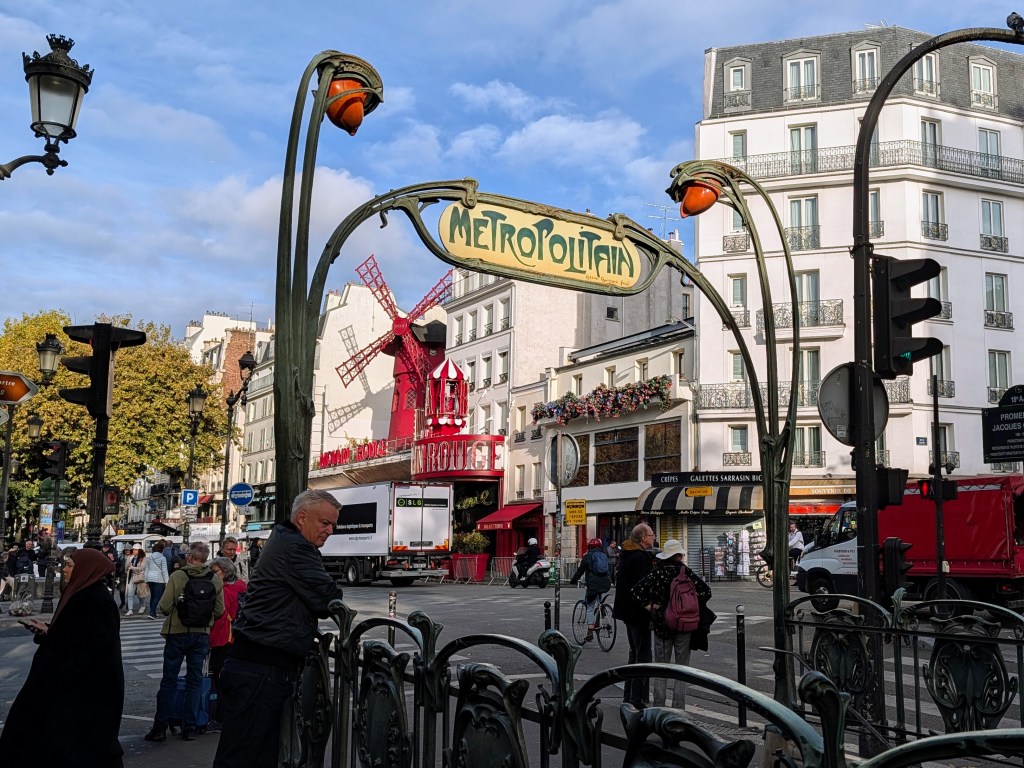
We had a walking tour booked for the morning. We left our luggage at the hotel and headed to the assigned metro stop at the foot of the hill. We noted that the metro sign does indeed look the same as the one we had seen this summer in Montreal, said to have been gifted from Paris.
Our guide Elise explained that originally Montmartre was a separate village.
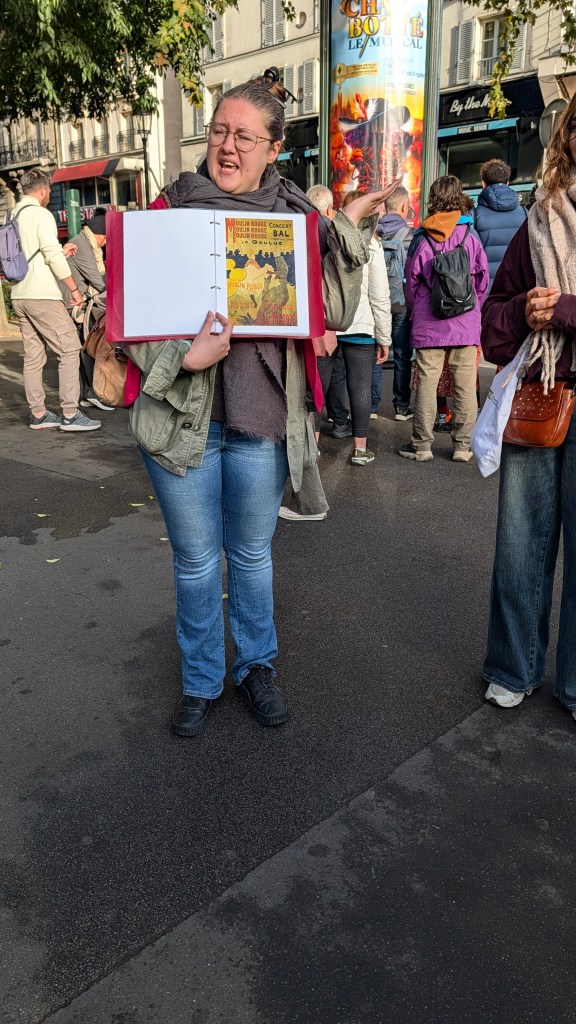
The street on which we were standing had a city wall, which was built for the purpose of taxes. Eating and drinking outside the city wall became popular to avoid said taxes. In 1860 with the reconstruction of the city, the wall came down, but it remained less expensive to live in this arrondissement, which attracted artists along with the working class.
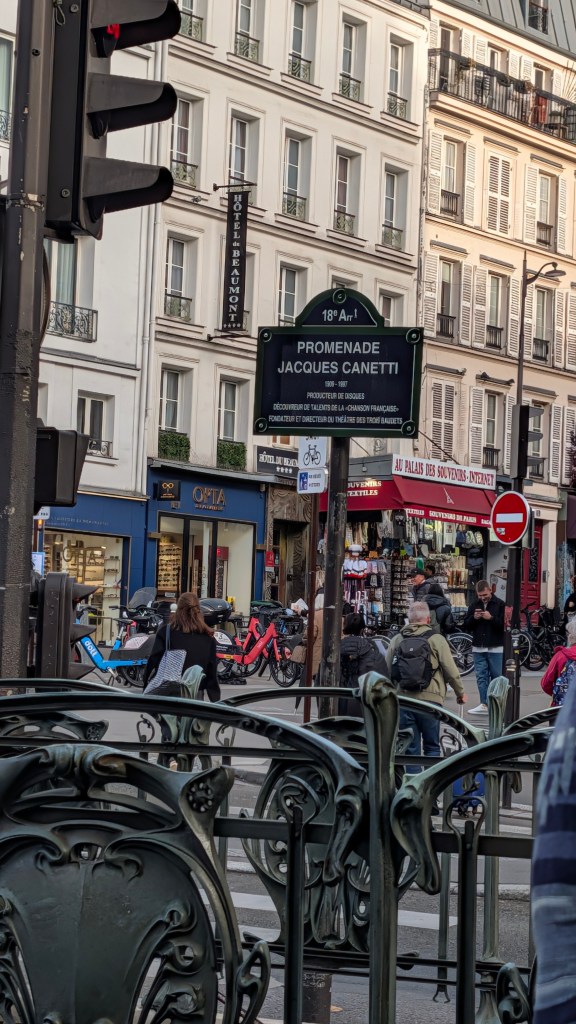
Elise took us first to Moulin Rouge cabaret located on the Boulevard de Clichy. She explained that although it had been built in 1889 by Charles Zidler and Joseph Oller, the iconic red windmill was gifted later, in 1899, the same year in which the Eiffel Tower was built. It is famously known for the can-can dance and as the birthplace of modern cabaret, but also historically significant, it was the first building in the city powered by electricity. It had to be outside the city because of how risqué it was considered. But the cabaret has hosted famous patrons including Sigmund Freud, Oscar Wilde, and the Prince of Wales.
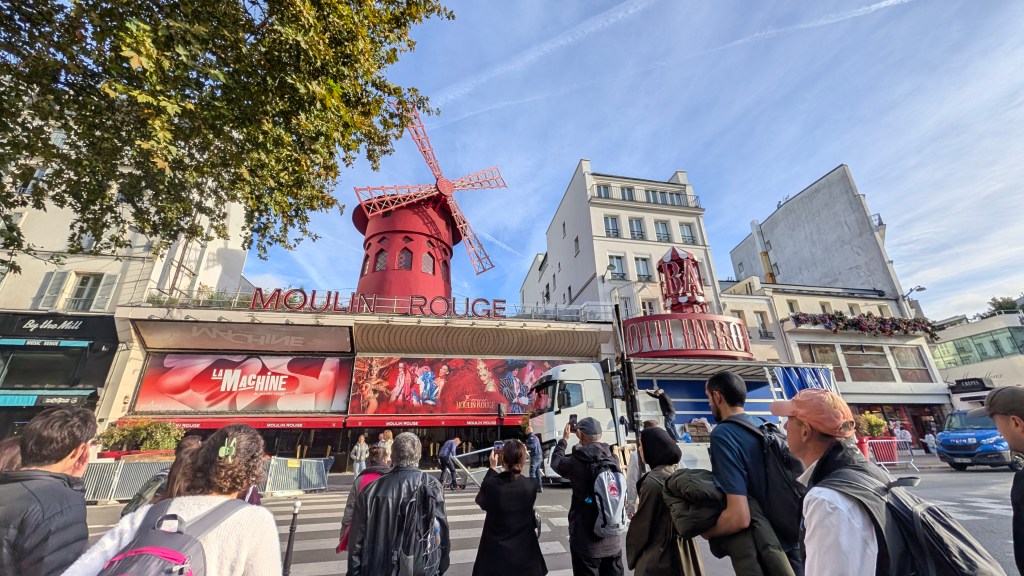
Moulin Rouge

Moulin Rouge dancers hold the Guinness World Record for the most simultaneous “demi-grand rond de jambe” cancan kicks, achieving 29 kicks in 30 seconds.  The on-site atelier handcrafted every feather and sequin for the dancers’ costumes. The venue has been managed by the Clerico family since 1955, with the current owner having been inspired by Las Vegas shows to modernize the revue. The venue currently has an incredible 1,500 employees, including a massive team of waitstaff.
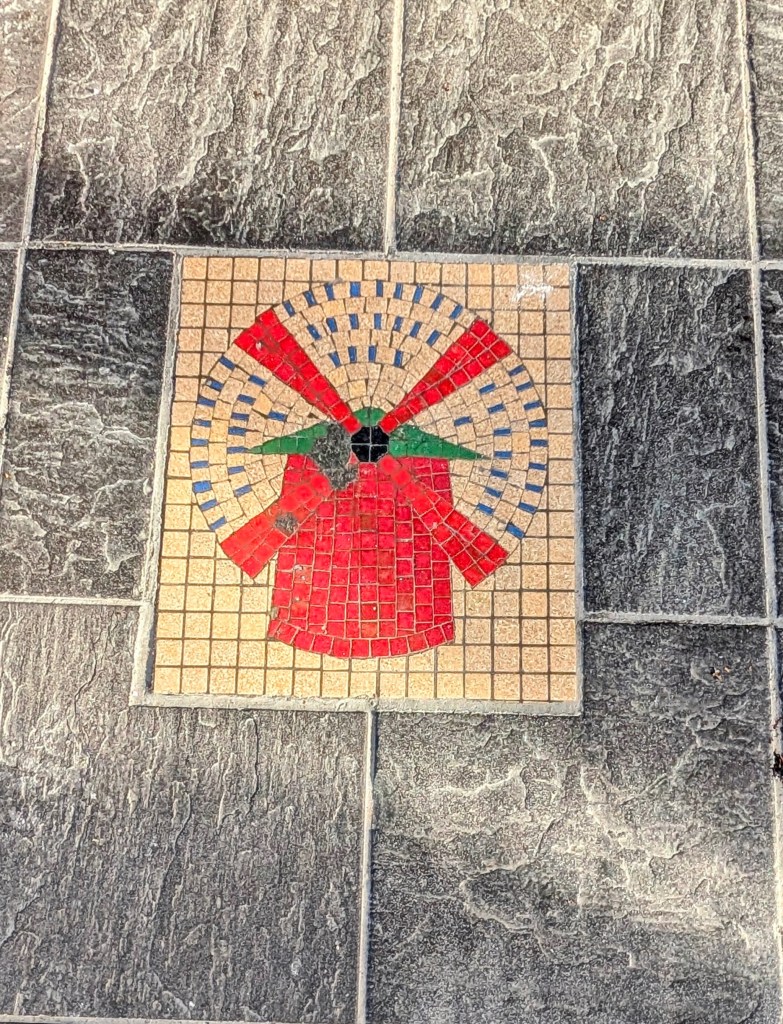
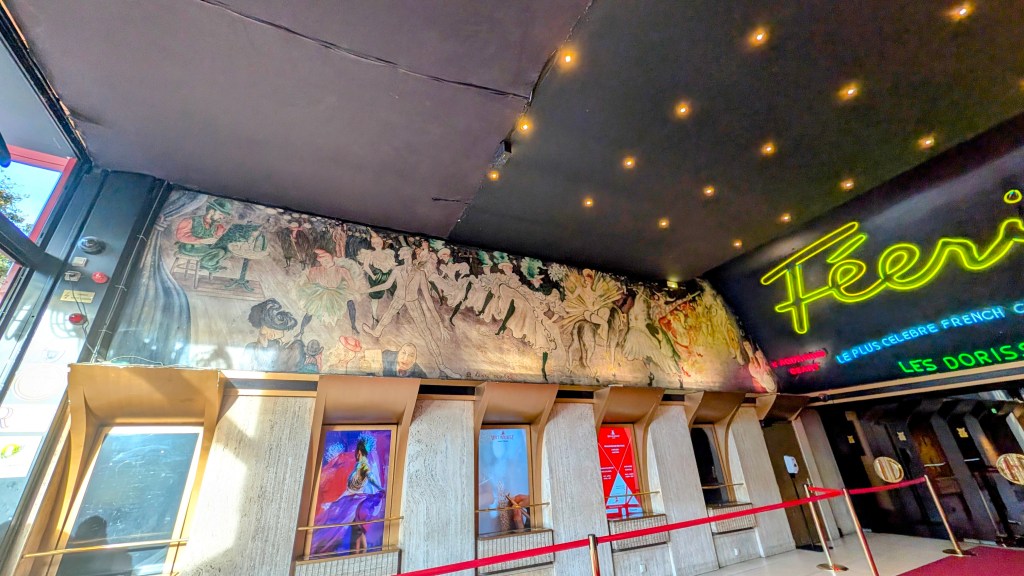
Painter Henri de Toulouse-Lautrec, lover of the can-can, became the soul of the neighborhood. He created iconic posters for the venue, featuring stars like La Goulue (Louise Weber). He was addicted to absinthe, which he called the Green Fairy. In one of his paintings, depicted outside the venue, the men are wearing top hats, which is a sign of the wealth of the clientele. There was no stage added until the 20th century, an American musical influence. Since 1957, all show names begin with the letter “F” (e.g., Féerie), a tradition started by choreographer Doris Haug to bring good luck.
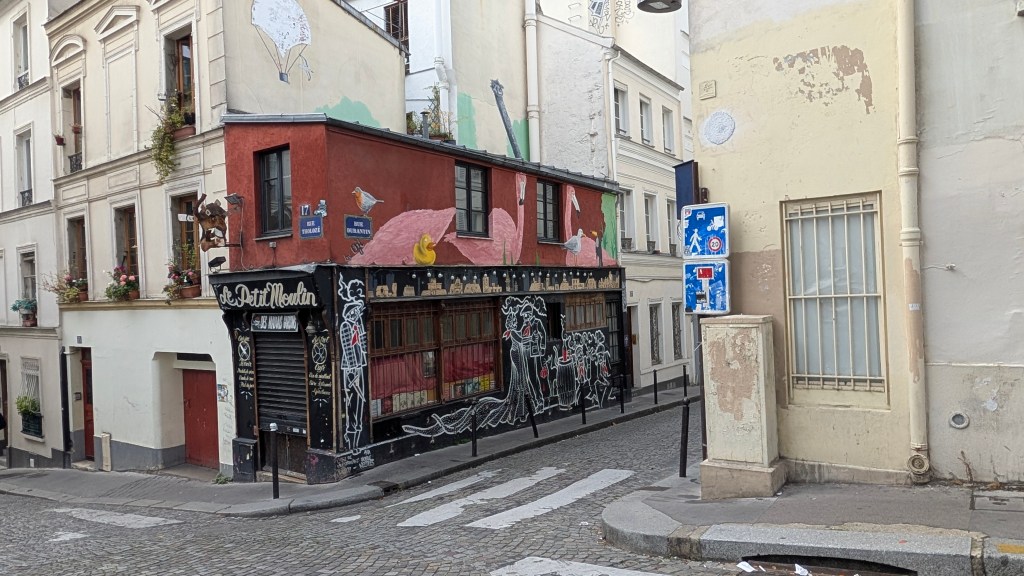
Elise pointed out Cafe Petit Moulin which was used as a set for the movie Amelie.
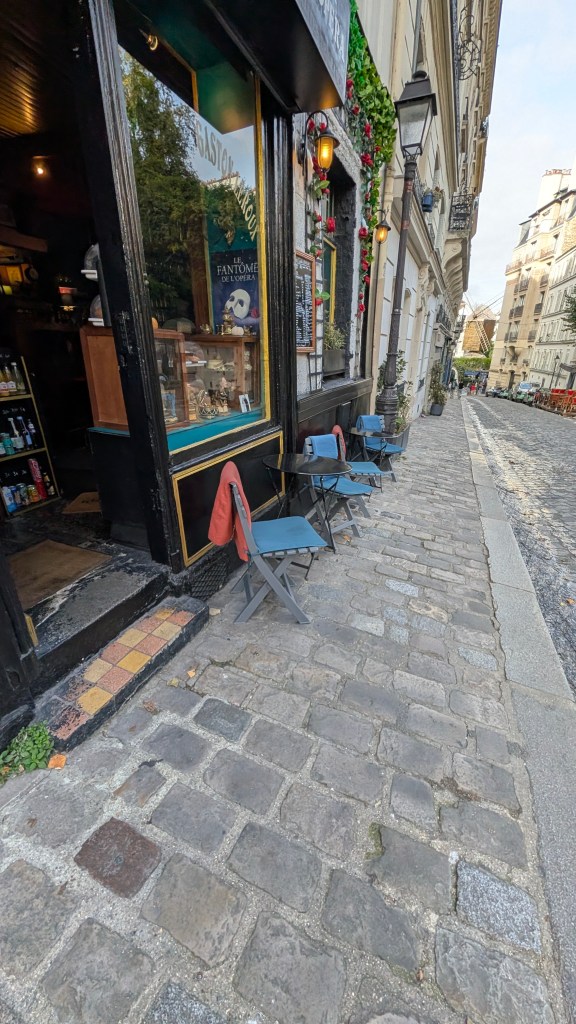
Elise told us that the French use terraces around cafes all year round partly to smoke, but also to people watch. All of the chairs at cafes face outward for the important people watching activity. By law they must allow room for passage of pedestrians.
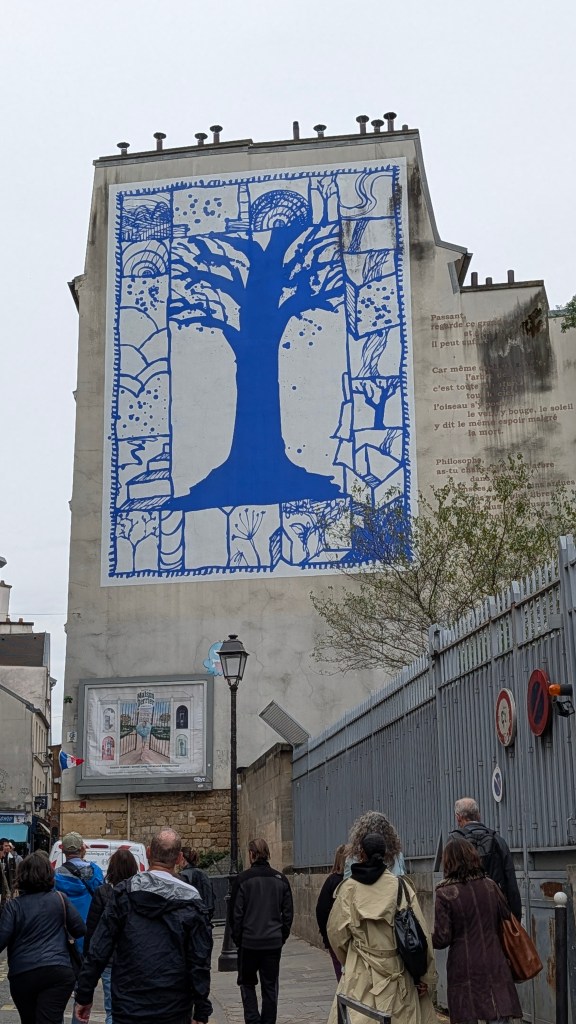
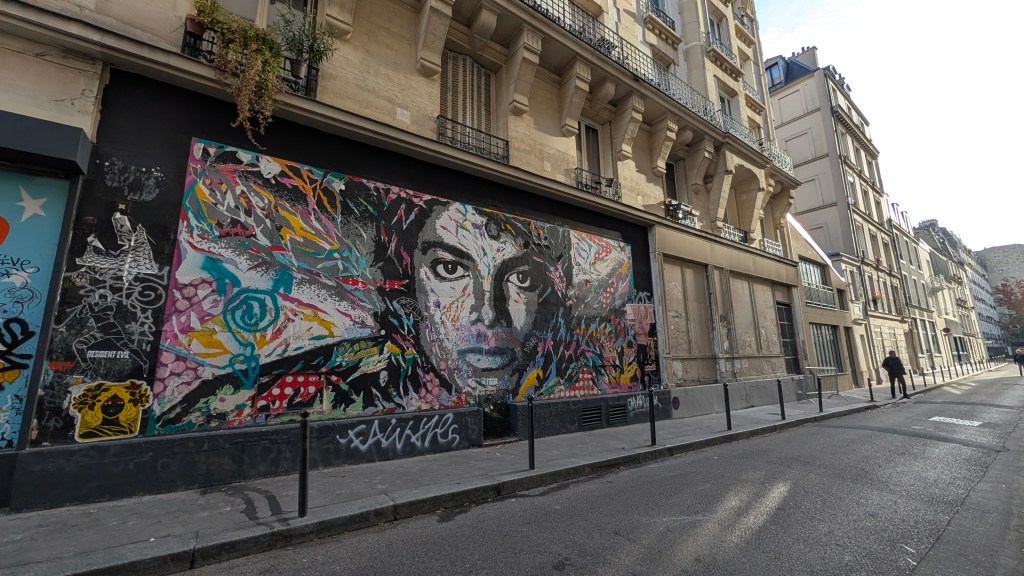
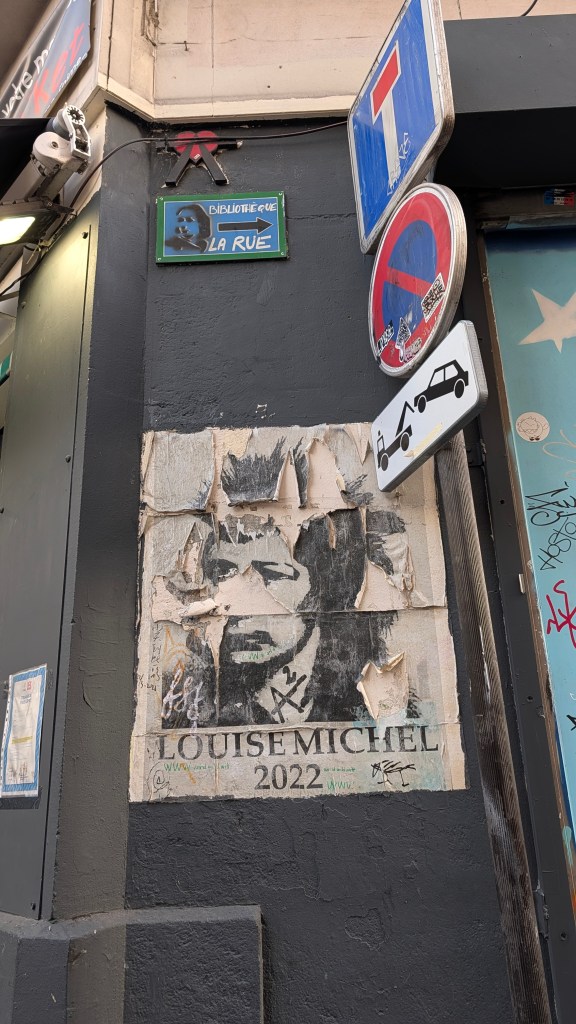
As we climbed the hill Elise started talking about all of the street art in the neighborhood, some of which are large murals, others not so large.
Louise Michel was a 19th century schoolteacher. In 1871 she actively participated in the events of the Paris Commune, ie the end of the Franco-Prussian War,  both on the front line and in support. The Freedom fighters had unsuccessfully tried to assassinate the president; they were executed by firing squad. Having turned herself in to secure her mother’s release, she was instead deported to New Caledonia, where she converted to anarchist thought. She became an icon for anarchists. For the love of honesty.
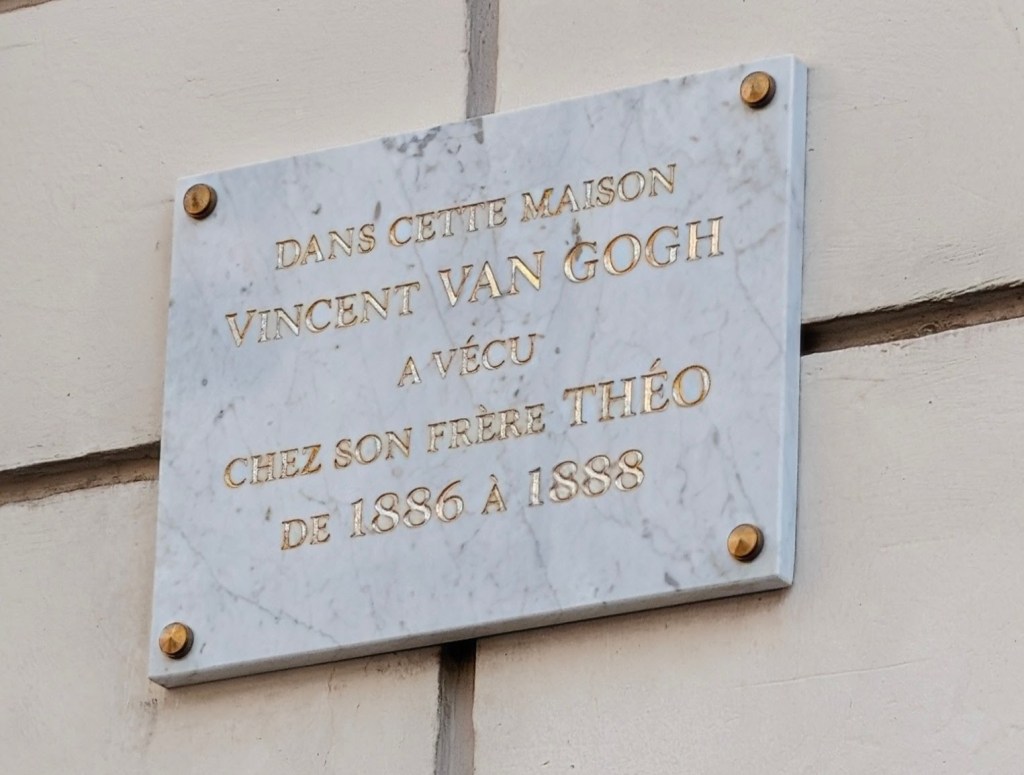
We walked by the home of Théo Van Gogh, art dealer and brother of Vincent, who visited here 1886-1888. It was during the evolution of the neighborhood, which Vincent Van Gogh painted often.
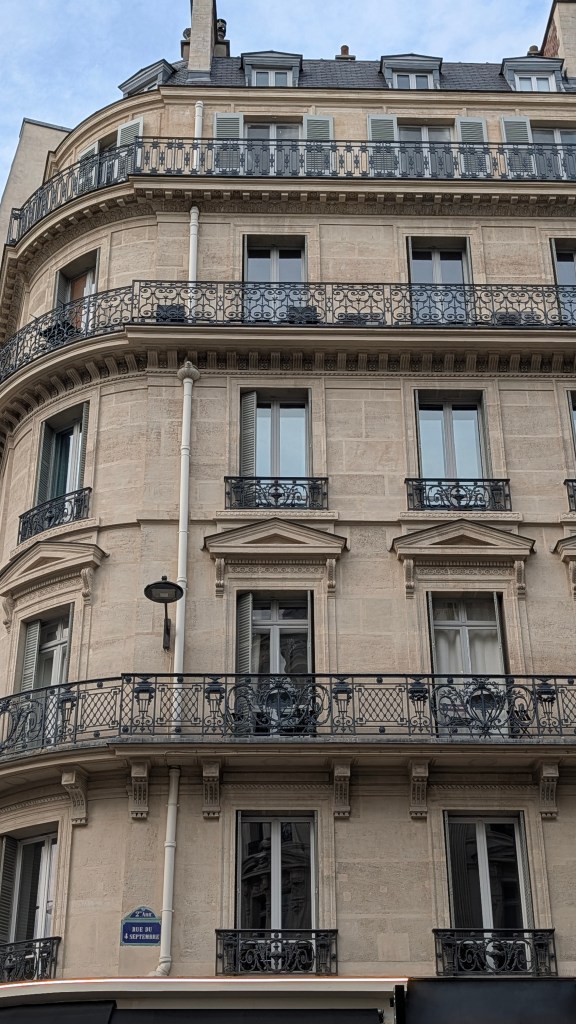
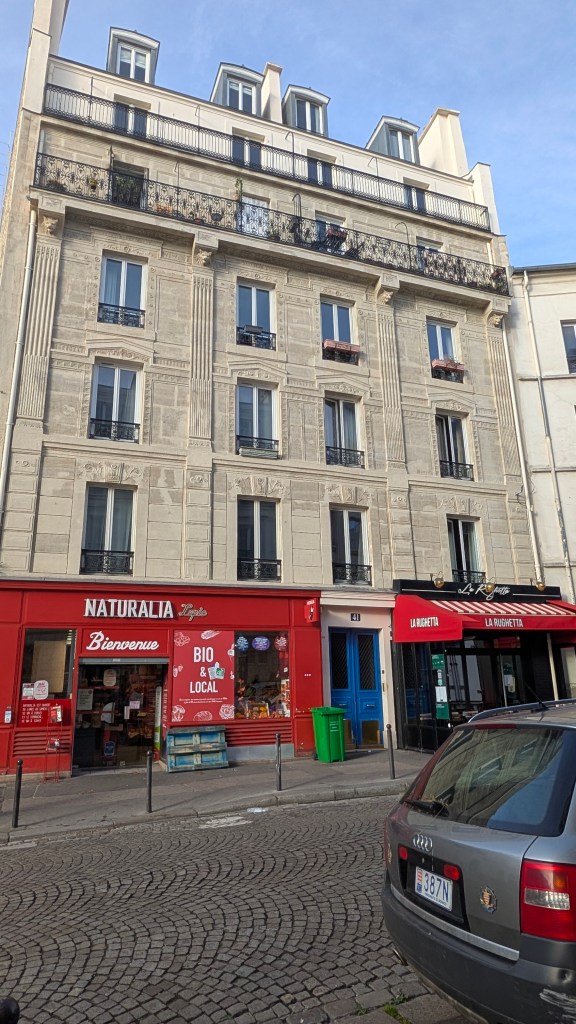
Elise also pointed out a building with typical Haussmann architecture, which we have seen throughout Paris and Bordeaux. They were built after nearly 60% of the existing buildings had been demolished. She reiterated that above the commercial space lived the family with the servants at the top, which was generally freezing in the winter and very hot in the summer. The staircases were made very narrow to save on internal space, which is why so many of the elevators in these buildings are so tiny today.
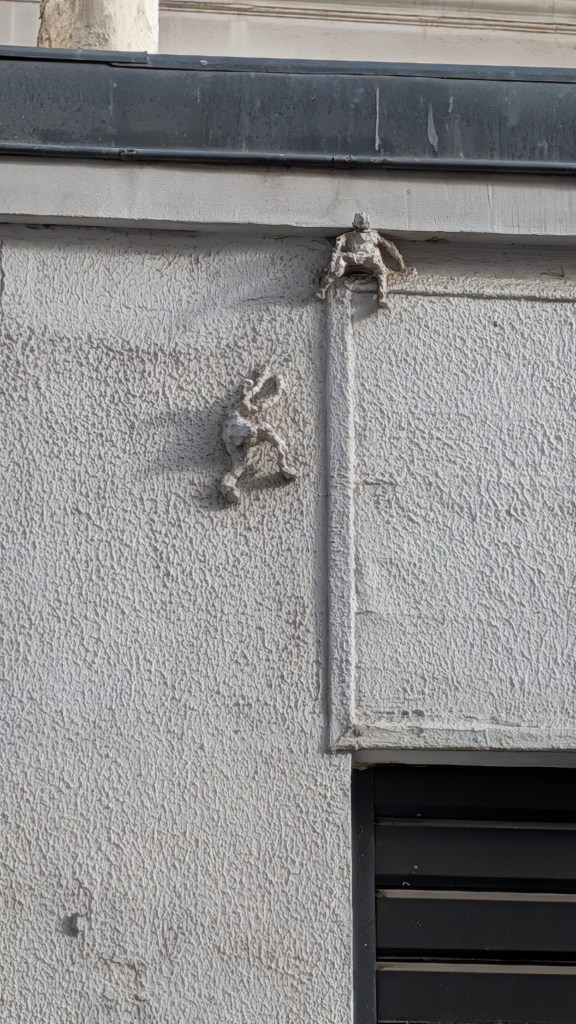
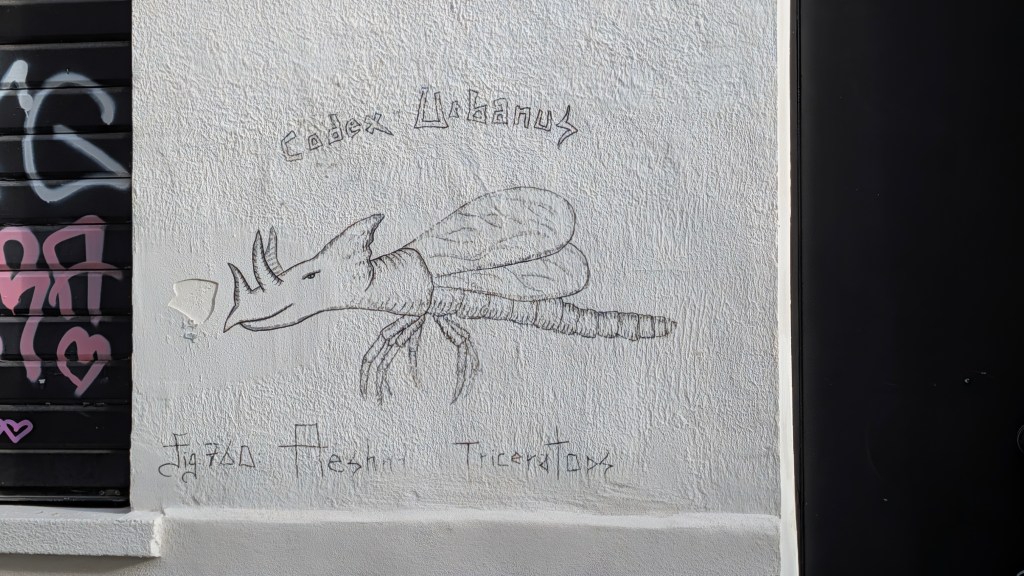
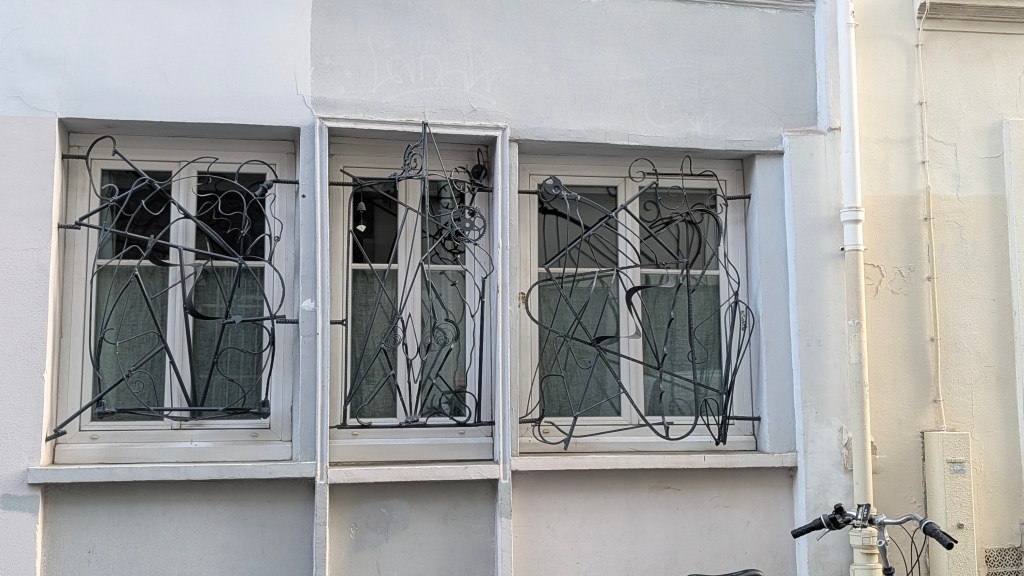
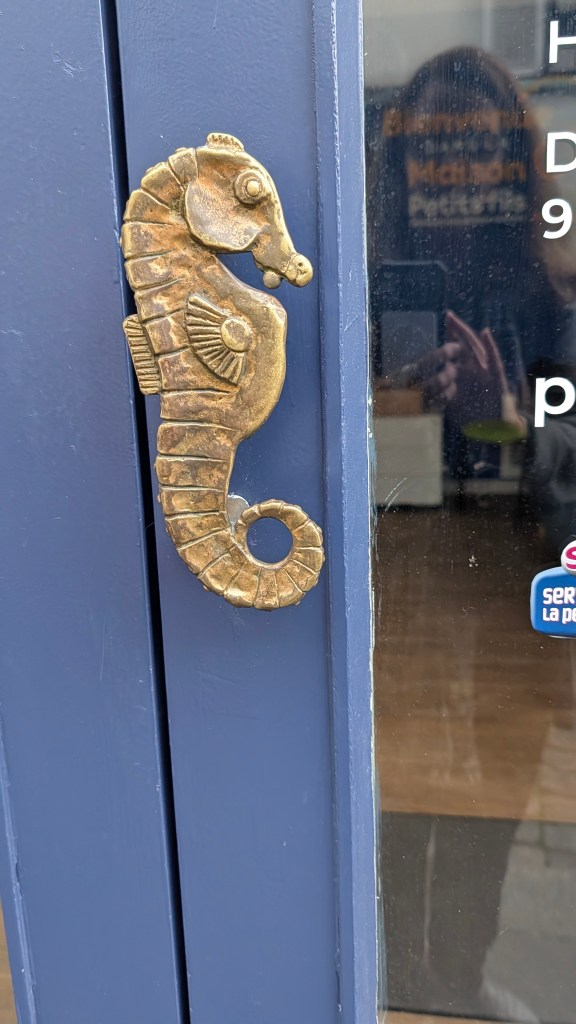
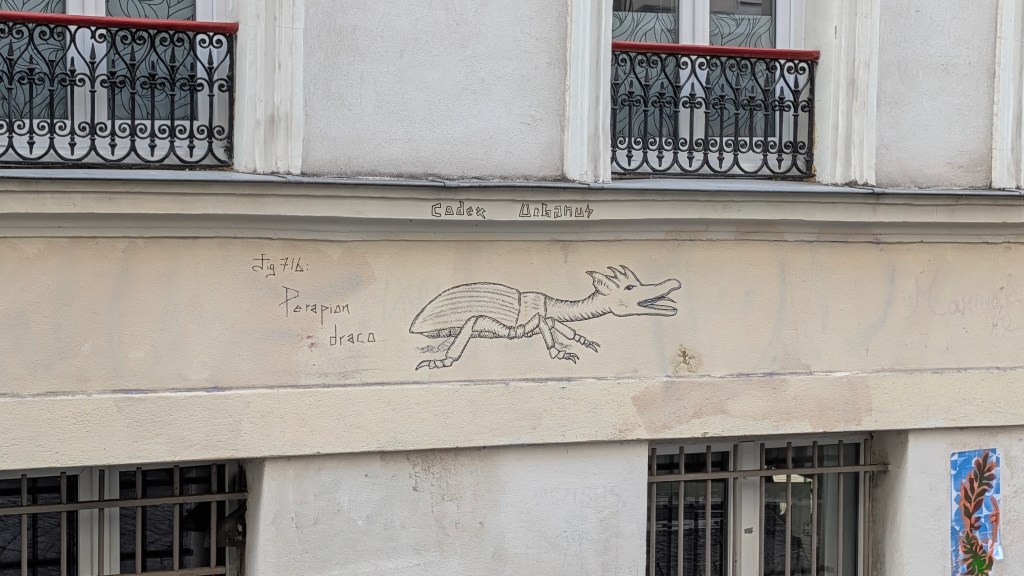
Street art is not confined to paintings and murals. Included can be mosaics or statues, no matter how small,
as well as sketches,
iron works.
and even door knobs.
Most are anonymous. Sometimes we can recognize the same artist’s work.
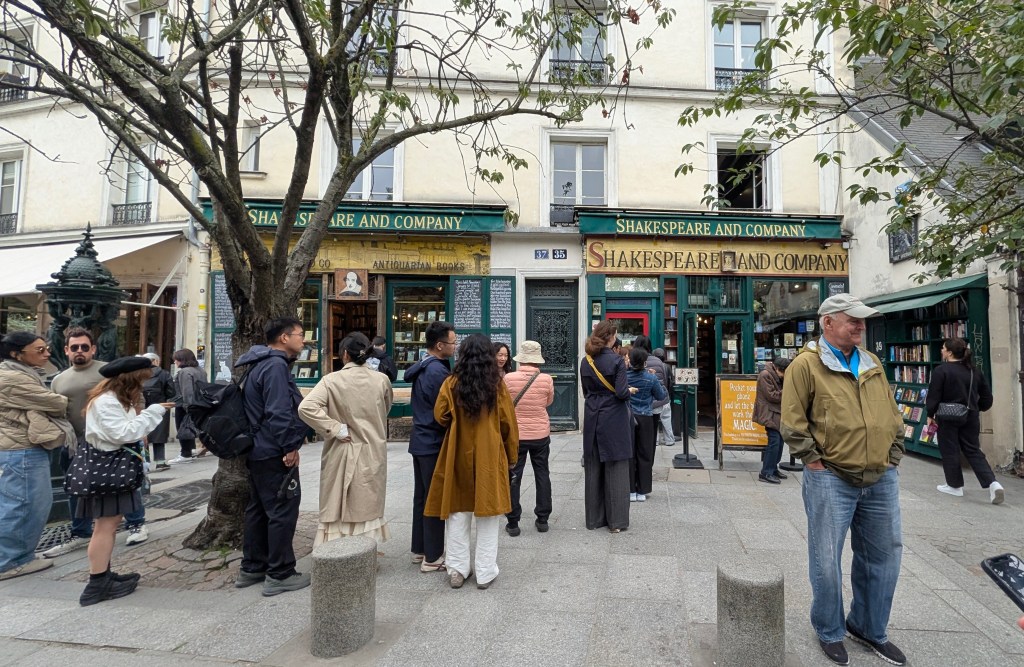
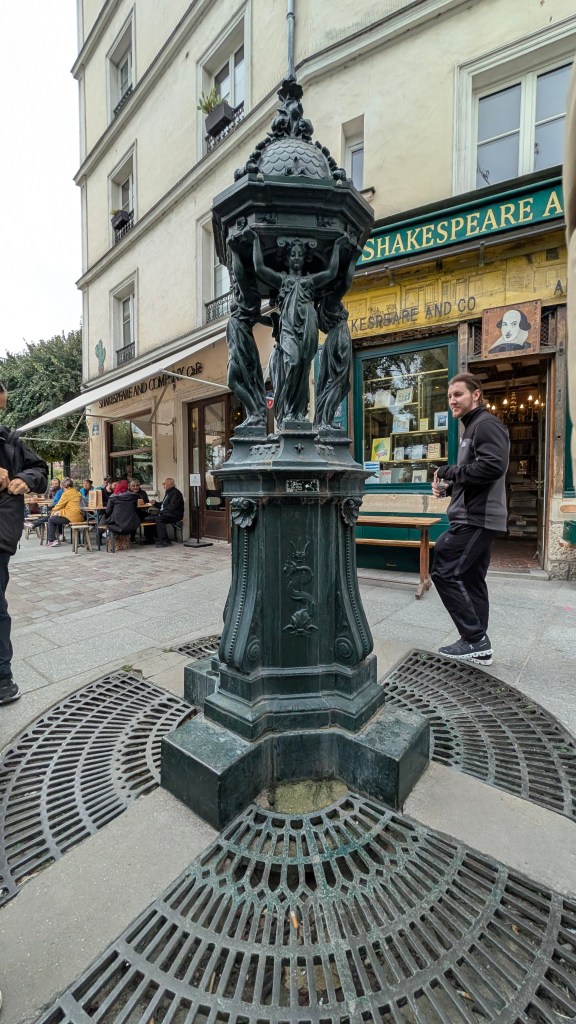
Elise showed us a cast-iron Wallace fountain, similar to the one we had seen outside the Shakespeare and Co. bookstore. Sir Richard Wallace was a philanthropist and a hygienist who gifted 50 fountains to the city for the municipality; there are now 107. The females portrayed are models of Greeks goddesses who portray kindness, simplicity, charity, and sobriety. Each one is different from her sisters, by the way she bends her knees and where her tunic is tucked into her blouse. Even today they may be the only source of free clean water for the poor and homeless. Today’s modernized fountains have a button instead of a lever, many have sprinklers to cool off residents, and some even have free sparkling water.
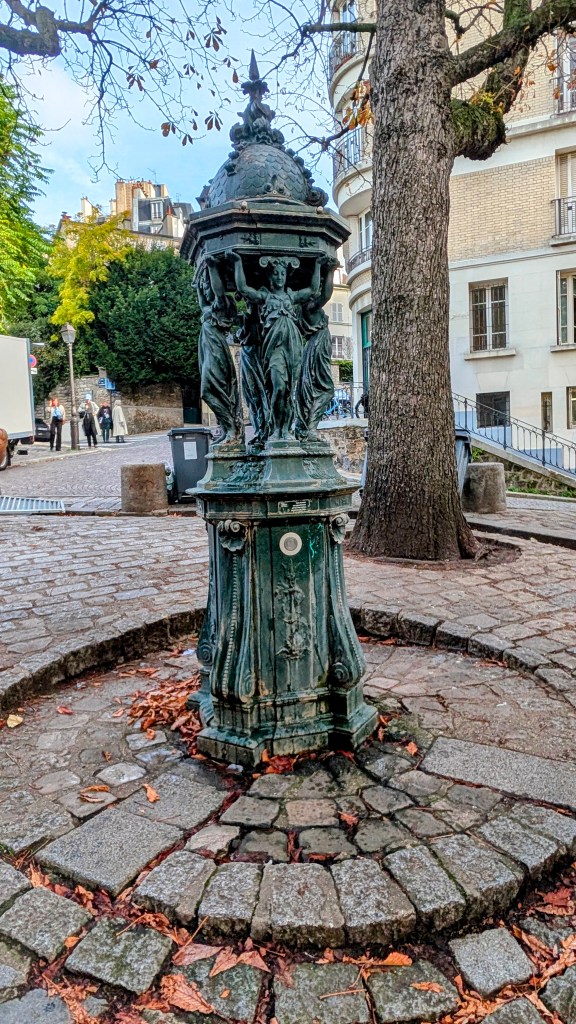
Wallace fountain

The Bateau-Lavoir (Washhouse Boat or Floating Laundry) is a famous, historic artists’ collective where Pablo Picasso lived and worked 1904-1907, and is where he famously painted Les Demoiselles d’Avignon in 1907.
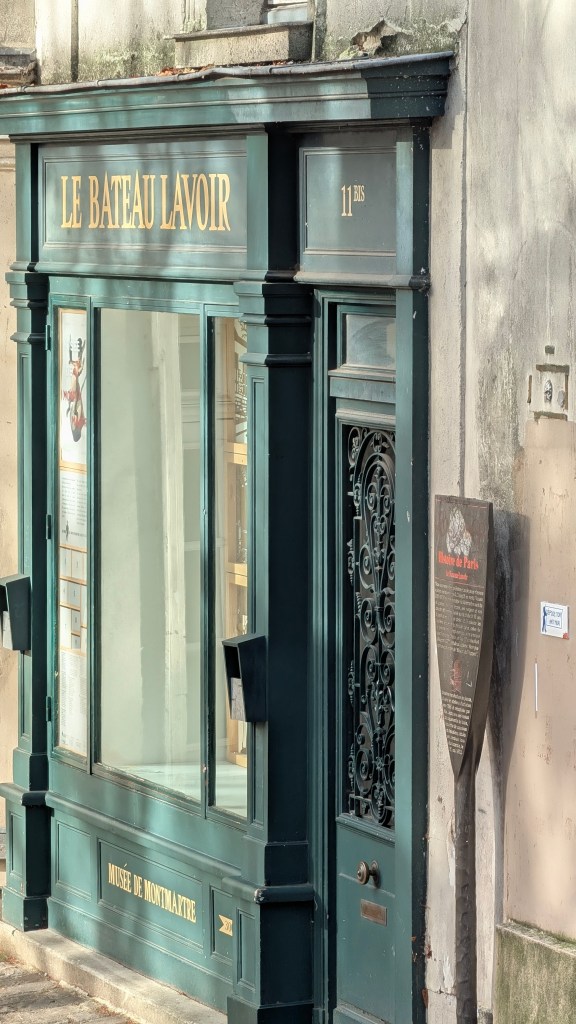
The Bateau-Lavoir (Washhouse Boat or Floating Laundry)

The upstairs studio, currently occupied by a 102 year-old woman, was his favorite because the windows are plentiful and face north, which means the light changes very little throughout the day.
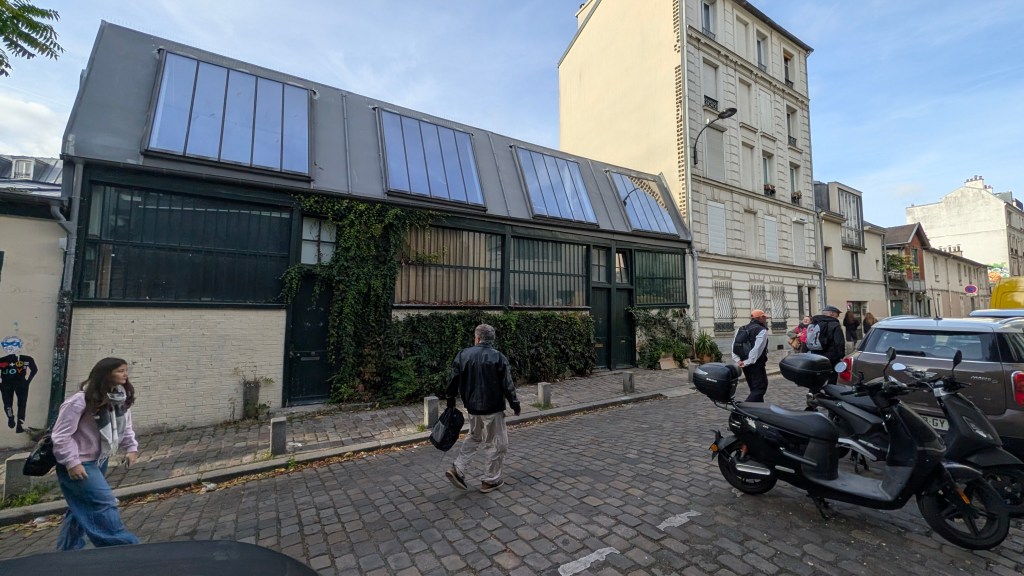
studio The Bateau-Lavoir (Washhouse Boat or Floating Laundry)

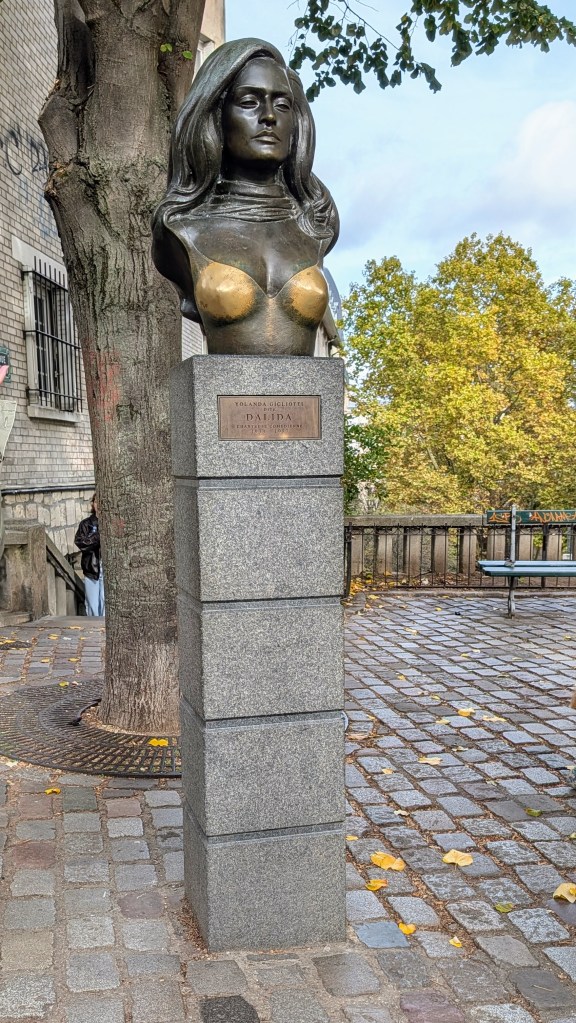
Around the corner was the home of Iolanda Cristina Gigliotti (1933–1987), professionally known as Dalida, an Italian naturalized French singer and actress. Throughout her international career, Dalida sold more than 140 million records worldwide. She was French by marriage, which lasted only two years. She then had many lovers, three of whom committed suicide; she became known as the black widow. She died in 1987, many believe by suicide.
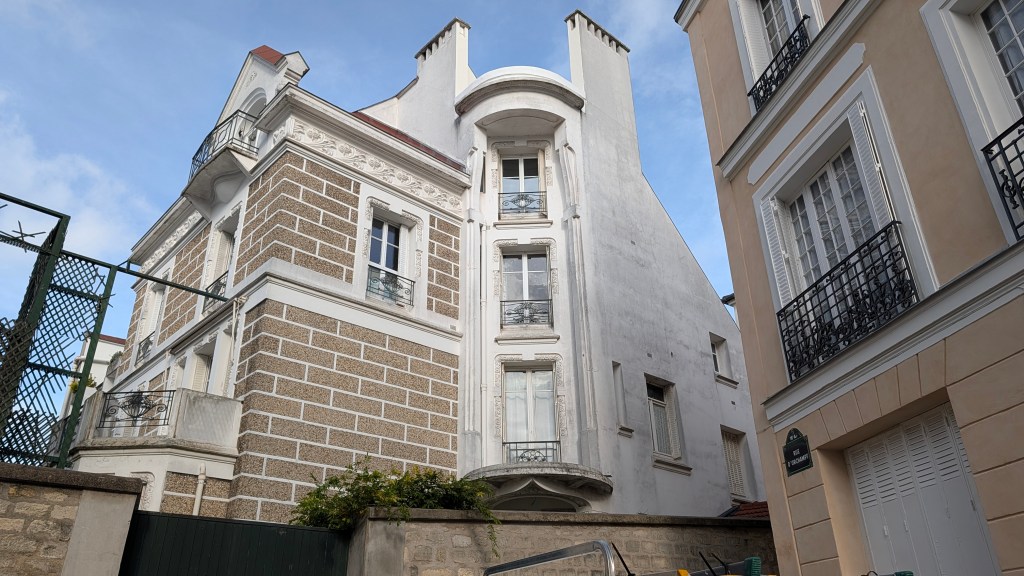
home of Dalida

Of the approximately 30 windmills built for the city of Paris in the 1600s, only two remain. They had been used as mills (moulin) for flour and spices, also to crush grapes and break stones for plaster. They were in use until the 19th century. One is, as we had seen the previous evening, on the Moulin de la Galette (Mill of the Pancake), now privately owned.
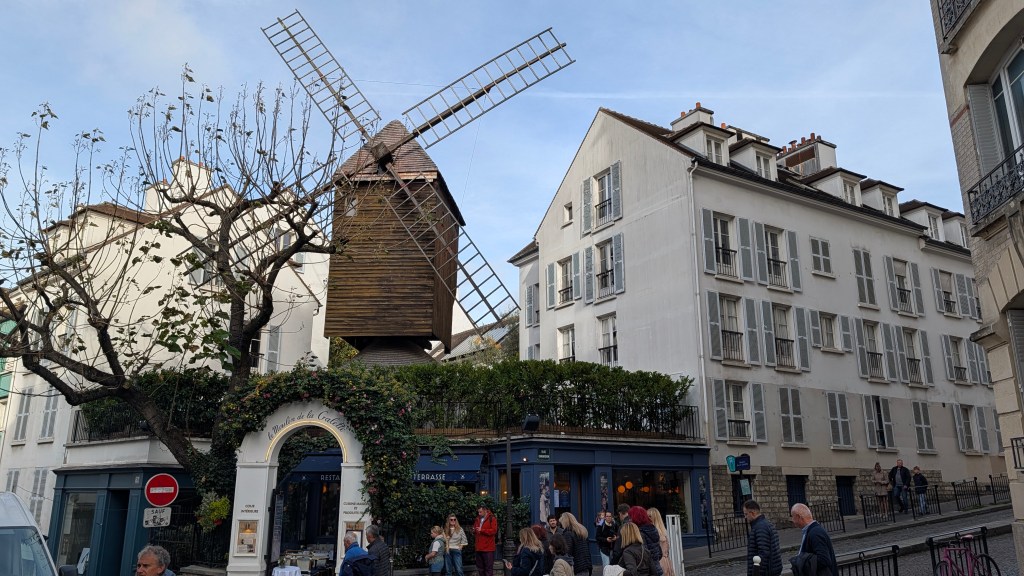
Moulin de la Galette (Mill of the Pancake)

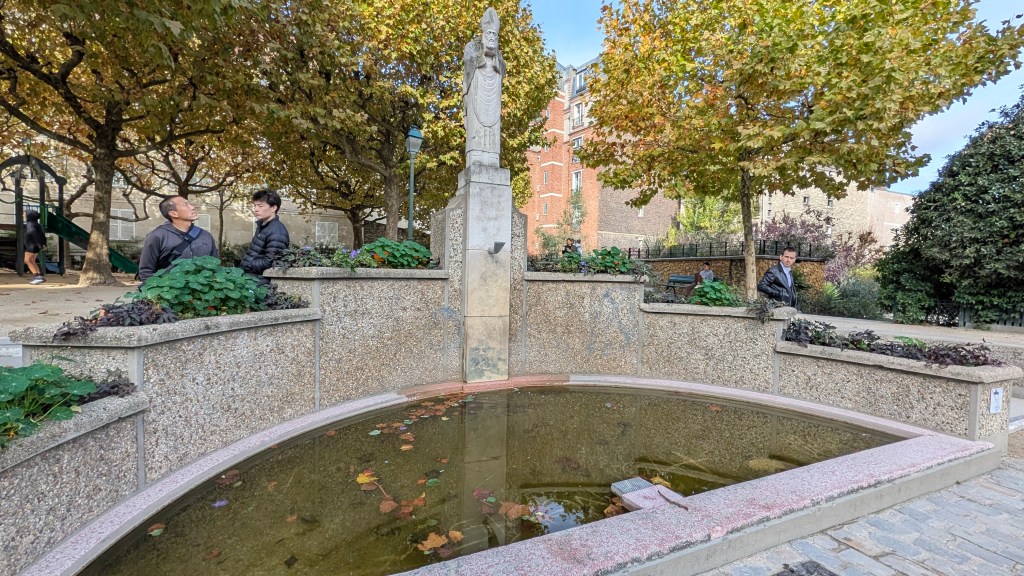
Around 250 AD Saint Denis, patron saint of Paris, was decapitated by the Romans soldiers nearby for the crime of converting citizens to Christianity. Paris was pagan until the 4th century. Legend holds that once beheaded, Saint Denis walked nearly four miles carrying his head before stopping to wash it in this fountain in the Square Suzanne Buisson, the site traditionally believed to be the spot where this miraculous event occurred. The statue depicts Saint Denis holding his own severed head in his hands. The current statue was installed in 1941, but the fountain itself is much older and was historically believed to provide holy water. 
A statue of Dalida was erected in a square dedicated to her 10 years after her death. Her breasts are wiped to shiny because it is believed to touch her breasts brings one good luck, although this makes no sense to me after she buried so many partners. Bocce is played in the square. It is a very popular activity in Paris due to its sociability; it can be a glue to a community.
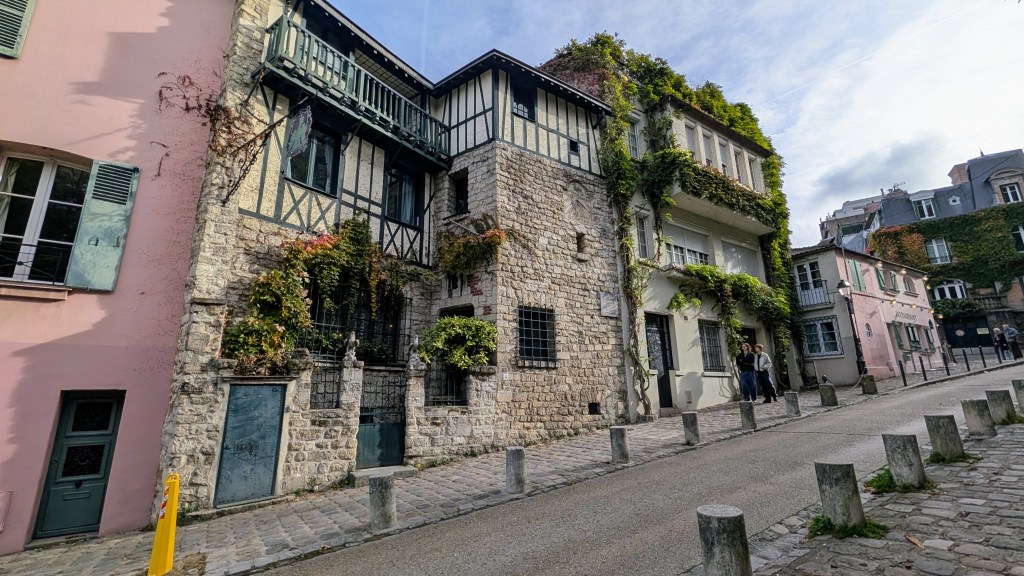
La Rue de l’Abreuvoir  is widely considered one of the most picturesque and historic streets in Montmartre district of Paris. It is particularly significant to the story of Saint Denis because it is part of the legendary path he walked after his decapitation.
Recently there was an attempt to stop traffic from passing through this area and a call for a ban on parking. This banner is a protest to that proposal.
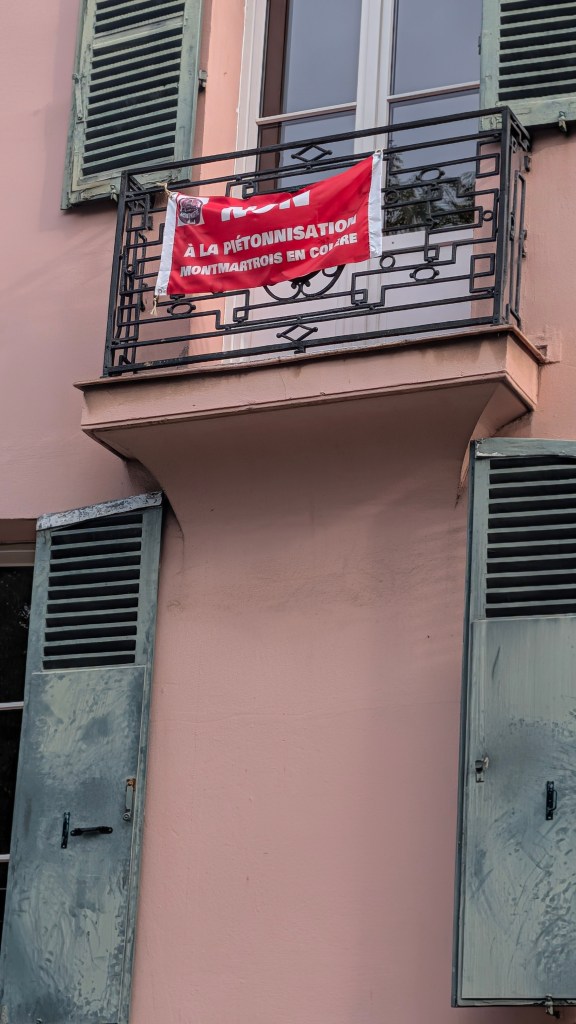
As we have seen elsewhere, the French love to protest and strike.
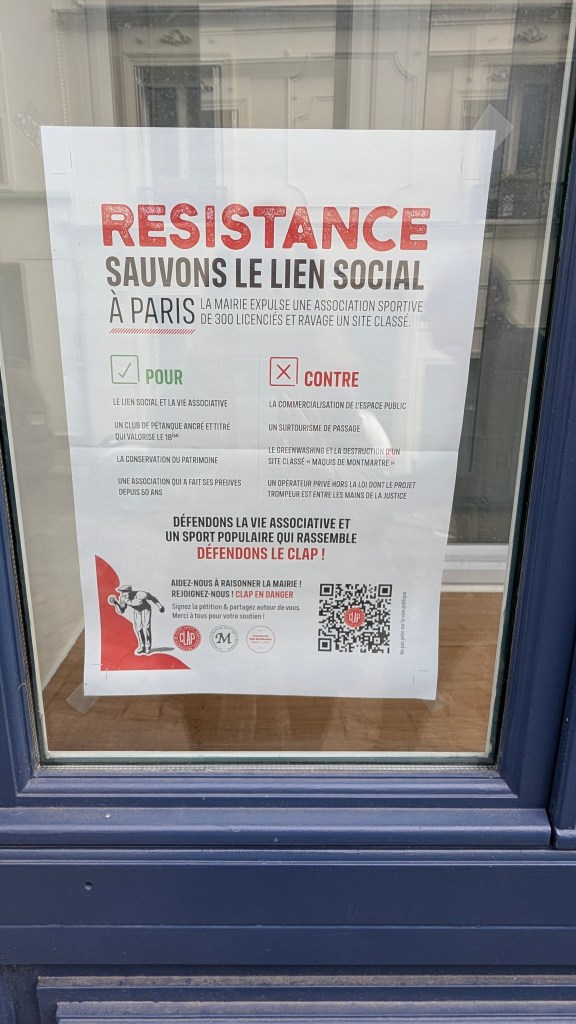
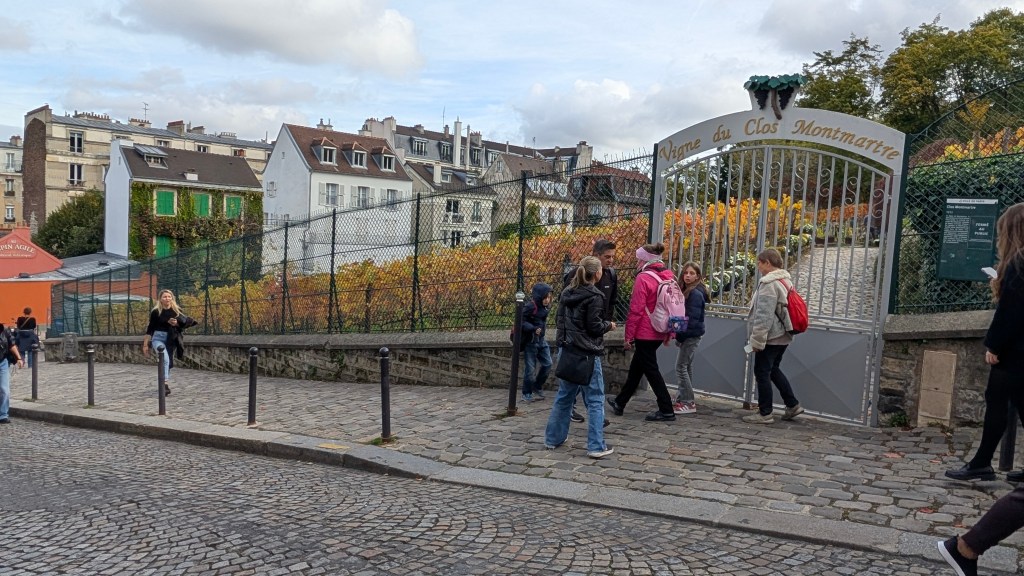
There remains one last vineyard in Montmartre. Prior to the Revolution, vineyards here were owned by the church. In 1789 most of them were destroyed. The area became slums until the 1930s when the government took the land back to clean it up. Each year now there is a grape harvesting party to pick the grapes. The wine is sold for €50 and is terrible, but the proceeds go to charity for the neighborhood.
Au Lapin Agile (The Agile Rabbit) cabaret is one of the oldest and most iconic cabarets in Paris, dating back to the 19th century. The venue was a famous gathering spot for artists, writers, and bohemian figures, including Pablo Picasso, who painted it in 1905. One of the artists drew a rabbit, so the name was changed. Sometimes when an artist could not afford his bill, he gave the proprietor a drawing instead. Picasso once gave a piece that later sold for €40 million.
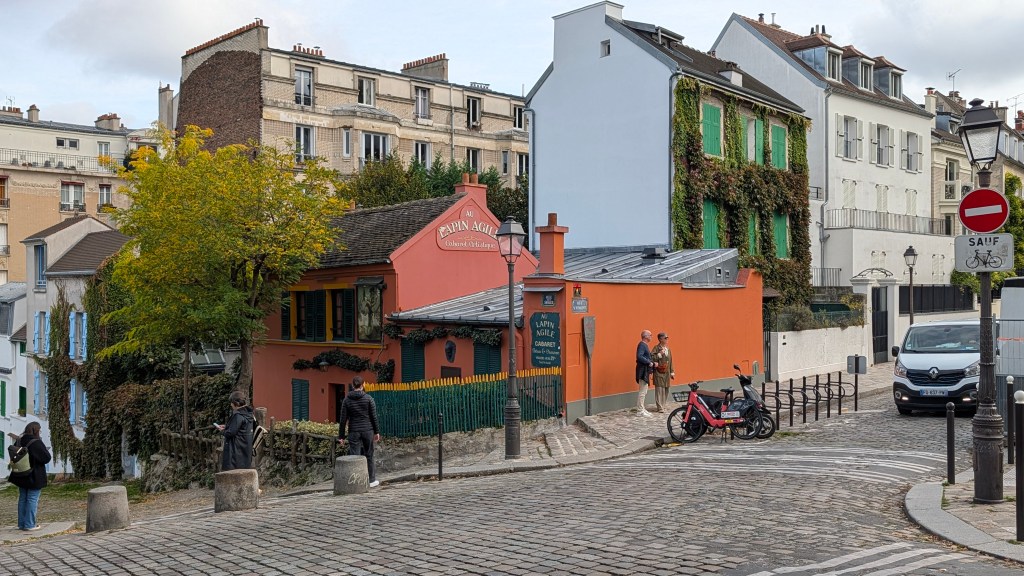
Au Lapin Agile (The Agile Rabbit)

The distinctive sign featuring a rabbit jumping out of a pot was painted by André Gill in 1875. 
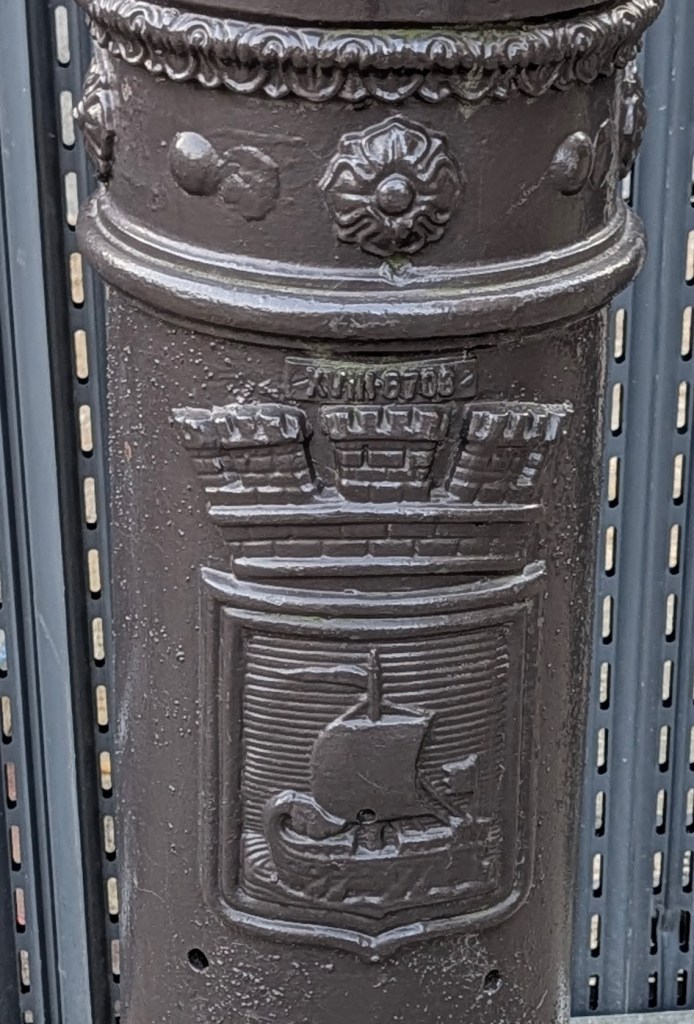
The coat of arms of Paris features a white ship (an ancient merchant vessel) on a red field, with a blue upper section containing gold fleurs-de-lis, symbolizing the city’s maritime history and royal ties, often accompanied by the Latin motto Fluctuat nec mergitur(Tossed but not sunk). Adopted in 1358 and officially registered in 1699, this emblem represents the city’s resilience. It can be seen on buildings
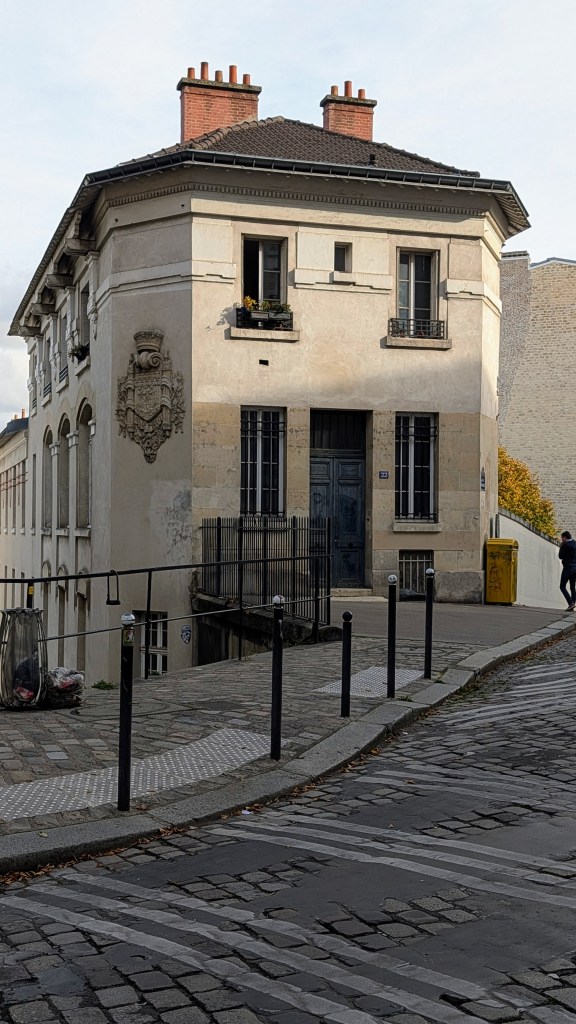
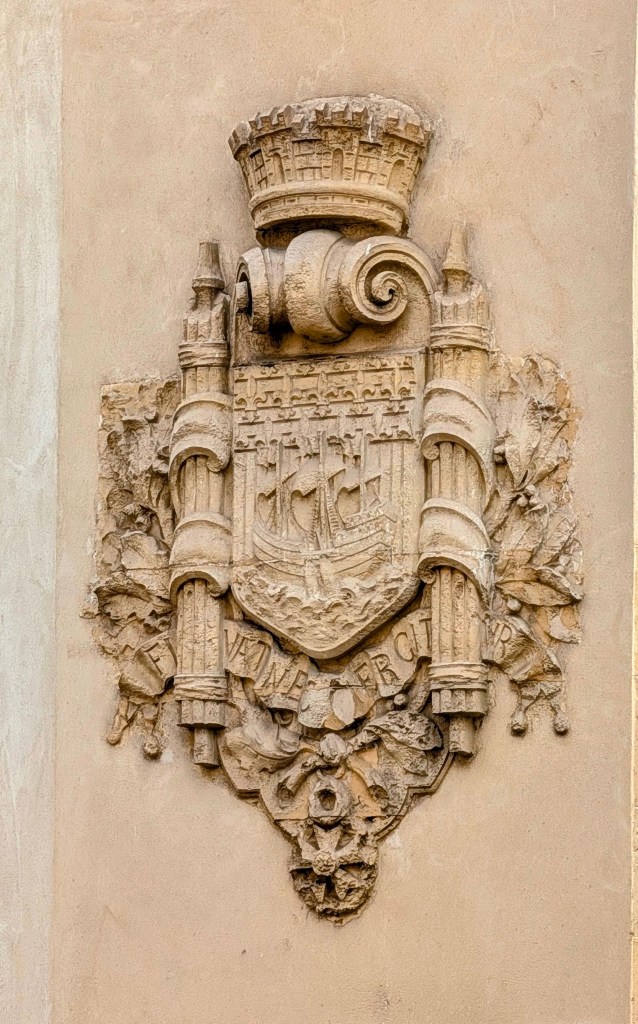
and even on lamp poles.
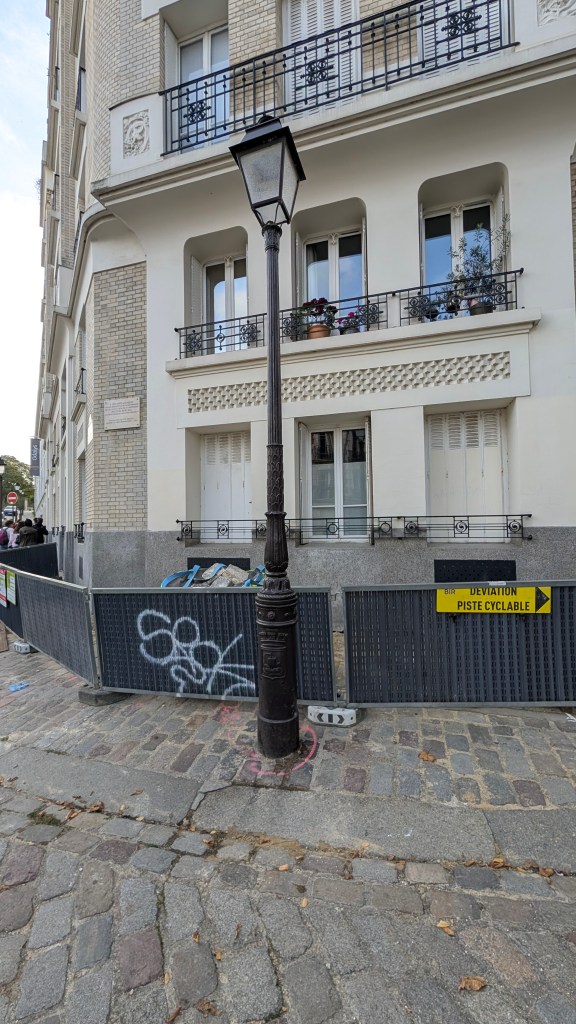
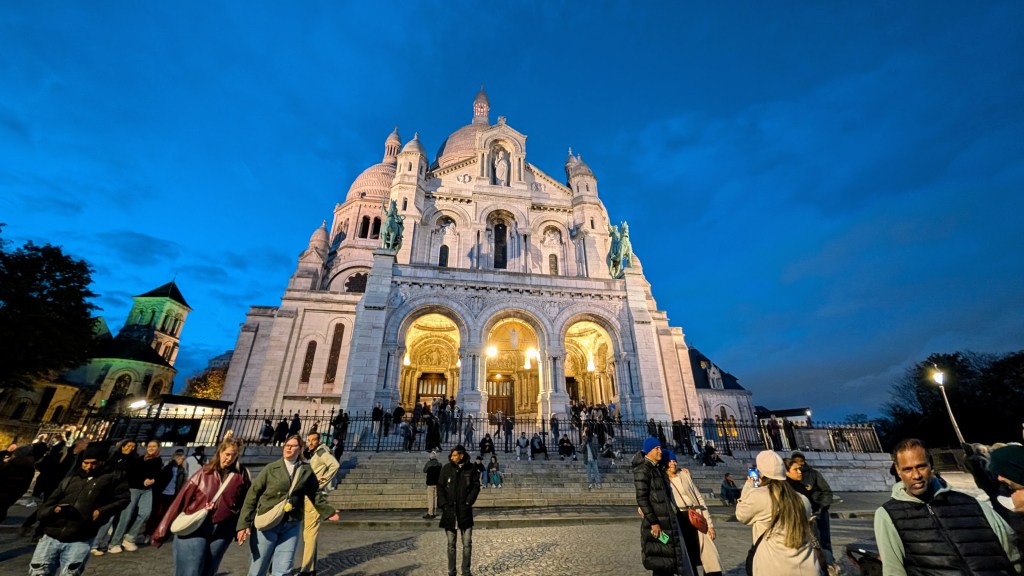
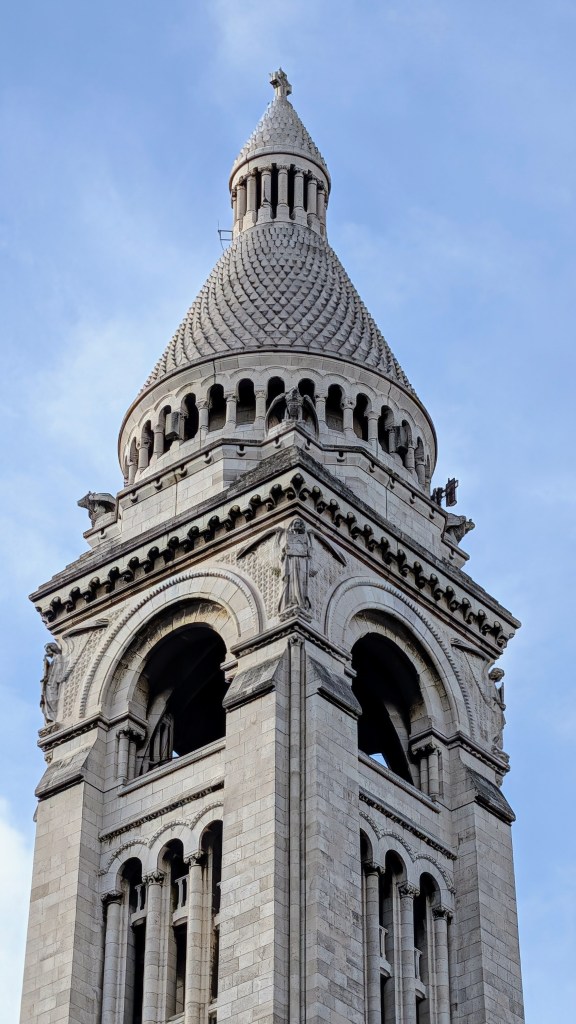
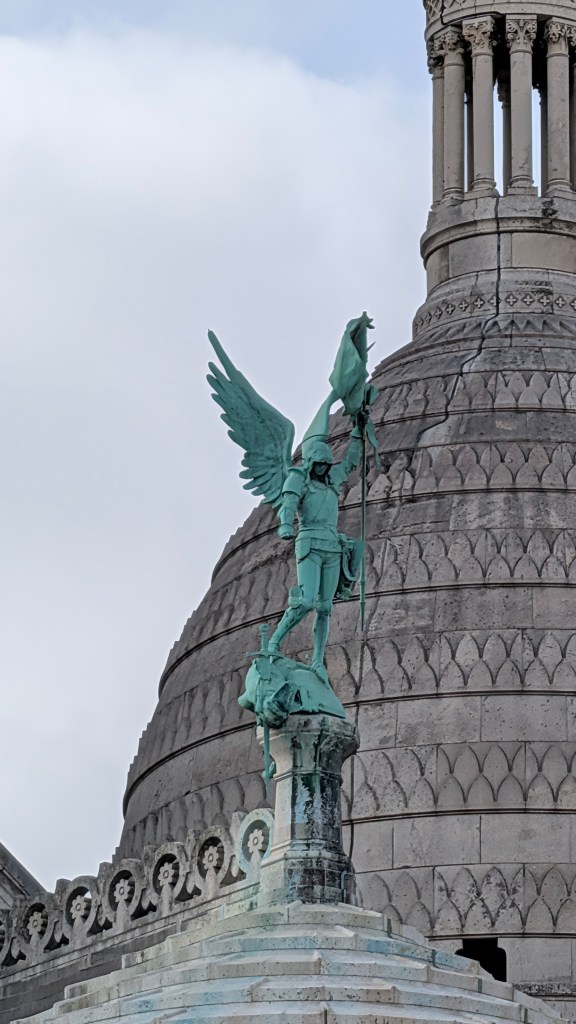
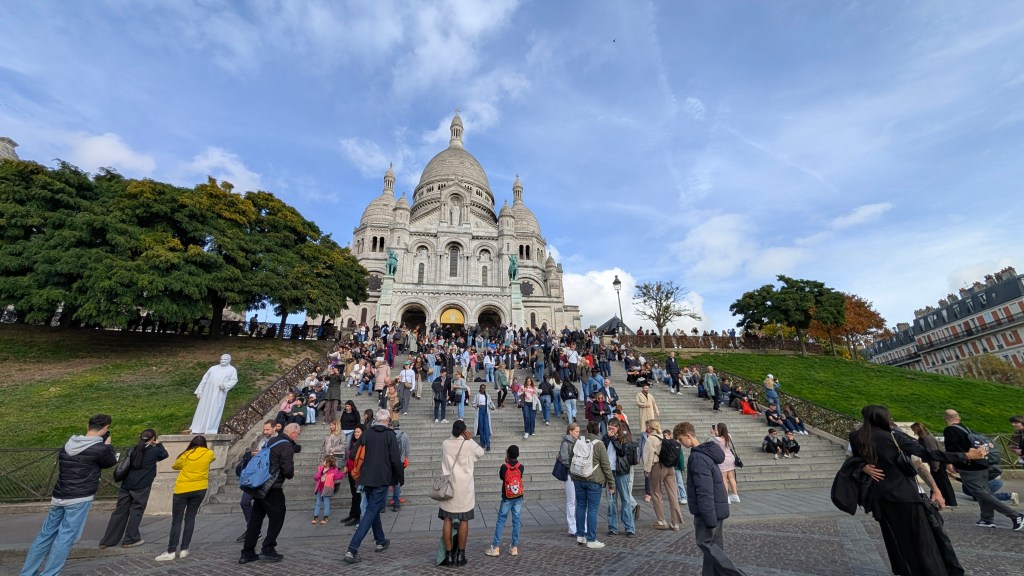
Construction of the Basilique du Sacré-Cœur de Montmartre (Basilica of the Sacred Heart of Montmartre), a Roman Catholic minor basilica, began in 1875, was completed in 1914, and it was formally consecrated in 1919. 
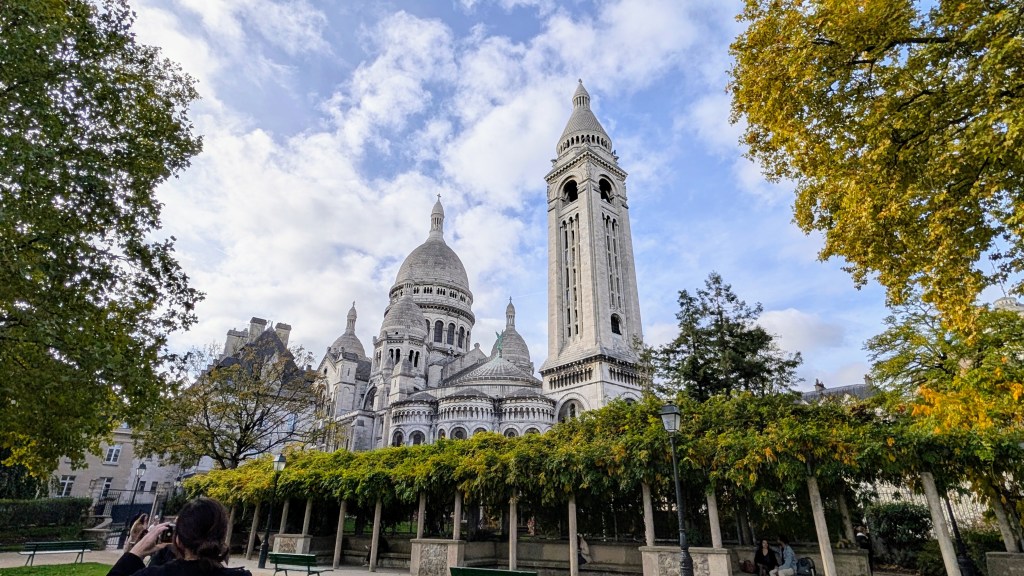
Basilique du Sacré-Cœur de Montmartre (Basilica of the Sacred Heart of Montmartre)

The architecture is inspired by Romanesque and Gothic styles as well as Greek inspired Byzantine styles. It features distinct white travertine stone that helps it stand out against the skyline and, even better, is self-washing.
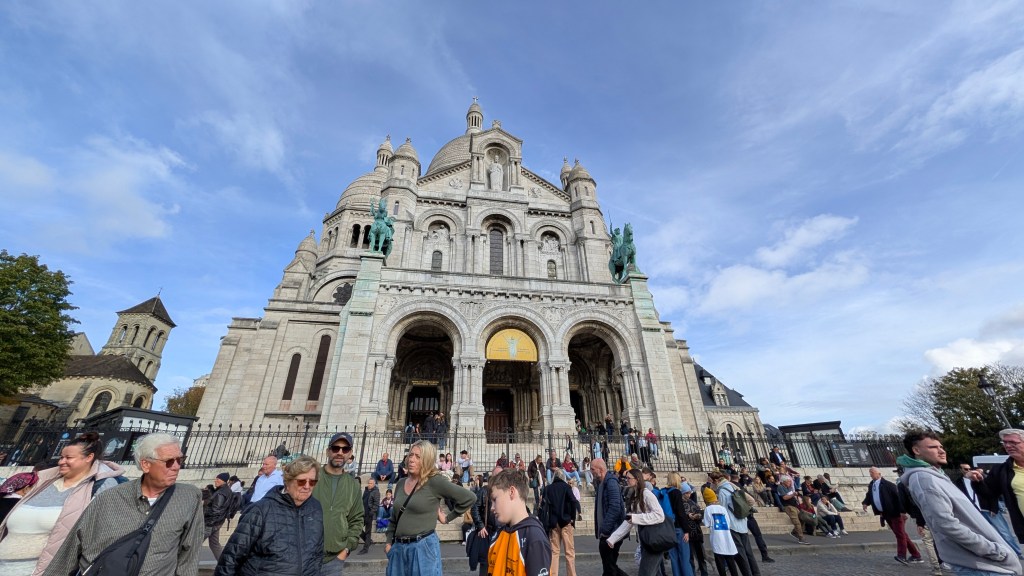
Basilique du Sacré-Cœur de Montmartre has maintained uninterrupted perpetual adoration of the Blessed Sacrament since August 1, 1885. Day and night, continuous silent prayer is offered for the world, even throughout the World Wars and the COVID-19 pandemic.
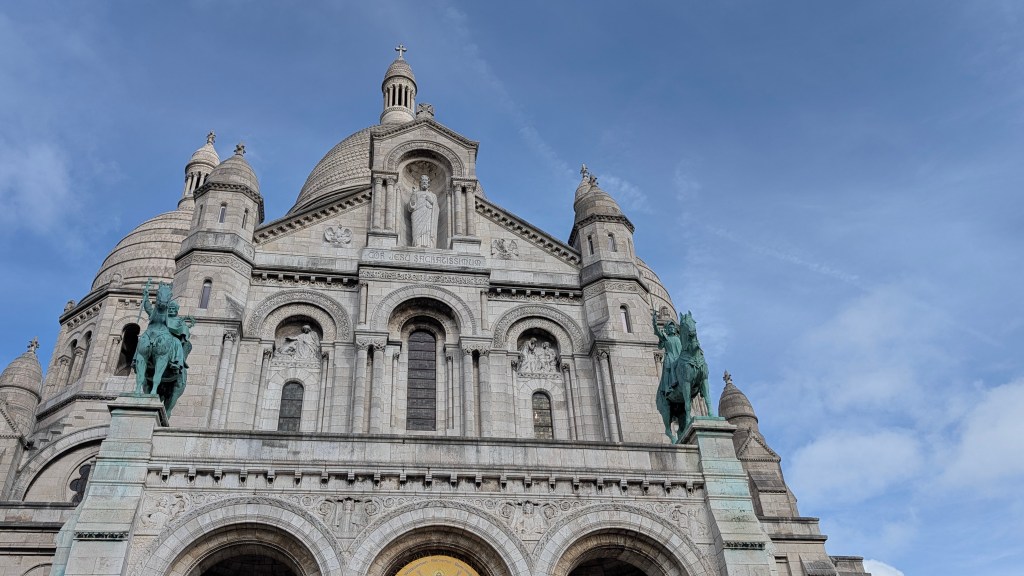
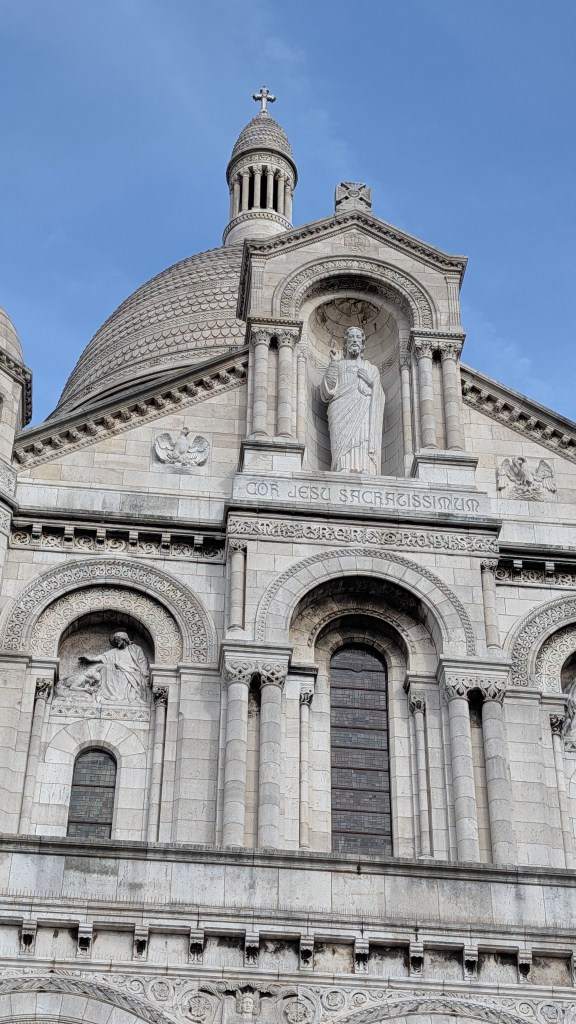
The basilica is the second most visited church in Paris after Notre-Dame. As is true for all churches by law in Paris, admission is free. But as our time was drawing short, and we had visited so many cathedrals and churches in France, we chose not to enter. From this high point are stunning views of Paris below.
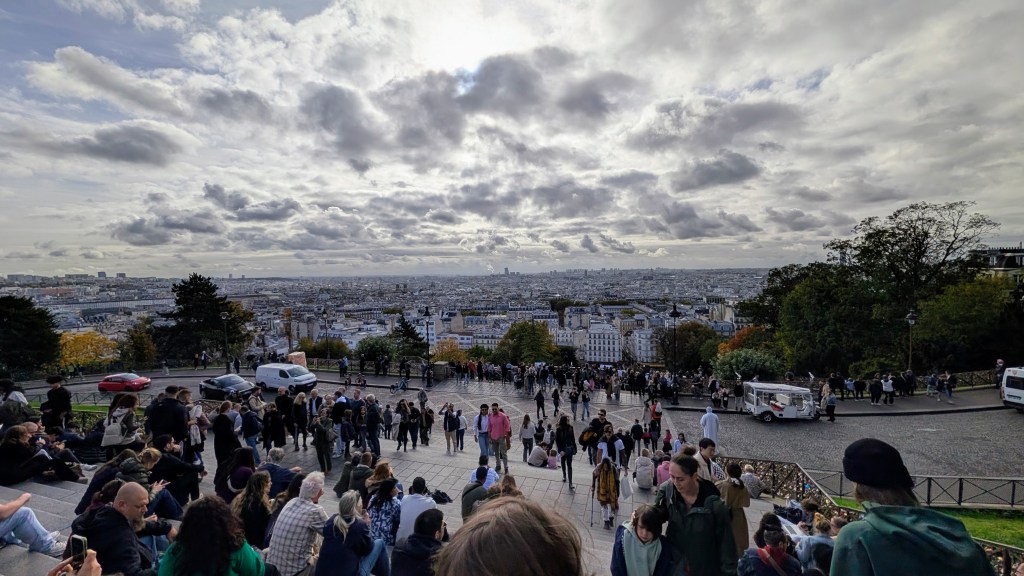
As we walked back down the hill, we looked back at this magnificent building.
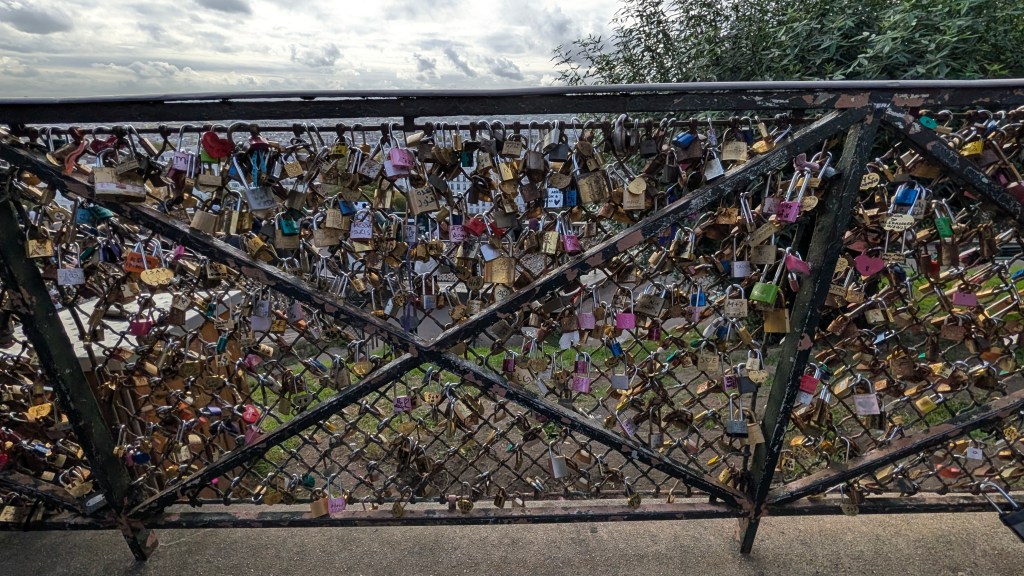
At the base we found locks of love, attestations of the unbreakable bonds of those who came before us.
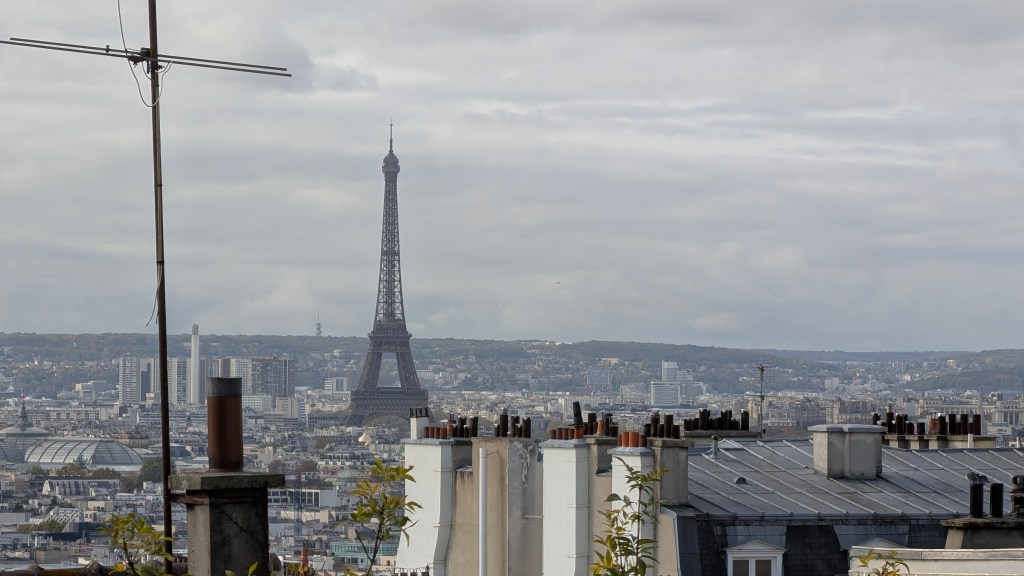
From this vantage point we had a good view of the Eiffel Tower in the distance.
We passed one last church as we descended the hill: Eglise Saint-Pierre de Montmartre, one of the oldest churches in Paris, with construction beginning in 1133. for Louis VI. 
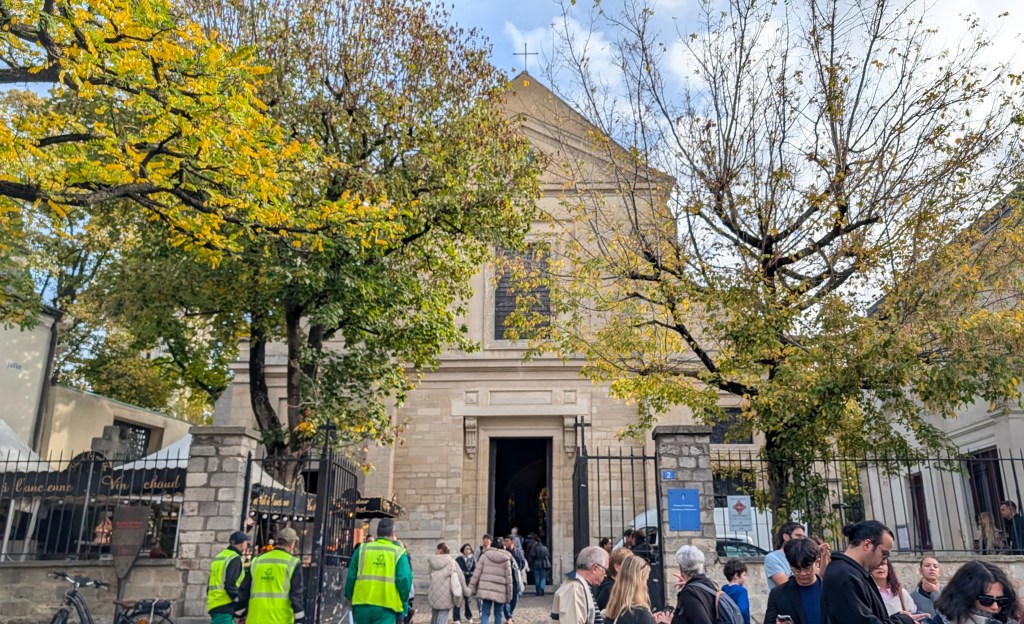
Eglise Saint-Pierre de Montmartre

We passed back through Place du Tertre one last time
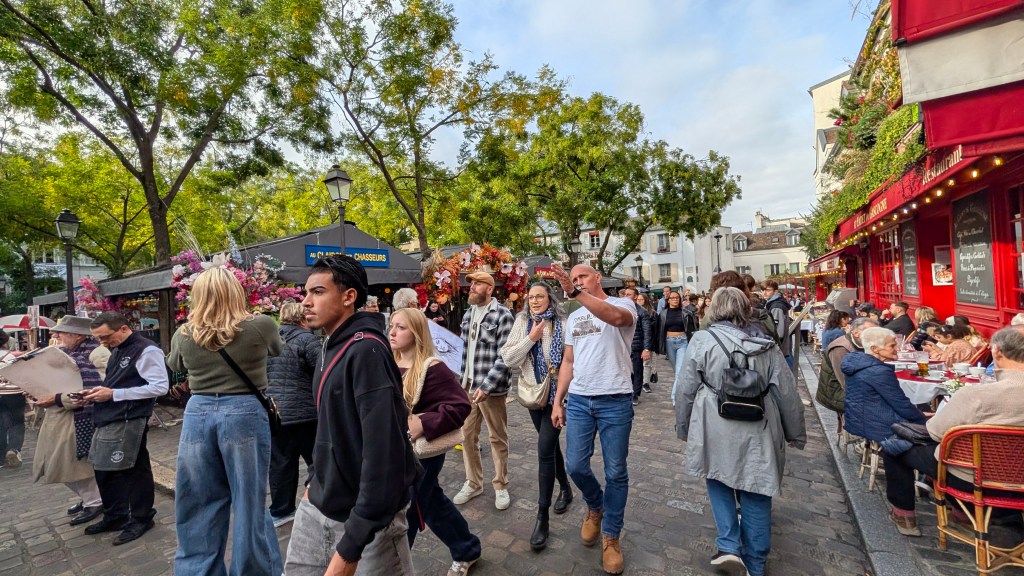
Place du Tertre

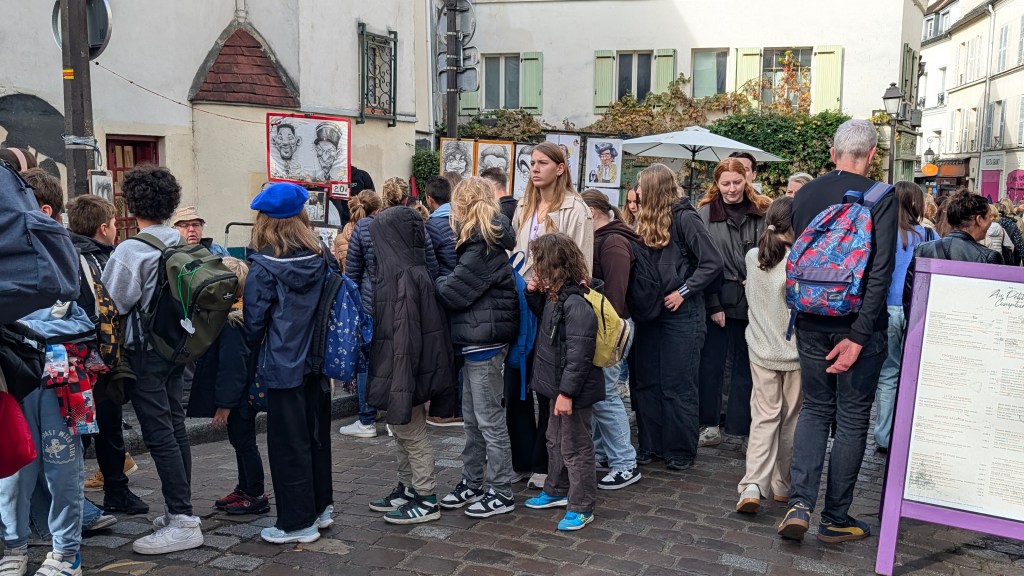
and noted the portrait painters trying to make a sale.
We chose to go to the Moulin Galette for our last French meal. Despite it being touristy, it had a special appeal.
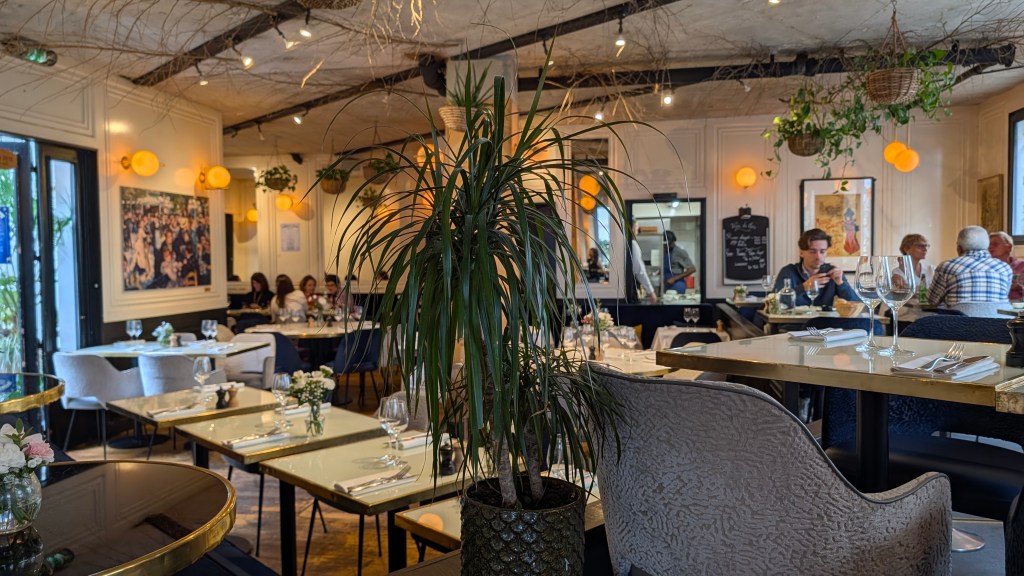
inside Moulin Galette

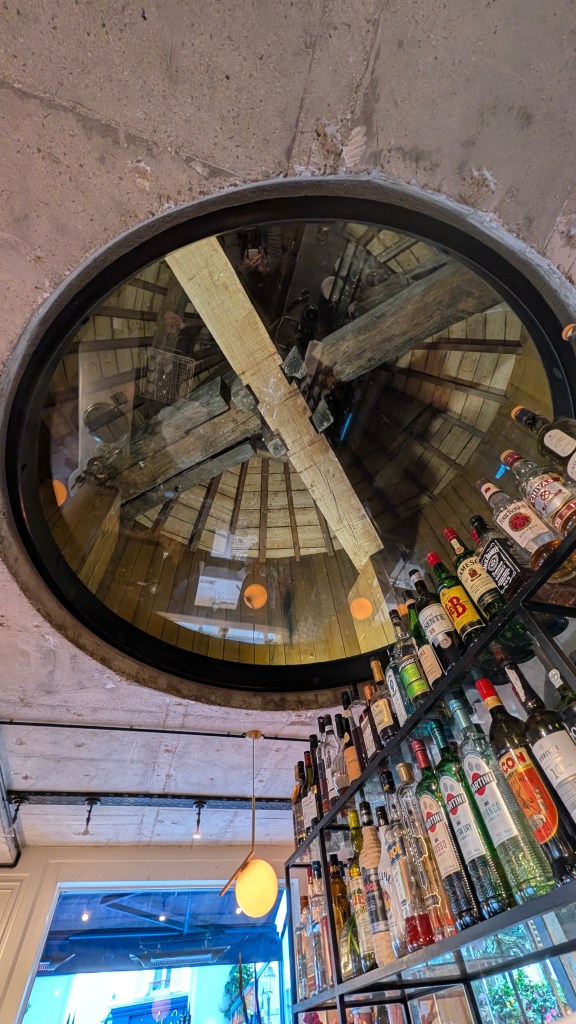
Behind the bar one can look up into the windmill.
We were seated out on the terrace.
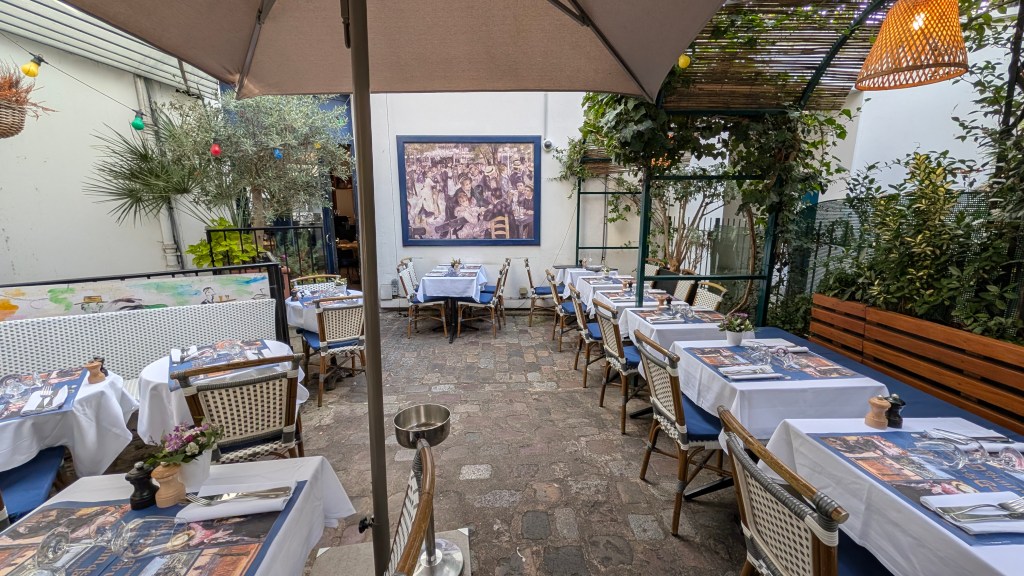
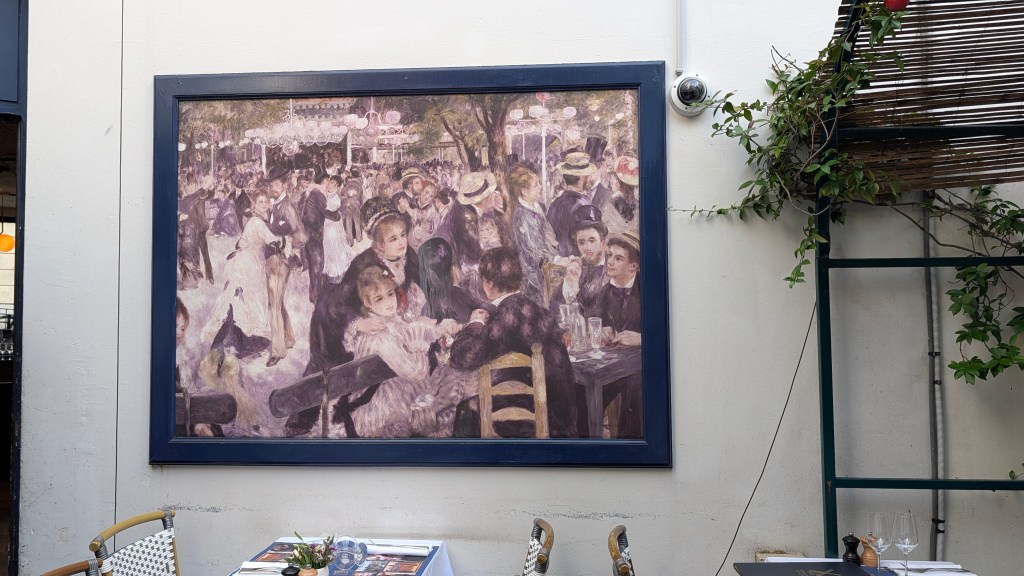
There can be found a reproduction of “Bal du moulin de la Galette” (Dance at Le Moulin de la Galette), a famous painting by Pierre-Auguste Renoir. The lady in pink is thought to have been his mistress. The straw hates depicted represent the working class.
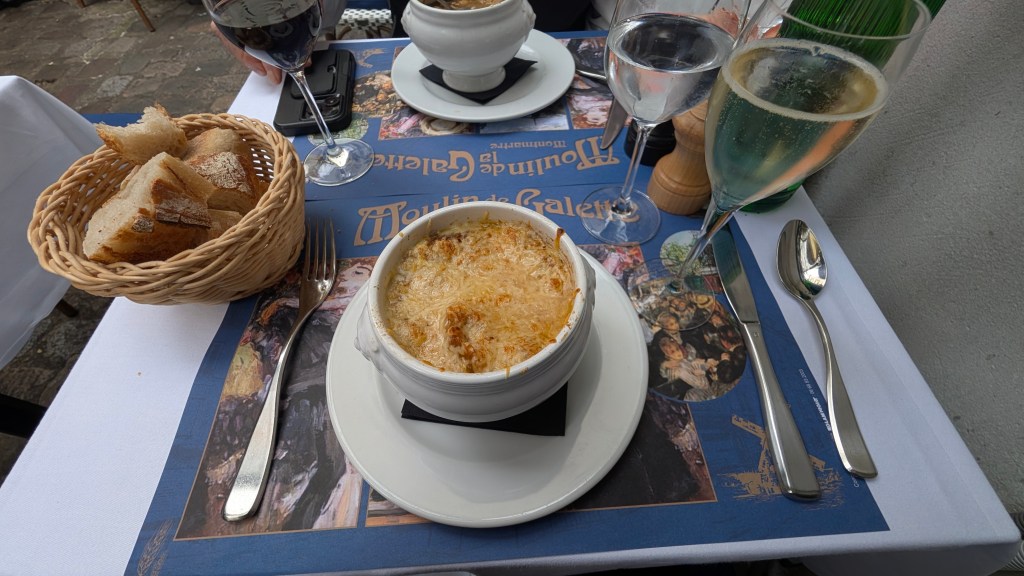
We had to have another cup of onion soup before leaving France, with, of course, a glass of champagne
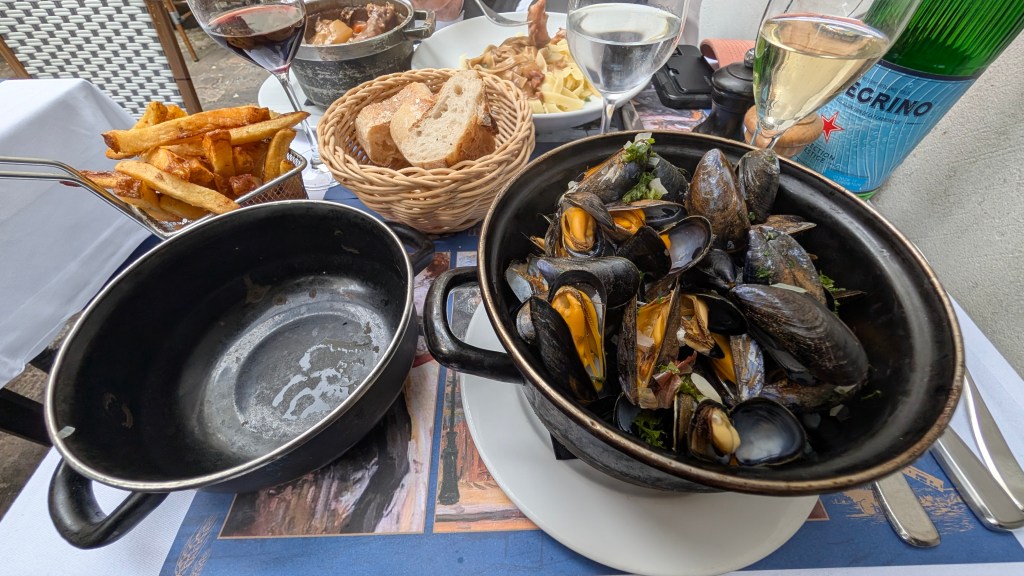
followed by Moules Marinières with pomme frites.
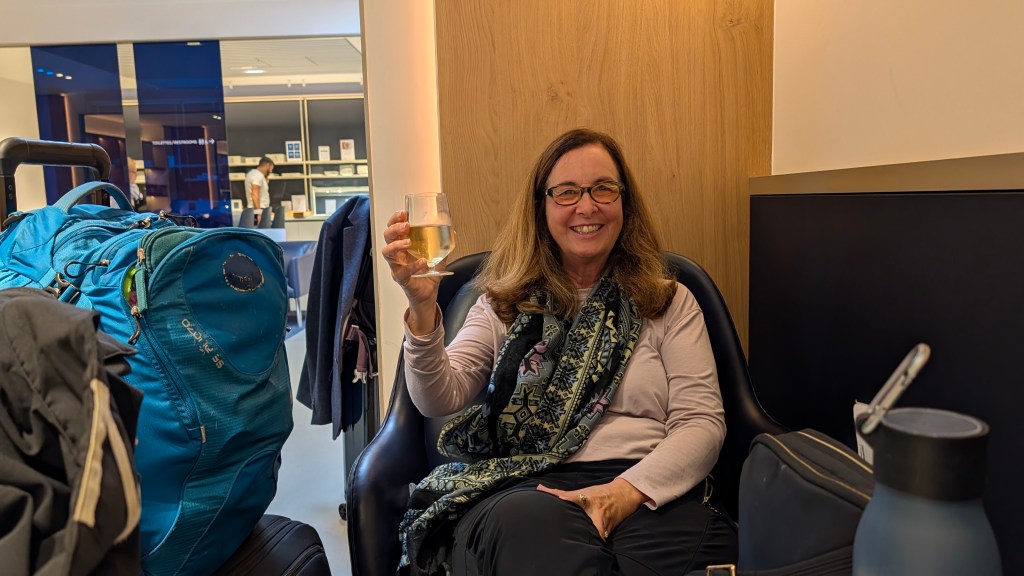
After lunch we collected our luggage and headed to the airport. There we had a final glass of wine to toast our journey.
France: Bordeaux: Graves region: Oct 12-13, Medoc region Oct. 14-17, 2025

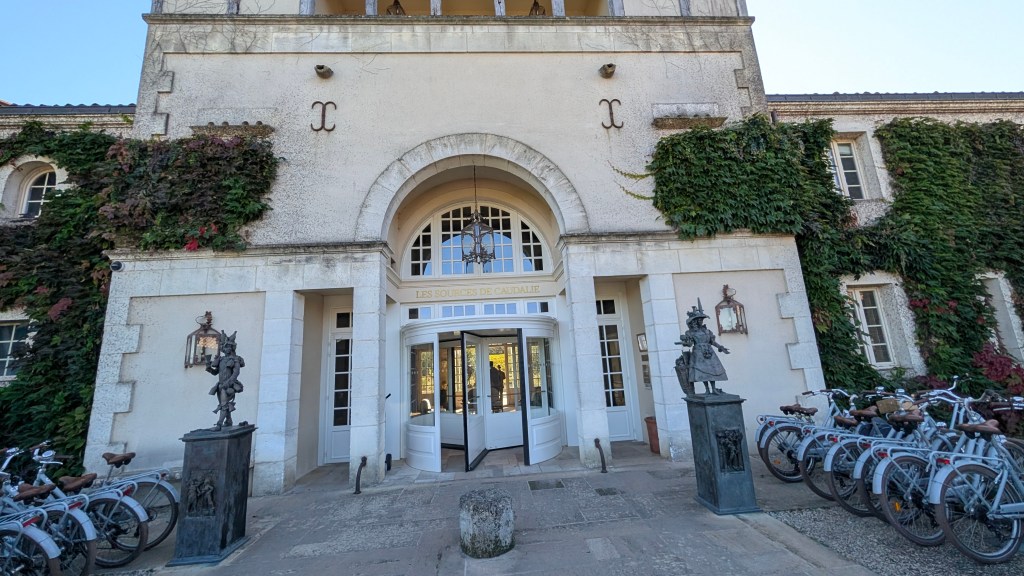
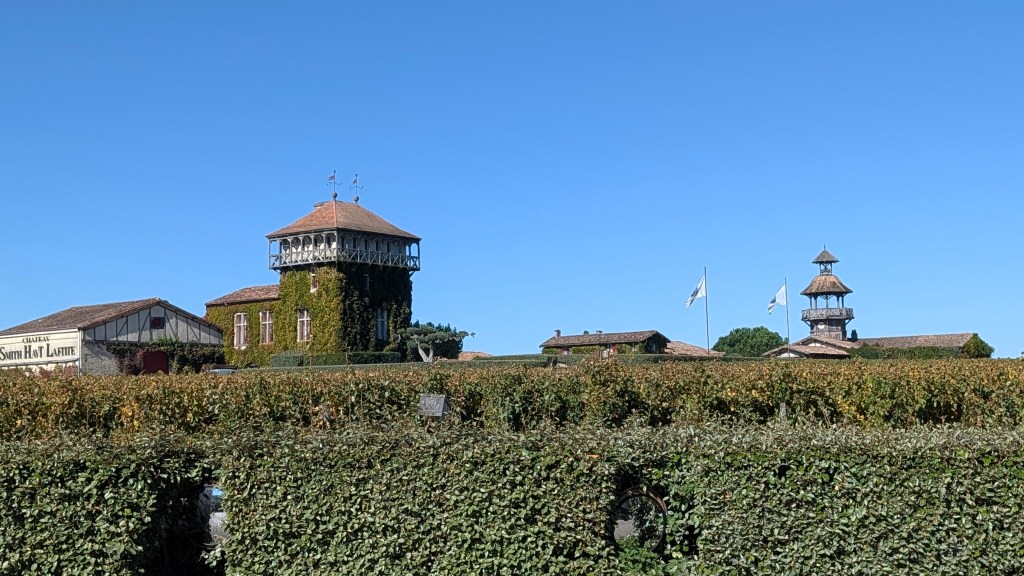
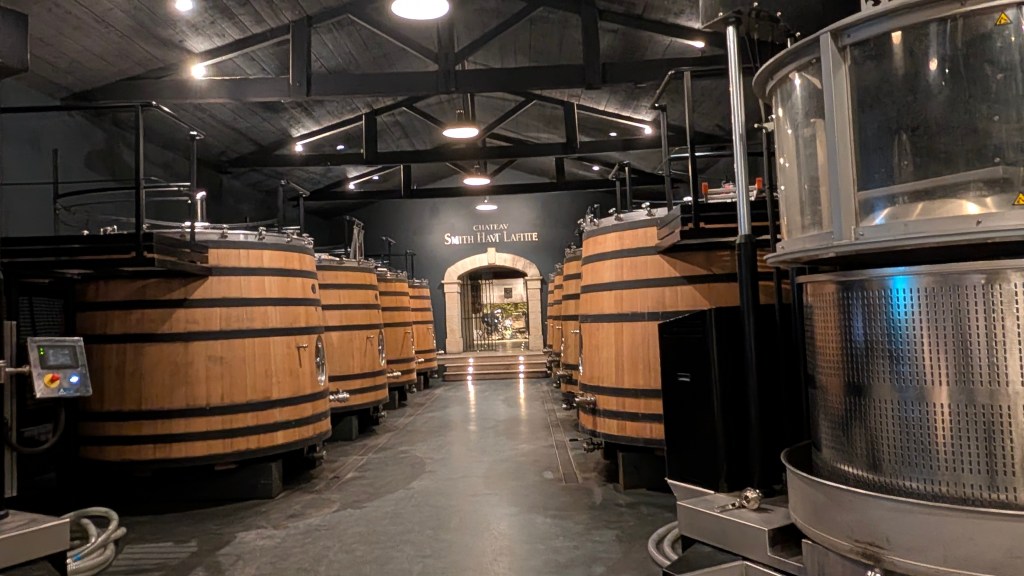
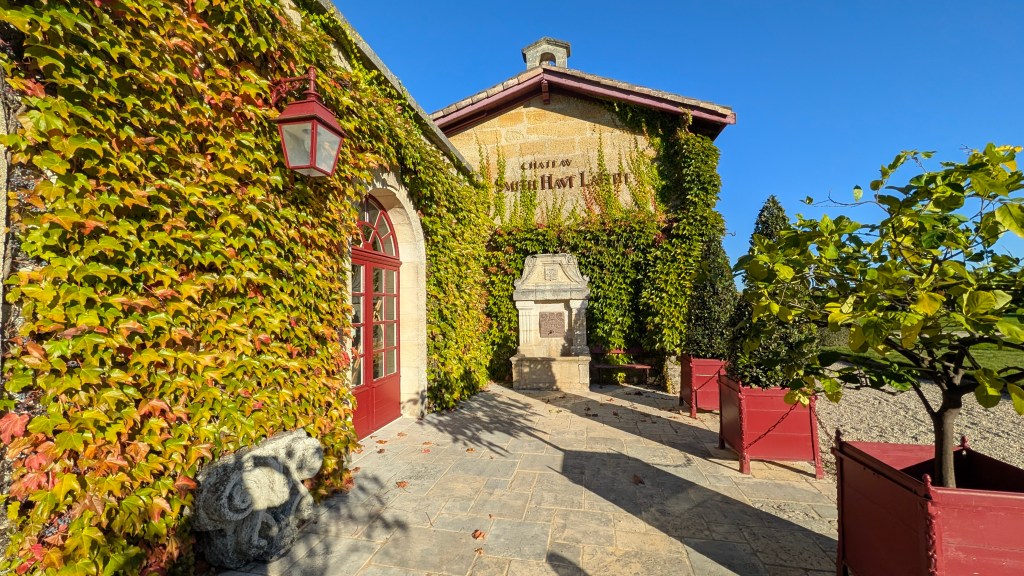
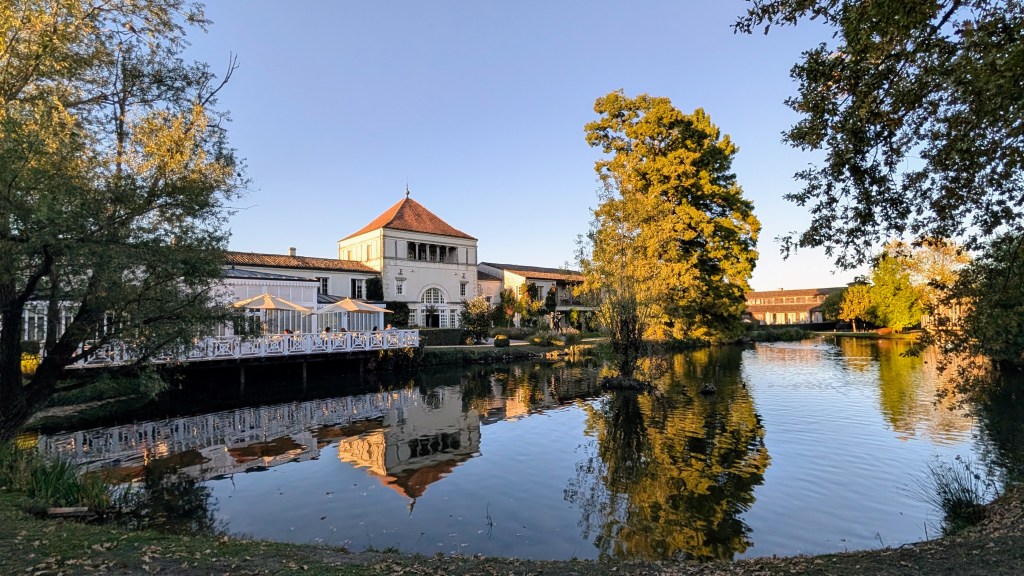
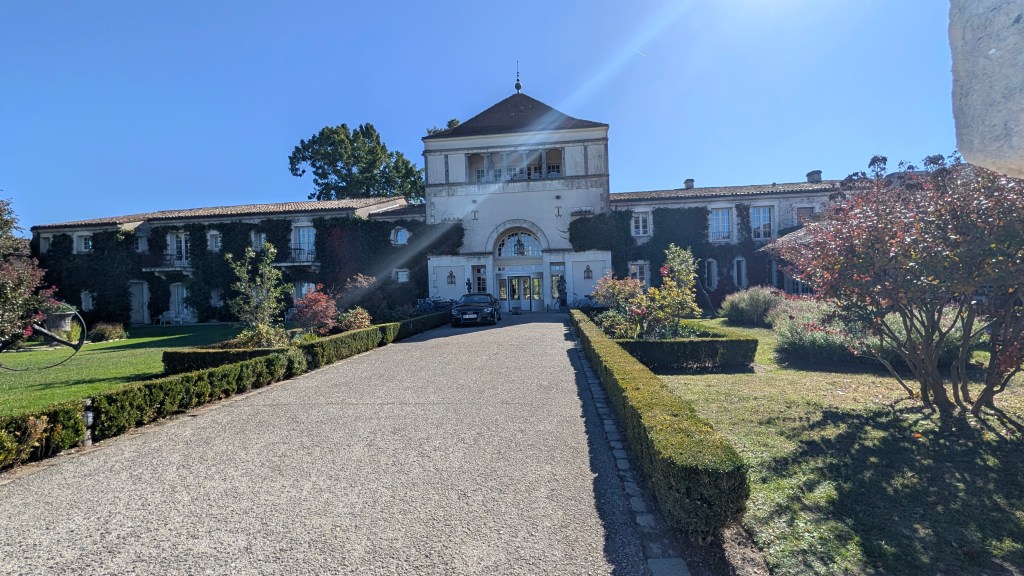
We drove to Marseilles, left our car at the airport rental, and boarded our plane to the Bordeaux-Mérignac airport. There we were met by our driver who transported us to Les Sources de Caudalie, a 5 star hotel nestled within the Château Smith Haut Lafitte winery’s vineyards. Our days of self-guided touring had come to a temporary end.

Les Sources de Caudalie

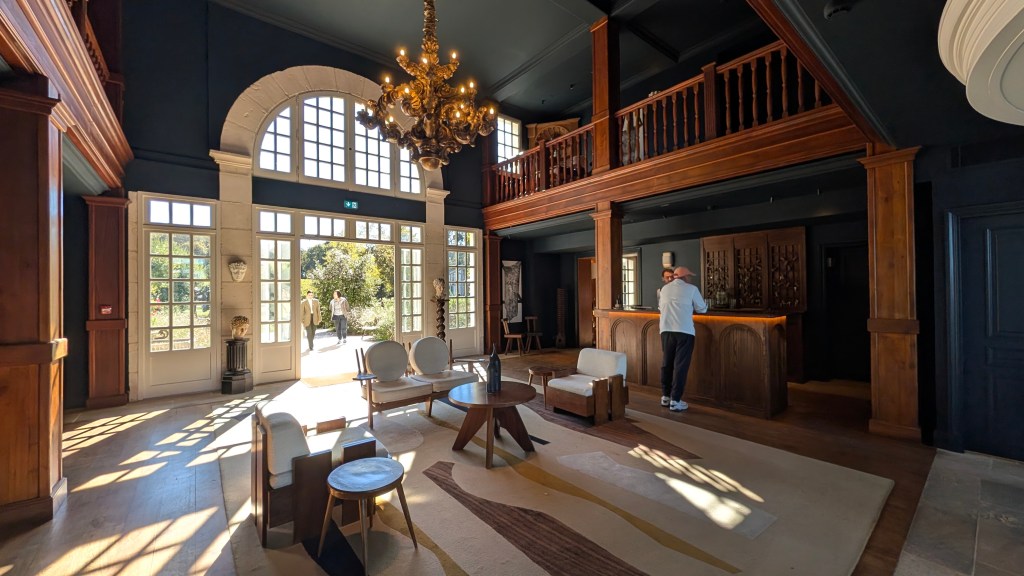
Established in 1999 by Alice and Jérôme Tourbier, daughter and son-in-law of Daniel and Florence Cathiard (owners of Château Smith Haut Lafitte), Les Sources de Caudalie is famous for pioneering “vinotherapy,” combining natural hot spring water with grape extracts. The buildings were designed by Architect Yves Collet using reclaimed, traditional materials, such as 18th-century wood from a nearby châteaux, to blend into the landscape like a traditional Aquitaine hamlet. Les Sources de Caudalie offers a luxurious, nature-focused, “French Paradox” experience: the idea that a diet rich in antioxidants (like red wine) leads to good health. The hotel was designed to feel like a family home rather than a grand palace, focusing on “art de vivre” (art of living), nature, and the vineyard.

Les Sources de Caudalie

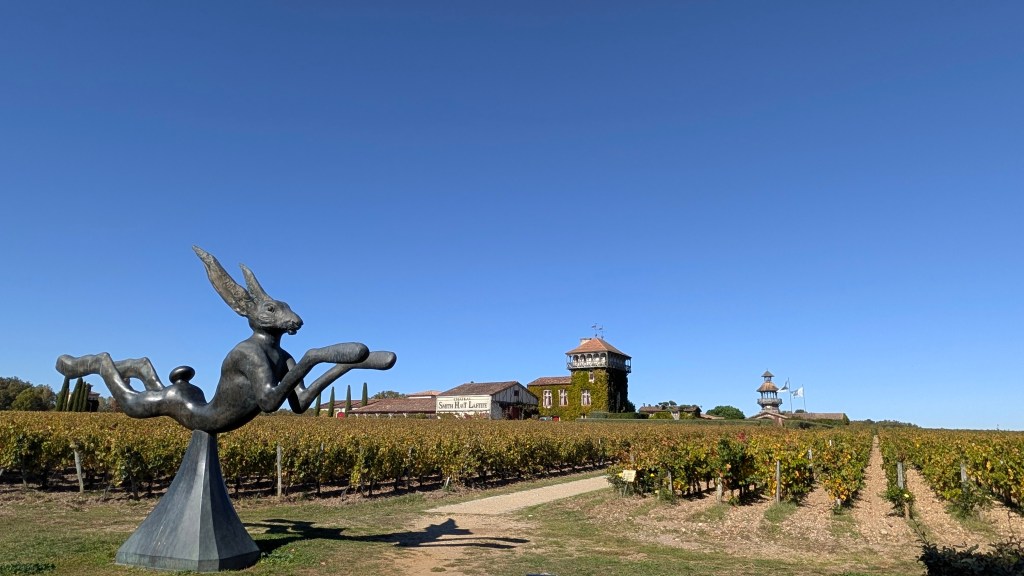
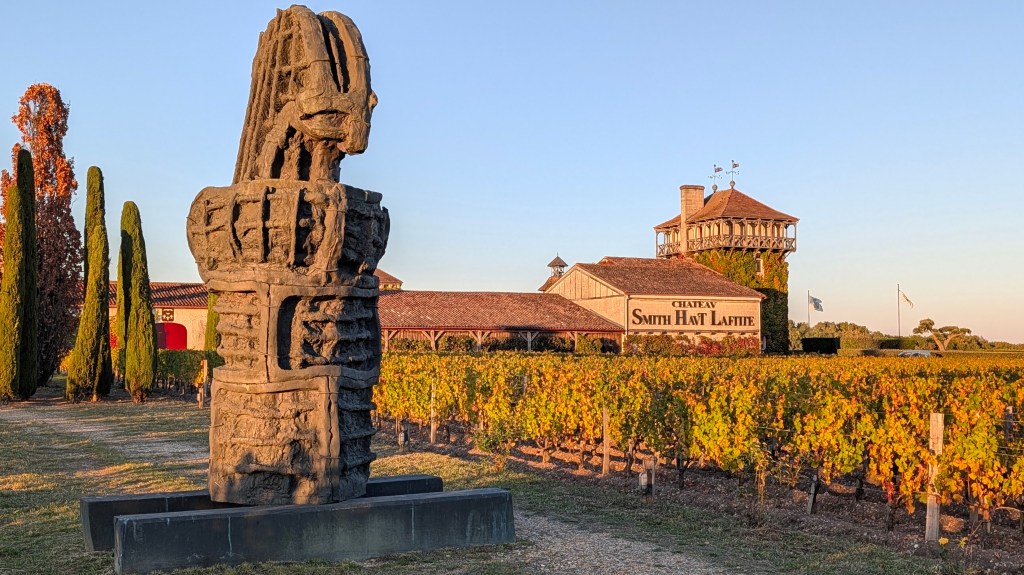
Before checking in, we turned around to take in the vineyards. Château Smith Haut Lafitte features a notable collection of monumental sculptures displayed throughout its vineyards and grounds, part of a “land art” trail. The collection includes works by several internationally recognized contemporary artists. “Hospitality” (Leaping Hare) by Barry Flanagan is an iconic bronze sculpture of a leaping hare positioned in the center of the vineyard, presiding over the oldest Cabernet Franc vines. The owners, Florence and Daniel Cathiard, purchased it to celebrate their first vintage release after acquiring the estate in 1990.

“Hospitality” (Leaping Hare) by Barry Flanagan: Château Smith Haut Lafitte

Other sculptures could be seen in the distance. 

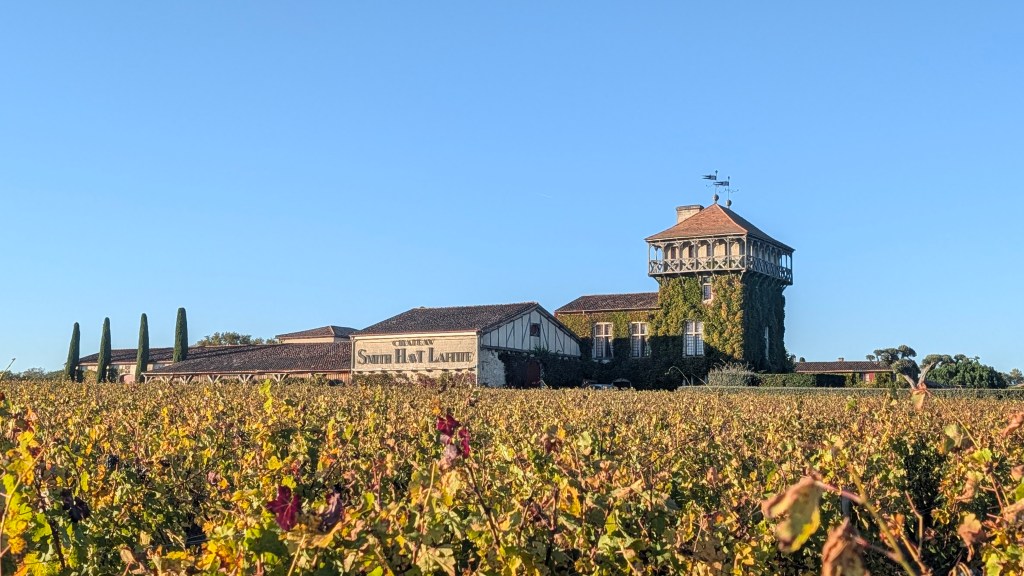
Château Smith Haut Lafitte, a prestigious Pessac-Léognan Grand Cru Classé in the Graves apellation of Bordeaux, a wine region on the Garonne River’s left bank, renowned for gravel-based soils, hence the name. Château Smith Haut Lafitte dates back to 1365 when the Bosq family first planted vines on a gravelly hill. Renamed in the 18th century by Scottish merchant George Smith, who exported wine to Britain, it was elevated to prominence by Mayor Lodi Martin Duffour-Dubergier in the mid-19th century.

We checked into the hotel

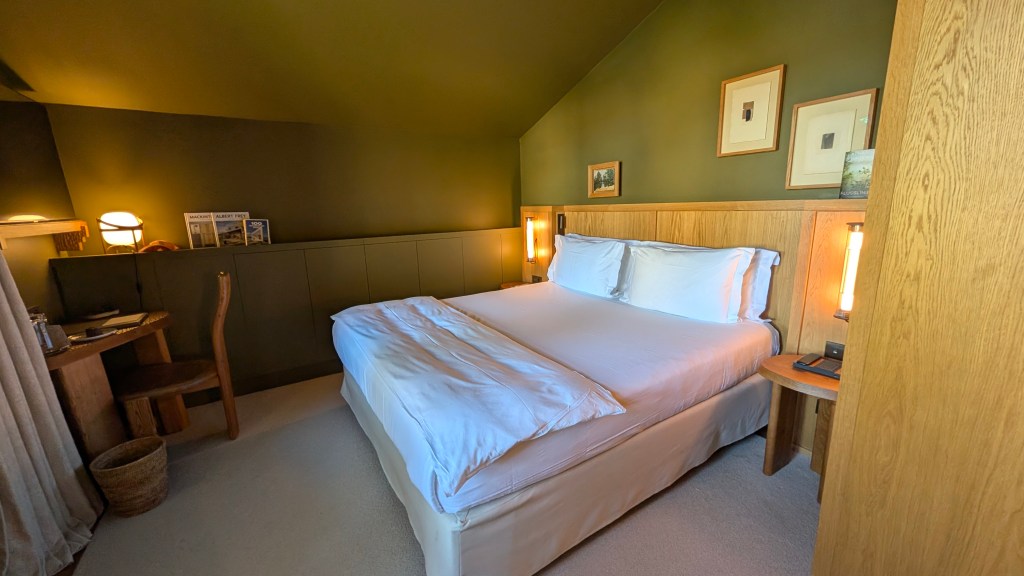
and were shown to our room.

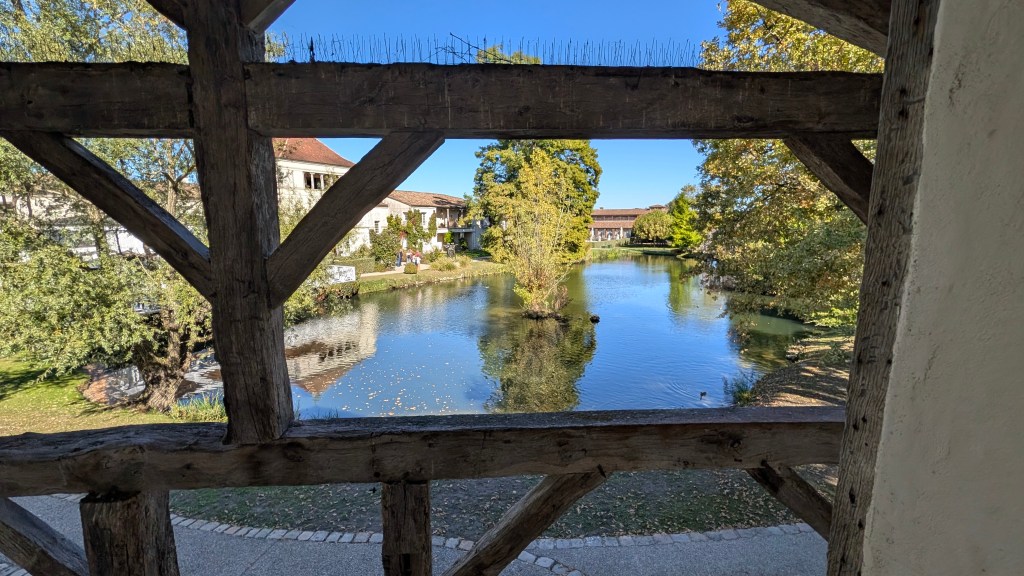
Fom our room we had a view of the pond behind the main hotel building.

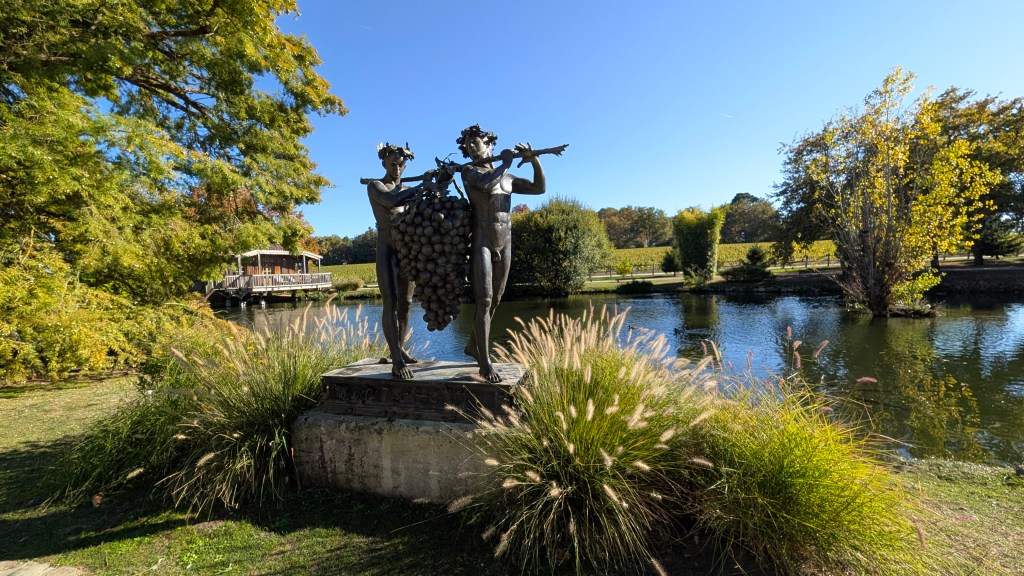
Between the main building and the pond stands this bronze sculpture which depicts two figures carrying a large bunch of grapes, reflecting the area’s rich winemaking heritage. 

We met up with friends Jeff and Carol, with whom we had booked this adventure. It was late in the afternoon, but it was time for our first winery tour.

We made our way across the road to Château Smith Haut Lafitte winery. The name of the winery means “little high hill.”

The reception area to the winery doubles as a gift shop. We were assigned our guide, Hortense.

We climbed the tower, from where we had a view back at the hotel. Hortense told us that the winery covers over 740 acres. The favorite grape grown is the petit bordeaux, a low volume grape varietal. All of the grapes are harvested by hand. The estate uses advanced technology like drones for monitoring and has an eco-friendly “Stealth” cellar for their second wine. They use natural methods like pheromone “mating disruption” for moths and introduce beneficial mites to fight red spiders.

Hortense esplained the history of the winery. In the 18th century Scottish wine merchant George Smith purchased the estate, built the Chartreuse, and gave it his name. In 1842 Lodi Martin Duffour-Dubergier, mayor of Bordeaux, took over and secured its reputation as a high-quality wine producer. In 1958 the property was acquired by the négociant house Louis Eschenauer. In 1990 former Olympic skier Daniel Cathiard and his wife Florence purchased the estate, transforming it into a, “bio-precision” estate with a focus on sustainability, natural fertilizers, and modern, high-tech winemaking. Their home is visible from the tower.

home of Daniel and Florence Cathiard

From this vantage, more of the unique sculptures could be seen. We climbed down to continue the tour.

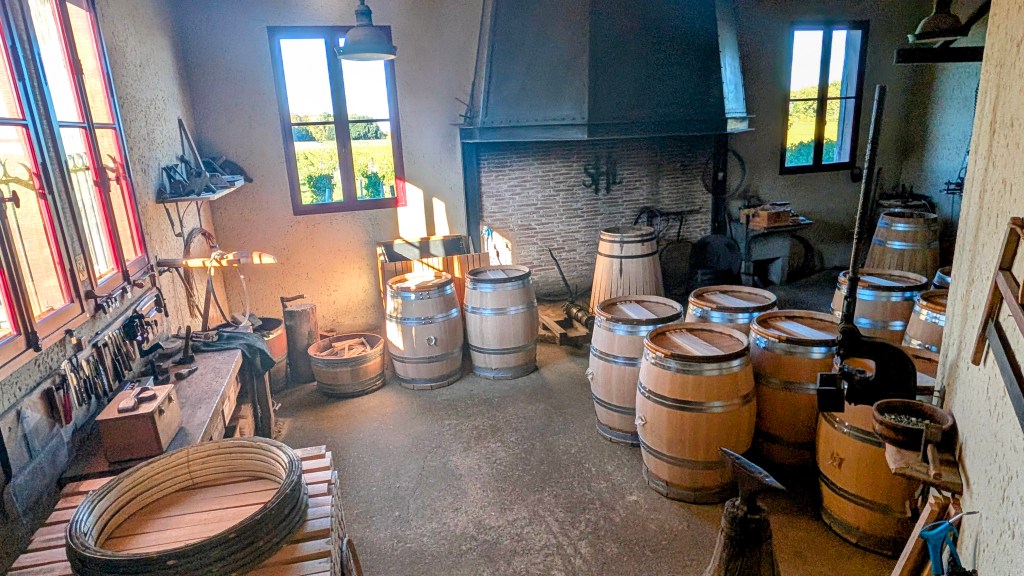
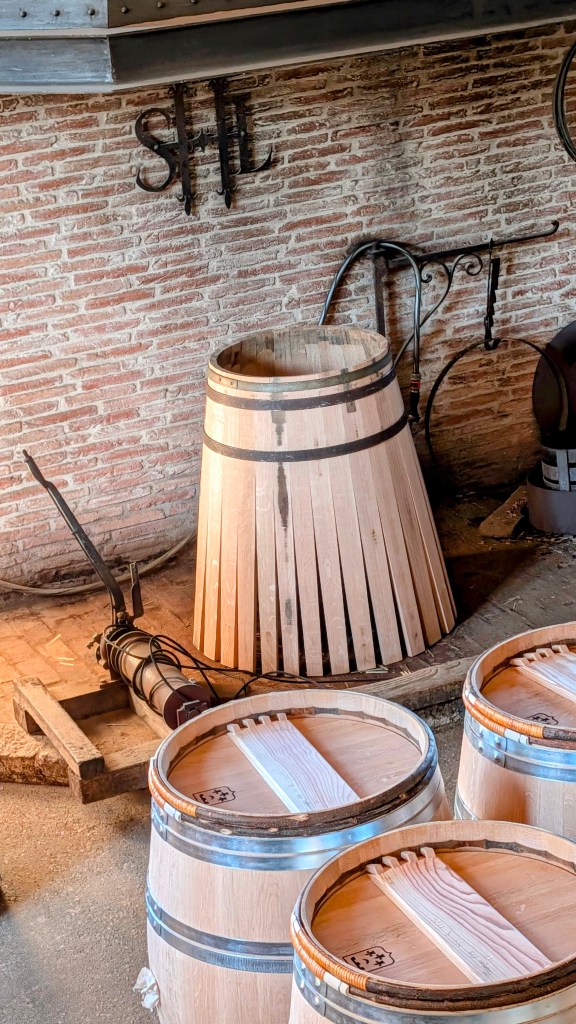
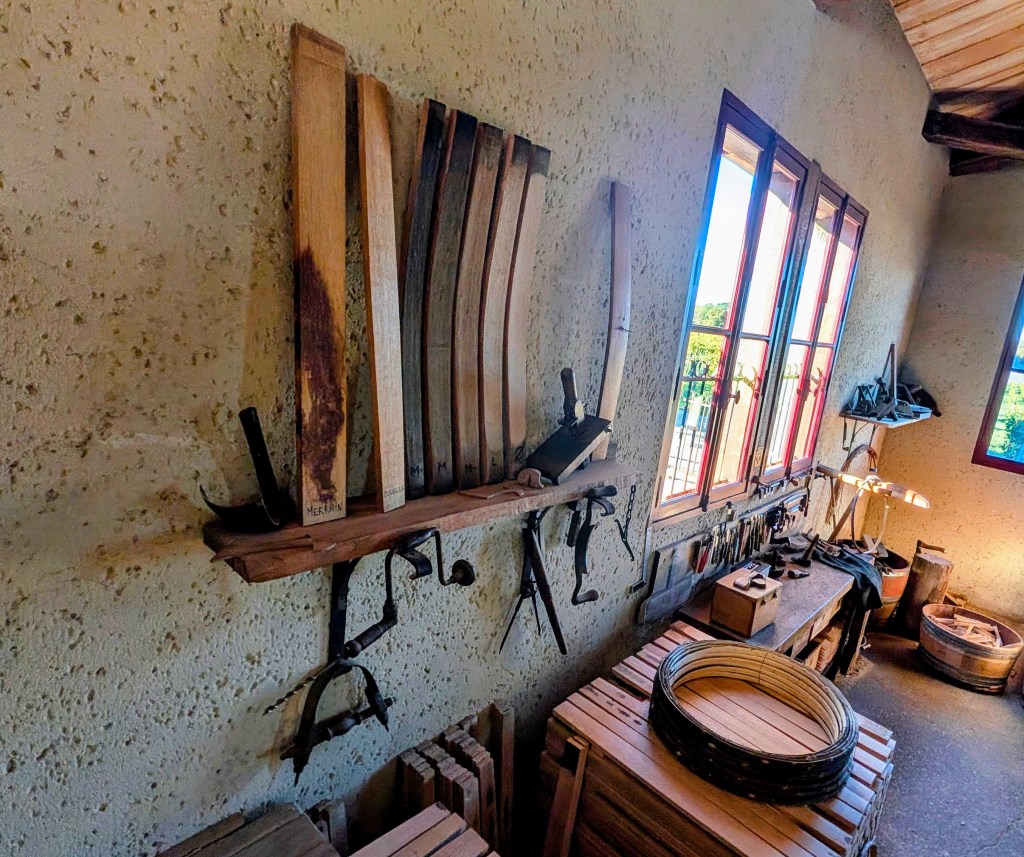
Château Smith Haut Lafitte is one of only 3 wineries in Bordeaux that make their own barrels, all from French oak. The winery operates its own cooperage to craft custom barrels and uses QR codes on bottles to provide detailed, interactive information to consumers.

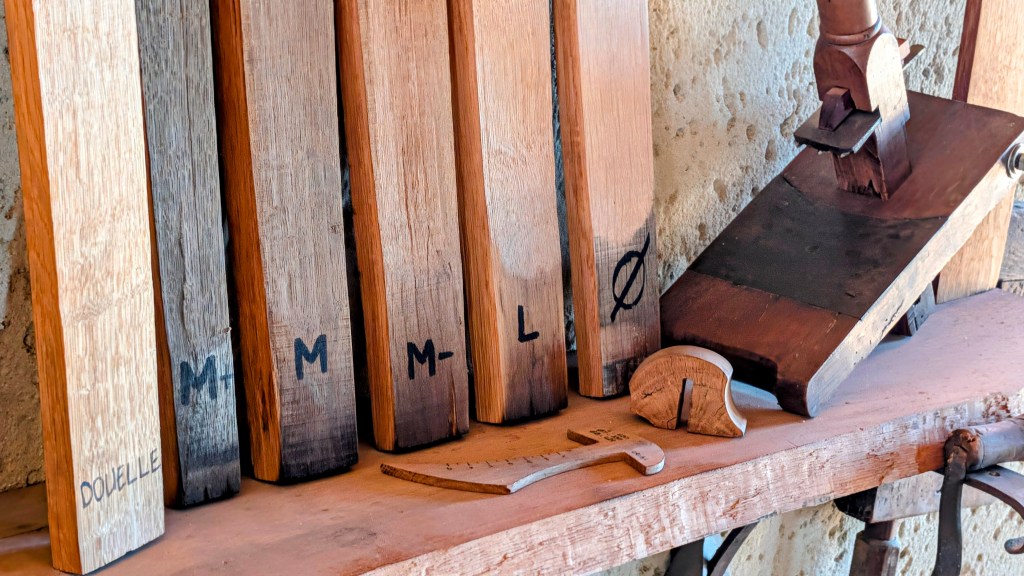
Each slat of oak is toasted in the fire.

The numbers on the slats denote the degree of toasting, each level bestowing a different flavor to the wine.

As we toured, I was struck by the art everywhere, even in a small vestibule.

The winery produces 800 barrels a year. The cellar contains over 1000 barrels. The reds stay in the barrel for 18 months, the whites 1 year. These are the whites.

The reds are so marked. Note the foil curtains along the far wall. In a world-first for sustainability, the château installed a system to capture the carbon dioxide released during fermentation and convert it into sodium bicarbonate, which can be used in toothpaste.

Hortense showed us the steel tanks.

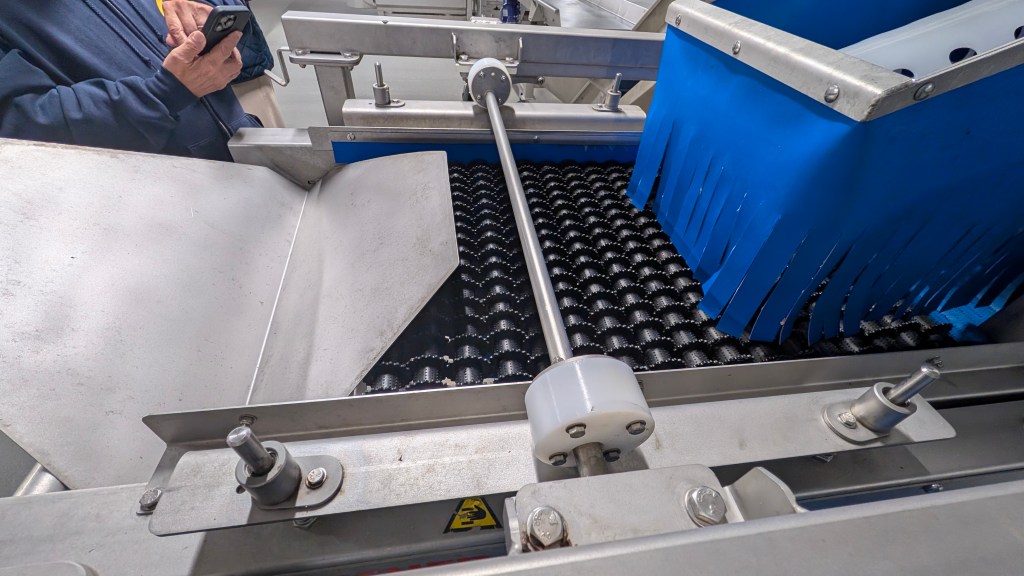
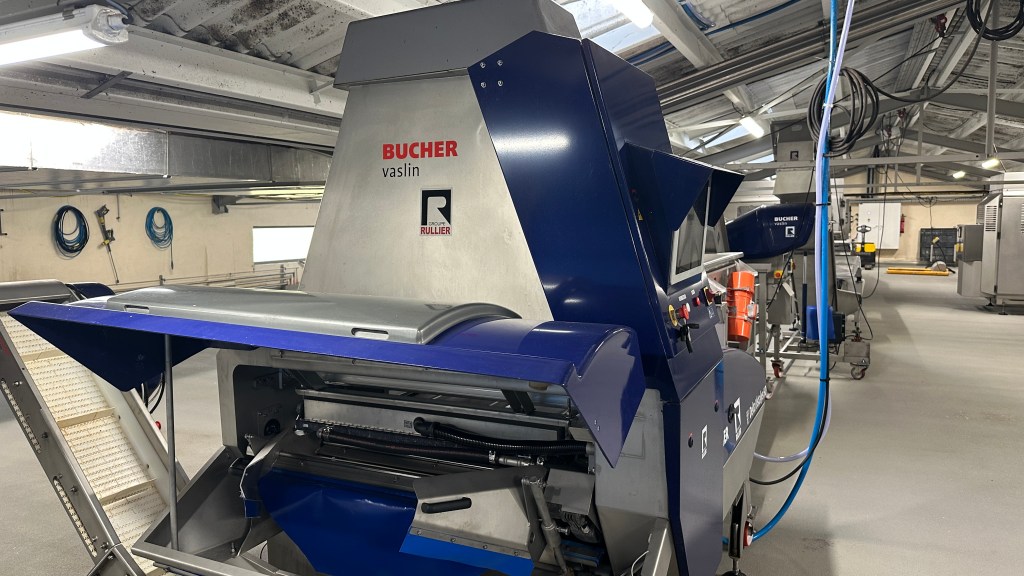
She showed us the destemming

and sorting machines

and the wood tanks room.

The Cathiards’ private collection is stored in a hidden underground cellar, accessible only via a trapdoor in the floor of the tasting room.

Finally we entered the bottle room.

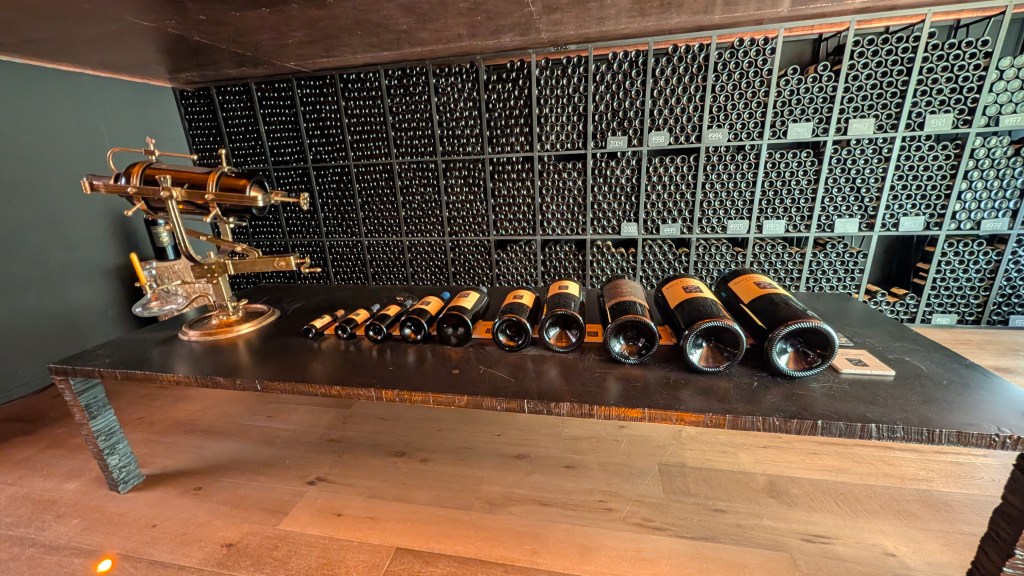
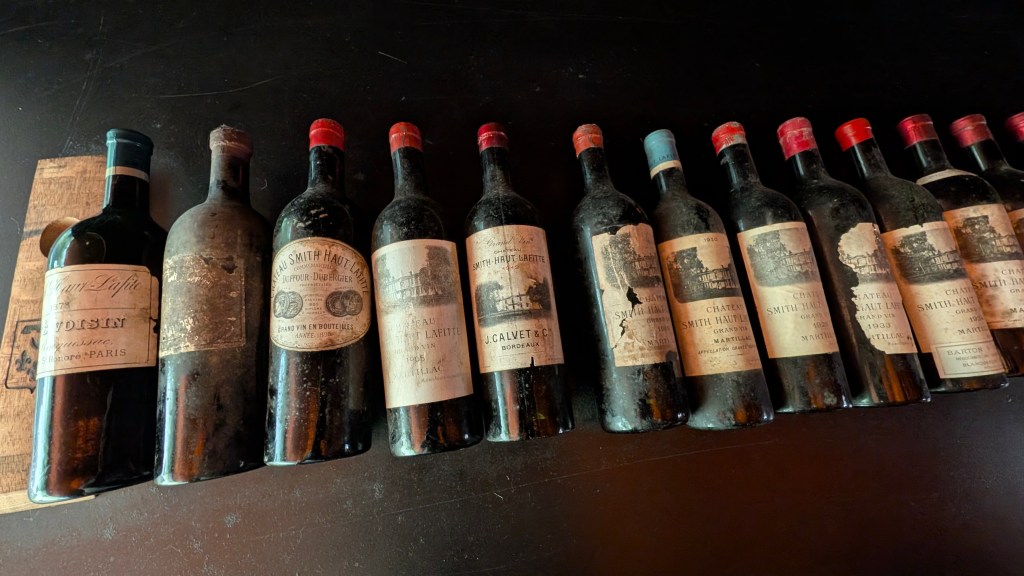
Some of the oldest bottles were on display.

Finally it was time for the tasting.

We left the winery as the sun was starting to fade and meandered through the vines.

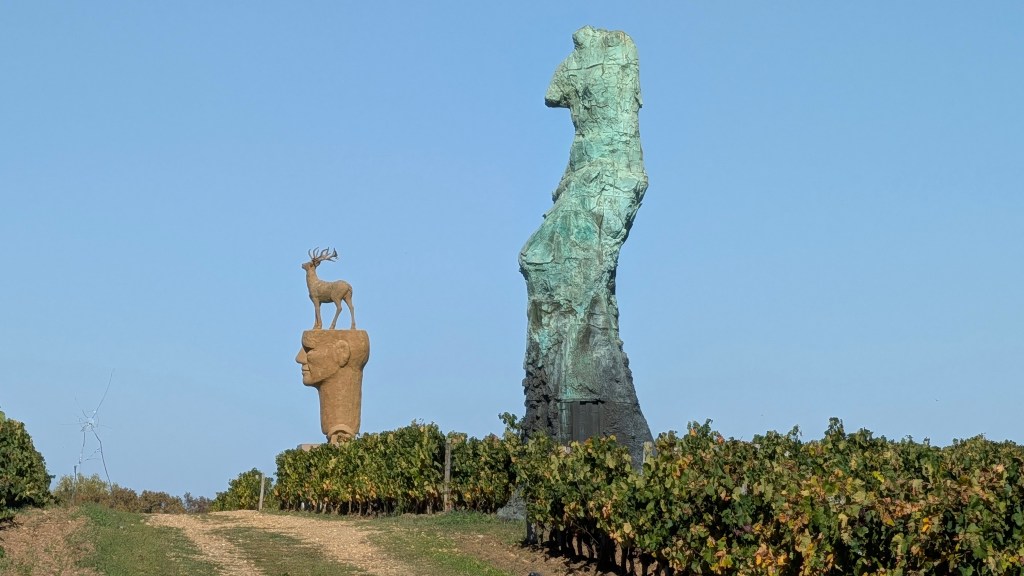
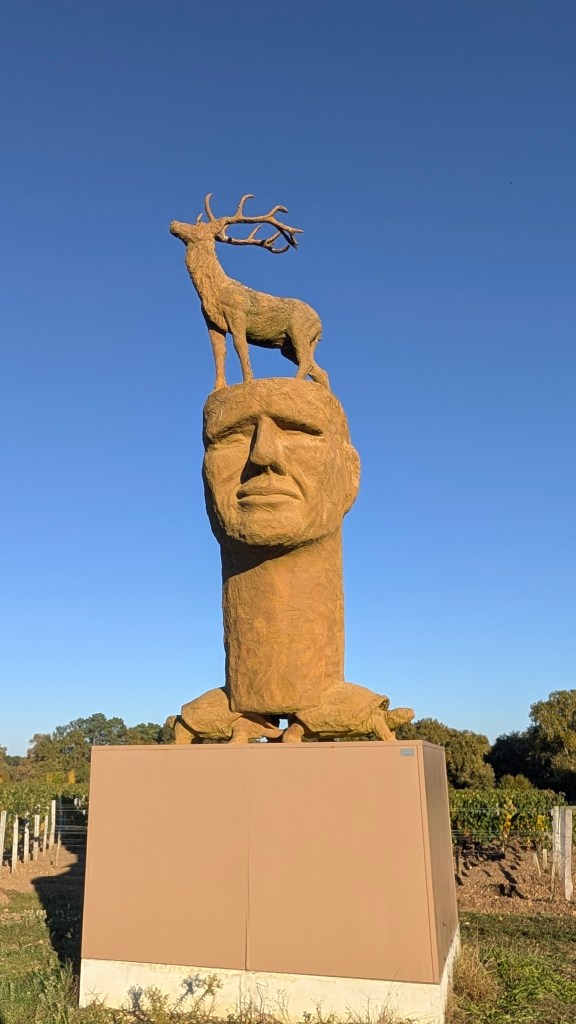
We went for a closer look at the statues. “Le Veado” was created by Portuguese artist Adália Alberto and is a copy of one in Nazaré, Portugal. The large human head topped by a deer, symbolizes a local Nazarine legend about saving Dom Fuas Roupinho. 

“Le Veado”

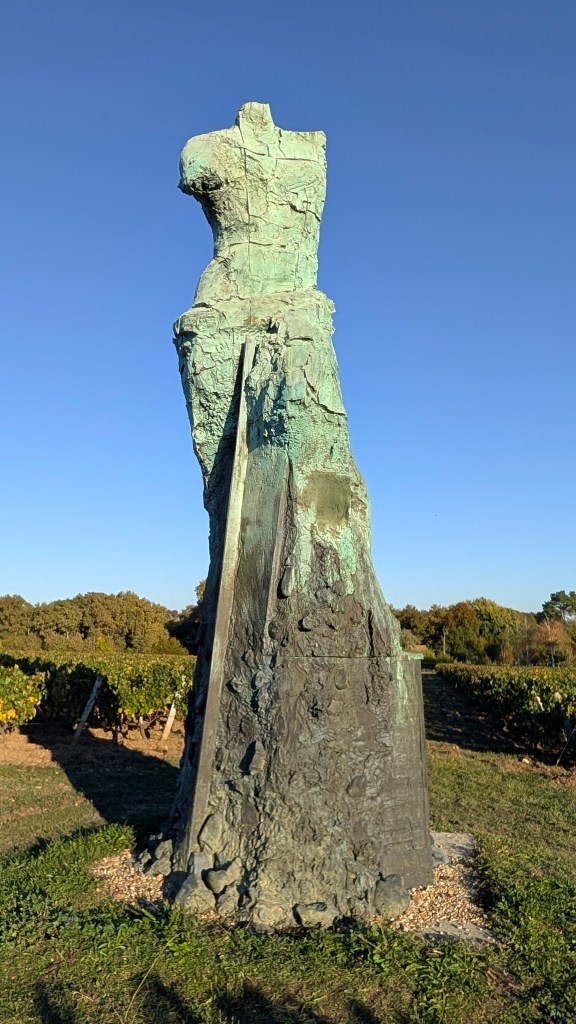
The “Venus de Bordeaux,” a monumental bronze sculpture by American artist Jim Dine is a modern interpretation of the classic Venus de Milo, featuring a disintegrating texture that symbolizes the relationship between art, fragility, and wine. 

“Venus de Bordeaux”

We noted the beginnings of autumnal colors on the grape vines and wondered how much more color we would see before our departure in 5 days.

We took the time before dinner to explore the hotel compound. The property resembles a small village with 61 rooms and suites, split among several distinct, rustic, and cozy houses.

The hotel boasts multiple dining options, including the two-Michelin-starred restaurant La Grand’Vigne and the more casual La Table du Lavoir as well as Rouge, a gourmet delicatessen and wine bar.

Rouge

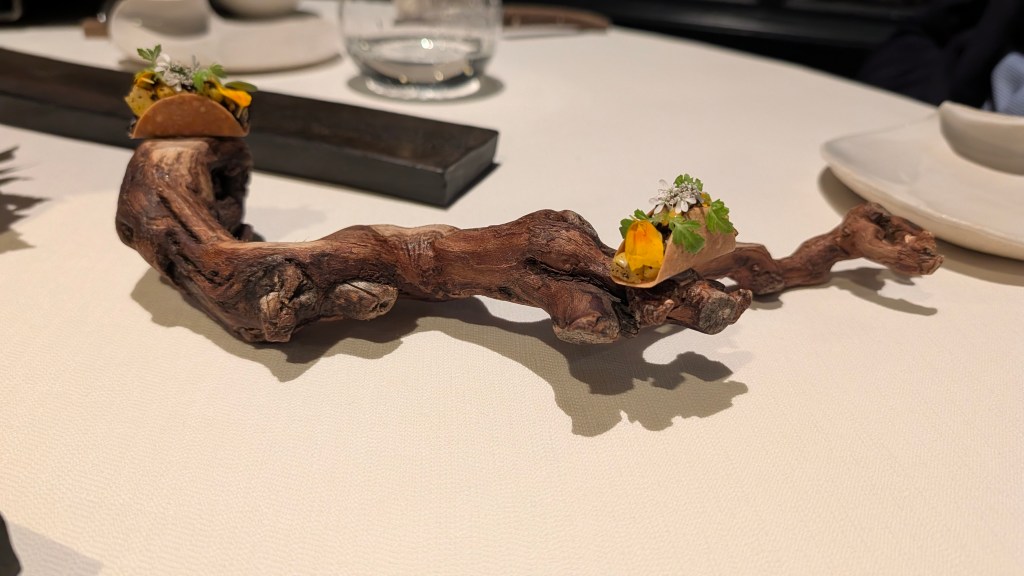
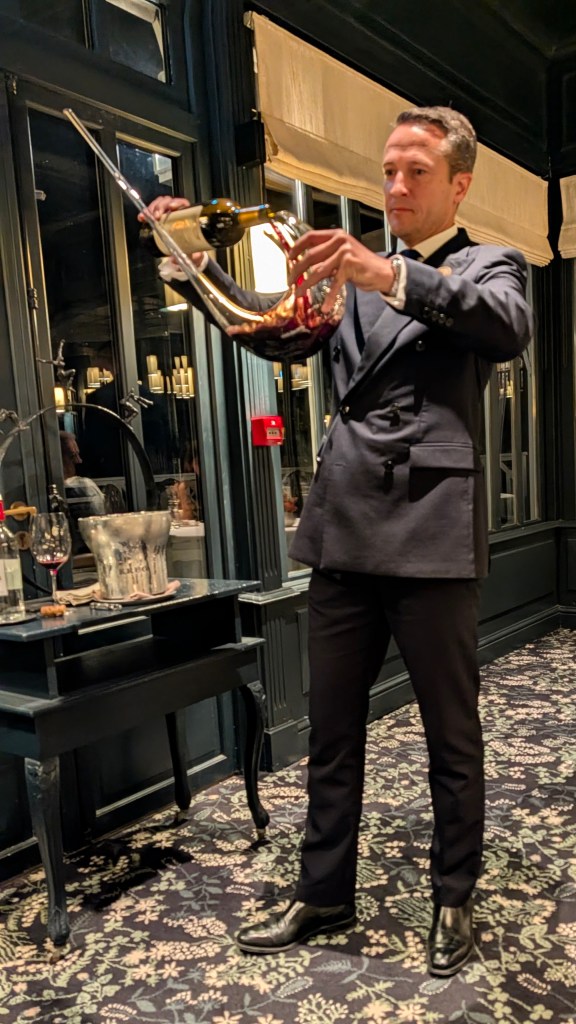
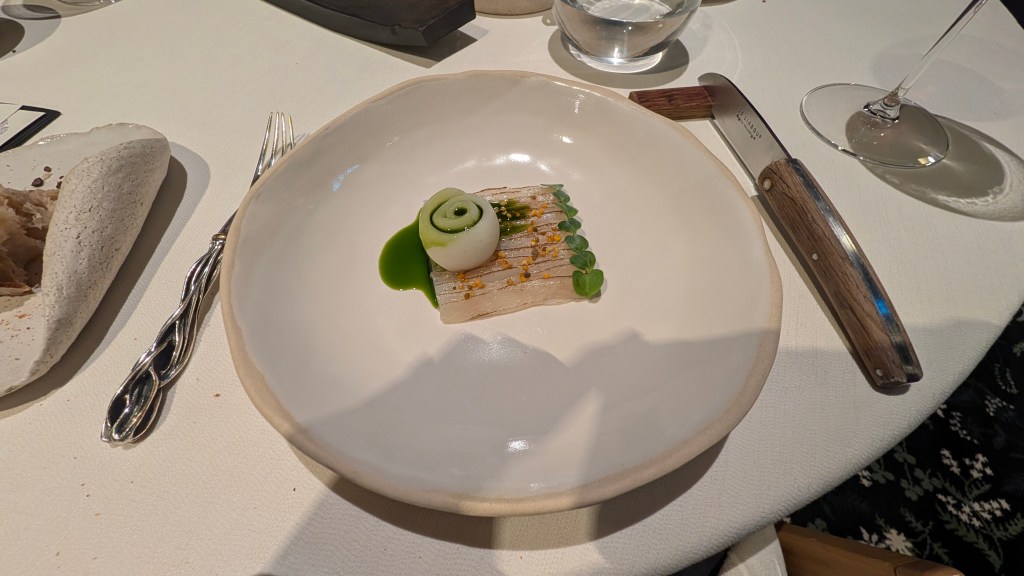
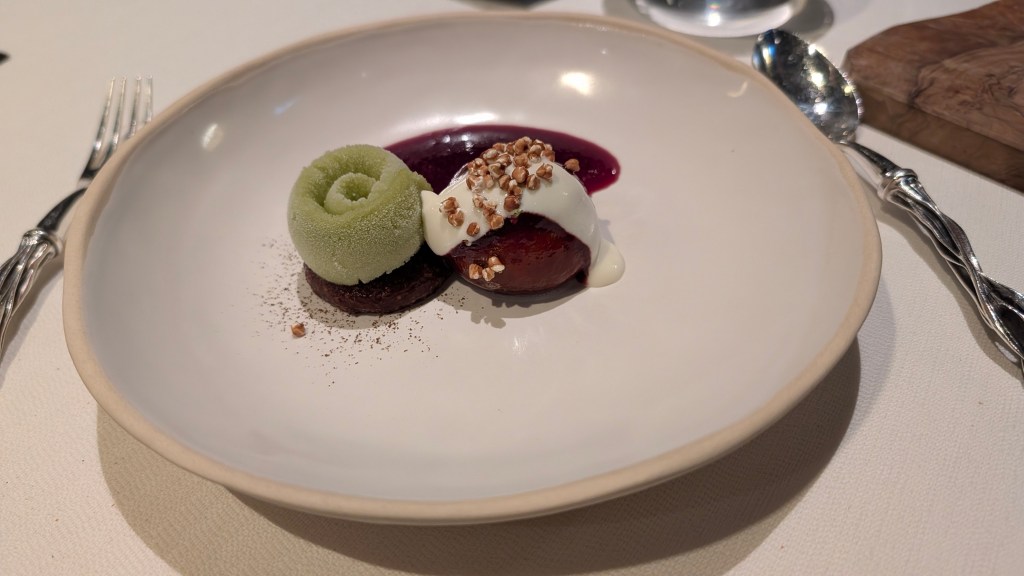
We dined that night at La Grand’Vigne, a two-Michelin-starred gastronomic restaurant. I will not bore you with all the food pictures (believe me I took them all), but will include here some of the most picturesque.

Our wine was decanted,

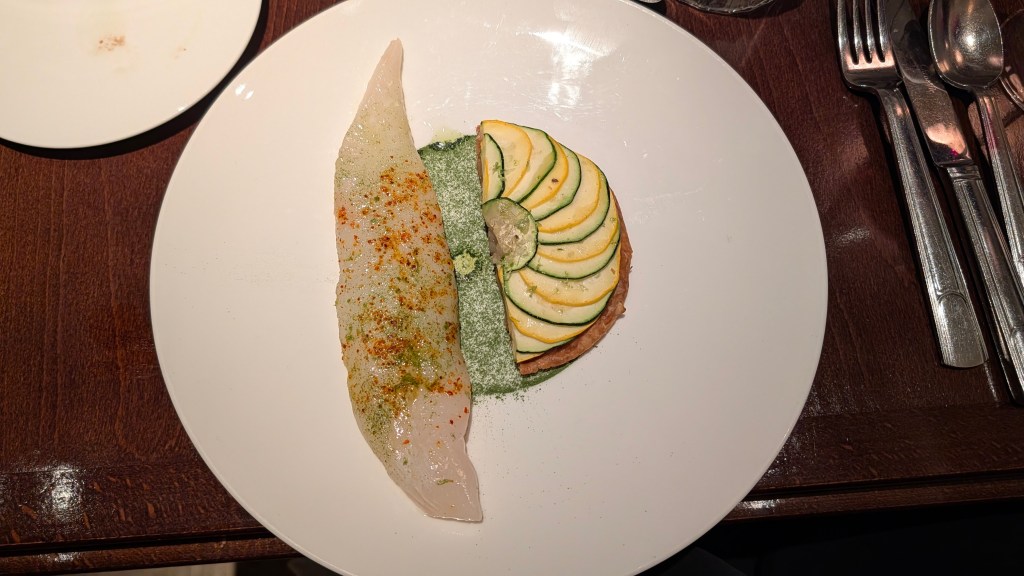
and the courses began with fish,

and finished with desert.

Prior to breakfast in the morning, we strolled around the pond to get a little exercise before another day of eating and drinking.

As we drove to our first destination, our driver explained wine classifications in Bordeaux. In the left-bank (of the River Garonne ) Médoc, Graves, and Sauternes regions, Grand Cru Classé refers to specific châteaux (estates) ranked in 1855 by order of Napoleon III to showcase the best wines at the Paris World Exhibition.  These 61 châteaux are ranked into five levels: First Growth (Premier Cru) down to Fifth Growth (Cinquième Cru). This classification is based on the reputation of the estate, not just the vineyard, and has remained largely unchanged since 1855 with the exception of the addition of Rothschild in 1972.  In Saint-Émilion a different system for the right-bank region is used; the ranking is reviewed roughly every 10 years. The levels there include Premiers Grands Crus Classés (A and B) and Grands Crus Classés. 

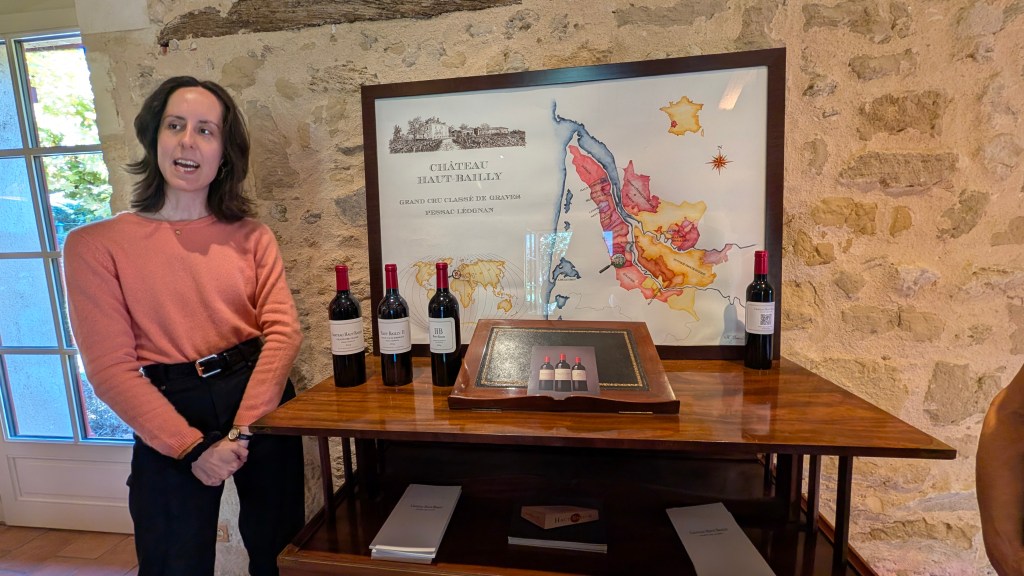
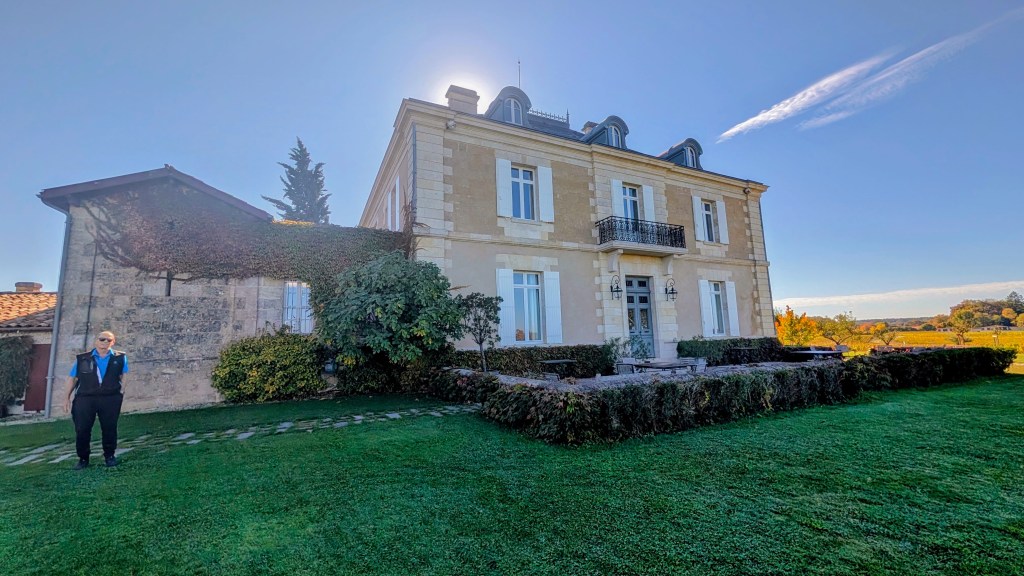
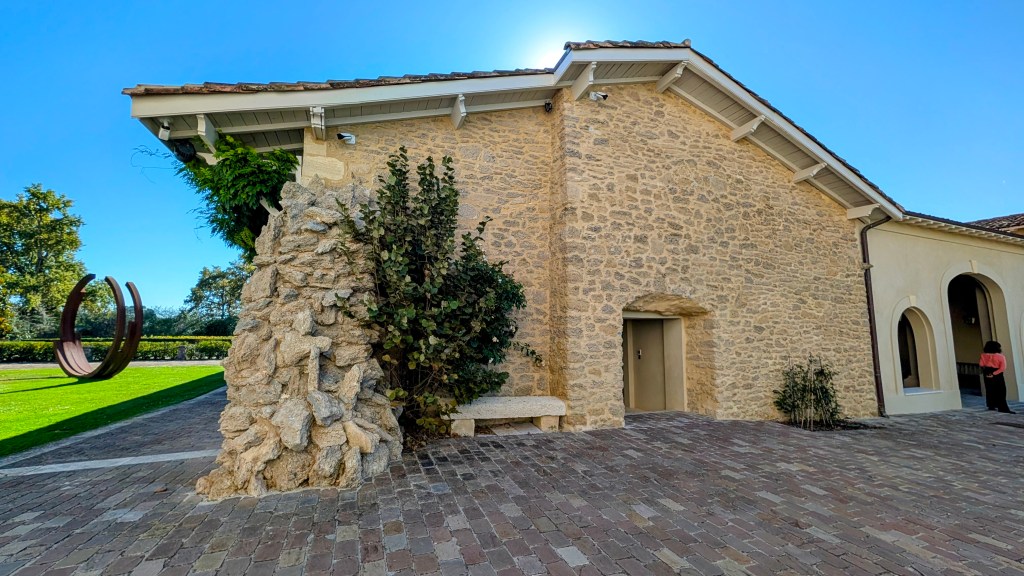
Today’s first winery, Château Haut-Bailly, a Cru Classé of Graves, is a historic Pessac-Léognan appellation estate with roots back to 1461, renowned for its 10 acres of ancient, 120-year-old vines, some of the oldest in Bordeaux. Eloise, our guide there, explained an appellation generally designates the geographic area in which the fruit or other agricultural product was grown. Using an appellation of origin on your label also indicates that the wine meets certain production requirements. In the Bordeaux region there are about 4,500 wineries in 60 appellations.

In 1872, the estate was purchased by Alcide Bellot des Minières, known as the “King of Vignerons” (or “King of Vines”), who famously resisted grafting during the phylloxera crisis. He built the manot house in 1875.

Within their oldest 10 acre plot, the vineyard contains all six major Bordeaux grape varieties (Cabernet Sauvignon, Merlot, Cabernet Franc, Petit Verdot, Malbec, and Carménère) planted together, a rare “field blend” style.

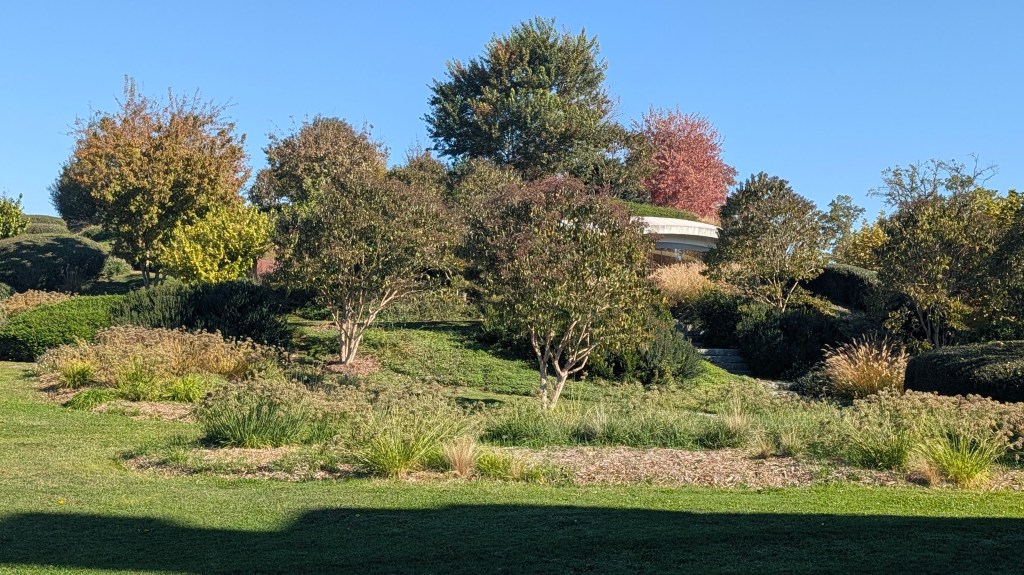
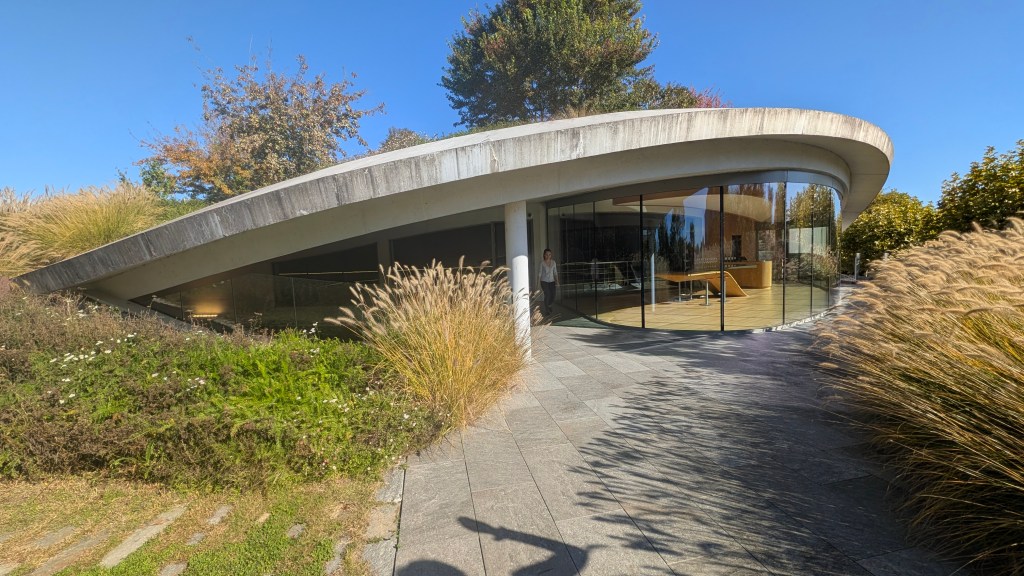
The ultra-modern, eco-friendly cellar, designed to blend into the landscape, features a massive suspended, vegetated roof that acts as a habitat for birds and bats.

The modern facility was unveiled for the 2021 harvest and features a contemporary design.

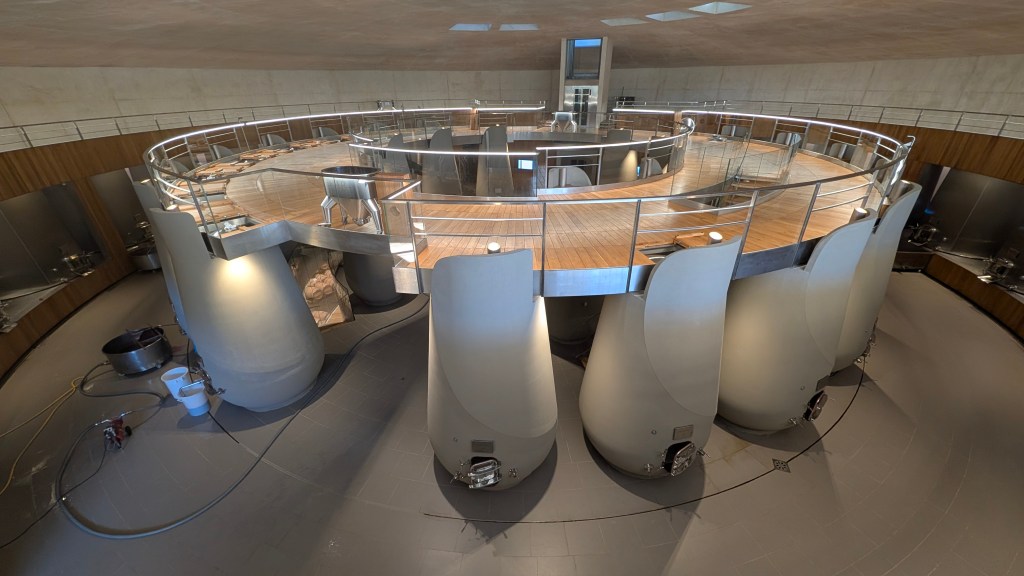
The facility is designed to enhance wine production using gravity and agroecology (application of ecological principles to agricultural systems) techniques.

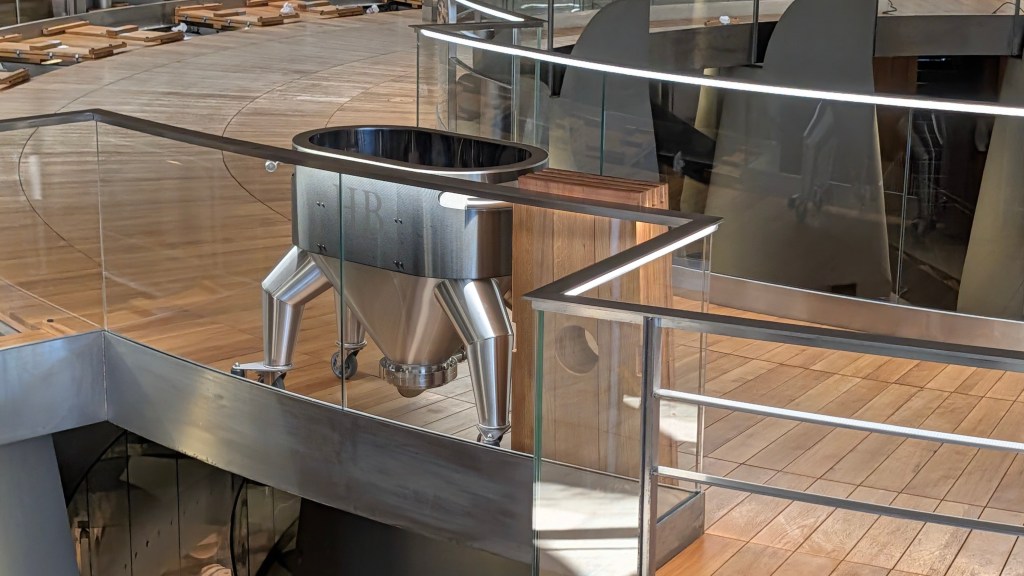
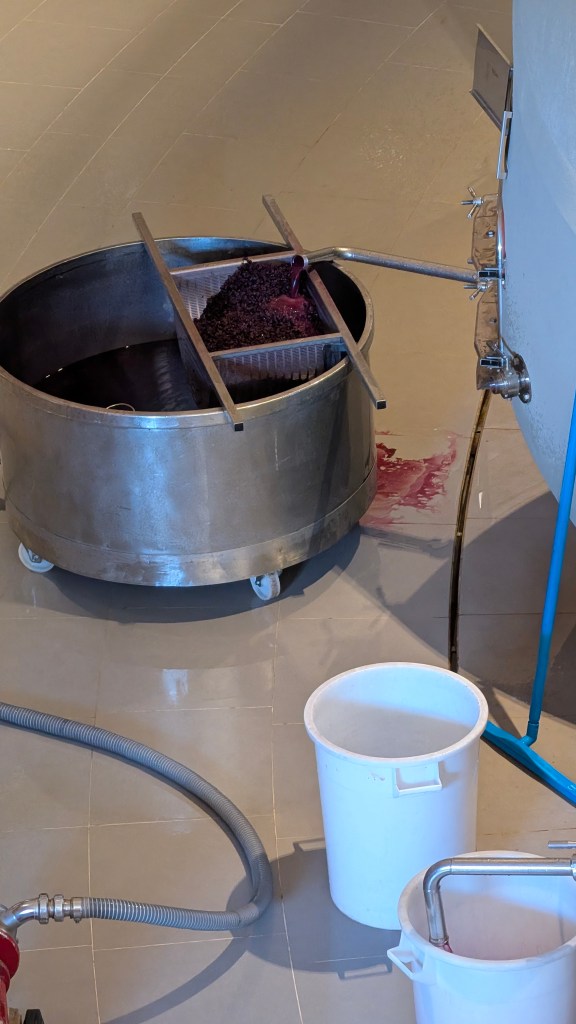
The grapes are wheeled in a carrier especially designed for the pupose, dropped into the large steel tank, and crushed by the force of gravity.

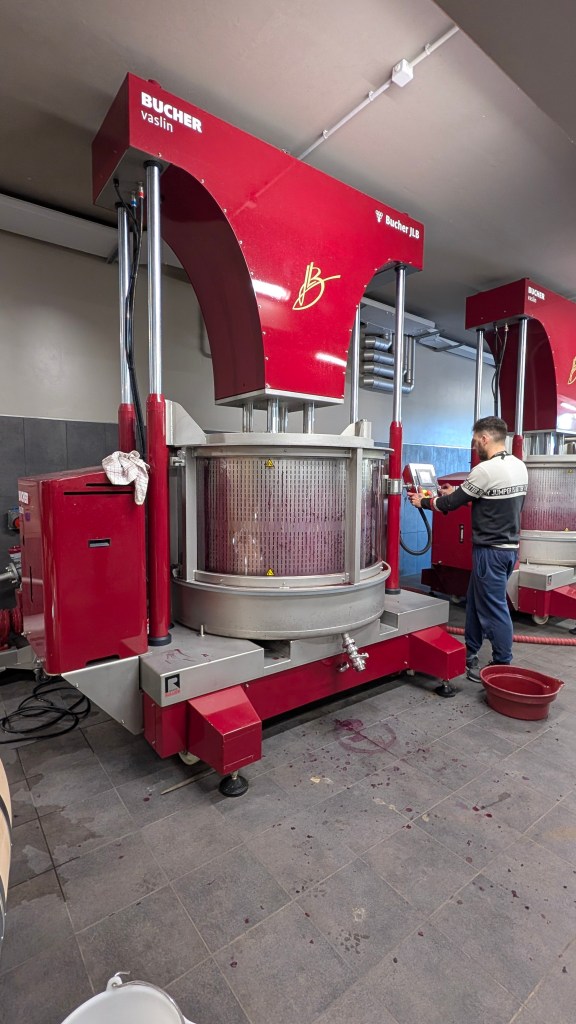
Once crushed, the grapes are removed from the steel tank and strained.

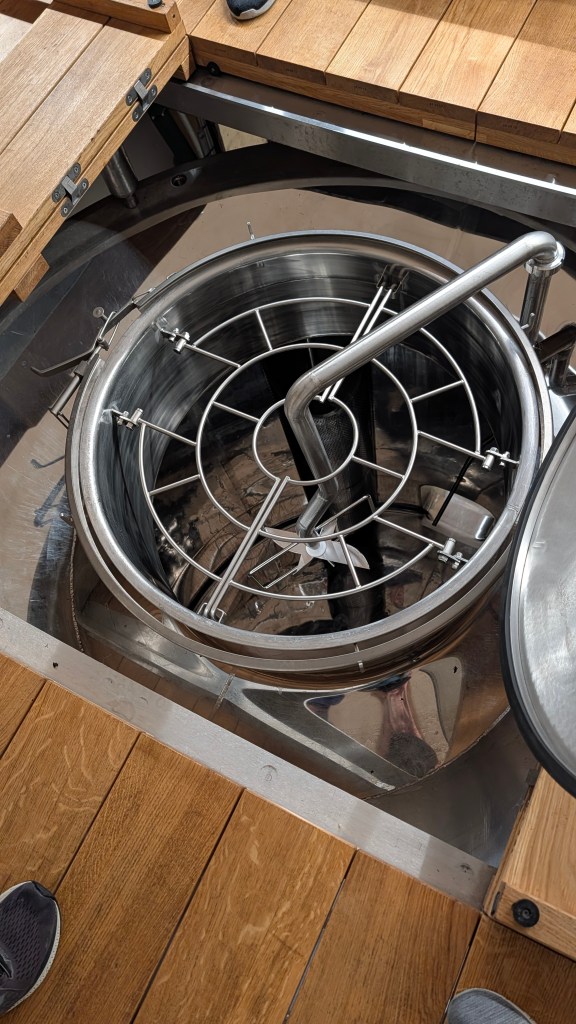
Looking down into the tank.

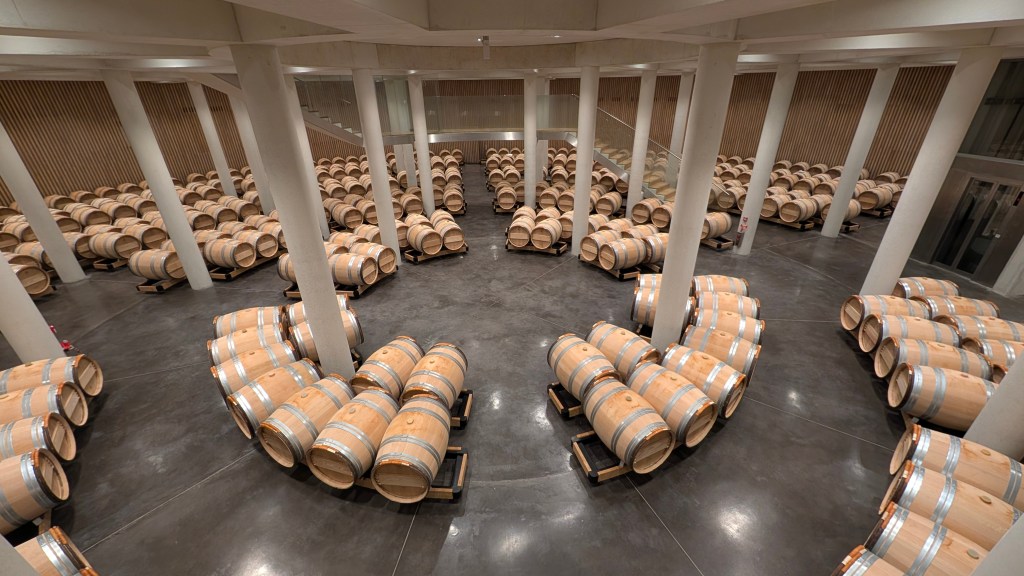
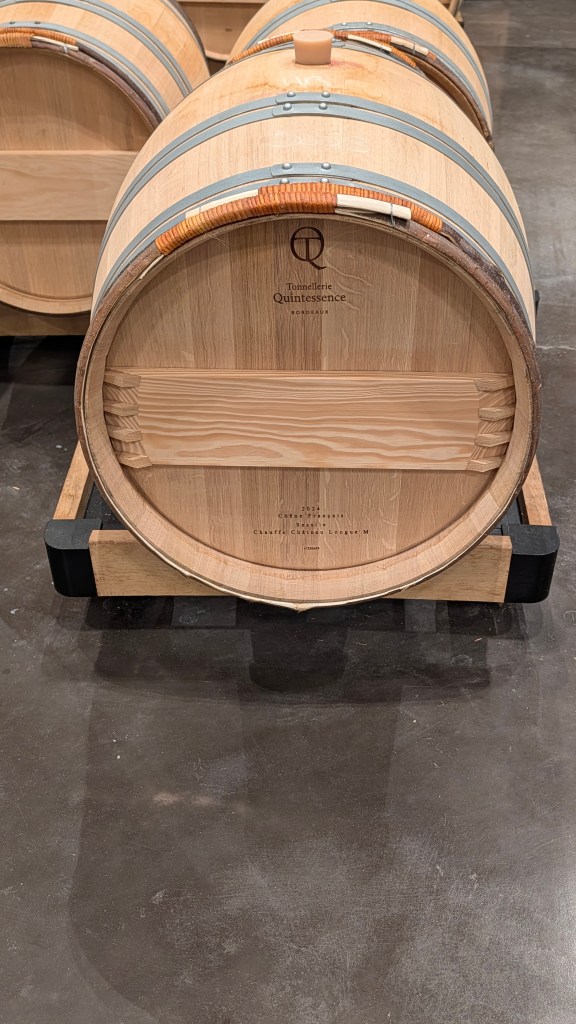
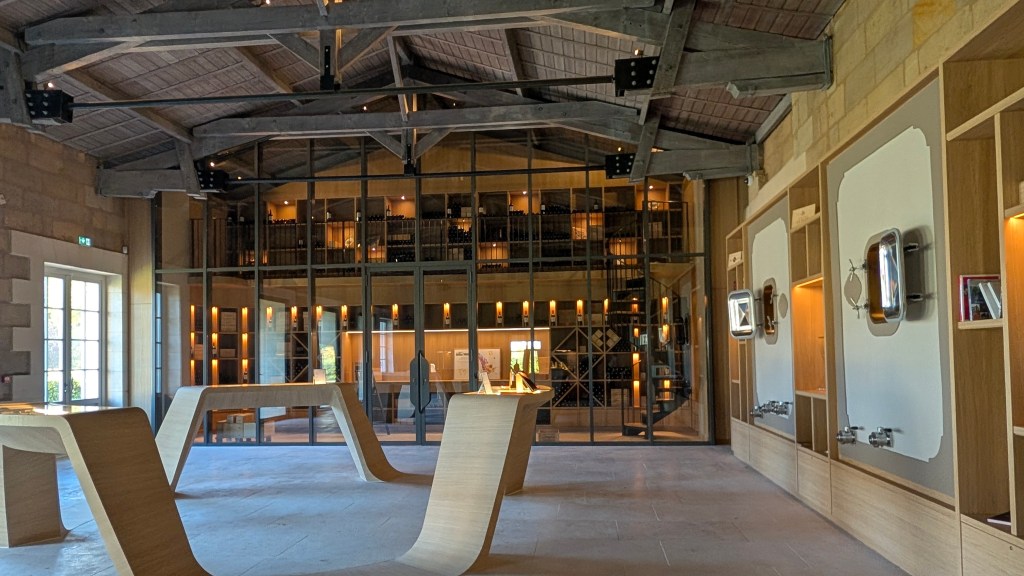
Eloise showed us the barrel room.

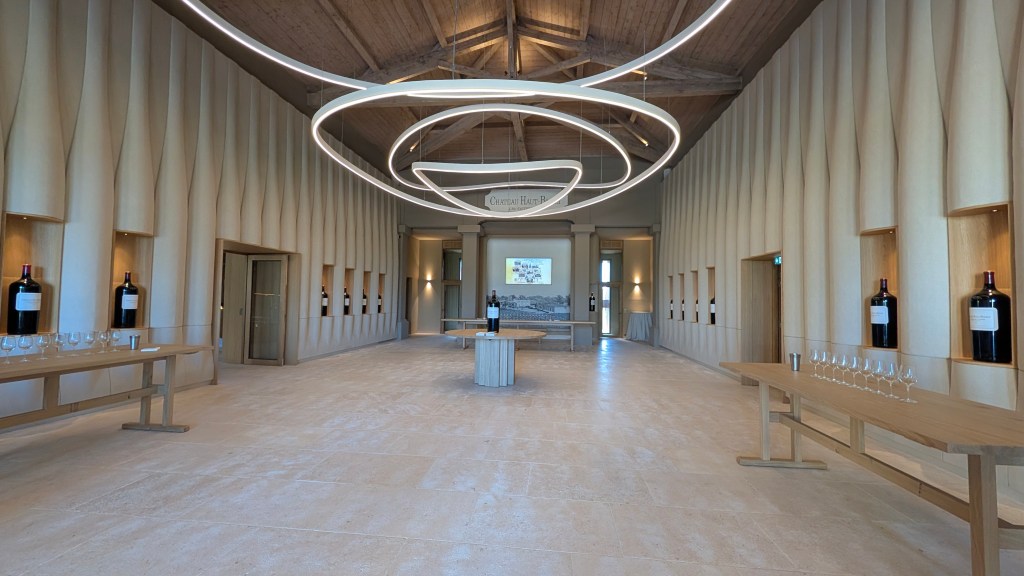
She then took us to the tasting building

and into the tasting room.

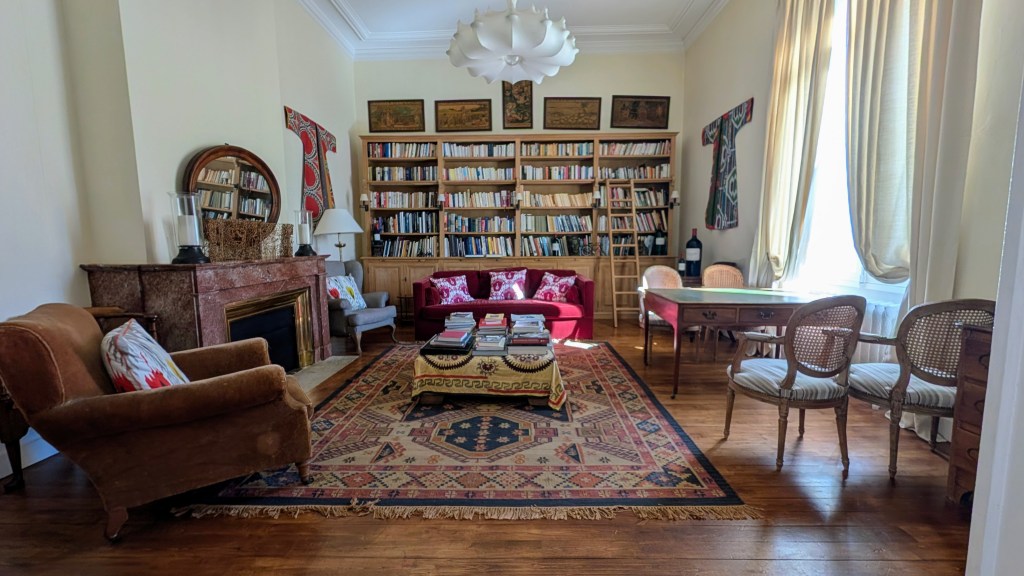
After our tasting we were taken into the manor house for lunch.

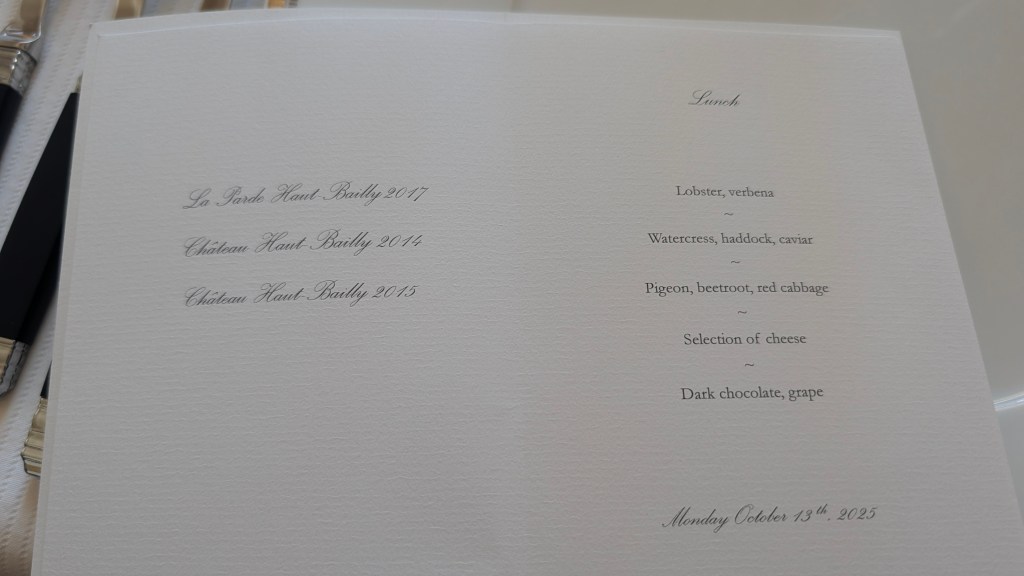
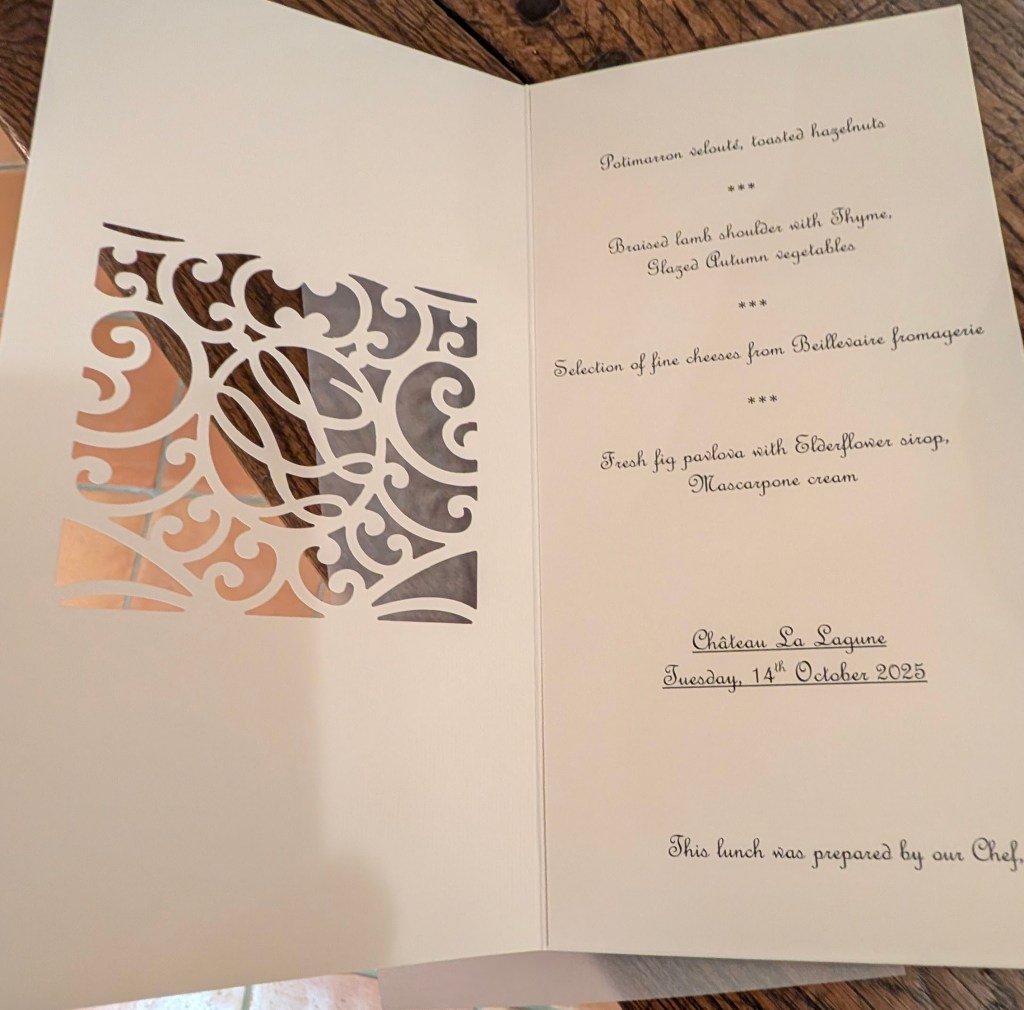
Our private menu

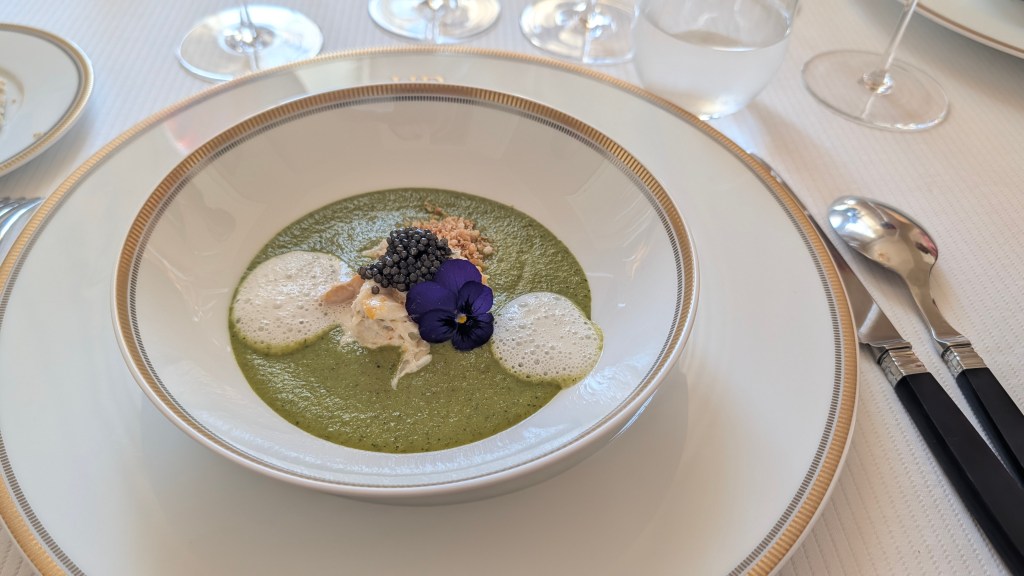
included lobster verbena

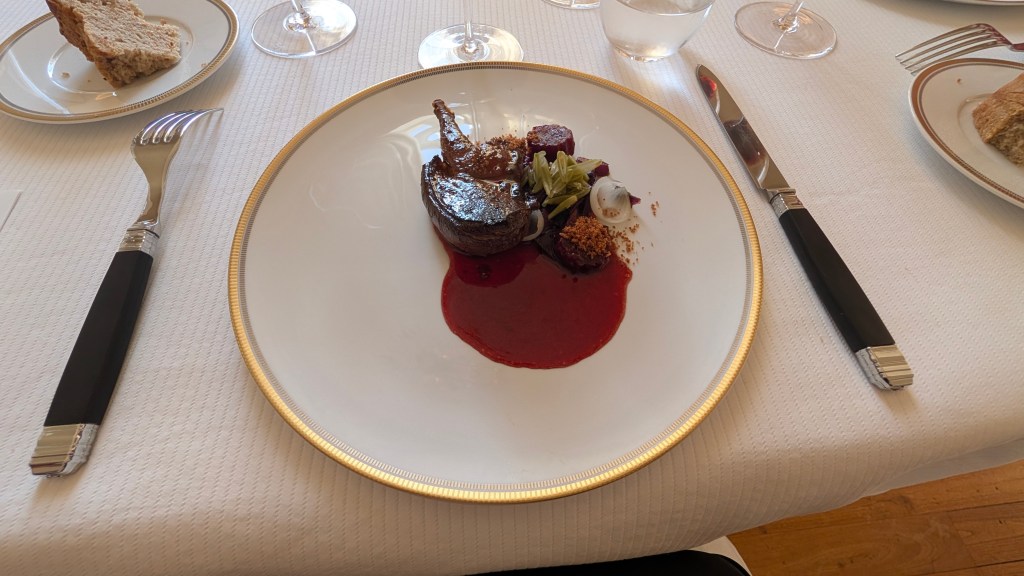
pigeon with beetroot

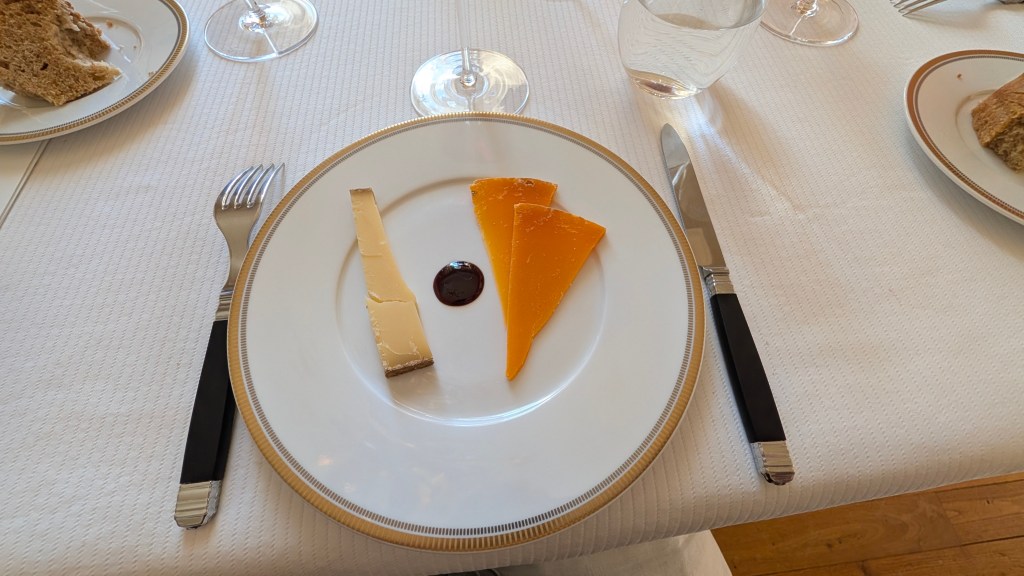
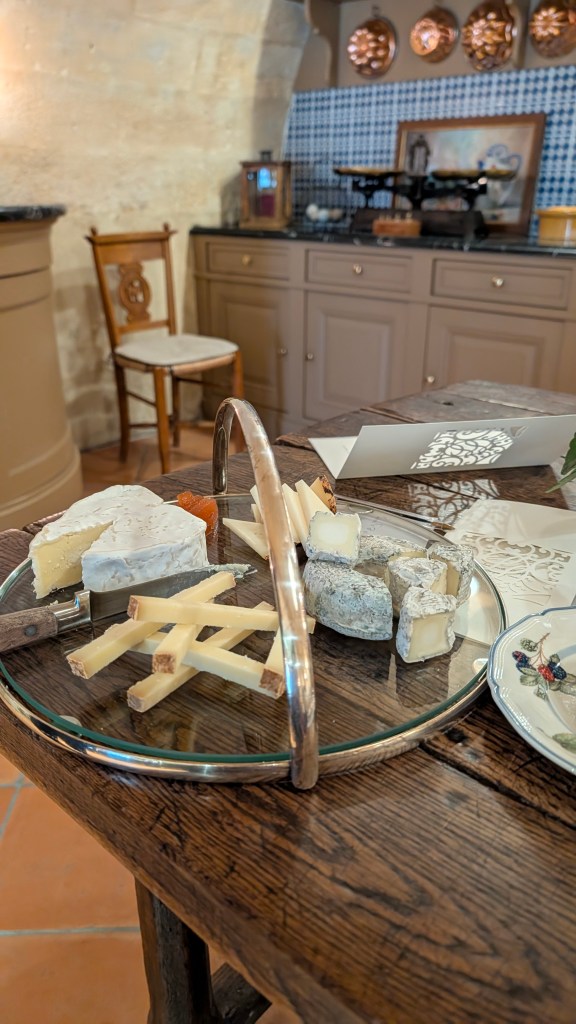
and, of course, cheese,

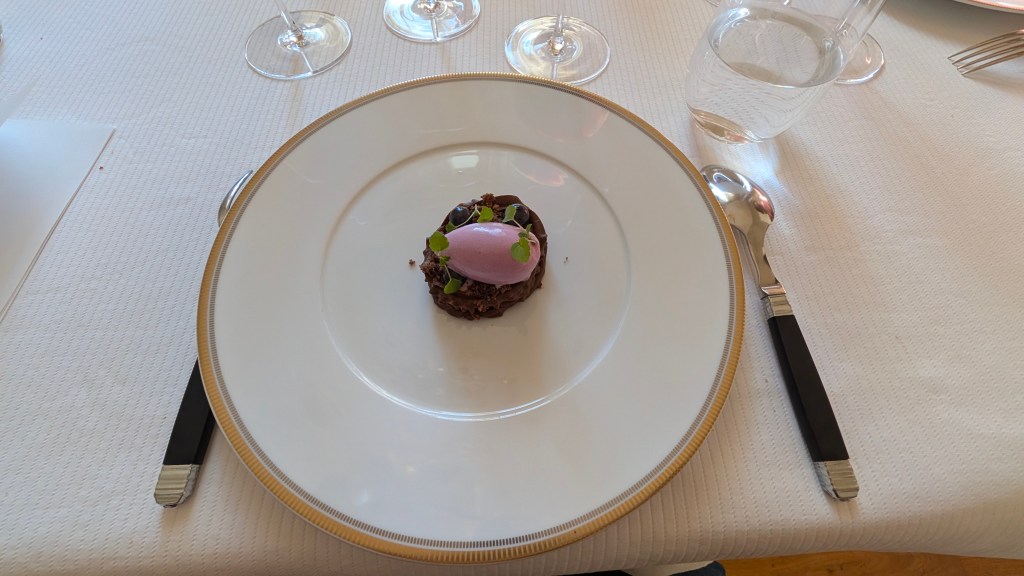
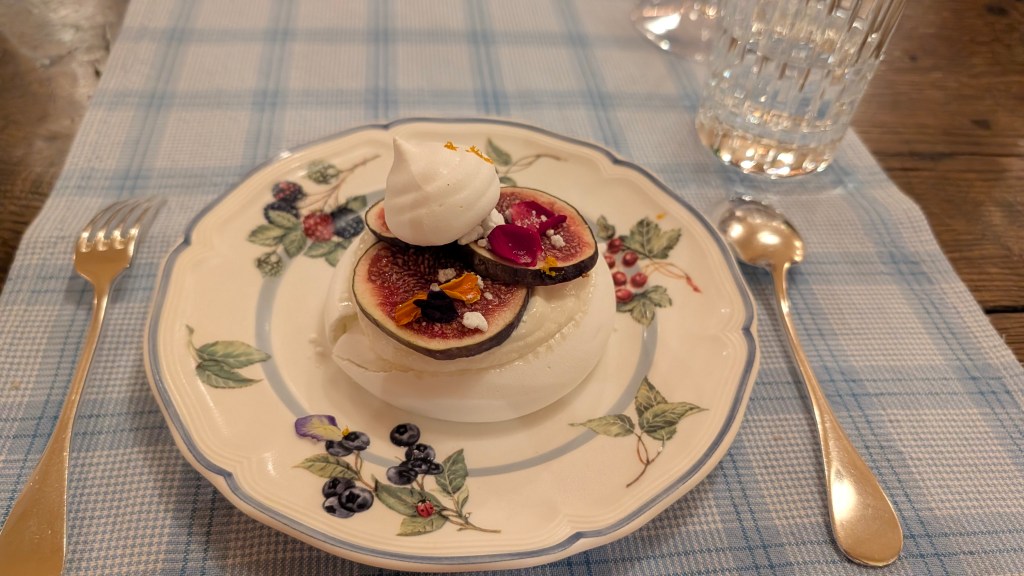
with dark chocolate for desert.

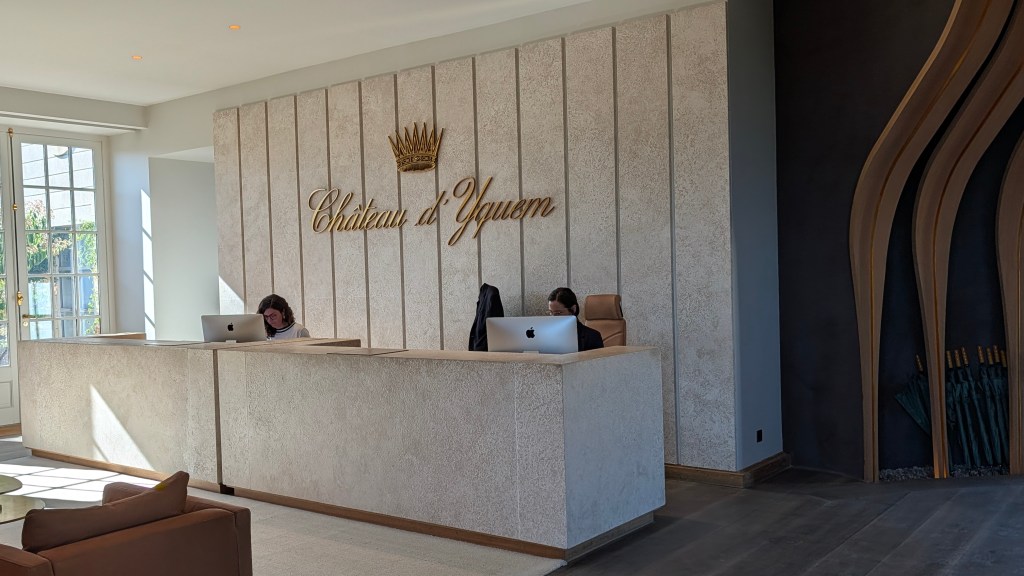
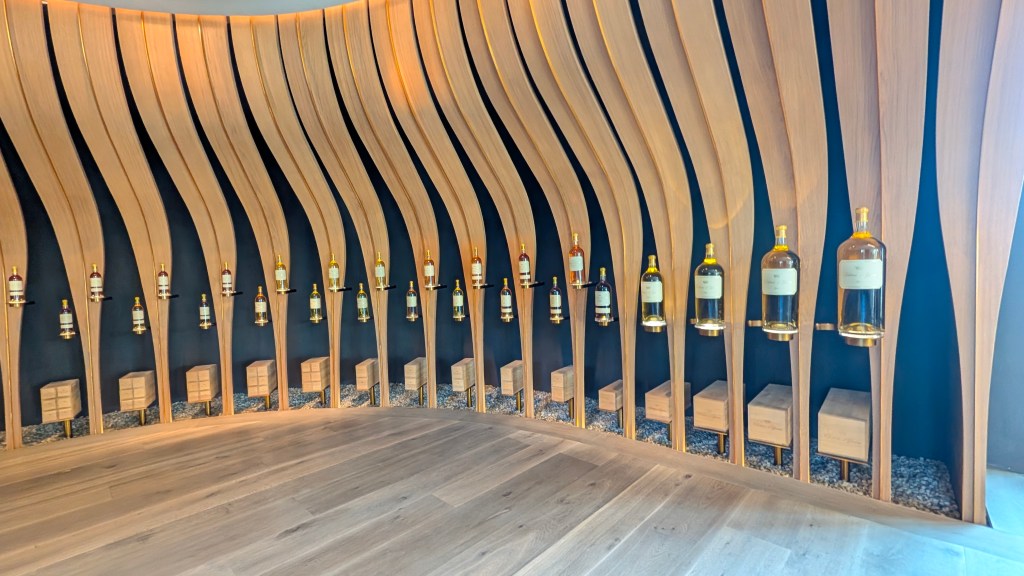
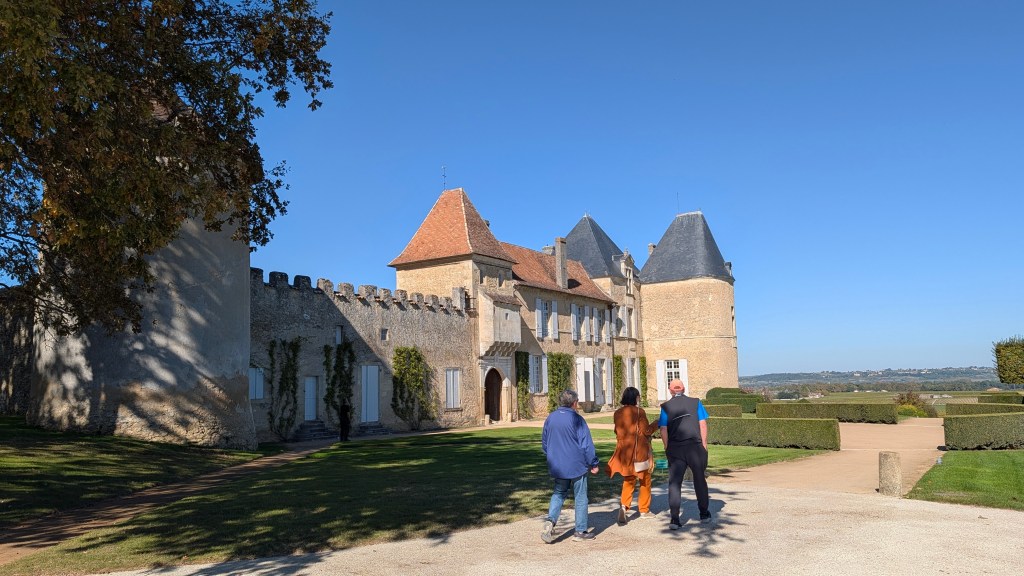
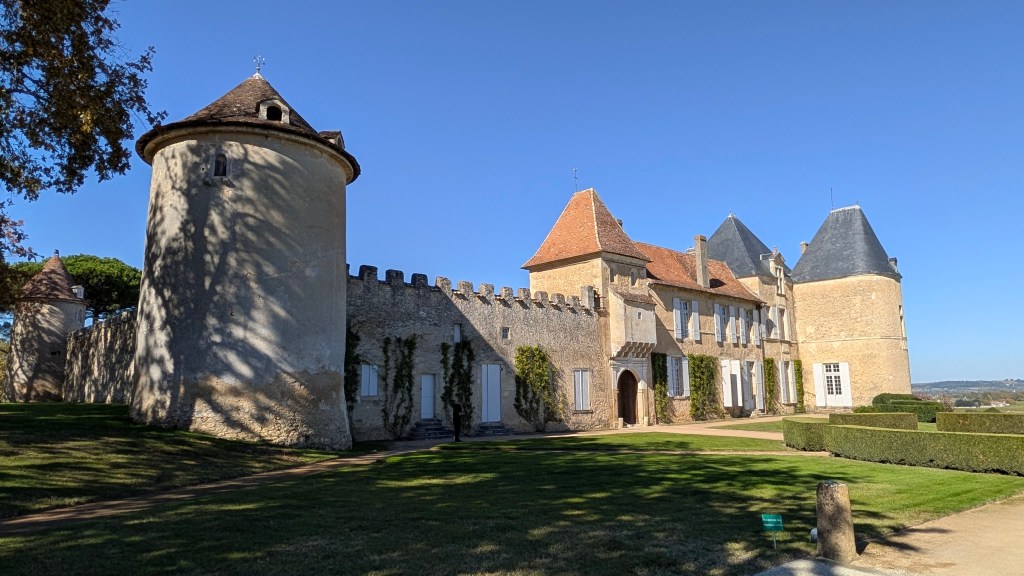
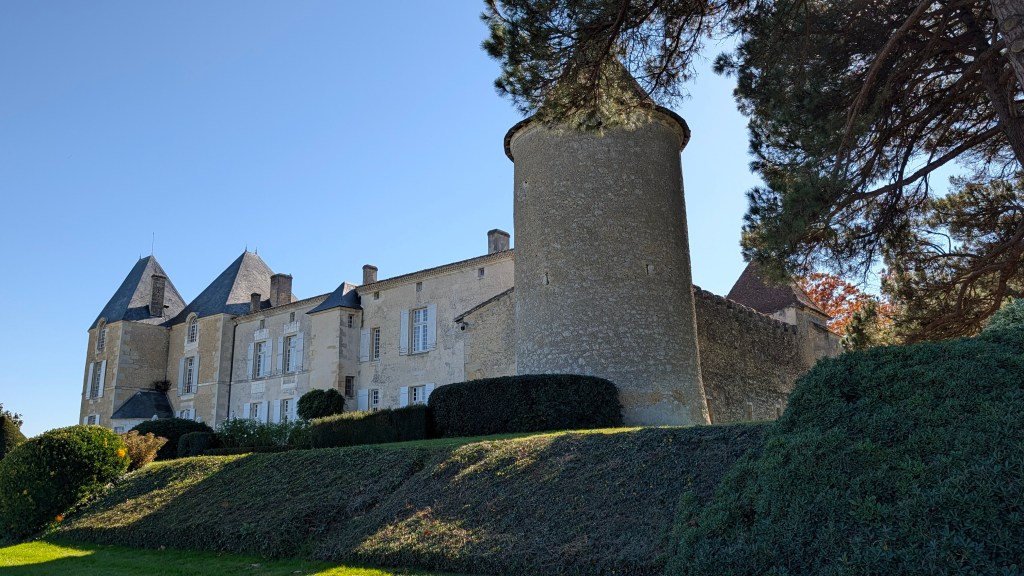
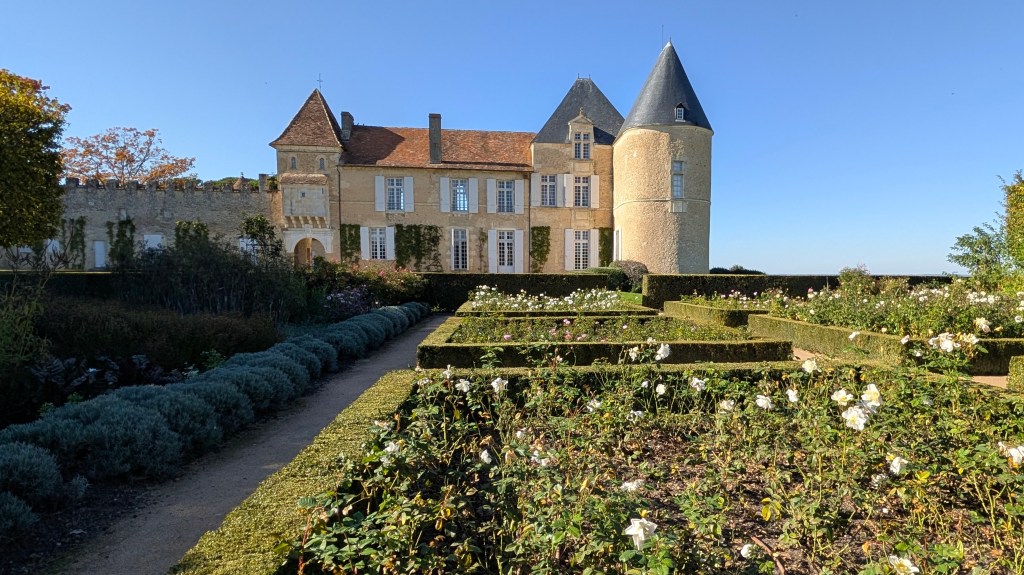
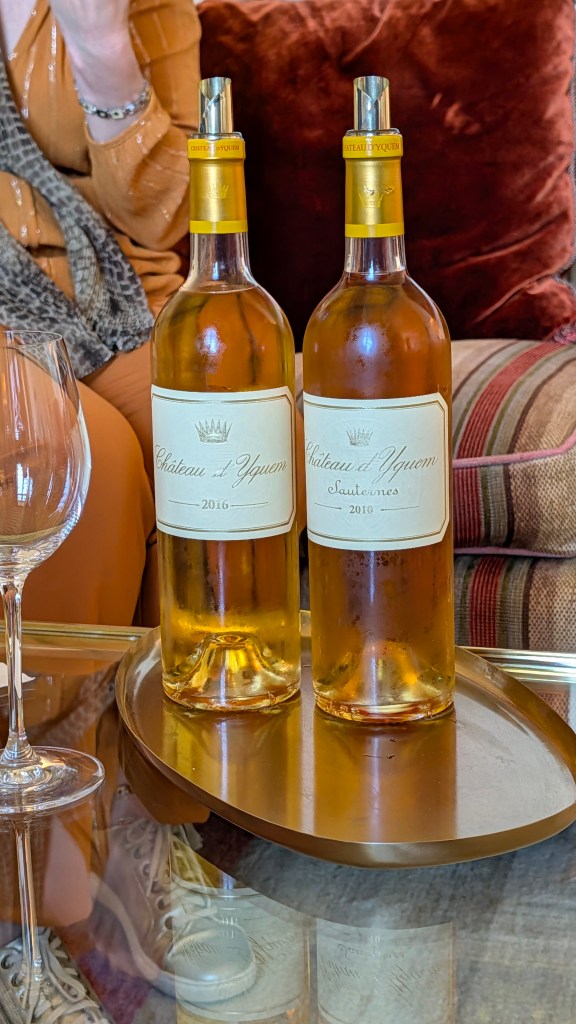
Having eaten so much lunch, it was difficult to think about tasting more wine. But a desert wine was on the schedule. Château d’Yquem, located in Sauternes apellation of the Graves region of Bordeaux, is the world’s most renowned sweet wine estate, famously ranked as the only Premier Cru Classé Supérieur (Superior First Growth) in the 1855 classification, placing it above all other Sauternes producers.

Production at Château d’Yquem is remarkably low, with the mantra that one vine produces only one glass of wine.  The estate is known to reject entire vintages if the quality does not meet their strict standards.

During the Middle Ages (1152–1453), the estate was owned by the King of England.

The property is currently owned by the luxury goods group LVMH. 

The vineyard had been under the same family control for over 400 years, from 1593 until it was acquired by LVMH in the late 1990s.

The site dates back to a 16th-century fortified farm and has served various purposes, including acting as a military hospital during wartime. 

Our guide Anna explained that the vineyard is situated at the highest elevation in the Sauternes region, comprising approximately 280 acres. The grapes are 70% sémillon and 30% savignon blanc.

Anna walked us past the extensive gardens.

Using an interactive map, Anna explained the geography enabling the sweet wine production. The Sauternes apellation is situated on the Gironde estuary, often referred to as a river, which is formed from the meeting of the two rivers Dordogne and Garonne just downstream of the centre of Bordeaux. Covering around 245 sq miles, it is the largest estuary in western Europe. The location of the appellation on the estuary ensures foggy mornings with high humidity, which allows for growth of the the fungi Botrytis cinerea (noble rot), which dehydrates the grapes and concentrates sugar and aroma. Yquem, the best of the sauterne wines, is known for its ability to age for over 100 years, often improving significantly with age.

Anna took us down the stairs

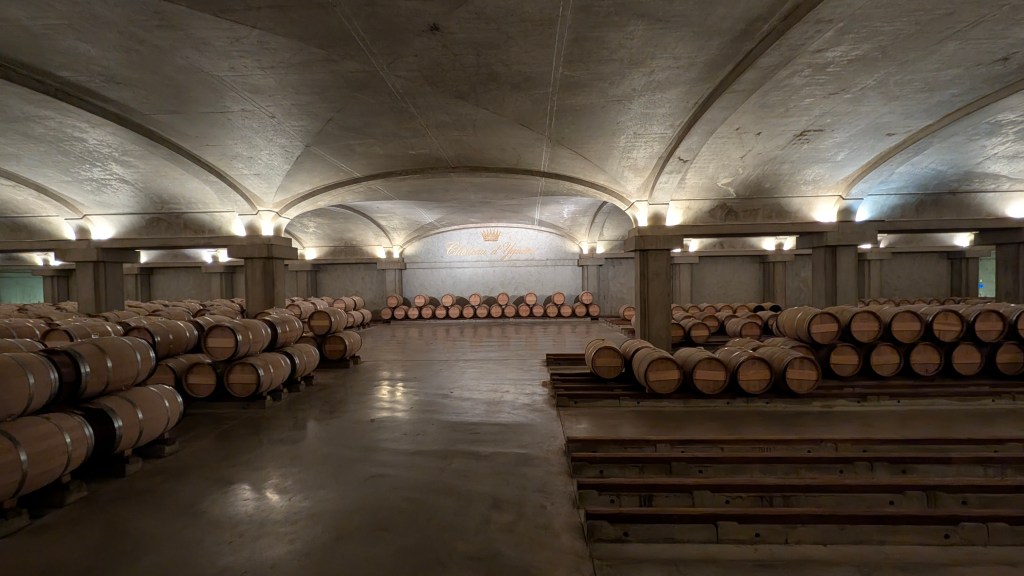
into the wine cellar. The grapes are in the barrel for two years. Each barrel is only used once. It is often considered the most expensive wine to produce in Bordeaux. The wine is bottled with CO2 in the bottle to improve longevity.

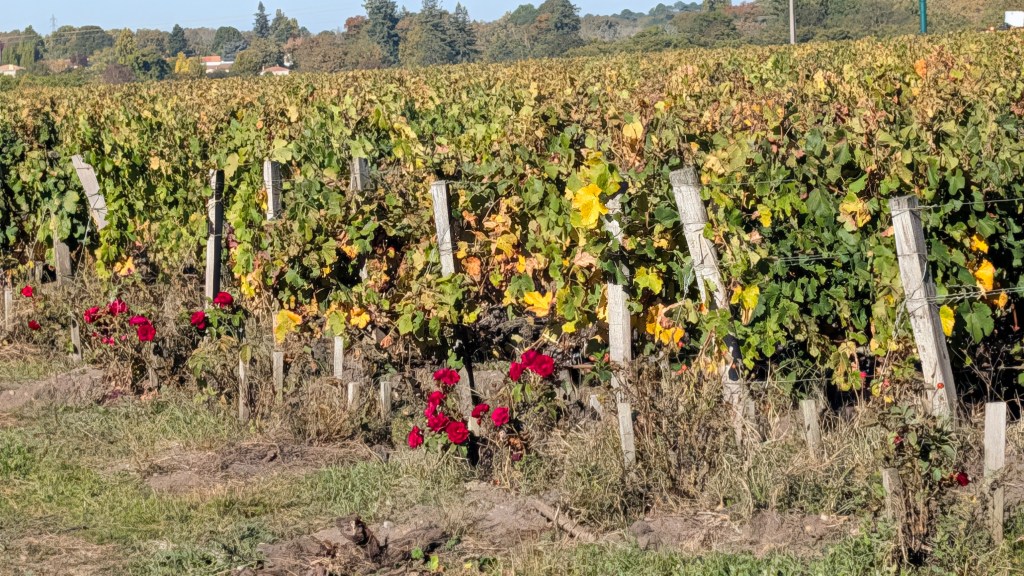
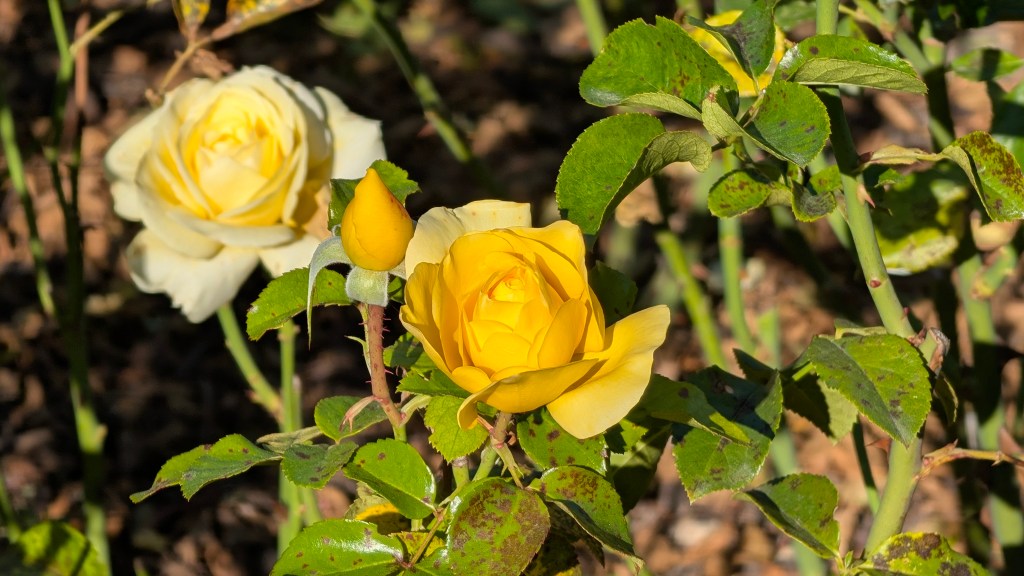
Roses are planted with grapevines primarily as an early warning system against diseases like powdery mildew, as roses are more sensitive and show symptoms first, allowing time for intervention.

Roses also act as natural pest control, attract beneficial insects, and historically helped guide plow horses. 

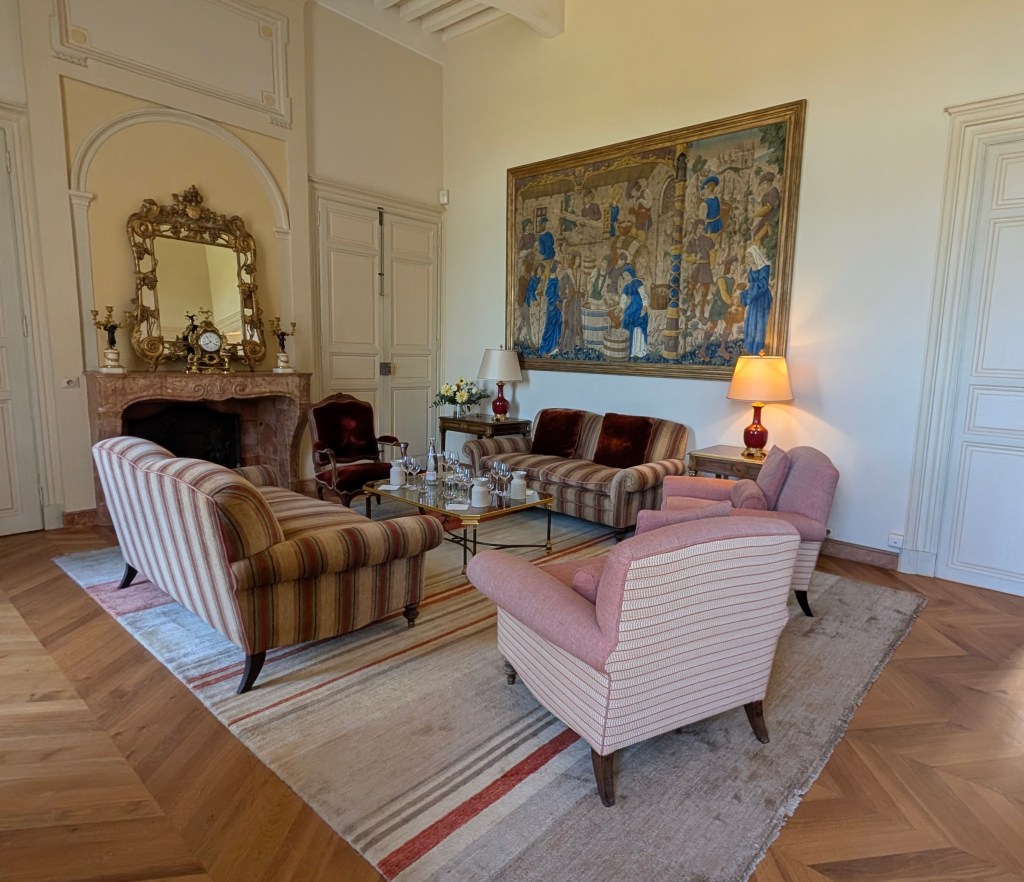
We were escorted to the tasting room. The blue in the tapestry, Anna told us, was typical of the 15th century.

Finally, we tasted.

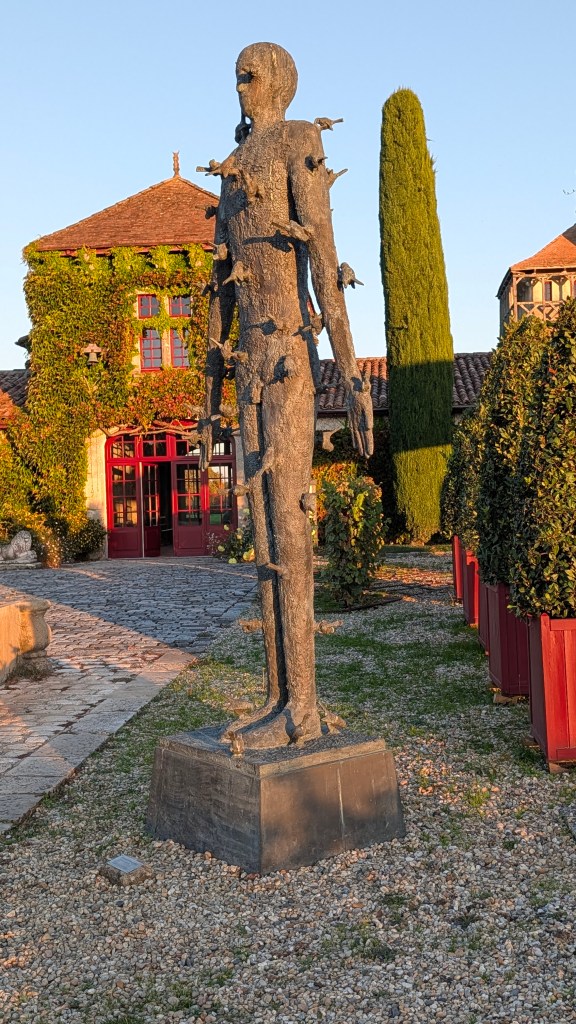
We returned “home” after another long day of eating and drinking. We decided to do a sunset walk and further explore the statues on the property. We could not find titles for all of them.

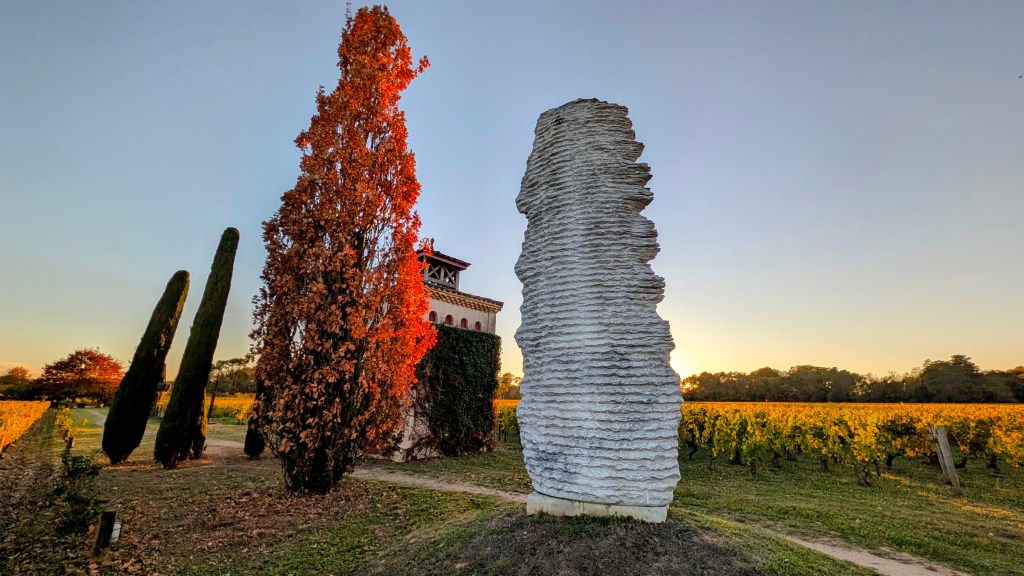
This large stone sculpture titled “Shlomo,” by the artist Boaz Vaadia, is crafted from layered bluestone, a technique Vaadia used to create organic, stratified forms. Boaz Vaadia was known for hand-carving individual stone pieces and stacking them to create figurative or abstract works.

“Shlomo” 

Italian artist Mimmo Paladino’s monumental bronze sculpture is titled “Caduto a ragione” (Fallen to the Ground) .

Caduto a ragione (Fallen to the Ground)

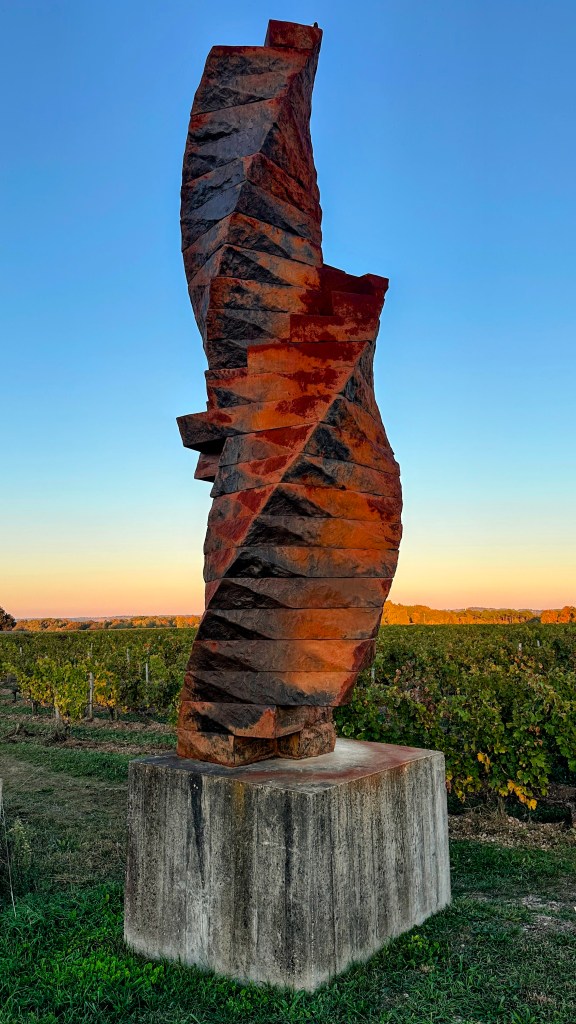
And probably my favorite: “Torsion 2” by Charles Hadcock, a bronze and iron sculpture installed in the vineyard to commemorate the 2009 vintage. Its shape reminded the owners of a vine tendril.

“Torsion 2” by Charles Hadcock

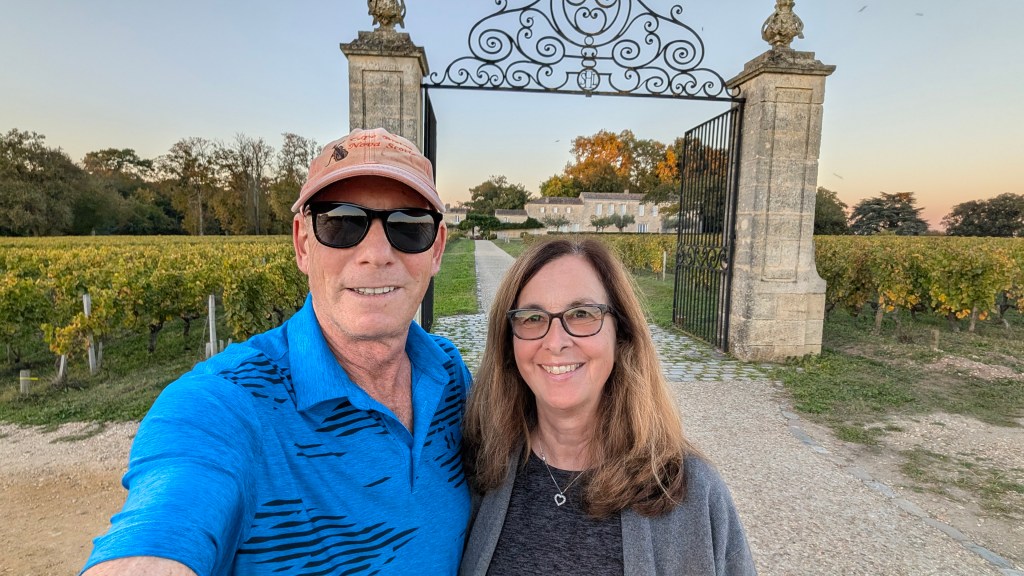
We went all the way out the main gate on our meandering.

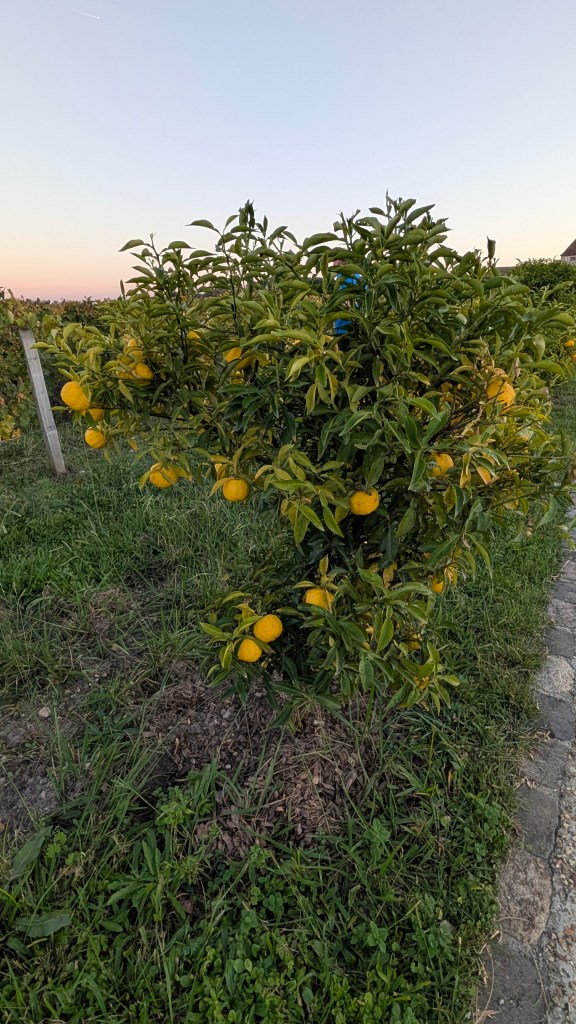
Back inside the property, we found a little kitchen garden complete with a dwarf lemon tree.

The next day we split up. We ladies had chosen to take a cooking class while the guys opted for yet another vineyard tour: We headed to the Haut-Médoc region to Château La Lagune. For most of its history, the Haut-Médoc was a vast region of salt marshes used for animal grazing  rather than viticulture. Romans had planted some vines by the first century AD, which stayed for about 4 centuries. The area was called media aquae (in the middle of water) because it is a peninsula where two rivers converge. Media aquae became Médoc. In the 17th century, Dutch merchants began an ambitious drainage project to convert the marshland into a usable vineyard area. Their objective was to provide the British market a wine alternative to the Graves and Portuguese’s wines that were dominating the market. Using technology that was advanced for that time, the Dutch were able to convert enough marshland to allow large estates to form all along the Gironde. Soon the Bordeaux wine regions of Margaux, Saint-Julien, Pauillac and Saint-Estèphe took shape. In Haut-Médoc there are a total of 6 appellations. By the 19th century, the wine region of the Haut-Médoc was one of the most prosperous in France, with wines that had an international reputation that would be unparalleled till the late 20th century.


Château La Lagune

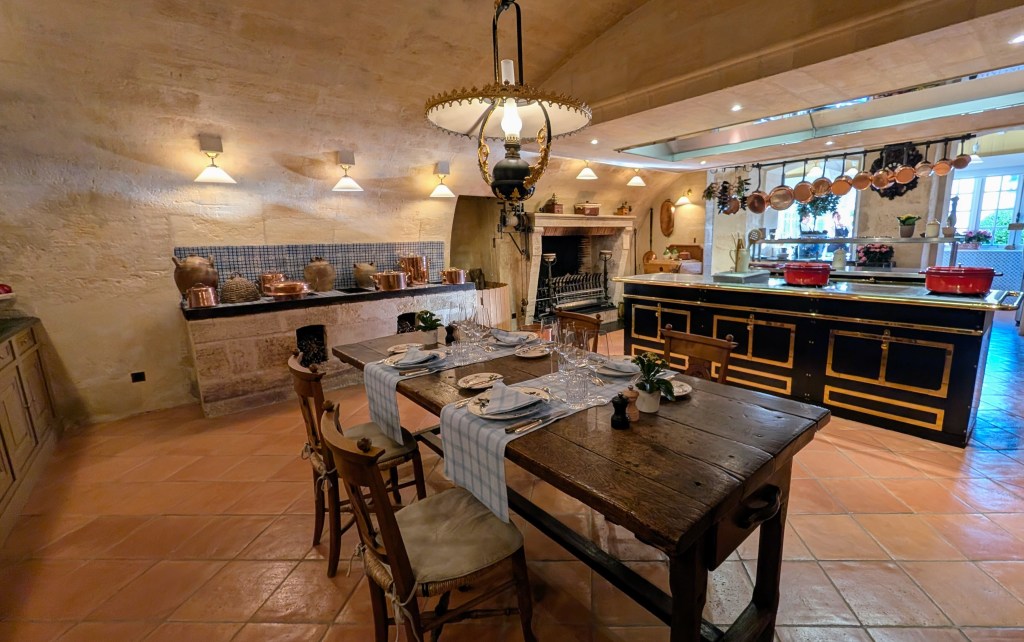
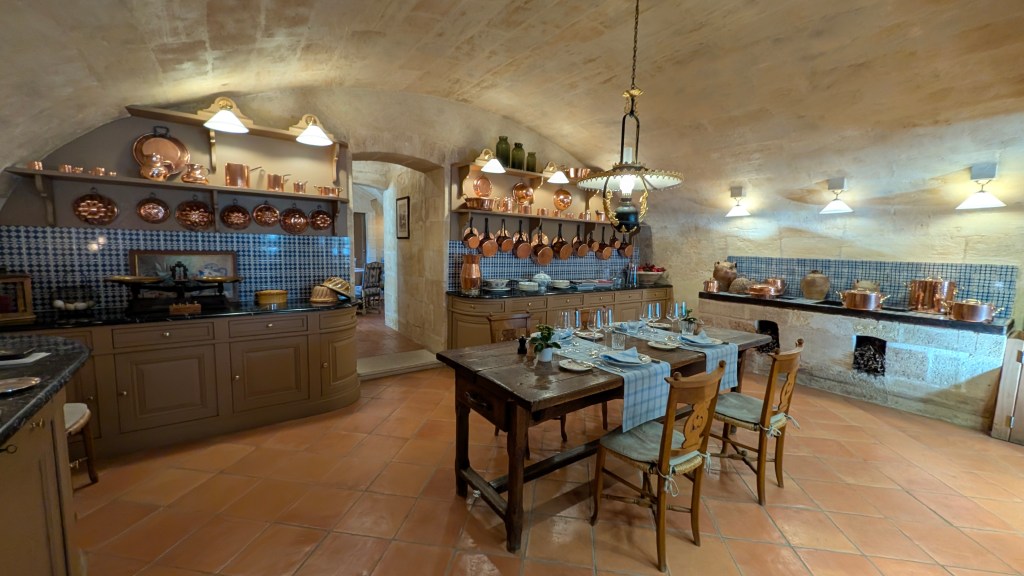
The château building, a single-story Chartreuse style, was built around 1730-1734 by Baron Victor Louis, the same architect who designed the famous Grand Theater of Bordeaux. By 1958, the estate had fallen into disrepair, with barely five hectares of vines remaining in production after a severe frost. It was dramatically rescued and replanted by new owner Georges Brunet. The current owner, Caroline Frey, is a horse lover and former show jumper. Reflecting this passion and a commitment to the terroir, a portion of the vineyard is worked by horses, and the entire 2012 harvest was carried out using only horses. The entire vineyard has been certified organic since 2016 and received biodynamic certification in 2022, highlighting a significant investment in sustainable viticulture practices under the Frey family’s ownership. We were escorted into the 18th century kitchen.

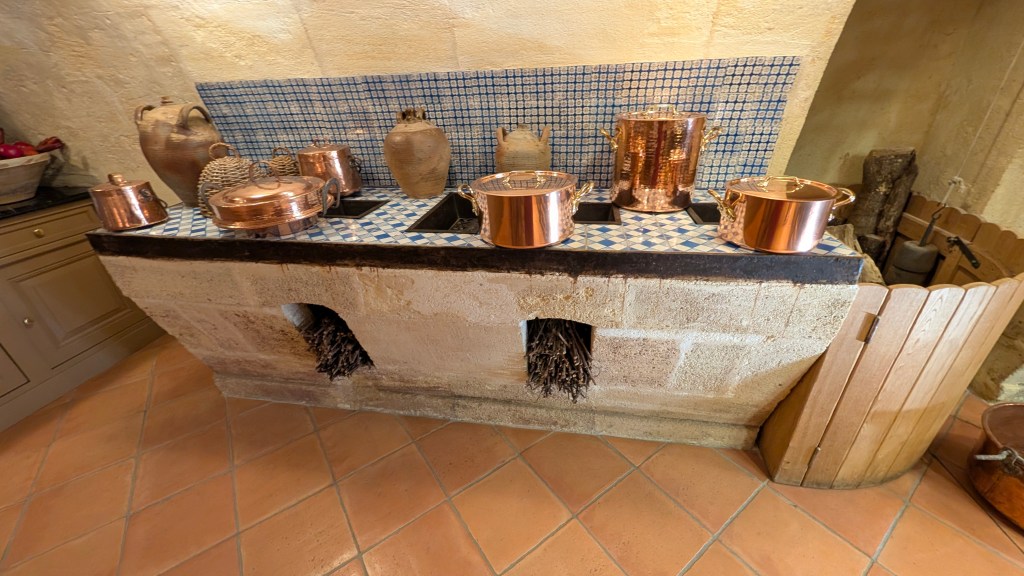
The massive kitchen did not disappoint.

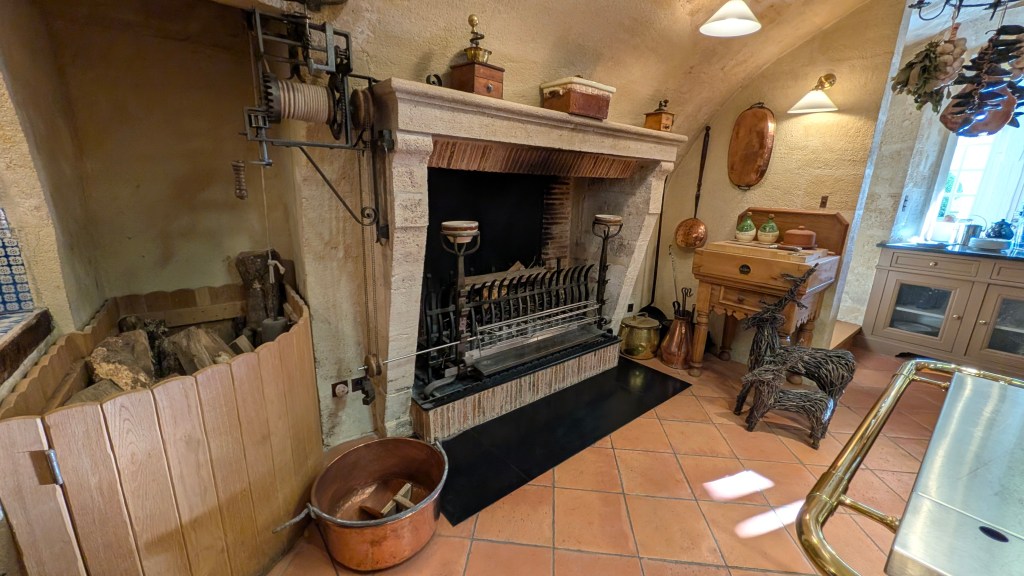
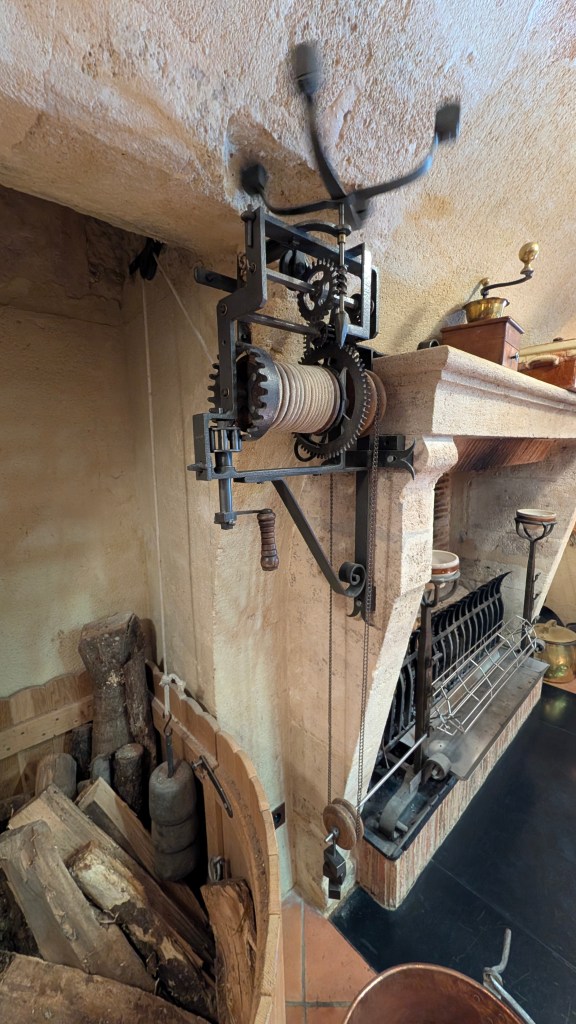
The fireplace not only provided warmth,

it was utilized for cooking. The spit on which large roasts were cooked used a clever system of pulleys and weights to turn the meat.

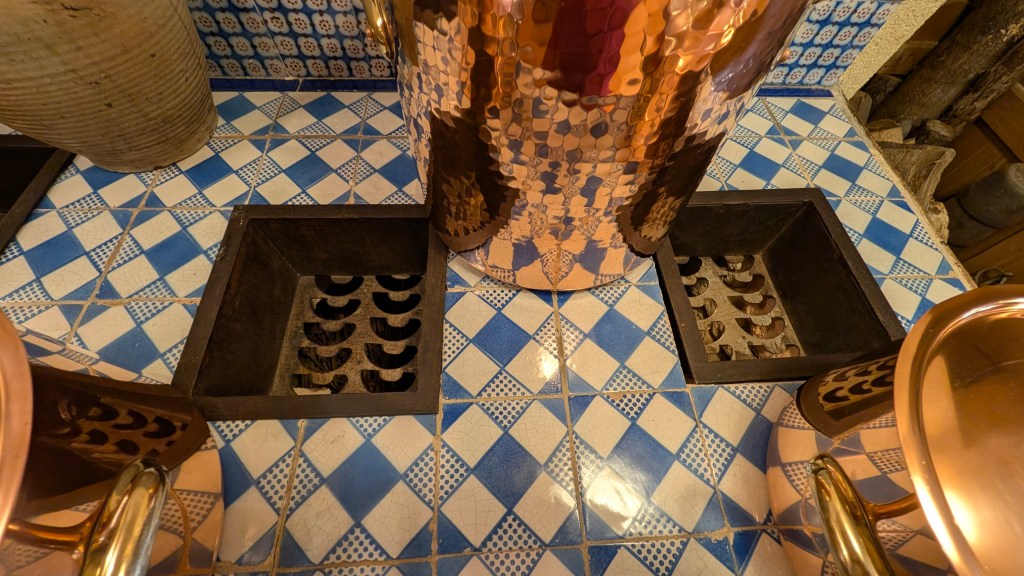
The stove top was heated using fire wood.

It could also be used for a smokey flavor while cooking.

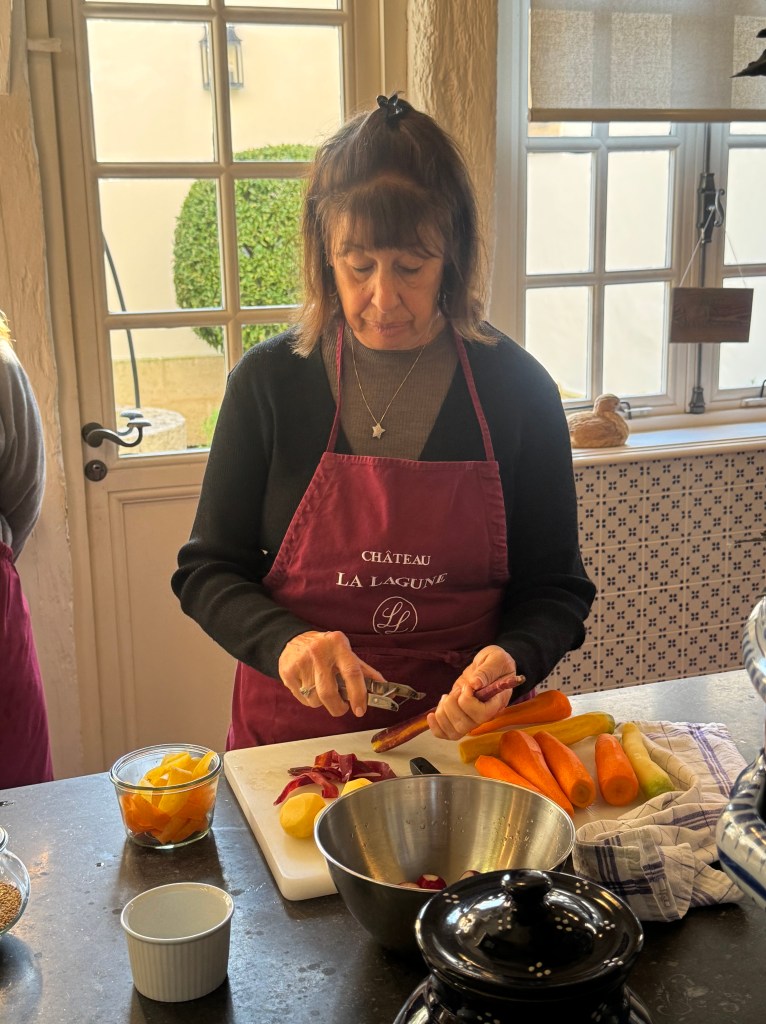
Our instructor for the day was chef Iris.

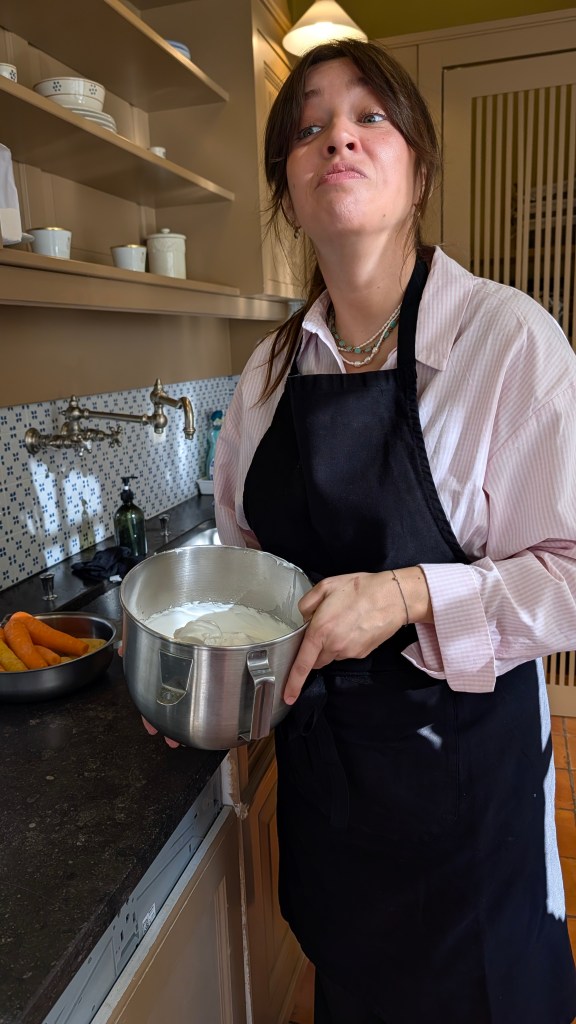
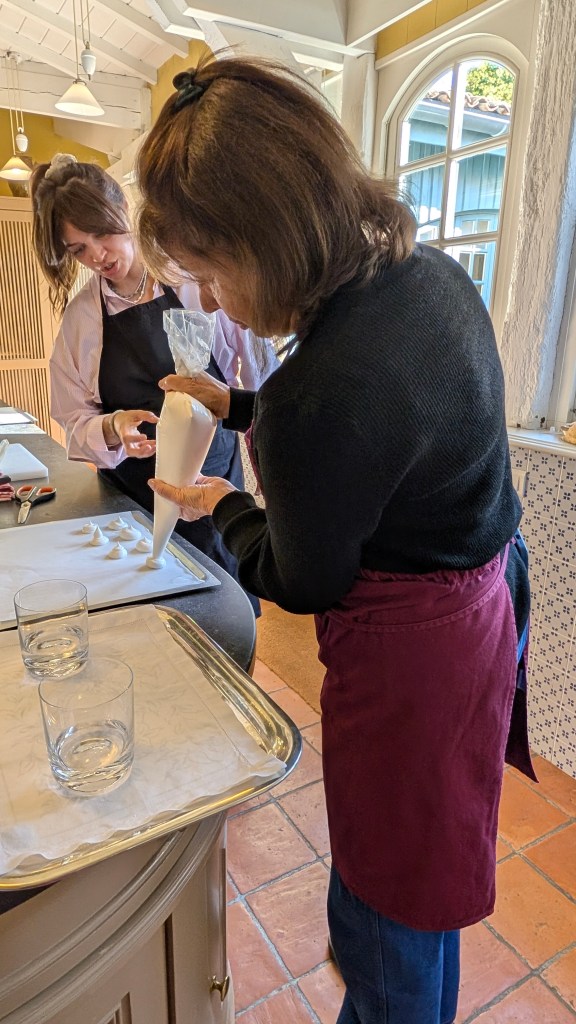
Iris first taught us how to make merengue,

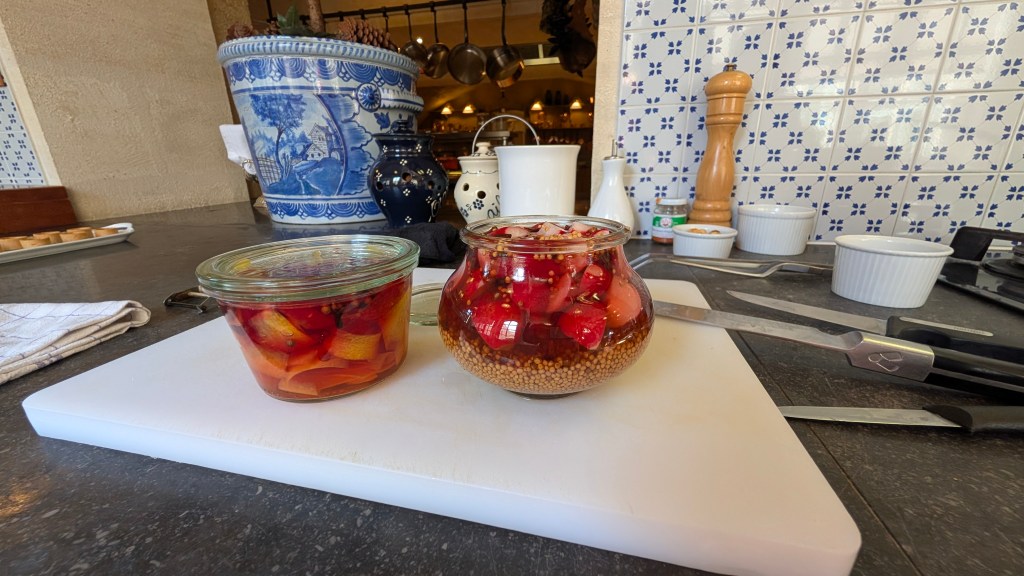
then how to pickle vegetables quickly.

We prepped veggies

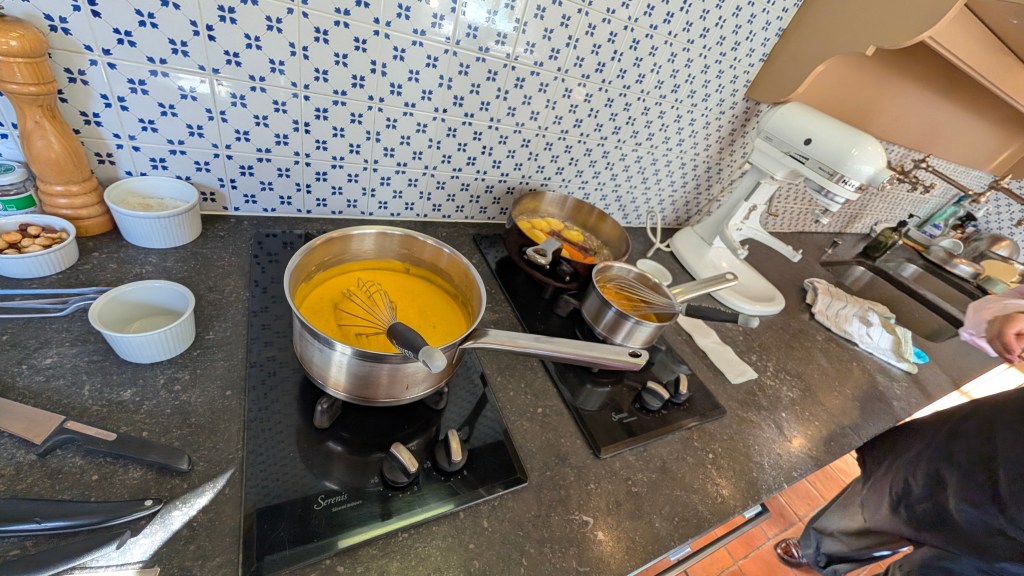
while the soup simmered.

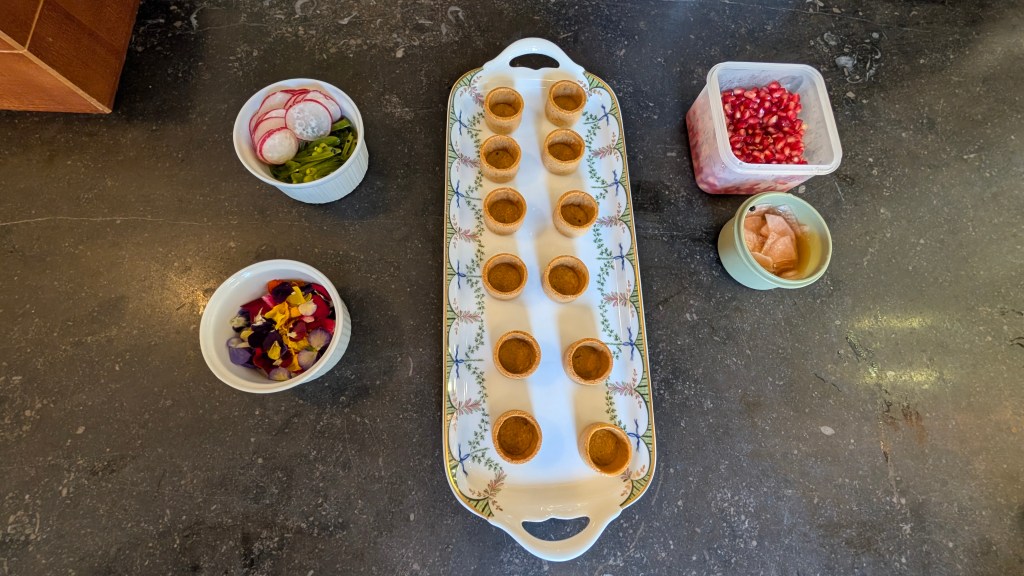
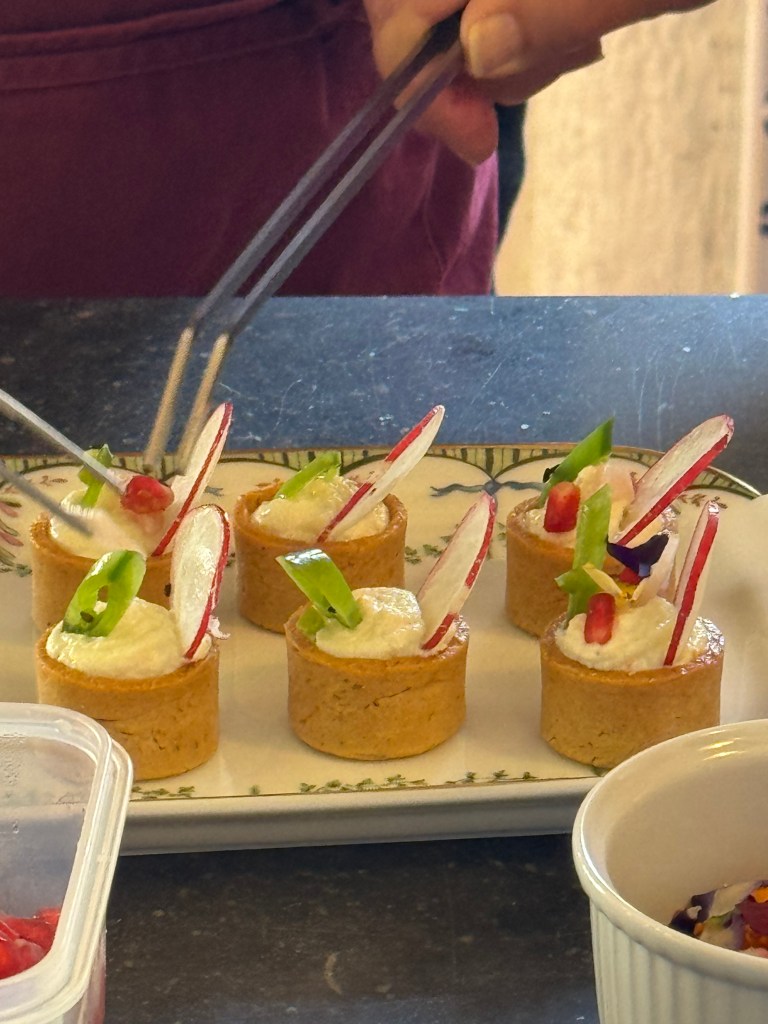
Next food project was the amuse-bouche.

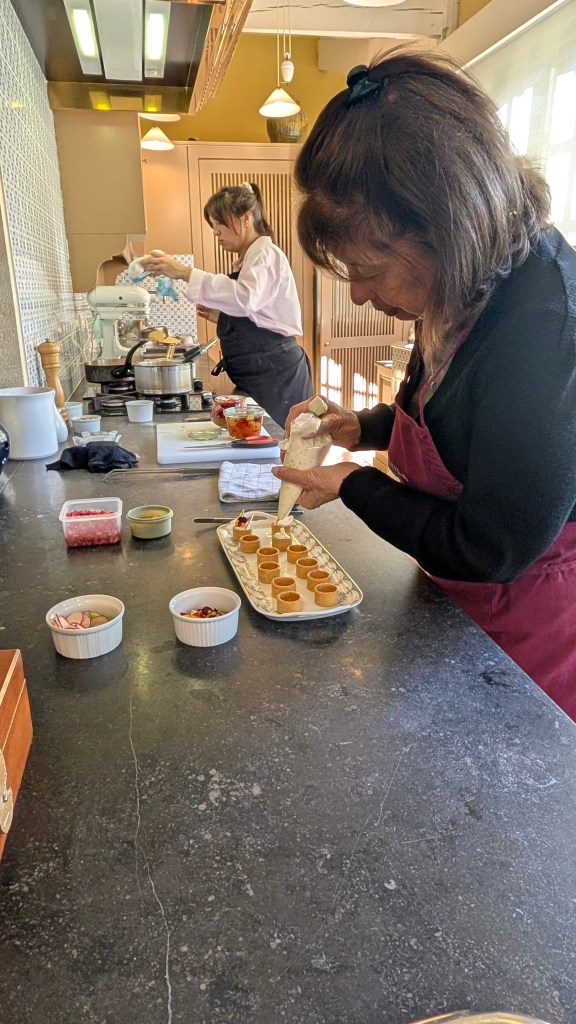
After filling the cups with mascarpone,

the decorating called for teamwork.

We were proud of our results.

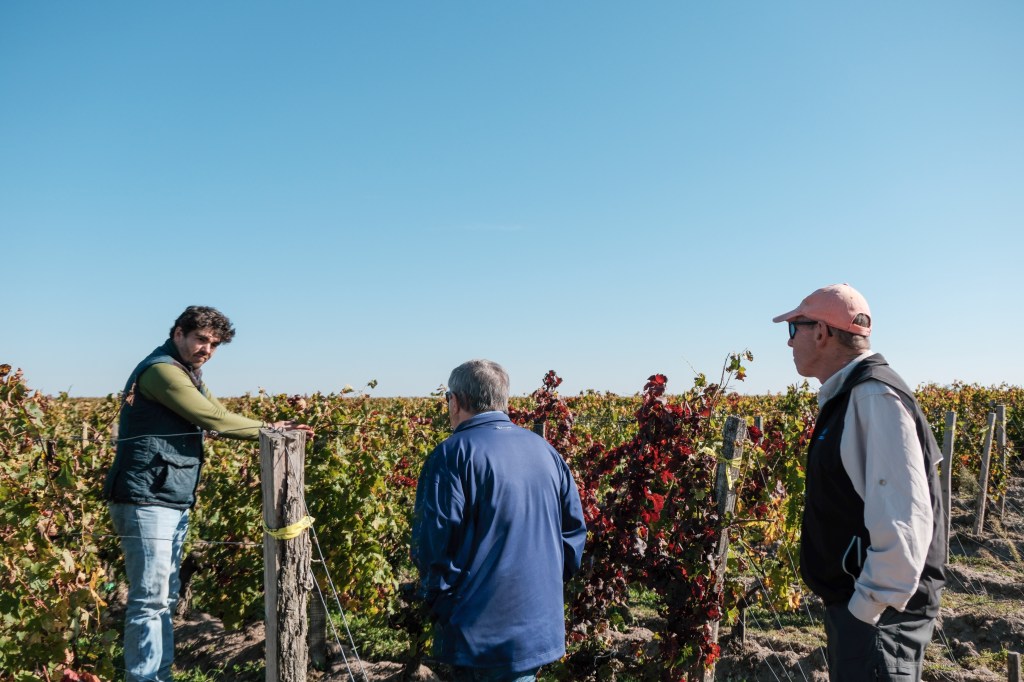
Meanwhile the guys had a vineyard tour

followed by a tasting.

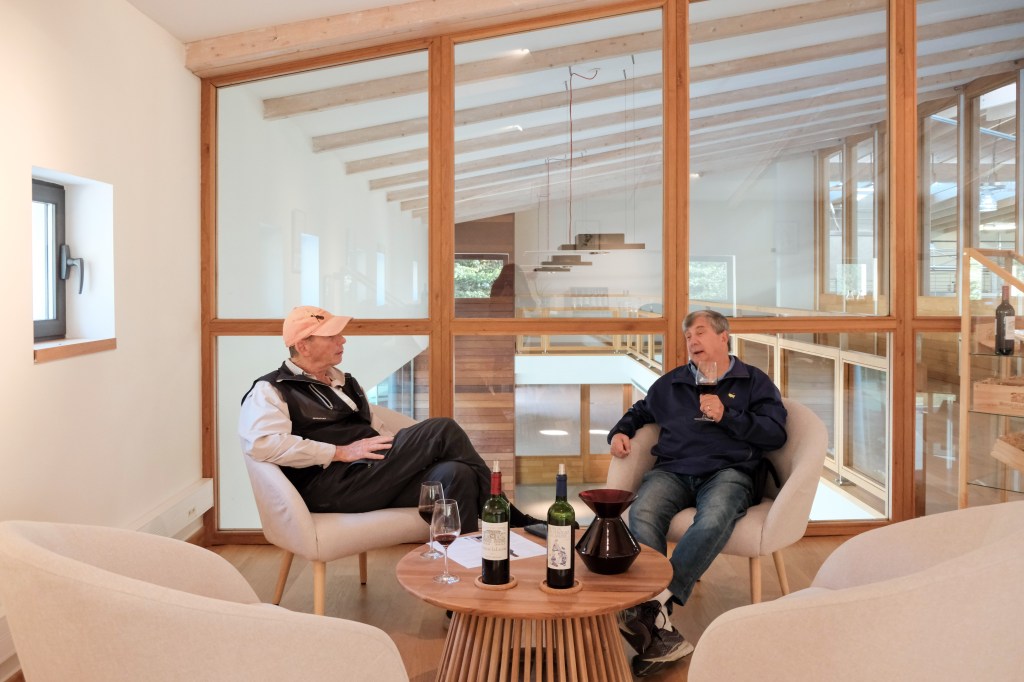
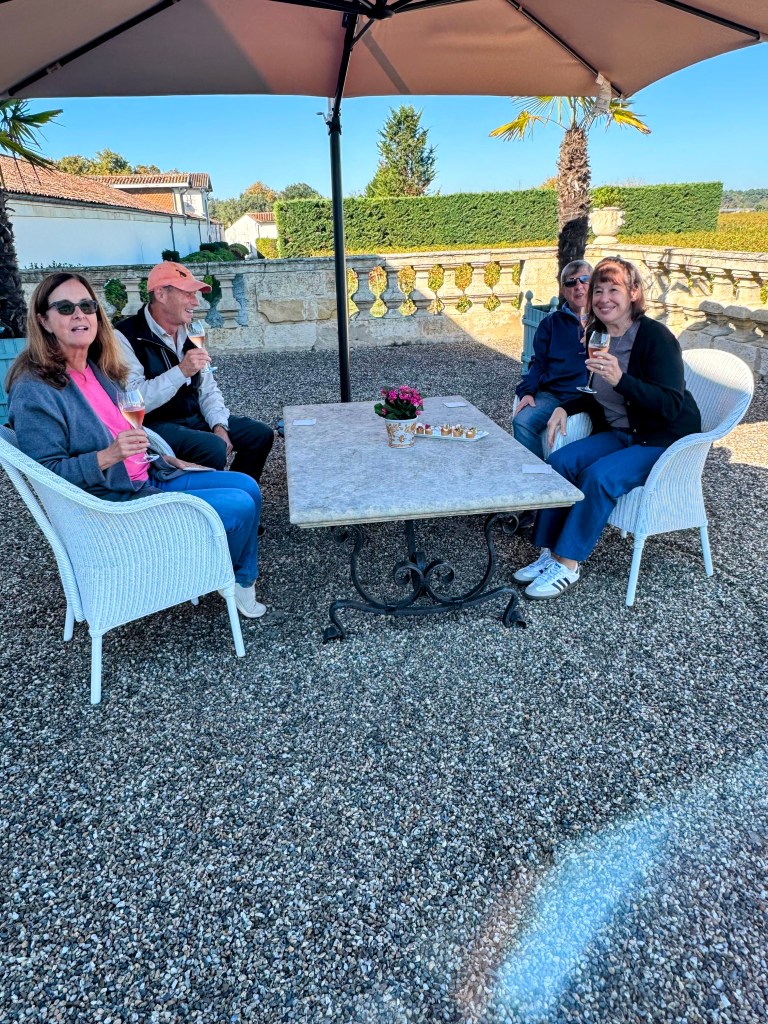
We joined them for a glass of wine before dinner.

Having been told that the chateaux can be rented by a group for a stay, we were invited to tour the mansion . We started in the dining room,

then the parlor,

and the sitting room.

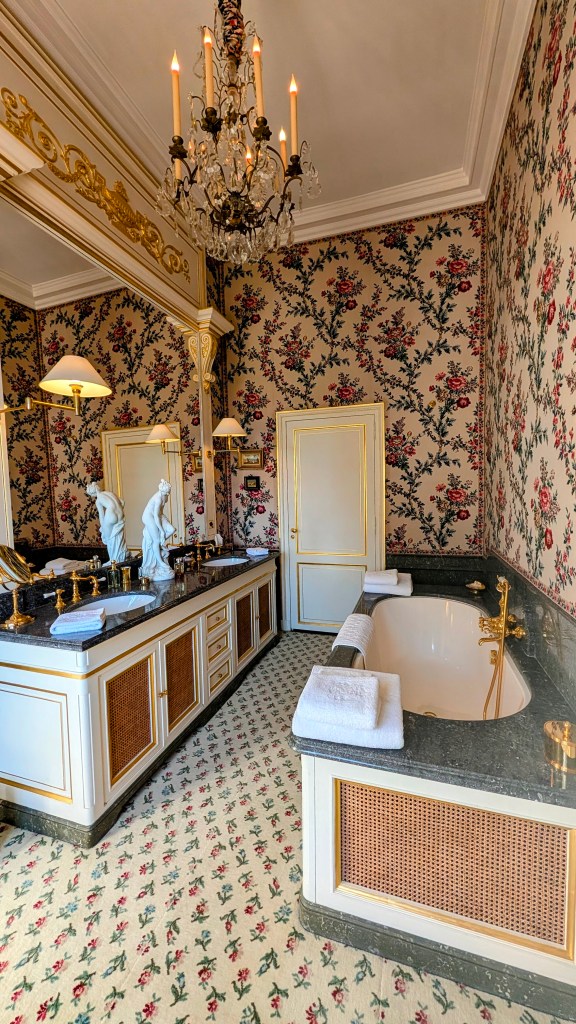
This is one of four bedrooms

each with an en-suite bathroom.

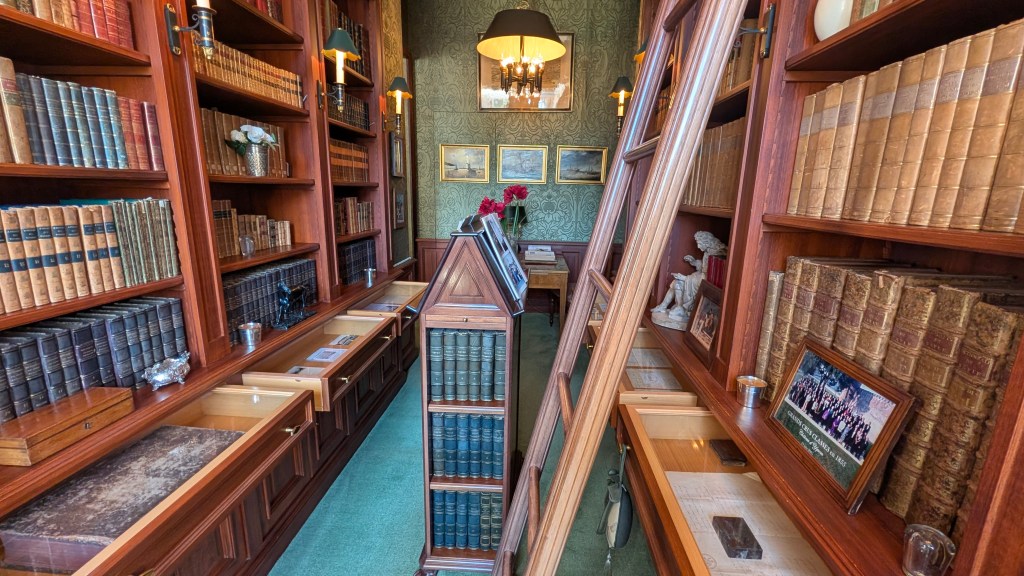
My favorite room, besides the kitchen, was the library.

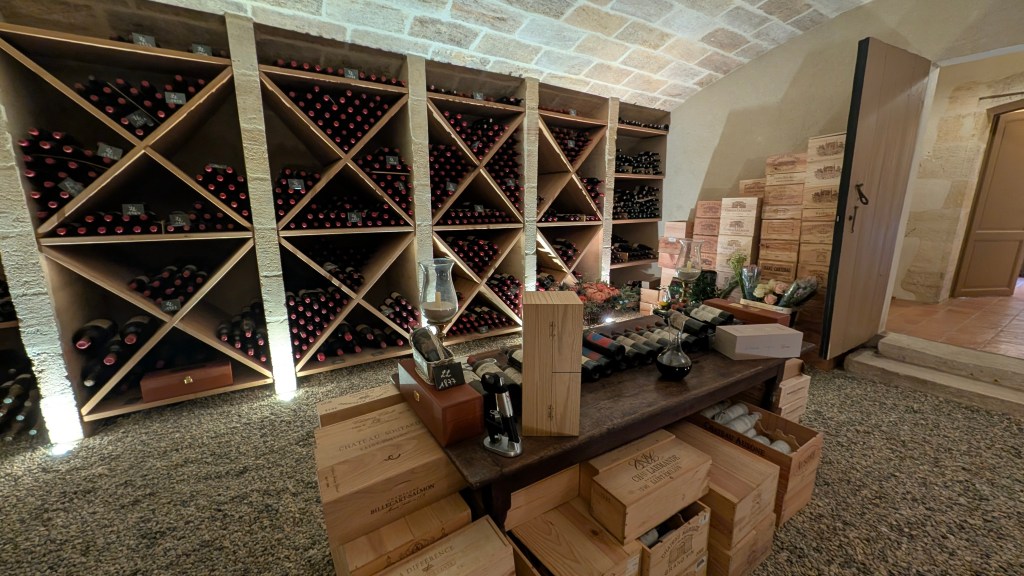
We checked out the extensive collection in the wine cellar

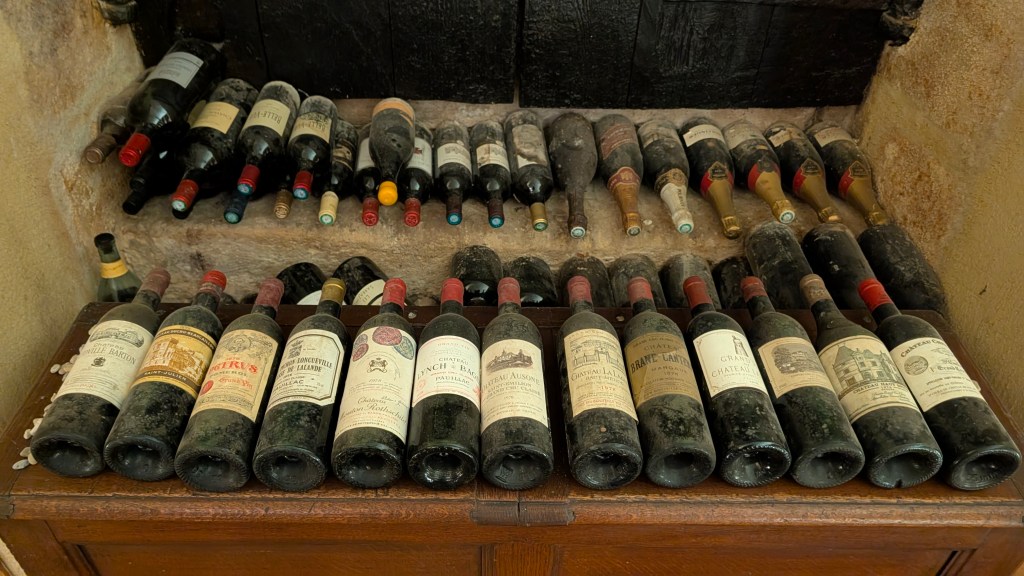
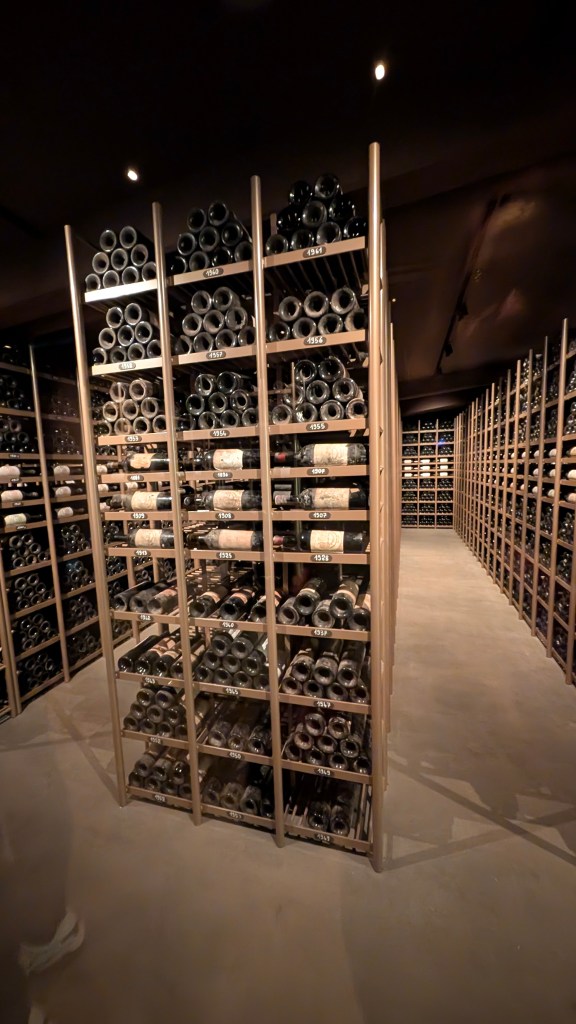
which included some very old bottles.

Finally it was time to enjoy the fruits of our (and chefs Iris and Katharine, who was in the background) labors.

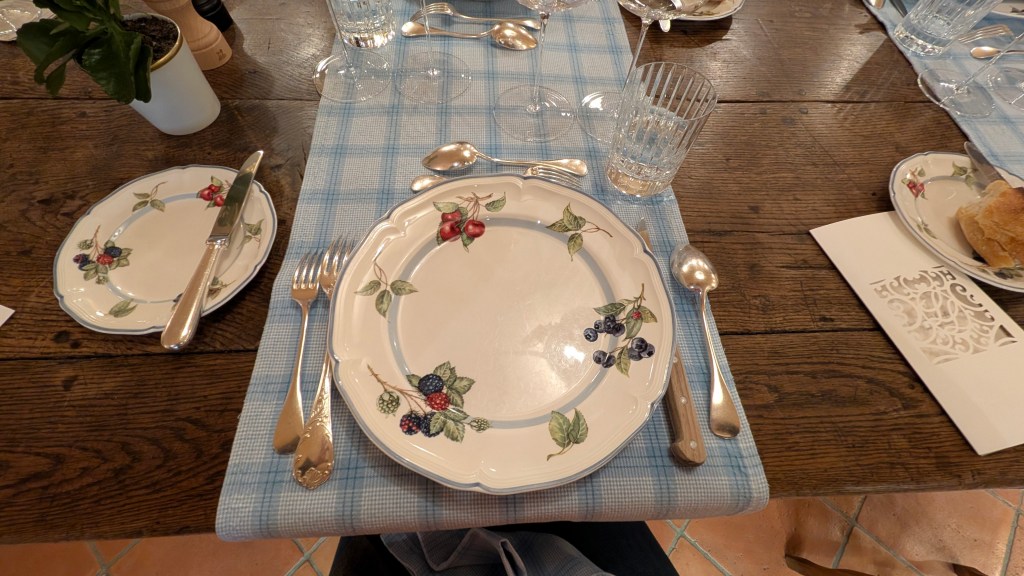
The table was ready.

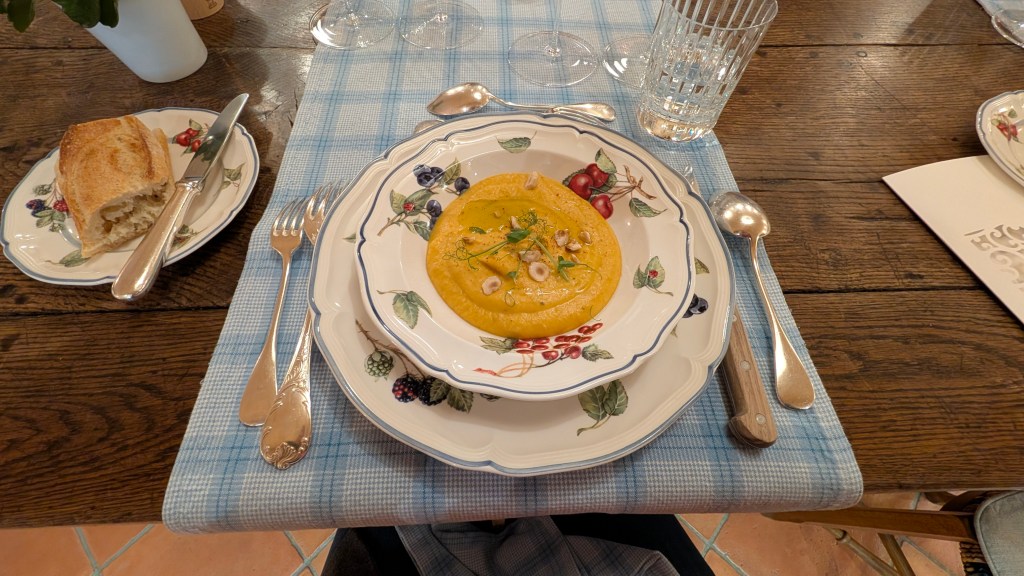
We started with the soup

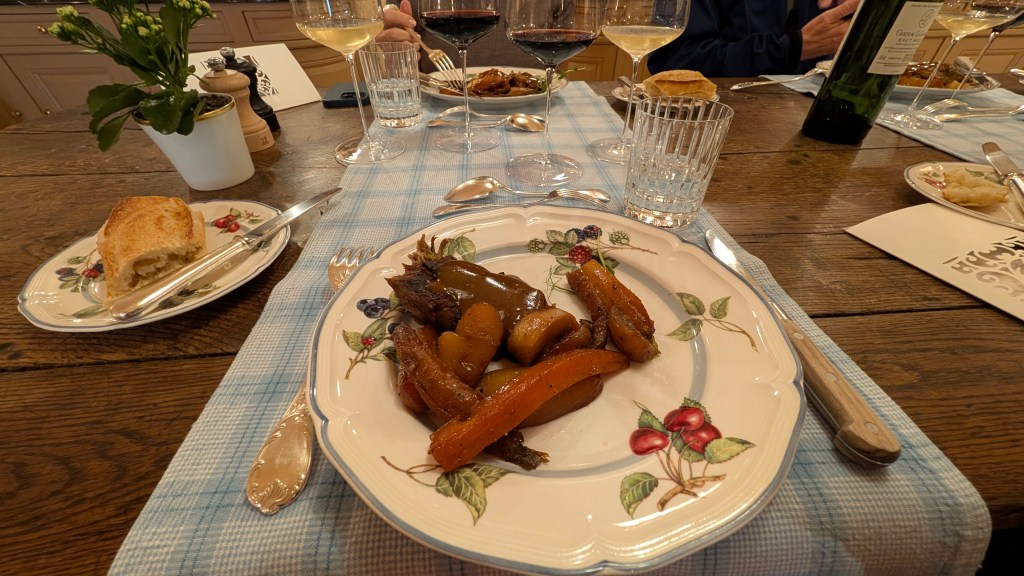
followed by braised lamb and vegetables.

Next was the requisite cheese course before dessert.

Our merengues had come out great!

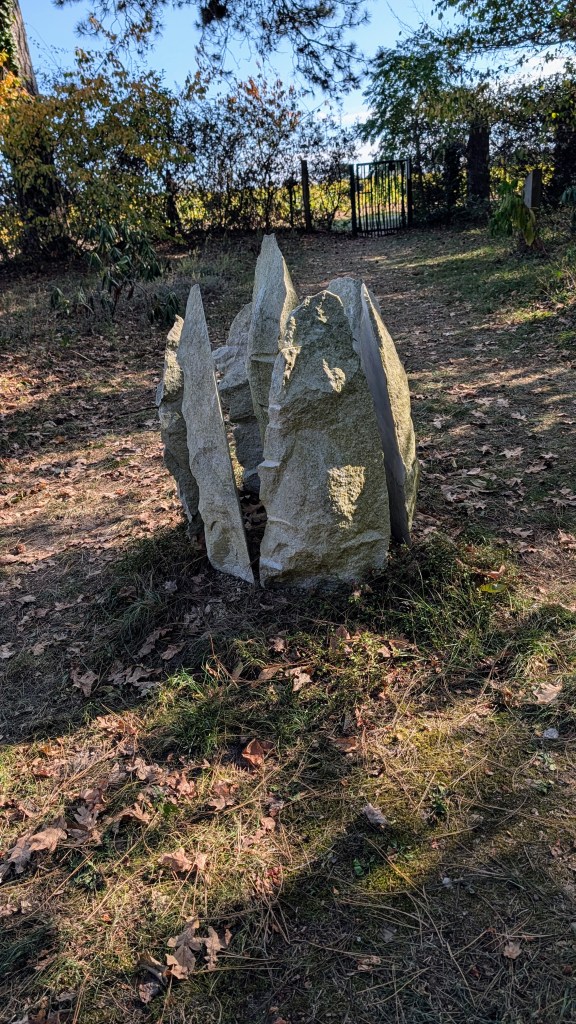
After such a big meal, and with no scheduled plans for the afternoon, Carol and I decided to tour the Forest of the Senses while the guys rested. Unlike most strictly agricultural estates, Smith Haut Lafitte features a 25 acre open-air museum called the Forest of the Senses, a land-art trail filled with contemporary sculptures. First we had to obtain the key to the gate from the wine shop. The first sculpture we encountered was “Oracle” by artist Jon Isherwood constructed from Fox Hill granite.  The sculpture is designed with multiple vertical segments that evoke a natural, monolithic look while being artistically structured. Isherwood’s work often focuses on involving the viewer’s interpretation through abstract, center-focused designs. 

“Oracle”

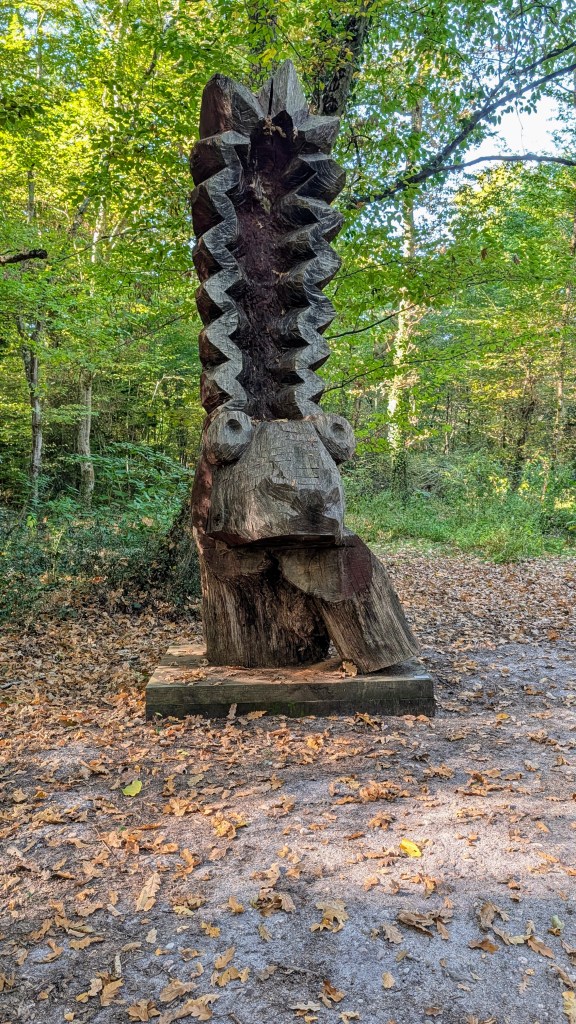
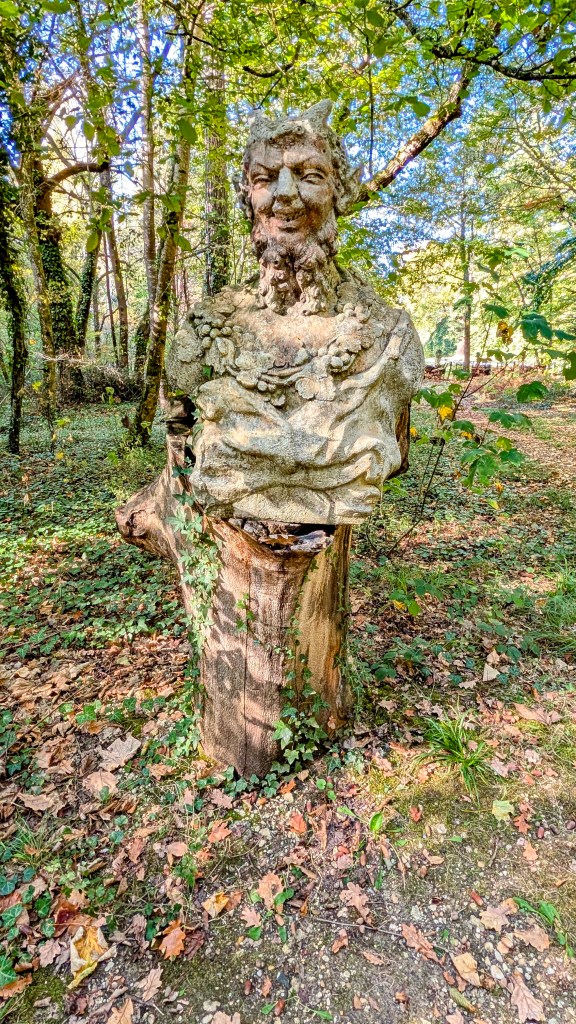
“Funky fellow”, a chainsaw carving created from a tree trunk, is situated near the Pharmacie de la Vingne (Pharmacy for the Vines), a dedicated, open-air exhibit showcasing natural, organic remedies used to protect the vineyard. It features eco-friendly alternatives to chemical products, such as horsetail and nettle.

“Funky fellow”

“Upstand” (2009) by Anthony Caro is humanoid sculpture made of metal and concrete that has become a natural habitat for moss and insects. 

Upstand”

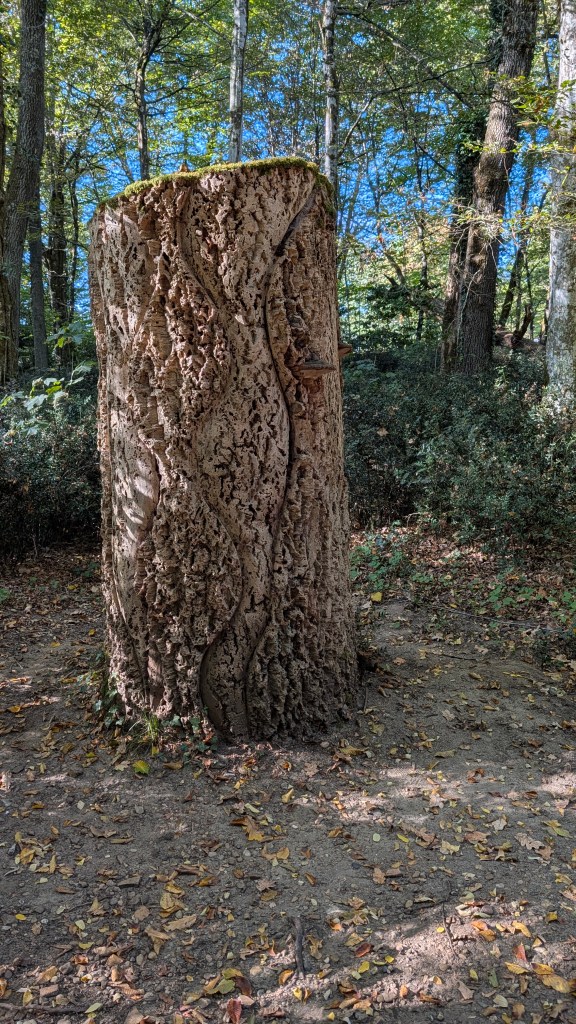
This centuries-old cork oak fell onto the neighboring property and left behind a natural statue visitors are encouraged to embrace, according to the signage.

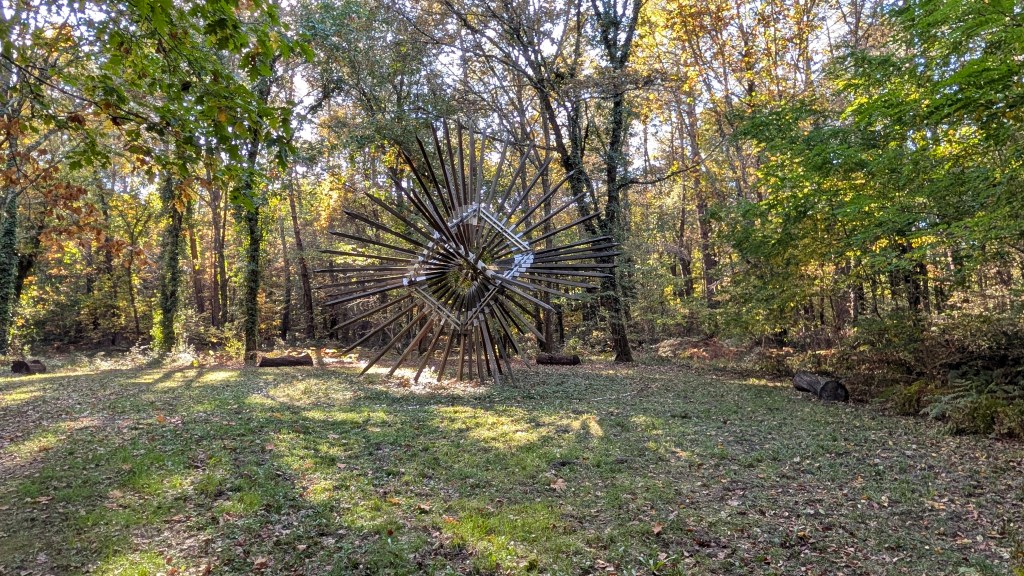
We could not find a title for this magnificent piece.

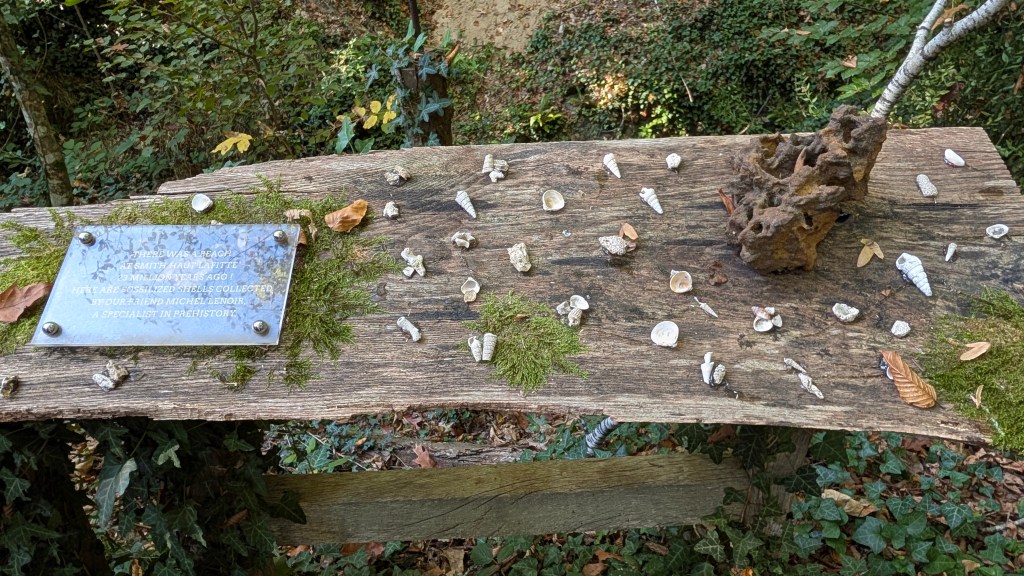
Twenty three million years ago Smith Haut Lafitte was a beach. These sea fossils have been collected from around the property.

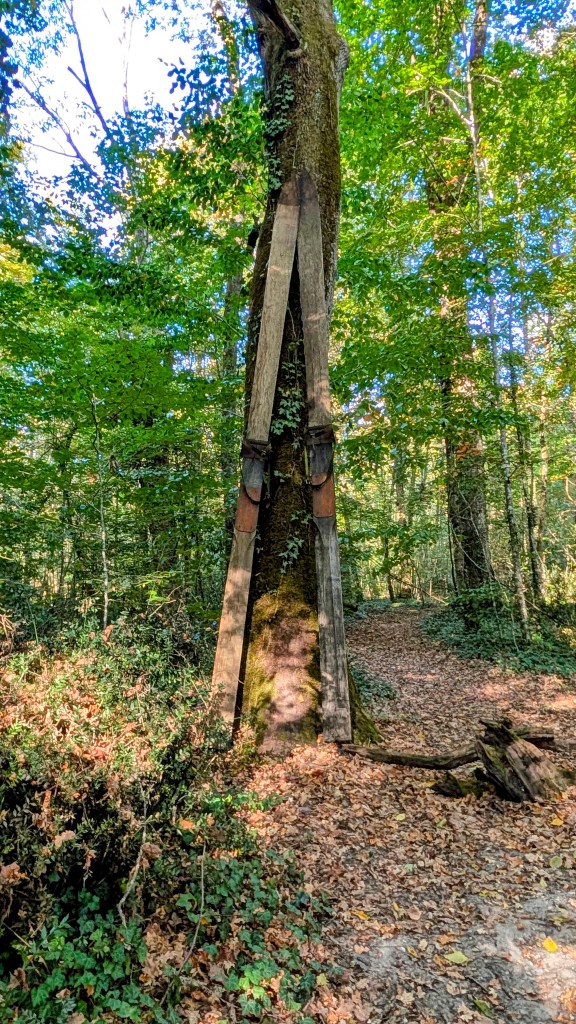
“Gulliver’s Skis” by Cyrille Menei is a nod toward the meeting of the Cathiards as ski champions for the French ski team.

“Gulliver’s Skis”

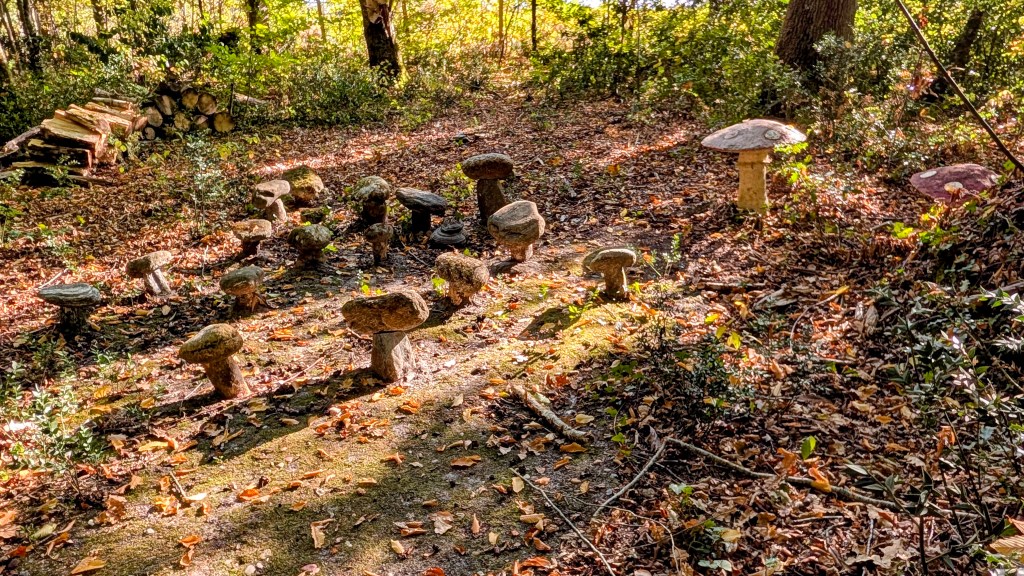
There was a garden of stone mushrooms

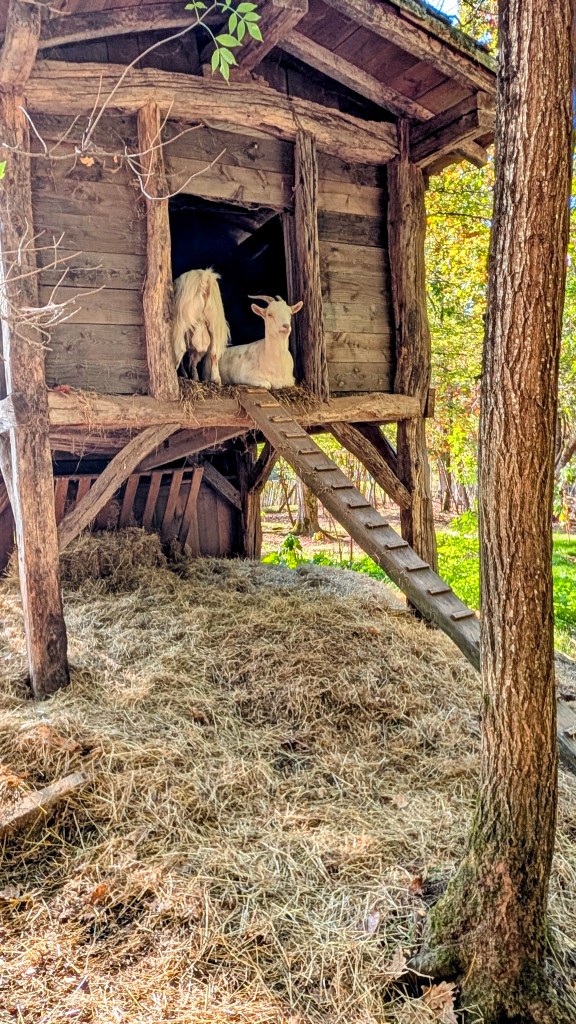
and live goats.

It was at this point we had reached a part of the working farm. It was also at this point that our map indicated the exit, but we could not find it. We tried all of the paths in several directions, but could not find our way to the gate. In exasperation, we climbed the fence.

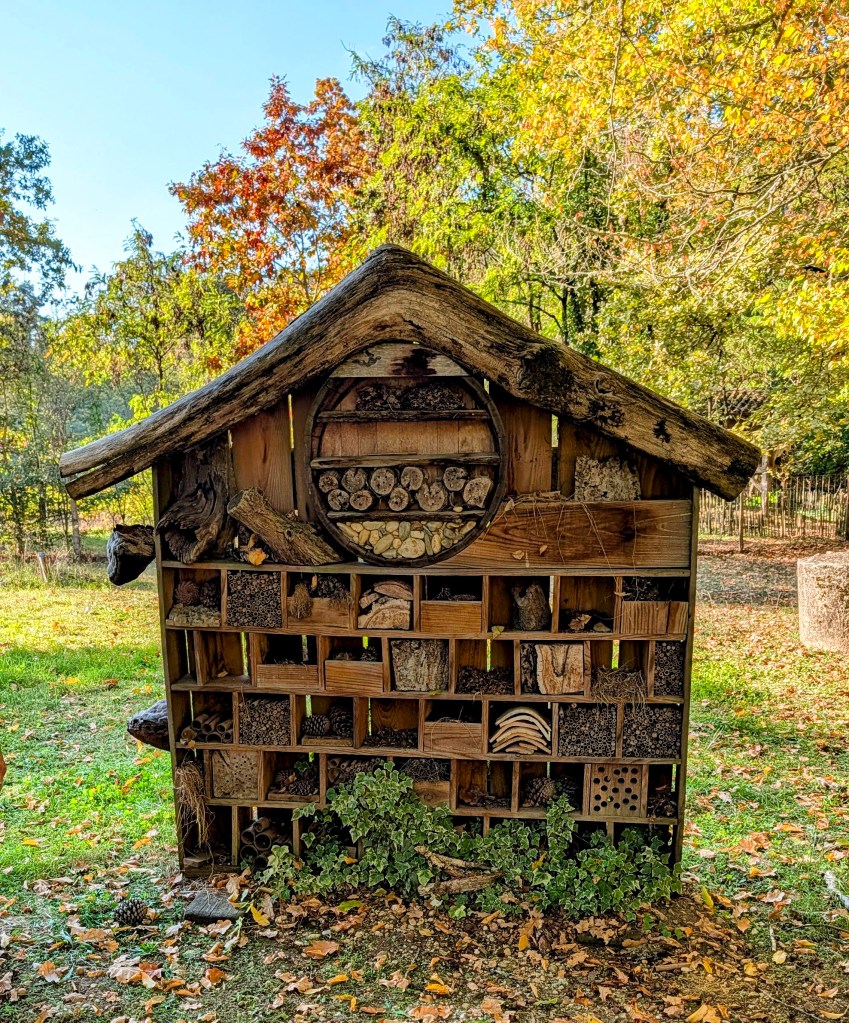
Such a large property requires a large bug hotel, also known as an insect house or insect habitat, designed to provide shelter for beneficial insects in a garden. It attracts beneficial insects like solitary bees, ladybirds, lacewings, and beetles to help with pollination and pest control. The structure is typically wooden and filled with varied natural materials to accommodate different species.  Common fillings include bamboo tubes, drilled logs, pinecones, bark, and straw, which provide nesting sites for pollinators and hibernation spots for other insects.  The roof should overhang to protect the interior from rain, and nooks and crannies provide year-round refuge. 

bug hotel

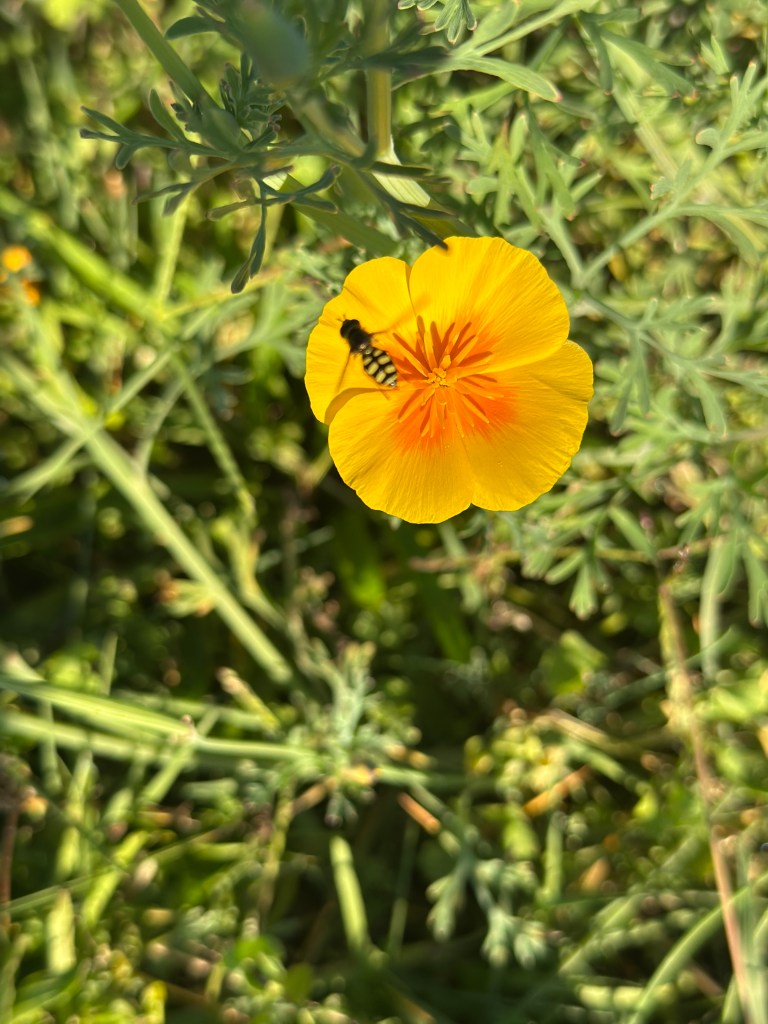
Nature at work: a pollinator on a poppy.

We ducked through one las sculpture

as we made our way back to the winery to return the key.
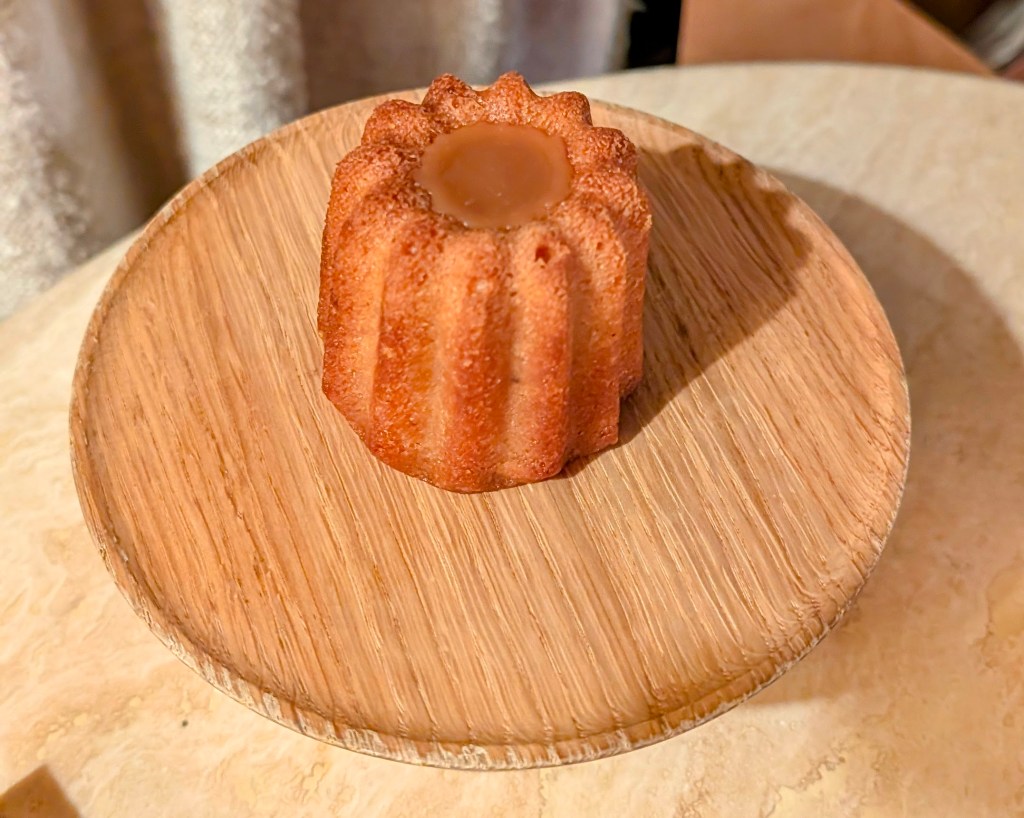
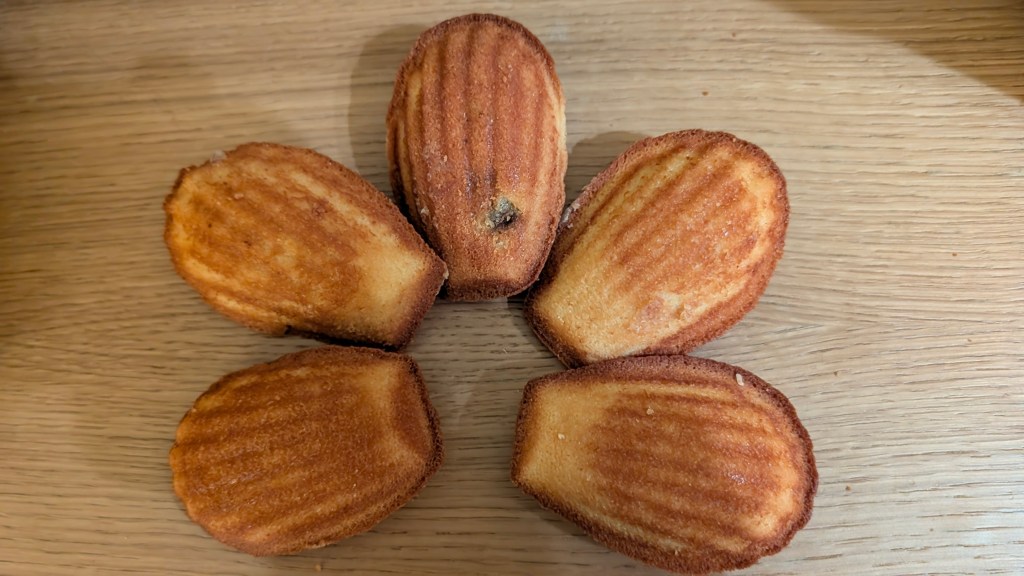
Each day the staff at Les Sources de Caudalie left us a canelé, a traditional French pastry originating from Bordeaux. A canelé features a thick, caramelized, crunchy exterior with a soft, custardy interior. typically flavored with rum and vanilla bean. Traditional preparation involves baking in copper molds lined with beeswax and butter to achieve a glassy, caramelized crust.  The origins of the canelé are somewhat mysterious; the name “canelé” comes from the French word meaning “fluted,” a nod to its shape, but also to the corks used for the wine barrels. The pastry is believed to have been created between the 15th and 18th centuries by nuns in Bordeaux using the egg yolks left over, some say from the whites having been used to starch the priests’ shirts, others say from the egg whites having been used in the clarification process in the wine making.

Canelé

The following day we headed to Saint-Émilion, a prestigious Right Bank Bordeaux wine appellation, renowned for producing red wines dominated by Merlot, often blended with Cabernet Franc. Covering over 13,600 acres, the region is characterized by diverse limestone, clay, and sandy soils, creating varied, structured wines. It features two main AOCs: Saint-Émilion and the superior Saint-Émilion Grand Cru. Saint-Émilion’s 860 wineries produce over 15 million bottles a year.

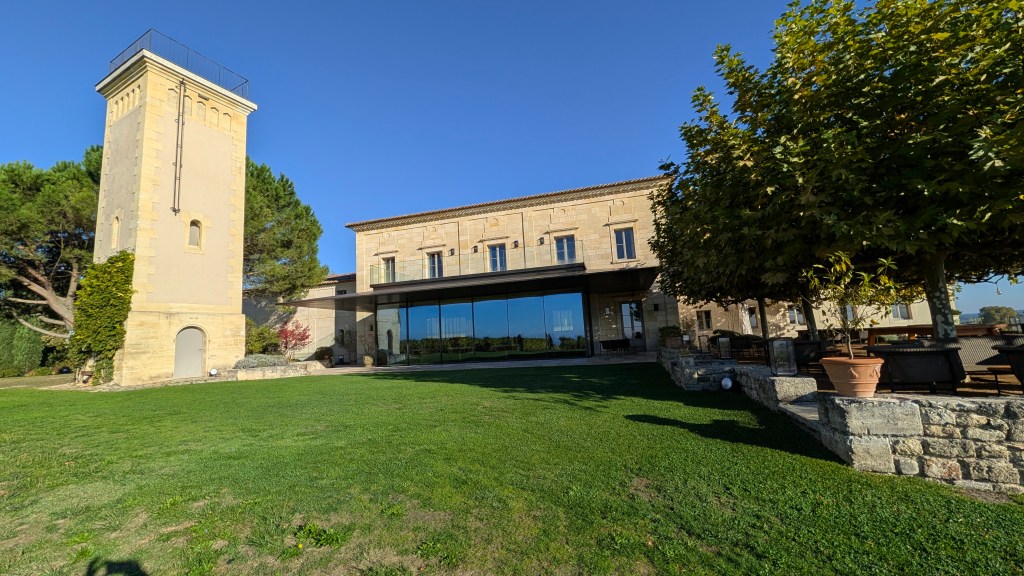
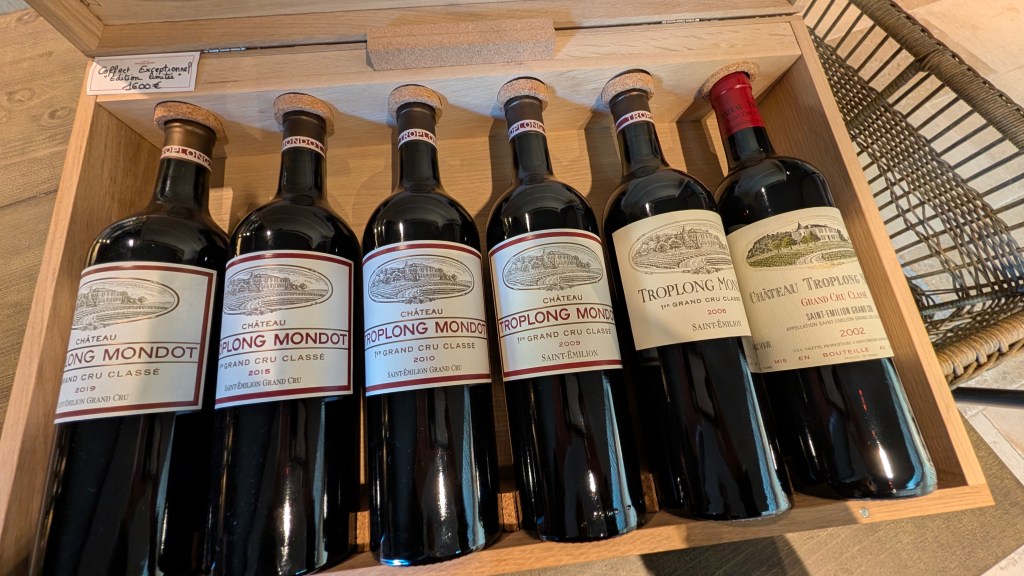
We headed to Château Troplong Mondot, a prestigious Premier Grand Cru Classé B renowned for its high-altitude, 106 acre vineyard, one of the largest in the appellation. Situated 360 feet above sea level, it offers 360-degree views.

Château Troplong Mondot

The estate was originally built in 1745. The estate takes its name from Raymond-Théodore Troplong, a prominent jurist and President of the Senate under Napoleon III, who expanded the property in the 1850s.

Originally the winery had only 80 acres containing 28 vineyards. Starting in the 1980s then owner Christian Valette reworked and replanted all of the vines over a 25 year period, then, 12 years ago bought about another 20 acres. In 2017, the SCOR insurance company acquired the estate from the Valette family, who had owned it since the 1930s. Due to its elevation, the terroir is unique, with thick clay-limestone soils containing flint and limestone. The limestone absorbs water and the flint absorbs the daytime heat, together allowing for high-concentration, powerful wines.

The majority of grapes had already been harvested, but there were some bunches still on the vine. The wines are primarily from Merlot grapes, 80%, and 20% Cabernet Franc.

Work horses have replaced tractors since 2010 because they are less likely to pack the dirt, which makes for better soil.

We took a safari ride to explore the property

and get a view of the town of Saint-Émilion below.

The property includes a luxurious hotel

and a permculture garden, a regenerative agricultural system that mimics natural ecosystems to create self-sustaining, productive landscapes, focusing on ecological harmony, soil health, and minimal waste.

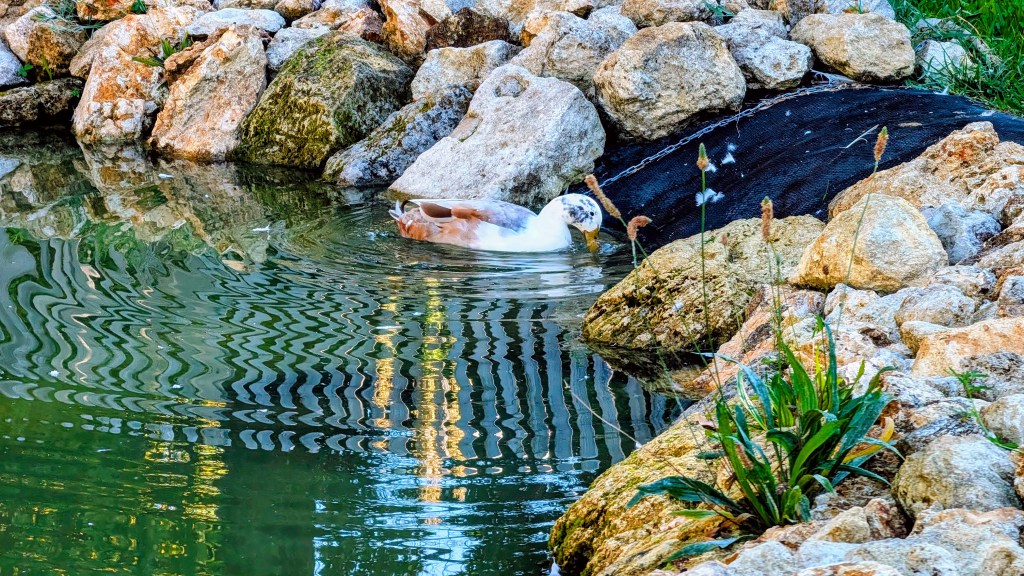
The ducks eat insects.

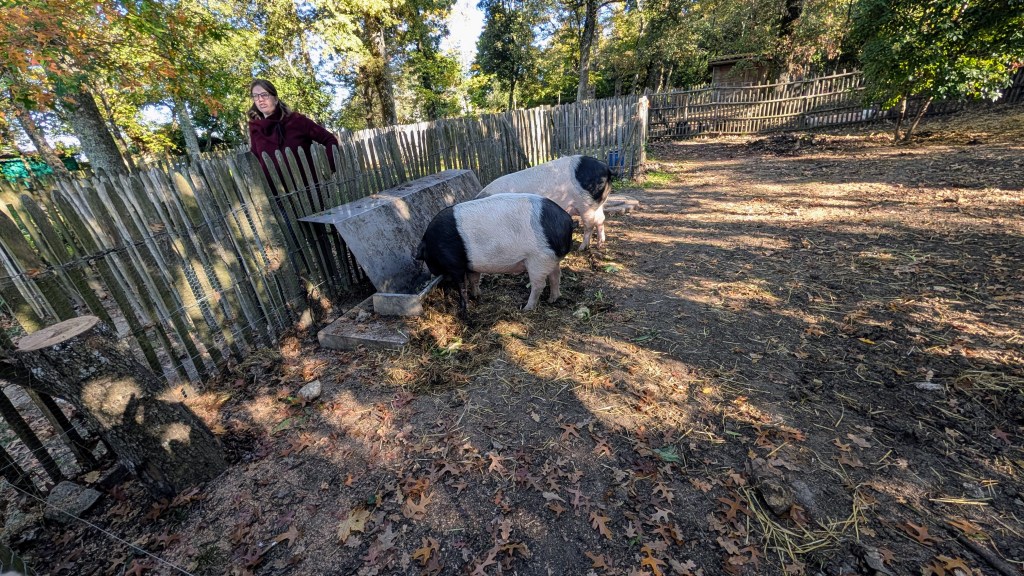
The pigs eat the table waste from the restaurant, then become food themselves the following year.

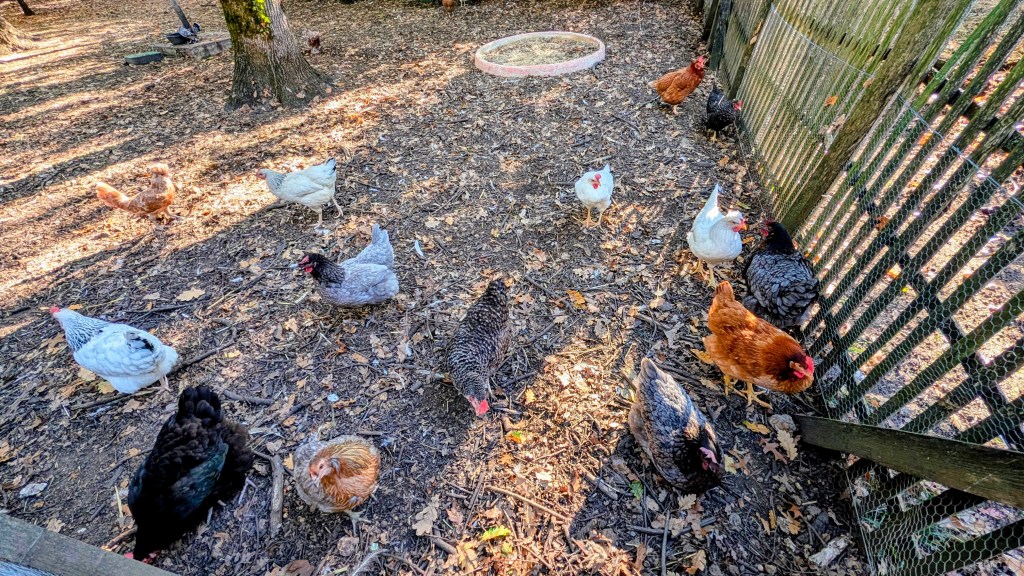
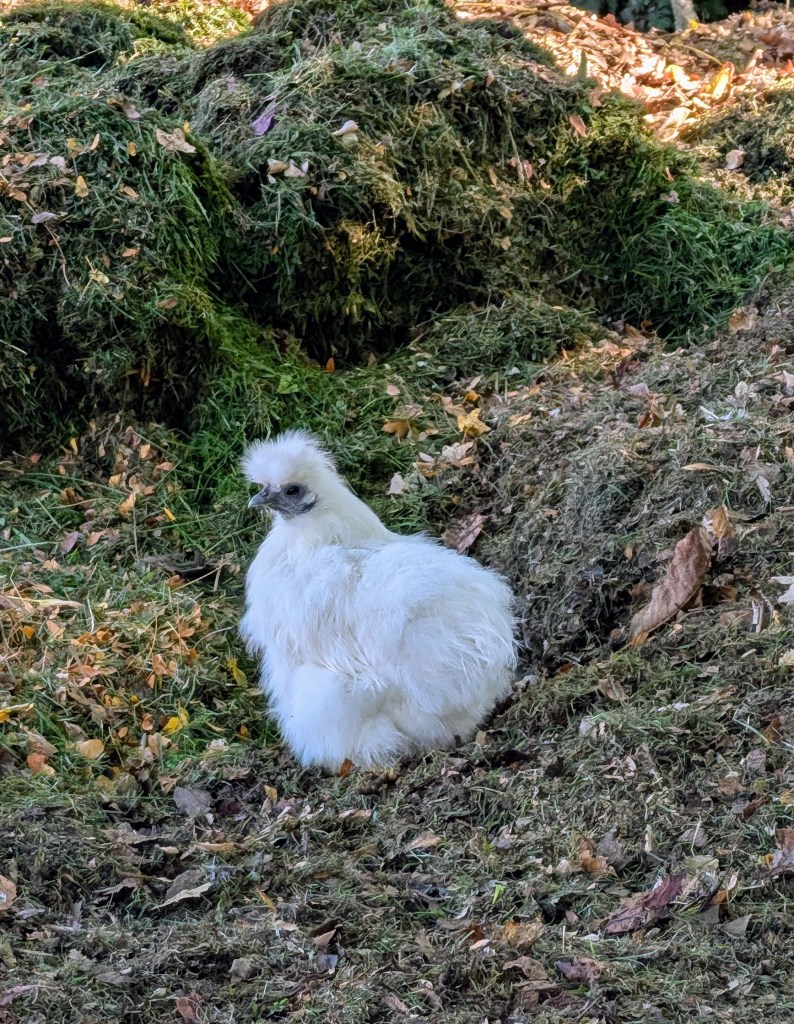
The chickens also eat table scraps.

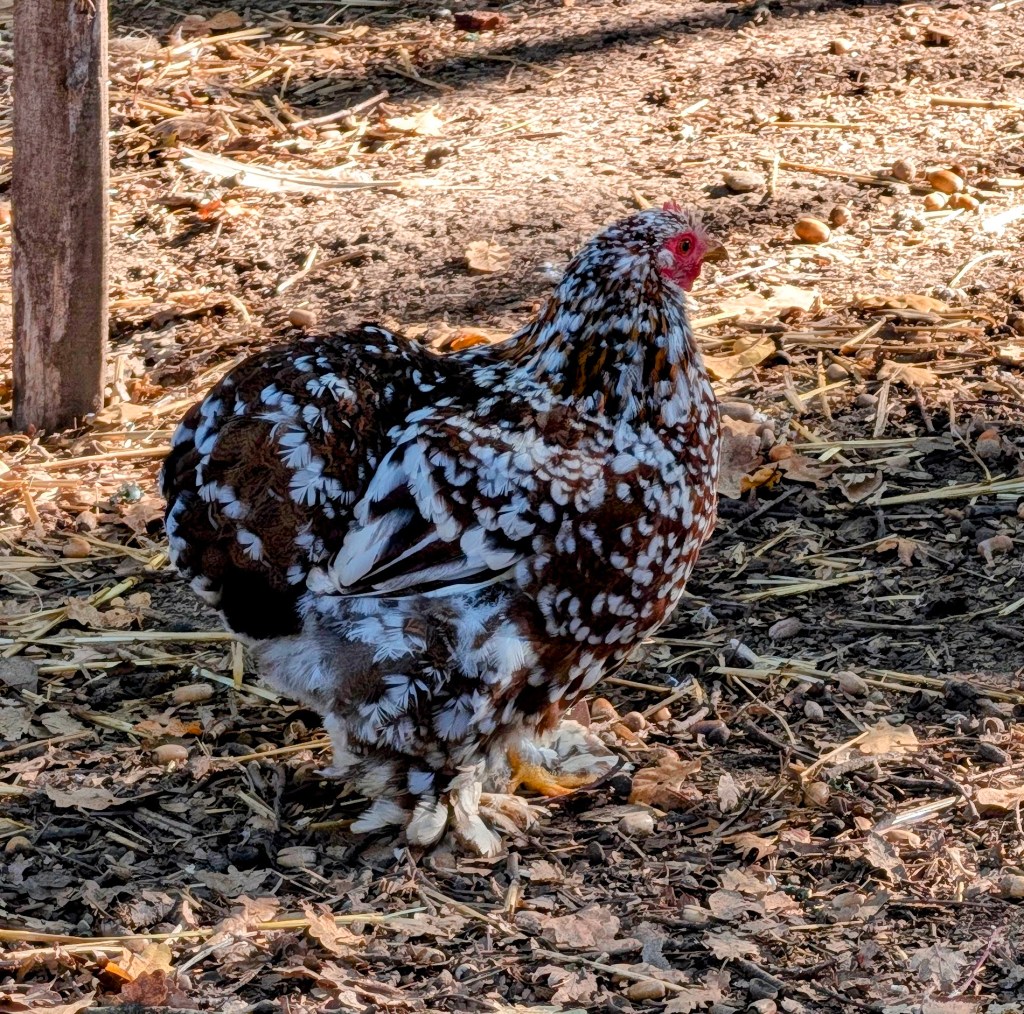
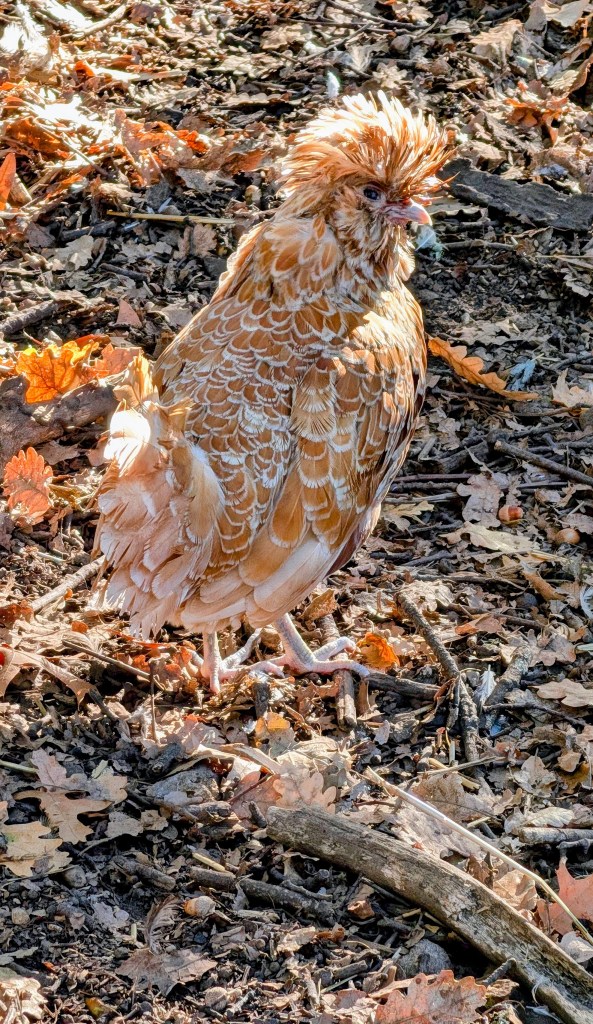
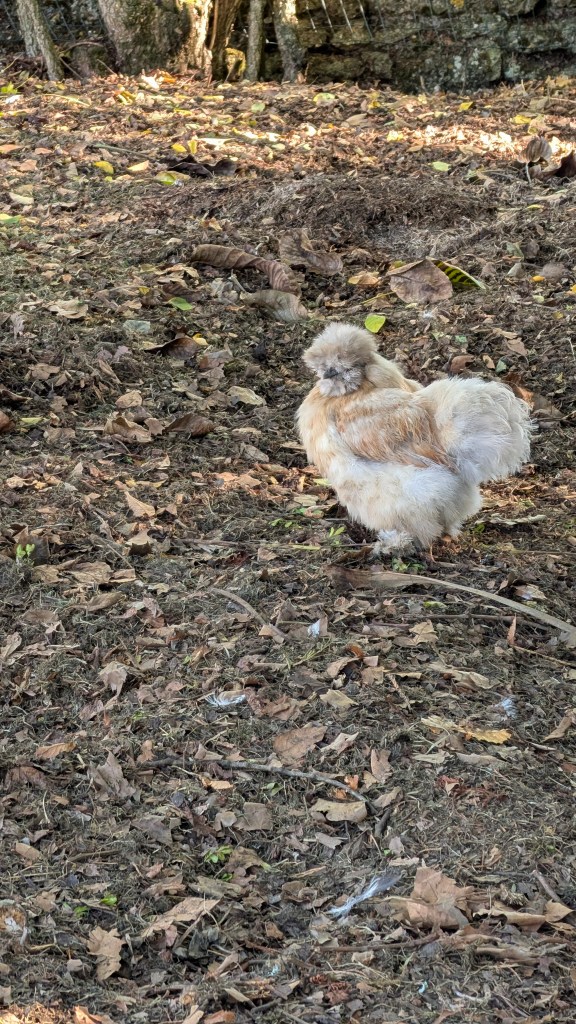
Some of the chickens were particularly colorful.

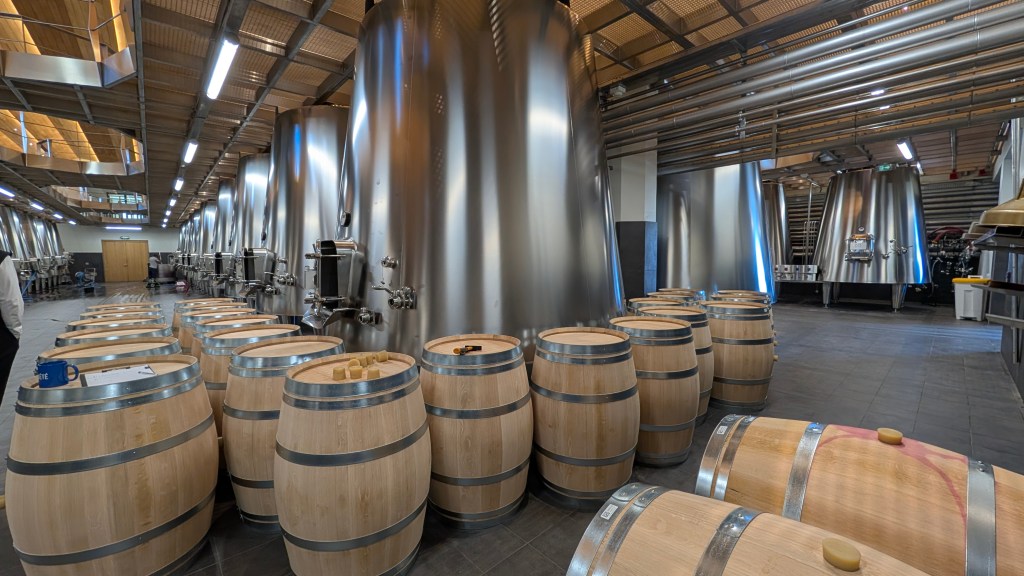
We headed into the winery where they were cleaning out the steel tanks.

Once the juice has been drained,

the solids are vacuumed out.

After maceration all of the juices are pressed out of the solid waste which is then recycled to avoid waste taxes. France’s anti-waste law bans the destruction of non-food products and encourages the recycling or repurposing of waste, pushing for circular solutions. France is currently spending approximately €200 million ($216 million) to distill 80 million gallons of surplus wine into pure alcohol for industrial use (cleaning, perfume) to manage oversupply. Instead of a waste tax on disposal, the government is paying producers to remove excess, with a very low excise tax of €0.03 per bottle, the lowest in Europe. 
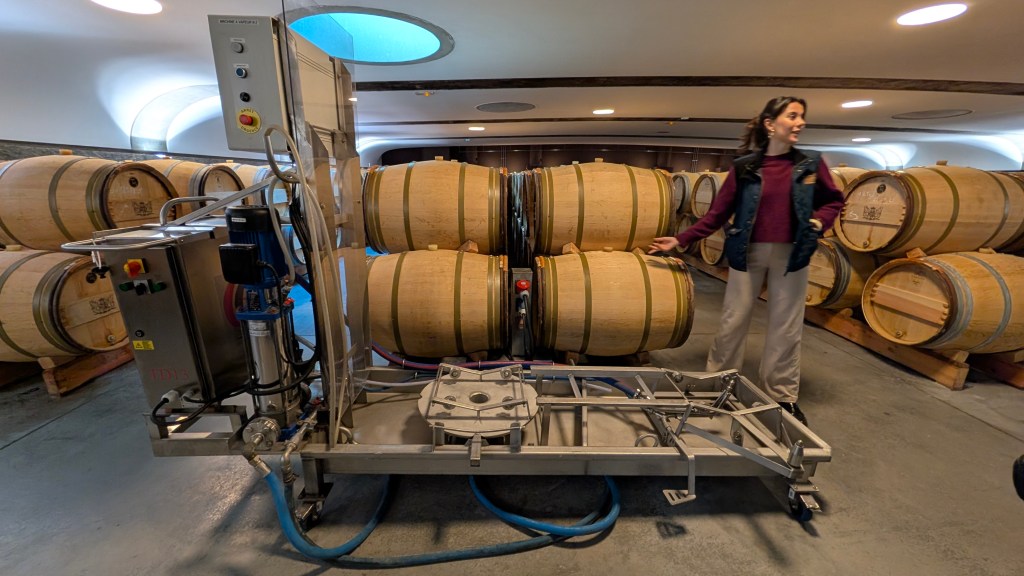
They were in the process of filling barrels from the tanks.

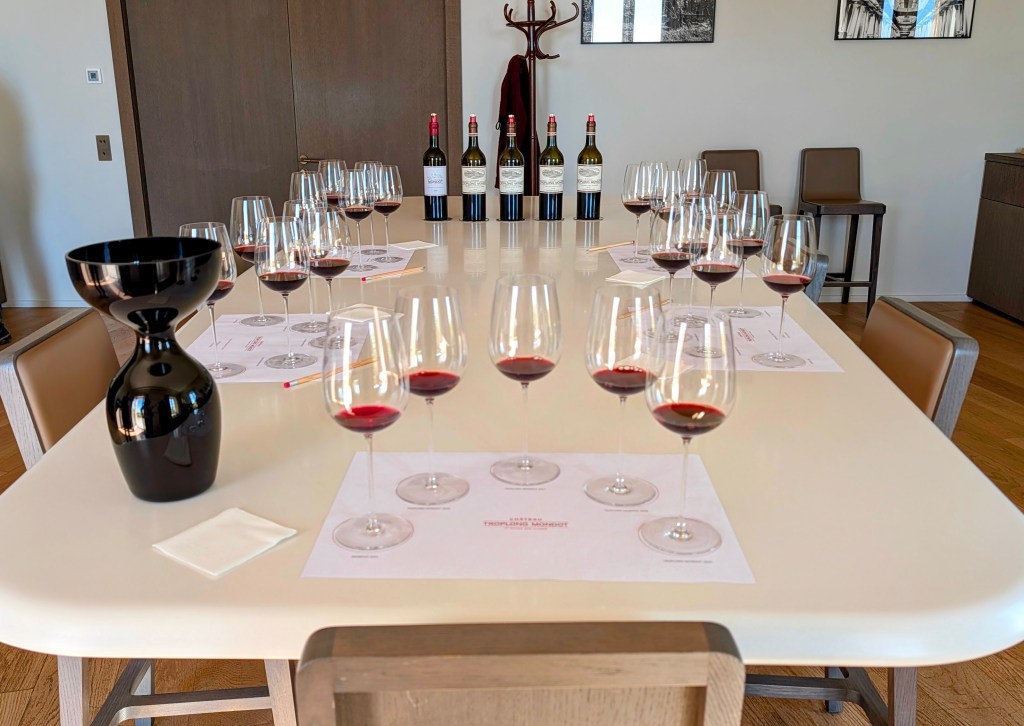
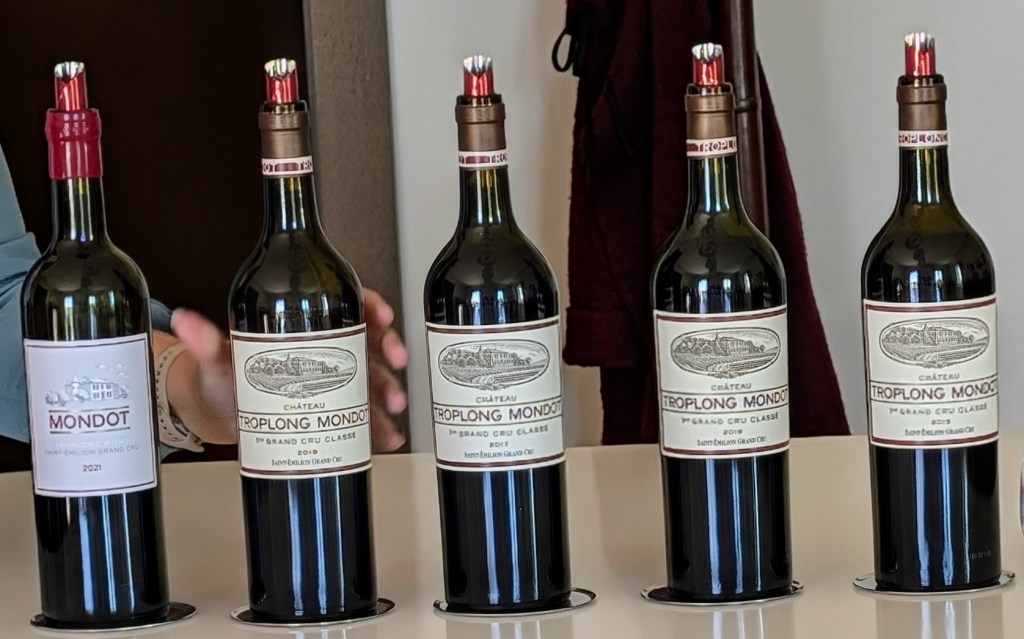
We made our way to the tasting room.

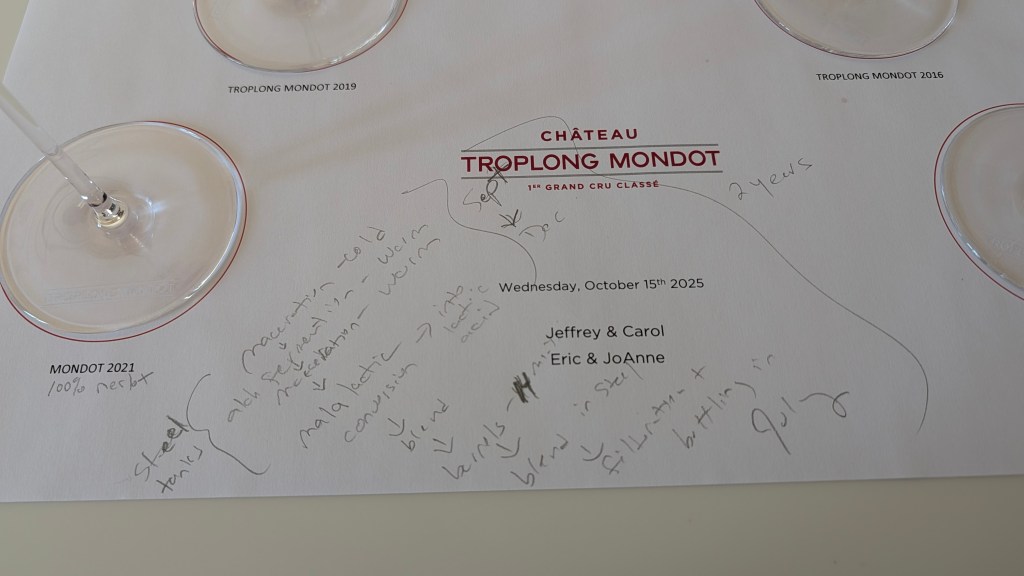
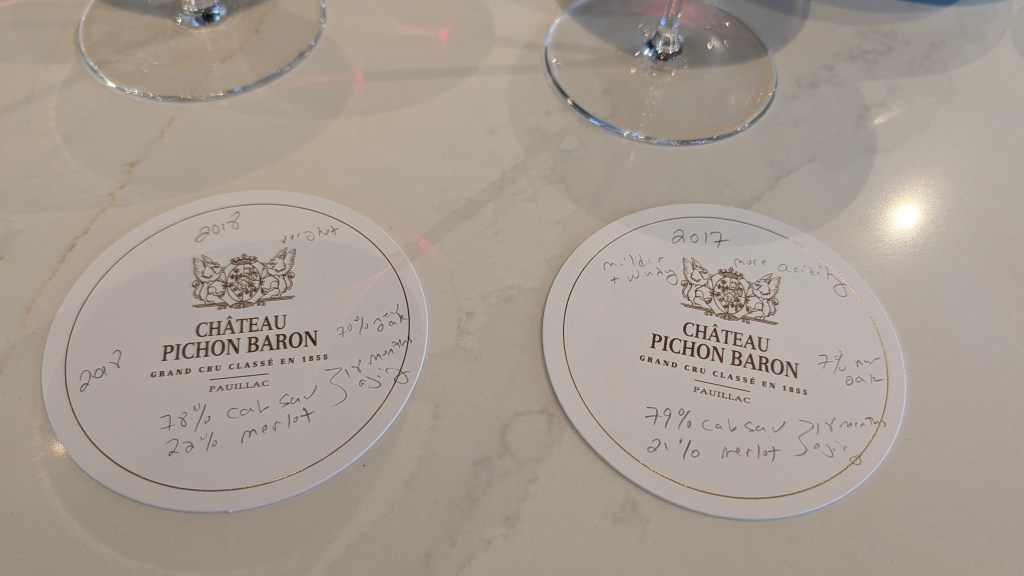
As is my usual habit, I took notes on the composition and quality of each wine we tasted.

We took a break for a moment to enjoy the beautiful day

before heading into the Michelin-starred restaurant, Les Belles Perdrix.

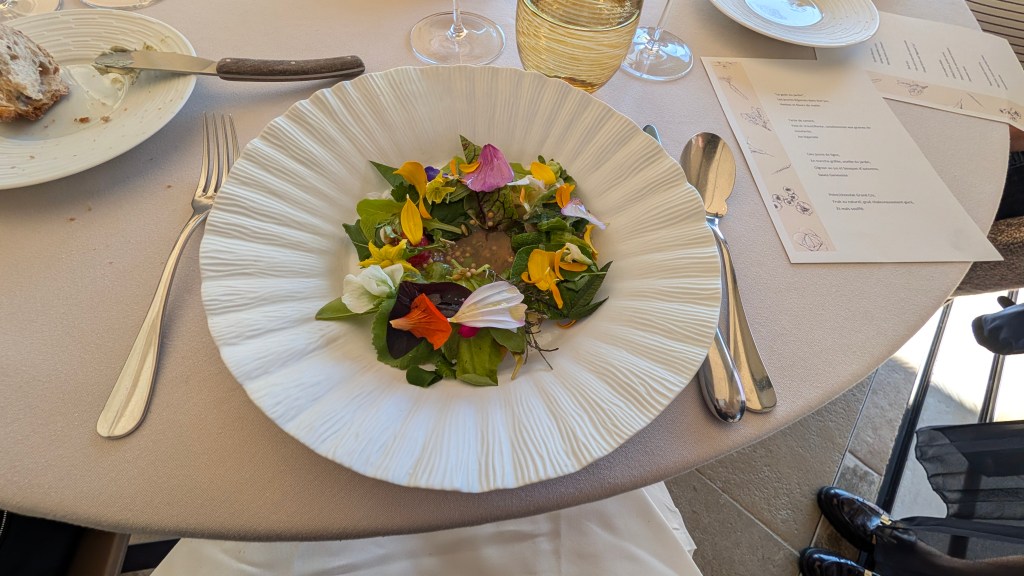
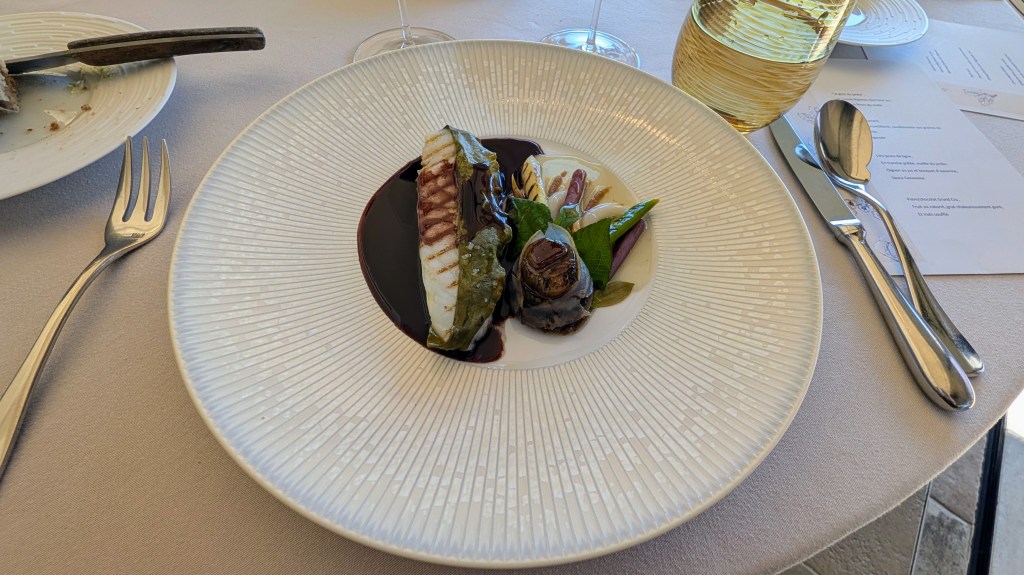
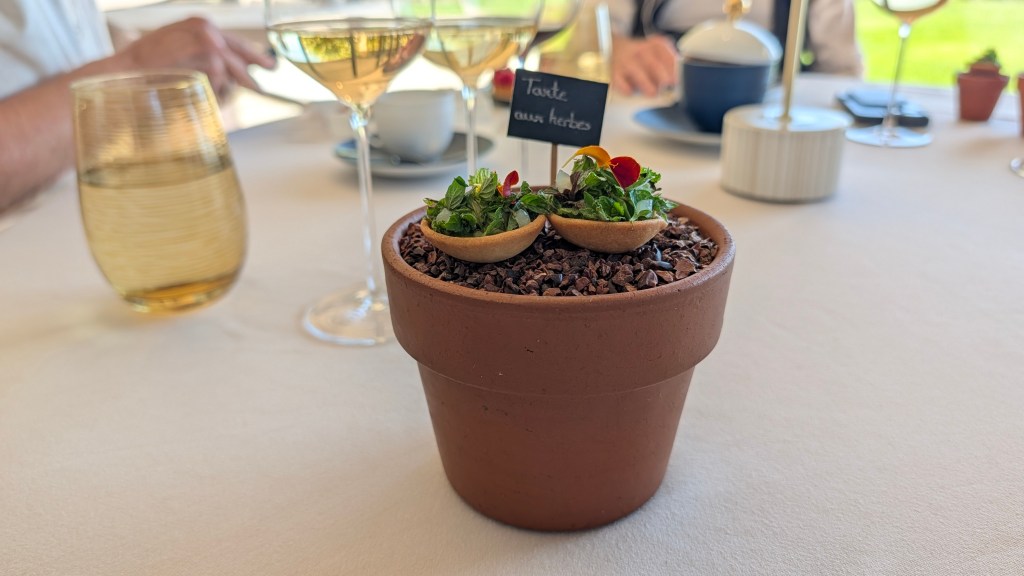
Once again the presentation matched the quality

Each course was more beautiful and more delicious than the previous.

The greens, veggies, and flowers were all from their own garden.

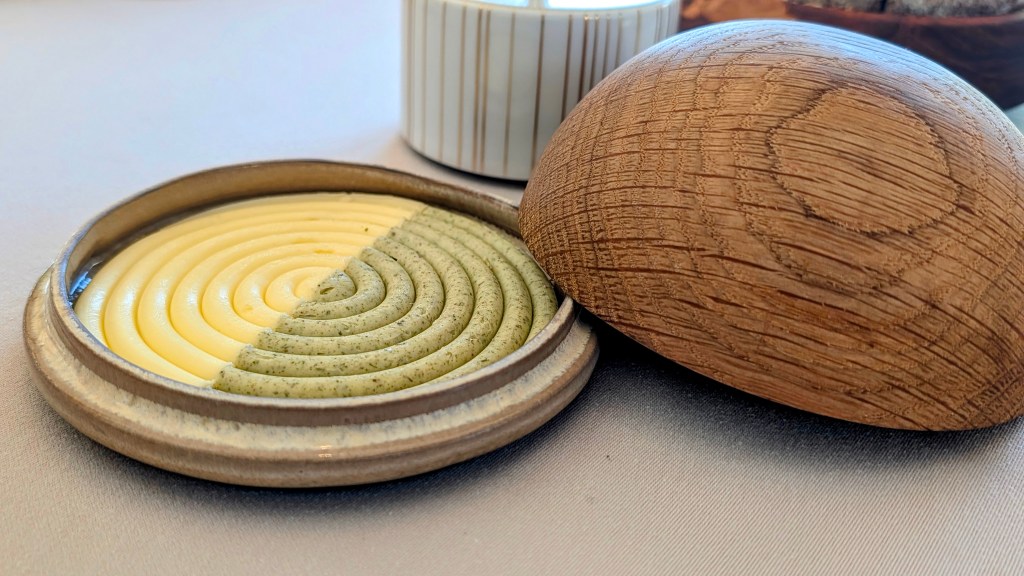
Even the butter was beautifully presented.

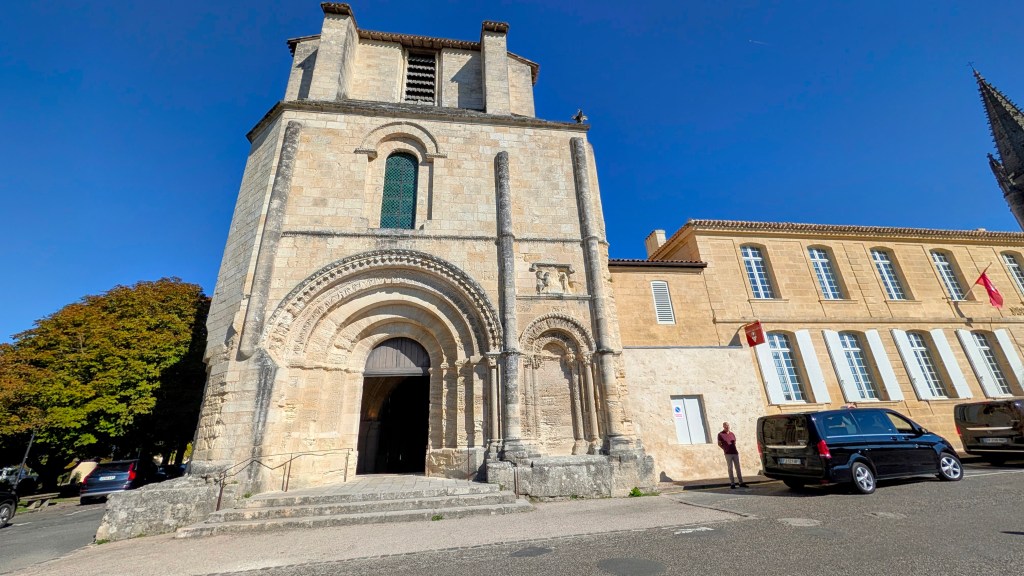
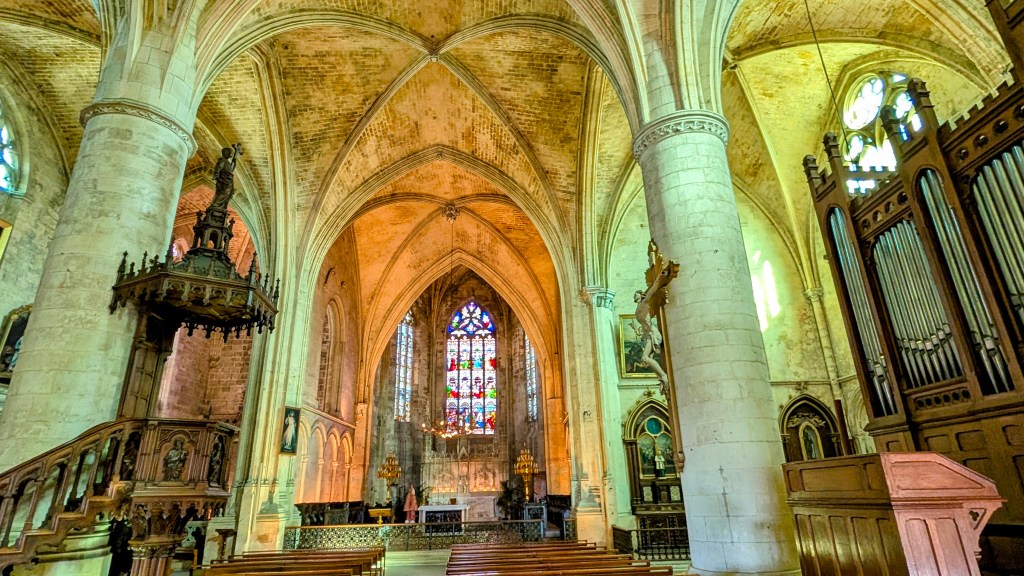
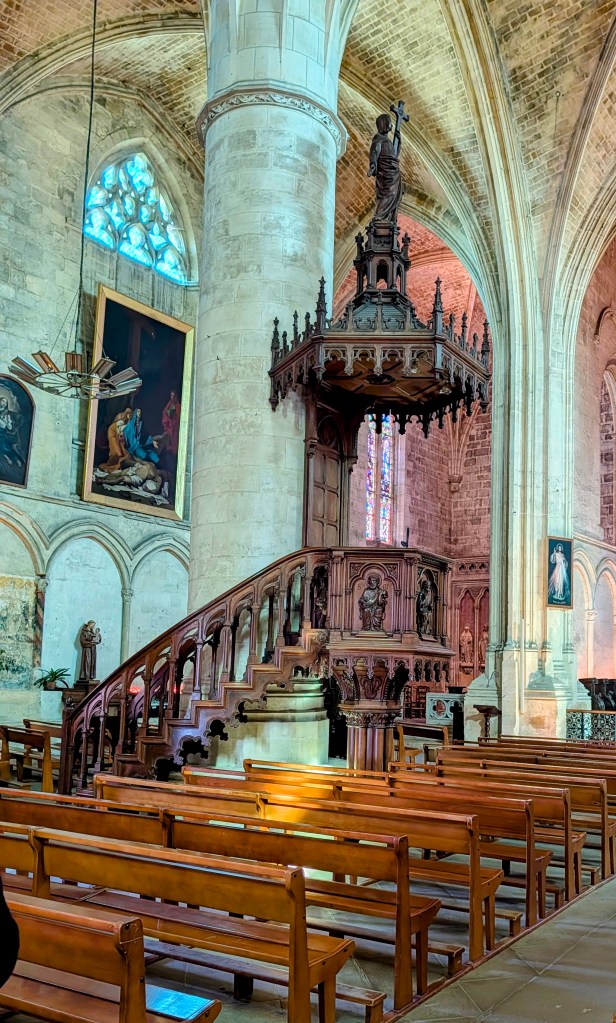
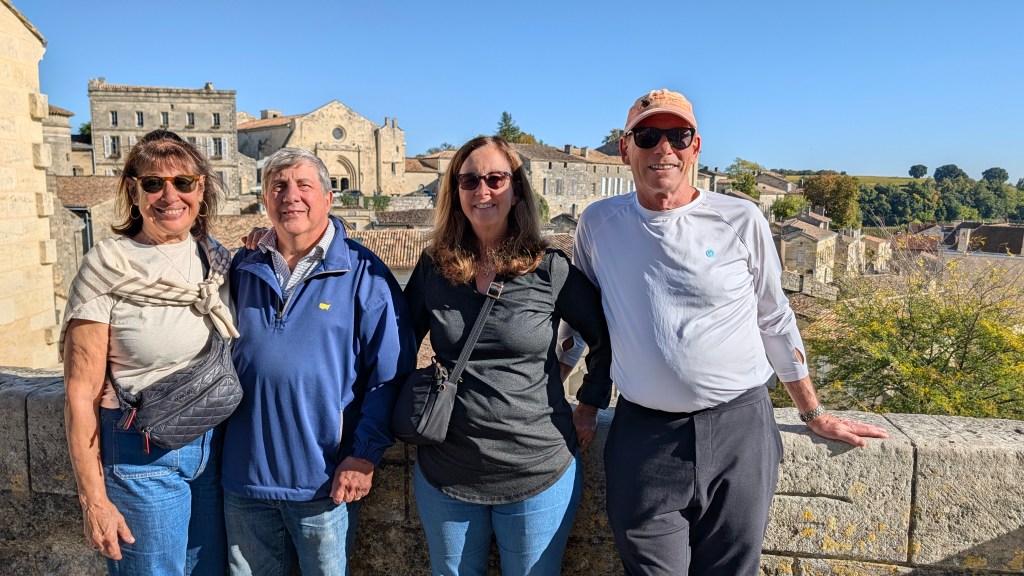
After lunch we were driven down into the village of Saint-Émilion, a medieval town with limestone architecture. The village has 40 full time inhabitants but is visited by over 1.2 million tourists a year. Less than 10% of visitors enter Eglise Collegiale (The Collegiate Church of Saint-Emilion). Founded in 1110 by Archbishop Arnaud Géraud de Cabanac, it served as a home for a college of Canons (Augustinian monks) from the 12th to the 18th century.  
Eglise Collegiale (The Collegiate Church of Saint-Emilion)

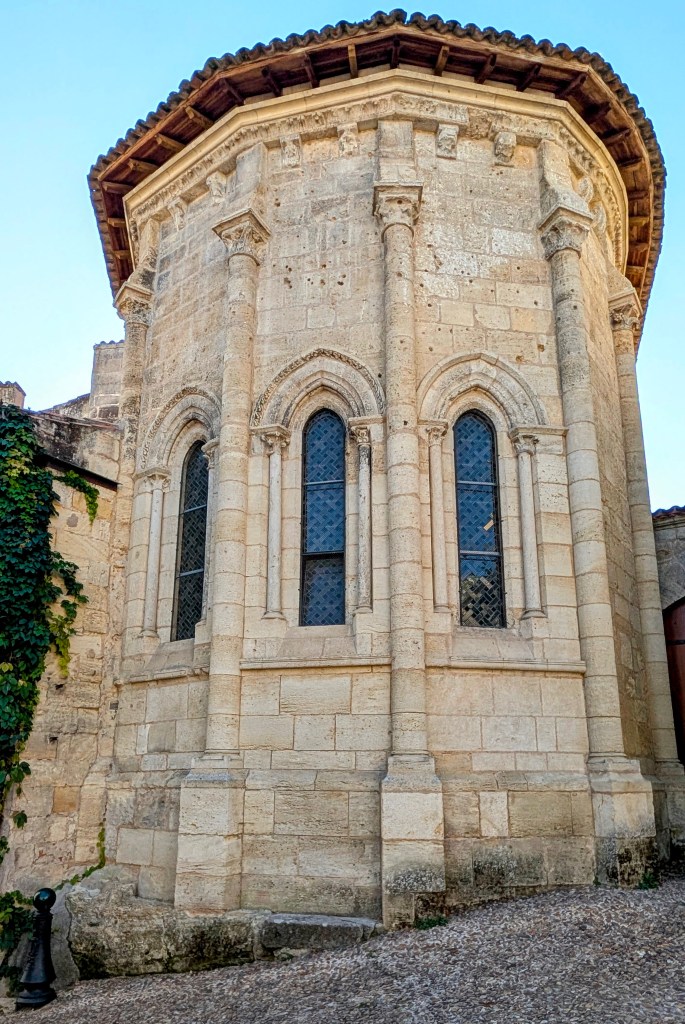
It is known for its blend of Romanesque and Gothic styles, with the transept and core dating between the 13th and 15th centuries.
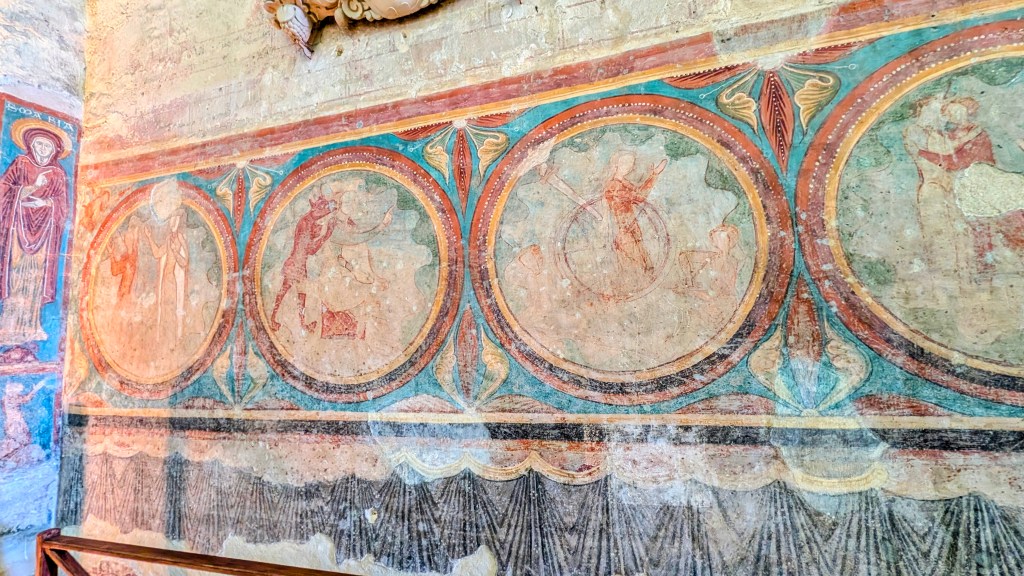
Ancient 12th-century frscoes can be found on the right side of the entrance.

The monaastery had been built outside of the town for religious purposes. The convent was built inside the town for use both for education and as a hospital.

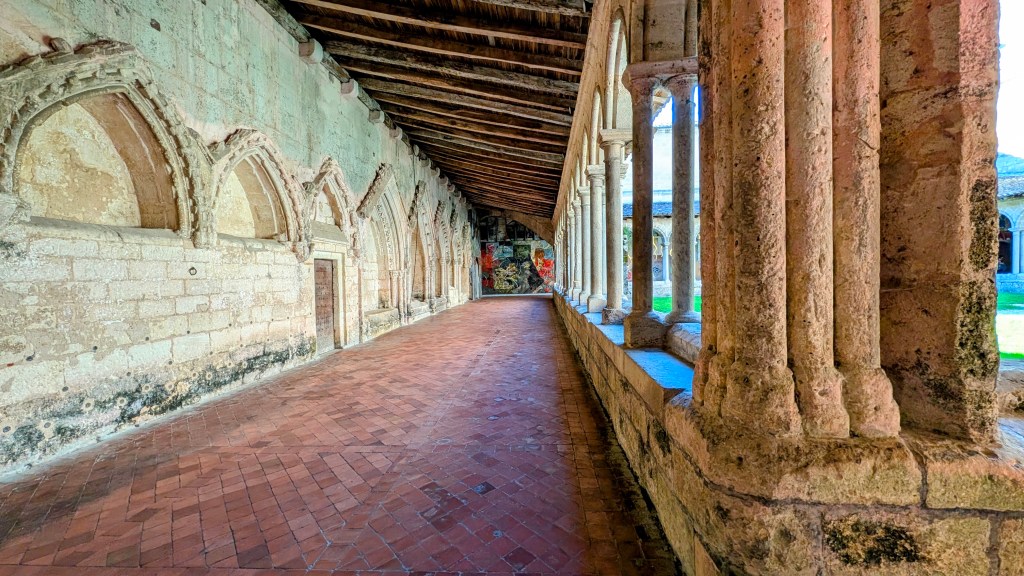
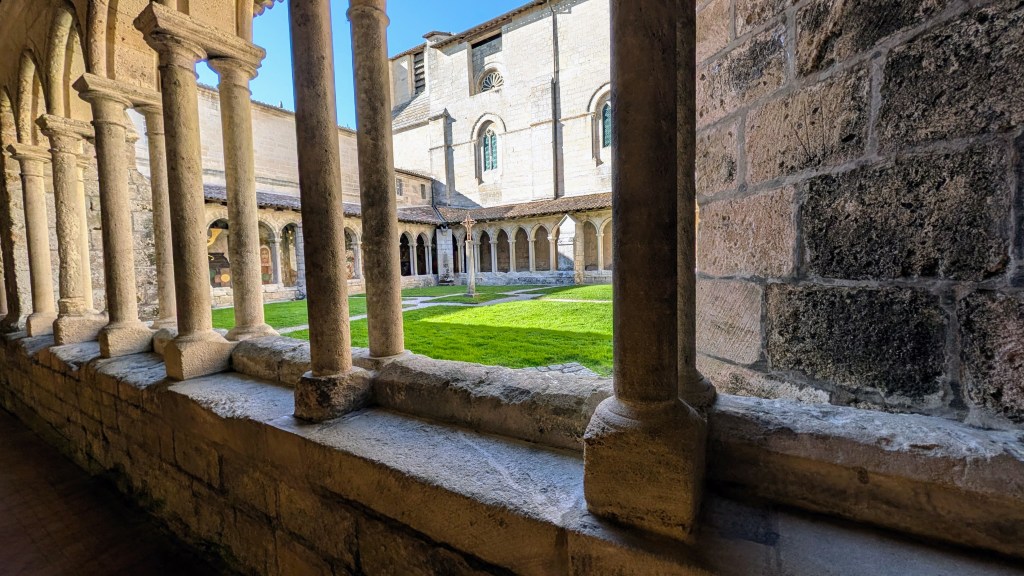
The peaceful, 12th-century cloister was used by monks for prayer.

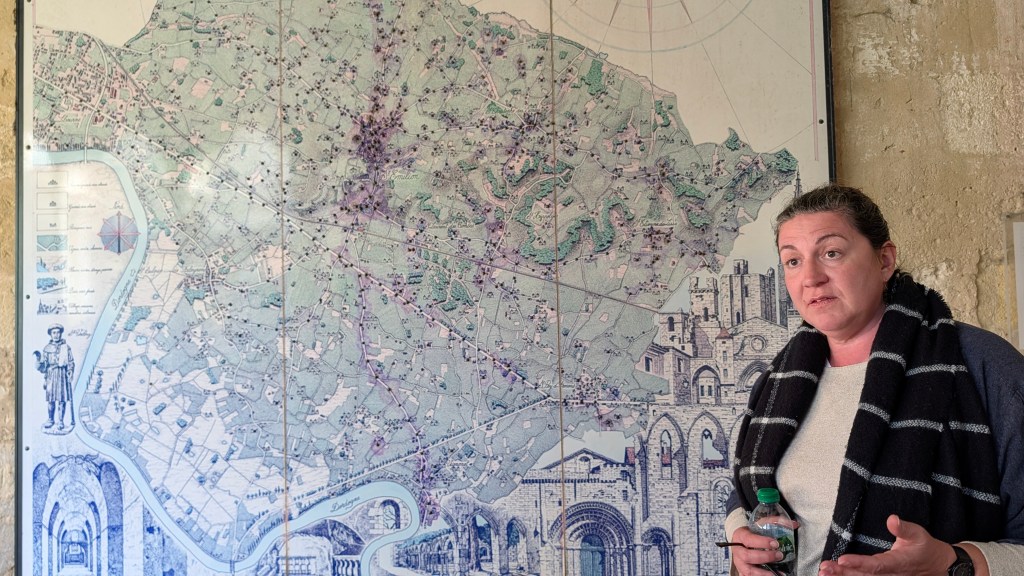
The outer side of the cloister is now the town’s tourist office.

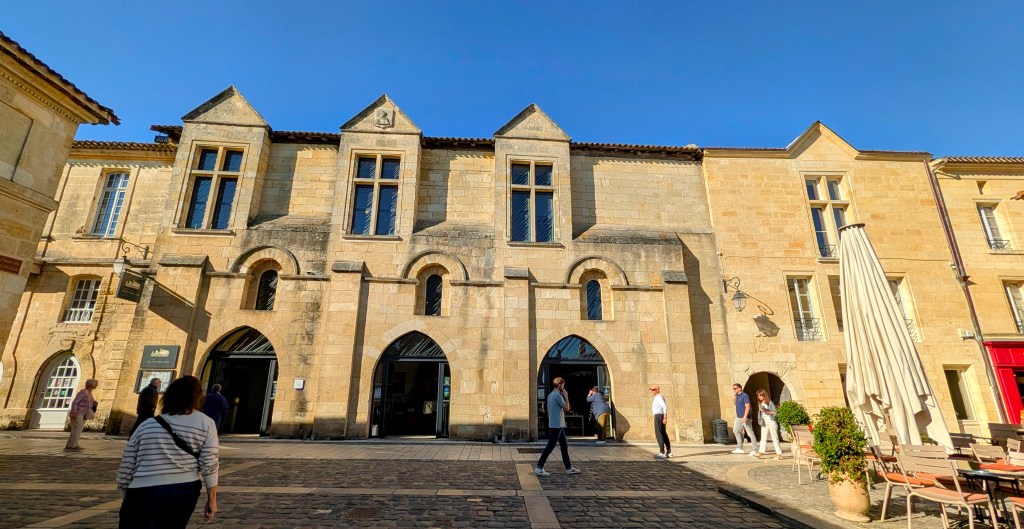
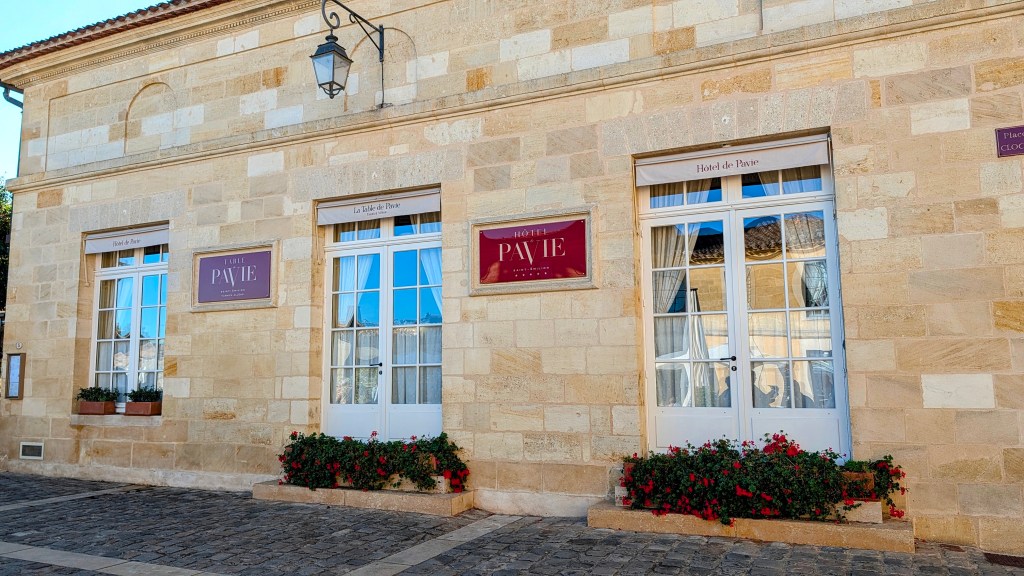
In the heart of the village is Hôtel de Pavie, a luxury 5-star hotel which features La Table de Pavie, a gastronomic restaurant overseen by renowned chef Yannick Alléno.  

Hôtel de Pavie

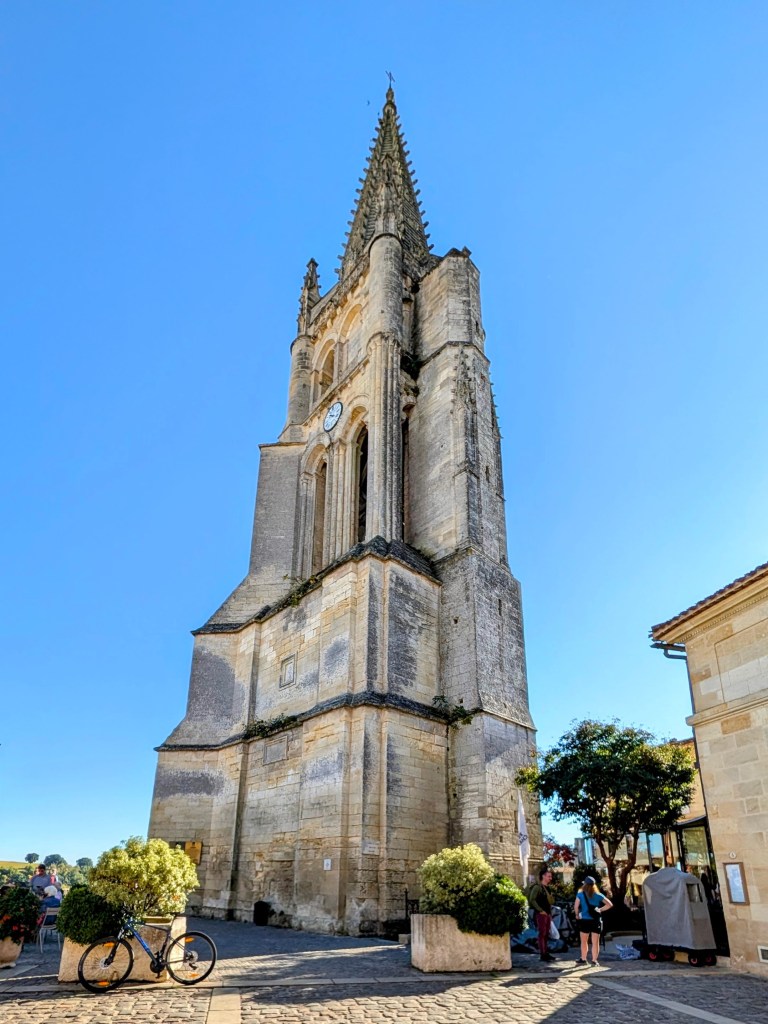
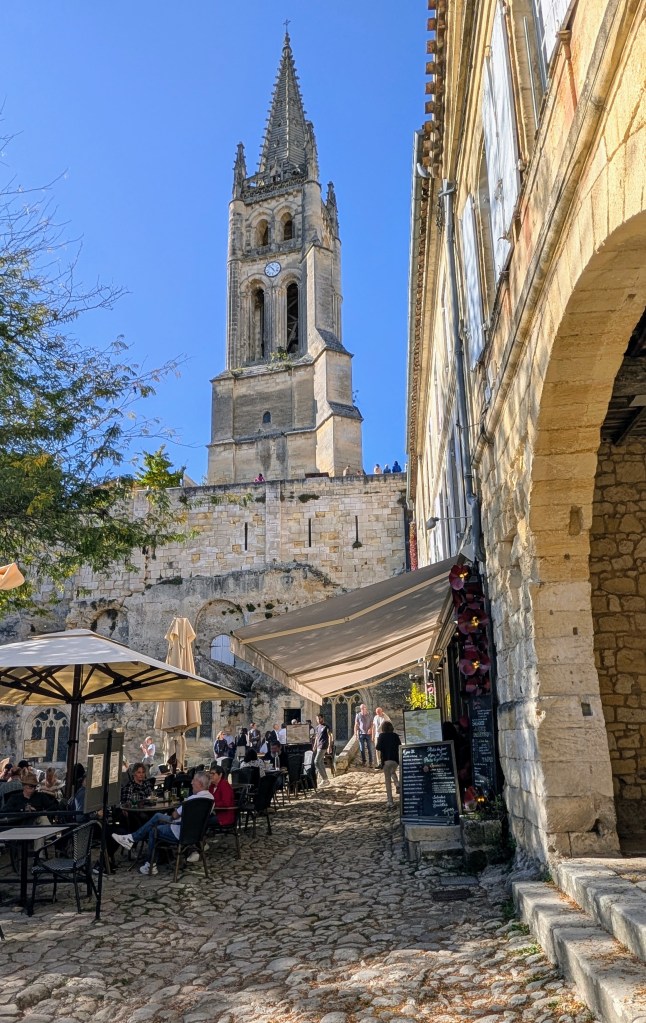
bell tower of Monolithic Church of Saint-Émilion

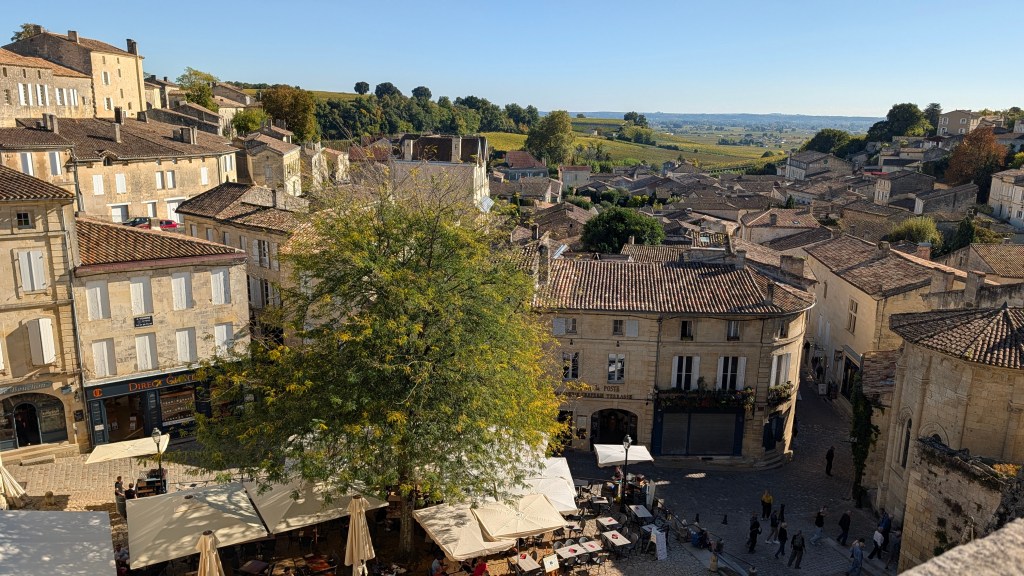
The historic medieval village of Saint-Émilion, originally named Ascumbas (rolling hills), was renamed in St. Émilion’s honor. It has been designated a UNESCO World Heritage Site since 1999.

historic medieval village of Saint-Émilion

 The village has 12.5 miles of tunnels created from mining limestone, which are now used to store wine.

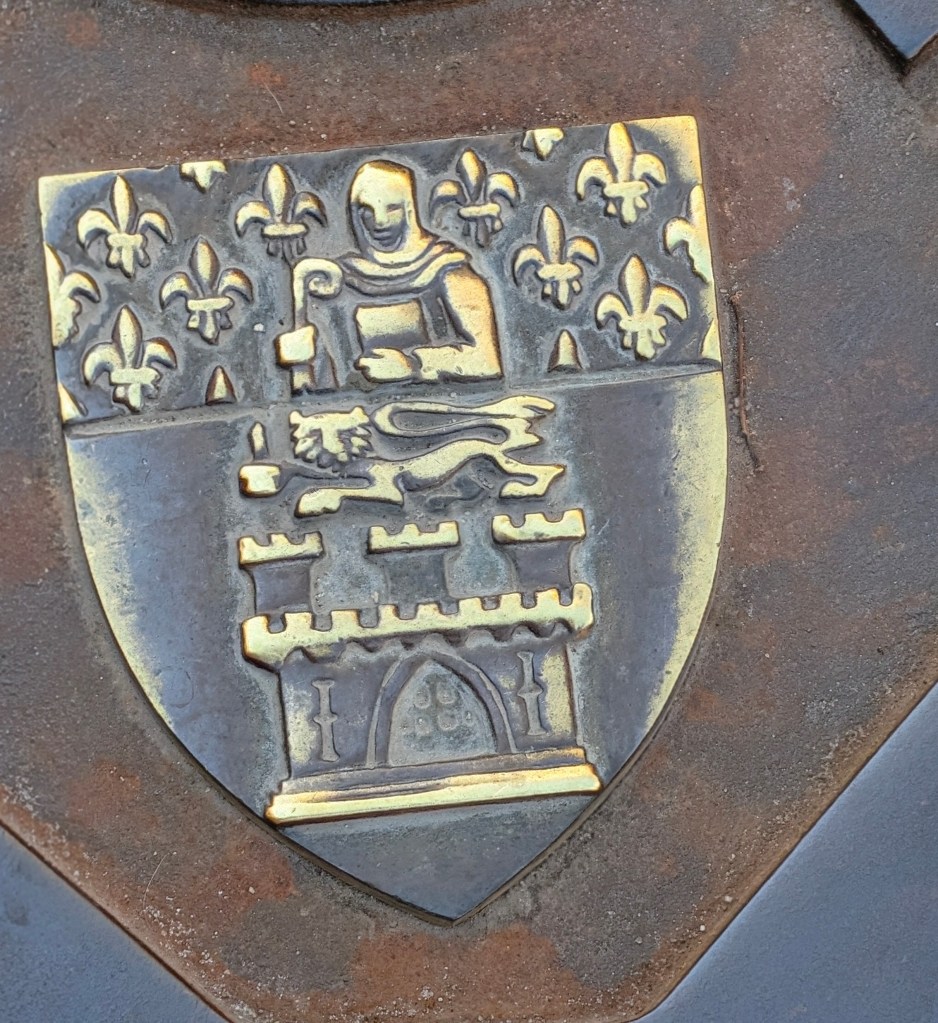
The coat of arms for the town of Saint-Émilion depicts a crowned figure holding a crozier, a lion, and a castle tower, surrounded by fleurs-de-lis. 

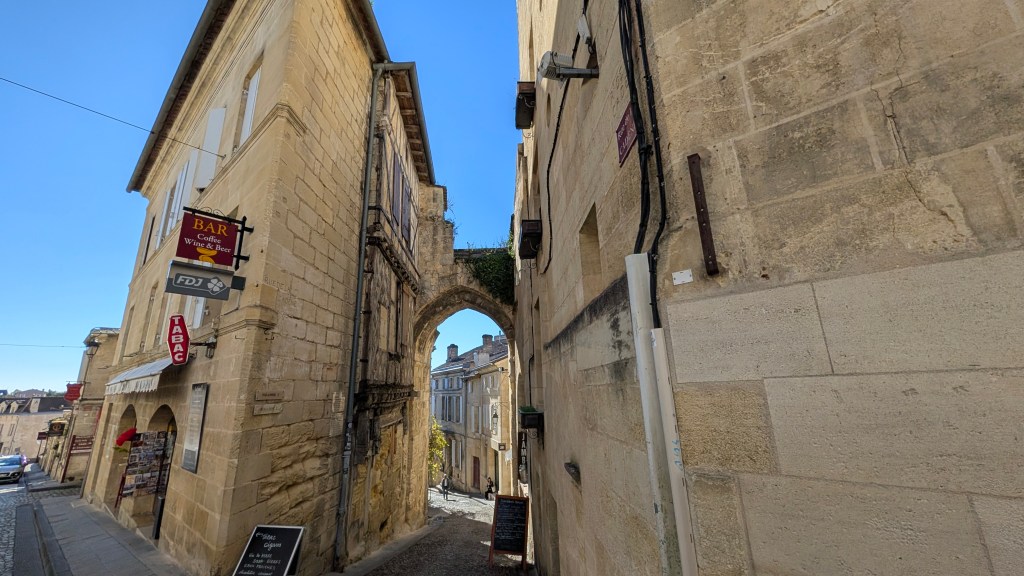
The Porte de la Cadène is a 13th-century stone archway that once served as a, defensive gate separating the town’s religious upper district from the secular lower town.

Porte de la Cadène

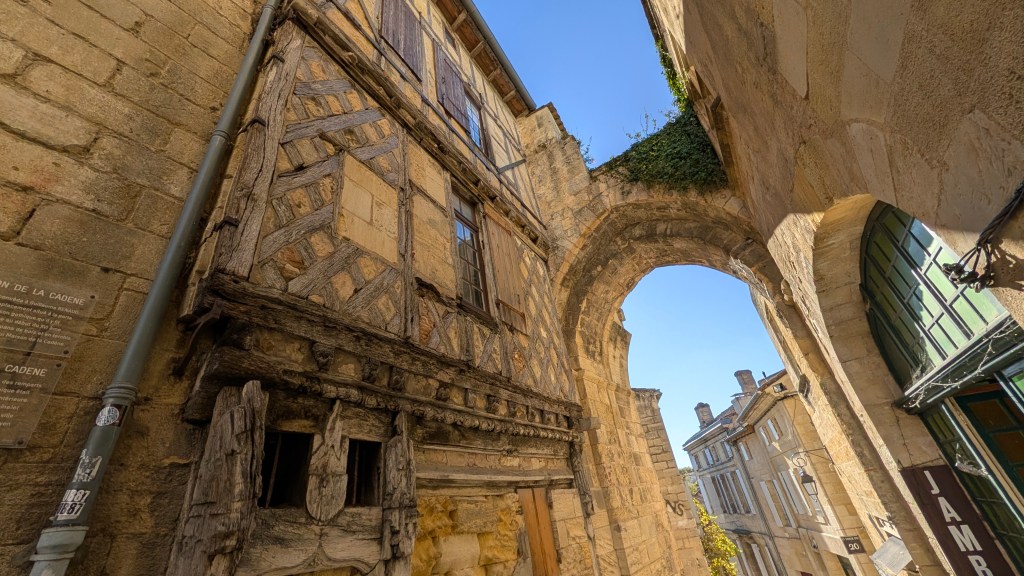
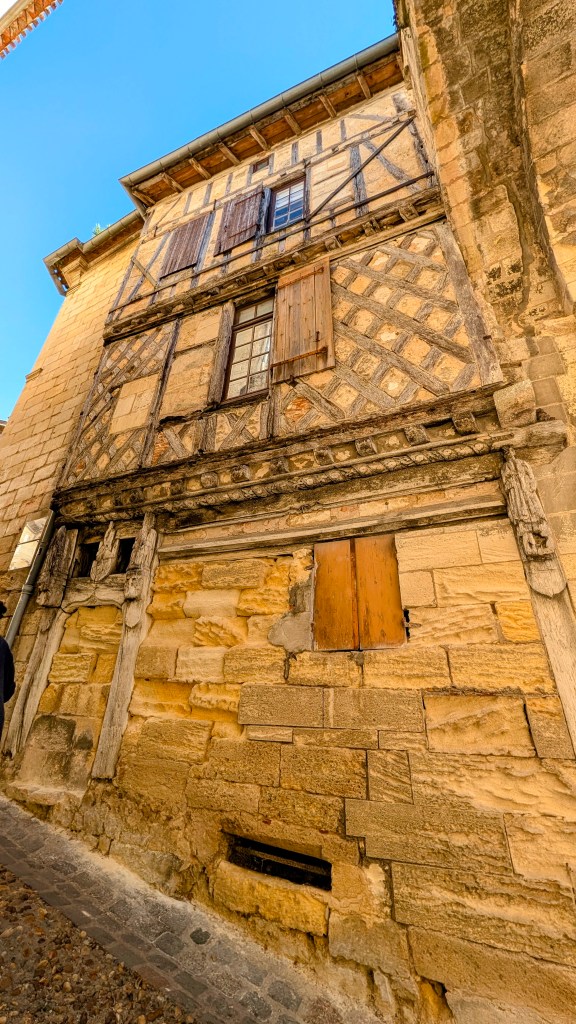
The Maison de la Cadène, a historic half-timbered house is notable as the only remaining timber-framed house within the village. 

Maison de la Cadène

While the upper timber facade dates to the 16th century, the stone lower section is much older. Maison de la Cadène features a 16th-century corkscrew staircase, a stone tower, and intricate, weathered wooden carvings. 

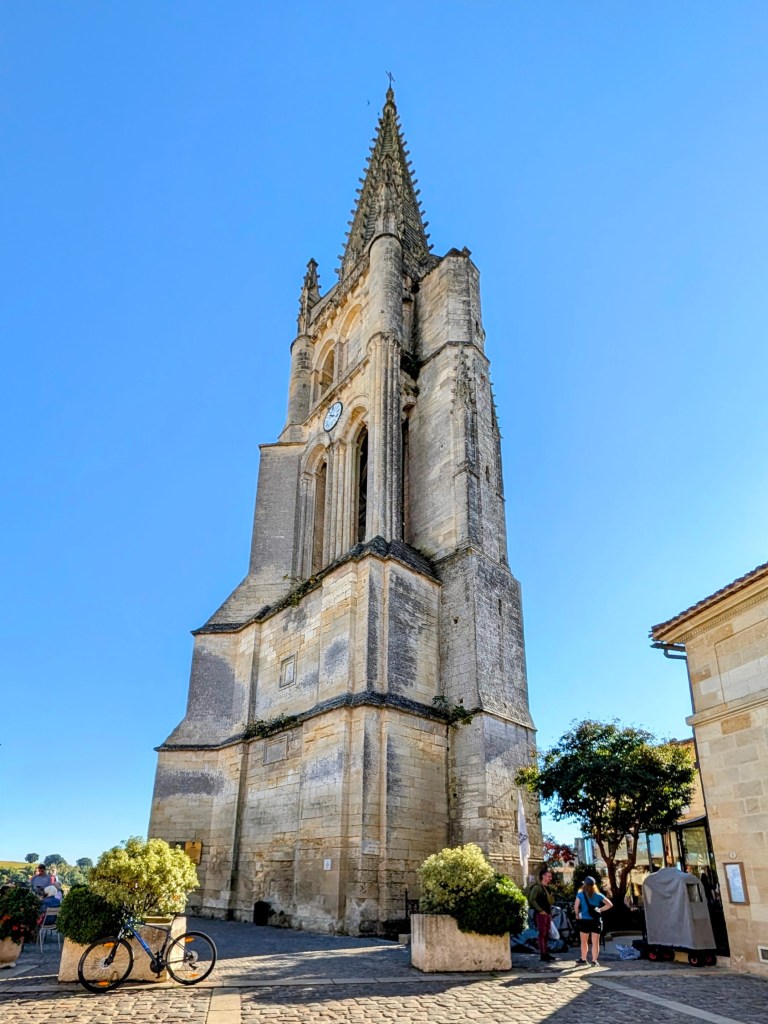
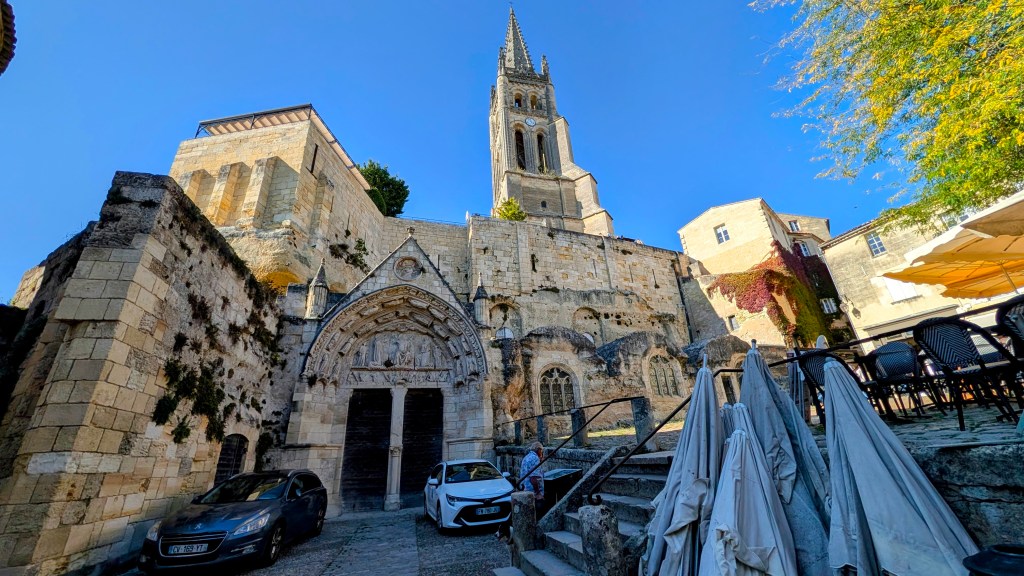
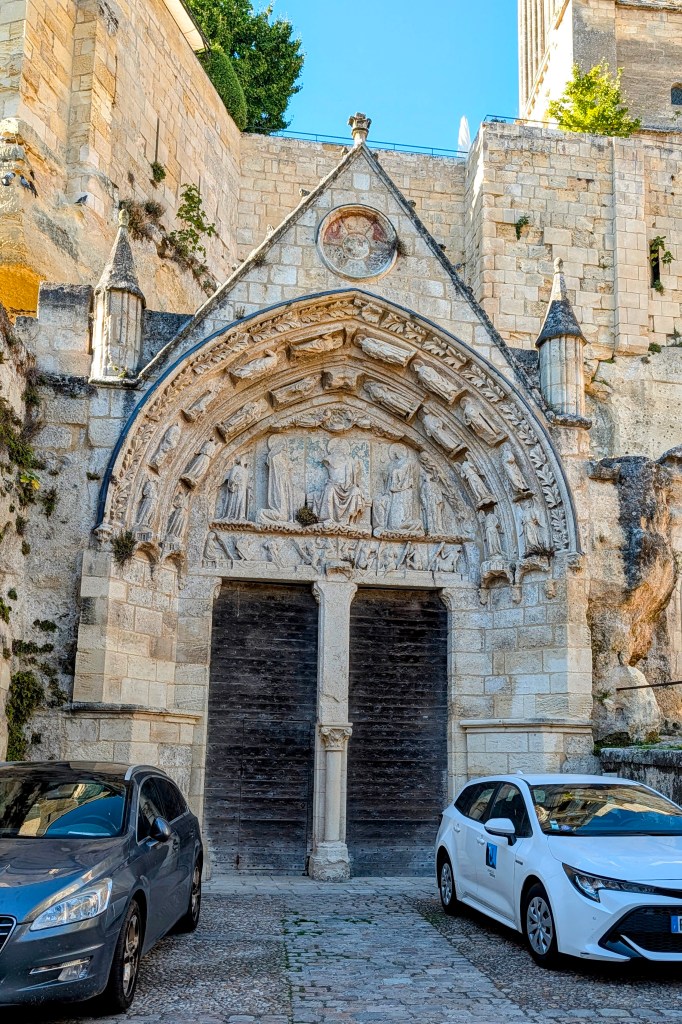
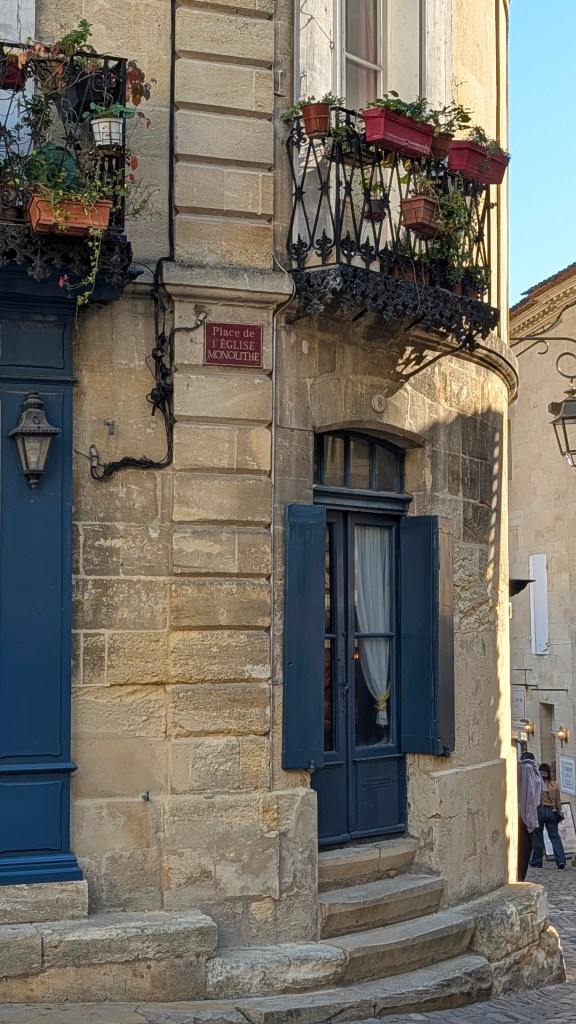
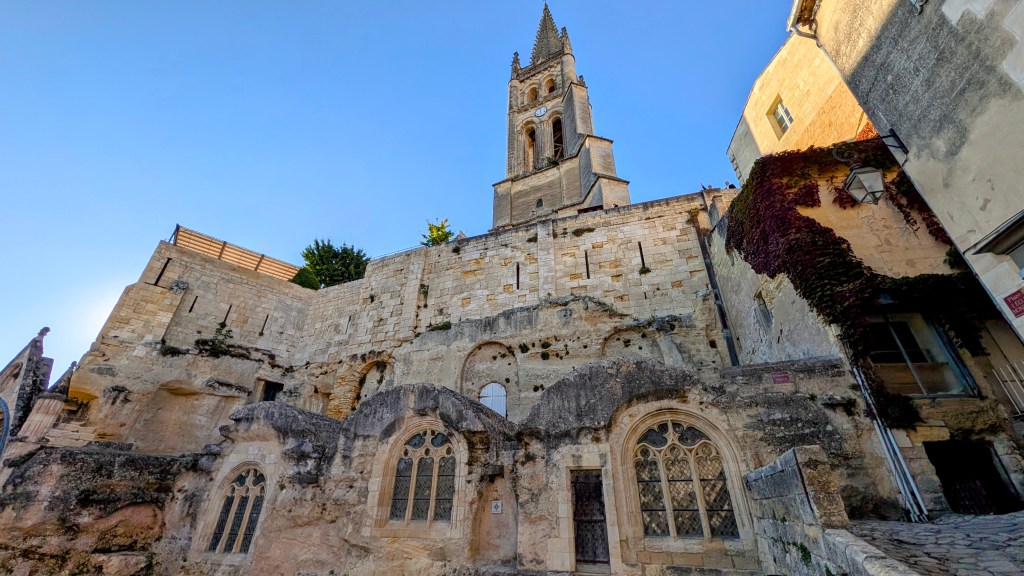
The Monolithic Church of Saint-Émilion is carved entirely out of a single limestone cliff; it is the largest underground church in Europe. It was dug between the 11th and 12th centuries by Benedictine monks, it was designed to accommodate pilgrims and to house the body of Saint Émilion.

bell tower of The Monolithic Church of Saint-Émilion

The 174 feet high limestone tower was built around 1230. It presides over a cute square which, before the revolution, was the market square. Now it is full of shops and cafés.

The Monolithic Church of Saint-Émilion was a major stop for pilgrims traveling along the Santiago de Compostela route. The chapel was erected in the second half of the 13th century in Romanesque style but later additions and renovations were Gothic. In 1998 the chapel began developing cracks; the building underwent some major repairs and internal supports were placed.

The Monolithic Church of Saint-Émilion

Despite its age, it is still a consecrated site used for religious ceremonies, concerts, and wine-related inductions.

The Monolithic Church of Saint-Émilion

We went underneath to visit where St. Émilion had lived as a hermit the last 17 years of his life: 750-767. Saint-Émilion was a Benedictine monk from Brittany. Despite his desire for solitude, his numerous miracles created quite a following. Miracle #1: While serving as a steward in Brittany, he reportedly stole bread to feed the poor. When confronted by his lord, he claimed the bread in his coat was wood, and it miraculously turned into wood to protect him. His second miracle was his removing bread from an oven with his bare hands. Third, he is credited with restoring the sight of a blind woman on January 6, 767 AD.  Located in his Grotte de l’Ermitage (underground hermitage), his stone seat is believed to help women conceive within a year of praying there. We visited but were not allowed to photograph any of it. In the 17th century, there was a revival of popularity for St. Émilion. In the end of the 18th century most of the monuments and artifacts in the area were confiscated for private possession.

The stained glass was added at the end of the 19th century in medieval style with bold colors.

Despite the massive size: the church measures 125 feet long and 40 feet high, requiring the excavation of roughly 530,000 cubic feet of limestone, it took less than 50 years to carve out the underground church. The catacombs were for priests, monks, the very rich, and babies who were still “pure.” All of this predated the revolution by 1000 years. During the revolution, frescoes were scratched off for saltpeter for gunpowder. Pictures were not allowed inside.

Although Saint-Émilion was a monk, the monks who followed him and established the community initiated the commercial wine production that the region is famous for today.

Our drive back from Saint-Émilion took us through Pomerol, the smallest major Bordeaux appellation (approx. 200 acres) located on the Right Bank, famous for producing some of the world’s most luxurious, Merlot-driven red wines. Unlike other regions, it has no official classification system, features no grand châteaux, and relies heavily on unique blue clay terroir to produce soft, velvety, and intensely aromatic wines. One hectare, or about 2.5 acres, sells for $85 million.

Château Pétrus in the Pomerol appellation is one of the most famous and expensive wine estates in the world, producing wine primarily from Merlot grapes. The estate, managed by the Moueix family, covers approximately 28.5 acres, and is renowned for its unique terroir, specifically a small plateau of blue clay. Château Pétrus produces only 30,000 bottles of wine a year.

Château Pétrus 

The following day we took a break from wineries and travelled to the coast. We drove through Landes forest. Previously a vast, wet, and sparsely populated marshland, the forest was systematically planted with maritime pines starting in the 18th century, with major efforts forced by Napoleon III in 1857 to stabilize the soil. Covering nearly 3 million acres, it is the largest artificial forest in Western Europe. Historically, the forest was tapped for resin (a process called gemmage) to produce turpentine and seal ships. Today, the focus is largely on wood production and paper making.

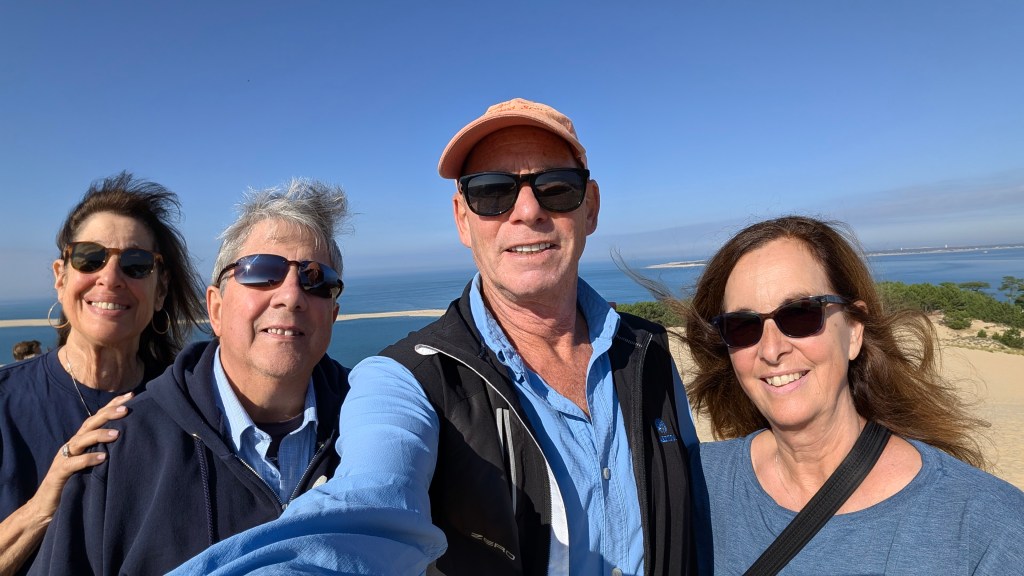
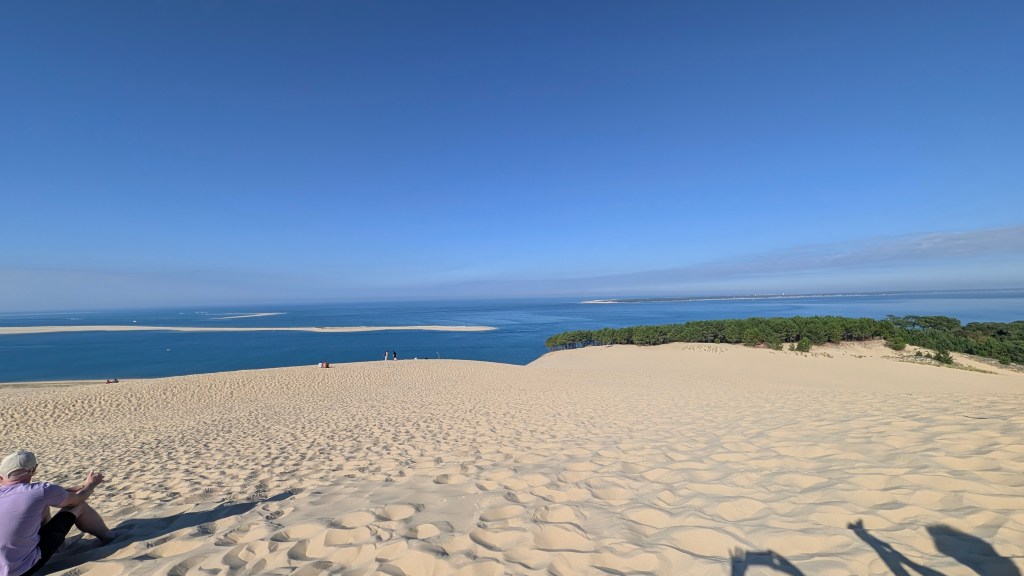
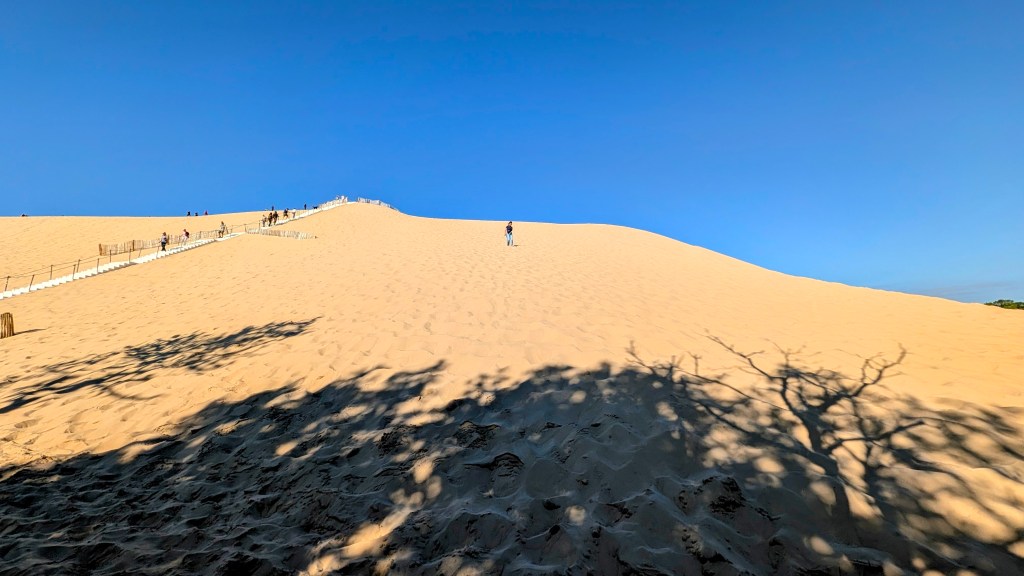
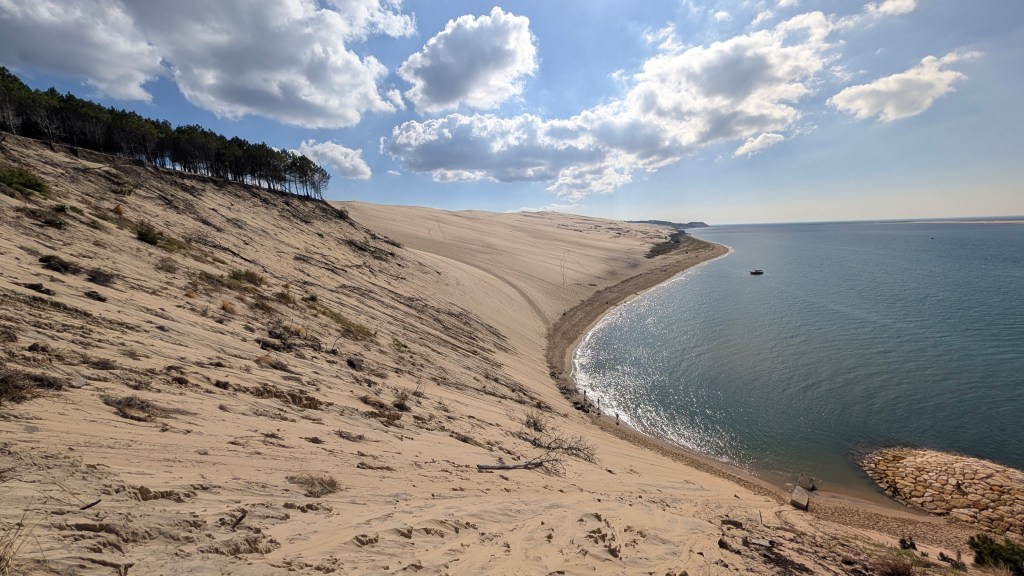
We arrived at the Dune of Pilat (Pilat comes from the Gascon word Pilhar, meaning a “heap” or “mound”), the tallest sand dune in Europe. We did not know what to expect, but Oh my!

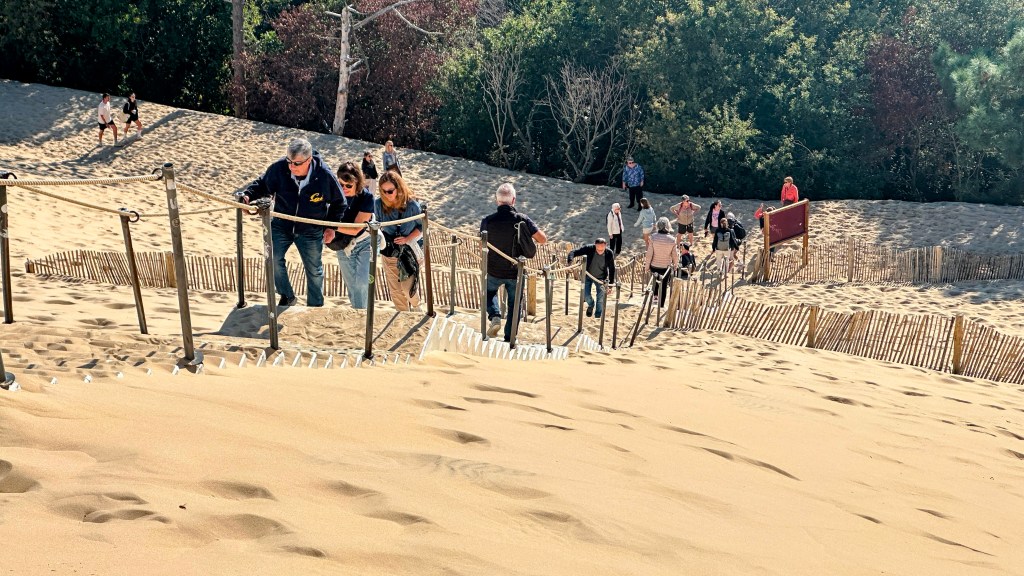
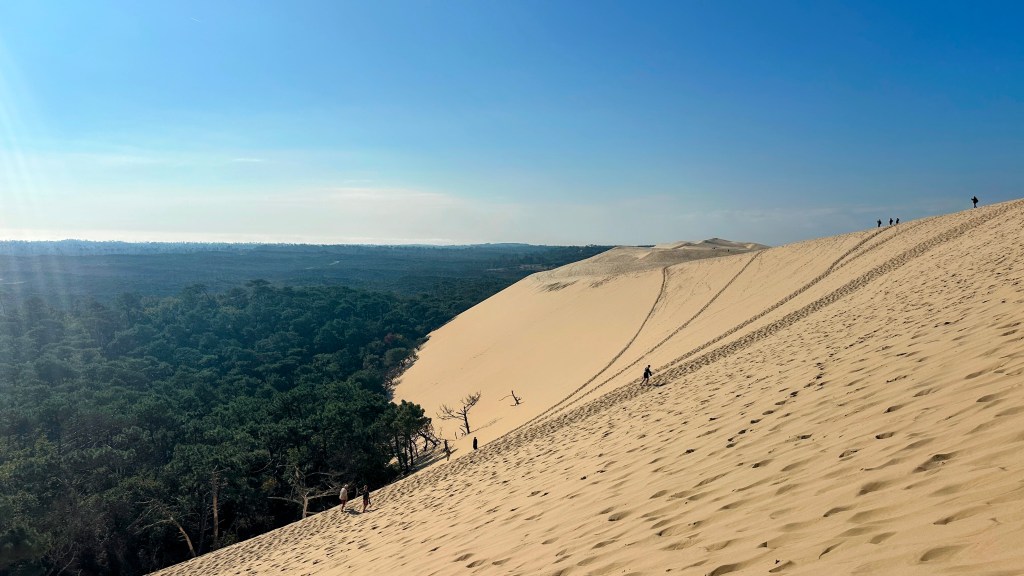
This was like no dune we had ever seen. It is roughly 340 feet high, 1600 feet wide, and stretches for 1.7 miles along the Atlantic coast near Arcachon Bay.  Around 1-2 million tourists visit the site annually, often climbing the steep, sandy slope or taking stairs installed from Easter to November. So up we went.

The dune is in constant motion due to wind and tides, shifting 1-5 meters inland every year and burying the Landes forest in its path. Often called a “sand monster,” it has buried roads, houses, and even portions of the World War II Atlantic Wall.

The forest acts as a buffer, moderating the cold Atlantic influence on the nearby, famous vineyards of Bordeaux.

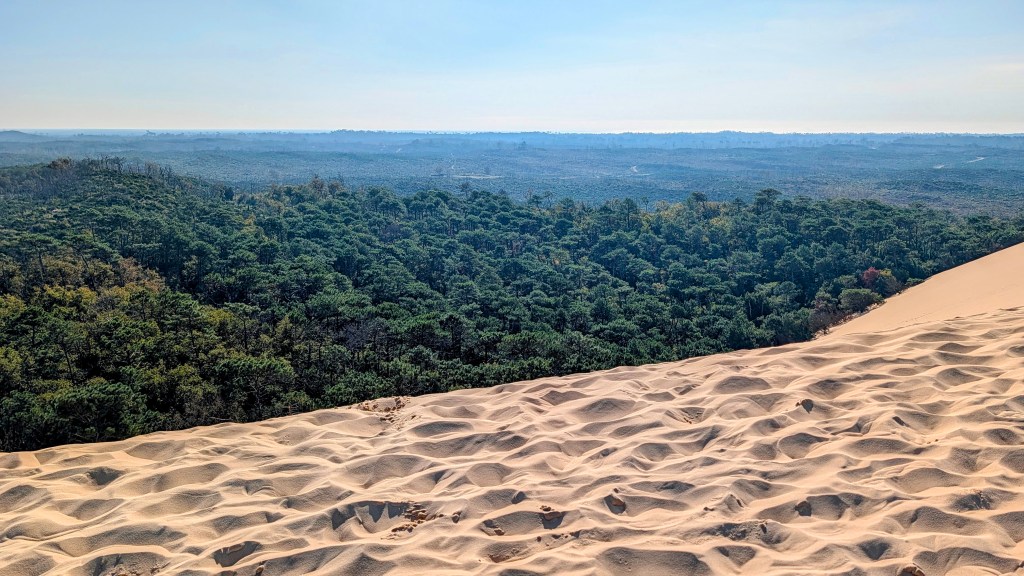
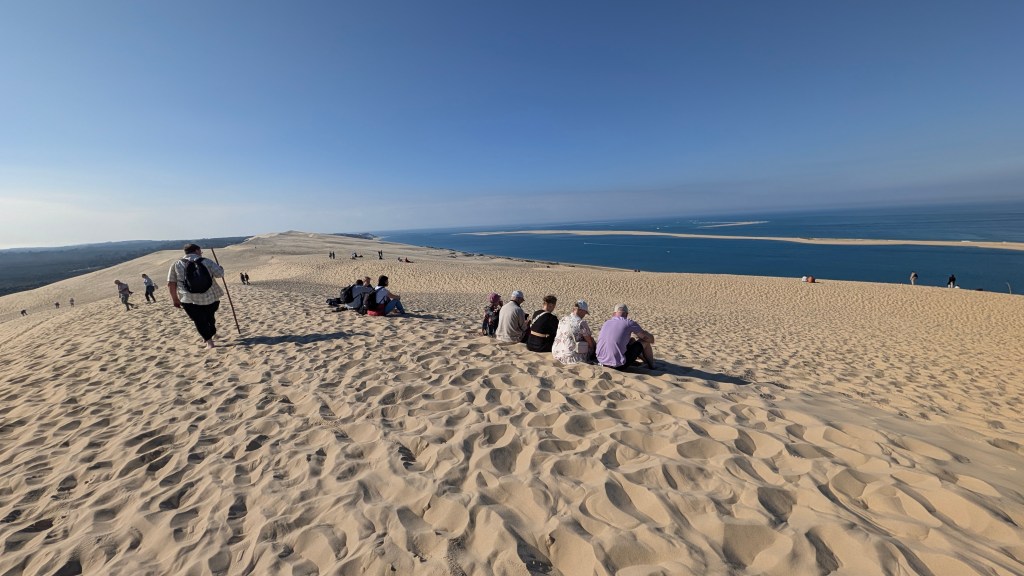
From the top we had a great 360 ° view which included the forest, Arcachon Bay, and the ocean all at the same time.

While it has taken thousands of years to form, it only became a truly massive structure in the last few centuries. In January 2009, a storm hit the dune with winds reaching 109 mph.

Arcachon Bay produces around 7,000 tons of oysters annually, with 430 acres dedicated to farming them.

Arcachon Bay

Coming down was only slightly easier than going up.

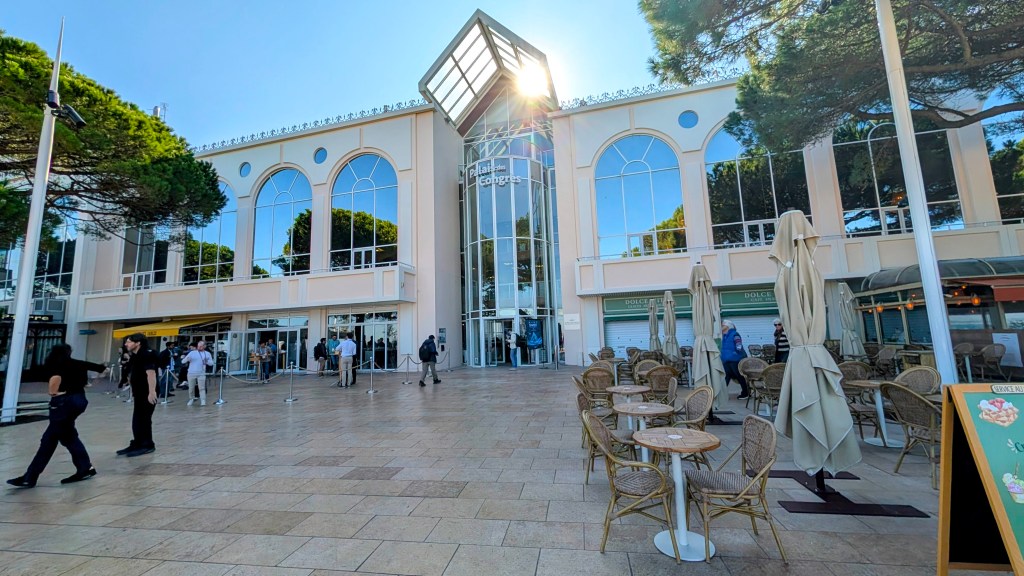
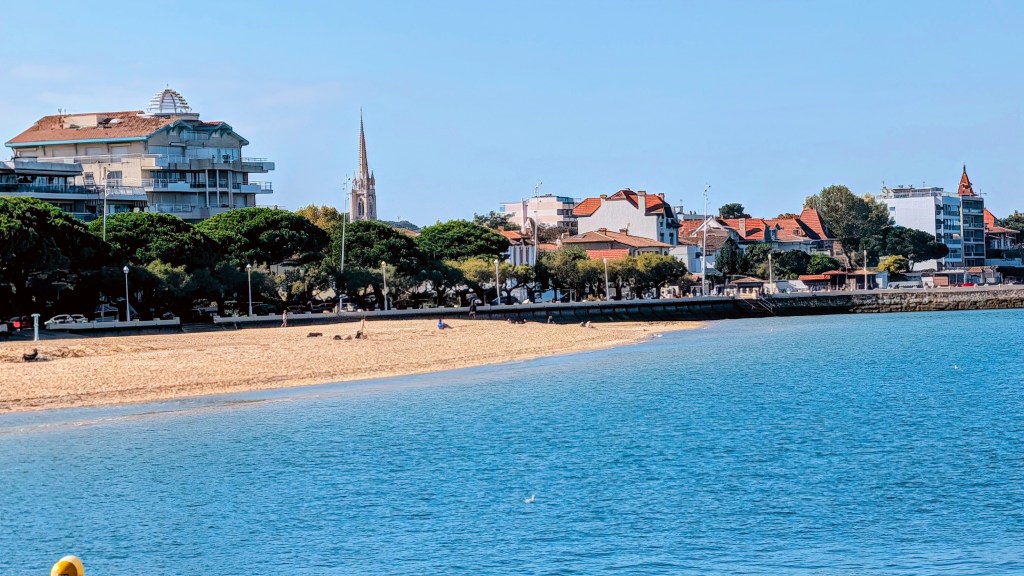
We visited the nearby seaside resort town of Arcachon founded in 1857. The town is unique for its four seasons-based districts, Summer, Winter, Spring, and Autumn, and was once a health retreat for lung ailments.  Our driver left us out on the beachfront of the 19th-century Ville d’Hiver (Winter Town) in front of the Palais des Congrès, a convention center.

Palais des Congrès

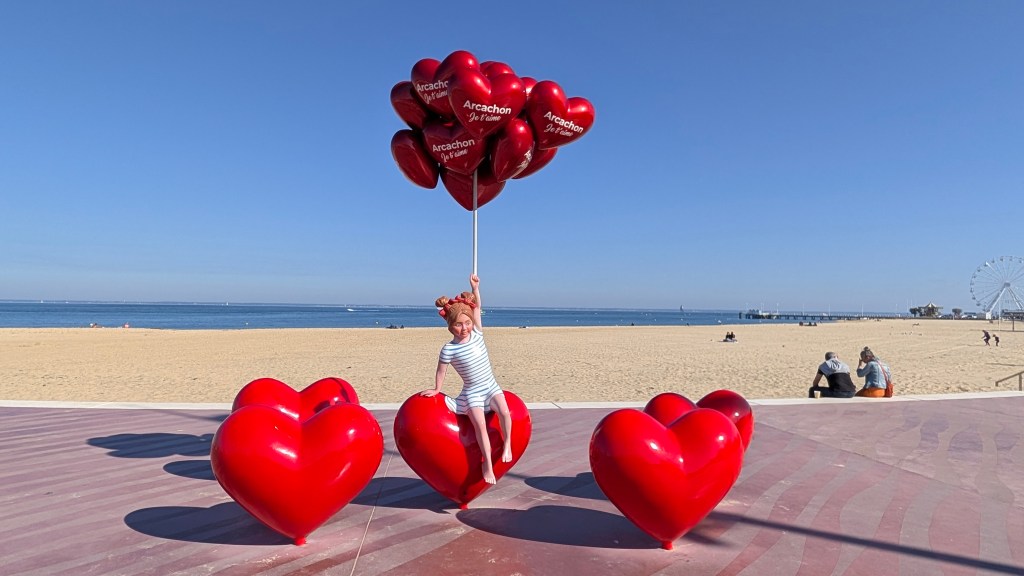
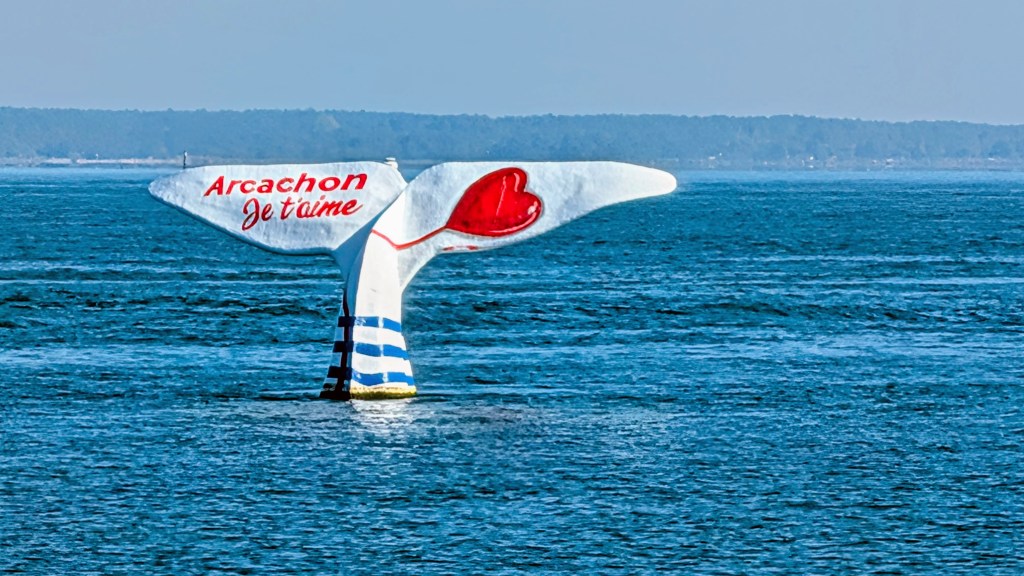
We strolled along the promenade on the beach enjoying the art installations

and the bay.

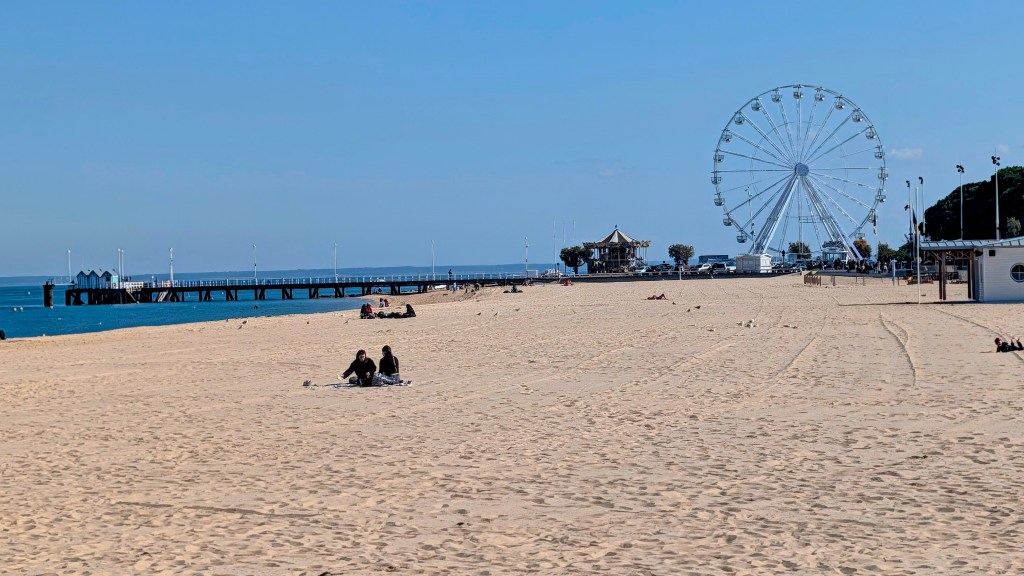
We walked out onto the pier.

Arcachon has a population of about 15,000 which doubles on the weekend.

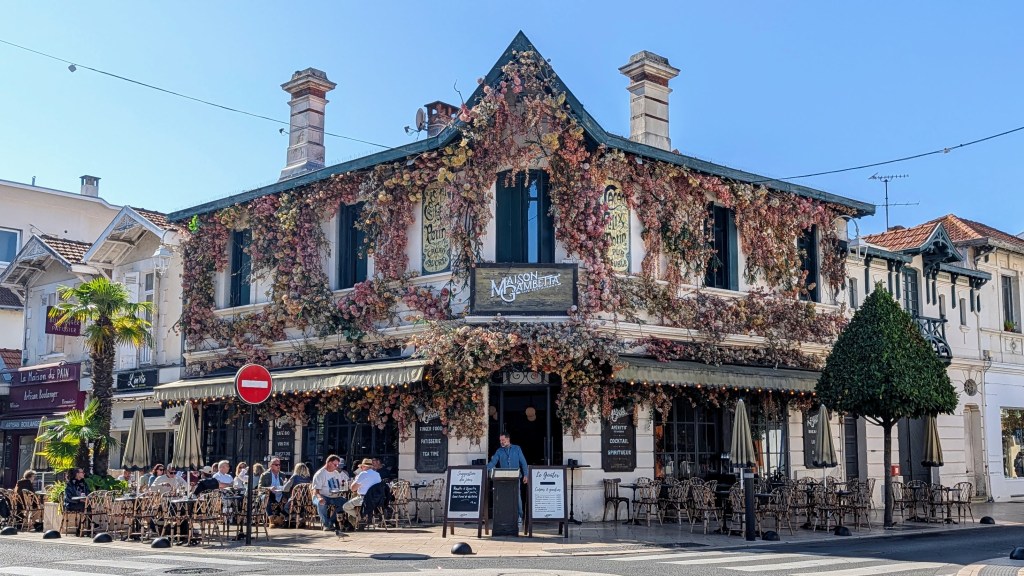
We left the beachfront and wandered around town. La Maison de Gambetta is known for its distinct floral exterior and outdoor dining area. 

La Maison de Gambetta

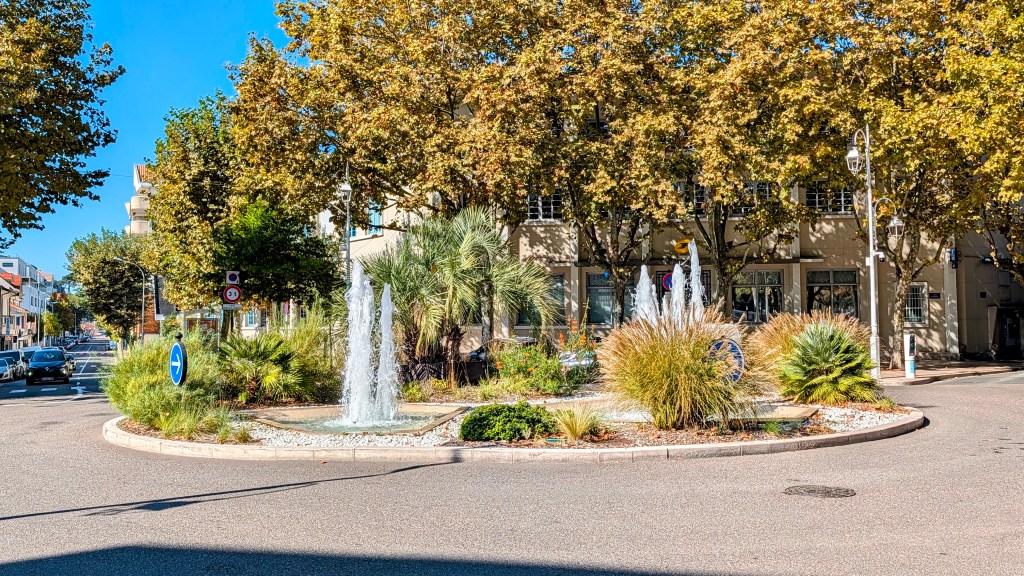
Just about every intersection has fountains and plantings.

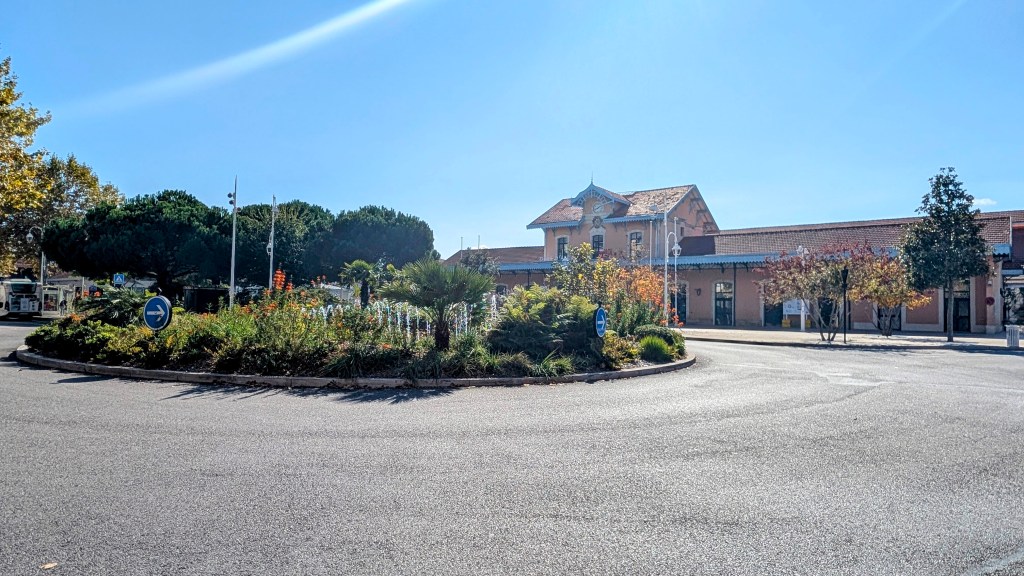
Gare d’Arcachon (The Arcachon railway station), originally opened in 1857, serves as the western terminus of the railway line from Lamothe and provides connections to destinations like Bordeaux and Paris. 

Gare d’Arcachon

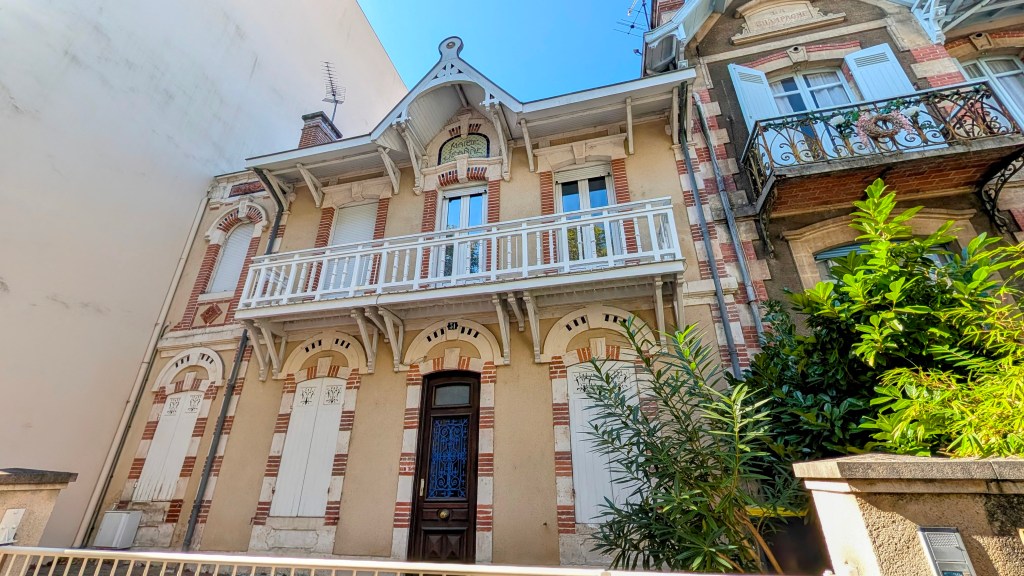
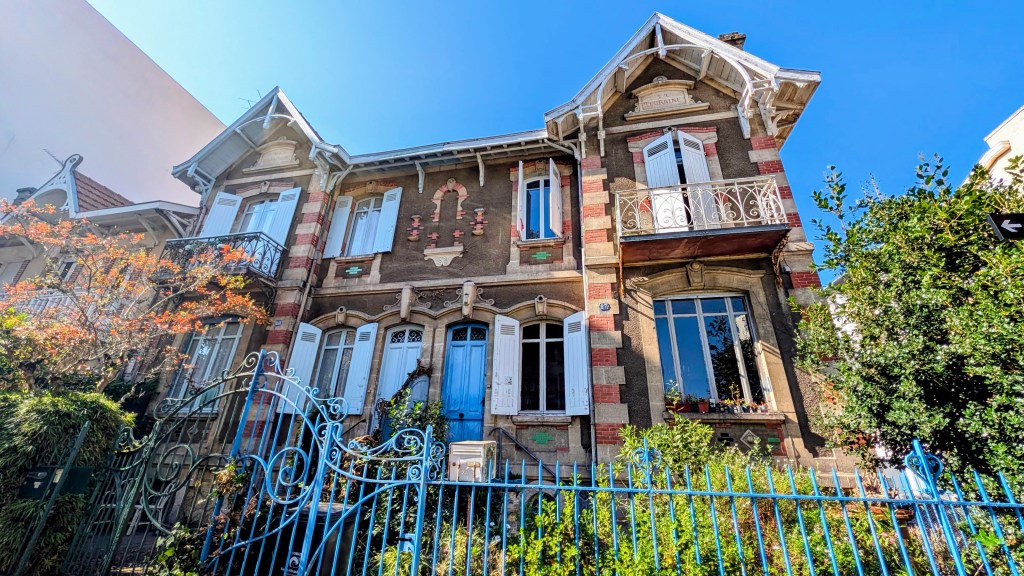
Ville d’Hiver (Winter Town) is a 1270 acres district featuring 300+ eclectic villas designed for wealthy winter residents. Built during the Belle Époque, these extravagant “Arcachonnaise” style homes showcase a mix of styles: Swiss, Moorish, and Gothic, characterized by steep roofs, turrets, and intricate ironwork.

“Arcachonnaise” Villa

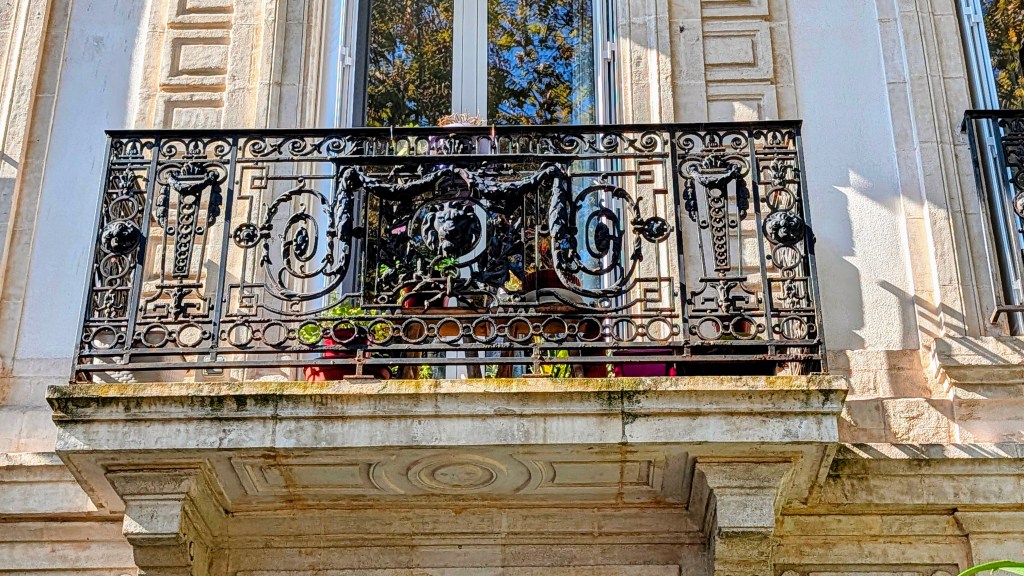
The ironwork is reminiscent of Paris.

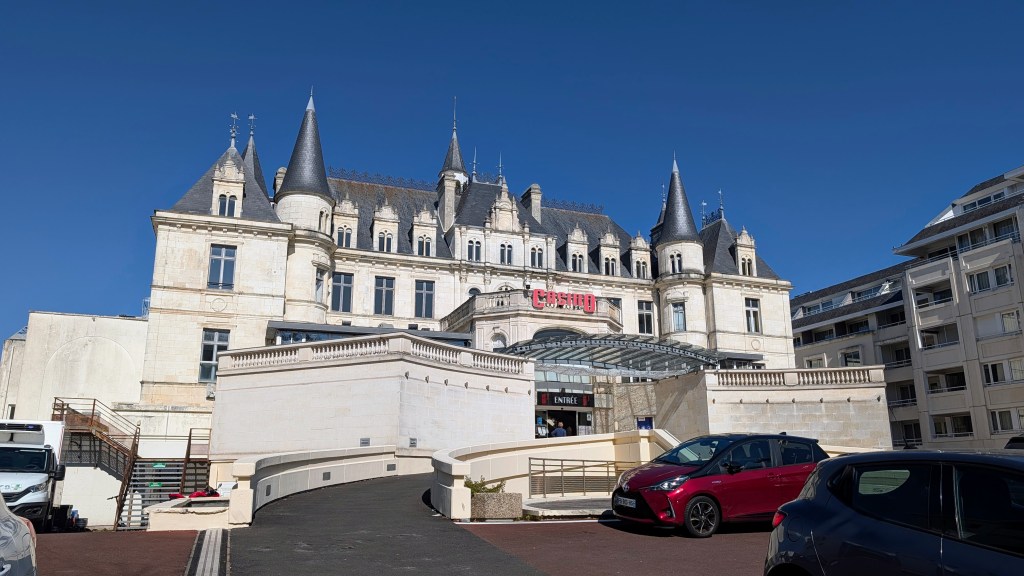
The Casino Partouche d’Arcachon, historically known as the Château Deganne, is a magnificent neo-Renaissance château originally constructed in 1853 and converted into a casino in 1903. 

The Casino Partouche d’Arcachon

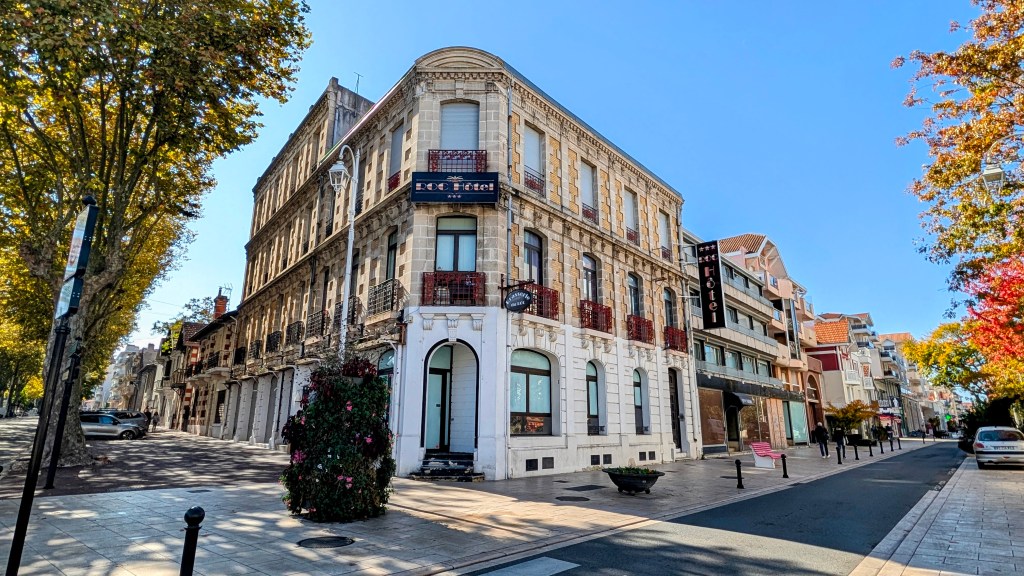
Even the local Roc Hotel is in the “Arcachonnaise” style.

The Roc

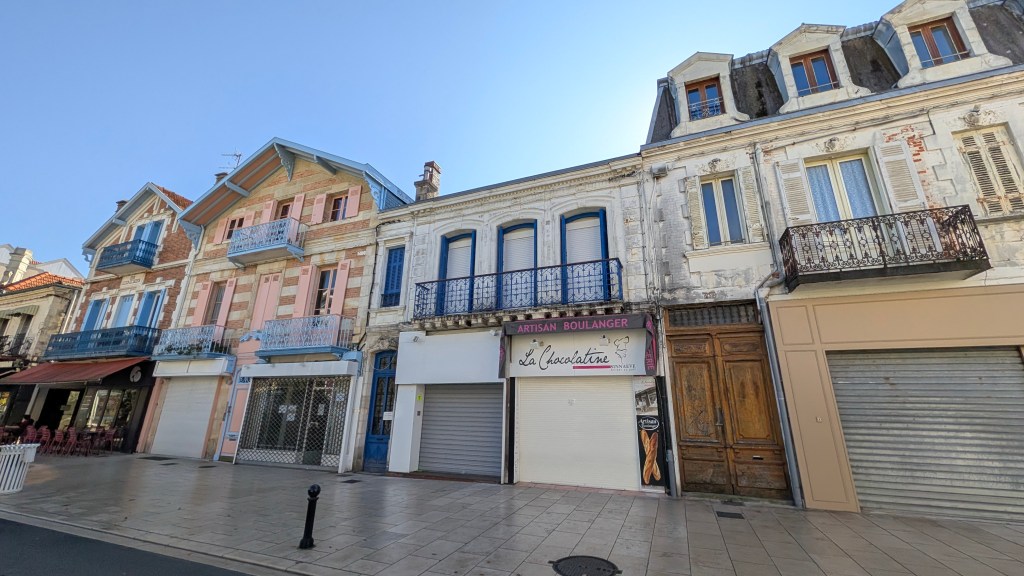
Unfortunately because it was a Sunday, the very cute shops were mostly closed

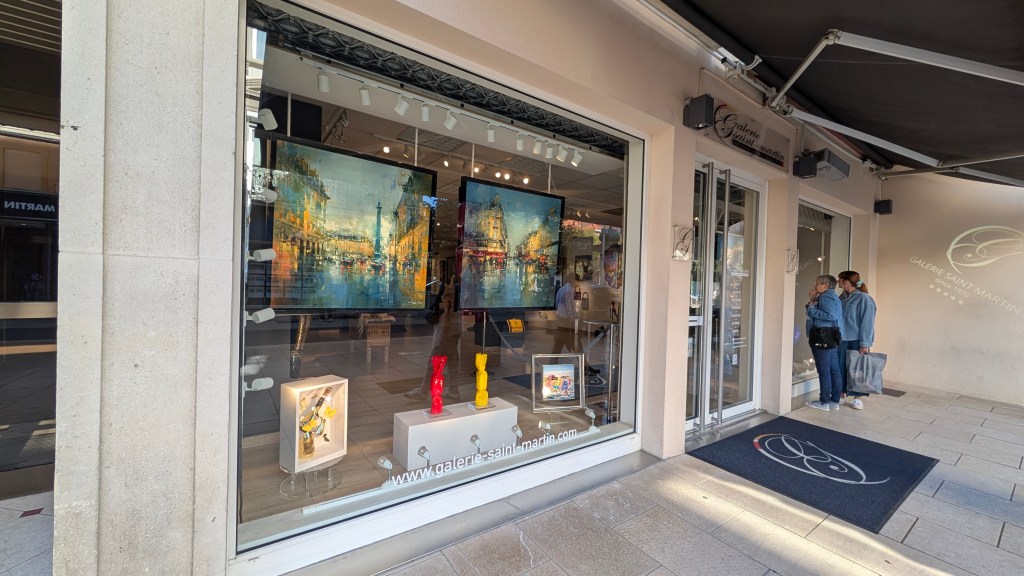
as were the galleries.

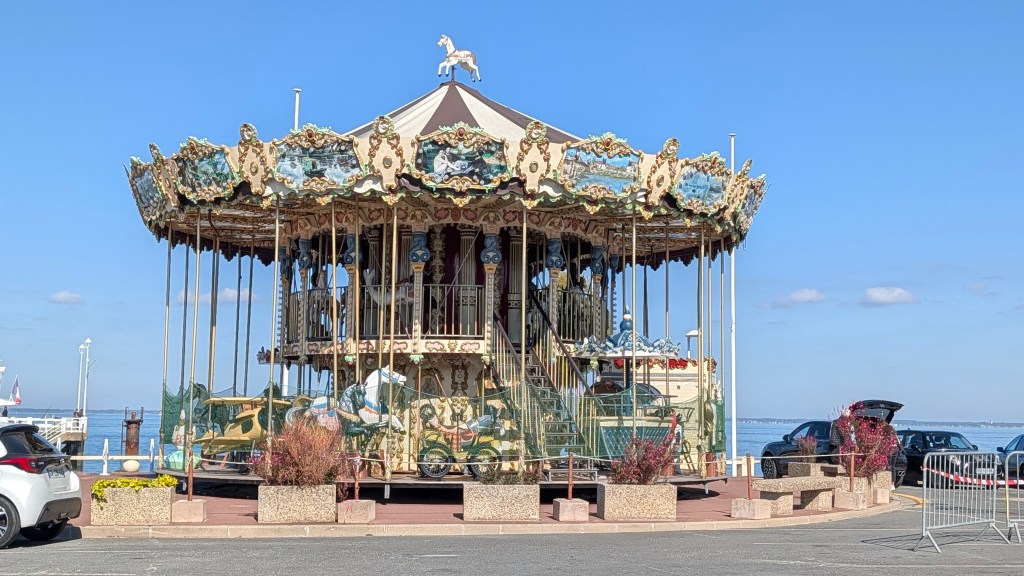
On the boardwalk was the requisite French carousel.

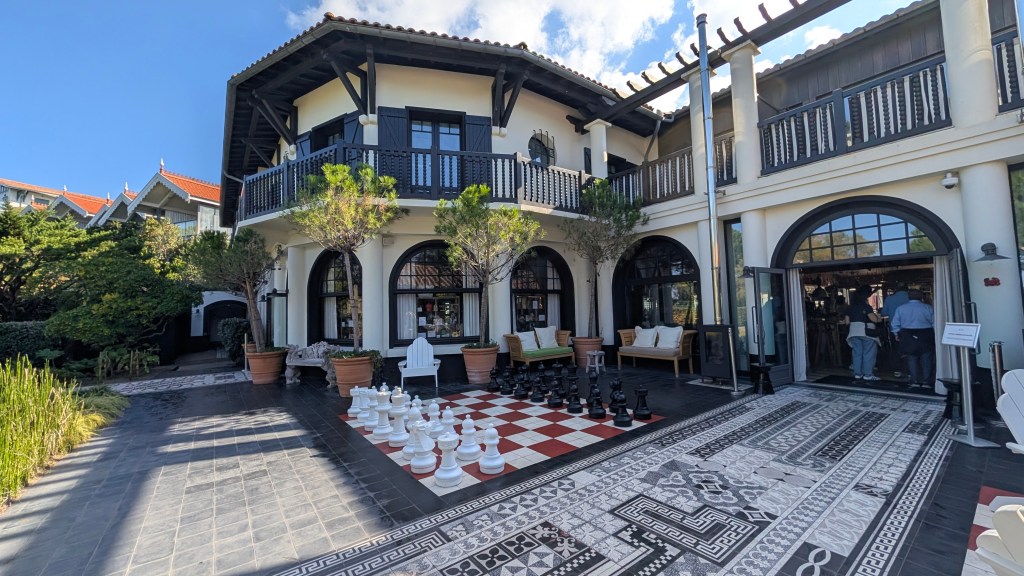
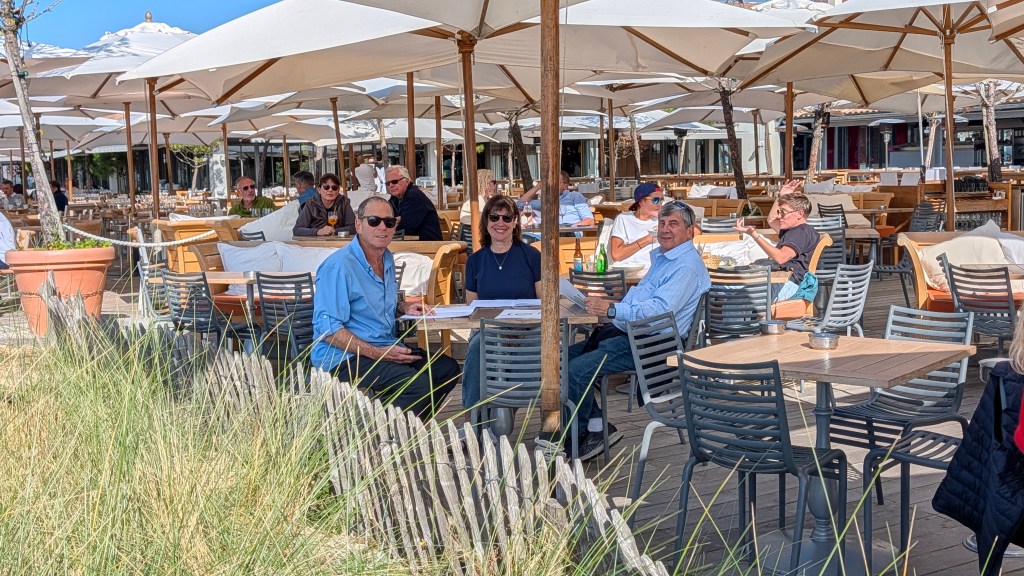
We left the village and stopped at La Coorniche, a luxury 5-star hotel and restaurant located in Pyla-sur-Mer, near Arcachon. The property was renovated by renowned designer Philippe Starck and features a distinctive Basque-style hunting lodge architectural aesthetic from the 1930s.  Oysters from the bay are their speciality, but they had run out before we arrived, so sad.

La Coorniche

But from the restaurant we did have a view of the bay and the Dune of Pilat.

Dinner was served at another restaurant at Les Sources de Caudalie, La Table du Lavoir (The Washhouse Table).

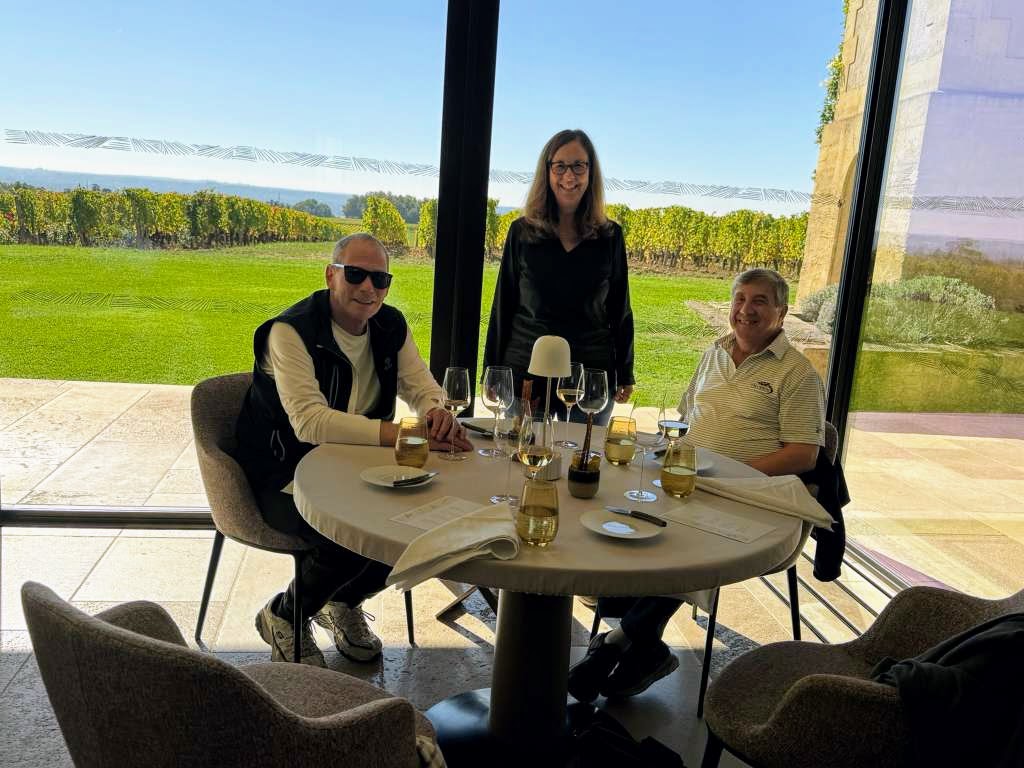
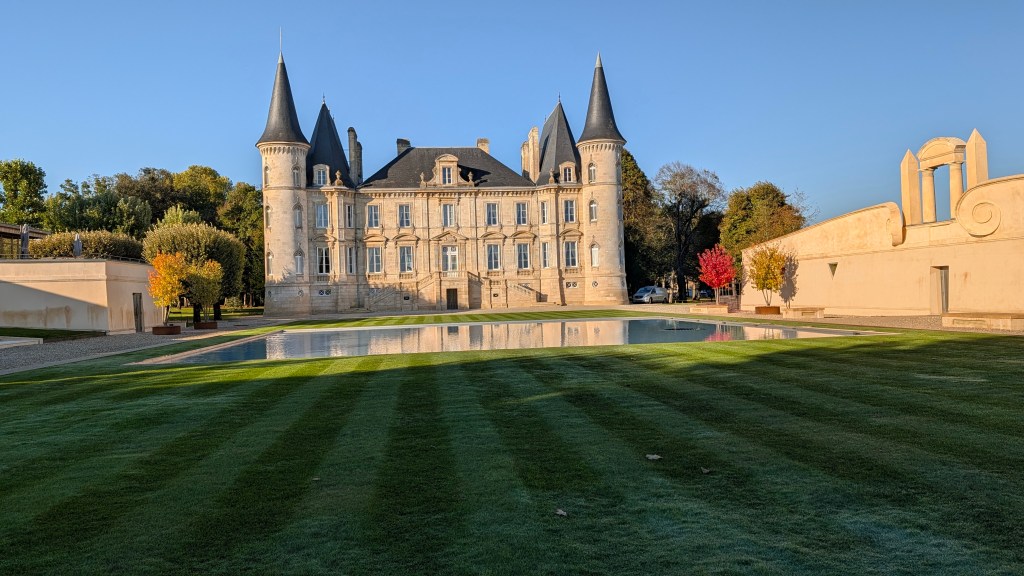
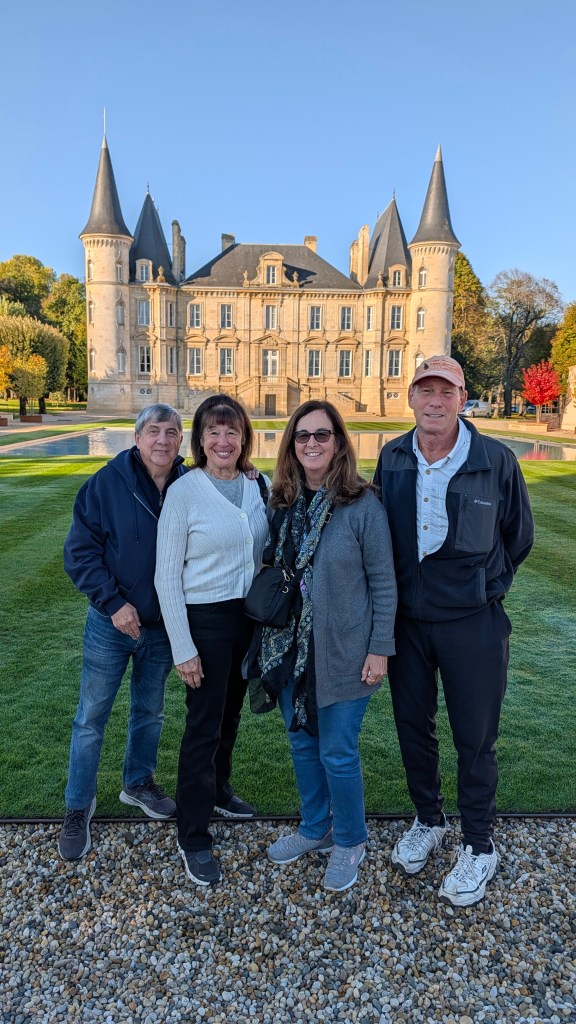
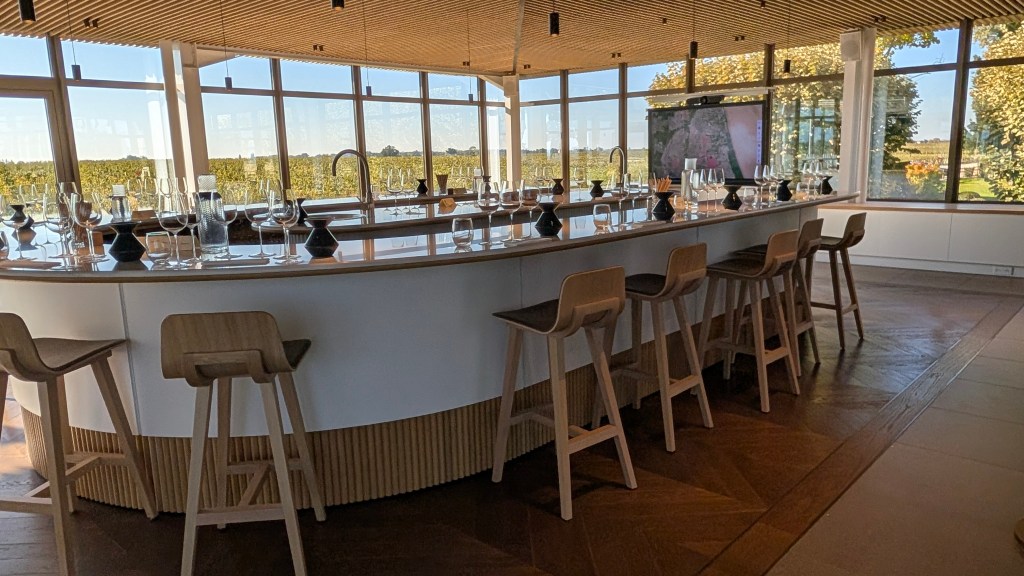
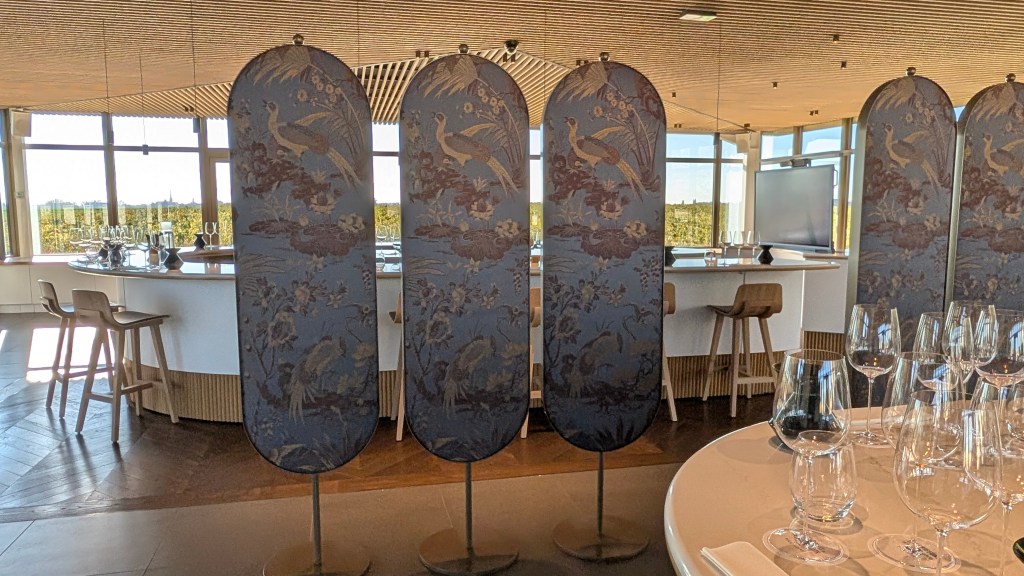
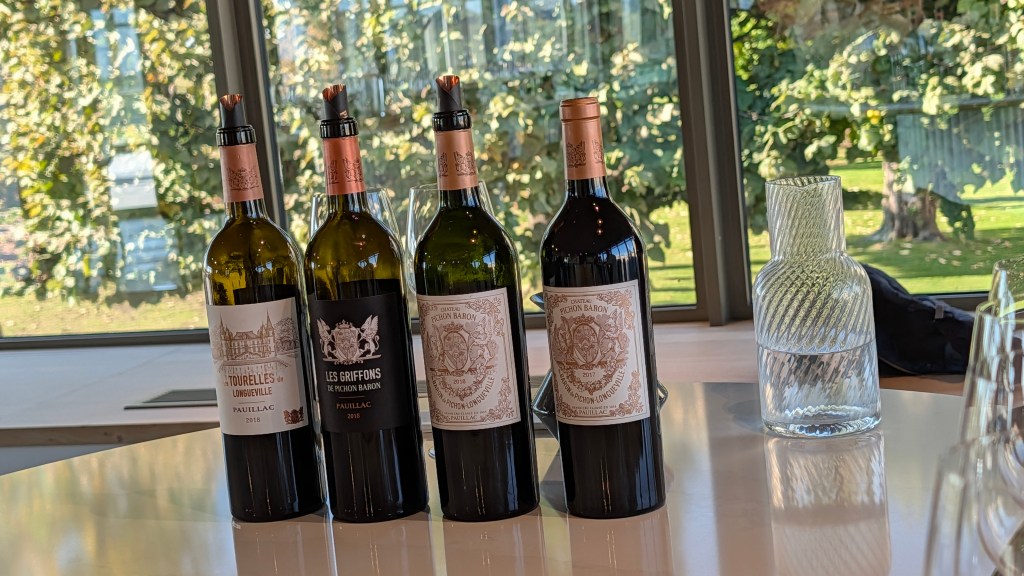
The next day we checked out of Les Sources de Caudalies and traveled back to Haut-Médoc first to the Pauillac appellation to visit Château Pichon Longueville Baron, immediately adjacent to the famous Château Latour.  According to the Official Bordeaux Wine Classification of 1855, it is classified as a Deuxième Cru Classé (Second Growth).

Château Pichon Longueville Baron

The history of the estate as told on their website: “The estate was founded in the late 17th Century. This period was known as the Grand Siècle, or “great century”, in reference to Louis XIV’s 1661 accession to the French throne. In 1689 Pierre Desmezures de Rauzan, an influential wine merchant and steward of the prestigious Latour and Margaux estates, bought plots of vines close to the Latour estate to create Enclos Rauzan. These vines were part of his daughter Thérèse’s dowry when she married Baron Jacques Pichon de Longueville in 1694, the year in which the Pichon Baron estate was founded. An illustrious estate, with an enduring reputation, was born. It remained in the same family for generations.”

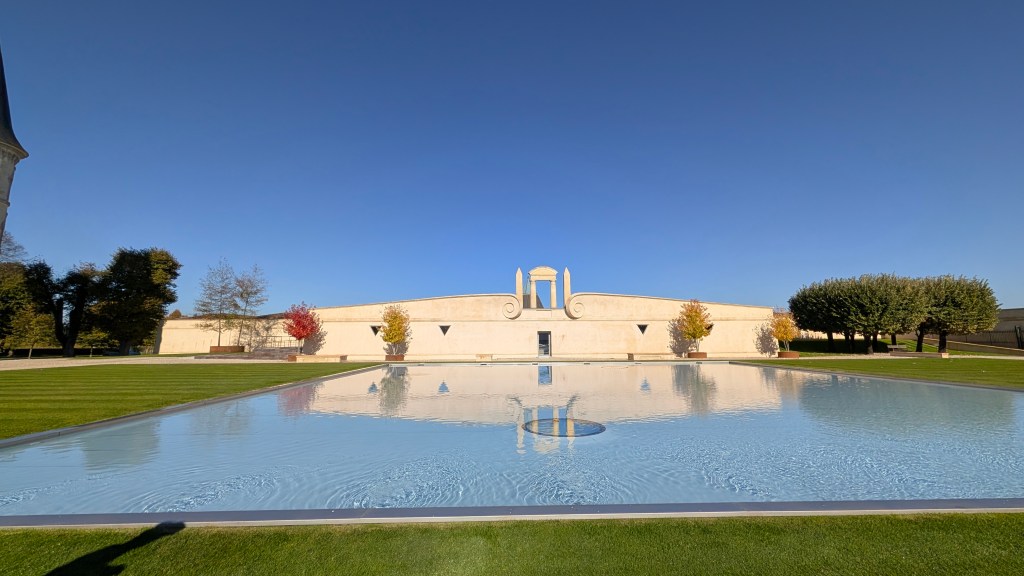
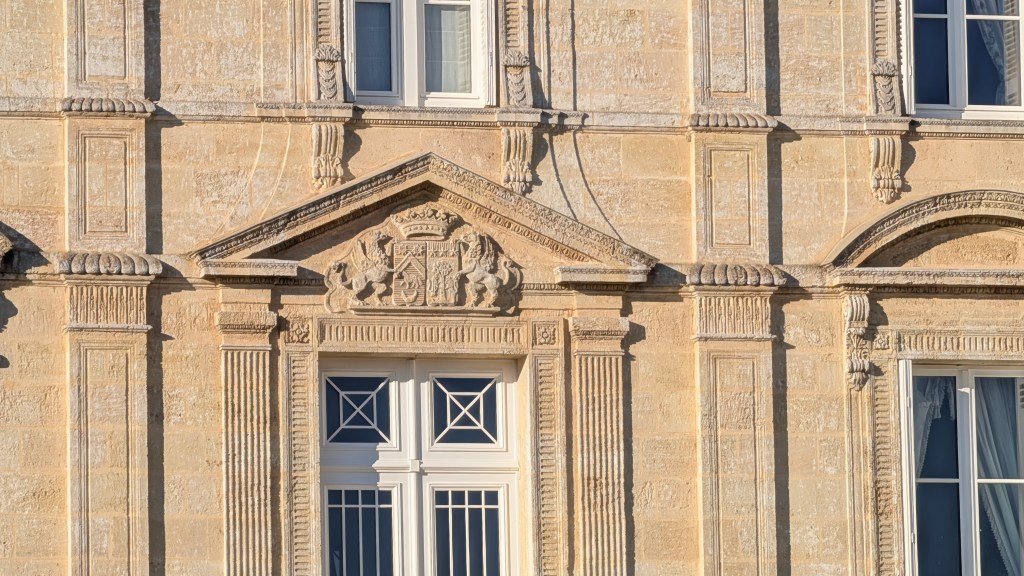
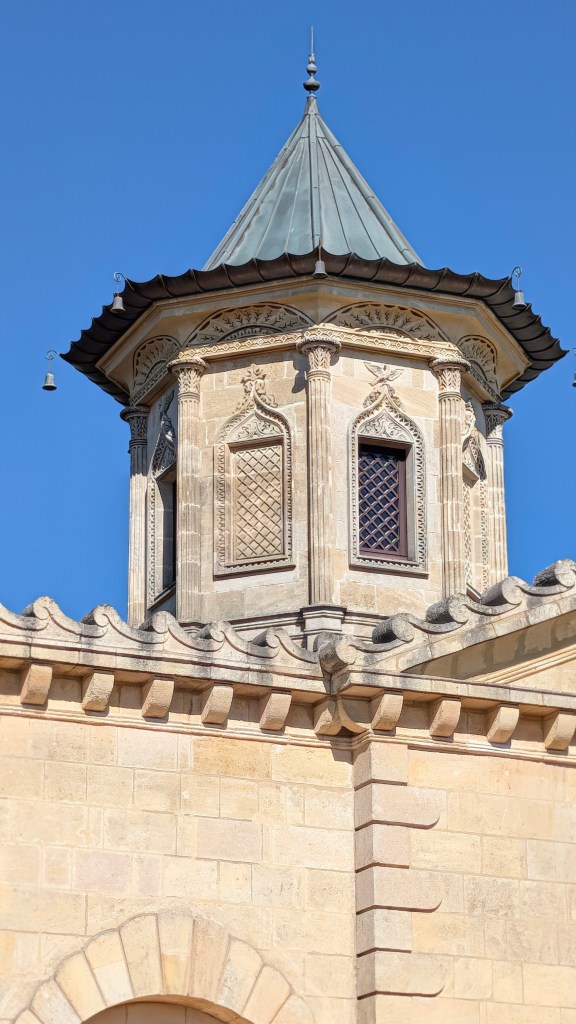
“In 1850 the property was divided in two. Baron Raoul Pichon de Longueville’s section became the Pichon Baron estate. The second section, belonging to his three sisters, became Pichon Comtesse. Baron Raoul was proud of his prestigious property, and in 1851 he commissioned the imposing château (using limestones from St. Emilion) inspired by Renaissance architecture that we know today. This uniquely charming and romantic château, with its two emblematic turrets, has stood proudly at the vineyard’s heart ever since. In 1987 the estate was bought by AXA Millésimes, (a French insurance company) whose aim is to enable great wines from vineyards with a glorious past to achieve their full potential… The comprehensive reconstruction of the fermenting room and cellar, and renovation of the château, began in 1988. Since then, the 19th century château’s image has been reflected in an ornamental pool stretching majestically before it.”

We were met by our guide Marie who explained that the 185 acres are divided into 3 different areas, each for a different wine because of the difference in the terroirs. The terroir closest to the river has a lot of gravel, which is especially good for the premium cabernets. The plots that have a higher sand and clay content are better for the merlots. Most of the vines are over 35 years old. The older vines produce a much lower quantity of grapes but with far better quality. No irrigation is allowed in the appellation, which requires deeper roots which creates better nutrients, and thus a better quality grape.

The destemmer uses an oscillation process to separate the grapes from the stems.

Optical sorters take thousands digital pictures, then use air blowers to separate the good from the bad berries. The bad berries are sent for production of hand sanitizing alcohols.

The vats are filled from the top using gravity to help crush the grapes. Each vat has a different grape varietal of a grape of a different age. The choice of wood v steel vats is only for size. Maceration is first for 5 days cold, then heated for 7 days; warm fermentation at 81°F using yeast that is cloned in their own lab. Malactic fermentation takes place at 70°F for another 5 days. At this point the solids float to the top, called a “cap.” The cap can either be pushed down from above or the fluids can be removed from the bottom and reintroduced through the top to mix the entire contents.

The juice is then mixed for a few hours before being poured into barrels. After 8 months in the barrel, they are remixed then reinserted into the barrels for another 4-10 months, depending on the grape, then possibly blended a second time.

All of the barrels are French oak, but from several different makers.

No pesticides or insecticides have been used on the property since 2001. The product is considered sustainable but not designated organic. Barrels are cleaned using hot water and uv light.

The winery produces 150,000 bottles a year.

It was time to head to the tasting room.

The cork changes about every 30 years, but the label has never changed.

Per my usual, I took notes on the grape contents of the different wines we tasted.

On the way out, we noted the steel gate had the same design as the label.

It was time for lunch at La Maison d’Estournel, a historic, originally private 19th-century residence of Louis-Gaspard d’Estournel, known for his unique architectural style.  It is now a charming boutique hotel in Saint-Estèphe featuring 14 elegant rooms and a restaurant. 

La Maison d’Estournel

We settled in for a delicious multi-coarse lunch

including squash soup

and fish.

After lunch we had some time to explore the property. It has a large, inviting back yard.

More on the elephants later.

Features of the property include a swimming pool,

and an extensive garden

with chickens

and flowers.

The restaurant is situated adjacent to the famed Château Cos d’Estournel winery in the Saint-Estèphe appellation.

Château Cos d’Estournel winery

We were met there by our guide Annaice who explained that cos, the name of the town, means “hill of pebbles,” in Gascon dialect and the name Cos d’Estournel was given in 1810 by Louis-Gaspard d’Estournel, the first owner. He bought basically the entire town except for the property of his direct neighbor.

Due to extensive trade with Asia, in the 1820s Louis-Gaspard built a unique, Asian-inspired palace, featuring pagodas and carved wooden doors, becoming a landmark of the region.

 The estate features a massive carved wooden door from Zanzibar, which is covered in studs that originally protected it from elephants.

The current owner bought the home, now the restaurant in which we ate, in 2000 and the winery in 2016. The winery has no windows because originally it was the wine cellar.

The details of the architecture are fascinating.

Nonconformist and determined to glorify the terroir of Cos d’Estournel, Louis-Gaspard saw every new market, especially India, as an exciting opportunity. Because of Louis-Gaspard’s significant debt locally, the wines of the estate were bottled and sealed with glass stoppers before being shipped to Calcutta, Madras, and Bombay as early as the 1830s, After a long journey, some of the wines of Cos d’Estournel were shipped back to France from India. When the bottles were opened, it was clear the wines had gained in elegance and richness, quite simply improved by sailing from Bordeaux to India and then back again, or so he thought. The advantages of aging wine were not yet appreciated. He began marketing as “back from Indies.”

Louis-Gaspard

To celebrate these Eastern expeditions and his success, Louis-Gaspard brought back exotic elements to the Médoc, including the pagodas and the elephant motif.

Elephants are fundamental symbols at Château Cos d’Estournel, serving as guardian angels, good-luck charms, and a direct nod to the estate’s Eastern heritage. They represent intelligence, strength, wisdom, and longevity, and are found throughout the estate, including in the gardens, cellars, and on the pagodas, and, as we had seen, his private home.

We went inside the original wine production space now turned guest tasting venue.

The inside is chock full of artifacts from the East. This mosaic is from Myanmar.

The doors were originally huge to allow for passage of equipment and wagons loaded with grapes.

A second, even more impressive door from Zanzibar is on the other side of the building not seen from the front.

Louis-Gaspard d’Estournel became known as the “Maharajah of Saint-Estèphe”.

Annaise explained to us that 300-350,000 bottles are produced yearly on the 250 acres.

Because of the location on the hill, the property is windy all the time which prevents frost in the winter and extreme heat in the summer. In the fall, the vines are pruned down to a single branch in a horizontal position. Horizontal growth is desired because grapes being low to the ground protects the grapes from the wind. There are 20 permanent employees of the estate; they are responsible for the pruning. For the 3 weeks of harvest, and additional 120 pickers are employed.

Elephants can be found everywhere.

The bottle collection includes some originals.

Finally, it was time for our tasting.

As we drove through Médoc we passed the historic Château Lafite Rothschild wine estate in the Pauillac appellation. It is one of only five wine-producing châteaux originally awarded First Growth status in the 1855 Bordeaux Classification. References to the property date back to 1234. The estate has been owned by members of the Rothschild family since 1868. The vineyard is renowned for producing some of the world’s most expensive red wines, primarily dominated by Cabernet Sauvignon. 

Château Lafite Rothschild

We checked into Villas Foch in Bordeaux in the late afternoon.


Villas Foch

The lobby was inviting and warm.

We climbed the stairs to our rooms for a bit of a rest before heading out into the evening for a light supper.

We went toward the city center passing through the main square, Place de la Comédie.

Place de la Comédie

After a light dinner we passed again through Place de la Comédie, this time taking note of the Grand Théâtre de Bordeaux, home to the Opéra National de Bordeaux. Completed in 1780, it is a masterpiece of Neoclassical architecture designed by Victor Louis.  The facade features a portico with 12 colossal Corinthian columns, topped by statues representing the nine Muses and three goddesses.  The theater is celebrated for its incredible acoustics and opulent interior, which was restored to its original blue and gold colors in 1991.

Grand Théâtre de Bordeaux

Almost directly across from Villas Foch was a temporary fair, which we could not resist.

It had all the usual rides and games.

We called it a night, but there was more wine touring yet to come. More on the city of Bordeaux in the next post.

France: Provence-Alpes-Côte d’Azur Region: Avignon, Aix-en-Provence, Cassis Oct 9-11, 2025

We left Arles early and headed east. On the way we stopped in Avignon, the “City of the Popes,” having served as the seat of the Catholic Church from 1309 to 1377. We parked near Place du Palais (Palace Square) a historic, lively square dominated by the 14th-century Palais des Papes (Popes’ Palace), the world’s largest Gothic palace. Once created by destroying homes to form a defensive “glacis” for the Popes, this UNESCO site is now a hub for cafes, tourists, and the famous Avignon Festival. We stopped for coffee before embarking on our tour of the city,

Place du Palais (Palace Square)

Because we were parked there and would return at the end of the day, we decided to hold off touring the inside of the huge palace for now and headed instead toward the cathedral.

Palais des Papes (Palace of the Popes)

Near the Palace of the Popes, on the Palace Square, is the seat of the Archbishop of Avignon, Cathedrale Notre-Dame des Doms (Avignon Cathedral). Built and consecrated in 1111, it is believed the Cathedral is not the first church to occupy this spot. It is thought a basilica preceded it only to be destroyed by Saracen raiders in 731. There are different theories about the origin of the name of the church. It might be derived from domus episcopal, meaning “Bishop’s house”, or Rocher des Doms after the enormous rock that rears above the cathedral.

Cathedrale Notre-Dame des Doms (Avignon Cathedral)

The style might be an architectural stew of mostly provencal Romanesque, mixed with Greek, Roman, Gothic and Baroque elements. Some inner chapels were added in the 14th century, during the time of Pope John XXII, second Pope of Avignon. The donated bells are a 35-strong carillon.

Cathedrale Notre-Dame des Doms (Avignon Cathedral)

The cathedral has a great octagonal dome,

From the entrance of the cathedral is a great view of the Palace Square.

The interior of the cathedral has been somewhat recently restored appearing now clean and bright.

The marble papal throne dates from the 12th century. In the chapel of John XXII, there is collection of reliquaries and vestments.

On our way out we noted the now familiar sign that we are on a Camino del Santiago route.

Just below the cathedral stands Musée du Petit Palais (Little Palace Museum). Housed in a 14th-century building, the museum showcases an exceptional collection of early Renaissance paintings and “primitives” from Italy, alongside works from the Avignon school. 

Musée du Petit Palais (Little Palace Museum)

Over the centuries, the building’s role evolved significantly. Initially a fortified citadel during the Western Schism, it fell into disrepair by the early 15th century. Restoration in the late 15th century shaped much of its current form, but it was again affected by nationalization during the French Revolution. In the 19th century, it became a Catholic secondary school, and later a technical school after the 1904 church-state separation. Declared a historic monument in 1910, it underwent major restoration starting in 1961 under architect Jean Sonnier.

What looks like a gargoyle but does not function as a water drain is called a grotesque.

The song goes… “On the bridge of Avignon Everyone is dancing On the bridge of Avignon Everyone dances in a ring” But, actually they danced below the bridge, not on it. The bridge referred to in the song, Le Pont d’Avignon is actually Pont Saint Benezet. Saint Benezet (1165-1184) was an illiterate shepherd who became the patron saint of bridge builders.

Pont Saint-Bénézet (St. Benezet Bridge)

In 1177 Benezet told the bishop he had had a vision wherein he was told by angels to build a stone bridge across the Rhone. The bridge was to be at a point where the force of the river was greatest. The bishop, not wanting to defy Heaven, approved the project and work began. Benezet’s holy mission was confirmed by no less than 18 miracles of healing.

Originally, it was 900 meters long, featured 22 arches, and connected Avignon to Villeneuve-lès-Avignon. It was once a crucial, narrow (only 4 meters wide) route for pilgrims, traders, and the Papal court in the 14th century.

The stone bridge that replaced Benezet’s damaged bridge in 1234 had 22 arches and 21 piers and was 980 yards long. The arches were low and were liable to collapse when the river ran too high. After repeated destruction by the Rhône’s currents and floods, maintenance was deemed too costly, and it was abandoned in the 17th century.

Only one chapel, Saint Nicholas Chapel, and four arches remain of the bridge. Inside were art installations by French artist Jean-Michel Othoniel, more from him later.

From the bridge a portion of the The Ramparts of Avignon, 2.8 miles of intact 14th-century medieval ramparts surrounding the city, can be seen.

The Ramparts of Avignon

The bridge had a protective drawbridge preventing intruders from entering the city.

We reentered the gates of the city and made our way to Place de l’Horloge (Clock Square). At its center is the monumental clock which gives the square its name, but cannot actually be seen from the square. The square is possibly the busiest in Avignon. Cafes and restaurants are frequently overflowing. Street artists emerge with their easels around the square. The Roman forum of Avenio was located where the Clock Square is today. During the 12th and 13th centuries it was known as the Square of the Butchers. This was the place where butchers set up shop on market days. It was partially occupied by the convent of Saint-Laurent, the oldest convent in the city.

Place de l’Horloge (Clock Square)

In the center of the square is Hôtel de Ville (Town Hall), designed by architect Léon Feuchères and completed in 1846, replacing an earlier structure. It serves as the municipal headquarters for the city of Avignon in the Provence region of southern France. 

Hôtel de Ville (Town Hall)

Hôtel de Ville has stood in the heart of the city since the 14th century. Originally serving a different civic function, the building’s tower operated as a belfry before it was transformed into a town hall in the 19th century. This transformation was guided by designs from Joseph-Auguste Joffry, who enhanced the building’s façade with elegant Corinthian columns, a balcony, and a peristyle, reflecting a Classical architectural style, which includes a clock, but not the one for which the square is named.

To see the clock in the tower, which dates back to the 15th century, we had to walk around the building.

On one end of the square we found a carousel. The French clearly like to keep their kids entertained.

On the ground in the center of Place de l’Horloge is a mosaic of the coat of arms for the city of Avignon featuring keys and flanked by eagles.

Rue de la Republique (Republic Street) Republic Street is a prominent quarter mile street in the heart of the city, running from the Clock Square (Place de l’Horloge) to Cours Jean Jaurè, the administrative hub of the city.

Rue de la Republique (Republic Street)

The street’s construction took place in three phases between 1856 and 1867, led by Paul Pamard’s municipality. The first phase (1856-1857) extended from the railway station to Joseph-Vernet Street, elevated to prevent flooding. The second phase (1859-1863) stretched to the Chapel of the Lycée. The final phase, completed in 1867, connected the chapel to Clock Square. Along the way are several historic buildings with interesting architecture.

Built in 1385 with a donation from the Cardinal Pierre de Pres, Église Saint-Pierre (St. Peter’s Church) is in the very center of town, near the Aubanel printing museum, on the cobbled Saint Pierre Square. Here is a perfect example of flamboyant Provencal Gothic architecture. There are six side chapels added in the 15th and 16th centuries. The building’s foundation dates back to the seventh century. An Octagonal bell tower surmounts the church.

Église Saint-Pierre (St. Peter’s Church)

The original renaissance walnut doors are 13 feet high with carvings by Antoine Volard.

Église Saint-Pierre (St. Peter’s Church)

We had trouble finding the entrance and walked around the back only to be surprised at how much larger it is than first appeared from the front.

Église Saint-Pierre (St. Peter’s Church)

The interior of the basilica does not disappoint. It has a multitude of painted vaults, gilded balconies for the choir, renaissance paintings,

Église Saint-Pierre (St. Peter’s Church)

and a stone altar with an altar piece by Umberto Boccioni. The original vestments and hat of Cardinal de Pres hang in a glass covered cabinet on the wall. They carry their age very well

Église Saint-Pierre (St. Peter’s Church)
Pieta St. Peter’s Basilica

Tour Saint-Jean is situated at Place Pie in the historic center of Avignon. Constructed in the 14th century, the tower originally served as part of the city’s defensive walls.  It is a stone tower featuring a clock near the top and Gothic-style window openings. 

Tour Saint-Jean

On its façade is the city coat of arms.

Nearby on Pie Square is Les Halles d’Avignon (Avignon Market Halls), a vibrant marketplace that has become synonymous with the city’s gastronomic culture. The origins of Market Halls trace back to the 16th century when the land, once owned by a man executed as a heretic, was designated for a covered market. Though construction was slow, the market hall was eventually completed in 1624, featuring not just shops but also a guardhouse and a chapel. Over the centuries, the market evolved, with major redevelopment projects taking place in the 19th and 20th centuries. Throughout its history, Market Halls has undergone numerous changes, including a roof redesign in the 1920s and various structural modernizations in the mid-20th century, adapting to the shifting commercial landscape with the advent of supermarkets and the subsequent need for downtown revitalization. A unique feature of Market Halls is the impressive 600 square meters green wall on the north façade, designed by botanist Patrick Blanc, which adds to the market’s distinct allure and serves as a significant city attraction.

Les Halles d’Avignon (Avignon Market Halls)

This covered market hosts around fifty traders offering a diverse range of high quality products including bread, cheese, fruits, vegetables, poultry, pastries, delicatessen items, shellfish, flowers, and both organic and exotic goods. Renowned authors like Peter Mayle and Jean Viard have celebrated the market, solidifying its reputation as a culinary hotspot. Today, Avignon Market Halls is not just a market but a lively community hub where, every Saturday since 2006, chefs and artisans from Greater Avignon engage with visitors through live cooking demonstrations using fresh ingredients from the market. This tradition not only highlights the rich culinary heritage of Avignon but also offers a hands-on experience for food enthusiasts looking to learn and share in the artistry of local cuisine.

Les Halles d’Avignon (Avignon Market Halls)

After lunch in a cafe in Place de l’Horloge we made our way back to the Palace of the Popes through the narrow winding streets of Avignon.

The Palace of the Popes is one of the largest, if not the largest, medieval Gothic structures in Europe.  The popes fled to Avignon in 1309 because Rome had become too dangerous due to political unrest and violent conflicts. The construct served well as a fortress, palace, and papal residence throughout the 14th century, during the Catholic schism (during which there were two popes: one in Italy, one in France) and the “Babylonian Captivity” of the Papacy. Six papal conclaves and seven Popes were maintained in the palace.

The palace is actually two buildings joined together. There is the old palace of Benedict II, firmly ensconced on the rock of the Doms, and the new palace of Clement VI. Clement was known to be the biggest spendthrift of the Popes of Avignon. The palace is probably the best example of International Gothic style.

Built in under 20 years (1335–1352) and covering 15,000 square meters. It served as the seat of Western Christianity during the 14th century.

The papal coat of arms is that of Pope Clement VI. The shield belongs to the Roger de Beaufort family, to which Clement VI belonged. Above the shield is the papal tiara, and behind it are the crossed keys of Saint Peter, symbolizing the authority of the Catholic Church. 

In the cloisters is another installation by French artist Jean-Michel Othoniel. There were many throughout the palace. I have to admit, I was not a big fan of them. I felt they distracted rather than enhanced the experience of the palace.

The walls are covered with remarkable 14th-century frescoes painted by famous Italian artists like Matteo Giovanetti. The floor below is another installation by Othoniel.

Displayed throughout are some original elements of the palace.

Pope John XXII, who lived in the palace, loved wine and helped make regional wines famous, leading to the creation of the nearby Châteauneuf-du-Pape (New Castle of the Pope).

The papal library housed in the palace held over 2,000 volumes. It was a big draw for scholars and humanists.

 Today, most of the palace is unfurnished, focusing on the impressive architecture, though some 14th-century frescoes remain. This lone chest remains.

The papal garden, originally designed in the 14th century, has been recreated using medieval-style landscaping arranged with large rectangular beds planted with Mediterranean species known to have grown there in the 1300s.  

 A decorative fountain is featured in one of the palace gardens.

After exploring the gardens we climbed back to an upper floor of the palace, from which we had a view of the gardens below as well as the high walls surrounding the palace.

The kichen was a very large room with a central chimney situated right next to

the very large banquet hall

with its massive fireplace. The Palace regularly hosts art exhibitions as seen above.

The grand chapel is enormous

as is the side chapel.

Secret, heavily fortified chambers holding the papal treasury were discovered in 1985, still containing bags of silver and gold coins. The Avignon papacy and administration became irrelevant when operations returned to Rome. After the popes left, the building took on many “unholy” roles, including serving as a military barracks and a prison following the French Revolution.

Having had our fill of the Palais des Papes, we got back in our car and headed to our next destination: Aix-en-Provence. Founded by Romans in 123 B.C. as Aquae Sixtiae (a spa town denoted for its thermal baths), it is now famous as the “City of a Thousand Fountains” and the birthplace of painter Paul Cézanne (1839-1906) as evident by the first thing we saw upon emerging from our car.

We checked into our hotel: the Cézanne Boutique Hotel, conveniently located right on the edge of the old city.

Cézanne Boutique Hotel

Tired from our long day, we headed for a delicious dinner at La Petite Ferme (The Little Farm).

In the morning we embarked on the journey of fountains, and other things. First stop: Fontaine de la Rotonde (Fountain of the Rotunda). When Count of Valbelle left Aix-en-Provence in 1779, he gifted the city a generous parting gift: 30,000 livres, which was the currency at the time. The city decided to put that money to work. It took a while in the planning stages, but in 1860 the most iconic splash zone in town got born: the Fountain of the Rotunda. Long known for its love affair with water, from Roman baths to bubbling neighborhood spouts, Aix needed a proper fountain to fortify its reputation. The Rotunda Fountain delivered. Towering nearly 40 feet, it was the first in the city to feature a cast-iron basin.

Fontaine de la Rotonde (Fountain of the Rotunda)

Lions lounge around its edge like they own the place, while bronze children cling to swans mid-ride, adding just the right touch of misdemeanor.

Further up a second bowl rests above the pool, this one guarded by snarling cheetah heads.

Crowning the whole affair is a trio of ladies-each facing a different destiny. “Justice,” by Joseph Marius Ramus, stares down Mirabeau Boulevard toward the courthouse. “Commerce and Agriculture,” by Louis Chabaud, keep watch toward Marseille’s factories. And “Fine Arts,” by Hippolyte Ferrat, gazes toward Avignon. Together, they’re known as the Three Graces.

We headed toward Cours Mirabeau, a famous, wide avenue lined with 17th- and 18th-century mansions that divides the old town from the Mazarin Quarter. The street, originally designed in the 17th century for carriage traffic, is now heavily pedestrianized and is known for its grand plane trees, historic fountains, and numerous cafes and restaurants. It is often referred to as the “Champs-Elysées of Provence” due to its popularity as a social hub.

Cours Mirabeau

At the entrance to Cours Mirabeau stands a statue entitled “Arts and Sciences”, a work of sculptor François Truphème, created in 1883.  The allegorical sculpture group depicts figures representing tension or cooperation between artistic and scientific pursuits. 

Located on the Cours Mirabeau is the Fontaine Moussue (Mossy Fountain), also known as the “Big Green Sponge” due to its unique appearance. Built in 1667, the first on the boulevard, it is is covered in thick moss and vegetation, which thrives on the warm, mineral-rich thermal water that flows through it at 65° F.  The Mossy Fountain has suffered from calcification, which makes the design difficult to see. It is believed that the shapes under the limestone deposits are four children holding a basin for the water.

Fontaine Moussue (Mossy Fountain)

Along the side of the street is a sculpture by American artist Carole Feurman that depicts strength through balance.

Fontaine des Neuf-Canons (Fountain of the Nine Cannons), currently under renovation (but I include it due to its interesting history),  was constructed in 1691, and was named for the nine cannons that shoot water into the basin. The fountain was built to provide water to sheep as they passed through the area. At that time, an easement authorized herds of sheep on transhumance between the commune La Crau and the Alps to come and drink there. The fountain was partially destroyed in 1944 during the liberation of Aix-en-Provence. An American tank had taken away one of the four lobes of the basin, this arm was not rebuilt, and its opposite lobe was, on the occasion of this incident, suppressed.

Fontaine des Neuf-Canons (Fountain of the Nine Cannons)

The Hôtel Maurel de Pontevès, constructed around 1650, originally served as a private mansion.  It currently houses the Tribunal de Commerce (Commercial Court) of Aix-en-Provence.  The entrance is famously flanked by two large stone atlantes statues holding up the wrought-iron balcony.  

Hôtel Maurel de Pontevès

Fontaine du Roi René, features a marble statue of René of Anjou, who was known for promoting learning and art in the region. It was designed by architect Pierre-Henri Révoil and erected in 1819.  The King is depicted holding a scepter and a bunch of Muscat grapes, a variety he introduced to Provence. 

Fontaine du Roi René,

Hôtel de Caumont was originally a private mansion built in the 18th century.  Today, it operates as the Caumont Centre d’Art, a museum featuring art exhibitions and restored period rooms. The property includes a paved Cour d’Honneur (honor courtyard) and private gardens.  It is considered an emblematic venue for the cultural scene in Aix-en-Provence. 

Hôtel de Caumont

Designed in 1715 by Robert de Cotte and Georges Vallon for the Marquess of Cabannes, the residence comes complete with an imposing entrance.

Inside, it’s all aristocratic finesse: curvy decorations and playful ceiling angels,

In the heart of the Mazarin District is the Square of the Four Dolphins, a quiet intersection dressed in 17th-century elegance. The district exists thanks to Michel Mazarin, the city’s archbishop with a flair for demolition. Back in 1645, he got the green light from Louis XIV to knock down Aix’s southern ramparts and replace them with something far more fashionable. Inspired by Italian Renaissance planning, architect Jean Lombard laid out a crisp grid of streets and dropped in a proper square right in the middle. Originally dubbed Saint-Michel Square, the space eventually took its cue from the sculpture at its core. The fountain stars four dolphins coiling around a pedestal, still making a splash. A pine cone is adorned at the top. It was the prototype for the fountain we had seen in St. Remy-en-Provence.

Fountain of the Four Dolphins

The entire neighborhood was built to impress, and it still does.

Mazarin District

As we made our way toward Eglise Saint-Jean-de-Malte (Church of Saint John)

Eglise Saint-Jean-de-Malte (Church of Saint John)

we were impeded by the large crowd lined up to enter the Musee Granet (Granet Museum), which, it turned out, was hosting a large Cézanne special exhibition. Henri Pointier, curator of the Aix museum from 1892 to 1925, was no fan of Cézanne. In fact, he reportedly swore the painter’s work would only hang there “over my dead body.” Wish granted: Pointier died in 1949, and within months, the museum started collecting Cézannes. That same year it also rebranded as Granet Museum, in honor of local artist and major benefactor François-Marius Granet. The museum itself occupies the former priory of Saint John’s Church and still shares a peaceful garden with the neighboring church.

Musee Granet (Granet Museum)

We skipped the crowd and instead headed into the Church of Saint John, the first Gothic Catholic church in Provence. Back in 1270, the Knights of Malta had a hospice and chapel here until it was decided it was too good a spot not to build a full-blown Gothic church. In the 1600s, the church officially joined city life when the ramparts shifted south to make way for the Mazarin district. The Revolution was not kind to the church; it was stripped of its valuables and acted as a military warehouse. Things did not improve until Napoleon came along and handed it back to the faithful.

Eglise Saint-Jean-de-Malte (Church of Saint John)
Interior Eglise Saint-Jean-de-Malte (Church of Saint John)

After its revival, the church slowly rebuilt its art collection. Today there are works like “La Sagrada Familia” by the artist Vincent Roux. Not bad for a church that once doubled as storage. 

“La Sagrada Familia” Vincent Roux

The baroque-style organ is from 2006.

Eglise Saint-Jean-de-Malte sits at the end of Rue d’Italie (Italy Street), which ranks among the oldest in all of France. It traces the route of the ancient Roman Aurelia way, which once linked Rome to Spain, passing right through the Baths of Sextius. Set in the old Mazarin district, Italy Street doesn’t scream grandeur, but its quiet mix of townhouses, shops, and eateries makes it one of the friendliest walks in town.

Rue d’Italie (Italy Street)

While in Aix I became obsessed with the many stunning doors and entryways scattered throughout the city. I will include some of my favorites in this blog, starting with this beauty.

Paul Cézanne was born on January 19th, 1839, in Aix-en-Provence. His father, Louis-Auguste Cézanne, started out as a hatter and worked his way up to banker. His mother, Elisabeth-Honorine Aubert, rounded out the household at 28 Opera street, where young Paul spent his early years sketching.

Maison Natale de Cezanne (Cezanne’s Birth House)

From 1850 to 1870, the Cézannes lived at 14 Matheron street, just a few minutes’ walk from Paul’s first address. Although Cézanne traveled often, especially to Paris, Aix always pulled him back.

Maison Natale de Cezanne (Cezanne’s Birth House)

A religious niche featuring a statue of the Virgin Mary holding the Baby Jesus is located on the home’s corner. These shrines, known as oratories or niches, are commonly found on the corners of buildings throughout Aix-en-Provence.  Historically, they served as comforting icons and protectors for the city, particularly during times of plague or for pilgrims.  

Eglise de la Madeleine (Church of the Madeleine) saw a lot of Cézanne family milestones: Paul’s parents were married there, his sister Marie was baptized in 1841, and his other sister, Rose, tied the knot there four decades later. At one corner of Preachers Square, the Church of the Madeleine originally rose in the 13th century as part of a Dominican convent complex, only to go up in flames in 1383. Rebuilt, it crumbled again in 1465. Finally in 1703, local architect Laurent Vallon gave the church its current form.

Eglise de la Madeleine (Church of the Madeleine)

Preachers Square (Place des Prêcheurs) was named after the Dominican convent near the square. First designed in the 15th century by artist Jean de Paris, it was expanded and beautified around 1640 by architect Jean Lombard. The Preachers Square, now admired for its beauty, was once used for public shaming and executions.

Preachers Square (Place des Prêcheurs)

The Prêcheurs fountain, added in 1748, was crafted by sculptor Jean-Pancrace Chastel. It consisted of a tall obelisk with four lions guarding each corner. The four medallions embedded in the obelisk feature Sextius, the founder of the Roman city, Charles III, Louis XV, and Louis XVIII. The fountain was destroyed in 1793; the restoration did not take place until 1833.

Prêcheurs Fountain

In the square this whimsical, Mary Poppins-reminiscent clock above an 1826 sun dial caught our eye.

The interior hall of the Palais de Justice (Palace of Justice), constructed between 1822 and 1832, features a distinctive neoclassical design characterized by a colonnaded courtyard. 

interior hall of the Palais de Justice (Palace of Justice)

with a central statue of Honoré Gabriel Riqueti, comte de Mirabeau (1749–1791), a prominent orator and leader during the early stages of the French Revolution. 

statue of Honoré Gabriel Riqueti

The Three Elms Square (Place des Trois Ormeaux) was named after its fountain, the Three Elms Fountain, which, in turn, was named for three elms planted in a triangle at each corner of the plaza. There is a legend that the elms magically grew in an area where local soldiers took up arms against the ruler of Aix. Though the square retains its name, the elm trees were removed and replaced with plane trees. The Three Elms Square is surrounded by houses, shops, and restaurants.

Three Elms Square (Place des Trois Ormeaux)

The fountain, made from Calissane and Bibemus stone, stands in the center of the square. The 17th-century fountain has a polygonal base with a central pedestal from which the water flows out of six cannons. The pedestal is carved with a floral motif, and vine leaves with a sublime bunch of grapes at the top.

Three Elms Fountain

The door of the Saphallin Hotel in the Three Elms Square dates to 1672.

Off the square nearby is another gorgeous Rococco style door.

In oratories the statues are often protected by iron bars, as seen here.  Saint Roch is the most frequently depicted saint in these street shrines, followed by the Virgin Mary. 

More stunning doors

This entrance, featuring elaborate baroque architectural details and a carved wooden door, is to the Palais de l’Archevêché, which now houses the Musée des Tapisseries (Tapestry Museum).  It serves as a venue for the international music festival, Festival d’Aix-en-Provence. The building is a historic archbishop’s palace located next to the Saint-Sauveur Cathedral. 

Musée des Tapisseries (Tapestry Museum)

Cathédrale Saint-Sauveur (Aix Cathedral) is a Roman Catholic cathedral built upon the foundations of a 1st-century Roman forum. The site’s first church was reportedly founded by Saint Maximinus, in the first century AD, who, according to tradition, arrived from Jerusalem with relics of Mary Magdalene in a boat generously lent by Saint Lazarus. It is renowned for featuring a mix of architectural styles, including Romanesque, Gothic, and Neo-Gothic, reflecting centuries of construction and renovation. The cathedral we see today took root in the 12th century with a solid Romanesque nave. Then came a second one in 1171, dedicated to Saint Maximinus himself, squeezing in between the original nave and baptistry like a holy architectural remix. The 14th century brought more flair, with a Gothic-style transept added in 1318. Today it serves as the seat of the Archbishop of Aix-en-Provence and Arles.

Cathédrale Saint-Sauveur (Aix Cathedral)

Outside, the façade is a theatrical display of late Gothic drama: pointed arches, slim yellowish buttresses, and twelve Apostles in the niches. The walnut portal doors, carved in 1505, are intricately carved with figures from the Old Testament.

On the roof is a statue of Saint Michael the Archangel vanquishing Satan.

Inside, it’s not just architecture on show. The walls display works by Nicolas Froment, Jean Daret, and Louis Finson, a follower of Caravaggio known for his dramatic flair. One standout treasure is a set of 16th-century tapestries, originally woven for Canterbury Cathedral and brought to Aix long before international art loans became the norm. To achieve visual symmetry in the Baroque nave, a real organ is paired with a second, non-functional “dummy” organ.

The 5th-century baptistry with Roman columns are still holding their ground.

The high altar is supported by bronze figures of the Holy Trinity.

The stained glass windows tell biblical stories to educate visitors, a practice common to medieval times.

Place de l’Hôtel de Ville (Town Hall Square) is where history and art come together in a picturesque standoff. This central square has been keeping civic life scenic since the 14th century, though the current Town Hall, finished in 1678, is the spruced-up version by architect Pierre Pavillon.

Place de l’Hôtel de Ville (Town Hall Square)

Paul Cézanne tied the knot here in 1886.

Towering above the square is the Clock Tower, built in 1510 from white limestone and accessorized with an astronomical clock from 1661.

Clock Tower

It also sports a medieval bell once used to enforce feudal dues.

In front of Aix’s imposing Hôtel de Ville stands a charming Baroque-style fountain dating from 1756

Richelme Square (Place Richelme) is widely known as the oldest and one of the most beautiful squares in Aix-en-Provence. The centrally-located square is surrounded by buildings with gilded facades and looming trees that cast comforting shadows. During the daytime, Richelme Square hosts a food market that has been around since the 14th century. The Boar Fountain (Fontana del Porcellino di Aix) is a primary feature of Richelme Square. The giant bronze boar is fashioned after a 17th-century statue in Florence, Il Porcellino (Italian “piglet”). The Boar was first displayed at the Town Hall then moved to Richelme Square in the 1980s.

The Boar Fountain (Fontana del Porcellino di Aix) in Richelme Square (Place Richelme)

Another magnificent entrance.

Place et Fontaine d’Albertas (Albertas Square) is a small, historic square created between 1745 and 1746 by the d’Albertas family. Back in the 16th century, Jean Aga, an adviser to the Parliament of Aix, decided to part ways with his residence, handing it off. A few generations later, the house’s square got sold to the d’Albertas clan, who had traded the hills of Alba, Italy, for Provence way back in the 14th century. Skipping forward to 1724, and Henri d’Albertas, royal adviser and apparent fan of urban upgrades, hired city architect Laurent Vallon to give his home a stylish overhaul. Not content with curb appeal alone, Henri bought the houses across the street and promptly flattened them for the greater architectural good. Henri died before completion, but his son Jean-Baptiste continued the project handing the design to Laurent’s son, Georges Vallon. Georges, now city architect himself, drew inspiration from the grand squares of Paris and created a petite but polished plaza in front of the family residence. Today’s Albertas Square is framed by four nearly identical mansions, all with Parisian-style façades and balconies.

Place et Fontaine d’Albertas (Albertas Square)

At the center of the square stands the Albertas Fountain, a cast-iron chalice anchoring the square. The decorative railing encircling the basin was forged by students from the local School of Arts and Crafts, their style merging seamlessly to the architect’s.

Albertas Fountain

The Église du Saint-Esprit (Church of the Holy Spirit) is a Roman Catholic church built in the 18th century. The Hôpital du Saint-Esprit, a hospital of the Order of the Holy Ghost, and several houses were torn down to make way for the construction of a new church. It was designed by architects Laurent and son George Vallon and built from 1706 to 1728.  The bell tower of Église du Saint-Esprit can be seen down the narrow street. 

bell tower of Église du Saint-Esprit

The tower features a distinctive 15th-century wrought-iron steeple, known as a campanile, housing the church bell, which was typical in Provence at the time. 

Across the street from Eglise du Saint-Esprit  is Tour des Augustins, a clock tower erected in 1510 on Roman foundations and the only remaining part of a former Augustinian convent. It features two clock faces: a traditional upper face and a lower astronomical clock added in 1661. It served as a belfry representing local government power.

Tour des Augustins

Inside is a little statue of Pope John Paul II.

The Fountain of the Augustins (Fontaine des Augustins) is situated in Augustine Square, the old center of Aix. The mini square, where the fountain stays, is surrounded by restaurants and cafes with plenty of outdoor seating.

Augustine Square

The fountain was built twice. The first fountain was built in 1620 near Espariat Street, about 95 meters from its current location. The second iteration came in 1820 when the old fountain was dismantled and a new one, designed by Aix architect Beisson, was built. In the days gone by, the water from the basin was used for steam locomotives in the nearby train station. The central element of the fountain, a Roman column originating from the demolished Palace of the Counts of Provence, was added later. The palace was located in the spot where the courthouse now stands. A 12-sided copper star sits atop the column. At its base, four cannons spill into a large, circular basin.

Fountain of the Augustins (Fontaine des Augustins)

Collège Mignet (Mignet College) sits on Cardinal Street in Aix’s refined Mazarin district and owes its name to 19th-century historian François-Auguste Mignet. Originally approved as a royal college in 1603 by King Henri IV, it started off under the scholarly gaze of the Jesuits. When they were disbanded in 1773, the Doctrinaire Fathers stepped in, until they too were shown the door during the Revolution. It reopened during the Napoleonic shuffle, briefly bore the monarchical badge as “Bourbon College,” and eventually landed in city hands by 1878. By then, it had been housed in not one but two former convents: Benedictine and Ursuline, stitched together to form its current façade. That architectural patchwork still stands today, with parts declared historic monuments, including the Benedictine entrance and a grand staircase.

Collège Mignet (Mignet College)

As for the alumni list, it reads like a name-dropper’s dream. You’ve got scientist Jean-Baptiste Baille, composer Darius Milhaud, literary giant Emile Zola, and of course, Paul Cézanne-who managed to graduate in 1858 with the teacherly praise of “quite well.” Zola and Cézanne were such close friends back then, they were dubbed “The Inseparables,” though only one of them went on to revolutionize the art world.

Collège Mignet (Mignet College)

We had circled our way back to the beginning: Fontaine de la Rotonde.

Across the street on the side opposite Cours Mirabeau stands a Statue de Paul Cézanne (Statue of Paul Cézanne). Sculpted by Dutch artist Gabriel Sterk, the statue was gifted to the city in 2006 for the centenary of Cézanne’s death. Cézanne stands over 6 feet in height and is in his usual work jacket, boots laced for walking, hat pulled low over his brow, like he is halfway between a hike and a painting session. Backpack slung and walking stick in hand, he could be sizing up a canvas or just deciding where to eat.

Statue de Paul Cezanne (Statue of Paul Cezanne)

Born in Aix in January 1839, Cézanne left his brushstrokes all over the history of modern art. Though often grouped with the Impressionists, he didn’t quite follow their rules; he preferred geometry to fleeting light and was more about structure than shimmer. His style helped bridge the classical with the abstract, laying the groundwork for post-impressionism and even cubism.

Statue de Paul Cezanne (Statue of Paul Cezanne)

After a full day of touring, it was time for a typical French activity: wine in a cafe.

We bought some madeleines for after dinner consumption.

The next morning we decided we had tired of the cities and were ready for a port town. Having arrived by train in Marseilles, which we found unpleasantly large, we chose Cassis as our day’s destination. Described by author Virginia Wolf as “little paradise” in the 1920s, Cassis is a charming, historic fishing port known for its stunning calanques (limestone inlets), high cliffs, and white wine. It serves as a Mediterranean getaway with rich, ancient history. Fun fact: Stone from the Cassis quarries was used to build the foundation of the Statue of Liberty in New York.

Cassis is dominated by Cap Canaille, one of the highest maritime cliffs in Europe, rising 1,293 feet above the sea.

Adorning the port is a modern interpretation of the Venus de Milo statue, specifically titled “La Vénus à la flamme” (The Venus with the Flame) created in 2024 in Cassis to celebrate the Olympic Games. 

“La Vénus à la flamme” (The Venus with the Flame)

We visited the beach which was plenty full on this warm day in mid-October.

We had wondered why the parking had been so difficult. We discovered that today Cassis was hosting a triathlon. People were pouring into town.

Overlooking the harbor stands the Statue of Calendal. It depicts Calendal, a humble anchovy fisherman who is the hero of a famous poem by Frédéric Mistral.  The original statue created in 1930 was destroyed in 1944, and the current monument was inaugurated in 2000. 

Statue of Calendal

The harbor was packed with boats and yachts of all sizes.

On the pier at the entrance to the port stands the Phare de Cassis (Lighthouse of Cassis). It is constructed from stone and features a distinctive green lantern room at the top. 

Phare de Cassis (Lighthouse of Cassis)

In Baragnon Square, dedicated to the city of Cassis, is a monument inaugurated in 1913 to commemorate the city’s connection to the Marseille Canal.  The structure serves as both a memorial and a decorative fountain.  It was donated to the city by Pierre Baragnon and Paul Revoil, whose names are inscribed on the monument. 

We strolled through the little park.

And paused in front of the monument with inscribed names of fallen soldiers from World Wars I and II. The memorial honors soldiers who died for France in Indochina, Morocco, and other theaters of war.

There were cafes in every square

on every street,

even those streets barely passable on foot.

We saw a dive boat gearing up to go out. In 1991, diver Henri Cosquer discovered the Cosquer Cave near Cassis, a submerged cave containing prehistoric cave paintings from 27,000 to 19,000 years ago.

The flags are flying in front of the capitainerie (harbor master’s office). 

capitainerie (harbor master’s office)

We stopped for a long, leisurely lunch which included a local speciality: panisses, chick pea dough deep fried.

A 13th-century castle sits on the cliffs overlooking the town,

which is now a private guest house.

Back in Aix-en-Provence, as we headed into the old part of the city for dinner, we found yet another carousel. What is with the carousels in France? I had to look up the history. Carousels are a common and beloved sight across France, particularly in Paris and other towns like Arles, Avignon, and Aix, due to their deep historical and cultural roots in the country. The word “carousel” is derived from the French “carrousel” (from Italian/Spanish “carosello,” meaning “little battle”), which referred to elaborate equestrian tournaments and parades held by the French nobility in the 17th century. The most famous of these was held by Louis XIV in 1662 in the area of Paris now known as the Place du Carrousel.  These events led to the development of mechanical devices that simulated the experience. After King Henri II died in a jousting accident in 1559, carousels (or manèges) were adopted as a safer way for knights to practice their skills, such as spearing rings, using stationary wooden horses. After the French Revolution, carousels became more accessible to the public, allowing common people to briefly experience the feeling of nobility associated with riding on elegantly dressed horses. This made them widely popular. The late 19th and early 20th centuries were the “golden age” of carousels, with mechanical advances and elaborate craftsmanship, including figures carved by renowned French artisans like Gustave Bayol. These artistic and often unique creations have a lasting appeal. Today, these colorful merry-go-rounds serve as a source of simple amusement and a link to a romanticized past.

Near the carousel we saw some street art we had not previously noticed.

As the sun set, highlighting the beautiful autumnal colors, we savored the Fontaine de la Rotonde one last time.

France: Provence-Alps-Côte d’Azur Region: Arles, Nimes, Pont du Gard, St. Remy-en-Provence October 5-8, 2025

Bright and early in the morning we headed to the train station and caught a train to Marseilles.

From there we rented a car and drove to Arles, first in the wrong direction, but we figured it out, don’t ask. We arrived at our AirBnb, a very unassuming apartment in Arles’s old city.

our AirBnb in Arles.

By the time we got settled in there was little left to the day. We headed to the main square in town for a delicious Moroccan meal.

We wandered out through the old gate: Porte de la Cavalerie (Cavalry Gate), a medieval gateway that marked the northern entrance to the old city. The structure consists of two crumbling round towers that date back to the 12th century. The gate is named after the nearby Bourg-Neuf district, later known as “Cavalry,” where the Knights Templar was established. 

Porte de la Cavalerie (Cavalry Gate)

Just inside the gates is the historic center of Arles with several restaurants. At the end stands Amédée Pichot fountain.

Built in 1868, this monument honors the French historian and author Amédée Pichot.  It features a central medallion made of enamelled earthenware tiles and is designed to resemble a leaning fountain.The structure includes commemorative inscriptions in both Latin and Provençal.

Amédée Pichot fountain

The light was starting to wane as we headed back to our apartment, but our eyes were caught by a church up on the hill: the tower of the Église Notre-Dame-de-la-Major (Church of Notre-Dame-la-Major). We had to go investigate.

Tower of the Église Notre-Dame-de-la-Major (Church of Notre-Dame-la-Major)

Situated at the top of the Hauture hill, this historic church’s construction, originally in the 5th century, was rebuilt on this site starting in 1152 AD. The tower features a stone spire topped by a statue of the Virgin and Child, along with a prominent clock face. 

This historic Catholic church was originally consecrated in 452 AD. It had been constructed on the ruins of a Roman temple. The structure exhibits Gothic architectural elements.

Église Notre-Dame-de-la-Major (Church of Notre-Dame-la-Major)

We took a peak inside. The architecture prominently features a Romanesque style with a vaulted nave. The interior includes a central aisle leading to the altar, flanked by stone arches and rows of wooden pews.

interior Église Notre-Dame-de-la-Major (Church of Notre-Dame-la-Major)

We climbed all the way to the top of the hill. It was worth the effort; the view over Arles as the sun was setting was beautiful.

It had been a long day, and our light was fading fast, so we decided to save our touring of Arles for a market day. In the morning we headed for nearby Nîmes. Dubbed the most Roman city outside Italy, Nîmes, a small city in Southern France, is steeped in history that harks back to the days of the mighty Roman Empire. The name itself holds clues to the city’s origin, reflecting Celtic roots and connection with the local god, Nemausus, associated with a healing spring. The hill of Mount Cavalier, once a preRoman Celtic fortified settlement, served as the birthplace of the city. Nîmes truly flourished during Roman times becoming a Roman colony, Colonia Nemausus, before 28 BC, where veterans of Julius Caesar’s legions were granted land. Eventually, this regional capital had a population of 50,000–60,000. Several monuments from that era are still in place and have earned Nimes its nickname, the “French Rome”. Over the centuries, Nîmes faced the challenges of history, including Visigoth rule in 472 and later, the Umayyad conquest in 725. The city witnessed turmoil and transformation but retained its Roman heritage.

One of the prominent landmarks in Nîmes is the Charles-de-Gaulle Esplanade, a vast open space that offers a perfect starting point for exploring the city. We parked in the heart of the city near the Fontaine Praier situated on the Esplanade Charles de Gaulle. This monumental marble fountain was inaugurated in 1851.  It was designed by the French sculptor James Pradier and architect Charles Questel.  The central statue allegorically represents the city of Nîmes, crowned by a miniature replica of the Roman Maison Carrée monument. 

Fontaine Pradier

Le taureau des arènes” (The bull of the arena), a sculpture created by contemporary Georgian artist Djoti Bjalava, was inaugurated during the Feria des Vendanges (grape harvest festival) in 2005. It represents the city’s strong bullfighting traditions and heritage.

Le taureau des arènes (the bull of the arena)

The Palais de Justice (Courthouse), built between 1838 and 1846, serves as the main court building for the city and the Gard department.  It is designed in a neoclassical style, inspired by classical Greek architecture. 

Palais de Justice (Courthouse)

The Arena of Nîmes is a magnificent Roman amphitheatre. Erected around 100 CE, shortly after the renowned Colosseum of Rome, this arena stands as one of the world’s most exceptionally preserved Roman amphitheatres. With its remarkable dimensions, the Arena of Nîmes measures 436 feet in length and 331 feet in width. Its grand outer facade soars to a height of 69 feet and boasts two stories adorned with 60 arcades. Among the 400 Roman amphitheatres known to exist, it ranks among the 20 largest. In ancient times, this grand structure had the capacity to accommodate a crowd of 24,000 spectators. The arena served a dual purpose, functioning as a venue for public events and theatrical performances while also hosting gladiator battles that captivated the masses. Presently, the Arena of Nîmes continues to play a central role in the city’s cultural life. It hosts two annual bullfights as part of the Feria de Nîmes. Additionally, the arena serves as a captivating backdrop for various public events, including reenactments of antiquity such as “The Great Roman Games” and concerts. “

The Arena of Nîmes

At the entrance to the arena stands the statue of Christian Montcouquiol, known as Nimeño II, proudly, earning it the name “Hero”.

“Hero”

Opened in 2018, the Museum of Romanity is strategically situated along the historic site of the old Roman ramparts, directly facing the iconic 2,000-year-old arena. The museum’s inception was driven by a series of remarkable archaeological discoveries made between 2006 and 2007. The ultra-modern building resembles a “folded glass toga.” But we had too much to see in the city, so we did not explore inside.

Museum of Romanity

Maison Carrée (Square House) stands as a remarkable testament to Roman architecture and religious devotion in the city. This ancient Roman temple is celebrated as one of the best-preserved examples of Roman temples within the former Roman Empire’s territory. It served as a mid-sized Augustan provincial temple dedicated to the Imperial cult, specifically as a caesareum. The Maison Carrée embodies elements of a Tuscan-style Roman temple as described by Vitruvius, a Roman writer on architecture from the same era, albeit with the use of the Corinthian order. The presence of this extensive porch distinctly highlights the temple’s frontal aspect, setting it apart from the designs of ancient Greek temples. The Maison Carrée has had a profound influence on architecture throughout history including the inspiration of the design by Thomas Jefferson of the Virginia State Capitol in the United States.

Maison Carrée (Square House)

In Place d’Assas (square of Assas) is a fountain, known as La Source de l’Étoile (The Source of the Star), designed by the French artist Martial Raysse and inaugurated in 1989 as part of the modernization of the square. 

La Source de l’Étoile (The Source of the Star)

The fountain has a long narrow waterway to which is attached a large head which represents Nemausus, the masculine deity associated with the city of Nîmes. 

Nemausus

We crossed a small stream and entered Jardins de la Fontaine (Fontaine Gardens). The layout of the gardens was part of an 18th-century project to enhance the beauty of Nîmes and is framed by the remnants of the ancient city walls.

gate Jardins de la Fontaine (Fontaine Gardins)

Originally, the site was home to a sacred spring venerated by the people long before the Romans arrived. In fact, the source of the Fontaine played a significant role in the founding of the city centuries before the Gallo-Roman era.

Created in 1745 by order of King Louis XV to organize the area around the original Roman spring of the city. the Fountain Gardens is one of the earliest public parks in Europe. The architecture includes statues, waterways, and fountains nestled at the foot of Mont Cavalier.

The central feature is a nymphaeum (water monument) dedicated to the nymph Nemausa. 

Nemausa

Near the gushing spring of “La Fontaine” sits the Temple of Diana, a remarkable 1st-century ancient Roman structure, which stands as a testament to the architectural and historical richness of the region. This structure was built during the reign of Augustus and is closely associated with an Augusteum, a sanctuary dedicated to the veneration of the emperor and his family, with a central focus on a nymphaeum.

Temple of Diana

Although traditionally referred to as the Temple of Diana, its basilica-like floor plan raises questions about its classification as a temple, and there is a lack of archaeological or literary evidence to support its dedication to Diana. Some suggest that this building may have served as a library instead. During the 2nd century, its façade was reconstructed, and in medieval times, it found use as a monastery, which contributed to its preservation over the years.

Temple of Diana

We then climbed Mont Cavalier to Tour Magne (Magne Tower), a remarkable Gallo-Roman monument that stands as a sentinel over the Gardens of the Fountain. It holds the distinction of being the most impressive remnant of the extensive Roman wall that once encircled the city. In Roman times, due to its structural integration into the city’s defensive wall, it likely served dual functions as a defensive fortification and as a watchtower or signal tower. Its considerable height in the Roman era was also a potent symbol of Roman authority and might, asserting its dominance over the cityscape.

Tour Magne (Magne Tower)

Castellum Aquae (Water Castle) is an intriguing Roman site that played a vital role in the city’s water distribution system during antiquity. This unassuming structure once served as the critical point where the city’s water supply, brought in from the aqueducts, was collected and subsequently dispersed throughout Nîmes. Constructed during the middle of the first century AD, Castellum Aquae stood as an engineering marvel of its time, functioning in conjunction with the renowned Pont du Gard aqueduct (more on this below). The water would embark on an impressive journey of approximately 31 miles, traveling over the Pont du Gard, before reaching this distribution hub. The structure features round apertures, through which lead pipes conveyed the water to various fountains and public baths, ensuring that Nîmes’ inhabitants had access to this precious resource. At the rear of Castellum Aquae, a sluice gate was employed to control and regulate the flow of water. This level of hydraulic engineering showcased the Romans’ mastery of aqueduct systems and their understanding of how to efficiently manage water resources.

Castellum Aquae (Water Castle)

This green door is the entrance to Les Halles de Nîmes, a famous large indoor market featuring over 100 stalls selling fresh produce, local products, and other goods. But alas, as it is a morning market, it was no longer open by the time we arrived.

Les Halles de Nîmes

Porte d’Auguste (Augustus Gate), which can be traced back to the 1st century BCE, as indicated by an inscription. was a crucial component of the extensive Roman wall that surrounded the city of Nîmes and served as one of the primary entrances to the city.

Porte d’Auguste (Augustus Gate)

This gate boasts four semicircular arch passages, consisting of two large central ones for vehicular traffic and two smaller lateral passages designed for pedestrians. In its original form, the gate was flanked by two semicircular towers. 

Porte d’Auguste (Augustus Gate)

The Augustus Gate derived its name from Emperor Augustus, who played a pivotal role in fortifying the town. Near the gate is a modern copy of a statue of Augustus.

statue of Augustus

Saint-Baudile Church is a large Neo-Gothic church built in the 19th century. It is known for its two prominent tall spires that dominate the skyline.

Saint-Baudile Church

Nîmes Cathedral is a significant Roman Catholic church dedicated to the Blessed Virgin Mary and Saint Castor of Apt, a local patron saint. Throughout its history, Nîmes Cathedral has served as the seat of the Bishops of Nîmes. The cathedral is believed to occupy the site where the former temple of Augustus once stood. Its architecture is a blend of Romanesque and Gothic styles, showcasing the diverse historical influences that have shaped Nîmes over the centuries. Unfortunately it was undergoing extensive renovations which precluded us from visiting.

Nîmes Cathedral

Place de l’Horloge (Clock Square), with its blend of shops and café terraces, is popular meeting place for both locals and visitors. We stopped for a snack and a drink.

Place de l’Horloge (Clock Square)

The history of this monument is closely intertwined with Nîmes itself. In 1410, the city’s residents sought and obtained permission from the King to erect a clock tower with a public-use bell. Prior to this, the citizens relied on the bell of the Cathedral for timekeeping and as a warning signal during times of conflict or war. This shared use of the steeple led to disputes, including the canons’ refusal to allow a sentinel on the church’s belfry. The conflicts persisted until an agreement was reached to transfer the bell to the city. The decision was facilitated by a trade-off: the city agreed to ban foreign wines from entering Nîmes, while the canons provided the bell. In return for their cooperation, wines produced in the canons’ vineyards outside the Nîmes region were granted entry into the city.

The original clock tower faced the threat of ruin over the years. However, in 1752, it was reconstructed and adorned with an octagon-shaped wrought iron bell tower. This elegant structure not only tells the time but also serves as a symbol of Nîmes’ rich history and culture.

The official seal of the city of Nîmes depicts a crocodile chained to a palm tree. This symbol commemorates the victory of Emperor Augustus’ soldiers in Egypt, many of whom settled in Nîmes after their campaign. These brass markers are often used to designate walking trails or historical sites throughout the city. 

Also found on bollards, this symbol originates from a Roman coin minted to commemorate the victory of Julius Caesar’s legions in Egypt. The palm tree symbolizes victory, while the crocodile represents Egypt. 

We noted this colorful carousel. Little did we appreciate how many we were to see in the coming days.

A statue of the French author, poet and statesman Alphonse de Lamartine (1790-1862), seated and writing, is located in the Square de la Couronne. Alphonse de Lamartine, was a leading figure in the 1848 French Revolution and was instrumental in the foundation of the Second Republic.

statue of Alphonse de Lamartine

Église Sainte-Perpétue et Sainte-Félicité is a Roman Catholic church constructed between 1852 and 1864 in the Neo-Gothic architectural style. The structure is known for its intricate facade and tall bell tower.  The church is dedicated to Saints Perpetua and Felicity, early Christian martyrs.

Église Sainte-Perpétue et Sainte-Félicité

And finally we found ourselves back where we had begun. The creation of Charles-de-Gaulle Esplanade dates back to the first half of the 16th century when Consul Jacques d’Albenas wanted to provide the city with a platform for artillery exercises . The space then laid out south of the Crown Gate also served for the official reception of dignitaries visiting the city. While some improvements were made in the 17th century, it was only in the 19th century that the esplanade became a true promenade. In 1841, the Nîmes city council decided to develop Avenue Feuchères and the esplanade, including aligning it with the current Boulevard de la Libération. New semi-circular walkways were then lined with groves of trees, flowers, and balustrades. These improvements were completed in 1861 with the inauguration of the monumental Pradier Fountain.

Charles-de-Gaulle Esplanade

We drove to nearby Pont du Gard is one of the best preserved ancient Roman aqueduct bridges.

Pont du Gard

Built in the first century AD to carry water over 31 miles to the Roman colony of Nemausus (Nîmes), it crosses the river Gardon near the town of Vers-Pont-du-Gard in southern France.

Gardon River

Vers-Pont-du-Gard is a small village famous for its local yellow limestone quarries, which provided the stone used to build the Roman aqueduct.

Vers-Pont-du-Gard

The stones, or blocks, sticking out from the Pont du Gard are not unfinished, but were intentionally left by Roman engineers to support wooden scaffolding and lifting machinery during the 1st-century construction. These protruding blocks, often found on the arches, facilitated maintenance and allowed for secure, temporary work platforms

The bridge has three tiers of arches made from limestone and stands 160 ft high. The aqueduct formerly carried an estimated 11,000,000  gal of water a day over 31 miles to the fountains, baths and homes of the citizens of Nemausus (Nîmes). The structure’s precise construction allowed an average gradient of 0.39 in 598 ft. It may have been in use as late as the 6th century, with some parts used for significantly longer, but lack of maintenance after the 4th century led to clogging by mineral deposits and debris that eventually stopped the flow of water.

After the Roman Empire collapsed and the aqueduct fell into disuse, the Pont du Gard remained largely intact with a secondary function as a toll bridge. For centuries the local lords and bishops were responsible for its upkeep, with a right to levy tolls on travellers using it to cross the river. Over time, some of its stone blocks were looted, and serious damage was inflicted in the 17th century. It attracted increasing attention starting in the 18th century, and became an important tourist destination. A series of renovations between the 18th and 21st centuries, commissioned by local authorities and the French state, culminated in the year 2000 with opening of a new visitor centre and removal of traffic and buildings from the bridge and area immediately around it. Today it is one of France’s most popular tourist attractions.

We returned to Arles late and enjoyed yet another delicious meal in the old town square.

We were amused to find the communist party headquarters In Voltaire Square.

Our next adventure was to a town in the middle of the Little Alps: Saint-Rémy-de-Provence, a town, which has been inhabited since prehistory, famous for its Roman history, medieval streets, and as the birthplace of Nostradamus. But Saint-Rémy-de-Provence is visited primarily for its association with artist Vincent van Gogh.  The 11th-century Saint-Paul de Mausole monastery, famous for housing Vincent van Gogh in 1889, was originally founded as a Benedictine priory. We followed a Van Gogh self-guided tour through the town and its immediate surrounds.

The tour began at Porte Saint-Paul, a stone gate that is part of the original 14th-century walls that once encircled the city. The archway, one of the few remaining gates of the medieval wall, leads into the old town center

Porte Saint-Paul

Place Jules Pellissier, a sunlight-dappled Provençal square where ancient plane trees shelter café-goers. 

Place Jules Pellissier

City Hall (Hôtel de Ville) of Saint-Rémy-de-Provence, situated at the top of Place Jules Pellissier, was formerly an Augustine convent until the 17th century when it was repurposed for civic life. After the revolution it became the town hall. It flies both the French and city flags.

City Hall (Hôtel de Ville)

The central emblem features a shield surrounded by a decorative wreath and crowned, indicating its original noble or religious significance.

In the center of Place Jules Pellissier stands the The Fontaine de Quatre Dauphins (Fountain of Four Dolphins), modeled after a similar one in Aix-en-Provence. It was the centerpiece of the former convent garden. The dolphins symbolize purity and abundance. The fountain was dedicated by Louis XVII in 1814.

Fontaine de Quatre Dauphins (Fountain of Four Dolphins)

Around the square are several cute shops and cafes.

Musée Estrine, originally known as the Hôtel Estrine, was constructed in 1748 and originally served as the residence for the representatives of the Princes of Monaco. The museum is now dedicated to the life and works of Vincent van Gogh.

Musée Estrine

Fontaine Nostradamus features a bust dedicated to Nostradamus, the famous 16th-century French astrologer and physician born in this city. Originally built in the Middle Ages for drinking water, the fountain was redesigned in the 18th century, with the current bust of Nostradamus replacing an earlier one of King Louis XVI. It is now receiving a TLC restoration.

Fontaine Nostradamus

Place Favier showcases Renaissance-era building styles, including the Hôtel de Sade nearby. Formerly known as the “Place aux Herbes” (herbs market square), it was renamed in 1849 in honor of Doctor Favier (1773–1862), a local physician celebrated for his lifelong dedication to treating the poor. The square is characterized by its large, shady plane trees, a 15th-century arch connecting residential buildings, and a distinctive crenellated round tower that adds to its medieval charm. Today, it remains a tranquil spot popular for its outdoor cafés and a quiet escape from the busier market streets.

Place Favier

The Hôtel de Sade embodies the power of the de Sade family, ennobled by the Pope in the 14th century. Currently the “archaeological museum” of the Glanum site, the Hôtel de Sade is a building that has undergone constant architectural evolution since the 4th century AD when it was originally Roman baths.

The Hôtel de Sade

The Alpilles Museum is housed in the Mistral de Mondragon mansion, a former Renaissance private mansion. Classified as a historical monument since 1862, the building is built around an admirable interior courtyard.

Alpilles Museum

The Collégiale Saint-Martin (Collegiate Church of St. Martin) is a historic Catholic church known for its blending of traditional: a 14th-century Gothic bell tower with the neoclassical: a 19th-century neoclassical façade. In 1132 it was built for the local parish.

Collégiale Saint-Martin (Collegiate Church of St. Martin)

But in 1331 it was elevated to a collegiate church by Pope John XXII. In 1818 there was a partial collapse of the bell tower which was rebuilt in 1821, from which time the bell tower has become a symbol of resistance and perseverance.

Collégiale Saint-Martin (Collegiate Church of St. Martin)

Nostradamus (Michel de Nostredame), a famous 16th-century physician and clairvoyant was born in this house on December 14, 1503. Nostradamus grew up in this region and later became famous for his book Les Prophéties, a collection of 942 poetic quatrains allegedly predicting future events. The building is now a private residence, but tourists frequently visit the exterior to see the commemorative plaque and green door. 

birthplace of Nostradamus

The former Hôpital Saint-Jacques (Saint-Jacques Hospital), a historic structure made of stone, was originally built within the town’s ancient fortifications in 1046. 

Hôpital Saint-Jacques (Saint-Jacques Hospital)

As we left the town’s historic center we passed something we had never seen on a public city street: a condom vending machine.

Outside of the city center sits Notre Dame de Pitié chapel. Built, according to historical records, around 1525 with a single nave, the Notre Dame de Pitié chapel was enlarged with two side aisles between 1650 and 1670, and then with a porch in 1685. Notre Dame de Pitié chapel now hosts contemporary art exhibitions.

Notre Dame de Pitié chapel

Outside of the historic city center is where Vincent Van Gogh spent his time. After a break down in Arles, Van Gogh voluntarily committed himself from May 1889 to May 1890 to Saint-Paul de Mausole, a 12th-century former monastery and active psychiatric hospital. He was given two rooms, one for use as his studio. During his stay he was quite prolific, painting nearly150 works.

Saint-Paul de Mausole nursing home

At this point on the self-guided walking tour we were instructed to note scenes which were inspiration to Van Gogh’s paintings, many of which were drawn while he had a day pass from the psychiatric hospital. He painted many cyprus trees. Their tall stance pointing heavenward symbolize spiritual seeking.

Some of the scenes are marked with plaques showing the Van Gogh painting inspired by the locale.

Van Gogh’s famous “Almond Blossoms” was painted for his brother after the birth of his brother’s first child, offering him joy during a dark time in Van Gogh’s life. Flowering trees were special to van Gogh; they represented awakening and hope.  Olive trees represent peace, endurance and reconciliation, triumph and humility.

Just on the outskirts of Saint-Rémy-de-Provence can be found “Les Antiques,” ancient Roman monuments located at the entrance to the archaeological site of Glanum.  These monuments represent some of the best-preserved remnants of Gallo-Roman architecture in France. 

“Les Antiques:” Mausoleum of the Julii & a Triumphal Arch

On the left is an 18-meter-high Mausoleum of the Julii dating back to 30-20 BC, built by the three Julii brothers in honor of their ancestors. The reliefs around the base symbolize eternal life.

Mausoleum of the Julii dating back

On the right is a Triumphal Arch from 20 AD, which served as the gateway to the city of Glanum. The carvings on the arch show Roman generals, their prisoners, and local fruits, which are symbols of power and prosperity.

Triumphal Arch

We drove a short distance to Carrières des Lumières, a unique multimedia art center located in Les Baux-de-Provence, France. It is a former limestone quarry transformed into an exhibition space where artworks are projected onto massive rock walls, pillars, and the floor. The immersive experience covers thousands of square meters, allowing visitors to walk through digitized paintings and art history. Different art shows are hosted throughout the year, featuring famous artists and themed exhibitions. When we arrived they were showing the works of Henri Rousseau (1844-1910), a French post-Impressionist painter in the Naïve or Primitive manner. 

Ridiculed during his lifetime by critics, he came to be recognized as a self-taught genius whose works are of high artistic quality.  Rousseau’s work exerted an extensive influence on several generations of avant-garde artists.

Next up were the works of Claude Monet (1840-1926), a French painter and founder of Impressionism who is seen as a key precursor to modernism, especially in his attempts to paint nature as he perceived it.

During Monet’s long career, he was the most consistent and prolific practitioner of Impressionism’s philosophy of expressing one’s perceptions of nature, especially as applied to plein air (outdoor) landscape painting.

Monet is best known for his paintings of water lilies in his garden in Giverny, which occupied him for the last 20 years of his life. Words and pictures can barely capture the awe inspiring experience of Carrières des Lumières.

Back in Arles for the night we dined at the Smoking Pig restaurant, so delicious.

Smoking Pig

Smoking Pig

Finally it was market day in Arles. We were pleasantly surprised at the wide assortment of goods on display. One side of the market were dry goods including everything from clothing

to shoes and jewelry,

to cleaning and repair job hardwares,

and entertainments including DVDs and music.

The food side had not only the usual breads and cheeses, but also varieties of olives

dried mushrooms,

spices,

dried fruits,

and fresh fish.

We bought and injoyed treats for breakfast. At the edge of the market was a little Monument to the Dead of the Resistance, which honors those who died during World War II.

Monument to the Dead of the Resistance,

After breakfast it was time to further explore Arles. First stop was the Arènes d’Arles (Arles Amphitheater), a premier 1st-century (circa 90 AD) Roman monument renowned for its excellent preservation. When built it helped make Arles a major Roman colony in Gaul.

Arènes d’Arles (Arles Amphitheater)

As a UNESCO World Heritage Site, it features a 3-story structure with 60 arches, showcasing both Roman engineering and classical Greek influence, and has two tiers with seating for 21,000 spectators. Originally built for gladiator battles, it now hosts bullfights and concerts.

Arènes d’Arles (Arles Ampheiheater)

Following the fall of the Roman Empire, it was turned into a fortified village. Over 200 houses and four defensive towers were built within its walls; three of these towers are still visible today.

Arènes d’Arles (Arles Amphitheater)

From the top of the seating is a spectacular view of Arles and the Rhone River below.

view from Arènes d’Arles (Arles Amphitheater)

Also from this vantage point Luma Arles tower, a cultural center designed by architect Frank Gehry completed in 2021, can be seen.

Luma Arles

Theatre Antique d’Arles (Ancient Theater of Arles), is one of the earliest monumental structures built in the city following its Roman colonization, around the late 1st century BC under Emperor Augustus. Designed to showcase drama, poetry, and public entertainment, the theatre could once welcome more than 8,000 spectators who gathered to enjoy performances celebrating Roman culture and civic unity. Although much of its original grandeur has faded over the centuries, the structure remains an essential reminder of Arles’s role as a thriving provincial center in the Roman Empire.

Theatre Antique d’Arles (Ancient Theater of Arles)

Like many ancient sites, the theatre suffered significant dismantling during the Middle Ages, when its stones were reused to construct churches and fortifications. Even so, several remarkable features endure, including the remnants of the seating area and the circular orchestra in front of the stage. However, the most alluring of elements is a pair of elegant marble columns still standing behind the stage — a stunning fragment of what was once a richly decorated stage backdrop. These columns became known as the “Two Widows,” much like two wives awaiting their lost husbands.

Theatre Antique d’Arles (Ancient Theater of Arles)

Today, the Ancient Theater blends heritage with living culture. From the end of June to the end of August, it hosts the Arles and Costume Festivals, the International Photography Meetings and the Peplum Film Festival. You are more than welcome to enjoy them just like the Romans once did — under the open Provençal sky.

remnants Theatre Antique d’Arles (Ancient Theater of Arles)

Place de la Republique (Republic Square) serves as the city’s elegant and historic centerpiece. Paved with cobblestones and framed by impressive architecture, the square beautifully reflects Arles’s layered past. At its center rises the Arles Obelisk. Around it stand several of Arles’s most remarkable landmarks: the Church of Saint Trophime, the Town Hall, and the Arles St. Anne Church.

Place de la Republique (Republic Square)

Obelisque d’Arles (Arles Obelisk) was carved from a single block of granite. The monument dates to the 4th century AD, when it originally adorned the Roman circus of Arles, a grand arena once used for chariot races. After the fall of the Roman Empire, the obelisk was lost to time, later rediscovered in fragments during the 17th century and re-erected in 1676. Interestingly, unlike other Roman monuments, the obelisk lacks inscriptions.

Obelisque d’Arles (Arles Obelisk)

Cathedrale Saint-Trophime d’Arles (St. Trophime Cathedral) is one of the greatest masterpieces of Romanesque architecture in Provence. The cathedral was built between the 12th and 15th centuries on the site of an earlier church. For centuries, it served as the seat of the archbishops of Arles and as an important stop along the pilgrimage route to Santiago de Compostela, contributing significantly to its artistic and religious prominence.  The church was downgraded from a cathedral to a parish church in 1801, but raised to a minor basilica by Pope Leo XIII in 1882.

Cathedrale Saint-Trophime d’Arles (St. Trophime Cathedral)

The most celebrated feature of Saint Trophime is its magnificent Romanesque portal, sculpted around 1180. The façade depicts the Last Judgment, with Christ in Majesty surrounded by apostles, angels, and symbolic creatures — a stunning display of medieval craftsmanship. The detailed carvings make the portal one of the finest in France, unfortunately currently covered in scaffolding. .

The interior of the Church of Saint-Trophime features a high, stone-vaulted nave with banded barrel vaults typical of the southern Romanesque style

interior Cathedrale Saint-Trophime d’Arles (St. Trophime Cathedral)

while the choir section features flamboyant Gothic style additions. 

The Cathedral of Saint-Trophime houses a significant collection of 17th and 18th-century Aubusson tapestries within its treasures. These, along with other Aubusson works from the period, often feature intricate scenes—ranging from pastoral landscapes and “verdure” (foliage) to biblical scenes like this Nativity.


Aubusson tapestr
y “Nativity

the Church of St. Trophime has a beautifully intricate pulpit.

In a side aisle of the former Benedictine abbey church is another stunning pulpit crafted from stone and features intricate carvings. The base of the pulpit is sculpted with figures resembling a bull and a lion. 

In another side chapel the baptismal font can be found.

The cathedral houses fine sculptures from the 12th century, particularly within its cloisters, more on those later. 

Town Hall and Cryptoporticus of Arles was completed in 1676, during a period when Arles sought to reaffirm its civic prestige. Designed in an elegant Provençal classical style, its harmonious façade and well-proportioned clock tower stand proudly on Republic Square, symbolizing the authority of the city’s magistrates.

Town Hall and Cryptoporticus of Arles

Inside, its grand staircase is crafted using stones recovered from ancient Roman buildings.

As a stylish bonus, the staircase also features a replica of Venus of Arles. The original ancient Greco-Roman sculpture was deemed to be a great gift for King Louis XIV, hence it was moved to the Versailles Palace itself.

Venus of Arles

Directly beneath Republic Square and the Town Hall lies the Cryptoporticus of Arles. Constructed around 30 BC during the Roman colony’s early development, this network of semi-subterranean vaulted galleries once supported the ancient forum above.

The structure likely served multiple roles, including storage, administrative functions, and stabilization of the civic center built on uneven terrain.

Eglise Sainte-Anne d’Arles (Arles St. Anne Church) was originally constructed in the 12th century as the Church of Notre-Dame-la-Principale, The Church of Saint Anne once served as a parish church closely linked to the neighbouring cathedral. Over time, its role shifted dramatically. In the 17th century, the building was repurposed as a seminary, later becoming a burial site for prominent canons of Saint Trophime. It was also during the 17th century that the church received its current name. Consecrated on the feast day of Saint Anne, the dedication was far from coincidental: the church once safeguarded revered relics of Saint Anne, including a vermeil bust.

Eglise Sainte-Anne d’Arles (Arles St. Anne Church)

Although no longer functioning as a church, Saint Anne retains its solemn Romanesque character. The simplicity of its façade and the solid lines of its architecture bring back ideas of medieval craftsmanship.

The Cloister of Saint Trophime in Arles is one of the finest examples of Romanesque and early Gothic architecture in southern France. Built between the 12th and 14th centuries, it adjoins the Church of Saint Trophime, which was once the cathedral of Arles. The cloister served as the residence and contemplative space for the cathedral’s canons, providing a serene environment for prayer, study, and reflection.

Cloitre Saint-Trophime (St. Trophime Cloister)

Unusually, the cloister connects to the church’s choir by a staircase of twenty-five steps — a rare arrangement, as cloisters are typically accessed from the nave or transept. 

The cloister itself was built during the 16th century as part of a larger monastic complex. It served as a vital site for religious practice and remains a symbol of medieval monastic life in France. 

What makes the Saint Trophime Cloister particularly exceptional is its remarkable sculptural decoration. Each gallery is adorned with intricately carved capitals and reliefs depicting biblical narratives, saints, and symbolic motifs that illustrate the transition from Romanesque to Gothic art. Visitors can observe this evolution firsthand: the older northern and eastern galleries feature rounded Romanesque arches, (to the right below) while the later southern and western galleries display the pointed arches characteristic of the Gothic style (to the left below). We were impressed with the number of art students, not just in the cloister but throughout the city.

The Corner Pillars (Piers) at the gallery intersections feature large-scale, high-relief figures and narrative panels. On the North-West Corner (St. Trophime) the primary focus is Saint Trophime, the first bishop of Arles, depicted between Saint Peter and Saint John. 

The smaller paired columns feature “historiated” capitals (capitals that tell a story). 

The eagle represents the authority of the Holy Roman Emperor, while the accompanying heraldic elements signify the city of Arles.

After thoroughly exploring the cloisters, we wandered down Rue de la Republique (Republic Street), one of the principal thoroughfares in Arles and a natural route for anyone exploring the heart of the city. Its origins align with 19th-century urban modernization, when Arles redesigned parts of its medieval street network to create a grander, more functional promenade leading directly to Republic Square. The wide, straight layout contrasts with the surrounding maze of narrow historic alleys. Lined with shops, cafés, bookshops, and boutiques, the street also features handsome 19th-century façades and subtle architectural details that highlight Arles’s evolution from an ancient Roman colony into a modern Provençal city.

Rue de la Republique (Republic Street)

The 17th-century doorway of the Hôtel de la Lauzière, framed by two distinctive twisted columns with Corinthian capitals, demonstrates the upward mobility and architectural influence of wealthy families in Arles during the Classical period. The portal is a notable example of French Mannerist architecture. 

Hôtel de la Lauzière

Place du Forum (Forum Square) stands on the site of what was once the vibrant political and commercial heart of the Roman city of Arelate. Established in the 1st century BC during the urban expansion under Emperor Augustus, the Roman forum served as a grand public space lined with temples, administrative buildings, and arcades where citizens gathered to debate politics, conduct business, and participate in public life. Although the ancient structures have mostly disappeared beneath centuries of urban development, the square remains an important reference point for understanding the early formation of Arles.

Place du Forum (Forum Square)

Today, Forum Square preserves only a small but striking architectural fragment from its Roman past: the “Two Columns.” These Corinthian shafts, built into the corner of a later building, provide a reminder of a former temple dedicated to the Roman Emperor Augustus.

“Two Columns”

In the center of the square stands a statue of Frédéric Mistral (1830–1914), a renowned French writer and Nobel Prize laureate, who was instrumental in reviving the Provençal language and literature.  

statue of Frédéric Mistral

The square also carries cultural significance through its association with artists such as Vincent van Gogh, who painted scenes of the neighborhood during his time in Arles.

We made our way to the Thermes de Constantin (Baths of Constantine). Built in the early 4th century AD during the reign of Emperor Constantine the Great, they formed part of a larger palatial complex overlooking the Rhône and served as a place where citizens could enjoy bathing, relaxation, and social interaction, a staple of Roman urban culture. Although only a portion of the baths survives today, what remains offers a vivid impression of their original scale and function.

Thermes de Constantin (Baths of Constantine)

The best-preserved section includes the caldarium, or hot room, recognizable by its thick walls and semi-domed architecture that once supported an elaborate heating system known as the hypocaust, which circulated warm air beneath the floors. Fragments representing the frigidarium and tepidarium (the cold and warm rooms) recall the ritual progression of Roman bathing. The brick arches, vaulted ceilings, and traces of marble decoration highlight the sophistication of Arles as a Roman colony and the comfort and luxury that bathers could enjoy nearly 1,700 years ago. The Baths of Constantine are among the best-preserved Roman baths in France, 

Thermes de Constantin (Baths of Constantine)

Art museum Musee Reattu (Reattu Museum) dates from the late 18th century when Jacques Réattu, a prominent Arles-born painter and Grand Prix de Rome laureate, acquired the former Commandery of the Knights of Malta and transformed part of the building into his residence and studio. After his death in 1833, the property and his artistic collection remained in the family until the mid-20th century, when the City of Arles purchased the estate and opened the museum in 1965. It was too nice and too late in the day to go inside.

Musee Reattu (Reattu Museum)

The coat of arms next to the door is that of the knights of Malta.

Knights of Malta coat of arms.

As the day lingered we found tranquility by the Rhone.

Rhone River

Ruins of the Pont aux Lions (“Bridge of Lions) spanning the Rhône River are the remains of a railway bridge built in 1868 that crossed the Rhône River.

Ruins of the Pont aux Lions (“Bridge of Lions)

  The bridge was destroyed by Allied bombing on August 6, 1944, during World War II to disrupt German transport routes. The remaining structure on the eastern bank now serves as a historical monument and viewpoint overlooking the river. 

Ruins of the Pont aux Lions (“Bridge of Lions)

This location is a frequent sight on river cruises traveling through the Provence region.

It is also the site where Van Gogh created “Starry Night over the Rhône,” a precursor to his famous “Starry Night,” which he painted while in the hospital in St. Remy.

According to writings by Gauguin, a friend and contemporary of Van Gogh’s, “Starry Night” was a turning point for Van Gogh as he “let go” from reality and embraced the abstract.

Van Gogh rented four rooms nearby in the “Yellow House,” also a subject of one of his paintings. Vincent had finally found a place at the Yellow House where he could not only paint but also have his friends come to stay.

Yellow House

His plan was to turn the yellow corner-building into an artists’ house, where like-minded painters could live and work together.

Finally we had come to where we had started: the twin towers that served as defensive city fortifications during the Middle Ages.

France: Paris Oct. 2-4, 2025

We landed in Paris in the early hours of the morning. As anyone who has visited Paris knows, the city is divided into districts known as arrondissements. Our hotel, Europe St. Severin, was in the 5th arrondissement, so we headed there to check-in and leave our luggage.

Europe St. Severin

First thing we did was hit a cafe to enjoy some people watching while caffeinating ourselves for a day of shaking the jet lag. Then we headed toward the Seine for a stroll. There we found a pianist entertaining the crowd.

We crossed the Pont d’Arcole, Paris’s first iron bridge, originally completed in 1856.  It connects the Hôtel de Ville on the Right Bank to the Île de la Cité, providing close views of monuments like Notre-Dame. This location is part of the banks of the Seine, which have been listed as a UNESCO World Heritage site since 1994. In the background, the architecture of the Île de la Cité is visible, which also includes the historic Pont Neuf nearby.

Pont d’Arcole

We had some time to kill before meeting friends for lunch, so we strolled around the 4th arrondissement. There we passed Hôtel de Ville, the city hall of Paris, France. It has been the headquarters of the municipality of Paris since 1357.

Hôtel de Ville

 The original building was constructed beginning in 1535, but was burned down during the Paris Commune; the current structure was built starting in 1872. It is an exquisite example of French Renaissance architecture. 

Hôtel de Ville

A bronze statue of Étienne Marcel, the provost of the merchants of Paris in the 14th century. The bronze statue dates back to the late 19th century.

Étienne Marcel

On the other side, the building’s facade features large banners with artwork by Shepard Fairey, an American street artist. The artwork and banners, which include text like “RESPECT” and “RESIST”, are part of an exhibition titled “From Paris to Belém: 10 years of global action for the climate”. The exhibition commemorates the 10th anniversary of the COP21 and the Paris Agreement on climate change. The exhibition combines science, urbanism, and art to showcase how cities worldwide are addressing climate change. 

Hôtel de Ville

Just behind the Hôtel de Ville (City Hall) in Place Saint-Gervais we found Jardin du Souvenir, (Garden of Remembrance, also referred to as the November 13 Memory Garden), a permanent memorial dedicated to the victims of the November 13, 2015 Paris attacks. 

Jardin du Souvenir

Jardin du Souvenir is designed as a peaceful, living space that transforms pain into a shared memory, open 24/7 for the public to visit, reflect, or simply rest. The design incorporates elements that represent the six different attack sites, using fragmented stone to evoke the event’s brutality while plants symbolize life and renewal.

Jardin du Souvenir

At the top of the Jardin is the Church of Saint-Gervais-Saint-Protais. The current church was built between 1494 and 1657, on the site of two earlier churches; the facade, completed last, was the first example of the French baroque style in Paris. The facade is notable for displaying the three classical orders of columns: Doric at the bottom, Ionic in the middle, and Corinthian at the top. 

Church of Saint-Gervais-Saint-Protais

Within the the 4th arrondissement lies the Marais district, known for its medieval architecture, charming streets, and vibrant Jewish heritage. We did not explore the entire neighborhood, but we did love this little gem.

We were amused by the high tech public facilities.

Heading to our meeting place on the Île de la Cité (the island in the middle of the Seine in the middle of Paris on which Notre Dame is located), we also passed the Palais de Justice (Palace of Justice), a historic courthouse which is a major judicial center and has been the seat of the French justice system since medieval times. 

Palais de Justice 

Finally it was time to meet up with Jay and Phyllis. We found them in the plaza of Notre Dame standing by the bronze equestrian statue titled Charlemagne et ses Leudes (Charlemagne and His Guards). The statue, completed in 1878, depicts Charlemagne, King of the Franks and the first Emperor of the Holy Roman Empire, on horseback. 

Charlemagne et ses Leudes

We sat, had another coffee, enjoyed a catch-up, and engaged in the most Parisian activity; people watching.

Having been to Paris before, we had decided against most of the touristy stops. But Notre Dame had burned in April, 2019 and has been rebuilt in the interim, so we all decided it deserved a revisit. Constructed between 1163 and 1260, it is a masterpiece of French Gothic architecture, which includes features including rose windows for light from God and flying buttresses to get closer to God. 

Notre Dame Cathedral

The three portals on the western façade of the cathedral each contain the architectural feature known as a tympanum depicting intricate biblical scenes within a pointed Gothic arch. 

The 14th-century stone sculpture known as “The Virgin of Paris,” located on the central portal of the cathedral depicts the Virgin Mary holding the Child Jesus, is a symbol of hope, faith, and resilience for Catholics.  The sculpture miraculously survived the devastating 2019 fire.

The Virgin of Paris

The rose window exterior contains a sculptural group which constitutes the Galerie de la Vierge (Gallery of the Virgin), depicting the Virgin Mary and Child flanked by two angels. 

Galerie de la Vierge (Gallery of the Virgin)

Inside was the usual throng of tourists.

Hung high above the chapels in the nave are Matisse designed works from 1946, inspired by a trip he took to Tahiti in 1930.  While originally paper cut-outs, these versions are tapestries woven by the Beauvais workshop. These artworks are part of a diptych that explores themes of light and nature. The two originals titled Polynesia, the Sea (bottom) and Polynesia, the Sky (top) are currently part of the art collection at the United Nations headquarters in New York. 

 Polynesia, the Sea (bottom) and Polynesia, the Sky (top)

The North Rose Window, built in 1250, is a masterpiece of Gothic architecture, featuring vibrant, detailed stained glass that depicts religious scenes and stories. This iconic window survived the April 2019 fire. 

North Rose Window,

Part of the extensive restoration of the cathedral following the 2019 fire includes this ceiling boss depicting the Virgin Mary holding the Child Jesus. 

The 14th-century choir screen, originally functioning to provide silence for the canons during church services by separating the choir area from the ambulatory, also survived the 2019 fire.  The larger sculpted walls span both the north and south sides of the choir.  Since the fire they have undergone extensive cleaning and restoration. 

The carved and painted sculptures depict scenes from the life of Christ, I have included here a close-up of “The Last Supper.”

The Last Supper

 Our Lady of Guadalupe is recognized as the patroness of Mexico and the Americas. She is a venerated Catholic icon representing a symbol of religious faith and unity. The original image is believed to have miraculously appeared on Juan Diego’s mantle (tilma) in Mexico in 1531 as a sign to the local bishop.  

Our Lady of Guadalupe

The cenotaph (tomb) of Cardinal Louis-Antoine de Noailles, located within the Chapelle Saint-Louis, features a sculpture of Cardinal Noailles kneeling in prayer. It was sculpted by Louis-Pierre Deseine around 1806, though some sources attribute it to Victor Geoffroy-Dechaume in the 1860s.  Cardinal Noailles served as the Archbishop of Paris from 1695 until his death in 1729. 

cenotaph of Cardinal Louis-Antoine de Noailles

The cenotaph of Cardinal Jean-Baptiste de Belloy, honoring the Archbishop of Paris who served from 1802 until his death at age 98, is situated in the Saint Marcel Chapel inside the cathedral.  It was sculpted by Louis-Pierre Deseine in the early 19th century.

cenotaph of Cardinal Jean-Baptiste de Belloy

The choir organ, the smaller of the cathedral’s two organs and the one typically used for daily services, underwent extensive cleaning and restoration after the fire. 

choir organ

The high altar, consecrated in 1182, has been a central feature throughout the cathedral’s history and survived the 2019 fire. Following the cathedral’s restoration, a new, modern bronze altar was consecrated in December 2024 for its reopening. 

The high alter contains the white marble Pietà sculpture by Nicolas Coustou, representing the Descent from the Cross.  Commissioned by Louis XIV and completed in 1727, this grouping, along with accompanying statues of Louis XIII and Louis XIV, largely survived the French Revolution and the 2019 fire.  

The 19th-century pulpit designed by Eugène Viollet-le-Duc as part of its gothic revival restoration also survived the fire

One could spend days exploring all the beautiful artwork within the cathedral, but we were running out of steam after our overnight flight. But once outside, we needed to note a few more of the cathedral’s attributes. Gargoyles are functional sculptures designed to divert rainwater away from the cathedral’s masonry to prevent water damage. These figures often take the form of grotesque mythical beings, fantastical animals, or devils, reflecting Gothic architectural traditions. 

 Many of the gargoyles seen today were added or heavily restored during the 19th-century restoration of the cathedral. 

During the 2019 fire, the cathedral’s spire collapsed onto the roof, and the flying buttresses threatened to collapse, threatening the entire building. The iconic spire has been completely rebuilt following its destruction in the 2019 fire and was officially unveiled in February 2024. The new spire is an exact, 315-foot replica of the 19th-century design by architect Eugene Viollet-le-Duc. The 16 copper statues of the apostles and evangelists that adorned the spire’s base were miraculously removed for restoration just days before the 2019 fire. They were restored and returned to their positions on the new spire in mid-2025.

A new golden rooster weathervane, designed by chief architect Philippe Villeneuve, sits atop the spire. The original rooster survived the fire and has since been restored. The original rooster is now being displayed at the Cité de l’architecture et du patrimoine. It is currently featured as a centerpiece in the permanent exhibition titled ‘Notre-Dame de Paris, from builders to restorers’. The new rooster contains relics, including fragments of the Crown of Thorns, as a symbol of hope and resilience.

On our way back to our hotel, we passed through Square René Viviani, an intimate garden is located in the 5th arrondissement, directly across from the Seine River and Notre-Dame with a beautiful view of the cathedral.

Square René Viviani

It was finally time to actually check in to our room and have a bit of a rest. The Europe St. Severin is extremely well located and very cute and clean,

Hotel Europe St. Severin

but the room was one of the tiniest into which we have ever squeezed.

After a well deserved rest we set out for dinner. We caught a cab and arrived early, so we strolled around a bit. What really caught my eye were the many sizes, shapes, and forms of the Parisian wrought iron balconies from the quite ornate

and intricate

to the simple

and the very simple

and even different ones on different levels of the same building, but more on that later.

After a most delicious and filling and beautifully presented dinner at Drouant,

we decided to walk back; after all, what is more romantic than Paris at night? And she did not disappoint. We first passed the Louvre, which was eerily quiet without the throngs of pedestrians. This, of course, was two weeks before the jewel heist at the Louvre. The glass structure in the center is the Louvre Pyramid, a modern addition designed by architect I.M. Pei that serves as a main entrance, inaugurated in 1989. 

Louvre Pyramid

In the Louvre plaza the equestrian statue of King Louis XIV can be found. This statue is a lead copy of the original marble sculpture created by the Italian artist Gian Lorenzo Bernini, which is now housed inside the Louvre Museum. The sculpture depicts the king in the guise of an ancient Roman emperor, associated with figures like Hercules, to project an image of power and a conquering hero. The original statue was commissioned by Louis XIV in 1665 but was not well-received by the king and subsequently altered to depict the Roman hero Marcus Curtius. 

King Louis XIV

Standing across from the Louvre, in the Place du Carrousel, is the Arc de Triomphe du Carrousel, smaller than the more famous Arc de Triomphe de l’Étoile, which is located at the other end of the Champs-Élysées.  Arc de Triomphe du Carrousel was commissioned by Napoleon and built between 1806 and 1808 to celebrate his military victories was designed to be the grand entrance to the Tuileries Palace. The monument is part of the historical axis of Paris and is decorated with sculptures and a quadriga (chariot with four horses) at the top. The Eiffel Tower can be seen in the distance peeking from behind.

Arc de Triomphe du Carrousel

We reached the Seine where we had a view across from the Institut de France building, also magnificently lit at night. The building is the seat of the Académie Française (French Academy) and other academies that make up the Institut de France. The distinctive dome and neoclassical architecture are prominent features of the Parisian skyline. 

After breakfast at Europe St. Severin, we joined our walking tour of the Latin Quarter, the 5th arrondissement, and our home for the few days. We had been instructed to meet at the Saint Michel Fountain, which had been built in 1869 as a tribute to Saint Michel. But when we got there we found a billboard for Samsung. Sanna our guide for the morning, who originated in Finland, explained that the city of Paris requires all major construction to be covered by a billboard for aesthetics, but also for cost management. The cost of renovating the fountain is estimated at €2.3 million; the revenue generated from the ad: €5 million.

Sanna went on to explain to us that in the 1850s a grand-scale construction and urban renewal in Paris was led by Baron Georges-Eugène Haussmann, under the commission of Emperor Napoleon III. It was felt by Napoleon III that the walled medieval streets were too narrow for both carriages and pedestrians. The buildings prior to that time were often made of flammable woods. Also, there was so much excrement due to the emptying of chamber pots from windows, as there was no sewage at the time, and horses defecating in the streets, that high heels were needed to walk in the streets. This massive project, known as the Haussmanian renovation, involved demolishing large parts of the old city to create wide boulevards, parks, and new infrastructure, and the construction of new buildings in the Haussmanian style.  Napoleon III, nephew of Napoleon Bonaparte, also felt that the narrow medieval streets lent themselves to barricades, as were utilized during the revolution, and widening the streets would make barricades much less practicable. Here in the Latin Quarter, some of the older, narrower streets were left intact.

Haussmannian style is a distinctive architectural aesthetic characterized by uniform, stone-faced buildings with a height of 5 stories (absolutely none higher than 9 stories) with symmetrical ornate façades, mansard roofs with dormer windows, specific street-width regulations, and a distinctive look of slanted zinc roofs and wrought-iron balconies. Cigarette balconies, ie those in front of windows with no space to walk out onto, are purely aesthetic. The typical building is commercial on the ground floor. The first floor is for the public or shared spaces of a wealthy family showcasing high ceilings and intricate balconies. The next level up is generally used privately by the family. The upper-most floors(s) were for the servants and staff. In the days prior to electricity, the upper floors had to be climbed via stairs and were generally more uncomfortably warm in the summer months. Sometimes (as in the building below) there is a floor between the commercial and residential spaces for the clerks of the business to perform their duties.

Sanna took us to see Shakespeare and Company, an English-language bookshop. The bookshop was founded by American George Whitman at 37 rue de la Bûcherie, Kilometer Zero, the point at which all French roads begin. Constructed in the early 17th century, the building was originally a monastery, La Maison du Mustier. Since opening in 1951, it’s been a meeting place for anglophone writers and readers, becoming a Left Bank literary institution. When the store first opened, it was called Le Mistral. George changed it to the present name in April 1964—on the four-hundredth anniversary of William Shakespeare’s birth—in honor of a bookseller he admired, Sylvia Beach, who’d founded the original Shakespeare and Company in 1919. Her store at 12 rue de l’Odéon was a gathering place for the great expat writers of the time—Joyce, Hemingway, Stein, Fitzgerald, Eliot, Pound—as well as for leading French writers. Beach ran a publishing house and allowed the artists to live upstairs. Beach published Ulysses by James Joyce there. Because of its political influence, the original store had been forced to close by the Nazis during WWII. George Whitman endeavored to carry on the spirit of Beach’s shop, and it quickly became a center for expat literary life in Paris. Allen Ginsberg, William Burroughs, Anaïs Nin, Richard Wright, William Styron, Julio Cortázar, Henry Miller, William Saroyan, Lawrence Durrell, James Jones, and James Baldwin were among early visitors to the shop.

Shakespeare and Company

The green fountain in front of Shakespeare and Company is a Wallace fountain, one of several public drinking fountains named after, financed by, and roughly designed by Sir Richard Wallace (1818–1890), an English francophile philanthropist. At the time most of the poor had to pay for water. Moreover, most of the water provided by vendors was drawn from the Seine river and was likely to be dirty, as run-off from streets and many of sewers drained into it. Hence it was safer to drink beer or other alcoholic beverages, which were almost as cheap as water. The temptation to take to liquor was strong among the lower classes, and it was considered a moral duty to keep them from falling into alcoholism. To this day, the fountains are a considerable source of free drinking water for the needy as well as any passer-by. Not only did the fountains accomplish Wallace’s philosophy of helping the needy, but they also beautified Paris.

Wallace fountain

Église Saint-Julien-le-Pauvre (Church of Saint-Julien-le-Pauvre) is one of the oldest religious buildings in Paris, with construction on the current structure beginning in 1163. Saint Julien was the patron saint of hospitals and travelers. This site in the Latin Quarter was chosen in the 12th century because it was the intellectual center of Paris at the time. Originally a Roman Catholic church, it was assigned to the Melkite Greek Catholic community in 1889 and serves as their parish church. The building blends Romanesque and early Gothic architectural styles. 

Église Saint-Julien-le-Pauvre (Church of Saint-Julien-le-Pauvre)

We revisited the Square René Viviani in which stands the oldest tree in the city: “false acacia,” which is a black locust tree brought back from North America and planted in 1601 by royal botanist Jean Robin and is over 400 years old. Despite being damaged during World War I, it continues to bloom annually and is a popular landmark which has become a symbol of the city and a testament to its longevity and resilience. One who touches it is said to have good luck for the remainder of the day.

Sanna next led us to Rue Saint Jacques (St. James Street) and explained that this is a route along the famous pilgrimage Camino del Santiago (St. James in Spanish, home to the Santiago Cathedral) as evident by the Camino scallop-shaped symbol embedded in the pavement.

Above the street on the side of a building facing the scallop is a picture painted and gifted by Salvador Dali in 1966 as a homage to his motherland Spain: a sundial on a face in the shape of a scallop.

Across the avenue stands Église Saint-Séverin (the Church of Saint-Séverin), known for its Flamboyant Gothic architecture, with construction spanning the 13th to 15th centuries, beginning in 1230, then rebuilt and enlarged in the 17th century after a fire.

Église Saint-Séverin

The church took its name from Saint Séverin of Paris, a devout hermit who lived at the site in the 6th century, and died in about 540. At the end of the 12th century, due to the popularity and growing size of the theology school attached to the cathedral of Notre Dame de Paris, the students and teachers were relocated to the Left Bank. The University of Paris was founded in 1215. The fame of the university and its teachers attracted students and scholars from across Europe, and a larger church was required. Thus, beginning in a 1230 construction began on a new church and Saint Severin became the university’s parish church.

It features unique architectural elements, including a column sculpted in the form of a palm tree,

and notable historic stained glass windows some of which are from the 14th century

and some from the 1970s.

Flamboyant is a late Gothic style characterized by its highly ornate, flame-like window tracery and swirling, curvilinear designs, as can be seen on the outside of the stained glass window.

The curls actually take on the shape of flames.

As we stood outside the church Sanna told us that originally there had been a cemetery next to the church which had become so over crowded with bodies that local perfumeries and food shops complained of the odor. Louis XVII had the bodies removed, boiled down for candle wax, and then had the bones removed to the limestone quarries, which are now the catacombs of Paris.

In Roman times France was called Gaul. The Romans defeated the local Parisii tribe in 52 BC under Julius Caesar’s command. After conquering the Gallic tribes and founding the Gallo-Roman city of Lutetia, the precursor to modern-day Paris, they established settlements on the left bank of the Seine, which would eventually become the Latin Quarter. The Romans remained for about 400 years, and the area was developed with Roman-style infrastructure. One of the many structures left by the romans are the baths. The entrance to the baths was underground. Over 16 miles of aqueducts were built to carry the water to the city. Wood fires were burned under the floors to heat the water for hot baths and steam rooms. There is a museum to visit the baths, but, having ourselves visited several in Spain, we just took a look from the outside.

Sorbonne Université’s (Sorbonne University) legacy reaches back to the Middle Ages in 1257 when the College of Sorbonne was established as a constituent college of the University of Paris, one of the first universities in Europe. In 1971, the University of Paris, including its humanities and science faculties, split into several interdisciplinary universities. Some, including the University of Paris-Sorbonne, retained the name Sorbonne and premises in the historic centre of the University of Paris. The Sorbonne is one of the most famous and sought after universities in Europe. Marie Curie was its first female professor after her husband was killed in a horse and carriage accident. Historically the students at the Sorbonne speak Latin, giving the quarter its name.

Sorbonne Université’s (Sorbonne University)

A bronze statue of the 16th-century Renaissance author and philosopher Michel de Montaigne, who invented essay-style writing is located in the Sorbonne quarter. It is popular for students to rub his right foot for good luck before exams.

Michel de Montaigne

Pantheon means all gods in Greek. The edifice in the Latin Quarter of Paris was built between 1758 and 1790 at the behest of King Louis XV, who intended it as a church dedicated to Saint Genevieve, Paris’s patron saint, whose relics were to be housed in the church but Louis XV died before its completion. Construction was completed in 1790, a year after the Revolution, at which time France was against religion. The Pantheon was turned into a mausoleum and now contains the bodies of many famous Parisians including Marie Curie, who with her husband Pierre, in 1903 was the first woman to win the Nobel prize. When Pierre was run over by a horse and carriage, his bones were so brittle from radiation exposure that he had too many broken ones to repair. Also buried within are writers Alexander Dumas and Victor Hugo. The mausoleum is also the final resting place for Voltaire and Rousseau, philosophers who had apposing ideas about whether men are born with evil. In 2021 Emmanuel Macron interred Josephine Baker, an American-born French dancer, singer, and actress, here due to her aid during World War II.

We crossed the street to visit Saint-Étienne-du-Mont Church. Its construction was begun in 1492 but was not completed until the 1862 resulting in its mix of Renaissance and Gothic (note the rose window) architectural styles. 

Saint-Étienne-du-Mont church

The ornate façade includes the famous purple-blue wooden doors and a relief which depicts the stoning of St. Stephen.

entrance Saint-Étienne-du-Mont church

The church is famous for its unique, finely carved stone rood screen or jubé, an ornate, typically medieval, masonry partition that divides the nave (where the congregation gathers) from the chancel or choir (where clergy conduct services), the only surviving one of its kind in the city. 

interior Saint-Étienne-du-Mont church

Saint-Étienne-du-Mont Church houses the shrine of Saint Geneviève, the patron saint of Paris. It is believed that Genevieve’s prayers saved Paris from being destroyed by the Huns under Attila in 451. As Attila and his army advanced toward Paris, the people were prepared to flee in panic. Genevieve, through a “prayer marathon” of fasting and supplication, persuaded the inhabitants to stay, assuring them of divine protection. Attila’s army unexpectedly changed course, bypassing Paris and marching on Orléans instead, saving the city. During a subsequent blockade and siege of Paris by King Childeric I’s Frankish forces, the city faced starvation. Genevieve bravely led a convoy of eleven barges through enemy lines to Troyes to gather grain and bring food back to the starving citizens. She also successfully interceded with Childeric, and later his son, King Clovis I, persuading them to release prisoners and show mercy to the people. Her intercession was invoked long after her death. The most famous instance was during the 1129 “burning fever” (ergot poisoning) epidemic that swept Paris. After her relics were carried in a solemn procession, the epidemic ceased immediately, and those who touched the shrine were healed. This miracle solidified her status as the city’s primary protector.

The majority of Genevieve’s original relics were destroyed during the French Revolution, but this shrine contains small surviving pieces and the rock upon which her original tomb rested. 

Chapel of St. Genevieve houses a 19th-century altar with a statue of the saint created by Achille Valois in 1823. 

Chapel of St. Genevieve

The mural L’Arbre Bleu (The Blue Tree) painted by Belgian artist Pierre Alechinsky is located on a building at the intersection of Rue Descartes and Rue Clovis.  Created in 2000 as part of the “Les Murs de l’An 2000” initiative by the City of Paris, it accompanies a poem by Yves Bonnefoy written on the adjacent wall. 

L’Arbre Bleu (The Blue Tree)

Sanna concluded our walking tour with some anecdotes about Ernest Hemingway, a frequent visitor to the Latin Quarter, living here for a time with his wife. Author of “The Sun Also Rises,” he was one of the most important characters of the Lost Generation. He left Paris in 1928 to cover the Spanish Civil war as a correspondent. He also covered the Normandy invasion. Ernest Hemingway famously “liberated” the Ritz Paris bar on August 25, 1944, arriving with armed Resistance fighters to reclaim his favorite haunt from the Nazis, only to find they had already fled. He celebrated by running up a massive tab for 51 Dry Martinis, solidifying his legend at the hotel. The Ritz bar now has a devoted stool with his name on it. Upon his return to Paris in 1956 he found suitcases filled with his writings and notes which he had left in the 20s. He committed suicide before the publication of his final novel. A quote from Ernest Hemingway’s memoir “A Moveable Feast” is: “If you are lucky enough to have lived in Paris as a young man, then wherever you go for the rest of your life, it stays with you, for Paris is a moveable feast.”

Upon completion of the tour, we returned to visit the Pantheon, but it was closed for renovations. The large sign hanging between the columns reads: ‘French justice will no longer be a justice that kills.’

It had started to drizzle, so we headed back to our hotel for a rest. We were so happy our new neighborhood was in the Latin Quarter.

It was still raining later when we decided to head out again. We challenged ourselves into navigating the metro system, which we managed successfully. We noted the entrance to the metro, which did indeed resemble the one we had seen in Montreal over the summer, purportedly a gift from Paris.

We strolled along the Champs-Élysées, ok not really strolled; it was raining and we walked briskly. We made our way to the Arc de Triomphe standing at the center of the Place Charles de Gaulle. It was commissioned by Napoleon in 1806 to honor the victories of French troops and honors those who fought and died for France in the French Revolutionary and Napoleonic Wars.

Arc de Triomphe

The Arc stands 162.5 ft high and beneath lies the Tomb of the Unknown Soldier, featuring an eternal flame that has burned since 1923. The surface of the arch is covered in carvings listing major French victories and the names of military leaders. 

“La Résistance de 1814” (The Resistance of 1814), located on the south pillar, is a sculpture depicting a winged figure representing the nation protecting a family while a soldier prepares for battle. Created by French sculptor Antoine Étex, the high relief commemorates the French resistance to Allied armies during the War of the Sixth Coalition. 

“La Résistance de 1814” (The Resistance of 1814)

For dinner we joined friends at Le Jardin Saint-Germain for another delicious meal.

In the morning the sun was shining; we decided to do a little touring on our own. We headed toward the Luxembourg Gardens first passing the Place de la Sorbonne, featuring the Sorbonne Chapel, a part of the University of Paris founded in 1253.  The chapel, ordered by Cardinal Richelieu, is a 17th-century architectural masterpiece and houses his tomb. The start of the fall colors were gorgeous.

Place de la Sorbonne

Upon entering the Luxembourg Gardens we were struck by the number of statues, over 100 throughout the property. This monument is dedicated to Charles Marie René Leconte de Lisle, a prominent French poet and writer from the 19th century.  The sculpture, created by Denys Puech in 1898, features a winged muse embracing the poet. 

monument dedicated to Charles Marie René Leconte de Lisle

 “Le Faune dansant” (Dancing Faun) bronze statue was created by Eugène-Louis Lequesne and unveiled in 1850. 

 “Le Faune dansant” (Dancing Faun)

“L’Acteur Grec” (The Greek Actor), a popular bronze sculpture, depicts an ancient Greek actor and is famous for its lively, almost selfie-taking pose. 

“L’Acteur Grec” (The Greek Actor)

The Medici Fountain was commissioned around 1630 by Marie de’ Medici, the widow of King Henri IV and regent of King Louis XIII.  The fountain is designed in a grotto style with sculptures depicting the mythological scene of Polyphemus surprising the lovers Acis and Galatea.  The fountain was moved stone-by-stone in 1862 during Baron Haussmann’s urban restructuring. Known as one of the most romantic spots in the city, it is a renowned example of Baroque garden architecture. 

Medici Fountain

The Luxembourg Palace currently serves as the seat of the French Senate, the upper house of the French Parliament.  It was originally built between 1615 and 1645 for Marie de’ Medici to serve as a royal residence.  The building was designed by architect Salomon de Brosse and was heavily inspired by the Pitti Palace in Florence, Italy. 

Luxembourg Palace

The gardens were created in 1612 by Queen Marie de’ Medici to emulate Florence’s Boboli Gardens, and to escape her home in the Louvre, but her son, Louis XIII, later forced her to leave.

Known for its calm atmosphere, the park hosts classic pastimes like sailing remote-controlled boats (a bit reminiscent of Central Park), playing chess, bocce, and traditional puppet shows.

The nearly 60 acre garden is a premier Parisian spot blending French formality with English-style landscapes. It features over 100 statues—including a replica of the Statue of Liberty, historic fruit orchards, the hidden Medici Fountain, and iconic green chairs for relaxing. 

Despite the lateness of the season, there were still plenty of blooms on the numerous plants.

White marble lion statues were sculpted by Jean-Baptiste Henraux as a royal attribute of power within the gardens. 

This statue is part of the “Reines de France et Femmes illustres” (Queens of France and Illustrious Women) series: twenty statues of famous French women situated on the terrace of the Luxembourg Gardens, commissioned by King Louis-Philippe I, which features prominent women from French history.  Featured here is Anne-Marie Louise d’Orléans, known as the “Grande Mademoiselle,” the Duchess of Montpensier, a major figure in French political and social life during the 17th century and one-time owner of the Luxembourg palace. Her statue was sculpted by Camille Demesmay in the 1800s.

Anne-Marie Louise d’Orléans

Here we found the statue of Marie de Médicis herself, sculpted by Louis-Denis Caillouette and completed around 1847. 

Marie de Médicis

 One of the first queens represented is the Statue de Sainte Clotilde (Statue of Saint Clotilda), a Frankish queen who lived from approximately 475–545. She was sculpted by Jean-Baptiste-Jules Klagmann in 1847. The queen is portrayed in regal attire typical for her time, with her arms crossed, resting her right elbow on a small column. 

 Statue de Sainte Clotilde (Statue of Saint Clotilda)

There were many queen statues, but I had to include Paris’s patron saint: Sainte Geneviève (419-522) sculpted by Michel-Louis Victor Mercier. 

Sainte Geneviève

And finally, I include Valentine de Milan (1370–1408), Duchess of Orléans and daughter of the Duke of Milan, sculpted from white marble by Jean Pierre Victor Huguenin in 1846, not for her but for the beautiful autumnal tree behind her.. 


Valentine de Milan

During the French Revolution, the palace was transformed from a royal residence into a crowded prison for aristocrats. After the Revolution, it became the residence of Napoleon Bonaparte, serving as his home when he was First Consul. During World War II, the palace and gardens were occupied by the German Luftwaffe (air force).

The current security is high.

As we had meandered through the gardens, an orchestra had set up in the band stand and now began to play. We rested and enjoyed the music for a while.

As we left the gardens, a sign reminded us that France is celebrating the 150th year of the senate of the republic.

Outside the garden, and actually throughout Paris, the police force is prominent and heavily armed, not surprising considering the history of terrorist attacks in the city in recent years.

We decided to further explore the 6th arrondissement, also known as the Saint-Germain-des-Prés district. One of France’s six national theaters, the Odéon-Théâtre de l’Europe was inaugurated in 1782 and is known for its elegant neoclassical facade and rich history. It is deeply integrated into the cultural landscape of Paris. The banners on the building announce the “New Season” (Nouvelle Saison), highlighting an international cast of directors and performers. 

Odéon-Théâtre de l’Europe

The popular Maison Sauvage restaurant is highly regarded for its distinctive, seasonally changing floral facade. It is a traditional French cafe frequently enjoyed by locals and tourists on its corner terrace. 

As we strolled around the Saint-Germain-des-Prés district we enjoyed the many galleries

and interesting shops.

This unassuming façade is actually L’Hotel, a 5-star hotel featuring a small indoor pool, a hammam, and a stylish ground-floor bar. It is known as the world’s first boutique hotel and was the last home of Oscar Wilde, who died there in 1900. The plaque on the left commemorates Oscar Wilde, and the building was formerly known as Hôtel d’Alsace. 

L’Hotel,

We stumbled upon the Académie nationale de médecine (National Academy of Medicine). The academy focuses on advising public authorities on matters regarding medicine, pharmacy, and veterinary sciences. The institution was created in 1820 by King Louis XVIII to study issues related to public health and medicine. 

Académie nationale de médecine (National Academy of Medicine)

Nextdoor is the École des Beaux-Arts (School of Fine Arts), specifically the Cour Bonaparte. While primarily a working school, it also functions as a museum and holds exhibitions. Founded in 1648, it is one of the world’s oldest and most prestigious fine arts schools. Many renowned artists, including Degas, Renoir, and Valentino, trained here. 

École des Beaux-Arts (School of Fine Arts)

As we entered the 7th arrondissement, behind the Académie nationale de médecine we found the Université Paris Cité Faculty of Medicine (formerly known as the Centre universitaire des Saints-Pères of Paris Descartes University) which houses the Faculty of Medicine for the university and is a major center for medical education. The institution is renowned for medical sciences, biomedical research, law, and other disciplines.  The site is part of the historical legacy of the University of Paris institutions. 

Université Paris Cité Faculty of Medicine

The façade of the building has a series of stone reliefs. This one is entitled “Nymphs of the Miraculous Sources” which depicts mythical figures associated with healing and water.

“Nymphs of the Miraculous Sources”

We continued toward the Seine, across which the Louvre can be seen. The complex was originally built as a fortress in the late 12th century before becoming a royal palace. 

We crossed one of the the Pont du Carrousel to Guichets du Louvre, ornate monumental gates and arched passageways on the south side of the palace, connecting the Seine quays to the Cour Napoléon. Built by architect Hector Lefuel between 1861 and 1870 (during the Second Empire), these grand entrances were designed to open up the palace and allow easy traffic flow into the complex.  Before the Napolean III 19th-century expansion that created these passageways, this area was filled with a maze of smaller, medieval streets and buildings. Today, the Guichets are a major access point, allowing buses, taxis, and traffic to pass through the palace complex rather than driving around it.

Guichets du Louvre

The Guichets du Louvre feature elaborate, decorative stonework and sculptures, reflecting the lavish style of Napoleon III’s expansion of the Louvre. “Genius of the Arts Astride Pegasus”, created by sculptor Antonin Mercié in 1877, depicts Apollo riding the mythical winged horse, Pegasus.  Emperor Napoleon III’s coat of arms is also featured in the pediment above. 

“Genius of the Arts Astride Pegasus”

The Pavillon Mollien is named after Mathieu Mollien (1758–1850), a French politician and peer who served as the Minister of Treasury under Napoleon I. Designed by architect Hector Lefuel, this section was built to match the opulent, heavy style of the new Louvre expansion in the 1850s. It was famously photographed by Gustave Le Gray to capture the intricate details of its facade. The facade features a prominent stone composition called L’Art et la Science (Art and Science) by sculptor François Jouffroy, completed in 1857. It features allegorical winged female figures representing these two disciplines.

Pavillon Mollien 

The Cour Napoléon (Napoleon Courtyard) is the central, iconic courtyard of the Louvre Palace. Before the iconic glass pyramid was built in the 1980s, the Cour Napoléon was used as a, somewhat undignified, parking lot for the Louvre. While named after Napoleon Bonaparte, the courtyard as we know it was largely completed by his nephew, Napoleon III, in the 1850s, who finally connected the Louvre to the Tuileries Palace. During the 1980s construction of the underground lobby beneath the courtyard, workers discovered an abandoned, hidden set of rooms containing over 25,000 historical items, which were then incorporated into the new exhibition spaces.

Cour Napoléon (Napoleon Courtyard)

Serving as a historic gateway marking the axis between the Louvre Museum and the Tuileries Gardens is the Arc de Triomphe du Carrousel, formerly the entrance to the now-destroyed Tuileries Palace. Commissioned by Napoleon Bonaparte in 1806 and completed in 1808, this arch was built to celebrate his military victories. The top features a quadriga, which is a copy of the famous Horses of Saint Mark from Venice, originally stolen as plunder.

Triomphe du Carrousel

Triomphe du Carrousel was modeled after the Arch of Septimius Severus in Rome and serves as a monumental entrance to the Tuileries Palace. 

Triomphe du Carrousel

We ambled into the Tuileries Gardens and there found the marble sculpture “Caïn venant de tuer son frère Abel” (Cain after killing his brother Abel) which depicts the biblical figure Cain in deep despair and sorrow after murdering his brother, Abel.  The statue was sculpted by Henri Vidal in 1896. 

“Caïn venant de tuer son frère Abel” (Cain after killing his brother Abel)

Theseus Fighting the Minotaur (Thésée combattant le Minotaure) was created by French artist Étienne-Jules Ramey in 1821 and presented at the 1827 Paris Salon. The statue depicts the Greek mythological hero Theseus overpowering the Minotaur, a creature that is half-man and half-bull.  It has been positioned on a pedestal within the Tuileries Gardens since its acquisition by the French state. 

Theseus Fighting the Minotaur (Thésée combattant le Minotaure)

Created in 1892. “Le Centaure Nessus enlevant Déjanire” (Nessus the Centaur Abducting Deianira) by Laurent Marqueste depicts a scene from Greek mythology where the centaur Nessus carries off Deianira, the wife of Heracles. 

“Le Centaure Nessus enlevant Déjanire” (Nessus the Centaur Abducting Deianira)

After all of our walking, it was time for tea. We waited on a significant line for the historic Angelina café, renowned for its ornate Belle Epoque interior and traditional French pastries. Founded in 1903, the café is famous for its elegant, gilded decor featuring murals and mirrored walls. 

Angelina café

It is particularly celebrated for its signature thick hot chocolate (“Chocolat Africain”) and classic desserts like the Mont-Blanc. 

We ordered the high tea; it did not dssappoint.

As we strolled along Rue de Rivoli we passed the entrance to the historic Librairie Galignani, renowned as the first English bookstore opened in continental Europe. Founded by the Galignani family, the bookstore has a heritage dating back to publishing efforts starting in 1520, with the Paris location established in the early 19th century. The shop is now known for its wide selection of both English and French books, with a particular specialty in fine arts.

We also passed L’Atelier Parfum, a French high perfumery with multiple boutiques in Paris and points of sale worldwide.  This establishment specializes in niche, artfully crafted fragrances using high-quality, natural, clean, and vegan ingredients. 

As it was very late in the day, we stopped along the Seine to enjoy the views and watch the tour boats sail by.