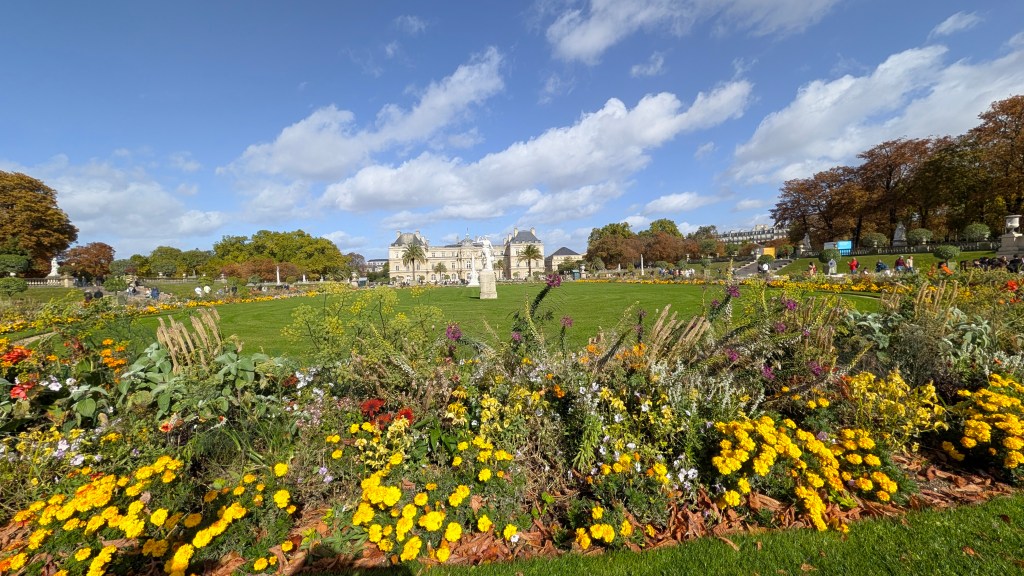
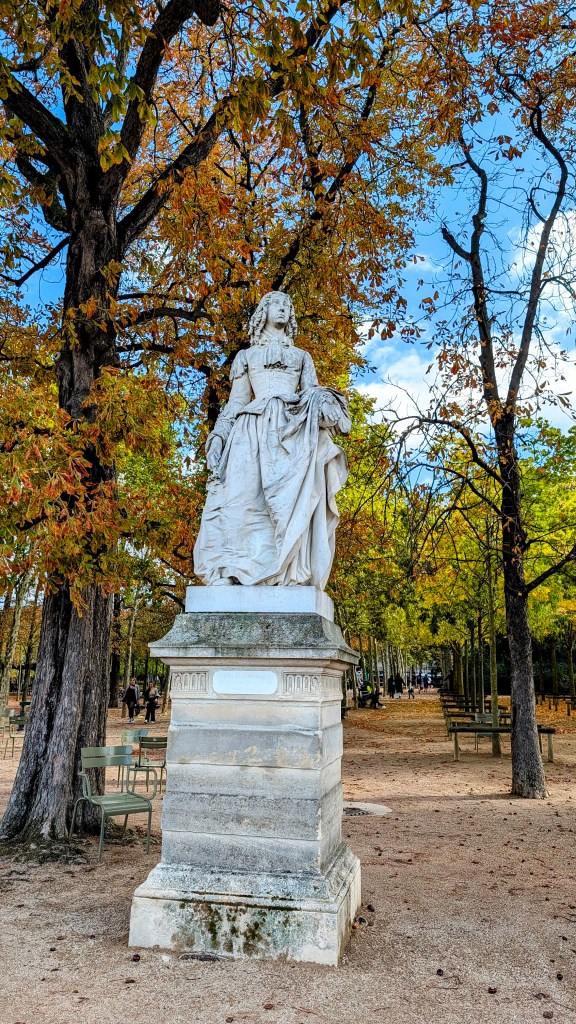
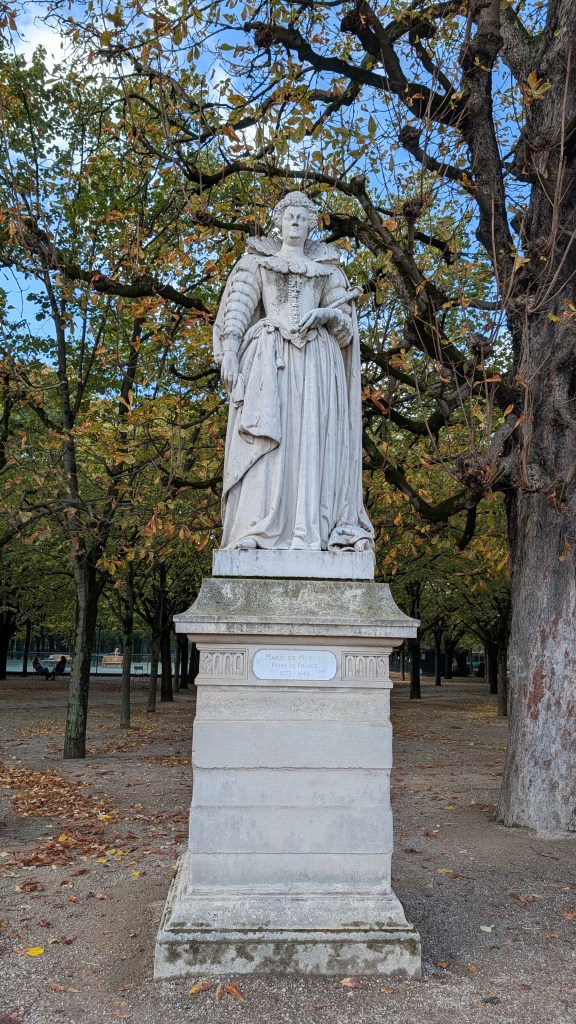
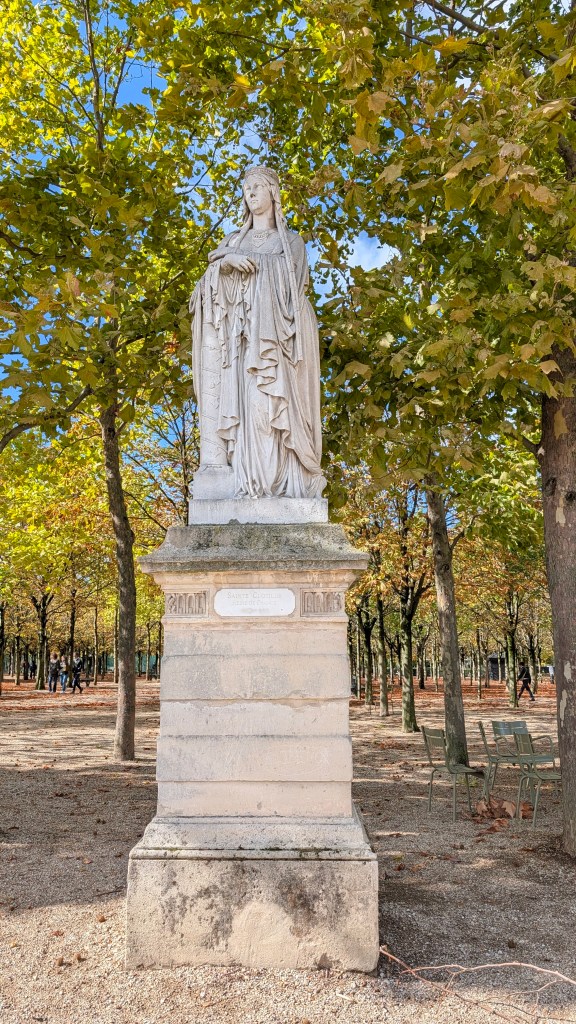
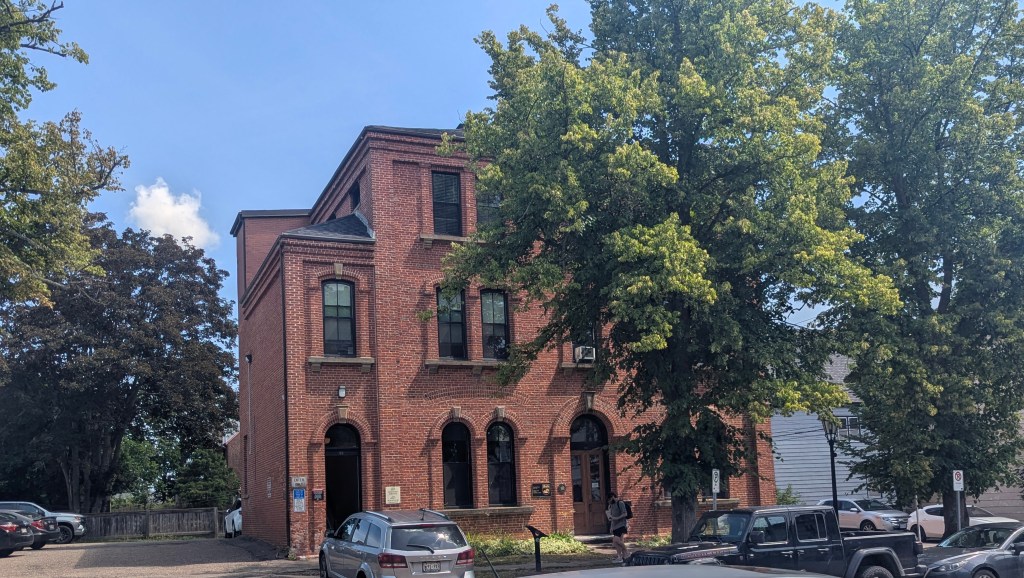
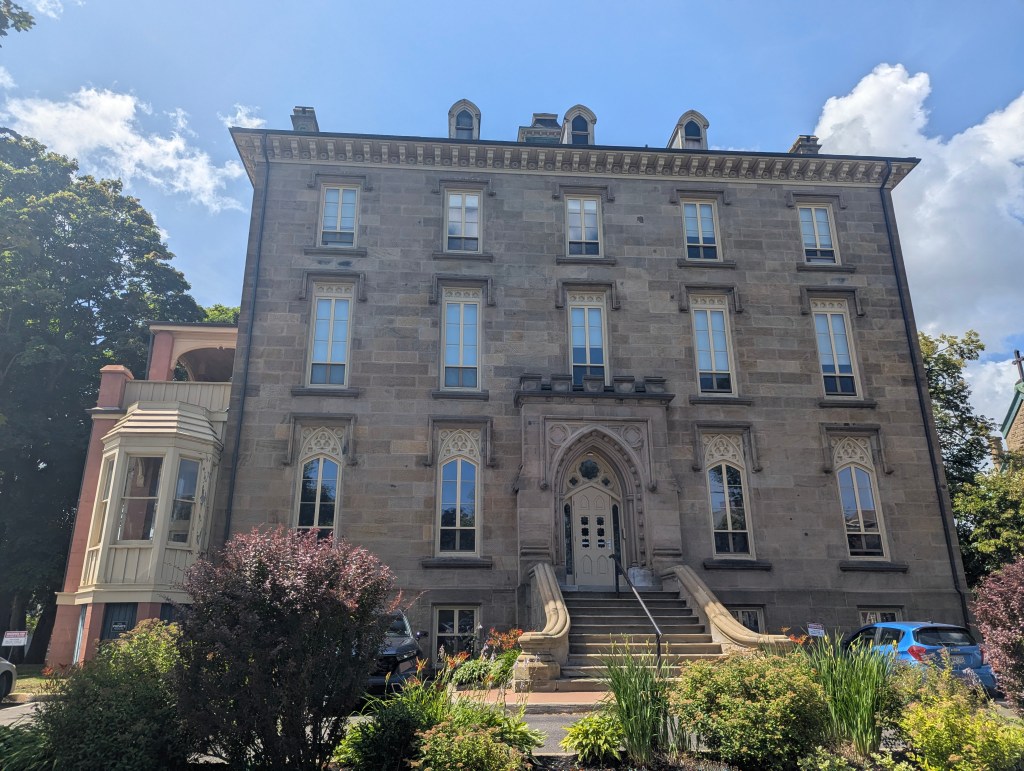
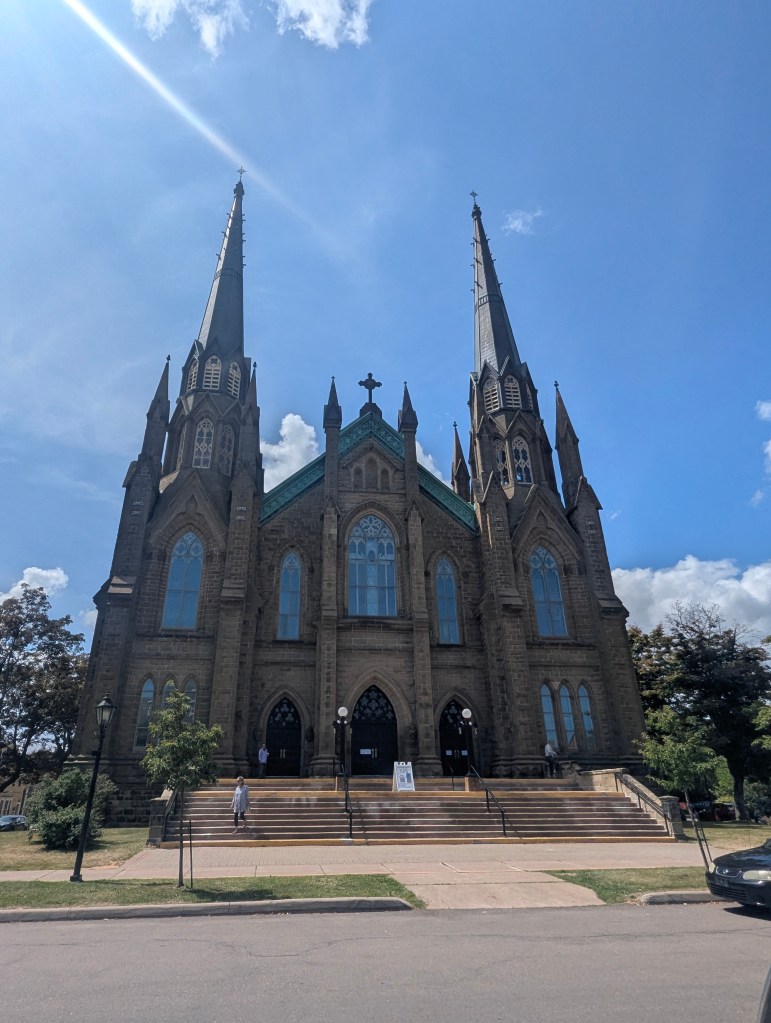
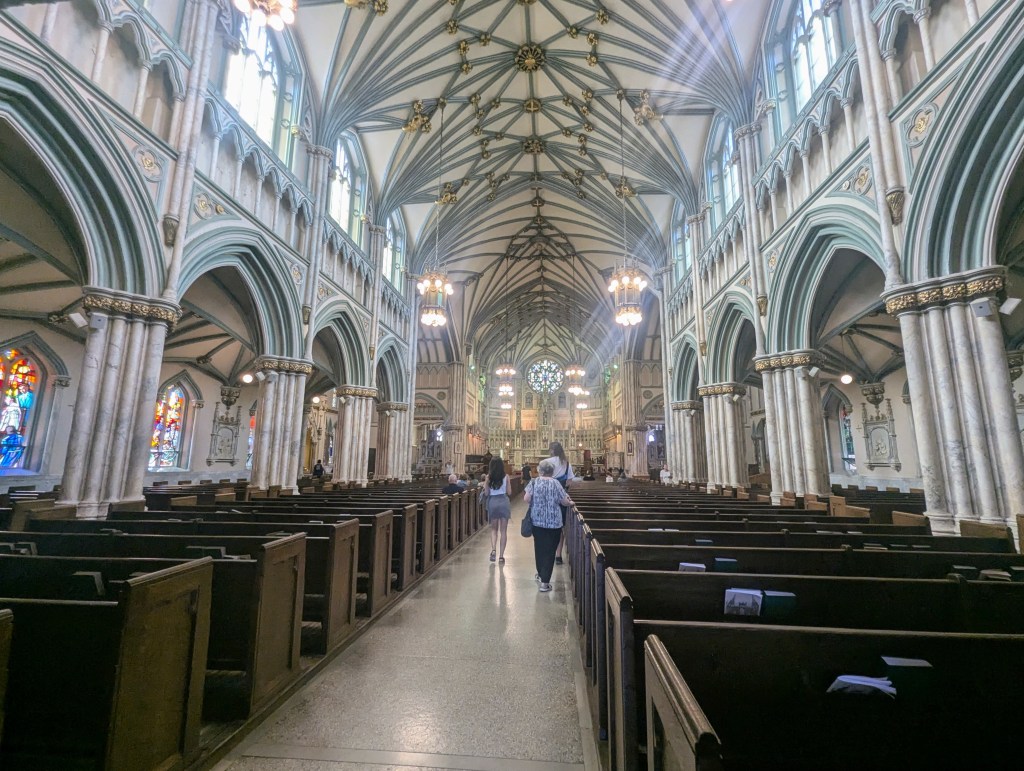
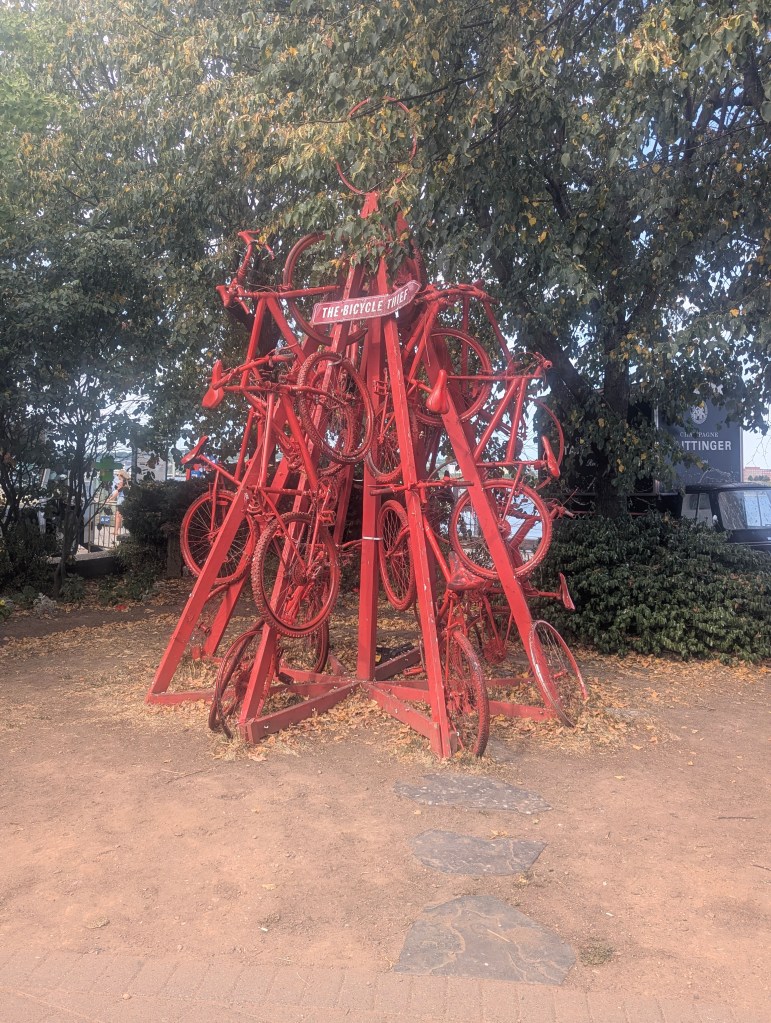
France: Provence-Alps-Côte d’Azur Region: Arles, Nimes, Pont du Gard, St. Remy-en-Provence October 5-8, 2025

Bright and early in the morning we headed to the train station and caught a train to Marseilles.
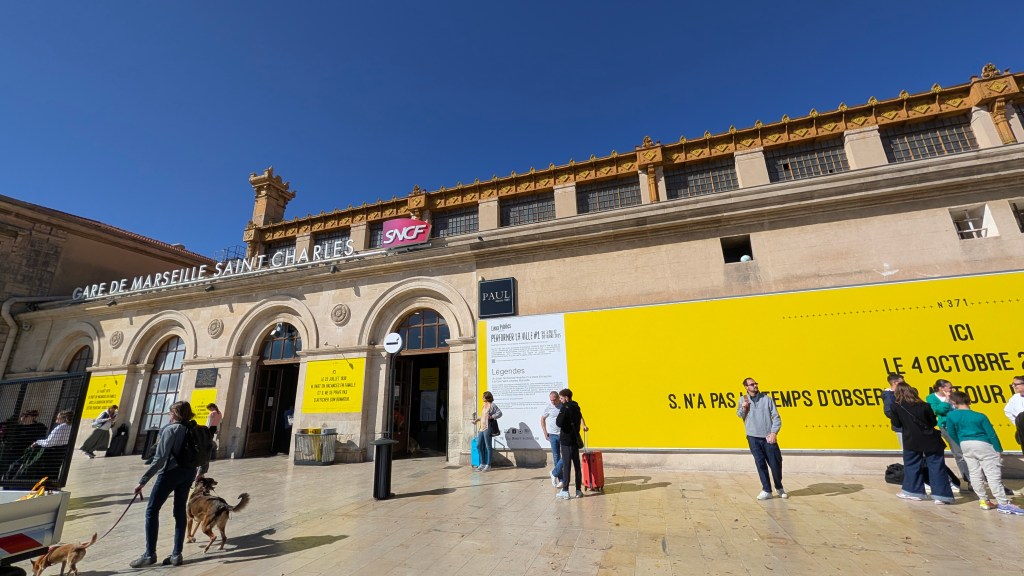
From there we rented a car and drove to Arles, first in the wrong direction, but we figured it out, don’t ask. We arrived at our AirBnb, a very unassuming apartment in Arles’s old city.
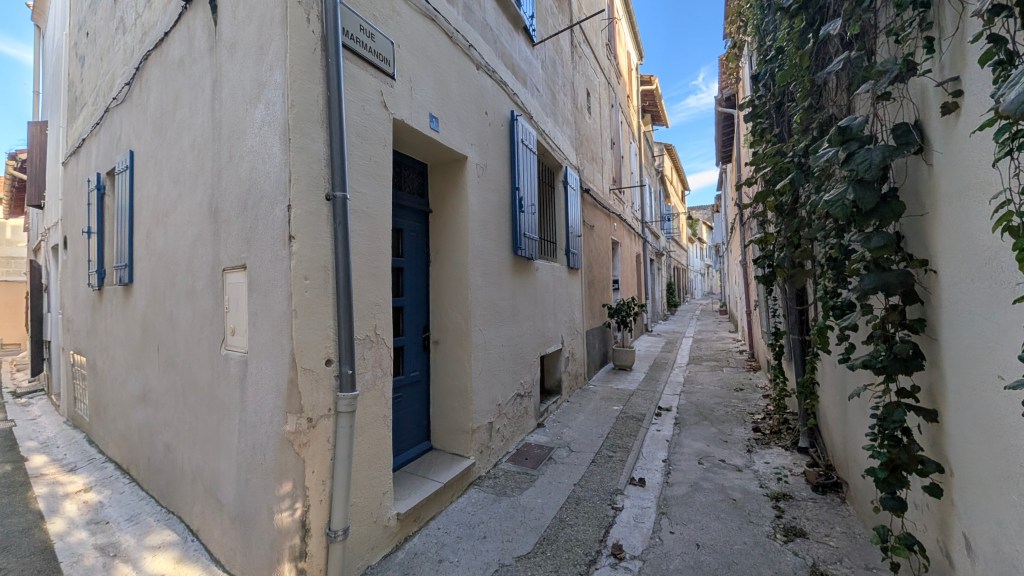
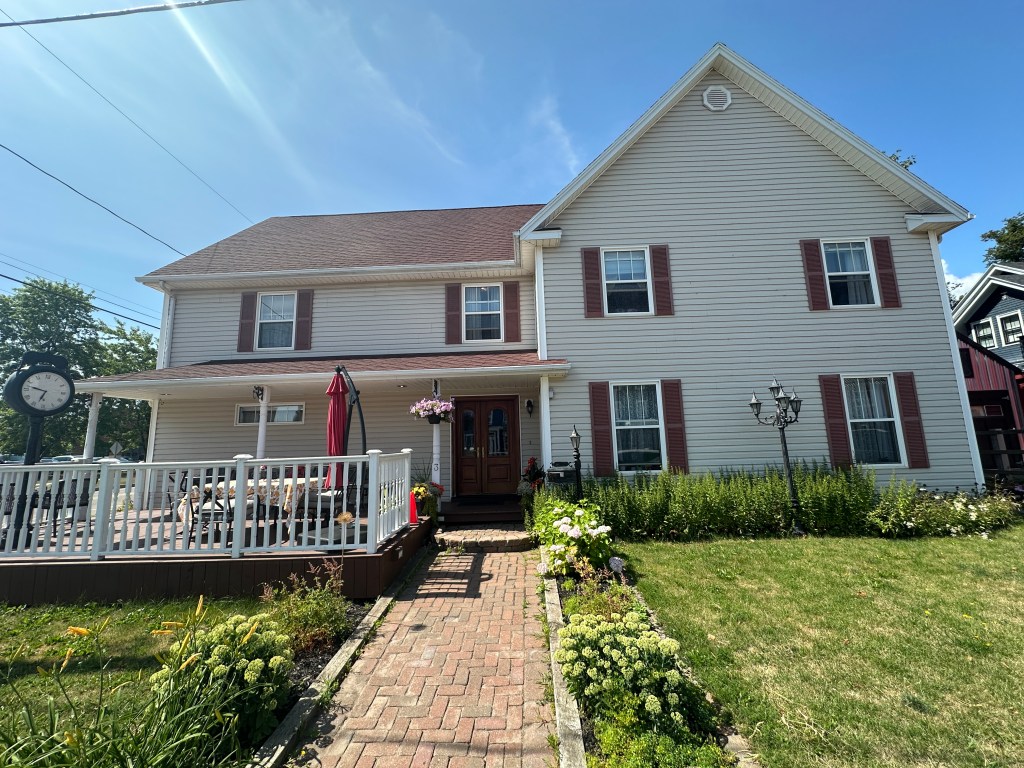
our AirBnb in Arles.

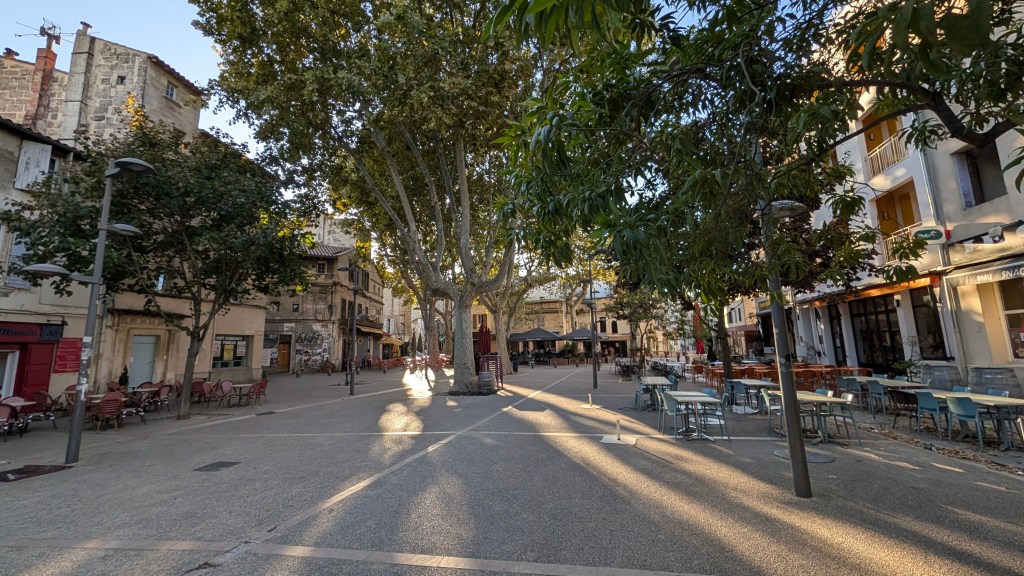
By the time we got settled in there was little left to the day. We headed to the main square in town for a delicious Moroccan meal.
We wandered out through the old gate: Porte de la Cavalerie (Cavalry Gate), a medieval gateway that marked the northern entrance to the old city. The structure consists of two crumbling round towers that date back to the 12th century. The gate is named after the nearby Bourg-Neuf district, later known as “Cavalry,” where the Knights Templar was established. 
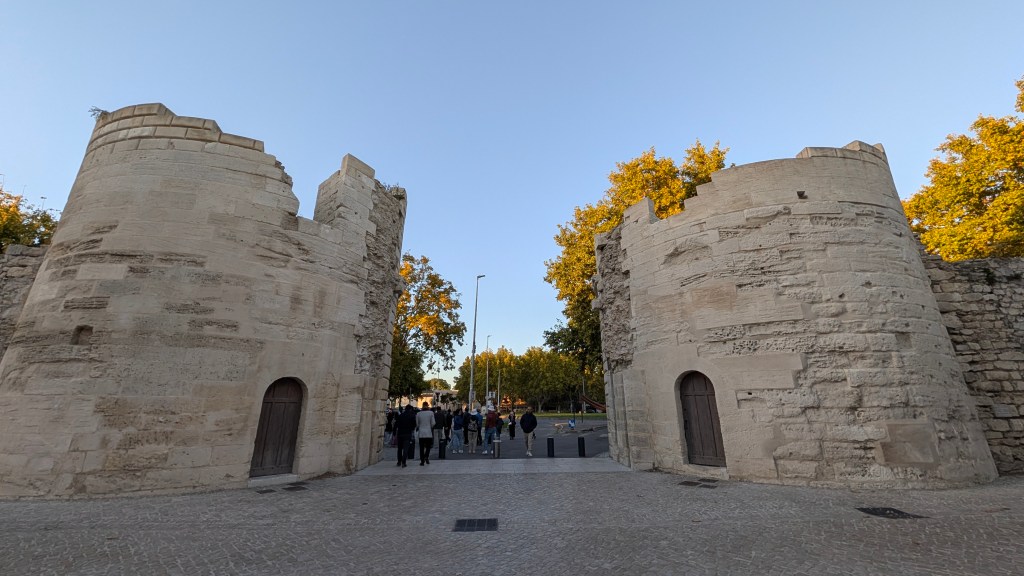
Porte de la Cavalerie (Cavalry Gate)

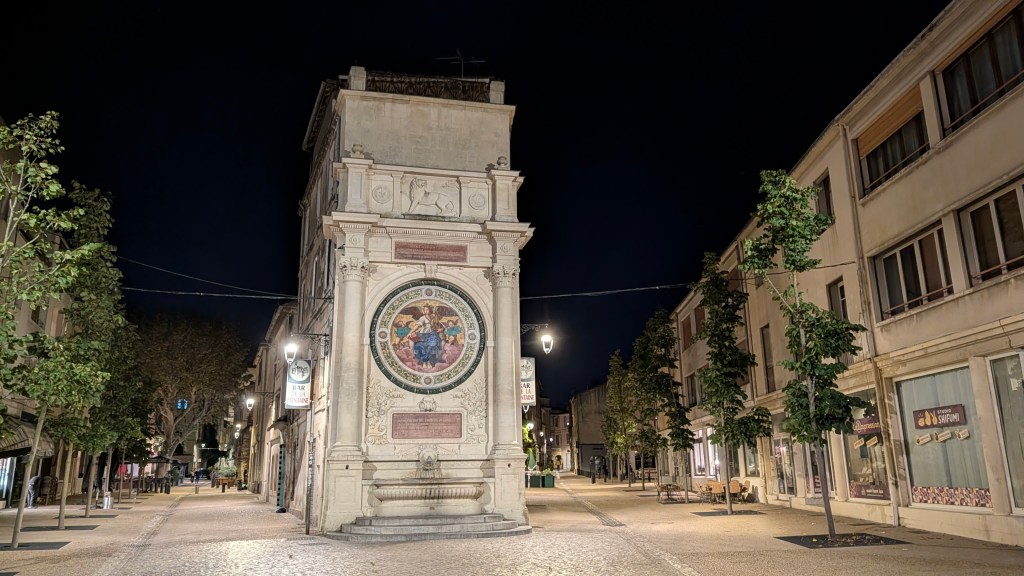
Just inside the gates is the historic center of Arles with several restaurants. At the end stands Amédée Pichot fountain.
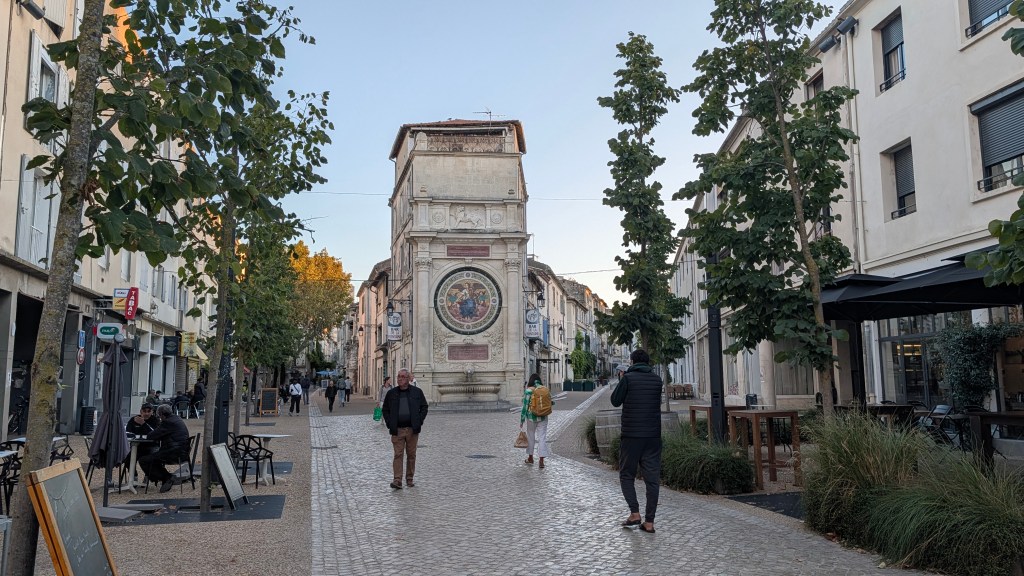
Built in 1868, this monument honors the French historian and author Amédée Pichot.  It features a central medallion made of enamelled earthenware tiles and is designed to resemble a leaning fountain.The structure includes commemorative inscriptions in both Latin and Provençal.
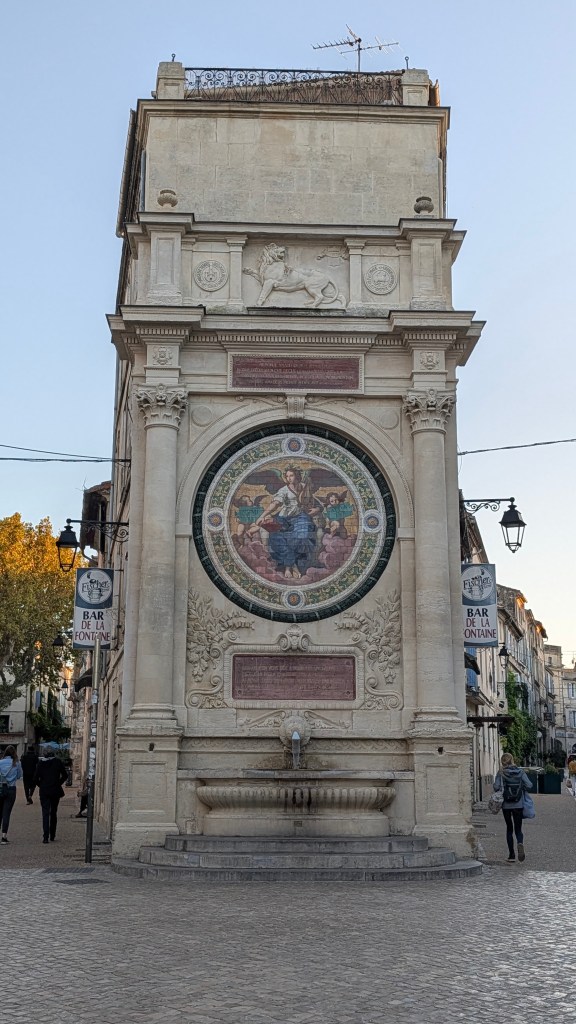
Amédée Pichot fountain

The light was starting to wane as we headed back to our apartment, but our eyes were caught by a church up on the hill: the tower of the Église Notre-Dame-de-la-Major (Church of Notre-Dame-la-Major). We had to go investigate.
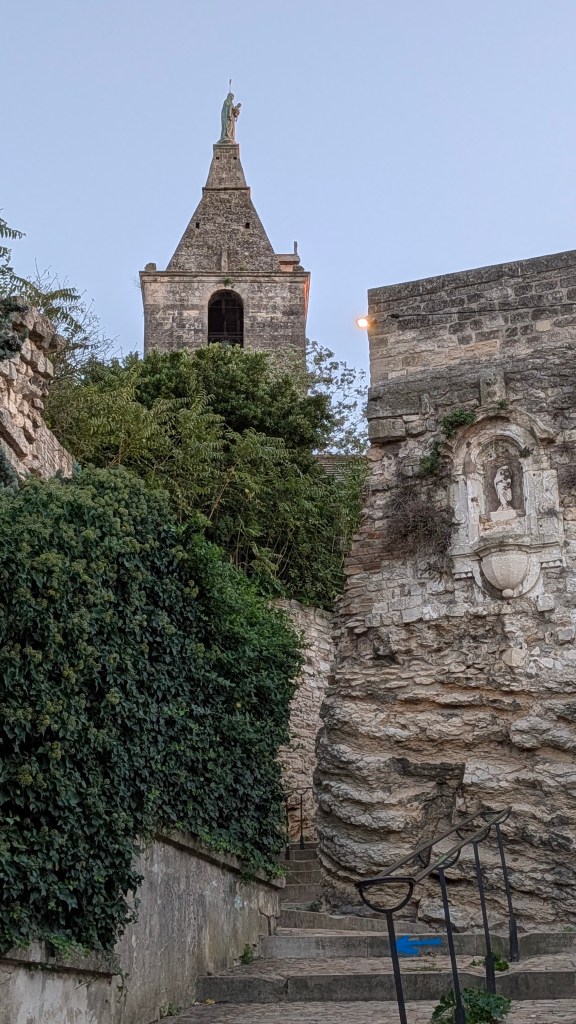
Tower of the Église Notre-Dame-de-la-Major (Church of Notre-Dame-la-Major)

Situated at the top of the Hauture hill, this historic church’s construction, originally in the 5th century, was rebuilt on this site starting in 1152 AD. The tower features a stone spire topped by a statue of the Virgin and Child, along with a prominent clock face. 
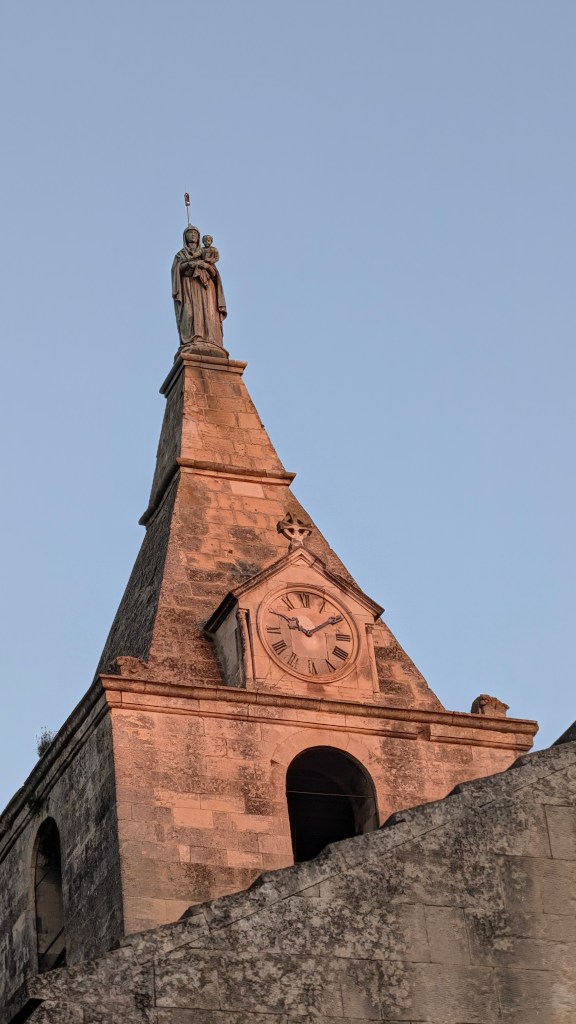
This historic Catholic church was originally consecrated in 452 AD. It had been constructed on the ruins of a Roman temple. The structure exhibits Gothic architectural elements.
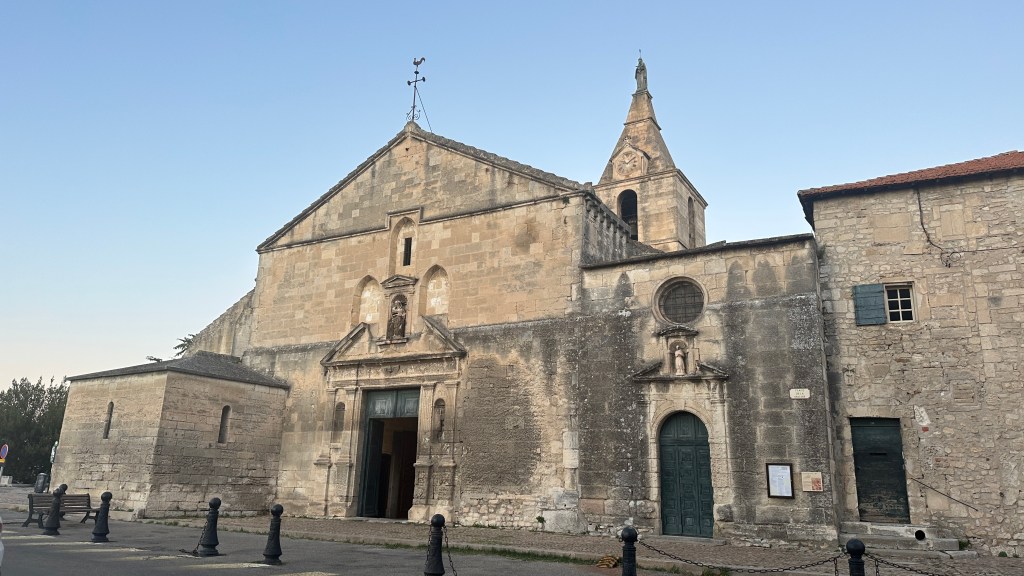
Église Notre-Dame-de-la-Major (Church of Notre-Dame-la-Major)

We took a peak inside. The architecture prominently features a Romanesque style with a vaulted nave. The interior includes a central aisle leading to the altar, flanked by stone arches and rows of wooden pews.
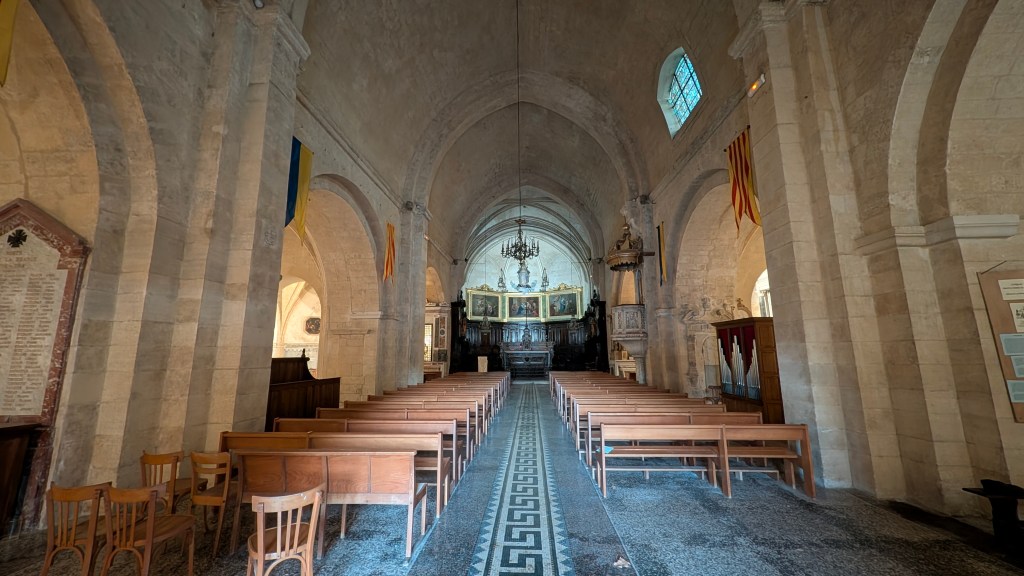
interior Église Notre-Dame-de-la-Major (Church of Notre-Dame-la-Major)

We climbed all the way to the top of the hill. It was worth the effort; the view over Arles as the sun was setting was beautiful.
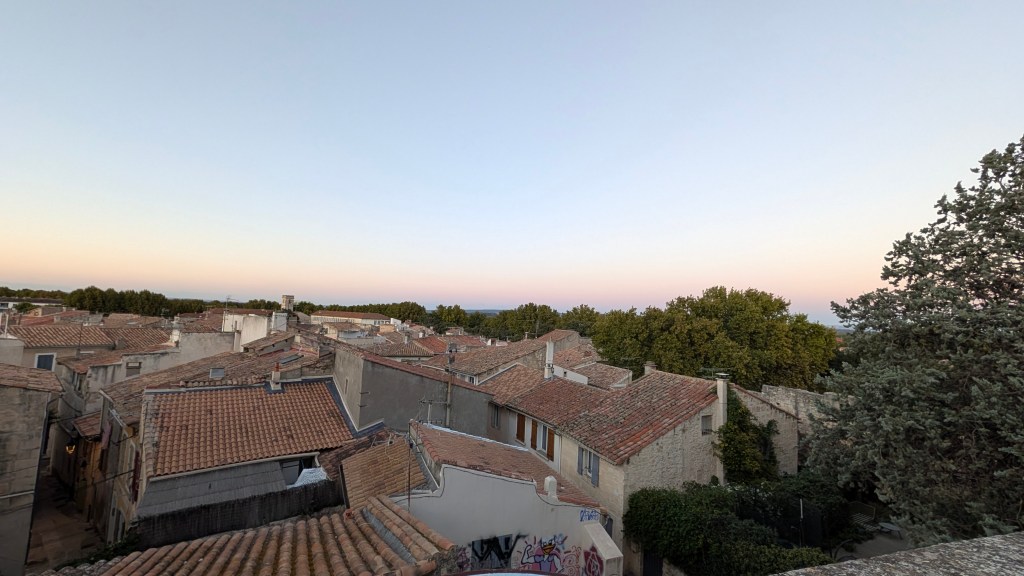
It had been a long day, and our light was fading fast, so we decided to save our touring of Arles for a market day. In the morning we headed for nearby Nîmes. Dubbed the most Roman city outside Italy, Nîmes, a small city in Southern France, is steeped in history that harks back to the days of the mighty Roman Empire. The name itself holds clues to the city’s origin, reflecting Celtic roots and connection with the local god, Nemausus, associated with a healing spring. The hill of Mount Cavalier, once a preRoman Celtic fortified settlement, served as the birthplace of the city. Nîmes truly flourished during Roman times becoming a Roman colony, Colonia Nemausus, before 28 BC, where veterans of Julius Caesar’s legions were granted land. Eventually, this regional capital had a population of 50,000–60,000. Several monuments from that era are still in place and have earned Nimes its nickname, the “French Rome”. Over the centuries, Nîmes faced the challenges of history, including Visigoth rule in 472 and later, the Umayyad conquest in 725. The city witnessed turmoil and transformation but retained its Roman heritage.

One of the prominent landmarks in Nîmes is the Charles-de-Gaulle Esplanade, a vast open space that offers a perfect starting point for exploring the city. We parked in the heart of the city near the Fontaine Praier situated on the Esplanade Charles de Gaulle. This monumental marble fountain was inaugurated in 1851.  It was designed by the French sculptor James Pradier and architect Charles Questel.  The central statue allegorically represents the city of Nîmes, crowned by a miniature replica of the Roman Maison Carrée monument. 
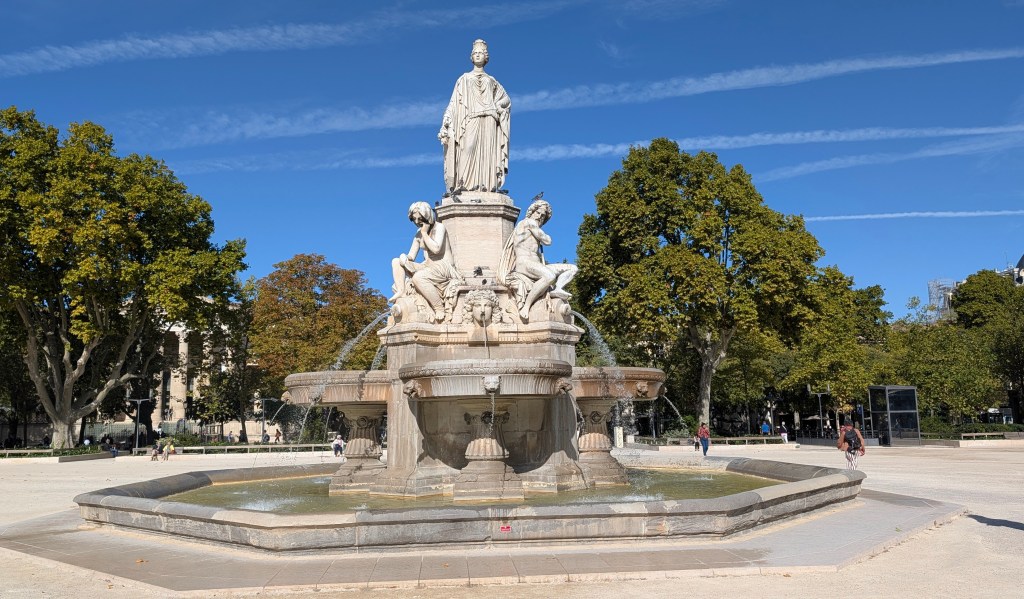
Fontaine Pradier

Le taureau des arènes” (The bull of the arena), a sculpture created by contemporary Georgian artist Djoti Bjalava, was inaugurated during the Feria des Vendanges (grape harvest festival) in 2005. It represents the city’s strong bullfighting traditions and heritage.
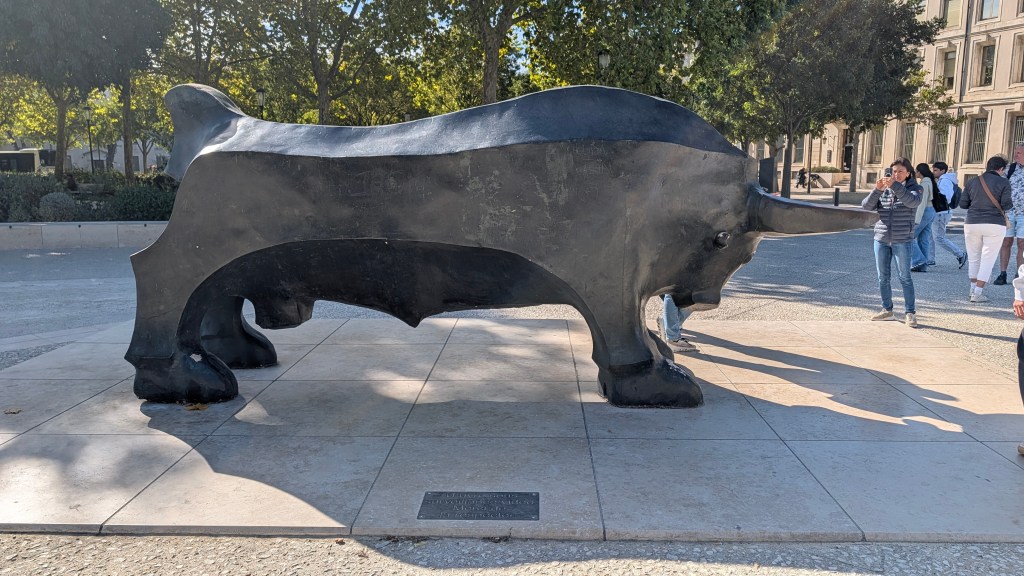
Le taureau des arènes (the bull of the arena)

The Palais de Justice (Courthouse), built between 1838 and 1846, serves as the main court building for the city and the Gard department.  It is designed in a neoclassical style, inspired by classical Greek architecture. 
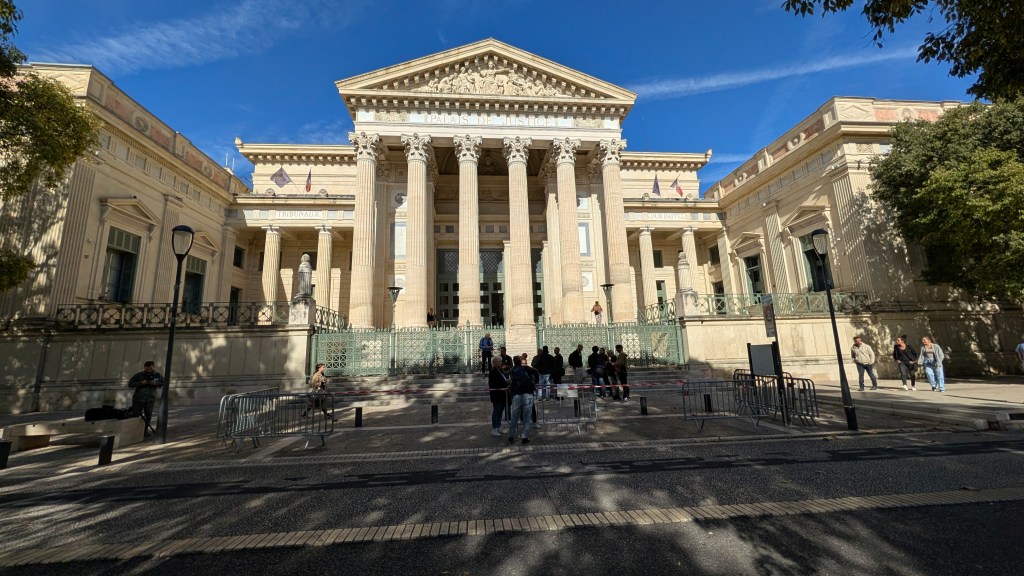
Palais de Justice (Courthouse)

The Arena of Nîmes is a magnificent Roman amphitheatre. Erected around 100 CE, shortly after the renowned Colosseum of Rome, this arena stands as one of the world’s most exceptionally preserved Roman amphitheatres. With its remarkable dimensions, the Arena of Nîmes measures 436 feet in length and 331 feet in width. Its grand outer facade soars to a height of 69 feet and boasts two stories adorned with 60 arcades. Among the 400 Roman amphitheatres known to exist, it ranks among the 20 largest. In ancient times, this grand structure had the capacity to accommodate a crowd of 24,000 spectators. The arena served a dual purpose, functioning as a venue for public events and theatrical performances while also hosting gladiator battles that captivated the masses. Presently, the Arena of Nîmes continues to play a central role in the city’s cultural life. It hosts two annual bullfights as part of the Feria de Nîmes. Additionally, the arena serves as a captivating backdrop for various public events, including reenactments of antiquity such as “The Great Roman Games” and concerts. “
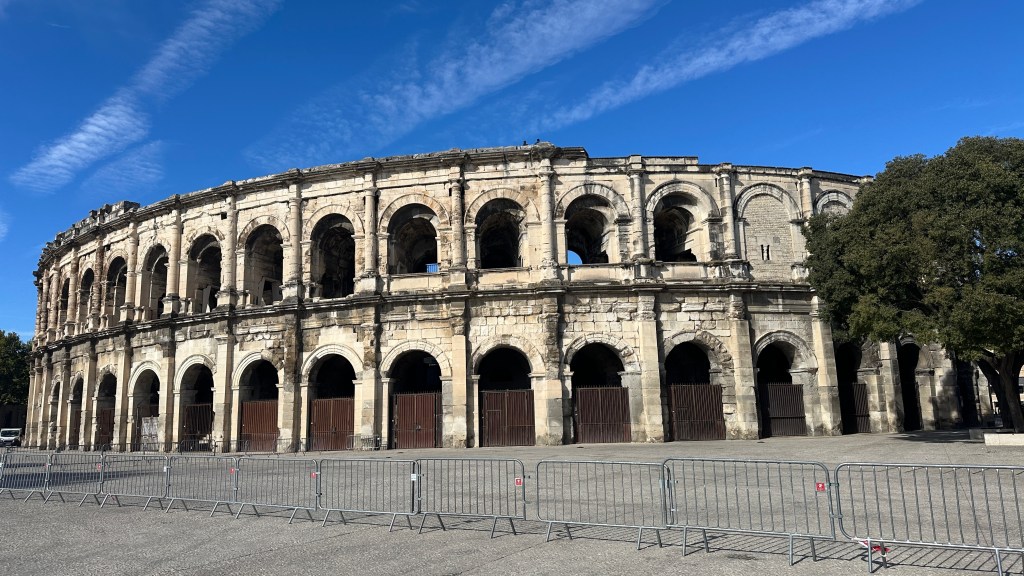
The Arena of Nîmes

At the entrance to the arena stands the statue of Christian Montcouquiol, known as Nimeño II, proudly, earning it the name “Hero”.
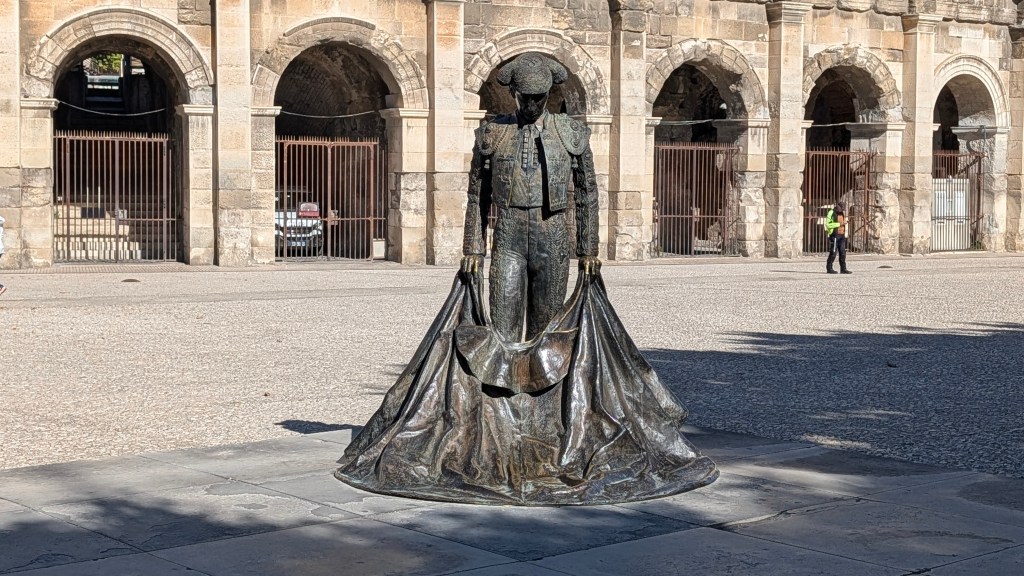
“Hero”

Opened in 2018, the Museum of Romanity is strategically situated along the historic site of the old Roman ramparts, directly facing the iconic 2,000-year-old arena. The museum’s inception was driven by a series of remarkable archaeological discoveries made between 2006 and 2007. The ultra-modern building resembles a “folded glass toga.” But we had too much to see in the city, so we did not explore inside.
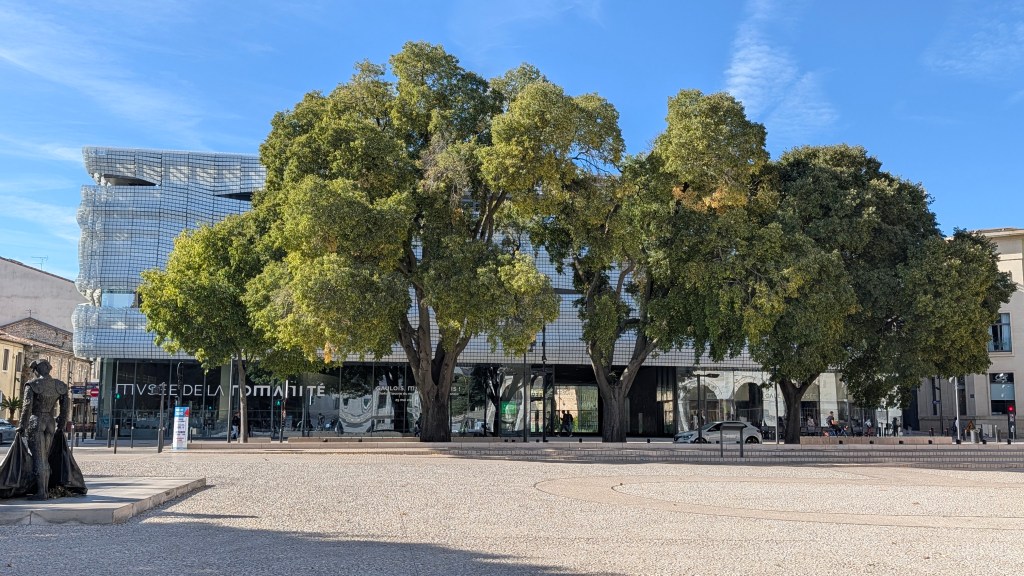
Museum of Romanity

Maison Carrée (Square House) stands as a remarkable testament to Roman architecture and religious devotion in the city. This ancient Roman temple is celebrated as one of the best-preserved examples of Roman temples within the former Roman Empire’s territory. It served as a mid-sized Augustan provincial temple dedicated to the Imperial cult, specifically as a caesareum. The Maison Carrée embodies elements of a Tuscan-style Roman temple as described by Vitruvius, a Roman writer on architecture from the same era, albeit with the use of the Corinthian order. The presence of this extensive porch distinctly highlights the temple’s frontal aspect, setting it apart from the designs of ancient Greek temples. The Maison Carrée has had a profound influence on architecture throughout history including the inspiration of the design by Thomas Jefferson of the Virginia State Capitol in the United States.
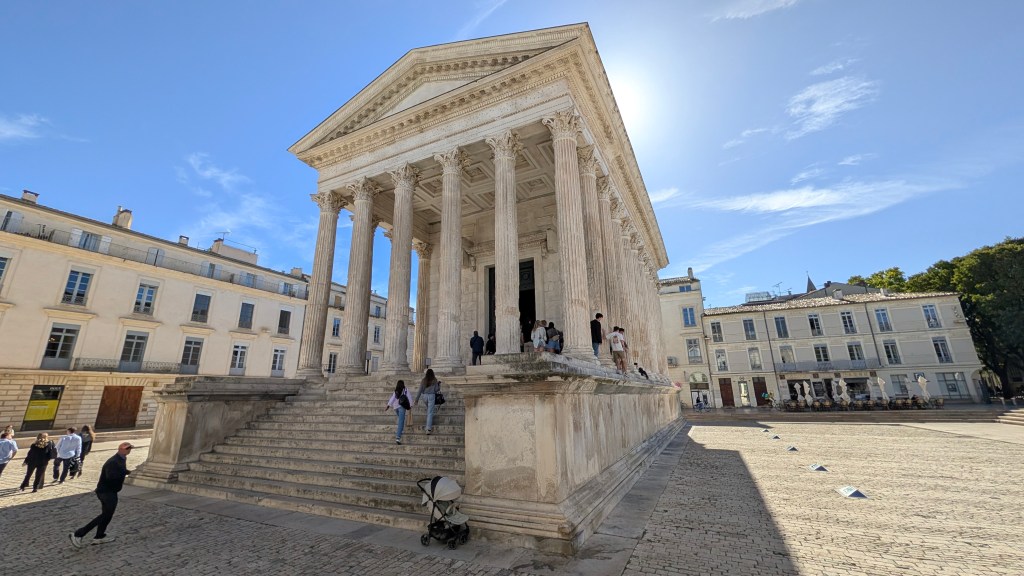
Maison Carrée (Square House)

In Place d’Assas (square of Assas) is a fountain, known as La Source de l’Étoile (The Source of the Star), designed by the French artist Martial Raysse and inaugurated in 1989 as part of the modernization of the square. 
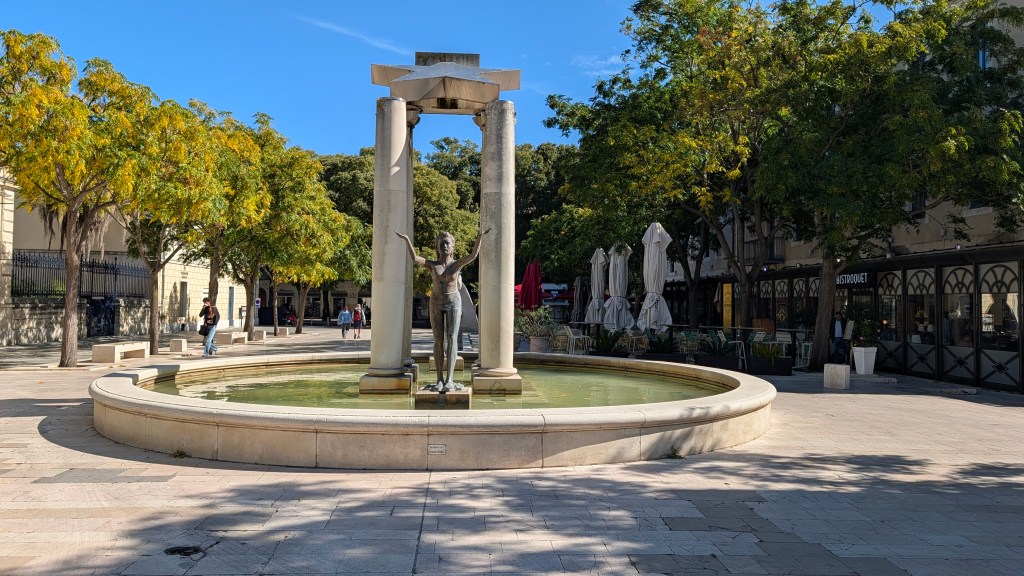
La Source de l’Étoile (The Source of the Star)

The fountain has a long narrow waterway to which is attached a large head which represents Nemausus, the masculine deity associated with the city of Nîmes. 
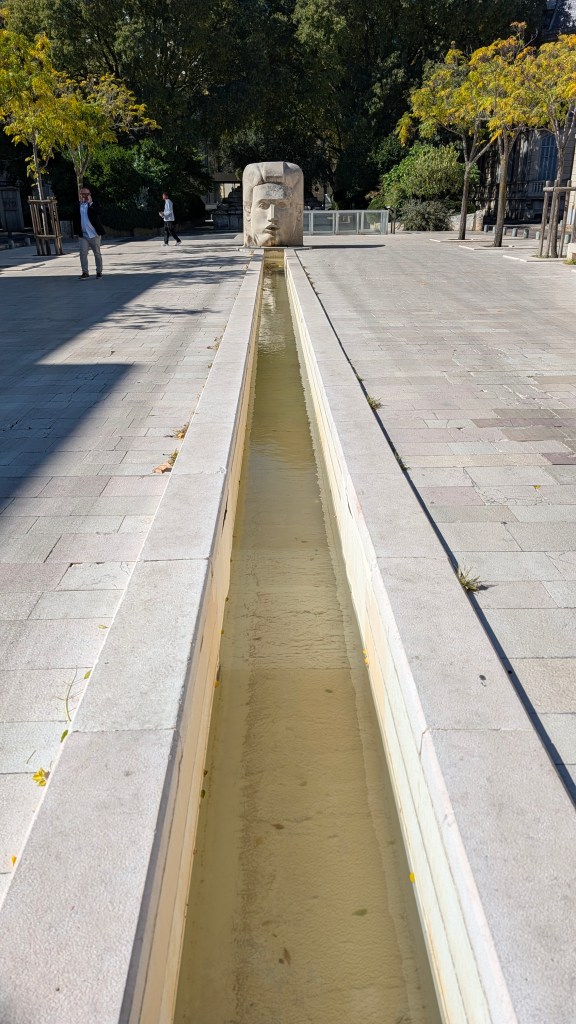
Nemausus

We crossed a small stream and entered Jardins de la Fontaine (Fontaine Gardens). The layout of the gardens was part of an 18th-century project to enhance the beauty of Nîmes and is framed by the remnants of the ancient city walls.
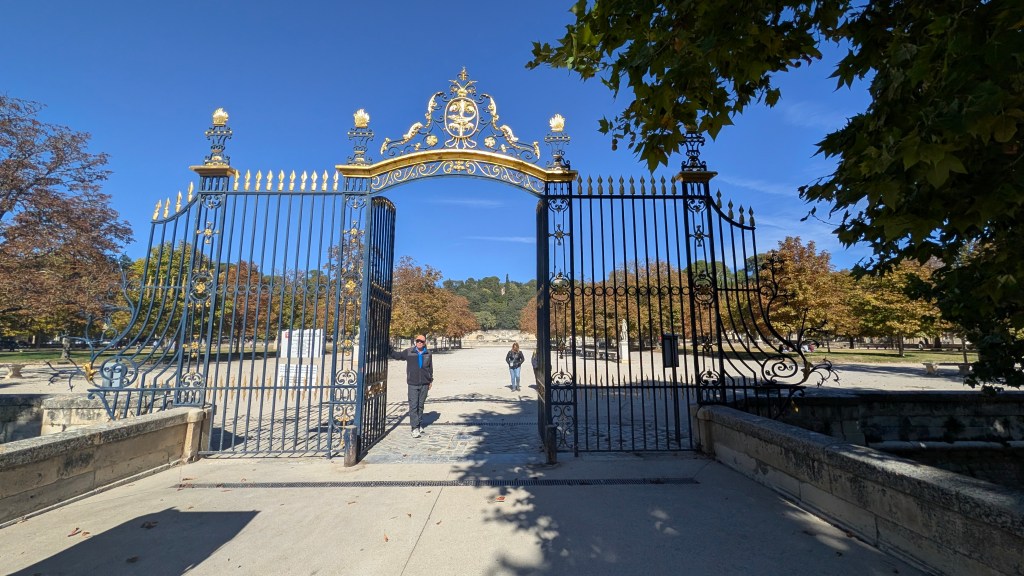
gate Jardins de la Fontaine (Fontaine Gardins)

Originally, the site was home to a sacred spring venerated by the people long before the Romans arrived. In fact, the source of the Fontaine played a significant role in the founding of the city centuries before the Gallo-Roman era.
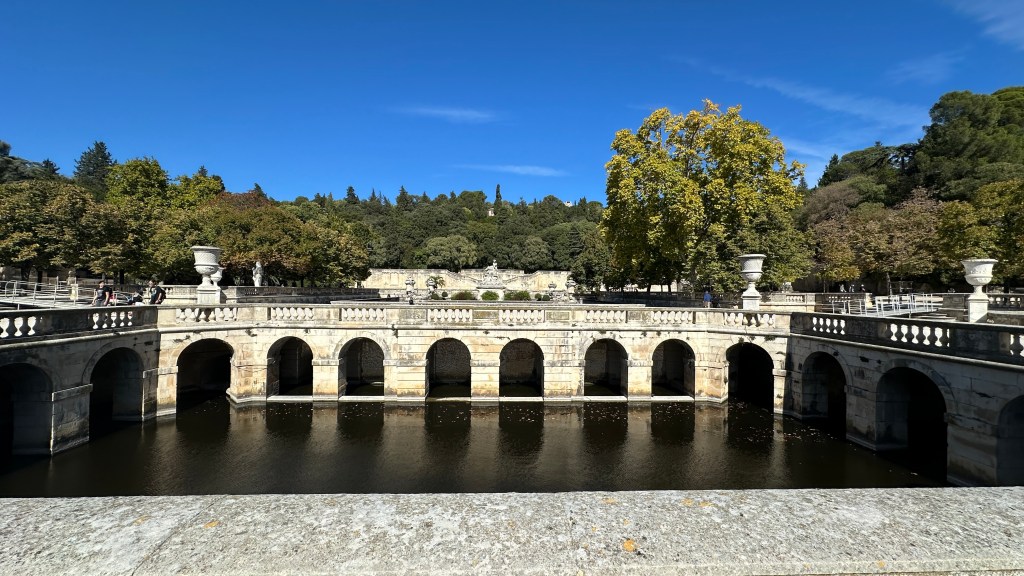
Created in 1745 by order of King Louis XV to organize the area around the original Roman spring of the city. the Fountain Gardens is one of the earliest public parks in Europe. The architecture includes statues, waterways, and fountains nestled at the foot of Mont Cavalier.
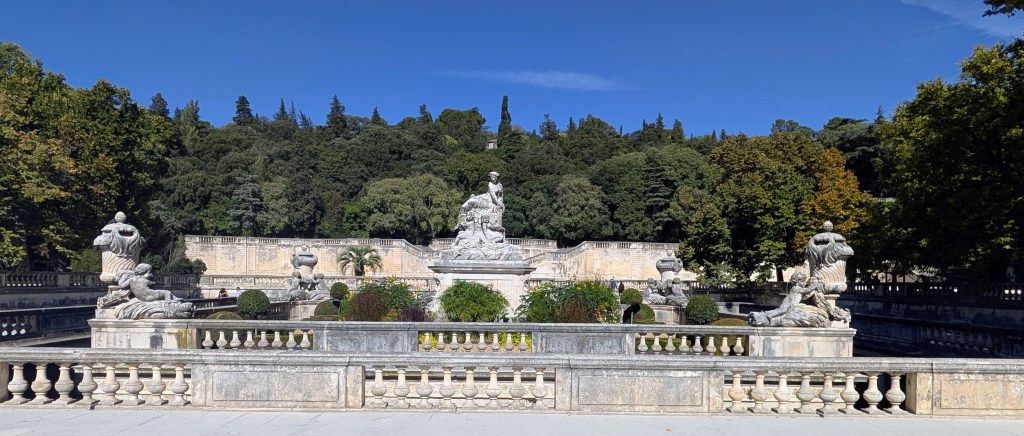
The central feature is a nymphaeum (water monument) dedicated to the nymph Nemausa. 
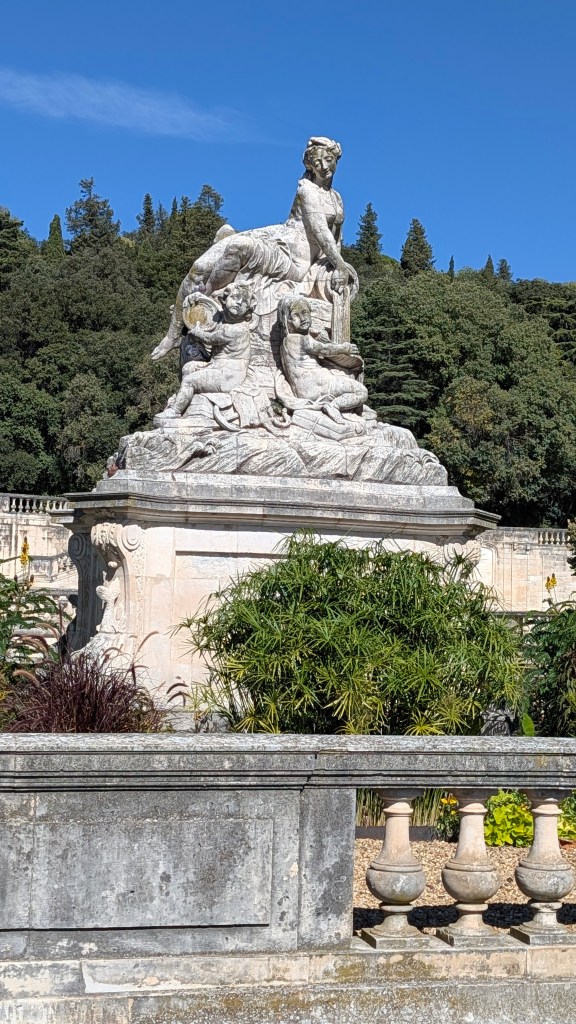
Nemausa

Near the gushing spring of “La Fontaine” sits the Temple of Diana, a remarkable 1st-century ancient Roman structure, which stands as a testament to the architectural and historical richness of the region. This structure was built during the reign of Augustus and is closely associated with an Augusteum, a sanctuary dedicated to the veneration of the emperor and his family, with a central focus on a nymphaeum.
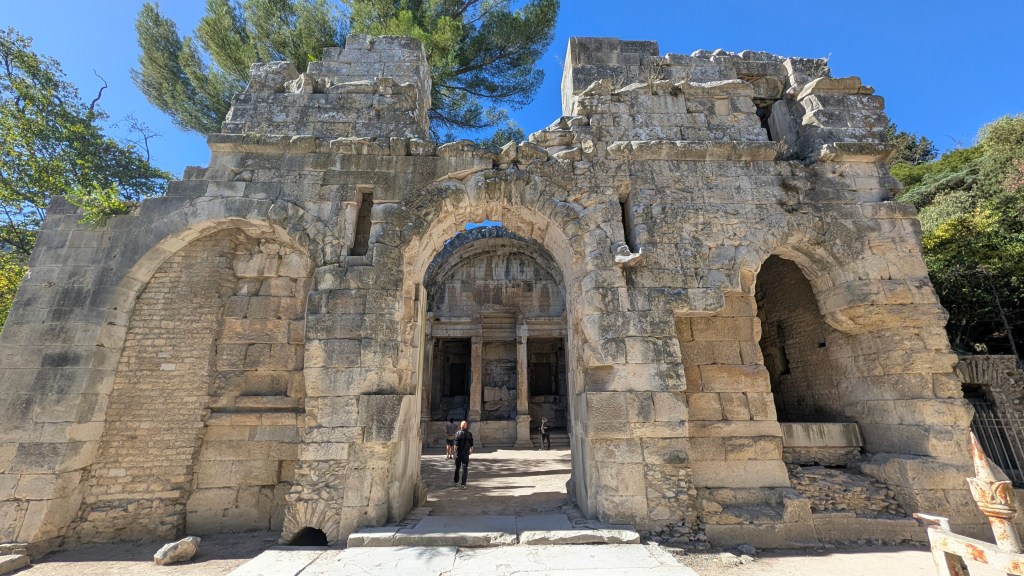
Temple of Diana

Although traditionally referred to as the Temple of Diana, its basilica-like floor plan raises questions about its classification as a temple, and there is a lack of archaeological or literary evidence to support its dedication to Diana. Some suggest that this building may have served as a library instead. During the 2nd century, its façade was reconstructed, and in medieval times, it found use as a monastery, which contributed to its preservation over the years.
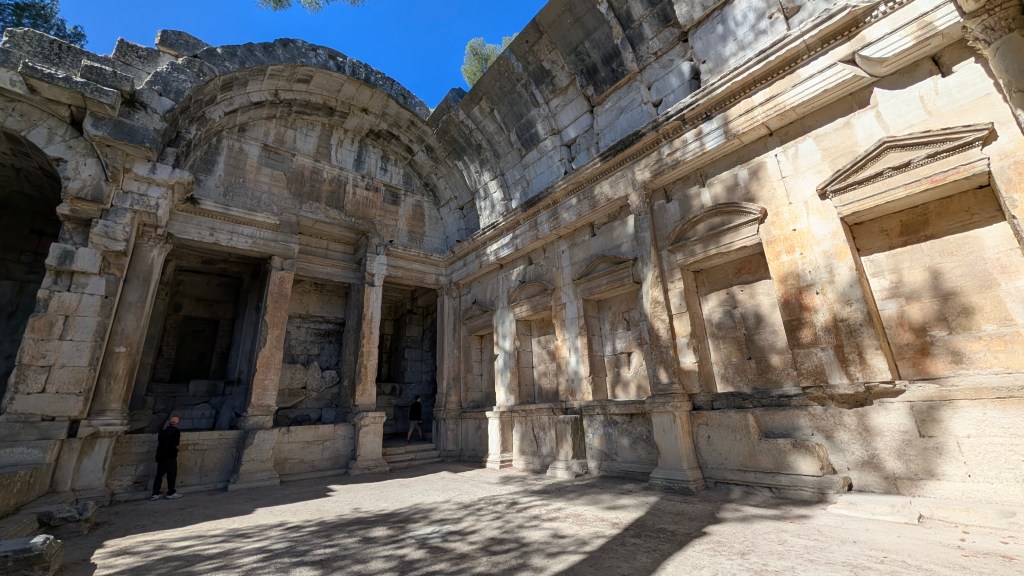
Temple of Diana

We then climbed Mont Cavalier to Tour Magne (Magne Tower), a remarkable Gallo-Roman monument that stands as a sentinel over the Gardens of the Fountain. It holds the distinction of being the most impressive remnant of the extensive Roman wall that once encircled the city. In Roman times, due to its structural integration into the city’s defensive wall, it likely served dual functions as a defensive fortification and as a watchtower or signal tower. Its considerable height in the Roman era was also a potent symbol of Roman authority and might, asserting its dominance over the cityscape.
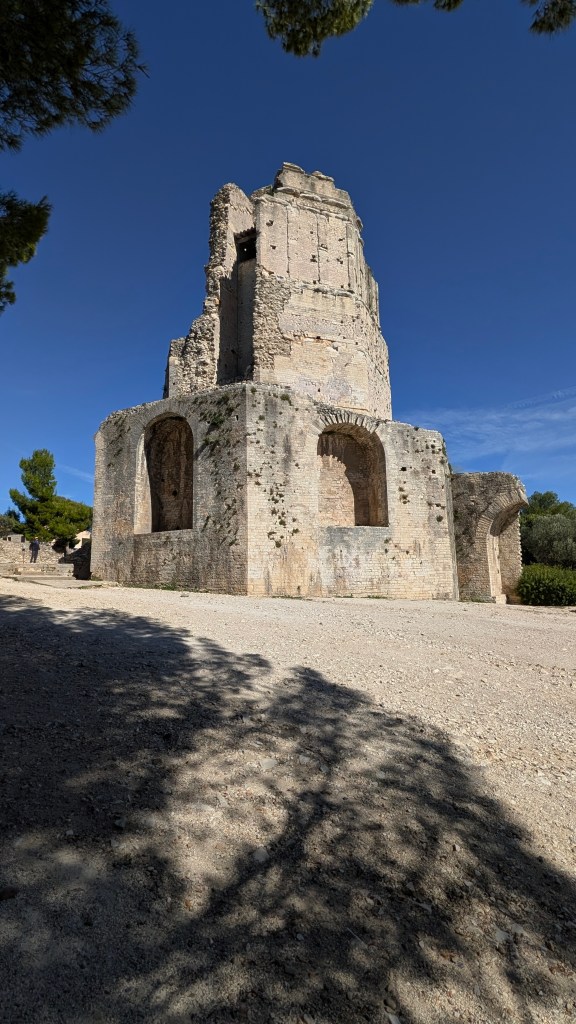
Tour Magne (Magne Tower)

Castellum Aquae (Water Castle) is an intriguing Roman site that played a vital role in the city’s water distribution system during antiquity. This unassuming structure once served as the critical point where the city’s water supply, brought in from the aqueducts, was collected and subsequently dispersed throughout Nîmes. Constructed during the middle of the first century AD, Castellum Aquae stood as an engineering marvel of its time, functioning in conjunction with the renowned Pont du Gard aqueduct (more on this below). The water would embark on an impressive journey of approximately 31 miles, traveling over the Pont du Gard, before reaching this distribution hub. The structure features round apertures, through which lead pipes conveyed the water to various fountains and public baths, ensuring that Nîmes’ inhabitants had access to this precious resource. At the rear of Castellum Aquae, a sluice gate was employed to control and regulate the flow of water. This level of hydraulic engineering showcased the Romans’ mastery of aqueduct systems and their understanding of how to efficiently manage water resources.
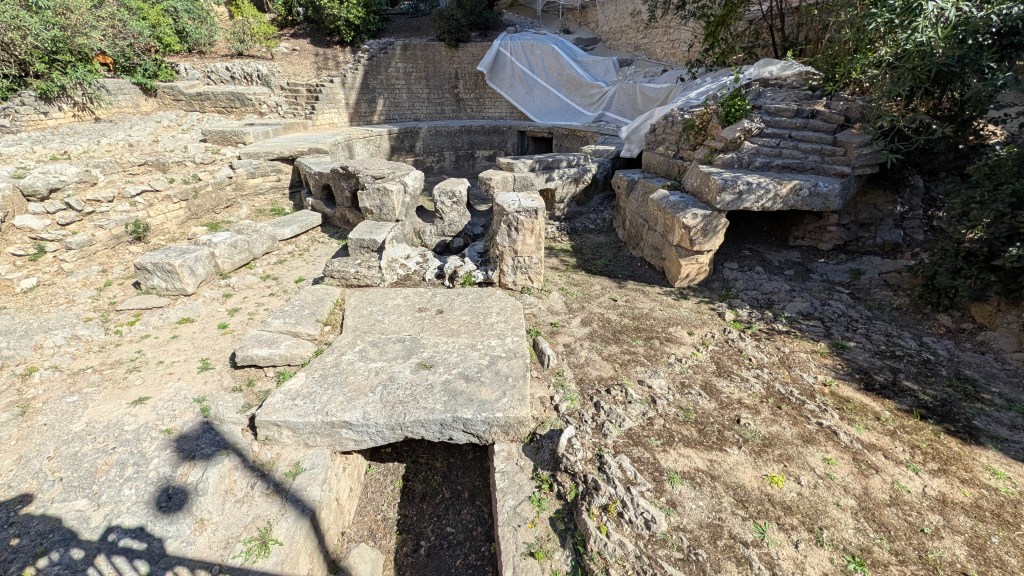
Castellum Aquae (Water Castle)

This green door is the entrance to Les Halles de Nîmes, a famous large indoor market featuring over 100 stalls selling fresh produce, local products, and other goods. But alas, as it is a morning market, it was no longer open by the time we arrived.
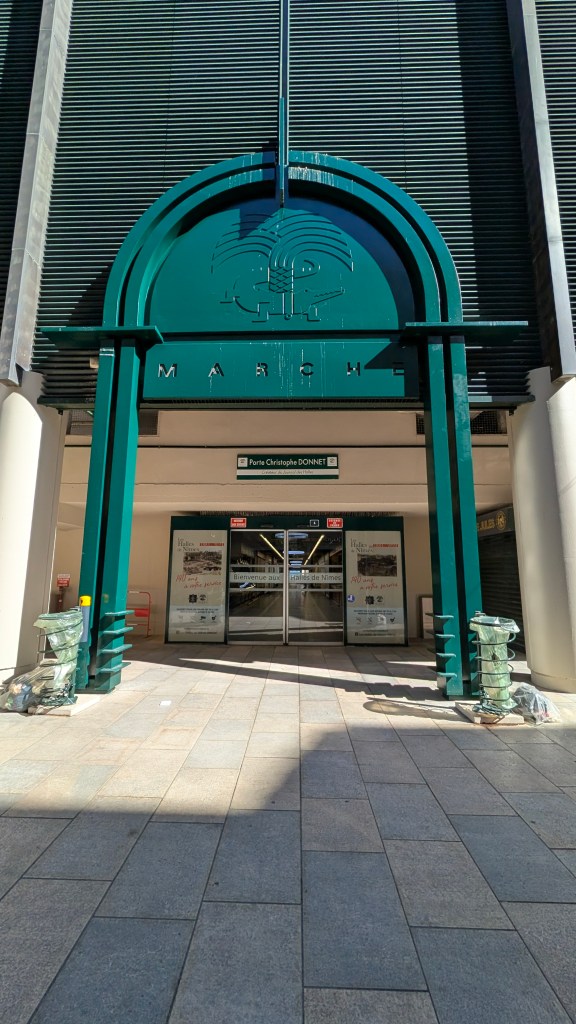
Les Halles de Nîmes

Porte d’Auguste (Augustus Gate), which can be traced back to the 1st century BCE, as indicated by an inscription. was a crucial component of the extensive Roman wall that surrounded the city of Nîmes and served as one of the primary entrances to the city.
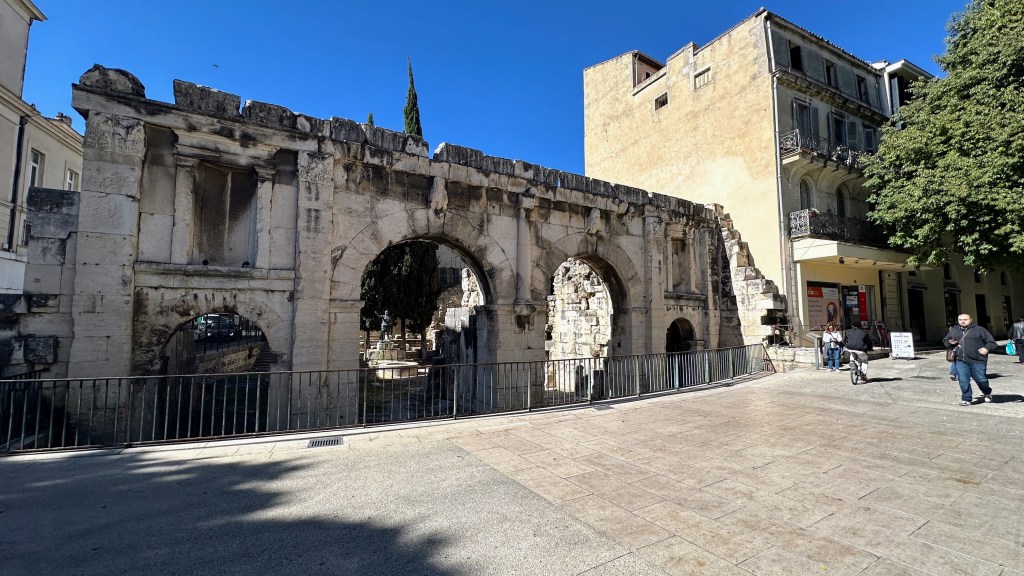
Porte d’Auguste (Augustus Gate)

This gate boasts four semicircular arch passages, consisting of two large central ones for vehicular traffic and two smaller lateral passages designed for pedestrians. In its original form, the gate was flanked by two semicircular towers. 
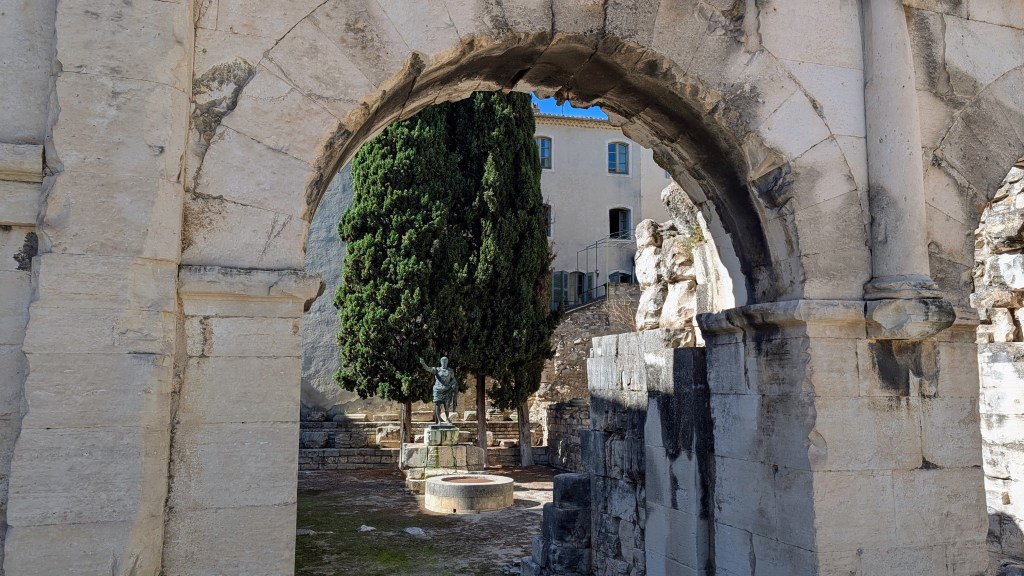
Porte d’Auguste (Augustus Gate)

The Augustus Gate derived its name from Emperor Augustus, who played a pivotal role in fortifying the town. Near the gate is a modern copy of a statue of Augustus.
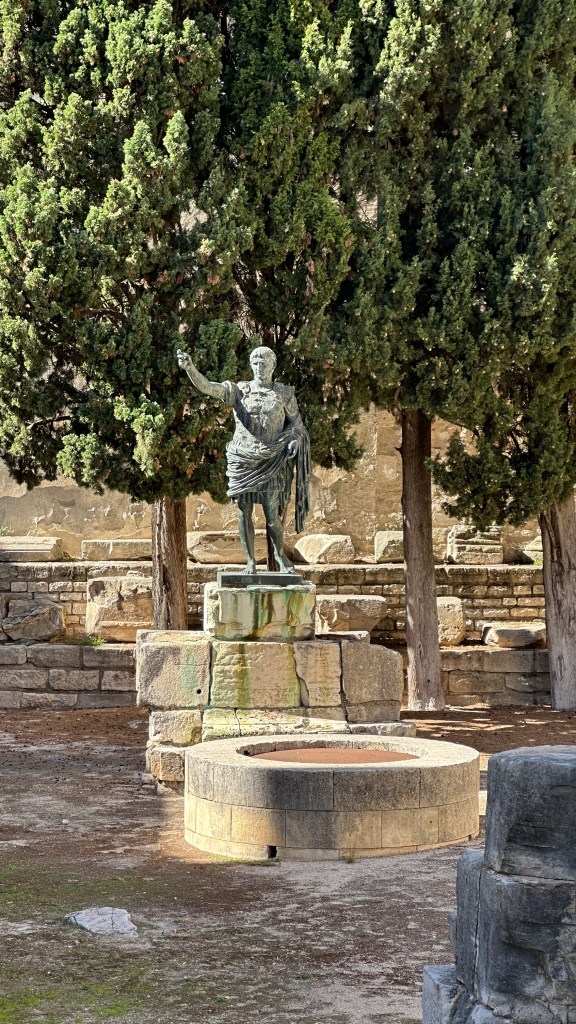
statue of Augustus

Saint-Baudile Church is a large Neo-Gothic church built in the 19th century. It is known for its two prominent tall spires that dominate the skyline.
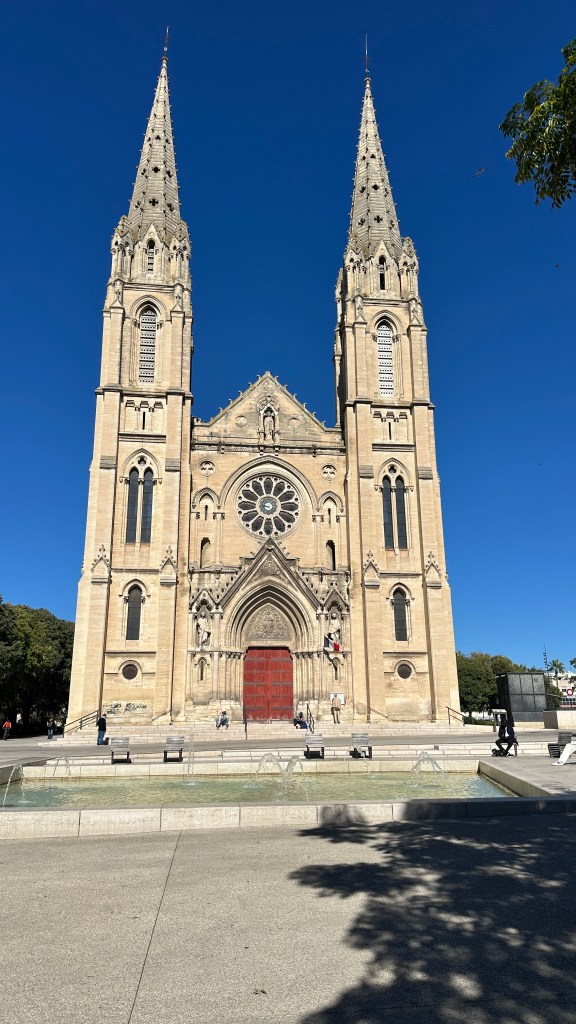
Saint-Baudile Church

Nîmes Cathedral is a significant Roman Catholic church dedicated to the Blessed Virgin Mary and Saint Castor of Apt, a local patron saint. Throughout its history, Nîmes Cathedral has served as the seat of the Bishops of Nîmes. The cathedral is believed to occupy the site where the former temple of Augustus once stood. Its architecture is a blend of Romanesque and Gothic styles, showcasing the diverse historical influences that have shaped Nîmes over the centuries. Unfortunately it was undergoing extensive renovations which precluded us from visiting.
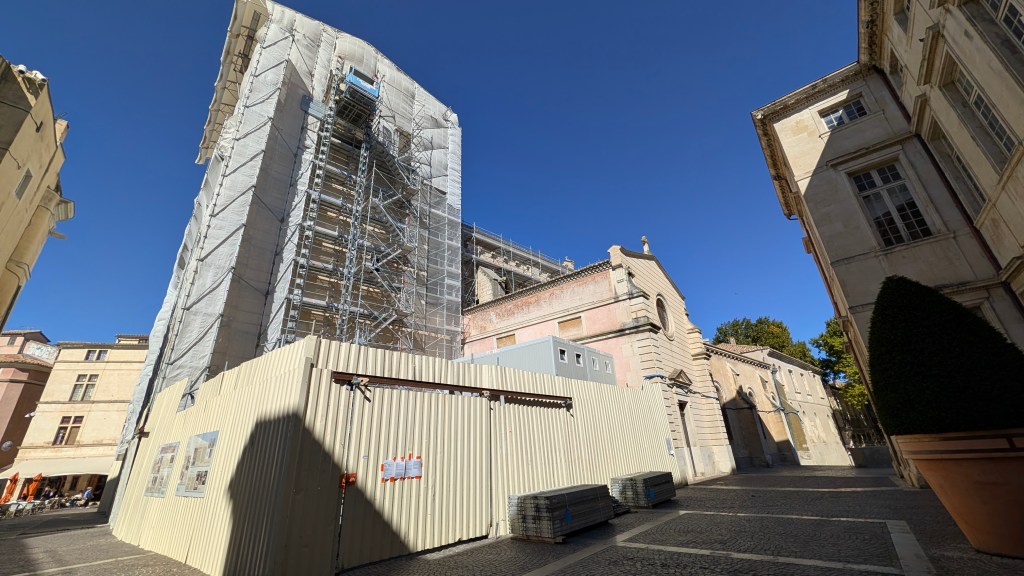
Nîmes Cathedral

Place de l’Horloge (Clock Square), with its blend of shops and café terraces, is popular meeting place for both locals and visitors. We stopped for a snack and a drink.
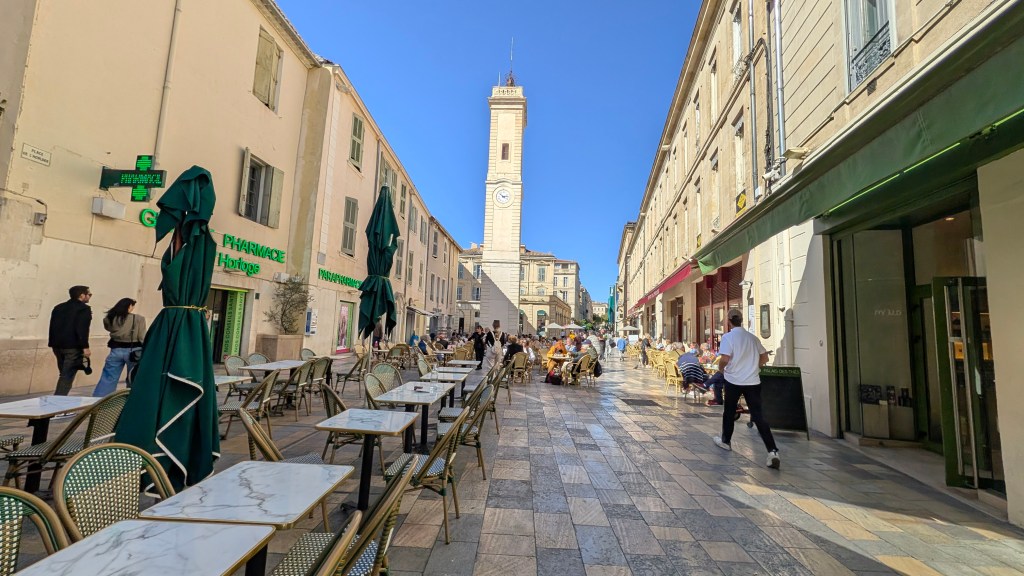
Place de l’Horloge (Clock Square)

The history of this monument is closely intertwined with Nîmes itself. In 1410, the city’s residents sought and obtained permission from the King to erect a clock tower with a public-use bell. Prior to this, the citizens relied on the bell of the Cathedral for timekeeping and as a warning signal during times of conflict or war. This shared use of the steeple led to disputes, including the canons’ refusal to allow a sentinel on the church’s belfry. The conflicts persisted until an agreement was reached to transfer the bell to the city. The decision was facilitated by a trade-off: the city agreed to ban foreign wines from entering Nîmes, while the canons provided the bell. In return for their cooperation, wines produced in the canons’ vineyards outside the Nîmes region were granted entry into the city.
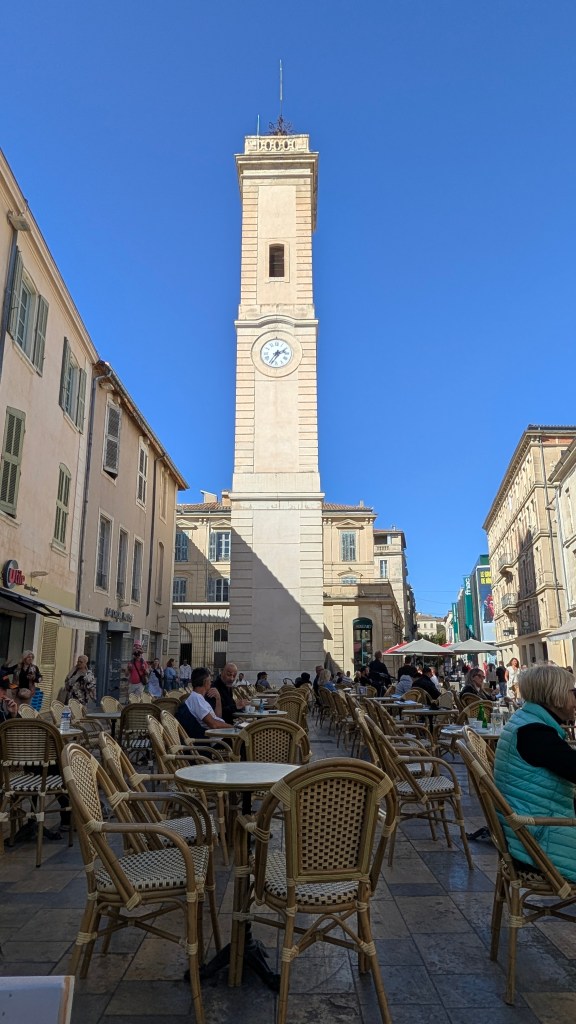
The original clock tower faced the threat of ruin over the years. However, in 1752, it was reconstructed and adorned with an octagon-shaped wrought iron bell tower. This elegant structure not only tells the time but also serves as a symbol of Nîmes’ rich history and culture.
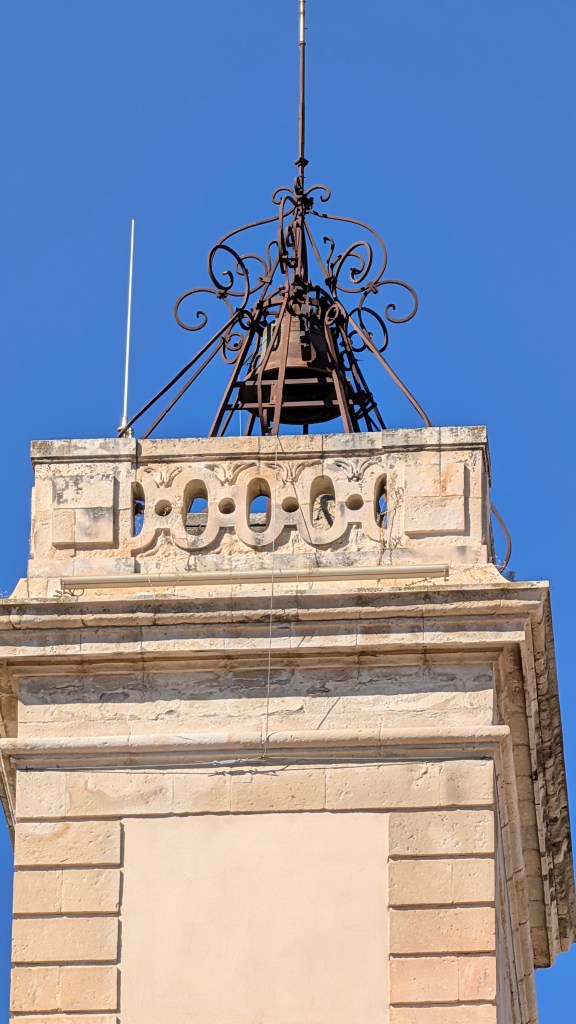
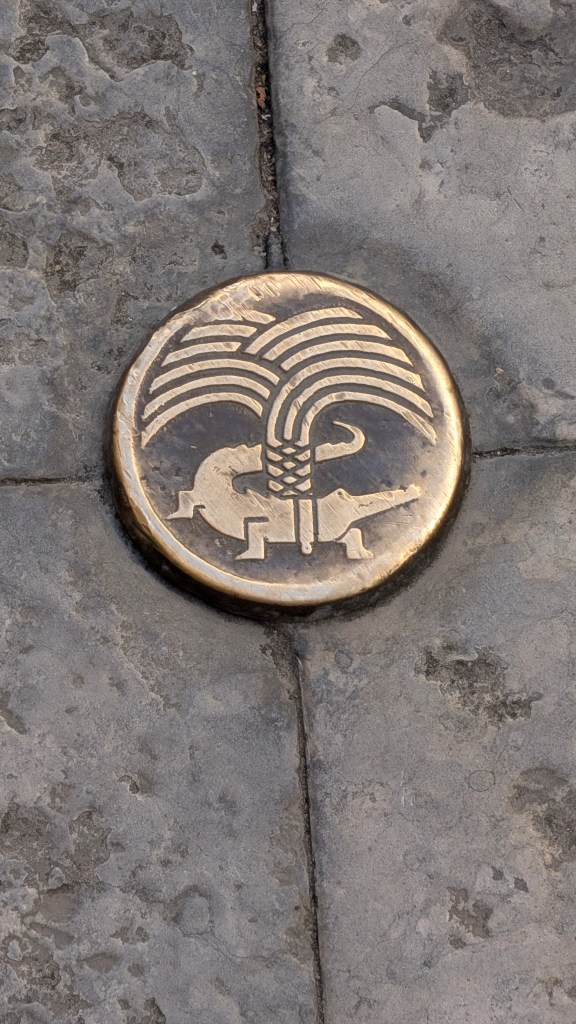
The official seal of the city of Nîmes depicts a crocodile chained to a palm tree. This symbol commemorates the victory of Emperor Augustus’ soldiers in Egypt, many of whom settled in Nîmes after their campaign. These brass markers are often used to designate walking trails or historical sites throughout the city. 
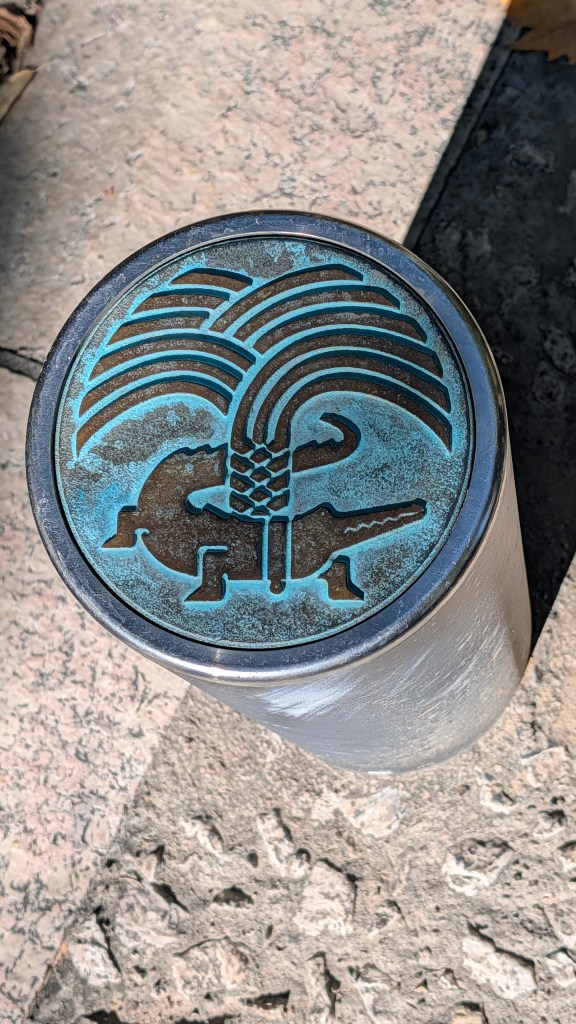
Also found on bollards, this symbol originates from a Roman coin minted to commemorate the victory of Julius Caesar’s legions in Egypt. The palm tree symbolizes victory, while the crocodile represents Egypt. 
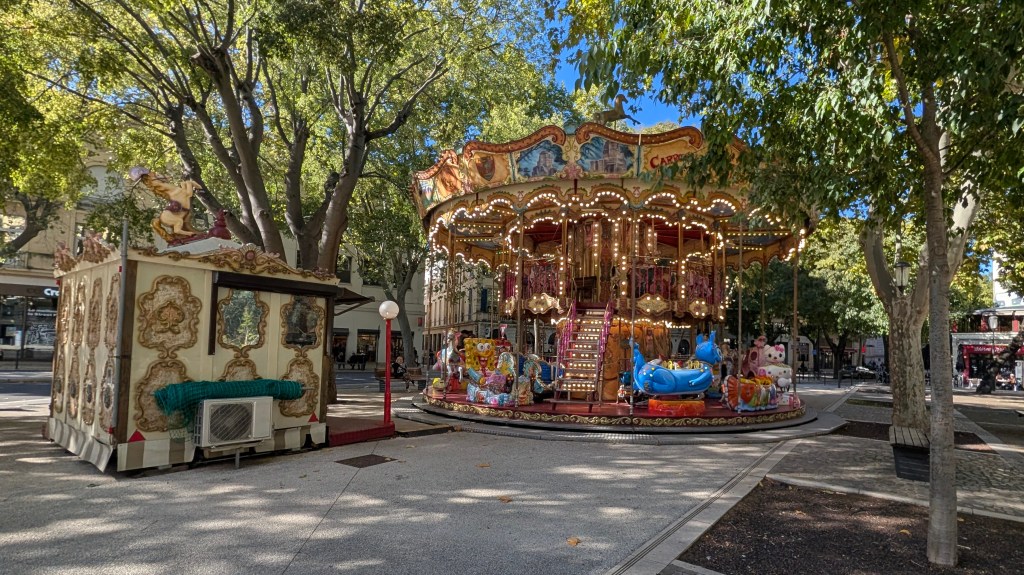
We noted this colorful carousel. Little did we appreciate how many we were to see in the coming days.
A statue of the French author, poet and statesman Alphonse de Lamartine (1790-1862), seated and writing, is located in the Square de la Couronne. Alphonse de Lamartine, was a leading figure in the 1848 French Revolution and was instrumental in the foundation of the Second Republic.
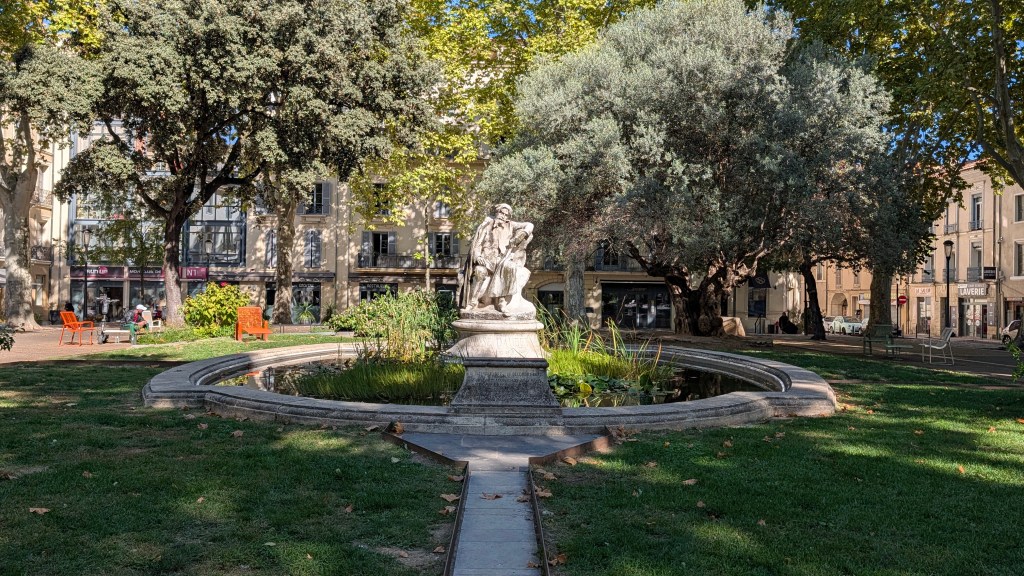
statue of Alphonse de Lamartine

Église Sainte-Perpétue et Sainte-Félicité is a Roman Catholic church constructed between 1852 and 1864 in the Neo-Gothic architectural style. The structure is known for its intricate facade and tall bell tower.  The church is dedicated to Saints Perpetua and Felicity, early Christian martyrs.
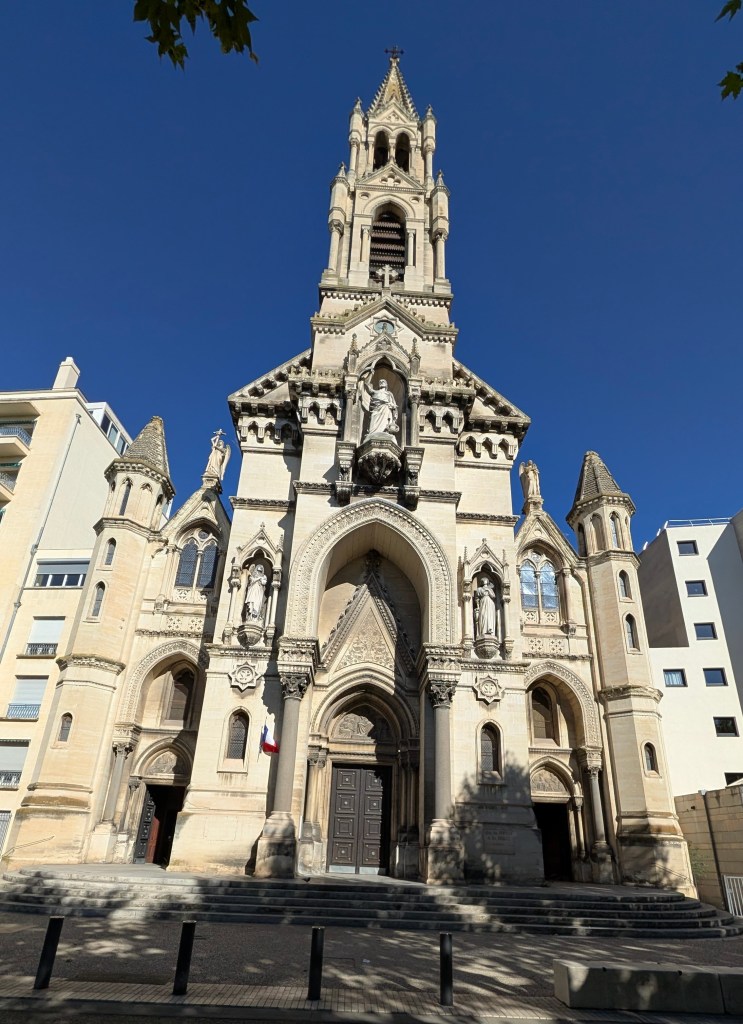
Église Sainte-Perpétue et Sainte-Félicité

And finally we found ourselves back where we had begun. The creation of Charles-de-Gaulle Esplanade dates back to the first half of the 16th century when Consul Jacques d’Albenas wanted to provide the city with a platform for artillery exercises . The space then laid out south of the Crown Gate also served for the official reception of dignitaries visiting the city. While some improvements were made in the 17th century, it was only in the 19th century that the esplanade became a true promenade. In 1841, the Nîmes city council decided to develop Avenue Feuchères and the esplanade, including aligning it with the current Boulevard de la Libération. New semi-circular walkways were then lined with groves of trees, flowers, and balustrades. These improvements were completed in 1861 with the inauguration of the monumental Pradier Fountain.
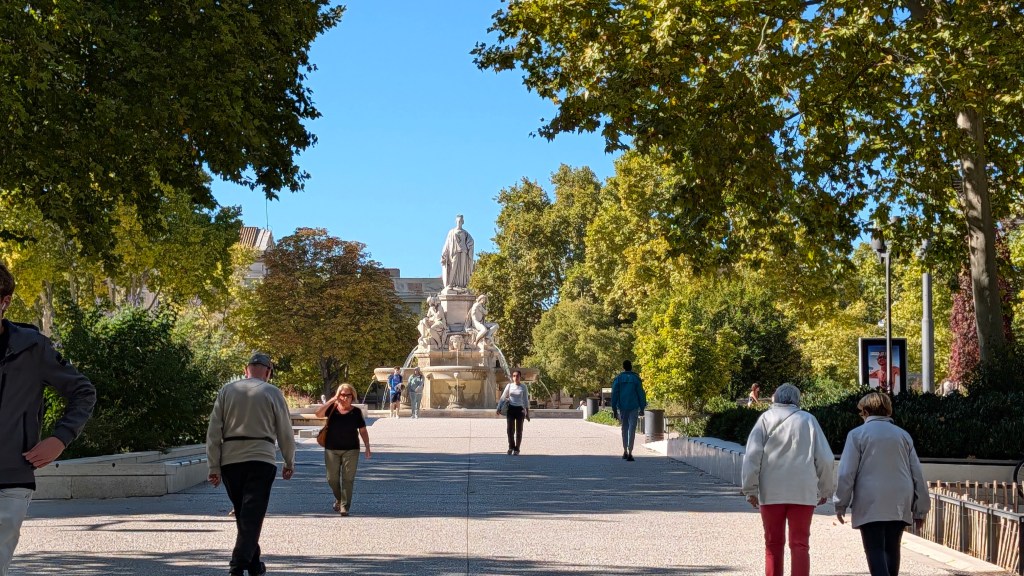
Charles-de-Gaulle Esplanade

We drove to nearby Pont du Gard is one of the best preserved ancient Roman aqueduct bridges.
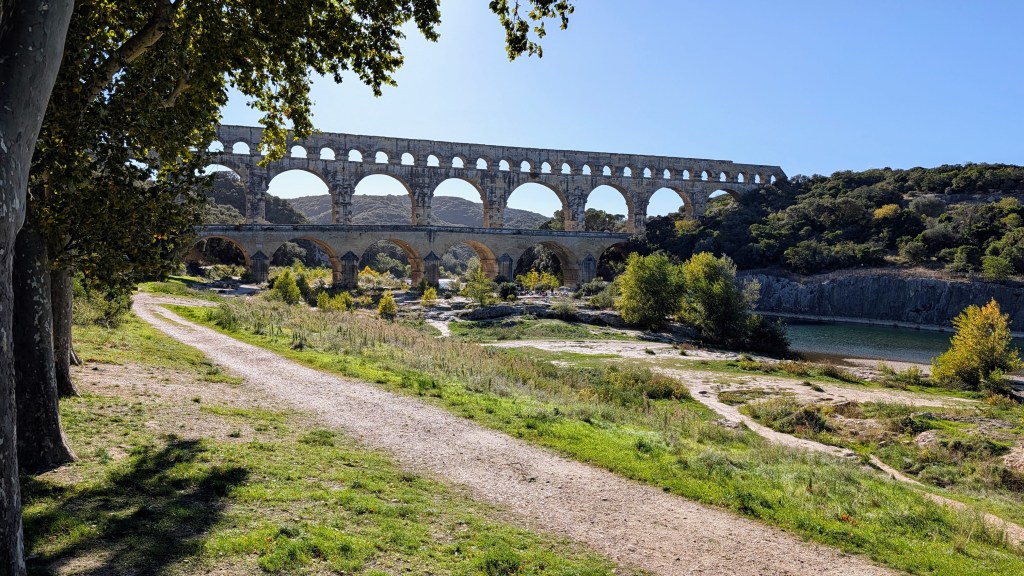
Pont du Gard

Built in the first century AD to carry water over 31 miles to the Roman colony of Nemausus (Nîmes), it crosses the river Gardon near the town of Vers-Pont-du-Gard in southern France.
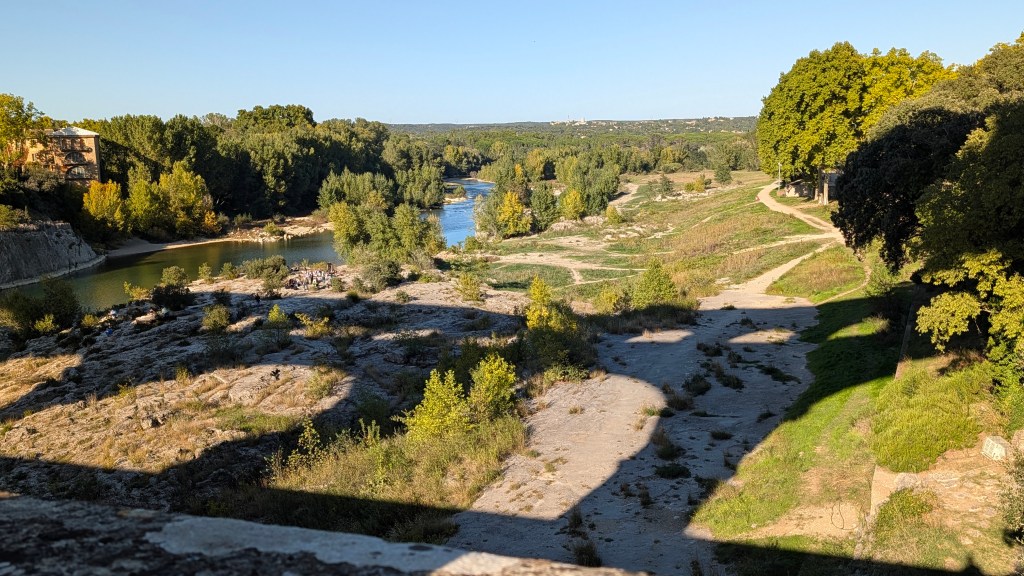
Gardon River

Vers-Pont-du-Gard is a small village famous for its local yellow limestone quarries, which provided the stone used to build the Roman aqueduct.
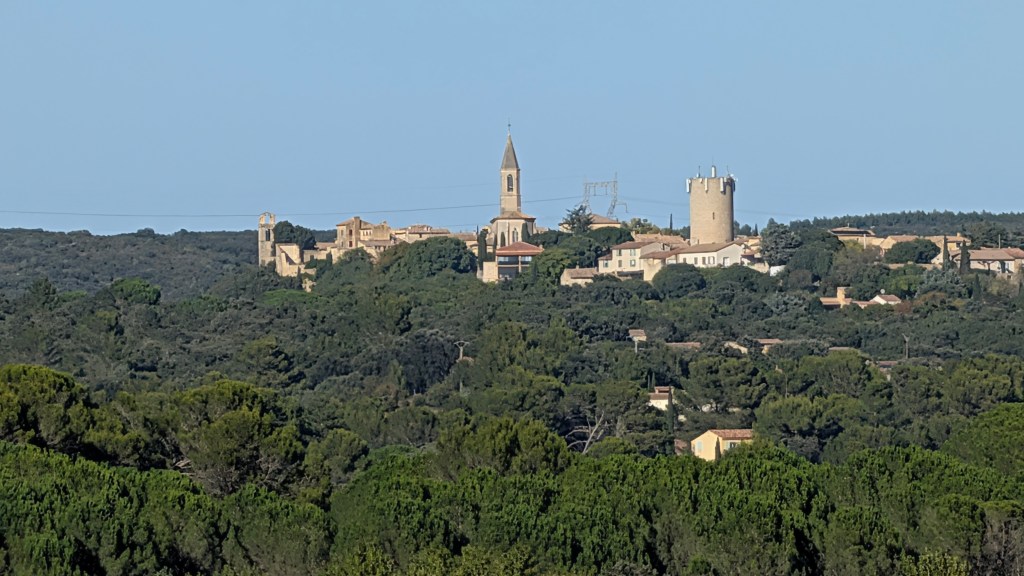
Vers-Pont-du-Gard

The stones, or blocks, sticking out from the Pont du Gard are not unfinished, but were intentionally left by Roman engineers to support wooden scaffolding and lifting machinery during the 1st-century construction. These protruding blocks, often found on the arches, facilitated maintenance and allowed for secure, temporary work platforms
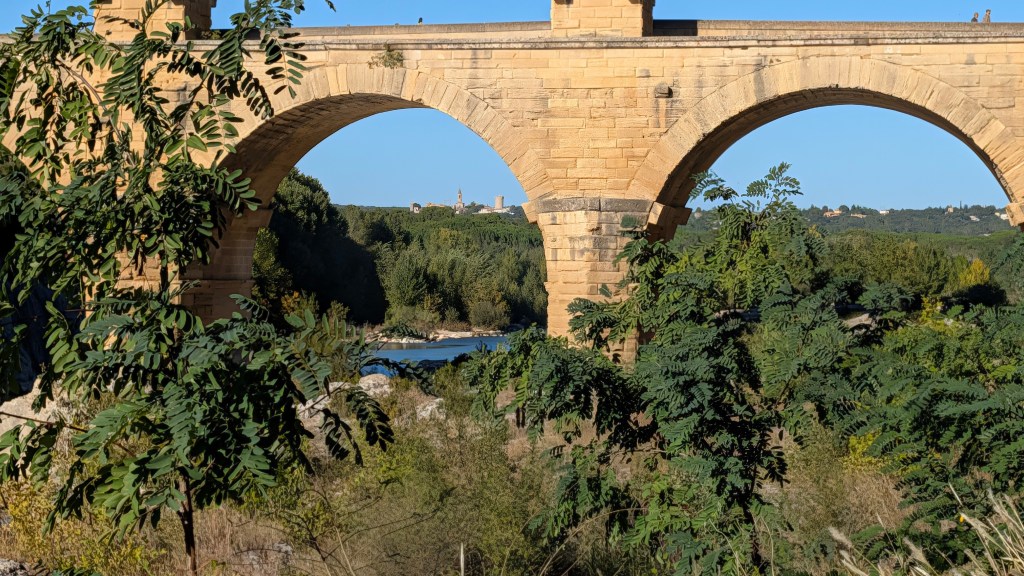
The bridge has three tiers of arches made from limestone and stands 160 ft high. The aqueduct formerly carried an estimated 11,000,000  gal of water a day over 31 miles to the fountains, baths and homes of the citizens of Nemausus (Nîmes). The structure’s precise construction allowed an average gradient of 0.39 in 598 ft. It may have been in use as late as the 6th century, with some parts used for significantly longer, but lack of maintenance after the 4th century led to clogging by mineral deposits and debris that eventually stopped the flow of water.
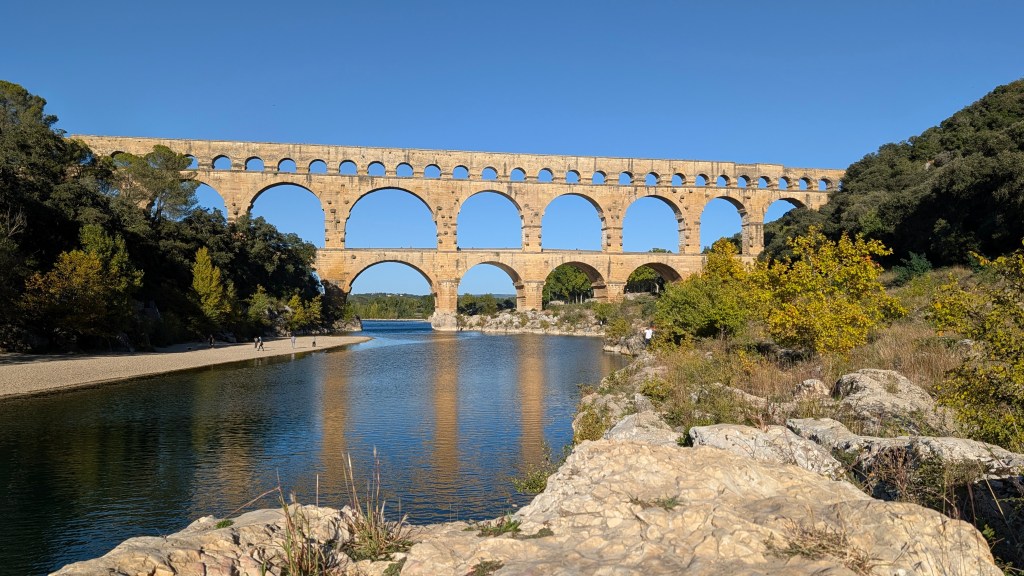
After the Roman Empire collapsed and the aqueduct fell into disuse, the Pont du Gard remained largely intact with a secondary function as a toll bridge. For centuries the local lords and bishops were responsible for its upkeep, with a right to levy tolls on travellers using it to cross the river. Over time, some of its stone blocks were looted, and serious damage was inflicted in the 17th century. It attracted increasing attention starting in the 18th century, and became an important tourist destination. A series of renovations between the 18th and 21st centuries, commissioned by local authorities and the French state, culminated in the year 2000 with opening of a new visitor centre and removal of traffic and buildings from the bridge and area immediately around it. Today it is one of France’s most popular tourist attractions.
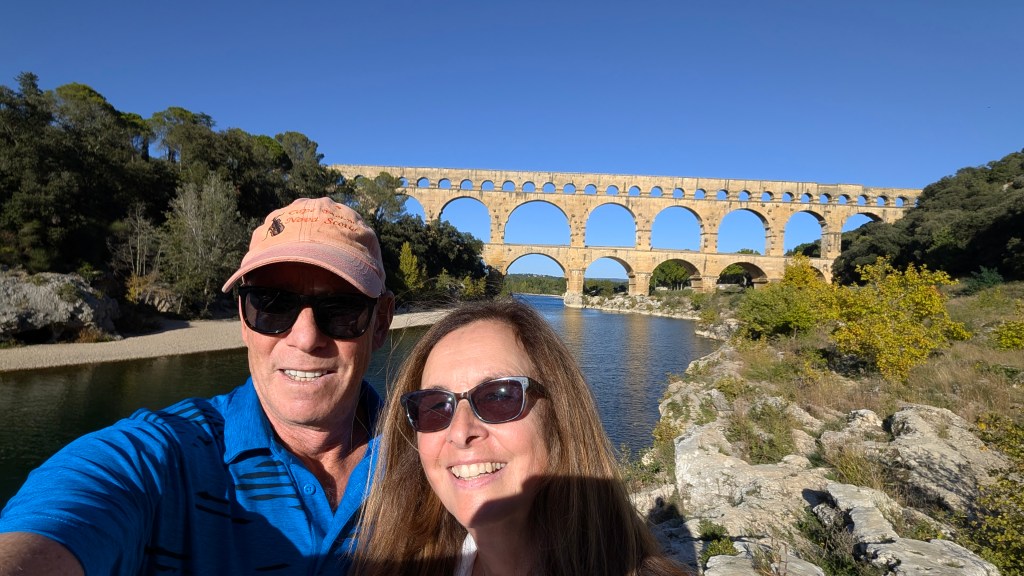
We returned to Arles late and enjoyed yet another delicious meal in the old town square.
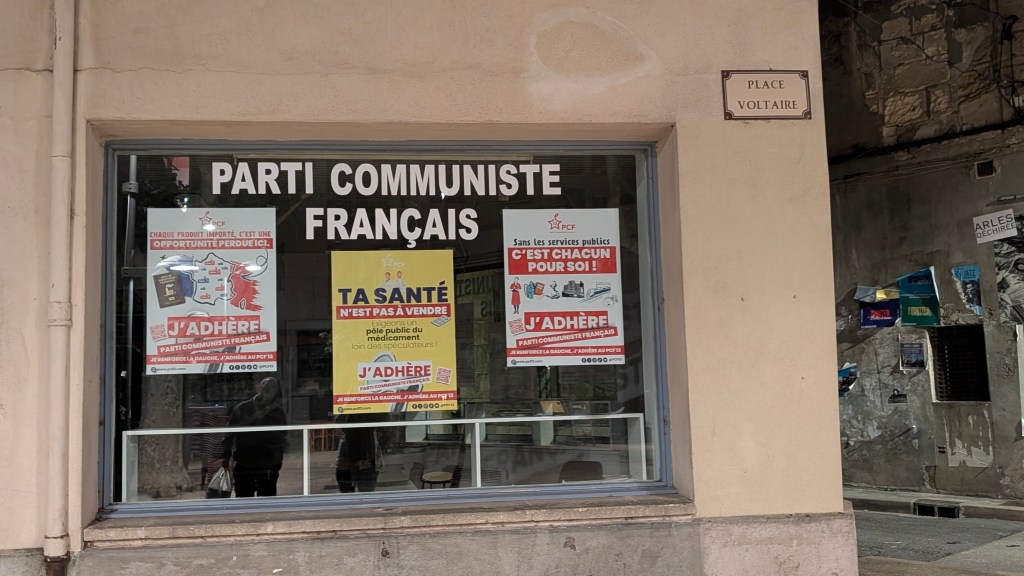
We were amused to find the communist party headquarters In Voltaire Square.
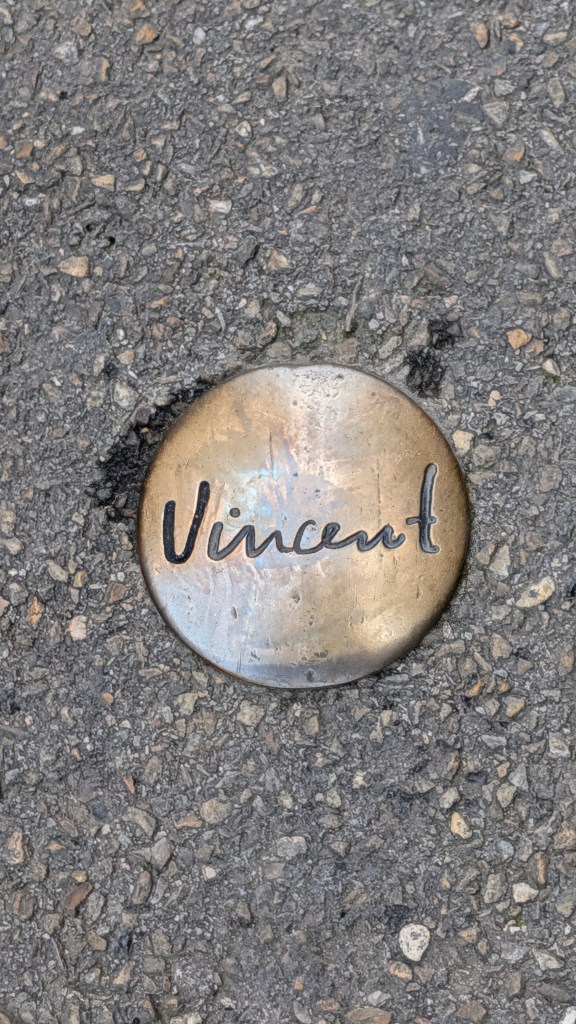
Our next adventure was to a town in the middle of the Little Alps: Saint-Rémy-de-Provence, a town, which has been inhabited since prehistory, famous for its Roman history, medieval streets, and as the birthplace of Nostradamus. But Saint-Rémy-de-Provence is visited primarily for its association with artist Vincent van Gogh.  The 11th-century Saint-Paul de Mausole monastery, famous for housing Vincent van Gogh in 1889, was originally founded as a Benedictine priory. We followed a Van Gogh self-guided tour through the town and its immediate surrounds.
The tour began at Porte Saint-Paul, a stone gate that is part of the original 14th-century walls that once encircled the city. The archway, one of the few remaining gates of the medieval wall, leads into the old town center
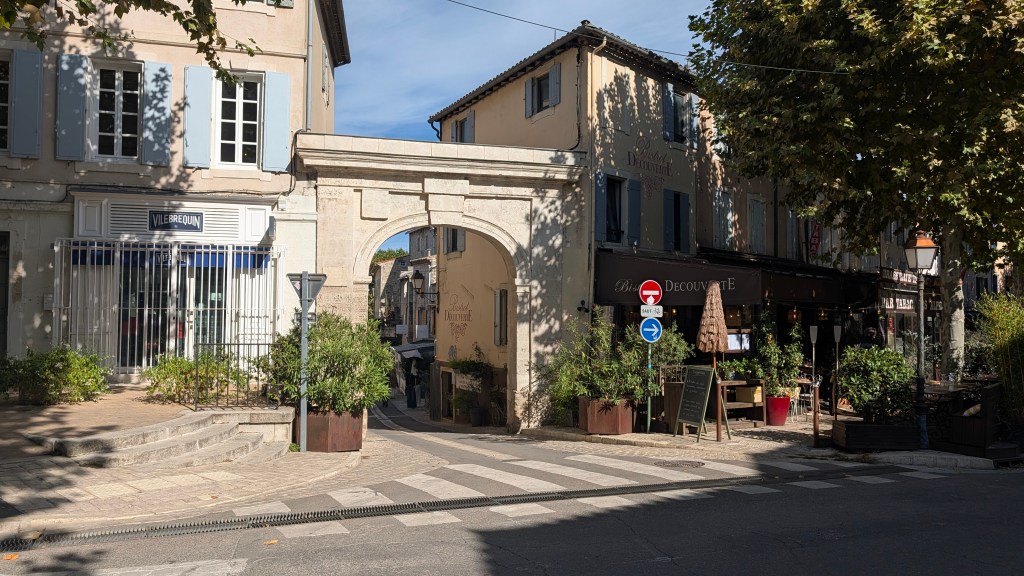
Porte Saint-Paul

Place Jules Pellissier, a sunlight-dappled Provençal square where ancient plane trees shelter café-goers. 
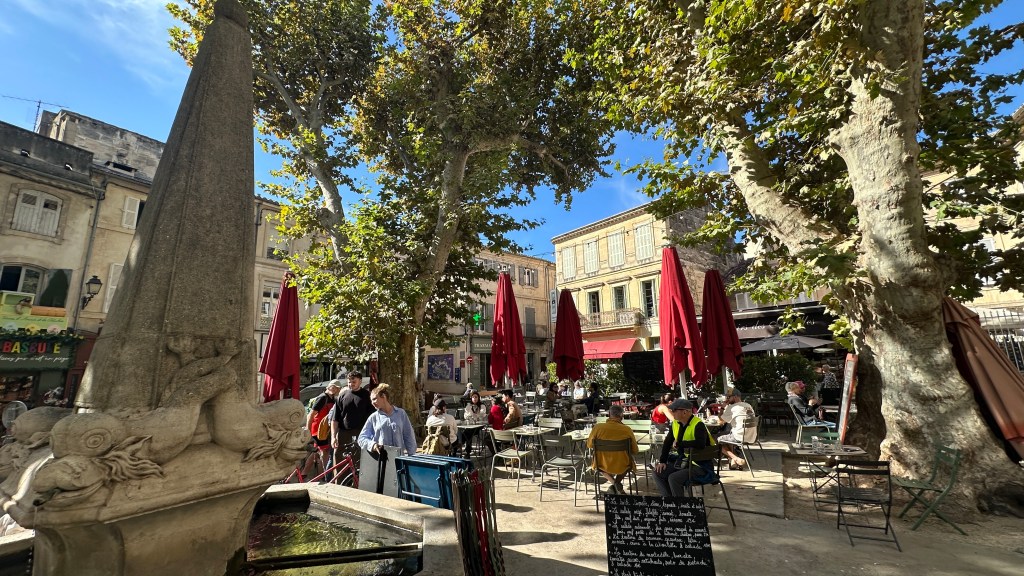
Place Jules Pellissier

City Hall (Hôtel de Ville) of Saint-Rémy-de-Provence, situated at the top of Place Jules Pellissier, was formerly an Augustine convent until the 17th century when it was repurposed for civic life. After the revolution it became the town hall. It flies both the French and city flags.
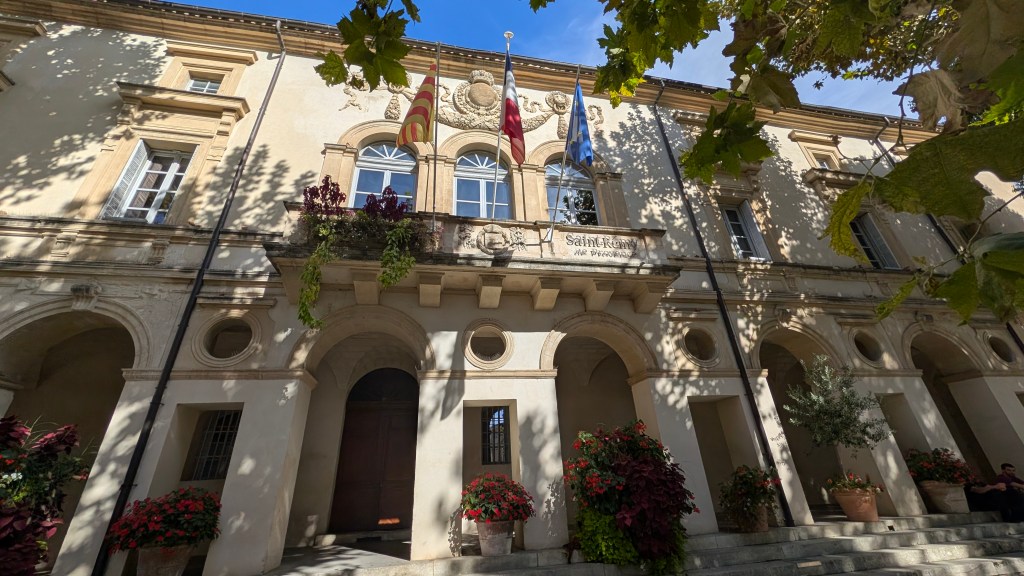
City Hall (Hôtel de Ville)

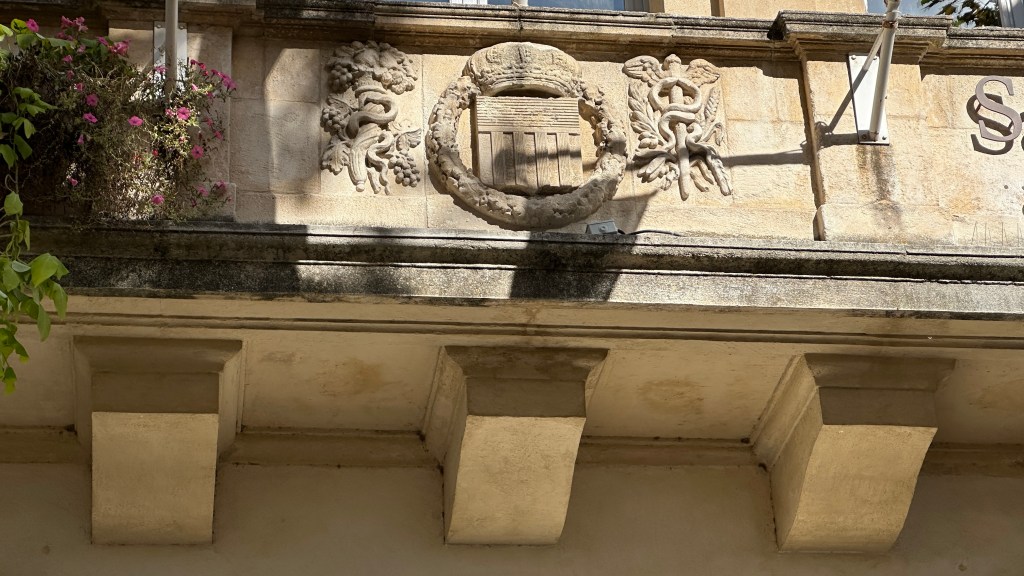
The central emblem features a shield surrounded by a decorative wreath and crowned, indicating its original noble or religious significance.
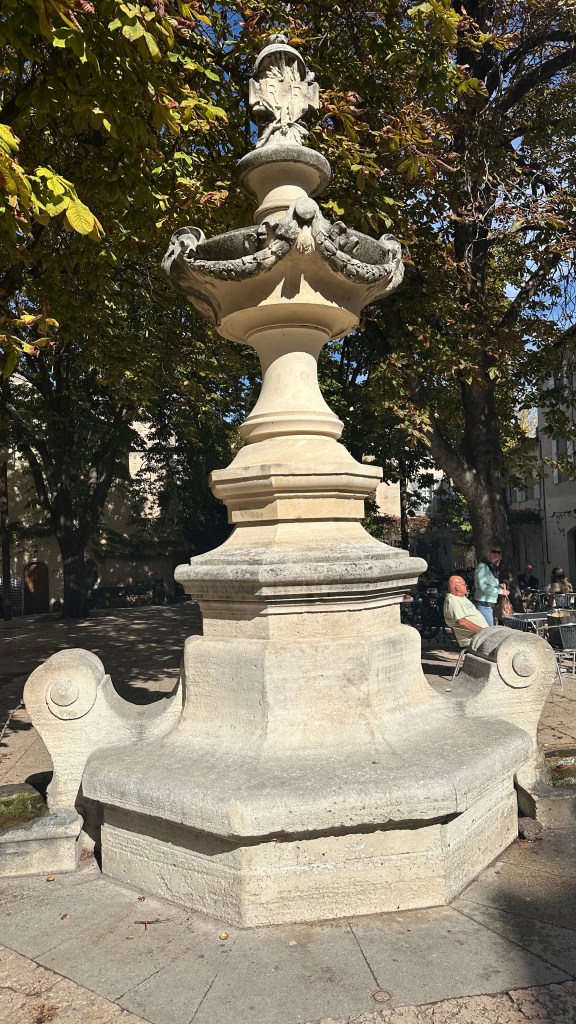
In the center of Place Jules Pellissier stands the The Fontaine de Quatre Dauphins (Fountain of Four Dolphins), modeled after a similar one in Aix-en-Provence. It was the centerpiece of the former convent garden. The dolphins symbolize purity and abundance. The fountain was dedicated by Louis XVII in 1814.
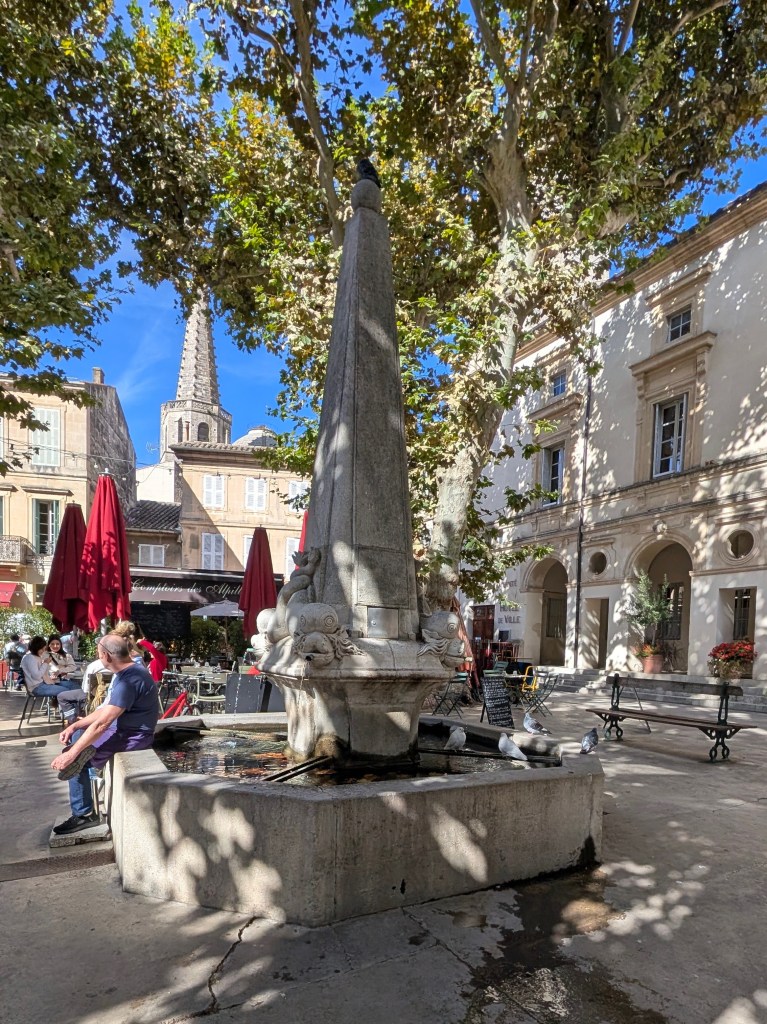
Fontaine de Quatre Dauphins (Fountain of Four Dolphins)

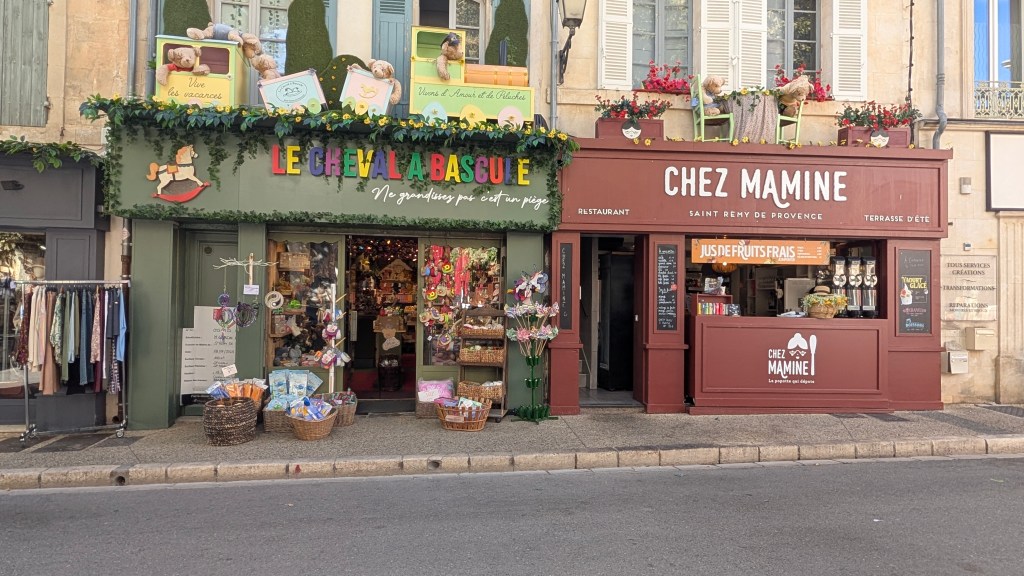
Around the square are several cute shops and cafes.
Musée Estrine, originally known as the Hôtel Estrine, was constructed in 1748 and originally served as the residence for the representatives of the Princes of Monaco. The museum is now dedicated to the life and works of Vincent van Gogh.
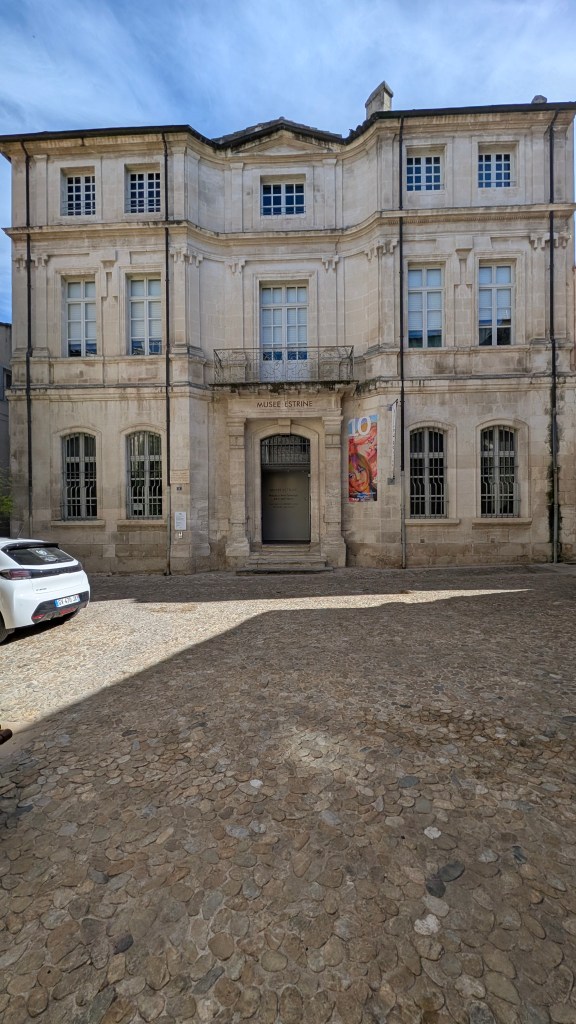
Musée Estrine

Fontaine Nostradamus features a bust dedicated to Nostradamus, the famous 16th-century French astrologer and physician born in this city. Originally built in the Middle Ages for drinking water, the fountain was redesigned in the 18th century, with the current bust of Nostradamus replacing an earlier one of King Louis XVI. It is now receiving a TLC restoration.
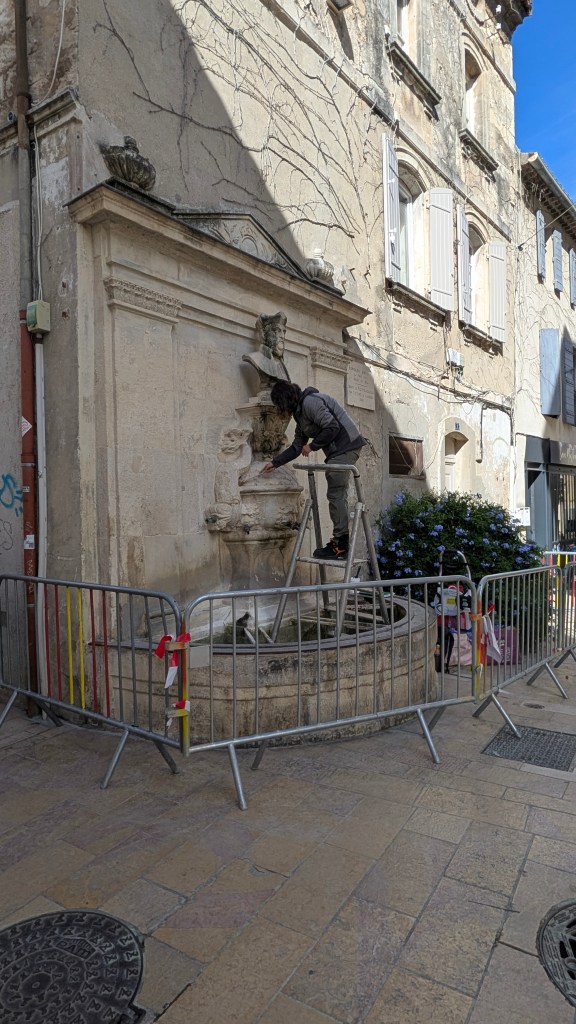
Fontaine Nostradamus

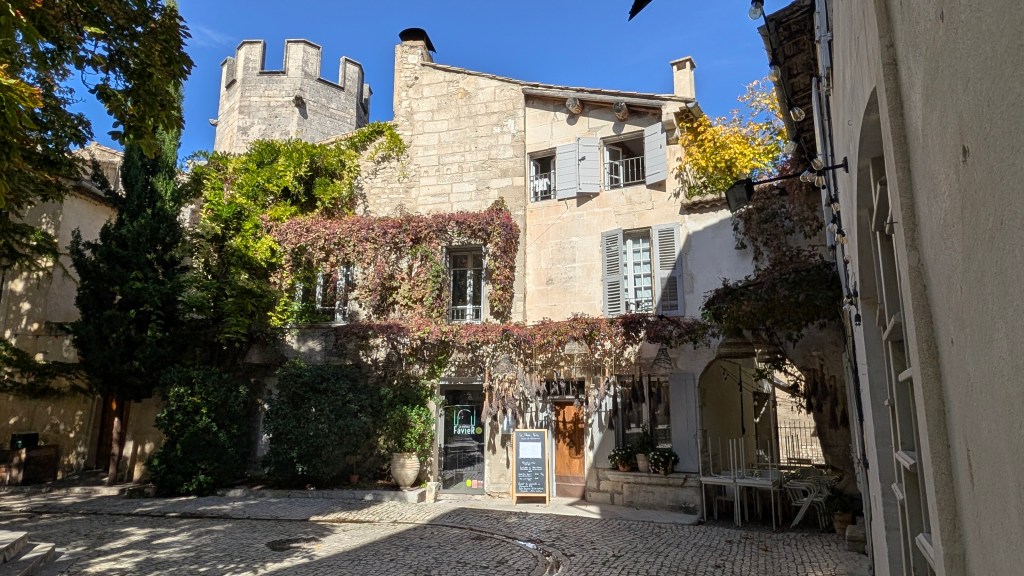
Place Favier showcases Renaissance-era building styles, including the Hôtel de Sade nearby. Formerly known as the “Place aux Herbes” (herbs market square), it was renamed in 1849 in honor of Doctor Favier (1773–1862), a local physician celebrated for his lifelong dedication to treating the poor. The square is characterized by its large, shady plane trees, a 15th-century arch connecting residential buildings, and a distinctive crenellated round tower that adds to its medieval charm. Today, it remains a tranquil spot popular for its outdoor cafés and a quiet escape from the busier market streets.

Place Favier

The Hôtel de Sade embodies the power of the de Sade family, ennobled by the Pope in the 14th century. Currently the “archaeological museum” of the Glanum site, the Hôtel de Sade is a building that has undergone constant architectural evolution since the 4th century AD when it was originally Roman baths.
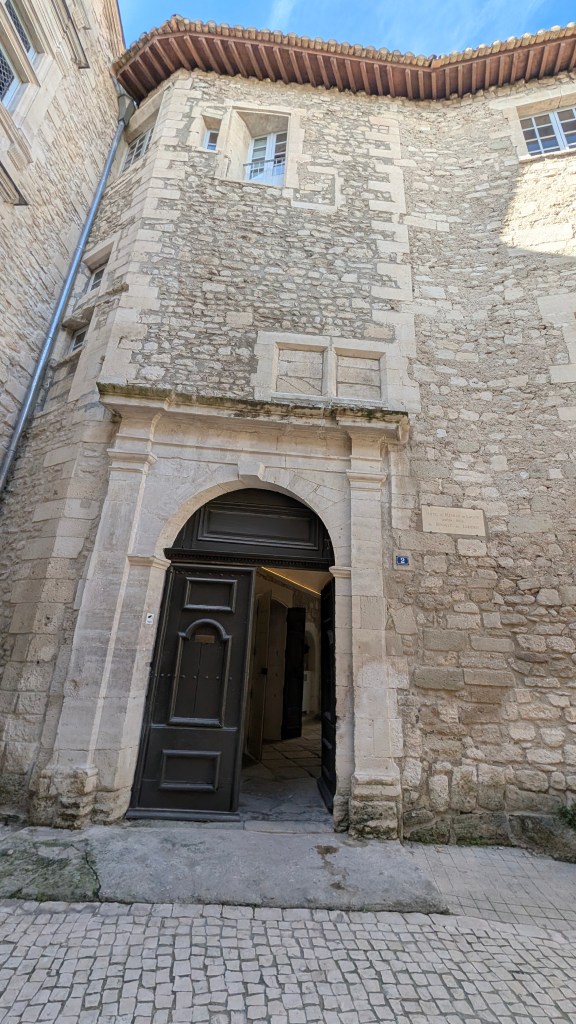
The Hôtel de Sade

The Alpilles Museum is housed in the Mistral de Mondragon mansion, a former Renaissance private mansion. Classified as a historical monument since 1862, the building is built around an admirable interior courtyard.
Alpilles Museum

The Collégiale Saint-Martin (Collegiate Church of St. Martin) is a historic Catholic church known for its blending of traditional: a 14th-century Gothic bell tower with the neoclassical: a 19th-century neoclassical façade. In 1132 it was built for the local parish.
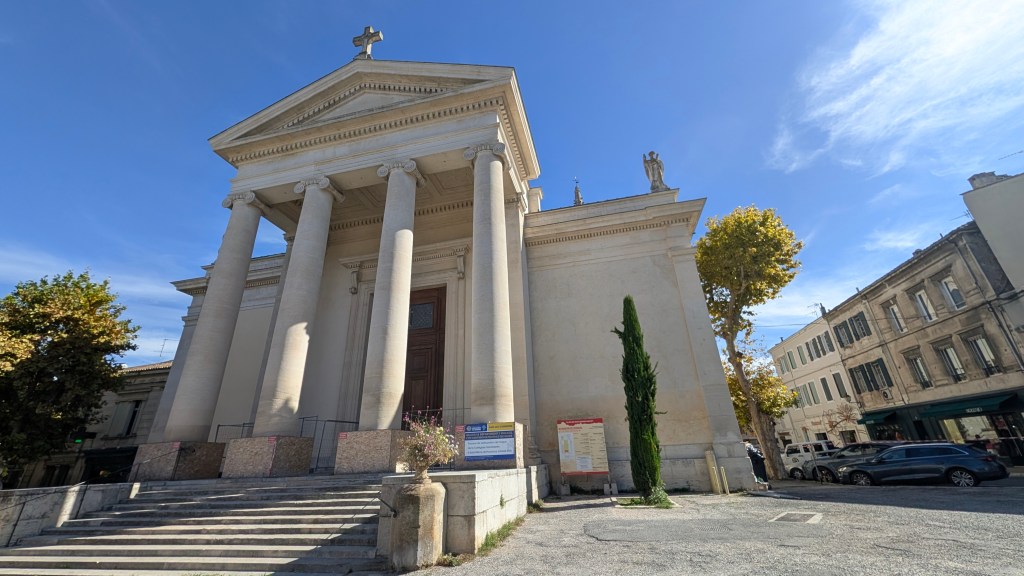
Collégiale Saint-Martin (Collegiate Church of St. Martin)

But in 1331 it was elevated to a collegiate church by Pope John XXII. In 1818 there was a partial collapse of the bell tower which was rebuilt in 1821, from which time the bell tower has become a symbol of resistance and perseverance.
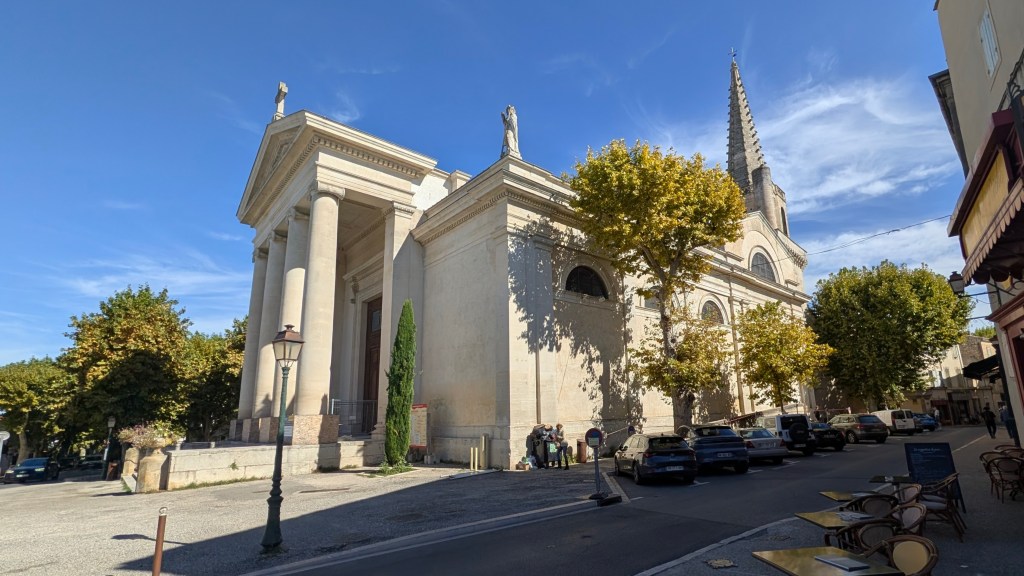
Collégiale Saint-Martin (Collegiate Church of St. Martin)

Nostradamus (Michel de Nostredame), a famous 16th-century physician and clairvoyant was born in this house on December 14, 1503. Nostradamus grew up in this region and later became famous for his book Les Prophéties, a collection of 942 poetic quatrains allegedly predicting future events. The building is now a private residence, but tourists frequently visit the exterior to see the commemorative plaque and green door. 

birthplace of Nostradamus

The former Hôpital Saint-Jacques (Saint-Jacques Hospital), a historic structure made of stone, was originally built within the town’s ancient fortifications in 1046. 
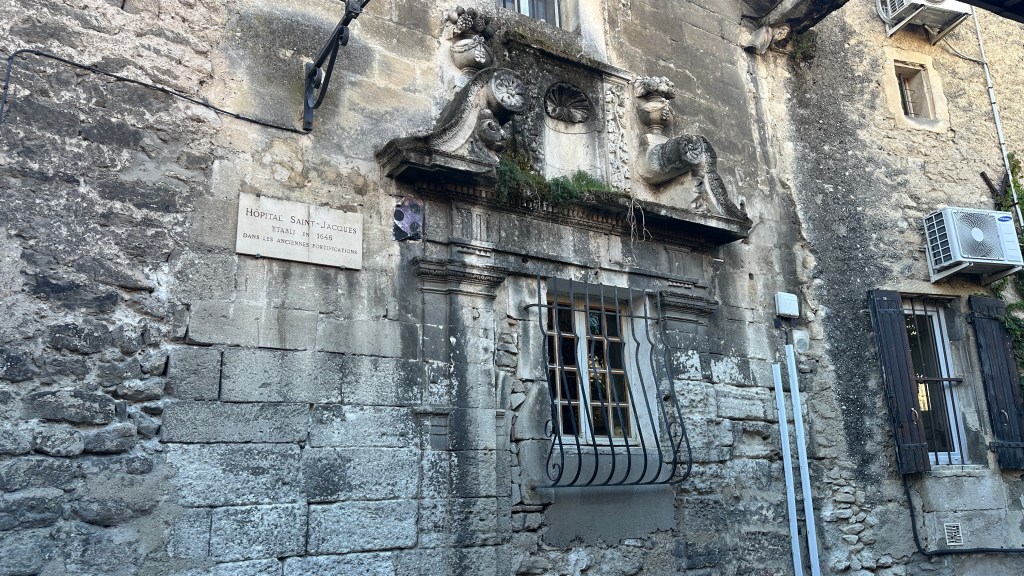
Hôpital Saint-Jacques (Saint-Jacques Hospital)

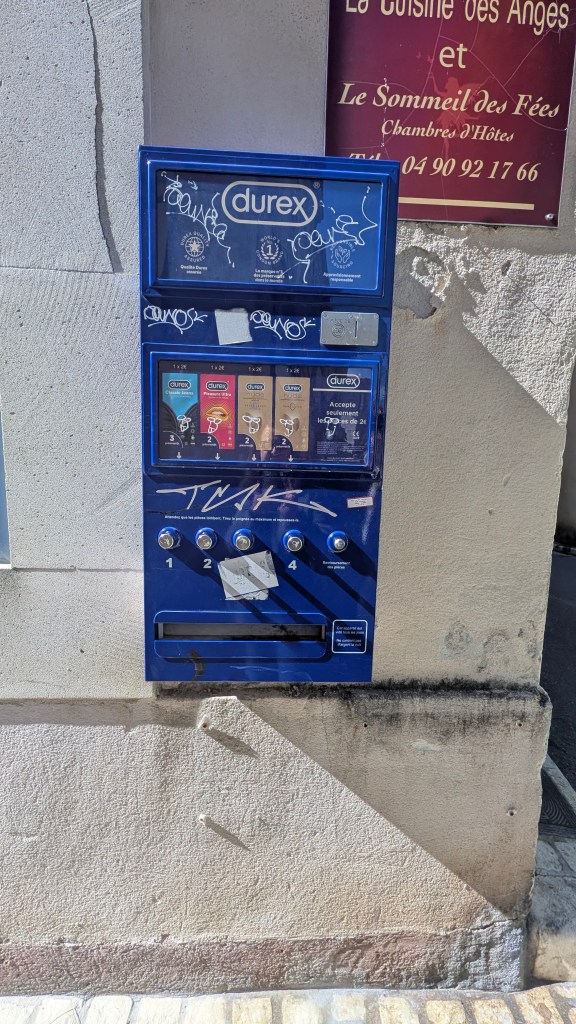
As we left the town’s historic center we passed something we had never seen on a public city street: a condom vending machine.
Outside of the city center sits Notre Dame de Pitié chapel. Built, according to historical records, around 1525 with a single nave, the Notre Dame de Pitié chapel was enlarged with two side aisles between 1650 and 1670, and then with a porch in 1685. Notre Dame de Pitié chapel now hosts contemporary art exhibitions.
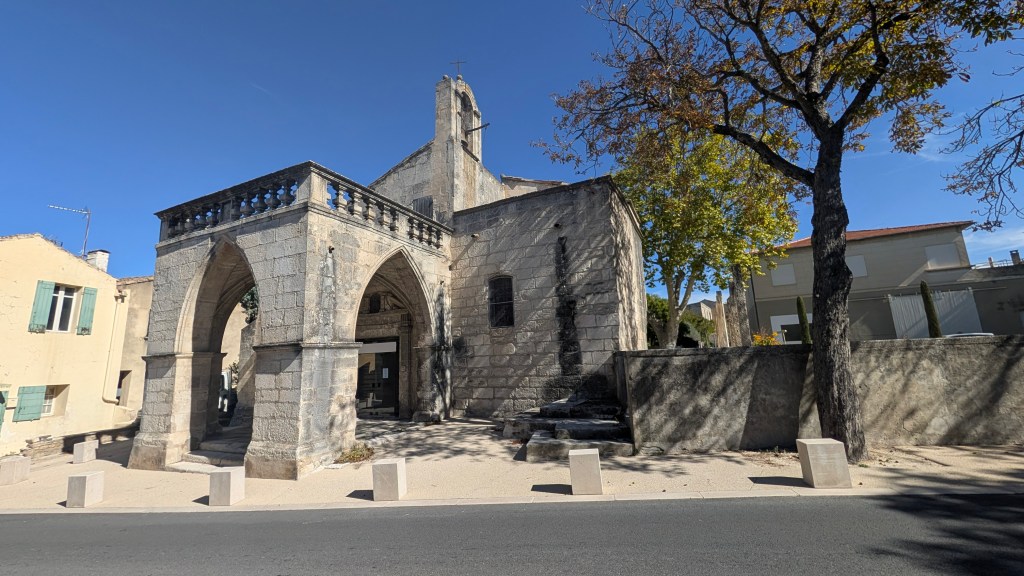
Notre Dame de Pitié chapel

Outside of the historic city center is where Vincent Van Gogh spent his time. After a break down in Arles, Van Gogh voluntarily committed himself from May 1889 to May 1890 to Saint-Paul de Mausole, a 12th-century former monastery and active psychiatric hospital. He was given two rooms, one for use as his studio. During his stay he was quite prolific, painting nearly150 works.
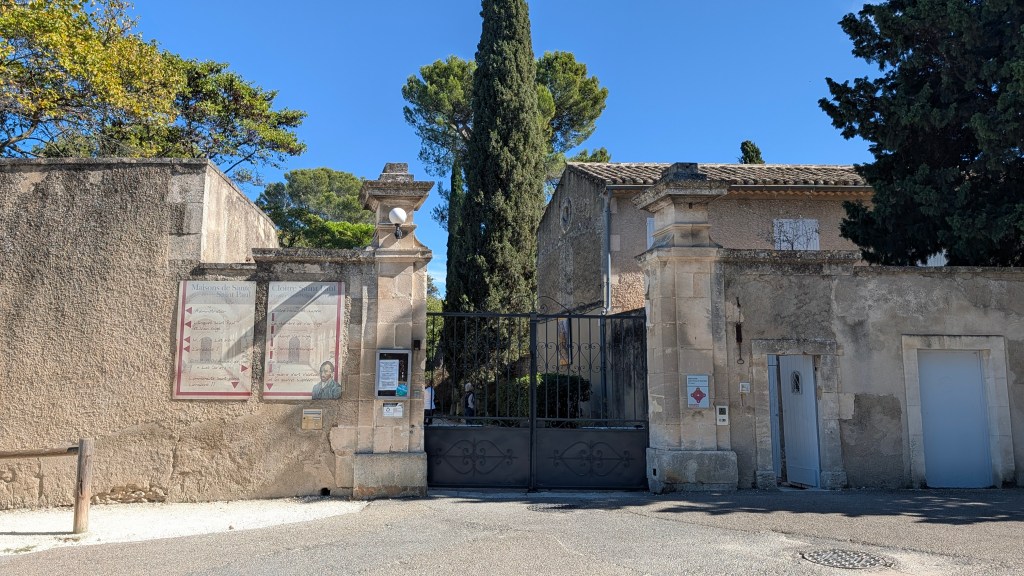
Saint-Paul de Mausole nursing home

At this point on the self-guided walking tour we were instructed to note scenes which were inspiration to Van Gogh’s paintings, many of which were drawn while he had a day pass from the psychiatric hospital. He painted many cyprus trees. Their tall stance pointing heavenward symbolize spiritual seeking.

Some of the scenes are marked with plaques showing the Van Gogh painting inspired by the locale.
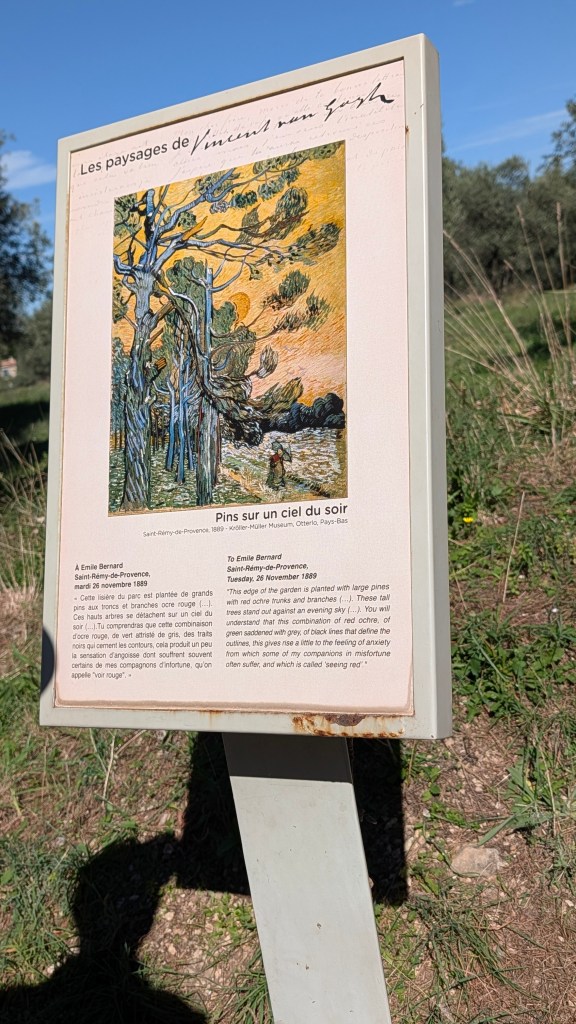
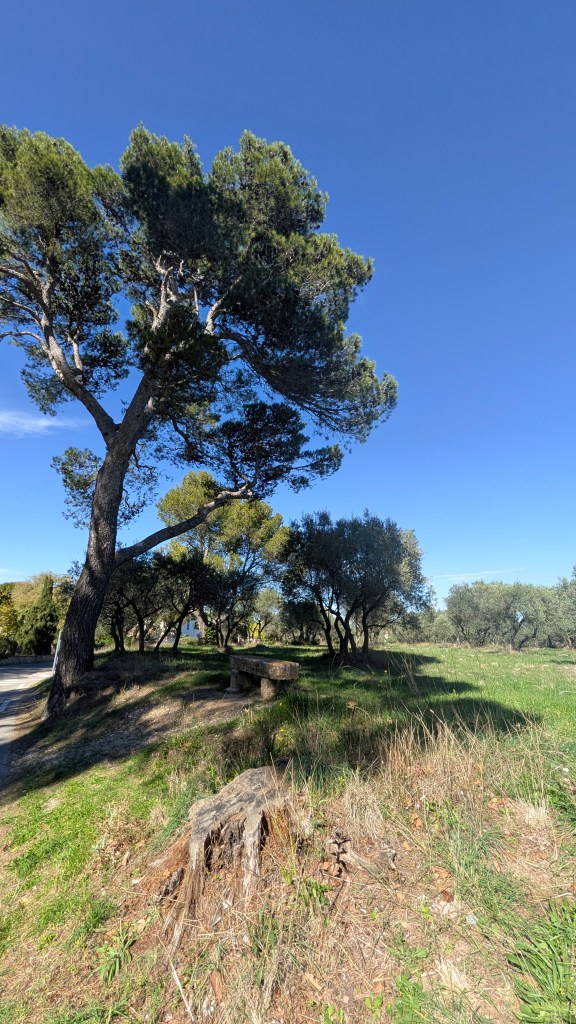
Van Gogh’s famous “Almond Blossoms” was painted for his brother after the birth of his brother’s first child, offering him joy during a dark time in Van Gogh’s life. Flowering trees were special to van Gogh; they represented awakening and hope.  Olive trees represent peace, endurance and reconciliation, triumph and humility.
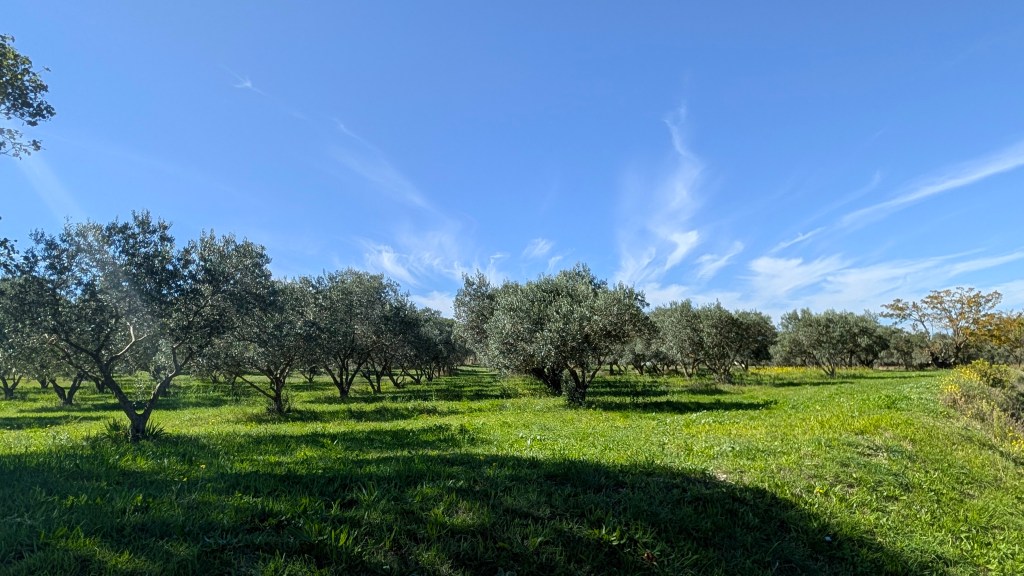
Just on the outskirts of Saint-Rémy-de-Provence can be found “Les Antiques,” ancient Roman monuments located at the entrance to the archaeological site of Glanum.  These monuments represent some of the best-preserved remnants of Gallo-Roman architecture in France. 
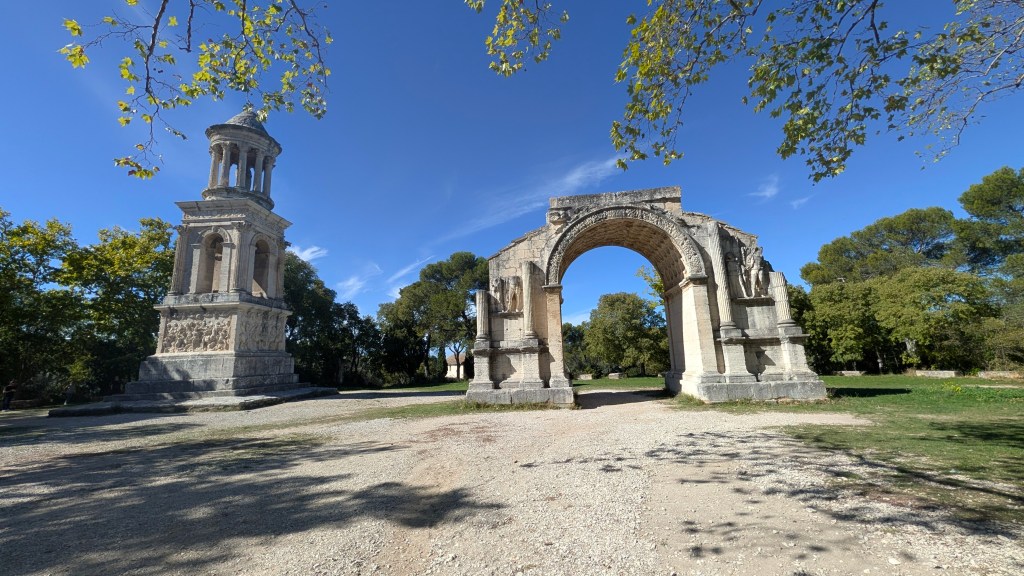
“Les Antiques:” Mausoleum of the Julii & a Triumphal Arch

On the left is an 18-meter-high Mausoleum of the Julii dating back to 30-20 BC, built by the three Julii brothers in honor of their ancestors. The reliefs around the base symbolize eternal life.
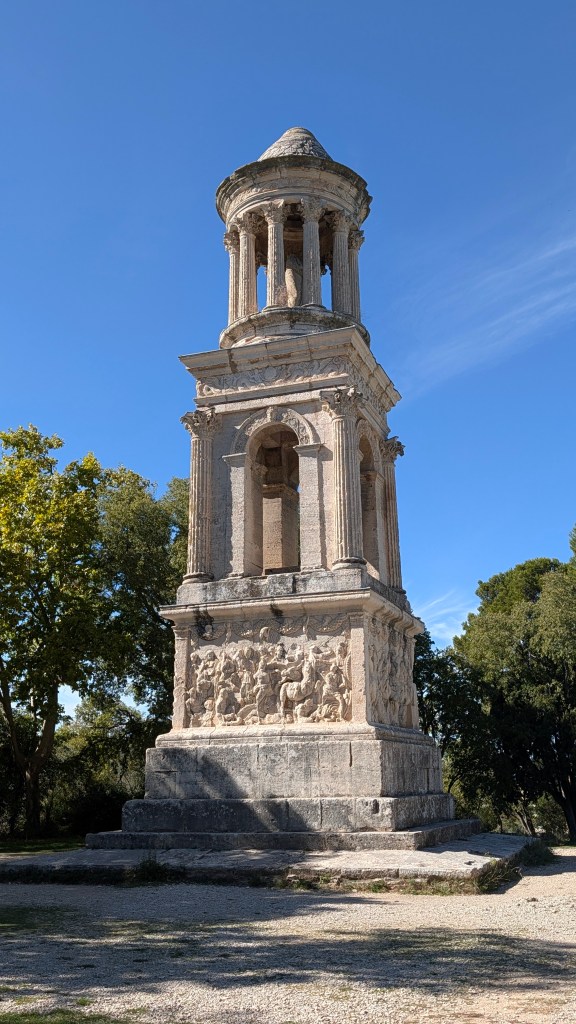
Mausoleum of the Julii dating back

On the right is a Triumphal Arch from 20 AD, which served as the gateway to the city of Glanum. The carvings on the arch show Roman generals, their prisoners, and local fruits, which are symbols of power and prosperity.
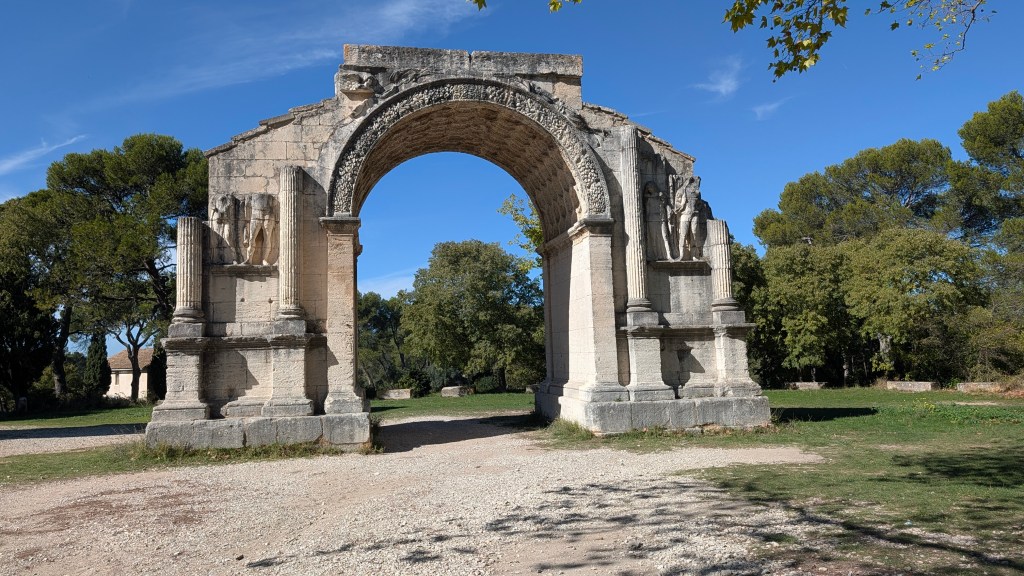
Triumphal Arch

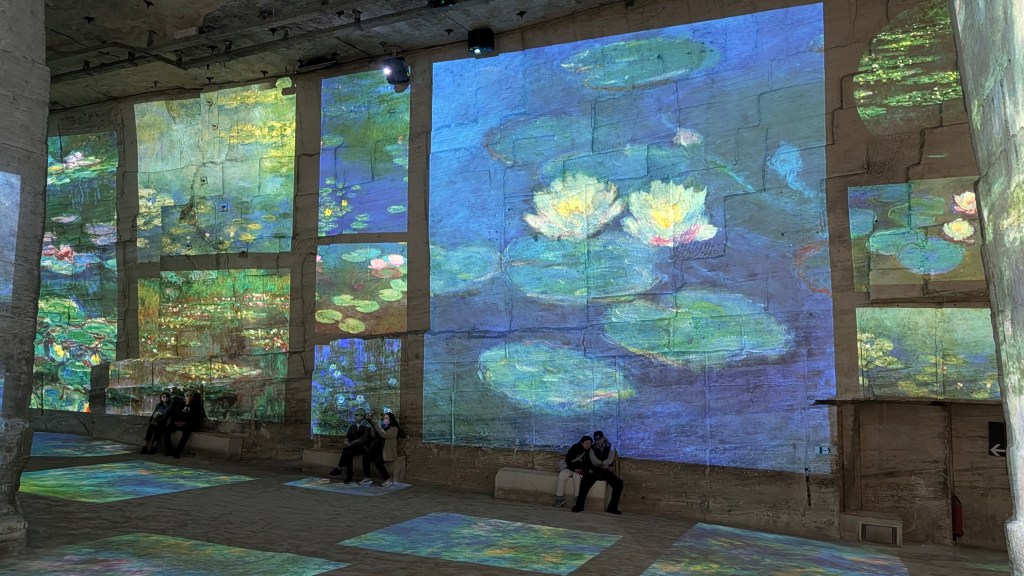
We drove a short distance to Carrières des Lumières, a unique multimedia art center located in Les Baux-de-Provence, France. It is a former limestone quarry transformed into an exhibition space where artworks are projected onto massive rock walls, pillars, and the floor. The immersive experience covers thousands of square meters, allowing visitors to walk through digitized paintings and art history. Different art shows are hosted throughout the year, featuring famous artists and themed exhibitions. When we arrived they were showing the works of Henri Rousseau (1844-1910), a French post-Impressionist painter in the Naïve or Primitive manner. 
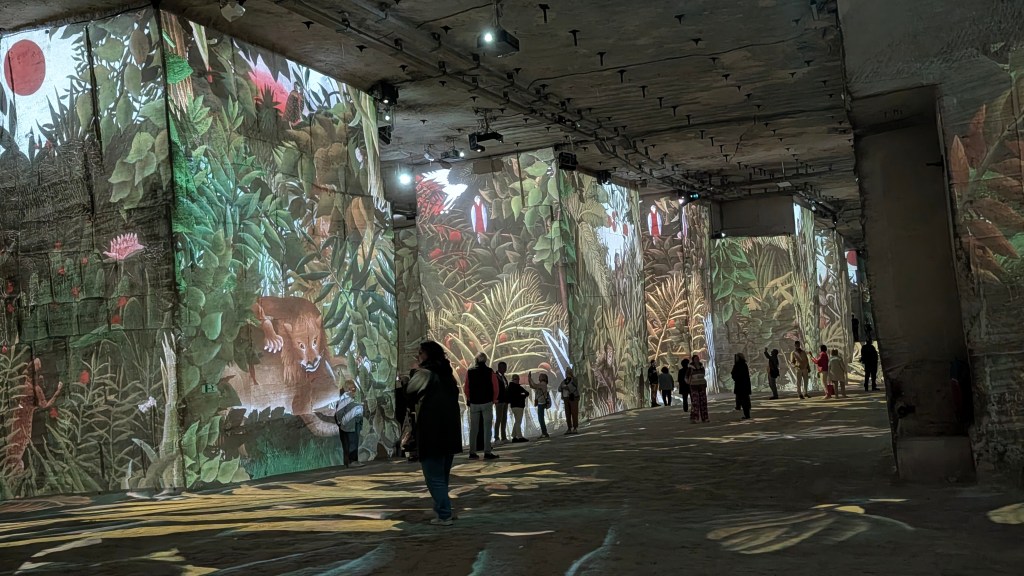
Ridiculed during his lifetime by critics, he came to be recognized as a self-taught genius whose works are of high artistic quality.  Rousseau’s work exerted an extensive influence on several generations of avant-garde artists.
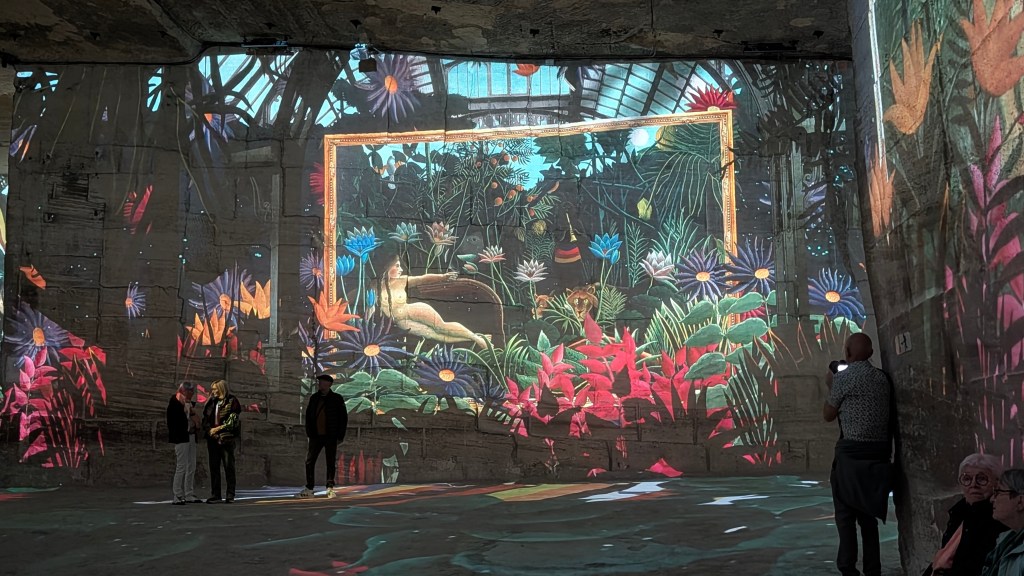
Next up were the works of Claude Monet (1840-1926), a French painter and founder of Impressionism who is seen as a key precursor to modernism, especially in his attempts to paint nature as he perceived it.
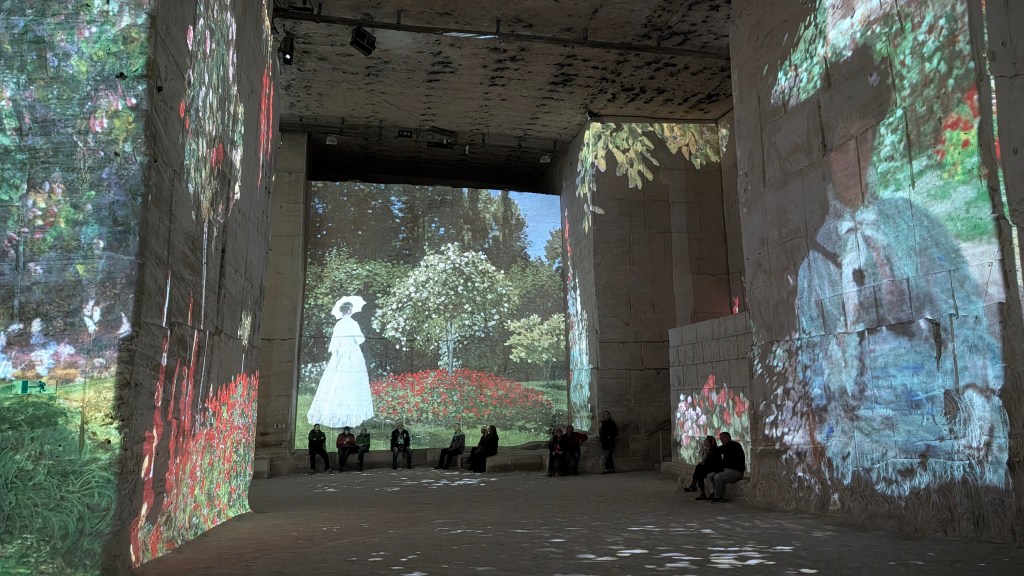
During Monet’s long career, he was the most consistent and prolific practitioner of Impressionism’s philosophy of expressing one’s perceptions of nature, especially as applied to plein air (outdoor) landscape painting.
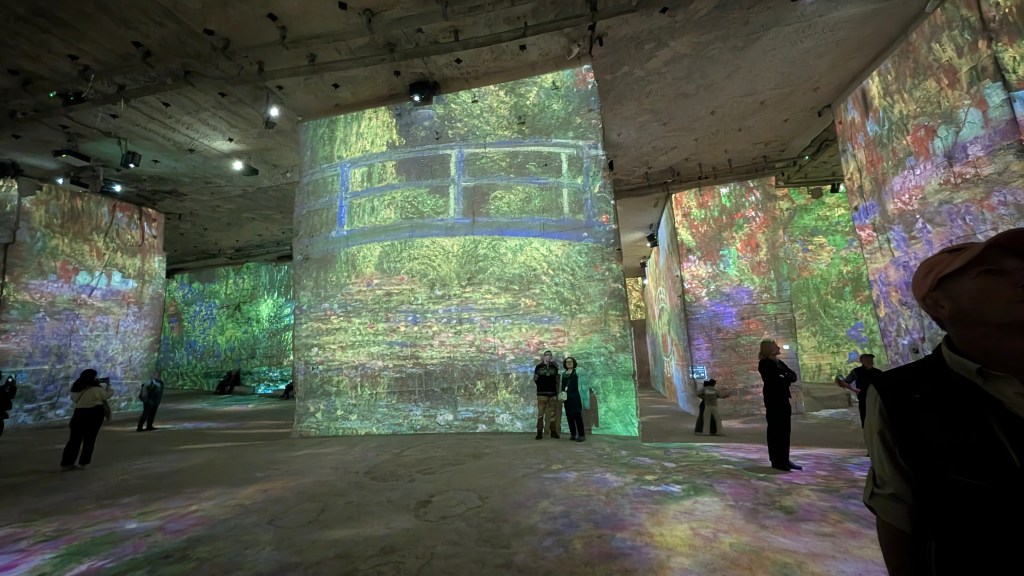
Monet is best known for his paintings of water lilies in his garden in Giverny, which occupied him for the last 20 years of his life. Words and pictures can barely capture the awe inspiring experience of Carrières des Lumières.
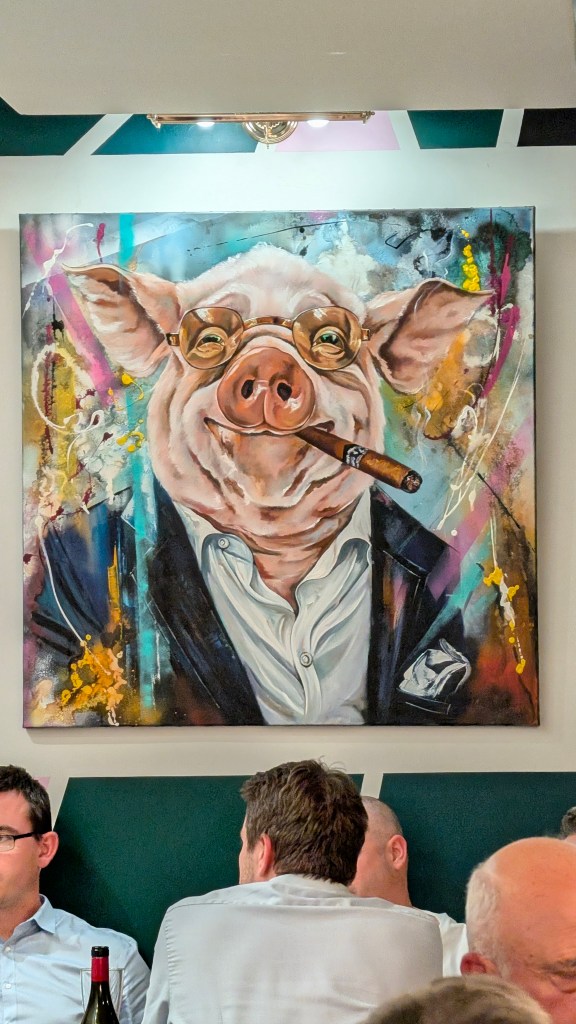
Back in Arles for the night we dined at the Smoking Pig restaurant, so delicious.
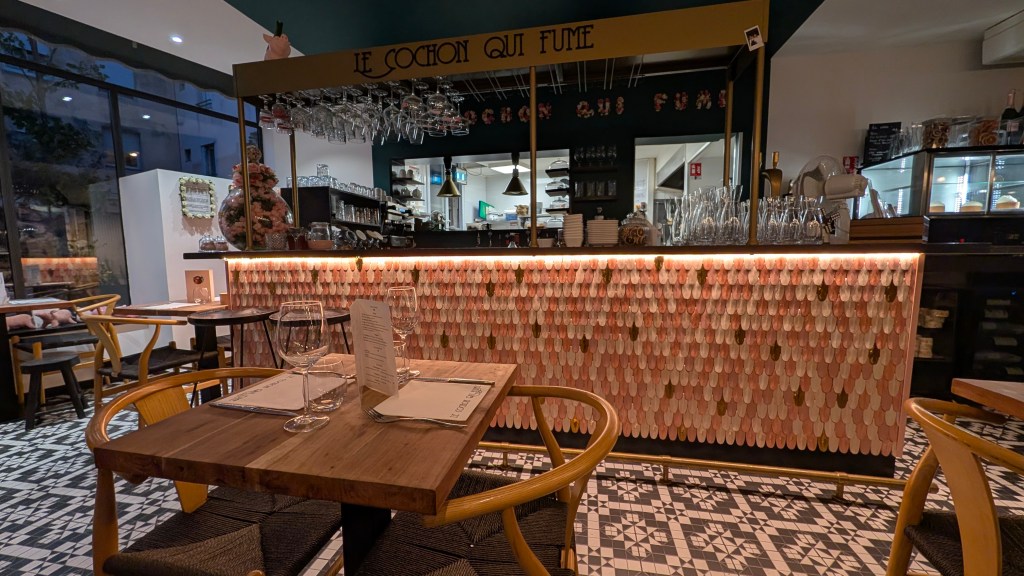
Smoking Pig

Smoking Pig

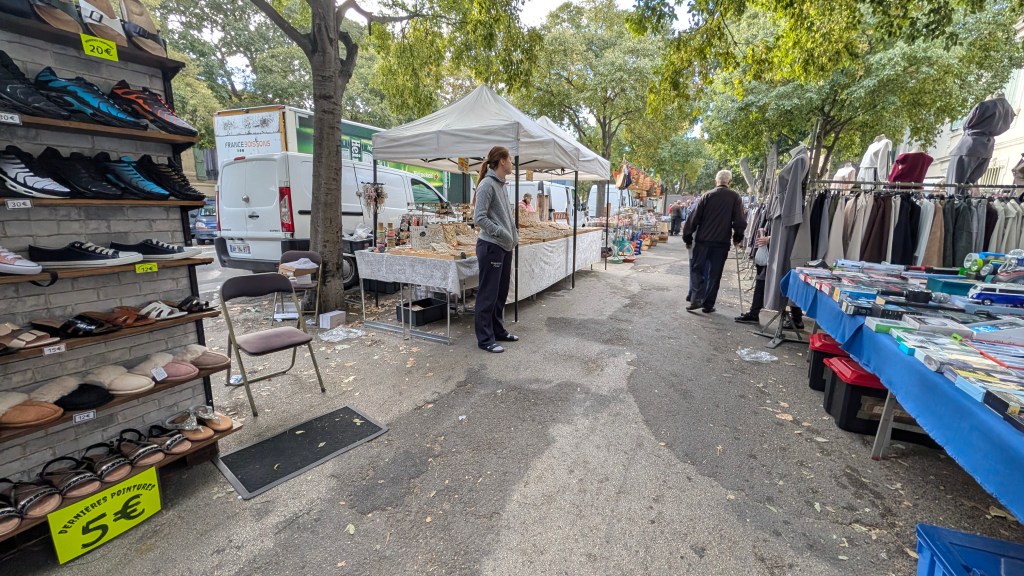
Finally it was market day in Arles. We were pleasantly surprised at the wide assortment of goods on display. One side of the market were dry goods including everything from clothing
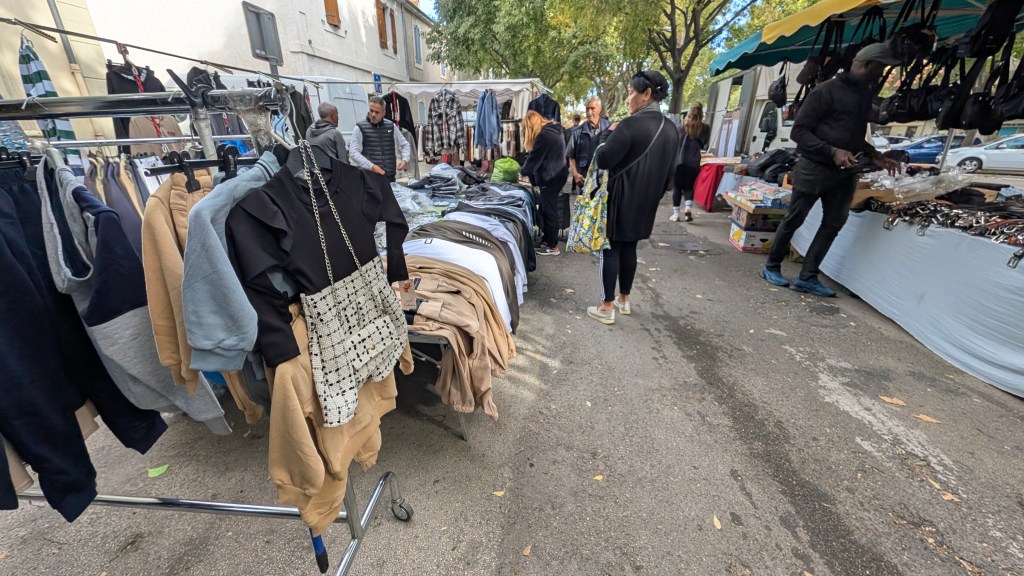
to shoes and jewelry,
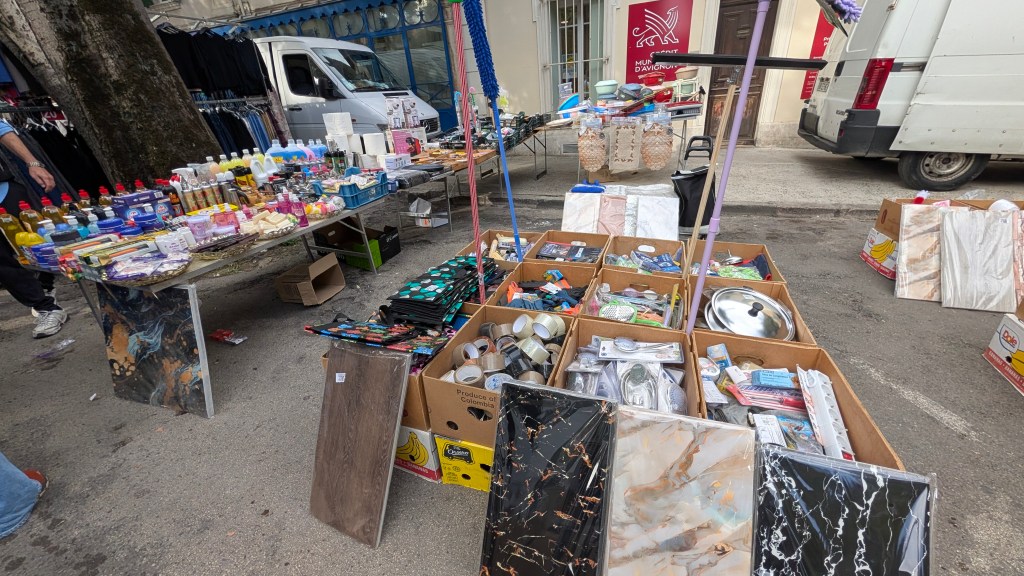
to cleaning and repair job hardwares,
and entertainments including DVDs and music.

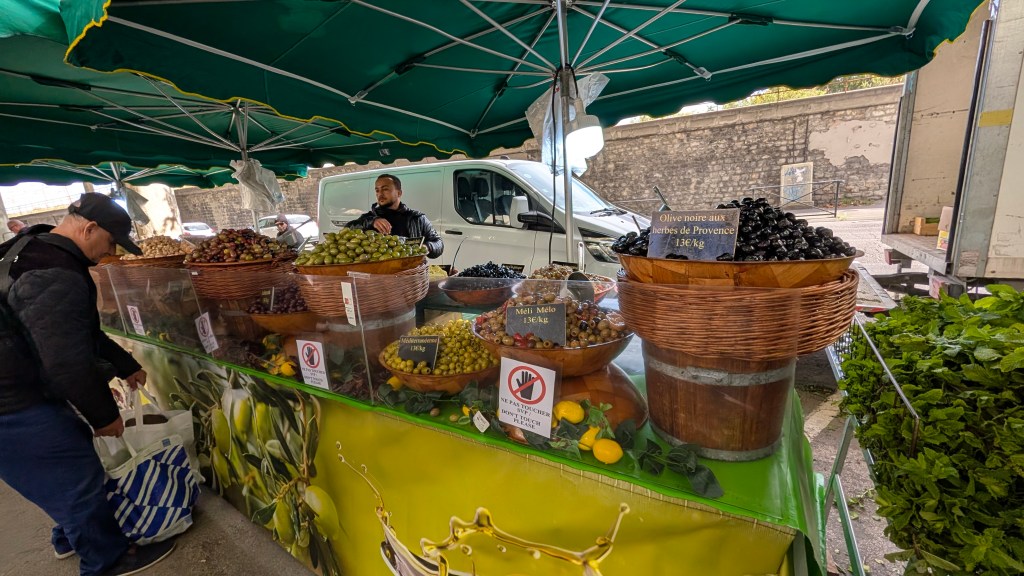
The food side had not only the usual breads and cheeses, but also varieties of olives
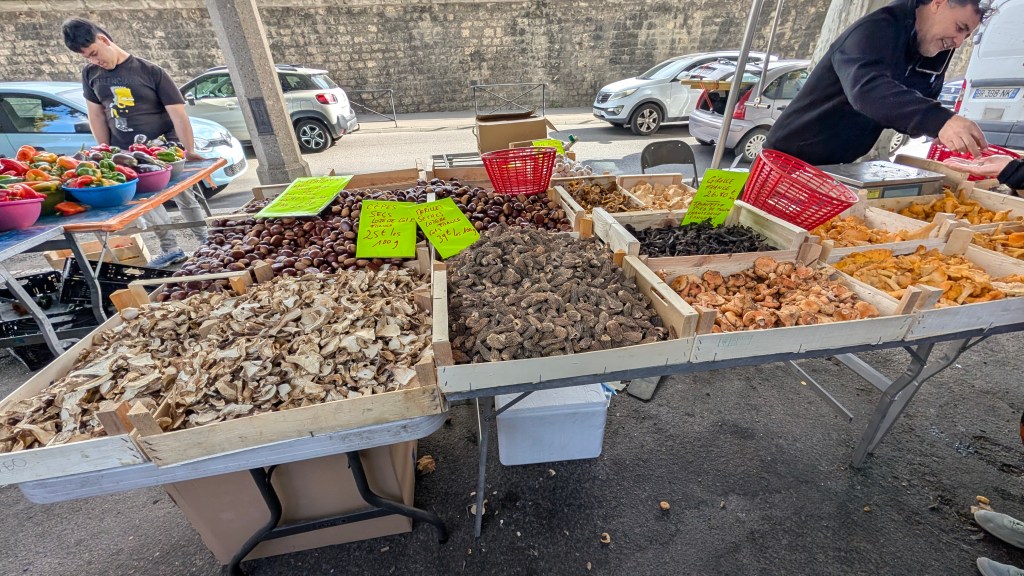
dried mushrooms,
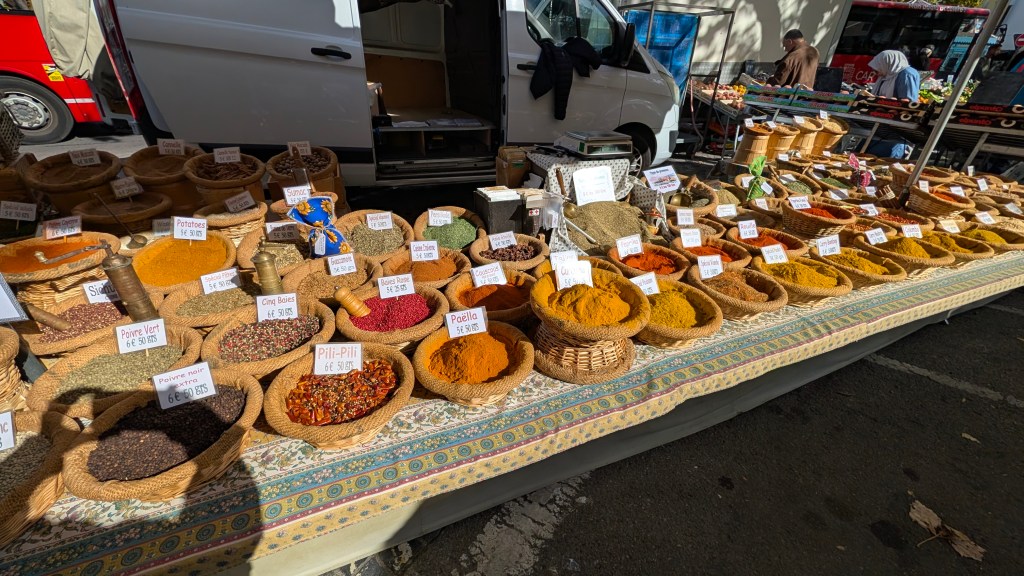
spices,
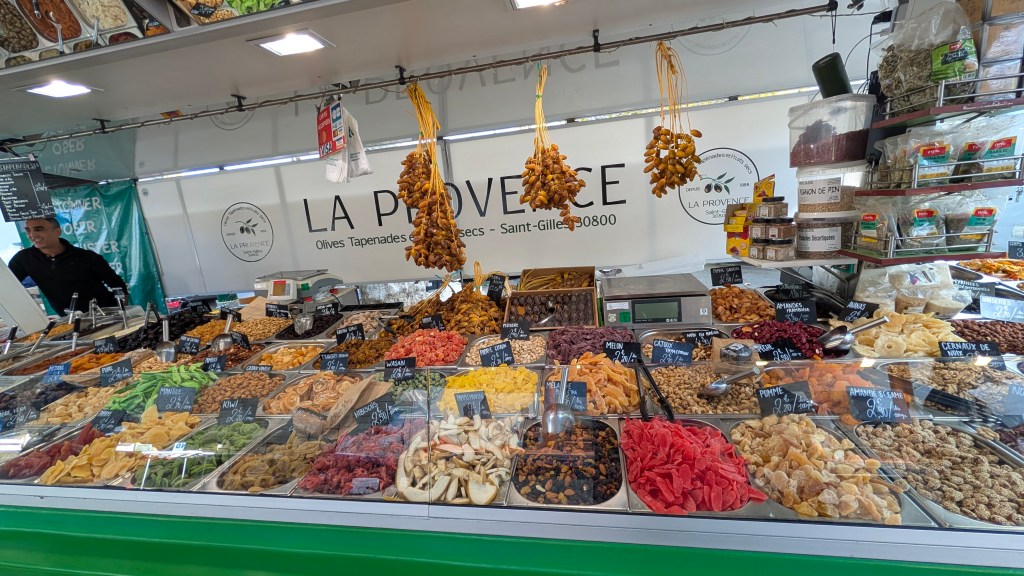
dried fruits,
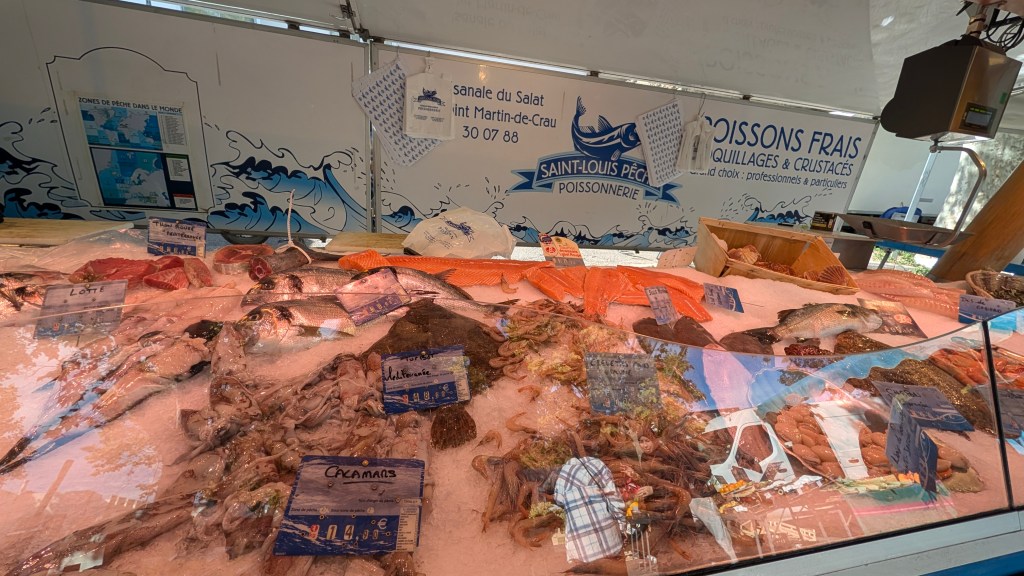
and fresh fish.
We bought and injoyed treats for breakfast. At the edge of the market was a little Monument to the Dead of the Resistance, which honors those who died during World War II.
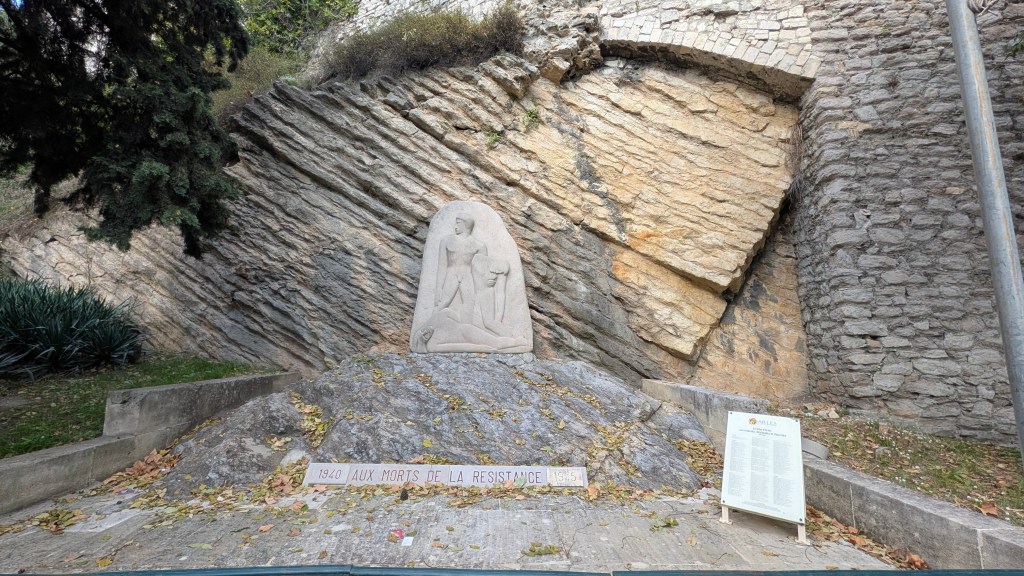
Monument to the Dead of the Resistance,

After breakfast it was time to further explore Arles. First stop was the Arènes d’Arles (Arles Amphitheater), a premier 1st-century (circa 90 AD) Roman monument renowned for its excellent preservation. When built it helped make Arles a major Roman colony in Gaul.
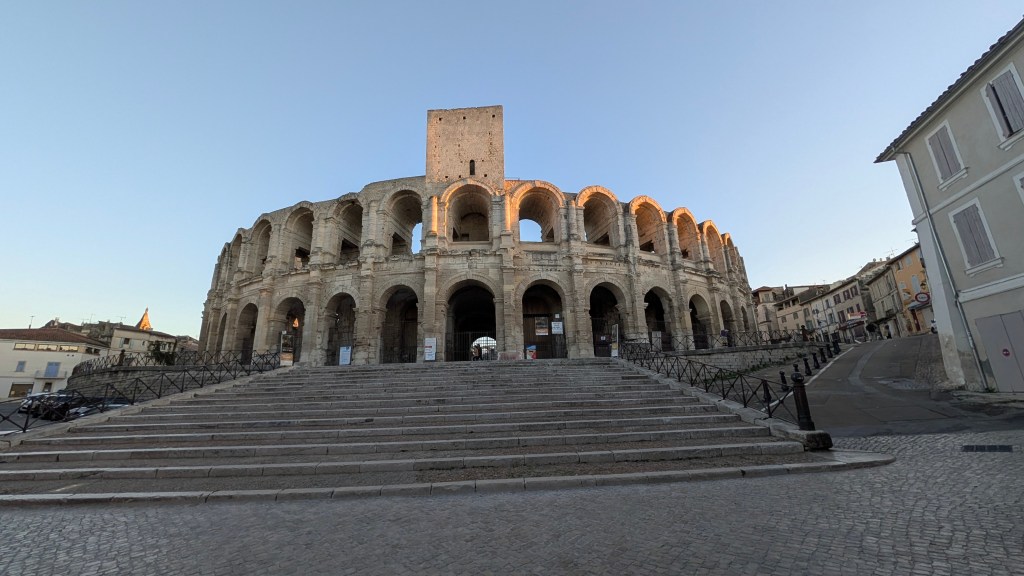
Arènes d’Arles (Arles Amphitheater)

As a UNESCO World Heritage Site, it features a 3-story structure with 60 arches, showcasing both Roman engineering and classical Greek influence, and has two tiers with seating for 21,000 spectators. Originally built for gladiator battles, it now hosts bullfights and concerts.
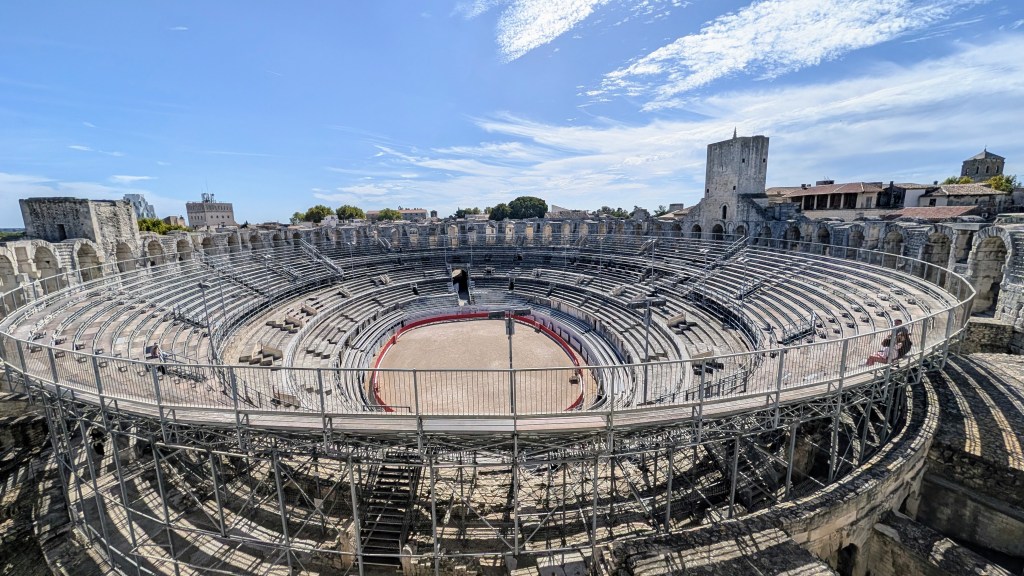
Arènes d’Arles (Arles Ampheiheater)

Following the fall of the Roman Empire, it was turned into a fortified village. Over 200 houses and four defensive towers were built within its walls; three of these towers are still visible today.
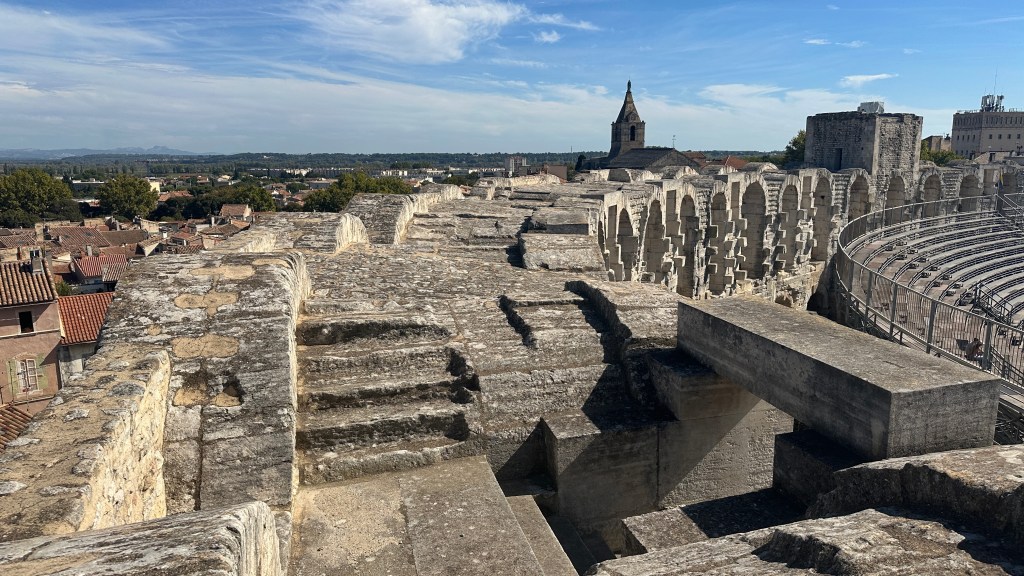
Arènes d’Arles (Arles Amphitheater)

From the top of the seating is a spectacular view of Arles and the Rhone River below.
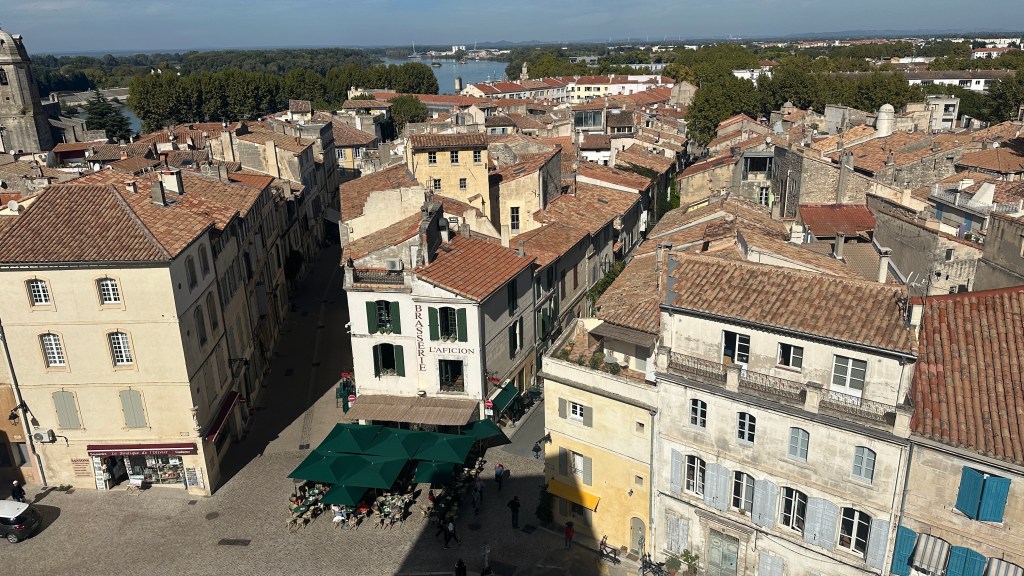
view from Arènes d’Arles (Arles Amphitheater)

Also from this vantage point Luma Arles tower, a cultural center designed by architect Frank Gehry completed in 2021, can be seen.
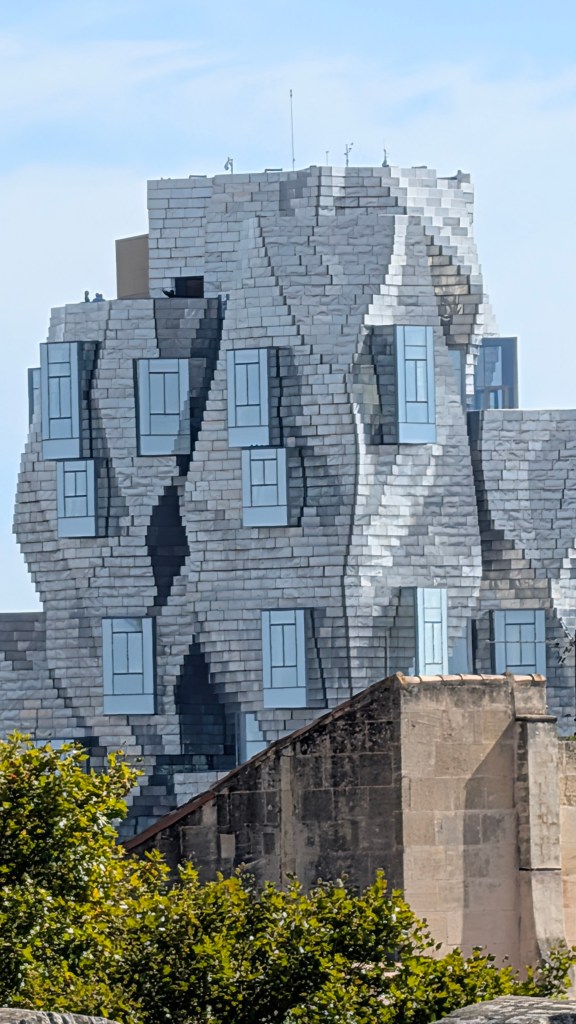
Luma Arles

Theatre Antique d’Arles (Ancient Theater of Arles), is one of the earliest monumental structures built in the city following its Roman colonization, around the late 1st century BC under Emperor Augustus. Designed to showcase drama, poetry, and public entertainment, the theatre could once welcome more than 8,000 spectators who gathered to enjoy performances celebrating Roman culture and civic unity. Although much of its original grandeur has faded over the centuries, the structure remains an essential reminder of Arles’s role as a thriving provincial center in the Roman Empire.
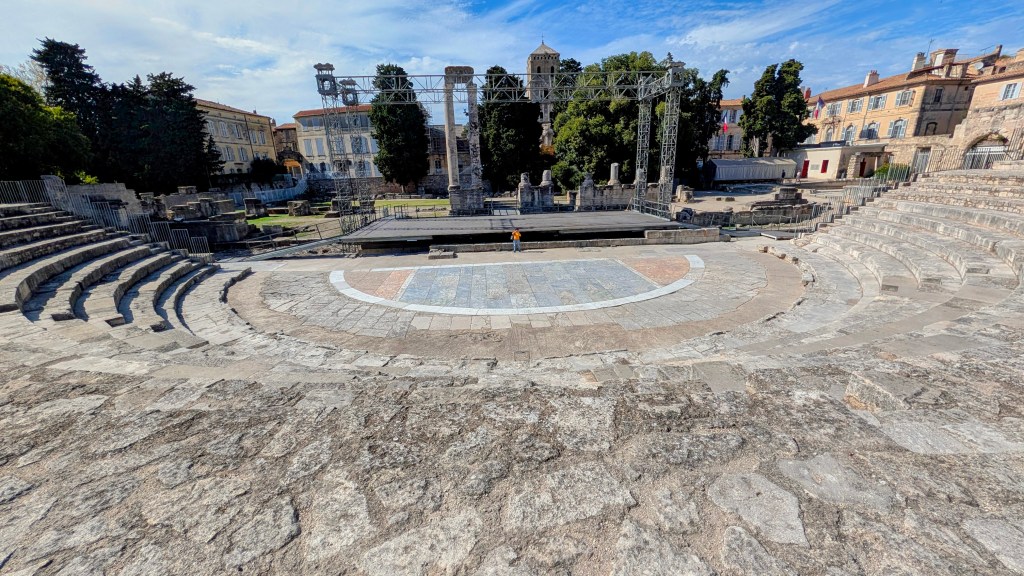
Theatre Antique d’Arles (Ancient Theater of Arles)

Like many ancient sites, the theatre suffered significant dismantling during the Middle Ages, when its stones were reused to construct churches and fortifications. Even so, several remarkable features endure, including the remnants of the seating area and the circular orchestra in front of the stage. However, the most alluring of elements is a pair of elegant marble columns still standing behind the stage — a stunning fragment of what was once a richly decorated stage backdrop. These columns became known as the “Two Widows,” much like two wives awaiting their lost husbands.
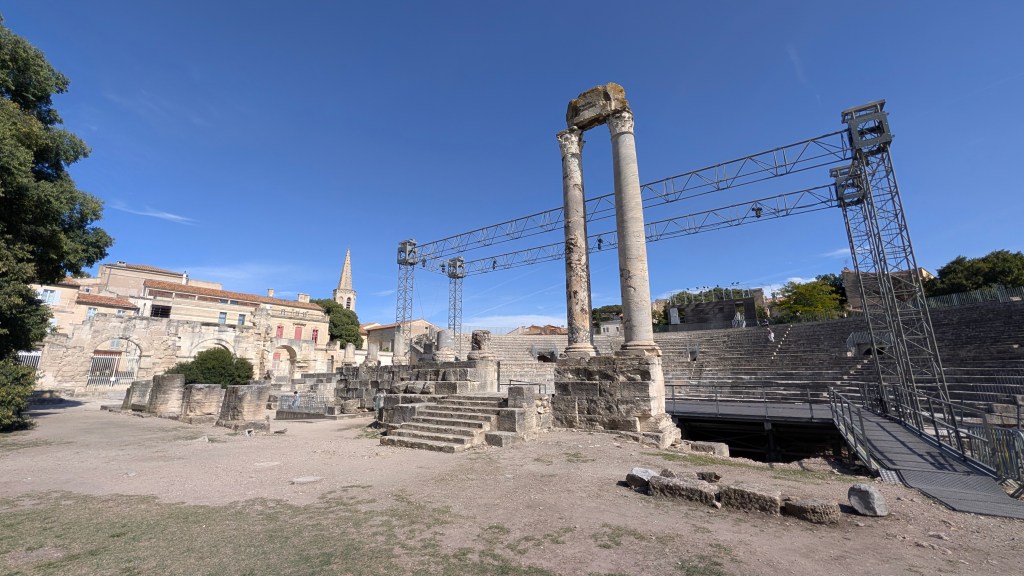
Theatre Antique d’Arles (Ancient Theater of Arles)

Today, the Ancient Theater blends heritage with living culture. From the end of June to the end of August, it hosts the Arles and Costume Festivals, the International Photography Meetings and the Peplum Film Festival. You are more than welcome to enjoy them just like the Romans once did — under the open Provençal sky.
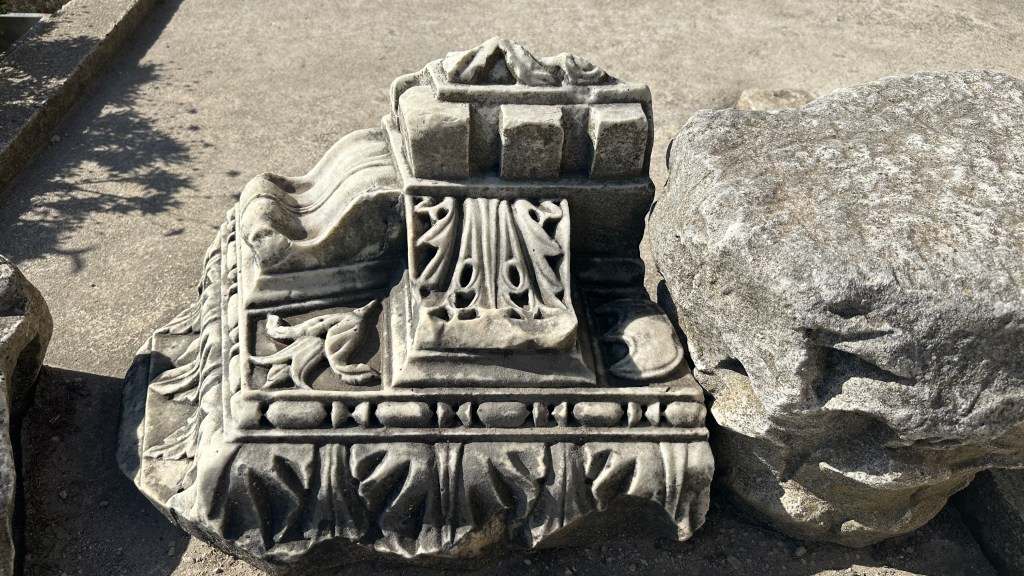
remnants Theatre Antique d’Arles (Ancient Theater of Arles)

Place de la Republique (Republic Square) serves as the city’s elegant and historic centerpiece. Paved with cobblestones and framed by impressive architecture, the square beautifully reflects Arles’s layered past. At its center rises the Arles Obelisk. Around it stand several of Arles’s most remarkable landmarks: the Church of Saint Trophime, the Town Hall, and the Arles St. Anne Church.
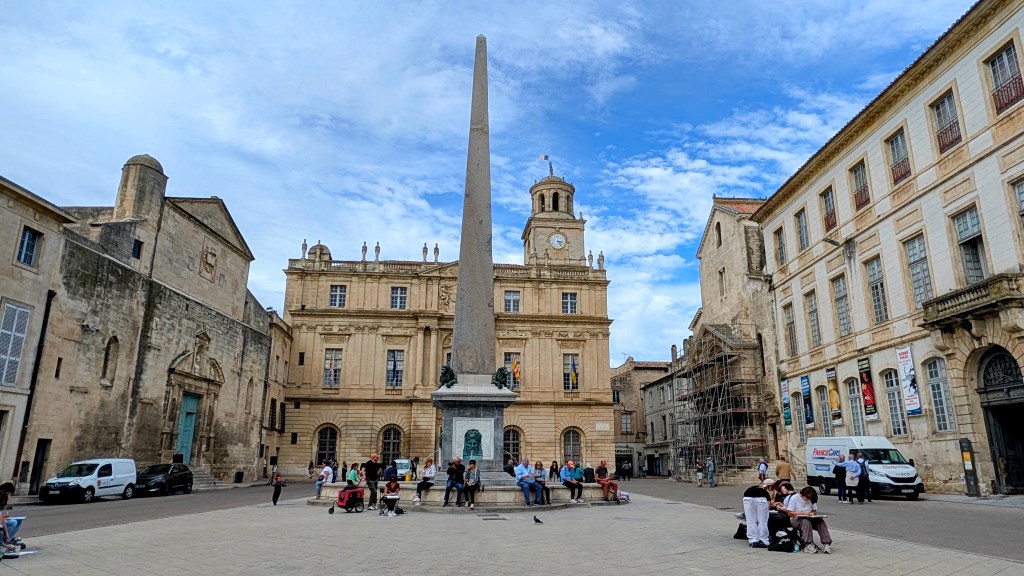
Place de la Republique (Republic Square)

Obelisque d’Arles (Arles Obelisk) was carved from a single block of granite. The monument dates to the 4th century AD, when it originally adorned the Roman circus of Arles, a grand arena once used for chariot races. After the fall of the Roman Empire, the obelisk was lost to time, later rediscovered in fragments during the 17th century and re-erected in 1676. Interestingly, unlike other Roman monuments, the obelisk lacks inscriptions.
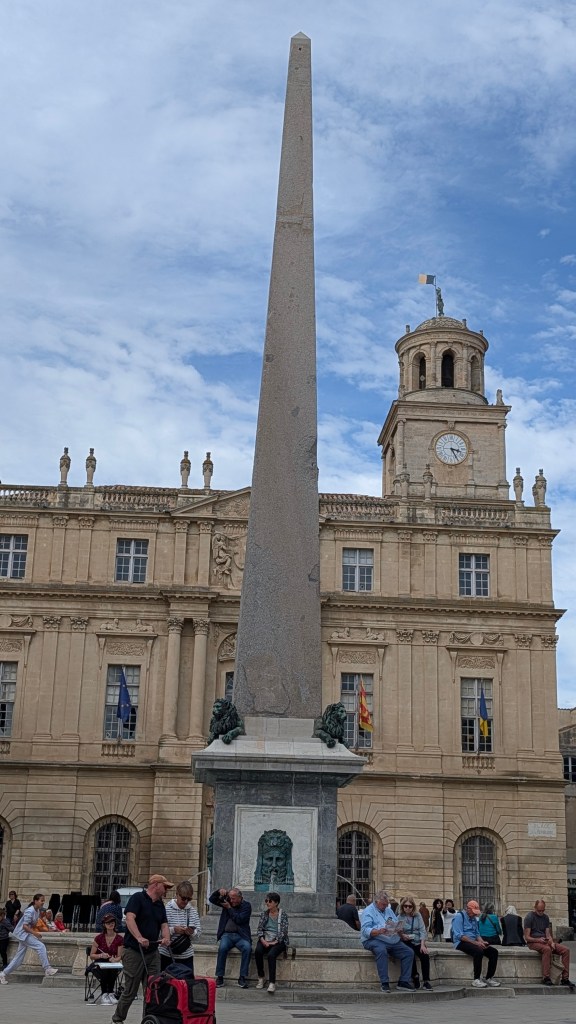
Obelisque d’Arles (Arles Obelisk)

Cathedrale Saint-Trophime d’Arles (St. Trophime Cathedral) is one of the greatest masterpieces of Romanesque architecture in Provence. The cathedral was built between the 12th and 15th centuries on the site of an earlier church. For centuries, it served as the seat of the archbishops of Arles and as an important stop along the pilgrimage route to Santiago de Compostela, contributing significantly to its artistic and religious prominence.  The church was downgraded from a cathedral to a parish church in 1801, but raised to a minor basilica by Pope Leo XIII in 1882.
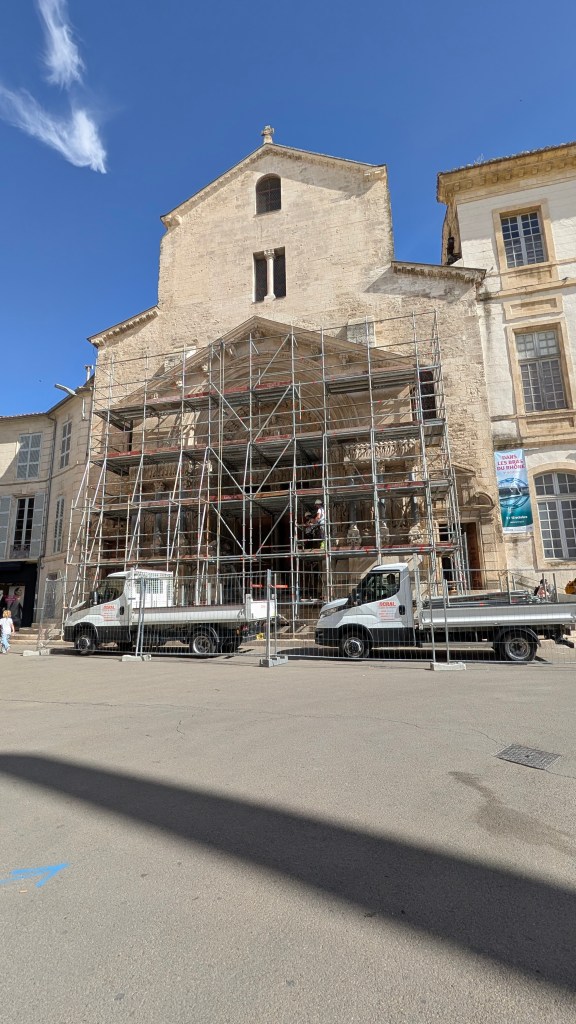
Cathedrale Saint-Trophime d’Arles (St. Trophime Cathedral)

The most celebrated feature of Saint Trophime is its magnificent Romanesque portal, sculpted around 1180. The façade depicts the Last Judgment, with Christ in Majesty surrounded by apostles, angels, and symbolic creatures — a stunning display of medieval craftsmanship. The detailed carvings make the portal one of the finest in France, unfortunately currently covered in scaffolding. .
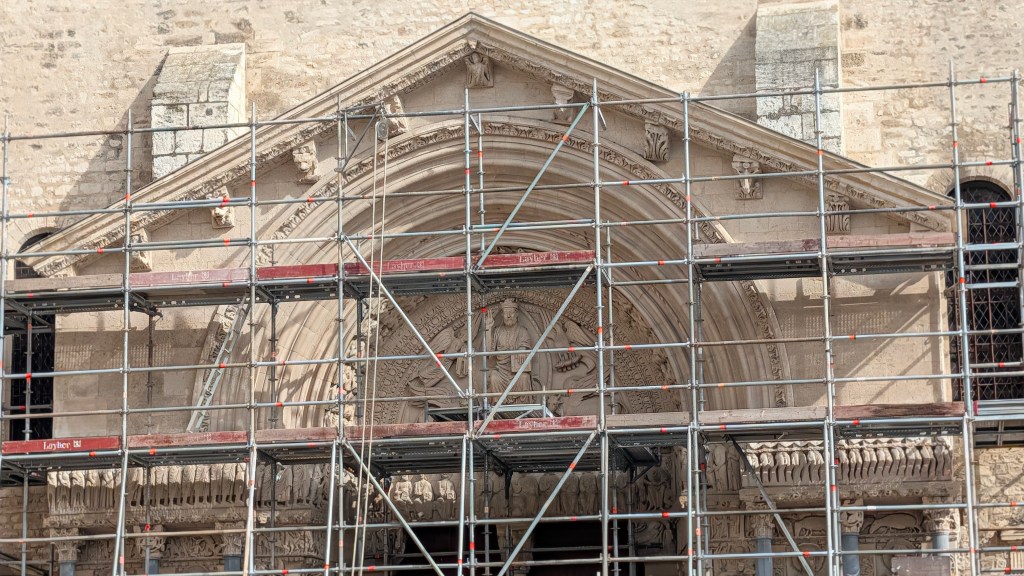
The interior of the Church of Saint-Trophime features a high, stone-vaulted nave with banded barrel vaults typical of the southern Romanesque style
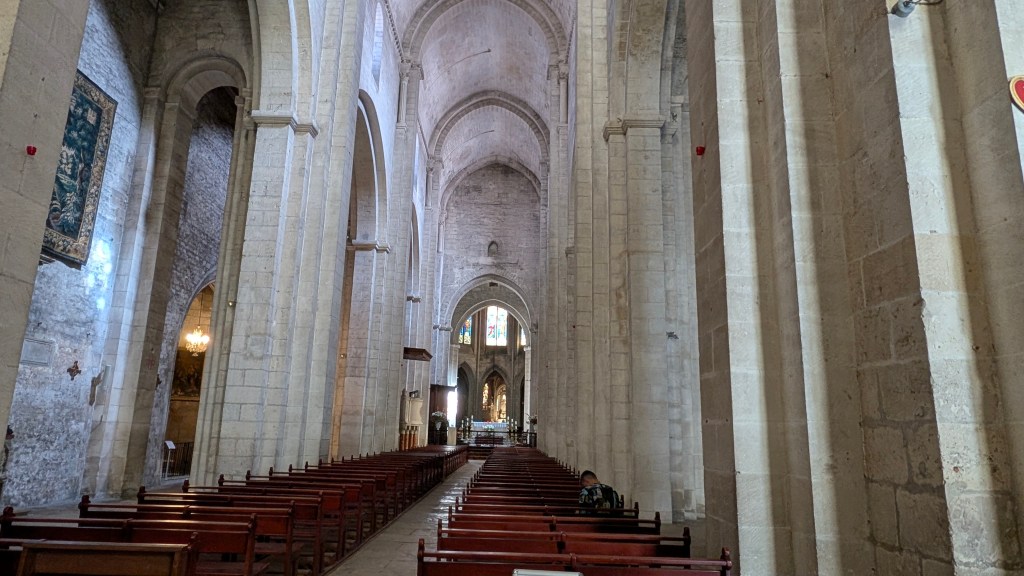
interior Cathedrale Saint-Trophime d’Arles (St. Trophime Cathedral)

while the choir section features flamboyant Gothic style additions. 
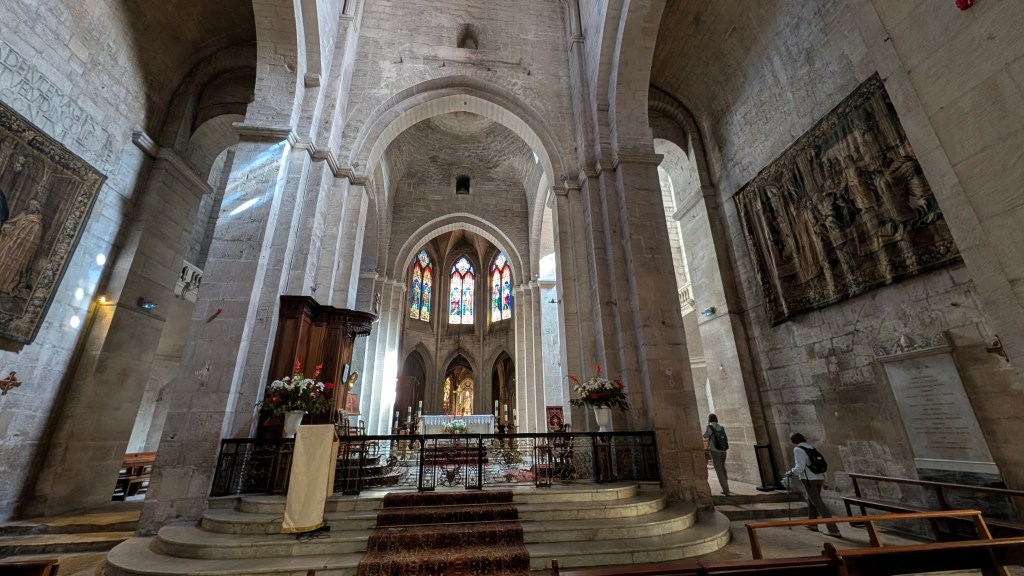
The Cathedral of Saint-Trophime houses a significant collection of 17th and 18th-century Aubusson tapestries within its treasures. These, along with other Aubusson works from the period, often feature intricate scenes—ranging from pastoral landscapes and “verdure” (foliage) to biblical scenes like this Nativity.
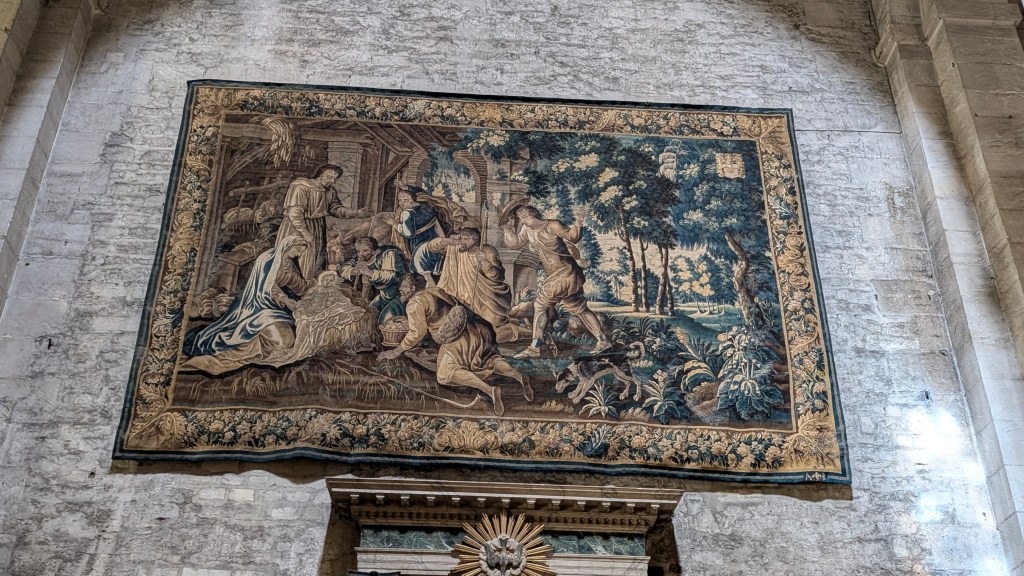

Aubusson tapestr
y “Nativity

the Church of St. Trophime has a beautifully intricate pulpit.
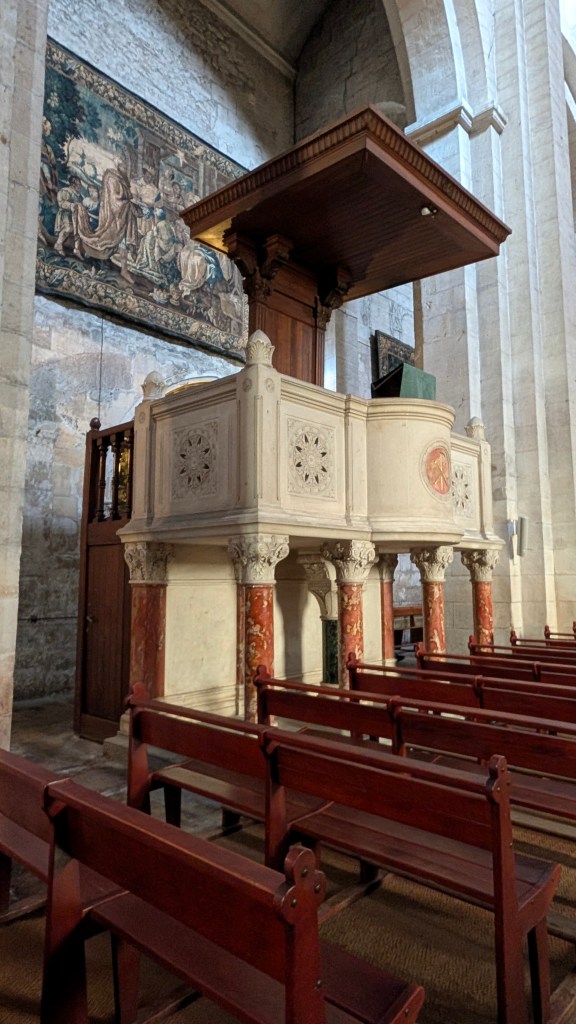
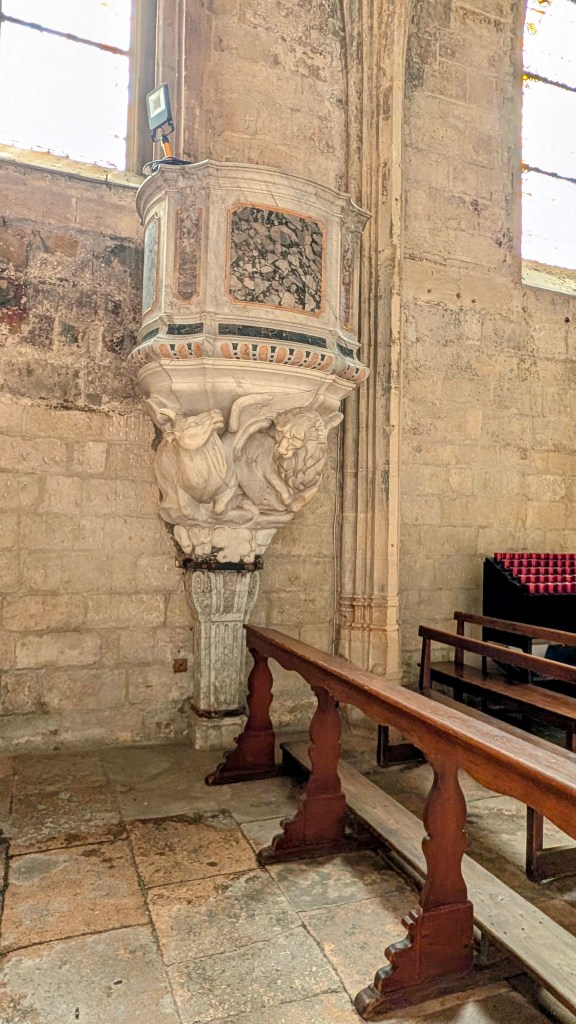
In a side aisle of the former Benedictine abbey church is another stunning pulpit crafted from stone and features intricate carvings. The base of the pulpit is sculpted with figures resembling a bull and a lion. 
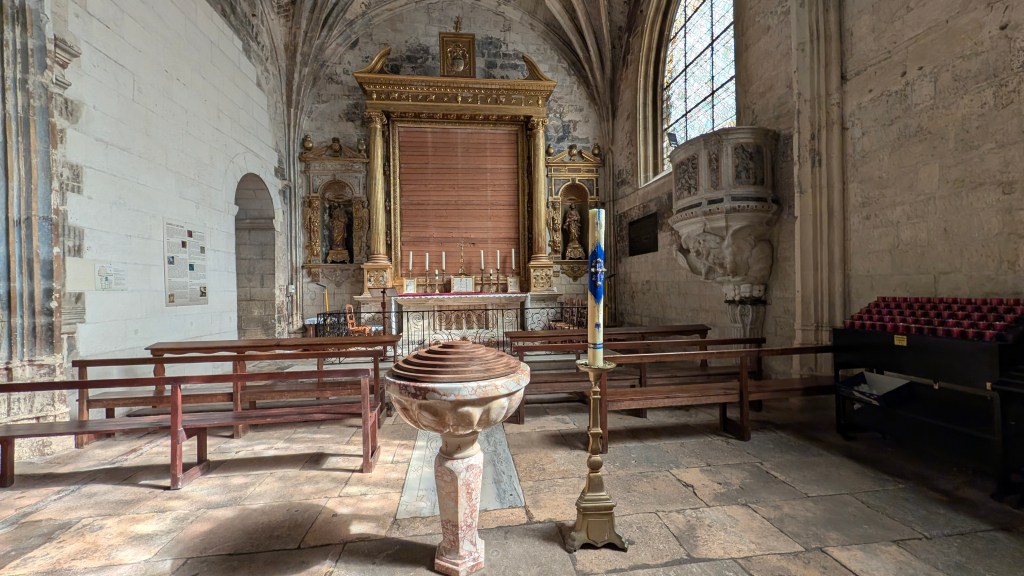
In another side chapel the baptismal font can be found.
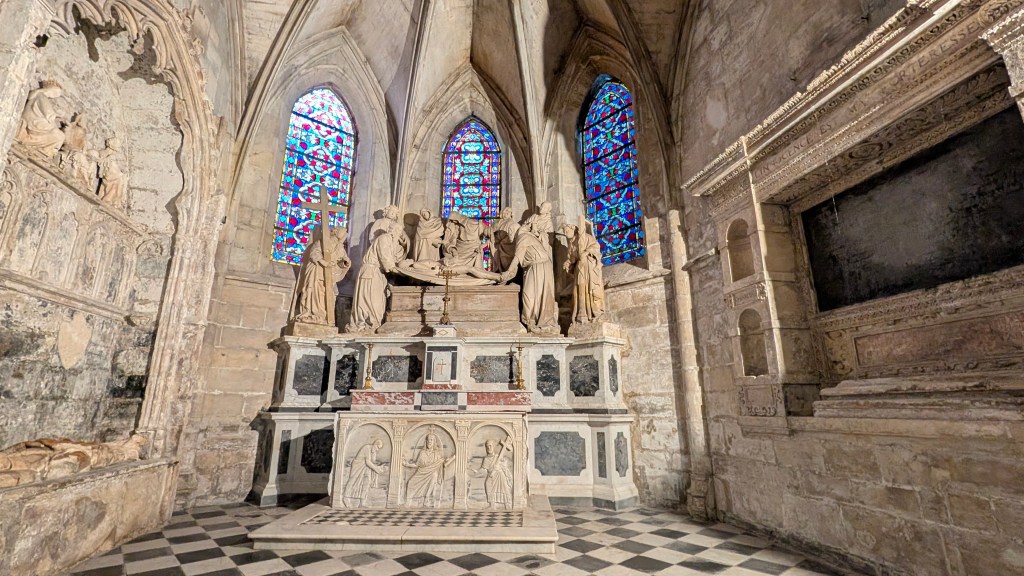
The cathedral houses fine sculptures from the 12th century, particularly within its cloisters, more on those later. 
Town Hall and Cryptoporticus of Arles was completed in 1676, during a period when Arles sought to reaffirm its civic prestige. Designed in an elegant Provençal classical style, its harmonious façade and well-proportioned clock tower stand proudly on Republic Square, symbolizing the authority of the city’s magistrates.
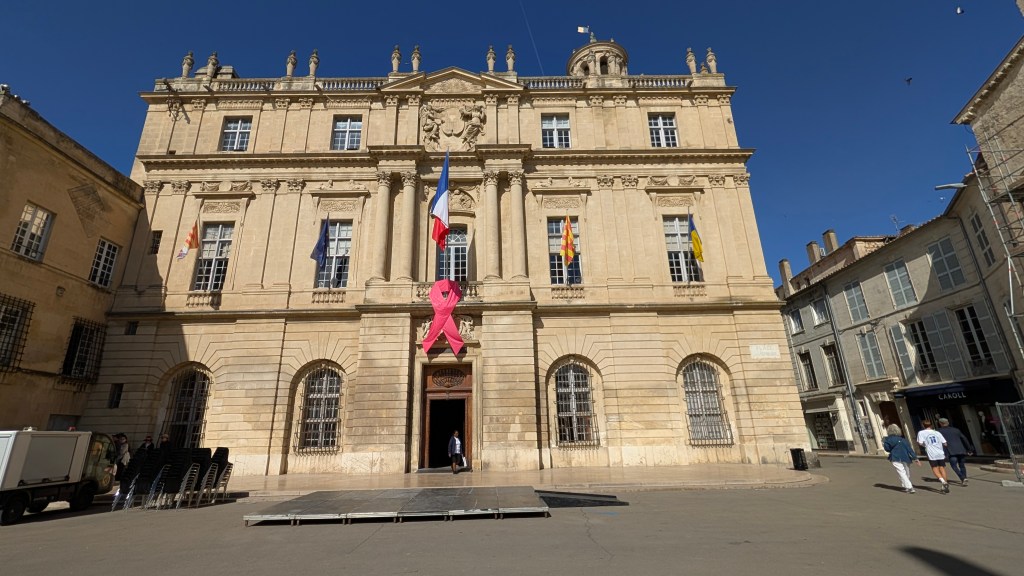
Town Hall and Cryptoporticus of Arles

Inside, its grand staircase is crafted using stones recovered from ancient Roman buildings.
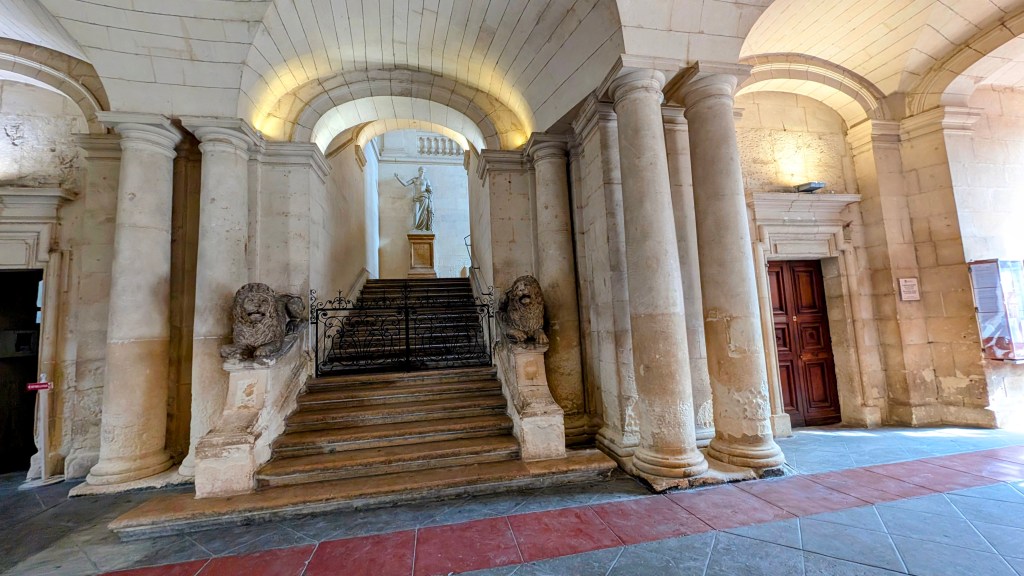
As a stylish bonus, the staircase also features a replica of Venus of Arles. The original ancient Greco-Roman sculpture was deemed to be a great gift for King Louis XIV, hence it was moved to the Versailles Palace itself.
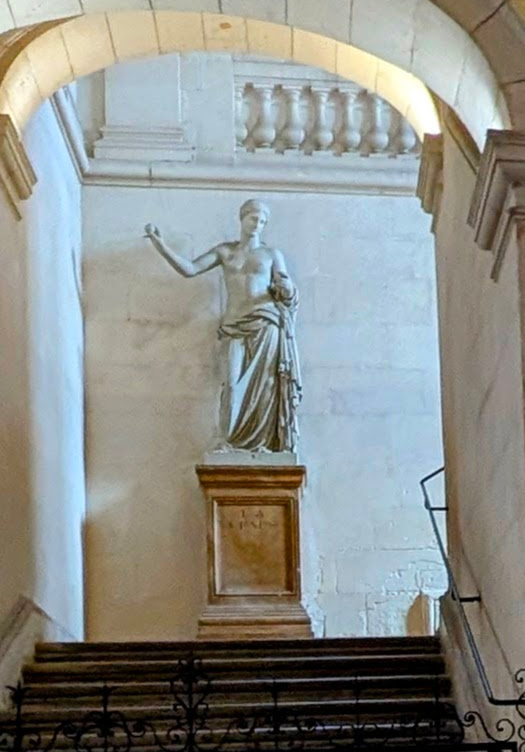
Venus of Arles

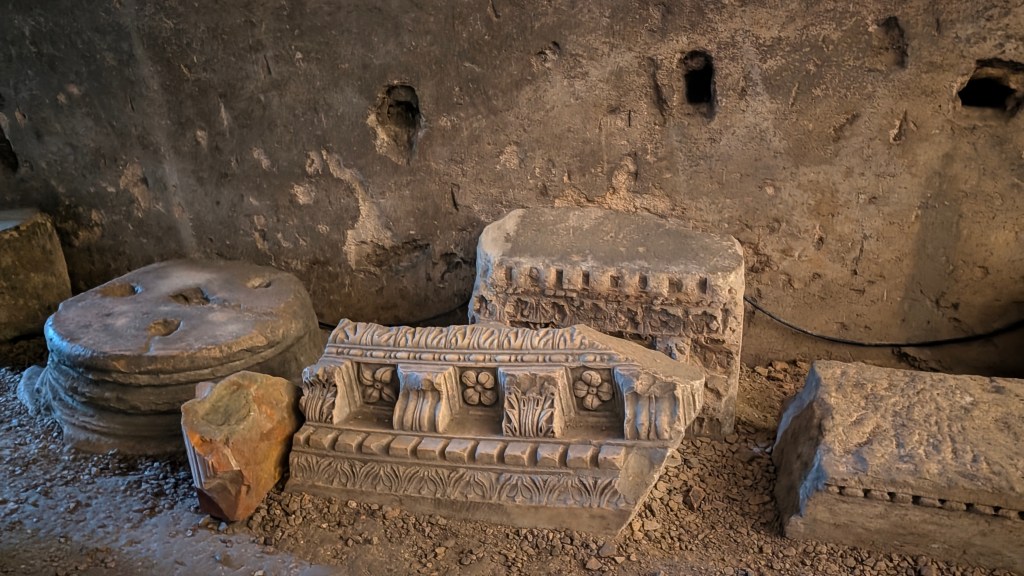
Directly beneath Republic Square and the Town Hall lies the Cryptoporticus of Arles. Constructed around 30 BC during the Roman colony’s early development, this network of semi-subterranean vaulted galleries once supported the ancient forum above.
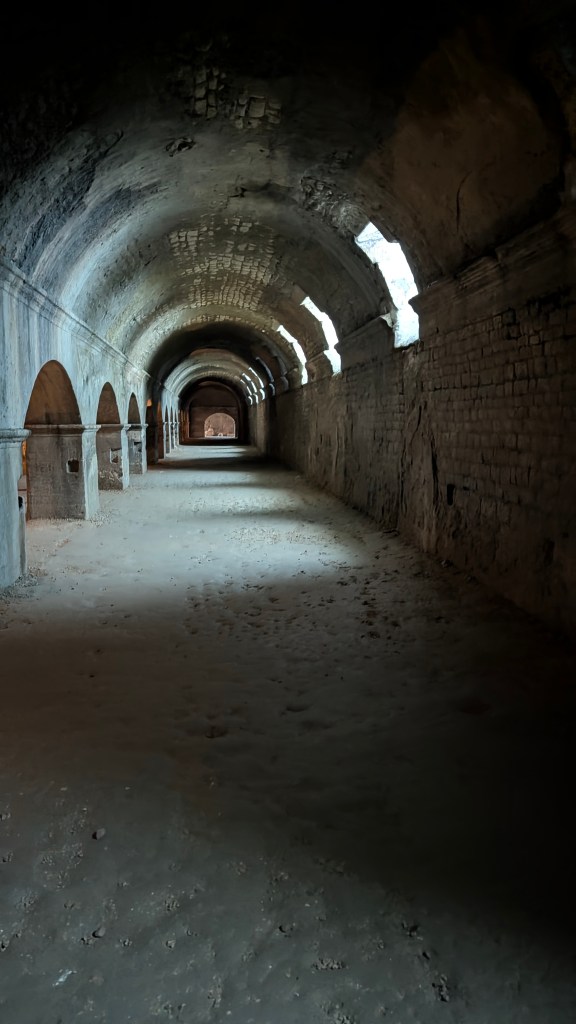
The structure likely served multiple roles, including storage, administrative functions, and stabilization of the civic center built on uneven terrain.
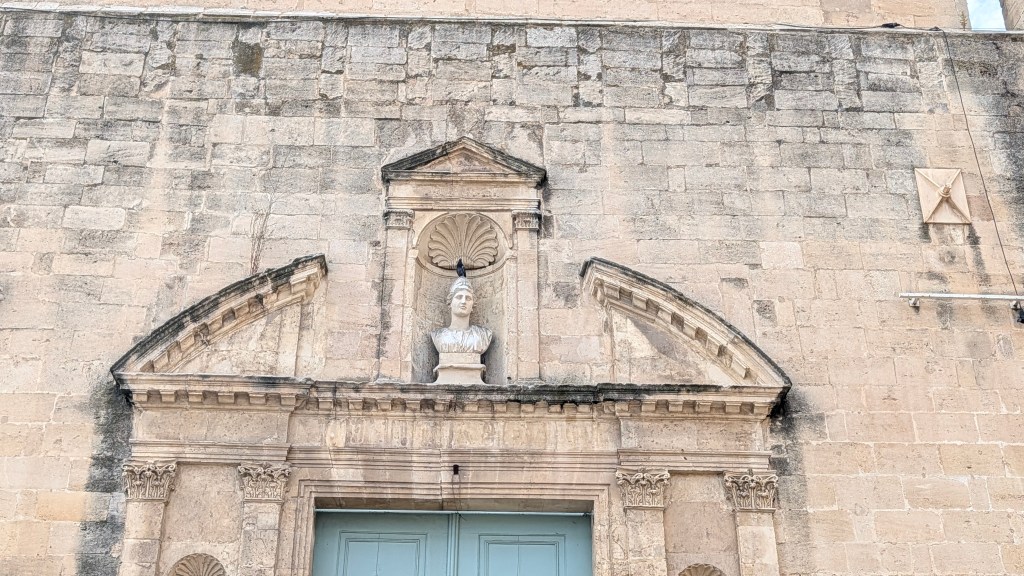
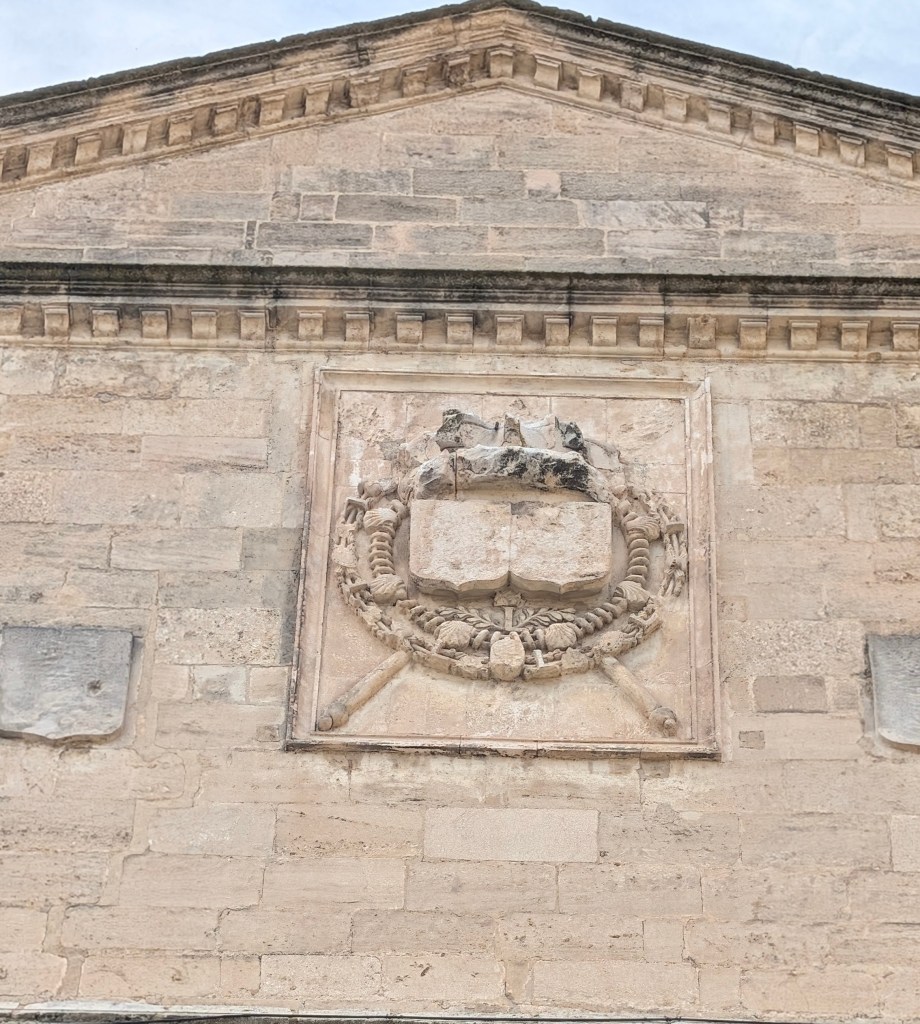
Eglise Sainte-Anne d’Arles (Arles St. Anne Church) was originally constructed in the 12th century as the Church of Notre-Dame-la-Principale, The Church of Saint Anne once served as a parish church closely linked to the neighbouring cathedral. Over time, its role shifted dramatically. In the 17th century, the building was repurposed as a seminary, later becoming a burial site for prominent canons of Saint Trophime. It was also during the 17th century that the church received its current name. Consecrated on the feast day of Saint Anne, the dedication was far from coincidental: the church once safeguarded revered relics of Saint Anne, including a vermeil bust.
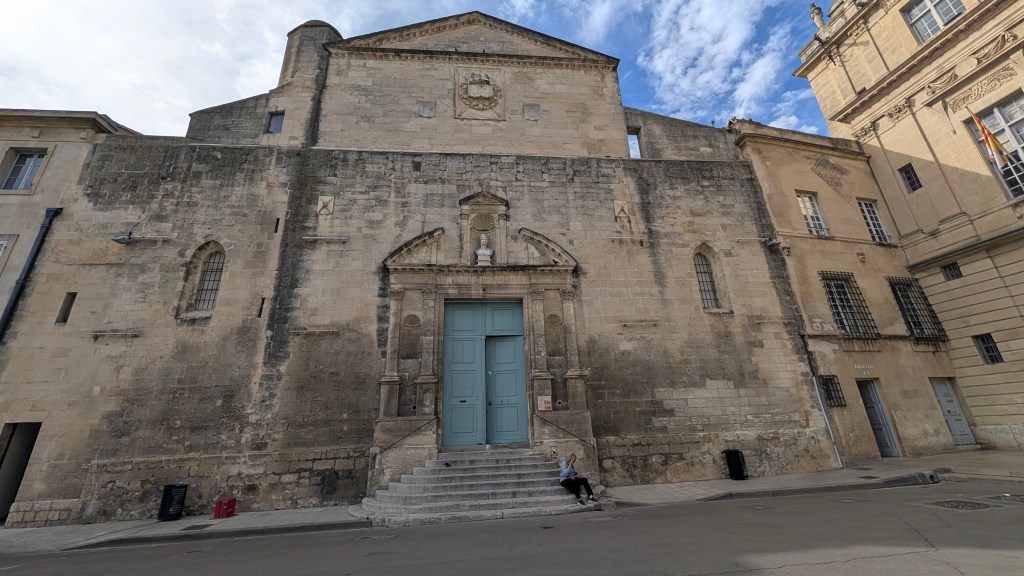
Eglise Sainte-Anne d’Arles (Arles St. Anne Church)

Although no longer functioning as a church, Saint Anne retains its solemn Romanesque character. The simplicity of its façade and the solid lines of its architecture bring back ideas of medieval craftsmanship.
The Cloister of Saint Trophime in Arles is one of the finest examples of Romanesque and early Gothic architecture in southern France. Built between the 12th and 14th centuries, it adjoins the Church of Saint Trophime, which was once the cathedral of Arles. The cloister served as the residence and contemplative space for the cathedral’s canons, providing a serene environment for prayer, study, and reflection.
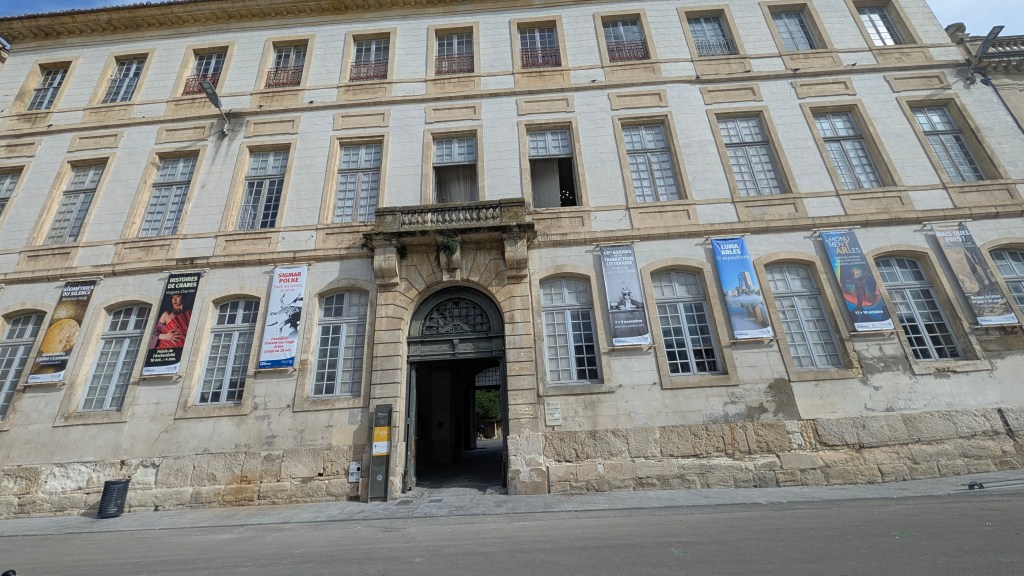
Cloitre Saint-Trophime (St. Trophime Cloister)

Unusually, the cloister connects to the church’s choir by a staircase of twenty-five steps — a rare arrangement, as cloisters are typically accessed from the nave or transept. 
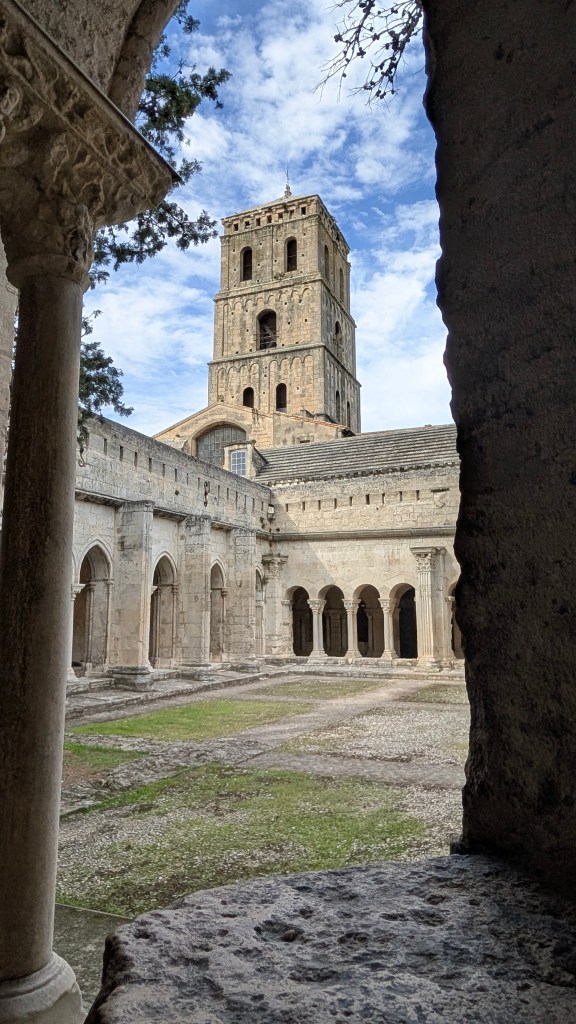
The cloister itself was built during the 16th century as part of a larger monastic complex. It served as a vital site for religious practice and remains a symbol of medieval monastic life in France. 
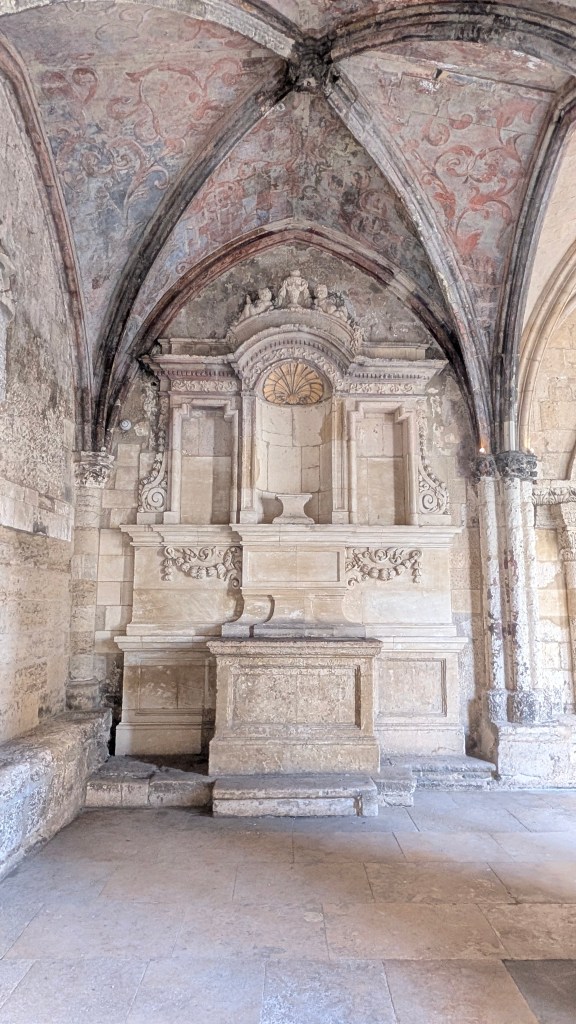
What makes the Saint Trophime Cloister particularly exceptional is its remarkable sculptural decoration. Each gallery is adorned with intricately carved capitals and reliefs depicting biblical narratives, saints, and symbolic motifs that illustrate the transition from Romanesque to Gothic art. Visitors can observe this evolution firsthand: the older northern and eastern galleries feature rounded Romanesque arches, (to the right below) while the later southern and western galleries display the pointed arches characteristic of the Gothic style (to the left below). We were impressed with the number of art students, not just in the cloister but throughout the city.
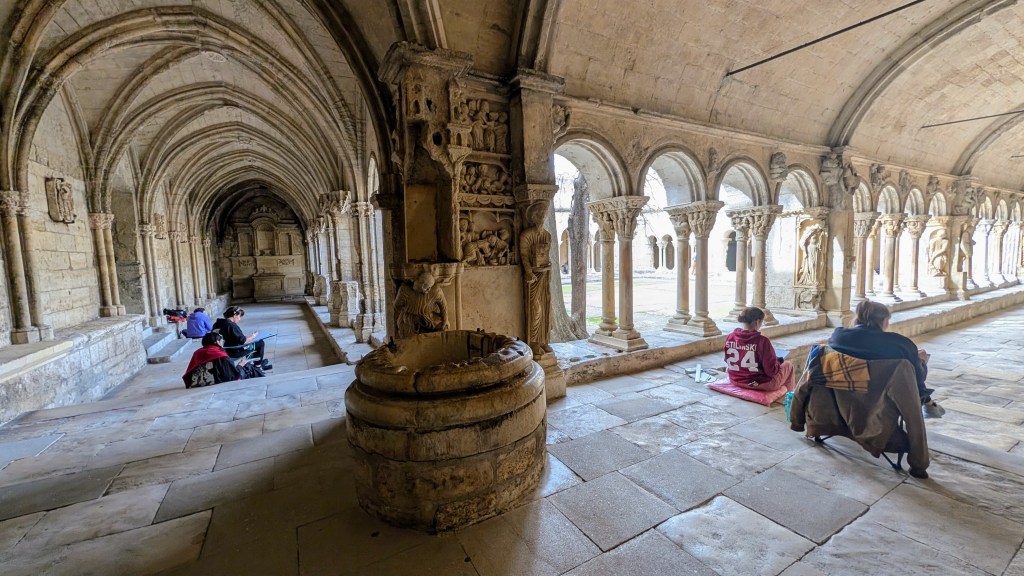
The Corner Pillars (Piers) at the gallery intersections feature large-scale, high-relief figures and narrative panels. On the North-West Corner (St. Trophime) the primary focus is Saint Trophime, the first bishop of Arles, depicted between Saint Peter and Saint John. 
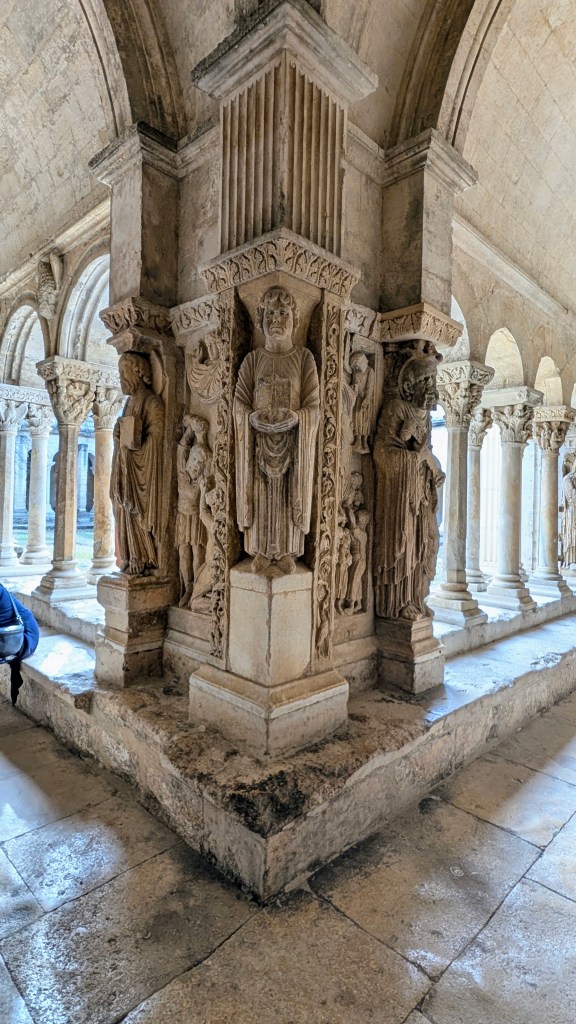
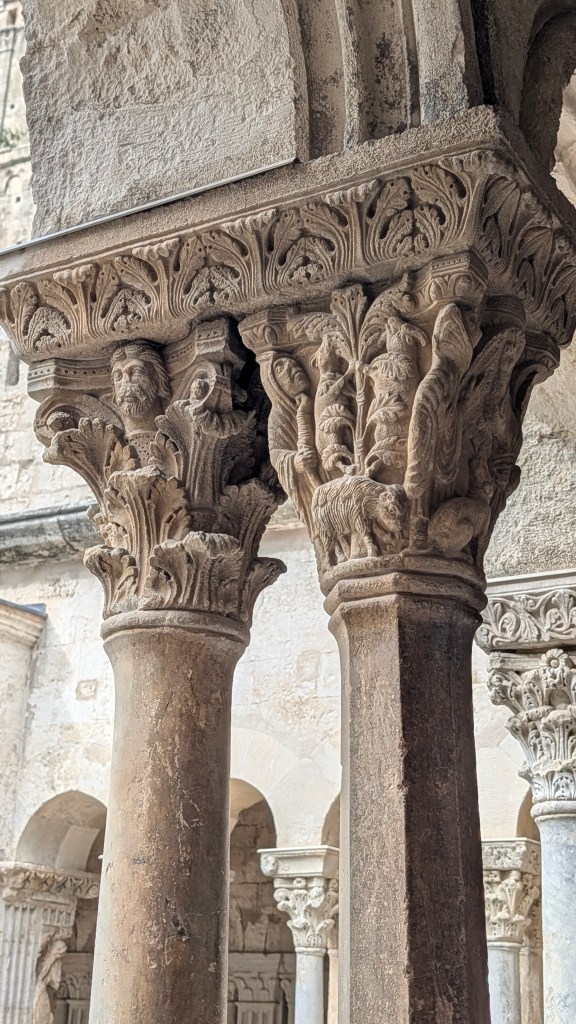
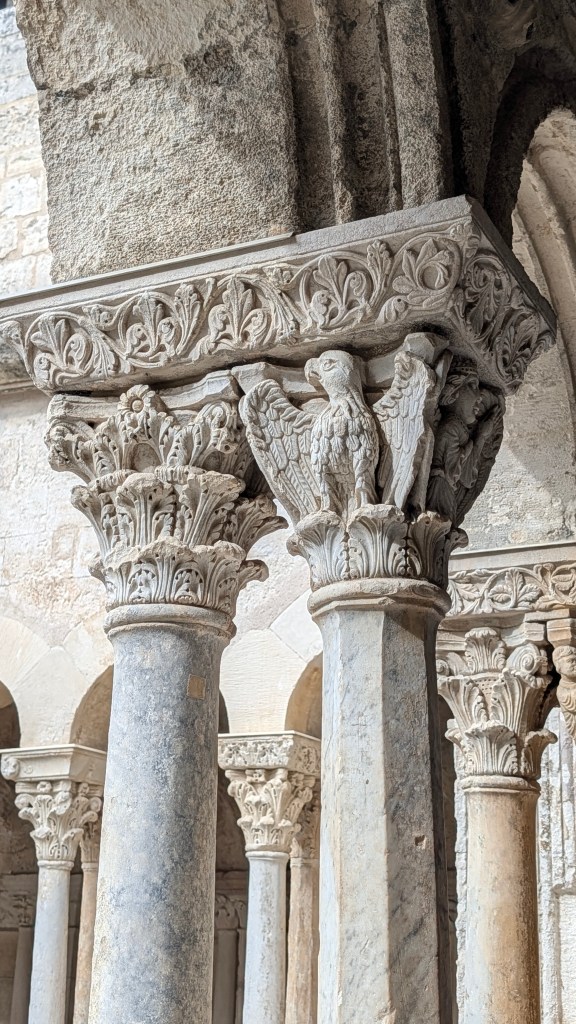
The smaller paired columns feature “historiated” capitals (capitals that tell a story). 
The eagle represents the authority of the Holy Roman Emperor, while the accompanying heraldic elements signify the city of Arles.
After thoroughly exploring the cloisters, we wandered down Rue de la Republique (Republic Street), one of the principal thoroughfares in Arles and a natural route for anyone exploring the heart of the city. Its origins align with 19th-century urban modernization, when Arles redesigned parts of its medieval street network to create a grander, more functional promenade leading directly to Republic Square. The wide, straight layout contrasts with the surrounding maze of narrow historic alleys. Lined with shops, cafés, bookshops, and boutiques, the street also features handsome 19th-century façades and subtle architectural details that highlight Arles’s evolution from an ancient Roman colony into a modern Provençal city.
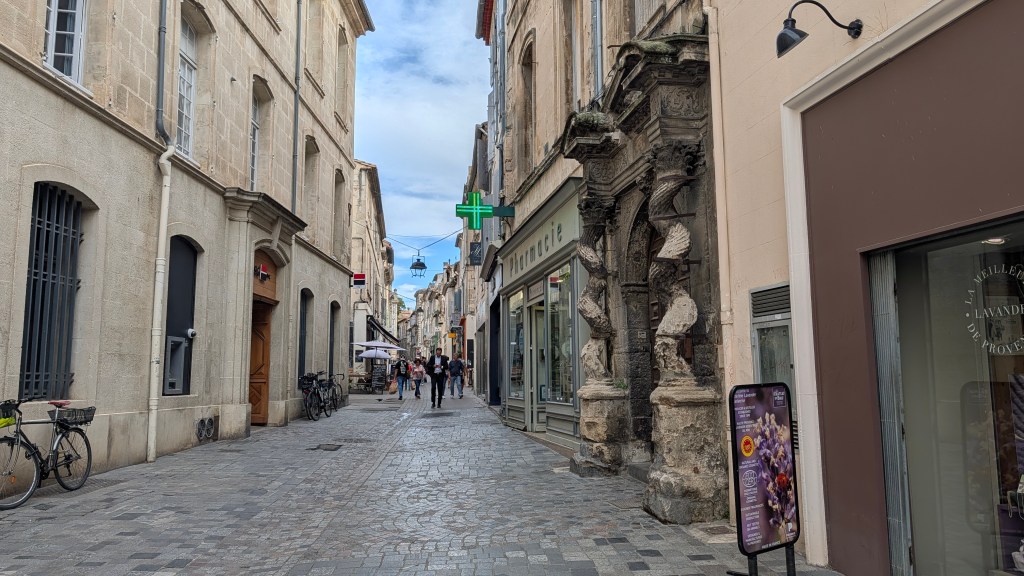
Rue de la Republique (Republic Street)

The 17th-century doorway of the Hôtel de la Lauzière, framed by two distinctive twisted columns with Corinthian capitals, demonstrates the upward mobility and architectural influence of wealthy families in Arles during the Classical period. The portal is a notable example of French Mannerist architecture. 
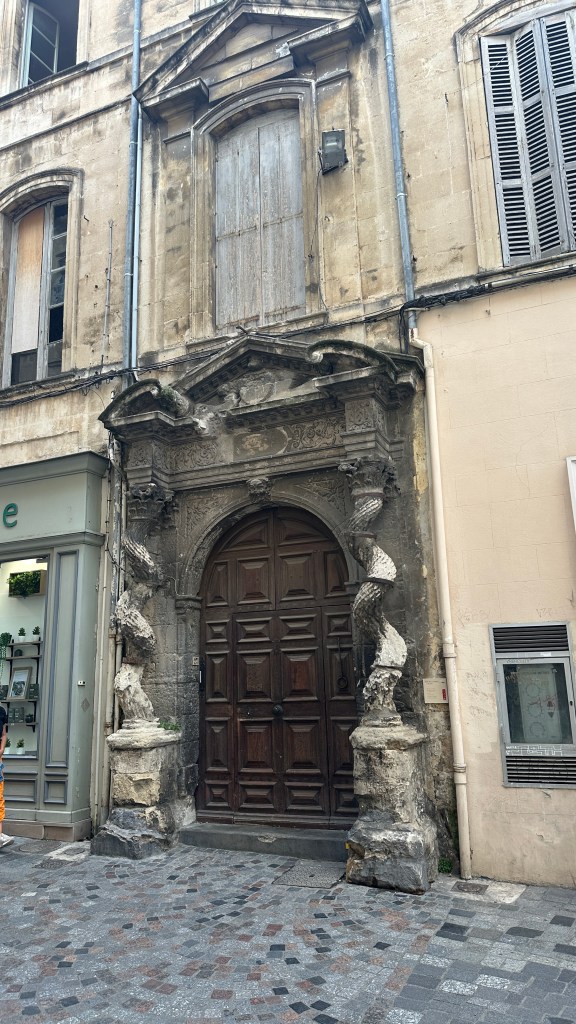
Hôtel de la Lauzière

Place du Forum (Forum Square) stands on the site of what was once the vibrant political and commercial heart of the Roman city of Arelate. Established in the 1st century BC during the urban expansion under Emperor Augustus, the Roman forum served as a grand public space lined with temples, administrative buildings, and arcades where citizens gathered to debate politics, conduct business, and participate in public life. Although the ancient structures have mostly disappeared beneath centuries of urban development, the square remains an important reference point for understanding the early formation of Arles.
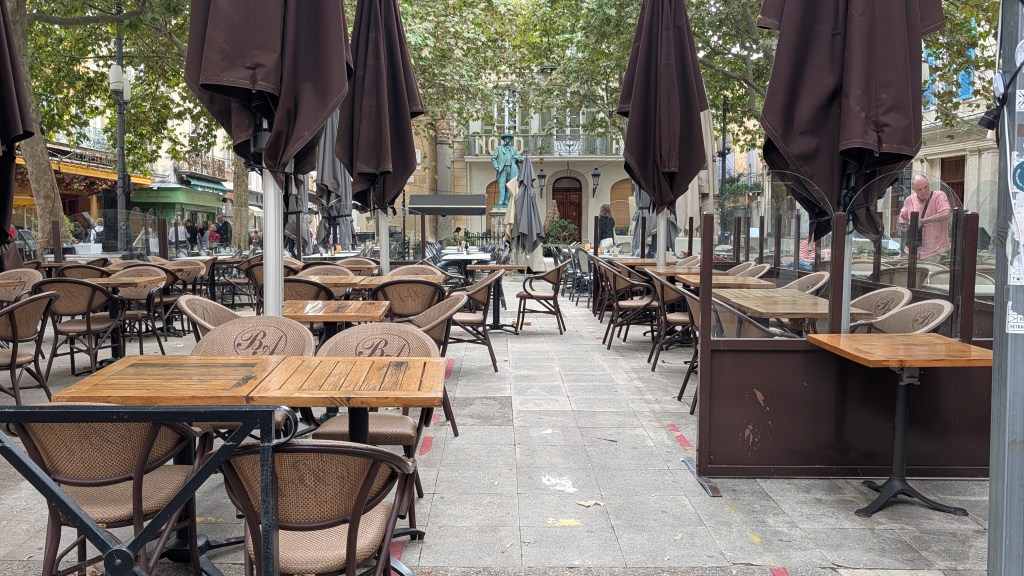
Place du Forum (Forum Square)

Today, Forum Square preserves only a small but striking architectural fragment from its Roman past: the “Two Columns.” These Corinthian shafts, built into the corner of a later building, provide a reminder of a former temple dedicated to the Roman Emperor Augustus.
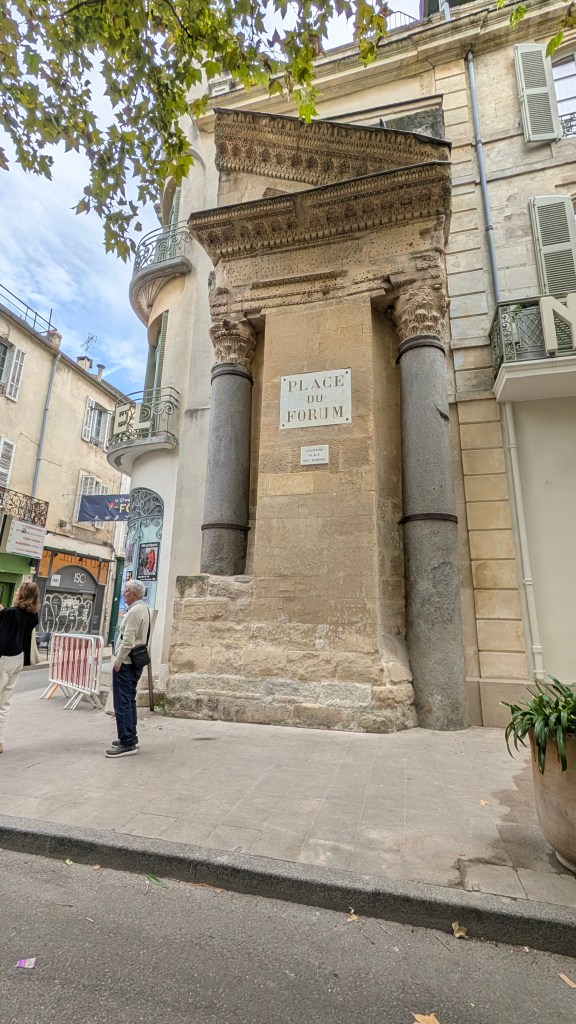
“Two Columns”

In the center of the square stands a statue of Frédéric Mistral (1830–1914), a renowned French writer and Nobel Prize laureate, who was instrumental in reviving the Provençal language and literature.  
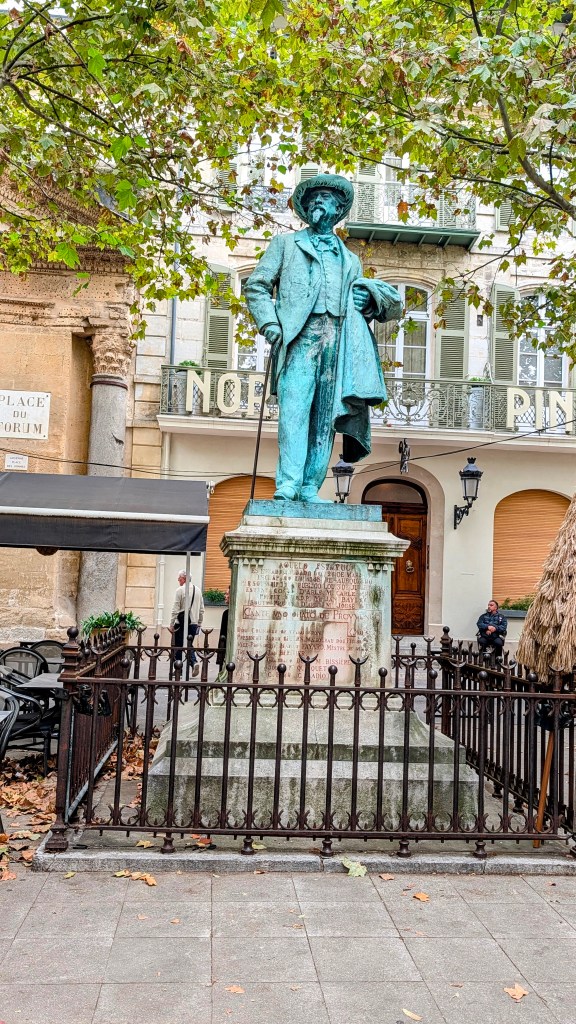
statue of Frédéric Mistral

The square also carries cultural significance through its association with artists such as Vincent van Gogh, who painted scenes of the neighborhood during his time in Arles.
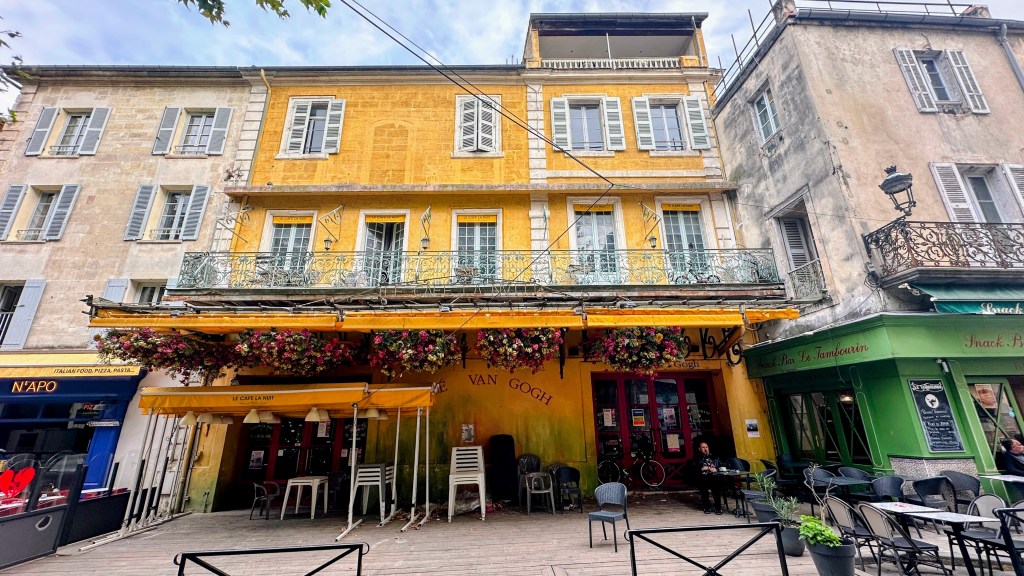
We made our way to the Thermes de Constantin (Baths of Constantine). Built in the early 4th century AD during the reign of Emperor Constantine the Great, they formed part of a larger palatial complex overlooking the Rhône and served as a place where citizens could enjoy bathing, relaxation, and social interaction, a staple of Roman urban culture. Although only a portion of the baths survives today, what remains offers a vivid impression of their original scale and function.
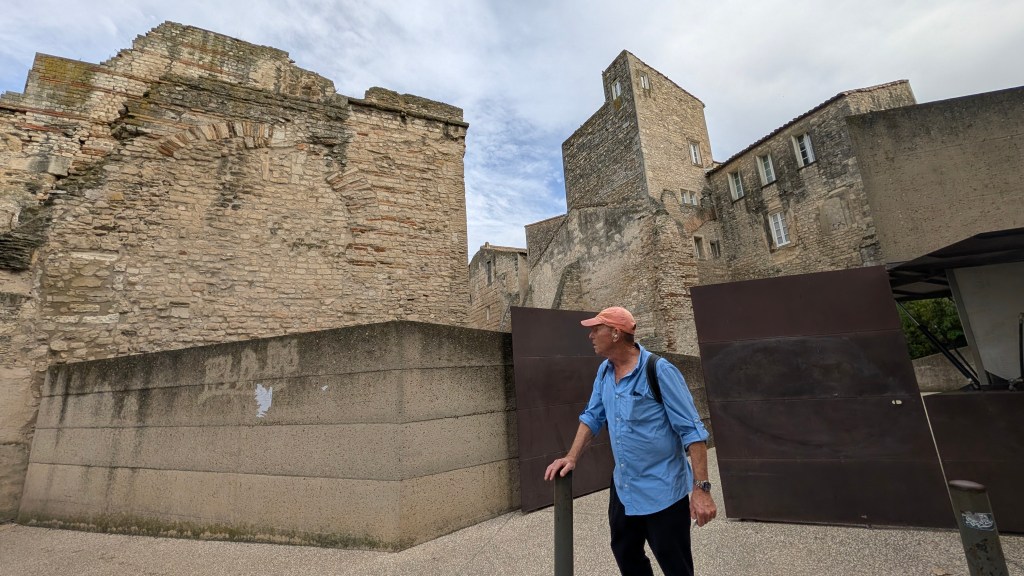
Thermes de Constantin (Baths of Constantine)

The best-preserved section includes the caldarium, or hot room, recognizable by its thick walls and semi-domed architecture that once supported an elaborate heating system known as the hypocaust, which circulated warm air beneath the floors. Fragments representing the frigidarium and tepidarium (the cold and warm rooms) recall the ritual progression of Roman bathing. The brick arches, vaulted ceilings, and traces of marble decoration highlight the sophistication of Arles as a Roman colony and the comfort and luxury that bathers could enjoy nearly 1,700 years ago. The Baths of Constantine are among the best-preserved Roman baths in France, 
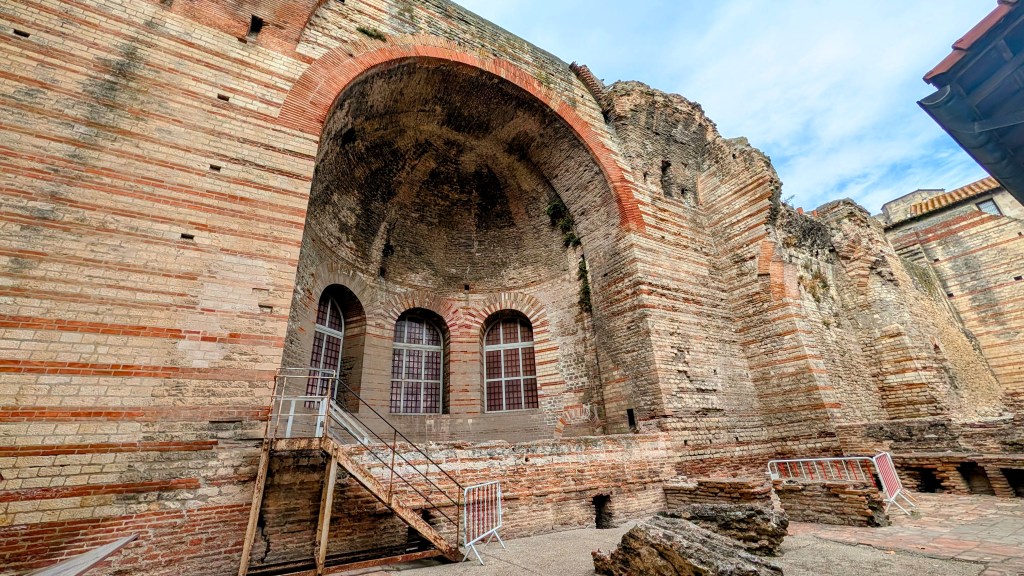
Thermes de Constantin (Baths of Constantine)

Art museum Musee Reattu (Reattu Museum) dates from the late 18th century when Jacques Réattu, a prominent Arles-born painter and Grand Prix de Rome laureate, acquired the former Commandery of the Knights of Malta and transformed part of the building into his residence and studio. After his death in 1833, the property and his artistic collection remained in the family until the mid-20th century, when the City of Arles purchased the estate and opened the museum in 1965. It was too nice and too late in the day to go inside.
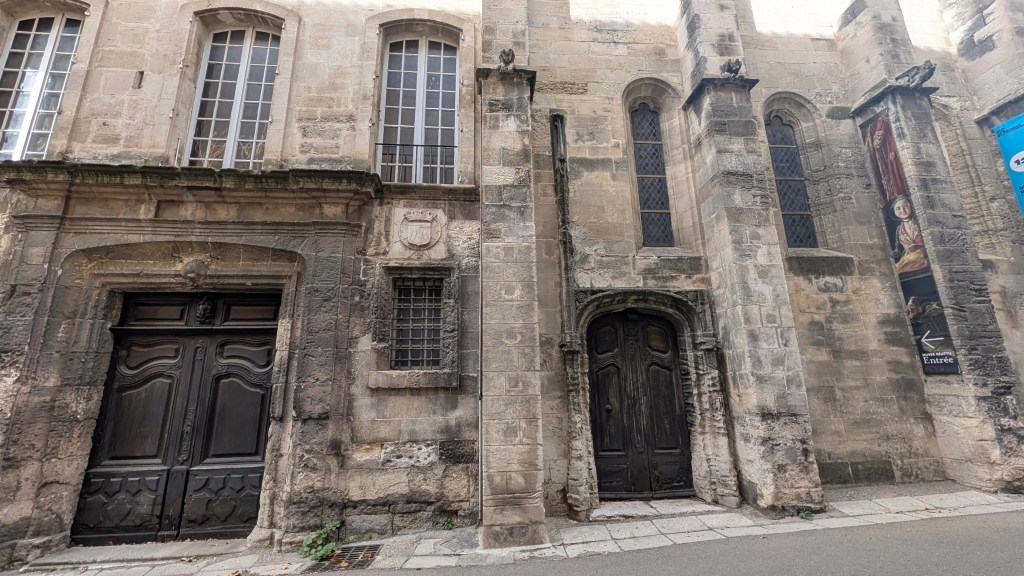
Musee Reattu (Reattu Museum)

The coat of arms next to the door is that of the knights of Malta.
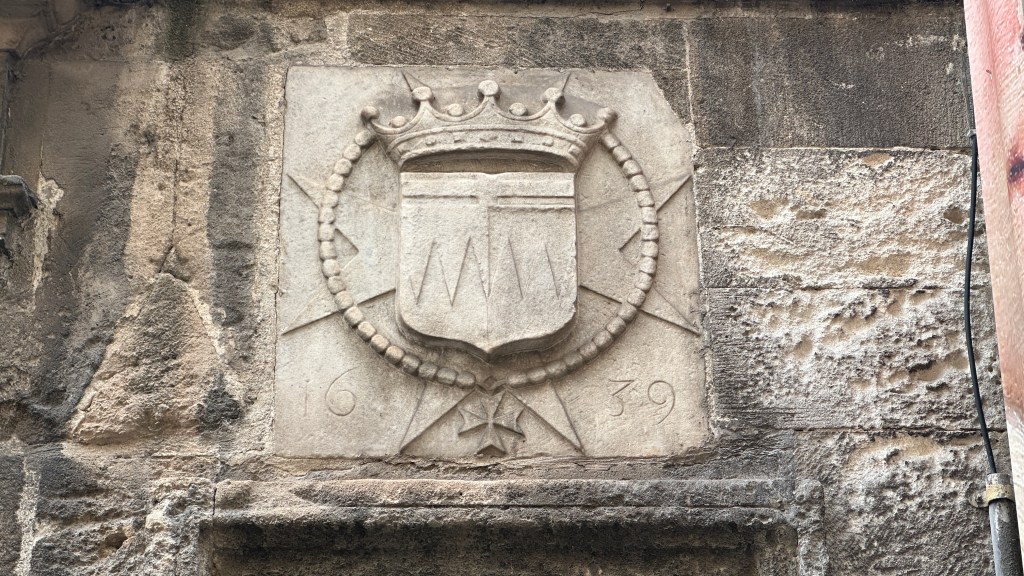
Knights of Malta coat of arms.

As the day lingered we found tranquility by the Rhone.
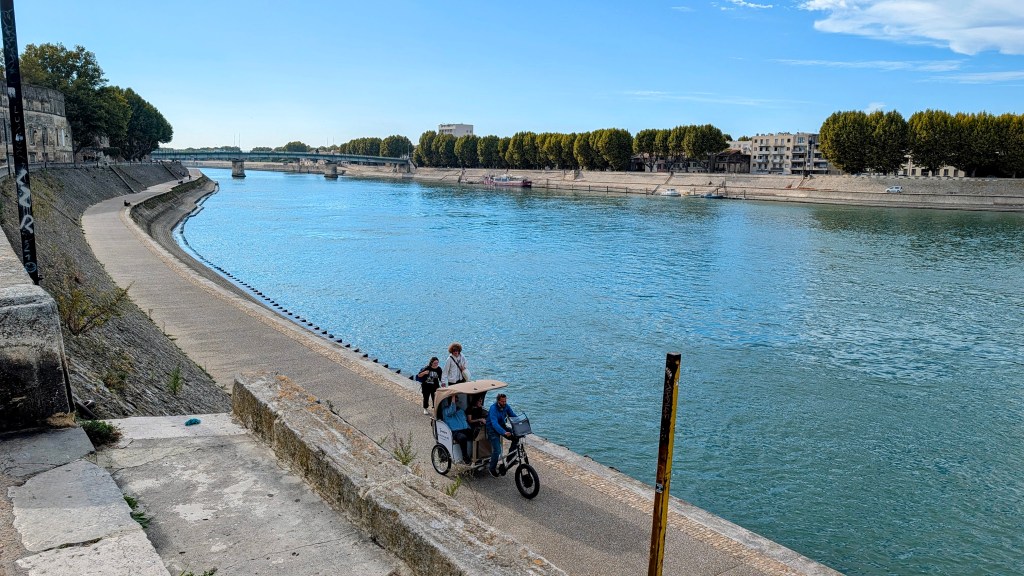
Rhone River

Ruins of the Pont aux Lions (“Bridge of Lions) spanning the Rhône River are the remains of a railway bridge built in 1868 that crossed the Rhône River.
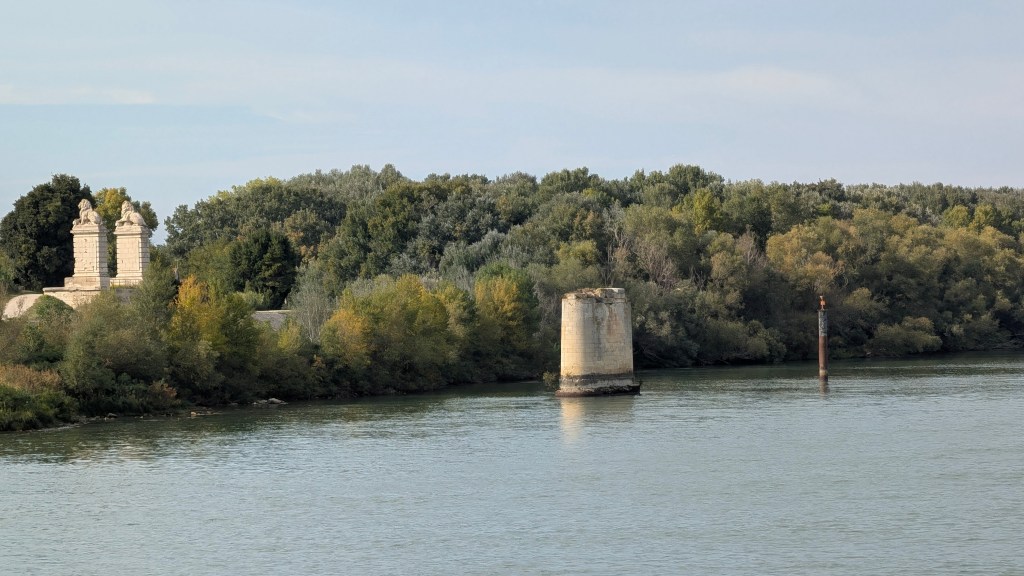
Ruins of the Pont aux Lions (“Bridge of Lions)

  The bridge was destroyed by Allied bombing on August 6, 1944, during World War II to disrupt German transport routes. The remaining structure on the eastern bank now serves as a historical monument and viewpoint overlooking the river. 
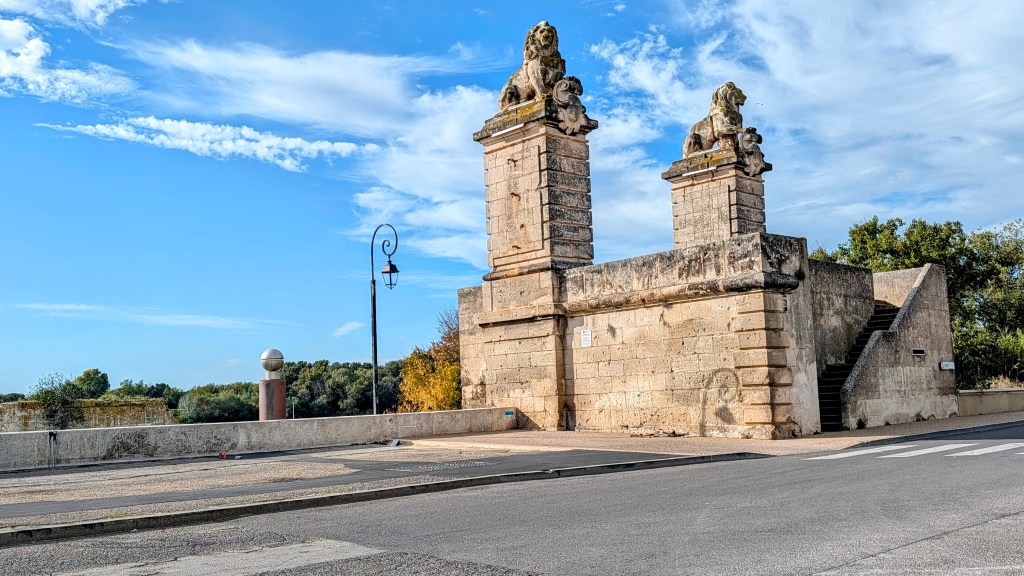
Ruins of the Pont aux Lions (“Bridge of Lions)

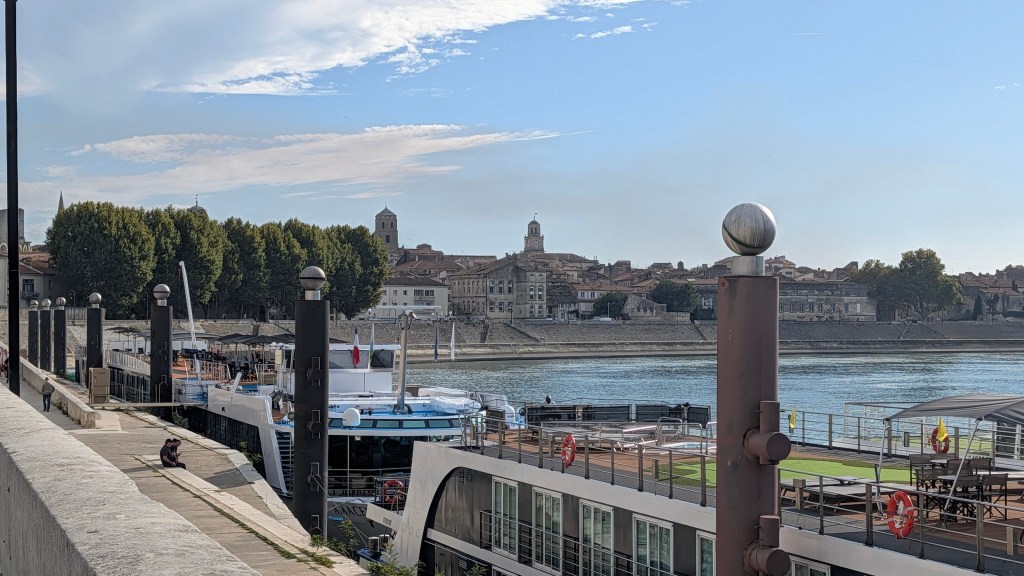
This location is a frequent sight on river cruises traveling through the Provence region.
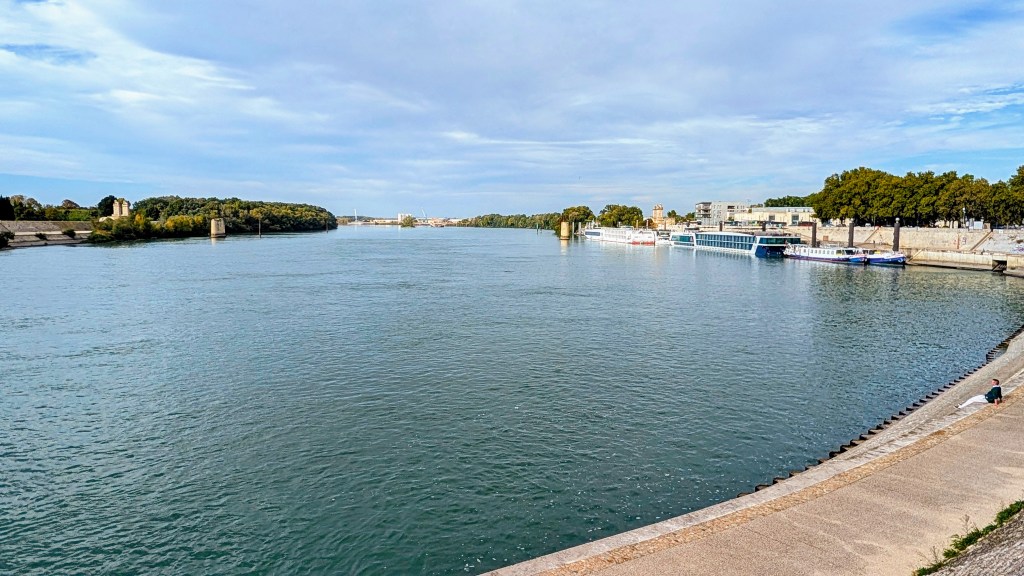
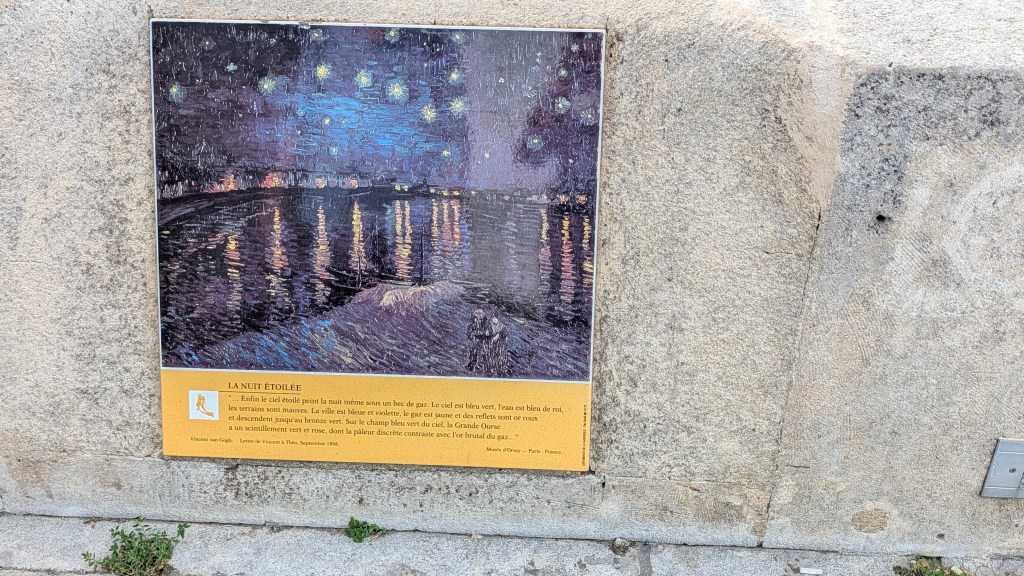
It is also the site where Van Gogh created “Starry Night over the Rhône,” a precursor to his famous “Starry Night,” which he painted while in the hospital in St. Remy.
According to writings by Gauguin, a friend and contemporary of Van Gogh’s, “Starry Night” was a turning point for Van Gogh as he “let go” from reality and embraced the abstract.
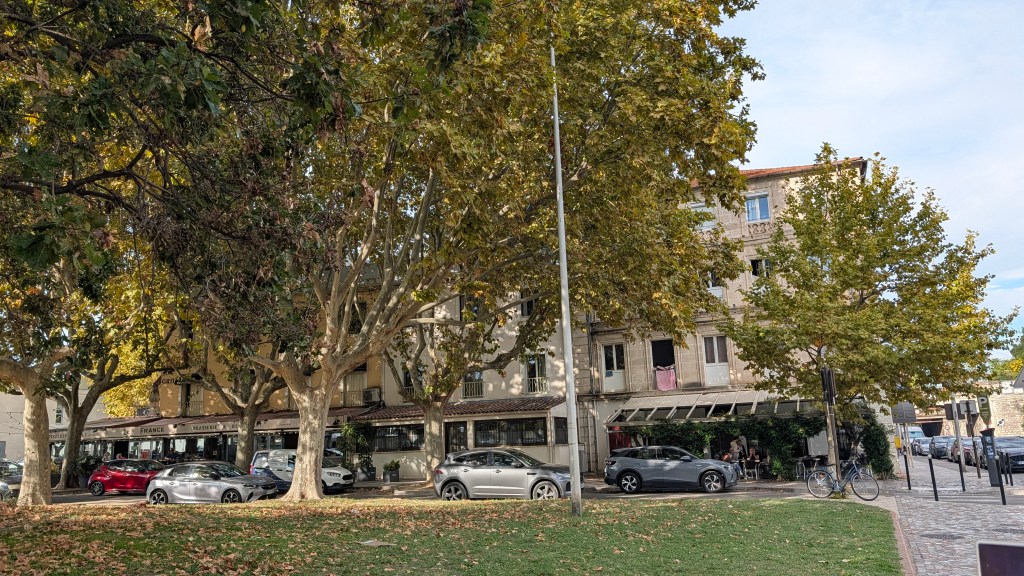
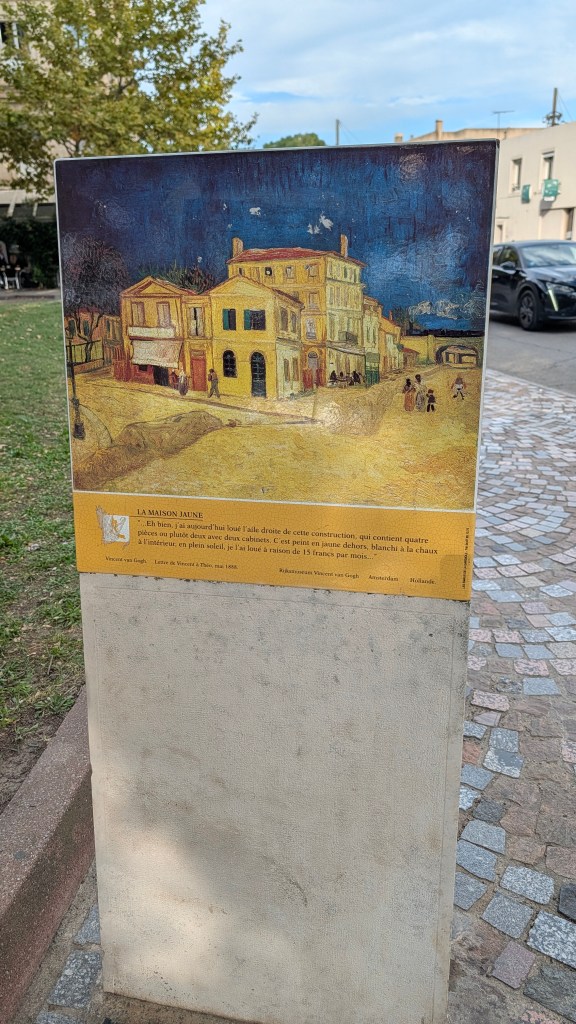
Van Gogh rented four rooms nearby in the “Yellow House,” also a subject of one of his paintings. Vincent had finally found a place at the Yellow House where he could not only paint but also have his friends come to stay.
Yellow House

His plan was to turn the yellow corner-building into an artists’ house, where like-minded painters could live and work together.
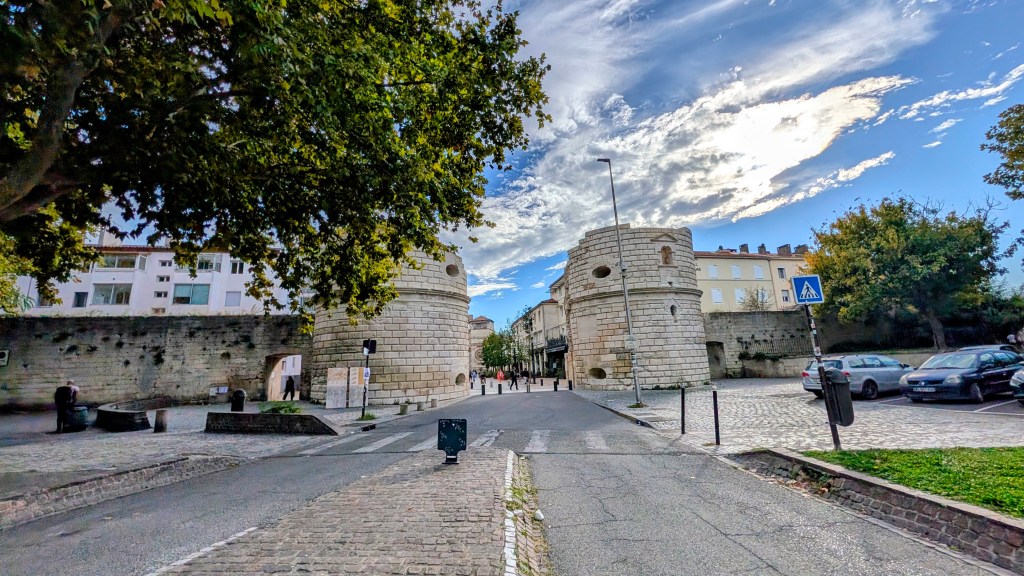
Finally we had come to where we had started: the twin towers that served as defensive city fortifications during the Middle Ages.
France: Paris Oct. 2-4, 2025

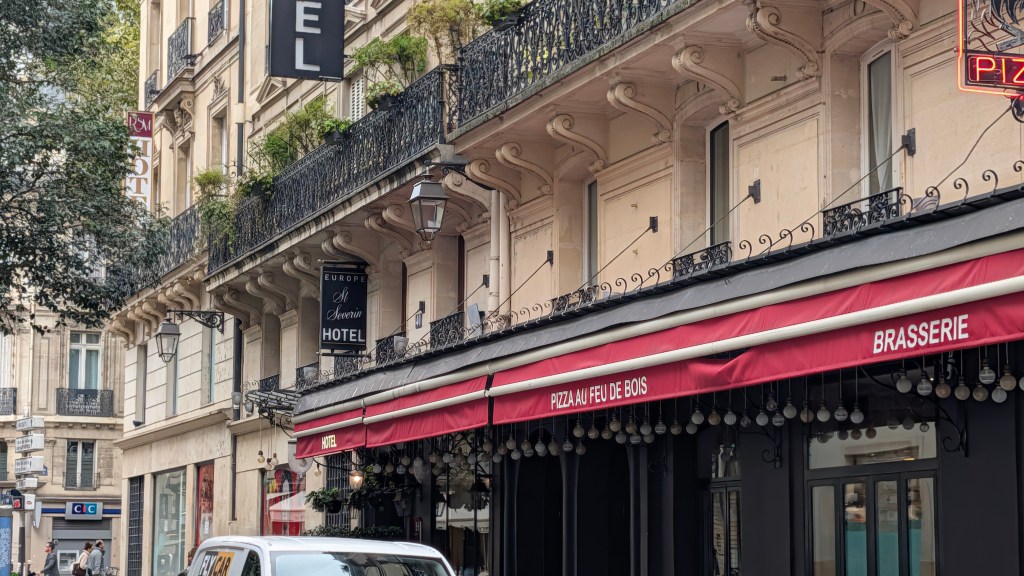
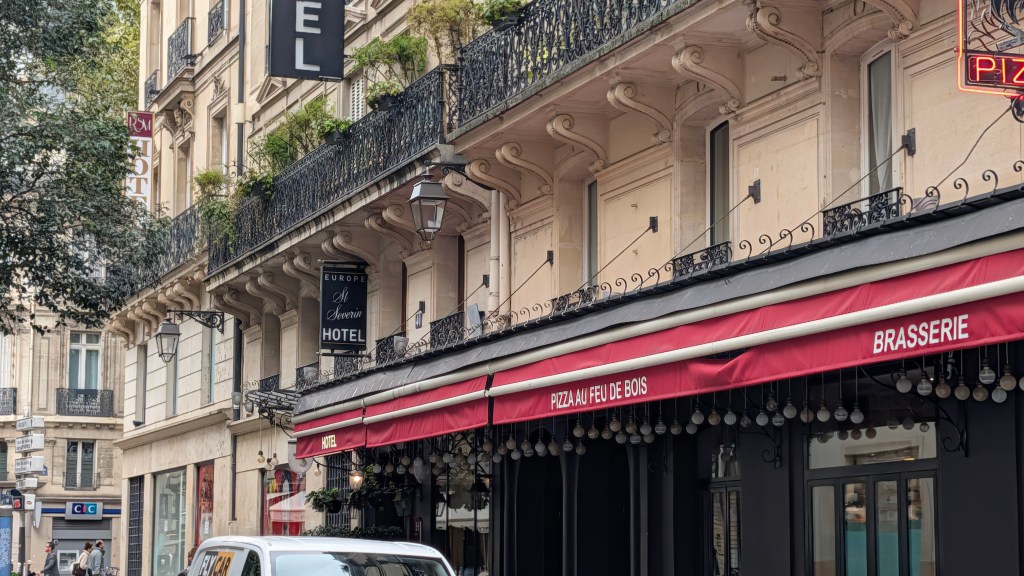
We landed in Paris in the early hours of the morning. As anyone who has visited Paris knows, the city is divided into districts known as arrondissements. Our hotel, Europe St. Severin, was in the 5th arrondissement, so we headed there to check-in and leave our luggage.

Europe St. Severin

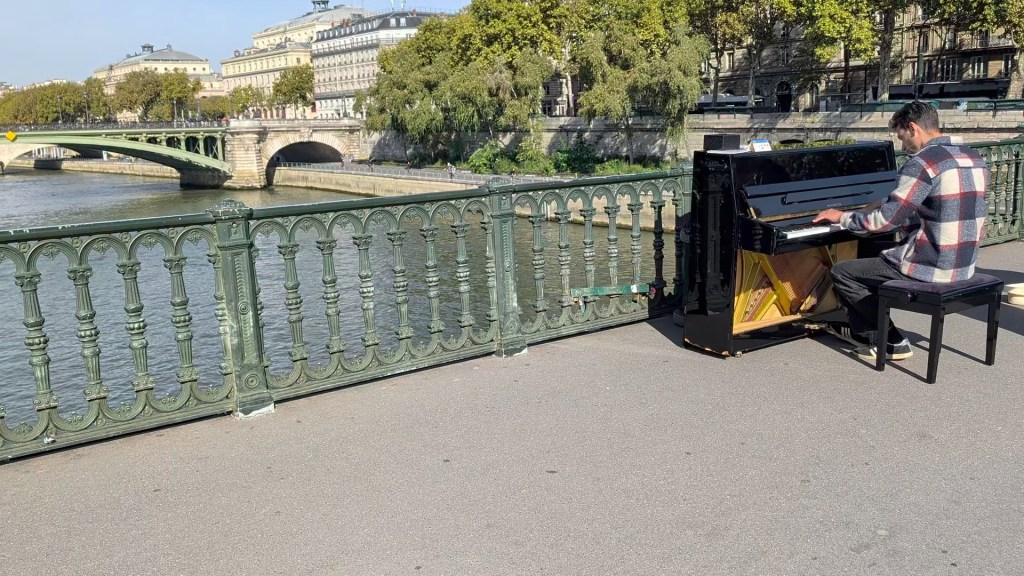
First thing we did was hit a cafe to enjoy some people watching while caffeinating ourselves for a day of shaking the jet lag. Then we headed toward the Seine for a stroll. There we found a pianist entertaining the crowd.

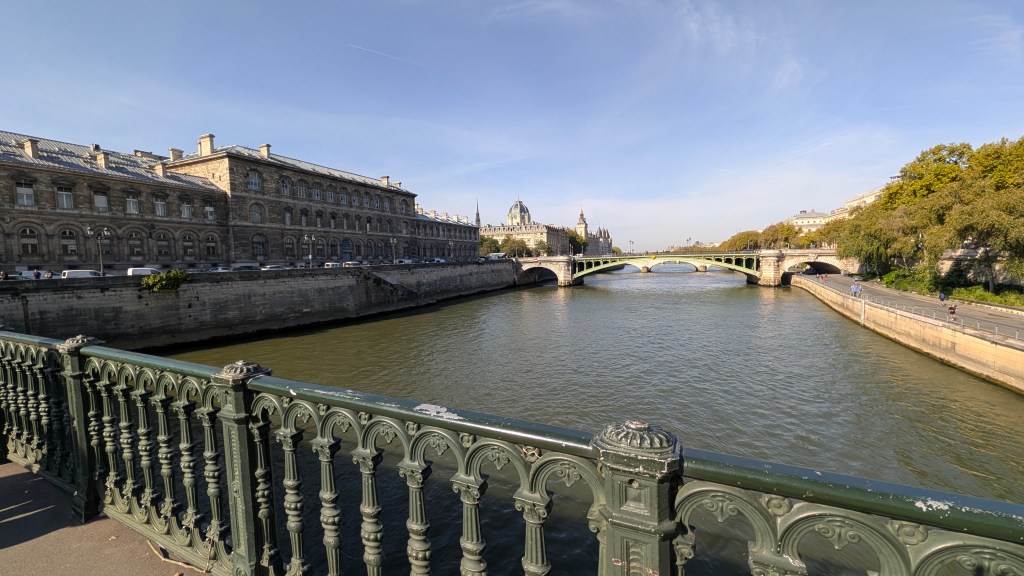
We crossed the Pont d’Arcole, Paris’s first iron bridge, originally completed in 1856.  It connects the Hôtel de Ville on the Right Bank to the Île de la Cité, providing close views of monuments like Notre-Dame. This location is part of the banks of the Seine, which have been listed as a UNESCO World Heritage site since 1994. In the background, the architecture of the Île de la Cité is visible, which also includes the historic Pont Neuf nearby.

Pont d’Arcole

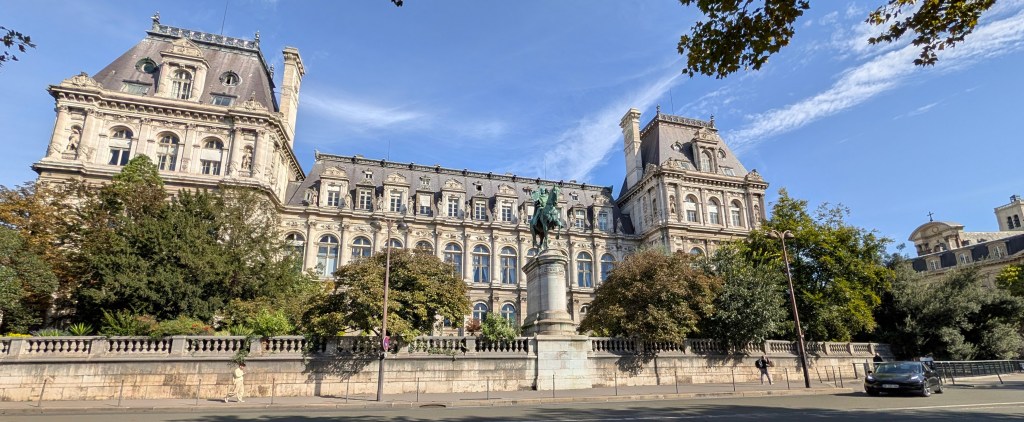
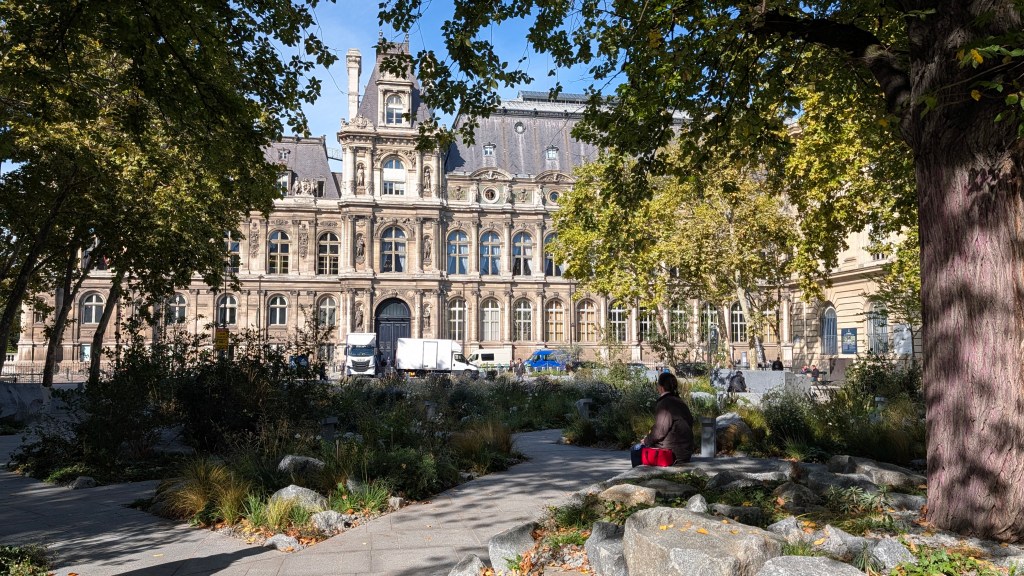
We had some time to kill before meeting friends for lunch, so we strolled around the 4th arrondissement. There we passed Hôtel de Ville, the city hall of Paris, France. It has been the headquarters of the municipality of Paris since 1357.

Hôtel de Ville

 The original building was constructed beginning in 1535, but was burned down during the Paris Commune; the current structure was built starting in 1872. It is an exquisite example of French Renaissance architecture. 

Hôtel de Ville

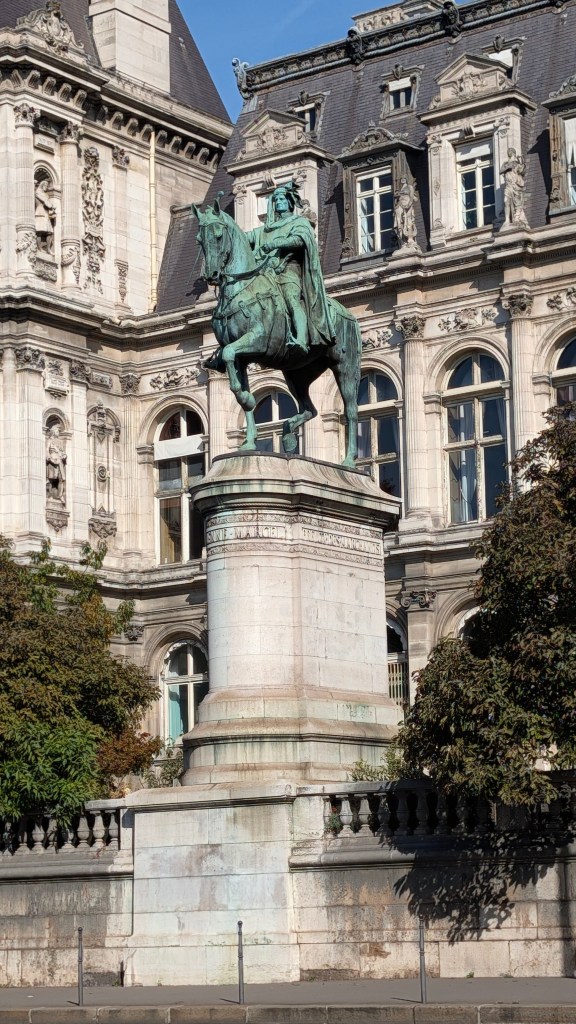
A bronze statue of Étienne Marcel, the provost of the merchants of Paris in the 14th century. The bronze statue dates back to the late 19th century.

Étienne Marcel

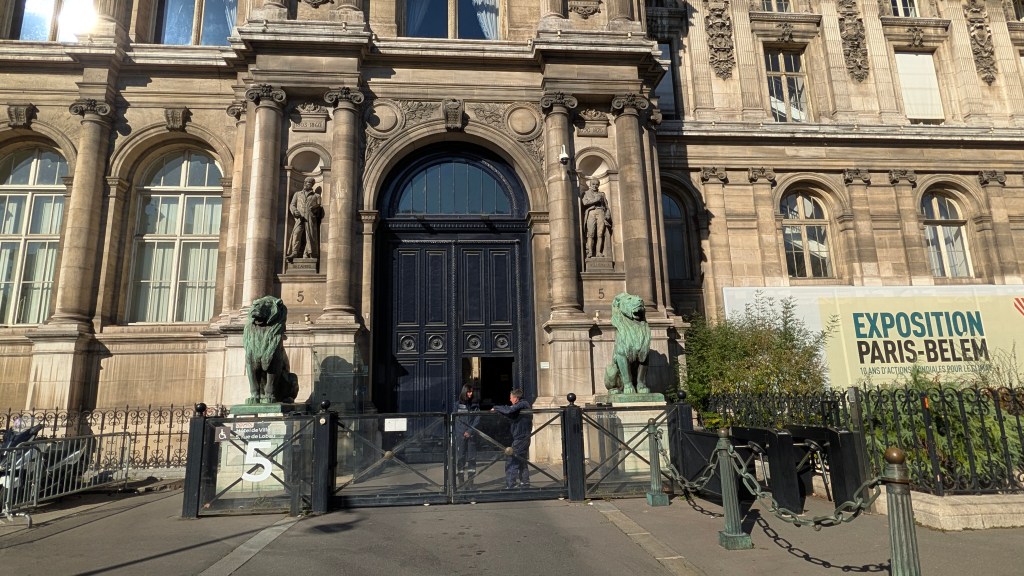
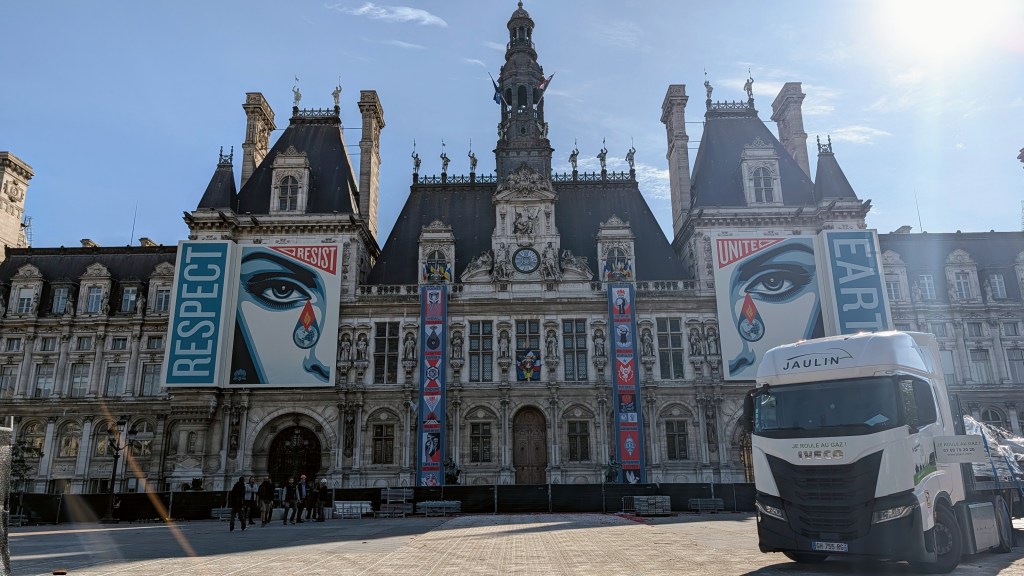
On the other side, the building’s facade features large banners with artwork by Shepard Fairey, an American street artist. The artwork and banners, which include text like “RESPECT” and “RESIST”, are part of an exhibition titled “From Paris to Belém: 10 years of global action for the climate”. The exhibition commemorates the 10th anniversary of the COP21 and the Paris Agreement on climate change. The exhibition combines science, urbanism, and art to showcase how cities worldwide are addressing climate change. 

Hôtel de Ville

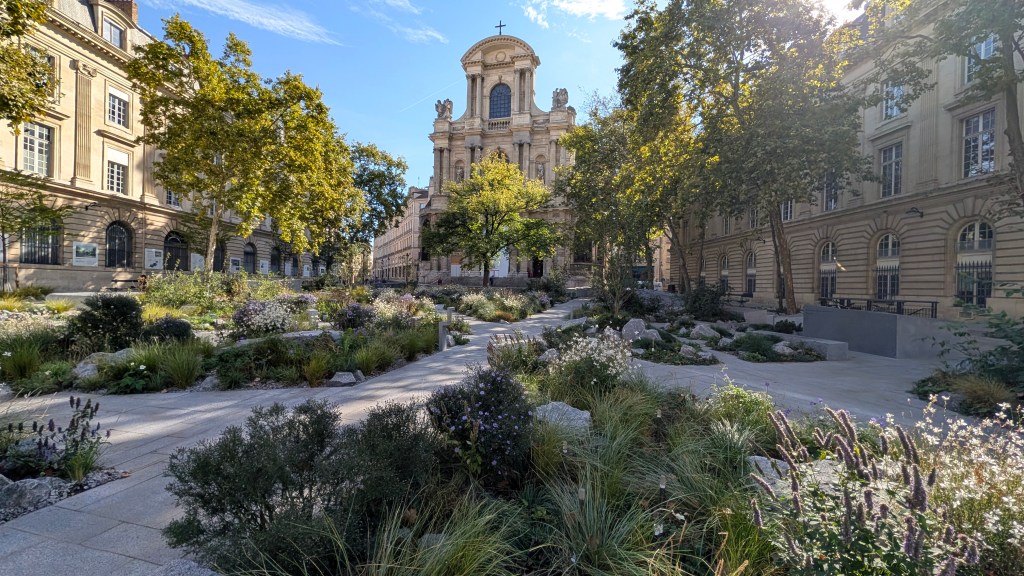
Just behind the Hôtel de Ville (City Hall) in Place Saint-Gervais we found Jardin du Souvenir, (Garden of Remembrance, also referred to as the November 13 Memory Garden), a permanent memorial dedicated to the victims of the November 13, 2015 Paris attacks. 

Jardin du Souvenir

Jardin du Souvenir is designed as a peaceful, living space that transforms pain into a shared memory, open 24/7 for the public to visit, reflect, or simply rest. The design incorporates elements that represent the six different attack sites, using fragmented stone to evoke the event’s brutality while plants symbolize life and renewal.

Jardin du Souvenir

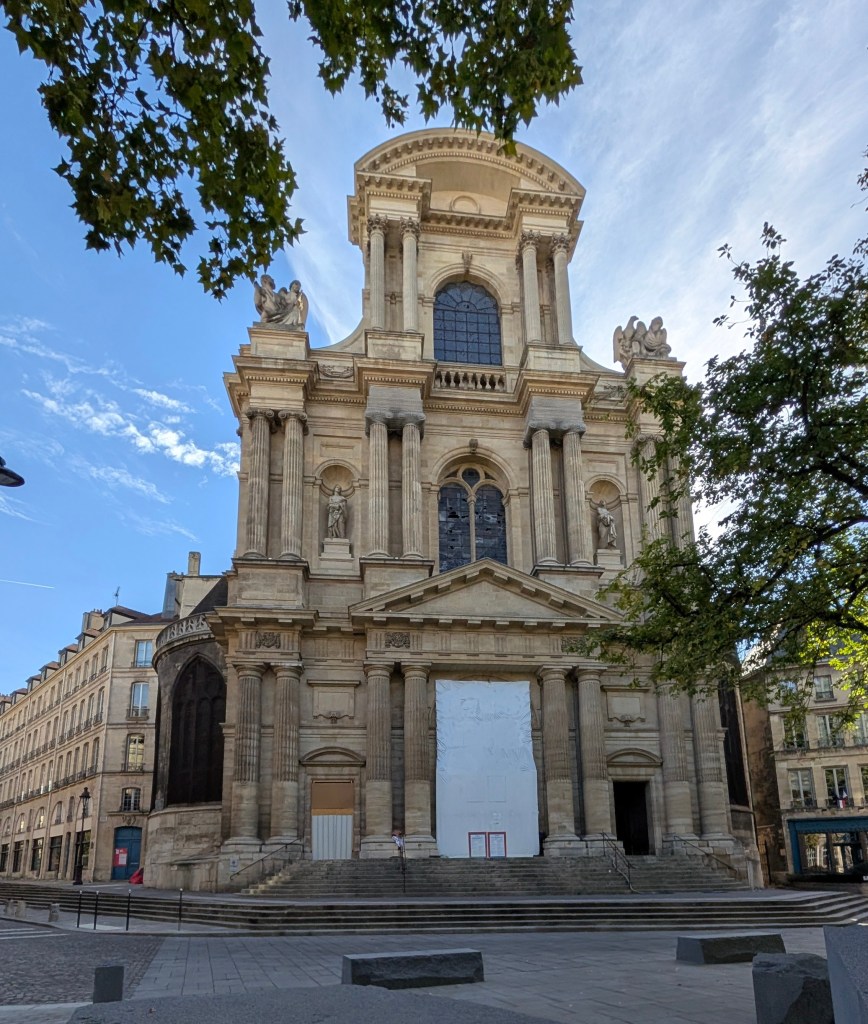
At the top of the Jardin is the Church of Saint-Gervais-Saint-Protais. The current church was built between 1494 and 1657, on the site of two earlier churches; the facade, completed last, was the first example of the French baroque style in Paris. The facade is notable for displaying the three classical orders of columns: Doric at the bottom, Ionic in the middle, and Corinthian at the top. 

Church of Saint-Gervais-Saint-Protais

Within the the 4th arrondissement lies the Marais district, known for its medieval architecture, charming streets, and vibrant Jewish heritage. We did not explore the entire neighborhood, but we did love this little gem.

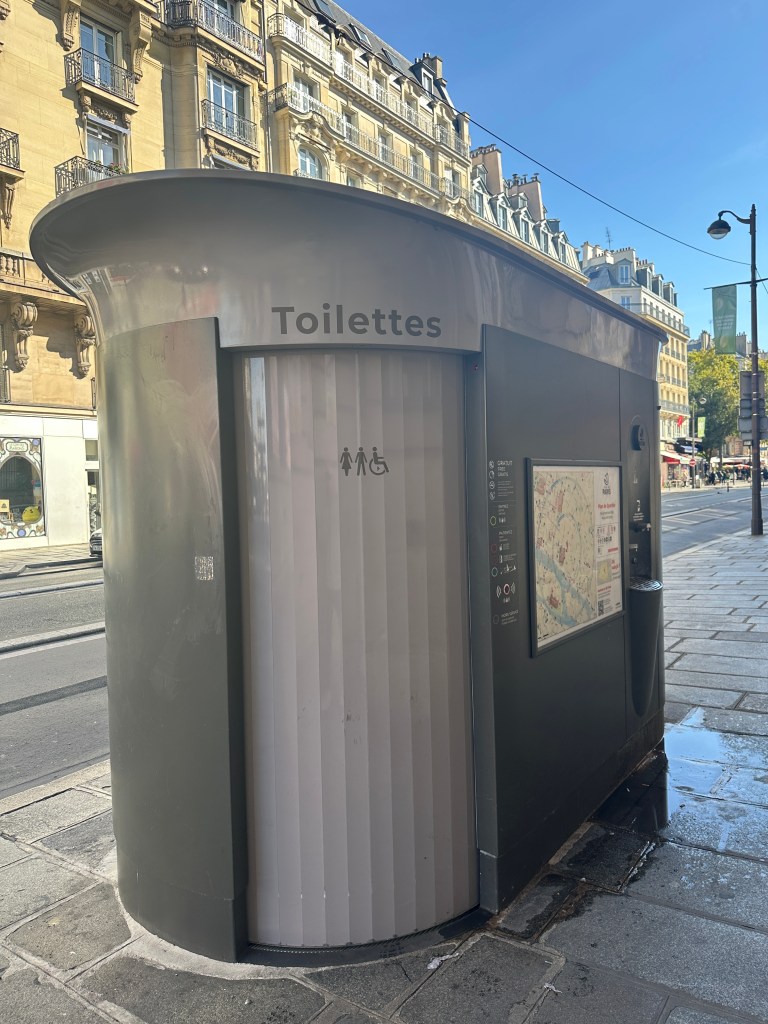
We were amused by the high tech public facilities.

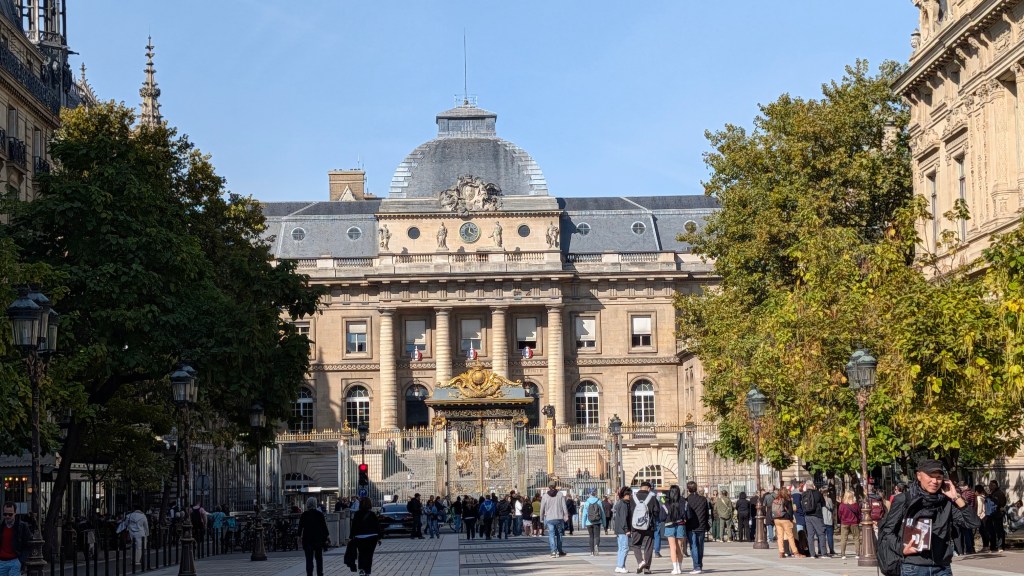
Heading to our meeting place on the Île de la Cité (the island in the middle of the Seine in the middle of Paris on which Notre Dame is located), we also passed the Palais de Justice (Palace of Justice), a historic courthouse which is a major judicial center and has been the seat of the French justice system since medieval times. 

Palais de Justice 

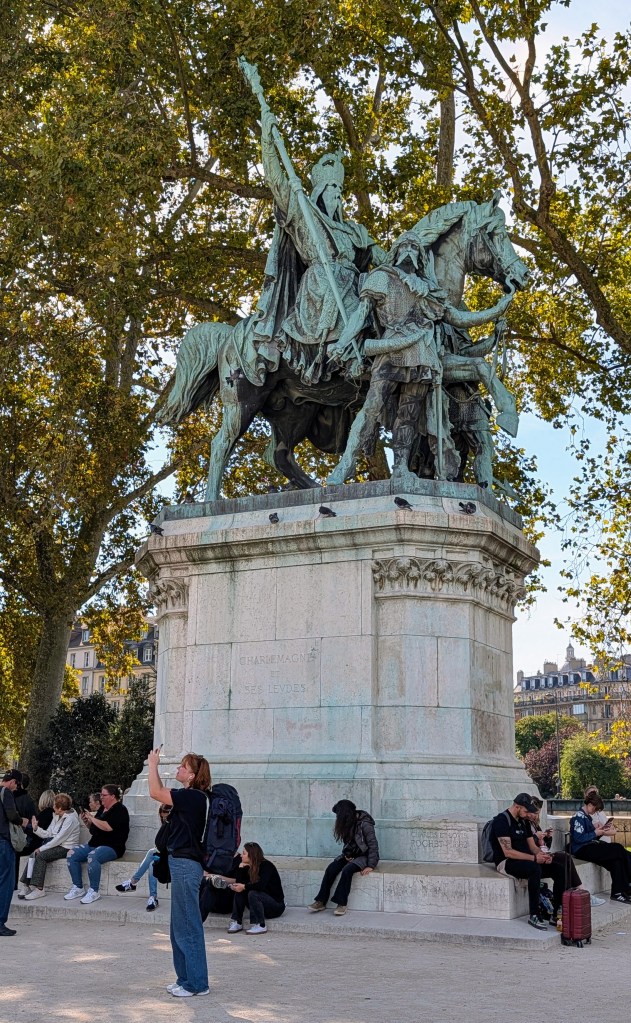
Finally it was time to meet up with Jay and Phyllis. We found them in the plaza of Notre Dame standing by the bronze equestrian statue titled Charlemagne et ses Leudes (Charlemagne and His Guards). The statue, completed in 1878, depicts Charlemagne, King of the Franks and the first Emperor of the Holy Roman Empire, on horseback. 

Charlemagne et ses Leudes

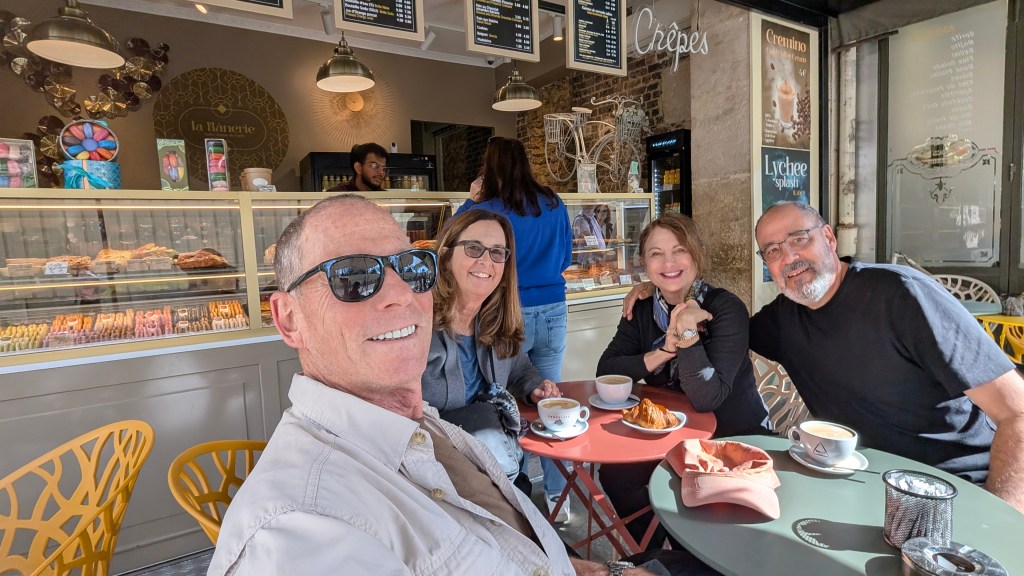
We sat, had another coffee, enjoyed a catch-up, and engaged in the most Parisian activity; people watching.

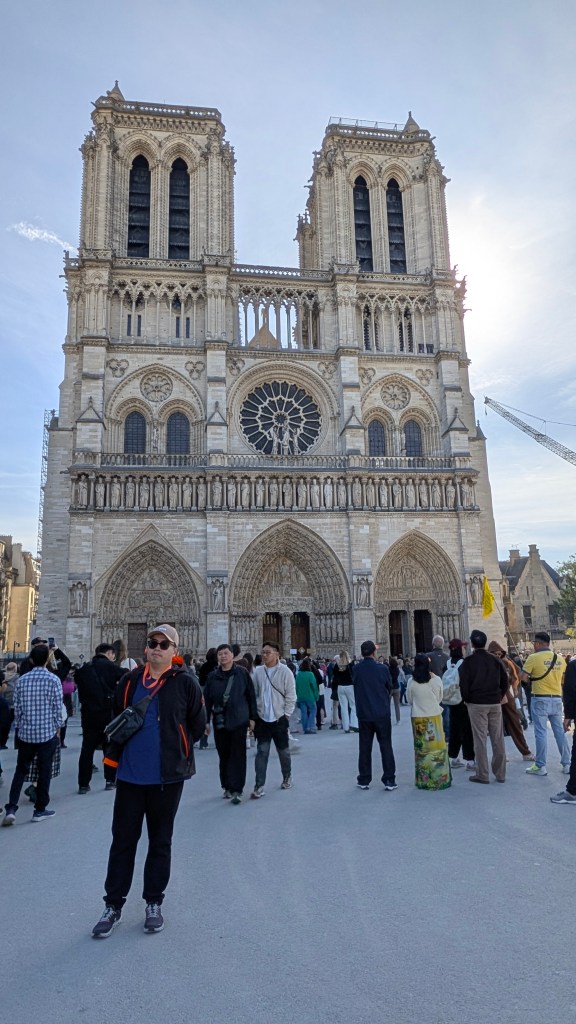
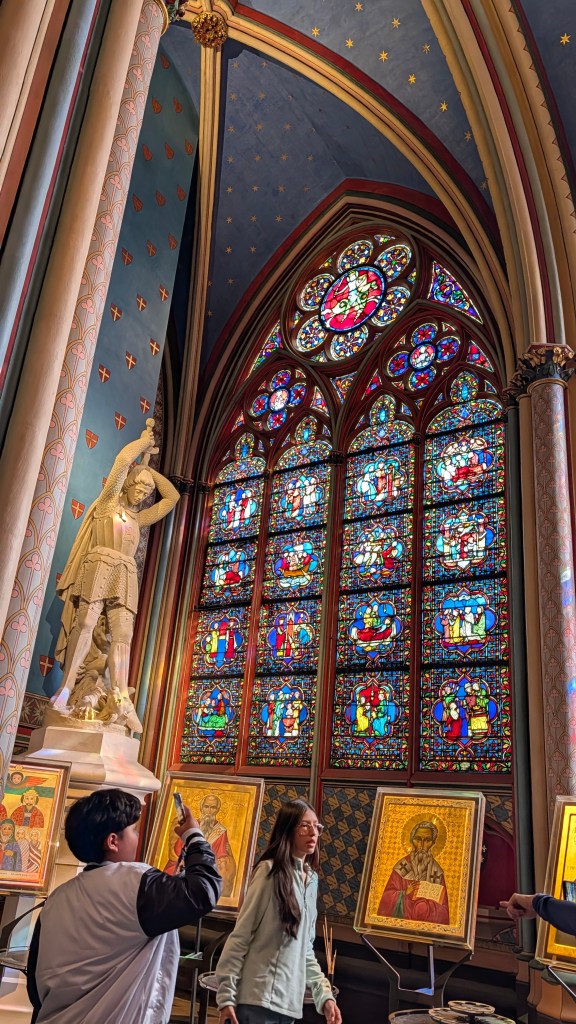
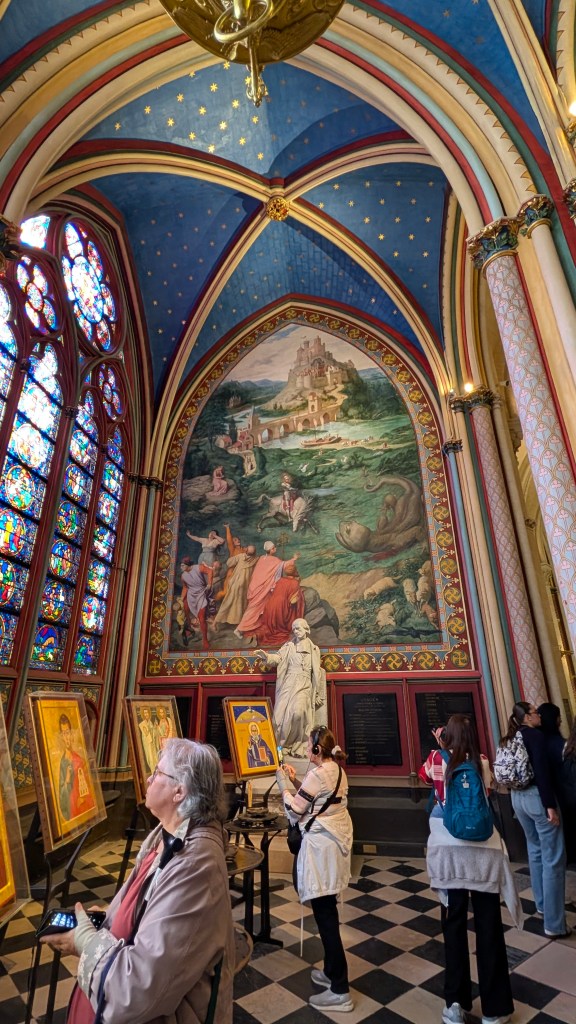
Having been to Paris before, we had decided against most of the touristy stops. But Notre Dame had burned in April, 2019 and has been rebuilt in the interim, so we all decided it deserved a revisit. Constructed between 1163 and 1260, it is a masterpiece of French Gothic architecture, which includes features including rose windows for light from God and flying buttresses to get closer to God. 

Notre Dame Cathedral

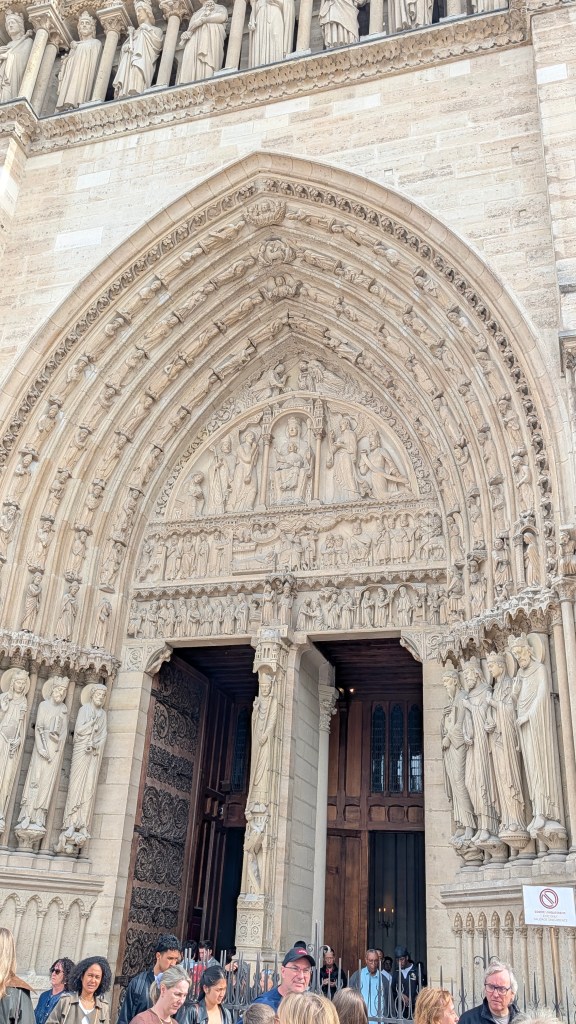
The three portals on the western façade of the cathedral each contain the architectural feature known as a tympanum depicting intricate biblical scenes within a pointed Gothic arch. 

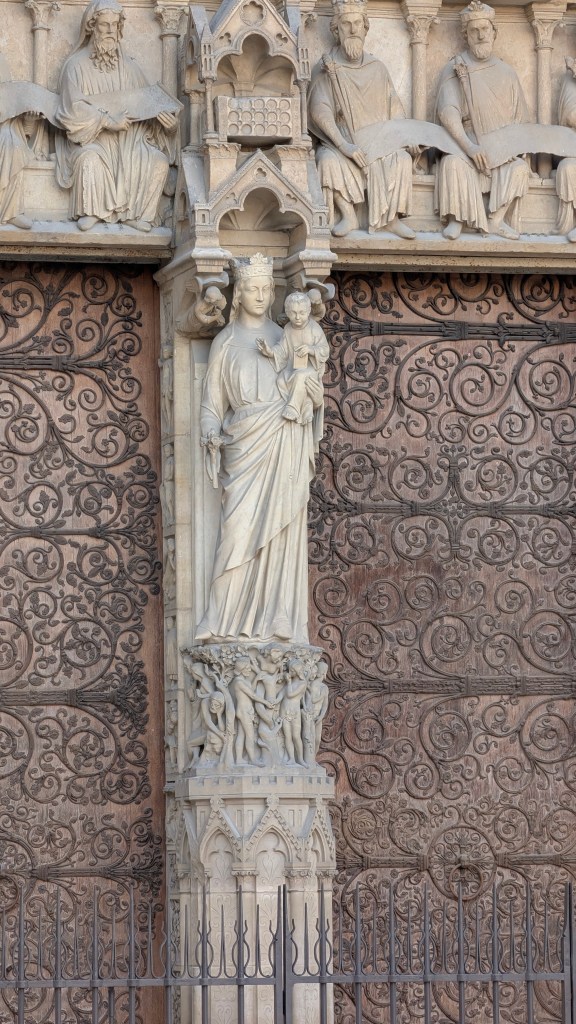
The 14th-century stone sculpture known as “The Virgin of Paris,” located on the central portal of the cathedral depicts the Virgin Mary holding the Child Jesus, is a symbol of hope, faith, and resilience for Catholics.  The sculpture miraculously survived the devastating 2019 fire.

The Virgin of Paris

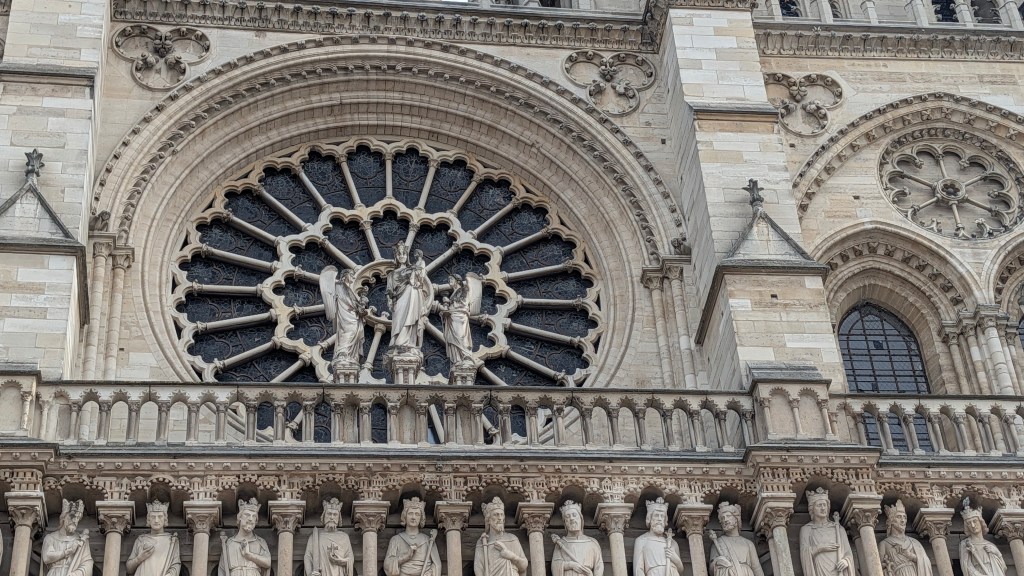
The rose window exterior contains a sculptural group which constitutes the Galerie de la Vierge (Gallery of the Virgin), depicting the Virgin Mary and Child flanked by two angels. 

Galerie de la Vierge (Gallery of the Virgin)

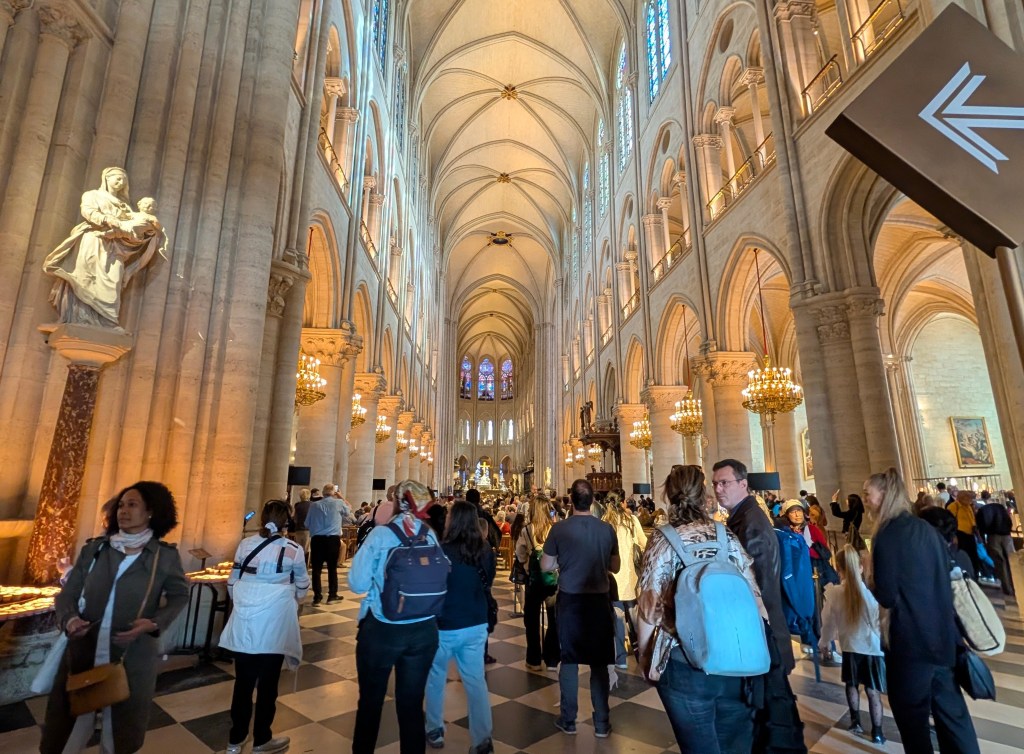
Inside was the usual throng of tourists.

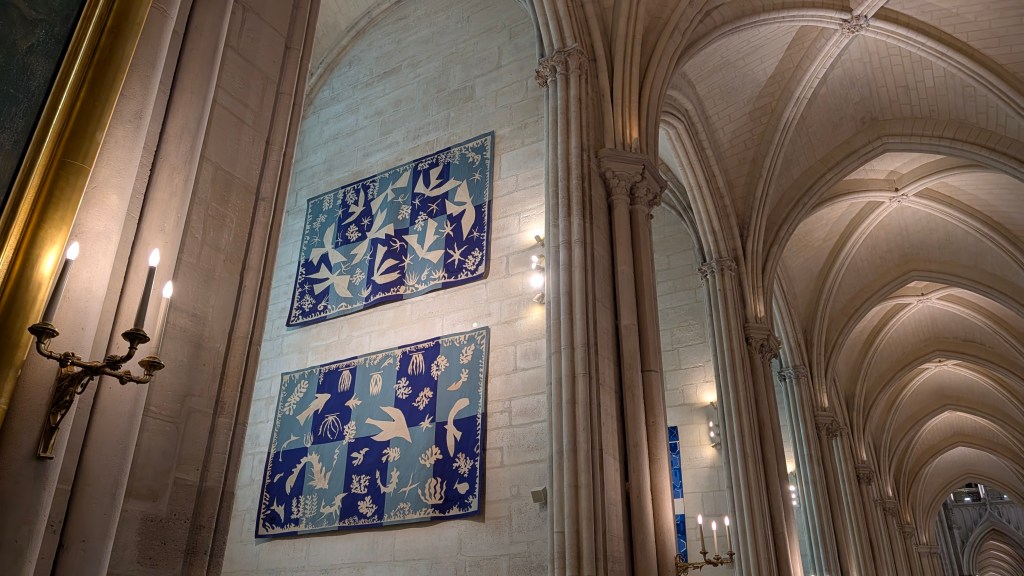
Hung high above the chapels in the nave are Matisse designed works from 1946, inspired by a trip he took to Tahiti in 1930.  While originally paper cut-outs, these versions are tapestries woven by the Beauvais workshop. These artworks are part of a diptych that explores themes of light and nature. The two originals titled Polynesia, the Sea (bottom) and Polynesia, the Sky (top) are currently part of the art collection at the United Nations headquarters in New York. 

 Polynesia, the Sea (bottom) and Polynesia, the Sky (top)

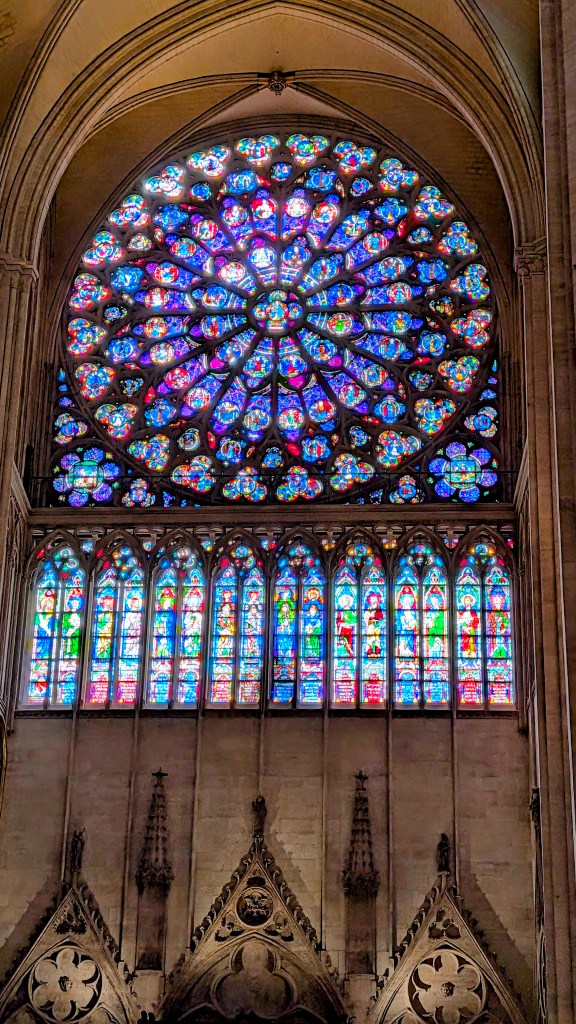
The North Rose Window, built in 1250, is a masterpiece of Gothic architecture, featuring vibrant, detailed stained glass that depicts religious scenes and stories. This iconic window survived the April 2019 fire. 

North Rose Window,

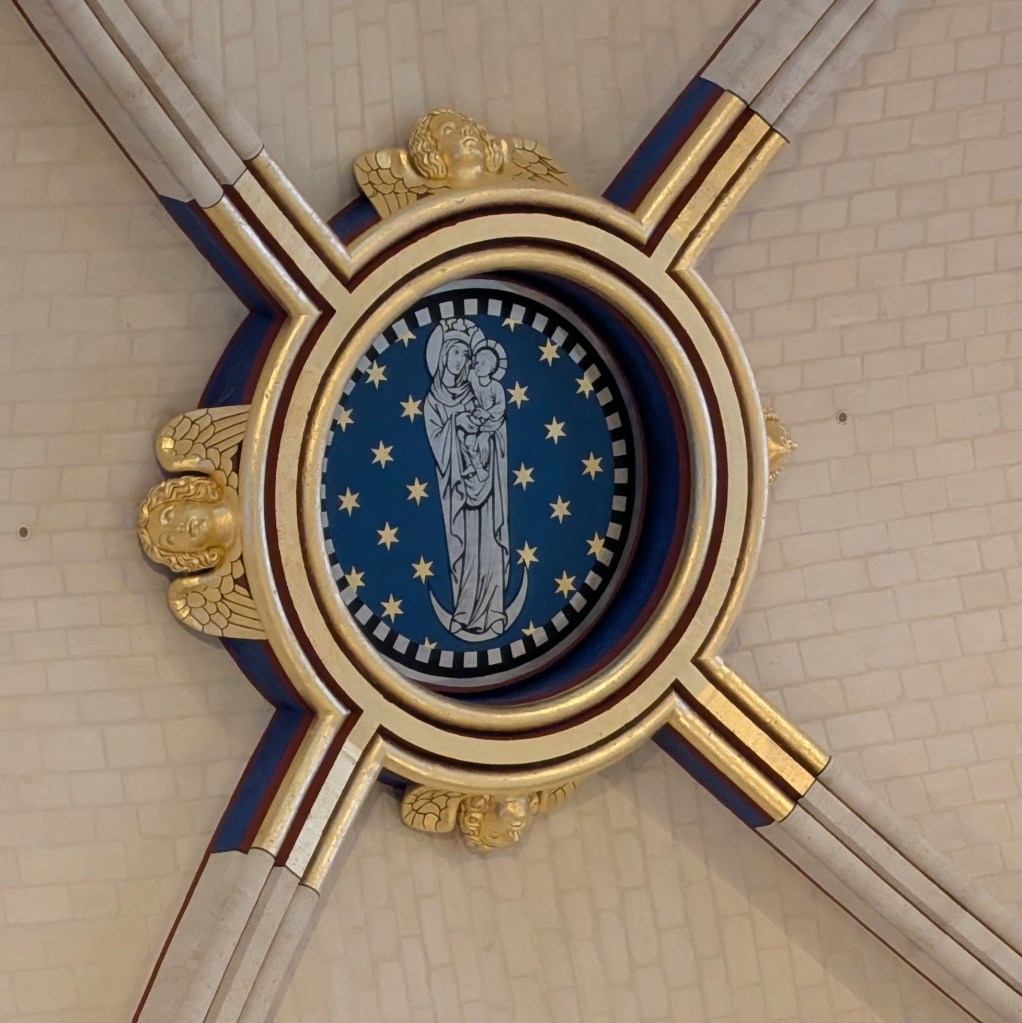
Part of the extensive restoration of the cathedral following the 2019 fire includes this ceiling boss depicting the Virgin Mary holding the Child Jesus. 

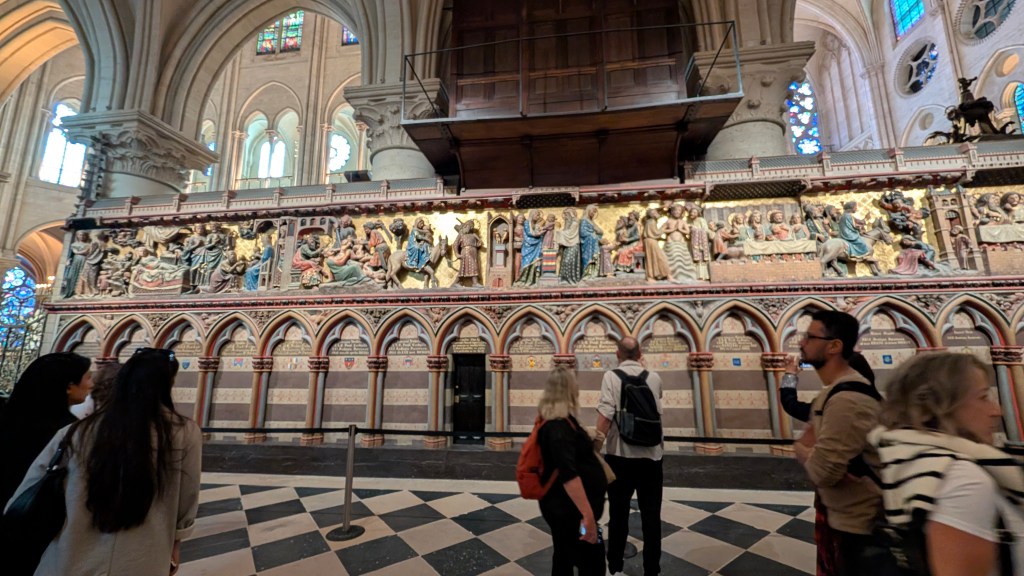
The 14th-century choir screen, originally functioning to provide silence for the canons during church services by separating the choir area from the ambulatory, also survived the 2019 fire.  The larger sculpted walls span both the north and south sides of the choir.  Since the fire they have undergone extensive cleaning and restoration. 

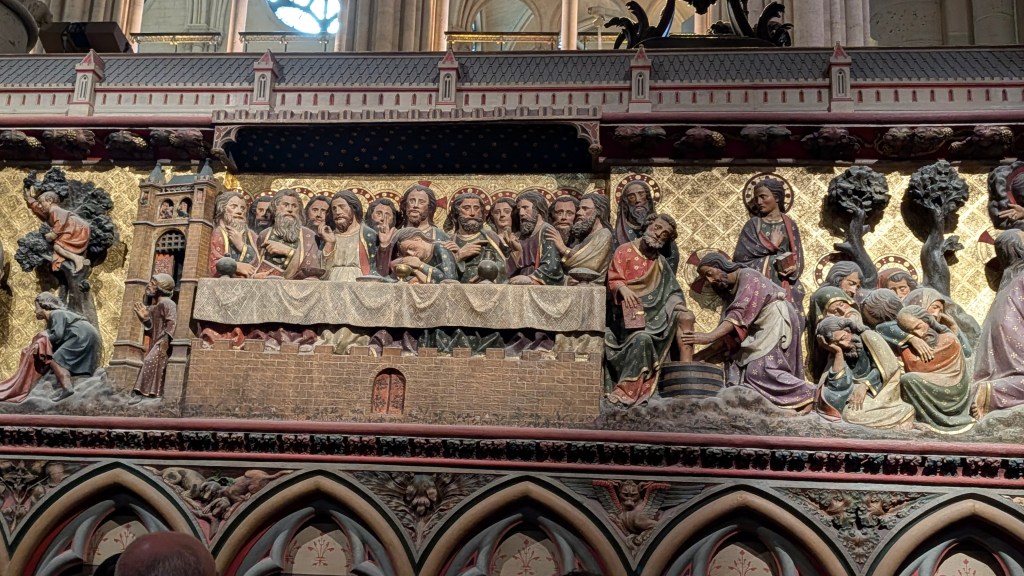
The carved and painted sculptures depict scenes from the life of Christ, I have included here a close-up of “The Last Supper.”

The Last Supper

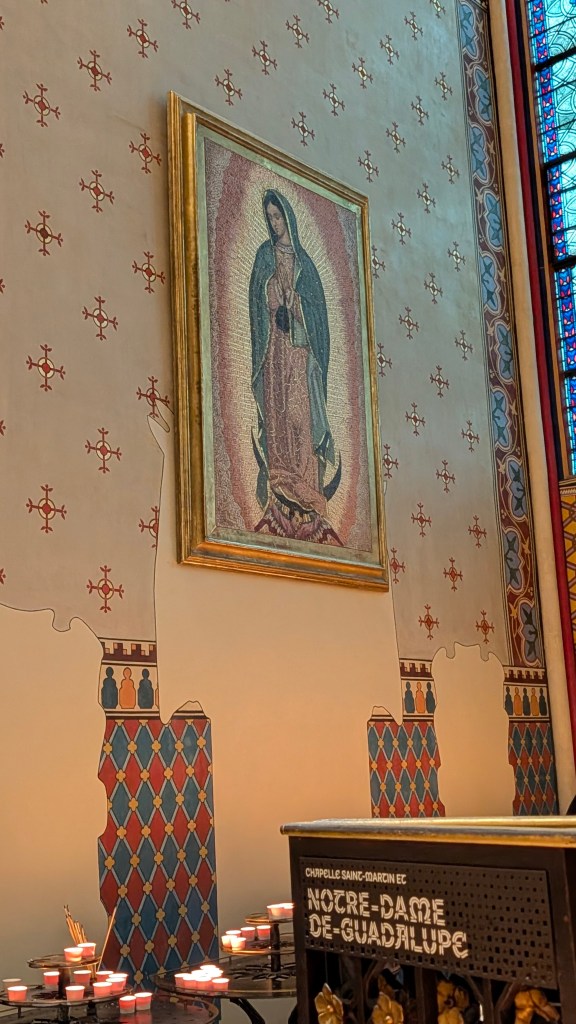
 Our Lady of Guadalupe is recognized as the patroness of Mexico and the Americas. She is a venerated Catholic icon representing a symbol of religious faith and unity. The original image is believed to have miraculously appeared on Juan Diego’s mantle (tilma) in Mexico in 1531 as a sign to the local bishop.  

Our Lady of Guadalupe

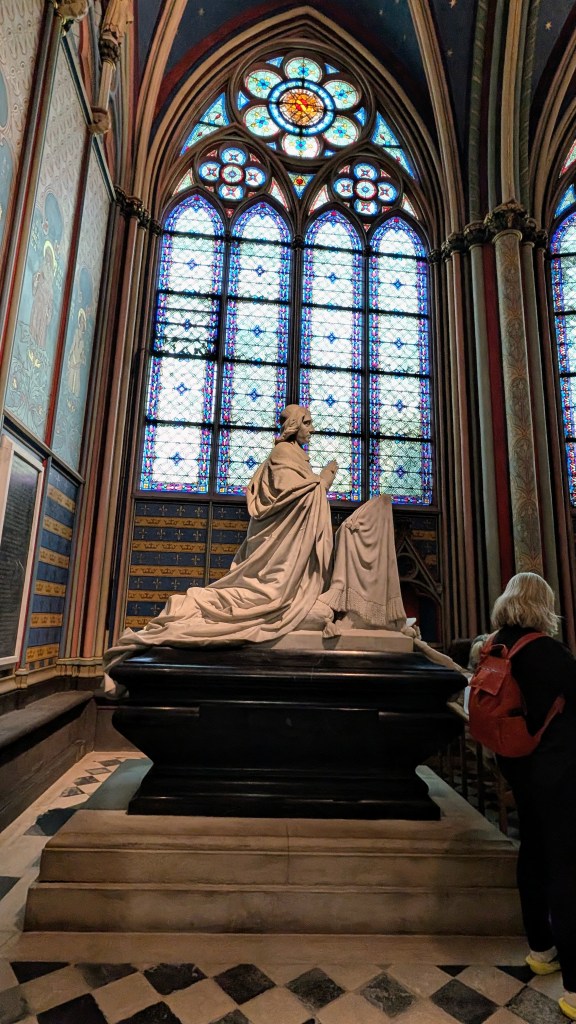
The cenotaph (tomb) of Cardinal Louis-Antoine de Noailles, located within the Chapelle Saint-Louis, features a sculpture of Cardinal Noailles kneeling in prayer. It was sculpted by Louis-Pierre Deseine around 1806, though some sources attribute it to Victor Geoffroy-Dechaume in the 1860s.  Cardinal Noailles served as the Archbishop of Paris from 1695 until his death in 1729. 

cenotaph of Cardinal Louis-Antoine de Noailles

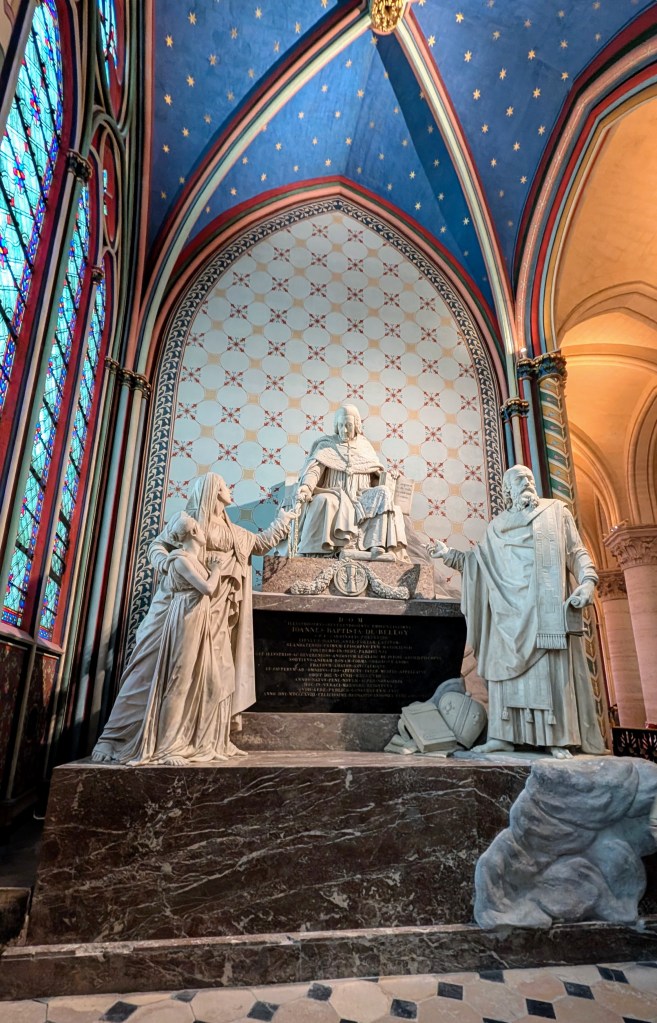
The cenotaph of Cardinal Jean-Baptiste de Belloy, honoring the Archbishop of Paris who served from 1802 until his death at age 98, is situated in the Saint Marcel Chapel inside the cathedral.  It was sculpted by Louis-Pierre Deseine in the early 19th century.

cenotaph of Cardinal Jean-Baptiste de Belloy

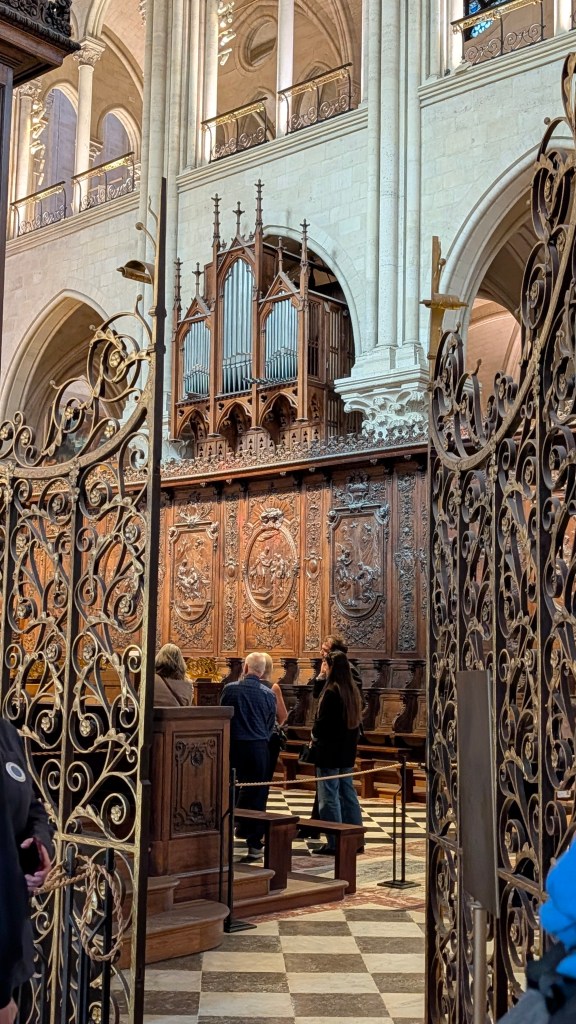
The choir organ, the smaller of the cathedral’s two organs and the one typically used for daily services, underwent extensive cleaning and restoration after the fire. 

choir organ

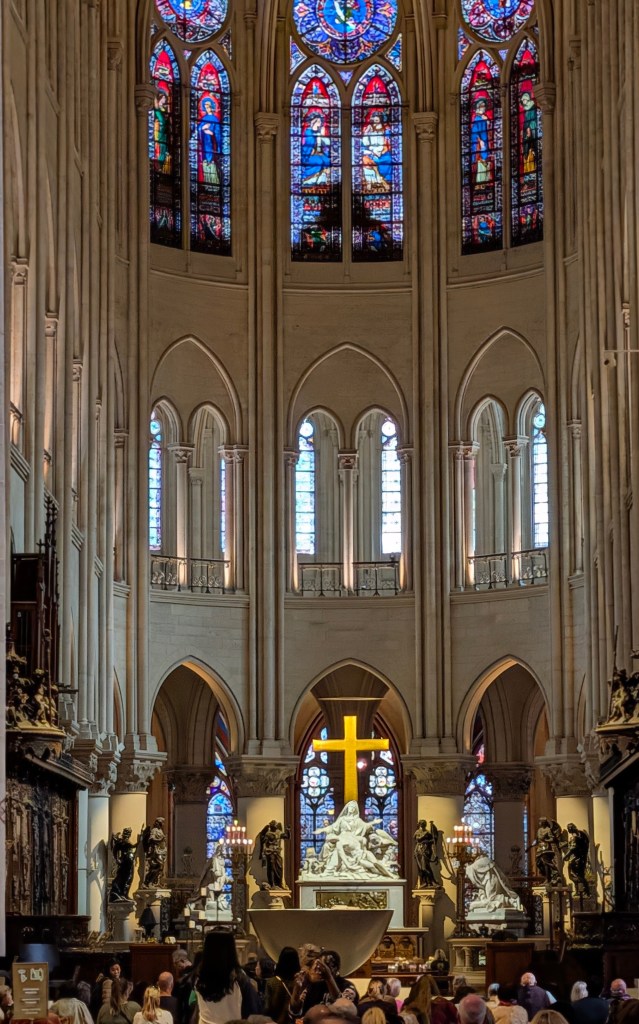
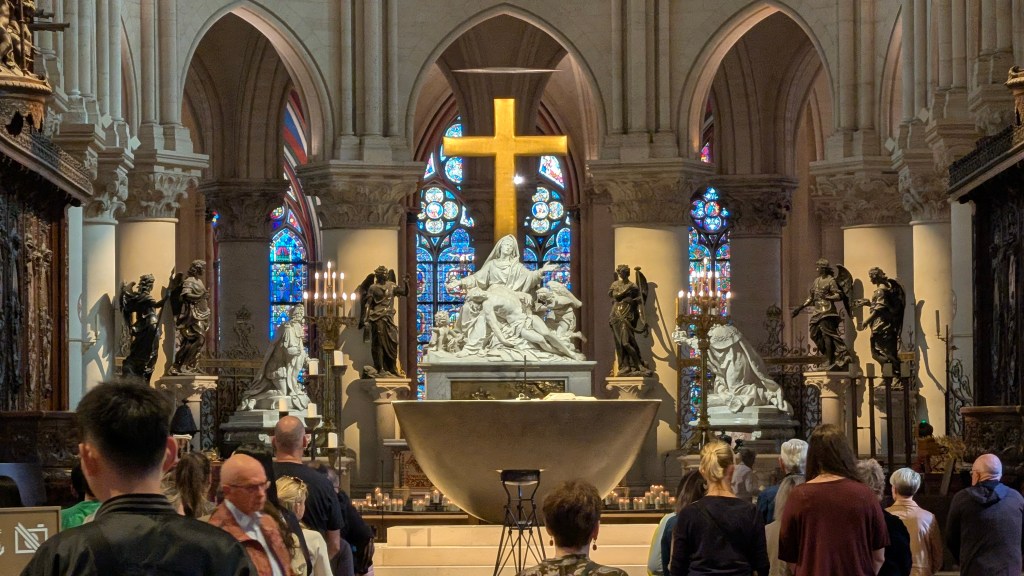
The high altar, consecrated in 1182, has been a central feature throughout the cathedral’s history and survived the 2019 fire. Following the cathedral’s restoration, a new, modern bronze altar was consecrated in December 2024 for its reopening. 

The high alter contains the white marble Pietà sculpture by Nicolas Coustou, representing the Descent from the Cross.  Commissioned by Louis XIV and completed in 1727, this grouping, along with accompanying statues of Louis XIII and Louis XIV, largely survived the French Revolution and the 2019 fire.  

The 19th-century pulpit designed by Eugène Viollet-le-Duc as part of its gothic revival restoration also survived the fire

One could spend days exploring all the beautiful artwork within the cathedral, but we were running out of steam after our overnight flight. But once outside, we needed to note a few more of the cathedral’s attributes. Gargoyles are functional sculptures designed to divert rainwater away from the cathedral’s masonry to prevent water damage. These figures often take the form of grotesque mythical beings, fantastical animals, or devils, reflecting Gothic architectural traditions. 

 Many of the gargoyles seen today were added or heavily restored during the 19th-century restoration of the cathedral. 

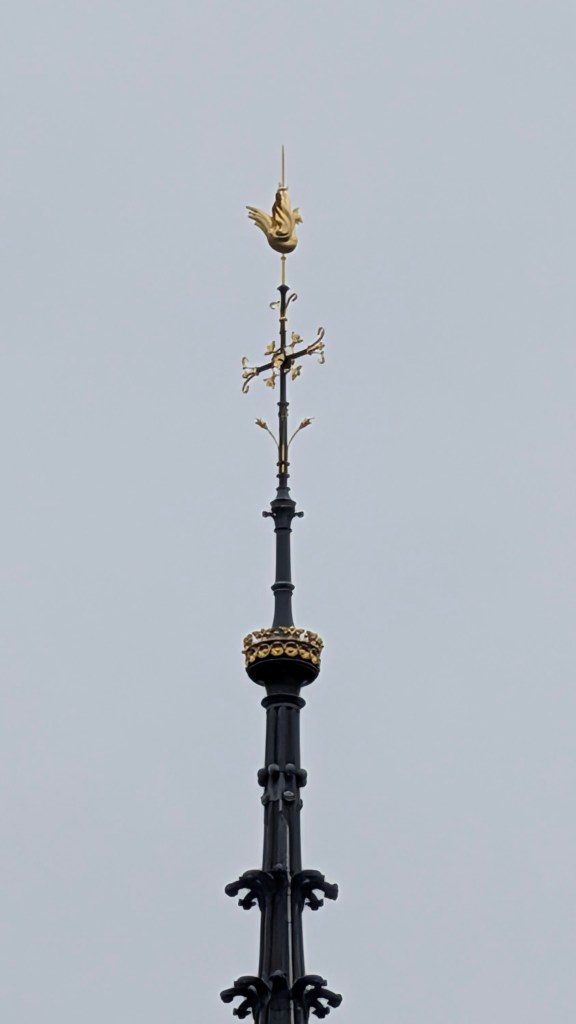
During the 2019 fire, the cathedral’s spire collapsed onto the roof, and the flying buttresses threatened to collapse, threatening the entire building. The iconic spire has been completely rebuilt following its destruction in the 2019 fire and was officially unveiled in February 2024. The new spire is an exact, 315-foot replica of the 19th-century design by architect Eugene Viollet-le-Duc. The 16 copper statues of the apostles and evangelists that adorned the spire’s base were miraculously removed for restoration just days before the 2019 fire. They were restored and returned to their positions on the new spire in mid-2025.

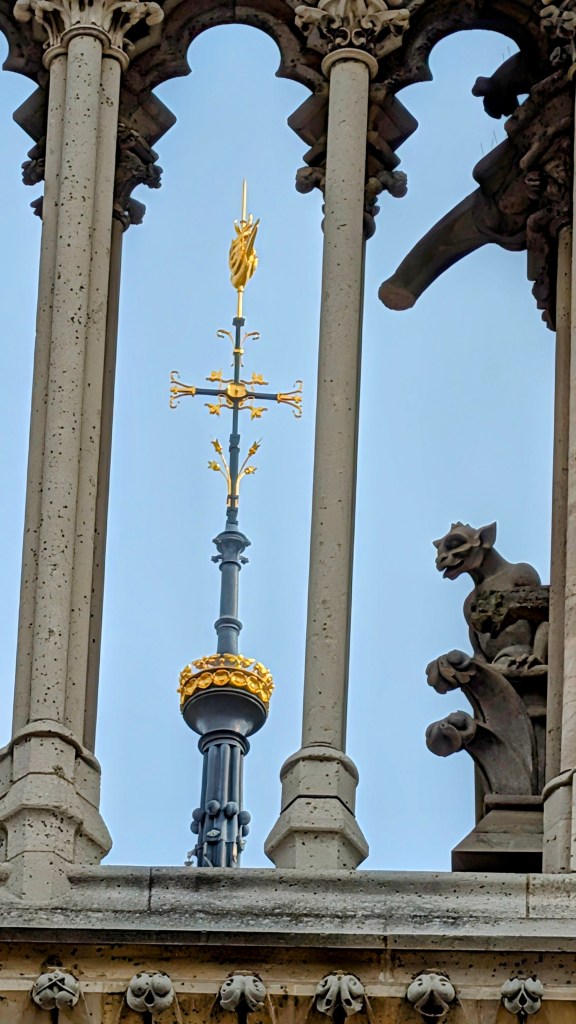
A new golden rooster weathervane, designed by chief architect Philippe Villeneuve, sits atop the spire. The original rooster survived the fire and has since been restored. The original rooster is now being displayed at the Cité de l’architecture et du patrimoine. It is currently featured as a centerpiece in the permanent exhibition titled ‘Notre-Dame de Paris, from builders to restorers’. The new rooster contains relics, including fragments of the Crown of Thorns, as a symbol of hope and resilience.

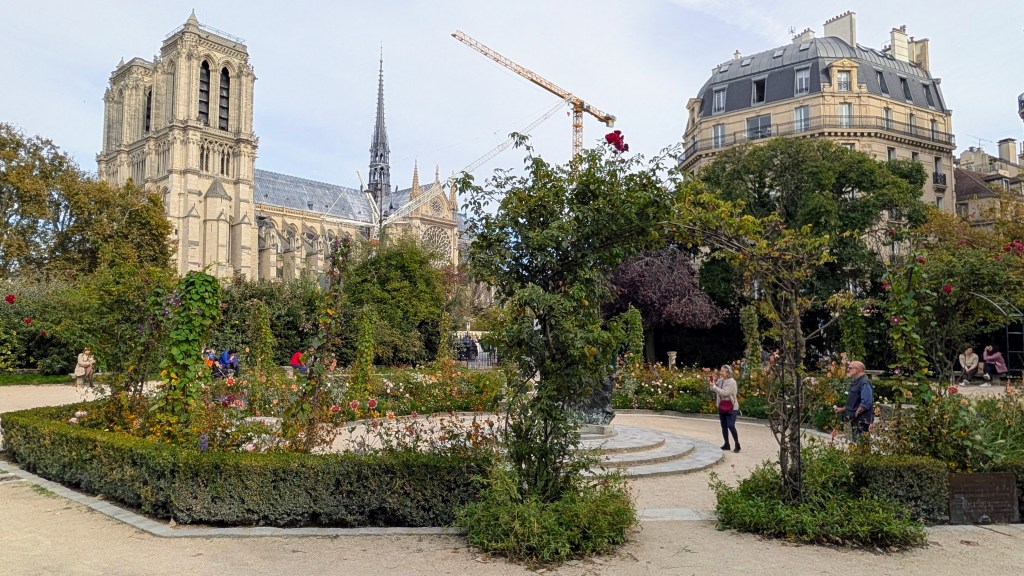
On our way back to our hotel, we passed through Square René Viviani, an intimate garden is located in the 5th arrondissement, directly across from the Seine River and Notre-Dame with a beautiful view of the cathedral.

Square René Viviani

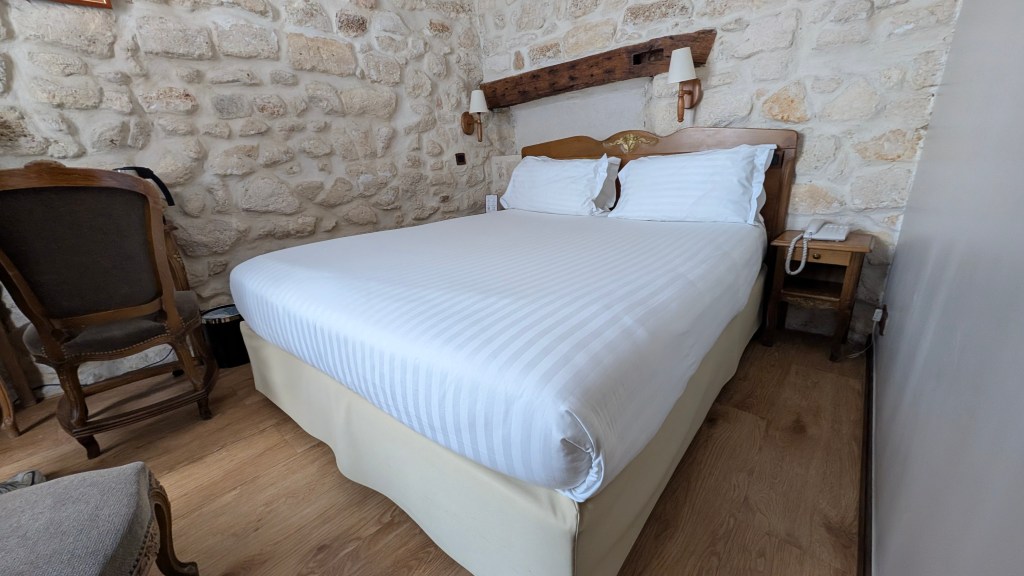
It was finally time to actually check in to our room and have a bit of a rest. The Europe St. Severin is extremely well located and very cute and clean,

Hotel Europe St. Severin

but the room was one of the tiniest into which we have ever squeezed.

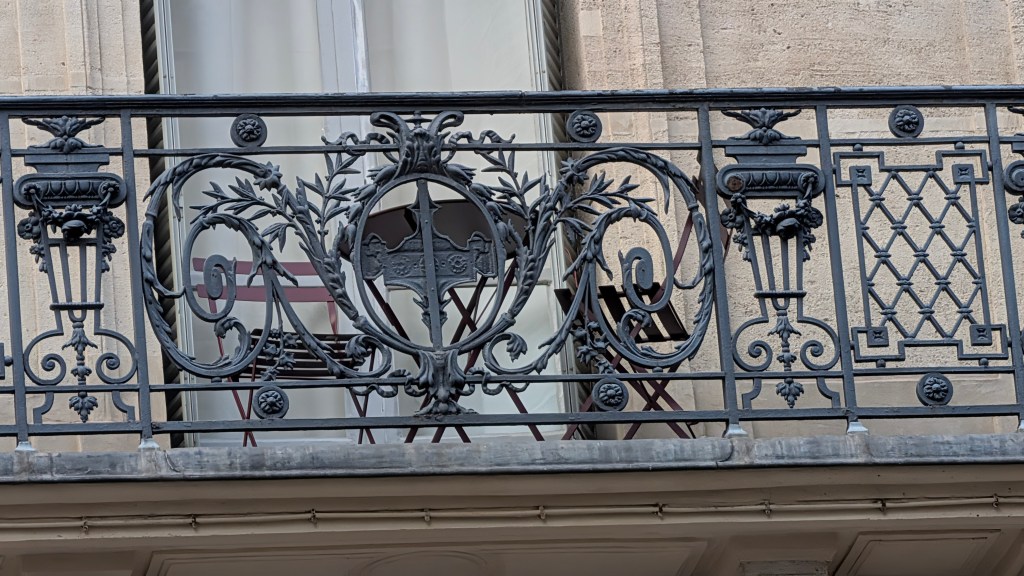
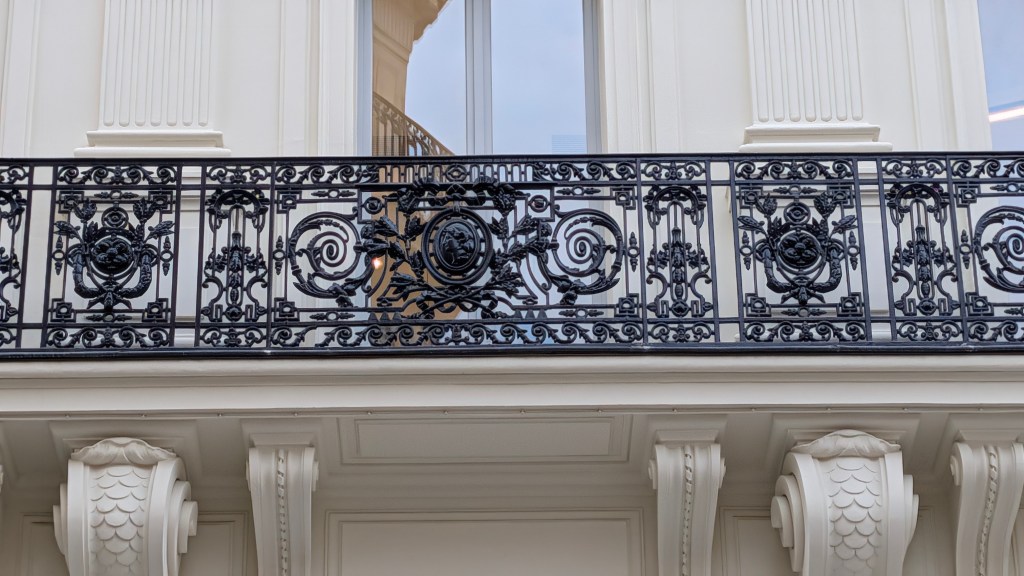
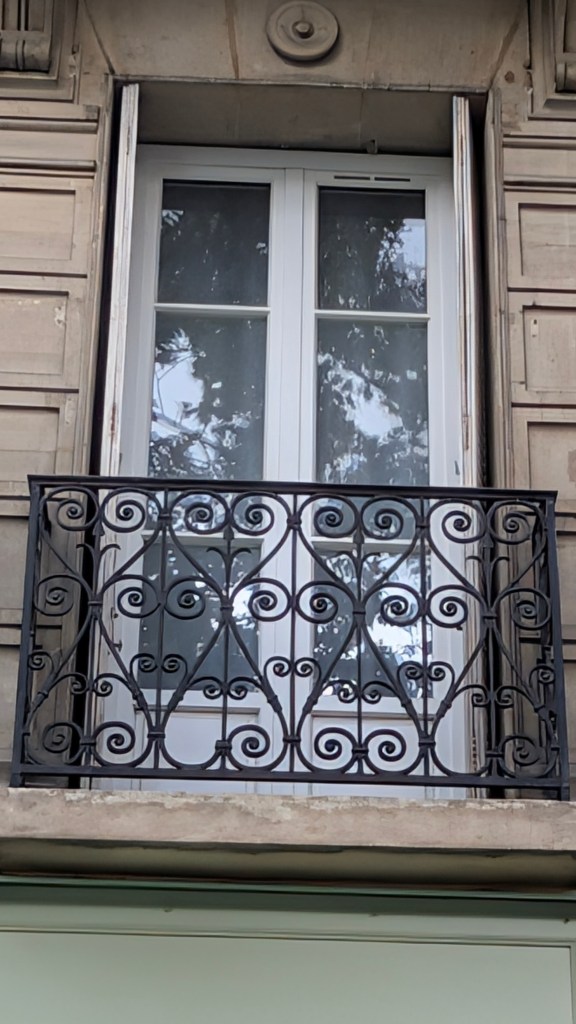
After a well deserved rest we set out for dinner. We caught a cab and arrived early, so we strolled around a bit. What really caught my eye were the many sizes, shapes, and forms of the Parisian wrought iron balconies from the quite ornate

and intricate

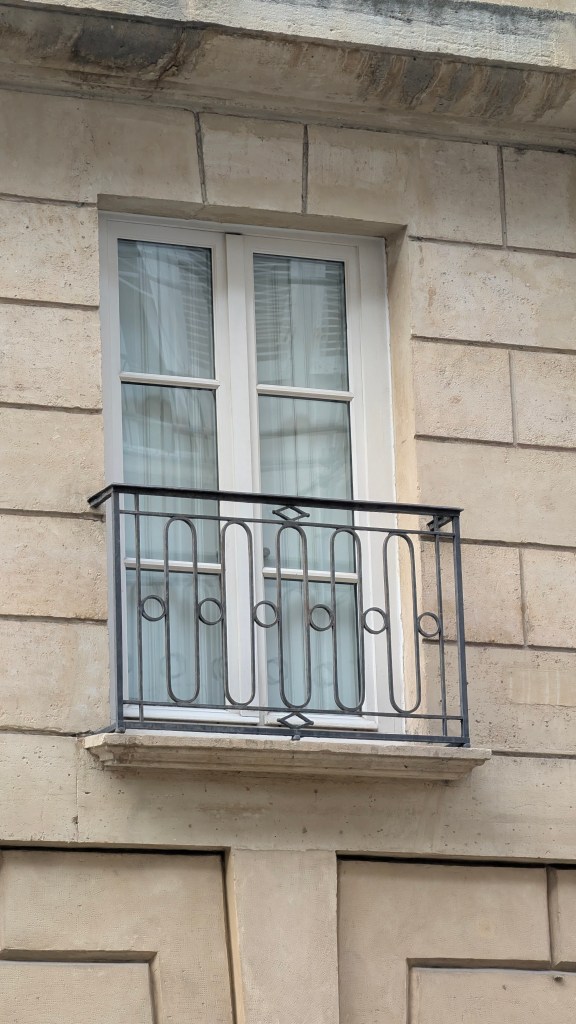
to the simple

and the very simple

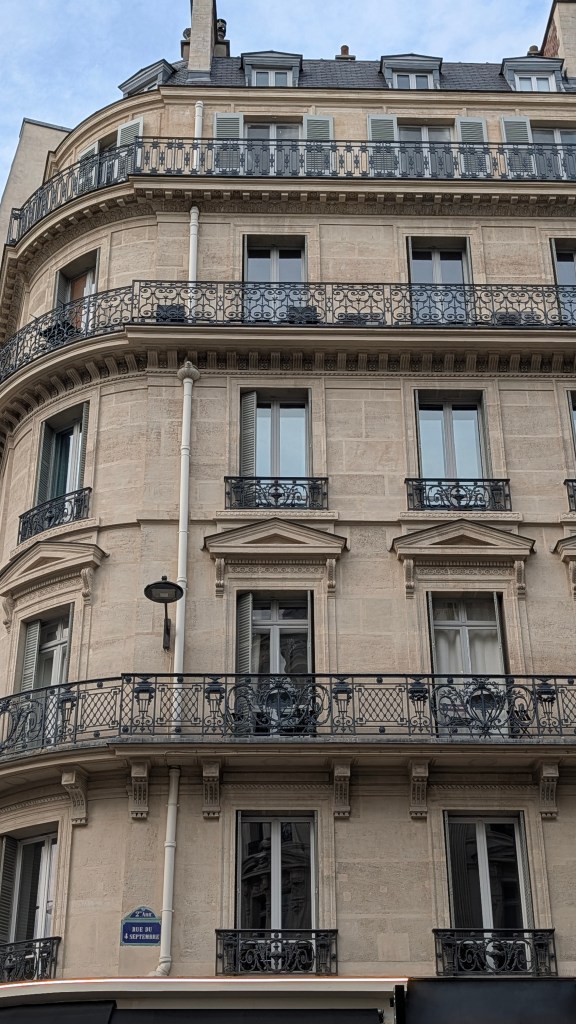
and even different ones on different levels of the same building, but more on that later.

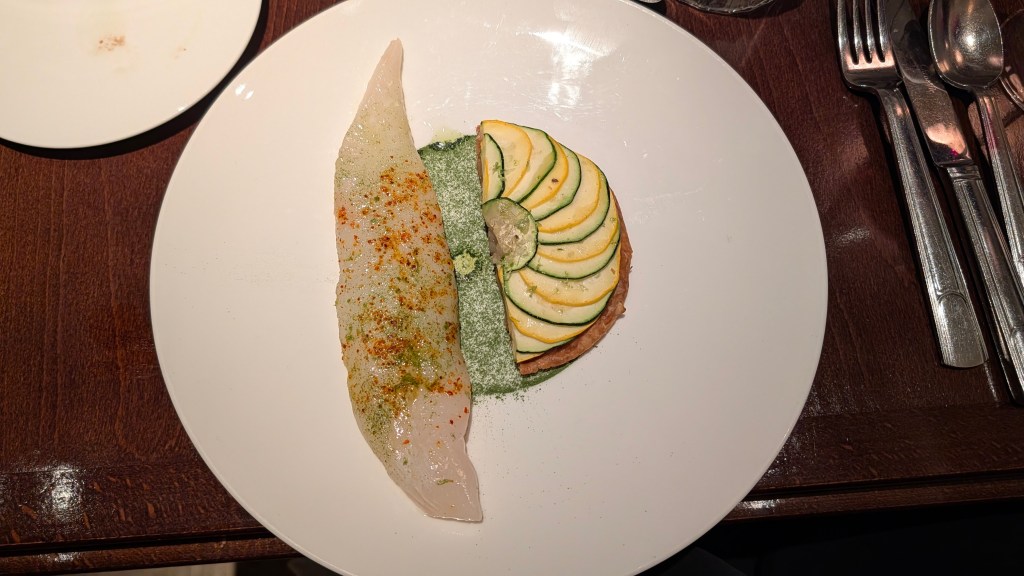
After a most delicious and filling and beautifully presented dinner at Drouant,

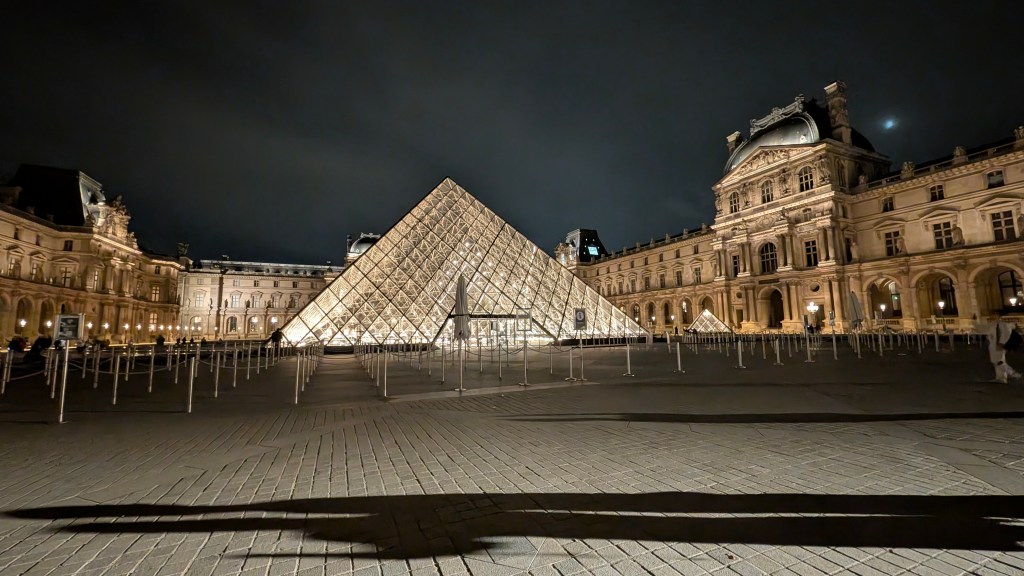
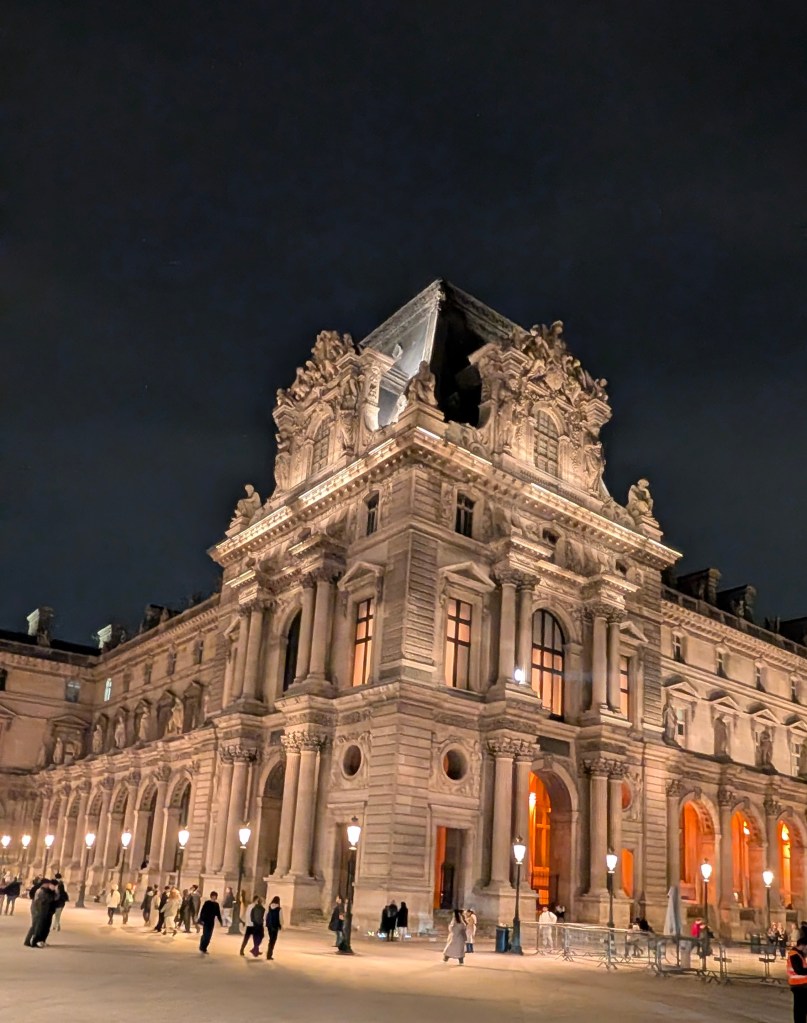
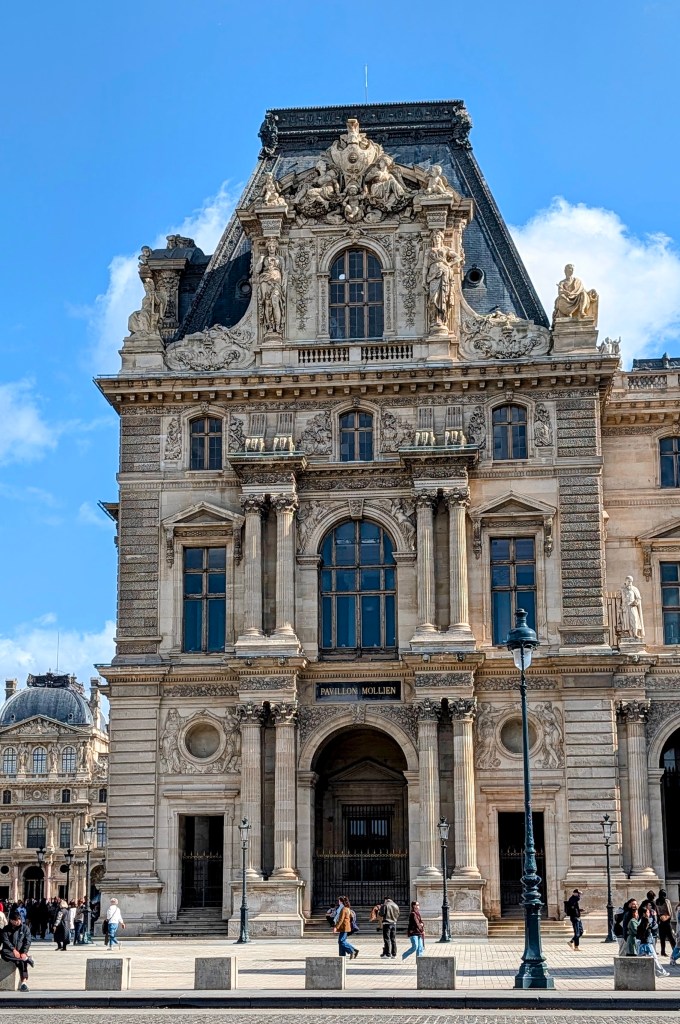
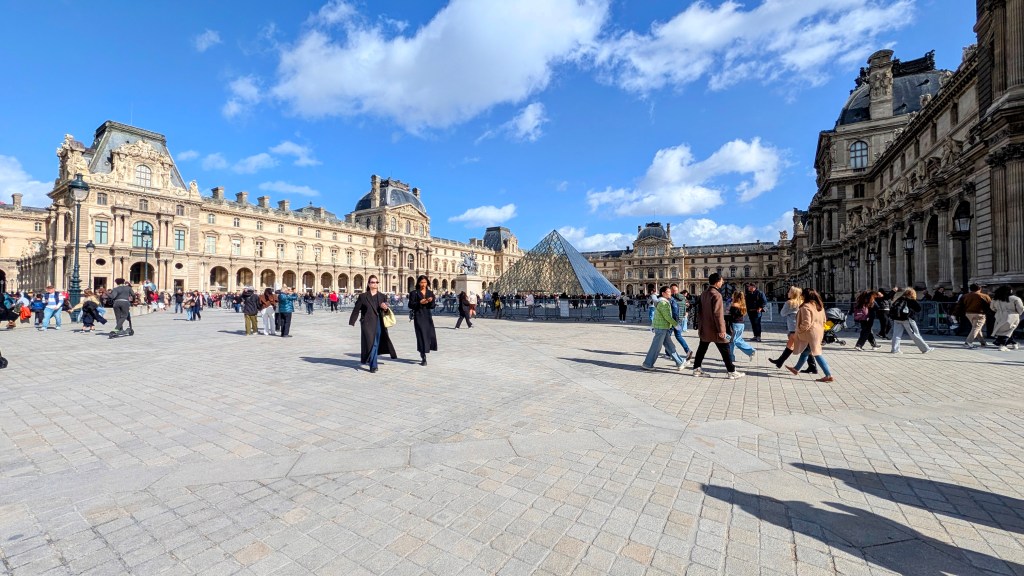
we decided to walk back; after all, what is more romantic than Paris at night? And she did not disappoint. We first passed the Louvre, which was eerily quiet without the throngs of pedestrians. This, of course, was two weeks before the jewel heist at the Louvre. The glass structure in the center is the Louvre Pyramid, a modern addition designed by architect I.M. Pei that serves as a main entrance, inaugurated in 1989. 

Louvre Pyramid

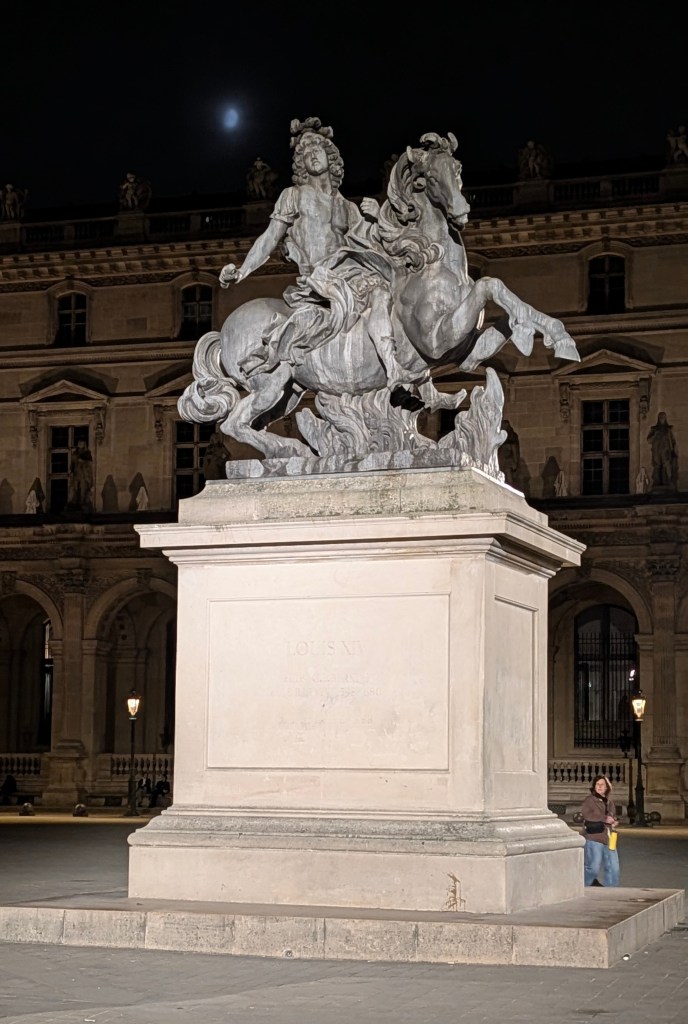
In the Louvre plaza the equestrian statue of King Louis XIV can be found. This statue is a lead copy of the original marble sculpture created by the Italian artist Gian Lorenzo Bernini, which is now housed inside the Louvre Museum. The sculpture depicts the king in the guise of an ancient Roman emperor, associated with figures like Hercules, to project an image of power and a conquering hero. The original statue was commissioned by Louis XIV in 1665 but was not well-received by the king and subsequently altered to depict the Roman hero Marcus Curtius. 

King Louis XIV

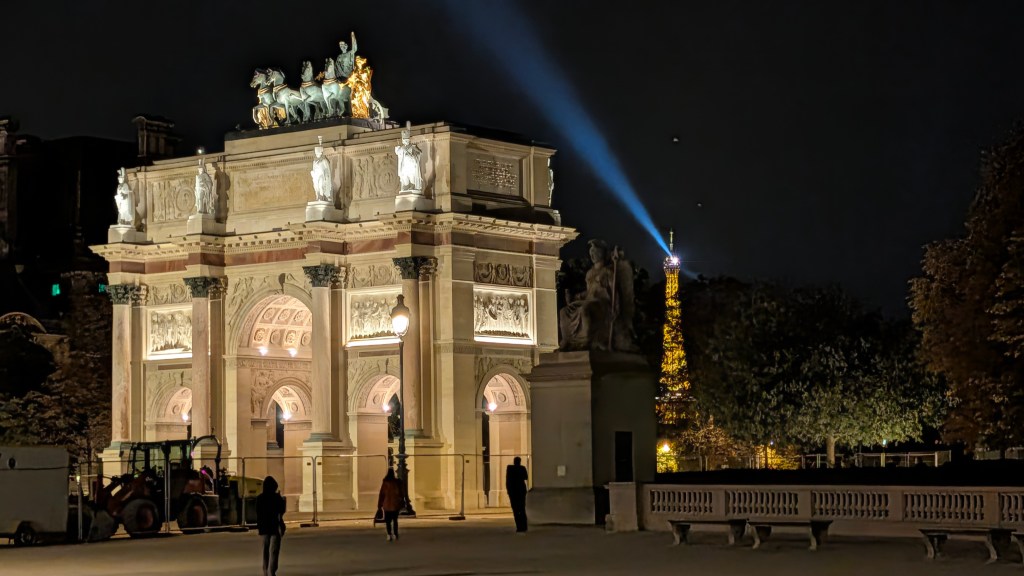
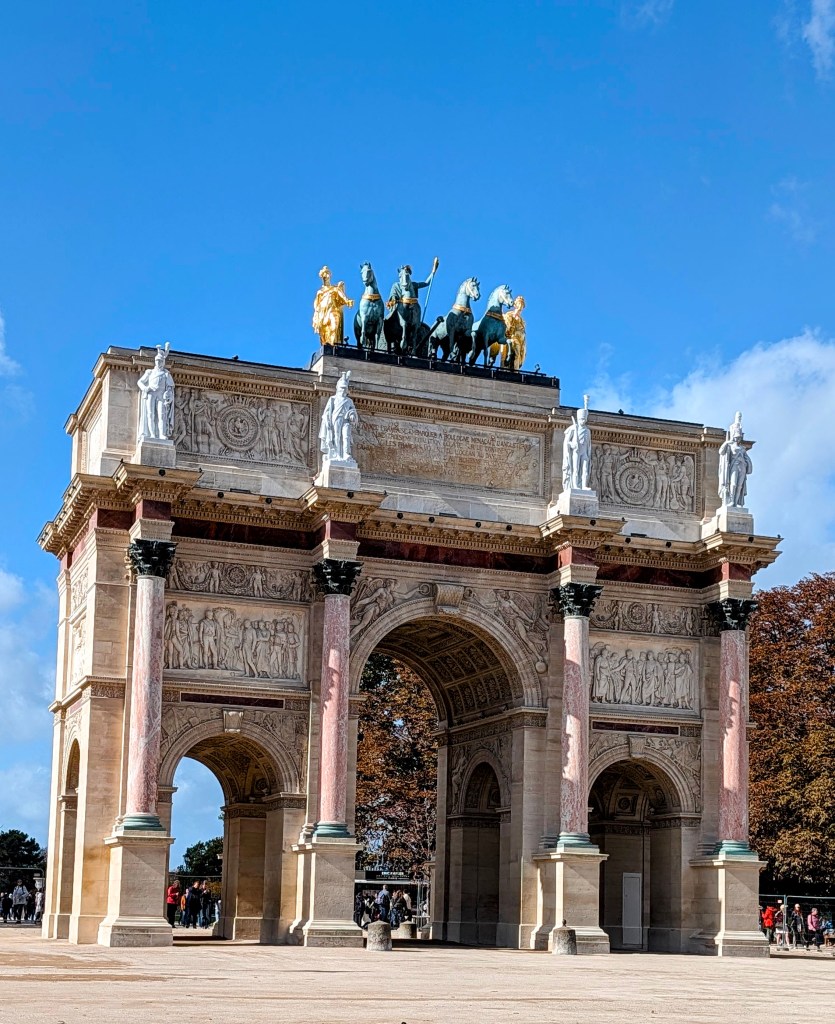
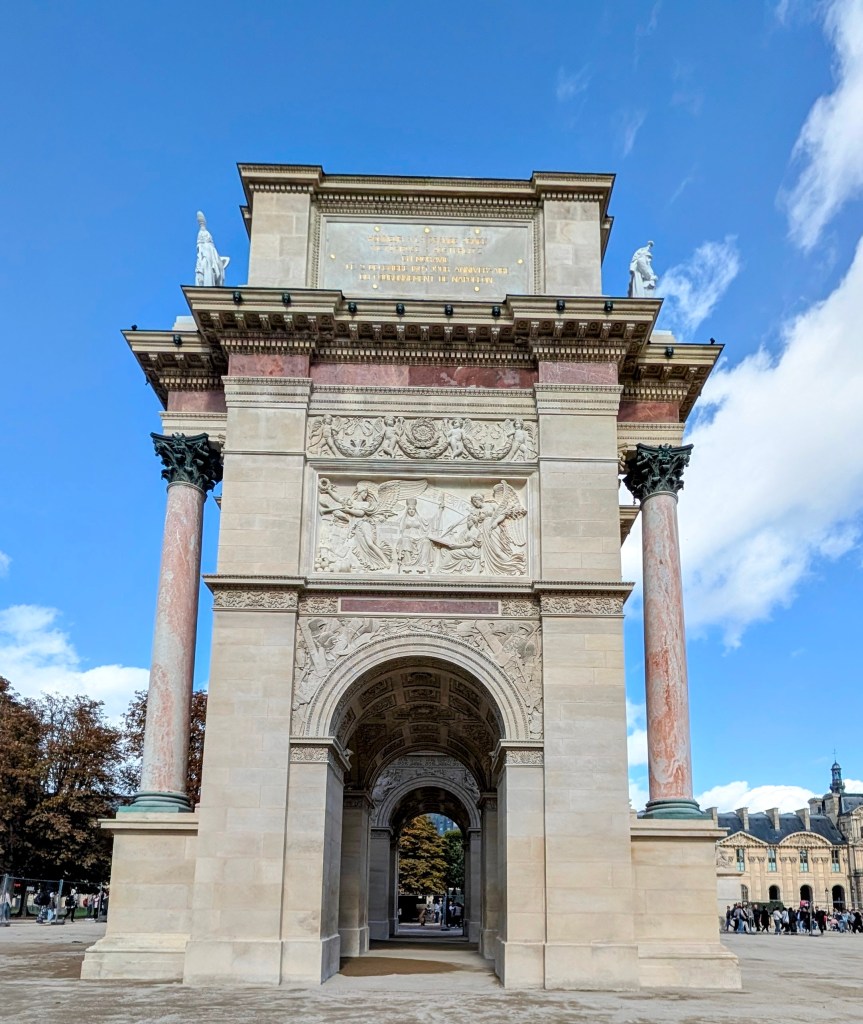
Standing across from the Louvre, in the Place du Carrousel, is the Arc de Triomphe du Carrousel, smaller than the more famous Arc de Triomphe de l’Étoile, which is located at the other end of the Champs-Élysées.  Arc de Triomphe du Carrousel was commissioned by Napoleon and built between 1806 and 1808 to celebrate his military victories was designed to be the grand entrance to the Tuileries Palace. The monument is part of the historical axis of Paris and is decorated with sculptures and a quadriga (chariot with four horses) at the top. The Eiffel Tower can be seen in the distance peeking from behind.

Arc de Triomphe du Carrousel

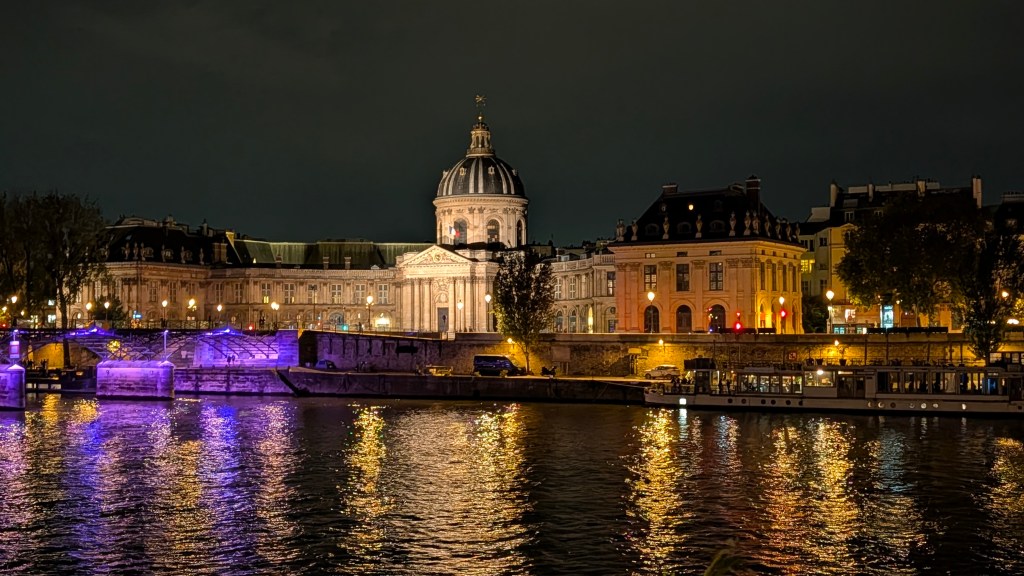
We reached the Seine where we had a view across from the Institut de France building, also magnificently lit at night. The building is the seat of the Académie Française (French Academy) and other academies that make up the Institut de France. The distinctive dome and neoclassical architecture are prominent features of the Parisian skyline. 

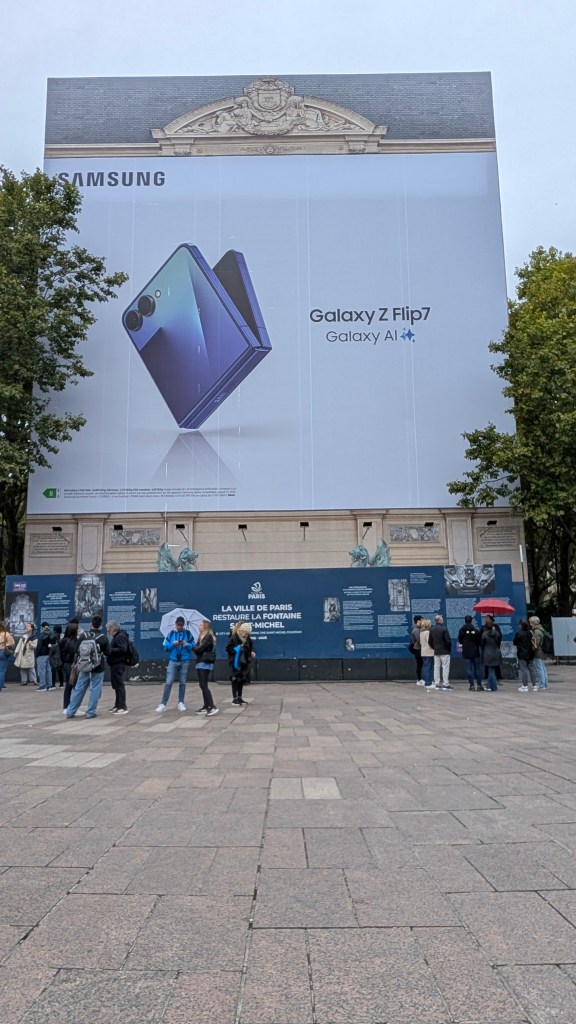
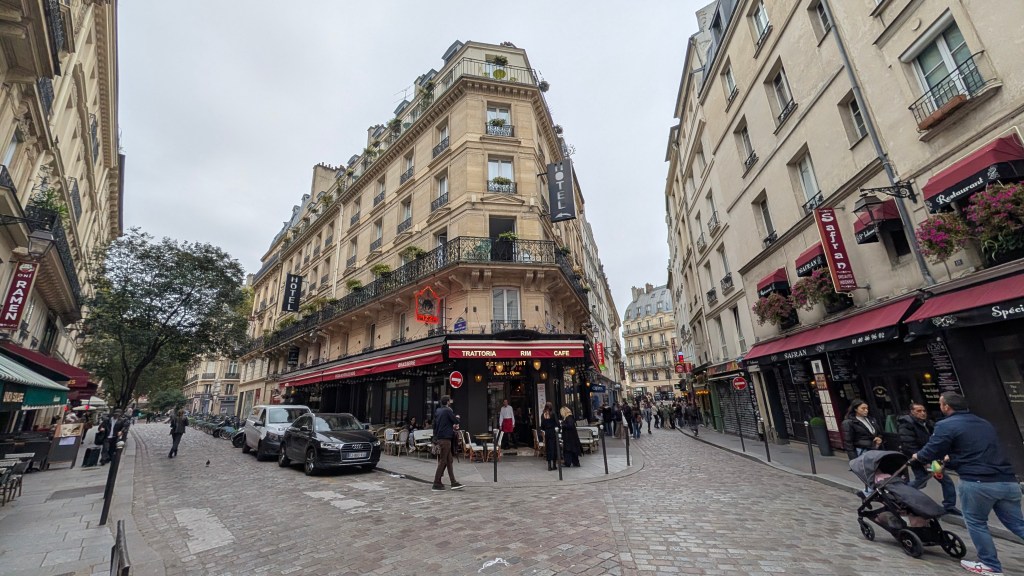
After breakfast at Europe St. Severin, we joined our walking tour of the Latin Quarter, the 5th arrondissement, and our home for the few days. We had been instructed to meet at the Saint Michel Fountain, which had been built in 1869 as a tribute to Saint Michel. But when we got there we found a billboard for Samsung. Sanna our guide for the morning, who originated in Finland, explained that the city of Paris requires all major construction to be covered by a billboard for aesthetics, but also for cost management. The cost of renovating the fountain is estimated at €2.3 million; the revenue generated from the ad: €5 million.

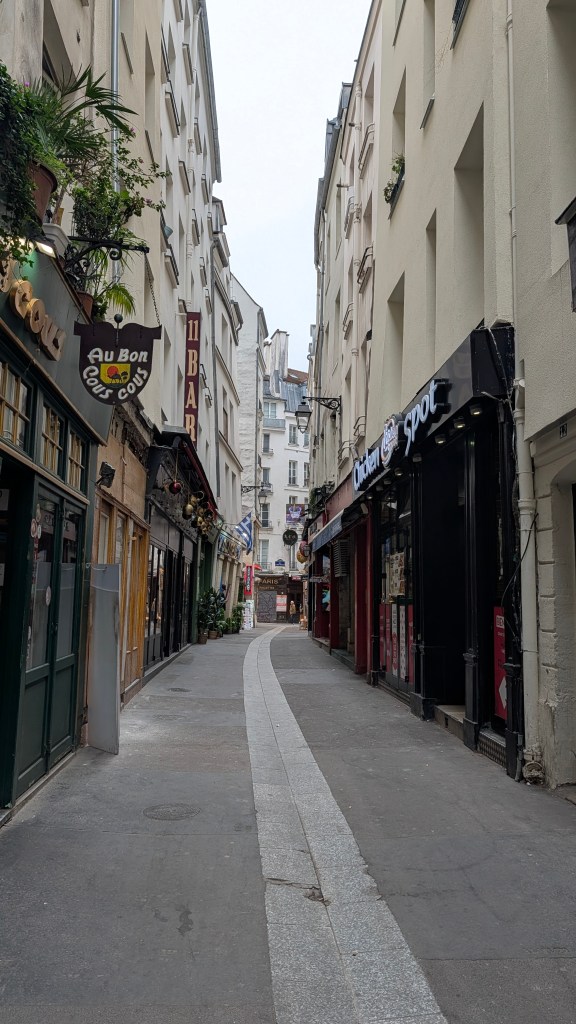
Sanna went on to explain to us that in the 1850s a grand-scale construction and urban renewal in Paris was led by Baron Georges-Eugène Haussmann, under the commission of Emperor Napoleon III. It was felt by Napoleon III that the walled medieval streets were too narrow for both carriages and pedestrians. The buildings prior to that time were often made of flammable woods. Also, there was so much excrement due to the emptying of chamber pots from windows, as there was no sewage at the time, and horses defecating in the streets, that high heels were needed to walk in the streets. This massive project, known as the Haussmanian renovation, involved demolishing large parts of the old city to create wide boulevards, parks, and new infrastructure, and the construction of new buildings in the Haussmanian style.  Napoleon III, nephew of Napoleon Bonaparte, also felt that the narrow medieval streets lent themselves to barricades, as were utilized during the revolution, and widening the streets would make barricades much less practicable. Here in the Latin Quarter, some of the older, narrower streets were left intact.

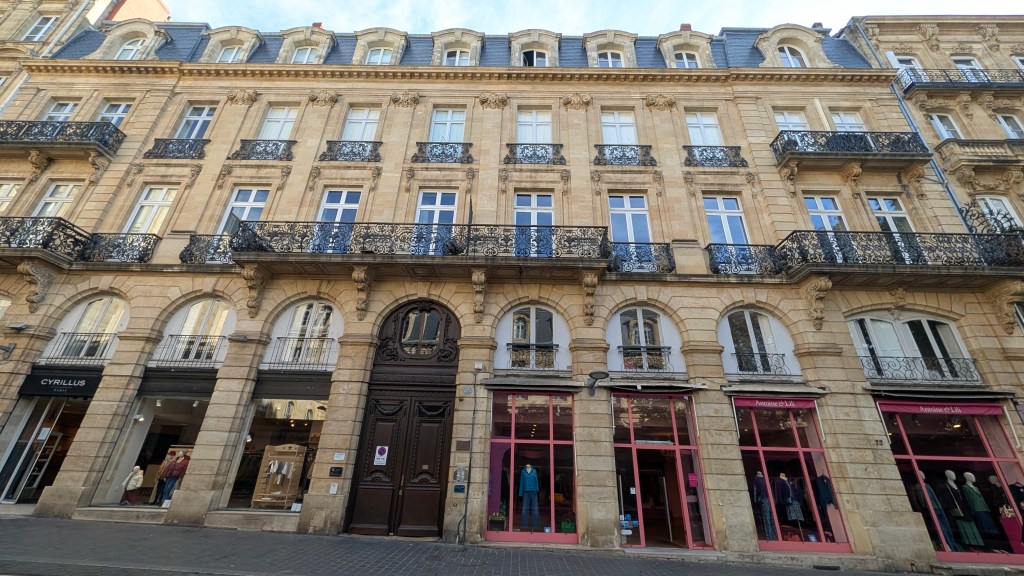
Haussmannian style is a distinctive architectural aesthetic characterized by uniform, stone-faced buildings with a height of 5 stories (absolutely none higher than 9 stories) with symmetrical ornate façades, mansard roofs with dormer windows, specific street-width regulations, and a distinctive look of slanted zinc roofs and wrought-iron balconies. Cigarette balconies, ie those in front of windows with no space to walk out onto, are purely aesthetic. The typical building is commercial on the ground floor. The first floor is for the public or shared spaces of a wealthy family showcasing high ceilings and intricate balconies. The next level up is generally used privately by the family. The upper-most floors(s) were for the servants and staff. In the days prior to electricity, the upper floors had to be climbed via stairs and were generally more uncomfortably warm in the summer months. Sometimes (as in the building below) there is a floor between the commercial and residential spaces for the clerks of the business to perform their duties.

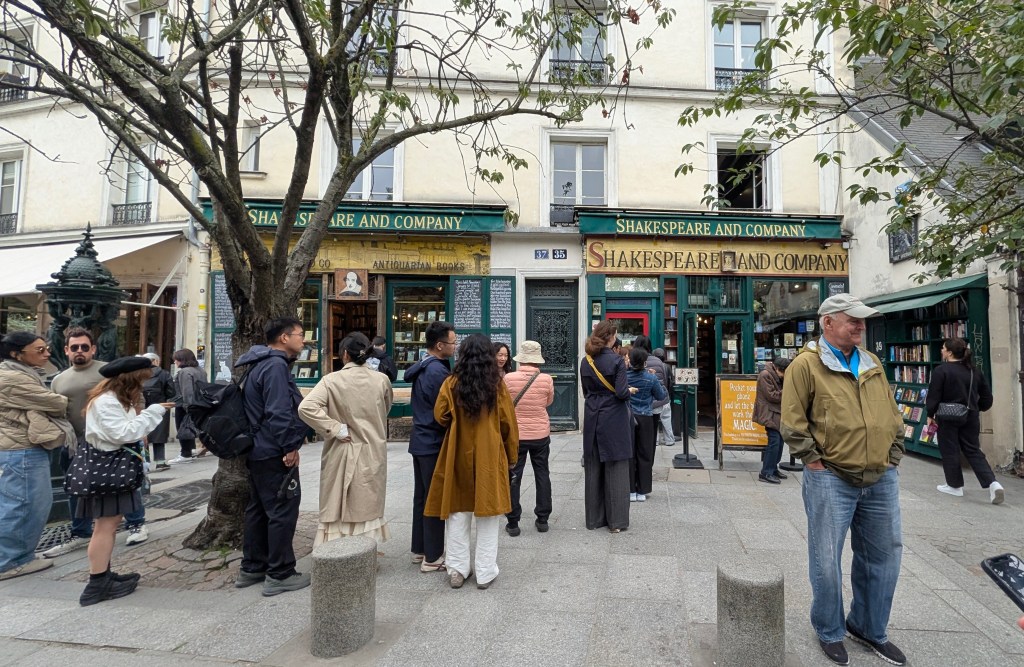
Sanna took us to see Shakespeare and Company, an English-language bookshop. The bookshop was founded by American George Whitman at 37 rue de la Bûcherie, Kilometer Zero, the point at which all French roads begin. Constructed in the early 17th century, the building was originally a monastery, La Maison du Mustier. Since opening in 1951, it’s been a meeting place for anglophone writers and readers, becoming a Left Bank literary institution. When the store first opened, it was called Le Mistral. George changed it to the present name in April 1964—on the four-hundredth anniversary of William Shakespeare’s birth—in honor of a bookseller he admired, Sylvia Beach, who’d founded the original Shakespeare and Company in 1919. Her store at 12 rue de l’Odéon was a gathering place for the great expat writers of the time—Joyce, Hemingway, Stein, Fitzgerald, Eliot, Pound—as well as for leading French writers. Beach ran a publishing house and allowed the artists to live upstairs. Beach published Ulysses by James Joyce there. Because of its political influence, the original store had been forced to close by the Nazis during WWII. George Whitman endeavored to carry on the spirit of Beach’s shop, and it quickly became a center for expat literary life in Paris. Allen Ginsberg, William Burroughs, Anaïs Nin, Richard Wright, William Styron, Julio Cortázar, Henry Miller, William Saroyan, Lawrence Durrell, James Jones, and James Baldwin were among early visitors to the shop.

Shakespeare and Company

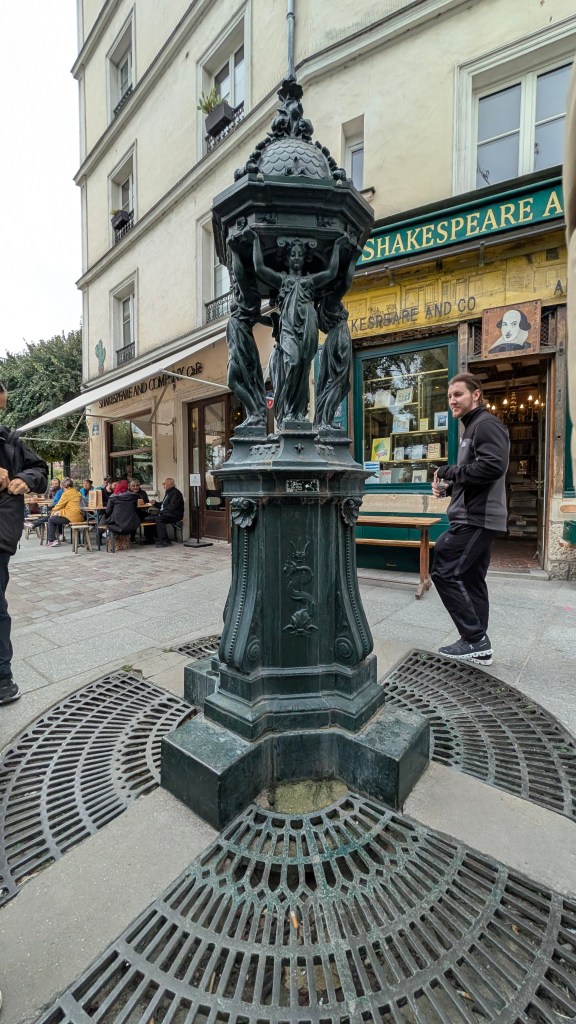
The green fountain in front of Shakespeare and Company is a Wallace fountain, one of several public drinking fountains named after, financed by, and roughly designed by Sir Richard Wallace (1818–1890), an English francophile philanthropist. At the time most of the poor had to pay for water. Moreover, most of the water provided by vendors was drawn from the Seine river and was likely to be dirty, as run-off from streets and many of sewers drained into it. Hence it was safer to drink beer or other alcoholic beverages, which were almost as cheap as water. The temptation to take to liquor was strong among the lower classes, and it was considered a moral duty to keep them from falling into alcoholism. To this day, the fountains are a considerable source of free drinking water for the needy as well as any passer-by. Not only did the fountains accomplish Wallace’s philosophy of helping the needy, but they also beautified Paris.

Wallace fountain

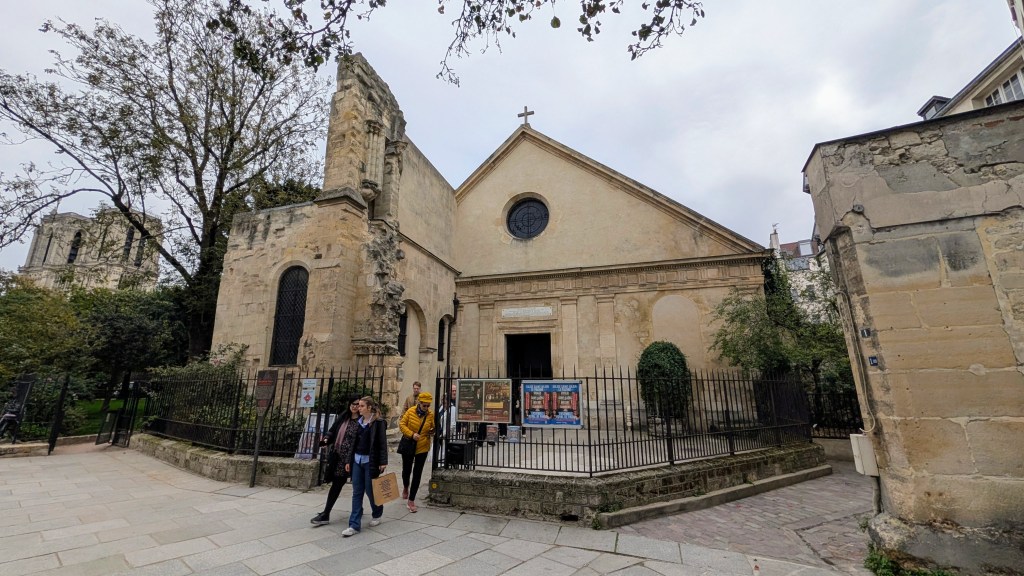
Église Saint-Julien-le-Pauvre (Church of Saint-Julien-le-Pauvre) is one of the oldest religious buildings in Paris, with construction on the current structure beginning in 1163. Saint Julien was the patron saint of hospitals and travelers. This site in the Latin Quarter was chosen in the 12th century because it was the intellectual center of Paris at the time. Originally a Roman Catholic church, it was assigned to the Melkite Greek Catholic community in 1889 and serves as their parish church. The building blends Romanesque and early Gothic architectural styles. 

Église Saint-Julien-le-Pauvre (Church of Saint-Julien-le-Pauvre)

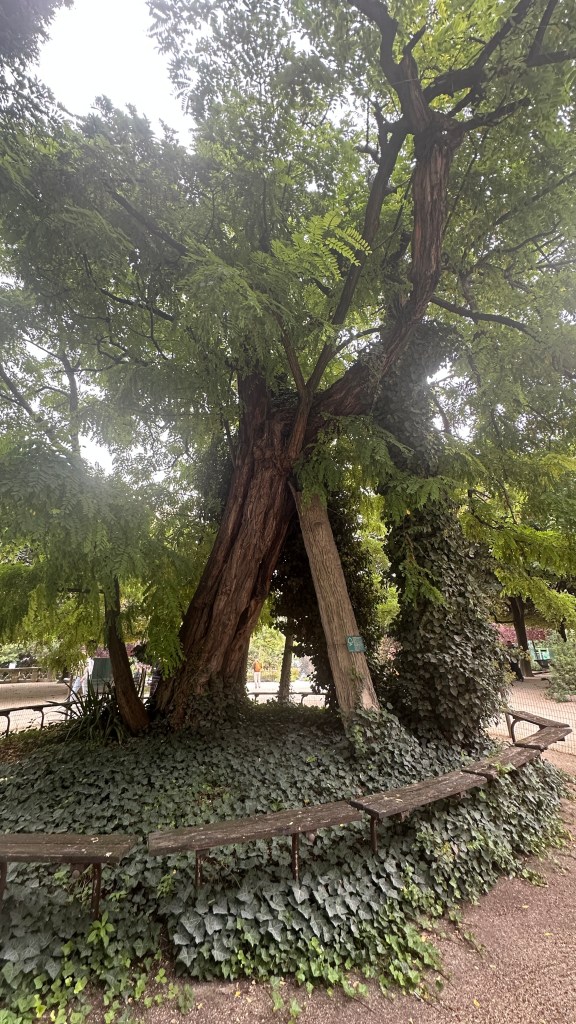
We revisited the Square René Viviani in which stands the oldest tree in the city: “false acacia,” which is a black locust tree brought back from North America and planted in 1601 by royal botanist Jean Robin and is over 400 years old. Despite being damaged during World War I, it continues to bloom annually and is a popular landmark which has become a symbol of the city and a testament to its longevity and resilience. One who touches it is said to have good luck for the remainder of the day.

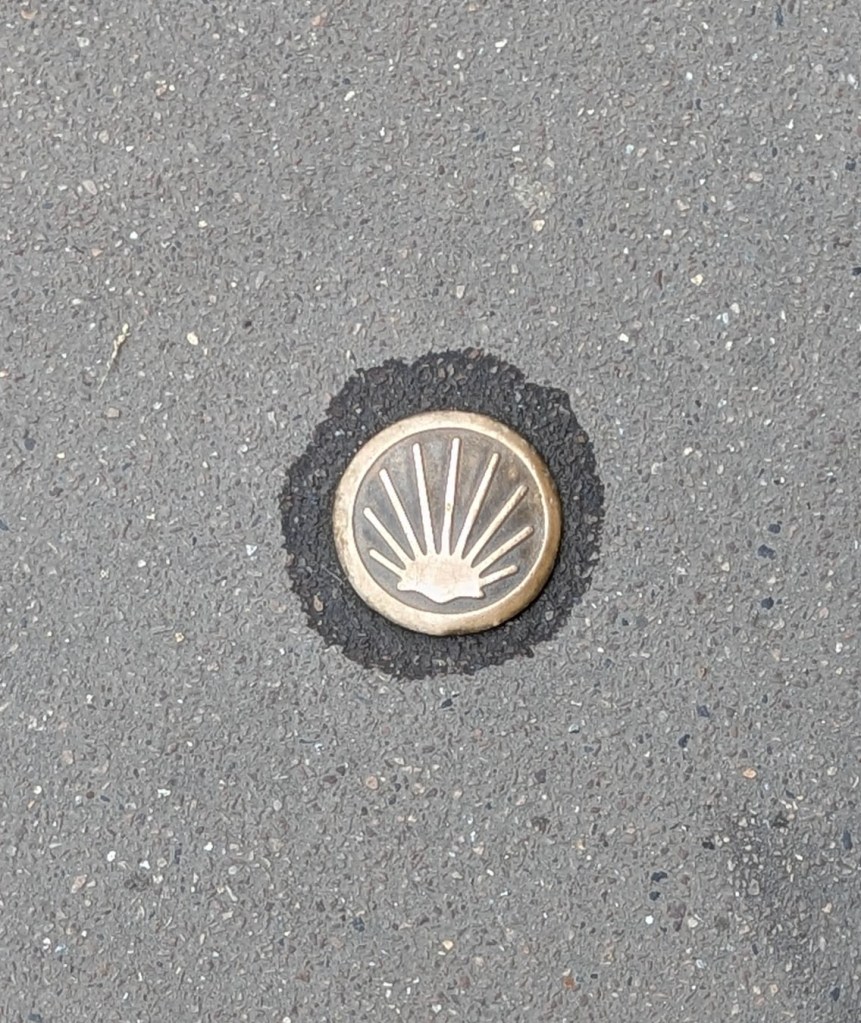
Sanna next led us to Rue Saint Jacques (St. James Street) and explained that this is a route along the famous pilgrimage Camino del Santiago (St. James in Spanish, home to the Santiago Cathedral) as evident by the Camino scallop-shaped symbol embedded in the pavement.

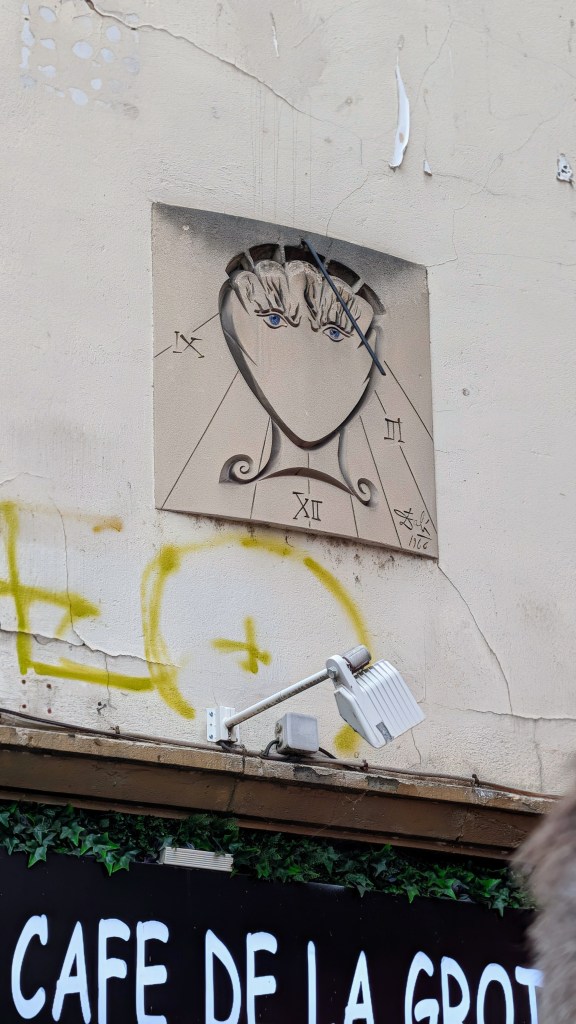
Above the street on the side of a building facing the scallop is a picture painted and gifted by Salvador Dali in 1966 as a homage to his motherland Spain: a sundial on a face in the shape of a scallop.

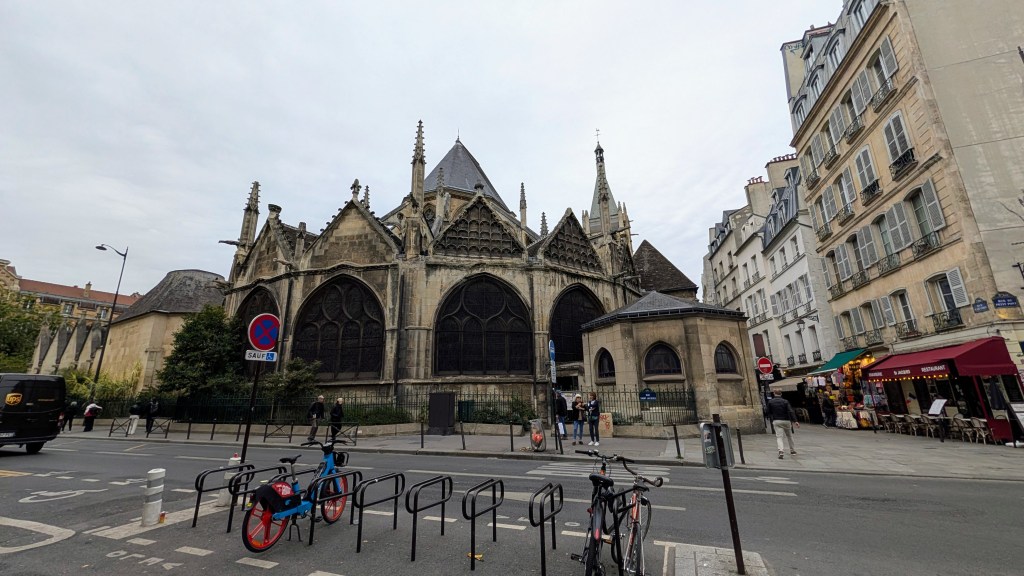
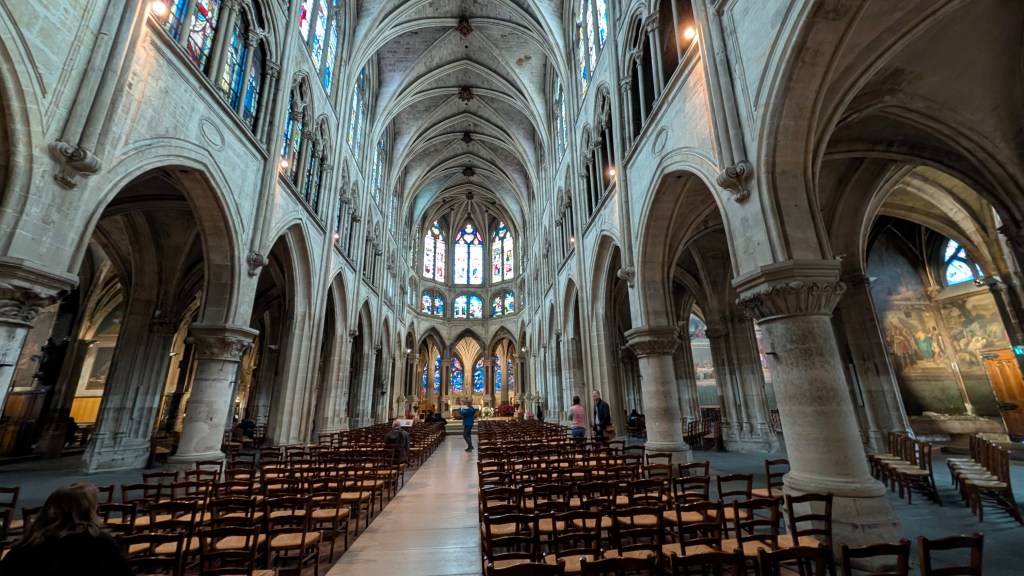
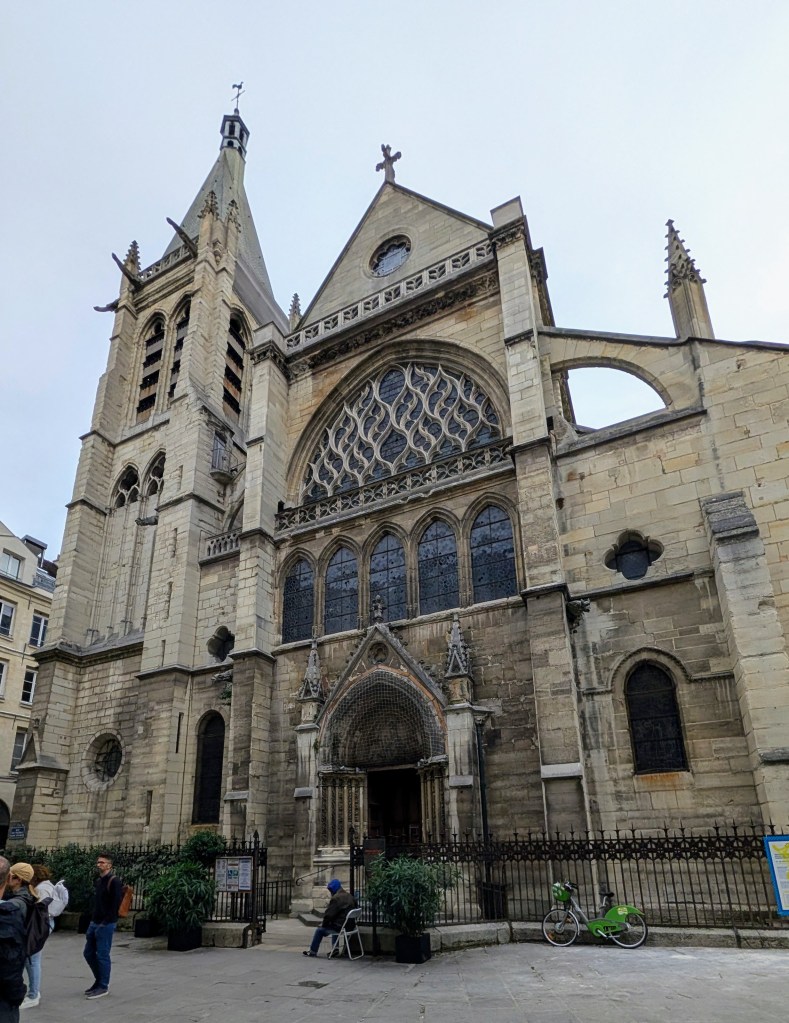
Across the avenue stands Église Saint-Séverin (the Church of Saint-Séverin), known for its Flamboyant Gothic architecture, with construction spanning the 13th to 15th centuries, beginning in 1230, then rebuilt and enlarged in the 17th century after a fire.

Église Saint-Séverin

The church took its name from Saint Séverin of Paris, a devout hermit who lived at the site in the 6th century, and died in about 540. At the end of the 12th century, due to the popularity and growing size of the theology school attached to the cathedral of Notre Dame de Paris, the students and teachers were relocated to the Left Bank. The University of Paris was founded in 1215. The fame of the university and its teachers attracted students and scholars from across Europe, and a larger church was required. Thus, beginning in a 1230 construction began on a new church and Saint Severin became the university’s parish church.

It features unique architectural elements, including a column sculpted in the form of a palm tree,

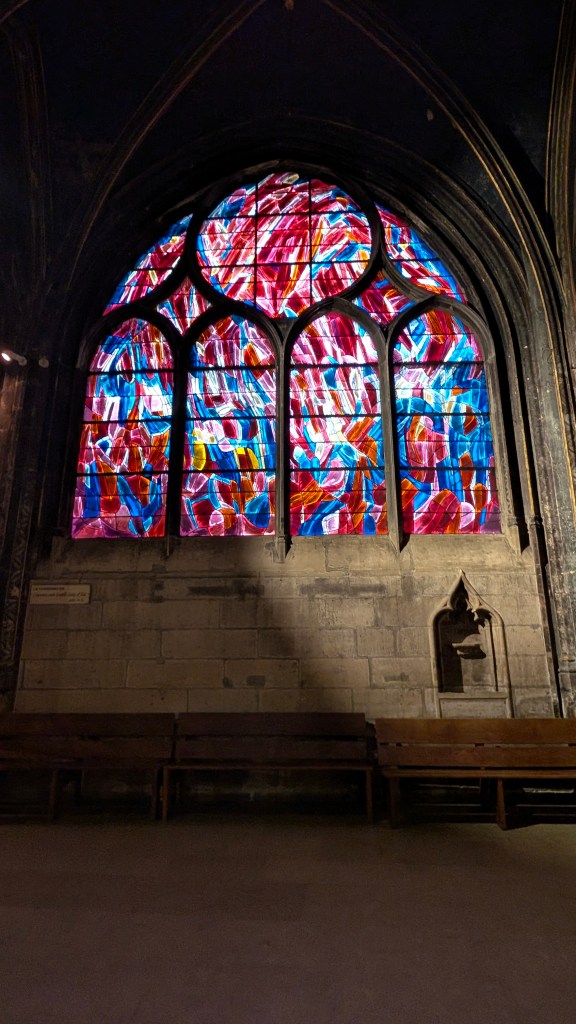
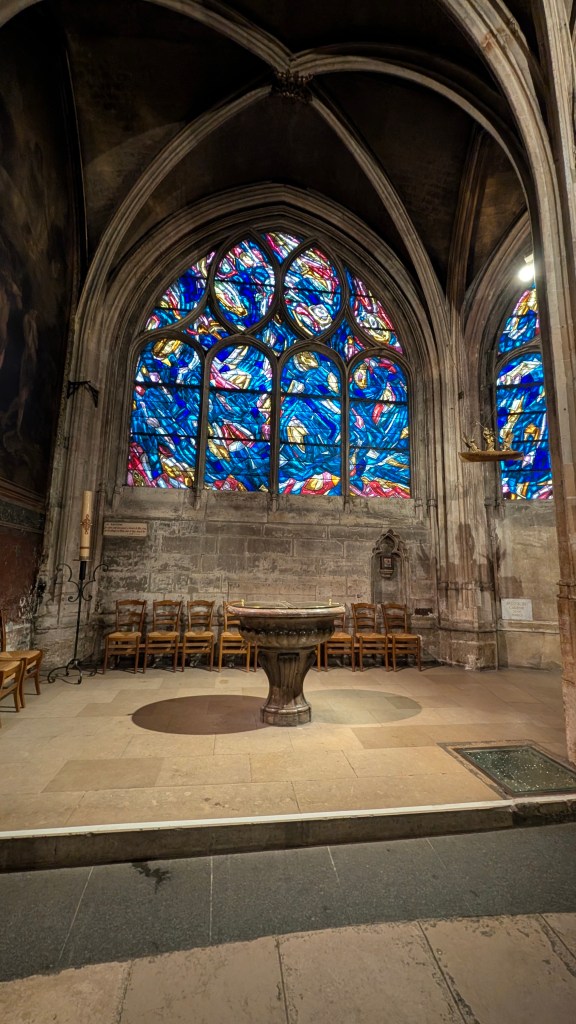
and notable historic stained glass windows some of which are from the 14th century

and some from the 1970s.

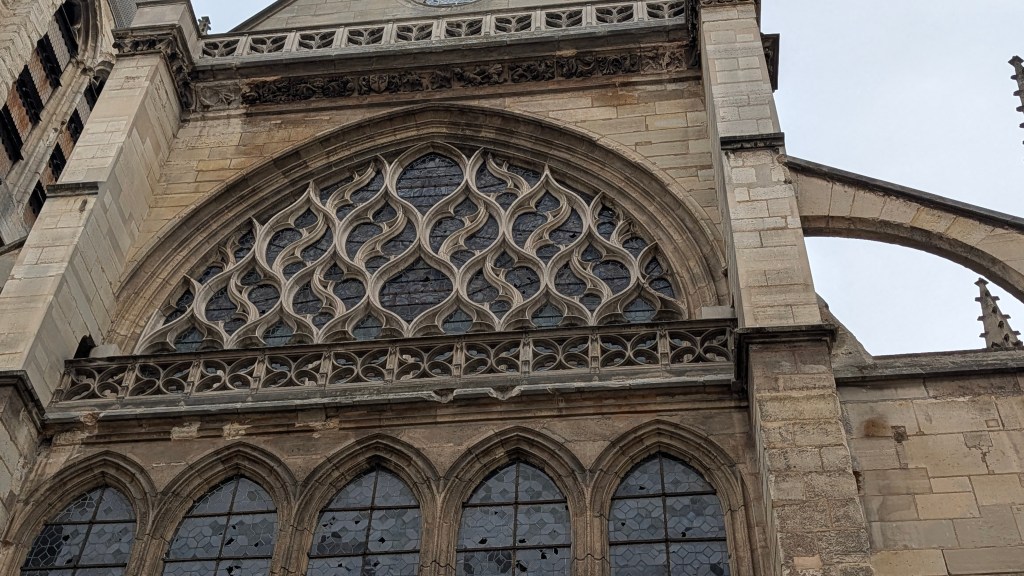
Flamboyant is a late Gothic style characterized by its highly ornate, flame-like window tracery and swirling, curvilinear designs, as can be seen on the outside of the stained glass window.

The curls actually take on the shape of flames.

As we stood outside the church Sanna told us that originally there had been a cemetery next to the church which had become so over crowded with bodies that local perfumeries and food shops complained of the odor. Louis XVII had the bodies removed, boiled down for candle wax, and then had the bones removed to the limestone quarries, which are now the catacombs of Paris.

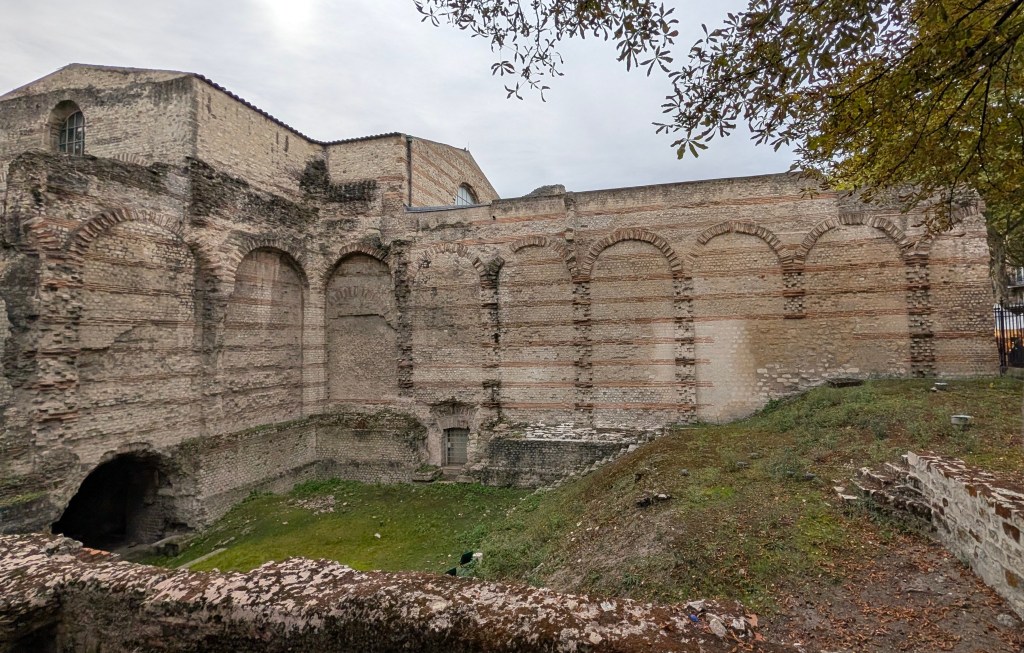
In Roman times France was called Gaul. The Romans defeated the local Parisii tribe in 52 BC under Julius Caesar’s command. After conquering the Gallic tribes and founding the Gallo-Roman city of Lutetia, the precursor to modern-day Paris, they established settlements on the left bank of the Seine, which would eventually become the Latin Quarter. The Romans remained for about 400 years, and the area was developed with Roman-style infrastructure. One of the many structures left by the romans are the baths. The entrance to the baths was underground. Over 16 miles of aqueducts were built to carry the water to the city. Wood fires were burned under the floors to heat the water for hot baths and steam rooms. There is a museum to visit the baths, but, having ourselves visited several in Spain, we just took a look from the outside.

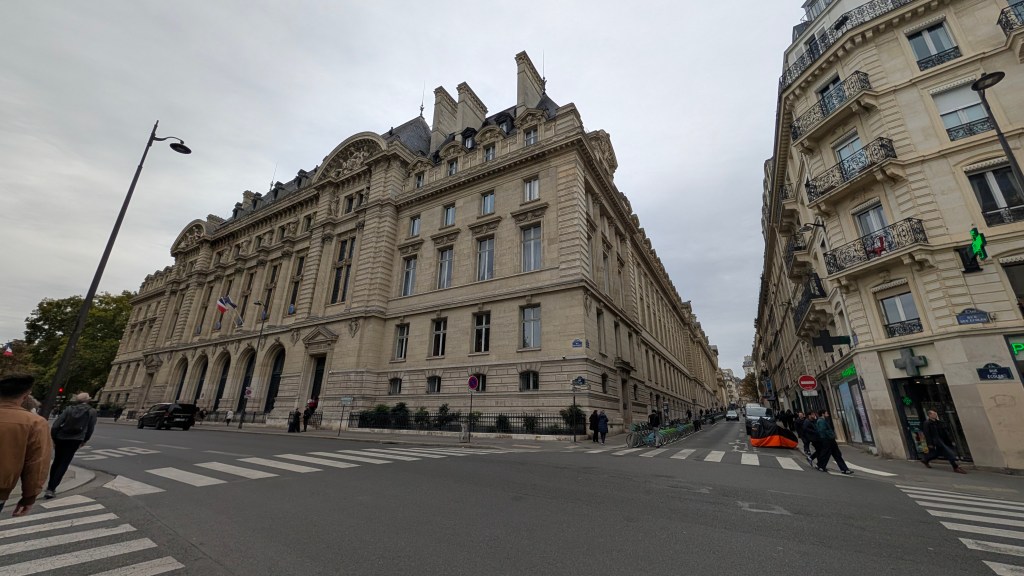
Sorbonne Université’s (Sorbonne University) legacy reaches back to the Middle Ages in 1257 when the College of Sorbonne was established as a constituent college of the University of Paris, one of the first universities in Europe. In 1971, the University of Paris, including its humanities and science faculties, split into several interdisciplinary universities. Some, including the University of Paris-Sorbonne, retained the name Sorbonne and premises in the historic centre of the University of Paris. The Sorbonne is one of the most famous and sought after universities in Europe. Marie Curie was its first female professor after her husband was killed in a horse and carriage accident. Historically the students at the Sorbonne speak Latin, giving the quarter its name.

Sorbonne Université’s (Sorbonne University)

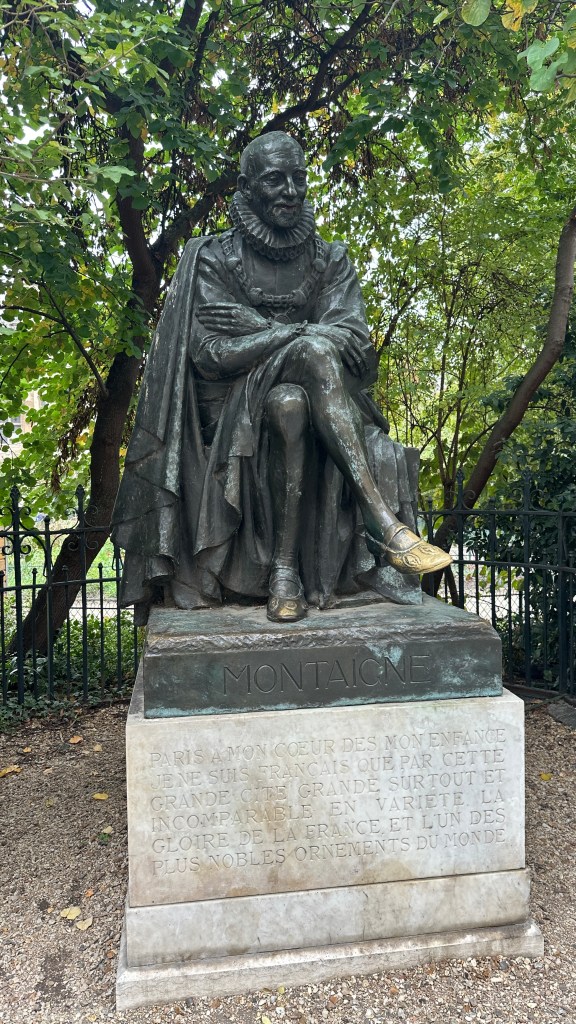
A bronze statue of the 16th-century Renaissance author and philosopher Michel de Montaigne, who invented essay-style writing is located in the Sorbonne quarter. It is popular for students to rub his right foot for good luck before exams.

Michel de Montaigne

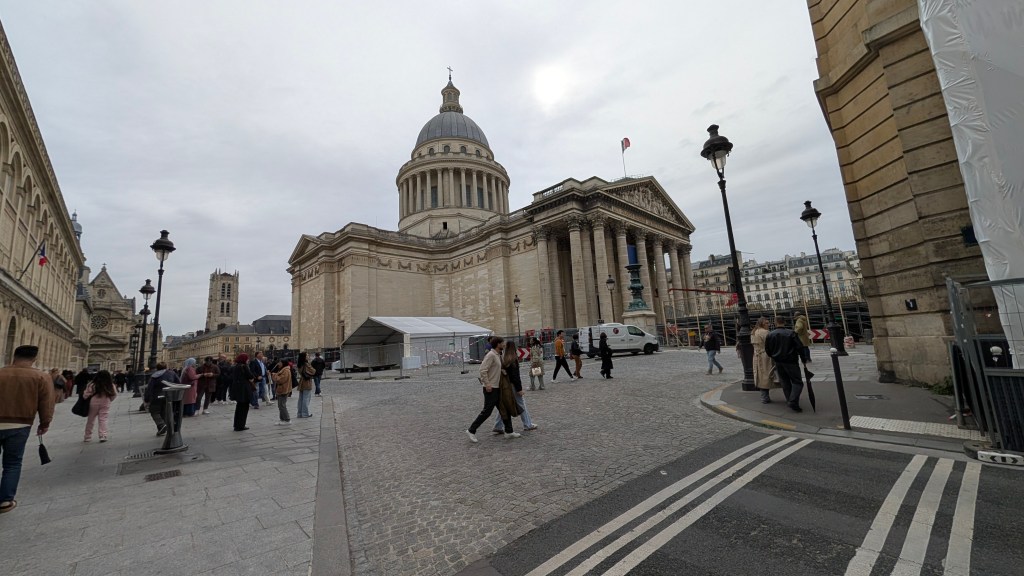
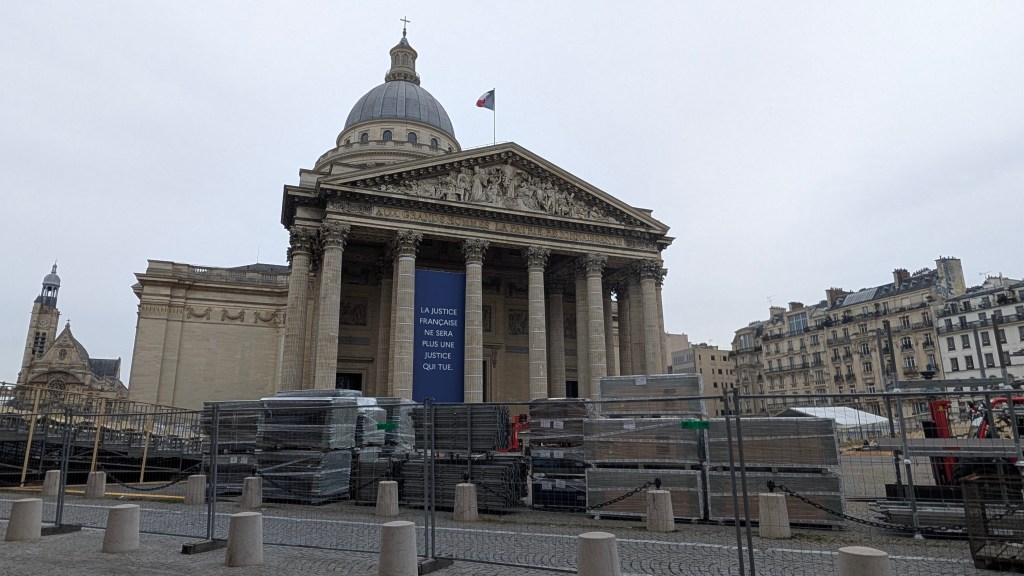
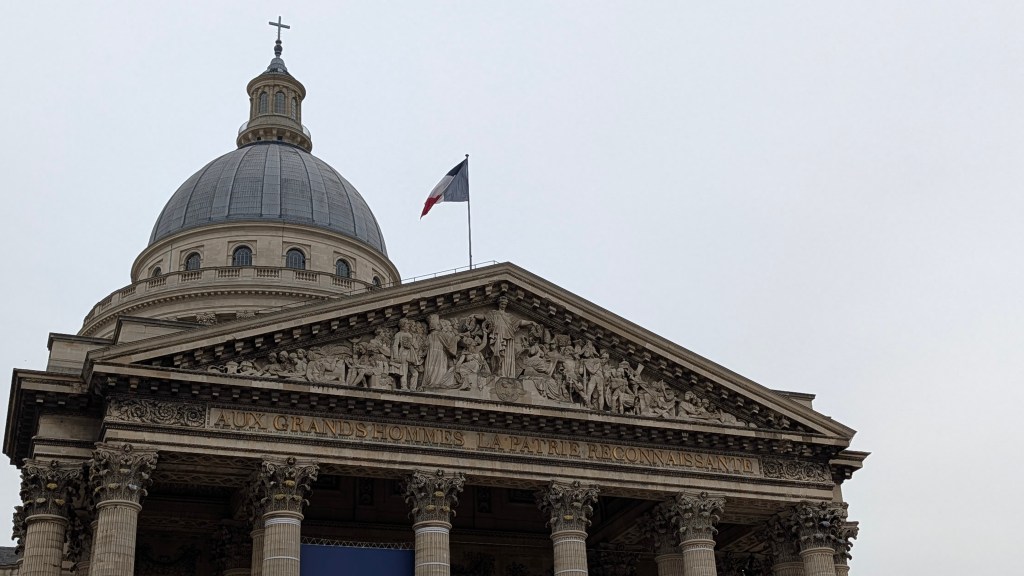
Pantheon means all gods in Greek. The edifice in the Latin Quarter of Paris was built between 1758 and 1790 at the behest of King Louis XV, who intended it as a church dedicated to Saint Genevieve, Paris’s patron saint, whose relics were to be housed in the church but Louis XV died before its completion. Construction was completed in 1790, a year after the Revolution, at which time France was against religion. The Pantheon was turned into a mausoleum and now contains the bodies of many famous Parisians including Marie Curie, who with her husband Pierre, in 1903 was the first woman to win the Nobel prize. When Pierre was run over by a horse and carriage, his bones were so brittle from radiation exposure that he had too many broken ones to repair. Also buried within are writers Alexander Dumas and Victor Hugo. The mausoleum is also the final resting place for Voltaire and Rousseau, philosophers who had apposing ideas about whether men are born with evil. In 2021 Emmanuel Macron interred Josephine Baker, an American-born French dancer, singer, and actress, here due to her aid during World War II.

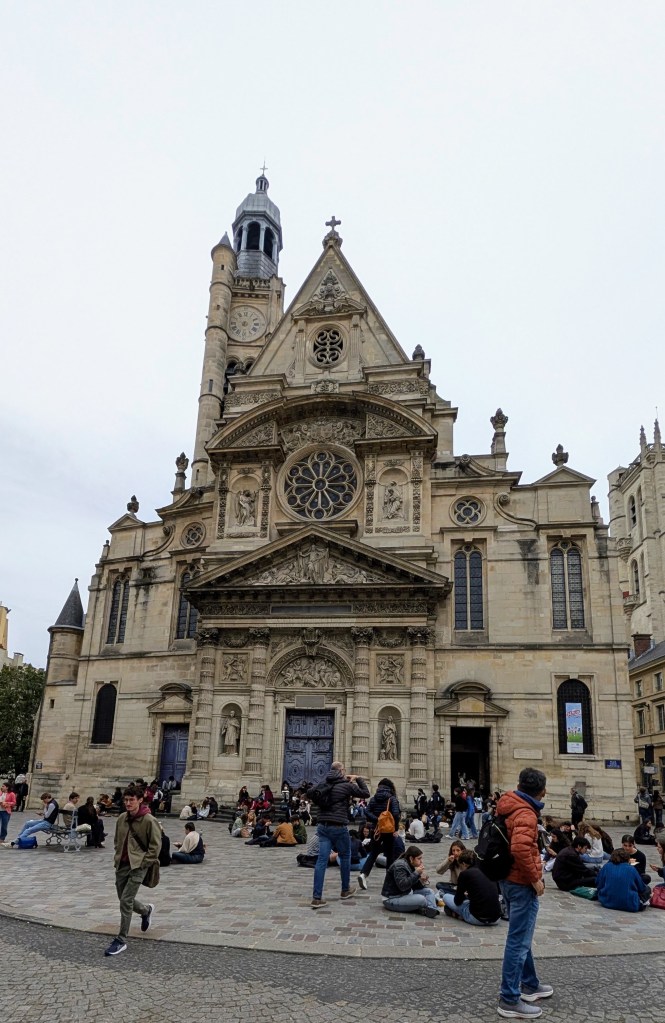
We crossed the street to visit Saint-Étienne-du-Mont Church. Its construction was begun in 1492 but was not completed until the 1862 resulting in its mix of Renaissance and Gothic (note the rose window) architectural styles. 

Saint-Étienne-du-Mont church

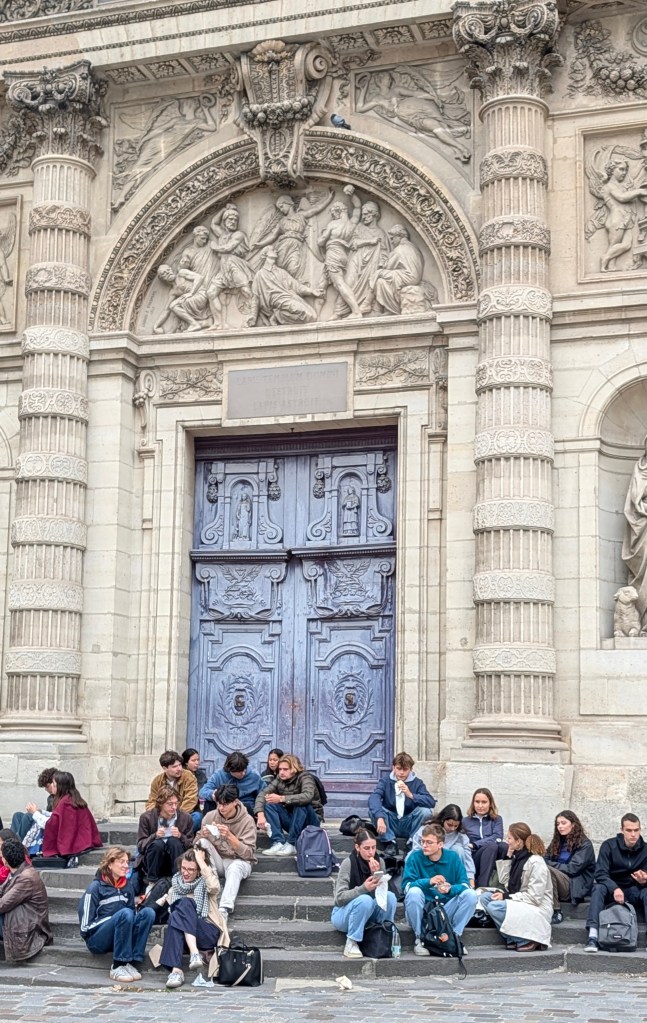
The ornate façade includes the famous purple-blue wooden doors and a relief which depicts the stoning of St. Stephen.

entrance Saint-Étienne-du-Mont church

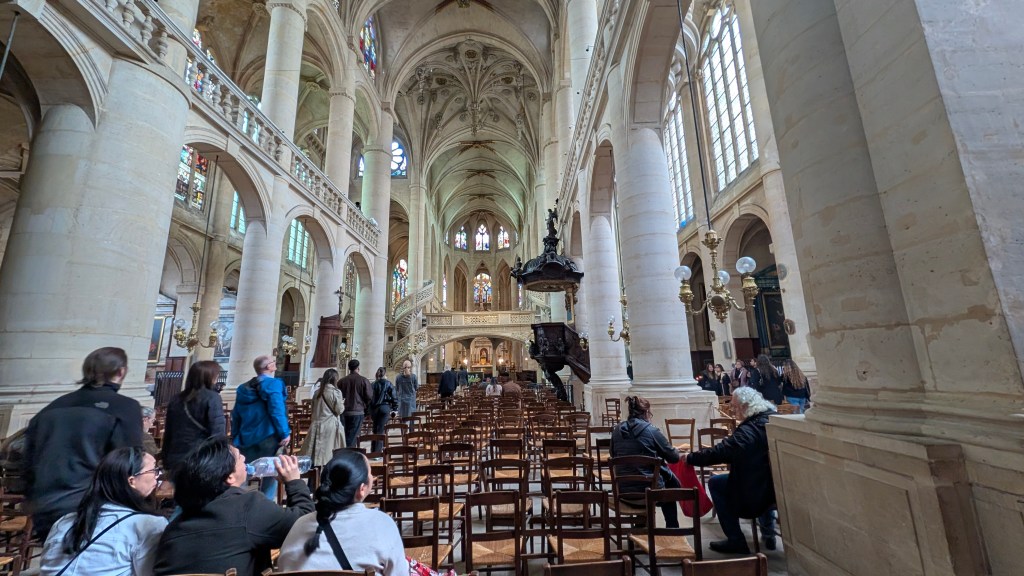
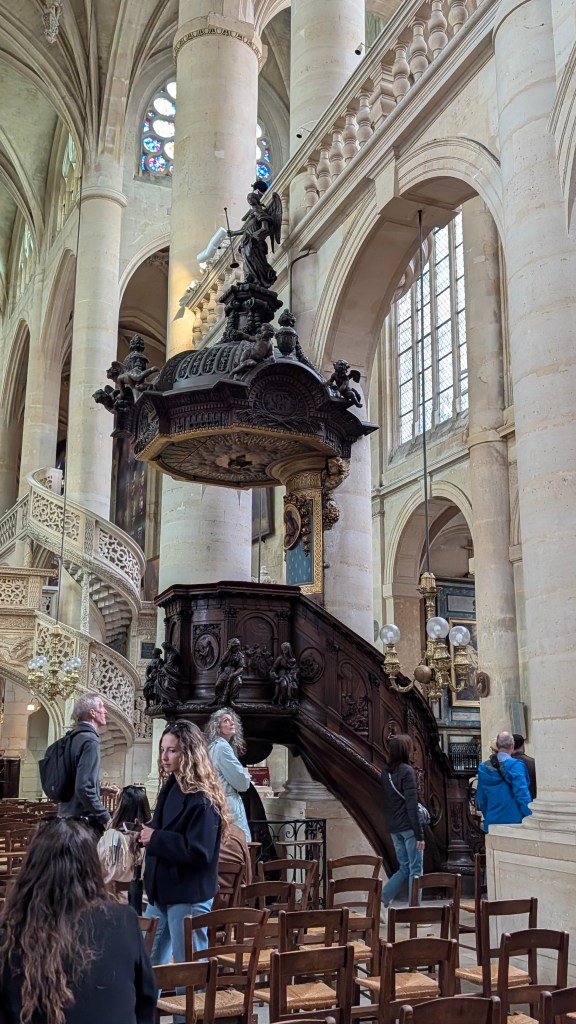
The church is famous for its unique, finely carved stone rood screen or jubé, an ornate, typically medieval, masonry partition that divides the nave (where the congregation gathers) from the chancel or choir (where clergy conduct services), the only surviving one of its kind in the city. 

interior Saint-Étienne-du-Mont church

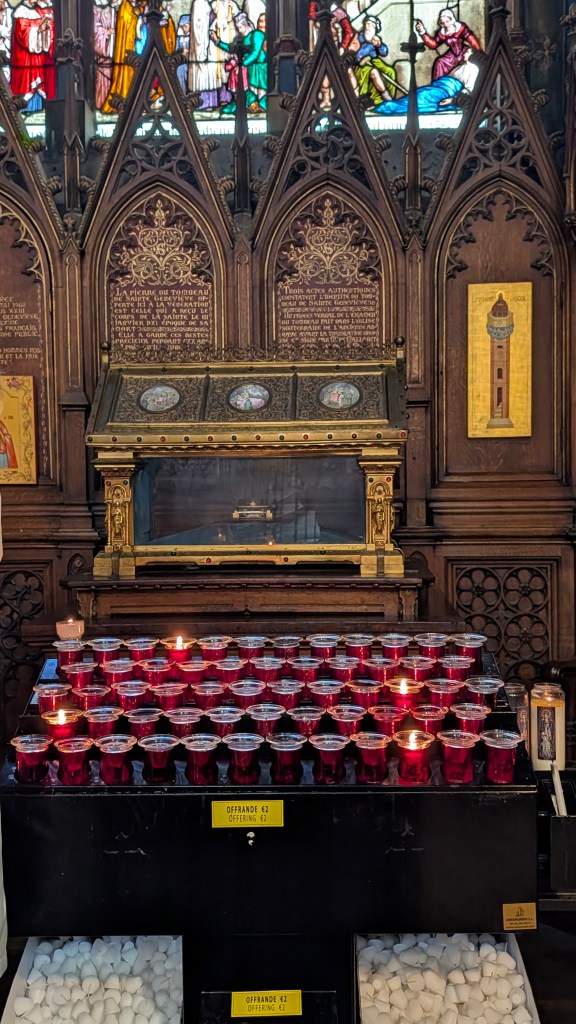
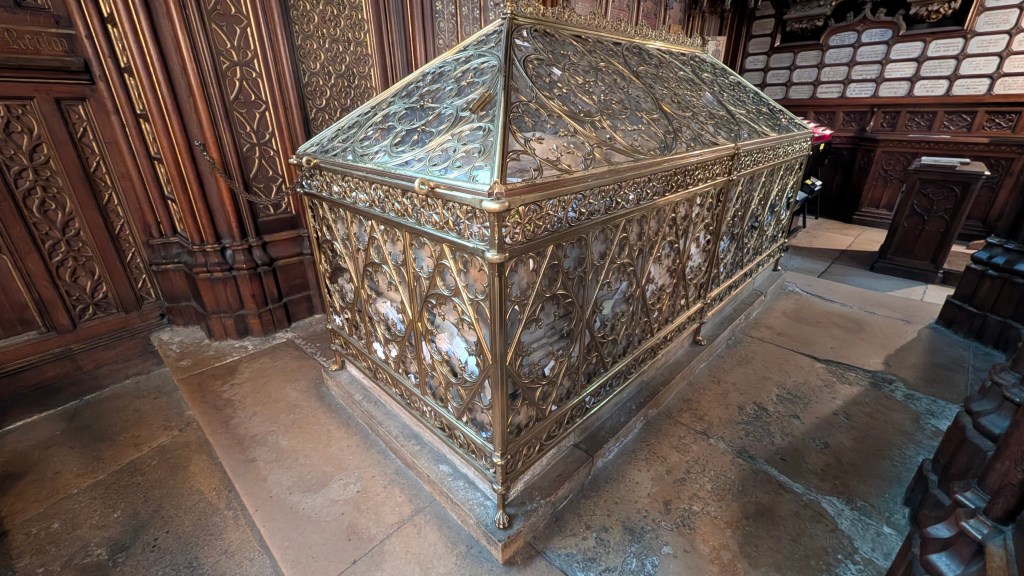
Saint-Étienne-du-Mont Church houses the shrine of Saint Geneviève, the patron saint of Paris. It is believed that Genevieve’s prayers saved Paris from being destroyed by the Huns under Attila in 451. As Attila and his army advanced toward Paris, the people were prepared to flee in panic. Genevieve, through a “prayer marathon” of fasting and supplication, persuaded the inhabitants to stay, assuring them of divine protection. Attila’s army unexpectedly changed course, bypassing Paris and marching on Orléans instead, saving the city. During a subsequent blockade and siege of Paris by King Childeric I’s Frankish forces, the city faced starvation. Genevieve bravely led a convoy of eleven barges through enemy lines to Troyes to gather grain and bring food back to the starving citizens. She also successfully interceded with Childeric, and later his son, King Clovis I, persuading them to release prisoners and show mercy to the people. Her intercession was invoked long after her death. The most famous instance was during the 1129 “burning fever” (ergot poisoning) epidemic that swept Paris. After her relics were carried in a solemn procession, the epidemic ceased immediately, and those who touched the shrine were healed. This miracle solidified her status as the city’s primary protector.

The majority of Genevieve’s original relics were destroyed during the French Revolution, but this shrine contains small surviving pieces and the rock upon which her original tomb rested. 

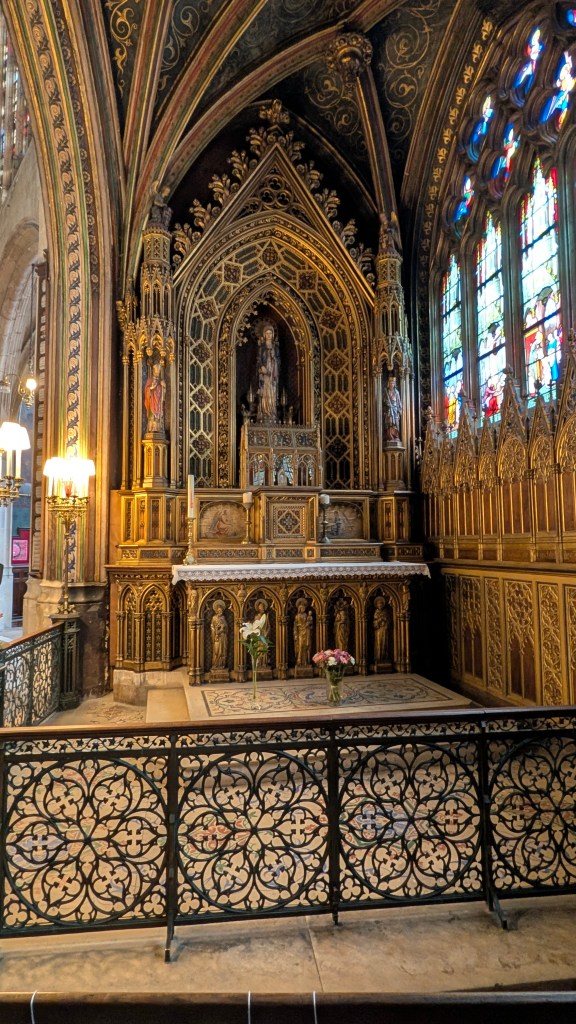
Chapel of St. Genevieve houses a 19th-century altar with a statue of the saint created by Achille Valois in 1823. 

Chapel of St. Genevieve

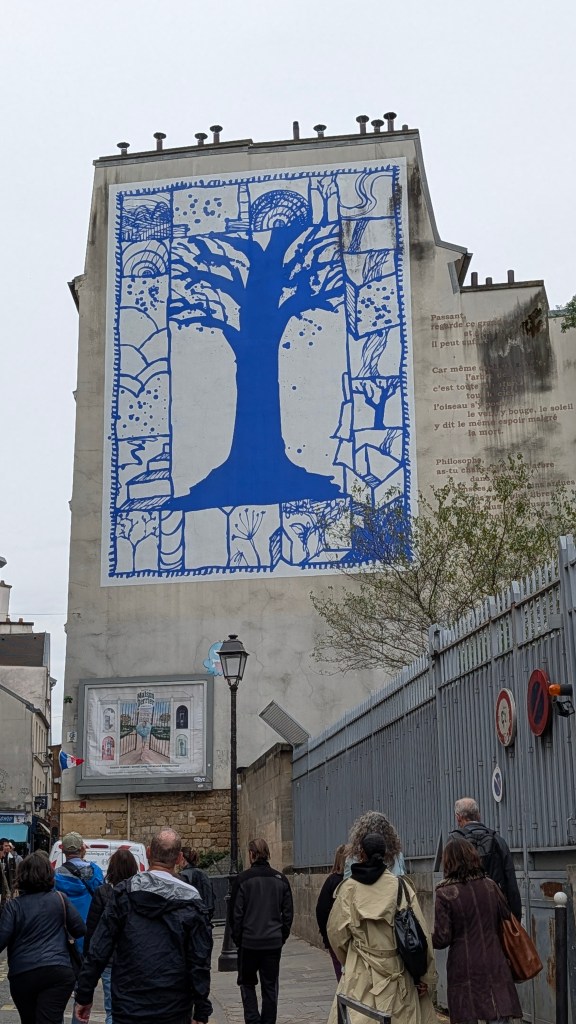
The mural L’Arbre Bleu (The Blue Tree) painted by Belgian artist Pierre Alechinsky is located on a building at the intersection of Rue Descartes and Rue Clovis.  Created in 2000 as part of the “Les Murs de l’An 2000” initiative by the City of Paris, it accompanies a poem by Yves Bonnefoy written on the adjacent wall. 

L’Arbre Bleu (The Blue Tree)

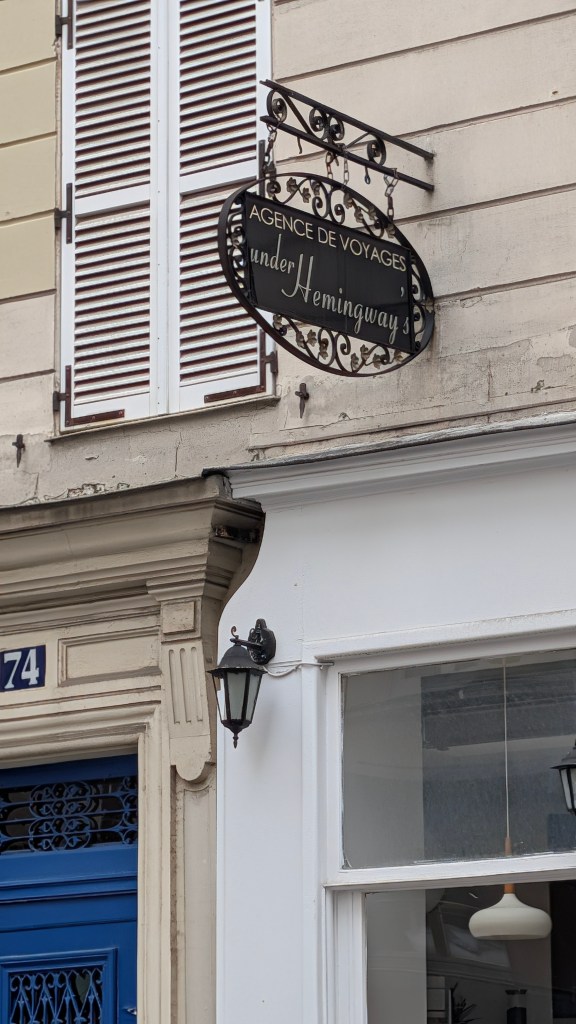
Sanna concluded our walking tour with some anecdotes about Ernest Hemingway, a frequent visitor to the Latin Quarter, living here for a time with his wife. Author of “The Sun Also Rises,” he was one of the most important characters of the Lost Generation. He left Paris in 1928 to cover the Spanish Civil war as a correspondent. He also covered the Normandy invasion. Ernest Hemingway famously “liberated” the Ritz Paris bar on August 25, 1944, arriving with armed Resistance fighters to reclaim his favorite haunt from the Nazis, only to find they had already fled. He celebrated by running up a massive tab for 51 Dry Martinis, solidifying his legend at the hotel. The Ritz bar now has a devoted stool with his name on it. Upon his return to Paris in 1956 he found suitcases filled with his writings and notes which he had left in the 20s. He committed suicide before the publication of his final novel. A quote from Ernest Hemingway’s memoir “A Moveable Feast” is: “If you are lucky enough to have lived in Paris as a young man, then wherever you go for the rest of your life, it stays with you, for Paris is a moveable feast.”

Upon completion of the tour, we returned to visit the Pantheon, but it was closed for renovations. The large sign hanging between the columns reads: ‘French justice will no longer be a justice that kills.’

It had started to drizzle, so we headed back to our hotel for a rest. We were so happy our new neighborhood was in the Latin Quarter.

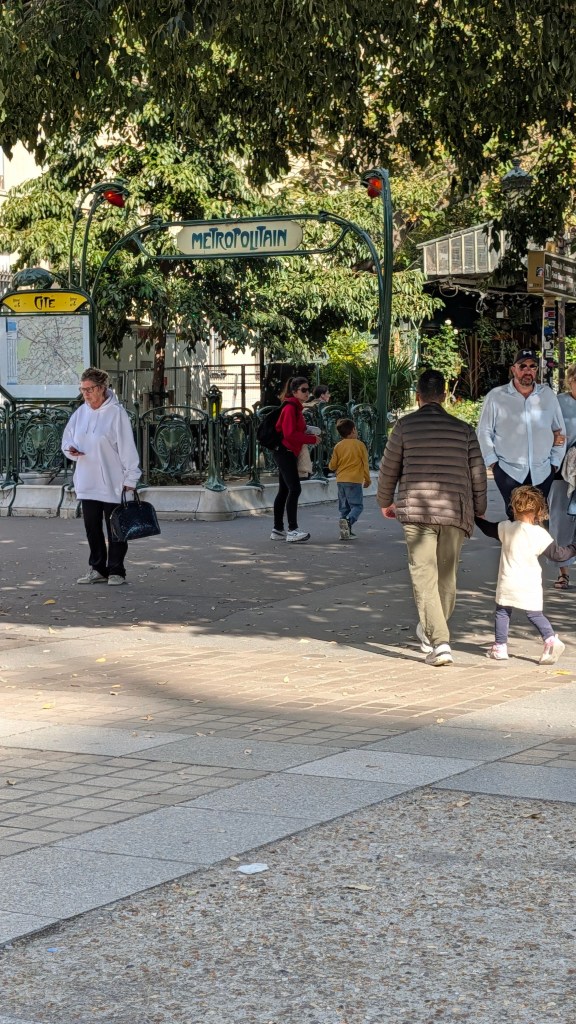
It was still raining later when we decided to head out again. We challenged ourselves into navigating the metro system, which we managed successfully. We noted the entrance to the metro, which did indeed resemble the one we had seen in Montreal over the summer, purportedly a gift from Paris.

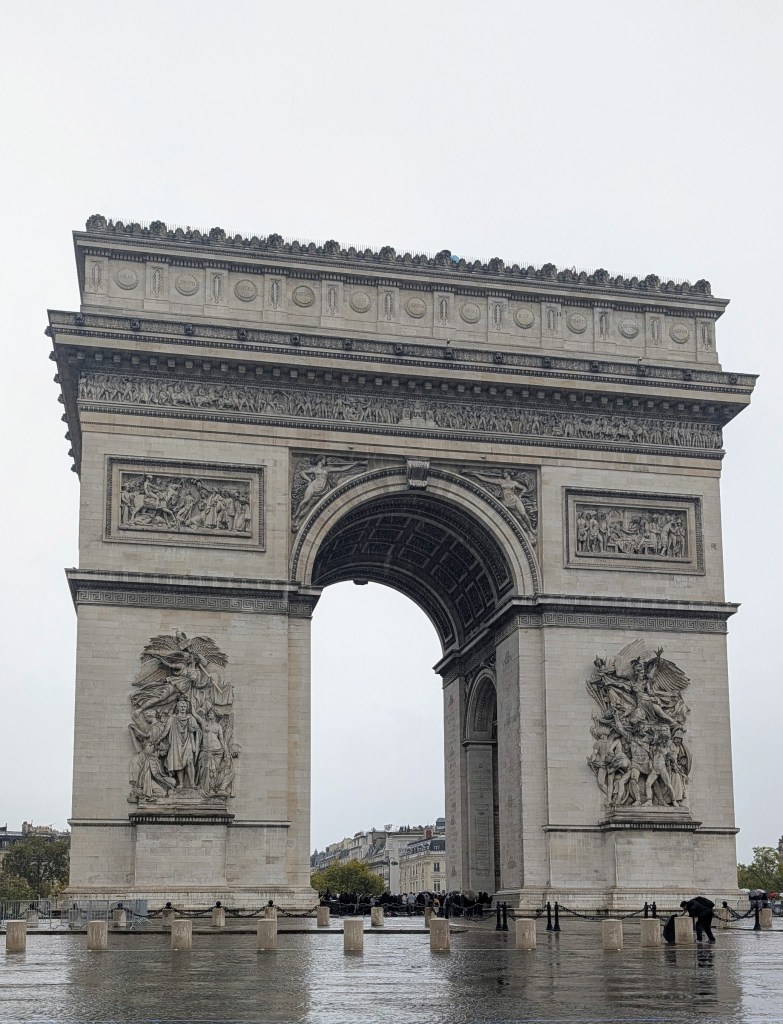
We strolled along the Champs-Élysées, ok not really strolled; it was raining and we walked briskly. We made our way to the Arc de Triomphe standing at the center of the Place Charles de Gaulle. It was commissioned by Napoleon in 1806 to honor the victories of French troops and honors those who fought and died for France in the French Revolutionary and Napoleonic Wars.

Arc de Triomphe

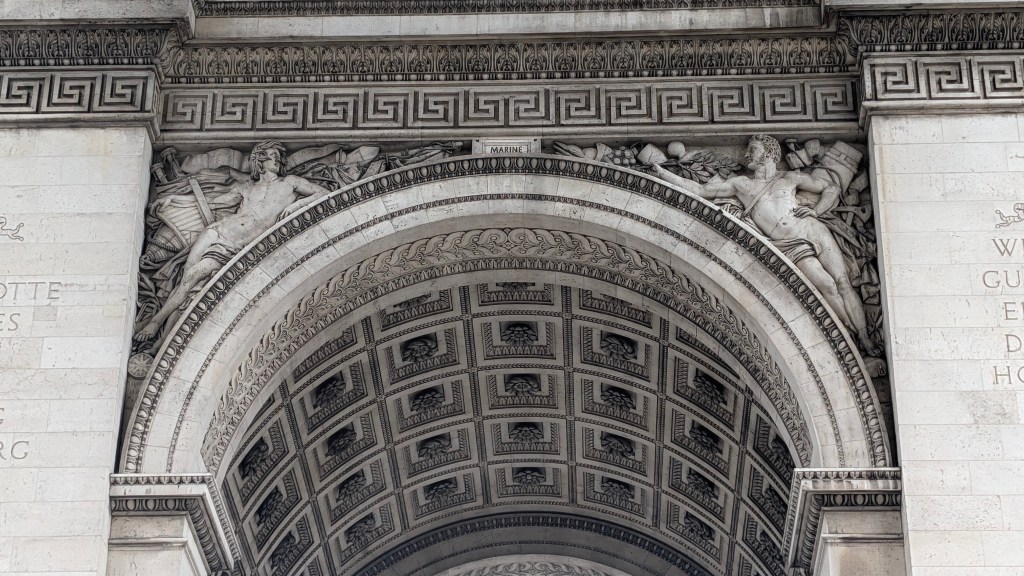
The Arc stands 162.5 ft high and beneath lies the Tomb of the Unknown Soldier, featuring an eternal flame that has burned since 1923. The surface of the arch is covered in carvings listing major French victories and the names of military leaders. 

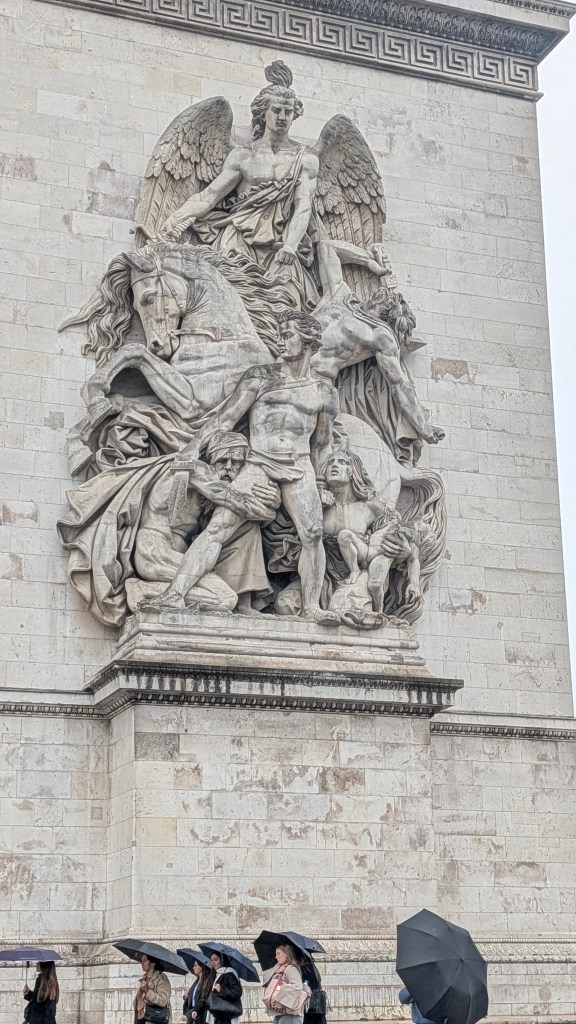
“La Résistance de 1814” (The Resistance of 1814), located on the south pillar, is a sculpture depicting a winged figure representing the nation protecting a family while a soldier prepares for battle. Created by French sculptor Antoine Étex, the high relief commemorates the French resistance to Allied armies during the War of the Sixth Coalition. 

“La Résistance de 1814” (The Resistance of 1814)

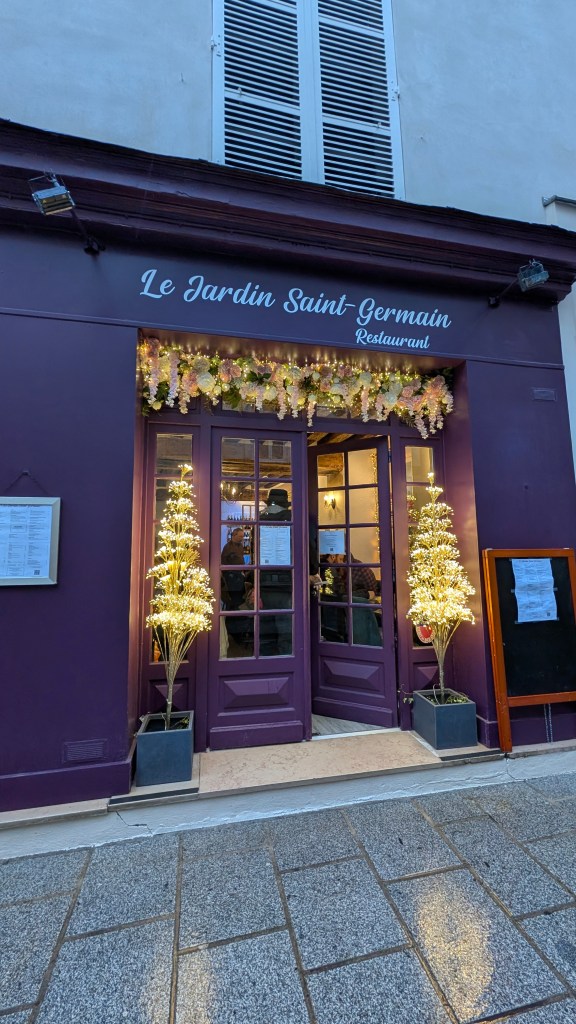
For dinner we joined friends at Le Jardin Saint-Germain for another delicious meal.

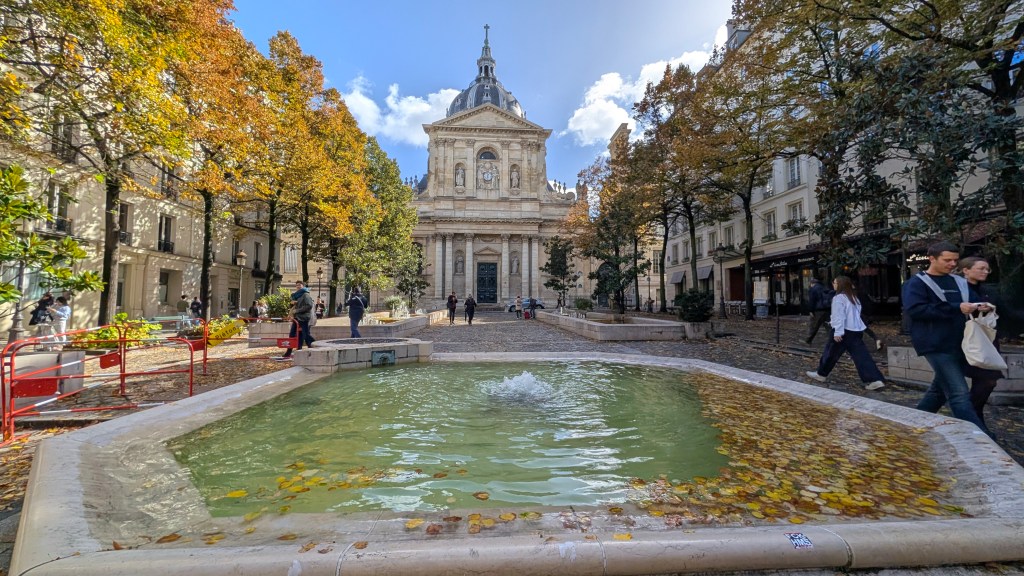
In the morning the sun was shining; we decided to do a little touring on our own. We headed toward the Luxembourg Gardens first passing the Place de la Sorbonne, featuring the Sorbonne Chapel, a part of the University of Paris founded in 1253.  The chapel, ordered by Cardinal Richelieu, is a 17th-century architectural masterpiece and houses his tomb. The start of the fall colors were gorgeous.

Place de la Sorbonne

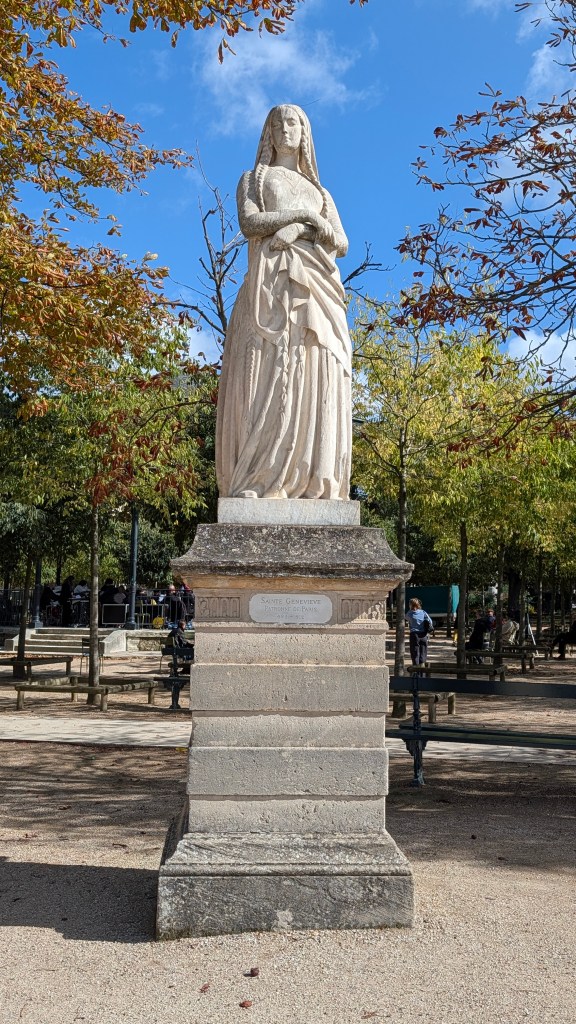
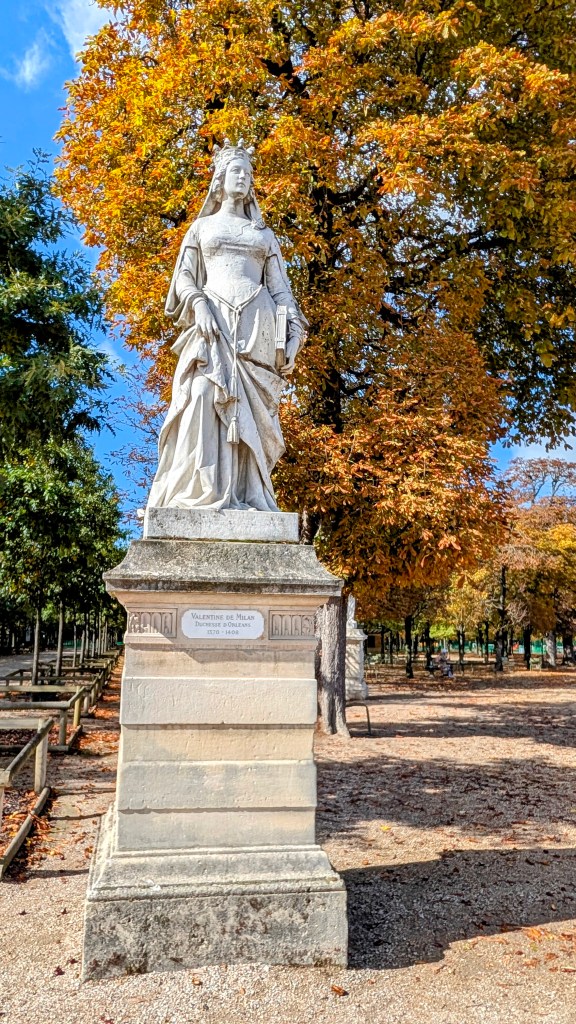
Upon entering the Luxembourg Gardens we were struck by the number of statues, over 100 throughout the property. This monument is dedicated to Charles Marie René Leconte de Lisle, a prominent French poet and writer from the 19th century.  The sculpture, created by Denys Puech in 1898, features a winged muse embracing the poet. 

monument dedicated to Charles Marie René Leconte de Lisle

 “Le Faune dansant” (Dancing Faun) bronze statue was created by Eugène-Louis Lequesne and unveiled in 1850. 

 “Le Faune dansant” (Dancing Faun)

“L’Acteur Grec” (The Greek Actor), a popular bronze sculpture, depicts an ancient Greek actor and is famous for its lively, almost selfie-taking pose. 

“L’Acteur Grec” (The Greek Actor)

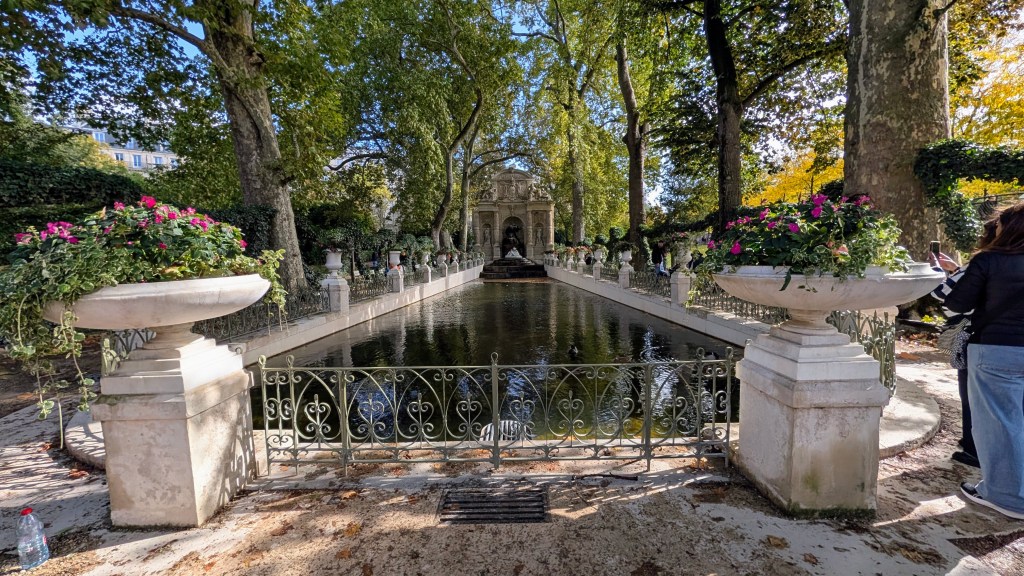
The Medici Fountain was commissioned around 1630 by Marie de’ Medici, the widow of King Henri IV and regent of King Louis XIII.  The fountain is designed in a grotto style with sculptures depicting the mythological scene of Polyphemus surprising the lovers Acis and Galatea.  The fountain was moved stone-by-stone in 1862 during Baron Haussmann’s urban restructuring. Known as one of the most romantic spots in the city, it is a renowned example of Baroque garden architecture. 

Medici Fountain

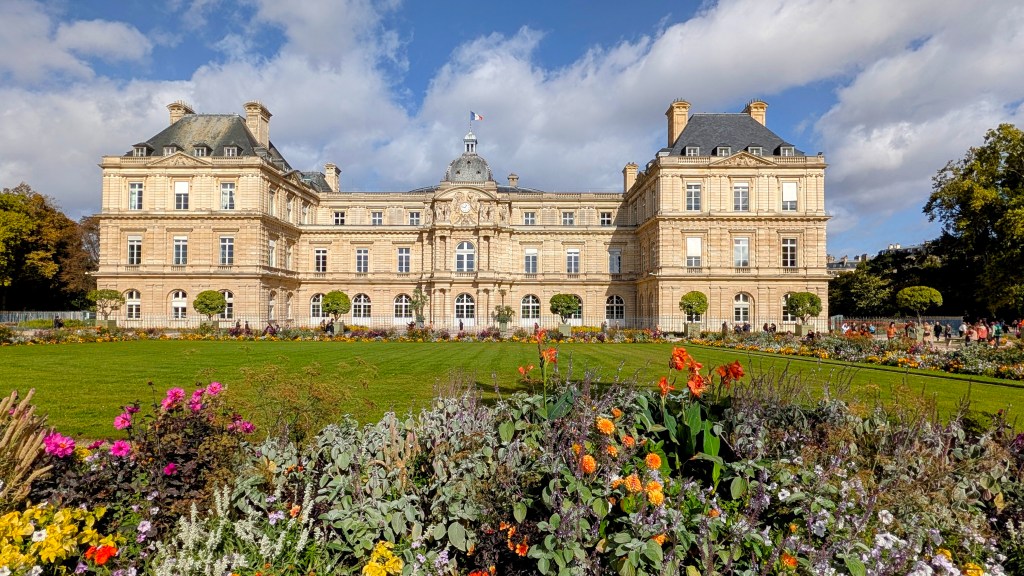
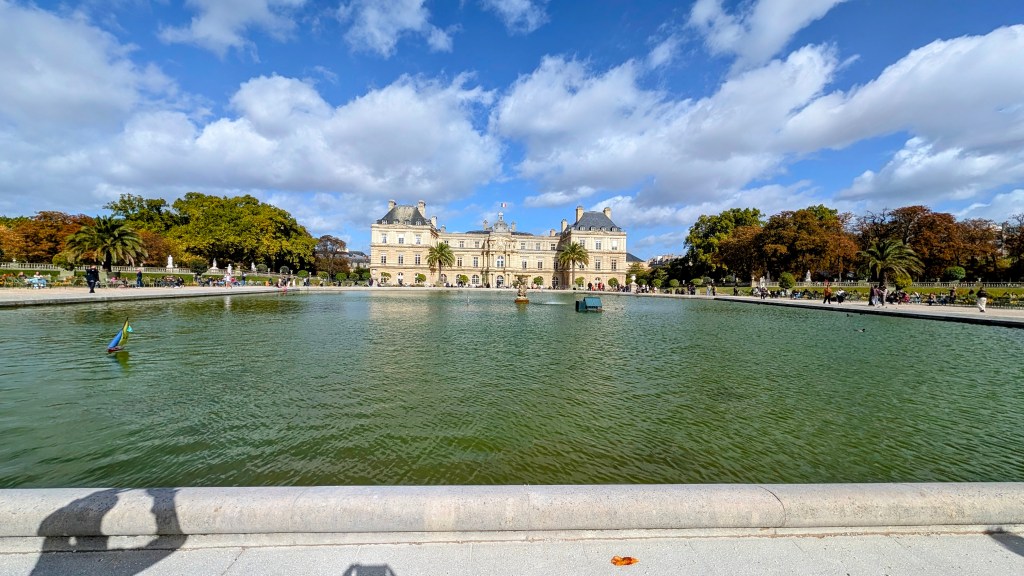
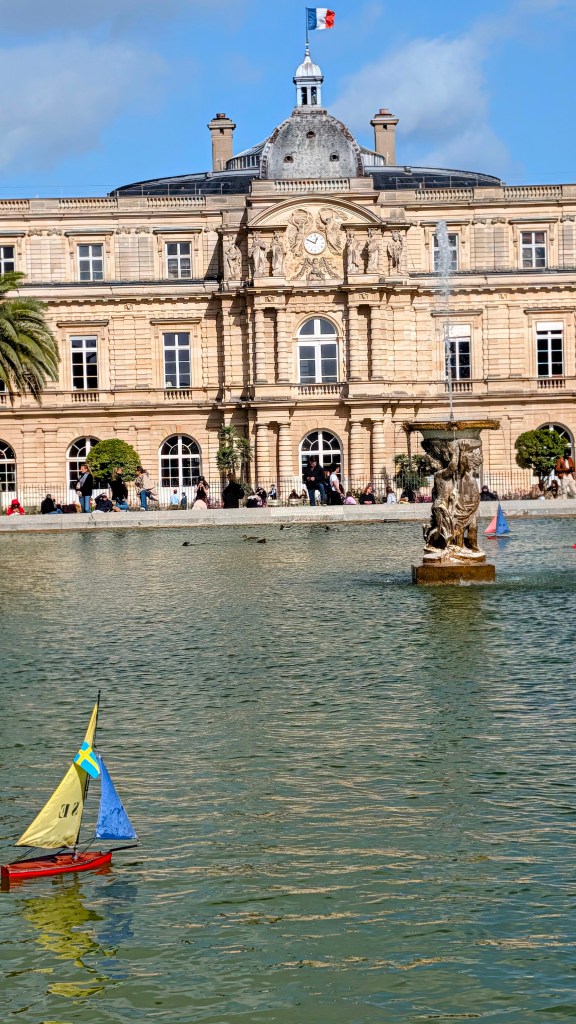
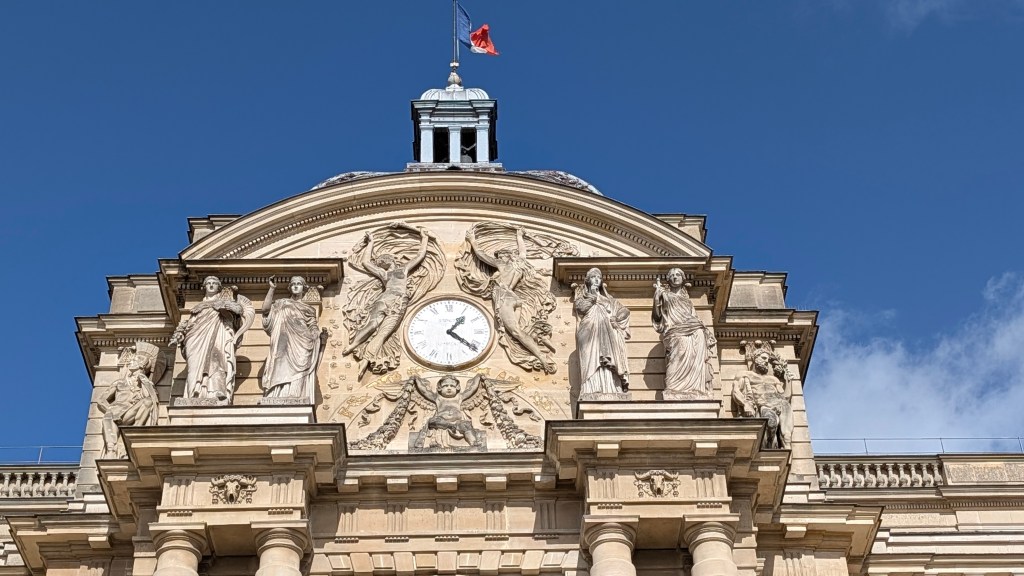
The Luxembourg Palace currently serves as the seat of the French Senate, the upper house of the French Parliament.  It was originally built between 1615 and 1645 for Marie de’ Medici to serve as a royal residence.  The building was designed by architect Salomon de Brosse and was heavily inspired by the Pitti Palace in Florence, Italy. 

Luxembourg Palace

The gardens were created in 1612 by Queen Marie de’ Medici to emulate Florence’s Boboli Gardens, and to escape her home in the Louvre, but her son, Louis XIII, later forced her to leave.

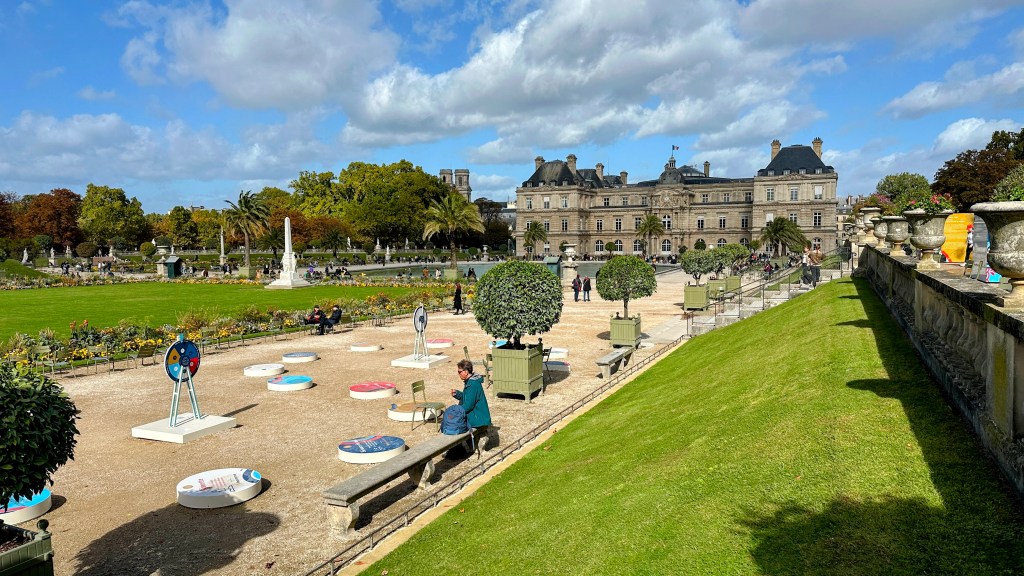
Known for its calm atmosphere, the park hosts classic pastimes like sailing remote-controlled boats (a bit reminiscent of Central Park), playing chess, bocce, and traditional puppet shows.

The nearly 60 acre garden is a premier Parisian spot blending French formality with English-style landscapes. It features over 100 statues—including a replica of the Statue of Liberty, historic fruit orchards, the hidden Medici Fountain, and iconic green chairs for relaxing. 

Despite the lateness of the season, there were still plenty of blooms on the numerous plants.

White marble lion statues were sculpted by Jean-Baptiste Henraux as a royal attribute of power within the gardens. 

This statue is part of the “Reines de France et Femmes illustres” (Queens of France and Illustrious Women) series: twenty statues of famous French women situated on the terrace of the Luxembourg Gardens, commissioned by King Louis-Philippe I, which features prominent women from French history.  Featured here is Anne-Marie Louise d’Orléans, known as the “Grande Mademoiselle,” the Duchess of Montpensier, a major figure in French political and social life during the 17th century and one-time owner of the Luxembourg palace. Her statue was sculpted by Camille Demesmay in the 1800s.

Anne-Marie Louise d’Orléans

Here we found the statue of Marie de Médicis herself, sculpted by Louis-Denis Caillouette and completed around 1847. 

Marie de Médicis

 One of the first queens represented is the Statue de Sainte Clotilde (Statue of Saint Clotilda), a Frankish queen who lived from approximately 475–545. She was sculpted by Jean-Baptiste-Jules Klagmann in 1847. The queen is portrayed in regal attire typical for her time, with her arms crossed, resting her right elbow on a small column. 

 Statue de Sainte Clotilde (Statue of Saint Clotilda)

There were many queen statues, but I had to include Paris’s patron saint: Sainte Geneviève (419-522) sculpted by Michel-Louis Victor Mercier. 

Sainte Geneviève

And finally, I include Valentine de Milan (1370–1408), Duchess of Orléans and daughter of the Duke of Milan, sculpted from white marble by Jean Pierre Victor Huguenin in 1846, not for her but for the beautiful autumnal tree behind her.. 


Valentine de Milan

During the French Revolution, the palace was transformed from a royal residence into a crowded prison for aristocrats. After the Revolution, it became the residence of Napoleon Bonaparte, serving as his home when he was First Consul. During World War II, the palace and gardens were occupied by the German Luftwaffe (air force).

The current security is high.

As we had meandered through the gardens, an orchestra had set up in the band stand and now began to play. We rested and enjoyed the music for a while.

As we left the gardens, a sign reminded us that France is celebrating the 150th year of the senate of the republic.

Outside the garden, and actually throughout Paris, the police force is prominent and heavily armed, not surprising considering the history of terrorist attacks in the city in recent years.

We decided to further explore the 6th arrondissement, also known as the Saint-Germain-des-Prés district. One of France’s six national theaters, the Odéon-Théâtre de l’Europe was inaugurated in 1782 and is known for its elegant neoclassical facade and rich history. It is deeply integrated into the cultural landscape of Paris. The banners on the building announce the “New Season” (Nouvelle Saison), highlighting an international cast of directors and performers. 

Odéon-Théâtre de l’Europe

The popular Maison Sauvage restaurant is highly regarded for its distinctive, seasonally changing floral facade. It is a traditional French cafe frequently enjoyed by locals and tourists on its corner terrace. 

As we strolled around the Saint-Germain-des-Prés district we enjoyed the many galleries

and interesting shops.

This unassuming façade is actually L’Hotel, a 5-star hotel featuring a small indoor pool, a hammam, and a stylish ground-floor bar. It is known as the world’s first boutique hotel and was the last home of Oscar Wilde, who died there in 1900. The plaque on the left commemorates Oscar Wilde, and the building was formerly known as Hôtel d’Alsace. 

L’Hotel,

We stumbled upon the Académie nationale de médecine (National Academy of Medicine). The academy focuses on advising public authorities on matters regarding medicine, pharmacy, and veterinary sciences. The institution was created in 1820 by King Louis XVIII to study issues related to public health and medicine. 

Académie nationale de médecine (National Academy of Medicine)

Nextdoor is the École des Beaux-Arts (School of Fine Arts), specifically the Cour Bonaparte. While primarily a working school, it also functions as a museum and holds exhibitions. Founded in 1648, it is one of the world’s oldest and most prestigious fine arts schools. Many renowned artists, including Degas, Renoir, and Valentino, trained here. 

École des Beaux-Arts (School of Fine Arts)

As we entered the 7th arrondissement, behind the Académie nationale de médecine we found the Université Paris Cité Faculty of Medicine (formerly known as the Centre universitaire des Saints-Pères of Paris Descartes University) which houses the Faculty of Medicine for the university and is a major center for medical education. The institution is renowned for medical sciences, biomedical research, law, and other disciplines.  The site is part of the historical legacy of the University of Paris institutions. 

Université Paris Cité Faculty of Medicine

The façade of the building has a series of stone reliefs. This one is entitled “Nymphs of the Miraculous Sources” which depicts mythical figures associated with healing and water.

“Nymphs of the Miraculous Sources”

We continued toward the Seine, across which the Louvre can be seen. The complex was originally built as a fortress in the late 12th century before becoming a royal palace. 

We crossed one of the the Pont du Carrousel to Guichets du Louvre, ornate monumental gates and arched passageways on the south side of the palace, connecting the Seine quays to the Cour Napoléon. Built by architect Hector Lefuel between 1861 and 1870 (during the Second Empire), these grand entrances were designed to open up the palace and allow easy traffic flow into the complex.  Before the Napolean III 19th-century expansion that created these passageways, this area was filled with a maze of smaller, medieval streets and buildings. Today, the Guichets are a major access point, allowing buses, taxis, and traffic to pass through the palace complex rather than driving around it.

Guichets du Louvre

The Guichets du Louvre feature elaborate, decorative stonework and sculptures, reflecting the lavish style of Napoleon III’s expansion of the Louvre. “Genius of the Arts Astride Pegasus”, created by sculptor Antonin Mercié in 1877, depicts Apollo riding the mythical winged horse, Pegasus.  Emperor Napoleon III’s coat of arms is also featured in the pediment above. 

“Genius of the Arts Astride Pegasus”

The Pavillon Mollien is named after Mathieu Mollien (1758–1850), a French politician and peer who served as the Minister of Treasury under Napoleon I. Designed by architect Hector Lefuel, this section was built to match the opulent, heavy style of the new Louvre expansion in the 1850s. It was famously photographed by Gustave Le Gray to capture the intricate details of its facade. The facade features a prominent stone composition called L’Art et la Science (Art and Science) by sculptor François Jouffroy, completed in 1857. It features allegorical winged female figures representing these two disciplines.

Pavillon Mollien 

The Cour Napoléon (Napoleon Courtyard) is the central, iconic courtyard of the Louvre Palace. Before the iconic glass pyramid was built in the 1980s, the Cour Napoléon was used as a, somewhat undignified, parking lot for the Louvre. While named after Napoleon Bonaparte, the courtyard as we know it was largely completed by his nephew, Napoleon III, in the 1850s, who finally connected the Louvre to the Tuileries Palace. During the 1980s construction of the underground lobby beneath the courtyard, workers discovered an abandoned, hidden set of rooms containing over 25,000 historical items, which were then incorporated into the new exhibition spaces.

Cour Napoléon (Napoleon Courtyard)

Serving as a historic gateway marking the axis between the Louvre Museum and the Tuileries Gardens is the Arc de Triomphe du Carrousel, formerly the entrance to the now-destroyed Tuileries Palace. Commissioned by Napoleon Bonaparte in 1806 and completed in 1808, this arch was built to celebrate his military victories. The top features a quadriga, which is a copy of the famous Horses of Saint Mark from Venice, originally stolen as plunder.

Triomphe du Carrousel

Triomphe du Carrousel was modeled after the Arch of Septimius Severus in Rome and serves as a monumental entrance to the Tuileries Palace. 

Triomphe du Carrousel

We ambled into the Tuileries Gardens and there found the marble sculpture “Caïn venant de tuer son frère Abel” (Cain after killing his brother Abel) which depicts the biblical figure Cain in deep despair and sorrow after murdering his brother, Abel.  The statue was sculpted by Henri Vidal in 1896. 

“Caïn venant de tuer son frère Abel” (Cain after killing his brother Abel)

Theseus Fighting the Minotaur (Thésée combattant le Minotaure) was created by French artist Étienne-Jules Ramey in 1821 and presented at the 1827 Paris Salon. The statue depicts the Greek mythological hero Theseus overpowering the Minotaur, a creature that is half-man and half-bull.  It has been positioned on a pedestal within the Tuileries Gardens since its acquisition by the French state. 

Theseus Fighting the Minotaur (Thésée combattant le Minotaure)

Created in 1892. “Le Centaure Nessus enlevant Déjanire” (Nessus the Centaur Abducting Deianira) by Laurent Marqueste depicts a scene from Greek mythology where the centaur Nessus carries off Deianira, the wife of Heracles. 

“Le Centaure Nessus enlevant Déjanire” (Nessus the Centaur Abducting Deianira)

After all of our walking, it was time for tea. We waited on a significant line for the historic Angelina café, renowned for its ornate Belle Epoque interior and traditional French pastries. Founded in 1903, the café is famous for its elegant, gilded decor featuring murals and mirrored walls. 

Angelina café

It is particularly celebrated for its signature thick hot chocolate (“Chocolat Africain”) and classic desserts like the Mont-Blanc. 

We ordered the high tea; it did not dssappoint.

As we strolled along Rue de Rivoli we passed the entrance to the historic Librairie Galignani, renowned as the first English bookstore opened in continental Europe. Founded by the Galignani family, the bookstore has a heritage dating back to publishing efforts starting in 1520, with the Paris location established in the early 19th century. The shop is now known for its wide selection of both English and French books, with a particular specialty in fine arts.

We also passed L’Atelier Parfum, a French high perfumery with multiple boutiques in Paris and points of sale worldwide.  This establishment specializes in niche, artfully crafted fragrances using high-quality, natural, clean, and vegan ingredients. 

As it was very late in the day, we stopped along the Seine to enjoy the views and watch the tour boats sail by.

Canada: Nova Scotia Province: Cape Breton Island July 31-August 3, 2025; Prince Edward Island Province August 4-7; Nova Scotia Province: Halifax August 8-10

We had a long drive from Saint John, New Brunswick to Cape Breton, Nova Scotia. Once there, we stayed with family on a gorgeous river-front home

complete with a blood pressure lowering hummingbird feeder.

After a good night’s rest, we ventured out to Louisbourg, a small fishing village with a population under 1000. The harbour had been used by European mariners since at least the 1590s, when it was known as English Port and Havre à l’Anglois, the French settlement that dated from 1713 in a fortress, more on that later. We stopped for lunch at North Star, a resort recently purchased and now operated by international designers Colin and Justin, whose shows have aired on HGTV and Cottage Life in Canada. We had watched the week prior, a 4 hour documentary of their purchase and subsequent renovation of North Star called ‘Colin and Justin’s Hotel Hell’.

North Star

We explored the property for a bit

before enjoying our “usual” lunch for the next few weeks: seafood chowder and lobster rolls. After fortifying ourselves with a hearty meal, we headed to the Fortress of Louisbourg, a National Historic Site of Canada. Much to our surprise we learned that all national sites, parks, monuments, etc. were free for the summer of 2025. It was later explained to us, by family members living in Canada, that this was one of the many ways Canada’s government has pushed back against some of Trump’s tariffs and threats; it was an incentive to keep Canadian tourists in Canada and not in the US. We boarded a bus and were driven to the fort.

Fortress of Louisbourg

The original settlement was founded in 1713 by settlers from Newfoundland, and initially called Havre à l’Anglois. Subsequently, the fishing port grew to become a major commercial port and a strongly defended fortress. The fortifications eventually surrounded the town. The walls were constructed mainly between 1720 and 1740. By the mid-1740s Louisbourg, named for Lous XIV of France, was one of the most extensive (and expensive) European fortifications constructed in North America. The fortress and town were partially reconstructed, in a project that started in 1961 and continued into the 1970s. Additional restoration was completed in 2018–2020 and again in 2022–2023 after Hurricane Fiona.

The Dauphin Gate Fortress of Louisbourg

The guard rooms closest to the entrance were for those most responsible for protecting the fort.

Note the windows from which a rifle can be fired while protecting the shooter.

The original budget for the fort was four million French livres, but the total cost of building ultimately cost France 30 million livres, which prompted King Louis XV to joke that he should be able to see the peaks of the buildings from his Palace in Versaille. Two and a half miles of wall surrounded the entire fort. On the western side of the fort, the walls were 30 feet high, and 36 feet across, protected by a wide ditch and ramparts.

Past the guard rooms, we entered the fortress community. As we walked about we learned about the daily life of the militia and their families. There were two sieges on the fortress. The siege of Louisbourg in 1745 resulted in the capture of the settlement by a combined British/British North American force during King George’s War in the British colonies. It was returned to the French in exchange for border towns in what is today Belgium. It was captured again during the siege of 1758 by British forces in the Seven Years’ War, after which its fortifications were systematically destroyed by British engineers. The British continued to have a garrison at Louisbourg until 1768 but had abandoned the site by 1785.

Most of the buildings are topped by a fleur-de-lis , a stylized lily, or iris, that has been a prominent symbol in heraldry, art, and culture for centuries, notably representing French royalty, in this case King Louis XIV.

Many of the first settlers were Basque. Their diet and trade were heavily dependent on cod, as we learned from these docents. Unlike most other cities in New France, Louisbourg did not rely on agriculture. Louisbourg itself was a popular port and was the third busiest port in North America. It was also popular for its exporting of fish, and other products made from fish, such as cod liver oil. The North Atlantic fishing trade employed over ten thousand people, and Louisbourg was seen as the ‘nursery for seamen.’ Louisbourg was an important investment for the French government because it gave them a strong commercial and military foothold. For France, the fishing industry was more lucrative than the fur trade. 

Over the years, restoration included about 60 buildings and two bastions. Many of the workers learned 18th century French masonry techniques and other skills to create an accurate replica. We looked in on several homes and visited kitchens

dining rooms

salons

offices

and bedrooms.

Even the barnyards

and vegetable gardens have been restored to their original functionality.

There are not only 18th century attired guides positioned throughout the fortress,

at 3 PM, a fife and drum band marched by playing.

Although most of the population was Roman Catholic during French control of the site, the Church was not powerful or wealthy. The Military Chapel was staffed by Recollets (missionaries) and everyone was welcome to attend the services. 

We were pulled inside by the sounds of singing

and found the choir on the balcony above.

One building is a museum celebrating the Indigenous Mi’kmaq people of the area. The eight-pointed star is an important symbol for the Mi’kmaq; it symbolizes the sun, representing spirituality and life, and the Mi’kmaq Sacred Circle, symbolizing natural cycles and interconnectedness. The star represents unity, the four cardinal directions, and the concept of balance within nature and oneself. Ancient Mi’kmaq petroglyphs of the star, indicate its deep historical roots, predating European contact

There is a huge warehouse that displays gear for winter and for use by fisherman

as well as tools for daily use.

We were impressed with there method to prevent entrance of rodents; broken glass was wedged beneath the foundation stones .

There were originally four gates, only two of which have been restored. The Frederick Gate was the waterfront entrance.

Frederick Gate

The fortress site provides opportunities for overnight stays in period-style accommodations as well as enjoying a meal in a local “inn.”

We left the fortress and drove to the lighthouse point. The Louisbourg Lighthouse is the fourth in a series of lighthouses that have been built on the site, the earliest was the first lighthouse in Canada. 

Construction began on the lighthouse in 1730 to assist navigation to the Fortress of Louisbourg. Lighthouse Point played a decisive role in both the Siege of 1745 and 1758 as, once captured, it provided a commanding gun battery location to bombard the fortress. This lighthouse was badly damaged in 1758 during the Final Siege of Louisbourg and abandoned by the British after they demolished the fortress. Stonework ruins from the first tower are still visible at the site.

There were two more lighthouses that had been destroyed by fire. The current lighthouse, an octagonal concrete structure decorated with neoclassical architectural features, was built in 1923. The Louisbourg lighthouse was destaffed in 1990.

Louisbourg Lighthouse

The fortress can be seen across the bay.

After the capture of the fortress in 1758, its fortifications were demolished in 1760 and the town-site abandoned by British forces in 1768. A small civilian population continued to live there after the military left. English settlers subsequently built a small fishing village across the harbor from the abandoned site of the fortress. The village grew slowly with additional Loyalists settlers in the 1780s. Today it remains a predominantly fishing village as evidenced by the stacks of lobster pots seen by almost every home. We were told that historically lobster was considered poor people’s food; locals would hide the shells in the garbage to avoid detection by their neighbors. Lobster transformed into a luxury item through changes in transportation, the development of canned lobster, and promotion by wealthy diners in cities like Boston and New York in the late 19th century.

We returned to North Star where we met with our family to enjoy dinner at The Bothy Restaurant.

We enjoyed chatting with Justin, Colin, and their staff especially after watching many of them in the documentary. In addition to enjoying lots of fresh seafood, we were entertained with live music and Scottish dancing.

The next day found us back in Louisbourg for their annual crab fest

which also featured live music.

After filling our bellies with crab, we went out for a boat ride. There are rivers, bays, and coastline everywhere on the island of Cape Breton; one is never far from the water and/or a view of it. Eric sent up the drone to capture our adventure.

We motored past the Big Fiddle, the world’s largest fiddle, which is located on the Sydney waterfront. The fiddle and bow reach a height of 60 feet. The Big Fiddle was designed and constructed by Cyril Hearn in 2005.  It is a tribute to the folk music and traditions of the province’s Celtic community.

The Big Fiddle

The next day we left our family and drove along the Cabot Trail, a 185 mile route encircling Cape Breton Island, renowned as one of the world’s most scenic coastal drives with spectacular ocean, forest, and mountain views. This popular road trip offers opportunities for hiking, whale watching, and exploring charming fishing villages. We stopped by Saint Joseph du Moine for the view.
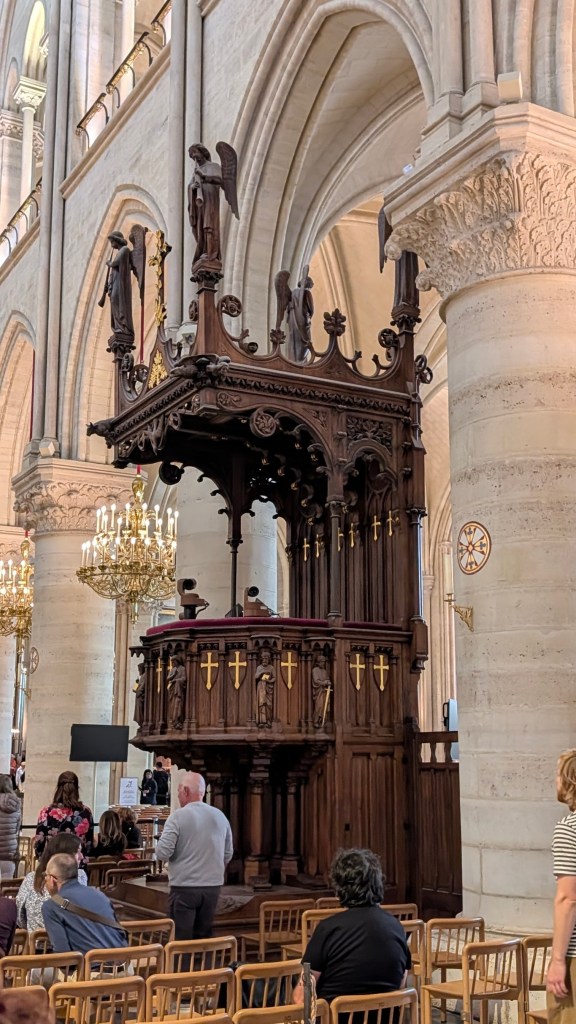
We continued along the coast, stopping frequently.

We admired the Mackenzie River Valley.

We drove through Cape Breton Highlands National Park, around the northern tip of the island, then passed onto the eastern side.

We checked into the Castle Rock Country Inn, a really cute bed and breakfast,

Castle Rock Country Inn

from which we had a great view of the North Atlantic.

We went out to dinner at The Arduaine Restaurant at the Keltic Lodge and enjoyed fresh seafood specialties.
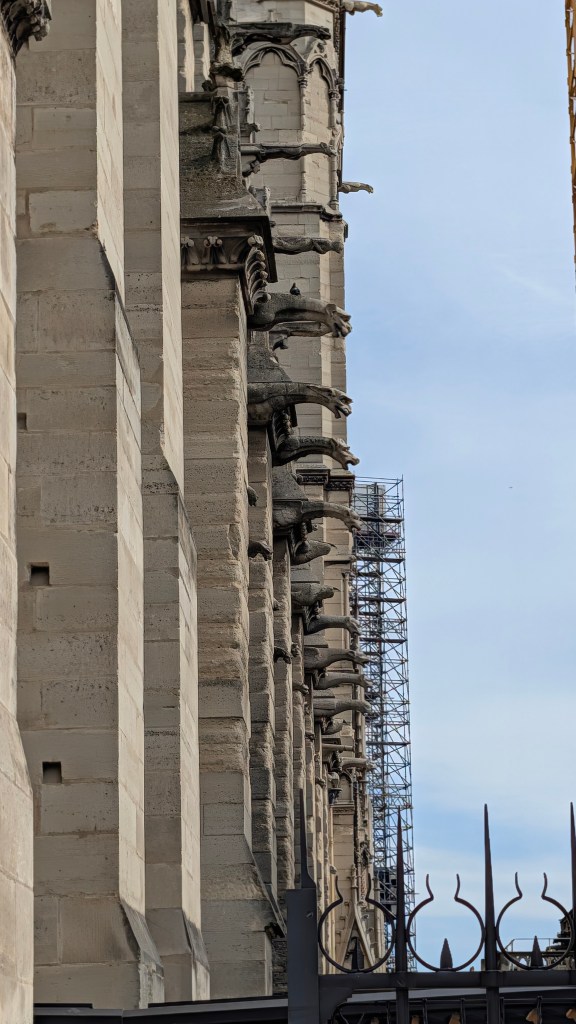
The following day we headed to Prince Edward Island (PEI). We stopped in Antigonish to visit Peace by Chocolate, which began with the Hadhad family’s thriving chocolate business in Damascus, Syria, which was destroyed in a bombing in 2012, forcing the family to become refugees in Lebanon before immigrating to Antigonish, Nova Scotia, in 2016. Supported by their new community, they rebuilt their chocolate-making legacy, establishing the Peace by Chocolate company that same year. The company’s story has since become a symbol of resilience, a celebration of Syrian heritage, and a message of peace and inclusion. We had watched the 2021 fim by the same name.

We boarded the Northumberland Ferry in Pictou, then settled in with a steaming cup of seafood chowder while enjoying the crossing on this overcast day.

We arrived PEI at Wood Islands

then drove the 40 minutes to Charlottetown where we were booked in an extremely cute bed and breakfast, Inn on the Harbor,

Inn on the Harbor

where we had the most comfortable room.

We dropped our stuff and headed right out to explore the port

before heading to Victoria Row to check out the nightlife then heading to Claddagh Oyster House for dinner.

We had a walking tour booked for the morning. We meandered along the Hillsboro River, a watershed covering over 135 square miles,

and into Confederation Park, where we met our guide Jonah. He started with the background history of PEI: the Mi’Kmaq arrived thousands of years ago via ice bridges. The first caucasians arrived in 1594. The French established the first settlement in 1713. Originally the island was named Saint John by the French, but when the English took over it was renamed in 1799 to honor Prince Edward, Duke of Kent and Strathearn, the fourth son of King George III and the father of Queen Victoria. He was so honored due to his service as commander of British forces in the Maritimes and his interest in the colony’s development, even though he never visited the island.  In 1864 the growing city held a conference of provinces: New Brunswick, Novas Scotia, and Province of Canada (at the time included both Ontario and Quebec) to negotiate for a larger single confederation. (PEI was included in the conferences but joined the Confederation later, in 1873.) On the day the delegates were due to arrive there was a circus in Charlottetown. There had not been a circus in over 20 years; it was much more interesting to the majority of the population. There was no one working at the public wharf at the foot of Great George Street when the Canadian delegates arrived on the steamship SS Victoria, so Prince Edward Island representative William Henry Pope (1825-1879) had to handle receptions by himself, including rowing out to greet the new arrivals. The statue below, on Confederation Landing, represents that greeting. The brick walkway appears undulating to represent the waves.
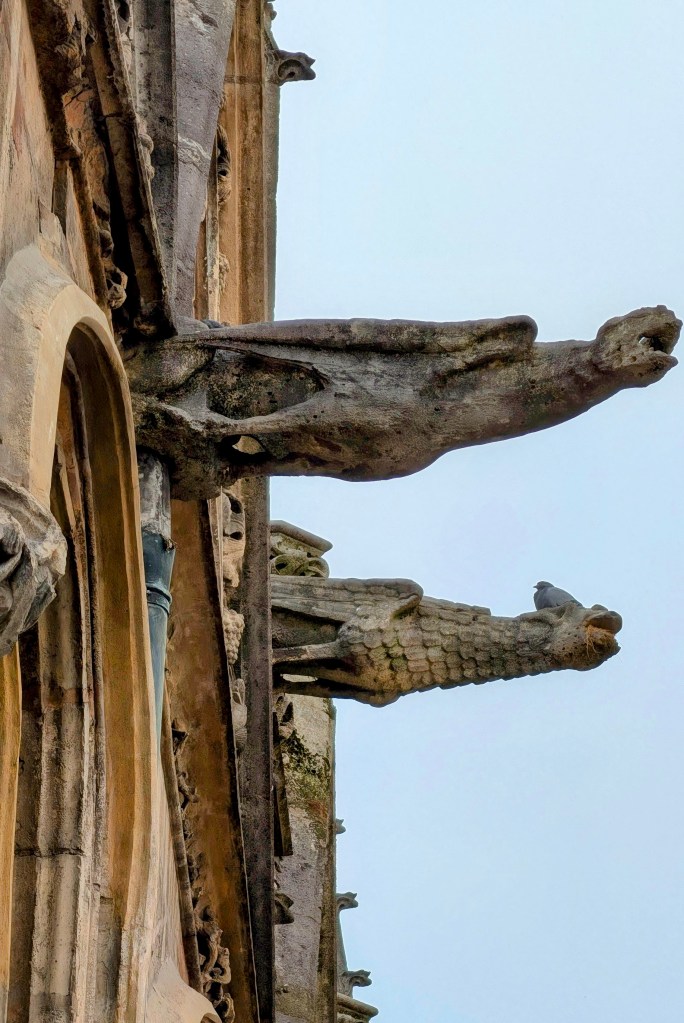
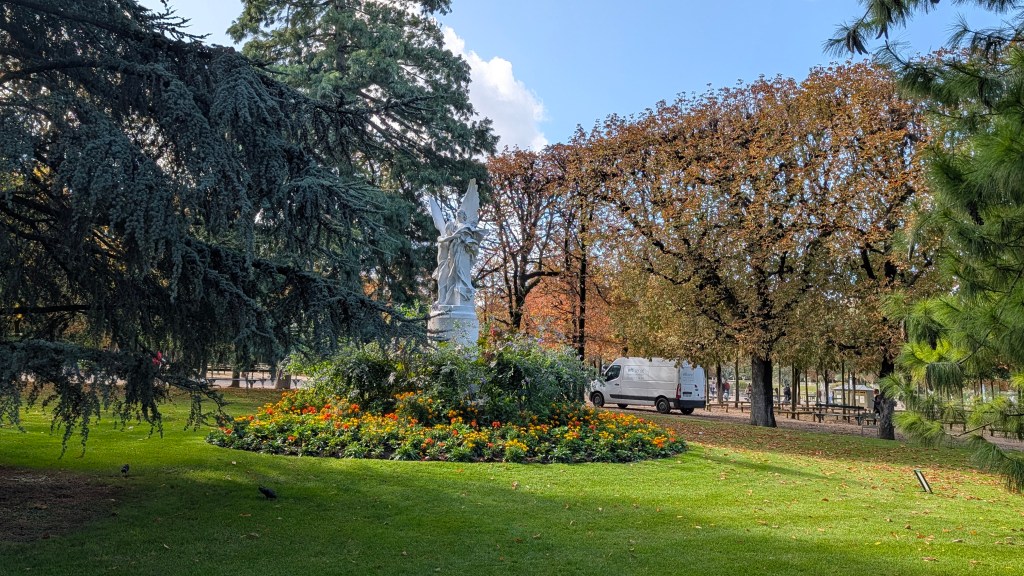
Peake’s Quay, named for James Peake Jr. (1842-1895), was a successful banker and shipbuilder. The Peaks family was one of the wealthiest in Charlottetown until about 1880 when the town’s decline began due to the loss of trees for export as well as competition from other developing cities like Montreal, Toronto, and Halifax. The decline continued until the 1980s when restoration projects began which in turn promoted tourism. Peak’s Quay is now a bustling hub of shops and restaurants as well as a marina. (Of note, PEI suffered further loss of trees when hurricane Fiona came through in September, 2022 taking over 40% of the islands trees down.)

Also found on the quay is Cow’s ice cream, made first here on PEI, but now a favorite throughout PEI and Nova Scotia.

The building for the first bank of PEI, constructed in 1867, is made of island brick and reflects the need then for a local bank and currency during the shipbuilding era. Over time the building has served various purposes including a Customs House and offices for both Federal and Provincial governments. Jonah pointed out that it had a drive though window which, by today’s standards, is very high because it was built to accommodate a horse and buggy.
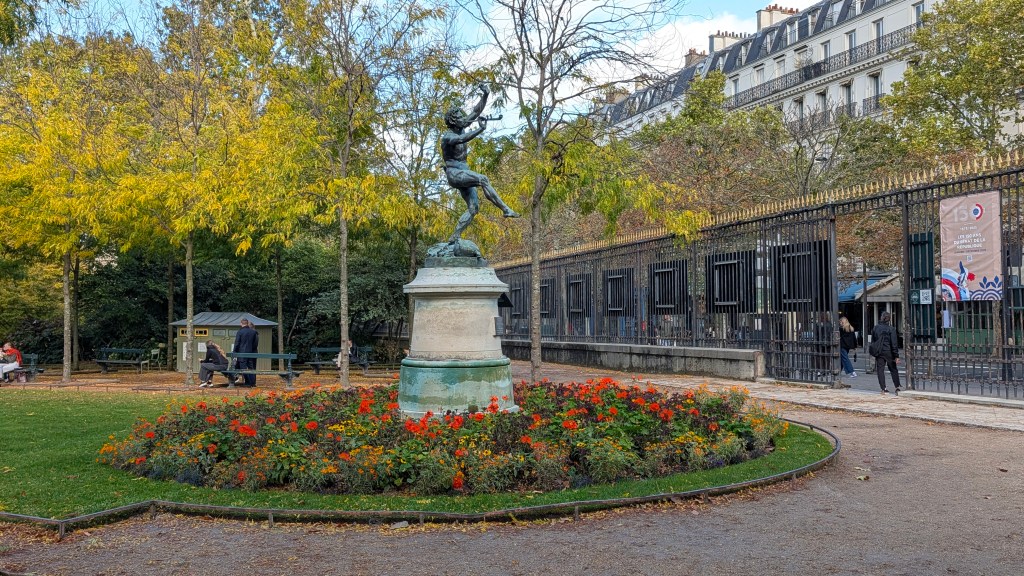
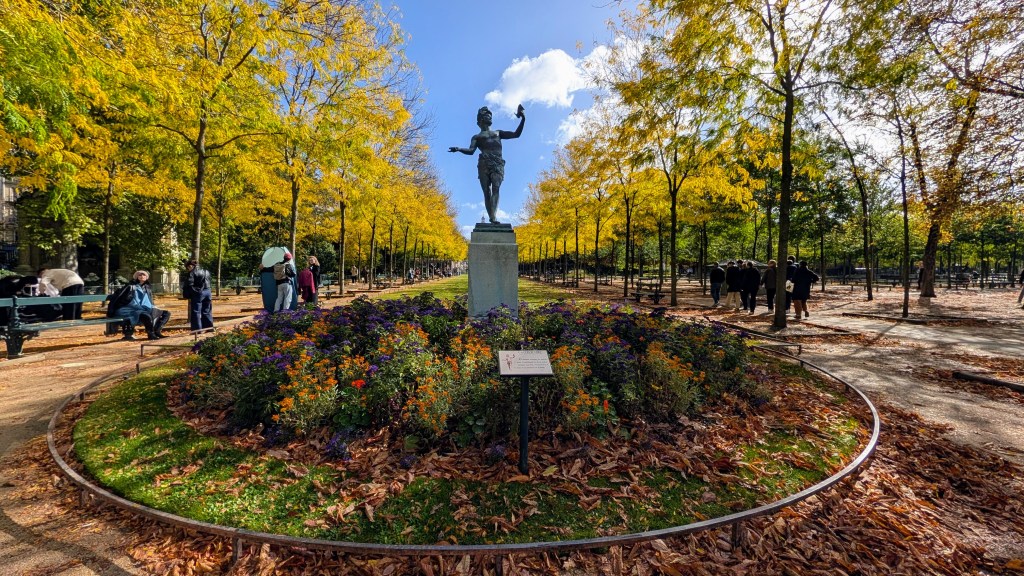
The Bishop’s Palace in Charlottetown was the former residence of the local bishop and is now part of St. Dunstan’s University (SDU). 

Bishop’s Palace

St. Dunstan’s Basilica is named for St. Dunstan, an 11th century English bishop and Benedictine monk. This is the fourth church on this site. The first Catholics to arrive were French from different New France settlements, but the second wave of Catholics later were Scottish, who had the first small wooden chapel built in 1758. After a fire in 1897 destroyed the second wood church, the first stone St Dunstan’s Cathedral was built and completed in 1907. The present stone structure was built between 1913 and 1919 after a fire destroyed the original cathedral in 1913. It was built in the Gothic Revival architectural style. The cathedral was blessed by the Pope in 1929 and elevated to a basilica.

St. Dunstan’s Basilica

Angus Bernard MacEachern (1759-1835) was the first Bishop of the Diocese of Charlottetown in 1829.  Prior the town did not have its own and had to share with other communities.

We took a look inside.

Jonah regaled us with the story of how, before Charlottetown had a bishop of its own, the bishop would travel 12 miles on the river in a small boat every week for services. The community loved and appreciated him. His tomb is in a side chapel of the basilica,

and his boat is preserved within.

Sculptor Nathan Scott’s statue commemorating two Fathers of Confederation both named John Hamilton Gray, one a Prince Edward Islander and the other a New Brunswicker stands squarely in the middle of Great George Street. It depicts the two Grays in conversation in 1864 debating the merits of confederation vs individual provinces, a subject on which they had opposing views.

Province House is where the PEI  Legislature has met since the structure was built for PEI by the Brits in 1847.  Because the soil on the island is rich in iron and other nutrients, growing corn and potatoes was lucrative in the early days of the island. As farming and hence the population grew, there was a push for self-governance. Province House was designed for “responsible government.” Prior government had been provided by the crown; PEI was the first province to establish self-governance. The building is currently undergoing extensive renovations which began in 2015 with an estimated budget of $10 million over two years. It has cost over $238 million with no end in sight. Jonah joked, “There are two seasons on PEI: winter and construction.”

Province House

The war memorial in front of Province House was unveiled on July 16, 1925, to commemorate soldiers from PEI who died in the First World War.  The memorial now also pays tribute to islanders who lost their lives in the Second World War, the Korean War, and the Afghanistan War. 

Province House sits at one end of what had been Queen Square, which was the central square in Charlottetown. All of the land below Water Street is reclaimed land. At the time of the confederation meetings, Queen Square was the main square and Victoria Row the main thoroughfare.

Victoria Row, historically known as the south side of Victoria Square,  is a street mall located on Richmond Street between Queen and Great George Streets. The architecture surrounding the cobblestone street dates back to the victorian era. It is currently all built from red brick after the original structures burned down in the fire of 1883. Because of excessive autos, the street is now closed to vehicular traffic during the summer months. It is home to various boutique shops and restaurants and is considered a main tourist attraction in Charlottetown. 

The Confederation Centre of the Arts is a national memorial and performing arts centre, dedicated to the 1864 conference that led to Confederation. It hosts live performances, runs an art gallery with Canadian visual art, provides arts education programs, and holds heritage activities that facilitate discussion about Canada.  Constructed to commemorate the 100th anniversary of the Charlottetown Conference and serve as a national memorial to the Fathers of Confederation, the center was designed in a Brutalist style, opened by Queen Elizabeth II in 1964, and was designated a National Historic site in 2002. 

The Confederation Centre of the Arts

Charlottetown City Hall is the seat of the City Council. It was designed in the Romanesque Revival style. It was built beginning in 1887 and was completed in 1888.

Charlottetown City Hall

The peoples who had inhabited the island were first the indigenous, then the French, and finally the Brits. The clock on the bell tower has symbols of a fox, a flower, and a great heron as an amalgamation to represent each.

The fire hall opened in 1916.

Rodd Charlotte is a town hotel built in the 1880s, originally as a railway station.

Rodd Charlotte

Jonah explains to us that in the late 19th century, everything north of Rochford Square was considered rural.

Where today’s (unimaginative architecturally) government buildings now stand was once a bog which was home to Africans.

Beaconsfield Historic House was built in 1877 for wealthy shipbuilder James Peake. It was considered one of the most elegant homes in Charlottetown. The house was designed by architect W.C. Harris and featured modern amenities for its time, including gas lighting, central heating, and indoor plumbing. In the 1970s the house served as a ladies’ residence and later as a residence for student nurses.  

Beaconsfield Historic House

Today, it is a museum and a symbol of Victorian elegance, open year-round for tours and special events.

The Government House is the official residence of the Lieutenant Governor of Prince Edward Island. The house was built in 1834 and is located within Victoria Park, overlooking the Charlottetown harbor. 

The Government House

It is owned by the royal family, whose members stay here when visiting the island.

After the tour we continued to walk around Charlottetown for a while until it was time to return to Victoria Row for dinner and a view of the St. Dunstan’s Basilica in the setting sun.

St. Dunstan’s Basilica

In the morning we headed north to visit the Greenwhich Trails.

We hiked through the woods and came out at a clearing with a view of St. Peters Bay.

There we saw fishermen collecting traps. Both PEI and Nova Scotia have very strict regulations with dates of when/where lobsters and oysters can be removed.

We visited the nearby beach.

Then we got back in the car and visited another beach.

We continued our drive along the northeastern most shore of PEI until we came to the East Point Lighthouse. Built in 1867, it is known as Canada’s Confederation Lighthouse. The lighthouse stands 64 feet high and has 67 steps to the top. 

East Point Lighthouse.

We then drove to our destination for the evening: The Inn at Bay Fortune. Dating to 1913 and originally a summer home for a Broadway playwright, this refined inn (open seasonally) is a five star resort with a restaurant run by Chef Matthew Pigeon.

As instructed, we had arrived early so we could explore the grounds on our own for a bit before the meal. We hiked through the pots and pans trail

and into the Arts Forest where we discovered woodland animals “hiding” in the wood piles.

We strolled through the farm.

The meal is called the fireworks feast because all of the food is cooked on open fires. Here the fire is getting started at the Fire Alter.

There are plenty of spots to sit, relax, and enjoy the surroundings.

Even the bar is whimsically decorated.

In the back of the woods are huge piles of oyster shells labeled with the year in which they were consumed.

The pile for 2020 was sadly quite small.

At 4 o’clock we were invited to join Chef Matthew in his “classroom” where he introduced himself. Together with the chief farmer Kevin Petrie and forager Nick of the North, they provide all of the ingredients for the food of the fireworks festival from local sources. Even the wheat for the bread is grown locally. Chef Matthew explained the concept of regenerative agriculture. The quote from his website:

“As farmers we understand that our first responsibility is to our soil, to the earth around us. We naturally focus on the life of our plants, but they come and go while the life of the soil endures. We’re inspired by the circle of life: the ongoing connection between healthy soil, a healthy environment and healthy, happy humans. We know that the more nutritious an ingredient is the better it tastes and the better the earth it came from. Our systems continuously strengthen the incredibly diverse and productive microorganisms within our soil. Sustainability is just our starting line, with one foot planted in the past and another firmly in the future we deploy a wide array of fascinating natural techniques to ensure long-term vitality.”

the classroom

After an informative session on culinary farming, we were invited to taste our amuse-bouche of fresh tuna caught that afternoon.

Then the tasting hour was begun! There were stations at the various fire pits plus Chef Matthew and a couple of his staff stood and shucked oysters only hours out of the Bay Fortune, all we could eat! We only managed about a 8-10 each because there were so many things to try including pulled pork tacos, more tuna, baked oysters. The most unique thing we tried was duck hearts fried in bone marrow. Every bite was so delicious.

Once the tasting hour was complete, we joined Chef Matthew on the main lawn for a champagne toast.

Even the sparkling wine is locally sourced.

Next we were invited into the dining room. We were seated family style at long tables and given the tasting menu for the night.

This would not be Prince Edward Island without first a bowl of seafood chowder, which was different than any we had yet had, and OMG so good!

Soup was followed by some light veggies

and then the most ingredients I have ever seen in a harvest salad.

We got to chatting with our table neighbors and eating all the delicious food, so I missed taking a pic of the breads, meats, and potatoes. As everything is seasonally themed, desert was appropriately raspberry in several different forms. By the time we left, we had been eating for 5 hours, a most memorable meal.

The next morning we set out to see the famous red beaches on the southern shores of PEI. Unfortunately, the tide was a bit too high to see much.

But we certainly could appreciate how much iron is in the soil.

We then set out for Green Gables. Neither of us had ever read Anne of Green Gables, so we decided to listen to it on Audible as we drove around the island.

Author of the beloved children’s novel, Lucy Maud Montgomery grew up in nearby Cavendish, PEI. Her mother had died of tuberculosis when Lucy was 21 months old. Grief stricken, her father placed her with her grandparents. It was her nearby aunt and uncle that owned the home in Cavendish, PEI that became the inspiration for Green Gables.

Green Gables.

Anne of Green Gables has been translated into at least 36 languages and has sold more than 50 million copies, making it one of the best selling books worldwide to date in any language, and is taught to students around the world. The building was initially erected during the 1830s, by the MacNeil family, relatives of Montgomery, who was born near the homestead. Interest in the Green Gables property grew in the decades after Montgomery published her novels, resulting in Green Gables’ purchase by the government of Canada in 1936. The government initially operated the home as an historic house that depicted 19th century farming life on Prince Edward Island. However, by the 1970s plans were undertaken to refurbish the building to resemble Green Gables as depicted in Montgomery’s novels. Since 1985, Green Gables and the larger National Historic Site operate as a museum of Lucy Maud Montgomery and her novels. One enters through the parlor.

There is a downstairs bedroom, in the book occupied by Matthew, the elderly brother.

The kitchen has also been restored to reflect a 19th century farmhouse.

The upstairs bedroom is where Anne lived.

Even the gardens have been restored to their original function.

In her books, Montgomery describes the haunted forest, not so haunted on this gorgeous summer day.

They have even preserved Anne’s beloved Lovers’ Lane.

After a thorough tour of the Green Gables museum and property, we took a ride along a different part of the north shore of PEI than that which we had explored the previous day.

The scenery is truly spectacular.

After a long day, we headed back to Charlottetown for another scrumptious seafood meal, started, of course, with a dozen oysters. Then in the morning we bade farewell to PEI.

The weather on the return ferry was much more gray than it had been on our first crossing. So we meandered inside for yet another bowl of yummy seafood chowder and were happily surprised by the entertainment we found there: a 70s cover band.

We drove the short distance from the ferry to our home for the next few nights: Halifax Marriott Harbourfront Hotel.

Halifax Marriott Harbourfront Hotel

As the day was still young, and we had plenty of energy, we headed out to have a look around. Halifax is located on the ancestral lands of the Mi’kmaq who lived in the area long before Europeans arrived. Mi’kmaq called the area “Great Harbor”. The city itself was established by the British in 1749 in violation of treaties with the Mi’kmaq. The establishment of the city led to Father le Loutre’s War, otherwise known as the Anglo-Micmac War. General Edward Cornwallis brought nearly 1,200 settlers to the new town of Halifax, which was named after the 2nd Earl of Halifax in England. Due to his success in extending American commerce, the Earl became known as “father of the colonies”. One of the first places we encountered was Province House, the seat of the Nova Scotia House of Assembly. The three-story building is built in the Neo-Classical style with Nova Scotia sandstone. It is the oldest legislative building in Canada and has been the meeting place for the Nova Scotia legislative assembly since 1819. The building is a National Historic Site of Canada. 

Province House

Next to the Province House is a memorial honoring those who served and died during the South African (Boer) War, which took place from 1899 to 1902. 

South African (Boer) War Memorial

On the other side of Province House is a statue of Joseph Howe (1804-1873, erected in 1904 to commemorate the centennial of Howe’s birth. It was the first public statue of a Nova Scotian to be erected in the province.  Joseph Howe was a journalist and politician who championed responsible government and argued in his own defense to establish freedom of the press in Nova Scotia. 

Joseph Howe

As we walked around the old city for a while, we were struck by how many murals there are everywhere.

We found a lot with a whole lot of murals and signage explaining that there had been a mural and music festival in the second week of July.

Guided by the GPSMyCity app, we embarked on a self-guided walking tour. First we stopped to admire the Town Clock, also known as the Old Town Clock or the Citadel Clock Tower. It is one of Halifax’s most recognizable landmarks. This historic clock tower, a reconstruction of an early 19th-century Palladian-style structure, remains a symbol of the city’s military past and architectural heritage. The idea for the Town Clock was conceived by Prince Edward, Duke of Kent, who served as the commander-in-chief of British North America’s military forces. Concerned about punctuality within the British Army and Royal Navy garrison in Halifax, he commissioned a turret clock before his return to England in 1800. The clock was manufactured by the prestigious House of Vulliamy, a renowned London-based firm of Royal Clockmakers. The Town Clock officially began keeping time for Halifax’s garrison on October 20, 1803 and continues to function with its original mechanism: an intricate system of three weights, gears, and a 13-foot pendulum housed in a cast-iron frame. The bell chimes every quarter-hour and hour, maintaining the discipline of timekeeping established over two centuries ago. The clock face, set on all four sides, features Roman numerals, with “4” traditionally written as “IIII” rather than “IV” for aesthetic balance. The clock’s slow-moving mechanism has contributed to its longevity, requiring twice-weekly manual winding by employees of Citadel Hill National Historic Site, under the care of Parks Canada. At noon daily there is a gun salute.

Behind lies the Citadel, completed in 1856 with an 8 pointed star configuration surrounding the fort. The garrison grounds are now an amphitheater and artillery park. We chose not to visit having seen the citadel in Quebec City.

Town Clock

We found ourselves in the Grand Parade,  a military parade square that dates to 1749. When the first contingent of British settlers in Halifax arrived in June 1749. Charles Morris, the Chief Surveyor, worked on the town layout which comprised an urban grid made up of oblong, rectangular city blocks with the Grand Parade at the center of the town. The plan stipulated a church at the southern end of the square, and a courthouse and prison at the northern end. Today the square is used for public events, concerts and special celebrations.

The monument shown is the Halifax Grand Parade Cenotaph unveiled on July 1, 1929, to commemorate the men and women of Halifax who died in the First World War.  It was later updated to include the years of the Second World War and the Korean War. 

Halifax Grand Parade Cenotaph

The Saint Paul’s Church, on the southern end of the Grand Parade, opened in 1749. It was the first Protestant Church in Canada and is also the oldest building in Halifax. Architecturally, Saint Paul’s is a significant landmark as the first Palladian-style building in Canada. It has undergone numerous expansions over the centuries. The church’s present structure includes wings added in the 19th century, making it one of the few Anglican churches worldwide with five aisles. The church was also the official place of worship for the garrison until 1844. Many notable figures have been associated with Saint Paul’s, including Governor Edward Cornwallis, Prince Edward (the future Duke of Kent).

Saint Paul’s Church

Halifax City Hall was built in 1890. It was originally built to replace the old courthouse and for other public use. Halifax City Hall is notable for being one of the oldest public buildings in Nova Scotia. With four floors and a seven-story clock tower, it is also one of the largest.

Halifax City Hall

 City National Bank building, which has a neoclassical architectural style, was formerly a bank and is now a bar and is on the National Register of Historic Places. 

 City National Bank building

The Art Gallery of Nova Scotia was originally built as the customs house and post office in 1868.  The exterior is constructed with Nova Scotia sandstone, and the building’s design was inspired by an Italian Renaissance palazzo. The museum’s collection includes historical and contemporary art from Nova Scotia, Canada, and around the world. 

The Art Gallery of Nova Scotia

I digress from our self-guided walking tour to include this Tim Horton’s. At this point we had been in Canada for over 2 weeks, and it occurred to me that I have yet to include one. Driving throughout Canada, Tim Horton’s is as ubiquitous as Starbucks and Subway combined in the US; there is one in almost every gas station. We stopped a couple of times to try the coffee and snacks, but honestly, we are not big fans of either.

At this point it was starting to get late. We freshened up a bit before setting out for what turned out to be a most delicious dinner at the Five Fishermen.

In the morning we dicided to drive to Peggy’s Cove, a small rural community located on the eastern shore of St. Margarets Bay,  less than an hour drive from Halifax. Due to the large volume of tourists, we had to park out of town and walk. A short distance before we got to the town of Peggy’s Cove, we passed St. John’s Anglican Church which was constructed in the Gothic Revival style in 1893. It replaced a previous church that was destroyed by fire in 1881.

St. John’s Anglican Church

The first recorded name of the cove was Eastern Point Harbour or Peggs Harbour in 1766. The village is likely named after Saint Margaret’s Bay (Peggy being a nickname for Margaret), which Samuel de Champlian named after his mother Marguerite Le Roy.

The village was founded in 1811 when the province of Nova Scotia issued a land grant of more than 800 acres to six families of German descent. The settlers relied on fishing as the mainstay of their economy but also farmed where the soil was fertile.

Many artists and photographers  flocked to Peggy’s Cove. As roads improved, the number of tourists increased. Today the population is small but Peggy’s Cove remains an active fishing village and a favorite tourist destination.

Peggys Point Lighthouse, also known as Peggys Cove Lighthouse, is an active lighthouse  and an iconic Canadian image.

Peggys Point Lighthouse

The classic red-and-white lighthouse is still operated by the Canadian Coast Guard and is situated on an extensive granite outcrop at Peggys Point. This lighthouse is one of the most-photographed structures in Atlantic Canada and one of the most recognizable lighthouses in the world.

Despite numerous signs warning of unpredictable surf (including one on a bronze plaque on the lighthouse itself), several visitors each year are swept off the rocks by waves, sometimes drowning.

There were several musicians hoping for tips from tourists including a man playing bagpipes and this guy playing an Alphorn (not very well…we were in Switzerland just last year).

More than 400 million years ago, in the Devonian Period, the plate tectonics movement of the Earth’s crust allowed molten material to bubble up from the Earth’s interior. This formed the rocks seen today and are part of the Great Nova Scotia batholith, a large mass of intrusive igneous rock. The landscape of Peggy’s Cove and surrounding areas was subsequently carved by the migration of glaciers and the ocean tides.

Peggy’s Cove has been declared a preservation area to protect its rugged beauty.

William Edward deGarthe (1907–1983) was a Finnish painter and sculptor who lived for much of his life in Peggy’s Cove.  In the late 1970s, deGarthe began a ten-year project to sculpt a “lasting monument to Nova Scotia fishermen” on a 100 ft granite outcropping behind his Peggy’s Cove Home. In 1976 deGarthe invited one of his students, J. Rene Barrette to help him with the sculpture. They worked together for 5 years. The project was about 80-per cent complete when the artist died in 1983.

The work depicts thirty-two fishermen and their wives and children enveloped by the wings of the guardian angel St. Elmo. It also features the image of Peggy, a legendary late-18th century shipwreck survivor deGarthe believed gave her name to the village. deGarthe bequeathed the sculpture to the province of Nova Scotia, and it can be viewed in a park located behind his former home.

We traveled back to Halifax along a different route from which we had come to see more of the coastline. We were rewarded with some magnificent scenery.

One observation during our time in Canada that I have failed to mention is the plethora of Canadian flags on so many homes and businesses.

We wondered whether this is typical of Canadians or if it was inspired by their current anti-American (ie anti-Trump) sentiment.

And of course no road trip in Canada is complete without passing a Tim Horton’s (or 2 or more).

Once back in Halifax we embarked on a stroll along the Halifax Waterfront Boardwalk. The boardwalk stretches from Halifax Seaport to Casino Nova Scotia. It is about a two mile walk, making it an easy excursion. It has everything one would imagine on a boardwalk. We started in front of our hotel.

and continued walking. About central is the Dockyard Clock. Originally installed in 1772 in the domed cupola of the Hauser Stores, which were part of the original Halifax Naval Dockyard, it is the last remaining architectural feature of the original Naval Dockyard. It is one of the oldest turret clocks in Canada.  The clock has been relocated three times and its current location is at Chebucto Landing. 

Dockyard Clock

Further along the boardwalk we passed the The Maritime Museum of the Atlantic, the oldest and largest Maritime Museum in Canada. The original concept of the Museum can be credited to a group of Royal Canadian Navy officers who envisioned a maritime museum where relics of Canada’s naval past could be conserved. Starting with a small space at the Halifax Dockyard in 1948, the museum then moved to quarters in the Halifax Citadel in 1952, and became the Maritime Museum of Canada in 1957. Floods and fires in the early 1960s caused temporary relocations to a variety of sites until 1965, when a home was found in a former bakery building at the Navy’s Victualling Depot. The Museum became the Marine History section of the Nova Scotia Museum in 1967. We kept thinking if the weather turned rainy, we would venture inside. But alas, the summertime sun was so gorgeous, we never got around to it.

In front of and part of the Maritime Museum is the CSS Acadia, a former hydrographic and oceanographic research ship. The ship served the Hydrographic Survey of Canada and the Canadian Hydrographic Service from 1913 to 1969, charting the coastline of Eastern Canada. It is the only ship still afloat that served in the Royal Canadian Navy during both World Wars and was present during the 1917 Halifax Explosion, more on that later.

CSS Acadia

All along the boardwalk are restaurants, coffee shops, souvenir shops, and plenty of things to see, do and buy. This very Canadian fast food spot serves poutine, a Canadian dish consisting of french fries and cheese curds topped with a hot brown gravy. Poutine originated in Quebec in the 1950s and has become a popular symbol of Québécois and Canadian cuisine.  We tried it once but were not at all fans.

There is, of course, also a Cow’s Ice Cream shop.

There were also multiple statues on the boardwalk,

even a Lebanese one. This statue was unveiled in September 2018 to commemorate 130 years of Lebanese immigration to the city and to honor the early Lebanese settlers. It depicts a young man in traditional Lebanese clothing, facing away from the harbor as if he has just arrived to begin a new life. The monument is a universal symbol of a proud, strong, and globally united Lebanese community. 

But the statue that amused us most was this one that despite the sign was never without folks young and old atop it when we passed.

There we also more murals on the boardwalk

this one right in front of our hotel, party time!

In the Harbor are plenty of ships all the time.

Also there is a view of Georges Island. The island is a glacial drumlin that has been a strategic military fortification since the mid-18th century.  It was part of the “Halifax Defense Complex” and served as a prison and an Acadian internment camp. Georges Island is only accessible by sea, and visitors can take a ferry or use a private boat, canoe, or kayak. The lighthouse on the island was first established in 1876, with the current concrete lighthouse built in 1919 after the original was destroyed by fire. 

Georges Island

We found a spot for dinner before calling it quits for the day. We had our usual Nova Scotia fare.

In the morning we had booked a Harbor Hopper tour. The bus part of it whipped around the city so fast that we got very little out of the experience; we had done better with our self-guided walking tour. We learned two important facts: Spring Street is so named because natural springs run beneath it. It was previously the busiest of all streets and lined with Victorian homes, only one of which survives today. The second interesting fact is that the Halifax Harbor is the second deepest city harbor in the world after Sydney Harbor, Australia. Many office buildings use the water in their air conditioning systems. But then the amphibious machine turned into a boat and took us out onto the water making the tour worth our while. We got great views of the harbor.

We could see out hotel

and the dockyard clock

and the CSS Acadia docked in front of the Maritime Museum. The Acadia, now part of the museum and used for science research, was the only ship to survive the Halifax explosion of 1917.

While on the water, our guide explained about the Halifax explosion of 1917. On the morning of 6 December 1917 at 8:45 am, the French cargo ship SS Mont-Blanc collided with the Norwegian vessel SS Imo  in the harbor. Mont-Blanc, laden with high explosives caught fire and detonated. At least 1,782 people, largely in Halifax and Dartmouth, were killed by the blast, debris, fires, or collapsed buildings, and an estimated 9,000 others were injured. The blast was the largest human-made explosion at the time. A tsunami created by the blast wiped out a community of Mi’kmaq who had lived in the Tufts Cove  area for generations. Rescue trains were dispatched from across Atlantic Canada, as well as the northeastern United States.  The response to the explosion from Boston and the appreciation in Halifax cemented ongoing warm relations.  In 1918, Halifax sent a Christmas tree to Boston in thanks and remembrance for the help that the Boston Red Cross and the Massachusetts Public Safety Committee provided immediately after the disaster.[That gift was revived in 1971 by the Nova Scotia government to continue the goodwill gesture and to promote trade and tourism. The tree is Boston’s official Christmas tree and is lit on Boston Common throughout the holiday season.

We thoroughly enjoyed our excursion out onto the water.

Once back on terra firma, we decided to continue our self-guided walking tour. First stop was Saint Mary’s Cathedral Basilica, a Gothic Revival style Catholic cathedral and the mother church of the Roman Catholic Archdiocese of Halifax-Yarmouth.  It was built on the site of a wooden chapel from 1784, with the cornerstone of the current stone building laid in 1820. Though consecrated in 1899, it was made a basilica in 1950. The interior of the cathedral suffered great damage during the explosion of 1917. Most of the cathedral’s stained glass windows were shattered and some of the bells were cracked. Renovations have repaired the windows and restored the bells to their previous grandeur.

Saint Mary’s Cathedral Basilic

The cathedral’s spire is the tallest polished free-standing granite spire in North America.

The Government House of Nova Scotia, located on Barrington Street, serves as the official residence of the lieutenant governor of Nova Scotia. Construction of Government House was commissioned in 1800 by then-Governor Sir John Wentworth to replace the previous Government House, which stood on the site now occupied by Province House.  Although the building was still incomplete, the governor and his family moved in by 1805.

The Government House of Nova Scotia

As we wandered inside, there just happened to be a tour in English about to start, so we joined. The wallpaper is all hand painted.

The dining room has the only original piece of furniture: a mahogany dining table.

On opposite entrances to the dining room are the two coat of arms: Nova Scotia

Nova Scotia Coat of Arms

and the royal family.

Royal Family Coat of Arms

There are also several interesting objects of art

and silver service.

Over the years, Government House has hosted numerous royal guests. Prince Edward (later King Edward VII) was the first in 1860, followed by Prince Arthur (1869), Prince George (later King George V) in 1883 and 1901, and Prince Albert (1913). King George VI returned in 1939 with Queen Elizabeth, who later visited as the Queen Mother. Queen Elizabeth II made multiple visits. Other royals included Princess Margaret, Prince Andrew, Prince Edward, and Prince Charles with Princess Diana. Queen Elilizabeth last visited in 2021. The staircase to the private rooms is the longest unsupported staircase in Canada.

We were informed that the Lieutenant Governor very much still lives and works here, but is currently out of town, which is why we were invited into his office.

Across the street from the Government House is an old burial ground. The Old Burying Ground was established in 1749 and served as the city’s main cemetery until 1844. 

The Welsford-Parker Monument is a triumphal arch that commemorates two Nova Scotian officers, Major Augustus Welsford and Captain William Parker, who died in the Crimean War. 

The Welsford-Parker Monument

The monument was erected in 1860 and is the only Crimean War monument in North America.

The Welsford-Parker Monument

St. Matthew’s United Church is one of the oldest Protestant church communities in the city.  Established in 1749, the same year as the original colony, it initially served as a place of worship for various dissenting Protestants from New England who did not align with the Church of England. The congregation originally gathered at Saint Paul’s Church until it secured its building at Hollis and Prince Streets in 1754. However, this structure was lost to a fire in 1857, leading to the construction of the current church on Barrington Street. The church also made use of the Old Burying Ground in Halifax. The congregation became part of the United Church of Canada in 1925, and has been known as St. Matthew’s United Church since then. 

St. Matthew’s United Church

We passed the Halifax Court House, a historic building the main section of which was completed in 1863.  It has housed both county and provincial courts since its completion. The architecture is noted for its imposing facade with a classical pediment and Tuscan columns. 

Halifax Court House

We also passed the former Halifax Memorial Library. The library was opened in 1951 as a memorial to soldiers who died in the World Wars. It was the main branch of the Halifax Public Libraries until 2014, when it was replaced by the Halifax Central Library.  The Halifax Regional Municipality is currently exploring options for the site’s future, which may include demolishing the building and turning the area into a park with “historical interpretation”. 

former Halifax Memorial Library

On the grounds is a 10 foot bronze statue of Winston Churchill. It was sculpted by Oscar Nemon and unveiled on January 20, 1980.  The statue was created to honor Sir Winston Churchill, who visited Halifax in 1943 and 1944. 

Halifax Central Library is the flagship library of the Halifax Public Library System. This library was completed in 2014 in a Modern architectural style designed. The library is notable for its ultra-modern design. It has the appearance of multiple levels stacked atop each other at varying angles. This includes the fifth floor, which juts over the plaza providing shade to the benches and tables below.

Halifax Central Library

The library is also home to public artwork created by Cliff Eyland. Eyland painted 5,000 miniature paintings on canvas the size of library cards, fittingly called “Library Cards.” 

“Library Cards”

Along with books, the library offers community rooms, an auditorium and two cafes. The rooftop terrace is a popular spot for visitors to get a beautiful view of Halifax from a unique location. We went up for a look.

The Ralph M. Medjuck Building, also known as the “H Building,” located on the Sexton Campus of Dalhousie University, was originally constructed in 1909 as the main building for the Nova Scotia Technical College. It is currently home to the university’s School of Architecture and Planning. 

The Ralph M. Medjuck Building, also known as the “H Building

The Church of Saint David was established in 1925, when the Presbyterians leased and then purchased the former Grafton Street Methodist Church as their congregational home. Much valued for its historical and spiritual association with Methodism and the creation of the United Church of Canada, the place is also valued for its association with the talented and renowned architect, David Stirling. Designed in the Victorian Gothic style, Sterling’s creation is a rare, if not unique, example of such architecture, constructed in brick from the province. The building is highlighted by its great front gable with tall Gothic buttresses and five detailed finials that project above the roof line. Most notably, the church was built without a steeple. Initially named simply the Presbyterian Church, the temple was renamed in 1930 in honor of the saintly King David I of Scotland, who reigned from 1124 to 1153.

The Church of Saint David

Located on Barrington Street, the Khyber Building has been a cornerstone of Halifax’s cultural scene for over a century. Originally erected in 1888 as The Church of England Institute, this Victorian Gothic Revival structure has evolved through various identities, from a religious institution to a vibrant artist-run center, music venue, and social space. It’s cultural reinvention began in 1994, when Halifax’s City Council repurposed the building as an arts hub, leading to the establishment of the Khyber Arts Society in 1997. By 1998, the Khyber Club emerged as a contemporary art gallery and performance space, fostering Halifax’s underground music and visual arts communities. Over the years, it became synonymous with artistic experimentation and creative energy, hosting countless exhibitions, concerts, and community events.

However, in 2014, the Halifax Regional Municipality closed the building due to hazardous materials, putting its future in limbo. A passionate movement emerged to reclaim and restore the space, and in March 2023, the Barrington Street Building Preservation Society secured $200,000 in federal funding and an additional $250,000 from the municipality to assist in remediation efforts. This funding marks a significant step toward reopening the Khyber as a thriving cultural venue under the stewardship of the Khyber Centre for the Arts.

Khyber Building

We had our final dinner in Canada on the waterfront at The Bicycle Thief. Of course we started with a dozen oysters and dined from there.