
We hopped a train from Lausanne to Bern, arriving in the rain. The rail system here is just so easy to navigate. We checked into our VRBO, which was well placed int the heart of the Old City, steps away from the cathedral. After dropping our luggage and throwing a load of laundry in, we were ready to explore this charming city.
Bern is the de facto capitol of Switzerland, referred to as the federal city. With a population of about 133,000 (as of 2022), Bern is the 5th most populous in Switzerland. Although fortified settlements were established since antiquity, the medieval city proper was founded by the Duke of Zähringer in about 1191. According to the local legend Zähringer vowed to name the city after the first animal he met on the hunt, and this turned out to be a bear, “bern” in German. Bern joined the Swiss Confederacy as early as 1353. Since then Bern became a large city-state and a prominent actor of Swiss history by pursuing a policy of sovereign territorial expansion. Since the 15th century, the city was progressively rebuilt and acquired its current characteristics.
Our first stop, due to both the proximity and the rain, was the cathedral, now Bern Minster, a Swiss reformed cathedral. It was founded originally in 1421 as the Cathedral of St. Vincent. A Romanesque church had been on this site since the 12th century, but was destroyed in the 1356 Basel earthquake. It converted from Catholicism during the 15th century reformation.
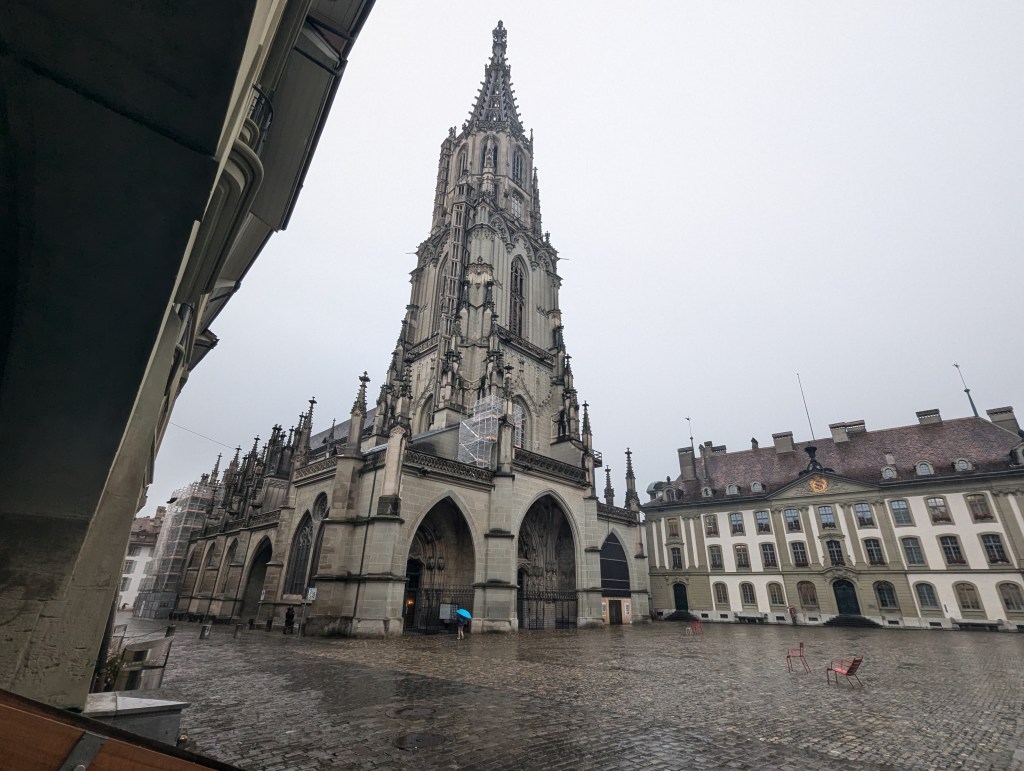
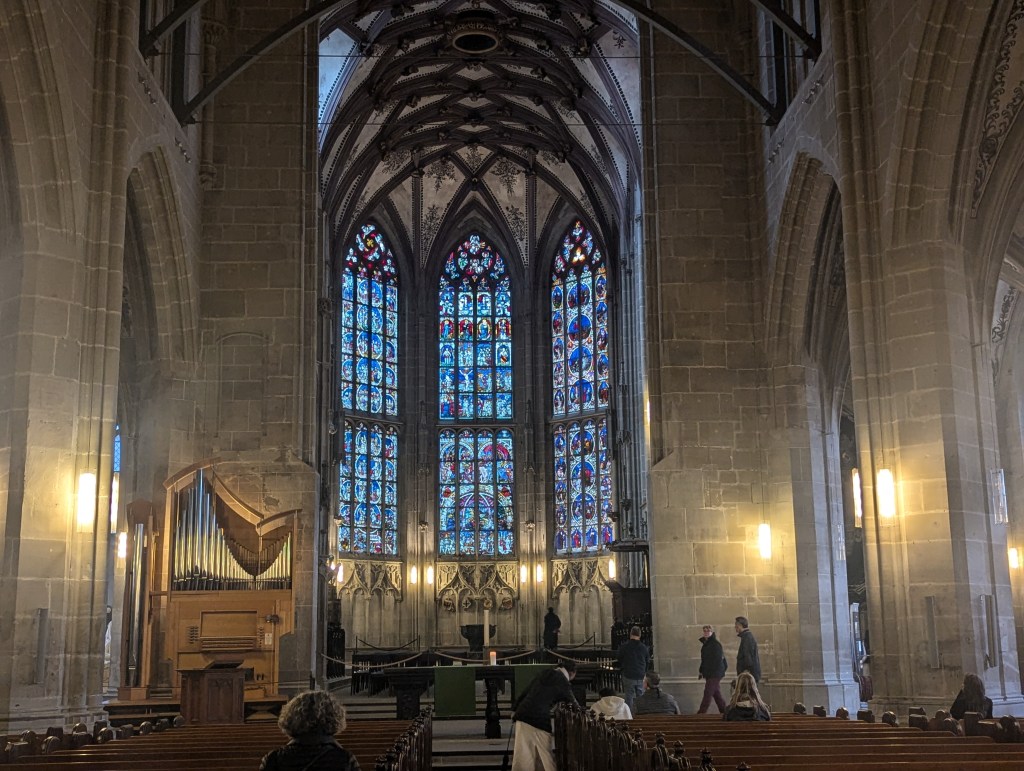
We walked around a bit familiarizing ourselves with the locale. Bern is built on what looks like a peninsula in a bend of the Aare River. The Old City, now a UNESCO World Heritage Site, lies all within this peninsula. The central street is aptly called Market Street (Marktgasse) and continues on to Kramgasse. Both are home to many 15th and 16th century buildings, now containing shops of all kinds. The is no traffic other than the trams and a few taxis. In the center are numerous fountains; more on them later.

Before heading back, we stopped at the local grocery store to pick up a few items. We were amused to see that the Swiss sell hard boiled eggs and distinguish them from raw by color.

We had a most delicious dinner at Falken Restaurant only steps from our place.
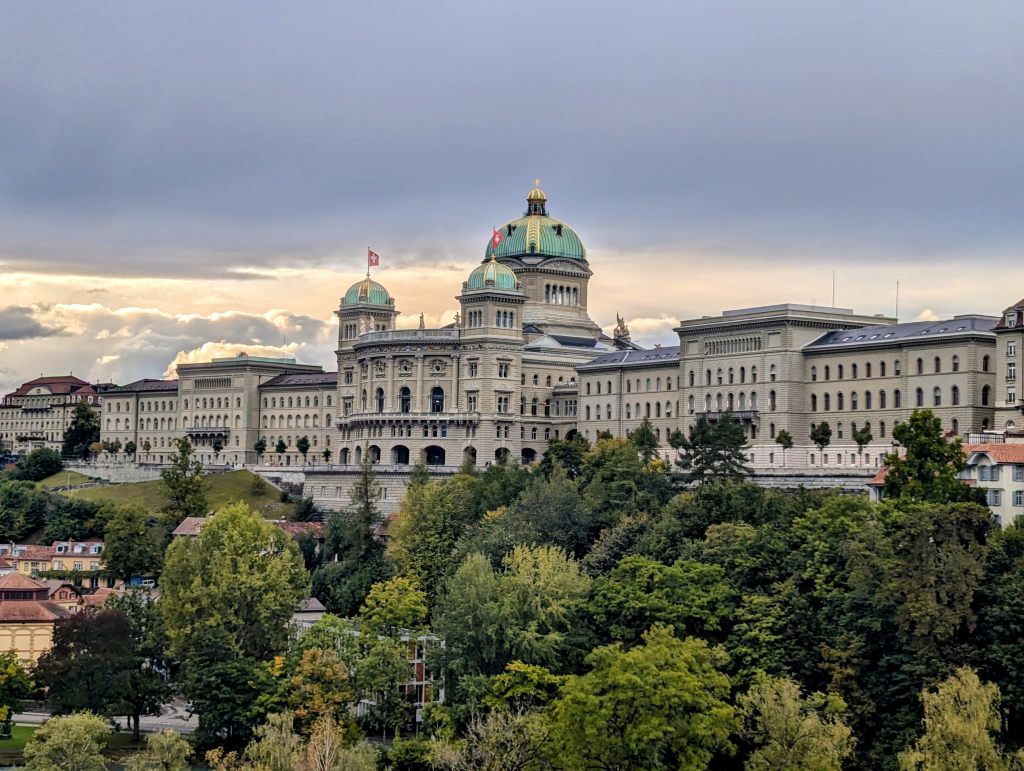
In the morning we embarked on a walking tour of the Old City. We started at the Federal Palace: Bundeshaus, which serves as the seat of the Swiss Government and Parliament. The Federal Palace is situated on a square of land originally settled in the 12th century. The square today is a meeting point.
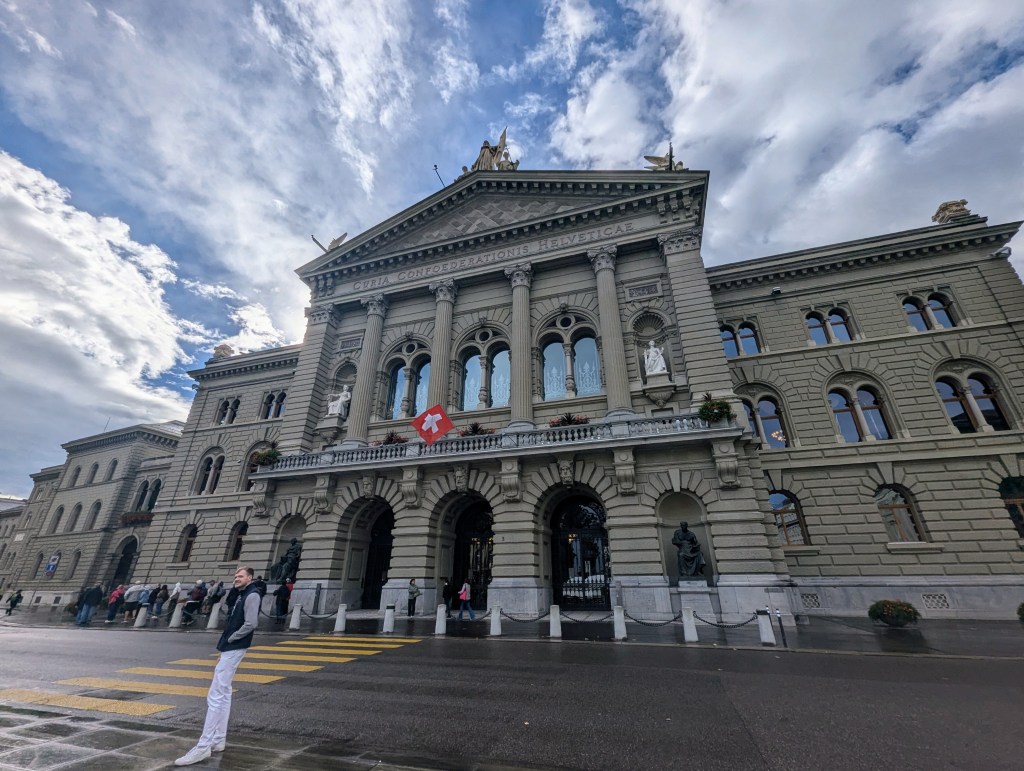
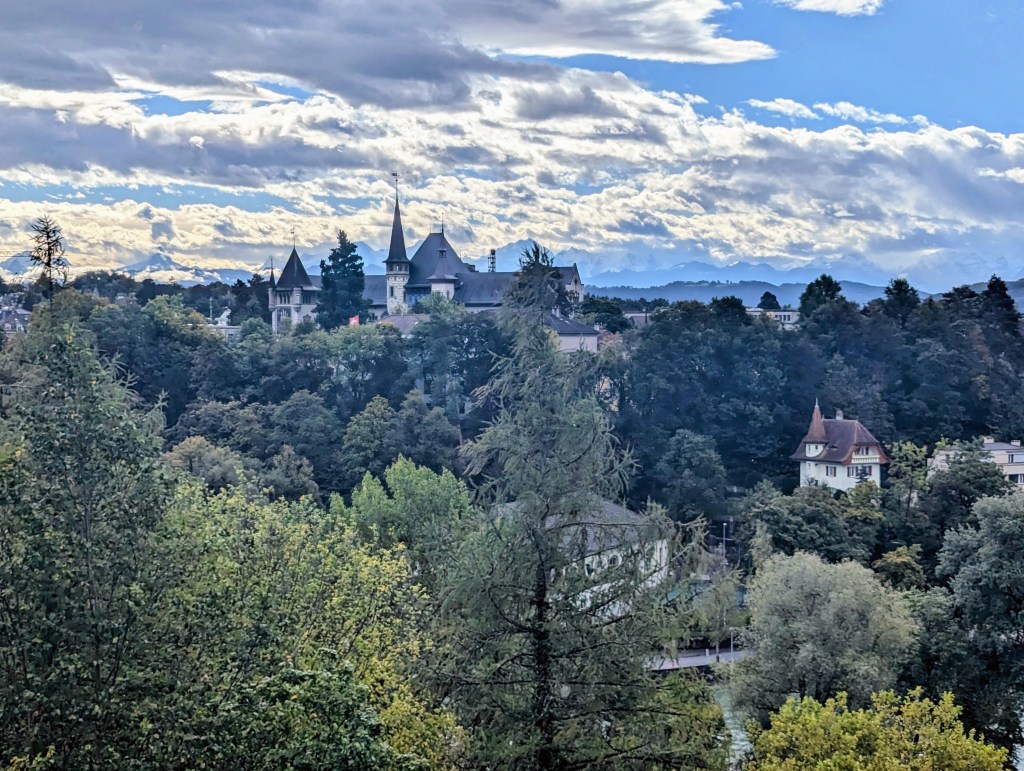
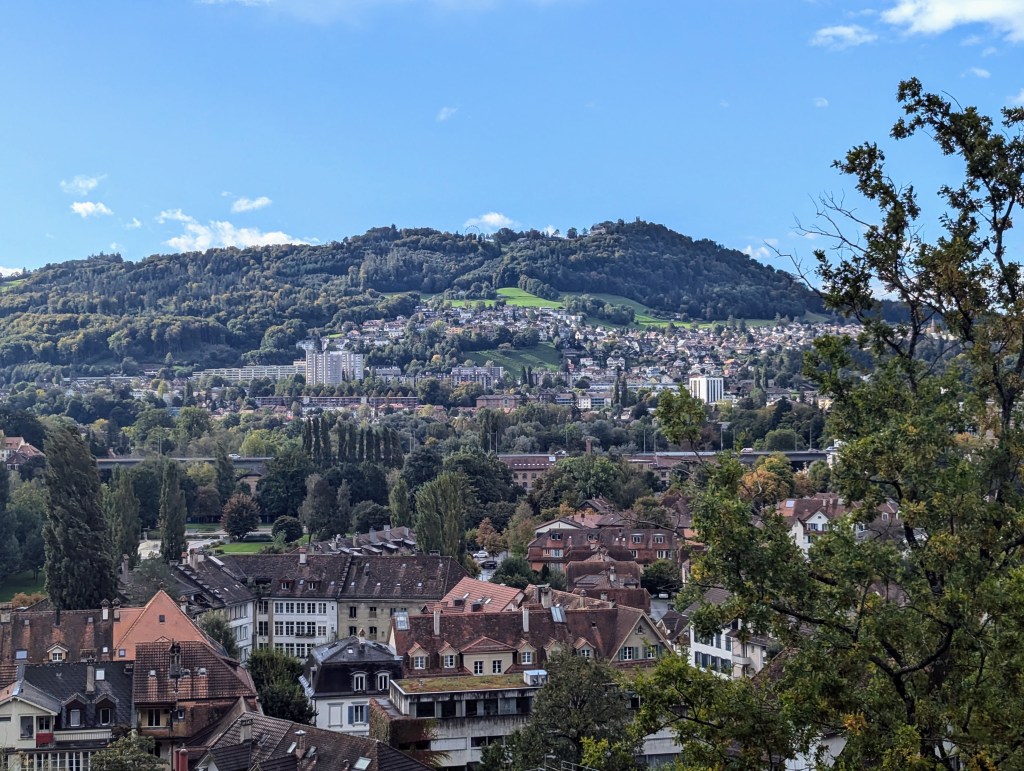
The views of the newer portions of the city from the back of the building are stunning.

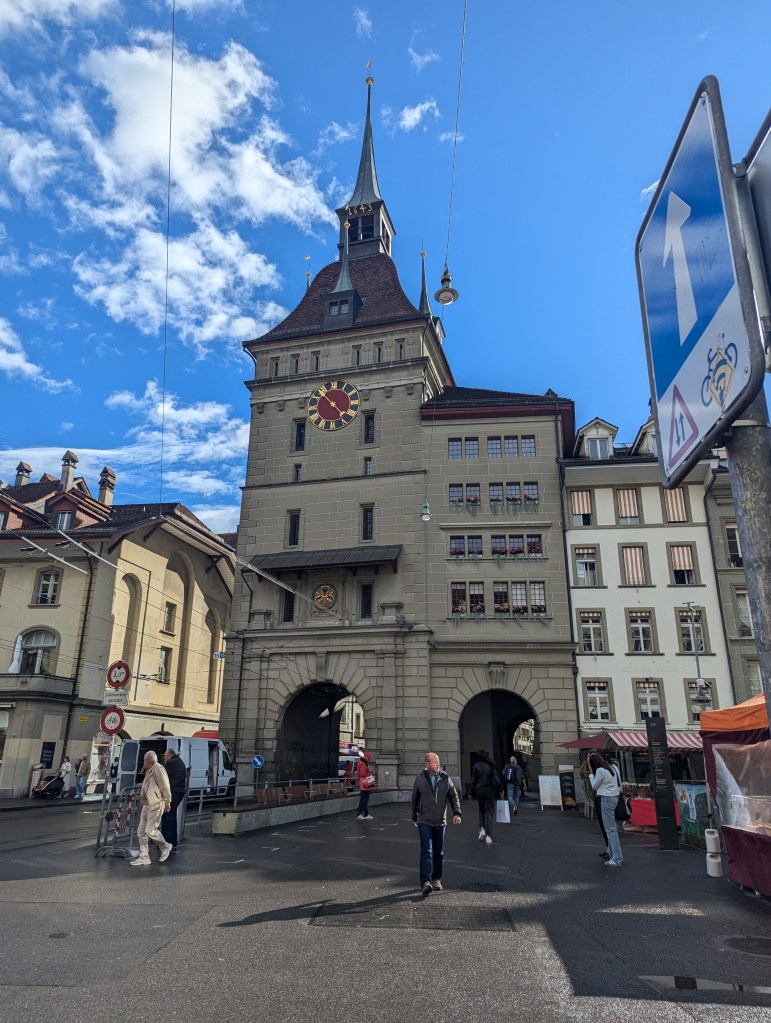
Walking through the square our next stop was the Käfigturm (Prison Tower). The original tower was built as a gate house during the second expansion of Bern in 1256. It has served the city as a guard tower, prison, clock tower, and the centre of urban life and a civic memorial.
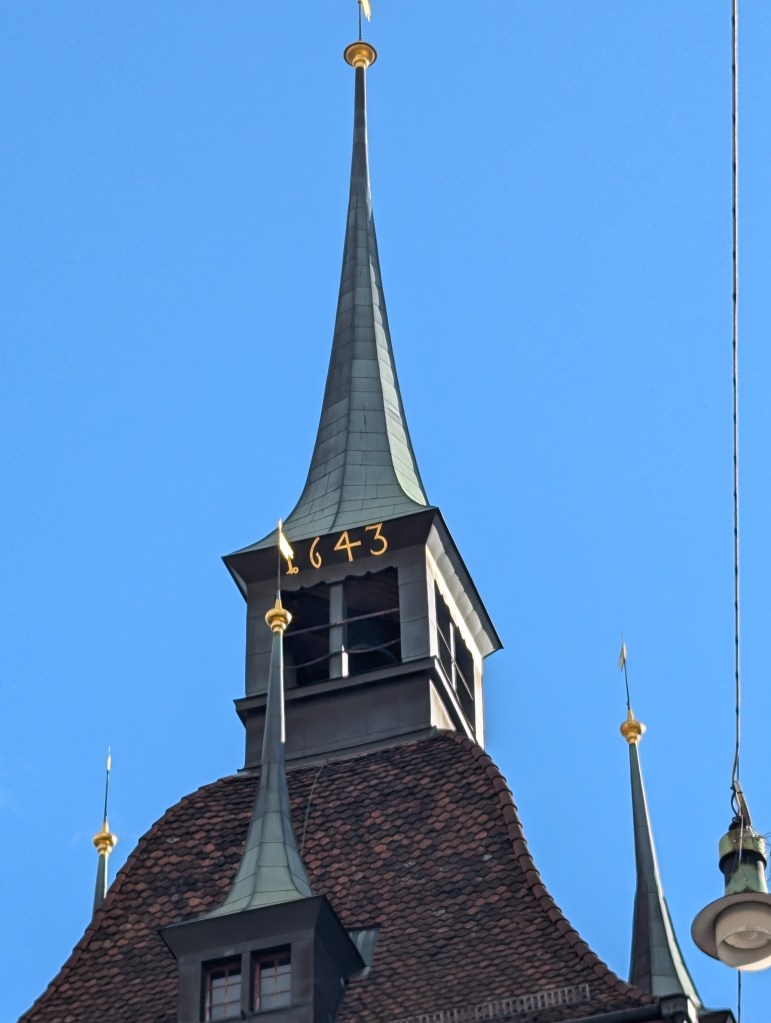
The bell dates to 1643 and still functions today. Originally it was struck by hand until a mechanism was added in the 19th century.
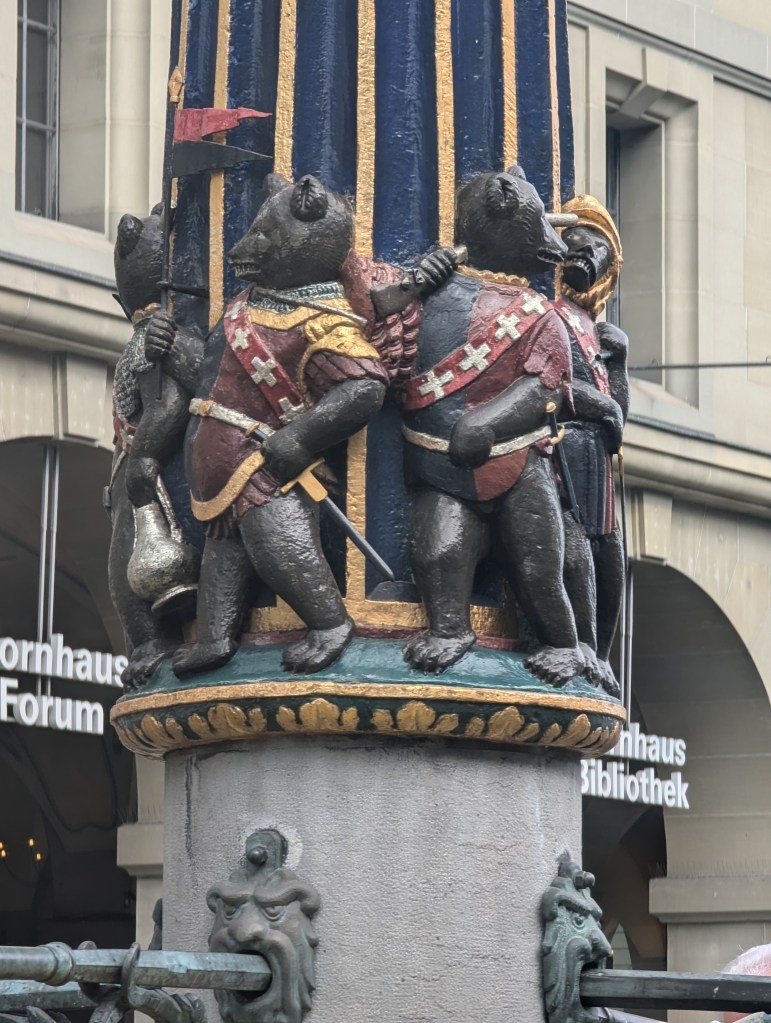
Our next stop was the Kindlifresserbrunnen, Child Eater Fountain. It was built in the mid 16th century to replace a wooden one. The fountain sculpture depicts a seated ogre devouring a naked child. Placed at his side is a bag containing more children. Because the ogre is wearing a pointed hat resembling a Jewish one, it has been speculated about the possibility of the ogre being the depiction of a Jew as an expression of blood libel against Jews.

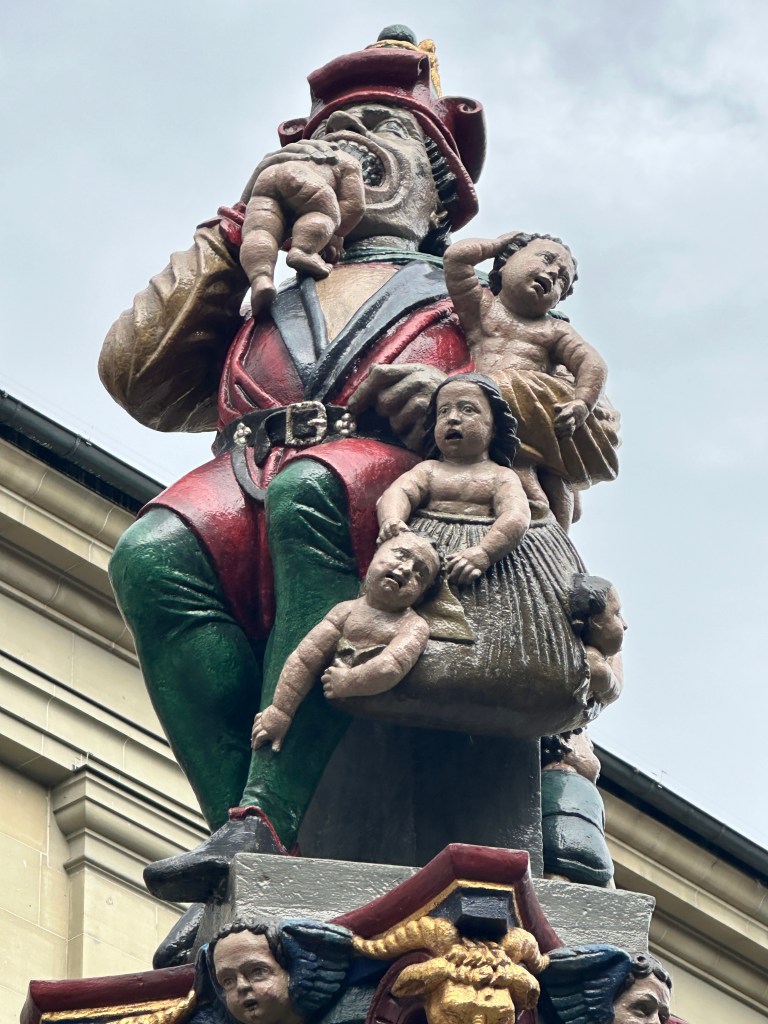
Another theory is that the statue is the likeness of Krampus, the beast-like creature from the folklore of Alpine countries thought to punish children during the Christmas season who had misbehaved. Another theory is the eight children depict the eight cantons of the Old Swiss Confederacy and the Ogre is an enemy trying to gobble the cantons up. This would match with the fountain’s base which shows a frieze of armed bears going to war, including a piper and a drummer.
We now strolled down Marktgasse (Market Street). Stretching from Käfigturm at one end and Zytglogge (Clock Tower) at the other, it has since 1286 been the vibrant center of the Old City.
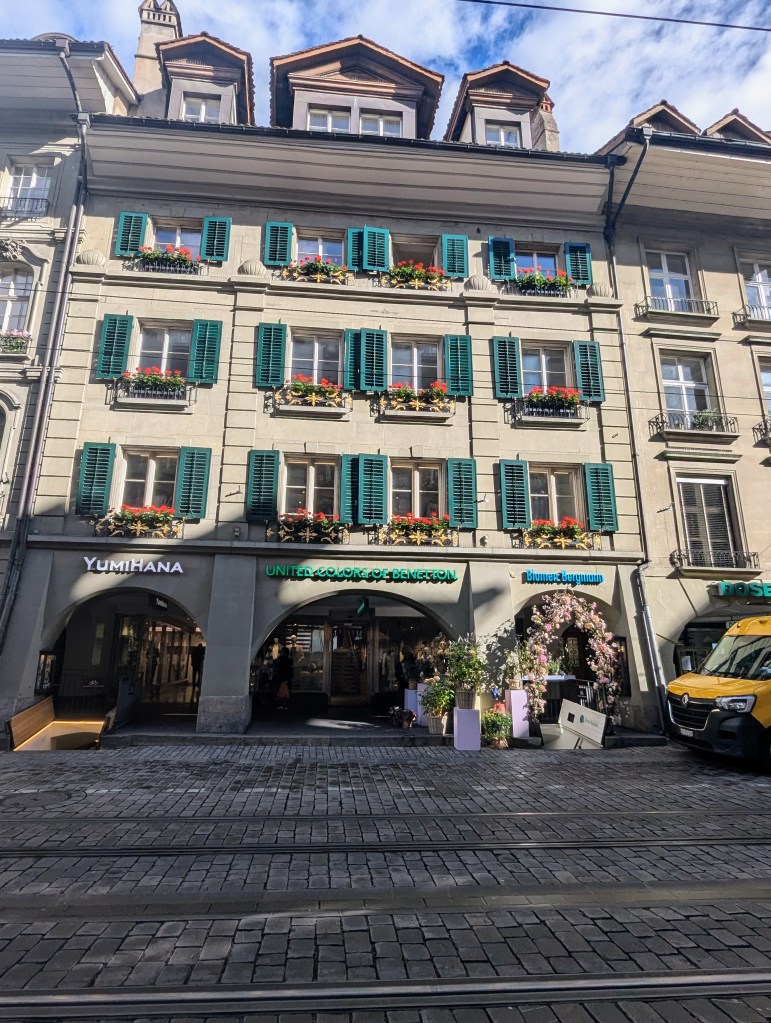
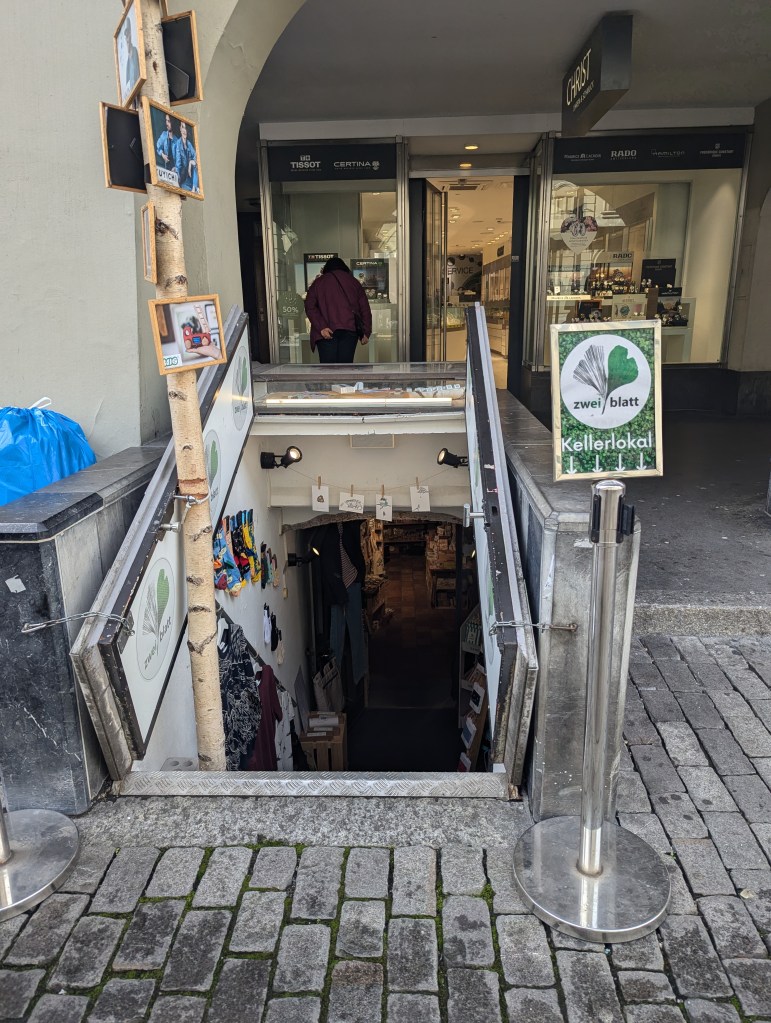
Note the open doors coming out of the street on both sides of the shop above. At fist we thought it was like in NYC opening into cellar spaces of the shops above. It turns out these open to separate shops and even museums. There is a whole layer of shopping a level below.
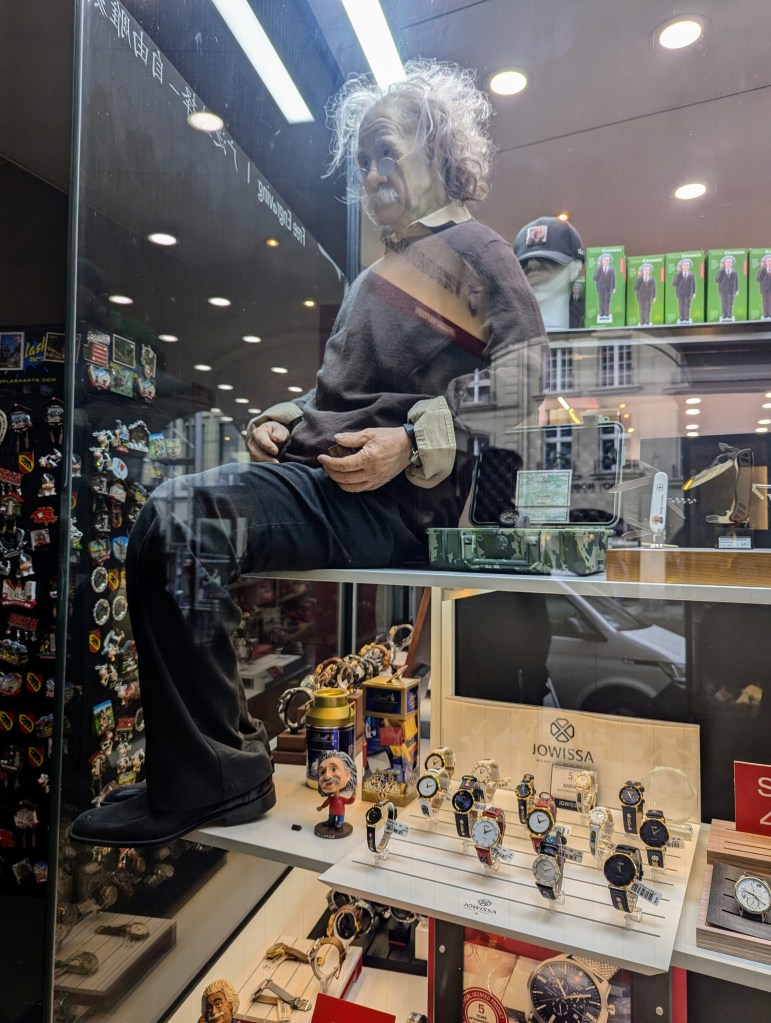
During his years at the patent office in Bern, Einstein lived in an apartment on this street. We opted to skip this (opted for the Einstein Museum instead), but were amused by the souvenir shop outside his residence full of Einstein replicas.
Along Market Street are numerous fountains like this one: The Zähringerbrunnen, which was built in 1535 as a memorial to the founder of Bern. The statue is a bear in full armor, with another bear cub at his feet (also holding a rifle). The bear represents the bear that, according to legend, Zähringer shot on the Aare peninsula as he was searching for a site to build a city. The armored bear carries a shield and a banner, both emblazoned with the Zähringer lion.
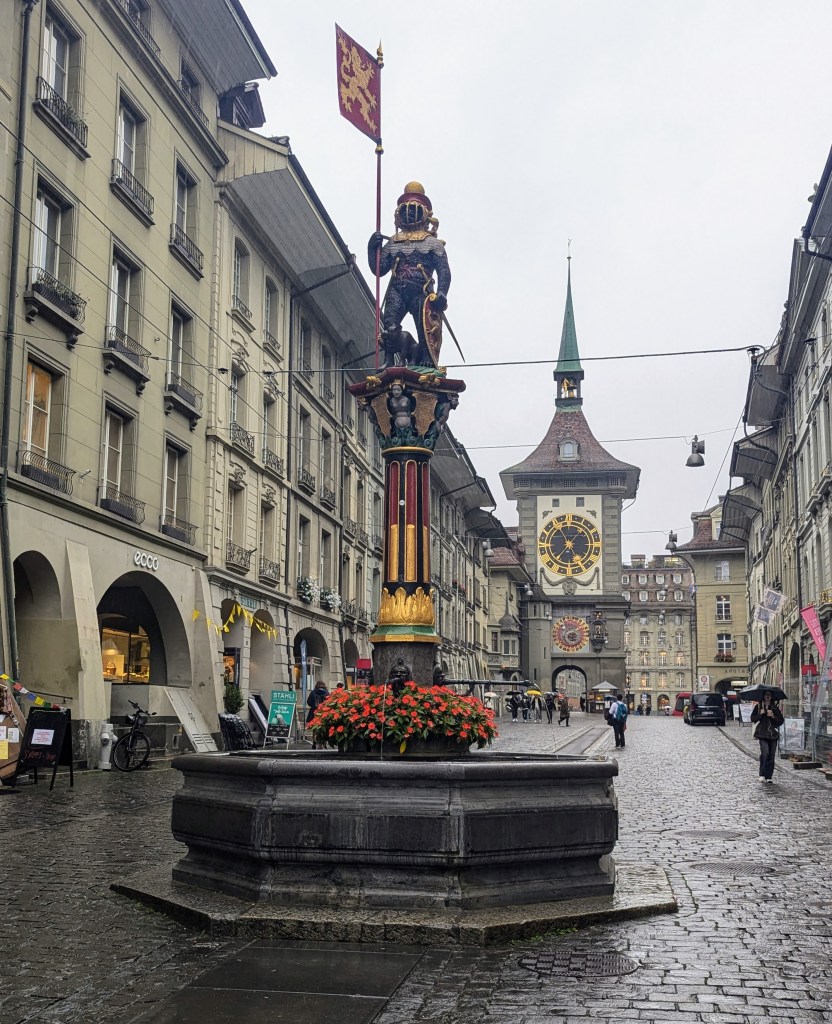
The east end of Market Street is dominated by the Zytglogge (Clock Tower). Despite the many redecorations and renovations it has undergone in its 800 years of existence, the Zytglogge is one of Bern’s most recognizable symbols and the oldest monument of the city with its 15th-century astrologic clock (on the other side).
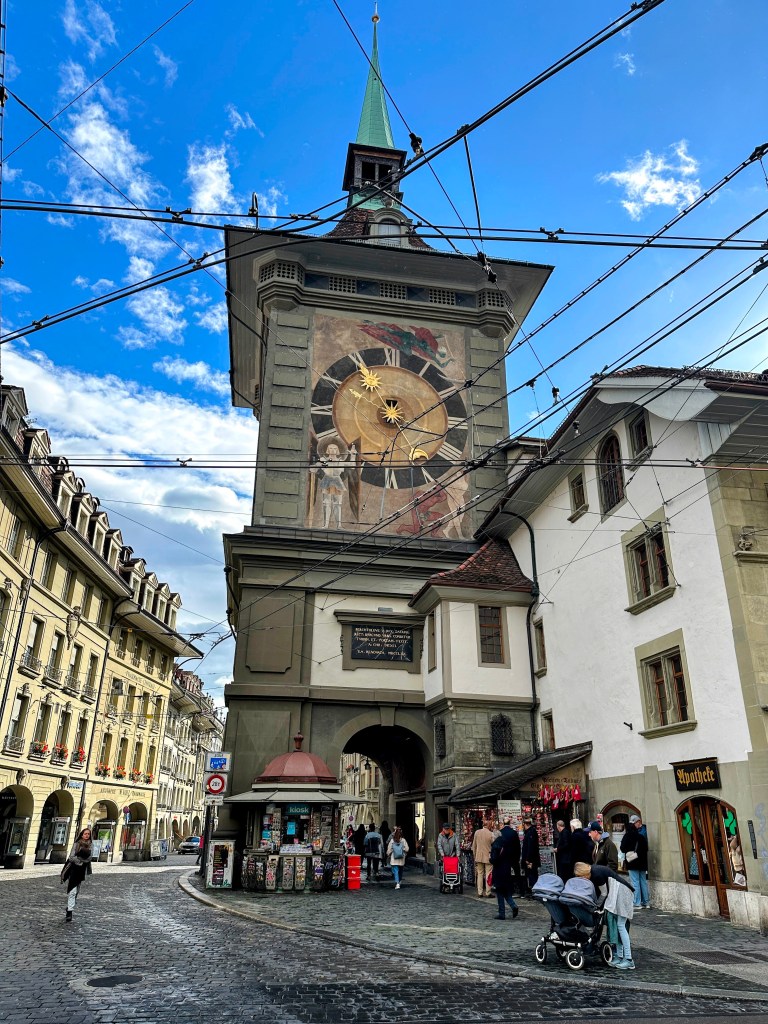
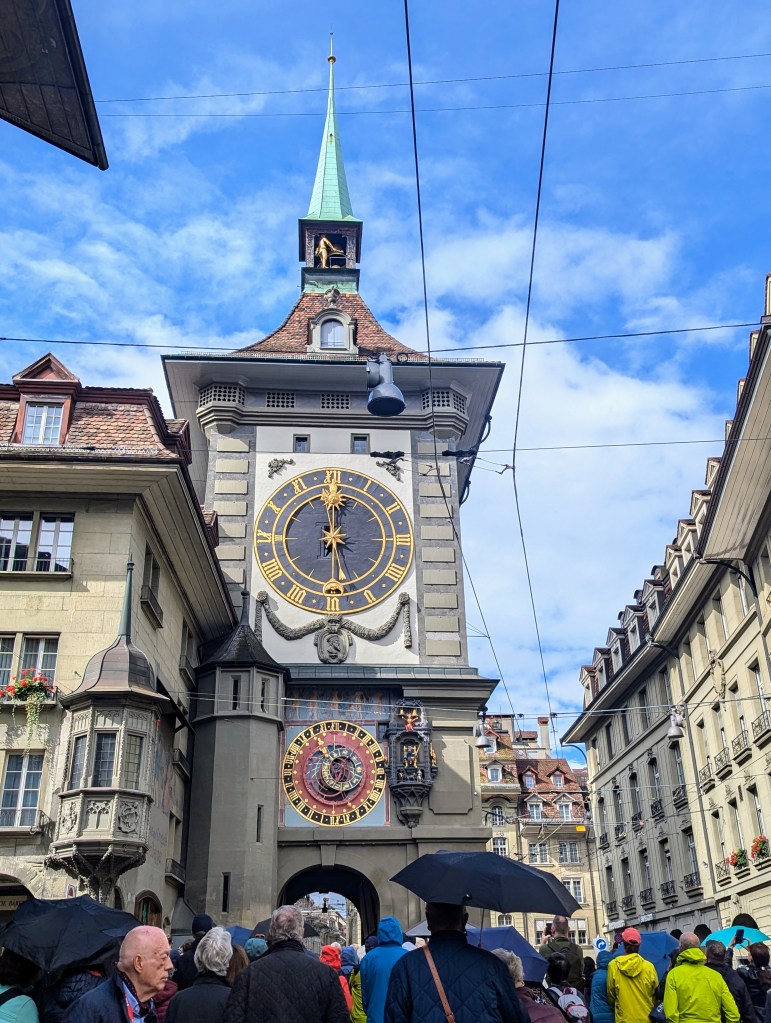
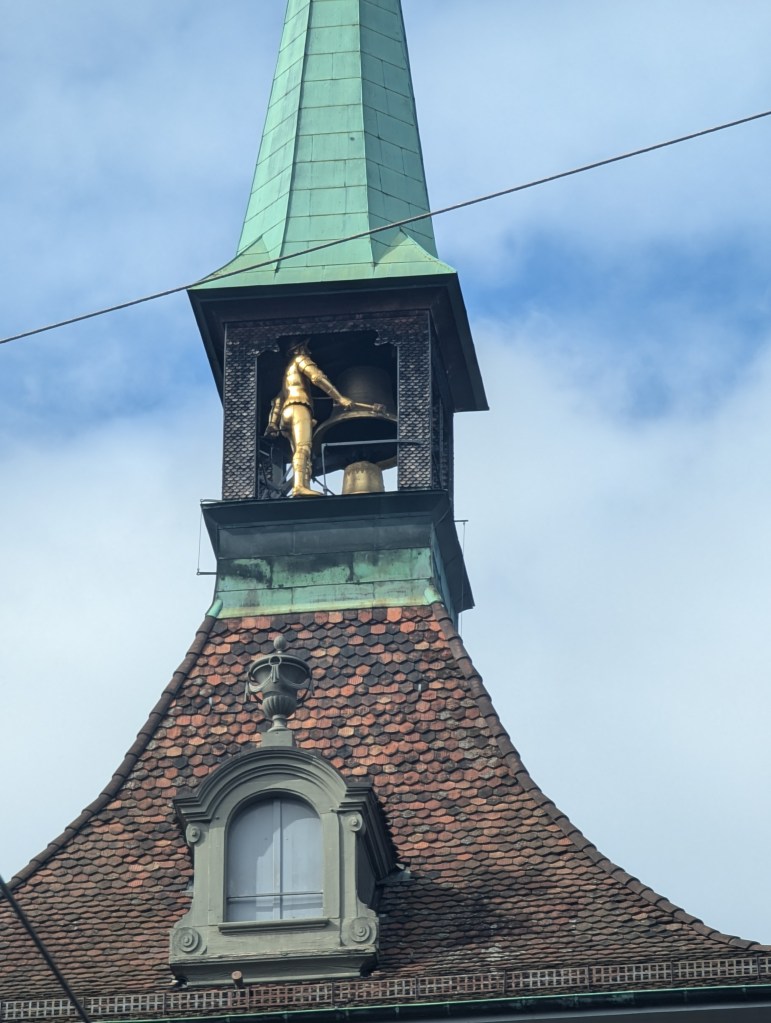
At the hour tourists gather to watch the mechanisms strike the bell.
Continuing east past Marktgasse we strolled down Kramgasse. Next stop was the 16th century Gerechtigkeitsbrunnen (Fountain of Justice). In a city of over 100 fountains this one stands out because it is the only one that has maintained all of the original design features. The iconic figure of Lady Justice was copied throughout Switzerland up until the middle of the 17th century. She is portrayed standing in gracious counterpoise holding her traditional attributes: a sword of justice in her right hand, a balance in her left hand and a blindfold over her eyes. Her costume is fashioned in an antique manner, with sandaled feet, one knee bared, wearing a decorative golden suit of armor.
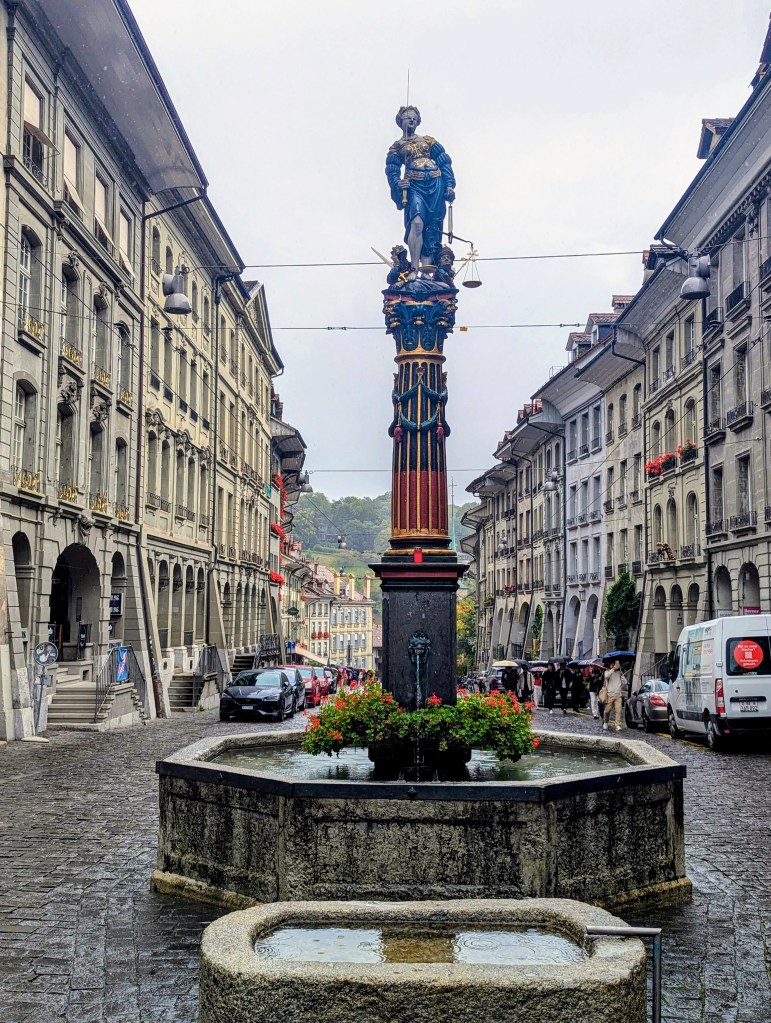
This is the first time in history that she is portrayed blindfolded, which later became a symbol for the principle of equality before the law. The blindfold implies that justice ought to be done without respect to rank or standing; that a just verdict is arrived at through introspection rather than with a view to outward looks. At the feet of Justice, four smaller busts crowd the pedestal: a Pope, an Emperor, a Sultan and a Schultheiss. All figures have closed their eyes as in submission. They represent the Four Earthly Powers: the four forms of government according to Renaissance Humanism theocracy: (the Pope), monarchy (the Emperor), autocracy (the Sultan) and the republic (the Schultheiss).

As we continued on Kramgasse we saw such diverse shops as a custom mens’ shoes store and this handmade string instruments shop.

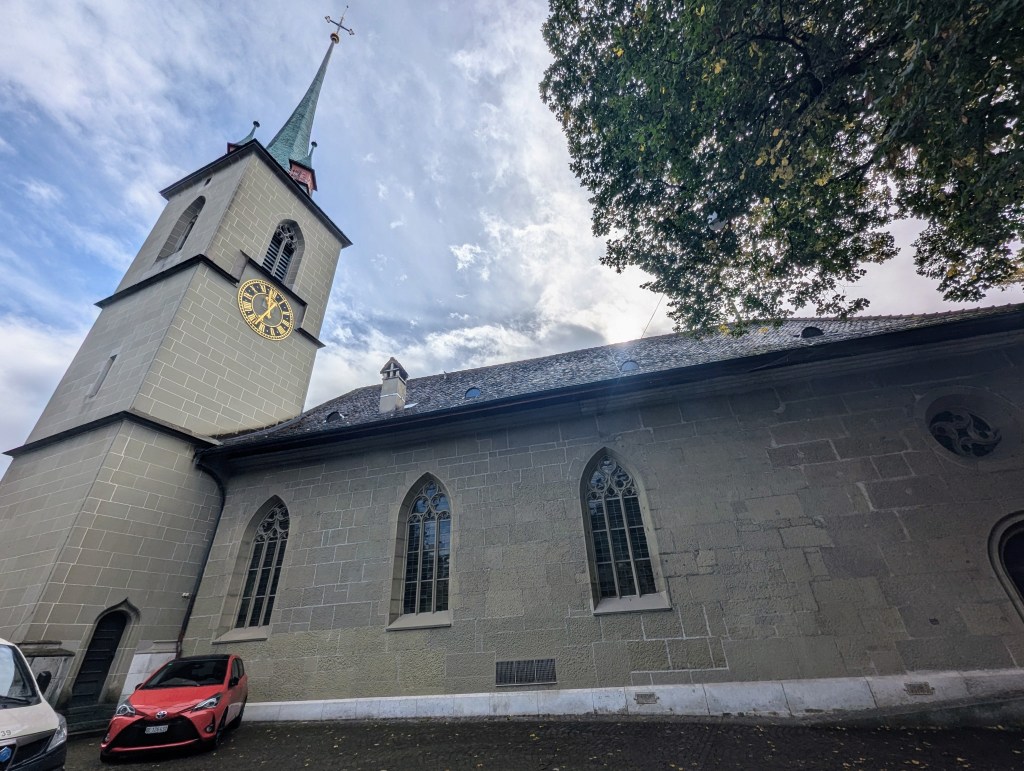
At the tip of the peninsula at the bend in the Aare River stands the Nydegg Church first built in 1341. Today it is part of the Reformed Churches of the Canton of Bern, and was one of the first in the European Union to perform same-sex marriages.
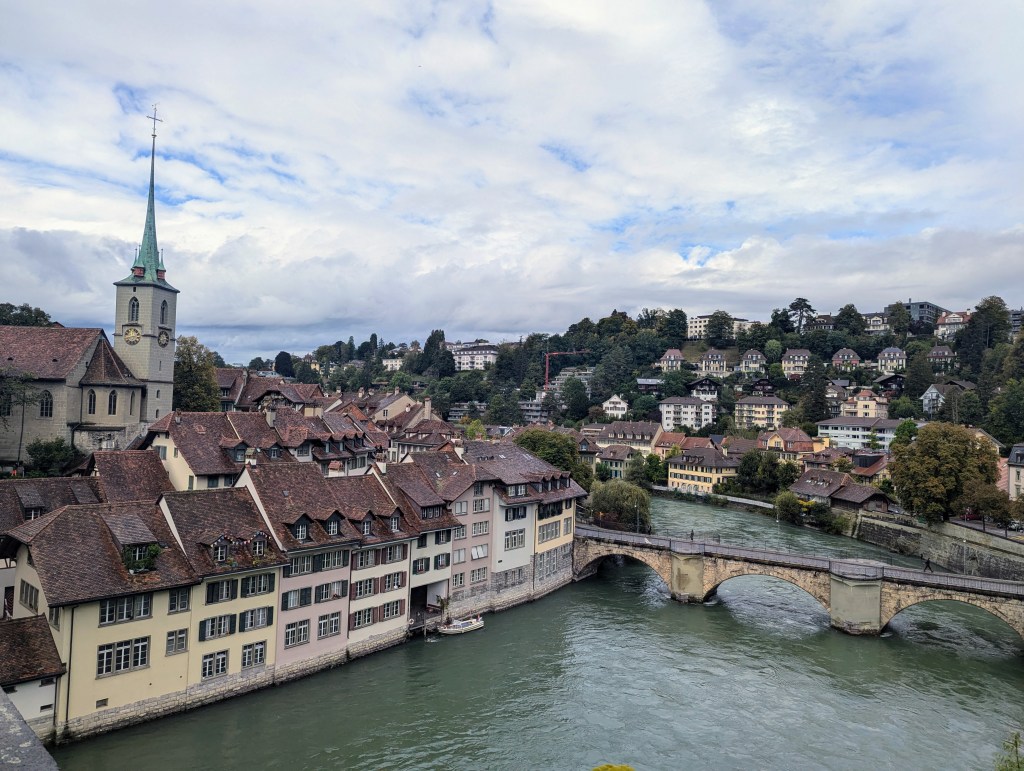
And finally, at the tip of the peninsula, connecting the Old City of Bern across the water, stands the Untertorbrucke (The Lower Gate Bridge). Originally constructed in 1256, it is the oldest of Bern’s bridges and for years was the only river crossing. It has undergone many modifications through the centuries, but today stands primarily as a vestige to its medieval core.
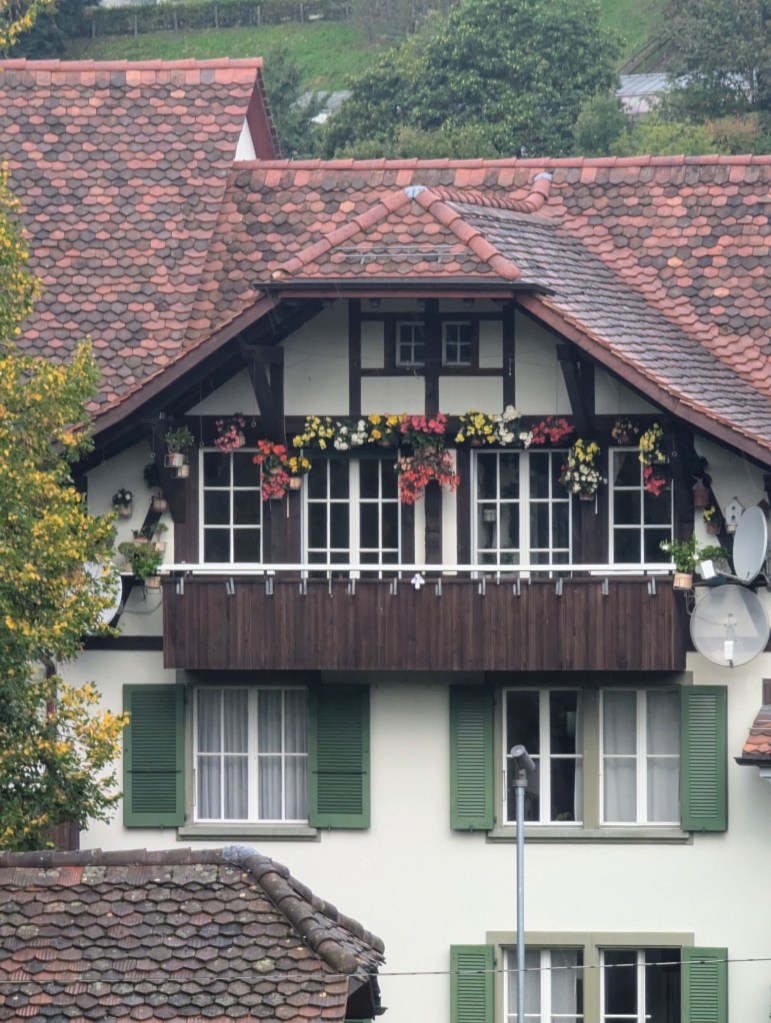
From here we could also see several typical Swiss homes.
Also here at the eastern end of the peninsula is the bear park

where for centuries the city of Bern has maintained a home for bears.
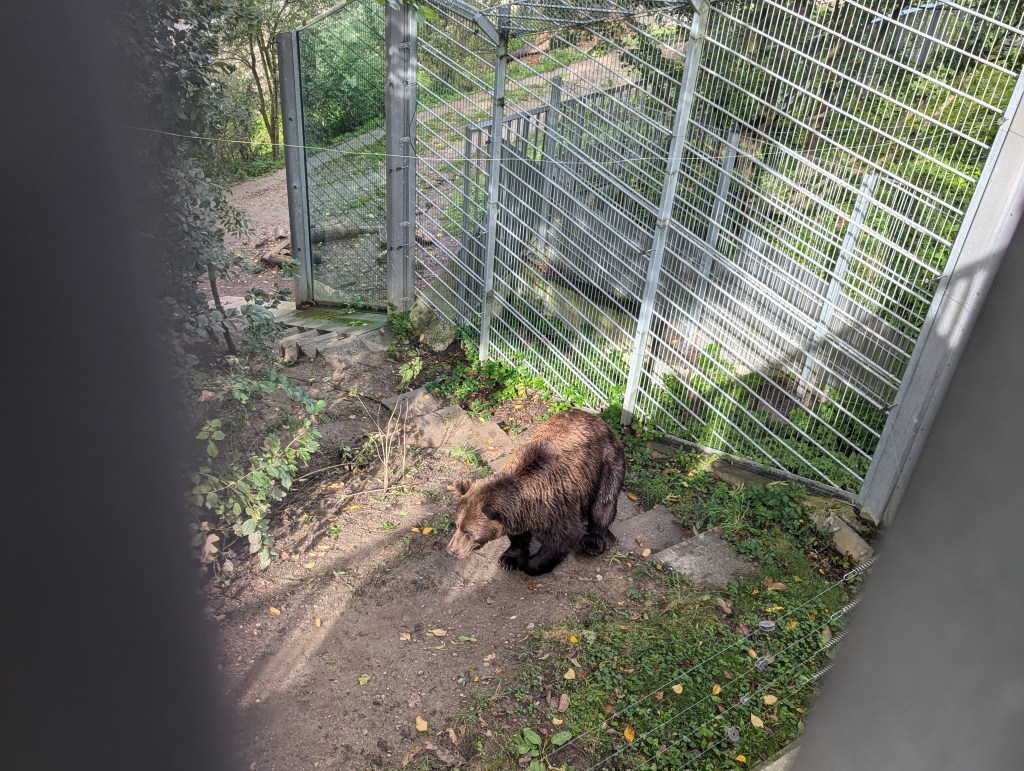
Due to rain, we took a break from exploring the city. But once the rain let up for a bit, we headed back out to see more fountains. Those who have read my Moroccan blogs may remember how door obsessed I became there. Well so far in Switzerland it has been the fountains that have been the source of my obsession.
Be it fountains or the Aare river, in Bern water is omnipresent. There are 217 public fountains in Bern’s Old City. Apart from their decorative character and interesting history, Bern’s fountains obviously also have a functional aspect. The cool water flowing from their spouts is drinkable and free for everyone. And the pragmatic locals have combined the useful with the beautiful, placing some of the fountains on busy streets and therefore making them the world’s most charming traffic blocks.
The history of Bern’s public water supply dates all the way back to the Middle Ages: in the 13th century, there were already several standpipes in the city of the Zähringen people. The water came from the city’s underground stream, wells and probably cisterns. The main supply was the city’s creek. It was used as sewage, transported water to fight fires and connected – and still connects – Bern’s fountains. Around 1550, the city replaced the then wooden fountains with elaborate stone ones.
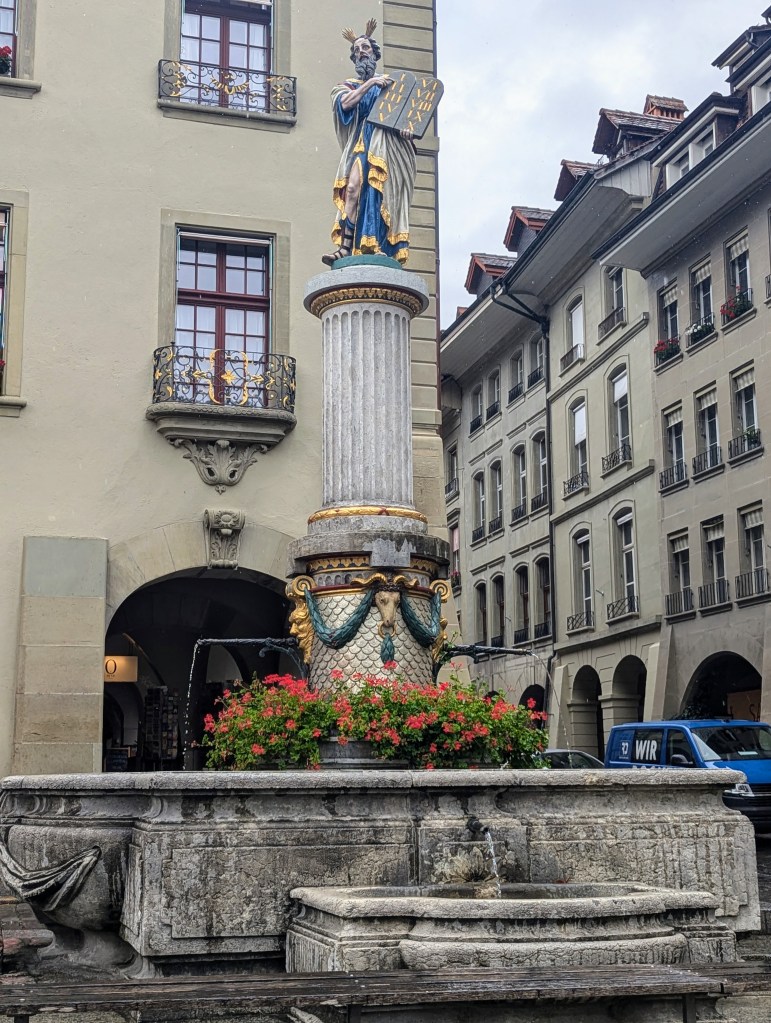
Steps from our apartment, in the plaza in front of the cathedral, stands Moses first constructed in 1544 and rebuilt after storm damage in 1790. The statue represents Moses bringing the Ten Commandments to the Tribes of Israel. Moses is portrayed with two rays of light projecting from his head, which represent Exodus 34:29-35 which tells that after meeting with God the skin of Moses’ face became radiant.
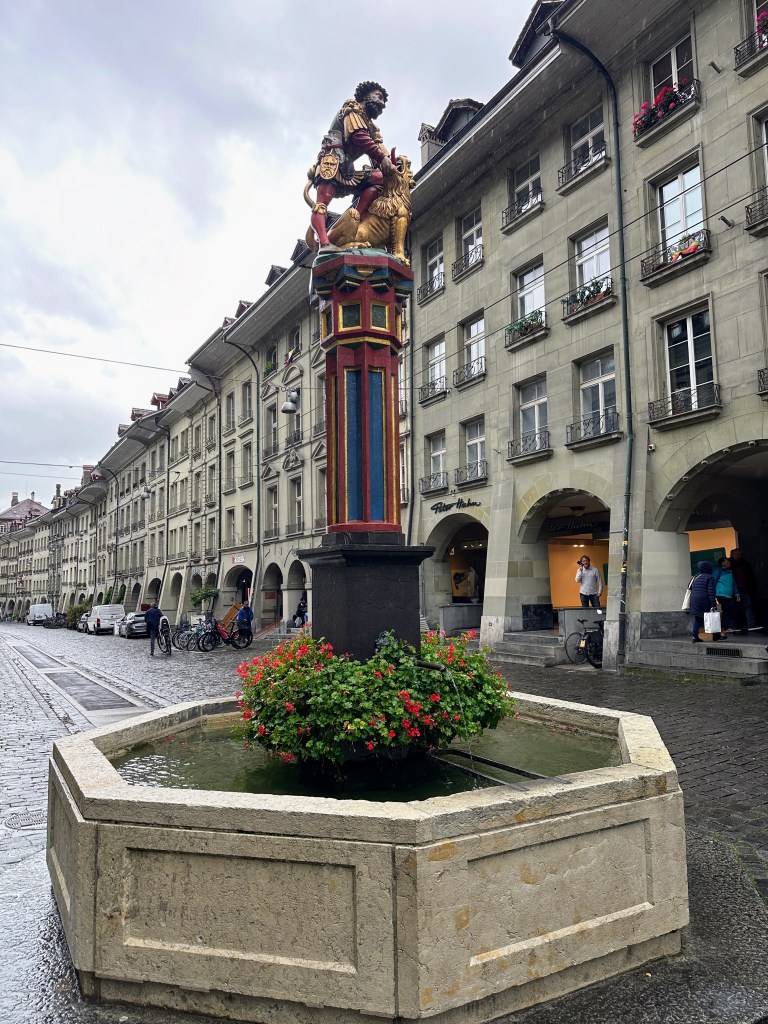
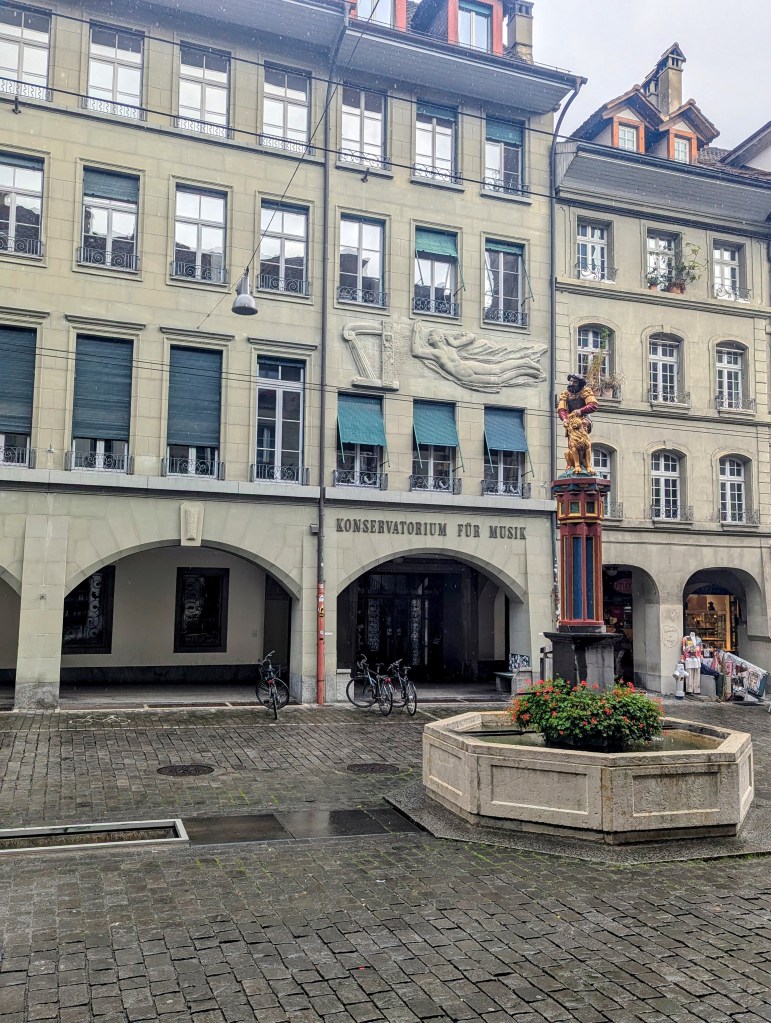
Another Old Testament figure is that of Samson also built in 1544. Biblical hero Samson is seen here killing the lion, a feat he is able to perform due to the great strength gifted to him by God on the condition that he abstain from alcohol and not cut his hair. A noteworthy detail on the statue is the butcher’s tools on Samson’s belt, hinting that the fountain’s likely patronage was the Butchers’ Guild.
Today the fountain stands in front of the Music Conservatory.
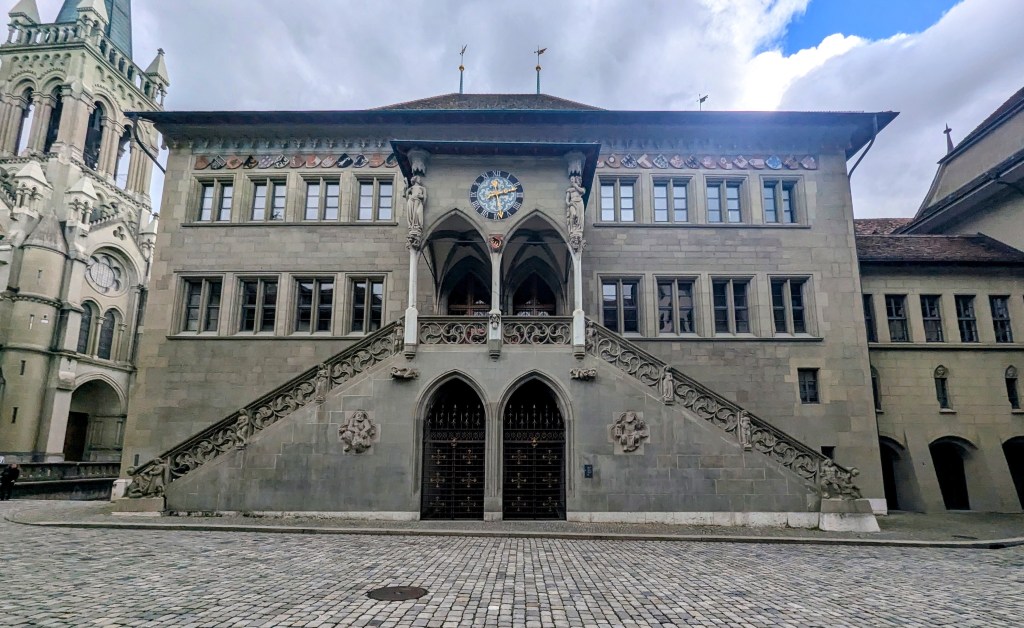
We detoured from Kramgasse and headed over to Town Hall, built in 1406.
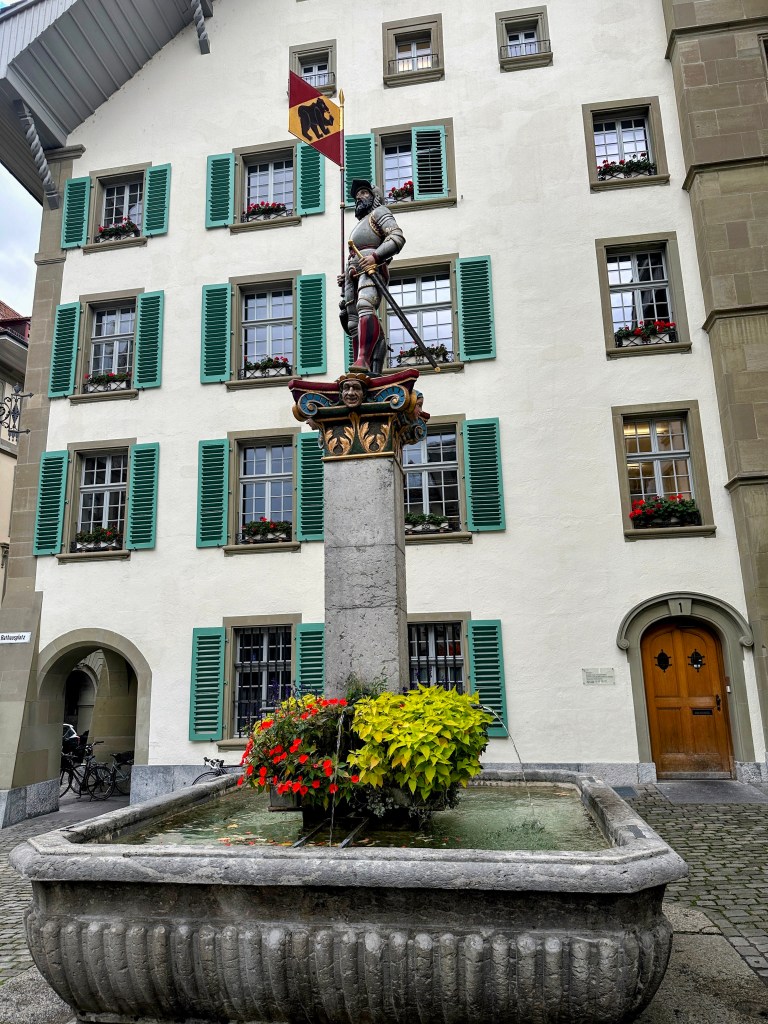
In front of which stands Vennerbrunnen (the Banner Carrier Fountain), built in 1542. The Venner was a military-political title in medieval Switzerland. He was responsible for peace and protection in a section of a city and then to lead troops from that section in battle.
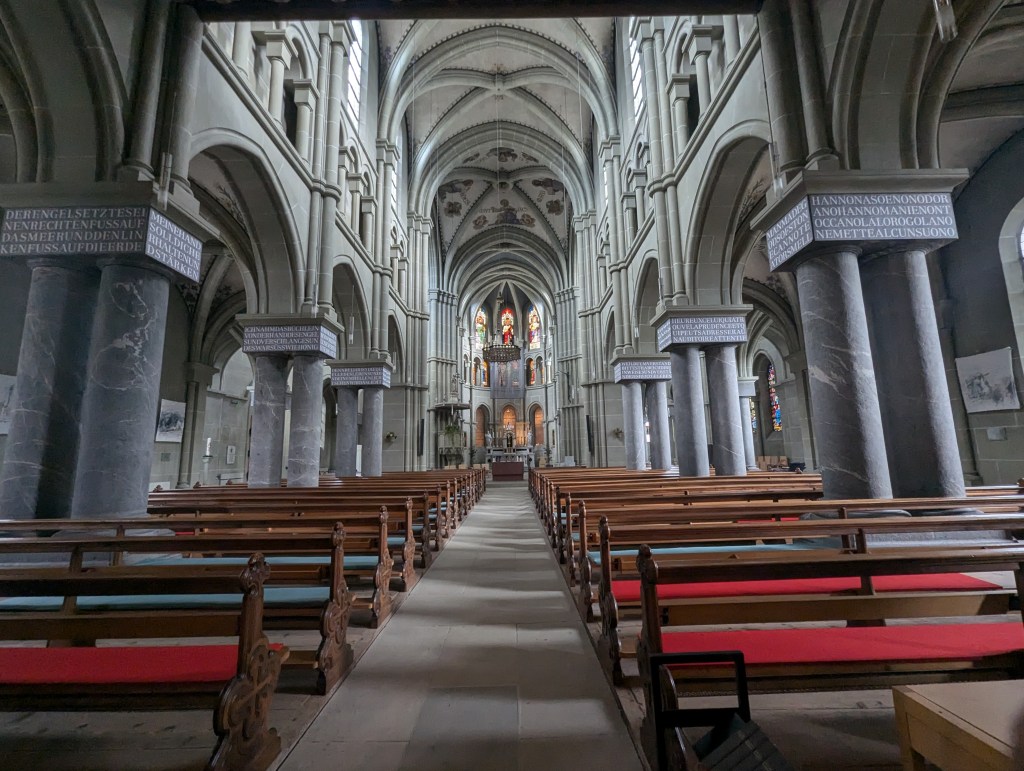
Next to Town Hall is the Church of St. Peter and St. Paul. During the Protestant Reformation in the early 16th century, the city of Bern adopted the new Protestant faith and the city’s churches converted, leaving the remaining Catholics in Bern without a church. Over the following centuries, they remained without a church in the city. The Church of St. Peter and Paul was begun in 1858 as the first Catholic church built in Bern since the Reformation.
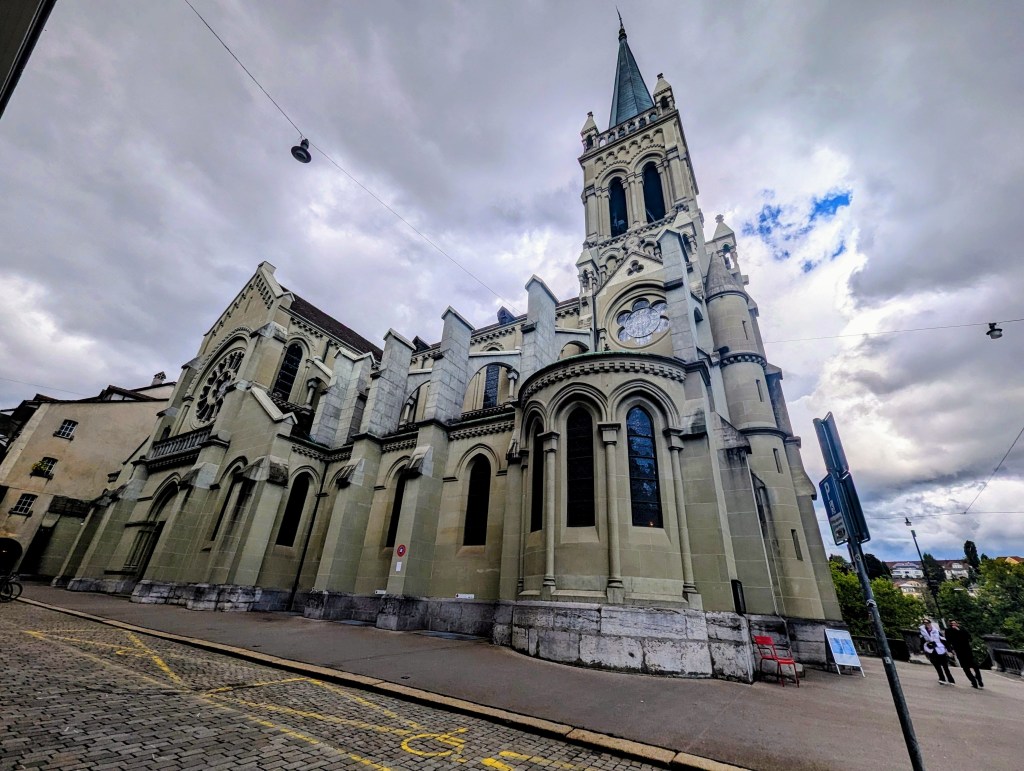
Kirche St. Peter und Paul
The church was renovated in the mid-twentieth century.
We headed back to Marktgasse and the Schützenbrunnen (Marksman Fountain) dating to 1543. The statue depicts an armed rifleman, a standard bearer for the Society of Musketry, with a banner in his right hand and a sword in his left. Notably, a bear cub, symbolically positioned between the rifleman’s legs, aims a rifle, adding a playful yet significant element to the composition.

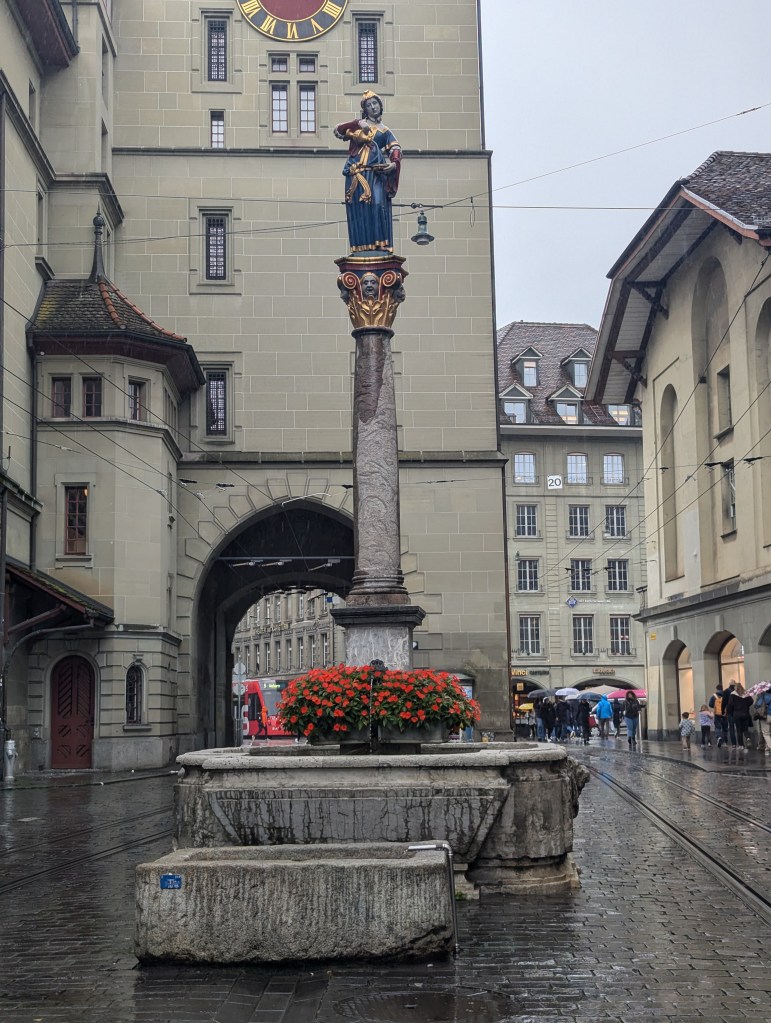
Further west on Marktgasse is one of our favorite fountains thematically. The Anna-Seiler-Brunnen (Anna Seiler Fountain) commemorates Anna Seiler, the founder of Bern’s first hospital. Constructed in 1545, the fountain features a statue of Anna Seiler dressed in a blue gown, pouring water into a small dish, symbolizing her nurturing spirit and commitment to healthcare. Anna Seiler bequeathed her house to the city in her will on November 29, 1354, specifying that it be transformed into a hospital with 13 beds and two attendants. Known initially as the Seilerin Spital, it later moved to the Dominican Order’s Saint Michael’s Island monastery in 1531 and was renamed the Inselspital. The modern Inselspital remains a thriving healthcare institution with about 6,000 employees, treating approximately 220,000 patients annually. Anna Seiler Fountain serves as a testament to Seiler’s legacy and her lasting impact on healthcare in Bern.
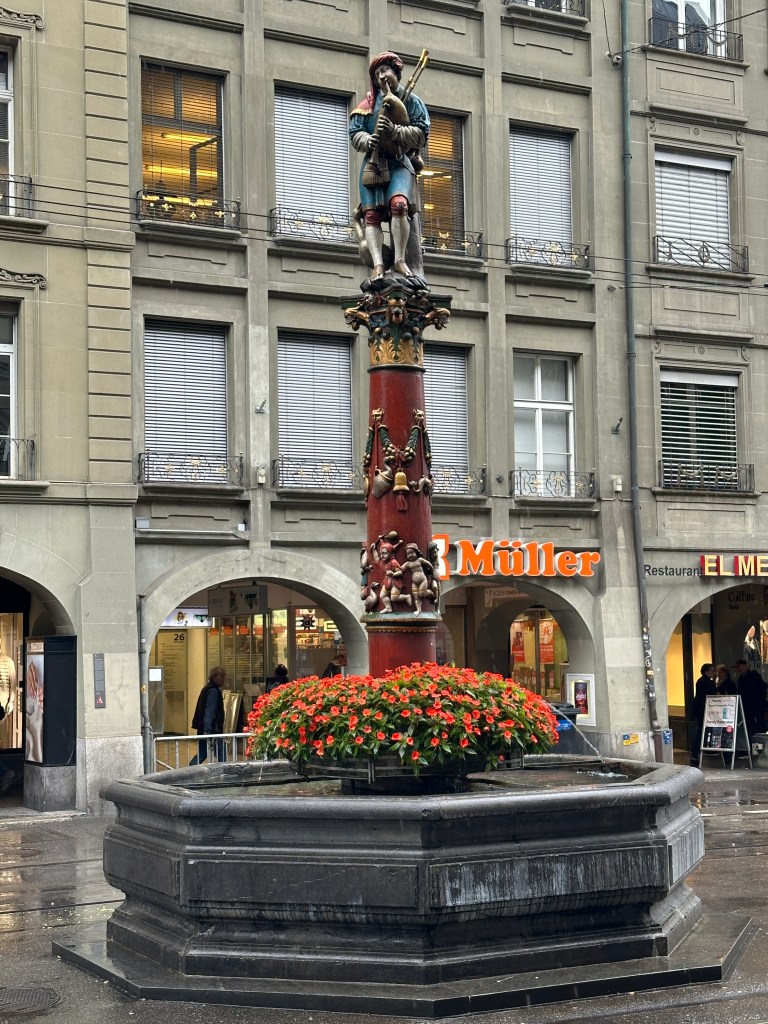
Our final fountain of the day was Pfeiferbrunnen (Bagpiper Fountain). This 16th century fountain, characterized by its colorful figures, depicts a cheerful scene where a bagpiper, accompanied by a golden goose and a small monkey playing the flageolet, jovially performs. This assembly is symbolic, celebrating themes of cheerfulness, life, music, dance, and culinary delights. Such themes were typical of the era and resonated with the social activities around fountains, which were vital communal spots in medieval Bern.
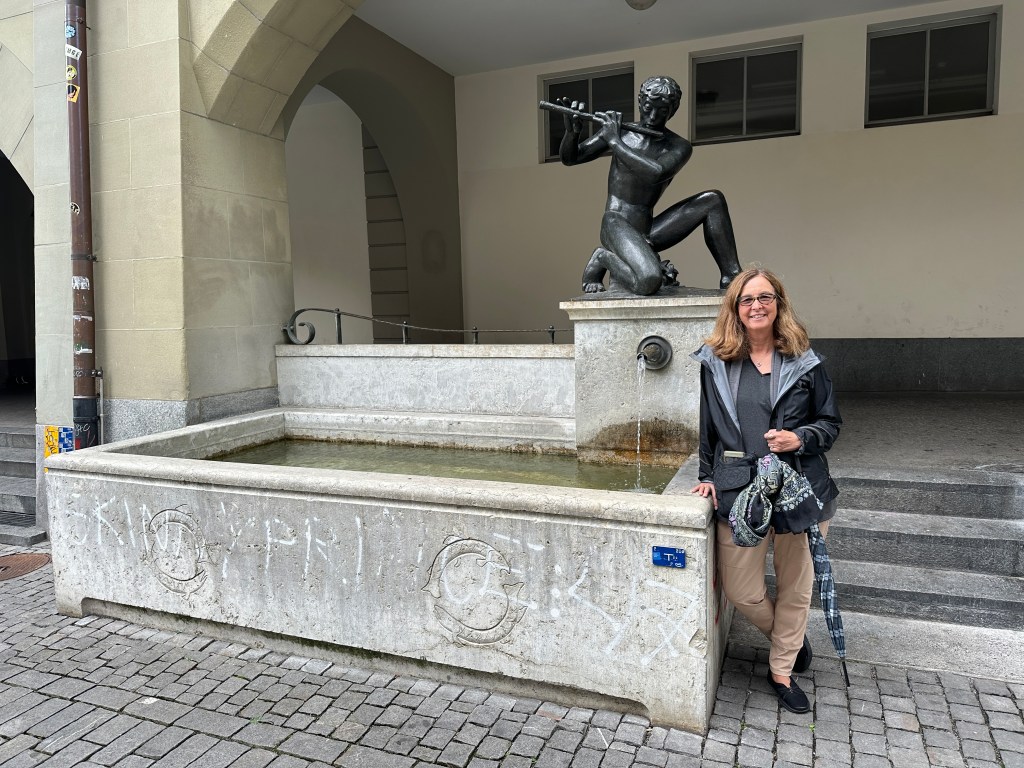
We could not resist one more pic of a fountain, though not such a historically significant one.
The next day brought lots more rain, so we headed across the Aare River toward the museum.
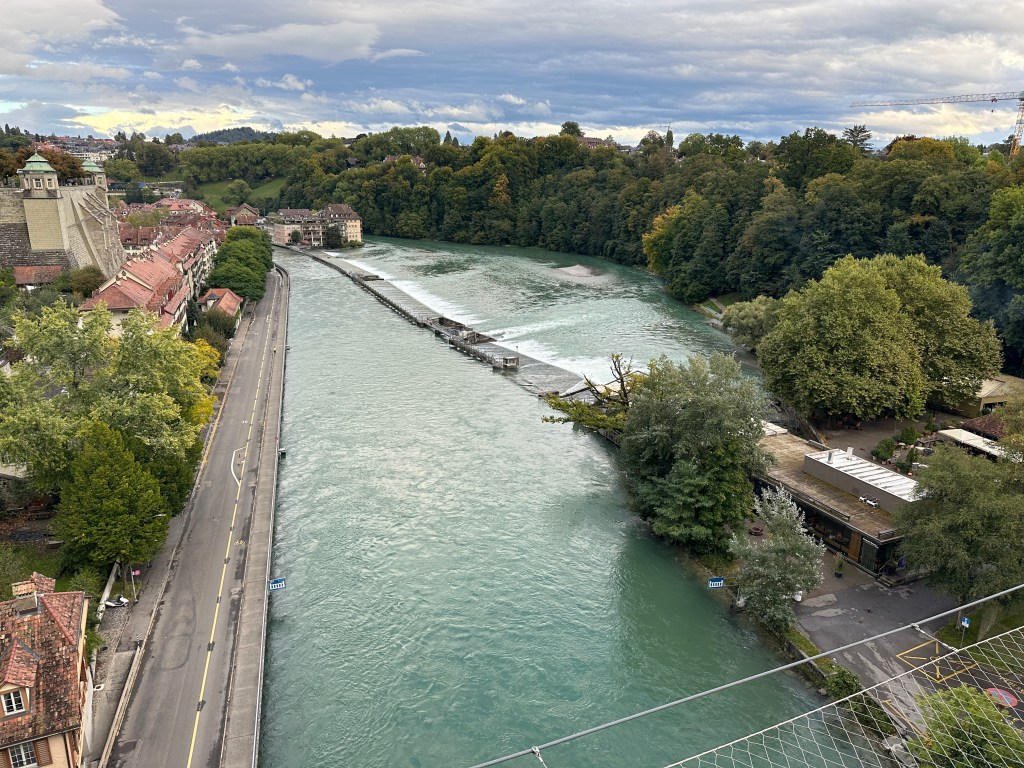
On the way we had an amazing view of the river.

Once on the other side we had a great view of the Bern Minster to the east
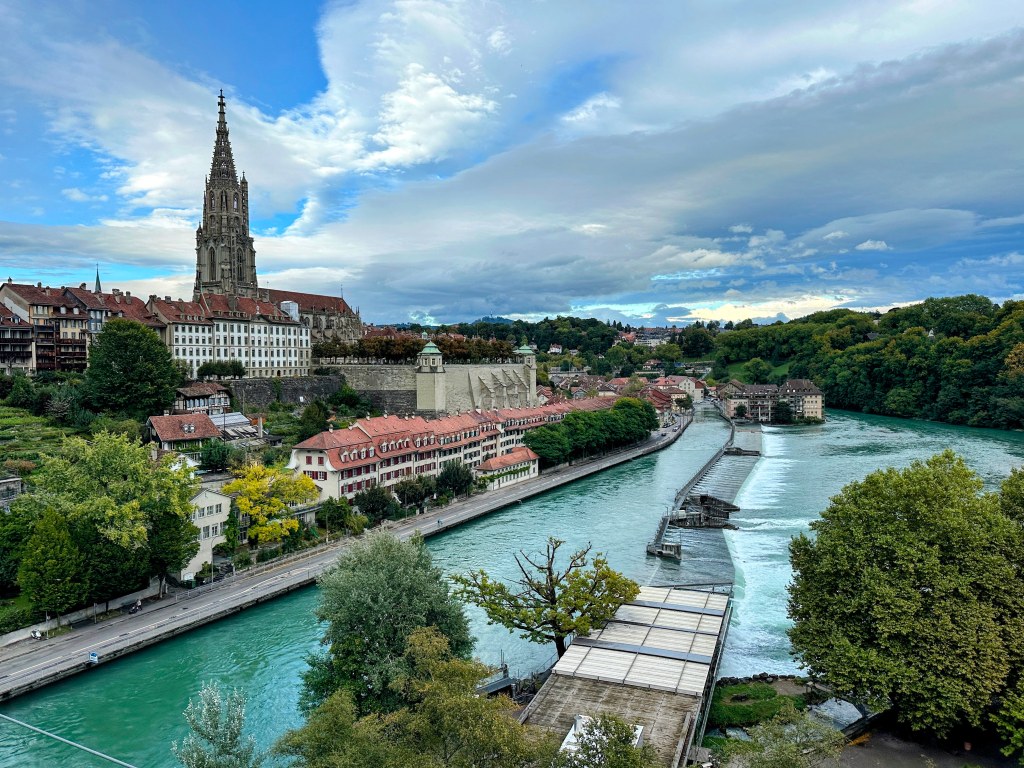
and the Parliament building to the west.
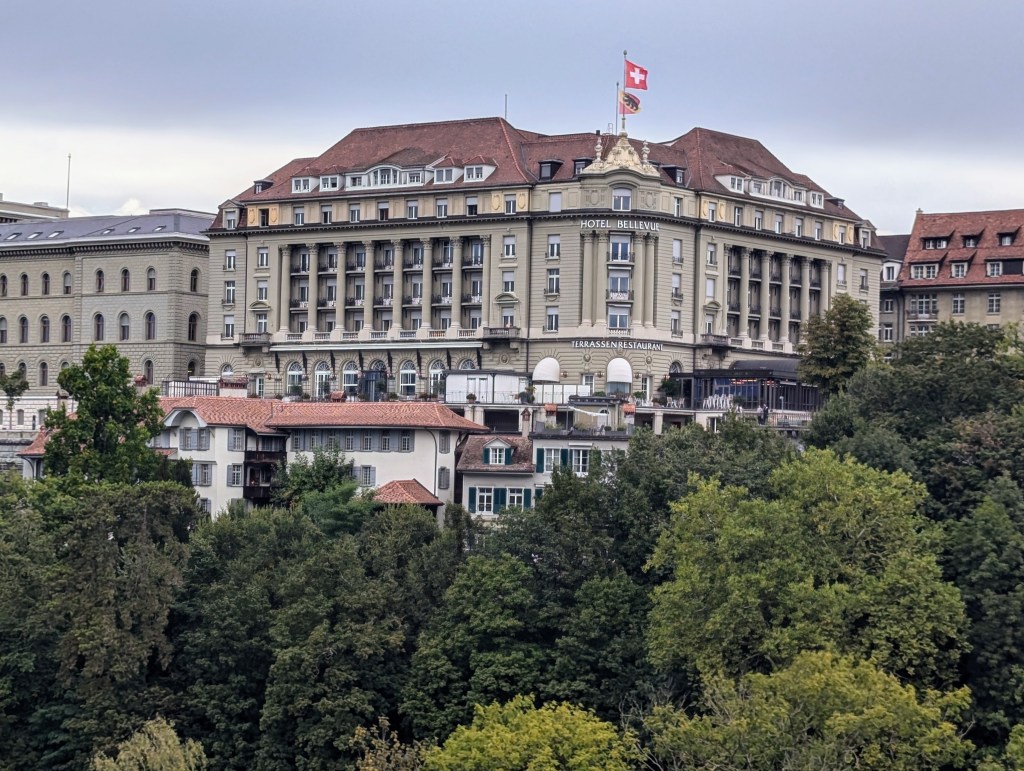
and the hotel Bellevue right nextdoor.
We approached the museum past the elaborate statue in front.
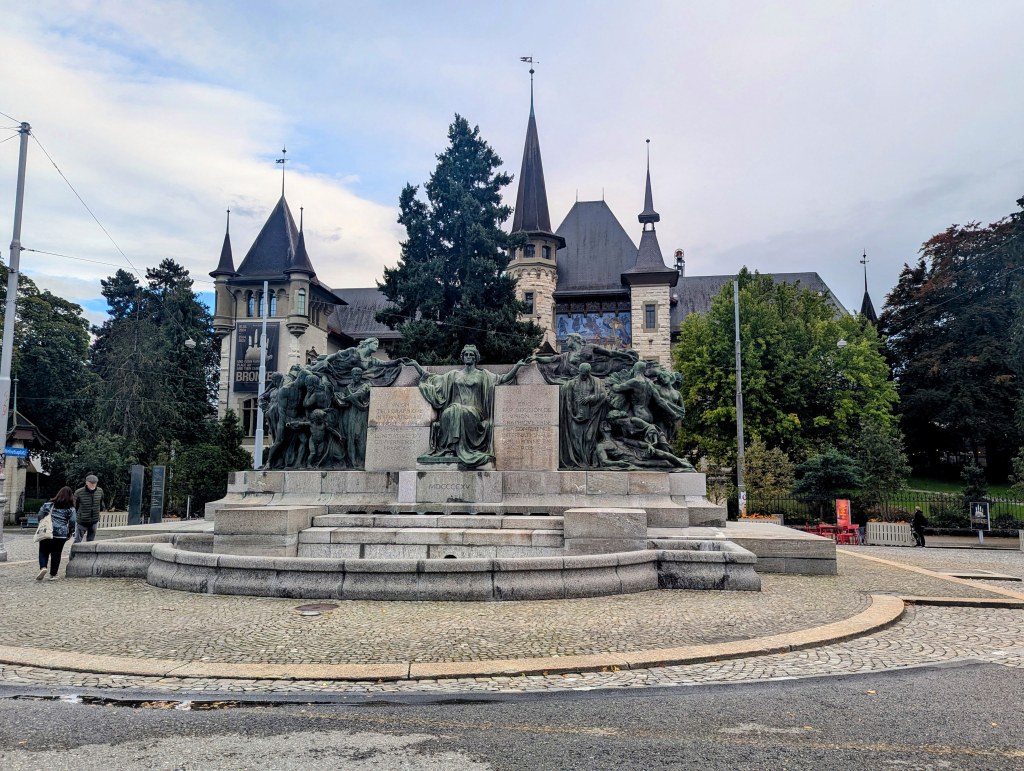
The Bern History Museum also houses the Einstein Museum
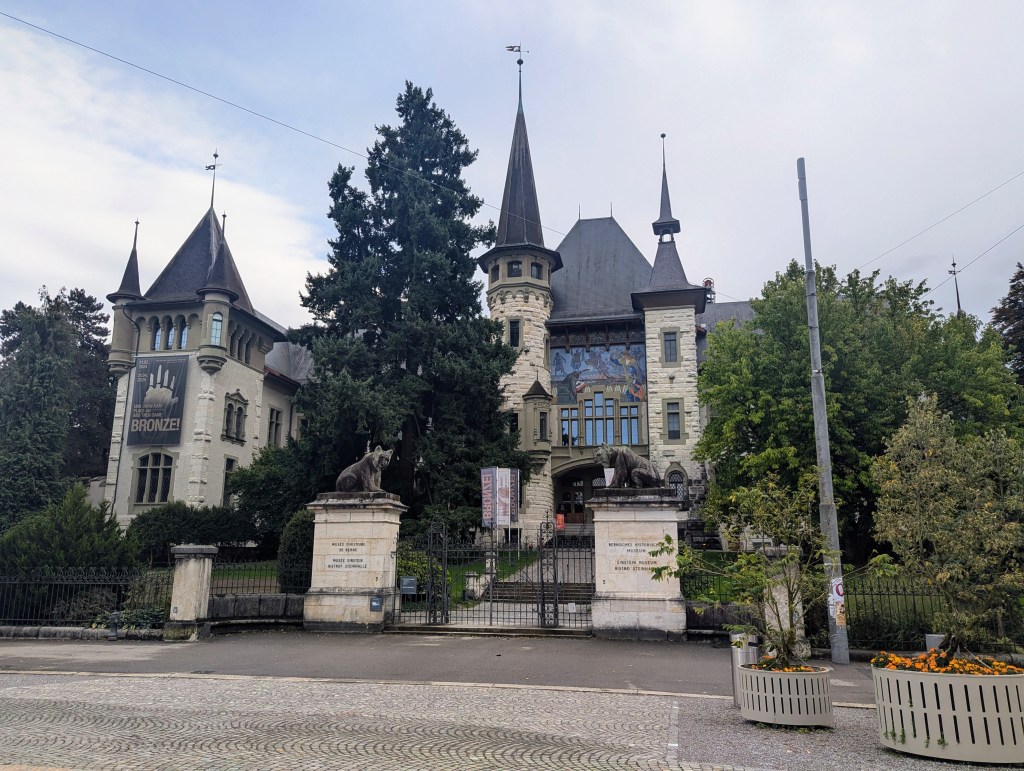
It not only has the requisite bear statues out front, seen above, but also has a bronze one of Einstein at the entrance.
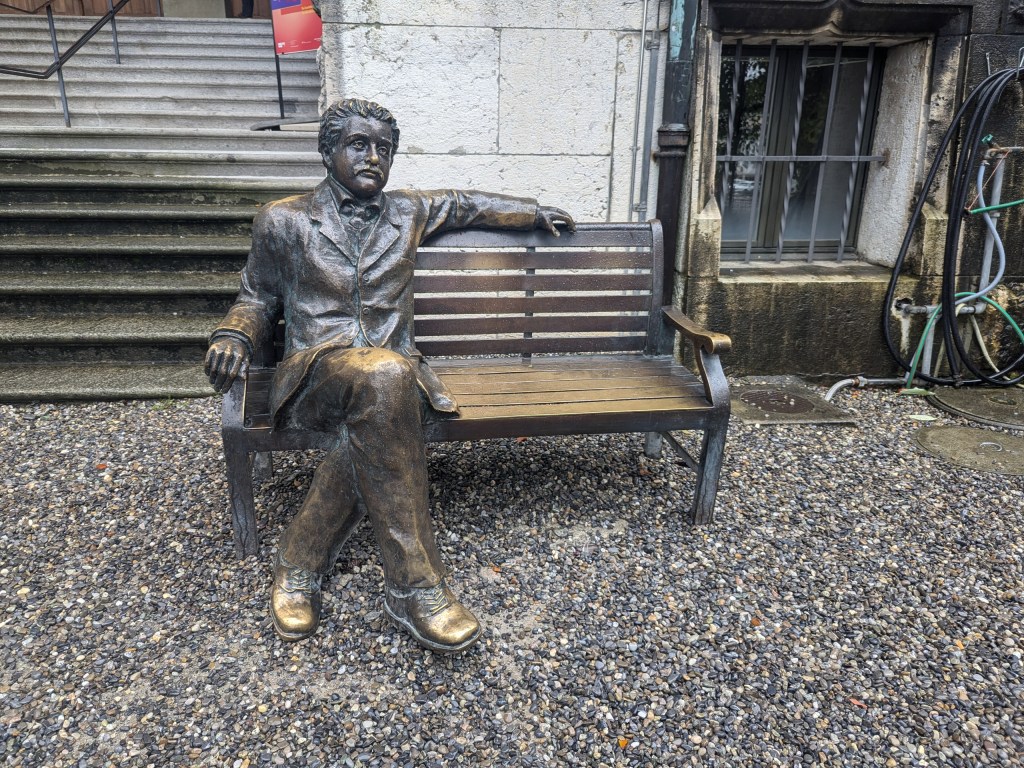
We spent several hours in the museum learning about Einstein’s life, his contributions to science, and his politics. We also learned a lot about Switzerland in the 20th century and how their neutrality during the world wars negatively affected their economy. Exhibitions included everything from explanations of relativity to this display of a typical grocery store in Bern in the early 20th century

On the way back we passed the casino, which is really an events venue. We glimpsed a bride scurrying inside to get out of the rain.
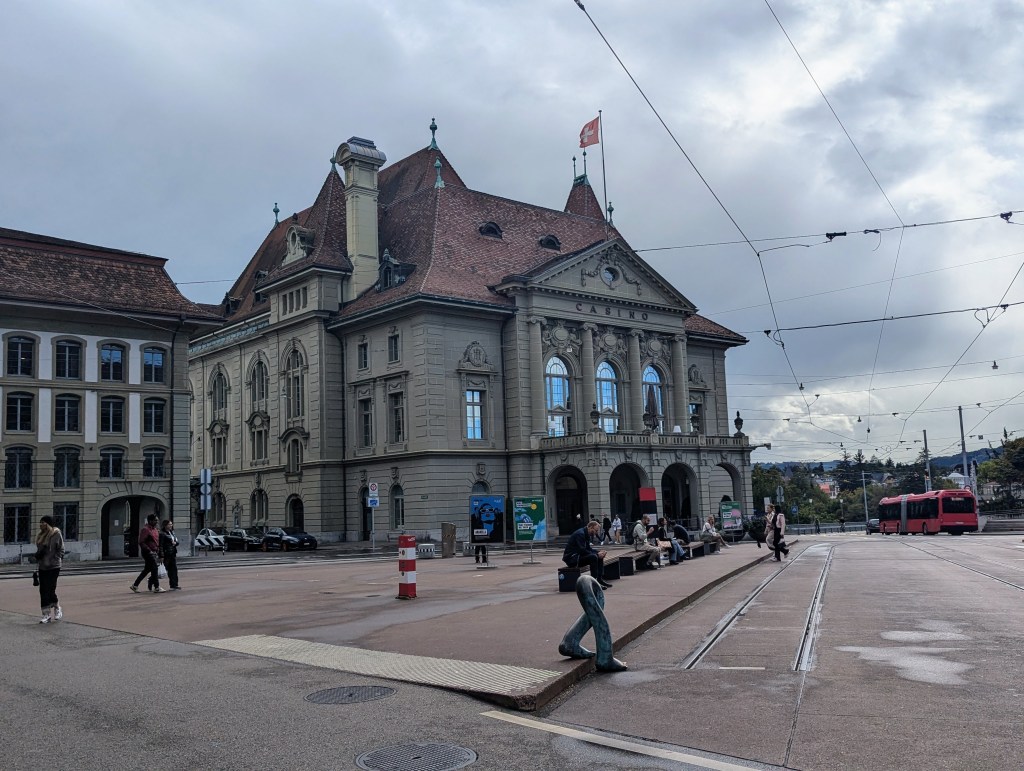
This final picture in Bern requires no explanation.

The morning brought sunshine once again. We decided to take the railcar

down to the park and neighborhood below the Parliament Building before heading out of town.
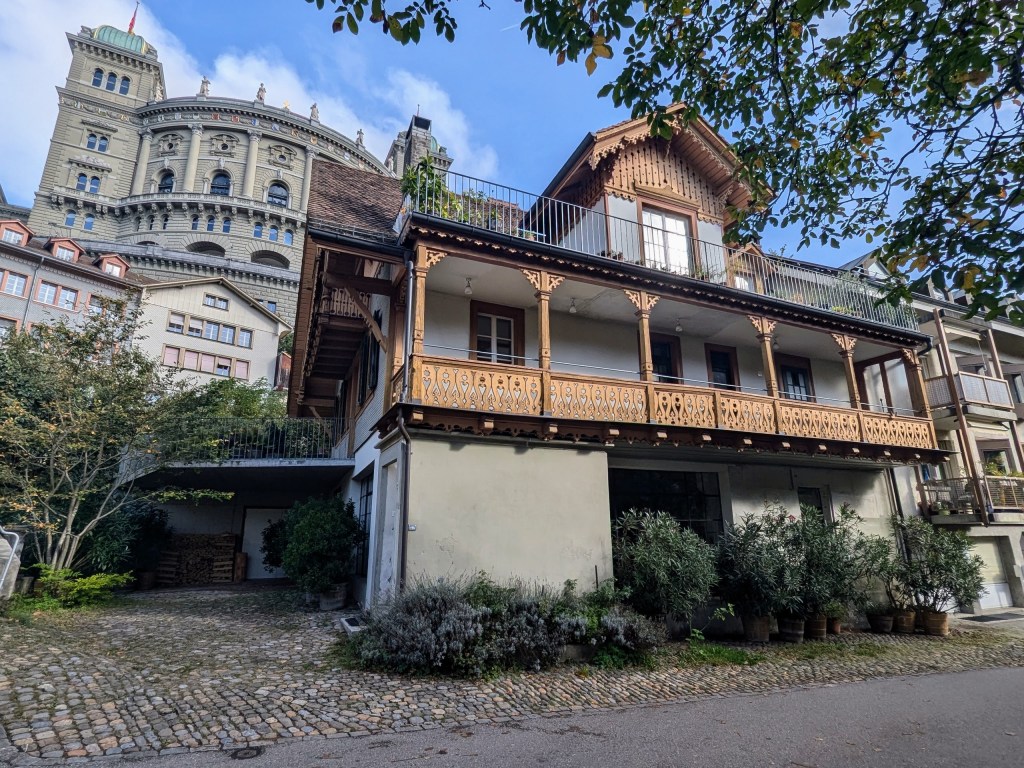
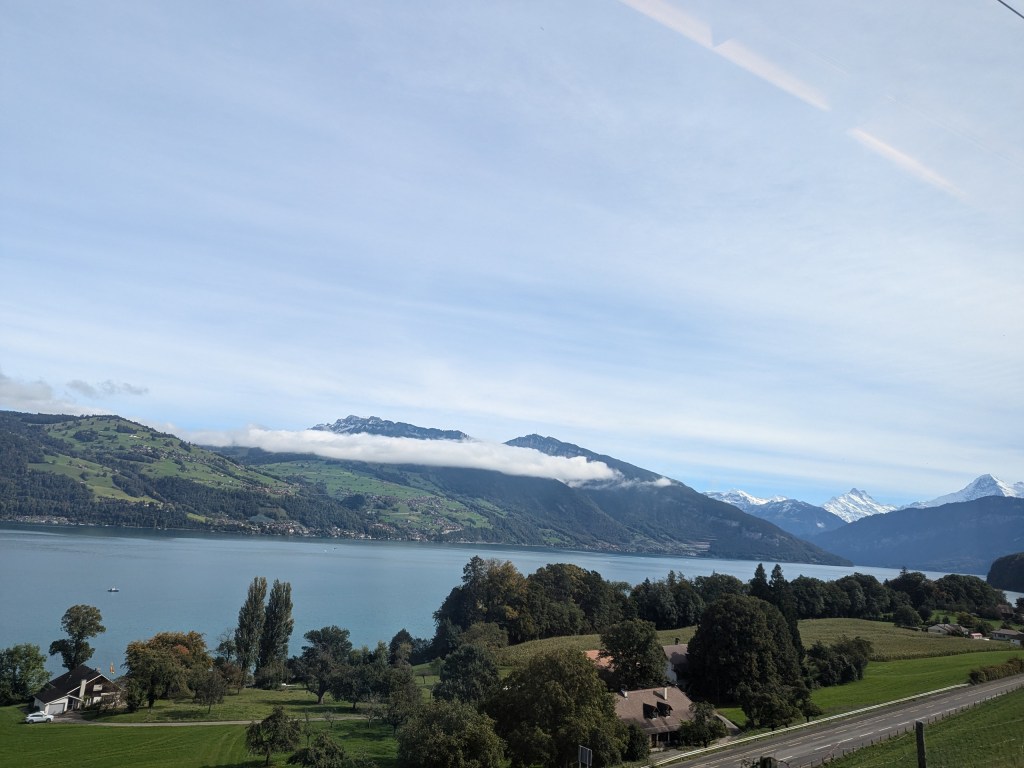
Our next stop was Interlaken. Along the way we were treated to beautiful scenery including this sneak peak preview of Lake Thun.
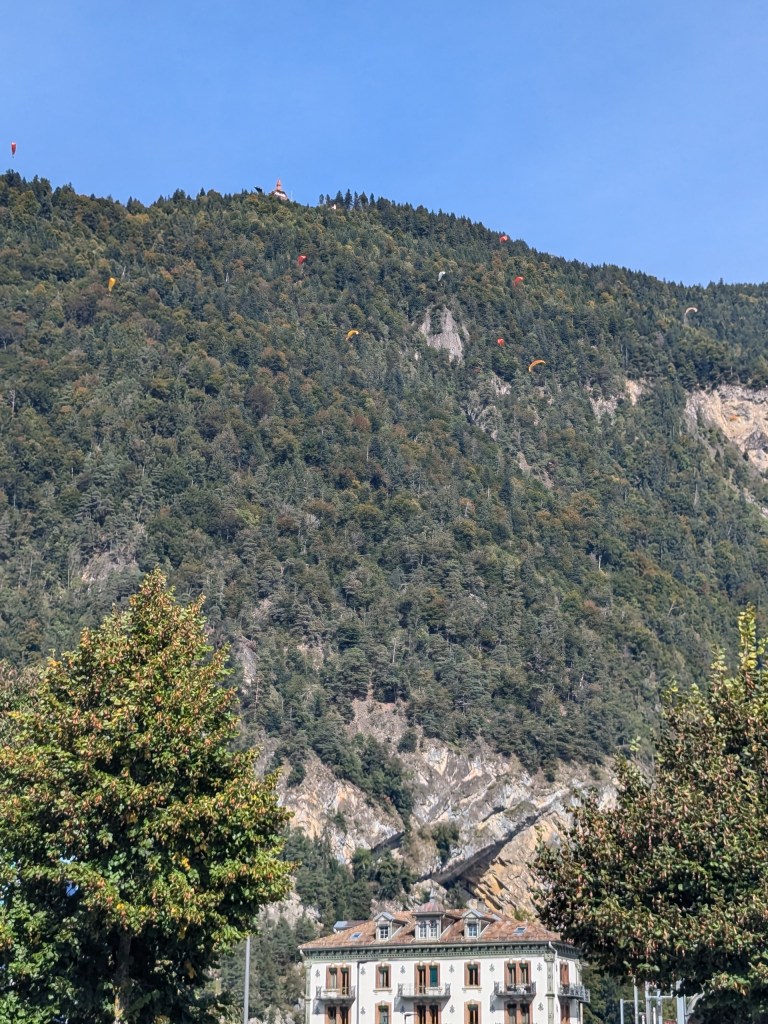
Upon arrival in town, the first striking scene was the numerous paragliders overhead, hard to see in the following picture, but dozens of them floating down out of the sky.
We checked into our Hotel: Rössli, an adorable family run boutique hotel on the west side of town.
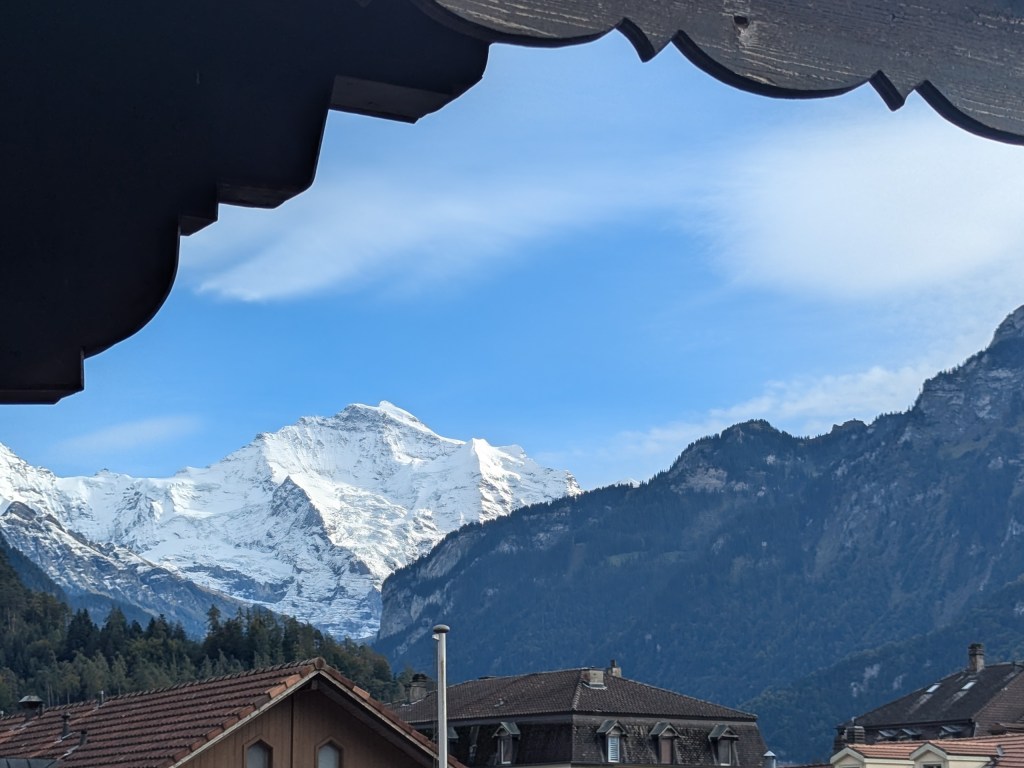
They pleasantly accommodated our early arrival. We settled into our new home and were struck by the amazing view from our balcony.
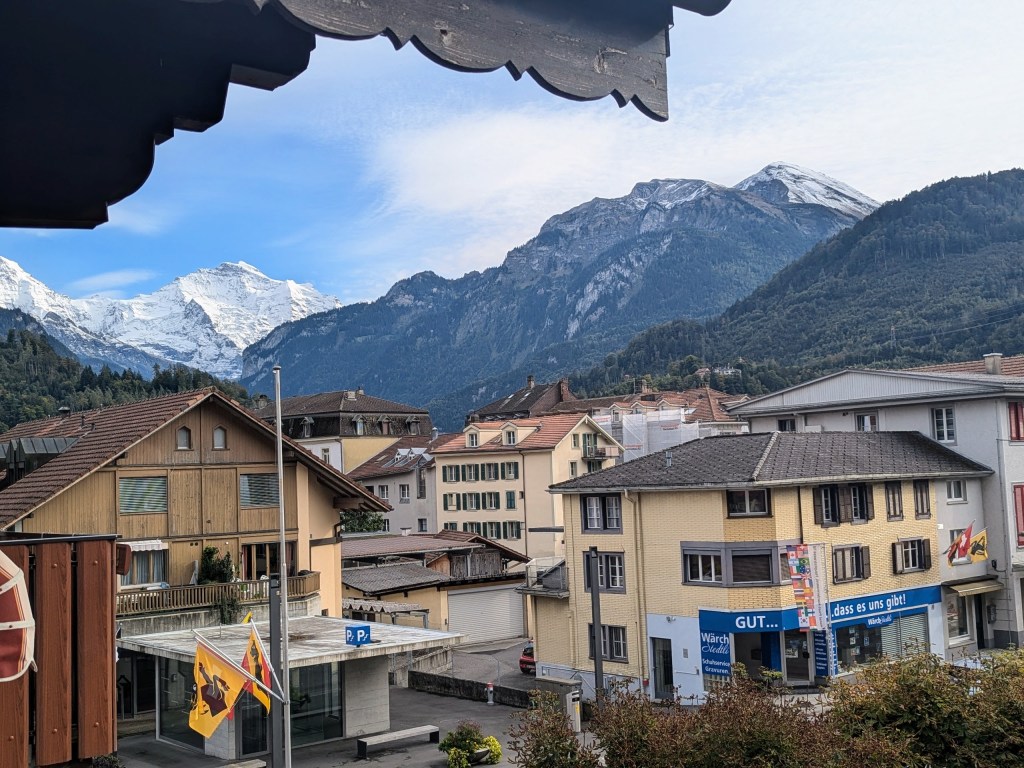
The little double peak is Jungfrau (young woman), which at 13,642 ft is the westernmost and highest point of a gigantic (6.2 mi) wall dominating the valleys of Lauterbrunnen and Grinwald. The wall is formed by the alignment of some of the biggest north faces in the Alps and looms over Interlaken.
We set out to explore the town, which is one of the most spectacular places in the world we have ever visited. It has all the beauty of the surrounding Alps, two gorgeous lakes on either side, and an old world charm to the hotels, shops, homes, and apartments.
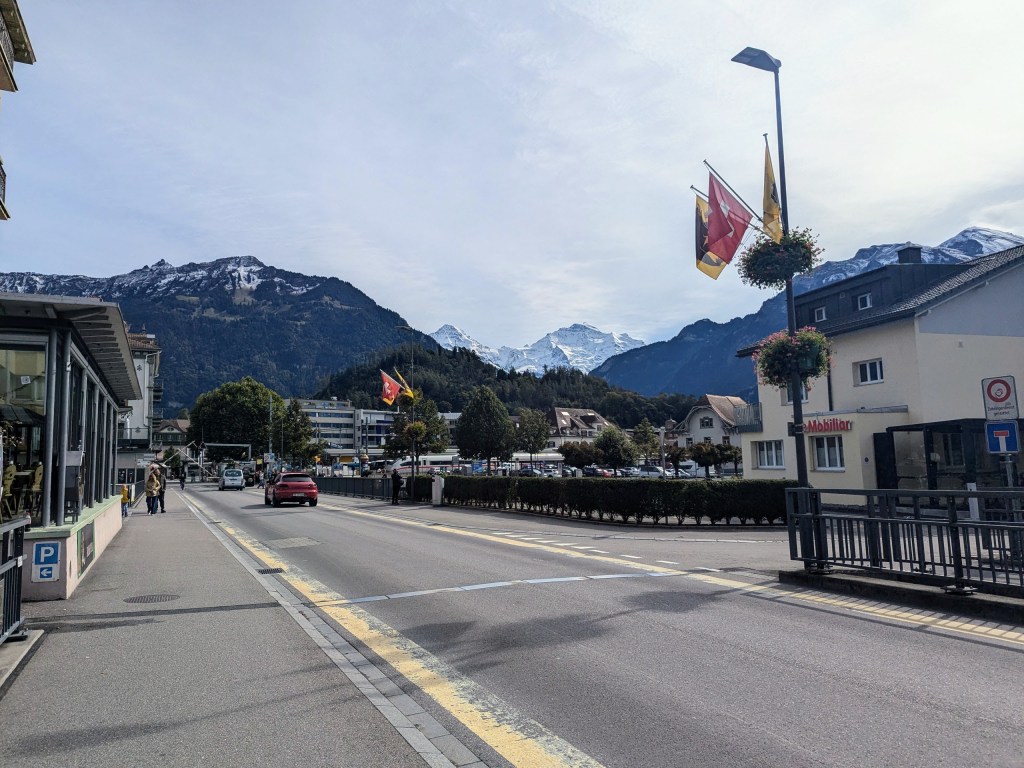
We strolled along the main street toward Höhematte Park.
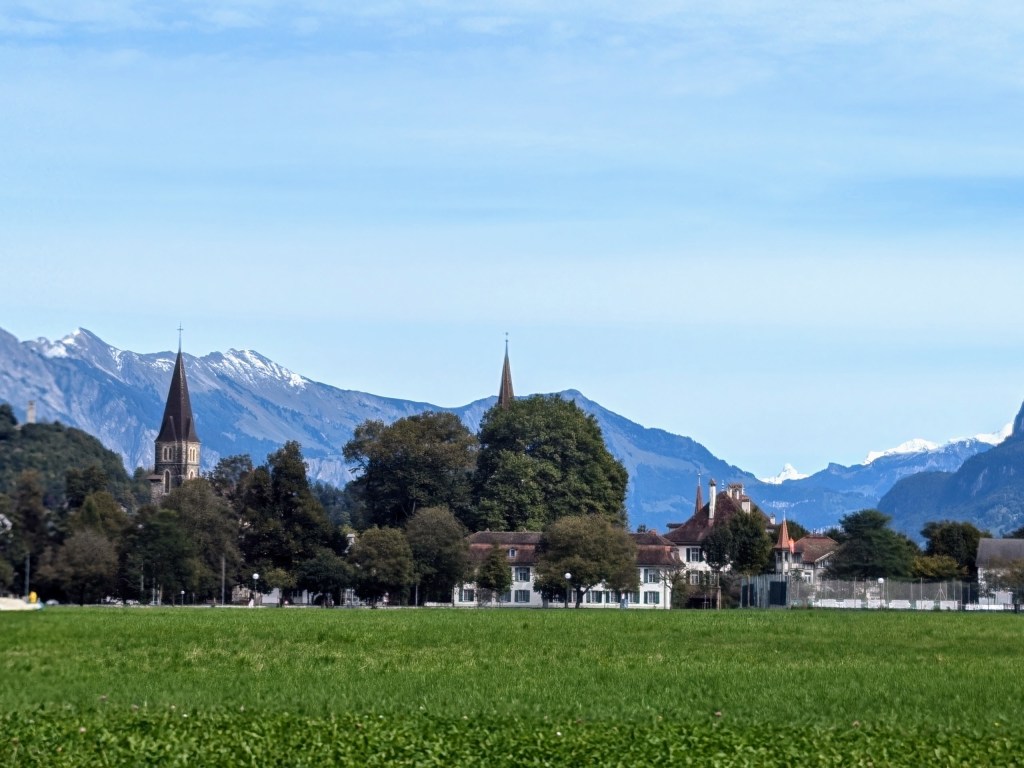
Here in this wide open space is where the paragliders come to land.
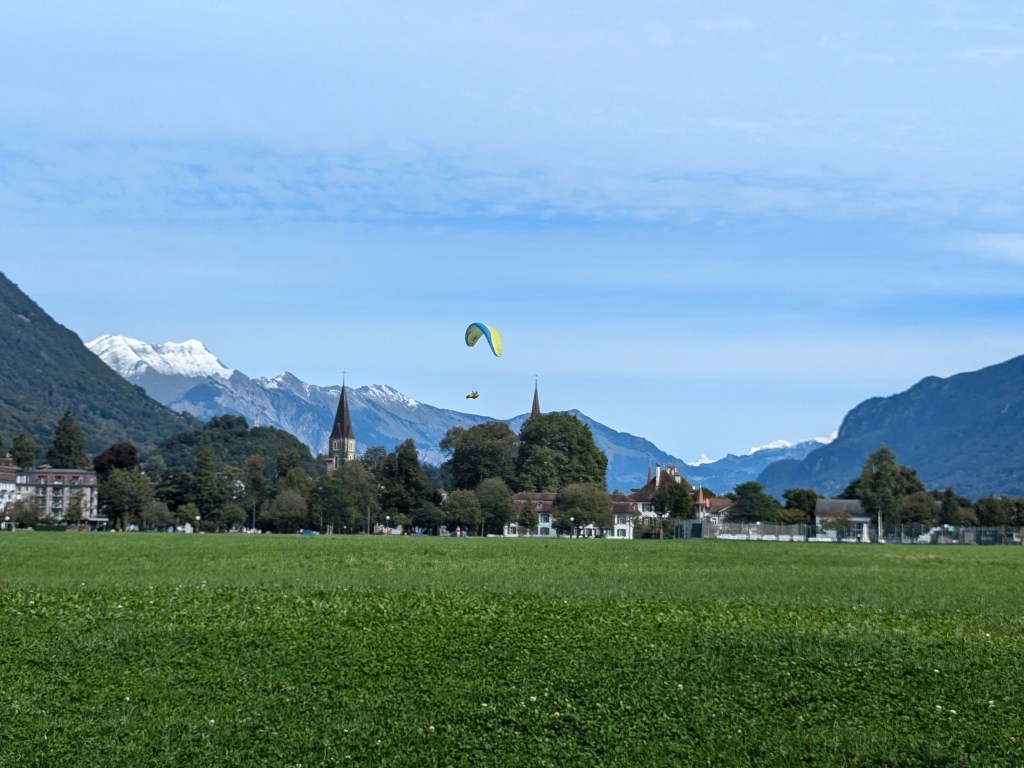
One can be seen coming in for a landing every minute.
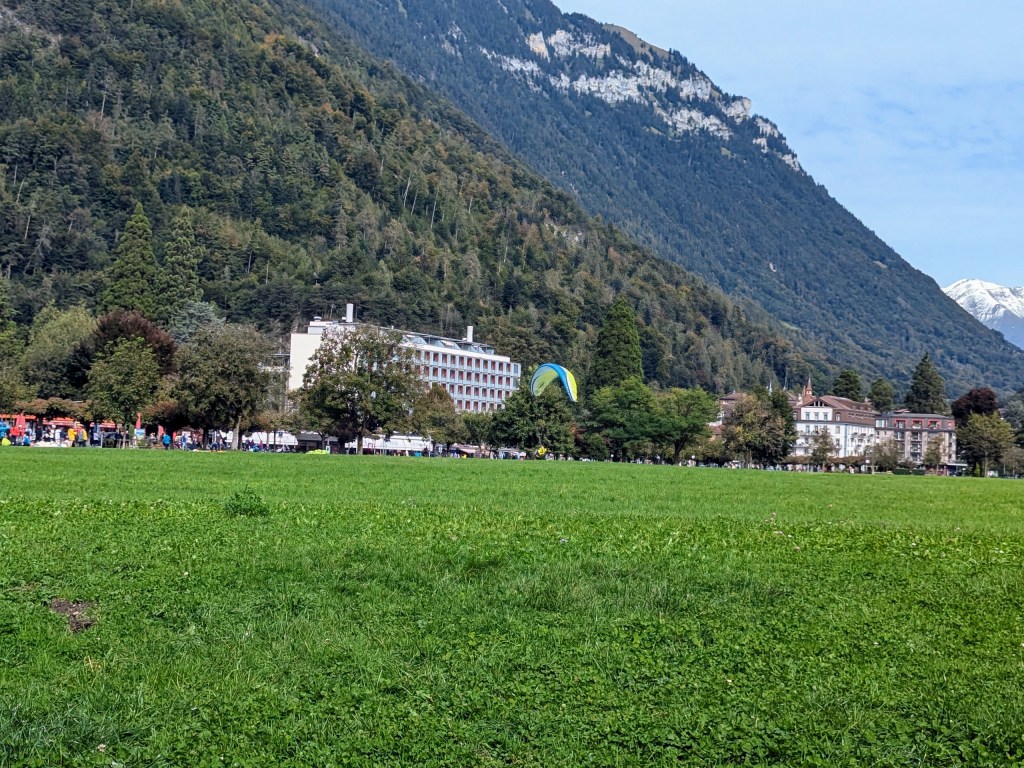
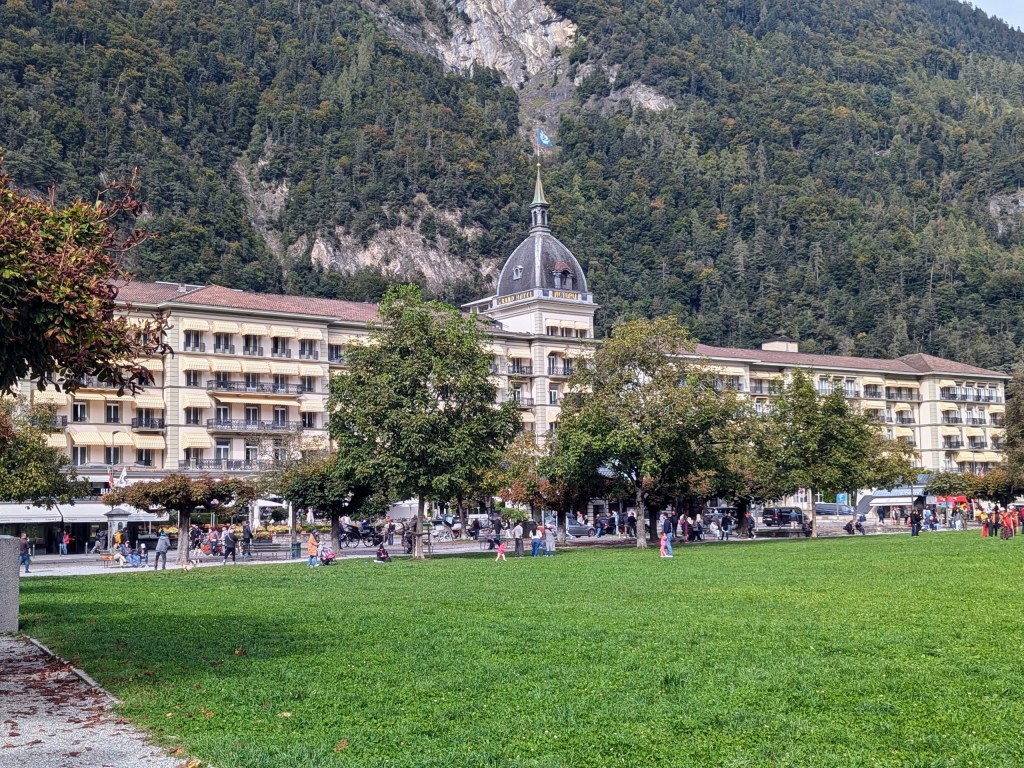
The west side of the park is dominated by the majestic Victoria Hotel.
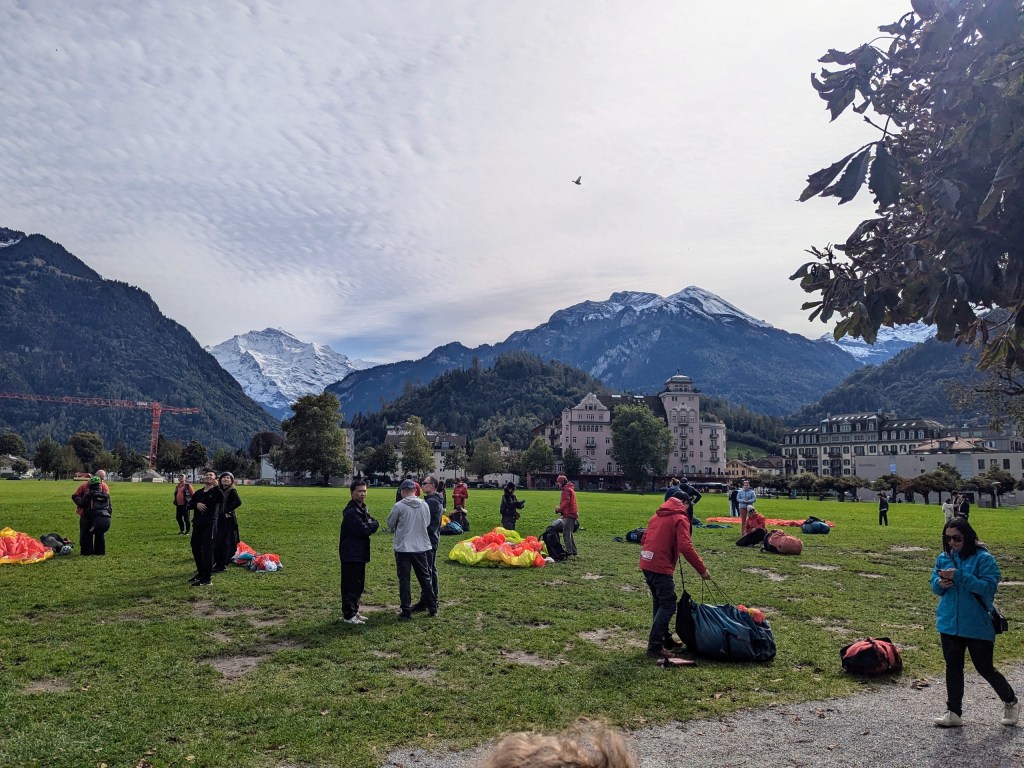
In front of which the paragliders can be seen packing their equipment for the next flight.
The park is boarded by flower boxes.

all still gorgeously full of color despite the late season.

At one point, as we started to walk away, there were so many gliders landing, it seemed overwhelming.
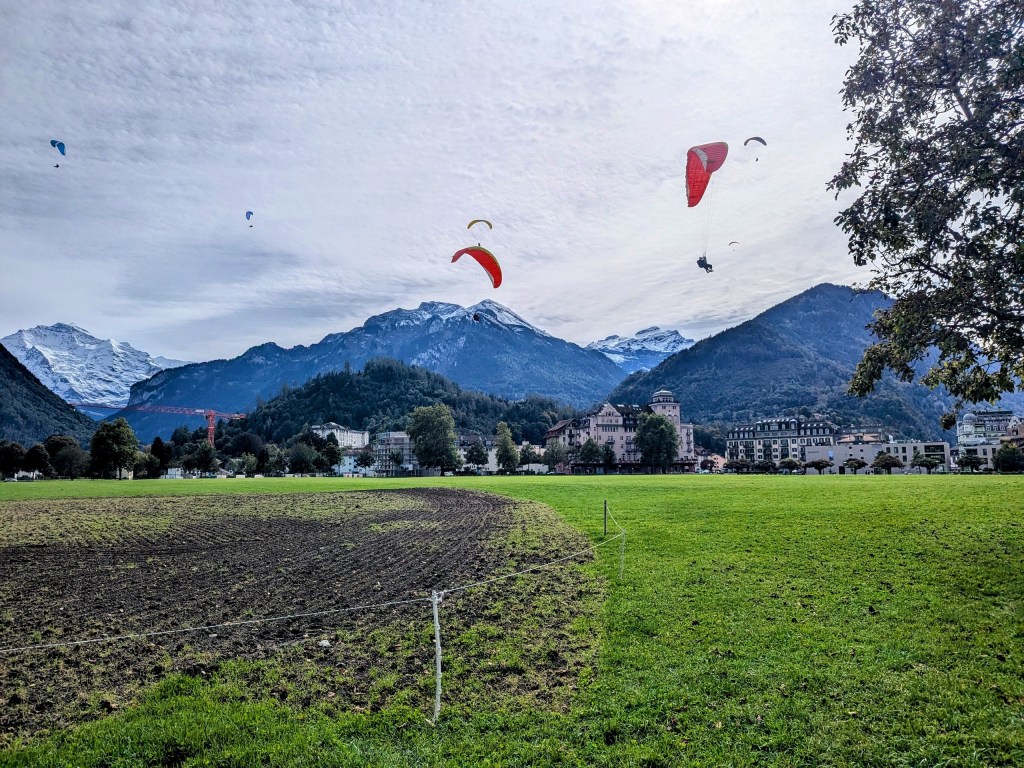
We wandered further west to the Hotel Interlaken.
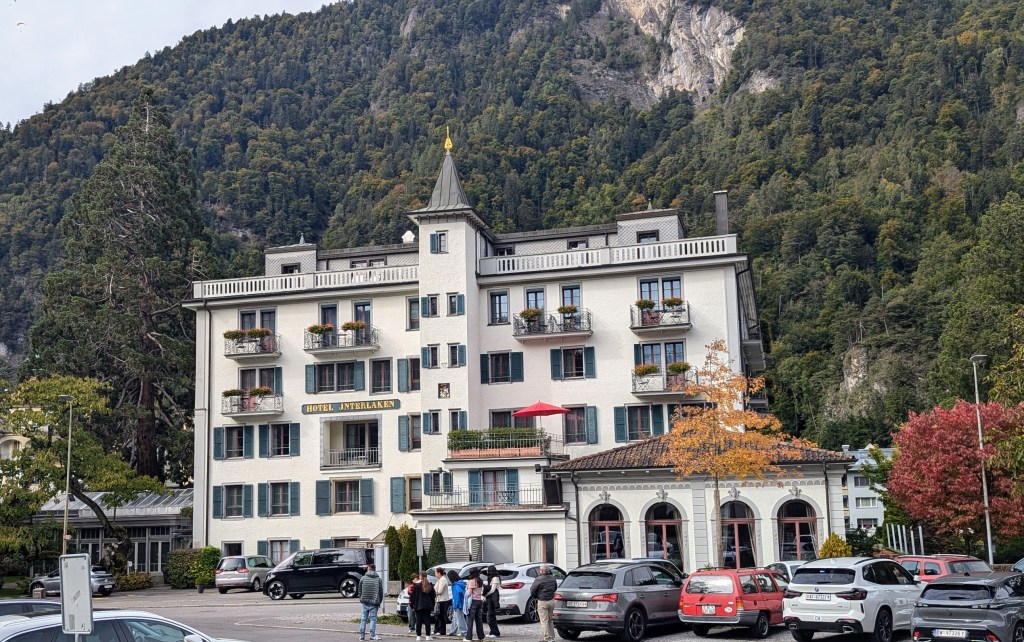
in front of which is a Japanese Garden. Created in 1995, the Japanese Garden of Interlaken was a gift from Interlaken’s Japanese twin town of Ōtsu. With its pond and pavilion, the Japanese Garden of Interlaken reflects the landscape in which it stands. Located next to the Hotel Interlaken, the garden symbolizes the roaring waterfalls and deep ravines of the Bernese Oberland; the Shinji pond represents lakes Brienz and Thun.
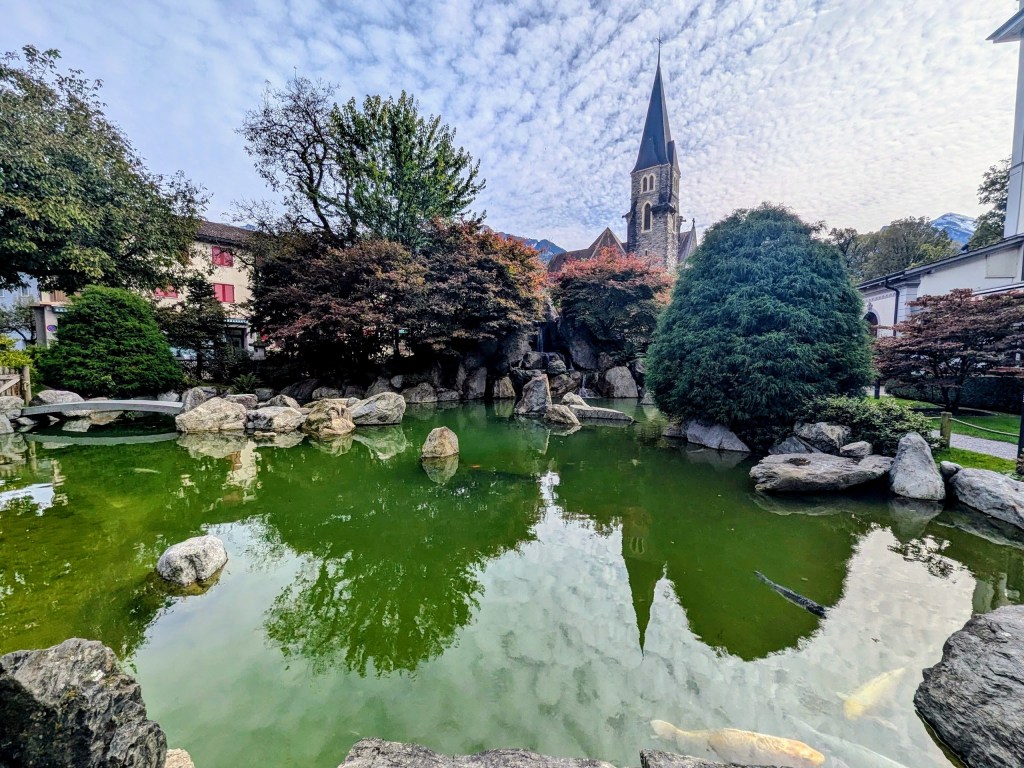
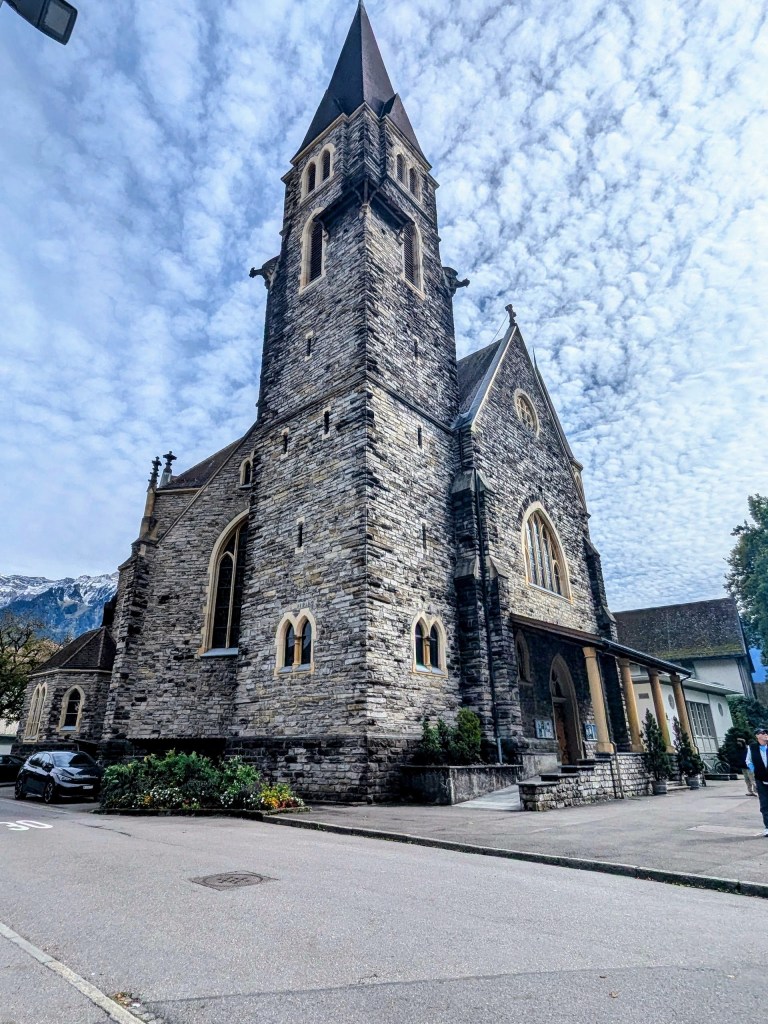
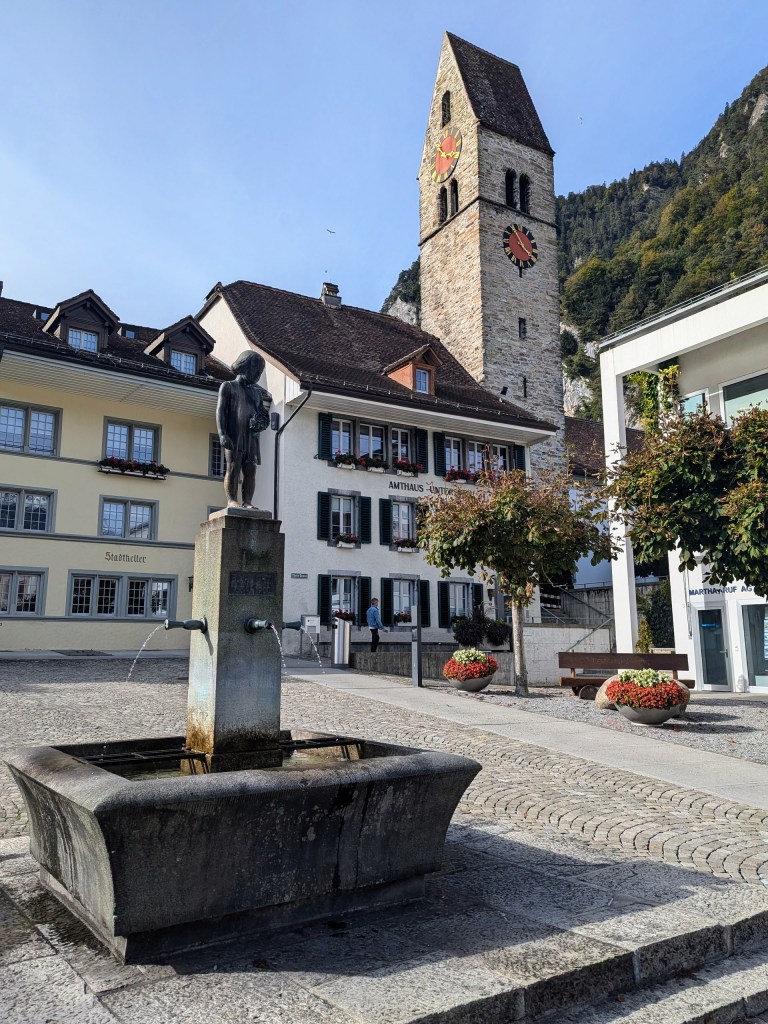
And behind the garden stands the Schlosskirche (Castle Church). Schlosskirche, sometimes called “the reformed church,” is one of the oldest building in Interlaken. Originally an Augustinian monastery, the castle church was built in 1133. Today, Schlosskirche is used as a convent and is one of the city’s most visited places. The church was used as a monastery for many years but it wasn’t always as revered as it is now. During the 16th century, the church was used as a storage for carriages, barrels and wine. The nave was even used as a granary. It wasn’t until the 19th century that Schlosskirke was used as a church again. The church was re-dedicated in 1911.
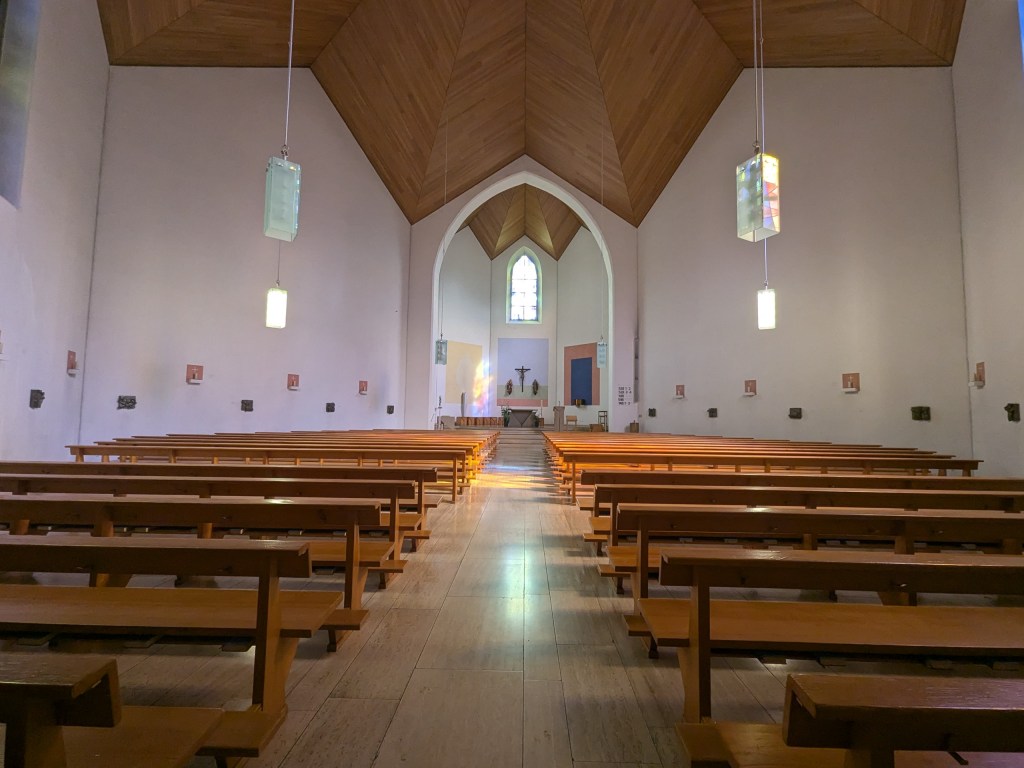
The interior is modest.
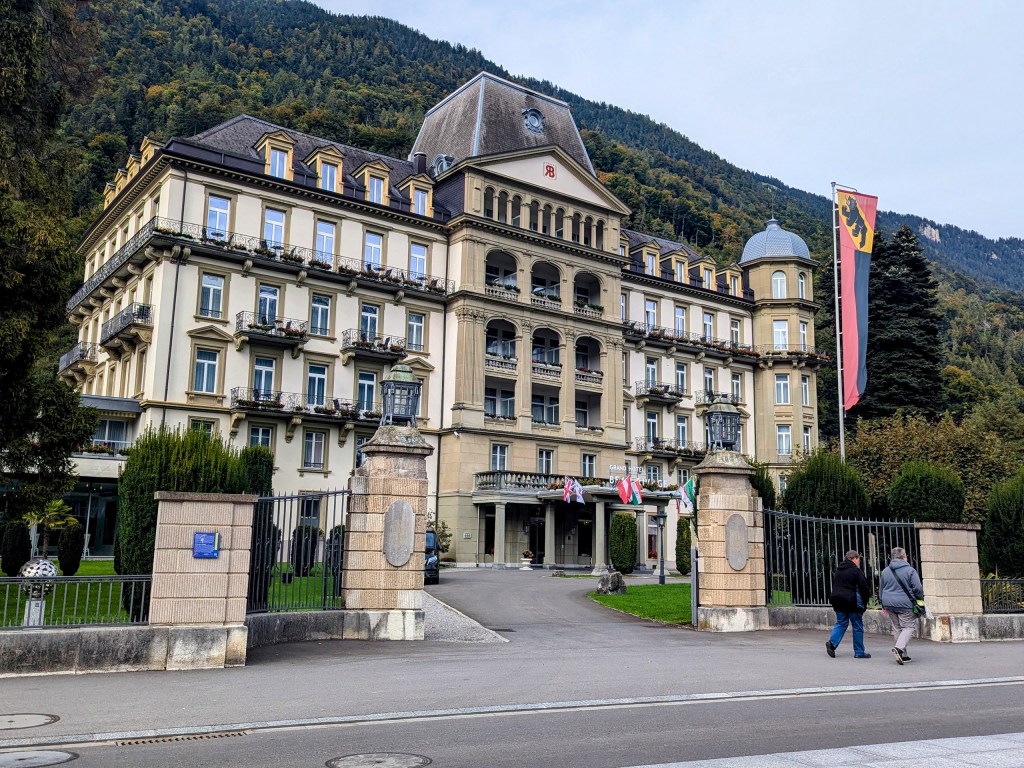
Everything about this town is charming from the hotels
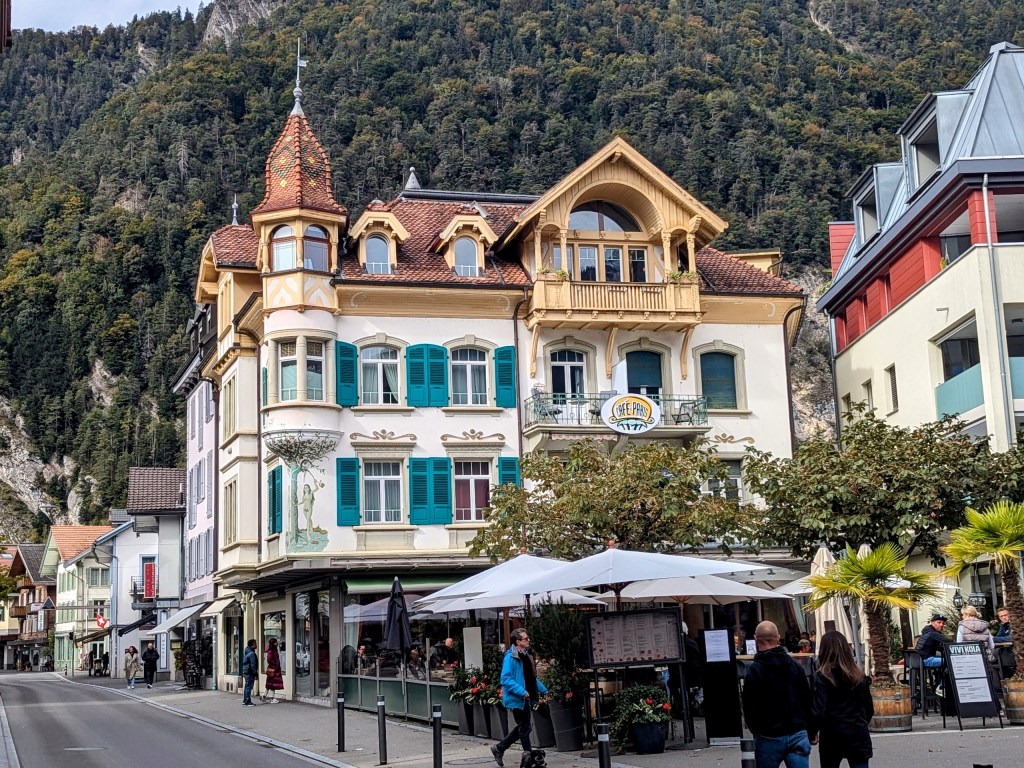
the cafes
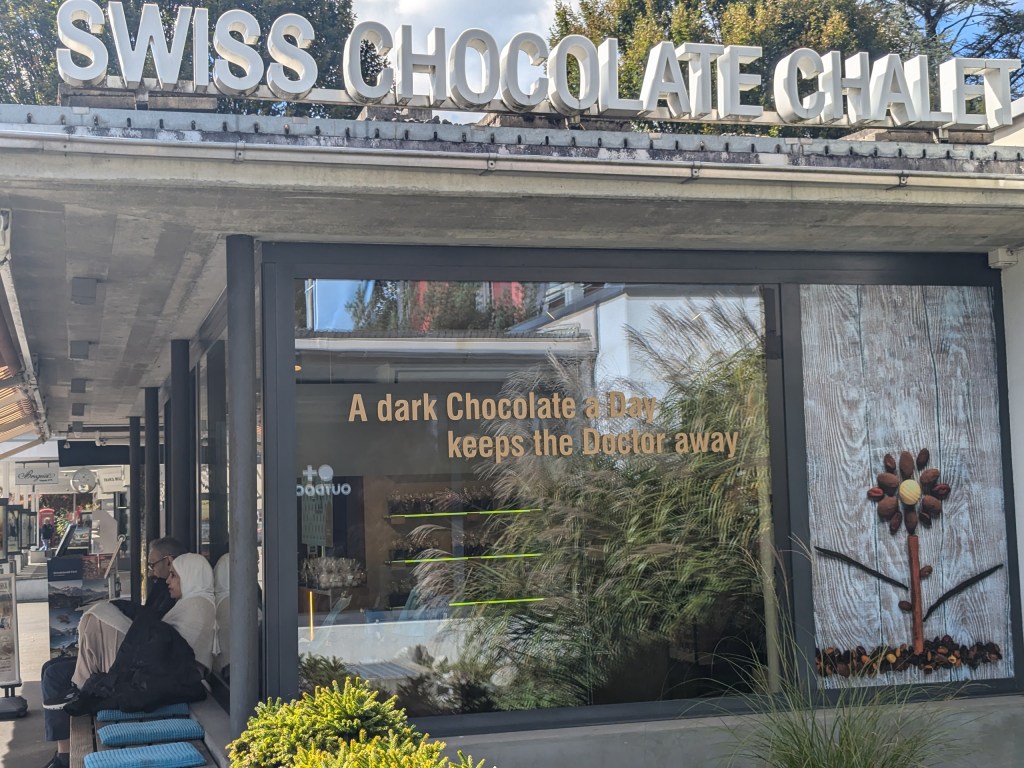
the shops
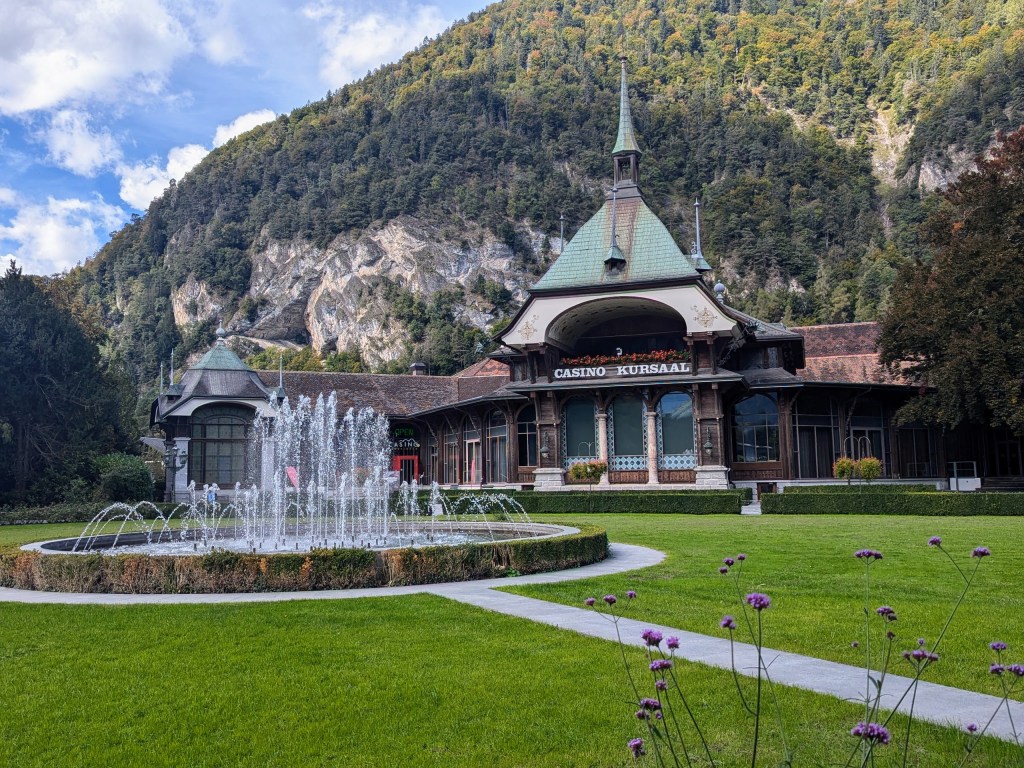
even the casino
and apartment buildings
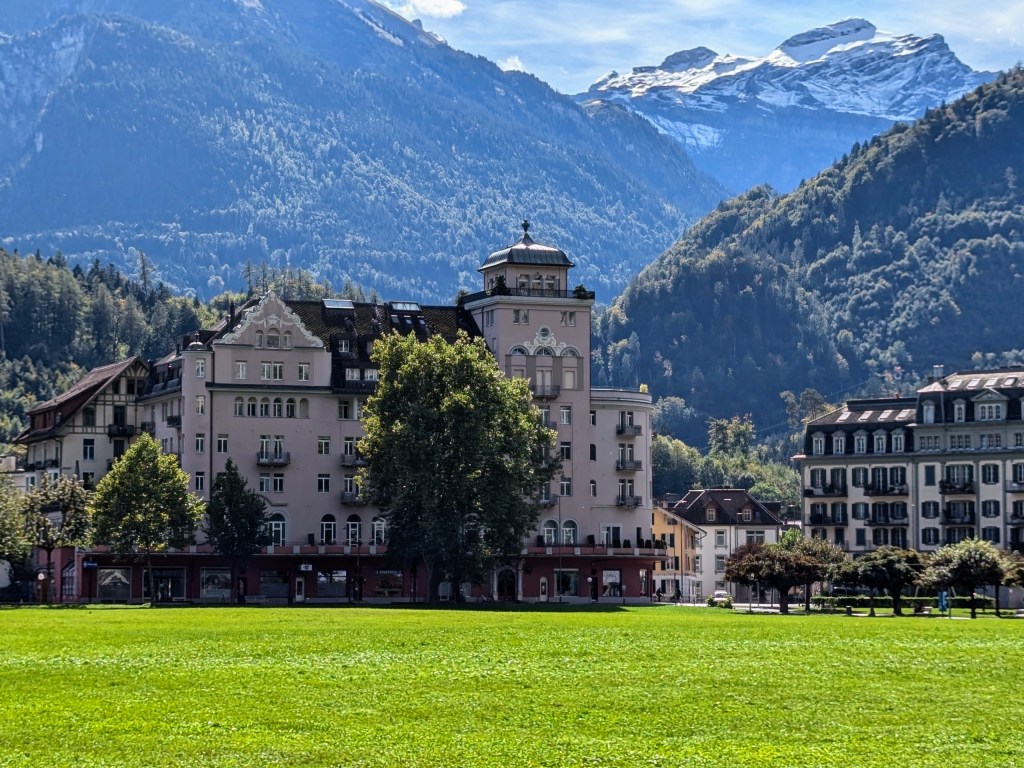
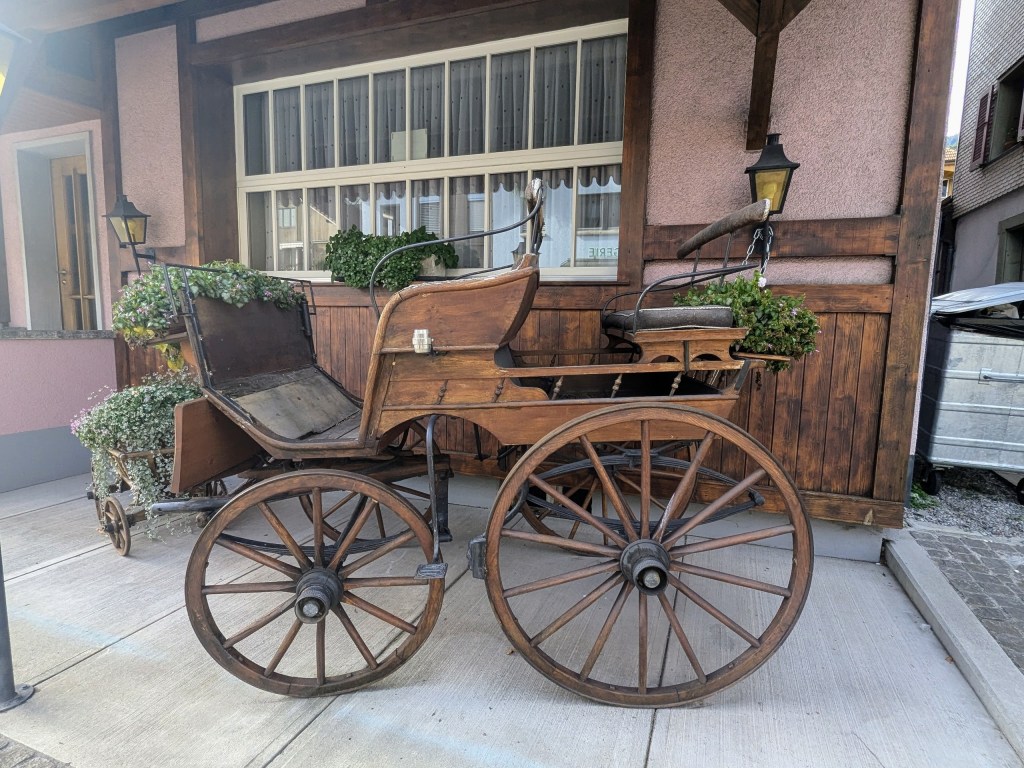
One thing we saw that I was not quick enough to catch on camera was a herd of cows being driven right up our street with their bells tinkling away. Another common sight in town are horse-drawn carriages for tourists.

The morning brought sunshine so we embarked on an adventure. We headed to the Harderbahn (train station).
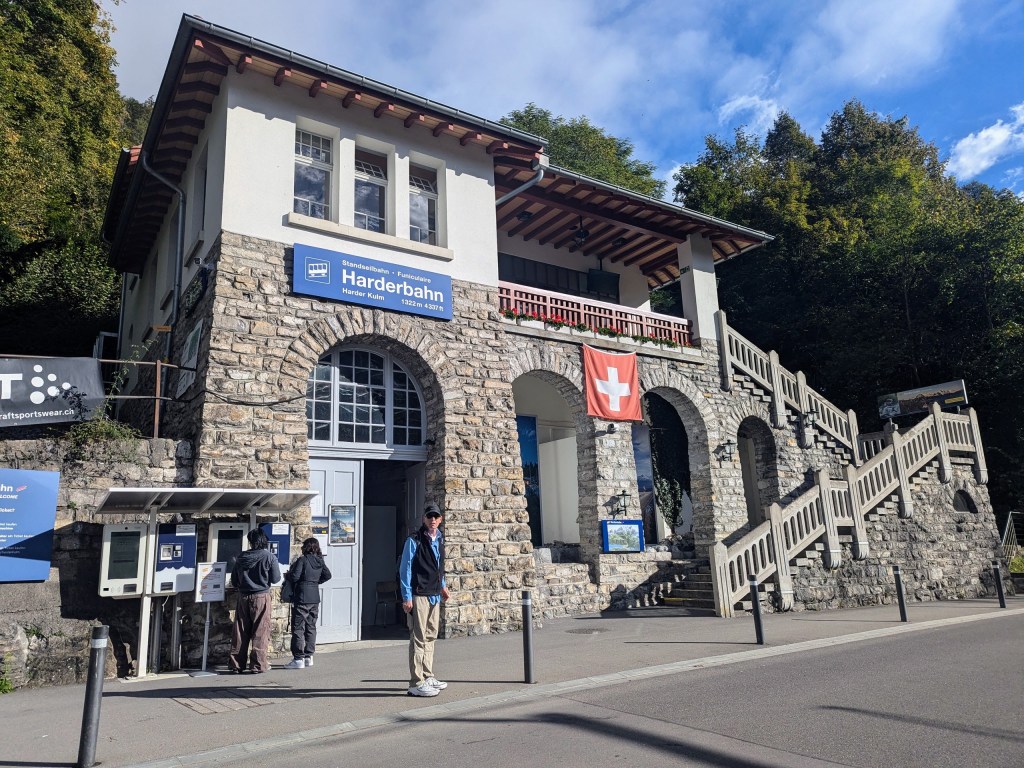
As we approached we could see the funicular track seemingly vertically rising to the top.

There we caught the funicular to the top. The funicular takes 10 minutes from the base station at 1,804 feet above sea level to the Harder Kulm station 4,344 ft elevation, a gain of 2,477 feet.
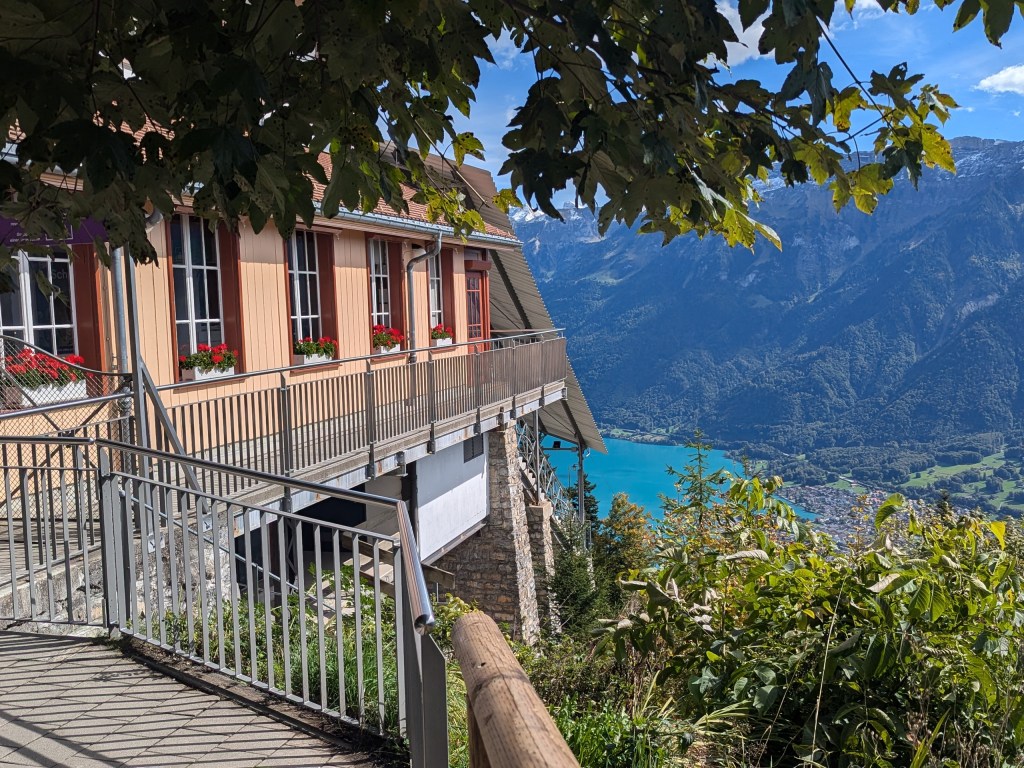
The track incline is about 64 degrees!
From there we got our first views.
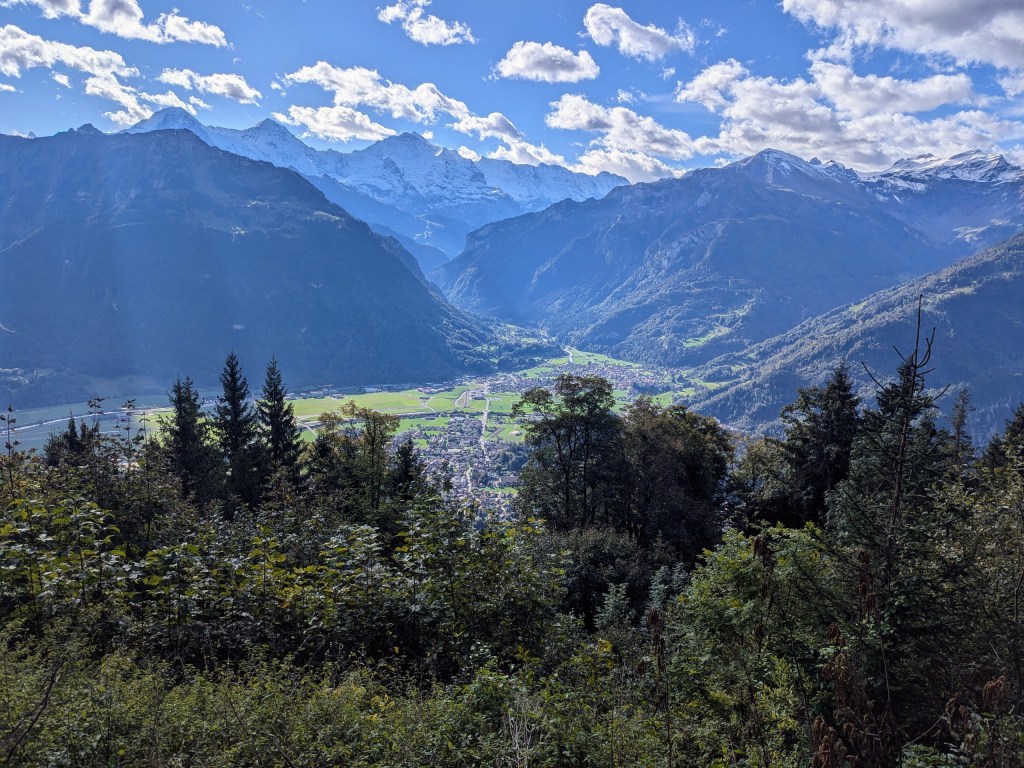
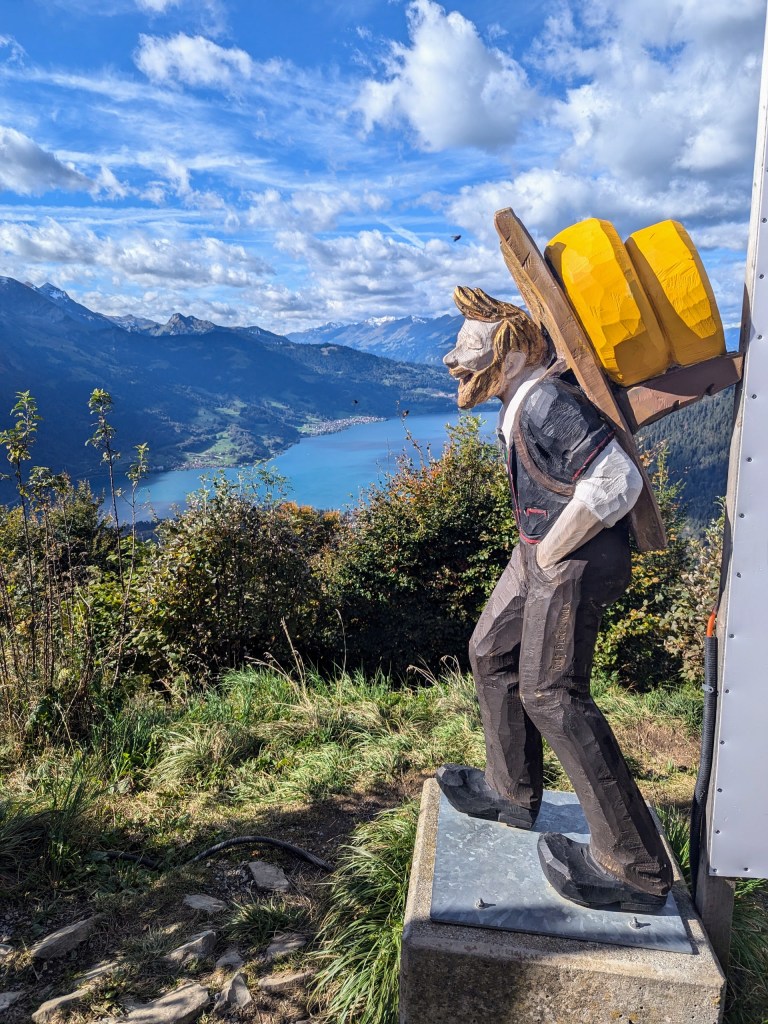
five-minute walk leads to the viewpoint. Along the way are several cute wood carvings, typically Swiss.


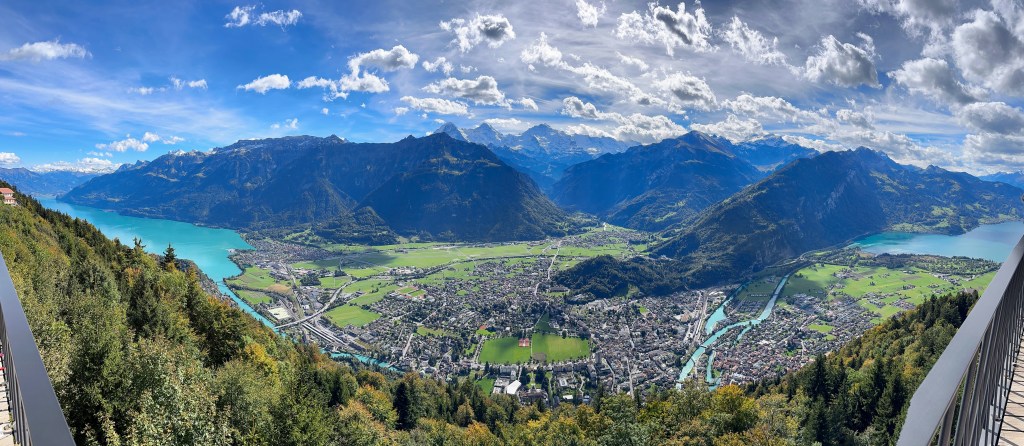
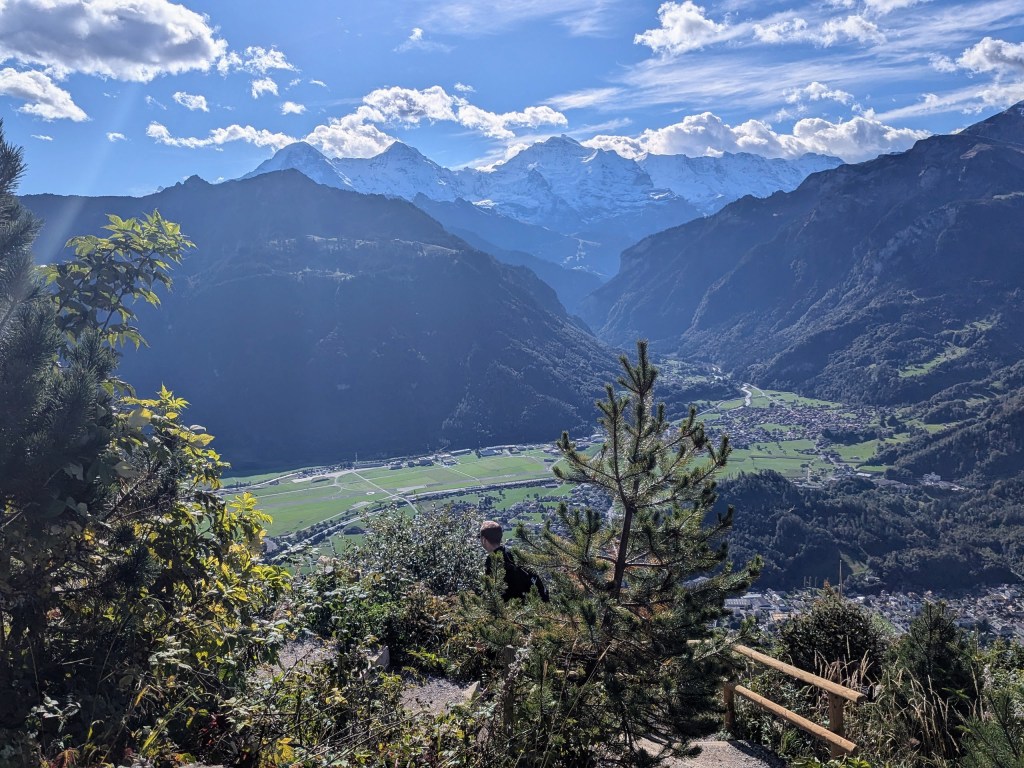
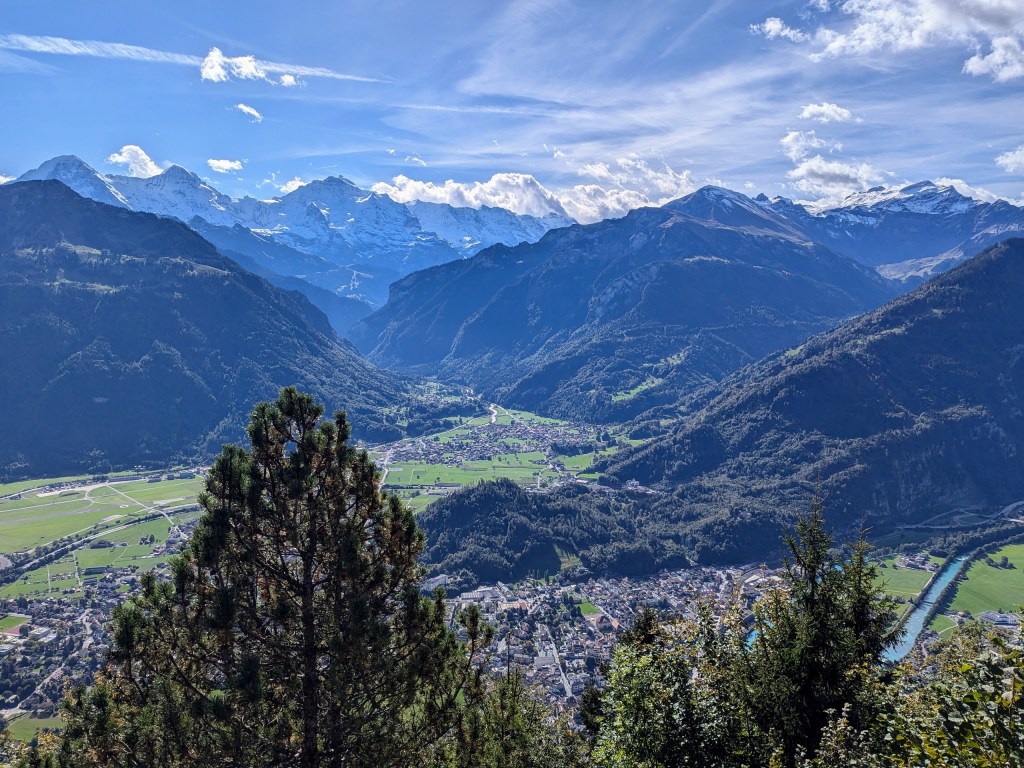
Looking down, one appreciates the two lakes between which the town nestles. The Thun to the west

and the Brienz to the east.
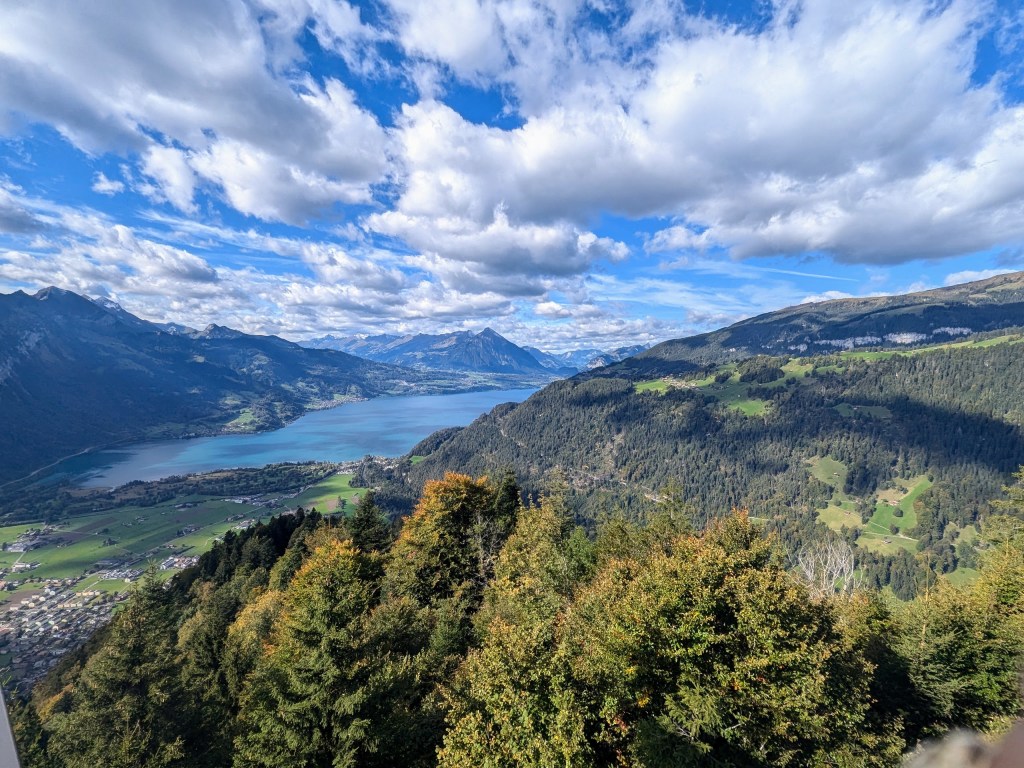
and the western half of the town with the channels connecting the two lakes

and the eastern side of town

To get to the viewing platform, one must pass through the pagpda like structure that houses the restaurant.

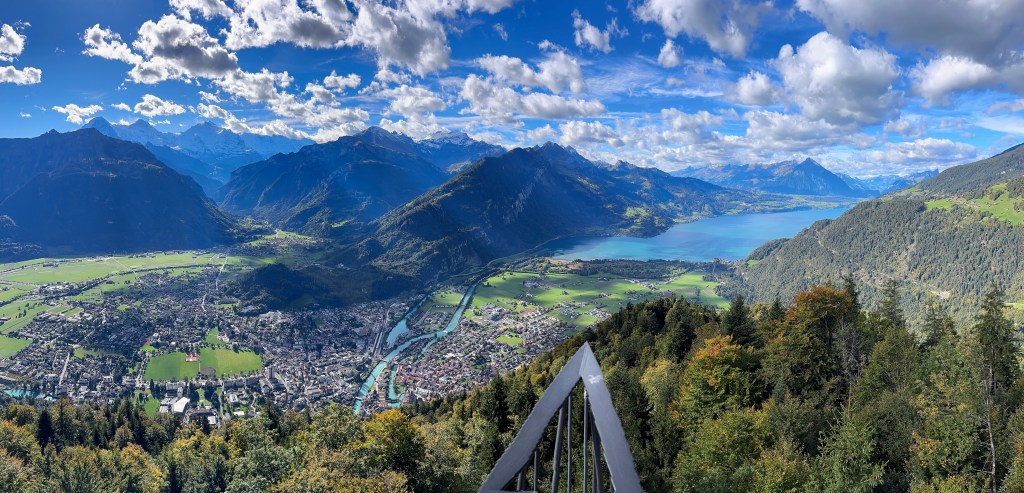
Once we reached the viewpoint platform, we were able to get a larger view
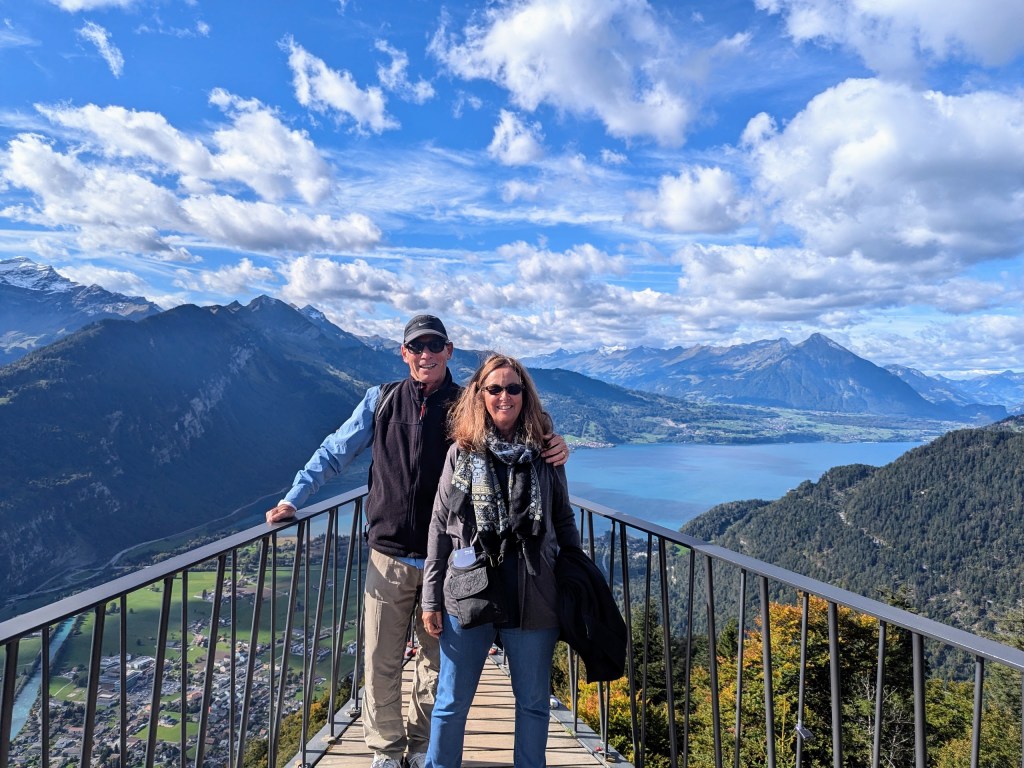
I was able to go out onto the platform by walking backwards with Eric holding my hand the hole time. (thinking of you, Carol) A kind couple took the picture for us.
I scooted off the platform immediately, but Eric managed to stay long enough for a panoramic shot.
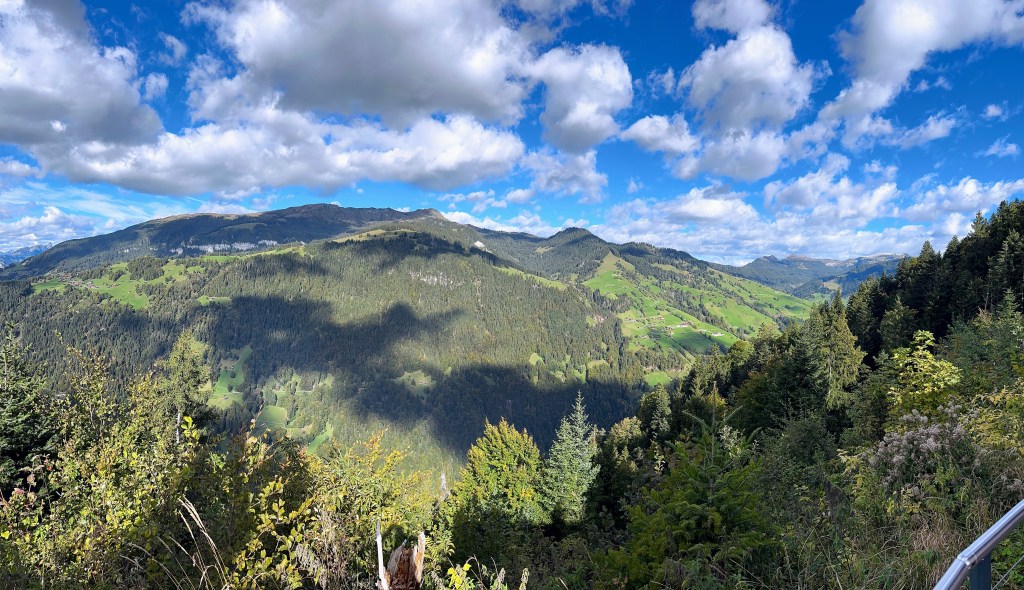
The views from the other side of the restaurant are also beautiful.
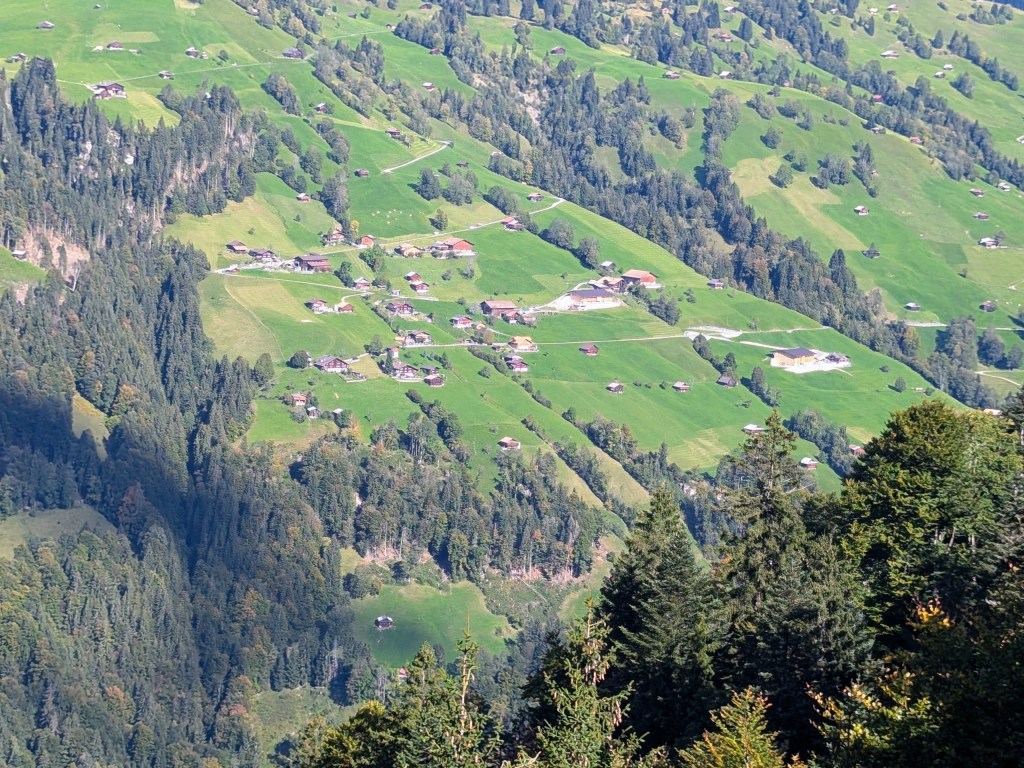
Striking are the numerous houses dotting the mountainside.
and this happy fellow
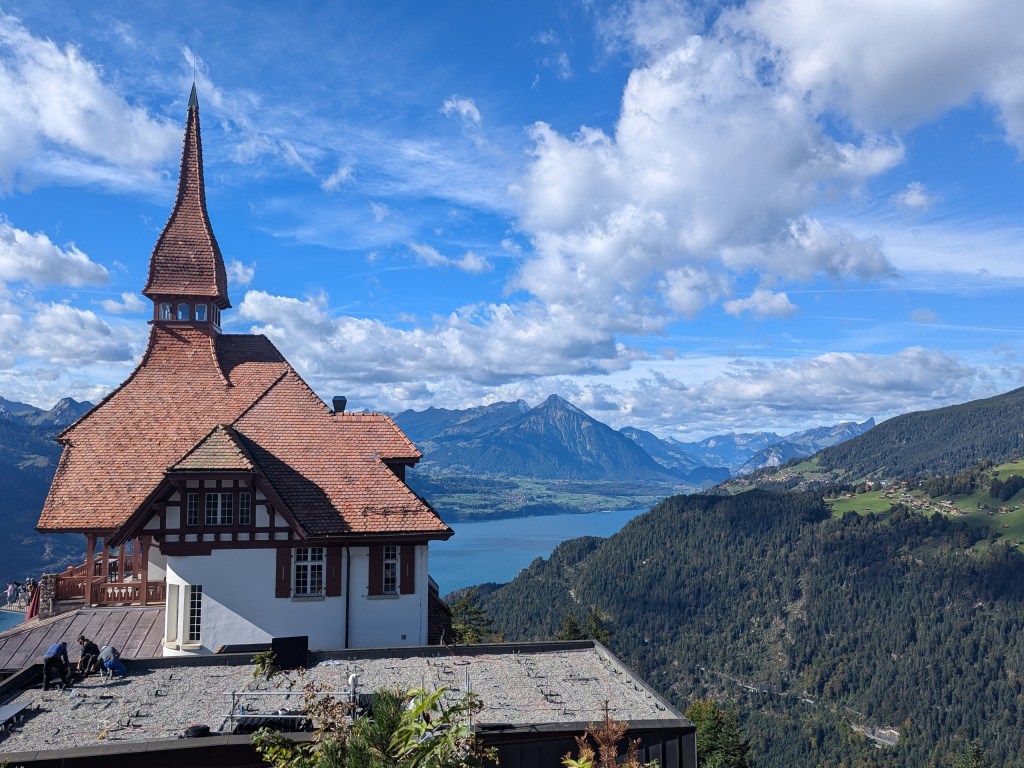
We hiked a bit further up the mountain. Looking down on Harder Kulm, we noticed that solar panels were being installed on the roof.
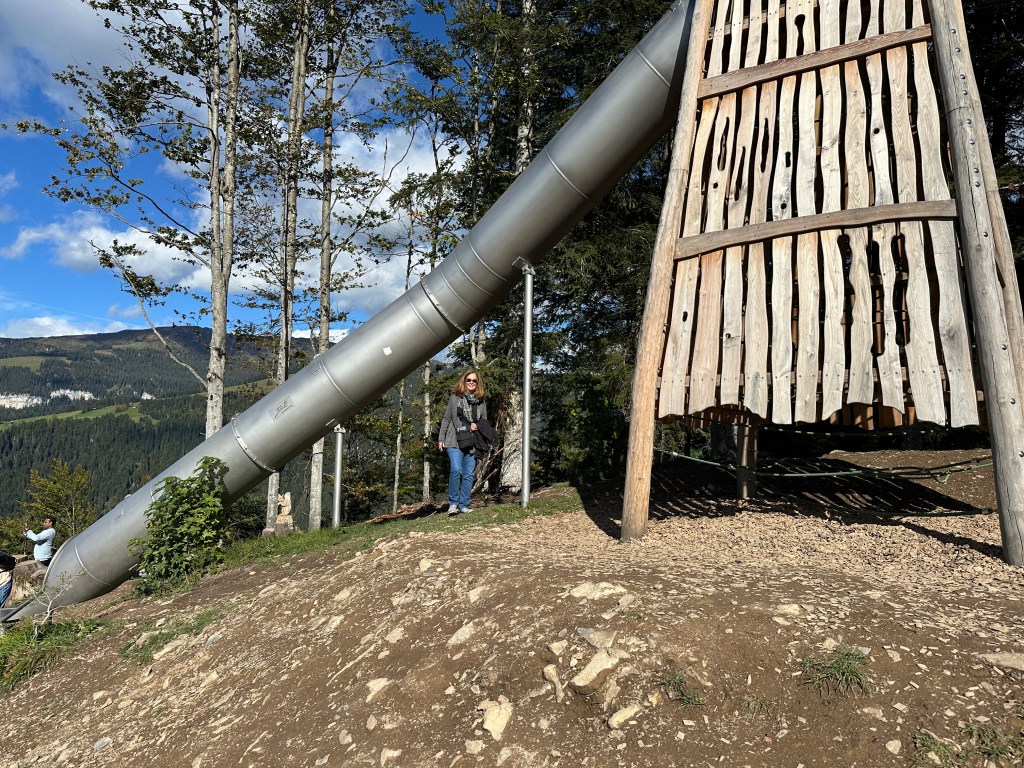
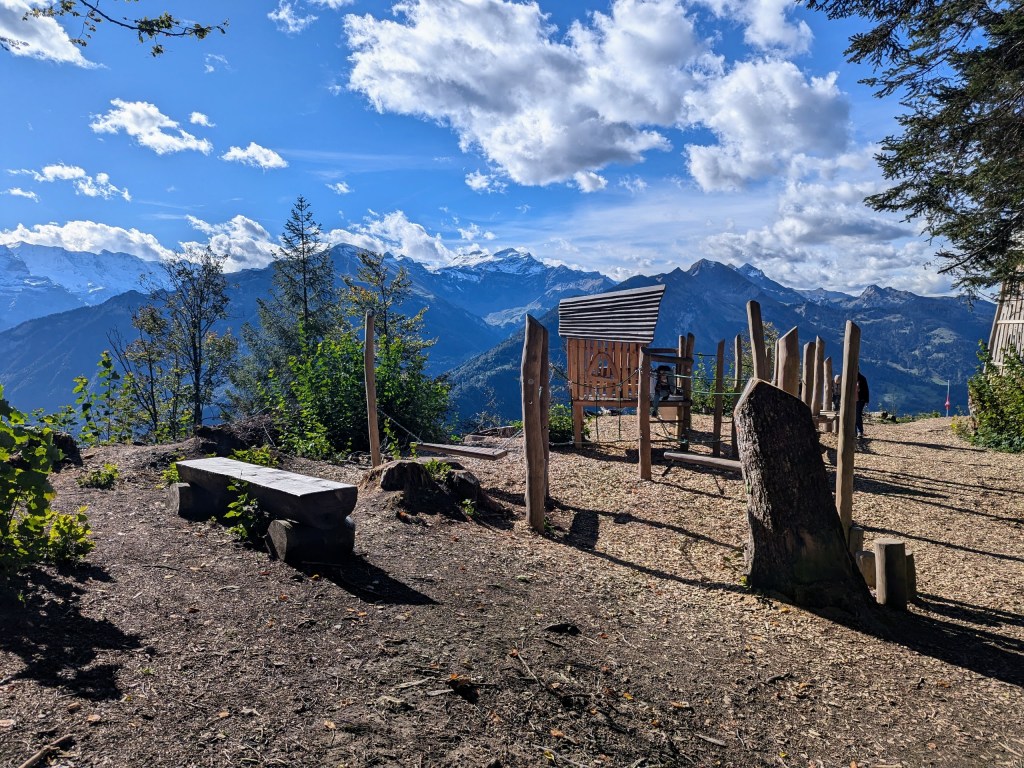
We passed through a playground for children.
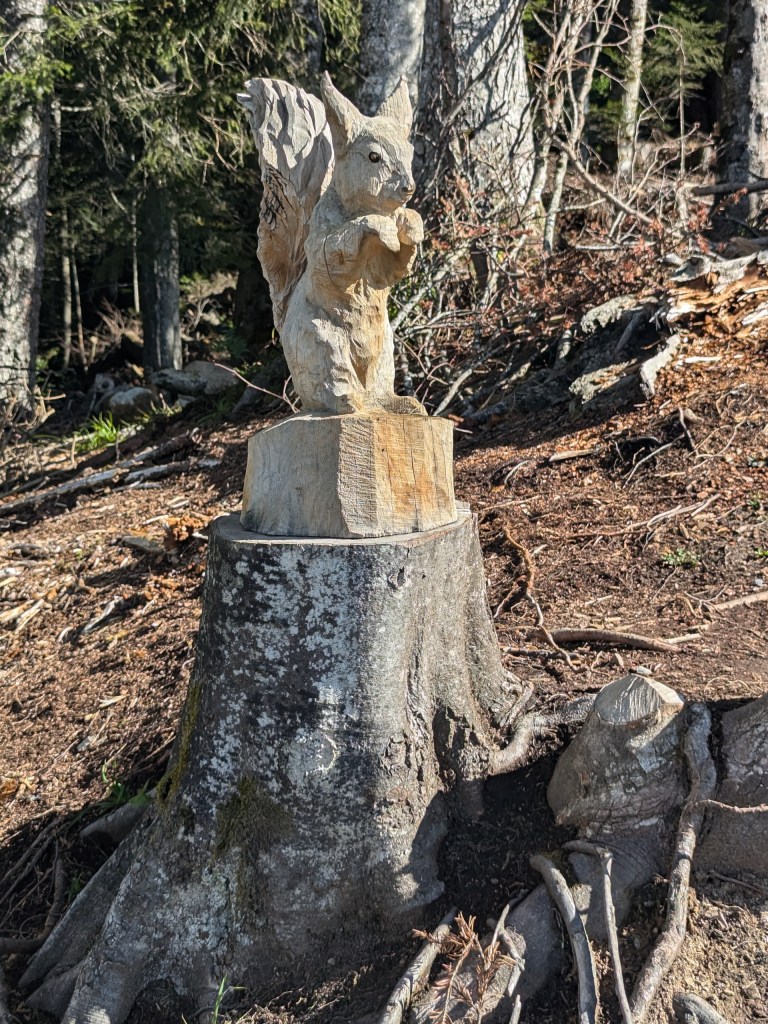
which had some more of these cuties carved right from the trees felled to create the playground..
We climbed higher still and took a hike into the surrounding forrest.
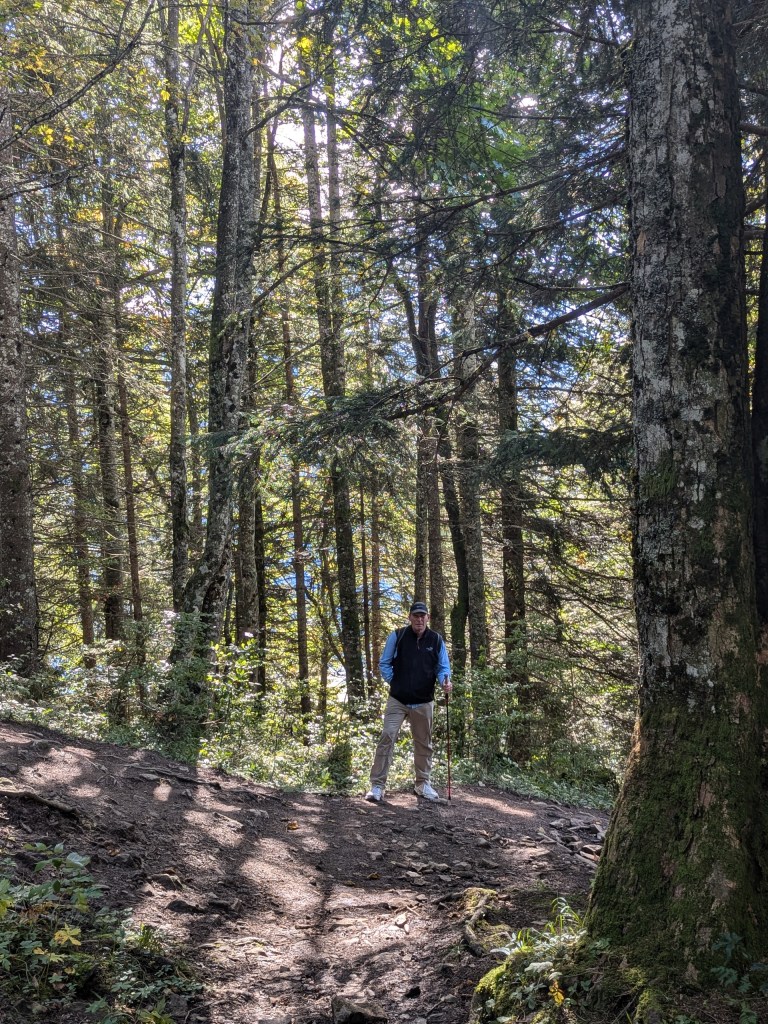
Coming back down out of the woods, we were again struck by the beauty of the view.
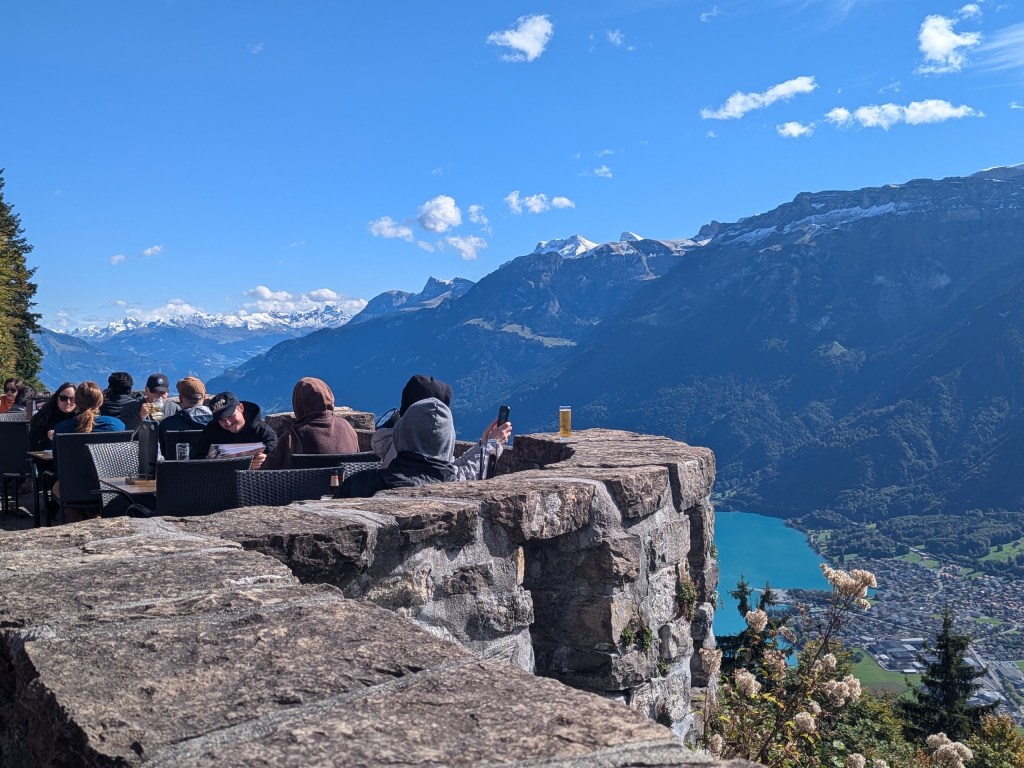
We were not quite ready to leave this glorious place yet, so we had lunch on the terrace.
We just could not get enough of these views!
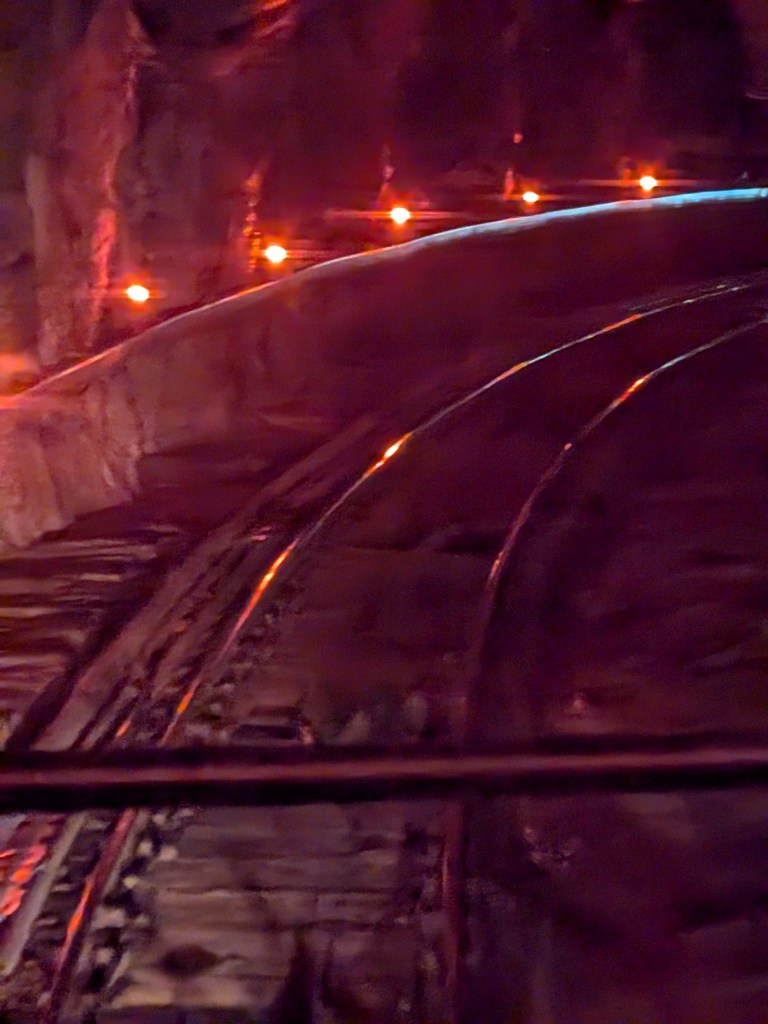
Finally we rode the funicular back down the mountain.

through the tunnel
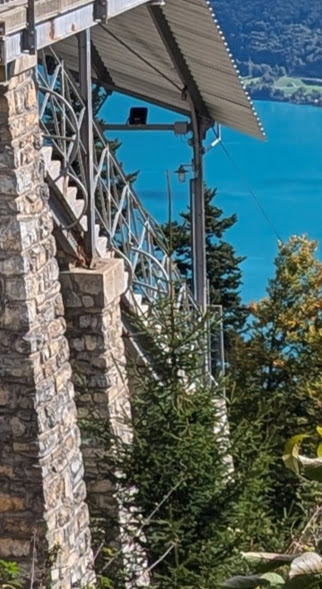
Once on the ground and looking back up, we were able to appreciate the platform from which we took our pictures. I was very happy to have not seen this prior to going onto it, which I had enough trouble doing anyway.

We headed back through town and crossed the River Aare in a different spot this time to see the covered bridges.
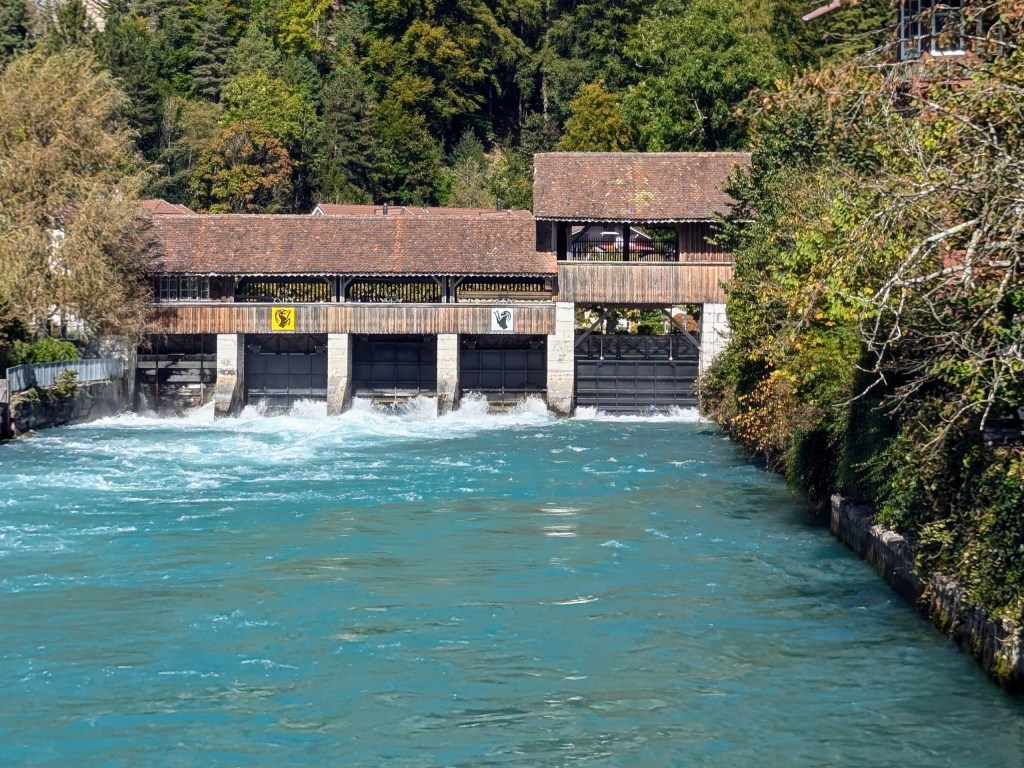
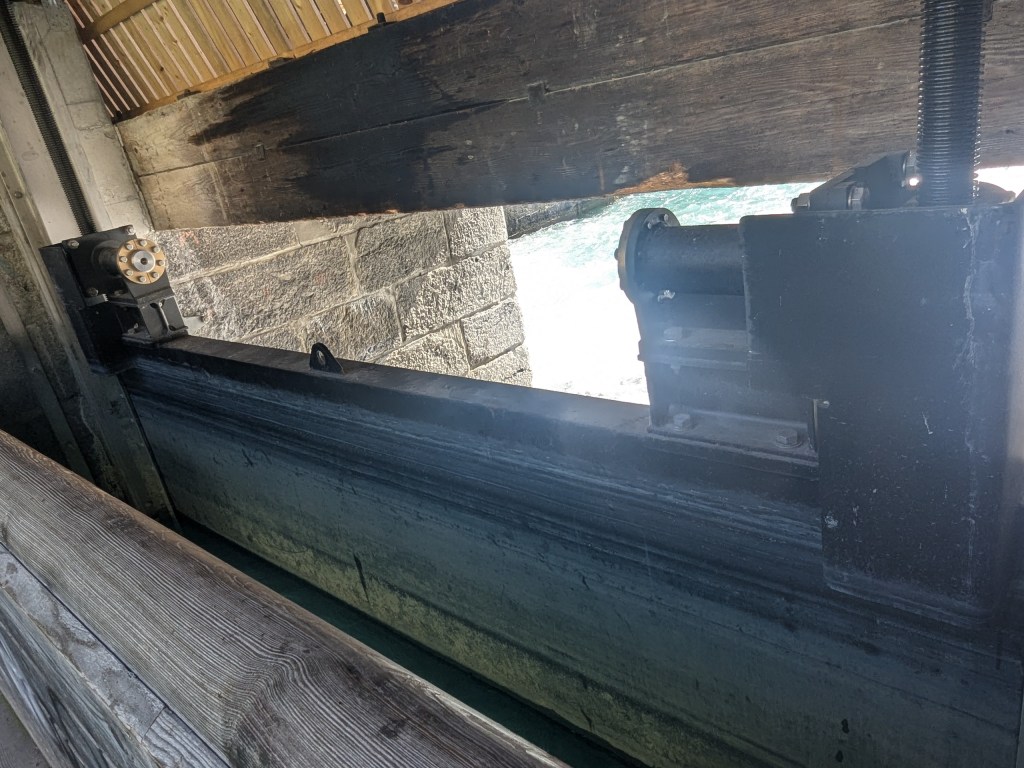
The main one has sluice gates to control the level of the lake. As early as 1433 the monastery built and controlled weirs here to optimize fishing. Later in 1854 sluice gates were installed to control water levels in Bern. Prior to their installation, salmon were able to make their way all the way to remote breeding grounds of eastern Bernese Oberland then the young fry would swim back via Lake Thun, much to the delight of the citizens of Bern. After the sluices were built, fish ladders had been installed to allow movement of fish between lakes Thun and Brienz. Unfortunately flooding in 2005 has damaged the ladders, but most of the species have figured out a way to negotiate the journey, but not yet the salmon.
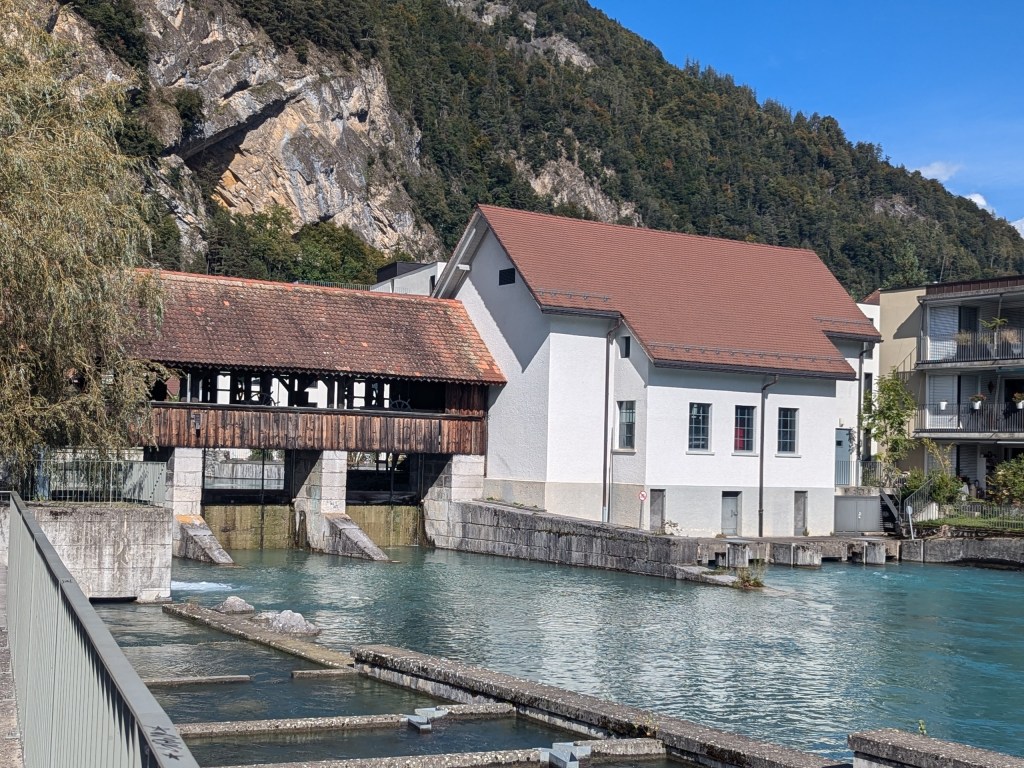
We headed back through the now familiar neighborhood of Interlaken West.
The next day it rained all day. We got out a bit in the morning and souvenir shopped, but while it poured in the afternoon, we took the day off and watched a movie.
 Jo & Eric's travels
Great travelogue, JoAnne. Thanks for sharing! Susan
LikeLike
Wh
LikeLike